Community Health Cell Report by Mr. S J Chander
Item
- Title
- Community Health Cell Report by Mr. S J Chander
- extracted text
-
L'-r1
T
p'/l
.
Rf/DM-^/p^-v/sudho.
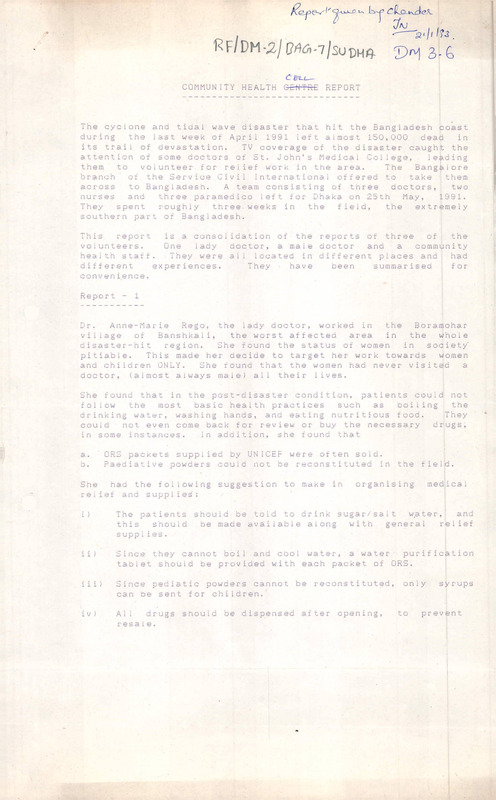
COMMUNITY HEALTH CENTRE REPORT
The cyclone and tidal wave disaster that hit the Bangladesh coast
during the last week of April 1991 left almost 150,000 dead
in
its trail of devastation.
TV coverage of the disaster caught the
attention of some doctors of St. John’s Medical College,
leading
them to volunteer for relief work in the area.
The Bangalore
branch of the Service Civil International offered to
take
them
across
to Bangladesh.
A team consisting of three doctors,
two
nurses
and
three paramedico left for Dhaka on 25th May,
1991.
They
spent
roughly
three-weeks in
the field,
the extremely
southern part of Bangladesh.
This
report
is a consolidation of the reports of three of
the
vo1unteers.
One
lady doctor, a male doctor and a community
health staff,
They were all located in different places and
had
different
experiences.
They
have
been
summarised
f or
convenience.
Repo r t
1
Anne-Marie Rego, the lady doctor, worked in
in
the Boramohar
D r.
the whole
village of
Banshkali,
the worst affected area in
disaster-hit
region.
She found the status of women
in society'
pitiable.
This made her decide to target her work towards
women
and children ONLY.
She found that the women had never visitdd a
doctor, (almost always male) all their lives.
She found that in the post-disaster condition, patients could not
such as
boiling
the
follow
the most- basic health practices
They
drinking water, washing hands, and eating nutritious food.
could not even come back for review or buy the necessary drugs,
in some instances.
In addition, she found that
a.
b.
ORS packets supplied by UNIChF were often sold.
Paediative powders could not be reconstituted in the field.
She had the following suggestion to make in
r e 1 i e f and supplies:
med i ca1
organising
i)
and
The patients should be told to drink sugar/salt water,
re 1i ef
be made available along with general
this
should
suppi ies.
ii)
Since they cannot boil and cool water, a water
purification
tablet should be provided with each packet of ORS.
iii)
Since pediatic powders cannot be reconstituted,
can oe sent for children.
on 1 y
iv )
drugs should be dispensed after opening,
Al 1
resaie.
to
syrups
prevent
V )
The basic diet of rice/chira is not nutr i t i ona f 1 y soibnd for
Groundnuts,
germinated gram iflour,
more than a week.
could
be
made
available.
vege tab 1es and bananas
operat ions.
relief
were neglected in the
She found
that women
’
members
of
They
only
got
relief
as
each,
They were given a. sari
morbidity/morta1ity
of
a. f am i 1 y .
Even though the most numbers
utens
iIs,
operations:
food,
_
rates were for women, all relief
the
were ma 1 e-or i ented.
I r|
rehab i1i tat ion
med i ca1
and
drug list, no drugs relating to women’s diseases were
essential
Therefore,
she suggests
that
ment ioned
or made available,
and
v o1unteer’s should’be sent into the field,
(a)
more women volunteer
made for their stay, (b)
a lady doctor should visit
f ac i1i t i es
villages by rotation, accompanied by male and female paramedicos.
__
for mother and
(c)
"Food for Work" schemes should cook one meal
these women could then be a captive audience for
child, and
(d)
the
health education,
This arrangement could also help beir|g
that
review.
She foun
mother/chi Id unit back for medical
r ought
roughly an equal number of ma 1e and female children were
f
age.
71.8% of the cases were under five years
for
treatment.
that the presence of a lady doctor would def J n i te1y
She feels
immunisation,
health centre for
this age group to the
draw
the expected
Diseases followed
prophylanis, etc.
V i tarn i n
(A)
trend of
gastro-intestinal
diseases
Malnutrition
Respiratory tract
infect ions
She also found a very surprising and interesting fact : there was
in
a high incidence of Iodine deficiency goite among the women
area
the area, which is highly unusual because it is a coas ta lj■j
v egetab
(
1es
even
fish is an important part of the diet, and
and
ser ious
tha t
feels
in saline conditions,
she
are grown
into the prob 1 em to
scientific survey should be conducted
1od i sed
of
identify
the cause, and recommends the prov is ions
salt.
Report
2
John’ s
St.
Sanjev Lewin of the department of pediatrics of
Dr.
team.
He
re
1
i
ef
college
Hospital,
was
also
a
part
of
the
Med ica1
Is
1
ands
within
sent
to
join
a
team
heading
for
the
Southern
was
the Char Passion Upazilla of the Bhola District, after an initial
the area,
He spent 13 days
in
three or four days.
delay of
Motahar,
populations
of
the
four
*
Chars
’
of
the
treating
He
concentrated
on
and
Nwelyn.
primarily
Stephen
Manohar,
He also helped to make a survey and distribute teli ef.
chi 1dren.
He
He made two field trips to be able to contact more patient^39p%
of
500
patients,
64.7%
of
whom
were
male,
pat
i
ents
,
saw over
were
in
they were most
i n the 116-50 year age group as
pat i ents
pat i ents
The under five age group constituted 25.8% of
mob i1e.
seen.
I
He found . that the bulk of the cases were of
Respiratory
tract
parasitic
followed
by
gastroenteritis
and
i nfect i ons,
med i cation.,
such as
i nf es tat i ons.
There was need for simple
t r ac t prjob 1 ems
Te t racycline and penicillin for the respiratory
. and ORS, cotrimexazo1e and Metrogyl for g-i tract prob 1 ems
Dr. Lewin has a number of suggestions to offer on the sub j e|c t
organising medical relief in disaster s i tuat ion.
of
1)
A med i ca1 team with specific aims and objectives will be more
was
than individuals being distributed at random, as
effective,
work
to
He would personally have preferred
the case with us.
which went to so much of trouble and expense on his
with SCI,
1 ess
much
than working with an NGO which was
rather
account,
committed to them.
2)- The best use of the team's time and energy could be savsed for
if travel arrangements and field placements could
re 1ief
work
SCI lost a lot of
have been planned in detail much in advance.
redistribute
team
members
to other
t i me and money in trying to
NGO*s.
3)
Medical services should not be equated with distribution of
rice,
like
mater i a 1 : medicines should not be handed out
r e1i ef
when
espec
ia
1
1
y
It
is
a
criminal
waste
of
expensive
medicine,
is
used in nonindicated illnesses.
This
4)
Medicines could be bought in bulk using generic names.
emergency
The
WHO
the
field,
out
much
cheaper
in
will
w o i- k
accept i ng whatever
of
be adhered to, instead
mannuai
should
try
to
palm
off.
pharmacenticals
insuf f io ient 1y
medicine were
5)
The preventive aspects of
The
use
of
a
motivated
paramedic
to
follow
up causative
covered.
The fol lowing tasks could have
factors would have been ideal.
been taken up by the paramedico:
Chlorination of identified- wel Is.
More tubeweIls.
~ * Education on the use of safe drinking water, hyg iene, na i 1
cutting and hand washing.
Clothes for children, especially as most respiratoryf cases
could have been associated with exposure to the wit and
co id el ements.
I •
Regular medical- services.
Immunisation as a Priority.
oca 1ly
- Diet and Nutrition advice and rehabilitation with
available shrimp, fish, shegs and snails..
is essential to have simpje iron and Vitamin
6)
It
(only
in such situations) to use as placebos.
tab 1ets
B
camp 1 ex
time and
7)
The dedicated staff need periodic orientations in
f
act
1 that
There should be stress on the
manpower utilisation.
for
need
There is
the
leader is basically a member of a team.
of
others*
on problems and strategies, acceptance
discussions
menial
/
mannua1
and
active
participation
in
even
the
most
ideas,
alongside
team
members.
of work
ideal routes and
8)
With repeated visits to fixed destinations,
modes of transport should be arrived at, and communicated clearly
This will enable a
to the various groups involved in the work.
trip
smooth use of manpower and goods everytime, instead of each
T i me Management is totally lacking as a ya 1ue.
being uncertain.
diagnos is
and
recognised
treatment
9)
Internationally
that
should
be used,
in the field so
protocols/schedules
doctors
being
c an be used even without med ica1
med icines
Med i c i ne r equirements should be standardised and only
a v a i 1 a b 1 e.
essential drugs used, which will lead to economical services, eg :
Acute watering diarrhoea : dehydration - ORS
Acute Blood/Mucus Diarrhoea - Metrogy1/Cotrimoxazoie
10)
School-teachers
can be used to
teach basic health
hygiene to children in makeshift schools, and these children
then spread the message back into their orthodox homes.
and
can
11)
Feedback on people’s needs should be given to the government
by
officials at the upazilla levels ie, need for schools, visits
visits
by
to meet the people, weekly
administrative officials
doctors, Immunisation programmes etc.
hy g i ene and
12)
He
feels
there is a total lack of
personal
v o ljun teers
knowledge of
nutrition education among people and
in
malnutrition
alike.
There is gross, widespread and chronic
immuq isat ion
the area.
Helminthiasis was widespread.
Total
15
failure since
1971, evidenced by children upto the age I of
’y
1: ack i ng .
lacking BCG vaccinations.
Medical services are totally
at a
Infants and children are exposed to the forces of nature,'
time when they need protection most.
- Media
 RF_DM-2_BAG-7_SUDHA.pdf
Position: 3106 (4 views)