The basic principles of rehabilitation, Role of NGO's, Key indicators to be monitored
Item
- Title
-
The basic principles of rehabilitation,
Role of NGO's, Key indicators to be monitored
- extracted text
-
Rr
/ dp -61
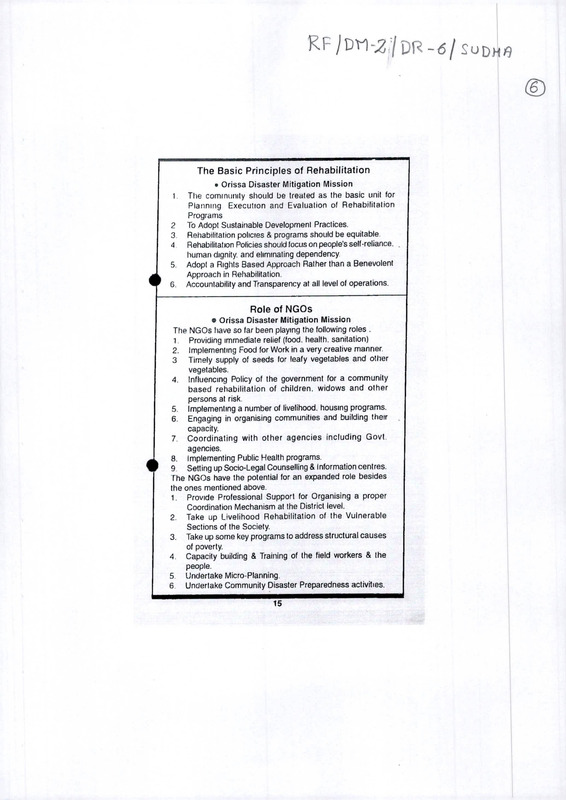
The Basic Principles of Rehabilitation
1.
2
3.
4
5.
6.
• Orissa Disaster Mitigation Mission
The community should be treated as the basic unit for
Planning Execution and Evaluation of Rehabilitation
Programs
To Adopt Sustainable Development Practices.
Rehabilitation policies & programs should be equitable
Rehabilitation Policies should focus on people's self-reliance,
human dignity, and eliminating dependency
Adopt a Rights Based Approach Rather than a Benevolent
Approach in Rehabilitation.
Accountability and Transparency at all level of operations.
Role of NGOs
• Orissa Disaster Mitigation Mission
The NGOs have so far been playing the following roles .
1. Providing immediate relief (food, health, sanitation)
2. Implementing Food for Work in a very creative manner.
Timely supply of seeds for leafy vegetables and other
3
vegetables.
4. Influencing Policy of the government for a community
based rehabilitation of children, widows and other
persons at risk.
5. Implementing a number of livelihood, housing programs.
6. Engaging in organising communities and building their
capacity.
7. Coordinating with other agencies including Govt,
agencies.
8. Implementing Public Health programs.
9 Setting up Socio-Legal Counselling & Information centres.
The NGOs have the potential for an expanded role besides
the ones mentioned above.
1. Provide Professional Support for Organising a proper
Coordination Mechanism at the District level.
2. Take up Livelihood Rehabilitation of the Vulnerable
Sections of the Society.
3. Take up some key programs to address structural causes
of poverty.
4. Capacity building & Training of the field workers & the
people.
5. Undertake Micro-Planning.
6. Undertake Community Disaster Preparedness activities.
15
Key Indicators to be monitored
• Orissa Disaster Mitigation Mission
I.
1.
2
3
4
LIVELIHOOD
Wages Employm. r.t No. of Person Days Created (Farm. Non-Farm Others)
Farm Employment No. of farmers. Restoring their Agricultural Livelihood
Self Employment No. of Self Employment Units Restarted
Food Availability Quantity of food available (at different levels Household. PDS.
Market levels)
II.
5
6
III.
8
9.
IV.
10.
11
12
13.
HEALTH
Safe drinking & bathing water No. of safe Drinking Water Sources Available
(giving adequate quantity ol water for 100 households) - No. of pon , ready for
bathing purposes
Public Awareness No of villages covered under preventive care & hygiene
promolion. No. of villages made aware of prevention against sunstroke
SOCIAL SECURITY
Rehabilitation of Orphans . No of Orphans Rehabilitated
Rehabilitation of Widows . No of Widows Rehabilitated
Rehabilitation of Old & Disabled & Persons at Risk No of Persons Rehabilitated
HABITAT (Ecology & Housing)
Nurseries .
No of Seedling Raised
Plantation
No of Trees Planted
Individual housing
No of New houses constructed
No of Houses Repaired
Public Buildings
No of Schools Rebuilt
No of Schools repaired (Primary. Secondary)
No. of Community Centres Built ( Cyclone Shelters,
others)
V.
DISASTER PREPAREDNESS
Preparedness of the Villagers No of villages covered under Community
Preparedness Program
15. Institutional Preparedness Strengthening at GP/Block/District level Setting up of
specialized institutions at state level
16. Disaster mitigation plan/Policy Review of Orissa Relief Code Review of best _
practices worldwide, Preparation of a Blue print for a Comprehensive Disaster '
Mitigation Plan.
14.
Cover Photo : CYSD. Orissa
Published by :
Bharat Dogra
C-27, Raksha Kunj, Paschim Vihar. New Delhi-110063
Composed by :
Studio Coalesce
3/33. Moti Nagar, New Delhi-15
Printed by .
Kulshrestha Printers
11 . Tyagi Vihar. Nangloi. Delhi-110041
16
- Media
 RF_DM-2_DR-6_SUDHA.pdf
Position: 3490 (3 views)