PREVENTION AND TREATMENT OF VITAMIN A DEFICIENCY.pdf
Media
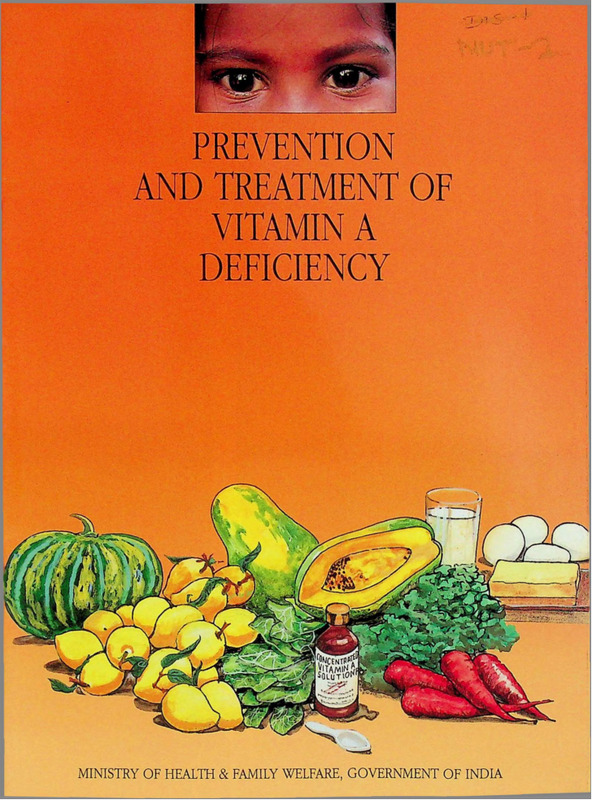
- extracted text
-
PREVENTION
AND TREATMENT OF
VITAMIN A
DEFICIENCY
MINISTRY OF HEALTH & FAMILY WELFARE, GOVERNMENT OF INDIA
PREFACE
In recognition of the magnitude of the problem
of vitamin A deficiency, India was the first country to
launch a national programme for prevention of
blindness in 1970. The overall strategy includes long
and short term measures. The long term measures
are designed to increase the availability and
consumption of foods rich in vitamin A. The
administration of concentrated dose supplement of
vitamin A to children between the ages of 6 months
to 5 years constitutes the short term measure to
prevent blindness and offer relief from other
debilitating effects of vitamin A deficiency.
The National Programme has been reviewed by
the National Institute of Nutrition in 1978 and the
findings indicate a need to improve the awareness of
concerned health professionals and programme
managers as well as elicit community participation in
order to achieve the desired impact.
The Department of Health and Family Welfare
set up a Task Force on Vitamin A in 1989 to
formulate policies and streamline procedures for
improving the implementation of the vitamin A
programme. In this effort, a booklet for health
professionals and programme managers has been
developed to provide the requisite information and
encourage interlinkages with other professionals
particularly of the ICDS scheme. Professionals
engaged in the National Prophylaxis Programme
against Blindness due to Vitamin A Deficiency have
an excellent opportunity and great responsibility in
controlling easily preventable nutritional blindness.
(K.B. Banerjee)
Deputy Commissioner (MCH)
Ministry of Health & Family Welfare
This booklet is addressed to:
• Medical Officers (PHC)
• Project Officers & Supervisors (ICDS)
• Health Administrators
• Programme Managers
engaged in the National Programme on
“Prophylaxis against Blindness due to Vitamin A
Deficiency".
CONTENTS
1. VITAMIN A DEFICIENCY IN INDIA
1
A.
Vitamin A Deficiency Problem
1
B.
Vitamin A Deficiency - How & Why
2
2. DIAGNOSTIC CRITERIA FOR
VITAMIN A DEFICIENCY
A.
B.
Ocular Signs & Symptoms
Recognition of the Signs & Symptoms of
Xerophthalmia .
3. THE NATIONAL PROGRAMME
3
3
4
5
A.
Short-term Strategy
5
B.
Long-term Strategy
8
C.
Towards Effective Implementation of
the National Programme
11
4. SUMMARY
12
5. REFERENCES
13
/ VITAMIN A DEFICIENCY IN INDIA
A.
VITAMIN A DEFICIENCY
PROBLEM
Vitamin A deficiency has been
recognised as a major controllable nutritional
problem in developing countries. The role of
vitamin A in preventing nutritional blindness is
well documented. According to rough
estimates 30-40,000 children may lose their
eye sight due to vitamin A deficiency in India
(1) . An adequate vitamin A status prevents
nutritional blindness. Evidence is accumulat
ing that it also contributes significantly to
improved child health as well as reduced mor
tality. The mechanism by which it has this
effect is unclear.
Vitamin A deficiency is a serious
public health problem in India
Prevent Vitamin A deficiency.
Prevent blindness, and reduce
risk of disease and death.
In Indonesia, children with vitamin A
deficiency have been shown to be two to three
times more prone to develop diarrhoea and
ARI (2). These two diseases account for
nearly half the childhood deaths in India (3)
(Figure 1).
Measles can severely deplete vitamin A
stores, leaving a child more vulnerable to
other diseases such as pneumonia, diarrhoea,
and xerophthalmia. Every year, thousands of
children die as a result of measles and its
secondary complications. In addition, this can
lead to a destruction of cornea and blindness.
MORTALITY PATTERN IN THE 1 — 4 YEARS AGE GROUP
Figure -1
SOURCE: Registrar General of India (3)
B.
VITAMIN A DEFICIENCY
HOW AND WHY?
Vitamin A deficiency results in
xerophthalmia i.e. drying of conjunctiva and
cornea followed by destruction of cornea and
blindness. Xerophthalmia occurs when the
body stores of vitamin A are exhausted and
the supply fails to meet requirements. This can
occur due to:
2 I
•
Low dietary intake of vitamin A rich foods
•
Interference in absorption or transport of
retinol in the body & rapid loss of vitamin
A from the body
•
Low Dietary Intake
Dietary deficiency of vitamin A rich food is
the primary cause for depletion of the
body stores of vitamin A and occurrence of
xerophthalmia.
• Interference with Absorption,
Transport & Rapid loss
Absorption of the vitamin is impaired and
the metabolic demands increase in
children suffering from diarrhoea,
respiratory
infections,
measles,
gastroenteritis and other diseases. This sets
up a vicious cycle of infections leading to
vitamin A deficiency. This deficiency in
turn reduces resistance to infection
resulting in more infections. Consequently,
it sets the child on a downward spiral of ill
health.
Vitamin A deficiency is
primarily due to low dietary
intake. It is aggravated by
infections which reduce its
absorption and utilization.
DIAGNOSTIC CRITERIA FOR
VITAMIN A DEFICIENCY
mnnnnmununnnnunoa=nnanmnnnnununnnner
A.
OCULAR SIGNS AND
SYMPTOMS
Although vitamin A deficiency affects
many tissues in the body, it is most detrimental
in its effects on the eye resulting in blindness.
The surface of the cornea becomes dry and
rough, and may ultimately break down
partially or completely. This may lead to
ulceration, which causes permanent scarring
or irreversible damage and loss of sight.
The ocular signs are considered the most
reliable criteria for identifying vitamin A
deficiency . Severe forms of the disease can
appear quickly without preceding milder signs
and symptoms appearing in sequential
progression.
A classification of the disease according
to eye symptoms and prevalence levels above
which it is considered a public health problem
is shown in Table 1 & 2.
Classification of Xerophthalmia by eye
(ocular) signs
Night blindness
(XN)
Conjunctival xerosis
(XIA)
Bitot’s spots
(X1B)
Corneal xerosis
(X2)
Corneal ulceration/keratomalacia < 1/3
corneal surface
(X3A)
Corneal ulceration/keratomalacia > 1/3
corneal surface
(X3B)
Corneal scar
(XS)
Xerophthalmic fundus
(XF)
Table -1
SOURCE: WHO (4)
Prevalence criteria (in percentage of preschool-age population, 6 months to 6 years old, at
risk) for determining the public health significance of xerophthalmia and vitamin A
deficiency.
CRITERIA
Night blindness (XN)
in > 1.0 %
Bitot’s spots (X1B)
in > 0.5 %
Corneal xerosis / Corneal
ulceration/keratomalacia (X2/X3A/X3B)
in > 0.01 %
Corneal scar (XS)
in > 0.05 %
Plasma vitamin A of <0.35 umol/l (10ug/dl)
in > 5.0 %
Table - 2
SOURCE: WHO (4)
B. RECOGNITION OF THE SIGNS AND SYMPTOMS OF XEROPHTHALMIA:
Night blindness The first symptom of xerophthalmia. A child cannot see to
get around after dark or in a dark room.
Bitot’s spots Although Bitot’s spots differ somewhat in size, location, and
shape, they have a similar appearance. They are
accumulations of foamy cheesy material on the conjunctiva,
often in association with other signs of xerophthalmia such
as night blindness.
Corneal xerosis/ulceration The cornea becomes dry' (xerosis). If the disease is not
treated, the xerosis can progress within hours to an ulcer of
the cornea.
Keratomalacia If the disease is not treated, a corneal ulcer can lead to
“melting” or “wasting” of the cornea (keratomalacia).
Corneal scar Keratomalacia can lead to perforation of the cornea. At this
stage, a corneal scar will remain in the eye. The sooner the
disease is treated, the smaller the ulcer and the smaller the
scar which will remain forever. If treated early, corneal
scars and blindness can be prevented.
COLOUR PLATES - HELEN KELLER FOUNDATION (5)
THE NATIONAL PROGRAMME
India was the first country in the world
to implement a National level Programme for
prevention of Vitamin A Deficiency in
children under five years of age.
The “National Prophylaxis Programme
against Blindness due to Vitamin A
Deficiency” was started in 1970, initially in
seven states where the incidence of the
problem was higher. By 1975, it was extended
to other regions of the country as a national
programme.
The Programme today covers 30 million
children under five years of age and utilizes
two major strategies:
A. Short-term:
B. Long-term:
Administration of megadose
of vitamin A solution
periodically to children
under five years.
Promotion of dietary intake
of vitamin A.
A.
SHORT TERM STRATEGY
The short term strategy focuses on
periodical provision of a massive dose of
vitamin A solution to children under five years.
This approach is based on the property of
vitamin A that it can be stored in liver and
utilised slowly over time.
Children under five years are at the
highest risk of blindness due to vitamin A
deficiency. In the past, pre-school children (15 years) were covered under the Programme.
The National Programme is now being
extended to cover children 6-11 months and a
priority is being proposed for children 6
months to 3 years.
Vitamin A supplementation, adminis
tered periodically, is effective and safe. When
vitamin A is administered in doses as
recommended, there are rarely any adverse
effects. Side effects such as headache and
vomiting may occur sometimes, but these are
rare, mild and transitory and do not require
any treatment.
Prevention of blindness due to vitamin A
deficiency
The recommended oral dose is :
Children
6-11 months
one dose of 100 000IU of
vitamin A orally.
(Measles immunisation is a
good time to give a routine
dose.)
Children
1-5 years
one dose of 200 000 IU of
vitamin A orally every six
months.
Treatment of vitamin A deficient cases
Effective intervention can save
the sight of millions of
children in our country.
All children suffering from vitamin A
deficiency must be administered a single oral
dose of 200 000 IU of vitamin A immediately
on diagnosis. This should be followed by
another dose of 200 000 IU of vitamin A one to
four weeks later. Regular consumption of
vitamin A rich foods such as dark green leafy
vegetables and yellow vegetables and fruits
(carrots, pumpkin, sweet potato, papaya,
mango) must be encouraged to prevent
recurrence.
Children who suffer from diarrhoea,
acute respiratory infections and measles
should be monitored carefully and given
usual prophylactic doses of Vitamin A.
Vitamin A Concentrate
Vitamin A solution for the National
Programme is supplied as a flavoured syrup in
100 ml bottles with a concentration of 100 000
IU vitamin A/ml. A spoon measure of 2 ml
solution is supplied with each bottle. A spoon
of syrup to the marked level provides the
recommended dose of 200 000 IU vitamin A.
Vitamin A does not require any special storage
measures such as a cold chain. However, it
should be stored in a cool dark room
protected from direct sunlight.
The bottle once opened must be utilised
within 6-8 weeks. The shelf life of a sealed
bottle of vitamin A solution stored in cool dark
place is about one year
The price of the syrup is around Rs.
25.00 per bottle of 100 mi or 50 paise per dose
of 200 000 IU vitamin A. The solution is
provided free of cost to the community
through primary health centres (PHCs).
A single spoon measure (2 ml) of200 000 IU of
Vitamin A.
Keep Vitamin A solution away
from sunlight A sealed bottle
can be kept at room
temperature for one year.
However, a bottle once opened
must be utilised within
6-8 weeks.
Additionally, fixed dose vitamin A cap
sules (100 000 IU), are also being supplied for
infants. The content of the capsule should be
squeezed gently and completely into the
mouth of the infant after snipping an end of
the capsule with a pair of scissors or a clean
razor blade.
Oral Dose -Vitamin A
One dose of 100 000 IU to infants (6-11 months).
Six monthly doses of 200 000 IU to children 1-5 years of age.
6
Procurement and Distribution
The Ministry of Health and Family
Welfare, supplies the vitamin A syrup. The
indent of supplies should be made by the
medical officer of the PHC on the basis of
expected number of beneficiaries i.e. children
6 months to 5 years of age.
i) Department of Health and Family
Welfare
The Maternal & Child Health (MCH)
Division, Department of Health and Family
Welfare is the nodal department responsible
for the overall administration of the
Programme. In rural areas the Programme is
implemented through the Primary Health
Centre (PHC) and its sub-centres, under the
supervision of the Medical Officers. The
medical officer of PHC is in-charge of
indenting of supplies of vitamin A, coverage of
beneficiaries and monitoring of the
programme.
The Auxiliary Nurse Midwife and other
paramedicals at PHCs are responsible for
administering vitamin A solution to children.
The Universal Immunisation Programme
offers opportunity to reach infants. The
contact with children between the ages of 9-12
months for measles vaccination provides an
excellent opportunity for administering the
first dose of vitamin A solution, 100 000 IU for
infants.
11) Department of Women and Child
Development
The Integrated Child Development
Services (ICDS) Programme provides an
opportunity to distribute vitamin A to children
six months to five years. In places where ICDS
is functioning, the Anganwadi workers should
participate not only in the identification of
children but also assist in the administration of
vitamin A and in imparting nutrition
education.
TOEOnsse
Monitoring
A child should receive a total of 9 oral
doses of vitamin A by the fifth birthday.
The Mother -Infant Immunisation Cards
should be used to record and monitor the
vitamin A doses administered to children
under two years.
addition to immunisation and growth cards,
such records are recommended to be used for
identifying as well as monitoring children for
administration of all 9 doses of Vitamin A. A
sample format for vitamin A monitoring is
given in Table 3.
B.
LONG TERM STRATEGY
1.
Consideration of Causes
Dietary deficiency is the primary cause
for depletion of body stores of vitamin A and
occurrence of xerophthalmia.The dietary
intake of vitamin A has been reported to be
much below the recommended daily
allowance (Figure-2) in all the ten states
surveyed by NNMB (6).
All children under six years are being
monitored for their growth under the ICDS
Programme. The usage of Growth Monitoring
Card is a practical method for recording and
monitoring administration of vitamin A
solution till the age of five years.
Under the MCH services and the ICDS
Programme, a list of under-fives is maintained
by the health and anganwadi workers. In
The vitamin A and carotene (vitamin A
precursor) deficient diet of the preschool
children, who comprise the ‘at risk group’ is of
particular concern. Their intake is reported to
be well below half the recommended
allowances of 400 pg of retinol or 1600 pg
B -carotene per day (7-9).
Absorption of the vitamin is reduced in
children suffering from diarrhoea, respiratory
infections, gastroenteritis, measles and other
diseases. The prevention and control of
infection & malnutrition by immunisation,
proper nutrition, oral rehydration and timely
medical care contribute towards the
prevention of vitamin A deficiency.
Name
of the
child
Mother’s
name
Date
of
Birth
Sex
Address
1. Sonu
Mangala
17.1.88
F
Katpara
17.10.88
17.4.89
2. Pratap
Krishna
29.1.88
M
Katpara
29.10.88
29.4.89
Table - 3
Dates of Administration
of vitamin A
1
2
A sample format for Vitamin A monitoring
SOURCE: NNMB (6).
2. Ultimate Solution
The ultimate solution for the prevention
of vitamin A deficiency is regular consumption
of vitamin A rich foods which are cheap and
locally available. Vitamin A consumption must
be ensured from birth itself. Breast feeding,
including feeding of colostrum, will protect
children from vitamin A deficiency during the
first six months. From the age of four to six
months, it
is crucial to introduce
complementary (semisolids) food containing
rich sources of vitamin A such as dark green
leafy vegetables and yellow vegetables and
fruits (carrots, capsicum, yam, pumpkin,
papaya, mango). Most leafy vegetables contain
more than the recommended dietary
allowance (RDA) of vitamin A for Indian
children in about 100g edible portion. This
quantity, on cooking, is reduced to two
tablespoons. A child can easily consume this
amount with other food items, thereby
meeting its total daily requirement (10).
In addition to green leafy vegetables as
far as possible, incorporation of other vitamin
A rich foods such as dairy products (milk,
cheese, curd , butter,)liver, eggs, oil and fat
should be encouraged in the daily diet of
preschool children who are prone to develop
vitamin A deficiency. Such food practices will
prevent vitamin A deficiency.
Breast feeding protects against
vitamin A deficiency during first
6 months of infancy. Colostrum
is rich in vitamin A.
7015222
Daily consumption of dark green leafy
vegetables and other vitamin A rich food is
also recommended during pregnancy and
lactation. Mother’s vitamin A status influences
the vitamin A content of mothers milk and the
health status of her children. Adequate intake
of vitamin A rich food during pregnancy and
lactation will prevent vitamin A deficiency
both in mother and child.
Nutrition education, an integral
component of Primary Health Care and ICDS
Programmes, must emphasise on promotion of
foods rich in vitamin A.
The ultimate solution lies in educating
people to eat food rich in vitamin A.
Ensure regular and adequate intake of
vitamin A by preschool children,
pregnant and lactating women.
Promote daily consumption of
dark green leafy vegetables and
yellow fruits and vegetables to
prevent vitamin A deficiency.
Foods rich in Vitamin A
• Green leafy vegetables
• Yellow fruits and vegetables
(Papaya, Mango, Pumpkin,
Chillies, Carrots)
• Milk, Cheese, Curd, Butter,
Eggs
• Liver, fishes
• Red palm oil
Dark green leafy vegetables and Yellow/Orange
vegetables
10
Yellowfruits
Dairy Products & Eggs
C.
TOWARDS EFFECTIVE
IMPLEMENTATION OF THE
NATIONAL PROGRAMME
The effective implementation of the
programme can only be achieved with trained
staff and by creating a high level of
community awareness.
The training should be imparted to the
entire health delivery team and to
functionaries of Integrated Child Development
Services (ICDS) Programme. This will help the
workers from both sectors in executing their
role and responsibility towards effective
implementation of the Programme.
Training of health and ICDS functionaries on
prevention of vitamin A deficiency.
The training should focus on :
11
•
Effect of vitamin A deficiency.
•
Recording signs and symptoms of vitamin
A deficiency.
•
Identifying beneficiaries.
•
Prevention and Treatment with massive
dose of vitamin A including indent of supplies.
•
Prevention of vitamin A deficiency by
promoting consumption of locally available
vitamin A rich foods. Specific messages
and effective methods of communication.
•
Encouraging community participation.
•
Recording
procedures.
system
and
reporting
Community education on prevention of vitamin
A deficiency.
MBOdOOnOOOOOOOOONOOOOTOSOTORWOROODOMOOTTTO —
Vitamin A deficiency is a major public
health problem among pre-school children in
India. According to rough estimates, every
year thirty to forty thousand children may
become victims of preventable blindness.
Vitamin A deficiency increases the
susceptibility of children to infections and
possibly influences morbidity and mortality.
The
benefits
of
vitamin
A
supplementation makes the “National
Prophylaxis Programme against Blindness due
to Vitamin A Deficiency” extremely cost
effective.
The health and ICDS administrators and
programme managers can form an effective
partnership in saving the sight and improving
lives of millions of children.
The National Prophylaxis Programme
against Blindness due to Vitamin A Deficiency
today covers 30 million children under five
years of age and utilities two major strategies
— short term and long term strategy. The
former entails mass distribution of a megadose
of vitamin A to children between 6 months to
5 years of age. The latter emphasises the
improvement of dietary intake of vitamin A
through regular consumption of vitamin A rich
foods such as dark green leafy vegetables,
yellow vegetables & fruits, dairy products and
the promotion of breast feeding. Educating the
people and increasing regular consumption of
vitamin A rich foods which are cheap and
locally available is encouraged since this is the
ultimate solution for the prevention of vitamin
A deficiency.
12
REFERENCES
C ---------------------------------------------------------------------------------------------------------------------------------------------0
I
13
1.
Menon K and Vijayraghavan K. Sequelae of severe xerophthalmia-A follow-up study. Am. J.
Clin. Nutr. 33:218, (1980).
2.
Sommer A, Jounne Katz MS, Ignatius Tarwotjo MPH. Increased risk of respiratory disease and
diarrhoea in children with pre-existing mild vitamin A deficiency. Am. J. Clin. Nutn. 40:
1090, (1984).
3.
Registrar General of India Survey of causes of death (rural) - Annual report 1986 Table 6,
(1988).
4.
WHO. Control of vitamin A deficiency and Report of a joint WHO/UNICEF/USAID/Hellen
Keller Interantional/IVACG Meeting Technical Report Series 672, WHO, Geneva, (1982).
5.
Helen Keller International. Vitamin A — Child Survival, (1987).
6.
NNMB. Interim Report ofRepeat Survey (.Phase D 1988-89 NIN, Hyderabad, India (1989).
7.
Narasinga Rao BS, Deosthale YG, Pant KC. Nutrient Composition of Inidan Foods. NIN,
Hyderabad, India, pp 94, (1989).
8.
ICMR. Studies on preschool children during 1968-70. Technical Report Series, 26, ICMR,
India, (1975).
9.
NNMB. Survey during 1975-78NNMB, India, Report (1979).
10.
Indirabai K, Bhatt JV, Vaidyanathan K. Leaf& Life. Programme for the prevention of Blinding
Malnutrition in Children, Royal Commonwealth Society for the Blind (India), (1986).
Produced with assistance from UNICEF, New Delhi.
NDQ-1191-HEA-077-E.30-91/2915-1625-R.1/PARKSONS
Ministry of Health & Family Welfare, Government of India.
Position: 5769 (1 views)