FRCH NEWSLETTER VOL.3-No. 1-5-JAN -FEB-MAY- SEPTEMBER-1989.pdf
Media
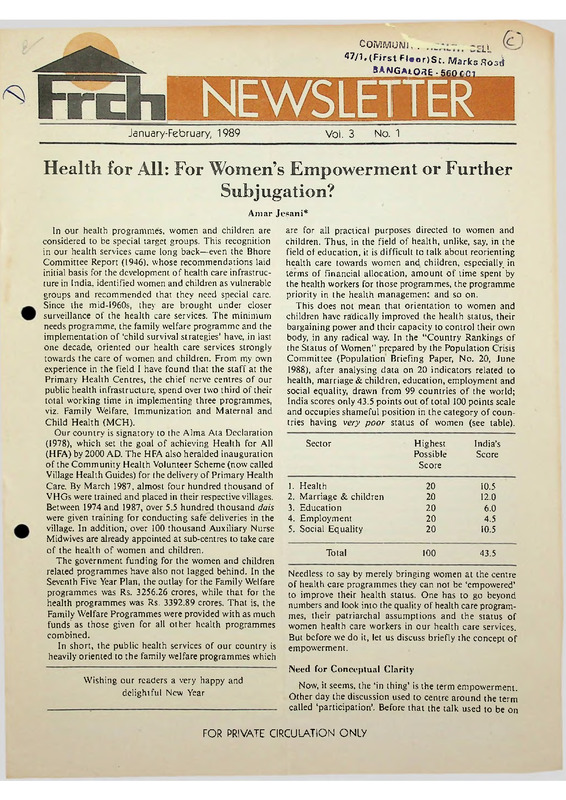
- extracted text
-
common 1,.
LL
47/1, (First Fl.Or)St. Marks Road
BANGALORE-5600
January-February, 1989
Vol. 3
No. 1
Health for All: For Women’s Empowerment or Further
Subjugation?
Amar Jesani*
In our health programmes, women and children are
considered to be special target groups. This recognition
in our health services came long back—even the Bhore
Committee Report (1946), whose recommendations laid
initial basis for the development of health care infrastruc
ture in India, identified women and children as vulnerable
groups and recommended that they need special care.
Since the mid-1960s, they are brought under closer
surveillance of the health care services. The minimum
needs programme, the family welfare programme and the
implementation of ‘child survival strategies’ have, in last
one decade, oriented our health care services strongly
towards the care of women and children. From my own
experience in the field I have found that the staff at the
Primary Health Centres, the chief nerve centres of our
public health infrastructure, spend over two third of their
total working time in implementing three programmes,
viz. Family Welfare, Immunization and Maternal and
Child Health (MCH).
Our country is signatory to the Alma Ata Declaration
(1978), which set the goal of achieving Health for All
(HFA) by 2000 AD. The HFA also heralded inauguration
of the Community Health Volunteer Scheme (now called
Village Health Guides) for the delivery of Primary Health
Care. By March 1987, almost four hundred thousand of
VHGs were trained and placed in their respective villages.
Between 1974 and 1987, over 5.5 hundred thousand dais
were given training for conducting safe deliveries in the
village. In addition; over 100 thousand Auxiliary Nurse
Midwives are already appointed at sub-centres to take care
of the health of women and children.
The government funding for the women and children
related programmes have also not lagged behind. In the
Seventh Five Year Plan, the outlay for the Family Welfare
programmes was Rs. 3256.26 crores, while that for the
health programmes was Rs. 3392.89 crores. That is, the
Family Welfare Programmes were provided with as much
funds as those given for all other health programmes
combined.
In short, the public health services of our country is
heavily oriented to the family welfare programmes which
are for all practical purposes directed to women and
children. Thus, in the field of health, unlike, say, in the
field of education, it is difficult to talk about reorienting
health care towards women and children, especially in
terms of financial allocation, amount of time spent by
the health workers for those programmes, the programme
priority in the health management and so on.
This does not mean that orientation to women and
children have radically improved the health status, their
bargaining power and their capacity to control their own
body, in any radical way. In the “Country Rankings of
the Status of Women” prepared by the Population Crisis
Committee (Population Briefing Paper, No. 20, June
1988), after analysing data on 20 indicators related to
health, marriage & children, education, employment and
social equality, drawn from 99 countries of the world;
India scores only 43.5 points out of total 100 points scale
and occupies shameful position in the category of coun
tries having very poor status of women (see table).
Sector
Highest
Possible
Score
India’s
Score
1. Health
2. Marriage & children
3. Education
4. Employment
5. Social Equality
20
20
20
20
20
10.5
12.0
6.0
4.5
10.5
Total
100
43.5
Needless to say by merely bringing women at the centre
of health care programmes they can not be ‘empowered’
to improve their health status. One has to go beyond
numbers and look into the quality of health care program
mes, their patriarchal assumptions and the status of
women health care workers in our health care services.
But before we do it, let us discuss briefly the concept of
empowerment.
Need for Conceptual Clarity
Wishing our readers a very happy and
delightful New Year
Now, it seems, the ‘in thing’ is the term empowerment.
Other day the discussion used to centre around the term
called ‘participation’. Before that the talk used to be on
FOR PRIVATE CIRCULATION ONLY
‘upliftment’, ‘integrated development’, 'shramdan1,
‘Sarvodaya’ and so on. Unfortunately our planners and
policy makers have a special liking for new terminologies
and concepts, which are used more for confusing the issue
rather than clarifying it. Inherent to this is the tendency
to discover new terminology from the experience of the
failure of old ones.
For instance, we started with 'Sarvodaya* i.e. upliftment
of all, and the integrated development. In no time we
realised that our economic policies and development pro
grammes have lifted only few but created armies of the
poor. Thus from ‘uplifting all’ we shifted to the ‘target
group approach’. The target group approach informs us
that by helping such specific group of people—for ex
ample people below poverty line, women, children etc—
more equitable development could be achieved. However,
we soon realised that there are programmes, the pro
gramme targets are more or less achieved, but their fruits
have not reached target groups. Thus came the orienta
tion to what is called community participation, people’s
participation and so on. Particularly in the field of health,
the concept of participation made big impact. Thus,
village Panchayats were asked to donate land for having
sub-centre or PHC—a way to participate. The ANMs were
served with administrative orders to form Mahila Mandals
and Mandals were paid for organising meetings—a way
for women to participate in the MCH, the Family Plan
ning and the Immunisation Programmes. This was taken
to a ridiculous extent by arguing that if people are made
to pay for the health care they would better participate —
indeed a backdoor entry to the concept of privatisation.
And yet, the people did not seem to participate so
wholeheartedly as expected. Now it is said that education
and communication, and perhaps empowerment would
motivate people to participate.
This long history of conceptual innovations make me
very skeptical to the term ‘empowerment—not because
I have anything against women empowering themselves,
but because of my genuine fears regarding the fate it very
likely would meet in the hands of our policy makers. Fur
ther, I have real aversion to the terms which sound very
high but convey very little. Perhaps such terms are choosen
with the intention of using ‘value-free’ or “neutral” ex
pression. The terms ‘participation’ and “empowerment”,
in absence of any added ideological value, become empty
shells. For they sound very elitist—the powerful empower
ing the powerless. For they sound dependency creating—
there is a need for the consent of the powerful in order
to empower the powerless. For they do not give autonomy
to the masses—our programmes, you participate or you
are being empowered to participate in our programmes.
Therefore, unless pro-women and pro-working people
or anti-patriarchal and anti-capitalist value base of the
process and goal of empowerment is made clear; and a
programme for action is devised accordingly, the em
powerment would only confuse and help apoliticise
women’s issues.
As the concept of community participation turned out
to be a hollow exercise in absence of independent people’s
power, the concept of empowerment could turn out to be
a pipe dream in the absence of radical change in power
relationships. That is, women’s empowerment should
seriously challenge and change the existing patriarchal
gender relations, the capitalist economic relations and
other social relations in the society.
In any discussion of social change, normally the focus.
is on two interrelated but separate fields, viz. the state and
the society. In our country, two central assumptions (apart
from others) underlying the state power, are patriarchy
and capitalism. The patriarchal assumptions become clear
when we analyse the constitution, the personal laws and
broad state policies. If such state wants to initiate pro
cesses in the society which could empower women and
challenge societal value system, it has to radically change
itself. A process of women’s empowerment started by a
state which has not transformed itself in such a manner,
would not be able to change any power relationship in
the society; and at worst, such attempts could become
tools to further enslave women.
Therefore, the genuine process of empowering women
would be much more independent of the state—in fact
the more independent the process, the more empowering
it would be and the more pressure it would create on the
state to change its policy.
Are Our Health Programmes Pro-Women?
In the field of health we must have a look at the existing
so called pro-women programmes. As I narrated earlier,
there is an unmistakable orientation towards women and
children in the health programmes. But does such orien
tation make those programmes pro-women and therefore
empowering?
It is an undisputed fact that all stratas of society having
low health and socio-economic status need special atten
tion in the health care. But, are women given special
attention to improve their health status and to enable them
to make independent decisions in the field of health?
My contention here is that in the field of health women
are targetted to achieve targets and not to improve their
health status. First of all, the women oriented programmes
are clubbed under the family welfare programmes. Thus,
these programmes recognise woman only as a reproductive
machine and mother. It is not her care, it is the care of
the reproductive machine that is emphasized throughout
these programmes. Secondly, the care of this reproductive
machine is at two extreme levels-either to control it from
reproducing or to make it reproduce the way the dominant
patriarchal ideology would like it to reproduce. This state
ment may sound very provocative, but I urge you to face
facts. Under family planning programme, the brunt of all
measures is borne by women. The way the methods—
from sterilisation to injectables and implants—are sought
to be ‘promoted’ for women have made them real helpless
target of the target practitioners. The unethical ways in
which new contraceptive technology is tested, for example
injectable contraceptive & implants, have made them
human guinea pigs. I wonder whether the morbidity load
created by such contraceptives far outweigh the benefits
of preventing a pregnancy. The other end of this spectrum
is the choice of child’s sex. All kinds of technologies are
allowed to flourish (and attempted laws to check, it have
remained on paper) which can lead to foetal sex deter
mination and the abortion of female foetuses.
Thirdly, there is a deliberate neglect to promote male
contraceptive practice, sterilisation and the research in that
field. It is'deliberate because the health care is dominated
(Contd on page 7)
Training of Local Health Educators
at Arogya Shikshan Kendra
in January 1989, Arogya Shikshan Kendra (ASK) economic as well as political aspects of various diseases
entered into the second phase of its work selecting were explained and a debate was generated. The issues like
educators from the local community and training them caste and gender discrimination, or the relation of poverty
to impart health education to the people at large.
to disease and to subsequent utilisation of proper medical
Accordingly, through personal contacts in each village care were brought up in the afternoon sessions-.
as well as by circulating information about the intention
The technical topics that were covered during the fort
to hold a training camp for potential educators, young
night included illnesses of children, preventive medicine,
men and women from all the eighteen village around
the structure and functioning of public health services,
Malshiras were invited to be trained over a period of fif
infections of the lower respiratory tract, identification of
teen days.
high risks during pregnancy, stomach ailments, diarrhoea
On an average 45 people attended the training camp
and diarrhoea management. Tuberculosis, was unfortuna
each day. Of these, 15 were women. The villagers of
tely not covered due to the unavailability of the desired
Malshiras requested the ASK to conduct the sessions using
guest speaker-however during the continuing education
a microphone system. Thus interested villagers would
sessions, this topic will be dealt with.
gather at the entrance of the village, which was very close
We are aware that the above package does not cover
to the venue of the camp and would listen to the training
all the aspects that a health education programme should
sessions.
deal with. Therefore, we have decided to hold training/
The ASK decided to involve as many government doc
evaluation sessions, once a week for the next two years.
tors in the educators’ training as possible. The reasons for
In these sessions, not only will new topics be discussed,
this were multifold. Firstly, the decision to call outsiders
but also various methods of health education (through
for the technical training was taken because among the
workshops on communication methods) would be design
staff at ASK there is no medically trained person. Since
ed and evaluated.
Malshiras has low access, doctors from nearby areas would
At ASK we have-defined health education in a very wide
have to be called. Secondly, ASK closely works with the
context, encompassing areas that are not strictly related
public health service and therefore the co-operation of the
latter is very important in the day to day functioning of to medicine or to health care such as maternity benefits
on Employment Guarantee Scheme sites or IRDP loan
Arogya Shikshan Kendra. Thirdly, we at ASK also had
distribution. Our educators thus would have to be very
a good opportunity to listen to health education training
versatile, motivated and astute to be able to impart this
by government health professionals. Fourthly, we wanted
kind of knowledge or to generate the demand for such
doctors from the public services because they would not
knowledge among the community without actually push
have much of a vested interest in increasing private
ing
people into accepting what they have to say. Also,
clientele through these lectures. The only private practi
training
of education to use culturally acceptable forms
tioner whom we invited (he has the reputation of being
very sensitive medical practitioner and he has always - of education will be necessary.
At the end of the training camp, personal discussions
offered to co-operate in our activities) refused, saying that
with
the trainees as well as group discussions with them,
he felt diffident about teaching and training others.
enabled
us to select our educators for health education.
We were however, quite aware that often the training
We
have
thus selected seven men (all in their twenties) and
sessions by government health functionaries may end up
four women. We have encouraged only married women
being too technical and devoid of social content. There
to become our educators because they are sure to reside
fore, we also invited some socially conscious and
in these villages even after our five year health education
motivated doctors/professionals to deliver some key
programme ends.
sessions. Dr Anant Phadke of Medico Friends Circle was
Though our first training camp is now over, we have
called to speak about the concept of Primary Health Care
and its importance, Mr Soni from Aurangabad was in to find out whether people accept our health education
and what changes are required in form and content. It
vited to speak upon indicators of health status and
is possible that people may reject certain packages entirely
demography. Dr. Arvind Patwardhan of Arogya Dakshata
or partially and that would certainly be worthwhile train
Mandal, Pune was asked to speak on Methods of Health
Education (unfortunately he could not come) and Dr. Anil ing for all of us at ASK.
Pilgaonkar from Bombay was requested to teach very Contributed by Arogya Shikshan Kendra Team.
basic pharmacology to our educators. Some sessions such
as the need and scope of health education, health rights
of people and the theory of infection, resistance of dise
ase, menstruation and conception were handled by the
staff of ASK.
With this 12th issue we are entering into Ilird year.
The technical inputs normally were given in the earlier
We request our readers to contribute minimum
part of the day. In the afternoons, the trainees would be
Rs 30/- to cover the printing cost.
encouraged to discuss what they had learnt in the morn
ing. This session was normally conducted in the absence
of the guest speaker and during this session the social,
Health Professional as an Abuser or Victim
Amar Jesani*
After the November Trial of the doctors who par
ticipated in the torture, killing and unethical experiments
on human beings in the fascist concentration camps, a
need to create an ethical code to regulate doctors’
behaviour in relation to torture, prisoners, prison condi
tions, death penalty etc, was increasingly felt. The momen
tum gained by the human rights movement within the
health professionals ultimately created certain milestones
and with them the relevant codes of ethics. In 1975, in
Singapore, the International Council of Nurses adopted
a resolution on “Role of the Nurse in the care of Detainees
and Prisoners”, in the same year the World Medical
Association adopted its famous Tokyo Declaration,
“Guidelines for Medical Doctors concerning torture and
other cruel, inhuman or degrading treatment or punish
ment in relation to detention and imprisonment”. The
organisations of other health professionals, such as
psychiatrists, psychologists etc. also formulated their own
codes of ethics in this field. As a consequence, on 18th
Dec 1982, the United Nations General Assembly adopted,
“Principles of Medical Ethics relevant to the Role of
Health Personnel, particularly Physicians, in the Protec
tion of Prisoners and Detainees against torture and other
cruel, inhuman or degrading treatment or punishment”.
Such international advances in the ethical principles
brought into focus two problems - (1) how to implement
these codes and to identify the health personnel violating
these codes and to punish them (2) how to protect those
who uphold these principles from the repression/victimisation by the authorities. Thus, the health profes
sionals must be addressed to as an abuser as well as a
victim.
The seminar started on the 19th Jan with the plenary
session of all participants. Later on, participants were
French Section of the Amnesty International organised
an International Seminar, at UNESCO headquarters in
Paris from 19th to 21st January 1989. I had an oppor
tunity to participate in this seminar as delegate from India.
Over hundred individuals and organisations participated
in the seminar.
The seminar started on the 19th Jan with the plenary
session of all participants. Lateron, participants were
divided into four groups. Each group was given a specific
subject for discussion. The group one discussed on, “A
Universal and Unequivocal Definition of the Principles
of Medical Ethics”. This included-i) the breadth and limits
of the principles of ethics as defined today, ii) finding a
cure for the ambiguities and deficiencies. The Group two
discussed on, “Finding an international cure for medicine
at risk”. It included-i) Developing trans-national interven
tions, ii) developing and improving existing international
mechanisms. The Group three discussed on, “Finding cure
for medicine at risk at the national level”. It included-i)
introduction of the principles of ethics in national codes
of law and legislation, ii) independence of Health Pro
fessionals, iii) constraining structures. The Group four
discussed on, “Ethics, Education and Information”. The
participants were requested in the plenary session to be
specific and concrete in their discussion in the groups so
that some recommendations could emerge from the deli
berations of the seminar. Accordingly, the discussions in
most of the groups were properly channelised. In the
group one, controversy came up bn the Kuwait declara
tion of the “Islamic code of Medical Ethics”. The pro
tagonists of the Islamic code argued that it concerned with
all aspects of Islamic society and the code in itself was
a major step forward. However, the critiques felt that the
Islamic code was trying to justify certain barbaric
punishments like flogging, amputation etc, which are in
themselves not Islamic as they go long back in history.
The Group one made three recommendations on, 1) doc
tors should never participate in corporal as well as capi
tal punishment, 2) No authority must compel doctors o
force feed hunger strikers, 3) Independence of doctors
from public authorities, penal institutions (eg. prison).
This applies to both the medical and para-medical per
sonnel and their associations.
The Group Two noted with distress, the participation
of doctors in the torture of prisoners in South Africa and
the South African Medical Association’s (MASA) reluc
tance to take action against them. This generated heated
debate as the secretary general of the World Medical
Association opposed a resolution moved by some par
ticipants on South Africa. Ultimately, the deadlock was
resolved and the participants were asked to sign on the
resolution on their own. Majority of them signed it on
the last day.
This group also recommended that international inspec
tion visits to detention centers should become universal
and such visits should occur any time at all detention
centers. The sanction against the torture should be not
only legal but also professional should also be looked into.
The possibility of setting up a mechanism to make com
plaints etc,
The Group Three recommended that 1) we need strong
local and national representative health workers’ organisa
tions to implement codes, 2) a general agreement on codes
among all types of health workers should be found so that
internal conflict among professionals be minimised, 3)
mutual support amongst the organisations, 4) the health
professional should not examine the victim of execution,
"some hours after the execution, 5) autopsy of every
death in prison must be carried out. No autopsy of such
deaths should be regarded as an indicator of human rights
abuse. In addition, this group also evolved seven objec
tive criteria to suspect human rights violation in prisons.
The Group four, to which I belonged, felt that we
should identify and resist not only the extreme cases but
also the ordinary day to day cases found in the society.
The ethics was discussed as a part of human condition
and not that of only professional like doctor. Thus it was
suggested that everybody should be involved in the fight
and not only doctors. The human body should be consi
dered inviolable and nobody should be given the right
whether the health personnel, police, a maker of execu
tion chair etc, to violate it. We should not medicalise tor
ture. The group discussed about various ways to inform
people, to educated professionals, the training to examine
and treat victims and so on. This group also suggested
that a committee may be formed to follow up the discus-
Medicine, Science and Humanism
Dr. P. K. Sethi*
Introduction
As our country gears up for its entry into the 21st
century, targets have been set. This has set the pace for
some hectic activity because targets have to be achieved.
WHO, hit upon the reassuring slogan of “Health for All
by 2000 A.D.
This has led to more targeted research, more missionoriented science and less basic research. There is little time
to waste and so it is considered prudent to buy technology
package from the west. This is the speediest path to
modernisation and modernisation for our planners, has
become synonymous with westernisation.
Dr Sethi fears about repercussions of such paths to
modernisation, on our field of medicine. He recalled Gan
dhi’s considerations on health being a multi-dimensional
phenomenon, involving interdependent physical,
psychological, social and political aspects.
Health care today is treated like a market com
modity to be measured in vital statistics. It lacks a moral
and ethical dimension, where Primary Health Centres
spreading out across the country like post offices, are
believed to distribute in neat package, as though from a
huge, newly stocked inventory, “health”.
It is a good thing that the rather conservative people
who make up the medical profession are becoming
dissatisfied with this mechanistic-reductionist approach
and have started looking for alternative paradigms. Many
exciting ideas are suddenly emerging. All these have strong
implications in the' field of health and disease, and are
enough to suggest a major revolution in biological think
ing is in the offing. These new lines falling into place will
provide us with a wiser framework to work on.
It is unfortunate though that while modern biologists
are realising the inter-dependence of all living things in
our biosphere, market forces continue to make use of
some of our discarded ideas about microbes. They con
tinue to frighten us merely to be able to push their pro-
sion and agreements arrived at the seminar.
The group discussion was followed by a plenary on the
second day. On the third day, an open plenary session with
the participation of concerned individuals from the peo
ple, including media wo/men was organised. The final
report of each group was presented. In this open meeting
the participants from Pakistan, South Africa and Algeria
etc. gave testimonials on the human rights violations in
their country. The resolution on South Africa and Algeria
were kept for the participants for putting their signature.
The'movers of those resolution were not disappointed as
participants queued up to express their solidarity.
On the whole, despite certain limitations in the
organisation of the seminar, problems in understanding
each others specific problems etc, the seminar was a good
experience to meet number of people, who are risking their
lives and careers to uphold medical ethics.
Report on the International Seminar “Medicines at Risk: the health
professional as an abuser or victim", organised by the French seclion of Amnesty International, at the UNESCO headquarters in
Paris -19th - 21st January 1989.
ducts for sale. We are bulldozed by the strong advertise
ment media into believing that without antibiotics in our
systems, disinfectants everywhere, deodrants into our
noses, mouth, underarms, and even into the telephone,
our lives would be in total jeopardy, surrounded on all
sides by human seeking germs. We live in a world where
microbes seem always trying to get at us but in fact, there
is marvellous symbiosis between us and them, examples
of which can be found in the animal and plant kingdom.
We pay too little attention and respect, to the built-in
durability and sheer power of the human organism. Its
surest tendency is towards stability and balance. Science
has, at long last, been providing legitimacy to this
ecological view of health, of the bio-universe as a huge
symbiotic organism.
I think, as medical persons, we have not been passing
oh such information to the public which could augment
confidence in their illnesses. It is interesting to note that
most of the criticism of modern medicine has emerged
from the affluent societies of the west. Probably the most
strident criticism has been voiced by Ivan Illich who con
siders the medical establishment intolerable for three
reasons: (a) It produces clinical damage which outweighs
its potential benefits, (b) It obscures the political condi
tions of an over-industrialised society which renders it
unhealthy, (c) It takes away the power of the individual
to heal himself. Medical audit does also reveal that
achievement of modern medicine really be attributed to
food, housing, working conditions, neighbourhood cohe
sions as well as cultural mechanisms which make it possi
ble to keep the population stable. The other fact of
modern medicinal habits is to methodologically decom
pose the patient as a person and convert him into a set
of laboratory findings. It is with this shadow of a person
reconstructed from the results of laboratory tests the
modern hospital is concerned. The practice of medicine,
as opposed to its scientific base, is not, and perhaps can
never be an exact science.
In the management of disease, there are three dififerent
levels of technology in medicine. The first is what is meant
by ‘supportive therapy i.e, “caring for” and “standing by”.
The second is the kind of technology best termed
‘Halfway technology’. This represents the kinds of things
which are done to compensate the effects of certain
disease which one is unable to do much about. It is the
technology designed to make up for disease, or postpone
death. The third kind of technology is so effective that
it attracts very little attention, it comes as a result of a
genuine understanding of human mechanisms, and when
it becomes available, it is relatively inexpensive and easy
to deliver. The best examples of immunisation, the treat
ment of tuberculosis, vitamin deficiency disease, endocrinal disorders with appropriate hormones and
therapist, must understand the technique of the scientist
and the vision of the humanist. Unbalanced development
in either direction continued too long, imperils the enterprise of healing.
* Excerpts from DrPK SETHI’S speech at Gandhi Memorial lecture
delivered at Ramah Research Institute, Bangalore on 2nd Oct 1988.
He is Emeritus Professor at SMS Medical College, Jaipur, India.
Privatisation and New Medical Technology—II
Ravi Duggal*
(In 1946 Bhore Committee had recommended a 75
bedded primary unit with 6 doctors, 6 Public Health
Nurses, 6 Midwives and 66 other paramedics and non
health supportive staff for a 10,000 to 20,000 popula
tion, supported by a 650 bedded secondary unit serving
50,000 population with 140 medical officers of a wide
variety of specialities; and the secondary unit will in turn
be supported by a 2,500 bedded hospital with 269
doctors serving a 3 million population). (GOI, 1946).
The above description clearly shows that the prolifera
tion of modern medicine through the public sector has
been a slow process. It’s access is very dispersed. On one
hand the private sector, even though of questionable quality. Piggy backing on the public sector, has sunk deeper
roots and is more easily accessible (physically) to the
population-only the access is related to purchasing power.
A strong curative medical care system, as had been sug
gested by the Bhore Committee, has never been considered
by the state for the mass of unorganised population in
the periphery. However, in major industrial centres and
cities the public health care facilities are relatively far bet
ter developed and also better utilised. This unequal
development clearly substantiates the enclave sector pat
terns of development of the health sector.
The same holds good for the NMT. The difference bet
ween NMT and introduction and development of modern
medical services is only academic. In the case of the latter,
the public sector did the groundwork of introduction of
modern medicine (of course, missionaries had already
done it in a few areas much earlier) on a wide scale in
the periphery and the private sector followed and
established themselves-it is very clearly established that
the public health services in the periphery are only an ap
peasement and not a well grounded and proper health care
service that meet the needs of the population. In the case
of NMT it is the private sector that is introducing the
technology but again with the assistance (tax subsidies,
duty exemptions etc.) of the State. The NMT is very ex
pensive to use and thus has restricted access to an in
significantly small proportion of the population. But
given the nature of private medical practices in India with
its system of kickbacks an overuse/misuse of NMT is
taking place and its use"proliferating to groups of popula
tion who even find preceding medical technologies an ex
treme financial burden to use. And NMT is the forerunner
of corporatisation.
Another important development that has diverted the
development of a proper medical care system is the com
munity health or medicine model exported to
underdeveloped countries by ideologues of imperialism.
Talking of community medicine in a class society is ab
surd because a community in such a society does not exist‘it appears only as a mystifying label placed on poor
peasants, urban subproletarians and the families of
workers, and the ultimate intention of such community
services is not to provide the people with the best possi
ble care but to install a cheap and invisible structure of
“concession” and “repression” through medicine’ (Breilh,
1981).
Community medicine as a concept has existed for a long
time-but it was demonstrated in India by the John
Hopkins’ project at Narangwal, Punjab, in the late sixties
under the leadership of Carl Taylor who had earlier been
associated with community development projects in India.
For capitalism the community medicine type of low cost
technology serves as an instrument of redistribution and
helps provide health services (albeit of an inferior kind)
with a negligible investment (of course by the state) that
appears as a special concession and demonstrates the
humanitarian concerns of the state (ibid).
It may also be noted that this model of health care has
been promoted very actively in India with the collabora
tion of a host of NGOs. This again shows strong public
private linkage and indicates a unique trend in privatisa
tion because resources used by NGOs are invariably of
government, if they are not imperialist.
‘ Thus, the lack of properly organised basic health
care/medical case services for the masses, the emergence
of NMT that contributes to* further inequality and the
model of community medicine that reeks of double stan
dards and of course institutionalises an unequal health/
medical care service, all are indicative of the vested in
terests that are served in the process of providing of health
care and the development (rather underdevelopment) of
the health sector in India.
Conclusions
The NMT has provided a firm footing for the growth
of monopoly capital in the health sector. Since historically
the health sector has had large scale public investments,
monopoly capital can only survive and grow further
through the process of privatisation.
In India privatisation has always existed; only present
ly the forms are changing in keeping with trends the world
over.
Privatisation, if furthered in India is going to have
drastic consequences. The health sector in India, unlike
those in developed countries, is inadequate and
underdeveloped and it is highly unequally distributed. If
steps are not taken to arrest its growth it will generate fur
ther inequality. The developed countries already have well
developed health care systems which are either national
systems or insurance based or a combination of the two.
Privatisation in those countries will not have as serious
a consequence as in underdeveloped countries because the
former have a well organised, workforce, which demands
health as a right-whether the government provides.it or
it pays the private sector to provide it. One thing must
be made clear that state health expenditures will not
decline either in developed or underdeveloped countries
because- of privatisation-the difference will be that the
state will contribute more to the private sector!
Thus a demand for a national health service in India
and other underdeveloped countries becomes even more
urgent because of privatisation.
Arguments in favour of privatisation stress the impor
tance of cost containment and cost-efficiency in health
care delivery. The privatisation lobby promises more ef
ficient services that would not cost the state much; fees
payable by the patient are supposed to act as disincen
tives for ‘overutilising’ health services. Their arguments
are based on the following principles.,
— The individual is responsible for his/her own health.
— Access to unlimited free health care is a privilege, and
not a right.
— There must be a unitary health care delivery system.
— The individual, rather than the institution should be
subsidised.
— User charges should be levied.
— Medical aid schemes should be restructured, over-usage
of health services should be curbed, and a more
market-oriented health care delivery system should be
developed (Critical Health, 1987).
If one looks closely at these arguments and principles
it becomes clear that the privatisation lobby is not in
terested in meeting health care needs but in serving vested
interests such as private hospitals and practitioners and
the pharmaceutical and the medical equipment industry.
Also privatisation will make access to health care depen
dent on paying capacity of the individual. This would
mean if you don’t pay, you Won’t get good health care,
but if lucky you may have access to third rate indigent
health aid packages or community health care.
For the capitalist state privatisation is a welcome step
because health has become highly political and privatisa
tion could help depoliticise it and liberate the state from
this responsibility. Thus privatisation will help the state
to break it’s umbilical connection with the private sector
(Contd from page 2)
by men and the patriarchal value system. Also because
any strong ‘promotion’ on men is considered to be
politically counter-productive. Fourthly, health education,
care of children including immunization, safe deliveries
etc. are considered necessary not on their own merits but
to control women’s fertility. Fifthly, now even female
education is being promoted, not because it should be a
fundamental right of every human being to get adequate
education, but to change the fertility behaviour of women.
Same is true for all other kind of intersectoral develop
ment in health care—they are all linked to the fertility of
women. Sixthly, children are always bracketed with
women. There is no mention of father and his respon
sibilities towards children anywhere.
Further, very little is talked about the gender inequality
in the provision of medical and health care. For family
welfare related programmes women are targeted, but no
special health care is envisaged, say to combat anaemia
amongst non-pregnant women or say TB.
In short, targeting women is assumed to be beneficial
to women to improve their status. The thrust of the pro
grammes is such that even if they improve few indicators,
the women’s status as reproductive machine dominated
by patriarchal values and as mother will never change.
Therefore there is very little indication that current orien
tation of health care will ever empower women to change
their social position.
Oppressed Women within the Health Care
The health care system can empower women only to
the extent that it allows the women within it to get
empowered. From this angle too the situation appears to
be very depressing.
The key health worker to take care of women and
children is the Auxiliary Nurse Midwife. She works at the
sub-centre and the PHC. Our experience in the field sug
gest that amongst all paramedics, the ANM is the better
functioning and more efficient cadre. Yet their status
within the PHC structure is the lowest and their social
condition appaling.
As compared to other staff, the ANMs are found to
be more meek, vulnerable and pushed around. Their
harassment in work as well as sex object is not so uncom
mon. And they being the chief vehicle for target fulfil-
(if not that of its protector) and leave the masses at the
mercy of the whims of the market.
All these manoeuvres of capitalism have thus to be ar
rested and the demand for health as a right and a national
health service has to be pushed vigorously as an answer
to privatisation for the sake of “health for all”
References:
This is an extract from the paper “Medical Services, Medical Technology
and Privatisation” presented at the Annual Meet of the Medico Friend
Circle held from 26-28 January 1989 at Alwaye.
1) Breilh, J. 1981: Community Medicine under imperialism: A new
medical policy in Imperialism, Health & Medicine, Vicente Navarro
(ed.) Baywood, N.Y.
2) GOI, 1946 (Bhore Committee): Health Survey and Development Committe, GOI Press, New Delhi.
3) Critical Health, 1987: ‘Privatisation—Health at a Price* in Critical
Health, No 19, April 1987.
(Concluded)
ment in the family welfare programmes, they are trained
to view women and children as potential targets, and thus
distorting their relationship with the rest of women.
Conclusion
For initiating any process of empowerment, a radical
revision in the orientation of current health care is a must.
Fundamental to such revision is:
(1) Reestablishing the concept that health services is for
the care of individual and community. It can not be
reduced to indicators showing health status. The im
provement in indicators should be by-product of the
total health care of individual and community.
(2) Family planning (FP) should be delinked from
population control. The FP should mean the woman’s
and man’s right to get (and provision of) scientific
contraceptive education, contraceptive facility and
safe sterilisation facilities. The.target practice in the
EP should be completely abolished.
(3) Abolition of sex determination practices.
(4) Guarantee of getting .free and quality medical care.
Enacting health care as the fundamental right of all
citizen’s.
(5) Child survival is basic to any human society. The child
survival is not mere anti-mortality programme but for
survival with quality of life. Adequate child care is
a right in itself. Linking it to the FP is degrading to
children.
(6) Radical improvement in the condition of work and
the status of women health workers. They must get
adequate power to counter the demands made by the
male superiors and colleagues. Needless to say, scan
ty representation of women in the category of doc
tors and bureaucrats is not so conducive to such
change.
Empowerment is multi-dimensional process. In the
ultimate analysis, no social strata can empower itself
without consciously recognising its collective strength.
Only the power of women emerging independently and
in position to patriarchal domination can ensure the real
empowerment.
* Amar Jesani is the Senior Research Officer working with FRCH.
(Paper prepared for the Working Group Committee for the Seminar:
Empowerment of Women: Multidisciplinary Perspectives)
Book Review
Manish' Mankad
1
. Kannapiran Chandra et. al., “Basics of documentaits high price could be one of the deterrents for the buyers.
tion”. - New Delhi: Voluntary Health Association of In Also, a hard bound edition would have been appreciated.
dia, 1988. p.90, Rs 150/I hope in future, VHAI would qome up with more detail
Library management, especially documentation has re
ed document with updated information of appendices,
mained a neglected area in India. It is true even at
especially see chapters V, VI, VII, barring a few editing
academic and research levels where flow of information
errors it deserves a special mention.
is substantial. This neglect has led to a cascading effect
2 Moulik T.K. “Biogas energy in India” - Ahmedabad
of duplication of research efforts, development of social
: Academic book centre, 1982, p 150, Rs 55/-. In 1975 the
models, both by grassroot workers and policymakers
Centre for Management of Agriculture, Indian Institute
without getting the feedback about already existing of Management, Ahmedabad conducted a detailed status
models which may or may not be useful.
evaluation survey of biogas programme in Gujarat. This
The reason is, the task of managing information is dif study was followed by a smaller socio economic evalua
ficult. It is a scientific process requiring basic knowledge
tion of biogas programme on all-India basis.
of techniques of documentation. The above mentioned
One of the major recommendations of this study was
book has taken a right step by providing the same in an
the promotion of large size community biogas plants in
easy-to-read-understand and apply manner.
order to reach the poorer sections of the population.
Though not comprehensive in nature, it does give a start
The book is intended for the government and othe*
to a fresher who would like to set up a documentation
agencies involved in the department of various biogas pro
unit. It can act as a ready reference tool and also as a
grammes in India.
course material for those who conduct training workshops
in the documentation techniques.
New additions at Aaroyga Shikshan Kendra’s library
The book has been well written and produced. Though
at Malshiras
Are many pacemakers implanted
unnecessarily?
In 1983 more than 120,000 pacemakers were implanted
in the U.S. at a cost of some $ 12,000 each. Designed to
maintain steady contractions of the heart muscle in
patients whose heartbeat is arrhythmic or exceedingly
slow, these small electrical devices are thought to be
lifesavers for the millions who have them.
Not necessarily, say investigators at the Albert Einstein
Medical Centre in Philadelphia. In the New England
Journal of Medicine, Allan M. Greenspan write that less
than half (44 per cent) of the pacemakers implanted in
Philadelphia in 1983 were clearly justified on medical
grounds. 36 per cent were of questionable medical value
and 20 per cent had no medical justification whatsoever.
The study was based on an indepth review of the
medical charts of 382 Medicare patients who received
pacemakers from January to June of 1983 at 30 hospitals
in Philadelphia. An eight-member panel of experts, which
included four board-certified cardiologists, reviewed the
patient data and concluded that one in five pacemarker
insertions was unnecessary. That held true for every
hospital included in the study, regardless of its size or
academic affiliation.
Physicians and hospitals stand to gain sizeable finan
cial rewards from the procedure when in doubt, moreover,
physicians are likely to recommend it for fear of malprac
tice suits.
One of the major concerns is that pacemakers can be
psychologically debilitating, especially when they are not
really needed. For many older patients they signal the end
of a productive life.
Source: Scientific American, March 1988.
1. Pattullo Polly, “Women at work”, - London:
Tavistock, 1981, P 191, Rs 110/-.
2. Fishlock Trevor, “India file”, - London: John Murray,
1983, p 189.
3. Guha Ranjit, “Selected Subaltern Studies”, - New
York: Oxford University Press, 1985, p 434.
4. Kakar Sudhir & Ross John, “Tales of love, sex and
danger”, - Delhi: Oxford University Press, 1986, p 249,
Rs 140/- .
5. Kakar Sudhir, “The Inner World: apsycho -analytic
study of childhood and society in India”, - Delhi: Ox
ford University Press, 1987, p 241, Rs 65/-.
Reprints
1 Deodhar, N A, ‘Health education in the context of
traditions, 1975, p 14.
2 Banerjee, D, ‘Ten years after the alma ata declaration:
Cholera outbreak in Delhi*, 1988, p 28.
3 Lancet, ‘Evaluating homeopathy*, 1988, p 95.
4 Swift, Cameron G, ‘Prescribing in old age*, Vol 296,
1988, BMJ. p 913-915.
5 Anita N. H, ‘Leprosy Control by a People’s Program,
a new concept in technology transfer, IJHS, 1987.
6 Paul, Charlotte, ‘The New Zealand cervical cancer
study: could it happen again?, BMJ, Vol 297, 1988,
p 533.
7 BMJ, ‘Detecting Bacteriuria in primary maternal and
child health care programme*, Vol 296, 1988.
8 Mooney Gavin, ‘What does equity in health mean*,
1987, pJ-3.
9 Johnson, Anne M, ‘Heterosexual, transmission of
human immunodeficiency virus*, BMJ, Vol 296, 1988.
10 Whitfield H & Bucks R, ‘General practitioners*
responsibilities to their patients*, BMJ, Vol 297,1988.
Edited by Sarita Pungaliya with the co-operation of Manish Mankad and Secretarial assistance from Anuradha Naik and Audrey Fernanaese.
Produced by the Foundation for Research in Community Health, 84-A, R.G. Thadani Marg, Worli, Bombay-400 018, registered under the Bombay
Public Trust Act. Printed by Modern Arts and Industries, A-Z Industrial Estate, Lower Parel, Bombay.
Vol. 3
May - September, 1989
No. 3-5
Health Expenditure in an Indian District
♦ Ravi Duggal
(In 1987 a study team from the FRCII, carried out a research assignment for the Indian Council of Medical Research, Government
of India. This is a summary of the study which is to be reported back to the respondents. The study aimed at finding out what the common
people spent from their own pocket- on treatment when they fell ill. The research study was conducted in six villages of Jalgaon district and six
wards (including two slums) of Jalgaon city. Jalgaon was selected for this study because in terms of socio economic development it is an
average district in the country, so to say a representative mini India. Five hundred and forty three households with a population of 3,459 were
included in the study to find out their socio-economic and health status. Information about the economic status, illness in the family, con
sumption expenditure, utilisation of various health services and expenditure for treatment of illnesses was collected from these households
in three different months (one each in Summer, Monsoon and Winter). The reference period of the information for this study is the year 1987.)
How Much Do the Poor and Rich Earn ?
Food and Other Expenditure
From the 3459 people covered by the research
study 2,248 (or 65% combined population of the Poor
est and Lower Middle Class) belong to the poor
class who live below or at a subsistence level. The
average monthly income of this class is Rs. 650 per
family. In comparison the richest class which consti
tutes approximately 1% of the population (45 persons out
of 3,459) has an average monthly income of Rs.3,500 per
family which is over five times that of the poor class.
Further, the top 9% owned 22% ofthe wealth and the
poorest 20% had a share of only 8% of the wealth.
With regard to consumption expenditure, similar
disparities are seen. The poorest class spends Rs. 68 per
person per month on food whereas the richest class
spends Rs. 273 per person per month which is four
times that of the poorest. The food expenditure of
the rich is almost three times the total consumption
expenditure of the poor. After spending on food the
poorest class has on an average only Rs. 29 per person
per month left for other expenditure like clothes, home
rent, etc. In contrast the richest class has Rs.309 per per
son per month i.c. ten times more than the poorest class.
FOR PRIVATE CIRCULATION ONLY
government’s health care institutions are concentrated in
cities and towns. For example out of the'4,215 govern
The study team did not clinically examine the ment hospitals in the country only 822 arc in the villages
population to find out if they were ill. We interviewed and the remaining 3,393 in large cities and towns. This
means that out of every 100 hospitals 81 are in cities
the head of the family or other responsible persons and
and only 19 in villages inspite of the fact that out of
asked them to report on the illness of their family
every 100 persons in our country 75 live in villages and
members.
From the information given to us it is revealed 25 in cities.
If we now rearrange the distribution of govern
that the rich have reported sickness more often than the
poor. This is something unexpected. Given the inade ment health facilities we discover that on an average in
quate living conditions of the poor we expect them to cities there is one government health facility for every
17,000 population or one in every 5 sq.km, area and in
fall ill more often than the rich. The information given
to us shows that out of every 100 persons in the rich the villages there is one government health facility for
class 28 arc ill in any given month. In contrast among every 25,000 population or one in every 140 sq. kms.
the poorest class for every 100 persons only 13 reported This means that in cities on an average a government
as falling ill in a given month. Why this unexpected dif facility is located within walking distance but in villages
where most Indians live the average distance of a health
ference ?
We live in a market economy. Almost every facility would be between 10 km. and 15 km. (and in
villages we know that transport facilities and roads arc
thing that we need has to be bought from the market.
Thus we need adequate money to buy what we need. very poor). This same dismal situation exists in Jalgaon
district.
The rich have the money but the poor do not. If we fall
ill and we do not have the money to go to a doctor then
Our study reveals that city dwellers use
we try and avoid perceiving illness (bul if we .must we government facilities more often than village people.
will borrow), and if we have the money then for even a Out of every 100 patients seeking treatment in the
minor cough and cold we will run to the doctor. Thus if city 16 used a government facility whereas in the
we have the money we can afford to “fall ill”!
village it was 10 out of 100. Out of every 100 patients
This is exactly what has emerged through’ the using government facilities 54 arc city dwellers.
findings of our study. The poor, as we have indicated
Further, the experience of people is that even if
earlier, have very little money left after they have met you arc near a government health facility or manage to
their requirements for food. Their purchasing power is reach it somehow, there is no guarantee that you will
very limited. Therefore they tend to ignore minor get proper care, unless of course you happen to know
illnesses. On the other hand the rich have lots of money - an official, businessman, politician or dada. This then
and so on the slightest pretext they can run to the doctor.
clearly shows whose interest the government, that has
The poor can only afford to go to the doctor when their been elected, serves.
capacity to earn a livelihood is affected by the illness.
The private doctor and hospital is the biggest
This, then, we feel is the reason why the poor have
provider of health services in India. Today there are
reported fewer illnesses than the rich.
about 7 lakh doctors (Allopathic, RMPs, Ayurvedic,
Unani etc.) in India out of which about 5.5 lakhs (or
Going to the Doctor
78%) work in the private sector. So it is obvious that
taking treatment in the present condition is most often
In our country, for treatment of illnesses we have going to cost money and lots of money.
In our study, the people we interviewed in Jal
three types of facilities available. One is the private
doctor or hospital, second arc public health services gaon district reported that they go most often to the
such as the government or municipal hospital, dispen private doctor even if they have to borrow money. Thus
sary and primary health centre and the third is the
out of every 100 persons falling ill 77 went to the private
traditional practitioner like the vaidya, hakim, mantrik, doctor or hospital, 13 went to the government hospital
or health centre, only 2 look treatment from a traditional
bhagal and so on.
Government and Municipal hospitals or dis practitioner, another 2 treated themselves through some
pensaries and primary health centres are supposed to home remedy and the remaining 6 did not do anything
provide health services free of charge (except for the about the illness. Worse still in the villages, where
small charge for case-paper). In India today there are government health services arc most inadequate, 80 out
33,775 government owned (includes municipal) hospi of every 100 persons falling ill go to a private doctor.
Does this mean that the private doctor is
tals, dispensaries and Primary Health Centres. This
good
?
Not necessarily. Since the private doctors in our
means that on an average there is one government health
unit for every 22,000 population today or one unit in country function in a market economy and have nobody
every 97 sq.km, area. This makes us believe that within to answer to about what they do, many of them would
a distance of between 5 and 10 km. there is a govern take advantage of this situation. They will practice
very often irrational and dangerous medicine by pre
ment health facility.
However, this is not tiuc because, most of the scribing unnecessary drugs which arc sometimes harmful.
Falling III
The unnecessary use of injections in Jalgaon
On the one hand, there is an argument that
district is rampant. Out of every 100 patients treated by the government spends enough money in providing
private doctors as many as 84 patients received some health care free of charge, especially for the poor. In
injections. In the case of public health insitulions the our study we found that the poor form the largest num
rate of giving injections was lower - for every 100 pa ber of those using government health services. Also,
tients treated 60 received injections. In rational gen when the utilisation rate among various facilities is
eral practice very few injections arc given. Many well
compared within the rich and poor classes the poor
known doctors say that, leaving aside immunisations,
utilise government facilities more often.
not more than 10 patients out of every 100 should receive
injections. To prove that in our study doctors have
But we have also seen that access to government
misused injections we looked at a few common diseases
health care, though supposedly free, is bolh difficult and
that don’t need injections for their treatment and
often expensive. Firstly, government health facilities arc
found use of injection to be extremely high. For ex on an average more dispersed (or at a greater dis
ample out of every 100 patients with diarrhoea 73 pa tance) than private facillics. Secondly, if one man
tients were given injections (this excludes intravenous
ages to reach the government health institution then
drips that are necessary in case of dehydration). Simi the wailing period is very long. This does not suit the
larly for malaria 88 out of 100 patients given an injec poor because if they spend too much lime seeking health
tion, for influenza 82 out of 100 received an injection
care they are likely to lose their daily earnings or
and even for simple cough and cold 67 out of 100 pa wages. Thirdly, it is not only the loss of wages that keeps
tients were given injections..
the poor or even the middle classes in Jalgaon from
There arc many reasons responsible for such
using government facillics but also other important rea
malpractice by doctors at the expense of poor patients. sons such as:
An important reason is the nexus between the drug in *
impersonal and inefficient services,
dustry and the doctor — it has become a partnership in
*
non-availability of adequate and proper drugs
profiteering through the exploitation of poor patients. It
and other facilities,
is unfortunate that the government allows this inspilc of *
unsuitable limings,
the fact that 85 out of every 100 doctors arc trained in
*
private fee charging by government doctors,
government medical colleges with people’s money, and
obsession with family planning, especially at Pri
from this about three quarters of doctors will set up pri
mary Health Centres.
vate practice. We must not forget the fact that today the
government spends over Rs. 2 lakhs for the education of Government Expenditure
each doctor, and this money which is spent by the gov
ernment is peoples’ money. Thus in 1987-88 out of the
At present the government spends about Rs.40
Rs. 553 lakhs that the Maharashtra Government spent
per person per year on health care and family welfare in
on doctors’ education, Rs. 415 lakhs was spent on doctors the country. In terms of today’s prices this is definitelywho end up doing private practice. This Rs. 415 lakhs not an adequate sum, but even this does not reach the
could have been used to provide good medical services poor. For instance out of this Rs.40 only 30% is given
to the people through 7 new 200 bedded district hospi to rural health services (Rs 16 per village person) and
tals in Maharashtra that would serve a population of 100 the remaining 70% for urban health services (Rs. Ill
to 150 lakhs!
per city person) when 75% of the popultion resides in
rural areas. In addition to this in the cities municipal
Cost of Health Care
bodies spend about Rs. 50 per city person per year.
This means that total - government expenditure is Rs 161
As pointed out earlier, in our country, in order per city person per year and only Rs 16 per village per
to treat one’s illness most often we go to the private son per year. Thus the government spends 10 times
doctor and thus have to pay for the treatment. We have
more for health care services for the city dweller as
also seen earlier that the poor classes have just enough compared to the villager. Even this large amount spent
money to buy a bare minimum of necessities for their
in the cities seems inadequate because even in a city like
simple livelihood.
Jalgaon 73 out of every 100 persons use private health
This is a vicious cycle. The poor don’t have care sericcs.
This means what the government
money to buy enough food. As a result they lack spends on health sendees is a miniscule proportion of
proper nourishment. Therefore they arc more prone to the existing demand, which is availed of by the people
illnesses. But if they fall ill they cannot seek proper from the private sector.
care because they don’t have enough money. So they
Personal Expenditure by the People
avoid reporting their illness. On the other hand the rich
have more than adequate nourishment and arc at a lesser
risk of falling ill but they seek medical care for even
We have already seen that the utilisation of
minor ailments because they have the resources to
government facilities is very small in comparison
purchase health care.
(Contd. on page 6)
STATE
EXPEMDITURE
EDUCATION
HEALTH
REVENUE ACCOUNT
YEAR
(in nillion rupees)
CAPTIAL ACCOUNT
(Cap+Rev)
Rev A/C
DEFENCE
Cap A/C
CCaptRev).
--------------------------------------------- —
Nedical
Fan.iel
PHS
Total
Medical
PHS
Fan. del
Total
Grand
Eductn
Eductn
TOTAL GOVT EXPENDITURE
REV A/C
CAP A/C
REV+CAP
YEAR
Total
Dross Exp
Grand
Total
Total
218.55
8
2.86
8
2.86
221.41
468.39
8
468.39
1860.16
8136.09
1452.23
9588.32
1951
509.67
e
20.69
8
20.69
530.36
1183.90
8
1183.90
2059.66
11703.74
3255.84
14959.65
1956
49.72
945.06
e
87.76
8
87.76
1032.82
2391.95
8
2391.95
3040.88
211001.18
6608.13
27609.31
1961
927.42
623.38 134.26
1685.06
e
108.20
8
108.20
1793.26
4326.13
8
4326.13
9153.37
51385.76
12838.25
64224.01
1966
1971
1316.45
1410.73 617.55
3344.73
e
201.67
8
201.67
3546.40
7791.14
8
7791.14
12753.62
87369.73
15317.98
102687.71
4971
1976
4170.75
2182.09 787.70
7140.54
274.56
502.70
.34.70
811.96
7952.50
17990.08
188.42
18178.50
26043.09
174933.02
36627.30
211560.32
1976
1981
8143.38
5657.26 1419.48
15220.12
625.80
1693.69
44.54
2364.03
17584.15
33927.37
470.00 . 34397.37
40421.48
361277.68
72481.04
433758.72
1981
1988
NA
NA
43466.00
HA
NA
HA
NA
HA
100663.00
88930.00
816690.00
HA
HA
1988
69.36
0.29
198.71
4.31
559.41
335.93
1966
1951
148.98
1956
306.65
1961
NA
NOTES :
: STATE = Central, State and Union territory Govts.
: Health = Medical + PHS + Fanvel
: PHS = Public Health, Sanitation t Vater supply ; Fanuel = Family Welfare
: REV = Revenue account ; CAP = Capital account
: 8 = Capital expendiuture on Nedical/Fanily welfare included in PHS capital and in sone cases under PUD.
: In the case of education, capital expenditure is presuably under PMD, etc.
: For the year 1988, the figures relate to only revenue expenditure.
: All figures relate to the year specified.
: NA = Not available.
SOURCE :
Combined Finance & Revenue Accounts (CFRR) , CAG, 1951-83 , 601.
1951-71 : The data for F.V. - REV A/C have been taken from Family Welfare Yearbook, 1979-80, GOL
FV expenditure has been deducted from Nedical expend iture-REV-A/c.
For 1988 = Report on Currency t Finance, 1987-88, Vol.II, Statistical Statesent, RBI.
NA
HA
NOTES:
In the first few years after Independence expenditure by the government on health (2.3%) and education (5%) was very low,
whereas the defence expenditure (19.4%) was very high. In the case of health services the Bhore Committee had recommended 15 to
20% of government’s expenditure as provision for health care. However this did not happen.
By the end of the First Five Year Plan Education saw a sharp rise in investment by the state and this remained more or less stable at
around 8% of government’s expenditure until the new Education Policy which provided a boost to raise expenditure considerably
reaching a proportion of over 12% of total government expenditure in 1988.
Health expenditure has remained quite static over the years, fluctuating between 3 and 4%. It crossed 5% in 1988 but this itself is
quite misleading because health includes Family Planning and Water Supply which together constitute almost half of this expenditure.
This recent rise in health expenditure is largely due to substantial increase in investment in family planning and water supply.
Defence expenditure has averaged over 10% of States expenditure. It’s declining ratio, especially after 1966 is quite misleading because
this expenditure is only expenditure incurred through the defence ministry. Defence production, Science & Technology, espcially space
and unclear research and application etc. have seen a phenomenal increase in the late seventies and eighties but are not reflected in this
defence expenditure.
RATIO OF STATE HEALTH, EDUCATION AND DEFENCE EXPENDITURES
(REVENUE & CAPITAL) .
(Percentage to Total Government Expenditure)
YEAR
HEALTH
EDUCATION
DEFENCE
1951
2.31
4.89
19.40
1956
3.55
7.91
13.77
1961
3.74
8.66
11.01
1966
2.79
6.74
14.25
1971
3.45
759
12.42
1976
3.76
859
12.31
1981
4.05
7.93
932
1988"
5.32
12.33
10.89
Only Revenue Expenditure.
(This data was Compiled by Sunil Nandraj and Saraswathy Ananthram both researchers at FRCII, as a part of the research project "Health
Iixpenditurc in India " sponsored by the ICMR)
(Conid. from page 3).
with the private faciltics. For the use of private health
facilities people have to pay directly from their own
pocket. (It is not that government faciltics arc free.
The. public, and even the poor, pay for government
faciltics through taxes such as income tax, sales tax and
so on .In fact the tax collected in India is 18% of the
income of the people and inspite of this people have
to spend vast amounts on social expenditures like
health and education).
Before providing information as to how much
burden people have to bear to seek health care it is
important to note that the expenditure to treat an illness
is not only what is paid to the doctor and hospital, pur
chase of drugs and diagnostic tests. It also includes
transport charges to reach a health faciltity, rituals
performed for warding off the illness, the cost of
special diet, ease-paper charges in government hospitals,
or tips
paid to the hospital personnel for special
treatment or attention and any other expenses because
of the illness. Also many poor people lose wages be
cause of their illness and have to borrow money.
In our study in Jalgaon district we found that
to treat their illnesses the public spends on an average as
much as Rs.183 per person per year. Thus for a family
of five persons a household would spend as much as
Rs. 915 in a year. Out of this Rs. .183 spent per person in
a year, Rs. 154 went towards doctor’s fees, medicines,
hospital costs and diagnostic tests. That is out of every
Rs. 100 spent on health care by a household, Rs. 84 went
towards health services. Of the remaining Rs. 7 was spent
on transport, Rs. 2 on rituals and another Rs. 7 on bribes,
case paper charges and special diet. Besides this Rs. 183
per person per year, for every child born in the family
Rs. 209 was spent per birth.
Further, if we look separately at private and
government health services utilisation in Jalgaon we
find that on an average to use private health services
people spend Rs. 208 per person per year and to use
government health services they spend Rs. 137 per per
son per year. The poorest class spends Rs. 69 per per
son per year if they use private health services and Rs. 20
if they use government health services.
We have already seen that the poor classes
have reported fewer illnesses than the rich classes,
therefore it is obvious that they spend less than the rich.
From the Jalgaon study data we* find that the poorest
class spend on an average Rs. 51 per person per year
on health care compared to Rs. 257 per person of the
middle class and Rs. 367 per person per year of the
richest class. This means that the richest class spends
on an average 7 times more than the poorest class when
their rate of falling ill is 2.25 times more than that of
the poorest. The lower expenditure of the poorer class
is also due to the fact that they use government
services more often than the rich as well as because of
their higher non-use of services than the rich due to their
lack of purchasing power.
The next question is, to whom does the money
paid by the people go to ? For every illness in the
household the family on an average spends Rs. 102.
Most of this goes to the private doctors. Thus out of
every Rs. 100 paid by the people to the health services
Rs. 88 went for the private health sector and Rs. 9 for the
government health serivces. From among those spending
on private health care for every Rs.100 spent by them Rs
87 went to the healthcare services, Rs. 6 was spent on
transport charges to reach the health facility and the re
maining Rs. 7 on other items. From among those who
used government health services for every Rs. 100 spent
by the people Rs. 81 went to the government health
services, Rs. 13 on transport and the remaining Rs. 6 on
other items.
This clearly shows that The private health care services divert a major
share of the expendable resources of the people.
The government health services also cost a
considerable amount.
The people using government health services
spend twice as much on transport as compared
to those using private services,
and the amount spent by people on treating their
illnesses is three and a half times more than
and in addition to what the government
(including municipal bodies) spends.
Is This Justified?
We believe that health care is the right of the
people and as suggested in the directive principles of
our constitution it should be provided free of charge to
all the people. Yet the majority of the people, includ
ing the poor who can ill-afford, have to bear consider
able expenses to meet their health care needs.
The services provided by the government are in
adequate both in quality and quantity, of difficult access
to the majority, and hence forces the poor to incur sub
stantial expenditure on private health care. Given their
locational disadvantage villagers use public health serv
ices less often than city dwellers and as a consequence
the village people have to use private doctors more
often, and hence have to spend much more on treatment
of their illnesses compared to city people.
The poor report lower rates of falling ill,
have greater nonutilisation rates when they fall ill, and
use public health facilities more often than the rich. As
a consequence they spend far less on health care than the
rich but even that amount is a burden for the poor
because they have barely enough resources to meet
their essentials of livelihood.
Thus what has emerged from these findings is
that as long as health care remains a commodity
within the context of our present economic conditions,
the existing human misery will only be compounded.
When people pay so much money as taxes to the
government then is the appalling lack of basic health
care services, as recommended by the government’s own
health committee (the Bhorc Committee) on the eve
of our nation’s independence from colonial rule,
justified?
• ( Ravi Duggal, is a Researcher at FRCH )
Degraded Breadwinner and Harassed Health Worker
(Socio - economic Background and Problems of the Auxiliary Nurse Midwife)
♦Amar Jesani
(The FRCH conducted a study of primary health centres (PHC) in Maharashtra for the state government in 1987-88. The main
objectives of the study were to understand the functioning of the PHC and the problems faced by the health workers; using a qualitative/
anthropological method of data collection. In the first phase of the study, three PHCs were selected in consultation with the govern
ment. These PHCs were selected in such a way that three ragions of Maharashtra were represented, one of them was from the tribal areas, one
was upgraded PHC and all of them fully functional with the majority of the staff appointed. Three* researchers of the FRCH spent two to
three months at each PHC for the data collection. In this phase all ANMs working at the PHC and its sub-centres were interviewed at length
using a structured schedule as well as an interview guide. The researchers accompanied many of them in their daily field work. The Staff
Nurses (SNs) at the upgraded PHC(or .the Rural Hospital) were also similarly interviewed. In the second phase of the study additional 10 PHCs
and 2 RHs were selected. The researchers spent 2 to 4 days at each place and interviewed one ANM from these PHCs using the same interview
schedule and the guide. This way in two phases of the study, 30 ANMs and 10 SNs (totally 40 of them) were interviewed. Following is a short
summary of our findings on the ANMs'/SNs* socio-economic background and problems.)
Unlike the Village Health Guides (VHGs) who or nearby. Besides,' the ANM is regularly transferred.
are recruited by the Panchayat, the ANMs are re- Therefore in a majority of cases there is disruption in
cruited at the district level by the Zilla Parishad. Our their family lives. In 48% of sub-centres ANMs do not
study revealed that 41% of the ANMs/SNs came from an stay with any family member, in fact they are actually
urban background which is a significantly high perce- separated from the family in order to work as an ANM.
It is important that rules, regulations and
ntage and this was due to the factors relating to low
education amongst rural women and the social stigma criteria regarding transfers applicable to male employees
attatched to the work particularly in rural areas. 20% should not be applied as rigidly to women employees.
Caste and religion are important indicators
were working away from their home district. This could
be due to transfer of the husband or due to personal of social status. This was observed during our survey of
choice as many prefer to work away from their native ANMs. The 62% belonged to the upper castes i.e.
village to minimize problems relating to the low status Maratha, Kunbi or Brahmin. They did not face the
problems that ANMs from lower castes faced. The latter
accorded to their work.
Our survey revealed a number of marriage re included the Scheduled Castes(SC), Neo-buddhists and
lated problems of the ANM/SN. This is partly due to Christians. Says Christian ANM “Tam a Christian
the nature of work, her constant travelling and but an original SC. The doctors harass me and insult
irregular hours of duty. Many have to stay overnight me. I am neither allowed to go inside the house, nor to
with their colleagues after the monthly PHC meetings touch the expectant mother”. Other complaints by the
as getting transport back home becomes virtually SC ANM included, “We are harassed in many ways; the
electricity in our quarters is cut of." The doctors do
impossible.
Although ANMs are considered part of the not like our presence and do not allow us to stay in the
Nursing Council, their status is much lower than the quarters even when they are empty". The upper castes
nurses in urban hospitals. This affects their marriage do not take medicine from us". "Nobody rents me a house
prospects and they are not considered the right choice for so I have to live in another village". "I have not done any
males of the so called respectable families. Even male delivery although I have worked for a year". "Leave aside
workers in the health services who may be "friendly" the illiterate villagers, even my colleagues never ate food
with ANMs do not consider the ANM as the right mar with me and ignored me”.
It was observed during our stay that casteism
riage partner. They feel “ANMs do not come from good
is
not
restricted
to villagers and lower level health
families” or “Good girls do not take up this work”.
Thus the irregular hours and the low status workers but is prevalent even amongst doctors, DHOs
accorded to their work forces them to marry a man (District Health Officers) and the higher bureaucracy.
The majority of ANMs/SNs came from landless
who is unemployed, an alcoholic or one who is earning
much less. If the husband is politically or economically arid poor peasants households. 15% of ANMs/SNs had
education less than 10th standard. The rest were
powerful, very often the ANM is the second wife.
educated upto the Xth or were college dropouts. However it was observed that graduates do not consider
Family Structure :
ANMs job worth doing.
It appeared that many of the ANMs had parThe ANM is an outsider in the sub-centre village. Thus to take up the job, she has to leave her house. ents who were illiterate while a few had parents who
The unmarried woman has to either stay alone or per- had educational levels less than those of the ANMs. Of
suade some family members to stay with her. In the the currently married ANMs the majority marry men
case of the married woman, the husband finds it virtually who have either equivalent or higher education and cerimpossible to get a suitable job in the sub-centre village tainly most marry men who are educated more than
pends on what kind of person you are”. If the ANM is
their fathers and mothers.
40% of ANMs had fathers who are cultivators, not working well and afraid of people complaining about
artisans or landless labourers. 25% of ANMs’ fathers . her, she is likely to be exploited by some persons in the
Such persons included politically powerful
had fixed salaried income or were professionals. In the village.
people
in
the
Panchayat Samiti and the ZP; they also
case of husband 50% had occupation equivalent or better
named
the
Medical
Officer, the ADHO and the DHO,
than the ANMs/ SNs. However nearly 50% ANMs either
Some
stated
that
“initially people look down on the
did not respond or had husbands who were unemployed.
This high percentage could be again attributed to the ANM. But if she works well they protect her". Such
low status accorded to an ANMs1 job which leads her to health workers felt that ANMs need protection and can
marry such a person who in the events of transfer can get it provided they work well. Some stated that we
know that people ill treat them but at the same lime “the
give up his occupation because her job is better paying.
While it is difficult to collect data regarding income conduct of women in the health department is not good".
our survey revealed monthly income of Rs.1244.50
(±270.30) per month. The study took into account only The ANM’s View
cash incomes. The average income of the ANM/SN
The ANMs themselves were eager to speak
appeared to be higher than that ‘of their parents and
about their image in society, 22% of ANMs said that
husbands.
It is often said that economic independence does some respected and some did not. They felt that the.
improve the women's status within her family, but tribals “do not behave badly" and “lake care" but the
ANM’s/SN’s position is contradictory. Although she is “outsiders”.were not safe and trustworthy. They also
either the only breadwinner or a very essential earner, felt that “educated people-treat us well, but the unedu
her work is not given any respect.
In fact it is cated look down upon us. They think we are bad women.
considered a necessary evil. Family members showed Some felt that, "in some areas people are good and treat
embarrassment in admitting their relatives working as us well, but in some parts they are not and we face prob
ANM/SN. "We know she does not do good work, goes lems”.
around with men and people gossip but she earns well
. 12% fell that there had been some improvement
and we need her income". The ANM is often scolded by compared to the past. “Earlier people thought badly
the MO/ADHO (Assistant District Health Officer) and of nurses, now they understand our work and have de
DHO in front of the family members which again does veloped respect for us". 45% said that people had an un
not enhance her status.
favourable opinion about them “people think we arc
vagabonds and roam with men”. “They consider the
Social image of the ANM .
ANM to be of bad character”. “She teaches the Family
Planning Methods so she must be using it.”. “Men
How does the society view the ANM? This is come to us to learn and make suggestive gestures".
an important social issue which needs to be understood. “When we talk to men, people gossip that we are having
Three interrelated aspects contribute to the construction affairs - multiple affairs”. Some ANMs who felt that
of the social image (or stereotype) of the ANM, these they were not respected stated that it was due to the
arc (1) The ANM as a woman (2) The ANM as a work “character of the individual ANM". They felt “if we
ing woman (3) Her providing certain kind of services as a behave well we can earn respect. We have to prove
health worker. She has to do family planning work, that we are not misusing our independence”.
speak regarding contraceptive methods, motivate villagers
Inspite of this background of social image what
to use them. Any woman talking about sex is could be the reasons for a woman to join as ANM? Is it
suspected to be of loose character. Further the fact idealism, the zeal to serve or other considerations?
that she has to go on house visits is not respected. Most
67.5% of the ANMs/SNs started their career
people have a stereotype image of the ANM. “We with this job. They were informed and encouraged by
know the kind of women who become ANMs. Do not relatives since the family is dependant on the ANMs
make us say it openly”.
income in most cases. It must be pointed out that on
the one hand they are unwilling to respect her work, on
The Male Health Worker’s View:
the other they encourage her to take up the ANM’s job.
, 22.5% admitted that they had used influence
Whilst 28% of male health workers who were either of a friend in the health department or a politician
also interviewed said that ANMs were respected by the to obtain the job. 90% of the ANMs/SNs look up the
village people since they perform deliveries and look job due to economic compulsions.
after the health of children, 31% evaded answering the
Whilst 75% said their economic expectations
question. This could be due to the fact that they were were fulfilled those who said they were not, gave reasons
either indifferent or that they had a negative image of the such as “bad living conditions and less pay".
ANMs which they did not want to discuss with the
Non-economic reasons for non-fulfillment of
female interviewer. The remaining 41% , who said the expectations included response such as, “we had
ANM was not respected gave one of the reasons that thought we would become nurses", “We are working in
she deserved it. “How people behaved with you de far off areas and people are ignorant. There is tremen
dous pressure to achieve Family Planning targets”.
Transfers:
control, leprosy, TB,curative work and blindness control
were listed as the most neglected duties of the ANM in
terms of time spent by her.
It emerges from this exercise that the govern
ment does not use or orient the ANM as a multipur
pose worker. They are essentially oriented as FP or
MCH workers or what is called family welfare workers.
11 was observed that 23.3% of ANMs and 20% of
SNs are first posted outside their home district by the
government. This could be due to expansion in infrastruc
ture. 10% of the ANMs stated that they wanted to be :
posted outside due to the bad social image of the ANMs Number of Deliveries
and the desire to be independent and escape from family
problems.
One of the functions of ANM is to conduct deliv
56% of ANMs had completed only 3 years or less eries. This could be at the homes of the pregnant
of their service, 23% had worked for more than 3 years woman, the sub-centre or at the PHC. Asked on how
(Upto 10) whereas 20% had worked for more than 10 many deliveries were conducted in a specified calendar
years. The average length of service was 6.7 years. In year by the sub-centre ANMs, 14.3% did not respond
the case of SNs the average length of service is 16.4 making us suspect that these women had not conducted
years and 60% of them had worked for more than 10 any delivery in the reference year. Another 14.3 %
years. This was due to the fact that many of them were admitted they had not, 23.8% conducted upto 5 deliver
earlier ANMs and had been promoted at the time of ies and 19% upto 10. In the case of PHC ANMs two
thirds had conducted more than 20 deliveries.
expansion.
In a transferable job those who were not happy
tried to use all means to get transferred. Several days Family Planning:
spent by the researchers at the DHO’s office revealed
Whilst 30% of the ANMs slated they did not
that there was not a single day when he was not ap
proached for a transfer by at least one health worker have to make any extra efforts to motivate people to
accept FP, 70% described various methods used to “get
either directly or through a politician.
43% and 33% of ANMs working at the sub- cases”. These include extra care of the family, providing
centre and PHC respectively were not satisfied with transport or food for the case and her relative, paying
extra money or providing alcohol.
This shows that
their current postings.
Our study revealed that all the ANMs appointed winning a FP case is of central importance to the ANM
at the PHC headquarter stay in the PHC. Most do get as she is terribly scared of not fulfilling her target. The
a quarter to stay at the PHC and that compared to the health system does not only approve but encourages
SNs, the ANMs show a better tendency to stay at the and sanctions such personal effort by the ANM to get
FP case.
place of appointment.
Only 5 out of 30 ANMs fell that the FP work
is not an obstacle in doing other duties. 7 of them fell
Work Priorities:
that though it was important to do FP its method of
The ANMs were asked to list the three impor implementation through target orientation should be
tant “duties” they perceived as being most emphasized changed. 14 of them said they were fed up of FP work
by the government. It was found that Family Planning and believed that its removal would improve their per
(30%) and Immunisation (24%) and Maternal and Child formance in health care programmes. They stated that
Health (MCH) (20%) topped the list. Of these the- the FP had distorted their relationship with the commu
first priority is given to FP.
nity.
Other duties listed were house to house visits,
record keeping and taking slides. Tasks such as TB, lep Harassment:
rosy control and health education are given least priority.
Some personal observation by the ANM re
Time Allocation:
garding harassment has been discussed earlier but here
we present a few other cases.
One ANM was facing problems with the doctor,
Again FP tops the. list of duties in which the
ANM spends the maximum working hours. House to and this was affecting her work. “It started because I
house visits occupied second place. This is not surpris refused to take money for injections from the Out Pa
ing considering the fact that they have to travel around tients* Department (OPD) patients. He does not allow
without a vehicle. MCH in terms of time spent over me to be in the OPD or in the operation theatre. How
look immunization. The immunization programme is can I work like this?”“Whal is new in harassment? All
implemented by the camp method which are organised on women face things like eve-teasing. Once a young man
fixed days. For the MCH a regular clinic day is kept. made passes. I told him I am not the kind who' flirtS
Besides the ANM has to make extra visits to the houses After that he stopped”.“The doctor used to invite all
of some women. The curative tasks of the ANM are nei the bad. people in the village. They used to come and
ther given enough time nor are they emphasized. Malaria harass us**.
“In some places my younger colleagues were mo
lested. Sometimes doctors help, sometimes they are not
bothered. Female workers really need protection”.
“The relatives of the FP cases come drunk at night
and create all sorts of problems for us"."The incidents of
sexual harassment are so high that it is an issue which
can not be taken lightly”.
Suggestions by the ANM:
The AN Ms felt that general measures such
as women’s education and special health education to
school children would automatically improve things.
Regarding the job the ANMs felt that — 1. The
sub-centre should have a building with instruments and
drugs. It should have electricity and water. 2. Fixed
duties should be laid down by the government. 3. The
FP cases should be provided with good food and trans
port facilities. 4. The ANMs at headquarters should be
allowed to visit her family on weekends and also
to
go to the field . 5. The female attendant and the VHG
should be paid regularly. 6. The MO should stay at the
PHC full time. 7. A female attendant or a trained dai
should be provided to help in deliveries.
In these types of working conditions ANMs
felt that they should" be given full protection and a
watchman should be provided at the PHC. Again the
quarters should be separated from the sub-centre and a
wall provided in order to keep certain bad elements out.
*(Roopashri Sinha, Rupande Panalal, Prabha Tirmare and
Madhu Rokle participated in the data collection. Roopashri Sinha also
helped in the preparation and analysis of data. We also thank Malini
Sheth for summarising the 124 pages long section in the present form .
While thanking them we add the usual disclaimer that only the author
is responsible for the views expressed in the above summary.)
Some facts...
If we keep in mind the fact that the greatest need
in the country is for basic health services, it would follow
that appropriately trained medical staff would consist of
ANMs, nurses and Lady Health Visitors. Since fewer
people need specialized care such as is given by doctors
and specialists it is natural to assume that we need fewer
of them.
I
The number of health personnel available at
present in each of these categories is however, directly
contradictory to the need. in 1983, we had:
80,012
1,62,875
2,68,712
ANM’s
Nurses
Doctors
1981
1 doctor for
2550 people
1 nurse for
4442 pople
Doctors
Nurses
Midwives
2,33,650
6,.80,000
1,12,500
According to the above recommendations and
recent WHO (World Health Organisation) estimates, we
clearly have a surplus of doctors while there is tremen
dous shortfall in the number of nurses. Inspite of this, our
country continues to train more doctors than nunscs
ANM s trained per year
Nurses trained per year
Doctors trained per year
(The above figures are for 1981-82.)
5,572
8,144
12,170
,
I
1 ANM for
9333 people
The above figures become all the more signifi
cant when we consider the well known fact that 70-80%
of doctors and 90% of the nurses are in urban areas while
80% of the ANM- s work in rural areas.
In 1946, a Committee set up to plan the devel
opment of health services in India (Bhore Committee)
had recommended that by 1971, the country should aim
to have one nurse for every-500 people. According to the
recommendations of this Committee, in the next 30-40
years (i.e. by the 1980’s) our country should have trained :
According to a recent estimate it has been
pointed out that even if the government wants to achieve
its short term targets of providing health coverage for the
whole country, it would need to train on an average
15,321 ANM s per year between 1981 and 1985. Considering that the number of ANM s being trained at present is
a mere 5,572, it seems impossible to bring about an increase of 275% in such a short period of time.
To sum up, if people in rural areas are to be
provided with basic health services, there needs to be a
sufficient number of ANM s and doctors working in these
areas, From what we have seen, there is a clear shortage
of ANM s in the country. On the other hand, there are
enough doctors but a majority of them are not working in
rural areas.
(Extracts from, ‘Taking Sides' - The Choices Before the Health Workers, 1986.-by Dr.C.Sathyamala, Nirmala Sundharam and Nalini Bhanot.)
■
|
|
i
I
|
!
i
I
|
•
Public Information ? No - ‘Selective Dissemination’
♦ Ramesh Awasthi and Sarita Pungaliya
Information is power. After armaments and
capital, information is fast emerging as a new source of
power which may completely reshuffle the traditional
power balance in the world. India missed the industrial
revolution by allcast a hundred years and we arc yet to
catch up. On the contrary, conditions in the village
indicate that even if urban India somehow manages to gear
up itself, the rural India (or ‘Bharat’ as Sharad Joshi
would call it) is not likely to make anywhere near it.
However the present politcal as well as technological
leadership in the country seems determined that it should
not miss the information revolution. We never both
ered ourselves about reaching industrial development
to rural India, yet why do we want communication to
reach every village?
Since information is power, dissemination of
selective information can be used selectively to the advan
tage of those who arc in power and who wield control
over the means of communication. Control over media
therefore, has become the focus of power struggle in our
country today.
A widest possible communication
network with control over dissemination of information
is likely to give the ruling elite greater power over the
people. The foundation of communication development in
the country was laid by the inauguration of one TV station
per day during 1976 just before the ’77 elections. It is
now being followed up with modernising telephone ex
changes and building national computer networks. Indian
brains from America have been put on these technology
missions for trouble-shooting. Developing a communica
tion industry or solving bottlenecks in indigenous produc
tion of communication hardware systems may require
technology storm troopers’ but using communication for
rural development or for eradicating poverty is certainly
not a problem that can be solved through technology.
Technology can not find shortcuts to socio-economic,
cultural and political barriers to communication.
Poverty in rural India is a multi-faceted pack
age. The deprivation is in every facet of life, whether it is
in terms of purchasing power, entitlement to resources,
social status, access to health care, education or share in
political power and information. As a part of our
national plan strategy to eradicate poverty, the govern
ment intervention in the last 15 years has been in terms
of target-group oriented anti-poverty programmes. We,
tried to find out how much information people have in
villages about these programmes, how they get the
information and through which media would they like to
receive information.
A quick survey of two villages (Tondal and
Dhankawadi) of Purandar taluka in Pune district of
Maharashtra was done in August 1989. Both the villages
are located about 60 kms south-west of Pune city, have a
population of less than 1000 each. While Tondal has four
TV Sets, Dhankawadi has only one. Being small grampanchayats, none of them could raise enough contribution
to be entitled to a free TV set (for the panchayat) from
the taluka panchayat samili. 100 adults were interviewed,
50 from each village (covering all castes) and 50 percent
of the respondents were women.
By no means can this study of two villages and
100 respondents be called representative of rural Mahar
ashtra or even rural Pune. It is only an indicative study.
The main findings arc a. Information about Government Schemes (**IRDP,
NREP, EGS, TRYSEM & JRY)
Out of the 100 respondents 48 have no informa
tion about any of these programmes. Of the 24, IRDP
beneficiaries barely 5 persons knew that IRDP was only
for BPL cardholders and that they got loan-subsidy for
buying goals, sheep etc. Most respondents knew about
EGS and that they get wage labour on EGS works, but
none of them had even a vague idea of the most important
‘Guarantee’ aspect of the EGS. In many other villages
too, we found through group discussion that EGS work
ers were uninformed about their right to demand work
under the very concept of EGS. NREP, inspite of being a
village level scheme, except one panchayat member
none of the respondents knew about it. About the
TRYSEM programme, 2 of the 4 beneficiaries and 2 nonbeneficiaries had any information.
The much publicised Jawahar Rojgar Yojana
drew a blank as to what it was all about. Only 14 of the
respondents had heard about it but knew nothing beyond
the name.
b. How People Get the Information:
Whatever information the people had; where did
they get it from? Friends and relatives (24%) and the
Gram Sovak (21%) were the main sources of information
for only 6-8% of the respondents. It means that word of
mouth through personal contact still rules as the most
common means of communication.
TV was not considered as a medium for
getting useful information. It was seen as a provider of en
tertainment. 63% of those who watched TV did so for
popular serials such as the Ramayan and Mahabharat.
Tuning to a transistor-radio for news was still a popular
habit. 77% of the radio listeners put it on mainly for the
news while 24% often enjoyed film songs. Only 21% of the
radio listeners and 13% of the TV viewers stayed on for
programmes related to agriculture.
When the people were asked through which
media they would like to receive information it became
clear that people somehow do not perceive radio and TV
as sources of information. None of them opted for radio
Book Review
1. Morgan Myfanwyct.al. ‘Sociological approaches to health
and mcdicine,. - London: Routledge, 1985, p.297.
The sociology of health and medicine is now an
established part of the curriculum in a wide range of
academic and professional courses.
This book draws attention to the influence of both
empirical epidemiology and theoretical sociology on the de
velopment of sociology of health and medicine. Although
empirical research continues to illuminate many social
aspects of medical care, recent work has expanded the
whole basis of discipline into new fields beyond pure
medical concerns. Similarly within sociological theory the
application of Marxist and feminist analysis have provided
powerful critique of the dominant approach to health and
the organisation of medical practice.
2)Lewis Jane, ‘What price Community medicine; the philosphy, practice and politics ofpublic health since 1919’,
,- Sussex: whcalshcaf, 1986 p.172.
This book brings out the recent development in
public health since the first world war in Great Britain, and
argues that during this century public health has lacked a
firm philosophy to guide its practice.
The author considers the problems faced by public
health and community medicine in relation to the political
difficulties raised by public health’s claim to a broad
mandate for diagnosis and tackling health problems, and
the medical politics involved in determining both the status
of public health doctor and the community physician.
and only three persons fell that it would be allright if
information is given on TV. Obviously, they cannot be
sure as to when the desired information will be transmit
ted and if they can watch TV al ihal precise momenl. Sec
ondly they cannot refer back lo radio or TV, if ihcy miss
some information or need some clarification. Therefore
the most popular choice of medium was one where the
animator will be present i.e. through camps (34%) public
meetings (30%), and through personal contact (25%).
Many of them (25%) wanted public meetings or camps
to. be supplemented with handbills or pamplets to which
they could refer to (later on), whenever required. In one
of the villages, the Gram-Sevak belonged to the same
village, stayed there and had good rapport with the
people, for 34% of the respondents the Gram Sevak was
the first choice as a reliable source of information.
Women Respondents
As far as women arc concerned, their access to
mass media is further curtailed due to socio-cultural
reasons. Women also do not attend public meetings or
camps unless organised exclusively for them. Moreover
women in general did not visualise themselves in the role
New Arrivals: Books
1. Government ofindia,‘Handbook of industrial statistics:
1987. - New Delhi, 1987, p.255
2. Government of India,‘Report of the committee on child
labour’. - New Delhi, 1987, p.112.
3. Government ofindia, ‘Economic Survey 1987-88’. - New
Delhi: Ministry of Finance, 1988, p.55.
4. Sharma P, ‘Caraka Samhita'.-Varanasi. Chankambha
Orientalia, 1981,3 Vols., p.544,879,414.
5. Koehler G. ‘The handbook of homeopathy: the
principles and practice’. - Wclingborrah: Thorsons publish
ing group, 1987, p. 240.
6. Glantz S.A., ‘Primer of biostatistics'. - New York,
McGraw Hill book, 1981, p.379.
7. Sharp Sue, ‘J ust like a girl”: how girls learn to be women.London : Pengiun books 1976, p.328
8. Greig David N.H., ‘Team work in general practice’.
London: Castle house, 1988, p.175.
New Additions : REPRINTS
1. Sethi, P.K., ‘Medicine,Science and humanism’, Current
Science, 1988, p. 1-9.
2. Angell, M., ‘Euthanasia’, NEJM, 1989, p.1348-50.
3. Nichler M., ‘Drink boiled water: a cultural analysis’, SSM,
1985, p.667-69.
4. Stacey M., ‘A Sociologist looks at the GMC’, Lancet, 1989,
p. 713-14.
5. Berwick D.M., ‘Continuous improvement as an ideal in
Health Care’, NEJM, 1989 p.53-56.
6. Melson D, ‘Lessons from an audil of unplanned pregnan
cies’, BMJ, 1988, p.904-906.
7. Ramprasad, ‘Immunisation mission boon or curse’, Illus
trated Weekly of India, 1988, p.50-51.
8. Magiurc P. ‘Communicate with cancer patients: Han
dling uncertainity, collusion’, BMJ, 1988, p.972-73.
of decision makers. When they were asked about issues,
problems or schemes about which they would like to re
ceive information, they were surprised. Some of them
expressed it explicitly saying “ask this question to the men
folk, what are we women to do with all this information?”.
Whether it is the women or any other deprived
section of society lack of information is a part and parcel
of the total deprivation condition that they live in, where
there is a cultural conditioning as well, for accepting such
a situation. Public information is an important and
essential input for any change. But even mass media is
incapable of breaking through the social, economic, cul
tural as well as political barriers or bypassing the strong
vested interests that maintain these barriers.
Abbreviations.
IRDP
NREP
EGS
TRYSEM
BPL
Integrated Rural Development Programme.
National Rural Employment Programme.
Employment Gaurantec Scheme.
Training Rural Youth for Self-employment.
Below Poverty Line.
(The study was carried out on behalf of FRCH by Ramesh Awasthi,
and Sarita Pungaliya, both reseachers at FRCH. The interviews were
conducted by - Chandrakant Dudhanc and Chhaya Sable .)
Edited by Sarita Pungaliya with the co-operation of Manisn-MankaJ and Secretarial assistance from Anuradha Naik and Audrey Fernandes.
Produced by the Foundation for Research in Community Health, 84-A, R.G. Thadani Marg, Wprli, Bombay - 400 018, Registered under the
Bombay Public Trust Act. Printed by Mandar Traders, 755/56 Kasha Peth, Opp. Sattoti Police Chowki, Pune 411 Oil.
Position: 4060 (2 views)