ICMR BULLETIN VOL. 26-No.-6-JUNE-1996.pdf
Media
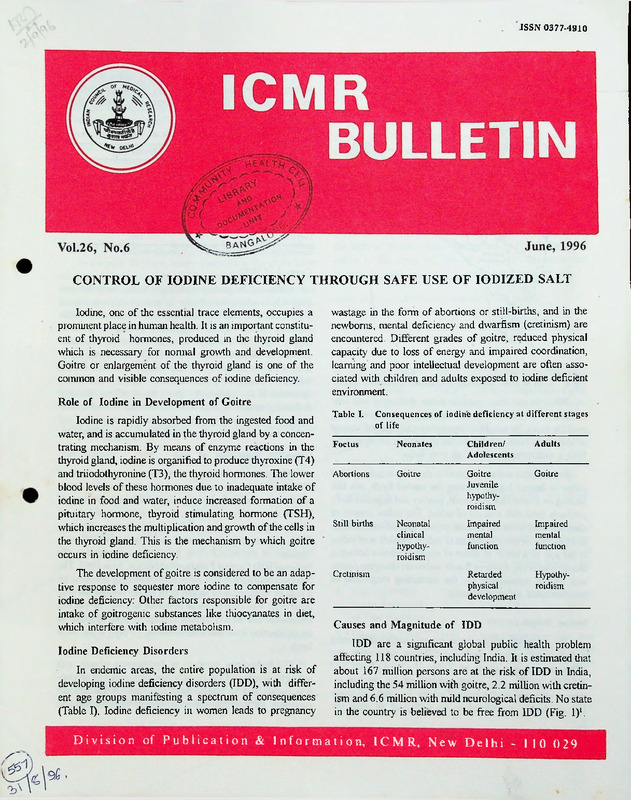
- extracted text
-
JSSN 0377-4810
CONTROL OF IODINE DEFICIENCY THROUGH SAFE USE OF IODIZED SALT
Iodine, one of the essential trace elements, occupies a
prominent place in human health. It is an important constitu
ent of thyroid hormones, produced in the thyroid gland
which is necessary for normal growth and development.
Goitre or enlargement of the thyroid gland is one of the
common and visible consequences of iodine deficiency.
wastage in the form of abortions or still-births, and in the
newborns, mental deficiency and dwa击sm (cretinism) are
encountered. Different grades of goitre, reduced physical
capacity due to loss of energy and impaired coordination,
learning and poor intellectual development are often asso
ciated with children and adults exposed to iodine deficient
environment.
Role of Iodine in Development of Goitre
Iodine is rapidly absorbed from the ingested food and
watei; and is accumulated in the thyroid gland by a concen
trating mechanism. By means of enzyme reactions in the
thyroid gland, iodine is organified to produce thyroxine (T4)
and triiodothyronine (T3), the thyroid hormones. The lower
blood levels of these hormones due to inadequate intake of
iodine in food and water, induce increased formation of a
pituitary hormone, thyroid stimulating hormone (TSH),
which increases the multiplication and growth of the cells in
tlie thyroid gland. This is the mechanism by which goitre
occurs in iodine deficiency.
The development of goitre is considered to be an adap
tive response to sequester more iodine to compensate for
iodine deficiency: Other factors responsible for goitre are
intake of goitrogenic substances like thiocyanates in diet,
wliich interfere with iodine metabolism.
Iodine Deficiency Disorders
In endemic areas, the entire population is at risk of
developing iodine deficiency disorders (IDD), with differ
ent age groups manifesting a spectrum of consequences
(Table I). Iodine deficiency in women leads to pregnancy
Table L
Consequences of iodine deficiency at different stages
of life
Foetus
Neonates
Children/
Adolescents
Adults
Abortions
Goitre
Goitre
Juvenile
hypothy
roidism
Goitre
Still birtlis
Neonatal
clinical
hypothy
roidism
htipaired
mental
function
Impaired
mental
function
Retarded
physical.
development
Hypothy
roidism
Cretinism
Causes and Magnitude of IDD
IDD are a significant global public health problem
affecting 118 countries, including India. It is estimated that
about 167 million persons are at the risk of IDD in India,
including the 54 million with goitre, 2.2 million with cretin
ism and 6.6 million with mild neurological deficits. No state
in the country is believed to be free from IDD (Fig. I)1.
Division of Publication & Information, ICMR, New Delhi - I 10 029
physiological needs. At all levels of intake, a fraction of the
body iodine is excreted in urine. Urinary iodine is sensitive
to dietary iodine intakes and is usually used as a biochemical
indicator of iodine status of the community, along with the
prevalence of goitre.
Table IL Recommended daily intake of iodine2
Age
Intake Qig)
0-6 months
40
6 - 12 months
50
1-10 years
70 - 120
11 years - Adulthood
120 - 150
Pregnancy
175
Lactation
200
Superscript number refers to the reference number
Control of IDD
Fig 1.
Map of India depicting prevalence of endemic goitre
While at one time, endemic iodine deficiency was con
sidered to be confined to the Himalayan mountain areas,
over the years, the sub-Himalayan plains and coastal regions
oflndia have been added to the list of endemic areas, making
IDD a widespread problem all over India.
Food (90%) and water provide the daily requirement of
iodine in human beings. Among the animal foods, sea fish
feeding on iodine-rich sea weeds, poultry and eggs and dairy
products form rich sources of iodine. The iodine content of
common food items like cereals, pulses, vegetables and firuits
is dependent on the soil content of iodine. Depletion of iodine
in the soil as a result of chain of eco-degradative activities
like deforestation, frequent floods arid rivers changing course
was mainly responsible for the increasing magnitude of
environmental iodine deficiency.
Iodine Requirements
The minimum iodine requirements, sufficient to meet
growth and functional needs for different age groups, are
different,. and are given in Table II (WHO/UNICEF/
ICCIDD, 1993)2. The iodine requirement for children in
creases with age. In the case of adults, an intake of about
150 jig/day is considered to be sufficient to meet the
42
Following the pioneering Kangra Wiley study between
1956-62, in which the efficacy of iodised salt was proven
in the control of IDD3, the Government of India adopted the
National Goitre Control Programme (NGCP) in 1962 to
supply iodized salt in endemic areas. However, even after
decades of implementation of the NGCP, the desired objec
tives were not achieved. Various factors attributed for the
failure are inadequate production and supply of iodised salt,
ignorance of the community about the ill effects of iodine
deficiency, apathy of local health personnel, lack of coordi
nation in implementation and deficiences in monitoring and
enforcement of Prevention of Food Adulteration (PFA) Act.
Universal Iodization of Salt
With mounting evidence of the increasing magnitude of
IDD in the country on the one hand, the resulting heavy
burden on society, the poor quality of life and the drain of
human resources on the other, the Government of India, in
1984, adopted the policy of Universal Iodization of Salt by
1995, and accordingly modified the organisation and man
agement of the NGCP. The NGCP was changed to the
National IDD Control Programme (NIDDCP) in 1992. The
National Nutrition Policy ofthe Government oflndia has set
a goal of reducing IDD to less than 10 per cent by the year
2000 AD. The PFA Act was amended in 1988, as per this
the iodised salt should contain at least 30 ppm of iodine at
the production level and a minimum of 15 ppm at the retail
level.
The technology involved in fortification of salt with
iodine is simple and the country has resources and produc
tion capabilities to handle huge quantities of iodized salt
necessary for covering the requirements of both man and
animals in India4. Considering a requirement of about 6 kg
per individual, per annum (including requirements for ani
mals), about 56 lakh tonnes of salt are required for the
country and more than 60 per cent of this is being currently
produced. The capability to enhance the production to meet
the increasing demand of iodised salt, exists. Ban on the sale
of non-iodized salt by the state governments to create a
demand for iodized salt is an important component in the
universal iodization approach. By 1996, almost all the state
governments except one state and two union territories have
issued such ban notifications (Information presented by the
Salt Commissioner at the "State level meeting on universal
access to iodized salt in Kerala, Thiruvanantbapuram",
May, 1996).
Concern for Safety in Non-iodine Deficient Population
In the past 50 years, many countries in the globe have
eliminated IDD or substantially controlled them largely as
a result of salt iodisation. While universal salt iodisation has
been endorsed in a number of international forums, a ques
tion often raised is whether exposure to additional supple
ments of iodine may result in undesirable effects, especially
in those already taking adequate iodine
providing minimum requirements, and not exceeding the
level compatible with normal functions. A series of studies
on the habitual v intakes of iodine reported from different
countries is presented in Table IK5"8. In many countries
including India the daily intakes range from 0.17-1.29 mg.
In countries like FRG and Denmark the levels are lower.
Intakes less than 50 |ig/day are definitely deficient, and
amounts in the range of 100-300are considered optimal,
functionally. There are a series of long-term studies showing
the upper limits of iodine intake and their effects on the
health of normal population (Table IV)5*6. Daily intakes
above 2000 pg are possibly excessive and are accompanied
by toxicity. A typical dose response curve depicting the
zones of safety according to van der Haar9 but modified in
the light of recent studies is depicted in Fig. 2. Intake of
iodine in the range of 300-1000 pg are consistent with
normal function and could be considered safe.
Table IV. Upper limits- of safety for iodine intake3**
Author
Year
Iodine intake/day
1. Nelson, UK
Lee
1985
1994
200 to 380 p.g
2. Pennington, USA
1989
210 to 950
3. Wolfl; Global
1969
10 tijnes requirements level
equivalent to 1.8 mg only pro
duced toxicity and goitre
4. FNB, RDA 9th Edn.
USA
1980
500 to 1000 ^g-Safe
adults
Safe Limits of Iodine Intake
As with many trace elements, changing dose tends to
diminish response at both extremes of intake. However, the
safety level of nutrient should be from the point of view of
Table IIL Reported dietary intakes .of iodine in different
countries5-,
S.No. Country
1.
USA
Total iodine intake
mg/day
Year
1986-89
Mean
Range
0.34, 0.39, 0.65,
0.29, 0.47, 0.27,
0.36
0.16-0.95
for
5. FNB, RDA 10th Edn. 1989
USA
Safe upto 1 mg/day for chil
dren and 2 mg for adults
1980
Less than 1 mg non-hazard・
6. AMA, USA
OUS
2.
Canada
1987
1.04
3.
Japan
1986
0.54, 0.19, 1.29
4.
Australia
1971 & 73
0.20
5.
Netherlands 1954 & 82
0.21
6.
England
1985 & 91
7.
FRG
1985
0.05-0.06
7. Thomas WC, USA
1978
Iodinated water supply 1 to 2
mg-no changes in thyroxine
no toxicity even in neonates
bom to mothers taking 1 mg
iodine
8. Joint FAO/WHO
Expert Committee
on Food Additives
1989
Maximum acceptable daily
intake 1 mg
9. Pennington, USA
1990
Intake equal to or less than
r mg probably safe but may
cause side eHects in some
individuals
0.059-4.746
0.28 (Normalized
0.17) 0.17
8.
Denmark
1985
0.06-0.07
9.
France
1985
0.10-0.15
10.
India
1989
1993
0.17-0.30
0.28-0.36
Recommended intake : 150 pig/day (WHO, 1993)2
Superscript numbers refer to the reference numbers
(no side effects)
Superscript numbers refer to the reference numbers
43
Intake of iodine pg/day
Fig 2.
Dose response curve of iodine in human
to studies conducted at the National Institute of Nutrition
(NIN)11, Hyderabad, under the standard conditions includ
ing transport by rail or road, 25-30 per cent of iodine was
lost in 3 months and 40-60 per cent in one year. In another
study12 on 2140 households where salt fortified with 40 ppm
of iodine was supplied, 98 per cent samples had iodine
content more than 15 ppm. A more recent study (NIN,
Unpublished, 1996) revealed that, 17 per cent of iodine was
lost in 3 months and 36 per cent in 6 months, when the salt
is prepared and used as in 1986 study. In "UP Citizens'
Study" where iodine was tested in market san^les at the
retaiVconsumer level, 61 per cent of the samples contained
less than 15 ppm (Citizens report on iodine content in salt
at consumer level in UP, AIIMS, 1994). Thus stability ofthe
iodine in salt is variabale, and ensuring this is a very
important factor for the success of the Programme.
Toxicity
Many of the earlier reported adverse effects associated
with high intakes like allergic reactions and thyrotoxicosis
have not been encountered in the more systematic follow up
studies. Allergic reactions have been extremely rare and are
unlikely to occur following salt iodization, though normal
population exposed to excess iodine remain in euthyroid
state through adoptive mechanisms. Many subsequent stud
ies revealed that a very few instances of thyroiditis and
iodidegoitre were found only in those individuals with
preexisting thyroid disease, and not due to intake of iodized
salt per se. In such cases, incidence of hyperthyroidism was
observed. In other instances the phenomenon of
hyperthyroidism occuring in endemic areas was very tran
sient and ceased after corrections of iodine deficiency
through supplementation of iodine, and did not occur in
those with sufficient normal iodine intake5,10.
To derive safe lower and higher limits of iodine, particu
larly from iodized salt, it is essential to consider the stability
of iodine and the amount of salt consumed. The moisture
content in salt, humidity in the air, acidity of the salt and
chemical form pfthe iodine are important Actors limiting the
stability of iodine. Losses in cooking and extent of absorp
tion are often the other factors which will determine the
ultimate availability of iodine to the body.
Stability of Iodine in the Salt
As per the Salt Commissioner's report (Information
presented-at the “Strategy workshop for eliminating micro
nutrient malnutrition in India" in Jaipur, November 1-2,
1995) about 72 per cent of the iodized salt samples supplied
had adequte levels of iodine, in difierent states. According
44
Dietary Iodine
Based on the analysis of iodine in raw food items,
Mahesh et aP, reported from NIN, the iodine content of
regional diets ranged from 173-265 妃day in low socio
economic group and 206-302 pg/day in high socio-economic
group. More recently Dodd and Dighe8 have estimated the
iodine content of regional diets obtained from Emilies living
in Bombay (Mumbai) and found that the raw foods con
tained 282-362 pg and after 37-70 per cent cooking losses,
the actual dietary intakesxwere 102-184 gg/day. This study
highlights that cooking losses of iodine were considerably
higher than what was assumed earlier.
Salt Intake
Data of NNMB13 show that, daily intake of salt is
around 10g; Dodd and Dighe8 reported that the average
intake of salt in Mumbai is around 7-8 g, and the actual
contribution of iodine from iodised salt worked out to be less
than 60 pg in a state with partial ban on non-iodised salt.
In view of available evidence of cooking losses, more real
istic guidelines for iodisation of salt were advocated.
Considering a minimum requirement at 10g salt intake,
fortification of salt at a level of 50 ppm of iodine seems to
be a practical measure, and this has been actually suggested
by WHO2. Thus, mandatory limits of salt fortification with
iodine may have to be revised to 50 ppm.
Assuming that all the iodine in the fortified salt is
available, the total daily intake from salt is not beyond 500
pg (50 ppm x 10 g). Considering additional amounts re
ceived from diet, the total intake would be far below the
maximum safe limit of iodine intake (1000 pg). Keq)ing the
stability and cooking losses in view; the net iodine assimi
lated will be well within the physiological range.
Iodine Content of Foods and Water from Non-endemic
and Endemic Areas
Foods and water from goitre areas (MP) contained
relatively low amounts of iodine. However, in endemic areas
in East Godavari district (A.P.), the iodine content of food
and water were low but not low enough to account for the
high prevalence of goitre. The role of other dietary factors
like goitrogens is suspected7. There are reports from other
countries indicating that goitrogenic principles from food
could also cause goitre endemias14
As the goitrogens inhibit iodine uptake and
organification reaction in the thyroid gland in a reversible
way, increasing the availability of iodine could overcome
this inhibition. Thus, even in situations where goitre endemia
may not be due to primary iodine deficiency, iodine obtained
from icxlised salt could reverse the process of goitrogenesis.
about 26 per cent to 16.1 per cent in IS area, while in the
control area, there was no percqptible change (13.5% and
14.1%). The urinary iodine excretion levels increased from
15.7 to 22.0 pg/dl in DFS areas, 7.6 to 18.7 pig/dl in IS
areas, while it decreased from 16.3 to 11.4 pg/dl in the
control area. No toxic effects attributable to either consump
tion of fortified salt or stabilisers were observed in the
population12.
These studies, thus, indicate that consumption ofiodised
salt containing stabilisers over a long duration is quite safe
and effective in the prevention and control of IDD.
References:
1.
Srinivasa Rao> P. Iodine deficiency disorders-Goitrogens and
brain development. Nutrition News 16: No. 3 (1995).
2.
WHO/UNICEF/ICCIDD Global prevalence of iodine defi
ciency disorders. Measuring the prevalence and distribution
of IDD. Micronutrient deficiency information system. MDIS
Working Paper No. 1, p. 9, 1993.
3.
Sooch, S.S., Deo, M.G., Karmarkar, MG., Kochupillai, N.,
Ramachandran, K. and Ramalingaswamy, V. Prevention of
endemic goitre with iodized salt. Bull WHO 49: 307, 1973.
4.
Vir, S. Control of iodine deficiency. The National
Programme-Current status. NFI Bull. 15: 1, 1994.
5.
Pennington, J.A.T. A review of iodine toxicity reports. J Am
Diet Assoc 90: 1571, 1990.
6.
Lee, S.M., Lewis, J. ana Buss, D.H. Iodine in British foods
and diets. Br J Nutr 72: 435, 1994.
7.
Mahesh, D.L., Deosthale, Y.G. and Narasinga Rao, B.S. Io
dine content of foods and water from goitre endemic and non
endemic areas. In: Environment, Genetics and Thyroid Dis
orders. Proceedings of the International Symposium of the
Thyroid Association of India. Eds. MG. Karmarker, C.S.
Pandav and M.M.S. Ahuja. p. 127, 1990.
8.
Dodd, N.S., and Dighe, S. Iodine content of diets of the people
of different regions living in Bombay J Food Sci Technol 30:
134, 1993.
9.
van der Haar, F. Renewed interest in the control of IDD. In:
Iodine Deficiency Disorders in the Region Eastern, Central
and Southern Africa. Eds. F. van dar Haar, and EP. Kavishe.
International Courses inFood Science and Nutrition, Wageningen,
The Netherlands, p. 13, 1986.
10.
Ranganathan, S. and Reddy, V. Human Requirements ofiodine
and safe use of iodised salt. Indian J Med Res 102:227,1995.
11.
Ranganathan, -S. and Narasinga Rao, B.S. Stability of iodine
in iodised salt. Indian Food Indust 5: 122, 1986.
12.
Diet and nutritional status of specific groups of urban popu
lation 1975-79. Report of the National Nutrition Monitoring
Bureau. National Institute of Nutrition, Hyderabad, India, p.
Efficacy of Iodised Salt r Recent Experiences at NIN
In the Kangra \^lley study iodized salt was used without
any stabilizer3. Subsequently calcium carbonate has been
introduced as a component stabilizing th。iodine in the salt.
Recently, NIN hns carried out a large scale communitybased study in the tribal areas of East Godavari district
(A.P.), to assess the feasibility of production and distribu
tion, stability, acceptability and bioeffect of salt fortified
with iodine and iron12. Four groups of villages, 20-25 each
with a population of about 5000 were included in the study.
Thr^ areas received salt fortified with iron or iodine either
singly or in combination while the fourth area received
unfortified salt. The fortification of salt was done so as to
provide about 150 pg of iodine and or 10 mg of iron per
10g of salt, depending upon the type of salt. It may be
mentioned here that stabilizers were added to the fortified
salt to increase its stability. Sodium hexametaphosphate (10
g/kg) was used as a stabiliser in double fortified salt (DFS)
and iron fortified salt,
calcium carbonate (0.63 g/kg)
was used as stabiliser in iodised salt (IS).
At the end of two year supplementation trial, the
results indicated that all the three types offortified salts were
found to be stable and were readily accepted by the commu
nity. No instances ofundesirable effects or toxicity or allergy
were noted in the community.
The prevalence of goitre decreased significantly from
initial 28 per cent to about 14 per cent in DFS areas and from
13.
14.
Gaitan, E. Goitrogens in the etiology of goitre. In: Endemic
Goitre and Endemic Cretinism. Eds. B. Stanbury and B.J.
Hetzel, John Wiley and Sons, Newyork p'219, 198.
Brahmam, G.N.V., Madhavan Nair, K., Ranganthan, S.» Gal
Reddy, Ch., Vishnuvardhana Rao, M., Nadamuni Naidu, A.,
Pralhad Rao, N. and Reddy, V. Use of common salt fortified
with iron and iodine (double fortified salt)-A community
study in Andhra Pradesh. National Institute of Nutritiou,
Hyderabad, 1994.
This write-up has been contributed by B. Sivakumar, K.
Madhavan Nair, G.N.V Brahmam and M. Mohan Ram, National
Institute of Nutrition, Hyderabad, based on the presentations
at the state level meeting on universal access to iodised salt in
Kerala, Thimvananthapuram, May 1996.
85TH ANNIVERSARY CELEBRATIONS OF ICMR
The Regional Medical Research Centre for Tribals,
Jabalpur celebrated the 85th Anniversary of the Council
(theme tribal health) on May 27,1996. A number ofpopular
publications/fblders produced by the Centre were released
on the occasion by the Chief guest Dr. S.K. Tiwary, Profes
sor and Head, Department ofTribal Studies at RD. Univer
sity, Jabalpur. Dr. R.S. Tiwary, Director, RMRC, Jabalpur
gave a detailed account of research work being carried out
at the RMRC, Jabalpur in the field of tribal health and
mentioned the various diseases viz sickle cell anaemia,
thalassaemia, tuberculosis, gonorrhoea, syphilis, yaws, etc.,
prevalent in the tribes ofMadhya Pradesh. Dr. G.D. Pandey,
Asstt. Director of the Centre highlighted the demographic,
social and cultural aspects of tribes and effects of these
factors on the health of the tribals.
The Rajendra Memorial Research Institute of Medical
Sciences, Patna, organised a symposium on tribal health on
April 30,1996. Dr. K.K. \ferma, Professor and Head, Deptt.
of Anthropology and Sociology, A.N. Sinha Institute of
Social Sciences, Patna, delivered a lecture on the tribals of
India and their health situation. Other topices covered in the
symposium included concept of health and sickness among
the tribals of M.P., health of tribals, tribal malaria, etc.
Dr. S.K. Kar, Director of the Institute highlighted the re
search work being carried out at the various ICMR Institutes/Centres in the field of tribal health.
Wt
ICMR NEWS
The following meetings of various technical committees/groups of the Council were held :
in the U International Conference of Food and Cancer Pre
vention at Ede, The Netherlands (May 18-23, 1996).
Meetings of the Expert Committees (ECS), Project
Review Committees (PRCs) and Toxicology Review Panel
held at New Delhi
Dr. M. Mohan Ram, Director, NIN, Hyderabad, partici
pated in the IV meeting of the South-East Asia Nutrition
Research-cum-Action Network at Jakarta (June 10-14, 1
1996).
EC on Otolaryngology
May 16, 1996
Special PRC on HIV Infection and
Other Viral Diseases
May 31, 1996
PRC for Projects on Non-communicable
Diseases
June 5, 1996
Toxicology Review Panel of the Division June 12, 1996
of Reproductive Health and Nutrition
Dr. K.N. Panicker, Dy. Director, Xfector Control Re
search Centre, Pondicherry, participated in the workshop
on control of filariasis in the Asia Pacific, at Bali (June 1417, 1996).
Appointments :
Participation of ICMR Scientists in Scientific Events:
Dr. J.M. Deshpande took over as the Director of the
Enterovirus Research Centre, Bombay w.e.f June 3, 1996.
Dr. Kalpagam Polasa, Senior Research Officer, Na
tional Institute of Nutrition (NIN) Hyderabad, participated
Dr. J. Mahanta took over as the Director of tiie Regional
Medical Research Centre, Dibrugarh w.e.f. June 4, 1996.
46
ICMR AIDED SYMPOSIA/SEMINARS/WORKSHOPS/COURSES/CONFERENCES
Symposium/SeminarAVorkshop/
Course/Conference
Date & Place
Contact Address
Seminar on Communicable and Water-bome Diseases
June 5-6, 1996;
o(at Daijeeling)
Dr. S. Mukhopadhyay, Executive Convenor ofthe
Seminar, Department of Plant Pathology, Bidhan
Chandra Krishi Vishwavidyalaya, Kalyani, Distt
Nadia.
Intemationl Congress on Ageing
August 19-21, 1996;
(at Thimvanantapuram)
Dr. P.K.B. Nair, Coordinator of the Congress,
Centre for Gerontological Studies, Thiruvantapuram.
Workshop on Design and Evaluation of Targeted Drug
Delivery System
September, 1996;
(at Manipal)
Dr. N. Udupa, Convenor of Workshop, College of
Pharmaceutical Sciences, Manipal.
COUNCIL'S TRAINING PROGRAMMES FOR 1996-97
Leprosy
Occupational Health
At the Central Jalma Institute for Leprosy, Agra:
At the National Institute of Occupational Health,
Ahmedabad:
・
Multidrug Therapy Orientation Course in Leprosy for
Medical Officers (September 9-20, 1996).
Orientation Course on Occupational Health for Indus
trial Medical OflScers (September 17-29, 1996).
•
Virology
At the National Institute of Virology, Pune:
Medical Entomology
・
At the Vector Control Research Centre, Pondicherry:
Diploma in Medical Virology (June 1996-May 1997).
M.Sc. in Medical Entomology (from August 1996; for
2 years).
•
Reproductive Biology
At the Institute for Research in Reproduction, Bombay:
•
•
Training Course on Immunoassay Techniques (June 315, 1996).
Training Course on Current Trends in Management of
Infertility and Reproductive Disorders (September 213, 1996).
Laboratory Animal Technology
At the National Centre for Laboratory Animal Science,
National Institute of Nutrition, Hyderabad:
・
Training Course for Laboratory Animal Technicians
(June 15-July 31, 1996).
Training Course for Laboratory Animal Supervisors
(September 1-November 30, 1996.
•
Endocrinology
At the National Institute of Nutrition, Hyderabad:
•
Annual Training Course on Endocrinological Tech
niques and their Applications (August 1- September
15, 1996).
Haematology
At the Institute of Immunohaematology, Bombay:
Nutrition
. - Training Course in Transfusion Medicine for Blood
Bank Medical Officers (August 5-October 4, 1996).
At the National Institute of Nutrition, Hyderabad:
・
• M.Sc. in Applied Nutrition (June 1, 1996-February
.28, 1997).
•
Annual Training Course in Nutrition (December
1996-February 28, 1997).
1,
Training Course in Blood Group Serology and Blood
Bank Methodology for Technicians (August 5-
September 4, 1996).
•
Training Course in Advanced Haematology and
Immunohaematology (September 17-October4,1996).
47
EMERITUS MEDICAL SCIENTISTS
INDIAN COUNCIL OF MEDICAL RESEARCH
Nominations/applications are invited from distinguished retiring scientists engaged in research in the field
of biomedicine for consideration for appointment as Emeritus Medical Scientists under the Council. Full
particulars can be obtained from the office of the Director-General, (Personnel Section), Indian Council of
Medical Research, Post Box No. 4911, New Delhi-110 029. Scientists who have retired or are going to retire
upto 31st March,. 1997 may apply for the appointment as Emeritus Medical Scientist under the Council.
Last date for receipt of applications is 30th September^ 1996.
INDIAN COUNCIL OF MEDICAL RESEARCH
Granf>in-ai<I for organising Seminars/Syhiposia/Workshops
The Council provides partial financial assistance for organising Seminars/Symposia/Wbrkshops.
Applications for grant of financial assistance (complete in all respects in the prescribed proforma), will be
considered only if furnished at least four months before the date of commencementt of the Seminar/
Symposium/Workshop, etc.
EDITORIAL BOARD
Dr. G.V. Satyavati
...
Chairperson
Dr. Badri N. Saxena
...
Member
Dr. N. Medappa
...
Editor
Printed and Published by Shri J.N. Mathur for the Indian Council of Medical Research, New Delhi
at the ICMR Offset Press、New Delhi-110029
R.N. 21813/71
Not viewed