ICMR Bulletin, Vol. 27, No. 2, Feb. 1997.pdf
Media
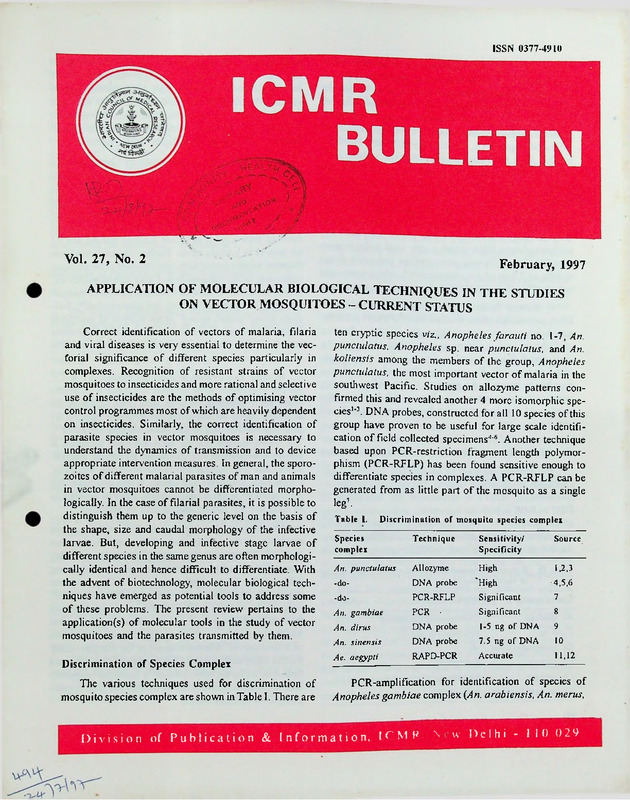
- extracted text
-
ISSN 0377-4910
ICMR
Vbl. 27, No. 2
February, 1997
APPLICATION OF MOLECULAR BIOLOGICAL TECHNIQUES IN THE STUDIES
ON VECTOR MOSQUITOES 一 CURRENT STATUS
Correct identification of vectors of malaria, filaria
and viral diseases is very essential to determine the vec
torial significance of different species particularly in
complexes. Recognition of resistant strains of vector
mosquitoes to insecticides and more rational and selective
use of insecticides are the methods of optimising vector
control programmes most of which are heavily dependent
on insecticides. Similarly, the correct identification of
parasite species in vector mosquitoes is necessary to
understand the dynamics of transmission and to device
appropriate intervention measures. In general, the sporo
zoites of different malarial parasites of man and animals
in vector mosquitoes cannot be differentiated morpho
logically. In the case of filarial parasites, it is possible to
distinguish them up to the generic level on the basis of
the shape, size and caudal morphology of the infective
larvae. But, developing and infective stage larvae of
different species in the same genus are often morphologi
cally identical and hence difficult to differentiate. With
the advent of biotechnology, molecular biological tech
niques have emerged as potential tools to address some
of these problems. The present review pertains to the
application(s) of molecular tools in the study of vector
mosquitoes and the parasites transmitted by them.
Discrimination of Species Complex
The various techniques used for discrimination of
mosquito species complex are shown in Table !. There are
ten cryptic species viz,, Anopheles farauti no. 1-7, An.
punctulatus, Anopheles sp. near punctulatus, and An.
koliensis among the members of the group, Anopheles
punctulatus, the most important vector of malaria in the
southwest Pacific. Studies on allozyme patterns con
firmed this and revealed another 4 more isomorphic species'3. DNA probes, constructed for all 10 species of this
group have proven to be useful fbr large scale identifi
cation of field collected specimens4'6. Another technique
based upon PCR-restriction fragment length polymor
phism (PCR-RFLP) has been found sensitive enough to
differentiate species in complexes. A PCR-RFLP can be
generated from as little part of the mosquito as a single
leg7.
Table I.
Discrimination of mosquito species complex
Species
complex
Technique
An. punctulatus
Allozyme
High
123
•do-
DNA probe
'High
•4,5,6
>do-
PCR-RFLP
Significant
7
An. gambiae
PCR
SigniGcant
8
An. dirus
DNA probe
1-5 ng of DNA
9
An. sinensis
DNA probe
7.5 ng of DNA
10
Ae. aegypti
RAPD-PCR
Accurate
11,12
•
Sensitivity/
Specificity
Source
PCR-amplification for identification of species of
Anopheles gambiae complex (An. arabiensis. An. merus,
Division of Publication & Information, I「M R
'w De 1 h i - 1 1 0 ()29
An. gambiae and An. quadriannulatus) has been found
to be sensitive, specific and easy to perform8. A Simple
chemiluminescent detection system was developed for
identification of Anopheles dirus complex and identified
species B, C and D in Thailand, using horse radish
peroxidase-labelled DNA probes9. These probes detected
1-5 ng of target DNA, a sensitivity level that was com
parable with the radioisotopic detection system. This
method allowed identification using third or fourth instar
larvae as well as the adult head, thorax or abdomen.
Another DNA probe was developed for discriminating
the two sibling species of Anopheles sinensis viz., An.
sinensis and 如.anthropophagus. This probe hybridized
with all stages of An. sinensis DNA, but with An.
anthropophagus DNA it had a very weak hybridization
signal10. This probe was very sensitive and could detect
as little as 7.5 ng of An. sinensis DNA, which represents
only 0.67% of the total DNA from a single mosquito.
A method using random amplified polymorphic
DNA-polymerase chain reaction (RAPD-PCR) markers,
was developed to estimate the number of sibling families
of Aedes aegypti, a species that distributes its eggs of a
single batch from a given gonotrophic cycle among sev
eral locations11,12. By applying this technique it was
possible to estimate the number of full-sibling families
contained in oviposition traps. It accurately estimated the
number of families when family sizes were small and
variable.
Detection of Insecticide Resistant/Susceptible Strains
The enzyme markers of insecticidal resistance/susceptibility are shown in Table II. The enzyme glutathioneS-transferase (GST) is responsible for conversion of
DDT to DDE in both the susceptible and resistant strains
of An. gambiae}3AA. There are seven GSTs and all of them
were found to possess different degrees ofDDTase activity.
An 8-fbld increase in total DDTase activity has been
Table IL
Detection of insecticide rcsistant/susceptible strains
of vector mosquitoes
Vector species
Marker enzyme
Source
An. gambiae
Glutathione-S-transferase
13,14
Culex sp.
Esterases A2 and B2
15
Cx. quinquefasciatus
-do-
16
Cx. pipiens
Esterase Bl
17
Cx. tarsalis
Malathion carboxylesterase
18,19
Cx. quinquefasciatus
Beta-esterase
20
reported in the resistant strain compared to the susceptible
one. The data show that both DDT resistance and the
increased levels of GST activity are stage specific, suggest
ing that different GSTs may be involved in DDT resistance
in adults and larvae. It was concluded that DDT resistance
is conferred by qualitatively dififerent glutathione-S-transferases which are present in higher concentration.
A study with five resistant strains of Culex species to
DDT and one insecticide susceptible strain, has shown that
esterases A2 and B2 interact with a range of insecticides to
a. similar extent, hence both have a role in resistance15. The
B2 esterases are more similar between strains, but some of
these are also kinetically distinct. Data on the purified
esterases from a range of strains suggests that A2 and B2
are present in a single strain. Furtlier, identical restriction
fragment length patterns have been observed in the amplicon
containing the B2 esterase from Culex strains worldwide.
Esterases A2 and B2 have been purified from three resistant
strains of Cx. quinquefasciatus and characterized16. Sub
strate kinetic studies as well as the kinetics of insecticide
interaction demonstrated that the esterases A2 and B2 differ
both from each other and in the forms found in tlie three
resistant strains.
In order to determine whether the esterase Bl in Cx.
pipiens mosquitoes from different countries is over-pro
duced due to amplification of the same DNA haplotype, the
amplified region encompassing the structural esterase Bl
gene was characterized by restriction mapping and RFLP17.
The results showed that the same amplified haplotype is
present in mosquitoes with an esterase Bl protein, indepen
dent oftheir geographical origin (French Guiana, Venezuela,
Puerto Rico, California and China). It was concluded that
B1 amplification has a unique origin, either in America or
in Asia, and has subsequently spread by migration.
Malathion resistance in a strain of Cx tarsalis is pri
marily due to the activity of a malathion carboxylesterase
(MCE)18. The resistant strain was 150 times more resistant
to malathion than the susceptible strain. Chromatofbcusing
indicated that the resistant strain has 2 MCEs, while the
susceptible strain possesses only one MCE. The MCE,
unique to the resistant strain, hydrolysed malathion 18 times
faster than MCE common to both strains, suggesting that
malathion resistance in Cx tarsalis is due to the presence
of a qualitatively different esterase in the resistant strain.
Further study on this enzyme19 has indicated that it does not
hydrolyse alpha-naphthyl acetate, a substrate commonly
used to detect increased levels of esterases in otlier organo
phosphorus resistant insects.
Studies carried out to understand the mvolvement of
beta-esterase-mediated hydrolysis as a mechanism of pyrethroid resistance in Ae. aegypti, Cx. quinquefiisciatus and
An. stephensi (in individual larvae and adult females and
males) indicated that ester hydrolysis of permethrin and
deltam^hrin is a predominant mechanism of pyrethroid
resistance in the larvae of Cx. quinquefasciatus but not in
Ae. aegypti^. However, a marginal role for esterases is
indicated in the larvae of An. stephensi. A PCR assay
performed between the allele-specific primers and flanking
primers known to be nested within exon 7 of the GABA
receptor/chloride ion channel gene Rdl which contains the
cyclodiene resistance associated mutation inAe. aegypti has
been observed to amplify the specific allele and allow the
detection of the single base pair mutation21.
Detection of Parasites in Vector Mosquitoes
Viruses
The various methods used for detection of viruses in
vector mosquitoes are shown in Table III. A colorimetric
Table IIL Detection of viruses in vector mosquitoes
Technique
Sensitivity/
Specificity
Source
•EEEV
Mosquito
PCR
0.1 pg RNA ©f EEEV
only or 1 infected
mosquito/1000
22
LACV
mosquito
RT-PCR
Detects 1 day post in
23
-do-
EIA
Virus &
host
oculation
Detects 2 days postin
23
oculation
DEN
Mosquito
ELISA
DEN & JE
ELISA
Mosquito
1/1000 dilution of hom
24
ogenate, but cross reacts
with all 4 DEN & JE
viruses
Readily screens antigens
25
in single & pooled speci
mens
EEEV: Eastern equine encephalomyelitis virus;
LACV: LaCrosse virus; DEN: Dengue; JE: Japanese encephalitis
dot-assay, developed following PCR method, has been found
to detect 0.1 pg of Eastern equine encephalon:/elitis virus
(EEEV) RNA22. This method is 250-fbld sensitive than
electrophoretic procedures. While RNA of Venezuelan
equine encephalitis, St. Louis encephalitis, Keystone,
Flanders, lensaw and Western equine encephalitis viruses
were not detected by this assay, the RNA of EEEV (Ten
Broeck) was detected at the 10-ng level. The detection of
EEEV in the liver of an infected emu (Dromaius
novaehollandiae) and in field-collected Culiseta melanura,
Cx erraticus and Cx nigripalpus that were analysed con
currently as bind samples by tissue culture plaque assay and
by PCR dot analysis proved that the assay is sensitive and
can be used to detect infected mosquitoes. The assay can
detect even a single infected mosquito in a pool of 1000
uninfected mosquitoes.
A reverse transcription-polymerase chain reaction (RT・
PCR) assay has been developed and compared with enzyme
immunoassay (EIA) and virus isolation methods for detect
ing LaCrosse virus (LAC) in mosquito pools23. All the three
techniques were able to detect a single LAC-infected Aedes
triseriatus mosquito in a pool of 99 negative mosquitoes.
The LAC RNA was detected 1 day post-infection by RTPCR, whereas EIA detected LAC antigen 2 days post
infection. Further, the RT-PCR and EIA were ^ble to detect
LAC RNA and protein, respectively, from mosquito samples
which were subjected to 7 freeze-thaw cycles; and RT-PCR
was able to detect LAC RNA from mosquito samples which
remained at room temperature for up to 7 days.
A rapid ELISA could detect dengue virus in a 1/1000
dilution of mosquito homogenate24. However, cross reaction
among all 4 dengue serotypes and Japanese encephalitis
virus was also noted. An indirect ELISA fbr detecting
dengue (DEN) virus in Ae. aegypti and Ae. albopictus and
Japanese encephalitis (JE) virus in Cx. tritaeniorhynchus
(experimentally infected) has been developed25. DEN anti
gen from 4 strains of dengue virus and JE antigen were
captured with a polyclonal anti-flavivirus IgG and detected
with a monoclonal antibody (4G2) that reacts with all
flaviviruies. The results indicated that the antigen-capture
ELISA could readily screen for DEN antigen in individual
and pooled mosquitoes.
Malaria parasites
Plasmodium infected mosquitoes were detected by using
a 32P-labelled cloned DNA probe (Table IV). This technique
was shown to detect infection even when one out of 25
mosquitoes had the parasites26. The head and thorax portions
of dried An. gambiae mosquitoes, infected with P.
falciparum, were processed by PCR and the infection was
detected by autoradiography27. The detection level was, ten
sporozoites per mosquito and the head and. thorax portions
of mosquitoes that contained matured P. falciparum oocysts
(without sporozoites) did not give positive signal, indicating
that the test detects only infective mosquitoes. In an another
study, application of dot-blot hybridization with cloned
genomic DNA labelled with photobiotin could detect 2 pg
11
of sporozoite DNA of P, falciparum in dried An. dims
mosquitoes or 1 infected mosquito in a pool of 25 without
DNA extraction28. It has been concluded that by using this
method, a single mosquito, squashed directly on a nitrocel
lulose filter, is enough for the detection of sporozoites while
the mosquitoes triturated in reduction buffer are sufficient
for the screening in a lai^e number of samples. By means
of enzymatic amplification ofP. falciparum DNA (using the
PCR), it has been possible to detect a minimum of 10
sporozoites or a single oocyst dissected from aPfalciparuminfected An. dirus.
a one-site direct assay. A two-site LAB assay using a crude
preparation of biotin labelled MAb and a commercially
obtained enzyme-labelled avidin detected about 180 sporo
zoites, whereas a two-site assay based on a custom-labelled
enzyme-MAb conjugate detected about 90 sporozoites. The
reliable detection level for pooled mosquito assays was one
infected in 50 specimens for the one-site assays and one in
100 for the two-site assays. The indirect LAB ELISA was
effective in discriminating gut restricted oocyst infections
from the disseminated sporozoite infection in mosquitoes.
Table IV. Detection of malaria parasites in vector mosquitoes
Filaria parasites
Parasite stage
& host
Technique
Sensitivity/
Specificity
Source
Plasmodium
*
Mosquito
32Plabelled DNA
1 mosquito/25
26
P. falciparum
Sporozoites
An. gambiae
PCR
10 sporozoites/
mosquito; did
not detect oocysts
27
P. falciparum
Sporozoites
An. dirus
DNA probe
2 pg of sporozoite
DNA or 1 infected
mosquito/25
28
P. vivax
CS antigen
An. stephensi
IRMA
Sporozoites in mat 22
ure oocysts a day
prior to liberation
or in salivary glands
or a Her dissection
of salivary glands
P. inui
Sporozoites
An. dirus
ELISA
•
50 sporozoites or
mosquito/50
30
Nanda etal29., carried out a two-site immunoradiometric
assay (IRMA) with An. stephensi fed on P. vivax blood to
ascertain at what time in the sporogonic cycle,
circumsporozoite (CS) antigen can be detected and to detect
CS antigen in mosquitoes squashed on filter paper (FP) and
cellulose acetate membrane (CAM). The CS antigen was
detectable only in mature oocysts (a day prior to sporozoite
liberation) and in salivary gland sporozoites. Dissected
sporozoites, adsorbed on FP/CAM, could also be detected
by this method.
One and two site ELISAs have been developed for
screening mosquitoes for infection with malarial parasite
using monoclonal antibodies (MAbs) produced against
sporozoite of P. inui (N34 strain) infecting An. dirus30. A
one-site indirect labelled avidin-biotin (LAB) assay detected
the infected mosquitoes at a sensitivity of less than 50
sporozoites. A comparable level of sensitivity was obtained
using an excessive amount of enzyme conjugated MAb in
12
A PtR-based detection system using Ssp I repeat DNA
sequence of Wuchereria bancrofti has been described fbrthe
detection of Ito 6 third stage larvae (L3) of W. bancrofti
added to 50 mosquito heads (Ae. polynesiensis)3} (Table V).
The results indicated that this assay can be a semi-quantitative one for detecting the number of third stage larvae
present in pools of mosquito vectors. No cross hybridization
or PCR amplification with filarial DNA from any other
genus was reported.
Table V.
Detection of filarial parasites in vector mosquitoes
Parasite stage
& host
Technique
Sensitivity/
Specificity
Source
W. bancrofti
L3 larva in
Ae. polynesiensis
& mF in blood
Ssp I
PCR
Detects 500 pg
of DNA in blood
and one L3 in pools
of 50 uninfected
mosquitoes
31
Dirofilaria sp.
& D. immitis
L3 larva in
mosquito & mF
in blood
PCR
Single infected mos
quitoes stored desi
ccated at RT for 7
months; did not
detect D. temuis
32
D. repens
mF in blood &
L3 larva, in
Mosquito
DNA hyb
ridization
Detects single mF in
blood or single L3 in
mosquito
33
B. malayi
Hha I
PCR
When radioactively
34
labelled-species speci
fic & sensitive detects
as little as 200 pg in
a pool1 of 50-100
uninfected mosquitoes
mF: microGlaria
A PCR-based test has been perfected for the identifica
tion of Dirofilaria sp. and for use in surveys for infected
vectors of D. immitis32. The assay could amplify the tai^et
DNA fragment from free D. immitis larvae (both L3 and
•)
microfilaria), individual infected mosquitoes, pools of 30
mosquitoes (including a single infected mosquito), infected
mosquitoes stored under desiccation at room temperature for
7 months and whole blood of an infected dog. Field collected
L3, identified tentatively as D. immitis, were confim)ed by
this assay. The primers did not amplify a monologous frag
ment &om a mermithid or from 4 other species of filarioid
nematodes (including another Dirofilaria species). There
was no amplification using the PCR test for L3, identified
tentatively as Dirofilaria sp. (possibly D. tenuis).
A highly repetitive DNA element from the genome ofD.
repens was cloned and sequenced33. The cloned repetitive
sequence hybridized only to D. repens DNA, a single mi
crofilaria in infected blood samples and a single L3 larva in
mosquitoes.
A PCR assay based on the Hha 1 repeat was developed
for the detection ofBrugia in blood samples and mosquitoes.
This assay has been used to detect individual L3 larvae. The
sensitivity of this system is so great, that it may be possible
to detect the L3 in 100 mosquitoes34.
The major advantage ofPCR system in the assays is that
results are obtained after PCR by simple running the prod
ucts on an agarose gel, staining with ethidium bromide, and
looking fora 188 base pair band. Results are obtained very
rapidly and the cost is comparable to conventional methods.
Conclusion
The available information indicates that the molecular
biological techniques can successfully be employed fbr the
accurate identification of genetically distinct members of
some species complexes and insecticide resistant strains of
mosquitoes and fbr the detection of infection and/or infec
tivity in mosquitoes due to viruses, and malarial and filarial
. parasites. However, at present, these techniques cannot be
handled by field level workers and have to be carried out in
centralised laboratories. With the rapid strides being made
in the area of molecular biology, it is possible that simple
and cost-efifective field kits fbr conducting these assays
could be made available in the not too distant future.
Vanuatu surveyed by allozyme electrophoresis. Med VetEntomol
8: 340, 1994.
3.
Foley, D.H., Cooper, R.D. and Bryan, J.H. A new species within
the Anopheles punctulatus complex in Western Province, Papua
New Guinea. J Am Mosq Contr Assoc 11: 122, 1995.
4.
Cooper, L.» Cooper, R.D. and Burkot, T.R. The Anopheles
punctulatus complex: DNA probes for identifying the Austarlian
species using isotopic, chromogenic, and chemiluminescence
detection systems. Exp Panuitol 73: 27, 1992.
5.
Booth, D.R., Mahon, R.J. and Sriprakash, K.S. DNA probes to
identify members of the Anopheles Jarauti complex. Med Vet
3: 447, [991.
6.
Beebe, N.W., Foley, D.H., Saul, A., Cooper, L., Bryan, J.H and
Burkot, T.R. DNA probes for identifying the members of the
Anopheles punctulatus complex in Papua New Guinea. Am J
Trop Med Hyg 50: 229, 1994.
7.
Beebe, N.W. and Saul, A. Discrimination of all members of the
Anopheles punctulatus complex by polymerase chain reaction
restriction fragment length polymorphism analysis. Am J Trop
Med Hyg 53: 478, 1995.
8.
Bredenkamp, B.L.F. and Sharp, B.L. PCR identification of the
Anopheles gambiae complex in South Africa. South African JSci
89:353, 1993.
9.
Audtho, M., Tassanakajon, A., Boonsaeng, V., Tpiankijagum, S.
and Panyim, S. Simple nonradioactive DNA hybridization method
for identification of sibling species of Anopheles dirus (Diptera:
Culicidae) complex. J Med Entomol 32\ 107, 1995.
10.
Niu, L.L., Yuan Zheng, Coi Gao Ying and Malcolm, C.A. DNA
probes for identification of sibling species ofAnopheles sinensis
and An anthropophagus. Chin Jparasitol Parasitic Dis J0:270,
1992.
11.
Apostol, B.L., Black, W.C., Miller, B.R., Reiter, P. and Beaty,
B.J. Estimation of the number of full-sibling families at an
oviposition site using RAPD-PCR marker^: Applications to the
mosquito Ae. aegypti. Theor Appl Genet 86'. 991, 1993.
12.
Apostol, B.L., Black, W.C., Reiter, P. and Miller, B.R. Use of
randomly amplified polymorphic DNA amplified by polymerase
chain reaction markers to estimate the number of Ae. aegypti
families at oviposition sites in San Juan, Puerto Rico. Am J Trop
心咂 51: 89, 1994.
13.
14.
2.
Foley, D.H., Pam, R.» Dagoro, H. and Biyan, J.H. Allozyme
analysis reveals six species within the Anopheles punctulatus
complex of mosquitoes in Papua New Guinea. Med VetEntomol
7: 37, 1993,Foley, D.H., Meek, S.R. and Bryan, J.H Tlie Anopheles
punctulatus group of mosquitoes in the Solomon Islands and
Prapanthadara, L.A., Hemingway, J. and Ketterman, A.J. DDTresistance in Anopheles gambiae (Diptera: Culicidae) from 2Lmizibar, Tanzania, based on increased DDT-dehydrochlorinase
activity of glutathione-S-transferases. Bull Entomol Res 85:267,
References
1.
Prapanthadara, L.A. and Ketterman, A.J. Qualitative and quan
titative changes in glutatione-S-tfansferases in the mosquito
Anopheles gambiae confer DDT-resistance. Biochem Soc Trans
21: 304S, 1993.
1995.
15.
Hemingway, J., Ketterman, A.J., Karunaratne, S.H.P.P.,
Jayawardena, K.G.I. and Vaughan, A. Amplified esterases A2
and B2. Has resistance occurred once or several times? In: Proc
1st Intern ConfInsect Pests in the Urban Environ., Cambridge,
UK: p. 319, 1993.
13
16.
Ketterman, A.l,Kanmaratne, S.H.P.P., Jayawardena, K.G.L and
Hemingway, J. Qualitative difference between populations of
Culex quinquefasciatus in both the esterases A2 and B2 which
are involved in insecticide resistance. Pestic biochem Physiol 47:
142, 1993.
17.
27.
28.
Whyard, S., Downe, A.E.R. and Walker, V.K. Isolation of an
esterase conferring insecticide resistance in the mosquito Culex
in blood and mosquito by DNA amplification. In: Commission of
Meeting, Italy, 1992. Eds. A. Cristani, and J. Crampton.
Parassitologia (Roma) 35 (supplemmento) : 117, 1993.
Whyard, S., Downe, A.E.R. and Walker, V.K. Characterization
of a novel esterase conferring insecticide resistance in the
29.
1995.
30.
Ffrench-Constant, R.H., Steichen, J.C. and Shotkoski, F. Poly
merase chain reaction diagnostic for cyclodience insecticide re
sistance in the mosquito Aedes aegypti. Med Vet Entomol 8: 99,
1994.
Armstrong,P., Borovsky,D., Shope,RE,Morris, C.D., Mitchell,
C.J:, Karabatsos, N., Komar, N. and Spielman, A. Sensitive and
specific colorimetric dot assay to detect Eastern equine
encephalomyelitis viral RNA in mosquitoes (Diptera: Culicidae)
after polymerase chain reaction amplification. JMed Entomol 32:
Wasieloski, L.P.Jr., Rayms-Keller, A., Curtis, L.A., Blair, C.D.
and Beaty, B.J. Reverse transcriptase-PCR detection ofLaCrosse
virus in mosquitoes and comparison with enzyme inununoassay
and virus isolation. J Clin Microbiol 32: 2076, 1994.
24.
Lee; H.L., Mangalam, S., Razdan, T., Seleena, P. and Inder
Singli, K. Development of an ELISA assay for the detection of
dengue viral antigen in mosquito: Preliminary observation. Mosq
Borne Dis Bull 10: 21, 1993.
25.
biotin enzyme-linked immunosorbent assay: Sinet, an Ethiopian
J Sci 15: 23, 1992.
31.' Chanteau, S., Luquiaud, P., Failloux, A.B. and Williams, S.A.
Detection of Wuchereria bancrofti larvae in pools of mosquitoes
by the polymerase chain reaction. Trans R Soc Trop Med Hyg 88:
665, 1994.
32.
Scoles, G.A. and Srinivas, K. Polymerase *
chain reaction-based
method for the detection of canine heartworm (Filarioidea:
Onchocercidae) in mosquitoes (Diptera: Culicidae) and verte
brate hosts. J Med Entomol 32: 864, 1995.
42; f995.
23.
Petros, B., Mehaffey, P., Campbell, G. and Collins, F. Detection
of Plasmodium infections in mosquitoes by a labelled avidin
*
quitoes. J Biosci 19: 193, 1994.
22.
Nanda, N., Joshi, H., Subbarao, S.K. and Sharma, V.P. Two-site
immunoradiometric assay (IRMA): Detection, efficiency, and
procedural modification. J Am Mosq Cont Assoc 10: 225, 1994.
Sahgal, A., Kumar, S. and Pillai, M.K.K. Microplate assay of
elevated esterase activity in individual pyrethroid resistant mos
21.
Tirasophon, W., Tassanakajon, A., Boonsaeng, V., Panyim, S.
and Wilairat, P. Sensitive detection of Plasmodium falciparum
the European Communities Second Malaria Contract Holders
mosquito Culex tarsalis. Arch Insect Biochem Physiol 29: 329,
20.
Stoffels, J.A.W., Van Leeuwen, W.M.D. and Post, R.J. Detection
reaction and oligonucleotide rDNA probe, without dissection of
the salivary gland. Med Vet Entomol 9: 433, ] 995.
Qiao, C-L. and Raymond, M. The same esterase B1 haplotype is
tarsalis. Insect Biochem Mol Biol 24: 819, 1994.
19.
Lin, K.Y., Chen, X.X., Huang, B.C., Cheng, Y.L., Cal, XZ and
Lin, S.G. Detection of malaria parasites in mosquitoes using a
DNA probe. Chin J Parasite Dis Cont 7: 88, 1994.
of Plasmodium sporozoites in mosquitoes by polymerase chain
amplified in insecticide>resistant mosquitoes of the Culexpipiens
complex from America and China. Heredity 74: 339, 1995.
18.
26.
Sithiprasasna, R.» Strickman, D.» Innis, B.L. and Linthicum,
K.J. ELISA for detecting dengue and Japanese encephalitis
3王 Chandrasekharan, N.V., Kanmanayake, E.H., Franzen, L.,
Abeyewickreme, W. and Pettersson, U. Dirofilaria repens'. Clon
ing and characterization of a repeated DNA sequence for the
diagnosis ofdirofilariasis in dogs, Canisfamiliaris. Exp Parasitol
78:279, 1994.
34. Lizotte, M.R. Supali, T., Partono, F. and Williams, S.A. A
polymerase chain reaction assay for the detection of Brugia
malayi in blood. Am J Trop Med Hyg 51: 314, 1994:
This write-up has been contributed by Dr. K. Balarainan,
Dy. Director and Dr. K. Krishnamoorthy and Dr. K.
viral antigen in mosquitoes. Ann Trop Med Parasitol 88: 397,
Gunasekaran, Senior Research Officers, Vector Control
1994.
Research Centre, Pondicherry.
ABSTRACTS
Some Research Projects Completed Recently
Critical evaluation of laser therapy in management
of diabetic retinopathy :
The study was undertaken to assess the relative
efficacy of argon green (514 nm) versus krypton red
(647 nm) laser photocoagulation in the management of
diabetic retinopathy and maculopathy respectively and
to evaluate the efficacy of peripheral scatter laser
photocoagulation in preproliferative diabetic retinopathy
(PPDR).
14
The patients were categorised into different groups.
Group 1 included 75 eyes of 68 diabetic patients with
proliferative diabetic retinopathy (PDR) and high risk
characteristics (HRC) while group 2included 60 eyes of
47 patients with PDR but without HRC. The high risk
characteristics included new vessels on or within 1 disc
diameter of the optic disc with and without vitreous or
preretinal haemorrhage; new vessels on the optic disc
(NVD) of approximately 1/4 to 1/3 disc area associated
with vitreous and/or preretinal haemorrhage; and new
vessels elsewhere more than 1/2 disc area associated
with vitreous and/or preretinal haemorrhage. All these
*eyes were prospectively randomised to treatment with
argon green (38 and 30 eyes respectively in groups
I and 2) or krypton red (37 and 30 eyes respectively)
laser photocoagulation. At the end of one year follow
up, there was no significant difference in the two groups
treated with different wavelengths in causing regression
of neovascularisation and improvement/stabilization of
visual acuity.
Group 3 included 121 eyes of 88 diabetic patients
with clinically significant macular oedema (CSME). The
eyes were randomized to treatment with argon green (60)
or krypton red (61) laser photocoagulation. At the end
of one year follow up the eyes treated with both argan
green or krypton red laser behaved similarly as regards
the resolution ofCSME and preserving/im proving visual
acuity from baseline levels.
Studies carried out on another group of 60 eyes (26
treated and 34 untreated of 42 patients) to evaluate the
efficacy of peripheral scatter laser photocoagulation in
PPDR demonstrated, that the number of eyes shoxying
progression was much less in the treated group (34.6%)
compared to control (55.9%). However, no conclusion
could be drawn from these findings as the duration of
follow up was too short (3 months) to comment upon
the beneficial role of this treatment.
The results of the study suggest that the quality of
care is not compromised by the availability of specific
laser wavelength fbr fundus photocoagulation. However,
a longer wavelength like krypton red offers the additional
advantage of better penetration through hazy media and
cataract and thus can be used with equal efficacy as the
standard argon green laser in eyes with cataract and
media opacities.
Amod Gupta
Department of Ophthalmology
Postgraduate Institute of Medical
Education and Research
Chandigarh
Etiopathogenesis and management problems in
pseudoexfoliation syndrome :
Patients with cataract (2792; 1695 males and 1097
females) and open angle glaucoma (147) were screened
fbr pseudoexfbliation (PXF) and to find out how such
eyes react to surgery fbr cataract and glaucoma and their
management.
One hundred and sixty two of the 2792 (5.8%)
patients with cataract had PXF (usually bilateral) with,
the highest incidence being found in the age group of
60-70 years. Incidence of PXF was more in males (61%)
as compared to females (39%). There was an association
of PXF with nuclear cataract, advanced stage of senile
cataract and sublerxation of the cataractus lens. In
patients with PXF extracapsular cataract extraction
reduced the risk of vitreous loss and accidental capsule
rupture, but poor mydriasis, zonular weakness and
pigment dispersal may pose difficulties.
Surgery in PXF syndrome was often complicated by
an intense postoperative iridocyclitis and sometimes by
hyphaema and vitreous haemorrhage. It is felt that
adequate surgical planning and gentle handling of tissues
can prevent or reduce the complications.
Nearly one-fburth of all the patients with PXF had
glaucoma. There was a strong correlation between the
presence of PXF material in the eye and glaucomatous
damage. In addition to pigment deposition in the trabe
cular meshvvork, the accumulation of PAS-positive
mucopolysaccharide-!ike PXF material in the outflow
channels may be a causative factor in pseudoexfbliation
glaucoma. Trabeculectomy yielded better results than
medical therapy in PXF glaucoma though the results
were worse than in primary open angle glaucoma
(POAG). Hyphaema and uveitis were more commonly
seen following trabeculectomy in PXF glaucoma than
in POAG. Intraocular haemorrhage aqd uveitis might be
due to the deposition of PXF material in the iris vessels
and the resultant neovascularization seen as profuse dyq
leakage at the pupillary margin during iris fluorescein
angiography. This test can be used as a sensitive and
specific indicator of PXF syndrome in doubtful cases
where even after fiill mydriasis, slit lamp biomicroscopy
does not reveal the presence of PXF material.
Findings of the study thus suggest that an awareness
of the PXF status will help in proper surgical planning,
reduction of operative complications and identification
of patients suspected to have glaucoma fbr long-term
fbllow-up.
V. Ananda Rao
Department of Ophthalmology
Jawaharlal Institute of Postgraduate
Medical Education and Research, Pondicherry
ICMR NEWS
The following meetings of the various technical committees/groups of the Council were held at New Delhi:
Meeting of Project Review Committee on Virology and Microbiology
Meeting of the Task Force on Risk
Factors for Acute Myocardial
Infarction
January 27, 1997
Participation of ICMR Scientists in Scientific Events:
Meeting of Experts and Investigators on Traditional Remedies for
Diabetes Mellitus
January 27, 1997
Dr. Vasantha Thavraj, Senior Research Officer,
Department of Paediatrics, All India Institute of Medical
Sciences, New Delhi, participated in the VII International
Congress on Anticancer Treatment at Paris (February 36, 1997).
February 11, 1997
ICMR AIDED SYMPOSIA/SEMINARS/WORKSHOPS/COURSES/CONFERENCES
Symposium/Seminar/Workshop/
Course/Conference
Date & Place
Contact Address
International Symposium on Sensorimotor Function of
the Nervous System
January 31-February 1,
1997;
(at Vellore)
Dr. M.S. Devanandan, Professor of Neurophysio
logy, Department of Neurological Sciences, Cluistian Medical College, Vellore-632004.
IH National Seminar on Malaria and otlier Tropical
Diseases
February 18-20, 1997;
(at Bangalore)
Prof. N.J. Shetty, Organising Secretary of tlie
Seminar, Centre for Applied Genetics, Bangalore
University, Bangalore-560056.
V Brain Storming Session in Molecular Iimnimology
Febmary 21-23, 1997;
(at Varanasi)
Dr. Ajit Sodhi, Coordinator of the Session, School
of Biotechnology, Banaras Hindu University, Var
anasi-221005.
International Conference on Developing Human Rela
tions and Etlmic Understanding
February 26-28, 1997;
(at Hardwar)
Dr. S.K. Srivastava, Organising Secretary of the
Conference, Department of Psychology, Gurukul
Kangri University, Hardwar-249404.
Symposium on Current Trends in Research on Drugs of
Herbal and Marine Origin
March 2, 1997;
(at Gandhinagar)
Prof. N.S. Parmar, Principal and Professor of
Pharmacology, K.B. Institute of Pharmaceutical
Education and Research, Gaiidhinagar-382023.
International Seminar on Frontiers in Surgical Pathology
March 3-5, 1997;
(at Chennai)
Dr. Malalliy Madhavan, Professor and Head, Dep
artment of Pathology, Dr. A.L. Mudaliar P.G.
Institute of. Basic Medical Sciences, Chennai600113.
COUNCIL'S TRAINING PROGRAMMES FOR 1997-98
Leprosy
•
Workshop on Genotoxicity (August 28-29, 1997).
At the Central JALMA Institute for Leprosy, Agra:
•
Workshop on Basic Molecular Biology for Clini
cians (December 2-11, 1997).
•
Training Course on National Leprosy Eradication
Programme for Medical Officers (February 24March 7 and September 15-26, 1997).
Endocrinology
At the National Institute of Nutrition, Hyderabad:
Virology
•
At the National Institute of Virology, Pune:
•
Diploma in Medical Virology (July 1997-May 1998).
Annual Certificate Course on Endocrinological Tech
niques and their Applications (August 1-September
15, 1997).
Reproductive Biology
Nutrition
At the Institutefor Research in Reproduction, Mumbai:
At the National Institute of Nutrition, Hyderabad:
•
•
16
Training Course on Research Methods in Clinical
Trials ofNewer Contraceptives (April 14-25,1997).
M.Sc. in Applied Nutrition (June 1, 1997-February
28, 1998).
•
Postgraduate Certificate Course in Nutrition (De
cember 1, 1997-February 28, 1998).
Occupational Health
Laboratory Animal Technology
At the National Institute of Occupational Health,
Ahmedabad:
At the National Centre for Laboratory Animal Science,
National Institute of Nutrition, Hyderabad:
•
Orientation Course on Occupational Health for In
dustrial Medical Officers (September 30-October
11, 1997).
•
Training Course on Environmental Hygiene Practice
(November 10-14, 1997).
•
Training Course for Laboratory Animal Technicians
(June 16-July 31, 1997).
•
Training Course fbfLaboratory Animal Supervisors
(September 1-November 29, 1997).
ICMR PUBLICATIONS
Price (Rs.)
Nutritive Slue of Indian Foods (1985), by C. Gopalan^ B.V. Ramasastri and
S.C. Balasubramaniam, Revised and Updated (1989), by B.S. Narasinga Rao, K.C. Pant
and Y.G. Deosthale (Reprinted 1995)
23.00
Growth & Physical Development of Indian Infants and Children (1972, Reprinted 1989)
10.00
Studies on Weaning & Supplementary Foods (1974, Reprinted 1996)
15.00
Studies on Pre-School Children (1974, Reprinted 1984)
6.00
A Manual of Nutrition (Second Edition 1974, Reprinted 1995)
6.00
Low Cost Nutritious Supplements (Second Edition 1975, Reprinted 1994)
4.00
Menus for Low-Cost Balanced Diets and School-Lunch Programmes Suitable for
NQrth India (Second Edition 1977,. Reprinted 1994)
4.50
Menus for Low-Cost Balanced Diets and School-Lunch Programmes Suitable for
South India (Fourth Edition 1996)
6.00
Some Common Indian Recipes and their Nutritive Value (Fourth Edition 1977,
Reprinted 1995) by Swaran Pasricha & L.M. Rebello
10.00
Nutrition for Mother & Child (Third Edition 1978, Reprinted 1994) by P.S.
Veilkatachalam & L.M. Rebello
9.00
J apanese~Encephal it is in India (Revised Edition 1980)
5.00
Some Therapeutic Diets (Fourth Edition 1988, Reprinted 1995) by Swaran Pasricha
4.50
Nutrient Requirements.& Recommended Dietary Allowances for Indians (1990, Reprinted 1995) 16.00
Fruits (Second Edition 1996) by Indira Gopalan & M. Mohan Ram
Count What Ybu Eat 泌89, Reprinted 1994) by Swaran Pasricha
20.00
9.00
Diet & Diabetes (Second Edition 1993) by T.C. Raghuram, Swaran Pasricha & R.D. Sharma
18.00
Dietary Tips fbr the Elderly (1992) by Swaran Pasricha & B.V.S. Thimmayamma
3.50
Diet and Heart Disease (1994, Reprinted 1996) by Ghafborunissa and Kamala Krishnaswamy
26.00
Depressive Disease (1986) by A. Venkoba Rao
58.00
*Medicinal Plants of India VdK2 (1987)
136.00
* 25 per cent discount allowed to individuals.
These publications are available on prepayment of costyby cheque, bank draft or postal order (bank and postal charges
will be extra) in favour of the Director-General, Indian Council of Medical Research, New Delhi. Money orders are not
acceptable. All correspondence in this regard should be addressed to the Chief, Division of Publication and Information,
Indian Council of Medical Research, Post Box No.49U, Ansari Nagar, New
*
Delhi-110029 (India).
Statement about ownership and other particulars of the ICMR Research Information Bulletin as
required under Rule 8 of the Registration of Newspapers (Central) Rules 1956.
Place of Publication
Indian Council of Medical Research
Ansari Nagar, New Delhi-110 029.
Periodicity of Publication
Monthly
Printer's Name
Shri J.N. Mathur
Nationality
Indian
Address
Press Manager
Indian Council of Medical Research,
Ansari Nagar, New Delhi-110 029.
Publisher's Name
Nationality
Address
Same as above
Editor's Name
Dr. N. Medappa
Nationality
Indian
Address
Indian Council of Medical Research,.
Ansari Nagar, New Delhi-110 029.
I, J.N. Mathur, hereby declare that the particulars given above are true to the best of my knowledge
and belief.
Sd/- J.N. Mathur
Publisher
EDITORIAL BOARD
Dr. G.V. Satyavati
...
Chairperson
Dr. Badri N. Saxena
...
Member
Dr. Bela Shah
...
Member
Dr. N. Medappa
...
Editor
Printed and Published by Shri J.N. Mathur for the Indian Council of Medical Research, New Delhi
at the ICMR Offset Press, New Delhi-110029
R.N. 21813/71
Position: 3014 (6 views)