ICMR BULLETIN VOL. 28-No.-2-FEBRUARY-1998.pdf
Media
- extracted text
-
ISSN 0377-4910
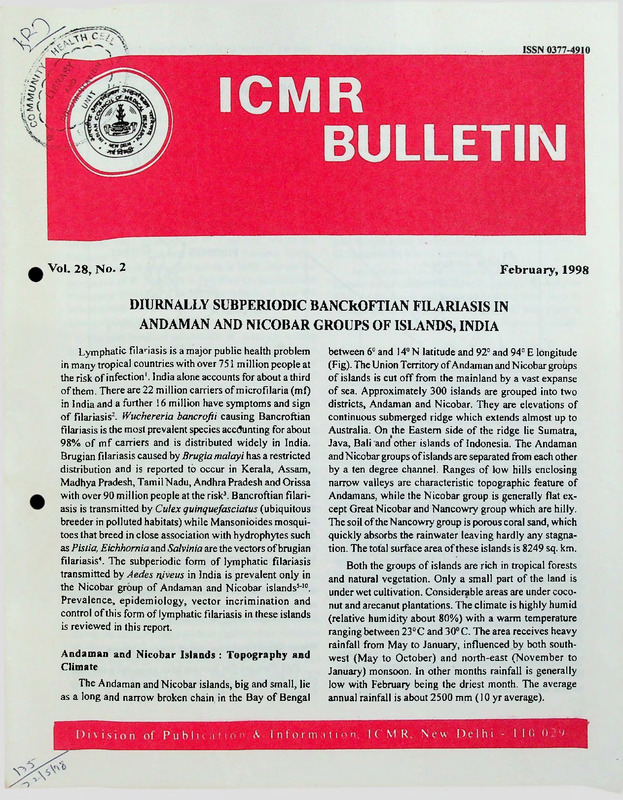
ICMR
BULLETIN
Vol. 28, No. 2
February, 1998
DIURNALLY SUBPERIODIC BANCROFTIAN FILARIASIS IN
ANDAMAN AND NICOBAR GROUPS OF ISLANDS, INDIA
Lymphatic filariasis is a major public health problem
in many tropical countries with over 751 million people at
the risk of infection1. India alone accounts for about a third
of them. There are 22 million carriers of microfilaria (mf)
in India and a further 16 million have symptoms and sign
of filariasis2. Wuchereria bancrofti causing Bancroftian
filariasis is the most prevalent species accounting for about
98% of mf carriers and is distributed widely in India.
Brugian filariasis caused by Brugia malayi has a restricted
distribution and is reported to occur in Kerala, Assam,
Madhya Pradesh, Tamil Nadu, Andhra Pradesh and Orissa
with over 90 million people at the risk3. Bancroftian filari
asis is transmitted by Culex quinquefasciatus (ubiquitous
breeder in polluted habitats) while Mansonioides mosqui
toes that breed in close association with hydrophytes such
as Pistia, Eichhomia and Salvinia are the vectors of brugian
filariasis4. The subperiodic form of lymphatic filariasis
transmitted by Aedes njveus in India is prevalent only in
the Nicobar group of Andaman and Nicobar islands5'10.
Prevalence, epidemiology, vector incrimination and
control of this form of lymphatic filariasis in these islands
is reviewed in this report.
Andaman and Nicobar Islands : Topography and
Climate
The Andaman and Nicobar islands, big and small, lie
as a long and narrow broken chain, in the Bay of Bengal
between 6° and 14° N latitude and 92° and 94° E longitude
(Fig). The Union Territory ofAndaman and Nicobar groups
of islands is cut off from the mainland by a vast expanse
of sea. Approximately 300 islands are grouped into two
districts, Andaman and Nicobar. They are elevations of
continuous submerged ridge which extends almost up to
Australia. On the Eastern side of the ridge lie Sumatra,
Java, Bali and other islands of Indonesia. The Andaman
and Nicobar groups of islands are separated from each other
by a ten degree channel. Ranges of low hills enclosing
narrow valleys are characteristic topographic feature of
Andamans, while the Nicobar group is generally flat ex
cept Great Nicobar and Nancowry group which are hilly.
The soil ofthe Nancowry group is porous coral sand, which
quickly absorbs the rainwater leaving hardly any stagna
tion. The total surface area of these islands is 8249 sq. km.
Both the groups of islands are rich in tropical forests
and natural vegetation. Only a small part of the land is
under wet cultivation. Considerable areas are under coco
nut and arecanut plantations. The climate is highly humid
(relative humidity about 80%) with a warm temperature
ranging between 23° C and 30°C. The area receives heavy
rainfall from May to January, influenced Jby both south
west (May to October) and north-east (November to
January) monsoon. In other months rainfall is generally
low with February being the driest month. The average
annual rainfall is about 2500 mm (10 yr average).
92°
93°
94°
95°
Fig. Andaman & Nicobar Islands
Population, Housing and Socio-Economic Conditions
The total population of Andaman and Nicdbar islands
is 2,80,661 (1991 census)11. Ex-convicts and their descen
dants, and people from mainland make up the population
of Port Blair. The tribal population constitutes 7.9% of the
total population. The tribes of Andaman and Nicobar
islands can be broadly divided into two distinct racial
groups-Negreto in the Andamans and Mongoloid in the
Nicobar. The vast majority of the tribal population live in
the Nicobar district. Six tribes (Great Andamanese, Onges,
Jarawas and Sentinelese of Negreto group and Shompen
and Nicobarese of Mongoloid group) inhabit different
remotely located islands. Apart from these tribes, mainlanders, for administrative and business purposes also stay
on different islands. Of these six tribes, two tribes are still
hostile and inaccessible. Three tribes ie. Andamanese,
14
Onges and Shompens have been rehabilitated by Andaman
and Nicobar Administration and are being provided with
regular free rations and other facilities. The Nicobarese
depend mainly on pigs which they rear and naturally
available coconuts, the rest of the food commodities
being supplied from the mainland.
Most of the houses in Port Blair and the administra
tive headquarters of Car N icobar and Nancowry group are
constructed on wooden platforms. The aborigine tribes live
in huts on stilts along the sea coast.
Water Supply and Disposal of Sewage Water
Port Blair and Car Nicobar have protected water sup
ply. In Teressa and Nancowry, wells are the only source
for potable water. Water for drinking purpose has to be
brought to Chowra island as the ground water is not suit
able for drinking. This necessitates storage of rain water
in drums and other containers for summer.
In Port Blair and Nancowry, sewage water is
discharged in the sea through drains. In other islands no
proper drainage system exists and the sewage water is either
absorbed by the porous soil or accumulated as pools or
pits.
Prevalence of Subperiodic Filariasis in Nicobar Group
of Islands
The prevalence of lymphatic filarial infection in these
islands was first identified.by Wilcock as early as 1944s.
He found that in Nicobar group 5.8% of the population
surveyed were positive for W. bancrofti, while the
.Andaman gro.up of islands was free of filariasis. Subse
quently, a sample survey carried out in 195 86, showed the
prevalence of W. bancrofti in Port Blair (Andamans) and
Nancowry (Nicobars). In Nicobar islands, 7 and 9%
infection rates were detected in human population surveyed
during day and night respectively.
The first report of subperiodic W. bancrofti among
tribes was from studies by Kalra during 19747. Only two
villages in Kamorta island and one in Nancowry island
were covered during this survey which showed mf rates of
12.3 and 1.7% respectively. Age and gender specific analy
sis of cases showed that the infection was confined to males
only 20 years of age and above.
Russel and co-workers8 did a day/night survey of6250
and 491 individuals in four islands of Nicobar district and
Port Blair town (Andamans). The survey showed two dis
tinct forms of W. bancrofti infection viz, a noctumally
periodic form in Port Blair and a subperiodic form in
Nancowry and Chowra islands. A low (0.3%) "mf rate in
Car Nicobar, medium (4.9 and 3.9%) in Port Blair and
Nancowry respectively and high rates of 15.8% in Teressa
and 13.4% in Chowra were recorded. Clinical manifesta
tions were recorded among 90 of the total 6741
individuals with both men and women being affected.
Elephantiasis in association with hydrocele was the
commonest disease manifestation encountered during the
survey.
After a gap of 15 yr, another survey was carried out
during the monsoon season which confirmed the existence
of subperiodic filariasis in Nicobar islands10. This survey
showed that the mf rate was lowest in Trinket (1.2%) and
highest in Kamorta (18.7%). The overall disease rate
was only. 1.9%, the highest being 2.5% from Chowra.
Elephantiasis ofthe legs was the predominant disease mani
festation. No information on prevalence of hydrocele is
available.
Periodicity of W. bancrofti Microfilaria
The first study on the periodicity in the appearance of
mf in the peripheral blood was done by Kalra7 in three
islands of Nancowry group. Microfilariae were observed
throughout the 24 h period without any distinct peak. The
density of mf was relatively lower than that of periodic
form. Another such observation with 15 male volunteers
from Chowra island10 also showed that the circulating mf
were present in the peripheral blood throughout the 24 h.
The mf count was found to vary widely during different
periods with a peak at about 18.00 h and a trough between
03.00 and 06.00 h in an individual.
Another study9 on the periodicity of mf of this species
showed the existence of noctumally periodic form at Port
Blair (Andamans) and diurnally subperiodic form in
Nicobar group of islands. The existence of both forms in
the same host was found in a settler in Nancowry island.
Mosquitoes Implicated in Filariasis Transmission
At least four mosquito species/species groups viz,
Aedes (Finlaya) niveus groupie. (Stegomyia) scuteliaris
group, Mansonia (Mansonidides) dives and Anopheles
sundaicus were reported to bite the aborigine tribes in the
jungles of Nancowry group of Nicobar islands7. Only one
specimen oL4e. (Finlaya) niveus group of mosquitoes was
naturally found infected, but none was found with infec
tive stage larva. The role of Ae. scutellaris which is an
established vector in Thailand and Singapore12*14 could not
be ascertained during this study. In a survey by Russel and
co-workers8 later in the same group of islands (Kamorta),
natural infection was found in Cx. quinquefasciatus col
lected from human dwellings. One of 150 mosquitoes was
found to harbour infective stage larva. This suggests the
probable co-existence of both periodic and subperiodic
forms of W. bancrofti in Nancowry group of islands. Dur
ing this survey, known vectors of subperiodic form of this
species were, however, not studied. A recent study10
showed that aborigine tribes who enter the forests are com
monly bitten by^e. (Finlaya) niveus and Ae. (Stegomyia)
seutellaris. Ae. (Finlaya) niveus was found naturally in
fected with W. bancrofti with infection and infectivity rates
of 1.1% and 0.9% respectively. Culex quinquefasciatus
was recorded in very low densities and on dissection was
not found infected.
15
Experimental Infection Studies
Experimental infection studies by allowing mosqui
toes to feed on mf carriers of W. bancrofti from Nancowry
knd Chowra (showing mf both in day and night time blood
samples) and Port Blair (periodic form) showed the
development of mf to infective stage only in Cx.
quinquefasciatus*. The microfilariae were observed to de
velop into L2 and L3 stages after 14 days postinfection.
The mean number of infective larvae per mosquito did not
differ significantly in Chowra and Nancowry, though there
were significant differences in mf densities among carri
ers. However, in Port Blair the mean number of infective
larvae per mosquito was significantly higher than that ob
served with mf carriers from Nancowry and Chowra. Only
a few mosquitoes of the species Ae. (Stegomyia) scutellaris
were fed op mf carriers and reported dead within 2-3 days
after the infective blood meal.
Similar studies10 with females of Ae. niveus, Ae.
malayensis and Ae. aegypti fed simultaneously on mf car
riers from Chowra (subperiodic form) in two batches were
carried out. The first batch of mosquitoes were fed on a
carrier with 206 mf/20 cmm, and a second batch on carri
ers with 300 mf/20 cmm blood at the time of feeding. Ae.
niveus was the only species in which larvae of W. bancrofti
developed. LI stage was found on 2-4 days postinfection,
L2 larvae from day 9 onwards and infective stage larvae
on the day 13. Ae. malayensis and Ae. aegypti were found
to pick up mf but did not support the development.
Conclusion
While the prevalence of periodic form of W. bancrofti
has been reported from some islands of Andaman group
including Little Andaman17, diumally subperiodic form of
W. bancrofti is known to be prevalent only in Nicobar group
of islands with a population of about 39,000. Of the 13
islands in this district, information on the prevalence of
filariasis is available only for Nancowry group of islands,
comprising 4 islands. The situation in the rest of the nine
islands of this district, with a population of nearly 33,500
spread over 172 villages is yet to be explored. From the
earlier surveys it is evident that at least 5562 people are at
the risk of this infection. Area specific extrapolation of
survey results showed that there were 793 mf carriers and
71 patients in the known endemic areas of Nicobar group
of islands10. While Chowra, Kamorta and Trinket islands
have been recorded with only subperiodic form of W.
bancrofti, there are indications of prevalence of both peri
odic and subperiodic forms of this species in Nancowry
16
island. This endemic foci is situated in the middle of this
district and the distribution of this infection in islands lo
cated above and below this belt is not yet known. Further
epidemiological investigations may be useful in under
standing the spatial distribution of this infection as well as
periodic form. The clinical spectrum of this disease in this
endemic foci also needs to be understood.
Ae. niveus is the established vector of the sub
periodic W. bancrofti. Though the members of Ae.
scutellaris sub group, known vector of subperiodic filari
asis elsewhere12’14 are prevalent in this island5’10, its role in
transmission remains to be verified. All the earlier ento
mological investigations were based on point surveillance.
To understand the transmission dynamics it is essential to
gather data from long-term studies. Such studies may also
be useful to enlist the mosquito fauna, their population
dynamics and breeding habitats. Experimental infection ~
studies are also needed to assess the vector potential of "
other mosquito species that are prevalent in this area.
The vector of this infection is a mosquito which breeds
primarily in tree holes and bite humans and animals dur
ing day time. With the given breeding peculiarity of this
species, biological, control with Toxorhynchites sp. could
be the only choice of control. As this area is inhabited
exclusively by the tribal community who depend on forest
produce for their livelihood, their frequenting the forest is
unavoidable. Therefore, none of the personal protection
measures against thd bite of mosquito is feasible includ
ing repellents which could well be cost prohibitive. There
fore, the alternative method of containing this infection is
chemotherapy to liquidate the parasite load. Among the
different chemotherapeutic options1, distribution of salt
fortified with DEC could be a pragmatic proposition in
such island situation where the influx of salt can be fairly
regulated. Studies on the efficacy of DEC fortified salt
may be useful in designing large scale mass medicated
salt programme which has been successfully demonstrated
in other regions of India15, ,6. The containment of this in
fection can be given priority as there exists a threat of its
infiltration into the non-endemic receptive areas.
References
1.
WHO. Lymphatic filariasis. The disease and its control (Fifth re
port of the WHO Expert Committee on Filariasis). WHO Tech
Rep Ser 821 : 1, 1992.
2.
Sharma, S.P., Biswas, H., Das, M. and Dwivedi, S.R. Present sta
tus ofthe filariasis problem in India. J Commun Dis 15 :53,1983.
3.
Das, M. Vector of filaria with special reference to India. J Commun
Dis8:W\,W16.
▼
4.
Rajagopalan, P.K., Panickcr, K.N. and Pani, S.P. Impact of 50
years of vector control on the prevalence of Brugia malayi in
Shertallai area of Kerala state. Indian J Med Res 89:418,1989.
5.
Wilcock, C. Medical organisation and diseases of Andaman and
Nicobar islands. Abst Trop Dis Bull 41: 703, 1944.
6.
Basu, P.C. A note on malaria and filariasis in Andaman and
Nicobar. Bull Nat Soc India Mai Mosq Dis 6: 193, 1958.
7.
Kalra, N.L. Filariasis among aborigines of Andaman and Nicobar
islands. J Commun Dis 6: 40, 1974.
8.
Russel, S., Das, M. and Rao, C.K. Filariasis in Andaman and
Nicobar islands. I. Survey findings-Nancowry, Teressa, Chowra,
Car Nicobar and Port Biair. J Commun Dis 7:15, 1975.
9.
Das, M., Russel, S. and Rao, C.K. Filariasis in Andaman and
Nicobar islands. II. Periodicity of microfilaria of IF bancrofti. J
Commun Dis 7: 251, 1975.
10.
Tewari, S.C., Hiriyan, J.H. and Reuben, R. Epidemiology of
subperiodic IF. bancrofti infection in the Nicobar islands, India.
Trans R Soc Trop Med Hyg 89: 163, 1995.
11.
Census of India 1991. Andaman and Nicobar Islands. Series 27,
Final population totals. Directorate of Census Operations.
12.
Gould, D.J., Bailey, C.L. and Vongpradist, S. Implication of for
est mosquitoes in the transmission of Wuchereria bancrofti in
Thailand. Mosq News 42 : 560, 1982.
13.
Colless, D.H. Notes on the culicine mosquitoes of Singapore. IV.
The Aedes niveus subgroup (Diptera: Culicidae): Introduction
and description of five nev' species and of new subspecies. Ann
Trop Med Parasitol 52 :468, 1958.
14.
Colless, D.H. Notes on the culicine mosquitoes of Singapore. V.
The Aedes niveus subgroup (Diptera: Culicidae): Previously de
scribed species and keys to adults and larvae. Ann Trop Med
Parasitol 53 : 166, 1959.
15.
Rao, C.K., Panduranga Rao, P., Russel, S., Hamzakoya, K.,
Chandrasekaran, A., Roychowdhury, S.P. and Krishna Rao, Ch.
Control of bancroftian filariasis with common salt medicated with
diethylcarbamazine in Lakshadweep. Indian J Med Res 73 :865,
1981.
16.
Narasimham, M.V.V.L., Shanna, S.P., Sundaram, R.M., Reddy
G.S., Raina, V.K., Sambasivam, V. and Das, M. Control of
bancroftian filariasis by diethylcarbamazine medicated salt in
Karaikal, Pondicherry, India. J Commun Dis 21 157, 1989.
17.
Shriram, A.N., Sugunan, A.P., Murhekar, M.V. and Sehgal, S.C.
Little Andaman island, a new focus of infection with noctumally
periodic Wuchereria bancrofti. Indian J Med Res 104 :166,1996.
This write-up has been contributed by Sh. A.N. Shriram,
Research Assistant and Dr. S.C. Sehgal, Director, Regional
Medical Research Centre, Port Blair.
ABSTRACTS
Some Research Projects Completed Recently
Sequential assay of oxygen free radicals, flit rates and
citrulline in experimental peritonitis.
Sequential production of oxygen free radicals, nitrates
and citrulline was studied in New Zealand Wistar strain
rats of average weight (200-250 g) after creating
peritonitis with caecal perforation. These parameters
were also studied after closure of the perforations and
peritoneal lavage (ie reversal of peritonitis). Average
survival time of rats after induction of peritonitis was 5.33
h. Baseline values of oxygen free radicals, nitrates and
citrulline (for comparison) were obtained in sham operated
rats (controls) subjected to laparotomy and closure.
After creating peritonitis sequential assays were per
formed from 1 to 6 h at 1 h intervals. Reversal of peritoni
tis was carried out at different intervals after induction of
peritonitis (from 1-6 h post peritonitis) and sequential as
says were carried out at every 1 h after reversal of perito
nitis.
There was a steady increase in the value of oxygen
free radicals from 0 to 3 h and in the nitrates and citrulline
levels from 0 to 4 h, thereafter they showed a gradual fall.
Peak levels of oxygen free radicals were seen at 3 h and
for nitrates and citrulline at 4 h post peritonitis. Maximum
mortality was observed between 3-4 h post peritonitis. After
induction of peritonitis all values were higher than the base
line values indicating that it was peritonitis which caused
the increase. Reversal of peritonitis produced significant
fall in all values. This study thus clearly indicated that the
values of oxygen free radicals, nitrates and citrulline were
significantly increased in peritonitis and were brought
down signifiantly with intervention in the form of rever
sal of peritonitis.
Harpreet Wasir
R.N. Katariya
Department of General Surgery
Postgraduate Institute of Medical
Education and Research, Chandigarh.
Studies on the effect of furosemide and the mechanism
involved in gastric acid secretion.
The study was carried out on CF strain of rats and
frogs to elucidate the mechanism of secretagogue
stimulated gastric acid secretion on the application of
furosemide, a potential antiulcer drug.
Gastric lesions were induced in rats using nonsteroi
dal anti-inflammatory drugs. Thereafter normal and ex
perimental rats were treated with oral furosemide at the
rate of 2 mg/kg body wt/day for six consecutive days.
17
Increase in the release of defensive factors like hexosamine
and mucin with reduction in the gastric acid and pepsin
secretion, were observed. There was an enhancement in
the rate of DNA and protein synthesis.
Furosemide inhibited histamine stimulated H*transport
from the secretory side of frog’s gastric mucoso by
releasing K* ion to the medium. The inhibition was rapidly
reversed by an increase in K* in the secretory solution
replacing equimolar Na* from the medium. This suggested
that the effect of furosemide occurred at or near the
secretory membrane and induced a conformational change
in K7H* exchange system resulting in the vectorial
transport of H* across the membrane. Scanning electron
microscopy also revealed the partial interaction of
furosemide and gastric parietal cells, resulting in partial
inhibition of gastric acid secretion without much alteration
in the classical intracellular pathway of acid secretion.
Furosemide at 1 mM concentration partially inhibited
(50%) K* stimulated H*. K*-ATPase activity. Gastric mi
crosomes pretreated with fursemide also exhibited an in
hibition of H*, K*-ATPase activity.
These findings suggest that furosemide is likely to act
as an antisecretory/antiulcer agent ie both as a gastric
cytoprotective agent as well as in the therapy of gastric
ulcer.
S.K. Bandyopadhyay
Department of Biochemistry
University College of medicine
Calcutta.
ICMR NEWS
Meetings of the Project Review Committee (PRC)/
Expert Group (EG) held at New Delhi:
PRC on Diarrhoeal Diseases
February 3, 1998
EG on Strategies for Research
on Suicide
February 6, 1998
(
Participation of ICMR Scientists in Scientific Events :
Dr. V. Sreenivas, Sr. Research Officer, ICMR Head
quarters, New Delhi, and Dr. N.S. Wairagkar, SRO, Na
tional Institute of Virology, Pune, participated in the II
Asian-Pacific Congress of Epidemiology organized jointly
with the VIII Scientific Meeting of the Japan Epidemio
logical Association at Tokyo (January 28-30, 1998).
ICMR AIDED SYMPOSIA/SEMINARS/WORKSHOPS/COURSES/CONFERENCES
Symposium/Seminir/Workshop/
Course/Conference
Date & Place
Contact Address
Conference on Advances in Clinical Pharmacology
February 1-3, 1998;
(at Mumbai)
Dr. N.A. Kshirsagar, Prof. & Head, Department of
Clinical Pharmacology, Seth G.S. Medical College,
Mumbai-400012.
International Conference on Nonlinear Dynamics and
Brain Functioning
February 5-11, 1998;
(at Bangalore)
Dr. N. Pradhan, Convenor of the Conference.
Department of Psychopharmacology, National
Institute of Mental Health & Neurosciences,
Bangalore-560029.
Update Ayurveda ’98
February 9-14, 1998;
(at Mumbai)
Dr. S.A. Dahanukar, Professor, Department of
Pharmacology, Seth G.S. Medical College,
Mumbai-400012.
International Conference on Medicinal Plants
Conservation; Utilisation, Trade and Cultural
Traditions
February 16-20,1998;
(at Bangalore)
Dr. M. Renugopal, C/o Foundation for Revitaliza
tion of Local Health Traditions, 50 MSH Layout,
Anand Nagar, Bangalore-560024.
Symposium on Gastrointestinal Protozoal Infection
February 23-24, 1998;
(at Lucknow)
Dr. S.R Naik, Prof. & Head, Department of Gas
Workshop on Application of Iontophoresis, Sonopho
resis and Hyperthermia in Drug Delivery
National Symposium on Affective Disorders : The
Indian Scene
18
troenterology, Sanjay Gandhi Postgraduate Insti
tute of Medical Sciences, Lucknow-226014.
February 27-28, 1998;
(at Manipal)
Dr. N. Udupa, In-charge Principal and Professor,
College of Pharmaceutical Sciences, Manipal-576119.
March 28-29,1998;
(at Chandigarh)
Dr. Ajit Avasthi, Organising Secretary of the Sym
posium, Department of Psychiatry, Postgraduate
Institute of Medical Education & Research,
Chandigarh-160012.
COUNCIL’S TRAINING PROGRAMMES FOR 1998-99
Leprosy
•
At the Central JALMA Institute for Leprosy, Agra:
•
Multidrug Therapy Orientation Course in Leprosy for
Medical Officers (April 6-17, August 17-28, October
26-November 6; and December 7-18, 1998).
Postgraduate Certificate Course in Nutrition (Decem
ber 1, 1998-February 28,1999).
Laboratory Animal Technology
At the National Centre for Laboratory Animal Science,
National Institute ofNutrition, Hyderabad:
Virology
At the National Institute of Virology, Pune:
•
Occupational Health
At the Institute for Research in Reproduction, Mumbai:
Workshop on Andrology forClinicians (November 1630,1998)
Endocrinology
At the National Institute of Occupational Health,
Ahmedabad:
•
Orientation Course on Occupational Health for Indus
trial Medical Officers (February 17-28, 1998).
•
Training Course on Environmental Hygiene Practice
(November 16-20, 1998).
At the National Institute of Nutrition, Hyderabad:
•
Annual Certificate Course on Endocrinological Tech
niques and their Applications (August 1-September
15, 1998).
Nutrition
Biomedical Statistics
At the Institutefor Research in Medical Statistics. Chennai:
•
Basic Course in Statistics for Postgraduate Medical
Students (July 1998).
•
Basic Course in Statistics for Medical Officers
(November 1998).
At the National Institute of Nutrition, Hyderabad:
•
Training Course for Laboratory Animal Technicians
(June 16-July 31, 1998).
Diploma in Medical Virology (July 1998-May 1999).
Reproductive Biology
kJ
*
•
M.Sc. in Applied Nutrition (June 1,1998-February 28,
1999).
EMERITUS MEDICAL SCIENTISTS
INDIAN COUNCIL OF MEDICAL RESEARCH
Nominations/applications are invited from distinguished retiring scientists engaged in research
in the field of biomedicine for consideration for appointment as Emeritus Medical Scientists under the
Council. Full particulars can be obtained from the office of the Director-General (Personnel Section),
Indian Council of Medical Research, Post Box No. 4911, New Delhi-110 029. Scientists who have
retired or are going to retire by 30th September, 1998 may apply for the appointment as Emeritus
Medical Scientist under the Council. Those who had applied earlier in response to ICMR Advertise
ment in September, 1997 need not apply again as their applications will also be considered.
Last date for receipt of applications is 31st March, 1998.
19
Statement about ownership and other particulars of the 1CMR Research Information Bulletin
as required under Rule 8 of the Registration of Newspapers (Central) Rules 1956.
Place of Publication
Indian Council of Medical Research
Ansari Nagar, New Delhi-110 029.
Periodicity of Publication
Monthly
Printer's Name
Shri J.N. Mathur
Nationality
Indian
Address
Press Manager
Indian Council of Medical Research,
Ansari Nagar, New Delhi-110 029.
Publisher's Name •
Nationality
Address
Same as above
Editor's Name
Dr. N. Medappa
Nationality
Indian
Address
Indian Council of Medical Research,
Ansari Nagbr, New Delhi-110 029.
1, J.N. Mathur, hereby declare that the particulars given above are true to the best of my
knowledge and belief.
Sd/- J.N. Mathur
Publisher
EDITORIAL BOARD
Chairman
Director-General
IC M R
Members
Dr. Badri N. Saxena
Dr. Bela Shah
Dr. Lalit Kant
Editor
Dr. N. Medappa
Printed and Published by Shri J.N. Mathur for the Indian Council of Medical Research, New Delhi
at the 1CMR Offset Press, New Delhi-110 029
R.N. 21813/71
Position: 2885 (7 views)