ICMR BULLETIN VOL. 29-No.-3-MARCH-1999.pdf
Media
- extracted text
-
ISSN 0377-4910
ICMR
BU LLETIN
r-
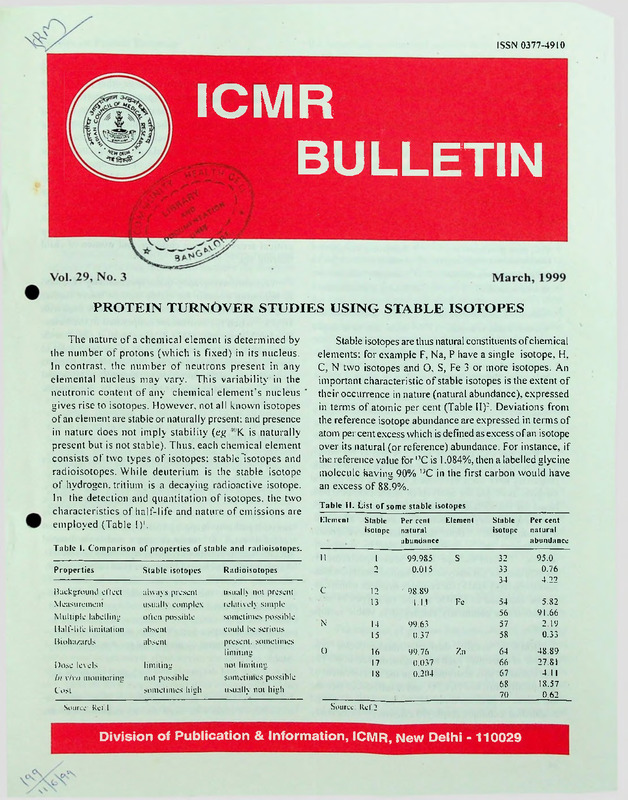
PROTEIN TURNOVER STUDIES USING STABLE ISOTOPES
The nature of a chemical element is determined by
the number of protons (which is fixed) in its nucleus.
In contrast, the number of neutrons present in any
elemental nucleus may vary. This variability in the
neutron ic content of any chemical element’s nucleus
gives rise to isotopes. However, not all known isotopes
of an element are stable or naturally present: and presence
in nature does not imply stability (eg ,0K is naturally
present but is not stable). Thus, each chemical element
consists of two types of isotopes; stable Isotopes and
radioisotopes. While deuterium is the stable isotope
of hydrogen, tritium is a decaying radioactive isotope.
In the detection and quantitation of isotopes, the two
characteristics of half-life and nature of emissions are
employed (Table I)1.
Stable isotopes are thus natural constituents of chemical
elements; for example F, Na, P have a single isotope, H,
C, N two isotopes and O, S, Fe 3 or mote isotopes. An
important characteristic of stable isotopes is the extent of
their occurrence in nature (natural abundance), expressed
in terms of atomic per cent (Table II)2. Deviations from
the reference isotope abundance are expressed in terms of
atom per cent excess which is defined as excess of an isotope
over its natural (or reference) abundance. For instance, if
the reference value for ,JC is 1.084%, then a labelled glycine
molecule having 90% ,3C in the first carbon would have
an excess of 88.9%.
Table II. List of some stable isotopes
Element
Stable
isotope
Stable
isotope
Per cent
natural
abundance
S
32
33
34
95.0
0.76
4.22
Fe
54
56
57
58
5.82
91.66
2.I9
0.33
Zn
64
66
67
68
70
48.89
27.81
4.II
I8.57
0.62
Element
Per cent
natural
abundance
Tabic I. Comparison of properties of stable and radioisotopes.
Properties
Stable isotopes
Radioisotopes
Background effect
Measurement
always present
usually not present
relatively simple
Multiple labelling
usually complex
often possible
Half-life limitation
Biohazards
absent
absent
sometimes possible
Dose levels
hi vivo monitoring
limiting
not possible
could be serious
present, sometimes
limiting
not limiting
sometinTes possible
Cost
sometimes high
usually not high
Source: Ref. I
H
I
2
99.985
0.015
C
12
13
' 98.89
I.II
N
I4
15
99.63
0.37
O
I6
17
18
99.76
0.037
0.204
Source: Ref.2
Division of Publication & Information, ICMR, New Delhi - 110029
Application of stable isotopes in natural science dates
back to the immediate years following the discovery of
deuterium in the 1930s. The initial studies provided a
major breakthrough in the availability of stable isotopic
methods for dynamic studies in metabolic process. Stable
isotopes are used in biology to measure the elemental
composition and also as tracers. In view of the absolute
safety, the stable isotopes have many in vivo applications
(Table III)1.
Table HI. Some applications of stable isotopes.
* Enzyme pathway mapping
determination
* Reaction rate
* C/C4 plant photosynthesis
(discrimination type indicator)
* Non-protein nitrogen
nutrition
* Protein nitrogen metabolism
* Dinitrogen fixation
* Mineral metabolism
* Tracing of pharmaceuti
cals
* Aminoacid/protcin absorption
* Isotope dilution studies
* Nutrition studies in animals
and plants
* Breath tests for hydroly
sis. oxidation and
absorption
* Double labelled water for
body composition and energy
expenditure
* Body water/milk volume
The in vivo techniques of activation analysis require
bombarding the target area (hand or other parts of the
body) .with nuclear particles (primarily neutrons from
various sources). The incident neutrons then interact
with the stable isotopes of the chemical elements in the
body producing, in a very selective manner, radioiso
topes which are then measured with appropriate nuclear
instrumentation. An example of this application is
measurement of body calcium with ,4MeV neutron ac
tivation analysis. However, measurement of such major
body constituents as N. Na. and Ca using in vivo tech
niques require careful assessment of their risk/benefit
ratio. It would not be reasonable to expect their use in
critical areas involving children, and women of child
bearing age1 -.
Gas chromatography-mass spectrometry (GCMS)
is becoming popular for stable isotope tracer studies'
employing complex matrices which cannot be used with
I RMS. When the instrument is operated in the Selec
tive Ion Monitoring (SIM-GCMS) mode, it can provide
reasonably precise measurements of isotope ratio in
complex matrix. In this method the sample components
of interest require conversion to thermally volatile and
stable gases and this is usually done by appropriate
derivatization.
Source: Ref. I
Measurement of Stable Isotopes
With the exception of H. C. N and O for which
measurement techniques based on physical and atomic
properties have been developed, there arc two general
methods available for analysis of stable isotopes, both
based on the differences in their nuclear properties.
mass spectrometry, and activation analysis, after neu
tron bombardmei
Both techniques achieve greater
development am. sophistication aided by computer
ization. Typical Isotope Radio Mass Spectrometers
(I RMS) used for gas analysis and Thermal Ionization Mass
Spectrometers (TIMS) for complex matrices which can
not be analysed in I RMS. are the two types of mass
spectrometers commonly employed in stable isotope
studies.
I RMS is usually dual-inlet dual-collector type
capable of extremely high measurement precision. The
application of this instrument is in the measurement of
isotopically enriched H. C. O. and N introduced into the
ion source in gaseous form: H.. N,. CO.. This is a well
established technique employed extensively in the study
of substrate metabolism.
34
Uses of Stable Isotopes
Stable isotopes are used in biology as (i) measures
of elemental composition: (ii) naturally labelled trac
ers; and (iii) artificially enriched stable isotope tracers.
Stable isotopes have many uses in addition to the: • ”.se
in all applications where radioisotopes are used from
enzvme pathway mapping to body composition, from
reaction rates to turnover rates and from mineral
metabolism to nutritional studies in animals (Table III).
Accurate measurement of isotopes is an important fun
damental requirement for tracer studies. In the case ol
stable isotopes the measurement of isotope ratios
is commonly used.
Stable isotopes are elements with higher atomi
number than natural elements and are non-radioacli\e
Stable isotopes are increasingly replacing radioisotope:
in research and diagnosis and they pro\ ide more reli
able information than radioisotopes with no risks. I'o
certain applications as in pregnanes or in neonates, ra
dioisotopes cannot be used and no radioisotopes are
available for elements like oxygen.
Studies on Protein Turnover
Retinol transport proteins
Retinol binding protein (RBP) and transthyretin (TTR)
arc involved in the transport of retinol (vitamin A) as a
prolein-protein complex in blood. Both these proteins
are synthesized and secreted from the liver, the storage
site of retinol'. In vitamin A deficiency. apoRBP accu
mulates in the liver, without any change in hepatic TTR.
and it is secreted immediately after vitamin A is reintro
duced in the diet4. The synthesis and circulating concen
trations of RBP and TTR are extremely sensitive to the
intakes of energy and protein. This observation, coupled
with the rapid turnover of these proteins, makes them
potentially good indicators of protein nutritional status5’5.
Because of the characteristic of their interactions and
the lack of appropriate methods to measure the turnover
of these proteins, relatively little progress has been made
towards a better understanding of the kinetics of the in
dividual proteins and the complex. The information
available is based on the use of radioiodinated TTR-bound/
free RBP. The results of these studies showed that
TTR-bound and free RBP have different replacement
times'*:. The tuntover of RBP is estimated to be 16 pinoles/
day which should be equivalent to about 16 pinoles of
retinol/day. as against the intake of only 7 pinoles of
rctinol/day reported in populations from advanced
countries. However, the turnover of TTR of 10 pmoles/
day is closer to the actual intakes of retinol. When it is
believed that retinol in circulation exists as a equimolar
complex, different replacement times for different
elements of the transport complex point to either a greater
catabolic rate of these proteins or increased recycling of
retinol. The latter possibility has been suggested by
earlier workers5.
Recently both human and pig plasma samples were
found to contain a peptide termed TTR,. which has a
molecular mass similar but not identical to that of TTR.
This peptide always occurred bound to RBP and showed
fractional synthesis rates (FSR) different from that
of TTR and RBP in pigs8. This was suggested to
be another member of the retinol transport complex
or a part of RBP receptor. TTR, is the only protein which
showed significantly lesser FSR as well as reduced plasma
concentration in chronic protein deficiency in pigs0.
Acute phase proteins
During the metabolic response to injury and infection,
there is a marked rise in the circulating concentrations of
the hcpatically synthesized positive acute phase proteins
(APPs) and a decrease in the concentrations of the negative
acute phase proteins10. The positive APPs constitute a
structurally and functionally heterogeneous group and are
involved in the removal and repair of damaged tissues, the
protection of healthy tissues, and the immune response".
Because of the critical role they play during recuperation
from injury and infections, these proteins have received a
great deal of attention’ ’12. Nearly all studies on positive
APPs. however, have been limited to measurements of
changes in plasma concentrations in response to injury' or
infections and during the course of recovery'. Hence, although
the extent to which the circulating pools of these proteins
increase and decrease during injury or infection has been
well established, very little information is available on the
kinetic changes responsible for these changes. This paucity
of information is due to the lack of appropriate methods to
measure the turnover of these proteins. The major difficulty
in determining the enrichment of proteins in blood is on
account of the tedious methods of isolation and purification
like salting out. density gradient centrifugation, affinity
chromatography and solvent extraction13. Also inadequately
small amounts of proteins are finally available for analysis
with moderate sample size.
Stable isotopes in protein turnover studies
Apart from the radiation hazards, a major concern with
exogenous labels is that the addition of the bulky iodine
atom alters the physiochemical properties of the protein,
thereby altering its susceptibility to proteolysis14-15. With
the advent of stable isotopes, studies of protein turnover
are easily carried out with 2H/I5N/,3C-labelled essential
aminoacids, particularly in humans16-17. Improvements in
gas chromatograph-mass spectrometers have allowed such
studies to be extended to that of individual proteins18-19. The
main objectives of studies undertaken by Sivakumar and
colleagues 8q-20 were to (i) use stable isotopically labelled
leucine to measure the synthesis rates of TTR and RBP
and some acute phase proteins like transferrin (Tr), hapto
globin (Ha) and antitrypsin (At); (ii) develop simple, cost
effective methods of purification of plasma proteins us
ing immunoprecipitation followed by SDS-PAGE in young
pigs: and (iii) extend the methodology to human infants.
The turnover of proteins has been studied mainly by
administering deuterium (a stable isotope)-labelled
aminoacid and using the\precursor-product model to
calculate its rate of synthesis21. In this approach, it is
necessary to obtain (a) the enrichment of the protein-bound
aminoacid tracer at two time points during the linear phase
of incorporation of the labelled aminoacid into protein and
35
(b) the steady-state enrichment of the tracer pool size of
the active aminoacid at the site of protein synthesis in the
liver. Lack of suitable methods for isolation of adequate
amount of the protein of interest from plasma in the pure
form to yield sufficient protein-derived aminoacids for
mass spectrometric analysis has so far limited such
application.
Four or 12 week old pigs were surgically implanted
with catheters in the jugular vein and the carotid artery80.
A sterile solution of :H,-Leucine (Cambridge Isotopes.
Woburn. MA, USA) in saline was given as a priming dose
of 30 gmoles/kg followed by a constant infusion at 30
pmoles/kg/h for 6-8 h. In young children, a catheter was
inserted in peripheral arm vein for blood sampling. The
isotope dose was infused with a milk-based feed through
a nasogastric tube at a dose as mentioned above for 8 h20.
The proteins were isolated from plasma by immuno
precipitation and purified by SDS-PAGE. From a single
plasma sample At, Tr and Ha were isolated by treating
sequentially with antisera against the three proteins20.
Similarly after removing TTR with complete immunopre
cipitation, the remaining plasma sample was treated with
RBP antiserum to obtain immunoprecipitate containing
RBP and, a new protein called as TTR/. These proteins
were resolved using SDS-PAGE 7% for Tr and Ha and
12%-for other proteins. Major bands of each protein having
mobility corresponding to the molecular mass of standards
were used for the enrichment studies.
Stable isotopic measurements
The isotopic enrichment of apoB-100 achieved a
constant value after 2 h of infusion and is parallel to that
seen in plasma leucine (Fig.), confirming the previous
observations’6. This provides steady state incorporation
of labelled leucine into apoB-100 and reflects the pool
size of the active aminoacid. The time course of incorpo
ration of pH J leucine into RBP and TTR (1 and 2) in
piglets shows an initial delay after which there was a rapid
and near-linear increase in the isotopic content of TTR
and RBP (Fig.). These findings justifiy the calculation of
FRS based on values over 2-4 h or 3-6 h time points which
fall into the linear portion of the curve.
Because of the slower turnover rates of some proteins
like albumin or TTR,. only a modest increase was seen in
the tracer/tracee ratio of the protein-bound aminoacid during
a 6-8 h isotope infusion. Nevertheless, with the recent
improvements in gas chromatograph-mass spectrometers
and the exquisite sensitivity achieved with the negative
chemical ionization approach, these relatively low tracer/
tracee ratios can be measured very accurately10.
36
Time (h)
Fig. Time course of typical isotope enrichment into plasma leucine
and some proteins
In vivo measurements of the turnover of RBP and
TTR (prealbumin) have been previously reported in
humans”7, cynemolgus monkeys22 and rats25. All these
studies used analysis of the decay of the radioiodinated
tracer proteins to compute degradation rates. Each study
reported substantial difference in the half-lives of TTR
and RBP*. Depending on the method of iodination. I2?l
radio labelled proteins showed different affinity14-’5 in
binding their receptors and therefore such data were not
reliable. The fractional synthesis rates of different pro
teins are slower when estimated with stable isotope as
compared to the earlier data using radioisotopes, con
firming the instability of the radiolabelled proteins and
emphasising the errors in measurements of turnover
obtained using them (Table IV).
The other important observation is that the FSRs of
RBP and TTR in younger pigs were much faster than
those from older one.s. Using radiolabelled tracers, previous
studies showed a four-fold difference between the half
life of TTR and RBP in humans or monkeys', while that
was only two-fold in the stable isotope study'8. The figures
of turnover of TTR and RBP agree more realistically with
the estimated 7 pmoJes/day intakes of retinol in healthy
populations.
The results (Table IV) also show that one of these
proteins. At had a very slow turnover rate (10 ± 1.5%
pool/day). The FSR was even slower- than the rate
reported for .albumin (which has a very slow turnover)
iii a group of young children who had recovered from
severe protein energy malnutrition24. Ha (50 ± 8%/day)
and Tr (19 ± I. I) had relatively slower FSR than reported
earlier2'24. These were the first reports in literature on
the rates of synthesis of acute phase proteins in young
children.
Spectrometry Methods. Ed. R. Alan. Liss Inc. New \ ork. p I.
1984.
3.
Goodman. D.S. In. The Retinoids. Eds. M.B. Sporn. A.B. Rob
erts and D.S. Goodman (Vol.7). Academic Press. New York.
p4l. 1984.
4.
Muto. Y.. Smith. J.E.. Milch. P.O. and Goodman. D.S. Regu
lation of retinol binding protein metabolism by vitamin A status
in the rat../ Biol ( hem 24~: 2542. 1972.
5.
Smith. F.R.. Goodman. D.S.. Zaklama. M.S.. Gabr. M.K..
Maraghy. S.E. and Pat wardhan. V.N. Serum vitamin A. retinol
binding protein and pre-albumin concentrations in protein calo
rie malnutrition: I. A functional defect in hepatic retinol release.
Am J Clin Xutr 26: 973. 1973.
6.
Valilquisl. A.. Peterson. P.A. and Wibeli. L. Metabolism of the
vitamin A transporting protein complex. I. Turnover studies in
normal persons and in patients with chronic renal failure. Eur
./ Clin Invest 3: 352. 1973.
7.
Smith. F.R.. Suskind. R.. Thanangkul. O.. Lcitzmann. C..
Goodmail. D.S. and Olson. R.E. Plasma vitamin A. retinol-binding
protein and pre-albumin concentrations in protein-calorie mal
nutrition. III. Response to varying dietary treatments. Am ./
Clin Xutr 28: 732. 1975.
8.
Sivakumar. B.. Jahoor. F.. Burrin. D.G.. Frazer. E.M. and Reeds.
PJ. Fractional synthesis rates of retinol-binding protein.
transthyretin and a new peptide measured by stable isotope
techniques in neonatal pigs. J Biol Chem 269: 26196. 1994.
9.
Jahoor. I-'.. Sivakumar. B . Rosario. M.D.. Burrin. D.. Wykes. I..
and Frazer. M. Chronic protein deficiency differentially affects
the kinetics of plasma proteins in young pigs. J Xutr 126: 1489.
1996.
10.
Fleck. A. Clinical and nutritional aspects ofchanges in acute-phase
proteins during inflammation. Proc Xutr Soc 48: 347. 1989.
11.
Schreiber. G. Plasma protein secretion by the liver. In: 7Int Plasma
Proteins. Ed. F.W. Putnam. (Vol. 4) Academic Press. New York.
p 361. 1984.
12.
Kush ver. I. T he phenomenon of the acute phase response. Ann
XY Acad Sci 389: 39. 1982.
13.
Putnam. F.W. 1. Perspectives - Past, present and future. In:
The Plasma Proteins. Ed. F.W. Putnam (Vol. 1). Academic Press.
New York, p 2. 1975.
14.
Malaba. 1... Kindberg. G.M.. Norum. K.R.. Berg. T. and Blomhoff.
R. Receptor-mediated endocytosis of retinol-binding protein
by liver parenchymal cells: Interference by radioactive iodina
tion. Biochem ./ 291: 187. 1993.
15.
Van Bennekum. A.M.. Blaner. W.S.. Seifert-Bock. I.. Moukides.
M.. Brouwer. A and Hendricks. ILF. Retinol uptake from
retinol-binding protein (RBP) by liver parenchy inal cells in vitro
does not specifically depend on its binding to RBP. Biochem
istry32: 1727. 1993.
16.
Reeds. P.J.. I lachcy. D.L.. Patterson. B.W.. Motil. KJ. and Klein.
P.D.* VLDI. Apolipoprotein B-l()().*a potential indicator of the
isotopic labelling of the hepatic protein synthetic precursor pool
in humans: Studies with multiple stable isolopically labelled
aminoacids../ Xutr 122: 457. 1992.
Tabic IV. Fractional synthesis rates (FSR) of plasma proteins
using stable isotopes.
Protein
FSR (% pool/day)
-------------------------------------------■--------------
Pigs
4 months
n=7
Pigs
8 months
n=4
Children
n=3
Literature
values
(adult)
93.4±9.6
56±5
1
139
TTR
47.0±3.1
25±2
'r-
34
TTR,
7.0±l.4
6±1.5
—
TRANS
FERRIN
-
I8±4
I9±l.l
24
HAPTO
GLOBIN
-
48±8
50±8
36
ANTI
TRYPSIN
-
IO±1.5
17
FIBRI
NOGEN
-
43*2.0
4.5*
RBP
4 r.
K,- 4.
FSR = (%/h) = | (PEt6 .- PEt3)/(Ep) | x 1100/31 ] where PI-l6 - PEG is
the increment in the isotopic enrichment of protein-bound leucine over
the last 3 h of the infusion and Ep is the plateau enrichment of apoB-100bound leucine over the same lime period.
* By stable isotopic method
Values are-Mean ± SE
Source: Refs.S. 9. 20 and 25-27.
Thus the turnover estimates obtained with natural
stable isotopes are reliable89-20. The micro-methodology
with sequential immunoprecipitation developed recently
will make the GCMS analysis more cost-effective, be
cause plasma samples obtained from a single study could
be conveniently used for deriving multiple protein turn
over rates. With increasing burden of radioisotopes in
the environment and problems of their disposal, appli
cations of stable isotopes is going to be the only way
left for the modern world to deal with the future needs
of tracer studies to solve health problems.
References
1.
Janghorbani. M. Stable isotopes in nutrition and food science.
Prog Food Xutr Sci 8: 303. 1984.
2.
Wolfe. R.R. Methods for studying metabolism. In: Tracers in
Metabolic Research. Radio Isotope and Stable isotope/Mass
37
17,
18.
19.
Molil. KJ.. Montandon. C.M.. I lachey. 1)1... Boutton. I . W..
Klein. P.D. and Garza. C Whole-body protein metabolism in
lactating and non-lactating women. .J A ppi Physiol 66- 370.
1989.
Wong. WAV. and Klein. P.D. A review of techniques for the
preparation of biological samples of mass-spectrometric mea
surements of hydrogen-2/hydrogen-1 and oxygen-18 oxygen-16
isotope ratios. Mass Spcdromet. /tor 5: 313. 1986.
.lahoor. I'.. Burrin. D.. Reeds. PJ. and Frazer. M.E. Measure
ment of plasma protein synthesis rate in the infant pig: An in
vestigation of alternative tracer approaches. Ant ./ Physiol R
26“ 221. 1994.
20.
Jahoor. F.. Sivakumar. B.. Rosario. M.D. and Frazer. E.M. Iso
lation of acute-phase proteins from plasma for determination of
fractional synthesis rales by a stable isotope tracer technique.
Anal Bioehem 236: 95. 1996.
21.
Stein. T.P.. Leskiw. MJ. and Wallcc. 11 AV. Measurement of
half-life of human plasma fibrinogen. Am J Physiol 234. E504.
1978.
22.
Vahlquist. A. Metabolism of the vitamin A transporting protein
complex: Turnover of retinol-binding protein, prealbumin and
vitamin .A in a primate (Macaea inis). Scand./( Itn I.ah Invest
30: 349. 1972.
23.
Peterson. P.A.. Nilsson. S.F.. Ostberg. I... Rask. L. and Vahlquist.
A. Aspects of the metabolism of retinol-binding protein and re
tinol. 177 Harm 181. 1974.
24.
Picou. 1). and Waterloo. J.C. The effect of malnutrition on the
metabolism of plasma albumin. Clin Sei 22: 459. 1962.
25.
Freeman, T. In: Protides in Biological Hinds. Ed. II. Peelers.
Elsevier. Amsterdam, p. 334. 1964.
26.
Kuppcrs. F. and Fallal. R J. ^-antitrypsin deficiency: A detect
in protein synthesis. Clin Chiin Ada 24: 401. 1969.
27,
Jeejcebhoy. K.N.. Bruce-Robertson. A.. Ho. J. and Sodtke. U.
t he comparative effects of nutritional and hormonal factors on
the synthesis of albumin, fibrinogen and transferrin. In: Pro
tein Turnover. CIBA Foundation Symposium Xo.9 Ed. G.EAV.
Wolstenholme and M. O'Connor. Elsevier. Amsterdam, p.217.
1973.
This write-up has been contributed by Dr. B. Sivakumar. Deputy
Director (Senior Grade), National Institute of Nutrition,
Hyderabad.
ABSTRACTS
Some Research Projects Completed Recently
Expression of antimetastatic marker-nm 23 and
prolactin in human breast carcinoma: Its relation with
relapse, survival and other prognostic factors.
The study was carried out in 100 patients (25 with
benign breast disease and 75 with breast cancer) to
investigate the combined utility ofan antimetastatic marker
nm23 and prolactin - a marker of tumour aggressiveness.
in the management of patients with benign breast disease.
early and advanced breast cancer. The parameters studied
included prolactin (PRL) estimation - pretherapeutic and
serial monitoring as an indicator of disease status,
immunohistological localization of PRL, expression of
PRL mRNA and nm23 mRNA by reverse transcriptasepolymerase chain reaction (RT-PCR).
Hyperprolactinaemia was observed in 52% (13/25)
of patients with benign breast disease and 55% (41/75)
of breast cancer patients. Hyperprolactinaemia was ob
served more’in patients with advanced stage cancer (63%)
compared to those with early stage disease (41%). The
levels of PRL increased with appearance of recurrence/
metastatic disease and decreased in patients who responded
to therapy. It was found that rise in PRL level preceded
disease progression. The PRL level remained elevated
throughout the course of the disease in patients who did
not respond to adjuvant therapy.
38
In 72% (18/25) of patients with benign breast dis
ease and 79% (53/67) of breast cancer patients the tumours
showed immunoreactivity with PRL antibody. A total of
56% (40/71) breast cancer tumours and 40% (4/10) of
the benign tumours expressed PRL-mRNA. Immunore
activity of nm23 was found to be 84,69 and 80% in benign,
stage II and advanced.stage cancer patients, respectively.
The nm23 mRNA expression, was observed in 70% of
benign and 100% breast cancer patients. Eighty six per
cent (44/51) of the nm23 positive and 56%. (9/16) of the
nm23 negative tumours showed immunoreactivity with
PRL antibody.
The results showed that PRL is a superior marker
for monitoring the disease course whereas nm23 cannot
be used as an antimetastatic marker but is a marker of
tumour aggressiveness.
J.M. Bhatavdekar
Gujarat Cancer and Research Institute
Ahmedabad.
Publications:
I.
Bhatavdekar. J.M.. Patel. D.D.. Vora. H.H.. Shah, N.G.. Karelia.
N.H.. Ghosh. N.. Suthar. T.P.. Dave. R.S., Mehta. R.H.. Chikhlikar.
P.R. and Balar. D.B. Comparison of prognostic value of plasma
prolactin with that ot receptors for prolactin, epidermal growth
factor, estrogen and progresterone in patients with stage III breast
cancer. Breast Dis 8: 317. 1995.
2.
Paid. I).!).. Bhataxdekar. J.XL. Chikhlikar, P.R.. Gho>h. N..
Suthar. I.P.. Karelia. N.I I.. Shah. N.G.. Mehta. R.l I and Balar.
D.B. Node negative breast carcinoma : 11\perprolactinaemia
over expression of P 53 as an independent predictor of poor
prognosis compared to newer and established prognosticator../
.Swrg Oncol 62: 86. 1996.
Targeting of glycosylated liposomes encapsulating
metal chelating drugs to the site of toxic metal stor
age in the biological systems.
receptors exist on the hepatocyte cell surface). This resulted
in the enhanced mobilization of cadmium from the
body organs (lever, kidneys and spleen) and from
hepatocytes. Il also produced enhanced excretion ol
cadmium through urinary and fecal route. I he clhcacy
of DMSA encapsulated in targetlable liposomes was found
lo be belter compared to that given via plain liposomes
or in the form of free material. The DMSA given as free
material and via plain liposomes resulted in lowering ol
Hie study was carried out in male albino mice to achieve
biochemical (protein, glutathione, lipid peroxide levels)
improved therapeutic and safely profile of metal chelat
ing drug - meso-2.3.dimercaptosuccinic acid (DMSA) in
the management of cadmium toxicity by using glycosylated
and haematological (haemoglobin level) parameters in
cadmium exposed mice, whereas the DMSA given through
glycosylated liposomes was able lo maintain the levels
liposomes as carriers for their targetted delivery.
of these parameters to their normal values.
Glycosylated liposomes encapsulating DMSA were
prepared involving coupling of glycosides to liposomes
The DMSA given via liposomes in both the forms
(plain liposomes and glycosylated liposomes) lowered
and their safely was evaluated in terms of blood and
biochemical parameters and trace metal levels in the body.
their stability and in vitro interaction of liposomes with
the levels of copper and zinc enhanced by cadmium treat
ment. thereby preventing the disturbances in essential trace
metal imbalances. Also these liposomes when adminis
tered empty to normal animals did not show any toxicity
isolated hepatocytes.
Cadmium toxicity was produced in the mice by in
jecting cadmium chloride (0.01 mmolc/kg) intraperito
neally. The chelating drug DMSA was given as (i) DMSA
encapsulated in glycosylated liposomes, (ii) DMSA via
plain liposomes: and (iii) plain DMSA.
to disqualify their use as carrier for metal detoxification.
J.R. Bchari
Industrial Toxicology Research Centre
Lpcknow.
Publication:
The glycosylated liposomes encapsulating DMSA
could be successfully targetted to the intracellular site
of cadmium accumulation ie hepatocytes (because of the
presence of free terminal sugar - galactose for which
Bchari. J.R.. Srivasiava. S.. Gupta. S.. Misra. M and Srivasiava. R.C.
Influence of 2.3-dimcrcaptosuccinic acid esters administered via li
posomes on biochemical alterations and cadmium levels in cadmium
pre-expo *d rats. J Sci hut Res 3(1): 27. 1995.
ICMR NEWS
The following meetings of various technical groups/
TF on Drug Trials in
committees of the Council were held:
Malaria
Meetings of the Task Forces (TFs)ZProject Review
Committee (PRC)ZE.xpert Group (EG)/Scientific
Advison' Committee (SAC)ZScientific Advisor)' Group
(SAG) held at New Delhi:
TF on District Nutrition
TF on Suicide
February 16. 1999
PRC on Mental Health.
Environmental Health.
February 17. 1999
February 22. 1999
February 22-23. 1999
Project (Phase I)
EG on Estimates of Disease
March 4. 1999
Burden due to Shigellosis in
a Rural Community in the
Andamans
Neurology and Biomedical
Engineering
PRC on Haematology.
Human Genetics and
Physiology
February 18. 1999
SAC of tfie ICMR-NIC Centre
for Biomedical Information.
New Delhi
March 9. 1999
SAG on Pharmacology
and Toxicology including
Traditional Medicine
March 12. 1999
39
Participation of ICMR Scientists in Scientific Events:
Dr. P.R. Gangakhedkar, Sr. Research Officer. National
AIDS Research Institute (NARI). Pune, participated in
the workshop on Communication and Public Information
Issues on HIV Vaccine Trials at Geneva (March 1-3.1999).
Dr. N.K. Ganguly. Director-General, ICMR. partici
pated in the 21 st meeting of the Scientific and Technical
Advisory Committee of the UNDP/World Bank/WHO
Special Programme for Research and Training in Tropi
cal Diseases at Geneva (March 1-4, 1999).
Dr. D.A. Gadkari. Director and Dr. B. Lalitha Rao.
Dy. Director. National Institute of Virology. Pune and
Dr. Pradeep Das, Asstt. Director. National Institute of
Cholera and Enteric Diseases. Calcutta, participated in
the International Conference on Emerging Infectious Dis
eases in the Pacific Rim at Bangkok (March 2-4. 1999).
Dr. V. Ramesh Bhat, Dy. Director (Sr.Grade). Na
tional Institute of Nutrition (NIN). Hyderabad, partici
pated in the 3rd joint FAO/WHO/UN EP International Con
ference on Mycotoxins at Tunis (March 3-6. 1999).
Dr. P. Bhaskaram. Dy. Director (Sr. Grade) .and
Dr. K.V.R. Sanna. Asstt. Director. NIN, Hyderabad.
participated in the XIX International Vitamin A Con
sultative Group meeting at Durban (March 8-11. 1999).
Dr. V. Kumaraswamy. Dy. Director. Tuberculosis
Research Centre. Chennai, participated in the meeting
of the WHO Task Force on Community Directed Treat
ment of Lymphatic Filariasis and Onchocerciasis at Geneva
(March 8-11. 1999).
Dr. A.R. Risbud. Asstt. Director. NARI. Pune, par
ticipated in the International Conference on HIV Vac
cine Development: Global. Regional and Thailand Up
date 1999 at Bangkok (March 15-19, 1999).
Dr. Lalit Kant. Sr. Dy. Director-General. ICMR Hqs..
New Delhi, participated in the conference on Vaccine
Development and Delivery : Partnership for the 21 st
Century at Bellagio (March 15-18, 1999).
Workshop/Seminar:
Fourth Indo-German Workshop on “Oncology into
the Next Millennium” was organised at Lonavala during
February 21-25. 1999.
A joint ICMR/ICSSR National Seminar on ’’Sta
tus of Health Care in India” was organised at New
Delhi during March 9-10. 1999.
ICMR AIDED SYMPOSIA/SEMINARS/WORKSHOPS/COURSES/CONFERENCES
Symposium/SeminarAVorkshop/
Coursc/Conferencc
Date & Place
Contact Address
Indo-French Symposium on Multiple Drug Resistance
and Emerging Diseases •
February 28-March 4. 1999:
(at New Delhi)
Dr. S.K. Sahani. Executive Secretary. Indian
National Science Academy. New Delhi-110002.
Technical Training Workshop on Industrial Hygiene
Measurements and National Seminar on Occupational
Safety and Health
March 1-6. 1999:
(at Chennai)
Dr. Kalpana Balakrishnan. Organising Secretary
of the Workshop. Sri Ramachandra Medical
College and Research Institute. Chennai-600016.
International Symposium on Prudent Use of Antibiotics
March 5-7. 1999:
Dr. Kunal Kothari. Organising Secretary of the
Symposium. Department of Medicine. S.M.S.
Medical College. Jaipur-302004.
(at Jaipur)
VI Chandigarh Symposium on New Biology
March 19-20. 1999:
(at Chandigarh)
Prof. R.C. Sobti. Organising Secretary of the
Symposium. Department of Biotechnology. Punjab
University. Chandigarh-160014.
Workshop on 1I1V/AIDS/S1 Ds and Healthy Lite Style
April 10-11. 1999:
(at Berhampur)
Dr. R.M. Tripathv. Organising Secretary of the
Workshop. Department of Social and Preventive
Medicine. MKCG Medical College. Berhampur*
760004.
40
COUNCIL’S TRAINING PROGRAMMES FOR 1999-2000
•
Leprosy
(June I4-July 30. 1999).
At the Central JALMA Institute for Leprosy, Agra:
•
. Training Course for Medical Officers Working under
the National Leprosy Eradication Programme (April
and September. 1999).
Training Course for Laboratory Animal Technicians
•
Training Course for Laboratory Animal Supervisors
(September 1-November 30. 1999).
Medical Entomology:
Reproductive Biology
At the Institutefor Research in Reproduction, Mumbai:
•
•
Training Course in Molecular Techniques in Ovarian
Function (September 27-October 2. 1999).
Training Course on Cytological Detection of Repro
ductive Tract Infections (December 13-17. J 999).
At the Vector Control Research Centre. Pondicherry:
•
Postgraduate Diploma Course in Medical Entomology
(from July 1999).
Biomedical Statistics
Endocrinology
At the Institutefor Research in Medical Statistics, Chennai:
At the National Institute ofNutrition,. Hyderabad:
•
Basic Course in Statistics for Medical Officers (July
1999).
*
Annual Certificate Course on Endocrinological
Techniques and their Application (August 1 September 15, 1999).
•
Training Course in Field Epidemiology (November.
1999).
Nutrition
Haematology
At the National Institute of Nutrition. Hyderabad:
At the Institute of Immunohuemutology. Mumbai:
*
M.Sc. in Applied Nutrition (June 1. 1999-February 28.
2000).
•
Postgraduate Certificate Course in Nutrition (Decem
ber 1, 1999-February 28. 2000).
•
Training Course in Transfusion Medicine for Blood
Bank Medical Officers (August 31 -October 29.1999).
•
Training Course in Blood Group Serology and Blood
Bank Methodology for Blood Bank Technicians
(August 31-September 30. 1999).
•
Training Course in Advanced Haematology and
Immunohaematology (October 11-29. 1999).
Laboratory Animal Technology
At the National Centre for Laboratory Animal Science.
National Institute ofNutrition. Hyderabad:
LCMR PUBLICATIONS
PricefRs.)
Nutritive Value of Indian Foods (1985) by C. Gopalan. B.V. Rama Sastri and S.C. Balasubramanian.
Revised and Updated (1989) by B.S. Narasinga Rao. Y.G. Deosthale and K.C. Pant (Reprinted 1996)
23.00
Growth and Physical Development of Indian Infants and Children (1972. Reprinted 1989)
10.00
Studies on Weaning and Supplementary Foods (1974. Reprinted 1996)
15.00
A Manual rof:Nutrition (Second Ed it ion 1974. Reprinted 1995)
6.00
Low Cost-Nutritious Supplements (Second Edition 1975. Reprinted 1996)
5.00
Menus for Low-Cost Balanced Diets and School-Lunch Programmes Suitable for North India
(Second Edition 1977. Reprinted 1994)
4.50
Menus for Low-Cost Balanced Diets and School-Lunch Programmes Suitable for South India
(Fourth- Edition 1996)
6.00
41
Some Common Indian Recipes and their Nutritive Value (Fourth Edition 1977. Reprinted 1995)
10.00
by Swaran Pasricha and L.M. Rebello
Nutrition for Mother and Child (Fourth Edition 1994. Reprinted 1996) by P.S. Venkatachalam
I L00
and L.M. Rebello
Japanese Encephalitis in India (Revised Edition 1980)
^-00
Some Therapeutic Diets (Fifth Edition 1996) by Swaran Pasricha
7.00
Nutrient Requirements and Recommended Dietary Allowances for Indians (I990.Reprinted 1995)
16.00
Fruits (Second Edition 1996) by Indira Gopalan and M. Mohan Ram
20.00
Count What You Eat (1989. Reprinted 1997) by Swaran Pasricha
15.00
* The Anophelines of India (Revised Edition 1984) by T.Ramachandra Rao
150.00
Depressive Disease (1986) by A. Venkoba Rao
58.00
* Medicinal Plants of India Vol.2 (1987)
136.00
Diet and Diabetes (Second Edition 1993. Reprinted 1997) by T.C. Raghuram.Swaran Pasricha
18.00
and R D. Sharma
Dietary Tips for the Elderly (1992. Reprinted 1997) by Swaran Pasricha and B.V.S. Thimmayamma
5.00
Diet and Heart Disease(l994.Reprinted 1995) by Ghafoorunissa and Kamala Krishnaswamy
26.00
Dietary Guidelines for Indians - A Manual (1998)
23.00
Dietary Guidelines for Indians (1998)
10.00
f-tqHRgft
strh
3rr^n
1974,
(ftcTu
1990)
6.00
(1997)
9.00
* 25 per cent discount allowed to individuals
These publications are available on prepayment of cost by cheque, bank draft or postal order (bank and postal charges will be extra) in
favour of the Director-General. Indian Council of Medical Research. New Delhi. Money orders are not acceptable. All correspondence
in this regard should be addressed to the Chief. Division of Publication and Information. Indian Council of Medical Research. Post Box
No.49ll. Ansari Nagar. New Delhi-110029 (India).
EDITORIAL BOARD
Dr. Bela Shah
Dr. V. Muthuswamy
Editor
Dr. N. Medappa
Printed and Published by Shri J.N. Mathur for the Indian Council of Medical Research. New Delhi
at the 1CMR Offset Press. New Delhi-110 029
R.N.2ISI3 71
Position: 2064 (12 views)