NEWS YOU CAN USE HIV-AIDS SEPTEMBER 2001.pdf
Media
- extracted text
-
HIV/AIDS - News You W^iO^OWNews You Can Use- HIV
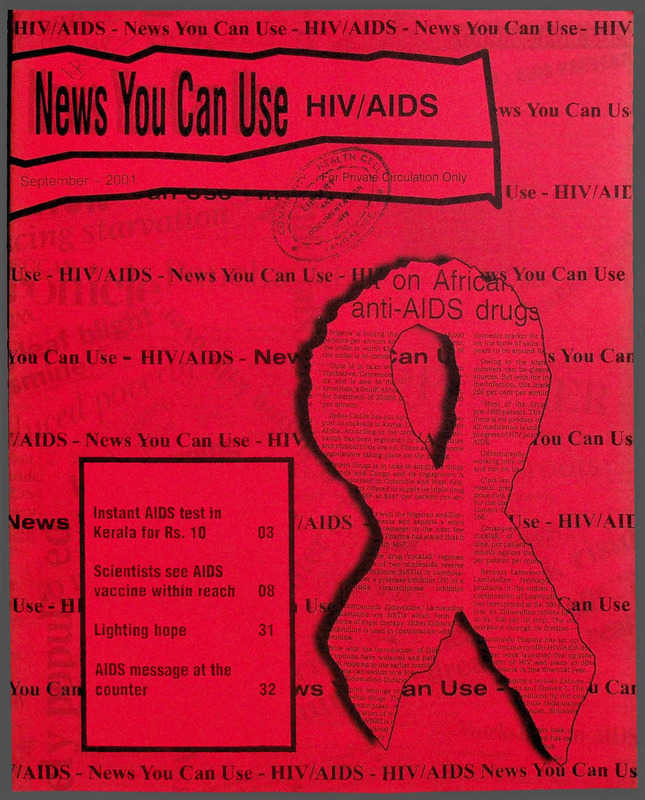
News You Can Use hiv a,ds
ws You Can Us>
^For Private Circulation Only
September - 2001
1
-In*,.-hivmii
axataj
iyg3
.
S.
<
X
l^rsn ^Afriz'^Vou Can Use
NigpnVis feuyjng-UioZ^^
koifCatbUse - ’iHVMiBS^'Ne'
1kW)0. ' dbmestlemarket for 1
^■patients pc.- annum a/
Pythe^rjidr. i<vfortfv$3jk. f'
| /jih? jqrdja^ij; iq--oof5an
Wf
I
* LI tl
v> <*.li
|-f‘:'sourcescBut with. the. inj:
.
|’-■..'WInfection, this marif
' -,..'. "& • r'•; '
I ■•« Amerfcan-. a South AfricX
r
for fret tin ent. of 20,00b \
:
r /•' P^X annum.. ■‘,- .■'**</( ■ •
V* ''■
° ‘ A Zydus Cadila has put up\
‘
/AIDS -News You Can Use-HI
*i•<"'
,■■ t~o .Owingto tirestignLy
'*&
!,< • Port i t5,cocklRlU to Kanya,
L\ Africa. According ca the corA / i
k ■ cation has been registered in VVBl and cuitlcal irfa&are ori^Tfifete al
.
:
•/
on foe biwls of .sulcs S ’
i2go';per centp^ ^nun
V /'Most. of the;, druw ■ ■ •
.
’
. I
< -V ■
Y'/./• ’ I
?Pxe?J99.5:pa(bnt$/ilieZ.
■. I
' there is bq product trf . .?<' ’ ;-j‘ ~•.
an medlcation fs brilft;
1
&-
Inties
home
Wol|)ta' taw"8 place on d.e »B.
.
Widiii Can Us
w
■^BBktero Dnjgs is in tall^ toilJppW ^fefafftr ndt ’on it
TBBnvrt iariet.'T’A«»T«
*■
/
offered W. supply
BH&SGgSffi
Mews
Use-H
Instant AIDS test in
Kerala for Rs. 10
Scientists see AIDS
vaccine within reach
triple dnrg.
/priatebts/*
(forylbe Jittf.
®^v/kh the Nigerian and Zim^
^,Vir’ >» T
■
03
08
Pharma has stated that It
o
'T.
impounds Zidovudine, Lamivudli
31
AIDS message at the
counter
32
. V —W» w
W.IV
‘ pond to the earlier mentV
canswitch to a Sta**r®< .■
tovudinc-Dldan.'
B
Loscripusc, J
^atlimoffh^
of V
.
.
\'
W’?"
combination of Lamivudl■
T T
has been priced at Rs.
a|l IjSC
lots/IU Zidovudine tnBlclH$C*** V
V
at Its.’ 2G0 per 10 Strip. The d\
dTHirkcied throijgij its .division Cl $
fchurobindo Pharipa .has scl upV^,-
.
^B—hnumis to offer HlV/Al0S d\
‘
JMpsC week laimchdd nye'pjjffdnA
l^fcent of HlV^nd. plans to-offei
^Btoffons ffyfh.h financial, year. J ■■
feiywtlhWh
•
cocWaii,
'< :inonV» against that/
■softwonucleosidereverse
■hibltora (NRTls) in cumbirta^^fpWr^sflnii^ltpr^ij’of
■^sldc ;^<mscripta$o
-InbibK
rtayudiriq'dnre . NRTis which form, - j
ibji^firipteih^y/KiherZidovui®
Lighting hope
I4T\/ / A IF
smJfcieots B^d.iekpccl< a mow. s V
.
^«ude Didan.osln/
?£:?:^^ayir,..fU!Oriayi/
<-.
tin JiutK'a^r
nd has eJ
■nus.
/
’/AIDS - News You Can Use - HOYIDi® HIV/AIDS News Yott Can Us
,.'N e ws< ¥oiu ■ Cart- Use - ftfA / AID3 '•- •*' ■ ■
"! '**
• ’ '•':* ■ ■ ' ■ -
; tNYCEf) is. a special:)^ fo-juriJatstt
HIV/A}D,S co m pi 1 ed to Jitee t tn'-'
Ispecific.mformtliionneeds -■(ivG<>
a p-ic' - a r<:51dnaf nrt i.:
Directed to meet the argeur r-eed. mr
b'luc c
.-.uf. -r
a rii’A / ;
HIV/AJDS. this spechtl pt’b’icatiori
ruiden zlwnby t’L/i'•ijWsU’f'art j;. at
.presents a ciimpilalibn of tieWclippings
. Oil the issue, V/e hopedtat the contents '.
swrlk^rpyidetrcaders..with' relevant;:.
wiipA;l<icil'i
ijirsebb’FtOo:/
useful ;utd .topical infotiriatioit i.i.
inlet tpbt/'w, fei N.Gijs is- a fey
facilitate grassrootwork-cmprevention;--.
ccnincir-••nrwtbotJupuigrf this
careandneiworkm.y
puhlieatipH is mmed<tG-5;;eii'„>.hen .
The publication includes a se|ectiptt0.f
newsiicn^/fealurC.(a ariiel.es/Cclitorijrs/
.. letters - from'...leading:.nafioii’ul
' itcwspapei-s. Lach.newTtitetncarriesthe
name and date of publication and is
ip rfs.- < <j},i^igh'
:
infcrintuioriSprocessesbas iyell iis"
sen'e as a regular reminder of (he
urgency to addressing the issue.
LoqDtlfcdiroip'
V Top Times of.[<idi.u ..
X .- Hindustan Tunes
X ThcHmdu
X The State>man
This publication is stqipoiied by
placed under appropriate categories fbr
PLAN ,. Internaiional
easy referee ce.
Madhya.m.
Teciw;
'ilus.edityirthas'beett,-
and
X -The Pioneer ;
X The New Indian Espre-ss
X
Deccan Herald
X
Deccan Chronicle
5h,mcwi Duv (d/pra
X The-Econoniic Times
•; Jiji■ IIvaham
X 'The Asian Age
Shnbha C
Surekly.i. P.K:
35<W'IH<Zv$hfiKSi1
News You Can Use is compiled and
published by Communtcaiion for
? De velopment and i.eainmg,
Bangalore
..
Communication for
Development and Learning
1 J/Av 7** Cross. IT*.
Konimangata
6* Block, Bangalore 56U 095
Ply (OSQ) 55i4IW.
r-niail cdlblf@bgt.vsni.aeitjit
UR.L . Movw edlblr.org1
EDITORIAL
The written word is like a double-edged sword. It can give accurate information
that can change an ignorant society into an informed one; or it can propagate
wrong information and transform an educated society into a panic ridden one.
However, there is no doubt the important role that the media or the written word
plays in our day-today life.
As a person working in the field of HIV/AIDS, I have come across individuals
who perceive the media as their main source of information about HIV/AIDS.
Nine out often learn about HIV/AIDS either through the print media or television.
Such is the impact created by the media, especially in the past few years; they
have made great efforts to bring HIV/AIDS to the forefront, which is commendable.
The information provided by the newspaper is regarded as gospel truth for many.
The print media has an immense responsibility in informing and educating the
public about HIV/AIDS. On the positive scale, the media provides awareness,
dispenses information, sensitization, provides latest information, highlights
injustice to HIV positive people, promotes advocacy and highlights the work of
governmental bodies, NGOs and individuals working in the.field of HIV/AIDS.
On the negative side, the media tends to resort to sensationalism, thereby
instilling fear and creating panic in the minds of people. But the worst damage
is done when media propagates incorrect information.
At our Clinic, ASHA Foundation, many HIV positive patients bring articles cut
out from newspapers which state that so and so is able to cure this disease
through simple medication (mostly related to the alternative system of medicine).
They want to know whether they can go there and use these medicines and will
it cure them. None of these articles prove conclusively through scientific methods
that these medicines are effective. Therefore, we have to explain to these patients
that they may not be cured through these means. They look at us with disbelief
and say “but the newspaper says so and the newspapers cannot be wrong”. I
feel that the print media needs to tread very carefully because of the profound
implications that such news has on an HIV positive individual. I know of people
who have spent vast amount taken through loans or selling their properties, to
procure treatment from places mentioned in the newspapers, but all to no avail.
HIV/AIDS is a disease, which inspires a lot of emotions in a person who is
positive such as shame, fear, guilt, anger, remorse, etc. But more important it
is a disease, which is also associated with a lot of stigmatization, humiliation
and rejection in the community and the work place. These issues can be
aggravated or reduced, depending on the role that the print media decides to
play-
X
It is also important that the print media highlights genuine work done by NGOs,
GOs individuals and other institutions so that people know where to go for care
and treatment. Media should be aware of the difference between genuine and
qualified NGOs and those who are in this business for the sake of money and
publicity.
Latest information on research, on vaccines, medication etc., should be provided
accurately. It is important to approach the issue in the Indian context stressing
on the work that has been done in Indian research centers, on the drugs that
are available in this Indian markets, etc.
Whenever there are issues, which are controversial, it is important to highlight
both aspects. If a report is one sided, it creates a bias in the mind of the reader.
This is the power that the media has over the public. It is imperative that this
power be used judiciously and in a non-partisan manner.
Sensationalism has become an integral part of reporting about HIV/AIDS.
Sometimes the media’s obsession with sensationalizing HIV/AIDS stories has
rendered them insensitive towards the subject. It is important that people living
with HIV/AIDS are not referred to as “victims” and AIDS is not referred to as
"land of no return”.
This disease by itself has created fear among all sections of society, including
the medical fraternity. It is important that the media should be extremely careful
in using terms such as ‘killer disease’, etc., when referring to HIV/AIDS. Incidents
such as the one reported widely in newspapers in Chennai, A few years ago
about people carrying syringes filled with HIV positive blood being injected
randomly into people at bus stops, etc., can create fear in the minds of the
public. Also the case of a HIV positive girl being burnt to death by villagers creates
sensationalism but instills fear in those who are infected. Extreme caution and
discretion need to be used while reporting such incidents.
In this background, I am glad that we have access to a publication like ‘News
You Can Use - HIV/AIDS’. I would like to commend CDL, Bangalore, fortheir
unique effort in bringing out this monthly publication. It makes the work of
individuals and organizations working in the field of HIV/AIDS that much easier
because all information on HIV/AIDS in various newspapers are compiled in
one issue. I would also like to thank the organization for providing this facility
free of cost to us. Good wishes to them in their endeavor.
Dr. Glory Alexander. M.D.
ASHA Foundation
Bangalore
September 2001
TABLE OF CONTENTS
SEPTEMBER - 2001
Analysis
Poverty, literacy and population
Human Rights and Wrongs
Access to drugs and the Patents Bill
Family Plannning
Lighting hope
Pregnant by choice
Cowing down cancer
Straight from the Womb
02
15
20
29
31
37
38
44
Announcement
State Aids cell
3rd Interantional Conference on AIDS ....
24
26
A ticking time bomb
The silent killer
Medical Milieu
Taking HIV to court
33
34
42
47
Feature
Genesis of an epidemic : Humans,
chimps & HIV
Spreading more than education
Out of the closet
Healing angel of the red light rejects....
Succor to the scourge of Al DS of Bellary
AIDS message at the counter
Addicted to life & freedom
09
10
11
16
27
32
39
Comment
Hum Do, Hamara Doordarshan
Terrosim, HIV & female power
Babes to come
03
21
36
Data
AIDS bomb ticking away in Shekhawati
Viagra linked to 616’deaths worldwide
Bihar wakes up to possible AIDS epidemic
Africa is dying
Aids cases on the rise among TN male
students
Census shatters shanty myths
Apex court bashes States for female
foeticide
AIDS high in Guntur
‘Gender tests affecting sex ratio’
Confession time
13
14
22
25
26
27
28
35
35
48
Drugs / Industry
Roche cuts AIDS drug price by 40% in
Brazil
Pharma firms upbeat about zero excise on
anti-AIDS...
Excise duty, sales tax on AIDS drugs to go
Cipla
02
12
14
28
Editorial
Tourist Distraction
Matter of concern
13
33
Global
AIDS fund
04
Chile split over birth control
04
Brazil worried by AIDS among elderly
11
Mbeki Questions Govt’s Cost To Fight Al DS 18
5-yr sex ban for virgins upset Swazis
32
Clinics offer emergency PEP
36
Ex official guilty in HIV case
43
News
Medical college authorities wake up to
AIDS risk to docs
01
Seminar, Exhibition Organised on AIDS
01
Positive marriages from the heart
05
First in surgery to stop excessive
menstrual bleeding
06
AIDS victim fights back in-law’s family
07
DCI may allow general physicians to
prescribe Viagra..
07
US set off AIDS virus, says Gaddafi
08
Students to take up AIDS awareness
campaign
09
Low cost medicines for AIDS patients urged 10
Al DS vaccine on the anvil
13
HIV tests for Lucknow varsity’s foreign
students
14
.‘AIDS therapist’ accuses Minister of
backtracking
14
Boy bias: Indians in US are opting for sex
selection tests
17
Global meet to discuss AIDS, laws and
ethics
17
Obstacles to children’s rights
21
Usefulness of natural micronised
progesterone
23
Living with AIDS
24
An Anti-AIDS awareness campaign in
Bhubaneswar
24
Minimise socio-economic fallout of AIDS,
says PM
26
Apex court bashes States for female
foeticide
28
SC deplores states’ failure to check female
foeticide
30
Designated centres asked to follow HIV test
guidelines
30
Corporates step into anti-AIDS
34
campaign
34
Plan to curb population growth, poverty
Gates-backed HIV helpline launched
35
Committee to tackle AIDS
36
Justice may come too late for this AIDS
victim
40
‘Include population issue in curriculum’
42
Mumbai’s sexual minorities
visible ‘n’ gay
43
Question and Answer
Booster Dose for Health
AIDS
18
45
Research
Egg donation latest boon to infertile
A breakthrough in detection of virus
Defence spinoff: DRDO to market neem
contraceptive
Scientists see AIDS vaccine within reach
Research On Acid In coconut Oil
Little-known Hepatitis strain may fight HIV
progression
AIDS vaccine on the anvil
Breakthrough in vaccine against AIDS
Ray of hope for jaundice - struck newborns
Screening pregnant women for diabetes
‘GB Virus C’ slows progress of AIDS
How AIDS virus blunts immune system
Viagra helps scale greater heights
04
04
05
08
08
12
13
19
19
23
35
39
44
Scheme
Instant AIDS test in Kerala for Rs. 10
03
Study
Drug-resistant HIV on the rise
‘Demand for boys skews sex ration in
Rajasthan’
DDT likely to cause early puberty in girls
06
40
41
Medical college authorities
wake up to AIDS risk to docs
HT Correspondent
Kanpur, August 31
THE GSVM Medical College
management, shaken over
reported exposure of Acquired
Immune Deficiency Syndrome
(AIDS) to nearly half-a-dozen
junior doctors, has come out of
hibernation to look into the mat
ter and take corrective mea
sures.
However, adequate proactive
steps were yet to be taken to pro
tect the doctors, nurses and other
ward employees from exposure
to the deadly disease.
Sources said head of depart
ments in a meeting chaired by
principal Dr RK Gupta took up
the issue. However, when con
tacted Dr Gupta refused to give
details. He also denied that any
such meeting was held.
It is learnt that the State Gov
ernment at the highest levels of
officialdom had taken a serious
note of the matter and reportedly
'pulled up' the authorities for
slackness in providing protec
tion to the junior doctors. It is
learnt that the parents of the
affected doctors also met the col
lege medical college manage
ment
However, sources said instead
of taking measures with the help
of agencies involved in AIDS
control, efforts were being made
to hush up the matter.
The district administration
has also sought details from the
management.
The insiders said the junior
doctors exposed to the deadly dis
ease had been identified and a
list thereof had been provided to
the authorities.
However, Dr Gupta said there
were no such cases. Refuting the
media reports, Dr Gupta said he
would not like to talk about the
matter.
It may be mentioned that
project director of Uttar
Pradesh AIDS Control Society
Bachittar Singh had already
accepted that two such cases
had come to light in GSVM
Medical College.
The college sources said there
was sharp reaction among the
junior doctors over the issue.
Initially, they resented the
report but were pacified by
seniors.
Sources said that there was an
urgent need to take precaution
ary and medical measures.
NACO and other organisations
should be approached for
advance help as after exposure it
becomes too late.
A senior doctor said protection
was required not only for doctors
but also for nurses and ward
staff, but there were no such
preparations in place.
The doctor said that after the
media reports only .gloves had
been provided.
But the doctors have also
demanded masks and other facil
ities to avoid contamination by
the disease.
There are guidelines to meet
the crisis but they were not so far
implemented, they said. Howev
er, another senior doctor said
there was no need to panic.
Hindustan Times
01 September 2001
Seminar, exhibition
organised on AIDS
From R Umamaheshwari
Hyderabad Aug. 31: There are apparently 39.4 million people, suffering
from AIDS the world over and among these, 1.6 million are children
below 12, and 13.8 women, as per the statistics of 1999. In this context,
the AP AIDS Control Society has identified about 230 colleges around
AP, in coordination with the NSS units.
A seminar-cum-exhibition on AIDS was held on Friday at the Kasturba
Gandhi College for Women, Marrcdpally, in collaboration with the Lions
Club Secunderabad Diamond, and the Indian Medical Association, AP
chapter. The NSS unit of the college is one of the units identified by the
AP AIDS Control Society, which will participate in the AIDS Aware col
lege campaign actively. Attending the seminar were the secretary. Lions
Club Secunderabad Diamond, Vikash, the Regional Chairman, Lions
Club, C S Reddy, Lion Rajaiah. and the eminent surgeon, M V Ranga
Reddy, of the Indian Medical Association, Hyderabad. The principal.
Kasturba Gandhi College for Women, Sulochana, and the NSS coordina
tors from the college. Surya Kaladhar, and Parvathy also attended.
Deccan Chronicle
01 September 2001
NYCU-HIV/AIDS
1
Poverty, literacy
and population
GK Varina
h<* three. terms listed in the heading are interconnected
to the extent that the presence of any one of them is
duo to either or both the others. Uttar Pradesh, a back
ward slate, is the most populous Indian state. If the growth
of population continues at the same, rate, it is estimated to
double in-the next thirty years. Bihar, with 8.07 per cent of
country’s population, has the lowest literacy rates. And what
irony, since both these states are rich in natural resources.
Progressing stains like Punjab and Haryana do not have pop
ulation problems of this magnitude. On the other hand, Kerala
with 91 per cent literacy had a population growth rate of
just 9.42 per ce.nl in the previous decade, as compared to
the national average of 21.34 per cent.
The reasons for such anomalies is the excessive focus on
issues alone. For instance, if a stale is overpopulated, the
emphasis is on merely checking population. No effort is made
lo know why poor people, by and large, have large families.
A man comes to this world with two legs to keep him mo
bile and two hands to work so that he can feed himself and
his dependents. He can pocket any amount of insult and face
the toughest situation, but he cannot fight hunger. For this,
he is ready to undertake any legitimate or non-legitimate
activity. A couple leaves early in the morning for work and
returns late in the evening. Passion is their only recreation.
This often results in non-planned children. After birth, such
children are left in the care of older siblings.
Survival is the sole aim of people, in this stratum of so
ciety. They do not have time for activities that can make their
life meaningful. Family planning is alow priority. This situ
ation is very common in urban slums. My experience of work
ing with different communities suggests that children born
lo couples are by and large accidental. In short, if precau
tions are taken, birth of an unwanted child can be avoided.
So planners need to make employment and income gen
eration opportunities the cornerstone of all community de
velopment programmes. We need not always look at big pro
jects alone? Our handicraft, and other rural or agro-based,
industries, etc are the areas that can be effectively engaged.
A strong marketing research division is required to help the
producers in making their produce worth marketing.
Also, the working environment should be made such that
literacy becomes one’s need. The contents of literacy pro
grammes should be such that one is educated to handle dayto-day problems. This will help people take proactive deci
sions about their lives, including the size of their family. They
will know their strengths and weaknesses, about opportu
nities available to them, and be familiar with threats that
create hurdles in their way. Becoming educated and en
hancing professional skills in addition to job performance,
should be linked to promotions.
On its part, society needs to concentrate on the follow
ing: a) Building a safe environment so that people, women
in particular, fearlessly come out and join the mainstream;
b) human development should be the sole aim of a program.
Caste. class, sex, etc should not determine the focus of such
programmes. The discriminatory attitude of giving incentive
has either benefited the already well off or has made peo
ple less competitive: c) convert our vast population as an as
set. Use it for developing infrastructure in remote areas to
avoid further migration to metropolis. This will also attract
big corporates to invest locally. In order to make people selfdependent, the Government should only facilitate them in
becoming so: d) Try and focus on newly-wedded couples and
tutor adolescent groups about the benefits of restricting fam
ily size. We have for long been targeting with greater em
phasis those who have already done the damage.
The Pioneer
01 September 2001
T
2
Roche cuts AIDS
drug price by
40% in Brazil
_______ Shasta Partington_______
RIO DE JANEIRO 1 SEPTEMBER
nder pressure from Brazil,
Swiss pharmaceutical giant
Roche agreed to cut the price
of its AIDS drug, nelfinavir, by 40 per
cent, which Health Minister Jose
Serra called a victory for developing
countries.
The discount is in line with the
demands by Brazilian health officials.
Brazil stepped up pressure on Roche
last week when Serra announced his
country would begin producing nel
finavir, a protease inhibitor, in Feb
ruary for a sharply reduced cost.
"Pharmaceutical companies have to
realise that pricing should be differ
ent for developing countries.... Our
resources are tight," Mr Serra told a
news conference as he announced
the deal.
"This is a victory for sick people."
Mr Serra said Brazil used to spend
$88.5 million a year on this drug.
With this deal, Brazil will save $35.4
million per year beginning in 2002.
The price of nelfinavir, which is sold
U
by Roche as Viraccpt though the
patent is held by US firm Pfizer,
would fall to 64 US cents per pill from
$1.07.
Roche had said earlier it was al
ready selling the drug at half the US
wholesale price. Brazil has the high
est number of AIDS patients in Latin
America, with an estimated 597,000.
The feud has revived the debate
about pricing of AIDS drugs in de
veloping countries — a debate that
came to a head when big pharma
ceutical firms tried to sue South Africa
over its cheap imports of AIDS drugs.
The companies eventually
dropped the suit, but only after crit
ics accused them of putting profits
before people's lives. Under Brazil
ian law; the government can issue a
compulsory licence to make a
patented drug when a "national
emergency" is invoked. Brazil already
produces eight of the 12 drugs in the
anti-AIDS cocktail locally, but it has
not had to violate patents to do so.
The drugs are distributed free of
charge as pan of Brazil's widely hailed
AIDS programme. — Reuters
The Economic Times
02 September 2001
NYCU - HIV/AIDS
9
THE KERALA Government has
introduced an instant AIDS test
scheme.
The test costing Rs 10 is aimed
at removing the agony that
patients go through while wait
ing for the test results. It is being
implemented in 10 hospitals,
including six medical colleges.
The test comes with coun
selling services. Patients will get
a pre-test and post-test coun
selling. If required, this coun
selling can be extended even
after the tests.
If a test finds a person HIV
positive, the result will be send to
an expert within half-an-hour
and two more tests will be con
ducted before the final confirma
tion.
The Kerala State AIDS Control
Society has developed and sup
plied special test kits, Elisa Read
er and Washer. The expenses for
these tests will be borne by the
National AIDS Control Organisa
tion.
Of the country’s 38 lakh AIDS
patients, 70,000 are in the State.
Quacks are cashing in on the
stigma attached to the disease.
The false publicity that these
quacks manage to get has got the
State Government worried.
An Ayurveda firm in Kochi
had fooled people by claiming
that it had cured a young woman
of the disease. But few knew that
the woman recently died of AIDS
after having had to fighting the
disease for eight years.
Now, the Government is plan-'
ning to prosecute the firm for
cheating patients with its false
claims.
Health officials are optimistic
that the new test will curb this
trend.
Hindustan Times
Ramesh Babu
Thiruvananthapuram, Sept 1
0 9 ^ p n fA m h p r 9 0 0 1
Instant AIDS test in Keralafor Rs 10
nitely higher on the carrot-ometer than the transistor radios
which were once disbursed as crass rewards for getting ster
ilised. Come to think of it, Dr Thakur’s plan to provide cheap
TV sets is ingeniously both an incentive and a disincentive.
Soaps as sops in place of the real thing offer infinite pos
sibilities for a new genre of ‘pop’ sociology. Be ready for a
slew of instant treatises on 'Popular Culture & Population
Culture’. In a sense, the two have always been related. The
difference is that, while the TV serial has always reflected
sexual urges, now it’ll be used to deflect them.
Unlike Sushma-Ji, Dr Thakur will presumably not drag
his feet, and will fast track his proposal to take his message
Direct to Home. But is it possible to convert huge segments
of the sexually-active population into passive couch-ntoos?
The small-screen route to small families is an interesting
‘NOT TONIGHT Ji, I’m watching Zee.’ This might well be conception, but not as fool-proof as an ISO-2000 IUCD. With
the nightly refrain of biwis from Bareilly to Bellary if last all the sexiness oozing out of the box these days, the Min
ister’s plans may well turn out to be abortive.
Wednesday’s episode in the Lok Sabha becomes a reality.
I presume it has been brought to the Mantri-Jz’s notice
With the ferocity of the sterilisation brigade during the
Emergency, the Opposition attacked the Minister for that TV shows might not convey messages that dovetail
Health and Family Welfare, CP Thakur, demanding to with his demographic agenda. For instance, pregnancy is
know what the government was doing to prevent India very clearly the flavour of the week in several ongoing seri
als, starting with *Kyunki Saas Bhi Kabhi Bahu ThV. How
from becoming the world’s busiest labour room.
ever, all is not lost Sassy saases can be coopted to play their
Calming the MPs like a clucking midwife, the Mantri-Ji
delivered yet another ‘solution’. Endorsing the time-worn socially conscious role in this programme. Way back in
argument that Indians were multiplying like a calculator 1982, a pan-Asian Population Conference in Colombo spent
several sessions underlining the fact that, from Mumbai to
on steroids simply because they had no access to less pro
Manila, mothers-in-law were the key factor in the success
ductive forms of entertainment, Dr Thakur revealed that
his ministry planned to distract the bored (therefore bor or otherwise of any family planning strategy.
The fecund Kauravas of the *MahaChopra' would also not
ing) masses with cheap television sets.
Reiterating his belief that higher television-set production be the right role models, but it could be pointed out that
would mean lower reproduction, the Minister reminded the Lord Krishna and Dr Thakur offer the same prescription:
House that a baby boom had resulted from the local power detachment. Besides, our battle to control population has
supply going bust for one night in New York. After what been both epic — and a Kurukshetra.
With minor variations, our most popular programmes
some observers interpreted as a pregnant pause, Dr Thakur
announced, “Entertainment is’an important component of could be renamed to suit this new deal signed between
the population policy. We want people to watch television.” birth rates and television ratings. Why, even our very first
So it’s official. Condoms, loops, the Pill — and Shekhar soap could have been called 'Hum Baba-Log'.
Since interactivity is only half a word removed from
Suman. Will these diversionary tactics be referred to as
intercourse, Zee’s latest winner could be renamed 'Baap
visual contraceptives? Will ‘Just Doordarshan it* become
Bolo, Haan to Haan, Na to Na’. We’d need a dramatic
the latest slogan from the Family Welfare agency’s procre
ative unit? Will the boob-tube as the alternative to the upward revision of *Kaun Banega CrorepatW since our
population is way ahead of these numbers; the British
tubectomy change forever the connotation of 'family’
original might have to be re-christened, ‘Who Wants to be a
entertainment?
Billionaire?’. And someone could easily come up with a
Love triangles will push the agenda of the red triangle.
new TV serial, ‘Kahani Gharb Gharb Kf, plagiarising from
And ‘Kya Masti Kya Dhoorri will be sponsored by Masti con
such disparate sources as ‘Look Who’s Talking Now’ to the
doms. Okay by me, as long as the Health Ministry doesn’t
gripping bi-annual report of the chief Auxilary Nurse Mid
screw up the programming in its attempt to stop the poor
wife of Zilla Bharat.
sods from doing so. It shouldn’t gang up with the prudes in
A word of caution. A dull commercial break, or worse,
the I&B, both ministries snipping provocative scenes as
Transmission Interrupted, could sabotage the best-laid
determinedly as surgeons at a mass vasectomy camp.
plans of mice and Mantrfjis.
Still, no one can say that the Family Welfare Minister hasn’t
Hindustan Times
upgraded his act My friends Saroj Pachauri and Anjal Nayyar of the Population Council may denounce all incentives
02 September 2001
and disincentives as regressive, but television sets are defi
ERRATICA
Bachi J Karkaria
Hum Do, Hamara
Doordarshan
NYCU - HIV/AIDS
3
Egg donation latest boon to infertile
By Rashmi Rao
PH News Service
BANGALORE. Sept 1
Infertility * a problem that affects
many women due to reasons rang
ing from importance to careers to
late marriages, biological reasons
and infertile partners. But techno
logical advancements have given
much hope with newer methods to
treat infertility, one such being egg
donation by women.
According to Dr Hrishikesh Pai
and Dr Nandita Palshetkar, infer
tility specialists of Lilavati
Hospital, Mumbai, egg donation
involves borrowing eggs from a
woman donor with her consent.
clinically fertilising the eggs with
the sperms of the recipient's hus
band and then implanting the
embryo into the recipient woman.
The success rate of this procedure
is said to be in the region of 30- 40
per cent, the doctors have stated in
a press release.
failed to conceive, menopausal
women, young women whose
ovaries have prematurely failed or
in women who have undergone
radiation or chemotherapy for
cancer treatment Patients with
chromosomal defects, can also use
the procedure to prevent the
Any woman without ovaries or with ovarian
failure, including persons treatedfor cancer, may
opt for egg donation, one of the latest answers for
infertility.
Egg donation can become a
boon for women who have had
multiple cycles of in vitro fertili
sation (IVF) or intra cytoplasmic
sperm injection (ICSI) and yet
A breakthrough in
detection of virus
London: Doctors may soon be able to listen for infection using a
new kind of virus detector. The system uses a quartz crystal micro
phone which picks up the sound of a captured virus breaking free
from an antibody. It is so sensitive it can detect a single virus par
ticle in a drop of fluid.
The scientists who developed the “rupture-event scanning”
method believe it will greatly improve the early detection of viral
diseases. Il should also allow far more sensitive monitoring of the
effectiveness of anti-viral drugs and vaccines used to. treat HIV,
influenza and other infections.
The system relies on the way quartz crystals vibrate when placed
in an electric field. David Klencrman and a team at Cambridge
University have published the results of their work in the journal
Nature Biotechnology. They are now trying to develop a portable
detector. (Ananovaf
defects from being passed on to the
child.
Egg donation has been prac
tised in India by a few gynaecolo
gists and infertility specialist cen
tres since the last 10 years. In
Bangalore too, a few gynaecolo
gists have been successfully treat
ing women with this procedure.
Speaking to Deccan Herald,
noted gynaecoloist Dr Sulochana
Gunasheela, who has 'herself
treated many women with this
procedure, said egg donation is
much sought after by young
women, who have gone into pre
mature ovarian failure, or by older
women with ovarian failure or in
cases where ovaries are unap
proachable.
“Anyone without ovaries or
with ovarian failure can opt for
this treatment The costs are simi
lar to that of in vitro fertilisation
and the success rate is better than
IVF,” she said.
But the problem in this proce
dure is of getting willing donors.
“We advice women to get their
own related donors like sisters or
sisters-in-law. Any donor that is
not related to the husband’s family
is preferred. We also insist on a
written egg sharing protocol in
order to avoid problems later,” Dr
Gunasheela said. If such donors
are available, egg donation to treat
infertility is a good option, she
added.
Similar thoughts were echoed
by another gynaecologist Dr
Prabha Singan, who said that egg
donation within the woman’s fam
ily is acceptable as there are no
protocols on this practice in India.
Unlike sperm banks, which are
regulated like blood banks, there
are no egg/embryo banks. So there
is a need for greater awareness
among people about the caution
they must exercise and also need
for India-specific laws for egg
donation, she opined.
While egg donation is current
ly being preferred by the upper
classes and women of Indian ori
gin settled abroad, Dr Singan
forsees an increasing number of
single, successful career women in
India, taking to this procedure in
the near future.
For more information, contact
Media Focus, Mumbai. Phone
4224007. Email: mediafocus@hotmail.com
Deccan Herald
02 September 2001
Deccan Chronicle
03 September 2001
Chile split over birth control
AIDS fund
BANGKOK, Sept. 1. — Thailand will join other Asian coun
tries and ask the UN to allocate more AIDS fund to the re
gion. At a recent meeting of Asian members of the WHO
held in Maldives, the decision to call for more assistance
from the UN through its Global Aids Fund, to address the
AIDS/HTV problem in the region, was taken. — TNA
The Statesman
02 September 2001
SANTIAGO, Sept. 1. —- A debate over the “morning-after”
pill exposed divisions in Chilean society as the Left-leaning
government clashed with church-led traditionalists over at
tempts to outlaw contraceptives.
A government spokesman yesterday said the pill should be
distributed in Chile in defiance of a Supreme Court ban on
Thursday that was lauded by the Catholics. — Reuters
The Statesman
02 September 2001
NYCU - HIV/AIDS
Positive marriages from the heart
By Kalpana Jain
Times News Network
NEW DELHI: If it takes extraordinary courage
to live with HIV. it takes a lot more to warmly
embrace those with it and bring them into your
own life. Would anyone want to do so con
sciously? Ask Mehar, Indrani and Rccna. They
have married men they knew to be living with
HIV even though it meant altering their day-today existence in its constantly changing land
scape.
For these educated, middle-class, working
young women — in three different metropoli
tan cities, Mumbai, Chennai and Delhi — mar
riage was not about seeking fulfilment by taking
on the traditional roles of being wife and moth
er; it was also not about the longevity of their
partners. It was an understanding of their sexu
ality. And once convinced of their strong feel
ings, there was nothing to hold them back.
Mehar. a counsellor herself, has married a
social activist; Indrani. working with an NGO,
married a doctor and Reena. running her inde
pendent business, tied the knot with a writer.
Their interactions started at a professional
level. This is when they also got to know about
the infected status of their partners. Love came
in gradually. Mehar gave herself a year to be
sure that it was not sympathy and also to make
the man she fell for, acquiesce.
Predictably, families were just not willing to
accept this situation. There were doubts, acri
mony and finally rejection. Mehar's parents
pleaded with her that they would not be able to
bear such a marriage. “No parent wants to sec
their children die before they do,” her father
sobbed as he believed his daughter was signing
her own death warrant. After all. just one
instance of unprotected sex can result in trans
mission of HIV. Rccna’s family too was just not
willing to accept her decision. “Why jump into a
well when you know it is a well?” they fumed.
Indrani faced similar verbal lashing.
But once they had reached a clear under
standing in their own minds that there was no
risk involved, Mehar. Reena and Indrani could
withstand the opposition. With friends provid
ing the necessary support, these women set
about reworking their lives, adjusting quietly to
the new demands. Living with HIV meant that
there could be no late nights as medicines had
to be taken; probing relatives had to be kept a
good distance off as secrecy became so crucial
for their lives and a simple fever could get them
fretting for days together. Most of all sex would
always have to be protected and there was no
room for impulsive passion.
As for living with an impending fear of death?
It is part of everyone’s life, says Mehar. “Who
knows what will happen next in life? What if I
am married to someone who reveals his HIV
status only after marriage?,’’ she questions. “The
biggest adjustment to be made is learning to be
quiet.” says Reena who has never associated
marriage with longevity. A short life with some
one, lived well is more fulfilling, she says.
One virus is teaching people to live different>y(Names have been changed.)
The Times of India
03 September 2001
Defence spinoff: DRDO to market
neem contraceptive
By Rezaul II. Laskar
New Delhi, Sept. 3: India’s research into
cutting edge defence technologies has pro
duced some unexpected civilian spinoffs.
ranging from lightweight callipers for polio
victims to a contraceptive derived from
neem oil.
The Defence Research and Development
Organisation, which has come in for criti
cism from the government in recent years
for delays in projects to develop state-of-theart weapon systems, is on the verge of con
cluding several deals with the private sector
to market its civilian spin-offs, defence
sources said.
Among many ingenious breakthroughs
made by the 50 DRDO laboratories across
the country are a sonar system that helps
fishermen locate shoals of fish, a stent to
open blocked arteries, a package of tech
nologies to grow vegetables and fruit in cold
Himalayan deserts, and computer software
that can identify cancerous cells within the
human body.
The DRDO, formed in 1958, has more thhn
5,000 scientists conducting research in fields
as diverse as armaments, advanced comput
ing and simulation and agriculture.
The drug controller of
•
Tamil Nadu has already
approved the indigenous
contraceptive derived from
neem oil as an ayurvedic product. S1RI Ltd,
a Hyderabad-based drug manufacturing
company, has finalised a contract with the
DRDO to commercially produce the neem
contraceptive, the sources said.'
The Delhi-based Defence Institute of
Physiology and Allied Sciences, which
played a leading role in developing the neem
contraceptive._ is currently working on
herbal medicines using aloe vera to treat
frostbites and other problems caused by the
extreme cold conditions encountered by sol
diers serving on the Siachen glacier, where
temperatures can drop to minus 50 degrees
Celsius.
’“This research too can have civilian appli
cations.” the sources said. Large-scale high
altitude trials of the herbal
medicine are already under
way.
The lightweight callipers.
developed by the Hyderabad-based Nizam
Institute of Medical Science using carbon
composite materials developed by DRDO
labs for the Prithvi short-range ballistic mis
siles, can benefit as many as eight million
polio .victims in India.
The callipers developed by DRDO, weigh
only 300‘gram, as against the average weight
of three kg for conventional callipers made
SPOTLIGHT
Contd...
NYCU - HIV/A1DS
0 5
Drug-Resistant
HIV
ON THE RISE
using them are changing all the time.*
She said the results of the theoretical model can be extrap
olated to other regions. The model included variables such as
the number of drug-sensitive cases, .the treatment rates,
increases in risky sexual behaviour and the rate at which drug
Tymstance emerges during treatment to predict the evolution
of 1,000 different strains of drug-resistant HIV.
Blower recommended several ways to minimize the preva
lence and transmission of drug-resistant HIV including delay
ing drug treatment as long as possible in order to maximize
the medical benefit and delay aide effects.
4 mathematical model has been used to
The Statesman
03 September 2001
understand the evolution of drug-resistant
HIV strains in the San Francisco gay
community from 1996 to 2001
Y 2005, nearly half of all HIV patients will not
respond to drugs now used to treat the disease, due
mostly to inaccurate use of those drug regimens by
doctors, a study reported last week
Researchers at the San Francisco and Los Angeles cam*
puses of the University of California used a mathematical
model to understand the evolution of drug-resistant HIV
strains in the San Francisco gay community from 1996 to
2001Drug-resistant HIV arises when people who are already
infected fail to respond to their treatment and when those
AIDS cases have unprotected sex with others. “We found that
the vast pugority of new cases come from acquired drug resis
tance not sexual transmission," says Sally Blower, lead author
of the study and UCLA professor of biomathematics.
Many AIDS patients have had great success with so-called
drug cocktails using highly active anti-retroviral therapies,
but HIV can develop resistance to these drugs and their long
term effectiveness is not known.
The drug cocktails are also less effective when complicated
treatment schedules are not followed and failure to adhere to
these schedules can increase the potential for future drug
resistance.
•The gHb answer to the trend is non-compliance on the part
of patients, but there are many other factors,” Blower said.
She noted that some AIDS patients have access to state-ofthe-art specialty treatment centres, while many others look to
general practitioners or other medical centres for care.
In a report published in the September issue of Nature
Medicine, her team found that the number of drug-resistant
HIV cases has already reached epidemic proportions in San
Francisco, rising from some 3 percent of overall cases in 1997
to a projected 42 percent in 2005.
They estimated that transmission from one person to
another accounted for just 8 per cent of new drug-resistant
infections last year, and that percentage will rise to 16 percent
in 2005. The researchers concluded that transmission ofdrugresistant strains has not increased, and will not increase, the
overall number of new HIV infections.
*You can decrease the amount of acquired drug resistance
ifyou have experts dealing with AIDS patients," Blower said.
"These are very complicated medicines and tfegindriinte for
B
6
Contd...
of wood, leather and steel.
The lightweight callipers have already
been fitted on more than 600 children, and
DRDO is currently on the lookout for a pri
vate firm to commercially manufacture them
on a large scale.
The coronary stent uses technology devel
oped by scientists at the Defence Metallurgi
cal Research Laboratory in Hyderabad. Dr
B. Soma Raju, an eminent cardiologist from
Hyderabad, worked with scientists from
three defence labs to perfect the stent.
After tests on animals, the stents were suc
cessfully implanted in four patients in 1996.
Since then, they have been implanted in
more than 1.400 people with heart problems.
While an imported stent would cost around
Rs.60,000, the indigenous one costs around
Rs. 25.000. The projected requirement for
stents in India is about one million, the
sources said. (/ANS)
The Asian Age
04 September 2001
termed the operation, known as
First in surgery Endometrial
Laser Intrauterine
Therapy (ELITT), a
to stop excessive Thermal
"grand success".
menstrual bleeding The operation was conducted
during a training workshop on
KOLKATA, Sep 2 (UNI)
hysteroscopes and advanced
For the first time in India, an
gynaecological laparoscopic sur
operation that can stop excessive
gery at the Eden Hospital, Asia's
bleeding during menstruation
oldest obstetric and gynaecologi
without performing hysterectomy.
cal centre.
was conducted recently upon a
The workshop was attended by
middle-aged woman at the Eden
doctors from different govern
Hospital under Calcutta Medical
ment hospitals on Thursday last
College and Hospital here.
after the same was introduced
Gynaecological
endoscopic
globally on June 12.
surgeon Dr Gautam Khastagir
Deccan Herald
03 September 2001
NYCU - HIV/AIDS
AIDS victim fights back in-kcw’s family
From Krtthvas Mukherjee
Kolkata, Sept. 4: With death star
ing her in the face, a young
woman abandoned by her family
after she contracted AIDS has
finally found support from neigh
bours and activists.
Farzana Begum. 26, has seen her
world turned around in just three
years. She was a chirpy 23-ycarold when she married Mohammed
Sajid. A few months later her hus
band fell seriously ill and was
diagnosed with AIDS.
The world fell apart for Begum.
She found that Sajid had contract
ed AIDS while working in
Mumbai before their marriage.
Though aware of Sajid’s condi
tion, his family had hidden this
from Begum.
Begum had also by then contract
ed the disease. Sajid’s condition
gradually worsened and he died
this year, three years after their
marriage.
Her in-laws then tried to force her
out of their house in Taltala in
central Kolkata. Her father-in-law,
however, showed her some pity.
He allowed her to stay in a small
house the family had at
Thakurpukur in Southwest
Kolkata.
A few months ago Begum's
father-in-law died. Soon her mother-in-law Ansari Begum and her
three sisters-in-law tried to drive
her out of the Thakurpukur house.
“They told me to vacate the
house,” says Begum. "But where
could I have gone? They asked to
return to my father’s house. But
my parents are so poor they could
n’t have supported me.”
Begum, however, refused to be
intimidated and hung on. “I decid
ed to fight back. After all none of
it was my fault,” she recalls.
Then her mother-in-law sold off
the house. The new owner forcibly
evicted Begum and locked up the
house.
With no one to turn to, Begum
approached a local club for help.
“I was penniless and without any
friends by then. So I approached
the members of the Sunday
Sporting Club here and told them
my story.”
The club members sympathised
with her plight and assured her of
help. They even took her in a
small procession to her old house.
“We will make sure that no one
ousts Farzana from the house her
father-in-law gave her,” says
Tamina Bibi, leader of the
women’s organisation. "She has
been tortured a lot by her in-laws.
All that will stop now.”
The club members are doing what
ever they can to make Begum’s
life easier during the time she has
left. Even the police are on
Begum’s side now. “We will see to
it that no one evicts Begum;” says
South 24 Parganas district police
chief Deb Kumar Ganguly. (IANS)
Deccan Chronicle
05 September 2001
DCI may allow general physicians to
prescribe Vi igra clones
By Amrita Nair-Ghaswalla
Times News Network
MUMBAI: Will the country finally
go ga-ga over Viagra? After hectic
lobbying from drug makers, the Drug
Controller of India (DCI) is actively
looking into requests to allow the desi
versions of Viagra to be made avail
able on the prescription of general
practitioners as well as consultant
physicians.This will facilitate the infu
sion of the drug to more remote areas
and help boost the offtake of the
drug.
At present, the Indian cousins of
Viagra are promoted only by androl
ogists, urologists, psychiatrists and
endocrinologists. Broadening of the
prescription net for the single mole
cule (sildenafil citrate), quoted to be
worth Rs 40 crore in the first year,
will help pump in the required rush of
sentiment to help sales soar.
A senior official at the DCI office
confirmed
the
development.
Speaking to this paper on the condi
tion of anonymity, he said that their
office had received several requests
from pharmaceutical firms as well as
general physicians and specialists.
The official pointed out that even
chemists had written in saying that
prescription trends have shown an
emergence of a fast growing erectile
dysfunction segment here. “However.
it would be premature to reveal any
thing at this stage,” the official added.
For the 12 domestic pharma com
panies, who had rushed to the market
(after duly conducting clinical trials)
with their own version of the wonder
drug, the initial pangs of excitement
died down swiftly with the limp sales
offering.Then, the fight for the Indian
market spilled on to the courts, with
the original patent holder of Viagra,
US major Pfizer Inc, allegedly deflat
ing ambitions by suing Indian compa-
nies for infringement of copyright.
Battling against the odds, domestic
pharmaceutical firms have persisted
in pushing for a wider prescription
net. “Erectile dysfunction (ED)
afflicts millions of Indians, but due to
the social stigma attached to it, it has
not received proper medical atten
tion” claims S.D. Kaul, regional
director. Ranbaxy Laboratories.
“We believe that the GPs and fam
ily physicians have a major role to
play in order to, uncover the hidden
problem,” he added.
Ranbaxy’s brand was the first
Indian version to hit the market, early
in January this year. On behalf of the
Indian pharmaceutical industry.
Ranbaxy has requested the DCI to
allow the product to be made avail
able on prescription of GPs as well as
consultant physicians.
Before its launch, Ranbaxy Labs
was working on the molecule for the
past two years and was the first com
pany in India to manufacture silde
nafil citrate in bulk at their Mohali
(Punjab) plant.
The drug is not recommended for
patients taking organic nitrates for
ischaemic heart disease and angina
and where sexual activity leads to
cardiac risk.
Sources point out that the drug
isn’t all about impotence, it is about
impatience (premature ejaculation).
They add that 75% of erectile dys
function cases are on account of
organic causes like diabetes, hyper
tension or atherosclerosis and only
25% are due to depression or psy
chogenic factors.
Though no recent statistics are
available in India, estimates suggest
that just 1.6% of ED sufferers (of an
estimated five crore Indian men) are
on sildenafil citrate and just 23.7 lakh
units have been prescribed in the first
Contd...
NYCU - HIV/AIDS
0
7
Scientists see AIDS vaccine within reach
FOR THE first time in years, the
push to find an effective AIDS
vaccine is gaining momentum,
with nearly 20 prototype vac
cines now in human trials and
more in the pipeline.
All of the experimental vac
cines are made of HIV proteins
and genes, not whole virus,
which is considered too risky.
Although most of the prototypes
are in the earliest stages of test
ing,
many HIV
vaccine
researchers are, for the first
time in years, confident that
they can eventually beat HIV
On Tuesday, many of those
researchers, public health
experts, drug company repre
sentatives and health ministers
from hard-hit nations met in
Philadelphia for AIDS Vaccine
2001, the first in a series of meet-
|
BODYTALK^
ings designed to speed vaccines
into large-scale trials.
If things go as researchers
hope, hundreds of thousands of
people across the world will roll
up their sleeves for tests that
will show whether a vaccine can
defeat the deadly virus.
The stakes couldn’t be higher.
In just two decades, HIV has
claimed 22 million lives and
threatens 36 million more, most
ly in countries that can't afford
costly treatment. Only priming
the immune system to stave off
infection or hold the virus in
check can combat the epidemic.
The vaccines in the pipeline
differ greatly from each other:
• AIDSVAX, the only one of
about 40 vaccines evaluated
worldwide that is now in largescale effectiveness trials, is
made of purified proteins from
HIV's surface. So far, it provokes
the immune system to make
antibodies, which can keep HIV
from infecting cells, but not the
potent white blood cells known
as killer T-cells that combat
infections by purging infected
cells from the bloodstream.
• ALVAC is made by filling a
virus, called canarypox, with
HIV genes that transform
canarypox into a factory for the
proteins that make up six com
ponents of the AIDS virus.
The researchers use viruses
to carry HIV into the blood
stream because they want to
provoke a T-cell response.
ALVAC has proved this
approach works, producing a
bumper crop of killer T-cells.
• Other vaccines now in safe
ty trials are made from DNA
that hasn't been injected into
viruses, from HIV proteins and
from HIV genes packed in live
but weakened, microbes.
No one knows which of the
experimental approaches will
work best, singly or together, or
if they will work at all, says
Susan Buchbinder. director of
HIV research for the San Fran
cisco Department of Health.
"People say mice lie most of
the time, monkeys lie some of
the time, and people never lie,"
she says. "We won’t know what
works best until we test it in
humans."
USA Today
Hindustan Times
06 September 2001
US set off
AIDS virus,
says Gaddafi
Tripoli, Sept 2: Libyan leader
Muammar Gaddafi has accused
the United States of having man
ufactured the AIDS virus and
urged it to take responsibility
for care of millions of people
infected with the disease.
“America manufactured the
AIDS virus in its military labo
ratories and it must take the
responsibility for the treatment
of AIDS victims,” he said
addressing the People’s General
Congress, Libya’s top executive
and legislative body, on the 32nd
anniversary of the coup d’etat
that brought him to power.
“Evidence exists now that US
manufactured the AIDS virus
when it launched its bacterial
defence programmes in the early
1980s,” he said. The origins of
HIV, remain a medical mystery.
It is widely accepted that the
virus was first transmitted from
chimpanzees to humans, but no
one is certain how, or when, this
happened. (Reuters)
Research On
Acid In
Coconut Oil
SIA Pacific Coconut
Community (APCC) is
carrying out a research to
extract medicine from an
acid, contained in the.
coconut oil, to fight the
AIDS virus, according to Dr
P Rethiham, Chairman of
Kochi-based
Coconut
Development Board. With
reports that rich content of
lauric acid, a component
fractionalised from coconut
oil, was found to be usefill
to fight the virus, tests
were being, carried out by
APCC, Rethinam said.
APCC had formulated a
project and it was proposed
for largescale testing of
AIDS patients with the
acid, he said.
-PTI
A
Cpntd...
three months following the launch.
Assuming repeat purchases consti
tute two-third of the total prescrip
tions. the actual users of sildenafil cit
rate works out to just 8 lakh people,
leaving a huge gap.
Another important component, as
cited by Ranbaxy, is the age factor.
The firm has pointed out that the
prevalence of ED is greater among
the younger generation.
“More than 70% of the patients in
India on Caverta are in the age group
of 40-50 years. Significant numbers
come from the 35-40 years group,”
said Mr Kaul, adding that women
also play a major role in enabling
their male partners to talk about ED
with the doctor.
So, while it may be too early to
write off the cheaper, equally potent,
desi brands, flaccid sales may soon
actually take off
The Times of India
05 September 2001
The Indian Express
05 September 2001
Deccan Chronicle
03 September 2001
8
NYCU - HIV/AIDS
0
Genesis of an
epidemic:
Humans, chimps
&HIV
see whether they had a virus like
ture became clouded. A few
the human form, HIV-1,
years ago, scientists found a
third chimpanzee with an AIDS* whether they had a different
virus like the third chim
like virus, but when they
analysed that virus, they discov panzee’s virus, or whether they
were infected with a variety of
ered that it was only distantly
AIDS-like viruses.
related to HIV-1. So, some
asked, were chimpanzees really
The Asian Age
the source of the human AIDS
06 September 2001
epidemic? Or were chim
panzees, and humans, becoming
infected by some other animals?
One way to find out would be
to study wild chimpanzees and
By Gina Kolata
New York Times Service
cine disaster theory, which held
that the virus was injected into
Africans in bad batches of polio
hree years ago, Dr Beat
vaccine. Then there was a more
rice Hahn got a call from pedestrian idea — that people
a colleague asking if she
got HIV from primates in
wanted some body parts from a Africa. Scientists tended to
chimpanzee that had died a
favour the primate hypothesis
decade ago. The colleague said, because they knew that diseases
“I have the spleen, the brain and can jump from animals to peo
the lymph nodes in my freezer. I ple. Dengue fever, Hanta virus,
need to clean my freezer, so
influenza and hepatitis B all
before I throw it out, do you
originated in other species. But,
want to look at it?”
researchers learned, it was not
Then the scientist said the ani easy to trace the virus causing
mal had antibodies in its blood the human AIDS epidemic,
very much like ones that people HIV-1, to an animal. And even
develop when they are infected when they started seeing
provocative hints about the ori
with the AIDS virus.
gins of AIDS, those hints soon
Hahn leapt at the chance. It
was a long shot, but it was possi turned contradictory.
The first evidence that HIV-1
ble that the long-dead chim
panzee could be a missing link jumped to humans from pri
mates came about a decade ago,
in the search for the origins of
AIDS. A few days later, Federal when scientists isolated a virus
Express delivered a huge box of from an African chimpanzee
frozen chimpanzee body parts, that closely resembled the AIDS
packed in dry ice, to Hahn’s lab virus now infecting tens of mil
lions of people. The chimpanzee
oratory at the University of
Alabama at Birmingham where virus looked so much like HIV-1
that it was almost irresistible to
she is a professor of medieme.
Three days later, she had her think that the animals had
somehow given the virus to peo
answer. That chimpanzee,
ple. Its genes were arranged the
which had been healthy until
she died in childbirth at age 26, same way, and it even had a dis
tinctive gene, called VPU, that
held clues that eventually
had never been seen in any
enabled Hahn and an interna
other virus. While AIDS-like
tional group of 11 others to
viruses were starting to emerge
unravel the mystery of the ori
in other primates and in other
gin of the epidemic. It was a
mystery that took years to solve, animals, none looked so much
like HIV-1 as this chimpanzee
and that had frustrated
one did. Adding to the evidence
researchers and the public,
was a tantalising snippet of
stunned by the sudden emer
gence of such a terrible new dis another AIDS-like virus found
in a tube of blood from a baby
ease.
Some said AIDS was caused by chimpanzee that had died.
While the fragment was too
a mutant virus, a sort of
small for anyone to be certain
Andromeda strain. Others
that it closely resembled HIV-1,
favoured conspiracy theories
the genetic sequence from this
suggesting that HIV had been
second chimp lined up exactly
created by scientists and
with a piece of the first chim
escaped from germ warfare
labs. There was a Western medi* panzee’s virus. But soon the pic-
T
Students to
take up AIDS
awareness
campaign
was launched at OU College of
Women, Koti, here on Monday.
Senior advocate M Kamaleswari,
Osmania
Medical
College
Biochemistry Department chief Dr
Dinesh Raj Mathur. AIDS Control
Project director K Chandra Mouli,
programme officers and others
spoke at a seminar organised to
mark the occasion.
A large number of students from
From Our Bureau
Reddy Women’s College, OU
Women’s College and Padmavathi
Hyderabad, Sept. 3: The National Mahila Kalasala participated in the
Service Scheme will take up awareness programme — ‘Free
HIV/A IDS awareness campaigns From HIV/AIDS Campaign’. Dr
in about 60 colleges under the Ramakrishna said the NSS has
jurisdiction of Osmania University selected 10 colleges, in the six dis
as part of its 'Youth for Healthy tricts, coming under OU. The pro
Society’ programme.
gramme with four phases involves
The NSS programme aims to training for programme coordina
impart training to 500-1.000 stu tors at the State and the district
dents in each of these colleges, level, seminars in colleges and
who in turn will take up awareness awareness campaigns by students
campaigns in slums and rural areas in slum and rural areas. In all,
about the precautionary steps to be about 1.50 lakh students will be
taken to prevent the spread of involved in the campaign.
AIDS. The first such programme
Deccan Chronicle
04 September 2001
NYCU - HIV/AIDS
9
had to merrodassesto’.t^ to the abanckmed students. Last jBarMiskine
grammar sch^k^tte^hbrs'af histors Gennam biology and geography to
iffieseetog^gm^br four teachersdie of AIDS. .>.
^V^lu^^^Si3^^^S^S£3#pn&^K^p^itpf'£2d5en receive'
^ed^tkm?^1oflfigMW^^te^brty Jrm?o^bl^ytei they are paid at
^)Sd^;a^ffife^yreb^SibfrljlOOamonth: teachers in the CAR
tt^ydo anjffliing necessary to
IfajllJgB®
?t^sH?K®he^4:.A^«he
bribes in return for
c^^^s^roru^iySe’ailteachere.hare died or
changing attitudes.
haring sexu
al^j®h-w£telling male
ig^^ftieiiowii thfldrem:riot simply
‘ vJ '. ■’ \^S'?’-‘’5i’^?;-vZ^C'\; •
f^'Zjl^^^^^y^^^&onad^tenato distribute 3 million condoms
Cen^^cwitep^c^<£^^fj^
ip^dTnextfew ;jweOis,iajnd
jiteW jjg^^^fl^^^^m^ufa^p^es’bSim^isafe Kxta^^aiin the
^eril spirit^w:Mr
staff aro responsi
ble..;:
/Giifc.bft^\<^^to^^^^feteH^andM^ui'p^p^ Nothing."
one foj^jjitt^^iaSyj^^tl troi-fheSr. daughters: to marry teachers, so
and the staff
■', i^TOjre^^^^^i^^t^Kainphg teaid^ in the Central African
RepSb^j((^^;
'stud^tte’^^(rff30dt^di;
erstoy^.aSdfr^nd .fh^ f£]^.cehj Saddled from AIDS’ ; \, 7‘. .'
■
,50 per
avedied from AIDS;’' (/'..
v^^^.we.r^w^'to^'^p^ hbW lb;protectthem^yes against
AIDS are often the on^pM^fe OT'fte riin^’-.. >•,. ’?■;<y^£K' -•
* Even primary school childrencontracted theVirus,from their teach
ers. In some vUlages HW infe<^on is cit^ as the main reason forgirisnotfinishing them edu^tiomBbys donotface thesame proMembecausetheyusuahy bribe their teacltere with bem-.aid cigarettes rather than sex.,
v’*-X■£&/t'->Safe-sex -campaigns are rare
AIDS infechQh jn ’$in secondary schools.. Rather
.£yZ ’ : \' than offering -education prb^
0160) 06 FS pt.Statt • 6 tl UJ ^mcn^*
ministry
the Central African;. ^ffiasemembe^ of^wiking
: • i^i r^'X^Li’ ;
population.who have • the. virus
RepUPilC:S:eClUCa,tjOn > and pregnant wnmen with HIV
n-
• -■■X’-’’ •
’ to prevent them from passing It
': ^ ■ ■ • • / '^Xr on to thefr nbw-bbrn chlldreji. ’
?*
v> ' . More than 13 per cent cf the
poputetipn.betwe^^ a^'of 17;and 30 is tKbughf tb carry the virus that
caitsesApS, according to-^htinistiy cf heal’tK, In certain sectors.the fig
ures are much higher^forinstei^ more than 70 per cent of soldiers are
believed fc
thatit would cost between
$12m and
*yfctw;'\
' "Central Alri^ te the cro&fo^for.^
timck£r traffic;.sd.along the m^.roads We'refinding a mudi greater rate of
HIV inftcti^t^S^P^^B^^\dfire^^^i^iffl^^te^;gjwq)
- Mutinies'\iy. thej’(MiR:mii&^^ifl96 and,19^whidi
raised
of-Min^&cjjia^
and 1998, and toe remaining schools have
10
u«mm
Deccan Herald
06 September 2001
Deccan Herald
06 September 2001
r
Low cost medicines for
Aids patients urged
PH News Service
BANGALORE. Sept 5
The State and Central government
should work unitedly to provide
medicine at affordable cost to
HIV/A ids patients apart from
launching massive prevention
programmes, said Dr Thelma,
Coordinator, Community Health
Centre, Bangalore.
Speaking on “UN Declaration
of Commitment on HTV/AIDS”,
Dr Thelma who participated at the
UN meeting on the issue in June
this year, said the declaration
acknowledged that lack of afford
able pharmaceuticals and health
systems continue to hinder effec
tive response to HIV/Aids in
many countries, especially for the
poorest people, and there was a
need to make drug available at low
prices.
She said the UN recognised
that the access to medication for
HIV/Aids patients is one of the
fundamental element to achieve
the full realisation of their rights.
However, she regretted that the US
was opposing free access to medi
cine for Aids patients.
Dr Thelma said the UN appre
ciated efforts of some developing
countries to promote innovation
and development of domestic
industries to increase access to
medicines and protect the health
of their population.
' Dr Thelma said the prevention
of HIV must be the mainstay of
the national, regional and interna
tional response to the epidemic.
The UN called upon tlie countries
to emphasis on the widespread
and effective initiatives including
awareness raising campaigns
through education, information
and health care services.
She said that the UN recog
nised that external debt and debt
servicing problems have substan
tially constrained the capacity of
many developing countries as well
as nations with economics in tran
sition to support the fight against
HIV/Aids. It called on the interna
tional community to provide
assistance for HIV/Aids preven
tion, care and treatment in devel
oping countries on a grant basis.
She said that poverty, under
development and illiteracy are
among the principal contributing
factors to the spread of HIV/Aids
which is now reversing or imped
ing development in many coun
tries. Therefore, the issue should
be addressed in an integrated
manner, Dr Thelma added.
NYCU-HIV/AIDS
Out of the closet
Let’s unite all ofus
and take the cyber-bus
to Hateless, Tolerant Peaceville
No more on the run.
Find ourplace in the sun
We didn't., but we can... and we will.
The changing-cultural climate, satellite TV and an.emerging
sensibility among the middle class and higher strata of society
T may sound childish, but in many ways this
verse in redlifi5nale.com reflects the growing
failing among the gay community in Kolkata
and its suburbs. Never before has this fraternity
come out of its shell as now, and they’re are mak
ing their presence felt everywhere in a city where,
truly speaking, sex appears to have acquired a
new fluidity.
*’
In fact, the changing cultural climate, satellite
TV and an emerging sensibility among the middle
class and higher strata of society that people must
be seen as individuals with individual desires has
resulted in a strong spurt of activity among
Kolkata’s gay Community.
Says psychiatrist G Nandi, “What was earlier
considered taboo is emerging as a fashion state
ment and is even making inroads into the middle
class family.” He adds that the opening up of the •
visual media and the new culture of openness
among today’s youth has also helped redefine sex
ual identities.
Recently, a group of determined individuals
emerging from the dark bylanes of a shadowy
world have started a string of gay support groups,
helplines, wd) sitefi and networking opportunities
for gays, lesbians and bisexuals who have for long
been ostracised by society. This marginal popula
tion is being given the chance tomingle with oth
ers like them in a society where homosexuality is
still largely looked upon as a sin, an abnormality.
The city-based Integration Society has floated
eastern India’s first resource centre for these sex-
I
that people must be seen as individuals with individual desires
has resulted in a strong spurt of activity among Kolkata's gay
community, says Imran Ahmed Siddiqui
ual minority'groups and has started a helpline, mother group (main centre) and there are 800
Sahayak. ‘fl’he community b getting bigger and hardcore members in the city itself,” says Dhall.
bigger because it is no logger an tihder-the-carpet
While- a lot oftheir activity is concentrated in
issue' b<i£ A matter of personal chnio7” claims . the city,'.there are also echoes iq the smaller towns
of the state. “Our
Integration Society ... .-■■•.v-..
I network is very
I strong and we hold
[ conferences twice a
| month where all
t the members from
[.the state get a
secretary fawan
Dhall. He* adds
that “we ire’ help
ing to empower
them and provide
all supports —
emotional, legal.
and health, bo that
they come to terms
with their sexualitf:
. Initially, they
started the gay
Council Club in
1993 and there
were only seven
members. ? Now’
they have seven
circles all. -over
West
Bengal. ■
“Kolkata is the ..
Brazil worried by
AIDS among elderly
RIO DE JANEIRO: Alarmed by the increasing rate
of AIDS in Brazilians over 60. the government will
begin distributing condoms to the rowdy geriatric
crowd, the Ministry of Health said Thursday. A study
at the private Gafree and Guinlc hospital here
revealed that, in the last five years, 86 cases of the
Acquired Immuno Deficiency Syndrome were diag
nosed, leading hospitals to review some 2,000 cases,
fearing incorrect diagnoses.
In general, the virus was not diagnosed because
some doctors did not think to test their geriatric
patients for AIDS, failing to recognize the possibility
they were sexually active, the hospital study found.
But hormone therapies and medicines like Viagra
have contributed to extending the sexual life of eld
erly Brazilians, (afpj
The Times of India
08 September 2001
chance to interact
with each other,”
says Ranjan, chair
man and one ofthe
coordinators of the
Society.
Spurred on by
the new media
openness, bisexu
als and gays are
definitely coming
out in the open in
increasing num
bers, but this reve
lation is not with
out its share of heartache. Surprisingly, Kolkata is
fast becoming a haven for male prostitutes, with
the Detective Department already having identi
fied “spots” in the city that have become favourite
haunts for gigolos.
Interestingly, Nandan — the cultural hub of
Kolkata
and the Victoria Memorial appear to
have become another Connaught Place of Delhi,
which is famous as a pick-up joint for-male prosti
tutes. “Apart from these two places, one may come
acron them in areas surrounding Esplanade,
Park Street, Dhakuria Lake and Gariahat and
also in Metro stations," says a senior Detective
Department official
For Doyel Mukherjee, a gigolo and student of
a well-known city college, set ia a profession,
hobby and otwwioh and rt augments bfo income. Many of his friends have joined him recently. “Our
clients, mostly married, come from very rich families and pay amounts ranging from Rs 1,000 to Rs o
3,000 for a single night,” says Mukherjee. He adds Q
NYCU- HIV/AIDS
11
Little-known Hepatitis strain
may fight HIVprogression
By THOMAS H. MAUGH
AN APPARENTLY harmless and widely carried - virus discov
ered only six years ago inhibits the
progression of HIV infection to
full-blown AIDS, allowing HIV
positive people to live substantially
longer, researchers report Thursday
in two new studies.
The virus is called Hepatitis G.
but it doesn't cause inflammation of
the liver or any other illness that
researchers have discovered. It
docs, however, cut the death rate
from AIDS by almost 50 percent,
two teams will report in Thursday's
New England Journal of Medicine.
That is a surprising finding because
other hepatitis viruses accelerate
progression of HIV.
“This leads us to believe (the
virus) is one factor explaining how
some people live longer and more
healthily with their HIV infection
than other HIV-infected people
do," said Dr. Jack Stapleton of the
Iowa College of Medicine, one of
the authors
Experts such as Dr. Steven
Wolinsky of the Northwestern
University Medical School held out
hope that the discovery could lead
to new ways to treat HIV infections
perhaps by mimicking the activity
of the virus if researchers can find
out how it works Nonetheless
Wolinsky cautioned in a editorial,
"there are many questions that
remain to be answered?
Most notably, researchers cur
rently do not know how the virus
works to inhibit AIDS, although
some of the new research points to
clues The finding also comes along
with a warning: Doctors worry’ that
some HIV-positive people may be
tempted to infect themselves with
the virus which is also known as
GBV-C, hoping to prevent the
onset of AIDS. They caution against
that because so little is known
about the virus
Ultimately, however, researchers
may want to do just that, said Dr.
Isa K. Mushahwar of Abbott
Laboratories in North Chicago,
who was one of the first to discover
the new virus
“It’s very exciting now that it is
confirmed statistically that infection
by
GBV-C
prolongs
life."
Mushahwar said. "Since it has now
been proven that GBV-C infection
is not harmful ...’ the ethical ques
tion becomes ‘Should we infect the
HrV-positivc’?”
Any attempt to do so will require
many more studies the involve
ment of the federal Food and Drug
Administration and other compli
cations he conceded. “But if it helps
and prolongs life ... the question
becomes ‘Why not’?”
The hepatitis G virus is a curious
beast that has been under scientists'
noses for at least half a century, and
perhaps for much longer than that.
Because it docs not produce any
known symptoms it had largely
been ignored by researchers
Indeed, the discovery of its
impact on AIDS came about large
ly by accident. Stapleton and his
colleagues were actually studying
the effect of alcohol and conven
tional hepatitis viruses on the pro
gression of HIV and stumbled
across the relationship to hepatitis
G almost by chance.
The virus is found in about 1 per
cent to 2 percent of healthy blood
donors in the United States
Because the virus is transmitted by
body fluids and infected needles
just like HIV, it is far more common
among people who are HIV-posi
tive -as many as 40 percent of them
cany the hepatitis G virus •
The virus was first identified in
J 995 by two teams of scientists - one
from Abbott Laboratories in North
Chicago and one from Genelabs
Technologies in Redwood City,
Calif (MA'ZPSvc)
The Times of India
07 September 2001
Contd...
.that he wifi continue with it till he gets a decent
For 23-year-old male prostitute Sunil Das,
though* it is more of a necessity than a choice. In
this city, people look for sex and he has no other
means of livelihood than tifis and he admits that
many others like him support their families from
this profession.
“Generally gigolos came from middle-class fam
ilies and in most cases this is their only source of
living ” says psychologist, Subir Ghosh, who coun
selled six persons in August alone.
According to Mnnal Kanti Dutta, project direc
tor of the STD/HTV intervention project at
Sonagachi, “There are more than 4,000 male sex
-workers operating in the city and we are demand
ing legalisation ofthe trade so that they could lead
the life of a normal wage-earner?
Pharma firms
upbeat about
zero excise on
anti-AIDS drugs
__________ M S Anand__________
7 SEPTEMBER
THE Health Ministry's decision to
abolish excise duty on anti-Aids drugs
is expected to make Indian manu
facturers of these drugs globally com
petitive.
This is expected to improve the
exports to South African and Latin
American markets, where the ac
quired immuno-defiriency syndrome
is spreading at an alarming rate.
'Our drugs would positively be
come more competitive. Presently
we pay about 16 per cent excise du
ties on the retail price of these drugs?
said Mr Lanka Srinivas, director of
Aurobindo Pharma.
Yet another company that is up
beat on the Health Ministry's deri
sion to waive excise duties is Matrix
Laboratories. The company has re
cently turned around on account of
its thrust on exports to South African
and Latin American markets.
* "The effective payment of excise
duties is about 8 per cent as we
deduct the duties incurred by us on
the purchase of raw materials? a
company source of Matrix Labora
tories said.
'There is a huge opportunity in
Africa following the withdrawal of
the patent suit filed by about 40
global pharma companies against the
South African Government, which
allowed the sale of cheaper branded
generic drugs? a pharma industry
source said.
The Economic Times
08 September 2001
The Statesman
07 September 2001
12
NYCU - HIV/AIDS
Tourist Distraction
AIDS bomb ticking
away in Shekhawati
Narayan Bareth
Jaipur
AIDS is fast spreading its tantacles
in the Shekhawati region. The
killer disease have claimed al least
15 lives in the last one year from
Jhunjhunu district. Out of these, 7
people have perished in the last
three months alone.
Murarka Foundation (MF), an
NGO engaged in the AIDS preven
tion campaign in Jhunjhunu in col
laboration with the State
Government, has identified some of
the areas as more vulnerable.
Mukcsh Gupta, director of MF told
The Pioneer, initially it was thought
that the disease affected only the
metro towns, but the latest survey
indicated that the disease has
spread to the remote areas also.
Only two years ago, the Stale AIDS
control society had marked only' four
areas of the district which were
threatened by AIDS.
However, the foundation in its re
cent survey in 33 villages have found
a number of patients suffering
from sex related diseases. Gupta
claimed. According to the founda
tion, at least 300 HIV positive cas
es have been detected till now in
Jhunjhunu district
The foundation have identified
over 60,000 families from live clus
ters - Navalgarh, Mukundgarh,
Jhunjhunu, Alsisar and Surajgarh
as vulenrable. These families belong
to migratory' work force. The mem
bers of these families migrate to dif
ferent parts of the country in
search of employment or business
purposes. In the begining, the foun
dation is trying to reach at least
2,500 such families to educate
them about possible threat ofAIDS,
said Dr Satyanarayan Jangid. There
should be mandatory health check
ups for eveiy one who returns to the
area. Dr Jangid suggested. The State
AIDS control programme had ear
lier identified only four places Purohito Ke Dhani, Khirod,
Mandava and Jhunjhunu town which could possibly be affected by
the disease. But now 1,345 families
of 33 villages have been found in the
grip of sex related diseases, he said.
Jhunjhunu district has been send
ing artisans, industrialists and
workers to different parts of the
country for centuries..
The Pioneer
07 September 2001
The recent diktats by alleged militant groups ordering Muslim
women to Wear burqas has justifiably been condemned by most people.
These are groups outside the pale of civilised society, so you can expect
no better of them, is the argument. But when an august institution of
learning like Lucknow university unleashes a bizarre morality drive, it is
a different matter altogether. In its bid to purge its campus of‘question
able’ foreign students, the proctor has made it mandatory for all foreign
students seeking admission to produce a health certificate stating,
among other things, that they are free of HIV and AIDS. In the first
place, let us state in no uncertain terms that there is no long queue of
foreign students waiting to get into the once reputed but now crumbling
institution. Nor for that matter are foreigners clamouring to get into
other educational institutions. For students from the West, the facilities
and quality of teaching are not on a par with many other countries.
Many students from the less developed countries, especially from
Africa, suffer racial discrimination. However, the most objectionable
part of the proctor’s pronouncement is that it is in contravention of the
law. In India, a person’s HIV status is a matter only between him or her
and the physician. Even then, as an added precaution, nobody is to
be informed of his/her positive status without prior counselling which
is necessary to cope with the trauma. No educational institution
or employer can be privy to a person’s HIV status unless this is
voluntarily disclosed by the affected. Surely, it is now common
knowledge that HIV is spreading very rapidly in India, thanks to
ignorance and official apathy.
But, of course, this has not meant that attitudes have changed to the
killer virus or those affected by it In a larger context, such ill-thoughtout pronouncements are at odds with various other measures the
government is undertaking to actually attract foreigners to our country.
Liberalisation was the first, and as we now know, it is not all it’s cracked
up to be — foreign firms are fleeing at the same speed they came in
when the doors opened ten years ago. Now, alarmed at the stagnant
tourism figures, the government has come up with a new scheme —
visas on entry for people from 16 countries. An excellent idea on paper
but anyone who has passed through customs and immigration at any of
our international airports will testify to the appalling inefficiency in
clearing even normal passenger traffic. It is difficult to imagine any
Indian official handing out visas in a painless manner to visitors. This
move, again, is an example of the government’s impractical and perhaps
overreaching ambition. While getting an Indian visa is most definitely a
complicated and arduous task abroad, this is not the only reason why
tourists stay away. There are a number of other deterrents such as poor
connectivity, unhygienic conditions, pesky touts and extremely prohibi
tive entry fees to many monuments. Very rarely is India a repeat
destinations for tourists with the exception of tourist destinations like
Kerala. So let us not have any illusions. Destination India is hardly
attractive to either the foreign student or tourist. It might be one day in
the future, but only when we have put our house in order.
The Times of India
08 September 2001
AIDS vaccine on the anvil
Philadelphia, Sept. 7: Scientists
at an international conference in
Philadelphia say they believe a
vaccine against the HIV is now
feasible.
The conference — organised by
the Foundation for Aids Vaccine
Research and Development —.
brings together more than 1,000
delegates and is aimed at speeding
research into an effective vaccine.
Most of the delegates are scien
tists. They say they are more
hopeful than ever that a vaccine
will be found, as they learn more
about the human immune system.
David Baltimore, one of the con
ference organisers, told the BBC
he was “optimistic, in a way that J
wasn’t a couple of years ago” that
vaccines being tested now “will be
able to provide a level of immuni
ty and that will make a difference.
both in the Unite*I
.rid
abroad.” There are many potential
vaccines in the pipeline, but much
research is still needed to lest their
effectiveness and safety.
Also attending the forpm is the
president of Rwanda. Paul
Kigame, who is telling (he dele
gates about the devastating effects
of AIDS on African countries.
Several African countries were
Deccan Chronicle
witnessing an unprecedented rise
08
September 2001
•n AIDS cases. (BBC)
NYCU - HIV/AIDS
9 13
HIV tests for Lucknow varsity’s
foreign students
STATESMAN NEWS SERVICE
LUCKNOW, Sept. 7. - The
Lucknow University has deci
ded to ask for a medical certifi
cate from all its foreign stu
dents seeking hostel accommo
dation from this year. The cer
tificate should dear them from
being carriers of HIV.
At one of its recently held
meetings the university admis
sion committee decided to take
11 foreign students in various
courses. The decision was tak
en in the wake of the Indian
Council of Cultural Relations’
recommendation. No foreign
students have applied for ad
mission so far. Incidentally,'no
foreign student had enrolled in
the last academic session.
Russian students used to
enroll in the university to learn
Hindi. There were students
even from Iran, Afghanistan*
and Africa.
?
Officials said that the health
certificate was needed as per
the Lucknow University Rules
and Regulation, 1989, which
was amended in 1997. It has
been made effective now in view
of the increased threat of AIDS.
Some officials said if Indians
could be subjected to all sorts of
tests elsewhere in the world
then “some tests” could be car
ried out on foreign students.
The measure was criticised for
being discriminatory. Senior pro
fessors including former vice ch
ancellor, Dr Roop Rekha Verma,
said that it appears to be a case of
“jingoism apart from being total
ly discriminatory. If at all such a
certificate is needed then it
should cover all the students of
the University”, Dr Verma said.
The chief provost, Dr R Singh,
said similar certificates could
be asked from local students
only after amendments were
made in the rules.
The Statesman
08 September 2001
Viagra linked
to 6l6’deaths
worldwide
Berlin, September 8
GERMANY’S HEALTH ministry
said on Friday 616 people world
wide had died after using Viagra
but cautioned against attributing
blame for the deaths on the anti
impotence drug.
In a response to a request by a
member of parliament, the min
istry said the data bank of the
Swedish-based Uppsala Monitor
ing Centre (UMC) had recorded
616 cases of people who had died
after using Viagra. Pfizer was
not available for comment.
The German Institute for
Pharmaceutical and Medical
Products has recorded 77 deaths
in the European Union and 30 in
Germany, the ministry said.
A spokeswoman for the health
ministry said in the German
cases existing health problems
rather than Viagra appeared to
be the main cause of death.
Reuters
Hindustan Times
09 September 2001
Excise duty, sales tax ‘AIDS therapist’ accuses
on AIDS drugs to go Minister of backtracking
MUMBAI: Central excise duty on
anti-AlDS drugs would be scrapp
ed shortly, reducing the price of the
expensive drugs by almost 50 per
cent. Union Minister of Health and
Family Welfare Dr CP. Thakur said
on Friday.
Thakur told reporters here his
ministry had written to Union
Finance Ministry and also to all
the state governments requesting
them to totally remove the central
excise duty and sales tax on the
anti-AlDS drugs to make them
reasonably affordable to the
patients.
The ministry has taken the deci
sion after it was observed that in
South Africa the demand for
Indian AIDS drug was increasing
following the introduction of the
drug by the Indian pharmaceutical
company Cipla, he said.
“This created a ripple in the
international market and we
thought that Indian patients also
should get maximum benefit from
the drug,” the minister said.
The health ministry will bring in
legislations for all imported drugs
and manufacturing units of the
multinationals based in India,
Thakur said adding the licence
period for these companies has
been extended from two to' five
years and licence charges would be
collected in US dollars.
The final notification in this
regard would come out next
month, he said, (pti)
The Times of India
08 September 2001
14
Express News Service
Tmmunocure’, the drug being
produced by Majeed’s Fair
Kochi, Sept 7: The Fair Pha Pharma.
rma proprietor and self-procl
He has been prescribing the
aimed AIDS therapist T A medicine for AIDS patients
Majeed on Wednesday termed for the past nine years.
the State Health Minister P
A powerful lobby of Multina
Sankaran’s reported statem tional Pharmaceutical compa
ent, which allegedly threate nies, with the help of a section
ned to initiate legal action of media, has been hunting
against him, as a backtrack him, Majeed alleged, and ad
ing from his earlier promise ded the Health Minister had
on giving production licence succumbed to the pressure tac
for his drug.
tics of this lobby. Hence the
Majeed said the Minister, Minister backtracked on the
while attending a function in assurance.
Thiruvananthapuram
on
Majeed also alleged that the
June 28, had assured that the National Aids Control Organi
Government would reconsi sation (NACO) had colluded
der its decision to cancel the with the MNCs to cancel his li
manufacturing
license
of cence.
The Indian Express
08 September 2001
NYCU-HIV/AIDS
0
NDIA may present a progressive face to
NGOs do it either," comments Pranita of
the international community but at •
WAMA. After a sustained campaign, the
home its moral brow frowns upon cer
attitude of the media changed, and the local
tain sections of people, and its iron heel con
press began to approach the issue from a
tinues to stamp upon them.
human rights angle.
The latest evidence of practice being out
Speaking at a demonstration in Delhi to
of step with human rights rhetoric came
highlight the human rights violations on
recently with the arrests of four social
sexuality minorities, Jaya Srivastava, direc
activists in Lucknow, capital of the north
tor of Ankur, an NGO working on education
ern Indian State of Uttar Pradesh (UP). In these
ual rape. A petition in this >in New Delhi’ said* "Everyone of us should
accessories
in
June, adopting a politically correct stance,
filed by the Delhi- Light for die rights of sexuality minorities.
HIV/AIDS education fell
seem regard
India had opposed a move to keep gays and |
based
AIDS
Anti-* 11 is not necessary to have only one way of
on
deaf
ears,
and
the
lesbians out of the UN General Assembly on '
Discrimination Movement =life*there are many ways of living."
what
police charged all four
HIV/AIDS, and argued that homosexuals;:
(ABVA) is pending final
Shaleen Rakesh of the Naz Foundation
activists, including the
are "a crucial population whose needs have '
preaches.
arguments before thel^^3) Trust's Milan Project which works
director of NFI. of crimi
to be addressed in the context of
Delhi High Court.
with MSM said. "Our outreach workers are
nal conspiracy to commit
HIV/AIDS".
The exquisite irony of constantly harassed by the police on the pre'unnatural sexual offences
Yet, barely a month later, the UP police
arresting people who are I lext that we are promoting homosexuality.
tunder Section 377, sale of
invoked Section 377 of the Indian Penal i
working under the govern-1How are we expected to prevent the spread
i obscene books and the
Code against two non-governmental organi-1
the
rnent's own guidelines as I
AIDS, which is transmitted primarily
indecent representation of
sations
(NGOs),
Naz
Foundation!:women.
issued by the National through sexual relations, without talking
overall
International (NFI) and Bharosa Trust - "Under Section 377, a
AIDS
Control about sex? Moreover, MSMs have a right to
working on HIV/AIDS awareness and pre
Organisation
(NACO) health just like everybody else."
specific act of sodomy is
society
vention with men who have sex with men necessary to file a case. In
escaped the chief judicial I
''The issue 10 Lucknow is not only that of
(MSM). Titled "Unnatural Offences",
magistrate and the ses-1 homosexuality but of systematic attacks on
this case there is no comSection 377 is an archaic provision intro
sions judge in Lucknow. NGOs working with marginalised sections
, plaint of sodomy and
repression
duced by the British government in 1860
who continued to refuse
people, says Pranita of WAMA.
nobody was 'caught in the
that outlaws "carnal intercourse against the
bail to the accused. The
In 1999’three activists of a women's group,
' act*. So they have said that
order of nature" with any man, woman or i
four activists of NFI and I Vanangana, were accused of kidnapping
1 these activists were 'con
animal, even if.it is voluntary. The maxi
Bharosa Trust were only because they had dared raise the issue of
spiring to commit unnatumum punishment for this offence is a fine,
bailed out by the High! utcest, she points out. About a year later the
' ral offences'. Watching
and imprisonment for life.
Court after over a month Police had used the draconian National
'films is not criminalised
The police claimed that these NGOsj
Security Act against Sahayog, an NGO-based
* under 377, neither does it
in prison.
ANJALI
were distributing pornographic material
Apart from peeling off
010 Kumaon hills, for chronicling sexual
I cover’ any so-called con
and promoting promiscuity. Activists work
the mask of progressive- < Practices in that region.
i'spiracy
to
commit
ing on AIDS awareness, however, contend!
Recently four activists of a group organis
ness from the face of an!
sodomy," says Tulika
that educational material dealing with safe |1 Srivastava, lawyer and sec
intolerant Indian state, the ing forest workers in Navgadh, UP. were
sex is bound to be sexually explicit
retary of the Lucknow-based Association
Lucknow episode acted as an impetus for rounded up and charged with treason for their
The details of the arrest and raids on the
for Advocacy and Legal Initiatives (AALI).
the NGO-community to mobilise themselves alleged ’anti-national' activities. This crack
offices of Bharosa Trust and Naz reveal sev
This clampdown comes even as there is a
against the high-handedness of the state down on NGOs in a state infamous for its
eral acts of the police that are patently ille
mafia and liquor lobbies, exposes the double
re-thinking about the relevance of Section machinery.
gal and violate human rights. After arrest
377. Years of campaigning by activists
Local groups in Lucknow were the first standards of the Indian government, asserts
ing an outreach worker of the Bharosa
against this abhorrent law that polices con to stand up and be counted. The Women’s ■ Pranita.
'Trust, the police first invited the press and
The conservative character of the State
sensual sex among adults, has led the Law
Association for Mobilisation and Action
took them along to raid the offices of '
(WAMA) of which AALI is a constituent. and the overall environment in society are
Bharosa and NFI. At the NFI office they !Commission to recommend that Section 377
be erased from the code. Lawyer and activist
immediately countered the misinformation . both leading to greater repression of all mar
chanced upon a dildo used to demonstrate ,
ginalised and minority communities. The
Shobha Aggarwal points out that the offensive launched by the police.
the correct way to use condoms. The press !
Supreme Court has in recent cases reduced
"NFI is only implementing the NACO pressure to abide by the 'normal' is so great
went to town dubbing it a 'sex toy'. Similarly
the sentences imposed under the Section.
guidelines and should not be harassed. The that there seems to be a shrinking of demo
some films on sex education were labelled as
Activists and legal experts have suggest government has proved incapable of work cratic space. In this context, the assertion of
pornographic, and the NGOs themselves (
ed that simultaneous amendments be effect ing among people to raise awareness on pre basic human rights becomes all the more vital.
began to be seen as 'sex clubs’ by the media. (
vention of HIV/AIDS and now it won't let
ed in laws governing rape to cover homosexWomen's Feature Service
Explanations about the importance of
I
Human Rights
and Wrongs
India doesn’t
to practise
it
The
conservative
character of the
State and
environment
in
are both
leading to greater
of all
marginalised and
minority
communities,
writes
DESHPANDE
N Y C U -H IV /A ID S
Deccan Herald
09 September 2001
Healing angel of
thered light rejects
n the choking, congested hylapes of Madipura, out to about I/5th of all HIV infections and over 12
Kamatipura.. Falkland Road, Kherwadi and parts million people living with HI V/AIDS in the country.
of Ghatkopar, Worli and Sivree, the well-endowed Though anti-retroviral (ARV) drugs have produced draand the frail selling their bodies for a pittance are not matic results in industrialised countries, the situation
much of a big deal. Ditto for the cell-toting collegiates in resource-poor settings like India is grim because
•“in search of pocket money.*’ What makes news here of the prohibitive costs. Not only is the cost of drugs
are sex-workers flashing their identity-cards at doc- and their availability a hurdle but patient follow-up
tors and attendants in government hospitals and clam- protocol and the requisite investigation are also not
ouring for their rights. They, after all, are no less hu- up to the mark,” says he.
man than the rest of us.
“We don't lag behind when it comes to facilities
For the sahelis, lais and bais of these red-light ar- for the management of HI V/AIDS. What we lack in
eas. Dr IS Gilada stands for more than just silent hope. js the preparedness of our minds and a bit of approHis name spells protection from the deadly HIV virus, pfiate orientation/training for care-givers. In fact, we
with the help of free condoms minus any droning about can offer treatment, of up to international standards,
morality and ethics.
with an 80 per cent reduction in cost and a lot fewer
“Brothel owners are cooperative because they know sjde effects. Over here, we are more rational when it
we do not stand on a moral pedestal and that we have comes to using ARV therapy, as compared to most othno other political or monetary interests. Our job is to* er developed countries. There, on the other band, costs
work towards their welfare and we have a clear-cut ape paid by a third party — medicare, insurance, govpolicy telling us how how to deal with sex workers.* eminent subsidies etc — and physicians tend to over
says Dr Gilada, Secretary General, People s Health treat patients," says the doctor, also the UNISON
Organisation (PHO).
Managing Director in India.
“For every 25 sex workers, we have one saheli. For
UNISON Medicare is one such centre involved in
every 10 sahelis, we have one tai and for every 10 the treatment of HIV/AIDS patients with honour and
tais, we have one bai. Most girls involved in the flesh dignity while using a rational approach. It provides
trade come from Karnataka, Andhra Pradesh, Tamil comprehensive medical care under one roof—counNadu, Bangladesh and Nepal. Maharashtrians make selling, testing and care etc — on the lines of Whitman
up about 10 per cent. We distribute about five lakh Walker Clinic^Washington DC and KIS, Munich. At
condoms every month in the seven main red-light armoment, over 3,500 patients are being cared for
eas " says he.
by UNISON, set up in 1995.
“Most sex workers believe in the ‘no condom, no
]ndia, close to 90 per cent of HIV-infected peosex* idiom. The I-cards we give them ensure that they p]e aren’t even aware of their condition. The most imare treated with dignity and respect. If not, then the portant task today is to provide proper counselling and
sex-workers ask the doctor or attendant to hand over, simple, non-expensive follow-up investigations for
in writing, their reasons for refusing treatment. This these people. The once AIDS capital of India,
assertion forjustice sees them through the ordeal,” em- Mumbai now also happens to be the countiy’s AIDS
phasises Dr Gilada.
care capital. While a rare breed of care-givers treat
A misinformed and misrepresented lol, the women HIV/AIDS patients with the utmost respect and some
involved in the flesh tra^e need to be counselled in with the utmost contempt, a few are simply not bothorder to help them develop a personal interest in their ercj
well-being; like the safety and betterment of their faRecently. Maharashtra Governor PC Alexander entherless children. “Of course we are not pro-prosti- dorsed the PHO perspective of HIV-controI in
tution but that does not take away from our cause of Mumbai and the fact that HIV was under control in
informing and educating these women about the dead- Maharashtra in general and Mumbai in particular.
ly virus. As it is, they are much too poor to afford treatWhile the current HIV prevalence in anti-natal clinment. if affected. In India, the cost of medicine needs jc (ANC) cases in Mumbai is less than two per cent.
to be pushed down, so as to push up their access,” says (he state average stands at over 2.5 per cent, meanDr Gilada. who says he was involved with India’s first ing a higher HIV prevaAIDS awareness project in 1986.
lence in the rest of the
“India has the second largest population and the state. PHO pegs the figure
highest HIV prevalence rate in the world. That work' at over 2.50,000 HIV and
I
16
Contd...
NYCU-HIV/AIDS
0
Contd...
40,000 AIDS cases in
Mumbai. The five states
with the highest rates of
HIV prevalence in India
are at present Maharashtra
(2.5%), Andhra Pradesh
(2.4%), Karnataka (2.1%), Tamil Nadu (2%) and
Manipur (1.8%). AP and Karnataka have come neck
to neck with Maharashtra in a short span of three years,
though they stood far behind earlier, and are likely to
overtake Maharashtra by the turn of 2001. On a ran
dom basis, India has a more than one per cent preva
lence rate; with the potential for greater increase, sug
gests a PHO study.
’‘What is now required is the concentration of our
efforts towards counselling and managing patients liv
ing with HIV and AIDS, in addition to continuing sci
ence-based education, awareness and intervention pro
grammes. The prevention campaigns must reach rur
al areas without wasting any more time,” concludes
Dr Gilada.
We hope that the scenario changes rapidly for the
better. After all, sex pots or not, we are all human.
—Priti Sharma
The Pioneer
09 September 2001
Boy bias: Indians
in US are opting for
sex selection tests
New York, Sept. 9: Sex selection in American society would vanish
tests have become a cause for con- if they continued “this kind of
cem among Indian Americans, voodoo" — referring to sex deterwith several community leaders mination and abortion.
warning that the bias for male chil- There are 1.5 'million people of
dren has spread from India to Indian origin living in the US.
American shores.
Like abortion, sex selection is an
Mr Dayan Naik, associate pro- issue
that raises emotional
fessor of cardiology at New York responses. Although it is not wideMedical College, has spoken out spread in the US, it is reason
strongly against sex determination enough for the Indian community
tests carried out by the Indian to'wony about The issue was
community in the US.
raised after a few publications dis
'll is unethical, I condemn it I continued advertisements of comwould even go as far as to say that panies offering to conduct sexif sex selection continues, we as a determination tests that they claim
community are doomed,” said Mr are for innocent purposes. Ms
Naik, also the immediate past Naima Sultana, a child psychiatrist
president of the American Associ- from India, said that advertiseation of Physicians of India Ori- ments by sex determination clinics
gin.
was an abuse of the right to fteeHe said the clout held by Indians dpm of speech. (IANS)
Global meet to discuss
AIDS, laws and ethics
the problems should be applied in
the cultural context and the social
reality that prevails in the respec
BANGALORE:
tive jurisdiction "The timing of the
A research pro
research project and the conse
gramme
on
quent discussions in this regard
‘HIV/AIDS:
were marked with relevance owing
Laws, Ethics and
to the introduction of AIDS
Human Rights
Prevention Bills in Karnataka and
Concerns’ is on
Maharashtra legislatures.
the agenda of
According to Joga Rao, TILEM
the
Sixth
and UNDP recognised that it was a
International
significant moment to undertake a
Congress on AIDS in Asia and the research project that has an out
Pacific (ICAAP) to be held in come that shall prevent the repro
Melbourne from October 5 to 10.
duction of western models of
The programme is conducted by HIV/AIDS regulation in the spe
The Institute of Legal Ethics and cific cultural context prevailing in
Medicine (TILEM), which is part India.
of the National Law School of
TILEM responded to this chal
India University, and the unit of lenge through the adoption of the
HIV and Development (for South following three research processes
and South-West Asia) of United as being fundamental for granting
Nations Development Programme. legitimacy to the research out
The project has been envisaged comes. They include cdhsul6titns
to trigger region-specific legal and with doctors, nurses, students.
ethical debates to structure possi media, NGOs, commercial sex
ble initiatives that aim at arresting workers, hospital administrators.
the further spread of HIV. The policy makers, judicial officers.
project has in its jurisdiction neigh police and prison officials, trade
bouring countries like Nepal, Sri unions, dentists, sexual minorities,
Lanka, Bangladesh and India.women and child activists.
Speaking to The Times of India,
TILEM will also be assisting
project coordinator Prof S. V. Joga Karnataka and any other interest
Rao of TILEM, who will launch ed state on structuring and finning
the research programme in up of policy.
Melbourne, said: “The problem of
TILEM hopes to get a positive
HIV/AIDS is accentuated by the nod from government, particularly
dual aspects of incurability of the in view of the fact that Chief
disease as coupled with societal Minister S.M. Krishna heads the
response towards the person who Karnataka State AIDS Prevention
is tested positive. The solution to Society.
By Paawana Poonacha
Times News Network
The Times of India
10 September 2001
The Asian Age
10 September 2001
NYCU-HIV/AIDS
17
Booster Dose for Health
After a gap of 18 years a new health
policy has been announced with
promises ofenergising the public
health system. It offers to strengthen
the basic healthcare services at the
level ofprimary care while suggest
ing regulatory mechanisms for the
private sector. But the main question
is how serious is the government
about improving the health system?
Union minister for health andfami
ly welfare Dr C P Thakur answers
this and other questions in an
interview with Kalpana Jain:
have recently announced the
health policy. But the function
ing of health systems has been so
poor over the years that people have
lost faith in it. The policy of1983 also
laid emphasis on primary health
care, but it did not achieve anything.
How do you think the new policy
will make any difference?
We have thought about its imple
mentation. Some of it needs to be
done at the central level and some
at the level of states. We will need to
energise state governments through
frequent interactions as also regular
monitoring. We have already start
ed a process whereby some districts
have been allocated to offi
cials for implementation of
the family welfare pro
gramme. The 36 officials,
deputed for the monitor
ing, will regularly visit
these districts and
re
view the programme,
instead of just conducting
an annual review. The
same process will be fol
lowed for health policy
implementation.
In this policy we are also
emphasising that some drugs and
consumables should be made avail
able at the level Of PHCs. We are
asking for the setting up of a med
ical grants commission, to help
medical institutions.
Till the common man sees any re
sults, these would seem like plans on
paper. Take the central government’s
own hospitals, functioning right here
in Delhi, which have been deteriorat
ing over the years. If people don’t
see an improvement in Delhi
hospitals, how are they to believe
you when you say the government
will improve things right upto
the PHCs?
Very true. But I can tell you there
are only three government hospi
tals under me. At AIIMS we are go
ing to implement schemes worth Rs
120 crore which have been pending
for years. For example, a trauma
centre, pending for 15 years, or a
dental college, pending since the in
ception of AIIMS. Similarly, for
PGI Chandigarh also, we are going
to implement schemes worth Rs
120 crore. We propose to turn Safdaijung hospital into Kargil Vijay
Smriti Medical College.The quality
18
of care goes up with the setting up
of a medical college. We are going
to improve Ram Manohar Lohia
hospital asalso Lady Hardinge and
Kalawati Saran hospital.
What about your own state, Bihar...
That is a big question. We will es
tablish the first hospital for tropical
diseases in Bihar, Samrat Ashok
hospital. But you are correct, med
ical colleges are in a bad shape.
We will take up some of them
under our scheme so that their
functioning improves. Not only
Bihar, we will do that for other
medical colleges in different parts
of the country.
Ifyou agree that quality of medical
colleges is poor in Bihar, do you ac
cept the surveillance data on AIDS
coming from the state. After all, it
influences the nationalfigures?
There is no good centre to do the
surveillance work in Bihar. One
ICMR centre is there in Patna.
Everyone goes there. Naturally,
data will be biased. Under a new
scheme, we will provide one diag
nostic centre for HIV and AIDS in
each district and medical college,
then the data will improve. Under
this policy, we are also going to link
public health. Even CGHS reim
bursement is easier for those seeking
private care..
That applies to major towns. But
in rural areas, it is only the ineffi
ciency of the primary health cen
tres. We have thought of doing
something about that in this policy.
AGENCE FRANCEPRESSE
What you have suggested is getting
licentiate medical practitioners and
JOHANNESBURG, Sept. 10. paramedics to go to far-flung areas
President, Mr Thabo Mbeki,
Are you promoting a two-tier sys
tem, with different healthcare for
who questions the link between
the poor?
HIV and AIDS, has cited World
No. We are thinking of penalising
Health Organisation’s 1995 sta
doctors who don’t attend duties. If
tistics to challenge South Af
there are complaints against them
rica’s spending on programmes
twice or thrice, their names should
to combat the pandemic, accor
be removed from the register. We
ding to a report today.
plan to bring community care as a
Mr Mbeki said in a letter to
specialised area. These doctors
health minister Manto Tshacould go to rural areas. We are also
balala-Msimang, a copy of
thinking of making two to three
which was published in Busi
years service in PHCs compulsory
ness Day newspaper, that gover
for medical graduates. Some states
nment’s allocation to health
are already working on it. Ra
services should be re-examined
jasthan and Orissa have already
agreed to implement it.
in the light of the statistics.
How to you propose to restore AI
The WHO figures back up Mr
IMS as the centre ofexcellence, espe
Mbeki’s assertion that AIDS is
cially when bureaucratic delays
not the leading cause of death in
hamper progress, while smart mar
the country, accounting for just
keting gimmicks give an edge
2.2 per cent of deaths — way
to
private
players?
“AtAIIMS we are
behind external causes such as
First of all, I don’t want to
homicides, accidents and suici
going to implement
compound bureaucratic de
des. Business Day, however,
schemes worth Rs 120 lays. We are giving adequate
says that a South African Medi
funds. We are also thinking
crore. Similarly, for
cal Research Council (MRC) re
that a modem annexe of AI
port to be published soon is
IMS should be constructed
PGI Chandigarh
expected to show that AIDS has
where people can get ser
also, we are going to
vices on payment.
indeed become the leading
A
revision
of pay
implement schemes
cause of death in the country.
scales of AIIMS doctors will
The daily said the MRC report
worth Rs 120 crore » be
done. A committee
will clearly show that the
under the expenditure sec
pattern of AIDS deaths has
all the districts for disease surveil retary is already looking into the
shifted significantly since the
lance. There will be monthly re pay scales of all .centres of
mid-1990s, the period from
views and we will know what is excellence such as IITs, BARC and
which Mr Mbeki’s statistics
happening where.
others in the country. Some incen
come. Mr Mbeki in his letter
There is fear that HIVprevalence in tive has to be there for excellence
warns the health minister that
Bihar may be very high and by the in research.
the figures will “provoke a howl
time it becomes visible, it may be too You have stated only plans We
of displeasure and a concerted
late to start prevention?
would tvant to know what has
propaganda campaign from
Certainly. Bihar is now the poor been done?
est state in the country, although it
those who have convinced
We have pushed most of the
was the fourth when India became pending schemes. They will fructify
themselves that HTV/AIDS is
independent. The more poor peo soon. A cabinet meeting is being
the single biggest cause of
ple you have, the more go for work held on starting the trauma centre;
death” in South Africa.
outside, especially to the richer we have already passed the
The South African leader has
states. Unfortunately, richer states schemes .for PGI Chandigarh; fi
been criticised internationally
are the centres for HIV and AIDS, nance
ministry is
finalising
for having said in 2000 that
such as Maharashtra, Karnataka, proposals for Safdaijung hospital;
AIDS might not be directly
Tamil Nadu, Andhra Pradesh.
we have formulated an empowered
caused by HIV.
What is your experience of HIV action group for family welfare
The Statesman
prevalence in kala-azar patients
programmes. We have also taken
Some years ago I could not detect action when we found that
11 September 2001
a single patient. Three years back, I the mosquito nets purchased for
got an average of one in 100. But in Assam were not up to the mark.
an ongoing study, in about 90 kala- We sent it for' CBI examination.
azar patients, we have two HIV pa When we heard that drugs for
tients. There is a rise. In the control kala-azar in Bihar were not of
group also there were four out of good quality, we ordered their
240. This is high. HIV incidence is withdrawal and sent them for test
increasing in Bihar.
ing in three reputed labs. We are
There is a feeling that private health awaiting the reports. We are The Times of India
care is growing at the expense of clearing a lot of debris.
10 September 2001
Mbeki Questions
Govt’s (Dost To
Fight AIDS
Breakthrough in vaccine against AIDS
Steve Sternberg
SCIENTISTS REPORTED on
Sunday that they have for the
first time crafted a vaccine that
strikes the AIDS virus, HIV, at
the one time it is fully exposed
and vulnerable.
The vaccine's most remark
able feature, one that distin
guishes it from the earlier
experimental vaccines, is that it
apparently can produce power
ful antibodies that cripple AIDS
strains from around the world.
AIDS mutates so quickly that
researchers have long feared
that no one vaccine could break
the back of the epidemic.
Although scientists have suc
ceeded in producing experimen
tal vaccines that prime the
immune system to clear HIV-
infected cells from the blood, no
one has managed to stimulate it
to create antibodies that can
clear the virus itself from the
bloodstream, until now.
"While we're hesitant to get
too excited, or overstate our
findings, what we’ve seen so fai
ls very, very promising,” says
Robert Gallo, co-discoverer of
HIV and director of the Univer
sity of Maryland Institute of
Human Virology.
The vaccine was conceived by
Anthony DeVico, 44, a bio
chemist at Gallo's institute. A
decade ago, DeVico proposed to
exploit new findings about the
way HIV guards itself from
recognition and eradication by
the immune system.
The AIDS virus does this by
masking its surface protein,
called GP120, so it is exposed to
the immune system for only
about half an hour, when it is
attempting to invade a white
blood cell.
During that period, GP 120
unfolds so that it can lock on to
the human receptor called CD4,
which serves as a gateway into
the human cell.
DeVico decided to create a
vaccine by permanently fusing
the exposed portion of GP120
with CD4, stimulating the
immune system to create potent
antibodies
that
could
disable HIV when it was most
vulnerable.
DeVico and his colleagues
have since injected several mon
keys with the GP120-CD4 vac
cine and tested their blood
against HIV in a test tube. To
their delight, they found the
monkeys' blood contained anti
bodies capable of attacking
widely divergent HIV strains
from Africa, North America and
elsewhere.
DeVico reported the results
on Sunday at a meeting spon
sored by the virology institute.
The next crucial test will
involve injecting the-monkeys
with HIV, to see whether their
vaccine-primed immune sys
tems can eradicate hoards of
virus circulating in their blood.
Researchers also hope to ratchet
up the vaccine's potency so that
it will provoke the immune
sys-’tem to overwhelm the virus
with deadly antibodies. And
they must prove the vaccine is
safe and effective in humans.
USA Today
Hindustan Times
11 September 2001
Ray of hope forjaundice^slruck newborns
and the baby is Rh positive. Another common
cause is when the mother has O blood group
and the baby has A or B blood group (ABO
BANGALORE: Severe jaundice in newborns
incompatibility). This is because O group indi
can cause brain damage. This is often tackled
tackled by exchange transfusion
viduals have anti-A and anti-B antibodies in
by exchange transfusion during which blood
during which blood from the baby is
the blood. These can cross from the mother to
from the baby is replaced with blood from a
the baby and destroy its red blood cells caus
replaced with blood from a healthy
healthy person.
ing jaundice.”
Doctors at the city’s ,\. .ipal Hospital have
person. Manipal Hospital has now.
This is usually treated with phototherapy or
now successfully used i econstituted blood in
successfully used reconstituted blood
exchange transfusion. "Exchange transfusion is
over 20 infants with severe jaundice which
done by removing a little blood from the baby
in oyer 20 such infants, which they
they say has shown better results.
and replacing it with an equal volume of blood
Explains consultant neonatologist at
say has shown better results.
from the donor. Previously, this was done using
Manipal Hospital Dr Arvind Shenoy:
whole blood from a donor.”
“Reconstituted blood contains red cells which
old and the jaundice disappears,” Dr Shenoy
- 'Die logic was that if the donor was of O
carry no antigen (O red cells) suspended in
group, his blood would have anti-A and anti-B
says.
plasma with no antibodies (AB plasma).'Illis
A severe degree of jaundice can. however.
antibodies. If he was of A or B blood group, his
ensures that the transfused red cells arc from
red cells would have A or B antigen. But there
lead to brain damage if left untreated.There
the mother's antibodies. Since the plasma has
was always a dilemma. "Which blood were we
arc many reasons for developing severe jaun
no antibodies, the baby’s red cells have no
dice in the newborn, the commonest being the to use? Using O group blood caused further
additional threat. This is one of the boons of
destruction of the baby’s red cells, whereas
modem blood banking and helps many babies, baby inheriting a different blood group than
using the the donor blood of the same group
that of the mother. In such an event the anti
particularly with ABO incompatibility.”
as the baby’s caused maternal antibodies.”
bodies in the mother's blood can cross over to
Almost all newborns develop jaundice. In
With reconstituted blood that problem has
the baby through the placenta and cause
most cases this is an innocuous event- and
been solved. And with that, the chances of sur
destruction of the baby’s red cells.
requires no treatment. "Jaundice in newborns
vival of babies with severe jaundice have made
Explains Dr Shenoy: “This is especially so if
is caused by destruction of red blood cells. This
a quantum leap.
the mother is Rhesus antigen (Rh) negative
decreases by the time the baby is two weeks
By Sriranjan Chaudhuri
Times News Network
Severe jaundice in newborns can
cause brain damage..This is often
The Times of India
15 September 2001
NYCU - HIV/AIDS J) 19
Access to drugs and
the
Patents Bill
The 1970 Patents Act has put India in an
CCESS TO drugs is of funda
mental importance. It is partly
conditioned by the price of
medicines which in turn is in
fluenced by the (non)availability of
product patents. The Agreement on
Trade-Related Aspects of Intellectual
Property Rights (TRIPS agreement) and
the spread of HIV/AIDS have contrib
uted to making access to drugs an issue
widely debated in many countries. In
India, the Patents (Second Amend
ment) Bill which seeks to put the 1970
Patents Act in conformity with TRIPS is
of great importance with regard to the
issue of fostering access to drugs for all.
A
From the 1970 Patents Act
to the Amendment Bill
CO CD
CD
CD
3
5
CD
The 1970 Patents Act generally
adopted the western model of intellec
tual property. However, a number of
safeguards were introduced to prevent
abuse of patent rights and to make sure
that patents would not unduly threaten
the fulfilment of basic needs. In the
case of health, specific measures were
provided, in particular to provide bet
ter access to drugs. These included a
much shorter duratiqn of the rights
granted (7 instead of 14 years), the pro
hibition of product patents o n all med
icines and a strong cqyfi^qj^ry
licensing regime.
Some of the main impacts Qijhe
1970 Patents Act in the health
have been to promote the rapid dcveP’
opment of a domestic pharmaceutical
sector producing mainly generic drugs.
Indeed, the domestic pharmaceutical
industry, which accounted for about 25
per cent of the domestic market by
1970 has increased its share to 70 per
cent of bulk drugs and meets nearly all
the demand for formulations. Further,
it has contributed to improving access
to drugs by fostering the availability of
comparatively cheap drugs.
TRIPS imposes significant changes
to this arrangement First, it requires
the availability of product patents in all
fields of technology. Second, it imposes
a uniform duration of 20 years for pat
ent rights. Third, compulsory licensing
is only allowed within specific limits.
This will foster major changes in the
health sector: Indian companies will
enviable position among developing
countries. India now boasts a strong drug
producing sector and comparatively
cheap medicines. The Patents Bill proposes
to undo the legal regime which supports these
achievements, says Philippe Cullet.
not be able to legally produce generic
versions of drugs now protected by
patents. From the consumer point of
view, some of the main impacts will be
the unavailability of cheap generic
drugs before the 20-year period of pro
tection elapses. Even though the 1970
Patents Act has fostered better access
to drugs, access remains far from uni
versal. In these circumstances, one
would expect the bill to preserve as
much of the present system as
possible.
The Patents Bill is a direct response
to TRIPS obligations and must be un
derstood in this context. The current
draft clearly reflects the drafters' inten
tion to avoid further confrontation
with other WTO member states on the
question of TRIPS implementation. In
the process, the bill does not make full
use of the flexibility offered In TRIPS
even though the patents act is being
modified because of TRIPS and not be
cause it has been found to be otherwise
defective.
The Bill generally provides stronger
protection to patent holders. This, im
plies that the balance of interests be
tween inventors and the general public
is being shifted in favour of the former.
More specifically, the Bill includes the
main TRIPS requirements such as a 20year uniform duration and a narrower
framework for compulsory licensing. It
also provides for the deletion of some
important sections such as the provi
sion seeking to oblige patentees to
manufacture their inventions in India
and the section concerning licences of
right. It does not yet introduce product
patents because India benefits horn a
further delay until 2005 in this field.
The Bill takes advantage of some of
the exceptions allowed by TRIPS itself.
For instance, it incorporates the envi
ronmental and health exceptions in
Sec. 3 of the Patents Act which deter
mines the scope of patentability. The
bill now specifically rules out the pat
entability of living things or non-living
substances occurring in nature and
further rejects the patentability of
plants and animals.
Towards a revised Bill
The present Bill is tame in its re
sponse to TRIPS. A number of argu
ments can be made for redrafting the
bill. First, the bill does not even make
use of all the exceptions allowed in
TRIPS.
This is surprising not only because of
the substantial opposition to TRIPS in
general but also because the Govern
ment's own stance is that TRIPS provi
sions recognising the need to balance
the rights and obligations of patent
holders are overarching provisions that
should qualify other provisions of the
agreement. Second, the recentcontro
versies in South Africa and Brazil have
shown that the interpretation of TRIPS
is an evolving matter.
The failed challenges to these two
countries’ legislations indicate that
provisions limiting patent rights in
cases of national health crises are un
likely to be challenged again. 'Third,
TRIPS does not arise in a vacuum! India
has other international commitments
which must be bome in mind (while
amending the Patents Act.
As a member state of the Covenant
on economic, social and cultural rights,
India recognises the right to health as a
fundamental human right Under the
Covenant, India is to progressively im
prove access to drugs. The current bill
amounts to partly dismantling the 1970
Patents Act regime and may thus
amount to a violation of India's human
rights commitments.
The 1970 Patents Act has put India in
an enviable position among developing
countries. India now boasts a strong
drug manufacturing sector and com
paratively cheap medicines. The Pat
ents Bill proposes to undo the legal
regime which supports these achieve
ments. While-6AdM|f the changes are
unavoidablet&IGtfg as India decides to
remain a member of the WTO, the draf
ters of the Bill have not made full use of
the existing and potential flexibility un
der TRIPS. The Bill could, for instance,
be redrafted to incorporate more spe
cific provisions for compulsory licens
ing in the case of health, nutrition or
environment related crises.
It could also provide like in the South
African legislation that patent rights
can be curtailed to foster the availabil
ity of more affordable medicines. Fur
ther, TRIPS recognises the need for the
introduction of patents to also foster
effective technology transfer. In some
cases, the implementation of this arti
cle without providing for local working
of the patent may not be possible and
the 1970 Patents Act clauses providing
for local working could be taken as a
model in this context.
In general, the 1970 Patents Act was
progressive from the perspective of ba
lancing the interests of patent holders
against those of society at large. Most
of the changes that are required by
TRIPS will be losses from the point of
view of this compromise since TRIPS
generally reinforces the rights of patent
holders.
The most progressive stance from
the point of view of access to drugs
would thus be to stick to the current
legal framework which should be taken
as a model rather than as a liability.
This is also in accordance with India's
own obligations under human rights
treaties to foster better access to drugs
over time.
The author can be contacted
at: pcullet@usnl.net
lage fountain for water that they Realising the gravity of the situa
carried home in large containers, a tion government agreed to provide
walk that for some could be a few the men with enough pipes to build
kilometres whilst their menfolk a water system on condition that
idly watched the scene.The women the men would have to lay the
would have no more of this non pipes themselves. Three cheers for
sense. They designed a novel the women of Sirt.
method to combat this form of
The Times of India
gender discrimination and male
Over 2.000 US in any country. There is need to chauvinism. They banished their
16 September 2001
personnel died guard against over-reaction. In its menfolk from their bedrooms.
when Japanese determination to root out terror refusing sex until the men provided
aircraft bombed ism and hunt down uncivilised ter running water to the village.
Pearl Harbour rorisls, civilised nations should not —
on December 7, have recourse to uncivilised means
1941. the day of which are in violation of internainfamy.
Over tional law and principle.
50.000
people
arc estimated to Equality is regarded as the core
have been killed or injured on of constitutional values. Our
account of terrorist air strikes on Constitution extends the guarantee
September II. 2001. America’s of equality to citizens and non-ciliDoomsday. International public zens alike. Discrimination prac
opinion has rightly condemned tised on grounds of sex, religion,
these barbaric acts of terrorism as a race or caste is the worst of the
war on civilisation, attack on seven deadly sins. Unfortunately, it
democracy, et al.
is not generally realised that actual
There has been a sense of shock or potential victims of AIDS are
and intense grief at the loss of subject to severe discrimination
numerous innocent lives through which in some cases infringes their
out the world with the exception of basic human rights.
President Saddam Hussein, the
The subject was discussed during
Palestinians and. of course, Osama the recent Durban Racism
bin Laden because they consider Conference.
According
to
the US to be their arch enemy. UNAIDS, a UN agency, fear of dis
Apparently, according to them crimination prevents people from
NEW YORK: The United nations
means, however brutal, however seeking treatment for AIDS or
Children’s Fund (Unicef) on
indiscriminate, are legitimate for from acknowledging their HIV sta
Thursday released its state of the
fanatics convinced of their mission. tus publicly. In many countries,
world’s children 2002 report, which
These perverted minds would people with, or suspected of having
identifies conflict, HIV/AIDS and
not blink at germ or biological war HIV, arc shunned by their friends
poverty as the main obstacles on
fare to achieve their holy cause.
and colleagues and also by their
the road to ensuring children’s
It is ironical that the most pow family members who even evicted
rights.
erful and wealthy nation which them from their homes. In some
According to the report, many of
during World War II was not cases they are divorced by their
the goals of the 1990 world summit
bombed by the then powerful mili spouses.
for children have not been met and
tary nation Japan, should reel
The worst part is that some doc
much work remains to be done.
under the effects of bombing by a tors refuse to treat them and nurs
Although significant progress has
group of resourceful aiK iscrupu- es avoid attending on them. The
been made in reducing the mortal
lous terrorists. Strategic offices and main factors for this phenomenon
ity rate for children under five, the
top officials were evacuated, finan are prejudice and intolerance on
target to reduce such rates by one
cial centres came to a standstill, air which HIV thrives. The regrettable
third was met in only 60 countries.
traffic was disrupted, health servic consequence is that people deny
es were paralysed, even Hollywood that HIV exists in their communi
The Times of India
closed.
ties.
16 September 2001
How do we fight these faceless
Social taboos about sexuality
‘enemies'? Despite heightened and prevents open discussion and
strictsccurily. what is the effective effective prevention education.
protection against those who arc Many people do not know they are
glad to sacrifice their lives to HIV-positive and are afraid to be
achieve their aim? No easy tested because of the stigma
answers. The real problem is that attached
to
seropositivity.
seeds of hatred have been planted Aggressive educational measures
and nurtured in the hearts and are the need of the hour to combat
minds of these people, their minds and control the prevalence of this
have been poisoned. These terror pan-endemic. Unfortunately there
ists arc glorified in the community is no sense of urgency in our coun
as crusaders and martyrs.
try to tackle the problem on a war
Wars begin in the minds of peo footing.
ple and ultimately it is to be fought
★★★
there. In the meantime the interna
For months, the women of Sirt, a
tional community must ensure that small village in Turkey, were forced
there is no safe haven for terrorists to line up in front of a trickling vilSOLI J. SORABJEE
Terrorism, HIV &
female poivei
Obstacles to
children’s rights
NYCU-HIV/AIDS
0
21
Bihar wakes up to
possible AIDS epidemic
tive cases till last year. However, experts are scep
tical about the authenticity ofthe previous records
lmost every fourth person who walked in for which, they think, did not reflect on the true size
an AIDS check up at a voluntary counselling of the calamity. Says Mr Kumar, “If we go by the
and testing centre (VCTC) at a central re results of the ongoing test, it is obvious that AIDS
search institute in Patna tested HIV-positive. The has made far deeper inroads into Bihar than pre
results from the first four months of the ongoing viously thought."
It is now obvious that a clear picture of the ex
survey, undertaken by the Bihar AIDS Control
Society, has sent shock waves through the state’s tent of the menace will only emerge after it is made
medical fraternity. The assistant director of the mandatory for blood testing labs, statewide, to pro
Rajendra Medical Research Institute (RMRI), vide accurate counts of all HIV-positive cases to the
Patna, Prabhat Kumar, told The Pioneer that so far, State Drug Control Society. Ifsuch an exercise were
to be undertaken, Bihar, statistically, might easi
out of 276 people, 79 had tested HIV-positive.
HIV-positive results were found to be common ly catch up with states like Manipur, Nagaland,
amongst migrant labourers and truck drivers. The Maharashtra, Punjab, Pondicherry, Goa and Delhi,
results have shown that 52 per cent of migrant who themselves are struggling to cope with their
labourers and 46 per cent of truck drivers tested potential AIDS explosions.
A study last year by the National Aids Control
HIV-positive. In addition, three jawans from para
military forces, who offered themselves for testing, Organisation (NACO) had placed Manipur atop the
were also found to be infected. "Labour migrating pack of states in the grip ofAIDS. Manipur had reg
to Mumbai and Calcutta were more prone to catch istered a sero-positive rate of 162 per thousand;*
ing the virus than those working in Delhi, Punjab Maharashtra 114.33; Nagaland 51.22; Punjab
42.68; Pondicherry 37.45; Goa 35.34 and Tamil
and Haryana,'* said Mr Kumar.
Migrant labour in Bihar can indeed get to be a Nadu 20.24. Bihar was placed well below with on
serious threat, when it comes to AIDS, because ly four persons for every 1,000 testing sero-posi
each year, thousands of unemployed youth leave tive. However, the latest figures show that Bihar
the state for the more promising lands of Mumbai, may even have left the north eastern states well be
Calcutta, Punjab, Delhi, Haryana and elsewhere. hind and a serious AIDS epidemic could break out
In most cases, they do not take their families with in the state in the not too distant future. The ab
them and tend to look for “cheap amusement” in sence of any statewide drive to detect HlV-posired light areas, most of them rife with the HIV virus. tive cases is the main reason why the threat ofAIDS
Truck drivers are another carrier group. Health has gone unnoticed so far. In addition, state-run
minister Shakuni Chaudhary has said the state gov AIDS control measures suffer from typical lethar
ernment is considering certain comprehensive gy and ineptitude.
A recent review report from the State AIDS
steps which would include the conducting of HIV
tests on truck drivers, while they’re driving down Control Society had recommended action against
national highways. A non governmental organi- 32 doctors, for negligence in implementation of the
sation (NGO) has been entrusted with the task of AIDS awareness programme and detection of HIV
positive-cases. The report says that publicity
carrying out the tests.
Mr Chaudhary said the situation on the AIDS campaigns, highlighting the danger of AIDS, have
front was grim and disclosed that of the total num been carried out in only five of Bihar’s 33 districts.
ber of HIV-positive cases, more than half were And that in these five districts, only cosmetic steps
women. In a majority of the cases, the women were were taken in place of recommended measures. For
infected by their husbands who, in turn, had con example, according to the report, AIDS awareness
tracted the virus from outside the state. The min posters were symbolically put up outside health
ister said the results had turned out to be an eye centres and no attempts were made to take the dri
opener for the state government, which will now ve into residential pockets. At the same time, ex
launch schemes to bring about awareness of the cept for Madhepura, AIDS control and awareness
danger posed by AIDS. "We are going to work on measures have remained a non starter in all north
a two-pronged strategy to contain the spread of the Bihar districts; which provide a staggering major
killer disease," said he. The high percentage of HIV ity of Bihar’s migrant labour community.
The result of the ongoing survey has thrown up
positive cases shows that a nascent AIDS epidemic
looms large over the state. "If urgent steps are not some other startling facts. For example, the study
taken to contain the scourge, AIDS could turn out has revealed that apart from one single case of a
to be the single largest killer in Bihar over the next blood transfusion, sexual practice was the main
reason for the AIDS spread. The NACO study has
decade," said Mr Kumar.
The results of the tests show that HIV-positive also disclosed that in dose to 80 per cent of the cas
cases have risen many times over during the last es, unsafe sex practices were the main reasons for (
12 months. Bihar had only 90 reported HIV-posi the AIDS transmission.
NAVIN UPADHYAY
A
22
NYCU-HIV/AIDS
Screening pregnant
women for diabetes
CREENING PREGNANT women stressed. The number of diabetics in
for gestational diabetes has be India is very huge and such a simple
come all the more compelling step will go a long way in bringing
with the results of such an exer down the number.
cise done at an antenatal clinic in
Controlling gestational diabetes has
Chennai this year. Nearly 25 per cent of other advantages too. Outcome of
the 1018 pregnant women screened pregnancy is one of it. But the most
were diagnosed as diabetic with either important benefit is preventing the
fasting plasma glucose and/or post glu- mother from continuing to be a diabet
cose level above 90 mgs and
120 mgs respectively.
(However, the number of
the screened women already
being diabetic but were never
diagnostic earlier is not
known). The fallout of gesta
tional diabetes in pregnant
women is the possibility of
offspring becoming diabetic
at a later stage, said Dr. V.
Seshaiah, Medical Director
(Diabetes Unit) at Apollo
Hospital, Chennai who did
the screening.
"Foetal Beta cells are pro
grammed to produce more
insulin to handle the in
creased levels of glucose
made available to the foetus
by the mother. Once pro
grammed, the possibility of
developing diabetics at a lat
er stage becomes real,” said
Dr. Seshaiah.
The good news is that sim
ple screening of pregnant
women for fasting blood sug
Chances of offspring developing diabetes at
ar level and post glucose level
a later stage exist If Increased level of
during the 28-32 week and nec
glucose Is made available to the foetus
essary modification of the
mother's diet and/or insulin in
jection to control the sugar level can ic even after delivery. According to Dr.
help prevent the offspring from be A. Ramachandran, Managing Director
coming diabetic at a later stage. How of M.V. Hospital for Diabetes, Chennai,
ever, gestational control of sugar in the the percentage of Indian women who
mother cannot guarantee a disease free continue to remain diabetic after deliv
state in the offspring if other triggers ery is fairly high compared to the US.
This drives home the importance of a
like genetic factors exists.
“Gestational diabetes in the mother simple yet effective step in preventing
is one of the factors which can cause more Indians from becoming diabetic.
diabetes in the offspring and is a easily
• R. Prasad
preventable one if screening and nec
in Chennai
essary steps are taken,” Dr. Seshaiah
Usefulness of
natural micronised
progesterone
By Our Staff Reporter
S
bangalore, sept. 16. Eminent ob
O
CM
stetricians and gynecologists
from Bangalore City, deliberated
on the management of various
conditions in women, who had
deficiency of progesterone (hor
mone). in a scientific session on
"Menarche to menopause and
the role of Progesterone” here on
Sunday.
'I'he session was organised by
Waller Bushnell as part of the on
going Continuing Medical Educa
tion (CME) of their new product,
Microgest, a natural micronised
progesterone formulation.
Speaking at the session. Dr. Sulochana Gunashcela, head of (he
Sulochana Gunashcela Maternity
and Surgical Home in Bangalore,
and former Chairperson (South
Zone), of the All-lndia Co-ordina
tion Committee of RCOG (Lon
don), spoke on the current trends
in the management of infertility
in women. Dr. Mohirii Prasad,
consultant obstetrician and gyne
cologist, P.R.Desai Hospital, here
talked on ”1 lormone replacement
therapy", and explained the use
fulness of natural micronised pro
gesterone in women over 40-45
years of age.
Dr. Krishnendu Gupta from
Kolkata spoke about the impor
tant role that natural micronised
progesterone played in the con
trol of threatened and habitual
abortion that occurred due to de
ficiency of progesterone.
The other speakers were Dr. Vidyamarii Lingegowda, consultant
obstrctician and gynecologist of
the talbagh Nursing and Materni
ty Home, Jayanagar, and Mr.
P.V.V.Sathynarayana,
Regional
Sales Manager, Walter Bushnell.
The Hindu
.17 September 2001
Contd...
Mr Chaudhary said that AIDS awareness pro
grammes would be accelerated and voluntary
counselling and testing centres would be set up at
the Kurji Holy Family Hospital in Patna and the
Duncan Hospital in Raxaul, on the Indo-Nepal bor
der. The health minister said the situation was grim
because close to 2.3 lakh people had contracted
the virus, sexually, in Bihar. "It shows how wide The Pioneer
spread the practice of unsafe sex is, which is also
13September 2001
the main cause for the spread of AIDS."
NYCU - HIV/AIDS
23
An Anti-AIDS awareness campaign in Bhubaneswar on Friday. — The Statesman
The Statesman
»
STATE AIDS CELL ORISSA
16 September 2001
INVITES LETTER OF INTEREST FOR DEVELOPMENT OFIECMATERIAL
&7>E: The State AIDS Cell is engaged in control and prevention of
HIV/AIDS in Orissa. In this regard, the Cell invites letters of interest from
fJGOs. noted advertisement agencies, individual consultants for devel
oping of IEC material for different AIDS Control Activities. The interest
ed parlies should have prior experience in designing, developing and
pre-testing materials in Oriya. should be aware about local and cultural
issues, should possess capacity in developing IEC material in print like
leaflets, posters, flip charts, booklets etc, and should possess sound
technical knowledge. The parties confirming to the above conditions
Jshould come prepared with the above material and make a presentation
The Times of India
17 September 2001
on 28.9.01 at 11.00 am in the State AIDS Cell. Project Director, State
AIDS Cell. 2nd Aoor, Oil Orissa Building, F-Nayapalti, Bhubaneswar.
The Indian Express
18 September 2001
Living with AIDS: cities change their fabric
■
By Kalpana Jain
Times Xiewo Network
NEW DELHI: Un: jioonisaycrs may npt have
been quite 'off the mafk. at least in Imphal: the
increasing numbersin mortuaries. long waiting
lisls at cafecentres and insufficient bedfin hos
pitals, tell a grim story of, a society hit by HIV.
even as the.lives of those left behind illustrate
b<’v a city changes its social fabric to cope with
a deadly disease..
Young widows are moving out of their homes,
even before the mounting period is over.search
ing for jobs or* support groups that can help them
find a way to bring up their children*, the state
itself has started encouraging people to go in for
prc-marital HIV testing and infected youngmen
have taken on the role of community mobilises
24
to create awareness.
;
,
,
Several widow groups’, as they are allied.
have come up in Manipur in recent tnpes, ^ach
ing women how to face life—whether it is learn
ing a vocational skill or coping with the motherin-law »
Most of al?. they check women from indulging
in sell-pity while ensuring that they take better
care of their jiealth. Indira Devi is the president
of one such group, called HOPE. Horizon- of
Prosperity and Education.
She was a'reticent young housewife till fynie
months ago. But her husband’s recent death has
compelled her to take on a different rnJe.rMy
husband passed away last month. I fell a suqden
feeling of emptiness. With such a group, wc nil
fuel that we are get cared for,” says this young
widow.
While Manipur may have found iiseli in the
Indian cpicu-ntie of the AIDS pandemic because
of its large nuinber of intravenous drug users
whose sharing.of syringes made the spread »>f
HIV so easy the ways in which the disease has
spread uoirgre no different from other cities in
the country;*HIV is now being primarily trans
mitted thiqugli heterosexual cdntacL
Sa the Only way. in which Manipur isdilfcrent
from oth^r states is llipt it has accepted the real
ity of the Epidemic and found ways to live with it.
Other states arc cither struggling in their etforts
or refusing the accent the problem even though
there is heavy concentration of cases coming
from r»“t just sections of society seen t»» be
indulging in higj.*.-iisk behaviour..
NYCU-HIV/AIDS
Africa is dying
whom
economic
development
AIDS victim. A survey in Tan
HE International AIDS depends.
zania found that a woman whose
conference
in The
Durban,
The
HIV
epidemic
is
affecting
every
Africa
is
dying.
HIV
husband was sick with AIDS
epidemic that is raging
South
Africa, held
last segment of society, every sector of the
year reminds
us that
spent 60 per cent less time
across Africa is now taking some 6,300
tending the crops.
lives each day, the equivalent of 15 economy, and every facet of life. For
Sub-Saharan Africa, a region
fully loaded jumbo jets crashing - example, close to half of Zimbabwe’s
of 600 million people, is moving
with no survivors. This number - health care budget is used to treat
climbing higher each year - is AIDS patients. In some hospitals in
into uncharted territory. There
expected to double during this Burundi and South Africa, AIDS
are historical precedents for epi
patients occupy 60 per cent of the
decade.
demics on this scale, such as the
Public attention has initially beds. Health care workers are worked
smallpox epidemic that deci
to exhaustion.
focussed on the dramatic rise in
mated New World
Indian
This epidemic, now producing
adult mortality and the precipi
populations in the 16th Century or
thousands of orphans each day, could the bubonic plague in Europe in the
tous drop in life expectancy. But
easily produce 20 million by 2010, a 14th Century, but there is no prece
we need now to look at the longer
number that could overwhelm the dent for such a concentrated loss of
term economic consequences resources of extended families.
falling food production, deterio
adults.
Education is also suffering. In
The good news is that some coun
rating
health
care
and
Zambia, the number of teachers dying tries are halting the spread of the
disintegrating educational sys
of AIDS each year approaches the virus. The key is strong leadership
tems. Effectively dealing with this
number of new teachers being from the top. In Uganda, where the
epidemic and the heavy loss of
trained. In the Central African epidemic, first took root, the active
adults will make the rebuilding of
Republic, a shortage of teachers personal leadership of President
Europe after World War II seem
closed 107 primary schools, leaving Yoweri Museveni over the last dozen
like child’s play by comparison.
only 66 open. At the college level, the years has succeeded in reducing the
While industrial countries have
damage is equally devastating. At the share of adults infected with the virus
held the HIV infection rate among
University of Durban-Westville in from a peak of 14 per cent to eiyit per
the adult population to less than
South Africa, 25 per cent of the stu cent. In effect, the number of new
one per cent, in some 16 African
dent body is HIV positive.
infections has dropped well below the
countries it is over 10 per cent. In
In addition to die continuing hand number of deaths from AIDS;
South Africa, it is 20 per cent. In
Senegal alone in Africa responded
icaps of a lack of infrastructure and
Zimbabwe and Swaziland, it is 25
trained personnel, Africa must now early to threat from the virus. As a
per cent. And in Botswana, which
contend with the adverse economic result, it prevented the epidemic from
has the highest infection rate, 36
effects of the epidemic. AIDS dramati gaining momentum and held the
per cent of adults are HIV positive.
cally increases the dependency ratio, infection rate to two per cent of its
Barring a medical miracle, these
the number of young and elderly who adults, a number only slightly higher
latter countries will lose one-fifth
depend on productive adults. This in than that of the industrial countries.
to one-third of their adults by the
turn makes it much more difficult for
Saving Africa depends on a Mar
end of this decade.
a society to save. Reduced savings shall Plan-scale effort on two fronts:
As deaths
multiply,
life
means reduced investment and one to curb the spread of the virus and
expectancy falls. Without AIDS,
slower economic growth or even the other to restore economic
countries with high infection
decline.
progress. Winning the former
rates, like Botswana, Zimbabwe
At the corporate level, firms in depends directly on Africa’s national
and South Africa would have a life
countries with high infection political leaders. Unless they person
expectancy of some 70 years or
rates are seeing their employee ally lead, the effort will fail.
more. With the virus continuing to
Once the leader outlines the behav
health care insurance costs
spread, life expectancy could drop
double, triple, or quadruple. ioural changes needed to contain the
to 30 - more like a medieval than a
Companies that were until virus - such as young people delaying
modern life span.
recently comfortably in the black first intercourse, reducing the
Whereas infectious diseases typi
now find themselves in the red. number of sexual partners and using
cally take their heaviest toll among the
Under these circumstances, condoms - then others can con
eldest and the very young who have
investment inflows from abroad tribute. This includes the medical
weaker immune systems, HIV claims
are declining and could dry up establishment within the country,
mostly adults, depriving countries of
entirely.
NGOs working in this area, and inter
their most productive workers. In the
In a largely rural society, food national health and family planning
epidemic's early stages, the virus typi
security declines as the epidemic agencies. To compensate for the
cally spreads most rapidly among the
progresses. At the family level, "missing generation”, countries will
better educated, more socially mobile
food supplies drop precipitously need assistance across the board in
segment of society. It takes the agron
when the first adult develops education. This is an area where the
omists, engineers, and teachers on
full-blown AIDS. This deprives U.S. Peace Corps and its equivalents
the family not only of a worker in in Europe can play a central role, par
the fields, but also of the work ticularly in supplying the teachers
Contd...
time of the adult caring for the needed to keep schools open. Social
T
NYCU - HIV/AIDS
25
Coptd...
Aids cases on the rise among
TN male students: Survey
tivity.
The
population
groups
CHENNAI. Sep 16(DHNS)
The AIDS Prevention and Control
studied in the survey include com
Project (APAC) of the Voluntary
mercial sex workers, truckers and
Health
Service, a
major non*
Governmental organisation, has
found in its latest survey in Tamil
Nadu that the involvement of
male students in multi-partner sex
has almost doubled from three to
5.3 per cent and male youth in
slums
have
involvement
reported
in
higher
regular
sex.
Seventeen per cent of the slum
youths engage in non*regu)ar sex
and their condom usage is also
low.
The APAC was set up in 1995
with financial assistance of US $10
million under a bilateral under-
standing between the Tamil Nadu
Government and the VHS. The
APAC has been collecting data on
high-risk sexual behavour every
year sincel996.
The data has helped in identi
fying and prioritising groups for
intervention and to make mid
coursecorrection in the project ac
helpers, male and female students.
male youth in slums, etc.
The survey .has found that
knowledge of sexually trans
mitted diseases like AIDS is high
among all of them, the awareness
ranging from 90 to 99 per cent. But
there are misconceptions too.
The involvement of truckers
and helpers in multi-partner
sexual behaviour has decreased
from 48 to 25 per cent.
Their involvement in paid sex
has fallen significantly from 38 to
18 per cent. Their condom usage
has also increased from 44 to 70
per cent. The increase is signif
icant with paid partners.
The condom usage of com
mercial sex workers has increased
significantly from 56 to 91 per cent.
In 1998, it was observed that the
condom usage of sex workers with
their regular clients was not very
good.
3 rd International Conference . .
on AIDS India 2000
December 1st to 5th, 2001, Chennai
Invites registration and abstracts from:
• AIDS Clinicians
• Researchers
Social Scientists
• Persons living with HIV disease
• NGOs
• Policy makers and Students
Scholarships are available
Contact: Secretariate
Department of Experimental Medicine
& AIDS Resource Center,
Tamil Nadu Dr. MGR Medical University,
69, Anna Salai, Guindy, Chennai - 600 032.
Tel: +91 44 2300639 Fax : 2346750
Email:aidsindia2000@yahoo.com
Website: www.aidsindia2000.org
26
workers are needed to work with
orphans. A programme of financial
assistance is necessary for the
extended families trying to absorb the
millions of orphans projected by 2010.
Given the high cost of doing busi
ness in an AIDS-ridden society,
special incentives in the form of tax
relief are needed to attract corporate
investors, incentives that could be
underwritten by international devel
opment agencies. And. debt relief is
essential to the rebuilding ofAfrica.
It is not possible to outline a
detailed rescue effort here. The
bottom line is that there is no prece
dent in international development for
the challenge the world now faces in
Africa. The question is whether we
can respond to it. We can. We have
the resources to do so. If we fail to
respond to Africa’s pain, we will for
feit the right to call ourselves a
civilised society. •
© Worldwatch Institute,
Washington DC
Lester R. Brown is Chairman and
Senior Fellow, Worldwatch Institute,
Washington D.C., and Chairman and
founder President of the Earth Policy
Institute, Washington.
For additional information and
data go to the Issue Alerts page at
http://www.worldwatch.org/chairman
This year, the usage behaviour
with regular clients has also in
creased from 51 to 88 per cent.
The project has succeeded in
increasing the perception of risk
among non-users of condoms. The
lessons learnt from the project
have been replicated in other
States.
The project collects data which
helps the Government understand
the burden of the disease. But it
does not explain whether be
haviour change is happening
among
vulnerable
groups.
Further, HIV prevalence may start
showing a declining trend only
after a few years of intensive in
tervention.
According to the APAC project.
India has around three million
people with HIV. The infection is
spreading fast in States like
Maharashtra,
Tamil
Nadu.
Andhra Pradesh and Manipur. In
Tamil Nadu, the main mode of
transmission is through hetero
sexual intercourse._____
Deccan Herald
17 September 2001
The Hindu
16 September 2001
Minimise socio-economic
fallout of AIDS, says PM
By Our Special Correspondent
NEW DELHI, SEPT. 18. The Prime
Minister, Mr. A.B. Vajpayee, has
called for urgent measures to
minimise the economic and so
cial fallout of the HIV/AIDS epi
demic and urged the industry to
play a more significant role in this
regard.
Launching an Industry Busi
ness Trust for HIV/AIDS formed
by the Confederation of Indian
Industry (CII) at a function at his
residence here today, Mr. Vaj
payee said the worst affected by
the HIV/AIDS were people in the
economically-productive
age
group of 15 to 49 years.
He said this was affecting the
social and economic fabric, lead-
The Times of India
16 September 2001
ing to not only reduced individual
earnings, but also declining pro
ductivity and loss of skill and ex
perience.
Nearly four million people were
afflicted by it and the epidemic
was growing rapidly in Tamil Na
du, Andhra Pradesh, Karnataka,
Maharashtra,
Manipur
and
Meghalaya.
"Many of these States are also
among the most industrialised
and economically-advanced.
Urgent action is, therefore, re
quired to minimise the economic
and social fallout of the epidemic
not only on the labour force, but
also on the general population,"
he said.
The Hindu
19 September 2001
NYCU - HIV/AIDS
0
Su ccour to the scourge of AIDS in Bellary
By Michael R Patrao
DH News Service
bangalore soh ib
Bellary is constantly in the news
lor various reasons. but another
serious side of Bellary which does
not make news o»* hit the headlines
h the fact that Bellary has the
highest ineidenee of HIV positive
•vises in lii!* Slate only after
Biingahm* LiT«m district.
A<.conli)ig io the monthly
i l»dat<’ on HIV infection in
K-.rnatak.’i : cr-ived by the
Karnataka State Aids Prevention
Society (KSAPS), a StateGovernment initiative. Bellary
recorded 798 HIV positive cases
from 1987 l<* April 2001. During
Mai’ this year 49 cases were tested
positive, Iho highest in the slate
lr>r the month.
When the Bangalore-based
Freedom Foundation wanted ro
decentralise their basic Care and
Support services to HIV Postive
• aiients. ii was decided that
• li’llary would lie ideal place to set
up their (’mt re as it had the high•■m incidence of such persons
besides the existing government
riciliiio.s v.'vc al.-»o poor.
Accordm:.: ’i> the Foundation's
Executive Trustee Ashok K Rau
the cultural, demographic and
societal structures have collective
ly contributed to the the high rate
of
incidence.
Despite
Government's willingness to
address the problem and the gen
eral awareness of HIV and AIDS,
there is a need for some structured
service and, therefore, the
Foundation identified a place in
Bellary City, he added.
The HIV and AIDS Centre in
Bellary is located on Infantry
Road, close to the TB Sanitarium
in the Cantonment area in a spa
cious rented building. It was for
mally set up in February this year
with a 30-bedded facility and the
Government responded by way of
grant for 10 people and making the
Centre a nodal facility for Bellary
and surrounding areas. Every day
there are three to four outpatients
who come to the Centre and the
number keeps increasing.
The Centre has a staff of 11
including a full time doctor, a proj
ect co-ordinator, three counsellors,
support staff, three nurses, two
The HIV/AIDS Centre in the Cantonment area of Bellary.
doctors (physicians) who visit
once or twice a day for specialised
consultancy. It has also been decid
ed to include the healthy members
of the positive community as sup
port staff.
Anti-retroviral (ARV) treat
ment of 140 children, who have
been tested positive has been
undertaken at the Centre. ARV
treament enhances the life-span of
the HIV positive individual.
Mr Rau, who is a member of
the National AIDS Committee
Organisation, the appointment for
which is made by the President of
India, said that a month-and-a-half
ago there was ajatha on the awarness of HIV/AIDS during which
Health Minister A B Malaka
Raddy visited Bellary. AIDS aware
ness programmes have been con
ducted for truck drivers in Bellary,
sex-workers of Siruguppa and D C
Nagar on the outskirts of Bellary.
He says prevention activity
cannot be taken in isolation and
there is a need for care and sup
port which encompasses aware-'
ness, prevention, medical treat
ment, psychological counselling,
rehabilitation, legal services
(fighting for the rights of HIV pos
itive patients) and advocacy.
Deccan Herald
19 September 2001
Census shatters shanty myths
TIRTHANKAR MITRA_____ males in slum population in with the increasing demand for
unorganised labour in the city.
several municipalities.
STATESMAN NEWS SERVICE
The population percentage is
The cost of foeticide deters
KOLKATA, Sept. 18. - The first slum residents from indulging in high in several municipal towns
ever census of slum dwellers female foeticide, officials said. where slum dwellers comprise
has shattered many myths ab Besides, a significant portion of more than 50 per cent of the
the female population of slums populace.
out them.
Against popular beliefs, males joining the workforce after a These are Titagarh, BhadrChampdani
and
don’t outnumber females in certain age and becoming the eshwar,
slums nor is the literacy rate family’s bread earners, explains Uluberia. People come here from
the neighbouring states for jobs.
their sizeable presence.
lower than urban areas.
Females outnumber males in If the slum population figures The municipal towns where
the slums in Siliguri, Jalpa- are anything to go by, then the literacy rate of slum popu
iguri,
Berhampore, Kanc- urban development and civic lation is higher than other
hrapara. Halishahar, Habra, facilities aren’t keeping pace residents are Kulti Halishahar
and New Barrackpore.
Barrackpore, Titagarh, Rajar- with the growth of slums.
The slum dwellers of these
hat-Gopalpur along with all the In Kolkata alone, 32.55 per
municipalities of Burdwan. cent of the population live in areas seem to be utilising’the
primary education facilities in
However,
the
population slums.
There is no initiative to house greater percentage than the
pattern available from these
municipalities dispel the idea. the slum population in Kolkata general residents.
Officials believe that selective either on part of the government
The Statesman
foeticide being low in the or the CMC. The slum popu
19 September 2001
slums, females outnumber lation is likely to rise in keeping
NYCU - HIV/AIDS
27
Apex court bashes States
for female foeticide
Pioneer News Service
New Delhi
FEMALE FOETICIDE has become
rampant in the country. As a re
sult, male-female sex ratio in the
age group 0-6 years has fallen
sharply in the country as shown
by the latest census. Despite the
Pre-Natal Diagnostic Test
(Regulation and Prevention of
Misuse) Act. 1994, Stale Govern
ments are- yet to take the law se
riously.
The Supreme Court on
Wednesday strongly reprimanded
State Governments for not doing
enough to prevent the scourge of
female foeticide. Even simple
measures like registration of ul
trasound machines in the State
have not been fully implemented
since five years that the Act has
been put in place.
The apex court came down
heavily on the Stale Governments
for their poor initiative in this re
gard. In one of the worst-afTecled-Slatcs in terms of adverse sex
ratio, the court oven said if offi
cials fail to imparl their duty, they
should bo removed from the office.
The PNDT Act requires State
Governments to register all ul
trasound machines, appoint ap
propriate authorities at district
and sub-district level to monitor
lhe implementation of the Act, and
set up advisory boards of experts.
For effective monitoring by the
CIPLA
he Cipla stock is in lime
light as it rose hand
somely bn Wednesday. Most
institutional investors favour
the stock due to its strongly
developing fundamentals.
Analysts expect the exemp
tion of exemption of excise
duty and sales tax on the
anti-AIDS medicines. Cipla
being a pharmaceutical
major could be one of the
biggest beneficiary for this
move._
The Asian Age
20 September 2001
T
28
This direction was given by lhe
bench after counsel for petition
er Centre for Enquiry Into Health
And Allied Themes (CF.HAT), Ms
Indira Jaising, pointed out that de
spite the court’s May 4 order in
this regard, little has been done
by the States and Union Territo
ries lo implement the Act.
When some counsel for certain
States said that the authorities
have issued warnings lo several
such unregistered centres having
ultrasound facilities, the court ex
pressed surprise and wondered
“whether the implementing au
thorities are aware of the law?"
“The Act provides for prosecu
tion and not warning. Authorities
under the provisions of lhe Act are
not empowered to issue warnings
and allow these centres to con
tinue their activities," it said.
The Census 2001 reveals that
the situation is worse in respect
of child population in lhe age
group 0-6, particular!)’ in lhe ‘af
fluent’ regions of Punjab (793),
Haryana (820), Chandigarh (845),
Himachal Pradesh (897) and Delhi
(865).
The Act prohibits pre-natal sex
determination in any form and use
of ultra-sonography for the pur
pose of sex-determination. It also
prohibits advertising relating to
sex determination of foetus. The
person who contravenes lhe pro
visions of the Act is punishable
with imprisonment of a term
which may extend to five years
with fine.
The Union Health and Family
Welfare Ministry admits that de
spite lhe law. only a handful of
cases have been reported.
The implementation of the
PNDT Act hinges on interest
shown by district authorities, who
in most cases is lhe chief medical
officer of the district. They have
been vested wilh powers to in
vestigate and lake action against
clinical malpractice of sex-deter
mination. What irked lhe apex
court is lhal some States are yet
lo appoint these authorities. The
quarterly report to be. submitted
by State Governments asks them
lo detail registration of laboratories/cHiiics. inspection and action
The Pioneer
taken, and awareness pro
20 September 2001 grammes carried out.
Central Government, States are al
so required to submil quarterly re
ports of action taken by them.
Despite direction in this regard
in May 2001, the Supreme Court
found that most Slate Govern
ments are lagging behind. The
Court has further given them a
time of six weeks to pul their act
in order.
“Wc make it clear that there is
total slackness on part of lhe ad
ministration in implementing the
Act,** a bench comprising Justice
M B Shah and Justice R P Sethi
said in its order directing the
States to implement the Act and
prosecute those clinics, centres
and laboratories which aid and
abet identification of sex of foetus
illegally.
NYCU - HIV/AIDS
0
yet our CPR is today less than
those of Thailand (72 per cent),
China (85 per cent), Iran (73
»|
per cent), Indonesia (57 per
cent) and Bangladesh (49 per
By KB SAHAY cent). India’s performance in
family planning is thus nothing
but deplorable.
It is not only that the rate of
the main causes of effectiveness of contraceptive dergoing sterilisation. Because, use of modem contraceptives in
F all th
India is quite inadequate at
poverty, ill health, illi use i.e. Contraceptive Preva if couples adopted sterilisation
42.8 per cent, even the rate of
but
only
after
having
say
three,
lence
Rate
in
the
country
would
teracy, unemployment,
increase in CPR is abysmally
four
or
more
children
and
if
malnutrition, all-round decay be the best and perhaps the
slow. The use of modem con
and misery which blight the life only way to evaluate the perfor this syndrome persisted then it
traceptives has been growing at
of millions and millions of peo mance and achievements of is obvious that even with very
a decimal rate of only about one
ple in India, excessive popula India’s five decade old family high CPR albeit with sterili
percentage point per year since
tion growth is the most domi planning programmes. It is sation as the main component
nant one. Also, of all the prob well known that CPR is dir — as it is the case in India — 1992-93. At this slow rate we
shall take another
lems and tasks facing India, ectly associated with the nati the family planning program
about three decad
none is more urgent for the na onal level of fertility and con mes cannot be effective in
es to raise our CPR
tion than that of reducing the traceptive r
prevalence is the controlling population growth
(excluding tradi
birth rate as the very first step single most determinant of as required.
tional methods) to
towards saving present and fertility decline in any country. Hence to get a true picture of
over 70 per cent so
future generations from disas To analyse the CPR in India, our family planning program
as to be able to
we shall employ the data provi mes which have predominantly
ter.
bring down our
It is therefore most appro ded by the National Family been sterilisation based, NFHS
total fertility rate
— I and II ought to have cared
Health Surveys.
priate that in the
below the replace
bi 1992-93 and again in 1998- to find out not only the CPR but
14 point reform
ment level as is the
also
the
average
number
of
99, the Ministry of Health and
agenda unveiled by
case in most of the
Family Welfare conducted children the sterilised couples
the Prime Minister
developed
coun
NFHS-I and NFHS-II respec have. But surprisingly this
at the recently held
tries. But for this
critical
information
and
data
tively
which
provides
—
along
national develop
to happen the use
with other useful information are not provided in both the
ment council meet
of contraceptives
— the CPR amongst the mar survey reports.
ing, one of the ag
has also got to be
ried couples in India. According I am .afraid this may be a
enda items is to re
effective unlike in
to NFHS-I India’s CPR in 1992- deliberate ploy to hide the poor
double efforts to
the present scena
of our family
93 was only 40.6 per cent out of -performance
,
control the coun
rio in India. Or else
which only 36.3 per cent coup- planning programmes because
try’s
population
even with a very
les used a modem method of
common knowledge that
growth. But for
high CPR we may
contraception
and
the
rest
dem
°9t
of
the
people
in
our
doing this it is
not be able to bring
pended on traditional methods country undergo sterilisation
necessary — first
down our TFR to
which are known to have high hut only after having at least
of all — to analyse
the
replacement
failure rates.
two sons which on an average
and evaluate the
level even in three decades.
There
again,
out
of
the
36.3
implies
at
least
three
to
four
performance of fa
According to the National
per cent of couples using children.
mily planning pro
Population Policy, 2000 we
modern contraceptives, 30.7
nUPTAPAPTT?
grammes going on
must bring down our TFR to
per cent couples adopted
LAJ KrVplviS
in India for about
the replacement level by 2010
sterilisation
for
birth
control.
Several
United
Nation
studies
five decades. This
stabilise * our
The CPR in 1998-99, accord- highlight that if fertility rates so as to
evaluation has now
ing to NFHS-II data, increased are
decline to levels associa population by 2045. For this
also become essen
te 48.2 per cent out of which ted with the UN’s medium to happen we must therefore
tial because the
• 42.8
— per cent couples used* variant population projections, accelerate our CPR by about
Census 2001 report published only
per
recently highlights that popu- any modem contraceptive. the CPR will have to be above 3.5 percentage points
lation growth in several major Here again 36.1 per cent of. 65 per cent for the Indian year, that is, three and half
times faster than what is
states comprising about 50 per couples underwent sterilisa- subcontinent. So this total CPR
happening now.
of
48.2
per
cent
in
1998-99
con
cent of India’s population is not tion. Thus according to both
showing perceptible signs of NFHS-I and II about 85 per sisting of 5 per cent traditional
IRONY
abatement making it difficult cent of the couples using any methods and 36.1 per cent
In 1996, the Government of
for the country to achieve a sta modem method of contracep sterilisation of extremely doub
ble population by 2045 as stipu tion in India adopted sterilisa tful kind is miserable both in India set up an expert com
lated in our National Popula tion which is clearly the main quantity and quality and, if at mittee under the chairmanship
tion Policy announced in 2000. stay of our family planning pro all, highlights the wastage of of the Registrar General and
funds and resources in the Census Commissioner of India
grammes.
to project India’s population
Now, to evaluate the real name of family planning going
Since use of contraceptives effectiveness of the family plan on for the past five decades in scenario from 1996 to 2016.
According to the committee,
(including sterilisation) is the ning programmes in India, it is our country.
only effective and legitimate necessary
Ito know the average
India was the first amongst India’s population on 31 March
2001 should have been 1,012
way to bring down the birth number of children the steri- the developing countries to set
.
rate analysis of the rate and lised couples had before un up a Ministry of Family Plan million. But as per the Census
ning way back in the fifties and 2001 we counted 1,027 million Gontu...
FAMILY PLANNING
Present Programmes Inadequate And Ineffective
O
MAINSTAY
NYCU - HIV/AIDS
29
Contd...
on that date. We celebrated the
birth of the billionth child in
May 2000 whereas according to
the Census 2001 figures we had
crossed the billionth mark
sometime in September 1999
itself.
Hence the Prime Minister’s
call-to redouble efforts to con
trol population growth is in
deed most significant. However
it should be obvious from the
above analysis that simply
increasing the percentage of
contraceptive prevalence may
not be of much help unless ef
forts are also made to increase
the effectiveness of the sterili
sation programmes which hap
pen to be the mainstay of our
family planning programmes
as explained earlier.
Accelerating the rate of dec
line in birth rate can not be
achieved by simply continuing
with our present system of
family planning programmes
that are totally voluntary in
nature beside being inadequate
and ineffective.
It is indeed ironical that
while the government is ready
to take and is indeed taking
hard and unpopular measures
on the economic front but
chickens out from taking any
hard measure on'the demo
graphic front.
SC deplores states’ failure to
check female foeticide
PH News Service
NEW DELHI, Sept 19
Deploring the states for their
slackness to implement the PreNatal Diagnostic Techniques Act
to check female foeticide, the
Supreme Court today asked them
to prosecute and not issue warn
ing to medical centres which are
still continuing illegal activities.
Giving six weeks time to the
states and Union territories to file
status report on implementation
of the Act, a division bench com
prising Justice M B Shah and
Justice R P Sethi directed them to
prosecute those clinics, centres
and laboratories which aid and
abet identification of sex foetus
illegally
The apex court direction came
after counsel for petitioner
CEHAT, Indira Jaising pointed out
that despite the court’s May 4
order in this regard, little has been
done by the states and Union terri
tories to implement the Act
When counsels of certain
states said that the authorities
have issued warnings to such
unregistered centres having ultra
sound facilities, the court
expressed surprise and wondered
whether the implementing author
ities were aware of the law. “The
Act provides for prosecution and
not warning. Authorities under
the provisions of the Act are not
empowered to issue warnings and
allow these centres to continue
their illegal activities,” the bench
said.
Expressing concern that the
Centre has taken more than five
years and yet not been able to
establish the appropriate authori
ty for the implementation of the
Act in several Union territories,
the court said: “We make it clear
that there is total slackness on the
part of administration in imple
menting the Act”
Counsel for the Centre Krishan
Mahajan conceded that “every
body slept on the implementation
of the Act and woke up only after
the Supreme Court took up the
case.” However, he provided a list
of states to the court which have
not yet notified the Appropriate
Authority in state as well as dis
trict and sub-district level,
Advisory Authority at the state
level and publish the list of such
authorities in the media for public
knowledge.
Mr Mahajan said the Union
government has appointed the
Central Supervisory Board but
lamented that the states have
failed to do their statutory duty of
providing it with quarterly
reports on the implementation of
the Act.
He said the quarterly reports
should contain survey conducted
of clinics, labs and centres with
sex
determination
facility,
whether they were registered,
action against non-registration
including search and seizure of
documents, records, etc. and the
number of awareness campaigns
launched by the state. “It is only
when such reports were sent that
the Centre could monitor the
implementation of the Act," he
said, adding that the response had
been very poor.
Deccan Herald
20 September 2001
The Statesman
20 September 2001
Designated centres asked to
follow HIV test guidelines
By Our Staff Correspondent
HASSAN, SEPT. 19. For a country suffering from the
scourge of AIDS, the Union Health Ministry’s move
to notify the names of the patients could not have
come at a worse time. This despite the fact that
many designated testing centres do not follow gui
delines for conducting HIV tests.
The Project Director, Karnataka State AIDS Pre
vention Society, and Commissioner, Health and
Family Welfare Service, has in an official communi
que to deputy commissioners, directed all con
cerned to strictly follow guidelines on conducting
HIV tests. The official has said that the policy-had
been taken up with the objective of monitoring
trends of HIV infection.
The policy had been mooted with the idea of vol
untary, confidential testing done at voluntary testing
and counselling centres by giving prior and post-test
counselling for individuals who wanted to undergo
HIV tests.
Mr. B.P.Kaniram, Deputy Commissioner, told The
30
Hindu that many private laboratories did not report
the results correctly, let alone offer counselling. He
said the Society hoped to set up voluntary testing
and counselling centres in all district headquarters.
The individuals would have to undergo one test by
simple rapid test or ELISA at these centres. If the
person tested positive, the sample would be sub
jected to another test with a different antigen, and if
found positive again, the patient would be con
firmed as HIV sero-positive.
The communique said testing without the pa▼tient’s consent could prove counter-productive in
g
the long run. Such testing could drive people under<\j
ground and make it difficult to launch surveillance
u
methods to control the epidemic.
The voluntary counselling and testing centres are 3 c
at the Department of Microbiology, Bangalore Medq
ical College, Victoria Hospital, Bangalore, Kasturba C
Medical College, Manipal and Mangalore, Karnataka J q
Institute of Medical Sciences, Hubli, Vijayanagara
(f)
Institute of Medical Sciences, Bellary, and Depart- f q
ment of Neuro-Virology, NIMHANS, Bangalore.
H CM
NYCU-HIV/AIDS
0
IVZAIDS is a major con- -ry
9
”9
J
9
Esx-sLighting hone
evolving a preventive strategy by
guiding the governments and sensitizing the civil society. We can
dren to kill. The vio casion. The presence of Mr Otunnu. the Special
also be the nodal point for the dislence, hatred and Representative of the United Nations Secretary
| semination of information and ed
xenophobia taught General for Children and Armed (Conflicts. today
ucating the public opinion. We
from the childhood in with us, is not only significant but also an evidence
can promote public awareness to establish an over
the veil of war games of the special concern of the United Nations to the
all consensus on preventive strategies. Apart from
and toys leads to the growing misuse of children in the armed conflicts
allocating resources in the Budget to support the
growth of a citizenry
We need to eradicate these potential sources of
preventive measures and curative research, we as
that seeks similar violence. Only then shall we be able to inculcate a
parliamentarians can persuade the governments
fulfillment in its culture of peace. If the conflicts are born in the
to create technical and medical infrastructure.
adulthood. This is a minds of a man. then the defences of peace loo can
The IPU in association with UNAIDS has pub
glaring dichotomy to be ensured by nurturing a culture of peace? in minds
lished a Handbook for Legislatures on HIV/AIDS,
which I have no an of people. Wordsworth said: “Child is the father of
Law and Human Rights which calls for the par
swer. On one hand man." A child today Ls the father of tomorrow. It
liamentary action to combat HIV/AIDS and mini
we convene confer is therefore essential that we impart value of peace
mize its devastating human and social impact. It
ence's for a culture of and tolerance among our children. The time has
seeks parliamentary supervision of Issues dealing
peace and on the come for the world to listen to the silent voices of
with public health and the anti-discrimination laws.
other with the same the children and pledge “yes" to children.
Here I would like to mention the recent pioneer
elan we make and
The issue of children as the driving force for the
research by an Indian pharmaceutical company,
patent newer war future society has to be discussed. The outcome of
Cl Pl A, which has developed an effective cocktail
games for the chil our deliberations during this conference shall be
therapy against HIV infection, at a very affordable
dren. We .have to further taken up during Parliamentarians Forum
cost compared to the highly priced drugs available pause and ponder that arc we not deceiving our for Children that the IPU would convene as a par
in the developed markets. Similarly, during my vis selves.
allel event to the forthcoming special session of the
it to Cuba. I was informed that Cuba has been able
In the recent years with spurt of ethnic and civ UN General /Assembly on Children later. The con
to develop a therapy that can prevent the com il strife, children in several regions have become clusions of both these events would then be pre
munication of infection from an expectant moth the soft target of violence. The most gruesome and sented to the special session of the UN General
er to her child. These indeed are encouraging signs. tragic aspect is that the sectarian militia is recruiting Assembly as a parliamentary input to the occasion.
The most tragic aspect of HIV/AIDS is its effect these children. 1 come from the subcontinent that
In view of public reactions to the globalization.
on the most vulnerable sections of the society, was divided on the basis of religion some half a cen- 1 have always considered it imperative that as the
Women and children are often the passive recipi- tury ago. Still some sectarian groups are recruit world body of lawmakers, the IPU must make a sig
ents of this infection. The situation is even worse*
ing young boys and nificant intervention in new emerging global eco
in the developing countries, particularly in Africa
training them in re nomic architecture. In last few years the Union has
where the incidence of HIV/AIDS is high. The worst
ligious fanaticism to associated itself with other inter-governmental fi
sufferers of this infection are the young and the most
carry out terrorism nancial institutions like UNCTAD and WTO to cre
productive sections of the society between the age
and drug trafficking. ate an informed consensus on the-new global econ
group of 20 to 40 years. This has been further com
In their most im omy. In June this year the Union had convened a
pounded by the lack of information and ('ducation.
pressionable age Parliamentary Meeting on international trade at
In this context. IPU shares concerns expressed
racial and s<?ctarian Geneva with the WTO. where we discussed the is
in the Declaration of Commitment on HIV/AIDS re
hatred Ls being in sue of fair, equitable and just trading order. We pro
cently adopted by the UN General Assembly al i Ls
culcated among chil pose to provide parliamentary dimension to inter
Special Session and that recognizes AIDS as a glob
dren by these terror national trade negotiations in order to make it mon*
al crisis which calls for a global concerted action
ist groups. Religious representative and responsive to popular aspira
and special assistance to sub-Saharan Africa.
and cultural bigots tions.
__________________
We. therefore, plan to hold a parliamentary
Protecting and caring for children must get our
are misleading the meeting on the occasion of Fourth Ministerial
top priority, as they are the driving force of the fu
future citizens of Meeting of“ the
* WTO
“ at "
" *later this year.
Doha
ture society. The future of the humankind depends
world into cult of ha
on how we invest on our children. The children,
tred, intolerance and
all over the world, especially in the developing coun
xenophobia.
The Pioneer
tries of Asia. Africa, and Latin America need our
Similar gruesome
20 September 2001
special attention.
abuse of childn?n has
Then* are millions of children in the world to
been reported from
day who do not get two square meals a day. They conflict-infested areas of Somalia, Rwanda-Burundi
do not gel potable drinking water. They do not get and from strife torn Bosnia-Herzegovina and
even the basic medical care. let alone the access Albania. What promise can the future hold for a
to education and knowledge. The world is becom- child in Middle-East who has witnessed violence
ing insensitive to their miseries and has no lime to against his family. Children orphaned in the sec
stop and listen to their voices. Mon? money is spent tarian violence are not only isolated from the spworld over on the purchase of arms and ainmuni-’ cial mainstream but are more likely to indulge in
lion and cosmetics and other luxury items than on juvenile crime and other forms of social strife. Even
the necessities for the children. Moreover, in an in a developed country like the US, children'havo
armed conflict, they are used as weapons.
shown deviant violent tendencies by opening inThe world believes in democracy and leaches that discriminate firing on their own classmates.
violence breeds in the minds of people and should Our recent meeting to provide the parliamentary
be eradicated therefrom. But on the other hand, input to the Third UN World Conference against
the greedy manufacturers of the same world hard- Racism. Racial Discrimination, Xenophobia and re:"
sell war toys and computer games that teach chil- iated intolerance at Durban was a significant oc-
Najma Heptullah
NYCU - HIV/A1DS
31
PRIYANKA
BANYAL
everal agencies have
undertaken initiatives
to generate aware
ness about AIDS. The pro
jects include interventions
in target groups such as
truckers, prostitutes, ur
ban backward settlements
and training them.
The Aids Prevention
And Control Project
(APAC) has done a good
job all over Tamil Nadu.
Creating awareness about
AIDS and its preventive
behaviour in the masses
involved two stages—ad
vertising and educating.
Advertising served to
spread knowledge and ed
ucation to spread the "dos
and don’ts."
An episodic study of the
projects showed that the
sale of condoms had to be
promoted through nontraditional outlets such as
petty shops and general
merchants. “The stigma
attached to the promo
tion of condoms re
strained the retailers from
stocking them," says one
of the dealers who displays
contraceptives like any
other item.
The APAC officials then
contacted NIS for a year
long training of the retail
ers in condom promotion
in August 1998. The pur
pose was to increase the
retailers’ knowledge about
HIV-AIDS and to encour
age them to promote condoms in a non-stig- material vital for the intervention, — video
matised manner. The "Win Customers For cassettes, courseware, banners, folders and
Life" training was initiated in six towns of stickers," says Asif, a chemist who was hes
Tamil Nadu. The issues raised included so itant about stocking condoms.
cial responsibilities of the retailers. The Says Sanjeev Duggal, president of NIS
methods comprised simulation exercises Sparta Limited, “There has been a definite in
crease in the number of non-stocking out
and small group discussions.
After a year, APAC reviewed Its strategies. lets that are now stocking condoms.” To sup
The recruitments of project executives and plement his statement, he cites the statistics
execution processes were also finalised by of outlets stocking condoms in the year 1999NIS. The trained people worked closely with 2000. It had risen by 46 per cent and sur
the NGOs involved in HIV/AIDS prevention passed the target of30 percent An audit car
and representatives of condom manufac ried out to measure the variation in the stock
turers. “NIS was involved in designing all the ing of the condom in the areas of interven
S
32
The Pioneer
20 September 2001
5-yr sex ban
for virgins
upset Swazis
Mbabane, Sept 19: Swaziland
students warned of a nation
wide strike should the small
African kingdom’s authorities
enforce a five-year sex ban on
all virgins as part of the revival
a traditional rite intended to
check the spread of ADDS.
King Mswati III recently re
introduced the “Umcwasho”
rite after 20 years, whereby all
virgins under the age of 19 ace
expected to wear a yellowish
■and green tassel around their
necks.
Should the Umcwasho JL>c
enforced, virgins would be for
bidden to have sex for. five
years, to shake hands or
engage in romantic conversa
tions with young men, wear
trousers and talk about sex.
The head of the Swazi Young
Women’s Association, Lungile
Ndlovu, last Sunday increased
the ban from an initial two to
five years.
Traditional leaders who have
been entrusted with trying
such cases would be expected
to punish both men and women
for breaches of the regulations
with a fine of a cow, or about
$160. Swaziland, which has a
population of some one million,
has been hit hard by the AIDS
epideihic. (DPA)
The A sian Age
20 Septem ber 2001
AIDS MESSAGE
AT THE COUNTER
tion registered an increase of 24 per cent in
1998-1999. Says project coordinator, “The re
tailers have an attitudinal barrier in selling
condoms and sale was found to be a major
factor in the prevention of AIDS."
Another organisation, Rai Bahadur
Gujarmal Modi' Foundation(RBGM), has
been conducting workshops to erase myths.
“Medicare has over half a million distribu
tors across India working towards this aim,”
says chairman Sameer Modi.
The team visits various schools and in
dustries to conduct these workshops. In
schools, the focus has been on peer pressure,
assertive behaviour, abstinence and in
cludes basics regarding modes of transmis
sion and preventive measures.
Prior to working with students, the RBGM
team has an orientation session with coun
sellors and principals. In the industrial seg
ment, RBGM educates the workers about pre ventive measures. At present, they are con
ducting workshops with brand names like
Nike and Hero Cycles.
NYCU-HIV/AIDS
9
Matter of concern
It is a matter of serious concern that state governments have
been very indifferent to the implementation of the Pre-Natal
Diagnostic Techniques Act which was formulated to check
female foeticide which is a major social problem in many parts of
the country The Supreme Court has admonished the states for
not taking active interest in pioceeding against those who violate
the provisions of the Act. Six weeks’ time has been given to the
states and union territories to report to the court on the status of
implementation of the Act. It is unfortunate that many issues of
social importance have to be taken to the judiciary for direction
to the executive for suitable remedial action and courts often
have to set deadlines and issue ultimatums to governments to
enforce laws or to provide justice to those who are denied it In
the case of female foeticide, state governments told the court that
medical centres which carried out sex. determination illegally
had been issued warnings while the law actually demanded that
they should be prosecuted. The implementation of the Act has
not been satisfactory in other respects also. The appropriate
authority for its implementation has not been set up in some
states and union territories and the central supervisory board is
not being supplied the status reports from states as required by
the law. Sex determination tests are openly advertised without
inviting any punitive action and newer technologies are being
used to destroy female foetuses.
Female infanticide and female foeticide are social problems
which have their roots in the preference for male children and
the discriminatory attitude against women. The latest census
has brought out that the adverse male-female ratio only wors
ened in the last one decade in the zero-six age group. The deteri
oration in the sex ratio is more glaring in affluent states like
Punjab and Haryana which have a strong tradition of social prej
udice against female children. In this context it was a welcome
step on the part of the Akai Takht, the supreme religious body of
the Sikhs, to have issued an edict banning female foeticide.
Increase in public awareness about gender equality and the dan
ger posed by female foeticide is the best way to eradicate the
practice. But governments have to enforce the law strictly to
ensure prosecution and punishment of those who go in for
female foeticide and the institutions which facilitate it. The
Union Health Minister, Mr C P Thakur, stated last week at a
health convention that the existing law is being made more strin
gent to prevent female foeticide. But how does the tightening of
the law help if governments do not have the will to implement
even the provisions of the present law?
A TICKING TIME BOMB
Census report highlights infiltration problem
HERE is neither surprise nor shock in the latest census
commission’s report which puts West Bengal’s four con
tiguous districts with Bangladesh among the first ten most
populous ones in the country. Compared to other West Bengal
districts, the decadal population growth in the border dis
tricts like North and South Dinajpur, Maida, Murshidabad
and Nadia has been abnormally high. While the core areas of
Kolkata have seen negative growth, because of shrinking job
opportunities, those in the interior districts like Bankura and
Punilia too have recorded much lower growth. But the dis
tricts with the most porous borders like North Dinajpur,
Maida and Murshidabad have recorded a growth of28.72 per
cent, 24.77 per cent and 23.70 per cent which is much higher
than the state’s decadal growth — 17.84 per cent. It is an
open secret that infiltration from Bangladesh is solely
responsible. This is the result of the indulgent policy pursued
by the Jyoti Basu Government. Basu’s line was that the
migration was seasonal although the Press had been
reporting in detail about large-scale migration throughout
the year radically changing the demography of the border
region. In fact we had more than once drawn the govern
ment’s attention to the lebensraum doctrine being openly ad
vocated by some Bangladeshi intellectuals almost demanding
landless Bangladeshis be allowed to settle in Indian states.
Actually it was the. undeclared policy of the Jyoti Basu
government to legitimise the stay of Bangladeshis by letting
local bodies issue them ration cards and enroll them as
voters. Denial of adequate infrastructure had made his
government’s mobile task force, whose job is to detect illegal
immigrants, almost defunct. There was even diversion of
funds that the Centre provided for building border roads.
Marxist ambivalence was guided by the electoral perception
that the deprived, hapless Bangladeshis would be natural al
lies. That fiie illegal migrants could be a security risk was
never taken seriously although the Centre had repeatedly
warned about it. It was only when the infiltrators started
voting for the BJP and after the New Jalpaiguri bomb blast
that the Marxists began to revise their perception. The
census report is a wake up call to realise the threat
infiltration poses to the state’s security, economy and social
structure. Any further ambivalence will spell disaster.
T
The Statesman
19 September 2001
Deccan Herald
21 September 2001
NYCU - HIV/AIDS
33
The silent killer
MIDST all the hoopla about HIV and AIDS, we
have forgotten an even more serious disease
stalking India. Tuberculosis, according to some
estimates, may have infected one in two Indians,
though they may not show visible signs of having
been infected. Health officials warn that TB could
claim more than forty lakh lives in the next decade if
we don't do anything. The increasing number of HIV
cases and multi-drug resistant tuberculosis threatens
to make the situation worse, they say. .
The statistics are alarming. TB kills 421 lakh peo
ple every year; in contrast, tropical diseases and
malaria take a toll of 30,000 and 20,000 respectively.
More.than 20,000 become infected with the tubercle
bacillus, more than 5,000 develop the disease and
more than 1,000 die of tuberculosis every day. The
fact that India accounts for more than two-thirds of
global TB fatalities every year is d dear indication of
how the disease is spreading unchecked.
Can something be done to halt the spread of TB?
Yes. The revised National Tuberculosis Control
Programme is a step in the right direction. More
than five lakh patients have been treated under the
World Bank-funded programme, saving the lives of
over 80,000, officials say. A third of the country now
has access to the programme. Health authorities say
the programme has expanded rapidly from covering
1.8 crore people in 1998 to 35 crore in March 2001.
More than 1.5 lakh health workers have been trained
and more than 1,400 supervisors deployed in the dis
tricts to administer to two crore people anti-tubercu
losis treatment.
Effective implementation of the programme-by 2005
would help save mere than Rs 108,000
according to experts. In cost-benefit tei^/aiffevestment of Rs 200 crore, would yie^l inore than Rs$i,00p
crore a year. Health'suthoritiee lnust do everythfeg
to ensure that the programme is expanded and intern
sified to cover the whole of India, Th^t 4s ; the least
expected erf them.
*
A
Corporates step into
anti-AIDS campaign
Narayan Murthy. Mr Anu Agha
among others.
’We arc initially focussing on
home-based care for persons with
HIV/AIDS. We will also initiate a mi
cro-credit society exclusively for
HIV positive people since they face
difficulties in availing loan from
banks." elaborates Sandhva Bhalia
of CII.
The business delegation is un
derstood to- have assured the
Prime Minister that funding will not
be a constraint for the task they
have taken up. They have adopt
ed the motto: Prevention and
Care, making it our business in the
interest of our society and the next
generation.
On the occasion. Union Health
Minister C P Thakftr stressed on the
need for intensive! monitoring of the
Aids control programme and set
ting up screening and counselling
centres at district-level. The Union
Health Minister informed the Prime
Minister that National AIDS Control
Organisation (NACO) is launching
an intensive monitoring of AIDS
control programme. Officers of NA
CO will fang out to various districts,
especially the ones worst-hit by the
HIV/AIDS, and got first hand in
formation on the implementation
of the programme.
Surveillance of actual HIV cas
es has proved to be a problem due
to lack of infrastructure. Whatever
numbers the Government is hand
ing out is based on a sentinel sur
vey from a few surveillance centres
across the country.
Yoga Rangatia
New Delhi
TRUCK TYRES being sold with a
booklet on HIV/AIDS prevention,
manual of a jeep coming witb in
formation on HIV/AIDS and even
petrol pumps offering condom
vending machines. Indian corpo
rates have taken the plunge in the
anti-HIV/AIDS campaign.
Indian industries will now look
at bow their marketing channel.
which in many cases network re
mote areas of the country, can be
used for spreading information on
HIV/AIDS and supply of condoms.
To start with, Indian business
houses have come together to set
up a trust to light HIV/AIDS. A
Confederation of Indian Industry
(Cll)-led delegation called on Prime
Minister Atal Bihari Vajpayee on
Tuesday to extend support and
draw out modalities of industry
support to the cause. The Prime
Minister formally' launched the
Indian Business Trust (IBT) to Fight
HIV/AIDS.
The CII has taken the lead
among industry associations and
set up an AIDS trust for the cam
paign. The main focus will be pre
vention of the HIV infection and
making an active public-private
partnership in the area.
Among the prominent industri
alists who have supported the ini
tiative are Mr Rat an Tata, Mr
Sanjiv Goenka, Mr Rahul Bajaj, Mr
Jamshed Godrej. Mr K K Birla, Mr
The Pioneer
20 September 2001
The Indian Express
23 September 2001
Plan to curb population growth, poverty
HT Correspondent
Mathura, September 19
THE UTTAR Pradesh govern
ment has initiated a plan to curb
population growth and pave the
way for eradicating poverty.
Talking to reporters late last
evening Uttar Pradesh Minister
for Child and Women Welfare
Sardar Singh said the state gov
ernment has decided to control
population growth by the year
2020. Then the state would be able
to not only free from diseases but
to check poverty also. The efforts
to eradicate poverty have yet to
yield the desired result owing to
population growth.
The government has decided
to make thrust on literacy as well
as health of mother and the
child. In order to prevent attack
of titarius, a kit would be sup
plied to every pregnant woman
free of cost during pre-delivery
period. ANM would look after the
mother and the child for some
time during post-delivery period.
The government has also decided
take services of ANMs on con
tract basis. Service of one ANM
on a population of 5,000 would be
ensured, he said. To a question
Singh said in order to provide
services of specialised doctors it
has been decided to take them on
them on contract.
To another question he said the
government has also decided to
promote’ ayurveda, unani and
homeopathy system. Growing of
herbal drugs would now be pro
moted. The state government
would check embryo termination
and penal action would now be
taken against the doctors engaged
in embryo termination, he stated.
Hindustan Times
20 September 2001
34
NYCU - HIV/AIDS
0
‘GB Virus C’ slows progress of AIDS
By Our Staff Correspondent
Prof. B.M.
Hegde, Vice-Chancellor of the
Manipal Academy of Higher Edu
cation (MAHE), has said that a
harmless virus, the "GB Virus C”
or "Hepatitis G Virus”, which was
discovered six years ago, is seen to
allow patients of AIDS to live
much longer by slowing the pro
gress of the syndrome.
MANIPAL,
SEPT.
20.
In a press release here on Fri
day, he said the studies — one at
the University of Iowa School of
Medicine with 363 AIDS patients,
and another at the Hanover Med
ical Schoo) in Germany with 197
patients — had shown that con
current infection with "GB Virus
C”, in those patients suffering
from AIDS, reduced the virus load
by nearly 99 per cent
This was confirmed by ”in vit
ro” (done outside the human
body) studies where the periph
eral blood of AIDS patients was
studied for the infected mononu
clear blood cells. Twentyfour
hours after being inoculated with
"GB Virus C", the mononuclear
cells of AIDS patients cleared
their load of virus to 99 per cent.
The "GB Virus C” was known to
the researchers for a long time, he
said and added that since it was
not capable of producing any dis
ease in man it was not studied.
When researchers get to know
more about the exact mechanism
of action of this new virus, the
doctors would have many options
for treating patients.
The information regarding the
"GB Virus C” was available in the
New England Journal ofMedicine,
2001; 345: 707-724, the release
said.
Meanwhile, doctors and pa
tients have been advised not to
take the injection of "GB Virus C”.
The Hindu
21 September 2001
Vender tests affecting sex ratio3
Times News Network
BANGALORE: Decrying the practise of
female foeticide, Health Minister Dr A.B.
Maalaka Raddy said that each foetus
regardless of its sex is precious. He was
speaking at a special programme on the
girl child —Cynosure of All Eyes
focussing on the Prenatal Diagnostic
Techniques Act, 1994, organised by the
Central Directorate of Field Publicity and
St John’s National Academy of Health
Sciences on Friday.
He said that modern sex determination
techniques was primarily meant for
knowing the well-being of the baby in the
mother’s womb.
‘‘Self realisation is the best tool for
implementation of the Act since it has
good intentions of checking the sex selec
tive female foeticide. However, scientific
techniques could be misused in the wrong
hands with the connivance of parents har
bouring desire for a male child,” Raddy
said.
Speaking on the occasion, Joint Director,
Directorate of Field Publicity Archana
Datta referred to the dwindling sex ratio in
most states as has been revealed in the pro
visional figures of Census 2001.
“There is an urgent need to narrow down
the gap between the provisions and actual
implementation of the Act,” Datta said.
Dr Kamini Rao, president of the
Federation of Obstetric and Gynae
cological Societies of India in her keynote
address called for registering all ultrasound
machines so that the actual intention
behind the test is detected.
AIDS high in Guntur
Health Minister S Aruna said that
132 cases of HIV positive were
recorded at free AIDS testing cen
tres across the Slate out of 365 tests
recently and the incidence of
HIV/AIDS was highest in Guntur.
Deccan Chronicle
23 September 2001
The Times of India
22 September 2001
Gates-backed HIV helpline launched
From Our Bureau
Hyderabad Sept. 21: A new programme on
STD and HIV awareness, sponsored by the
Bill and Belinda Gates Foundation, was
launched by the Minister for Labour and
Employment, Krishan Yadav, on Friday.
This novel concept utilises the benefits of
telecommunication for common good.
The scheme is called Interactive Voice
Response System and is doing very well in
Tamil Nadu. People desirous of counselling
support, but without any idea of whom to
approach, can dial two numbers, one for a
recorded message on STD and its causes and
prevention, and the other for an interactive
one-to-one counselling. The- numbers, 7602535
and 7660966, will be operational with immedi
ate effect. The Minister has promised unfailing
and continuous power supply to all these call
centres. In Chennai, the IVRS receives about
400 to 600 calls a day.
The non-governmental organisation Nrityanjali
performed a play on HIV awareness on the
occasion.
The IVRS has the active support of the
Deepam Educational Society for Health which
has been operating in many districts of Tamil
Nadu since 1991, on the issue of reproductive
and child health, HIV/AIDS, STDs and espe
cially on the issue of awareness among adoles
cents and women’s groups.
The Hyderabad chapter of DESH has working
alongwith men, women and adolescent groups
on the same issue.
They have taigetted about 2,000 families, five
schools, and two workplaces (industries) to
work on the issue of reproductive and child
health.
The Society also provides training and docu
mentation for 50 non-govemmental organisa
tions around five States.
Deccan Chronicle
22 September 2001
NYCU - HIV/AIDS
35
Babes to come.
T the National Academy of Medical Science (India) Workshop on
National Guidelines for Medically Assisted Reproductive
Technologies (MART) in India, at the Indian Academy of
Science, last Sunday, lots of issues were raised and while some were
thrashed out. the others were left to the discretion of the practitioners.
What are the techniques involved in MART? Are medical practices in
accordance with the guidelines laid down and is it all hunky -dory with
the latter?
In India, the inability to have a child bears a social stigma, in addition
to the fact that almost every couple wants a child of their own. Failure
been formed to tackle the disease.
By Our Staff Correspondent
to do so brings them to the infertility clinics some of which in the recent
A Voluntary AIDS Testing and
UDUPI, sept. 20. Dr. Sudarshan,
past have become famous for the illegal sex determination of foetuses.
Counseling Centre would be
Head of State Task Force on opened at the Government Dis
The couple is medically examined and then there are a variety of proce
Health, said on Thursday that the trict Hospital in October, he add
dures. Procedures other than those prescribed in the guidelines must be
State Government was giving top ed.
subjected to the clinics ethical committee and need an informed consent
priority to tackling AIDS in Udupi
by the patients. Generally, procedures such as artificial insemination
Dr. Sudarshan said the Govern
District,'which had the highest
with the husband or donor's sperm or in vitro fertilisation and embryo
number of AIDS patients in the ment would identify the taluks in
the district with a high number of
transfer, are advocated. The latter involves various sub - techniques.
State.
AIDS patients. Voluntary organi
Semen, oocytes and embryos can be preserved in liquid nitrogen by a
He was speaking at a pro sations would be included in the
process known as cryopreservation. It is however necessary to screen
gramme on AIDS awareness orga drive against AIDS. The World
.5i.
...
atnf
m**- .»• donors and avoid those suffering
nised by the Udupi City Bank would give financial assist
; fr°m venereal diseases, hepatitis
Municipal Council (CMC) at the ance to tackle the disease, and the
I; Y- <y
°r
w*^
virus.
Town Hall, here.
Government would seek a grant
The Question is • whether the
from the Bill Gates Foundation,
He said that a report on AIDS in
government ought to play a role
the district had been submitted to he added.
in all these bodies, and if not, who keeps a check on clinics and ensures
the Government, and an imple
Prof. B.M. Hcgde, Vice-Chan
an ethical practice? There are certain procedures to be observed, say,
mentation committee had been cellor of MAHE, said the AIDS vi
with a fresh semen sample from a donor. It has to be quarantined for a
formed. The Chief Minister, Mr. rus had mutated 15 times in the
definite period and then undergo strict quality checks before it is inject
S.M. Krishna, would discuss the last 20 years. The Oxford Univer
ed into a recipient. The speakers cited cases where quality control was
issue at a meeting in Mangalore sity was working on a vaccine for
very poor. Another important issue were the drug companies that domi
on September 28. A district action AIDS. People should not treat
nated the scene more than the clinical considerations for the necessary
plan and an AIDS Society had AIDS patients as untouchables.
drugs. For example, ‘recombinant gonadotrophins', (hormones) are
The Hindu
being used for the ovarian stimulation of women patients. These drugs
are far more expensive than ‘urinary gonadotrophins’ that may serve a
21 September 2001
similar purpose in most cases. Said Dr Pandiyan, from the Apollo
Hospitals in Chennai that ‘urinary gonadotrophins’ have not been
proved inferior to the former! This issue is reminiscent of the debate
that raged on between international medical journals and drug compa
nies. The journals claimed that these companies were dictating medical
research! There have been instances where researchers have done drug
trials and been forced to write positive responses in their papers! The
debate continues, whether drug companies ought to have an upper hand
Clinics offer emergency PEP
or ethics? The issue was left unresolved and Dr B N Chakravarty from
Calcutta and Dr T C Anand Kumar from the local organising committee
The fact that condoms fail 14 per cent of
suggested that the decision had best be left to the ethical committee of
the time has prompted clinics in the US
the clinics.
to offer emergency postexposure pro
The most important question of the day - about what should be done
phylaxis (PEP) for people who fear the HIV
with unused embryos raised a number of questions. Examples were
virus. The drug regimen, first used by peocited from other countries where thousands of embryos were thrown
n'e jabbed with infected needles on the
job, is a combination of virus-fighting
into the sea because their parents (owners) could not be traced and with
out their permission nothing could be done with them! Ought embryos
drugs including Crixivan and Combivir.
When taken for 30 days after exposure,
to be used for subsequent transfers to other recipients or for research?
PEP may reduce the risk of infection by
With the permission of the parents who are the owners of the
85 per cent But the CDC doesn't endorse
embryo, one could use them for subsequent transfers or research, said
it for non- job related exposure. The drugs
both Dr Chakravarty and Dr Anand Kumar. Stem cells from human
are expensive and must be taken within
embryos are caught in a controversy at the moment, if they could be har
two hours of exposure.
vested and use to regenerate tissue? However, one can really study cell
development and differentiation in human embryos, study the kind of
The Pioneer
genes that may be turned on and off at different developmental stages
25 September 2001
and finally can they be used for organ harvesting and replacement. Most
interesting was the discussion on what was the cut off limit for a woman
to receive embryo transplants? While Dr Chakravarty insisted that it
should be around forty the others came to the conclusion that as long as
she was medically and*physically fit to have a child, she could go ahead Deccan Herald
and have one! Some womanpower, this!
PAPIYA BHATTACHARYA 25 September 2001
A
Committee to tackle AIDS
36
NYCU - HIV/AIDS
PREGNANT BY CHOICE
What about men fathering children later and lai
er in life? Be warned, say some doctors—mei
have biological clocks, too.
pregnancies should be born
Men, like Murdoch, are demonstratin
jk
their maleness by fathering childre
out of informed debate,
t at advanced age. But, frankly, scienc
Ml ’ doesn't recommend it.
says MOHINDER SINGH
The older the father, the greate
the chance of mental illness an
disorders and diseases includin
n November 1996,63-year-old Arceli Keh gave
some cancers.
birth after lying about her age to a California in
. It’s a sperm thing.The older th
fertility specialist and obtaining eggs from a
sperm-carrier, the mor
younger donor. Another woman, aged 62, chose
i _ chance there is of all kinc
IVF with donor eggs after her 19-year-old son was
of mutations, deleter
killed in a car accident.
k ous as well as neutral
An Italian pioneer in dealing with infertility cases,
Researchers
i
Dr Severino Antinori has helped 70 postmenopausal
C o 1 u m b i
women become pregnant.
|Qg University, Ne*
Yet there does operate a worldwide sentiment
York have recent
against postmenopausal pregnancy. It possibly flows
established a de:
from the idea that at some stage women should make
link between p:
peace with their biological clocks; be reconciled to
ternal age an
having no more children once they reach menopause
mental illness. IT
—the nature's halt to motherhood. With the technique
American College •
of egg donation now available, women past
Medical Genetics pu
menopause can question that closure. •
rm.
f the risk of producing
In India, sentiment against older women bearing *
genetic defect as “fo<
children is possibly stronger. For example, it is
to-five times greater f
deemed somewhat embarrassing even for a*
fathers aged 45 ar
menopausal woman to become pregnant when she
above than for their 20-:
already has a daughter with children. Dr. Zev
year old counterparts”
Rosenwaks, director of the Centre for Reproductive
All but one of a woman’s eggs a
Medicine at New York Hospital, is opposed to preg
F produced before her own birth — at
nancy ofpostmenopausal women. He argues that the
they usually divide just 24 times. Mt
situation is not comparable to actor Anthony Quin
produce sperm throughout their life
creating the eleventh child at age seventy-eight. "Since
at the rate of 17,610 (to the power 6‘
men do not undergo pregnaftcy, there is no chance
MB day. Also the cells keep dividing eve
their baby’s health will be compromised,” says he.
116 days.
Since so few babies have been born of post
I In a 20-year-old man, each cell w
menopausal women, we don’t really know what the
have divided 200 times. By the time h
risks will be for the baby or the mother,” says he. To 40, it will be 660 times. Each new rep
him, taking to trendy new techniques without an
cation means both that mistakes ha
equal concern for the unknown risks is apparently in
. more chance of occurring and th
advisable.
•
\ those mistakes are then perpetuati
The American Society of Reproductive Medicine
NHL by constant replication. Also as m<
(ASRM) discourages egg donation to postmenopausal £
age, their testicles age with thei
women. One reason is the scarcity of eggs—as com
Blood supply reduces and teste
pared to sperm. It also wants to protect older women
terone levels drop — both impc
against risks to their health by preventing them from
— tant in the proofreading and rep;
getting pregnant: "The limit is not age; the limit is pregnancy and the joys of child rearing, even though of DNA. So mistakes are not likely to be fixed. The
physical.”
the baby comes of borrowed eggs. To some this would is the greater possibility of environmental dama
But then there are dissenting voices that decry any seem a more preferable option than adopting a child. from gene-damaging chemicals to older men. Wi
rationing of medical services by age; it’s like setting
Dr Narendra Malhotra, India's leading IVF specialist, the mutation rate per cell division increasing with aj
a maximum age limit on who can receive a kidney. admits that the pressure and demand of post older men are heir to more problematic mutatio
They favour a policy born out of informed social de menopausal pregnancy is "too much on the IVF clin and other genetic abnormalities. And so older fathf
bate, not left to individual physicians to decide in an ics.'* In India the oldest woman who has achieved could mean more schizophrenics.
ad hoc fashion. With advances in IVF techniques, there pregnancy by IVF is reported to have been 53. This When asked what could be done, when there u
is likelihood of more and more postmenopausal was because the women gave their age wrongly, say worldwide trend for men to bear children in lai
women going in for pregnancy.
the doctors.
years, the leading geneticist JF Crow of the Univers
The general health and longevity of women is imAccording to Dr Malhotra, postmenopausal preg- of Wisconsin replies, “Well, there is, of course, a s
proving, and so also their economic status. There nancy should only be attempted in physically healthy ludon. Collect sperm at puberty and freeze it till nee
would be the temptation to seek the satisfaction of women, and definitely of not more than 45 years of ed.”
A policy on menopausal
I
A
■MM
os
The Pioneer
25 September 200
NYCU - HIV/AIDS
37
Cowing down
CANCER
Breast & cervical cancers account for most of
deaths in women, while calcium depletion due
to osteoporosis causes major fractures
Sreecdvi D
Breast cancer
says pap smear test is a must for pregnant
ANCER in any form is
women, though it is not practised so. “If found
lethal. But in women,
manageable during pregnancy period, the can
the most common can
cer can be removed along with delivery,” she
cers take away their femininity too. A
says.
:
seminar on breast and cervical cancers con ^Breast lump
Menopause and osteoporosis were the other
ducted at the Institute of Genetics of the
hot subjects discussed at the seminar. With the
Osmania University in Hyderabad succeeded •Bleeding from nipples
longer life-span, thanks to the advances in the
field of medicine, women live much longer
in driving home the message that this dis
than their pre
ease is completely curable if detected and
•{’Withdrawn nipple
decessors and
treated in time.
Companions of
on an average
Breast and cervical cancers are the most
••Change in the shape
one third of her
common in women. In fact, by the time a < of the breast
life is spent in
woman reaches 50 years, one in fifty is at the
menopause.
risk of contracting breast cancer, said Dr
Jayasree Reddy, well-known gynaecologist and executive Deprivation of the female
•Hot flushes
director of CDR Hospitals here. It is the second commonest hormone estrogen makes life
physiologically and psycho •Excessive sweating .
cancer in India.
•Giddiness
Though it can be genetic also, 80% of cancer occurs at ran logically difficult for the
•Irregular bleeding^?:;:
dom with out the patient having a family history of the dis woman.
• Sudden chills
Onset of menopause comes
ease. Precautions against cancer have to be taken from the
•Headache;
age of 20 years. Early detection and screening are the prima with hot flushes, excessive
•Insomnia
sweating, giddiness, irregu
ry steps to tackle this disease.
•Depression
While late marriage, early periods, excessive fat and lar bleeding, sudden chills,
•Lack of concentration
absence of breast feeding are contributory factors to breast headache and insomnia. The
•Decreased libido
cancer, self-examination, examination by a professional and psychological impact can
•Incontinence.
mammography are the ways to detect it. A cancer as small as result in depression, lack of
•Loss of hair
a pea can be removed with out much ado, but as it becomes concentration and decreased
bigger, removal, keeping the breast intact, is more and more libido. Incontinence, loss of •Brittle nails
hair, brittle
difficult Self-examination (to be conducted
nails also are
within seven days of the periods) helps a
Cervical cancer seen. Since estrogen has cardio protective abil
long way in detecting the lump, and usually
ity, its loss or decrease makes the woman an
only one out of five turns out malignant.
ideal candidate for Ischemic heart disease.
Cervical cancer is more common among
This period is also marked by the loss of cal
those not exercising sex hygiene. According
cium which leads to decrease in bone density
to Dr Jayasree, 50% of women contract this.
causing osteoporosis. This makes bones
Those at risk are predominantly early-mar
porous and easy to crack. Ageing, menopause
ried women (marriage at the age of 14-16
and sedentary lifestyles contribute to develop
years), those having many children and mul
•Vaginal bleeding in
ing this silent disease.
tiple sex partners.
Osteoporosis can be tackled with appropri
The best way to detect this is the pap smear ^post-menstrual stage ■'
ate intake of calcium and by avoiding excesses
••Offensive vaginal dis ;
test where cells from the cervix swept off by
of tea, colas etc which take away calcium from
a small instrument known as pap smear ^■charge
the body. Feeding children on a rich diet of
••Lower abdominal pain
reveals the presence of human papilloma, the
calcium from an early stage helps immensely
disease causing virus. .
in tackling this disease at a later stage.
The test costs hardly Rs 100. Dr Jayasree
C
symptoms
signs
38
NYCU - HIV/AIDS
The In d ia n E xpress
25 S e p te m b e r 2001
menopause
O
accountant thought I was out 01
suffers a relapse."
Besides the chemical depen my mind. He told me I should be
dency
treatment
centre, committed to a mental asylum.
Freedom Foundation runs a care But we went ahead. The money
and support unit for HIV/AIDS comes in, there are several good
affected individuals at Hennur. Samaritans in this world.”
A team of doctors and counsel The hope of a new beginning
lors ensure the smooth function- is evident in the
__ eyes of the
ing of the place. The de-addic- patients assembled for their
tion programme lasts for a peri group sessions. Anubhav, a
od of four months. The treat recovering addict says, “I try not
ment includes detoxification, to think of those crazy days of
psycho-therapy and extensive addiction, it is unnerving. At the
counselling.
centre, we follow a time-table of
Freedom Foundation has also sorts. There is hardly any time to
been working along with the brood or waste over the past. I
Jayalakshmi V.G. meets psy hats —- those of a mason, cook,
state and central government, on have already begun making
chologist Ashok K. Rau, who accountant and psychotherapist,
all rolled into one. When the projects related to health care. plans for the future, which does
gave up a flourishing practice
The HIV centre is run free of n’t include drugs.”
to start Freedom Foundation, a first patient was brought in, we
were working from a guesf bed cost. Ashok says, “When I sug Freedom Foundation, De
centre that helps addicts re
expanding the centre and addiction
Centre,
Hennur
room at home,” Ashok recalls. gested
_
enter the mainstream of society
“All along, the objective of the providing medication for HIV Cross, ■ Bangalore: 560 043.
centre has been to provide patients free of cost, my senior Call: 5440134.
;he walls of Freedom
health care and a safe environ
The Asian Age
Foundation sport paint
ment for addicts victimised by
ings- of birds in flight.
25 September 2001
the social set-up. I have seen
Says Ashok K. Rau, founder of
cases where the individual has
Freedom Foundation, “We hope
been subject to physical and
this represents freedom from
mental harassment, beaten up
addiction.”
and even burnt.”
How AIDS virus
Psychologists Ashok K. Rau
What kind of substance abuse
and Karl Sequiera shared a
blunts immune
dream' somewhere in the early Oases does Freedom Foundation
have to grapple with? “Initially
Nineties — to open an organisa
system
we were getting drug-abuse
tion which could treat addicts
cases. But now, alcohol con
and provide a healthy environ
NEW, 3D images from researchers at
sumption . is on the increase,
ment for them.
Dana-Farber Cancer Institute provide
courtesy
the
pub-culture.
The
A dream that was realised in
picture yet of how AIDS virus blunts
youngest
person recently treated
1993, when the Freedom
the immune system's ability to mount
Foundation opened its doors. for alcohol abuse at this facility
an attack against infections and cancer.
was
14
years
old,
and
the
oldest,
Now, in 2001, the organisation
The images, according to the Pro
72.
People suffer from selective
is
set
to
receive
the
ceedings of the National Academy of
amnesia and denial, where a
Commonwealth Award for its
Sciences, provide a detailed, close-up
pioneering work in the field of family member is concerned.
look at one part of the meeting be
They
tend
to
ignore
the
obvious
HIV/AIDS.
tween infected cells and helper” T
signs
and
bring
the
individual
It takes courage to go against
cells, which mobilise the body’s de
for treatment as a last resort.”
the flow and give up a flourish
fences against disease.
According
to
Ashok,
the
foun
ing practice, but that’s exactly
A comparison of those images with
dation
aims at being “affordable
what Ashok did. “When I spoke
images of the meeting between helper
and accessible." Payment is
of starting this centre, the elders
T cells and HIV-1 (the virus that causes
based on the financial status of
in my family thought it was a
AIDS) shows how the HIV-1 mimics
the
p
atient
.
“
Since
1993,
when
noble idea, but they felt I should
other enemy invaders and essentially
we
started,
.the
quality
of
care
have waited till I was 60, not
blindfolds the T cells to the presence of
and
the
recovery
rate
has
start Freedom Foundation in the
infection and cancer.
improved,"
says
Ashok.
.
prime of my career."
This work enables us to piece togeth
The
Freedom
Foundation
But Ashok and Karl had made
er an exact picture of a key part of the
up their mind and wanted to boasts of a recovery rate of 49
process by which the immune system
bring in a more holistic view to per cent, one of the highest in
is alerted to the disease, and to under
Bangalore.
“
Addiction
is
a
con
de-addiction. “Back then, addic
stand how HIV subverts that process,"
dition
which
always
carries
the
tion was viewed and treated
says the study’s lead author, Jia-huai
risk
of
relapse,
even
after
the
solely as a ,medical condition,
Wang, of Dana-Farber.
the psycho-social aspect was treatment has run its course. We
It provides a pictorial explanation for
totally ignored. We wanted to at the Freedom Foundation have
a
stringent
follow-up
method,
immunodeficiency
- the process by
change that,” says Ashok.
which HIV undermines the immune
the organisation was (literal valid .for a period of five years,”
system’s ability to resist invaders.
ly) built from scratch. “We he adds.
And it will help in development of
bought land on the Hennur Main Chief councillor Basil Joseph
therapies that target the vulnerable
Road, because it was the only bit remarks on the working atmos
points of HIV infection adds the report.
of real estate which was finan phere at Freedom Foundation,
cially viable. We had to convert “Work can get stressful and dif
The Hindu
a run-down chicken shed into ficult at times. Sometimes the
cases
can
be
very
disturbing.
27 September 2001
the centre. Back then, we
‘founders’ had to wear many Especially when the individual
Addicted
freedom
T
NYCU - HIV/AIDS
39
ustice may come too Mg
for this AIDS victim
By Geetha Rao
but no action has been taken yet.
house in Tirupati to do the housework ahd
eevi ini f
Networt<
This reporter met Chitra. but she’ was so - look after hissori. After a few weeks, Chitra
SEXUALLY abused when only 14. pushed traumatised by her experiences that she wanted to come back to Bangalore, but her
into prostitution, serving 40 men a day, was . very reticent.. The Diya Shanti brother would not let-tier go and beat her
escaping by hiding in the toilet of a train for Christian association put together the bits up. His wife threatened to lock her up
a week subsisting on plain drinking water, and pieces of her life.
- Chitra happened to come into contact with
Chitra (name changed), a stone cutter from
According
to Colleen
Samuel, honorary
honorary a middle-aged man called Subramarii who
According to
Colleen Samuel,
Bhairathi Bande on the outskirts: .of director.. Divya Shanti Trust on Hennur promised to take her to Bangalore.
Bangalore, has been through untold bor-‘ Road, when Chitra was 12. her mother (an
Instead he took her to Rajkot, and she
rors in her 17 years of existence.
__ As
_ if. aicxjhoijc) sent her as a domestic wprkeir to' was handed over to another man. Santosh,
things weren’t bad enough, she is now HIV Mumbai, but called her back later as she who is said to have tied a thali around her
positive but both she and her parents don't felt she would Soon attain puberty. It was neck. He too beat her up. and forced her I
understand the magnitude of the problem. then that her cousin began to frequent their into prostitution along with 40 other girls,
And the good Samaritan trust that is trying. house. Promising marriage, he raped her. some ot who had babies.
to rehabilitate her has filed a PIL more than She attained puberty after four months^ ~
...„
Chitra stayed in Rajkot
for eight __
months
four months ago against the local police.
•Chitra’s brother then took her to his allegedly in a cage which was her lodging.
Given two meals a day. all the girls inclug!
‘Demand for boys skews
sex ratio in Rajasthan’
JAIPUR, Sept 25 (DHNS)
Who says women’s education
and self-reliance have made
them fully independent ? When
it comes to issues related to
motherhood, she still has to bow
to family pressures, even to the
extent of aborting a female foe
tus and risking her own life in
the process. All this for giving
the family a son!
A survey conducted by an
NGO at the state capital has re
vealed glaring facts that even
well educated and financially
well-off women find it hard to
ignore their families' persistent
demand for a male child.
Fulfilling their wishes often
takes the toll of the female
foetus in the womb again and
again until the family is has a
baby boy. Poor women even lose
their lives while discharging
their pious obligation of giving
the family a "ghar ka chirag".
The study was presented at a
media workshop here recently
during the “girl child week”
being celebrated in the state.
A study carried out by the
Indian Institute for Rural
Development revealed that well
educated couples in higly placed
jobs such as civil servants, char
tered accountants, multina
tional executives, central gov-
40
ing Chitra entertained nearly 40 customers
a day. They would be on the job at 7 arr
and go on 12 in the night
At Rajkot, she met Raniamma with whom
she escaped from the brothel. At Pune sta
tion, Raniamma got down'to drink watei
and was caught. Chitra escaped notice by
hiding in the toilet of the train, subsisting
only on water. An old woman brought hei
back to Bangalore.
Chitra's mother then brought her to the
Divya Shanti Trust. According to Preethi
Mathias, advocate, who helps at the trust;
when Chitra complained of bleeding in the
mouth and nose, she was sent to the
Baptist Hospital for a checkup, arid the doc
tor found she was HIV-positive. Today, she
is infected with AIDS, but neither she nor'
ernemnt officials, university
teachers went for abortion as
the sex determination test indi*
cated the presence of a female
foetus in the womb. In all the
cases included in the survey, the
women were well educated and
working. They terminated preg
nancies again, and again, even
risking their lives, unless they
got a son. Needless to mention
the rampant violation of sex de
termination test in the state in
her parents can comprehend the situation,
and believe that all is fine with her.
many private clinics, where the
The Divya Shanthi Trust has now offered
sex of the baby is revealed in
her accommodation; end work In its gar
code language. ‘Start savings’ is
ments unit, where she is learning embroi--.
the common indicator pre
dery. It also provides her with nutritious^
dicting a girl child while ‘offer
food so she can fight AIDS.
'
sweets’ is a clear signal of the
According to one of the trustees; a PIL i
storks delivering a baby, Mr
has been filed more than four months ago
Rambabu Bhatt of the IIRD said
at the high court. When justice is finally
while presenting the report at
'meted out, it may be too late. For Chitra
the workshop organised in col
may not live to see the day.
‘
laboration with the state
The
Times
of
India
women's commission
and
UNICEF. According to the latest
27 September 2001
census figures, the sex ratio is
gradually declining in the state.
There are two specific belts in
Rajasthan where it is worst. In
western
and
northern
Rajasthan, the districts of
Ganganagar, Hanumangarh,
Koiayat block of Bikaner, Deccan Herald
Jaisalmer and Bharatpur diso
.
onn.
trict, the sex ratio is the worst. 26 September 2001
NYCU-HIV/AIDS
DDT likely to cause early
puberty in girls
ESTICIDE RESIDUES may be weight rapiffly upon reaching the West. DDE, in the lab. Preliminary results
affecting the reproductive sys Belgian researchers found that this the suggest that in rats DDE causes the
brain to send out the biochemical sig
tem of children in developing ory couldn't explain what they saw.
Some foreign children were not re nals that stimulate puberty.
countries, say researchers in
tarded by weight or growth when they
He suggests that children in devel
Belgium.
A team led by Jean-Pierre Bourguig- arrived,” says Bourguignon. And there oping countries don’t normally suffer
non from the University of Liege has was no particular home country affect from early puberty because they tend
found that children who had immigrat ed, suggesting genetic factors weren’t to be undernourished, and this slows
their development down. But even if
ed from countries such as India and responsible either.
The team tested the children for a the effect on puberty is masked, their
Colombia are 80 times more likely to
range of pesticides and found that 21 reproductive systems could still be
start puberty unusually young.
The researchers suspect that DDT out of 26 immigrant children with pre harmed. New Scientist
may be to blame. Three-quarters of cocious puberty had high levels of DDE
these immigrant children with “preco in their blood. The chemical was only
cious puberty" had high levels of a detectable in 2 out of 15 native-bom
chemical derivative of DDT in their Belgian children.
“Says endocrinologist Stuart Milligan
blood._This chemical, called DDE,
mimics the effects of the hormone oes of King’s College London. “More stud
trogen, which is important in controll ies are needed to confirm a link with
pesticides.” What’s dangerous is to cre
ing sexual development.
Children with precocious puberty ate a scare story from something that’s
start sexual development several years not proven.
DDT has been banned in the Eu
earlier than normal. The girls in Bourguignon’s study started developing ropean Union and the U.S. for decades,
breasts before the age of eight, and but it is still commonly used in many
started their periods before 10. Young developing countries, mainly to control
sters immigrating to European coun malaria.
Bourguignon and his team now plan
tries also have an increased tendency
to check whether immigrant children
to begin puberty early.
This effect was thought to be be with early puberty have higher levels of
cause children who were undemour- pesticide than those who don’t.
They’re also studying the effects of
ishecMn their home countries gain
P
Similar trends found in U.S. boys
.S. BOYS appear to reach
puberty earlier than in past
decades, a new study
suggests, but why that
happens is not clear and neither are
die health consequences.
Researchers say possible effects on
health are more likely to be negative.
"We analysed data from the third
National Health and Nutrition
Examination Survey, which were
collected in two phases between 1988
and 1994 on 2,114 boys aged 8 to 19
in this country," said Dr. Marcia
Herman-Giddens, a researcher
affiliated with die University of North
Carolina at Chapel Hill. ‘
‘We found that all three groups
white, African-American and
Mexican- American boys were
significantly taller and heavier for
U
their age than boys in previous
studies, which is consistent with
earlier puberty.”
A report on the findings appeared
in the Archives of Pediatric and
Adolescent Medicine.
Herman-Giddens had earlier
indicated that U.S. girls of both white
and black race appeared to enter
puberty earlier than they did in years
past.
For unknown reasons, black girls
on average start maturing about a
year before whites do, that study
showed.
The study looked at the first signs
of puberty in boys appearance of
pubic hair and growth of testes.
The estimate is based* on the onset
of pubic hair growth assessment of
which is less subjective than that of
testicular growth. The difference
could be greater if the genital
findings are accurate.
Like genital growth, pubic han
development results from the
natural, genetically programmed
boost in production of male
hormones, but environmental factors
may play a role.
“Is this real, and is it healthy or
not?” she said. “It’s probably not
healthy since earlier studies have
shown that the sooner a boy starts
puberty, the higher his risk is of
developing testicular cancer, just as
early-maturing girls are at greater risk
of developing breast cancer.
Changes in age of maturity could
reflect, in part, harmful
environmental conditions such as
exposure to chemical contaminants.
The Hindu
27 September 2001
NYCU - HIV/AIDS
41
Include population
issue in curriculum’
By Our Staff Reporter
bangalore, SEPT. 26. Experts at the
regional seminar on “Population
Education: Status and future di
rections” organised by the Na
tional Council of Educational
Research and Training (NCERT)
stressed the need to integrate
population education in the
school curriculum, with a thrust
on adolescence.
Dr. J.LPandey, Head of the Na
tional Population Education Pro
ject (NPEP) of the Department of
Education in Social Sciences and
Humanities, NCERT, said the
NPEP, which was being imple
mented in the country since 1980,
had made efforts to integrate crit
ical population concerns in the
content and process of school
education and teacher training.
The aim was to make the learners
aware of the relationship among
population, resources, environ
ment and quality of life so that
they could take correct decisions
on population and development
issues by observing the small
family norm.
______
Although efforts had been
made to incorporate population
education and adolescent repro
ductive health in school curricu
lum, much needed to be done.
Education of girls was a major
concern. Advocacy programmes
for parents and the communities
could bring about a change in
mindset on educating girls, he
said.
There was a need to create an
awareness among various target
groups at the primary and sec
ondary stages of school education
about issues concerning popula
tion. Teachers needed to be
trained to deal with sensitive is
sues so that they could teach the
prescribed curriculum effectively.
Dr. Saroj Yadav, Programme
Co-ordinator, NCERT, said more
than 600 titles on population edu
cation were published in 17 lan
guages as part of the project. The
aim should be to see that all the
material on population education
and related issues were used ef
fectively in educating both stu
dents and teachers, he added.
MEDICAL MILIEU
THE DIRECTIVE ISSUED by the Supreme
Court last week to the States and Union Terri
tories on the implementation of the Pre-Natal
Diagnostic Techniques (Regulation and Pre
vention of Misuse) Act of 1994 is yet again sug
gestive of the long road from legislation to
executive action. While the rules relating to the
enforcement of the Act were formulated in
1996, the Central Supervisory Board and corre
sponding bodies at the State level have hardly
been functional. If the Supreme Court, while
hearing the Public Interest Litigation, was con
strained to call for an action taken report with
in six weeks after noting the lack of progress by
a majority of States in identifying the authority
that is to enforce the provisions of the Act as
well as the number of unregistered laboratories
in the country, it is because its previous order
of last May went unheeded by all the States
except Tamil Nadu and Kerala.
The medical profession has for sometime
now been witnessing a proliferation of diag
nostic laboratories accompanied by indiscrim
inate prescription of highly sophisticated scans
with little regard to the actual need.among pa
tients for such techniques, with an underlying
motive for hefty financial returns among physi
cians as well as laboratories. It was perhaps
only a matter of time before prenatal diagnosis
began to assume the kind of proportions it has
in recent years. These are if anything symp
tomatic of the formidable ground realities un
derpinning a modernising society where the
traditional framework is at once steadfastly re
silient and readily absorptive. Thus, patriarchal
prejudice resuscitates itself in the face of the
onslaught from developmentalism by a selec
tive recourse to technological know-how. A
striking parallel perhaps is the renewal of caste
identities after the expansion of industrialisa
tion, urbanisation and other modern institu
tional arrangements, or the persistence of
untouchability, despite its legal abolition more
than half a century ago. Thus the whole gamut
of issues relating to foeticide pose a challenge
at various levels and the scope for judicial in
tervention is bound to be limited. Beyond legal
remedies, any real progress would ultimately
hinge on a range of attenuating circumstances
such as women’s education and employment,
economic independence and decision making
power. It is noteworthy, especially in the con
text of the comparison made, on the one hand,
between the overall economic advances made
by Punjab and Haryana and the contrasting
adverse sex ratio among children in these
States, on the other, that not all of these var
iables necessarily presuppose or follow one an
other. On the contrary, regions that are
relatively less advanced economically but have
made significant strides in each of the, above
indicators may well account for fewer instanc
es of foeticide.
Against this general scenario, reading a di
rect correlation between sex determination of
foetuses and the adverse sex ratio among chil
dren seen in the provisional results for the 2001
population census may be unwarranted. For
besides the prevalence of foeticide, demogra
phers have alluded to better reporting of age
among boys and girls in the 0-6 category and
higher female mortality among factors that
contribute to an adverse sex ratio.
The Hindu
28 September 2001
The Hindu
27 September 2001
42
NYCU - HIV/AIDS
Mumbai’s sexual minorities visible ‘n’ gay
Times News Network
MUMBAI: Not often does one peep out of a
BEST bus at Flora Fountain and see young
women sporting ‘We arc lesbians’ posters on
their T-shirts. For that matter, not often does
one sec eunuchs talking sexual polemic with
briefcase-wielding office-goers at a busy city
square.
For the first time, the city’s gays, lesbians,
trans-scxuals and other so-called fringe groups
broke the barrier of taboo and invisibility and
staged a demonstration at Flora Fountain from
4-8 pm on Friday. Lawyers representing them
also participated in the event held to protest the
arrest of sexual health workers in Lucknow and
Section 377 of the Indian Penal Code which
criminalises homosexuality.
Surprisingly, the first tentative and curious
bundle of onlookers and passersby soon gath
ered into a small crowds around the activists.
and people started asking direct, if sometimes a
bit naive, questions to the protesters distributing
pamphlets. Significantly, the absence of derision
or hostility in the queries surprised the organis
ers. People were not even giggling.
“Why do you do it?”
“Are you married?”
“Arc you unhappy in your marriage?”
These were some of the questions one heard
being asked. The irrepressible Ashoke Row
Kavi, chairperson of Humsafar Trust and the
condoms. The sexual minorities in the city have
taken the issue up to highlight the misuse and
abuse of Section 377, which defines “carnal
knowledge against the course of nature”.
“This Section forbids consensual same-sex
activity and places it in the same category as
bestiality or sex with animals,” Kavi com
plained. “One needs to abolish Section 377 and
strengthen Section 376 which deals with rape.”
he said.
According to Kumana, Section 377 is also
abused by parents of homosexuals, who “black
mail them into marriage, threatening to hand
them over to the police otherwise”.
Anand Grover of the Lawyers Collective,
who took part in the protest, pointed out that
face of gay activism in Mumbai, was answering
Sec 377 was introduced in India by the British,
a swarm of queries in jeans and with a red scarf who, however, later repealed a similar law in
around his neck.
their own country.
“This is a start,” he says. “People are becom
Besides, the fact that the number of cases
ing fed up of all the harassment meted out just
booked under this section had increased consid
because you are in a sexual minority.”
erably in the last decade was a cause for con
Geeta Kumana, project coordinator of
cern, he says. “Till 1990, there were 40 cases
Aanchal, a lesbian group, adds, “This is the first
reported in the high courts across the country.
time that we are so visible. Besides protesting
But only in the last 10 years, 20 cases have been
against the arrests and Section 377, which crimi reported,” he adds.
nalises homosexuality, we’re going to tell the
Organisers though are not just pressing for
world about our sexual identities.”
repealing Sec 377.Tejal Shah from Stree
On July 7, five outreach workers from
Sangam, a collective of lesbian and bisexual
Bharosa, an organisation working in the field of women, says the Indian Constitution should be
‘men having sex with men* (MSM), were arrest amended to include guidelines banning any dis
ed in Lucknow while they were distributing free crimination qnjhe basis of sexual orientation.
For the first time, the city’s gays,
lesbians, trans-sexuals and other
so-called fringe groups broke the
barrier of taboo and invisibility and
staged a demonstration in Mumbai.
The first tentative and curious crowd
started asking direct, if sometimes a
' bit naive, questions to the protesters
distributing pamphlets. People :were
not even giggling.
The Times of India
29 September 2001
Ex-health official guilty in HIV case
Tokyo, Sept 28: A Japanese a Government cover-up and given blood products tainted
court on Friday found a for unethical links ’between big with the human immunodefic
iency virus that causes AIDS.
mer Health Ministry official business and bureaucrats.
He was found guilty of negli
guilty of negligence in connec The Tokyo District Court sen
tion with a scandal that expo- z tenced Akihito Matsumura, gence in the death of a patient
sed thousands to HIV through who headed the Health Minis with liver disease who contra
tainted blood products, but try’s Biologies and Antibiot cted AIDS after being given
gave him a suspended sente ics Division from 1984 to 1986, unheated blood products in
to a year in prison, suspended April 1986. But Matsumura
nce.
The high-profile scandal, for two years, a spokesman was found not guilty in the
which grabbed headlines in for the court said. Matsum death of another patient, who
the mid-1990s, spread deep ura had been charged- with got AIDS after being given uninto the ministry and rocked professional negligence result- • heated blood products in May
the nation with allegations of ing in the deaths of patients to June of 1985 • Reuters.
The Indian Express
29 September 2001
NYCU-HIV/AIDS
43
Kamala Thiagarajan analyses the mother-child bond, which continues to baffle scientists
OR a short span of time, mother*
and baby share one body. But do
they share one mind? Some things
in life remain an enigma, despite
best efforts on the part of medical sci
ence to unravel their mysteries.
Quite a few mothers believe they have
been in contact with their unborn chil
dren during pregnancy! Anita, a young
mother with a three-month old .baby,
claims to have controlled her baby’s
physical appearance right from the
womb! “I kept meditating on a poster of
the cutest baby I'd ever seen when I was
pregnant. The poster on my wall could
very well be a photograph of my baby
now!”
Many women talk and sing to their
unborn children throughout pregnancy.
Felicity lives in the Home Counties of
England. Before her daughter was born.
Felicity picked up information about the
unborn child that even the most sophisti
cated scans today cannot record. As she
talked to her unborn baby, she realized
her baby was talking to her in her mind.
“It was as if I heard the baby’s voice,”
she says. “When I was about six months
pregnant, I asked the baby if she was
healthy and she said she was.” The baby
then ‘told’ her that it had an apple-.
shaped birthmark on its heel.
Right enough, when the baby was
born, she was absolutely perfect except
for an apple-shaped mark on one of her
heels!
This unique mother-child relationship
has been studied by Cassandra Eason, an
expen on pyschic ties and mother-child
bonding. The author of The Mother Link,
F
Cassandra believes that these women’s
claims are not impossible. "As the moth
er’s body expands, there seems to be a
strong tie between the developing baby
and the mother, which soon results in a
sort of two-way communication.”
Medical science may not be able to
provide concrete proof. However, we do
know that there are many barriers that
buffer the foetus from the outside world
— amniotic fluid, embroyonic mem
branes, the uterus and maternal
abdomin. They allow the foetus to live in
an atmosphere where sound, vibration
and motion are believed to be muffled.
And studies now prove that intonation
patterns of pitch, stress, rhythm, as well
as music, all reach the foetus without
distortion. Dr David B Chamberlain,
whose PhD thesis was on Fetal Listening
and Hearing, says, “Sounds have a sur
prising impact upon the foetal heart rate:
a five second stimulus can cause changes
in heart rate and movement which last
up to an hour. Some musical sounds can
cause changes in metabolism”.
'Brahm’s Lullaby’, for example, played
six times a day for five minutes in a pre
mature baby nursery produced faster
weight gain than voice sounds played on
the same schedule. Dr Benny Benjamin,
consultant peadiatrician at Malar
Hospitals, • Chennai, confirms this,
“Sometimes, while performing complicat
ed-surgical procedures on infants, the
maternal heart beat is played during the
operation. This soothes the infant”.
It is also known for a fact today that
the baby in the womb' is quick .to sense
the mother’s- emotions. If pregnancy is
cluttered with emotional stress (especial
ly in the last three months) there is the
possibility of having a child who is anx
ious and experiences difficulties falling
asleep. Because mother and child share
emotions this way. many doctors in the
West are now setting up prenatal learn
ing clinics!
According to Professor Peter Hepper of
the School of Psychology, Belfast, the
baby in the womb is capable of learning
as early as 24 weeks. While.he admits to
a communication between mother and
foetus, he rules out anything remotely
psychic. One of his projects has also
shown that babies just one hour old
already prefer their mother’s voice to
that of another woman. Another project
showed that newborns whose mothers
had eaten garlic during the last weeks of
pregnancy recognized the same smell on
cotton wool.
In. Caracas, Venezuela, psychologist
Beatriz Manrique organized the largest
program to date with 680 families .divided
into experimental and control groups.
The idea was to instruct the baby in the
womb,- teaching it various skills by read
ing and singing. These sessions stretched
over 13 weeks. When these children later
grew up, a battery of tests proved that the
prenataly stimulated babies were consis
tently superior in visual, auditory, lan
guage, memory, and* motor skills when
compared to other children their age.
All this just goes to prove that love
can work in invisible ways, and that a
mother’s love is beyond the complete
comprehension of even modern medical
science.
■
The Indian Express
30 September 2001
Viagra helps scale shown that the drug that
gives a lift to flagging sex
fives can also help people
greater heights
London: Viagra, the block breathe more easily at high
buster anti-impotence drug, altitudes and on moun
could help men scale ever taineering expeditions where
greater heights..
»
The Asian Age
Scientists at Hammersmith
29
September 2001
Hospital in west London have
44
NYCU-HIV/AIDS
0
:tMBI
that were diagnosed as HIV
positive eventually did develop
AIDS at some point though the
intervals between a diagnosis of
HIV-positive status and evidence
of clinical AIDS were very long
in some cases. The time between
Q. What is AIDS?
7. Oral problems such as
A. Acquired Immune Deficiency
gingivitis,
oral
hairy
Syndrome (AIDS) is an infection
leucoplakia, aphthous ulcers
caused
by
the
human
and oral candidiasis.
immunodeficiency virus (HIV) 8. Skin problems; seborrhoeic
dermatitis,
impetigo,
that slowly impairs and finally
Magazine
destroys the body’s immune
system
(which
fights
folliculitis, herpes simplex,
molluscous contagiosum,
rendering an
increasingly
viral warts, psoriasis and
A. HIV is a virus and AIDS is
and transmit the infection to
the group df diseases acquired
others unknowingly. This is a
when the immune system is
very dangerous stage of the
unable to defend the body
disease from a public health
against infections. AIDS is an
standpoint as both the patient
advanced stage of HIV infection.
Q. What is AIDS-related
complex?
and the victim are unaware of
infections),
individual
HIV infection and AIDS can
take 2-10 years or even longer.
HIV infection should be
considered to be eventually fatal,
though the course may be
prolonged in some cases, until
scientific data to the contrary is
available.
Q. How is HIV infection
xeroderma
transmitted?
defenceless against otherwise Q. Can HIV infection be A. HIV is transmitted by:
non-life-threatening infections asymptomatic?
• Unprotected sexual contact
A. Yes, in the early stages of HIV
that can then become fatal.
(homosexual)
and
infection, infected individuals
Q. What is HIV infection?
heterosexual
contact
A. It is the state of being infected look and feel absolutely normal.
involving vaginal, anal or
with the HIV vims. One may or In the very early stages, even
oral intercourse, i.e., any
may not have any symptoms or blood investigations may be
exchange of body fluids
negative if seroconversion has • Infected blood or blood
manifestations of the diseases.
Q. What is the difference not yet taken place. However, an
products
individual can still be infective • Use of contaminated needles
between AIDS and HIV?
the risk and cannot anticipate it
or syringes
•
Infected mother to the foetus
during pregnancy
•
•
Infected mother to the infant
via breast milk
Injections, ear-piercing,
tattooing, acupuncture, etc.
Organ
transplants
or
or take protective measures to •
reduce the risk of transmission..
surgeries
the term used for the stage of Hence, it is advisable to always • Infected semen in cases of
HIV infection which is take precautions when indulging
artificial
insemination.
characterized by two or more of in behaviour considered high
Ideally, sperm banks should
the following constitutional risk. Only in later stages of the
screen the HIV status of
signs and symptoms in the disease, when the immune
donors
absence of a super-added AIDS system becomes progressively
A. AIDS-related complex is
impaired, do symptoms of illness
diagnosing condition:
Q. Which are the high-risk
1.
Swelling of lymph nodes.
appear.
2.
Night sweat.
determine the HIV status of an
3.
Fatigue.
individual by simply looking at
infection are:
him.
• Male homosexuals.
Q. Can HIV infection stay
• Individuals indulging in anal
asymptomatic indefinitely, i.e.
intercourse.
is it possible for an individual
• Commercial sex workers
to stay HIV-positive for several
(CSW, prostitutes).
years without developing ADDS
• Promiscuous individuals
and finally seroconvert to
with
multiple
sexual
HIV-negative status?
partners.
A. No, Almost .all known cases • Individuals who indulge in Contd
4’. Weight loss of more than 10
per cent of body weight with
no underlying cause.
5. Diarrhoea
with
no
demonstrable underlying
cause.
6. ENT problems such as
chronic sinusitis and
post-nasal drip.
It
is
difficult
to
groups for HTV infection?
A. The high-risk groups for HIV
NYCU-HIV/AIDS
Contd...
•
who share needles.
People in the health care
individuals modify patterns of
behaviour to reduce the risk of
industry.
Patients requiring repeated
HIV infection?
•
blood transfusion.
reduced by:
• Maintaining
sexual
relationships with known
provide 99.9 per cent protection
against the risk of transmission
HIV negative
• Maintaining
people.
mutually
Condoms
monogamous
relationships.
sexual
receiving
• Patients
inadequately screened blood
from professional donors.
Hemodialysis and peritoneal
dialysis patients.
• Patients undergoing organ
•
•
transplants.
Patients undergoing surgical
procedures.
• Patients with
A. The risk of infection can be
• Always using a condom
when indulging in sexual
behaviour with strangers
sexually
(homosexual)
anal
of HIV infection.
coated
with
spermicidal agents such as
nonoxynol-9
may
offer
additional protection due to its
viricidal effects. Even a single
unprotected intercourse can put
you at risk of HIV infection.
Ideally, it is best to have a
transmitted diseases (STDs).
Q. What are the patterns of
intercourse) and with
individuals known to be
mutually faithful sexual partner.
sexual behaviours that increase
the risk of HIV infection?
HIV-positive.
with
In India, almost 85-90 per cent
of all HIV infections are
commercial sex workers
transmitted through unprotected
(male or female or child
sexual intercourse. If condoms
become more popular, this
• Avoiding
A. The patterns of sexual
behaviour that are considered
high risk for contracting HIV
infection are:
•
sex
prostitutes).
If not, it is best to use a condom.
would not only reduce the
Male homosexual inter
course.
Bi-sexual intercourse.
Q. What is the protective effect
of condoms for reducing the
but would also be beneficial in
risk of transmission of AIDS?
reducing all other sexually
• Anal intercourse.
• Sex with multiple partners.
A. Barrier contraceptives such as
transmitted diseases. Further, in
condoms provide more than 90
countries like India or China, the
• Sex with commercial sex
per cent protection against
popular use of condoms for any
workers (male, female or
transmission of HIV infection
and other sexually transmitted
reason would also directly help
from a populated control
•
child prostitutes).
• Casual sex with strangers
whose
•
HIV
status
is
unknown.
Sexual intercourse with
individuals known to be
HIV-positive.
For each of the preceding
categories the risk increases
significantly with unprotected
sexual intercourse.
Q. How can sexually active
46
or
method of use.
Inability to use it at the
right time.
If used properly, condoms
•
incidence of new HIV infection,
diseases. However, awareness
standpoint.
about this protective effect of
The preceding data refers to the
in
reducing
the
use of male condoms. Female
transmission of disease, over and
condoms have been developed a
above their contraceptive effect,
is very poor.
few years ago, though they have
failed to achieve popularity.
condoms
Factors contributing to the
However, it is likely that the
transmission of disease, in spite
preceding statistics would also
of condom use, are:
hold true for female condoms.
•
Lack of knowledge of proper
Youth Vision
15 August 2001
NYCU-HIV/AIDS
9
Taking HIV to court
The decision on how to treat people with HIV
infection has never been a simple clinical matter
alone. From the beginning of this epidemic each new
breastfeeding, and that it is only appropriate to
prescribe nevirapine in the setting of an overall plan
for the care of women with HIV. The government is
treatment has been scrutinised, and criticised, as
also known to be worried about the toxicity of anti
never before, by scientists, doctors, and people with
AIDS. The litany of accusations is long: not making
retroviral drugs. None of these reasons justifies the
government’s position. As the coalition states in their
affidavit: “whether or not to prescribe Nevirapine is a
matter of professional medical judgment... it is not a
new medications available quickly enough; use of
drugs without adequate safety testing; drugs being too
expensive; and pharmaceutical companies keeping a
monopoly on the production of drugs. Increasingly,
dissatisfied individuals and groups are resorting to
matter which is capable of rational or appropriate
decision on a blanket basis.” They accept the urgent
need for an overall plan for the care of women with
legal action. Two cases currently underway in South
HIV, but waiting until this is in place will cause many
Africa illustrate the extremes of opinion.
The first case has been brought by a coalition of
children to be infected.
groups: the Treatment Action Campaign, an
organisation that lobbies for affordable treatment for
government over drug toxicity, is that being brought
by Annet Hayman against Glaxo Wellcome SA, the
importers of zidovudine. Her husband died in 1998
after having being diagnosed with HIV in 1997 and
people with HIV infection; Haroon Saloojce, a
paediatrician from Johannesburg on behalf of Save
The second case, which echoes the concerns of the
Our Babies—a group of paediatricians and maternal
treated with zidovudine and lamivudinc. He was
and child-health practitioners; and the Children’s
of mother-to-child transmission of HIV. They state
that “the continued failure and refusal of the [health
apparently well before treatment. His widow claims in
court papers served on the company that he “died as a
direct result of the cellular toxicity of AZT
[zidovudine]”. The court papers give a detailed
rationale that alleges that zidovudine “has no proven
anti-HIV effects in vivo countervailing against its
proven profound cellular toxicity for patients raking
it”. This case is not the first of such lawsuits alleging
ministers] to make Nevirapine generally available in
that people with HIV have died because of the
Rights Centre, which represents children with HIV.
Together they have lodged a lawsuit against the South
African health minister, Manto Tshabalala-Msimang,
and the nine provincial health ministers protesting
against the South African Government’s management
the public sector . . . and to plan and implement a
treatment,. not the HIV; a previous UK case was
nation-wide comprehensive programme to prevent
mother-to-child transmission of HIV, is in conflict
withdrawn before it came to court.
with the Constitution and unlawful”.
politics of HIV. This disease is a tragedy for every
These cases tell us something interesting about the
In South Africa approximately 70 000 infections
family that it affects, but in Africa there is no time to
occur by mother-to-child transmission around birth
indulge the luxury of wondering about the side-effects
of anti-retrovirals. HIV does not discriminate in who
each year. Two drugs, zidovudine and nevirapine, can
the
it kills. By refusing to allow doctors in the public
manufacturer of nevirapine, Boehringer Ingelheim,
sector the freedom to prescribe drugs to prevent
prevent
mother-to-child
transmission
and
has offered to supply the drug free of charge to
mother-to-child transmission,
governments for 5 years. However, the South African
Thabo Mbeki is discriminating against African men,
government says more studies are needed, and it has
women, and children who rely on public care. Had
this happened under apartheid governments they
would—rightly—have been horrified. AIDS is already
wiping out one generation of South Africans; if the
limited the use of nevirapine in the public sector to a
few study sites. But in the private sector in South
Africa doctors can, and do, prescribe nevirapine if
indicated. The health minister justifies this situation
by saying that the government has concerns about
resistance to nevirapine, that despite using nevirapine
transmission to
the child can
occur with
the government of
government does not act quickly, another generation
will be ipsi.
The Lancet
01 September 2001
NYCU - HIV/AIDS
47
Confession time
number of infections reported had risen
by 67% during the first six months of this
year, compared with the same period last
year. That trend, together with others, such
as a rising percentage of Hiv-positive drug
users, will make it difficult for China to
BEIJING
meet its target, according to other experts.
“A very serious epidemic”
A recent report by the United Nations*
aids office put the number of hiv suffer
FTER failing for months, if not years, to
ucorne publicly to grips with a fast ers in China at over im at the end of 2000,
growing problem of hiv and aids, Chi and predicted, far more gloomily, that the
nese health officials on August 23rd pulled country might by 2010 have 20m victims
their heads out of the sand, at least par to deal with. However overdue it may be,
tially. Talking to reporters in Beijing, the the high-level official attention given to the
vice-minister of health, Yin Dakui, ac matter marks a vital turning point in
knowledged that China is “facing a very China’s struggle to deal with not only the
serious epidemic” and admitted that negli spread of hiv, but also the interference of
gence by provincial and local-level offi provincial officials in Henan, one of the
cials had contributed to the spread of the country’s hardest-hit areas.
Beginning in the late 1980s, several ru
disease.
ral counties in Henan had turned blood
This comes as no news to the health
collection into something of an industry.
professionals, Chinese and foreign alike,
Lacking other sources of income, many
who have been trying for years to study
residents sold blood on a regular basis to
the problem despite official stonewalling.
government or army-run collection sta
And it certainly is not news to the tens of
tions that failed to follow basic guidelines
thousands of people, possibly more, in He
for sterilisation. As the virus spread, local
nan province who have been infected by
officials tried to cover up the problem.
selling their blood at $5 a go to shoddy col
Journalists and central-government inves
lection centres using shared and unsteril
tigators were kept out, and sometimes
ised equipment.
threatened with violence if they persisted.
According to Mr Yin, China had
Community workers and aids sufferers
600,000 people infected with hiv, which
who tried to get outside help ended up
can lead to aids, at the end of last year, but
earning much attention from the police,
he predicted that the country would meet
and little from health agencies.
its goal of keeping the number below 1.5m
Attention now from Beijing will not in
by 2010. However he also said that the
clude enough money to pay for the expen
sive life-prolonging medications that are
available, but Mr Yin announced a plan to
spend $23111 on education programmes
and on efforts to clean up the nation’s
blood-collection system. ■
A
The Economist
01 September 2001
Singer Sun Yue gives blood safely
48
NYCU - HIV/AIDS
News You Can Use - Hiv/AIDS - News You Can Use
DS - News You Can Use - HIV/AIDS - News You Can Use - HI
•S^News You Can Use - HtV/AlDS - News You Can Use - HIV/AIDS
VbuCap:-'tJ.se- News You Can Use - HIV/AIDS - News You Cai
rou Can Use - HIV/AIDS - News You Can Vse - HIV/AIDS - New!
DS - News You
Sei lip in February J 997. Coiinmi.nication for Development
Hu Can Use -HI
CDLffljtrgj-tpintegrateintpy:he.development.
>S - News You Can
M®8ta<eseto±fe\^>J>cBmbntaupn> &
\
7 ■■_. y ■;-■ v j i J v7
• bgfflgp^prOd&jtK?^
•
Media management
se - HIV/AIDS
:
'
• Chiirkha Features Network
tytlbev pubJacMidtV. aj^ ^FeW Vou ^an ljs£fl gfTd
> - News You Ca
Vou Can Use - Ne
We welcome visitors!
.
Communication for Development and Learning
I 11 /A, 7<h Cro^hvtfto; Kpnopailiaiu ',
r^l r 6t!’ Block- Raugaiore 56.01)95
rou Can Use -
MM
IV/AIDS-New
DS - News You Can Use - HIV/AIDS - News You Can Use - H
Position: 5346 (1 views)