JANASHAKTI VOL. 2 NO. 1 JANUARY 1992.pdf
Media
- extracted text
-
COMMUNITY HEALTH CELL
326. V Main. I Block
(for private circulation only)Jatt 1992
Vol. 2 No, 1
THE FEEBLE VOICES FROM THE
FORESTS
1991 and covered all the 112 hadis
of H.D.Kote.
r | ‘o live in surroundings of one's
A origin is a fundamental right of
man. But the tribals of Mysore and
Kodagu districts are really cheated
and are not permitted to continue
living in the midst of the trees and
animals that they are used to.
H.D.Kote taluk of Mysore district
has a greater number of tribals, and
their situation today is pathetic
and they live in inhuman situa
tions due to the negligence and
careless attitude of the authorities
concerned.
Recently eight children died of
starvation in Dadadha hadi. This
event came to light due to certain
circumstances. But there are
hundreds of deaths that have not
been recorded. Starvation seems to
be clinging round their neck and
may be quite a number of children
do not even see the light of day due
to the acute starvation.
To understand this situation
better and to have a correct picture
of the hadis and their problems, the
Budakattu Krishikara Sangha,
The following report is the outcomeof this jatha, meeting with the
people in their own hadis, holding
discussions with them etc. Further,
there are certain demands as well
as suggestions placed before the
society and its rulers in order that
the tribal population can have a
meaningful existence.
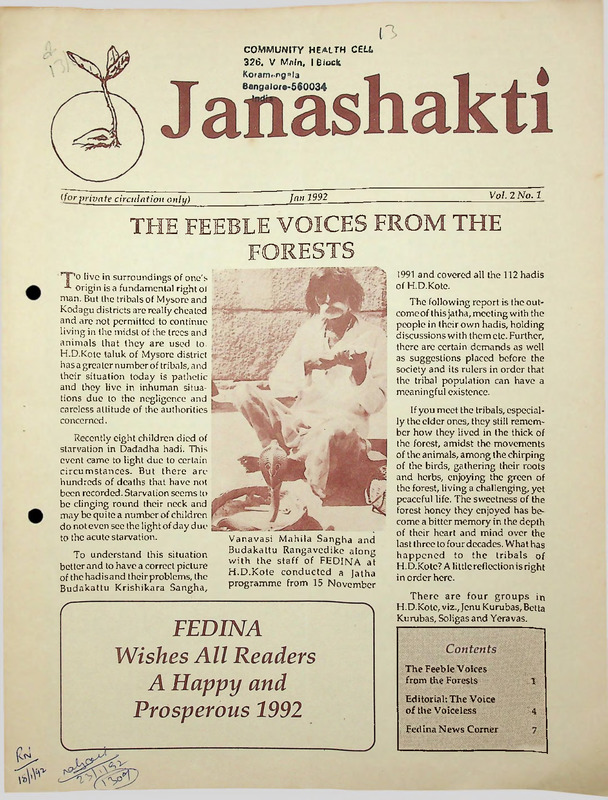
Vanavasi Mahila Sangha and
Budakattu Rangavedike along
with the staff of FEDINA at
H.D.Kote conducted a Jatha
programme from 15 November
If you meet the tribals, especial
ly the elder ones, they still remem
ber how they lived in the thick of
the forest, amidst the movements
of the animals, among the chirping
of the birds, gathering their roots
and herbs, enjoying the green of
the forest, living a challenging, yet
peaceful life. The sweetness of the
forest honey they enjoyed has be
come a bitter memory in the depth
of their heart and mind over the
last three to four decades. What has
happened to the tribals of
H.D.Kote? A little reflection is right
in order here.
There are four groups in
H.D.Kote, viz., Jenu Kurubas, Betta
Kurubas, Soligas and Yeravas.
The Feeble Voices
from the Forests:-:.:
Illi
Editorial: The Voice
of the Voiceless .
||||
Redina News Corner£$
2
Jan 1992
JANASAKTHI
Rehabilitation - A Farce
After the implementation of
1963 Forest Act, quite a few tribal
hadis were rehabilitated. Accord
ing to this settlement, every tribal
family was assigned 5 acres of
land, a house and other necessities
were to be provided and new
colonies were to be set up. Out of
112 hadis, only 17 were converted
into colonies and the rest were left
to themselves. Even in those 17
colonies, neither the allotment of
land nor the construction of house
has properly taken place. If only
we glance at those colonies we can
see for ourselves the real situation
that persists even today.
1. Annur Colony: Instead of 5
acres of land, only three to four
acres of land was distributed. The
land that was distributed was unfit
for cultivation.
2. Muskare Colony: The land
that was allotted to them has been
grabbed by others.
3. Beemanahalli Colony: Only a
few have been allotted land. Even
the land that has been allotted has
not been properly demarcated and
there is confusion concerning the
ownership of land.
4. Vaddaragudi Colony: Land
has not been allotted to all the
families.
Similar confusions can be
noticed in Penjahalli Colony,
Udbhur Colony, Brahmagiri
Colony, Maladahadi, Chennagundi, M.C.Tholalu, Haralahalli,
Kudige, B.Matakere, Nemmanahalli and Ankanathapura
colony. No one is certain about the
land assignment, its where-abouts
and its ownership rights. Many are
landless and homeless in these
colonies.
To sum up, of the 773 families
of the 15 colonies that were
rehabilitated, 328 families are land
less even today.
Landless Hadis
If this is the situation of the
colonies that were rehabilitated,
what about those who were shifted
out of the forests and were not
provided with any alternatives.
One can just imagine the pitiable
situation of these people who have
neither the forest nor the land but
are left in the lurch to fend for
themselves. We can divide the
landless hadis as landless hadis
outside the forest and landless
hadis within the forests.
All these hadis were in the
forest earlier. Today the forest has
disappeared and this land has be
come barren and has been
entrusted to the Revenue Depart
ment. Their habitat has become
closer to the revenue villages. In
stead of saying they were forceful
ly shifted out of the forest, what we
can firmly say is that the non
tribals along with the forest depart
ment have destroyed the forest so
much, that the tribals are deprived
of their natural surroundings of life
and existence.
The tribals of these hadis face
untold miseries and problems. In
some of the hadis, the tribals have
not even place to build their small
huts. For example, in Suthigehundi, when the tribals began to con
struct their small huts, a farmer of
that village threatened them on the
pretext that the land belongs to
him. So some of the families
Table 1. Landless hadis outside the forests:
fa milies
hadi
families
Anegatti Dipo Mala
26
Anegatti hadi
4
Satthige hundi
7
Kothnahalli
25
Chamenahalli hundi
24
Chikkereyur
20
Hosahalli hadi
12
Prabhanagar
25
Chennegowdana hundi 10
Dadadhahalli
20
Seegodu hadi
16
Heerehalli
(near Moleyur)
7
Devalapura
30
Bavikere
36
Hanchipura
20
Naganahalli
10
Motha Kerehadi
15
Heerehalli
49
Hadi
migrated to Anegatti Dipn Mala.
Here the forest officials did not
permit them to live peacefully, so
again they shifted to a nearby place
and have settled in a place belong
ing to someone in Hebbalguppe.
The Tahasildar has distributed
them houses under the new
programme called ASHRAY A. But
when the labourers began to dig
foundation for the houses, the
forest officials took away all the
instruments and informed them
that this land belongs to the forest
department. We can see such dis
turbing situations practically in
every hadi.
In Bhavikere hadi, the land that
has been made ready for cultiva
tion by the tribals has been
encroached by non-tribals. This
has already happened seven times.
Even this year, they have been
preparing some forsaken land for
cultivation. They are sure that
some one or the other will claim
that land next year. There is the
ihbuilt fear of being driven away.
The tribals struggle to prepare
the land for cultivation and in
variably some non-tribals
encroach it. This is the common
practice around here. Forcefully
moving from their settlement is the
repeated story that happens eveiy
year at different places. The unsure
and insecure lives of these tribals
continue creating history, but it
remains in the dark, never being
recorded, never being made
known to the so called "society",
which having ears hears .not,
having eyes sees not, and having
mouth opens it not for the rights of
these helpless tribals.
Two acres each were allotted to
seven persons in Survey no.72 in
Chikkereyur hadi.# But the posses
sion of this land is with one big
landlord. Nothing has happened
inspite of the many applications
and supplications made to the
government. Inspite of the land
being allotted, the tribals have only
the piece of paper with them
without the actual possession of
the land and are unable to cultivate
the land which belongs to them.
Some other tribal settlements
happened to be in the midst of the
villages. Chennegowdanahundi is
Jan 1992
JANASAKTHI
Jan 1992
page!JANASAKTHI
Editorial
THE VOICE OF THE VOICELESS
1991 willgo down in the History of the world as a memorable
year for the historical decisions tafan, violence committed, com
munal hatredperpetuated, gruesome murders committedetc. t the
international scene, Soviet Union became a reality of the past,
paving way to a new Commonwealth of Independent 9fations, the
effects of which are yet to be felt globally.
In India, the murder of Rajiv (jandhi brought to an end the
family rule and the election fought during that period saw the
Indian Sfational Congress emerging as the single largest party.
Jfarasihma Rao was sworn in as the T.9d. of India with newfaces
to headsome of the fay portfolios. Liberalization, devaluation and
inflation has made the cost of living rise higher. Trices are soaring
high and the poor person s life is made more and more difficult.
Violence based on caste, religion, language, boarder and basic
resources have continued and have tafan new forms. Instead of
building bridges of understanding andfellowship, more and more
walls of division, hatred and misunderstanding have been con
structed which have given cause to continuous suspicion, doubt
andlackjf trust in the other. from Last to iVest, from Vfprth to
South, all the States of the Union aregripped with one issue or the
other and this has made the life of common people more difficult.
SLtrociti.es on women, dalits, tribals andchildren have increased
and theirfeeble voices ofprotest have bee crushed, their unsteady.
raising of hand to claim their rightful place in the society is put
down heavily and they are made to submit themselves to all sorts
of inhuman and unheard of tortures.
Is there any hope of changefor them during 1992? iVill their
voice be heard, will their rightful cryforjustice be answered? QVill
the mainstream society and its rulers be open to understand the
plight of these voiceless, wea^and downtrodden? Or will 1991
continue its sway over 1992 also?
J4s members of this society, we who are committed to a new
human society have a duty to perform - to be the voice of the dumb,
the hand of the handless, the feet of the crippled, the eyes of the
blind, the ear of thee deaf, etc. Otherwise, the ne^tgeneration will
surely point their accusingfinger at us shouting: 'having eyes you
saw not, having ears you heard not, having mouth you opened it
not to uphold the rights of the the downtrodden — the tribals,
dalits, women and children'.
from page 2
The Feeble Voices
an example of this. Houses were
constructed for them. But the
people of the village fought with
them and almost pushed them out
of the village. Now they have
moved away from there and have
settled behind the forest guest
house near Handpost with some
small structure not meant for
human habitat.
This way the landless tribals
face innumerable difficulties.
Neither the blowing wind, nor the
falling rain, nor the bright sun
shine can wipe away the miseries
faced by these tribals. They are
living amidst a slow moving death,
unwanted and rejected by the
mainstream society.
Table 2
Landless hadis in the
midst of forests:
families
ha di
Balle
Muleyoor
Golur
Sebinakolli
Manchur I
Manchur II
Kaimaradahadi
Kalkere hadi
Aanemala
Bavalihadi
Thimmanahadi
Hosahallihadi
Sunkadakatte
Udbhur Kerehadi
56
42
45
24
20
6
16
9
13
7
16
12
18
The families that live here have
labour only if the forest depart
ment offers them some job here
and there. Otherwise they have no
labour at all. Some times they
migrate to the neighboring state,
Kerala, in search of labour. When
they have no labour, they have to
face the stark reality of life, i.e.,
hunger. One of the major con
tradictions one notices here is that
no tribal family has been given any
land. Yet people belonging to
"Odiga Gowdas" have been offered
thousands of acres of forest land
for cultivation. One can firmly af
firm that only when the
bureaucracy, politicians and
landlords have any humanity in
/an 1992_____.___________fANASAKTHI
them that the lives of the tribals
would become meaningful and not
just by inserting some acts or
amendments in the Constitution of
our country. The problems the
tribals face are far beyond the reach
of the structure of laws and con
stitutions. They could be perceived
only by those who have a human
heart which opens its eyes to the
situation and life-struggle of the
tribals. Dr. B.D.Sharma, when he
was the Commissioner for SC/ST,
has submitted a detailed report to
the Government of India, in which
he, for the first time, gives a real
picture of situation of the tribals
and pointed out suggestions for
their upliftment.
Some had is are in the forest and
in fact do some sort of cultivation.
They have not yet received any
ownership right over the land they
cultivate. They are:
Maladahadi
42 families
Dammanakatte
33
Bhogepura
25
Seegurhadi
37
BadagaI
21
Badaga II
16
Udbhur hadi
37
Majanakuppe mala 10
Uskoor Mala
36
These families have been cul
Will their wait be in vain?
tivating the land belonging to the
forest department for the last 10 to
12 years. Since they do not posses
any document of right of owner
ship, no government benefits or
programmes reach them. The
tribals who live within the forests
have been deprived of any govern
ment welfare programmes. Nor do
the Forest Officials permit them to
plan any developmental program
mes. For example, Bhavikere hadi
was allotted 30 houses by the Zilla
Parishat; but the Forest Depart
ment did not permit them to con
struct these houses. From 1987
onwards, nearly 210 houses were
approved for the tribals who live in
the forest, but no house has been
built due to the stiff stand taken by
the forest department. Further,
these tribals also face lack of proper
drinking water, school, medical
facilities, etc., which are basic for a
proper living.
On the other hand, most of the
government welfare programmes
can be utilised by only those who
have land. Hence, the tribals who
are landless, have not been
touched by these programmes.
Even though some have received
some benefits, it has not helped
them to lift themselves up from the
miserable situation they are in.
To sum up, of the 3037 tribal
families in H.D. Kote, 1650 are
landless. In their own land of birth,
they have to find alternatives for a
meaningful existence and survival.
Tribals Displaced By Dams
Three major dams have been
constructed in H.D.Kote, viz.,
Taraka, Kabini and Nugu. Out of
these, Kabini is a major one. It has
brought around 61 square
kilometers of land under water. In
the process, (according to the
report of Public Works Depart
ment) 14 tribal hadis were dis
placed. But nothing is mentioned
about their identity, their
rehabilitation and the various al
ternatives offered to them. Accord
ing to the survey we conducted,
the following details have been ob
tained.
15 Tribal hadis have been dis
placed.
Chatarahundi: There were 16
Soliga families. After the displace
ment, these families dispersed to
Boredevara manti and Bundanamala.
Kanakanahalli colony: There
were 36 families of Jenu Kuruba
and Soliga community. They used
page 6
to cultivate land here. After the displacement, they moved to
Katuvalu, Boredevara manti, Bandipura, Basavapura and Bundanamala.
Jaganakote: There were 32 Betta
Kuruba families. Of these 13 were
allotted land in Kenchanahalli Sur
vey No.l. But this land was
encroached by farmers and forest
department. The tribals had to
JANASAKTHI
they are landless and clispersed in
Kothnahalli and Heerehalli.
Displacement Due to
Forest Laws
Karnataka Forest Act 1963 and
Wildlife Protection Act 1972 has
brought in more displacement
from the forests.
They are:
Gadimachanayakanahalli - 65
Of the many things said in the circulars, one thing that
props up as an important issue is that one should not
consider that the tribals have encroached the forest
land, rather these tribals have lived there for genera
tions and hence for them living in the forest is their fun
damental right.
move out to a nearby place near
N.Begur, which is today known as
Jaganakote.
Maranahadi: 60 Jenukuruba
families lived here. They owned
sufficient land and even cultivated
rice. They had to move to the upper
part of the hadi as the lower part
came under the cover of water. The
land they used to cultivate was
submerged, and today many of
them are landless.
Manchegowdanahalli colony:
20 Jenukuruba families lived here.
They had to move to Dammanakatte, K.R.pura, Doddahadi
and Macchur hadi.
Bhogepura
hadi:
20
Jenukuruba families had to move
away from here due to the sub
merging of their land. They moved
into the forest and built up their
hadi under the same name.
Similarly, those which were
dispersed due to submerging are:
Naganakatte hadi - 18 families
Kakanakote Masti hadi - 40
families; Maradaboddedevera
hadi - 20 families; Sidiluhodeda
hunasemarada hadi - 15 families;
Sundepurada hadi - 30 families;
Maranahadi - 60 families; Dammanakatte hadi - 18 families;
Dhyavana hadi - 30 families;
Hosahalli hadi - 23 families.
Besides these, the 30 families
that were displaced under Taraka
Dam submerging, were cultivating
around 80 acres of land. But today
families; Metikuppe hadi - 60
families; Sonahalli - 30 families;
Kothnahalli hadi - 30 families;
Malahadi - 35 families; Badaga
colony -18 families; Seegur hadi 9 families; Alanahalli hadi - 15
families; Vadera halli hadi - 35
families; Bhavikere - 30 families;
Dadadha halli hadi - 20 families.
Most of these families were cul
tivating land in the forests and
were content. Today most of them
are landless and are displaced
from the forests. They are left with
no alternatives either. Both the
government and the forest depart
ment have ignored their demand
for a right to live and turned a blind
eye towards their rightful
demands.
There are some other hadis that
have been displaced from the
forests and have been brought to
the periphery of the forests.
They are:
Balle - 42 families; Doddahadi 16 families; Macchur hadi 1-22
families; Macchur hadi II - 16
families; Sunkadakatte hadi - 12
families; Golur Hadi - 32 families;
Kadegadde hadi - 12 families;
Hosur hadi - 16 families; Banur
hadi - 8 families; Bavali hadi - 7
families; Mule hadi - 43 families;
Aane mala - 21 families; Hosahalli
hadi - 26 families.
So far these families were right
in the forest, cultivating the land
for their livelihood. Today they
Jan 1992
have been moved to the very
periphery of the forest with no
land to cultivate and have become
landless labourers.
Now efforts are on from the
forest department to further dis
place them from their present
places of existence. Totally 1086
families of 41 hadis have been dis
placed due to forest laws and con
struction of dams.
The life style and the food
habits of the people who live in the
forest is a special and peculiar one.
They know the forest so well, as if
they live in the very heart of the
forest. They used 47 varieties of
roots , 90 kinds of fruits, 60 kinds
of greens/leaves, 43 varieties of
mushrooms as food.. If these are
displaced from their natural
habitat, one is uprooting from
them their very fundamental right
of existence, their right to live.
Government Circulars
In order to fulfill the rightful
demands of the tribals, the govern
ment need not contravene any law.
Dr. B.D.Sharma, the commissioner
of SC/ST, placed before the
government certain recommenda
tions and suggestions in order to
help the tribals.
The government has discussed
this in the meeting of secretaries
and has sent out 6 circulars on 188-1990 to be implemented by all the
state governments.
Of the many things said in the
circulars, one thing that props up
as an important issue is that one
should not consider that the tribals
have encroached the forest land,
rather these tribals have lived there
for generations and hence for them
living in the forest is their fun
damental right.
The second circular No.13-1-90
F.P.(2)18-8-90 pertains to the rights
of the tribals.
Even before the government
declared certain forests as
reserved, many of the tribals lived
in these forests. Without consider
ing this fact, today they are con
sidered as those who have illegally
occupied the reserved forests, and
are to be forcefully evacuated. It
was important on the part of the
department to identify these tribals
before the forest was declared
reserved and produce documents
Jan 1992
of their existence. The lack of such
documents with the forest depart
ment is not the mistake of the
tribals, but the sluggishness of the
department, and for this the in
nocent tribals should not be vic
timized. Hence these tribals should
not be considered as illegal oc
cupants of the forest land. They
were there even before the act
came into existence.
Secondly those who possessed
land before 1980, such land must
be legalised. No tribal should be
displaced before proper alterna
tive is planned and implemented.
Government of India has sent
out a circular to all the state
governments concerning the
rehabilitation of the tribals. NO.621-89 FP 1-6-90. Some of the main
points here are:
1. This plan has to be imple
mented in the degraded forests
that exist even in reserved forests.
2. Sufficient land has to be iden
tified for rehabilitation and should
be converted into blocks for such
purpose. Every family has be to
allotted 5 hectares of land for rais
ing forest and 2 hectares of land for
cultivation.
Besides, according to the Na
tional Forest Policy 1988, the tradi
tional tribal right to forest is to be
respected.
Other aspects that are dealt in
these circulars are:
Granting of ownership of forest
land; settlements that exist in the
forest are to be considered as
revenue villages and provision
must be made for their develop
ment; due compensation to be of
fered if any harm has been done by
wild animals; only tribals to be
taken for all the works within the
forest and giving them the just
wages etc. Against this back
ground, we place before the
government some of the fun
damental demands of the tribals of
H.D.Kote.
Urging Feeble Voices
1. The tribals of H.D.Kote are
forest dwellers from several cen
turies. They have been deprived of
all the basic rights and have be
come homeless and landless. Considering this fact, the forest
JANASAKTH1
department should rehabilitate
them within the forest according
to the plans presented in circular
no.6-21-89 FP1-6-90.
a. In the plan of rehabilitation,
the degraded lands are to be iden
tified and are to be allotted to the
tribals.
b. We have already mentioned
the hadis and families to be
rehabilitated. They are:
356 families from 18 hadis
i.
who are landless and are outside
the forest.
ii. 284 families of 13 hadis who
are living in the forest.
iii. 1086 families of 42 hadis who
are displaced due to the forest laws
and construction of dams.
iv. 257 families of 9 hadis who
are cultivating the forest lands are
to be given ownership rights.
2. The government should
grant 5 acres of land to each family
(totally 1659 families who are land
less) and undertake a comprehen
sive developmental programme
for them.
3. Through LAMP society, the
tribals are to be allowed to collect
the minor forest produce from all
categories of forests.
4. The tribal skills are to be en
couraged and developed and the
necessary raw material like bam
boo should be provided.
5. Tribals are to be taken for
forest work and those tribals who
have worked as watchmen for
many years are to be made per
manent.
6. In order to assist the agricul
tural activity, government should
plan irrigation facilities for the
tribals.
7. Government should follow
the Andhra Pradesh Model (ITDA)
and open single window to handle
all the programmes pertaining to
the tribals. A critical evaluation
should be conducted on all the
tribal programmes to find out their
meaningfulness and effective im
plementation.
8. In order to make basic educa
tion compulsory among the tribals,
more and more Ashrama schools
are to be opened wherever neces
sary.
00..........
U»'TH CbLL —
326, V Main, I Block
Ko»amc ngala
Bangalore-560034
P<W7
SARJAPURA
Sheep rearing
A programme to assist landless
labourers and those who depend
only on casual wages has been in
itiated at Ittangur village. Six
women beneficiaries have been
chosen and they are given a pair of
sheep each for rearing. It is hoped
that this programme will give ad
ditional income when the number
of sheep increase in due course.
Shramadan atKallahalli
On 26th October, the people of
Kallahalli organised a shramadan
(free labour) where every one in
the village participated. When
people join together they can do
wonders. This was proved during
this one day shramadan during
which they repaired the road
which goes through their village
and cleansed the whole village.
This has helped them to work
together for common goals. Kal
lahalli village looks much brighter
today and the people of the village
are proud of their achievement.
Jatha
The recent starvation deaths at
Dadadahalli colony, where 8 tribal
children died evoked the tribal
people to organise a Jatha which
received full support from BKS,
VMS, Budakattu Ranga Vedike
and Fedina-Vikasa. This jatha
which began on November 15th
went through all the colonies and
ended on 21st December 1991. The
idea behind this jatha was to visit
all the 106 Hadis of H.D.Kote taluk
and get the situation analysis of
each hadi regarding the require
ments of the tribals. All the hadis
participated in the jatha . The
Budakattu Ranga Vedike, which is
the cultural forum of the tribals,
performed few street plays and
sang some songs which were well
appreciated by everyone. During
the concluding function at
Mooleyur hadi on December 21st,
the DC of Mysore district Mr. Sid-
Jan 1992
JANASAKTHI
page S
daiah spoke to the tribals and as
sured them that proper action will
be taken to solve their problems.
Around 500 tribals were present at
this meeting.
WAYANAD
Exhibition
Under the auspices of Fedina
and Adivasi Aikya Sami thy, an ex
hibition of traditional handicrafts
of the tribals of Wayanad was or
ganised which was both interest
ing and informative. The one day
exhibition which was held at Vazhavatta area was much ap
preciated by tribals and
non-tribals. Traditional household
utensils, jewellery, farming equip
ments, food preservatives, musical
instruments etc. were the main
items displayed on the occasion.
Tribal medicines were also part of
this exhibition.
Legal education seminar
Kuppady, Vazhavatta, Nambiyarkunnu and Edakkal areas,
legal eduaclion seminars were con
ducted. Fundamental rights of the
citizens of India and other legal is
sues specifically related to the
tribals were discussed. Mr. Luckose Jacob, Advocate Mathew Vclloor. Advocate Ccevarghese, Baby
Paul and E.T. Raju took classes
during the seminar.
Vegetable gardens
The Adivasi Aikya Sami thy
members have started vegetable
gardens at Kuppady in Balhcry
area. Vegetable seeds for this pur
pose have been supplied by the
Ambalavayal horticulture depart
ment. Organic farming methods
will be used to develop these
vegetables. Ms Agnes Luckose and
Ms Indira took classes to explain
the advantages of doing organic
farming. There is a plan to imple
ment this programme in all the
other areas.
NILGIRIS
Balawadis
Balawadis have begun to func
tion at Cholady, Kanayamvayal,
and Chempakappally areas. Along
with these balawadis, health
education, vaccination and child
care are also given importance.
There arc 75 children attending
these balawadis.
World literacy day
September 8th, the world
literacy day, was celebrated with
various activities. The literacy
jatha which was organised by the
cultural troup was the climax of the
celebration. This jatha which
began at 8.00 a.m. at Ayyankolly
reached Bithcrkad in the evening.
Street dramas, songs and other cul
tural events made this programme
an enjoyable and successful event.
CHENGAM
Staff Training
Since our programme at Chcngam is of recent origin, it was
decided to invite the Chengam
team for a follow-up training at
Bangalore office. All the staff mem
bers participated in this training
programme from 2nd to 6th
December 1991. Giving guidance
on various aspects of social work,
Mr. Sam Chelladurai and Mr.
Saravanan from Indian Social In
stitute conducted this programme
with the assistance of Promod John
and Bangalore office staff.
Two of our tribal staff members
were sent to Vellore for training in
mushroom culture. They will be
giving training to the tribals of the
villages to cultivate mushroom for
additional income.
Community Health Centre
KITTUR
Re-starting of handlooms
In Machi village, the Khadi
Gramodyog of Bailhongal had put
two weaving maggas, which they
wanted to take back as the people
had not been showing very keen
interest in making use of these. The
staff requested the chairman to
give them some more time. So after
a long discussion with the villagers
and with the help of one of the
villagers, we managed to find a
man from nearby village who
could repair the looms and teach
the Machi people weaving. Now
the magga is re-started with much
vigour.
Meeting with AEO
We have been thinking of
programmes which were sidelined
because of the land issue. The
schools were the ones which were
badly affected. One of the staff has
shown interest to start a school in
Galaginamada. So, all the team
members sat with the villagers to
discuss about the Kulavalli area
schools. It was decided to contact
the new AEO at Bailhongal and
brief him about the situation. 20
villagers along with the staff went
to Bailahongal and requested the
education department to visit
these villages. Upon their request,
the AEO visited Dindlckoppa,
Sagara, Papermill and Kulavalli. A
school betterment committee was
formed in all these three villages
for the first time and the AEO has
approved these.
Working Together
December 18th will not be easi
ly forgotten by the people of
There arc many issues such as
Jawadi hills and our team at Chen
ration cards, bus services, post of
gam. One of their long cherished
fice services etc. which affect all the
dreams materialised on that day
nine villages. Rather than strug
when they inaugurated their com
gling to sort out these issues in
munity health centre with great joy
isolation, they have decided to
and pride. Representatives from
work together. In view of this a
our other project areas were also
meeting was organised at Ninpresent to share the happiness
gapur where representatives from
with the people of Jawadi hills.
the Kulavalli duster participated.
Janasaklhiis the official newsletter of Foundation for Educational
Innovations in Asia (Fedina), 902 Indira Nagar 1st Stage, Bangalore 560
038. Published in Engl i s h, Kannada andM al ayal a m by Mahesh Lobo,
' Coordinator, Fedina.Issuedated'Ja nuary
x Editorial Team: M ahesh, Ko k ka 11, S m i t ha, Pra m o d a nd Vasu.
; • Designedand prin ted^Wprdmakers-^ j W--Z
Position: 5346 (1 views)