JANASHAKTI VOL. 2 NO. 4 OCTOBER 1992.pdf
Media
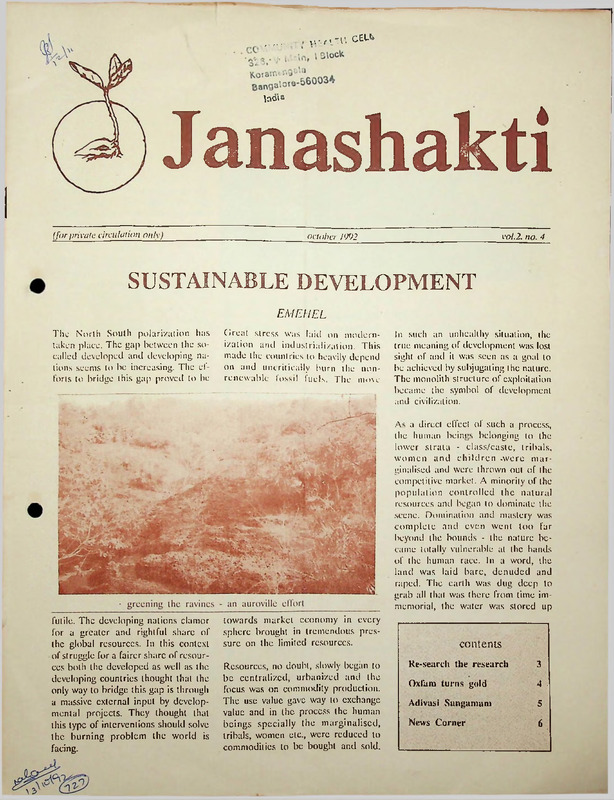
- extracted text
-
.......I
UVITU CELt
Icidyi
Janashakti
(for private circulation only)
vol.2. no. 4
October 1992
SUSTAINABLE DEVELOPMENT
EMEHEL
The North South polarization has
taken place. The gap between the socalled developed and developing na
tions seems to be increasing. The ef
forts to bridge this gap proved to be
C J real stress was laid on modern
ization and industrialization. This
made the countries to heavily depend
on and uncritically burn the non
renewable fossil fuels. The move
In such an unhealthy situation, the
true meaning of development was lost
sight of and it was seen as a goal to
be achieved by subjugating the nature.
The monolith structure of exploitation
became the symbol of development
and civilization.
As a direct effect of such a process,
the human beings belonging to the
lower strata - class/casle, tribals,
women and children .were mar
ginalised and were thrown out of the
competitive market. A minority of the
population controlled the natural
resources and began to dominate the
scene. Domination and mastery was
complete and even went too far
beyond the bounds - the nature be
came totally vulnerable at the hands
of the human race. In a word, the
land was laid bare, denuded and
raped. The earth was dug deep to
grab all that was there from time im
memorial, the waler was stored up
futile. The developing nations clamor
for a greater and rightful share of
the global resources. In this context
of struggle for a fairer share of resour
ces both the developed as well as the
developing countries thought that the
only way to bridge this gap is through
a massive external input by develop
mental projects. They thought that
this type of interventions should solve
the burning problem the world is
facing.
towards market economy in every
sphere brought in tremendous pres
sure on the limited resources.
Resources, no doubt, slowly began to
be centralized, urbanized and the
focus was on commodity production.
The use value gave way to exchange
value and in the process the human
beings specially the marginalised,
tribals, women etc., were reduced to
commodities to be bought and sold.
contents
Re-search the research
3
Oxfam turns gold
4 ;
. Adivasi Sangamam
5
News Corner
6
JANASHAKT!
____________ October 1992
which allows space and freedom to
each to grow in harmony with the
other. Hence, development is a
process of growth, through which
every being is allowed to grow and
find its meaning, by respecting every
thing else.
This way development becomes a sus
tainable process. In the words of the
World Commission on Environment
and Development, “development
that meets the needs of the present,
without compromising the ability of
future generations to meet their own
needs”.
to such an extent that so many were
displaced, submerging the virgin rain
forests and destroying the bio-diversilv which was in abundance in such
areas. For sheer pleasure and satis
faction the animal world was hunted
down. Il was/is an absolute mastery!
A total mastery on and in the earth,
on the seas and sky. In other words,
the universe was subjugated. Nothing
was left to be conquered and so the
destruction was total and complete.
The planet earth, the mother of all
living, was/is fatally wounded, ex
ploited and all kinds of crimes were
committed against her by the brutal
power of man, hastening the doom’s
day.
All this happened because of the ex
isting / prevalent notion of develop
ment man had created lor himself.
Today, we have to pause for a while
and question ourselves on our notion
of development. I would like to un
de r s I a n d development in a
photographic language. In the
“development” process in the studio,
the lab-technician cannot add any
thing to the film, but only bring to
visibility the reality to which the film
was exposed to. Il is a process by
which the hidden is brought to light.
In a way, this is a process initiated
to move Irom the latent and unseen
to reality, to be seen and observed.
Development is such a process
through which the people arc initialed
into various possibilities and resources
and by identifing and using them in
the most appropriate way, they begin
to grow in relation to other human
beings, plant and animal world. In the
symbiotic relationship with each
other, the human beings undertake
and commit themselves to grow up
as fully human, giving space and opporlunily to other human beings, na
ture, plant and animal world, so that
all that is in this world can attain their
fullest stature and purpose-fullness.
Devclopmenl, in this sense, is a par
ticipation in the creation process, and
this should evoke a sense of awe and
reverence, ic., respect to every thing,
animate and inanimate. This also
brings in the sense of sacredness,
___________________________________________________________________
We arc in an age, as mentioned ear
lier, where most of the human activity
is un-suslainablc, rather it is destruc
tive. If we continue to proceed as of
now, in the areas of Science and Tech
nology, energy production, manufac
ture of consumer goods, use and
disuse of forests, rivers, mountains
and valleys, exploitation of all that is
available on the land and beneath its
depths, in the waler and on the ocean
beds, etc., and of course, if we
reproduce al the present rate, one can
be absolutely sure, that the destruc
tion of this life giving nature is to be
anticipated, and nothing much will be
left for the subsequent generations.
Il is in this context, one has to serious
ly consider the options of sustainable
alternatives, which are ecologically
sound, and arc beneficial to the mar
ginalised, oppressed sections of the
society, women and children. It is ill
this context, one has to seriously con
sider the option one has in the
production of food, the system of
farming we practice and look for, ex
plore into other ways and means
which are sustainable and sound.
Agriculture plays the pivotal role, and
it is lime now that we look at agricul
ture seriously.
'_________ (to be continued)
Using internal inputs is no guarantee for sustainability
No single agricultural method has a corner on sustainability. Any fanning system, whether “chemical intensive" or
“natural" can be in some aspects resource-conserving and in other aspects wasteful, environmentally unsound orpollut
ing- ...
Obviously, serious questions surround how long such external energy and external supply of nutrients, fossilfuels, petro
chemicals and mineral fertilizers can be maintained. But simply substituting nonchemical alternatives may not neces
sarily make agriculture more sustainable, e.g., applying animal manures unwisely can pollute ground and surface water
as badly ds overuse of chemicalfertilizers can and plant-derived pesticides can be as dangerous as chemical pesticides.
(Dover & Tablot 1987 Source: Farming for the Future)
October 1992
Tribal center
Fedina has been working mainly with
tribals. Out of the 6 programmes it
covers in the three southern stales,
4 arc exclusively among the tribals.
Constant interaction with the tribals
did raise quite a few creative initia
tives in understanding the tribal cos
mology, religion, language, cultural
forms and their healing system. Il is
in this context that selling up of a
tribal centre was thought of which
would function as a nucleus of tribal
life and culture.
After a lol of discussion, planning and
interaction with the concerned tribals,
it was decided to start tribal center
al H.D. Kolc. The long cherished
dream became a reality on Saturday
19lh September 1992.
A unique foundation stone laying
ceremony was planned for this. A pla
que made up of mud and wood was
prepared symbolizing tribal life and
culture. The unveiling of this plaque
marked the beginning this tribal cen
ter. The traditional leaders of tribals
viz. Sml. Kalamma of Ncmmanahalli
colony and Devaiah of Maranahadi
along with Mr. Joachim Lindau of
Bread for the World, Germany, un
veiled the plaque. This was witnessed
by the tribal representation of 113
tribal settlements numbering around
500, Fedina staff, Trustees along with
invited guests. The chief secretary of
Zilla Parishal, Mysore, graced the
occasion.
The highlight of the day was that the
whole ceremony was conducted in line
with tribal culture. The traditional
tribal welcome was offered to the in
vited guests, the pooja (worship) was
offered by the tribal priests, tribal
dances were performed to ward off
all evil spirits and to welcome good
omen wishing success. The men,
women and Rangavedikc performed
traditional dances like Kolat a, Bcllakurubara Kunilha, folk dances by
women etc.
Il is hoped that this tribal centre will
mark a new beginning towards their
cultural awakening and development.
JANASHAKTI
page 3
Editorial
RE-SEARCH THE RESEARCH!
EXPERIMENT WITH EXPERIMENTS!!
Research and experiments have come to stay in our society. There
is greater value and credibility to a product that comes into the
market after a ‘Research and experiment’ process. Today there
are institutions and individuals willing to undertake research and
experiment on any issue for a fee. As people generally get fed
up with routine, the market research and survey helps producers
to come out with new models and new products. Testing of these
products, experimenting them with a variety of conditions and
combinations, proves that, the propagation of a product or idea
is undertaken, only when its viability and use is clearly tested,
and that it is better than any other of its kind. So we have research
and experiments undertaken almost in every field, commercial or
non-commercial. This also helps to find alternatives and suggests
strongly why these alternatives are to be preferred. Hence re
search and experiments are undertaken in the areas of science
and technology; Education, production, health etc, etc. The list is
quite long.
Government, government institutions, financial and educational in• stitutions, manufacturers of particular items provide financial and
other support to undertake research and conduct experiments in
order to propagate, improve or market a particular idea/com
modity. Huge grants, supportive system is available to undertake
research and experiments in high tech modern agriculture, im
provement of breeds, etc. Manufacturers of fertilizers and pes
ticides, directly or through government machinery and financial
institutions advice and offer loan cum subsidy in order to market
their products. All assistance is offered to experiment with innova
tive measures which are leading to chemicalization, modernization
and alienation.
But it is unfortunate, how much support ecological and sus
tainable agriculture gets from these institutions. No research is
undertaken to prove the viability of this system. No bank comes
forward to offer loan to produce biomass, vermiculture or pur
chase compost manure. No educational institute offers assistance
to research in ecological farming and of course, no consumer
would like to pay a higher supportive price to the products
produced in an ecologically sound way. What a contradiction!
All want to save this planet earth but no one wants it to happen!!
How sad is the state of our research and experiments!!!
JANASHAKT1
page 4
_____October 1992
“OXFAM turns GOLD”
OXFAM, a British charity organisa
tion with no religious bias or political
affiliation, celebrates it’s 50th An
niversary on 5lh October, 1992, at
various levels. Il was set up in 1942
by a small group of Oxford citizens
who sent help to hungry children in
Nazi occupied Greece. They called
themselves Oxfam Committee for
Famine Relief (OXFAM). After the
war, they continued to raise money
and helped victims of any disasters
covering wider needs of the whole
world.
Oxfam believes that if shared equi
tably, there arc sufficient material
resources in the world to enable all
people to find fulfilment and to meet
the basic needs. So development
works of various kind started emerg
ing and address long term solutions.
Oxfam extends its help through grants
to registered organisations towards
long term solutions to the problems
of poverty. So Oxfam is keen to en
courage the formation of groups/organisations which tackle poverty and
can eventually be self-supporting. It
is a partnership of people who work
together for the basic human rights
of food, shelter and reasonable con
ditions of life.
Oxfam has 105 field offices scattered
in 72 countries in all the continents.
In 1965, Oxfam opened its first field
office in India al Bangalore. There
arc 7 such offices in India covering
all states. Welfare oriented, institu
tionalized services had been extensive
ly supported by oxfam. Of late, the
thrust is more towards rural based
social action groups. These groups
contribute effectively in social change.
Oxfam supports 350 organisations
throughout India which arc involved
in the following types of works:
Rural Development, Health, Disaster
Relief, Agriculture, Income Genera
tion, Drought Relief, Creation of
Employment Opportunities, Tapping
Government Schemes, Tribals,
Fisherfolk, Women, Dalits etc.
(Now the trend is also to develop a
wider awareness of our work within
India). So, oxfam is beginning to con
centrate on the primary issues of
drought, forest, employment and aid
trade and debt. In all their work,
they seek the active involvement of
women as essential partners.
For this, Oxfam raises mainly from
the general public in the U.K.
Another major source of funds is a
network of more than 850 Oxfam
shops. These shops sell re-usable
goods donated by the U.K. public and
handicrafts from producer groups in
many developing countries.
Today, Oxfam is active due to their
project partners, tireless effort’s of
millions of supporters and thousands
of volunteers in the UK and Ireland.
Going, Going.....
About 42 percent of all tropical forest has been removed over the past 500 years or so, but most of
this loss has occurred in the last 30 years. In the early 1980s forest areas in Africa were being cleared
29 times faster than they were being planted:; in tropical America, this ratio was 10.5 to 1, and in
tropical Asia 4.5 to 1. In the last ten years annual deforestation in the tropics has doubled to 20
million hectares.
Many countries have been rapidly denuded of valuable and productive forests: Cote d'Ivoire, El
Salvador, Haiti, Bangladesh- peninsular Malaysia, Sri Lanka, Benin, Sierra Leone and Togo /n the
wetter topics. Many nations in the drier regions, specially the Sahel, have also been denuded of
much of their dry woodlands.
Only 10 of today's 33 tropical timber exporting countries will have any timber /eft to export in the year
2000. In contrast very few countries still UM the major part of their territory under forest. The
following countries have extremely low population densities and - so far - lack the capability or
economic opportunities to exploit the forests: French Guiana, Surnam, Guyana, Papua New Guinea
and Zaire.
(Source: Defending the Future)
JANASHAKTI
October 1992
page 5
ADIVASISANGAMAM
October 12th to 19th, 1992.
Over the past few years, among the
tribal action groups and those con
cerned with tribal development, there
has been a growing concern with
regard to the cultural factors influenc
ing the socio-economic development
of the tribals. The traditional culture
of tribals contain symbols that express
various perceptions of reality. The
tribal folk arts can be used effectively
for tribal development. Ignorance
about the cultural background of the
tribals has led to the failure of many
development programmes both by
the government and voluntary agen
cies. Tribals need the benefit of
modernisation within their own social
framework and within their traditional
culture and rhythm of life.
- their language, culture, art, way of
life, world view, way of managing their
own affairs.
There have been continued struggles
which arc expressions of their will to
survive as a people. There is now an
increasing search to reach out.across
the country for sharing and learning.
There is the need to initiate collective
and common movements for rc-cslablishmcnt of their identity with its
socio-cultural expressions and to
reclaim their unique heritage. From
the localised attempt to bring together
The following programmes are en
visaged:
I. A three day national colloquium
on Adivasi culture and
development (October 13th to 15th).
Around 250 nationally known tribal
leaders, experts, representatives of
tribal action groups and those who
are concerned with tribal issues are
expected to paricipalc in this.
II. Adivasi art and cultural festival
(October 17th and 18th).
Around 15,000 Adivasis from Kerala,
Karnataka and Tamil Nadu will par
ticipate in this festival.
Al present many NGO’s and other
development agencies who are in
volved with the tribals think in this
line and are experimenting the same
al different levels. Unfortunately, all
such attempts made by tribal action
groups and others remain isolated arid
localised. Sharing of these experiences
and ideas would facilitate to develop
a common understanding and more
meaningful involvement.
Some action groups at Wayanad have
been taking some initiative along this
line. To this effect they .have had
several exposures to various tribal
situations, discussions with tribal
leaders, social activists, sociologists,
social action groups, anthropologists
etc. The insights and findings from
the above have encouraged them to
pursue these studies on a wider level
and to come to a common platform.
Arising out of these localised attempts
a need has emerged to bring together
people from larger number of com
munities from the various parts of the
country. The emerging Adivasi situa
tion in the country is characterised
by a deepening crisis for survival.
This crisis is not only the destruction
of their life sustaining systems but also
that of their very existence as a people
colonial rule of the British and
destroyed the Panamaram fort. It is
quite apt that this programme com
mences on this day. It becomes even
more relevant since 1992 - 1993 is
being observed as the International
year of Indigenous people.
III. Exposure and exchange
programme (October 16th and 17th).
Exposure to tribal situation in
Wayanad (kerala), Coorg and Mysore
districts (Karnataka) and Nilgiris dis
trict (Tamil Nadu).
people from large number of com
munities in the southern parts has
sprung the need to organise a national
level campaign to strengthen dialogue,
solidarity and try new possibilities.
To bring about a qualitative transfor
mation in the process of the reclama
tion of tribal heritage, it is planned
to conduct a nine day programme
from October 11th to 19th, .1992, to
enhance sharing, learning and search
to develop a common understanding
and vision.
October 11th invokes a potent
memory in the history of tribal resis
tance against oppressive powers. On
October 11th, 1802, under the leader
ship of Thalakkal Chandu, the tribals
in Wayanad fought against the
The following particular programmes
will take place on all the Sangamam
days.
1. Cultural programmes by different
tribal groups from different
places in the evenings - music, songs,
dance, drama etc.
2. Exhibition and sale of art and crafts
of different tribal communities.
3. Photo exhibition of Adivasi life, en
vironment and struggles.
The organisers for the above men
tioned Sangamam arc:
Adivasi Munnelta Sangham, Tamil
Nadu, Adivasi Aikya Samithy,
Wayanad, Adivasi Vikasana Pravarthaka Samithy, Wayanad, Budakattu
Krishikara Sangha, Karnataka, Kerala
Paniya Samajam, Kerala.
Venue:
Mananthavady, Wayanad District,
Kerala.
JANASHAKTl
page 6
FEDINA NEWS CORNER
BANGALORE
October 1992
japura. On the 24lh September a one
day training was conducted to educate
the people about some aspect con
cerning police. The Sub Inspector of
Police, Sarjapura, Mr. Hussain was
the chief resource person.
told that in some tribal hamlets
women are being harrassed by nontribals. Necessary steps were taken to
guard the honour of the tribal women
folk and to watch the activities of the
outside forces in the colonics.
AIDS
Protest march
An awareness programme on AIDS
was organised at Sarjapura office
where 15 women and 12 men par
ticipated. Mr. Somashekar of the In
dian Health Organisation led the
programme to a success. He briefed
the participants on what AIDS is, its
symptoms, how it can be detected and
prevented.
The forest department has con
tributed generously to the miseries of
the tribals. Recently the guards of the
forest department forcibly cut the
bamboos from the land which belongs
to the tribals. They even sold their
live-stock of these tribals al throw
away prices. Those who protested
were beaten up by these guards. Fol
lowing these incidents the Yajamanas
of 24 hamlets decided to organise a
three day protest march from July
27th to 29th in front of the Forest
department al Anlharasanlhc. Over
1000 tribals participated in this
protest march. The crowd returned
to their respective places only after
getting assurance from the forest
department that they will not be har
rassed again. They also submitted a
seven point memorandum to the
forest officials.
Area Coordinator's meet
Area Cordinalors of Fedina met on
first October 1992. Re-orienting the
programmes to activate and utilise the
full creative potential of the staff was
the main concern at this meeting.
Mr.Luckosc briefed the members
about the developments of the Adivasi
Sangamam at Mananlhavady.
S ARJAPURA
H. D. ROTE
Learning thru doing
Foundation laid
An entertainment cum learning
programme was conducted for 29
children from 6 villages al Sarjapura.
The children were taught to make
simple handicrafts and other useful
materials from waste materials. This
was done mainly to give the children
an exposure to other media of learn
ing apart from their monotonous curriculum. A follow up of this
programme will be conducted regular-
I
Legal training
Legal education is being given to the
staff as well as the villagers of Sar-
On September 19lh, 1992, a long
cherished dream of Fedina
materialised when the foundation
stone was laid for a tribal cultural
centre at H.D. Koto. This centre is
only an expression of the keen interest
that Fedina attaches to tribal culture.
Tribal women meet
Twenty women from ten tribal ham
lets met at Bakikcrc on September
8th and 9lh to discuss the various
problems that they arc facing. Siddamma of Mushkcrc colony who look
the initiative to organise this meeting
WAYANAD
Onam celebrations
The Adivasi Aikya Samilhy celebrated
Onam, the national festival of
Kcralilcs, with various cultural
programmes. These celebrations were
mainly al Balhcry, Chceral, Vazhavalla and Vaduvanchal areas. Pookkalam
(decoration with flowers) and sports
competitions were part of the Onam
celebrations. The processions or
ganised al all areas on the occasion
of Onam was a campaign for the
Adivasi Sangamam in October.
Two more Doctors
plaque unveiled - h d kote
The Adivasi ‘Doctors"Tcam which is
leading the ‘Aslhma’-trcalmcnl pro
gram is enhanced by the participation
of two more tribal doctors. They arc
Kunkan and Karulha from Bathcry
area. Vellachy, Chakkilian, Balan,
Vanchala arc already giving their ser
vices to the this cause.
JANASHAKT1
October 1992
page 7
member arc trying to get back all the
cards which arc pawned.
towards adivasi farmers. Their slogan
is ‘Development through Farming’.
Aid for plantain cultivation
Adivasi farmers union
Integrated Tribal Development
Programme came up with 8*4 l°r
Adivasi farmers of Nilgiris formed a
union of their own for the first lime.
Until now they were working for the
‘upliflmcnl’ of non-tribals by working
in their fields; but now it is the other
way about. The small cooperative ven
lures started in Nilgiris paved the way
for (his organisation.
NILGIRIS
KITTUR
Exposure tour
youth training - sarjapura
women for growing plantain. Eighty
members of the women’s organization
received Rs.250/- each as grant.
Plantain cultivation extended
Il is named ‘NILGIRIS ADIVASI
FARMER’S UNION’. The union con
sists of all the farmers and farm
workers of the area. The union is
mainly to protest against the callous
indifference shown by the government
and other financial institutions
The plantain cultivation which started
last year on a cooperative basis is ex
tended now to more centres. Il was
started with 1000 plantains and was
a great success last year. This year
it is planned by the committee lo plant
5000 saplings in different centres.
Pawning Ration Cards
The ration cards which are ‘gifted’
by the government lo the adivasis for
filling allcast half their stomach also
have been taken off by the non-tribals.
When tribals usually ask for a small
loan of Rs. 5/- or 10/-, it is their ration
Card which goes as the security. The
non-tribals in turn use this card to
gel all the essential commodities from
the shops obviously lo sell it al a
higher rale in (he market. Kadalakolli
colony has 40 families with ration
cards but only 10 families possess
them actually. Colony committee
India
A group of twenty people from the
Kulavalli cluster visited differentorganisations in Maharashtra. They
visited the Neemgoan
HarijanFarmer’s Society at Pune,
development activities al Ralcgansindhc,women’s sangha at Mysale
during this six day lour. The function
ing oflhc pani panchayal and experi
ments at vermicullure in Maharashtra
werecye-openers for the group. They
were very much impressed by
lheworking of the women’s sanghas
al Maharashtra and the aclivepartici pation of the people to grow more
fruit trees in thcirvillages. This ex
posure had so much impact on some
members that theyhave given up their
habits of drinking and smoking. All
of them havcdccidcd to support their
women sanghas al Kulavalli.
JANASHAKTI
page 8
CHENGAM
Child care centres
In view of the meager health and
educational facilities in Jawadu hills
and on account of the persistent
demand by the villagers, five child
care centres are planned for the vil
lages viz. Chinnakilpettu Kilkollai,
Mcllhattiapcttu, Erukkampcltu and
Palhiri. Two of them have started
functioning already. These child care
centres will also act as the training
centres for the Mcllhattiapcttu school
which is centrally located.
The land, building and a house for
the teacher will be provided by the
respective villages. Educational
materials for the centres, the teachers
October 1992
and logistical support will be Fedina’s
contribution in this novel endeavor.
This participatory approach faced in
itial resistance from the villagers be
cause they never had chance of
dicision making. A local tribal com
mittee has been formed to look after
the daily administration of each cen
ter. Work is in full swing by enthusias
tic villagers in other villages to set
up their child care centres.
FEDINA at Auroville
To understand this in its true spirit, FEDINA with
the . assistance of ICRA arranged an on-going
training programme at Auroville Green
our life style? Searching for alternatives in tech
Resource Centre at Pondichery.
nologies used may not be adequate unless
Mr. Ardhendhu Chatterjee, who is in charge of
these alternatives are accompanied with sus
this centre offered all the assistance and was
tainable changes in human behaviour and life
in
fact the main resource person during the first
style especially in the consumption pattern.
phase of
FED I N A':
this very
along with
interesting
ICRA
has
and practi
b e e n
cal training
seriously
course
considering
held be
alternatives
tween 25
to
the
and 30the
dominant
September
method of
1992
at
farming in ex
Pondicher
istence these
y.
Staff
days. Though
members
opted initially
from
for organic •
FEDINA
farming, ■_
and ICRA
trainees in the nature’s class room
serious
participat
reflections
ed and in
led them to continue their search for a sus
fact everyone returned with a dedication and
tainable method, which is wholistic. The discus
conversion - we have to change ourselves to
sions and various exposure programmes made
the taste of the nature and not vice versa.
them to move in the direction of ecological
farming.
/s ecological agriculture a change in the
method of farming or has it anything to do with
JANASHAKTI is the official newsletter of the Foundation for Educational Innovations in Asia (FEDINA) 902. Indiranagar, I stage,
Bangalore 560 038. Published In*English, Kannada and Malayalam by Mahesh II Lobo, Coordinator, FEDINA.
EDITORIAL TEAM: mahesh, kokkat, promod, vasu, smitha.
DTP SKILLS: promod
PRINTED AT:
Position: 5346 (1 views)