NO. 216 JUNE 1992.pdf
Media
- extracted text
-
No. 216 June 1992
ISSN 0911-0755
JOICffNEWS
Population Challenges for Colombia
First lady of Colombia outlines shared objectives with JOICFP, calls for joint action
FP services and contraceptive methods
to enable them to freely decide the number
of children they would like to have, she
said. Gaviria said that efforts to enhance
the status of women have also had an
impact on FP successes.
Early Pregnancy Problems
bIB i
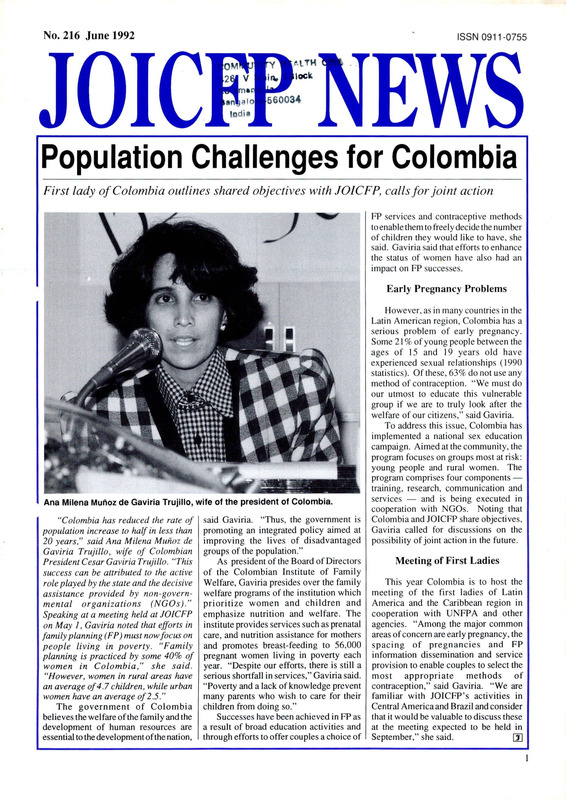
Ana Milena Munoz de Gaviria Trujillo, wife of the president of Colombia.
“Colombia has reduced the rate of
population increase to half in less than
20 years,” said Ana Milena Munoz de
Gaviria Trujillo, wife of Colombian
President Cesar Gaviria Trujillo. “This
success can be attributed to the active
role played by the state and the decisive
assistance provided by non-govern
mental organizations (NGOs).”
Speaking at a meeting held at JOICFP
on May 1, Gaviria noted that efforts in
family planning (FP) must nowfocus on
people living in poverty. “Family
planning is practiced by some 40% of
women in Colombia,” she said.
“However, women in rural areas have
an average of 4.7 children, while urban
women have an average of 2.5.”
The government of Colombia
believes the welfare of the family and the
development of human resources are
essential to the development of the nation.
said Gaviria. “Thus, the government is
promoting an integrated policy aimed at
improving the lives of disadvantaged
groups of the population.”
As president of the Board of Directors
of the Colombian Institute of Family
Welfare, Gaviria presides over the family
welfare programs of the institution which
prioritize women and children and
emphasize nutrition and welfare. The
institute provides services such as prenatal
care, and nutrition assistance for mothers
and promotes breast-feeding to 56,000
pregnant women living in poverty each
year. “Despite our efforts, there is still a
serious shortfall in services,” Gaviria said.
“Poverty and a lack of knowledge prevent
many parents who wish to care for their
children from doing so.”
Successes have been achieved in FP as
a result of broad education activities and
through efforts to offer couples a choice of
However, as in many countries in the
Latin American region, Colombia has a
serious problem of early pregnancy.
Some 21% of young people between the
ages of 15 and 19 years old have
experienced sexual relationships (1990
statistics). Of these, 63% do not use any
method of contraception. “We must do
our utmost to educate this vulnerable
group if we are to truly look after the
welfare of our citizens,” said Gaviria.
To address this issue, Colombia has
implemented a national sex education
campaign. Aimed at the community, the
program focuses on groups most at risk:
young people and rural women. The
program comprises four components —
training, research, communication and
services — and is being executed in
cooperation with NGOs. Noting that
Colombia and JOICFP share objectives,
Gaviria called for discussions on the
possibility of joint action in the future.
Meeting of First Ladies
This year Colombia is to host the
meeting of the first ladies of Latin
America and the Caribbean region in
cooperation with UNFPA and other
agencies. “Among the major common
areas of concern are early pregnancy, the
spacing of pregnancies and FP
information dissemination and service
provision to enable couples to select the
most appropriate methods of
contraception,” said Gaviria. “We are
familiar with JOICFP’s activities in
Central America and Brazil and consider
that it would be valuable to discuss these
at the meeting expected to be held in
September,” she said.
[T]
1
UNFPA
Sharing Global Objectives
the discussions,
Dr.
Nafis
the prime minister
Sadik, executive
emphasized the
director, UNFPA,
importance of
expressed
population issues
appreciation for
and said the gov
the contributions
ernment of Japan
made by the
would like to
Japanese gov
continue to work
ernment to the
in cooperation
Fund to Japanese
with UNFPA to
Prime Minister
address problems
Kiichi Miyazawa
concerning
during a meeting
population and
held at the Prime
development
Minister’s Office
around the world.
on April 22. Sadik
The UNFPA
said that the sum
head presented
provided by the
Sadik with Miyazawa
Miyazawa with a
Japanese gov
ernment amounted to a quarter of the “Population Clock 11”, a digital “clock”
total assistance received by UNFPA, but that displays up-to-date information on the
urged the prime minister to make further populations of world UN member states
and UN observer states. The UNFPA head
efforts to support UNFPA.
Sadik was joined at the Prime also provided the prime minister with an
Minister’s Office by Robert McNamara, outline of the world population situation
former president, World Bank, who is a and gave an overview of the UN population
strong supporter of the Fund’s population predictions for the coming years during
and development programs. During the talks.
[J]
Population on the Agenda
Dr. Nafis Sadik, executive director, former president, World Bank, and Dr.
UNFPA, presented some UN population Hirofumi Ando, director. Information and
estimates and explained the impact that External Relations Division, UNFPA,
the rapidly increasing world population Sadik joined leading members of the Japan
will have on development and the global Parliamentarians Federation for Population
environment during an address at a (JPFP), representatives of the Japanese
luncheon hosted by JOICFP President ministries of health and welfare, foreign
and former Japanese Prime Minister affairs and finance and JOICFP
Takeo Fukuda in Tokyo on April 21. representatives at the luncheon.
Voicing agreement with Sadik, Fukuda
Quotingfiguresfrom UNFPA's “State of
World Population Report 1992”, Sadik pointed out that it is impossible to find
stressed the interrelationship between solutions to environmental problems
without seriously tackling population
population and environment issues.
Accompanied by Robert McNamara, issues. He stressed: “Global issues
concerning population are the very source
of environmental problems.”
Population issues are among the most
pressing problems facing humankind at
present, said Taro Nakayama, chairman,
JPFP, and former foreign minister. He
said that much more effort is required of
Japan in terms of its official development
assistance (ODA). The level of Japan’s
ODA falls behind that of other members
of the Development Assistance Com
mittee (DAC) of the Organization for
(From left) Nafis Sadik, Takeo Fukuda Economic Cooperation and Development
and Robert McNamara.
(OECD), he said.
[J]
2
Larger Role
for Japan
“Japan is destined to play a larger
and larger role on the world scene,
exercising greater political power and,
hopefully, assuming greater political
and economic responsibility,” said
Robert McNamara, former president,
World Bank. The keynote speaker at
a special meeting of Population Forum
21, held in Tokyo on April 20,
McNamara said that Japan has yet to
fulfil the superpower responsibilities
that are expected of a country with
superpower status. “A large increase
in ODA (official development
assistance) is but one example of the
action required of Japan if it is to fulfil
its responsibilities in the post-Cold
War world,” he said.
Commenting on the emergence of
a “new order” in the post-Cold War
years, McNamara emphasized that
there is a need for developing new
relationships both among the powerful
nations and between the powerful
nations and Third World nations.
Another guest speaker, Dr. Nafis
Sadik, executive director, UNFPA,
took the opportunity provided by the
meeting to announce that the “UN
Conference on Population and
Development” (World Population
Conference) will be held in Egypt in
1994. Sadik said that the Egyptian
government had agreed to host the
meeting during discussions held in
Egypt prior to her visit to Japan.
Chaired by former Minister of
Foreign Affairs Saburo Okita,
Population Forum 21 comprises
opinion leaders from the private sector,
business leaders, representatives of the
mass media and prominent individuals
from the academic, arts and cultural
fields.
I
r
1
(From left) Takeo Fukuda, Robert
McNamara and Taro Nakayama.
JOICFP NEWS, June 1992
UNFPA
Population in All Its Dimensions
UNFPA emphasizes a multi-dimensional approach in population programs
Joseph Van Arendonk, deputy much closer to the individual than the Population is not a single issue, it is
executive director, UNFPA, spoke to government. Consequently, they are more related to everything. It is related to the
JOICFP NEWS on April 3 about the trusted. Also, because they are small they community, health, the enhancement of
focus of UNFPA programs. Below is an don’t have the bureaucratic and procedural the status of women and poverty
delay of governments, and there is less alleviation.
outline of his interview.
To bring up FP acceptance, the two
What UNFPA is trying to do now in vested interest. Therefore, the NGO is a
critical
points in any program are
must.
However,
I
don
’
t
believe
that
you
programs is to base them on past
communication, because by
performances. In other words,
educating people you make them
we do assessments of how things
understand why they should do
have gone over time. We then
certain things, and services. If
identify major gaps and focus
you educate people, you must be
our program on them. In
absolutely sure that the services
programming, we tend to take a
are available.
much more holistic approach
All our programs always have
towards strategic planning,
a
very
important component for
rather than supporting ad hoc
information, education and
projects. We look much more at
communication. Within that
the overall context rather than
component of 1EC we try to build
individual activities.
up a certain strategy of how to
We are also trying to make
best
communicate government
governments themselves more
policies to different groups in
responsible for population
the society. There are various
activities. In the past, most
ways and means by which you
activities were implemented by
can approach a certain group.
UNFPA and other UN agencies.
Therefore, it is so important that
But we are now trying to get
IEC activities are not conducted
governments to slowly accept
in an ad hoc manner. What you
more responsibility for projects
really must do is to develop a
so that over time they will
well-thought-out, consistent
become more self-reliant,
strategy and test that strategy
financially, technically and in
before
you embark on something.
terms of responsibility.
That is the way by which you can
If UNFPA is to be effective
really reach the people you want
Joseph Van Arendonk
in assisting governments to
to reach.
implement their population
policies, then its focus must be multi can leave this whole field to NGOs only. If
Stronger Commitment
you go into a developing country, you
dimensional.
cannot forget the role that the government
At the moment UNFPA is heavily
will have to play for a long time in the
Political Leaders
development of that country. You cannot overcommitted and very much in need of
On one hand, we must focus on the walk away from the ministry of health. money. The fraction that is now being
political leaders; it is practically You must put enormous stress on trying to contributed worldwide to population
impossible to get the local level really improve the quality of services provided programs is so marginal that the issue is
inspired without doing so. At the same by that ministry of health. Therefore, it is not really being addressed. If people
truly believe that population is important
time, however, people are influenced by not an either-or situation.
In terms of FP services, we don’t believe for development, especially sustainable
religious leaders, teachers and the mass
media. In other words, attention must that they should be provided outside an development, then the governments of
also be paid to specific groups, so that integrated context. All our FP activities the world have to make a much stronger
the society as a whole begins to see the are part of maternal and child health commitment.
The first thing that we at UNFPA
importance of issues concerning (MCH) because FP is a health measure
and health is a package. If you provide expect of Japan, as one of the strongest
population.
As for NGOs, we consider them FP, but the people are undernourished, economies of the world, is a substantial
extremely important, especially local then you are still not providing for their increase in contribution, both through
NGOs. Why? Because when we talk health. You have to present FP to that multilateral channels and bilaterally. If
about NGOs we talk about the private person as part of an integrated package, economically strong countries such as
Japan do not substantially increase their
sector. Local NGOs are much more part of a whole health program.
directed toward the needs of the
Therefore, JOICFP’s approach, which inputs then, of course, nobody will. But,
individual in the part of the country in links FP to other aspects of health and on the other hand, if Japan sets an example
[J]
which they are operational. They are community living, is very important. other countries might follow.
JOICFP NEWS, June 1992
3
China
Communal
Efforts
Bear Fruit
’S
R ???
Experiences gained in implementing
the Integrated Project (IP) in China in
the first and second phase areas have
been utilized in third phase areas to help
overcome problems and speed the
progress of project activities. This was
one of the observations made by a
monitoring mission which visited third
phase IP areas in April to observe project
activities and provide technical
assistance. The mission, which commentedfavorably on the solid efforts that
have been made to promote the IP, also
provided practical advice on ways to
improve project implementation.
The team, which included two
Japanese experts, visited Jiangchuan
County, Yuxi Prefecture, Yunnan
Province, from April 22 - 24 and
Hengshan County, Henyang City, Hunan
Province, from April 28 - 30. The mis
sion comprised Dr. Hiroshi Ogino, board
member, Japan Family Planning
Federation, and Dr. Noriji Suzuki,
professor, Department of Parasitology,
Kochi Medical School, members of the
National Steering Committee (NSC) of
the IP, representatives of first and second
phase areas and JOICFP officers. After
making observations in the communities,
the monitoring mission held seminars
with experts and local staff.
Monitoring & Data Collection
The mission was positive in its overall
assessment of the activities of the IP
which was launched in third phase areas
in 1990. However, some problems were
noted in the monitoring and recording of
statistics. In particular, the mission
pointed out that efforts should be made to
consider the actual number of cases and
details including the cause of death in
rates such as the infant mortality rate
(IMR) when assessing the project’s
impact. Relying on rates alone, the
experts said, could be misleading,
especially for small subject groups. To
achieve long-term objectives, statistics
should be utilized by IP staff to
4
■ \
g,
New projec t areas in China
build on past performances
to speed progress
5 -
........
(From top, left) Conducting child health checkups in Hengshan County; testing
a new water system in Hengshan County; washing clothes at a middle school in
Jiangchuan County; and providing FP guidance in Jiangchuan County.
determine project strengths and weaknesses
to ultimately improve the quality of
services, the mission said.
In Hengshan County, the monitoring
mission found that the project had brought
considerable improvements to the lives of
the people. Some 6,000 toilets had been
constructed and 4,500 wells had been dug
over the two years. Under the IP, money
had been collected from the community to
construct new school buildings with toilets
and manage homes for the aged and
kindergartens. The Maternal and Child
Health Handbook was adopted in the IP
area in 1991 and has been distributed to
1,200 mothers and pregnant women.
One of the most successful aspects of
the project noted by the experts was the
participation of the community in activities.
A farmer who spoke to the team said the
community people were willing to pay to
improve his village. It was his belief, he
said, that efforts made to improve the
health of other community members
would ultimately have a positive effect on
his own health.
Meanwhile, in Jiangchuan County the
mission noted that more couples were
voluntarily practicing FP and attached
importance to healthy births and childrearing. Since a baseline survey taken at
the end of 1989, the contraceptive
prevalence rate had increased from 61 % to
84% as of year-end 1991; the hospital
delivery rate had increased from 45% to
70%; and the I MR had fallen from 60.5%o
to 44.5%o.
Prior to the IP, there had been no
family planning association in the coun
ty, but the team found that there were
now 36 with 1,565 members. The mission
also noted that the IP had contributed to
the establishment of such non
governmental organizations and
institutions in the community as
associations and homes for the aged and
kindergartens.
Methane-generating Toilets
In the area of environmental
sanitation, the mission found that
methane-generating toilets had been
constructed in 95 out of the 103
households in Zhangwuying village. A
labor-saving innovation, the toilets help
cut down on cooking and lighting costs
of families and contribute to improving
environmental sanitation and the health
of the people. In 1992, the IP in the
Jiangchuan was expanded from five
townships in the county with apopulation
of 100,800 to cover eight townships with
a total population of 140,300.
Overall in both counties, the mission
was impressed with the speed with which
progress has been made in the
community-based project and the
commitment and participation of the
people involved in the project.
[T]
JOICFP NEWS, June 1992
Asia and the Pacific
An Active Role for Mothers
VDlAfunds utilized in Nepal IP area to strengthen MCH care
Funds allocated by the Japanese
Ministry of Posts and Telecom
munications are being used to set up a
practical system for providing and
monitoring maternal and child health
(MCH) care services in the Integrated
Project (IP) area of Panchkhal in Nepal.
Collected from the Japanese public
through the Voluntary Deposit for
International Aid (VDIA) scheme, the
funds are being used to set up a personal
health record system)or pregnant women
and children in the IP area. The concept
ofthe proposed health record is based on
the MCH Handbook of Japan. Its func
tion will be to encourage women to take
a more active role in maintaining their
health and that of their children, while
also providing an entry point for family
planning (FP) promotion.
The VDIA funds allocated last year
have also been used to equip community
health agents with healthcare bags and to
purchase health monitoring equipment
and such educational materials as the
Magnel Kit to promote FP/MCH. During
a JOICFP mission to Nepal, conducted
from March 23- April 1, it was agreed
that training will be provided to ensure
that the donations are fully utilized to
promote FP/MCH activities. Three new
community-based primary health care
units (CBPHCUs) under construction in
t
N'-lW
i'<- A
' W/l
fck -'
11
w"
Health agents with healthcare bags
supplied with VDIA funds.
three new IP sites are also being funded
under the VD1A scheme.
Ideas for the MCH card or booklet to
function as the MCH record were discussed
at a meeting held at the IP field office in
Panchkhal on March 27. Attended by
community health workers, members of
the health committees and women
volunteers of the 12 IP villages in the area,
the meeting provided a forum for
discussions on ways to provide MCH care
services and implement the MCH
recording system.
The new MCH record, now under
production, is expected to engage mothers
more actively in the health process and
create awareness of FP/MCH issues in
pilot communities in the IP area.
(J)
Nepal Wins
Support
International donors will provide Nepal
with US$85 million of the US$ 138 million
in assistance required to support its eighth
five-year plan for population and health
(1992- 1997). At the Donors Meeting on
Population & Health, held in Kathmandu
from March 24 - 25, participants agreed
that the government of Nepal would would
provide the rest of the funds.
Sponsored by the Nepalese government,
the meeting was attended by government
officials from countries including
Canada, Finland, Germany, Japan, the
Netherlands, Switzerland, the U.K and the
U.S. Officials of international agencies
such as the World Bank, UNDP, UNFPA,
UNICEF, WHO, ADB and IMF and non
governmental organizations brought total
attendance to around 60.
During the meeting, the government
explained its population and health policy
and outlined the objectives of its five-year
plan. One of the goals is to improve the
country’s health infrastructure to ensure
that services reach the grassroots. Within
five years, the government aims to have
established sub-health posts with a team
of trained health workers in every village.
The plan calls for a total of 3,199 such
health posts to be built through joint
community-government efforts.
Community-based primary health care
units (CBPHCUs) have already been set
up under the Integrated Project (IP) in 12
villages of Panchkhal.
New IEC Framework for the ’90s
A meeting of experts in Chiang Mai,
Thailand, came up with a three-stage
framework to guide population
communication strategies for Asia and
the Pacific during the 1990s. The
Regional IEC Experts Group Meeting on
Population Communication Strategies
for the 1990s succeeded in producing a
reference from which to determine the
maturity ofpopulation programs ofeach
country and develop IEC strategies.
The meeting was held from April 13
- 19 and was attended by population
communication experts from 14
countries, five resource persons and
three representatives of UNFPA, as well
as observers from ESCAP and ILO.
JOICFP was invited to provide input on
regional IEC strategies for community
based population programs. The meeting
was organized by the UNESCO Princi
pal Office for Asia and the Pacific with
JO1CFP NEWS, June 1992
the support of UNFPA.
Participants were made aware of the
importance that UNFPA places on IEC by
a representative of the Fund who said that
IEC activities represent the second-largest
area of activity for UNFPA in terms of
budget. The official noted the sophistication
of IEC programs in Asia and the Pacific,
but stressed that in some countries in the
region family planning acceptance had
reached a plateau. She said a revitalized
IEC strategy was needed to remedy this
situation, but that such a strategy would
also be of use to other regions.
Discussions at the meeting focused on
a background paper compiled by six
resource persons from papers submitted
by participants and on the creation of a
framework to determine appropriate IEC
strategies. Participants decided on a
framework of three levels: level 1
(launching stage); level 2 (developing
JHAIlANp
i ii
IEC experts in Chiang Mai.
stage); and level 3 (advanced stage).
In making recommendations,
participants agreed that emphasis in
population communication strategies be
placed on the impact of the mass media;
the involvement of NGOs; research and
program monitoring; further regional
cooperation among countries; and the
maintenance of a human resource
network.
The last two days of the meeting
were spent in discussions with four
administrators from Asia whose
comments were reflected in the final
recommendations.
[J
5
Ghana/the Gambia
Moving
in the Right
Direction
IP PF finds progress in IP
areas in Ghana and the
Gambia
■ I/1
reinforce FP services. To further improve
services, Barry urged that emphasis be
placed on the acquisition of medical
equipment, more IEC activities, and a
better healthcare information system.
The IP in the Gambia, meanwhile,
was launched in two villages in mid1988. The project is executed by the
Gambia Family Planning Association
(GFPA) in collaboration with the
Department of Health Services and
Medical Research Council of the Gambia.
FP Acceptance
Thefirst IPPF monitoring mission of
the activities being carried out in Ghana
In her analysis of the project’s
and the Gambia under the Integrated
performance, Barry said that results for
Project (IP)notedpositive improvements
A soap-making project of the women's
in such areas as family planning (FP) club of Munyagen, the Gambia.
the 1991 targets had been satisfactory
with the number of FP acceptors at 903
acceptance and made recommendations
to further improve the effectiveness of at a steady pace and resources are properly instead of the expected 192. She said the
activities. The mission was conducted by managed. Barry attributed the good project single most important factor that has
Dr. T. Mariama Barry, program officer, performance to the joint efforts of IPPF made the project a success is the existing
Service Delivery, IPPF, who was in and JOICFP to fund the project, sustained cooperation among the different
Ghana from February 15 - 22, and in community participation, truly motivated collaborators involved in FP services.
Noting that the successful imple
the Gambia from February 23 - 29, to personnel and good cooperation between
provide technical assistance, monitor the government and PPAG at national and mentation of the 1991 Action Plan was
project achievements for 1991 and help intermediate levels. “In view of the hampered by the lack of financial
plan 1992 activities.
encouraging results obtained in Ghana, the resources and by the change and late
project may be considered for extension,” recruitment of new personnel, Barry
said, “The IP has had significant impact
Income-generating Projects
she said.
In assessing the significant increase in on the health of, and the contraceptive
To assess the impact of the project, contraceptive use from 17.4% in 1989 to use by the inhabitants of Munyagen and
the IPPF officer met and talked with 62.8 % at the end of 1991, Barry commented Mandinari.” Further increases in use of
executing personnel and collaborators that community participation in the IP has FP services will depend on “efforts made
including representatives from UNFPA, rendered FP more comprehensible and in IEC, not just at the clinics, but also
organizing committees and community acceptable. The success of FP activities is throughout the project zones,” she said.
based delivery agents, and visited Awutu, also the result of highly motivated Additional funds should be allocated to
Bontrase, Tsotsoo and Ojobi in Ghana operations personnel and continuous GFPA to ensure the success of the
C
2
and Mandinari and Munyagen in the information and education campaigns to program in the future, she said.
E
Gambia. At IP sites, she viewed income
generating projects and referral clinics.
Initiated in 1987, the IP in Ghana
covers nine villages with a total
The report of an evaluation of the UNFPA-supported Project “Creation of Awareness on
population of 17,000. Executed by the
Aging for Policy Making Purposes in the Asian Region” was published by JOICFP in March.
Planned Parenthood Association of
The evaluation was carried out from November 5 - 20,1991, by Dr.
Ghana (PPAG), the project marks the
John McCallum, senior research fellow, National Center for
Epidemiology and Population Health, The Australian National
end of its pilot phase in 1992.
University, and Dr. Trinidad Osteria, fellow, Institute of Southeast
In her monitoring report, Barry said
Asian Studies, Singapore. The four-year project was funded by
that project activities are being executed
UNFPA and was conducted in response to the emerging issue of
population aging in the region. The report has been prepared by the
consultants to serve as a guideline for future planning and
implementation of programs on aging.
New Publications
A bakery project of the women’s club
in Tsotsoo, Ghana.
6
A report titled “Analysis of the Integrated Project and IEC Materials
in Guatemala & Mexico and their Dissemination throughout the
Region” was published by JOICFP in March in cooperation with
UNFPA and the Japanese Ministry of Foreign Affairs. Theevaluation
of the IP was carried out from November 17 - December 14,1991,
by Patricia Poppe, program officer II, Center for Communication
Programs, The Johns Hopkins University, and Luis Maria Aller
Atucha, member, IEC Panel of Experts, WHO. The report of the
evaluation of the four-year project has been prepared by the
consultants to serve as a guideline for future planning and
implementation of the regional Integrated Project.
JOICFP NEWS, June 1992
In the News
Kunii’s Message on Air
A presentation on “Population
problems in developing countries” by
JO1CFP Chairman Chojiro Kunii was
broadcast around the world by the Japan
Broadcasting Corporation (NHK) on
March 31. The chairman s eight-minute
message was translated into the main
languages of the countries in which it
was broadcast through Radio Japan and
was replayed several times over a period
of 24 hours.
In his message, Kunii spoke on four
main points: cunent population issues in
developing countries; the Integrated
Project (IP) being implemented in
developing countries by JOICFP;
effective approaches to population is
sues; and the significance of population
in the “Agenda 21”package of programs
for the global environment to be discus
sed at the UN Conference on Environment
and Development.
Kunii commented favorably on the
decision to include countermeasures to
slow the rapidly increasing world
population as an integral part of the
environment policy to be discussed at the
summit. “Population issues must take
priority in discussions on sustainable
i AA, <<' i"' ’»
JO1CFP NEWS, June 1992
. •• ■" f
"...
Japanese non-governmental organi
zations (NGOs) observed “Earth Day”
on April 22 with a week of events to
create awareness of environmental issues
among the public. Organized by JANIC
(Japanese NGO Center for International
Cooperation), of which JOICFP is a
member, the events included an “Earth
Day Asia Festival”, held in Yoyogi Park
in central Tokyo on April 25 and 26. The
Chojiro Kunii
event, which was open to the public,
development,” he said. “Any discussion included presentations on the
on development must also consider the environment and sustainable deve
human element, the actual needs of the lopment and teaching forums.
The festival attracted large crowds
people.” He said it is his hope that the
summit discussions concern practical from the public which is showing a great
deal of interest in issues concerning the
strategies and not abstract theory.
“Japan has rich experiences in environment and development ahead of
community development and health the UN Conference on Environment and
promotion,” said Kunii. “After World Development.Covered by the mass
War II, Japan also had to come to terms media, the event featured guest speakers
with environmental problems brought on including opinion leaders and officials
by rapid development and accumulated of Japanese and foreign NGOs. In
vast experiences and technical know-how particular, the public welcomed
that it can now contribute to other parts of presentations by representatives of
the world.”
[J] Asian NGOs who provided insights into
environmental problems such as
deforestation in their countries.
Efforts for the Environment
“Demonstrating leadership to solve
the global environment problem must be
the pillar of Japan s role in the inter
national community,” said Noboru
Takeshita, former prime minister of
Japan. Takeshita made his statement at
the conclusion of the Eminent Persons
Meeting on Financing Global Envi
ronment and Development, held in
Tokyo April 15-17.
An international conference of
prominent world leaders, the meeting
ended with the adoption of the Tokyo
Declaration that called on Japan to lead
the world in financing programs to protect
the global environment. Attended by 29
participants, mostly politicians from 19
developing and developed countries, the
forum was called by Takeshita who also
served as honorary chairman of the
conference.
According to the declaration,
developing nations should provide the
majority of funds for the protection of
their environments and the development
of their countries. Of the estimated
US$600 billion required to implement
Eyes to
the Earth
the “Agenda 21” package of environmental
programs, the declaration suggests that
US$125 billion should be supplied to
developing nations by the industrial
nations. Agenda 21 is scheduled to be
adopted at the UN Conference on
Environment and Development.
To supply the additional funds needed
to protect the environment, the declaration
suggests that all nations review fiscal and
taxation policies and consider special taxes
and charges while pursuing a course of
sustainable development. The declaration
also suggests that developing countries
have better access to markets in
industrialized countries to help them
mobilize funds. A durable solution to the
debts of developing countries was also
noted as a prerequisite to any transition
to sustainable development.
Among those taking part in the event
were Kiichi Miyazawa, prime minister,
Japan; Saburo Okita, former foreign
minister, Japan; Robert McNamara, former
president, World Bank; Jimmy Carter,
former president, U.S.A.; and Maurice
Strong, secretary-general, UNCED. g]
Future land expansion 1988-2050
For farm and non-farm needs
Area expansion (million km2)
1988-2050
61
The cubes show the area of wildlife habitat that will be
cleared for farming, roads and settlements by 2050, by the
three United Nations population projections. The area
cleared under the high projection would nearly equal all the
world's protected areas in 1989.
Source: Paul Harrison, The Third Revolution, I.B. Tauris, 1992.
Chart courtesy of UNFP/\
7
Voice of Voices
By Chojiro Kunii
DIARY
JOICFP ADOLESCENT
HEALTH SERIES
________ NEW ANIMATED FILM__________
Progress in Guatemala
The Integrated Project (IP) of JOICFP
is being implemented in Guatemala in
San Lucas Toliman, an area with a
population of 35,000. The project has
been executed for the last three years by
a local non-governmental organization,
APROFAM (Family Planning Associ
ation of Guatemala), supported by
UNFPA, MEXFAM (Mexican Family
Planning Foundation) and JOICFP.
The report of an evaluation of this
project carried out in cooperation with
the Johns Hopkins University was
recently published. Written in both
Spanish and English, the report is the
result of the joint efforts of Patricia
Poppe and Luis Maria Atucha and
includes a detailed description of how
the IP is being promoted in Guatemala
and Mexico. An excellent account of
current project activities, this report is
both interesting and praiseworthy.
The Japanese Ambassador to
Guatemala recently attended a donation
ceremony of 150 reconditioned bicycles
sent from Japan to Guatemala (see below).
While in the IP area, he also met with
local government leaders and IP staff.
Meanwhile, the Johns Hopkins
University is planning an IEC seminar
this summer in Baltimore. Among the
topics to be discussed at this meeting is
the IP and adolescent health.
[J|
Bikes for Health
The hand-over ceremony for 150
reconditioned bicycles sent from Japan
to assist family planning and health
promotion under
the Integrated
Project (IP) made
Isted
news when it was
EmjiMR ot
a Sm Luck ToMh
featured on the
front and second
pages ofthe March
11
issue
of
“Elgrafico", the
newspaper with
the second-biggest
circulation in
Guatemala. The article focused on
Japanese Ambassador to Guatemala
Hirosuke Oshima who attended the
ceremony, held in San Lucas Toliman on
March 6. The ambassador, who is wellacquainted with the activities of the IP,
served as consignee of the shipmentfrom
Japan. Also attending the ceremony were
local government authorities, IP staff
members and volunteers.
8
JOICFP Program Officer Aiko lijima was in
Nepal from Mar. 23 - Apr. 1 to attend the
Donors Meeting on Population (Mar. 23 - 25)
and to monitor activities of the IP. An MCH
expert from Japan, Kumiko Mukaihara,
accompanied lijima to provide technical
assistance.
* * *
Joseph Van Arendonk, deputy executive
director, UNFPA, visited JOICFP on Apr. 3 to
discuss the four-year plan for 1992 - 1995.
* * *
Raheem Sheikh, director, Asia & the Pacific
Division, UNFPA, was in Japan from Apr. 14
- 15 to exchange information with JOICFP
officers.
* * *
Robert McNamara, former president, World
Bank; Dr. Nafis Sadik, executive director, and
Dr. Hirofumi Ando, director, Information and
External Relations Division, UNFPA, were in
Japan to attend a special meeting of the
Population Forum 21 on Apr. 20 and the
GISPRI Symposium ’92 on Apr. 21. They also
met with Prime Minister Kiichi Miyazawa,
Foreign Minister Michio Watanabe and
leading parliamentarians concerned with
population issues, and held discussions with
Takeo Fukuda, JOICFP president and former
prime minister, high-ranking government
officials and JOICFP officers.
* * *
Dr. Daniela Colombo, president, Italian
Association for Women in Development
(AIDoS), visited JOICFP on Apr. 21 to
exchange information.
* * *
JOICFP Program Officer Sumie Ishii was in
Thailand to attend the Regional IEC Experts
Group Meeting on Population Communication
Strategies, held Apr. 13-19, and in China from
Apr. 23 - 26 to exchange information on the
production of IEC materials.
* * *
KatsuhideKitatani, deputy executive director,
UNFPA, accompanied by Kyoichi Nakamura,
special assistant to the deputy executive director,
UNFPA, were in Japan to attend the State of
World Population Press Conference on Apr.
27. Kitatani also attended the MCCOBA
meeting as a keynote speaker on Apr. 30.
* * *
Ana Milena Munoz de Gaviria Trujillo, first
lady of Colombia, visited JOICFP on May 1 to
exchange information. She was accompanied
by six people including three representatives of
the Embassy of Colombia led by Ambassador
Rodrigo Villamizar.
* * *
Dr. Hiroshi Ogino, board member, Family
Planning Federation of Japan and Dr. Noriji
Suzuki, professor, Department of Parasitology,
Kochi Medical School, accompanied by Shinichi Yagi, deputy executive director; Yukio
Honma, program officer; and Yoshitatsu Kanno,
staff member, JOICFP, were in China from
Apr. 14 - May 6 to attend the IP Workshop/
Seminar, to carry out IP monitoring and provide
technical assistance.
BEST WISHES
14min, color/English, Spanish
BaMPiiiim—
A young couple's struggle to build an equal
relationship is the theme of BEST WISHES, the
third animated film in a series produced by a joint
Mexican and Japanese team.
The film concerns Gaspar and Sara who live in
an inner-city slum. The couple faces a crisis when
Sara decides she wants to be more independent
and work outside the home. As they try to come to
terms with this new element in their relationship,
they learn the importance of communication and
realize that they must reassess male-female roles
and respect each other as individuals.
Directed and distributed by
Sakura Motion Picture Co., Ltd.
STANDARD BLDG., 22-1. NISHI-SHINJUKU 1-CHOME
SHINJUKU-KU, TOKYO 160, JAPAN TEL.03-3342-5768
CABLE "SAKURA MOVIES TOKYO"/Telex:J34799JTCINBTH
16mm-VTR(/?eta, VHS NTSC, PAL, SECAM) |
FP/MCH Insights
Six nurses taking part in the
“Specialized Nursing Course”
organized by the International
Nursing Foundation of Japan gained
insights into Japan’s post-war
community-based family planning
(FP) and maternal and child health
programs during a seminar at
JOICFP on April 27. Through
presentations, film shows and
discussions, the participants were
also given an overview of IEC
materials produced by JOICFP and
the community-based FP/MCH
activities promoted in developing
countries through JOICFP’s Inte
grated Project. Attending the seminar
were nursesfrom Bangladesh, Kenya,
Nigeria, Pakistan, the Seychelles and
Sri Lanka.
JOICFP NEWS is a monthly newsletter
published by the Japanese Organization for
International Cooperation in Family Planning,
Inc. (JOICFP).
JOICFP NEWS welcomes your comments,
suggestions and contributions. Please mail to:
JOICFP NEWS
Hoken Kaikan Bekkan
1-1, Sadohara-cho, Ichigaya
Shinjuku-ku, Tokyo 162 Japan
Phone: Tokyo 3268-5875
Telex: 2324584 JOICFP J
Cable Address: JOICFP Tokyo
Facsimile: Tokyo 3235-7090
JOICFP NEWS, June 1992
Position: 1916 (9 views)