NO. 214 APRIL 1992.pdf
Media
- extracted text
-
No. 214 April 1992
ISSN 0911-0755
JOICFPXEWS
Women Take Initiative in Vietnam
Parliamentarians welcome grassroots support from women in Japan
Despite strong government com
mitment and a vast national healthcare
system that serves the grassroots through
a network of village health stations,
improvement in the level of health in
Vietnam is seriously hampered by a lack
ofmedical equipment and medicine, said
Dr. Nguyen Thi Ngoc Phuong, vice
chairwoman, National Assembly of
Vietnam. In Tokyo to attend the Asian
Forum of Parliamentarians on Popu
lation and Development (AFPPD)
meeting on February 25 and the Eighth
Asian Parliamentarians’ Meeting on
Population and Development on
February 26, the parliamentarian said
that Vietnam needs strong support to
overcome these serious shortages and
praised the efforts made by Japanese
individuals and women’s groups to
answer some of these needs.
Reproductive Health
Phuong also commented favorably
on a new JOICFP initiative to tackle
women’s reproductive health issues
through the Integrated Project (IP). Under
the plan, JOICFP would send medical
supplies and equipment to pilot
communes of the IP to support activities
to improve women’s health at the
grassroots. The plan was made in
response to a recent evaluation which
highlighted women’s reproductive health
as a serious problem in Vietnam.
Through the IP, women in Japan and
Vietnam have joined hands to support
the promotion family planning (FP),
maternal and child health (MCH),
primary health care and community
development in Vietnam. The Nagano
Chapter of the Women’s League has
been supporting grassroots projects in
Vietnam with donations of equipment
and funds to support activities. Twenty
reconditioned treadle sewing machines
have also been donated by schools and
individuals in Japan to support women’s
income-generating activities.
“I would like to see more such
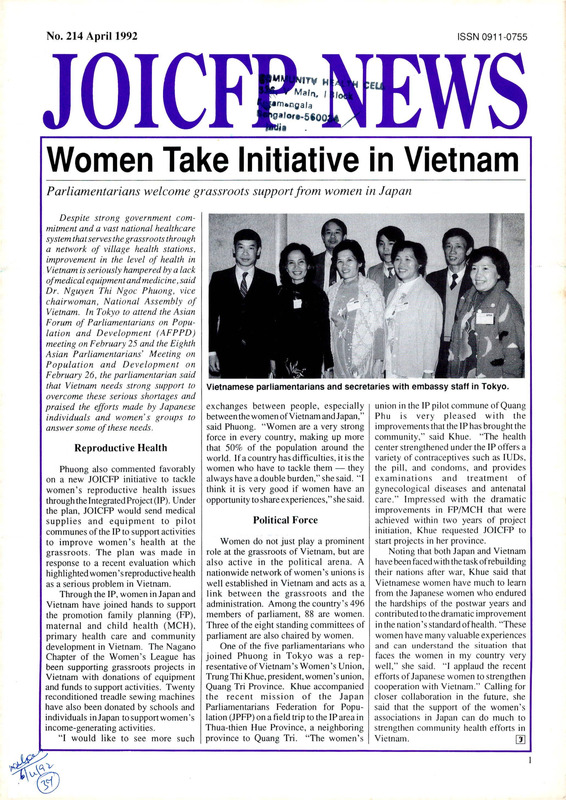
Vietnamese parliamentarians and secretaries with embassy staff in Tokyo.
exchanges between people, especially
between the women of Vietnam and Japan,”
said Phuong. “Women are a very strong
force in every country, making up more
that 50% of the population around the
world. If a country has difficulties, it is the
women who have to tackle them — they
always have a double burden,” she said. “I
think it is very good if women have an
opportunity to share experiences,” she said.
Political Force
Women do not just play a prominent
role at the grassroots of Vietnam, but are
also active in the political arena. A
nationwide network of women’s unions is
well established in Vietnam and acts as a.
link between the grassroots and the
administration. Among the country’s 496
members of parliament, 88 are women.
Three of the eight standing committees of
parliament are also chaired by women.
One of the five parliamentarians who
joined Phuong in Tokyo was a rep
resentative of Vietnam’s Women’s Union,
Trung Thi Khue, president, women’s union,
Quang Tri Province. Khue accompanied
the recent mission of the Japan
Parliamentarians Federation for Popu
lation (JPFP) on a field trip to the IP area in
Thua-thien Hue Province, a neighboring
province to Quang Tri. “The women’s
union in the IP pilot commune of Quang
Phu is very pleased with the
improvements that the IP has brought the
community,” said Khue. “The health
center strengthened under the IP offers a
variety of contraceptives such as IUDs,
the pill, and condoms, and provides
examinations and treatment of
gynecological diseases and antenatal
care.” Impressed with the dramatic
improvements in FP/MCH that were
achieved within two years of project
initiation, Khue requested JOICFP to
start projects in her province.
Noting that both Japan and Vietnam
have been faced with the task ofrebuilding
their nations after war, Khue said that
Vietnamese women have much to learn
from the Japanese women who endured
the hardships of the postwar years and
contributed to the dramatic improvement
in the nation’s standard of health. “These
women have many valuable experiences
and can understand the situation that
faces the women in my country very
well,” she said. “I applaud the recent
efforts of Japanese women to strengthen
cooperation with Vietnam.” Calling for
closer collaboration in the future, she
said that the support of the women’s
associations in Japan can do much to
strengthen community health efforts in
Vietnam.
[J]
1
Asian Forum
Challenges
for Vietnam
Below is an outline of a presentation
made by Dr. Nguyen Thi Ngoc Phuong
at the Eighth Asian Parliamentarians'
Meeting on Population and Deve
lopment on February 26.
The laws and policies of Vietnam
concerning population and deve
lopment are aimed at reducing the
population growth rate, while still
respecting the rights of individuals to
choose freely the number and spacing
of births, and contraceptive methods.
Although Vietnam has a low gross
income per capita, the infant mortality
rate is 45%o and literacy rate is 88%,
while there is one medical doctor for
3,300 persons — better than average
for a developing country. Still, FP
programs have been implemented for
many years and have not achieved
expected results. We think the main
reason for this is that FP programs in
rural areas, where over 80% of the
population lives, have not been
intensively implemented. Another
importantfactoraffecting the programs
is Vietnam’s economic difficulties.
There are two areas in which
Vietnam will be concentrating efforts
for population and FP programs: first,
intensifying IEC programs so that every
person can voluntarily accept FP and
consider it to be of benefit; and second,
making budget and staff investments
in FP implementation in rural areas.
Prime Minister’s Message
Below are excerpts ofa message sent by
Japanese Prime MinisterKiichi Miyazawa
to the Asian Forum.
One of the most urgent global issues
facing us today concerns how human beings
and the earth can co-exist. Whether or not
we can solve population problems is
believed to be the key to realizing a bright
future. World population now stands at
5.4 billion, 3.2 billion (approximately 60%)
of which live in Asia. It is, thus, no
exaggeration to say that the population
situation in Asia will determine the fate of
all human beings. Population problems
are not any single country’s problems.
Rather they are something that must be
dealt with on a global scale while examining
the relationship between population trends
and the earth's ability to sustain human
existence. Ecological issues, which are
closely linked with population problems,
are recently receiving a great deal of
attention. We need to think about what
roles Japan can play in Asia to deal with
population problems.
2
New Initiatives for Asia
Policymakers urge action on population and development
The Asian Forum ofParliamentarians
on Population and Development (AFPPD)
and the Asian Population and Development
Association (APDA) marked their 10th
anniversaries in Tokyo on February 25
with calls for renewed efforts in the
population and development field. The
Eighth Asian
Parliamenta
rians’ Meeting
on Population
and Deve
lopment was
also heId at the
same venue on
February 26.
In an ad
dress to the
forum, Takeo
Fukuda,
president of
Takeo Fukuda
J O I CFP ,
honorary chairman of the Japan
Parliamentarians Federation for Population
(JPFP) and former prime minister of Japan,
emphasized that serious effort is required
of parliamentarians involved in the
population and development and
environmental fields. The significant
impact that population has on the global
environment must be recognized, he said.
A pioneering organization, the Asian
Forum was set up in 1982 and links
parliamentarian federations of countries
in the Asian
region con
cerned with
population and
development.
The forum has
continued to
be an effective
organization
for generating
interest, while
sustaining
involvement
and cooper
Prasop Ratanakorn
ation among
Asian parliamentarians. Policymakers
from 16 countries were welcomed to the
forum with an address by Prasop
Ratanakorn, secretary general, AFPPD.
In a message to the forum, Dr. Halfdan
Mahler, secretary general, IPPF, said, “The
parliamentary movement on population
and development began in Asia. Within a
decade the parliamentary movement has
spread all over the world.” Mahler said
that parliamentarians are uniquely
placed to play an increasingly important
role in bringing about changes in all
countries, especially in Asia where 5560% of the world’s population lives.
Encouraging closer cooperation among
parliamentarian federations and family
planning associations, he said IPPF is
strongly committed to continued support
of the Asian parliamentary movement.
“All of us must renew our de
termination to assist the region in
reaching the population and develop
ment objectives including selfsufficiency in food and provision of
education for all,” said Katsuhide
Kitatani, deputy executive director,
UNFPA. “In the endeavor to attain the
objectives, the most critical factor is to
secure the resources needed to design
and to imp1ement
effecti ve
programs.”
Noting the
efforts of
parliamen
tarians over
the last 10
years,
Kitatani
promised
that UNFPA
would make
Taro Nakayama
efforts to
work in closer collaboration with
parliamentarians in the future.
The meeting featured several
addresses and presentations including an
address by Taro Nakayama, chairman,
JPFP, and former foreign minister of
Japan. During proceedings, a special
tribute was paid to the late Takashi Sato,
former chairman, AFPPD, who died on
April 17, 1991, and Sat Paul Mittal,
former acting chairman, who died on
January 12, 1992. Prominent members
of the AFPPD, both parliamentarians
made considerable contributions to
promoting population and development
issues in the Asian region.
Sato and Mittal were also
memorialized in a book published to
mark the forum’s 10th anniversary. A
compact volume on the history of the
forum, the book includes messages
from several prominent individuals
including Dr. Nafis Sadik, executive
director, UNFPA.
|j]
IPPF
IPPF Looks
to the Next
40 Years
Federation renews
determination to improve the
health and well-being of
women, children and families
‘‘IPPF had a glorious period with
volunteer pioneers when virtually no
funds were available,” says Dr. Halfdan
Mahler, secretary general, IPPF, in the
40th anniversary issue of IPPF’s
“People” magazine. “What in my
opinion is now required is a federation
of ‘FPA Pioneers Model 2000’ that
togetherprogressively will lead to IPPF's
moral re-awakening and make the
federation the pioneering NGO (non
governmental organization) leader in
the 1990s at the national and
international levels.”
The world’s largest voluntary family
One of the Brave
Among the “brave and angry women”
noted by IPPF in its anniversary
issue of “People” magazine as
dominating the early history of the
organization is Shidzue Kato,
president, Family Planning Federation
of Japan, and vice president, JOICFP.
Kato was involved in IPPF from its
birth in 1952
in Bombay,
India, and
worked with
prominent
women
active with
in the FP
movement
including
Margaret
Shldzue Kato
Sanger of
the U.S., Elise Ottesen-Jensen of
Sweden and Dhanvanthi Rama Rau
of India to put the young organization
on its feet. Within Japan, Kato has
been a driving force in the FP
movement which sought to give
women control over their fertility and
power to determine their health and
that of their children. Despite her 95
years of age, she remains committed
to improving the status and health of
women and promoting FP both in
Japan and internationally.
JOICFP NEWS, April 1992
i ■ 4
7
A network of FPAs provides FP support to women in 132 countries.
planning (FP) organization, IPPF marks its
40th anniversary this year with renewed
determination to improve the health and
well-being of women, children and families.
Working on a global scale to promote and
provide FP services and to develop public
support for sustainable population,
environment and development policies,
IPPF embraces a network of autonomous,
indigenous national family planning
associations (FPAs) in 132 developing and
developed countries.
The federation was launched in 1952 in
Bombay, India, and was an outgrowth of
the International Committee on Planned
Parenthood, established in 1948. Two FP
pioneers were appointed as joint first
presidents of the federation, Lady Rama
Rau of India and Margaret Sanger of the
U.S. Shidzue Kato, president, Family
Planning Federation of Japan (FPFJ), and
vice president, JOICFP, was also among
the prominent individuals associated with
its establishment, while Japan was among
the early members of the federation, joining
in 1954.
In 1955, the Fifth International
Conference on Planned Parenthood was
held in Tokyo, an event that gave significant
encouragement to the FP movement in
Japan. Through the efforts of the people
involved in the FPAs and IPPF, population
issues continued to attract attention around
the world culminating in the establishment
of UNFPA in 1969. Ayearpriortothis,FP
pioneers in Japan founded JOICFP.
Today, IPPF has grown from being a
federation of eight members to one with
109 members from 132 countries. The
FPA countries represented in the federation
now account for over 95% of the world’s
population. Working to provide every
individual with access to the knowledge
and means that will enable him or her to
choose when to have children and how
many to have, IPPF continues its efforts to
integrate FP into social, economic and
community development programs
wherever a local need is expressed. By
submitting itself to constant self
appraisals, IPPF strives to remain a
relevant agency reflecting FP needs of
people around the world.
|j]
Africa 2000
In the anniversary issue of “People"
magazine, Dr. Fred Sai, president, IPPF,
looks at Africa’sfuture. Below are excerpts.
As part of human resource development
African governments should put a lot more
emphasis on the population and family
planning (FP) programs. So far, about 10
governments
have come
out
with
policies in
both these
areas. All
other govern
ments have
accepted FP
as a contri
bution to
health. This
is not suffiFred Sai
cient because it does not permit the
governments to give programs the priority
that they deserve. There is a need for
governments to sponsor major nationwide
population programs so that the anticipated
increases in Africa’s population growth
rates may be curtailed.
For all those concerned with FP in
Africa there are two challenges which are
interrelated. The first is how to make
governments realize that they must begin
to listen to the people and to work with
them. The second challenge is how to
change fertility aspirations of the people.
If governments and people move
together, Africa, with its vast resources,
could surprise both itself and the world.
* Photo courtesy of IPPF
3
Latin America
Starting with the People
Dr. Jorge A. Solorzano Benitez is You have to learn to think like them. To
director of the Integrated Project (IP) of approach these people, the most important
Guatemala launched in 1988 in the area thing to do is to teach them about their
of San Lucas Tollman. To assist project health using some examples they can
implemenation in the IP area where 97% understand. With PC, they can quickly see
ofthe population is indigenous, Solorzano results and will trust you.
spent considerable time living with the
The biggest health concern in
indigenous people to gain an
Guatemala is a very high
understanding of them prior
infant mortality rate,
to the launch of the IP. He
mainly caused by diarrhea,
spoke about the project in
acute respiratory diseases
Guatemala and the people of
and measles. Maternal
the IP area with JOICFP
mortality is also high
NEWS on February 29. Below
because almost all women
is an outline of the interview.
give birth at home and
KIn applying the IP in
have no antenatal care or
Guatemala our priority is the
postnatal care. Through
indigenous people, those we
the IP, we are trying to
Jorge Solbrzano
call Mayan people. Before
improve the skills of
the IP, we encountered many problems midwives with training. Also, through a
in approaching this ethnic group. network of community volunteers we are
However, the IP concept and philosophy trying to provide the community with oral
are appropriate for this group. The IP is rehydration salts, contraceptives and
acceptable because it has made these anthelmintics at affordable prices. The
people aware of their health and they people in the IP area accept a paying
have realized that they themselves have system. It is their belief that if you don’t
to work to be healthy. The people in the pay for services, you don’t deserve them.
When the project started, we had 18
IP areas are working together to improve
village environmental sanitation. family planning (FP) users. That number
Through the IP, we are providing health has already increased to 1,000. One of the
education and are developing a network biggest barriers to FP acceptance is the
of community volunteers. Also, we are opposition of the Catholic church. We try
working with teachers at elementary to overcome this by teaching people that it
schools to conduct parasite control (PC) is their own decision to practice or not
programs for the people.
practice FP. But we suggest that if they
The Mayan people have a long want to take care of their family’s welfare,
tradition and it is not possible for them to then they have to decide to wait at least two
change as quickly as non-Mayan people. years between pregnancies.
The initial coverage of the project was
The best way to approach the people is
not to go against them or their beliefs. 10,000 people. Now the project covers
You have to know the people, their way 37,000 people. We are trying to expand
of life, their interests and their problems. the project to cover 120,000 people. [j|
<
Taken during the recent independent evaluation of the Integrated Project (IP) for the Latin
American and Caribbean region, the photos show (left) a presentation of the animated
adolescent healthfilm “Blue Pigeon" to primary schoolchildren in Cuajimalca, Mexico, and
(right) young winners ofa hand-washing competition and their teacher at the IP office in San
Lucas Tollman, Guatemala.
Photos courtesy of Patricia Poppe
4
Shortcuts to
Success
Dr. Solorzano was in Indonesiafrom
February 19-28 on a study tour. Below
is an outline of his impressions of the
Indonesian IP and FP/MCH in Japan.
Sharing experiences with people really
involved in the IP in another country
provided me with a wide scope of ideas.
The study tour was a nice complement to
the knowledge I acquired at the recent
“Seminar on Parasite Control
Administration of Senior Officers”. I
was most impressed with the speed with
which the Indonesian IP accomplished
self-reliance and by the spirit of the group
of people working for the project.
Guatemala and Indonesia are on
different sides of the earth, but we do
have some things in common. I saw
some similar problems and learned
applicable experiences. In particular,
the system used in the central IP
laboratory is applicable to the
Guatemalan situation. They have a very
smooth, efficient and easy way of
working. The system used in schools in
Indonesia to motivate the children,
teachers and parents to participate in the
project could also be applied in
Guatemala with some modification.
Fee-charging System
We are trying a fee-charging system in
Guatemala and will apply some of the
aspects of the Indonesian system with
some modifications. To be self-reliant it
is necessary to apply the mass approach
so that services are affordable to the
people. We apply the IP philosophy to
prove that through this strategy, MCH
with an FP component is well accepted
by the people.
When I look at Japan, I can see that
health improved because MCH and FP
were very well implemented in rural
areas by local health personnel. Today,
there is a lot of high technology in Japan.
However, the FP/MCH program does
not only depend on technology, but also
effectively uses public health nurses.
The high standard of health in Japan
was not achieved just because the people
were wealthy and had a lot of money to
pay for services. The most important
factors to the success of healthcare
activities in Japan were the participation
of the community in the implementation
of FP/MCH programs and government
support of these programs. Today,
Japanese people in rural areas are well
aware that FP is an MCH activity —
without education. They are practicing
FP because they are aware that it is an
integral part of MCH.
JOICFP NEWS, April 1992
Women
Putting Strategy into Action
Women s Workshop inspires practical workplans, IEC materials for Latin America
The photo book is used to mobilize
women in San Lucas Cuilapan,Oaxaca.
Significant progress was made at the
Women’s Workshop in Oaxaca, Mexico,
due to the ejforts of 76 participants who
actively shared and evaluated strategies
to promote women’s health and deve
lopment in the Latin America and
Caribbean region. Held February 3 - 7,
the event provided a forum for
participants to review progress on the
“Plan ofAction” made lastyear, discuss
the evaluation of the regional Integrated
Project (IP), evaluate IEC materials
made under the IP to promote women’s
health and exchange information and
experiences on young women’s health.
The program also included a field trip to
IP villages in Oaxaca.
much of what she learned at the workshop
would be put to use in her work at the
community level to support training for
community leaders. The Women’s
Workshops are important for sharing
experiences, she said.
Among the six IEC materials produced
with funds from UNFPA, JOICFP and
other organizations, was a colorful flip
chart of the Bolivian Ministry of Health
titled “Women’s Rights in Health”. Highly
evaluated by participants, the flip chart
covered such topics as maternal and child
health (MCH) and reproductive health,
and emphasized the role of family planning
(FP) in health promotion.
IEC Materials
Two other IEC materials highly rated A video to promote breast-feeding
by participants were videos made by the produced under the IP in Guatemala.
Family Planning Association of Guatemala
(APROFAM). The videos promoting regional prototype, the book has proved
breast-feeding and women’s rights were a successful IEC material for encourag
welcomed by the majority of participants ing women to participate in health
as successful and relevant. The Center for promotion at the grassroots. Participants
Mothers, Children, Infants and Family were told that the book had inspired
Planning (CMI/PF) of Brazil also chose women in the village of San Lucas
video as the medium for their IEC Cuilapan to establish an association
material on AIDS prevention from a which now has a membership of 70.
A valuable learning experience, the
woman’s perspective. The video, featuring
semi-professional actors, won approval Women’s Workshop was welcomed by
participants as a practical means of
from some two-thirds of participants.
During the workshop, much was promoting women’s health and deve
demanded of the participants who not only lopment in the region. Commenting on
Applying the Lessons
had to take part in discussions and the progress made at the workshops, one
The effectiveness of the women’s evaluations, but had to present their ideas participant said that the first workshop in
workshops was underlined by partici for a film to promote women’s health at 1989 gave participants an overview of
pants who said that much of what they the sub-regional level in the form of role the situation of women in the region,
have learned has been applied in their plays. Through the intense efforts of the while the fourth workshop produced
own countries. A participant from participants, the groundwork was laid for concrete results through the active
g]
Colombia said that many points made in the production of a film to be used at the participation of all who took part.
the “Plan of Action” had been endorsed sub-regional level
by government policy. Supported by the as a prototype to
president of Colombia, the Council for assist in the pro
Women, Youth and Family was created duction of films to
in 1991 and reflected much of the “Plan promote women’s
health.
of Action” in its policy, she said.
During the field
The practical nature of the IEC
materials produced over the last year trip, participants
under the IP highlighted the effective observed health
role that the Women’s Workshops play workers utilizing
as a source of strategies for promoting the women’s photo
women’s health. Noting that a lack of book “Now, a New
awareness of women ’ s rights was a hurdle Wind Blows” to
to improving women’s health, a mobilize women.
participant from Brazil said that the Produced jointly (From left) Dr. Magarita Dalton, secretary, State Council on
workshop gave her many ideas for by UNFPA and Population, Oaxaca, and Graciela Duce, country director,
producing IEC materials. She said that JOICFP as a UNFPA, Mexico.
JOICFP NEWS, April 1992
5
In the News
Staying in
Touch in
the 1990s
1PPF leads FPAs toward
rejuvenation
V. T. Palan, regional director,
ESEAOR-1PPF, spoke to JOICFP NEWS
on February 24 about the challenges
facing IPPF in the 1990s. Below are
highlights of the interview.
An enormous challenge of the ’90s
facing IPPF is how to attract a wide base
of volunteers into our organization. The
need for family planning (FP) is now by
and large accepted around the world. We
now need to find new causes for
volunteers to rally around. These new
causes will clearly differ by country.
Broadly, however, they must be inspiring.
We must demonstrate that as a non
governmental organization (NGO) we
can continue to develop effectively and
efficiently. The challenge is not only to
Kato Turns 95
■J
a'
"//Z ''
.
■■
Kazutoshi Yamaji, senior advisor,
JOICFP, presents Shidzue Kato with a
bouquet on her birthday.
A reception was held to celebrate the 95th
birthday ofJapanesefamily planning (FP)
pioneer, Shidzue Kato, in Tokyo on March
12. Kato, president, Family Planning
Federation of Japan and vice president,
JOICFP, has been an active advocate of
women s rights, FP and maternal and child
health for over 70 years. Addressing the
100 guests at the event, Kato said she
remains committed to her work. “There is
still much work to be done and I will
continue to do my best until I am greeted by
God,” she told the guests. Earlier, on
March 2, participants of the Council on
Population Educationpaid tribute to Kato's
marathon efforts to improve the lives of
women and children in Japan.
6
V. T. Palan
identify new goals or restate old relevant
ones, but to continue to have our feet at the
community level. We must ensure that we
have a core of professional staff. We must
have a deep understanding of what
volunteerism means. We must manage
effective, efficient programs. We also
need to look at ourselves and trim our
organization. That is part of an organ
ization’s growth.
Vital Volunteer Input
IPPF must have the vital input of
volunteers to give it direction and vision.
But we also need to ensure that volunteers
truly represent the community. The
organization needs to be continually
rejuvenated with new blood and new ideas.
Women’s views, youth’s views and
community views in general are important
if IPPF is to be responsive to grassroots
needs. At the moment the volunteer
composition doesn’t reflect the needs of
the ’90s. One challenge is whether IPPF
and the family planning organizations
(FPAs) can evolve a strategy to bring about
greater involvement of women at all levels.
“The Family Planning Challenges of
the ’ 90s” project was started in 1990 under
Halfdan Mahler and is aimed at getting the
FPAs to reexamine themselves through
the process of strategic thinking, planning
and management. Most organizations that
have been established for a while tend to
get somewhat fixed in their plans and
activities and, not consciously, stop being
responsive to needs and to the environment.
Strategic thinking is critical to the
process of reexamination. If FPAs are
willing to open themselves up for
examination not only by the staff and
volunteers of the organization but also by
other stakeholders — and get these
stakeholders to voice their needs openly
— then they have some way of being
responsive to the community. If an
organization’s volunteers truly represent
the community, reflect the community’s
needs and respond to these needs, then it
is arelevant and responsive organization.
And this is where we have strength.
Six FPAs, one for each region, have
taken part in the project. All six
volunteered to take part and as a result of
their successes, 20 or so more FPAs
would like to join the process. Once the
desire for change and willingness to look
at themselves has been established, the
next step is to provide supportive
assistance to FPAs. IPPF can provide
bridging support and is willing to retrain
staff to meet new needs. Hopefully,
through this process we will be able to
see FPAs venture into new directions
and doing the right things.
g]
Population Award
__ . ____ _ __ _ . •
On February 6, UNFPA jointly
honored J. R. D. Tata, president, Tata
Iron and Steel Co., Ltd., Jamshedpur,
India, and the Population Council, a U.S.
non-governmental organization (NGO)
headquartered in New York, with the
1992 UN Population Award for
contributions to increasing the awareness
of population problems and their
solutions. Tata, 87, was honored for his
efforts to establish a successful family
planning program in Jamshedpur that
served as a model program in India, g]
New Publication
A booklet titled “Population and the
Environment: the Challenges Ahead"
has been published by UNFPA ahead
of the Earth Summit (UN Conference
on Environment and Development) to
be held in
Brazil from
June 1-12.
Aimed at a
wide range
of people,
including
politicians,
journalists,
students as well as the general public,
the booklet introduces the inter
relationships among population,
resources and the environment and
emphasizes the need for sustainable
development. “Population issues are
central to the search for sustainability,”
comments UNFPA Executive Director
Nafis Sadik in the booklet’s foreword.
A Japanese-language version of the
booklet has also been released in
Japan by UNFPA.
JOICFP NEWS, April 1992
TCDC
Sharing Keys to Community Health
Ethiopian IP administrators take home workable strategies from Malaysia and Thailand
particular, the team was impressed with
the close coordination among the various
government departments. In one rural area
they visited, the ministries of health and
agriculture worked in close cooperation to
promote community development.
Smooth Integration
A smoothly run integrated project, the
Malaysian IP focuses on human resource
development through health promotion,
training and community mobilization to
achieve goals of community development.
The
ambitious NADI Program, launched
A health worker explains contraception
to people in Jerong Seberang village. as a grassroots development campaign
under the IP and now promoted as a
Despite the distance between Africa national development program, integrates
and Asia, two administrators of the various components such as health,
Integrated Project (IP) of Ethiopia agriculture and education.
learned applicable strategies to
The use of mobile health teams for FP/
grassroots health promotion and MCH and primary health care promotion
community development from the pro was another feature of the Malaysian IP
jects in Malaysia and Thailand during a that impressed the visitors. The teams
study tourfrom February 24 - March 6. were effective for reaching grassroots
Dr. Petros Olango Dubusho, head, communities in both urban and rural
Regional Health Department, West Shoa, communities, they said. At the village
and Dr. Eyob Tsegaye Asfaw, head, level, the Ethiopians learned that the
Health Division, Health Programming, health teams had not only won the trust of
Addis Ababa, Ethiopia, said that much of the community for FP promotion, but had
what they observed of grassroots inte contributed to raising awareness of health
grated family planning (FP), maternal in the area.
and child health (MCH) and primary
health careprograms in the two countries
Effectiveness of NGOs
would be used in IP areas of Ethiopia to
improve project implementation.
Meanwhile, in Thailand, the effective
Noting that both the Malaysian and ness of non-governmental organizations
Ethiopian projects are implemented by (NGOs) and mobilization of community
the government, the Ethiopian visitors volunteers particularly interested the team.
said that they learned many readily The use of a wide base of health volunteers
applicable strategies from the Malaysian is vital to the success of the IP in Ethiopia
IP. The Ethiopians were inspired by the where there is a shortage of doctors to
significant contribution that the serve the country’s large population of 50
government had made to improving million, they said. The Ethiopians were
community health and development. In especially interested to learn how the IPimplementing agency, the Population and
Community Development Association
(PDA) of Thailand, selected and
maintained its volunteers.
Another feature of grassroots
development in Thailand that left an
impression on the visitors was the
successful income-generation schemes that
have been fostered by PDA. The team
noted that the schemes contribute to
community development while providing
local employment and skills training for
Dr. Eyob Tsegaye Asfaw (right) discus young people. The use of a local NGO
ses honey production with a villager.
that responds to community needs is
JOICFP NEWS, April 1992
Bi
7
Dr. Petros Olango Dubusho meets
with local women and children.
particularly beneficial for project
implementation, the team said. In
Ethiopia, those foreign-implemented
projects that recognize the needs of the
people at the grassroots are more
successful, they said.
The Ethiopians said the wide
acceptance of the IP by people at the
grassroots in Malaysia and Thailand and
the achievements of the projects made
them optimistic about the success of the
Ethiopian project. Stressing the
importance of grassroots involvement in
the project, the team said they learned
many practical strategies for streng
thening the IP in Ethiopia.
[J]
JOICFP ADOLESCENT
HEALTH SERIES
NEW ANIMATION
BEST WISHES
14min, color/English, Spanish
Why do a young man and a young woman decide
to live together ? Why does a couple try to find the
answers to raising a family and a happy life ?
BEST WISHES is the third animated film in a
series jointly produced by Mexico and Japan. This
film depicts a young man and a young woman who
are pursuing true love and who are confronted by
reality and their worries about the futures. And they
eliminate misconceptions about male-female roles
and learn to respect each other as individuals.
Directed and distributed by
Sakura Motion Picture Co., Ltd.
STANDARD BLDG.. 22-1. NISHI-SHINJUKU 1-CHOME
SHINJUKU-KU. TOKYO 160. JAPAN TEL.03-3342-5768
CABLE "SAKURA MOVIES TOKYOVTelex J34799 ITCINBTH
| lemm-VTR^eta, VHS/NTSC, PAL, SECAM)j
7
Voice of Voices
By Chojiro Kunii
IPPF and Japan
Forty years have now passed since
the birth of IPPF. Today, the organiza
tion boasts a collaborative network that
embraces both government and private
sectors in almost every country in the
world. I would like to heartily
congratulate all the people that have
contributed to the development of this
organization for their achievements.
Japan’s family planning (FP)
movement began in earnest in 1954
through the efforts of such individuals as
Yoshio Koya, Shidzue Kato, Kan Majima
and Juitsu Kitaoka who worked hard to
establish FP organizations. The con
siderable contributions that these people
made to the Japanese FP movement were
inspired by one person, Margaret Sanger,
who also provided financial support
early on in the movement.
Following the Fifth International
Conference on Planned Parenthood in
Tokyo, those of us involved in the
movement worked closely with FP
promoters to officially establish the
Japan Family Planning Association in
1956 to promote FP. With the support of
the Ministry of Health and Welfare, the
press and field workers including
midwives and public health nurses, we
were able to expand the movement to
reach the people at the grassroots.
In the years that ensued, Japan’s
economy made significant steps toward
recovery. Thus, the Japanese government
began to support IPPF, encouraged by
Nobusuke Kishi and Shidzue Kato.
It was during this time that a group of
young people to which I belonged began
to spread the concept of the Integrated
Project (IP) in Asia based on the
grassroots experiences of Japan.
[J]
DIARY
Six participants from Indonesia, Peru and
Thailand took part in a one-day seminar
organized by JOICFP under the Program for
the Counterpart Training on Population and
Family Planning on Feb. 20.
* * *
UNFPA Deputy Executive Director
Katsuhide Kitatani visited JOICFP to ex
change information while in Japan to attend
the Asian Forum meeting on Feb. 25 and 26.
* * *
V.T. Palan, regional director, IPPF-ESAOR,
visited JOICFP while in Japan to attend the
Asian Forum meeting on Feb. 25 and 26.
* * *
8
Benjamin D. De Leon, executive director,
Philippine Legislators’ Committee on
Population and Development Foundation
visited JOICFP on Feb. 27.
* * *
Dr. Jorge A. Solorzano Benitez, IP director,
Guatemala, was in Japan from Jan. 20 - Feb. 18
to participate in the Seminar on Parasite Control
Administration for Senior Officers. He was in
Indonesia from Feb. 19 - 26 to observe the
Indonesian IP and was in Japan from Feb. 28 29 to report on his activities.
* * *
Three medical students from Chiang Mai
University attended a one-day seminar on FP
and the IP at JOICFP on Mar. 2.
* * *
Dr. Peter J. Foley, regional director, Asia and
the Pacific Office, Family Planning
International Assistance, Planned Parenthood
Federation of America, and M. Mosleh Uddin,
faculty member, UN Statistical Institute for
Asia and the Pacific (SIAP), visited JOICFPon
Mar. 2 to exchange information.
* * *
Dr. Petros Olango Dubusho, head. Regional
Health Department, West Shoa Administrative
Region, and Dr. Eyob Tsegaya Asfaw, head,
Health Program Division, Addis Ababa
Regional Health Department, Ethiopia, took
part in a study tour of IP activities in Malaysia
and Thailand from Feb. 21 - Mar. 8. They were
accompanied by Fumiharu Sato, staff member,
JOICFP.
Kunii Honored
Chojiro Kunii, chairman, Hoken Kaikan
Foundation and JOICFP, was honored by
the prestigious Ohyama Health Foundation
on March 7 for his efforts to improve the
health ofthe Japanese people in the postwar
years. The health foundation, which has
manyprominent experts and scholars among
its members, presented Kunii with a
commemorative plaquefor his contributions
to the fields of maternal and child health,
family planning, parasite control and
preventive health andfor contributing to the
longevity of
the Japanese
people. The
foundation
commended
Kunii's tire
less efforts to
share
his
experiences,
Ktrntp ii ieK
Chojiro Kunii
andideaswith
developing countries through international
cooperation. Expressing his appreciation of
the honor. Kunii gave a brief presentation
on the health activities in which he has been
involved since the end of the war. The
Ohyama Health Foundation was established
in 1974 and began presenting the award
annually in 1975 to individuals making
significant contributions to health in Japan.
Kunii was the first person with a non
medical background to receive the award.
Stamp ofApproval
The latest film in JOICFP’s animated
adolescent health series won over
whelming approval from participants
at the Women’s Workshop, held in
Oaxaca, Mexico, from February 3 - 7.
During the one hour spent discussing
the film after its premier at the
workshop,
participants
agreed that
the film was
an effective
education
material for
tackling
adolescent
health
issues,
particularly
those concerned with relationships
between young men and women.
Aimed at a mature adolescent
audience, “Best Wishes" concerns a
young couple’s efforts to build a strong,
equal partnership and toucheson such
themes as women’s independence,
communication between the sexes,
sexual roles and family planning. All
three films in the series take a very
straightforward approach toward
sexual matters and are intended to be
used by instructors to elicit feedback
from target adolescent audiences.
“Best Wishes” particularly im
pressed the participants from
Paraguay and Colombia who said the
film was appropriate for young urban
couples in both countries. They said
they would like to begin using the film
as soon as possible.
The film was also appreciated by
the Cuban observer who commented
that the emphasis placed on audience
discussion was particularly impor
tant. Remarking that priority had
been put on adolescent health
programs in Cuba, she said that the
approach of “Best Wishes” was
appropriate since it did not coerce
adolescents, but encouraged them to
respond and take an active part in the
education process.
JOICFP NEWS is a monthly newsletter
published by the Japanese Organization for
International Cooperation in Family Planning.
Inc. (JOICFP).
JOICFP NEWS welcomes your comments,
suggestions and contributions. Please mail to:
JOICFPNEWS
Hoken Kaikan Bckkan
1-1, Sadohara-cho, Ichigaya
Shinjuku-ku, Tokyo 162 Japan
Phone: Tokyo 3268-5875
Telex: 2324584 JOICFP J
Cable Address: JOICFP Tokyo
Facsimile: Tokyo 3235-7090
JOICFPNEWS, April 1992
Position: 3803 (2 views)