NO. 212 FEBRUARY 1992.pdf
Media
- extracted text
-
No. 212 February 1992
ISSN 0911-0755
JOICFP NEWS
Nakayama Takes Helm of JPFP
New chairman urges greater role for Japan in population and development field
The new chairman of the Japan
Parliamentarians Federation for Pop
ulation (JPFP) outlined a prominent
global role for Japan in the field of
population and development in his
inaugural address on December 13. Dr.
Taro Nakayama, chairman, JPFP,
emphasized that Japan must show
initiative in the population and deve
lopment field and called on fellow
policy-makers to do their utmost to en
sure a brighter future for people
throughout the world.
1
r
IB
Senior LDP Member
A senior member of the ruling Li
beral Democratic Party of Japan and
former minister of foreign affairs,
Nakayama, 67, was officially appointed
to his new post at the annual general
assembly of the federation in Tokyo.
Prior to the appointment, the position of
chairperson had been vacant since the
death of former Chairman Shintaro Abe
on May 15, 1991.
Noting the importance of maintaining
the substantial financial contribution that
Japan is already making to population
and development, Nakayama stressed
that Japan should also contribute to
developing countries through the transfer
of technical know-how and applicable
experiences. Japan’s postwar experi
ences can be used to strengthen
population and development programs
in countries in Asia and the Pacific,
Africa and Latin America, he said.
Fourth Chairman
Nakayama is the fourth parlia
mentarian to hold the position of JPFP
chairman since the federation was
established in 1974 by former Prime
Minister Nobusuke Kishi. President of
JOICFP, Takeo Fukuda, also a former
prime minister, succeeded Kishi as the
chairman in 1979 and currently holds
the position of honorary chairman of the
federation. Abe took over as chairman
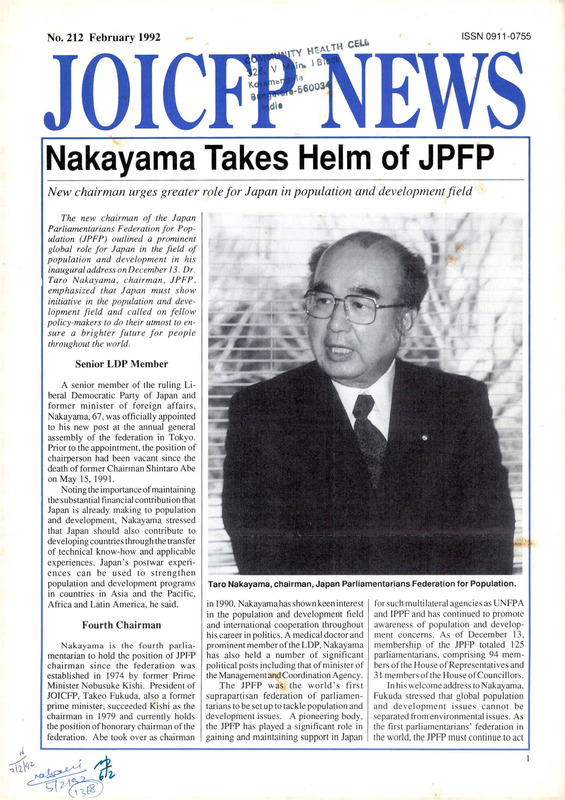
Taro Nakayama, chairman, Japan Parliamentarians Federation for Population.
in 1990. Nakayama has shown keen interest
in the population and development field
and international cooperation throughout
his career in politics. A medical doctor and
prominent member of the LDP, Nakayama
has also held a number of significant
political posts including that of minister of
the Management and Coordination Agency.
The JPFP was the world’s first
suprapartisan federation of parliamen
tarians to be set up to tackle population and
development issues. A pioneering body,
the JPFP has played a significant role in
gaining and maintaining support in Japan
for such multilateral agencies as UNFPA
and IPPF and has continued to promote
awareness of population and develop
ment concerns. As of December 13,
membership of the JPFP totaled 125
parliamentarians, comprising 94 mem
bers of the House of Representatives and
31 members of the House of Councillors.
In his welcome address to Nakayama,
Fukuda stressed that global population
and development issues cannot be
separated from environmental issues. As
the first parliamentarians’ federation in
the world, the JPFP must continue to act
1
Japan
as a catalyst as well as taking a
leadership role in the population and
development field. He said it is up to
the new
I ■ chairman
to guide
the JPFP in
a positive
direction.
Following
the estab
lishment of
the JPFP,
some 60
similar
federations
of parlia
Michihiko Kano
mentarians
focusing on population and develop
ment issues have been set up around the
world. The JPFP is a key member of the
Global Committee of Parliamentarians
on Population and Development
(GCPPD), an international umbrella
organization that links all the par
liamentarians’ federations throughout
the world concerned with population and
development.
The appointments of Michihiko Kano as
senior vice chairman and Shin Sakurai as
executive director further revitalize the
line-up of executive officers of the JPFP.
Both parliamentarians have a long history
of showing ,
intense __
support for j
maintaining 'fW
Japanese pfcj
contributions
to interna- Sir’
tionalpopulation and
development H
activities. M
Kano was H
formerly H
the minister
Shin Sakurai
of agricul
ture, forestry and fisheries. He fills the
senior vice chairman’s post left vacant by
pioneering JPFP member Takashi Sato,
who died on April 17, 1991.
3]
K'-Cp
k
JPFP Executive Officers
Honorary Chairman: Takeo Fukuda
Chairman: Taro Nakayama (LDP)
Senior Vice Chairman: Michihiko Kano
(LDP)
Vice Chairman: Hironori Inouye (JSP)
Vice Chairman: Shogo Abe (SDP)
Vice Chairman: Hidehiko Yaoi (Komeito)
Vice Chairman: Shigenobu Sanji (DSP)
Executive Director: Shin Sakurai (LDP)
Acting Executive Director/Secretary
General: Ichiji Ishii (LDP)
Director: Takako Doi (JSP)
Director: Hisaoki Kamei (LDP)
Director: Shozo Azuma (Komeito)
Director: Osamu Ikeda (Rengo)
Deputy Secretary General: Kayoko Shimizu
(LDP)
Note: Liberal Democratic Party (LDP);
Japan Socialist Party (JSP); Clean
Government Party (Komeito); Japan
Democratic Socialist Party (DSP); United
Socialist Democratic Party (SDP);Trade
Union Confederation (Rengo).
Sharing Successes and Failures
Kazuo Aichi, former minister of the
Environment Agency and member,
Global Legislators Organization for a
Balanced Environment (GLOBE), was
guest speaker at a regular meeting of the
Council on Population Education, held
in Tokyo on December 5. Prior to the
meeting, chaired by former Foreign
Minister Saburo Okita, Aichi was
interviewed by JOICFP NEWS. Below
is an outline of the interview.
There are many factors that influence
environmental issues, but population is
one of the most important of these. The
environment would not be such a press
ing issue if we didn’t have such a large
human population.
Environmental issues differ between
the developing and industrialized
countries. In developing countries, the
major contributing factors to environ
mental problems are rapidly increasing
population and large-scale poverty. In
the industrialized countries, environ
mental problems mainly stem from the
mass production, mass consumption and
mass waste that characterize people’s
lifestyles. It is therefore necessary to use
different approaches to meet the
environmental needs of the developing
and industrialized worlds.
Japan can do much to contribute to
solving environmental problems around
2
the world. Just 20 years ago, when the
Environment Agency was established,
Japan faced major problems of environ
mental pollution. The government and
private sector had to act decisively on
pollution which was creating problems
and causing such tragedies as the indus
trial waste poisoning in the Minamata and
the Yokkaichi areas. Japan, thus, built up a
considerable base of technology and
skilled personnel which can now play a
role in solving environmental problems
throughout the world.
Conflict with Development
As in many developing countries today,
Japan experienced a conflict between
economic growth and environmental
destruction. In coming to terms with this
conflict, Japan accumulated experiences
which it can now pass on to developing
countries. In many of these countries,
priority is being placed on economic growth
at the expense of the environment. It is
vitally important to strike a balance be
tween the two as Japan’s bitter experi
ences demonstrate. After putting priority
on economic growth, Japan had to expend
large sums of money to clean up the after
effects of its rapid industrialization. This
was not cost-effective at all and is one of
Japan’s failures. But this experience, too,
Kazuo Aichi, member, parliament.
is something that we can offer other
countries to help them avoid making the
same mistakes. Therefore, it is not only
our successes that can be replicated in
other countries, but there is also much to
be learned from Japan’s mistakes.
The government of Japan also
considers its financial assistance a very
important part of its contribution to
environmental causes around the world.
However, the establishment of an
appropriate multilateral financial
mechanism for the environment is one of
the most urgent issues that needs to be
worked out.
In the future, I see room for Japan to
take a leadership role in environmental
issues. Japan has the technology and
experience, both successes and failures,
to take the initiative on the world stage
and contribute greatly to environmental
efforts.
[J]
JOICFP NEWS, February 1992
Forum
Defusing the
Population
Bomb
We are rapidly wasting or destroying
the “national capital” of the planet. Critical
resources are deep, rich agricultural soils,
fossil groundwater and biodiversity — the
genetic library of animals, plants and
microorganisms that provide free eco
system services. Overpopulation poses a
serious threat to these resources.
Responsibility for this accelerating
environmental deterioration rests more
heavily on the shoulders ofthe rich than the
poor — although rapid population growth
among the poor will quickly increase their
contribution. The basic problem is the scale
of human activities. The impact of the
entire human population is now much
too large to be sustained by natural
ecosystems over the longterm. Runaway
consumption among the rich and runaway
population growth among the poor
threaten to destroy our civilization.
Both rich and poor countries must
immediately take steps to lower fertility
to below replacement level. Policies to
lower fertility in rich nations whose
average citizens are the most destructive
of the earth’s environmental systems
could have an immediate large payoff for
the environment.
The rich nations must also do
everything they can to lend a hand to the
developing nations so that they won’t
repeat the same mistakes as the
industrialized countries. We all have a
very big stake in seeing developing
countries develop in a benign way. For
example, it is critical that developing
nations, especially India and China, do
not fuel their development using their
abundant coal supplies in combination
with inefficient power plants. The
additional carbon dioxide they would
inject into the atmosphere could
dramatically increase the pace of global
warming.
Worldwide, there is a growing
awareness of these issues. It is very clear
that if you provide people with educa
tion and social security and give more
power to women, birthrates will fall.
We have the technology to become
efficient with our use of resources and
are no longer saddled with East-West
divisions that soak up these valuable
resources. The changes that are necessary
are possible and change can happen with
great rapidity. We must act locally and
get our politicians to think globally. [J]
Takeo Fukuda
Saburo Okita
Katsuhide Kitatani
We face an imminent crisis created by a
burgeoning world population and growing
consumerism. Action is urgently needed to
determine measures and policies that will
tackle the explosive increase in the
population. We have now realized that our
energy sources
and resources
are not infinite.
Since they are
finite and the
population is
still increasing,
ourfutureisnot
guaranteed.
This makes
population one
Fukuda
of the most
important issues now facing humankind.
Grassroots activities are very important to
tackling population and poverty issues and
preserving the environment, but in the past very
little assistance has
been given to nongovernmen tai
organizations
(NGOs). This has
been changing over
the last two years
with the govern
ment providing
assistance to the
budgets of NGOs.
Okita
There is so much
that NGOs can do and the important role that
they can play is gradually being recognized in
Japan. It is vital that the government of Japan
encourage these organizations.
A global population explosion is anticipated
in the 21st century which will result in a
depletion of the world’s resources if prompt
action is not taken to find solutions. The
action we take now will determine the fate
of humankind. As we move toward the 21 st
century, we
need to think
more about the
earth. Our chil
dren’s genera
tion will also
depend on nat
ural resources.
Thus, we must
ask ourselves
now whether
Kita(an|
we have the
right to deplete these resources.
Rich nations must support
poor nations to reduce
populations and save
environment, says Ehrlich
Some 200 people turned out for a
special lecture meeting on December 16
in Tokyo. The meeting was held to
commemorate the 120th anniversary of
the Mainichi Shimbun newspaper and
was organized by Population Forum 21
and the Mainichi in cooperation with
JO1CFP. Paul Ehrlich, professor,
Stanford University, and author of “The
Population Bomb” published in 1968,
was guest speaker at the event and gave
a presentation on “The Population
Explosion and the Global Environment”.
Below are highlights of his presentation
and comments from Takeo Fukuda,
president, JOICFP, and former prime
minister of Japan; Saburo Okita,
chairman, Population Forum 21, and
former minister, Foreign Affairs; and
Katsuhide Kitatani, deputy executive
director, UNFPA.
There have been several surprises
since I wrote my book, many unpleasant.
Ofthe earth’s 5.3 billion people in 1990,
1.2 billion were living a decent life,
while 4.1 billion lived in misery. The
ozone layer has been depleted. We’ve
discovered that global warming is
JO1CFP NEWS, February 1992
Paul Ehrlich, professor, Stanford
University.
happening much faster than anticipated.
We didn’t fully understand the impact of
tropical deforestation and acid precipita
tion or deposition in 1968. However, we
did write about disease, and now we have
a major new epidemic in AIDS.
Wasting National Capital
3
IPPF
Bringing Women into Development
Mahler's support for women's rights is hailed by Nagano women's league
A special lecture meeting held, in
Matsumoto City, Nagano Prefecture, on
November 25 demonstrated the concern
being shown by the women ofNaganofor
international women’s issues. Focusing
on women’s health and women in
development, the meeting was organized
by the Nagano Chapter of the Women’s
League with the support of the National
Health Insurance Federationfor Nagano
Prefecture, the Nagano Branch of the
Anti-tuberculosis Association and the
Shinano Mainichi Shimbun newspaper
incooperation withJOlCFP, government
and non-governmental organizations.
Guest speaker at the event was Dr.
Halfdan Mahler, secretary general,
IPPF. Below is an outline of his speech.
Only the three boys in my family
went to high school because there was
not enough money to send the four girls.
Thus, even in my country not so many
years ago there was this hidden discri
’I
JR
J
Mahler and Mark Laskin, assistant secretary general, IPPF in Nagano.
mination against women. Fortunately, I
had a marvelous mother who taught me
that I had to fight for total equality
between women and men.
Through my job, I have realized that
family planning (FP) must be a part of
A Birthright to Equality
Dr. Halfdan Mahler, secretary general,
IPPF, met with the Board ofDirectors ofthe
Family Planning Federation of Japan
(FPFJ) onNovember26 in Tokyo. Below is
an outline of his address and comments by
Shidzue Kato, chairwoman, FPFJ.
Halfdan Mahler
Shidzue Kato stands as a symbol
throughout the world. She was not only able
to look women’s reality in the eyes but had
the courage and imagination to do some
thing about it. I have heard Kato say that
she considers all her work to be humanistic.
I think we must always remember when
we are crunched by demographers’ figures
» that we are
X* talking about
S’lx “humanistic
“■ ■ democracy not
“humanistic
£ <. demography”.
We must em
ft .
power every
Mwoman, couple
and family ev
Mahler
erywhere in the
world to make their (FP) choice. We know
that there are hundreds of millions of wom
en who would like information on how to
take good care of their reproductive health.
Even in a poor country like Bangladesh,
women under 20 want only 2.5 children.
I believe that women have a birthright
to equality, which very few countries
f*
L' ' J
4
recognize, in spite of having signed the UN
Convention for the Elimination of all Forms
of Discrimination Against Women. To a large
extent, FP is aimed at empowering women to
have at least democratic control over what is
intimately theirs — their own reproductive
health. Therefore, our ethical vision for
complete democracy must be to satisfy that
democratic demand that we know exists in so
many if not all developing countries.
Shidzue Kato
Right now in the U.S. and elsewhere, we
are seeing the effects of a right-wing backlash
against reproductive rights. The so-called
“pro-life” movement has turned into a witch
hunt. Faced with such a situation, we must
stand firm and determine our own philosophy.
It is important that people who support
reproductive rights join hands and show a I
confident united
front to ensure
that the witch hunt
does not affect us.
Sometimes
Japanese policy
makers make
mistakes. They
are very worried
right now about
Kato
the nation’s low
total fertility rate and about an anticipated
shortage of labor in the future. However, it
should be left up to each individual to decide
when and how many children to have.
J
health in all efforts, and should go hand
in hand with all other facets of the
development process. Nowhere did I see
this more clearly than in the appalling
level of maternal mortality in the
developing world. As Japan has shown,
tragic waste could be avoided by better
nutrition in the early years, primary health
care for all, good antenatal attention and
proper facilities and help in childbirth,
access to good obstetric care when
emergencies arise, and, of course, FP
universally available, to free women from
unwanted and high-risk pregnancies.
Maternal Mortality
Maternal mortality is too often the
end result of a life diminished by
discrimination from birth. For me, it is
disturbing and frightening to witness the
silence with which is greeted the hun
dreds of thousands of deaths of mothers.
I have set myself and IPPF the task to
intensify our efforts to bring women
squarely within the development pro
cess in a true spirit of equity. Women
must be empowered to shake off their
shackles of discrimination; they must be
able to decide how many children they
want and when to have them. So, they
must have the knowledge of FP and the
means to put it into practice. Women
everywhere are bom equal, it is we men
who create laws, rules and customs which
deny them their birthright — equality!
I agree with the FP pioneer and
founder of JOICFP, Chojiro Kunii, that
all efforts at the integrated approach are
geared to working with the people to
promote family health and happiness.
This is the humanistic way ahead. [T]
JOICFP NEWS, February 1992
Nepal
Taking
Progress a
Step Further
Nepal IP proves positive
testing ground for grassroots
health activities
Implementation of the Integrated
Project (IP) at the grassroots of rural
and urban communities in Nepal has
yielded significant results, both in terms
of health improvement and practical
strategies for further application in
communities. This was one of the
conclusions of the 12th National
Conference on the IP, held in Kathmandu
from November 27-29. The workshop
was organized by the the Family Planning
Association of Nepal (FPAN), the
implementing agency of the IP in Nepal.
The innovative approach of the IP,
which integrates family planning (FP),
maternal and child health (MCH) with
primary health care and community
development for promotion through
community-based primary health care
(CBPHC) units, was highlighted over
Villagers view VDIA items in Bhagabati (left) and Phulbari, Panchkhal.
the three days. In particular, attention was
focused on the school health program being
conducted in the urban IP sites in
Kathmandu and the activities of the
CBPHC units that have been set up by
communities in rural sites in Panchkhal.
The first day was attended by 100
people including high-ranking govern
ment officials, IP personnel from all lev
els of project implementation and
representatives of international agencies.
Noting the similarity between
objectives of the recently initiated fiveyear government health and welfare pro
ject and the IP, participants recommended
that the CBPHC units be utilized as the
sub-health posts proposed under the new
government plan and that community
health workers be absorbed by the
government.
Reaching the Grassroots
The Magnel Kit is demonstrated to the
community in Baluwa, Panchkhal.
During field trips to pilot IP areas in
Nepalfrom November23-26, the JOICFP
mission observed progress of the project
and distributed items provided through
assistance from the “Voluntary Deposit
for International Aid” (VDIA) scheme of
the Japanese Ministry of Posts and
Telecommunications to personnel of the
CBPHC units. The VDIA equipment and
materials were officially turned over to
FPAN during the National IP Workshop.
Demonstrations of how to use the items,
which included Magnel Kits for
reproductive health education, baby
weighing and measuring equipment and
medical kits, were provided for IP
personnel and concerned people within
the communities.
addresses by representatives of organ
izations such as WHO and UNICEF and
prominent government officials.
The conference ended on a positive
note with participants noting a greater
potential for expansion of the project
through collaboration with the govern
ment. Participants also recommended
efforts to encourage strong female
leadership in project areas and to conduct
effective monitoring and evaluation
activities regularly.
U
Gov't Hails IP
While in Nepal to attend the National
IP Conference, the JOICFP mission
spoke with Dr. Ham Baran Yadav,
Minister of Health on November 28.
Below is a summary of the minister's
comments.
The government is dedicated to
raising the standard of health of the
people, particularly those at the
grassroots which account for some
92% of the population. We regard
highly the innovative approach taken
by JOICFP in Nepal to promote FP.
The government is very concerned
about raising the status of women in
Nepal and promoting MCH in co
ordination with non-governmental
organizations.
The CBPHC and school health
program conducted under the IP is
particularly appreciated by the
government. The CBPHC units can do
much to assist implementation of
activities at the sub-health posts that
are scheduled to be set up and run by
village health committees within the
next five years. The government of
fers its full cooperation to expand IP
activities in Nepal in the future.
At present in Panchkhal, one health
worker provides each IP village with health
education and supplies villagers with
essential drugs at a nominal cost. The
activities of the IP conducted through the
CBPHC units are supervised by a health
committee in each village to ensure that
services reach the people at the grassroots.
Over the three days of the conference,
participants listened to presentations and
speeches and discussed ways to improve
activities and expand the IP in the future.
A one-day field trip to Panchkhal was
also included in the program.
Omer Ertur, UNFPA country director,
Nepal, who gained an understanding of
the IP some years ago, said, “I found the IP
to be a very unique and genuinely
innovative approach to killing two birds
with one stone.” Participants also heard
________________ COMMUNITY HEALTH CEU
JOICFP NEWS, February 1992
06©
§26, V Mairn I Block
dangalore-560034
5
Exchanges
Taking on
Unique
Challenges
UNFPA country director
discusses individual
approaches for Cambodia,
Laos and Myanmar
Sabiha Syed, country director,
UNFPA Thailand, was interviewed by
JOICFP NEWS while in Japan from
December 8-14. Syed spoke about the
UNFPA activities she is responsible for
in thefour countries ofCambodia, Laos,
Myanmar and Thailand. Below are
highlights of the interview.
In Myanmar, a country with 41
million people, the first project in
maternal and child health (MCH) was
launched in 1991, following discussions
that were initiated earlier. In the area of
MCH, especially with regard to the health
of women, the most alarming issue is the
high incidence of induced abortion.
Consequently, maternal mortality is very
6
Sabiha Syed, country director, UNFPA,
Thailand.
high. That is why family planning (FP)
and MCH are absolutely necessary. The
priorities for a program in Myanmar are
safe contraception, improvement in
reproductive health and reduction of
induced abortion.
Laos, in comparison, is a small coun
try with 2.4 million people. But the rate of
population growth is very high and infant
and child mortality is also very high. The
government has realized the need for an
MCH and birth-spacing project, and
UNFPA is now conducting a PRSD
(program review and strategy develop
ment) mission.
Small Beginnings
Priority on MCH
In a country where sewing machines
are owned exclusively by tailors, the
donation of 27 fully reconditioned
treadle sewing machines from Japan
to the pilot areas of the Integrated
Project (IP) in Ethiopia received a warm
welcome indeed. Most of the machines
will be used by women’s clubs in West
Shoa Administrative Region in coop
eration with the Department of Labor
and Social Affairs to support vocation
al training and income generation for
women in IP areas. At present, two
machines are being used by the
Gulele MCH/FP clinic in Addis Ababa
where a staff member is repairing bed
linen and nursing uniforms. With the
machines, the staff member has been
patching small-sized bed sheets,
which cost 24 birr (US$11.7) to re
place, large-sized bed sheets, which
cost 100 birr (US$48.8), and nursing
outfits, which cost 40 birr (US$19.5).
The hospital, which delivers between
130-140 babies a month is now able
to save on equipment outlays with the
machines. At present, a new sewing
machine, if available, is worth 2,000
birr (US$975) and a second-hand
one is worth 1,200 birr (US$585) in
Ethiopia.
We will have a program in Laos as of
1993, and again the priority will also be
MCH. Laos is one of the most sparsely
populated countries in the world, a factor
that causes problems for service delivery.
Most Laotians live along the Mekong
River in small remote villages. It is a
landlocked country with no harbor. It is
also a richly endowed country, but the
agriculture is subsistence. So, the service
delivery mechanism has to be really well
thought out to address this unique situation
and meet the needs of this high-fertility/
high-mortality population. Service deliv
ery and training of health personnel at all
levels including traditional birth atten
dants (TBAs) are the major priorities.
Cambodia is now going to initiate a
strong MCH/birth-spacing project and is
looking to UNFPA for assistance and
training of their health personnel. A
mission was scheduled to be sent by
UNFPA in January. The program would
hopefully start after the government is
installed. A lot of groundwork must be
done and UNFPA, like other UN agencies,
is doing preparatory work for the project.
Again emphasis will be on MCH/FP
services and safe motherhood. Cambodia
is also likely to seek assistance from
UNFPA in its first census.
Each of the countries is unique, so it
is not good to treat them as one. Myanmar
has a high abortion rate, while Laos and
Cambodia are high-fertility and highmortality countries. Laos is the most
ethnically diverse of the four countries.
Thailand, Myanmar and Cambodia are
more homogeneous.
I face a generation gap in experience
between Thailand and the three coun
tries where programs are in their infancy,
but it allows a lot of TCDC (technical
cooperation between developing coun
tries) to occur. Cambodia, Laos and
Myanmar can learn from Thailand which
is eager and willing to assist.
The mechanism and strategy adopted
by JOICFP in Vietnam in terms of
activities is utilizing the women’s
associations. In Laos, Cambodia and
Myanmar the women’s associations are
also strong. They are political but at the
same time they are also the most
grassroots. Since success has been met
in Vietnam, I see no reason for the same
strategy not achieving success in the three
other countries. I think it can work as
effectively as it has in Vietnam.
E
Assistance provided to the Integrated
Project (IP) in Zambia through the
Voluntary Deposit for International Aid
(VDIA) scheme of the Japanese Ministry
of Posts and Telecommunications has
been utilized to foster community
development in IP areas. The funds,
received in October, have been chan
neled into the women’s clubs, men s
clubs and cooperatives in the three IP
sites of Fiwale, Kabushi and Kapata to
foster income-generation activities at the
grassroots and bolster the FP, MCH and
nutrition activities of the project.
Pesticides, vegetable seeds including
maize seeds and fertilizers were handed
over to community leaders to support
agricultural endeavors in IP areas. For
further income generation, fabrics, sew
ing thread and yarn were also provided
to the women’s clubs, while men’s clubs
received nets to supportfishing activities,
tools for carpentry and guitars to be used
by the club members during FP education
performances.
JOICFP NEWS, February 1992
In the News
AIDS Day Rouses Japanese
Japan was one of many countries reported figure and that about 10 million
around the world where activities were people are HIV carriers. Some 30-40
held on December I to draw attention to million people are expected to be infected
the impact ofAIDS. Ina departure from with HIV worldwide by the end of the
the two previous years in which century, according to WHO estimates.
As yet, the proportion ofpeople infected
uncoordinated activities were conducted
by various groups, World AIDS Day was with HIV in Japan is still relatively low in
marked this year by cooperative efforts comparison to many other countries. But
by the government and private sector in as the number of victims continues to
Japan to achieve a shared goal of increase sharply, there is growing concern A young AIDS victim and his mother
bringing AIDS to the attention ofpeople by both the private sector and govern at Chiangmai Hospital, Thailand.
ment about future effects of the disease.
throughout the country.
government’s efforts to halt the spread of
To mark AIDS Day, various edu
the disease is through education since a
1,898 HIV-positive Cases
cational materials including pamphlets
major obstacle to prevention is lack of
were made available around the country,
awareness.
A recent survey of the
According
to
a
report
released
by
the
and in some areas such as Tokyo, the
public could receive free blood tests. Ministry of Health and Welfare (MOHW) Management and Coordination Agency,
Panel discussions and AIDS workshops in late November, there were 1,898 cases found that 41% of Japanese people
were also among the events organized by of HIV infection and 415 cases of AIDS believed that they could contract AIDS
government and non-governmental confirmed in the country. The results of by sharing bathroom and toilet facilities.
the regular MOHW bimonthly survey also Another 62% believed that mosquitos
organizations on the day.
found that 56 new victims were reported in could carry and pass on AIDS.
To remedy this situation, the MOHW
the September-October period, the largest
PDA Activities
increase ever recorded. Of these, 32 were plans to offer consultation services and
A major television network, Tokyo women, reflecting the rapid increase in the reinforce the communication networks
Broadcasting Station (TBS), featured a number of people infected through among hospitals. Several AIDS
documentary on AIDS in Thailand. heterosexual contact. The total number of information hotlines already exist and
Introduced by JOICFP to the activities people reported to be suffering from AIDS anonymous AIDS testing is available at
of the Population and Community in 1991 was 177 as of October 1 — double all health centers. At present, MOHW,
Development Association (PDA) of the increase rate of 1990. An explosion in the Education Ministry and Science and
Thailand, the television crew focused the number of victims is feared unless the Technology Agency invest some ¥1.1
on the innovative AIDS-prevention acti disease is contained, said an official of billion (US$8.46 million) annually in
vities of PDA that have helped expose MOHW’s AIDS Surveillance Committee. developing preventive measures and
[J]
One of the major thrusts of the treatments of AIDS.
the serious AIDS problem in the country
and fueled action on the issue.
World AIDS Day was set aside by
MATERNAL AND CHILD HEALTH SERIES
WHO in 1988 with the purpose of open
★ NEW FILM ★(ANIMATION
ing channels of communication,
strengthening the exchange of infor
mation and experience and forging a
The number of unwanted preg
spirit of social tolerance on the AIDS
nancies among teenagers is increas
issue. Some 418,000 cases of AIDS
ing at an alarming rate in Latin
were reported in 163 countries around
American countries. By having a Japan. Focusing on the sexual
the world as of October 1, according to
baby too early, teenagers are oblig-: changes that take place in the
WHO. The UN agency, however,
ed to drop out of school, to quit
minds and bodies of teenaged
estimates that the actual number of AIDS
their jobs, and usually, to sink into
boys and girls, this film ex
sheer poverty. BLUE PIGEON is
sufferers is several times more than the
plains the pro cess of sexual
JOICFP
BLUE PIGEONEng|sh
r
the first animated film in a series
jointly produced by Mexico and
McNamara Backs FP
Former president of the World Bank,
Robert McNamara, recently called for
developed and developing countries
to act decisively to reduce population
growth rates in the 1990s. Noting that
the world’s population could triple in
100 years, McNamara warned that
increases could destroy advances
made during the 20th century at a
speech at the UN on December 10.
JOICFP NEWS, February 1992
(DOCUMENTARY)
CASA DE SALUD
A Small Revolution of
the Village Women in Mexico
42min, color
English, Spanish, Chinese, Japanese
A human document of Mexican
villagers, whose strong will power
has helped them join forces to build
all for themselves the house of
health, "Casa de Salud”.
intercourse and contraception
through to child-birth.
(ANIMATION)
RINA’S DREAM 20min, color/English
(ANIMATION)
GOOD KASEM AND CLEVER MANEE
15min, color/English, Thai, Spanish
Directed and distributed by
Sakura Motion Picture Co., Ltd.
STANDARD BLDG, 22-1, NISHI-SHINJUKU 1-CHOME
SHINJUKU-KU. TOKYO 160. JAPAN TEL.03-3342-5768
CABLE:"SAKURA MOVIES TOKYO"/Telex: J34799 ITCINBTH
16mm-VTR(Z?eta, VMS NTSC, PAL, SEC AM)
7
Voice of Voices
By Chojiro Kunii
45 Years of History
It was 45 years ago that the producers ’
cooperative movement was founded after
Japan’s bitter defeat in war. This was the
first of several social movements in which
I would play an active role. I was later
involved in the parasite control movement
of 1949, followed by my involvement in
family planning, preventive health and
international cooperation as the Hoken
Kaikan Group’s work devoted to health
expanded over the years.
To commemorate the Hoken Kaikan’s
45th anniversary, a celebration event was
held at Hotel Grand Palace in Tokyo on
November 28. Among the 400 people
from all over Japan who attended were
colleagues from the government,
academia and private sectors and many
friends I have known since the beginning
of my career. Together we reaffirmed
our faith in the achievements of our
endeavors, and were able to share the joy
of success together.
On behalf of the organizers, I briefly
recounted the events that have occurred
over the group’s 45 years and expressed
appreciation to all the guests for their
generous cooperative efforts in the past.
I received a warm response when I spoke
about JOICFP’s Integrated Project which
is being implemented in developing
countries through the support of
numerous domestic health organizations
to promote humanistic family planning
and to foster regional cooperation. Dr.
Halfdan Mahler from IPPF and Mrs.
Shidzue Kato representing FPFJ also
gave congratulatory messages.
@]
Japan Honors Grant
James Grant, executive director,
UNICEF, was awarded the Grand
Cordon of the Order of the Sacred
Treasure bythe Japanese government
on Novem
ber 3 in
recognition
for his con
tributions to
improving
the health
and welfare
of children
around the
world.
Grant has
James Grant
held the
position of executive director of the UN
Children's Fund since 1980.
8
n
Chojiro Kunii with Dr. Toshio Kuroda.
Chojiro Kunii, chairman, JOICFP, was
awarded a plaque on December 17 by the
Population Problems Research Institute of
the Mainichi Shimbun newspaper for his
contribution to the people ofJapan. Signed
by Mainichi Shimbun President Noboru
Watanabe, the inscription on the plaque
noted Kunii’s efforts in many fields inclu
ding health, development, family planning,
parasite control and international coope
ration and commended his initiative and
commitment to improving people’s lives.
The Mainichi institute is well-known in Japan
for the KAP survey on FP it has conducted
every two years since 1950. Dr. Toshio
Kuroda, director emeritus, Nihon University
Population Research Institute, gave a
congratulatory speech in which he noted
Kunii’s contributions to various fields.
DIARY
Dr. Sune Bergstrom, professor emeritus,
Karolinska Institute, Sweden, and Dr.
Mahmoud F. Fathalla, director, Special Pro
gram of Research Development and Research
Training in Human Reproduction, WHO, visited
JOICFP and JFPA on Nov. 5 to exchange
information.
*
*
*
Dr. John McCallum, senior research fellow,
National Center for Epidemiology and
Population Health, Australian National
University, and Dr. Trinidad S. Osteria, fellow,
Institute of Southeast Asian Studies, Singapore,
carried out an evaluation of the Asian Aging
Project in Indonesia, Malaysia, the Philippines,
Singapore and Thailand from Nov. 5-20. They
were joined by JOICFP Program Officer Ryoko
Nishida in Bangkok, who was in Thailand from
Nov. 16-22.
*
*
*
A 10-member mission from China headed by
Dr. Zhou Haizhen, director, FP Commission
of Jiangsu Province, was in Japan from Nov. 720 to study FP/MCH activities and exchange
information on the IP.
* * *
Helene Courte, program director. South Pacific
Commission, visited JOICFP on Nov. 14 to
exchange information with JOICFPofficers.
* * *
Luis Aller Atucha, executive director,
A.A. Y. Associados, Argentina, and Patricia
Poppe, program officer, Center for
Communication Programs, School of
Hygiene and Public Health, Johns Hopkins
University, were in Tokyo from Nov. 19-20
prior to traveling to Guatemala and Mexico
for IP evaluation activities.
* * *
A three-member team from the High Institute
of Nursing, Cairo University, Egypt, visited
JOICFP on Nov. 21 to discuss FP.
* * *
JOICFP Deputy Executive Director Shinichi Yagi and Program Officer Aiko lijima
were in Nepal from Nov. 21-Dec. 6 for the
National Workshop on the IP and to monitor
IP activities.
* * *
Dr. Halfdan Mahler, secretary general, and
Mark Laskin, assistant secretary general,
IPPF, were in Japan Nov. 24-29 for JOICFParranged activities. The IPPF representatives
met with JOICFP President Takeo Fukuda
and parliamentarians concerned with pop
ulation and development during their stay.
* * *
Eight representatives of eight countries
attended a half-day seminar at JOICFP on
FP/MCH on Nov. 28.
* * *
Dr. Hirofumi Ando, director, Information
and External Relations Division, UNFPA,
visited JOICFP on Dec. 3 to exchange
information while in Tokyo from Nov. 29Dec. 3.
*
*
*
Staff member Mayumi Katsube was in
Tunisia from Dec. 2-25 as a member of a
JICA team headed by Dr. Minoru
Muramatsu, former president, Saitama
College of Health, to conduct a basic survey
on population and FP.
* * *
Sabiha Syed, country director, UNFPA,
Thailand, visited JOICFP to exchange
information while in Japan from Dec. 8-14.
* * *
Paul Ehrlich, professor, Stanford University;
Katsuhide Kitatani, deputy executive
director, and Dr. Hirofumi Ando, director,
Information and External Relations Division,
UNFPA, were in Japan to take part in a
special lecture meeting of the Population
Forum 21 on Dec. 16.
JOICFP NEWS is a monthly newsletter
published by the Japanese Organization for
International Cooperation in Family Planning,
Inc. (JOICFP).
JOICFP NEWS welcomes your comments,
suggestions and contributions. Please mail to:
JOICFP NEWS
Hoken Kaikan Bekkan
1-1, Sadohara-cho, Ichigaya
Shinjuku-ku, Tokyo 162 Japan
Phone: Tokyo 3268-5875
Telex: 2324584 JOICFP J
Cable Address: JOICFP Tokyo
Facsimile: Tokyo 3235-7090
------------------------------------ -------------JO1CFPNEWS, February 1992
Position: 2673 (5 views)