NO. 211 JANUARY 1992.pdf
Media
- extracted text
-
211 January 1992
ISSN 0911-0755
JOIC “NEWS
Benga ■•-560034
1L
Priority on Population for Vietnam
Japanese mission heeds call for economic cooperation in population and development
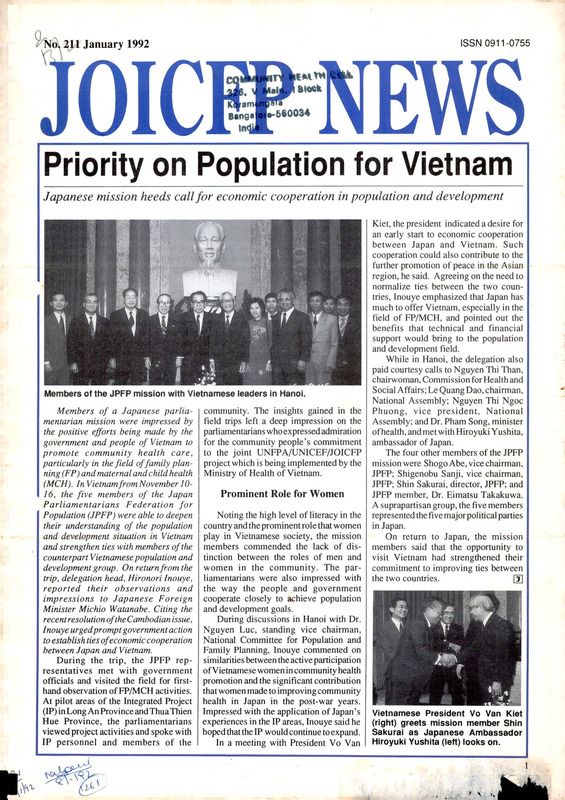
Members of the JPFP mission with Vietnamese leaders in Hanoi.
Members of a Japanese parlia community. The insights gained in the
mentarian mission were impressed by field trips left a deep impression on the
the positive efforts being made by the parliamentarians who expressed admiration
government and people of Vietnam to for the community people’s commitment
promote community health care, to the joint UNFPA/UNICEF/JOICFP
particularly in the field offamily plan project which is being implemented by the
ning (FP) and maternal and child health Ministry of Health of Vietnam.
(MCH). In Vietnamfrom November 1016, the five members of the Japan
Prominent Role for Women
Parliamentarians Federation for
Population (JPFP) were able to deepen
Noting the high level of literacy in the
their understanding of the population country and the prominent role that women
and development situation in Vietnam play in Vietnamese society, the mission
and strengthen ties with members of the members commended the lack of dis
counterpart Vietnamese population and tinction between the roles of men and
development group. On return from the women in the community. The par
trip, delegation head, Hironori Inouye, liamentarians were also impressed with
reported their observations and the way the people and government
impressions to Japanese Foreign cooperate closely to achieve population
Minister Michio Watanabe. Citing the and development goals.
recent resolution ofthe Cambodian issue,
During discussions in Hanoi with Dr.
Inouye urged prompt government action Nguyen Luc, standing vice chairman,
to establish ties ofeconomic cooperation National Committee for Population and
Family Planning, Inouye commented on
between Japan and Vietnam.
During the trip, the JPFP rep similarities between the active participation
resentatives met with government of Vietnamese women in community health
officials and visited the field for first promotion and the significant contribution
hand observation of FP/MCH activities. that women made to improving community
At pilot areas of the Integrated Project health in Japan in the post-war years.
(IP) in Long An Province and Thua Thien Impressed with the application of Japan’s
Hue Province, the parliamentarians experiences in the IP areas, Inouye said he
viewed project activities and spoke with hoped that the IP would continue to expand.
IP personnel and members of the
In a meeting with President Vo Van
Kiet, the president indicated a desire for
an early start to economic cooperation
between Japan and Vietnam. Such
cooperation could also contribute to the
further promotion of peace in the Asian
region, he said. Agreeing on the need to
normalize ties between the two coun
tries, Inouye emphasized that Japan has
much to offer Vietnam, especially in the
field of FP/MCH, and pointed out the
benefits that technical and financial
support would bring to the population
and development field.
While in Hanoi, the delegation also
paid courtesy calls to Nguyen Thi Than,
chairwoman, Commission for Health and
Social Affairs; Le Quang Dao, chairman.
National Assembly; Nguyen Thi Ngoc
Phuong, vice president, National
Assembly; and Dr. Pham Song, minister
of health, and met with Hiroyuki Yushita,
ambassador of Japan.
The four other members of the JPFP
mission were Shogo Abe, vice chairman,
JPFP; Shigenobu Sanji, vice chairman,
JPFP; Shin Sakurai, director, JPFP; and
JPFP member, Dr. Eimatsu Takakuwa.
A suprapartisan group, the five members
represented the five major political parties
in Japan.
On return to Japan, the mission
members said that the opportunity to
visit Vietnam had strengthened their
commitment to improving ties between
the two countries.
[J]
Vietnamese President Vo Van Kiet
(right) greets mission member Shin
Sakurai as Japanese Ambassador
Hiroyuki Yushita (left) looks on.
Asia
Field Observation
The highlight of the Japan Parliamentarians Federation
for Population (JPFP)mission to Vietnam was the observation
ofcommunity-based FP/MCH activities in pilot sites of the IP
in Long An Province and Thua Thien Hue Province.
Initiated in June 1989, the IP in Long the Japanese team
An Province has made rapid progress in listened to a pre
the pilot district of Ben Luc and has sentation on the
recently been expanded to new pilot areas project’s progress
in Due Hoa. Implemented by local by the chairman of
steering committees comprising health the People’s Com
and education representatives of the mittee which was
. 1
government and members of mass followed up with a
SIM
organizations such as women’s video on activities (From left) Dr. Hironori Inouye, Shogo Abe, Dr. Eimatsu
associations and the Red Cross, the pro and achievements Takakuwa and Shigenobu Sanji at Quang Phu commune.
ject utilizes local volunteers to promote in the community.
the FP/MCH, health education, parasite Produced by district and provincial noted the significant contributions that
control (PC) and environmental sanita personnel, the video on the Quang Phu IP women make to project implementation.
tion activities in three pilot communes was also broadcast in color nationwide by A Vietnamese parliamentarian who
accompanied the mission said that she
the national TV station.
in the district.
The Japanese mission hailed the would like to start the project in Quang
The project has continued to expand
since its inception to cover a growing community-based approach taken under Tri, her home province located nearby,
[J]
number of people in the pilot districts. the IP in the pilot areas they visited and in the future.
Following IP implementation in Ben
Luc in 1989, the FP practice rate rose
markedly from 16.7% to 50.7%, as of
June 1991, with the number of FP
A two-person team concluded an evaluation of the four-year regional project on aging
acceptors expanding from 551 in 1989
in Asia with recommendations that the project be continued to bring further benefits to
to reach 1,817 in 1991.
programs being developed at the country level in the region. The team, which conducted the
evaluation in the five countries of Indonesia, Malaysia, the Philippines, Singapore and
Education & Training
Thailand from November 5-20, found that the UNFPA-supported project on “ Creation of
Awareness on Aging for Policy-making Purposes in the Asian Region” (1988-1991) had
Fueled by the IP’s education and
boosted awareness of aging issues and contributed to program development in the region.
training components, community
Activities of the JOICFP-implemented project included
two training sessions in Tokyo and one seminar in Singapore
participation in the project has continued
for administrators and program managers on the policy issues
to increase since its inception. The
on aging; the development of educational materials such as the
mission, which visited the home of one
“Population Aging in Asia” booklet and slides; and the
of the women volunteers, was impressed
promotion of information and experience sharing among
with the commitment of the women to
participating countries through training sessions and workshops.
improving the health and welfare of the
To carry out their evaluation, Dr. John McCallum, senior
community. The Japanese delegation also
research fellow, National Center for Epidemiology and
visited the Long An community health
Population Health, Australian National University, and Dr.
center where they were given an outline
Trinidad S.Osteria, fellow, Institute of Southeast Asian Studies,
of the IP’s progress in the province by the
Singapore, reviewed project activities to assess the project’s
Dr. John McCallum
impact. Past participants were asked what applicable
project director.
experiences they had gained and what could be done at the
The JPFP team were introduced to all
regional level to answer future needs in their countries. The
levels of project activities in Thua Thien
team also visited UNFPA and related agencies to gather
Hue Province where they visited the
information on the aging issue prior to adebriefing/ information
Quang Phu commune in Huong Dien
sharing session in Bangkok where they joined representatives
district. Since the IP was launched in
of UNFPA Thailand Office, ESCAP and JOICFP.
June 1989, it has succeeded in raising
In summing up their findings, the two evaluators called for
the number of couples practicing FP from
the project to be continued to provide assistance to countries to
125 to 436 as of 1991. In particular, the
develop their own programs in the future. The project had
IP has contributed to significantly
enabled the sharing of experiences and replication of activities
within Asia, they said. Indonesia’s decision to set aside a week
increasing the awareness of MCH in the
for the elderly in December 1991 along the same lines as
commune and the participation of moth
Dr. Trinidad S. Osteria
Singapore’s annual campaign was noted as a positive example
ers in safe motherhood practices, im
of the exchange of experiences in the field of aging. Another example pointed out by the team
munization, infant health check-ups as
was Singapore’s launch of a “Senior Citizen’s Award Program” which comprises many of the
well as growth monitoring. Awareness
features of a program in the Philippines. Urging a continuation of the project, the evaluators
of environmental sanitation and safe
suggested that workshop and training activities in the future might take specific themes to
drinking water has also spread under the
answer particular needs in the region.
project. At the commune health center,
Aging Project on Target
JOICFP NEWS, January 1992
Oso
;
*N0
i
Asia
Charting
a Practical
Course
APCO training course targets
strategies for applying
technical skills
Participants of the APCO training
course expressed appreciation for the
wide range of knowledge and skills
provided by the course, held November
11-23 in Bangkok, Thailand. Along with
the usual range of technical know-how
offered in the curriculum, participants
were provided with a thorough under
standing ofthe concept and strategies of
the Integrated Project (IP) to ensure that
skills gained in the training are utilized
fully to promote the IP at the grassroots
of communities.
Organized by the Japan Parasite
Control Association and Mahidol
University, the 15th Asian Parasite
Control Organization Training Course
of the IP was attended by some 30
technical personnel from IP areas in
eight IP-implementing countries. Project
personnel attending the course were from
Bhutan, India, Indonesia, Malaysia,
Nepal, the Philippines, Sri Lanka,
Thailand and Vietnam. This year marked
the first time for Vietnamese and Indian
participants to join the course.
Response to the course contents was
unanimously positive, with participants
On-the-job Training
Following the APCO Training Course,
Takaaki Hara, director, Research and
Study Department, JAPC, took to the
field for three days from November
25-27 to pass on some practical skills
to IP staff in Bangkok, and Pitsanulok
and Chiang Rai provinces. Providing
intensive, on-the-job training in
everyday skills to a total of 15 IP staff
including six laboratory technicians,
Hara pointed out simple ways to refine
procedures to make services more
cost-effective and contribute to the
project’s self-reliance. In assessing
progress being made in the IP areas
visited, it was noted that further efforts
should be put into improving
collaboration between the government
and non-governmental organizations
in community-based health activities,
particularly in health education.
JOICFP NEWS, January 1992
'1
■■
7 1 g
11^. J
x<.. J
■
II
3
kj
(Top, left & right) Participants brush up health check-up and health education
techniques. (Bottom, left) The Vietnamese, Bhutanese and Indian participants
learn laboratory skills. (Bottom, right) School children study IEC materials.
expressing interest in applying what they participants expressed satisfaction with
had learned in their countries. Participants the practical tone of the course and noted
agreed the course strengthened technical that they had also shared many applicable
skills, while deepening understanding of experiences and much information with
the use of PC as a trigger to spark each other. In particular, the opportunity
for TCDC (technical cooperation be
community enthusiasm for FP/MCH.
The curriculum included a mixture of tween developing countries) had
presentations on such subjects as FP/MCH, encouraged the Nepalese participants to
health care management, environmental consider setting up a school health
sanitation, primary health care, nutrition, program along the same lines as the
IEC, health education and income Indonesian program being conducted in
[7]
generation. Two resource persons from Jakarta under the IP.
Japan, Dr. Muneo Yokogawa, professor
emeritus, Chiba University, and Takaaki
Handbook
Hara, director, Research and Study
Department, Japan Association of Parasite
The role that the Maternal and Child Health
Control, provided practical insights into
(MCH) Handbook played in dramatically
improving IP implementation through PC.
reducing the infant mortality rate in Japan
in the post-war years impressed eight
Participants were able to hone their
participants ofthe "Group Training Course
technical skills in the laboratory during the
in Countermeasures for the Improvement
course and were given a chance to observe
ofInfant Mortality Rate ” sponsored by the
and take part in field activities in Tambol
Japan
International Cooperation Agency
Taruer in Muang district, Nakhon Si
(JICA). The group gained insights into the
Tammarat Province. At a primary school,
use ofthe booklet-style health record during
participants also observed health and
a half-day seminar at JOICFP. Prior to
hygiene education activities and assisted
the visit, the team spent time with Dr.
in health check-ups for the children. More
Eikichi Matsuyama, former executive
emphasis was placed on field activities
director, Japan Association for Maternal
Welfare, at the Kosei Nenkin Hospital
than in previous years to ensure that
where they observed the handbook being
participants understood the practical nature
utilized. Matsuyama, who supervised the
of their newly acquired knowledge and
English translation ofthe booklet, gave an
skills and the effectiveness of applying
overview
of its development. Participants
them in the field to achieve the ultimate
were from Brazil, Colombia, Costa Rica,
FP/MCH goals of the IP.
Indonesia, Mexico, Nigeria and Peru.
During group discussion sessions, __________________
J
----------------------------------------- COMMUNITY HEALTH CfcU,
3
326, V Main, I Block
MCH
Koramongala
Bangalore-560034
India
Ethiopia
Embracing the Community Spirit
Ethiopian Integrated Project wins overwhelming approval at grassroots
Following the political transition
that took place in Ethiopia in July 1991,
a meeting was held in Addis Ababa on
October 29 to determinefuture directions
of the Integrated Project (IP). Attended
by representatives of UNEPA, the Office
ofState Committeefor Foreign Economic
Relations (OSCEER) and Ministry of
Health of Ethiopia and JOICFP, the
tripartite meeting reviewed progress in
the pilot areas of the IP and discussed
future perspectives under the new
political situation.
The most notable feature of the IP to
emerge during discussions was the
continued acceptance of the IP
components at the grassroots of
communities despite the recent social
and political upheaval. In reviewing
activities in pilot areas, it became apparent
that significant progress had been made
in pilot areas amid the political transition,
demonstrating the community orientation
of the project. Following the change of
government, “peace and stability
committees’’ were established in all
villages throughout the country.
Mesert Seifu is 15 years old. Before the
well was dug in her village ofEjersa Koji
in Ethiopia under the IP, she would spend
at least three hours of every morning
before going to school in the afternoon
walking 1.5km to the river to fetch three
pots of water to be usedfor drinking and
cooking by the 13 members ofherfamily.
In the evenings animals drink at the
riverside and soil the water, making river
water undrinkable. The new 10m deep
well, she explained, has considerably
eased her burden and that of the other
women in the village. It now takes only
5 minutes to fetch water from the well
supervised by the “sub-village" leader.
In the neighboring IP village of Obi
Oseli, a vendor charged the community
people 0.10 birr (US$0.05) for a jar of
water prior to a well being dug.
4
i.
Hit
A health assistant displays drugs
purchased for the health post in Obi
Oseli with a revolving fund.
Composed of key community people such
as village leaders, these committees have
fit in well with the IP concept of commu
nity participation and have helped bolster
the already strong support shown by people
at the grassroots for the project.
During the meeting in Addis Ababa,
participants discussed results of surveys
carried out in two IP areas. Conducted in
October 1991, the survey in the urban area
in Addis Ababa showed that the
contraceptive prevalence rate (CPR) had
increased from 26% to 38% in one year. In
the rural area in Wonchi District, West
Shoa Administrative Region, the survey
revealed that the CPR had increased from
0.95% to 10% in a year. Compared to the
national CPR average of only 4%, the
results indicated that the communities have
been responding to the IP messages.
Incorporating the IP
The flexible nature of the IP has
continued to be well-suited to the Ethiopian
situation where it accommodates existing
family planning (FP) and maternal and
child health (MCH) programs of the
government. The project also reinforces
the position of government community
health agents (CHAs) working in urban
and rural areas, as well as community
health assistants in rural areas.
In urban areas, the CHAs have eight
responsibilities: mobilizing people for the
immunization and environmental sani
tation campaign; data collection on social
and economic indicators; distribution of
condoms for AIDS; health education;
registration of vital statistics; oral
rehydration therapy (ORT); reporting to
the district health management; and
growth monitoring. For the rural health
assistants attached to health posts, the
five responsibilities entail: resupply of
oral contraceptives; supply of condoms;
referrals to clinics for IUDs and
sterilization; counseling on FP; and
immunization. Meanwhile, the CHAs in
rural areas are responsible for: treating
minor ailments and endemic diseases;
antenatal screening and reporting of
high-risk pregnancies; as well as
mobilizing people to receive immu
nization and education on sanitation,
safe drinking water, personal hygiene,
and the prevention of sexually transmit
ted diseases.
Sharing Components
In all pilot areas, the IP embraces
deworming campaigns; hygiene and
environmental inspections; nutrition
education; anthropometric measurement
and analysis; resupply of the pill and
supervision of CH As and traditional birth
attendants (TBAs). By sharing most of
the same components, the IP supports the
fields of responsibility of existing
community health workers to reinforce
their activities.
Another feature of the IP that has won
overwhelming support among com
munity people is the establishment of
revolving funds for essential drugs which
are often scarce in communities. The
funds, set up with an initial injection of
“seed” money, are maintained through a
fee-charging system fordrugs, which not
only strengthens the project financially,
but gives the community people more
confidence to have some say in the type
and quality of the drugs and services they
receive. Service providers are thus
encouraged to respond to community
needs and promote health education. The
community people are charged only 25%
more than the cost price of the drugs
under the scheme in comparison to the
50-100% profit margin of commercially
sold drugs. In the rural IP area, 150 birr
(US$73) has been generated for the
project since its start, a large sum when
compared to Ethiopia’s per-capita GDP
(US$115).
S
JOICFP NEWS, January 1992
Women
After the
UN Decade
for Women
UNIFEM aims to give
women's work the credit
and benefits it is due
Sharon Capeling-Alakija, director,
UN Development Fund for Women
(UNIFEM), spoke at a press conference
organized by the Japanese Prime
Minister s Office on November 26 in
Tokyo. Below is an outline of her
presentation and an interview conducted
with JOICFP NEWS on the same day.
We are in a world where the number
of poor people is growing more rapidly
than ever before. The number of women
among these poor is growing more rapidly
than ever before.
Despite the fact that in developing
countries one-third of all households
entirely depends on the woman for
income, women eam, own and control
less than men. And despite all the work
that has been done in the 15 years since
the 1975 conference on women in Mexico
City the situation — working and living
conditions — of women in developing
countries is worse than in 1975.
UNIFEM is one of the few parts of
Unconventional Wisdom
“UNIFEM was founded on what once
was an unconventional belief in
women’s capacity for leadership, for
taking control of their own lives and for
influencing in a positive way their
families communites and nations,” said
Sharon Capeling-Alakija, director,
UNIFEM, in a keynote speech to the
Yokohama Women’s International
Seminar’91 on November 23. “Every
project UNIFEM finances attempts to
bring visibility to women’s productive
and decision-making capabilities," she
said. A one-day seminar held in
Yokohama, the event featured pre
sentations and discussions on the
theme of “Women in Development”.
Attended by some 300 people, the
seminar was organized by the
Yokohama Women’s Association for
Communications Networking with the
support of the Yokohama City Board
of Education and Yokohama
Association
for
International
Communications and Exchanges.
JOICFP NEWS, January 1992
The conditions of women in developing
countries have worsened since 1975.
(Photo) Women at work in Sri Lanka.
the UN system that actually grew out of a
social movement — the women’s move
ment. It was created not only to provide
resources, but to give an international voice
to the visible contributions women make
to families, communities and societies.
UNIFEM was originally created as a fund
for the 1975-1985 decade. People then
believed that with a fund and after a decade
for women we’d see changes in values,
equality, development and peace. But by
1985, it became obvious that it would take
a lot longer to change the world.
Large Mandate
The mandate that UNIFEM was given
in 1985 was firstly, to directly support the
economic activities of women living in
developing countries; secondly, to support
activities that will enable women to
participate in and benefit from mainstream
development activities; and thirdly,
advocacy — to take the experiences of
UNIFEM, get them documented and
disseminate the findings. We’re a small
organization with a very big mandate. It
means that we have to take our small funds
and pay big dividends.
Some time ago, we realized that
UNIFEM had to be more of a catalyst to
ensure that big donors used their money
more effectively for women. With their
resources, maybe we could reach more
women. About 40% of UNIFEM’s pro
grams are executed by non-governmental
organizations (NGOs), mainly those of
developing countries where they exist, and
also by some international organizations.
If you want to reach women, one of the
most effective ways is through NGOs.
We have found that it is important to
take a practical and strategical approach.
Simply going in and doing something for
the people in the short-term seems to work,
but in the long-term the project will
eventually collapse. For women, this sort
of project approach may even undermine
their position and control. What I learned
from 20 years of working in NGOs at the
grassroots is that you could work and be
a success at that level for 10 years. Then
in a capital city, a trade agreement or
policy could be signed that would render
that work for 10 years useless. So, we had
to find some way to help policy-makers
understand how their policy affected
people at the grassroots. We also had to
make women at the grassroots understand
how these policies could affect their lives.
We have chosen two sectors that we
consider the most strategic to women’s
development in developing countries:
agriculture and trade and industry. In
agriculture, our primary focus is food
security at all stages: planting, storage
and market distribution. In trade and
industry, we focus on micro-enterprises
where we find many women involved.
So little is being done in developing
countries to produce appropriate
technologies to reduce the drudgery of
women. When equipment such as water
pumps is brought in, women are rarely
trained in repair technologies. Women
have a vested interest in ensuring that the
pump works. Nothing changes in men’s
lives if the pump breaks, but a lot changes
in women’s lives.
The whole concept of women in
development (WID) was a rejection of
the trickle-down theory of development.
We discovered that development did not
only have a neutral effect on women, but
often had a negative effect on them. So,
my understanding of WID was to begin
to change the way development occurs
so that women not only benefit from it,
but participate actively in it.
It is highly desirable that men and
women work together. We cannot exclude
men because the power is in their hands.
The women’s movement learned that
both women and men have to see the
importance of change for reasons of
ethics and efficiency. Women are also
not necessarily gender-aware.
[j]
Sharon Capeling-Alakija
5
Japan
Founded
on a Social
Movement
Hoken Kaikan Group marks
45 years of answering health
and development needs in the
community
The Hoken Kaikan Group celebrated
45 years of history on November 28.
Comprising nine non-governmental
organizations (NGOs), but linked to a
great many more through a wellestablished nationwide network of
preventive medicine, family planning
(FP) and maternal and child health (MCH)
organizations, the group today is a model
of self-reliance and successful
community health services.
From its beginnings as a communityminded group led by Chojiro Kunii, the
Hoken Kaikan Group has continued to
respond to community needs with
innovative services geared to improving
the health and well-being of families and
individuals. Hence, the group has
continued to grow and expand from its
initial orientation as a cooperative
movement, to an organization engaged
in parasite control (PC), FP/MCH,
preventive medicine and more recently,
international cooperation.
In the field of FP/MCH, the Hoken
Kaikan Group includes the Family
New Publication
Coinciding with the 45th anniversary of
the Hoken Kaikan Group, JOICFP
Chairman Chojiro Kunii reviews the 45
years of the group’s activities in a book
titled “Japan — a Country of Longevity.
It All Began with Parasites”. Written in
Japanese, the essays, articles and
poems contain
ed in the hard
cover volume
are attractively
laid out with pho
tos of MCH/FP
and preventive
health activities
past and present. The contents span
the years since WWII and take in the
short-lived cooperative movement in
the post-war years, PC, preventive
health and FP activities and conclude
with a section of new challenges in
population problems, world peace and
international cooperation.
6
Ji Bl I '
J
1
pm
i
Ln
(From left) Dr. Halfdan Mahler, executive
secretary, IPPF, with JOICFP Chairman
Chojiro Kunii.
Planning Federation of Japan, established
in 1954; the Japan Family Planning
Association (JFPA), established in 1954;
the Federation of Japan MCH Centers,
established in 1963; and the MCH
Promotion Council, established in 1971.
The group members in the preventive health
field include the Japan Association of
Parasite Control, established in 1957; the
Japan Association of Health Service,
established in 1966; and the Tokyo Health
Service Association, established in 1967.
Nationwide Network
The group also embraces a network
of 33 branches of the Japan Health Service
Association and a staff of 4,000. For
JOICFP, which was established as part of
the Hoken Kaikan Group in 1968, this
extensive network represents vast human
and material resources to support its FP/
MCH and primary health care activities
conducted under the Integrated Project in
developing countries.
The roots of the group can be traced to
the producers’ cooperative movement
established in 1946 in the grim post-war
years. One of the movement’s prominent
leaders was Hoken Kaikan Group
Chairman Kunii. Under the theme of “All
for one and one for all”, the movement
caught on as a community enterprise system
but faltered within three years amid the
soaring inflation that marked Japan’s early
recovery from war. Alerted to the high
incidence of parasite infection among the
Japanese population (80%), Kunii turned
from the cooperative movement to focus
his energies on PC. He established the
Tokyo Parasite Control Association in
1949, the forerunner of the Hoken Kaikan.
By the 1950s, another serious social
problem caught Kunii’s attention. In the
absence of FP and faced with a grossly
inadequate socio-economic situation,
women were turning to induced abortion
in alarming numbers. In 1955 alone, official
records indicate that 1.17 million
abortions were conducted. Japan’s total
population at this time was 89 million
and the number of live births reported
that year was 1.73 million. Recognizing
the serious threat that abortion posed to
women’s health, Kunii sought toestablish
a system to give women access to FP. He
set up the JFPA in 1954 under the
principle of “Every child should be a
wanted child”.
Meanwhile, PC activities continued
to expand, while services diversified.
Through the activities of the group the
effectiveness of mass health examinations
and mass treatment were accepted in
Japan and preventive medicine became
an integral part of Japan’s health care
system. A key factor in the success of the
Hoken Kaikan Group was the close
collaborative ties the group established
with government at the central and local
levels and with community organizations
which provided volunteer support for
community-based health activities. [J]
45 Years of History
The Hoken Kaikan Group celebrated
its 45th anniversary with a reception in
Tokyo on November 28. Many of Japan’s
pioneers in FP/MCH and preventive
health were among the 400 guests. In a
speech to the
reception,
Dr. Halfdan
Mahler,
secretary
general,
IPPF, remar
ked on his
long asso
ciation with
Shidzue Kato
the Hoken
Kaikan Group and said that the unique
activities of the group of independent
NGOs and its rich experiences can
contribute greatly to improving the way
of life in developing countries, especially
in the field of community health and
welfare within communities.
In a message to the reception, Takeo
Fukuda, former prime minister of Japan
and president, JOICFP, commented on the
initiative of JOICFP Chairman Chojiro
Kunii which enabled the formation of the
NGO group. He said that the Hoken Kaikan
Group has not only done much for people’s
health in Japan but is also contributing to
development and health programs abroad.
Shidzue Kato, president, Family
Planning Federation of Japan (FPFJ) also
paid tribute to Kunii’s drive and
contribution to the FP movement in Japan
and abroad and encouraged him to contin
ue with his efforts.
JOICFP NEWS, January 1992
Japan
Options in the Era of Low Fertility
MCHIFP conference studies choices for Japan as aged society looms
Around 2,000 participants repre
senting 47 prefectures across Japan
turned out for the National Convention
of Maternal and Child Health (MCH)
and Family Planning (FP) in Oita City,
Oita Prefecture, Kyushu, held November
14-15. Drawnfrom government and non
governmental sectors, participants
included MCHIFP administrators,
doctors, midwives, public health nurses
and members of the press. The two-day
event comprised presentations and
discussions under the theme of “MCH in
the era of low fertility”. Focusing on
“The community's role in caring for the
children of the future”, participants
sought to establish a new direction for
MCHIFP in Japan reflecting present
andfuture realities.
The 26th such gathering, the MCH/
FP conference was first held in 1965
when MCH and FP was officially
integrated in government policy with the
enactment of the MCH Law. Prior to
1965, a national FP conference was held
annually. The Oita conference was
-—J
Oita Governor Morihiko Hiramatsu
addresses the conference.
organized under the joint auspices of the
Ministry of Health and Welfare, Oita
prefectural government, the Family
Planning Federation of Japan (FPFJ) and
the Boshi Aiiku Kai.
In a message to the conference, Shidzue
Kato, president, FPFJ, stressed that the
choice of whether to give birth to a child or
not was an individual one. It is not the
government’s place to make such decisions,
she said. Urging global action, Kato
explained that Japan has rich experiences
in MCH/FP which it should share with
developing countries. She said that the
FP movement contributed significantly
to Japan’s development and these
experiences are applicable in other
countries. It is Japan’s duty to contribute
to solving the very serious population
problems around the world, she said.
Oita Prefecture is one of a growing
number of prefectures in Japan where
local governments and the private sector
have initiated activities to head off the
effects of a falling birthrate and outward
migration. Forty-seven out of 48
municipalities in the prefecture have
launched incentive schemes to encourage
women to have children. Among the
incentives are free medical care for
children under 3 years of age, free hospital
baby deliveries and financial dividends
for childbirth and even marriage. “To
vitalize our community, each family
needs to have at least two babies,” said
Morihiko Hiramatsu, governor, Oita
Prefecture.
[J]
Marriage Losing Its Appeal
Dr. Naohiro Ogawa,professor, Nihon
University, was the keynote speaker at
the National Convention of MCHIFP in
Oita City. Aformer member ofESCAP,
Ogawa spoke on “Low Fertility and the
Super-fast Aging Society”. Below are
highlights of his presentation.
In 1989, Japan’s total fertility rate
(TFR) was 1.57. In 1990, the figure had
plunged to 1.53. The falling birthrate has
become a social issue and is now
receiving a great deal of attention from
policy-makers. In 1947, the TFR was
4.54. Ten years later in 1957, it had been
halved to mark 2.04. Today, the TFR for
every 47 prefectures of Japan is under 2.
Even the prefecture with the highest
birthrate, Okinawa, still records a TFR
of only 1.91. Ona world scale, Japan’s
TFR is very low and not far behind the
the two countries with the lowest rates:
Italy with 1.29 and Spain with 1.30.
According to a poll conducted by a
major newspaper regarding the so-called
“new single” (unmarried) phenomenon,
some 43% of men and 54% of women
indicate that they think a single lifestyle
is preferable. Among women in their
JOICFP NEWS, January 1992
20s, three out of four say that they prefer
a single lifestyle. I anticipate that this
trend will continue and foresee the number
of women intending to remain single
permanently hitting 13% in the future.
Young women are seeking a higher
education and want to participate more
actively in the work force. Today, 37% of
women and 35% of men enroll in higher
education institutions. Women are
marrying later and taking a more active
role in business. Naturally, the birthrate is
falling in response to these changes.
There are three basic periods of hardship
for women having children. For mothers
in their 20s, there is the great physical
hardship involved in raising children. For
mothers in their 30s, there is the stress of
getting children through their school
entrance exams. For mothers in their 40s,
there is the great financial burden of paying
for their children’s higher education. It is
for these reasons that women are choosing
to regulate the number of their children.
Many municipalities have announced
countermeasures in response to the falling
birthrate. What both enterprises and the
government should not overlook is the
Dr. Naohiro Ogawa
importance of creating an environment
conducive to rearing children.
The Japanese society is aging rapidly.
Just six years ago in 1985, there were two
children for every aged person in our
society. Now the ratio is one to one.
Japan will be the nation with the largest
proportion of aged people by the year
2000 when people over 65 years of age
will account for 17% of the population.
Values are changing and it is not easy
to increase the birthrate. What we can do
is create a positive environment for child
rearing. We also must consider how to
care for the aged within families and
society. I suggest that we reconsider the
age of 65 as the retirement age. We must
take a longer-term view of this society
and plan realistically for our future. [J]
7
Voice of Voices
By Chojiro Kunii
The Story of Ears
8
ANNOUNCEMENT
The Fourth Women’s Workshop for Community Health will be held as follows:
Date:
February 3-7,1992
Venue:
Oaxaca, Mexico
Organizers: Mexican Family Planning Foundation (MEXFAM), UNFPA, IPPF and
JOICFP
Participants: Representatives of governments and/or NGOs from Bolivia, Brazil,
Colombia, Ecuador, Guatemala, Mexico, Nicaragua, Jamaica, Paraguay and Peru,
and international agencies
Objectives: 1)To review progress of activities conducted under the “Plan of
Action” approved in thethirdworkshopandto discuss the findings of the independent
evaluation; 2) to discuss social and health conditions of young women; 3) to propose
strategies to enhance the social and health conditions of young women, particularly
IEC material and training manual strategies.
When I was a small child, my
grandmother said to me, “Your ears are
very good ears. They show me that when
you grow up, luck will come to you.’’
Now that I am past the age of 70, I
sometimes wonder if what she said to me
decided my fate. When I failed my initial
university entrance examination, and later
when I had to go to war, I could always
hear my grandmother’s words in the back
of my mind, “Everything is going to be
all right.” Even during the desperate
postwar days and when my hopes for the
producers’ cooperative movement were
dashed, I could still hear those words.
When I entered the unique field of para
site control. She whispered, “You are
going to make this your career.”
From the cooperative movement to
the parasite control movement, the twists
and turns which my work took were
hardly those of a conventional career.
But since then, the course has followed
the more reasonable direction of
preventive health to family planning and
on to international cooperation. With my
youth well and truly behind me now, I
think I can safely graduate from life.
My recently published book “Japan
— a Country of Longevity. It All Began
with Parasites” provides insights into the
many chapters of my life’s work. Its
creation, thus, was also guided by the
words of my grandmother long ago.
The times spent drinking liquor,
falling in love, going through tough
periods and writing poems are all part of
the ups and downs that have led me to my
old age. To my grandmother who blessed
my ears when I was a small child, I would
now like to say thank you.
g]
JOICFP counsellor, Dr. Michio Hashimoto,
and Program Officer Ryoichi Suzuki attended
the Seminar on Collaboration between
Government and NGOs for Maternal Health
and FP Programs, held in Yogyakarta,
Indonesia, from Oct. 7-12.
Students of Shown Joshi Daigaku High
Schoolfocused on worldpopulationfor a
display set up for the public during the
school's festival on November 11.
Featured in the display were various
UNFPA and JOICFP publications on
population and development as well as
UNFPA’s World Population Clock.
Dr. Shigeo Hayashi accompanied JOICFP
Deputy Executive Director Shin-ichi Yagi,
program officers Sumie Ishii and Hideyuki
Takahashi and staff member Fumiharu Sato to
the Third Pan-African Conference on the IP,
held Accra, Ghana, from Oct. 15-22. Following
the conference, Yagi, Ishii and Sato visited
IPPF Headquarters in London, England, on
Oct. 24-25, and Takahashi visited Ethiopia to
attend the tripartite meeting for the IP from
Oct. 24-30.
* * *
Dr. Hirofumi Ando, director. Information and
External Relations Division and Jyoti Singh,
director, Technical and Evaluation Division,
UNFPA, visited JOICFP while in Japan from
Oct. 15-23.
* * *
Raheem Sheikh, chief, Asia and the Pacific
Division, UNFPA, visited JOICFP on Oct. 16-
Note: Self-funded observers are welcome to attend the workshop. For further
information, please contact JOICFP.
JCHCFP MATERNAL LW CHILD HEALTH SERIES
[ANIMATION FILM
RINA’S DREAM
20min/color, English
A moving story in animation featuring a midwife
whose dedication results in the spread of a village
movement for the improved health of mothers
and children.
DOCUMENTARY NEW FILM
SONG OF TOMORROW
AT KILIMANJARO
32min/color, English
The maternal & child health movement began in
Masama on the slopes of Kilimanjaro, Tanzania,
involving the whole village joined by midwives,
girl volunteers and the religious group.
DIARY
*
*
*
16mm-VTR(z3eta,VHS NTSC,PAL,SECAM)
directed and distributed by
Sakura Motion Picture Co., Ltd.
STANDARD BLDG., 22-1, NISHI-SHINJUKU 1-CHOME
SHINJUKU-KU, TOKYO 160, JAPAN
TEL TOKYO 3342-5768/CABLE; "SAKURAMOVIES TOKYO”
Telex:J34799 ITCINBTHiPublic Booth) Registered No. ITC347
17 to exchange information.
* * *
Hugh O’Haire, information officer, In
formation and External Relations Division,
UNFPA, was in Japan from Oct. 20-23 to
collect information on the bicycle and sewing
machine assistance project.
* * *
Eight nurses from Taiwan, China, attended a
half-day seminar on the IP at JOICFP on
Nov. 1.
* * *
Eight representatives of eight JICA FP
project-implementing countries attended a
half-day IP seminar at JOICFP on Nov. 5.
JOICFP NEWS is a monthly newsletter
published by the Japanese Organization for
International Cooperation in Family Planning,
Inc. (JOICFP).
JOICFP NEWS welcomes your comments,
suggestions and contributions. Please mail to:
JOICFP NEWS
Hokcn Kaikan Bekkan
1-1, Sadohara-cho, Ichigaya
Shinjuku-ku, Tokyo 162 Japan
Phone: Tokyo 3268-5875
Telex: 2324584 JOICFP J
Cable Address: JOICFP Tokyo
Facsimile: Tokyo 3235-7090
JOICFP NEWS, January 1992
I
Position: 2673 (5 views)