RF_DM-3_CHE-1_SUDHA.pdf
Media
- extracted text
-
(ipufjio
11
1 wr ’^AL HEAL&
V'p: jPgi
6]
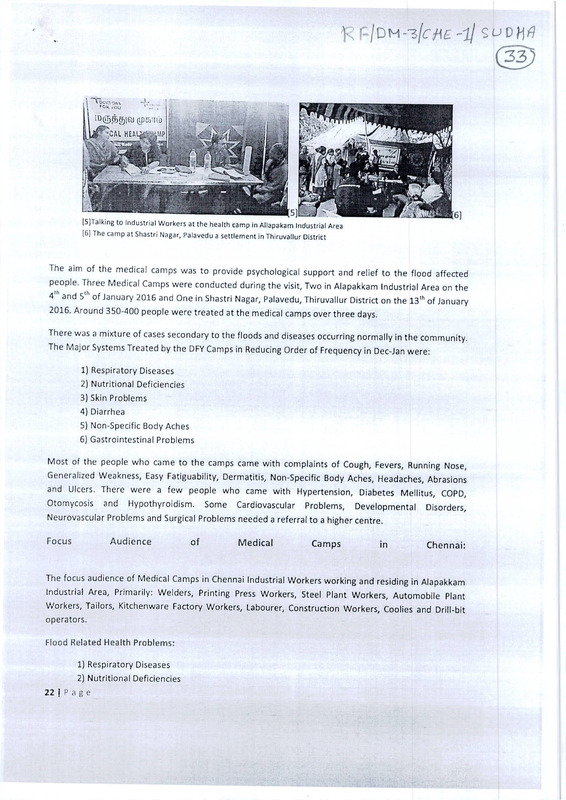
(5) Talking to Industrial Workers at the health camp in Allapakam Industrial Area
[6] The camp at Shastri Nagar, Palavedu a settlement in Thiruvaflur District
The aim of the medical camps was to provide psychological support and relief to the flood affected
people. Three Medical Camps were conducted during the visit, Two in Alapakkam Industrial Area on the
4' and 5th of January 2016 and One in Shastri Nagar, Palavedu, Thiruvallur District on the 13th of January
2016. Around 350-400 people were treated at the medical camps over three days.
There was a mixture of cases secondary to the floods and diseases occurring normally in the community.
The Major Systems Treated by the DFY Camps in Reducing Order of Frequency in Dec-Jan were:
1) Respiratory Diseases
2) Nutritional Deficiencies
3) Skin Problems
4) Diarrhea
5} Non-Specific Body Aches
6) Gastrointestinal Problems
Most of the people who came to the camps came with complaints of Cough, Fevers, Running Nose,
Generalized Weakness, Easy Fatiguability, Dermatitis, Non-Specific Body Aches, Headaches, Abrasions
and Ulcers. There were a few people who came with Hypertension, Diabetes Mellitus, COPD,
Otomycosis
and
Hypothyroidism.
Some
Cardiovascular
Problems,
Developmental
Disorders,
Neurovascular Problems and Surgical Problems needed a referral to a higher centre.
Focus
Audience
of
Medical
Camps
in
Chennai:
The focus audience of Medical Camps in Chennai Industrial Workers working and residing in Alapakkam
Industrial Area, Primarily: Welders, Printing Press Workers, Steel Plant Workers, Automobile Plant
Workers, Tailors, Kitchenware Factory Workers, Labourer, Construction Workers, Coolies and Drill-bit
operators.
Flood Related Health Problems:
1) Respiratory Diseases
2) Nutritional Deficiencies
22 | P a g e
*
3) Skin Problems
4) Diarrhea
5) Non-Specific Body Aches
6) Fevers
7) Non Diarrheal Gastrointestinal Problems
Occupational Problems:
These were the problems that came up during the camps which I considered to be Occupational
1) Body Pains
2) Exertional Palpitations due to lack of age appropriate tasks
3) Arthritis of Fingers, Back and Knee problems
Many of the people presenting with these problems in the camps had an occupational history of
longstanding unprotected lifting of weights or other labour intensive heavy work for long hours through
the day. The workers did not work with gloves or hard hats and worked on tasks that were not
appropriate for their age.
Here are some case studies I found Interesting:
A 45 year old woman, illiterate with poor eyesight works as a drill-bit operator for roadworks on a daily
wage. She is obese and she complains of chest pains and chronic body aches. She works 10-12 hours a
day operating a drill for roadworks and has to manage the household chores once she goes back home,
she cannot think of any other way to subsist and cannot afford to go to a hospital.
A 27 year old man works as a manual labourer for a company, he has shifted boxes of supplies all day
without protective gear for 7 years. The joints on his fingers are swollen and he has chronic lower back
pains. He decided to go back to his company and coax his superiors to give him gloves and didn't want a
change of job.
Strengths Of Medical Camps:
1)
2)
Facilitates Entry into the Community
It Provides Psychological Relief to a community during a disaster and can be a useful spiritual
support.
3)
Fills a lacuna of Primary Health Care Demand to a Community
4)
Caters to Normal Health Problems and Problems Secondary to the Disaster
5)
Facilitates Organizational tie ups with External Agencies
6)
Publicizes Organization to Community, Funders, Doctors and Support Staff
7)
Publicizes Pharmaceuticals for Pharma Companies
23 | P a g e
,
, it«
J... ...
8)
Publicizes Products of Sponsors
9)
Popularizes Funders
10) Provides Data For Diseases in a Community
11) Helps the Organization identify problems in a focus group or a focus area
12) Facilitates Networking among Medical Professionals and Public Health Professionals
13) Facilitates a Deeper Understanding
of Common Knowledge, Beliefs and Practices of a
Community through one to one interactions under the garb of a free Clinical Checkup
14) Useful in Early Response and Rescue Phases
15) Useful in Frontline Areas of Disaster
16) Facilitates knowledge and understanding of Medical Systems and Authorities in Affected Areas
17) Facilitates Contact with Authorities for Larger Scale Issues and Changes
Weaknesses of Medical Camps:
1)
Empowers Organizations and Individuals and not Communities
2)
Impact of program affects a small group of individuals per day
3)
Band Aid Impact: Impact of program is more short term than long term
4)
Area of effect is small, with a radius around the medical camp location
5)
Difficulties in Following up cases
6)
Pushes products into communities
7)
Not possible to give long term treatment or treatments which require monitoring
8)
Medicines used for normal illnesses unrelated to floods can be used in an area of genuine need
and shortage but it is impossible to turn down people with genuine health issues.
9)
Acute care for critical/complicated cases requiring specialty or superspecialty treatment
requires referrals to tertiary care centres which are often not accessible, unaffordable or have
failed to provide quality care to the patients.
Opportunities:
1)
Access to Community
2)
Access to Authorities
3)
Access to Institutional Heads of Organizations
4)
Access to Funders
5)
Access to Medical Professionals
6)
Access to Allied Professionals and Support Staff
7)
Access to Pharmaceuticals
8)
Access to Data
9)
Access to Referral Networks
Threats in Medical Camps:
1)
Lack of sufficient infrastructure to manage all health problems
2)
Lack of Medicines for all
24 | P a g e
3)
During Election Time Political Parties in power may try and stop NGO Work that is very visible
like camps because it may remind people to ask what government is doing about filling the
lacuna in Primary Health Care.
4) Alternatively Political Parties may take credit for medical camps to get more votes
5)
People are suspicious of visible work and someone even asked us if we were doing our work for
votes
6)
False Cases and Malingering can be rampant since medicines are free which is a waste of time
and resources and deviates resources from where they are truly needed.
School Programs: Children as Agents of Change
I[6|l
J f I
[7]
>
1(8]
' i'f
.91
[GJChlldren at Vllllvakam Panchayat Union School listening to the health talk
25 I P a g e
gF (O M-SODH/9
3)
During Election Time Political Parties in power may try and stop NGO Work that is very visible
like camps because it may remind people to ask what government is doing about filling the
lacuna in Primary Health Care.
5)
Alternatively Political Parties may take credit for medical C- —
camps to get more votes
People are suspicious of visible work and someone even asked
—J us if we were doing our work for
votes
6)
False Cases and Malingering can be rampant since medicines are free which is a waste of time
4)
and resources and deviates resources from where they are truly needed.
School Programs: Children as Agents of Change
I|6)l
l[7]
1(81
I.
:9]
\ p'-'lL
•''J
16]Chlldren at Villlvakam Panchayat Union School listening to the health talk
25 | P a g e
[7]True Companionship: A child talks without talking
[8]Engagmg with students at N.Sama Rao Nursery and Primary School
|9]Talking about Dewornning to Children and School Stall
[10] A class of naughty, somewhat rowdy adolescent boys who wouldn't let me start my talk on Reproductive Health for the first ten minutes
transform into friends for life after the ARSH talk on reproductive and sexual health
Social Reform in Tamil Nadu: Influence and Trends
Since Tamil Nadu comes from a Social Reformist Culture originating from the Periyar Period, Social and
Welfare Programs are a subject of Pride and Healthy Competition between the DMK and the AIADMK
through their periods of alternate rule in the state. Government School Health Programs in Tamil Nadu
are excellent but implementation is variable and dependent on the quality of implementation of the
local authorities at the municipality in which the school is located and is sometimes more on paper than
in reality. NGOs play an important role in filling the gap in the delivery of services.
School Health Programs: Children Are Agents of Change
DFY conducted school health programs at:
1) N.Sama Rao Nursery and Primary School, Singarachari Street, Triplicane, Chennai on 6th January 2016
2) Villivakam Panchayat Union Elementary School, Alapakkam, Chennai on 8lh January 2016
3) Government Higher Secondary School Thandurai, Pattabiram, Tiruvallur District on 9th January 2016
DFY's School Program focused on the following Agendas:
Discussing Health Programs and Policy with the Institutional Heads and Teachers
Deworming
Nutrition
Sanitation
Child Clinic
Health Awareness
Hygiene Talks
Adolescent, Reproductive and Sexual Health Talks (ARSH)
First Aid Kits and First Aid Education to Teachers
At the School Programs we would interact with the children and talk to children on a range of health
topics and answered their questions if they had any, what are germs? the various types of germs, routes
of transmission of infections and disease how to protect ourselves from these. We also spoke to them
about Dengue, Malaria and brainstormed about how to protect families from vectors, Whether
everyone had access to water, practical approaches on how to make water safe to drink. Students
26 | P a g e
demonstrated to each other the six steps of hand washing. Boys and Girls were separated and we would
discuss with the students about safe and unsafe sex, sexually transmitted diseases and responsible
sexuality. Students asked many questions about sex and sexuality and many myths were debunked.
Mass Deworming was conducted at Villivakam Panchayat Elementary School. Chewable 400 mg
Albendazole tablets were given to the students. Every school was given a First Aid Kit and the Physical
Education Instructors were explained to, if they had any queries how to best use them. We distributed
nutritional supplements at the Villivakam Panchayat Union Elementary School and gave every school a
Model First Aid Kit.
The Model First Aid Kits Contained:
1) Betadine; Povidone Iodine
2) Medicated Betadine Gauze
3) Plain Gauze
4) Roller Bandage
5) Antibiotic Creams
6) Hand Sanitizer
7) Gloves
8) ORS
9)
Deworming Tablets
Focus Audience of School Health Programs: Principal/Headmistress, School Teachers and Staff,
Students - 90% of the children in these schools were from slums. They were children of Rickshaw Pullers,
Autorickshaw Drivers, Small Shop Owners, Beachside Vendors, Taxi Drivers, Domestic Workers,
Construction Workers, Labourers and Unemployed
Types Of Schools Visited:
1) Urban Private Slum School
2) Urban Government Slum School
3) Rural Government Slum School
Some Observations:
The parents of the students in these schools have a Seasonal Variation in Income, their livelihoods are
affected during times of disasters or even rough weather for that matter, there are periods when the
families have to manage with zero income. However, Parents want to pay fees even during times of
economic hardship.
Parents of slum children seldom have time to meet teachers.
The Children are often more educated than parents and enable their parents with new knowledge and
skills.
27 | P a g e
Jchool Health Programs:
werment of Institutions and Communities, not Organizations and Individuals
igs out your inner child as facilitator
ceply Satisfying and energizing experience with Sharp, eager, vibrant, enthusiastic agencies of
v>pe.
Impact of a few hours interaction lasts for a lifetime for both the facilitator and the facilitated
(. cts large groups of people and their families
‘' a large area of effect across thousands of homes
rings out confidence in the Children
ings out Community-ship in the Children
Nurtures Creativity, Leadership and Life skills
hildren are the emotional and spiritual barometer of a family or institution, School Programs
>ielp you assess a community from a spiritual perspective if you spend a day in a school
schools are a barometer of efficacy of government programs in a ward or municipality and
jIIows organizations to assess the spiritual quotient of the local authorities and agencies before
.mg other work which needs their involvement
■
y to review and follow up with the institutional head once rapport is established
npowers Teachers and Students
nproves Teacher-Parent Collaboration
iciiitates Institution-Government Collaboration
an affect institutional policy which will become a part of a student's habit and a life after they
.ome adult citizens.
increases Awareness at an Institutional level
change is by word of mouth. Strength and impact of the program is a function of: strength of
■spiration, potency of the messages and memorability of engagement between the students
nd the facilitators. These are intangible functions that aren't limited by infrastructure, human
esources, institutional or government policy and thus makes it a very potent program.
nows for large scale one time health interventions to children. Eg.Deworming, Immunization,
ition.
notes Healthy Sexuality in Adolescents
r.'lylhs and Taboos about Sex Are removed
•cates Adolescents about the Dangers of STIs and Unwanted Pregnancies
oinotes healthy, respectful and responsible relationships with the opposite sex
Promotes Population Control at a young age
Reduces Sexual Insecurities
f.
eens reproductive diseases and allows early intervention
Z ) Aule to identify, screen and refer children with massive health issues that require medical
a.tention to ethical pediatricians
♦
1)
Empowerment of Institutions is a function of intent. Involvement, engagement, moral fabric and
skills of the institutional head, if one of these is lacking it is difficult to tie up with government
agencies and bring about a lasting change.
2)
Nepotism and favouritism is common when we make teachers an agency to screening
malnourished or sick children, they would bring their relatives or friend's children or their
favourite pupils rather than genuinely sick or poorly nourished children.
3)
Malingering for free medicines was common
4)
Teachers would use relief and aid materials for their personal use or for their families
5)
Boys were often given more preference than girls unconsciously and girls unconsciously blindly
6)
Some Teachers were scared of approaching authorities. They felt unheard, invalidated and
accepted the inequality
demotivated to bring about a change as they believed nobody would listen to them
7)
Conversely Some Headmasters were overly dependent on the authorities out of fear and would
8)
With Limited resources and a large audience of sick children, it is impossible to decide who
9)
The program could increase sexual curiosity and the chances of underage sexual encounters.
refuse to make any independent decisions without a nod from above.
deserves the resources and attention.
Opportunities
1)
Empowering teachers and institutional heads with awareness of programs
2)
Empowering Teachers with skills and tools and networks to negotiate with government agencies
for regular implementation of the programs
3)
Capacity Building of Students in Leadership, Health Awareness and Self-Regulation through
health clubs and moral debates.
4)
Helping Government Agencies with implementation and delivery of services for its programs
5)
Collecting health and family data for future programs and interventions
6)
Sanitation and improvement of school toilets and providing a model for toilets in the community
Threats:
1)
If the Teachers and Students are both unruly the whole program has the potential to go to
waste.
2)
Embezzlement of Resources by school staff
3)
Following a program, if a few children fall ill institutional heads are wary that they would be
4)
Some wards are very tightly regulated and programs cannot be conducted easily in these wards
blamed and have to face consequences
without the blessing of the authorities and it is difficult to get their approval.
5)
Children may miscommunicate instructions and this may lead to more problems than before, it
is thus important to keep instructions as brief, simple, entertaining and comprehensive as
possible.
6)
Sexual Curiosities may increase after sex talks and adolescents may have underage sexual
encounters out of curiosity.
29 | P a g e
f
Community Dialogue: Process
---------
w
CO
r
y ' J’" ' :
Indupriya of R.R Traders organized for us to meet 21 representatives from hamlets spanning a 750
strong population around Pattabiram, Thirunindravur, they spoke to us about their lives and the issues
they faced before and post-floods. They were women who wanted opportunities to make money to
either help a child go back to school or help a sick person at home with a serious medical condition get
treatment. R.R Traders is training and employing some of these women to pack Dignity Kits for DFY's
programs. The remaining women have now received employment from Gunj, another NGO partner of
DFY. R.R Traders is looking to train two Widows at the Coimbatore Office of Arunachalam Murugasan to
manufacture sanitary napkins and is planning on investing on a Machine that costs Rs.65,000/- to
manufacture their own sanitary napkins once the training is completed. They are looking for ways to
contact the office and are assessing the cost of funding the entire training program.
Water Purification
Water supply is from Government electric Borewells, stored in overhead tanks. Water is also brought to
villages from borewells in Tankers, Lorries and Tractors. People in the middle class choose to buy
drinking water privately if they can afford it.
In badly affected areas, since there was no way of telling if contamination of water was at source or
during transmission or at the point of collection till the water samples were analyzed Chlorine Tablets
were Distributed along with the Hygiene Kits and Dignity Kits.
Contents of Hygiene Kits: (Distributed specially where these are not accessible)
Soap and Towel
1)
2)
3)
4)
5)
Toothbrush
6)
Toothpaste
Nail Cutter
Shaving Kit
Powder
Contents of Dignity Kits:
30 | P a g e
Position: 869 (22 views)