RF_DM-3_GUJ-3_SUDHA.pdf
Media
- extracted text
-
■--3 '--'-AG- ■
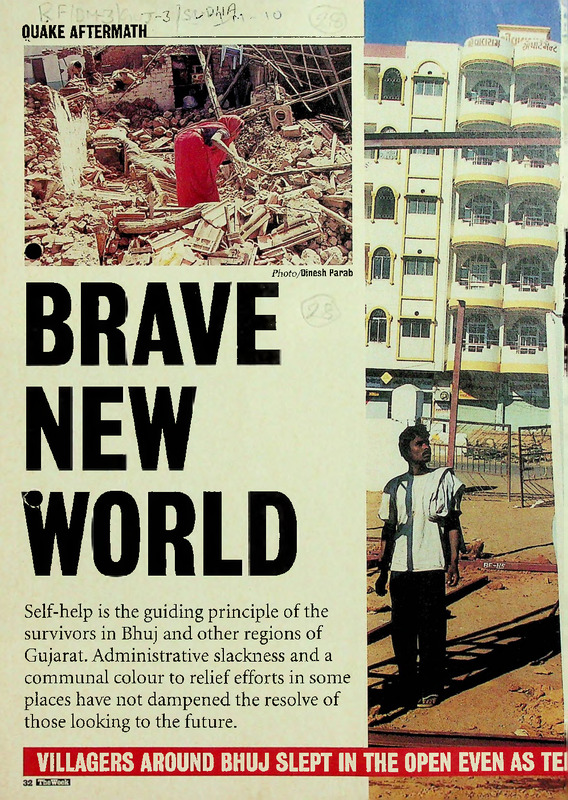
QUAKE AFTERMATH
f
©
Photo/Dinesh Parab
BRAVE
NEW
WORLD
(2E7
Self-help is the guiding principle of the
survivors in Bhuj and other regions of
Gujarat. Administrative slackness and a
communal colour to relief efforts in some
places have not dampened the resolve of
those looking to the future.
VILLAGERS AROUND BHUJ SLEPT IN THE OPEN EVEN AS TE
Crims
Birth of a (ton®
Guru Satam moves away from the shadow of Chhota Rajan by
killing film producer and Dawood associate Hanif Kadawala
fter a brief lull, gangland killings have once again
tional and produced movies like Sahibaan (Sanjay Duttstarted in Mumbai, this time with the gunning
Madhuri Dixit), Baap Numbri, Beta Dus Nunibri (Kader
down of video cassette king and film producer
Khan, Aditya Panscholi and Farah), DiJ Hi To Hai (Jackie
Hanif Kadawala, 45, on February 7- An accused in the
Shroff in a double role with Divya Bharati and Shilpa
March 1993 serial bomb blasts, Kadawala was allegedly a
Shirodkar) and Sanam (Sanjay Dutt and Manisha Koirala).
close associate of underworld don Dawood Ibrahim and
Two of his projects, Street Singer (Ajay Devgan and Shilpa
owned the prestigious Tava group ofrestaurants in Mumbai.
Shirodkar) and Jung were abandoned when he was ar
Around noon, a sharpshooter whom Kadawala ostensi
rested in June 1993 for his involvement in the Mur^wi
bly knew entered his Bandra of
serial blasts.
fice, whipped out a gun and fired
Kadawala and Hingora
five bullets into him. The killer
were charged, under TADA,
then escaped in a waiting ve
with passing on an AK-56 as
hicle. Guru Satam, Dawood’s
sault rifle to actor Sanjay Dutt.
rival Chhota Rajan’s former
Later, they melted down the
henchman, has claimed credit
rifle and destroyed the evi
for the killing and in the process
dence. Dutt spent nearly two
announced his ‘independent ar
years behind bars before get
rival’ in the underworld.
ting bail, and Kadawala was
Senior police officials said
jailed for four years. He was on
that Satam had been waiting to
bail when he was killed.
take control of Rajan’s extor
It is said that Satam has
tion businesses in Mumbai for
been trying to set up an inde
some time. The Dawood gang’s
pendentbase in Mumbai along
unsuccessful bid on Rajan’s life
with local don Ravi Poojari and
in Bangkok in September last
Bangalore don Muthappa Rai
year had sent most of Rajan’s
(who is believed to be in Swit
men underground.
zerland). The police are inves
Dawood also received set
tigating their possible involve
backs subsequently. The arrests
ment in the attack on Ra|^
of Bollywood producer Nazim
who is now believed to bWri
Rizvi and diamond king and film
Vietnam.
financier Bharat Shah were a
The police had arrested 165
big blow to Dawood, who is hid
persons in connection with the
ing in Karachi. Satnam prob
serial bomb blasts, ofwhom 30
GURU SATAN’S TARGET COULDN’T
ably felt that it was the right
are still in custody. Seven, in
time to strike and fill the vacuu m
cluding Kadawala, have been
HAVE BEEN BETTER. APART FROM BEING
left by the big players. But hav
gunned down. The others killed
CLOSE
TO
DAWOOD
AND
MANAGING
HIS
ing earned two enemies—
are: builder Wajidkhan
FINANCES IN MUMBAI, KADAWALA
Dawood and Rajan—Satam has
Walikhan Mohammed Khan in
to tread carefully now.
March 1998; Bismillah Khan
(ABOVE) OWNED MAGNUM VIDEOS,
Satam’s target couldn’t have
alias Salim Kurla in April 1998;
WHICH HE STARTED WITH PARTNER
been better. Apart from being
Salim Qasim Rehmatullah alias
SAMIR HINGORA IN THE 1970s.
close to Dawood and manag
Salim Passport in May 1998;
ing his finances in Mumbai,
Mohammed Mustafa Jindran
and Kiran Govardhan Pandey in June 1998; and Noor
Kadawala owned Magnum Videos, which he started with
Khan in December 1999partner Samir Hingora in the 1970s. During the video
One lucky survivor was former collector of customs,
boom of the mid-1970s and the late 1980s they flooded
Somnath Thapa, who escaped with bullet injuries and is
the market with videos of new and old movies and made
awaiting trial. Some police officers are concerned that the
a killing.
killings could weaken the prosecution case.
As the cable industry bloomed in the mid-1980s, the
Quaied Najmi
duo changed tracks to launch Magnum Films Interna
A
Feb 18 2001
fcviiaaaa 3i
ByB. Krishnakumar/BhuJ
s the Army and as
sorted
agencies
struggle to clear the
debris of the earth
quake that all but
obliterated much of Kutch, Anil
Mukhim is showing the way. The
new collector of the district walks
into his chamber in Umed Bhavan
in Bhuj though its first floor has
collapsed. He operates from there
with asmile and an open-door policy.
It is a confidence-building move and
it shows. The rest of the staff has
moved in, too. Till Mukhim took
over, the district administrationnumbed by the quake—was operat
ing out of tents.
A stream of complainants, offic
ers and staff make Mukhim’s office a
beehive. He is polite but firm, telling
help-seekers where to go. “You want
tents? Ok, go to your taluka office;
these have been dispatched there,”
he tells one persistent complainant.
An engineer from CIDCO,
Mumbai, complains that he has not
been given a scale map of Bhachau,
the ravaged township that the
Maharashtra government is help
ing rebuild. When the collector says
it may not be possible to trace the
document, the engineer replies he
has tracked down the map to a
particular office in Bhuj. All he
needs is an official to accompany
him.
The collector asks an officer to
make the necessary arrangements,
only to be told that the office con
cerned is locked because the build
ing is damaged. The CIDCO engi
neer volunteers to do the risky part,
but is frustrated by a typical bureau
cratic reply: “How can we enter the
office without permission?” Mukhim
A
A window of opportunity
RELIEF MATERIAL HAS BEEN POURING IN BUT DISTRIBUTION
IS HAPHAZARD. THE OUTBACKS WERE STILL TO GET TENTS
AND BLANKETS EVEN ON FEB 6. (ERECTING A PREFAB HOUSE
IN BHUJ; SALVAGING THE REMAINS IN MARDIA VILLAGE, TOP)
Phofo/Sanjay Ahlawat
IHPERATURES
DIPPED TO
-5CELSIUS SOME NIGHTS.
—*
--- •
——
4®
ESEZS33 33
QUAKE AFTERMATH—________________
$
A fluid situation but no dearth of hope
"NOW IT IS FIRE-FIGHTING WHICH WILL CONTINUE FOR AT
LEAST 15 DAYS AND THEN WE WILL TAKE UP REHABILITA
TION," SAYS KUTCH COLLECTOR ANIL MUKHIN (BELOW). A
SURVIVOR QUENCHES HER THIRST IN BHUJ (ABOVE).
tries to assuage the engineer, telling
him that he would try to get the docu
ments.
Mukhim’s priorities are clear: ‘The
first thing is to make the people be
lieve that the system is functioning.
Now it is fire-fighting which will con
tinue for at least 15 days and then we
will take up rehabilitation.”
Mukhim is making a gallant at
tempt to kick-start the system. Power
supply was restored three days after
the quake, and water was being pro
vided in Bhuj, Bhachauand Anjar.but
that is a trickle considering the vast
ness ofKutch. Reliefmaterial has been
pouring in but distribution continues
to be haphazard. The outbacks were
still to get tents and blankets and nor
mal water supply even on February
6—and to think that over 350 villages
ofthe 1,000 in Kutch have been razed
by the quake.
In Loriya village, whose 500 dwell
ings have been reduced to rubble,
brothers Ramji and Kanji are sifting
through the remains or
their home-cum-flour
mill. “Nobody has come to
help us,” says Kanji.
Their humble homes
were a blessing: “We ran
out the moment we heard
the first rumble. So the ca
sualties were low, only
three people died here,”
says V.K. Jadeja, a lab as
sistant with the geology
department. The villagers
slept in the open even as
temperatures dipped to
5°Celsius some nights.
In
neighbouring
Dhrang, where all the 200
houses have collapsed,
'WE WERE LIKE BROTHERS. NOW THEY ARE FIGHTING ON G
34 EE233
Feb 18 2001
farmer Laxman Mehra says the vil
lagers have been living in the open
for eight clays and getting food and
wate r occasi o n al ly fro i n reliefteams.
In Lodai, supposedly the epicentre
of the quake, hectic activity is on
around the panchayat office. Trac
tor-loads of foodgrains, clothing and
tents are being driven off to be dis
tributed among various bastis
(wards). A pan shop is open as in
Bhuj and other affected areas, doing
brisk sales of gutka, cigarettes and
bidis.
Over 800 structures tumbled in
this village of 5,000 people but the
xleath toll fortunately is only 23.
jThere is an occasional complaint
about lack of power supply, water
and even food, but by and large life
seems to be springing back amid the
rows ofcrumbled houses. Home fires
are burning though on pavements
and open spaces.
Self-help seems to be the guid
ing principle as people pick up the
pieces ofwhat were homes and move
into tent-houses. A unit from the
Army (6 Maratha) is at hand, put
ting up community tents and proending medical relief. They are try
ing to put behind the nightmare of
January 26 when 20 of their folks
were crushed to death.
In Sukhpar, 7 km from Bhuj,
confusion reigns as a bundle of plas
tic tents is dumped on the roadside.
lit is February 6, eleven days after the
?[uake and there is no administra
tive presence here. Adam, a farm
labourer, and Sulaiman Rehman
who works with the Gujarat Elec
tricity Board as a lineman, are sul
len. “Nothing has come from the
government, people are fighting
among themselves to grab whatever
is dumped by various voluntary agen
cies,” they say.
The friends blame the so-called
aid committee members represent
ing the Patels, Harijans, Muslims
and Khalifas for cornering what they
want first. “We were like brothers.
Now they are fighting on caste and
community basis for reliefmaterial,”
says Adam, tears streaming down
his face.
Photos/ft. Krishnakumar
Men with a mission: Col. Gurdip Singh and Maj. Y. S. Rao of'the
Sappers at work in the Jain Bhavan Complex in Bhuj
Army plays a hero’s role
n February 4, a team from the 12 Engineering Regiment was at
Owork
in Bhuj struggling to pull down a five-storey building that
seemed to be leaning on thin air. Implosion was not feasible given its
precarious tilt.
Engineer-in-chief Brig. Kiran Krishan and Col. Gurdip Singh were
supervising the operation. The building withstood the pull of the
massive military crane and the banging of the heavy earthmover from
morn till sunset. It was finally felled the next day, bringing to an end just
one of the many difficult jobs assigned to the unit. Another team from
the unit is declogging the lanes in an old enclave of Bhuj. It is close to
meeting up with a group from the 108 Engineering Regiment that had
cut and bulldozed its way through the Soni (Gold) Market.
The 12 Engineering Regiment is also at work at Jain Bhavan, a
residential complex in Bhuj, which collapsed. The first building in the
complex housed the largest number of people and the army mounted
its biggest operation there. It retrieved 70 bodies from the Bhavan.
There were about 500 families in the complex and it was a challenging
task to look for survivors. “At great risk to their lives, our men have gone
in search of survivors wherever we found a cavity,” says Col. Gurdip
Singh, commandant of the unit better known as the Sappers.
The colonel, who has commanded a unit in Angola, says the devas
tation here is much more than what he has witnessed elsewhere. With
Maj. Y.S. Rao, he moves from site to site and reports progress to Brig.
Krishan. His regiment is also at work at the collapsed Syndicate Bank
and civil hospital buildings, from where they retrieved 80 bodies.
There are more than 25,000 men and officers from the elite Army
regiments—Sikh Light Infantry, the Sappers, 6 Marathas, 2 Marathas—
backed by men from the BSF, CRPF, SSB (Special Sendees Bureau,
which operates around the border), state police and the Home Guard
at work in Kutch today. The army has the toughest assignments.
If Bhuj and other quake-hit areas are wobbling back to normalcy,
the nation has to salute these gallant men.
B. Krishnakumar
STE AND COMMUNITY BASIS FOR RELIEF MATERIAL.'
Feb 18 2001
EEEE53 35
QUAKE AFTERMATH____________________
Rebuilding minds
Latur youth strive to reopen schools
do you want to leave? It’s better you die here in front ofour eyes,”
Why
said Limbaji Pratale’s mother when he told her that he wanted to
seek a new life in Pune, a few days after an earthquake had struck his native
Talani village in Latur.
The standard six student was too scared to stay back and wanted to join
his friends who were fleeing the village. “I simply cried until she relented.”
Seven years later, Limbaji, 19, did not wait for permission to leave for
Gujarat.
“The quake on Republic Day brought back harrowing memories of the
past. I could not sleep," he says. ‘The thought that somebody might be
waiting for help under the debris, just as I had on the night of September
30,1993, brought me here.”
Like Limbaji, there are a hundred youth from Latur camping in
Bhachau as part of a 500-strong Bharatiya Jain Sanghatana relief team
from Pune.
For them, it is like revisiting a nightmare. Limbaji’s eyes well up as he
talks ofhis sister and brother-in-law who lost their lives and his father who
was was handicapped in the Latur quake.
But there is little time to waste. “The Kutch tragedy is ten times greater
than ours, because rescuers arrived here very late,” says Atmaram Javalge,
18, of the National Cadet Corps, who lost his mother in 1993. Bodies had
started rotting in many villages by the time the Sanghatana arrived on
January 28.
Since there was little that they could do in terms of rescue operations,
the Sanghatana moved instantly to provide relief and restart schools in 40
villages in Bhachau.
Since many children had lost their lives during Republic Day ceremo
nies in schools across Kutch the Sanghatana volunteers very gently men
tioned restarting schools to the elders. Contrary to their expectation, the
reaction was almost always positive even in villages like Samikhiyali,
which was completely flattened.
“Within a week ofthe tragedy, we had had two meetings with the village
elders and teachers,” said Shantilal Muttha, founder-president of the
Sanghatana.
In 1993, Muttha brought children—orphans or those who had lost a
one parent—from Latur to Pune within 20 days of the earthquake and set
up a school. Today, the first batch of students from his school are in
college—Limbaji plans to do BA Economics, and Tukaram Mhaske, 22, is
a final-year graduation student.
Muttha also has 350 students from the malnutrition-hit Melghat area
of Maharashtra and orphans from across the state.
These students expressed an instant bonding with the children in
Kutch when I men tioned this visit to them. In fact, we witnessed a virtual
scramble to get names included on the volunteer list,” said Muttha. “Many
of my friends felt very disappointed on being left behind,” says Tukaram.
Muttha, who worked for Latur’s reconstruction, believes that putting
education back on track is the greatest challenge in the aftermath of
tragedies of such high magnitude, as it is given much less importance than
medical aid, food or shelter.
Anosh Malekar/BJiac/iau
Murmurs ofcommunal dissent are
being heard in the hour of grief.
Ratabhai Ahmedbhai Kevar who
works for the Kevar Yuvak Mandal
Relief Committee alleges that non
vegetarian relief supplies from Saudi
Arabia are being seized and dumped
by VHP and Bajrang Dal volunteers.
Ikram Mirza of the Ideal Relief Wing
ofJamat-e-Islami Hind backs him up:
“We don’t know where these things
have gone.”
Javed Dhupelwala, an indepen
dent corporator from Baroda, makes
a more specific charge: “The RSS men
stopped our vehicles near Madhopar
REHABILITATING THE VILLAGERS WOULD BE THE TOUCHES'
36 ItLfrl'.rai
Feb 18 2001
swing from -5°C in the night to 35°C
in the day during winter and to al
most 50°C in summer.
Mohammed and his family
Fakir
continue to live in their small
Illustra t/on/Bhaskaran
The trauma of the living
“NOTHING HAS GOME FROM THE GOVERNMENT, PEOPLE
ARE FIGHTING AMONG THEMSELVES TO GRAB WHATEVER IS
DUMPED BY VARIOUS VOLUNTARY AGENCIES,’’ SAY
RESIDENTS OF SUKHPAR, SEVEN KM FROM BHUJ.
and asked: ‘What are yon carrying in
the vehicle? If there are bread and
biscuits give it to us.’ We showed
them that we were carrying rice and
water and then they said, ‘Ok, go
on’.”
These are hopefully aberrations
among what are essentially the most
hospitable people who happen to live
in the most inhospitable of terrain
and clime. Huge stretches of the
Kutch are marshy and temperatures
and slightly damaged dwelling in
the heart of Bhuj, and people are al
work in his garage which is tempo
rarily attached to it. The original
work place, at the other side of the
town, is a shambles but Fakirbhai is
not unduly perturbed.
“Where will you have your
lunch?” he asks as we make the
rounds of the city’s various ‘opera
tion theatres’ where the army is at
work. There are no eateries open on
February 5 but for some bhajiya
stalls. “You are coming home with
me,” he says with a finality. They
treat guests as family: “Come right
in, wash your hands,” he says usher
ing me into the house. Meal is
promptly served: tasty jowar rotis
and vegetable curry.
The next day one bumps into Pir
Asikali, in his late fifties, near what
used to be his palatial mansion at
Khoja Faliya. “It was spread over
10,000 sq. ft.,” he says with a smile.
He and his family were trapped in
the debris of their bungalow till 11
a.m. of February 28 when men of the
6 Maratha Light Infantry rescued
them. Asikali says his property' was
worth at least Rs 1.5 crore; all that
remains is a heap of bricks and con
crete. He is banking on a new luxury
bus, now in Ahmedabad like the rest
of his family, and a truck to keep
them going.
As we drive back to town, Asikali
waves us to a halt. “Where are you
goi ng to stay overnight?” he inquires.
“At the Kutch Vikas Trust campus (a
haven for the quake-hit and visi
tors),” I reply. “You will have to sleep
in the open and it is very chilly these
days, especially after the earthquake.
Come to my sister’s house at Jai
Nagar. You can stay there tonight,”
he insists.
Jai Nagar, housing 70-odd fami
lies, is a picture of harmonious com
munity life. “There is no caste or
community divide here. We all live
as an extended family,” says Asikali.
OF THE MANY TASKS THE GOVT HAS AT HAND.
Feb 18 2001
ES3Z53 37
QUAKE AFTERMATH
History now: Lakhpatji’s chhatardi before and after January 26
Goodbye, from Ash and me
had rebuffed a brute of a quake nearly two centuries ago. Survived the
Itsizzling
presence ofAishwarya Rai. Even the thuds of my excited heart
beats. Sadly, Lakhpatji’s chhatardi could not survive Republic Day 2001.
“Yes, Lakhpatji’s chhatardi has been destroyed and a portion ofthe Aina
Mahal has collapsed. The whole of Bhuj is in ruins.” My heart sank when
Dilipsinghji, the descendant ofthe erstwhile ruler of Bhuj, told me the news
with a grim finality in his voice. The chhatardi, known for its umbrella
shaped roof, was an object of perpetual fascination for frequent visitors to
Bhuj like me. Inside its engraved sandstone pillars and gleaming dome
swirled stories of love and sacrifice.
The chhatardi was built in the late 18th century in memory of Bhuj’s
ruler Lakhpatji (1752-61) and his 16 queens and mistresses—all of whom
jumped on his pyre—by his son Maharaoshri Godji. Aina Mahal, known for
its mirrored room, was built by Lakhpatji at a cost of 8 million koris.
Lakhpatji was undoubtedly a connoisseur of the arts. And though
foreign trade and industry received a boost during his rule, his obsession for
the dancing queens of the day and other cultural activities wiped out his
immense wealth.
Extravagant he may have been, but Lakhpatji did have fine taste. That
is why on each visit to Bhuj it was a ritual for me to visit the Aina Mahal
museum, where Kutch art and culture are on display, and the beautiful
chhatardi. Till some years ago, this monument was neglected but after some
scenes ofthe hit movie Hum Dil De Chuke Sanamwere shot here, it became
a major tourist attraction.
On my previous visit to Bhuj in November, I captured its beauty on film,
somewhat like Sanjay Leela Bhansali. Now I only have memories. And my
heart still thumps when I think of Lakhpatji’s chhatardi.
Jayant Pithadia/B/mj
Dinner over, his brother-in-law F.S.
Rayina, who is the registrar in the civil
judge’s court, tells me that Bhuj had
celebrated its 456th birthday on De
cember 1.
The conversation is snapped cis my
hosts rush for the door with Asikali
pulling me along: the alert comes from
a whoosh in the air as if a breeze was
whistling its way through a long corri
dor.
Though the colony has been left
unscathed by the January 26 quake,
barring cracks in the buildings, resi
dents sleep in tents. Asikali, though,
feels more at home in the small oneroom-kitchen
dwelling
of
Navinchandra Lalji who runs
Deepak Nastagrah and Guest Housch
in Bhuj town. “We are childhood
friends,” says Asikali.
The loud horn of a truck inter
rupts the discussion. Asikali’s truck
has arrived and it has a load for
Ahmedabad. In a split-second, he de
cides to head for the city where his
family is residing and the luxury bus is
parked. He has to get back to busi ness,
too.
Like brothers Dilawar and
Munnawar Damani who run Damani
Sales, an outlet for kerosene, lubri
cants and diesel near Bhid Gate. As
sisted by another teenager, they
opened the shop on February 1. “Busi
ness is picking up. There is demand
for kerosene and oil from the
autorickshaw
owners,”
says
Munnawar.
The Damani family lives in a tent
at Mehndi Colony; their row house
collapsed but his parents and younger
brother got out in time. Munnawar
was at work when the quake hit and
their small shop stands out in a local
ity that has all but been razed.
Down the road, the locality is en
veloped in dust and stench. Police
men, guarding whatever is left in the
debris, men of the Army, volunteer
agencies all wear a nose-mask. There
is a chorus of complaints from repre
sentatives ofpeople in the Babansiphir,
Vistrapura, Khatri chakla, Bhid Gate
and Sajarnamatam, all minoritydominated enclaves. They say that re
lief and clean-up operations have not
begun in their areas even 10 days after
PIR ASIKALI POINTS TO THE SPOT WHERE HIS PALATIAL M
38 IhnWABfr
Feb 18 2001
Photo/Paras Shah
A hunger to get back to business
move the machinery and manpower
to the affected areas. The problem
is of access into the alleys that have
BROTHERS DILAWAR AND MUNNAWAR DAMANI (BELOW)
disappeared under mounds of de
STARTED AN OUTLET FOR OIL AND KEROSENE IN BHUJ ON
bris in inner Bhuj, all of Bhachau
FEBRUARY 1. “DEMAND FROM AUTORICKSHAW DRIVERS IS
and Anjar. The removal of debris is
PICKING UP,” THEY SAY. (AT A COMMUNITY KITCHEN, ABOVE)
a mammoth task, and then the big
question: where to rehabilitate
people, Mukhim says.
the disaster.
Thousands of people
Says Ali Mohammed Jat, a
are camping on the large
Tbrmer member of the Bhuj Munici
Jubilee and middle
pal Council: ‘There has been 100 per
school grounds, the tent
cent destruction and bodies are still
enclaves put up by the
lying under the debris. Nobody is
Army and Central and
providing us essentials, no water
state police forces, and
tankers come here, no medicines.”
on the pavements outside
Ismail Manjoti, who is a BJP coun
damaged houses in the
cillor of Ward 11, is fretting that “till
towns. And then there are
date we have not got tents and blan
the thousands in the vil
kets. Nothing from foreign aid agen
lages all over Kutch.
cies has reached us.” He and a bunch
Reaching them and re
of complainants from various wards
habilitating the villagers,
gather outside the collector’s cham
who complain that they
Photo/3. Krishnakumar
ber and angrily demand a meeting
are last on the list of the
council,” Mukhim says even as two
with him.
administration’s priorities, would
men hold up bottles of muddied
Once they meet Mukhim, the
be the toughest of the many tasks
water. He assures them that the
team is appeased and gets back to
Mukhim has at hand.
tanker-owners involved will be dealt
their wards convinced that some or
He has a made abeginning, and
with.
der has been restored in the admin
the people are lending him a help
The Herculean task before the
ing hand by trying to help them
istration. “I have handed over part of
district collector and his team is to
selves.
the responsibilities to the municipal
SION STOOD. “IT WAS SPREAD OVER 10,000 S
Feb 18 2001
ES5TS 39
Personnel deployed* in worst-hit Kutch, 2s
senior IAS officers, 107 administrative officers, 2,104
technical'staff, 197 police officers, 10 SRP companies;
22,500 armed forces, 3,000 para-military, 1,349
Home Guards and 690 police personnel; 13,355
manpower engaged through contractor.
line families in rural areas
♦ Rs 22,000 per dwelling unit for affected districts
♦ CAPART earmarks Rs 5 crore to meet short and longterm relief and rehabilitation activities ♦ Rural Agro Research Development Society has sent
10,000 tarpaulin sheets, 20,000 chatais for setting up
tents.for. 10,000 families
Utilities: Power restored in 9 town's and 785 villages
♦ Telecommunication links partially restored
♦ Water supply restored through pipes, tankers and
other sources
♦ Road, rail a nd .air traffic, near normal
.
...
A roof above: Shelter made by urban development ministry
Health: 395 hospitals functioning; 34 in Kutch.
♦ 256 mobile teams to treat injury cases and ensure chlorination/disinfection.
♦ 2,371 medical officers, 615 specialists (298 from other
states) and 5,536 para medics deployed, in affected areas
♦ Mental health experts from NIMHANS and Al IMS
♦ 12 special teams of veterinary doctors
Photo/Arvind Jain
Food and fuel supplied* 6471.3 tonnes food
,grain,106,7 tonnes milk powder, 555.815 tonnes
^vegetables, 349 tonnes edible oil, 6,844 kilo litres diesel,
-2,909 kilo litres petrol; 4,601 kilo litres kerosene and
-82,700 kitchen kits distributed in Kutch, Ahmedabad,
jRajkot, Jamnagar, Surendranagar districts.
Rural hOUSingZ Additional allocation of Rs 25.0
448 NGOs and 7,332 volunteers for relief work
Rs 13.06 crore from NGOs and individual donors
Rs 16.51 crore from other states
Rs 88.14 ex-gratia to 1.15 lakh persons
Rs16.42 lakh to 1,909 families for household kits
Rs 203.04 lakh death compensation for 283 people
crore for earthquake-proof housing for below poverty’
Corporate largesse
Reliance Industries Limited: Dhirubhai Ambani donated
RsScroretothePM’sReliefFund AdditibnalRsIScrore
for Anjar. A medical team rushed to affected areas.
Company aircraft, helicopters, equipment and person
nel used for relief work.
Larsen and Toubro: Rs 5 crore for construction activities.
Studying quake-proof designs. To assist Maharashtra
government in reconstructing Bhachau.
Public sector banks: Rs 25 crore to PM’s Fund.
Indian Airlines: Rs 2 crore, including Rs 1 crore from
employees.
Bombay Diamond Merchants’ Association: To collect Rs 20
crore and send through Gem and Jewellery National
Relief Foundation.
Dabhol Power Company: Sent a helicopter for relief opera
tions, a dozen doctors and paramedics.
Hlndgja Foundation: Rs 5 crore. Fifty-bed facilities for
victimsatthe P.D. HindujaNational Hospital in Mumbai.
Videocon Group: To rebuild 250 houses in Bharuch and
collect 1,000 bottles ofblood.
LIC Housing Finance Limited: Concessions in repayment of
loans.Newschemesforrepairsandreconstructionofhouses
Healing touch: Nita Ambani consoling a child at Anjar
-
Situation report as on Feb. 7
Population affected
3.78 crore
Districts
21
Villages
8,792
Human deaths
16,480
Injured
1,44,927
' District
Warm relief: Dresses heaped on the road for quake victims in Bhqj
Photo/Saqjay Ahlawat
Helping hands
External assistance from 38 countries
World Bank
$300 million
Asian Development Bank
$350 million
Japan
$ 3 million
European Union
Euro 38 million
CARE
$3.5 million
World1 Food Programme has launched an emergency operation
to feed more than 300,000 victims through afour-month, $4
million operation. The agency has been delivering high-energy
biscuits in Bhuj. Around 178,000 people, mostly pregnant
women, nursing mothers and children will be given these
biscuits for two months, after which they would be given a
nutritous blend called Indiamix for another two months.
Dead
Injured
Ahmedabad
750
4,037
Jamnagar
119
4,592
Kutch-Bhqj
14,927
1,15,940
Rqjkot________
410
10,568
Houses collapsed
2,28,906
Cattle deaths
18,352
Estimated loss of property
Rs 13,500 crore
Impact on trade & industry
Rs 2,000 crore
Operation Bhuj
riel Sharon’s victory7 in the Israeli election -1
Ahas
made its mark-in Bhuj. The eighth ....... r- *
baby born in the Israeli Defence Force’s mobile
hospital in the earthquake-ravaged town has
been named Sharon. Like two other premature
babies, Sharon is nurtured in an incubator.
By February 5, the 70-bed Israeli medical
unit had treated 700 patients including a man
who had a heart attack and a woman who had a
stroke. The 80-member team is led by Dr
Yehuda Baruch.
-7 J.
' -.17.
" ’ ■3
;: • j
;
■■ - r
L77J.
J
at concessional rates. Processing fees waived.
NASSCOM: Rs 5 crore from members. California-based experts .
to formulate methods for better preparedness.
Nortel Networks: To give $100,000 towards relief operations.
J.B. Chemical and Pharmaceuticals Limited: To adopt Vavania
village in. Rajkot. Will, construct 250 houses. Company pro
moters, the Modis, to donate Rs 1 crore. Medical aid worth Rs
15 lakh despatched to Bhuj, Mom and Bharuch.
Zydus-Cadila: Rs 1 crore worth medical aid distributed.
Power-gen India: Rs 1 crore to the PM’s Fund. Sent a medical
team to quake-hit areas.
Mqjor PSUs: To adopt groups of villages for relief and
reconstruction.
CH, FICCI and ASSOCHAM: To adopt large clusters of villages for
relief and reconstruction.
FICCI-CARE: To provide temporary shelter, water/sanitation/
electricity, quake-resistant housing, construction of perma
nent social infrastructure (schools, clinics, anganwadis, tube
wells), help to small business establishments and craftsmen.
Contributors/^. Krishnakumar, Qualed N^jml, Palash Kumar
Life goes on: An Israeli doctor observing a newborn
P/iofo/Sanjay Ahlawat
It is all precision-driven: patients are
segregated on arrival and moved to the OPD,
operation theatres, ICUs and the paediatrics
ward. While delivering one of the premature .
f.'? ...
babies, the surgeons had a delicate task: operate •
the damaged skull of the baby even as the
caesarian was on. “No one died here. We can
treat 1,000 patients every day,” says IDF spokesperson Idit Dudveoany. The unit comprises a
rescue team, a lab, an X-ray tent, sleeping
quarters and a logistics group.
a
Graphics/W. Jose
QUAKE AFTERMATH
Pride of broken hearts
The Kutchis are ready to fight it out on their own
itting in a camp for
earthquake victims
Velabhai Mesanbhaib
Harijan recalls his dreams.
His children, Raniben, 20, and
Nagjibhai, 15, were his passport to a
better life. But Velabhai’s dreams
were crushed when both Raniben
and Nagjibhai were found dead
S
Chokdi: February 1,2001
The village was reduced to
nibble. Ganga Ben
clings to her baby,
the only one left to
call her own.
42
under the debris of their house in
Lunwa village in Bhachau.
“Now it is a question of our
survival,” says Velabhai’s wife,
Paruben. Velabhai is too weak to
work in fields and their landlord
Samjibhai Lakman Patel’s
house was also reduced
‘ to rubble. With no
j power to draw water into his fields,
1 his castor crop is under serious
! threat.
Samjibhai, however, has
I sufficient foodgrain under the
I rubble to feed the Harijan family
and his own for about three
months. They hope to be on
the recovery path by then.
Illustrations/
Bhaskaran/B/iuf
Feb 18 2001
They expect no relief from the
government or voluntary agen
cies. “We were given blankets,
foodgrain, tea, sugar and stoves.
That is enough,” says Velabhai. In
fact, all that the 350 homeless
families in this village ask for is
tarpaulin sheets to erect tents;
sleeping in the open in the chilly
nights is near impossible. For now
they manage with a bonfire, but it
is no permanent solution.
Villagers like Velabhai across
Kutch may be heartbroken but
not disheartened. Says Valjibhai
Patel of Voundh village: “Bahut
seva ho gaya. (We have had
plough of relief). How long can
-we survive on aid from outside?
As time passes we will wipe our
tears and rebuild our lives.”
In fact, the grit of the Kutchis
has forced government officials
in Anjar to rethink the proposal
' from NGOs and corporate houses
| to start community kitchens. “It
1 would wreck the people’s ‘self• help’ effort,” says Sanjay Gupta, a
i senior IAS officer, who was
! dismayed by news reports about
people looting relief material.
: “There has been not a single
I incident in Anjar. The Kutchis are
1 a ven- proud people,” he says.
“They should not be maligned
because of some stray incidents.”
Septuagenarian Gangaben
Patel of Voundh village would
' rather scrape through the rubble
| of her house than stand in a long
I queue for a sari. Well past 6 p.m.
1 Gangaben locates the brand-new
Lodai: February 1,2001
The epicentre of the killer quake.
Claimed 170 lives in the village, and
brought down all the houses. Maya
Samad lost everything—her hus
band, children and grandchildren.
Jikdi: February 2,2001
Eighteen villagers died.
Rethi Bai lost all her
four children. No relief
has come by. Not even
drinking water.
ES233 43
Feb 18 2001
QUAKE AFTERMATH
Modpur: February 1,2001
The quake claimed 97 lives. But spared the baby in the crib.
The orphan is being taken care of by the surviving women.
embroidered ‘ghaghras’ (long
skirts) she had made for her two
daughters.
The Kutchis prefer traditional
clothes like ‘choli-ghaghra’ and
‘wanjada-ganji’. There are very few
takers for saris, shirts and trousers,
and many relief teams abandoned
their stocks on the roadsides, says
Shantilal Muttha of the Pune-based
Bharatiya Jain Sanghatana.
Amid death Gujarati hospitality
was alive. Sister Suma from the
Missionaries of Charity7, Baroda,
recalls her first moments in Vamka
village: “A group of women were
crying; they had lost children,
wealth and property.” Then the
women amazed her by offering to
cook a meal for her.
The missionaries have been
44
concentrating on medical aid.
But marginal farmers like
Valjibhai Sonabhai Ahir of
Zhikdi village in Bhuj are more
concerned about the future of
their wheat, bajra and castor
crops. With no power, the
pump sets on borewells
have stopped working. An
impending drought
staring in his face,
Valjibhai sees hard times
ahead.
Lunava: February 2,2001
The entire village
perished. Geeta Ben is
in a daze. She lost her
family of six.
Failure of crops
would hit animals
as well as humans.
Father Joseph
"
Kunnath. managing
trustee of Kutch
Vikas Trust,
Raidhanpur, said
most farmers depend
on their crops to
feed their cattle.
The Kutchis are
used to coping with
droughts; last year’s
drought was the
33rd since indepen
dence. But the
hardships caused by
the first major quake
since independence is
bound to rock their
lives for a long time.
Anosh Malekar/
Kutch
Feb 18 2001
Position: 569 (31 views)