RF_DM-3_BHO-2_SUDHA.pdf
Media
- extracted text
-
RF/0M-3/i3ho
HEALTH &
RIGHTS
Thelma Narayan
tells how an
international
campaign has
supported the
case of victims of
an industrial
disaster in India.
Combating inequality
I
hopal has come to symbolise industrial dis
asters. The world’s worst industrial acci
dent occurred here in December 1984 when
a massive leakage of toxic gases from a pesticide
plant affected over 500,000 people. Unaware of the
potential hazard of the ‘neighbourhood’ plant, or
of precautions to be taken in the event of an acci
dent, the innocent paid dearly with their lives and
health. Government of India estimates are of 1,700
dead in the early phase; unofficial estimates are
higher. As always, the poor were worst affected.
Devastated lives
Today, sickness and death rates are even higher and
studies suggest that they will continue to rise. Im
mune and respiratory systems have been damaged.
r^-l
I
Nt
•
'J
£
£
sL
^1
> . Am
r
WF
I®
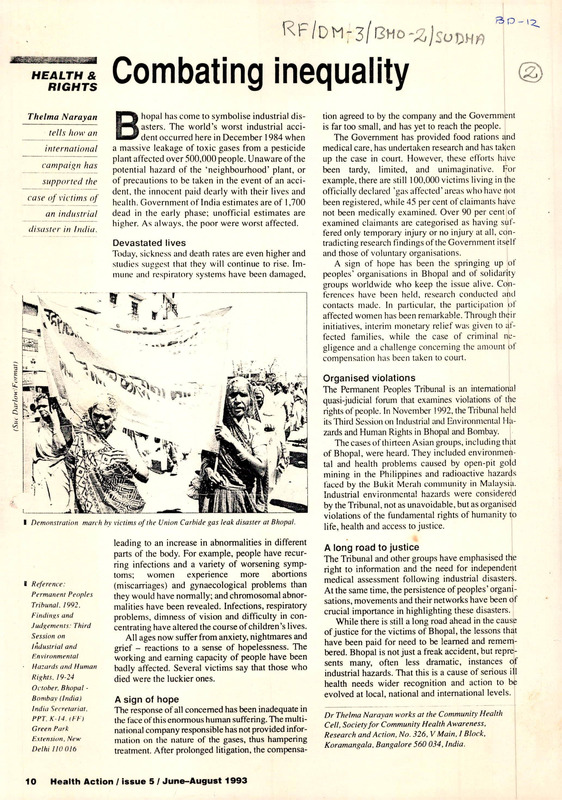
I Demonstration march by victims of the Union Carbide gas leak disaster at Bhopal.
B Reference:
Permanent Peoples
Tribunal. 1992,
Findings and
Judgements: Third
Session on
Industrial and
Environmental
■
Hazards and Human
Rights. 19-24
leading to an increase in abnormalities in different
parts of the body. For example, people have recur
ring infections and a variety of worsening symp
toms; women experience more abortions
(miscarriages) and gynaecological problems than
they would have normally; and chromosomal abnor
malities have been revealed. Infections, respiratory
problems, dimness of vision and difficulty in con
centrating have altered the course of children’s lives.
All ages now suffer from anxiety, nightmares and
grief - reactions to a sense of hopelessness. The
working and earning capacity of people have been
badly affected. Several victims say that those who
died were the luckier ones.
October, Bhopal ■
Bombay (India)
h sign of hope
India Secretariat.
PPT. K-14. (FF)
The response of all concerned has been inadequate in
the face of this enormous human suffering. The multi
national company responsible has not provided infor
mation on the nature of the gases, thus hampering
treatment. After prolonged litigation, the compensa-
Green Park
Extension. New
Delhi 110 016
10
tion agreed to by the company and the Government
is far too small, and has yet to reach the people.
The Government has provided food rations and
medical care, has undertaken research and has taken
up the case in court. However, these efforts have
been tardy, limited, and unimaginative. For
example, there are still 100,000 victims living in the
officially declared ’gas affected’ areas who have not
been registered, while 45 per cent of claimants have
not been medically examined. Over 90 per cent of
examined claimants are categorised as having suf
fered only temporary injury or no injury at all, con
tradicting research findings of the Government itself
and those of voluntary organisations.
A sign of hope has been the springing up of
peoples’ organisations in Bhopal and of solidarity
groups worldwide who keep the issue alive. Con
ferences have been held, research conducted and
contacts made. In particular, the participation of
affected women has been remarkable. Through their
initiatives, interim monetary relief was given to af
fected families, while the case of criminal ne
gligence and a challenge concerning the amount of
compensation has been taken to court.
Organised violations
1
1
ri O -
Health Action / issue 5 / June-August 1993
The Permanent Peoples Tribunal is an international
quasi-judicial forum that examines violations of the
rights of people. In November 1992, the Tribunal held
its Third Session on Industrial and Environmental Ha
zards and Human Rights in Bhopal and Bombay.
The cases of thirteen Asian groups, including that
of Bhopal, were heard. They included environmen
tal and health problems caused by open-pit gold
mining in the Philippines and radioactive hazards
faced by the Bukit Me rah community in Malaysia.
Industrial environmental hazards were considered
by the Tribunal, not as unavoidable, but as organised
violations of the fundamental rights of humanity ^o
life, health and access to justice.
A long road to justice
The Tribunal and other groups have emphasised the
right to information and the need for independent
medical assessment following industrial disasters.
At the same time, the persistence of peoples’ organi
sations, movements and their networks have been ot
crucial importance in highlighting these disasters.
While there is still a long road ahead in the cause
of justice for the victims of Bhopal, the lessons that
have been paid for need to be learned and remem
bered. Bhopal is not just a freak accident, but repre
sents many, often less dramatic, instances of
industrial hazards. That this is a cause of serious ill
health needs wider recognition and action to be
evolved at local, national and international levels.
Dr Thelma Narayan works at the Community Health
Cell, Societyfor Community Health Awareness,
Research and Action, No. 326, V Main, I Block,
Koramangala, Bangalore 560 034, India.
Position: 3585 (2 views)