RF_DM-1_EPR(B)-5_SUDHA.pdf
Media
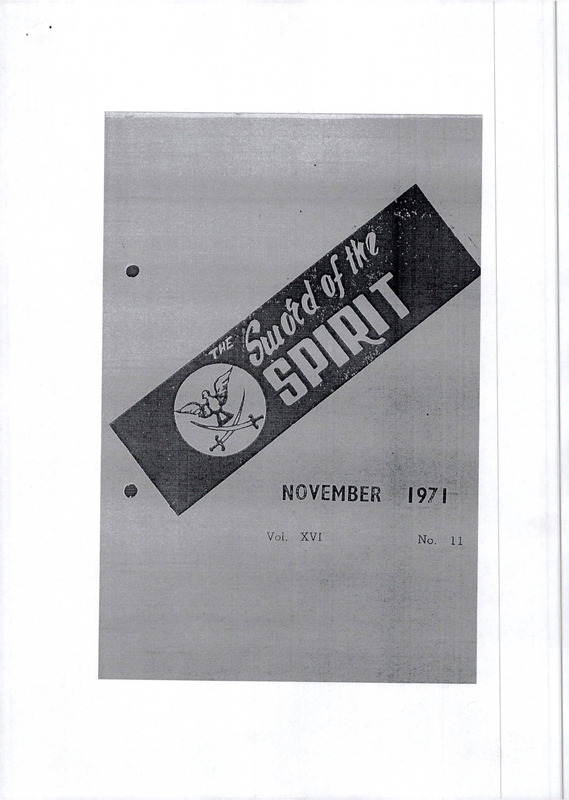
- extracted text
-
NOVEMBER
Vol.
XVI
1971
No.
11
‘ And lake auto you the helmet of salvation and
"lite ^tvcic) o/ (tie ‘ypi’ilt
(which is the word of Cody)
(Eph. VI. 1.)
NOVEMBER 1971
Vol.
XVI
25 P.
Editor t
No. 1 I
CONTENTS
SISTER ANGEL MARY
Principal, Mount Carmel
Coll ege
SR, Palace R nad,
Bduqalore 1-B.
Associate Editor :
SISTER M DOROTHY
Prof--as or of French,
Mount Carmel College
58. Palace Road,
Bangalore 1 -B.
PAGES
1.
Ed i tor i a I
2
Contemplative Religious
Their Rele\ancc N'dav
— S.M A.
3.
4.
5.
■&
Printer dt- I'tthlixher ;
M. R. SELVARAJ. B.A,
St, Mary’s Press
St. Mary’s Town
Ba riqnl'ire—5.
1
6,
7.
8.
3
Vouth Problem—Part H
—S.I3.C.
Love from a Stranger
— Frances Yasas
Extract from The Pageant
of the Popes"—(contd.)
I I
“Life Everlasting. Aman.”
— S.M.4.
13
Thoughts of Wise Men
— Chicko
14
8
10
News & Notes
Extract from Letters
16
Mother's Day Celebration
22
Tribute to
St. John ’s Do. tors
23
BusincS5 Manager :
Mr. S. ARDGYASWAMI
“ Sword of the Spirit
Archbishop’s House
18, Miller’s Road
Bangal ore-6.
Solemnity Marks Feast
of Cur Lady of Health
24
Subscription Rates :
A Course in Penmanship
25
Single Copy
25 P.
Annual Subscription Rs. 3
Advtrrlsement Rates:
Ra. 20.00
Full Page
Rs. 12.00
Hal| Page
Ra.
6.00
Quarter Page
Imprimatur:
Wm. L. D'McJIo
Vicar Capital ar
Bangalore
Dated 16-10-1971
oiiaL
The world is full of strife today and disaster looms
on the horizon. In men’s hearts there is hatred, fear
and suspicion, which cloud their vision. The freedom
and security of our country is threatened by our
immediate neighbour, once bound to us by the closest
ties of affection and esteem. We are now thinking in
terms of war with Pakistan, which may soon escalate
into a maj or world war. No man, however wants war, except
those who can make profit out of it.
It is rather
difficult to say anything with certainty, yet the
prospect of war is so bad and the consequences of war
g^ery bad indeed . But if war comes , it comes . To a great
^Wxtent today it has to be provided for, and all the
consequences of war have to be accepted. Our Govern
ment, our economy and our education should keep pace
with modern standards of economy and efficiency.
It is consoling however to go back in retrospect and
find that no matter what our private differences were,
when we were faced with a crisis, the nation rose as one
man to face it. Private and personal interests were
never permitted to prevail over national welfare.
We always settled international disputes in a
spirit of peace and fellowship, though we were obliged
to resist aggression when it occurred.
While non
violence does not mean surrender to evil, it also
requires that we should be ready to negotiate for an
honourable settlement, if and when an opportunity
offers itself.
We are convinced of the irrationality of war. We
know that it does not settle disputes, but when our
security is imperilled, when justice is violated, whe^S
the dignity of man is in question, when men are treated
like beasts, we are obliged to use force for defence
purposes and to oppose the champion of cruelty and
injustice. Peace can only come when nations are free
and also when human beings everywhere have freedom,
security and opportunity.
It is good now to remind ourselves of what President
J. F. Kennedy said in his inaugural speech :
‘‘ Let every nation know, whether it wishes us well
or ill, that we shall pay any price, bear any burden >
meet any hardship,
to assure the survival and the
success of liberty.
0
Let both sides unite to heed in all corners of the
earth the command of Isaiah—to ‘ undo the heavy
burdens
(and) let the oppressed go free
’
Abandon war and usher in peace and harmony.
2
/
I
Contemplative Religious
Their Relevance Todag
One would have thought that the place of contomplatives in the
Church, was once and for all defended and taught by Christ, in
those memorable words at Bethany, “ Mary has chosen, the better
part ” — not that “ actives ” (the word has been coined by the writer)
jftcannot rise to contemplative heights, as seen in the lives of the
^^great saints, St. Paul, St. Thomas Apostle, St. Francis of Assisi, or
St-Francis Xavier, all of them reflections of Christ’s life on earth.
However, we would restrict ourselves in this discussion, to the use
of the term to denote those physically withdrawn, almost entirely
from the main-stream of our mundane life, in a spirit of total renunci
ation, to devote themselves to a life of prayer, silence and penance.
The aim of their li fe is close union with God, not for their pleasure
or satisfaction but to attain the true end of their creation, union with
the Creator and to pray for their fellow-men to attain this union, in
the varying degrees of God’s designs. They are not above praying,
too, for the temporal needs of men—peace, happiness, success—■ in
the measure of God’s will, they will warn you ! All in all, contemplatives are, among the Church’s workers, chiefly necessary for her
fruitfulness.
The contemplative then, is no introvert. He or she is as much
an extrovert, as any worker in the vine-yard of Christ. Indeed, the
ontemplative life has full meaning only in the ecclesial sense, in the
sense of the Apostolic Roman Catholic Church, groaning and travail"
ing for man’s salvation, that he might be saved by the redemptive
power of Christ’s sufferings and the sufferings of the members of
His mystical Body, which is the Church. “ The Way of Perfection ”
of St. Teresa of Jesus, “ shows that Teresa founded the nuns for an
apostolic purpose. They were to live for the good of the Church
and not just for personal perfection. Since their life was to be one
of prayer and penance, these prayers and penances were to be applied
to the needs of the Church.” (Fr. M. Griffin, O.C.D., “ Spiritual Life”,
3
Winter number, U.S.A. 1970). The author continues “ Teresa did
not think of the spiritual life just in terms of her own pleasure and
satisfaction. Hers was not an egocentric spirituality. She did not
care, she said, how much grief and suffering it cost her as long as God
was glorified and the souls of mon gained for Christ. Unfortunately
the modern world must often think of contemplative nuns as living
a life in which they pursue their own spiritual pleasures and interests.
They forget that those who are closest to God and who enjoy His
intimacy most are the very ones who suffer most : they suffer because
others do not enjoy this same intimacy with God and do not glorify
Him.
Women have always been outstanding in their appreciation of
and their generosity in administering the corporal works of mercy
to others. As important as these corporal works may be, today
there is danger that many are not equally interested in the spiritual
works of mercy towards others. Both are necessary, but if the
spiritual works are forgotten there will only be a greater increase of
problems for this affluent society of ours. The importance of both
but the primacy of the spiritual would be the motto of Teresa. ”
Rev. Fr. Eliseus, O. C. D-, in his excellent article in the July
issue of “ In Christo ”, “ Apostolate of the Interior Life ” — which,
by the way, stresses the fact that the interior life is “a must”, to
speak colloquially, for al], whether contemplative or active—quotes
Pope John XXIII and Vatican IT, in defence of the Contemplative
Religious Orders. These statements should be remembered when
one is confronted by curious c modern ’ opinions held by even theo-j*
logians and other learned persons, such as that the Trappist monk
loads an indolent life and therefore, ” distils wine for occupation ”
or, that the contemplative nun is a “neurotic, frustrated woman”!!
Pope John XXIII, in an Apostolic letter, declared “ several times we
have exposed the fruitfulness of the hidden religious life. Looking
to St. Teresa of Avila it behoves us to assert that although the
Church makes much of the works of the external apostolate so much
needed in these times, however, she attaches the greatest value to the
life consecr ated to God and dedicated to contemplation in this very
4
age in which human activities are too much esteemed. Apostolate
indeed, which is true and veritable, consists in this, that one partici
pates in the salutary work of Christ, which cannot be done unless
by prayer and dedication of oneself, just as our Saviour redeemed
human-kind bound and oppressed by sins chiefly through self
sacrifice and prayer to His Father. Therefore, one who tries to
follow this intimate way of the salvation work of Christ, exercises
apostolate par excellence although he abstains from external work ”.
Vatican II stated, when speaking of Religious who were totally
dedicated to contemplation in a life of solitude, silence, prayer and
^^penanco “ no matter how urgent may be the needs of the active
apostolate, such communities will always have a distinguished part to
play in Christ’s Mystical Body, where ‘ all the members have not the
same (unction
For they offer to God a choice sacrifice of praise.
They brighten God’s people with the richest splendours of sanctity
By their example they motivate this people ; by imparting a hidden,
apostolic fruitfulness, they make this people grow. Thus they are
the glory of the Church and an overflowing fountain of heavenly
graces ”.
It enjoins that Religious dedicated exclusively to the
contemplative life, should be left free and unmolested, even when
there are urgent needs of active apostolate (“ Perfectae Caritatis’>
norm 7). “ Hands lifted up ”, says Bossuet “destroy more batta
lions than Ipnds that strike ” and a bishop of Cochin-China said to
the Goverpor of Saigon “ Ten Carmelite nuns in prayer \y>I1 be a
greater help than twenty missionaries preaching”.
Saint Therese of the Child Jesus defended her choice of the
contemplative Religious State, in her charming manner. She was
Confident of the role of cloistered Carmel, in the Church.
. . She know
tho challenges of that hard life and hoc heroic love of Christ and of
the Church attracted hor to it. She wrote to hor own Sister Celine,
on the eve of the lattpr’s entrance to Carmel “ I am very glad Gelino,
that you do not feel any natural attraction for Carmel now that yqu
are about to enter ; this is a delicate attention on the part of Our
Lord who is enabling you to make Him a gift. He knows that it is
more blessed to givo than to receive. How blessed also to suffer
reproach for the sake of Him who loves us and to pass for fools in
3
the eyes of the world !----- The only crime of which Herod accused
Our Lord was madness----- and in a sense he was right
why come
down on earth to make sinners His intimate friends? We could
never go to such lengths of folly to repay our Bridegroom ; compared
with His, our actions are quite reasonable. Let the world then leave
us in peace
knowing nothing of al! Jesus has done and suffered to
save it from perdition ”.
The remarks of Fr. Eliseus, O.C.D., are very pertinent to the
point—the primacy of the spiritual over the temporal needs of man
and the primacy of the spiritual life over other aspects of man’s life
on earth. “ Death to self is just the opposite of self-love ”, ‘ ‘ Manual
work is more easy than intellectual work and intellectual work than
works of the spiritual or interior life. Is not this .the reason that
people betake themselves more readily to works of the first two kinds
than to the exercise of virtues and to the practice of prayer for acquir
ing union of love with God in which the interior life consists ? ” Tire
contemplative, by the way, performs much manual work as well, in a
spirit of penance and community support, though not with solicitude
for material gain. In this sense too they follow the Gospel injunction
not to eat their bread in idleness (and what bread 1)
One feels that the whole subject of the relative values of the
contemplative and active life, could be viewed in these perspectives
Jesus praying alone on the mountain tops for a greater part of the
night — Jesus in the desert fasting and praying for the souls of men—
Jesus surrounded by the multitude and ‘‘going about doing good ”,
yet all the while communing with his Father, working for His glory
alone and drawing strength from Him. The two first scenes would beA
closely related to the life of the Contemplative and the third woula^
suggest the life of the Active worker. In Jesus we have the perfection
of the Christian life, uninterrupted contemplation, united with action
and vice-versa, but it is a level beyond man’s attainment, except at
lesser heights.
The cloistered Order of Carmel and other cloistered Orders of
men and women in this sad world, are like oases in the desert. To
6
-
use another image, they link together earth and heaven and attract
God’s continual protection of our smal! globe—His creation.
Happy the city, town or village which holds a monastery or con
vent of contemplatives, known or unknown to it I
L’Osservatore Romano recently reported an interesting and
lively incident, also pertinent to our discussion. Pope Paul was visiting
the Cloistered Convent of Franciscan Poor Clares, near the Pope’s
Summer residence. His Holiness described the visit as “ a reply to
Athe tacit objection which views cloistered nuns as ‘emigrants’ from
^the life reality and experience of our times and as persons and insti
tutions out of date and pass^. To the Pope’s question “ Do you
believe this objection ? ” There was an emphatic and spontaneous ‘no’
from the “ norirally silent nuns ” ! confirming their relevance to
the lives of their fellow-men, today, as yesterday and for all t ime.
Sister M. Antoinette T.C.
VO-O O a-o 000-0-00 oo-ooooon ooo o o-o^kj o O O 0-00 o O OO o O O OOO 00-00-0000
STILL BETTER TODAY
( Retie ad els)
Cjettela
31 32 ]. C. W. Road
Near Bharat Talkies, Bangalore-2
Phone: 29022
Retreading of Giant Tyres
7
YOUTH PROBLEMS
Part II
{Continued from October issue)
Such tendencies therefore must necessarily bring in disap
pointments and failures, with the result that disillusion is common.
In order that this may not happen, it must be realised that the
Church is a bulwark, caring for us, from cradle to the grave, and^j .
can therefore be a centre, round which all souls of good-will
should gather and learn the ways of success in life.
Instead, strange children of passing whims, modern youth is
/ eager to chase the tinted baubles of this world, and w'ithout
considering that the Church is our good Mother, who is in a
position to laden our hands with the gold of eternity, and help us
to be
jealous for the better gifts/'
they even run away from the Church, perhaps not like the
prodigal child, certainly to the detriment of themselves. Where
then is the meaning of blaming the Church for being
“Centrifugal,” when it is possible to rally round this our good
Holy Mother the Church and her ministers, who are ever on the
alert to- do good, to inspire and direct and make use of this
dynamic element ol youthful personalities to bring them to “ new
pastures ” to quench their thirst and enable them to follow the
lines of progress, and imbue these souls with principles and ideals
that will lead them to a progressive success in their life.
Without Christ and His Chuich life is bound to be
a failure. To have laboured as best as in us lay, to have played
out our strength to the last notch of endurance, to have schemed
and planned with our eye on Yesterday and on tomorrow, and
K
■
-
then to find that our life is strewn in ashes, spells the deepest
discouragement. Hence it is that one must turn to where there
is hope, even sometimes against hope, and fill up our lives with
those little incidents, and efforts which can bring us untold
blessings through the charity of Christ.
A little act of self repression or sacrifice through will
power and the grace of God, a passing deed that brings back
a bit of jiy to saddened hearts, the lifting of our own
and other eyes to catch a clearer view of the farther shore, all
these quite simple acts will leave us richer than we were. We
will thus be in a position to undertake greater tasks, and casting
aside witlessness, learn at length to make my work, my
recreation, my prayer, my every act bring me nearer to Our
Lord with hands full of graces, to rise up above the ordinary and
make myself an instru ment in His hands to look forward to a
fuller life of contentment, happiness and success.
S. B. c.
>0000000 (HfLXHXHj o O CO O
OOOOo-.
oooooco
<x^o^acflOoo-(
With compliments from:
f f
-y
*r
t
jQelGCtt’t
. .
leas
»j
O*>O-O-->OCO oooo OOOuVO-<H>' »o —•»
co oooa ooo C<rOO<
•)
one rom
^Stranger
India, India,
You never thought a stranger could love you ;
Could serve you,
Could live for you, could die for you ;
India, India,
You never thought a stranger could love you.
India, India,
You never thought a stranger could love you.
So you had no room for me anywhere,
Neither in your big cities nor in your villages.
There was not even a stable in which to lay my head.
Yet my heart, though poor, is swept free
Of everything except its love for you.
India, India,
You never thought a stranger could love you.
India, India,
You never thought a stranger could love you.
Yet brown-eyed children in me weep at night
Because they will never see the light of day.
India, India,
I could have born them to serve you ;
To live for you, to die for you ;
India, India,
You never thought a stranger could love you,
India, India,
You never thought a stranger could love you.
Yet my love for you has veiled for me the beauty of the
whole world.
I am an “outcaste” among my people;
I am a woman without a name,
A woman without shame, shameless only in my love for you.
India, India,
You never thought a stranger could love you.
Frances Yasas,
Dec. 11, 1967.
10
Jv
4the
1
Mm.;
>1
^5
(Continued)
Fabian proved himself to be a capable executive directing the
Church, through times that were turbulent for all during Roman
rule. Murder seems to be the usual instrument of accession as
emperor and it is by this unchristian method that Philip, sometimes
known as the first Christian emperor, became emperor. For
^the first time official tolerance was accorded to Christians and to
'•'Pope Fabian was granted the right for ecclesiastical authorities
to possess properties. His successor, Decius again prescribed
death penalty to Christians, by an edict. Fabian answered this
challenge with his life in 250. Decius tried to prevent a new
election. For a year he was successful, but the administration
of the church went on uninterruptedly in the persons of a Council
ot Presbyters, who in defiance of the Emperor met and dwelt
secretly in Rome. The Emperor was summoned to the Danube
by the invasion of the Goths. His absence enabled the election
of a new Pope.
Cornelius, a Roman of aristocratic antecedents was elected
Pope. Navatius a priest fell into schism declaring that Cornelius
was in error in permitting penitent apostates to be granted for
giveness. Cornelius called upon a council of 60 bishops in 251
and the propaganda of Novatius was condemned and he and his
followers were excommunicated. Cornelius was banished and
put to death in 253.
Lucius, his successor was also sent to exile but at the
Wommand of a new emperor ,Valerian he was ordered back to
Rome. There appeared to be some tolerance and conciliation.
Twelve month after his election, Lucius passed away peacefully,
a death rare in the history of earlier Popes (254).
His successor Stephen apparently anxious that the persecu
tion should start again, cautioned the clergy not wear ecclesias
tical vestments except inside the churches
A long argu
ment with the Bishop of Carthage concerning the validity of
baptism by heretics engaged his attention- Stephen made public
throughout the church that such baptisms were valid. For the
11
first time in history, the emperor became suspicious and anxious
for the church's material wealth. An edict came requiring the
clergy under pain of death or exile, to render sacrifice to pagan
gods. The Pope perished in exile in 257.
Sixtus II accepted the papal honour and soon after was be
headed upon his own throne (257-258).
For Dionysius, an invasion of the empire caused a cessation
of the persecution. Valerian was defeated and his successor, his
son Gallienus was tolerant towards the Christians. Full priviJh
leges of citizenship were granted and Church property was'*
restored. There was a happy relationship between the church
and state. Dionysius passed away in 268.
His successors were Felix (269-274), Eutychian (275-283)
and Caius (283-296). These Popes successfully carried on the
tradition of good administration. Faith was spreading rapidly.
Heresies were abundant but met with the discipline, and orthodoxy
was protected. Metropolitans were appointed.
appointed, The church
emerged as a recognised and united Society. This aroused
jealousy among the people: and anti-christian opinions were
formed.
Marcellinus became Pope in 296. Emperor Diocletian set
out to reorganise the government of the empire partitioning the
vast territories into two portions. East and West, each to be
governed separately by an Emperor who in turn to be assisted by
a sub ruler. The East he chose for his own jurisdiction and
chose for his lieutenant, Gallius, a barbarian of pagan standard.^
and with hatred for Christians This resulted in promulgating an
edict against Christians. Marcellinus perished during the outrages
perperated by his rule in 304.
Four years after, Marcellus was elected the new Pope.
With courageous defiance he set out to provide new places of
worship for the church-less faithful. He died in 309, one year
after he took office.
(To be continued)
12
“LIFE EVERLASTING.
AMEN.”
I feel them draw more near — the living dead —
They seem to await me, thronging at the
Port of heaven : I will not feel alone then,
I will not feel alone when I have viewed
Again my dear dead, seen again their welcoming
Smile, heard again their voices as on earth.
Above all else shall Life begin for me —■
The life with God for all eternity.
I may not much nor long be missed on earth.
’Tis nothing, if death gives me heav’nly birth.
I shall in turn await the coming there
Of those I loved on earth, my bliss to share.
This I believe, dear Lord, with all my power —
That faith will merge with vision in death’s hour.
Sister M. Antoinette
October 1971
13
evt
THE COLD WITHIN
Six humans trapped by circumstance
In bleak and bitter cold
Each one possessed a stick of wood
Or so the story’s told.
Their dying fire in need of logs
The first man held his back
For of the faces round the fire.
He noticed one was black.
The next man looking a cross the way
Saw one, not of his church
And couldn’t bring himself to give
The fire, his stick of birch.
The third one sat in tattered clothes
He gave his coat a hitch
Why should his log be put to use
To warm the idle rich ?
The rich man just sat back and thought
Of the wealth he bad in store
And how to keep what he had earned
From the lazy, shiftless poor.
14
■'
■.
<
•
The black man’s face bespoke revenge,
As the fire passed from his sight,
For all he saw in his stick of wood
Was a chance to spite the white.
The last man of the forlorn group
Did nought except for gain
Giving only to those who gave
Was how he played the game.
Their logs held tight in death’s still hands,
Was proof of human sin.
They didn’t die from the cold withou,
They died from the cold within.
— James Patrick Kinney
Nearly all men can stand adversity ; but to test a man’s
character give him power.
A
Lincoln
EXAMPl E COUNTS : Young people do not assimilate the
values of their group by learning the words (truth, justice etc.)
and their definitions. They learn attitudes, habits and ways of
judging. They learn these in intensely personal transactions with
their immediate family or associates They do not learn ethical
Yjinciples ; they emulate ethical (or unethical) people. They do
not analyze or list the attributes they wish to develop; they
identify with people who seem to them to have these attributes.
That is why young people need models, both in their imaginative
life and in their environment, models of what man at his best
can be.
— John Gardener
Co nt rib uecl by
15
Chic/io ”
VO
Vx’
Dear Readers,
We in St. John’s Medical College have sent four medical teams
to the refugee camps in West Bengal and we thought it would be nic^.
to share our experiences with you. The following account consist^
of extracts from our letters to the Staff and students of St. Johns.
I.
“ Work at Neelganj ” :
Extracts frcm letters of Dr. Ram Narayan
12th July :— Neelganj Refugee camp is situated about 20—25
mile; from Calcutta on the main trunk road between the towns of
Barasat and Barrackpore in the 24 Paraganas district of West Bengal.
1 .:e camp has about 5000 inhabitants, mostly children, women and
old men. They are living in very unhygienic conditions — squalor,
dirt and disease are rampant. The government and many other
voluntary agencies are pouring in supplies, but the needs and num
bers are gigantic. The land in and around the camp is low lying
clay soil and with the monsoons having started, the area is becoming
very slushy. The most urgent need in the camp is the starting of
a Dispensary.
13th July:—
We started our dispensary yesterday.
A sma^|,
thatched hut in the centre of the camp has a small unostentatious
banner which roads ‘CARITAS’. This is our dispensary. We work
here from 8 A.M. to 6-30 P.M. with a short lunch break. After
6-30 it gets too dark to continue our work here and we have no light
facilities. An old Ford brings us back and forth from Morning Star
College where we have been put up. Our team consists of the three
o! us, Mr. Carrenter our Pathology Technician and two Sisters —Sr. Bridget of the Medical Mission and Sr. Paul of the Jesus and
Mary Congregations.
16
t
1j
’
, Malnutrition is the
children have pneumonias or worm infestations.
rule and almost every child suffers from it. An epidemic of infective
hepatitis and polio have also broken out.
iOth August:— Today Senator Edward Kennedy visited our
camp. He visited our hospital and asked us about the health pro
blems of the camp. He was listening most of the time and was
appalled at the magnitude of the camp and its problems. Our Salt
Lake City camp is probably one of the biggest refugee camps in the
v> orld.
The refugees here are definitely better oil than the average Indian
Tim dweller. Already many people in Calcutta are grumbling about
(0e privileges that they are getting - the refugees are also not always
grateful and accept everything as their i ight. In Pakistan they were
starving — here they get everything free without lifting a finger to
help themselves. 1 he Goverment even has to pay them to build
their own houses.
When we came we used to have 20 — 25 deaths/day in our
wards. But now conditions have improved and the death rare ha s
fallen to 2—3/day — mainly old people and small children.
1 2th September:— The Salt Lake Camp has now a total strength
of about a lakh and 70 thousand refugees. The hospital also has in
creased its bed-st iength to 250 and the out patient attendance ranges
from 700 — 1000 patients a day. There are hardly any facilities for
laboratory investigations here and hence we ‘have to rely mainly on
our clinical acumen to diagnose and treat the cases. The working
conditions are not too bad. The work is enjoyable but it is the
stifling heat which saps one of all energy and concentration.
28th September :— At the camp there are a lot of clashes tak ing place between the refugees and the government volunteers who
come to distribute rations here. People feel that these incidents
are politically motivated. The injured are usually brought to our
dispensary for treatment. Once the jeep in which we were travelling
was gheraced by government volunteers who claimed that adequate
iroatmeni was not given by us for one of the injured of their side.
They tore off the canvas from the sides and started brandishing their
fists at us. Luckily they were’nt armed and if it was’nt for the timely
intervention of some home guards anything could have happened.
Though security measures were taken after this, the authorities
did not seem very much perturbed since for people in Calcutta this is
an everyday affair. We have not had any trouble after that.
.............. And so the story continues. The story of young
doctors and their contribution to what Senator Kennedy has describ
ed as l< the greatest disaster of mankind ”,
21
Mother's Day Celebrations, C. W. L., Bangalore
On Saturday, 10th October 1971, a fine function, part of the
Mother’s Day Celebrations of the Catholic Women’s League was
held at the Catholic Club, Bangalore.
At 5-00 p.m. tea and refreshments were on sale, and embroidered
kerchief’s were sold for presentation to Mothers.
Mrs. Yvonne Ferris, President of the Catholic Women’s League
opened the service stating that the Catholic Women’s League,
Bangalore had been celebrating Mother’s Day for years, around tl£k\
11th October, Feast of the Maternity of Our Lady. Cathol*'
Women had regularly collected money and clothes, new and old for
annual distribution in all parishes to the poor.
In recent years an Essay contest on ‘ Mother ’ for school-children
has been successfully conducted.
Rev. Father Stanley Aranjo, next exhorted Catholic Mothers to
take their responsibilities seriously. The duty of a mother was to
help a child to grow, develop and absorb all that was best in the
home. This called some to divest themselves of their own wishes
and adjust to the temperament not only of the husband but of each
individual child. Each child had its own personality. The Blessed
Virgin worked in her home at Nazareth with joy and cheerfulness.
The Catholic Mother too must dedicate herself generously, enthusias
tically, and lovingly to the children given by God.
Oar Lady also extended her motherhood to all mankind. The
Catholic mother must think of those children suffering, neglected,
and l<irgotto■ i. There were not only the ‘ haves ’ and * Have-nots ’ in
India, but thousands of ‘Have-nothings ’.
A beautiful Bible Service with hymns, prayers and reflections
followed Father Aranjo’s stirring address. Especially
Espo-ially apt in this
Abortion Age was the verse quoted below ;
All : We ask this Lord, through Mary, our Mother, that all
women respect motherhood and not fall a prey to vicious teachings
that encourage the destruction of life, which is the gift of God.
Alter the oible Service, Mrs. Marie Therese Cfastellino read out
winning excerpts from the essays written for ‘ Mother's Day’ Compe
tition. Prizes were distributed to Primary, Middle and High School
winning students.
Games followed for the over 125 women present. A“ Lucky
Mother ” Competition too was awarded1 a prize. Entertainment
was provided by Mrs. Dora Gonsalves she is a well-known comedian
in the Catholic world. The gathering dispersed, happy and content.
22
Tribute to
St. JOHN'S Doctors tor Refugee
Relief Work
BANGALORE (CNI) :
The
first
batch of doctors
from
St. John’s Medical College, Bangalore, who had volunteered to help
in the refugee relief work in north-east India have completed their
assignment and have returned after making noteworthy contribution
to succour the refugees.
^College,
Rev. Alen de Lastic, Rector, Morning Star
Sewli-Telenipara, via
Barrackporo, 24-Parganas district,
in a letter dated August 28, 1971 addressed to Dr. L. Monteiro, Dean
of St. John’s Medical College, Bangalore, says:
“ Please accept my heartfelt thanks for sending the medical
teams to help out in the refugee camps nearby.
Doctors
Vikram, Ravi and Gouri were the pioneers in this work.
But for their kind service the camp at Nilganj, two miles
from here,
would have remained neglected,
would probably not be alive today.
and many
Their efficient and
regular medical attention is responsible for the health of
the entire camp.
I do not think there is a healthier camp
than that of Nilganj, and the credit must surely go to
them • . . . The medical students also did outstanding work
in the big camp at Salt Lake, Sector Five, close to the city.
(Hi
The
entire medical staff,
students and intern-doctors
showed unstinting dedication in their service to the suffer
ing victims from across the border.
St, John’s Medical
which assumes
for
College,
the
responsibility
training, can well ba proud of them.
their
May God grant you
His blessings for this great service to the Nation and to
the afflicted members of our human race.”
23
Solemnity Marks Feast of Our Lady of Health
BANGALORE (CN1) : Solemn grandeur marked the celebration
of the feast of Our Lady of Health at St. Mary’s Church, Shivajinagar, Bangalore on September 8, when lakhs of Christians and non
Christians prayed, offered gifts at the miraculous Shrine popularly
known as the Second Lourdes of the East, next only to the shrine of
Our Lady at Velankanni in South India. Masses were offered from
4-30 in the morning culminating in an open-air concelebrated Ma^^
by the Vicar Capitular, Rt. Rev. Msgr. Wm. L. D’Mello and seven
other priests.
also.
Masses continued in the neon and at 4 and 6 p.m
Processions
bearing statutes and pictures of Our Lady of
Health from gaily decorated outside chapels in various parts of
Bangalore joined the main procession which began with Mr. Louis,
Mysore Inspector-General of Police, pushing the first of 50 floats
W'hich wont through the streets around the church till early hours of
the
following morning.
The main float of Our Lady was fully
bedecked with jasmine flowers, the annual contribution of the Hindu
flower Merchants of Russell Market in front of the church. Fr. Paul
Kinathukara, pastor of the Parish, to whom all credit goes for the
successful organization of this grand celebration in the Archdiocese,
blessed the procession.
The shrine of St. Mary’s was built about 160 years ago by some
Jesuit Fathers in 1760 with the help of the Fathers of the Foreign
Mission Society of Paris.
24
A Course in Penmanship
All sorts of courses are in vogue these days, but this particular one
is unique in many ways. It can help to improvethe writing of the
young as well as old. It can bo taught to individuals as the well as
groups.
The course is divided into three parts, the duration of each part
being about twelve lessons. It can be shortened for adults. It is
helpful to parents, teachers and most of all to students.
If we step into a classroom of any school, any class we find the
majority of children showing books written in ink — untidy,
irregular hand. Even for these there is hope when, under the
guidance of a capable teacher, they practice a few basic strokes first
and then little by little, letter by letter, words, phrases and sentences
are built up steadily to make every line that is written, a work of art.
A good handwriting is the index of a man’s character, said
Mahatma Gandhi. Let us help our children to develop a good
handwriting which is neat, firm and steady, just as their personality
develops and helps them to reap the fruits of their destiny.
Claudina da Cunha
Course in Penmanship
Mrs. Remedios,
C/o. Mrs. Fewkes,
Museum Road,
Bangalore - 1.
25
Phone:S0369
Reg. No. B. G. 375
IL •
j
50336 #
When in BANGALORE
•
50337
51738
J
VICTORIA HOTEL
BAR AND RESTAURANT
47-48, Residency Road
Just opposite Mayo Hall, Bangalore-25
Head Office: Victoria Hotel, Egmore, Madras-8
Associated Branches : Hotel Victoria, Egmoro - 8
Hotel Continental, PONDICHERRY
Victoria Bakery, Bangalore
&
A Varied Assortment of Deliciously Flavoured BIRYANI RICE and
CURRY LUNCHES : A-LA-CARTE
<$■
Our Oriental Dishes are a Speciality.
First Class Cuisine & Accommodation at Surprisingly Economical Rates.
Efficient Courteous Service,
Please Visit Us Once.
Satisfaction Guaranteed
^ooooo O00-0oooo Oo00-000o o-oo OOOOO t O<yc OOOOOO O O o O OO oo o o
Editor, Sister Angel Mary, Principal, Mount Cannel College, Bangalore- 1-B
Associate Editor, Sister M. Dorothy, Lecturer in French,
Mount Carmel College, Bangalore-l-B
Printed and Published by M. R. Selvaraj, B. A.,
Manager, St. Mary's Press, St. Mary's Town, BANGALORE-5.
Dm
)< i Id m * i /^ rk6p)- l s u d w
'/Vo*'
/ ‘7 7 /
/\{o //
Lz4.'5 /
\fc6’
\Y0 \
Dear Readers,
We in St. John’s Medical College tav
to the refugee camps in West Benga a
medical teams
.t would bc nice
ists
1.
1W, July--- MwIJS"1
to«o> °r
main trunk road
m„t, tro,„ C.lcuu. » the
•>« “
"2™fc. “ s «*• °f W“' ’“M
in the 24 Paraganas
Barasat and Barrackporerin
mostly childron, women and
The camp has about 500
unhyeienic conditions — squalor,
old men. They are l.vmg m
7
1y
ment and many other
dirt and disease are rampant T
g
num.
voluntary agencies are pour^m supphes^
.is low lying
very slushy.
the monsoons hi.^star^-toaL is becoming
the starting of
The most urgent need in the camp
a Dispensary.
w. parted our dispensary yesterday. A small
13th July:-- We star e
•
unoslentatious
thatched hut rn the ccure <. I ,
diSpensary. We work
banner which reads ^RITA
Atter
here from 8 A.M. to 6-30 • •
and we have 110 light
6-30 it gets too dark to continue
Morning Star
facilities. An old bord br.nfes u
Our team consists of the three
College where we have been.
b .lechnician and two Sisters of us, Mr. Carpenter OU1 Lathe cy
and
Sr. Bridget of the Medical Mission and Si. Paul
Mary Congregations.
16
,
w
I
'
23rd July:— Our out-patient section sees about 200 — 250
patients daily. It is manned by Dr. Vikram and Or. Gouri. The
cases are predominantly dysenteries. Pneumonia. Skin diseases and
Malnutrition. We have seen no cases of cholera so far. The dressing
section, in which Mr. Carpenter and Sr. Paul work, has a large at
tendance of eye and ear infections and skin diseases. We have two
cases of bullet injuries which come regularly for treatment.
All our patients are given rr edicines for never more than two days
in neat little white packets, and injections and mixture are given
daily. Sr. Bridget and 1 visit the huts daily where we see elderly
patients and others who are too ill to come to our dispensary. We
carry a few important medicines in a basket and occasionally our
sojourns take us to the nearby village where some of the refugees
are staying. Home visiting is very interesting because we come to
know a lot about these people — their customs, food habits and
their present living conditions. 1 will alvays remember my visit to
a small brick hut in the centre of a moat approachable by a dot wide
mud-path in which one of our open cases of Tuberculosis was resid
ing with his family. The only available ventilation was a doorway
3 feet by ll, feet and one had to bend double to enter the place. Not
all the visits arc however so depressing. O ie is happy to find that
amidst all this suffering people still have moments of laughter and
merriment. We often find men gathered together playing cards or
listening to the old village musician si iging their haunting melodies,
children swinging on makeshift swings or cradles and craftsmen busy
weaving fishing nets or making split bamboo fish traps.
24th July
The brothers from Morning Star College help us
in our work as ranslators. One of them compounds all the mixtures
that we prescribe in the dispensary. CARITAS has organised a milk
and bread distribution programme which i > also carried out by them.
Wo have received donations of biscuits, fruit juices, custard and
• baby foods which are distributed to needy patients through our
dispensary. Soon they will be distributing clothes and even blankets
25th J uly
Yesterday we had quite a busy day in the camp
since we opened our new treatment room. Tins is a small hut with
17
F -.
6 — 7 bamboo beds, where we propose to admit patients for intra
venous fluids, deliveries and minor nursing procedures. During
the period of admission, the patients receive food from the hospital
biscuits, milk, orange juice, bread, vegetable and meat stews all of
which come in neat little tins donated by foreign welfare organisations.
27th July •— The refugees are like our villagers. They have
medicines only if they feel ill. 'When their symptoms settle down.
they discontinue treatment and invariably return with a relapse. It
is often exasperating but one has to be patient with them. There are
others who like our medicines so much that they return daily with
imaginary complaints. Here one guts an insight into the difficulties
one would face in the practice of medicine in the rural areas.
28th July
Today a little baby girl was born in our dispen
sary. Her mother Lokhi Rani had been admitted on the previous
day with severe gastro-enteritis precipitating the onset of labour
With our Maternity Kit and a little bit of common sense, our sisters
conducted the delivery safely. From our box of old clothes we
brought out cute baby dresses for the infant and the mother left the
dispensary in the evening, proud of her little one. We shall be visit
ing them post-natally for a few days and the sisters will be teaching
her the basic principles of child care.
29th July ;— The Monsoons have set in and daily we have down
pours. The patients however continue to come and an interesting
feature we noticed was that they have all brought their own umbrellas
from East Pakistan. Many of them brought just that and nothing
else.
1st August:— A team of ten brothers have arrived from De
Nobili College, Poona. They are organising the “ caritas ” sponsored
bread distribution programme in many of the nearby camps. We
have nicknamed them the “ Bread Brothers
6th August:— The local government health authorities visit us
quite often and use our daily statistics Tor drawing graphs which
IK
as you know is an important pastime for them. Incidentally we
have been pressing them to make arrangements for ambulance faci
lities for some of our patients who need emergency surgery in a
district hospital.
’
''
Sth August: - Today the youngmen of the camp aged 15—35
organised a small folk and film song concert for us at our dispensary.
We gathered there after dinner at about 9 p.m, and till 11 p.m., were
entertained by them. They had hired a harmonium and a drum for
the occasion. It was an attempt by them to express thcir^ appreci
ation of our work and the gesture was very touching. 01 ten they
come and offer us rice, dlml or sugar from their rations or invite us
io their huts for a meal to reciprocate our work for them.
15th August;— Today after attending the hag-hoisting cere
mony on the terrace of the seminary we went to the camp to give all
the children a treat on our Independence day. All the children weie
asked to line up for a glass of freshly prepared protein milk and bis
cuits. The queue was never ending and many of the little ones kept
coming for second and third rounds. I am sure they enjoyed them
selves? We have completed a month of work at Neelganj and on
retrospect we find that the experience has beenvery fruitful. Profes, sionally we have had very good experience and we have also felt a
sense of fulfilment — we leel we have lived up to oui St. John s
motto “He lives because of me”.
II.
The Challenge of Salt Lake: —
Extracts from letters of
Doctor Wenzel Vaz, Marian Kamath and Palaniappan
’
*
25th August:— Salt Lake Camp is situated on the outskirts
of Calcutta near Dum Dum Airport. Unlike Neelganj it is a very
huge camp since it is an attempt by the gox ernment to prevent refugees
from entering Calcutta. In the camp there is a 60 —70 bed hospital
organised by the Caritas and the Medico International of Germany.
Daily there is an exodus into the camp and it has now become the
biggest headache for the government.
19
26th August :— The camp has over 100,000 refugees. There
are huts in every direction as far as the eye can see. The huts are very
well built. The refugees are given free food, lodging, medical care—
everything they need. The Indian government is doing a very good
job in the present circumstances. These people are definitely not
going to return to Pakistan — they hope to stay on permanently in
India which to them is a land of plenty.
•
Our hospital also consists of tents and thatched huts. The
O.P.D. is very busy. We see about 500 — 700 patients per day. We
start at 7 a.m. and carry on till 5-30 p.m. At present there are two
German doctors, two Indian doctors and three of us students.
28th August:— We take turns in doing night duty. I stayed
behind last night with two sisters. What work! We had six deli
veries, one abortion due to cholera and three other cholera patients.
Most of our time was spent in starting intravenous saline dripsOur only light was a spirit lantern and a torch. The sisters are
worth their weight in gold. No one can work like them.
In our wards we only admit the serious cases — mainly cholera,
bacillary dysentery and pneumonia. The rest we give medicines and
send them home, hoping for the best. Our wards are so full —
some times two patients on a mat and there are drips all over the
place. Thank God our wards are waterproof.
The Mother Teresa nuns look after our food and the patients,
ford in the wards. Mother Teresa herself works here. She is a
wonderful person. “Caritas” distributes 20,000 loaves of bread here
every day — 1 loaf for 5 people.
5th August
There are so many voluntary organisations help
ing the people over here. The sanitation is being looked after by
some volunteers from Germany and England. The whole system
is marvellous — the drainage being carried out with the help ol sub
soil water —- the area being very swampy. They try to check the
Hies with lots of sprays and bleaching powder but the flies somehow
thrive here and the incidence of dysentery is very high. For the last
few days the number of cholera cases are decreasing- Most of the
20
w
children have pneumonias or worm infestations. Malnutrition is the
rule and almost every child suffers from it. An epidemic oi infective
hepatitis and polio have also broken out.
10th August:— Today Senator Edward Kennedy visited our
camp. He visited our hospital and asked us about the health pro
blems of the camp. He was listening most of the time and was
appalled at the magnitude of the camp and its problems. Our Salt
Lake City camp is probably one of the biggest refugee camps in the
world.
'
The refugees here are definitely better off than the average Indian
slum dweller? Already many people in Calcutta are grumbling about
the privileges that they are getting - the refugees are.also not always
grateful and accept everything as their right. In Pakistan they wcie
starving — here they get everything free without lifting a linger to
help themselves. 'I he Goverment even has to pay them to build
their own houses.
When we camo we used to have 20 — 25 deaths/day in our
wards. But now conditions have improved and the death rate has
fallen to 2—3/day — mainly old people and small children.
•
12th SeptemberThe Salt Lake Camp has now a total strength
of about a lakh and 70 thousand refugees. The hospital also has increased its bed-snength to 250 and the out patient attendance ranges
from 700 — 1000 patients a day. There are hardly any facilities for
laboratory investigations here and hence we have to rely mainly on
our clinickl acumen to diagnose and treat the cases. The working
conditions are not too bad. The work is enjoyable but it is the
stifling heat which saps one of all energy and concentration.
28th SeptemberAt the camp there are a lot of clashes tak ing place between the refugees and the government volunteers who
come to distribute rations here. People feel that these incidents
are politically motivated. The injured are usually brought to our
dispensary for treatment. Once the jeep in which we were travelling
was gheraoed by government volunteers who claimed that adequate
treatment was not given by us for one of the injured of their side.
They tore off the canvas from the sides and started brandishing their
fists at us. Luckily they were’nt armed and if it was’nt for the timely
intervention of some home guards anything could have happened.
Though security measures were taken after this, the authorities
did not seem very much perturbed since for people in Calcutta this is
an everyday affair. Vvc have not had any trouble after that.
.............. And so the story continues. The story of young
doctors and their contribution to what Senator Kennedy has describ
ed as (i the greatest disaster of mankind”.
21
Mother's Day Celebrations, C.W. L., Bangalore
On Saturday, IOth October 1971, a fine function, part of the
Mother’s Day Celebrations of the Catholic Women’s League was
held at the Catholic Chib, Bangalore,
At 5-00 p.m. tea and refreshments were on sale, and embroidered
kerchief’s were sold for presentation to Mothers.
Mrs. Yvonne Ferris, President of the Catholic Women’s League
opened the service stating that the Catholic Women’s League,
Bangalore had been celebrating Mother’s Day for years, around the
11th October, Feast of the Maternity of Our Lady. Catholic
Women had regularly collected money and clothes, new and old for
annual distribution in all parishes to the poor.
*
In recent years an Essay contest on ‘ Mother ’ for school-children
has been successfully conducted.
Rev. Father Stanley Aranjo, next exhorted Catholic Mothers to
take their responsibilities seriously. The duty of a mother was to
help a child to grow, develop and absorb all that was best in the
home. This called some to divest themselves of their own wishes
and adjust to the temperament not. only of the husband but of each
individual child. Each child had its own personality. The Blessed ,
Virgin worked in her home at Nazareth with joy and cheerfulness.
The Catholic Mother too must dedicate herself generously, enthusias
tically, and lovingly to the children given by God.
O.ir Lady also extended her motherhood to all mankind. The
Catholic mother must think of those children suffering, neglected,
and fi-rgotte:.. There were not only the ‘ haves ’ and ‘ Have-nots ’ in
India, but ;ho.jsaids of‘Have-nothings ’.
A beatr.iful Bible Service with hymns, prayers and reflections
followed F.j! ier \ranjo's stirring address. Especially apt in this
Abortion Age was the sei se <:uoted below :
AU : We ask this Lord, through Mary, our Mother, that al!
women respect motherhood arid not fall a prey to vicious teachings
that encourage the destruction of life, which is the gift of God.
.After the .ible Service, Mrs. Marie Therese Castellino read out
winning ocerpts from the essays written for ‘Mother's Day’ Compe
tition. Prizes were distributed to Primary, Middle and High School ,
winning studenis.
Ciame.'s iolluwed mu’ the over 125 women present. A“ Lucky
Mother ’’ < ornpetrion too was awarded a prize. Entertain nent
was provided by Mrs. Dora Gonsalves — she is a well-known comedian
in the f athobc w-'rld. I he gathering dispersed, happy and content.
22
Tribute to St. JOHN'S Doctors for Refugee
Relief Work
BANGALORE (CNI):
The
first
batch of doctors from
St. John’s Medical College, Bangalore, who had volunteered to help
in the refugee relief work in north-east India have completed their
assignment and have returned after making noteworthy contribution
to succour the refugees.
Rev. Alen de Lastic, Rector, Morning Star
College, Sewli-Telenipara, via
Barrackpore, 24-Parganas district,
in a letter dated August 28, 1971 addressed to Dr. L. Monteiro, Dean
of St. John’s Medical College, Bangalore, says:
“ Please accept my heartfelt thanks for sending the medical
teams to help out in the refugee camps nearby.
Doctors
Vikram, Ravi and Gouri were the pioneers in this work.
But for their kind service the camp at Nilganj, two miles
from here, would have remained neglected, and many
would probably not be alive today.
Their efficient and
regular medical attention is responsible for the health of
the entire camp.
I do not think there is a healthier camp
than that of Nilganj, and the credit must surely go to
them • . . . The medical students also did outstanding work
in the big camp at Salt Lake, Sector Five, close to the city.
The
entire medical staff, students and intern-doctors
showed unstinting dedication in their service to the suffer
ing victims from across the border.
St, John’s Medical
which assumes the
for
College,
responsibility
training, can well be proud of them.
their
May God grant you
His blessings for this great service to the Nation and to
the afflicted members of our human race.”
23
Solemnity Marks Feast of Our Lady of Health
BANGALORE (CN1) : Solemn grandeur marked the celebration
of the feast of Our Lady of Health at St. Mary’s Church, Shivaji-
nag ar, Bangalore on September 8, when lakhs of Christians and non-
’
,
Christians prayed, offered gifts at the miraculous Shrine popularly
known as the Second Lourdes of the East, next only to the shrine of
Our Lady at Velankanni in South India.
Masses were offered from
4-30 in the morning culminating in an open-air concclebrated Mass
by the Vicar Capitular. Rt. Rev. Msgr. Wm. L. D’Mello and seven
other priests.
also.
Masses continued in ti c noon and at 4 and 6 p.m
Processions bearing statutes and pictures of Our Lady of
Health from gaily decorated outside chapels in various parts of
Bangalore joined the main procession which began with Mr. Louis,
Mysore Inspector-General of Police, pushing the first of 50 floats
which went through the streets around the church till early hours ot
the
following mornjng.
J he main Boat of Our Lady was fully
bedecked with jasmine flowers, the annual contribution of the Hindu
flower Merchants of Russell Market in front of the church. Fr. Paul
Kinathukara, pastor- ofithe Parish, to whom all credit goes for the
successful organization of this grand celebration in the Archdiocese,
blessed the procession.
The shrine of St. Mary’s was built about 160 years ago by some
Jesuit Fathers in 1760 with the help of the Fathers of the Foreign
Mission Society of Paris.
24
,
i
Position: 3585 (2 views)