RF_DM-2_BAG-5_SUDHA.pdf
Media
- extracted text
-
R i" / D H ■
T) n 3* S* / $uV M ■
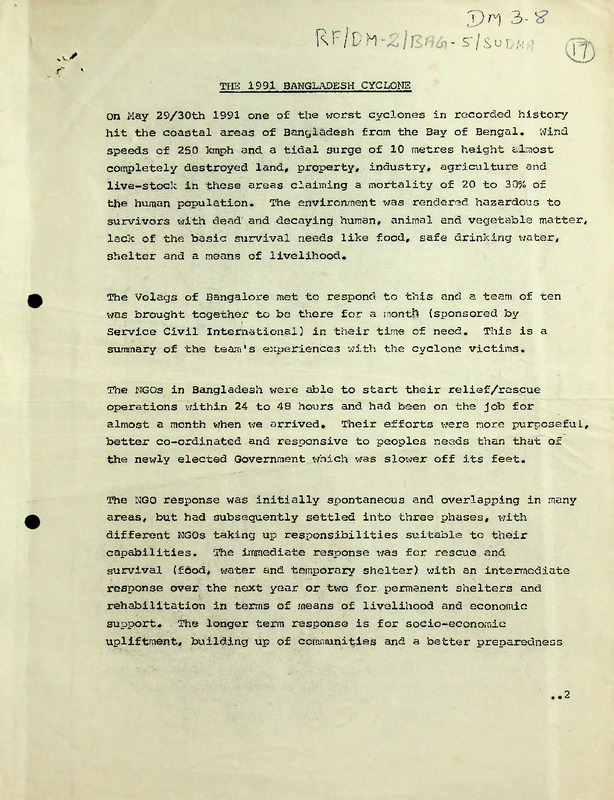
THE 1991 BANGLADESH CYCLONE
On May 29/30th 1991 one of the worst cyclones in recorded history
hit the coastal areas of Bangladesh from the Bay of Bengal. Wind
speeds of 250 kmph and a tidal surge of 10 metres height almost
completely destroyed land, property, industry, agriculture and
live-stock in these areas claiming a mortality of 20 to 30% of
the human population.
The environment was rendered hazardous to
survivors with dead and decaying human, animal and vegetable matter,
lack of the basic survival needs like food, safe drinking water,
shelter and a means of livelihood.
The Volags of Bangalore met to respond to this and a team of ten
was brought together to be there for a month (sponsored by
Service Civil International) in their time of need. This is a
summary of the team’s experiences with the cyclone victims.
The NGOs in Bangladesh were able to start their relief/rescue
operations within 24 to 48 hours and had been on the job for
almost a month when we arrived. Their efforts were more purposeful,
better co-ordinated and responsive to peoples needs than that of
the newly elected Government which was slower off its feet.
The NGO response was initially spontaneous and overlapping in many
areas, but had subsequently settled into three phases, with
different NGOs taking up responsibilities suitable to their
capabilities.
The immediate response was for rescue and
survival (food, water and temporary shelter) with an intermediate
response over the next year or two for permanent shelters and
rehabilitation in terms of means of livelihood and economic
support.
The longer term response is for socio-economic
upliftment, building up of communities and a better preparedness
2
2.
in future disasters•
Some NGOs already working in these
areas are gearing up to all three phases, while Organisations
like Gonoshasthya Kendra (GK) have newly taken up some of
the worst hit areas for all three phases.
The conformding factors noticed were,
- all these areas are plains and at sea-level;
- cyclones occur once in two to three years, with major
cyclones once in ten to eleven years (associated with
the cycle of sun-spot activity);
- floods from the 230 odd tributaries of rivers from the
Himalayas occur annually along with the monsoons
claiming their toll?
- the literacy levels are below 20%, health facilities
and other infrastructure like cyclone-shelters are
inadequate and the Status of Women and their participation
in community life is abysmal.
The redeeming factors are,
- the commitment, enthusiasm and ability for hard work
among the NGOs;
- the pride in the Bangladeshi that he is capable of
managing the situation in his/her own way, and
- the unifying factor of a single language (Bangla) throughout
the country, a concerned and active student volunteer force,
and a strong belief, that INSHALLAH - WE WILL OVERCOME 1
-x-x-x-x-x-xDR, SHIRDI PRASAD TEKUR,
Community Health Cell,
Bangalore,
06-07-1991
Position: 3585 (2 views)