RF_DM-2_DR-18_SUDHA.pdf
Media
- extracted text
-
Post Superry clone - Manual for IndMduals
'R'F lDM-2.JDK-18
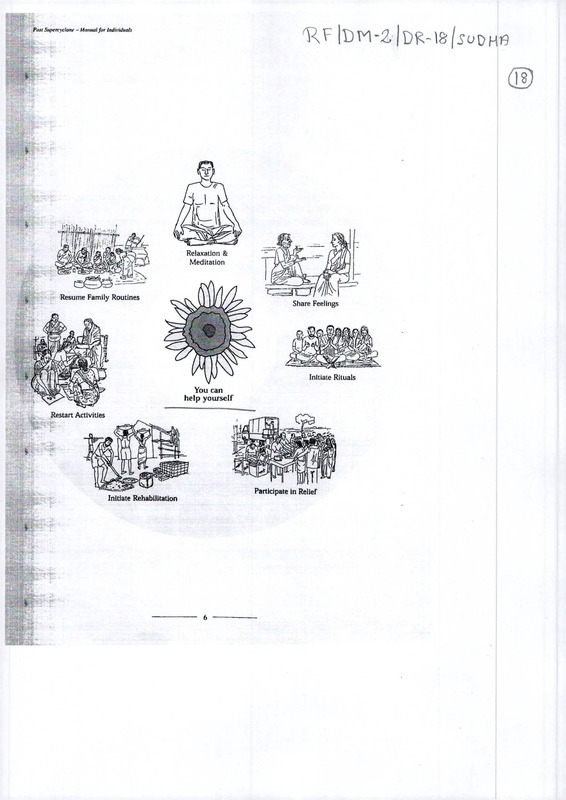
Relaxation &
Meditation
Resume Family Routines
Share Feelings
Initiate Rituals
You can
help yourself
Restart Activities
Participate in Relief
Initiate Rehabilitation
6
RECOVERY MECHANISMS
i
Symptoms start decreasing in most people in a few
weeks when they initiate some actions to reorganise
and rebuild themselves. After a few weeks/
months, even though the memories of the disaster
remain, they do not stop you from going ahead with
your life.
HOW CAN YOU RECOVER?
To promote recovery we suggest the following to be done:
At a Personal Level:
✓ Listen to authentic information about the supercyclone.
X Do not believe in rumours that go around during such times.
✓ Be together with family members.
X Do not send women, children and the aged to far off places for the sake of safety
as this separation can cause a lot of anxiety to them and you.
✓ Be with people from the same village, i.e. people you are familiar with, even if
you are in temporary dwellings.
✓ Get back to a daily routine as soon as possible to make you feel that you are in
control of the situation.
✓ Make it a point to talk about the supercyclone,
share your experiences and feelings with your
family, your parents, friends, spouse, siblings,
acquaintances. This will help ventilate/release
your emotions.
✓ Restart activities that are special to your family
like having meals together, praying, playing
games, singing, etc.
✓ Keep touching and comforting your parents,
children, spouse and the aged in your family.
This will not only make you feel good but also
make the other person feel the same.
✓ Initiate and participate in rituals like collective
grieving, prayer meetings or group mournings if
you have lost a near and dear one. This will help
you come to terms with the loss of the person.
7
V
Post Suprrcyclont' - Manual for Inrlividualt
✓ Take part in rescue, relief and rehabilitation operations if you are not hurt or
only slightly injured. Work is a good tonic for healing.
✓ Keep in constant touch in case of a member of the family having to be shifted to
a far off hospital or residence. Update him/her about yourself as well as find out
about him/herself. This gives a feeling of being cared for.
✓ Take time everyday to relax and have a good time by gathering together at a
central place/point. playing kabbadi, reading, listening to music, visiting shrines,
singing hymns, chanting prayers, reading scriptures.
✓ Make time for yourself and acknowledge and admit that you will not be always
functioning at your usual level of efficiency for a few weeks/months.
At the Community level:
Immediate
✓ Disseminate authentic information about the disaster
and the help available either by going around
personally or using loudspeakers or posters/placards.
✓ Organise groups for rescue operations. Help to remove
debris, shift people to a safe
place, help the disabled,
and share food, water and
medicines. Identify groups
for each activity and a leader for each group. The whole
village should be involved in planning rescue, relief and
rehabilitation operations.
✓ Listen to and encourage other people talking about the disaster, etc.
✓ Encourage the group to focus on the special groups like the children, women,
disabled and elderly.
✓ Organise people to present their needs and difficulties to the administrators in a
collective manner.
✓ Bring together people of the community for sharing of grief/community
mourning.
✓ Organise self help groups to procure aid and to discuss
emotions associated with the disaster. Self-help groups
should have people with similar needs. For example,
people who have lost family members could join
together to grieve and later work on it.
8
%
✓ Organise weekly meetings to share information and sing together.
✓ Prepare yourself for delays and difficulties.
In Future
✓ Seek information about help extended and organise groups to represent your
village to seek help/aid.
✓ Actively mobilise action for reconstruction and rehabilitation work. Take care
that this includes all aspects of a community to be disaster proof, where agriculture,
electricity, health care, education, etc. are concerned.
✓ Continue dialoguing with government officials and NGOs for a persistent effort
on relief and rehabilitation.
T'F' '
9
Ji.
p
P<kx Supen'.xvlone - Manual for Imlividuuls
SPECIAL GROUPS
Children, women, old people and the disabled are special groups of people who need
special attention. Let us first talk about children.
YOUNG CHILDREN
The child’s mind and emotional state are not yet developed enough to solve problems
as an adult. A child needs to discuss and sort out his/her fears with an adult because
he/she probably does not realise there are other options. He/she becomes dependent
on adults physically and emotionally. Often the child cannot comprehend the
consequences of any disaster - leave alone even this supercyclone. There is a sense
of losing his/her identity. However, events that take place during a disaster, like
darkness, loud noises, commotion, loss of shelter, separation from caring persons
like mother, father and siblings, deprivation of food, and drink, experiencing the
cold, and so on, do impact the child much more than it would an adult.
■ Very young pre-school children react by:
• Crying
• Clinging to adults, especially known people.
Later, often they are known to:
• Cry and excessively cling on to some family member due
to the fear of once again losing whatever security they have.
• Become listless and apathetic, especially if they do not
get warmth and a feeling of security from the surviving adults.
• Have disturbed sleep and unhealthy feeding problems.
• Behave like a smaller child much younger than his/her age. For example, a child
of three years may stop talking and may insist on being carried and fed like a
one-year-old child or an eight-year-old and restart wetting the bed at night.
SCHOOL GOING OLDER CHILDREN
Following are the experiences these children can show:
• Have nightmares or talk about the cyclone repeatedly. They are unable to get a
sense of control over what has happened.
• Regress and develop bed-wetting or thumb sucking.
• Refuse to go to school or even separate for a short while from the remaining family
members for fear of losing them.
io
Decline in scholastic performance due to preoccupation with and reliving
constantly the disaster scenes.
Physical symptoms like abdominal pain, headache, movements of the body, which
is one way of communicating distress.
©
Feel responsible for the death of the near and dear one(s) and become depressed
and withdrawn, with reduced sleep and appetite.
o Disturbed and angry over what has happened and retaliate with difficult
behaviour, like irritability, quarrels, lying, disobedience and at times stealing.
Sumitra, a 9-year-old impish girl, after the cyclone seems to be coping well - doing her
routine, going to school and helping other children in the family. However, her interest
in studies has suddenly decreased. She no longer shows interest in doing her homework
given by the teacher. The teacher thought it was natural, with the children having gone
through a lot. To her surprise, Sumitra continued to be disinterested in studies after
many months and later dropped out ofschool, though her father was keen to send her to
school as he felt she was very intelligent. But nobody realised that Sumitra s friend in
class, Sarada had been washed away in the cyclone along with her family. Sumitra used
to compete with her for the first position.
How to help
Often the child does not understand why he/she behaves in a particular manner
and cannot articulate the reasons for the behaviour clearly. It is necessary for the
parents/adults to understand these changes and take certain measures to help the
child get over the stress. The goal is to improve the feeling of security and bonding
between them.
□ Leaving children with known adults, i.e. mother, siblings, known neighbours.
■ Re-establishing at the earliest possible a routine like eating, playing, studying,
sleeping, etc.
■ Actions that are security-giving
• Touching, hugging the child often
• Reassuring them verbally.
• If possible giving a favourite toy, or piece of cloth (mother's sari)
which the child had used earlier as a soother.
• Keeping a small light on while the child is sleeping.
■ Activities which will provide a sense of control over the disaster.
F
?r
• Allowing the children to talk about the incident and listening
without advising.
11
110
06669
,o* /
F
Pott Supercwlnnf - Manual for Indhiduals
I
• Encouraging play activities which are related to the incident. For example.
Children can make paper boats and put then in water. The boats may be rocked,
creating a turbulence in the water. The difficulties of people in the boat can be
discussed.
• Story telling, singing songs pertaining to the
@
cyc'°ne'
• Giving attention to and approving of the child s
coping behaviour, e.g., praising him/her for going
back to school and following a routine, etc. Routine
also gives a sense of control over oneself.
■ Liaisoning with the teacher to also help in the recovery of the child.
■ Paying more attention and spending more time with them on their studies.
12
!*
AGED PEOPLE
Aged people like children may not be in total control of situations. This makes them
also very vulnerable to the trauma. They take a longer time and more effort to recover
with the disaster.
When faced with the death of many young
people, the aged can become very depressed.
They may:
® Withdraw, cry and groan repeatedly, for many
months.
G Suffer from sleeplessness and refuse food.
© Be agitated, feel hopeless and have suicidal
tendencies
0 Fall ill as psychologically they are affected and their resistance is low and are
susceptible to all types of illness.
■
Binay Panda s (aged 64) only companion was his ailing wife who was bed-ridden since
the last few years. She died when their hut came down in the cyclone. Others thought
that her death was a blessing in disguise to Panda; he also felt so. However, over the
following weeks, Binay was found to be apathetic, confused and complaining ofmemory
loss. People thought that it was due to his advanced age. But it was. one health worker
who realised that Binay was mourning his wife's death in this manner.
How to help
r1
© Keep them with the near and dear ones as much as possible.
© Convey to them positive news without fail and
repeatedly.
® Touch them and allow them to cry.
© Re-establish their daily routine.
® Give them responsibility which they can carry out
without much difficulty, like for e.g, take care of
children for short periods, distribute food for a small
number of people, etc.
• Consult them in relief activities.
(Note: the above two give them a feeling of control
over the situation.)
• Attend to them with immediate medical attention
J
when necessary.
H.
• Conduct prayers in small and large groups,
focussing on religious matters.
HiBo
13
£
i
Posl Supcn-yclonc - Manual for Individuals
■
WOMEN
Women feel more vulnerable than men in disaster situations. The poor physical
condition of an average Indian woman and the oppressive social conditions in a
patriarchal society are some of the reasons for this. Women are more emotional than
men and a supercyclone causing such a magnitude of human suffering affects them
significantly. However, women also respond to stress differently from men, which
can be manifested in:
X Exhibiting more emotional symptoms like weeping and
later on becoming depressed.
X Exhibiting symptoms like ’fainting’.
X Experiencing physical symptoms like aches and pains,
weakness as a response to conflict.
X Showing more ‘resilience’ than the other group to care
for the young.
Among them, more affected are women who are young,
single, widowed, orphaned, disabled, have lost children,
etc. Specific attention has to be given to the affected women during and following a
disaster, like:
Helping women help themselves
X Similar to the aged and children, women should stay
together in nearby safe places rather than move to
faraway places.
X Obtain information about the safety of family members ||^
especially spouses, offsprings, siblings and parents.
X Involve actively in routine activities of the family
pertaining to caring of the young, old, sick members of
the family, etc.
IS
ft
w
X Involve in community level activities, which are
familiar, like preparing food, caring of the sick.
X Involve actively in relief activities of social relevance, like maintenance of
cleanliness of the surroundings, etc.
X Form self-help groups among yourselves to deal with, share the loss, and suffering,
and participate in the rehabilitation activities.
...«•
14
;.«u
r
© Create private physical spaces for yourself and
other women for bathing, changing clothes, etc.
© Mobilise resources to help other affected women
in innovative ways like asking women who have “•.«
lost children to adopt orphaned children,
I
suggesting widowed women to start a new life.
® Spend time in singing and other activities that give
you happiness.
p-
15
Pml Suprnyclonr - Manual for Imlivitluah
ISR
DISABLED PEOPLE
People who
are uisouicu
disabled like the
reopie
who aie
me visually
viduany
impaired, hearing impaired, orthopaedically
handicapped, mentally ill and mentally
handicapped are also affected by the cyclone. The
disability often may stretch their recovery skills,
,In the face of disasters like the------------supercyclone, they
need assistance from others to adjust and recover,
without which they can become quite ill.
/ ■'
Z7
Amit. is a 40-year-old visually impaired person, who has so far been totally independent,
able to walk freely within the village and to hisjob as a music teacher. During the cyclone.
Amit was totally helpless as he did not know where and how to reach a place ofsafety. He
could not even help his elderly father to a place of safety.
This is to be remembered and recognised.
How to help the disabled
® Explain to and update them of the situation. This gives a feeling of being
involved and not ignored.
• Remove them to any place of safety where they can recover.
• Focus on specific tasks which they can perform within the limitations of their
handicap. Focus on what they can do.
© It is better to have groups comprising differently abled people and some
people without disabilities.
RECAP
• Special groups like children, old people, women and disabled can react
differently to the supercyclone.
• Their distress also starts decreasing after a few weeks.
• Specific efforts can help recovery.
• In some this may not happen and therefore need recognition and intervention.
16
PERSONNEL INVOLVED IN GIVING
HELP/AID IN A DISASTER
Immediate (at the time of disaster):
® Local administrative officers - District
Commissioner, Tahsildar, Panchayat members,
Block Development Officer.
Local health authorities: District Health Officers,
Primary Health Doctors, Nurses, Health Workers,
Anganwadi Workers, Mental Health Professionals.
© Fire brigade
• Army
I?’
17
- Manual for Individuals
Posi
■1;
• Voluntary organisations
• Media
After the disaster
• Local Administrative Authorities
• Block Development Authorities
• Agricultural Officers
• Veterinary - Animal husbandry officials
• Public Works Department (PWD)
• Local Health Authorities
• District Education Authorities.
Suggestions while using this Document
• Translate into local language.
• Narrate stories and couplets in the local language while talking of recovery.
• Perform skits in the local language giving information about the disaster
and also encouraging recovery.
18
Position: 2643 (4 views)