RF_DM-2_DR-16_SUDHA.pdf
Media
- extracted text
-
^F/PM-2|DS-16|suDHn
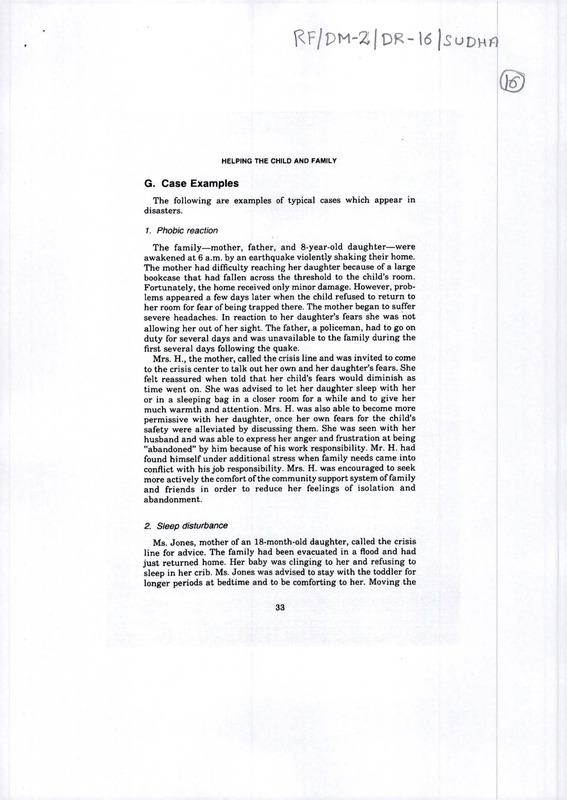
HELPING THE CHILD AND FAMILY
G. Case Examples
The following are examples of typical cases which appear in
disasters.
1. Phobic reaction
The family—mother, father, and 8-year-old daughter—were
awakened at 6 a.m. by an earthquake violently shaking their home.
The mother had difficulty reaching her daughter because of a large
bookcase that had fallen across the threshold to the child’s room.
Fortunately, the home received only minor damage. However, prob
lems appeared a few days later when the child refused to return to
her room for fear of being trapped there. The mother began to suffer
severe headaches. In reaction to her daughter’s fears she was not
allowing her out of her sight. The father, a policeman, had to go on
duty for several days and was unavailable to the family during the
first several days following the quake.
Mrs. H., the mother, called the crisis line and was invited to come
to the crisis center to talk out her own and her daughter’s fears. She
felt reassured when told that her child’s fears would diminish as
time went on. She was advised to let her daughter sleep with her
or in a sleeping bag in a closer room for a while and to give her
much warmth and attention. Mrs. H. was also able to become more
permissive with her daughter, once her own fears for the child’s
safety were alleviated by discussing them. She was seen with her
husband and was able to express her anger and frustration at being
"abandoned” by him because of his work responsibility. Mr. H. had
found himself under additional stress when family needs came into
conflict with his job responsibility. Mrs. H. was encouraged to seek
more actively the comfort of the community support system of family
and friends in order to reduce her feelings of isolation and
abandonment.
2. Sleep disturbance
Ms. Jones, mother of an 18-month-old daughter, called the crisis
line for advice. The family had been evacuated in a flood and had
just returned home. Her baby was clinging to her and refusing to
sleep in her crib. Ms. Jones was advised to stay with the toddler for
longer periods at bedtime and to be comforting to her. Moving the
33
CHILD HEALTH WORKERS IN DISASTERS
crib to another wall in the room also helped. Understanding that
the baby’s reaction was "normal” was reassuring to this mother.
3. School-avoidance behavior
Eight-year-old Joan refused to return to school after a tornado.
Her mother was reluctant to force her to go because she might cry
in school. Mrs. P. was encouraged to volunteer at the school for a
few days and to become actively involved there. Joan’s refusal be
havior stopped in a few days. Her mother was helped by being ad
vised about how to be firm and at the same time supportive to the
child. She was encouraged to recognize and accept her daughter’s
fears and to share her own with her. As the mother learned to feel
secure in separating from her daughter, her child’s fears lessened
and disappeared.
4. Confusion
A 16-year-old, wandering about seemingly confused and dis
oriented, was seen by a Red Cross worker at an evacuation site. The
Red Cross worker recognized the potential seriousness of the symp
toms and sought help for the boy. It was learned that his home had
been destroyed and his favorite pet had died. The counselor was able
to get him to talk out his feelings of loss and frustration. His family
was brought into the sessions and was helped to understand their
youngster’s intense feelings of loss. A volunteer job cleaning up
debris was located for the boy in order to keep him occupied and
involved with other teenagers.
5. Suspected abusive behavior
The housing assistance advisor reported that a family in a mobile
home was having serious arguments. The children appeared ne
glected, and one child was bruised. A mental health professional
was called in, since this family was coping badly under a great deal
of stress. Family sessions were started in the home, and a referral
was made to a family service worker because of the suspicion of
child abuse and the parents’ use of drugs. Community resources were
tapped to meet the multiple needs of this family.
34
HELPING THE CHILD AND FAMILY
6. Disruptive classroom behavior
The principal of a local elementary school invited a mental health
consultant to meet with his teaching staff. The teachers had a high
absentee rate since a tornado had struck and were unable to handle
their classes. The children were restless, while the teachers tried
to work as usual. The consultant conducted two training sessions:
one on understanding children’s reactions to disaster; and the second
on specific skills, such as rap groups and play for children in the
classroom. The teachers responded positively to the help since they
needed to learn specific intervention techniques.
7. Reaction in a child with special needs
The mother of a deaf boy told a field worker that her son was
showing regressive behavior since a tornado had forced the family
to evacuate. The child seemed confused and unable to stay in one
place. He did not seem to understand why his family had moved and
what had caused the destruction around him. The family was urging
the housing advisor to return them to their former home or at least
to the same neighborhood, since the boy needed a more familiar
routine and environment. The mental health consultant was called
in to help. By explaining the psychological reasons for the child’s
reactions to the family and the advisor, the consultant devised a
plan which included providing the boy with an explanation of the
events of the tornado, what a tornado is, and how the family planned
to resume its normal life. The parents were advised that their son’s
needs for attention at this time were greater than usual; that this
was a transitory situation. Once the child’s fears were alleviated by
parental support, his regression was reduced.
d. Problems in a childcare center
A director of a daycare center sought help from a mental health
worker during a postflood period. The young children were more
clinging, unwilling to nap, and having difficulty leaving their par
ents when they were dropped off at the center. Attendance had been
erratic since the flood. The consultant met with the director and the
teachers to discuss the kinds of problems they were having in the
classroom. The consultant also encouraged the staff to talk about
their own experiences resulting from the disaster.
35
CHILD HEALTH WORKERS IN DISASTERS
The teachers, exhausted from their work, ended their day by re
turning to their own homes, which were in need of extensive repairs.
They were unable to perform at their usual work level. Volunteers
to help in the classroom were recruited from among local teenagers.
Suggestions for games and play activities to assist the children in
expressing their feelings were made to the teachers. The consultant
helped lead a parent-teacher group to provide advice and mutual
support.
9. Apathetic behavior
A Red Cross field worker at an interagency meeting expressed
concern at the apathy of the families in evacuation centers. He said
that people were just lolling about, barely doing anything, and chil
dren were running about unsupervised. A flood had caused these
families to be evacuated from their homes, and there was nothing
that they could do at this point. The mental health worker assisted
the Red Cross volunteers in forming discussion groups and starting
recreational activities in the center. The evacuees themselves were
organized to develop programs for children and adults.
36
Position: 3585 (2 views)