Swasth hind, Vol. 27, No.11, November 1983.pdf
Media
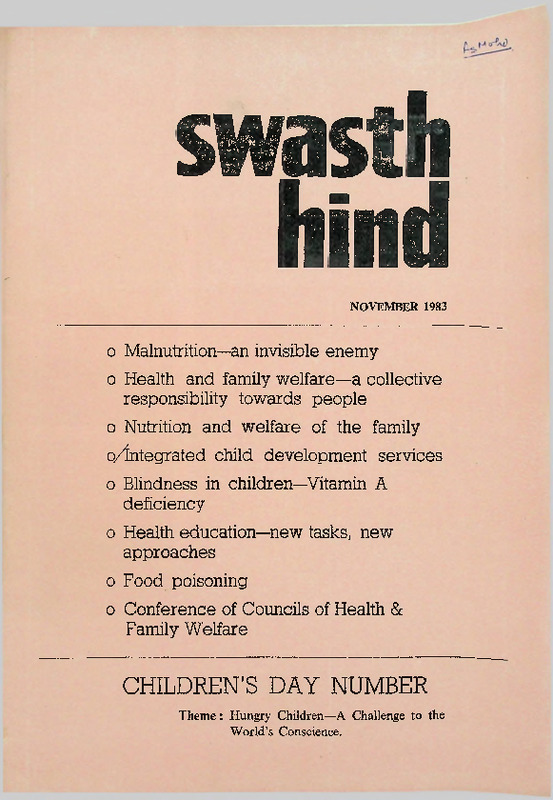
- extracted text
-
swasth
hind
NOVEMBER 1983
o Malnutrition—an invisible enemy
o Health and family welfare—a collective
responsibility towards people
o Nutrition and welfare of the family
o/integrated child development services
o Blindness in children—Vitamin A
deficiency
o Health education—new tasks, new
approaches
o Food poisoning
o Conference of Councils of Health &
Family Welfare
CHILDREN’S DAY NUMBER
Theme: Hungry Children—A Challenge to the
World’s Conscience.
swasth
hind
Kartika-Agrahayana
Saka 1905
November 1983
Vol. XXVII No. 11
OBJECTIVES
Swasth Hind (Healthy India) is a monthly journal
published by the Central Health Education Bureau,
Directorate General of Health Services, Ministry of
Health and Family Welfare, Government of India,
New Delhi. Some of its important objectives and aims
are to:
REPORT and interpret the policies, plans, pro
grammes and achievements of the Union Ministry of
Health and Family Welfare.
ACT as a medium of exchange of information on
health activities of the Central and State Health
Organizations.
FOCUS attention on the major public health
problems in India and to report on the latest trends
in public health.
In this issue
Malnutrition—an invisible enemy
261
230 million women in developing world suffer
from nutritional anaemia
Peter Ozorio
264
Health and family welfare
— a collective responsibility towards people
266
Nutrition and welfare of the family
B. V. S. Thimmayamma
269
Integrated Child Development Services
272
Blindness in children—Vitamin A deficiency
274
Health education—new tasks, new approaches
Prof. Kenneth Standard
&
Annette Kaplun
275
Food poisoning
Dr L. N. Mohapalra
279
Feeding and toilet training of children—a study
Dr Arun K. Gupta
&
Asha Khosa
281
KEEP in touch with health and welfare workers and
agencies in India and abroad.
IX Joint Conference of the Central Councils of
Health and Family Welfare—Important recom
mendations
284
REPORT on important seminars, conferences, dis
cussions, etc., on health topics.
Health in Parliament
286
Books
Editorial and Business Offices
Central Health Education Bureau
Kotla Marg, New Delhi-110 002.
111 cover
Articles on health topics are invited for publication in this
Journal.
State Health Directorates are requested to send reports of
their activities for publication.
The contents of the Journal are freely reproducible.
acknowledgement is requested.
ASSTT. EDITOR
D. N. Issar
Sr. SUB-EDITOR
M. S. Dhillon
SUB-EDITOR
G. B. L. Srivast ava
Due
The opinions expressed by the contributors are not neces
sarily those of the Government of India.
SWASTH HIND reserves the right to edit the articles sent
for publication.
25 paise
Single Copy
Annual Subscription
.
(Postage Free)
Rs. 3 -00
MALNUTRITION
-an invisible enemy
The most effective attack ever made against
child malnutrition can now be mounted. Oppor
tunities currently available can be used as an
entering wedge to break the hunger-poverty
cycle, with significant improvements accomp
lished in a short time on a large scale.
n the past few years several so
I
cial and scientific break-throughs
have suddenly
made it possible
to end child malnutrition. What
we do in the next few years—neg
lecting or taking advantage of these
opportunities—will determine whe
ther we are going to destroy or
save and improve the lives of hund
reds of millions of children.
A serious commitment by peo
ples and governments to a major
revolution in child health could ac
celerate progress for all the world’s
children, slow down the rate of po
pulation growth, reduce child mal
nutrition and cut deaths of children
by at least half before the end of the
1990s.
Low-cost life-saving
available
tactics are now
Four simple steps can be taken
right now to launch an antihunger
revolution—Growth Charts. Oral
Rehydration Therapy, Breastfeed
ing promotion, and Immunization.
all on a mass scale. To make it
easy , to remember them, they have
been given a nickname: GOBI.
"November 1983
0 Growth Charts
—to make invisible malnutrition
visible
In about half of all cases of child
malnutrition, its invisibility is a
major constraint on improving the
child’s condition. A mother who
does not realize her child is mal
nourished will take no steps to im
prove the diet. Consistent under
nutrition,
successive
infections,
bouts of diarrhoea and other ill
nesses can all hold back a child’s
growth over weeks or months so
gradually that a mother does not
notice what is happening-r-but the
lack of growth will not pass unno
ticed by a monthly growth chart.
For example, if a child who has
had measles fails to gain weight.
or loses weight the following month,
this will show up on the chart—
and as soon as a mother sees this.
her spontaneous reaction is to give
the child more food. Tn the past
children’s growth charts
have
usually been kept in clinics or
paediatricians’
offices. Weighing.
monitoring and evaluating informa
tion about a child’s progress were
the responsibility of health person
nel. Only children brought regu
larly to a health service benefited—
and most uneducated mothers do
not bring children to a clinic or
doctor until the child is obviously
and seriously ill.
The revolutionary potential of the
monthly growth chart kept at home
by a mother is that it involves the
person who cares the most on a
daily basis in the task of improving
a child’s nutrition, instead of alie
nating her from that responsibility
by professionalizing the process and
wrapping its techniques and know
ledge in mystery.
Experimental projects in the past
few years have shown that the use
of simple card-board child-growth
charts kept by mothers who weigh’
their children monthly, and note the
weight on the charts, makes malnu
trition visible, and this alone is
enough to reduce it. Such charts
serve both as an early warning sys
tem and as encouragement to better
nutritional practices.
261
< Oral Rchydrafion Therapy (ORT)
—to end the biggest single cause of
all child deaths
The. average child in a poor com
munity of the developing world has
between six and 16 bouts of diar
rhoeal infection every lean These
kill more than 5 million children a
year—one child every six seconds!
Usually a mother’s response to a
child's diarrhoea is to withhold
foods and fluids—the child thus be
comes malnourished both by the
illness and the treatment. Each
episode of infection increases mal
nutrition. and each increase in mal
nutrition increases the risk of an
other infection.
Four ways to fight malnutrition
Cjrowth Charts: to help a mother keep track of monthly pro
gress.. warning her when there are problems and encouraging
her when her children's nutritional needs are being well met.
O ral Rehydration Therapy: an inexpensive and
io enable a mother to help her children when they suffer from
dehydration, a frequent and dangerous effect of diarrhoea.
roast feeding:
the best and most inexpensive “convenience
food” for babies, to get them off to a good start in life, safely
providing excellent nourishment and protection from infections.
Immunization:
to prevent the six major
diseases that arc
especially threatening to malnourished children; youngsters may
protest; but wise mothers know its life-saving value.
Diarrhoea leads to dehydration.
which leads to weight loss, and if
children lose 15 per cent of their
body weight in a few days they die.
benefits to the vast majority of chil
dren in need.
Tn the past; dehydration could
only be treated by qualified nurses • Breastfeeding
or doctors using expensive intraven
ous feeding in an often inacessible —to prevent the most unnecessary
hospital. But ort enables mothers malnutrition of all
to treat’their children inexpensively
Breast milk is the best food for a
in their own homes. This break baby in any society, but in poor
through was made possible by the communities
or the
developing
discovery that adding glucose to a world the advantages of breatfeedsalt and water solution can increase ing over bottle-feeding can mean the
the bodv’s rate of absorption of fluid difference between life and death.
bv 2500 per cent.
Usually unable to read the ins
Communitv development workers
truction on a tin of formula, or to
can also show mothers how to
afford enough artificial milk over
make up their own rehydration so
many mothers, or to boil water
lutions bv using eight teaspoonsful
every four hours, or to sterilize the
of sugar to one of salt per litre of
necessary equipment; a low-income
boiled and cooled water. Thus
mother who abandons breastfeeding
ort is a “people’s medicine”.
is spending a large proportion of her
The need for ort is clear. The small income in order to expose her
technology is known, and simple. baby to malnutrition, infection and
The cost is small. The means of an early grave.
dissemination arc available. The
The cost of feeding a baby ade
receptiveness of parents has been
demonstrated. Only an inexcusable quate quantities of artificial milk
lack of national and international often works out to more than half
will can now prevent bringing its of a poor family’s weekly income.
262
effective way
No wonder mothers dilute the for
mula to save money—and no won
der babies therefore become mal
nourished.
Breast milk and the colostrum
which precedes in the first days of
an infant’s life have immunological
qualities which protect babies from
infection. Also the prolactin which
breastfeeding releases in the mo
ther’s body is a natural contracep
tive which can prevent several mil
lion conceptions a year in mothers
whose bodies have not fully recover
ed from a previous pregnancy. Ad
ded to these health benefits arc the
fact that breastfeeding requires no
time-consuming preparations: it is
always sterile and at the right tem
perature; it is free: and it increases
the natural loving bond between
mother and baby in a joyous way.
Yet in spite of all these great ad
vantages. the practice of breastfeed
ing has declined sharply in the deve
loping world in recent years—from
over 90% to as low as 10% in some
areas.
Swastt-t Hind
for several weeks and claims 10 per
“The earth has enough for
cent of the body weight in a fourth
but not
of all cases. A malnourished child everyone's need,
who catches measles is approxima enough for everyone's greed."
tely 400 times more likely to die of
Malialni'J Gandhi
it than a child who is adequately
fed. Vaccines have been available How these four health actions can
for a number of years, but it was be implemented
necessary to keep most vaccines
AU these measures arc low-cost
frozen until one hour before use.
and can be introduced in any area
where there arc a few trained com
Therefore, children in remote
munity leaders. They do not de
areas and in tropical countries were
pend on complex and long-range
usually beyond the reach of immuni economic or political changes. They
zation. But vaccines have now are available now. Each procedure
which are more would be mutually reinforcing, so
In the past few years, however, been developed
heat-stable,
thus
more portable; that the beneficial impact of the
a vigorous fight to promote breast
they
remain
potent
at higher tem whole would be greater than the
feeding has begun. At least 35 na
peratures,
for
longer
times.
In non- sum of the parts—and they would
tions have now adopted special legal
tropical
countries
refrigeration
is all help to stimulate further people’s
codes to regulate the marketing of
no
longer
necessary.
Even
in
the
breastmilk substitutes, and many
participation in other health impro
manufacturers of infant formula tropics less complex and expensive vements and community develop
have begun to change their market refrigeration is needed.
ment.
ing practices in accordance with the
The result is that an ailment like
But to realize the full potential
international code established in measles may soon join smallpox on of any scientific break-through there
1981 by the World Health Assembly. the list of major killer diseases must be an equivalent “social break
The results are already reducing which have been wiped off the face through”, to make the new knowmalnutrition and saving lives.
of the earth.
led gc available to the 500 million
Among the main causes of this
decline has been increased availa
bility and advertising of infant for
mulas. To a mother whose confi
dence may already be low because
of poverty and lack of education,
the appeal of a “scientific” and
“modern” method of feeding her
baby is very tempting, so that even
the most innocent promotions (“for
those who can’t breastfeed” or “for
mothers with insufficient milk”) can
create anxiety—and anxiety itself
can reduce the ability to breastfeed.
• Immunization
—to kill off the six major child
killing diseases
Six common contagious diseases
(diphtheria, measles, poliomyelitis,
tetanus, tuberculosis and whooping
cough) kill an estimated 5 million
children a year in the developing
world, accounting for approximately
one-third of all child deaths. But
it is now possible to immunize chil
dren against every one of these dis
eases.
Infectious diseases are closely re
lated to malnutrition, both as cause
and effect. Malnourished children
have lowered resistance to infection
and reduced ability to recover from
it. A disease like whooping cough
can induce increased malnutrition
by the frequent vomiting it pro
vokes. Measles halts weight gain
November 1983
TREATMENT OF DIARRHOEA
When a child gets diarrhoea, care must be taken to prevent loss
of water and salts, which can develop very rapidly, within a few
hours. Hence, it is important to replace water and salts lost in the
stools as early as possible. This is called rehydration and should
be done within six hours after the onset of symptoms.
Rehydration should be continued as long as diarrhoea persists,
and till the child starts taking normal diet such as. milk, cereals,
etc. The health workers in the area should be consulted immediately
and the child should be given medicine and treatment for the in
fections only when the doctor feels it is necessary. The child should
be given water along with salt. This solution can be made at home
by mixing 1/2 teaspoon of salt (three gm.) and five teaspoons of
sugar (25 gm.) with one litre of water. It is three pinches of salt
(three to four pinches will be equal to three gm.) Sugar can be
measured with four finger scoop (which will be 25 gm.). The mix
ture is also available in shops selling medicines. The solution should
be given with spoon or cup as frequently as possible until the
child refuses. Breastfeeding should also be given along with this.
Otherwise, half diluted milk formula with sugar can be given. This
can be increased gradually and the dilution decreased. In four to
six days the child should be able to take its normal requirement.
If the child is vomiting and does not retain fluid given by
mouth, the fluid should be given intravenously. In such cases, the
doctor or health worker should be contacted. Cases of the type
should be treated in a clinic or in a hospital.
263
mothers and young children in the
poorest areas of the developing
world. Every available channel has
to be used: local communities’ own
organizations, adult education cen
tres, women’s groups, community
development workers,
primary
health care networks and health
services, schools, billboards, mass
Peter Ozorio
media.
Even when technological know
ome 230 million women in the tion collated,” the report says, “it
how. basic services and community
developing
world, aged from 15 would seem that about half the non
organizations are available, lasting
to
49,
arc
estimated
to be suffering pregnant women and nearly twoprogress depends on political will.
from
iron-deficiency
anaemia,
“one thirds of the pregnant women have
A government truly committed to
of
the
most
frequently
observed
dis haemoglobin concentrations below
the greatest health of the greatest
those laid down by WHO as being
eases
in
the
world
today.'
’
number of people at the lowest pos
indicative
of anaemia.”
sible cost will support the training
This
is
a
finding
of
a
recent
re
of thousands of paramedics in pre
ference to the lengthy and costly view, published in the statistical
This is due to the “dramatic in
training of a few highly specialized quarterly ‘’The Prevalence of Nu crease in nutrient requirements” of
doctors. This is beginning to hap tritional Anaemia in Women in De pregnancy that is needed not only
pen. Governments of developing veloping Countries: A Critical Re to replace body losses, but also to
countries are more determined than view,” Erica Royston, WHO Sta provide for the needs of the fetus
most of them were in the past to tistician, World Health Statistics and placenta and the increased
bring health care to the majority Quarterly, Vol. 35, No. 2, 1982.) blood volume of the mother.
of the population rather than to that brings together information on
concentrate most of their limited the prevalence of anaemia in a total
“The need cannot be met by diet
resources on expensive medical population of 464 million women.
alone, but is derived at least partly
equipment and personnel which
Essentially what the report shows from maternal reserves,” the report
serve only the already privileged
is that about half of all women in says. “When these reserves arc al
10% of the population.
developing countries—that is 230 ready low—from malnutrition or
Political commitment can achieve out of 464 million—are anaemic. frequent pregnancies—anaemia re
impressive results. Conversely, im suffering from a deficiency of one sults.”
pressive results can help to bring or more essential nutrients, chiefly
about increased commitment. No of iron, and less frequently of folate.
Women in the Third World have
advocacy is as convincing as suc
“on average twice as many child
cessful action proving that substan
Among areas covered arc Africa, ren” as women in the industrialized
tial improvements are possible at Asia and Latin America.
world. “At any point in time, every
low cost in a short span of time.
sixth woman, aged 15 to 49 years,
This is why unicef, in co-operation I
“Because of its deleterious conse in a developing country is pregnant
with its many governmental and quences, and because it is so compared with 1 in 17 in developed
non-governmental partners in the widespread, nutritional anaemia in countries,” the report states.
development process, is actively women is one of the nutritional de
supporting experimental pilot pro ficiency diseases that must be given
This is the situation, region-byjects to demonstrate the effective high priority,” the report states.
ness of "gobi” in practice.
“Most nutritional anaemia can be region, in the developing world:
prevented.”
Additional long-range measures
— In Africa, 63 per cent are anae
The four tactics described (gobi)
mic out of 15.1 million preg
The report also shows that the
could win major battles against mal percentage of anaemia is higher
nant women, as against 40 per
nutrition but, to win a total war, among pregnant women than in non
cent anaemic out of 77.1 million
(Contd. on page 27J) pregnant ones. “From the informa
non-pregnant women.
230 MILLIONWOMEN IN DEVELOPING
WORLD SUFFER FROM NUTRITIONAL
ANAEMIA
S
264
Swasth Hind
—- Tn Asia, the figures arc 65 per
cent anaemic out of 43.2 million
pregnant, and 57 percent anaemic
out of 253.2 million non-preg
nant women. (No information
was available for China).
— In Latin America, figures arc 30
per cent anaemic out of 9.6 mil
lion pregnant, and 15 per cent
anaemic out of 65 million non
pregnant women.
Maternal mortality
Severe anaemia in pregnancy has
been shown to be associated with
an increased risk of maternal mor
tality. While the maternal death
rate for non-anaemic women is 3.5
per 1.000 births in Kuala Lumpur.
Malaysia, the report notes by way
of examples, the rate is higher by
five-fold for those with severe ana
emia, or 15.5 per 1,000 births.
Mild, or moderate, anaemia may
“impair well-being, may reduce
maximal work capacity, and adver
sely affect work performance.” the
report says, even though it is “more
or less well tolerated.” Few. if any,
however, can function normally with
severe anaemia.
Children are one the world
over, and they could become
a unifying factor in a world
that is torn apart by strident
and narrow nationalism.
Jawaharlal Nehru
•Singularly at risk
The report cites two major rea
sons why women in the reproduc
tive ages are singularly at risk of
anaemia.
Firstly, “regular menstrual blood
losses constitute a continuing drain
of nutrients, which have to be re
placed.” About 40 ml of blood
“equivalent to an average daily iron
"November 1983
Anaemia among women in India
Smt. Mohsina Kidwai, Minister of State for Health and Family
Welfare, said in Lok Sabha on 4 August, 1983, that “according to
WHO report, which is based on a number of surveys and studies pub
lished in India, nutritional anaemia is a major health problem among
women in India. Studies done by the National Institute of Nutrition,
Hyderabad, and other institutions confirm this finding.
There is a programme of prophylaxis against nutritional anaemia
among pregnant and nursing mothers, and children (1-12 years). Under
this programme a combined Iron and Folic Acid tablet is administered
daily for a period of 100 days to supplement the deficiency of Iron
and Folic Acid in their diet. During the Sixth Five Year Plan the tar
get is to cover 60 million mothers and as many children. 36.39 million
mothers and 34.62 million children have already been covered during
the first three years of the Plan.
Under the Integrated Child Development Service (ICDS) Scheme,
sponsored by the Ministry of Social Welfare, diet supplements to expec
tant mothers and preschool children arc being given in various parts
of the country to reduce the mortality, as well as to improve the child
health.
Besides, health education and nutrition education of the community,
particularly mothers, have been intensified through mass-media chan
nels and inter-personal communication by medical and para-medical
staff to encourage intake of balanced diet by pregnant women and children.
loss of 0.6 mg, is lost each month
by a healthy woman and a small
proportion often lose even more iron
through their menses.
“remain in iron balance,” they need
“three times as much iron as is re
quired by an adult man.”
Although women have higher re
Secondly, “pregnancy increases quirements than men, in many coun
the requirements of the woman's tries their diets are “frequently
body to meet the needs of the grow more deficient than men’s.” And
ing fetus.” Yet more often than in certain societies food taboos,
not, diets in the developing world “specially those that apply during
are inadequate for the needs of pregnancy, aggravate malnutrition.
pregnancy, or to replace menstrual
Anaemia can also be caused by
blood losses.
parasitic diseases, the report adds,
According to calculations of a with the “two chief culprits being
WHO expert group, for women to intestinal parasites and malaria.” —
265
HEALTH AND FAMILY WELFARE
—A Collective responsibility towards people
Smt Mohsina Kidwai
W
Family welfare cannot be viewed in
isolation of other health programmes.
Eradication of communicable diseases
like malaria, typhoid, leprosy, etc., is
important to ensure health and
happiness^ which is the objective of
family planning ultimately.
Even
programmes like control of blindness,
T.B. etc., are important in this regard.
We are committed to ‘Health for All by
the year 2000 A.D’.
This can be ensured
only if preventive, promotional, curative
and reh ibilit ative health care measures
go together.
Monitoring of our efforts
in these areas will also be necessary to
give us the correct position as to how
much ground we have covered and how
much remains to be covered.
e are all engaged in a noble task as we are pro
moting the small family norm. It is directly re
lated to the quality of life of the people and pros
perity of the nation. Integrated with health, family
planning promises the welfare of not only a family
but the community as a whole. It constitutes one
of the fundamentals of planned economic develop
ment of the country. It is central to all other nation
building projects, for all our efforts towards develop
ment of economic resources will be nullified if the
population explosion is not stemmed.
Family planing cannot be seen in isolation of other
health programmes. If we advise people to merely
plan their family without taking suitable steps to
ensure good health of their children, they may not
come forward with full confidence. It is. therefore.
necessary that maximum efforts should be directed
towards the promotion of health care activities for
both mother and child.
We have already started
the Minimum Needs Programme under which we arc
pledged to provide basic health care facilities like
immunisation of children to save them from infant
diseases as also for expectant mothers, to protect
them from, nutritional deficiency and diseases such
as tetanus, etc., provision of safe drinking waler and
improvement in sanitation. We also have the Integ
rated Child Development Scheme (TCDS) under the
Ministry of Social Welfare, and School Health Pro
grammes, etc. All these schemes must be properly
coordinated and implemented vigorously
to bring
about a whole-hearted response to family planning
by the people.
Opinion leaders
As the Prime Minister has rightly stated, family
planning should be promoted as a people’s move
ment. This can. however, be achieved only if the
people are able to understand that the adoption of
266
Swasth Hind
(lie small family norm is both in their own interest
as well as in the interest of the country. In fact,
they should feci proud in taking part in the family
planning programme. Opinion leaders like teachers,
ex-servicemen, members of Panchayals, z'dci parishads
and voluntary agencies must be encouraged to take
the lead in promoting the family planning programme.
Family planning counselling
I bis brings me to another important point, /.<*.,
family planning counselling. It is the people's right
to receive correct information about a programme
that deals with their personal lives and welfare. We
must make arrangements to impart such information
at all important points of contact with the people,
such as hospitals, post partuni centres, dispensaries,
primary health centres and sub-centres, etc. Such
arrangements could be made even at other places
where people congregate such as weekly markets,
fairs and festivals, big exhibitions, etc. This counsel
ling should not be confined
to information about
family planning methods, services and supplies only.
Guidance about general health care, sanitation, etc.,
should also be imparled. In this connection, J see a
great role for the village health workers too, including
the Village Health Guide and Trained Birth Attend
ant. .In case, health check up facilities are introduced
at our primary health centres and sub-centres, people
will definitely come forward in larger numbers and
be prepared to benefit from family planning coun
selling.
Role of mass media
The role of mass media in health and family wel
fare education cannot be over-emphasised. More and
more programmes should be designed, produced and
presented over Radio and Doordarshan. All other
popular means
to increase awareness among the
people about the various family welfare services and
their significance besides health and MCH services
are to be deployed.
Mass media programmes are
best followed up with an effective system of inter
personal communication, so that awareness can be
converted into action without any lapse of time. 1
would rather suggest that communication and services
should go hand in hand.
best attention and be fully satisfied.
I his is very
important in the case of sterilisation. The pre-operalion check up, hygienic conditions during operation
and follow up after sterilisation should be treated as
equally important and paid equal attention. Let us
not forget that one single dissatisfied person may
cause immense damage to (he programme. It is a
proved fact that disalislicd acceptors are more vocal.
Similarly due care may he taken in selecting cases
for IUD insertions and oral pill administration. Neces
sary follow up will have to be ensured in these cases
also.
Adequate infra-structurc
No doubt, all this demands that there should be
an adequate infra-structurc for providing the vari
ous health care facilities and services. Before we
think of additional manpower, we may, however, en
sure that the present resources of men and material
are utilised to the optimum. The demand for addi
tional resources will be justified only after that. Some
of the States have not created or filled up certain
posts in accordance with the pattern suggested by
the Centre. There should be no difficulty in having
additional staff to this extent at least.
One of the reasons for non-availability of requisite
personnel could be the lack of facilities like residen
tial accommodation, children's education, etc. in the
outlying areas. This can be solved by pooling the
resources with other needy departments like Educa
tion and Social Welfare. Common hostels could be
established for lady workers belonging to the De
partments of Health, Education and Social Welfare.
Another way out could be to recruit workers locally
so that they do not face any problems of dislocation.
Special efforts will have to be made to attract lady
doctors to work in the rural and backward areas.
This is so, because most of the demand lor health
and family welfare services is from women. They
must be attended by qualified women doctors. In
case provision of proper facilities takes time at a
particular location, they could be posted at conveni
ent places and given adequate transport to tour the
adjoining areas.
Training of workers
Acceptor an motivators
In the matter of services, we should bear in mind
that the acceptor is going to be an important moti
vator also. He or she, should, therefore, receive the
November 1983
Training of workers at all levels is another impor
tant area that demands attention.
As mentioned
earlier, the quality of service is imperative for the
success of the family welfare programme. This can
267
be ensured only through proper training
of (he
workers in the services that they arc required to per
form.
This should particularly be ensured in the
case of para-medical stall’, Health Guides and Dais.
Coordination with other departments
Another important point is coordination with other
departments.
As mentioned earlier, family wellarc
programme is a pivot for all other programmes. The
departments other than Health and Family Well are
should, therefore, find no difficulty in adopting it
as an integral part of their normal activities. Here
we should, however, take a precaution that the efforts
of other departments do not be duplicated by our
own activities. This should apply to the various vol
untary organisations also engaged in the health and
family welfare programmes. They could perhaps be
given certain exclusive areas for operation.
Monitorink the progress
Monitoring of performance with respect to various
aspects is very important. This should not be con
fined only to sterilisation operations and IUD inser
tions. Sendees like immunisation and school health
programmes should also be monitored al all levels.
This will not only keep the directors of the pro
grammes informed about the prevailing situations in
their areas but also enable them to lake timely steps
to rectify the shortcomings wherever and whenever
they occur.
Monitoring may not be taken in the
sense of reporting only. All the facts gathered from
the field must be analysed and evaluated to identify
the strengths, weaknesses, opportunities and threats.
Lot of advancement has taken place in sciences
that are relevant to everyday life. People should,
therefore legitimately expect from us, that certain
new methods may be found for easy and effective
contraception. I understand that the Indian Council
for Medical Research is already aware of this need
and is working on a vaccine.
1 would appeal to
them to step up their efforts and come out with this
new method expeditiously.
Stales and Union Territories should look at all the
health and family welfare programmes as a collec
tive responsibility towards the people of the country.
The State Governments and
the Union Territory
Administrations should lake pride in their efforts to
promote these programmes. They should work with a
268
national spirit—the spirit of unity and integrity. The
Centre can provide only guidelines and a certain
amount of funds. But actual services are the res
ponsibility of the Stales and the Union Territories.
It will, therefore, be in the interest of their own image
that they ensure the best possible quality of service.
This can, however, flow only from the quality of
(raining that (hey provide to the medical and para
medical staff.
Every effort may, therefore, be made
to provide necessary training to (he workers engag
ed in ail health and family welfare programmes.
I must draw attention to a very painful fact and
that is the high rate of infant mortality. It is as
high' as 176 per thousand live births in U.P. The
national average is 127. This is enormous and we
are quite far off from our target of at the most 60 to
be achieved in the next 17 years. This demands im
mediate attention and urgent steps.
We must step
up the
immunisation programmes
for pregnant
mothers and infants. Steps may also be taken to
ensure general health care of these vulnerable cate
gories in the larger interest of their longevity as well
as good health.
Involvement of voluntary agencies
We must make the involvement of voluntary agen
cies in the health and family welfare programmes as
effective as possible. Timely release of grants in aid
and proper coordination of services must be ensured
in the larger interest of public participation in the
national programmes meant for the improvement ol
quality of life of our people. A large number of
voluntary agencies arc already
working in close
coordination with the Slate Governments. But there
are many parts of the country which have yet to reap
the fruits of this activity. They have to identify
suitable voluntary institutions and encourage them
to participate in our activities. They may be based
only in small specific areas, but that should not deter
us from approching them.
—‘Extracts from the welcome speech by Smt.
Mohsina Kidwai, Union Minister of State
for Health & Family Welfare, delivered at the
9th Joint Conference of Central Councils ol
Health & Family Welfare held in New
Delhi from 7-9 July, 1983.
Swasth Hind
NUTRITION AND
WELFARE OF THE FAMILY
B. V. S. Thimmayamma
‘protective’
F the many factors that contri teins are also called
bute to family welfare, nutrition foods. Rich sources of minerals and
plays an important role. Nutrition vitamins are green leafy vegetables,
al status of a family, largely de vegetables, fresh fruits, milk, eggs
pends on its socio economic status and flesh foods.
and availability of nutritious food.
The importance of a nutrition
By nutritious food we mean, the in
ally
balanced diet has been well
clusion of various food items in the
diet such as cereals, pulses, green recognised long ago and is referr
leafy vegetables, other vegetables, ed to in ancient Hindu scriptures.
fruits, milk, sugar and jaggcry, fats In Mahabharatha, it has been men
and oils and flesh foods which pro tioned that, “He who takes food in
vide nutrients required for normal proper measures, lives a long life
health. A balanced diet contains and lives without any disease, gets
different types of foodstuffs in pro strength and has alertness of mind.
“He who takes food in per quantities and proportions pro Moreover his children are born
proper measures, lives a long viding adequate energy, proteins. healthy and without any deformity
minerals and vitamins required by or disease”.
life and lives without any the human body for maintaining
Dietary requirements vary
disease,
gets strength and health.
In any community or a family
has alertness of mind. More
orib
finds the population consisting
Energy
is
needed
by
the
body
over his children are born
to perform various activities nor of infants, preschool children, school
healthy and without any de
children, adolescents and
mally.
Just as a railway engine age
formity or disease.
needs fuel for its smooth running, adults. The diet and nutrient, re
groups will
the human machine also requires quirements of these
—Mahabharata
energy to carryout its functions nor vary according to their physiologi
mally.
Energy is mainly derived cal status and the type of activity
from cereals, roots and tubers. they do. For example, as per the
sugars, fats and oils huts and oil recommended allowances of Indian
seeds and pulses. Foods rich in Council of Medical Research (1981),
pro!cin are called body-building the dietary requirements of a preg
foods.
Protein
is required for nant woman doing sedentary work
growth and repair and replacement are as follows:
of tissues in the body. The major
A mouls (gms/day
sources of protein are pulses, nuts Foods
-------------------- ----and oilseeds, milk. meat, fish and
Vege- Noii-vegieggs. Minerals and vitamins regu
larian larian
late the life processes and protect
1________________ 2________ 3_
the body against diseases. That is
445
445
whv. minerals, vitamins and pro Cereals
O
November 1983
269
2
l
3
28
Pulses
Green - leafy
vegetables
Roots and
tubers
Other vege
tables
55
100
100
50
50
40
40
Milk
200
200
20
25
30
30
Fats and
Oils
Sugar and
Jaggery
Egg
ml.
One egg
ence pregnancy complications result
ing almost one in five in abortions
miscarriages, still-births and prema
ture deliveries. Infants who areata
disadvantage even from the time of
birth, arc exposed to further mal
nutrition due to delayed and inade
quate supplementation.
Though prolonged breastfeeding
is beneficial, delayed supplementa
tion. inadequate and poor quality of
supplements would result in various
nutritional
deficiency
disorders.
Some of the findings of nutrition
studies carried out among different
populations are indicated below:
crease in family size (i.e., 4 or more
children).
Measures to improve nutritional sta
tus
How can the diet and nutritional
status of the family be improved for
achieving family welfare? The most
important of the means are: (1) short
term measure of supplementing the
existing diets of vulnerable segments
of population (i.e. pre-chool child
ren, pregnant and lactating mothers
with , low cost nutritious recipes, (2)
providing nutrition education to all
members of the community, and
(3) educating the community on
the importance of limiting family
size.
Any seasonal fruit may be consu
med depending on the purchasing
Nearly 17% of infants are bom
poweri of the person.
before full term. 80—90% of pre
school children (below 5 years)
(I) Supplementing the diets with
Causes of inadequate nutrition
show retarded growth.
1-2% of
low-cost
nutritious recipes.
However many people
do not children below 5 years show severe
Several low-cost nutritious reci
give attention to the nutritive value protein energy malnutrition 7-8%
of foods in their selection or cook show different grades of vitamin A pes have been formulated to sup
ing and processing. Rice is often deficiency, and 35—50% suffer from plement the existing diets of young
children and improve their nutri
washed several times and cooked anaemia.
tional status.
Some of the them
in excess water. The diets of a
About a fifth of the children in 5—
majority of population arc either 12 years age show one or more signs can also be used in the treatment
improper or inadequate. Several of malnutrition, such as retarded and prevention of protein-calorie
nutritional deficiency disorders arc growth, vitamin A deficiency, or B malnutrition. These recipes arc
mainly based on locally available,
commonly seen among our popula vitamin deficiency or anaemia.
nutritious and inexpensive foods
tion. The most common causes for
inadequacy and low nutritional
Pregnant women and
lactating like cereals, pulses, nuts and oil
quality of our diets arc: (1) lack mothci’s have low body weights. 50- seeds. sugar or jaggery and greenThey provide
of knowledge regarding the utili 60% show anaemia, over 30% have leafy vegetables.
sation
of locally available nutri B-complex and vitamin A deficien about 300 calories and 10 gms. of
tious foods that are cheap. (2) cies. Nearly one fourth of the total protein.
certain food beliefs and taboos, deaths among mothers is due to
Ready mix powders (such as Hy
(3) Larger family size resulting in anaemia.
derabad mix), porridges (like wheat
improper food distribution among
Malnutrition is also prevalent in gram porridge) and solids (like
family members, and (4) Low pur
kichedi/upma wheat-gram laddu
chasing power. Early marriages, various degrees in adult population.
or biscuit) were tried out among
repeated pregnancies, short inter Apart from general undernutrition/
the pre-school children in the com
val (spacing) between
deliveries, overnutrition specific nutritional dis
munity and were found to be acc
low weight gain during pregnancy orders arc seen in various regions.
eptable. For example, the propor
also contribute a lot to the poor
This indicates that in general tions of ‘Hyderabad Mix’, are rest
nutritional status of vulnerable seg
most of the population groups are ed wheat (40 gms.) rosted bengal
ments of population.
affected by inadequate diet and de gram dal (15 gms.) rosted ground
ficiency of nutrients in the diet. nuts (10 gms.) and sugar or jaggery
Vulnerable groups
Nutritional deficiencies were obser (30 gms). They are all powdered,
Undernourished mothers in the ved to be more, especially, among mixed and stored. The powder can
olw socio-economic groups experi mothers and children with an in either be mixed in hot water or in
270
Swasth Hind
milk to make a porridge and can prevent anaemia among mothers
be given to the child easily and rea and children is also in operation
dily. These powders can also be in maternity and child health and
stored in air-tight containers when primary health centres through the
prepared in large amounts.
distribution of tablets containing
iron and folic acid. Immunization
Pregnant women and lactating is also important.
mothers can also be given similar
types of recipes in larger propor (2) Nutrition education
tions providing about 500 calories
Nutrition education to the com
and 20-25 gms. of protein to im
munity
can be undertaken on
prove their nutritional status. There
different
practical
aspects through
are national programmes of supple
various
approaches
as group dis
mentary feeding for pregnant
cussions
and
demonstrations,
which
women
and
nursing
mothers.
will
have
beneficial
effects
on
the
School children get supplements
community.
Flip
charts
and
mass
through midday meal programmes.
media such as radio and television
Apart
from
these
supple can be very effective. Apart from
ments, prophylaxis programme of doctors, Auxiliary Nurse, Midwives
massive dose of vitamin A concen and other health workers, local tea
trate (i.e. 200,000 1U), once in 6 chers can also be engaged as agents
months, to all the pre-school child of nutrition education. Among the
ren, has been implemented since topics that need to be included in
1970, on a national scale (through such programmes of nutrition edu
maternity and child health and pri cation are: importance of breast
mary health centres) to prevent feeding: introduction of supple
blindness due to vitamin A defici ments to the infant, preferably bet
ency. Similarly a programme to ween 4-6 months, use of locally
(Contd. from page 264)
additional strategies are needed.
Among these are : increased agri
cultural productivity; agricultural
research; land reform and jobs;
family planning; food subsidies; and
nutrition education.
is reduced and life expectancy is
increased. Families in areas where
health services have reduced child
deaths tend to have fewer children
than families who expect many of
their children to die. When death
rates have fallen to around 15 per
1000 people (which is about the
average for low-income developing
countries today) each further fall
of one point in the death rate is
usually accompanied by an even
larger fall in the birth rate.
Family planning—Too many bir
ths too close together undermine the
nutritional well-being and health of
both mothers and children. Family
planning is therefore another im
portant step to be taken in order
Thus a "survival revolution”
to reduce both maternal and infant which reduced infant and child mor
mortality and to increase maternal
tality by half and prevented the
and child health.
deaths of 6 or 7 million infants
It is an interesting, though seem each year by the end of the century
ingly paradoxical, fact that popula would be likely to bring births
tion growth actually goes down ra down as well, by between 12 and
ther than up when infant mortality 20 million a year.
November 1983
available nutritious,
inexpensive
foods such as wheat, ragi, etc., in
supplements; hygienic ways of arti
ficial feeding (only if unavoidable);
desirable cooking methods to retain
nutritive value of foods; dangers of
malnutrition; timely nutritional and
health care.
(3) Education regarding family size
The community also needs to
know more about the economic and
nutritional advantages
of
small
family. Limitation of family size
preferably with two or three child
ren is desirable. Smaller the family,
better is the nutritional status.
Means of improving the family in
come through cottage industries,
raising of poultry, kitchen garden
may be emphasized. Family bud
geting particularly expenditure on
food and selection of foods which
provide good nutritive value at low
cost also form and essential infor
mation. A
Courtesy: NUTRITION
July 19S3
Nutrition education—This is ano
ther vital element of basic commu
nity services and primary health
care. Economic growth and increas
ed agricultural production will not
in the themselves achieve a signifi
cant or permanent reduction in the
numbers of the hungry, nor will
temporary food subsidies, if people
remain ignorant about what food is
good for them.
Development workers’ training
must include health and nutrition
education which they can pass on
to their neighbours through com
munity centres and schools, incul
cating improved eating and sanita
tion habits. A
(This article is based upon the 1983 “State
of the World's Children" Report by UNICEF s
Executive Director James P. Grant)
271
Integrated
Child
Development
Services
What does a child need? Acceptance,
love and nurturance, nourishment for
his body, stimulation for his mind.
Every mother wants to provide all
these yet she cannot always do so:
Poverty and privation, sharing
the burden of earning for the
family, lacking the health or
energy or being in a remote
area; these and other related
factors hinder her mother
ing. In such cases, the
government has to inter
vene with suitable aid.
ICDS is the pledge
made by the nation
that the child will
not be neglected.
ith a view to provide a package of services to the
children, the Integrated Child Development Ser
vices Programme (ICDS) was formulated and initiated
in 1975-76. This programme addresses itself mainly
to issues involving those who have not reaped the bene
fits of the country's prosperity.
W
The ICDS focuses on Point 15 (women and children)
of the new 20-Point Programme, and also co-operates
in strengthening the thrust of the 20-Point Programme
in the areas of Drinking Water; Family Planning;
Health; and Education.
272
Under this programme
Assistance is provided to children and mothers thro
ugh:
* Supplementary nutrition for children and mothers.
* Immunization of the child.
° Nutrition and health education for the family.
~ Access to health care.
Pre-school education for children.
* Functional literacy for adult women.
* Providing a link with other services.
Supplementary Nutrition
A vast proportion of the children of this country
suffer from protein-energy malnutrition in their early
years. Their growth is slowed down, and they become
vulnerable to disease. Over an extended period, the
effects are likely to affect future development.
A major aim of the ICDS is to supplement the daily
diet of the child under six. Every month a child's
weight is recorded and those who are below the norms
are put on a supplementary diet. The anganwadi, the
centre for children, provides them each with a supple
ment that meets about one-fourth the child’s total daily
requirement. It is known that development before
birth is dependent on the mother’s health. Therefore,
diets of pregnant women and nursing mothers are also
supplemented. Local availability and familiar tastes
are taken into account. The cost of a fraction of a
rupee for one child’s daily supplement is minimal, and
the benefit is considerable.
Immunisation
Prevention is better than cure. Immunization aga
inst infectious diseases is an important part of this pro
gramme. Children at the anganwadis are protected
from polio, tetanus, whooping cough and diphtheria,
typhoid and tuberculosis. Expectant mothers are also
immunised against tetanus.
Nutrition and health education
It is important that the family is aware of the major
factors in health care and nutrition. Mothers arc en
couraged to breast-feed their child as long as possible.
All mothers of child bearing age are given an informal
education in nutrition. Mothers of children who suffer
from extreme malnutrition arc helped individually.
Several methods of communication are used including
folk media.
Health check-up
The services of ICDS reach out also to the mother.
Periodic health examinations of pregnant and lactating
mothers is an integral part of the programme.
Regular health checks and home visits by the angaii
wadis staff are an important aspect of this scheme.
Swasth Hind
By March 1985, the country will have 1000ICDS
projects providing basic needs to young children in
a total population of about 80 million in tribal,
Iiilly, and backward rural areas and urban slums.
The mother is given advice and aid for the care of the
infant. She is encouraged to bring her children to the
anganwadi for immunisation and medication.
Referral services
ICDS enables the integration of several aspects of
child care. When a child has been identified as need
ing expert treatment, the family is referred to a hos
pital or other specialised institution. When impair
ments are detected early, they can be prevented from
developing into handicaps.
Pre-school education
*/l space to grow, the right to know'
In the home the infant moves from the mothers lap
to the ’angan’ where other children play. Here he is
in the presence of his mother and other women in the
family. From the ‘angan’ he moves to the anganwadi.
A familiar person from the neighbourhood serves
here as the caregiver. Cousins and friends play to
gether. Toys and other learning materials are created
with local colour. In this setting he has a fair chance
to develop competence, social skills, and, above all
to be happy.
Exploring the world around is a natural activity for
every child. Through his senses he learns about his
immediate environment. Through learning he widens
his experience. Through knowing and feeling he be
comes a person in his own right.
Functional literacy for adult women
The women in the family play the major role in the
care of their children, and for them the ICDS scheme
provides courses in functional literacy. The approach
is to start with their needs and their problems. Home
management, nutrition, child care and hygiene cons
titute the contents of this aspect of ICDS. Functional
literacy thus becomes at once the instrument and the
goal, for enhancing the quality of life for the mother
and child.
Cointesy:T)WP
Let’s give the child
his childhood, the
nation, its human
wealth.
November 1983
HEALTH EDUCATION
—Health education should be made an integral com-,
petent for all health and welfare programmes includ-j
ing education to emphasis the promotional and pre
ventive aspects of health through improvement of
environment and development of sound health prac
tices.
—A fixed percentage (5 to 10%) of the total budget
|of a particular health programme should be earmarked
for carrying out health educational activities. A part
of this amount should be subsequently pooled to
gether and kept at the disposal of the Central/State
Health Education Bureau to have an integrated health
educational programme.
—Health education should be made compulsory in
primary, secondary and higher secondary educational)
and population educational institutions
and underl
Adult Education Programmes and it should be en
sured that the education of the community is under
taken through these school children in the form ol
child to child, child to parent approach.
—Health education cells/units may be established!
in health related agencies including organised sector
for planning, implementing, monitoring of the pro
gramme. Nodal institution for coordinating this pro
gramme and providing guidelines and consultancy'
service will be Central Health Education Bureau/
State Health Education Bureau.
—At present 18 State Health Education Bureaux
have been well developed and rest of the States are
yet to set up such institutes. All the States Health
Education Bureaux should be developed on the pat
tern suggested by the Government of India.
The
State Governments/UTs may earmark adequate funds
for the establishment of new Bureau, where there is
none, and strengthening of existing Bureau according
to the pattern suggested.
—Use of print media is feasible only to limited ex
tent due to high prevailing illiteracy. In these cir
cumstances, the folk indigenous media should be
suitably developed for providing health education to
neo-literate masses by coordinating the resources and
expertise of all developmental programmes and volun
tary agencies working in the field of health, family
welfare and nutrition programme to suit the local
needs.
The vast vistas opened up by television.
radio, etc., should be fully harnessed for the propaga
tion of health education.
—To provide trained manpower, specialised training
in Diploma Course in Health Education should be
provided so that they can take care of hospital health
education, school health education, etc.
27,
BLINDNESS
IN
CHILDREN
Vitamin A deficiency
who do not get enough vitamin A in
their food may become blind. They have vita
min A deficiency. Several thousand young children in
India are blind because they do not get enough vitamin
A in their food.
hildren
C
these foods, he will not get vitamin A deficiency blind
ness.
Vitamin A is present in milk, eggs, ghee and fish
liver oils. But these foods are expensive, and some
parents cannpt afford them.
Who can become blind
Children between 1 and 5 years are most likely to
become blind from vitamin A deficiency. In some
areas in India people mostly eat rice. Children in these
areas often do not get enough vitamin A in their food
and suffer from vitamin A deficiency.
Symptoms of vitamin A deficiency
If a child has vitamin A deficiency, he does not
become blind suddenly. He becomes blind slowly.
If you notice that a child has some early signs of
vitamin A deficiency, you can cure him. You can
save his eyes completely.
Look for these signs
— If a child cannot see well in dim light, he has
night blindness. Night blindness is the first sign
of vitamin A deficiency.
—If the white part of a child’s eye is dull and dry
he has an early sign of vitamin A deficiency.
—If a child has greyish foamy patches shaped like
triangles on the white part of his eye, he has
Bitot’s spots. Bitot’s spots are another early sign
of vitamin A deficiency.
If a child has one of these signs, you must treat him
quickly. If you do not treat him quickly, the child
may become completely blind. In severe cases of vita
min A deficiency, the black part of the child’s eye
becomes damaged. Then the child becomes totally
blind. We call this kind of blindness, Keratomalacia.
Treatment of vitamin A deficiency
We can treat vitamin A deficiency with food. Some
foods contain a lot of vitamin A. If we give a child
274
Many inexpensive foods also contain vitamin A.
Palak, amaranth, Methi, carrots, papaya and mango
are all inexpensive foods. They all contain plenty
of vitamin A.
Sometimes, people do not eat these foods. They
think these foods are harmful. Perhaps they are igno
rant, or superstitious. Perhaps they have a false belief
about these foods. But we know that these foods are
good. We must encourage children to eat them.
We can save a child’s eyes in another way. We
can give him massive doses of vitamin A by mouth.
The National Institute of Nutrition in Hyderabad
has studied this method carefully. They found that if
you give a child 200,000 LU. (60,000 micro gms) of
Vitamin A by mouth every 6 months, he will be
fully protected from vitamin A deficiency. This is
especially important for children between the ages of
I and 3 years.
If we give a child massive doses of vitamin A we
can easily and safely prevent blindness. The Govern
ment of India has started a national programme for
prevention of vitamin A deficiency. They use this
method.
How can a pregnant mother protect her unborn child
A pregnant mother should eat plenty of foods
which contain vitamin A. Then her body can give
vitamin A to the baby inside her womb. If the preg
nant mother gets plenty of vitamin A, her unborn
baby also gets plenty of vitamin A. This protects the
baby from blindness due to vitamin A deficiency.
Courtesy: NIN, Hyderabad
Swasth Hind
HEALTH EDUCATION
new tasks, new approaches
Prof. Kenneth Standard
&
Annette Kaplun
education finds itself faced today with
tasks unparalleled in its history. Changing dis
ease patterns and cultural expectations, new views
about the relationship between the governed and the
governing and between community members and
health care providers, fuller recognition of the ability
of the common person to think and act constructively
in the identification and solution of his or her pro
blems—all these have led to a reformulation of some
of the basic tenets of public health and consequently
towards a reorientation of health education.
ealth
H
Furthermore, it is realized that health science and
technology have reached a point where their contribu
tion to the further improvement of health standards
can make a real impact only if people themselves
become full partners in safeguarding and promoting
health.
It is not accidental that education features promi
nently in the Declaration of Alma-Ata, nor is it by
chance that the Global Strategy for attaining “health
for all" as well as W.H.O's Seventh General Pro
gramme of Work constantly refer to educational acti
vities as the means par excellence for encouraging
the involvement of people from all walks of life and
for making them true artisans of health and develop
ment. A W.H.O. Expert Committee on New Appro
aches to Health Education in Primary Health Care
was. therefore, convened in Geneva to appraise the
new tasks of health education and advise the Organi
zation on the new approaches needed.
Need for critical assessment
Historically, health education has been committed
io prevention and more recently to health promotion
with greater emphasis on people's involvement. Ne
vertheless, health education practice has remained in
many cases static, not evolving sufficiently with time.
The Expert Committee endorsed the pressing need
for a critical assessment of the many coexisting mo
dels and structures that have grown up over the
■November 1983
“To identify priority areas for action [in
health education].. . .it is necessary to go the
people with respect for their values and their
felt needs. It also requires a scientific study
of the situation.” With its focus on people
on the one hand and on a scientific approach
on the other this statement perhaps more
than any other demonstrates the two trends
that characterized the th: n king of a recent
W.H.O. Expert Committee that met in
Geneva from 12-18 October, 1982 to
discuss new approaches to health educa
tion in primary health care. The views and
ccnclusions of the experts are summarized
below in an article by the Chairman of the
Expert Committee and a W.H.O. consultant.
years. Such an assessment must be conducted with
the courage to admit that some may be wrong or in
need of modification and the confidence to select those
which promise to be a sound basis for the effective
realization of primary health care.
What are the changes needed and how can they 'be
achieved?
Four target areas for new approaches
Four areas—technology, resources, models, and
roles—were identified by the Expert Committee as
needing close attention.
Peopie-oriented technology
Health care providers tend to motivate people to
want what they think people should want rather than
275
professionals in fulfilling one of their major responsi
bilities, that of providing the public with knowledge
about alternative types of behaviour and their out
comes so that people are in a position to make choices
and accept the consequences.
••To be helpful iu evaluation, when called upon, means
placing evaluative technology at the disposal of the lay
health group, not imposing professional ideology regarding
the importance and appropriateness of benefits.”
Lowell S. Levin, background paper for WHO Expert Committee
on New Approaches io Health Education in Primary Health Care.
Evaluation
With programme implementation comes the need
for monitoring progress. Tn inviting Member States
to strengthen their managerial process for health deve
lopment, W.H.O. recommended “a careful evaluation
with a view to improving effectiveness and increasing
efficiency". In the past, very little evaluation of health
education activities has been undertaken. Linking
health education with a specific outcome is
rela
tively new and not easily accepted by those who are
responsible for educational activities. Today the diffi
culty is compounded by the need to devise new indi
cators and methods that will make it possible to eva
luate the non-professional input in the field of health
without imposing professional concepts regarding the
importance or the appropriateness of benefits.
Research
Research in health education should aim at deve
loping a body of knowledge in full harmony with the
concept of primary health care that will be useful for
planning, management and practice. For example,
data arc needed on effective ways of involving com
munities in defining problems, developing criteria for
evaluating solutions, elaborating hypotheses, and in
terpreting results.
Such community involvement
would guarantee more realistic evaluation criteria:
if the people define the problems, they arc more likely
to help define the solutions.
Another priority for research in health education
concerns the area where people’s fell needs overlap
with the epidemiologically assessed needs. It is in
this area what health education activities are likely to
yield their maximum return.
Ethics
As a backdrop to research, planning, and action,
ethical issues arc raised throughout the report of the Ex
pert Committee, which stressed the importance for
278
health care providers of being sensitive to the needs,
preferences, and priorities of individuals and communi
ties—especially when these differ from their own. But
the views of the community may also differ from those
of persons who are in decision-making positions. The
health care providers thus have a difficult task: not only
must they avoid actions that will promote values from
the “system" contrary to those of the community, but
they also must serve as the people’s “advocates" by
making their needs and preferences known to the deci
sion-makers.
All who act as health educators must be aware of the
power they wield. Health education is a very potent
force that can sharpen people’s awareness to the point
where unfelt needs become felt needs and felt needs be
come demands with political, social, and cultural impli
cations. It is not a strictly technological matter—nor is
primary health care: health care providers deal con
stantly with socioeconomic and hence political issues.
The new approach to health education in primary
health care thus matches people's expectations to take a
full part in the affairs of the community and die world
at large.
Men and women have become gradually
aware of their rights as human beings. They are de
manding social equity. These aspirations are perfectly
compartible with the new approach to health education.
As Dr A. Moarfi, then Associate Director of WHO’s
Division of Public Information and Education for
Health, has pointed out, “the individual is a reacting
and interacting being who, despite physical, social, ec
onomic, and political constraints, has a considerable
degree of freedom. Even in the most adverse circum
stances he is at least free to think, to dream, to have
vision. “And it is by respecting the individual’s free
dom and dignity that health education can provide the
ecological setting for health for all by the year 2000.
Courtesy:: WHO CHRONICLE
No 2, 1983
Swasth Hind
FOOD POISONING
Dr L. N. Mohapatra
Preventive measures against food poisoning include preventing or at least limiting
contamination, inhibition of multiplication of bacteria in foods and killing of
pathogenic organisms. Control measures at every step, like cooking and processing,
storage and distribution of food stuff, particularly liable to harbour food poisoning
organisms, need to be ensured.
he term food poisoning is vague. Illness resulting
from ingestion of unwholesome food could be
called food poisoning. This may be due to food con
taining inorganic or toxic chemicals, poisonous food of
animal or plant origin and toxic products or infections
caused by several bacterial species.
T
Many well known bacterial infections like enteric
fever, dysentery, cholera are often food borne. This
is also true for some of the viral and parasitic diseases
like infective hepatitis and trichinosis, tapeworm infec
tions and emoebiasis. Besides these, ingestion of orga
nic or inorganic toxic chemical substances result in illhealth. Poisonous foods such as toxic fungi (mush
rooms) and berries and animal products also cause gas
trointestinal upset. Some individuals are allergic to cer
tain food stuffs which do not cause harm to others.
These arc all examples of food borne infections and
intoxications.
What is food poisoning
Tn medical terminology food poisoning, to be more
precise “bacterial food poisoning”, means gastrointes
tinal upset caused by several bacteria or their toxic
products present in foods. It is characterised by out
breaks which are explosive in nature. The causative
agent is in the environment with a source or reservoir
and is disseminated through contaminated food which
is capable of supporting the growth of the contaminat
ing organism. Tt is caused by the preformed toxin (bac
terial) present in the processed food or an acute infec
tion by the bacterial agents transmitted through food.
The former is called the “toxin type” and the latter
the “infection type”. Botulism, another bacterial food
poisoning, is also a result of bacterial multiplication in
the food but is due to a preformed toxin that acts on
the nervous system. Hence, it is conventionally dis
cussed as a separate disease entity.
Tn the 19th century food poisoning was usually re
garded a chemical reaction to ingestion of toxic subs
November 1983
tances resulting from decomposition of protein referr
ed to as “Ptomaines”. The term ptomaine poisoning
is now discarded because the vast majority of food
poisoning cases have been caused by bacteria which
are not proteolytic and, therefore, cause no alteration
in the taste of food consumed.
Symptoms
It is often possible to distinguish the “infection type”
of food poisoning from the “toxin type*' by careful
examination of cases.
Tn the infection type the illness appears after a period
varying from 4 to 36 hours (usually between 8 to 24
hours). Nausea, vomiting, diarrhoea, abdominal pain
and slight rise of temperature are the usual symptoms.
These symptoms gradually subside and the patient re
covers in a few days in favourable cases. In a severe
infection the patient, suffers from extreme thirst, cramp,
coma and often dies.
In the toxin type of food poisoning, the symptoms
appear early, i.c., within one to six hours (usually about
three hours). The onset is more abrupt, vomiting is
more violent and diarrhoea is less prominent. Fever is
usually absent, and the patient recovers in a day or two.
The attack rate varies greatly in different outbreaks.
partly due to uneven distribution of the infecting or
ganism or toxin in the food and partly due to varia
tion in individual susceptibility. Usually the attack
rate is high but the case fatality rate is low. Sex has
apparently little effect, but age is important: most of
the deaths occurring in the very young and the very
old age groups.
Causative agents and their source
Several bacterial species are responsible for food poi
soning outbreaks. The infection type of this illness is
caused by Salmonellae. Clostridium perfringens, Bacil-
279
professionals in fulfilling one of their major responsi
bilities, that of providing the public with knowledge
about alternative types of behaviour and their out
comes so that people are in a position to make choices
and accept the consequences.
“To be helpful in evaluation, when called upon, means
placing evaluative technology at the disposal of the lay
health group, not imposing professional ideology regarding
the importance and appropriateness of benefits.”
Lowell S. Levin, background paper for WHO Expert Committee
on New Approaches to Health Education in Primary Health Care.
Evaluation
With programme implementation comes the need
for monitoring progress. In inviting Member Slates
to strengthen their managerial process for health deve
lopment, W.H.O. recommended “a careful evaluation
with a view to improving effectiveness and increasing
efficiency". In the past, very little evaluation of health
education activities has been undertaken. Linking
health education with a specific outcome is rela
tively new and not easily accepted by those who are
responsible for educational activities. Today the diffi
culty is compounded by the need to devise new indi
cators and methods that will make it possible to eva
luate the non-professional input in the field of health
without imposing professional concepts regarding the
importance or the appropriateness of benefits.
Research
Research in health education should aim at deve
loping a body of knowledge in full harmony with the
concept of primary health care that will be useful for
planning, management and practice. For example,
data are needed on effective ways of involving com
munities in defining problems, developing criteria for
evaluating solutions, elaborating hypotheses, and in
terpreting results.
Such comm unity involvement
would guarantee more realistic evaluation criteria:
if the people define the problems, they are more likely
to help define the solutions.
Another priority for research in health education
concerns the area where people’s fell needs overlap
with the epidemiologically assessed needs. It is in
this area what health education activities are likely to
yield their maximum return.
Ethics
As a backdrop to research, planning, and action,
ethical issues arc raised throughout the report of the Ex
pert Committee, which stressed the importance for
278
health care providers of being sensitive to the needs,
preferences, and priorities of individuals and communi
ties—especially when these differ from their own. But
the views of the community may also differ from those
of persons who are in decision-making positions. The
health care providers thus have a difficult task: not only
must they avoid actions that will promote values from
the "system” contrary to those of the community, but
they also must serve as the people’s “advocates” by
making their needs and preferences known to the deci
sion-makers.
All who act as health educators must be aware of the
power they wield. Health education is a very potent
force that can sharpen people’s awareness to the point
where unfelt needs become felt needs and felt needs be
come demands with political, social, and cultural impli
cations. It is not a strictly technological matter—nor is
primary health care: health care providers deal con
stantly with socioeconomic and hence political issues.
The new approach to health education in primary
health care thus matches people's expectations to Lake a
full part in the affairs of the community and the world
at large.
Men and women have become gradually
aware of their rights as human beings. They are de
manding social equity. These aspirations are perfectly
compartible with the new approach to health education.
As Dr A. Moarfi, then Associate Director of WHO’s
Division of Public Information and Education for
Health, has pointed out, “the individual is a reacting
and interacting being who, despite physical, social, ec
onomic, and political constraints, has a considerable
degree of freedom. Even in the most adverse circum
stances he is at least free to think, to dream, to have
vision. "And it is by respecting the individual’s free
dom and dignity that health education can provide the
ecological setting for health for all by the year 2000.
Courtesy:-. WHO CHRONICLE
No 2, 1983
Swasth Hind
FOOD POISONING
Dr L. N. Mohapatra
Preventive measures against food poisoning include preventing or at least limiting
contamination, inhibition of multiplication of bacteria in foods and killing of
pathogenic organisms. Control measures at every step, like cooking and processing,
storage and distribution of food stuff, particularly liable to harbour food poisoning
organisms, need to be ensured.
he term food poisoning is vague. Illness resulting
from ingestion of unwholesome food could be
called food poisoning. This may be due to food con
taining inorganic or toxic chemicals, poisonous food of
animal or plant origin and toxic products or infections
caused by several bacterial species.
T
Many well known bacterial infections like enteric
fever, dysentery, cholera are often food borne. This
is also true for some of the viral and parasitic diseases
like infective hepatitis and trichinosis, tapeworm infec
tions and emoebiasis. Besides these, ingestion of orga
nic or inorganic toxic chemical substances result in illhealth. Poisonous foods such as toxic fungi (mush
rooms) and berries and animal products also cause gas
trointestinal upset. Some individuals are allergic to cer
tain food stuffs which do not cause harm to others.
These arc all examples of food borne infections and
intoxications.
Will'd is food poisoning
Tn medical terminology food poisoning, to be more
precise “bacterial food poisoning”, means gastrointes
tinal upset caused by several bacteria or their toxic
products present in foods. It is characterised by out
breaks which are explosive in nature. The causative
agent is in the environment with a source or reservoir
and is disseminated through contaminated food which
is capable of supporting the growth of the contaminat
ing organism. Tt is caused by the preformed toxin (bac
terial) present in the processed food or an acute infec
tion by the bacterial agents transmitted through food.
The former is called the “toxin type” and the latter
the “infection type”. Botulism, another bacterial food
poisoning, is also a result of bacterial multiplication in
the food but is due to a preformed toxin that acts on
the nervous system. Hence, it is conventionally dis
cussed as a separate disease entity.
In the 19th century food poisoning was usually re
garded a chemical reaction to ingestion of toxic subs
November 1983
tances resulting from decomposition of protein referr
ed to as “Ptomaines”. The term ptomaine poisoning
is now discarded because the vast majority of food
poisoning cases have been caused by bacteria which
are not proteolytic and. therefore, cause no alteration
in the taste of food consumed.
Symptoms
It is often possible to distinguish the “infection type”
of food poisoning from the “toxin type” by careful
examination of cases.
In the infection type the illness appears after a period
varying from 4 to 36 hours (usually between 8 to 24
hours). Nausea, vomiting, diarrhoea, abdominal pain
and slight rise of temperature are the usual symptoms.
These symptoms gradually subside and the patient re
covers in a few days in favourable cases. In a severe
infection the patient suffers from extreme thirst, cramp,
coma and often dies.
In the toxin type of food poisoning, the symptoms
appear early, i.e.t within one to six hours (usually about
three hours). The onset is more abrupt, vomiting is
more violent and diarrhoea is less prominent Fever is
usually absent and the patient recovers in a day or two.
The attack rate varies greatly in different outbreaks,
parti)7 due to uneven distribution of the infecting or
ganism or toxin in the food and partly due to varia
tion in individual susceptibility. Usually the attack
rale is high but the case fatality rate is low. Sex has
apparently little effect, but age is important: most of
the deaths occurring in the very young and the very
old age groups.
Causative agents and their source
Several bacterial species are responsible for food poi
soning outbreaks. The infection type of this illness is
caused by Salmonellae, Clostridium perfringens, Bacil
279
lus cercus, Vibrio parahacinolylicus, E.coli, Y.enterocolilica and a lew oilier organisms. Most of these come
from the environment and contaminate the food. They
come from the animals and anima! products, from
soil and also from the human carriers who harbour
these organisms. Their presence in foods in large
numbers before consumption leads to the gastrointes
tinal upset.
The toxin type of food poisoning is caused by Stap
hylococcus aureus, which produces a powerful entero
toxin while multiplying in food. This toxin is not des
troyed by heat-in ordinary cooking process. Consump
tion of food containing this preformed toxin leads to
diarrhoea and vomiting.
Botulism is another type of food poisoning where
the toxin produced by C.botulinum present in food
leads to symptoms involving the nervous tissue. This is
manifest in partial paralysis of the eyeball movement
and pharyngeal paralysis. Diarrhoea and vomiting are
not the presenting symptoms,
be there initially.
though vomiting may
Prevention
Food safety programme is aimed at ensuring whole
someness of foods for the consumer. One careless
food handler, or one human carrier of disease produc
ing organisms jeopardises the health of a number of
persons. The bigger the catering establishment (res
taurants. contcens, hotels and hospital kitchens, etc.),
the greater is the danger. Preventive measures include
preventing or at least limiting contamination, inhibi
tion of multiplication of bacteria in foods and killing
of pathogenic organisms. Control measures at every
step, z.e.. cooking and processing, storage and distribu
tion of food stuff, particularly liable to harbour food
poisoning organisms, need to be ensured. This has to
be planned based on universal scientific education. The
salvation of mankind lies in scientific plannig of life.
Courtesy: AUMS New Delhi
INTERNATIONAL DRINKING WATER SUPPLY AND SANITATION DECADE
There is an urgent need for stocktaking and a re
view of strategies and. their implementation process
both for the country and the regional programmes as
well as in the areas of international cooperation to
ensure that the International Drinking Water Supply
and Sanitation Decade (IDWSSD) achieves its objec
tives. This was staled by Dr U Ko Ko, Regional
Director. WHO South-East Asia Region, while open
ing a Regional Consultation on IDWSSD in New
Delhi on 8 August. 1983.
Explaining the scenario in the Region when the
Decade was launched in 1981, with the target of pro
viding safe waler and adequate sanitation facilities
to all by 1990. the Regional Director said that the
South-East Asia Region had started the Decade with
one of the lowest coverages of the population with
waler and sanitation. Though visible progress had
been made due to national and international efforts.
the rate of implementation of the programme is still
slow due lo the lack of internal resources and the
low quantum of external aid, the lowest compared
with other Regions. This had resulted in a large
segment of the population remaining without safe
waler and sanitation facilities.
sector notwithstanding the pressure on development
capital, there was no country in the Region where the
national budget for the sector was adequate to cover
the backlog of work and meet the targets.
Tn this
context. Dr Ko Ko highlighted the need for using
appropriate technology which was not only relevant
lo the situation but was also effective, workable and
affordable.
The five-day consultation was attended by senior
water and sanitation programme administrators.
planners and health officials from the Region and the
representatives of UNDP, UNICEF and the World
Bank, who arc supporting Decade activities. Among
other things, the consultation reviewed the status of
the Decade activities in the Region, identify the major
factors inhibiting progress in achieving national ob
jectives and indicate what actions should be taken
to remove the constraints. The question of shortfalls
in human and material resources required to meet
development objectives, the imbalance between re
quirements and available financial
recources, the
inadequate health impact of water supply and sani
tation programmes and slow progress in community
education and participation was also taken up.
While a number of countries had prepared Decade
plans and had increased budgetary allocations to the
—W. H. O. Release
280
Swasth Hind
A STUDY
FEEDING AND
TOILET TRAINING
OF CHILDREN
Dr A kun K. Gupta
and
Asha Khosa
Among the groups which shape and
influence child personality
and behaviour during early years, the
role played by the family is probably
the most important. The childhood
experiences and interactions with the
parents, peers and other significant
groups in different social settings are
recognized by social scientists as
important determinants of the process
of socialization. From a helpless mass
of protoplasm, the growth of the child
in the family through purposive directed
activity into an individual with a
balanced integration of his needs and
purposes with that of social order is a
complicated process in which the child
is forced to buy social conformity and
approval for himself through a gradual
process during the course of which he
aquires many habits and sacrifices his
natural urges. This paper reports the
results of a pilot study on habit
formation in relation to feeding and
toilet training of children in families of
different socio-economic status.
November 1983
TJarental expectations and demands which ultimaA tcly govern child behaviour and habit formation
arc not similar in all families and societies. They
depend upon a ntimer of factors. Some of these arc:
educational level of the parents, age, socio-economic
status, culture, religion, ethnic background, neigh
bours and child rearing practices respectively.
Even though child rearing practices in relation to
feeding and toilet habits have been studied in the
past, the attempts can be described as being isolated
patching and out of date. Thus, the data on the
development of these habits in the Indian situations
is quite scanty. With poverty, mass-illiteracy, hunger,
unemployment, lack of awareness, large families and
increasing malnourishment on the one hand and lack
of proper educational programmes for the community
and mothers in general on the other, we do not have
reliable data regarding the feeding and toilet habits
of the children. For example, it is not known which
methods and modes are adopted by mothers belong
ing to different socio-economic status families for the
feeding, weaning and toilet training of their children.
Also, not much is known about the problems encounted and the practices followed by them, in habit
formation. Since the knowledge of current child
rearing practices is important from the point of view
of devising child cart programme for the parents and
mothers from the different socio-economic strata of
society, it was decided to launch a research project
in this connection. The specific objectives set for the
pilot study were to know:
1. What is the duration of (i) Breast feeding, (ii)
Bottle feeding, (tii) Toilet training, and (iv)
Bladder training, in the families belonging to
different socio-economic strata?
2. How do mothers belonging
to the different
socio-economic status
families
respond to
children during feeding?
3. How strictly do mothers follow schedule of
feeding children in families with upper, low
and middle socio-economic status respectively?
4. When do mothers belonging to different socio
economic strata start weaning children
and
which methods do they follow in weaning?
5. Which problems in their children are perceiv
ed during weaning by mothers of different
socio-economic status families?
281
6. Which restrictions arc placed on children by
mothers on ways of eating in different socio
economic staus families?
7. What are the locations permitted to children
for urination, and defecation by mothers in
the different socio-economic status families?
8. How much concerned are (he mothers regard
ing cleaning their children after defecation in
different socio-economic status families?
Sample
The sample consisted of 150 mothers who were
selected at random from the high, middle and low
socio-economic status groups, each group comprising
50 mothers. Average age of the mothers was 26 years.
Procedure
Data were collected through home visits by the
field workers followed by interviews with the mothers.
For this purpose, an interview schedule was devised
covering different aspects related to feeding, weaning
and toilet training habits. The responses given by
the mothers were statistically analysed and frequency
counts were made. The data were tabulated and in
terpreted.
CONCLUSIONS
Duration of breast feeding
The duration of breast feeding in lower socio-econo
mic status families has been found to be significantly
more as compared to the same in the middle and
upper socio-economic status families. The duration
of the breast feeding is 12 to 18 months in the former
group, while in 28% families of the upper groups it
has been found to be as low as 0 to 4 months.
Duration of bottle feeding
The duration of bottle feeding has been found to
range between 9 to 36 months. However, for 64%
families in the upper group, 74% in the middle group
and 58% in the lower group, it ranges between 13 to
18 months. For 32% mothers from the low socio
economic status families, this duration was only 9 to
12 months. Among 26% mothers in the upper socio
economic status families also the duration of the breast
feeding was the same. Thus, in both the upper and
the lower socio-economic groups, the duration of bottle
feeding has been found to be lower as compared to
the middle socio-economic status families.
Duration of bowel training
The duration of bowel training among the upper and
middle socio-economic status families has been found
to range between 9 to 12 months, even though, in the
middle socio-economic status families, this duration
may extend to 16 months. This period ranges from
282
13 to 18 months among 64% of the lower socio-eco
nomic status families. Thus, the length of bowel train
ing is somewhat longer in the middle and lower socio
economic status families.
Duration of bladder training.
In the lower socio-economic status families, die
length of bladder training usually ranges from 13 to 20
months. By this lime, almost 92% of the children
attain bladder control. In the middle and the upper
socio-economic status families, the training period
ranges between 13 to 24 months. Thus, bladder con
trol is attained earlier by the children in the lower
socio-economic groups.
Mothers response during feeding
It has been found that almost 30% of the mothers
in the upper socio-economic status families never res
pond in any form to their babies during feeding. This
percentage is significantly higher than the percentage
of similar behaviour in the lower and middle groups.
The extent of mother-child interaction during feeding
has been found to be the highest (80%) in the lower
socio-economic status group.
Schedule of feeding
Schedule of feeding for children in the upper socio
economic status families has been found to be quite
strict (50%). This was comparatively higher as com
pared to the figure for the lower socio-economic groups
in which only 30%, families had somewhat strict sche
dule.
Thus, there are more flexibility and laxity in the
feeding schedule in the lower and middle socio-econo
mic status families.
In the lower socio-economic’
group, feeding is predominantly determined by
self demand by the child (52%).
Reasons for beginning weaning
The main reasons among the lower socio-economic
status families for weaning have been found to be phy
sical ailments and pregnancy of mothers whereas in
the upper socio-economic status groups, the reasons
were (I) age of the child, and (2) desire on the part of
the mother to be free.
Thus, weaning seems to depend upon physical and
family reasons, i.e.t out of necessity in the lower socio
economic status families.
Methods used in weaning
The methods used by the lower and middle groups
in weaning consist of denial of milk by applying some
bitter material on the breast and refusal of the mother
to sleep with the child. On the other hand, in the
upper socio-economic status families, the mothers used
strictness. They resort to slapping and total refusal
to give breast feeding.
Swasth Hind
Feeding problems
The perception of the feeding problems faced by
the children during weaning has been found to be most.
acute among the mothers in the high socio-economic
status1 families. Lack of appetite and interest or liking
for some particular food by their children have been .
identified as problems by mothers from higher socio
economic status families. Against this 64% mothers
in the middle socio-economic group and 48% in the
lower socio-economic group did not report any
feeding problems with the children. It seems that they
are somewhat ignorant to the problems mentioned
above.
Restriction on way of eating
The mothers in the middle socio-economic status
families have been found to insist most on the children
eating with the right hand, and on their eating only
while sitting. As compared to this, restrictions on
eating are considerably less imposed by mothers in
lower and upper socio-economic status families. This
suggests
that disciplinary restrictions arc maxi
mum in the middle income group families.
Location for defecation
Among the middle and higher socio-economic status
families, defecation by children is permitted in lava
tories or bathrooms. On the other hand, probably
because of Jack of bathroom (lavatory) facilities, de
fecation by the children is allowed at the back of the
house (in one corner), in the lane, or even anywhere
outside the house. Thus, the availability of proper
facilities for easing out may go a along way in incul
cating proper attitudes and concern for defecating later
on.
Mother’s concern for cleaning after defecation
Mothers in the middle socio-economic status
families show greatest concern for cleaning the child
immediately after defecation (86%). This concern on
the other hand, in least (40%) among the mothers in
the upper socio-economic status families. It is impli
ed that mothers in the upper socio-economic status
families arc cither not directly responsible for cleaning
their babies themselves or else they do not show ade
quate awareness of the need to clean the child imme
diately after defecation.
Location permitted for urination
Sixty-four per cent mothers from the middle socio
economic status families insist that urination should be
done only in the lavatories as compared to 38% of the
mothers in the upper socio-economic status families.
The results show that both the upper and lower groups
arc not very strict regarding the place of urination.
IMPLICATIONS
The pilot study brings out the importance of educat
ing mothers especially those belonging to the lower
and the higher socio-economic status families regard
ing different aspects of child feeding and toilet training.
The present study has revealed that habit training in
the middle socio-economic status families is on some
what stricter and well defined lines whereas among
the lower and the upper groups, it is varied, generally
less strict and more casual. The popular feeling that
children, from upper socio-economic status, are bound
to have better habits, therefore, appears to be a myth.
Programmes of child care and education for mothers
of higher socio-economic families, therefore, is also
required.
Most of the problems related to the feeding and
sanitary training in the lower socio-economic status
families appear to be due to necessity rather than by
chance. In the light of the finding that the mothers
in the lower socio-economic status families force
their children to leave breast feeding because of their
being on the family way, highlights the importance of
family planning and control in such families. Coupl
ed with the lack of sufficient food and means to buy
better food and lack of facilities, children in the lower
socio-economic status families, once devoid of mother’s
milk, are likely to show symptoms of malnutrition
later on. Supplementary meals and feeds for such
children, therefore, should be provided.
“PEOPLE’SfMEDICINE”
With the right ingredients available, and with the know
ledge that drinking—not the withholding of fluid—is the right
response to childhood diarrhoea, ORT could become a
‘people’s medicine5 and put into the hands of parents them
selves the means to save the lives of most infants who die
each year from diarrhoeal infections—International Exchange News
"November 1983
283
Ninth Joint Conference of the
Central Councils of Health & Family Welfare
IMPORTANT RECOMMENDATIONS
he 9th Joint Conference of the Central Council of
T
Health and the Central Family Welfare Coun
cil. held in New Delhi from 7—9 July, 1983, made a
number of recommendations on health and family
welfare. We publish below some of the important
recommendations of the conference.
Family Welfare
—The Family Welfare Programme including Mater
nal and Child Health and Primary Health Care, on
which the future well-being of the country and the
people arc dependent, should be accorded top most
priority amongst all programmes.
—The Family Planning Programme is to be promo
ted entirely on voluntary basis and should be based
on information and acceptance of family planning
methods. This may be achieved by educating people
about the advantages of delay in marriage, defer
ment of the arrival of the first child, adequate spacing
for the second child and stopping thereafter.
—Raising of the status of the women is very essen
tial for the acceptance of small family norm. In this
context, it may be necessary to examine what, mea
sures including social, legislative and administrative,
are necessary for raising the status of women.
—-The Child Marriage Act lays down rhe minimum
age for marriage for boys and girls. The provisions
under this Act require to be brought to the notice
of the people particularly in rural areas. The media
machinery available at various levels in the States
should be utilised to bring out the benefits accruing
by observance of the provisions of the Act. Appro
priate studies should be undertaken to identify the
socio-cultural factors leading to the perpetration of
the practice of child marriage.
—The contributors to the family welfare programme
so far have been mostly women. It is, therefore,
necessary to motivate more male members of the
community to come forward to accept the family
planning methods. Besides, vasectomy is easier and
less costly. Concerted efforts have to be made to
motivate more male members as also to secure their
better involvement in the programme.
284
—It was strongly affirmed that the participation of
voluntary and non-governmental bodies and community
groups is a key strategy in making the family plann
ing a people's programme.
—It was urged on the Government both Central
and States, to take further positive steps, in consul
tation with experienced voluntary organisations, to
encourage a far greater involvement of the non-gov
ernmental sector. It equally urged upon all organi
sations and groups in the non-governmental sector at
all levels—national. State, district
and village—to
come forward in large numbers and take a bigger role
in promoting this national programme.
Maternal and child health
— For more effective implementation of mother and
child health care programme each state may appoint
at the Stale Headquarters level an officer of the rank
of a Deputy Director or above who should be in
overall charge of MCH and immunization activities.
For the timely monitoring of the programme, the
D&E Cell in the State as well as the Ministry should
be suitably reinforced.
Schemes for Scheduled Castes/Tribes
—The States/Union Territories should take immedi
ate necessary steps to strengthen the infrastructural
support for the implementation of various schemes
included in the Tribal Sub-plan and Special Compon
ent Plan for Scheduled Castes so that the funds ear
marked under these schemes are properly and fully
utilised and physical targets are achieved as planned.
School health
—School Health Services should be planned in such
a manner as to cover all primary school children both
in rural and urban areas as a time bound program
me during Seventh Plan period. The resources of
health, education and social welfare
departments,
both at Central and State Government levels, should
be coordinated to provide at least one medical exa
mination to each child every year and to provide
treatment for minor, acute and chronic health and
nutrition problems.
Swasth Hind
Leprosy eradication
—All the leprosy endemic Stales should pass through
an intensive compaign of multi-drug regimen of treat
ment with enhanced case-detection, health education,
concentrating in high endemic districts first, followed
by other endemic districts. The number of districts
earmarked to be covered per year should be increas
ed so that all the high endemic districts arc covered
within 5 years lime. The facilities of multi-drug treat
ment should also be made available free of cost to
infectious leprosy patients being treated in recognised
leprosy institutions and at suitable outdoor clinics.
—Liberalised grant-in-aid should be given to indivi
dual volunteers and voluntary organisations or insti
tutions undertaking case-detection, treatment assess
ment, rehabilitation, training and research work in
the field of leprosy and the different existing granls-inaid schemes for leprosy should be revised on a realistic
basis giving higher rates of grants, providing additional
staff for enhanced activities and funds for purpose of
material, equipment, construction, etc.
—In order to create confidence among the patients
and a climate for removal of the social stigma asso
ciated with the society, the obsolete Lepers Act of
1898 should be repealed, if not already done.
Tuberculosis control
—The National T.B. Control Programme should be
made a 100 per cent centrally sponsored scheme.
—A whole time properly trained State T.B. Officer
with supporting staff should be provided at the Direc
torate level by each Stale and Union Territory lor
effective supervision, implementation, monitoring and
extension of the activities under the f.B
Control
Program nc.
—A high powered board, consisting of eminent ex
perts and officials be appointed by the Government
of India at Central level and by each of the Slate
Governments at the Slate level for taking expediti
ously the policy decisions required for vigorous im
plementation of the programme and
for effective
monitoring.
Control of blindness
—Ophthalmic Cells in the Directorate of Health
Services in all States should be created under the
National Programme for Control of Blindness for
planning, monitoring and evaluation at the State level.
—The existing rate of financial assistance of Rs. 60
to voluntary agencies is far too inadequate and should
be revised to Rs. 120 per intraocular operation. The
eye camps organised by the Government agencies
should also be assisted to provide for drugs, dressing,
spectacles and food.
November 1983
Malaria eradication
—National Malaria Eradication Programme should
be made a 100% Centrally sponsored scheme with
adequate provision of funds.
—Suitable byc-laws should be framed and enacted
by Slate/Local bodies to prevent/reduce domestic
and per-domcstic mosquito breeding.
Unqualified Medical Practitioners
—All States/Union Territories should take action
on the most immediate basis to put an end to the pro
blem of unqualified medical practitioners by making
suitable provisions in the Slate Acts.
Admission to Medical Institutions
—All States/Union Territories should take steps to
put an end to the practice of charging capitation fee
for admission of students medical institutions.
Indian Systems of Medicine
—Mushroom growth of Indian Systems of Medicine
and Homoeopathy Colleges should be checked effec
tively and no new college should be opened without
prior approval of State Government and Central
Council of Indian Medicine/Central
Council
of
Homoeopathy.
—Adequate production of Indian System of Medi
cine and Homoeopathy drugs of appropriate standard
is an essential part of the proper delivery of medical
services under these systems in the country. Urgent
steps need be taken for the production, collection and
conservation of raw drugs of herbal, mineral and
metallic origin.
Licensing of drug formulations
—A strict control over the licensing of drug formu
la lions should be exercised and only such formula
tions as arc therapeutically rational and for which
adequate stability data, detailed methods of analysis
arc provided should be licensed, Screening Commit
tees should be constituted for this purpose and States
which have not constituted such committees should
lake immediate action to do so.
—A more stringent action should be taken against
manufacturers whose products have been reported to
be sub-standard.
Food Adulteration
—The Central Government should immediately set
up a Statutory National Food Quality Board with
necessary functional units as recommended to deve
lop policies and strategies for implementations of pre
vention of food adulteration activities in the country.
—Slate level Food Quality Board be set up in each
State for proper implementation of the programme.
285
Health in Parliament
LOK SABHA
28 JULY 1983
EYE DISEASES
Shrimati Mohsina Kidwai Minister of state for
Health and Family Welfare, informed (he Lok Sabha
that for controlling the problem of blindness in the
country, the Government of India had launched the
National Programme for Control of Blindness. The
Programme was being implemented by Government
as a 100 per cent Centrally assisted Central sponsored
scheme all over the country during (he Sixth Plan
period. The main features of the Programme were:
(i) Equipping the Primary Health Centres with
Ophthalmic equipment and trained Ophthalmic Assis
tants to render primary eye care services, develop
ment of ophthalmic wing of District Hospitals, streng
thening of Ophthalmology Departments of selected
medical colleges, establishment of Regional
Eye
Institutes, development of Dr R. P. Centre, New
Delhi, as national level apex institute for various eye
care activities including surgical services.
Besides,
Dr R. P. Centre and the Regional Eye Institutes
have to carry out research in the eye care services
and provide training facilities.
(ii) Establishment of Mobile Eye Units for com
prehensive eye care services including performance of
intra-ocular operations and more particularly, catar
act operations in eye camps.
(iii) Cataract being the most common cause for
blindness in the country, provision of grant-in-aid to
voluntary organizations and Zila ParishadsI Panchayats for organizing eye camps in rural areas and
towns up to one lakh population and metropolitan
slums for performing cataract and other intra-ocular
operations.
(iv) Augmentation of the stock of (rained Ophtha
lmic Assistants by establishment of training schools for
the training of Ophthalmic Assistants who arc to be
posted at the Primary Health Centres and District
Hospitals, etc.
(v) Imparting health education on eye care through
all media of mass communication with particular
emphasis on ocular health amongst children and all
other vulnerable groups and orientation of teachers,
social workers and students about the problems of
eye health care and nutritional deficiency.
286
(vi) Distribution of antibiotic tubes for treatment
against trachoma.
With inclusion of this National Programme under
the revised 20-point programme, the performance of
cataract operations and (he progress of establish
ment of various infrastructural services has been intensifed.
-So far the following services have been developed
under the programme:
Name of service
1.
2.
3.
4.
5.
Mobile Unit
PHCs
Distt. Hospital
Medical College
Regional Institute
Achievement
upto 1982-83
Targets
for 1983-84
63
1660
298
32
4
11
—
44
10
2
Targets
for 1984-85
_
900
50
10
—
The Government of India had set up a Working
Group to formulate an appropriate strategy taking
advantage of the experience of the implementation
of the National Programme for control of Blindness
during the last five years, the advances made in the
field of surgical and medical science, the extended
reach of mass media and other relevant factors. Time
bound action was in hand to lake decisions on the
recommendations of the Working Group on Control
of Blindness.
4 AUGUST 1983
HEALTH GUIDES SCHEME
Smt. Kidwai, in reply to a question said, “the
Scheme is being implemented since 2 October. 1977.
Under this scheme a Health Guide is selected for
every 1000 rural population/every village. The Health
Guide is a voluntary worker selected by the commu
nity having his own independent vocation. During
his three months training he is paid a stipend of
Rs. 200 per month and an honorarium of Rs. 50 per
month thereafter. He is also supplied a medi
cine kit
every
quarter containing
medicines
worth Rs. 150.
All the 430 Primary Health
Centres in Maharashtra have already been covered
under this scheme since 1 April, 1982. As per infor
mation received from the State Government 27304
Health Guides have been trained till 31 December,
1982.
SwAsm Hind
The amount released to the
State Government
under the Scheme since 1.977-78, is given below:
Year
Actual funds released
(Rs. in lakhs)
1977—78
1978—79
1979—80
1980—81
1981—82
1982—83
1983—84
47.66
133.10
104.72
126.80
240-70
504.72
225.00
(first two instalments)
Supply of Health Guide Kits has been decentraliz
ed since 1 April, 1979. The respective Stale Govern
ments are now procuring and supplying these items
through their own arrangements."
POPULATION SUFFERING FROM CALORIE
OR PROTEIN DEFICIENCY
The Minister of State for Health and Family Wel
fare said that from the nutritional point of view
children below the age of six years and pregnant
women constitute the vulnerable groups. Various
inter-sectoral nutrition programmes were being im
plemented to supplement the nutritional deficiencies
in the vulnerable groups.
IMPLEMENTATION
OF SPECIAL HEALTH
SCHEMES IN ADIVASI AREAS
Smt. Kidwai said “special programmes to tackle
the problems of the predominantly adivasi areas have
already been launched besides setting up a primary
health centre for a population of 20,000 and a sub
centre for a population of 3,000 for tribals instead of
30,000 and 5,000 respectively in the non-tribal/nonhill areas. Some work on the genetic and pathogene
tic mapping on the Onges tribes of Andaman and
Nicobar Islands, Kuthia Kondha and Jung tribes of
Orissa suspected to be demographically declining has
been done. A team from the Jawaharlal Institute
of Postgraduate
Medical Education and Research,
Pondicherry, has submitted its first report on Onges
Tribes. The Tribal and Harijan Research Institute,
Orissa (THRTI) has set up a Cell to investigate the
problems in Orissa. The Government has given priority
to the programmes of predominantly adivasi areas of
the country. Some medical scientists at the All India
Institute of Medical Sciences are working on the genetic
aspects of diseases affecting tribal population especi
ally on haematological (sicklecell diseases) and com
municable diseases and genetic disorders.
The Indian Council of Medical Research has taken
up the following:
1. Study of haematological and clinical profile of
sicklecell anaemia in scheduled tribcs/scheduled
castes.
November 1983
2. The study of health nutrition status of tribes in
Madhya Pradesh.
3. Setting up of Regional Medical Research Cen
tres for tribes.
The Central Councils of Research in Ayurveda and
Siddha, Homoeopathy and Unani have also taken
up research work in adivasi areas. A scheme regard
ing research on diseases to which scheduled tribes/
scheduled castes are generally prone has also been
launched during the Sixth
Five Year Plan. The
other health problems of predominantly adivasi areas
like leprosy, tuberculosis, malaria, blindness, goitre
and other endemic ailments are being tackled under
the respective national programmes. Further, a com
mittee has also been recently constituted to review
and evolve recommendations in regard io program
mes for scheduled tribes in the country."
11 AUGUST 1983
NEW SCHEMES TO LOOK AFTER THE HEALTH
OF WOMEN AND CHILDREN
Smt. Kidwai told the Lok Sabha that the ongoing
schemes which were being continued during the cur
rent year were as follows:
Scheme
Targets in lakhs
1. Prophylaxis against nutritional
anaemia
(a) in mothers
(b) in children
2. Prophylaxis against blindness due to
Vitamin“A” deficiency among childre n
3. Immunization
DPT—Infants
Polio „
BCG
„
DT-Childrcn (5-6 years)
Typhoid „
TT-Children (10 years)
TT-Childrcn (16 years)
TT-Pregn?.nt women
120.00
120.00
250.00
145.00
75-00
150.00
130-00
100-00
40.00
25.00
115.00
Action was also being taken to expand the health
infrastructure in the country by setting up of primary
health centres, rural family welfare centres, urban
family welfare centres, post-partum centres, etc. Pae
diatric units had been established in many district
hospitals and some sub-divisional hospitals. A large
number of medical and para-medical personnel had
been trained including dais, village health guides,
auxiliary nurse, midwives, lady health visitors, etc.
Oral Rehydration Therapy with ORS (Oral Rahydration Salt) powder to control diarrhoeal diseases
among children was another important activity. The
ORS packets were distributed through primary health
centres, sub-centres and Village Health Guides.
287
IMPLEMENTATION
GRAMME
OF
NUTRITION
PRO
18 AUGUST 1983
CHILDREN IMMUNIZED AGAINST DISEASES
In reply to a question the Minister of State for
Health and Family Welfare said “as envisaged in
the Sixth Plan, education on health, hygiene and
nutrition, etc., of mothers and children is being im
parted to the people both through multi-media chan
nels such as radio, TV, posters, films, exhibitions,
folk media, press advertisements, opinion leader camps.
song and drama, etc., and also through intra-personal
communication of medical
and paramedical staff
working in urban and rural areas as for example
doctors, male
and female multi-purpose workers,
trained dais, village health guides, etc, and staff of
mass media organization at the centre as well as in
the States. An integrated programme (ICDS) pro
viding a package of services such as nutrition educa
tion. non-formal education, referral services, health
check-up, immunization, supplementary nutrition is
being implemented by the Ministry of Social Welfare”.
Kumari Kumud Joshi. Deputy Minister for Health
and Family Welfare said in Lok Subha that the
number of children immunized against diphtheria,
tetanus, typhoid, tuberculosis and polio during the
years 1980-81. 1981-82 and 1982-83 was as follows:
Shrimati Kidwai said “immunisation programmes
are being undertaken for prevention of diphtheria,
whooping cough, tetanus, poliomyelitis, tuberculosis
and typhoid for children and tetanus toxoid immuni
zation for pregnant mothers which also prevent tetanus
of the new-born.
A scheme to prevent blindness caused by Vitamin
A deficiency among children, through oral aministration of massive dose of VITAMIN A was in opera
tion. This scheme was implemented mostly in rural
areas of all States/Union Territories.
(Figs. in Lakhs)
Vaccine
1980-81
1981-82
1982-83
DPT
Polio
BCG
DT
Typhoid
TT(School)
71.5
16.1
130.34
102.3
16.2
2.50
91.1
29.1
135.74
107.4
27.1
18.06
92.64
38.93
132.48
94.14
43.76
31.07
CHILDREN’S BLINDNESS DUE TO PARENTS
MALNUTRITION
Kumari Joshi said that according to a W.H.O.
Report, 52,500 children become blind every year due
IMMUNISATION PROGRAMME FOR PREVEN
----- to malnutrition caused by Vitamin ‘A’ deficiency.
TION OF DISEASES
The country is self sufficient in the production of
all vaccines required for the programme except the
polio vaccine. Polio vaccine is imported in bulk, ft
is diluted and ampouled by the Haffkine Bio-Phar
maceutical Corporation Ltd., Bombay for use in
country. Action is being taken for indigenous pro
duction of Polio Vaccine.”
Besides educational
efforts to popularize breast
feeding, appropriate weaning foods, use of green leafy
vegetables and other food stuffs rich in Vitamin ‘A’
were being intensified through all media of mass
communication and inter-personal communication
channels.
ICDS and other social welfare schemes were also
helping in the prevention of blindness. A
CHANGE OF ADDRESS
Please don't forget to intimate th? change of address.
quote your Subscriber Number.
To ensure prompt supply of Swasth Hind, please
For all enquiries, please write io :
The Director
Central Health Education Bureau
(Directorate General of Health Services)
Kotla Marg, New Delhi-110 002
288
Swasth Hind
Authors of the month
Mr Peter Ozorio
Information Officer
World Health Organization
GENEVA (Switzerland)
NUTRITION
Shri B. V. S. Thimmayamnvi
We publish below a list of Selected articles on
‘‘nutrition” published recently in various national
and international journals:
—Beliefs and practices of urban mothers regarding “hot”
and “cold” foods in childhood illnesses.
Real, M. et al
Annals of Tropical Paediatrics 1982 Jun; 2(2): 93—6
FOOD HABITS/NUTRITION
—Diet and development.
Holt, KS
Child care, Health and Development 1982 Jul-Aug; 8(4):
183—201
CHILD DEVELOPMENTI CHILD NUTRITION
— Education for nutrition.
Albart, L
Central African Journal of Medicine 1982 Aug; 28(8):
193—4
NUTRITION—EDUCA TION
—Importance of seed proteins in human nutrition.
Casey, R and Wrigley, CW
Plant Foods and Human Nutrition 1982; 31(3): 189—90
NUTRITION
—Improving the health, nutrition and sanitary conditions in
a village through the education of women and children.
Devadas, RP et al
Indian Journal of Nutrition and Dictics 1982 Aug;
19(8): 255—7
RURAL HEALTH/HEALTH EDUCATION
—Nutrition policies for the elderly.
Schaefer, AE
American Journal of Clinical Nutrition 1982 Oct; 36(4):
819—22
NUTRITION—IN OLD AGE
—Nutrition and aging; assessing the nutritional status of the
elderly patient.
Scholl, R.
Journal of the Kansas Medical Society 1982 Jul; 83(7):
368—70
NUTRITION/AGING
—Nutrition education programme in Naickennapalayam
village.
(Editorial)
Indian Journal of Nutrition and Dietics 1982 Aug;
19(8) : 258—9
RURAL HEALTH—INDIA/NUTRITION—INDIA/
HEALTH EDUCATION—INDIA
—Nutrition education; what are we trying to achieve?
Laing, R.
Central African Journal of Medicine 1982 Aug; 28(8):
184—5 t
NUTRITION—EDUCATION
—Nutrition teaching.
Neuberger, A.
Human Nutrition: Clinical Nutrition 1982; 36C (2):
101
NUTRITION—EDUCA TION
National Institute of Nutrition
P.O. Osmania( Tarnaka
H yderabad-500007
Professor Sir Kenneth Standard
Head,
Department
of Preventive & Social
Medicine
University of West Indies, Mona
JAMAICA
Mr Annette Kaplun
W.H.O. Consultant
World Health Organization
GENEVA (Switzerland)
Dr L. N. Mohapatra
Professor and Head
Department of Microbiology
All India Institute of Medical Sciences
Ansari Nagar
New Delhi-110029
Dr Arun K. Gupta
Director
and
Kum. Asha Khosa
Coordinator
Child & Social Welfare Wing
Model Institute of Education & Research
B. C. Road.
JAMMU-180001
—Population and social indicators of food and nutrition m
Peninsular Malaysia.
Chong. YH
Medical Journal of Malaysia 1982 Jan; 37(2): 134—40
FOOD HABITS—MALAYSIA/NUTRITION—MALAY
SIA /FOOD SER VICES—MA LA YSIA
—What is nutrition?
Taylor, TG
Journal of Biological Education 1982; 16(2) : 93—6
NUTRITION
—Ctiurltsy : CHETNA. March 1983
National Medical Library (DGHS)
Ansari Nagar, New Delhi-110029
Improving the Health of Children
In a world distracted by so many deceptive
and dangerous kinds of progress, we refuse
to accept that such truiy human and truly civi
lized progress as saving the lives and improv
ing the health of the world’s children should
be abandoned at the first sign of difficulty.
And we believe that if the political will can
be found to seize the opportunities now
offered by recent social and scientific pro
gress, then the goal of adequate food and
health for the vast majority of the world’s
children need not be a dream deferred.
—UNICEF
ISSUED BY THE CENTRAL HEALTH EDUCATION BUREAU, KOTLA MARG.
PRINTED
BY
THE MANAGER,
GOVERNMENT OF INDIA PRESS,
NEW DELHI -110 002 AND
COIMBATORE - 641 019
Regd. No. D-(C) 359
Regd. No. R. N. 4504/57
There is nothing more primeval than
the child. There have been so many
changes in man, according to time,
place, education and tradition, but the
child remains today exactly what he
was hundreds of thousands of years
ago. That changeless, eternal won
der, the child, is endlessly reborn to
man, through the ages, and yet he is
as new and tender, as innocent and
sweet, as he was on the very first
day.
—Rabindranath Tagore
Position: 764 (20 views)