Swasth hind, Vol. 27, No.12, December 1983.pdf
Media
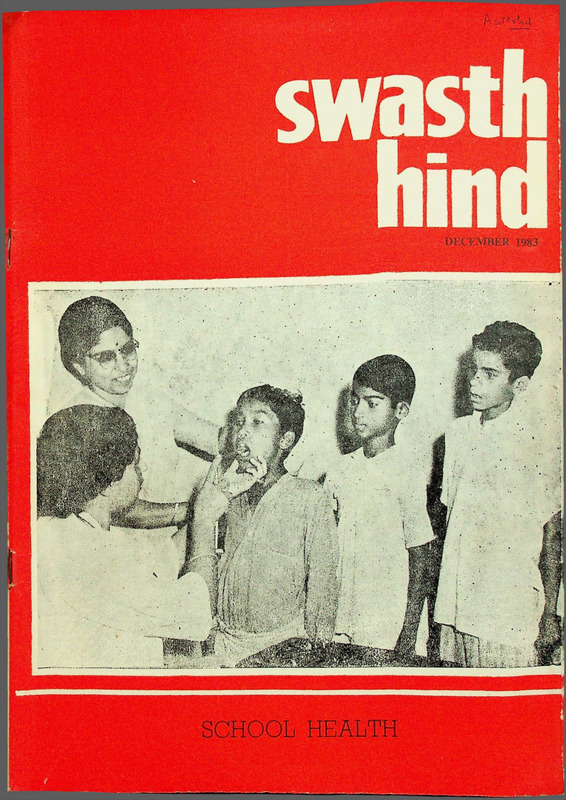
- extracted text
-
ife
JS
III
S8|te§®
ZyvV '.*7>-,;i’Z*t?frj&F&r*.
asgE^^^^S^S.i
3ER 1983
SCHOOL]
tttwgsg^’
PWRBI
In this issue
swasth
hind
293
Health education through socially useful
productive work
G. Guru & Gouri R. Ghosh
295
Promoting mental health in classroom
—Role of teacher
Dr Prem Lata Chawla
297
Population award — an honour to dedicated
workers & parents
Smt. Indira Gandhi
298
IMPACT—India launched
300
Need for sex education
Dr V.N. Rao
R. Parthasarathy
302
Monitoring of school health service programme
Sint. C.K. Mann
304
Nutrition extension through primary school
V. Ramadasmurthy & Dr M. Mohan Ram
306
307
308
New Delhi-110 002.
Preparing for school
Brain injury—an avoidable tragedy
Dr A.K. Banerji
311
: D.N. Issar
Influence of physical defects on academic
performance and intelligence
Vijay Suple
312
: M.S. Dhillon
School Health Scheme for urban areas
Dr B, Loomba
December 1983
Vol. XXVII No. 12
Readers Write
I am a health worker having Diploma in Health
Education. I read an issue of Swasth Hind and
found it very useful as it contained important infor
mation about community health aspects.
M.G. Behetwar
Asarkarwada,
Keshaoraj wctal,
AKOT-444101
Distt. AKOLA (M.S.)
Editorial and Business Offices
Central Health Education Bureau
Asstt. Editor
Sr. Sub-Editor
: G.B.L. Sri vatsa
Sub-Editor
289
A health card for every child
Dr A. Abubecker
Agrabayana-Pausa
Saka 1905
Kotla Maig,
School health programme
considerations for a national policy
J.S. Manjul
Strong and beautiful—a.story
Dr R.L. Bijlani
Back inside
cover
Articles on health topics are invited for publication in this
Journal.
State Health Directorates are requested to send reports of
their activities for publication.
Subscription Rates
Single Copy
Annual
.
.
•
Re. 0.25
.
•
Rs. 3.00
(Postage Free)
The contents of this Journal are freely reproducible.
acknowledgement is requested.
Due
The opinions expressed by the contributors are not neces
sarily those of the Government of India.
SWASTH HIND reserves the right to edit the articles sent
for publication.
SCHOOL HEALTH PROGRAMME
Considerations for a National Policy
J.S. Manjul
ealth has been considered as
one of the major goals of edu
cation and social development by
the educationists and the programme
planners. But little has been done
in the direction of achieving the ob
jective of optimal health. There is
little in the way of systematic plan
ning. implementation and pro
gramme evaluation so that children
may develop desirable habits to pro
tect themselves from preventable
diseases: adopt a life style which
may keep them away from most
of the non-communicable diseases
most of the time: fight superstitions.
misconceptions, beliefs and fads
which are likely to adversely influ
ence their health: understand the
scientific basis for these; and utilise
available health services in case of
need.
H
The Government of India has launched an Intensive
Pilot Project on School Health Services in 25 selected
blocks located in 20 districts of 17 States and three
Union Territories. This would pave a way to launch a
systematic school health service programme to cover all
the students attending primary classes, both in rural
and urban areas of the country, in a phased manner by
the end of the Seventh Five Year Plan. The author feels
that there is a need to establish linkage between the Inte
grated Child Development Scheme (ICDS) Programme
and School Health Programme. He says that the health
records of a pre-school child should be passed on to the
school for incorporation in the cumulative health card
of the child to be maintained in the school. In the urban
areas school health units may be established for a group
of schools having enrolment of 5000 to 6000 students.
He has also emphasised the need of preparing an ap
proach paper on implementation and evaluation of
health education to provide clear guidelines for this im
portant programme and to prescribe minimum teacher
preparation and a set-up to deal with it. Such steps
would ensure optimum utilisation of educational oppor
tunities by the younger generation.
December 1983
India is committed to achieve an
appropriate level of health for all
by the year 2000. Ground work
has been done. National Health
Policy and National Policy for
Children have included basic ele
ments of health care for younger
generation. These elements are no
doubt important considering the
current health problems of children.
However, more emphasis on health
education will help prevent health
problems rather than providing
curative and clinical base for the
detection and treatment of health
problems. Systematically planned
and implemented health education
programme with a built-in system
289
of feedback for programme modifi
cation is essential to achieve the
goals more objectively. This will
help reduce the increasing burden
on existing curative services which
even when expanded may not be
able to keep pace with the rapidly
increasing population in view of li
mited resources. Constant observa
tion and screening for defects and
deviations from normal health
among school students by teachers.
early detection and treatment of
diseases and
disabilities among
school population can reduce the de
mand on medicare facilities, lower
the need for costly rehabilitation
effort and enable students to make
optimum use of educational oppor
tunities in improving scholastic per
formance.
Health Services in Schools
Sporadic efforts have been made
in almost all the States and Union
Territories to set up and/or expand
school health services. Reviewing
the resources, facilities and involve
ment of education authority in the
programme, it appears that much
remains to be done. Considering
the fact that health appraisal of
school children is to be done in the
school itself and not at the primary
health centre fPHO. facilities for
transporting the medical and para
medical staff to the school cannot
be overlooked.
According to a recent survey the
; number of students enrolled in pri
mary classes only ranges from 700
to 19000 under one primary health
centre. Therefore, if each school
is to be covered and each student
is medically examined every year.
the number of medical officers need
to be increased’ in the PHC accord
ing to the number of students under
the centre. Transport facilities to
enable the medical officers to visit
the schools also need to be streng
thened.
The programme has suffered dur
ing the past due to lack of resources
290
Ninth Joint Conference of Central Council of. Health and Central
Family Welfaie Council
RECOMMENDATIONS ON SCHOOL HEALTH
In view of the importance of health for school-going popula
tion, the National Health Policy, National Policy for children and
the 20-Point Programme towards achieving the goal of “Health
for All by the year 2000 AD” the Conference resolved that:
— School Health Services should be planned in such a manner
as to cover all primary school children both in rural and
urban areas as a time bound programme during seventh
plan period. The resources of health, education and social
welfare departments both at Central and State Government
levels should be coordinated to provide at least one medical
examination to each child every year and to provide treat
ment for minor, acute and chronic health and nutrition
problems. School Health Committees at the district level
must have an effective coordination With (.he Health, Educa
tion and Social Welfare departments in order to have
an adequate referral and follow-up mechanism and also to
monitor anjd evaluate the day to day execution of the pro. gramme. The Councils took note of the cumulative health
card system introduced by the Government of Goa, Daman
and Diu, Haryana and some other States and recommended
that such a pattern could be adopted by other States/
Union Territories. Guidclfnies for this scheme may be issued
by Government of India.
— The teachers in primary classes should be trained for obser
ving and screening students for defects and deviations from
normal health to maintain effective surveillance and for
providing supportive health education for the prevention
of health problems by developing desirable health habits.
—-
Minimum healthful living conditions including safe drink
ing water, proper drainage, safe disposal of waste, suitable
furniture, adequate lighting and ventilation conditions and
Mid-day Meal Programme should be provided in a phased
manner for all primary school-going children giving priority
to weaker section.
Manpower and material resources be strengthened both at
National and State levels for implementation, documenta
tion, review and monitoring activities for school health
programme on priority basis and in conformity with the
programme expansion, for the success of the time bound
programme.
— The Central Health Education Bureau will coordinate and
monitor the programme and provide advisory, consultancy
services and necessary guidelines for planning, implementa
tion, evaluation and monitoring of the programme to the
concerned agencies at State level and also for strengthening
objective based health education in programmes of formal
and non-formal education
preparation of instructional
material and training of teachers in health education.
—
Swasti-t Hind
RECOMMENDATIONS ON SCHOOL HEALTH-CoW
In view of these roles the School 1 lealth Education
Division of the Central Health Education Bureau and the
Student Health Education Units of the State Health Edu
cation Bureaux be immediately strengthened.
_
The teacher training units for training teachers for streng
thening school health programme be established under
StucleiH Health Education Units of the Stale Health Edu
cation Bureaux on the pattern of teachers training
Unit at Institute of Public Ideal th, Punaniallai (I amil Nadu)
and readier Training Unit with the Stale Health Educa
tion Bureau, Gujarat at Ahmcdabad.
— Recognising the importance of health for school going
children and the 20-Point Programme towards achieving
the Goal of Health for All by the year 2000 and the nonuniform school health service programme in the country
and also considering that there is a large bulk of popula
tion. who are going to the schools, it is strongly recommend
ed that for effective implementation of uniform school health
service programme to start within the Seventh Five Year
Plan the programme may be made an essential part of
minimum needs programme. A
in terms of men, money and mate
rials. There is shortage of staff in
PHCs. at the district, State and the
national levels; lack of funds for
purchase of school health medical
examination kits, medicines, correc
tive aids, training of teachers and
other health education personnel in
volved, health education materials,
petrol, oil and lubricants, printing
of cumulative health cards equal to
the number of students to be exa
mined, printing of other records and
returns, office establishment for pro
viding supervision, guidance and
monitoring the programme; lack of
arrangements for re feral services.
Therefore, in view of these experi
ences there is a need to make the
school health services a time bound
centrally sponsored programme so
that the benefits may reach the re
motest corners of the country to help
the children from deprived families
:as the welfare of the children forms
sa significant aspect of the new 20IPoint Programme of the Prime
Minister.
DtECEMBER 1983
The objective of the school health
programme is to provide at least
one medical examination to each
student every year. Teachers are
in a significant position to observe
any deviation from normal health,
help children develop desirable
health practices to prevent health
problems and refer them to medical/
health centres. A comprehensive
programme of teacher training,
therefore, is needed to enable the
teachers to do this job, both at pre
service and also at inservice level.
These teachers will refer students to
the nearest health centres on the
basis of their day to day observa
tions and can also provide health
education not only to students but
also to their parents following such
approaches as ‘child-to-child’ health
education programme, and ‘childto-parent’ health education.
Most of the schools in the remote
areas do not possess even the basic
health facilities like safe drinking
water, sewage disposal and drain
age facilities, suitable buildings,
furniture, etc. Besides, there is
little coordination between health
and education agencies. School
Health programme and mid-day
meal programme are operating in
different schools under two different
agencies. Though a significant step
has been taken to constitute an
Inter-Ministry Standing Committee
on Coordination between Ministries
of Health and Family Welfare,
Education and Culture and Social
Welfare; similar committees need
to be constituted at State, district,
and block levels. There is also a
need to establish linkage between
ICDS programme and the school
health programme. The health re
cord of each pre-school child
should be passed on to the school
to be incorporated in the cumula
tive health card of the child to be
maintained further.
In the urban areas school health
units may be established for a group
of schools having enrolment of
5000 to 6000 students. These units
may be located in one of the schools
and for a group of such units re
ferral facilities may be established
with adequate resources.
The School Health Education
Division of the Central Health Edu
cation Bureau is monitoring the
coverage under all types of school
health service programmes in the
country and a monthly progress re
port is sent to the Prime Minister's
Secretariat regularly under the new
20-Point programme.
Government of India has launch
ed an Intensive Pilot Project on
School Health Services in 25 select
ed blocks located in 20 districts of
17 States and three Union Territo
ries. The feedback received from
this project will help in developing
modules based on different set of
resources and topographical factors
which would be utilised to launch
a systematic school health service
programme in the country to cover
291
all students attending primary classes
in the rural areas by the end of the
seventh Five year Plan in a phased
manner. The 9th Joint Conference
of Central Council of Health *and
Central Council of Family Welfare
held in New Delhi from 7-9 July,
1983, has made significant recom
mendations on school health ser
vices. (Sec pages 290 and 291.)
Health Education in Schools
dealt with the problems in detail.
The country report on Health Edu
cation presented by the NCERT
in the above Working Group Meet
ing slates “Concepts of health have
been integrated with the concepts
of Environment Studies, Science
and Social Studies. In addition, a
student also learns about health
through socially useful productive
work and games/physical education.
Thus, a student spends about 30%
of school time for learning health
concepts”. The fact is that bits of
information, not arranged in graded
and sequential manner arc being
provided by teachers who have
little pre-service or inservice train
ing in health education and manage
ment of school health programme
directed towards specific objectives.
This has not resulted in helping stu
dents develop desirable health prac
tices and in rooting out supersti
tions. Under the Central Board of
Secondary Education, New Delhi,
health education is being taught as
a separate subject a’ongwith phy
sical education but the responsibi
lity has been assigned to post-gra
duate physical education teachers
for leaching the same. These tea
chers, though they had a Paper
(Course) in health education with
their training in physical education,
still feel that they lack in content
as well as methodology in dealing
with this subject effectively.
School Health Education Division
ol the Central Health Education
Bureau (CHEB) has been working in
close collaboration with the Na
tional Council of Educational Re
search and Training (NCERT) for
Health Education has also been
strengthening health education in
integrated
with Adult Education
school curricula. Health education
Programme
and National Service
content has been integrated in diffe
Scheme with the aim of reaching
rent subjects like environment stu
the benefits of health education to
dies. life science, oopulation educa
Both these pro
Schools are not open for more common people.
tion. physical, education, socially
useful productive work at various titan 220 days a year. A medical grammes suffer due to lack of train
like to avail ing facilities for the volunteers and
levels of school education. There has officer may also
not been a systematic effort to casual, earned and sick leave during also in the form of instructional
train teachers in organising health this period. This is likely to reduce materials.
education programme to achieve its the number of actual operational
specific objectives for each level of days of an academic year to not Towards a National Policy
education. Teachers and students more than 150 days on which stu
An approach paper on imple
even do not have a total perspective dents can be medically examined. If
of health education programme. a school is open for six hours dur mentation and evaluation of health
Several workshops, seminars have ing a day the total number of education needs to be prepared to
been organised, jointly by the Cen working hours are not likely to be provide clear guidelines for this
tral Health Education Bureau and more than 900 hours during a year. important programme and prescribe
the National Council for Education Even for utilising all this lime me minimum teacher preparation and
al Research and Training which dical officers will have to spend a set-up to deal with it. A cell
have highlighted the issues and pro many hours travelling to and from under a Technical Adviser in the
blems in the way of systematic im the school considering the distances Ministry of Education for health
plementation and evaluation of the and difficult terrain in remote areas Education would be able to provide
programme. Concrete steps as re between primary health centre and needed leadership in deciding a
commended from time to time have the schools. If a systematic check National Policy on School Health
not so far been taken. The latest up is given an findings are recorded Programme including school health
reports of fl) National Workshop in the cumulative health card along services, healthful school living in
on School Health Programme. with health education of students. cluding school meal programme
CHEB, 1978. and (2) Technical teachers and parents at the time and health education through for
Working Group meeting on Curri of check-up not more than 5-6 stu mal and non-formal approaches and
culum Development in Health and dents can be examined during an concrete steps to be taken which
Nutrition, organised by the NCERT. hour which would mean about 10-12 may help to achieve the goal of
and Asian Centre of Educational minutes for each child. Tn this appropriate level of health for all
Innovations
for
Development, manner during one year a medical in next sixteen years. This would
Bangkok. UNESCO Regional Office officer would not be able to cover also ensure optimum utilisation of
for Education in Asia and Oceana. more than 5400 students.
educational opportunities by youn
Bangkok. 1980, at New Delhi, have
ger generation. A
292
Swasth Hind
SCHOOL HEALTH SERVICES IN KERALA
A HEALTH CARD
FOR
EVERY CHILD
Dr A. Abubecker
onsidering the importance of
School Health Programme in
moulding healthy citizens of tomor
row the Government of Kerala de
cided to implement a scheme for the
comprehensive physical examination
and medical test of the entire school
going children of the State (num
bering around 55 lakhs). In the
Budget Speech for the year 1980-81,
a time bound programme for the
implementation of the scheme of
Health Cards for School Children
was announced. The scheme con
templates the coverage of all school
going children in accordance with a
phased programme of five years.
The scheme is a
comprehensive
health care programme for: —
C
(a) Promotion and maintenance of
health.
Prior to the inception of the State Health Education Bureau in 1960
School Health Services in Kerala was confined to medical examination
of children in a few schools and conduct of smallpox vaccination in all
schools according to the Central pattern. Though the Student Health
Education Unit for the State Health Education Bureau was sanctioned
in 1965 with the post of School Health Education Officer drawn from
the Department of Public Instruction, the School Health Programme
commenced work on a regular basis only after 1970. The activities of
rhe Unit were mainly aimed at three groups-students, teachers and
parents. Teachers and parents were oriented in order to get their sup
port and assistance for the programme, while the schemes implemented
strove to prepare the school children to grow and develop as healthy
citizens. The approach was mainly of an integrated nature so that all
the aforesaid groups categories as well as the regular public health
workers got an experience of the working and importance of the pro
gramme. The School Health Programme provided for all important
activities like teacher preparation, student education, medical examina
tion of pupils and follow up, improvement of healthful school living
environments etc., to the extent of budget provision available each year.
Workshop on Health and Population Education for High School Tea
chers and Officers of the Department of Education; Training to Tea
cher-Educators, Seminars for Assistant Education Officers; Pilot Pro
ject in School Health, Model School Health programme and Compre
hensive School Health Programme are the important activities under
taken under the School Health Programme during the decade 1970.1980. We publish here an article giving the details of the Health
(Cards for school children scheme in Kerala being implemented since
H980-81.
(b) Prevention, detection and cure
of diseases.
(c) Prevention, identification, cor
rection or reduction of deformi
ties and disabilities.
(d) Maintenance of health record.
The Scheme consists of services for
(1) Early detection, treatment and
follow up of disease, deformi
ties and disabilities in children
during their school life.
(2) Prevention of communicable
and non communicable dise
ases including nutritional defi
ciencies.
(3) Imparting knowledge to child
ren about health.
healthful
living, disease and disease
prevention.
(4) Providing sufficient knowledge
and orientation to teachers, in
health matters.
Main objective
To provide maximum health care
to the entire school going popula
tion in the State.
Specific Objectives
1. Conducting medical examina
tion of students in all the
schools in the State.
December 1983
293
2. Provision of curative and cor alth and Taluk Headquarters visit
rective treatment for all school the schools in the district in fully.
children who arc found to be equipped mobile units and physical
ly check the pupils and provide them
in need of such services.
3. Maintenance of cumulative with cumulative Health Cards indi
Health Card for each student. cating complete medical details and
corrective action required wherever
4. Immunisation of all school necessary. The medical records are
children.
updated from year to year as part
5. Provision of nutrient supple of a continuing programme which
ments to those school child will be extended to the entire school
ren who are found to be in going population within a period of
need of the same.
a few years. Pupils found to be in
6. Imparling health education to need of treatment, corrective action
etc., are referred to the nearest sui
pupils.
table Government Medical Institu
7. Imparting knowledge to selec tion. It is the responsibility of the
ted teachers in health matters parents/guardian to take the child
so that they can,
to the referred institution and avail
(a) impart knowledge in health of the sendees. Provision has been
care to pupils.
made for the supply of medicines to
(b) make routine health obser the medical institutions exclusively
for the School Health Programme.
vation of pupils.
Medical
services and investigations
(c) take appropriate action in
rendered
to school children under
situations requiring first aid
and emergency treatment of the School Health Programme are
free of all charges irrespective of the
minor ailments.
income of their parents.
8. Arrangement in schools for
giving first aid and emergency Health Education
treatment of minor ailments.
(a) Pupils: Topics related to heal
IMPLEMENTATION OF THE
SCHEME
Organisational set-up
The Additional Director of Heal
th Services (School Health) is the
State level programme officer and
the District Medical Officer of He
alth is in-charge of the programme
in the District. Medical Officers
designated ‘School Medical examinners’ have been appointed exclusi
vely for the programme. Necessary
ministerial staff have also been ap
pointed at the Directorate of Health
Services and at District Headquar
ters.
Medical examination and referral
service
The School Medical Examiners
allotted to each district and attach
ed to the District Hospital/Office of
the District Medical Officer of He
294
4. First Aid and treatment of
minor ailments (1-| hrs.) and
5. Health appraisal of pupils by
teachers (Ihr.)
(Total—6 hrs.)
Health Education is one of the
subjects prescribed for the Teacher’s
Training Certificate Examination
and B.Ed. Examination in the State
and the one day orientation training
given as part of the Scheme of He
alth Cards for school children,
though not enough, is found to be
very useful in enlisting the active
cooperation and assistance of the
teachers in the effective implemen
tation of the scheme.
The Education Department of the
State is also conducting a few 10day Health Education Training
Course for Headmasters of Primary
Schools every year.
Recording, reporting, consolidation
of results.
The following records, forms and
registers are used.
(i) Cumulative Health Card (Ori
ginal): It is a comprehensive re
cord for entering the details relating
th and healthful living have to personal data, family history.
been included in the school pre-school history, childhood disea
curriculum
and integrated ses and other diseases, growth par
with the various subjects. The ticulars. immunisation, findings of
main responsibility of impart physical examination, treatment fol
ing health education to pupils low up etc. This is kept in the
is on the teachers.
school till the pupil continues on
the rolls of the school and will be
(b) Teachers'. Provision has been issued to him when he leaves the
made in the scheme for con institution.
ducting one day orientation
(ii) Health card (duplicate): Sin
training to teachers at the rate
of one teacher from each sc ce the original card is retained in
hool every year. The topics the school, there will not be any
dealt with and the time given record to refer to the background
to each topic in the training of the child or the details of services
rendered by the doctors treating the
are:
child in between two school inspec
1. School Health Programme (1
tions. Hence, a deplicatc card with
hr.)
summary of findings which can be
2. Role of teachers in school entrusted with parents is maintained
health programme fl hr.)
for each pupil.
3. Diseases common to school
(Contd. on page 296)
children (U- hrs.)
Swasth Hind
STUDENT’S PARTICIPATION IN LOCAL HEALTH PROGRAMMES
Health Education through
Socially Useful Productive Work
G. Guru & Gouri R. Ghosh
curricular activity becomes meaningful when it
A related to the needs of the learner and the com
munity to which he belongs. It becomes more mean
Socially Useful Productive Work
(SUPW) has been defined as purpo
sive, meaningful, manual work result
ing in goods or services which are
useful to the. society. It has been given
a central place in the school curricu
lum as well as the status of a fullfledged subject in the final public
examination at the end of class X
by the Ishwarbhai Patel Committee
(1977k The concept and objectives
of SUPW as defined by the Ishwar
bhai Patel Committee were accepted
by the Adisheshiah Committee
(1978) for the plus two stage.
ingful when it is related to the basic needs.
It
becomes purposive when it has a bearing on the pro
cess of enhancing nutrition, health, environmental
and socio-economic status of the community.
Through Socially Useful Productive Work (SUPW)
activities the child becomes aware of the social and
environmental problems; feels a loving concern for
the community and the environment; develops team
spirit, self-reliance, dignity of labour, tolerance co
operation, sympathy, and becomes a useful member
of the society.
SUPW, thus, has been well-conceived as one of the
most powerful educational instruments for the person
ality development of the child as well as peaceful
social transformation.
Ishwarbhai Patel Committee has identified six areas
of work situations which occur in the home, in the
school and in the community;
(i) health and hygiene;
(ii) food;
(iii) shelter;
(iv) clothing;
(v) culture and recreation; and
(vi) community work, and social service.
Purposive and meaningful SUPW activities can be
drawn from these areas as per local needs and faci
lities available. And local health programmes can be
selected in all the six areas of work situations.
Primary level
At primary level, relevant activities can be organi
zed to develop desirable nutrition, health and sanita
tion practices among the primary school children.
Such programmes can be extended from the school
to children’s homes as Individual Projects’ and to
the community as ‘Group Projects’. Suitable activities
at this level may include, among others, keeping the
surroundings (school, home, neighbourhood) clean
and beautiful; planting and taking care of shade giving
trees along the school and on road-side; rearing vege
table garden in school and home; maintaining articles
December 1983
295
of use neatly; washing clothes; looking after clean
and safe water supply especially during festivals,
preparing and maintaining compost pit, etc.,
Middle level
At middle level, activities conducted at primary7
level arc continued which may be of advanced type.
Besides, activities may include making of tooth
powder, soap, disinfectants, detergent powder, hair
oil, brooms, waste-paper baskets, dust bins, compost
manure, first aid boxes, health posters; keeping health
records; working at health centres; growing of selec
ted vegetables of high nutritive values and ornamen
tal plants in plots or pots; making of jams, jelly,
sauce, pickles, fruit juices; working in co-operative
canteens: looking after sanitary disposal of wastes
during festivals: helping in the care of the sick; keep
ing sources of water in the community safe and clean:
introducing important messages of health to the com
munity through door-to-door contracts and commu
nity meetings and exhibitions.
Secondary level
At secondary level, activities of Pre-secondary stage
may be continued, but these will be well-planned and
well-organised. These may cover other activities
such as growing and rearing nursery beds; medicinal
plants; conserving soil; controlling desert; restoring
vegetation cover through social/farm forestry; con
structing and maintaining toilet facilities, compost pits
and gobar gas plants; maintaining cleanliness of the
neighbourhood, wells and ponds; eradicating com
municable diseases; rendering paramedical service;
preparing and maintaining mushroom culture, hydro
ponics; providing trench latrines and maintaining
these hygienically, home and village planning; moni
toring local health programme through coordination
of children of neighbouring schools.
Students’ participation through SUPW in local health
programmes, if well-planned and coordinated; and im
plemented can enhance nutrition, health, and environ
mental sanitation status of the community to a great
extent.
The local problem can be taken up as '‘Students’
group activity projects” under the teachers’ guidance.
The local communities will have to be taken into
confidence for their successful participation in the pro
ject.
These project reports can be evaluated as part ol
the students practical work. Good projects reports
can also be published in school magazines for giving
encouragement to the students. A
(Contd. from page 294)
(viii) Consolidated monthly pro maintained in schools for recording
(Hi) Referral card (Form No. I): gress report (Form VI)'. This Form the teachers’ health observation of
It is given to the pupil in case he is is used for sending the consolidated the pupils.
report of the school medical exami
advised for referral service.
(xii) Register no. IV : This Re
(fv) Intimation to parents (Form nations conducted in the District. gister is also maintained in schools
II)'. It is a form for giving intima The consolidation for the district is and the visits, activities, opinions,
tion to the parent of the child ad done in the office of the Medical suggestions, etc., of the health per
Officer of Health and forwarded to
vised for referral service.
sonnel and other concerned officers
the
Directorate of Health Services.
(v) Monthly report of Medical
are entered in this Register.
examination of School Children
Consolidation for the State is done First aid and emergency treatment
(Form III)'. The School Medical in the Directorate.
of minor ailments in schools
Examiners send the details of their
(ix) Register no. I: It is the No There is provision for providing
work to the District Medical Officer
minal
Register for Medical Exami all the schools in the State with a
of Health and Director of Health
nation
to be maintained in each First Aid Kit each.
Services in Form HI every month.
school. The details of pupils who
(vz) School follow-tip report (Form are subjected to medical examina School Health Committee
IV): The Head of the school sends tion at a time are recorded in this
In each District a committee de
the report of medical examination Register.
signated as District Advisory Com
conducted in the school in Form IV
mittee for the Scheme has been con
(x) Register no. II: It is the Fol stituted. The District Collector is
to the District Medical Officer of
low-up Register and is maintained the patron. Dy. Director of Educa
Health(vii) Attendance report regarding in the medical institution. The de tion of the District is the Chairmap
referred cases (Form V): It is in tails of attendance and results of and the District Programme Officer
this Form that the heads of medical referred cases are entered in this is the Convener of the Committee.
institutions send monthly report Register.
Members of the Committee are de
about the attendance and result of
(xi) Register no. Ill: (Health ob cided by the Chairman and the Dis
servation Register): It is a register trict Programme Officer. A
referred cases.
296
SwastfTHind
PROMOTING MENTAL HEALTH
IN CLASS ROOM
—Role of Teacher
Dr Prem Lata Chawla
For promotion of mental health the teacher should be prompt in alerting
the parents and helping them to find special help for children who show
stammering, tics (convulsive motions of certain muscles), mannerisms or other
minor defects which make the child self-conscious, foster low self-esteem and
restrict the degree of freedom of behaviour enjoyed by all children.
an undisputed fact that school is an impor
tant part of most children’s lives as they spend
much of their time, over a period of twelve years, in
the classroom. The child at school grows and deve
lops in a well defined social system of the classroom.
The students attempt to fit into their environment
and they also try to control their environment by
mastering lessons, by getting alongwith their class
mates and teachers. This process of socialization
produces some stress for all children. It may intro
duce behaviour problems in some, while it may cause
worries, upsets and conflicts in others. The teacher
should not only be familiar but well-conversant with
the patterns of emotional disorders and principles of
mental hygiene, so that they become efficient in pre
venting these disorders and promoting mental health
in the school.
Patterns of emotional disorders
Some common patterns of emotional disorders ob
served in school children are: (I) ‘Good’ or ‘model’
child; (2) Aggressive child; (3) Anxious child; (4)
Scholastically backward child, and (5) Child with
specific learning difficulty.
‘Good’ or ‘model3 child'. The ‘Good’ or ‘model’
children appear to be reserved, withdrawn, seclusive.
They pursue solitary interests and hobbies and avoid
competitive activities and sports. In group situations
they are inept and awkward. These children are
unable to express anger, hostility in aggressive manner
and they tend to show a lack of initiative. These
children become isolated because of low self-esteem,
poor interpersonal skills, psychiatric illness or some
personal stress. Isolated withdrawn child
(model
child) from a lower socio-economic status family is a
very sick child while a naughty boisterous and some
what antisocial child from a similar background re
flects a good psychiatric health.
This is because
children belonging to lower economic-class are ex
pected to be aggressive and less well-mannered while
middle class children are expected to be aggressive
t is
J
December 1983
but well-mannered. Good does not always mean that
this type of behaviour is good for the child, but
rather that it is acceptable to the adults about him.
The teacher should be careful so as not to misuse the
‘good’ child by encouraging him to carry tales and
reports on other children. The children should again
be protected from becoming dutiful and responsible
to the extent that they subordinate all their wishes to
that of the adults. The teacher should make every
effort to bring these children in the mainstread of
classroom activity by taking note of them and by
making them participate actively. This will help the
child in developing interpersonal skills which are
going to be useful to him as he goes out of the school
into the adult world.
Aggressive child'. Normal aggression stems from
the child’s need to feel important and to dominate
others. When the child is always aggressive and is
motivated by factors other than recognition and mas
tery, and when aggression stems from anger, hostility
or jealousy, then it is to be considered abnormal.
The abnormal aggressive behaviour manifests as fre
quent disobedience, lying, stealing, running away from
school, fighting, being destructive, smoking and indul
ging in anti-social acts. Aggressive behaviour may be
determined by group pressure, e.g., socio-economic
status of the child or it may represent a faulty deve
lopment of social conscience due to inadequate or in
appropriate child rearing by the parents. It is also
certain that schools with their formal curriculum and
particular social values affect the personality develop
ment and academic achievement of the students. The
successful schools in terms of low delinquency rate
and high academic achievement ar? those which func
tion without excessive punishment, are well-managed,
have concern for children’s need, appreciation of their
good work and behaviour and allow children to play
a responsible part in their schooling.
(Contd. on page 310)
297
POPULATION AWARD
--an honour to dedicated workers & parents
Smt. Indira Gandhi
Prime Minister Smt. Indira Gandhi received the
1983 UN Population Award from UN SecretaryGeneral Javier Perez de Cuellar at a ceremony held
in New York on 30 September, 1983.
Smt. Gandhi shared the award, the first ever pre
sented by the United Nations, with Mr Qian Xin
Zhong, Chinese Minister incharge of the State Family
Planning Commission. The award consists of a
diploma, a gold medal and a monetary prize of
S 12,500 for each of the two laureates. The objective
of the award is to promote the solution of the popu
lation explosion by encouraging the efforts of people
in population-related activities and increasing the
awareness of population questions.
Published below is the text of the speech delivered
by the Prime Minister after receiving the United
Nations Population Award.
....... I greatly value the honour you have done me
today. The honour is not to me personally or even
to the Government of India, but to the thousands of
dedicated family planning workers and the millions of
young parents, who are willingly planning their fami
lies.
They will be encouraged that this world body
has recognized India’s efforts in one of the most diffi
cult areas of social engineering. Even more, it is a
reminder of the tremendous responsibility cast on us,
because India and China, which is also honoured
today, are more than a third of the human race.
The 1881 census showed India’s population as 253
million. • Fifty years later, our National Song men
tioned 300 million working for liberation. It was a
comparatively small increase.
The Indian Empire.
as the British then called it, included four sovereign
countries of today: India. Bangladesh. Burma and
Pakistan. The cumulative population of these four
has now trebled.
How was the population stable in the first half of
the century? The reason is simple. The old stability
was an unhealthy one. a result of disease, famine and
an unconscionably high death rate. Indeed in the
decade 1911-1921. influenza took a toll of 20 million
people, so that the population of India fell. Thus,
the stability was an index of poverty, helplessness and
298
governmental irresponsibility—very different from the
demographic stability achieved by modern affluent
societies.
Fight against epidemics
The end of the 1939-45 witnessed some major poli
tical and scientific events.
Politically, it was the
beginning of the post-colonial era. One by one, many
countries regained freedom and sovereignty. Scienti
fically, the nuclear age was bom. Less widely heral
ded, but no less dramatic in its consequences, was the
advent of new “Miracle Drugs” like antibiotics and
their widespread use.
The newly free countries also
mobilised their resources to fight epidemic and famine.
In the last years of foreign rule in India, at a time
when most of us were in prison, there was a famine
in just one province, Bengal, in which 3.5 million died.
In the last three and a half decades, we have had
the usual number of droughts but no deaths from
famine. Droughts are made by nature, famines are
mostly man-made. The people of India are legiti
mately proud that freedom has brought an end to
famine.
Simultaneously we have made a concerted
attack on epidemics. Plague and smallpox have been
eradicated. Malaria deaths have been reduced from
millions to thousands.
All this has led to a burgeoning of our population
as happened in 19th century Europe, when public
health spread and social welfare measures began.
Between 1801 and 1901, the population of Britain in
creased from 10.5 million to 37 -million. And that of
Europe from 188 million to 415 million. Thus, the
population growth of India is not because of impro
vidence and dereliction, but a sign that the Govern
ment is doing its utmost to save lives.
Death rate falls as a result of organised public
health ...-rvices. Birth rate falls with the growth of
education and improvement in standards of living.
One could say that the death rate is brought down by
the community’s responsibility to the individual, and
the birth rate by the individual’s responsibility to the
community. The human race begins with children.
The person who cares for children cares for the human
race.
Swasth Hind
People’s consent and cooperation
Long years before our independence, we realized
that poverty could not be effectively combated unless
the size of the family was limited to enable each child
to have a better share of resources and opportunities.
India was the first to adopt family planning as its
official policy.
Control of population is an integral
part of our plans for development. While special
funds and staff are earmarked for this programme we
also recognise that the task has to be dovetailed into
our general programmes of health and education.
Our functioning is democratic.
The Government
can act only with the consent and cooperation of the
people.
Our family planning programme is entirely
voluntary and we recognize the importance of invol
ving voluntary organizations in its implementation.
Significant decline in birth rate
The birth rate, which was above 40 per thousand
in 1951 has come down to 33 for the nation as a
whole, in those states where education, particularly
of girls, is higher, and where economic progress has
been faster and rural health services better developed,
the birth rate has fallen even more markedly. It is
25.6 per thousand in Kerala and 30.3 per thousand
in Punjab.
Our object is to reduce the national
average to 21 per thousand by the year 2000.
The task is not easy. Millions of couples, many of
them illiterate, must be persuaded and given the
means.
With low incomes and crowded homes,
couples can seldom afford to, or have the abi
lity to, use contraceptives. So they choose sterilisa
tion.
There is some opposition, though less than in
other countries, and more for political reasons than
religious.
Our people have taken well to laparos
copy.
With the assurance of reversibility, more will •
avail themselves of these services as fast as we can
provide them. We owe it to young parents in deve
loping countries to find simpler regimens. Medical
research should also produce more effective and safe
formulations to confer long-lasting immunity on men
and women. These should be inexpensive, easy to
use and without harmful after effects. Couples should
be able not only to avoid conception but to have child
ren at their choice.
False theories about the dele
terious ethical consequences of the use of contracep
tives insult the inner worth and dignity of human
beings, and their mastery, over themselves.
Economic backwardness
Our main obstacle.is the economic backwardness
which we seek to remove. In agricultural and craft
societies, children are regraded as extra hands to help
the family. For the same reason boys are preferred.
December 1983
Also, in the old demographic lottery, death was a
more likely chance.
A large margin had to be pro
vided for infant mortality.
Today, younger women,
even those who may not be educated, have ambitions
for their children and are enthusiastic about family
planning.
They are our best allies.
But husbands
and mothers-in-law sometimes pose problems.
It is said that prosperity is a good contraceptive.
But the effect of development are submerged unless
we bring about a low birth rate. Family planning is
an input for development, an indispensable exercise in
human, capital formation. Education, better capacity for
producing and earning, a higher rise in per capita
income are possible only when population growth is
curbed. Individuals are not moved by statistics, but
by emotions. We have been able to convince an in
creasing number of people that in our circumstances.
family planning means better health for the mother
and child, more opportunities for the family as a
whole.
No coercion- in- family planning
We are pursuing our objective with undeviating
steadfastness. But we have not and shall not use
coercion. It is not workable in so intimate a perso
nal relationship or in our system of governance. A
few years ago, when we were intensifying our volun
tary family planning drive, political parties delibera
tely misrepresented it and politicised it into an election
issue, making wild allegations of forced sterilisations.
which were later proved baseless, but they were belie
ved and helped to change the government.
A vital
element of the national agenda for progress received
an unfortunate and irretrievable setback.
Now we
are once more going forward.
Need! of international cooperation
In this we need international cooperation. Some
people are still unreconciled to the idea of family
planning and continue to spread false reports. Aca
demics and media persons should regorously scruti
nise such reports.
It is projected that the world population, around 4
billion in 1980, will cross the 6 billion mark by the
year 2000. In other words, in less than two decades.
half as many more people will have been added as
now live on earth.
Ninety per cent of this increase
will occur in developing countries, which are already
facing pressure on land, food, water, housing, employ
ment, education and health. India has succeeded in
doubling its grain production between the mid-sixties
and mid-seventies.
Our agricultural growth is ahead
(Contd. on page 309)
299
India Committed to
Uplift the
Disabled Persons
Zail Singh
Picsident of India
hen one looks at the staggering number of dis
W
abled people in the world today of which about
80% live in developing countries and the frightening
prospect that the number of disabled persons would
be doubled by the end of the century, the problem of
tackling disabilities may appear to defy any possible
solution. The consequences of physical and mental
disability in terms of the suffering and frustration are
tragic both in its nature as well as its magnitude. Dis
ablement among children and the working age group
of population results in less of economic activity and
productivity, and disability among the aged results in
physical and psychological suffering.
Fortunately,
however, modem scientific advances in the field of
health and medical sciences all over the world have ,
made available to us low cost practical strategies by
the use of which, at appropriate timings and in a plan
ned manner, the problem of disabilities can be tackled
and reduced to manageable proportions in a reasona
ble short span of time. For example, a vastly expan
ded programme of immunisation of mothers and child
ren, effective steps against malnutrition and better
care of pregnant mothers and children can help in
reducing the number of disabled persons to a consi
derable extent. I feel that a more systematic effort is
required to be made by all nations, particularly of the
developing world, in collaboration with the inter
national organisations working in the sphere of health.
to plan and put into action appropriate measures of
prevention, focussed particularly on these disabilities
against which there exists an appropriate and cost
effective potential for control. It is in the fitness of
things that many international organisations have
joined hands in taking an initiative in this direction.
The Government of India is firmly committed to
the cause of the upliftment of the poor and down
trodden sections of society particularly the disabled
persons, who happened to be most neglected people
of the community and need maximum support and
sympathy. We have been able to develop a number
of practical and low cost technologies in India for
prevention and cure of disabilities of various kinds
and these are being applied in the country with consi
derable success. However, there is need for a well
coordinated plan of action and concerted effort to en
sure better application of these technologies all over
the country.
300
‘IMPACT-India’
Launched
The project ‘IMPACT’—an international initiative against avoidable disablement—
was launched in New Delhi on 2nd October, 1983, birth day of Mahatma Gandhi, by
the President of India, Shri Zail Singh. IMPACT is gradually to be extended to other
countries.
Three international agencies—the World Health Organizations (WHO), United Nations
Children’ Fund (UNICEF) and United Nations Development Programme (UNDP)—have got
together to organise IMPACT in collaboration with the Union Ministry of Health & Family
Welfare and the Ministry of Social Welfare.!
A three-day Seminar of Administrators and health experts was organised to mark
the inauguration of the project ‘IMPACT-India’.
Prime Minister Indira Gandhi sent a message on the occasion.
Facilitating the organisers of the IMPACT-India Seminar for taking an important practi
cal step forward from Leeds Castle Declaration, the President, Shri Zail Singh hoped that
the participants wculd te able to evolve ccncrete plans of action for disability prevention
for incorporation in the international and national health plans in order to secure a progres
sive reduction in the scale of disabilities prevalent in various countries.
Vice-President of India, Shri M. Hidayatullah, who delivered the valedictory address
on 4 October, 1983, stressed the need for educating people about the causes of various
diseases which led to disablement. Elementary hygiene and safety should form a part of
the school curriculum, he suggested.
Minister of State for Health and Family Welfare Smt. Mohsina Kidwai said that
the blue print of action to reduce the incidence of disablement over the next 15 years
that had been evolved by the IMPACT Seminar would, to a great extent ensure that the
next generation would not suffer from the present degree of disability. The action pro
gramme would be included in the community-based development programme and primary
health care system.
It is indeed heartening to note that project ‘IM
PACT’ is being launched on Mahatma Gandhi’s birth
day. Mahatma Gandhi’s services to the cause of the
physically handicapped, the lepers, the blind are well
known. Gandhi’s ideals will provide the necessary
strength and encouragement to all those who are in
volved in this herculean task of providing light to'
those who cannot see, speech to those who cannot
hear and movement to those who are deprived of per
forming normal human activities.
— Excerpts from the inaugural address by
the President of India on launching the
Project ‘IMPACT* in New Delhi, on 2
October—1983
Swasth Hind
Recommendations of the Seminar
A
I
t
The three-day IMPACT-India Seminar on avoida
ble disablement concluded in New Delhi on 4 Octo
ber, 1983, with the adoption of the New Delhi Dec
laration outlining a series of recommendations which
would be incorporated in a blue print plan of aclion.
The recommendations envisage “disablement free
zones” on the lines of the cataract free zones and the
setting up of a National Rehabilitation Fund on the
pattern of the Prime Minister’s Fund to assist disabled
persons.
December 1983
Prime Minister’s Message
“Many disabilities and diseases are avoidable.
Growing economic prosperity and higher educational
standards should bring higher health consciousness.
Our development programmes emphasise safety and
prevention.
Gandhiji’s contribution to the rehabilitation of
leprosy patients has been an inspiration for our ex
tensive programme for the rehabilitation of the dis
abled.
It has been long recognised that disability
causes anguish to those affected and to their families.
With assistance and training, the disabled can be
come useful citizens and lead fulfilling lives.
India has pioneered the application of highly
effective low cost technologies particularly in arti
ficial limbs, spectacles and simple hearing aids. The
new
international initiative against
avoidable dis
ablement will synchronise this technology with the
facilities available in our established health infra
structure.
I send my good wishes for the inauguration
of
IMPACT.”
Recommendations made concerned four areas—
eye, ear, orthopaedic and mental disablements—which
are to be tackled under IMPACT.
The National Programme for Control of Blindness
would serve as a model within the country for the
control of other categories of disablement.
Prevention of blindness
To achieve the targets set for the prevention of
blindness it was recommended that the vitamin A dis*
tribution system be strengthened, an ophthalmic assis
tant be posted at every primary health centre, volun
tary agencies be assisted to conduct eye camps, child
ren eye health screened through the school health pro
gramme and health educational provided through tea
chers and village leaders.
Prevention of deafness
For prevention of deafness, the participants recom
mended that more stress should be laid on ante-natal
and pre-natal care. Among other things, integrated
education for deaf children in normal schools should
be encouraged and priority given to the supply of
hearing and speech aids.
Orthopaedic disablement
In the field of orthopaedic disablement, it was
pointed out that of the 15 million handicapped, 7
million were the result of polio and at least one mil
lion cases could be attributed to leprosy and the re
mainder to tuberculosis, accidents, and birth injury.
{continued in 3rd cover)
301
NEED FOR SEX EDUCATION
Dr V.N. Rao
R. Parthasarathy
In order to prevent many of the serious complications
education needs to be imparted in matters related to sex.
This can be planned in collaboration with medical per
sonnel, professional social workers and educationists.
Such systematic sex education to different groups would
definitely fetch high dividends not only in preventing
psychological and psychiatric complications but also in
promoting positive mental health.
S
exual problems are found in all groups of people—
married and unmarried, young, middle and old, male
and female and everywhere—in the developing and de
veloped countries. It is evident from the literature on
the subject that most of he people experience his pro
blem at one time or the other, temporarily if not per
manently.
The mere utterance of the word “sex” arouses feel
ings of sin, disgust, shame or uneasiness in the society.
There are parents who oppose their children learn
ing physiology and anatomy and reproduction in the
class rooms. In such a society, the person with sexual
problems suffers a lot—unable to share his problem
with anybody or to do something to overcome the
problem. When he reads attractive advertisements
on treatment for sex troubles he/she gets thrilled to
find solution for his/her problem. The individual then
reads pornographic literature and finds different things
said about sex problems which invariably aggravate
his fear and worries.
Somatic Complaints
Because of the culturally imposed taboos towards
sex. persons with disorders in the sexual behaviour con
sciously or unconsciously transform these problems into
different somatic complaints like headache, fatigue.
generalized aches and pains, frequent micturition, pal
pitations, difficulty in sleep and digestion. Usually, the
physicians prescribe some pain killers, tonics and injec
tions. The victims, in addition to these prescriptions,
would be taking costly beverages presuming that their
problems would be solved once they become physically
302
strong. However, it is not uncommon to see people with
strong physique having sexual problems.
Psychological trauma
Psychological trauma experienced by the persons
affected with these disorders is inexplicable. Besides.
economic burden, he/she starts consulting astrologers.
traditional healers, quacks and others who give him
a little ray of hope. These problems in turn affect his
work situation. Many a times the preoccupation of
mind and worries make the individuals encounter un
expected situations, sometimes leading to severe in
juries or death due to accidents. Feelings of inferiority,
inadequacy and helplessness force the individuals to
withdraw from social relations. The individual becomes
so anxious and fearful that he starts suspecting others.
Such reactions act as a vicious cycle resulting in dis
turbed’ interpersonal relations and increased sexual
problems.
False notions
The adolescents falsely believe that masturbation
constitutes a grave moral and intrinsically serious
disorder. The ill-effects of this unscientific view leads
to lots of problems like decreased interest and concen
tration in studies and extra-curricular activities, exa
mination phobia, anxiety, pahic and extremely depres
sive reactions.
The unscientific views and knowledge got through
friendly chit-chat, neighbourhood gossips, blue books,
magazines and films, fill the minds of adolescents with
different fears and misconceptions. The adults start
believing that they could not enjoy sexual relationship
because they indulged in masturbation at their earlier
stages. The married men attribute their failure in
sexual enjoyment or premature ejaculation or impo
tence to passing of “dhat” or semen through urine. He
becomes excessively preoccupied with loss of semen
which in turn deteriorates his personal and social
functioning. Such misconceptions lead them to believe
in evil spirits and black magic. Among females many
misconceptions, doubts and fears are associated with
different normal biological functioning like menstrua
tion. sexual relationship, pregnancy, breast-feeding and
menopause. The different “do’s” and “don’ts” based
Swasth Hind
on their unscientific knowledge and hearsay trouble I
their personal and marital happiness. Many psycholo
gical and psychiatric conditions are associated with
sexual behaviour. According to Joseph Wolpe, the
impotence and premature ejaculation, the common
est of all sexual problems, in the great majority of the
cases are due to anxiety having been conditioned to
aspects of sexual situations. It has been the experi
ence of mental health professionals that anxiety
with its obsessive apprehensiveness may arise in as
sociation with frustration or dilemmas occurring in some
major life problems related to such topics as voca
tional. sexual or marital adjustment.
CHILD MENTAL HEALTH
Does the psychosocial development of children
really deserve serious concern, especially in countries
beset with high infant mortality, frequent epidemics
and the constant threat of starvation? This was one
of the central issues dealt with by a multidisciplinary
WHO Expert Committee meeting.
Sex education
A study conducted on anxiety patients who attended
the National Institute of Mental Health and Neuro
Sciences, Bangalore, showed that almost 50 per cent of
the patients of different age groups had problems in
sexual relationship mainly because of their ignorance
about matters related to sex. The main mode of therapy
was sex education in individual and group sessions. Un
fortunately, only a fragment of population with sexual
problems seek the services of the general hospitals or
psychiatric centres. They may be presenting with
seemingly physical, psychiatric or psychological prob
lem. It is very rare that the persons come out with
sexual problem directly for the professional help.
There are specific modern treatment techniques
available in psychological, social and psychiatric sphe
res. However, the cost of these treatments is very high
when compared to simple methods of sex education
in the earlier stages. In order to prevent many of the
serious complications education needs to be imparted
in matters related to sex. This can be planned in
collaboration with medical personnel, professional so
cial workers and educationists. Such systematic sex
education to different groups would definitely fetch
high dividends not only in preventing psychological
and psychiatric complications but also in promoting
positive mental health.
The contents of sex education could be appropri
ately included in school education. In the colleges.
special lectures or group discussions could be orga* nized to enhance students scientific knowledge. Simi
larly, curriculum for the teachers, social workers and
health personnel should Incorporate the effective me
thods of sex education. Health education services should
emphasize on sex education as indispensable compo
nent of their activities. The persons who are trained
in sex education should make use of the mass media
effectively. Such comprehensive services, would no
doubt, improve the physical and mental health of the
people. A
December 1983
»
The Committee concluded that there is ample evi
dence that childhood mental health is a major public
health and social concern for all countries: approxi
mately one-third of the world’s population—some
1300 million—is under the age of 15 and between 5%
and 15% of all children aged 3-15 are affected by per
sistent and socially handicapping mental disorders.
Furthermore, the rapid social and economic changes
taking place in developing countries in which 80% of
the world’s children live, have resulted in increased
psychosocial stresses exacerbating mental health
problems. Under these conditions children are a group
at particularly high risk.
The Committee discussed general health measures
that are immediately applicable and that would have a
significant impact on children’s health status: improv
ed maternal and obstetric care, improved nutri
tion, effective immunization programmes, reduction of
accidents. Among the social welfare measures recom
mended are improved day-care facilities, early deci
sions as to adoption or fostering in the case of children
from seriously unsatisfactory homes, and avoidance
whenever possible of repeated hospitalizations for phy
sical illness. Treatment measures that were recommen
ded were chosen for their demonstrated effectiveness,
relative low cost and suitability for use by
non-professionals. These include methods to modify
behaviour, short-term counselling, and the short-term
use of drugs—e.g., stimulant drugs in the treatment of
severe over-activity, tranquillizing agents in severe
anxiety, and antidepressants in persistent depression.
The majority of effective interventions can take place
in the home, school, or health centre. Therefore top
priority should be given to involvement in programmes
and training of health workers, teachers, social wor
kers, police, parents and others concerned with the
growth, health, education and socialization of children.
—Review of ‘Chile! mental health and psycho
social development*. Report of WHO Expert
Committee. World Health Organisation Technical
Report Series, 1977, No. 613 (ISBN 92 4
1206136). 71 pages. Price.Sw.fr. 7.-. US$
2*80. French. Russian and Spanish editions
in preparation.
303
MONITORING OF
SCHOOL HEALTH
SERVICE PROGRAMME
Smt. C.K. Mann
Central Health Education Bureau, Directo
rate General of Health Services is monitoring the
School Health Service Programme in the country in
all the Stales and Union Territories. A centrally spon
sored National School Health Scheme was launched
in 1977 for the benefit of primary school children in
rural areas with supportive health education. It intended
to cover all the students in primary classes in rural
areas through the network of primary health centres
in a phased manner. In 1979, on the recommen
dation of the National Development Council, the
Scheme was transferred to State Sector alongwith other
Centrally Sponsored schemes. Since then it is being im
plemented as a Centrally Sponsored Scheme only in
8 Union Territories except Delhi. Delhi had a very
comprehensive school health programme of its own
and, therefore, it opted out of the Centrally Sponsored
Scheme.
T
he
Pattern of assistance
The States have been persuaded to include these
programmes as a part of minimum needs programme.
The pattern of assistance with regard to each compo
nent of the scheme viz., (i) purchase of school health
medical examination kits, (ii) supportive health edu
cation materials, and (iii) training of teachers, is given
below:
—Non-recurring grant @ Rs. 1500 to the Union
Territory Administration per Primary Health Cen
tre (PHC) for the purchase of School Health Me
dical Examination kit:
—Recurring grant to the Union Territory Adminis
tration @ Rs. 1000 per PHC per year for procurement/production of supportive health education
material in the regional language for use in
schools: and
—Recurring grant to U.T. Administration (a' Rs. 500
per PHC per year for continuing education/in
service training of teachers for observing and
screening students for defects and deviation from
normal health and playing very effective role in
the management of school health programme.
As far the scheme of the State Sector is concerned
there is no uniform pattern adopted by the States.
304
States like Bihar, Tripura, Manipur, Jammu & Kash
mir have not started the scheme as yet. Efforts have
been made to persuade these States to implement the
scheme for the benefit of the school going population.
Monetary process
The Central Health Education Bureau is monitor
ing this Scheme in the country by.
(i) getting the monthly progress reports from all the
States and U.Ts. :
(ii) Quarterly expenditure reports from the U.T. Ad
ministration;
(iii) providing technical assistance and support for
creation of posts, supply of technical materials and
prototype health education materials, training of tea
chers and other para-medical and educational personnel,
development of educational materials like teachers guide
manuals etc., and organisation of technical workshops
and seminars to provide technical guidelines. This
assistance is provided when it is considered necessary
or as and when requested by the U.T. Administration.
Besides the National School Health Service Scheme.
some of the Union Territories have their own
school health service programmes, which are more
comprehensive in provision of staff, printing of cumu
lative health cards and training of teachers. For these
they submit separate propoals to Central Government,
which are sent to Central Health Education Bureau
for comments before finally agreeing to the proposals.
During the Sixth Five Year Plan the budget alloca
tion for the Centrally Sponsored National School Health
Scheme has been Rupees three lakhs for 8 U.Ts. Now
the Planning Commission has recommended to trans
fer the School Health Service Programme to the U.T.
Administration after the Sixth Five Year Plan.
An attempt has been made to assess the present po
sition of the programme taking into consideration the
coverage of students for medical examination difficul
ties encountered by the States and Union Territories and
the recommendations made by them for further streng
thening of the Scheme. A total of 3,714 PHCs in the
country are providing the School Health Service Pro
gramme to the students of primary level and in some
of the States even upto college level, e.g., Pondicherry.
About 1.65,83,157 students have been covered under
this scheme and 41.58,987 were medically examined
over the past two years. The common health problems
reported among the school children include (i) mal
nutrition: (ii) deficiency diseases related to mal
nutrition: (iii) dental caries: (iv) worm infestation:
(v) defective vision and other eye problems: and
(vi) scabies.
Swasth Hind
Suggebiioii for effective implementation
For effective monitoring of the School Health Services
Programme following suggestions/recommendations
have been received from various States/U.Ts:
—In many Slates/U.Ts the Primary Health Centres
are not fully staffed. Even the sanctioned posts
are lying vacant. Since School Health Service
Programme is not considered a priority pro
gramme, adequate attention in terms of its cover
age is not provided in view of other target orien
ted priority programmes. Hence, it is very im
portant that the primary health centres should be
fully staffed with medical officers and para-medi
cal staff.
It has been observed that one medical officer during
a day can examine not more than 30 students.
Approximately there are 200 school working
days in a year in which only 6000 students can
be examined. This means that in a year if one
medical officer and his para-medical staff is en
gaged exclusively for the School Health Programme
then only 6000 students can be examined.
—The major bottleneck in the effective and mean
ingful implementation of the School Health Ser
vice Programme has been the non-availability of
vehicle for School Health Service Programme. Un
less a separate vehicle is provided, it would not
be possible to provide the School Health Service
to the students in the schools which are scattered
to far off distances in the rural areas. Absence of
a vehicle is also making it difficult to refer the
children for treatment and follow-up. Generally
the vehicle deployed at the PHC is meant for
other target oriented programmes and for school
health, no transport arrangements are available.
—Funds have also been reported to be another very
important impediment in the programme imple
mentation. Most of the States have been request
ing to make this programme again a Centrally
Sponsored Scheme so that adequate funds are
provided.
—Lack of coordination among Education and
Health Departments is also one of the significant
factor coming in the way of proper implementa
tion of the scheme. Unless there is a close and
strong coordination between Education and Health
Departments the programme will not be very effec
tive.
Some of the States/U.Ts like Goa, Daman & Diu,
Kerala, Gujarat and Haryana,'etc., have sugges
ted that a separate School Health Bureaux may be
created at the State/U.T. level.
pSCEMBER 1983
in order to make the School Health Services Pro
gramme more comprehensive in the country, the fol
lowing factors may be taken into consideration:
—To provide one annual comprehensive medical
check up to all children of classes I to V and
teachers in these schools by medical officer of PHC/
PHU in selected districts / PHCs giving priority to
leprosy endemic districts Integrated Child Deve
lopment Services (ICDS) districts, family welfare
area project districts and tribal districts/blocks
with the intent to cover all PHCs in the country
in a phased manner.
—To coordinate facilities and resources like mobile
health service vans with medical colleges under
various programmes and projects like prevention
of blindness programme, leprosy eradication pro
gramme, tuberculosis control programme, PCBS
Programme, Multi-purpose Workers (MPW)
Scheme and programmes of Indian Red Cross,
Indian Dental Association, etc., for the benefit of
school children so as to provide effective follow
up and referral facilities to the detected cases.
—To train teachers for (i) observing and screen
ing children for defects and deviations from nor
mal health, to refer them to parents/MPW/PHC/
PHU;
(ii) identifying minor ailments for pro
viding treatment by teachers/village health guide.
common symptoms of communicable diseases,
deficiency diseases and behavioural disorders
among students; (iii) establishing a liaison with
parents and health service personnel; (iv) fol
low-up instructions by the physician for making
necessary adjustment in school programme to suit
individual cases; (v) providing healthful living
conditions including health education in schools
to develop good health habits to prevent possible
health disorders: and (vi) assisting medical officer
to complete relevant parts of cumulative health
card.
—To involve specialists under various health pro
grammes and medical colleges and provide medi
cal practitioners through local chapters of Indian
Medical Association (IMA) and health experts
available with voluntary agencies to organise
camps and campaigns for mass screening/survey
of health disorders among school children with
special reference to leprosy, heart diseases tuber
culosis cases, cases of mal-nutrition, etc., to pro-.
vide extensive coverage to students and arrange
on the spot services to be followed up by PHU/
PHC physician and MPW, etc., till the problems
arc remedied. The findings may be recorded in
the cumulative health record booklets of the indi
vidual students to avoid any duplicate coverage
305
NUTRITION EXTENSION THROUGH PRIMARY SCHOOLS
V. Ramadasmurthy and Dr M. Mohan Ram
ealth status of the children of a nation is a highly
H
reliable index of the health of her population. Ac
cording to the 1981 Census estimates in India, children
upto 14 years of age number 255 million (38% of our
total population). Infant Mortality Rates are very
high, with the national average of 125. Protein
Energy Malnutrition is a major nutritional disorder
among children. Vitamin A deficiency leading to
blindness affects children below 6 years and around
25.000 children become blind every year. 85% of pre
school children have anaemia.
Fifty seven per cent of rural Indians have intakes
below the 2400 calories mark. 95% of them in the
lowest expenditure class and 19% in the highest ex
penditure class fail to receive the recommended intake.
118 million children are below the poverty line.
The health and nutrition-status of young children in
India and in several developing countries is
thus
quite unsatisfactory with farfetched consequences.
Many young school going children are infact chance
survivors of chronic episodes of malnutrition in their
early life. Their dietary situation continues to be
unsatisfactory. In view of their poor resistance and
physical stamina, they end up as substandard adults
with low functional capacity and endurance.
The school going child is virtually caught in the
vicious circle of malnutrition and infection. The over
crowding in classrooms, insanitary environment, and
inadequate availability of safe water tend to aggravate
the situation further. All this is reflected in poor at
tendance, lowered learning abilities and performance at
school.
Retention capacity of primary schools (defined as
enrolment in Class II to V as percentage of enrolment
in Class VIII) is poor. The National average of stu
dents reaching Class H is 73% and for Class V only
39%.
Food fallacies, taboos and prejudices coupled with
poverty constitute the main hurdles in the way of ob
taining nutritious diet using available foods within
our means. Thus nutrition education is an accepted
means of improving nutrition status.
The School offers ample scope for health and nutrition
education.
Apart from being easily accessible and receptive
306
to new concepts, schoolgoers have good potential as
disseminators of health/nutrition messages to their
families.
It was emphasised that formal instruction' in foods
and nutrition must begin at the primary grades and
extend through the secondary school and colleges.
Because, even children in the primary school have
set food habits determined by the family, deficien
cies relating to diet/health ought to be corrected at
that level itself. This would also ensure the expo
sure of the children at least to basic nutrition con
cepts even if they drop out at the secondary level.
Nutrition programmes
Several approaches have been tried out in this regard.
Introduction of Mid-day Meal Programme or School
Lunch Programme has been an important early step.
However, evaluation of the programme in several
situations had revealed ineffective implementation, as
pects relating to the educational value having been
relegated to the background. Raising of school gardens
with accent on cheap, easily grown, nutritious vegeta
bles and fruits such as greens, drumstick trees, papaya,
guava has also been attempted with reasonable success
under the supervision of committed teachers.
Incorporation in school curriculum
Much thought has also been given to the question of
incorporation of nutrition topics in the school curricu
lum. NCERT, SCERT and other agencies have made
attempts in this direction. Objective evaluations of
text books on science for their nutrition content re
vealed factual discrepancies. NCERT has recently out
lined the syllabus of nutrition education at primary
and middle school levels.
Special publications
National Institute of Nutrition (NIN) has also brought
out some special publications such as Lessons in Nutri
tion for School Children with specimen lesson plans on
basics in nutrition. Nutrition lessons prepared by NIN
have also been broadcast as part of the ‘School on
AIR’ Programmes of All India Radio, Hyderabad.
Traditional media
In recent years, NIN, NCERT and Home Science
faculties in several parts of the country have been
Swasth Hind
"'he effectiveness of schooling is
. significantly dependent on the
characteristics of entering children.
There is growing evidence that child
ren of preschool age from poorer
segments of the population in deve
loping countries perform poorly tn
most tests of ability compared with
children from higher-income groups.
As elementary schools expand and
become more equitable, drawing
an increasing number of children
from lower-income families, they
will face an increasing deterioration
of the “raw input’’ entering the sys
tem. It is important, therefore, to
identify the critical factors deter
mining the abilities of preschool
children that can be influenced by
policy instruments usually available
to governments. There are indica
tions that the most critical factors
in this category are nutrition, heal
th, and early social environment.
Nutrition
The first factor, malnutrition, ad
versely affects the mental perfor
mance and psychomotor activity of
a large proportion of children in
developing countries. Studies have
shown that serious nutritional defi
ciencies in early childhood impair
normal growth and function of the
brain; that moderate deficiencies of
nutrition affect learning capacity:
and that malnutrition may most pro
foundly influence behaviour through
dysfunctional changes in attention.
resoonsiveness. motivation.
and
emotion.
Health
Second, children from impoveri
shed socioeconomic backgrounds
are most seriouslv handicapped bv
I
PREPARING FOR SCHOOL
health services. There are, however.
certain educational measures that
can change the quality or the mix
of the environments at home and
outside that the child is exposed to
during his preschool years. First,
the environment at home can be
altered through improvements in
Social environment
health, nutrition, child rearing, and
Third, early social environment population education in both adult
affects the cognitive, affective, and education programmes and the cur
interpersonal development of a ricula of primary and secondary
child. One study shows, for exa schools, and the provision of general
mple, that a child’s experience with extension workers at the village
his adult caretaker during the first level to provide training for parents
two years has a significant effect on in health, nutrition, and family life.
his motivation, expectancy of suc Second, the environment outside the
cess, and cognitive abilities during child's home can be made more
school
years.
Understandably. conducive by providing preschool
these three factors are interrelated. compensatory programmes, daycare
Just as malnutrition increases sus centres or similar community arr
ceptibility to disease, a disease can angements on a large scale. Only
contribute to malnutrition.
countries approaching universal pri
Similarly, undemutrition and poor mary education can afford to con
health can lead to apathy in a child, sider, within the wide array of their
which, in turn, may make the adult educational needs and priorities, a
less responsive to him. reducing vertical expansion of their primary
adult-child
interaction.
These cycle to include one or two years of
problems are compounded, more formal preschool education.
over, by rapid growth of the popu
Because poor health and inade
lation. Large families and close quate diet may be features of the
spacing of births frequently preclude entire period of childhood which
the provision of sufficient food. includes the school years, efforts to
health care, and attention for child improve health and nutrition should
ren.
be extended to primary schools.
Because of their communal nature.
Improvement of the preschool
moreover, primary schools may pre
environment largely depends on
sent one of the most efficient chan
wider measures to alleviate socio
nels for providing nutritional sup
economic deprivation and to nrovide
plements and for taking preventive
nutritionally adequate food, better
measures against common diseases.
water supply, sanitation and hous
(Source'. Education Sector Policy Paper. World
ing. and preventive and curative
Bank) (Reproduced from FUTURE ’UNICEF)
poor health: they are plagued by
intestinal parasitic and infectious
diarrhoeal diseases, airborne disea
ses. and the like. Because poor hea
lth affects a child’s responsiveness
to his environment, it also affects his
cognitive development.
devising innovative approaches to nutrition educa
tion of the school going child. Role playing, use of
traditional games, puppets, nutrition rhymes, folk
stories, comic strips have been tried out, with reason
ably good results.
Practical education in hostels
Another suitable avenue is the hostel. In this si
tuation, practical aspects relating to nutritive value
oof foods, preparation of good nutritious food at rea
December 1983
sonable cost, food and personal hygiene and related
aspects could be brought home to children effectively.
'there is, thus, scope for nutrition education of the
school child even from the primary level, with great
practical benefit to the nation.
This task, however,
needs the full cooperation and involvement of teachers and other functionaries.
—nutrition news,
N1n, September, 1982
307
BRAIN INJURY
—an avoidable tragedy
Dr A.K. Banerji
Brain injuries are by and large preventable.
Banning the
consumption of alcohol by all vehicle drivers, compulsory helmets
for drivers and pillion riders of two wheel-motorised vehicles,
exemplary punishment for habitual offenders, making municipal
bye-laws strict regarding parapets on roof-tops, and making traffic
education compulsory in schools are some of the measures to
prevent these injuries.
rain injuries are characterised by unconsciousness
B an
remote
after
injury to the head. The probability is
on the part of an individual having a normal
span of life without at least a minor head injury. Re
garding the population of Delhi, every year approxi
mately one in 200 gets a brain injury, 1 in 500 is
admitted to a hospital, and 1 in 6000 dies. Traffic
accidents account for 70—80%, fall from heights
15—20% and violent fights 5—10%. Of all the brain
injuries about 80% are in people of below 40 years
of age and about 10% of brain injuries are associated
with other injuries, e.g.» face, neck, bones, abdomen,
and chest.
Traffic accident deaths in Delhi are disturbingly
high, registering a rise of about 30% in 1982 for a
single year.
This is indicative of increasing traffic
accidents.
The major killers are trucks and buses,
and the major victims are pedestrians and two-wheel
riders.
Driving after consumption of alcohol is a
significant factor both in case of the truck drivers as
well as the victims, particularly motorised two wheeler
drivers (about 30% of scooter/motor cycle riding
victims were admitted with brain injuries to AITMS
during 1982 had consumed alcohol). The helmet
using culture for the scooter/motor cycle riders
is still remote; the driver using it merely to fulfil a
legal requirement and the pillion rider not using it at
all.
It is tragic that about a third of victims who
were scooter/motor cycle riders, the helmet was not
strapped to the chin and thereby the victim suffered
a brain injury which could have been otherwise pre
vented^
Roof-tops without side walls are common, parti
cularly in the less affluent areas, and. kite flying on
308
these roofs by children often lead to falls and serious
brain injuries. Similarly fall from trees is not un
common in children in quest of fruits (forbidden !).
Fall from buses and train tops has not yet become
important causes in Delhi though with increasing tra
ffic and electric trains becoming popular this is around
the corner, and traffic planning for Delhi should be
done now
First-aid is vital
First-aid of a patient with brain injury is vital, and
could greatly influence the outcome. Obstruction to
breathing is what usually kills. The patient should
be turned to the side gently, allowing all secretions
and vomit to flow out of the mouth and also prevent
the tongue from falling back and chocking the person.
Bleeding from scalp is best stopped by pressing over
a clean handkerchief. It must be stressed that bleed
ing from the scalp looks ghastly but it rarely kills. No
morphia or pethedine should be administered. Trans
port of the patient is best done in the side position
with gentle monoeuvres to prevent undue movement
which could cause problems with potential bone/joint
injuries not recognised at the time of injury.
Brain injury may cause bruises and blood clots or
laceration of brain. All injuries of brain also cause
swelling of brain which is important in producing
symptoms by increasing pressure inside the head.
All patients who after an injury have become un
conscious, sustain a wound on the scalp, or weakness
or numbness of limbsor face, or watery (often mixed
with blood) discharge from the nose or ear, or a
convulsion, require to be admitted to a hospital. Tn
Swasth Hind
the hospital constant observation with minimal medi
cation is required. All patients who have a scalp
wound or blood clots inside the head causing pressure
and affecting the brain require to be operated. A
fracture of the skull does not require an operation,
and incidentally skull fractures take years to heal.
Undue worry about skull fracture is needless as the
skull is merely the container.
What is important
is the content, i.e., brain. Severely injured patients
are monitored by machines and computers which help
in regulating the intracranial pressure. Management
of respiration is vital as obstructed breathing increases
swelling of the brain.
days and even weeks, though technically the patient
is dead.
The organs of such patients are used for
organ transplantation as the blood circulation persists
if the heart is working.
Brain injuries are preventable
Brain injuries are by and large preventable. Death,
disability and loss of man-days are severe economic
burden to a country such as ours, leaving aside the
severe emotional impact on the family. Traffic and
transport engineering and management require to be
developed as a discipline.
The banning of alcohol
by all vehicle drivers, compulsory helmets for driver
and pillion riders of two wheel motorised vehicles,
exemplary punishment for habitual and serious offen
ders (make (hem to donate an organ during life for
transplant), making municipal bye-laws strict regard
ing parapets on roof-tops, and making traffic educa
tion compulsory in schools are some of the steps.
Above all, what is required is the knowledge of the
enormity of the problem, and expression of indigna
tion and protest against causative factors by the ave
rage citizen who or whose near and dear ones may be
tomorrow's victim.
About 5% of patients with injuries of the brain are
left with severe residual changes. Minor injuries of
the brain often produce temporary giddiness, lack of
concentration and headaches, which may last for days
or even weeks, but such patients invariably get relief
in due course.
Memory loss is seen in nearly all
brain injuries. Leaving the trivial injury, in all other
brain injuries there is loss of memory of events before
the injury as also after the injury, even if the patient
was apparently conscious. If after a brain injury the
respiration stops permanently it means that the
patient's brain has died.
Such patients if put on
respirator may continue to have the heart beating for
(Cowfajr.*
All
India Institute of
Science, New Delhi.)
Medical
[could from page 299)
of our population.
Not all developing countries are
in a similar position.
and love.
Child bearing should be a joy, not a
burden and since it is the mother who bears and
rears the child, we are concerned not only with her
health but her will. Family planning is proof of our
love for children and a test of our claim to be good
mothers, good fathers, and a good society.
I sec population planning, as indeed any other pro
gramme, not in terms of numbers but in terms of
individuals: men, women and children. And of
human realities.
Every child, said Rabindranath
Tagore, is a reminder that god has not despaired of
man. But so many million children in the world are
victims of human despair and incapacity. They are
denied their rightful share of food, shelter, learning
Contributions to “Swasth
health topics are invited.
Hind” from
1 thank the United Nations for this Award.
I
should like to assure this distinguished audience that
India will continue its work to deserve the trust re
posed in us. A
health and social
welfare workers on public
Articles should be typewritten and suitably illustrated. They ordinarily should contain
about 1200 words and sent in triplicate to the Editor, Central Health Education Bureau,
Kotla Road, New Delhi-110 002,
Reproduction of contents
is, however, requested.
December 1983
of “Swasth
Hind” is welcome. Due
acknowledgement
309
first generation students, the teacher can become the
ideal to which lhe students look upto and imitate.
{Contd. from page 297)
Anxious Child: The anxious children tend to worry
about almost everything. They want to please every
one and fulfil everyone’s expectations and are con
cerned about their competence. They are very sensi
tive to criticism and hence they want to be perfect and
often express self-doubts.
They might show nailbiting, restlessness, stammering or other mannerisms.
'I hey might often complain of headaches, stomacha
ches, dizziness and palpitationsr etc. These children
are able to perform well but their performance is al
a considerable cost to their inner happiness. lhe
teacher should take extra care in handling such child
ren so as not to enhance their self-doubt and concern.
Scholastically backward child: Single most impor
tant factor causing scholastic backwardness is low
intelligence of jhc child. Il is for the teacher to re
cognize the presence of mental retardation and advise
the parents to seek appropriate vocational guidance
and training for preparing lhe mentally backward child
for a well-adjusted and happy adult life. The under
achievement at school might be due to minor physical
disabilities like partial deafness or poor vision. It
can also be caused by personality factors like the child
may still be immature for group interaction or aca
demic tasks. Similarly an overprotected child who
has now learnt to assume responsibility for himself
also remains scholastically backward inspile of good
intelligence. The teacher can help these students by
clearly spelling out expectations, by establishing work
routine and by immediate reward. It is upto the
teacher to make the student understand the value of
education for their later development. In fact, for the
Child with specific learning difficulty: One common
but often unrecognized cause of the child’s scholastic
backwardness is specific learning difficulty in the ab
sence of mental retardation. The child is said to
sutler from lhe disorder of specific reading disability
when he has difficulty in learning to read and is behind
by one year in his expected reading ability according
to his age and intelligence. The child with specific
reading disorder is unable to distinguish between let
ters which are similar, e.g., M and W; b and d
cF and cf, Zf and k so they indulge in reverse reading
and writing. They are poor in spellings, while reading
they either omit words or add words from their own
and their comprehension of what they read is poor.
This is because, for comprehension to occur, the read
ing has to be effortless and automatic. The hand
writing of such children is poor, composition of low
quality because of lack of knowledge of spellings and
grammar. These children dislike reading and writing
and avoid these activities. These children might in
dulge in classroom disruptive behaviour. This makes
their recognition and institution of remedial measures
at earlier stage obligatory. For promotion of mental
health the teacher should be prompt in alerting the
parents and helping them to find special help for child
ren who show stammering, tics (convulsive motions of
certain muscles'), mannerisms or other minor defects
which make the child self-conscious, foster low self
esteem and restrict the degree of freedom of behaviour
enjoyed by all children. A
Authors of the month
Shri J. S. Manjul
Dr A. Abubecker
Shri G. Guru
Deputy Director (SHE)
Central Health Education Bureau
Kolla Road, New Delhi-110002.
Addl. Director of Health Services (S.H.)
Directorate of Health Services
Trivandrum (Kerala).
Reader
Vocationalisalion of Education Unit
&
Shri Gouri R. Ghosh
Dr Prem Lata Chawla
Dr V. N. Rao
Asstt. Professor of Psychiatry
A.1.1.M.S.. Ansari Nagar.
New Delhi-110029.
Shri R. Parthasarathy
Shri V. Ramadasinurthy
34/3 Third Cross, Lalginagar,
Lakkasandra Extn..
Bangalore-560030.
&
&
Professor & Head
Deplt. of Education in Science &
Mathematics
NCERT. Aurobindo Marg,
New Delhi-110016.
Snit. C. K. Mann
Dy. Asstt. Director General (SHE)
CHEB. Kotla. Road.
New Delhi-110002.
Dr M. Mohan Rani
Dr A. K. Banerji
Vijay Suplc
Dy. Director
National Institute of Nutrition,
Professor of Neuro- Surgery
A.I.I.M.S.,
Ansari Nagar,
New Delhi-110029.
c/o Tulapurkar
Vidyut Colony
Begumpura
Aurangabad-431004.
Jamai-Osmania P.O.
Hyderabad-500007.
310
Dr B. I.ooniba
Dr R. L. Bijlani
Office of the Ophthalmologist
1/C School Medical Scheme
Municipal Corporation of Delhi
Minto Road, New Delhi-110002.
Deptt. of Physiology
A.I.I.M.S.. Ansari Nagar
New Delhi-110029.
Swasth Hind
A STUDY
Influence of Physical Defects on Academic Performance &
Intelligence
Vijay Suple
between a physical disability and
mental deficiency has long been the subject of
controversy and been engaging the attention of many
educationists and psychologists.
he relationship
T
Ayres (1909) found that physical and mental handi
caps arc associated in the same Sample. We cannot
conclude that one type of handicap has caused the
other, although to a very small degree, such relation
ship may be present.
Westenberger (1927) selected the poorest 10 per
cent with regard to physical defects from a sample of
approximately 400 school children in Wisconsin.
Medical and surgical treatment was provided over
nine months’ period but without observable effects
upon mental development. The investigator conclu
ded “the influence of physical defects upon academic
performance and intelligence has been somewhat exag
gerated in the past”.
Method
A study to find the influence of physical defects
upon academic performance and intelligence was
conducted at the Government Crippled Children’s
Home. Aurangabad.
It included twenty polio inmates to undergo I.Q.
testing.
Participants were children between 7 to 14
years age-groups. and all of them were school going.
The wechsler Intelligence Scale for Children (W.T.S.
C.) was selected as a tool to estimate the I.Q. per
formance. W.I.S.C. consists of twelve tests which
are divided into two subgroups identified as (a) Verbal
Test, and (b) Performance Test. Verbal Test consists
of general information, general comprehension, arith
metic, similarity, vocabulary and digit span. Perfor
mance Test consists of picture completion, picture
arrangement, block design, object assembly, coding
and maze.
A good rapport was established with each child
and he was informed about the aim of the study. This
made the Children very co-operative and showed ex
treme interest throughout the testing season.
December 1983
RESULTS
The following Table shows number of children and
their I.Q score:
TABLE
Category
1 (I.Q. PERFORMANCE)
I.Q. Score
Very Superior
Superior
Normal
Dullness
Border Line
Retardation
Percent
age
10
15
No. of
cases
2
3
above 120
above 110
between 90
and 109
Between 80
and 89
Below 80
lota! :
II
55
3
15
1
20
5
100
According to W.H.O. classification it appears that
all children have normal intellectual level except one
child who has scored .below 80. This particular case
was found to have mild mental retardation. The
social and personal history revealed that this child
belongs to very poor family. And this might be a
contributory factor for his retardation.
The Table-2 shows the number and percentage of
educationally retarded children according to their edu
cational standard. Out of the total sample of 20, 12
children were found to be retarded in academic perfor
mance. The total percentage of educationally retarded
children comes to 60 per cent.
TABLE 2 (ACADEMIC PERFORMANCE)
Academic
Standard
II Standard
III Standrrd
IV Standard
V Standard
VI S'andard
VII Standard
Total
Total No.
of Cases
8
3
0
5
2 .
2
20
No. of educa
tionally re
tarded cases
5
2
0
3
6
12
Percentage
25
to
0
15
10
0
60
Discussion
Very few crippled children are mentally retarded
as a direct result of disablement. The results obtained
confirm the conclusion of other such studies that the
influence of physical defects on intelligence perfor
mance is exaggerated.
However cultural, economic and social barriers
could be responsible for educational retardation. A
311
SCHOOL HEALTH SCHEME FOR URBAN AREAS
Dr B- Loom ba
in- School plays a vital role in developing proper
health attitudes and practices based on correct
T
information right from childhood to help a child to
attain the highest level of health for himself, his
family and his community. It is, next to home, the
most important agency for imparting health education
to children. Therefore, there is a need for a wellorganised school health programme.
The main aim of school health service is prevention
of diseases, right from the childhood. Hence, if the
health of children is maintained in childhood, they will
grow into healthy adults. Also diseases delected and
treated in childhood will help prolong the lives of the
people.
Thus the need for a well organised school health
service cannot be over-stressed.
The broad objec
tives of school health service arc: Promotion of posi
tive health. Prevention of disease; Early diagnosis:
treatment and followup of defects: Awakening health
consciousness in children, their teachers and parents:
the provision of healthful environment.
Surveys carried out in India indicate that the major
health problems faced by school children are: mal
nutrition; infectious diseases, trachoma and refractive
errors; ear. nose and throat diseases: and dental disea
ses specially caries and tartar.
To meet the above objectives of school health pro
gramme there is need to involve all those who are
concerned with the health of school children. They
are the doctor (alongwith the para-medical staff), the
teacher and the parents. Their role should be welldefined and clearly understood.
School health services
The services rendered by the school health pro
gramme should cover all the fields.
Health promotion and health education is by far
the most important component of school health ser
vice. It should include education on care of various
parts of the body, proper use of sanitary convenien
ces. water supply, need of ventilation, sufficient lights
‘in classrooms and general cleanliness in the school.
Most important is to make the child and the com
munity at large conscious about healthful living and
clean surroundings.
The children and their parents
are to be impressed for the benefits of immunization.
The routine immunization services should include:
1. On school entry*.—DT vaccine and oral polio
312
vaccine: booster doses if already vaccinated
otherwise full immunization.
2. Every year*.—TAB and cholera vaccination in
the beginning of summer.
3. On school leaving:—TT booster doses.
In case of out-break of an infectious disease special
arrangements should be made including closure of
school for some days if needed.
Health appraisal
It is that phase of school health service which seeks
to assess the physical, mental, emotional and social
status of individual child, through such means as
health histories, teachers' and nurses* observations and
complete medical examination.
It is a continuing process, the objectives of which
are to assess change in individual health status, and
discover deviations from normal and establish a doc
tor-child-parent relationship. This also helps
the
parents to understand the health needs of the child.
Staff requirements
An annual health examination for every school child
is ideal.
The follow-up is equally important. Five
to six thousand school children in an urban area
should be under the charge of one medical unit con
sisting of one doctor, one public health nurse (PHN)
and one nursing orderly. For forty thousand Child
ren there should be one ENT specialist, one paedia
trician. one dental surgeon, one dental hygienist, one
refractionist, one laboratory technician, and one
pharmacist, one van with a driver and cleaner.
Records of every child should be maintained in
the school itself. Where as a GDMO and a PHN have
to care for 5 to 6 thousand children, a teacher has to
care for 30 to 40 children and the parents care for
one to six children. If all of them, f.<?„ doctor,
PHN. teacher parents join hands a lot of good can be
done to these children.
The children with health problems should be pro
perly followed-up in coordination with the teachers
and the parents.
The author makes a strong plea that for health
restoration central clinics and school clinics should be
established. Also child guidance clinics can be esta
blished in large towns for dealing with children having
lesser degree of mental defects. Special surveys should
be conducted for prevention of blindness and of physi
cally handicapped children A
Swxsth Hind
I
I
STORY
STRONG AND BEAUTIFUL
Dr R. L. Bijlani
She was a good girl. Her parents
loved her.
Her teachers loved her. Her friends
liked her.
Kavita was fond of birthdays. Her birthday was so
much fun. Her friends’ birthdays were also so much
fun. Why did birthdays come only once every year,
she asked. Or else, why couldn’t the year get shorter,
she wondered.
Kavita wanted to grow up. She wanted to grow
up fast. She wanted to look like mummy. She wan
ted to dress up like mummy. At every birthday, she
grew a year older.
Birthdays were great!
At birthdays, Kavita had cake to eat.
At birth
days, she had ice cream to eat. There were choco
lates, toffees, cold drinks and so many nice things to
be had at birthdays. And, eating was good for get
ting bigger, so everybody told her. Birthdays were
great!
Birthday, or no birthday, Kavita liked having cake,
ice cream, chocolates, toffees, and cold drinks. She
could have them anytime.
She could have them all
the time. She said to her father, “I want to grow
big. Please get me lots and lots of cake, ice cream,
chocolates, toffees and cold drinks.”
“I shall get you lots and lots of cake, ice cream,
chocolates, toffees and cold drinks. But before I do
that, please tell me”, said her father. “Suppose you
have to build a house. You go to the market to get
bricks. In the market, there are two types of bricks.
Some bricks are made of bright coloured paper. They
arc very pretty and would make a very pretty house.
But they arc weak and would make a weak house.
“The second type of bricks are made of clay. They
are dull red in colour. They are not at all pretty, and
would not make a pretty house. But they are strong,
and would make a strong house.”
Kavita said: “I would like to buy the dull in
colour but strong bricks. I would like to have a
strong house.” Her father said: “you are a wise girl.
You have made the right choice. Your house would
keep standing even when there is rain or a strong
wind.”
Her father continued, “You are also like a house.
Food makes you grow in the same way as bricks make
a house grow.
“Cake, ice cream, chocolates, toffees and cold
drings are like pretty paper bricks. They would
make you grow big but not strong.
avita was six.
K
"Chapati, rice, dal and green vegetables are like
strong bricks.
They would make you grow big and
strong.
‘"Kavita, now tell me what would you like to eat?”
Kavita said: “I would like to have chapati, rice, dal
and green vegetables, and also plenty of cake, ice
cream, chocolates, toffees and cold drinks.”
Her father said: “In the house that you build, you
cannot use both good and bad bricks.
Wherever
there is a weak brick, you cannot put a strong brick.
Suppose your house needs a hundred bricks. If you
use ten weak bricks, you can use only ninety strong
bricks.
If you use fifty weak bricks, you can use
only fifty strong bricks.
“In the same way, if you put too much of cake,
ice cream and chocolates in your tummy, your tummy
would be quite full. You would not feel like eating
any more. There would not be much room left for
chapati, rice, dal and green vegetables.
So you have
to make a choice.”
Kavita was a wise girl. She made the right choice.
What do you think was it?
Kavita looked sad. She did not want to miss all
the nice things.
Her father knew why she looked
sad. He continued: “You may like to make your
house strong.
But you may also like to have it
pretty. To do so, you may hang a few paper paint
ings on the walls.
“In the same way, you should eat lots of chapati,
rice, dal and green vegetables.
But sometimes you
may take a little cake or ice cream or chocolate.”
That made Kavita smile.
She said: “Papa, I now
know what to do grow big and strong. I shall take
plenty of chapati, rice, dal and green vegetables.
Sometimes, at a party may be, I might have a little
cake or ice cream or chocolate.”
Kavita did what she said. And, of course, she grew
up to be big and strong.
(Contd. from page 301)
An intensive vaccination programme against polio
needed to be taken up and the leprosy programme
should be expanded and strengthened, the seminar
recommended.
Mental disorders
The participants recommended that research both
into the extent and causes of the problem and poten
tials for practical control be taken up.
Mental dis
ability. it was emphasised, should form an integral
part of any programme of disability prevention. Use
of iodised salt, and an improvement in the nutritional
status of expectant mothers were amongst the other
measures recommended. A
ISSUED BY THE CENTRAL HEALTH EDUCATION BUREAU. KOTLA MARG, NEW DELHI-110 002
AND
PRINTED BY
THE MANAGER, GOVERNMENT
OF INDIA PRESS,
COIMBATORE-641
019.
Regd. No. D(C)-359
Regd. No. RN. 4504'57
|’;Swasth
hind
Regd
AROGYA SANDESH
(A Hindi illustrated monthly)
SPECIAL NUMBERS-1983
January
March-April
May
June
July
August
November
December
For
Leprosy-2
World Health Day
(Theme: Health for All By
*Healthful living
the Year 2000: the count
down has begun)
*Information on health programmes
World Communications
Year-1983
Food and nutrition.
*New developments in the field of health
Mental health
Wealth Progress in India.
*Health news from India and abroad
Children’s Day
Theme: Hungry Child- a
Challenge to world’s conscience
Each issue is a herald of health
School health
OTHER ISSUES
September
October
Accent on Drug Dependence
Accent on Environment
Send your order along with the cost by M. 0./Postal Order to:
Subscription rates
Annual
: Rs. 3. 00
Single copy : Rc. 0.50 Paise
Director,
Central Health Education Bureau,
Please send your order with money in advance to;
Kotla Marg,
New Delhi-110002.
The Director,
You can also become a regular subscriber for Swasth Hind.
Annual Subscription: Rs- 3.00
(Post free)
Central Health Education Bureau,
Kotla Marg, New DcIhi-110 002.
Position: 841 (18 views)