Swasth hind, Vol. 30, No.2, February 1986.pdf
Media
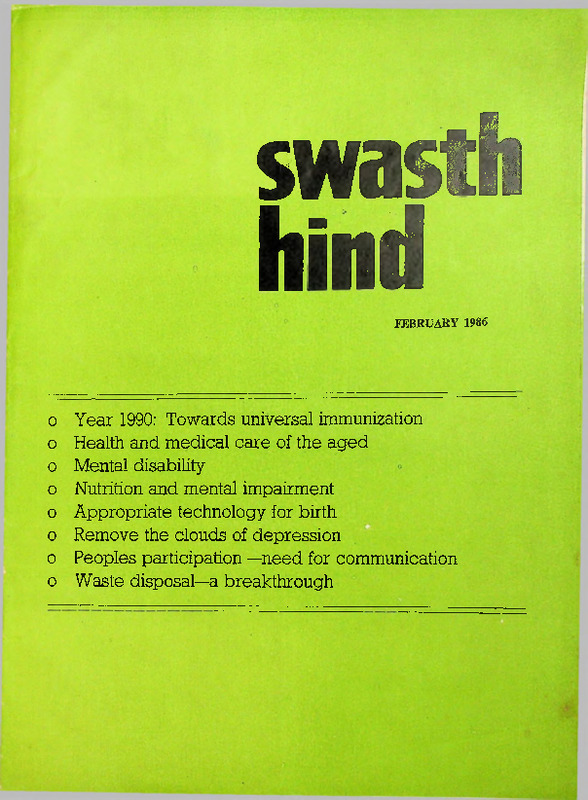
- extracted text
-
swasth
hind
FEBRUARY 1986
o
o
o
o
o
o
o
o
Year 1990: Towards universal immunization
Health and medical care of the aged
Mental disability
Nutrition and mental impairment
Appropriate technology for birth
Remove the clouds of depression
Peoples participation —need for communication
Waste disposal—a breakthrough
In this Issue
swasth
hind
Page No.
February 1986
Magha-Phalguna
Saka 1907
Vol.
XXX
No. 2
Year 1990: Towards universal immunization
29
Health and medical care of the aged
35
Dr S.R. Mehta
38
Mental disability
Prof. Jaswant Singh Neki
OBJECTIVES
Nutrition and mental impairment
40
Dr R.D. Sharma
Swasth Hind (Healthy India) is a monthly journal Published by
the Central Health Education Bureau Directorate General of
Health Services, Ministry of Health and Family Welfare, Govern
ment of India, New Delhi. Some of its important objectives and
aims are to :
Appropriate technology for birth
42
Remove the clouds of depression- a feature
44
j REPORT and interpret the policies, plans, programmes and achie
vements of the Union Ministry of Health and Family Welfare.
Dr H. Mahadevappa
ACT as a medium of exchange of information on health activities
of the Central and State Health Organisations.
Peoples participation—need for communication
FOCUS attention on the major public health problems in India
and to report on the latest trends in public health.
KEEP in touch with health and welfare workers and agencies in
India and abroad.
REPORT on important seminars, conferences, discussions etc.,
on health tdpics.
Editorial and Business Offices
47
Late Prof. B.C. Srivastava
Dr Sanjay Chaturvedi and Surendra Mohan
Waste disposal—a breakthrough
49
N.K. Ray
Continuing global increase in alcohol
production and consumption
51
News
55
Books
Third inside
cover
Central Health Education Bureau
(Directorate General of Health Services)
Articles on health topics are invited for publication in this
Journal.
Kotla Marg, New Delhi-110 002
State Health Directorates are requested to send reports of
their activities for publication.
The contents of the Journal are freely reproducible. Due
acknowledgement is requested.
EDITOR
N. G. Srivastava
The opinions expressed by the contributors are not neces
sarily those of the Government of India.
SWASTH HIND reserves the right to edit the articles sent
for publications.
ASSTT. EDITOR
SUBSCRIPTION RATES
D. N. Issar
Sr. SUB-EDITOR
M. S. Dhillon
Single Copy
Annual
25 Paise
..
(Postage Free)
Rs. 3.00
YEAR 1990:
TOWARDS UNIVERSAL IMMUNIZATION
It is ' planned to immunize 85 % of infants and expectant
mothers by 1990 against six vaccine-preventable diseases. The
coverage will be extended over a five-year period in a phased
manner immunizing about 18 million infants and 24 million
mothers every year.
FEBRUARY
1986
29
he interests of the children are specially finding
T
place of priority in the National Planning pro
cess. A broad spectrum of public policies in support
of children is taking shape across the different social
service sectors. Recognising the primacy of Immuni
zation in
the package of child survival services,
the National Health Policy has set the following speci
fic targets for this programme to be achieved by
1990:
Expected Immunisation Status by 1990
Infants
I mmunisation Status: 1990
(per cent population)
D.P.T.
—
85
Polio
—
85
BCG
—
80
TT
Pregnant women
100
TT
(For school children)
10 years
16 years
100
100
(New school entrants)
5-6 years
85
-do-
85
D.T.
Typhoid
Even though measles vaccination was not mention
ed in the immunization package under the National
Health Policy, the Planning Commission’s Steering
Group on Health and Family Welfare has recom
mended universal coverage (85%) of measles vacci
nation for infants. For other vaccination programmes,
coverage will be extended from the present level of
about 40% to 50%.
While inadequate facilities have limited the ser
vices, the coverage of the eligibles in areas where
services are available can be augmented by reducing
the dropouts from the first to the third doses. By
cutting down the dropouts, the effective coverage
would increase substantially. Usually, the targetted
number of children are reported to have been contac
ted at least once and if they could be induced to re
turn to complete the schedule, we would not be far
behind the planned targets.
30
Although the reasons for the dropout rates vary
from place to place, the ones most commonly noted
are the lack of information regarding the schedule
and the use of blunt or unsterilised needles, the sche
dules not being at convenient hours and mild illnesses
being taken as contra-indications. In some cases, how
ever, the dropouts are not genuine but are the result
of weaknesses in the recording system.
The progress in the States and Union Territories
has not been uniform. Some States have increased the
coverage remarkably, others have been slower due to
a variety of reasons. The programme is now being
given high priority in U.P., M.P. and Rajasthan by the
concerned State authorities and show signs of picking
up. The progress in the large States will make a tre
mendous difference to the overall performance in the
country. The coverage in Bihar is low by any stand
ards.
The achievements over the past few years have
been impressive because these were achieved without
any substantial inputs into the programme. The Cen
tral Government provided funds for vaccines required
to meet the planned targets and the State Govern
ments implemented the programme with the existing
staff. Funds for POL, ice, minor repair of refrigera
tors and other contingent expenditure were not provi
ded for separately and were usually met from the
“Miscellaneous Purpose Funds” under the family
welfare programme. Lack of funds often led to acute
shortages of syringes, needles and other essential sup
plies in many areas. Further increase in immunization
coverage will be possible only if adequate provision
is made for recurring expenditure. This will be more
than compensated by the prevention of disease, dis
ability and death due to the EPI diseases and the
positive impact on the family welfare programme.
It is planned to immunize 85% of infants and ex
pectant mothers by 1990 against six vaccine-preven
table diseases. The coverage will be extended over a
five-year period in a phased manner immunizing about
18 million infants and 24 million mothers every year.
In line with the expected fertility behaviour, the num
ber of pregnant women and infants are expected to
show a declining trend during 1985-90 period. To a
great extent, this decline in fertility will be neutralized
by rising population base. Therefore, for programme
SWASTH HIND
UNIVERSAL IMMUNIZATION CAMPAIGN LAUNCHED
r I ^he Universal Immunization Programme aiming
at providing protection
to all the expectant
mothers and children against six vaccine-preventable
diseases by 1990 was launched in the country by Shri
Rajiv Gandhi, the Prime Minister of India, on 19
November, 1985, at Fatehpur Beri, Primary Health
Centre, near Mehrauli, New Delhi.
This programme which envisages to ensure greater
child survival has been' dedicated to the memory of
Smt. Indira Gandhi whose love for women and chil
dren was so intense. The campaign, therefore, began
from November 19. her birthday.
Inaugurating this campaign, Shri Rajiv Gandhi felt
that child health care should become an essential
part of the family welfare programme.
Hoping that the programme would reach every
nook and corner of the country, especially rural India,
Shri Rajiv Gandhi called on all sections of society
to do what they could for its success.
Among others, Smt. Mohsina Kidwai, Union Minis
ter of Health and Family Welfare,' Shri S. Krishnakumar. Union Deputy Minister, Health and Family
Welfare, Shri Jag Pravesh Chandra, Chief Executive
Councillor, Delhi Administration, Rtd. Air Vice Mar
shal H. L. Kapur, Lieut. Governor, Delhi, Shri
Mohinder Singh Saathi, Mayor of Delhi, Shri
S. S. Dhanoa, Secretary, Health & F.W., Shri R. P.
Kapoor, Addl. Secy & Commissioner (FW & MCH)
and Dr D. B. Bisht, Dir. General, Health Services,
also attended.
The Ministry of Health and Family Welfare has
been making hectic preparations for planning and
seeking involvement of all concerned in putting the
first phase of this programme on ground.
Numerous communications were issued from the
Centre to State leadership and others including Pan-
FEBRUARY 1986
chayat Pradhans drawing their attention towards the
objectives of this vital campaign..
In a letter addressed to Health Ministers of all the
States on 12 September, 1985, Smt. Mohsina Kidwai,
Union Minister of Health and Family Welfare inform
ed them about the dedication of the programme to
the memory of Smt. Indira Gandhi and provided other
details for its implementation.
Smt. Kidwai informed the Ministers that during
the current year as part of overall strategy, 30 districts
and catchment areas of 50 medical colleges had been
selected for providing universal immunization servi
ces. During the coming years,. she added, more and
more such districts will be taken up so that during
the last year of the plan, i.e., 1989-90, all the districts
in the country will be covered under the programme
of Universal Immunization. She added that additional
inputs in the form of additional staff, vaccines, equip
ments for storage and transportation of vaccine, etc.,
have been provided to these districts. Vehicles have
also been sanctioned to improve mobility for outreach
operations and supervisory visits. The expenditure
will be met in full by the Government of India as
per the prescribed pattern.
Smt. Kidwai emphasised that successful implemen
tation of the programme would require very careful
planning and effective management. It would also re
quire full political and administrative support. - -
In a follow-up communication to the States, Shri
R. P. Kapoor, Additional Secretary and Commission
er (Family Welfare & MCH), stated that the proposed
programme had placed - a responsibility on all of us
to ensure that the various activities under the scheme
were carried out effectively and within the specified
time-schedule. He added that lessons learnt during
this campaign would prove helpful in extending the
campaign to other districts.
A
31
Prime Minister’s Message
{Continued from Page 30)
—>
purposes, we may plan for an infant population of 22
million and 24 million expectant mothers to be cover
ed annually.
On
UNIVERSAL IMMUNI
ZATION CAMPAIGN
Year-wise Proposed Number of Beneficiaries
1985-86 to 1989-90
(in millions)
Beneficiaries Vaccine 1985-86 1986-87 1987-88 1988-89 1989-90
Preg. women TT
12.9
(50)
15.2
(60)
18.6
(65)
21.9
(75)
23.9
(85)
DPT
14.0
(60)
15.3
(67)
16.9
(75)
17.7
(80)
18.3
(85)
Polio
14.0
(60)
15.3
(67)
16.9
(75)
17.0
(80)
18.3
(85)
BCG
14.0
(60)
15.3
(67)
16.9
(75)
17.0
(80)
18.3
(85)
Measles 2.3
(10)
5.7
(25)
10.0
(45)
14.2
(65)
18.3
(85)
Infants
Obviously to be effective, the vaccine must be
given to the individual before he has been exposed
to the disease. In India where most of the vaccine pre
ventable diseases occur at an early age, it is impor
tant that the full course of the vaccine is completed
before the child reaches his first birthday or soon
thereafter upto 14 months.
The main thrust of the programme will be the
coverage of pregnant women with two doses or a
booster dose of TT and of infants with three doses
each of DPT and polio vaccines. In the urban areas
and in areas where the training of MPWs has been
completed, BCG vaccine will also be included. Since
measles vaccine is being included in the programme
in 1985-86, greater effort and focussed training pro7
grammes will be necessary to reach high level of 85%
coverage in 1990 starting from zero in the base year:
1984.
—>
32
Every infant that is born has the right
to grow into a healthy adult. The more
successful we are in reducing infant mor
tality and ensuring child survival, the
more likely is it that we will succeed in
our family welfare programmes.
Indiraji had an abiding love for
children. She enjoyed meeting them, play
ing with them, teaching them. She said:
“Every child has a right to health,
to education, to congenial employ
ment. But his share of the sun and
air, of water and sustaining food,
is limited by the economic status of
his parents. We feel that it is the
duty of the State to correct this
injustice. All children do not come
with the same natural endowments,
but every government should be
able to give to every child the best
opportunity to develop its potentia
lities to the fullest”.
She took a great interest in the Programme
of Universal Immunization which, by the
beginning of the next decade, will cover the
entire country. She did not herself live to
see the Programme reach full fruition. But
there could be no more appropriate living
memorial to her.
October 28, 1985
(RAJIV GANDHI)
SWASTH HIND
ImmunizaticmWoricfeWide
PERCENTAGE OF THE WORLD’S CHILDREN
IMMUNIZED IN THE FIRST YEAR OF LIFE
DPT
BCG
Polio
Measles
Percentage of
pregnant women
immunized against
Tetanus
24
AFRICA
58
AMERICAS
^Wl33
SOUTH
EAST ASIA
N/A
EUROPE
EASTERN
MEDITERRANEAN
WESTERN
PACIFIC
N/A
BCG immunizes against Tuberculosis
DPT (3 injections) immunizes against Diphtheria. Pertussis (whooping cough) and Tetanus
Tetanus Toxoid (2 injections) given to a woman in pregnancy immunizes her child against Tetanus
in the first month of life—the most dangerous period
VACCINE-PREVENTABLE DEATHS
Estimated annual number of child deaths from the main
diseases which can be cheaply immunized against:COUNTRY
Pakistan
Bangladesh
Indonesia
Nigeria
Mexico
Ethiopia
Zaire
Philippines
Brazil
Burma
Thailand
Vietnam
Kenya
Egypt
South Africa
Sudan
Afghanistan
Iran
Algeria
Morocco
Turkey
Colombia
Tanzania
Rep of Korea
Allother
developing
countries
Grand total
Neonatal
Tetanus
298.000
132.000
119.000
71.000
64.000
31,000
16.000
21.0’00
12.000
28,000
20.000
10.000
12.000
9.000
16.000
11.000
8.000
11,000
17.000
10,000
10,0008.000
9.000
6.0Q0
5.000
181.000
1.135.000
Measles
Whooping
Cough
189.000
66,000
69.000
63,000
68.000
19.000
25.000
19,000
12.000
18.000
16.000
11.000
19.000
15.000
13,000
14.000
15,000
11,000
9,000
8,000
5.000
5,000
6,000
Total
2.000
1,269,000
361.000
361,000
352.000
303.000
107.000
101,000
85,000
83.000
80.000
79.000
78.000
77.000
61.000
61,000
60.000
59.000
49,000
45,000
43.000
36.000
29.000
29.000
19.000
17.000
411.000
139.000
731.000
2.598.000
842.000
4.575.000
782.000
163,000
173,000
218,000
171,000
57.000
60.000
45.000
59.000
34.000
43.000
57.000
46,000
37.000
32.000
35,000
36.000
27.000
19,000
25,000
21,000
16.000
14.000
7,000
10,000
Table excludes China
.6,000
Source Adapted from WHO
1984-NEW STYLE CAMPAIGNS
New style immunization campaigns have this year
revolutionised immunization coverage in:-
------------------------ BRAZIL---------------------where immunization rates have been lifted towards 90% by a
campaign involving 450.000 volunteers manning over 90.000
immunization posts across an area larger than Western
Europe
--------------------- COLOM Bl A------------------where almost a million children have been immunized on
each of 3 National Vaccination Days - more than doubling the
percentage of children immunized
----------------------- NIGERIA---------------------where a pilot campaign in the Owo area has increased
immunization coverage from 9% to over 70% in preparation
for (he launch of a national campaign
------ ------------------- INDIA---------------------- where campaigns m thousands of villages of Karnataka and
Madhya Pradesh and in the majority of Delhi's poorer areas
have boosted vaccination coverage to unprecedented levels
---------------------- PAKISTAN-------------------where the proportion of the nation's children immunized has
risen from less than 5% to more than 25% m one year (end of
1984 target - 50%)
The strategies behind the successes -
• Massive public education campaigns using every possible
channel of communication to let parents know the importance
of immunizing their children
• Taking immunization nearer to the people by setting up
immunization posts in schools, parks, polling booths.
mosques, churches, temples, bazaars and markets • as well
as in clinics and health centres
Chart: Stephen Hawkins Oxford Illustrators
—UNICEF
FEBRUARY 1986
33
Since most vaccines require multiple doses, efforts
will be directed towards cutting down dropouts for
the second and the third doses. This is proposed by
improving the services by making them more acces
sible through outreach operations and by providing
in adequate quantities the essential supplies. Health
education activities will be intensified to publicise the
benefits of immunization and imperatives of following
full schedule and by educating people that minor ail
ments are not a contra-indication to vaccinations.
Massive demand generation TEC programme will have
to be organised.
The programme will be implemented as a part of
the primary health care through the network of mul
tipurpose workers. The vaccinations will be adminis
tered by the female and male multipurpose workers.
The MPWs will be assisted by the village health
guides, trained dais, anganwadi workers, social wor
kers and others for the collection of children during
outreach operations and follow-up for subsequent
doses. The active involvement of medical and nursing
students will be encouraged. Community awareness
and involvement will be the key to its success.
Different strategies will be adopted depending on
local conditions and availability of resources. As far
as possible, a fixed centre approach will be followed
since it is not only cheaper, organisationally easier and
less time-consuming but it is also the easiest to sus
tain over the years. However, such an approach will
not in itself lead to a high coverage and will, there
fore, be combined with outreach operations. The
MPWs will visit the villages on a prefixed day
and organise the sessions at a convenient site. All
vaccines will be made available at each session.
Human resources are essential to effectively carry
out various tasks under the immunization programme.
The job responsibilities are varied requiring highly
qualified personnel for vaccine production, and qua
lity control, programme management and communi
cations to those with skilled level of training in ser
vice delivery.
34
At the field level, the ANM is the key person in
the implementation of the programme. She, however.
has several other duties and responsibilities which
include providing care during pregnancy, conducting
deliveries, supervising deliveries conducted by train
ed dais, post-natal care, health education on family
planning and distribution of conventional contracep
tives, recording of births and deaths, notification of
communicable diseases and treatment of minor ail
ments. The time she devotes to her responsibilities
for the immunization coverage of the eligible popu
lation in her area will be important. She is also assis
ted in her work by the male multipurpose workers
(MPWs) who are also required to provide services to
a population at a distance from the health centre. If
those aspects of the project which do not require long
specialised training can be taken over by the mem
bers of the community, the MPWs would be in a
position to cover a large number of beneficiaries over
a shorter period of time. Moreover, availability of
essential supplies in adequate quantities would also
increase efficiency. Under the programme both these
approaches will be adopted.
India has got more than 106 medical colleges with
an annual intake of over 12,000 medical students per
year. In addition, there are a large number of nur
sing schools. The participation of both the medical
and nursing students is being activated by organising
training courses and involvement in the field work.
Involvement of students from other educational insti
tutions is being encouraged for
health educational activities,
motivational and
follow-up for comple
tion of immunization schedule and surveillance.
EPI has been integrated in the basic curricula of
the training courses of medical students, nursing stu
dents and other paramedical workers. However, speci
fic inservice courses related to EPI will have to be
organised to increase the efficiency and effectiveness
of the programme to achieve maximum benefits within
the available resources.
A
SWASTH HIND
HEALTH AND MEDICAL CARE OF THE
AGED
Dr S. R. Mehta
A judicious mix of curative services, legal protective measures and health
education can become a basis for tackling the health and medical care
problems of the aged. But more than that the community members
have also to be sensitized about the problems of the aged so that a
greater commitment and involvement of the community leaders could
be ensured in order to include “care for the aged” within the purview
of Primary Health care.
FEBRUARY
1986
35
X/'outh is assuming a higher value than the old
in the modem society because of active work
force needed to reconstruct and transform the tradi
tional social order. That does not mean that the old
has no place in the modern setup.
The cummUlative experience and wisdom of the old can form a
basis for the foundation of a modern social system
provided
the youth
is oriented adequately and
appropriately to embody the thought patterns and the
guidelines of the old in the developmental strategy.
It has been observed that the social and psycho
logical aspects of the ageing experience can be ex
plained by categorizing that into phases or stages
denoting the human life cycle (Atehley, 1972; Birren. 1964).
However, as per the disengagement
theory of ageing, it is in the interest of the society
to phase out those persons whose deaths would dis
rupt the smooth functioning of the social order.
This functionalist perspective advocates an orderly
means of transferring power from the older members
of society to the younger. There has to be a mutual
withdrawal of ageing individuals and society from
each other and this process of withdrawal is inevita
ble and necessary for “Successful” ageing (Elaine
Cumming and William Hencry, 1961). That is why,
societies develop norms of retiring people from work
at a certain age.
But this disengagement process
is not confined only to separation from occupational
work; rather it affects the other regular social roles
and activities of an individual. This makes the dis
engagement a much more complex process than the
theory allows.
It has however, been recognized that improved
health and medical care services, nutrition, and sani
tary living conditions have contributed in providing
longevity to people and even in the developing coun
tries, the life span for both sexes have been raised.
This necessitated a change in the social norms of re
tiring and related regular activities. It is increasingly
expressed that for successful ageing, persons main
tain fairly constant levels of activity.
Further the
amount of engagement or disengagement, to a large
extent are determined by past life styles and socio
economic considerations rather than by intrinsic and
inevitable processes (Erdman Palmore, 1969).
However, this activity theory of ageing, fails to ac
count for the behaviour of all individuals as some
aged persons because of physical, mental or socio
36
economic reasons, may not be able to carry forward
their middle aged experience of active living to old
age.
Moreover, they may not judge themselves
according to the norms of the earlier social life. Des
pite these limitations, the activity theory for ageing
provides promise for role of active ageing in develop
ment of nations.
Lately, continuity theory has provided a wider
spectrum to explain the several aspects of ageing. It
is observed that as an individual advances in his or
her different phases or states of life cycle, he or she
develops more stable values, attitudes, norms, and
habits as part of his or her personality.
Thus an
individual may tend to react to the ageing process by
maintaining consistency in his or her characteristics,
traits and predispositions.
But an individual may
also change his or her reaction towards ageing by
adapting to new situations (Atehley, 1972, Ncugarten,
1964).
A brief account of the main trends in ageing theory
which have caught the attention of social gerontology,
do bring home the fact that physical hazards, impairness, mental infirmities, reality of feeling tired
and sick and inability to cope up with various pro
blems due to recognition of impending death, produce
several problems of adjustment and depression for the
aged persons.
Health and Medical Care Problems
The socio-emotional, psychological adaptation, eco
nomic or attitudinal adjustment, health and social
welfare problems of the aged are so interrelated that
it is difficult to separate one from the other.
But
the role of active ageing within the “Activity” pers
pective has to recognize the health and medical care
problems of the aged persons.
To keep oneself
active in some activity which may be productive in
terms of economic return or unproductive for the
sake of deriving pleasure or satisfaction in the leisure
time available with the old, it is necessary that the
old persons are educated about the preventive and
promotional aspects of health so as to maintain them
selves as healthy. In addition, medical care services
have to be made accessible to them so that they be
cured of the diseases or physical hazards or infir
mities.
In the case of an older person, the certifi
cation of the physician based on certain signs and
symptoms that would declare him sick or ill is not
SWASTH HIND
that much as his subjective assessment of a health
problem that would influence him to seek medical
care or to utilize the available health services. Be
cause of inherent stratification system based on
different dimensions including sex and age, in the
social structure of developing countries, the distri
bution of health and medical care services, managed
mostly by government is largely uneven.
Due to
elite structure of health care in the developing coun
tries, there is a skewed distribution, and despite the
well taken welfare measures by the government State,
the older persons especially the women are often
neglected.
Health is now being viewed more as a holistic con
cept because of the limitation of the functionalist
perspective to consider illness or sickness within the
monolithic and homogenous, social structure whose
participants act under the influence of exterior reified
values.
Even the Interactionists, who advocate cul
tural pluralism as relevant to the understanding of the
phenomenon of illness, seem to fall into the trap of
Functionalists, as their plural groups are also sub
servient of their values.
That is why, Dingwall, ad
vocates ethnomedicine approach in understanding
the concepts of health and illness as these are based
on the knowledge that members of some collectively
draw on to make sense in their social and natural
world and on the content and organization of that.
knowledge.
(Dingwall, 1976).
This pluralistic
approach in health care rather than functionalist mono
lithic model, provides a wider perspective in concei
ving health and illness by including within its purview
the folk and indigenous medicine practices followed
by lay persons from different socio-economic strata.
Older persons, because of scarce resources at their
disposal are likely to follow some of the home medi
cations or folk health practices either to keep them
selves healthy or to get cured of minor ailments.
This may even include light physical or Yoga exer
cises which do not involve any cost and are suitable to
“culture of poverty” groups.
What are the major health hazards or problems
faced by older persons? No doubt, there may be
many health problems more attributable to the inevi
table process of ageing, yet quite a few of them are
due to neglect and lack of care. A study carried out
in Chandigarh dnd the surrounding villages has re
vealed that the most frequently mentioned health pro
blems by the aged are defective eyesight, general
FEBRUARY 1986
weakness, pain in joints, chronic cough and cold.
defective hearing, high blood pressure, digestive com
plaints, breathing trouble, trembling of limbs, etc.
(O'Souza, 1984).
However there are variations re
ported on sex, class and environment basis.
The
nature of health problems reported would need both
preventive and curative care to be provided to the
ageing persons.
Health and medical care services
In order that many of the aged could become active
in taking productive or non-productive pursuits be
cause of economic necessity or otherwise, one has to
take care of health and medical problems of the
aged. It is, generally, suggested that a three pronged
approach should be followed in providing health care
to the people.
First, the community area and tar
get groups vulnerable to the health and medical pro
blems should be flooded with health care services so
that there is adequacy of opportunity with the sick
persons to avail of such services.
But in view of
scarce resources at our disposal, we cannot provide
liberal medical care to the old and aged persons in
our society.
Secondly, we should provide legal protection to the
needy and deserving persons.
This legal approach
becomes more significant in the case of the aged who
because of their limitation of physical mobility and
financial constraints are often neglected while seek
ing medical care at the hospitals or dispensaries.
There is a need to provide health insurance schemes
for this group and to open special window counters
or provide exclusive beds in the hospitals for them.
Even there should be incentive schemes for indigen
ous medicine practitioners including Ayurvaids and
Homeopaths or provide subsidised health care to the
old in the community. Though this may appear to en
courage dependency of the old on the State/government, yet to keep the old in fit condition for active
ageing, it is important. Through legislations the elect
ed representatives to State Assemblies and Central
Parliament, should play an active role in safeguarding
the health interests of the aged persons.
Health education
Simultaneously with the above approaches, health
education of the aged constitutes another important
aspect of the health care needed so that they could
learn certain do’s and dont’s related to the different
(Contd. on Page 46)
37
MENTAL DISABILITY
Prof. Jaswant Singh Neki
rs. B., the 25-year-old wife of a diplomat, had a
Disability is a complex concept. It ranges from
physical, through psychological, to social dis
ablement. Its manifestations differ widely in
visibility and hence in the concern they evoke.
Such physical disabilities as blindness and
deafness, being most visible, have easily attrac
ted the active interest not only of health pro
fessionals and charitable organizations, but
also of many governments. Disability resulting
from mental disorder, on the other hand, has
attracted insufficient attention from, the public
even while it generates greater anxiety, disgust
and repulsion than physical disability. Yet it
can often be equally devastating, and afflicts
not only the disabled but also many of those
around them, especially members of their
family.
38
M
severe phobia of pollution. She had to spend
almost three hours every morning in the protracted
ritual of her ablutions. Her family pleaded with her
to interrupt this ritual but in vain. She realised her
folly, but felt helpless before it and was herself very
miserable. To worsen her predicament she gave birth
to a baby whose toilet needs, multiplied her ritual to,
several times a day. By now she was spending most
of the day. in her bathroom. The whole family was
in misery.
Fear of pollution (misophobia) is only one of many
kinds of phobias. The incidence of phobic disorders
sufficiently severe to cause definite disability is bet
ween one and two per thousand in the developed
world, where they account for between two and three
per cent of psychiatric patients. A high proportion of
these are agoraphobics—those who have fear of open
spaces; They cannot leave their homes unaccompani
ed. and are■therefore severely incapacitated individuals.
SWASTH HIND
There are many other varieties of phobia. As an
airliner took off from Athens airport not long ago, a
middleaged man sprang to his feet and shouted, “My
heart! my heart’” he clasped his chest with his hands
and his brow was studded with sweat Being the only
doctor on board, I was called in to assist. . I listened
to his heart and took his blood pressure; both looked
normal. I asked him, “Do you fear closed spaces?”
“Yes”, he replied “I didn’t want to fly, but had to.”
A great many people are afraid of lizards, mice’,'spi
ders, cockroaches or what' have you. Yet their , dis
ability is often known to themselves alone or to those
immediately around them.
These are by no means the only disabled group of
psychiatric patients. Dr K. L., a 45-year-oId physicist,
was stricken with depression. ' He stayed in bed,. un
communicative. He had even to be cajoled to eat,
which he barely did, and in four weeks lost four kilo
grams of weight. Previously, he had loved his labora
tory and his family—but now would not even look at
them. His mind was full of gloomy thoughts arid 'he
spent1 much of the time planning how to end his own
life. He had twice attempted suicide, but each time
.prompt medjeal help saved him. His illness had incapacited him more than any. paralysis would.
Again, depressive illness is quite a common condi
tion. Its life-expectancy rates obtained from popula
tion studies vary from 9 to 18 per 1,000 for males and
22 to 28 per 1,000 for females.
The most dreaded of all psychiatric illnesses is schi
zophrenia, which is associated with a variety of handi
caps and disabilities. First, there is the “premorbid
handicap”—the handicap due to factors that' precede
the illness. These include poor social class, lack o_
education, poverty of skills, and social isolation. Next,
there is the primary handicap due to the illness itself,
with such “negative” symptoms as impoverishment of
feeling, social withdrawal, poverty of speech, slowness
of movement, lack of motivation and initiative. The
schizophrenic is thus walking a tight-rope, in danger
on the one hand of an under-stimulating environment
aggravating his or her “negative” symptoms, and overstimulation on the other hand aggravating the overt
psychotic symptoms such as delusions or hallucina
tions. Certain secondary handicaps, not arising from
the illness directly, mo.y result from prolonged institu
tionalisation. These include apathy, loss of interest,
FEBRUARY 1986
loss of initiative, lack of individuality, lack of asserti
veness, and deterioration of personal habits.
These-handicaps not' only aggravate disability but
also make rehabilitation an arduous task. Where psy
chiatric help is not readily available, families really
"do riot know nbw to contend with schizophrenic kins
folk. Loss of social skills render them particularly
unlit to fulfil their expected roles—whether as wage
earner, housekeeper, spouse or parent. They present a
wide , spectrum of incapacitation and disability.
Cultural variations especially seem to characterise
the disability of this disorder. There is perceptibly
less disability from schizophrenia in the developing
than in the developed world. This difference is further
widened by the higher and more complicated expecta
tions of patients in the . developed world.
.The disability from which epileptics suffer may ap
pear only intermittently; but social handicap is present
all the time, They may not drive, nor swim, and must
not expose themselves, to dangerous situations, for ins
tance by working with heavy machinery. The preva
lence of epilepsy iis much higher among psychiatric
patients (3 to 10 per cent) than that found in the
general population (0.6 per cent).
Mental retardation is another condition beset with
severe disability. Though detected in childhood, this
condition may continue well into adulthood due to im
proved, chances of survival of the patients. There may
be- need for the provision of special schools, special
residential placements and special guidance services.
Then there is the disability produced by treatment
itself. Most drugs used in treating mental disorders
have side-effects—luckily reversible in a majority of
cases. But somet’imes a severely disabling and irrever
sible disorder may remain behind. Electroconvulsive
therapy can produce memory disturbances, especially
disabling in those who have to do intellectual work.
Luckily, they tend to recede with time, but may take
several months ’to disappear completely.
Clearly psychiatric disability has a very wide spec
trum. Though the physically disabled have already
become a powerful pressure group in contemporary
society, the same cannot be said of the psychiatrically
disabled. They offer a major challenge to society in
their search for equal rights.
A
• —World Health
August/September, 1985
39
NUTRITION AND MENTAL
IMPAIRMENT
Dr R. D. Sharma
' I' here is accumulating evidence to show that disorders of .nutrition may cause some mental distur-,
bances. We do not know just what lack of metabolic
food elements may be responsible for the retarded deve
lopment, but we do know that when the nutritional de
ficiency is corrected, there is marked improvement in
the mental reaction of the child (Levinson, 1967).
Maternal nutrition prior to delivery affects the brain
growth (Sharma, 1984). The peak period of brain
growth are the last fifteen weeks, of pregnancy, which
coincides with the period of maximum growth of the
foetus on the whole. During this period the nutritional
demands of the growing foetus are greatly enhanced,
and if the mother fails to meet these demands, die
satisfactory growth of brain is likely to be adversely
affected. Maternal nutrition may, therefore, interfere
with fetal neuronal development. The growth of human
brain involves enormous proliferation of neurons, ex
tension of axons, and dendrites and the process of
mylinetion. (Manocha, 1975). During its peak growth
period, synthesis of protein and lipo proteins make up
to ninety per cent of the dry weight of the brain (Cow
ley and Griessel, 1966).
It is estimated that there is two thousand times in
crease in protein substances during the process of ma
turation of a neuroblast into an anterior horncell. If
this figure is magnified for the entire brain, the latter
at the time of birth is gaining weight at a rate of 1 or
2 mg/minute. A generous supply of nutrients is, the
refore, essential for the mother, who in turn must obtain
it from her dietary source. Whereas a marginal supply
of nutrients to the mother may be enough to sustain
the foetus in its early stages of pregnancy, the needs of
the rapidly growing foetus during the last trimester are
indeed considerable and may outstrip maternal supplies
if no serious attempt is made by the mother to increase
significantly her nutrient intake during this period (Ma
nocha, 1975). If the mother fails to provide the needed
nutrients, the results are disastrous for the baby because
it is likely to change the composition of the brain (Reoder and Chow, 1972). The deficiency of essential nutri
ents affects the intellect by directly modifying the gro
wth and bio-chemical maturation of the brain. Dobbing
(1968) and Manocha (1972) have suggested a direct
damage to the structure of the brain in humans and
monkeys during their period of fastest growth; which
occurs at about the time of birth. Those newborn ba
bies who succumb to malnutrition soon after birth
show a marked reduction in their brain cellularity
40
(Winick and Rosso, 1969). Some of the survivors in this
group are left permanently with the small cellular en
dowment (Winick, 1970). Such anatomical damage
manifests itself in irreversible functional impairment
(Monckeberg, 1969). Some studies suggest that various
regions of the brain have once in a life opportunity
to grow properly and during this period (late pre-natal
and less than two years of post-natal life), even mild
to moderate malnutrition may produce irreversible da
mage. It is quite probable that satisfactory brain deve
lopment during this period is a pre-requisite for satis
factory subsequent bodily growth (Winick, 1972; Dob
bing, 1973, 1974; Dobbing 1973, 1974, Dobbing and
Sands, 1973). It may be remembered that by the time
a child is three years old, eight per cent of his brain
development has been completed compared to only,
twenty per cent of his body development. Under these
conditions, malnutrition that affects the growth of the
baby is likely to affect the brain development as well
(livingston, .1971,-Widdowson, 1972).
Electro Encephalographic (EEG) abnormalities are
a good index of functional impairment, which most like
ly reflects anatomical damage (Stoch and Smythe, 1963).
If the degree of malnutrition suffered in its intra-uterine
life, because of the mother’s inability to provide nutri
ents is severe enough, the EEG abnormalities may never
become normal even if the child is apparently physically
rehabilitated in his later life.
Hypoglycemia of the neonate whose growth has been
retarded in its intra-uterine life, may also be responsible
for damage to the brain. The hypoglycemic infants
show a deficiency of hepatic glycogen. This will adver
sely affect the brain of a newborn baby which has very
little stored glycogen and is totally dependent on blood
glucose for its energy requirements (Naeye, 1966)..With
respect to direct involvement of the nervous system dur
ing the episode of severe malnutrition, one may reason
ably conclude that malnourished babies do exhibit a
profound ability for catch up growth including physical
size, brain growth or head circumference, but there is a
critical period during intra-uterine and neonatal life dur
ing which malnutrition may cause irreversible damage
to the brain and adversely affect learning ability (Man
ocha), 1975).
During the intra-uterine life the environmental fac
tors also play an important role. It has been observed
that infants who are malnourished in their fetal life be
long to parents from lowest socio-economic group who
are trapped in poverty and illiteracy. A child belonging
SWASTH HIND
to them is not only malnourished, and prone to catch
ing common infections because of the insanitary dwelling
in which he lives, but also experiences retardation in
language, personal, social and psychological behaviour
because ot the cultural impoverishment of the parents
^Barnes, 1972; Craviote and De Licardle, 1968; Mon
ckeberg, 1968. 1972; Schrimshaw, 1968; Cheek et al,
1972: Vahlquist, 1972).
. It may be worthwhile to summarize the findings
of a few pertinent. investigations which indicate
the effects of early malnutrition on intellectual per
formance. Cabak and Najdanvic (1965) studied the
effects of' undernutrition in early life on the physi
cal, and mental development of 36 Serbian children
who were hospitalized for severe malnutrition bet
ween 4-24 months of age. It was found that their
mean I.Q. level was 88 as compared to an average
of 93 in children of unskilled Serbian workers. Ka
gan (1973) believes that during the period of 12 to
18 months, some important cognitive changes occur
in the child’s mental development. It is likely that
malnutrition at this critical age vitally affects the
cognitive development of the child.
Liang et al (1967) in a study on malnourished
children who were in the age group 2-4 years found
that these children were lagging in their l.Q. due
to deficiency of vitamin A.
Il may be reasonably concluded that children
who suffered severe. episodes of malnutrition in
their early life suffer severe handicaps in their adult
life, fail ta learn the substance of human culture
and do not Acquire the skill necessary for compet
ing in this aggressively competitive world.
4. Planners, nutritionists and social scientists
should join on common platform to deal with
nutritional problems.
REFERENCES
I.
Barnes, R.H.:Conference: Early Nutrition and En
vironmental Influences upon Behavioural Development,
Seattle Dec. 6-7, 1971.
2.
Cabak, U. and Najdanvic, R. Effect of Undernutrition
in Early Life Arch.Dis.Child, 40; 532, 1965.
3.
Check, D.B., Holt, A.B. and Mellets, E.D.: PAHO Pub.
1251, 1972.
4.
Chow, B.F., Nutr.Rep.Int., 7:247, 1973.
‘ 5. Cowley, J.J. and
14:506, 1966.
. In view of nutritional problems the following
suggestions arc given to deal with these problems:
1. There should be proper facilities for treat
ment and prevention of malnutrition.
’
2. Nutrition
Education should be an integral
part Of health, non-fbrmal. adult and popu. lation education.
3. There should be proper training for physi
cians, nurses, midwives and all medical and
health personnel to deal with nutritional pro
blems.
FEBRUARY 1986
Behaviour:
R.D’ Brain
6.
Cravioto, J. and DcLicardic, E.R. In scrimshaw, N.S.
and Gordeon J. (Eds.) Malnutrition, learning and be
haviour. Cambridge MIT Press, 1968.
7.
Dobbing, J.; tn Scrimshaw, N and Gordon J. (Eds.)
Malnutrition Learning and Behaviour, Cambridge MIT
Press, 1968.
8.
Dobbing, J: Nutr.Rep.Int., 1:401, 1973.
9.
Dobbing, J. and Sands. J.Arch, Dis child, 48:757, 1973.
10.
Dobbing, J. Rodratries, 53:2, 1974.
11.
Ghassemi, H. World Nutrition and Nutrition
tion, Oxford University Press, 1980.
12.
Kagan, J.: Nutrition, Development and Social Beha
viour Washington, DHEW Publ.- 242, 1973.
13. Levinson, A. The Mentally Retarded
. Allen and Unwin Ltd., 1967.
14.
child,
Educa
George
Liang, P.H., et al An J.Clin.Nutr. 20, 1290, 1967.
15.
Livingston, S.K.: J.Nutr.Ed., 3:18, 1971.
16.
Manocha, S.L. Nutrition and over populated
Charles C, Thomas, 1975.
17.
Manocha, S.L., Malnutrition and Retarded Human
Development Sprinfield, Thomas, 1972.
18.
Monckeberg, F. Paper presented at Conference on
Nutrition and Human Development, East Lansing,
1969.
19.
Monckeberg, F. In Schrimshaw,
J.(Eds.) Malnutrition, Learning and
bridge MIT Press, 1968.
20.
Monckeberg, F. PAHO Pub. 251, 1972.
21.
Naeye, R.L. Am J.Obstet Gynecal, 95, 276, 1966.
22.
Reoder, L.M. and Chow. B.F.; Am.J.CIin.Nutr. 25:812,
1972.
23.
Sharma, R.D., Breast Feeding and Infant Nutrition—
A Psycho-Socio-Biological Interaction, Swasth Hind,
Vol. XXVII No. 6, June, 1984.
24.
Stoch, M.B.
38:546, 1963.
25.
Vahlquist, B.:Acta Ped A Scicnt Hung, 13:309, 1972.
26.
Widdowson, E.M., Bibl. Nutr.Diet.l7:5, 1972.
27.
Winick, M. and Rosso, P.Pediatr Rs. 3:781, 1969.
28.
Winick, M. PAHO Pub. 251, 1972.
29.
Winnie, N. Ed. Clin N.Am. 54:1413, 1970.
Conclusion
The well being of the newborn and the mother is
a matter of great significance in every society. Im
proved nutrition of the mother will decrease the
chances of mental impairment in the child as well
as improve its learning abilities (Chow. 1973). A
well nourished mother will meet most of the re
quirements of her growing fetus. Therefore, it is
very important to disseminate knowledge on nutri
tion for infants, adolescents, pregnant and lactating
mothers.
Griessel,
and
Smythe,
plannet,
N.S., and Gordon.
Behaviour. Cam
P.M.:Arch, Dis Child,
. 41
Appropriate Technology for Birth
There is no more crucial passage in life than birth. Yet 60 per cent of the world's women do not have
access to pregnancy care and safe delivery care, which would dramatically reduce the risk of maternal
and newborn mortality. Making available to them the appropriate technology that is required would be
a decisive step towards Health for All.
The basic kit shown below is simple, inexpensive and can be made from locally available materials. It
supports three essential -factors that will dramatically reduce the risk of infection in mother and child:
a clean delivery surface, clean hands (soap and a nailstick), clean cutting of the umbilical cord (a razor
blade and cotton for tying off the cord). A tape measure enables .the health worker to monitor the
growth of the uterus regularly, in order to detect conditions that require special care. Newborn babies
and infants can lose as much as 25 per cent of their body heat unless they are well wrapped up; a
simple cap made from several layers of cloth (photo right) can conserve a large part of their body heat,
and thus make them less vulnerable to sickness. This is another example of Appropriate Technology
for Birth.
Above ‘..Even a short training course for traditional birth attendants can
dramatically reduce perinatal mortality: see graph, far right.
Photo WHO/ILO .
Below: If they are too short, women may have difficulties during the
delivery. They can easily be identified with a measuring stick and
referred to more specialised care.
■ photo who/j. Bemiev
FEATURE
REMOVE THE CLOUDS OF DEPRESSION
Dr H. Mahadevappa
was working as an Accounts Officer in a
Government office. Her husband Nagaraj, was
The general public is under the impression that only
working as a lecturer in a College. They had three
those who are mad ought to visit the Mental Hospital.
Children. All were going to School in Malleswaram.
They fail to realise that the stress and strains of
Laxmi was about 35 years old and full of activities
modern way of life can give rise to many major ill
in her social circle. Laxmi's mother-in-law Mallamma
nesses which can be effectively treated by a. Psychiatrist.
axmi
L
was a good woman. She was taking care of her daugh
ter-in-law very well. Laxmi and Mallamma’s relations
were more like that of a
mother and a
daughter.
behaviour of Laxmi. Now-a-days, she does not talk to
me freely. Previously she used to work in the kit
Financially they were in a good position.
chen also. Now she does not even bother to prepare
noticed that his wife was not
a cup of tea. Of course, I do not mind to work in the
active like before. She had almost withdrawn to her
kitchen. Afterall, 1 have no other work to do. But,
self. Earlier she was an active
member of
various
Nagu, I feel, that at times she talks to herself. I had
women’s
organisations
‘manini*,
‘femina
heard her talking even when no one was there in the
club’
She used to fight against injustice meted
room. Once I asked her the reasons for this beha
Recently
etc.
Nagaraj
like
out to women. Every week the members of her area
viour. But she did not
respond to my queries. She
used to get together in her house to discuss the fur
was looking at me as if I was a stranger. Please do not
ther course of action. But for the past one month
think that 1 am complaining against your wife. I
he had noticed that Laxmi was not participating in
just suspected if you had any quarrel with her. Is it
the meetings. She was
so?”.
earlier an avid
reader of
women’s magazines. Now she had totally left read
ing any of the magazines. When asked about it, she
Nagaraj, replied in the negative. He told his mo
had replied that she had lost interest in women Libe
ther that he also had observed that kind of behaviour.
ration movement in India. She told him that she
After all we have no problem to. lead a happy life,
did not like to meet people. She wanted to stay alone
he said. Socially, financially and medically he had felt
in the house. She had stopped chatting and gossiping.
that she was fine. Then what is wrong with her now.
This was a surprise for
he wondered.
Nagaraj, as she was very
active in social circle. It was a real surprise for him.
When Laxmi lost interest in eating food and even
Once Mallamma asked his son when he was alone,
“Nagu, I am seeing some subtle changes in the
44
in sex. he
Laxmi
became very much
examined by a
general
concerned; He got
practitioner. The
SWASTH HIND
General practitioner was a very busy Doctor. As
Nagaraj, complained that his wife had lost interest
in eating food, and did not get a good amount of
sleep, the Doctor prescribed some tablets and tonics,
and as usual he gave an injection of B-Complex. The
examination had taken only four minutes. However,
even after few days, the condition did not improve.
Laxmi remained as she was. She had withdrawn now
totally. He did not know what to do now.
Nagaraj talked to his friend Mohan, who was a
technician in the Radiology Department of a hospi
tal. He knew a little about mental illness. He sug
gested Nagaraj to get the treatment in a Mental Hos
pital. But Nagaraj, did not agree. “What? in the
Mental Hospital. My wife is not a mad woman. Of
course, she is not as active as before. She does not
take food properly. She had lost interest even in sex.
But these are the things which even normal people
can have. Even I had the same problem when I had
fought with my boss”, he told Mohan. But Mohan
persisted “See! you have taken her to on% of the best
General Practitioners in this area. Did she improve?
No. Even if you take her to another physician. 1 bet
that they would not prescribe more than what a
General Practitioner has already given. To my mind,
it appears that there is nothing wrong with her phy
sical health. The problem is with her mind. For that
reason, it is better to consult a Psychiatrist. Why do
n’t you bring your wife on Thursday?”
Initially, Laxmi was not willing to get examined
by a Psychiatrist. There was almost a small quarrel
over this issue. Finally Laxmi agreed. Nagaraj, took
her to Dr Chandrashekar, the Psychiatrist of a Men
tal Hospital.
Dr Chandrashekar, was an experienced Psychia
trist. He was a popular Doctor. He had mild manners
and sympathetic attitude towards the patients. He
listened patiently to what Nagaraj had to say, and
interviewed the patient in detail. Finally he came to
a conclusion that the patient had sufferred from En
dogenous Depression.
What is Depression?
Is it an incurable illness? No, it is definitely cura
ble. All of us at times feel depressed. It may be due
FEBRUARY 1986
to a blow to our ago, loss of money, or disability or
it can be due to separation from the loved ones such
as the death of spouse or parents. But we overcome
the depressed mood and go on to lead a normal life.
But m some patients, there need not be any pre
cipitating factor to make them depressed. Without
any reason these patients can get depressed. They with
draw from most of the activities they were interested
in previously. They lose the appetite and may lose
the weight. They may get up in .the early, hours in the
morning, sit in the chair and start looking at the
ceiling with a vacant expression on their face. When
questioned they may refuse to answer the question.
Even when they reply, they may do so in Monosylla
bles. They may lose their interest in sex too. If the
husband persists and proceeds' in the act, they may
be just passive partners in the game. When question
ed about it, they may tell that they have lost interest
in it. The depressed mood may last in some patients
for a few weeks and in others it may last for few
months. Though this illness may effect any age group
most commonly it effects the adults, middle aged and
elderly. It. is more common in women. Particularly,
it may occur when the woman is near the menopau
sal phase of her life—the crucial period in women’s
life, when she loses her confidence in her beauty, at
tractiveness and sex appeal.
In severe cases, the patient may try to commit sui
cide. If, she is rescued by the cautious relatives or
friends, she may become angry and violent. She may
try to commit suicide again. So, the threat of suicide,
thoughts of suicide, or suicidal attempts should be
taken seriously, as it is one of the main features of
depressive illness. During the critical period, cons
tant watch is necessary.
Many people think that such illness may not get
cured by medical methods. So they resort to other
methods like going to a traditional healer, an astro
loger, or to a temple of their choice. They try all
these jnethods before coming to a Psychiatrist. Such
practice is more common in rural areas. The reason
being that the stigma attached to the patient who
visits the Mental Hospital still persists. The general
public is under the impression that only those who
are mad ought to visit the Mental Hospital. They fail
45
to realise that the stress and strains of modern way
of life can give , rise to many major illnesses which
can be effectively treated by a Psychiatrist.
The reason for these types of depressive illness is
now recognised to be due to changes in the amines
in the brain. In this particular illness there may or
may not be any stress factor. Though it is to a some
extent hereditary, it can be effectively treated.
Most of the times the patient can be treated by
oral tablets alone. Injections arc not necessary. It is
useless to give B-Complex injections and other vita
mins in the hope that the patient will gain some
strength to carry on the activities. So also with the
tonics. If the patient says that she has lost appetite,
the first thing the husband does normally, is to go to
a Medical shop and bring an attractive bottle of tonic.
Tonics are hot necessary and are useless-in this kind
of patientSi as the symptoms of loss of appetite and
other features are caused by the changes in the mind.
If the condition is severe, then the patient may
need to be given Electro-Convulsive Therapy. This
can be given every 2 to 3 days. Normally, it may be
(contd. from page 37)
diseases and inculcate these in their behaviour pat
terns through constant practice so as to prevent the
occurrence of diseases or reducing the effects of ill
nesses. Experience has shown that education by
itself in the developing countries may not be that
effective. As such, it is necessary to support it with
curative services to' be provided by different health
personnel and agencies.
Group talks on health matters supplemented with
projected media may be effective for educating the
aged persons. Social gerontology should also form
a part of the syllabi for medical professionals and
para-medical professionals so that they could inte
grate health education alongwith health care to be
provided to the aged persons.
Perhaps, a judicious mix of curative services, legal
protective measures and health education can become
a basis w for tackling the health and medical care
problems of the aged. But more than that the com
munity members have also to be sensitized about the
problems of the aged so that a greater commitment
and involvement of the community leaders could be
46
necessary to take about | doz. therapies (E.C.Ts). As
anaesthesia is given in modern mental hospitals. ECT
is not painful. Patient will get' enormous benefit with
this procedure, though there are some controversies
over this issue. It is specifically indicated where the
suicidal possibilities are higher. ’As drugs take about**
a month to be effective, E.C.T. is used to treat the
severely depressed patients.
Now, Laxmi has recovered from illness. However,
the Doctor has advised her to take drugs for another
six months. Now she has understood her illness and
so have her family-members. She no longer feels sad.
She joints in all activities which she was fond of
earlier. Whenever she feels sad, or feels like commu
ting suicide, she tells about her feelings either to her
husband or to the Psychiatrist. She takes the drugs
regularly and though she at times feels that she had
now become a mental patient, she is confident that
she can live like any other normal individual. Her
husband and mother-in-law do give their psycholo
gical support to fight her illness. Now Laxmi is no
more sad. She is now happy and full of vigour and
vitality, and so is her husband. The clouds of depres
sion have' been removed.
A
ensured in order to include “care for the aged” with
in the purview of Primary Health Care rather than
making it a responsibility of Secondary and Tertiary
Hospital Based Care.
REFERENCES
1. Atchley, Robert C, The Social Forces in Later Life, Belmont,
• Cal: Wadsworth, 1972.
2. Birren, James F., The Psychology of Aging, Englewood Cliffs
N.J: Prentice-Hall Inc^ 1964.
L Cumming, Elaine, and William E. Henery, Growing Old: The
Process of disengagement, New York, Basic Books: 1961.
4. Dingwall, Robert, Aspects ofIllness. Martin Robcrstan and
Company Ltd., 1976.
5. D’Souza, Victer S. Preliminary Report on. Role of Active Aging
in National Development, Chandigarh, Population Re
search Centre, Department of Sociology, Panjab univer
sity, 1984 (Mimeograph).
6. Neugarten, Bernice, and Joan W. Moore, “The Changing
age-status System” in Middle age and aging, B Neugarten
(Ed.) Chicago, University of Chicago Press, 1968.
7. Palmore, Erdman, “Sociological aspects cf aging” in Beha
viour and adaptation in later life, E. Busse and E.P. feiffcr
(Eds.) Boston, Little Brown, 1969.
SWASTH HIND
PEOPLES PARTICIPATION
NEED FOR COMMUNICATION
— Prof. B. C. Srivastava
— Dr Sanjay Chaturvedi and
— Surendra Mohan
LT ealth for all means attainment by all the people
•■-Aof the world of,a level of health that will
permit them to lead a socially and economically
productive life. It does not mean that by the year
2000 doctors will provide medical treatment to every
body in the world nor'it means that’ nobody will fall
sick in the year 2000. But it means that essential
health care will be accessable to all individuals and
families in acceptable and affordable way and with
their full involvement.; The people will realise their
responsibility and power in prevention of diseases
and promotion of health. Conceding its feasibility, we
propose that the current infant mortality rate of 120
per 1000 live births comes down to 60 and present
death rate of 15/1000 drops to 9/1000 by the year
2000. By the same time birth rate should come down
to 21 from 33 and net reproduction rate to 1.00 from
1.67. This will be possible by effective protection of
60 per cent of the eligible couples against 22 per cent
at present.
The key to attainment of “Health for all by the
year 2000'’ is tb develop the siystem bf primary health
care. With Primary Heaith Care as its principal in
strument ‘Health for all’ becomes a practical propo
sition and not merely a pious hope. Several action
research studies undertaken in various parts of India
and in other countries reveal that, given the necessary
encouragement and guidance, the community can
look after majority of its preventive, promotive and
simple curative health problems, leaving only a pro
portionately small quantum of the difficult curative
problems to be dealt with by the more sophisticated
health care services.
FEBRUARY 1986
People’s responsibility of their own health
Governments have a responsibility for the health
of the people, but people, too, have the right and the
duty to take an active partt in maintaining their own
health and, when they are ill in looking after them
selves. They have the same duty with respect to their
families, their workmates,: their neighbours. All of
them can be agents of change for health—ordinary
citizens going about their daily business in villages
and towns, grouping together in families and commu
nities, and associating with one another in all forms
of social and political -groups, educational and res
earch institutions, non-governmental organisations
and professional associations. Health workers, too, are
part of the people; so are others who have community
responsibility, such as civic and religious leaders,
teachers, magistrates, community workers and social
workers. Without the dedicated involvement of
people health for all will be a constantly receding
horizon.
But to act wisely, people must understand what'
health is all about. And it is the duty of those who
possess health knowledge to share it' with others. The
days are over when action for health was the prero
gative bf all-knowing individuals holding their pro
fessional secrets to themselves and handing out doses
of it to ignorant’, passive patients lining up for cha
rity. To bring about widespread understanding about
health was the reason for giving pride of place among
the essential elements of primary health care to
education concerning prevailing health problems and
methods of preventing and controlling them.
47
What can people do about their health?
To give a few examples, people can take individual
and community action t'o ensure that they have suffi
cient food of the right kind. They can get together to
make the most of whatever safe water is available.
or can be made available, making sure that it is pro
tected from pollution and contamination. They can
insist on acceptable standards of hygiene in and
around their homes, in market places and shops, in
schools, in factories, in canteens, and restaurants.
They can learn how to space the children they desire
in such a way as to give each and every one of them
a good chance of survival, reasonable education, and
a decent quality of life.
Women can help one another to remain healthy
during pregnancy
and breastfeeding,
seeking the
advice of health workers as and when necessary.
Parents can learn how to rear their infants in a
healthy manner, to look after them if they get diarr
hoea or respiratory infections, and t'o ensure that their
children are immunised against the prevailing infec
tious diseases, for which the country and community
can afford to provide immunisations. They can be
taught to recognise those serious conditions that
require attention from more knowledgeable health
workers.
' Communities, with the help and guidance of com
munity health workers, can undertake tasks to fight
against such diseas.es as malaria and other parasitic
diseases, for example, by organising insecticide spray
ing and the control of insects and other carriers of
disease such as rats houseflies and snails. Mothers
and fathers can make sure that their children get the
drugs they need to prevent and treat malaria and
ensure that their elders or the disabled receive the
care they need but are unable to provide by them
selves. Communities can see to it that school child
ren receive training in first-aid and in the elementary
care of simple illnesses. Communities can also take
action to ensure that drugs that' are essential become
available to them at a cost they can afford.
Need for communication
Education for health requires both motivation and
communication. For communication can and should
not only provide insight into what is needed to remain
healthy and what should be done when health begins
to fail; it also can and should heighten individual and
community aspirations towards better health. Effective
communication will give rise to greater motivation
and this in turn to improved communication.
A steady flow of information is required, not only
by the written word, through local and international.
newspapers, and journals, but
also through talks,
group discussions, radios, television, comic strips,
plays, films, vocal music and the like. And this
communication shduld take place in families, schools,
factories, offices, universities, social and religious
groups, trade unions, political parties, and at all places
wherever people meet.
A
“The transformation of health between the eighteenth and twentieth centuries
was due essentially to the decline of infectious diseases, brought about mainly—
until 1900 wholly—by better nutrition, provision of clean water, improvements in
sewage disposal and a reduction in birth rates...
It is probably true to say that
if [these] basic measures . were implemented throughout the world by the year
2000 the goal of c heal th for all’ would be achieved if nothing else were done; if
these measures are not implemented, the goal will not be achieved whatever else is
done.”
—^Report of the First Meeting of the ACMR Sub"
committee on Health Research Strategy for HFA12000
48
SWASTH HIND
WASTE DISPOSAL—A BREAKTHROUGH
N. K.
has its own in-built system of maintain
ing ecological
balance. If we
examine its
wonderful method of maintaining its environment and
keeping the balance of things in it, we will be amazed
io find the perfect' arrangement made by Mother
Nature. But with the development of mankind,
growth of civilisation and
rapid industrialisation,
man has not only polluted the natural environment,
but has also brought it to the brink of destruction
and disaster.
ature
N
Ecologists have now realised that unless effective
steps are taken to save the situation, a time will come
when man will die of hunger, thirst, disease and even
suffocation.
Among many factors which have contributed to
disturb ecological balance, ignorance tops everything.
Time is near when rivers will be nothing but peren
nial drains and lush forests, nothing but deserts.
Keeping our environment clean needs vigorous
efforts. Disposal of human waste is one among the
various important problems to be Solved.
For the first time. The Sulabh International, Volun
tary Social Organisation, has taken up the gigantic
task of pioneering a scientific system of human waste
disposal.
A proper system for the disposal of night-soil is an
important aspect of environmental sanitation. The
existence of nearly 41 lakh service type latrines
throughout the country is posing a serious problem
affecting the health of the nation.
Disease causing
Owing to non-availability of a suitable system of
night-soil disposal, human excreta becomes a reser
voir of causative agents for diseases such as cholera,
dysentery, typhoid, paratyphoid fever, infectious hep
atitis. hook-worm, and so on. Consumption of pollut
ed water and contaminated food and exposure of the
population to polluted soil results in transmission of
diseases. One of the most effective measures for com
bating such diseases is to create a barrier to break
the chain responsible for transmission of diseases.
Proper disposal of human excreta is thus the most
important measure for the control of spreading
diseases.
FEBRUARY 1986
Ray
Various systems such as the sewerage and septic
tank, for the proper, safe and hygienic disposal of
human wastes adopted so far have not attracted mass
acceptance due to their high cost of construction and
maintenance and inadequate supply of water. These
are the retrogressions which have caused a lop-sided
situation. Thus, out of 3245 towns in India, most
do not have even a partial sewerage system.
Sanitary engineers, planners, social scientists and
health organisations have been making all-out efforts
to develop or even invent a more economical, safe
and hygienic system for the disposal of human waste,
keeping in view the aforesaid constraints. In Bihar.
standard/design of low cost waterseal hand flush
sanitary latrine with lateral pits was developed which
is popularly known as “Sulabh Shauchalaya”. It is
a suitable sanitary latrine in which the surface soil
is not contaminated and, pollution of ground and
surface water is eliminated. It prevents access of flies
and animals to waste. It does not necessitate handl
ing of excreta for disposal. The method of its con
struction is simple and inexpensive. It is odourless
too.
Nearly one lakh Sulabh Shauchalayas have been
installed in Bihar so far and 5,000 in West Bengal.
The crusade is on. The programme is being carried
on in other States and some neighbouring countries
too. Apart
*
from motivating individual house-holders,
the organisation also constructs and maintains public
latrines in places like railway stations, bus stands.
market areas, hospitals, office compounds, etc. About
50,000 people are daily availing of such facilities in
Patna alone. In Calcutta, three public latrines and
bath complexes comprising 60 seats have been con
structed and about 3000 persons are using this facility
daily.
Wide adaptability
An assessment of the data collected and specific
studies made by various international agencies, such
as WHO, UNDP and UNICEF, reveal that this
system can be adopted in almost all hydrogeological
conditions without any risk of pollution. It has been
widely accepted in different parts of the country and
abroad under varying soil, water, climatic and biolo
gical conditions.
In the seminar on low-cost sanitation, held in
Calcutta in February 1982, sponsored by the All
India Institute of Hygiene and Public Health Engi
49
neering Directorate, Government of West Bengal, the
consensus was that! in unsewered areas, the two-pit
pour-flush latrines were the most suitable for human
waste disposal. It was also recommended that the
programme should be introduced in order to elimi
nate the existing manual privy system.
In recent
seminars held at Udaipur and Ooty in collaboration
with UNDP, the importance of low-cost sanitation
has been further emphasised in the context of environ
mental sanitation.
Popularity
In 1979 a socio-economic survey of Sulabh Shauchalayas installed in the Ranchi Municipal areas was
conducted by t'he Xavier Institute of Social Services.
Beneficiaries
expressed their full satisfaction and
majority of them were convinced that vulnerability to
epidemics had decreased considerably after the in
stallation of Sulabh Shauchalayas.
So, the low-cost sanitation with an on-site excreta
disposal system developed by the ‘Sulabh Interna
tional’ and widely known as ‘Sulabh Shauchalaya’
fully meets all the requirements of a safe, sound and
hygienic system, which can serve as an alternative to
the sewerage and septic tank systems, particularly
in under-developed and developing areas, where eco
nomic constraints stand in the way of such projects.
Conversion of bucket latrines into Sulabh Shaucha
layas as also construction of public Sulabh Shauch
alaya complexes can go a long way in solving, to a
large extent, the sanitation problems in urban and
semi-urban areas which, in turn, will refurbish the
environmental condition in general and eliminate
pollution in rivers and other water bodies.
A
ENVIRONMENTAL POLLUTION : SPECIAL FACTORS IN DEVELOPING COUNTRIES
The pathophysiological effects of exposure to environmental
pollutants arc not expected to vary from one part of the
world to another, but the intensity of the effects may be
more pronounced
in developing countries because of un
hygienic living conditions, malnutrition, etc......
When discussing respiratory diseases caused by environmen
tal pollution, one has to take note of the high incidence of
pulmonary heart disease (corpulmonale) in women exposed
to the fumes of firewood, dried animal dung, or even kero
sene inside their
homes in crowded
urban settlements.
Recent studies have revealed that the smoke generated by
these fuels contains almost all of the toxic components found
in the smoke emitted when fossil fuels are burnt, but in
concentrations far exceeding
those established
for these
substances in the WHO environmental health criteria and
national standards.
Dictaiy factors can influence
several ways. The toxicitics
the toxicity of chemicals in
of several pesticides are cn-
handed in rats given different levels of protein in their diet.
The direct effect of protein deficiency on the capacity of
the liver to detoxify xcnobiotics is well established.
The inherited susceptibility of many people living in tro
pical Africa to the side-effects of antimalarial or anti-tuber.
cular drugs, haemolytic anaemias, and pancreatitis, and the
vulnerability of the tribal people in countries like India to
various infections, all demonstrate the influence of genetic
factors on the response of the host to xcnobiotics-
50
The toxic potential of environmental pollutants can be
affected by the high ambient temperature of many develop
ing countries. In the high temperature and humidity of the
working environment, it is uncomfortable to wear protective
clothing. This can increase the level of exposure to and
absorption of toxic chemicals.
The influence of altitude on the health effects due to ex
posure to air pollutants is apparent in Mexico City, and in
workers engaged in the processing of mineral resources in
high altitude areas of Chile, Bolivia, India, and Nepal who
arc exposed to noxious smoke and fumes in addition to the
physiological stress of altitude.
In summary, it would be, unrealistic
to assume that the
threshold limit value (for pollutants) derived for the highly
industrialized countries are applicable ‘ to workers and the
general population in tropical or semitropical countries who
may have a background of undemuLrition • and parasitic
infections and who may be exposed to an unhygienic en
vironment.
takes.
This may also be true for acceptable daily in
From: WHO Technical Report Series, No. 718. 1985 (En
vironmental pollution control
in relation to development:
report Of a WHO Expert Committee), pp. 14—15.
swasthJhind
Continuing Global Increase in
Alcohol Production and Consumption
any disabling and sometimes fatal physical and
-LVJL psychological conditions can be attributed either
wholly or in part to excessive drinking . . .” ‘’Alcohol
is destroying millions more than the famine in the
Sahel, and in some countries the number of known
alcoholics equals the population of the largest cities
. . .” “Advertising cannot be blamed for alcohol
abuse . . .” These are some of the statements aired
in a controversial round-table discussion on the alcohol
trade and alcoholism published in World Health
Forum, rd. 6, No. 3, 1985, a publication of the World
Health Organization (WHO) which constitutes an in
ternational forum for discussion on all aspects of
public health whilst not necessarily reflecting WHO’s
own policies.
World commercial production of alcohol rose by
almost 50% between 1965 and 1980. Two-thirds of
the world’s alcohol production occurred in Europe
and North America but since population growth in
these regions has been the least rapid, this would
indicate a growing importance in international trading
in alcoholic beverages. The Republic of Korea, Japan
and Mexico have experienced very rapid rates of in
crease in alcohol consumption and other countries in
Africa, Latin America and Asia have already embark
ed on paths that lead in the same direction.
Opinions were divided on the importance of market
ing practices and advertising as a causal factor for
the increase in alcohol consumption. Advertising
practices include the sponsorship of sporting and cul
tural events, the dissemination of brand names and
logos on clothing, as well as the more traditional
forms of advertising. This could be an issue of special
concern in countries that do not have a long tradi
tion of popular advertising and where the population
may be more vulnerable to extravagant claims. In
developing countries, young men living in urban areas
are often the first to adopt the practice of heavy
drinking. However, another opinion was that ad
vertising is most unlikely to have more than a minus
cule effect on total alcohol consumption and that fac
tors such as unemployment, broken homes, stress and
psychological disorders often have a greater influence
FEBRUARY 1986
on drinking patterns. It was pointed out that abuse
of illegal drugs was clearly not the result of adver
tising.
The promotion of soft drinks was suggested as one
way of combatting, increased alcohol consumption but
another opinion was that whilst soft drinks have their
merit, they did not release people from the sometimes
intolerable clutch of reality, which is a human need
that cannot be denied.
No agreement emerged from this round table on
the precise size of the world’s drinking problem. The
prevalence of alcohol-related problems is almost as
hard to assess as the real consumption of alcohol.
Some participants pointed to rising trends in consump
tion as the best indicator of increasing rates of pro
blems. Others argued that facts and figures can be
deceptive—cirrhosis death rates are not always relia
ble; alcohol-related traffic accidents are influenced by
road conditions; as treatment facilities multiply, so
do patients. But all the participants agreed that alcoholrrelated problems are serious, widespread and
require urgent action.
WHO can take a lead in focusing international con
cern on the increasing size of the problem. It was
felt that it was upto WHO to draw attention to the
steadily increasing production of and trade in alcoholic
beverages and to impress on governments the inevi
table public health implications that will have to be
faced if this trend continues.
Participants in the round table discussion included
Sally Casswell (University of Auckland, New Zealand),
John Cavanagh (Institute for Policy Studies, Washing
ton D.C.), Aleck Crichton (International Federation
of Wines and Spirits, Paris), Donald Goodwin (Univer
sity of Kansas, USA); Marcus Grant (WHO), Samuel
W. Hynd (National Council on Smoking, Alcohol and
Drug Dependence, Swaziland), Robert Kendell (Uni
versity of Edinburgh, Scotland), Elizabeth Quamina
(Ministry of Health and Environment, Trinidad &
Tobago), Brendan Walsh (University College, Dublin,
Ireland), M. J. Waterson (Advertising Association,
London, England).
,
O
51
KHUSHAHALI KE RAAH-AN EXHIBITION
Above: Shri S. S. Dhanoa. Secretary, Ministry of
Health and Family Welfare (third from left) on a visit
to the Health Pavilion.
On his left is Shri R. PKapoor, Addl.
Secretary, Ministry of Health and
Family Welfare]
Right :
52
A view of the visitors to the Pavilion.
SWASTH HIND
he Ministry of
T
Health and Family Wel
fare participated in the “India Interna
tional Trade Fair-1985” held from 14-27
November, 1985, in New Delhi.
The Ministry had put up a pavilion
“Khushahali Ke Raah” at the fair to high
light the role of the Ministry of Health and
Family Welfare in promoting health of the
people through its various activities.
The display served as a pointer to how
health and family welfare programmes hold
key to good health, nutritional food, health
education and other facilities.
The pavilion was divided into three parts:
(i) The basement included an audio-visual
room for film-shows on family planning and
February 1986
free services to the visitors for blood pres
sure check-up, blood group identification
and vision check-up; (ii) The ground floor
depicted the “Tree of Life” supported by
two diorama on child care through immuni
zation and the improvement in quality of
life; and (iii) the first floor depicted the ad
verse effects of run-away population growth
on our development and efforts being made
to tackle this problem.
The pavilion was adjudged the third best
for its informational and educational con
tents among the pavilions put up by diffe
rent Central Ministries.
53
.
W
Every
Birth/Death
JS® must be
REGISTERED
because it helps you
A Birth Certificate.is
proof of age for purposes
like :
• Admission to School
• Obtaining a Driving Licence
• Obtaining a Passport
® Getting Employment
• Right to Vote
• Taking Insurance Policy
A Death Certificate is
needed :
@ To inherit property
@ To get insurance money
• To settle property ciairhs
&
It Helps The Nation
Registration of Births/Deaths provides basic information to
forecast and plan for future needs for BETTER HEALTH and
BETTER LIFE
It is compulsory too under the Registration of Births & Deaths
Act, 1969
Ensure Timely Registration of Births &
Deaths and obtain the Registration
Certificate free of Charge.
Delayed Registration is also permissible
REGISTRAR GENERAL, INDIA
davp 85/25
54
SWASTH HIND
NBWS
Health Ministers of South-East Asian
Countries Meet
he fifth meeting of Health Ministers from WHO's
Asia Region was held in Colombo, Sri
T South-East
*
Lanka
from 5-7 November, 1985.
The agenda for the meeting included a review of
the progress in the implementation of the health for
all strategies. Ways and means of strengthening de
velopment of leadership to accelerate the march to
wards the goal of health for all was also discussed.
An innovation this year was a field visit organized
by the host government to show the guests the im
plementation of various primary health care pro
grammes. The areas covered included community
participation in health development, health infrastruc
ture development and health
information systems
with particular reference to the expanded programme
on immunization and the control of diarrhoeal dis
eases.
Sponsored by the WHO South-East Asia Regional
Office and hosted by the respective Member Govern
ments, the meetings of the health ministers have been
held in Jakarta, Dhaka, Kathmandu, and New Delhi
respectively during the past four years.
At their first meeting, the Ministers had called fororganized steps to establish collaboration amongst
countries in the Region, specially with regard to the
implementation of the national and regional strate
gies for achieving the goal of health for all. At sub
sequent meetings, the Ministers identified common
areas for collaborative efforts in health manpower
training, diarrhoeal diseases control, immunization,
maternal and child health, family planning, nutrition
and control of epidemics.
Some initiatives have already been taken in this
regard, with particular reference to technical coope
ration among developing countries (TDQ activities.
A memorandum of understanding has been signed
between Thailand and Nepal to further, collaborate
in mutually identified health development areas. Si
milar initiatives are envisaged between other countries
in the Region.
Test For Early Detection of Cancer
Developed
Researchers at Monash University in Melbourne
have developed a test for detecting the early stages
of cancer in the stomach and digestive tracts.
The blood test has been patented and is in the
process of meeting strict Japanese regulations, one
of the last barriers between it and a possibly lucra
tive initial world market.
Although not a cure for this major form of cancer,
the test is regarded as a substantial advance in the
long medical battle against cancer. The incidence of
colorectal cancer is second to that of lung cancer
in men and breast cancer in women. If tumours in
the colon or rectum are discovered before they spread
out of that part of the intestine—previously difficult
to detect as there are few symptoms until the cancer
is widespread—they are much easier to cure by sur
gery.
The director of the Monash Centre for Molecular
Biology and Medicine, Professor Anthony Linnane,
said it was possible the blood test would become a
standard screening procedure for any patient over a
certain age.
The test, .which took about five years to develop,
looks for a particular substance that is generated by
the tumours on the. walls of the colon, rectum; small
intestine, arid stomach, and finds 'its way into the
blood.
. —U. N. Weekly News letter
9 November, 1985.
FEBRUARY 1986
;55
New Probe into Arthritis
Arthritis in its various forms is one of the world’s
commonest diseases. Although cold, wet weather
often makes the symptoms worse/the. underlying dis-?
ease process is likely to occur in all climates.
It is possible that the worldwide incidence of the
disease is in the region of 480 million cases.
Any successful research into the cause and cure
of arthritis will benefit the sufferers of this crippling
disease in. many countries. It is welcome news, there
fore, that one of Britain’s voluntary organisations, die
Arthritis and Rheumatism Council for Research, is
to spend £ 23.7 million in the next two years to dis
cover its cause and cure.
The normal function of the immune system of the
body is to protect it against foreign substances. The
system is mobilised when anything potentially harm
ful enters the body. However, in certain diseases the
forces of the immune system turn inward so that they
are mobilised to attack the body’s own tissues.
Women Hit Hardest
One of these auto-immune diseases is rheumatoid
arthritis, a crippling condition most common in women
between the ages of 35 and 50. It is three times
more common in women than in men. No age is
exempt.
There is a juvenile form that affects children and
it can manifest itself in old age. In this condition
the cells of the immune system appear to attack the
structures of the joints, mainly the smaller ones, so
that the tissues of the body are being destroyed rather
than protected.
The cause of this abnormal reaction of the immune
system is not known, and although an increasing
number of drugs is available to relieve the symptoms
no cure has yet been discovered.
biochemical studies of cartilage, carried out at the
Mathilda and Terence Kennedy Institute of Rheuma
tology at Hammersmith in West London, and funded
by the Arthritis and Rheumatism Council for Re
search.
Immunisation Against Miscarriages
Professors James Mowbray and Richard William
Beard of St. Mary’s Hospital, London, have deve
loped a new immunisation technique for treating
women who have recurrent miscarriages.
Some cases of repeated spontaneous abortions (mis
carriages) may be due to the fact that the mother’s
immune system is rejecting the baby as if it were a
foreign body—in the same way an organ transplant
is rejected. It is as if the woman is allergic to the
paternal element in the foetus which, of course, comes
from the sperm.
In the research carried out by Professor Beard (a
gynaecologist) and Professor Mowbray (an immuno
logist) and their team at St. Mary’s Hospital, washed
white blood cells and lymphocytes taken from the
husbands’ blood were injected into women who ex
perienced repeated miscarriages, to encourage the pro
duction of antibodies. In theory, if enough antibodies
are circulating in the mother’s blood then rejection
of the foetus might not occur.
The research team was able to prove that this
theory is correct and 78% of women injected with
their husbands’ white cells had a successful pregnancy;
This high rate compares with a success rate of only
37% of women injected with their own white cells;
In the case of women who had one live birth before
they started having recurrent miscarriages, the suc
cess rate was even higher (82%) among those injected
with their husbands’ white cells.
— BIS
Biochemical! Studies
Research aimed at finding the cause of the other
principal form of arthritis, osteo arthritis, will also
be intensified. Until recently it has always been
thought that. this degenerative disease, commonest in
old age, was part of the ageing process and due to
wear and tear on the cartilage—the cushioning mate
rial that protects the moving parts of joints.
In recent years, however, a new concept of dege
nerative joint disease has begun to evolve as informa
tion on the wide variety of causes has become availa
ble through research.
Understanding of the degeneration of joints that
occurs in osteo arthritis has been greatly helped by
56
‘‘The most important medical advance in the nine
teenth century was the discovery that infectious dis
eases are largely attributable to environmental con
ditions and can often be prevented by control of the
influences which lead to them; the most significant
advance in the twentieth century is the recognition
that the same is true of many noncommunicable dis
eases.”
—Report of the First Meeting of the ACMR Sub
committee on Health Research Strategy for H FA 12000
SVVASTH HIND
AUTHORS OF THE MONTH
BOOKS
Health for All and Public Health: Vuori, H.
Canadian Journal of Public Health 1985
Jan/Feb; 76(1) : 13-6.
The WHO is a major public health agency and
its policies could be a guiding star for public health
agencies. WHO’s two major policies include a world
wide ambitious goal ‘health for all’ and a means to
achieve this goal ‘primary health care’. Public health
professionals have a very important role to play in
this strategy and they should be deeply involved in
this movement. They could:
— examine the targets and the evidence on which
they are based.
— criticize them and suggest better ones if needed.
— produce the missing scientific evidence to sup
port the targets.
— help the national health authorities to set priori
ties among the targets.
— assist in adapting the regional targets to fit the
national conditions.
— advocate the entire Health for All movement
and the targets found to be scientifically sound,
technically feasible and politically and socially
acceptable.
— support policies aiming at achieving the targets.
— implement activities based on such policies.
— monitor the progress.
— evaluate the outcome.
Health for All is not a task for WHO alone, not
even for governments and WHO together; it is every
body’s task.
COMMUNICATION RESEARCH FOR
FAMILY PLANNING: Jain, SC. Vidura
1985 Apr; 22(2) : 99-101, 103-5.
The use of large-scale publicity and propaganda in
extensive programmes like family planning, is increas
ing in- India. Mass media such as the radio, televi
sion, newspapers, documentaries, magazines, direct
mailing techniques, exhibitions and commercialized
family planning campaigns have been playing a sig
nificant role in creating awareness in people. But
they have a limited potential in actually motivating
people. Promotional techniques, such as incentives to
the acceptors, family planning and health education
help to some extent. Several studies on the role of
Dr S. R. Mehta
Reader,
Department of Sociology,
Punjab University,
Chandigarh—160 014.
Prof. Jaswant Singh Neki
W.H.O. Consultant
National Mental Health Programme,
Tanzania,
C/o World Health Organization,
Geneva.
Dr R. D. Shanna
Researcher,
Centre for Policy Research.
Dharam Marg,
Chankyapuri,
New Delhi—110 021.
Dr H. Mahadevappa
Resident in Psychiatry,
National Institute of Mental
Health and Neuro Sciences,
Bangalore—560 029.
Dr Sanjay Chaturvedi
Demonstrator
and
Surendra Mohan
Health Educator,
Upgraded Department of
Social and Preventive Medicine.
K.G.’s Medical College.
Lucknow.
these techniques have been analysed in this article.
These studies show that education is a very important
factor in the awareness, trial and adoption processes
since the bulk of the people are illiterate, poor and
belong to the lower classes,. the-.techniques adopted
so.-far to diffuse the.family, planning practices have
not met with success. Mass medias by themselves
cannot help in the diffusion process. Adoption which
is the goal of diffusion depends not only on aware
ness but also on trial. It is at the trial stage that
interpersonal process is very important. So in order
to bridge the gap between the awareness and accep
tance, both the mass media and the agents of change
must be used. To be really effective, these agents of
change must come from all strata in the society.
From :
*
"•
Highlights from Current Health Literature,
Vol. IV, No. 9, National Medical Library,
New'Detfii.--
ISSUED BY THE CENTRAL HEALTH EDUCATION BUREAU, (DIRECTORATE GENERAL OF HEALTH SERVICES), KOTLA
NEW
DELHI-110 002
AND
PRINTED
BY
THE
MANAGER,
GOVERNMENT
OF INDIA
PRESS,
MARG,
COIMBATORE-641019.
Regd. No. D-(C) 359
Regd. No. R. N. 4504/57
'—
—------ —
Read
'
■|
swasth
tad
AROGYA SANDESH
(A Hindi illustrated monthly)
SPECIAL NUMBERS 1985
January
The International Youth Year Theme: Participation, Development and Peace
February
Nutrition
March-April World Health Day, Theme:
Healthy Youth; Our Best Resource
June
Environment and Health
July
Heart Disease
August
Health Progress
October
Behavioural Research and Health
November
Universal Children’s Day Theme:
Community Participation
December
Women, Health and Development
For
♦Healthful living
♦Information on health programmes
♦New developments in the field of health
♦Health news from India and abroad
SWASTH HIND
Gives you a perspective on
India’s Plans and Programmes
in the field of Public Health
Combined issue
:
•
50 pavs’c
Send your order alongwith the cost by M.O./Postal Order to:
Director
Central Health Education Bureau
Kotla Marg
New Delhi-110 002.
:
Rs. 3.00
Single copy :
Re. 0.25
Annual
Please send your order with money in advance to:
You can also become a regulal subscriber for Swasth Hind.
The Director,
Aft&ual Subscription :
(Post free)
*..
R.
3 (Mi
Central Health Education Bureau,
Kotla Marg, New Delhi-110 002.
Position: 764 (20 views)