Swasth hind, Vol. 29, No.11, November 1985.pdf
Media
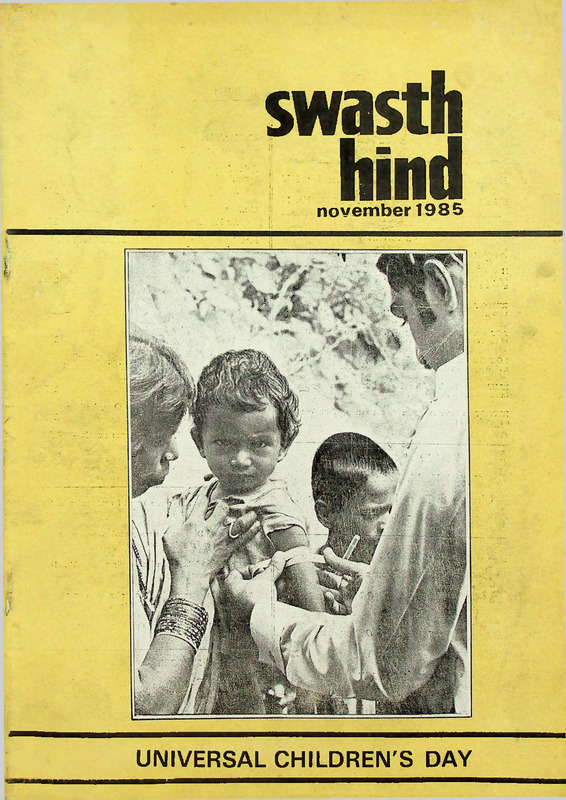
- extracted text
-
swasth
hind
november 1985
UNIVERSAL CHILDREN'S DAY
In this Issue
swasth
hind
Page No.
Children’s Day
— a start in Community Participation
November 1985
Kartika-Agrahayana
Role of community participation in care of
rural children
Dr Sanjiv Kumar
Saka 1907
Vol.
XXIX
265
268
No. 11
Community participation for child mental health
Dr V.N. Rao & R. Parthasarathy
objectives
Swasth Hind (Healthy India) is a monthly journal published by
the Central Health Education Bureau, Directorate General of
Health Services, Ministry of Health and Family Welfare, Govern
ment of India, New Delhi. Some of its important objectives and
aims are to :
REPORT and intcipret the policies, plans, programmes and achie
vcments of the Union Ministry of Health and Family Welfare.
272
Health Education in maternal and child health
and family welfare programmes
Dr (Sint.) V.K. Bhasin
216
278
Do-it-yourself exhibits
The growing group
S. Sivasankara Pillai
282
ACT as a medium of exchange of information on health activities
of the Central and State Health Organisations.
The State of the World’s Children 1985
— a revolution beginning
FOCUS attention on the major public health problems in India
and to report on the latest trends in public hcalh.
Eleventh Joint Conference of Central Council
of Health and Central Family Welfare Council
— Universal Immunisation by 1990
KEEP in touch with health and welfare workers and agencies in
India and abroad.
REPORT on important seminars, conferences, discussions, etc.,
on health topics.
285
Smt. Mohsina Kidwai
287
National Conference of Voluntary Organisations
on Family Welfare
Annual Family Welfare Performance awards—
1983-84
Editorial and Business Offices
292
Third
inside
cover
Central Health Education Bureau
(Directorate General of Health Services)
Kotla Marg, New Delhi-110 002
Articles on health topics are invited for publication in this
Journal.
State Health Directorates are requested to send reports of
their activities for publication.
EDITOR
The contents of the Journal are freely reproducible. Due
N. G. Srivastava
ASSTT. EDITOR
D. N. Issar
Sr. SUB-EDITOR
acknowledgement is requested.
The opinions expressed by the contributors arc not neces
sarily those of the Government of India.
SWASTH HIND reserves the right to edit the articles sent
for publications.
M. S. Dhillon
SUBSCRIPTION RATES
COVER DESIGN
B. S. Nagi
Single Copy
Annual
..
(Postage Free)
25 Paise
Rs. 3.00
CHILDREN’S DAY
A start in Community Participation
Last year, as the International Youth Year was just over the horizon, the
theme chosen for Universal Children’s Day emphasized the close link
between children and youth, the many ways in which youth can be
of service to children, and the many ways in which both can con
tribute to their communities. This year is now IYY. It has
three themes, chosen by the United Nations General Assembly
in 1979: Participation, Development and Peace. The theme
selected for Children’s Day this year is ‘Community
Participation’.
November, 1985
265
because of the valuable contribu
tion, youth—with their idealism and openness to
change—can make in “bringing about a new inter
national economic order based on equity and justice”.
Development, because of the “imperative need to
harness the energies, ethusiasms and creative abilities
of youth to the tasks of nation building”, And Peace,
because of the need—in this period of seemingly unresolvable conflict in many parts of the world—“to
disseminate among youth the ideals of peace, respect
for human rights and fundamental freedoms, human
solidarity and dedication to the objectives of pro
gress and development’’.
articipation,
P
These three themes chosen in 1979 remain just as
relevant today—if not more so. The United Nations
General Assembly designated 1985 as International
Youth Year in order to provide an opportunity for
drawing attention to the situation of youth, initiating
action programmes in their favour, and
involving
them in studying and seeking solutions to the problems
facing their communities and nations. Any new
awareness generated this year as to the problems and
aspirations of youth, any programmes launched to im
prove their situation, any new structures developed to
give them more of a voice and more opportunities to
participate in the lives of their communities, will be that
much more-done for children as well—for very few years
separate children from youth.
For this reason, it seems appropriate that this year
Universal Children’s Day be devoted to sensitizing
both children and youth to the aims of IYY, and pre
paring them for the important role they can play as
agents for social change. To quote UNICEF’s Exe
cutive Director, James Grant, again this year, “Bleak
as. the future seems for our children, there is no rea
son to despair. Things can change if people, especial
ly young people, refuse to regard themselves as help
less victims of irresistible and intangible forces. AU
of us, younger and older, can work to change the
world we live in”.
The theme of this year’s Universal Children’s Day
is thus ‘Community participation’. Tn many com
munities in the developing world, children are already
contributing a great deal to their communities, and
in fact often have to assume a rather heavy load of
responsibilities. In these communities, it is important
that their essential contribution be recognized, that
it become ‘participatory’ in every sense, and that it
be strengthened and guided in order to become an
even more effective force for improving the lives of
their families. In most industrialized countries, child
hood is considered to be no more than a period of
preparation for a later entry into society as parents
and part of the work force. Little is done in terms
of preparing ’children to participate in the develop
ment of their communities and nations. And even
less is done to begin to involve them in this process,
to show them that they can make a difference.
266
YOUTH INVOLVEMENT
Community participation, in its fullest sense, is
a way of enabling people to marshall and channel
their energies and abilities to improve their lives.
This requires organization and motivation; and the
outsider’s role is. to cajole and inspire, and to encourage
the community to take over the responsibility, for its
own development. Outside agencies can help
the
community to establish links with the formal govern
ment structures, and offer external financial and tech
nical support if and when the community needs it.
But they should not run. plan, manage, impose or
decide.
The people’s own creative ability to identify pro
blems, take decisions, gain self-confidence, and as
sume control over their own lives is the central te
net of community participation. The development of
that ability and the necessary skills at the community
level is the strategy’s humanist ideal.
All sectors and age groups
Again, however, we have to be careful. The asso
ciation between community participation on the one
hand and the poor, the powerless and the developing
countries on the other is a valid one, but as we have
seen, it does not cover the whole spectrum.
Community participation is as essential for real
development in the industrial countries as it is in
the developing countries, and it is equally essential
for all social sectors and age groups.
Admittedly, it is not quite .as easy to practise as it
is to preach. Participation is often up against apathy,
obedience to arbitrary authority, or the reluctance to
take risks. And even when such characteristics are
not predominant, the quest for participation will
often clash with time-honoured systems of law or
custom—whether in fighting high food prices, school
or health cutbacks, corruption, or race or sex descrimination. Nevertheless, if the issue is important to
them, people are prepared to spend time learning, to
brave the chance of a midnight knock at the door by
a menacing figure, and to risk being ostracized for
going against the norm. Their resolve is stiffened
by the knowledge that if they don’s fight for their
rights, no one else will Real development, whereever it has taken place, has been the result of this
kind of broad-based action.
For the poor world, genuine community involve
ment could generate the enthusiasm
and energy
needed, to break the spiral of despair that afflicts so
many.
For the rich world with its mania
for
growth, more people’s involvement, might bring lower
productivity but it will also help people feel more in
Swasth Hind
Community participation is essential for real development, and it is equally essential for all social
sectors and age groups including children and the youth.
charge of their own lives, and less alone in the face
of a complex, anonymous society on the brink of
self-destruction.
So participation is a basic ingredient for develop
ment. It is
* probably also the key to youth involve
ment in development action. For young people sec
no need to invest time, energy and idealism in activi
ties they do not identify with, have not asked for
and have not planned themselves. If, however, young
people arc invited to be involved meaningfully rather
than with a ‘tokenism’, then there is no question
about them wanting to participate in the develop
ment of their communities. If only they could be
given the opportunity, the impact on society would
be striking.
November, 1985
Youth as agents for social change
The dynamism of young people, as agents for so
cial change, can be organized and channelled to
wards helping to save the lives . of the thousands
and thousands of children who die every day through
out the world. That is why youth participation is
seen as essential for UNICEF as we try to go to
scale with the Child Survival and Development Re
volution, and also why UNICEF has chosen ‘Youth
in service to children’ as its theme for IYY.
Constructive action—not words—is what is needed.
—UNICEF
267
ROLE OF COMMUNITY PARTICIPATION
IN CARE OF RURAL CHILDREN
Dr Sanjiv Kumar
Health for all by the year 2000—will it
remain a distant dream or become a
reality will all depend on how far the
people have themselves taken over the
responsibility of their own health care
and mobilized their own resources in
active association with the Government.
ndia's population, according to 1981 Census is
over 68 crores, and about 80% of them live in
rural areas distributed among 5,76,236 villages and
hamlets. Such a widely scattered population creates
many difficulties in communication and in delivery of
health care. Further more, physical and social isola
tion, together with illiteracy and cultural upbringing
make the rural people conservative and suspicious of
all outside influences. Hence, programmes of health
care need careful planning and implementation with
community involvement at every stage.
I
In rural India the rate of childhood mortality is
high. The factors responsible for it include—lack of
socioeconomic development, scarcity of medical
care and under utilization, of whatever services are
available, certain undesirable practices of child rear
ing and so on. The most important factor is wide
spread ignorance about simple, easy, cheap and effec
tive methods of child care in health and disease. Al
most all the diseases in children are preventable and
this prevention begins in the home and its surround
ings where these illnesses begin. If the basic princi
ples of child care are put into practice at the family
level in the community the level of health of the
children will show a tremendous improvement.
The child health in urban areas is better due
to better sanitation, better understanding of the prin
ciples of child rearing and availability of better and
well organised services as compared to the rural
areas. The experience of various health programmes
in India has shown that no health programme can be
successful without community participation and no
area is more important than child health so far as
health of a community is concerned.
268
The important areas which can contribute to child
health and can be much more effective with commu
nity praticipation include :
Antenatal and delivery care
Care of the child begins from conception. All care
during gestation reaches the baby indirectly through
the mother. Mother’s nutrition should be adequate
for adequate growth of the foetus. The local beliefs
and customs about dietary intake’during pregnancy
must be studied and properly modified to ensure ade
quate nutrition to the mother. The traditional birth
attendants (dais) conduct almost 90% of the deli
veries in the rural areas. They are being trained by
the Government to be more scientific in their ap
proach. They are acceptable to the rural mothers and
taken as a part of the rural community.
Through
them the rural mothers can be encouraged to utilize
the services of female multipurpose workers, sub
centres or primary health centres. The dais can
render a
good service by referring difficult
and complicated cases to subcentres or P.H.Cs at
a proper time.
The dais can be very effec
tive agents to bring changes in the practices of
care of the pregnant, lactating mothers and children.
Proper antenatal care and care at the time of delivery
will provide the children a good start in life.
Immunization
Tuberculosis, Diphtheria, Whooping Cough, Teta
nus, Polio, Typhoid and Measles are responsible for
a large number of deaths and disabilities in the child
ren. All these diseases are preventable by Immuni
zation. These immunizations are readily available
and have proven to be effective. Every child must
be protected with these.
Community participation has been recognized as
an important factor for the success of the Expanded
Programme on Immunization (EPI) launched in In
dia from January 1978.
There is a need to educate
the people about the benefits and availability of these
services and invlovement of local social organiza
tions like Mahila-Mandals,
Panchayats, Youth
Clubs and other institutions available in the rural
, areas.
Nutrition care
Good nutrition is the foundation of good health.
Every mother should be reminded of this every time
she visits a health centre or is visited by a health
Swasth Hind
I The revolution in child
survival-HOW IT WORKS
Recent advances In knowledge mean that low-cost protection could save the lives of up to
7 million children a year and protect the normal development of many millions more. The
aim and measure of this 'child survival revolution’ is regular monthly weight gain — the
best single indicator of a child’s normal, healthy development. The growth charts below
explain how it works — and why so much can be done with so little.
SEE how
they grow
GROWTH OF A CHILD WITH LOW COST PROTECTION
Frequent illness and lack
of the basic nutritional
advice listed below — not
absolute shortage of food
in the house
is the
most important cause of
child malnutrition.
Regular weighing, growth
charts kept by the mother
and basic nutrition advice
could therefore enable
mothers to drastically
reduce malnutrition in the
modern world.
A mother may need help
and advice from a health
worker:& After five or six months
begin giving other foods
in addition to breast-milk
— staples mashed with a
little oil and skinned
vegetables.
. . . AND IT WOULDN’T MEAN MORE PEOPLE
When people are more confident
that their children will survive, they
tend to have only the number of
children they actually want—-one
reason why there has never been a
steep fall in birth rates without a fall
in child death rates. With a child
survival revolution, total world
population would eventually stabilize
at a lower level and at an earlier
date.
S Keep on breast-feeding
until the child is at least
one year old.
$ Children have small
stomachs — so feed a
little and often.
$ Persist in feeding
during illness and
immediately afterwards
— even if the child has
little appetite.
dhans' Stephen Hawkins, Oxford Illustrators
November, 1985
269
functionary and given specific advice, keeping in mind
the local foods available and the foods cooked in the
family. Exclusive breast feeding must be promoted
till the child is 4 to 5 months old and then weaning
with locally available foods should be encouraged
which should be sufficient in both
quantity and
quality.
Use of home-based growth card can be a very
effective way of health education even to the illiterate
mothers. The frequent measures of a child’s weight,
plotted on the growth card, provide a quick evalua
tion of the child's nutritional status. The mothers
can very easily comprehend how their children are
doing and make efforts to keep their children at pro
per weight curve.
This practice of making and maintaining growth
cards must be made an integral part of every health
centre and even be extended to the field in provid
ing health care to the children.
Child spacing
The spacing in between two child births is a very
important factor influencing the health of the children
and also that of the mother. A survey on 6,000 wo
men in India has shown infant mortality rate of 80
per 1000 where interval between births was 3 to 4
years rising to 200 per 1000 when interval births was
less than one year. Many other studies from all over
the world have also shown that to give a fair chance
of survival to the children the spacing between the
two children should be at least 3 years.
Empowering mothers with the knowledge and the
means to increase the interval between births is, there
fore, a crucial contribution which family planning can
make to the health of the children and the mothers.
Studies in both developed and developing countries
have shown that ‘too many’ could be as dangerous as
‘too close’. WHO study on 21,000 women has shown
that 90% of women prefer lesser number of children
and longer intervals among them but most of them
either do not have the means or freedom to exercise
their freedom.
The local bodies like Mahila Mandats
*
handicraft
schools for women, adult literacy classes, youth clubs,
etc., can be effectively utilized in giving education
about effects of child spacing, number of children and
age of the mother at child birth on the health of the
children and the mother.
Since use of conventional contraceptives plays a
very important role in child spacing there is a need
to make these available from outlets from where
these may be collected by users without hesitation. The
dais, health guides and the female health workers can
be used more effectively in distributing Nirodhs under
the Depot Holder Scheme. The petty shop keepers
in the villages may also be used more effectively un
der the Social Marketing Scheme. The health func
tionaries can use the influential members of the com
munity in motivating the mothers for accepting other
methods of child spacing like I.U.D.
All these users
270
need to be motivated to continue using these methods
and encouraged to take advice if they have any doubts
or problems in using these methods.
Environmental sanitation
Majority of the diseases in the children can be pre
vented very effectively if the environmental factors
like poor sanitation, unsafe water, inadequate hous
ing and other factors are taken care of.
All health functionaries working in the health cen
tres and the field must utilize every available oppor
tunity to educate and convince the mothers and
others to promote better practices—proper storage of
water, care of the wells, waste disposal, sanitary lat
rines, care while constructing houses and bringing in
modifications in the existing houses so as to promote
good health.
Care of sick children
Though prevention is the most effective way of
tackling health problems, the traditional function of
the health care system remains an important factor.
The confidence of mothers can be built up by good
clinical care and helps them to accept preventive and
promotive care like antenatal services, immunization,
child spacing and other programmes which they may
not understand at first.
The mothers must be actively involved in caring for
the sick child and the preventive measures for the
ailment must be explained to her so that she can take
these preventive measures in future. This is very im
portant in care of the malnourished children, and also
in case of children with diarrhoea, the importance of
Oral Rehydration therapy can be explained. It
has been seen that children admitted
with severe
malnutrition get admitted to hospital time and again
if mothers are not actively involved in nutritional re
habilitation of their sick children.
Traditional practices
Every one is greatly influenced by the traditional
customs of his family, community or country. These
customs affect almost everything people do, including
the food they eat, the houses they live in, their rela
tions with other people and how they work and play,
their age at marriage, child rearing, care during sick
ness. All these have an important influence on health.
These practices may be beneficial, harmless, uncertain
or harmful. Health workers can understand these
only if they develop close contacts and friendly rela
tions with the members of the community, indigenous
healers, birth attendants and religious leaders. These
beliefs can be divided into the four categories men
tioned above. Those practices which are psychologi
cally and physiologically beneficial like
prolonged
breastfeeding, sexual taboos that encourage spacing
of pregnancies, etc., must be encouraged. The harm
less practices like ceremonial rituals may not be in
terfered with. Those practices, effects of which are
uncertain also may not be interfered with till these
effects arc known to be beneficial or harmful.
Only
the harmful cultural beliefs and practices should be
actively changed like dietary taboos after child birth,
diluting milk, etc.
Swasth Hind
S. KRISHNA KUMAR IS OUR
DEPUTY MINISTER
Shri S. Krishna Kumar has taken over
as the Deputy Minister (Family Planning),
Ministry of Health and Family Welfare.
Understand the community needs
The mere setting up of health centres and sub-cen
tres is no more than extension of out-patients de
partments of hospitals with very little impact on
health of the community. The needs of the community
need to be defined. The vulnerable groups identified
and adequately covered. The care of the children
must be a part of the basic services and not taken
as a speciality service. Antenatal care of mothers,
supervision of growth and development, immuniza
tion, health and nutrition education, advice on child
spacing, early identification and treatment of common
childhood ailments can be built around the under 5’s
clinics, the objective being to generate competent
parenthood, community cohesion and self reliance.
Depending upon the local resources and community
response, Mahila Mandats, Youth club, gram sabha>
parent clubs, sports clubs, nutrition rehabilitative pro
grammes, adult literacy classes and similar agencies
could be involved in promoting effective care for the
children.
Lesson from health programmes
It has been realized from the experience in health
care so far that success or failure of the community
health services is judged by the community involve
ment and support. Whether the community looks at
it as something, or as part of their social and cultural
life or something alien forced from outside. There is
a need for mutual trust and friendship and involve
ment of the community in planning, implementation
and evaluation of the health programmes.
Though prevention is the most effective way of
tackling health problems^'the traditional function
of the health care remains an important factor.
But it is essential to involve parents in health care of
children.
Community participation is now a part of the rural
health programmes to develop awareness in the people
by involving local leaders and the
community
groups which can act as pegs on which to hang mu
tually beneficial activities. The village health guides
and the traditional birth attendants play a very im
portant role as local agents through whom the mo
dern health care can become more acceptable to the
villagers. The village health councils which have been
established in some villages need to be encouraged
to become more effective in identifying the local health
problems and mobilizing the local resources and to
utilize available government functionaries and resources
more effectively for improving the health of the child
ren which is an important vulnerable group.
S. S. DHANOA IS OUR NEW
SECRETARY
Shri Surain Singh Dhanoa took over as
Secretary, Ministry of Health and Family
Welfare, on 30 September, 1985.
UNICEF has stated that a revolution in child sur
vival is beginning to go into action around the world
with the help of low cost techniques. But to be suc
cessful to save millions of children's lives, the focus
of health care must be shifted from institutions to
families. Most nations in developing world have
enough of capacity to reach and support these fami
lies. .
Health for all by the year 2000—will it remain a dis
*
tant drcam dr become a reality, will all depend on
hdw far the people have themselves taken over the
responsibility of their own health care and mobilised
their own resources in active association with the
Government.
®
November, 1985
271
COMMUNITY PARTICIPATION
FOR CHILD MENTAL HEALTH
Dr V.N. Rao & R. Parthasarathy
The effective use of mass media and other techniques of public cooperation
and education, specially through voluntary agencies, would achieve the results
of promoting child’s happiness, offering early and prompt treatment to child
hood emotional disorders and extending necessary rehabilitation and after
care facilities for disabilities in the society.
272
Swasth Hind
he importance of childhood is well emphasised
both in the ancient and modem literature. It has
been the area of intensive study, serious thinking and
applied research by the professionals and non-professionals concerned with mental health, medicine,
education, child development and other fields of
social welfare.
As children are easily amenable to
different stresses and strains, it is imperative on the
part of the parents and teachers to know the intrica
cies of ‘the healthy psycho-social environments lead
ing to behavioural patterns which are personally satis
fying and socially acceptable.
2. Inconsistent messages of parents lead to inexplica
ble problems in children
Though researches about child health are profusely
conducted in educational institutions and health cen
tres it would reach the public only through social action
programme aiming at comprehensive health education.
Actually the relevance of such researches is determined
only when the propounded tenets are put into practice
by the parents.
3. Parental over protection or utter neglect are detri
mental to child's happiness and health
T
Health education
Keeping the
* importance of health education as the
frame of reference an attempt has been made to cull
out the principles of healthy living from the findings of
an important study recently conducted at the National
Institute of Mental Health and Neuro Sciences,
Bangalore. The study focussed on the individuals
who encountered intolerable anxiety, intense fear and
extreme difficulties in dealing with realities of day
to day life.
These individuals and their family
members were interviewed in detail by using'scienti
fically valid and reliable instruments and techniques.
It has been found that such disturbed individuals
invariably have certain peculiar psychological charac
teristics and strained interpersonal relationships. Such
findings were found to be statistically significant when
compared with matched “Control Group” of “healthy
individuals”. In otherwords, the roots of their hap
piness and unhappiness are inextricably interwined
with psycho-social interiors of their family living.
Some of the salient features of anxiety provoking
situations as brought out in this scientific study form
ed the pith of the following guidelines to childs’
happiness and health:
1. Parents frequently quarrel and children
adjustmental difficulties
develop
When parents/elders, who are supposed to be
models for healthy behaviour of their children, start
quarrelling specially in the presence of children, they
November, 1985
cause innumerable difficulties in interpersonal adjust
ment. Children become highly disturbed when their
sources of security and safety are threatened. These
threats play an havoc in their calm and quiet life.
Children become confused when father or mother
give them contradictory messages at different times.
This confusion is further intensified when both the
parents give entirely different instructions. In addi
tion when the same behaviour sometimes is punished
and rewarded at other times, the children become
helpless prey of avoidable communication difficulties.
More often than not parents adopt extreme ways
of handling their children rather than resorting to
other healthy alternatives.
Their over-protection
make the children deprived of courage and growth
potentials required for healthy living in the society.
Equally harmful is utter neglect and abuse of children
resulting in helplessness and hopelessness.
4. Unreasonable and unrealistic expectations of the
parents cause insurmountable hurdles for childs
growth and development
Many a times the parents tend to get vicarious plea
sure in the high achievements of the children. When
the expectations exceed the child’s capacities and
.unreasonable demands are not fulfilled the parents
gets frustrated and disappointed. Their children are
driven to despair and depression.
5. Parents partiality
children •
create pathetic
conditions in
Parents’ discrimination among children because of
sex preferences, complexion and. false notions becomes
the source of anxiety, discomfort and inferiority feel
ings in children. Such children develop a negative
attitude towards
themselves and the environment.
These factors predispose them to emotional difficul
ties.
6. Parents' dictatorship gives rise to unbearable hard’*
ships in children
When either of the parents or both of them become
the dictators and expect the children to behave like
slaves, the innocent children are troubled day and
night. They manifest in different forms like night-
273
The children need to be guided rather than governed, supported rather than suppressed, encouraged
rather than discouraged in their explorations into new vistas of life.
mares and terrors and other pathological behaviours.
the seeds of young minds- need soils of democracy
and not the storms of dictatorship.
7. Harmonious relationship in the family is indispen
sable for integrated personality of the children
The home, the miniature society, provides rich
experience in socialization.
The quality of relation
ship that exists among the siblings, parents and other
members determine the individual coping mechanism.
When the general climate in the family is cold and
hostile, the childs’ growth is stunted and restricted.
The warmth of love and affection not only from
parents but also from siblings provide nourishment
for the growing mind.
274
8. Peer group relationships generate
potentials among the children
strengths and
The effects of healthy parent-child relationship need
to be supplemented by productive and purposeful
relationship with others in the neighbourhood.
It
serves as effective source for sharing the experiences—
pains, joys and pleasures.
9. “Significant others' play significant role in childs?
life
Most of the children get inspiration not only from
immediate family members but also ‘significant
others’ like neighbours, relatives, friends and teachers.
They gain lots of encouragement
and enthusiasm
from their achievements and ways of life.
Swasth Hind
10. Incorporation of healthy values and goals make
the child?s life meaningful and enjoyable
Instead of imposing certain dogmatic values and
beliefs, the parents should help the children to get
exposed to all aspects of life in order to enable them
to get a balanced picture about life and the society
at large. The children need to be guided rather than
governed, supported rather than suppressed, encoura
ged rather than discouraged in their explorations into
new vistas of life.
These guidelines translated from research findings
and clinical experience in working with normal and
abnormal individuals, will go a long way in making
the child happy and healthy and his life purposeful
and meaningful.
In this context it is important to note that the
W.H.O Expert Committee (1979) concluded that there
is ample evidence that childhood mental health is a
major public health and social concern for all coun
tries: approximately one third of the world’s popula
tion 13.00 million is under the age of 15 and between
5% and 15% of all children aged 3-15 are affected
by persistent and socially handicapping mental dis
orders. Furthermore, the rapid social and economic
changes taking place in developing countries in which
80% of the world’s children live have resulted in
increased psychosocial stresses exacerbating mental
health problems. Under these conditions the children
are a group at particularly high risk.
It is tremendous task to make the society accept the
health scientists’ view points on such issues related
to child development. The community need to be
prepared collectively and individually at different
levels by using different strategies. This undertaking
of community action is very much necessary to
mitigate/resolve many hurdles affecting implementa
tion of mental health programmes for children.
In addition to improved maternal and heild health
care facilities, various social welfare measures like
improved day care facilities, early decision as to
adoption or fostering in the case of children from
seriously unsatisfactory homes and avoidance when
ever possible of repeated hospitalization for physical
illness are essential. The majority of effective inter
ventions, as well pointed by W.H.O. Expert Com
mittee can take place in -the home, school or health
centre. Therefore, top priority should be given to
involvement in the Mental Health programmes, and
in training of health workers, teachers, social workers,
police, parents and others concerned with the growth,
health education and socialization of children.
•
ELIGIBLE COUPLES AND PROTECTION OFFERED BY THE PROGRAMME
(As of March)
1976
1981
1982
1983
1984
1985
Number of couples (millions)
105
117
119
121
124
126
Number currently using contraception (millions)
20
28
30
34
40
45
17.0
22.7
23.7
25.9
29.2
31.9
Percent effectively protected
Out of 331 districts for which information is availaolc, the couple protection rate as of 1st April, 1984:
exceeds 30 per cent in 145 districts (43.8%)
exceeds 35 per cent in 101 districts (30.5%)
exceeds 40 per cent in 62 districts (18.7%)
exceeds 45 per cent in 41 districts (12.4%)
exceeds 50 per cent in 21 districts (6.3%)
Source:
Facts and Figures on Family Welfare—April 1985, Deptt. of Family Welfare, New Delhi.
November, 1985
275
Health Education in Maternal and Child Health
and Family Welfare Programmes
Dr. (Smt.) V. K. Bhasin
hough the death rate in India has fallen consi
derably to about 11.9 per 1000 in 1983, and the
expectation of life at birth has risen to 54.4 years,
there is genuine concern about the fact that decline
in mortality has not been shared equally between diffe
rent age, sex and socio-economic groups both in
urban and rural populations.
The greatest concern
is the absence of any appreciable decline in maternal
and infant mortality rates. The continuous low sur
vival rates of infants and young children have created
the feeling among parents that a fair number of child
ren is essential for social security in old age.
This
factor has negatively
influenced the motivational
efforts towards large scale voluntary acceptance of
Family Planning Programme, which in turn
has
significantly contributed to the growing socio-econo
mic gap between rich and poor thus perpetuating the
vicious cycle of high fertility and poverty.
T
Realising this fact, maternal and child health servi
ces consisting of integrated package of services, i.e.,
curative, family planning, immunization, nutrition and
276
health education are being geared up to meet the
health needs of women of 15-45 years of age, before,
during and after delivery and of children upto 5
years of age. The overall aim of integrated mater
nal child health services is to reduce the morbidity
and mortality among pregnant women, infants and
pre-school children.
Women of child bearing age, i.e., 15 to 45 years
of age, constitute 20%, children under 5 constitute
35% of the population.
Considering the rates of
fertility and mortality for this vulnerable group and
targets to be attained by 2000 A. D., maternal and
child health is a task of great urgency since the popu
lation of India as per projections is expected to be
917 millions by 2000 A.D.
Population policies and goals
The National Health Policy, approved by the Par
liament in 1983, has enunciated the long term demo
graphic goal of the country to be to reach a replace
ment level of fertility (or a Net Re-production Rate
Swasth Hind
of One—NRR—1) by the year 2000 at the lowest
feasible levels of mortality as shown below:—
Birth Rate
—21 per thousand
Death Rate
— 9 per thousand
Infant Mortality Rate
—Below 60 per thou
sand live births
Effective Couple Protection Rate —60 per cent
—64 years
Life Expectancy at Birth
Health Education is the
border that touches all
the other areas, which
mother receives auto
matically, while she
attends the clinic.
Care in
illness
(Felt need)
As already mentioned, mothers and children cons
titute a large percentage and form a special “risk
group” due to their vulnerability to morbidity and
mortality. This can be brought down by augmenting
the knowledge of people for optimum utilisation of
package of maternal and child health services. These
services are being provided as “package services” in
order to achieve a greater impact through “Under
Five Clinic” (see opposite column) which provides
curative, promotive and preventive health services.
F. P.
Adequate
Nutrition
Immunization
Symbol of ‘Under Five Clinic' (Courtesy: Preventive
& Social Medicine by J.E. Park)
In recent years increased emphasis is given to the
concept.
of “at risk” for improved Maternal and
Child Health and Family Planning services and on
integration of MCH Care package into the basic
health services. There is a need to ensure maximum
coverage of target population by effective and effi
cient MCH services through
primary health care
approach.
pation have a pivotal role to play. Health education
and community participation are in fact interrelated.
The emphasis here is on health education and its role
in MCH and family planning, i.e., its philosophy,
aims and objectives, its implementation, monitoring
and evaluation.
Community Participation
Philosophy of health education'. Importance of
health education has been recognised by our commu
nity since ancient times and the emphasis has —>
To attain the set targets of ‘Health for All’ by
2000 A.D., health education and community partici-
FACTS AND FIGURES
VITAL STATISTICS*
**
1973
**
1974
1975
1976
1977
1978
1979
1980
1981
1982
1983T
I. Birth rate (per 1000 popn.) S 34.6
2. Death rate (per 1000
popn.) S
15.5
3. Natural growth rate (%)
1.9
34.5
35.2
34.4
33.0
33.3
33.7
33.7
33.9
33.8
33.6
14.5
2.0
15.9
1.9
15.0
1.9
14.7
1.8
14.2
1.9
13.0
2.1
12.6
2.1
12.5
2.1
11.-9
2.2
11.9
2.2
4. Mean age at marriage
(1971 Census)
(1981 Census)ft
•
5. Infant Mortality Rate*
Male
Male
Female
Female
22.2
23.4
Combined
Rural
Urban
1972
1978
1979
1980
1981
139
150
85
127
137
74
120
130
72
114
124
65
110
119
62
Urban
140
173
4.3
6;0
2.1
Rural
137
170
4.6
5.4
2.2
*
1972
6. General fertility rate @
7. General marital fertility rate @
8. Total fertility rate @
9. Total marital fertility rate @
10. Gross reproduction ratef@
Rural
166
191
5.4
6.8
2.7
17.2
18.7
*
1978
Urban
102
144
3.2
4.6
1.5
* Based on Sample Registration System or Special Surveys conducted thereunder.
t Provisional
S Excluding Bihar and West Bengal for the period 1973 to 1978.
♦* Possible under-estimates.
tf Excluding Assam & based on 5% Sample Data.
@ Registrar General, India, New Delhi—Survey Report on Levels, Trends & Differentials in fertility, 1979; Statement Nos. 4 &
7; pages 3 & 4.
*
November, 1985
Source :■ Facts and Figures on Family Welfare—April 1985
Depth of Family Welfare, New Delhi.
277
Do-it-yourself exhibits
One way of attracting the public's attention to the
activities or aims of the group is to organize an
exhibit.
Before deciding what kind of displays to prepare, it
is advisable to keep in mind that the material should
be informative and educational; that it should
present UCD or IYY objectives to varied audiences
and that it should incite iong-range goodwill by
creating or reinforcing a true image of your goals.
Although the design of a display is important, it
need not be extravagant; The problem in many cases
may merely be one of making an attractive 'show
window'.
Some of you may find it practical to design and
build your own displays, others may wish to come
to some arrangement with a designer to provide a
display or displays which can be broken down easily
into units and moved from one location to another,
and others may merely wish to make use of existing
display materials.
Window displays
Notice boards
If your office building has
Tack photo material,
windows at street level,
posters, texts announcing
where pedestrian traffic
passes, then put them to events on your existing no
use by arranging a display. tice board. 'Velcro-tape' is
You may also try to dispose excellent for thisl purpose.
of a window in a bank or Change the photo theme
shop, where you can dis regularly. Place litf! ature on
a table nearby. ’
play a small exhibit.
Pegboard panels
Light boxes
j Whichever course you
•
adopt, the following
suggestions should be kept
in mind:
® Place the display unit in
a well-lighted position,
preferably with ceiling
spots.
® Place the display in a
prominent spot where it
will easily be seen and read
by all visitors. For example.
a lobby opposite the main
entrance is a preferred
position.
© Displays designed to be
hung from a ceiling should
be low enough to be read
and looked over easily.
@ Displays should provide
a place for holding
literature or books.
Some standard rules for
putting up an exhibit:
Two pieces of cardboard of
plywood, kept together by
a string or wire.-
A bit costly and require
professional- help. From
colour slides, order trans
parencies which can then
be mounted on boxes il
luminated from behind.
Animated display
• Always make a 'grid',
i.e. divide your available
space into units and make
your lay-out accordingly.
Materials required are basic
and consist of cardboard,
glue, paints, stfing,
coloured paper, streamers,
pieces of wood, photos,
posters, texts, some hand
lettering skills and lots of
imagination.
Cardboard boxes, or
mobiles hung from the
ceiling; photos on the sides.
Never forget that an
adult's vision has a range
of up to 2 m in height and
a child's of 1 m.
Pegboard panels are easy to
install. Mounted photo
graphs and texts are easily
interchangeable. Hang dis
pensers containing litera
ture or books on plastic
trays which can be found in
supermarkets.
This animated display is
powered by a small electric
motor. The child's arm
pointing at a piggy bank
swings back and forth like a
pendulum. A similar display
can also be hung from a
ceiling.
Parasol holder, cardboard
or plywood glued to a
broomstick.
IDEAS FORUM Rfc. 20
278
Swasth Hind
November, 1985
279
->been on self-health care. Health education is a process
which affects changes in knowledge, attitude and
practice (KAP) or in other words changes in know
ledge, attitude, beliefs and behaviour (KAB2).
Aims of health education: as described by World
Health Organisation for maternal and child health
and family planing are:
(i) To ensure that the health of mothers and
children is valued as an asset.
(ii) To equip the people with skills, knowledge and
attitude to enable them to solve the health pro
blems of mothers and children by their own
actions and efforts.
(iii) To promote the development and proper use
of maternal and child health services. Health
education in other words is a democratic ap
proach.
Objectives of health education
(i) To make MCH/FP services more effective.
(ii) To make the community aware towards the
optimum utilization of services.
(iii) To acquaint people with scientific knowledge
regarding promotion of positive health, i.e.,
growth and development and preventive mea
sures against various infectious • diseases as
well a malnutrition.
(iv) To help people get rid of misconceptions, old
practices and beliefs such as applying cowdung
to cord and the belief that death of the new
bom is a “Will of God”.
(v) To mobilise the local available resources-trained
birth attendants, i.e., dais. Since 80% of births
in our country take place outside the institu
tions, i.e., at homes, where the guidance for care
of pregnant mother is largely provided either
by the old ladies of the family or by the birth
attendants (Dais') of the community even when
maternal and child health centres are available
in the locality. These dais are being imparted
training so that these Trained Birth Attendants
(TBAs) can educate the rural people and take
care of mothers and children better and more
scientifically.
Plan for implementation
For an effective and successful implementation of
health education the following points/steps should be
borne in mind.
(i) Know your area—
(a) Total area in sq. kms.
(b) topography of the area.
(c) density of population.
(d) location of the industries which will give
an idea about health hazards as well as
employment opportunity available to the
community.
Ideally the above information should be depicted
on a map.
280
(ii) Know your people (Socio-demographic profile)
(a) Existing total population.
(b) Religion and caste-wise distribution.
(c) Identification of priority groups in terms
of infants, pre-school children and eligible
couples (females in the age group of 15-45
years). To know the average age of mar
riage of the females in that area shall be
an important factor.
(d) Socio-economic attributes include literacy
rate of population specially female educa
tion and per capita income.
(e) Major occupation of the economically pro
ductive group. (This will determine the
acceptance and utilisation of MCH/FP ser
vices).
(f) Identification of ’ leaders, both formal and
informal and involving the leaders in the
implementation of the programme.
(g) Establishing rapport with the community
so that they participate in the implementa
tion of health education.
Health education can be carried out through (A)
individual, (B) group and (C) community approaches.
(A) Individual approach: At the Centre when a preg
nant mother attends antenatal clinic or brings the
child for some ailment, general check-up or immuni
zation, this approach is effective. The interview guide
outlining the points for communication can be prepar
ed. These points can also be communicated to the
family members especially to the mother-in-law and
husband when the health worker goes for domiciliary
visits.
Specific messages in the form of Do’s and Don’ts
can be prepared and grouped into two categories (i)
for women and (ii) for children.
As explained already the main aims of MCH/FP
package services for women are (i) information/know
ledge to be communicated for women’s health to en
sure that marriage and motherhood should go unevent
ful without pathological complications, and (ii) the
children should develop into healthy individuals.
Talking points for mothers
— Adequate knowledge regarding prevention of
urinary tract infection, German measles and
other ailments should be provided.
— After the marriage couple should be ensured
that the child born can live and grow in healthy
surroundings with adequate nourishment, health
supervision and medical attention.
— Pregnant mother should be encouraged to at
tend antenatal clinic. During her visit to M.C.H.
centre with her anxiety she makes enquiries re
garding pregnancy, child birth and child care.
The same should be explained to her and edu
cational material on the subject can be provid
ed.
— While taking down detailed history regarding
past-illness to reduce any complications, edu-
Swasth Hind
cate the women about personal hygiene, exer
cise, importance of balanced diet, specially ade
quate calories with good quality proteins, cal
cium, etc., prepared from the locally available
food stuff.
— Explain timely immunization against tetanus.
— Explain the adverse affects of drugs and X-rays.
— In form about warning symptoms according to
“at Risk” concept noticed by them such
as swelling of feet, blurring of vision, headache,
fever, vaginal bleeding.
— Fear/apprehension about delivery should be re
moved by explaining to the mother that child
birth is mostly a physiological process, except
when risk factors are present during pregnancy
or complications develop during labour, i.e.,
delayed labour due to some maternal and child
factors.
— How to prepare the items required for new-born
should be taught to pregnant mothers..
Messages for child health
— Encourage the mother for breastfeeding expla
ining all the advantages of breastfeeding.
— Wash hands and breasts before feeding the child.
— Consult the doctor if child is unable to suck.
— Not to put anything on cord, specially cowdung,
etc.
— Not to message the head of the child if there
is any swelling.
— Consult a doctor if child has repeated vomiting.
convulsions, difficulty in breathing, frequent
loose motions, jaundice or persistent eye dis
charge.
— Role of balanced diet and nutrition for physical
and mental growth of child.
— Normal milestones of growth and development
should be explained to the mother.
— Timely immunization for preventing/reducing
morbidity and mortality from dreadful diseases.
This can be ensured if only women are properly
educated regarding the need to do so.
(B) Group approach'. Health education can be im
parted either in the centre while mothers and children
are waiting in the centre or in the community centre
by organizing seminar or orientation training camp
(O.T.C.)
For some messages, already
mentioned, films,
charts, posters, pamphlets, booklets, lectures are utilis
ed as aids for health education.
(c) Community approach'. Mass media has a vital
role to play in creating awareness among general pub
lic. Health education can be provided by organising
exhibitions on main problems of mothers and child
ren, by the Song and Drama Division and the Direc
torate of Advertising and Visual Publicity (D.A.V.P.)
under the Ministry of Information and Broadcasting
depicting “at risk” concept both for the mothers and
the children. All possible available media should be
utilized for educating people on child health. The
concept of growth and development, oral Rehydra
November, 1985
tion, breastfeeding and immunization (GOBI), (i.e.,
G=Growth, O=Oral Rehydration, B=Breastfeeding,
I immunization) should be popularised.
Principle of health education
Principle of health education is the same as that
of general education, i.e.. to motivate the staff, the
community leaders and the community to accept the
new ideas of health education.
Steps involved in motivation for adopting health prac
tices are:
7
6
5
4
3
Adopting Health Practice
Being satisfied with the result
Trying out (he health service (trial)
Being convinced about the need
Discussion with others
Taking interest in the idea
Receiving information and developing awareness
(Courtesy: W.H.O. Publication)
Evaluation and monitoring of health education
It is essential to monitor and evaluate the health
education programmes periodically.. This will help to
know to what extent the health education activities in
the community have been successful in bringing about
a change in the health practices of mothers and child
ren. It is through evaluation that the strong and
weak components of the programme are known. Bas
ed on the findings of the evaluation that the subse
quent plan of health education can be modified.
Considering the importance of health education in
the family welfare programme, it is vital to integrate
health education activities in all spheres of family
welfare programme, particularly when the package of
services including Maternity & Child Health Care,
Expanded Programme of Immunization,
nutrition
education including prophylaxis against anaemia, Vit.
A deficiency, maintaining growth chart. Oral Rehy
dration Therapy (ORT) along with risk approach for
children and mothers with proper referral system are
going to be delivered to the community in family
welfare programme.
Success of the programme depends on effective he
alth education and community participation to enlist
their acceptance and willing participation in the pro
gramme. Therefore, health education is a must for
the success of family welfare programme, which in
turn is- vital and essential for achieving Health For
All by 2000 A.D.
281
THE GROWING
GROUP
S. S1VASANKARA P1LLAI
is an insignificant segment
measured against the scale of time. It is long
enough to create a sea change in the minds of men,
their ideas and outlook. The idea that the affairs
of the family would make a significant contribution
in nation building would not have made sense to the
great majority of our people at the time of indepen
dence.
hirty eight years
T
For most people in Indian villages, at the time of
freedom from colonial rule, there was nothing to
start with except the family “heirloom” of poverty
and backwardness.
The Government had to give
attention to such programmes as would “develop the
people” side by side with huge projects for overall
economic development.
One of the main areas where “investment in man”
had to be given a thick spread was that of child
welfare.
The Indian child of the early fifties was the unenvi
able repository of ill-health, ignorance, apathy and
exploitation. The parents were not sure whether he
or she would live or live for how many years with
what all ailments and deficiencies. Most parents in
the weaker sections of the society would not have
given a thought to their child after age of ten. By
then the child ought to have started sharing the
burden of the family with the parents.
STATE OF THE CHILD
Children constitute 40 per cent of our population.
Children in the age group of 0-4 constitute 12.6 per
cent, the group 5-9 makes 14.1 per cent and the group
10-14 makes 12.9 per cent of the population as per
the 1981 census. With increasing stress on the small
family norm there is a likelihood of the percentage
of children to total population being stabilised in the
coming five or ten years. The fact remains that the
present generation is going to be work force of the
future.
282
The child is no longer just another acqui
sition of the parents. It is not a mouth
to be fed so that two hands start toiling
after eight years. The child has emerged
as the most significant component of the
special matrix. A number of mutually
complementary and regenerating activi
ties have helped in giving child develop
ment a meaning beyond cliches.
We have still a long way to go in the matter of
improving the quality of life for our children. There
are many problem areas like high level of mortality
and morbidity, malnutrition and related diseases
leading to temporary or irreversible disabilities, high
rate of drop outs from schools. Child labour, vag
rancy and related problems create another force of
retraction. But the programme of Integrated Child
Development (ICDS) started in 1975 by the Govern
ment of India based on National Policy for Children
adopted in 1970, has created a climate of awareness
about the child.
Various programmes of health,
nutrition, education and rehabilitation are fast pick
ing up. The programme which started with 33 pro
jects in 1975 now has more than 1200 projects all
over the country.
Impact of ICDS Programme
The village level link in the chain of ICDS, the
Anganwadi worker is an agent of multi-directional
change. Coming from the locality, she acts as direct
link with children and mothers and provides health
and nutrition lessons. She also assists the local staff
in health services and immunisation and also coordi
nates with local bodies and schools.
Swasth Hind
The impact of ICDS programme on the quality of
life of the children is shown by several indicators like
increased weight at birth, reduction in malnutrition
and increase in immunisaton coverage. In the original
33 projects the instance of malnutrition among child
ren of 0-6 years fell from 21.9 per cent to 5.4 per cent.
The immunisation coverage in ICDS project area for
BCG, DPT and Polio were nearly 46 per cent, 44
per cent and 43 per cent whereas in the non-project
areas it was 25, 18 and 16 per cent respectively.
Infant mortality rate in ICDS areas in 1982-83 was
83.3 per thousand against the national average of
114 per thousand.
Maternal and child health
The expansion of services for maternal and child
health care has brought down infant mortality rate
from 134 per thousand at the time of independence
to 114 in 1980. Better chances of survival of a child
infuses greater confidence in the parents to limit
their family size which automatically improves the
quality of life on a micro level.
The services for maternal and child health are for
ever expanding through a vast net work of primary
health centres, sub-centres and urban family welfare
centres in the country. * They provide effective pre
natal care, safe delivery, post-natal care, initiation to
breastfeeding, immunisation against common infec
tious diseases and control of diarrhoeal diseases.
The Government’s objective is the establishment of
more sub-centres, at least one for every 5000 popu
lation and one PHC for every thirty thousand popu
lation.
Armour Against III-Hcalth
Several schemes have been taken up for immuni
sation of children against diseases like Diphtheria,
Tetanus, Polio and also to prevent diseases caused
by the vitamin deficiencies coupled with malnutrition.
Vitamin ‘A’ deficiency is the major cause of blind
ness in children. Nearly two lakh units of Vitamin
A are given to children in 1-5 years age group every
•six months.
During the year 1984-85 supplementary nutrition
services were provided to 35 lakh children and 8 lakh
expectant mothers. The Anganwadi also provides
play-and-learn sessions for the children and training
to mothers on child care, nutrition, hygiene and edu
cation.
In additlion to this there are special nutrition pro
grammes operated alongwith the rnid-day meal scheme
in the sub-centres. There are now around 70 lakh
beneficiaries. The Balwadi'programme run.by Central
Social Welfare Board, Harijan Savak Samaj, Bhartiya
Adivasi Sevak Samaj and Kasturba Gandhi Memo
rial National Trust together run about 7000 Balwadis.
Supplementary nutrition is provided to more than
three lakh children in the age group of 3-5 years.
The Oral Rehydration Therapy (ORT) has recen
tly been propagated on a tremendous scale as a very
November, 1985
simple and effective remedy for diarrhoeal diseases.
Field trails with ORT have reduced diarrhoeal deaths
more than 50 per cent in the Indian villages. The
simple formula of mixture of water, salt and sugar
for ORT has been popularised all over through mass
media, through extension workers and display boards
in public places.
One of the hurdles in the family planning pro
gramme has been the concept among the working
class families that a child comes into this world not
just with a mouth to feed but with two hands to
work and supplement the family’s earnings.
This
tendency has also been the main reason for increase
in the social evils like child labour, begging and long
term degenerating processes like non enrolment in
schools or dropping out.
The Government’s approach towards this problem
is two-pronged: keeping steady surveillance to detect
instances of child labour and taking punitive action
with the help of legislation so that the menace could
be completely eradicated over a period of time; and
taking up programmes which would instill confidence
in the minds of the poor parents that it is not exactly
necessary to count the ten or twelve year old child
as a wage earner. He could be given formal educa
tion and the chances of taking up some job.
Some of the dropouts from schools become baby
sitters for their siblings while the parents go out for
work. Increasing attention is being paid to provide
day care and creche facilities for children of working
women. However, without the right education to the
would-be beneficiaries, the facilities will be unavailed
by them.
The mass media are giving more and more attention
to programmes for children and on children to create
just the right type of atmosphere where the various
groups like parents, teachers, social workers, govern
mental agencies and children will keep themselves
abreast of the activities while contributing their ideas
and suggestions.
School —A Must
The first step towards opportunities for employ
ment and quality of life is by way of education that
is affordable and available within easy reach even for
the children in the far-flung villages. Two things had
stood in the way of achieving these objectives—the
lack of facilities even for elementary level education
in many of the villages and the interaction of the
various social and familial limitations which either
precluded enrolment or generated dropouts. We have
come a long way from this. The enrolment in the age
group of 6-11 representing classes 1-4 now represents
96 per cent of this age segment of the population.
The Sixth Plan aimed at giving essential minimum
education to all children up to the age of 14 within
the next 10 years. Nearly 36 per cent of the plan
expenditure on education was earmarked for this.
283
A national campaign on univcrsalisation of elementary
education was launched to create a climate of nation
wide enrolment monitoring of attendance and prevent
ing dropouts.
Most of the States and Union Territories have al
ready enacted legislation for compulsory education.
Elementary education, that is, classes 1-5, is now free
in all States and Union Territories. There is also a
scheme for Early Childhood Education for pre-school
children now being implemented in eigth States.
family’s earnings. A number of reform areas and
interaction of the forces of change w’ould certainly
make a dent in the attitudes of both the employers
and the parents of weaker sections over a period of
time. Smaller family size, better wages and steady
employment for the parents would make all the
difference.
Child labour
There are already restrictive legislation controlling
child labour. A special Child Labour Cell in the
Ministry of Labour keeps constant watch over the
welfare programmes for the children and gives assis
tance to the voluntary besides engaged in activities
of child welfare. There are however, some, factors
that constantly push backwards the efforts.
These
include major natural calamities that throw out of gear
the whole village subsistence system and the centuriesold menace of parental cruelty towards children.
There is no denying the fact that a lot more remains
to be done in wiping out cruelty and exploitation
especially in the case of migrant labour families who
have little chance of coming into contact with motiva
tion' and extension programmes.
Legislation alone will not help accomplish complete
eradication of the evil of child labour. This is because
the exploited lot themselves do not realise their
plight and instead consider themselves lucky enough
to be able to contribute a few extra rupees to the
The journey is arduous but we have set out in a
big way as the destiny of the nation depends on the
speed with which we reach the goal of complete pro
tection and1 care for our children.
•
The efforts to reduce the number of dropouts from
schools will have proper results only with the changes
in the aspirations of the village community and also
a new self-confidence for improving the quality of life.
The anti-poverty programmes have in the recent past
considerably helped in creating this spirit so that the
villagers envisage a better further for their children
than just reaching the age of ten and becoming a
partner in the traditional occupation.
FACTS AND FIGURES ON MATERNAL AND CHILD HEALTH
(Figures in million)
SI. No.
Activity
Target
1984-85
Performance
April—March
1984-85
1
2
1. Immunisation :
(a) T.T. for expectant mothers
(b) D.P.T. for children (0-2 years)
(c) D.T. for children
2. Prophylaxis against Nutritional Anaemia:
(a) Total Women
(b) Children
3. Prophylaxis against blindness (due to Vit ‘A’ deficiency)
1st Dose
4. Polio
5. Typhoid
6. T.T. (10 Yrs.)
7. T.T. (16 Yrs.)
1983-84®
(Corrs.
period)
Achievement Change over
of annual
1983-84+
target+
3
4
5
6
7
13.03
14.51
13.06
8.38
10.82
10.18
7.65
10.38
9.86
64.3
74.6
77.9
(+)9.6
(+)4.2
(+)3.2
13.00
13.00
16.16
15.79
15.83
14.22
124.4
121.6
(+)1.9
(+)11.0
27.00
12.00
11.00
5.01
3.04
23.33
8.38
6.29
3.23
2.11
14.64
7.10
5.44
2.59
1.61
86.4
69.8
57.2
73.8
77.6
(+)46.2
(+)18.0
(+)15.5
(+)24.6
(+)31.2
S Worked out on the basis of absolute figures.
+ Excluding States/UTs. for which corresponding figures for last year are not available.
i Worked out after excluding the target of those States for which the performance figures were not received..
@ Includes figures of States/UTs upto the period for which the figures for the current year are available.
*
Source: Facts and Figures on Family Welfare—April 1985*
Deptt. of Family Welfare, New Delhi.
284
Swasth Hind
THE STATE OF THE WORLD’S CHILDREN 1985
A Revolution Beginning
1984 the lives of an estimated half a million
children have been saved by oral rehydration
therapy (ORT). Yet less than 15% of the world’s
families are using this revolutionary low-cost tech
nique for preventing and treating diarrhoeal dehydra
tion—the biggest single killer of children in the
modern world.
Tn
These estimates are made by UNICEF in the
annual State of the World’s Children report issued by
its Executive Director, James Grant.
Bringing in evidence from all parts of the develop
ing world, the report demonstrates that just four in
expensive methods like ORT “could now enable
parents themselves to bring about a child survival
revolution and save the lives of at least half of the
40,000 children who now die each day.”
In answer to fears that such a drastic reduction in
child deaths might accelerate population growth, the
report points out that parents tend to have smaller
families once they are reasonably sure that their
existing children will survive. “Reducing child
deaths,” concludes UNICEF, “is therefore also likely
to cause population growth to slow down.”
Simple solution
ORT is the most dramatic of the low-cost techni
ques discussed in the report. Every year, an esti
mated 4 million children die from the dehydration
which can suddenly set in when a child has diarrhoea.
During the illness, fluid losses can quickly drain away
10% of the child’s body-weight. And at that point,
death is only hours away. Previously, the only cure
for dehydration was
sophisticated
intravenous
therapy. Now, it can be prevented by giving the
child an oral rehydration solution to drink.
Using either a 10-cent sachet of salts made up to
precise WHO/UNICEF formula (UNICEF has sup
plied 78 countries with 65 million sachets this year)
or a home-made mixture of salt and sugar in the
right proportions, parents themselves can make an
effective oral rehydration solution. And it is this
do-it-yourself element which could
make the new
treatment available to the majority of the world’s
children, despite the fact that most have no access to
modem health care. Over the next five years, says
UNICEF, ORT could spread to half the world’s fa
November, 1985
milies. “At that point,” says the report, “it will save
the lives of some two million children a year”
Survival revolution
For protecting the lives—and the normal deve
lopment—of many millions of children in the deve
loping world, the report sets out three other basic
low-cost strategies: —
♦Growth monitoring—to able
mothers
them
selves to prevent at least half of all child malnu
trition by means of a 10-cent growth chart and
some basic advice about weaning and feeding
young children.
* Breast-Seeding—-to provide
the best
possible
nutrition for the first six months of life and to
protect the infant against common infections.
* Immunization—using newer, more heat-stable
vaccines to provide protection against six com
mon diseases which now kill 5 million children
a year and leave another 5 million with life-long
disabilities.
Since UNICEF first began drawing attention to
these opportunities two years ago, things have begun
to happen. So much so that UN Secretary-General
Javier Perez de Cuellar now says that “there are un
mistakable signs that a veritable child survival revolu
tion has begun to spread across the world”.
In total, 38 nations have now begun large-scale
production of oral rehydration salts and 130 nations
have taken some form of action to promote know
ledge of breast-feeding’s advantages and bottle-feed
ing’s dangers.
The will
UNICEF’s main concern now is to help govern
ments and voluntary organizations to get this know
ledge and these techniques into the hands of millions
of parents—and to give them the confidence and
support to take more control over family health. The
only way to achieve that, says the report, is to enlist
the support of every concerned
organization and
every possible channel of communication as well as
the resources of the health services themselves. Al
most all the successful campaigns cited in the report
have relied heavily on cadres of volunteers, people’s
organizations, voluntary groups, and the mass media,
285
as well as on many different branches of government,
to put the new means of child protection at the dis
posal of parents.
"In short, we arc faced not with a grandiose long
term plan dependent upon a thousand doubtful pre
mises,” says the report, '‘but with a few specific tasks
which most nations could reasonably expect to
achieve within the next few years. Specifically, all
families could be enabled to use ORT, all children
could be immunized, all mothers could become aware
of the importance of breast-feeding and proper
weaning, and all parents could have the means and
the knowledge to prevent malnutrition through the
monitoring of their children's growth. It is extra
ordinary that four such apparently simple proposi
India :
tions could so dramatically improve child neaiui as
to halve the rate of deaths, disabilities and malnutri
tion. But this is the opportunity which present know
ledge has now opened up. And we are therefore left
with a bare question—have we the yvill to do tfl”
Calling on the industrialized nations to support the
developing world in bringing this change about, the
report concludes:
"The cost certainly does not exceed a fraction of
1% of the world's gross international product. If the
yvill to accept that challenge is missing, then perhaps
it yvill never be there. For in all realism, it is un
likely that there will ever again be such an opportu
nity to do so much for so many, and for so little.” ©
Reaching Ten Million
has more children than all the 46 countries
of Africa put together. The majority of those
children are living in poverty : one in three is born
underweight, one in seven dies before the age of five,
and an estimated 3 million die each year from condi
tions which could be prevented by oral rehydration
and immunization alone.
munizations and for regular check-ups on their health,
and as a centre for literacy, health and nutrition courses
for mothers. Along with village health guides, the an
ganwadi workers—women recruited from the commu
nity and trained for several months—are the commu
nity’s primary link with the health centres and all
other services for young children.
Over the years, successes in improving the health of
Indian children have been chalked up in pilot pro
jects and small-scale government programmes. But
there are now signs that the government is setting in
place a matrix of basic child health strategies on a
scale commensurate with the problem itself: —
From experimental beginnings ten years ago in 33
of India’s 5,000 administrative ‘blocks’ (each with an
average of 100,000 people), the ICDS programme will
by mid-1985 be active in 1,000 blocks containing some
of India’s poorest villages and slums. At that point the
anganwadi workers, currently some 60,000 strong, will
be organzing immunizations and check-ups for 10.3
million children, classes for 3.4 million mothers, and
supplements feeding for 6.1 million children and
1.1 million women. Another 1,000 blocks will be cover
ed by 1990, and the programme as a whole is due to
reach every poor child aged six and under by the turn
of the century.
ndia
I
O Following successful local campaigns which have
raised child immunization rates to over 80%, several
state governments are now moving to immunize all
children. UNICEF’s regional office in New Delhi esti
mates that if all state governments follow through on
this commitment, then India can achieve its goal of
vaccinating 85% of all infants by the year 1990
O A national code on the marketing of breast-milk
substitutes.
O A national programme to prevent disability has
been launched—including massive distribution of vita
min A to prevent blindness in children.
O Government outlays on clean water and sanitation
are to be almost quadrupled over the next five years.
At the heart of these activities lies the massive pro
gramme for Integrated Child Development Services
(ICDS), centred on the anganwadi—literally, a court
yard for child care. The anganwadis each cover a popu
lation of about 1,000 and serve simultaneously as a
pre-school for children up to six, as a supplementary
feeding centre for pregnant and nursing women and
for poor children, as the focal point for children’s im
286
Already, the immunization rates have doubled and
tripled in ICDS blocks. A survey of the children in
15 of the original project blocks has shown that severe
malnutrition fell from 21.9% to 5.4% over 21 months.
Among children up to three, usually the hardest group
to reach, malnutrition fell from 29.2% to 6%. Even
though the children in rural ICDS blocks arc among
the most deprived in the country, their infant mor
tality rate is steadily falling a study of 200 ICDS
blocks found an infant mortality rate in 1982-1983 of
89 deaths per 1,000 live births in rural blocks, as com
pared with the national figure of 124 per 1,000 in rural
areas.
Remarkably, the current 1,000 ICDS projects cost
out at only 0.13% of the country’s gross domestic pro
duct. And the cost will still be well below 1% even
when all India’s children in need have been reached.
O
Swasth Hind
ELEVENTH
joint
conference
of
central
council of health
AND CENTRAL FAMILY WELFARE COUNCIL
UNIVERSAL IMMUNISATION BY 1990
Smt. Mohsina Kidwai
The Eleventh Joint Conference of the Central
Council of Health and the Central Family
Welfare Council was held in New Delhi from
2 September, 1985. The three-day Conference
was inaugurated by Smt. Mohsina Kidwai,
Union Minister of Health and Family Welfare.
Shri Yogendra Makwana, Minister of State
for Health and Family Welfare, also addressed
the Conference. The Conference made a num
ber of wide ranging recommendations on
Family Welfare Programme including MCH
and Immunisation; Primary Health Care;
National Leprosy Eradication Programme;
National Malaria Eradication Programme;
Control of Blindness; Indian Systems of Medi
cine and Homoeopathy; and Medical Educa
tion, Research and Training.
November, 1985
E are meeting at a time when the Planning
commission has indicated health allocations which
are likely to be available for implementation of health
and family planning programme during the seventh
Five Year Plan. In a developing country like ours,
money is never enough. With the constraint on re
sources, we cannot say that we are satisfied with the
allocations which have
been indicated against the
Health and Family Welfare Programmes. Yet we have
to make the most of our limited resources to improve
the management, monitoring and supervision systems,
to achieve the maximum output from our investments.
We hope to continue forward the start we had made
in the Sixth Plan and to consolidate the gains.
W
Family Welfare Programme
In this w.e are fortunate that solid foundations
were already laid during the period of the illustrious
Prime Ministership of Smt. Indira Gandhi who was
287
so tragically snatched away from our amidst in Octo
ber last year. Smt. Gandhi wanted us to educate the
Indian women and prepare the people in such a way
that they accepted the family planning programme as
a purely voluntary programme aimed at the well-being
of the citizens particularly the women and the
children.
This year’s meeting has a special significance be
cause of the atmosphere of newness and initiative that
seems to pervade not only our Department but the
entire nation. Under the direction of our new, young
and energetic Prime Minister, Shri Rajiv Gandhi, we
are well on the road to success in practically every
direction. The Departments of Health and Family
Welfare are no exception.
By identifying the population problem as the major
problem that the nation faces today, the Prime Minis
ter has imparted a renewed sense of urgency to the
programmme. We all stand committed to it and to
an extent feel ourselves privileged in being involved
in this national task.
declared that two-thirds of India’s population consisted
of people who are below the age of 40. To
bring the young couples under the protection of
Family Welfare as also to encourage, guide and
prepare the parents to be in the way of family wel
fare, we have to promote the spacing methods.
Our late Prime Minister Smt. Indira Gandhi had
emphasisted that the programme must become a
people’s programme if we are to ensure its success.
Steps have been taken to increase the involvement
of voluntary and non-governmental organisations for
promoting the programme. Besides increasing the fin
ancial allocations
and streamlining procedures for
release of grants to voluntary organisations, the Minis
try has sought wide community participation through
a national level conference which was organised in
April this year. Later, we organised State level con
ferences in Jaipur and Lucknow. A major conference
in which representatives of voluntary organisations
will meet face to face with the programme managers.
The total number of acceptors of Family Planning
Methods reached a level of 16 million during 1984-85
an increase of one million over the previous year. 40
million couples are presently practising Family Plan
ning. During the next Plan, this number must increase
to 60 million. This is a stupendous task. We must,
therefore, accelerate Family Planning activities.
Non-governmental organisations.—While
speaking
•of non-governmental organisations, I may add that we
have finalised arrangements for promoting the sale of
Nirodh through the support of leading Market
ing Organisations and they have ensured a
49% increase in the sales. I would appeal to the
State Governments to lend their support to these mar
keting organisations in popularising Nirodh. We are
also seeking to involve the leading Advertising Agen
cies to lend their media and publicity expertise in
building up demand generation for the Family Plann
ing Programme. Private research organisations have
been involved for conducting surveys on which we
could re-design our media strategies. Here I would
like to mention that there never was a better time
when such facilities were available for publicity of
the programme. The radio today covers over 90%
of the population whereas Television, the most po
tent medium has so rapidly expanded during the past
year or so as to increase its coverage to about 70%.
We must make the most of these opportunities to
bring more people into the family welfare fold.
One of the effective steps we .took to promote the
programme was the 10-week
intensive campaign
which was launched on the 20th of March this year
with a message from the Prime Minister. Separate
targets were fixed for this period and the performance
was monitored through weekly reviews. The results
were remarkable. In what was generally considered
a lean period from the point of view of the Family
Planning Campaign, the actual performance register
ed an all time high. Here is a lesson for us. Given
the will to carry forward the programme, we can
indeed achieve remarkable results. And this is the
need of the hour.
While making the fullest use of the mass media,
we have to ensure a proper place for inter-personal
communication for furthering the programme. For
this our grass-root level workers must be energised
to contribute their utmost.
I would request all the
programme managers to work with determination to
energise the entire field force. For this, ways will
have to be found to make them more effective and
if the organisation needs an overhaul, we must not
hesitate to do it. My Ministry at present is engag
ed in an exercise to review the media set-up in the
States and I have no doubt that beneficial ’results will
follow.
Yet another need of the hour is the increase in
adoption of the spacing methods. I would like to
recall the remarks of the Prime Minister during his
Independence Day speech from the Red Fort when he
MCH Programme.—The importance of the MCH
Programme can hardly be over-emphasised. We must
improve chances of child survival and reduce infant
mortality to ensure acceptance of family planning by
(Contd. on page 290)
A review of the performance of the Family Wel
fare Programme shows an encouraging trend. During
the last 15 years, we have invested 2350.00 crore
rupees in the programme. Birth rates during 1970 to
1983 have declined from 37 to 33 per thousand. You
will agree, however, that even this birth rate is un
acceptably high especially in the States of Uttar Pra
desh, Bihar, Rajasthan and Madhya Pradesh. 40%
of our population lives in these four States. The birth
rates in these States continue to be 38 per thousand
and more. Action must be taken to see that these
birth rates decline rapidly.
288
Swasth Hind
^“EKLA
CHALO RE”
Your determination
to walk alone
I
when you were right /
Your courage and
Your leadership.
Your concern for the
deprived and the depressed.
Your passion for India
and Indianness.
Your fight for the rights
i of human kind everywhere.
We Remember
Today and Everyday.
And we know the right way
to remember you
is to uphold our unity
And build for you
AWorthy Memorial of
Peace and Harmony /
(Contd. from page 288)
our people. We must all have before our eyes the
goal of achieving universal immunization by the end
of the Seventh Plan. On 19th of November, this
year we shall be launching the Universal Immunisa
tion Programme in 30 selected districts and catch
ment areas of fifty medical colleges. Success in the
selected districts will help us to devise suitable stra
tegics for the rest of the country.
Immunisation.—Although increased demand gene
ration on one hand and making the people aware
of the importance of immunization and other health
programmes on the other, we have to strengthen our
existing infrastructure to provide the required servi
ces. These must be strengthened both qualitatively
and quantitatively. We must not forget that a satisfied
acceptor is. our best ally in promoting the program
me. We have to make a positive shift.from a clinic
based family planning programme to a community
based family planning programme.
Rural Health Services.—We should take this op
portunity of the commencement of the new Five Year
Plan to review the rural health services in the coun
try. Are all the schemes serving the purpose for
which these were designed? Is the infrastructure of
primary health centres, sub-centres, village health
guides. AN Ms serving the purpose for which they
were recruited, trained and employed? Is there any
need to modify the responsibilities assigned to these
functionaries particularly to the village health guides?
Would the village health guides be a fit instrument
for carrying the message of family planning to our
rural masses? If so, what are the new technical and
other educational inputs which would be required in
the field? Can we ensure that the new requirements
are taken care of by the financial resources made
available to the Centre and the States in the Five
Year Plan? If not, then how should we go about
augmenting our resources?
I am raising these questions because Health and
Family Planning is a joint venture of the Centre and
the States and we have to apply our minds to find
solutions to problems of all kinds. These problems
could be technical!, financial, infrastructural but they
are all part of activities aimed at raising the health
standards of the communities.
Here I must emphasize the fact that mere establish
ment of buildings is not enough. Even equipping them
290
with adequate staff and medicines is not enough.
What is required is the human element. In the re
cent Janwani- Programme telecast over Doordarshan
J made a plea to our medical personnel to treat the
patients coming to them not only with medicine but
also with sympathy. Medical care is perhaps the
most demanding of professions but one must not lose
sight of the fact that polite words and
human
considerations are at times even more effective than
the drugs that are administered. 1 Would like to
renew my plea to our medical and para-medical wor
kers Every patient turned away with humiliation
and neglect is one more blot on the most noble of
professions: every patient treated with sympathy is
a victory not only for medicine but for entire huma
nity.
Leprosy.—There are some ailments which require
greater understanding and sympathy of not only the
medical men but of the entire society. Leprosy is
one such major problem. We have no doubt, made
significant gains in the control of this dreaded, dis
ease. Of the nearly four million people estimated
to be suffering from Leprosy, 3.35 million cases had
been detected at the end of May this year and a
total of 1.95 million cases have so far been discharg
ed because of cure of arrest of the disease.
During the Seventh Plan period the activities have
been so planned as to achieve the goal of arrest of
the disease in 60 per cent of the known cases by
1990. More highly endemic districts for Leprosy
are proposed to be brought under multi-drug treat
ment during this period. Together with cure, the
leprosy patients require sympathy and opportunities
of rehabilitation. Unfortunately according to the in
formation available, only three States have so far re
pealed the Leprosy Act of 1898. I would like to
take this opportunity to appeal to repeal this Act
in the respective States, if not done so far. This is
necessary for ensuring proper rehabilitation of cur
ed patients in our society.
Tuberculosis.—Tuberculosis, the killer disease only
a few years back was conquered by medical science
but because of several factors (Continues to be a
major public health problem in our country. Even
now, some ten million people are estimated to be
suffering from this disease. We have no doubt brought
down the mortality rate to 53 per one lakh popula
tion from 80 per one lakh only a few years back.
S was th Hind
But much more remains to be done. Our aim is
to have one T.B. Centre in every district of the coun
try and we are working towards that goal.
Malaria.—Another disease which continues to
cause concern is malaria. Our modified plan lo con
trol it, did yield results, and the incidence was brought
down by 68% in 1984 as compared to 1976. I had
appealed to the States to strengthen the programme
but no significant improvement seems to have been
made. The spray operations have been inade
quate both in terms of space and time. We must
energise our field operations activities and also edu
cate and make the people aware of the need for
environmental control of the vector.
^Control of . Blindness.—The Government is
also
laying great stress on the control of blindness. It
is estimated that the country has 9 million blind
people at present. The national programme for con
trol of blindness aims at reducing the incidence of
blindness from the present level of 1.5 per cent to
0.3 per cent by the end of the century. For this in
frastructural facilities are being strengthened in dis
trict hospitals, regional institutions, medical colleges
and primary health centres. The States must make
the fullest use of these facilities.
Medical Education.—Our succession in the field of
health and family welfare .depends largely on the
quality of our medical education. We have expand
ed at a fast pace. We have 106 Medical Colleges to
day producing over 12000 M.B.B.S. doctors every
year but the quality of medical education is not ex
actly what a developing country requires. We have
to lay greater emphasis on preventive and promotive
aspects of health. The ROME (Re-orientation of
Medical Education) scheme has to be implemented
vigorously.
A Workshop has been organised in
Delhi in which the Deans and Professors of Medical
Colleges met to consider ways to improve the imple
mentation of the ROME scheme; We must take all
steps to improve the standards of our medical edu
cation and make it relevant to our needs.
Medical Research.—Medical Research will receive
increased support in the Seventh Five Year Plan. The
thrust areas of Medical research deal essentially with
problems of communicable diseases, malnutrition
family planning and delivery of primary health care
services to the under-privileged sections of the popu
lation. Alternative method of controlling influx of
parasite diseases such as Malaria and Filaria have
November, 1985
been developed. A vaccine against Leprosy is under
human trial. Long acting injectable contraceptives
for the use as spacing methods are being introduced
in the programme. Highly innovative studies on an
anti pregnancy vaccine will reach a conclusive stage
during the Seventh Plan. Research findings are help
ing to find more effective measure of treatment for
Leprosy and T.B. The entire research orientation
will be to find solution for our health problems.
Continuing Education.—Besides formal medical
education and research we must make lhe most of
the concept of continuing education. There must be
a continuous process whereby our medical and
para-medical workers are able to acquire the latest
skills and put them to the service of the people. This
is an area to which adequate attention has not so
far been paid, either by us or by the States but the
area should not be allowed to be neglected any more.
Indian Systems of Medicine.—On the whole what
we must plan is a multi-pronged attack on these
major and other diseases. And in our strategy, we
have to seek the help of all known systems of medi
cine. We are perhaps fortunate in having a rich
store of indigenous medicines. The country at pre
sent has more than 4 lakh registered practitioners of
the Indian Systems and Homoeopathy. In view of
the fact that they have a high level of acceptance and
respect especially in the rural areas, efforts are not
only being made to promote the Indian Systems but
also to seek their help in winning over the people
to the cause of family planning.
To conclude I must say that I am aware as any
one else that achieving the twin goals of “Health
for All” and “Achieving the Net Reproduction Rate
of One” by the turn of the century is indeed an
ambitious task. The phrase “turn of century” some
times gives a comfortable feeling that time is still on
our side, but then when we consider. that we have
only 15 years to go before we reach this turn, the
concept of ‘century’ suddenly shrinks. Time. unfor
tunately is not on our side. But given the political
commitment, the advances in the field of modern
medicine and the expansion of the electronic and
other media that we have now, certainly the task is
not impossible. It is true that we perhaps never
faced such a major challenge but then certainly the
advantage and facilities were also never greater. Let
us make the most of these.
•
(Excerpts from the Inaugural Address)
291
NATIONAL CONFERENCE OF VOLUNTARY ORGANISATIONS ON FAMILY WELFARE
Need for Greater Involvement of Voluntary Organisations
— Smt. Mohsina Kidwai
National Conference of Voluntary Organizations
on Family Welfare was held in New Delhi on 4
September, 1985. Addressing the Voluntary Organi
zations Smt. Mohsina Kidwai, Union Minister of
Health and Family Welfare, said, “The voluntary or
ganisations being close to the people and enjoying
their full confidence, can play a pivotal role in mak
ing the National Family Welfare programme a peo
ple’s movement. This requires the involvement of all
voluntary organisations working at the grass root
level.”
A
“Family Welfare is an all embracing programme
which should be interwoven with the social and deve
lopmental programmes,” she added.
Smt. Kidwai said that the Government had been
in consultation with the voluntary organizations from
time to time to seek their greater involvement in the
programme. The Population Advisory Council appo
inted by Government in 1982 had constituted a cou
ple of working Groups including one on Community
Participation. The report of the Council was getting
ready, and would come up before the Government
soon for consideration. The last Conference of volun
tary organisations held on 29 March, 1985, had dealt
with various issues and Government is taking action
on those recommendations.
The Minister solicited the views of the voluntary
organisations on their perception of Family Welfare
Policy, ways and means of maximising returns on in
vestment made, whether certain areas of activity need
to be strengthened etc. “Government had, constitut
ed an inter-departmental Steering Group to considerthe kind of assistance that Government should lend
in the matter and how best an integrated programme
of action could be developed”, she added.
Dedicating the Universal Immunization programme
to the memory of Smt. Indira Gandhi, the Minister
said, “Mother and child health constitutes the core
of the programme. We propose to achieve universal
immunization during the VHth Plan period. As a
first step we are launching this programme in 30 dis
tricts and catchment area of 50 medical colleges”. She
urged upon all voluntary organisations to lend their
support to the Immunization Programme'and contri
bute to it in a suitable manner and felt that with
their active participation the goal would be achieved
with utmost expedition.
292
Speaking on the occasion Shri Yogendra Makwana,
the then Union Minister of State for Health and Fa
mily welfare said that It was not just a matter of achi
eving the target of a given number of sterilizations or
IUD insertions or dispensing contraceptives but of
changing the attitudes and perceptions of people. In
this task, people from all walks of life would have to
be involved and the family planning drive turned into
a movement of the people, by the people and for the
people. Voluntary organizations could play a very
significant part and make an invaluable contribution
in this direction. The voluntary organizations had an
informal approach and provide selfless service to the
people and were, therefore, in a better position to help
provide momentum to this movement of national
•Welfare.
“A number of new schemes for financial assistance
to voluntary organisations engaged in the field of
family welfare have been formulated. Procedures for
grant-in-aid have been simplified. The powers of the
State Governments to release grants-in-aid to volun
tary organisations have been enhanced from the exist
ing Rs. 2.5 lakhs per unit per annum to Rs. 5.00
lakhs per annum and that of the State Family Welfare
Officer in urgent cases from the existing Rs. 50,000/per annum to Rs. 2,00,000/- per annum in cases of
approved schemes. The grants directly released by
the Ministry to. the voluntary organisations had risen
from Rs. 21.54 lakhs during 1979-80 to an estimated
figure of Rs. 104.71 lakhs during the financial year
of 1984-85. This was in addition to the contributions
made by the Ministry for implementation of the Fa
mily Welfare Programme through the State Govern
ments and Union Territories. Grants to. set-up a small
Consultancy Cell and a rolling fund of Rs. 5 lakhs to
encourage smaller organisations to take up family
welfare projects have been given to the Family Plann
ing Association of India. A sum of Rs. 30 Lakhs has
been given to National Institute of Health and Fami
ly Welfare, New Delhi, to assist voluntary organisa
tions in project formulations and to monitor and eva
luate their working. Innovative projects are being
encouraged” he added.
He appealed to the voluntary organisations to in
tensify and expand their activities and help the gov
ernment in its endeavour to make the country healthy
and prosperous by controlling the galloping popula
tion and providing better health care to the people.
Swasth Hind
ANNUAL FAMILY WELFARE PERFORMANCE
AWARDS—1983 - 84
MT. MOHSINA KIDWAI,
Union Minister of
Health and Family Welfare, gave away the Annual
Family Welfare Performance Awards for the year
1983-84 on 4 September, 1985, in New Delhi.
S
Recognising the primacy of population stabilisa
tion in the country’s efforts for socio-economic pro
gress and health and human resource development,
the Government of India had decided in February
1983 to establish a scheme of Annual National Family
Welfare Awards to States and Union Territories for
their outstanding performance in the implementation
of the family planning programme. It has been ob
served that the the introduction of this scheme has
helped enhance the performance in this programme.
Evaluation and selection is based on the perform
ance during the particular year as reflected in the
increase in Couple Protection Rate, percentage achieve
ment of targets, improvement in performance over last
year and quality of programme implementation. With
a view to ensure that all States and Union Territories
have a fair chance to win the Awards, States and
Union Territories were divided into 5 groups. Fifteen
States each having a population of over 1 crore were
divided into 3 groups taking into account their Cou
ple Protection Rates. The next category included
States and Union Territories with population rang
ing between 10 lakh and 1 crore. The last category
consists of States and Union Territories with less
than 10 lakh population.
Group A
Group A comprises the States of Maharashtra,
Gujarat, Kerala, Haryana and Tamil Nadu. For the
year 1983-84, the State of Maharashtra which achiev
ed a Couple Protection Rate of 48.1% by 31st March,
1984 is given the first Award of Rs. 2.5 crore. Maha
rashtra achieved 145.8% of its targets in terms of
equivalent sterilisation, recording 8.1 percentage point
increase in the Couple Protection Rate.
The Second Award of Rs. 1 crore is given to the
State of Haryana which achieved 114.0% of its tar
get in terms of equivalent sterilisation, and a percen
tage point increase of 8.7 in Couple Protection Rate
which reached 40.2% by 31st March, 1984.
Group B
Group B consists of the States of Punjab, Andhra
Pradesh. Orissa. Karnataka and West Bengal.
For
the year 1983-84. the State of Punjab which achieved
a Couple Protection Rate of 42.9% by 31st March,
1984, is given the first Award of Rs. 2.5 crore. Pun
jab achieved 126.6% of its targets in terms of equi
valent sterilisation. Recording 8.4 percentage point
increase in Couple Protection Rate.
The Second Award of Rs. 1 crore in this Group
is given to the State of West Bengal which achieved
72.0% of its target in terms of equivalent sterilisation
and a percentage point increase of 2.3 in Couple
Protection Rate which reached 28.0% by 31st March,
1984.
Group C
Group C comprises the States of Madhya Pradesh,
Bihar, Assam, Rajasthan and Uttar Pradesh.
The
first Award of Rs. 2.5 crore for the year 1983-84 in
this Group is given to the State of Assam which
achieved a Couple Protection Rate of 20.9% by
March 1984. Assam achieved 93.4% of its target in
terms of equivalent sterilisation recording 2.3 percen
tage point increase in Couple Protection Rate.
The Second Award of Rs. 1 crore in this group
is given to the Slate of Madhya Pradesh which achiev
ed 66.2% of its target in terms of equivalent sterili
sation, and a percentage point increase of 3.6 in
Couple Protection Rate which
reached 27.2% by
31st March, 1984.
Group D
Group D consists of Jammu & Kashmir, Hima
chal Pradesh. Manipur, Tripura, Meghalaya, Delhi.
and Goa. Daman and Diu. The award of Rs. 50
lakh for this Group is given to the State of Himachal
Pradesh which achieved the Couple Protection Rate
of 31.3% by March 1984. Himachal Pradesh achiev
ed 90.9% of its target in terms of equivalent sterili
sation recording a 2.7 percentage point increase in
Couple Protection Rate.
Group E
Group E comprises Nagaland, Arunachal Pradesh,
Pondicherry, Mizoram, Chandigarh, Sikkim, Anda
man & Nicobar Islands. Dadra & Nagal Haveli and
Lakshadweep. The award of Rs. 25 lakh for the
year 1983-84 in this Group is given to the Union
Territory of Pondicherry which achieved a Couple
Protection Rate of 46.1% by March 1984. Pondi
cherry achieved 137.6 percent of its target in terms
of equivalent sterilisation recording a 5.7 percentage
point increase in Couple Protection Rate.
•
Authors of the Month
Dr. Sanjiv Kumar
Tutor and Medical Officer Incharge
Primary Health Centre, Chhainsa
Rural Field Practice Area,
Centre for Community Medicine
All India Institute of Medical Sciences
New Delhi-110029
Dr. V.N. Rao
and
R. Paithasarathy
Department of Psychiatric Social Work
National Institute of Mental Health and
Neuro Sciences (N1MHANS)
Bangalore-560029
Dr. (Smt.) V. K. Bhasin
Chief Medical Officer Incharge
C.G.H.S. Dispensary
Minto Road.
New Delhi-110002
ISSUED DY THE CENTRAL HEALTH EDUCATION BUREAU, (DIRECTORATE GENERAL OF HEALTH SERVICES), KOTLA
NEW DELHI-110 002
AND PRINTED BY THE MANAGER, GOVERNMENT
MARG,
OF INDIA PRESS, COIMBATOBE-641 019.
Regd. No. D-(C) 359
Regd. No. R. N-~4504/57
Artist: Hector Cattolica
“The mother is the highest level health worker
not in
training or in qualifications but in time and love, in the
special knowledge of her own children, in the breadth of
integrated services she provides, and in the permanent
presence she brings, to her child’s life. ”
THE STATE OF THE WORLD’S CHILDREN 1985 — UNICEF
Position: 722 (21 views)