Swasth hind, Vol. 31, Nos. 3&4, March - April 1987.pdf
Media
- extracted text
-
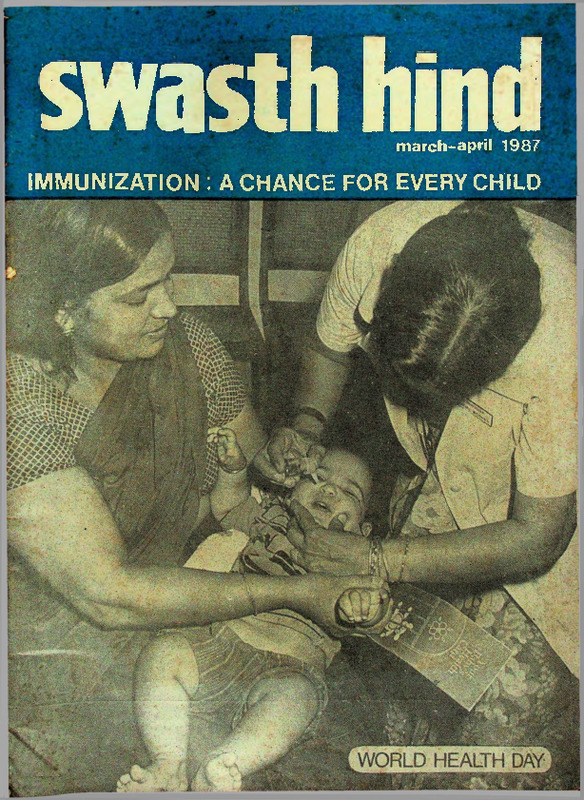
swasth hind
march-april 1987
IMMUNIZATION . A CHANCE FOR EVERY CHILD
In this Issue
swasthhind
Page No.
Expanded programme on immunization
—present position and future plan
March-April 1987
Phalguna-V aisakha
Vol. XXXI Nos. 3 & 4
Saka 1908-1909
62
Dr P. C. Roy
Immunization—a way to child development
65
Dr Mahendra Dutta
STATEMENT ABOUT OWNERSHIP AND
OTHER PARTICULARS ABOUT NEWSPAPER SWASTH
HIND TO BE PUBLISHED IN THE FIRST ISSUE EVERY
YEAR AFTER LAST DAY OF FEBRUARY
FORM IV
(See Rule 8)
1. Place of Publication
2.
Periodicity of its publication
5. Editor’s Name
Nationality
Address
6. Name and address of indivi
duals who own the newspaper
and partners or shareholders
holding more than one per cent
of the total capital.
Monthly
Dispelling doubts and fears about immunization
Shri N.G. Srivastava
Indian
Central Health Education
Bureau, Directorate Gene
ral of Health Services,
Kotla Marg, New Delhi110 002
—role of health education through mass media
67
72
74
Dr (Smt) V. K. Bhasin
Social aspects of immunization
78
Dr A. B. Hiramani & Dr (Kum) Neelam Sharma
Backgiounder to a programme against vaccinepreventable child diseases
80
M. S. Dhillon
Integrated child development services and
immunization programme
87
Dr Y. L. Vasudeva
Diet and immunization programmes
91
Dr P. Bhaskaram & Dr B. S. Narasinga Rao
Childhood diarrhoea—the deadly killer
Nil
94
Dr Umesh Kapil
Immunization programme—changing strategies
I, Dr. (Sint) V.K. Bhasin, hereby declare that the particulars
given above are true to the best of my knowledge and belief.
Sd/Dr. (Smt) V.K. Bhasin
Director.
New Delhi
29 Jan. 1987
Immunization—need for a coverage breakthrough
Dr Sanjiv Kumar & Prof. L. M. Nath
Dr. (Smt) V.K. Bhasin
Indian
Director, Central Health
Education Bureau,
Directorate General of
Health Services, Kotla
Marg, New Delhi -110 002
4. Publisher’s Name
Nationality ■*
Address
symptoms and prevention
Dr P. N. Sehgal & Dr J. P. Narain
New Delhi
Manager
Indian
Government of India
Press, Coimbatore (Tamil
Nadu.)
3. Printer’s Name
Nationality
Address
Six childhood communicable diseases—causes,
in a rural field area
97
Dr Bir Singh, Dr S. K. Kapoor & Dr J. Lobo
Love and prayers only won’t do
100
Late D. Lakshminarayan
SUBSCRIPTION RATES
Single Copy
..
Annual
..
..
..
(Postage Free)
50 Paise
Rs. 6.00
This Issue—Re. 1.00
EDITOR
N. G. Srivastava
Sr. SUB-EDITORS
M. L. Mehta
M. S. Dhillon
COVER DESIGN
B. S. Nagi
Articles on health topics are invited for publication in this
Journal.
State Health Directorates are requested to send reports of
their activities for publication.
The contents of this Journal are freely reproducible. Due
acknowledgement is requested.
The opinions expressed by the contributors are not neces
sarily those of the Government of India.
SWASTH HIND reserves the right to edit the articles sent
for publication.
WORLD HEALTH DAY 1987
Immunization A Chance for
Every Child
Millions of children die each year the world over and countless others are disabled, as a result of
vaccine-preventable diseases. Those lives could be saved by vaccines.
In India, the Expanded Pragramme on Immunization was launched in January 1978 with a view to
reducing the incidence of certain vaccine-preventable diseases. To accelerate the activities, the Universal
Immunization Programme was launched on 19 November, 1985, with the objective of providing protection
to all the expectant mothers and infants against six vaccine-preventable diseases, v/z., measles, diphtheria,
pertussis (whooping cough), tetanus, polio and tuberculosis by the year 1990.
Each year the World Health Organization focuses attention on a topic important to world health
through a programme of public information and health education. It does so as part of observance of
World Health Day, 7 April, which marks the coming into force of its Constitution.
We devote this special number of Swasth Hind to the theme of the World Health Day, 1987—
“Immunization : A Chance for Every Child”.
March-April 1987
61
EXPANDED PROGRAMME ON IMMUNIZATION
-PRESENT POSITION AND FUTURE PLAN
Dr P. C. Roy
India is self-sufficient in the production of all vaccines under EPT except polio and
measles. Polio vaccine is being imported at present, but is likely to be produ
ced in the country shortly. UNICEF is committed to supply entire requirements
of measles vaccine during the Seventh Plan period. Efforts are being made for
indigenous production of measles vaccine through imported technology.
he Expanded Programme on Immunization (EPI)
was introduced in January, 1978 in India. Since
then the EPI activities have been gradually expanded
with the objective of reducing morbidity, mortality
and disabilities due to vaccine-preventable diseases,
namely, diphtheria, pertussis, tetanus, poliomyelitis,
tuberculosis and typhoid fever, by making free vac
cination services easily available to all eligible children
and expectant mothers. Measles vaccine was initiated
in 1985-86.
T
Impact of immunization programme
Immunization programme is one of the most costeffective public health measures and an important
component of the primary health care services. The
vaccines available for the control of diseases are
effective, safe and cheap. Besides the reduction in
the incidence of vaccine-preventable diseases, the posi
tive impact of immunization programme is also likely
to be reflected in the related programmes of maternal
and child health and family welfare planning. The
immunization programme is, however, a continuous
and long-term one.
Aims and objectives of EPI
The Expanded Programme on Immunization aims
at bringing down the infant mortality rate from 110
to 87 by 1990 and to 60 per 1000 live-births by 2000
AD as envisaged in our National Health Policy. It
also aims at reducing peri-natal mortality rate from
67 to 30-35 and pre-school child mortality from 24
to 10 by 2000 AD, to reduce the neo-natal tetanus
mortality rate to less than one per 1000 live-births
and reduce poliomyelitis rate to less than 0.33 per
1000 children (0-4 years) by 1990 from the present
(1981) level of one per 1000. We aim at achieving
universal immunization of eligible children and ex
pectant mothers by the end of 1990.
TABLE 1—YEARWISE TARGETS AND ACHIEVEMENTS DURING 6TH PLAN PERIOD
(Figures
T.T. (Preg. Women)
in
POLIO
D.P.T.
YEAR
1980—81
1981—82
1982r—83
1983—84
1984—85
.
.
.
Target
Achieve
ment
%achievement
of Target
Target
Achieve
ment
% achieve
ment
of Target
Target
Achieve
ment
6.84
, 5.28
7.11
7.64
8.19
. 9.27
77.3
13.55
15.97
7.15
9.23
10.34
11.13
12.34 .
52.8
57.9
74.00
76.70
85.10
3.83
2.40
5.24
7.50
12.00
1.61
2.93
4.55
7.90
9.76
.7.96
A '
...
•
*^oo
@50
13.00
89.5
84.9
,7® 3
71-3
13.97
15.0
.14.5
Millions)
■■
■»
% achieve
ment
of Target
42.2
123.8
87.0
105.9
81.33
Source E & I Division
62
Swasth Hind
The programme ahead
The EPI programme is being implemented with the
assistance of State/Union Territory health authorities
through hospitals, dispensaries and MCH clinics in
urban areas and the primary health centres and sub
centres in rural areas including outreach operations in
villages which are not within easy reach of the health
centres.
To accelerate the activities we have started Uni
versal Immunization Programme in 1985-86 with
30 selected districts and catchment areas of 50 medi
cal colleges with three doses of DPT and polio, one
dose each of BCG and measles to all infants and two
doses of tetanus to all expectant mothers. In 1986-87
India
aims
at
another 62 new districts and rest of the medical
colleges have been taken up. The rest of the districts
will be covered an a phased manner under the Univer
sal Immunization Programme during the Seventh Plan
period.
In order to achieve the goal of universal immuniza
tion additional inputs are being provided.and infra
structure rapidly expanded during the Seventh Plan
period to rapidly extend the services to larger num
ber of beneficiaries. Additional manpower to plan,
monitor and evaluate various aspects of the pro
gramme at various levels is being sanctioned as well
as steps are being taken to augment the production of
EPI vaccines in the country. We are also strengthening
and improving the cold chain system and other equip-
achieving universal immunization of eligible children and expectant
Photo shows B.C.G. vaccination being given to an infant.
mothers by the end of 1990.
March-April 1987
63
TABLE n A—YEARWISE TARGETS AND ACHIEVEMENT DURING 6TH PLAN PERIOD ON EPI
B.C.G.
YEAR
TYPHOID
D.T.
Target Achieve- % Achieve- Target Achieve- % Achievement
ment of
mcnt ment of
Target
Target
1980—81
1981—82
1982—83
1983—84
1984—85
.
.
. 15.0
.
.
.
.
.
. 15.0
. 15.0
. 15.0
.
. 14.5
13.03
13.58
13.93
13.96
12.32
86.86
90.53
92.87
93.07
84.97
11.37
12.57
12.50
13.0
13.0
10.23
10.81
10.25
10.53
11.33
ment, necessary for effective immunization from year
to year.
India is self-sufficient in the production of all EPI
vaccines except polio and measles. Polio vaccine is
being imported by Haffkine Bio-Pharmaceutical Com
pany, Bombay, which is likely to produce indigenous
oral polio vaccine shortly. UNICEF is committed to
supply entire requirements of measles vaccine during
the Seventh Plan period as a commodity assistance.
Efforts are being made on indigenous production of
measles vaccine through imported technology.
Role of WHO and UNICEF
The external assistance in the National Immuniza
tion Programme is received from WHO projects and
UNICEF.
L TT (PW)
2. DPT
Annual
Target
Achieve
ment
1985-86
^increase %achievement
(+) or
Decrease of
Annual
(-)
Target
128.55
93.06
+9.5
72.4
140.44
153.44
95.0
85.3
140.44
119.80
+20.7
+40-9
128.91
+6.4
91.9
5. DT
140.44
111.90
110.98
+7.7
99.2
6. TYPHOID
111.90
69.92
62.5
7- TT (10Y)
55.40
40.53
+7.8
+23.5
73.2
8. TT (16 Y)
33.04
26.49
+27.0
80.2
3. POLIO
4. BCG
64
16.5
26.6
50.8
61.7
66.1
2.0
3.5
5.0
0.25
1.81
3.11
6.5
8.0
4.42
62.2
68.0
6.12
76.5
12.5
51.7
Training programme
Proper planning and management of the EPI pro
gramme is essential to achieve maximum epidemiolo
gical impact within the limitations of manpower and
financial resources. Training activties were started in
1978 and are being continued every year. So far,
about 1115 medical officers had attended the course
of mid-level managers at the National and State levels
and 609 paramedical staff, 111 technicians have been
trained in the maintenance and repair of cold chain
equipments.
Table m—Reported Vaccination Performance
(April-Aug. 1986) (Figures in lakhs)
(Figures are provisional)
Vaccine
DPT
POLIO
BCG
DT
TYPHOID
TT(SC)
lOYears
16 Years
TT (P.W.)
Annual
Target
Propor
tionate
target
153.0
153.0
153.0
121.0
121.0
38.98
38.98
33.81
30.31
30.31
34.45
27.97
23.07
24.33
17.31
88.4
71.8
68.2
80.3
57.1
67.0
41.0
152.0
16.38
10.40
38.59
11.27
7.29
32.94
68.9
70.2
85.4
Achieve % Cover
ment
age of pro(April-Aug: portio1986)
nate
Target
Proportionate target calculated according to the reports recei
ved from States/UTs.
April—5%
Source : E &I Division, Department of F.W. Figures are
provisional and likely to be increased as reports are pending from
some of the States/UTs.
1-62
2.63
5.02
6.17
7.27
WHO projects help in improving the skill and
knowledge, better planning and management, etc.
UNICEF is assisting to a large extent by providing
cold chain equipments, vehicles, syringes, needles,
vaccines, etc.
Performance under ongoing EPI programme fro'm April,
1985 to March. 1986 is as under
Name of the
Vaccine
9*82
10.0
10.0
10.0
11.0
90.10
86.10
82.0
81.0
87.2
Table U-B—Performance (1985-86)
(Figures in lakhs
T.T. (School Children)
Target Achieve- %achieve- Target Achieve- %Achie^Z
ment
ment of
ment
meat of
Target
Target
Aug.—28%
May—10%
June—15%
July—21%
__________ _______________________
Source : E & I Division, Department of Family welfare.
Swasth Hind
IMMUNIZATION
—A Way To Child Development
Dr Mahendra Dutta
The key person in the implementation of
the immunization programme is the mother.
It is she who decides whether a child would
receive a full course of immunization or not.
Increasing efforts are being made to reach
all mothers to inform them of the benefits
of immunization and particularly of the need
for a full course of the vaccinations. But
there is a need for mobilization of all
community resourses to rapidly reach the
immunization message to all the mothers.
March-April 1987
N spite of the fact that mortality among in
fants and children has significantly declined since
Independence due to the improvement of health care
services for them, India is listed among those coun
tries of the world that are reporting “high” level of
infant mortality of over 100 infant deaths per thousand
live-births. Almost half of the total deaths in the
country occur among children below five years of
age, and about one-third of the total deaths during
the first year of life. Frequently, these deaths arc
due to acute respiratory disease, diarrhoea and other
common childhood infections including tetanus, tuber
culosis, diphtheria and measles.
I
65
Sample surveys conducted in the count: y during the
years 1981 and 1982 revealed that nearly 2,00,000
children below the age of four years are struck every
year with paralytic poliomyelitis and become lame.
And about, 2,50,000 newborn babies die due to te
tanus every year. Measles and whooping cough in
variably affect the majority of unprotected children
during early years of life.
More important than kill
ing some of the children, these diseases adversely
affect their nutritional status arid growth and predis
pose them to infections that may later kill them.
Diphtheria and tuberculosis among children are also
commonly fatal. Over a million children are estimat
ed to die of vaccine-preventable diseases every year.
Protection from diseases
Scientists today have made available vaccines which
protect against some of the common diseases. Eradi
cation of smallpox throughout the world and elimi
nation of poliomyelitis, measles, neonatal tetanus,
diphtheria and whooping cough from many of the
developed countries have been possible with these
vaccines. Unfortunately, these infectious diseases are
still common in the developing countries affecting in
fants and children and cause considerable mortality
and impaired health of survivors.
Vaccines that are introduced into the body either by
mouth or by injection are risk-free, safe and protec
tive povided they are properly stored before adminis
tration.
Except measles and BCG, other vaccines
require repeated administration to afford complete pro
tection. Since most diseases affect young children,
babies should be fully immunized before attaining
their first birthday.
Total coverage
Recognising that immunization against common
childhood diseases with potent and stable vaccines
will prevent mortality and disability as well as pro
mote the health and nutrition of children, the Ex
panded Programme on Immunization has been under
taken in the country since January 1978. Besides
BCG (against tuberculosis), DPT (triple), DT (Diph
theria & Tetanus Toxoid) and TT (Tetanus Toxoid)
vaccines that were previously available, polio and
measles vaccines have been introduced since 1980 and
1985 respectively in many areas of the country. Since
66
the year 1985, an acceleration of the programme in
selected 30 districts (62 more districts have been includ
ed from April, 1986) is carried out to achieve a total
coverage of all the eligible children and pregnant
women. The remaining districts—-90 from 1987, 120
from 1988 and others from 1989—will also be covered
so as to achieve the objective of total coverage of
eligible children and pregnant women by the year
1990. Till 1985, only half of infants born each year
were being brought for the first dose of DPT and
polio vaccines and only three-fourth of them came
to receive the second and third doses. By 1990, as
many as 82 million infants and 93 million pregnant
women will be given vaccines. For this, 1000 million
doses of vaccines are needed. To meet the increased
demand of vaccinations, the availability of services of
vaccine delivery is being expanded so as to reach it
as close to the people as possible and to offer it at
times and on days convenient to them.
Mother—the centre of child health care
Though the health service personnel right down to
the community health workers are fully involvrxl in
the implementation of immunization programme, yet
the key person is the mother who is the centre of child
health care. It is she who decides whether a child
would be taken for a full course of immunization
or not. The health workers no doubt' continue to make
increasing efforts to reach all mothers to inform them
of the benefits of immunization and particularly of
the need for a full course of vaccinations. There is a
need for mobilization of all other community resources
to rapidly reach the immunization message to all the
mothers. Also further support from the mass com
munication media like television, radio, films, news
papers and periodicals are necessary. Messages for
mothers will include: “Prevention is better than cupe”,
“children can die if not protected/immunized”, “im
munization prevents crippling by polio”, “whooping
cough seriously affects nutrition and growth of child—
it can be prevented by immunization”, “measles can
kill and if the child survives, he is prone to get serious
illness—measles is preventable by immunization”,
“make sure the child is fully immunized before the
first birthday*, “tetanus of newborn is invariably
fatal—it can be prevented through immunization of
mother during pregnancy”, “repeated doses of vaccines
are often needed to afford complete protetion—follow
the full schedule”. •
Swasth Hind
SIX CHILDHOOD COMMUNICABLE DISEASES
—Causes, Symptoms And Prevention
Dr P. N. Sehgal
Dr J. P. Narain
Preventable communicable diseases continue to remain a major cause of childhood
mortality in our country. To combat this problem, a high priority has been accorded
to the maternal and child health under the National Health Policy.
It aims at
bringing down infant mortality rate to 60 per 1000 livebirths and pre-school morta
lity rate to 10 per 1000 children by the year 2000. One of the important strategies in
this direction has been the intensification of immunization against six vaccine-prevent
able diseases. This paper provides a brief review of causes, clinical picture and
preventive strategies against these diseases.
March-April 1987
67
Diphtheria
iphtheria as a clinical entity
was first recognised by Bretonneaur in 1826. It was not until 1883,
that Klebs described the morphology
of the diphtheria bacillus (Coryncbacterium diphtheriae) and a year
later Loeffler established that the
bacillus caused the disease. Diph*
theria toxoid was used widely (aga
inst this disease) in the USA in about
1940 and is now routinely being
given to children as well as to adults
throughout the world.
ferably at the 3rd, 4th and 5th
month of age, then a booster at 18
months and another at school-going
age. It is important to routinely
give the vaccines according to a re
commended schedule because anti
bodies form over a period of months.
In an outbreak situation, imme
diate preventive measures consist of
vaccination of susceptible persons,
antibiotic treatment of household
and other contacts who are at high
risk of acquiring the disease. All
close contacts should be kept under
surveillance to detect secondary cases.
If they can’t be kept under surveil
lance, they should be given 20,000
units of diphtheria anti-toxin in addi
tion to the vaccination and anti-biotic therapy.
Infection with
C. diptheria of
gravis, mitis or intermedins biotype
most commonly occur following con
tact with a patient or a carrier and
is characterized by production of
toxin. Generally tonsils, pharynx,
larynx, nose and occasionally other
If diphtheria is strongly suspected,
nerve membranes or skin may be anti-toxin (20,000-1,00,000 unit) sho
involved. The characteristic lesion uld be given immediately. Erythro
is marked by a patch or patches of mycin or penicillins should also be
an adherent greyish membrane with administered in conjunction with but
surrounding inflammation. In faucial not as a substitute for anti-toxin.
diphtheria, throat is sore and cervi
Measles
cal lymph nodes are enlarged. Laryn
A Persian physician Rhazes who
geal diphtheria is serious in infants
first
described measles in 900 AD
and young children while nasal di
phtheria is mild. Inapparent infec thought that measles was more se
tion or asymptomatic carriers of bac vere and dreadful than smallpox.
teria in the nose and throat is far The epidemiology of measles elu
more common than clinical diphthe cidated by Panum in 1846 after an
ria. Case fatality is 5-10 per cent. investigation of an epidemic in
Diagnosis is confirmed by bacterial Faroe Island, where there had
been no known case of measles for
examination of lesions.
65 years.
In 1911, Goldburger
In India, about 25,000 cases of and Anderson demonstrated that
diphtheria are reported annually. It
measles was caused by a virus
is believed that diphtheria has not
which they were able to transmit
only declined but fewer cases of se
from human respiratory secretions
vere diphtheria are now being seen
to monkeys. Isolation of measles
in the hospitals.
virus in cell culture by Enders
,and
Peebles in 1954, paved the
Vaccination with diphtheria toxoid
is by far the safest and most effec way for development of vaccine
tive method of preventing the dis against this disease.
ease. Children should receive three
primary doses during infancy pre
68
Measles begins with high fever
followed by cough, runny nose and
conjunctivitis. After 3-4 days of
prodromal period, the rash appears
first in the face and neck and then
moving downwards. Often it be
comes generalized. The small bluish
white spots on a reddish base call
ed Koplik’s spots appear on the
mucus membrane of the
mouth
about two days before and
dis
appear about two days after the
onset of rash. These spots are consi
dered as pathognomonic for mea
sles. Measles is transmitted through
respiratory secretions. Direct con
tact with the droplets is frequen
tly required although spread through
airborne route has also been des
cribed. The incubation period is
about 10 days varying from 8-17
days. Measles is one of the most
infectious and readily transmitted
diseases.
Although statistics on measles in
India are poor, it is suggested that
around 1,00,000 cases are reported
annually. Actual number of cases
could be manifold. In poor coun
tries, measles is often a severe dis
ease frequently
complicated by
bronchopneumonia, diarrhoea, dy
sentery and middle ear infection.
Although case fatality of endemic
measles is assumed to range from
1-3 per cent in India, rates as high
as 5-10 per cent have been reported
during epidemics.
A live attenuated measles vaccine
is now available which is the pre
ventive agent of choice. A single
injection can induce active immuni
ty in more than 95% of susceptible
persons. In India, the vaccine is
given at nine months of age. Ad
verse reactions following vaccina
tion are mild and self-limiting and
consist of pain at local site and fever,
rash and mild cough. For vaccine
to be effective and immunogenic,
cold chain is required to be main-
Swasth Hiti d
tained right from manufacturer to
the field vaccine site. Vaccination
may not produce protection if the
vaccine has been improperly handled
or stored.
Message
WORLD HEALTH DAY, 1987
Dr H. Mahler
For effective control of measles,
Director-General of the World Health Organization
early reporting of cases and rapid
outbreak investigation, and vacci
We have within our reach a challenging goal set in 1977 by the health
nation of susceptible contacts is re parliament of nations, our World Health Assembly, to provide immunization
quired. Because laboratory diag for ail the children of the world by 1990.
nosis of measles is neither available
There is, however, no room for complacency. I have decided to
nor feasible, a standard clinical/
devote
World Health Day 1987 to immunization because much more still
epidemiological criteria should be
needs
to
be done within countries themselves. No matter how generous
used to identify cases. Patients with
external
support
will be, nothing can replace the active participation of
high fever, generalised rash and one
individuals
and
their
communities, of national leaders and their govern
or more of these symptoms—cough,
ment
structures.
runny nose and conjunctivitis should
be considered to have measles un
Planet earth can no longer accept that, in the age of modern tech
less proven otherwise. With mea nology, children should still die by the millions of diseases which can be
sles vaccination included under the prevented by available vaccines.
Universal Immunization Programme,
Since we launched the WHO Expanded Programme on Immunization
the incidence of measles in the coun
in 1974, moving forward with the strengthening of primary health care,
try is expected to decline.
there have been major public gains. The lives of some 800.000 infants
Whooping cough
are saved every year in developing countries, where child, vaccine and
health
worker can be brought together. The World Health Organization
Whooping cough is an acute res
piratory infection which is highly is particularly grateful to UNICEF, whose active support to achieve uni
contagious in the early stage. Infec versal child immunization by 1990 has been, and will remain, of critical
tion is acquired primarily by direct importance for the success of this programme.
Immunization is truly a chance for every child. The informed
contact with discharges from res
cooperation
of the people, the unwavering commitment of leaders, the
piratory mucus membrane of infect
devotion
of
health
workers, the loving care and intelligent interest of parents,
ed persons by the airborne route
the
raising
of
necessary
funds and materials, are the vital ingredients of
or by droplets. Illness develops after
an average incubation period of the cocktail needed to give life to all children cf the world.
seven days (range 5—21 days).
The clinical picture consists of an
initial catarrhal stage which starts
with a irritating cough which gra
dually becomes paroxysmal. Paro
xysms are characterised by repeat
ed violent coughs. Each series of
paroxysm has many coughs with
out intervening inhalation and may
be followed by a characteristic
crowing or high pitched inspi
ratory whoop. Paroxysms frequen
tly end with the expulsion of
clear, tenacious mucus. The cough
March-April 1987
may lasti for several weeks and can
lead to malnutrition and secondary
infections especially pneumonia.
Nearly 3,00,000 cases of pertussis
are reported annually in India. Ac
cording to a WHO estimate, at least
80% of the children in an unim
munized population contract the
disease and some 1.5% of children
in developing countries die of
whooping cough or associated com
plications. Most of those who die
are infants.
/ Since the isolation of Bordetella
pertussis in 1906 many attempts
were made to produce a vaccine
from various field strains. Active
immunization with a vaccine con
sists of a suspension of killed bac
teria adsorbed on aluminium salts.
The schedule of immunization is
same as that recommended for di
phtheria for those under five years
of age. Pertussis vaccine is not
given to persons above five years of
age since disease is usually milder
69
and reactions to the vaccine severe plus meningeal irritation followed verse reactions include rare occur
in older children and adults. Chil by asymetric flaccid paralysis (due rence of paralytic poliomyelitis caus
dren who experience) severe reac to bulbar or spinal involvement). ed by vaccination. This reaction has
tions such as convulsions, a persis Paralytic poliomyelitis can be of been seen in about one of every
tent or unusually severe screaming, three types — spinal, bulbar, and 11 million doses of OPV distributed
a temperature of
105 °F, collapse bulbospinal. The chance of paraly for recipient cases.
or an encephalopathy should not sis following poliovirus infection in
receive a further dose of pertussis creases with higher age at infection, Tuberculosis
containing vaccine. Passive immuni seronegativity against types, preg
Tuberculosis is as old as anti
zation is of no proven value in nancy, tonsillectomy, recent vaccina
quity.
Hippocrates was the first
whooping cough.
Vaccines are tions, trauma, fatigue and level of
to
offer
clear description of the
effective in reducing both morbidity exposure.
disease
in
the 5th century BC. Koch
and mortality for whooping cough.
Poliomyelitis has been effectively discovered the etiological agent
controlled in most industrialised tubercle bacillus {Mycobacterium
Poliomyelitis
countries by using Inactivated Polio- tuberculosis) in 1882. In most of
Poliomyelitis is caused by a ribo Viruses (IPV) or Oral Polio Virus the Western countries, tuberculosis,
nucleic acid (RNA) picoma virus, (OPV) vaccine. In developing coun since the beginning of 20th century,
which has three antigenically dis tries, it still remains a serious pu has shown a steady decline in mor
tinct types (1, 2 & 3). These types blic health problem and a leading bidity and mortality due to factors
may cross-react serologically and cause of lameness among children. such as public awareness of the*
therefore infection with one type In India, about 15,000 cases are disease, improved socio-economic si
may provide some cross-protection reported annually through the rou tuation, development of radiogra
against paralytic disease from in tine reporting system. Sample sur phic screening technique and availa
fection from another type. Epide veys conducted in 1981 and 1982 bility of anti-tuberculosis drugs. In
miological evidence suggests that show that there are at least 10 to developing countries on the other
poliovirus type 1 isolated from polio 15 times more cases than that re hand, tuberculosis still ranks among
myelitis patients are more likely to ported. Thus roughly about 2,80,000 major public health problems. It
be of wild strain while poliovirus children develop polio each year. is estimated that in India nearly
type 2 or 3 isolates are more likely The majority of cases are under 2.8% of the children below five
two years of age at the time of in years of age and nearly 13.4% of
to be vaccine strain.
fection, while it is rare about five the population in the age-group of
Infection with poliovirus occurs years of age. Based on 1981 lame 5-9 years are infected with tubercle
either through fecaloral route or ness surveys, it is estimated that the bacilli. The annual incidence among
through respiratory secretions. The annual incidence rate of poliomye children varies from 0.8% to 2%.
incubation period is commonly litis varied from 1.5 to 1.7 per 1000
6—20 days. Infection with any of children under five in urban and
Tuberculosis
is
transmitted
the three types may result in either 1.6 to 1.8 in rural areas. It is aim through exposure to tubercle bacilli
of the following forms (1) Inap ed to bring down the incidence to in airborne droplet nuclei from spu
parent infection (90-95%) — pati negligible levels by the end of 1990. tum of persons with infectious tuber
ent asymptomatic but virus present As a preventive strategy, the OPV culosis. Prolonged and close ex
in throat and/or stool, (2) Minor is being used in the country as a posure to an infectious case may
illness (4-8%) — only upper res trivalent oral vaccine given along lead to infection of contacts. Initial
piratory infection, gastroenteritis or with DPT at three properly spaced infection usually goes un-noticed
flue like symptoms, (3) Nonparaly doses. OPV vaccine provides not and tuberculin sensitivity appears in
tic poliomyelitis (1-2%) — symp only sero immunity to all three po 6-8 weeks. It may progress directly
toms of minor illness plus nervous liovirus types but also intestinal im to pulmonary tuberculosis or through
system involvement and suspected munity that protects the recipient dissemination by lymph and blood
meningitis, (4) Paralytic poliomyeli against paralytic disease. OPV is a may produce miliary tuberculosis or
tis (0.1—0.2%) — minor
illness very safe and effective vaccine. Ad tubercular meningitis. The serious
70
Swasth Hind
outcome is more common in children
and young adults.
Preventive measures against tuber
culosis include improvement of sosical conditions which increase the
risk of becoming infected such as
overcrowding, early detection and
prompt treatment of cases, ensuring
compliance to therapeutic* regimen
in the home. Inoculation of suscep
tible infants with BCG vaccine does
not lead to a progressive disease and
provides resistance to subsequent
infection with virulent tubercle ba
cilli. A large-scale BCG trial con
ducted by ICMR in Chingleput
district of South India revealed ini
tially that BCG vaccination does not
give any protection against tuber
culosis. However, subsequent follow
up has revealed that BCG-vaccinat
ed children are able to avoid hazards
of natural
primary infection in
the form of post-primary tuber
culosis which are most dange
rous. It is for this reason, that
BCG vaccination has been offered
to the infants and young children
by integrating it with the Expanded
Programme on Immunization so that
infants can be protected against
tuberculosis.
Neonatal Tetanus
Neonatal tetanus is one of the
major causes of neonatal mortality
in the country. The risk of expo
sure of the newborns to the spores
of Clostridium tetani especially in
rural areas are extremely high
because the environment is heavily
contaminated with these spores. The
unhealthy practice of applying cow
dung in the cut portion of the um
bilicus as well as the malpractice
of cutting the cord with an unclean
instrument contribute to the infec
tion in the newborn baby. The high
incidence of neonatal tetanus in our
country is a direct reflection of the
inadequate maternity care services
and limited immunization against
tetanus.
It is estimated that 0.23 to 0.25
million infants die of neonatal teta
nus within the first month of birth.
The mortality rate due to neonatal
tetanus is highest in rural areas of
Uttar Pradesh (68 per thousand live
births). In the rural areas of Rajas
than and West Bengal, the rates
are between 10 and 20 per 1000 live
births, whereas they are less than
10 in the other States. For the
whole country, mortality rate is esti
mated to be 13.3 per 1000 live
births in rural areas and 3.2 in the
urban areas. It is aimed to reduce
the neonatal tetanus mortality rates
to less than one per 1000 live births.
Clinically, neonatal tetanus ty
pically presents in a newborn infant
who sucks and cries well for the
first few days after birth. Subse
quently, the infant develops progres
sive difficulty and later inability to
feed because of generalised stiffness
with spasms or convulsions along
with muscular rigidity. The sym
ptoms appear 3-14 days after birth
and death rapidly follows. Overall
case fatality rates in neonatal teta
nus are very high that may even
.exceed 80%.
Prevention of neonatal tetanus is
achievable by two
approaches—
firstly by improving maternity care
and having more births conducted
by trained attendants, and secondly
by increasing immunization coverage
of pregnant women with tetanus to
xoid (TT). At present, control of neo
natal tetanus is receiving a high prio
rity and both approaches, as men
tioned above, are being applied.—
the immunization of pregnant women
with TT under EPI and the training
of dais under the rural health pro
gramme. Health education is a vital
component for increasing accep
tance of both these programmes. Two
doses of TT are recommended dur
ing pregnancy, the first dose at
four months- and the second at an
interval of not less than one month
after the first. The second dose
should preferably be given at least
15 days before the expected date
of delivery. In case of previous
vaccination history, one booster dose
is given.
A
Neonatal Tetanus
Neonatal tetanus is second to measles as a global killer, yet remains a disease
largely invisible to title health services. Because its control requires a focus on
immunizing women of childbearing age and on improving delivery practices,
neonatal tetanus serves as a good index of the quality of maternal care. A single
case suggests multiple failures* within the maternal and child health care system,
and should call for immediate remedial action.
—Dr R. H. Henderson speaking at the 39th World
Health Assembly, Geneva, 16 May 1986.
March-April 1987
71
IMMUNIZATION
- Need For A Coverage Breakthrough
Dr Sanjiv Kumar
Prof. L. M. Nath
Increasing emphasis on immunization of children all over the world clearly shows
that there is a shift from the hospital-based curative care to community-based
approach. In view of the increasing population and limited government resources
adequate immunization coverage becomes the only choice to improve health and
nutrition of the population in the shortest time.
he theme for this year’s World Health Day—
‘Immunization—a chance for every child’—reflects
the growing conviction that greater emphasis should
be placed on the positive actions to protect and pro
mote health.
Immunization has been called the
most cost effective method which has become avai
lable to mankind in preventing death and disability
from increasing number of existing diseases. It has
been due to immunization and proper application of
this measure at the community level with total national
and international
commitment that smallpox, a
dread disease, has been wiped out from the face of
this earth. For generations to come, it will be his
tory.
T
Increasing emphasis on immunization of children
all over the world clearly shows that there is a shift
from hospital based curative care to community based
approach based on positive goal of health and fit
ness.
The World Health Organization (WHO) launched
Expanded Programme on Immunization (EPI) in
1974.
It is estimated that this programme saves
800,000 infants every year.
The coverage with these
vaccines, which was less than five per cent before
EPI was started, has gone up eight-fold now.
India launched its EPI in January 1978. Further
impetus was given to this by the Universal Immuni
zation Programme launched on 19th November, 1985,
72
to be the living memorial to the late Prime Minister,
Smt- Indira Gandhi.
When this monument is com
pleted it will save one million Indian children each
year.
Despite full support from the Government of India
and international agencies the coverage still needs to
be improved.
The drop-out rate from the first to
the third dose of DPT and oral Polio vaccine is
high.
The breakthrough
The “supply breakthrough” in immunization has
been brought about by more heat stable vaccines,
more reliable cold chains, training of medical and
paramedical workers and involving more workers in
immunization programme.
Equally important is
‘demand breakthrough’ which will help in converting
immunization from mere theory to a practical thing.
Though nearly a million deaths are prevented by
immunization against vaccine-preventable diseases
yet three-and-a-half million children are dying from
these each year.
After eight years of initiation of
this programme in India, the figures of coverage are
still poor being less than 50% for BCG, less than
50% for DPT and 18% for OPV.
Our country is
facing increasing population, and limited government
resources for social services.
In this context ade
quate immunization coverage becomes the only choice
to improve health and nutrition of the population in
the shortest time.
Swasth Hind
The dropout rate from the first to the third dose of DPT and oral polio vaccine is high. This
problem needs serious attention. Photo shows vaccination being provided at a health centre.
Community mobilization
Children cannot wait for conventional development
programme to take hold.
The strategy of com
munity mobilization must be fully utilized to improve
immunization coverage.
The vulnerable, once
motivated with the help of their society, will be able
to fully utilize the services provided by the govern
ments and the professional workers.
It has been
realized that for the health of the people to improve
significantly they must actively participate in provi
sion and utilization of health care facilities.
Keep
ing this in mind a new approach was tried in the pri
mary health centre area of the All-India Institute of
Medical Sciences, (AlIMS). It was announced in
the villages that all the children attending the under
five clinic will be given a small prize--a small rubber
ball (worth 50P) or a small packet of biscuits (worth
75P) each. The attendance at these sessions went
up by more than five times.
These sessions were
also utilised for health education of the mothers about
March-April 1987
simple methods to protect and promote health of
the children.
Expenditure for these sessions was
met by the village Panchayat or through villagers’
contribution.
This aproach has helped us in achiev
ing an immunization coverage of above 90% in the
PHC area of AIIMS.
The national target for 1990
has already been achieved in this area.
The success of immunization programmes will pio
neer new ways of taking known effective solutions
to the basic health problems and putting them at the
disposal of those who need them the most. Now
families themselves can significantly increase their
children’s chances of survival and normal growth
and development if methods can be found to put the
knowledge at the disposal of the community.
By
knowing more, demanding more and doing more about
such basic health strategies the people will achieve
a greater degree of control over their own and their
families’ health.
>
73
DISPELLING DOUBTS AND FEARS
ABOUT IMMUNIZATION
—Role Of Health Education Through
Mass Media
Dr (Smt) V. K. Bhasin
If the objective of the universal immunization is to be achieved as planned, apart
from creating demand for services, the problem of dropouts after the first dose has
to be solved seriously, says the author. And suggests that the programme should be
closely and continuously monitored and evaluated to identify as to how far through
different communication approaches the doubts and fears of the community have
been overcome.
he Government
of India has accorded high
priority to programmes aimed at improving the
health of mothers and children.
As a part of over
all strategy for improving the child survival rate, the
Expanded Programme on Immunization (EPI) was
started in January, 1978.
The ongoing National
Control Programmes on smallpox and tuberculosis
were transferred to E.P.I.
Besides these, immuni
zation against poliomyelitis, diphtheria, tetanus,
whooping cough and measles were also taken up on
pilot basis through
selected medical colleges with
proper cold chain delivery system.
T
Immunization against the most common and deadly
childhood diseases saves the lives of some one million
children in developing countries each year.
But
still more than 3.5 million others are killed or disa
bled, which could have been prevented by immuniza
tion. Concerted efforts are now under way to expand
immunization services to cover all the world’s infants
and pregnant women by 1990.
E.P.I focusses on six childhood diseases.
are:—
measles:—It affects
nearly all children
over two million children annually.
and
These
(Whooping cough):—This disease kills
some 600,000 children each year and affects mil
lions more.
tetanus:—Contracted
through con
tamination of the umbilical cord at birth, it kills
about 800,000 children each year.
74
major cause of lameness in
the developing world, it kills about 30,000 child
ren annually.
year this disease attacks
10 million children and can be especially severe
among young children.
tuberculosis:—Each
less common, it kills 10-15
per cent of its victims.
diphtheria:—Though
IMMUNIZATION SCHEDULE
Beneficiaries
Age
Pregnant Women
16-36 weeks
Infants
Children
Vaccine
Doses
TT
2*
3-12
months
DPT
Polio
BCG
3
3
1
9-15
months
Measles
1
18-24
months
DPT
Polio
1
1
5-6 years
DT
Typhoid
!♦♦
2
10 years
TT
Typhoid
!•♦
!♦♦
16 years
TT
Typhoid
!♦♦
!•♦
kills
pertussis
neo-natal
poliomyelitis:—A
♦One booster only if vaccinated previously.
♦♦Two doses if not vaccinated previously.
Swasth Hind
Over 3,00,000 cases of typhoid fever are reported annually, the majority of victims being school
children.
Greater involvement of teachers can help cover the children with typhoid and TT
vaccines since it is a captive group. The TT vaccination of school children was started in 1980-81.
March-April 1987
75
Coverage under the immunization programme has
been expanding gradually*
In the financial year
1982-83, about 11 million infants and eight million
expectant mothers benefited from the immunization
services, i.e., tetanus toxoid (T.T), diphtheria (DPT),
poliomyelitis (Polio) and B.C.G. Realising the poten
tial of immunization as a cost-effective intervention
to reduce the infant and maternal morbidity and
mortality, the Government of India have decided to
extend this programme rapidly with the aim of pro
viding universal immunization by 1990.
TOWARDS UNIVERSAL IMMUNIZATION
Beneficiaries
Proposed
Coverage
Infants
Percentage
Number
(In millions)
Expectant
mothers
Percentage
Number
(In millions)
Financial year
1988-89
1987-88
1989-90
75
80
85
16.9
17.7
18.3
65
75
100
18.6
21.9
23.9
Courtesy : Towards Universal Immunization 1990, Ministry of
Health and Family Welfare, Government of India, 1985.
Coverage during VII Plan
During the Seventh Plan period, 82.2 million in
fants and 92.5 million expectant mothers are to be
covered under the programme.
This involves ad
ministration of over 840 million doses of different
types of vaccines.
A programme of this magnitude
in a large country like India will need additional
resources and effective management.
Training of
health personnel, production of adequate quantity of
vaccines, and maintenance of its continuous supply
with vaccine potency at the delivery end within the
framework of primary health care to 22 million infants
bom each year and expectant mothers is of prime
importance.
Besides providing services, information,
education and communication of the community to
ensure their participation is vital.
The Universal Immunization Programme is also
an important component of the Family Welfare Pro
gramme which is Centrally-sponsored.
This pro
gramme is conducted in a phased manner to cover
all the districts in the country.
Under the pro
gramme, 30 districts were covered during 1985-86 and
62 districts would be covered in 1986-87, 80 in 198788, 120 in 1988-89 and 120 in 1989-90.
A district
is the operational unit for planning and implemen
tation of all the developmental programmes includ
ing universal immunization programme.
The chief
76
medical officer (CMO) heads the health and family
welfare services in the district. The collector of the
district is the coordinator in immunization programme
specially of the functionaries of other agencies like
social welfare department, Anganwadi workers of the
Integrated Child Development Services set-up, school
teachers, agriculture extension agencies, besides other
Government employees.
Delivery of immunization services
The infrastructure for delivery
of immunization
services is provided in the rural and urban areas
through a network of primary health centres (PHCs)
and sub-centres, urban family welfare centres, post
partum centres, Governmental dispensaries, private
medical practitioners and voluntary organizations.
At the village level, health guide (H.G.) and trained
birth attendant (T.B.A.)/Dai are another community
health workersA female multipurpose worker (a
trained auxiliary nurse-midwife) plays a key role in
immunization programme.
Besides allopathic doc
tors, there are 4,00,000 medical practitioners of the
Indian Systems of Medicine, who render useful ser
vices in rural areas as also in the selected urban
communities.
Doubts and fears
Rural and tribal community and urban slum-dwel
lers have some doubts and fears about efficacy of
immunization due to its certain side-effects.
For
example, B.C.G. vaccination may give rise to swel
ling, tenderness, redness and even enlargement of
lymphatic glands in the armpit, DPT and measles
vaccinations may cause fever sometimes for a day or
two and sometimes for 10-12 days.
Every health
worker must inform the mother about these side
effects and help removing doubts and fears about
immunization.
He should inform the mother about
the dangers of not following the immunization sche
dule (mentioned already), thereby educating her with
all the possible means of communication like (i) mass
media approaches, (iij interpersonal dialogue, and
(iii) group meetings by organizing orientation training
camps (OTQ involving formal and non-formal
leaders during religious functions, fairs and festivalsBasic factors
Therefore, there are two basic factors to identify
those who have these fears and doubts and how to
dispel them:—
1. Identify the community with a view to find out
whether it is only a few people who have the
fears and doubts or is it the entire community?
Swasth Hind
1.2 If a few people have these doubts and fears, iden
tify as to when did they start getting these.
1.3 What was the source of these doubts or fears—
magic healers or quacks.
1.4 Percentage of drop-outs due to fears and doubts.
2. How to dispel their fears and doubts.
These fears and doubts of the parents about
young children can be dispelled only if their
parents are convinced that immunization is avai
lable, know where and when services are avai
lable and understand when children and mothers
should receive vaccines- They should be explain
ed the consequences of diseases if children are not
immunized according to the schedule.
— communication. Through mass media one
can reach most people; but as already mention
ed that group approach and person-to-person
approach can reinforce these messages and moti
vate people to get their children immunized.
Motivation of pregnant women, mothers and
family members can be done at home, the sub
centre, and primary health centre with the help
of flip rolls and pamphlets.
Mass media
The media sector growth has been phenomenal—
printed material, Radio and T.V.
It has been observed that communication efforts
do increase the coverage of Immunization Programme.
Therefore, sound and effective communication stra
tegy should be planned, so that community feels the
need and utilises the immunization services.
(i) Radio has a nationwide network for spreading
information.
Messages/radio spots regard
ing immunization are broadcast during morn
ings and afternoons when women can listen to
their radio sets—Transistors have revolutionis
ed communication.
They reach right up to
the villages and far off hamlets.
Three components of communication strategy re
quired for dispelling fears and doubts are:—audien
ces, messages and various communication approaches,
specially mass media.
(ii) T.V.—Since 1984, T.V. network has spread
over a large area of our country. Relevant
messages about immunization programme are
being developed and telecast.
— audiences. The main audience for immuni
zation is parents of young children, others are
inlaws specially
mother-in-law,
community
leaders both formal and non-formaL
(iii) Films on Immunization should be shown
cinemas.
— messages.
The messages aim at creating
awareness about community participation and to
provide specific information that people need to
avail servicesSimple messages are most effec
tive.
They should appeal, in local dialect, the
parents and prospective parents abotit the need
to know when and where immunization services
are available, who should receive them and when
specific immunizations should be obtained. When
parents bring their children for immunization
they should be informed about two basic facts.
which are:—
• How many doses are necessary for full protection
and when should they bring their children back
for the next dose.
• What are the common side-effects and what to
do thereafter.
March-April 1987
in
(iv) Printed material like newspapers and maga
zines highlight relevant messages on immuni*
zation.
(v) Hoardings and tin plates(vi) Putting banners on immunization during fairs
and festivals..
(vii) Traditional media like folk Songs, kathas, pup
pet shows and Bhajan mandlies, etc.
The ^Government of India, is committed to. accom
plish universal immunization of children by 1990. If
the objective of universal immunization is to be
achieved as planned, apart from creating demand for
services, the problem of dropouts after the first dose
has to be solved seriously. -This programme should
be closely and continuously monitored and evaluated
to identify as to how far through different communi
cation approaches the doubts and fears of the com
munity have been overcome. O
77
SOCIAL ASPECTS OF IMMUNIZATION
Dr A. B. Hiramani
Dr (Kum) Neelam Sharma
Some studies make it clear that awareness in the community about the universal
immunization programme needs to be generated in order to make it a success. More
studies on the influence of social, cultural and psychological factors on the accept
ance of immunization programme are required to understand the community better.
n India, about 12.6% of the
population that
constitutes children below five years of age fail
prey to the killer diseases such as whooping cough,
diptheria. tetanus, measles, poliomyelitis and tuber
culosis.
T
Immunization to the target group is like ‘stitch in
time, saves nine”. which guarantees protection to the
individual against particular diseases.
With the ad
vent of vaccination against smallpox, polio, DPT.
tuberculosis and a few other diseases, infant mortali
ty has been brought down considerably; but the gap
still remains wide between the developed and
the developing countries in the world.
One
would not wonder to find the reason for eradica
tion of smallpox from African and other tropical
countries much later than from the Western and
European countries.
Predominant reason for late
success is nothing but the community's social and
cultural attributes that obstruct the acceptance of
modern health services.
Those who participated in
the process of smallpox eradication in India believed
that vaccination alone did not play a miracle; but
health education and community itself were contri
butors to its success.
Health education, through
varied category of health workers and the community,
aims at bringing about desirable social and cultural
change in the community that help healthful living.
The study of the community and its social and cul
tural factors is a prerequisite for implementing any
health programme.
This is because the social and
cultural characteristics of the community have a great
influence on its health.
This process not only tries
to understand the community but also indirectly gene
rates in it a sense of participation in the programme.
Relevance with community behaviour
Immunization is one of the health
programmes
which has intimate relevance with community beha
78
viourMore so in India faced with high illiteracy,
superstitions and other social and cultural factors that
effect adoption of modern health care services.
A
tilt towards curative aspects of health service delivery
has been reduced with a realization that timely pre
ventive measures minimise the intensity and nature of
various easily preventable health problems. It is on this
premise that immunization programme has been
launched.
The present paper tries to take a stock of empirical
studies on social aspects and their role in the immuni
zation programme; because the results of such
studies have close relevance to the implementation of
the programme itself.
The study in rural areas of West Bengal has reveal
ed that about seven out of ten families having child
ren below five years of age did not get their children
immunized due to lack of knowledge or negligence
(Ray. et al,
1983).
For DPT immunization, it was
found that there were 51 families, though received
immunization, had no knowledge about it.
Such
results tlius provide a good feedback to the pro
grammeIt shows that free services provided by
the Government by themselves alone do not ensure
their adoption by the people. The people adopt such
services only when they are made aware of their im
portance and utility for healthful living of the child.
While comparing the rate of acceptance between DPT
and tetanus vaccinations, the latter was found to be
quite low, reason being lack of health education of
the community.
The BCG vaccination coverage, according to a
study, depends on factors like availability of services,
health practices, socio-cultural characteristics of the
community and their participation in the programme.
Swasth Hind
People will avail of immunization services only when they arc made aware of their importance and utility.
Photo shows a group of mothers with their children waiting for vaccination at a health centre.
However, one study did not find influence of these
factors on acceptance of BCG vaccination; a little less
than 50%. did not accept vaccination due to fear
(Seetha, et al, 1980).
The study in Purnea district in Bihar found that
44% mothers were unaware of the number of doses
required while 38% did not know the place where the
services were available (DGHS, 1982).
zation programme.
Nevertheless, some studies make
it clear that the awareness in the community about the
programme need to be generated in order to make
universal immunization programme a success. More
studies on these aspects are required to understand
the community.
REFERENCES
1.
Ray, Sandip Kumar, Ganguly Moni Moy & Mukhopadhyay Bansi Badan—Some Aspects of
Common
Immunization Services in a Rural Area, Indian Jour
nal of Preventive and Social Medicine, Vol. 14, Nos.
1-2, March-June, 1983.
2.
Seetha, M.A., N. Srikanta Ramu, Hardan Singh—Ac
ceptability of BCG Vaccination among Rural Com
munity, Indian Journal of Preventive & Social Medi
cine. Vol. 11, No. 2, 1980.
3.
DGHS—Study of EPI in Bihar, EPl Bulletin Vol. V,
No. 1, January, 1982.
4.
Srivastava, V.P. et al—Community Response to Im
munizations Programme in selected Rural Areas
in
Rajasthan, CHEB Technical Series—38, 1982.
b
!
People, in general have no strong objection to get
their children immunized against diseases.
But, in
the case of those who did not receive immunization,
ignorance is a major reason*
(Srivastave, et al,
1982)
The review of a few studies show that there is no
uniform trend of influence of social, cultural or
psychological factors on the acceptance of immuni
March-April 1987
79
a
B
a chance
for every child
WORLD HEALTH DAY 1987
BACKGROUNDER TO A PROGRAMME
AGAINST VACCINE-PREVENTABLE
CHILD DISEASES
M. S. Dhillon
Efforts to augment demand generation and community participation for immunization
must focus on the consumers of the programme, with due regard to their problems,
needs, biases and aspirations. This needs total commitment to the programme to
have a maximal translation into action by appropriate health education and dissemi
nation of information in a language people understand and with a cultural bias fami
liar to them.
for children to be protected against the
dangerous infectious diseases of childhood can
not be too strongly emphasised.
These dangerous
diseases, infectious in nature, are: diphtheria, whoop
ing cough (pertussis), polio, tetanus, tuberculosis and
measles.
Immunization is a safe, reliable and sim
ple method to protect our children from these debilitat
ing diseases. A large number of children under three
years of age die from these communicable diseases
and many are disabled.
he need
T
Immunization is the most cost-effective health inter
vention known to man.
It is an integral part of
maternal and child health programmes and is a sheet
anchor of primary health care.
Immunization against vaccine-preventable diseases
alongwith Oral Rehydration Therapy (O.R.T.), proper
nutrition, personal hygiene and clean surroundings
can help protect children from preventable diseases
and ensure a healthy life for eveiy child.
80
Keeping this in view, the World Health Organiza
tion has set a target of providing immunization for
all children by the year 1990.
Universal immuniza
tion is also one of the key elements of the W.H-O.’s
overall goal of “Health for All by the Year 2000”.
It is in this context that the W.H.O. has selected its
theme for the World Health Day—7th April, 1987, as
“Immunization : A Chance for Every Child”.
The theme emphasises the need for prevention of
childhood diseases through immunization to provide
a chance to every child to lead a healthy life. This
Day seeks to afford an opportunity to give further
impetus to the Expanded Programme on Immuniza
tion (E.P.I.) throughout the world.
Situation in India
The Government of India have accorded high prio
rity to programmes aimed at improving the health of
the mothers and children.
As part of overall stra
tegy of improving the child survival rate the National
Health Policy aims at universal immunization of new-
Swasth Hind
MEASLES—FEW FACTS
The Disease
*
It is caused by a virus.
Incidence
*
An estimated 67 million cases of measles occur yearly
in the developing world, causing over 2 million deaths.
*
Nevertheless, in 1983 only some 3-1 million cases were
actually reported by 148 countries. The breakdown by
WHO regions: 780,000 reported in Africa; 125,000 in
the Americas; 210,000 in the Eastern Mediterranean;
820,000 in Europe; 205,000 in South-East Asia; aad
975,000 in the Western Pacific.
*
Virtually every unprotected child contracts the diseasela the Third World, practically all children are affected
before the age of three, much earlier than in the indus
trialized world.
*
Mortality rates are highest in malnourished and very
young children who may have case fatality rates of
10% or more.
Transmission
Measles is acquired through personal contact*
Those
infected are contagious both before and after the ap
pearance of the rash.
The incubation period of the disease varies from 8 to
14 days.
immunization
*
One dose of measles vaccine is necessary. It should be
given at 9 months for children in developing countries
and between 12 and 15 months for those in industria
lized countries.
*
Children who are malnourished or ill should be im
munized. Immunization does not endanger their health
and they are in particular need of protection.
•
Only about 41% of the world’s children under 5 years
old are immunized against measles.
*
In the developing world (excluding China) measles im
munization coverage is estimated at about 25%
*
In WHO’s European region, immunization coverage is
currently about 75%.
*
Liquid measles vaccine may be
0’C (22*F) and +’C (46’F).
Symptoms
*
*
Initial symptoms, lasting from 3 to 7 days, resemble
those of a cold; red, watery eyes, running nose, cough,
malaise, and a high fever.
These are often followed . by a symptom unique to
measles; grayish-white spots with red borders (Koplik
spots) inside the cheeks that lead to a characteristic red
spotted rash generally lasting 4 to 6 days.
Complications occur in about 30% of cases and include
ear infections, pneumonia, diarrhoea, blindness, and
encephalitis.
There is a higher risk of death and severe illness for
9 to 12 months following a measles attack even for
children who have apparently recovered-
maintained
between
—W.HO.
born children and expectant mothers with a view to
provide protection against vaccine-preventable child
hood diseases: diphtheria, whooping cough (pertussis),
tetanus, poliomyelitis, tuberculosis and measles.
infants includes vaccines against tuberculosis, diph
theria, pertussis, tetanus, poliomyelitis and measles.
Expectant mothers are given two doses of TT to pro
tect them and their newborns against tetanus.
India : towards universal immunization
The primary health care chain has now been . ex
tended to grassroot level.
The Health Guide (H.G.)
at the village level serves as a link between the commu
nity and the primary health care services.
A train
ed birth attendant (Dai) is yet another health worker
at the village level who provides midwifery servicesThese health workers at ihe village level and all the
others at the upper level are being involved in a limi
ted way in supplementing the efforts of female wor
kers in the matter of providing immunization services.
The Universal Immunization Programme was laun
ched in the country on 19th November, 1985—the birth
day of our late Prime Minister. Smt. Indira Gandhi.
The objective is to provide protection to all the ex
pectant mothers and children against six vaccine pre
ventable diseases by the year 1990.
The coverage
will be extended over a five-year period in a phased
manner immunizing about 18 million infants and 24
million mothers every year.
It is planned to immu
nize 82.2 million infants and 92.5 million expectant
mothers.
The package of immunization services for
March-April 1987
Recognising the primacy of immunization in the
package of child survival services, the National Health
81
About 1 out of 10 children with throat diphtheria die.
Transmission
*
Diphtheria is acquired through personal contact- Those
infected are contagious for up to 4 weeks, whether
or not they develop symptoms themselves.
*
The incubation period of the disease is generally bet
ween 2 to 5 days.
S> mptoms
*
Although skin and nasal infections arc usually mild.
diphtherial throat infections can become serious.
*
Initial symptoms include fever, malaise, and mild sore
throat.
*
Membranes may develop in the throat, often causing
death by asphyxiation.
*
Diphtheria bacilli in the throat also produce a toxin
which passes into the blood and may attack the heart
or the nervous system, with fatal results-
*
Other complications include: paralysis of the palate, eye
muscles, threat, muscles of the respiratory tract or arm
and leg muscles-
Immunization
*
Diphtheria vaccine is usually given together with per
tussis and tetanus vaccines in a combination called DPT.
Three doses of DPT are necessary. A dose should be
given at 6, 10 and 14 weeks of age.
*
Globally, approximately 47% of children less than 12
months old receive the full series of DPT vaccines.
'Hie Disease
•
A bacterial disease, diphtheria can be a very mild infec
tion or it can be life-threatening-
*
The developing world (excluding China) has raised its
DPT immunization coverage rate from less than 5%
in 1974 to 38% in 19S5.
Incidence
•
Diphtheria is rarely seen in industrialized countries- In
developing countries, where sanitation and hygiene are
poor, it appears primarily as a skin disease.
•
In 1983 only some 46,800 cases were actually reported
by 160 countries.
The breakdown by WHO regions:
1,300 in Africa; 5,100 in the Americas; 7,200 in the
Eastern Mediterranean; 1,800 in
Europe;
18,400 in
South-East Asia and 13,000 in the Western Pacific.
*
In WHO’s European region. 81% of children
receive complete DPT (or DT) immunization.
*
A decline in diphtheria incidence is usually one of the
first signs of an effective immunization programme.
*
DPT vaccine must be stored between 0°C (22°F) and
+ 8°C (46’F). It cannot be frozen.
—W.HO.
diphtheria
few facts
Policy has set the following specific targets for this
programme to be achieved by 1990:
Expected Immunization Status by 1990
Immunization Status : 1990
(Per cent population)
D.P.T.
Infants
85
Polio
—
85
B.C.G.
—
80
T.T.
Pregnant women
100
T.T.
(For school children)
10 years
100
16yeais
100
D.T.
(New school entrants)
5—6 years
85
Typhoid-d<85
The Steering Group on Health and Family Welfare
of the Planning Commission has recommended univer
sal coverage (85%) for measles vaccination for infants.
82
bow
5 iaiii thrust
The right time to prevent any infectious disease is
obviously before it happens and in early childhood.
The vaccine must be given to an individual before
he has been exposed to the disease.
Most of the
vaccine-preventable diseases occur at an early age,
therefore, it is important that the full course of the
vaccine-preventable diseases occur at an early age,
birthday or soon thereafter up to 14 months and the
levels of immunization in the community are sustain
ed so that each new generation is protected.
The main thrust of the Universal Immunization
Programme would be the coverage of pregnant women
with two doses or a booster dose of TT, and of infants
with three doses each of DPT and Polio vaccines.
Targets for BCG and measles vaccines have also been
set.
During pregnancy, two doses of tetanus toxoid
(TT) are recommended, the first dose at 4 months and
the second at an interval of not less than one month
after the first dose or should preferably be given at
Swasth Hind
PERTUSSIS- FEW FACTS
The Disease
*
It is an exhausting bacterial disease, which usually docs
not respond well to treatment.
Incidence
*
Pertussis afflicts an estimated 51 million children annu
ally, causing over 600,000 deaths.
*
Nevertheless, only some 1,1 million cases were actually
reported in 1983 by 163 countries. The breakdown by
WHO regions: 140,000 in Africa; 50,000 in the Americas;
110,000 in the Eastern Mediterranean; 130.000 in Europe:
270.000 in South-East Asia; and 460,000 in the Western
Pacific
*
Nearly 80% of all unprotected children will get pertussis
before they reach 5 years old. Half of pertussis deaths
arc of children less than one year old.
Transmission
*
*
Pertussis is communicated by person-to-person contact. It
is most contagious during initial symptoms.
The incubation period of the disease varies from 6 to
12 days.
Symptoms
♦
At onset, pertussis mimics a cold; runny nose, sneezing,
cough, and fever.
*
The disease's common
name is derived
from the
“whoop” children make
while desperately trying to
inhale after the coughing spasms which develop within
7 to 10 days*
*
Diagnosing pertussis can be difficult because young in
fants may lack the whoop, and other infections can
produce-similar symptoms.
*
A residual cough may persist for several months.
*
Complications include; malnutrition (caused by excessive
vomiting after coughing), haemorrhages,
convulsions.
coma, encephalitis, permanent brain damage and
pneumonia.
Immunization
*
Pertussis vaccine is usually given together with diph
theria and tetanus \accincs in a combination called DPT.
least 15 days before the expected date of delivery.
The aim should be to contact women early during
the pregnancy so that there is sufficient time available
to complete the two doses.
Only one dose of TT is
given in subsequent pregnancies, if this occurs within
5 years of the completed course.
I'hc diseases
TETANUS—The mortality rate from neonatal teta
nus in the country is estimated to be 13.3 per 1000
live births in the rural areas and 3.2 in the urban
areas.
It is aimed to reduce these rates to less than
1 per 1000 live births.
Tetanus can also occur in older children and adults.
The spores enter the body when broken skin (through
cuts, wounds or bums) is contaminated with dust, soil
or other substances containing tetanus spores.
Oto
genic infections have been found to be a predispos
ing factor for tetanus in young children. The case
fatality rate is highThe total number of cases of
tetanus in the country is not known.
The monthly
returns indicate that at least 50,000 people get the
disease every year.
March-April 1987
Three doses of DPT are necessary.
given at 6,10 and 14 weeks of age.
dose should be
A child who has suffered a severe reaction following a
previous dose should not be given another dose of DPT.
Globally, approximately 47% of children less than 12
months old receive the full series of DPT protection.
The developing world (excluding China) has raised its
DPT immunization rate from less than 5% in 1974 to
38% in 1985.
In WHO’s European region, 81% of children now receive
complete DPT (or DT) immunization.
DPT vaccine must be stored between 0°C (22‘F) and
+8“C (46°F). It cannot be frozen.
—VV.HO.
Two programmes are in operation for the preven
tion of neonatal tetanus in the country—the immuni
zation of pregnant women with TT under EPI and
the training of dais on safe and aseptic delivery prac
tices under the rural health programme.
Health
education is a vital component in the control and
prevention of tetanus.
Besides the vaccination of pregnant women, TT
vaccination services are also provided to infants and
children.
Since the protection received from the
mother will last only for a few months, infants are
given TT as a combined vaccine with diphtheria
toxoid and pertussis vaccine (DPT) at 3 months of
age.
Three doses of the vaccine are given at inter
vals of not less than one month, followed by a boos
ter dose 12 to 18 months later.
Another booster is
given in the form of diphtheria toxoid (DT) at primary
school entry.
TT booster doses are repeated for
school going children every five years by vaccinating
children in the last classes of the primary and secon
dary schools. Coverage of young girls is important
since later when they become pregnant even one dose
of TT will be adequate to protect them and their
8S
*
*
Nevertheless, in 1983 only some 10.000 cases of neona
tal tetanus were actually reported by 74 countries. The
breakdown by WHO regions: 500 reported in Africa;
1.300 in the Americas; 6.550 in the Eastern Mediter
ranean; 10 in Europe; 1,400 in South-East Asia; and
40 in the Western PacificAlmost 100% of newborn babies with neonatal tetanus
die.
Transmission
*
*
Tetanus is not a contagious disease: it does not spread
from one individual to another. It occurs through the
infection of a wound by the tetanus bacillus.
Th incubation period of the disease varies between 4
to 21 days.
Symptoms
*
*
The first sign of tetanus in the newborn is the inability
to suck, which is caused, along with an appearance of
“Smiling”, by muscular spasms of the lips and mouth.
The muscular stiffness and muscular spasms develop
throughout the body, which can be accompanied by
convulsions.
Immunization
*
♦
TETANUS—FEW FACTS
*
The Disease
*
*
*
A bacterial disease, tetanus can occur at any age.
Neonatal tetanus is caused
by unsterile methods of
cutting the umbilical cord or by dressing it with germ
laden substances such as ash, mud or animal dung,
which are common practices in parts of the Third
World.
Treatment of neonatal tetanus is difficult and generally
unsuccessful.
Incidence
*
It is estimated that over 800,000 newborn babies die
annually from neonatal tetanus.
newborns against tetanus. One of the major diffi
culties in. giving two doses of TT vaccine to the preg
nant women is that they report very late for ante
natal check-up.
DIPHTHERIA—Diphtheria is one of the most
dangerous diseases and is particularly dangerous to
children under school going age.
It is a disease of
the nose and throat in which a toxin is developed that
spreads throughout the body and may cause heart
failure or paralysis.
Doctors, can usually cure the
disease and prevent serious: results, if patients report
at early stage of the disease.
Every hour’s delay,
however, adds to the danger.
Parents need to be
careful to bring a case of -sore throat immediately to
the doctor.
It is much safer to protect the children against this
disease through immunization.
PERTUSSIS—The disease is characterised by severe
coughing bouts.
The cough may last several weeks.
Whooping cough can lead to malnutrition and secon
84
*
*
*
e
Tetanus vaccine
(IT) is administered
to pregnant
women. This is because babies born to immune mothers
have a natural immunity to tetanus for up to about
12 weeks after birth.
Women who have never been immunized before should
receive two doses of TT with at least four weeks bet
ween doses.
Only about 14% of pregnant women around the world
are immunized with two doses Of TT.
In the developing world (excluding China) the tetanus
immunization coverage rate for pregnant women is esti
mated at about 20%.
Neonatal tetanus can also be prevented by ensuring
hygienic practices during and after birth.
For children, tetanus vaccine is usually given together
with diphtheria and pertussis vaccines in the combina
tion called DPT. Three doses of DPT are necessary.
A dose should be given at 6, 10, and 14 weeks of age.
DPT and TT must be stored between 0°C (22°F) and
4-8’C (46OF). They cannot be frozen.
—W.H.O.
dary infections specially pneumonia. Nearly 3,00,000
cases of pertussis (whooping cough) are reported
annually.
According to a W.H.O. estimate, at least
80% of the children in an unimmunized population
will contract the disease and some 1.5% of children
in developing countries who acquire pertussis will
die from it or from its complications.
POLIOMYELITIS—Poliomyelitis is a serious pub
lic health problem. It is the leading cause of lame
ness in children- The sources of infection are patients
and more frequently children with inapparent forms
of the disease.
Since the surveys have showed that the children
get poliomyelitis at an early age, efforts are concen
trated in completing the three-dose schedule of im
munization before the child reaches his first birthday.
MEASLES—Measles is a highly infectious disease
and virtually all children will contract it at some
time or the other unless protected by vaccination.
Overt symptoms do not, however, appear in all the
cases and the disease may take a mild form in other*.
Swasth Hind
POLIOMYELITIS—FEW FACTS
.g-t;.
The JCfiscasc
*
It is caused by one of three viruses: Folio virus I, II, or
III.
Incidence
*
An estimated 275,000 children is developing countries
are afflicted by paralytic polio every year, in most cases
before the age of throe.
*
It is the major cause of lameness in the Third World.
*
Nevertheless, in 1983 only some 36,400 cases were
actually reported by 170 countries. The breakdown by
WHO regions: 2.900 cases reported in Africa; 1,100 in
the
Americas; 5,200 in the
Eastern Mediterranean;
400 in Europe; 22,000 in South-East Asia; and 4,800
in the Western Pacific.
*
One in 10 patients with the paralytic form of polio dies.
Transmission
*
Carriers (with or witboat typical symptoms) can infect
others through direct contact or through fecal contami
nation of food or water.
*
Individuals are most contagious the first 3 weeks after
being infected.
*
The incubation period for paralytic polio varies between
7 to 14 days.
Symptoms
< ^jPolio symptoms include: cold-like symptoms, fever,
. ^-mudaise^sore throat, nausea, vomiting, diarrhoea, head\icIicT sunn css of the neck, muscle pains in the limbs and
the back,'and paralysis.
*
One out. of every 200 children affected by polio develops
symptOiffs typical of paralytic polio.
*
Of those afflicted with paralytic polio, approximately
85% will have weakened, wasted muscles leading to
handicap or lameness.
Immunization
*
OPV (given orally) is the most frequently used polio
vaccine. Three dosses of OPV are necessary. A dose
should be given at 6, 10 and 14 weeks of age. OPV
is often given simultaneously with immunizations against
diphtheria, pertussis and tetanus (DPT).
Measles can lead to secondary infections of the
lungs, cars and eyes. The complications can be severe
in malnourished children and can prove fatal m areas
where early diagnosis and treatment is difficult due
to poor health facilities.
Many deaths attributable
to measles are due to post-measles complications but
are recorded as deaths due to broncho-pneumonia,
diarrhoea-dehydration, etc.
Based on the available
information, it is assumed that the case fatality rate
of measles ranges from 1 % to 3% (Measles Im
munization Project. DGHS, 1982).
Measles vaccine has been used in limited quantities
through selected medical colleges as part of the meas
les immunization project.
The vaccine is being
introduced in the routine immunization services during
the Seventh Plan period.
At present, measles immu
nization is given through Paediatric Deptts. of Medi
cal Colleges and Hospitals in the country.
The
right age of the child to be immunized is 9—15
months.
TUBERCULOSIS—Tuberculosis continues to be a
major public health problem in the country with high
morbidity and mortality rates.
It is estimated that
nearly 1.5% of the population above the age of 5
March-April 1987
*
♦
♦
*
Where polio is prevalent, a dose also should be given
at birth to protect during the crucial early weeks of a
child’s life.
Only about 48% of children around the world receive
full polio protection.
In the developing world (excluding China) polio im
munization coverage is estimated at about 36%.
In WHO's European
region, approximately 75% of
children are fully protected against polio.
OPV is very heat sensitive, requiring careful handling
especially in tropical areas.
—WJH.O.
years is suffering from radiologically active tubercu
losis diseases of the lungs of which nearly one-fourth
z.e. nearly 0.4% are sputum positive or infectious. It
is also estimated that nearly 93% of infectious T.B.
cases are in the age group of 20 years and above, and
the remaining 7% are in the age group of 10—19
years.
It is further estimated that nearly 2.8% of
the children below the age group of 5 years and nearly
13.4% of the population in the age group of 5—9
years are infected with tubercle bacilli.
The annual
incidence (attack rate) of infection in the O—4 years
age group is 0.8%; in the 5—9 years age group 1.1%;
and in the 10—14 years age group nearly 2%.
The consequence of a primary infection with viru
lent tubercle bacilli among previously uninfected per
sons is that a small minority of such individuals deve
lop progressive tuberculosis.
Inoculation to suscep
tible infants with BCG vaccine does not lead to a
progressive disease and provides resistance to subse
quent infection with virulent tubercle bacilli.
TYPHOID—Over 3,00,000 cases of typhoid fever
are reported annually, the majority of victims being
school children.
The disease is characterised by
prolonged fever.
85
*
*
Up to 60.000 of these will be cases of meningeal TB.
Even when treated, 50% of young children with men
ingeal TB die; untreated meningeal
TB is virtually
100% fatal.
. Nevertheless, in 1983 only some 1-6 million cases of
TB were actually reported by 135 countries. The break
down by WHO region: 136,900 reported in Africa;
31,100 in the Americas; 225,300 in the Eastern Medi
terranean; 64,900
in Europe; 888,400
in South-East
Asia; and 329,400 in the Western Pacific.
Transmission
* TB spreads from pc4>on-to-person; it is often a family
disease passed on from older to younger members.
*
Without treatment, or with improper treatment, those
with pulmonary TB can be contagious all their lives.
*
Initial TB symptoms can appear 4 to 12 weeks after
infection*
Symptoms
*
Symptoms of pulmonary TB include: low fever, cough,
blood in the sputum, chest pain, sweating at night, and
weight loss.
*
As symptoms of pulmonary TB are rarely diagnosed in
young children, the disease often develops into menin
geal, miliary or other types of TB.
*
Once a person has
been infected with
TB, latent
(dormant) bacilli
may become active
and produce
symptoms at any time, especially when resistance is
lowered by conditions such
as malnutrition, extreme
fatigue, and stress*
TUBERCULOSIS- FEW FACTS
The Disease
*
It is caused by a bacteria.
*
All forms of the disease initially begin as pulmonary
(lung) tuberculosis*
* TB can also affect other organs, including the meninges
(membranes encasing the brain and spinal cord), the
bones and joints, and the kidneys.
*
Treatment of TB is long, and not always successful.
Incidence
*
TB afflicts as many as 10 million victims a year; of
these, an estimated 2 million are children under the age
of five*
Typhoid vaccination services were started under
E.P.I. in 1979-80.
Two doses of the vaccine are
given to the children at primary school entry.
Immunize and protect your child
These diseases take a heavy toll of life.
Besides
the unfortunate children who die of these diseases,
many are disabled for life with complications such as
brain damage, paralysis, chronic lung ailments, deaf
ness and blindness. Children can be protected against
these diseases by timely immunization. (For Im
munization Schedule please see page 74).
Immunization services are available free of cost at
the maternal and child welfare (MCW) centres, dis
pensaries, hospitals and primary health centres. These
centres or the health workers will provide any addi
tional information on the immunization programme.
Unless the immunization system can assure that
children, as they are born, are continuously covered,
the initial impact which can be achieved by a success
ful mass immunization effort will be quickly eroded.
86
Immunization
*
One dose of BCG vaccine provides protection against
TB during childhood.
*
BCG immunization should be given at birth, or as
soon thereafter as possible.
*
About 46% of children around the world are immu
nized with BCG*
*
In the developing world (excluding China), BCG im
munization coverage is estimated at 39%.
*
In WHO's European region, 70% of children receive
BCG immunization.
♦
BCG vaccine is both heat and light sensitive. It should
be stored away from light and kept between 0°C (22°F)
and +8’C (46 F).
—W.H.O*
Part of the effort, however, needs to be directed
toward mobilizing community resources.
Their
potential is enormous and their involvement indispen
sable in countries like India.
The community
helpers can identify the children who require immuni
zation and “channel” them to the health services.
Therefore, efforts to augment demand generation
and community participation for immunization must
focus on the consumers of the Programme, with due
regard to their problems, needs, biases and aspira
tions.
This needs total commitment to the Pro
gramme to have a maximal translation into action by
appropriate health education and dissemination of
information in a language people understand and with
a cultural bias familiar to them.
Let us join hands in education of public about the
vital role of immunization and help our countrymen
to utilize the Expanded Programme on Immuniza
tion to provide the chance of a healthy long life to
every child. •
Swasth Hind
INTEGRATED CHILD DEVELOPMENT SERVICES
AND
IMMUNIZATION PROGRAMME
Dr Y. L. Vasudeva .
Immunization is an important service under the ICDS programme. Stepwise actions
are taken to increase the coverage of immunization programme in ICDS Projects.
It is monitored, fed forward and fed backwards on monthly basis and corrective
actions are taken at each operative level.
ntegrated Child Development
Services (ICDS)
Scheme was launched on 2 October, 1975, in pur
suance of the national policy for children, in 33 ex
perimental blocks.
Success of the scheme promoted
expansion of ICDS projects. Till March, 1986, as
many as 1357 projects were sanctioned in tribal, rural
and urban slum areas. Another 244 projects were
sanctioned for 1986.
I
ICDS is a Multi-Sectoral Programme and in
volves several departments.
Its implementation
is co-ordinated at the village, primary health centre
(PHC), project, district, State, and Central levels.
The primary responsibility for implementation of the
programme is with the Department of Women and
Child Development, Ministry of Human Resources
Development at the Centre and the nodal departments
for execution of the programme at the State may
be social welfare, rural development, tribal welfare
or health and family welfare.
ICDS beneficiaries are to a large extent, identical
with those under maternal and child health (MCH)
and the Expanded Programme on Immunization
(EPI) programmes.
The objectives of ICDS are:
(i) To improve the nutritional and health status
of children in the age group 0-6 years;
(ii) To lay the foundations for proper psychologi
cal, physical and social development of the
child;
(iii) To reduce the incidence of mortality, morbi
dity, malnutrition and school dropouts; •
March-April 1987
(iv) To achieve effective co-ordination of policy
and implementation amongst the various de
partments to promote child development; and
(v) To enhance the capability of the mother to
look after the normal
health and nutrition
needs through nutrition and health education.
Services and their delivery at the village
Towards achieving the objectives, a package of
services, comprising of the following components is
delivered to the beneficiaries—
Supplementary nutrition, immunization, health
checkup and referral services, nutrition and health
education to women, pre-school education to 3-6
years aged children—convergence of other supportive
service like water supply and sanitation to Anganwadi worker (AW) helps the implementation.
ICDS is implemented through a network of village
centres,, known as Anganwadis. AWs are the front
liner voluntary functionaries and act as interface with
the; community. They are local women appointed on
honorary basis to provide the package of services to
women and children. They receive three months basic
training, which is updated through continuing educa
tion every month by the medical team. The medical
officer, lady health visitor, female health worker of
the primary health centre and social welfare func
tionaries; namely child development project officer;
mukhya sewika and anganwadi worker form a team
for ICDS implementation.
Immunization programme in ICDS
India has an expanded programme on immuniza
tion and later on Universal immunization programme
87
ICDS Projects use the services of field publicity units, song and drama division and other folk forums, which being area
specific, help enhance the immunization coverage. Photo shows folk dances spreading the message of promoting child
health and immunization.
has been started for selected districts. The
ICDS in the programmes is as follows:
1. Education for
community.
immunization
role of
and involving
2. Initial survey of pregnant mothers and 0-6
year children, immunization coverage of diffe
rent* immunizations.
3. Complete record of births and pregnant mothers,
so also accurate record of children between
different age groups and record of immunized
and unimmunized children.
4. Helping and assisting the medical
ensuring immunization.
team
for
. 5. Care after immunization.
6. Follow-up of the dropouts
88
of immunization.
Education for immunization and involving community
Immunization is an important service. High prio
rity to education of mothers and community for im
munization has been given. AW workers and multi
purpose workers use all contacts for spreading the
messages on immunizations. The message content is
information on preventing of diseases, need for com
pletion of schedules at right ages, combating of reac
tions, in fact all benefit's of the programme. These
workers have successfully overcome the lack of moti
vation, arising out of any situation.
For education, the workers rely mostly on inter
personal communication during their home visits and
group discussions organised for mothers at the anganwadi and subcentres.
Posters and other non-projected aids are also used: Educational efforts clarify
Swasth Hind
and remove doubts and the result is enhanced accep
tability. AWs and auxiliary nurse-midwives (ANMs)
draw die attention of their clientele towards mass
media efforts of education, which gives credibility to
their own messages. Some ICDS projects have used the
services of field publicity units, song and drama divi
sion and other folk forums which being area specific
have enhanced the immunization programme.
Increasing (he coverage
Stepwise actions are taken to increase the coverage
of immunization programme in ICDS projects. AWs
helped by multipurpose worker (female) carries out
survey of pregnant mothers and 0-6 year children.
An inventory of non-immunized children/pregnant
mothers is prepared and plans are made for complete
coverage at different levels. Work for execution is
distributed. Birth recording results into the immuni
zation of infants and young children, so that they
are immunized at appropriate age and thereby have
the least’ risk of disease occurrence.
Helping the medical team in immunization
In fact, in ICDS projects actual immunization, i.e.,
injections or oral drops, are given by the medical
staff, viz-, health worker (female) health
assistant
(female), or medical officers, but most of other relat
ed activities are undertaken by Anganwadi workers.
She lists eligible children and arranges for vaccination
session sites, helps the health staff for sterilization of
equipment, explains care after immunization, follows
up, so that drop-outs are negligible and immuniza
tion contacts are minimum. Through AWs efforts out
reach operations and campaigns of immunization are
becoming successful.
* Seventy projects (34.7%) were better in all the
four immunizations (BCG, DPT, Polio and TT
to pregnant mothers), 146 projects (72.3%) bet
ter in BCG, 138 (68.3%) better in DPT and
Polio
and 141
(69.8) in TT to pregnant
mothers. Roughly one-third of the projects
showed better performance on all the four vac
cines, while in more than two-thirds projects
immunization was better with individual im
munization, than the district as a whole.
Immunization Evaluation
External Evaluation—Medical college consultant has
been carrying out baseline, repeat and longitudinal
surveys on adequate scientific principles on the cove
rage of package of services including immunization
specific for each year’s age group, till six years of age
and tetanus toxoid to pregnant mothers. The consul
tant and their team collected information by house
visits and not through the records of AWs or ANMs.
The performance is given out in tables No. 1-3. The
baseline of 1976, baseline of the project's of 1983 and
immunization levels reached in seven years operating
projects. For BCG, DPT (3 doses). Polio (3 doses)
and Tetanus toxoid to pregnant mothers (2 doses) by
all projects and differentiated into rural, tribal and
urban projects. Tables of 1983 describe coverage of
0-2 years
age-group and 0-6 years and pregnant
mothers (TT-two doses). All these findings are indi
cative of improved immunization coverage in ICDS
than non-ICDS areas, be they are rural, tribal or
urban. These are in sum total National scene. How
ever, some individual projects have reached even
higher coverage. In 1983, highest coverage attained
in respect of 0-2 years and 0-6 years are given in the
table-4.
Monitoring immunization
Thei immunization is monitored, fed forward and
fed backwards on monthly basis and corrective actions
are taken at each operative level.
AW MMR points out) whether immunization in
respect of different immunizing agents occurred in
her Anganwadi, if the same has not happened for
three months continuously, pressure is brought about
for necessary action.
* Sector level plans for dates and venues of im
munization.
* PHC level reviews and plans for left-out areas
in PHCs and secures the necessary supply of
vaccines.
* District level compares the project perfor
mance against district level, when computeriz
ed analysis from Central Cell is intimated to
the district.
* Quarterly review of immunization is done at
the State quarterly conference.
* An assessment of immunization through moni
toring was done for March, 1986 taking cumu
lative figures from April 1985. Of the 79 dis
tricts, 202 ICDS projects reported immunization
in these districts.
March-April 1987
Using evaluation for the programme
The Central Technical Committee on Health and
Nutrition, AllMS, has brought out Statewise data on
Essential Health and Nutrition including immuniza
tion from consultants’ annual evaluation exercises. The
Statewise information is categorized as baseline, fol
low up to three years and surveys after 34- years.
This publication and consultant! Report on survey
ed projects known as “action oriented report” pro
vides for corrective and procedural actions for im
provement in the surveyed projects in particular and
State as whole in general. Action oriented report is
becoming a useful document of actions and dissemi
nation is being done through various formal and
informal co-ordination committees and forums. These
resources deal extensively on immunization.
Outcome of immunization in ICDS
At the moment it can be said that in ICDS pro
jects—
1. Children—their parents and social structure of
the village is ready to receive immunization
service due to informal but persistent efforts
of AWs and H.W.Fs.
89
2. There is a pressure on district and PHC Staff
for maximum coverage of immunization in
I CDS projects.
3. There is better supply of vaccines in
blocks.
Table 3
IMMUNIZATION TO CHILDREN (BELOW 2 YEARS)
1CDS
4. Immunization is part of broader development
programme in ICDS.
Percentage Coverage
Nature of Survey
BCG
DPT
(3 doses)
Polio
(3 doses)
Rural
Non ICDS
21-4%
15.6%
15.2%__
Rural ICDS
7 years old
(1983-84)
41-7%
35.9%
36.5%
5. There is close monitoring and evaluation fol
lowed by vigorous action.
Tabic 1 (0-6 Years)
IMMUNIZATION STATUS
(CONSULTANT ANNUAL SURVEYS)
Nature of
Survey
BCG
DPT
(3 doses)
Polio
(3 doses)
Pregnant
mothers
TT
(2 doses)
Baseline 1976
21%
4.9%
9-2%
6%
Baseline 1983
Non ICDS
29.4%
21-4%
16.6%
28.9%
59.6%
33.1%
7 years of
ICDS
(1983-84)
64.6%
61%
__
Tribal
Non ICDS
20.6%
5.2%
3.2%
Tribals
7 years old
32.5%
H.5%
14.9%^_
— _
Urban
Non ICDS
31.5%
13.9%
12.9%
Urban ICDS
7 years old
81.1%
47.5%
47.3%
Table 4
HIGHEST PERCENTAGE (COVERAGE) ACHIEVED
Tabic 2 (0-6 years)
IMMUNIZATION STATUS AS PER NATURE OF
ICDS PROJECTS
Nature of
Survey
BCG
DPT
(3 doses)
Polio
(3 doses)
Pregnant
mothers
TT
(2 doses)
Rural
Non ICDS
26.0%
25.5%
20.2%
29.2%
Rural ICDS
7 years old
(1983-84)
Tribal
Non ICDS
—-—
54.4%
28-6%
Polio
DPT
( 3 doses) (3 doses)
Rural
0—2
78-5%
53.7%
83-7%
76.8%
59.5%
36.8%
Rural
0—6
11%
4.7%
22.1%
----- --------
Tribal
0—2
29.6% | 36.9%
30.8%
Tribal
0—6
Urban
0—2
88.7%
57.1%
Urban
0—6
92.6%
79.5%
46.6%
Urban
Non ICDS
39-5%
20.8%
19.1%
32.9%
_ -
87.9%
70.1%
70.1%
28.8%
———
90
B.C.G.
Nature of
Survey
64.6%
Tribal ICDS
7 years old
Urban ICDS
7 years old
0-2, 0-6 Years and Pregnant mothers TT (1983-84)
TT
Pregnant
mothers
(2 doses)
53.5% ]
76.1% J
72.2%
■
69.%
61.9%
66.6%
62.1%
—_ — —
_________ -—
68.%
48.9%
91.7%
.
57-4% 1
65.2%
79-5% J
-
Swasth Hind
DIET AND IMMUNIZATION PROGRAMMES
Dr P. Bhaskaram
Dr B. S. Narasinga Rao
Immunological studies carried
out on children belonging to
various nutritional grades es
tablish the utility of mass vac
cination programmes in contro
lling common communicable
diseases which have adverse
nutritional effects on children.
Immunization against common
infections greatly helps in pre
venting the deterioration of
the
erstwhile
nutritional
status of a child.
due to various nutrient defi
ciencies is widespread among children in
developing countries. Protein-energy
malnutri
tion (PEM) in young growing children is the
commonest form of nutritional deficiency and is
a major public health problem. In India, it has
been reported that 1-2% of preschool children
living in poor socio-economic conditions suffer
from the severe form of the disease manifesting
clinically as kwashiorkor and/or marasmus and
nearly 60-70% of the children suffer from the
mild and moderate forms which manifest as
growth retardation or undernutrition.
Besides
PENT, blindness due to vitamin A deficiency,
anaemia due to iron and folate deficiency are
major nutritional problems among children and
are of public health magnitude.
Infectious diseases are also widespread among
children living in poor communities and are
often co-existent with malnutrition.
A close
interaction between
these two disorders has
been shown to result in increased morbidity and
mortality among poor children. Extensive
epidemiological, clinical
and
experimen
tal data available from various parts of
M
alnutrition
March-April 1987
91
the world have established that infectious diseases ad
versely affect the nutritional status of thei host. The
frequent epidemiological relationship between infec
tious diseases and PEM has led to the belief that
acute as well as chronic infections have deleterious
effects on the nutritional status of undernourished
children from poor communities.
Childhood infections
Among the various childhood infections, gastroin
testinal infections causing diarrhoea, have often been
held responsible for the precipitation of seyere PEM
in developing countries. An outstanding epidemio
logic relationship between diarrhoea and malnutrition
has been described by several workers.
Immunosuppression
Besides these various physiologic and metabolic
disturbances alterations in immunocompetence me
chanisms are also common during infectious illnesses.
The decreased cellular immunity leading to recurrent
secondary infections during post-measles period is a
classical example of the immunosuppressive effect
of infectious diseases (Figures 1 and 2).
Figure I
Tuberculosis is a common infectious disease that is
closely associated with poverty and starvation. It is
found to be an important precipitating factor for
kwashiorkor among children living in underprivileg
ed communities. Whooping cough constitutes one/ of
the common infections among children leading to
severe malnutrition. The role of viral infections and
especially of measles in precipitating severe malnu
trition has been well demonstrated. More than 95%
of the children in the developing countries suffer
from this disease before they reach the 5th birthday.
In a recent study carried out by the National Institute
of Nutrition (NIN) it was observed that nearly 25%
of the 750 children seeking admission to hospital for
kwashiorkor and/or marasmus gave history of having
had measles within six months before the episode of
malnutrition.
Improving nutritional status
In a prospective study carried out among children
residing in slum areas, it was found that recurrent
morbid episodes followed the attack of measles for
a period of six months. And four per cent of the
children manifested severe clinical PEM within 3-6
months after the episode of measles. These studies
clearly highlight the role of infectious illness and
the nutritional status of the child at the time of illness
as the two important factors determining the subse
quent nutritional status of a poor child. These studies
strongly suggest the need to improve the nutritional
status as well as to prevent the infectious diseases.
C - Control ;
M : Measles ;
Figure IT
Besides association with PEM, the role of infectious
diseases in precipitating blindness due to vitamin A
deficiency and anaemia by iron deprivation are wellknown.
In addition to the clinical and epidemiological re
ports, the physiological, biochemical and other effects
of infection on nutritional status are uniformly found
to be adverse to the host. Anorexia, vomiting and
malabsorption are often associated with infections
leading to decreased intake and excessive loss of nu
trients. Further, metabolic disturbances are commonly
observed during infection. Loss of nitrogen as a re
sult of increased protein catobolism, drop in plasma
albumin concentration, drop in body weight and re
tarded growth subsequent to infection are some of
the effects consequent to infection.
92
Adverse effects
These adverse effects of infection on nutritional sta
tus clarify the important role played by infectious dis
eases in precipitating malnutrition and suggest that
prevention and control of common childhood infec
tions constitute one of the important approaches of
combating malnutrition.
Swasth Hind
Besides improving health of the
child and the mother, the Immuni
zation Programme helps in reducing
Maternal Mortality.
Courtesy: Child^Health in India 1985, Ministry of Health & Family Welfare.
Are vaccinations useful ?
Based on thia immunosuppressive effects of various
severe nutritional deficiencies, doubts have been ex
pressed on the usefulness of mass vaccination pro
grammes in preventing the common communicable
diseases and its consequent usefulness as a tool to
prevent malnutrition among poor children. However,
recent studies carried out at the NIN clarify many
of these points. Immunological studies carried out
in children belonging to various nutritional grades
demonstrated that the specific immune mechanisms
are satisfactory in undernourished children who con
stitute nearly 65-70% of the preschool children.
Whereas they were imparied only in children who
had severe malnutrition manifesting as kwashiorkor
or marasmus who do not exceed 2-3% of the pre
school children in the poor communities. Response
to various vaccines in terms of specific antibody pro
duction and mounting of specific cell-mediated immune
responses were carried out in such children.
The results clearly demonstrated that the immune
responses mounted on challenge with DPT,
BCG
March-April 1987
and measles vaccine were adequate and similar in both
well-nourished and undernourished children. . These
studies establish the utility of mass vaccination pro
grammes in controlling common communicable dis
eases which have adverse nutritional effects on child
ren. Immunization against common infections thus
greatly helps in preventing the deterioration of the
erstwhile nutritional status of a child. However, * a
positive impact on the nutritional status of the child
can perhaps be achieved only by simultaneous im
provement in their nutritional status through bridging
the calorie gap in their routine diets.
There are several conflicting views expressed about
the usefulness of supplementary feeding as a tool in
controlling malnutrition. However, such programmes
can be expected to have the optimum results only
when combined with approaches to control and pre
vent communicable diseases simultaneously.
There
fore, diet and immunization programmes have to be
simultaneously implemented along with other appro
aches to
control
malnutrition
in
developing
countries.
93
CHILDHOOD DIARRHOEA
—The Deadly Killer
Dr Umesh Kapil
Clinical experience suggests that diarrhoea predisposes to malnutrition and malnutri
tion increases vulnerability to diarrhoea due to decreased body immune mechanism.
However, it is difficult to establish which disease is the primary cause of the other.
cute diarrhoeal disease conti
nues to be a major pablic health
problem of serious concern in the de
veloping countries. In Africa, Lai in
America and Asia (excluding China)
it is estimated that 1 billion cases of
diarrhoea occur each year with an
estimated 4.6 million deaths.
In
1979 global estimate indicated that
the acute diarrhoeal disease account
ed for 3-5 billion attacks with 5-10
million deaths. In developing coun
tries, diarrhoea is amongst the top
5 causes of morbidity and mortality
while in the developed countries the
mortality is low and morbidity is
variable.
A
Indian profile
In India, particularly the rural
areas, the acute diarrhoeal disease is
considered as a mild disease with
low case fatality but the fact remains
that it is not a minor problem as
it is one of the most common cause
of death during infancy and pre
school age group. Usually, in a
family set-up it is difficult to predict
which child is going to suffer from
•severe dehydration and in which
child the disease would remain self
limiting. This makes parents igno
94
rant about the seriousness of the
disease and hence delayed treatment
and high fatality.
Inter-relationship between diarrhoea
and malnutrition
Protein
energy
malnutrition
(PEM) is the commonest nutrition
disorder in India.
PEM is refect
ed as growth retardation (less weight
and height) of the child. Accord
ing to National Nutrition Monitor
ing Bureau (NNMB) survey (1982)
83.3% children (aged 1-5 years)
were malnourished, having weight
less than 90% of the standard weight
while 6.1%
children had severe
PEM (weight less than 60%) of the
standard.
rhoeal disease follows a seasonal
pattern, the peak incidence period
being in summer, when the water
supply is in shortage and hygienic
conditions are poor.
A close association has been re
ported between malnutrition and
diarrhoea as they have common
parameters affecting each other’s cli
nical course. The delayed weaning
predisposes a child to malnutrition
while
early
weaning increases
the risk of exposure to en
teric pathogens.
The feeding and
cultural practices during diarrhoea
have significant impact on the nutri
tional status of the child.
Clinical experience suggests that
diarrhoea predisposes to malnutri
tion and malnutrition increases
vulnerability to diarrhoea due to
decreased body immune mechanism.
However, it is difficult to establish
which disease is the primary cause
of the other.
Also, community based studies
have reported that each child suffers
approximately two attacks of diarr
hoea per year.
The dehydration
complicating diarrhoea is uncommon
and severe dehydration is rare. The
lowest incidence of disease is in in
fants where majority of
children National strategy
are on breast milk and highest inci
In early fifties, Government of
dence is in 1-2 year age group when India initiated a National Cholera
the weaning process starts and child Control Programme.
During re
is put on bottle feeding. The diar cent years the incidence of cholera
Swasth Hind
cases and deaths due to it decreased.
Also, the discovery of Oral Rehyd
ration Therapy (ORT) benefits on
massive scale has changed the
management of diarrhoeal diseases.
The National Cholera Control Pro
gramme is now named as National
Diarrhoeal Disease Control Pro
gramme (NDDCP).
Objectives of NDDCP
Short-term •
•
To reduce the mortality due
to diarrhoeal diseases through
implementation of ORT at the
community level.
To reduce mortality due to
diarrhoeal diseases by train
ing of medical and paramedi
cal personnel, increase pro
duction and. distribution of Oral
Rehydration Salt (ORS) and
education of mothers and com
munity members for use of
more fluids, breastfeeding,
proper weaning and adoption
of personal hygiene.
Long-term.
To reduce the morbidity from
diarrhoeal diseases through the
provision of safe water supply,
improvement in environmental
sanitation and sewage disposal
system, health and nutrition
education of the community.
•
Plan of action
A national plan of action to con
trol the diarrhoeal diseases as a part
of the primary health care pro
gramme has been drawn up under
NDDCP.
The following activities
would be undertaken:
Training:
Training of peripheral health
workers, multipurpose workers, vil
lage health guides, medical, nursing
and pharmacy students, private prac
titioners, teachers and community
March-April 1987
leaders in knowledge for prevention,
control and management of diarr
hoeal diseases.
During the year 1985-86, eight
training programmes for doctors at
the district level were organised.
In association with Indian Medical
Association, 12 orientation courses
for private practitioners were con
ducted in different parts of the coun
try such as Varanasi, Agartalla,
Meerut, Lucknow, Mangalore, In
dore, etc.
Also a workshop on
laboratory aspects was organised at
the National Institute of Cholera
and Enteric Diseases, Calcutta, on
Laboratory diagnosis in diarrhoeal
diseases for the microbiologists work
ing in selected medical colleges, dis
trict hospitals, etc.
in prevention of occurrence of diarr
hoea.
In the second stage the use
of ORT is encouraged only when
home available fluids have not pro
duced significant improvement. The
peripheral health workers are sup
plied with Oral Rehydration Solu
tion (ORS).
Under the Health
Guides scheme 100 packets of ORS
are to be distributed to each Health
Guide. Also 200 packets of ORS
are to be distributed to the 86,000
sub-centres functioning under the
National Family Welfare Program
me. In the third stage, the primary
health centres and hospitals will be
treating severe cases of diarrhoea
with dehydration, which have failed
to respond to home available fluids
or ORT. Intravenous fluids are to
be given in such cases.
Health education
Research
Education of community mem
The priority areas of research in
bers in the prevention and control of relation to isolation and diagnosis
diarrhoeal diseases is envisaged. of etiological agents, epidemiologi
Mass educational activities through cal parameters, different approaches
press insertions, radio program for prevention and control of diarr
mes, T.V., Cinema slides, etc. hoea and drug resistance, etc., would
would be. initiated. Efforts would be encouraged.
be made to involve voluntary organi
zations particularly the women orga Multi-centric surveys
nisations to support the populariza
Multi-centric surveys have been
tion of oral rehydration therapy.
initiated to get accurate estimation
During the year 1985-86, a folder
of mortality and morbidity and use
on diarrhoeal diseases for use of
of ORS in diarrhoea.
The three
members of the community, health
different types of population have
guides and a flip chart on the sub
been included, they are:
ject for use of paramedical workers
was prepared at a cost’ of Rs. 10 Urban Areas: — Delhi, Bombay, Calcutta,
lakhs.
Madras, Hyderabad and
Coimbatore.
Oral rehydration therapy (ORT)
Semi Urban
The ORT is envisaged in three Areas:
stages. The first stage is managing Rural Areas:
diarrhoeal disease with home made/
home available liquids like sharbat,
lassi, kanji, dal water green coco
nut water, etc.
This would help
— Burdwan, Ntzamabad.
— Kangra (H.P.)
— Primary health centres
attached to the seven
Medical Colleges of Uttar
Pradesh.
95
WE
eSaTHE PEOPLE OF»a
W>» INDIA -®^W
96
Swasth Hind
IMMUNIZATION PROGRAMME
Changing Strategies In A Rural Field Area
Dr Bir Singh
Dr S. K. Kapoor
Dr J. Lobo
Immunization services need to be integrated with the delivery of general health
services. The authors in this article share their 14 years’ experience in implementing
the immunization programme in their field practice area.
Various modes for the
effective delivery of immunization services were tried out and finally, the authors feel,
they have been able to deliver the goods — in terms of coverage of the eligible
groups with immunization.
mmunization Programme as one of the most cost-
I
effective public health measures and an important
component of primary health care (1).
To reduce the morbidity and mortality due to tuber
culosis, poliomyelitis, diphtheria, tetanus, whooping
cough and typhoid fever, the Government of India
started the Expanded Programme on Immunization
in January 1978.
Measles was included in the pro
gramme in 1985-86.
The Universal Immunization
Programme, started in 1985, is a yet another signifi
cant step. (2)
However, despite much emphasis on immunization
services, the results are not so impressive in terms
of coverage of eligible groups due to a variety of
reasons like ignorance of people, erratic supply of
vaccines and poor system of cold chain.
The authors share their experiences in implement
ing immunization programme in their field practice
area during the last 14 years.
They have been trying out various modes for effec
tive delivery of immunization services in the field and
finally, they feel, they have been able to deliver the
goods as is evident from the results.
Material and Methods
1. The area: Comprehensive Rural Health Services
Project (C.R.H.S-P.) Ballabgarh in the Haryana
State is the field practice area of the All India
Institute of Medical Sciences, New Delhi, and
has got an Intensive Field Practice Area (I.F.P.A).
The Primary Health Centre (PH.C) Dayalpur is
the main P.H.C. of I.F.P.A and caters to a
population of about 52,000 in 25 villages situated
within a radius of 10 kms.
March-April 1987
All households in the field area are numbered by
the workers and their records are maintained in
Family Record Cards.
Census data, collected every
year, is up-dated by the regular registration of vital
events.
The staff includes one medical officer incharge,
3 to 5 interns undergoing rural training, one male
supervisor (field supervisor: F.S), one female super
visor (lady health visitor : LHV), six male Multipur
pose Workers (M.P.Ws) and six female Multipurpose
Workers (FMPWs) in six subcentres in the field.
Delivery of immunization services
Immunization services are available at the P.H.Conce-a-week.
They are also provided by the health
workers in villages under the P.H.C.
Immunization services have been integrated with
general health services.
There is no separate staff.
*1972-77: The system of administration of Oral
Polio Vaccine (O.P.V.), Triple Vaccine (D.P.T),
C-G.
B.
to children and Tetanus Toxoid (T.T)
to pregnant women was as follows:
O.P.V.:
As the supply was erractic, only once or
twice a month the vaccine used to be supplied to
be supplied to the FMPWs. The FMPWs used
to give it by going from house to house during
their routine domiciliary visits.
Lot of O.P-V.
was wasted in this method.
D.P.T.: The system was same as for O.P-V. How
ever, combining O.P.V. and D.P.T. resulted in
less acceptability of the D.P.T. by the villagers,
B C.G.: B.C.G. Vaccinators from the district head
quarters used to come to the P.H.C. villages once
in two years or so according to a programme.
97
T.T.: Procedure was same as for D.P.T.
Supervision of the FMPWs for immunization in
the field was practically non-existent.
♦1977-82: During this period, responsibility of
administering O.P.V., D-P.T. & T.T. continued
to be with FMPWs. Supervision by the,L.H.V.
was introduced.
Responsibility of giving
B.C.G. and D.T. was handed over to the MMPWs
who used to give these vaccines dining their
domiciliary visits.
Supervision by the F.S. was
started.
♦1983 & 1984: A new programme called the Com
munity Therapy (C.T.) was introduced.
The
idea was to provide, in a concerted manner, a
package of services for tackling problems requir
ing immediate attention, e.g-, examination of
women with high-risk pregnancy by an mtern(s).,
education about oral rehydration solution; super
vision of chlorination of wells, etc.
This had
immunization services as an important compo
nent amongst various other services.
All 25 villages were divided into two groups.
Group ‘A’ had 13 villages and Group ‘B’ was allotted
12 villages.
A programme with specific dates was prepared
advance for the full year.
in
The dates were communicated to the villagers and
MPWs.
Each village got its turn after every three
monthsOn the assigned day, the C.T. team (one
intern, F.S., L.H.V. and two MPWs of the area) used
to reach the village in a vehicle with all vaccines. As
the arrival of the team was known to all villagers in
advance, they were expected to gather at one assigned
place in the village and get their children immunized.
R.H-S.P.
C.
garh.
Headquarters (9 kms. away) at Ballab
The entire group assembles in the PHC.
Thirteen teams of one or two members each are formed
and list of children handed over to each team alongwith vaccine. The team members set out for various
villages on foot, cycles, public transport or the PHC
vehicle.
The children are administered O.P.V. by
going from house to house according to the list.
The team spends about four to five hours in the
village. Similarly 12 villages are covered on the next
day.
Acceptance of OPV by the villagers has been
tremendous, probably due to its dissociation from
an “Injection” (D.P.T).
B.C.G.: Each village is covered once in four months.
A team of the F.S. and the area MMPWs goes from
house to house administering BCG to unprotected
children according to the prepared list.
This is done in the afternoon so that the MMPWs
can carry out his morning duties without any distur
bance.
T.T. and D.P.T. : The FMPWs use the list and
systematically go from house to house giving D.P.T./
T.T.
The difference from previous years is that the
supervision and cross-checking by the L.H.V. or
F.S. and the medical officer incharge, P.H.C. about
this has been more intensive and frequent.
The
FMPW also can now spend more time in motivating
the “resistant” mothers for D.P.T. and T.T.
Results:
TABLE
Immunization Coverage in Various Years.
%coverage of children below
three years
In addition to this, D.P.T. and T.T. continued to
be given by the F.M.P.Ws as before.
After initial enthusiasm, a significant fall in atten
dance of the villagers was a regular feature:
The
programme continued till the end of 1984.
♦1985 and 1986:
A new system was introduced—
O.P.V-: For this a “two days a month” programme
was started.
Under this programme, all 25
villages were covered in two days.
The entire 14-member field staff, two doctors
from the P.H.C., six local health guides and nur
sing students from Ballabgarh hospital make a
group of 20 to 24 persons.
The MMPWs and FMPWs prepare a villagewise
and housewise list of children below three years who
are yet to be covered with various vaccines in their
subcentres areasThey communicate their vaccine
requirements to the medical officer.
Two days are fixed for O.P.V. programme and
dates are communicated to the workers and the
villagers in advance.
On the first day, 13 villages
are covered.
The vehicle with well preserved vaccine
and 13 vaccine carriers arrives early from the
98
Current
National
Figures***
Vaccine
1977
O.P.V.*
B.C.G.
D.P.T.*
Measles
Vaccine
T.T. to pregnant
Women (2 doses)
7.2
3.1
10.1
37
38
15
62
56.7
56.0
91
91
81
18**
50
50
—
—-
—
81@
—
27
58
95 -5
38
1982
1984
74
1985
• 3 doses coverage.
♦* In children below 1 year.
@ Administration on and experimental basis in an area having
12000 population. Strategy was the same as for B.C.G.
♦♦♦ Reference number —3.
Discussion
In the period 1972-77, implementation of immuni
zation services was very poor because of many factors
like erratic supply of vaccines, poor maintenance of
cold chain and greater resistance to immunization
amongst villagers because of lack of awareness about
importance of immunization.
Supervision was prac
tically non-existent.
Swasth Hind
Common Causes of Childhood Mortality In India
XXIII
CERTIFICATE COURSE IN
HEALTH EDUCATION
The XXIII Certificate Course in Health
Education of two-month duration con
ducted by the Central Health Education
Bureau, New Delhi concluded here on
2 January, 1987. Seventeen trainees re
presenting various States/UTs. attended
the Course.
Dr Mahendra Dutta, Deputy Director
General of Health Services
(Planning),
was the Chief Guest.
He gave away
the certificates to all the successful
candidates.
Dr Dutta, in his valedictory address,
stressed the
importance of community
participation in health work as envisaged
in the National Health Policy. He said
that health workers at the peripheral level
should be properly trained and adequately
equipped for improving the health status
of the community.
He
exhorted the
participants to strive hard towards achiev
ing the goal of
“Health for All by
2000 A.D.”
Earlier, Dr (Smt) V. K. Bhasin, Direc
tor. CHEB, welcomed the Chief Guest
and distributed
the health
education
material produced by the Bureau to the
trainees and advised them to suitably
adapt these according to the, need and
language of the community of’their areas.
Dr S. Venkatesh, Deputy Assistant
Director General (Public Health), piesented the report of the course.
Courtesy: Child Health in India 1985, Ministry of Health & Family Welfare.
During 1977-82, the implementation was slightly
better, probably because of improvement in supply of
vaccines, handing over part of responsibilities for
immunization services to MMPWs, and increase in
awareness of people about immunization. Still, the
results were far from satisfactory.
In 1983 and 1984, implementation of immunization
services was given a new dimension by the introduc
tion of “C.T.” programme.
Acceptance of immuni
zation was better as compared to previous years but
still not satisfactory.
One factor was that a village
got its turn only once in three months and it was
not possible to collect all children at one place on a
given day.
There were other activities which also
took quite a bit of time of the C.T- team, hence suffi
cient time could not be devoted to actively get child
ren to the assigned place for vaccination.
In the strategy, currently in use, time spent by the
workers on immunization is much less and yields
better results.
The system is extremely methodical
hence there is very little wastage of precious vaccine.
Since there is personalised and more effective contact
with each household, awareness about immunization
March-April 1987
amongst villagers has increased tremendously.
Pro
per entries are made in appropriate registers on the
same day by the workers. This eliminates a common
problem of entries not being made.
On the other
hand, over-reporting is curbed because the entries are
made under direct supervision of medical officer incharge or FS or LHV.
There is also a system of
strict cross-checking by the supervisors during their
supervisory visits.
Thus the strategy currently in use has given us the
best results. We attribute it to methodical planning
good teamwork, smooth implementation and ade
quate supervision.
Very soon, we hope to achieve
the target of 100% immunization.
REFERENCES
W. H. O. UNICEF (1978).
Alma-Ata 1978: Primary
Health Care, Report of the International Conference.
W. H. O., Geneva.
2. Immunization Programmes in India, 1985: Directorate
General of Health Services, Ministry of Health and Family
Welfare, Government of India.
3. Health Statistics of India, 1986. Central Bureau of Health
Intelligence, Ministry of Health and Family Welfare,
Government of India.
1.
99
LOVE AND PRAYERS ONLY
WON’T DO
D. Lakshminarayan
W
hen Mohan visited us the vrhcr
day, I asked him whether he
had immunized his year- old son. his
fifth and third surviving child,
against the many childh od infec
tions. His reph was sharp, “what
immunization Saheb, I have not got
anything done. Anyway, who has
the time. My aosence from work
means loss of wages”
“But, surely, Mohan, I interven
ed, your wife could have taken the
child to any MCH centre or Govern
ment hospital.
Immunizations for
children and pregnant women are
done free at these places”.
“Saheb, how can you expect an
illiterate woman to be aware of these
facilities. And even if she manages
to go to these places, she has to
waste a day. And, who will look
after the other two kids while she
is gone”.
Mohan is a resident of
one of the new resettlement colonies
in West Delhi, an environment, where
ignorance
and
misconceptions
abound.
“But, Mohan”, I persisted, “don’t
you know the possible consequences
of lack of protection.
You have
lost two infants just because they
had not been immunized.
How
do you manage to be so callous”.
My voice showed visible anger by
now.
“I do realise, Saheb, that my dear
children died and I could do nothing.
I was helpless then, as I am helpless
now. It is my fate. If God can
protect my child, He will do it”,
Mohan replied.
“Mohan! you must remember
that God cannot come to take your
child to a doctor or hospital, in
case the need arises.
It is either
you or your wife who has to do it”,
I told Mohan.
The discussion convinced me that
the views held by Mohan were typi
cal of a sizeable group in our socie
ty. The irony of it is that a majo
100
rity of people belonging to this group
are aware that immunization, is im
portant for a child and today facili
ties are available at hospitals and
dispensaries to immunize children
against many childhood diseases.
Yet, even in metropolitan towns like
Delhi, Bombay, Calcutta, Madras,
etc, these people fail to make use of
the facilities offered by the Govern
ment or voluntary agencies.
Why
this inhuman disregard for protec
tion of one’s own offsprings?
It
may be partly due to lack of com
plete information about facilities
available and partly because of in
complete knowledge about causation
and spread c-f a host of childhood
diseases to which children fall a
victim to.
The apathy could also
be explained by poor living condi
tions and low priorities accorded to
this aspect of life in their ethos. It
is a matter of regret that these
people are ready to shower any
amount of love on a child and care
for him when he is sick. But sad
ly enough, love and prayers alone
are no answer to cure an ailing
child. He may need an antibiotic
drug or other therapeutic medicine
or regular treatment over a period
of time.
Many thousands of children are
bom in our country daily. A large
number of these children are not
cared for properly and adequately
even by those who have just' to take
a few measures to bring up these in
fants properly within the means they
have. Neglect,
deprivation and
malnutrition take away life of many
of them in the first few years.
Many others grow up with deficient
mental and physical capabilities una
ble to cope up with the demands
of the modren competitive society.
Who can provide such care and
help? Surely, it has to start some
where.
Parents owe it to their
children to bring them up properly.
It must begin with the parents, at
home.
It is the family environ
ment that can help a child best—to
grow, to get protected against! disease
and to be loved.
A child can’t
speak for himself—he needs the
care of adults who can detect when
he is at’ risk and act fast to help him
in case he has an ailment.
It is
their first responsibility towards
their offspring towards society and
towards humanity.
Those child
ren who are denied this care and at
tention, as happened in the case of
Mohan’s two children, either perish
as they perished, or are permanent
ly weakened and damaged by the
unfair struggle for life.
And the
fault is not theirs.
Majority of the diseases in child
ren can be prevented very effectively
if the environmental factors like
poor sanitation, unsafe water, inade
quate housing and other factors are
taken care of. All health workers,
social workers and others committed
to improve the health status of our
people in general and children in
particular should bring these facts to
the knowledge of parents and others.
The health workers should see that
practices that are conducive to
health and prevalent in our society
like prolonged breastfeeding are
encouraged, while those detrimental
to health like dietary taboos after
childbirth, diluting of milk, etc., are
discouraged.
The workers should
ensure that every child born in a
community is immunized. ©
D. LAXMINARAYAN EXPIRES
Shri D. Laxminarayan, Health
Education Technician, Grade I
(Script Writing!, expired on 3 Decem
ber, 1986.
He was 46.
He had
been working in the Editorial Divi
sion of the Central Health Educa
tion Bureau since September, 1968.
Shri Laxminarayan has also serv
ed for a brief period as an Assistant
Editor (Radio and T.V.) in the
Central Health Education Bureau
and Assistant Editor with the Kendriya Vidhyalaya Sangathan, New
Delhi. The last rites were perform
ed on 4 December, 1986.
He is
survived by his wife and two sons.
Swasth Hind joins his colleagues
and friends in mourning his unti-.
mely death.
Swasth Hind
BOOKS
“The Expanded Programme on Immunization in SouthEast Asia'*, SEARO RHP No. 12, Price Ind. Rs. 35.00
• Expanded Programme on Immunization activities
were launched in the Region in 1977 to combat’ vac
cine-preventable diseases for which safe and costeffective immunizations are available (diphtheria,
pertussis, tetanus, poliomyelitis, measles and tuber
culosis).
In the absence of immunization, some 4
out of every 1000 school-aged children will be disa
bled by poliomyelitis. Measles kills 2 out of 100
cases in the developing world, the figure rising to 10
or more per 100 cases in malnourished populations.
Without immunization, the risk of children contract
ing measles is very great’. Neonatal tetanus accounts,
in many areas, for 20-50 per cent of the total infant
mortality. Taken together, the six EPI target diseases
kill some 4 million children world-wide each year,
and cripple, blind or cause mental damage to an ad
ditional 4 million.
This book represents a significant contribution to
documenting the progress of the Expanded Programme
on Immunization (EPI) in the South-East Asia Re
gion. This is the first* time that detailed information
on the establishment, expansion and current status of
national programmes of immunization in the countries
of the Region has been published. Thus, apart from
serving as a reference work, it provides an interesting
and comprehensive picture of the progress of the EPI.
The book also provides the reader with information
on the basis on which each country of the Region
is now beginning to intensify its immunization activi
ties in accordance with the joint
WHO/UNICEF
statement on Planning Principles for Accelerated Im
munization Activities, released in 1985.*
Most of the material for the book has been obtain
ed from the country reports and background papers
for regional issues presented at the Regional EPI’
National Programme Managers Consultative Meeting
held in the WHO Regional Office, New Delhi, from
30 April to 3 May 1985. The topics represent some
of the major issues facing EPI in the Region: The
need to dramatically improve immunization coverage,
establishment of reliable information systems; establi
shment of disease-reduction targets; community parti
cipation; operational research; and vaccine procure
ment, production and potency testing.
♦Since brought out as a Publication, “Planning Principles for
Accelerated Immunization Activities”, Price Ind. Rs. 15.
AUTHORS OF THE MONTH
Dr Mahendra Dutta
Dr Y. L. Vasudeva
Deputy Director General (P)
. Directorate General of Health Services
Nirman Bhavan, New Delhi-110011.
Dr P. C. Roy
Asstt. Director General (EPI)
Directorate General of Health Services
Nirman Bhavan, New Delhi-110011.
Senior Consultant
Integrated Child Development Services
• Office of the Central Technical Committee
Department of Gastroenterology and Human Nutrition Unit
All India Institute of Medical Sciences
Ansari Nagar, New Dehi-110029.
M. S. Dhillon
Senior Sub-Editor
Central Health Education Bureau
Kotla Road, New Delhi-110002-
Dr P. N. Schgal
Director
Dr P. Bhaskaram
and
Assistant Director
Dr J. P. Narain
Assistant Director
National Institute of Communicable Diseases
22 Sham Nath Marg
Delhi-110054.
Dr Sanjiv Kumar
Senior Resident
and
and
Dr B. S. Narasinga Rao
Director
National Institute of Nutrition
(Indian Council of Medical Research)
Jamai-Osmania P.O.
Hyderabad-500007
Andhra Pradesh.
Dr Umesh Kapil
Prof. L. M. Nath
Professor and Head
Centre for Community Medicine
All India Institute of Medical Sciences
Ansari Nagar, New Delhi-110029.
Dr (Smt) V. K. Bhasin
Lecturer
Department of Gastroenterology and Human Nutrition Unit
All India Institute of Medical Sciences
Ansari Nagar, New Delhi-110029.
Dr Bir Singh
Senior Resident,
Director
Central Health Education Bureau
Kotla Road, New Delhi-110002.
Dr S. K. Kapoor
Dr A. B. Hiramani
Assistant Professor
Centre for Community Medicine
All India Institute of Medical Sciences
Ansari Nagar, New Delhi-110029.
Associate Professor
and
Dr J. Lobo
Deputy Director (Research)
and
Dr (Kum) Ncelam Sharma
Late D. Lakshminarayan
Junior Investigator
Central Health Education Bureau
Kotla Road, New Delhi-110002.
Former Senior Sub-Editor
Central Health Education Bureau
Kotla Road, New Delhi-110002.
ISSUED BY THE CENTRAL HEALTH EDUCATION BUREAU (DIRECTORATE GENERAL OF HEALTH SERVICES), KOTLA ROAD,
NEW DELHI—110 002
AND
PRINTED BY THE MANAGER,
GOVERNMENT
OF
INDIA
PRESS, COIMBATORE—641019.
Regd. No. D-(C) 359
Regd. No. R. N. 4504/57
Position: 1114 (14 views)