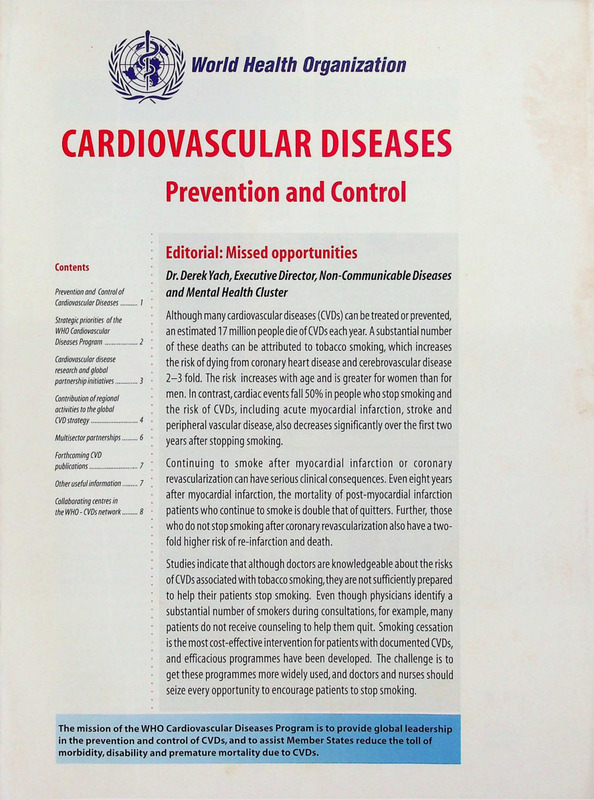
CARDIOVASCULAR DISEASES PREVENTION AND CONTROL
Item
- Title
- CARDIOVASCULAR DISEASES PREVENTION AND CONTROL
- extracted text
-
CARDIOVASCULAR DISEASES
Prevention and Control
: Editorial: Missed opportunities
Dr. Derek Yach, Executive Director, Non-Communicable Diseases
and Mental Heulth Cluster
prevention and control of
Cardiovascular Diseases.......... 1
.
■
' Although many cardiovascular diseases (CVDs) can be treated or prevented,
■ an estimated 17 million people die of CVDs each year. A substantial number
Diseases Program..................... 2 ,
of these deaths can be attributed to tobacco smoking, which increases
Cardiovascular disease
the risk of dying...
from coronary heart
disease and cerebrovascular
disease
research and global
.
,
,
partnershipinitiatives
3 ■
2-3 fold. The risk increases with age and is greater for women than for
contribution ofregional
men. In contrast, cardiac events fall 50% in people who stop smoking and
activities to the global
the risk of CVDs, including acute myocardial infarction, stroke and
cvDstrategy.............................. 4 •
peripheral vascular disease, also decreases significantly over the first two
Multisectorpartnerships.........6 •
years after stopping smoking.
Strategic priorities ofthe
who cardiovascular
Forthcoming CVD
•
Continuing to smoke after myocardial infarction or coronary
revascularization can have serious clinical consequences. Even eight years
- . .
after myocardial infarction, the mortality of post-myocardial infarction
theWHO-cvosnetwork......... 8 •
patients who continue to smoke is double that of quitters. Further, those
• who do not stop smoking after coronary revascularization also have a two
fold higher risk of re-infarction and death.
publications.............. .................7
Otherusefulinformation
7
:
'
•
-
Studies indicate that although doctors are knowledgeable aboutthe risks
of CVDs associated with tobacco smoking, they are not sufficiently prepared
to help their patients stop smoking. Even though physicians identify a
substantial number of smokers during consultations, for example, many
patients do not receive counseling to help them quit. Smoking cessation
is the most cost-effective intervention for patients with documented CVDs,
and efficacious programmes have been developed. The challenge is to
get these programmes more widely used, and doctors and nurses should
seize every opportunity to encourage patients to stop smoking.
The mission of the WHO Cardiovascular Diseases Program is to provide global leadership |
in the prevention and control of CVDs, and to assist Member States reduce the toll of
morbidity, disability and premature mortality due to CVDs.
Strategic priorities of the WHO Cardiovascular Diseases
Program
H_________
Public health problem
What is being done?
12.4 million deaths from heart
attacks and strokes (1998)
Heart Attacks
(7.3 million)
Strokes
(5.1 million)
Low and middle income countries
Colossal CVD burden in low and
middle income countries (1998)
CVD Deaths
Upper
income
DALYs due to CVD
Low and middle
income countries
Upper
income
600 Million hypertensives in the
world are at risk of heart attacks,
stroke and cardiac failure
600
400
200
0
180 million
from high
income
countries
420 million
from low
and middle
income
countries
Children and young adults die of
preventable rheumatic heart disease
2 V
WHO
CVD Strategy
2001/2002
An estimated 12 million require
secondary prophylaxis to prevent
further disability and death
due to rheumatic
heart disease.
" AaNig,
8 million are children =a223
of school going age
maweniiaaat
Cost-effective
interventions
for
secondary prevention. A programme is
being developed in collaboration with the
Wellcome Trust to help Member States
strengthen health care for people with
established CVD. The programme supports
cost-effective secondary prevention and
facilitates policy development and capacity
building for scaling-up national secondary
prevention programmes. The objective is to
develop context-specific, resource-sensitive,
model programmes that could be integrated
into the health systems of Member States.
Integrated community based prevention
programs. Regional networks of community
based demonstration programmes are being
developed in collaboration with the Health
Promotion NCD Prevention and Surveillance
Department. The programmes promote
healthy lifestyles, particularly in tobacco use,
diet and physical activity, through public
policies for healthy living. The long-term goal
is to provide countries with the experience
to establish national, integrated,community
based programmes for preventing CVDs and
other major non-communicable diseases
(NCDs).
Guidelines and cost-effective strategies.
The 1999 WHO International Society
Guidelines for Management of Hypertension
are being updated, using evidence-based
methodology. The update will be available
on the web for peer review by December
2001. Programmes are also being developed
for the cost-effective management of
hypertension in low-resource settings.
Guidelines and integrated programs for
secondary prophylaxis.The 1988 technical
report on the management of rheumatic
fever and rheumatic heart disease is being
revised, using evidence-based methodology.
The draft document will be available on the
web for peer review and wider consultation
by December 2001. Secondary prophylaxis
programs that can be integrated into primary
health care are being developed in
consultation with local experts.
Cardiovascular disease research and global partnership
initiatives
The Cardiovascular Health
Air travel and venous thoromboembolism
Research Initiative in developing countries
The CVD Research Initiative began in
November 1998 as a joint programme of
WHO and the Global Forum for Health
Research. The partnership has since
expanded to include the Institute of
Medicine (USA); World Heart Federation;
National Public Health Institute (Finland);
World Hypertension League; International
Obesity Task Force; International Institute
for Health and Development (Australia);
Institut Universitaire de Medecine Sociale
et Preventive (Switzerland); Centres for
Disease Control (USA); and National
Institutes of Health (USA). The Initiative
has developed six multicentre
collaborative research projects on
capacity assesssment, surveillance,
community-based interventions,clinical
management and global information
networks.
On 12-13 March 2001, WHO convened a
consultation of international experts to
review the evidence on air travel and
venous thromboembolism. The group
unanimously decided that further
research to investigate possible
association should be undertaken as soon
as feasible, under the auspices of WHO
and the International Civil Aviation
Organization, and supported by an
independent scientific committee. It was
also recommended that the International
AirTransport Association and commercial
airlines should be collaborators in the
research. Research protocols for a set of
multicentre collaborative studies have
since been developed by the Scientific
Committee and are ready for
implementation.
(Contact: mendiss@who.ch).
(Contact:
cvdresearch@mantraonline.com).
INTER-HEART: A global case-control study of
risk factors for acute
myocardial infarction
INTER-HEART is a global case-control
study that seeks to understand the
importance of both traditional and
emerging risk factors for acute myocardial
infarction. The findings will be relevant for
developing health policies that can be
applied to different countries and ethnic
groups. The study may also lead to cohort
studies in participating countries and
foster a network of committed
investigators in approximately 50
countries. INTER-HEART is sponsored by
the WHO and the World Heart Federation,
and has received funding from peer-review
agencies and industry.
Smoking cessation and
lowcost drugs (generics)
can halve the recurrence
rates ofheart attacks
and strokes.
(Contact: interheart@ccc.mcmaster.ca).
WHO
CVD Strategy
200172002
The Americas
The Pan American Health Organization
(PAHO) is promoting CARMEN (Spanish
acronym for: Actions for the Multifactorial
Reduction of Noncommunicable Diseases) as
a general framework for the prevention and
control of NCDs in the Americas. This
initiative was created in 1997 to reduce risk
factors for NCDs, particularly cardiovascular
disease, by coordinating health promotion
and disease prevention activities in
communities and community health
services.
PAHO is working with member countries to
support capacity building for an
interdisciplinary prevention model in
primary health care. This model includes the
identification of risk factors, early detection
of cases, delivery of comprehensive and
long-term care, and more active participation
of all members of the health team and the
community. Management of hypertension
and diabetes are particularly important in
the model. A regional surveillance system
for NCD risk factors is also being established,
as member countries adopt a standard
methodology.
Other important activities include
strengthening collaborative work with
various actors and community groups
involved in this area, promoting the
formation of coalitions between key
stakeholders, and developing initiatives
based on best practices by supporting
information exchange among countries.
(Contact: roblessy@paho.org).
Eastern Mediterranean
4 V
WHO
CVD Strategy
2001/2002
The Eastern Mediterranean Regional Office
(EMRO) gives high priority to CVD prevention
and control programmes. National
surveillance programmes for CVD risk factors
and community-based prevention
programmes have been initiated; and
national and international workshops are
held to increase awareness and educate
health professionals about the CVD
epidemic. Healthy lifestyles are also
advocated through country workshops and
health education programs. In several
Member States, EMRO supported the
development of national clinical guidelines
for cost-effective management of
hypertension, with emphasis on primary
care.
Many countries are making significant
progress in developing national programmes
for the surveillance of risk factors and for
managing hypertension. The challenge is to
deliver interventions, which will promote
behavioural changes in individuals and in
the population as a whole.
(Contact: KhatibO@who.sci.eg).
Africa
CVD and other chronic conditions are rapidly
increasing in Africa, and poverty plays a
major role in the impact of these diseases on
communities. Benin,Cameroon, Mali,
Zambia, Zimbabwe and Algeria are
participating in WHO Global Programme for
Prevention and Control of Rheumatic Fever
and Rheumatic Heart Disease. A regional
advisory board is being set up to assist with
managing the programme. The most
important activities for controlling risk
factors are related to the Tobacco Free
Initiative. Situation analyses are being
conducted in Botswana, Kenya, Lesotho,
Malawi, Swaziland,Zambia and Zimbabwe.
Health education programmes targeting
school youngsters are also underway in
these countries. Technical support is being
provided to Botswana, Kenya, Lesotho and
Zimbabwe to develop anti-tobacco
legislation. Support has also been provided
to Botswana and Zimbabwe to undertake a
situation analysis on CVD and other major
NCDs, and the programme will be extended
to three other countries in the near future. In
addition, two countries will participate in a
pilot test of WHO stepwise approach to
surveillance. Nigeria is partoftheWHO/CDC
MEGA country project. Initial steps have
already been taken to establish a regional
network of NCD-related activities.
(Contact: belhocinem@whoafr.org).
South-East Asia
Growing evidence shows that CVD poses an
important health threat to disadvantaged
and poor segments of population. A top
priority of the South-East Asia WHO regional
office (SEARO) is thus to promote the
development of reliable, inexpensive and
sustainable surveillance systems for major
NCDs and their risk factors, that can be used
at both regional and national levels.
Advocacy and technical support aimed at
integrating national NCD prevention and
control programmes also continue in the
region. SEARO has emphasized the need to
shift the focus of policy makers from
expensive tertiary care, to primary and
secondary prevention through communityand primary healthcare-based interventions.
Efforts are also being made to increase
public awareness about the harmful effects
of tobacco use, and Indonesia, Myanmar,
Nepal and Thailand have initiated national
CVD control programmes.
(Contact: leowskij@whosea.org).
European Region
The Countrywide Integrated
Noncommunicable Diseases Intervention
(CINDI) programme aims to reduce
modifiable risk factors, such as smoking and
high blood pressure, by integrating health
promotion and disease prevention. At
present, 27 countries participate in the
programme.
Two other programmes also aim to improve
the quality of life of people with CVDs. The
Helsingborg Declaration on stroke
management was a follow-up to the 1995
Pan-European Consensus Meeting on stroke
management. The meeting was organized in
collaboration with the European Stroke
Council, the World Confederation of
Physiotherapy-Europe, the World Federation
of Occupational Therapy, the European
Federation of Neurologists Societies and the
International Stroke Society. A document on
stroke units is under elaboration.
The second programme is a pilot project
aimed at improving the education skills of
general practitioners. The programme shows
practitioners how to educate coronary heart
disease patients about improving the quality
oftheir lives, and how rehabilitation and
secondary prevention can be improved.
(Contact: ash@who.dk).
Western Pacific
The Western Pacific Regional Office of WHO
(WPRO) has taken an integrated approach to
the prevention and control of NCDs,
including CVD. In 2000, the Western Pacific
Regional Committee adopted resolution
WPR/RC51 .R5 on the prevention and control
of NCDs. A Declaration and Plan of Action on
Diabetes has also been formulated, in
addition to a Call for Action on Obesity in the
Pacific islands. Technical capacity for
surveillance is supported through
participation in the global WHO STEPS
process in Mongolia,Viet Nam and Pacific
island countries.
Integrated community-based interventions
on NCDs are being implemented in China,
the Philippines, Micronesia,Tonga and
Samoa. Several Member States have
supported national guidelines for managing
hypertension in the community,for example,
and a guide to Developing Food-based
Dietary Guidelines for the Prevention and
Control of NCDs has been developed.
Physical Activity Guidelines have also been
formulated. The work of the WPRO TobaccoFree Initiative generates support for the
Framework Convention on Tobacco Control
and supports national tobacco control
activities.
(Contact: galeag@wpro.who.int).
V 5
WHO
CVD Strategy
2001/2002
World Heart Federation (WHF)
International Society of Hypertension (ISH)
The WHF maintains a close working
relationship with the WHO CVD
programme. Joint activities include the
WHO/WHF/UNESCO Campaign for the
Prevention of CVD; health promotion in
school-age children in developing
countries; projects on rheumatic fever/
rheumatic heart disease; the Monica
project; and development of health
education materials, and norms and
standards in CVD. The WHF supports WHO
efforts to control and prevent risk factors
for NCDs,such as tobacco smoking. WHO
supports the WHF International Ten-day
Teaching Seminar on CVD Epidemiology
and Prevention.
ISH collaboration on the WHO
Cardiovascular Diseases Programme
began in 1974 and has produced four
versions of the WHO/ISH guidelines on
managing mild hypertension (1983,1986,
1989,1993). Currently, the 1999 WHO/ISH
guidelines are being updated.
The WHF organizes the annual World
Heart Day to increase awareness about
the global impact of heart disease and
stroke. On 24 September 2000, the first
World Heart Day was organized by
WHF and co-sponsored by WHO and
77 countries participated. The 2001
World Heart Day will take place on
30 September with the theme "A heart
for life."
(Contact: janet.voute@worldheart.org).
World Hypertension League (WHL)
6 V
WHO
CVD Strategy
2001/2002
From 1982-1987 WHL/WHO collaboration
conducted a successful Patient Education
Project on hypertension. WHL has also
launched the Pan American Health
Initiative (PAHI) to stimulate international
interest in hypertension control in the
Americas. PAHI is a WHL collaboration
with Pan American Health Organization;
Inter-American Heart Foundation; Inter
American Society of Cardiology; Inter
American Society of Hypertension;
National Heart, Lung and Blood Institute;
Pan American Network of CARMEN
Programs; Sociedad Latinoamericana de
Nefrolog'a e Hipertension;and WHF.
(Contact: Lenfantc@NIH.Gov)
(Contact: giuseppe.mancia@unimib.it).
Heart Friends Around the World (HFATW)
HFATW is an international non
governmental organization and an
affiliated member of the WHF that
promotes CVD prevention worldwide
through a membership network of over
1000 cardiologists in more than 100
countries. A WHO/HFATW joint project is
being established for the continuing
medical education of health personnel in
low- and middle-income countries.
(Con tact: heartfrien@cbmail.it).
International Federation of Red Cross and
Red Crescent Societies
The International Federation of Red Cross
and Red Crescent Societies have included
cardiopulmonary resuscitation and CVD
awareness as a major component in First
Aid Training Courses. In collaboration with
WHO, an initiative has also been launched
to improve awareness of CVDs in poor and
marginalized populations.
(Con tact: secretariat@ifrc.org).
Other partners include: UNESCO;
International Civil Aviation Organization;
International Stroke Society; International
Society of Cardiothoracic Surgeons;
International Society on Thrombosis and
Haemostasis; International Atherosclerosis
Society; International Federation of Sports
Medicine; Federacion Internationale de
Medecine Sportive (FIMS); Sli na Slante/Sli
International; and the Arab Gulf
Programme for the United Nations
Development Organizations (AGFUND).
Forthcoming CVD publications
Cardiovascular survey methods
The third edition is a complete source and
critical reference for those involved in
cardiovascular research.
WHO MONICA monograph
This monograph documents the largest
collaborative epidemiological study of
CVDs, risk factors and socioeconomic
determinants. The 21 -year study was
coordinated by WHO/CVD and covered 21
countries in 4 continents.
Global Scenario 2001
One heart attack
every 4 seconds
One stroke
every 5 seconds
Atherosclerosis in children and young adults
An overview of the WHO and International
Society and Federation of Cardiology
Study on Pathobiological Determinants of
Atherosclerosis in Youth (PBDAY) is in
press in the Journal of CVD Prevention.
CVDInfobase
CVDInfobase (http:Wcvdinfobase.ic.gc.ca),
was launched in 1997 by a WHO
collaborating centre at the Division of
Cardiology, University of Ottawa, Canada.
It contains information about CVDs
available for individual developing
countries that is profiled on five key
groups of variables: demographics,
mortality, morbidity, risk factors and
related health services. Plans are being
made to adapt the site to other NCDs.
(Contact: wielgosz@uottawa.ca).
ProCOR
ProCor (http://www.procor.org; global
electronic conference on cardiovascular
health in the developing world) is a free
website that facilitates the global
exchange of information on CVDs.
(Contact: arlene@usa.healthnet.org).
Global Deaths 1999
17 Million due to
cardiovascular
disease
V 7
WHO
CVD Strategy
2001/2002
Collaborating centres in the WHO - CVDs network
V Division of Cardiology, University of
Ottawa,Ontario, Canada.
Contact: wielgosz@uottawa.ca
V National Institute of Cardiovascular
Diseases, Karachi, Pakistan.
Con tact: nicvdedo@comsats.net.pk
V National Heart, Lung and Blood Institute,
National Institutes of Health, Bethesda,
MD, USA.
Contact: Lenfantc@NIH.Gov
V Wissenschaftliches Institut der
Praxisartze Wiesloch, Heidelberg,
Germany.
Contact: Egbert.nussel@wip.villa-bosch.de
V Division of Epidemiology, School of Public
Health, University of Minnesota, MN, USA.
Contact: luepker@epi.umn.edu
V Kaunas Medical Academy Centre, Kaunas,
Lithuania.
Contact: cmtl@kma.lt
V National Cardiovascular Centre,Osaka,
Japan.
Contact: who-cc@mgt.ncvc.go.jp
V National Centre for Environmental Health,
Centres for Disease Control, Atlanta, GA,
USA.
Contact: ejsl@cdc.gov
V Guangdong Provincial Cardiovascular
Institute, Guangzhou, China.
Con tact: gzcdvl@public.guangzhou.gd. cn
V Shanghai Institute of Cardiovascular
Diseases,Shanghai Medical University,
Shanghai,China.
Contact: yq_wang@shmu.edu.cn
V Institute of Cardiovascular Diseases and
Fuwai Hospital, Chinese Academy, Beijing,
China.
Con tact: tsg@public. east, cn.net
V Menzies Centre for Population Health
Research, Hobart, Australia.
Contact: T.Dwyer@utas.edu.au
V Alfred & Baker Medical Unit, Maker
Medical Research Institute,Melbourne,
Australia.
Con tact: g.jennings@alfred. org.au
V Institute of Epidemiology and Social
Medicine, University of Munster, Germany.
Contact: keilu@uni-munster.de
V Azienda Per l Servizi Sanitari 4,
"Medio Friuli," Udine, Italy.
Contact: vanuzzod@tin.it
V Istituto di Medicina Fisica e Riabilitazione,
Udine, Italy.
Contact: crge@ass4.sanita.fvg.it
V Institut Universitaire de Medicine Sociale
et Preventive, Lausanne, Switzerland.
Contact: IUMSP@inst.hospvd.ch
V Royal Newcastle Hospital,Newcastle,
Australia.
Contact: jbyles@cceb.newcastle.ed.au
V All India Heart Foundation, New Delhi,
India.
Con tact: padmavat@del2. vsni.net.in
V Graduate School of Human and
Environmental Studies, Kyoto University,
Kyoto,Japan.
Contact: yamori@helios.jinkan.kyotou. ac.jp
V All India Institute of Medical Sciences,
New Delhi, India.
Contact: Ksreddy@satyam.net.in
V Department of Preventive Medicine and
Public Health,Tokyo, Japan.
Contact: kats@tokyo-med.ac.jp
Contact Information
World Health Organization
Cardiovascular Diseases Program
CH 1211 Geneva 27, Switzerland
Fax 0041 22 791 4151
E mail mendiss@who.ch
Web address: http://www.who.int/ncd/cvd/index.htm
Design by: Health & Development Networks
http://www.hdnet.org
© World Health Organization, 2001
This document is not a formal publication of the World Health Organization (WHO), and all rights are reserved by the Organization,
The document may, however, be freely reviewed, abstracted, reproduced or translated, in part or in whole, but not for sale or for use in
conjunction with commercial purposes.
The designations employed and the presentation of material on maps included in the document do not imply the expression of any opinion
whatsoever on the part of the World Health Organization concerning the legal status of any country, territory, city or of its authorities,
or concerning the delimitation of its frontiers or boundaries.
Position: 3914 (3 views)