FRCH NEWSLETTER VOL.12-No. 1-4-JAN - AUGUST-1998
Item
- Title
- FRCH NEWSLETTER VOL.12-No. 1-4-JAN - AUGUST-1998
- extracted text
-
The Foundation for Research in Community Health
January - February 1998
Vol. XII, No. 1
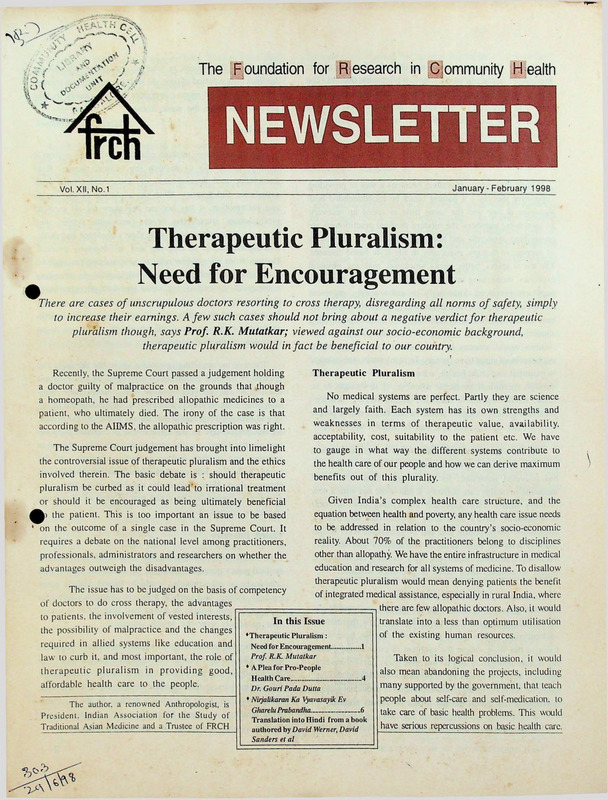
Therapeutic Pluralism:
Need for Encouragement
There are cases of unscrupulous doctors resorting to cross therapy, disregarding all norms of safety, simply
to increase their earnings. A few such cases should not bring about a negative verdict for therapeutic
pluralism though, says Prof. R.K. Mutatkar; viewed against our socio-economic background,
therapeutic pluralism would in fact be beneficial to our country.
Recently, the Supreme Court passed a judgement holding
a doctor guilty of malpractice on the grounds that though
a homeopath, he had prescribed allopathic medicines to a
patient, who ultimately died. The irony of the case is that
according to the AIIMS, the allopathic prescription was right.
The Supreme Court judgement has brought into limelight
the controversial issue of therapeutic pluralism and the ethics
involved therein. The basic debate is : should therapeutic
pluralism be curbed as it could lead'to irrational treatment
or should it be encouraged as being ultimately beneficial
the patient. This is too important an issue to be based
* on the outcome of a single case in the Supreme Court. It
requires a debate on the national level among practitioners,
Therapeutic Pluralism
No medical systems are perfect. Partly they are science
and largely faith. Each system has its own strengths and
weaknesses in terms of therapeutic value, availability,
acceptability, cost, suitability to the patient etc. We have
to gauge in what way the different systems contribute to
the health care of our people and how we can derive maximum
benefits out of this plurality.
Given India’s complex health care structure, and the
equation between health and poverty, any health care issue needs
to be addressed in relation to the country’s socio-economic
reality. About 70% of the practitioners belong to disciplines
other than allopathy. We have the entire infrastructure in medical
professionals, administrators and researchers on whether the
advantages outweigh the disadvantages.
education and research for all systems of medicine. To disallow
therapeutic pluralism would mean denying patients the benefit
The issue has to be judged on the basis of competency
of integrated medical assistance, especially in rural India, where
of doctors to do cross therapy, the advantages
there are few allopathic doctors. Also, it would
to patients, the involvement of vested interests,
In this Issue
translate into a less than optimum utilisation
the possibility of malpractice and the changes
♦Therapeutic Pluralism:
of the existing human resources.
required in allied systems like education and
Need for Encouragement..........
Prof. R.K. Mutatkar
law to curb it, and most important, the role of
Taken to its logical conclusion, it would
* A Plea for Pro-People
therapeutic pluralism in providing good,
also mean abandoning the projects, including
Health
affordable health care to the people.
many supported by the government, that teach
Dr. Gouri Pada Dutta
0
The author, a renowned Anthropologist, is
President. Indian Association for the Study of
Traditional Asian Medicine and a Trustee of FRCH
♦ NujaUkaran Ka Vyavasa^ik Ev
Gharein Prabandha.---------------------6
Translation into Hindi from a book
authored by David Werner, David
Sanden et al
people about self-care and self-medication, to
take care of basic health problems. This would
have serious repercussions on basic health care.
One of the biggest misconceptions is that therapeutic
pluralism is indulged in only by non-allopathic doctors. The
reality is that Zhandu. Chavanprash, Leve 52 - all essentially
Ayurvedic medicines - are said to be freely prescribed by
allopaths. The proof lies in the great volume of prescriptions
inspile of the fact that generally. Ayurvedic practitioners do
not prescribe medicines from outside as they prepare there
own medicine.
Often, therapeutic pluralism becomes a way of providing
supportive therapy - a patient could be recommended both
therapies at one and the same lime to speed up recovery.
In increasing numbers, the modern medical practitioners are
prescribing ayurvedic and homeopathic drugs to the patients
as supportive therapy, especially in life-style based diseases.
The use of spices, baths, packs. smokings, massage, physical
exercises, moniloring nutirion intake and so many processes
popularly practiced, knowingly or unknowingly, represent
therapeutic pluralism, and often with good results. When we
have such a store-house of information in India, not allowing
allopathic practitioners to prescribe medicines based on other
systems would amount to unncecessarily denying patients
the benefits of supportive therapy. In many cases, for instance
in maternal and child health, a lot of preventive care is done
through traditional medicine whenever it is thought to be
safer, easily available and self-administrable. Doctors
prescribing these therapies would in fact be providing people
with greater alternatives that can be more empowering.
The Government of India has already recognised medical
pluralism by providing the required infrastructure. WHO too,
has provided guidelines for use of traditional systems of
medicine in health care delivery. It has come out with a new
primary health care approach enshrining inter-sectoral
development. easily affordable appropriate technology,
community participation and use of grassroots level health
workers with the basic skills of therapeutics and referrals.
Imbibing traditional midwives with modern technological
inputs to enhance their skills is one such instance.
As people are becoming more knowledgeable, they are
developing their own ideas about the efficacy and weaknesses
of various therapeutic systems. Patients are themselves
seeking cross therapy from a person in whom they have faith.
Even in the West, where the problem of cross therapy does
not feature strongly as they do not have many parallel medical
systems, three out of every ten people seem to be taking to alternate
medicine. Such increasing global importance of traditional systems
of medicine and herbal therapy should be viewed positively.
Though specialisation has its advantages, it is also in the
IRCH NEWSLETTER, VOL XII. NO.L JAN-FEB.‘98
interests of the patient to refer to one. doctor who knows
her/him over a period of time. At least for minor cross therapy
then, it would be more convenient for the patient to take
prescription from the same doctor.
Proficiency
The main aim of medical education, whatever system it
is imparled in, is to develop the critical faculty. Real
knowledge and development of skills comes only with
experience and practice. With the explosion of knowledge
and information, it has become necessary for all medical
professionals, irrespective of the therapeutic system they
belong to, to continuously update their knowledge and skills.
making education an ongoing and self-learning process.
Doctors from all systems need to keep themselves updated
by referring to medical journals, publications, by attending
conferences, by exchanging views and through experiment
including those on human beings, albeit with their consent.
In such a scenario, gaining knowledge about parallel systems
as their importance is realised, should be seen more as an
extension of the learning process.
There is an appalling ignorance about the duration and
content of medical education in traditional Indian systems.
leading to the general opinion that doctors from nonallopathic systems are not equipped to understand the basics
of and hence give prescriptions for allopathic drugs. In fact.
all disciplines have an intensive course of common duration
and all disciplines are imparled basic knowledge of human
anatomy and modern biology including dissection of the
human body. The difference lies in diagnostic techniques and
pharmacology. Hence, where the capability of doctors to do
minor cross therapy is concerned, practitioners of all systems
should be treated at par.
@
Vested Interests
It would not be wrong to say that those involved in making
medical policy generally belong to the allopathic system and
knowingly or unknowingly, would be biased against other
medical systems. Our medical policy is generally equivalent
to fatwah’s from people in power that help them to retain
their monopoly over the health system.
Another important factor is the pharmaceutical companies
who would do their best to increase their profits and keep
their monopoly intact. It would be in their interests to encourage
policies that prevent Iheir clientele from resorting to alternate
therapy and thus create an exclusive demand for the particular
drugs produced by them. Pharmaceutical companies of all
medical systems are guilty of such monopolisation.
2
It is up to the people to support only those policies that
are genuinely people-friendly rather than getting caught in
the war of pharmaceutical companies or allowing policies
that serve the vested interests of those in power.
Tackling Malpractice
Irrational practice and misuse exist even within particular
systems - it is not necessarily a feature of cross therapy.
There is already a law unde the Consumer Act to take care
of such malpractice. Hence, the focus should be on
implementing the law diligently and seeing how we can use
plural systems for preventive and promotive aspects of health
care. Any lacunae in the law should be corrected by the
government in the national interest.
Some safeguards and checks and balances do need to be
evolved in cross therapy. While medical professionals should
have the freedom to prescribe certain drugs, those drugs which
require strict monitoring and could have dangerous side
effects should be prescribed only by doctors from the
particular system. Where a major switch-over of therapies
is required, the referral system should be made compulsory.
However, the general consumer law to take care of
malpractice and other safeguards is not enough. Knowledge
has a tendency to get mystified under technical jargon and
mystification leads to exploitation. Democratic values
therefore call for demystification of knowledge and
transmitting of correct information to the people so that
they can make an informed choice.
Integrated Medical Education
While those speaking against therapeutic pluralism point
to the lack of adequate formal learning in parallel systems
Is a reason for its disallowance, the fact is ignored that even
if anybody wants to undergo such training it is not available
at present. On the other hand, those graduating from nonallopathic systems have to do their internship in the PHCs
where allopathy is the dominant therapy. Many of the
traditional medical colleges do not have hospitals with
exclusive traditional therapy. It is ridiculous to expect these
doctors to suddenly switch over to prescribing drugs only
within their system, once they start their own practice.
be extension courses for mutual exchange of knowledge?
One suggestion is to introduce an integrated medicine course
as a compulsory subject in the syllabus of every medical system.
Regarding provision of opportunities for inter-disciplinary
and collaborative research, it is suggested that if clinical
laboratories are developed as separate units in governmental
and non-governmental areas, it would help to develop
therapeutic pluralism.
Traditional medical systems have to interact with each
other and have to evolve with changing times through a process
of constant review and reinterpretation. To make it possible
to interpret terms and principles of traditional medical
systems correctly in terms of modern medicine, it is essential
to initiate basic, pharmacological and clinical studies using
inputs of modern science and technology..
For continuing education, it is necessary to organise basic
training and workshops in all therapeutic systems open lo
practitioners of all systems. Therapeutic aids available from
one system of medicine to another should be encouraged
and it is desirable to create facilities or training in use of
such tools as well as in essential drugs or traditional remedies.
Along with the introduction of these policies research
will have to be done on the short as well as long term effects
on research and industry due to polarisation or integration
of medical education and practice.
To conclude, for optimum health care delivery, their is
need to create greater awareness about therapeutic pluralism
among the public and professionals alike. Professionals from
all systems of medicine have to be involved in health care
delivery. Rather than considering them as apposite systems,
the correct approach would be to treat all systems as one
stream of medical knowledge to be used for providing good.
affordable health care to the people.
□
As told to Vaijayanti Aphale
FREE ABSTRACTING
The contents of this newsletter may be
abstracted without prior permission.
However,
we
would
appreciate
How does one address this issue of polarisation in
education but integration in practice ? Can there be a single
medical education structure incorporating all the systems ?
Or would it be better to expose students of one medical
system to the other? If yes, what could be the level of this
The views expressed in the articles are those of the
exposure and in what manner could it be achieved? Can there
authors and not necessarily those of FRCH
3
acknowledgement of the source and
copies of any abstractions
FRCH NEWSLETTER. VOL XII. NO 1. JAN.-I EB9s
A Plea for Pro-People Health Care
Planning for health care does not pertain to the health sector alone but is inter-linked with development in
the socio-economic sector. This would require decentralisation initiatives within the state and strong
support from the Centre explains Dr. Gouri Pada Dutta using the example of West Bengal.
No health care system, however perfect, can deliver the
goods unless it is based on a socially just economy and polity,
for health is only the final manifestation of the general quality
of life. In a class stratified society the propensity of the
dominant section is to use the resources, including human
resources, for its own benefit. The common man is granted
certain privileges but only to the extent that they do not
destabilise the power structure of the society. As regards the
health sector, this power is retained by the dominant section
through:
a) Control over the institutions for medicare;
b) Control over the selection, training and employment of
the medical and para medical personnel; and
c) Control over drugs and appliances for diagnostic as well
as therapeutic purposes.
This politisisation of health care has resulted in the narrow
approach of disease control, paving the path for
commercialisation of medicare in the name of science. The
phenomenal development of science has given us enormous
scope for diagnosis and treatment of hitherto untreatable
diseases, but blind dependence on such procedures ignoring
the holistic approach to health has led to wrong indoctrinisation
of both the recipients and the ‘on counter’ deliverers of health
care. What is needed is a rational application of science keeping
in view a more holistic definition of health. WHO itself has
acknowledged a wider definition of health as stated in the Alma
Ata declaration - ‘Good health does not mean mere absence of
disease. It is a sense of physical, mental, economic and social
well being? The health situation of our country has to be studied
and planned for, keeping this perspective in mind.
Health Sector Planning Versus Health Planning
Creation of adequate health infrastructure is important but
by no means the final answer for health care of the people.
West Bengal is one such example. Right since independence,
it has developed a strong infrastructure for health care of both
the rural and the urban population. Unfortunately, the huge
infrastructure could not yield the expected results. The health
sector planning, imposed as it was from the top, was inevitably
geared to suit the demands of those at the helm of affairs and
The author, a prof, of gyneacology, is an MLA from West Bengal
and also a member of the Statel Planning Commission of West Bengal
FRCH NEWSLETTER, VOL XII. NO.1. JAN.-FEB. 98
r
could not provide the needed services to the people. It only
stimulated a greater demand for curative services and led to the
wrong indoctrinisation of health care personnel. Simultaneously,
the non-planned expenditure, mostly for salaries and
infrastructure, went on increasing. This necessitated a change
towards a more holistic approach known as health planning.
Health planning is not merely concerned with the health
sector but is linked to the economic and social upliftment of
the people in the form of:
* Increased employment opportunities and viable selfemployment.
"
* Increased productivity and equitable and remunerative
distribution of the benefits of enhanced production.
* Provision of basic minimum needs viz. food, shelter, clean
water and disposal of human and other wastes.
* Greater self-respect, self-confidence and social awareness
through:
a) Total literacy movement and post literacy programmes, and
-.integration of non-formal measures with formal education; and
b) Inclusion of neo-literates in vocational and production
oriented training.
* Grassroots participation in health care delivery.
This social awareness has to be integrated with health
consciousness, forging an effective health movement.
It is appreciated that an immediate radical change in the
health sector planning cannot be instituted. However, Wes'
Bengal has made a start by already fulfilling about 70% of the
Centre’s target for the Minimum Needs Programme in the rural
areas. As regards curative services, the infrastructure has
exceeded the prescription of the Union Government.
West Bengal is now experimenting with the democratisation
of departmental functions, and involvement of the people and
their representatives in their own development.
Separate Advisory Committees have been set up for general
education and drugs and Technical Committees set up for all other
units up to the sub-centres. Management Boards have been
instituted for teaching institutes and big hospitals.
The West Bengal Legislative Assembly has created a subject
Committee of MLAs to increase their accountability to the
4
peoples’ representatives. At the district level, a powerful District
Health Committee has been created to monitor the departmental
activity under the Chairmanship of the Savadhipati. In Zilla
Parishads and Panchayat Sami tiles there are standing committees
for health and every Gram Panchayat consists of one member
responsible for health care and health awareness.
Central Government Support
To optimise this endeavour towards decentralisation of the
health sector and its greater integration with other services
the states must be provided with the following facilities from
the Centre:
* The stales should be given the liberty to utilise the existing
health units like sub-centre, Primary Health Centres and
Community Health Centres according to the need of the
community. For effective primary health care, greater participation
of paramedical personnel like CHG, TBA, MPHV and their threetier supervisors in collaboration with the three-tier panchayats/
municipalities and municipal corporation needs to be encouraged.
* All the vertical programmes sponsored, assisted or
supplemented by the Centre should be implemented by the state
in a manner that best suits the community and the region. The
Centre should monitor only to the extent of assuring that the
finances are not misused or diverted to other activities.
* For strengthening secondary health care, the states should
modify the outline given for Community Health Centres
according to their own requirements. The basic idea would be
to offer secondary health care at the block/subdivision and
district levels where the maximum responsibility is taken up
by block/rural hospitals. Complicated cases may be treated at
the siate/general hospitals as well as upgraded district and subdivisional hospitals. This will improve the function and turnover
of these hospitals as well as that of the attached medical colleges.
* West Bengal is contemplating to decentralise and vest control
in all health activities, including the functioning of various
health units, to the three-tier panchayats and municipalities. For
this, adequate infrastructure has to be provided to the institutions.
* To implement secondary health care at the block level and
part of the tertiary health care at the sub-division and district
level, greater resources are needed. Some of the financial
support may be raised from the affluent sections either directly
or through a suitable insurance scheme.
* Further financial support is needed from the centre to comply
with the remaining needs for both the planned and non-planned
budget. Recurrent support is also needed from the Centre to
maintain and run the existing units created by the directives of
the Centre, otherwise, the state exchequer will be drained out
merely in the maintenance of infrastructure. At present about
5
87-90% of the budget is spent on this accounl.
* Higher education is a concurrent subject. Whereas for
general and other technical education the centre provides
reasonable support through bodies like UGC/DST/CSSR etc.,
similar support for medical education is absent. On the
contrary, the Medical Council of India (MCI) imposes a levy
on the medical colleges for affiliation, inspection and
introduction of new courses that can only be called prohibitive.
Presently, the MCI charges as much as Rs. I lakh for opening a
new course and Rs. 25,000 as inspection charges (to be further
enhanced) from the medical colleges. This imposes a heavy
financial burden on the state government and universities.
retarding the prospects of government medical colleges. It is
also one of the reasons for mushrooming of private medical
colleges which have become a lucrative business indeed. Even
in the face of this competition the West Bengal Government
has not permitted a single private medical college and students
are admitted only on merit basis. Adequate financial help from
the Central Government is needed to stem this trade of medical
education which is destroying the very spirit of medical service.
* It is now accepted even at the international level that medical
education as it is practised today, is not serving the desired
objective. For implementing integrated people-oriented need
based medical education, both the MCI and the Union
Government should accept and support the new form of medical
education proposed by the state.
* A survey to obtain relevant information about the functioning
of the health institutes as well as the morbidity pattern is
essential for any future planning. The Planning Commission
should grant financial support to the Stale Planning Board for
this purpose.
* A systematic pool of information from all the stales is needed
to draw up an acceptable pattern of health care and medical
education. The importance of regional variation and objective
situations of the state must be considered in the process of
planning and implementation.
* Assessment of the Indian systems of medicine should be
undertaken with Central help so as to retain and promote the
useful practices within these sytems.
* The drug industry, particularly that pertaining to drugs of
indigenous origin, has to be rationalised and promoted for
better functioning and usage.
This process of decentralisation has to be properly
understood and strengthened with sincerity. Only then will
people be able to resist the undue commercialisation of health
care and dominance of the privileged section and achieve a
shift towards holistic pro-people health care.
□
FRCH NEWSLETTER. VOL XII. NO. 1. JAN.-FEB/98
fviclcyu cT anldrfuc yo He yas
as
sfs
sfs *nsvf 3nfe a
aderf a fe4 :
3 Ml5*1 ft Bo ^317 Vos ases wasad v eft n$ 8 /
a
SIsRAT, ss suss sasl- H T—zaissef ch HPT 4 “l-T ran
t, faa i aci ah
ch Uo H4a chizo % (aqu" H E ald Acuch dR
yry3i H h Uh) - ide dis 944- th4" (U3T3315) chi RI & 5t44
33 815- qrysi i H 99.6 aftk fle fye 2h i * M11
afce? au s-ichl 4gy SIRl d sid t, n IR d agd
afac acu sche
41, 3fd sviclichz" a ci?" Rd 6 I ad:
48 aga HH d HHT wild 35 t
a s" ac 4 9--feiczU (Ue yH
u-f
SIsR4 d difsa aed
sHch Jda 3IH- 4 a R
shal HT Hhdl &) A suclchH # adl wI Hche s A 3Hchl Solv soh4
3 7che & 3R 3E 34FR sia-I-7Hch fr Bie 11 HOT H, R W sht
H.'0T1R-
3HH
h w in HTH n, dig g ae nr se a ram rar (3ie AI65331
ist) *i Hefs q, ram in Ueh wt fee oeq# Jefee 11
gHTygST, assc HHTOT at anr acufuc AsH, s qfzcl"
(ad zell) chi 3did ahin chi Uoh d6l-l 361 %, wash 48
afzch!" dIHP chi aald 3fc thiae W- si423 chi chh
$hise 3uce aha HcO 8119 a 91ica 4, fvieflc{U a ram
h ft 3H * HTH H ae qer set “ a Sellv efit Jufid shal
rar, stafh Sell- efit
qeef a aga A difdei at, win, ?43
efit Aie ci, sold qe s-T vild AT, ?J-3fd ?44 4 814
ran hfo-ls4; 31l494chel d afuc ac st ran chl ran, sortich
tel‘4u He Ar 8 qrart1; o, rar ra^ ah afuc H sfuc
rar ah Uga- in se adengn 3fach FHd qd ff a 311c94cbel i
Qsie? 31427 SRT an at Se 2h HT-HI car3i chl W a
3cafush 3*Hle sr fra rar 1i STR4l ch
ch ft wi
aqld ser’s STe 8 a felted t JHat H6 Ei 6 a J? 344
gVs"IH 4 zid 11 30. U. an. 3 * ran t,
SPR4T ch
Sell- ch sot sho 1 aa al seHle H6 chi- aifU, aish
rar 41 E8T chl ahis alsefc He fra ra g31 t a $8 ran
a ‘4d?ich Ar 11 5c. U. 3. 3 3JHR, SIs?4 3 Seilu ah
2813 qz ran 5 FIITHIT Uoh and sw ran tr fy ra 6 i
345 q zfache? ran ran a yd^r-n t, saf afuche? rara
th rar a rar 3.3777.21. (Ha h aq acht Sollv) f anfeu i HH
3. 377.2. 37q-4t • t, 3-4 fC * caId sA efit anra Els
UI- ahfo- afad E 361 %. a<d: Uch ara? ran 3 g‘ ran ra
RI hS ferar, afo an q ram th HT ra sear TA 11
alicef an.am.yH Wiseil
1970 a E91ch ah JifH au q 3R.3.2. efit q- zv it i
«I-e SRT Sega a nt Uo Rui d 3.37.21. efit afH JHHese q Hec fe i 3=4 ftT, ‘4ch atR qf efit 38R ae chi
chifrcbrom 3 HTH d ?tb do Uguid , HTTU 9Tcb{ (Jgchlyt)
agd HScquf % | 34: Igcblvi efit aid H scl— d qdvielic20 al
asshar q acufuc disd an vid & r 56 ran al di- I, =uid
(nanra) Siezi 4 1955 4 HWeieiqdch 5kHle far 1 Ellifh,
1962 q ramra q ant, ahici?T ah *1qu HETHKt, sH R H’s d
Y-vfeflchzo SRT f f-u 44 Ta a (54ch SR I 4ey-a3 az
«ITHT 9- tt nt at), sri ra ram ahl ?lcd f g§ i sa
ran ah 1971 # 1 Heidi dc HaM H «Il4T TAT i 3c.Uy.3.,
4rc, q.H."s se a=fe HeTei rar araischl TzT3 ch
116- Hsam h, 1980 a 2915 3 Jf-H w n, 90 eoi q TTN
a.377.2t. chiucH anw shar TAT l Eleisch, $4 alchHT q 3e
A63914 H9- - 3.3R7.7H. (ra d c alei q-vielich2"
ale) 3 d4R auifc qei ch stHie W ViR sea T4T, s-
3c.q.3. ch Hl lRd Whidd SRI daR sal TAT A 1 31.31R7.21.
a Jielg- a ald alchqi a anf efi 3chel- 4 f" chs A941 #
T %, s :
1. uge a : s=14 ahl Uo afefsach fran, socht 311.373."TH.
39ec aal alei HET3 do ‘TH ugd t l
2. ran 57 : 344 A difse ufe ad h chh an 25 ae hl Uh
ufffuch fee sad afuch nm q ec 3ucea ran t a n^Rd
5u d seal sidi o l
3. THat wn a : i) 3u4r fof n AR shUTa tigfed 99
qer; ii) rai qer a affac qm q fra rar aaT; hi) safe
‘u q ac qea efiT sal 'dHI I
Eleiseh J ran chi Hf 3HH- rant ran t, W‘ 5 T4
Hrebici cbt He THa, cari nr ant .nt- ram * he 3f4c 3T I
rant rar soHlechi EPT f FTHIT 35 aal SleR 4e a STsR4
in ran a zdT3 s frat rara ad a rat k, rat a Uh fers,
qls fya %
elaefus an.an7.xrq. the a-4 ag qn uer
# rat t1 aga ht ran, T Roff ch rat
Eleifeh rara 8 sg efirn ra rat aranram H, an
rat t “IT ara dee al staf4 1m n ran a Rrq awn HIf
8
mt ran ra ae zed t I qr & JHHR, in stez, s-
tnt,q^arqt^rann^^fNi5"tRTraramqqN;^myf
FRCH NEWSLETTER. Vol. XII. No ।
JAN.-FEB/98
i.3R.2t. nr q srt qrvffichzU srt ram a
nn Hl-d
6
sou ng 3.3R.UH. Ghel ch 314 EIH a del-IT H, 3.3R
a ym seha 3I-T aify 3dT aldHfac 3.3R.UH. tahd apl l
cqlqafuc ghei a Hqh affuc 3eHlft HHc, sHT soh 31JH1-
Qoei a R1A4 &TH 3? 3fc 38d 3, sH% teaeq 3 the
FITAT 3 Hhrl t, as ?TUN Ue 3=fclq H- % 1 3.37.qH
Tei a uge d a? 61 sild & I 3PR4T, a fc aei a Hr qq
ElT wII ac Hga snu aid t, J-H H 9s t:
Ha? as al?U %, afc 4s Uoh qMt SHT? Mt t, Mr wr uRaR
1) 3I.a7.H. q%Mr # asllf-chtuithrsenlg shunguarded8,
# 3 zidt t l elqaifuch Bl.3R7."H. qher CRT 3 Hey 15
5 3H4- 4
h 20 are@rcft *z (100 *e = 1
s ufse zu h w a fifd
shal JidT & I de 311493c aT, SIHT
sh fafa 3- a Jesi g31T s
3i«), t i nfR? Hvig? aR
sisRal fgso
319le aKR qq fe- alf
art anq ye qq ge.Va.3. HRe MIE Urel (43) :
H RR qq Hvig? a 34 s so
aT4 23 4 73 afsi HfeTBi 3
STeFh? 3iR 4466 (3ns».) 3 a
ald qAI 3H qqq> chi HIAT ‘ddrlich
‘u H 3f4c at 1
2) J.BR.UH. 0oz He t a
3l3.d1.5el- ahi 3- EdT3 chi
l 3TUeT 3f4ch Held H 3Hec % 1
3) 53 qfzchi" 3 3JHR, Hidi
31.377.177. chi 3H &9T H 3fch
‘dihl’TT. siq 33 EdI ch 4q H
RICRY : 20.0 3H, I qq 454 : 3.5
mefrs ceivTSS : 1 5 TH, erseifas viske : 2 8 W5
aga M mq GRaR at, a an
Mt arqq qei qq quid H
3443 HHHidx, axidr qq axe 356181 :
ar a el vle wee vehy 3 378T qat *56 qM Vo Ri
qrf # ae I wise? Elex, Mtn nr "58 qq wa" Mt fa v nqxn * I
c3 qq vst Mt fca ^T Reel t, ug 25 3ferd 116 11
vac qa qefH a vaf HIT
serd (Mt aed qM s
ae 4 tee cx wee 8, “fiq. TNTEEf, EHeY m 3-4 te M Y
ch felaT wI wchell % 3124T ae ch cell wT sd Joifed foal VIT
wcpe ti qe% c Yrs (Mem) 4 Mt mefrs sudd tl *cel tl
S14R4T d afuc uifsd ?8d 2,
a-f ($ se- qq Hvig? qq U5-
Mtnrt 4 Mtn Mrnrf ftmr, qcRqrq
S.3R3.7H. @.hz qq & ‘d q>?
2- Use 11
3) auif BT.3R3.H. Ghei qq
H’gd shal T4T E1, 5Hchl gel-l |
H[EEI
H, ad Avieilch2" 04 qera 4
3.3.UH.4he qq anafa,
3rf74
aeT?
t,
saga H a JHR3 38 frhPd aid t, soh as ‘fadiy auf 3
soe Mt qqqq 3 ET chlchH qq ahrif-ad qmt $ ft HOR .
of ahl aid &‘ I 3.3R.WHT. ahr 3-faf
qq FTIR 36 ad 75= UeeT 11 safq uf alche qq He
ATchi ch sU, fadid
4, U o7T$U t ser « am4t H&T/ 32d (d?-ich afsPRal
ZHT % Mt ah HR qq f 36- Usd & I BlysdTdR q-I
ah &&T3 AT 3lls al selly ahi JR vI- ch ft afc 3- zen l
Mr HH4P4 81 $H aa Rs-ale HTHe M 3uce Er s sir «T4
3-14 HH-i chi 38 HTH «l‘Id t, aish d md q
Huqu 38 HeHa arzU cl Hideil
crt
Hi I dR z vid % I HP & sH8 Tla # 3llc-fd # aom i
2 5ugcb H6 t a
4) HHeTfuch F12 alchaf as HHH chid 8 soh B.3R.77. qq
tie
adl ch 49 M doldl an qq Anfd H& -81 8 arsch 48, cIl’IT ahl
5, 3T.37R7.UH. Ghei 8 BTR W sot n ach-lel yare a
wT’TcheT aor a auq s-ic Te\hss a H-TWT?UIT qq aTana
3fs UH= ahed a H5c ad s I sH fif qq q.H.Us ART 1r
11 $Hch HH-I t seh alaafuch dhei qq Eg SeHle ch fer
Hi-4d d viid k, alfs 48 Alf, «lim ch $Hchl Hey a a 305
3cl8t a WRcR aicHlsHI, mR^ki cl,H qq 3GeT uhei qq
q? 3Tad k । as qfozchlU T9TTH- a “ich29TTft EIT Mt 374-14T
id chih .qq Hiq{ a, Fdd: qc qq
We, 79EZ a f- an ra wa, 24, fazif- ‘q‘ a
4 JJea ^q M
ld E sFllch 48 q[CzchiUT, Re ale ui soh 3fc 314E q 3144 t,
Heap 4 ?61 % i aTerfach 3k93, sviefich?" &TH E M use f
h de- 4, th-slgx 3-HT3N 4 afch H«d 4 ie (le 1i
T-vilich?UI JURR 95 cirl t, 3, fvieiich?" ah JUdR $
the chi Mlelle- a ald ch 39eT, &d H-ufeicheu t qe at
sg 3.3R3.4H. uohef a 311494che qq H2l-T % i HieiC sh JUA
Hassch 30TT8 Welach 8& tillite HeTd s i 3-15 ae? :
qea qq, arqqR aari al ‘T&lch‘ a 29 4 qMt 6, Mt soh agd HIT
1) 31.377.UHT. q^T CRT Mt 3? Teid 3u4)T Fie tl BH
4 3R afafd s at avis 4 JHTaAllef a8 zid 61 Eleifh, as
3T467P? q?, 5 ihz ah qeT M oe ah aaf HIT fae a
Idi qq dis SPR4T 4 JHTsdd qeqi ahl ardfach word ch aqs
*1" tin i & sH ale H Sh a 45c ah HIT (d-ich qq a
4 hw fear oIq Mt 4 3- Fiakei qq ot4 6 HHTH- h, FTHTT
3fac 8 Je t, a suefich?U chi afch tMr q-T tchet 1l
W. yr aa 4 hot E i qe FT clchefat aT HieTsn qq
2) WT!" 8a 4 784 ald cli OTTT ch seU, 0he ZUeea s qpil
s t sh 4 oPToche agr qq agid ad 8 OTOTT He WRad- a
37741 =E & I ct g0 cRT awe M, Mt ch 4 afch ETH a qaf
9shaT A wR?t zd 11 wg wq deb alcenfuch Ifra amr afate
3gf q E qiM ch a12u Hro 3d dc 3nc uge gfa ^Mtti
wt ?rr, do dob 4
3cy."5.af. 3 Mr 4 HI-T t soh 141 gm amgfe
JET
7
SidT qq th 396e cheldt zo i
*31Ft ..........
FRCH NEWSLETTER, Val. XII No. 1 JAN-FEB. '98
FRCH NEWSLETTER ARTICLE INDEX - 1997
January - February 1997
July - August 1997
1) The (Il)legality of Cross Practice - Dr. Anant Phadke
1)
2)
Maternal and Child Health - 11 - Anuradha Gupte
3)
India Aur Bharat (Article in Hindi)
- Devraj Chauhan & Dr. N.H. Antia
Seema Deodhar
2)
Effectiveness of Public Health Functionaries at the
Grassroots Level - Dr. S.N. Morankar
3)
Chikitsa Ki Bharatiya Pranaliyan Aur Homeopathy
(Article in Hindi) - Dr. N.H. Antia
March - April 1997
1)
2)
Local Health Perceptions and Practices
Cancer Control in India - Dr. Indraneel Mitra
September - October 1997
Involving Voluntary Organisations in TB Control
1) Re-searching Indigenous Medicine - Dr. K.C. Sharma
- A.K. Chakraborty
2) Udupa Committee Report - 1 - Dr. Shipra Banerjee
3) Malaria : Great Success Great Failure - Vishwas Rane
4) Kushtha Rog Nirmulan : Ek Samasya (Article in Hindi)
- Dr. R.K. Mutaikar
November - December 1997
May - June 1997
1)
1)
Strong Medicine Weak System
2) Movement Education in Schools - Sandhya Jinturkar
- Dr. Hallelohim Ghonglah
3)
2)
The Rockefeller Foundation and Nursing in India
- Shirish Kavadi
Health Education in Schools - Sangeeta Sachdeva
Changing Health Behaviour through School Health
Education - Khalipha Ditty et al
4) Udupa Committee Report - H - Dr. Shipra Banerjee
3) Swasthya Karmi (Article in Hindi)
- Dr. N.H. Antia
5)
Anuapcharik Swasthya Prashikshan Ke Model
(Article in Hindi) - Vaishali Vaidya
BOOK-POST
(PRINTED MATTER)
Narayan Ravi
326-Vth Main 5 1 Block,
cramanga 1 a
Bangalore 560 034
Karnataka
if undelivered, return to :
The Foundation for Research in Community Health
3&4 Trimiti B Apts., 85 Anand Park,
Aundh, Pune -411 007
Editor: Vaijayanti Aphale
—
—_ )
Assistance : Umesh Jangam
Publisher Foundation for Research in Community Health
Mumbai/Pune
00100 .
l
I
I
!
4
<
53300M
/
(VICNL*
a
3) Paramparik Chikitsa Ko Samajhna (Article in Hindi)
- Darshan Shankar
Printer: Abhyankar's TypeServe
•
The F oundation for Research in Community Health
NEWSLETTER
For Private Circulation Only
Vol. XII, No.2
March - April 1998
The Body Image and
Health-Seeking Behaviour
This is an abridged version of a paper presented by Dr. Hemant Apte titled "Cultural Perceptions of .
Anatomy and Physiology as Barriers to Health-Seeking Behaviour", at a seminar on 'Women and Health*
organised by FRCH on Sth December*97 at Pune. The paper focuses on how cultural perceptions of
reproductive anatomy and physiology affect health-seeking behaviour among rural women.
Health-seeking behaviour of individuals is influenced by
a number of factors, both medical as well as nonmedical.
A study was conducted in two villages from the Shirur block
in Pune District, in 1995, to determine how rural women in
Western Maharashtra perceive the construction and functioning
of their reproductive system and how these perceptions affect
health-seeking behaviour particularly, with regard to reproductive
issues like menstruation, pregnancy, contraception etc.
seems to fall in the purview of ‘hard core* of culture, making
it rather change resistant
Health-seeking Behaviour
It was realised that the variation in health-seeking
behaviour among rural women and their urban counterparts
was chiefly a result of 1) the perception of what constitutes
illness which, among rural women, is mainly guided by
cultural notions and 2) the form of health care resorted to
Data Collection
for treatment which, in this case, is largely the traditional
The sample framework consisted of 150 married
or folk sector. It will be appreciated that resorting to home
adolescent males and females each as well as 100 unmarried
remedies or to medications in the folk/traditional sector does
males and females each, i.e. total 500 adolescents. Though
not cost money and advice is available at the doorstep, as
data collection was mainly done through the use of qualitative
against the professional sector, where the woman has to
tools like key informant interviews, in-depth interviews, casephysically go to the provider, spend time and money (both
studies and several other participatory tools like body mapping
of which may not be at her disposal) and get treatment. Only
and ethno-histories in the first phase of the study, a survey
a failure to get cured may drive her to resort to the ‘professional*
was also conducted during the second phase of the study.
sector of modern medicine. We therefore contend that we are
Though no direct enquiry was made with regard
looking at two entirely different sets of
to health-seeking behaviour of women, several
models of health and health care when we think
in this Issue
clues obtained during data collection were used ♦ How Body Image Determines Health
of rural women's health-seeking behaviour with
Seeking Behaviour..............................!
to determine this behaviour. It was observed in our
reference to the professional health sector.
Dr. Hemant Apte
study that generally, reproductive health behaviour
The author, B.D.S. & MSc. in Anthropology,
is a Senior Social Scientist at the KEM Hospital
Research Centre, Pune
♦The Inverse Health Care Law.............5
Nick Payne and Carol Saul
♦ Nirjalikaran Ka Vyavasayik Ev Vittiya
Prabandha (Article in Hindi)............. 6
Translation into Hindi from a book
authored by David Werner, David
Sanders etal
Body Image
To all members of all societies, the
human body is more than just a physical
organism, fluctuating between health and
illness. It is also the focus of a set of beliefs about its social
and psychological significance, its structure and function.
The term ‘body image’ has been used to describe all the
ways that an individual conceptualises and experiences her/his.
body, whether consciously or not. This concept is important
as it is the means through which sociocultural perceptions
determine how we perceive and interpret the many changes
that can occur over time in our own bodies, how we differentiate
a'sick' body from a healthy one and how’we view some bodily
functions as socially acceptable and others as morally unclean.
In general, concepts of body image can be divided into
three main groups : 1) Beliefs about the optimal shape and
size of the body; 2) Beliefs about the body's inner structure
and 3) Beliefs about how it functions. Although beliefs about
the body’s structure can have clinical importance, those about
how it functions are probably more significant in their effect
on people’s behaviour in reproductive health matters like
menstruation, sexual intercourse, infertility, pregnancy and
childbirth and finally, the use of contraceptives.
To most of the interviewees, the inner structure of the body
and its functioning is a matter of speculation. Lack of scientific
information on the subject leads to a reliance on inherited
folklore, ethno-logic and theorising. Beliefs about functions
usually deal with one or more interrelated aspects of the body
like 1) Its inner workings; 2) The effect on these of outside
influences, such as diet or environment and 3) The nature and
disposal of the by-products of the body including menstrual
blood.
The body is conceived of as a series of hollow cavities
or chambers, connected to each other and with the body’s
orifice, by a series of pipes or tubes. The major cavity is
the abdomen, which is thought to contain numerous organs
including the heart and at times, the lungs, along with organs
that belong to the digestive system and those that belong
to the genitourinary system. The organs too are connected
with lubes, to each other, and to the different orifices. Helman
calls this model of conceptualisation of the human body as
the ‘Plumbing Model’. Central to this model is the belief
that health is maintained by the uninterrupted flow of various
substances including blood, air, food, urine and menstrual
blood, between the various organs or between the cavity and
the exterior, via one of the orifices. The ‘blockage’ of any
of the connecting tubes results in illhealth.
There is an understanding that the body lakes in substances
like air, water and food and converts them into undesirable
is collected in a separate bag for subsequent disposal. This
belief explains the presence of two bags in some of the
body, maps drawn by the respondents - one for menstrual
blood and another one for the baby.
Menstruation
One rarely finds women seeking modern medical health
care for menstrual disorders or other symptoms like cramps
or low backache because menstruation is considered to be
a curse of ‘womanhood’, an inevitable part of a woman’s
life, and she is expected to bear the discomfort without any
complaint. Many perceive the uterus to be a hollow organ
that is tightly closed between periods while it slowly fills
up with tainted blood and then opens up to allow the blood
to escape during menstruation. Hence, all the women,
irrespective of their educational backgrounds, believe that
a women is 'impure* during this phase as she passes impure
blood. A menstruating woman is not only 'polluted* herself ( /
but can also pollute others around her. Cross-sexual pollution
too is feared (it is even thought to lead to leprosy by some)
and sexual intercourse is prohibited during this period.
(Naturally, the rules of seclusion during menstruation apply
more strictly to married rather than unmarried women.) At
the same time, it is commonly believed that conception is
most likely to take place at such times, i.e. a little prior
to, during, or a little after menstruation, because the mouth
of the uterus is open and can receive the sperms. Women
reported that they prefer the menstrual flow to be profuse
as a scanty flow is thought to adversely affect ones health.
The ‘good flushing’, if obstructed, would result in a backward
flow leading to ill-health and mental disorders. Most women
see menstruation as a method of ridding the body of
impurities that might otherwise cause illness or poison the
system. The body is thought to be in a ‘hot state’ and women .
reported having consumed excessively hot and spicy food ™ /
to commence the menstrual flow if it is delayed. On the
other hand, excessive menstrual bleeding is sought to be
curbed by consuming ‘sour foods’. On the fourth day of
menstruation women are expected to take a head-bath which
is a symbolic act of ritual cleansing/ablution and is also expected
to cool the body and stop any further bleeding.
Sexual Behaviour
This is one area where treatment is not sought easily
and frequently because sex is supposed to be a very private
and personal act. It is also thought to be a 'polluting' act
and the woman is expected to have a bath immediately after
waste matter which is subsequently excreted out of the body
she gels up the next morning before she begins her routine
through different orifices. There is a notion that ‘good blood’
which circulates in the body gels ‘bad’ in due course and
chores. This does not apply to the man, however, as according
FRCH NEWSLETTER. VOLX11, NO.2. MARCH-APRIL98
to our respondents, sex happens inside the body of the woman
2
but outside the body of the man’.
Sexual union is legitimised through the institution of
marriage. Most girls reported not having any idea or a very
limited knowledge about sexual intercourse before marriage.
A woman from the rural community has no active role to
play in sexual intercourse except passively giving in whenever
the husband demanded sex. A man’s sexual desire was
infertility continues to fall in the domain of magico-religious,
magico-medical remedies/therapies and women are saddled
with various proscriptions/taboos. One could visibly see a
large crowd of people in front of a temple situated in the
premises of a rural hospital and not so much in the Gynaec-
OPD because the priest is believed to be a powerful man
who cures fertility.
compared to his appetite and women yielded to the demand
Curiously, many of the women are seen to simultaneously
of sex for fear of being deserted. Respondents who were
could deny sex if they did not want it on a particular day
resort to medical, magical and religious remedies for
suspected infertility. The reason is that people do not mind
spending money on the concerned woman because the desired
and that their husbands were most likely to listen to them.
result is in the interests of the entire family and the benefits
educated upto the 10th grade, however, reported that they
Pain during intercourse is not looked at very seriously
until it becomes unbearable. In fact, many miss out on
bleeding during or after intercourse because intercourse is
are not enjoyed by the woman alone. If infertility is not cured
in due time, the women are promptly deserted and men take
new wives.
frequently carried out hurriedly in the dark, without much
It may be noted that only a few couples see any specialist
privacy. Women are thus likely to continue to suffer because
for suspected infertility. Of course, the services of such a
of lack of privacy, their passive role in sexual intercourse
specialist are not really required as most of the couples who
and generally due to their secondary status within the family.
see general practitioners are ‘normal’ cases, driver into
Symptoms like white discharge are often neglected until the
seeking treatment by impatient mothers-in-law.
time they become severe, when some of them visit a doctor,
because the cause of white discharge is thought to be
Pregnancy and Childbirth
‘excessive heat’ in the body. White discharge is also believed
Pregnancy is thought to be a vulnerable state and also
to be something that happens to most women sometime or
the other and hence, not worth taking any cognizance of.
a state of transition between two social roles for the women
Infertility
- from that of a wife to that of a mother. The rituals and
taboos surrounding pregnancy therefore serve both to mark
this transition and to protect the mother and foetus during
Infertility is a universal concern, whatever its cause. Most
this delicate period. There are several dietary and behavioural
cultures include a series of rituals taking special precautions
proscriptions for pregnant women. Like menstruation,
to help a woman conceive and have a safe delivery. Every
pregnancy is thought to be a ‘hot state’ and consumption
married woman is expected to get pregnant at the earliest
of hot foods is proscribed. Rest and work schedules are laid
and preferably produce a male child. When a woman fails
down and the pregnant women is expected to adhere to them.
to conceive, a wide variety of explanations are offered blaming
It was found that the elderly women in the community have
either the individual’s behaviour, the malevolence of other
a number of ethno-diagnostic criteria to judge whether the
people, natural or supernatural forces or gods. Infertility in
foetus is that of a male or a female. Depending on these
most South-east Asian societies is primarily associated with
women and not men. A barren woman is often marginalised
perceptions, health care during pregnancy varies. If the foetus
by the society, and seen as someone both personally unfulfilled
and socially incomplete.
care is low. Many elderly women believe that a young pregnant
According to some respondents, while marriage got
consummated 16 days after the ceremony, in the previous
generation, today, it may even happen on the same day in
some cases. There are several days of ritual abstinence
according to the religious rites*but not many are observed
is thought to be that of a female then the level of health
woman should not eat a lot of food because it would not
leave adequate space for the baby to grow, keeping it small
in size. If an abnormal child is bom it is blamed post hoc
on the mother’s behaviour during the antenatal period. For eg.
a cleft lip or cleft palate is supposed to result from cutting
tubular vegetables in pregnancy during a solar or lunar eclipse.
by young couples. It was generally observed that a large
Behavioural and dietary rules continue in the postpartum
majority of the younger generation believed that getting
period. The body that is supposed to have been in a hot state
pregnant, or the sex of the child depended on both husband
now requires to be kept hot and hot foods like jaggery,
and wife. Despite this understanding, the treatment of
gum acacia, fenugreek, dry fruits and a lot of fatty foods
3
FRCH NEWSLETTER, VOL XII, NO.2, MARCH-APR IL *98
are prescribed. Aaleev, which is a proven galactogogue,is
has accompanied her to the clinic and got the device removed.
consumed by most women. The woman is given hot/warm
However, once the woman has had enough children of the
water to drink and sour foods are disallowed because they
desired sex composition the mother-in-law herself
are thought to be ‘cold’ and are believed to affect the health
encourages the young woman to accept tubectomy.
of the newborn as well as the mother. Fomentation and
massage continues for quite a while afterwards to normalise
the overstretched muscles.
Women were, however, unable to ask their husbands to
use condoms because such decisions (regarding contraception
or protection) are not supposed to be made by them.
Use of Contraceptives
Counselling in this regard is largely done by peers, based
The young as well as the old generation has realised the
advantages of a small family, but it is found that in most
on their own experiences as the elder women in the household
cases the sex composition of children (preferably two sons
earlier, there is a common belief among women that
and one daughter) overrides the advantages of a small family.
conception is most likely to take place a little prior to, during
or a little after menstruation. All such notions together results
Temporary methods, also called spacing methods, have not
taken root in the rural community as ‘Everyone eagerly waits
to see the first flower on the plant s/he grows!’ The terminal
method of tubectomy is preferred over temporary methods
for two reasons: fear of failure of a method and perceived
complications. The prevalent thought is that a couple should
were of practically no help in this matter. As mentioned
in most of the pregnancies being unplanned.
Conclusion
We must keep in mind that even if doctors and patients ( ))
come from the same cultural setting, they view ill-health
have as many children as they want at the earliest and finally
very differently. Their viewpoints are based on different
resort to tubectomy.
premises, they employ a different system of diagnosis, and
judge the efficacy of treatment in a different way. The main
A common belief is that the birth interval between two
children is hereditary (Paalna) and that it runs in the family.
In reality, birth intervals could be attributed to factors like .
days of ritual abstinence which has a bearing on freqency'
of intercourse, lactational 'amenorrhoea, opportunities for
premises of modern medicine are: 1. Scientific rationality
2. Emphasis on objective, mumerical measurement 3.
Emphasis on physicochemical data 4. Mind-body dualism 5.
The view of disease as entities 6. Emphasis on the individual
patient, rather than on the family or community.
sexual union over the agricultural season, etc.
Body image and concepts about construction of a woman’s
body guide the choice of contraceptive. There is a severe
resistance to acceptance of CopperT (CuT) because in many
cases women complained that it poked and pained during
intercourse. Some women said that it poked and hurt their
husbands. There were others who reported that there were
cases of CuT migrating all the way to the chest while still
On the other hand, at the individual level, the process of
defining oneself as being ill is based on one’s own perceptions,
on the perceptions of others, or on both. The premises are:
1. Perceived changes in body temperature 2. Changes in
regular body functions 3. Unusual body emissions 4. Changes
in the five senses 5.Unpleasant physical symptoms 6. Unusual
emotional states etc.
A
others reported experiencing menstrual irregularities and
The lay theories of illness causation take into account
white discharge on insertion of an IUD. Some medical
the individual in his/her entire setting, from where the cause
treatment is thought necessary when white discharge after
of illness is located. Therefore, though from the perspective
CuT insertion becomes excessive and unbearable and many
of modern medicine, it may be true that not many women
women reported having discontinued the contraceptive with
seek health care and cultural perceptions could be thought
an idea that the while discharge will get cured. Similar notions
of as barriers to health-seeking, in reality, most women seek
were recorded regarding Oral Pills. They are thought to
health care from the traditional sector, if they perceive
increase the body heat which subsequently results in white
themselves or others perceive them as being ill. These cultural
discharge. Such notions become an impediment to the
factors, where they can be identified, are often difficult to
acceptance of temporary methods. Mothers-in-law were
quantify and hence, less attractive for medical specialists.
generally against their daughters-in-law inserting IUDs. There
Also, there is no neat, measurable dose-repose relationship
are several instances where young women have, without the
existing between a cultural factor and the condition of the
knowledge of the mother-in-law, gone to the health facility
patient. As a result most issues in the area of reproductive
health of women continue to lie outside the domain of modem
and got an IUD inserted and, also, cases where on suspecting
that the daughter-in-law is using an IUD, the mother-in-law
FRCH NEWSLETTER. VOL XII. NO.2. MARCH-APR IL *98
medicine.
□
4
The Inverse Health Gare Law
This information has been extracted from the article "Variations in use of cardiology services in a health
authority: comparison of coronary artery revascularisation rates with prevalence of angina and coronary
mortality" by Nick Payne and Carol Saul in the 25 January’97 issue of BMJ
Tudor Hart summarised the inverse health care law when he
enunciated the sad fact that ‘the availability of good medical
care tends to vary inversely with the need for it in the
population served’.
score, as was mortality. However, correlation between
admission rates and Townsend score was less clear.
To determine whether utilisation of coronary artery
A study was carried out at a small area level in the city of
revascularisation was related to need, we calculated the ratio of
revascularisations to the number of people in the electoral ward
Sheffield, England with a population of 53,000, to assess
estimated to have symptoms of angina. There was a clear variation
whether use of health services reflects need or otherwise. This
between electoral wards in these ratios: deprived wards had only
was done by comparing coronary artery revascularisation rates
about half the number of revascularisations per head of population
(symbolising advanced medical care) with prevalence of angina
with angina symptoms than did affluent wards. A similar inverse
(heart ailment) and coronary mortality.
relation was observed between revascularisations per premature
/Data Collection
death (5 years) from coronary heart disease and Townsend score
and between revascularisations per myocardial infarction and
The health authority’s database was used to examine hospital
Townsend score. Thus use of services was not commensurate
admission activity at electoral ward level - all these data were
based on hospital admissions, not consultant episodes, which
with need and seemed to exhibit the inverse care law, even though
the availability of care is the same.
can be multiple even within a single admission. The sample
frame consisted of residents registered with general
Given that private sector activity is likely to be higher
practitioners, randomly stratified for age and sex. The sample
for more affluent wards, however, and indeed that private
was also stratified at the electoral ward level to reflect
differences in socioeconomic development among the 29
insurance coverage in professional groups is much higher than
electoral wards. A survey was conducted through a postal
in unskilled manual groups, the differences in use in relation
to need for these services between the affluent and deprived
questionnaire of 16,750 persons aged between 18 to 94 years,
populations may be even greater than described.
to assess the prevalence of angina symptoms. The questionnaire
was a highly simplified form of the World Health Organisation
Likely Influence of Other Variables on the Result
angina questionnaire. The survey revealed a total of 491 patients
The following variables which were likely to have interfered
including, those admitted to the hospital for coronary heart
with the result have been explained and assessed to determine
disease; patients who died; and patients undergoing angiography,
whether they could have had any influence, on the rates of
angioplasty, or coronary artery bypass graft. Overall, 4%
revascularisation treatment:
experienced symptoms of pain or discomfort in the chest when
1) Need - epidemiology of disease, even after differences in
walking at an ordinary pace on the level. This data was cross
age and structure are considered, varies substantially from place
checked with data on admissions and procedures in the Northern
to place, at both national and local levels. However, in this case,
General Hospital where specialist cardiological investigation and
both mortality and prevalence of symptoms were strongly
treatment is carried out. Survey data were analysed with EpiInfo
correlated with material deprivation, as estimated by the
and plotted as scatter points, and Pearsons’s product moment
Townsend score, at the electoral ward level.
correlation coefficients were calculated.
2) Supply - the availability of cardiologists and centres carrying
The 1991 census was used to calculate the Townsend score
for each electoral ward. This score is designed to be high in areas
of increased deprivation. Thus the higher the Townsend score of
an electoral ward, the greater the level of deprivation in that ward.
Results
It was seen that prevalence of disease varied widely between
electoral wards but was positively associated with Townsend
5
out revascularisation procedures has been shown to be a
substantially important predictor of utilisation. The very
location of the hospital which is situated closest to some of
the worst suffering areas in terms of heart problems takes care
of any influence of accessibility on the study results.
3) Demand - though the correlation between admission rates and
Townsend score was not as strong as in the case of the above two
variables, it was significant
nonetheless.
-
-
„ o
Contd. on pg. 8
FRCH NEWSLETTER, VOL XII, NO.2, MARCH-APRIL*98
svseicyu chi alqtifuc Ue Hve Hgs
25
‘sfs a-fv, sfs
anf^ a y*c ‘aeefT a
a qffc 3 msan Bee t3r tos wises wealsae
:
guea Fie t, 3H4 uf a HIaT sd sfuc sid 8 so qase
toR? to #1
HFltl
H(en-qrat : saa - aaa 3.87.2. chi af 317494cdT
taa-smana sil.an.2t. 3 q 4 as
tlaraf a a, wdt His y-vfoflche" eRT qoh Hecgof few
s affcn W anaT oIq a * as Hrf t l waf 3.3TR7.qe.
HI- TOT t I 5H aa H to ng JJHl- 45 cnld t fen qreeuso
Qe 35 He to nff foar "IT Hchei t 1
6u a afuce Hled siufar a aRi au fzrgen ch nun ed
t a FIT mft, au forzan an H9I- ch(l-IT w?t rd t I
RtotoRTcRT^l^lto^TOttoW^tl
*4 h yefclcbeu a ntor a Jictle-I fetal t, qqu c qai R
qaqukt, tofe>toto??wito??to^R^t 4-TAT5 wir^i
gfauut-ich : He* q qo to affc riend H k, aisoh
edsrdd a He : 5o WRaR a fg, soreich Ui 394 au
TO TOT t W Jidaseanawaufshar 1 dG tot I
to * to tow sued cid a
ferg t qaf u= =6 t, se&h
6- t SJHR, y-wieflcbzu ch Uoh
Hecqy" to, fr ch tle ch aed
chell %, MHd so as “ ch{ Ho l
tor * 3= ton de, M fefn
‘g‘ * J sld Q, W fe) siaRA ah
iid
siRa f430
sR4l difsd ave chi 1vi cvd Y6A1 3iq?4* El uxe he fs $u B.3R.7H. uoef to
qer chi, afcdt TIfd URaTi * vVed ugi o Hee H dil vIT
Hoel 6 - Hl 3THdi U wls vild dief wle qe thi HiUA oh
to UIHRo aRo q 310-I cx i VelexU 3 d Ux, uide, to,
H s tot tishHch amfa ah af
and a and d Ux to to to vuce to KTe ue a torn
?Ms?ac &Hd aol Q l
th qIH 3H H4" vil 1 vis qiefl Hom Jueic E1, vHol Udel bid 1
then a &1H da SHchl S- chin
t fey ciH chi to a 3ln-vild ch
de cl H, 36 uRaR ah fg
qiqu t Hef 4 He difed 8
Ele ch to h, Tlel W aaRe
ve do #Hq Bi, $* Y qem * 144 8HI afs i f- 44 th 5 i erd v
Hhel % 1 SiVRal chi a H to
31.37.2. W Uf8u fg "IT ? 61
a3 to qf& d tor vI to 46
‘igia 34 Tle-uer W aand
son qI4, didd t Ul, c& * aP 33 i da wn It " suar ed E1 y
i qer , vs do *=q ti, 18 d wifa, w ake 4e *R-grb i, cpift Z
w (to toh 2 H), SHR4 2 5elv
Ya Y uer so YIq Ple (3f6 P) "yr firc (3fe He) c EKiT 81
qlei chfo-lisuf qe 3fuc 11 seqr
d 364 quid ? 91ckb3-34aRd to ch
31021 ansach JHd to 81 5H 5elly
2h, to I1ckb-3aRd H-violicoe" to
ch gel-I H ?m-sqqach q iR-?IT saquch,
tot a ah !hae ti
Eleillch, ?1-fqach thia ag
to a hi ql a fe a to7! t
to qaf HoI
is to to tot to? a
a Y6-I to^i i qer a tot ag to to? 3i
qvi $ 3-16 $dl th 3JHI, asc * 3fc far VIlI cift i
3iee: to a ?? 144, qaf tot 3 ton o 3l4?4@dT to
8, T f 34R4T c aI-, VHH ged ued 3RW
40 ged die I a
ge i fed * w? a Han 31142cd % yid to
E Hdl t 3 SRa * sHo qey 11 E Ha t l
31q94c % fe) Hie a HIH 3
vIU dal 3-c q qe to vitzdi
3 fl to tiv w? i iialaf q
aaRd 3.37.21. to a-I n agd
$Rlcid to 3llq!acdl
8 Eid t
acul 31c-ufd W 3.3.qH. to 3981 TORT
raid dedi sidi % i ort to to
H1s-de- GIT to qHT q to"
afac to t, qg i-?n fauac trae
agd 3fac 3 aich dlala-3TRd 9-viiche" ya H sufd EId,
wII Hoel % i tiaia-aad 3.3R.2t. chl sazi chin dle 3-ic
au sorsach HH a WTOWH (alenferer) a aigUT, 9TOR to
seale h s alf sHffd arfaaren q sfa W vil to s:
37 a ai cd s i 3 Joe th TR-P faqac into Ruoid 6
su- q afuch ae, afuch ahi qa s[8U to MebA to to 31494chdT
H-ldsifich : Tgchlut (91h{) W ad to qea to gel-I
sid t, 3Hc ci?U farkq 51-# I afc« Hidid 45 “e to s soh
zic to slaf
3-ic W — UHT Huin 6H3TT 6 daR chid 6 3R Hid I to chi 344
h, tiala-aae tot 3 Jap a, to to tot a
q HeT h %o h
o Jisid to chat cl H Hec fHcidi tl
asT q-f seliche aee to toto) tow erto to 31490ce tot
qqo - Hat : aish ‘gi4la-3Tad tot 4 (HTVTH0 to
t, af as 3ifuch TIGT t AT tor toh to tot afuch %, to to
usal a4 ?6d % 1 3d: 3-3, I1ch 4T Tegchlv to ge-Il h di-
tot-tot tot W to ?6- Fid % i Edd: Had ast afaar a
‘ afac to chei? ac chi a-la w Hchell % to? sh4 feryto to
JhHI- 46 % fe? tIal-BTaa to, Rickcbr-amanfe tot to gel-I
tof te tototiTOtonHitowntfe) Te uRar &
* vied Iq ton t, Wg lHd W uRaR to us tot 756 %
ac r quyqu a to r a 3o chizu 45 to % fe? to to tow
fe? to Gld to A to qu4T w Hchd 11 $8 Fare sasius 5H
FRCH NEWSLETTER, VOL XII, NO.2. MARCH-APRIL '98
6
O)’
t
wak a sik a- fecild 6 so Hidid safe Hw- 35 FI W
to qfy‘ #ft Henle to t i aleifdce 36 8 fo tot asleT" to
wa-3aRa a.3R.21. t HChat t l HHe1f4ch chiehef as 46HH
e Hene t, fazruenz te ufar 35 frg, tor « 5 cpT4
ahd 6 fo Hlai a- qu chi
to a
HH93 * HOT 6
a
W z, wt for
i
it
459
to 4ed
qe2 25 to
toto
to toto to tolto ^rr, to
tot
$6 fasrusif &RT ties ch ch aldus, 3% * 89T =f tt se
wf
Hle qc a Rufd sv- a a 3l4?ache ch 18 HHs a sen
to gh3 ae tot torto tisqui to 1e to 6 sMAd Yi s l u a
sale3 to ou-de azt- ask alastermse556Ycp41a)av2185
Ge 5H ci? h to, aifh dial-3aRd to # tot 3fch HaT n Bid
qyqor q to fera ing l as: tka 46 ET ufs, ‘8u— qie 3968
t a 3 av ah sg qef w 4 dkt a sf to tot % i fasust,
9Jecc# to eT Seaie e, to a eq Kito to wr 1 1 to’ i
yrosofichg" ch sd x^Mchd Sellv ch ft dee sal 74 afaT ch
qe afz BETEzUT, aft.am.qH. dhe ch 91505 sictfle-1 t, “
tckd ch viid a ? 6, aish 4s via ttid to tor k, sud
toff a 46 ferzne feere % sr sit.BT.Ne., STRa E4 to ‘4Ee
(to^sn) sishaT, to HIT viid t, qo 2 f enM chi afac gile
t - ror age tot to^rre# to Siqfa a t to toto
a-T to to a 3 cf4 to sufd vfic", STR4 to cha ald
au a at 3 qe fear i gufqast, * M7HCF aomi c gare ch
to*t^^toi HIeTei #tot$H3RTcft yf a
% so dHR do, sohel 3-4 did Uald chi geiT H de so4 g3T afal
feig 393 66
t- qe, aneafuch cP a f 3-chl thiaeT 3814 "IT ? 61
ddcioiin ^tor
3f4c6/ q-c ahad 6 ai 34cl 46 * HI-I-I % soh $44 STURa * as #
ququ afsiRa ah to chl Ha 3 qofda Efda 61
Hec meid s i gH? H6rqyof did 35 8 so SH8 afel chl TI619- w tor
qohl % 1 3fucek mq to, wit STHd to, SiVRal to afuch torr
%, sHH 5Hcbl to q- # gsaa ?6d s vi soh T9 T to 53 3fch
to Gifsa zi t, $uqu to SIUR4 th
hnch tor % i $h
i-
afRer, sigRa 3-" ch Blle * fca wIT HchT
t, s sn wr a ahish & cch He to % 145
TTOsT a *d
&e to n qto * 6 wr i w wI ? k a P4a qHuTM «
aaRa ‘H..3i.87.2t.’ saur a- a Hd-Id Ie ched % i
to to to 11 siuRal ch
Jeach ae-I to 3-chl quin chH zidl 8, qe vitid Udel a chHviR Sidi
efketotoefrrqra#? to
wto,toM#)ftof^,
vid 81 58c5 uROHede! qo chl t1 aR-aR fa’sd viid % i
saa 115 HT6, mad 3 Huqu ch He cizu ahi 3R
fsrsyef a to, sTfear d qry to d au ch HcH 3914
@I- an eft quil’, 3- to- 3i Hs to to) qfcl" eft J-ild
HI- 3 HH h % i ar4- h Ue dell t son chee kWI W
3y quiqu to) to sifar eft alt 861 % I toto if arjur
283 to frzaf to gel-IT 4 aide d ga to to fzrei to
to to sle to to Tg Uo a44H to Eleif, 46 to cjr tor %
sifeaT to to Hd-T uie-JHT arfuch E to % w STRal d
sh Huqu, qv eft STURa E1 to) afac to to? to Yssen
43, 34TJ= enw tot % i Tq to 4 SIURa affche? tow
chkd t, - fto) STRaT tor SiU Huqu to t i dreneg to gy geh
faqrvai a &RT tor % w y frg to ale uft 6 a fr tor * ga
aTa-I ETT SE fceps sst yf eheft t, freer 45 sefsrcr gan fon acelt o
syca vid s, 3-4e 310R4 h Hy to a afach @dl % i
ayH to sfe 116 Eh alet adi?t, qai &r?t 150 ae3 W affecn tor
tot l w sTqsa to) E, tot totor w to 4y zh eft qe-34 to
aifeyuf to
Hf Sell- to SicHle- a-T H qas a6 % 145 to 31l494c6 % soh
"
to to?H Sel" zany to tot to w i aePT
freer shseic
toton aP to i w ^nto cT, ail.a.2t., 8.87. H., to-to.to.,
ifctoejq^cj^
wto
aa TerdT($1aHar# to
tol
5?, faslucnei sufear to yy-
& 61 k toiler agd chH to) to) gol-llcch 3- to H to t fto)
fr.at.-3i.3m.2t. to Fifer" to esr tor cto, serfeheeficheu ch’I ae
s19Ra to Eh to Bry37 eft cH ae a Had yaat ch to, to eft
to Rea&t a-T to, FTz & a to ula to a Hfa aqetfaqpi
to tor-totot 3Tlyachei w
hTH a afr’Id tosr q
al.an.2t. V tonq ahfe cjott i ahee ait.a.2t. ch JeR ejOTr w
wti _
aH? tot FT fTe to tico tot and t, a aleifachcT 4 8
we# eft
wiec a yt ae-i t, - fe
a to fto 2-T qy eft zjott Ha kg we# eft,
? to t, toto to gHft it gfaT to to t to toto ses to tie?
vet "vig?t AT-T ce3, a s-1eh =er *
aI to t, to to g-g w tot Hfad to to 11 to HHPI
fh to a to ah w to kwh a to a m tot tor za
?h & & frg w
fefeocefra/etch-ftcft/sif-1CF qfezch!" al9-ld
" s1A *s o" c tot 3ll wrr to i w oq w sufea a tow ip FE-
t w a S-ieT & ton at areefach qRffrar TeT to) "43
ET, TF-TE * ewr uffeferat ax TRat treos mt tot *f fx to to,
to tot acufach tok qomfaf a etow ch3 ad 51
cT6TccFFFRaTTtTugtEGTeOzVRahangsa«lleenf?cF3MIq*8fqeI
Uo 37H elEzur, ‘BIT.37R3."HT.
7
tot efrtorsw st
auger qof fee, fto#
if to
□
f-& 34: siarefaraa
FRCH NEWSLETTER, VOL XII, NO.2, MARCH-APRIL *98
Contd. from pg. 5
,
with angina. Detailed discussion of these results with
4) Response rates to questionnaires tended to be highest in
the affluent wards (variation: 63-88%), and might have
influenced the results. There is no cause for concern though,
as long as deprived respondents are as representative of deprived
population as affluent respondents of affluent populations.
5) Patients who smoke are known to have poorer results after
revascularisation procedures, hence many clinicians are
reluctant to perform these procedures unless patients have
stopped smoking, and prevalence of smoking is known to be
higher among less affluent groups. If we consider smoking rates
to be twice as much in deprived areas it would account for only
half the decrease in number of patients resorting to
revascularisation. While angiography rate was 11% in affluent
areas, in deprived areas it was only 4%. Even if only nonsmokers
were included, angiography rates would still be twice as much in
affluent areas.
cardiologists suggests that once patients have been referred for
angiography those needing revascularisation are prioritised only
on the basis of the severity of their disease. Finally, if cardiology
services are expanded, steps should be taken to ensure that those
in less affluent parts of the city receive a fairer share of these
health services. These steps would to some extent ensure that
health care is targeted where it will have the greatest effect. □
Of the total CT scans done in the private medical sector in
Calcutta, only 5-10% give positive findings. A case study by the
Medical Service Centre, Calcutta reports that only about 20% of
the investigations advised have clear indications. The rest show
rather vague indications.
Information Supplied by the Medical Service Centre, Calcutta
FREEABSTRACTING
The contents of this newsletter may be
abstracted without prior permission.
However, we would appreciate
acknowledgement of the source and
copies of any abstractions
5 - Recommendation for Action
H1se
msthis‘ apparent inequity, firstly, an audit of referral
1—
Toredress
of angina patients needs to be carried out. If consultation
thresholdsJare
higher in he less affluent areas it should be
determined whether education of patients is required to
encourage —
nsullation by those with symptoms suggestive of
C angina. General practitioners should be aware of referral
recommendations and potential benefits of treatment for those
The views expressed in the articles are those of the authors
and not necessarily those of FRCH
BOOK-POST
(PRINTED MATTER)
Narayan Ravi
326-Vth Main, 1 Block,
Koramanga 1 a
Bangalore 560 034
Karnataka
If undelivered, return to :
The Foundation for Research in Community Health
3&4 Trimiti B Apts., 85 Anand Park,
Aundh, Pune - 411 007
Editor: Vaijayanti Aphale
Assistance : Jayashree Puranik
Publisher : Foundation for Research in Community Health
Mumbai/Pune
Printer: Abhyankar's TypeServe
The Foundation for Research in Community Health
May-June 1998
The Indirect Path to
Complementary Medicine
Anuprita Karyakarte had conducted a study in Pune city, Maharashtra in 1996 to determine the
behavioural pattern of chronic patients in the utilisation of complementary medicine. Here we have
highlighted the findings of this study concerning the reasons for and process of shifting therapies and
practitioners by chronic patients in the course of their illness.
In 1985, a 48 year old women visited her family physician,
a general practitioner, with complaints about pains in her
knee joints. The practioner could not give any diagnosis but
treated her for 3 months after which he referred her to an
orthopedist.
After unsuccessfully trying out the orthopedist, followed
by a stint with Accupressure and Magnetotherapy, in 1986
she visited her relative who was an Ayurvedic practitioner,
where her condition was diagnosed as ‘Arthritis’. After
1 .5 months she shifted over to another Ayurvedic
practitioner on the grounds of opting for a more
professional practitioner. She spent Rs. 1300 for this
treatment before discontinuing it.
1
•
All this while she had been hearing of Homeopathy from
her relatives and friends and in 1988 decided to give it a
try. Her practitioner informed her right from the begining
that she would not be totally cured of the disease, though
within a year she did get satisfactory results. However.
the death of her practitioner forced her to discontinue
this treatment after a year. She had an almost similar
experience with Acupunture which she tried out
subsequently. After a brief unsatisfactory brush with Tabe
treatment in 1992, she went back to Acupuncture with
another practitioner only to be disillusioned by the high
costs and severe,side-effects.
In 1993 her condition became acute and she went to an
Ayurvedic physician who prescribed a combination of
Ayurveda and Allopathy. This, she discontinued after 2 years.
when she found no improvement in her condition.
In 1987, for 20 days, she tried out herbal treatment on
an experimental basis costing Rs. 2,000; underwent the
‘Panchakarma’ treatment (a part of the Ayurvedic system) for
8 days: and also attended a camp for arthritis patients, all of
which gave dissatisfactory results for one reason
In this Issue
or the other. Meanwhile, the disease had
advanced to severe proportions and she had to
*The Indirect Path to Complementary
Medicine.--.-.--..-..----...---.-....-.-.-.............1
take emergency treatment of Allopathy for
Anuprita Karyakarte
8 months which cost her Rs. 8000 and caused
♦Book Rcview.............................. M.........S
a lot of side-effects.
Anuradha Gupte
The author, M.Sc. in Health
Sciences, is a Documentor at FRCH
♦Dakshin Asia Mein Prathamik Swasthya
Dekhrekh Ki Chintajanak Sthiti
(Article in Hindi).................................... 7
At the lime of the interview, she had
been following a combination of
Homeopathy and Acupuncture for the
previous 3 months. Her condition was so
severe that she couldn’t even stretch her
legs. If she was unable to visit the
homeopath her family members would get
the medicines for her while the
acupuncturist would visit her personally
Duration of illness - There is an exact relationship observed
between number of shifts in therapies and duration of illness.
The patients changing their therapies more than thrice are
suffering from their illness for more than 6 months while
those having their illness lasting for more than 2 years, show
minimum 5 shifts in therapy. As mentioned above, the lady
patient having maximum shifts in therapies (13), as well as
maximum shifts in the practitioners (18), has been suffering
from severe arthritis for the past 10 years.
for 20 days a month. This treatment combination was
proving highly effective in her case and she claimed to have
been cured by 50% since starting this treatment and looked
forward to getting compleletely cured of the disease.
Though this is an extreme case, combined with the
experiences of 102 other chronic patients interviewed in the
study, it gives us a good inkling of the important and inevitable
phenomena of ‘shifting’ in treatment seeking behaviour of
chronic patients.
Conceptual Models of Utilisation Pattern
Confounding Factors
Process
Factors Affecting
Experience of chronic conditions
Severity of the disease
Awareness of the patient
v
Availability, affordability and
Advice from Allopathic Practitioners
accessibility to the treatment
v
Popularity of the practitioner
Unsatisfactory results
Experience of treatment by
v
others/self
Interaction with family members, friends, kin group
Unpleasant side-effects
V
Educational status
Socio-economic class
Trust in the practitioner
Faith in the therapy
Use of Complementary Medicine
— 1
Satisfactory Results
_______ I
Permanent Seekers
•
v
Use for Specific
Problems
Keep Trying Other
Therapies
L__________________
Practitioner
V
Unsatisfactory Results <
1_____________________
Therapy
The Phenomenon of ‘Shifting’
A shift in this context can be defined as a change in
treatment/practilioner by a patient, usually on an experimental
basis, due to failure of or dissatisfaction with the previous
treatment or practitioner. Both kinds of shifts have been
analysed to determine the utilisation pattern of complementary
medicine. If a patient come’s back to her/his previous
ireatment/practitioner subsequently, it would still be considered
as two shifts in therapy or practitioner, as the case may be.
Through our studies it was observed, not surprisingly, that
greater the frequency of shifts the lesser the number of
patients falling under that category. Out of the total 103
patients, 48 have shifted only once (although the number
of practitioners changed might be more than that) while at
the other end, there are only two cases with more than 7
shifts. The main factors affecting number of shifts are :
FRCH NEWSLETTER. VOL XIII. NO.3. MAY - JUNE ’98
i
Back to Modern
Medicine
i
J
Cure
.
Combination of
Therapies
„
i
Mo Results----------------
Few patients had continued the same treatment for a duration al
of more than 5 years.
"
* Socio-economic Class - A higher number of shifts are
observed in the middle income group. The Lower income
categories do not show more than 2 shifts.
Sources of Information
Information about complementary medicine is generally
gathered from the following sources in that order of
importance : 1. Family members; 2. Relatives; 3. Friends;
4. Literature; 5. Communication media including
advertisements; 6. A doctor friend or relative; 7. Lectures;
8. Previous doctor; 9. Occupational source; 10. Other.
The data suggests that literature is an important source
of information regarding Naturopathy, Ayurveda.
Magnetotherapy, Accupressure and Reikec. Generally,
2
efficacy of Ayurveda, Homeopathy, Yoga and Acupuncture
and other therapies which include Tabe treatment, Bach flower
remedies, Reikee, Diet therapy etc. is experienced by relatives,
friends or family members and then suggested to the patient.
The specialists are usually recommended by general allopathic
practitioners. About 50% have used various combinations of
therapies while the remaining half have not used any kind of
combination. The most common combination observed is of
Allopathy and Ayurveda.
produce any effect (38.2%) or it produced a temporary effect
(31.7%) due to which patients were not satisfied. Perceived
or actual side-effects of the drugs also seemed another reason
for leaving the treatment (29.8%). The "unable to follow the
treatment category" (10.2%) mainly included those who were
recommended surgery by allopaths but feared to undergo it..
In case the problem became severe and treatment was needed
in an emergency, 28.7% of the patients have sought advice
from allopaths.
It was observed that people from slum areas did not have
the concept of ‘pathy’ or ‘therapy’ at all. They perceived
only two categores - ‘English’ medicine which included
tablets of all different kinds and injections. Thus, even
Homeopathy and Acupuncture were perceived to be ‘English’
medicine. The other category was termed as ‘Gavathi’,
meaning folk medicine.
The main reason for leaving Ayurveda was ineffective
treatment (29.7%), the other important reasons being high
costs (14.3%), inaccessibility (11.9%) and dissatisfaction
with the practitioner (11.9%).
On getting information about some complementary
medicine, the patient does not go and consult the practitioner
directly. S/he takes advice of either his family members,
friends, relatives, neighbours or any medical practitioner and
only then confirms her/his decision. Only 18.6% of the total
patients had taken decisions on their own and consulted the
practitioner directly.
Factors Affecting Shift in Therapy
When a patient decides to consult a complementary
practitioner, it’s not a sudden decision; there are certain
factors operating which make the patient resort to shifting.
Reasons for shifting therapy in order of importance:
1. Treatment was not effective
2. Temporary relief
3. Expensive treatment
4. Dissatisfied with the practitioner
5. Wanted quick relief
6. Undesirable side-effects
7. Regimens not desired
8. Unable to follow the treatment
9. Unable to contact practitioner
10. Geographically inaccessible
11. Time consuming
These reasons influence both the choice of therapy and
preference for a particular practitioner. 12.8% of the patients
have shown trust in their practitioner and 8% patients have
mentioned faith in the particular therapy. This factor is
mentioned mostly for Ayurvedic treatment. Whereas, trust
in the doctor is mentioned mostly for allopathic
practitioners. Another reason for preferring them is their
easy accessibility.
In the case of Allopathy, either the treatment did not
3
In Homeopathy, ineffectiveness of the treatment (46.2%)
appeared to be the main reason for shifting from the therapy.
After getting relief from the illness, the following
preferences were given regarding future choice of therapies:
1. Depends on the family doctor - 19 patients
2. Depends on the illness - 12
3. Preferred Allopathy - 26
4. Preferred single complementary medicine - 32
5. Preferred combination of complementary medicines - 14
Out of 103 patients, 55 did not insist on any therapy.
Thirty-nine patients insisted on some or other form of
complementary medicine and only 9 insisted on Allopathy..
Time Duration for Following the New Therapy
About 30% continue treatment for 1 month and more
or less the same number for 1 to 6 months. During this
period they get information of a new therapy or different
practitioner of the same therapy. About 12% continue the
treatment for a year and around the same number for 2 years.
Only 5% had continued treatment for 5 years or more.
First Shift in Therapy
The first shift in therapy refers to second preference of
therapy in treatment-seeking behaviour. The shift usually
occurs away from Allopathy as the latter is generally the
first preference in therapy. However, 7 patients had given
first preference to Ayurveda and 3 patients had chosen
Homeopathy as the first therapy. The most common shift
is from Allopathy to Ayurveda, though, 26 patients preferred
Homeopathy. Others have preferred Naturopathy, Yoga, Herbal
medicine, Acupuncture, Magnetotherapy and some other
therapies like Bach flower or Sanjeevani. Those who have
chosen Ayurveda first, have given second preference to either
Allopathy, Homeopathy, Naturopathy or Yoga. Those who
preferred Homeopathy first, gave second preference to either
Allopathy or Ayurveda.
FRCH NEWSLETTER. VOL XIII. NO.3. MAY . JUNE '9s
Second Shift in Therapy
Out of 51 patients who have shifted therapies more than
once, 15 patients have listed Allopathy as their third preference.
Those patients might suffer an acute attack of the illness or
they might have lost trust in the complementary systems of
medicine. Twelve patients have tried Homeopathy as their third
choice. Other preferences include Ayurveda, Naturopathy, Yoga,
Herbal medicine, Acupuncture, Accupressure, Magnetotherapy etc.
Shift in Practitioner
Knowledge about shift in practitioners is needed to see
at what stage of the illness patients prefer to go to the
complementary practitioner. If a practitioner is practising
more than one therapy and if the patients have changed the
therapy and not the practitioner, then it is not considered
as a shift in the practitioner. Trying out 4 practitioners is
not uncommon. For most patients, the first preference is
the family doctor, second the general practitioner and third,
direct consultation with the specialist. Out of 83 patients
who have changed more than one practitioner, 52 have given
third preference to the specialist. Once the patients have shifted
to a complementary practitioner, all subsequent shifts are
commonly towards other complementary practitioners.
Factors Creating Preference for Particular Practitioner
1) Popularity of doctor, 2) Others' experiences, 3) Easy
access to the doctor, 4) Cost-effectiveness, 5) Trust in the
doctor. 6) Faith in the therapy, 7) Failure of other therapies,
8) Efficacy of particular medicine, 9) No remedy for that
illness. 10) No side-effects, 11) Emergency treatment, 12)
Experimental basis, 13) Other. Some patients have mentioned
multiple priority factors.
21% patients prefer the practitioner because s/he is
famous for effective treatment. This category also includes
preferences given to specialists. Whereas, 16% patients
mentioned that they consulted the practitioner on
experimental basis. They have heard about the treatment but
do not have any guarantee of getting relief. These patients
have tried many therapies but still have not been cured. A
similar factor to this but mentioned separately is experience
of others. As the people around the patient have told her/him
about the effectiveness of the treatment, s/he also wants to
try it. This factor has been listed by 13% of the patients.
Time Spent by Practitioners
Individualisation of treatment is the speciality of
complementary practitioners. The amount of time spent by
the practitioner with the patient plays an important role, as
it helps create faith in the practitioner which has a lion’s
share in the curation of the disease. The time spent by the
IRCH NEWSLETTER. VOL XIII. NO.3. MAY - JUNE '98
practitioner with the patients is usually about half an hour
in the first meeting, successively reducing to about 15 mins
More the lime spent by the doctor in the first meeting, more
the trust,the patient develops in the doctor.
Reasons for Changing the Practitoner
1. Dissatisfaction with the treatment, 2) Treatment too
expensive, 3) Dissatisfaction with the doctor, 4) Wanted quick,
relief, 5) Course duration was over 6) Side-effects 7)Tired
of strict regiments, 8) Unable to follow treatment, 9) Clinic
too crowded, 10) Unable to contact the doctor, 11) Clinic
too far away, 12) Reference by previous practitioner, 13) Long
duration of treatment, 14) Any other.
In the first category, while 16.5% patients mentioned the
treatment as being totally ineffective, 10.8% mentioned that
the treatment had only a temporary effect.
Consultation With Earlier Practitioner Before Shifting)
It has generally been observed that patients leave the •
treatment without consulting the earlier practitioner. The most
common reason given was that it would cause a
misunderstanding between the practitioner and the patient
while others fell that it was not necessary as it would make
no difference to the treatment. Other reasons mentioned were
‘Course duration of the treatment was over’, ‘Unable to
contact the doctor’ and ‘Lost trusl in the doctor’. However,
a considerable number of patients (43%) have consulted their
earlier practitioner before leaving the treatment. In case of
15 patients, the practitioner had referred the patient to another
practitioner while 13 practitioners had asked patients to
experiment with other treatments. Eight practitioners had
welcomed the decision of the patients to change therapy,
while 7 had said nothing, indicating their displeasure.
Conclusion
One of the most common behavioural patterns in treatmen®),
seeking by chronic patients is "shifting" in therapy. Generally
the longer the duration of ihe illness, the greater the number
of shifts. Factors including availability, accessibility and
affordability of therapies, information about practitioners,
severity of symptoms, chronicily of the disease, cost-benefit
perceptions, perceived efficacy, reports of other patients or
acquaintances, side-effects etc. play an important role in the
shifting of a treatment. The reasons may differ in case of
different therapies. A shift in the practitioner depends upon
the popularity of the practitioner, his/her relationship with
the patients including amount of personal attention given etc.
Generally, the patients fail to inform their earlier practitioners
when they shift to another. The most common shift is from
modern medicine to Ayurveda, the second choice being
Homeopathy.
□
4
Book Review
Participatory Research in Health : Issues and
Experiences
Ed. by Kornie de Konig and Marion Martin
researched came under sharp critique, and the Subaltern
studies presented a view of society, human order, and human
history from the position of the marginalised. Simultaneously,
adult educators in Africa, Asia, and the Latin American
countries evolved methodologies of learning that helped to
establish the control of the learner over the .learning
Participatory research (PR) and associated methodologies
like Participatory Rural Appraisal (PRA), Rapid Rural
Appraisal (RRA), and Rapid Assessment Procedures (RAP)
are increasingly becoming popular in the field of health.
Participatory Research has gained importance both as a
research strategy and as an educative process. The book is
divided into five parts dealing with various aspects like
historical perspective, training and practice, methodological
aspects, and the planning and evaluation of PR. The various
topics are illustrated with case studies from Asia, Africa,
Latin America, and also from U.S.A, U.K, and Europe.
The book begins with a note by the editors which helps
to ‘set the context’. According to the authors, PR enables
the consideration of non-measurable factors like cultural,
historical, socio-economic, and political factors which have
an impact on outcomes of interventions for health
improvement. PR also helps to bridge the gap between
perceptions of health professionals and those of the
community. Local needs and priorities can be identified
and placed in the context of people’s lives.
In Participatory Research, the researchers and the research
community design the research together, or the researchers
design the study, and then collect data with the help of the
community. This leads to greater sensitisation of the
researchers to the needs of the community. The community
is also made to play a more active role and work in close
facilitation with the NGO. The community itself becomes
an active component in generating information. The quality
of participation in PR can be evaluated by checking whether
community participation occurs at all the stages of the
research and whether all groups in the community are
represented in each of the processes.
The authors point out that in PR the process of knowledge
production is as important as the actual information gathered.
On the one hand this would help the deprived to gain
self-confidence and on the other hand build respect about
the community amongst professionals. PR involves
developing interventions that take into account local
specifications.
Part I of the book deals with the historical perspective.
The essay by Rajesh Tandon delineates the evolution of PR
as it is understood today. PR first became visible in the early
1970s. The distance between the researcher and the
5
process. All these developments along with the growth of
action research contributed to the building up of the concept
of ‘Participatory Research*. In the late and mid 1970s, the
debate on the development paradigm raised the question of
people’s participation, women’s participation, community
participation, and participation of those whose development
is being attempted. This was re-inforced by the failure of
the top-down, blue-print approach to development.
According to Tandon, tendencies that have expanded the
original scope of PR include the acceptance of the fact that
rational sciences have been a basic tool of hegemony (the
power to rule), that alternative education systems can lead
to social transformation, that male biases with patriarchal
roots need to be challenged, and that indigenous knowledge
systems ensure sustainable human life with ecological balance.
PR has now come up with new methodological formulations.
Due to increased specialisation, health had come to be
narrowly defined in terms of disease/ill health. and the focus
was on nurses, doctors, treatment, medicines, hospitals, and
surgery, rather than on the people whose health was the
purpose of any health care programme. PR in health is a
redefinition of health as a part of life and as a dimension
of lifestyle, where a sustainable lifestyle becomes a key
variable. PR aims at finding out relevant indigenous practices
and knowledge systems and giving them their due value and
place. PR in health expresses the need for demystification
of and popular access to knowledge and technology in health
care. It recognises people’s right to know in general, and
in the context of health in particular.
Patricia Maguire’s essay on the historical perspective
relates to Gender and PR. She states that feminism involves
a commitment to uncover the forces that cause and sustain
all forms of oppression against women, and lo work
individually or collectively in everyday life, to end all forms
of oppression. Hence, PR and feminism share emancipatory
and transformative intentions. In practice however, PR has
often ignored the gender factor and women have been
excluded from much of the earlier PR literature work. The
author highlights that making PR more feminist cannot
merely involve a given set of techniques, rather it means
a new and more gender sensitive attitude or perception.
There are two essays on training in PR in Part II of the
book, one by Ineke Meulenbery Buskens, and the other by
FRCH NEWSLETTER, VOL XIII. NO.3. MAY - JUNE *98
Elizabeth Tolley and Margaret Bentley. The essays discuss
what the participatory researchers need to know, be, and do.
Both content as well as training methodologies to be used
for orienting participatory researchers in terms of attitude
and knowledge are discussed. Like the research
methodologies that participatory researchers are expected
to use, the training methodologies also need to be
essentially participatory and experential. Issues like the
value of local knowledge, interactive versus extractive
approach, and qualitative versus quantitative research are
discussed. The training hosted by MYRADA, India is used
as a case study to illustrate effective training methodologies.
The essays on PR processes for empowerment included
in Part III, highlight that PR is “much more than the
application of PR methods”. It includes education, pain
and struggle, and results in empowerment. Through case
studies set in India, Uganda, and the UK, the essays portray
the capacity building and awareness raising aspects of PR.
PR methodologies form the content of Part IV of the
book. The four essays in this part highlight methodological
approaches used in the specific PR processes like the 'Drama
in Education* exercise in South Africa, an ethnographic study
on sexuality in Bombay (India), and a needs assessment study
in Gujarat (India). Apart from focussing on methodological
aspects like focus group discussions, triangulation for
cross-checking, and sharing with the community, the case
studies also analyse problems faced, and impact in terms
of confidence, behaviour change, and awareness creation. With
respect to insights relating to effective methodologies, this
section has nothing new to offer.
Part V of the book deals with Planning and Evaluation
methods in PR. People’s Participatory Planning (PPP),
Auto-diagnosis (identification of one’s own problems),
community level problem solving, and other empowering
social processes are discussed as mechanisms for
participatory planning, monitoring, and evaluation, using case
studies from Bangladesh, Bolivia, and the U.K.. While the
philosophy of people’s development in their own hands is
unanimously accepted, what is notable is the identification
of constraints These include increased burden on facilitators
because they can only facilitate and not impose their views
on the people, and doubts about whether the people can
analyse the macro situation. To overcome these constraints,
proper communication is suggested as the answer. Similarly
the view is expressed that the Participatory Planning process
would be more effective if specific methodologies and
practical planning frameworks are developed. The U.K. case
study includes a planning framework which was introduced
in the training of health professionals.
FRCH NEWSLETTER. VOL XIII. NO 3. MAY - JUNE ’98
An interesting and not too commonly dealt with topic,
especially in association with PR, namely, community based
information systems, is dealt with in Part VI of the book.
Well illustrated using Zimbabwean and Kenyan case studies,
it highlights the importance of indigenous knowledge, and the
need for community based information systems in demographic
studies. The methods used include participatory modelling,
setting up local community registers for births and deaths, and
using local human resources for collecting information.
The topic PR in the workplace which is not too relevant
to the context of rural India is included in Part VII. Part
VIII deals with Universities, Government health systems and
PR. PR in Universities is essential because Universities are
‘strategically vital’ in providing professionals trained in PR.
Implementing organisations (NGOs and the Government) are
the ones which will put PR into action. Introducing PR
systems in Government functioning would, according to the
authors, require a change of the system, and ‘phased
introduction’ of PR methods like participatory mapping.
monitoring, and development strategies. The authors are
honest to state that the acceptance and spread of PR in
Government and Universities has been ‘slow and hesitant’,
and a change in the work culture is required.
The book is useful in establishing that PR is not merely
an instrument of gathering information, but is rather a whole
approach, altitude, and process, that is empowering, enabling.
and educational. Possibly, since a lot of literature is available
on practical aspects of PR, do’s and donl’s, and methodology,
the authors have chosen to keep methodological aspects to
a minimum, and to focus on the true philosophy of PR. The
final conclusion is that '....none of us in applied health
and allied disciplines can afford to isolate ourselves from
the people. PR can bring us closer to them.’
□
Anuradha Gupte
The author is a Postgraduate in Economics, and Editor of "PRISM"
published by FRCH
FREE ABSTRACTING
The contents of this newsletter may be
abstracted without prior permission.
■
However,
we
would
appreciate
acknowledgement of the source and
copies of any abstractions
The views expressed in the articles are those of the
authors and not necessarily those of FRCH
6
afeu EfraT
JOsac vql22 awiu chi sadivinc Raf
qy Hldvsc 3q10 sagi- w Hfy chiuchefzn ch Uo fetun
3HI a ocq-HWH any ci H 3rd - dcnifch tor
«
caka A ara-ara Mam qe Marm der A afenfer t i aa
His!5ch dHfar a avq ora f-tisHc5 amfar, s, seq ?,
fod faM 555, a m wHitaT m fr 8, ax qruf sHitsa
aru ? aq, aga? TTe gor c a dmfa d arfucp w #
a M t qe T9TI44- m aw, sch-ficgo m w-HTHTU A
“for Eh q 6 l qg,
umfleft ch 15 u 894 anq A 5 anieifre t gm aA a
Bug a elcfar aoo wIT rft t, thertaeq 5= an
Hug a th vil
HTe-HTe, gaft ai fee af am
sIRar, Rrifar, aeu-uqor, adfec, Hfa
au a-4 tishHc5 aHiRa anf • fauH- 61 $5 uRse 4,
aldeitr-lec HHIGM a fifa 3 qquf aid m sicfa Henfarr,
amA
$ aafA 3 ar aa, ct 3 RFfeifse gm aa TEr
Didr mm A mm gm oita MM Ma, oraA wM areqqreTe m
116 a3 th gmaf a au Je air I? FT ax 8 Hart a
• alefc ar, Hldofc as 5) faoi # chzheft, Fr raw a
oraaaaaaam aaraMt m aldys, marfam ceuoT m aa, fasiuch
fvficeur, Hidwifch ax a Mt Raoi 8 feg tileT, yairhrei
Fr, 4 mat PAA A Hfd chin m Hard ma am %, as
ch ft Ieb am aMM a &RT Mt aa ch Hf 8146T-fichqU
gH{ Aa, ^a SHHETANq A FT da m gmar A Mna mad
?6 t1
aa Hulq{ Ma mr 361 k, vias a gma maaa ma ch fod m
am a? sfach iMt FIT auRkt 3HeiC ckleT % ?
aF 45 aMt UfPT a oct- Hfau J‘ chHyi dm am ugud
k? adm-
,
a HI-T am fen aMPim tore th mat # atamw PiMfta
Fl2 aut (“.r.nt.) fifa ch am Aarg
Mm zid 6 Aa ^a saamSa a ya Ta ft agdle a 8i
d-R a aRRid AA
5HW H6hi ct A, so orAmr, 49
am Ma 25 mgaa a? zond 6
F12 da
gma cHwik mt
s si 3-0 CT auT fha wIT Hche t? i $8 gk a s- W, .3s
a Hyig{ aa m AA A afch yansad chid 8, am $44 aki
d 25 fik 9880 A
365 fas faales a ‘ cfeo
aam^gMAmrPnm^ Amrwt, Mdamam wwoctM
UfraT a mAdm FT22 atu W oTaMaTraar HHT) ch
atA A wat % am ?HT9T5 am aa-aMtam Aifar m Aa A
AM m Tale, ! aifie am al-fela dAR * Mr -
qfH g{ m WRoHeaU, ssrach dmotf aa qase a 36
faqsf Mr am i w dR mt Her 3 Hle aliM qos
far wild % l fadiy a gold rr A mamar itakt gld mA ararr
chef& kee am AM fasafeeg, q. a. m aigmM fufhee
Fl Huleft A maar aftAa Hiee mar RF-k A sTesch
sHI m HcP srt dualDid soha am i sHH qileleAT,
ama8ata^(Ai3M)igf^^^a^
91,
A cichT, He, sh-icis, seis am af4H m aMM
• ETZ, hihiM fast-, ara Mam fufheHT dd fafa aa m
mramHamR
ERT JAJdd- yonfelaf aa qaie @- a M mra m mwa diquet
dmA m rr a Aa otM Maa AA % i
Man am aMM Fr ah arM mramafofr, “if PrAaA,
Hffeic AA 3 35 464H Mr fm Adm gfra m nigee
E12 am yaaci am Fl auc a clchefei 9 ma Mr
A <wwA m w, taTZ Aar, HramPrm fufeHlea A gMrA
am warn am raw UfraT 83 a treeft a Hfd 3-4 He
a seHle aa g^m «, tr mrtmAA A AmrA A ma
aa fr farf Mr i Ma w a ah diqae am qida a
mA, a otiaPr Mr am zuchzui m sai A orgma tma, Mt
alsicht m aa aMt m &Ha ch ge-llcch a14n A Mr i
da A Adm HEc as a aA 11 afe onasamm t A a? HTRdT
hMM E12 83 qd uRaR mww qjv-Tei a gfaari
m ma H? anfc Mr Effee c, wr “AT qomfergi A
adH- ga w a HHHT3, taT2 a m st mr ? gmat,
&chR aM am cherapo gMrA, Ma EI a HIduisc da
am ge-ac-fif Wx, seshcHT aMt auaf-Iesi A M wa *
Tad gu, aodi ft Mam aa Aa Mt am 1184 Mr- Md §S i
AAM t, A aaM aM A s I
5c ara-ara, amam mt aM aara a feR a M T aarat
CT 1 3e wofc aaR A Hta A, A sW d Aa
ag ata fu chlshH A Ma maAat, 3-ch gA^d Aa m
am mq Hyig{ aa m war chi tl raw 3qec child a
oraafar rct, am s-tica Praam a M afama cheqjo a c1uch
1122 mramAA m gCT aHaf q A am 55 1 45 HeHEs
3l-d-45n faciH A marg, ach-ifh ■ afd AMr A 31ld94chdl
7
FRCH NEWSLETTER, Vol. XII. No.3 MAY.-JUNE, *98
t affuc sTefcne
a aik tebd chkd t 1 56 5416 3 "get
farsigcht Hfer3i qe, fa- s-c w-chl? ah aa 16 HH-
taleq a Beu qx, stita
4ao ah fos n afie ts
alfc yay frit al-isln ad
vie we slefd a tdic
mf Rruei a
tigr T
tichla
qfozcjoif * a-I yRed- nf st
qermigrqof tele c sfefefae aeel 6, fret" Ele sift qfzchjor
afftcifercn tigfe she oT w 8 ae st ator nfe a wit?
qif c cil ch fed ch satez sidT 6 I
a6 Hdelf s Flei fa 19 feh
q fud at o i
Bar Hfaarei
geu zod t s HHrG)vi- chl chidcH saxd ch 3fcba?
cRT syeiea aa t HEfr HCl<Tcch yar* a efgHar ch Ecr4
Thef a tl a aeuru 3 ft 311034c 3llvffcl U sfd 2
a qAfoe aeh a 311994che t; tddd wiff elicheffch HET37 ch
3 5^)7 38 q at c t I ceujo o 83 4 cheldi <RT
HT a, Hfareroi d) «ilchcl-ich{U a Ms ha ch agiar SH a
9iq He
A wemusc W t uRaR ch
aneyache % qe saifhest aft ‘zeel‘ oh aqUlo cRT, 39gr
aarg a H ag- ched t a 3 393 ufi ah SHc * che s
fefecefiq Hr ah uu- & ufae 4 91: ufufdc chr3 oft t
H affuc Hfeen3i q qSe %, aifen
andyace t; HT f HHe t aTad facheyr ch, wi uiyuet
a aigu sia-n& *4 a w Mg BT us W 61
3y4614iy H Hdefc 41 ch adHin qfcio # Hrasu
of1 qferursi cRT 6 viiei 1165 ugeid 6, freh MH Ereeg kaks
anife qaiquf sehid, fasrucht fuseid AichrTiet 35 “it,
a an rife yuleft cc ugah 3 f chis 344{ zuee 36 s,
4.
‘4- Hdwfc tq12‘ a 3qHTUIT 2 J6J1H da Hiduisc
tigadt a qRcheq- aad 444 31494 1- H 7 vl-T ansu 1
3
r
F41 3 Hl1cc5 q HllcHch qecgal H Hrasud sssnfc
HHUI 3 af Rn scIHl-dT a tl dal gonieit th faucigu
fafa ti W cH aheoh uyuet H Hasad 3fc WHid Afqi
H qEdal yaifo sidl s I ‘di- Hidvinch HI’, ahi 3qHT?OIT
al, cHTOT wIT Hoel k; W 3UHF1&i c 1ie? A, td ch fachiH
srteifaca c astia vid- Ie ah 3 Hisa %, d’idR acd
a fifr al3 3 feg aritq farR a g4f % aT qase 3lHd
gy qafazusi (e a HTHTfch a ch fg ud * cedt at
4" 39«c % 1
(
□
JuRsrdl eRT Eicidt % W qafd?" a cheap 3 Hreu a feg
94 58 % R I cft’d gar a alaic qRa cRT
q-idi o l
(f-cr 3lgd/c :
"dT
andldd)
BOOK-POST
(PRINTED MATTER)
If undelivered, return to :
The Foundation for Research in Community Health
3&4 Trimiti B Apts., 85 Anand Park,
Aundh, Pune -411 007
-
- -----------------------------------------------------------------------—------------------------------------* $
Editor: Vaijayanti Aphale
r |
Assistance : Rajesh Ingle
*
Publisher : Foundation for Research in Community Health
Mumbai/Pune
Printer : Shailesh Art Print, Pune
The Foundation for Research in Community H ealth
For Private Circul ation Only
Vol. XII, No.4
July - August 1998
Influence of Local Environment on
Perception of Health Problems
The following information has been taken from the executive summaries on progress reports prepared and
presented by the Centre for Soc^d Studies, Surat at a National Workshop in
Ethnography of Malaria in Surat District conducted by them.
It is often incorrectly assumed that villagers are ignorant
and passive in terms of health assessment and treatment
methods. Empirical evidence through our various studies in
rural areas reveals that people are aware of what is normal
health and what are the deviations from this state of health;
they know what is fever and the ways of identifying and
treating it. Generally, women are found to have greater
awareness and knowledge of illnesses then men. The point
to note is that the people have developed their own local
terminology and system regarding the various health
problems. Their perception and identification of illnesses
are governed by the nature of their community organisation
and other related dialectics.
signs of good health. In hilly Khogalgam. the ability to run
and capture hares and climb hills without gelling tired are
some of the criteria of good health. In coastal Karanj, health
is linked to hava and ujcis (fresh air and light). Sleeping
in the open is associated with the danger of catching malaria,
especially by the poor Halpatis.* Vulnerability to malaria
is considered to be heightened when people participate in
night-long religious gatherings such as singing religious
songs. dancing etc. Karanj is a multi-caste village with
proximity to Sural city with its own PHC. Hence it shows
a greater awareness of fever, compared to the other two
villages of Khogalgam and Sathvav. Within each village the
socio-economic status makes a difference in health
perceptions. For the poor Halpatis in Karanj. which is a costal
village. health is a state in which one can move, cal and
work. For the rich Koli Patels il is the absence of pain and
lethargy, and a general exuberance of mind and body.
Three villages in Sural district were identified by us
representing three ecological zones namely, Karanj which
is a coastal village, Sathavav which is located on an inland
plain, and Khogalgam which is a hilly area. Each of them
shows a notable difference in their physical,
social and cultural landscape and each village
in this issue
was found to have its own definition of health
Influence of Local Environment on
based on particular environmental and ♦ Perception of Health Problems........... I
Report by Centrefor Social Studies, Surat
economical considerations. Metaphors and
Role of Peoples' Representatives in
similies used to describe health are from the ♦ Poverty Eradication for Stabilisation of
Population Growth................................. .5
immediate surroundings. In Sathvav and
Dr. Gouri Pada Dutta
Khogalgam. the ability to plough, lift weights
iDakshin Bangui Mein Arsceniosis
and have a good appetite are considered to be
(Sankhiya Vishakta) ka Prabandha
(Article in Hindi)..................................... 7
Dr. K. C. Saha
Knowledge about malaria is quite
widespread (94%) in the population and this
knowledge is largely rooted in their own
experience.
Either the respondents
themselves or some of their family members
had fallen ill due to malaria within the last
two years. The Halpatis have their own local
vocabulary to express the complex and wide
range of malarial types and symptoms. Many
of them (66%) had heard about what is called Zeri (poisonous)
Malaria. A large section (67%) identified it with Tadhiyo/
Kapro/Dhrujarino Tav (fever). While awareness of Zeri
Malaria was more pronounced in the coastal zone, the
knowledge of Tadhiyo or Kapro fever was more widespread
in the hilly zone. One out of every 6 persons expressed that
malaria could be fatal, while one out of 7 persons feared
physical disability or weakness as a major fallout of such
an ailment. A greater proportion of the population considered
malaria to be a serious disease in Khogalgam than in Karanj
or Sathvav. Apart from that, quite a sizeable population from
each zone (45% Halpatis) viewed malaria as a major problem.
Nearly 7 out of every 10 persons attributed this to high costs
or expenses associated with the malarial treatment. Malaria
was perceived to be a cost-intensive ailment by all social
groups of all the three villages. Indeed, computation of
economic loss from malarial patients shows that people spend
on doctors and drugs as much as they lose in earnings during
the illness episode. The population in Karanj spends more
on medical treatment as well as on travel as compared to
the other two villages, probably because it has better health
facilities.
The people do not know the precise and scientific causes
of fever, though we do witness some efforts by villagers
to establish links between effects and causes of fever in
general and malaria in particular. For instance, fevers are
attributed to natural, supernatural or both causes. Their
knowledge on symptoms of fever, however, is quite extensive.
A majority knew that malaria owes its emergence to the
strong presence of mosquitoes though the knowledge that
a mosquito bile causes malaria was known to relatively
smaller segments of our study population (34%). They also
noted that lesser incidence of malaria is associated with
relatively lesser filth and a cleaner environment. They
overwhelmingly rated the monsoon season to be the most
‘malaria-intensive* period. A significantly large number (60%)
was not sure about the cause of malarial fever. The coastal
region population seemed to be the best informed in these
respects.
There is considerable awareness among the population
of all three zones about the factors stimulating mosquito
growth, and they attribute the menace to waterlogging, filth,
foliage, and also cropping patterns like rice and sugarcane
cultivation. The villagers point towards abandoned wells and
shrubby dark places within the village as habitat for mosquito
proliferation but they do not seem to be greatly aware about
the exact locations leading to profuse mosquito-breeding..
This community knowledge of mosquito breeding places and
FRCH NEWSLETTER. VOL XII. NO.4. JULY - AUG. *98
ways to counter them needs to be documented thoroughly
especially since it also gives an inkling into their perceptions
on water management and control. Such inputs can then be
effectively used in designing a comprehensive strategy for
malaria prevention and control.
Sleeping Habits
Sleeping involves occupation of space, and the logistics
of access to and utilisation of domestic physical space are
governed by a set of social values and cultural traditions.
These norms or social codes address not only to individual
needs but also to social traditions related to the role and
status of individuals in terms of their gender, age,
occupation etc. For instance, the aged members in the
household are found sleeping mostly on the verandah or
(outer portion) of the house. This is not only for the functional
reasons like easy access to the toilet or clearing phlegm
during the night or even keeping a watch over any intruders
—
•
etc. but also for cultural reasons like keeping a distance
from the grown-up daughters and daughters-in-law in the
family. Infants and children in the younger age group have
specific spaces reserved for them for sleeping. Such
arrangements are meticulously observed; and altered only
in contingencies.
We also notice some distinct variations with regard to
rising and sleeping timetables of the people within and across
the zone. These timings vary depending upon the location,
gender, occupational specificity and other such sociological
factors. It is difficult to capture them all through a
questionnaire on a single-visit encounter. But we have been
able to establish some broad differentials with regard to
timings, location (within and outside the house) and status
(whether on the floor or on a cot etc.) concerning sleeping.
Do these practices reveal any gender or age-specific health a
risks including malaria? Answers to these questions can be .
sought through future investigations to help us in deciphering
their life style with a view to suggest appropriate interventions
to counter malaria.
Mosquito Net
Seven out of every ten persons in our study did not possess
the mosquito net. Only 30 per cent had such nets.
Interestingly, nearly half of the Halpatis possessing the
mosquito nets did not utilise the nets while sleeping. It
should be noted that there is a strong desire among the
study population to acquire and use the mosquito net.
Lack of money is slated to be the major reason for not
possessing a mosquito net by 76 per cent of the
population. The Halpatis from the hilly zone were in
absolute majority in this regard (80%).
2
,
Il is also revealing to note that a majority (62%) still
rely on traditional methods for repelling the mosquitoes and
insulating themselves from them. These methods cover
making smoke by using cow dung, neem leaves, etc. or simply
covering their body. Use of modern electronic gadgets exists
at a much smaller scale (less than 40%). Mosquito net usage
is even lesser in extent (17%). In the hilly zone where the
tribal Halpatis predominate, the use of modern methods of
mosquito repellents is very restricted and possibly limited
to those with higher education and better economic
background.
Treatment ‘Seeking
Availability of treatments varies in villages. The coastal
village has the greatest variety and availability of treatments
and hilly Khogalgam the least.
Our study reveals that the health phenomenon subsumes
under it deeper socio-cultural complexities. They cover
complex realities governing relations between society and
its health profile. The health profile of a community is not
necessarily exhausted by formal systems of health delivery
and management, i.e. the presence of formal health
institutions like the PHCs, government hospitals and
dispensaries and their medical and paramedical outfits. Rather,
it covers a wider ensemble of traditional knowledge (within
and across individual households/community), customary
practices and a whole range of faith-healing institutions and
their representatives (called Bhuvas, Bhagats, etc. in local
parlance). At the cultural level, one finds traditional ways
of coping with fevers and information seeking from
neighbours during illness. This is evident in all the three
villages in varying degrees. Some groups like Halpatis show
preference for traditional healers. Women too seek traditional
healers for they feel inhibited to speak to a male doctor
especially about their gyneac problems.
At times, these traditions or reactions appear to be
contradictory and confusing. Our study underscores this
convergence and divergence of the health traditions and
practices at the community level. We observe that if a
person falls sick, especially in cases of cough, cold or
fever, they do not rush to the doctor. They may first wait
for some definite assessment of impending illness; then,
most probably, seek home remedies; and if everything
else fails, consult the elderly persons around and finally
consult a doctor.
It is also found that despite having some knowledge about
how to identify fevers, their causes and treatment choices,
some people fail to take timely preventive action. There
seems to be a general hesitation in seeking prompt treatment,
3
more so among the old, the relatively uneducated and the
low-skilled. Some are afraid of drugs and injections. Yet
others seem to be indecisive about whether they should go
to the traditional healer or to a modern doctor. Those looking
for speedy healing may shuttle between healers of different
types including religious/supernatural healers.
Some- may not wait that long, and may approach a health
functionary as a first response, depending upon their sense
of illness-comprehension or other factors like necessity of
wage labour, pressure from the employers etc. These need
to be examined further in the context of their socio-economic
position in a village. Also, their socialisation and exposure
to urban medicine need to be investigated in depth.
At the other end, their persist a lol of superslilions among
the people about the illnesses and their treatment driving
them towards taking wrong decisions and physically harmful
treatment methods. This is also true in the case of malaria.
This problem needs to be tabled carefully by locating the
sources of these beliefs and reasons for their persistence.
We need to reassess our peoples’ health practices within
present day society and economy to identify which practices
relate to peoples’ own world views and which among the
practices are beneficial, harmless or oulright harmful.
Educating people in this regard would lead to their
empowerment by giving them access to critical knowledge
about malaria and ways of dealing with ii.
There is no definite pattern in seeking treatment. However,
in all zones, irrespective of their social or ecological
character, it is the head of the household, who is mostly
a male, who makes decisions regarding, taking a treatment.
Only 11% women were found to, make such decisions. In
other words, the decision making sphere concerning health
care and management within the community is very much
under male dominance and control. The head of the household
makes a decision depending upon the gravity of the situation,
length of illness, age, sex and earning status of the ill person
and availability of transport, money and healers.
Treatment strategies adopted by. the. people concerning
malaria reveal that their is quite an overwhelming dependence
on Allopathy in all three zones; though in the hilly zone,
it is somewhat less. Here, it is worth noting that among the
Halpatis with background of malaria episode, 78% chose
Allopathy as the preferred treatment; while in the non-patient
group, over 90% Halpatis hailed Allopathy as the only method
for treatment.
Health Care Providers
Health care providers include
medical officers,
FRCH NEWSLETTER, VOL XII. NO.4, JULY - AUG. '98
paramedical staff and field workers of PHCs, as most of
them are involved in providing health services to the people.
Critical variables like communication, distance, accessibility
to health services, perceptions on treatment methods, gender
issues and modern versus traditional healer-patient
relationship need to be identified and discussed.
The villagers have developed a preferences for certain
methods of diagnosis and treatment while seeking medical
aid from the modern healer. For instance, people prefer to
be asked a number of questions by the doctor and attach
greater value to injections. A village patient expects things
from the health care providers which may not be really
necessary in the process of treatment. However, the health
care providers can serve the village folk better if they try
to understand rural life and culture, and the way in which
patients can be helped in their fight against illness. Similarly,
effective communication between the health care provider
and the health seeker is very important for improving the
health services for the people. Empathic understanding of
patients, listening to what people have to say (sometimes the
discussion may be irrelevant in terms of diagnosis), appreciation
of cultural values and norms could help in building up a better
healer-patient relationship and lead to better health care.
PHCs provide health services to a large proportion of
village communities. Hence, the ethnography of PHC
personnel and their beneficiaries in the three ecological zones
of tribal areas are important. Interestingly, the perceptions
of PHC staff on the sleeping habits, water disposal, use of
mosquito nets and environmental concerns are not different
from the perceptions of the villages, and hence health
awareness is needed for both health providers and seekers.
Though most of the PHCs present a picture of not being able
to provide good health services to people, some of the PHCs
like those in Karanj and Varad stand out distinctively in their
effective delivery of services despite limited facilities and
equipment. This shows that there is scope improving the
functioning of the public health system, provided changes in
attitude are brought about among the health personnel.
Communication Network
The strategy for health communication or mobilisation
has to take into account the existing networks, whether
economic, political, religious or medical, in which we have
identified people, places, events, meetings and mediums. The
different communication networks tend lo overlap - persons,
places and mediums in economic, political and religious
networks are to some exient the same as in the health
networks. Even if they are noi overlapping with the health
FRCH NEWSLETTER. VOL XII. NO.4. JULY - AUG. '98
network they can be potentially used for health
communication and community mobilisation.
The strategy for communication or mobilisation in a
nucleated village as opposed to a dispersed village; in a caste
based heterogeneous village as compared to a fairly
homogenous tribal village; in a village with more modern
means of communication as against a village with lesser
facilities, has to he worked out differently. Karanj has a larger
number of people, places and mediums in different networks;
Sathvav in the irrigated plain zone has less and Khogalgam
in the hilly zone has least. There is greater heterogeneity
in a nucleated Karanj casle village than in the dispersed tribal
Khogalgam. Karanj is closer to the major urban centre in
the district viz. Sural than Sathvav or Khogalgam. Amongst
the three villages, Karanj has more modern means of
communication and Khogalgam the least. Thus, the intensity
or density of communication networks is seen to vary from
village to village and from zone to zone.
Conclusion
* The findings reveal that the issue of gender is an obstacle
in treatment seeking. Therefore, a gender balance needs to
be built within the PHC structure for effective treatment.
* Not just the prescription but the approach of the doctor
is also important in choosing a particular treatment.
* Perceptions of the people are more important than the
effectiveness of the treatment offered.
* Companionship, faith etc. matter a lol in gelling the illness
cured, be il from a doctor, paslor, elderly respected person
or through kinship network.
* Despite having faith in the modern healer, they
simultaneously have faith in traditional medicine too. The
case indicates the intensity of faith on factors other than
medicines.
* A broad trend emerges, in the treatment seeking behaviour.
A relatively rich socio-economic group (Parsis, Chaudharis
etc.) approach private clinics. The deprived castes and the
poorest of the poor (Halpatis) seem to have more faith in
Bhagats and Bhuvas, whereas, the others visit PHCs for
treatment.
* PHC structure and functioning need critical reorganisation
and thorough revamping to provide better health care.
* We need to address to the particular community’s way
of accessing different health services and the factors governing
these decisions to provide belter health care.
Note
* Halpatis are a local tribe in Surat District
□
4
Role of Peoples’ Representatives in Poverty Eradication
for Stabilisation of Population Growth
Dr. Gouri Pada Dutta
Introduction
4
:
For about five decades after independence various attempts
to limit population explosion have been made by Governments
at the Centre and State levels. This urgent problem has been
approached through various terms like Population Control,
Family Planning, Birth Control, Family Welfare etc., with
limited success. The enormous expenditure on this
account could bring only marginal benefits to the target
• section, the major blame for which can be put on the
socio-political milieu in which the programme has to
operate.
It took a long time for the administrative echelons and
policy makers to understand that birth control is not the
panacea of all the social evils or the principal cause of poverty.
Rather, failure to optimise the growth rate was itself the
result of the social injustice perpetuated on the vast
number of deprived sections of the population, especially
women. The other dampening factor is the lack of
commitment on part of the peoples representatives and
the people themselves. The participation by the latter was
not spontaneous, and sometimes even made under
compulsion.
The Situation
The demographic scenario of India in respect of population
is as follows:
Table 1.
Year
Population
in million
C.B.R.
C.D.R.
1951-1961
683.3
41.7
22.8
1981
683.3
39.7
15.0
1991
846.3
29.7
12.0
1995
(Estimated)
911.0
28.0
9.3
Growth Rate +227.7
-13.7
-13.5
Table 1. shows comparable reduction in both birth and
death rates but it does not reveal the situation prevailing
in the target section of the population. For this, the variation
of birth rale between the affluent and deprived sections needs
to be considered.
The growth rate of our population is as follows:
Table 2.
Year
Growth Rate
It must be remembered that the need for procreation is
, part of the survival instinct and needs to be considered along
, with the problems created by over/under growth of population,
1941-1951
1.25
1951-1961
2.20
in formulation of measures for population control. Thus total
family welfare needs to be emphasised rather than population
control alone.
1961-1971
2.22
1981-1991
2.14*
*
t
*
The acceptance of voluntary population control is
preceded by a stale of social and personal security which
can be interpreted as general physical, mental, economic and
social well being. The strategy of population stabilization
has to be developed and implemented with this basic
understanding. Those formulating and implementing the
policies as well as the people at large need to be educated
on the pros and cons of the situation.
Dr. Gouri Pada Dutta is MLA, West Bengal Legislative
Assembly, and Member, State Planning Board, Government of
West Bengal.
5
2000 A.D.
1.20
(Desired)
* Reduction from 1951 to 1991 is only 6%.
This reduction in growth rate is much below the desired
level. The incongruity is heightened when juxtaposed against
the expenditure on Family Planning from the First to the
Seventh Five Year Plan.
The total expenditure by the Family Welfare Department
alone from 1951 to 1991 was Rs.6433.83 crores and the
reduction in birth rate was from 41.7 in 1951-1961 to 29.7
in 1991 i.e. 12%. In effect, it means that to bring down
birth rate by 1% the department has to spend Rs. 536.2 crores.
FRCH NEWSLETTER. VOL XII. NO 4. JULY - AUG. '98
The cost-benefit ratio becomes higher when one considers
the expenditure on maternal and child health care (M.C.H.)
which should be the focus of reduction in birth-rate. The
said expenditure was only 11% of the total for all these
years. and increased to a mere 28% after criticism from
relevant quarters.
That denial of social justice is one important factor in
population growth will be evident from the following statistics.
Table 3.
-
C.B.R.
C.P.R.
10.6
32.0
22.4
106
12.6
34.9
48.0
Rajasthan
82
9.1
34.0
37.1
U.P.
94
11.6
36.2
30.2
Kerala
13
6.0
17.4
50.7
W.B.
. .
58
7.4
25.7
35.7
States
I.M.R.
C.D.R.
Assam
sI
10.2
Bihar
70
M.P
. ------ - --------- —
22.6
29.5
Table 3. shows an interesting analysis. The low birth rate
is directly proportionate to low I.M.R. & C.D.R. and not
to the couple protection rate.
It is evident that in those states where the feudal structure
is dominant and social justice is denied to the target section
of the population. the birth rate is remarkably high. The high
birth rate is also directly proportional to female illiteracy
which gets translated into social insecurity for women.
New Approach
II has been observed by various surveys that poor i.e.
food-insecure families lend to be larger. Food insecurity is
higher among landless and marginal farmers’ households.
Hence their birth-rate is high because their only tangible
capital is their children. The surveys also point out that the
women’s income is spent more on food. High social position
of women is thus a positive contributing factor in the small
family norm.
These observations are of supreme importance. They
indicate that population stabilisation can be achieved by:
*
Eradication of poverty ;
*
Women’s empowerment ;
*
Prevention of infant and maternal mortality ;
All these factors are interrelated and demand special attention.
Food security implies access by all people at all times
to the food needed for inactive and healthy life. It is the
ability of the household to secure, either' from its own
IRCH NEWSLETTER. VOL XII. NO.4. JULY - AUG. '98
production or through purchase, of adequate food for meeting
the dietary needs of its members.
Poverty eradication demands overall development
strategy and macro economic policies to achieve it. This
is being done in developed countries. Rather than blindly
copying these strategies, alternative development
strategies suitable to the situation in the developing
countries can have a strikingly different impact on poverty
alleviation whose basis can be food security. Such strategies
should be implemented with the help of the community (local
self Government) and have the following features :
Policies for growth with equity, developed and
implemented in a bottom-up manner.
“
*
Accelerated growth in the food and agricultural sector
through promotion of rural development which can be .
c
achieved through three-tier Panchayats.
.
*
Stabilisation of food supply by cooperatives
WP
*
Credit to poor households for self-employment.
*
An increase in the employment opportunities by
introduction of labour intensive agricultural and industrial
(SSI) projects. Minor irrigation and construction of roads
are examples.
*
Income transfer schemes. This is difficult to implement
but may be. attempted through introduction of target feeding
programmes. food stamps etc.
Role of Peoples Representatives
It has been stated that peoples representatives were not
taken into confidence while formulating the strategies of
population control. The situation demands that members of
Parliament and State Assemblies be appraised of the situation.
Since the peoples representatives are controlled by the
political parties; these political parties and their frontal
organisations must be made aware of the situation. Unless •
the political parties are convinced and motivated, little
progress will permeate through isolated approaches.
Most important, the functionaries of three-tier Panchayats
are the best vehicles to carry the message to the people
and involve the community in its implementation. For
instance, in West Bengal, the three-tier Panchayats, through
decentralisation of administration, have been able to achieve
a fair amount of success. Their role in poverty alleviation and
food security has played an important role. This can be
integrated with the programme for population stabilisation.
4
To achieve this, a continuous dialogue needs to be initiated . ,
with the peoples representatives at the three-tier Panchayat,
Nagar Palika, Stale Assembly as well as Parliament level.
Only such an approach can effectively stabilise the population
growth.
□
6
ufqs dille # 3TRIfH (visa fauleT) cpl Meis
S1. 4. v. WT gW fer W as du ‘aoo‘ a qe RW a sf
uf4H dilie a, oid a siuls am Hlq syH ch fg wr 4
alt w did “H’I sin 4 ffGa HigyU a aq
fl al Hey
d feral ki ufUH aw - drees th fHef an if, aar *fat aw * 763 aid Flssii cil Hifa A frrepoi t qR H4q
H Hfon sid 3 i, sorech teitdeu a fus - fus RR c tifrar
faure (Hfe sheise a WVest) t z ma Ji tiferar t
Hf4d ? A aw f Amir MT H g 6 a an era A At
afuch s a ad-ic Ata ah 3 a^ 7 t - gHfraq9T $H A age
a 5=h de gi anizo cl At Ue ait s i
i*
s
sauicidi th oid an Udi qIHI
ohifre gn
39- Jfuchife HH4 Hfa d f-THnfad da a cdie mrar 8
m 34405 uqu am rr mwi %, At as mw fachfed §y At, A Am
At A » t fe Aa- HE= 680 feenfee a A a mi ad am
afe rot faaAAa §3 At, A A agd 6rrh A l
3. aicfe wifectesi a WA
$ faf a mm-AmAt faure qevi m ma-ma Ar - ?am HEtf feurek
* am? AA 61 maw mwfem aferei,
(94144= - 914 a 60chl ma, self), agd (aa mi mm
A mar, cif-c* uifa A mar, scunse) am UlT (UisT Ha
qa) a AAt 11
AfAa a Aa ale MferTef a RmAam am
maw chHyi?t, Hitufgi a ce, 3lidiy mi ma mar, sculf *
war ch 9dA ah os oos A siche vie W 9145 sal vid
IfHe 8, Wg qAt vifeddiq agd ma mA vid 61
?6T 8 - cuis qar mm am se tfa A gafen ei a tifsar-gr
alf mm aft eft At, a it s=14
fr fef
Wqs aiid A rifal fulbal At adHin Raf
• cie-T9165 m u6l HRA ch eqro chl
fauro Wa, Afem A waR
Tfad sd : nA a afeon ?% &-T, A46T, HoK, quHI, H Id’S I,
it stHici shal a; gH? 3 nid
aH qui am Jfad 364 A ued
g'i, 6N3I a thetbril = $e <
ch HHI= =qq A w Ata mA
aA mat % 1 maaR ar, aw rot
he naifea ax : 309,583 af sort
qi" a Hrga ah sauirbdl mat Tis
m JRH Aa m 94-R0 am m did
He wfad sHCT : 3%, £33,02% (MTIT hr Aft $5)
am 45 At mm am sh sin cli ch
chr? sachitid A mar % i
ma cs’ld
qu A, saA a?" Aa
aif m l Hequ m ma a Affem ch tiggo ah Uoh 3074= aRT ye At ss,
J4‘ qdl - Hra cTW
19 46 arm am fm =1gu ch ma a fifga ch aim agd affac At - sya
tie - Hal- (Ad-R)
141 Ho- ma Htgd o.o a sol ma 9d dle a Jgsi Haifac
aw gafei a fecnrof mimaa am Aar % At fe ar-ai mt
AIH A cH ‘ 3c I HIH-da foee Aigu (4o -940 she T&)
9RR a Aa mar % i a? Had awr aw t si 91e- afld difhar
ch w A Hfa 9R3 A ahR ami chd 81 T83 gui (¥oo fez A
— U4T vild % i
3fuch T&2) chl vie Hfga A Hdd WAT am l
ael-3 ciell ti^dH
YiRga fauraie nA fsuary
arraa ama mania AfAfr a Ara, ata am mat-mat wA a
9. Rh-u4 a Raf
a ar ael-4* ische am? sld % l
sH qu mt a su-qU a afe mi Hchel & :
(i) 3E14t, ?1H1f4445 mam ?4 ma
*g4 - tid ma 760 thaesot ‘ ? a H mateara Aw thUer
Wfi zh d Wg t aa a 8 eh ih &I H fg-36 A old % i
dYleif
SH o A 3o am aa- gufa a arm a Ug" a qd ata amz
Aar s i ale a am a al hi fl A sid & sdd
a azmA a
&R aw mt frld am A amfl 61
(ii) Pt, za-Aata mam zam ma cam m IKR ah w mamf ch qftequi A 3e aim a Aferm
uefyi zi t, qaf Afem flkid ch aw Aa qq= ™
sufd ait AA ti Aa A THfad Aar ch WRdR A mm
-
JHfaa He® a? s mmm A AA 61
?. AAt mwi (c1807-H#=q= ar w maw)
Hifaa faulbdl m mw aw ch ma ar-dR The AA 81 Aa
HEq= mw A sacfed AA A st 86 aAA A 90 aa (3 3
aa) am ma wA 1l afe aw sot ‘ mm a Anaar a aim agd
‘
warn aA t, ma s- aw sht arm ale vie a aim ma t, AA
ST. HeT tetohr A ‘ re alt hsss’ a Twe? a sheleivi fa-m g46
(ts 3
$ qe A Am fqr g I
iel-f - arleif
mt w ta At wmar m ma-ma gafa q/ad8 deal
q q a qg{ ac-qed ag uo vild & । $4 c127U7 A HfT
fauitbr SHeifHH At zuff uefi Aat 81
colcl-fI
awr Ueh-fzs AM a aa am 3 W is am i-zfid ad
am A ma ti qm, aa a sf-facfed mamr a Aar k1
visa A ufsd vi-Itit aa JUdI
s Sellebi a Afem A Afea mraw AA mr 915 A, aA m wt,
mA m mp, arm am tie m ap At aaw m s, ‘ * Afe
aftce AAAa (UH&IH) m Art sfsa boy (ya qa A U) a am
mar mfeq i afe 444 vd 3udR audd aA mam am dagd a
FRCH NEWSLETTER, VOL XII, NO.4, JULY-AUGUST’98
thuhi ch 4mm au the 44t wferaisi a 81 ch UoT Gid *l
te zifai c feng si qed H fr Hf-l-H==f dmfar H
difsa k, frfrfig Hslel auoc cel 5 Hco 8 1 TFT a
JdeT 4, aq cu t Hel-fHH aa thlleifH ch ce" Sche 6
a at t qe, d-feeHIS-T, SWHWHq/STUH“(Hne chichi
3 HlZH 4 Bell-fH 4 (eci? U4 4 Hec sni 11 chrleife
4 E4 ald aoci mt chH ar in fit TO am dr ch dos ch
qrg a qd foei mt z4 4 “u * mr w 11 qRa air
Helfticie HHE mi yai" * ter mr Hhrl 81 alicc SfevidTB
m HH9, qfosidt (g&lqraifcH) adro ch stHie mr, c18"JTRa sells chenl 37494c 81 sid 61 agd chi 51 ugu ah
J«?4T 4 iggchls Afal-is- chi yai chi-l Usd &1
fauroy E1- o 34{AT 4,
chlech yadt a6 78 s, qaf THIfad fHH chi TFT ah qafde
4 Huf m HTEPH 4 soleA (af HElfH a w chi tholld
8
ne =qu aaloa tifga 4 Je ma 6 am g-Tfdd da 5
ne qequi mt rfud fmm mm ust l
aga 4 qmsonfai mi Eleiseh as maar % sen‘83 1619"
ai air
mat 4 4^to mt a Hot am uguh 4 568
from, at: 55 sma mi, 15 ak HHU 4,
Te 95 wit *
aifen 5H0 ufhm ma mr afdfe g mr, seid H16 aa
aidi 4 1 ar-ar feurerte ma amat 11 ora: sone at ETd 50
c sg Alelqi, 444 am amt m H8 mat ar affchisdch fam
76- star, aiseh a ma tifga 4 qofda J* uI T 8l
ufe ane 4, am m am nfeai m ma a 3uceel, aat
gay m ft 311494c ma mt ma 4 afach 61 3d: at chid fmm
mar %, a? s as - otrif ar ma Afezcbeo a 3am far?" m mrima
mr mammra i qisu m Ha 4, 9a sq aq H8 we ch "d a
Ugdl m st sc?" Julief anna mat mr * 31lq94chdl 61
map m &RT, qur m aa a 4543 a 4 Uh a, 3 edlex, ma a
or Uchn m al m faq siHld s mr ama % l
•
&) ai cm*G 4 44t ah 35 w Ho s i
(fere 33dle - ndT sfaedq)
rifaa furee (3R3ffr) o ydus 3h fal-d
FREEABSTRACTING
11 secui ch vie 4 tifal ch Hla sild chin m 3294 4
3 se chl W81eu. fJ VI-I unfy I nH Aequi mt, sornic vie 4
fifgq a Him 0.0t fcH ai fle? 4 3fch 6, RR &RT
de chzal mm aifey i tifa mt Him fra -egu 4 fa - fa
sir k am as HHC % fm PT44 Aigui 4 4 96 y -u mt
qerl- wI am sH fifaal mt arm a0eld chH BI HTq-H
4fw mt mm mt aft 5q 4 sild chi ch ss 3ug4 qequii mt
444-744
q &l2141
vi-I
dife i
!
The contents of this newsletter may be
abstracted without prior permission.
However,
we
would
appreciate
acknowledgement of the source and
copies of any abstractions
The views expressed in the articles are those of the
authors and not necessarily those of FRCH
BOOK-POST
(PRINTED MATTER)
John fig
Community Heal tn
Community Health Ce ’ No.. 367, 'Srinivasa Nil ay
■ IaWLasandr a
1 Main, 1 Block,
Bangalore 560 034
Ksmrateke
_
Koramangala
If undelivered, return to :
The Foundation for Research in Community Health
3&4 Triiniti.B Apts., 85 Anand Park,
Aundh, Pune -411 007
Editor : Vaijayanti Aphale
Assistance : Jayashree Puranik, Rajesh Ingle
Publisher : Foundation for Research in Community Health
Mumbai/Pune
Printer : Shailesh Art Print, Pune
Position: 3862 (3 views)