FRCH NEWSLETTER VOL.9-No. 1-3-5-6-AN -FEB-MAY-JUNE-SEP-DEC-1995
Item
- Title
- FRCH NEWSLETTER VOL.9-No. 1-3-5-6-AN -FEB-MAY-JUNE-SEP-DEC-1995
- extracted text
-
NEWSLETTER
Vol. IX, No. 1
Jan. - Feb. 1995
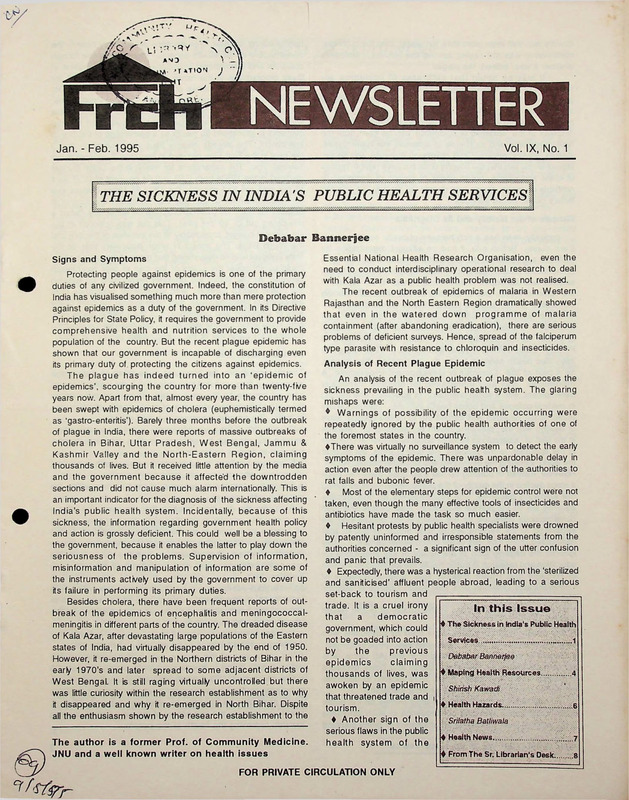
THE SICKNESS IN INDIA'S PUBLIC HEALTH SERVICES^
Debabar Bannerjee
Signs and Symptoms
Protecting people against epidemics is one of the primary
duties of any civilized government. Indeed, the constitution of
India has visualised something much more than mere protection
against epidemics as a duty of the government. In its Directive
Principles for State Policy, it requires the government to provide
comprehensive health and nutrition services to the whole
population of the country. But the recent plague epidemic has
shown that our government is incapable of discharging even
its primary duty of. protecting the citizens against epidemics.
The plague has indeed turned into an ‘epidemic of
epidemics', scourging the country for more than twenty-five
years now. Apart from that, almost every year, the country has
been swept with epidemics of cholera (euphemistically termed
as ‘gastro-enteritis'). Barely three months before the outbreak
of plague in India, there were reports of massive outbreaks of
cholera in Bihar, Uttar Pradesh, West Bengal, Jammu &
Kashmir Valley and the North-Eastern Region, claiming
thousands of lives. But it received little attention by the media
and the government because it affected the downtrodden
sections and did not cause much alarm internationally. This is
an important indicator for the diagnosis of the sickness affecting
India's public health system. Incidentally, because of this
sickness, the information regarding government health policy
and action is grossly deficient. This could well be a blessing to
the government, because it enables the latter to play down the
seriousness of the problems. Supervision of information,
misinformation and manipulation of information are some of
the instruments actively used by the government to cover up
its failure in performing its primary duties.
Besides cholera, there have been frequent reports of out
break of the epidemics of encephalitis and meningococcalmeningitis in different parts of the country. The dreaded disease
of Kala Azar, after devastating large populations of the Eastern
states of India, had virtually disappeared by the end of 1950.
However, it re-emerged in the Northern districts of Bihar in the
early 1970's and later spread to some adjacent districts of
West Bengal. It is still raging virtually uncontrolled, but there
was little curiosity within the research establishment as to why
it disappeared and why it re-emerged in North Bihar. Dispite
all the enthusiasm shown by the research establishment to the
The author is a former Prof, of Community Medicine.
Essential National Health Research Organisation, even the
need to conduct interdisciplinary operational research to deal
with Kala Azar as a public health problem was not realised.
The recent outbreak of epidemics of malaria in Western
Rajasthan and the North Eastern Region dramatically showed
that even in the watered down programme of malaria
containment (after abandoning eradication), there are serious
problems of deficient surveys. Hence, spread of the falciperum
type parasite with resistance to chloroquin and insecticides.
Analysis of Recent Plague Epidemic
An analysis of the recent outbreak of plague exposes the
sickness prevailing in the public health system. The glaring
mishaps were:
♦ Warnings of possibility of the epidemic occurring were
repeatedly ignored by the public health authorities of one of
the foremost states in the country.
♦ There was virtually no surveillance system to detect the early
symptoms of the epidemic. There was unpardonable delay in
action even after the people drew attention of the -authorities to
rat falls and bubonic fever.
♦
Most of the elementary steps for epidemic control were not
taken, even though the many effective tools of insecticides and
antibiotics have made the task so much easier.
♦ Hesitant protests by public health specialists were drowned
by patently uninformed and irresponsible statements from the
authorities concerned - a significant sign of the utter confusion
and panic that prevails.
♦ Expectedly, there was a hysterical reaction from the ‘sterilized
and saniticised’ affluent people abroad, leading to a serious
set-back to tourism and
trade. It is a cruel irony
that
a
democratic
government, which could
not be goaded into action
by
the
previous
epidemics
claiming
thousands of lives, was
awoken by an epidemic
that threatened trade and
tourism.
♦ Another sign of the
serious flaws in the public
health system of the
JNU and a well known writer on health issues
FOR PRIVATE CIRCULATION ONLY
In this Issue
♦ The Sickness in India's Public Health
Services.........................................1
Debabar Bannetjee
• Maping Health Resources............. 4
'v Shifish Kawadi
• Health Hazards.... . .......... ............
Srilatha Batliwala :
♦ Health News........... .... ..............
• From The Sr. Librarian’s Desk.........8
country was that even more than ten weeks after the outbreak,
controversy was still raging among the top microbiologists
whether it was, indeed, the plague.
It may be noted that outbreaks of epidemics are
symptoms of an advanced stage of sickness of the public health
services. It is worse when the epidemics range virtually
uncontrolled and people are left helpless. That the ‘health’ of
public health services was not very good even before the
outbreak of the ‘epidemic of epidemics’ can be seen from the
high prevalence and incidence of diseases like tuberculosis,
malaria, filarisis, maternal and childhood diseases .and so on.
Moreover, the fact that the country does not have reliable reports
of births and deaths, not to speak of reports of compulsorily
notifiable diseases, shows how deeply the malady has affected
India’s public health services.
Genesis of the Malady and its Diagnosis
Ironically, India has a rich heritage of public health service.
Even during British rule, it had an efficient organization for
epidemic control under the leadership of the officers belonging
to the Indian Medical Service. A much broader vision of health
services was developed in independent India in the reports of
the National Health Sub-committee of The National Planning
Committee (1940) and the famous Bhore Committee (1946).
The first two decades after independence saw many bold
initiatives in this field; these were indeed the 'golden decades’
of health service development in India. The programme of
Primary Health Centres (PHCs) was started in 1952 to provide
integrated health services to the rural population, free of cost,
as a part of the Community Development Programme. A
programme was also undertaken for massive manpower
development, with a social orientation of education and training
in medical colleges and public health institutes. Interdisciplinary
public health research was carried out to devise optional ways
of dealing with the prevailing health problems. Such research
in the field of tuberculosis brought about fundamental changes
in the approach to the problem, not only in India, but all over
the world, including the developed and underdeveloped regions.
However, instead of building on this solid base, there has been
a steep decline in the quality of the public health services during
the following decades. The responsibility for this decline
squarely lies on the political leadership. Their cynical and even
contemptuous disregard for the health of the people they are
supposed to be serving led to four major setbacks that
contributed to the sickness of the public health service.
They
ignored the degeneration in the quality of key institutions for
education and research in public health like the All India Institute
of Hygiene and Public Health, The* National Institute of
Communicable Diseases and The Indian Council of Medical
Research.
• There was a steep decline in the quality of public health
specialists.
♦ Key public health positions were filled by physicians who
had little expertise in public health services.
♦ Generalist administrators belonging to the IAS cadre, who
are obvious misfits for taking operational and policy decisions
in medical and public health fields, were allowed to dominate
the public health system, by the political leadership.
Imposition of target oriented programmes on the public
health organization was one consequence of such ignorance
at the political level. Insistence on attainment of family planning
FRCH NEWSLETTER, VOL. IX, NO. 1, JAN - FEB *95
targets during the past three decades dealt a body blow to the
infrastructure of the health services. Moreover, some foreign
countries and international institutions added to the erosion of
these programmes in the name of ‘international initiatives’. for
e.g. the global programmes concerning immunisation, AIDs,
Polio Eradication, Diarrhoeal Disease Control Programme,
Acute Respiratory infections Programme and so forth. In line
with this unpardonable neglect, there have been serious
cutbacks in allocations for health as a percentage of the overall
investment. The already meagre plan allocation of around 3
per cent in the First Plan plunged to less than 2 per cent in the
Seventh Plan. The expenditure for health in the Union Budget
declined in the 1980s from 0.08 to 0.04 per cent of GDP. As if
all this was not bad enough, the 1992-93 Union Budget saw
an actual slashing of 20 per cent in health investment in
nominal terms. The malaria programme especially, faced a
whooping cut of 40 per cent. This cut was restored in the
subsequent budget, presumably at the instance of the IMF and
the World Bank. The impact of union budgetary cuts on the
state budgets was so devastating that many of the state budjets
could barely cover the salary of the staff of their rural health
services. As the states are primarily responsible for running
the public health services, with substantial assistance from
the centre in specified areas, they have to bear the brunt of the
acts of omission and commission of the political leadership,
both at the union and the state levels. This provides the clinching
evidence for diagnosis of the public health services in India.
Remedial Measures
The diagosis shows the measures to be taken to remedy this
sickness - a long, grinding task indeed. It is the political leaders
who will have to be the pace-setters. They need to recapture
the spirit of the ‘golden decades’ of public health administration
in India. The specific measures required include:
♦ Strenthening of the key public health institutions for education,
training and research by expressly seeking out bright creative
scholars to form a ‘critical mass’.
♦ Filling key positions in public health services with competent
physicians, who can provide inspiring leadership.
♦ Integrating target oriented special programmes within the
overall health services.
♦ Reducing the dominant position that the generalist officers
have come to occupy in deciding upon the technical aspects
of policies or at least in programme implementation, to the
status they held during the ‘golden age’ of public health services
in India. Instead, they should be handed over tasks like
manpower development and hospital and medical care
services.
❖ Undertake research on health systems towards using
techniques of operational research and systems analysis to
optimise the health service system, i.e. making more effective
use of the available resources.
♦ Increase budgetary support to health services, but only after
ensuring that the funds in hand are being optimally utilized.
❖ The same area of the country, which was supporting 361
million people in 1951, is now supporting a population of 900
million, most of which lives under degrading conditions in terms
of housing, sanitation, water supply, nutrition and so on. These
areas must also be attended to, wherever required. After all,
health services are but one aspect of the overall effort needed
towards improving the health of the people.
—
MAPPING HEALTH RESOURCES
Shirish Kavadi
Health care services in India are inefficient, unequally
distributed, and because of the dominance of the private sector,
also unaffordable to the general population - making them
virtually inaccessible to the people at large. True, for a country
of India’s size and population, the resources needed are
phenomenal, but there is no acute shortage of health care
facilities or personnel in the country. Instead, as most studies
point out, the real problem lies in poor planning and unequal
and improper distribution of available resources. Such improper
planning may be the result of misplaced priorities as much as
due to the absence of an adequate and reliable database. In
India, information on human resources and infrastructure for
health care services is poorly documented. The total volume
of these resources is not known. Also, data available from
various sources do not tally. Thus, while proper planning is
imperative, it is hampered by the lack of reliable data. This
problem is countenanced by researchers as well. especially
those carrying out policy research and field based studies.
This article explains the attempt made by a team of
researchers from FRCH to carry out a comprehensive survey
of health resources/providers in Ahmednagar district - to
determine the volume of health care facilities and practitioners
- as a part of a larger study on health expenditure and
investment. The survey was restricted to a district since the
latter appeared both a suitable and a manageable
administrative and territorial unit. Here, an attempt is made to
delineate the approach adopted, the methodology and
techniques used and the limitations of these techniques. In so
describing the process, the idea is to outline an approach for
mapping health resources, which could prove useful to
researchers conducting studies into district level health services
and related issues and related issues. A fairly accurate and
reliable information on the volume of health resources and
distributional pattern across social geography, sector and
system would make for a better understanding of the issues
involved in health care inequity.
Techniques of Data Gathering
To begin with, definite categories of health providers were
identified, with a view to making them as comprehensive as
possible. The health providers, as identified, covered:
♦ Health care facilities - dispensaries, hospitals, clinics,
polyclinics, special hospitals, PHC’s, sub-centres, medical
stores, indig eno us/folk and other non-allopathic facilities.
♦ Practitioners - allopathic doctors, indigenous and other nonallopathic doctors, nurses and all other paramedics from the
private and public sectors in both urban and rural areas.
The discussion that follows will, however, pertain primarily to
medical practitioners.
The exercise involved the listing of all health care providers
in the district by tapping all known official and non-official
The author is a researcher at FRCH and has coordinated the
study,1 Health Investment and Expenditure1 on which the present
article is based.
3
sources. Three techniques were used for listing:
♦ Collecting information from official and non-official
sources: Information gathered from these sources, for both
health personnel and health establishments, was cross
checked, compiled and then classified. Classification was done
mainly on the basis of social geography, system of medicine,
qualification and sector.
♦ Sample survey: To check the validity. of these data and
specifically the sources, a sample check was conducted.
♦ Mailed questionnaires: The last exercise involved a postal
survey. Questionnaires were mailed to all the listed
practitioners and hospitals to generate information on
providers within their locality.
The second and third techniques were used owing to the
inadequacies of the sources used in the first.
Official Sources of Information
Official Registration with their respective Councils is a
statutory requirement for all qualified medical graduates who
wish to practise. The Councils are statutory bodies and it is inturn obligatory for the Councils of all systems of medicine to
maintain updated records of qualified but practising doctors.
Hence, the Councils were the major source of information
regarding medical practitioners in the district. The four Councils
were :
♦ Maharashtra Medical Council (Allopathic)
♦ Maharashtra Board of Ayurved and Unani Systems of
Medicine
♦ Board of Homeopathic and Biochemic Systems of Medicine
and
❖ Maharashtra State Dental Council.
From the Council directories/registers, 1887 doctors were
listed.
In addition, information on private practitioners and doctors
working in public health services was recorded through the
District Health Office, Civil Hospital, Medical Officers of
Municipal Councils and Cantonment Hospital and the Extension
Officers of Health at Panchayat Samitis. Lastly, information
on the total number of health professionals was also collected
from the National Information Centre, Pune.
The major sources of information on health establishments
were: the Directory of Hospitals ip India (1988) published by
the Health Ministry, Government of India, and the lists provided
by the District Health Officer, Municipal Councils and Panchayat
Samitis. The office of Food and Drug Administration provided
a list of medical stores and licensed drug sellers in the district.
Non-Official/Private Sources:
Information was also gathered from private sources.
Maharashtra Sales and Medical Representatives Association.
Ahmednagar Unit had published a directory, “Medical
Directory Ahmednagar District" in 1986, for private
circulation. Some pathological laboratory owners, pharmacists
FRCH NEWSLETTER, VOL. IX, NO. 1, JAN - FEB ‘95
and medical associations too have published directories in
talukas like Shrirampur. In addition to this, membership lists
of the local branches of Indian Medical Association (IMA),
National Integrated Medical Associations (NIMA) and other
taluka-level associations were sought. Also, the associations
of medical stores and pharmacies at both the district and taluka
levels were tapped along with distributors of pharmaceuticals
and drugs. The latter mainly provided information on medical
stores. The private and public sources (non-council) elicited
the names of 1773 doctors. The overall impression was that
the non-official sources and non-council lists were more reliable
(though not necessarily exhaustive) since these lists contained
names of doctors who were actually practising in the district.
Limitations of the sources
Since none of the Councils had updated the published
directories of the registered medical graduates till 1990, the
unpublished registers had to be referred to, in all these
Councils. From the directories and registers, doctors having
their professional addresses (if available) or residential
addresses or both at Ahmednagar district, were listed. The
Allopathic Council does not specify whether the addresses of
doctors are residential or professional. The Ayurvedic Council
registers only residential addresses. The Homeopathic and
Dental Councils give both professional and residential
addresses but not all doctors have registered with professional
addresses even for these Councils. As a result, in the case of
a majority of doctors from these four Councils, only the
residential addresses are known. This makes it difficult to
identify or trace doctors who have either emigrated out or
immigrated into Ahmednagar district and not cared to inform
the change in residence, or doctors who practice within
Ahmednagar but do not reside therein. Visits to the offices of
the Civil Surgeon, DHO, Panchayat Samitis and Municipal
Councils also revealed that the obligatory registration of
practice, especially for the nursing homes under the Bombay
Nursing Home Act, is not complied with by medical
practitioners, particularly so in rural areas. That the legally
required registration with the local bodies is not being observed
was confirmed by the Medical Officer of Ahmednagar Municipal
Council who informed us that only 25 percent of the privately
run health units care to register. Only the Shop and
Establishment Departments of the Municipal Councils of
Shrirampur. Sangamner and Kopargaon, however, had lists of
registered doctors and hospitals in their respective areas. But
overall. The information from these lists was neither complete
nor adequate and hence not fully reliable. All other official
sources gave lists that were either informally prepared for us
or were prepared for some other purpose with little concern for
accuracy. The exception was the Ahmednagar Municipal
Council. The Health Department of this Council had an updated
fist of general practitioners, consultants and hospital owners
in Ahmednagar city. The Chief Medical Officer has undertaken
to prepare such a list almost every year. The “Directory of
Hospitals in India” (government) was also found to be most
inadequate especially regarding units with a small bed strength.
A possible explanation for this could be that since most nursing
homes do not register with Local Boards as required under the
Bombay Nursing Home Act, they remain officially non-existent.
The directory depends entirely on official sources. Hence, the
listing of private medical establishments encountered the same
FRCH NEWSLETTER, VOL. IX, NO.1, JAN - FEB '95
problem as in the listing of medical personnel. Information on
the number of beds and facilities available, types of
establishments (general/special hospitals, nursing homes,
dispensaries, clinics) and ownerships too was not available or
was incomplete for most hospitals in these published sources.
Data gathered from the sources other than the Council records
was inaccurate as far as qualifications and names were
concerned.
Organization and Processing of Data
Each list was entered into the computer and a database
of the practitioners was constructed. Whatever information
about doctors that was available - address, sex, degree,
registration number, year of qualification, university etc. - under
each list, was included. Subsequently, all the lists were tallied
and thoroughly checked to remove errors and repetitions. A
similar exercise was carried out for hospitals and nursing
homes. A list of pharmacy shops was also compiled. An
indication of the inadequacy and unreliability of the Council
lists was seen from the fact that only 32 per cent of the 1887
doctors who had registered with the Councils were identified
amongst the 1773 practitioners listed from other sources. It
was also found that names of about 66 per cent of the 1773
practitioners could not be located in the Council registers with
an Ahmednagar address. Cross checking was an arduous and
time consuming task. After going through the whole process a
single master list of medical practitioners from Ahmednagar
district was compiled. All duplications were deleted from the
list, giving a final total of 3059. Given the limitations of the
exercise carried out, we decided to undertake a sample survey
with a view to determining both, the reliability of our sources
and validity of available data. The sample survey had also, as
one of its objectives, the identification of non-qualified and
non-conventional medical practitioners who could not be listed
from the earlier mentioned sources.
The Sample Survey
The second technique involved a sample check in over 65
villages and 2 towns in 4 talukas. The sampling was based
on rural-urban and regional (developed and under-developed)
differentials in the distribution of health resources and on the
doctor-population ratio (high, average and low). Accordingly,
the towns Nagar and Shrirampur and talukas Parner and Akola
were selected.
♦ Rural Sampling
Villages from the selected talukas were classified as those
having high, average and low doctor-population ratios and those
villages having no doctors. Sixteen villages were randomly
selected in this fashion. Four villages within a 5 km. radius of
every selected village were included, to form village clusters,
for a doctor’s area of operation extends to the adjacent villages
as well. Thus village clusters rather than isolated villages
became the basic units for the survey. In the first round of the
survey in Parner all villages in a cluster were visited.
Subsequently, in the remaining sample talukas the strategy
was changed to cover only the central or PHC village within
each cluster. This was so since it was felt that the medical
information about the whole cluster could be gathered from
the central or the PHC village itself. In cases where the centre
had shifted to the PHC village, the village clusters also changed
4
slightly. After the Parner experience, only three village clusters
in each of the remaining three talukas were surveyed. Thus
instead of 16, our sample consisted of only 13 village clusters
with 5 villages each, making a total of 65 out of altogether
1503 villages in the whole district.
Councils and Boards.
Table No. 1
Taluka-wise break up of existing doctors in
comparison with the original list
Sample Taluka
♦ Urban Sampling
No.of Doctors
Original list
Two towns, Nagar and Shrirampur were automatically
selected, being the only urban centres among the targeted
talukas. These towns also fell in the categories of high and low
concentration of doctors respectively among the urban areas
in the district. The approach involved in the urban survey was
different owing to various difficulties involving logistics and lack
of adequate personnel. Physically cross-checking 836 and 184
doctors in Nagar and Shrirampur respectively was not possible
unless a ward-to-ward survey was done. We decided to
approach medical stores, instead. Prominent areas in Nagar
and Shrirampur were marked. A centrally located medical store
in each locality was identified. Ten medical stores in Nagar
and 4 in Shrirampur were accordingly selected. Names of
doctors in the respective locality were listed with the help of
employees/owners of the medical stores.
♦ Questionnaires
Though the main objective was to seek information on
medical practitioners in the locality with a view to
counterchecking our list, we planned general interviews with
doctors, paramedics, folk healers and with the lay community
in order to establish our credentials and develop a good rapport
with them, before enquiring about the health providers within
their locality. The questionnaire was pre-tested through a pilot
survey in Purandar taluka of Pune district. The interview
schedules began with background information regarding the
villages, families, occupations, amenities available in their
areas, disease patterns, problems in giving and receiving
medical care etc. Only towards the end did we enquire about
the health personnel in that area.
Validity of Information Sources
Verified list
Nagar
11
11
Akola
20
22
Parner
30
28
Shrirampur
66
53
Total
127
114
_Taluka-wise assessment of the sample list
For Parner taluka, which had a low concentration of doctors,
our estimation was most accurate, whereas for Shrirampur,
with a high concentration, our estimation was least accurate.
In both the talukas with an average concentration of doctors
there were more doctors than expected. But on an average the
list of practising doctors fell short of the original sample list
(See Table No. 1). During the sample check the team
experienced great difficulty in identifying and locating folk
practitioners. Often, community members were reticent and
would not talk about them; at times we were even laughed at,
saying that such practices were no longer prevalent; at other
times persons so identified when personally met, denied that
they practiced folk medicine. Practitioners of traditional
medicine (Ayurveda/Unani) were also difficult to locate, since
the practise of this medicine as a hereditary or caste profession
appeared to have died out. Against the background of
difficulties encountered in the first two techniques, we decided
to mail questionnaires to the listed doctors and ask them to
provide information on the fellow practitioners in their locality
or within their knowledge.
Postal Survey
The fact that only 72 out of the 127 listed doctors actually
The postal survey was carried out by mailing questionnaires
practised in the areas that they were expected to be practising
to all the listed health providers, and to those who were identified
in, exposed the inadequacy of our sources of information, in
from the incoming responses, thus attempting to cover the
particular the Council directories. Of the remaining 55 doctors,
whole district. Besides seeking information regarding their
some had shifted to other places, some had retired or expired
practice and the delivery of health care in their area, the
while others could not be traced at all. In all, 42 new doctors
respondents were also asked to identify other practitioners in
practising in the sample areas were added to our list. Out of
their vicinity.
these 42 additional doctors, about 11 doctors came from the
same district and had already been included in our inventory,
Response to postal questionnaires
but with different addresses. We could not determine whether
Out of 3059 doctors to whom the questionnaires were
those who had shifted or were untraceable were practising
mailed, 460 (15%) replied to us. Eight per cent (249) of the
elsewhere in the same district. The actual number of doctors
questionnaires came back unopened because the doctors
practising in the sample areas was thus calculated at 114 (See
concerned had either shifted, expired, retired or were
Table No. 1). Out of the 114 practising doctors only 33 had
untraceable (See Table No. 2). We received 177 new names of
registered with their respective Medical Councils with their
individual doctors, not recorded elsewhere in our list. During
current addresses. The percentage of doctors who had shifted
our subsequent tours to the district a number of non-respondent
from their original residence (26.4%) and of those who were
doctors informed us that the questionnaires reached them only
untraceable (12.8%) was very high. Among the Medical
after the stated last date for replies; otherwise, the response
Councils, the Board of Homeopathy and Biochemic Systems
be
etter.
of Medicine provided a comparatively more complete and valid
list of doctors. It's information acquired from informal sources /
(contd. on page 8)
that proved to be more accurate than that rendered by various/ /
rate would have
5
----- _
•_
"- _
1 =
2
«
AVPRCH NEWSLET
5
#11——
CR
R, VOL. IX, NO. 1, JAN - FEB *95
HEALTH HAZARDS
for Women & Unborn Children
India has one of the highest infant death rates in the
world, particularly for infant girls. Good health services are
essential to reduce this rate, but they are not enough, suggests
the report on a project in Alibag taluka, a rice cultivating area
in rural Maharashtra, initiated by the FRCH in 1973. The report,
undertaken in 1982, states that while village level health
services can greatly improve women’s and children’s health
status, they must be accompanied by other basic changes in
order to be truly effective.
The FRCH was disturbed by the fact that despite
early successes in the rural health project, a plateau of sorts
was reached and from 1980 onwards, no significant changes
in the health profile of the people could be achieved. Concern
was greatest over the stubborn refusal of the infant mortality
rate (internationally accepted as the most sensitive index of
the health status of a nation or society) to move below 70 to 75
per 1000 livebirths.
The main goal of the study was to understand the nature
and characteristics of all the deaths occuring in the project
area in one calendar year by age, sex, subregion and cause.
This enhanced understanding would then be used to improve
the health services, provided in the project, wherever possible.
A unique feature of this study was that it was carried out by
village women and not trained investigators from the city.
Startling Facts Uncovered
The first clear trend to be detected by the study was the
gender differential in pre-school mortality, with girls contributing
almost two-thirds of all deaths in the 0-6 age group.
The vast bulk of preschool mortality (80 percent)
occured below the age of one year; of this, over three-fourths
occurred in the neonatal period, that is, up to 30 days after
birth. Almost half the neonatal mortality is accounted for by
pre-mature and small-for-date infants. Another 34 per cent
was due to stillbirths and birth injuries, the latter including three
cord strangulations, one antepartum haemorrhage, and one
skull fracture when the infant was dropped at delivery.
However, the most startling finding of the study came
to light when all infant deaths were plotted by month (See Table
1 .), to determine any seasonal variation in the mortality pattern.
Firstly, we see that 40 per cent of all infant deaths
occured in the four monsoon months of July to October. If we
include May and June, when the fields are being prepared for
sowing operations, and seedlings are grown in the nurseries,
the figure rises to 61 per cent. This is not surprising in itself,
since public health wisdom states that the environmental
onslaught of the monsoon brings in its wake a host of infections
and parasitic diseases which hit the young and vulnerable the
hardest. It is also a time when the village access to health
care is severely reduced by floods, blocked roads, and the
heavy demand for labour in the fields.
However, on disaggregating the 14 deaths which
occured in July-August, it was found that 50 per cent, that is,
seven, were stillbirths and prematurely born infants, or both.
This was intriguing, since the 10 other stillbirths and premature
babies were scattered randomly through the other 10 months
of the year. Why was there this cluster or bunching of this
The author was Research Associate and Project Coordinator
for the above project.
FRCH NEWSLETTER, VOL. IX, NO. 1, JAN - FEB '95
Srilatha
Batliwala
particular problem in these months? It could not even be
explained by a large number of births having occurred in those
months - if anything, the largest number of births occurred
after this period.
Possible Explanation
The only explanation that the author has been able to
find is that July and August are the height of the agricultural
season in this area, with rice sowing operation in full swing. In
a single crop area like Alibag, this means that every pair of
hands - including those of women in advanced stages of
pregnancy - is busy in the fields from dawn to dusk, either in
their own fields or as labourers on others’ lands. It is well known
that women alone perform the important skilled. but backbreaking job of transplanting sapplings in rice cultivation.
This means that every woman - heavily pregnant or otherwise
- is squatting on her haunches for hours together. Obstetricians
confirm that such physical strain and pressure on the uterus
could well trigger off premature labour in the last trimester of
pregnancy, not to mention increasing the chances of a stillbirth.
Premature deliveries, that too by half starved, physically
debilitated women endanger not only the infant’s chances of
survival, but the mother’s as well. It is hardly surprising, if the
above explanation is correct, that so many stillbirths and
premature births occured in these couple of months in the
project area. This could well be the culminating expression of
the social, economic, and technological neglect which the poor
in general, and poor women in particular, face through out the
year, throughout their lives. The fact that no maternal death
occured in this or any other part of the year was either pure
chance, or proof of the incredible biological strength of the
female of the species - but a strength which, in our country, is
clearly reaching the limits of its endurance.
Conclusion
Firstly, though the FRCH study was carefully planned,
closely supervised and comprehensive, one cannot rule out
the possibility that some or all of its findings were eccentric or
arbitary fluctuations of that particular year or region. While
they cannot be dismissed, neither can they be considered
conclusive until further data is generated. This is particularly
vital vis-a-vis the high incidence of stillbirths and premature
births and deaths during the peak-rice cultivation season.
Secondly, if the findings presented in this article and
the accompanying explanation are indeed valid, then we have
located an important new occupational health hazard to
pregnant women and their unborn children in rice growing
areas. Our theory about this is somewhat strengthened by the
fact that in parts of Tamil Nadu, folklore dictates that husbands
and wives are not permitted to cohabit in the period 10 to 8
months prior to the next sowing season.
For those engaged in appropriate technology research,
and who follow the dictum “start with women", the tentative
findings of the study indicate the need to concentrate on
developing transplanting and sowing devices which will reduce
the arduousness of these tasks, particularly the need to squat
while performing these activities. Above all, this information
must be disseminated among the labouring women
themselves, after all, it is they who have to discuss the matter
and decide upon what is to be done.
□
6
healthnews
_ The World Summit for Social Development is scheduled
to meet at Copenhagen in March this year. The draft of the
declaration of the summit, to be signed by all heads of the
state, has already been prepared at the Preparatory Committee
meeting for the Summit.
The Summit has been called to exploit the opportunities
for international cooperation that the end of the cold war
presents in order to manage the process of globalisation so as
to enhance its benefits and mitigate its negative effects and to
address the 3 core issues of poverty alleviation, employment
generation and social integration.
UNICEF's latest ‘State of The World’s Children Report’
makes special mention of India, along with a number of other
developing countries, for the dramatic progress it has made in
protecting the health of the children and its immunisation and
iodination programmes. Among the various success stories
cited by the report is the progress made by India against iodine
deficiency disorders (IDD); the successful implementation of
the immunisation programme by the public health care system
- 90 per cent of the children are getting immunised within the
first year of their birth; its guinea eradication scheme and the
action taken on a national scale to eliminate iron deficiency in
pregnant women. It also made a mention of India’s plans to
eradicate polio from 11 states, with a combined population of
260 million.
The report specially singled out Kerala as a model for
developing societies in the field of social progress.
However, it also said that India has not done as well in
improving its sanitation and nutrition programmes while efforts
to contain the incidence of diarrhoea have also not been very
successful as it continues to be the main cause of child
morbidity in most parts of the country.
In an attempt to decentralise family welfare programmes,
the Health and Family Welfare Ministry has drawn up a plan
for 4 districts in 4 states on an experimental basis.
This change in planning is meant to promote peoples’
participation and an area specific approach where the diverse
needs of the states, sporting different demographic data, would
be catered to. The plan will be tried out in the 4 pilot districts of
Medak in Andhra Pradesh, Nagpur in Maharashtra, Dausa in
Rajasthan and Anna Dindigul in Tamil Nadu.
The draft is the result of a joint effort by the district -level
attitude towards sex and sexuality.
A detailed schematic curriculum has been devised that
is divided into 5 parts - human sexual development, inter
personal relationship, interactive abilities, sexual behaviour
and sexual health. The first part includes study of anatomy
and physiology, the sexual act and conception, pubertal
changes, self awarness and gender role. The second part
deals with inter-personal relationship, talks about the family
unit with emphasis on husband-wife and parent-child
interaction,peer group and tolerance of ethnic variations.
For the first time, 20 NGOs supported by the Ford
Foundation met to pool their experiences and plan future action
regarding the anti-AIDS programmes carried out by the Ford
Foundation and the Tata Institute of Social Sciences, Bombay;
in a three-day national workshop organised by the Gell for AIDS
Research, Action and Training at TISS. The effort would be to
fashion a national programme which was not ruin by the
government but instead involve the people themselves.
The infectious disease Anthrax, a bacterial disease
transmitted through domesticated animals, is threatening to
take an epidemic form in 2 Tamil Nadu districts. Experts warn
unless effective preventive measures were taken, the disease
would take a heavy toll of human lives in the region. Already,
several lives have been claimed in North Arcot and
Thiruvannamalai Sambuvarayar districts in the current year.
The last reported outbreak of human anthrax in this region.
which is known to be an enzootic for the disease. Was in 1990.
The carcasses of infected animals are the source of
numerous spores that contaminate the environment,
particularly the soil. From the soil, the spore may become air
borne. Some doctors believe that the spores of the bacteria
are present in the region - North Arcot, Tiruvannmalaiand Chittor
District - for people to have got the infection. But, they say, the
cases were reported from a fairly large area making it difficult
for them to detect a common source of infection.
Despite a legal ban on the sale of uniodised salt. a study
conducted in Gorakhpur, Varanasi and Dehradun Districts in
Uttar Pradesh found that in a number of samples the level of
iodine is quite erratic while some of the samples were found to
contain no iodine at all. The study was conducted by the
International Council for Control of Iodine Deficiency Disorders
and the Centre for Community Medicine at the All India Institute
of Medical Sciences with the help of non-governmental
organisations active in the 3 districts. Incidently, Uttar Pradesh
has the highest incidence of iodine deficiency disorders with
officials, community leaders and resource persons from local
institutions who were sensitised with the issues concerned
through a series of workshops. The cost of implementation, to
be worked put by the local-level officials and leaders, will be
shared by the Central Government and the United Nations
some areas reporting prevalence of goitre as high as 46 per
Population Fund.
cent.
A draft proposal on the National Sexual Health
Education Programme was released on the last day of the
third Asian Conference held in New Delhi on December'94.
The draft includes a detailed curriculum targeted at young
adults and those in pre-pubertal and pubertal stages of life.
The aim of the programme is imparting knowledge as well as
sexual conditioning wherein an individual develops a healthy
7
Penicillin, a key bulk drug, may be removed from the
negative list of imports. The move is significant as this bulk
drug is critical to the country’s health needs while the domestic
industry caters to only 40 per cent of the demand. The rationale
behind this move is to lower the cost of controlled drugs where
penicillin is used as a basic input.
•
Compiled from The Times Of India
FRCH NEWSLETTER, VOL. IX, NO. 1, JAN - FEB *95
FROM THE SENIOR LIBRARIANS DESK....
Panchayati Raj: Selected References Available in FRCH Library
1.
Webster. Neil, Panchayati Raj and the Decentralisation of
Development Planning in West Bengal, Calcutta, K. P. Bagchi
and Company, 1992, Pgs. 149.
2.
Thakur, Devendra (Ed.), District Planning and Panchayati Raj,
New Delhi. Deep and Deep Publications, 1991, Pgs. 472.
3.
Sivanna, N., Panchayati Raj Reforms and Rural Development,
Allahabad, Chugh Publications, 1990, Pgs. 308.
4.
Singh S.S. and Misra. Suresh, Legislative Framework of
Panchayati Raj in India. New Delhi, Intellectual Publishing
House, 1993, Pgs. 299.
12
Lal, G.M.M., Rajiv Gandhi and Panchayati Raj: Democracy and
Development at the Grassroots," Delhi, Konark Publishers Pvt.
Ltd, 1994, Pgs. 120.
13.
Krishnan, M.G., Panchayati Raj in India, An Analytical Study
of Karnataka, New Delhi, Mittal Publications. 1992,
Pgs. 149.
14.
Institute of Social Sciences. Decentralised planning and
Panchayati Raj: Proceedings of the D.T Lakdawala Memorial
Symposium, New Delhi, Concept Publishing Company, 1994,
Pgs. 64.
15.
Inamdar, N.B. and others, Panchayati Raj: An Annotated
Resource Guide, New Delhi, Concept Publishing Company, 1991.
Pgs. 253.
16.
Datta Prabhat, Second Generation Panchayats in India (With
Special Reference to West Bengal), Calcutta, Calcutta Book
House Pvt. Ltd., 1993, Pgs. 174.
17.
Dutta, N.. Village Panchayats in India: A case study of Assam, New
Delhi, Mittal Publications, 1989, Pgs. 207.
Palanithural, G., Empowering People for Prosperity : A Study
in New Panchayati Raj System, Delhi, Kanishka Publishers
18.
Desai, Vasant. Panchayati Raj: Power to the People, Bombay,
Himalaya Publishing House, 1990, pgs. 516.
5.
Singh S.K., Role of Panchayat Raj in India, New Delhi, Radha
Publications, 1992, Pgs. 143.
6.
Shah. B.L.. Panchayati Raj: The Role of Panchayats in
Integrated Rural Development. New Delhi. Cosmo Publications.
1990. Pgs. 198.
7.
Satyanarayana. P. Towards New Panchayati Raj: Critical
Perspectives on the Reorganisation at Rural Local Government
New Delhi. Uppal publishing House, 1990, Pgs. 247.
8.
Distributors. 1994, Pgs. 131.
19.
9.
Mishra. S.N , Panchayati Raj Bureaucracy Rural Development,
New Delhi, 11. PA.. 1986, Pgs. 166.
Chand, Attar, Panchayati Raj and Rural Development, New Delhi.
H K. Publishers and Distributors, 1990, Pgs. 216.
20.
10.
Mehta Ashok. Chairman, Report of the Committee on Panchayati
Raj Institutions. New Delhi, Ministry of Agriculture and
Irrigation, Government of India, 1978, Pgs. 301.
Bhargava, B.S., Panchayati Raj System and Political Parties.
New Delhi, Ashish Publishing House, 1979, Pgs. 536.
21.
Bhadouria. B.P.S.. Decentralised Planning for Development in
India, Delhi, Commonwealth Publishers, 1988, Pgs. 375.
Mathew. George, Panchayati Raj from Legislation to Movement,
New Delhi, Concept Publishing Company, 1994, Pgs. 156
22
Aziz, Abdul, Decentralised Planning : The Karnataka Experiment,
New Delhi, Sage Publications, 1993, Pgs. 148.
11.
overestimated by a mere 3 per cent. There is the possibility of
a certain number of doctors still being inadvertently left out by
us, but the number 3059 serves as a fairly reliable figure of
doctors in the district.
(contd. from page 5)
Table No. 2
A breakup of the doctors' status
Doctor’s Status"
No. of Doctors
Shifted
Retired
Expired
14
10
9
(5.6%)
(4.0%)
(3.6%)
Not traceable
216
(86.7%) "
% of Total
Data Processing and Findings
The original list was cross-checked with lists prepared
through the sample check and postal survey. All duplications
were taken care of. The final list showed 3059 doctors (qualified
and unqualified) located in urban and rural areas, representing
all systems of medicine. Doctors from both the public and
private sectors were covered. Nearly 92 per cent were from
the latter sector. Around 860 health establishments including
274 hospitals (with bed strength ranging from 3 to 200 beds),
PHC's, sub-centres etc. were also listed, while 565 medical
stores were found to be functioning in the district.
From both the surveys, the status of 1164 doctors (294
non-existing and 870 existing) could be determined, leaving
the status of 1895 (62%) doctors undecided. Out of the 870
practising doctors, an addition of 209 doctors was made to the
final list, based on information gathered during the surveys.
After adding and deleting from the final list as per our
information, we found that the original list of 3059 doctors was
Conclusion
An important constraint in conducting an exercise of this
kind covering a large territory is that of Logistics. Such an
exercise can be carried out only in. a district or a smaller
territorial unit. Yet, it may be said that in spite of the various
limitations and constraints, the FRCH team was able to prepare
a fairly reliable inventory of health providers in the district
which also enabled them to better understand the distributional
pattern of medical personnel across social geography, sector
and system of medicine1. Keeping in mind the various
limitations encountered by the FRCH team, other researchers
can improvise upon the above described approach by improving
the techniques and better dealing with local conditions.
□
Produced by the Foundation tor Research in Community Health
|
|
( Registered under the Bombay Public Trust Act ),84-A. R. G. Thadani
Marg, Worli, Bombay 400 018
Edited by Vaijayanti Aphale
with secretarial help from Rajesh Ingle. Jayashree Puranik & Sushama |
Joshi.
-e
e
—
g
Printed at Omega Offset, Maratha Colony, Tilakwadi, Belgaum - 590 006.
|
|
FREE ABSTRACTING
| The contents of this newsletter may be abstracted without prior t
8 permission. However, we would welcome acknowledment of the |
1 See Manji ri Sule, FRCH Newsletter (Nov-Dec‘92), and S. Kavadl
and M. Sule, FRCH Newsletter (July-Aug.,94).
$ source and copies of any abstractions
§
The Foundation for Research in Community Health
For Private Circulation Only
Vol. IX, No. 3
May-June 1995
‘ hop.
Family Medicine .
1 . V
.
Prakash C. Rao
DOCUMENTATION
j 5
. UN’s .
--NGALOR‘Wherever the art of medecine is loved, there also is love
Especially in urban areas, where the family doctor faces stiff
for humanity* - Hippocrates.
competition from hospitals, nursing homes and consultants
Family doctors constitute an important part of medical
care, with most of them being private practitioners. It is said
that a family doctor is concerned with the art of providing the
science of primary health care. An ideal family physician
(who contrary to their training are engaged in primary health
care) as also quacks and his own colleagues, the family doctor
is tempted to break down the barrier of ethics in order to
achieve success and wealth.
provides personalised, primary, holistic and continuing health
In more than 50 per cent of the cases in family practice,
care to the people irrespective of age, sex or illness. The very
patients cannot be diagnosed correctly using the conventional
personal nature of his relationship with the patient facilitates
approach, especially where the patient shows symptoms that
timely diagnosis and also allows him to integrate the physical,
do not fit typically, into any known medical conditions. In such
psychological and social factors in diagnosis. He undertakes
a case the three dimensional approach
continuing management of his patients who are bed-ridden
psychological and social) helps the family doctor in treating
with chronic, recurrent and terminal illness. The relationship
the patient rationally. In contrast, an overenthusiastic hospital
of trust that exists between the family physician and the patient
based approach may lead to unnecessary investigations and
serves him well in his profession in knowing exactly when and
irrational therapy. But in actual practice, the pressure of making
(physical,
how to intervene through treatment, prevention or education
a quick buck forces the doctor to go for symptomatic hospital
to promote the health of his patients.
oriented ‘management* of patients* problems, turning the whole
concept of personalised family medical care upside down. If
In the West, family medicine is an established specialty
the diagnosis does not corroborate the existence of any major
in which the concerned doctors undergo specialised training.
disease the doctors do not hesitate to state, ‘Low B.P., General
In India, family medicine as a separate discipline does not exist,
Weakness etc!* and treat the patient with unnecessary
in spite of the fact that quite a few graduates, willingly or
vitamins.
unwillingly, do end up being private general practitioners.
Neither the need for family medicine nor the potential of a family
doctor in community health care is recognised.
The family doctor is not included in any of the
government health care programmes and
remains a missing link in the health care of the
society. With the quality of interaction between
the doctor and the patient getting business-like
and often exploitative, health has turned out to
be a commodity bought and sold in the market.
Dr. Prakash C. Rao is a consulting
family physician.
William Osler, the family physician, once said, “Talk to
the patient and he will tell the diagnosis". Family
I In this Issue
• Family Medicine---------------.---I
Prakash C. Rao
medical practice is expected to make use of
this dictum where listening often serves the
purpose of diagnosis and talking that of therapy.
Instead, family doctors too often rely heavily
• Cultural Determinants of on irrational investigations and irrational
S.N.Morankar
• Health Awarness..----------------4
Seema Deodhar
• Health
+FromtheSr.Librarian’s
Desk . ...........................8
prescriptions.
It is the moral responsibility of doctors to
use a rational approach to diagnosis and
therapy; yet, are the conditions in which a family
(contd. on page 8)
Cultural Determinants of Diarrhoea
This is a revised summary of S. N. Morankar's PHD thesis in
Anthropology (Poona University) under the same title
Every disease has a scientific explanation as well as a
practical behaviour of the mother or family members while caring
cultural context. The latter involves a study of local concepts of
for the child during actual occurrence of diarrhoea.
health and illness among people/patients for whom these
concepts are meaningful, known as EMIC, while the former
Field research was carried out from Oct. 1990 to April 1991
refers to an epidemiological study using clinical diagnosis and
in two phases. Phase I was undertaken from Oct. 1990 to mid
employing a structured clinical view, called ETIC. Unfortunately,
January 1991. During this period pre-episode (prior to actual
the dominant model for research remains the Knowledge Attitude
occurrence of diarrhoea) data was collected, using the structured
and Practice (KAP) Survey which is heavily biased towards the
interview schedule (EMIC) to understand the mothers' views
ETIC framework as it provides a strong data base but is not very
regarding diarrhoea management. Phase II data was collected
sensitive to users* perspectives and their actual behaviour. For
from 1st Feb. 1991 to 30th April 1991. During this period all
instance, detailed literature reviews undertaken on the prominent
mothers having children below the age of five years were visited
aspects of diarrhoeal diseases such as breast-feeding, personal
twice a day at 8.00 am and 6.00 pm to observe actual behaviour
and domestic hygiene, water supply, excreta disposal, utilization
and talk with the respondents. Such frequent visiting also reduced
of home based ORT etc., point to the need for new and innovative
the recall time. During analysis of the data each variable was
type of research to better understand the determinants, especially
cross tabulated with components of other variables, comparing
the cultural concepts, of diarrhoeal illness and appropriate use
of ORT at home. (It is estimated that diarrhoea kills about five
the data collected in both phases i.e. pre-episode knowledge with
the actual practice of diarrhoea management during episode. To
million people, mostly children, every year, of which 1.5 million
test the association among these variables, chF test was used
deaths occur in India alone.)
for interpretation.
Accordingly, a study was conducted at the village Supa in
g
Y
Epidemiological Observations
Baramati Taluka of Pune district to define the cultural
determinants of diarrhoea, thus attempting a reorientation of
Diarrhoea was found to occur in 81 children (23.5 %) during
research technique. The village was ideal for the study since it
89 days of the research period consisting of 36.2 per cent of the
contained plural medical and health facilities including a primary
families. A strong correlation with occurrence of diarrhoea was
health center (now upgraded to a rural hospital with 30 beds),
found in the following cases:
six private practitioners and one medical store. Religious healers
* Children who belonged to large families (7.7 persons), who
known as Devrishis also were part of the village health
had younger siblings below f ive years, and whose mothers were
infrastructure.
comparatively young (22.4 years old) and engaged as
housewives were more prone to diarrhoeal episodes.
The study uses both EMIC and ETIC frameworks for social
* A twelve week incidence of diarrhoea was highest among
analysis to study the relationship between culturally defined
children below six months, followed by 7-12 month old children.
experience and professionally defined outcomes. A combined
Generally, male children suffered more and had a longer duration
methodology using quantitative and qualitative techniques was
employed which enhanced the practical utility of the ethnographic
of episode as compared to their female counterparts.
* The traditional Indian practice of maintaining a long breast-
and epidemiological methods. The qualitative methods included
feeding period proved helpful. Data collected indicates a negative
in-depth interviews, group discussions and observations
correlation between the period of breast-feeding and occurrence
conducted with village leaders, government health functionaries,
of diarrhoea. Compared to the average period of breast-feeding
family members and private practitioners to document
(30 months) in rural India, the village average of 18.2 months
perceptions, beliefs and practices in relation to diarrhoea. All
was less, either due to successive pregnancy, exhaustion of
mothers (total 224) having children below the age of five years
breast milk or, particularly, the influence of urbanization on the
(345) were the target population of the study. To collect quantitative
upper and middle classes. Therefore, though no significant
data, basically, two proformae were prepared. A semi-structured
association was found between socio-economic status of the
interview schedule (EMIC) was administered in the first proforma
study population and occurrence of diarrhoea, bottle feeding
to determine the classification of diarrhoea, patterns of distress
practices were an important cause of diarrhoea among children
related to various types of diarrhoea, and the help and treatment
below five years in the upper middle class.
seeking behaviour. The second proforma was an interview-cum-
* More children who lived in large houses suffered from
observation schedule which contained questions regarding the
diarrhoeal episodes. Since such houses were likely to be used
as godowns for storing agricultural produce, and thus not cleaned
S. N. Morankar is a senior researcher at FRCH
for months, the child crawling freely in the area was prone to
2
•
child’s excreta, personal hygiene, the use of safe drinking water
catch diarrhoea.
and other related issues.
In the folowing cases correlation with occurrence of the
Patterns of Distress
illness was non-significant:
* Though diarrhoea occurred more among families using
As illness and disease occurs, it shows symptoms,
bore-well water for drinking purposes, no significant relationship
and further action is taken depending upon the severity of the
was found between the water source and diarrhoea. Insufficient
symptoms as perceived by the individual patient or caretakers.
availability of tap water made it difficult to draw conclusions
Opinion of the mothers regarding severity of diarrhoea, causation
regarding this source.
• Though the place for sheltering domestic animals - cows,
of the illness, help and treatment seeking for illness both at the
bullocks, goats, sheep, dogs etc. - plays a non-significant role,
related to the signs and symptoms accompanying the illness.
more children suffered from the same where animals were
Diarrhoea, in the village, was considered an inevitable, common,
sheltered in the house, dogs and poultry birds were allowed to
non-serious health problem that occurred frequently. When
move freely in the living place as well as the kitchen and especially
enquired, mothers spontaneously recognised four types of
where animals were tied inside the house itself. These animals
diarrhoea: loose/watery stool, stool with mucous, stool with blood
time of pre- and particular episode was found to be significantly
seem to bring in more infection as they spread the human excreta
and abnormal stool. As many as 33 types of signs and symptoms
bytheirfeet, either from the courtyards, roadsides or defecation
were reported by them which could be categorised into six broad
fields.
categories of: dehydration, physical, behavioral, diarrhoea with
• The distance at which the children’s excreta was disposed
fever, stool quality and uncertain. Stool quality followed by
of as also the place of adult defecation was not significantly
physical symptoms were major patterns of distress found to be
related to the occurrence of diarrhoea. It was found that in families
worrying the mothers. Whereas continuous loose/watery motions
having their own sanitary latrine the occurrence of diarrhoea
were considered ‘fatal’ by one-fifth of the mothers, very few
was less compared to families using public latrines or open
considered stool with mucous and blood and abnormal stool as
fields.
fatal. The majority considered loose/watery motions with mucous
• Fewer children who played within the house were affected
and blood as “serious" diarrhoea. More than 90 percent mothers
with diarrhoeal episode. However, no significant association was
considered abnormal stools as ‘not serious’. Comparing peoples’
found between the place of play and occurrence of diarrhoea.
perceptions, more considered diarrhoeal illness as ‘not serious’
during a particular episode than during pre-episode.
Environmental sanitation and hygiene is one of the main
routes of transmission of diarrhoeal infection. The study shows
On the whole, it was observed that what the mothers
that a common view among the people was that faeces pose
perceived during pre-episode was not what they actually did
little danger to health. A majority of mothers (93 %) threw the
when an episode did occur. On actual occurrence of the disease
stools of their children within a range of 50 feet from the living
they had a comparatively casual attitude towards diarrhoea. They
place. Due to lack of time, particularly during the morning,
encountered it often and a majority took to modern medicine,
mothers belonging to the lower and lower middle classes often
seeking help of private practitioners.
unhygenically cleaned the bottom of the child as also the
defecation place in the house and threw the faeces nearby.
Perceived Causes
Personal hygiene practices were determined culturally, such as
hand washing and bathing. Traditionally, people are supposed to
Transitional phases in the normal growth and development
wash their hands or bathe completely after defecation, after
of children e.g. teething, were reported most frequently and as
exposure to childbirth or death and when in contact with spittle,
the most important cause of watery/loose stool. The most
human faeces or animal faeces. However, only two-third of the
important causes for stools with mucous and blood
mothers used water for their child’s anal cleansing and the
reported as food, water, weather, growth stages in a young child
remaining used cloth or rags. Economic compulsions allowed
and also the consequence of continuous loose/watery motions.
were
only one-third of the mothers to use soap to clean soiled clothes.
It is believed that a mother’s irregular food consumption leads to
Forty-three per cent mothers used soap to clean their hands on
occurrence of diarrhoea with abnormal stools (green, black,
cleaning a child after it defecated and, usually, the left hand was
white, frothy or grain type) in breast-feeding infants. Thus
used. Though culturally the left hand may be avoided in ritual
developmental phases and mother's Irregular food consumption
salutations and in transferring gifts, it is used in handling cooking
were considered the main culprits of diarrhoea both during pre-
utensils, peeling fruits, serving food, drawing water, to taste food
and particular episodes. None of the mothers spelled out the
during cooking and hold tooth powder while cleansing teeth.
supernatural as a cause of diarrhoea, which is a welcome sign.
Considering the above findings, concentrated effortswill be
Perceived causes, along with signs and symptoms of the
necessary not only to educate the community but also for
illness are important determinants of patterns of distress, help
concrete action on the proper disposal of wastes, disposal of
and treatment seeking and preventive measures for the disease
3
AWARNESS
at the time of pre-episode as well as particular episode. While
of village Tais
practitioners during pre-episode investigation, in actual fact 27
| - Seema Deodhar |1
teething was a natural phenomenon and believed that diarrhoea
HEALTH
_
majority of the mothers reported help seeking of private
per cent of them did not go for any help as they thought that
so occurring would heal naturally. Also, several others who were
FRCH has undertaken a project at Parinche, a part of which
consists of educating select village tais( temale workers)
uncertain regarding the cause of diarrhoea did not actually seek.
any medical aid. Where treatment seeking was concerned, those
in matters pertaining to the overall development of the
mothers who held food and water responsible for the illness and
village including health care. During the. health training
home remedy as its treatment during pre-episode inquiry in fact
sessions formal questionnaires as well as informal group
did not give any treatment, including home remedy, during actual
discussions were arranged in order to obtain the views of
village tals on the causes of various illnesses. Such an
treatment did not seek any treatment at all during actual episode.
exercise was undertaken in order to :|
Thus a majority of them did not go for help and treatment seeking
episode. Also, mothers uncertain about the use of ORT for
during actual illness due to their perception regarding the causes
* Check out the impact of wider exposure to media and
of the disease and not because they meant to neglect their
formal education on general health awareness - to what
extent this better health awareness has been able to
children.
substitute their traditional beliefs about health matters.
Help Seeking Behaviour
* Find out what impact d Id the technique used (formaI
Several factors act to decide upon whom to consult for
versus informal) in eliciting their views, have upon the final
response.
' _ /11
$
treatment. Although most parents almost always try to give the
•
best possible care to their children, standards of care vary both
Techniques-
between and within cultures. As per this study, a majority of them
preferred private physicians, due to a belief in their effective
I was decided toadminister questionnaires containing two
treatment, immediate recovery, easy accessibility and
to three questions at the beginning of each session,
pertaining to the top ic to be discussed in the session. After
understanding behaviour on part of the doctors.
each session an informal group discussion would be held
On occurrence of mucous and bloody type of diarrhoea, most.
where the same questions would be approached indirectly.
mothers visited the primary health centre and private physicians
For eg. if the formal question asked was what was the cause
as it requires long treatment, whereas about 60 per cent
of fever, in the group discussion the late would be asked
considered that abnormal type of diarrhoea could be controlled
to narrate their own experiences regarding fever, what
by home remedy or by regulating the mother’s food consumption.
treatment they underwent to get rid of the same, what
Those mothers who wanted to get rid of the worsening condition
different practices were followed in their family to cure
of the child to be free of worry and also to utilize their time for
fever, where did the family usually go for treatment and
why was a particular practitioner favoured over others. ||
household chores or other activities, heavily depended upon
Questions
A major change in help seeking was observed with respect
to those mothers who fell in self-healing, self-medication and
private practitioners.
The main topics covered were fever, diarrhoea, snake
uncertain categories. Uncertain mothers during pre-episode took
bites, respiratory tract infections and reproductory tract
conditions. Following are some of the questions covered
to self-healing during particular episode. During pre-episode
in a formal (F) as well as
diarrhoea; however, several of them did not seek help during the
mothers claimed to take maximum care to seek help for
informal (I) manner :
1. What causes illness?'
actual episode. Thus, significant change in behaviour of the
{^Infection, unclean water supply, lack of adequate
sewagefSdtUty and heredity.
to help seeking patterns.
111*11^an'^vUepir»,bfacRmagfc, influence
of the evil oye or bad luck.
2
tever ?
(F) Infection, over-exertion, exposure to sun orrain water,
Treatment Seeking and Feeding Practices
$ Possession by an evil spirit, black magic, influence of
symptoms and waiting period, 90 per cent mothers resorted to
the evil eye or fesr.
home remedy or referred to PHCs or private physicians within
mothers was found during pre- and particular episode with regard
Physicians always complain that mothers or caretakers fail
PP-
What causes
to bring children to doctors for treatment immediately, especially
given the speed with which diarrhoea can kill. But the study shows
that after considering and judging the stool quality, signs and
4
.
•
3.
Reproductory tract infections :
two days of onset of diarrhoea. Most of the cases were of loose/
|81 _
watery stool and fell in the ‘not serious' category. This time-lag for
reporting for treatment is short compared to other parts of rural
Maharashtra where it takes 7-8 days of time-lag to report 'not
serious* type of diarrhoea with ordinary loose yellow stool or with
What causes white discharge ?
|
(F) Infection of Indulging tn sex with multiple partners.,
(9 indulging in sex with multiple partners orpossession
by an evitspirlt
mucous type of diarrhoea, as reported by UNICEF.
-
More than 80 percent believed that only modern medicine
(oral, injection, IV fluid) was effective to cure all types of diarrhoea.
However, when particular episode occurred only 62 per cent sought
modern medicine as treatment. Modern medicine was believed to
What causes infertility ?
(F) Some faultin the reproductive system of the woman
or man concerned.
be useful for early or immediate recovery of illness. It controls
diarrhoea early (brings to normal colour and texture of stool) and
(D The influence ofseven evilfairles believedto frequent
any natural water source.
the patient feels better (recovers strength, feels fresh, etc). None
of the children with diarrhoea during study period were administered
4. Respiratory tract infections:
IV fluid.
What causes cough and cold?
W here the mothers had talked about going in for home remedy
or ORT during pre-episode, in actual practice one-third of them
did not go for treatment due to a wait-and-watch attitude towards
(F) Eating sour food or excess rice.
(i)
Same response as above. Only regarding ear
rebirth of a family member and the same could be cured
treatment seeking in diarrhoeal episode with it getting arrested in
the process itself, maybe due to continuous breast-feeding or a
self-healing process. Only 2.5 per cent mothers used ORS and
5* What was the treatment for a snake bite ?
that the child did not drink the solution.
(F) Blood flow from the bitten part into the rest of the
The UNICEF44 study has also reported that only 11 per cent
mothers utilize ORT/ORS in Maharashtra. Moreover, health
infections, if pus came out of the ear it Indicated the
other 2.5 per cent used ORT since many mothers complained
body had to be obstructed and the poisonous blood had
to be quickly extracted.
providers, particularly private practitioners, considered ORS and
(9 The traditional practice of going to the temple and
ORT ineffective and they had prescribed antibiotics in preference
to ORS/ORT. This is a very significant finding from the programme
11H 'VHl'J
praying to God.
6. What causes diarrhoea ?
(F) Indigestion or allergy*
point of view, since it proves that though ORT is the mainstay of
the programme it has not been propagated properly by health
workers to motivate mothers to use it as home remedy for
| __
' 1 _ ■ 11 _ S
diarrhoeal management.
(9 indigestion, allergy orupon straying in an evifpiace^
Regarding restrictions on food, majority of the mothers were
uncertain during pre-episode inquiry. However, they did not restrict
ArtsSysis_
the food during particular episode as they did not want their child
A wide discrepancy was observed between the
to become weak and further deteriorate in health. Neither selective
feeding of food nor cutting down or stoppage of breast-feeding nor
responses to the same question when asked formallyand
informally. Thus the technique used for gaining
information had a remarkable influenceupon the answers ;
restriction of fluids was resorted to. Only plain water was given by
majority of them. It is a welcome sign that mothers did not restrict
the usual feeding and fluids and continued breast-feeding, which
benefited the child by preventing dehydration. Though home-made
Oral Rehydration Solution (ORS) e.g. sarbat, sago khir, etc. was
known as a home remedy for diarrhoea, it was not very popular,
given. This dualism was a reflection of the dualinfluence
of traditional culture along with modern education and
media exposure. Only one tal out of total 15 tais gave
rational responses throughout. To conclude, though
modern health awareness hasincreased in the village,
the same does not necessarily influence actual
responses
orperceptions during occurrence of an illness
which are mere likely to be defined by traditional beliefs
and practices."
Seema Deodhar is a researcher at FRCH
as the ingredients were not readily available and mothers were
reluctant to spend money and time, which was diverted to
administering modern medicine instead. There is need to develope
a positive attitude of mothers towards the use of ORT/ORS, with
the aid of which mothers can control/manage diarrhoea at home,
instead of depending on modern medicine.
,
The study reveals that mothers who promptly reported to a
health practitioner for medical advice were relatively more
5
interested in their child’s health in general, and were more
concerned about the diarrhoeal ilness episode. They perceived
populations of India for effective diarrhoea management.
that diarrhoea presented a substantial threat to their child, but
longer period of breast-feeding must be imbibed/reinforced in
had confidence in the ability of physicians and medication to
the community for control of diarrhoea..
5. In traditional societies the existing cultural values of a
reduce this threat. These mothers worried about the child's health
6. Since more diarrhoeal cases were observed in houses
and engaged in behaviour they felt would prevent future illness.
which had a large area, there is need to include the message in
They appeared to have had more satisfactory interaction with
health education that the whole house should be kept clean.
7. A culture of poverty such as non-availability of enough
the clinics.
water, casual attitude towards domestic and surrounding
Social Context
cleanliness
and
personal
hygiene
prevailed
in
the
village.Though house-to-house and person-to-person health
Social context is a complex phenomenon in which several
education is included in the National Diarrhoeal Control
variables having complex relationships are associated. One’s
Programme the message does not actually reach every house.
social status plays a prominent role in utilization of health services
A culture of cleanliness could be imbibed through greater
and participation in health and development programmes. It has
efforts in the direction of demonstration and continuous
been reported by Foster and Anderson that: “ from a cultural
follow-up by community and village leaders, ICDS workers,
point of view, however, illness is quite a different thing; it is the
youth and mahila mandals, peripheral health workers and NGOs
social recognition that a person is unable to fulfill his normal roles
working in the area.
adequately, and that something must be done about the situation.
Man’s diseases, a pathological concept, become socially
The study’s major contribution to current knowledge on
significant only when they are identified as illness, a cultural
diarrhoea management and the research methods for evaluation/
concept and, a physiological malfunctioning that is seen to threaten
study of diarrhoea related behaviour is the discovery of significant
the individual and his society, which causes us to seek aid."
inconsistencies between information provided by mothers about
their behaviour during pre-episode as compared to actual
As per the study, signs and symptoms of diarrhoea were
behaviour during particular episode. The mothers’ actual
known to all the mothers uniformly. No significant change of
diarrhoea management, with respect to perceived severity,
opinion was found regarding the causes of diarrhoea among
perceived causes, help seeking and treatment seeking differed
various socio-economic classes. However, a significant change
from the information they provided in the pre-episode survey
of opinion with regard to severity of the illness was found among
(i.e. one time KAP information). This shows the drawbacks of
the middle, lower middle and tower class mothers and most of
KAP surveys in diarrhoea management and points to the need
them did not administer or secure any treatment during a
for use of qualitative methods (EMIC) in health programme
diarrhoeal episode. This emphasizes the need to concentrate
evaluation for the explanation and prediction of behaviour. The
more attention on all aspects of diarrhoea in the middle, lower
methodology of ‘daily visit’ used for assessment of diarrhoeal
middle and lower classes of rural India.
morbidity in the study, subsequently followed for diarrhoeal
Conclusion
perceptions of uncertain categories of persons.
management actions, was useful to ascertain the behaviour/
Important steps to be taken on the basis of the study are :
Hopefully, the variables studied will enable health and
paramedical professionals, including ICDS workers, to gain a
1 .There is need to create a positive attitude in the
better understanding of the problems that different mothers might
community and to have very effective programmes regarding
have in help and treatment seeking. On the basis of the study
ORT/ORS promotion which is the main stay of the Diarrhoeal
findings, it could be possible to construct a relatively brief list of
Disease Control Programme.
questions to be administered to each mother, the answers to
2. Despite the availability of public health services in the
which might aid the health worker in identifying the problem
village, majority of the mothers utilized private practitioners’
dimensions and the health worker may thus be able to tailor
services. Therefore, there is urgent need to upgrade and improve
interventions to suit the particular needs of each individual.
the quality of service provided by public health services. This
also suggests that private practitioners can be effectively involved
Further research needs identified show that a study should
in the diarrhoeal control programme as people have a greater
be undertaken on the line of this study in different villages having/
trust in them.
not having various levels of public health services, to understand
3. Presently, there is no mechanism to report the diarrhoeal
the utilization of health services in general and, particularly, to
cases treated by private practitioners to the government’s
assess the use of ORT and home made ORS. Also, their is
Management Information System (MIS). Therefore, there is urgent
need to evolve a comprehensive and effective health
need to include these cases in the MIS reporting system to have
understanding strategy in consultation with the community to
correct morbidity patterns of diarrhoeal diseases.
determine what role the community could play in providing for an
are
4. Concentrated efforts regarding all aspects of diarrhoea
easily accessible health infrastructure within the holistic
needed in the middle, lower middle and lower income
framework of a village development plan.
6
•
HEALTH NEWS
Chemists and druggists all over the country are complaining
hope to bring down the birth rate to 26 per thousand. Separate
that some pharmaceutical companies are selling drugs (IV) fluids
cells will be set up right from the centre up to the village level for
directly to general practitioners and private nursing homes. The
the smooth functioning and effective monitoring of the programme
Dombivili Medical (Chemist) Association maintains that while
which is to be actually implemented by the state government.
chemists have to adhere to stringent rules laid down by the FDA,
The methodology adopted would do away with the general
unscrupulous doctors justify stocking of medicines on emergency
approach and focus on identifying specific gaps by providing
grounds. Reliable sources say some pharmaceutical companies
resources directly at the operational level instead of routing them
allegedly bribe doctors and private nursing homes by offering them
through the state government.
gifts. Chemists claimed that this had resulted in a 30 per cent
drop in sales during the last year or two.
A seminar was organised in May this year by the Impact India
Association to make wholesale dealers in pharmaceuticals aware
In spite of increase in foodgrain production over the years,
of how they should stock and maintain the temperature of
it has failed to create a significant impact on the overall nutritional
vaccines. In India, despite being immunised by vaccines, a great
status of the Indian population. The department of Women and
number of children suffer from vaccine preventable diseases
Child Development recently released a National Plan of Action on
because the potency of vaccines had been lost due to failure to
Nutrition which is meant to operationalise the National Nutrition
store in cool temperatures (ranging from two to eight degrees
Policy framed earlier with the specific objective of rectifying this
centigrade).
situation. The action plan highlights priority areas and lays down
specific objectives and a time-frame for achieving the goals before
The study, ‘World Mental Health: Problems and Priorities in
them. It sets out plans concerning agriculture, civil supplies,
Low-Income Countries'prepared by 88 specialists from 30
education, women and child development and health and rural
countries draws attention to the
development which can contribute to improvement in nutrition
behavioural problems in the world’s poorest nations, even as
levels.
advances are made against debilitating or fatal diseases. Though
rise in mental illness and
deterioration in mental and social health threatens more violence,
The country's first Occupational and Environment Medicine
ethnic conflict and destability in developing nations, these problems
(OEM) clinic was inaugurated at Bombay to identify health hazards
are often relegated to the margins of policy in some countries
caused by the environment at one's work place (for eg. a person
because of the stigma attached to the mentally ill.
working in a power industry is constantly exposed to carbon tetra
chloride, a chemical which affects the liver) at an individual and
Malaria is threatening to turn Into epidemic proportions in
industrial level; to study exposure patterns; to treat affected
Assam where officially 11 districts have been declared as malaria
persons and create awareness. Since it is a new concept in India,
affected. Though officials have put the death toll at 129, the
many developed countries have offered their assistance in the
voluntary health workers fear it to be much higher. Anti-malaria
matter.
drugs are reportedly in short supply as also the testing facilities
are inadequate or in disrepair. Malaria has become a widespread
The union government Is planning to launch a major
cause of death in the entire north-east region where,unlike in other
programme, known as the Pulse Polio Programme, in
parts of the country, malaria cases are found throughout the year.
December’95 for polio eradication in the country. Some of the
The symptoms of malaria may also not be the characteristic
neighbouring countries are also being involved. Under the
sweating and shaking chills, making diagnosis of the disease
programme, two days of the year will be identified for immunisation
difficult.
of all children under the age of three all over the country. The
programme will be carried out over a period of four years for which
Dhule has been witnessing many cases of children dying or
financial assistance of Rs 50 crores has been granted. Nehru
taking ill, especially in the tribal community, due to a virtual
Yuvak Kendra sangathans, anganwadis, state branches of the
epidemic of measles breaking out in the region. Other causes of
Voluntary Health Association of India and other non-governmental
death include pneumonia, gastoenterites etc., many of which
organisations will be actively involved in its implementation.
could be rooted in the chronic state of malnutrition, arising from
poverty and the absence of basic infrastructural developement
A special technology mission has been set up by the Centre
with the specific objective of bringing down the birth rates in the
in the tribal areas. The Maharashtra government has formed a
four Hindi speaking states of Bihar, Uttar Pradesh, Madhya Pradesh
special coordination committee to initiate relief measures but
and Rajasthan. It is to be operationalised by mid-July and would
absence of roads and scattered, tiny settlements are making
stretch over a period of six years, at the end of which officials
speedy outreach of food and medical aid difficult.
7
•
FROM THE SENIOR LIBRARIAN'S DESK . . .
Food & Nutrition : Selected References Available in FRCH Library
1. Alpers, David H and Others, Manual of Nutritional Therapeutics,
Boston, Little, Brown & Company, 1988, Pgs. 486.
12. King, Maurice and Others, Nutrition for Developing Countries,
London, Oxford University Press, 1976, Pgs. 436.
2. Antia, F.P., Clinical Dietetics and Nutrition, Bombay, Oxford
University Press, 1989, Pgs. 438.
13. Thimmayamma, B.V.S. and Others, Use of Food Products in
Supplementary Feeding Programmes in Andhra Pradesh,
Hyderabad, National Institute of Nutrition, 1987, Pgs. 76.
3. Ballentine, Rudolph, Diet and Nutrition : A Holistic Approach,
Pennsylavnia, The Himalayan International Institute, 1978, Pgs. 634.
4. Biswas, Margaret and Pinstrup- Andersen, Per (Ed), Nutrition &
Development, Oxford, Oxford University Press, 1988, Pgs 190.
5. Bender, Arnold E., Health or Hoax? : The Truth About Health
Foods & Diets, New York, Prometheus Books, 1986, Pgs 184.
6. Berg, Alan, Malnutrition : What Can Be Done?, London, The
Johns Hopkins University Press, 1987, Pgs. 139.
7. George, Susan, How the Other Half Dies : The Real Reason for
World Hunger, England, Penguin Books Ltd., 1978, Pgs. 352.
8. Gillespie, Stuart, Struggle for Health, New Delhi, Concept
Publishing Company, 1993, Pgs 164.
9. Gopalan, C., Nutrition and Health Care : Problems & Policies,
Nutrition Foundation of India, Pgs. 118.
10. Gopalan, C. and others, Nutritive Value of Indian Foods,
Hyderabad, National Institute of Nutrition & ICMR, 1985, Pgs. 204.
11. Jackson, Tony and Eabe, Deborah, Against the Grain : The
Dilemma of Project Food Aid, Oxford, OXFAM 1982, Pgs. 132.
( Contd. from page 1)
doctor practices today, conducive to adopting such an approach?
Today, the Indian market is flooded with inessential medicines and
some of the banned drugs are also easily available. Some of the
inessential drugs often overprescribed are:.
1. Tonics 2. Some Expectorants and Cough Syrups 3. Enzymes
for Digestion 4. Steroids for Debility 5. New Generation Vitalizers
6. Combination Drugs- 7. Brain Tonics 8. Drugs for Liver
Diseases 9. Protein. Powders and Liquids 10. Gripe Water and
Bonnison 11. High Concentration Vitamins 12. Multivitamins
for Healthy Individuals
A family doctor should learn to restrict his treatment practices
to the essential drugs list drawn up by the WHO. Also, there
are many Indian journals which give a critical appraisal of the
drug situation in India through which the family doctors can
keep their kowledge updated, but very few family doctors in
India are well-informed. At the same time continuing education
and information remains a neglected area . It is necessary
that the Indian government inform doctors periodically about
relevant facts related to essential and rational health care.
Obviously, family doctors should stick to a few time tested
and safe drugs. New drugs should be prescribed only if they
have a clear side effect profile, safety and proven efficiency
on double blind multicentric trials. Use of a particular drug by
a reputed physician is no guarantee of its safety and efficacy.
Unfortunately, doctors are often seen to be making
experimental guinea pigs of their patients. Over the years the
patients are virtually conditioned to believe in the efficacy of
14. Rao, V K R V, Food, Nutrition & Poverty in India, New Delhi,
Vikas Publishing House Pvt Ltd., 1982, Pgs. 154.
15. Edmundson, WadeC. and Others, Diet, Disease and Development,
Delhi, Macmillan India Ltd., 1992, Pgs. 324.
16. Vijayaraghavan, K. and Others, Identification of Simple
Indicators and Development of Nutrition Surveillance Method :
At the Primary Health Centre level, New Delhi, Indian Council of
Medical Research, 1989, Pgs. 96.
17. Shields, Brenda, Nutrition During Pregency, Allahabad, A. H.
Wheeler and Co. Private limited., 1988, Pgs. 61.
18. ICMR, Field Supplementation Trial in Pregnant Women with 60
MG, 120 MG, and 180 MG of Iron with 500 MG of Folic Acid, New
Delhi, ICMR, 1992, Pgs. 46.
19. Rao, N. P. and Others, Nutritional Content of Community Care
Services Delivered Through Health and Non-Health
Channels, Hyderabad, National Institute of Nutrition, 1988.
injections for every illness. The current practice of recycling
syringes is also unhealthy. Who else but the doctors can be
held responsible for this?
To conclude, the health care of the community should
primarily be the concern of the state but experience shows
that the public health services have not been able to cope
with the situation. Hence, committed contribution of family
doctors is essential to help salvage the worsening health
situation in India. Also, the health problems of our masses
are related to illiteracy, poverty, ignorance, superstitious beliefs
etc. - in many instances not expensive medicines but correct
advise is all that is needed to cure the illness and a family
doctor is ideal for dealing with such situations. The government
has to recognise this large and useful group of health care
providers and induct them into the health service infrastructure.
One way of doing this would be to make doctors compulsorily
serve in rural areas for some period of time (especially since
the government spends such a huge sum on training doctors).
Such an integration of the private and public sectors in health
care services, if well coordinated, would surely take us closer
to our goal of ‘Health for All’.
"
—
FREE ABSTRACTING
The contents of this newsletter may be
abstracted without prior permission. However
we would welcome acknowledgement of the
source and copies of any abstractions.
Edited by Vaijayanti Aphale, with secretarial assistance from Rajam John & Rajesh Ingle and produced by the Foundation for Research in Community
Health, 3-4 Trimiti-B, Anand Park, Aundh, Pune - 07. Registered under the Bombay Public Trust Act, Printed at Omega Offset, Belgaum - 06
—[Private cireulation Only
VoLIX, No. 5____________________________________________________ Sept. - Oct. 1995
Aspirin : The Wonder Drug
Dr. Ashok Vaidya & Dr. Noshir Antia
Introduction
the pain-relieving effects of the juice of the bark of the willow tree
(Salix alba vulgaris). In the mid-eighteenth century,
Reverend
Three years from now, Aspirin or acetylsalicylic acid will be
Edmund Stone in England wrote “An account of the success of
celebrating its continuous service to mankind as a pain-reliever
the bark of the willow in the cure of agues”, to the President of the
for over a century. Every year, more than 40,000 metric tons of
Royal Society. It became so popular that it was feared that the
aspirin is used world-wide for making tablets. Given the rate of
tree may become extinct, hence, stripping the bark of the willow
obsolescence of drugs today, that aspirin has managed to stay in
tree was made a punishable crime. Probably this is the first plant
the limelight for so tong and gain new indications is an achievement
protecting environmental legislation in history. (We could do with
in itself, deserving a detailed analysis of its strengths and
some such legislations in India, today.)
weaknesses, its uses and abuses and its cost-effectiveness in
health care. The fact that aspirin is a derivative of a plant chemical
A bitter glycoside called salicin, the active portion in the willow
makes it even more interesting in view of the resurgence of global
bark, was discovered by Leroux in 1827. In 1838, Pina made
interest in herbal remedies.
salicylic acid from salicin. In 1853, Charles Frederic Gerardi. for
the first time, produced an impure form of the acetyl derivative of
Individuals vary in their‘pain-threshold
*;
one person may lightly
salicylic acid. Hermann Kolbe and Lautemann in 1860 achieved
bear a wound being sutured without any anaesthesia, whereas
synthesis of salicylic acid from phenol. Buss, in 1875, used sodium
another may be in pain for hours from a small cut to the finger.
salicylate as an antipyretic and for rheumatic fever. Felix Hoffmann
The physiology of pain, the underlying neural pathways and
from the Bayer company synthetically produced pure
behavioural mechanisms, and chemical transmitters of pain like
acetylsalicylic acid which was introduced in medicine by Dreser
kinins, substance-P and prostaglandins have been studied in both,
in 1899. Aspirin was actually a brand name given by Bayer to
animals and man. Morphine-like endogenous substances relieving
acetylsalicylic acid but its popularity since, has turned it into a
pain - endorphins and encephalins - have been identified and
generic name.
synthesized. Nevertheless pain remains of much
scientific interest for many laboratories and more
in this Issue
Chemically, scientific is salicylic acid acetate.
so in health care.
• Aspirin:: The Wonder Drug----l
Dr. Vhidya & Dr, AtUia
The crystals are needle-like and odourless, but in
History and Chemistry
♦ Heahh Care Reform -------------3
G.J.Araios
salicylic and acetic acids and acquires the odour
The first reference to aspirin dates back to the
time of Hippocrates (460-377 B.C.) who mentioned
moist air aspirin is gradually hydrolyzed into
of acetic acid (vinegar), loosing its effectiveness.
• Prevention Costlier than
Cure ..................................... 6 :
Indications for Aspirin
♦ A. Vaidya : Hon. Jt. Director, The Bhavan:s
SPARC & Research Consultant, FMR.
• Health
* Dr. Antia : Director, FMR & Director, FRCH
• From theSr. Librarian’s
Desk_________ :___ -___________ 8
The list of indications for aspirin is quite
formidable and evergrowing. This is obvious if one
was to consider how often pain and inflation occur in diverse
The correct dosage of aspirin for prevention of myocardial
diseases and infections and how thrombosis is a common basis
infarction, stroke, or transient ischemic attacks, ranges between
for stroke, coronary attacks, embolism etc. Following is an
325 to 1300 mg, daily. An extensive study carried out by many
illustrative list of the indications for aspirin which have emerged
investigators showed a decrease in the risk of cardiac infarction
by 47% if 325 mg of aspirin is taken every alternate day. The recent
over the years (Table 1.).
trend is to use even lower (75-150 mg) doses of aspirin daily, for
Table 1.
prevention of transient ischemic attacks.
Indications for Aspirin
How Aspirin Works
* Anti-pyretic (when fever, is delirious)
* Analgesia ( headache, arthritis, dysmenorrhoea,
neuralgia, injuries, dental pain)
* Acute rheumatic fever
Though relief from pain or inflammation on taking aspirin is a
common experience, yet how this was actually brought about was
not understood for many decades. The mystery was finally
deciphered by Sir John Vane when it was found that aspirin inhibited
the synthesis of prostaglandins by acetylating and inactivating the
* Rheumatoid arthritis
synthetic enzyme cyclooxygenase. Aspirin stimulates the
* Coronary artery disease
secretion of interleukin 2 and gammainterferon from the body’s
own immune cells (monocytes). Immunostimulatory effects are
* Transient ischemic attacks (minor strokes)
*
likely to be of help in viral infections and autoimmune diseases.
. Post-operative or varicose vein thrombosis
* Pre-eclampsia and eclampsia
* Renal colic
Side-Effects of ASA
The most common side-effect of aspirin is gastric irritation
leading to heart-burn, nausea, epigastric pain and bleeding in some
* Retinal micro angiopathy
• Closure of patent ductus arteriosus
* Enhancement of immunity
cases. It is said that with a full dosage of aspirin, almost 70% of
patients will bleed 5 ml of blood through their gastric mucosa each
day. Those who have peptic ulcers or acid-peptic diseases do not
take kindly to aspirin. But this effect can be mitigated by
concomitantly giving histamine-2 receptor blockers or acid
secretion blockers to reduce gastric acidity. About 2% of patients
Formulationsand Dosages of ASA
Aspirin is a white powder, poorly soluble in water and available
in the form of tablets ranging from 65 to 650 mg (the common
tablets weigh from 325 to 450 mg), capsules (300 mg) or as
suppositories. If a patient has taken the tablet with very little
liquid, i.e. less than quarter of a litre, there is a risk that the tablet
will disintegrate too slowly and insufficiently. Micronized aspirin
and effervescent tablets have been developed for countering these
problems of slower and decreased absorption and more
gastrointestinal irritation.
are sensitive to aspirin and may develop skin allergy or bronchial
asthma. Only rarely, in younger children, a peculiar syndrome of
mitochondrial dysfunction - Reye's syndrome - can occur which
may be fatal. Hence aspirin is not permitted for use in children.
Aspirin has multiple drug-interactions and care should be taken
in patients receiving anti-coagulants and other medications for
chronic diseases. Only with large dosages, salicylism-tinnitus
(ringing in the ears) and acidosis may occur. Therefore, the usual,
short-term therapy is considered safer. Many new non-steroidal
anti-inflammatory drugs (NSAIDs) are claimed to have advantages
over aspirin in terms of efficacy (on the basis of dose required),
It is desirable to start taking aspirin in low dosages and assess
the relief obtained. Most of the patients obtain relief from pain
but as far as the safety profile is concerned, the advantages
claimed are marginal and debated even among experts.
within 4 to 6 hours, on taking a dose of 650 mg - this quantity of
aspirin has little or no anti-inflammatory effect. Aspirin should
Cost-effectiveness of Aspirin
always be taken after eating something. For rheumatoid arthritis
or where relief from inflammation is desired, only 0.9 gm tablets
Aspirin is one of the lowest-priced drug. The price of Aspirin
of aspirin, four times a day, is the recommended initial dose, to be
can be further brought down if proper packaging of the drug
increased as and when required. There is hence, a difference
powder with calcium carbonate is evolved which can resist
between the dose of analgesia for an headache and that for
humidity and decomposition of aspirin. Many of the other NSAIDs
relieving inflammation. The antipyretic dose ranges from 325 mg
to 1 gm orally every 3 to 4 hours, in adults.
FRCH NEWSLETTER. VOL.IX, NO.2, SEPT. - OCT. *95
( Continued on pg. 5)
2
Changing our Metaphors
Health Care Reform
The following article by G. J. Annas has been abstracted from the16th March'95 issue of The New England Journal of Medicine.
Though the specific reference in the original article is to the American health care system, we have generalised it since the basic
argument is applicable to all economies on the path of modernisation.
A democracy is founded on the proposition that we are all
technology. The military metaphor also leads us to accept as
endowed by our creator with certain inalienable rights, especially
inevitable organizations that are hierarchical and dominated by
the rights tolife liberty and the pursuit of happiness. Any government
men. It suggests that viewing the patient's body as a battlefield is
sponsored health care plan must take into account these
appropriate, as are short-term, single-minded tactical goals.
inalienable rights. Unfortunately, side-by-side also exist the
Military thinking concentrates on the physical, sees control as
extreme and distorted manifestations of democracy, as reflected
central, and encourages the expenditure of massive resources to
in the wasteful, technologically driven, individualistic, and death
achieve dominance.
denying culture found in our urban localities. Every health care
plan, government-sponsored or not, must also take these post
As pervasive as the military metaphor is in medicine, the
modern characteristics into account. How is it even possible to
metaphor itself has been so sanitized that it is virtually unrelated
think seriously about reforming a health care system that reflects
to the reality of war. We have not, for example, used the metaphor
these primal and pervasive values and characteristics? The first
to assert that medicine, like war, should be financed and controlled
necessary step - which will require us to look deeper than money
only by the government. The metaphor has also become mythic.
and means, to goals and ends - is to devise a new metaphor to
As a historian of war, John Keegan, correctly argues, modern
frame our discussions of public policy and to help us develop a
warfare has become so horrible that “it is scarecly possible
new conception or metaphor of health care. Metaphors, which
anywhere in the world today to raise a body of reasoned support
entice us to understand and experience “one kind of thing in terms
for the opinion that war is a justifiable activity".
of another...play a central role in the construction of social and
political reality”. We have tried the military metaphor and the market
metaphor; both narrow our field of vision, and neither can take us
where we need to go.
The Market Metaphor
The market metaphor has already transformed the way we
think about fundamental relations in medical care but is just as
dysfunctional as the military metaphor.
The Military Metaphor
In the language of the
market, for example, health plans and hospitals market products
to consumers, who purchase them on the basis of price. Medical
The military metaphor has had a pervasive influence on both
the practice and the financing of medicine. Medicine is a battle
against death. Diseases attack the body, and physicians intervene.
We are almost constantly engaged in wars on various diseases,
such as cancer and AIDS. (In India its also Tuberculosis, Malaria
etc.). Physicians, who are mostly specialists backed by allied
health professionals and trained to be aggressive, fight these
invading diseases with weapons designed to knock them out.
Physicians give orders in the trenches and on the front lines, using
their armamentaria in search of breakthroughs. Treatments are
conventional or heroic, and the brave patients soldier on. We
engage in triage in the emergency department, invasive
procedures in the operating the alter, and even defensive medicine
when a legal enemy is suspected.
care is a business that necessarily involves marketing through
advertising and competition among suppliers who are primarily
motivated by profit. Health care becomes managed care. Mergers
and acquisitions become core activities. Chains are developed,
vertical integration is pursued, and antitrust worries proliferate.
Consumer choice becomes the central theme of the market
metaphor.
In the language of insurance, consumers become
“covered lives” (or even “money-generating biological structures").
Economists become health-financing gurus.
The role of
physicians is radically altered as they are instructed by managers
that they can no longer be patient advocates (but instead must
advocate for the entire group of covered lives in the health plan).
The goal of medicine becomes a healthy bottom line instead of a
healthy population.
The military metaphor leads us to over-mobilize and to think
The market metaphor leads us to think about medicine in
of medicine in terms that have become dysfunctional. For eg,
already familiar ways : emphasis is placed on efficiency, profit
this perspective encourages us to ignore costs and prompts
maximization, customer satisfaction, the ability to pay, planning,
hospitals and physicians to engage in medical arms races in the
entrepreneurship, and competitive models. The ideology of
belief that all problems can be solved with more sophisticated
medicine is displaced by the ideology of the market place. Trust
3
FRCH NEWSLETTER, VOL.IX. NO.2. SEPT - OCT. '95
is replaced by caveat emptor. There is not place for the poor and
of our lives and on the expenditure of resources we think
uninsured in the metaphor of the market. Business ethics supplant
reasonable to increase longevity), value nature, and emphasize
medical ethics as the practice of medicine becomes corporate.
the quality of life. This metaphor could lead us to worry about our
Nonprofit medical organizations tend to be corrupted by adopting
grandchildren and thus to plan for the long term, to favour
the values of their for-profit competitors. A management degree
sustainable technology over technology we cannot afford to provide
becomes at least as important as a medical degree.
to all who could benefit from it, to emphasize prevention and public
Public
institutions, which by definition cannot compete in the for-profit
health measures, and to debate the merits of rationing.
arena, risk demise, second-class status, or simply privatization.
Use of the ecologic metaphor is not unprecedented is
Like the military metaphor, the market metaphor is also a myth.
medicine. Two physician writers, for example, have used it
Patients, as consumers, are to make decisions, but these
extensively. Lewis Thomas often invoked this metaphor in his
decisions are now relegated to corporate entities. The market
essays in the Journal, and his idea that the earth itself could best
metaphor conceals the inherent imperfections of the market and
be thought of as a “single cell" became the title for his first collection
ignores the public nature of many aspects of medicine. This
of essays, The Lives of a Cell. Using this metaphor helped him to
perspective also ignores the inability of the market to distribute
develop many of his important insights into modern medicine,
goods and services whose supply and demand are unrelated to
including his concept of a “halfway technology,” his argument that
price. The metaphor pretends that there is such a thing as a free
death should not be seen as the enemy, and his suggestion that
market in health insurance plans and that purchasers can and
in viewing humans as part of the environment, we could see
should be content with their choices when unexpected injuries or
ourselves from a new perspective, as highly specialized
illnesses strike them or their family members. The reality is that
“handymen" for the earth.
markets are highly regulated, major industries enjoy large public
subsidies, industrial organizations tend toward oligopoly, and
The other leading physician spokesperson for an ecologic view
strong laws that protect consumers and offer them recourse
of medicine is Van Rensselaer Potter, who in coining the term
through product-liability suits have become essential to prevent
“bioethics" in 1971 meant it to apply not to just to medical ethics
profits from being too ruthlessly pursued. (Another reason why
(its contemporary application) but to a blend of biologic knowledge
the market metaphor is not valid to health care is, because, unlike
and human values that would take special account of
the conventional assumption in market economics of absolute
environmental values. In his words, “Today we need biologists
knowledge on part of the consumer, high technology completely
who respect the fragile web of life and who can broaden their
distances the average consumer from knowledge of medicine.
knowledge to include the nature of man and his relation to the
This gives the doctor near complete power over the patients body
biological and physical worlds.”
and mind: the consumer is no longer “king" but more of an
experimental guinea pig and\or a money making machine. - editor)
Drawing on the attempts of the “deep ecologists” to ask more
fundamental questions than their “shallow" environmental
The Ecologic Metaphor
counterparts (who concentrate on the abatement of pollution and
recycling), psychiatrist Willard Gaylin suggested that what was
It seems reasonable to conclude that if the government is ever
needed was a “wide-open far-ranging public debate about the
to make meaningful progress in reforming our system for financing
deeper issues of health care - our attitudes toward life and death,
and delivering medical care, a new way must be found to think
the goals of medicine, the meaning of health, suffering versus
about health itself. This will require at least a new metaphoric
survival, who shall live and who shall die (and who shall decide).”
framework that permits us to reenvision and thus to reconstruct
Without addressing these deeper questions, Gaylin rightly argues,
the American medical care system. The leading candidate for a
we can never solve our health care crisis.
new metaphor is ecology.
The ecologic metaphor also naturally leads us to
Ecologists use words such as “integrity,” “balance,” “natural,”
considerations of population health. This perspective shifts the
“limited (resources),” “quality (of life),” “diversity,” “renewable,”
emphasis from individual risk factors, for example, “toward the
“sustainable," “responsibility (forfuture generations)," “community,”
social structures and processes within which ill-health originates,
If applied to health care, the concepts
and which will often be more amenable to modification." Use of
embedded in these words and others common to the ecology
the ecologic metaphor encourages us to look upstream to see
movement could have a profound influence on the way the debate
what is causing the illnesses and injuries downstream. This is a
and "conservation."
about reform is conducted and on plans for change that are seen
reference to another metaphor, about villagers who devised
as reasonable. The ecologic metaphor could, for example, help
complex methods to save people from drowning, instead of boking
us confront and accept limits (both on expectations about the length
upstream to see who was pushing them in.
FRCH NEWSLETTER, VOL.IX, NO.2, SEPT. - OCT. '95
The ecologic
4
perspective puts more emphasis on prevention and public health
Table 2
interventions and less on wasteful interventions at the end of life.
Price of Aspirin and other NSAIDS
Control and Community
The predominance of the military and market metaphors in
Price per Ten
Drug
our thinking about medicine has reinforced the quest for control
that seems to define both modern medicine and post-modern
Drug
Price per Ten
Units (in Rs.)
Units (in Rs.)
Aspirin
1.00
Voveran - E.C.
7.50
Naproxin
27.90
Diclorann E.C.
11.40
eliminated the necessity to engage in sexual intercourse to
Crocin
3.25
Indomenthacin
5.93
procreate and has thereby radically altered the meaning of
Metacin
3.25
Dolonex
42.30
parenthood in ways we have yet to confront socially. At life’s other
Cataflan
8.85
Naproxin
27.90
Paracetamol
2.50
Brufen (200 mg)
4.00
politics. Medicine's accomplishments have been astonishing at
both borders of life.
Medical technology has, for example,
border, we continue our effort to banish death and, if unsuccessful,
to assert control in the name of freedom to end life itself.
Unlike the military and market metaphors, which only
reinforce our counterproductive post-modern characteristics of
Aspirin is available both as generic tablets and as brands and
wastefulness, obsession with technology, fear of death, and
multiple combinations and modified formulations. Table 3. lists
individualism, the ecologic metaphor can help us confront them.
some of these available in the market.
Applied to medicine, the ecologic metaphor can encourage an
alternative vision of resource conservation, sustainable technology,
Table 3
acceptance of death as natural and necessary, responsibility for
Aspirin Formulations, Combinations & Price
others, and at least some degree of community. It can also help
move us from standards of medical practice determined by the
Constituents
Brand
Comments
Price per 10
Units (in Rs)
law, an integral part of the market, to standards that provide a
greater role for ethics and ethical behaviour in the practice of
DAPRISAL
medicine.
Aspirin 325 mg
Habit forming ?
7.40
2.00
Destropro
poxyphene
Conclusion
100 mg
DISPRIN
Aspirin 325 mg
Rational
provides affordable, high-quality care for all, and we will not face,
Ca (CO3)2
Combination
let alone meet, this challenge if we continue to rely on visions of
105 mg Citric
health care mediated by the military and market metaphors.
acid 35 mg
The challenge remains to create a health care system that
Language has a powerful effect on how we think and is infectious;
MICROPIRIN Aspirin 350 mg
as William S. Burroughs, has aptly put it, “Language is a virus”.
Caffeine 20 mg
We need a new vision of health care, and the ecologic metaphor
provides one that can directly address the major problems with our
ASA - 50
current culture, as well as the deeper issues in health care.
APC without
1.25
‘p‘ (phenacetin)
Enteric control
Low dose for
aspirin 50 mg
TIA.CHD
7.00
•
( Continued from pg. 2)
T5A =
Transient ischemic attacks
MI =
Myocardial infarction
CHD =
Coronary heart attack
cost significantly higher. Paracetamol, though a good and
economical analgesic, does not have much anti-inflammatory
effect. Multiple formulations are available which are unduly
Conclusion
expensive and their sustained release makes matters worse.
Aspirin is a relatively safe drug for short-term use in acute
pain or inflammation; However, in case of long-term intake, large
Table 2. compares the prices of aspirin and other NSAIDS in the
dosages may lead to stomach upsets and occasionally, bleeding
Indian market. It can easily be seen that the price differential is
in some patients. As a preventive measure for transient ischemic
sizeable and many drugs are beyond the purchasing power of
attacks and coronary artery disease, smaller dosages are relatively
most Indians.
safer.
5
FRCH NEWSLETTER, VOL.IX, NO.2, SEPT. - OCT. '95
Prevention Costlier than Cure?
Dr. R. V. Banpel
It is a well accepted notion in public health that prevention is
better than cure. But is this true in its strict sense? Given the
medical colleges, in creating social awareness among young
doctors.
existing situation in most developing countries, the actual
implementation of preventive strategies would require a rehauling
On the other hand, ANMs at the sub-centres complain that
of the socio-political environment. Moreover, the balance between
they are always bullied and pressurised by panchayat members,
curative and preventive health service is very delicate - the health
youth leaders, doctors and bureaucrats. Moreover, in the existing
of the people is determined by how this balance is maintained by
bureaucratic system, a lot of their time is taken up in paper work.
the government. Though primary health care is provided by all
In all this, real work suffers to a great extent.
governments, ultimately, the extent to which the services provided,
both curative and preventive, are realistic and relevant, will
determine the success or failure of the health infrastructure of the
government Thus the issue is not merely financial but also political.
The nature of the system prevents true involvement of the
health workers in their work. It is not a fault of the workers though.
They get no support in developing meaningful or relevant
programmes locally, as the planners are afraid that such a step
exacting a high cost overall.
would subvert the system imposed by them!
Small wonder then that an observation of primary health care
development since its inception in most developing countries
shows that both governmental as well as non-governmental
agencies have continued to build service-based delivery systems,
rather than try to tackle down the complex problems of political,
social and environmental issues that ultimately determine public
health. Most governments prefer to invest
in the solid
manifestations of health care - clinics and curative health - as
these are acceptable signs for the people that the government is
doing something forthem!
The main obstacles in the implementation of preventive health
care strategy are:
* Lack of allocation of time to work through the issues in
interaction with the people in a fully participatory way;
Talk to the people and they have their own story to tell. A typical
experience of those on field work is that the people are always
complaining about the shortage of doctors at PHCs, irregularity of
doctors and nurses etc. According to the people, barring a few
exceptions, none of them are well conversant with their work, for
eg. if a sterilisation operation is undertaken, they do not have the
capacity to deal with any post-operative complications. The
‘Sarkar1 too does not seem to be bothered about the plight of the
people. If you ask the people what they want, they readily demand
a good hospital, competent doctors and free medicines.
Legislative enforcement in health, as tound in the U.K. at the
turn of the century, is not possible in the poor countries since
such enforcement, in effect, involves high costs overall, as has
already been elaborated at the beginning of the article. Given all
• Lack of relevant training of service personnel;
the above conditions, prevention actually becomes costlier than
' Lack of inter-sectoral management.
cure.
The persistence of such obstacles is a clear indication of the
How does one escape from this vicious circle? Though our
lack of political interest at the local, national as well as international
discussion has dwelled upon Why preventive health care can be
levels in taking a comprehensive view of public health care. To
very costly, it has not calculated the actual cost of prevention.
take the case of our own country, while the state feels that the
Actually their can be no definite answer as the cost can be as high
centre is being too dictatorial, at the local level accusations are
as one pleases. But what we can concentrate upon is how the
levelled at PHC doctors and ANMs from sub-centres for neglecting
available resources can best be utilised. Since service based
their work.
systems have a severe limitation in that they are unable to achieve
The doctors at the PHCs justify their attitude by saying, “We
are trained as doctors and not as social workers, how can the
government expect us to go to the people with folded hands and
request them to accept family planning methods ?" This clearly
speaks of the failure of the social medicine departments in our
Dr. Banpel is a Primary Health Consultant at SOSVA
FRCH NEWSLETTER. VOL.IX, NO.2, SEPT. - OCT. '95
an integrated approach because of “vertical demands" (top-down
approach) made by donors and governments, the solution lies in
adopting flexible responses to local situations in an approachable
manner, in cooperation with the local community. Much can be done
with the services and resources available at our disposal if only we
try and be more realistic of our goals and work together as a team.
Peoples health in peoples hands is the only true answer.
•
6
HEALTH NEWs
The centre has decided to sanction 460 new Integrated Child
disposal of bio-medical wastes from hospitals, research and
Development Schemes (ICDS) with a view to improving the
development organisations, laboratories and slaughter houses.
nutritional and health status of vulnerable groups. The new blocks
Presently, the indiscriminate disposal of the waste so generated
would be identified on the basis of criteria of backwardness in
is becoming a potential source of health risk to the human
different parts of the country. So far, 3908 ICDS projects have
population. One of the important features of these rules is the
been sanctioned in the country, of which 3342 are fully operational.
prohibition on the import and export of such wastes. In orderto track
these wastes - bi-annual reports, maintenance of records and annual
If the prevailing trend in Kerala of preference for breast
returns concerning such wastes has been made mandatory.
feed over baby-food is sustained, Kerala may soon become the
nation's first ‘baby-friendly* state. In terms of actual measures, it
The first hospital and rehabilitation centre for AIDS patients
would mean that all hospitals with minimum 250 deliveries a year
is to be set up at Gadab in Raigad district of Maharashtra, 88 kms
will pledge to make all efforts to encourage breast-feeding, shun
from Bombay. Besides admitting patients who require acute and
tinned-food and bottle-feeding and encourage immunisation.
chronic care the hospital will also look after orphaned children of
Ernakulam city in Kerala has already been declared the first baby
AIDS victims and HIV-infected sex workers. The plan for starting
friendly urban centre in the country.
such a centre has been initiated by the Indian Health Organisation,
an NGO involved in checking the spread of AIDS since 1985.
The 1995 Human Development Report has placed India 134th
among 174 countries, as per a ranking based on the human
development index (HDI), thus relegating it to the “low human
development category". The HDI is based on several parameters
like longetivity, educational attainment and basic purchasing power.
Other countries in the south Asian region also placed in the low
human development category are : Paksitan (128th), Myanmar
(132nd), Bangladesh (146th), Nepal (151st) and Bhutan (160th).
India's first herbal health care kit for therapeutical use has
been prepared by theTropical Botanic Garden and Research
Institute (TBGRI) of Kerala. Drugs made of herbs in the form of
granule, capsule and ointment are to be packed and marketed by
a Madras-based unit under the technology transfer mission.
Termed the "common man's mobile dispensary," the kit contains
remedies for cough, fever, diarrhoea, gas trouble, eye disorders,
constipation, colic, uterine bleeding, appetite, general stamina,
An inexpensive tuberculosis test has been developed by a
sprain, burns, head and earache. The clinical safety of the drugs
team of scientists led by Pramod Khandekar atthe National Institute
was established by toxological studies as per the WHO guidelines-
of Immunology. The test can detect tuberculosis in a person within
1991. The kit is a product of the two-year-long joint efforts of the
24 hours and costs just Rs 60 per patient. ( Presently, it takes up
scientists in ethno-medicine, ayurveda, phytochemistry,
to two months to carry out different tests to detect TB.) The
pharmacology and pharmacy.
mechanical equipment fabricated to conduct the test costs around
Rs 7 lakhs and any trained technician should be able to operate
it. Nearly 200 samples could be tested with the equipment daily.
The test is based on amplification of micro-bacteria TB-DNA
technique called polymer chain reaction.
A micro-study of the family planning programme was
conducted in 24 villages of Roopnagar district in Punjab by the
Population Research Centre attached to the Centre for Research
in Rural Development. It is part of the operational research in
spacing methods conducted separately by 18 PRCs located
Bombay was rocked by a ‘bloody* scandal in which the Indian
throughout the country. The findings reveal that the family
Red Cross blood bank was allegedly found guilty of selling HIV-
programme in Punjab has suffered seriously because of lack of
infected blood to hospitals. The Food and Drug Administration
knowledge of the side-effects, selection of methods not guided by
(FDA), in consultation with the Drug Controller of India (DCI),
health status and absence of effective management of the side
immediately directed the Indian Red Cross Society to shut down
effects of the popular methods of contraception.
its blood bank until further orders and cancelled its license as
well. Incidiently, a recent finding contained by a report prepared by
the School of Tropical Medicine revealed that a fourth of the HIV-
infected patients in West Bengal are blood donors, causing
considerable alarm in the state.
A new health awareness programme is being launched
among school-going children by the Delhi government, considering
the fact that the roots of heart ailments and many other diseases
concerning the lungs and stomach begin in the school years itself.
Educational as well as medical experts are being incorporated
The government has issued the Bio-medical Wastes
into the programme. Contralto the programme is the organisation
(management and handling) Rules, 1995 notification under the
of a 'health mela' which will spread awareness on matters such
as personal hygiene among the capital's school children.
•
Environment Protection Act for proper disinfection, treatment and
7
' FROM NEWSLETTER, VOLIX, NO.2. SEPT. - OCT *95
FROM THE SENIOR LIBRARIAN'S DESK....
Working Women: Selected References Available in FRCH Library
Banerjee, Nirmal, Women Workers in the Unorganized Sector: The Calcutta
Experience, 1985, Sangam Books Pvt. Ltd., Hyderabad, Pgs. 150
SI, Tribal Domestic Worker at the Crossroads : A Search for Alternatives,
1993, Indian Social Institute, New Delhi, Pgs. 71
Black. Clementina (Ed.), Married Women's Work, 1983, Virago Press Ltd.,
London. Pgs. 290
Mazumdar, Vina (Ed.), Women Workers in India : Studies in Employment and
Status, 1990, Chanakya Publications, Delhi Pgs. 304
Chandola. L. M.. Women in the Unorganized Sector, 1985, Radiant
Publishers, New Delhi, Pgs. 109
Mitra. Asok (Etc. All). Status of Women : Household and Non-household
Economic Activity, 1979, Allied Publishers Pvt. Ltd., Bombay. Pgs. 78
Chandra. S.K. & Lakshmiswaramma, Working Women and Instant Care :
Problems of Breast Feeding and Instant Weaning Faced by Women
Working in the Organized and Unorganized Sectors, 1991, Mittal
Publications, New Delhi, Pages 102
Mitra. Asok, Status of Women : Literacy and Employment, 1979. Allied
Publishers Pvt. Ltd.. Bombay, Pgs. 74
Devasia, Leelamma& Devasia, V.V. (Ed.), Women in India, 1990, Indian Social
Institute, New Delhi, Pgs. 193
Rose, Kalima, Where Women Are Leaders : The SEWA Movement in India,
1992, Vistar Publications, New Delhi, Pgs. 286
Everett. Jana and Savara, Mira, Women and Organisations in the Informal
Sector, 1994. Himalaya Publishing House, Bombay, Pgs. 180
Sen, Sunil, Working Women and Popular Movements in Bengal : From the
Gandhi Era to the Present Day, 1985, K. P. Bagchi & Co., Calcutta, Pgs. 128
Gill, Tess & Whitty, Larry, Women's Rights in the Workplace, 1983, Penguin
Books. England, Pgs. 438
Shah, K. T. (Ed.), Womens Role in Planned Economy, 1947, Vora & Co.
Publishers Ltd., Bombay, Pgs. 265
Ministry of Labour, GOI, Socio-economic Conditions of Women Workers in
Manufacture of Chemicals and Chemical Products and Food Product
Industries, 1986, Labour Bureau, Ministry of Labour, GOI, New Delhi,
Pgs 65
Sinha, G. P. and Ranade, S.N., Women Construction Workers : Reports of
Two Surveys, 1975, Allied Publishers, Bombay, Pgs. 76
Hirway. Indira, Denial of Maternity Benefits to Women Workers : A Study of
the Factory Sector in Gujarat, 1986, Oxford and IBH Publishing Co. Pvt
Ltd., New Delhi, Pgs. 151
*----------------------------------------------------------------------------------------------------------------------
State of Rural Health Complexes
in Bangladesh
A news Item from 'Dhaka', it has been reproduced here since
the conditions are akin to those of the Indian rural health
comlexes.
Though a relatively poor country, Bangladesh appears to
have developed a network of health care facilities. Hospitals in
cities apart, physical facilities have been built up in rural areas
both at thana and union levels. These facilities have been termed
as health complexes and equipment of different types have also
been installed in some of them. They have been made operational
at least in theory with the posting of doctors, nurses and other
technicians.
In reality though, not many of these health complexes have
been made operational. Many of them are yet to render effective
service to patients. This is because doctors and other technicians
OECD. Integration of Women into the Economy, 1985, OECD Paris, Pgs.183
Tellis Nayak, J. B., Education and Income Generation for Women : Non-formal
Approaches, 1982, Indian Social Institute, New Delhi, Pgs. 79
Vohra, Gautam, Women in Bihar: A Study of their Role in Tasar Silk Production,
1988, Vikas Publishing House Pvt. Ltd., New Delhi, Pgs. 206
denial of service to the people cannot be condoned on any account,
since the patients and their family members as citizens and
taxpayers indirectly bear the cost of development of health
complexes. Those in charge of the management of such complexes
and doctors, nurses and technicians appointed there are paid for
their services from these taxes. The people at large also indirectly
bear the cost of education of doctors, nurses and technicians in
addition to the expenses made by parents and guardians of such
professionals. It therefore becomes a moral duty of all concerned
to be available at their workplace and render such service as
needed by patients coming from far and near.
Strict disciplinary measures should be taken by appropriate
authorities against all absentees in rural health complexes. Also,
positive measures like providing family accommodations and
schooling of children of professionals in such complexes need to
be initiated in order to encourage them to work in rural areas.
The capital costs of the existing health complexes are quite
have not either been posted in such complexes or even if posted,
such personnel are not available in their stations. Some of the
pronounced and no one would like to see these not utilized properly.
doctors and technicians have remained in the cities, despite their
As these facilities are geared to attaining improved health of the
posting in rural areas.Of course, the absentee medical
professionals of rural health complexes have arguments of their
The goal of serving the rural people should be upheld.
people at large, efforts have to be made to optimize their utilization.
•
own. They justify their behaviour on groundsof family obligations
or professional interests; higher remuneration and fees in city
based clinics and laboratories ; better opportunities in cities for
pursuing studies in institutions of higher learning etc.
Such arguments, however, do not stand the test of legality
and morality for in either case, a patient seeking emergency
FREE ABSTRACTING
The contents of this Newsletter may be abstracted
without prior permission. However, we would welcome
aknowledgement of the source and copies of any
abstractions.
treatment or medical advice is automatically denied service. Such
Edited by Vaijayanti Aphale with secretarial assistance from Swatl Tore. Produced by the Foundation for Research in Community Health, 2-3, Trimiti B
Appts, £.5 Anand Park, Aundh, Pune - 7. Registered under the Bombay Pubic Trust Act. Printed at Omega Offset, Maratha Colony, Tilakwadi, Belgaum - 6.
The Foundation for Research in Community Health
Nov.-Dec. 1995
Vol.lX, No. 6
For Private Circulation Only
An Introduction
Training for Health
Dr. N. H. Antia
The term ‘Health Education’, despite being so called, fails
people and is now sought to be eroded by the unfortunate
Like similar other
materialistic culture and values of the West. A culture, alien
to address either health or education.
programmes it has degenerated into another
to our own, increasingly moulded by market
techno-managerial exercise designed to help
forces, which aims to promote an unhealthy
mental and physical style. It has
achieve the ‘targets’ of vertical programmes like
Family
Planning,
Immunization,
Happy New Year
to
all our readers
Malaria
Eradication, Tuberculosis Control and AIDS
. Control. The failure to achieve even these limited
converted
health into illness and illness into another
lucrative business or industry.
A major objective of training for health must
targets after several decades of such effort
therefore be not only to promote our traditional
indicates that there is some basic flaw in the approach itself,
values of health but also to counter the unhealthy life styles
a fact corroborated by the health statistics of our country as
being promoted by the new globalised market forces.
compared, not only to China but even to that of our own state
Even
in illness care the training must be oriented towards
of Kerala.
encouraging self help to the extent possible and creating
health has evaded the medical
awarness of the dangers of overmedication promoted so
profession trained almost entirely in curative medecine imported
vociferously by the health industry. Quality of medical care must
from the West. And yet, it is common knowledge that health
not be equated with its cost because good health and medical
The holistic concept of
involves most aspects of life such as nutrition,
care is cheap while bad health care has no
education, water, sanitation, housing and
upper limit. Over 70% of all problems of health
environment. This understanding of health as
taught by Ayurveda and Yoga is a part of the
health culture of our people. Training for health
at every level whether it be the health
professionals, paramedicals, school children or
the community and its health workers must be
and illness care can be best undertaken by
In this issue
• Training for Health--------
Dr. N.H. Antia
•
■
• Health Education : Limits and|
Strengths....... y-------- - ---------------.-...2 • ■
Dr.BameshAwasthi
DI.R.VBanpel
► Selection and Training
• Womenin HealthTraining........
such as to enforce and support that which is
fortunately a part of the health culture of our
Dr. N.H. Antia, Director and Trustee of FMR &
FRCH, has done commendable work in plastic
surgery, leprosy and community health. Major
committees he has served on include the
Planning Commission Health Committee, GOI.
the people themselves if they have access to
proper information and support from their own
trained community health workers.
The role of the professionals is to teach,
encourage and support -the people and
Aarti Kelkar
community for the relatively complicated
Training
Seema Deodhar.
facilities. An important aspect of training for
• Participatory Approach to
• Teaching th# Teachers’Teachers....8
. Subhash Saudagar
....10
.• ThePartIcipatoryTrainer............
Vaishalf Vaidya
1
• From the Sr Librarians ®
• Health News.
problems that require greater skills and
health must concern itself with demistifying the
present overprofessionalised approach and
return health and its care to the people where
it truly belongs.•
Health Education : Limits and Strengths
Dr. Ramesh Awasthi
The famous Alma-Ata Declaration on Primary Health Care
positive process of change towards betterment in health of all
recognised that the role of information and education is not
the people, especially of those who are today, deprived and
restricted to merely bringing about ‘desirable* changes in people's
vulnerable.
health behaviour. It is now accepted that health education has
a wider function of working with the people, so that they can
An action research study was undertaken by the FRCH to
effectively take charge of their own health concerns and be
study and understand this process, with the objective of
able to demand decent health services from the state,
strengthening health education services. The emphasis was to
be on getting people to demand services from the public health
irrespective of people's capacity to pay.
system by putting collective pressure on the functionaries. The
Yet, most health education efforts are largely restricted to
study was carried out in three PHC areas covering 47 villages
top-down instructional endeavours with a few audio-visual shows
(about 90,000
aimed at achieving people's acceptance of the programme, so
of Pune district in Maharashtra.
population) of Baramati and Purandar talukas
that the planners of the programme are able to achieve their
targets. Due to this narrow approach, people have often been
made targets of health messages chiefly related to family
planning, and now to AIDS;
the programmes being largely
decided through availability of aid from bilateral foreign funding
In the area covered by the Supa PHC in Baramati taluka,
the project activities were carried out through the existing
government health functionaries. This would help to realise the
replicablity of our work and methodology. While in teh Malshiras
PHC in Purandar taluka, we worked through intensive interaction
agencies.
with the local people. The Parinche PHC area, also in Purandar
Health behavior of a community is shaped by a large number
taluka, was studied only as a control area. As the Malshiras
of interlinked determinants. Physical realities of life, socio
area was to be the field of intense interaction with the people,
economic conditions and totality of knowledge and experiences
the research team stayed in Malshiras village for the five years
of many generations, i.e. ‘health culture', are important factors
which influence health behaviour of the people. Therefore, it
is not rational to expect that mere communication of ‘proper
health information* (howsoever scientific it might be) to the people
will change their behaviour. Availability (or lack of it) of resources
is also a major impediment to realisation of good health, in
spite of good health education services.
of the project.
For many reasons we did not have a doctor on our team.
To get a doctor to take health education without providing services
in a region that is so starved of medical facilities would have
been insensitive to people's reality. Secondly, our intention of
increasing people's demands on the public health services would
have failed, as our doctor-oriented project would have to, in
Health education, like any other endeavor, has to be a two-
way communication process. There is no ground to be arrogant
about our ’ scientific* information and to have disrespect for
the experiential knowledge base of the people. It would do us
some good to remember that the people we are planning to
’teach’ have survived, with considerable skill, through untold
adverse conditions.
all ethical consideration, provide medical intervention in the face
of emergencies, or on demand from the people. Thirdly, health
education would have got identified with the doctor, and people
would have found it hard to believe that non-medicos could
impart such knowledge effectively and in a demystified manner.
The role of local educators would have been sidelined, and
the myth that ‘health = doctor* would have got
further
strengthened.
If ‘Health for AH* has to become a holistic concept, then
health education should not only develop consciousness about
health care activities, but should also aim at creating critical
consciousness among the people for improvement in all aspects
of life. The role of health education, therefore, is to initiate a
Even as we were conducting health education activities in
the two areas of intervention, we were aware that health education,
on its own merit, cannot change the reality of people's lives.
In a limited way, health education has been used, by government
and non-government agencies to increase the coverage of their
Dr. Ramesh Awasthi is a trustee and senior scientist of FRCH
programmes, and to increase “people’s participation**. If the
and coordinates the Parinche, Grameen Bank,
education is given in an understandable and sensitive fashion,
Information and Village library projects of FRCH
FRCH NEWSLETTER. VOL.IX, NO.6, NOV.-DEC. '95
Public
(Continued on pg. 4)
2
Community Health Workers
Training and Selection
Dr. R. V. Banpel
“In the context of development, community participation refers
to an active process whereby beneficiaries influence the direction
and execution of development projects rather than merely receive
a share of project benefits” — Samule Paul.
* Service component and referral service
* Follow-up
Pre-selection and Community Participation
1. Two hundred and seventy-eight women die everyday in Bharat
during pregnancy and childbirth.
Before the final selection of the health workers the philosophy
of the NGO, its objectives, participation required from the
community should be clearly defined and explained to the people.
2. Only 30 per cent children have been fully immunised against
six infectious diseases.
3. Sixty per cent newly married women do not plan to resort
to any form of family planning.
This can be done by holding village level meetings involving
the community and people from all walks of life viz., local leaders,
mahila mandals, youth clubs, other organisations working in
the area and also government officials. The role of community
workers should be clearly delineated and the community should
These are some of the dismaying statistics given by the
be involved in all the programmes right from the start.
National Family Health Survey 92-93 carried out by the
International Institute of Health Sciences, Bombay. This, when
Final Selection
we are just two years away from the golden jubilee of our
Final selection of community workers should be fair and
independence.
open to all. Priority should be given to women workers.
Inspite of spending crores of rupees on health care, we
are still unable to provide basic health care facilities to the majority
Actual Training (Classroom and Field)
of our population. Even the thousands of medical graduates
This should be designed to suit the needs of the local
that we chum out every year have been unable to change the
situation. Where have we gone wrong?
community with emphasis on local problems of sanitation,
drinking water, common communicable diseases and their simple
The main fault seems to lie in our health care system which
follows a centralised, top-down approach. The conventional
approach of training community health workers has met with
little success since it disregards the vital principal of
decentralisation. The only workable alternative would be a national
level training programme that incorporates training of village level
treatment/prevention. A Baseline Survey carried out by the
workers themselves would form an important part of initial
training. This will have two advantages :
(a
) Community will come to know the community workers and
vica versa.
workers not only in the field of health but in various sectors
b) Community Worker will know not only what she has to do
related to health care like veterinary health and formal/non-formal
but also why she has to do so
education. The training programme could be divided into the
following components :
Presently, most of the health training is done by doctors.
The latter though very informative, may not be able to
* Pre-selection and community participation
* Final selection
communicate with the grassroots level workers. Hence if training
were to include substantial inputs from ANM's, trained nurses
and school teachers it would prove to be more effective.
• Base Line Survey and actual training
Service Component and Referral Service (Including Basic
Dr. R. V. Banpel, presently a Community Health Consultant at
Pathology)
SOSVA, was associated with the Parinche Project of FRCH
as a senior researcher.
3
Service Component should start operating gradually as it has
FRCH NEWSLETTER, VOLIX, NO.6 NOV.-DEC. '95
making some effort, at least, to get ahead. Even in dire situations,
two distinct advantages :
a) It gives confidence to the worker that she can treat on her
it was apparent that people had appreciated the effort that the
educators had put in. Perhaps it was because the educatiors
own.
were part of their own community, a fact that facilitated better
b) It allows the worker to develop a rapport with local components
interaction, and that the education was demand based and was
and her utility is appreciated by the community, which should
told in a demystified fashion, taking into account local beliefs
help in the sustanability of the programmes.
and practices.
Follow up
It was clear then, that health education without providing
Training is a continuous process. So effective follow up of
services was also having an impact on people’s minds. Perhaps,
all three aspects viz., training, service and referrals is essential
it was this very fact that created the impact. People were told
to decide the success or failure of the training programme.
about their rights at the health centre, and how to question
To sum up, the age old policy of “I take care of you" should
are free was disputed; people as payers of indirect taxes had
health workers who were negligent. The myth that public services
change drastically, to “I take care of myself’.
□
(Continued from pg. 2)
without insulting local beliefs, its impact on utilisation of services
infact paid in advance to the state so as to receive optimum
services, in health and in other sectors. People were told of
their right to see case papers, and to ask the private doctor
details of treatment and diagnosis.
is almost dramatic.
When people, especially women tried to act upon the advice
Health education, one may say, can create an impact if
of our educators, they were often unsuccessful, and sometimes
one is ‘filling the gaps’ in the information available to people.
they even got into trouble for their efforts. The case of the PHC
That is to say, when a particular service is available, but people
doctor who was allegedly molesting women is a case in point.
are unaware of its benefits, then one may impart the relevant
He threatened to ‘dismiss’ the Community Health Guide, and
information and expect to find a change. What happens then,
also threatened to disclose the names of women who had
if people have no access to the ‘services’ mentioned above?
approached him for abortions. Yet all those who put up a fight
Is health education then irrelevant, or should the information
felt more empowered through their experiences. Somehow there
about the very absence of services be given to people ? Is
was a difference this time, you realised that you were not wrong,
health education a means to increase utilisation of existing
but that you had been wronged. It was a case of health education
services or is it something more than that ? The dilemma is
with a little difference.
undoubtedly that of an ethical and political nature.
Perhaps women would also learn to apply the same formula
Over and over again, our educators faced dead ends, when
and realise that not eating greens is different from not having
they noticed the ’futility of their efforts. When pregnant women
any greens to eat, or that an interrupted supply of drugs in
were advised to eat greens, they said that there was not enough
TB meant that the health services were issuing a death warrant
clean drinking water, leave alone fresh leafy vegetables (we
to the patient. Similarly, the fact that a doctor is no God, and
worked in an area of severe drought). When a TB patient was
that she or he has to be occasionally questioned.
convinced of compliance in treatment and came to the PHC,
drugs and/ or doctors were not always available. Private doctors
Tracing a full circle, we come to the argument that if health
continued to pump saline intra-venously, in spite of our patient
education is necessary to increase people’s utilisation of available
being* educated* in the rational therapy for diarrhoea, and young
services, it is doubly necessary when services are not available.
mothers who finally brought their babies for immunisation, were
Withdrawing one because the other is absent would amount
perpetually ragged for sterilisation by the ANMs. Was our
to doubling the injustice done to the people.
intervention really meaningful ?
During our intervention for two years, we tried also to ‘fill
All our workers (including we ourselves) were pleasantly
the gaps’ in the collective consciousness of people about their
surprised to see that our KAP surveys had actually shown an
lack of access to health services, hoping that the questioning
impact in the project area. Peoples* responses to diarrhoea,
would extend to the causes of drought or of wife-beating.
to TB, to ante-natal care and to immunisation had markedly
Because after all, health is a state of physical, emotional
changed in the area of active intervention, as compared to those
and ecological harmony; a condition that is not possible to
in the control area. Government workers in both the areas of
achieve unless equality, freedom and social justice exist for
all people.
eg •
intervention were opening up with their difficulties and were
FRCH NEWSLETTER, VOL.IX, NO.6, NOV.-DEC. *95
4
The human element
Women in Health Training
Aarti Kelkar
“in order to awaken the people, it is the woman who has to
women eager to work have been selected by the community,
be awakened. Once she is on the move, the household moves"
and are expected to function as ‘development workers' for their
....... Jawaharlal Nehru.
community. We deliberately address these women respectfully
as Tais' which also conveys the closeness associated with
Involvement of the grassroots level in development is a
a family member.
relatively new concept. Till recently, all programmes at
development failed mainly due to the fact that aid was provided
Seventeen tais have been selected who are being given
externally. People who provided aid did not have, or failed to
training in various areas like health education wherein measures
generate, faith in the minds of the local people nor could they
of prevention of diseases and epidemics, early detection and
go to the roots of the problems the villagers faced as they
primary help, motivation of people to approach doctors when
were culturally alienated from the people. They came as total
needed have been encouraged. The other areas are public
aliens providing help to the villagers, for a temporary period
information, village library and grameen bank which intend to
of time, to be withdrawn on exhaustion of resources. The
create social awareness among the people. This research is
organisations failed to motivate self-respect, involvement, a sense
experimental in nature wherein after being trained the tais are
of justice and responsibility among the people, making them
expected to use this information for the benefit of the community.
dependent upon the organisations. Thus all these efforts
at development though good, failed to produce long term
effects.
On the other hand centralised development schemes of the
government including public health care failed to reach the people
because of a gap between the providers and the beneficiaries,
lack of social awareness, absence of political empowerment
The uniqueness in the principles and proceedings of the
training sessions make them very different from the usual formal
educational pattern. The training process is not just a mechanical
task of equipping the women with technical skills but a highly
educative and enlightening process for the participants. While
the community at large will benefit, the tais themselves are
of the people, political exploitation and social domination by the
gaining a lot and are undergoing a virtual metamorphosis in
rich and higher castes in the village set up.
their personality and attitudes. Interactive communication is
encouraged where all contribute their views at an equal level
Keeping this in mind involvement of the members or people
from the community itself was proposed, as they would be easily
accepted by the local people, well acquainted with the problems
and the end product of the discussions is a combination of
technical information enriched by local knowledge, beliefs and
practices. Not only medical aspects but the associated social,
at the village level and have a natural affinity for the people
cultural and psychological aspects of every problem are analysed.
from their community. This can be done at the village level
This allows the women to relate every instance from the sessions
through the panchayats, thus preventing health from being the
monopoly of administrators, bureaucrats and politicians.
with their personal experiences which makes every problem
more realistic and approachable thus, preventing it from being
handled at the technical level alone. For instance, through the
Thirty per cent reservation of women in the panchayats is
tais we realised that poor sanitary practices common among
a very important step in this direction. A woman is an important
the village women, like reusing damp menstrual clothes thrown
development agent as she plays a fundamental role in the
orientation of her family. Increasing her awareness will increase
the awarness of the family and simultaneously improve her status
in the community.
With this aim in mind the Parinche project has been
undertaken, involving an integrated approach for development.
This includes the tai training programme wherein competent
carelessly in the cattleshed or not cleaning the body properly
while taking a bath, arise from the isolation practices and taboos
associated with menstruation and the lack of privacy and
inferiority and shame associated with their bodies.
One more positive aspect of our training is that during the
sessions valuable information regarding the various problems
of women which have remained hidden till now can be identified
which unfurl the different aspects of
how women ‘suffer in
Aarti Kelkar is trained in health sciences and is presently doing
silence' and also bear with the atrocities committed towards
documentation for the Parinche project at FRCH.
them in the society.
5
FRCH NEWSLETTER, VOLIX, NO.6 NOV.-DEC. '95
It is clear that the training sessions have not remained a
instance, it was felt during the demonstration of their presentation
formal training programme but a place to express themselves
skills that the tais tended to use all technical words and theoretical
and to share their joys and sorrows, stresses and anxieties,
information. They were exactly imitating words used during the
thus, encouraging a feeling of mutual help, goodwill,
sessions. There appears a need to encourage the tais to use
encouragement and hope to attain the common goal together.
their own means of communication which should be cultivated
The aim behind this is that only when this ideology is practised
right from the early stages.
and internalised at a personal level can it be applied at the
community level. The tais find the training sessions undertaken
There is another aspect which needs to be considered. Many
from their daily tensions. There were a
of the women are becoming aware of the changes taking place
few instances where some of the tais were seen crying,
around them, but fail to take effective action. For instance,
expressing their sorrows while other tais sympathetically listened
Ms. X knows that it is wrong of her husband to drink and hit
a very good outlet
In one of the health sessions when the
her but, remains silent This means, there is a gap between
transport problem of the tais was raised one of the tais retorted
the knowledge and actual practice of the people. Utilising the
“Why do you (the trainer) not make arrangements for our stay
understanding aquired in actual practice remains one of the
to their problems.
here during the training sessions so that we could get some
major challenges of the project. Only if the tais can affect change
relief from the usual family pressures?"
at the personal level first, would they be able to persuade others
to do so.
Another tai recalled that when she had been over to her
mother's place and was asked to rest she told her mother that
It is becoming clear that just as we have started evaluating
it was wrong for her to rest at the expense of her sister-in-
and deriving information from the women, the women have also
law who was made to work the whole day. This instance gives
started evaluatiing and examining us. One interesting example
an idea as to how the tais are slowly changing.
can be given here from the Khelwadi session wherein Raju
was telling the women that it was wrong to peel vegetable skins
The tais have also started questioning, on a rational basis,
while preparing vegetables. During lunch, one of the tais
a few existing norms in the society. They now reason that if
immediately pointed out that vegetable skins in Raju’s tiffin had
menstrual blood was bad, why had God arranged for this same
been peeled off, which was wrong. The process of training is
blood to nourish the child in times of pregnancy? Their analysis
not a one way process, hence, whatever be our responses
also extends to various aspects related to the society. While
during the training sessions will be reflected in the training of
talking about social hierarchy one of the women reflected that
junior tais by the senior tais.
the traditional Indian game of Dahi Handi, to be played on Gokul
Ashtami, symbolised the exploitative social structure, wherein
Also, to what extent can we absolve ourselves of the personal
those at the top of the social pyramid trampled upon those
problems that these tais have to face only because they have
at the bottom and appropriated all the resources for themselves.
been bold enough to attend these training sessions ? We have
Why should the common person support such a structure?
to be extremely sensitive to these events which relate to the
everyday lives of the tais. The human element cannot be
One more important operational aspect of the project is that
the women are asked to collect case studies and information
ignored.The tais face various problems at the family, the
community, the economic level etc. and sheer inconviniences
on cases related to different problems from the village itself.
like lack of adequate transport. Some tais have to wallk huge
The main aim is to motivate people to take their own decisions,
distances due to lack of pucca roads especially during the
analyse problems at their own level and build the concept of
monsoons. One of tais had to face her in-laws’ ire because
‘self help’ in their minds. The women are encouraged to formulate
she needed to give up a day’s work in the fields earning her
their own questions which has met with a good response. In
connection with this the tais informed us that they would never
approach people with pen and papers as it would offend the
people and invite their suspicion. Thus the tais have realised
the importance of developing
trust and faith among the
people.
Rs 30 for attending the training sessions which just earned
her Rs 20 daily. Any saving done by the tais from this allowance
is not welcome by the in-laws and some even have doubts
whether the tais are disclosing their true income at home. Many
of the tais have to face a negative reaction from the community
which does not hesitate to critiicise their initiative as a wastage
of time or as atempts to play God. If these women are widows
More Effort Needed
or have been separated from their husbands the matter becomes
worse.
While the tais have certainly aquired a more posiitve outlook,
there are areas where a better orientation is required. For
FRCH NEWSLETTER, VOLJX, NO.6, NOV.-DEC. '95
(Continued on pg. 9)
6
Participatory Approach to Training
Seema Deodhar
Health is not an isolated concept but is determined by the
surrounding socio-economic and political milieu and in turn affects
the same. The 73rd amendment to the constitution seeks to
introduce decentralisation in our political process. It is imperative
that community health workers whether in the public or private
sector, mould themselves to function in this decentralised system.
Also, as in other fields, even in health care, the top-down approach
has failed to give the results desired. If our declaration of Health
for All by 2000 AD is to become a reality, primary health care has
to be easily accessible, a task impossible to achieve in a vast
country like ours unless its functioning is adequately decentralised.
Thus any complete training programme for community health
complex political and socio-economic aspects.
Collective discussion and interaction are central to the
participatory approach. People can only understand their situations
by learning from their own and each others experiences. They do
not feel that some knowledge alien to them is being thrust upon
them. In the session, knowledge about fever was imparted not by
giving boring structured lessons but by making each tai relate her
personal or close relative's experience about illness, its causes
and remedies. This leads to cumulative knowledge and thus the
technical support required for training is minimised. The trainer
only has to help them rationalise the situation. This allows the
trainees to relate their health problems to the existing socio
workers must seek to upgrade not just the medical skills of the
economic conditions. For eg. after our training session on
trainees but also train them to function in the new decentralised
diarrhoea, they do not relate the disease only to microbes but can
setup. It is this philosophy that u nderlies our participatory approach
identify that it usually happens to deprived people as they are unable
to health training. In essence, participation becomes both a basic
to get adequate and clean water supply. Such basic understanding
value underlying this method of training as well as an instrumental
of how or why a problem exists is essential to undertaking effective
requirement whereby trainees learn through participation. The
action to eliminate it.
training sessions become a mini-decentralised setup where the
trainees get to experience the participatory approach which they
can then extrapolate to the larger local situation. The trainees
necessarily come from the grassroots level and every aspect of
training including content, location and duration of training is
As no person really acts as the ‘expert* or ‘teacher* it ensures
that the trainer is not seen as know-all but more as a co-traveller
on the path of joint exploration. The trainer has to acknowledge
their inputs especially where it comes to knowledge of the local
determined by trainees participation. In fact even the mode of
situation. While this helps to broaden the perspective of the trainer,
training was decided by the trainees themselves who said they
it makes the trainees feel involved as their own contribution is
preferred the participatory informal approach as a long time had
accepted. At Parinche it has also given the tais the confidence to
elapsed since they had been to school and they would now find it
apply this knowledge to solve their particular problems and in the
too tedious to sit through formal lectures stretching for two to three
process make interesting innovations. For example, one tais’s
hours. To make it truly participatory, during the sessions we divide
cow was suffering from diarrhoea and wouldn’t be cured even
the tais into small groups of four or five so that the training is not
after being treated by a vet. The tai who had attended a training
dominated by a few outspoken tais.
session on diarrhoea innovatively administered the medicine
Course Content
dosage and it did give relief to her cow.
meant for curing diarrhoea in humans to her cow in a much larger
It is true that the strictly medical inputs may get diluted as
Analysis and action are strengthened through debate and
compared to the course content of the formal educational
discussion which is very much a part of participatory training.
institutions. Also the skills learnt may not be perfected since a
Disagreements and conflict are not to be feared; they are part of
critical, supervisory authority is missing. But in real-life situations
the process and must be dealt with openly by all those involved
it is the overall compatibility of the health providers, of which pure
so that important issues do not become personalised as bad
medical skills form just a part, that determine their optimal usage
feelings and individual problems. When it was realised that one of
to the community. That is the reason why ANMs, though equipped
the tais tended to over-prescribe, the tais made a collective
with medical skills are unable to function properly since they are
not trained to work in grassroots level surroundings which have
analysis of the whole situation and decided that the tai should
administer medicine only after consulting the other tais till she got
Seema Deodhar, who has teaching experience in ANM training
used to prescribing rationally. Of course the tai was to be provided
schools, is currently working at FRCH as editor of the ANMs
with drugs which she could administer on the spot in cases of
journal AYUSHI, and simultaneously conducts health training
emergency. This method of putting a check on undesirable practice
sessions of the Parinche tais.
7
(Continued on pg. 9)
AW-4
"o/L&RARY
5C
AND
e
7V,( .
DOCUMENTATION
2
/
UNIT
* /
FRCH NEWSLETTER, VOLIX, NO.6 NOV.-DEC. *95
Training the Teachers’ Teachers
Subhash Saudagar
School age child health education and teachers training is
the lesson beforehand, use of educational tools and guidance
one of the projects currently being implemented by the FRCH
of how to impart health education through various practical
in the four districts of Nashik, Ahmednagar, Pune and Solapur.
methods.
Since almost all the primary school teachers are
trained
The lecturers realised that the background of the students
at the DEd. colleges, all students from these colleges in all
being taught had to be taken into consideration and the knowledge
the four districts were incorporated in this study. Lecturers in
being imparted to them linked to familiar things in their milieu.
the colleges were given health education training so that this
The need to have lively sessions in order to sustain the interest
would be passed on by them to the trainee (student) teachers
of the students was also recognised. The need to develop a
in their colleges. One of the main aims of SACKETT is to create
scientific positive attitude and proper knowledge of the subject
the right kind of attitude towards health education among student
instead of needlessly stressing technicalities was also discussed.
teachers.
Since our entire training session was done through open
discussion the lecturers could experience this training method
Health education has recently been incorporated in the DEd
first hand. This participation helped in developing the right attitude
syllabus. It is basically looked upon as a scoring subject by
to health education and developing a social temperament. Since
students with the result that it was studied only from the
there was no insistence on learning the lesson, lecturers used
examination point of view. Moreover, the syllbus was not at all
various techniques such as discussions, role-play, songs,
practical and far removed from reality. Health education was
dance, poetry, story telling as their teaching methods. The
limited to academic knowledge and lecturers were unaware of
enthusiasm of the students in this kind of session was
how to incorporate other elements in it.
noteworthy.
Keeping this in mind the training of lecturers in health
Not only was care taken to keep the experience and age
education was taken up. The purpose of such training was to
of the lecturer in mind during the training sessions, but efforts
provide for more time to discuss the issues at length and to
were also taken not to hurt the ‘ego* of the teachers. This attitude
develop the right kind of attitude. A seven day training period
helped in sustaining the interest of the lecturers throughout the
was planned, split up into three phases of two + two + three
training period organised by us.
days.
Presently our book ‘Javoo Arogycha Gava' is being taught
In the first workshop the topics discussed were the doubts
in DEd. colleges. The lecturers are now using discussion
regarding health education, the role of the teacher and health
methods and practical demonstrations while teaching. We have
education in schools. The importance of dialogue and discussion
observed these lessons and are satisfied that health education
in health education was stressed with an entire session devoted
is no longer mere book knowledge but something which affects
to ‘dialogue in health education*. This session helped to a large
everyday life. In fact today it would be correct to say that there
extent in dispelling the doubts of the teachers. It was concluded
has been a change in attitude about health education in a majority
that the lecture system was redundant in the teaching of health
of DEd colleges and due importance is now being given to
education.
the subject.
Since the basic method of training in our project is that
Health education as a subject has also now gained
of open discussion, the lecturers were convinced of the
importance in schools. Trainee teachers are keen to take up
advantages of this method of teaching. We regarded this as
health related social issues. Many students have already taken
the first successful step of our training.
up projects in annual camps and at the quarterly camp. In those
DEd colleges where service training centres exist, lecturers are
The next training workshop discussed the preparation of
making a beginning by taking a couple of lectures per day beyond
the traditional framework of teaching. Some lecturers, whenever
Subhash Saudagar, an experienced communicator, has teaching
they get the opportunity, have been presenting their views about
experience of nearly 26 years. He is presently working as
health education at
researcher on the project SACHETT of FRCH.
newspaper articles.
FRCH NEWSLETTER, VOL.IX, NO.6, NOV.-DEC. '95
various public meetings or through
8
After listening to broadcasts of the educational series ‘Javoo
Arogyacha Gava* over Aakashwani, lecturers have been
(Continued from pg. 7)
certainly is very effective without being offensive.
enthusiastically sending in their responses, the listeners/
lecturers are asking for more participation from the social health
Our sessions are conducted in an informal atmosphere with
research officers, and wait with anticipation for the officer to
lots of games, songs, role-plays etc. Besides making the sessions
pay a visit to their school. Several of the teachers participating
in this project feel that their status has been enhanced due
interesting they create a situation in which the tais feel comfortable
and free to speak, feel interested in gaining knowledge and help to
build a sense of trust, support, solidarity and confidence. The
to it.
openness and free discussion also develop a questioning attitude
The cooperation received for the project is commendable.
Many schools are enthusiastic about enrolling more students
in this project in the following educational year.
among the tais. Once when a tai had been to a hospital and
found the doctor administering an injection to a two year old child
for simple fever, she pointed out to him that a tablet of crocin would
have been as effective and there was no need for such an
Lecturers are now convinced that the need for the right kind
of health education in society can be fulfilled by the teachers
themselves.
expensive injection. In another incidence, when one of the tais’s
daughter was suffering from anemia and the doctor was inclined
to give her blood transfusion the tai suggested that her daughter
should first be put on a course of iron tablets for at least two months
and even after that if there was no improvement in her condition,
It is our belief that the new conciousness in health education
0y is the impact of our training in health.
•
she could be given blood transfusion. This kind of confidence and
rationality is rarely found even among those who pass out from
formal health training institutes.
(Continued from pg. 6)
Our informal method of communication has created a great
impression on the minds of the trainees. On conducting a session
At times, while speaking to the tais, it was felt that they
on prolapsed uterus we were keen that the tais should actually
had started anticipating the responces we expected of them
interact with women in their community who were suffering from
and started responding accordingly. It is time we stopped looking
the above condition and gather first hand information. We devised
upon them as mere respondents and broaden their roles from
a formal questionnaire for the purpose of the survey and then
being respondants to those of information givers and that too
pointed out that such formal questions might fail to get the right
in their own way.
and correct information out of the women. The tais promptly replied
that they were not naive enough to ask formal questions to the
Most of all, the tais constantly need to be made aware of
women but would be using the questionnaire only as a guideline
the fact that whatever information is given to them has to be
for eliciting information. The actual interaction would take the form
utilised for the good of the community and not to be kept to
of informal discussions where the women would be asked to relate
themselves.
their own experiences as per the method of interaction that was
followed in our training sessions. This proves that the tais have
0) Conclusion
come realise the value of communication techniques which should
differ according to the surroundings and status of the respondents,
The training is also turning out to be a jouney of self
evaluation at the personal and process level. It does not follow
a pre-determined closed pattern but is oriented according to
the reactions and needs of the community.
for optimal results. Of course it remains to be seen how well the
tais can gather information and analyse it.
Our experiment in participatory training is not without its flaws
and whether the tais attending our training session will prove more
useful than the existing health providers is to be seen. But where
The training sessions encourage interactive communication,
we have already succeeded is in introducing the participatory
helping the tais to understand and analyse the intricate and
approach in our training right from the selection of the trainees which
deeper dimensions of the problems and equiping them with
was done by the village people themselves to conducting the actual
the capacity to deal with these problems.
training. We hope to extend this approach right to the evaluation of
our trainees and the selection of junior tais for continuing the training
Thus the programme is elevated from being a mere transfer
process. Also it is important that the training retain its participatory
of skills to a continuous process of learning, internalising and
element , that is, even after the completion of our training
development of the decision making capacity of the tais leading
to the empowerment of women.
□
programme, the tais continue to interact with each other share and
update their knowledge on the basis of their actual experiences."
9
FRCH NEWSLETTER, VOLIX, NO.6 NOV.-DEC. '95
Experiences at Khelwadis
The Participatory Trainer
Vaishali Vaidya
The Heseroc project for non-formal education in health,
serves as a platform for tais to share their experience of teaching
sanitation and environment in 27 bastis in and around Parinche
and learning and to express and exchange information with each
seeks to extend education through the tais to children who are
other. We do not edit or ‘refine* the material received for Savaii
either out of school or irregular in attendance. We run Khelwadis
so as to retain the true grassroots level expression. The response
(non-formal educative sessions) for children which are now
so far has been quiet encouraging.
managed by the tais, the latter trained at participatory workshops
run by us. Our objective is that by the time the project is over,
While the running of Khelwadis is being decentralised,
the tais are able to manage these Khelwadis on their own and
simultaneously even the conducting of workshops for tais is
also train junior tais who will further spread non-formal education.
being handed over to the FRCH staff recruited from Parinche,
i
Such an objective required a specific orientation of our training
.e. the entire training is being localised. The local staff is
encouraged to look after the entire training sessions right from
sessions as well as the functioning of our Khelwadis. Before
planning the agenda for the training to conducting the actual
conducting our workshops we explained to the tais the project
workshops.
work and how they could help us in the project. We then asked
them about their expectations and their needs, their aspirations
This experience of participatory training at three levels :
and their perceptions. Our workshops were oriented keeping
participation of children in Khelwadis, of tais in training sessions
in mind this information.
and of local people in conducting the training workshops for
tais has been very educative to us as trainers and we have
The workshops were entirely participatory in nature. While
gained immensely from interaction with our tais. We have also
discussing the contents of education we discussed about various
realised how important it is for the participatory trainer to have
modes of transferring knowledge and skills to children. Simple
the right orientation in non-formal participatory education. In such
stories, skits, role-plays, folk songs, stimulation exercises,
an approach the trainer has to play the role of co-educator
pictures, flip-charts created in the workshops - all have given
and encourage a give and take among the participants rather
a new confidence to the tais and a new incentive for children
than acting as a know-all, dictating to the community workers
to learn.
what is to be done. The educator must have the willingness
As regards the content, major topics about food, air, water,
diseases related to these and their prevention, measures related
to environment protection and sanitation have been covered so
far. At no stage however was the training medicalised neither
was it loaded with information, since the aim was to equip the
tais with knowledge and skills which could be easily transferred
to children. The tais were given detailed notes in order to help
them to remember, reflect upon and practise what was taught.
These tais now conduct Khelwadis at their respective villages.
Not only are these Khelwadis being run efficiently, the tais have
introduced various innovative means of communication including
inexpensive teaching aids. For instance the tais have taken to
writing messages on Blackboards at public places like S.T.
stands so as to get the message across to the parents.
We have recently started a newsletter called 'Savaii*, which
to deepen her/his knowledge of the local situation by constant
observation, listening, questioning, discussion and analysis.
When possible, she/he should live, eat and work with the local
people which is the best way to increase one's understanding
about the local situation and to develop a good rapport with
the participants. The trainer should be able to analyse the local
problems in-depth including their national, international
ramifications.
It is preferable to use not just the local dialect but even
local expressions as it brings all the participants closer and
helps to develop a sense of trust and oneness and also allows
the trainees to be more articulate.
Also it is very important to know whom you are working
with. While training for the rural population (in this case the
Khelwadi children) needs to be comprehensive and liberating,
for the community workers (the Khelwadi tais and our local
Vaishali Vaidya is trained in education and has teaching
staff) it should be specific and sensitising.
experience for 20 years. She is presently coordinating the
HESEROC programme undertaken by FRCH.
FRCH NEWSLETTER, VOL.IX, NO.6, NOV.-DEC. '95
(Continued on pg.11)
10
HEALTH NEWS
In a unanimous verdict a three-judge Bench of the
set up more regional testing laboratories to ensure quality control
Supreme Court rejected a batch of writ petitions filed by private
of drugs of alternative systems. The resolutions passed on the
hospitals and doctors seeking a declaration that the provisions
concluding day of the conference included :
of the Consumer Protection Act, 1986 were not applicable to
* Graduates of alternative systems of medicine to receive same
alleged deficiency in medical service. The Court upheld the
facilities as doctors of modern medicine.
judgement of the National Consumer Commission of April 1992
* Compulsory service for medical graduates to reach health
holding that the activity of providing medical assistance for
care to rural areas.
payment carried out by hospitals and members of the medical
* Creation of a separate foundation at central level for promoting
profession falls within the scope of the expression "service"
health activities and development of a mechanisim to facilitate
as defined in Section 2(1 )(O) of the Act and that in the event
inter-ministerial co-ordination for better health care.
of any deficiency in the performance of such service the
* A separate national programme for preventive diseases and
aggrieved party can invoke the remedies provided under the
promotional health in which alternative medicine systems are
Act by filing a complaint before the consumer forum. The fact
found effective should be formulated. The council stressed upon
that medical practitioners are subject to the disciplinary control
the urgent need for an oral health policy and recommended
of the Medical Council of India or State Medical Councils would
strenthening of the disease surveillance mechanism at all levels
not exclude the services rendered by them from the ambit of
of administration and implementation of hospital emergency
the Act. The Court held that service rendered free of charge
contingency plan for management of mass casualities and crisis
or for a token payment would not come under the ambit of
situations and epidemics.
the act.
* Tuberculosis, which claims 1,300 lives everyday is to be made
a notifiable disease.
Despite the operation of the National Malaria Control
* The role of panchayats was identified as a crucial factor in
Programme by the centre, the disease continued to strike many
ensuring health care to the people. The panchayats were called
districts in India in the states of the North-East, Assam, Bihar,
upon to associate themselves with the 'panchayat swasthya
Bengal and Maharashtra. These occurrences expose a
seva scheme' .
weakened health system, alienated from the common people,
inadequately
A UNICEF report, 'The Progress of Indian States'
supported by infrastructure or manpower trained in a
released on 13th November*95 reveals that India has nearly
comprehensive public health approach.
75 million malnourished children - the largest number in the
ill-informed on current medical treatment and
world. The report brings out the wide disparities in the
A three-day conference of the Central Council of Health
achievement levels of various states in child-care programmes.
and family welfare (the apex advisory body to the Union
For instance while Kerala's infant mortality rate is 13 in 1000,
ministry of health and family welfare) was held in the
Orissa's is 110.
□
capital from 11th October'95. Inaugurating the conference,
the Union minister for Health and Family Welfare, Mr. A. R.
(Continued from pg. 10)
Antulay said that strenthening the primary care delivery system
The trained community workers appreciate if we follow up
was the key to the success of the goal of Health for All by
our training and actually see the achievement of the workers.
Achieving the goal would require the committed
For Instance our tais like it if we visit their Khelwadis periodically,
2000 A.D.
involvement of the entire society, the industry, the non-resident
not to supervise but to observe the progress of the students
Indians and the panchayats. The government would provide
and credit the tais for the genuine work they have put in it
private and non-governmental institutions with funds for building
hospitals and other facilities provided they earmarked 30 per
cent of the beds in their hospitals for the poor. The important
role of alternative systems of medicine like Unani, Siddhi and
Most important, the trainer has to carry this attitude outside
the four walls of the training place and generally empathise
with the local people and their needs and beliefs.
others in low-cost health care for the poor was also stressed.
Considering our rich experience of training at different levels,
The importance of health insurance in providing access to health
we hope to bring out a comprehensive manual for trainers
care for all was emphasised.
11
The government proposed to
towards the end of the project.
•
FRCH NEWSLETTER, VOLIX, NO.6 NOV.-DEC. '95
FROM THE SENIOR LIBRARIAN'S DESK....
Poverty: Selected References Available in FRCH Library
Ashish Publishing House, New Delhi, Pgs. 173.
11) Krishnaswamy, K.S. (Ed.), Poverty and Income Distribution, 1990, Oxford
University Press, Bombay, Pgs. 420.
2) C.D.S, Poverty, Unemployment and Development Policy : A Case Study
of Selected Issues with Reference to Kerala, 1977, Orient Longman Ltd., New
12) Kurien, C.T., Poverty Planning and Social Transformation, 1978. Allied
Publishers Pvt. Ltd., Bombay, Pgs. 174.
1)
Aziz, Abdul, Poverty Alleviation in India : Policies and Programmes, 1994,
Delhi, Pgs. 235.
3)
Dandekar, V.M. and Rath, Nilkantha, Poverty in India, 1971, Indian School
of Political
Economy,
Pune, Pgs.
159.
4) Dogra, Bharat, Poverty Development and Poverty : India 1947-84, 1984,
Bharat Dogra, New Delhi, Pgs. 327.
5) Eswaran, M. and Kotwal, Ashok, Why Poverty Persists in India, 1994, Oxford
University Press, New Delhi, Pgs. 130.
6)
Ghosh, Samarjit, The Turn : From Poverty to Prosperity, 1986, Best Books,,
Calcutta, Pgs. 140.
13) Myrdal, Gunnar, The Challenge of World Poverty : A World Anti-poverty
Program in Outline, 1971, Vintage Books, New York, Pgs. 530.
14) Nambiar, A.C.K., Rural Poverty : Problems and Prospects, 1992, Ashish
Publishing House, New Delhi, Pgs. 134.
15)
Naoroji, Dadabhai; Poverty and Un-British Rule in India, 1990, Low Price
Publications, Delhi, Pgs. 597.
16)
Ranadive, Kania, Political Economy of Poverty, 1990, Orient Longman Ltd.,
Hyderabad, Pgs. 72.
17) Rohini Nayyar, Rural Poverty in India : An Analysis of Inter-state Differences,
1991, Oxford University Press, Bombay, Pgs. 297.
7) Government of India. Papers Presented at the National Seminar on Poverty
Alleviation, 1988, Ministry of Programme Implementation, Government of India,
New Delhi.
18) Sen, Amartya, Poverty and Famines : An Essay on Entitlement Deprivation,
1981, Oxford University Press, Delhi, Pgs. 257.
8) Haq, Mahbub Ul, The Poverty Curtain : Choices for the Third World,
1976, Oxford University Press, Delhi, Pgs. 247.
Allahabad, Pgs. 543.
9)
Hayter, Teresa, The Creation of World Poverty, 1982,
Syndicate, New Delhi,
Select Book Service
128.
Pgs.
19)
Singh, S. P., Poverty, Food and Nutrition in India, 1991, Chugh Publications,
20) Sinha, Madhuri,, Poverty Planning and Social Transformation : Towards
Alternative Development Strategy, 1993, Deep and Deep Publications, New Delhi,
Pgs. 121.
10) Harriss, B., Guhan, S. and Cassen, R.H., Poverty in India : Research and
policy, 1992, Oxford University Press, Bombay, Pgs. 465.
21)
Thomas, H, A Picture of Poverty, 1979, Oxfam, Oxford, Pgs. 117.
Index : Newsletter Articles 1995
January-February, 1995
September-October, 1995
1) The Sickness in India’s Public Health Services - Debabar Banerjec.
1) Aspirin : The Wonder Drug - Dr. Ashok Vaidya & Dr. N.H. Antia
2) Maping Health Resources - Shirish
3) Health
Kavadi.
Hazards - Srilatha Batliwala.
2) Health Care Reform - G. J. Annas
3) Prevention Costlier than Cure ? - Dr. R.V. Banpel.
4) Panchayati Raj : Selected references from the FRCH library.
March-April, 1995
4) Working Women : Selected references from the FRCH library.
November-December 1995
1) Community Involvement in Mental Health Care - Dr. R.L. Kapur.
1) Training for Health -
Dr. N.H. Antia.
2) The Health Status of Women in India - Srilatha Batliwala.
2) Health Education : Limits and Strengths -
Dr. Ramesh Awasthi.
3) Child Abuse and Welfare : Selected references from the FRCH library.
3) Selection and Training -
May-June, 1995
1)
Family Medicine - Dr.
Prakash
C.
Rao.
2) Cultural Determinants of Diarrhoea - Dr. S.N. Morankar.
3)
Health
Awareness
-
Seema
Deodhar.
Dr. R. V. Banpel.
4) Women in Health Training -
Aarti Kelkar.
5) Participatory Approach to Training
6) Training the Teacher's Teachers
-
-
Seema Deodhar.
Subhash Saudagar.
4) Food & Nutrition : Selected references from the FRCH library.
7) The Participatory Trainer
July-August, 1995
8) Poverty : Selected references from the FRCH library.
-
Vaishali Vaidya.
1) Leading Issues in Medical Ethics - Dr. Anant Phadke
FREE ABSTRACTING
2)
Private
Nursing
Schools
-
Seema
Deodhar
3) Health Care in HIV/AIDS - IMA, Pune & Health Plus.
4) Trials and Errors - Women & Health Cell of MFC.
5) Medical Ethics : Selected references from FRCH library.
Edited by
Research
The contents of this Newsletter may be abstracted
without prior permission. However, we would
appreciate aknowledgement of the source and copies
of any abstractions.
Vaijayanti Aphale with
assistance from Sushma Joshi, Rajesh Ingle and Shubha Gadkari. Produced by the Foundation for
in Community Health, 2-3, Trimiti B Appts, 85 Anand Park, Aundh, Pune - 7. Registered under the Bombay Pubic Trust Act.
Printed at Omega Offset, Maratha Colony, Tilakwadi, Belgaum - 6.
Position: 3862 (3 views)