FRCH NEWSLETTER VOL.8-No. 1-4-6-JAN -FEB-JULY-AUGUST-NOV-DEC-1994
Item
- Title
- FRCH NEWSLETTER VOL.8-No. 1-4-6-JAN -FEB-JULY-AUGUST-NOV-DEC-1994
- extracted text
-
NEWSLETTER
SPECIAL ISSUE ON WOMEN & HEALTH
Vol.VIII, No.1
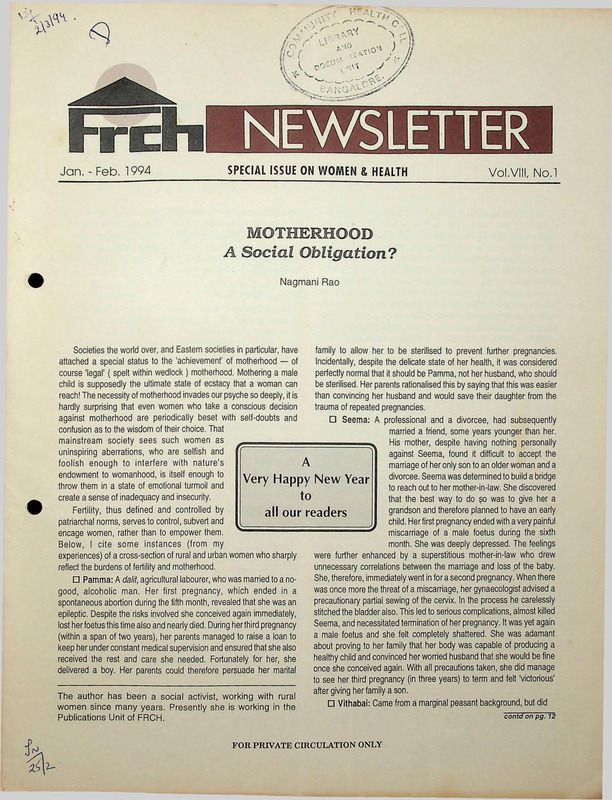
MOTHERHOOD
A Social Obligation?
Nagmani Rao
Societies the world over, and Eastern societies in particular, have
family to allow her to be sterilised to prevent further pregnancies.
attached a special status to the ‘achievement1 of motherhood — of
Incidentally, despite the delicate state of her health, it was considered
course legal' (spelt within wedlock) motherhood. Mothering a male
perfectly normal that it should be Pamma, not her husband, who should
child is supposedly the ultimate state of ecstacy that a woman can
be sterilised. Her parents rationalised this by saying that this was easier
reach! The necessity of motherhood invades our psyche so deeply, it is
than convincing her husband and would save their daughter from the
hardly surprising that even women who take a conscious decision
trauma of repeated pregnancies.
against motherhood are periodically beset with self-doubts and
□ Seema: A professional and a divorcee, had subsequently
confusion as to the wisdom of their choice. That
mainstream society sees such women as
uninspiring aberrations, who are selfish and
married a friend, some years younger than her.
( ■
--------
throw them in a state of emotional turmoil and
create a sense of inadequacy and insecurity.
Fertility, thus defined and controlled by
patriarchal norms, serves to control, subvert and
encage women, rather than to empower them.
:
A
foolish enough to interfere with nature's
endowment to womanhood, is itself enough to
-
His mother, despite having nothing personally
against Seema, found it difficult to accept the
marriage of her only son to an older woman and a
Very Happy New Year
to
all our readers
-
divorcee. Seema was determined to build a bridge
to reach out to her mother-in-law. She discovered
that the best way to do o was to give her a
grandson and therefore planned to have an early
child. Her first pregnancy ended with a very painful
miscarriage of a male foetus during the sixth
month. She was deeply depressed. The feelings
Below, I cite some instances (from my
experiences) of a cross-section of rural and urban women who sharply
were further enhanced by a superstitious mother-in-law who drew
unnecessary correlations between the marriage and loss pf the baby.
reflect the burdens of fertility and motherhood.
□ Pamma: A dalit, agricultural labourer, who was married to a no
She, therefore, immediately went in for a second pregnancy. When there
good, alcoholic man. Her first pregnancy, which ended in a
was once more the threat of a miscarriage, her gynaecologist advised a
spontaneous abortion during the fifth month, revealed that she was an
precautionary partial sewing of the cervix. In the process he carelessly
epileptic. Despite the risks involved she conceived again immediately,
stitched the bladder also. This led to serious complications, almost killed
lost her foetus this time also and nearly died. During her third pregnancy
Seema, and necessitated termination of her pregnancy. It was yet again
(within a span of two years), her parents managed to raise a loan to
a male foetus and she felt completely shattered. She was adamant
keep her under constant medical supervision and ensured that she also
about proving to her family that her body was capable of producing a
received the rest and care she needed. Fortunately for her, she
healthy child and convinced her worried husband that she would be fine
delivered a boy. Her parents could therefore persuade her marital
once she conceived again. With all precautions taken, she did manage
to see her third pregnancy (in three years) to term and felt ‘victorious*
The author has been a social activist, working with rural
women since many years. Presently she is working in the
Publications Unit of FRCH.
after giving her family a son.
□ Vithabai: Came from a marginal peasant background, but did
FOR PRIVATE CIRCULATION ONLY
contd on pg. 12
WOMEN’S BELIEFS ABOUT ANATOMY
Manisha Gupte
Why is it necessary to find out about women's beliefs about their
certain afflictions caused by local gods, goddesses and spirits. Twenty
anatomy? It may seem rather pointless perhaps, to delve into
seven questions were asked, and women were asked to point out a
obscurantism, glorifying the old traditions, when our job as modem
body part or an affliction on a line drawing of a woman's body. The first
educators is to take the people forward. When people, especially
19 questions related to the location of organs (entities, apparatus or
women, have suffered so much through tradition and culture, it may also
spaces) and of physiological functions. The remaining 8 were related to
seem a little insensitive to indulge in such a meaningless enquiry. But in
location of sites where certain deities affect the body.
our well-meaning efforts, we try to replace traditional models of
understanding the body with the new Western anatomical model. The
underlying belief is that the latter is better than the former. On the other
hand we are also aware of the fact that Western medicine is not valuefree and that it is heavily biased against women. Is it then a case of the
proverbial devil and the deep blue sea, or is there a third option ?
The Women's Movement brought about a breakthrough in the
understanding of our own bodies. We rediscovered ourselves with
pride, and we learnt to be suspicious of male-defined constructions of
our bodies and minds. Our experiences were valid, too! The form of
knowledge was as important as the content and so was the vocabulary.
We searched for new words and many of these came from our own
feelings and existence.
To create visibility and space, then, becomes the central theme of
becoming autonomous, and this process has to continue forever.
Women, even if they are rural, illiterate and traditional, have to speak
out about how they see their bodies, their illnesses and the subsequent
cures. With this in mind, we have been talking to women about various
aspects of physical and emotional health, reproduction and sexuality.
Demographic Data
A: Castewise: (1). Maratha/Mali 50% (2). Brahmins and Privileged
balutedars (artisans) 4% (3). Unprivileged balutedars and Scheduled
Tribes 33% (4). Muslims 13%
B: Agewise: (1). Between 20 - 30 years 18% (2). Between 31 - 40
years 33% (3). Between 41 - 50 years 32% (4). Between 51 - 60 years
13% (5). Above 60 years 4%
C: Educationwise: (1). No formal education 74% (2). Upto Std IV
14% (3). Upto Std VI110% (4). Upto Matriculation 2%
We tried as far as possible to interview women who had not been
exposed to the Western model of understanding physiology and
anatomy. The responses to most questions did not vary with respect to
caste, age or education. Two women who are with MASUM (Mahila
Sarvangin Utkarsh Mandal - the development group we formed) for the
past two years, showed some typical responses. The rest of the women
were quite consistent in their understanding/ perception of body and
illness.
This article is only one part of a series of enquiries.
As a health educator and trainer*, one’s consistent experience was
that women responded heartily to all the information we provided about
reproductive biology. Nowhere did we find women reluctant to discuss
I. Location of Body Parts or Functions
1. The Brain: All 55 women unanimously agreed that the brain is
located in the skull, above the forehead.
their experiences and problems. That made us think. Weren't women
2. Jaundice: Jaundice is located' near the eyes. In its early stage, it
supposed to be coy? Or was that something that the Sanskritised
affects the eyes, turning them yellow. At this point, it is not dangerous
version would have us believe? The best way was to ask women to fill in
and can be cured by herbal remedies and also by tying a sacred, or
the missing third dimension to our knowledge.
‘charged' string of herbs tightly around the neck. The string 'grows'
The following article attempts to listen to what women have to say,
(earlier the roots are wet; as they dry up, the string around them
without a running commentary all through. No judgement is attempted,
loosens) and hangs down upto the abdomen in a week after which
either way, on the information that women have shared. The question
jaundice recedes. However, if the jaundice travels down into the
naire is extremely tentative, being based on one's limited knowledge of
abdomen one finds a swelling in this region. This jaundice is not related
local religio-cultural perceptions. As mentioned earlier, this enquiry is
tokaleejorthe liver.
only a part of an ongoing interaction with women and men in our
3. Kaleej: This word is not understood as liver, sometimes
villages. During March and April 1992, we interviewed 55 women from
synonymous with heart as well as With the mind (i.e mana\ It is located
Malshiras village regarding their perception about the body and about
between the breasts, or just above or below them, in the centre of the
body. It is of vital importance to our existence.
The author is a feminist and a health activist. She is a trustee
of MASUM - Mahila Sarvangeen Utkarsha Mandal - a self-help
group of women at taluka Purander, District Pune.
FRCH NEWSLETTER. VOL. VIII, NO. 1. JAN.-FEB. 94
4. Mana, or mind: The concept of mind or mana is close to that of
heart, rather than that of brain. It ‘feels’ rather than thinks’. It is located
along with the kaleej. Three women out of 55 said that the mana was
2
located at the base of the throat; one said that it was located in the brain,
— is a little different from Aristotle’s ‘wandering uterus’ that causes
and one woman said that it was located inside the mouth and it 'speaks
hysteria. Vaygula is related to post-natal complications and sometimes
on our behalf. One woman, who pointed out the kaleejin the abdominal
to pain during menstruation , not so much to psychological disorders).
region, said that the mana was located there, too. The location of the
Three women said that they did not know anything about this entity.
mana unanimously was in the central and interior part of the body.
5. Lung: This is a single entity, not a pair. It is located near the mind,
again between or just above the breasts, the centre of the body.
17. Where is menstrual blood formed? One woman said that it was
formed in the brain, one said that menstrual blood was- formed all over
the body and then eliminated through the urinary orifice, and one
The above five questions were related more or less to ‘vital entities’,
woman specifically mentioned that it was formed in the pishvi or ‘bag* —
all of which are located near the breasts. The three questions that
meaning uterus. One respondent said that it was formed in the finger
related to ‘digestion* were:
6. Stomach: This is located above the navel.
7. Intestines: They are also located above the navel, around the
stomach.
8. Nail: They are two vertical 'muscles* or ‘nerves' in the abdomen,
close to and above the navel.
Four questions were asked about physiological functions:
9. Where is urine formed? Out of 55 women, one woman said that
she didn't know. One woman pointed to the centre of the abdomen,
above the navel. Two women said that it was formed in the uterus. All
nails. One woman said it was formed in the ‘egg*. This young woman (a
Muslim with no formal education) had seen our Women's Reproductive
Biology slide-show three years ago — this might account for the idea of
the 'egg'. Two women mentioned the otipot, without specifying uterus
as the site where menstrual blood forms or ‘collects’. The rest pointed to
the area below the navel.
18. Where is the 'Tambi' or Copper - T fitted? Eleven out of 55
women said that they did not know the answer to this question. This
category includes women who are as young as 22 years of age. Two
women said that it was fitted in the uterus and one said that it was fitted
upon the ‘mouth of the uterus*. Seven women said that it was fitted in
others said that urine is formed below the navel, sometimes in the groin,
the urinary apparatus. While 10 women pointed to the pubic region, the
in the‘front* of the body.
rest (24 women) said that the IUD was fitted inside the vagina.
10. Where are faeces formed? Two women pointed to the
abdomen, above the navel; one woman said that they were formed in
the lower backbone; while one woman said that they were formed in the
uterus. All others said that they’ were formed below the navel, in the
19. Where is the ‘operation’ or tubectomy performed? Twelve
women said that tubectomy was performed on the navel. Nine women
mentioned the oitipot, whereas the rest pointed to the area just below
the navel.
posterior region, ‘behind the urine'.
11. If 'germs’ enter through the mouth, where do they spread? How
are they eliminated? and
12. If ‘germs' enter the body through the nose, where do they
spread and how are they eliminated? Five women out of 55 said that
II. Role of the Supernatural
The second set of eight questions was related to the effect of a few
revered and fearsome gods,.goddesses and spirits on the body.
they did not know the answers to the above questions. Two women said
20. How does Mari Aai affect the human body? Twenty-two women
that the germs entered the brain, where they got killed and then they just
said that they did not know as to what exactly Mari Aai did. Twenty-three
stayed there. Most others said that the germs entered the abdomen and
women said that she caused itching all over the body, created ‘heat* and
were thrown out through the anus. Five women said that the germs
constipation. Three women indicated three different areas of itching: the
spread all over the body and might be eliminated through the urine or
face, the chest, and the inside of the mouth. Both men and women are
along with faecal matter.
affected by the curse of the Mari Aai.
The following 7 questions were related to the reproductive system:
13. Where are the otipot andpishvi, or uterus? Otipot is the uterine
region, whereas uterus and Pishvi are the same entity. It is the most
important organ related to conception.
14. Where is the baby conceived? Where does it grow? The baby is
conceived in the uterus. It grows there, too. In the latter part of
pregnancy, the baby grows beyond the otipot region and reaches upto
the abdomen, or chest.
15. Where is the placenta? Forty-five women felt that the placenta
was always attached to the child. However, when the baby is born, the
placenta may not come out “because it could have got stuck to the
chest". This is an emergency in obstetrics and “only a good daican save
the delivering woman”. Three women said that the placenta was
attached ‘anywhere* in the lower abdomen; one said that it was attached
to the woman’s navel and two said that it was attached to the uterus.
One woman said that the placenta was attached to the urinary bladder.
16. Where is the vaygula ideated? Vaygula is located in or around
the otipot. All women agreed that it had a tendency to wander around in
the lower abdomen in the kusati (both Sides of uterus) after delivery, and
it had to be set in its place by an expert dai, through repeated massages.
If left to wander, it causes obesity, pain and post-natal complications.
(The understanding of vaygula—crudely translated as 'a ball of wind’
21. Where does Mothi Bai affect the body? Five women were not
sure as to how Mothi Bai acted—the others said that this goddess was
a ‘heat producing* deity, causing boils, blisters, burning in the stomach,
and rash in the mouth, on the face and on the body. If one does not
recognise the affliction as the goddess’s anger and does not
immediately offer penance, then an abscess forms or a wound refuses
to heal. If medication is sought, Mothi Bai gets particularly angry and
then she causes pain, fever and psychological disorders leading to
complete exhaustion of the person. Men, women and cattle are affected
alike by Mothi Bai. Different Mothi Bais can affect a person. There is a
brahmin Mothi Bai, a gurav, a mali, a Muslim, a Gujarati, a nomadic and
a Germal (German) Mothi Bai, too! (During World War II, German
prisoners of war were kept on Purandar Fort in our taluka — perhaps
that is the connection). Each Mothi Bai has to be pleased in a specific
fashion, for example: vegetarian food for the brahmin goddess, flowers
for the mall goddess, etc.
22. How does Kalubai affect the body? She causes headaches,
bodyaches and fever with rigours. She affects the whole body, and
people get bedridden. She can torture a person beyond reason, causing
madness and she can even ‘hang you to death'. The entire household is
affected, quarrels start brewing and family peace is shattered. Twentytwo women were ignorant of Kalubai’s specific effect on people.
contd on pg.5
3
FRCH NEWSLETTER, VOL. VIII, NO. 1, JAN. - FEB. 94
REPRODUCTIVE HEALTH
An Evolving Perspective
FFWH Team
Any issue-based group faces a dilemma after a few years of its
activities. Ours was strictly an issue-based group—the Forum Against
brought us face to face with the societal attitude towards reproduction
especially in the context of global population control ideology.
Sex-Determination And Sex-Preselection, now also known as Forum
Today, it is being argued openly, even by the progressive and
For Women’s Health, formed in 1986. We, individuals and
environmentalist groups that population is a major problem. They go on
representatives of groups active in different fields, tried to come together
to the extent of saying that any means necessary can and should be
for this issue-based work. We worked without any formal structure and
without having any official spokesperson. The issue was of sex
used to curb this population explosion. While projecting population as a
grave problem, they are being unable to differentiate between birth
determination and sex-preselection which can be achieved with the help
control and population control. On the other hand, for us, now, these are
of prenatal diagnostic techniques like chorionic villi biopsy and
issues that are more clearly understood today than ever before. Our
amniocentesis—the latter being a more popular technique. Around this
demand for birth control is in fact: a demand for the right to determine
issue, it was possible to build a convergence of issues like human rights
our existence in ways that we want; our efforts at reclaiming our
issue, women’s issues and people’s science issues. Our main demand
personhood, at denying the bounds of motherhood imposed by society
was: legal regulation of this technique. Along with this, were attempts to
which have crushed our ‘person’ in more ways than one. It is this need
create awareness amongst people regarding women’s oppression and
that is being exploited for population control, to crush any efforts at
sex-discrimination in society.
redefining ourselves on our terms.
Since then many changes have occurred in our initial position. First,
we were concerned with the life and existence of female foetus, and the
emphasis was that it was a human rights issue, an issue of right to be
bom as a female. This changed very early in the group to a women
centred emphasis. The whole stress was then on the issue of women’s
oppression as also it being a misuse of science and technology.
The experience and the realisation of futility of regulation on sex -
determination techniques in the state of Maharashtra, and overall
societal attitude towards male child forced us to rethink. A persistent
struggle to get a regulation passed by the central government was
continued, but at the same time we were rethinking about our method of
campaigning. Newer and newer invasive techniques were developing in
the area of sex-determination and they were becoming a part of
‘development’. These ‘developments’ in science and technology in the
name of helping the society solve its problems made us broaden our
vision. The hazardous implications of stress on finding technological
solutions to social problems, which was an implicit issue in our
campaign, Was becoming more and more explicit.
The composition of our group has changed over the last few years.
Now most of us are women, active in health issues and women’s issues
in general. The focus is on the broader issue of reproductive health.
Starting from issues related to prenatal diagnostic technology, we have
now focussed on all technologies of reproduction. The group is presently
active in campaigns against contraceptive methods that are long-acting,
provider controlled and make systemic changes in the body. This has
Forum For Women's Health (FFWH) is a group that began as
Forum Against Sex-Determination and Sex-Preselection, in
1986. Since then the group has widened its sphere of activities,
which now include also the issues in reproductive health,
especially contraception.
FRCH NEWSLETTER, VOL VIII. NO. 1. JAN.-FEB. 94
Our Rationale
A woman cannot perceive her individual existence as a separate
entity. She can think of herself only in relation to and with respect to
others. In case of sex-determination tests it is very difficult to determine
whether it is the woman’s desire to produce a male child or whether this
particular technique is being forced on her. Women have been made to
perceive their existence only as providers of sexual pleasure to men, or
as reproducers and that too preferably of a male child. This
understanding of their role is being perpetuated through generations
and is reinforced with the advent of new technology.
A striking example is of menstrual bleeding and its repercussions on
a woman’s life. No understanding achieved by science, of the beautiful
and delicate menstrual cycle, has been of the kind which will allow her to
accept it as something which is not a dirty or hideous phenomenon
happening to her every month. At the same time, in fact, if any woman
complains about her difficulties during menstruation, it is considered by
society and hence by medicine as her psychological problem which has
no ‘scientific’ explanation. This same society makes her accept the
hormonal contraceptives. The changes in bleeding pattern after use of
hormonal contraceptives are also-labelled as psychological and not as
an alarming factor to be taken cognition of. This attitude of society and
science is so much imbibed by the women that there is no questioning of
any kind. Everything is accepted as a fait accompli.
This attitude of women towards their own self not only alienates
them from their own bodies, but allows them to undergo any torture.
This attitude does not differ from the developed world to the underdeveloped world or from the rural to urban areas. It is just that the form
of torture may vary with the geographical situations and the extent of
advent in the technological aspects. In the developed world women are
4
forced to produce more children because of the problems of shortage of
contd. from pg.3
human power and in the under-developed world it is forced on women
23. How does Mhasoba affect the body? He causes weakness,
to control their fertility at any cost under the pretext of 'population
giddiness, vomiting and fever. Limbs ache. All family members start
explosion’.
The difference is again not so important because the emphasis on
curbing the population is also very much a part of certain sections of the
getting affected, once Mhasoba curses a person. When angry, Mhasoba
kills. Twenty-eight women did not know how Mhasoba affected them or
anyone else.
first world, and in the same way, in the third world, fertility is promoted in
24. How does Khandoba affect the body? He causes madness in a
certain sections of society. We want to dwell on this point because we
person. The head of the household and the senior males are particularly
feel that all these attempts of forcing to produce more or less children
oppress women.
To achieve this, society makes use, to the fullest extent, of the
psychological make-up of women which is an outcome of societal
oppression of centuries. Stressing reproduction as the primary role of
vulnerable. Economically, the household is shattered. Family members
start getting suspicious of each other, become inhuman, aliented and
cruel. Quarrels, mentally unsound and delinquent behavior are
characteristics of Khandoba's anger. Twenty-eight women were not
aware of the details of Khandoba's anger.
women, while taking away any freedom to be able to make any
25. How do the Saati Asras—Apsaras (seven nymphs) affect the
independent decisions, can in no way help towards making women's
body? They torture women. They cause nightmares and adversely
health and existence a positive reality.
affect menstrual cycles — making them irregular and painful. The
We do not consider health of women as an autonomous entity. It is
very much a part of the societal milieu. And hence a single, strong,
independent, tribal woman getting murdered for being a root cause for
accidental happenings in the community becomes a lesson to all women
uterine region gets affected, becoming tender and painful. The Saati
Asras cause abortions and infertility. They enter a woman's body,
causing writhing and hysterical behavior. Twenty-five women reported
that they did not know how exactly these nymphs tortured the body.
that they must exist only within the prescribed norms of society.
26. How do the Mavlyas affect the body? (They are the seven
Roopkanwar’s sati and apparent transformation into a goddess does
sisters of Khandoba) These sisters are very secretive and cunning.
not give us any different message. Similarly, the recent news from
They cause vague, unknown symptoms in women. They cause delay in
Germany, of a pregnant woman injured to death being kept alive for the
conception and sometimes even infertility. Menstrual chaos, and
foetus to grow, re-emphasises the same outlook of the society and its
abortions are also the effect of the Mavlyas affecting a woman; children
science. All these happenings are similar as far as their rationale is
die repeatedly. Thirteen women out of fifty-five did not know how the
concerned.
Mavlyas affected people.
27. How does Satvai affect the body? Twenty-one women did not
We are not Alone
In 1989, there was an international conference held in Comilla,
know the exact behavior of Satvai. Others agreed that she affects
young children, if she is not adequately appeased on the fifth day after
delivery. She writes the child's future, whether good or bad. Children get
Bangladesh, to discuss all the issues related with reproductive
boils on the head and body, they become cranky, they contract scabies
technology. The 'Declaration of Comilla', a document brought out by the
and ringworm as a punishment from Satvai. Children become
participants at the conference, indicated the various linkages mentioned
malnourished, ricketty, lose weight and get emaciated. Satvai can also
above. A correspondence was seen among the neglect of young girls,
kill children. She can cause the mother's milk to dry overnight and can
development of modem technologies related to reproduction, and those
also cause secondary infertility, premature deliveries, still-births, and
that make interventions in nature.
problematic positions of the foetus during delivery.
As an outcome of this conference, a need was felt by Indian
participants to come together and have a discussion on health related
issues at national level. We, as a group, took an initiative to organise a
workshop in October 1989. Many groups working in the area of health
participated. Due to the diversity of issues related with health, the point
of emphasis of each group was different. Because of this, it was felt
necessary to arrive at a definition of health. Suprisingly there was total
agreement on the definition that evolved. Health was defined not as an
absence of ill-health, but as the overall well-being of a person in her
socio-economic and cultural context.
Both these conferences really helped us broaden our vision and
realise the vastness of the issue of women's health. As a result, it has
Observations
Responses of women reveal a wholly different understanding of the
body when compared to the Western model. Yet, surprisingly, women's
answers are remarkably similar—suggesting an oral communication or
a collective belief about anatomy.- Caste and age do not seem to alter
the cultural understanding about one's own body:
□
There are spaces (or entities) in the body - rather than definite
‘organs'. The body is a continuum rather than a set of disjointed organs.
□
The thorax and the abdomen (upto pubis) are one connected
region, thus it is quite possible for the placenta to travel upwards and to
become imperative on us to sharpen our arguments and politics.
stick to the chest after delivery. It is also possible for the growing foetus
Although the group is still issue-based and although the emphasis is still
to 'rot' in the mother's undigested food. Similarly, it is possible for the
on the reproductive technologies, our understanding of women's
uterus to 'collect the impure menstrual blood’ from all over the body, and
reproductive health is being further developed.
to eliminate it from the urinary orifice. The concept of a reproductive
We believe that although women need contraception, they are not
the only ones responsible for reproduction. Reproduction and all issues
canal is absent.
□
The navel seems to be a fulcrum of all reproductive activities.
related to it, have to be made the joint responsibility of men and women.
Sometimes the placenta is attached there. The uterus is located at the
At the same time, contraception is a process which should empower
navel. The ‘operation’ or tubectomy is also performed here.
women to be able to make decisions about themselves as persons. It is
something that should intervene at the level of the meeting of the egg
and the sperm, from both of whom the story of reproduction begins.
•
5
□
The Copper - T is fitted in the vagina. This may explain
women’s fear that it will interfere with intercourse and that an IUD can’t
be kept a secret from the husband.
contd on pg.9
FRCH NEWSLETTER, VOL. VIII, NO. 1. JAN. - FEB. 94
OCCUPATIONAL HEALTH OF SELF-EMPLOYED WOMEN
Some Experiences
Mirai Chatterjee
indicators of what women experience through their lives, are particularly
This Paper, whicH refers to piece-rate workers, was presented at
the West-Asian Workshop on Health and Safety, Bombay, Sept.
1991.
conspicuos by their absence. Similarly there has been very little
research on and designing of protective and preventive equipment for
workers or work processes. In light of the conditions described above,
the need to study, understand and learn these workers* special health
Self-employed women are among the poorest and the most
problems hardly needs to be emphasised. As a first step towards
exploited of workers in India. Despite their large numbers and very
working for the improvement of women’s health, we felt that it was
significant contribution to the national economy and society, these
necessary to increase our own understanding of the nature and scale of
women workers in the unorganized sector are often not even
health problems experienced by self-employed women. We also
considered to be workers. Even when they are considered as workers,
decided to focus on occupational health, as this is a particularly
their role and contribution are not given the importance that is due. As
neglected aspect of workers* lives. Our information on this issue was
these workers are ignored or 'invisible* to policy-makers, planners,
hitherto anecdotal and impressionistic. While we believed that this was
researchers and the public at large, it is hardly surprising that their
valid and important, we also felt that some supplementary data was
occupational health problems are also neglected, much less
required. Thus we began a process of collecting and documenting the
understood.
health experiences of women workers. They themselves were
However, our experience with self-employed women workers
researchers and resource persons in this process. In addition, we
reveals that they are faced with definite-health problems associated with
hoped, from the start, that the data collected would support us in
their work. Further, being among the poorest in our society, these
collective action to influence policies, programmes, public opinion and
workers live in small, badly lit homes with little or no ventilation. Few
even legislation regarding workers* occupational health status. Further,
have access to basic amenities like water supply and sanitation. Such
we thought that our research might indicate areas of study which could
living conditions, together with undernutrition and occupational health
be taken up by national research institutions. Finally, we hoped that the
problems trap them in an endless cycle of infection, disease and general
data from this research process would lead to greater awareness
poor health.
among workers and thus contribute to the struggles of workers for a
At the same time, these workers* body and health are literally their
only wealth. As long as they are able-bodied and healthy, they are able
to work and earn. However, if they or their families are sick, it means
safe and just work environment.
In this paper, the results of four community-based studies on
workers* occupational health will be discussed. These are :
that they lose their daily wages. There is no provision for 'sick leave*, or
i)
Ready-made garment workers of Ahmedabad.
any other paid leave, if they have to stay at home either because they
ii)
Bidi workers of Indore.
iii)
Agarbatti workers of Ahmedabad.
iv)
Masala workers of Ahmedabad.
are ill or to take care of sick family members. Thus their own health and
that of their families have important economic implications for them.
In addition, there are hardly any policies, programmes or legislation
for self-employed women workers. Nor is our health care system
oriented towards the health problems, particularly occupational ones, of
Research Design
these workers. Furthermore, health care practitioners of all types and
All four studies were participatory, initiating a process in which all
levels of expertise are virtually unaware of, and unfamiliar with, the
involved would learn, share experiences and collect data together. This
kinds of problems which this group of workers have, and the magnitude
methodology was chosen because of our belief that workers must be
and prevalence of the problems.
involved in all stages of research if this is to be a part of the empower-
Finally, there are very few studies focussing on the occupational
ment process. We also believed that some of the best research and
health of women workers. Longitudinal studies which could be important
data is generated when the workers themselves are involved.
The author is the Co-ordinator of the Health Team of SEWA
some workers’ representatives visited all the various neighbourhoods
and also the Secretary of the Lok Swasthya Health Workers*
Where women live arid work. We not only observed their living and
working conditions, but also learned about the magnitude and range of
1. Area visits and discussions with workers: SEWA organisers and
Co-operative. SEWA- the Self Employed Women’s Association
is a registered trade union of 100,000 women workers in the
problems that they face every day. We spoke to individual workers of all
informal sector. Lok Swasthya Co-operative provides holistic,
ages and communities, their representatives and leaders affiliated to
integrated, work-linked primary health care to SEWA members.
SEWA and other organisations, and had informal discussions, in small
FRCH NEWSLETTER, VOL. VIII, NO. 1. JAN.-FEB.
94
6
groups. Some of the SEWA organisers were workers themselves and
were aware that our studies had limitations in terms of conclusively
lived in the same neighbourhoods; this naturally helped greatly in terms
establishing cause and effect relationships between an occupation and
of establishing rapport with workers and facilitating the learning, sharing
a particular health problem.
and data-collection process.
The third section was aimed at collecting data on other health
2. Group-meetings with workers outside their workplace: Over a
problems (those other than the ones experienced while actually working
period of an year, we had several meetings with workers at the SEWA
in a particular occupation). What emerged in our discussions with the
office, in community halls or in schools nearby. Generally, workers from
workers was that the gynaecological problems were very prevalent.
different neighbourhoods who participated in earlier meetings came to
Hence, in this section, questions related to specific gynaecological
the subsequent ones as well. At every meeting, the health aspect of
symptoms were asked.
workers’ lives was discussed, alongwith other issues like low wages and
identity cards. Women articulated specific needs and recommendations
with regard to health which we have incorporated in our discussions on
recommendations.
3. Discussions with local health functionaries, doctors, govern
ment welfare officers and social workers: We tried to collect and
exchange information from a wide range of sources in order to access
the level of existing knowledge and examine attempts, if any, to solve or
alleviate women's occupational health problems. In addition, we wanted
to learn about existing government and non-government programmes
and policies concerning these workers.
)
Results and Discussion
1. Socio-economic profile: In Table 1, some socio-economic
4. Surveys: Four surveys were undertaken to obtain data on the
indicators of the workers of the four occupation groups have been
portrayed. This profile reveals that the self-employed women are poor,
work long hours for low wages and many are illiterate. The masala
workers had the highest percentage of illiteracy. Fifty per cent or more
of the workers in each sample worked between eight to twelve hours a
day. This work, of course, refers to wage labour and excludes the time
taken for household chores and childcare. Finally, the majority of
workers reported daily incomes of no more than Rs.10/-. Only masala
workers were earning more than Rs.10/-. However, it should be
prevalence of certain health conditions, specific to each occupational
emphasized that their work is seasonal.
group. The surveys were intended to be cross-sectional studies and we
did not involve other women workers as ‘controls’. For all four surveys,
samples of workers were taken from the city in question, and an attempt
was made to include all the major areas where workers live and work.
Table 1
Selected Socio-economic Indicators of the Four Trade
Groups (% tage of workers in each sample group)
We also tried to obtain a cross-section of workers in terms of age, years
of work and community. The survey questionnaires were designed to
Socio-economic
Ready-mades
Bidi
Agarbatti Masala
collect this data which the women themselves considered relevant.
Indicators
workers
workers
WORKERS
workers
N=100
n=156
n=150
n=150
The sample sizes for each group and the estimated total number of
workers of each occupation in Ahmedabad city or Indore are given in
the table below. The total number of workers are SEWA’s estimates,
Married
65
86
88
84
based on years of work with the women. However, no systematic
Illiterate
28
56
37
66
89
62
50
53
57
—
—
—
census of these occupation groups has ever been conducted.
Hours of work per day
8-12 hrs
Occupation group
Sample size
()
Estimated
WORKERS IN THE
•
Dailly Income:
TOTAL NUMBER OF
Rs. 5-8
OCCUPATION.
Rs. 9—10
—
77
65
16
---
15
19
41
9
7
2
42
1. Ready-made Garment workers
100
10,000
Rs. 11—15
2. Bidi workers
156
7,000
More than Rs. 15
3. Agarbatti workers
150
10,000
4. Masala workers
150
2,000
Each questionnaire was divided into three sections. The first was
aimed at collecting some general socio-economic data about the sample
of workers. This included questions about age, community household
size, literacy, hours of work, years of work and income.
The next section was designed to obtain information about a) the
2. Occupational health profile: In our numerous individual and group
discussions with women, what emerged was that both while at work
(that is, sewing garments, rolling bidis or agarbaitis and crushing
masalas into powder) and immediately after work, women experienced
several health problems or symptoms. The nature of some of the major
problems portrayed is evident in Tables 2 and 3. It should be emphasized that this data was obtained by careful questioning and interviews
of the workers, and not by clinical examinations: The basic premise, as
kind of health problems women experienced while actually working in a
mentioned earlier, was that the workers themselves know best what
particular occupation, b) health problems experienced after the day’s
their problems are, as they experience these every day and throughout
Work in that occupation was complete and c) whether treatment was
their lives.
sought for these health problems arid, if so, what type was preferred. In
addition, all the health problems mentioned were those that a worker
experienced at the time of interview and not regarding any previous
illness. Finally, we recorded all responses of the Workers, regardless of
whether we felt that a particular health problem Was work-related or not.
As we were not doing a case-control study over a period of time, we
7
From Table 2, it is evident that pain in the limbs, namely hands,
arms, legs and feet, is the most common and was reported by 80% of
garment workers and 63% of bidi workers. Back pain and headache
were also commonly reported. From our observations and from
discussions with the workers, it appears that posture adopted while
working may be contributing to the pain experienced.
FRCH NEWSLETTER, VOL. VIII, NO. 1, JAN. - FEB. 94
Table 2
Distribution (%tage)of Occupational Health Problems
while at Work
Furthermore, as Table 4 shows, workers experienced several of the
problems they reported, simultaneously, and both while at work and
immediately after.
As our community-based studies did not incorporate experiences of
Health Problem
Ready-mades
Back Pain
Bidi
17
56
47
Agarbatti Masala
a group of workers as ‘controls’, conclusive statements about statistical
significance, associations and causality cannot be made. Our studies
9
were aimed at involving workers in studying their own health, particularly
at work, and increasing their awareness of health problems by
Pain in Limbs
80
63
7
38
Headache
41
37
—
1
Dizziness
23
44
—-
1
Eye Problems
26
25
—
2
Exhaustion
—
46
—
1
collectivizing their experiences. Based on these, we suggest that
longitudinal, epidemiological studies on these workers’ health problems
be undertaken.
3. Gynaecological problems: In the course of questioning the workers
about their work-related health problems, we found that many women
wanted to tell us about their gynaecological problems. Thus, although
we had not intended to do so originally, we began to question the
In the case of problems experienced immediately after or on
completion of the day’s work, agarbatti and masala workers reported
more problems or symptoms on the whole. Seventy-three per cent of
agarbatti and 39% of masala workers, for example, complained of back
pain, as compared to 12% of bidi workers. Interestingly, only masala
workers (51 %) reported that they developed blisters and calluses on
their hands after work and that they experienced a burning sensation
(45 %) especially in their hands. This could be due to their work process
which involves repeated pounding with a metal rod. This rod repeatedly
rubs against the palms and fingers, thus causing blisters.
Table 3
Distribution (% tage of sample size) of Occupational
Health Problems Reported Immediately After Work.
Health Problem
Ready-mades
Bidi
Agarbatti
Masala
Back Pain
—
12
73
39
Pain in Limbs
33
9
78
16
Headache
—
21
23
11
Dizziness
49
47
11
23
Eye Problems
18
16
7
11
Exhaustion
47
63
2
6
Blisters & Callouses
—
—
—
45
—
—
—
45
group samples. Fifty-eight percent of the bidi workers, for example,
reported early periods. Fifty-four percent of them and 57% of readymade
garment workers said that they had white discharge. Fifty four percent
of masala workers experienced burning sensation while urinating, more
than any other group who reported this symptom. Finally, the majority of
workers in all four groups reported pain in the abdomen.
Table 5
Distribution (% tage of sample size) of Gynaecological
Problems Among Workers
Ready-mades
Bidi
Agarbatti
Early periods
7
58
7
6
Heavy bleeding
14
21
9
3
while urinating
33
28
16
54
White discharge
57
54
26
28
30
23
24
56
80
62
63
53
Health problems
Masala
Itching sensation
while urinating
Pain in lower
abdomen
Table 6
Distribution (% tage of sample size) of Gyaenecological
Problems Occuring Simultaneously
Table 4
Distribution (% tage of sample size ) of Occupational
Health Problems
A = While at Work
considerable gynaecological morbidity among all the four occupation
Burning sensation
Burning sensation
(especially in hands)
women on this aspect of their health. We found that there was
B = After Work
No. of Problems
Agarbatti Masala
Ready-mades
Bidi
Less than 2
7
4
12
8
2— 4
42
47
69
40
More than 4
51
48
19
51
A
No. OF HEALTH
Ready-mades
Bidi
Agarbatti
Masala
found that the vast majority of them reported more than two at a time. In
Less than 2
16
6
91
69
2—4
74
77
9
31
More than 4
10
15
—
—
2-4
More than 4
fact 51% of ready-made garment and the same percentage of masala
workers reported that they experienced more than four gynaecological
problems at a time.Forty-seven percent of bidi workers and most of the
-
less than 2
When we attempted to determine how many of these gynae
cological problems occurred simultaneously among the workers, we
PROBLEMS
B
agarbatti workers (69 %) reported that between two and four problems
44
24
56
0
occurred simultaneously.
6
20
' 73
81
75
We did not conduct pelvic examinations or laboratory tests to
0
: 13
5
diagnose gynaecological diseases based on the symptoms or problem
FRCH NEWSLETTER, VOL VIII, NO. 1, JAN.-FEB. 94
8
reported by the women. This data, however, does reveal that there is
7. Provision of health insurance: Health insurance should be made
considerable gynaecological morbidity, which, for the most part,
available to self-employed women workers. Health cards should be
remains undetected. There is, therefore, a need to study these problems
given to workers entitling them to receive health care of their choice and
and to find out how they can be prevented, detected and treated at the
free medicines at any state public health facility and/or recognised
community level.
private facility upto a certain limit.
The suggestions made above are those which are directly health-
Applicability of Findings
This paper has briefly attempted to outline four community-based
studies undertaken by women workers in those particular occupations.
Workers' own experiences were not only considered valid, but formed
the basis of the studies. This resulted in a kind of 'health audit' of each
occupation and also served to collectivize and quantify what had hitherto
been workers' individual experiences. From this 'health audit' a few
suggestions may be made if we are to work towards the improvement of
women's health status in our country.
related. However, we would like to emphasize that in order to improve
women workers’ living and working conditions, and thus their overall
health status and well-being, certain interventions are essential. These
include provision of identity cards to women, thus recognizing them as
workers; enforcement of minimum wages; regulation of working hours
and provision of basic amenities such as adequate housing; water
supply and sanitation. These have not been discussed here but it is
important to note that without simultaneous efforts towards obtaining
these, all interventions designed to improve self-employed women
workers’ health will necessarily have limited effect. Women workers’
1. The need for research on occupational health: We found in the
health is closely interwoven with the nature of their work and working
course of our research that there were virtually no studies on the
conditions. Thus attempts to understand and improve their health must
occupational health of self-employed women. One important
recommendation from our studies would be: undertaking of in-depth,
be undertaken in the wider context of their overall efforts for justice in
the workplace.
epidemiological studies of these workers as a priority. This research
would include the ergonomic aspect of women's work about which very
little is known, the prevalence of occupational morbidity and the
prevalence of stress among workers. The research also needs to focus
on possible preventive measures and even simple, affordable
References
1.
Chaterjee M., Occupational Health Issues of Home-based, Piece-rate workers: three
2.
studies of ready-made garment, bidi and chikan workers, SEWA, March 1988.
Chaterjee M„ Occupational Health of Self-employed Women: some issues and
experiences, Paper Presented at the 'Shakti', Women's Health Workshop, Bombay,
equipment to safeguard workers' health. Workers should be closely
involved in the research process, both for their own learning and
3.
awareness and for finding solutions suitable to them and their living
conditions.
4.
employed Women Workers, New Delhi, January 1988.
Jhabvala R. & Jumani U., Experience of Organising Home-based Workers in India,
5.
SEWA, Ahmedabad, 1986.
Tripathi G. C., Vasudeo N.D., Majumdar R.D. & Deotale P.G., Study of Lung Function in
2. The need for research on gynaecological diseases: Research
should also focus on gynaecological morbidity which appears to be
December 1987.
Chaterjee M. and Macwan J, Occupational Health Issues of Self-employed Women:
agarbatti and masala workers of Ahmedabad, Study for National Commission for Self-
Bidi Workers, Indian Journal of Occupational Health, Vol. 28(4), Oct.- Dec. 1985.
widespread among poor women. Appropriate preventive measures
©
could be suggested or developed, alongwith workers' own recom
mendations.
3. Orientation of existing health facilities to workers’ needs: In
contd, from pg, 5
areas where large numbers of workers live, the out-patient dispensary
We have covered only eight of the various deities affecting people’s
(OPD) of the nearest health centre should have a special division for
health. None of the ghosts and ghouls have been covered here. Many
self-employed workers. The timings should be fixed according to
illnesses, dysfunctions, deficiencies are considered as the result of
women's needs. The findings of research, as discussed above, should
disobeying or displeasing a particular deity. Mental disorders and
be used to both orient the health functionaries with regard to workers'
poverty are also caused by malevolent (or angered) spirits and gods.
health and to organise health services accordingly.
4. Provision of safe, subsidized tools of production: Safe,
□
Many Muslim women were not aware of the ill-effects of those
gods which ‘possess’ a person. However, they all agreed that many
subsidized tools (for crushing masalas, sewing garments and so on)
gynaecological complaints were caused by the nymphs and the Mavlyas
should be made available to workers, to improve their work environment
or that Satvai affects children.
and to reduce work-related health and safety problems.
5. Provision of preventive equipment and health education: Safe
□
Only two women out of 55 categorically stated that malevolent
spirits do not affect the body and mind. Both these women from
and low-cost preventive equipment should be provided to workers at a
unprivileged balutedar families are between the age group of 30-40
subsidized rate. Through the Workers' Education Board, preventive
years and have been working with MASUM for the past two years.
health education, both with respect to occupational and other health
As mentioned earlier, I have deliberately refrained from taking
problems should be initiated. Unions and other organisations working
positions on what my women friends had to say about their own bodies.
with self-employed workers should have access to these health
Later on, after a series of related enquiries, I hope to understand these
education programmes, and should be involved in the planning and
observations within a feminist theoretical framework. For the time being,
actual implementation of them.
the space to speak out, belongs entirely to the women of my community.
6. Provision of benefits; Weekly day off, paid holidays, sick leave,
maternity leave, old age pension and creche facilities: Self-employed
women workers do not have any fixed employer-employee relationship,
if at all. And yet, Whether provided by the employer or the state, certain
minimum benefits are needed which would affect women’s overall
health status.
9
Acknowledgements:
□
To Shaila Magar for helping with collecting of information and to the 55 women who actively
cooperated with the researchers.
•
A special acknowledgement is due to Dr. Rani Bang, from whom I got the idea to conduct
an enquiry with the help of a line representation of a woman's body. She has conducted a
similar study and I am grateful to her for sharing her idea with me.
FRCH NEWSLETTER, VOL. VIII. NO. 1. JAN.. FEB. 94
WOMEN’S HEALTH, TRADITIONAL MEDICINES &
EMPOWERMENT
Renu Khanna
It is now increasingly being acknowledged that women’s health
their status. Once women have the confidence, the ability to analyse the
status is a composite of many factors : women's lack of power; their
situation and to take their own decisions, their health status would
secondary status in family and society and the resulting discrimination;
improve.
lack of knowledge and information; certain harmful cultural and
What then is empowerment of women in the context of women's
traditional practices, most of which have had their roots in patriarchy;
health ? We, at SARTHI, have visualised empowerment related to
and lack of access to safe and empathic services. Among other things, it
women’s health as follows: Empowerment of women could be
is women's perceived lack of power which pushes them into a situation
manifested along a continuum. At an intrapersonal level, empower-
of early marriage and consequently early child-bearing. Powerlessness
ment begins with individual women having a changed perception of
in the face of social pressures makes them go through the rites of
themselves. What they earlier thought as dirty and a cause of sharam
womanhood: multiple pregnancies in quick succession so that they can
never be anything but exhausted and weak. It is their lack of power and
(shame, embarrassment), they now begin to claim and own. The
physical problems which earlier went undiscussed, now begin to come
the inability to have any control over their bodies, which make many
out of the shrouds. At the interpersonal level, women begin to realise
women yield to the brutalities of conjugal life — in many cases it takes
how certain relationships, and their subordinate role in them, directly
affect their bodies. An example of this is the relationships with their
on the hue of more chronic suffering through the transmission of sexual
diseases and their sequelae.
husbands. In small ways they begin to negotiate these relationships so
Gender-discrimination which often begins even before birth, affects
that the power differentials are gradually lessened. At the next level,
the nutritional status of females. Gender-discrimination in the allocation
groups of women get together to negotiate relationships in the
of food — as well as in health care and education — is a widespread
environment. For instance, a small group of women may decide to
and well-documented phenomenon in much of the developing world.
accompany their village sister to the health centre to make sure that she
Nutritional deficits contribute to certain lifelong handicaps such as
gets the service which she requires. And finally at the community level,
stunted growth and chronic anaemia, two of the main factors behind
women organize themselves, for collective action, around their own
complications of pregnancy and childbirth as well as other chronic
issues. They may organize to demand their health rights from the state;
gynaecological problems. Cultural and traditional practices which
or they may organize to draw attention to issues which directly affect
restrict nutritional consumption when women most need it, that is during
their bodies arid health — issues like rape and other forms of violence
pregnancy, further compound the nutritional deficit. A patriarchal and
which were till recently left unaddressed.
male-dominated health care delivery system which views women only
as objects and as instruments of population control, further alienates
women: even when their health problems become very serious, women
hesitate to approach the health care services. The reason for this is their
perceptions of themselves in relation to the health care system; their
belief (of course, based on past experience) that they will not be able to
negotiate with the system to their advantage.
Empowerment in the Context of Health
A very important part of the effort to improve women's health must
Redefining Women’s Health
From the above, it is evident that women's health is much more
than just the maternal health and family planning that our country's
health system has restricted it to; programmes for women's health need
to be wider in scope — they need to incorporate care for common
gynaecological, psychological and emotional health problems. The
programmes for women's health also need to take the life cycle
approach', that is, deal with health problems of women right from their
adolescence (and even before that) to menopause and beyond.
thus be directed towards empowerment of women and improvement of
Women’s Health and 'Ethnomedicine’
The author is a founder member of SAHAJ (Society for Health
Alternatives) and is based in Baroda. She is the Vice-President
of SARTHI, avoluntary agency working in Panchmahal District
in Gujarat. Since 1984, among other things, she has been
involved in developing a Women's Programme at SARTHI, of
The time is perhaps right to recognise that despite many efforts,
indicators reflecting women's health status (eg. maternal mortality,
anaemia etc.) do not show significant improvement. Some of the more
conscientious community health projects in the country have reported
that beyond a point, despite all their efforts at high risk management,
which the Women's Health Programme is a part. She is also
a member of SHODHINI, an action research group for alternative
maternal mortality rates are not going down. A major reason may
medicine and women's health in India.
into account local beliefs and practices related to women's health.
FRCH NEWSLETTER, VOL. VIII, NO. 1. JAN.-FEB. 94
perhaps be the dominant use of the biomedical model which fails to take
10
Health interventions which are divorced from the local cultural
In dealing with the local women’s beliefs, a point that was
context are likely to be resisted, if not totally rejected by the local people.
recognised was that the beliefs had a role in healing. Healing can take
In several parts of Gujarat, for instance, women believe that an intra
uterine device like Copper-T once inserted, will be irretrievably lost as it
place much faster if interventions are compatible with the belief system
of the patient. Thus the task of understanding the belief system, of
will 'climb up in the internal cavity*. Women also believe that a big
deconstructing and reconstructing the belief system, is a sensitive one.
danger of using the Copper-T is that it can cause the man and the
Starting with the analysis of the local beliefs and using their own
woman to get ‘entangled* during intercourse, and nothing short of a
terminology during the training, made us partners in the training
medical intervention can result in a 'separation*. If health care providers
process. First, we had to understand their modes of thinking about
do not acknowledge these beliefs, and do not base their health
health. Then we could analyse the harmful beliefs and practices and
education on them, no matter how hard they try to impose their health
substitute them by not so harmful ones.
education on local women's concepts of their bodies, women will not
accept IUDs.
Traditional Medicines
Beliefs and Perceptions
in women’s health and empowerment is the use of traditional medicines
A second aspect of 'ethnomedicine* that can play an important role
In the course of evolving the women’s health programme at
in service delivery programmes. Women, through the ages, have been
SARTHI, we compiled a list of beliefs related to women’s health. Listing
repositories of knowledge related to locally available flora that can be
out these beliefs alongwith our women health workers (all local women)
used for common health problems. An action research done by
was a very important exercise. The approach in dealing with the beliefs
SHODHINI (a network of ‘women’s health’ activists working with grass
was to help the women look carefully and critically at them, in order to
root women) revealed that about 175 of the 300 plants, used in different
avoid the harmful and preserve the best in them. The idea was to
parts of India by local women, were mentioned in available literature as
emphasize that which is valuable in the local tradition, and to explore
having the same properties the women used them for. These, classified
ways that build on them rather than ignoring or rejecting them. For
as ‘A’ plants, indicate the extent of knowledge of the local healers. The
instance, the women of the area believe that if a pregnant woman
‘B* category of plants (about 111) are not confirmed by the existing
consumes too much yoghurt and milk, these will ‘stick’ to the foetus and
literature as being used for the symptoms that the women use them for
make the delivery difficult. This notion formed the foundation of a
but certainly may have the properties that the women attribute to them.
session on the digestive system and how the foetus receives nutrition.
Only 14 plants, categorised as ‘C* were positively harmful and
Similarly, the beliefs about green water from the vagina (if the water
contraindicated in the available literature. The local women healers who
from the woman's vagina on the onset of labour is green, the woman
are a part of SHODHINI feel certainly strengthened when they are
should be taken to the hospital) and presentation of a baby’s hand or
informed that Asparagus racemosus which they have been using for
foot as medical emergencies, gave an opportunity to build upon the
years for various forms of bleeding in pregnancy and delivery, is known
topic of emergencies further.
for its tonic and astringent properties. Or that neem (Azadirachta indica)
Most of the beliefs fell into the grey area of neither being harmful nor
which they use for skin infections is a disinfectant and can be used for
particularly health protecting; for example, burying of the placenta
certain kinds of vaginal discharge. Similarly, garlic (Allium sativum)
alongwith some rice and money or that healers should never speak
Which they use for trichomona! infections has anti-bacterial properties.
aloud the names of traditional medicines. These beliefs were left
This kind of validation of the traditionally used plants by external
unchallenged or unaddressed although we made a mental note of them
agencies has succeeded in elevating the status of herbal remedies and
for future reference (for instance, we learnt never to ask the healers
has given the community (men and women) a new confidence in their
about names of traditional medicines—we learnt that if we wanted this
own knowledge. Additionally, it has radically altered the relationship
information we had to ask the healer to show us this plant).
between the local women and the external women who have been
Some of the beliefs were analysed in the light of scientific
Working as facilitators. Learning about their belief systems and their
information available to us. After one such discussion, the women
traditional medicines and sharing our knowledge based on modem
realised that onset of menstruation was independent of the marriage or
scientific concepts has made us partners in this process, The mutual
whether the girl had intercourse or not — menstruation was dependent
exchange of knowledge and experiences has both been humbling and
on the physical development which in turn was dependent on her age.
empowering. Another empowering feature, of the use of traditional
Another belief that was dispelled was the one of pregnant women not
medicines in women’s health, is the increased sense of control that the
being able to see at night. Information on Vitamin A deficiency and its
women have: they do not have to depend on external medical
effects was provided to counter this belief. Some of the beliefs were
professionals to tend to their common problems, they can use the locally
analysed in the light of progressive feminist theories. The ones that fell
available materials to take bare of their symptoms.
in this category related to pollution rites and taboos: for instance, a
menstruating woman cannot enter the kitchen or fetch water or touch
vessels. The feminist world-view, that pollution taboos were a means to
disempower women, was very novel and mind-blowing to the local
women.
A surprising aspect of some of these beliefs for which no logical
explanation could be found was their universality. Indication of the sex
of the foetus by assessing bumps on the abdomen is a widely prevalent
Conclusion
In summary, empowerment is the bottom line. A meaningful health
programme for women can take roots only if it has empowerment as its
basic objective; and in the process facilitates greater control for women
over their own bodies, and minds. Women’s subjectivity, their
experiences of being in this world, have been negated and rendered
invisible. The layers of negation and devaluation need to be peeled off
belief in different parts of India as well as in ayurveda. Similarly the
so that women are empowered, their experiences validated and they
belief, that slipping the root of Echinops echinatus into the woman’s
are enabled to develop their self-image within a context where they can
braid would hasten labour, is to be found in parts of Uttar Pradesh and
exert control over their bodies an recognise their intrinsic strengths,
Madhya Pradesh.
11
both individually and collectively.
continued 6Ve>lea#
FRCH NEWSLETTER, VOL VIII, NO. 1, JAN. - FEB. 94
The above article has briefly described the role of ethnomedicine in
are good or undesirable health practices. Ultimately, the only common
empowerment. We have outlined an action research model that tries to
criterion is what is empowering according to the subjective experiences
take the 'best of both the systems'. This means, in effect, straddling at
of the women involved.
least two different paradigms and two different knowledge systems —
the traditional and the modem. In the process of creating a synthesis,
we are filtering, taking some in and weeding some out. What goes in this
References
1.
Khanna Renu, Participatory Action Research in Women’s Health, Unpublished Paper,
2.
September 1993.
Khanna Renu, Taking Charge: women’s health as empowerment - the SARTHI
3.
experience, SAHAJ/SARTHI, 1992.
Koblinsky Marge, Timyan Judith and Gay Jill, The Health of Women: a global perspective.
4.
Westview Press Inc., 1993.
Nissim Rina, SHODHINI: action oriented research on alternative medicine and women’s
decisive process of filtering and weeding out ? Which or whose
knowledge and moral system decides what is good ?
Admittedly, we as facilitators use the ‘modem* paradigm to evolve
yardsticks for good or bad. But that is only at the initial stages. In a
health programme, which is based on a participatory discourse, the
collective consciousness of all women evolves decision criteria for what
health in India, Paper Presented at VCongresolnternacionale Interdisciplinariode la Mujer,
Costa Rica, Feb. 1993.
contd from pq. 1
not go out for labour because of indifferent health. Also, there was a
felt anxious about the reaction of the villagers if she was not able to
regular income from her husband, who was the village postman. After
show ‘results* within a year of marriage. Without resorting to necessary
two living daughters, Vithabai was desperate to have a son. Over three
precautions, she thus happily managed to give the ‘good news* of a
years, she went through three successive full-term pregnancies and
pregnancy within six months of her marriage. Her husband agreed that
each time delivered a male child. The first was still-born; the second
it was likely to create family tensions, as he was nowhere near a
died two weeks after birth; and the third, bom rather weak, also survived
position of ‘settling down*, but expressed helplessness under the
for just three days. Her husband, who was relatively understanding,
circumstances.
tried to convince her that they were not ‘destined* to have a son. But
□ Vimalbai: An agricultural labourer. She was prevented from
Vithabai was not ready to give up and went through her seventh
cohabiting with her husband because there was a fourteen Rupees
pregnancy in nine years. This time, ironically, the female baby survived
shortfall in her dowry. After two years of a torturous existence, her
but Vithabai suffered acute anaemia. The social worker, doctor and
husband married a second time on the grounds that his first wife was
husband were finally able to convince her that her body would not
‘barren*. Vimalbai suffered deep turmoil as she witnessed the second
survive further pregnancies. Her husband then immediately underwent
wife enjoying everything that was rightfully hers. Yet, for years she
sterilisation out of the fear that she might change her mind once she
patiently bore with the physical and mental abuse in the hope that she
regained her health!
would manage to win over her husband and still be able to prove that
□ Meena: A city-bred social worker, was working in a rural area.
she was not barren. But this proved impossible. In her desperate urge to
Due to contraceptive failure, she conceived soon after marriage. She
prove her fertility she succumbed to an illicit relationship, got pregnant
and her husband were totally unprepared for such an early parenthood
and was almost murdered by her husband, as a result. She managed to
and therefore decided to abort the foetus. But this was easier decided
escape with her life, but her natal family was ready to accept her back in
than done. Women members of their group exerted pressure, specially
their fold on the condition that she clandestinely aborted the foetus and
on Meena, saying that the decision was foolish and immoral and that
continued to perpetuate the myth of her ‘barrenness*. Since the man
they would regret it. They saw the issue of ‘unpreparedness* as
responsible for her pregnancy was not prepared to ‘lower* his prestige
superfluous and saw no reason why a first child should be planned.
by standing by her, she bitterly succumbed to social pressure.
They put this attitude down as one of ‘urban eccentricity* and exhorted
The case studies could go on endlessly. The point, however, has
Meena not to be so selfish. Frustrated and angry, Meena asked her
been made. In most of the cases presented above the message which
colleagues why she was being singled out for the bombardment when it
comes out loud and clear is the desperation of the women to prove their
was a decision jointly taken with her husband. But beyond a single line
fertility and to mother at least one male child. In some instances, as in
appeal of 'why don't you change your mind*, there was no further
the cases of Vithabai and Seema, the husbands displayed unusual
dialogue on the matter with the husband. The women justified this on
sensitivity and rationality. Yet, these are exceptions. In the ultimate
the ground that, as a woman, they expected Meena to appreciate the
analysis, the desperation of the women is more pronounced because
feelings of motherhood better and it was up to her to convince her
they have more at stake. Society would condone, even encourage,
husband. All these, on the eve of the abortion, served to confuse and
remarriage of a ‘deprived* male. He would, after all, only be fulfilling his
depress Meena. They, nevertheless, went ahead with the decision.
social obligation of preserving the patriarchal lineage. But a legally
However, in the villages, her colleagues spread the word that Meena
wedded, non-mother would be looked upon with suspicion, be
had had a miscarriage. They advised her to carry on with this falsehood
humiliated and face overt and covert ways of ostracism. In short, her life
that they had consciously perpetuated. They convinced her that this
would supposedly be meaningless minus a motherhood tag. Another
was done keeping her interests in mind, as the villagers would never
fact that emerges from these cases is that the social construction of
understand the justification to abort a ‘legally conceived child'! Too
motherhood is a universal phenomenon which cuts across all classes
exhausted to protest and weakened by guilt feelings, Meena decided to
and educational backgrounds.
toe the group’s line.
This does not mean that reproductive roles are always borne under
□ Sheetal: An educated, yet to be employed young woman, who
duress. They are and can be happy experiences. But unless women are
had grown up in a village and had moved to the city after marriage. Her
given the liberty and space to have control over their own fertility,
husband, who still did not have a regular job or an income steady
reproduction becomes a mere social exercise — a duty borne with or
enough to support a family, was not in a hurry to start one. But Sheetal
without pleasure, a process to buy an elusive ‘gift’ called status.
FRCH NEWSLEHER. VOL. VIII. NO. 1, JAN.-FEB. 94
•
12
WOMEN, FERTILITY AND PLANETARY SUSTENANCE
Mira Sadgopal
This is a modified version of the Paper presented at the Sixth
National Conference on Women's Studies, University ofMysore,
1993.
value system is based on domination and exploitation for more and
more production in the name of 'progress’.
The global tendency is to force upon the world’s people, and indeed
upon the planet, more of the same. However, now the stark and
As the apocalyptic timbre of ‘the year two thousand* strikes our
horrifying limits have appeared at every frontier and horizon. The crisis
eardrums again and again, we citizens may be all too prone to get
can only be resolved through a historical paradigm-shift to a holistic and
earned off in the current of global fervour to 'meet targets’. To keep
ecological world-view and a value system based on partnership and
sane, we must exert to recall that there will be no real difference
planetary sustainability. For this shift to occur, we have to learn a lot
between December 1999 and January 2000, except by dent of our
from our traditional societies. They were sustainable ones, albeit at a
human minds (...unless, of course, the uncanny but possible event of
lower level of development. Further development from this level need
global nuclear holocaust occurs at that very midnight hour).
not be at the expense of sustainability.
The fact is that today, at this moment on this frail planet, we are
Although the dominant paradigm assaults the entire physical and
already in enough of a mess. Many have made us realise this with facts
social environment through the gigantic crisis brought about by modem
and figures. Rather than mindlessly panicking over the proverbially
‘development*, to see the paradigm-problem through the issue of
ticking 'population bomb* or seemingly inevitable nuclear destruction, it
women’s control of human fertility is especially instructive. Immediately,
is imperative right now that people try to understand a deeper controlling
it links the ‘personal* with the ‘political’, a pre-requisite for appreciating
reality. Some thoughtful persons across the globe are identifying this as
the complete meaning of paradigm, I feel. Secondly, it helps us to clarify
a ‘paradigm crisis* unparalleled in human existence.
our view of population, touted as the single greatest threat to world
survival. Thirdly, it places reproductive rights in the same sphere as
The Paradigm Problem, Human Fertility & Feminism
A paradigm means a set of values, a model or a world-view. The
existence of every distinct society or particular civilization is backed by
one. At times of passage from one major stage of development into
another, the paradigm shift is a fundamental, revolutionary event.
There is a growing understanding that the great problems of today's
world, including the drastic economic 'solutions’ like the NEP (New
Economic Policy) and structural adjustments being launched in all
‘developing’ countries, are parts of a single crisis of perception.
environmental sustenance, which is where they should be. Furthermore,
it gives us a natural context for assessing contraceptive needs and for
judging the appropriateness of present and future contraceptive
technologies. Finally, it allows us to select what is relevant from what is
irrelevant in government policies affecting health.
The central role of women in traditional societies characterized by
sustainable forms of production has been highlighted by Vandana Shiva.
Also in traditional and tribal societies (from ancient times to present
day), we have scattered accounts of women’s awareness and adoption
of varied practical means to curb their fertility in the interests of well
They are symptomatic of the untenability of the dominant paradigm
being and survival within the given habitat, climate or season of mobility,
which originated from eighteenth and nineteenth century Europe and
for example, among the Kung and Bantu people of South-West Africa,
America and was disseminated through nineteenth century colonialism
the Tasaday of the Philippine rain-forest, and native North
to countries like ours. This was a 'rational' and mechanistic world-view
Americans,etc. We may have heard or read horror stories of birth
spawned in the industrial revolution, which saw nature as an enemy to
accidents and abortions in eighteenth and nineteenth century, when
be conquered by human civilization. Although this control over nature
male physicians in Europe (and later in the colonies) were performing
was meant to benefit human beings, the few were always more 'equal'
their well-known coup to wrest health care away from women and
than the many others, and the mass of human beings tended to be
midwives. In much of rural India still, such tragedies are not uncommon
confused with nature, that is, to be controlled and used. The Malthusian
for women, and are often singly attributed to lack of access to ‘proper’
theory regarding poor populations was tailored to fit this outlook. The
health services. In fact, however, never before have women been in
danger of becoming more alienated from their bodies, health, and their
The author is a medical doctor and an active member of Medico
Friends Circle since 1975. For fifteen years, she was working
with women, in Hoshangabad district, M.P., on health-related
issues, as a core group member of Kishor-Bharati. She is
currently holding a three-year Ashoka Fellowship for research
and training in Fertility Awareness Education.
13
own fertility.
Paradoxically, although not surprisingly in the given paradigm,
modem birth control technology has often contributed to this alienation
despite it’s potential for individual liberation. This schism of women from
their bodies and reproduction is paralleled by deep alienation in human
FRCH NEWSLETTER, VOL. VIII, NO. 1, JAN. - FEB. 94
society from older forms of livelihood and production, which did not
social stress accompanying the privatisation, deregulation, and
destroy but rather consciously preserved nature at the same time.
elimination of social subsidies that have been central elements to
restructure ‘inefficient’ Third World economies.
Population and Reproductive Rights
During the June 1992 Earth Summit at Rio de Janeiro, the Global
Forum passed the Treaty on Consumption and Lifestyle. While not
ensuring any of the radical changes necessary if our planet is to survive,
it records a historical recognition: “While overall population growth is a
danger to the health of the planet, it must be recognised that population
growth in the North, due to extremely high levels of per capita
Linking all this with the previous discussion of women’s traditional
roles in sustaining the habitat, I mean to suggest that complete
reproductive rights of women are not in essence contradictory to
ecological curbing of population growth. In fact, reproductive rights
should be seen in the holistic context of total health rights and the right
to fulfill women’s traditional and necessary ecological role to ensure the
sustenance of the planet.
consumption, is a far greater threat than population growth in the
South.” In spite of this fact, women’s reproductive rights are being
trampled in the name of population policy without a genuine attempt to
tackle the basic issue of destructive development.
Contraceptive Needs and Technologies
As they say, an ‘ideal contraceptive' should be safe, acceptable,
effective, user (not provider) dependent, not too difficult to use, and
As a case in point, Thailand gives us one of the success stories in
reversible in case pregnancy is later desired. It holds equally true that
population control, reducing its fertility rates by 50% since the sixties.
for such contraception ‘to work ideally, people have to want it to
This has been parallelled by a phenomenal deterioration of Thailand’s
succeed, and they have to understand and use it properly. In other
environment, as the country has been converted into an economic
words, mainly people must think. This is from the point of view of the
colony of Japan, the world’s largest consumer of tropical forest products
‘user*.
(wood). Japan is currently also exporting industrial pollution on a
Much research has established that simple barrier methods
massive scale to the same region. With it has exploded ‘sex tourism’
(condom, diaphragm, etc.) with spermicides, and even periodic absti
and STDs....
nence based upon women’s fertility symptoms can achieve extra-
Experiences of many countries tell us that women’s development is
ordinarily high effectiveness rates (92 - 98%) when couples' motivation
the best contraceptive at a social level. Some countries or areas of the
is high and they understand the method (and their bodies) well. Not only
South with low per capita income levels which have successfully brought
this, but barrier methods and periodic abstinence are virtually hazard-
down their growth rates are instructive for us. These are Sri Lanka,
free and totally in control of the user(s). Unfortunately, the rubber
Kerala, China and Cuba, with fertility rates having been reduced nearly
diaphragm has never been made available for women in India, due to a
by 40% or more between 1960 and 1985. In each case, there has been
prejudice that they won’t be able to use it (no water, soap, privacy...) or
staunch government committment to social welfare, including
don’t want it (too messy, or ‘shameful’). In general, men don’t -like’ to
supporting distribution of basic foods, old age security and specific
use a condom. The AIDS fear has begun to change this attitude in
measures to liberate women. The latter range from women’s
outside sex, but not in that with wives. Fertility-awareness-based contra
employment opportunities, child-care, women’s education, to
ceptive practices require the most personal and dedicated involvement
comprehensive women's health services (including contraception). In
of women and their male sexual partners.
addition, in Cuba after the revolution, women were not only granted the
In the last two decades in our country, and globally, We have seen
right to divorce, but a husband’s refusal to practice or allow
the increasing administrative tendency to retreat from appreciating the
contraception could be legal grounds for the woman to sue for it! In
person’s point of view. During these years it has not been difficult to
China, the severe ‘one-child’ policy could have gotten nowhere without
detect a general elitist attitude about people as if they are inherently
the priority given to land-reform, education, health services and relative
stupid, or that if they use their brains they do so unreliably, irresponsibly
food security, etc., for the vast majority of the population including
and even dangerously. Hence the technologies which international
women equally.
population control agencies and governments choose to ‘offer* (without
Hence, in addition to general welfare, women’s enhanced social
status, economic and health rights and access to education are vital in
real choice for people) are progressively more provider (not user)
dependent, long-acting, of dubious safety and untested reversibility,
lowering birth-rates. This consensus, probably quite evident to most of
us, is stated in the 1992 World Development Report issued by the World
and supposedly highly effective, especially since, once in place, the so-
Bank.
have seen the IUD, the pill, vasectomy (quickly abandoned), manual
called user cannot discontinue the method easily. Progressively, we
However, recent developments in China are not good, providing
and then laparoscopic sterilisation, the long-acting hormonal injectibles
negative lessons in population control. Massive economic reforms which
and implants, and the upcoming anti-pregnancy vaccines. Data is
began in the eighties have brought privatization of agriculture and
industry though there is a rapid increase in production. There is rapid
accumulating on the adverse effects of these invasive contraceptives. In
erosion of social security mechanisms and widening inequalities.
higher incidence of RID (pelvic inflammatory disease). Here in India, as
Bangladesh, IUDs and tubectomy each are associated with sevenfold
Thrown back on their own family’s resources, many Chinese again see
a result of mass sterilisation camps with poor follow-up, untold numbers
having children, especially boys, as beneficial, both as a substitute for
of women suffer and die off the record. Even at the philosophical level,
lost public protections and as a means of taking maximum advantage of
many of us can appreciate in this progression a trend of increasing
the hew economic system, China’s birth-rates, and notably female
alienation of women and human beings from fertility.
infanticide, have increased since the eighties.
What China's experience in the 1980s suggests is that the
‘structural adjustment programmes', that the World Bank and the IMF
Government Policy and Women’s Lives
Professor Ashish Bose has pointed out that the major weaknesses
have imposed on large parts of the South during the same decade, will
of the Indian Family Planning Programme have been,
actually increase fertility-rates, owing to the income and widespread
1) that it has revolved around technology,
FRCH NEWSLETTER, VOL VIII. NO. 1. JAN.-FEB. 94
14
2) India’s rate of cancer of the cervix is the highest in the world, and
2) that it has been corrupted by incentive money (and biased by the
can be detected at the earliest (curable) stage by screening of
same towards sterilisation rather than spacing),
women with a simple, inexpensive test called the Pap Smear.
3) that planners and policy-makers became prisoners of targets to
3) Contraceptive choice for women at present is a farce. Even without
satisfy donor agencies, where 'family* is nowhere in the picture, and
further research, more options like the diaphragm, cervical cap,
4) that it has seen increasing bureaucratisation to facilitate the
sponge, spermicides and female condom can be arranged (through
management of huge allocated funds where people do not count.
As importantly, on the people's side, he has pinpointed what he
calls 'demographic fundamentalism’ expressed in the pervasive desire
the Movement) and provided (by Government or otherwise) for
for sons. Hence, the rural masses fix their own ‘minimum needs
(but locally sensitised) fertility awareness education. Sterilisation,
programme’ with a cut-off point at two boys. Given the statistics, to have
the frequent choice for terminal birth control, could be made safer
'field trials’ all over the country, with well organised standardised
two living sons, a woman must give birth to three, but she might also
and more humane. Right to unconditional, safe abortion is essential
have three daughters or so, meaning six births per family on average...
as the last resort for all women.
Further, Prof. Bose contends that, since 58 % of couples are “below
Recommendations
the son line and will therefore resist family planning, no matter how
efficiently our Family Planning Programme is run, or how modem our
The following are some relevant, interconnected steps that the
contraceptive technology is, there are limits to what a programme
Women’s Movement in India could take up and carry into the next
centered around contraceptive technology can do. At most, it can get
century:
1.
forty-two percent in the net, and that is the figure we are nearing... in
short, our Family Planning Programme has reached a dead end."
Professor Bose’s prescription for cure, I think, is simple, practical
and campaignable:
Disband the redundant Department of Family Welfare and merge it
1.
abuse within and outside the home, custodial rape, etc., without
forgetting that nothing will really begin to change until part III of Prof.
Bose’s above prescription is insured.
2.
with Health, making contraception part of good all-round health
care. Dr. N. H. Antia recommends the same.
11.
De-bureaucratise the Family Welfare Programme and hand over
the entire motivational work to the NGO sector, particularly women’s
organisations.
We should note that since his prescription was offered in 1990
before the NEP began, it should be fortified in this light.
With regard to women’s reproductive health, some issues should be
specifically mentioned:
1)
Infertility is a large and growing problem among women, due to
because upgrading of woman’s status and her education are the
essential preconditions for safeguarding her general and reproductive
health and hence these two general measures are so important.
3.
methods, etc.
Support setting up real models of women's health care in
every part of the country, and provide a broad information and action
network of all groups actually working on this. Participate in and support
necessary research in these centres. Concerning reproductive health,
let us remember that men require such services, too.
4.
Focus on safe, appropriate contraception for women in light
of the entire above discussion, and considering the previously neglected
need for protection against reproductive tract infections.
factors such as rising incidence of STDs, the failure to curb tuber
culosis and its probable future increase, unsafe contraceptive
Begin campaigning widely, boldly and steadily for deep and
far-reaching changes for and by women in government and society
III. Introduce a policy of positive discrimination in every field in favour of
women, thus making them assets and not liabilities.
Continue the day-to-day fight against violent abuses like
amniocentesis (female foeticide), dowry torture, physical and sexual
5.
Support arid stimulate initiatives by men (and women, when
needed) to come to terms with violence and with the oppressive social
pressures and values that perpetuate violent, exploitative patterns of
behaviour. We can link this with anti-communal action at large.
6.
Integrate women’s health concerns with an ecologically
sound perspective and environment-friendly action. For example, use
Facts on World-Wide Contraceptive Use
alternatives to indestructible and toxic, ‘disposable’ menstrual hygiene
The following information gives an over-view of what
kinds of contraceptives are being used in the world.
contamination of food distributed to the public, protect the remaining
products, oppose wasteful overuse of high technology, fight pesticide
forest habitats and people including their dwindling wealth of medicinal
plants, and support practical ‘green’ initiatives in rural and urban areas.
□
□
□
□
□
□
400 million married couples or a little less than
50% use a contraceptive method.
155 million rely on sterilization.
80 million use the IUD (58 million in- China alone).
61 million use hormonal methods mainly the
Pill (55 million).
38 million use condoms.
58 million rely on traditional methods.
Source: Asian and Pacific Women's Resource and Action Series: Health.
Government concurrence and backing of the law may be sought to
support much of this. However, it is obviously riot a prerequisite. The
greatest task will be winning over the masses of women, and the people
at large. Ultimately, “if the people lead, the leaders will follow”!
References:
1.
2.
Antia N. H., Family Planning: an alternative strategy, FROM Newsletter, Jan.-Feb. 1992.
Bose Ashish, The Numbers Game, Seminar, 369, May 1990.
3.
4.
Capra Fritjof, The New Vision of Reality, Elmwood Quarterly, Vol.8(3), 1992.
Ehrenreich Barbara and Ehrenreich John; Witches; Midwives and Nurses: a history of
5.
women healers, The Feminist Press, New York, 1972.
Shiva Vandana, Staying Alive: women, ecology and survival in India, Kali Press, New
6.
Delhi, 1988.
Wasserheit Judith & others, Reproductive Tract Infections in a Family Planning
Population in Rural Bangladesh, Shides in Famiy Planning Vol.20(2), Mar-Apr 1989.
15
FRCHNEWSLETTER, VOL. VIII, NO. 1, JAN.-FEB. 94
FROM THE LIBRARIAN S DESK
This is a list of some of the books on 'Women and Health' in the FRCH library, compiled by Ravindra Thipse.
Abdullah Rashidah and Hashim Rita, Asia and Pacific Women’s
1.
11.
Growth of Affluent Indian Girls During Adolescence, NFI, New
12.
Delhi, 1989, pgs. 74.
Gupta R. N. and Ramachandran L, Illegal Abortion in Rural Areas,
13.
ICMR, New Delhi, 1989, pgs. 179.
Gupte Manisha and Borkar Anita, Women’s Work, Fertility and
Resource and Action Series: Health, Asian and Pacific Development
Centre, Kuala Lumpur, 1990, pgs. 298.
2.
Balasubrahmanyan Vimal, Mirror Image: the media and the women’s
question, Centre for Education & Documentation, Bombay, 1988,pgs. 158.
Access to Health Care: a socio-economic study of two villages in
3.
Bhatia Jagdish, Study of Maternal Mortality in Anantapur District,
4.
IIM, Bangalore, 1988, pgs. 65.
Chatterjee Meera, Indian Women: their health and economic
14.
HandbookforDa/s,DGHS,MinistiyofHFW,GOI,NewDelhi,1982,pgs.90.
productivity, World Bank, Washington, 1990, pgs. 130.
15.
Hirway Indira, Denial of Maternity Benefits to Women Workers: a
5.
Dayal Rekha, Women in Health and Development in South-East
Pune district, FRCH, Bombay, 1987, pgs. 211.
study of the factory sector in Gujarat, Oxford and IBH Publishing Co.
Pvt. Ltd., New Delhi, 1986, pgs. 151.
Asia, SEARO, WHO, New Delhi, 1985, pgs. 127.
Desai Neera and Krishnaraj Maithreyi, Women and Society in India,
6.
16.
Adolescent Girls: training modules Vol. 2: social awareness, NFI,
Ajanta Publication, Delhi, 1987, pgs. 404.
Distorted Lives: women’s reproductive health and Bhopal disaster,
7.
Medico Friend Circle, Pune, 1990, pgs. 61.
New Delhi, 1993, pgs. 50.
17.
Fazalbhoy Nasreen, Health Status of Indian Women, Unit of Women’s
8.
Studies, TISS, Bombay, 1988, pgs. 51.
120mg and 180mg of Iron with 500mg of Folic Acid, ICMR, New
Khanna Renu, Taking Charge: women’s health as empowerment -
the SARTHI experience, SAHAJ and SARTHI, Gujarat, 1992, pgs. 143.
19.
Krishna V. Etc., Collaborative Study on High Risk Pregnancies and
20.
Linking Fertility and the Socio-economic Activity of Rural Women,
21.
Management Training Modules for Dai (TBA), NIHFW, New Delhi,
22.
Manual for Health Worker Female, Vol. I and Vol. II, DGHS, Ministry
23.
Mathai S. T., Education for Better Living of Rural Adolescent Girls:
Maternal Mortality, FCMR, New Delhi, 1990, pgs. 213.
Delhi, 1992,pgs.45.
10.
Karkal Malini and Pandey Divya, Studies on Women and Population:
a critique, Himalaya Publishing House, Bombay, 1989, pgs. 106.
18.
Field Supplementation Trial in Pregnant Women with 60mg,
9.
Jain Sharda and Shivpuri Veena, Education for Better Living of Rural
Gopalan C. and Kaur Suminder, Women and Nutrition in India,
NFI, New Delhi, 1989, pgs. 378.
Institute of Social Studies Trust, New Delhi, 1987, pgs. 330.
1988, pgs. 49.
In this Issue
ofHFW, GOI, New Delhi, 1984.
training modules vol.1: health and nutrition, NFI, New Delhi, 1992,
□ Motherhood: A Social Obligation?........................................ 1
Nagatani Rod
pgs. 87.
24.
□ Women's Beliefs about Anatomy...................................... 2
Manisha Guplc
Mohanti Dilnawaz and Rao Amla, Improved Infant Feeding Practices,
VHAI, New Delhi, 1991.
25.
Rao N. B. and Kanbargi R., Medical Termination of Pregnency: an
analysis of trends and differentials in legal abortions in Karnataka,
□ Reproductive Health: An Evolving Perspective ................... 4
Himalaya Publishing House, Bombay, 1980, pgs. 96.
FFWHTann
26.
Rose Kalima, Where Women are Leaders: the SEWA movement in
27.
Sahni Ashok, Health of the High Risk Groups: mother, children and
28.
Saxena B.N. and Gupta R.N., Psycho-social Factors Affecting
□ Occupational Health of Self-employed Women..................6
Minri Guitterjee
India, Vistaar Publications, New Delhi, 1992, pgs. 286.
elderly, Indian Society of Health Administration, Bangalore, 1987, pgs. 307.
• Women's Health, Traditional Medicines & Empowerment. 10
Renu Kluinnn
Continuation and Discontinuation of Intra-uterine Device and Oral
• Women Fertility & Planetary Sustenance........................... ...
Mira Sadgopal
Pill in Urban India, ICMR, New Delhi, 1986, pgs.69.
29.
Shatrugna Veena, Women and Health, Research Unit on Women’s
30.
Subrahmanyam S., Status of Women and Children in Andhra
31.
Sumaraj Leena, Women and Medical Care, Ashish Publishing House,
32.
Women, Health and Development: progress report, WHO, Geneva,
33.
Women Self-help and Naturopathy: alternative health care for
FREE ABSTRACTING
The contents of this newsletter may be abstracted without
34.
Women’s Health and Safe Motherhood: the role of the obstetrician
prior permission. However, we would welcome
35.
Workshop on Towards the Preparation of Adolescent Girls for Safe
• From the Librarian's Desk........................ ............. ............. 16
□
Studies, SNDT Women’s University, Bombay, pgs. 73.
Pradesh, 1990, UNICEF (SEIO), Hyderabad, 1991, pgs. 208.
Produced by the Foundation for Research in Community Health, (Registered under
the Bombay Public Trusts Act.) 84-A, R.G.Thadani Marg, Worli, Bombay 400018.
•
New Delhi, 1991, pgs. 177.
Edited by Rohini tele
with Secretarial Assistance from Sushama Joshi and Anita Nair.
1992, pgs. 33.
•
Printed at Printext Offset, 461/1, Sadashiv Peth, Pune 411030.
•
acknowledgement of the source & copies of any abstractions.
women, SHAKTI, Bombay, 1988, pgs. 70.
and gynaecologist, WHO, Geneva, 1989, pgs. 22.
Motherhood Through the ICDSP Programme’: a report, National Institute
of Public Cooperation and Child Development, New Delhi, 1989, pgs. 128.
NEWSLETTER
Vol. VII, No. 43
July - August 1994
Tuberculosis Control
THE PUBLIC HEALTH SERVICES
Sheela Rangan & M. W. Uplekar
- the last time he had been there with a wound on his leg, he had
sis the fourth articCe in tfte seriesfrom tde project Socialand
to pay the compounder for the dressing given every alternate day;
OperationalConstraints in TiiBercuIosis Control.
the doctor had asked him to buy some expensive medicines from
outside and had also asked him to take injections from his private
The previous articles in this series discussed the problems that
clinic for 5 days. In the end, Vitthal had spent almost as much as
people at large and the patients of tuberculosis have in seeking help
when they suffer from TB. The study undertaken by the FRCH to
he would have spent with a private doctor and had also wasted a
.
lot of time waiting for his turn at the PHC. His brother-in-law assured
identify social and operational constraints in tuberculosis control
him that this time there would be no waiting since he knew the local
also focussed on the role of the public health services. This article,
panchayat member who would put in a word for him with the new
which looks at the health providers in the public health sector in
doctor - the Medical Officer (MO) who had treated Vitthal a year
Pune district, addresses the following queries :
ago had now been transferred.
* What are the facilities that the public health facilities offer
for tuberculosis patients?
He was finally convinced and went to the PHC. It was a Monday
and he was informed that the doctor would be available only on
* What is the attitude of the staff towards the disease and
Thursday. When he did meet the MO, he was given a cursory
examination and told to get a sputum examination and a chest
the patients ?
X-ray. The lab-technician informed him that since the microscope
* What is the knowledge of the various functionaries about
the disease and what are their practices as regards the
control programme ?
was not working, he would have'to go to another PHC 25 kms. away
for the sputum test Further, for his X-ray he would have to go to a
private X-ray clinic or to yet another PHC 10 kms. away. When
* What are their problems with implementing the TB
Vitthal inquired if there was a simpler way of getting both his tests
programme and what solutions do they have for these ?
done together and at a lower cost, he was advised to go to the
Sassoon General Hospital in Pune city.
An Illustrative Case
When Vitthal was told by his family doctor that in order to cure
After a week, Vitthal
Pune
landed
10-12 months, which would cost him close to Rs. 5000, his world
morning, at 11.30 am. On
at
totally collapsed - he had already spent Rs. 2000 for the treatment
reaching Sassoon, he had
of his cough by 3 doctors in the village and the nearby town and had
to spend half an hour at
taken a loan of Rs.1000 for this.
the campus before he could
His brother-in-law, on seeing his misery, suggested he go to the
nearby Primary Health Centre (PHC) and find out if he could be
treated there. But Vitthal had had a bad experience with the PHC
locate the chest out-patient
department (OPD). By this
time the OPD had already
closed and he was asked
to come back the next day.
Both the authors are medical doctors and researchers
Having nobody to stay with
involved in the completed IDRC sponsored study on
in Pune and since he was
which this article is based.
low on finances, he decided
FOR PRIVATE CIRCULATION ONLY
in this Issue
one
his cough and chest pain, he would have to take treatment for
• Public
Tuberculosis
Control......1
The
Health Services
Sheela Bangan & M W Uplekar -
• public-Private Health Services
in
a District
: a note on their
location
-4
ShinshKavadAManinSule
• The Village Library
Programme
...----------------.5
SavitaKurhade
FRCH Publications Update..... 6
* From
The Sr. Librarians Desk 8
to stay in the hospital campus itself.
The next day, after a half-hour wait in the queue, he managed
to meet the doctor, who recommended investigations. At the
laboratory, he was told to pick up a large leaf, go to the back of
the building, face the wall and spit on the leaf. He was then asked
to get his chest X-rayed and come again the next day with a
second sputum sample in a glass bottle. On the third day of his
stay in Pune, his reports were seen by the doctor who declared
that he needed to be hospitalized. Since the beds in Sassoon
were full, he was given a slip and sent to Aundh Chest Hospital.
After a series of enquiries, he reached Aundh, only to be told that
he was 115 on the waiting list. A security guard informed him
in undertones that Rs.100 would help him jump the queue.
public health centre with X-ray facility. If the X-ray shows shadows
suggestive of TB, the patient is started on treatment and sent
back to the referring PHC for continuation of treatment. Whenever
the patient does not report to the PHC for collecting his monthly
quota of drugs on the due date, he is sent a reminder either
by post or through personal home visits by health workers.
Follow-up sputum examination is done at the end of 2 months
and again before completion of the treatment course. After
completion of the entire course, the patient's treatment card
is closed and sent to the District TB Centre (DTC).
What Ails the Public Sector
Vitthal’s story acquaints us with some of the problems afflicting
the TB programme today :
Desperate that he was, Vitthal coughed up the money and got
himself admitted. A series of tests and X-rays later, he was
started on treatment and after a fortnight, when his physical
- The non-functioning Primary Health Centres
-
condition improved, he was asked to go back to Sassoon.
Though he was at his wit's end, Vitthal went back to Sassoon,
where his treatment card was made. He was told by the clerk
Frequent referrals without consideration to the physical
condition of the patient
- The poor quality of case finding tools
-
Non-availability of drugs and supplies
that he had two choices - he could give a false Pune city address
and collect his drugs every month from Sassoon or they could
- The blatant manipulation of records and reports
send his card back to the PHC close to his residence. Having
It is well-known that for most illnesses people prefer to use
had enough to do with the city, Vitthal chose the second option
the expensive services of the private sector. This is because of
and went back to his village.
the near total non-functioning of the PHCs - they are viewed as
The next month, when he went to the PHC for his drugs, he
doing only Family Planning and Immunization work (which is a
was informed by the compounder that only one of the 3 drugs
fact acknowledged by the health functionaries as well). Moreover,
he was advised was available at the PHC and he had to buy the
the public health functionaries themselves do not have
rest from the chemist. Vitthal, who by now had totally exhausted
enough confidence in the quality of their own services. This
his funds, preferred to take only the drugs given by the PHC. Over
percolates to the users of the services as well. This, however,
the next two months, he visited the PHC whenever he had time
does not seem to be true of all the PHCs.
and collected and consumed whatever drugs were given to
that we studied, things did appear to work efficiently, though only
him - sometimes one and at others three. His condition started
for the few influential in the community and those with political
deteriorating and soon he became totally bed-ridden and
connections.
In one of the PHCs
stopped taking treatment from the PHC. But his treatment card
As far as TB services are concerned, even in PHCs where
at the PHC showed that he was a regular patient. Ten months
diagnostic facilities are supposed to be available, very often
later he was declared to have 'completed optimum period of
either the microscope or the X-ray machine does not work, or
treatment* (COPT) by the PHC and his card was closed. Vitthal
there are no chemicals or X-ray films available. In some cases,
had thus become one more person among the 40% patients
the personnel to perform these tests are not in place.
started on treatment that year who, on the records, had
"successfully completed his treatment and got cured" by the
The inefficient functioning of the peripheral health institutions
results in an excessive load on the DTC, to which patients
public health system!
flock. More than 60% of patients attending the DTC are from rural
The TB Programme : On Paper
areas. This leads to a decline in the quality of case finding,
The role of a PHC is very well-delineated under the National TB
especially sputum microscopy. Consequently, there is an
Programme. Since most patients of TB do present themselves
over- reliance on X-rays for confirming diagnosis. The excessive
to the public health services, the doctor at the PHC is supposed to
load on the DTC also results in the functionaries being unable
subject all cases with cough for more than 2 weeks to a simple
to offer supervisory and technical support so vital for the proper
sputum examination. Patients need to be explained carefully
functioning of the programme at the level of the PHCs.
about the method of bringing out sputum, as, often, they give only
Unfortunately, the non-function of the programme at the PHCs
saliva for examination. The doctor himself, or the laboratory
does not come through when one examines the data available on
technician, is supposed to explain this method and provide a
the programme performance. Our observation is that the
sputum cup to the patient for collecting the sample. Under
maintenance of records at the PHCs is very poor - treatment cards
the programme guidelines, sputum examination is to be done on
of patients are not always made, most of them are incomplete and
the same day and the patient is to be started on appropriate
cards of patients who are irregular or have completed treatment are
treatment if the sputum shows the presence of the TB bacilli.
at times simply torn up instead of being sent to the DTC. Hence the
If it fails to show any bacilli, the patient is referred to the nearest
DTC, which is at a loss at the time of preparation of annual reports,
FRCH NEWSLETTER
VOL
VIII, NO. 4, JULY - AUGUST '94
2
resorts to manipulation of data. An attempt made by us to perform
introduce the practice of incentives along the lines of the
independent cohort analyses of treatment cards for two consecutive
family planning and leprosy programmes and set strict targets
years showed wide variations in the results. While the DTC reported
for each level of functionaries.
.27%
and
25% of the
put on
Short
Course
Having closely observed the functioning of the health services
Chemotherapy(SCC) for the 2 years and 35% and 29% of those
in general and its tackling of the serious problem of TB, we wonder
started on standard regimens (SR) as completing treatment, our
whether the solutions proposed by the health functionaries
analyses showed the treatment completion rates to be 8% and 14%
themselves - of setting strict targets, offering incentives and using
for SCC and 4% and 9% for SR for the same years.
"whips" for non-performance on paper - would provide a sustainable
Justifying the Lacunae
alternative. Our team of researchers had prolonged interactions
patients
Quite a few of the problems affecting the programme are
acknowledged by the functionaries themselves - but they have
their own reasons to justify these. The priority given to the Family
Planning and Immunization programmes and the pressures on the
PHC personnel to achieve the targets set by these programmes are
with health functionaries and discussed with them, at length,
the issues involved. In order to enable us to build a "working" model,
we made special efforts to evoke responses from them, based
on their first-hand experiences of ground realities. Their responses
raised several questions in our minds.
the reasons quoted for the failure of the TB programme. Though
When the family planning programme, which received
there are targets for the TB programme as well, these may be
topmost priority at each level, could lead only to a dismal
ignored in the absence of any pressure from the top. The low priority
failure, why would the health workers want the same approach
accorded to the programme also results in the lack of supplies -
to be adopted for TB control? Have we been brain-washed so
drugs are always in short supply, chemicals, stains and X-ray films
much by the "vertical" approaches that we cannot think
become unavailable for prolonged periods, and there is insufficient
otherwise? Or truly, is this the only approach to the problem?
budgetary provision for posting letters to defaulting patients (as
Can we learn from other experiments outside the system? How
recommended by the programme). Sometimes, even if drugs are
can these be adapted to the present system? And would these
available at the DTC, these do not reach the PHCs for a variety of
petty reasons - the indents do not reach the DTC on time, there is
be sustainable?
Acknowledgment - The authors have based this article on information
no vehicle to deliver the drugs or the PHC staff refuse to go to the
collected and analyzed by the research team of the IDRC-funded project
DTC since they do not get reimbursed for their travel expenses.
on tuberculosis.
Sputum examination, the simplest but most important tool for
detecting TB cases, meets with problems at each of its steps - right
from collection to microscopic examination. The multi-purpose
workers (MPWs) who are supposed to be collecting sputum
specimens from people from the community with chest symptoms
do not always do so - very often they blame people for refusing to
give sputum samples. Sputum cups, which are supposed to be
provided for collecting the samples, are not available - hence, even
at the DTC the samples are, at times, collected on leaves. Spirit,
which is required for preparation of the smear on a glass slide, is
not available and the workers complain that when the slides are
sent to the PHC for examination, there are long delays in receiving
the reports and sometimes even loss of reports. The PHCs and
the DTC in turn blame the MPWs for sending them slides of poor
quality and at times even broken slides. A study on quality of
sputum microscopy done by us showed that the quality of sputum
examination, even at the DTC, was very poor - upto 21 % of slides
were found to be wrongly reported.
The training offered to the PHC staff with regard to the TB
programme is also very poor, as reflected by their knowledge
regarding the disease and its control and their practices. Very
few MOs knew the correct treatment regimens. Rarely were any
defaulter retrieval actions, as recommended by the programme,
taken by the health workers. The functionaries, however, feel
that it is the patients who are to be blamed for poor treatment
adherence.
Ad hoc Solutions
Most functionaries believe that the only solution to making
the TB programme work is to make it a vertical programme -
3
FRCH NEWSLETTER, VOL
VIII, NO. 4. JULY - AUGUST ‘94
PUBLIC-PRIVATE HEALTH SERVICES IN A DISTRICT
a note on their location
Shirish Kavadi & Manjiri Sule
Nearly fifty years after independence and seven Five Year
would necessarily call for a redistribution of resources.
Plans later, India is still far away from achieving universal and
quality health care. The problem is not so much with the availability
of health resources. Inaccessibility and non-availability of health
facilities are actually a problem of their distribution. Here, an
attempt is made to explain this unequal distribution of health
services in a district and its significance for health care planning.
Developed regions and urban areas tend to have a concentra
Against this background, all efforts to ensure equitable and
quality health care would have to take into account the maldistribution
of health resources. Policy makers and planners, health researchers
and activists, will all have to work out a plan and policy to ensure
an equitable distribution of health resources. For this, reliable and
accurate information on the nature and pattern of this maldistribution
would be in order.
tion of health care services - both public and private. It has also
been observed that the private sector tends to be concentrated in
areas where public facilities already exist. The private sector,
utilizing to its own advantage the dissatisfaction of the general
populace with public facilities, is thus assured of a large clientele.
The FRCH study in Ahmednagar district, which involved
preparing an inventory of health resources, has brought this
out reasonably well. The district, according to the study estimates,
has 3059 doctors, a small, percentage of which belongs to the
public sector. (For a detailed explaination see Sule M., FRCH
AVERAGE NUMBER OF DOCTORS PER TYPE OF VILLAGE/TOWN
• DEVELOPED
TALUKAS
DEVELOPED
TALUKAS
TYPE OF VILLAGE/TOWN
No OF
Villages
/Towns
I.
□:UNDER
No OF
Doctors
No OF
Villages
/Towns
No OF
Doctors
Towns with Civil
Hospital and/or
5
1428
0
0
Municipal Facilities
Towns/Villages with
Rural Hospital
3
115
9
287
III. Villages with PHCs
37
233
39
273
IV. Villages with Sub-centres
182
284
240
237
324
163
673
107
II.
V. Villages without any
Public Facilities
TYPE
OF
VILLAGE/TOWN
The private sector in India is large. More than 70% of the
Newsletter, Nov.- Dec. 1992). Ahmednagar has 13 talukas with
resources - both personnel and facilities - are concentrated in this
five of these falling in the developed category and seven in
sector. It also provides nearly 80% of medical care. The private
the under-developed. The district has 10 towns and around
sector has received further impetus from the IMF/World Bank
1500 villages. Here an attempt is made to identify the location
sponsored Structural Adjustment Programme (SAP) in India. The
of doctors against public facilities in the towns and villages
Eighth Five Year Plan has stated that henceforth the Government
of the district. The diagram and table presented above indicate
of India would encourage private initiative in health care, while it
the tendency of doctors to set up practice in towns/villages
would curb further expansion of the government sector health
where public health services already exist.
services. As a part of this general process, decentralization of
health care is also being encouraged. Thu new Panchayati Raj
Act has incorporated health care as a subject for Panchayati
Raj institutions*.
It was observed that villages having no or limited accessibility
to public services also have the least number of private doctors.
Many private doctors, when not located in a town/village with
public facility, are usually based in a neighbouring village within
Notwithstanding the criticism about SAP, decentralization of
a radius of five to ten kilometers, which is also the area covered
health care has been welcomed, both by health researchers and
by a PHC. The villages falling outside the periphery of a PHC
health activists, on the grounds of enhanced accessibility and local
area thus have no immediate access to either public or private
control over health services. But a decentralized health care system
health providers.
FRCH NEWSLETTER
VOL
Vill
NO
4. JULY • AUGUST '94
g
4
Quenching the Thirst for Knowledge
THE VILLAGE LIBRARY PROGRAMME
Savita Kurhade
Government. Thereafter, the salary of the librarian and certain
This is the fast article of the current series based on the
TuSCic Information Troject.
running expenses would be managed from Government grants and
other overhead/extra expenses would be met from the membership
fees deposited in the bank. The library generally functions for two
If we look at the social life of people, we find that this is
closely interlinked with various factors such as politics,
economics and education. But still we find much variation in urban
and rural life.
hours in the morning and two hours in the evening.
While starting a library in the village the main question that
arises is that of location/place for the library. In some villages
this problem is solved by gram panchayats or Mahila Mandals
At present, in Maharashtra, there are over 40 thousand
which provide the place. But in some villages, where there is no
villages in which reside over 60% of the state's population.
common place available,
A majority of the villagers are far away from economic and
home. In some villages librarians are also self-employed, like
industrial development. One reason for this is lack of knowledge.
tailors. In such cases the library is started in the shops or business
It is observed that with proper information and guidance
the villagers themselves stand firmly for their development. This
fact had become clear in the course of the Public Information
Project.
the library is started at the librarian's
premises.
Learning through Experiences
In this way libraries have been started at Kasare, Manewadi,
Kalewadi, Wafarewadi and Gargundi villages in Parner taluka. The
There are many media in cities for providing information. In
villages these are relatively few. Seeing this gap, in April 1992
initial response to most of these libraries was far below our
expectations. We realized that the main reason was that the
FRCH launched a programme of starting Rural Libraries in villages
villagers would not come to the library merely out of interest in
of Purandar (Dist-Pune) and Parner (Dist-Ahmednagar) talukas.
reading the books; also they were unaware of the role of the library
The intention was to enhance the interest of children, neo-literates
in development.
and students of adult education classes. It was also intended
important ingredient for social reconstruction and change. To reach
But our conviction is that library is indeed an
to create social awareness and make villagers familiar with the
information to villagers and to inculcate the reading habit it became
current affairs and work towards their own development.
necessary for us to modify our approach to initiate the programme.
We felt that a library is the best medium to educate people
We started the activity as part of the Granthashala. In the
and to motivate different social activities. We also felt that these
evening, when villagers gather at the library, the librarian reads
libraries should be planned, organized and managed by the
out the important news, stories and articles from the newspaper.
people themselves. Libraries were started only in those villages
This has received a good response from illiterate adults, especially
where people showed some interest in the idea.
The financial
support for these village libraries came from Parle Products.
The Working of the Libraries
While starting the libraries FRCH issues a set of 100 books to
in Dhoki (Parner). Enthused by this response we are thinking of
arranging similar programmes in other villages also.
Vachan Saptah (Reading Week) is similar to the religious Dharmik
Saptah in the villages. During the eight days of this saptah
each library in which different areas such as farming/agriculture,
information on subjects like farming, health, education, child care,
health, entertainment, literature, science, fiction, etc., are covered.
women and law, are read out to the villagers. Later on, group
Similarly there is one daily Newspaper provided with it. The P.V.
discussions are held on these subjects.
Mandlik Trust of Bombay provides two magazines - Sadhana and
Samyayog - to each library.
As an experiment Vachan Saptah was arranged at DhotreBudruk (Parner taluka) in March 1994. But due to lack of proper
To manage the library in a village, a committee of local people
planning and adequate publicity for the same the people's response
is set up by the village people at a public meeting. This committee
was poor. By the time the people came to know about this, the
decides about the admission fee, monthly fee and the rules of
week had ended. Using this experience proper planning and
the library in that village. The amount gathered for the library is
advertisement was done for future programmes. A neat selection
deposited in the bank in the name of the library and this account is
of reading material was also an added feature responsible for the
operated jointly by a member of the committee and the local FRCH
success of the later programmes. Information about agriculture,
representative.
The expenses, like the purchase of new books and the
honorarium of librarians, is to be borne by FRCH project funds till
the library obtains recognition and grants from the state
The author is a researcher on the Public Information
Project.
5
education, health, atrocities on women and similar other subjects
were read out as well as slide shows and street plays arranged to
reach out to the villagers in an effective manner. Due to the projects
like Vachan Saptah, slide shows, etc., the village libraries, which
initially met with a none too enthusiastic response, began to be run
with renewed vigour.
(Contd. on pg.7)
FRCH NEWSLETTER, VOL, VIIL NO. 4, JULY : AUGUST *94
FRCH PUBLICATIONS UPDATE
A number of studies have been produced by FRCH during the past year. We
present below information in brief about each of them.
1. Javoo Arogyachya Gava
(in Marathi, April
1993): This set of 4 manuals is the outcome of the
5-year (1988-1992) School Health Education Project
creating critical consciousness among the people
for improvement in all aspects of life.
In India
Abroad
their 1467 students (of Standards 5 and 6). The
Rs. 100 plus
U.S.$ 20/
distinction of these manuals is that while broadly
Rs. 10 (postage)
Rs.53 (Air Mail)
Cost
which trained 34 urban and rural teachers and
6 10 plus
Rs.35 (Sea Mail)
adhering to the defined curriculum on health, these
have gone beyond conventional teaching patterns.
While covering the basics of nutrition, physiology,
4. A Study of Household Health Expenditure in
prevention and treatment of common diseases,
Madhya Pradesh (Jan.1994, pgs. 137 ) : This
the emphasis is on the social aspects of health.
book documents the findings of the household
Additional information covers the symptoms, causes
health expenditure study carried out in Sagar and
and treatment of common diseases, first aid and
Morena districts of Madhya Pradesh. The analysis
the misuse of medicines.
looks at household expenditure as a part of
consumption
Cost
expenditure and examines its
In India
Abroad
Rs.100 plus
U.S.$ 20/ £ 10 plus
gender, age, social geography, etc. Corroborating
Rs. 11 (postage)
Rs.110 (Air Mail)
the findings of earlier health expenditure studies of
Rs.65 (Sea Mail)
components against such differentials as class,
FRCH, KSSP, NCAER, etc., this study highlights
the fact that a massive chunk of the already
2. Employee Medical Benefits in the Corporate
meagre earnings of the poor goes towards
Sector (Nov. 1993 pgs. 61) : This exploratory
acquiring health care, that too of a dubious quality,
study looks at the medical care benefits provided
in the private sector.
to the employees in the organized industrial sector
Cost
In India
Abroad
Rs.60 plus
U.S.$ 12/ £ 6 plus
Rs. 12 (postage)
Rs.98 (Air Mail)
(public and private). The author has made a
detailed study of 143 companies, looking at the
types of medical benefits and the costs incurred.
Rs.47 (Sea Mail)
The analysis is made against the background of
the current socio-economic policies of the State
and employee medical benefits are looked upon as
5. The Private Medical Sector in India (Apr. 1994,
'social wages' rather than as benefits provided due
pgs.63) : This monograph makes a critical review
of the private medical sector, discussing features
to the 'goodness of the employer'.
such as costly, sub-standard, private medical
Cost
In India
Abroad
Rs.40 plus
U.S.$ 8/ £ 4 plus
practices
Rs.10 (postage)
Rs.53 (Air Mail)
Continuing Medical Education among doctors and
Rs.35 (Sea Mail)
other factors which impede the development of a
colleges, irrational drug use and prescription
by
private
practitioners,
lack of
rational, affordable and socially just medical
3. Strengthening Health Education Services : An
Action Research Study : (Dec. 1993, pgs.165) :
This
book
documents
the
experiences of
system.
Wide-ranging
reforms
have
been
suggested to regulate and render the private
medical sector accountable to
its clients.
researchers who lived over a five-year period in
Considering the relative paucity of data concerning
Malshiras village in Purander taluka of Pune
this dominant sector, further areas for study have
district. They covered three PNC areas in Purandar
been suggested. Given the growing trend towards
and Baramati talukas of this district through
privatisation of health care services in India, this
comprehensive health education inputs. The rich
volume raises several pertinent issues.
experiences
gained
and
the
perspectives
Cost
In India
Abroad
Rs.50 plus
U.S.$ 10/ £ 5 plus
Rs.8 (postage)
Rs.55 (Air Mail)
developed through these efforts provide valuable
insights - insights which confirm that if ‘Health for
All' has to become a holistic concept, health
education should not only develop consciousness
about health care activities, but should also aim at
FRCH NEWSLETTER, VOL
VIII, NO. 4, JULY - AUGUST *94
Rs.25 (Sea Mail)
(Contd. on pg.7)
6
Maharashtra, under the charismatic leadership of
6. Health Research Studies in India : A Review &
Annotated Bibliography : (May 1994, pgs.195) :
Anna Hazare. It highlights the aspects of self-help,
An outcome of a comprehensive appraisal and
inspired leadership and committed efforts to being
review carried out by the FRCH team, this study
about transformation in rural areas.
was commissioned by the Ministry of Health and
Cost
In India
Abroad
Hard Cover
U.S.$ 10/ £ 5
Family Welfare, Government of India, in 1993. The
volume carries, in Section 1, a review of the
Rs. 100
documents scrutinized, organized under the
headings, Service Delivery,
Epidemiology,
Health Education, Community Participation and
Alternative Strategies. The second Section
Soft Cover
U.S.$ 15/ £ 7.50 plus
Rs.75 plus
Rs.55 (Air Mail)
Rs.8.50(postage)
Rs.25 (Sea Mail)
presents annotated bibliographies of all the 211
documents included in the study. The time frame
8. Panchayati Raj and Health : Proceedings of
covered in this review is the decade covering the
the Seminar (July 1994 pgs.17)
early 1980's to early 1990's. It has involved an
documents the proceedings and discussions of a
seminar on this subject organized by FRCH in
exhaustive collection of studies that have been
carried
by
out
social
science
: This report
April 1994. The seminar, which brought together
research
organizations academic institutions, government
persons from such diverse fields as medicine, social
and non-government market research agencies
and political science, economics, and civil servants
as well as NGO's. The review, apart from
and social workers,
documenting the research studies, provides a
dimensions of decentralization; made, a critical
critique and identifies the gaps in knowledge and
appraisal of the experiences of states like West
methodology of these research studies.
Bengal, Kerala and Karnataka in implementing
Cost
In India
Rs.175
Panchayati Raj; and pinpointed the areas which
can be effectively managed and implemented
Abroad
U.S.$ 35/ £17.50 plus
plus
discussed the various
through the decentralized Panchayati Raj system.
Rs.10.50 (postage) Rs.119 (Air Mail)
Health was seen as one such prominent sector
Rs.47 (Sea Mail)
whereby Panchayati Raj could be used as an
effective instrument for eliciting
7. Ralegan
Siddhi
;
A
Model
for
Village
(May 1994, pgs.95) : An English
Development
community
participation in the health programme as well as
providing supervision, which is so essential for
updated version of the earlier Marathi book
effective health care services at the grassroots.
published by FRCH in two editions (1989 & 1991)
was a need
Cost
expressed by the non-Marathi
In India
Abroad
readership. This book documents the process of
Rs.20 plus
U.S.$ 4/ £ 2 plus
socio-economic transformation of the famed
Rs.8 (postage)
Rs.30 (Air Mail)
Ralegan Siddhi village in Ahmednagar district of
Copies of the above publications may be ordered from
Rs. 18 (Sea Mail)
* *
Bulk Orders of 5 or more copies would be entitled to
a discount.
The Publications Unit
Foundation for Research in Community Health
**
Buyers abroad, ptease specify if you would like to
3-4 Trimiti - B Apartments, 85, Anand Park,
receive your copies by Air Mail or Sea Mail and remit
Aundh, Pune - 411007, Maharashtra.
postage .amount accordingly.
were in the form of a library for each of these villages. These were
(Contd. from P.No.5)
It is now planned to hold Vachan Saptah at Dhoki (Parner
taluka)
and Dive (Purandar taluka) villages, where new libraries
started in January 1994.
The Current Position
have been established. It has also been planned to start a library at
Presently there are libraries in 11 villages (in Purandar and
Kaldari (Purandar taluka).
Parner talukas) which are functioning satisfactorily. A meeting is
The insights gained from the initial experiences in Parner taluka
proved useful while starting the libraries in Purandar taluka.
In
Parinche area an essay contest was arranged among the Mahila
Mandals and Tarun Mandals from a number of villages. The subject
was 'Our Plan to Develop our Village'. The first three winners of the
contest were given prizes. Also five consolation prizes were given
to the five villages (Parinche, Bandelwadi, Veer, Satalwadi, and
held every month of all the librarians. The meeting of Parner taluka
librarians is held at Takli-Dhokeshwar and that of Purandar taluka
is held at Parinche. During these meetings various matters are
discussed concerning the progress of libraries, difficulties faced and
their solutions, proposed schemes, response to the existing schemes,
etc.
It is here where the future planning for the programmes of
the village libraries (such that they become effective vehicles for
Shindewadi) which had sent participants. The consolation prizes
7
(Contd. on pg.8)
FRCH NEWSLETTER. VOL
VIII, NO. 4. JULY - AUGUST *94
FROM THE SENIOR LIBRARIAN’S DESK . . . .
Health Education : Selected References Available in FRCH Library
1)
Awasthi, Ramesh et al Strengthening Health Education Services: An
11)
Health, Bombay, Pgs. 166.
2)
Bajaj, J.S.
12)
4)
1980, CHEB, DGHS, Ministry of H 4 F W, Government of India,
Danida Support Unit Vision Screening in School Children: A Training
Module, 1992, DANPCB, New Delhi, Pgs. 63.
David, Kenneth and Williams, Trefor
13)
7)
8)
Health Education in Schools
Pgs. 278.
Politics of Health Education :
14)
Government of India, Planning Commission Report of the
Working Group on Health Education/Information, Education
15)
Shukla, Bhattacharya
and Communication (IEC) for the Eighth Five-Year Plan :
Executive Summary,1989, Planning Commission,'Government
16)
Turner, C.E. Planning for Health Education in Schools, 1966, Longmans
Green and Co. Ltd., London, Pgs. 157.
of India, New Delhi, Pgs. 32.
17)
WHO
Government of India, Ministry of H 4 F W School Health : A Guide
for Primary School Teachers, 1984, DGHS, Ministry of H 4 F W,
Raising the Issues, 1986, Routledge and Kegan Paul, London,
Pgs. 241.
Project Nutrition Health Education and
Environmental Sanitation, 1991, NCERT, New Delhi, Pgs. 261.
Education for Health : A Manual on Health Education in
Hiramani, A.B. Health Education in Primary Health Care,1992,
Primary Health Care, 1988, World Health Organization, Geneva,
B.R. Publishing Corporation, New Delhi, Pgs. 145.
Pgs. 261.
Mahadevan, Kuttan Health Education for Quality of Life, 1992, B.R.
18)
M.O.SA Handbook of School Health (16th Ed.), 1984, MTP Press
NCERT
Encyclopaedia of Indian Education Project Document,
WHO
Health Education in the Control of Schistosomiasis, 1991,
B. R. Publishing Corporation, Delhi, Pgs. 61.
19)
WHO
Health Education Strategies in South-East Asia, 1991,
World Health Organization (SEARO), New Delhi, Pgs. 96.
Ltd., England, Pgs. 227.
10)
Health Education : A New
Rodmell, Sue and Watt, Alison
Publishing Corporation, Delhi, Pgs. 556.
9)
Ramchandran, L and Dharmalingam, T.
Approach, 1993, Vikas Publishing House Pvt. Ltd., New Delhi,
Government of India, New Delhi, Pgs. 108.
6)
Pandit, S. A., Rao, Mani, Sinha, K.S. and Janmejai, K. Operational
New Delhi, Pgs. 26.
(2nd Ed.), 1987, Harper and Row Publishers, London, Pgs. 278.
5)
Health Education for School Children : A Framework,
Guide for Integration of Health Education in Hospital Services,
National Education Policy In Health Sciences, 1989,
Pgs. 24.
3)
NCERT
1988, CHEB-NCERT, New Delhi, Pgs. 48.
Action Research Study, 1994, Foundation for Research in Community
20)
WHO
Information and Education for Health in South-East
1992, National Council of Educational Research and Training,
Asia, 1992, World Health Organization (SEARO), New Delhi,
New Delhi, Pgs. 125.
Pgs. 96.
3
(Contd. from pg. 7)
development) are discussed. Also the books of different libraries
are exchanged at regular intervals.
drawing and elocution competitions. Among the children of
standard first to tenth, the competitions will be held by the
respective village libraries. The first three to five winners of each
village will be brought together and a second round of competition
An example of deep motivation was found in an essay, which
was sent to an essay competition held by 'Lalit magazine, the
subject of the essay was ‘Asahi Ek Granthpat (A Librarian Such As
will be conducted. These two rounds will be held at Purandar and
Parner separately. If possible, we would have a final round of
competition between winners of Parner and Purander talukas.
This). The essay contained information on how the librarian of
village ‘Gargundi* had maintained the library excellently and how the
villagers are themselves managing and co-ordinating activities and
heading towards independence in this matter.
Though the people living in cities get much more facilities for
their intellectual growth and therefore develop at a faster rate, it is
also important for the villagers to be equally equipped in this world
of competition. The approach of the government and other agencies
The successful running of a library at Gargundi village has
deeply motivated a 9th std. boy of Karandi village (Parner taluka) to
take the initiative and help the villagers to start a library without any
financial help from FRCH or the government.
towards the development of villagers is to treat them as ignorant
people. Equipping villagers with knowledge and information will
serve towards the realization of their potential as dynamic forces in
the development of the country.
E
Going Beyond the Libraries
Despite all these it would be wrong to claim that the
establishment of the library, by itself, is sufficient for the
development of people. If the consciousness of the people is to
Produced by the Foundation for Research in Community Health,
84-A, R.G.Thadani Marg, Worli, Bombay 400 018.
(Registered under the Bombay Public Trusts Act.)
•
be enhanced and they are to be motivated for development,
different schemes have to be undertaken. Hence, in addition to
Edited by Nagmani Rao
with secretarial help from Sushama Joshi, Jayashree Puranik, Anita Nair.'
library, other projects like Balwadi and Adult Education as part of
•
the library programme, have also been undertaken. These
Printed at Omega Offset, Maratha Colony, Tilakwadi, Belgaum - 590 006.
programmes are made attractive, informative, full of variety and
close to the lives of villagers.
*
FREE
ABSTRACTING
It is observed that children are also taking an active interest in
The contents of this newsletter may be abstracted without
reading books ard hence turning to libraries. To keep children
prior permission. However, we would welcome acknow
ledgement of the source and copies of any abstractions.
attracted
towards libraries we are planning to organize reading,
NEWSLETTER
Vol. VIII, No. 6
Nov. - Dec. 1994
THE NEW DRUG POLICY
For Health or for Profit?
Wishvas Rane
Now that the economic liberalisation has
industries
in the Third World.
According to
been accepted as a state policy, it is no
UNIDO, India's pharmaceutical industry belongs
wonder that the new drug policy has to fall in
to category V, i.e. technologically developed
line with the accepted industrial liberalisation.
enough to be self-reliant. Even then our drug
While different sectors in the drug industry
production and distribution has not been in
have succeeded in lobbying for concessions
keeping with the health needs of our people.
and greater profit margins, the voice of the
While on the one hand there is shortage of
consumers is conspicuous by its silence.
essential and life saving drugs, on the o.ther,
Unused to participating in decision making or
even rural markets have been flooded with
even in analysing and expressing their views
costly brands of irrational drugs of doubtful
regarding health and drug policies, the academic and professional
therapeutic value and need. This is abundantly clear from Table 2.
medical bodies and faculties of medical colleges and health
professionals have very little to contribute. Thus, the medical
The new drug policy, announced recently, treats the pharma
ceutical industry more liberally through the following changes.
establishment is not in a position to safeguard the health of the
people. The government looks to pharmaceuticals as an industry
* Number of price controlled drugs to be slashed from 142 to
of profit making and does not have any consideration for the safety
73 [ this had earlier been reduced from 343 to 142 when
of the people.
mark-ups (total profit) were increased from 40 per cent to
75 per cent in category I (life saving and other important
Dr. Amit Sen Gupta has stated in The Economic Times issue
drugs) and from 55 per cent to 100 per cent for category II
dated 24 Sept, 1994 that the drug companies have tried to
(some other essential drugs) ].
obfuscate the issue by claiming that the profits to sales
* Greater profitability (up by 4 per cent) will be allowed for bulk
turnover ratio is not adequate. The pharmaceutical industry is not a
drug manufacturing.
capital intensive industry. Table 1 shows that both sales and profits
have, in fact, been growing at a faster rate in the pharmaceutical
industry.
* 51 per cent foreign equity participation will be allowed
Ranbaxy, in its advertisement in Times of India issue
automatically and
dated 21 Oct. 1994, has claimed " Profits up 120%" for half year
these companies
ending 30 Sept, 1994.
will be treated on
HFA : Health = Medicines ?
par with
Indian
India is committed to the slogan" Health For All By 2000 AD".
By offering such a
The year 2000 is not very far off. The politicians, bureaucrats and
drug
the medical profession wrongly equate health to medicine. The
liberal
government is thus bent upon increasing the present yearly sales
the
of drugs from Rs. 6000 crores to Rs. 15000 crores by the end of
conveniently forgotten that
the century. India has one of the most developed pharmaceutical
even developed market
policy,
government
has
economies treat the drug
A medical doctor, the author is a leading member of
industry differently from
Arogya Dakshata Mandal, Pune and is also involved in
consumer goods indus
the rational drug movement since the past two decades.
tries. Price and production
FOR PRIVATE CIRCULATION ONLY
In this Issue
• The New Drug Policy : For
J Health or for Profit? .----1
companies.
Wishvas Fane
• Evolving a Health Curriculum
For anSchools
: A Perspective
_ and
Experience.---..
.4
Mohan Deshpande
• The Scourge of Plague i A
.Viewpoint
-------------------7
ShamAshtekar
• From The Sr. Librarian’s Desk 8
. WSW
Table 1
controls are enforced in all the developed countries.
GROWTH IN SALES & PROFITS OF TOP DRUG COMPANIES
A Profit Oriented Drug Policy
Truly speaking, the Drug Policy should fall in line with the
COMPANY
SALES
CHANGE
(in Rs.
(%)
crores)
PROFIT
CHANGE
DIVIDEND
(in Rs.
(%)
(%)
National Health Policy. But we have a National Health Policy only
on paper, and the Drug Policy that we have is not meeting the
crores)
health needs of the country. The statement on National Health
Table 2
TOTAL
7028
25
605
48
RANBAXY
688
22
79
71
40
GLAXO
551
28
32
49
27
HOECHST
351
23
32
136
25
SALES OF IRRATIONAL DRUGS IN 1992
DRUG
SANDOZ
290
1
22
3
262
56
5
1
—
CIPLA
244
24
24
21
32
TORRENT
229
39
25
54
30
AMBALAL
220
FAZER
214
7
25
11
20
783
86
SALES
GROWTH
(in Rs.crores)
%
23.92
0.5
DEXORANGE PLUS Tonic
20.11
17.0
LIV 52
Useless liver drug
17.80
15.8
NEUROBION
Irrational vitamin combn.
15.88
31.0
ELECTRAL
Irrational oral rehydration
16.83
24.4
REVITAL
Oral ginseng tonic
15.05
19.0
COREX
Irrational cough mixture
13.83
12.2
BENADRYL
Irrational cough mixure
13.56
2.1
AMPOXIN
Irrational antibiotic combn.
13.30
0.3
BARALGAN
Hazardous anti-spasmodic
13.17
10.2
COBADEX FORTE
Irrational vitamin combn.
12.88
39.3
COMBIFLAM
Irrational analgesic comb.
12.78
23.4
POLYBION
Irrational vitamin comb.
12.48
10.4
PHENSEDYL
Irrational cough mixure
11.96
1.2
GELLUSIL MPS
Irrational antacid combn.
10.72
21.0
15.3
Irrational vitamin combn.
25
ALEMBIC
SARABHA1
BECOSULE
DESCRIPTION
30
PROCTER &
206
GAMBLE
DR. REDDY'S
175
41
31
17
...
33
23
10
61
30
BURROUGHS
WELLCOME
KOPRAN LTD.
BOOTS
169
159
154
20
18
18
18
16
59
23
22.5
38
GOLDEN
HERBERT
142
4
188
101
NOVALGIN
Hazardous analgesic
10.53
COMPLAN
Food products (non drug)
9.23
6.0
VICKS VAPORUB
Useless cold remedy
8.71
27.6
OSTOCALCIUM
Irrational calcium comb.
8.67
6.3
HAEM-UP
Irrational tonic
8.50
18.2
ENTEROQUINOL
Hazardous anti-diarrhoeal
8.43
16.5
MACALVIT
Calcium syrup
8.09
6.3
20
Source: Sen Gupta, Amit, Wrong Prescriptions... The Economic
IPCALABS
140
22
15
49
25
PARKE DAVIS
137
7
17
13
35
(
Times, Sept. 24,1994.
Policy reads “.... The existing picture : The mortality rates for
women and children are still distressingly high; almost one third of
WOCKHARDT
136
38
22
46
—
SMITHKUNE
123
15
14
25
24
EMERCK
121
2
9
85
15
NICHOLAS
108
19
22
• 38
22.5
T.T.K PHARMA
103
32
6
48
--
UNICHEM
103
11
5
76
60
LYKALABS
103
20
5
39
---
the total deaths occur among children below the age of 5 years;
infant mortality is around 129 per thousand live births.... High
incidence of diarrhoeal diseases and other preventive and infectious
diseases, specially amongst infants and children, lack of safe
drinking water and poor environmental sanitation, poverty and
ignorance, are among the major contributory causes of high
incidence of disease and mortality.1
"Medical Industry :The country has built up a sound
technological and manufacturing capability in the field of drugs,
vaccines, bio-medical equipments, etc. The available know-how
requires to be adequately exploited to increase production of
essential and life saving drugs and vaccines of proven quality to
CORE
PARENTERA
103
127
28
114
40
fully meet the national requirement, especially in regard to the
national programmes to combat malaria, TB, leprosy, blindness,
Source
:
Sengupta,
Amit,
"Wrong
The Economic Times, Sept. 24,1994.
FRCH NEWSLETTER, VOL VIII. NO, 6. NOV, - DEC. 94
Prescriptions....
diarrhoeal diseases, etc. The production of the essential, life saving
drugs under their generic names and the adoption of economical
2
packaging practices would considerably reduce the unit cost of
will have to take a number of steps on various fronts to reduce this
medicines, bringing them within the reach of the poorer sections
menace..."4
of society, besides significantly reducing the expenditure being
But the New Drug Policy has not taken any steps in this
incurred by the governmental organisations on purchase of drugs."2
direction. The policy has no control on such proliferation of irrational
These were the ideals set by the government and measuring
drugs and drug combinations. With the multinationals with their
these against the New Drug Policy one finds that we are far be low
extensive marketing network, now given a free hand, one
Maharashtra state is supposed to be
can expect that these irrational drugs will, in fact, multiply. The
progressive. Yet the State Government here has been continuously
multinationals are willing to come to India because of the big
reducing the allocation of health as the budgetory figures indicate
potential of an unexplored market and lack of legislation. I am sure,
— 1986-87 : 3.40 per cent of the state budget; allocated to health
if they are made to follow the same rules and regulations about
care; reduced to 2.78 per cent by 1992-93 and a mere 2.5 per cent
manufacturing and marketing as prevalent in their parent countries,
in 1993-94. Most of this scarce funding is erroneously spent on
none of them would show any interest. From past experience we
the minimum standards.
buying irrational drugs and drug combinations. The Government of
have seen that in spite of specific ratio parameters (bulk-drug-to
India has effected more than a 25 per cent cut. The Finance
formulations), the multinationals have managed to create a
Minister has saved Rs. 100 crores and offered around Rs. 3000
shortage of essentials and gained on irrationals. There is no ethical
crores as exise relief to liberalise the Indian economy.3 And now
code of marketing and the government has no control on promotion
the pharmaceutical industry has been further liberalised to further
of pharmaceuticals. Monitoring of unethical promotional and
worsen the health status.
marketing practices must take place.
The Issue of Public Interest
Screening of promotional
material must be ensured, especially where controversial drugs are
concerned and where it is pointed out that false claims have been
While referring to the Supreme Court judgement by
made. The problem is further compounded by the fact that there is
Dr. Chennappa Reddy in the Cynamide case, in his legal notes in
almost no source of regular, unbiased, authentic information
Indian Express, issue dated 27 Apr. 1994, M.J. Antony says," The
on drugs available in the country. A majority of the medical
most significant aspect of the judgement from the viewpoint of the
public is that the price control measures are now to be tested
against the interests of the consumers, and not just those of the
practitioners depend on promotional material supplied by
pharmaceutical companies. None of these provisions are found in
the New Drug Policy.
manufacturers. Since price fixation has been held to be a legislative
act, it follows that the government will take into account the
consumers' interest more than the profit margin of the producers in
essential commodities. The judgement emphasises that 'the right of
the citizens to obtain essential articles at fixed prices and the duty
of the state to provide them are tranformed into the power of the
state to fix prices and obligation of the producer to charge no more
than the price fixed1. This stress on public interest is a leap forward
from some of the leading Constitution Bench judgements which
had also laid down that price fixation is a legislative act." But now,
with the new drug policy, the drugs selected for price control are
not necessarily essential, but those with a sales turnover of over
Rs. 4 crores. Thus the right of price fixation for many essential
drugs goes to the manufacturers and only the price of the trash
will be controlled.
In the New Drug Policy just five drugs are reserved for the public
sector. It is important to bear in mind that the public sector started
production of vital drugs like antibiotics in India, which led to
a drastic fall in drug prices. The small scale sector has also
contributed in a big way to reducing the prices of essential bulk
drugs through manufacturing done by more economical processes.
These bulk drugs were, and are, used by the multinationals to
manufacture formulations and earn maximum profits. They were not
interested in the bulk drug manufacturing, because, in their opinion,
the bulk drug prices were not remunerative. Now that the New Drug
Policy has removed all the previous restrictions and compulsions on
bulk drug manufacturing, the multinationals will import bulk drugs
for the prices that they want. Mismanagement, deliberate neglect,
corruption, and sabotage at various levels has brought the public
sector to its present condition. In a way, the demise of the public
The last (December 1986) Drug Policy statement says, "the
present production pattern does not adequately reflect the
sector will strike off the indigenous drug industry and a stage will
come when bulk drugs will be imported at exhorbitant rates. In any
genuine requirements of the health care needs of the country. The
case, after five years, when the new Patent Act under intellectual
proliferation of formulations and packs without adequate
property rights comes in, all the new raw materials will be priced at
therapeutic rationale is a matter of concern." Kelkar Committee
Report reads, in other words there has been diversion of scarce
whatever the manufacturer charges.
managerial, technological and capital resources in production of
inessential bulk products. The explosion in the production of cough
Quality and Price Control Failures
Based on BICP
(Bureau of Industrial Cost and Prices) cost
mixures, balms, vitamins combinations, expectorants are
studies, the goverment had fixed prices of some of the bulk drugs
notable examples of the phenomenon. Similarly, the price regime
produced by Glaxo, Hoechst, MSD and other multinational drug
encourages the proliferation of unnecessary combinations of drugs
companies. This was in 1980, and till today the companies have not
as that helps companies to avoid rigid price control. Consequently,
paid for the exhorbitantly charged differences. Table 3 clearly shows
India has become the home of one of the largest number of
the difference in rates. These companies obtained stay orders from
combination formulations in the world.... according to them
(experts) these combinations are not just unnecessary but also can
be harmful to the health of the people. Once again the government
3
High Courts and continued to overcharge for these bulk drugs and
earn maximum profits on their formulations. This was when there
(Contd. on page 6)
FRCH NEWSLETTER, VOL. VIII, NO, 6, NOV. - DEC. 94
EVOLVING A HEALTH CURRICULUM FOR SCHOOLS
A Perspective and an Experience
Mohan Deshpande
reality, there are virtually no limits to its scope. One need not feel
"The positive assessment of health curriculum emerges more in
recommendation for change than in celebration of what exists.
• Sue Rodmel & Alison Watt
Introducing health education in schools is considered rather
disconserted in recognising that this entails a fundamental change
in the social order. At the same time, we also need not say that
health education is worth nothing in the absence of such a change.
The Current Lacunae
useful by everyone concerned about the well-being of today's
Such a critique of the existing reductionist model can itself
children and tomorrow's adults. It has therefore been one of the
attain a reductionist form if overstated and may vanish into a
major concerns of various Committees since 1941. The general
protracted socio-political excursion. But what we have to recognise
consensus and the legitimacy of school health education, however,
is that the present health education imparted in schools has helped
appears to be based on a reductionist model comprising mainly of
only to produce increasingly educated dependents, who are passive
instructions on personal hygiene and nutrition. This is despite the
consumers of pills and silent spectators of the health scene around
emphasis laid by the Committees on its 'comprehensiveness.' The
them. Another effect, which is even more dangerous, is that they
question is, what is comprehensive ?
have learnt to victim-blame the people who are deprived of
basic facilities for healthful living. They tend to see poor people as
Health Education : What Does it Mean ?
individuals devoid of good, healthy habits, estranged from
If we begin addressing this question, the prevalent general
agreement appears more and more dubious and therefore, not
acceptable. The concept of health necessarily has a complex and
open-ended (and therefore contestable) meaning in reality. While
deciding on health syllabus, our education policy makers have
their socio-economic and cultural milieu. The model has, in fact,
ideologically helped the elites to absolve themselves of their
social responsibilities and to look (down) upon the poor as
'uneducated' people ridden with superstitions and blind faiths and
lacking the will to change, as well as breeders of diseases.
never examined this concept in its width and depth. Teachers have
continued to feed the children with (more and more) piece-meal
As correctly stated in the Bhore Committee's report in 1946,
information and, at best, instructions that have to be learnt by rote
"The theoretical instruction on personal hygiene given to students in
to somehow pass the examinations.
the classrooms would necessarily fail to influence their lives in the
absence of essential facilities to enable them to practice what they
If, by health education, we mean helping people to develop
capacities for their physical, social, intellectual, emotional and
aesthetic fulfilment, we allow almost everything to come under its
umbrella. We surely need to choose what is most appropriate from
the health and perihealth areas, while determining the scope and
the content of health education. Once we accept the broad concept
of health, however, it would be erroneous to
education is just a technical or
say that health
neutral area of 'science'. For
instance, when we look at the multi-factorial causation of disease,
we consider the factors ranging from ‘the insensible to the material
(as aptly put by Wood and Bradley), the economic and social
conditions, environment, culture, working conditions, urbanization,
sanitation, caste, etc. This*spectrum can be further expanded by
including the health care services, their inadequacies (also not to
forget, family structure
and status of women and girls) and of
course, the germs. Thus, the central area of health education
seems to be overwhelmingly socio-political. The term 'socio-
political* must allow
for a certain reasonable exploration into
the inequitable distribution of, and access to both material and
knowledge resources.
are taught". The continuation of such unhelpful education in schools
can probably be traced to our narrow concept of adequacy of
material and knowledge resources available to the people. What we
think as adequate may actually be inadequate. If adequate, they
may not be accessible, and in some cases, may even be totally
absent. The extent to which children and their parents especially in
the rural areas are physically, intellectually and emotionally
deprived is difficult to gauge from the mental framework of the
educated and elite. Could enormous deprivation- be the reason why
conventional health instruction methods have failed in the past fifty
years to bring about a change in the health behaviour of yesterday's
children and today's adults? It is perfectly right to make an attempt
to change for the better in spite of the conditions of deprivation. But
it can be done with more sensitivity and subtlety. To us, any health
instruction that is intrusive, abrasive, loud and top-down in its
approach is unacceptable. Such instructional methods have also
led to developing unresolved contradictions in the child's, mind as
s/he cannot see the solution to the basic health problems in the
immediate surroundings, no matter how hard s/he tries to apply
what is learnt. This creates a 'burnt-out' feeling and frustration.
Ironically, health education in schools has always been con
Some children fortunately’, are able to alienate the class-room
fined to educating children on individual health behaviour when in
teaching from real life and are able to manage such alienation
without feeling very uncomfortable. This situation is deeply
The author is a doctor and a researcher at FRCH who
despairing for a sensitive health educator. Most teachers initially
has been associated in a prominent capacity with the
feel helpless and later, indifferent. It is not that they do not see the
various school health education projects which have
obvious, but, as an easy way out, they soon fall back on the easy,
been and are presently being carried out by the
relatively didactic methods of teaching. They find it
increasingly
Foundation.
FRCH NEWSLETTER VOL. VIII, NO. 6, NOV. - DEC. 94
4
difficult to come out of this situation as the years go by. Thus the
agents of change become the agents of status-quo.
A New Definition of School Health Education
While the conventional trilogy of school health (viz. periodic
health check-ups, education in personal hygiene and nutrition and
Human Body Structure and Functions : A brief account of
evolution of human and other animal species - their similarities and
differences; human anatomy and physiology, taught together,
system by system (no scholastic details were given since the study
had mainly a functional value); growth and development; body care,
personal hygiene.
mid-day meals) remains relevant, a new definition of school health
is needed. It would see the school as a centre of a broad range of
activities of health education, carried out by children and teachers
for themselves and for the community. Specific activities will be in
relation to a comprehensive understanding of etiology of diseases,
acquiring knowledge and skills to prevent diseases and to cure
some common ailments, creating demand for facilities for healthful
living and taking actions that would positively influence their own
and the community's health.
Actually, these are some of the issues and questions regarding
whether the schooling provides an adequate preparation for life.
The makers of the National Policy on Education (1986) seem
concerned about the attitudes, values and skills that would provide
such a preparation for life, though they do not indicate the ways
and means on how to go about introducing and sustaining these
aspects of education in the given system. The policy touches even
Food, Nutrition and Water: Importance of food in relation to
the body, its growth and development; building resistance against
diseases; locally available foods, their nutritive values, what would
make a square meal; food-constituents, food habits and concepts;
how to improve food value by introducing simple modifications;
deficiencies, how to identify them; corrective measures; tinned
foods; vitamin tablets, tonics, alchohol; growing vegetables;
distribution of food and scarcity of food; water - safe and unsafe.
Diseases and Defects : Common, frequent and widely
prevalent diseases/ ailments - diarrhoea, dysentery, malaria,
respiratory infections, tuberculosis, leprosy, jaundice, skin
infections like scabies, lice, ringworm, tetanus, diphtheria, worms?
dental caries, ear and eye infections; simple curative and preventive
measures; home remedies; First Aid measures in case of wounds,
dog-bite, snake-bite, burns, high fever, etc.
less upon health education per se. We believe that the groundwork
Environment, Responsibilities, Habits and Rights :
done in the School Health Education Project (SHEP) may provide
Community and personal hygiene, sanitation, latrines, pollution of
some insights into these aspects of education.
water, air; vectors of diseases; safety measures; health rights;
All these issues greatly influenced the way in which we set out
to interact with children and teachers of 34 rural and urban schools
in Maharashtra. There was a clear and conscious shift towards a
more comprehensive health communication: The initial fear that the
children (with ages ranging from 10 to 13) may not understand the
complexities of the broad concept of health soon disappeared. In
health care facilities - public and private; national health programmes;
health organisations; health communication.
The following considerations helped us while designing the
curriculum :
*
While teaching anatomy and physiology we
realised that
children always wanted to know how and wherefrom
fact, we, and also the teachers, were convinced that it was easier
humans came to exist on earth and how we are different
to communicate with the children in this way. Dr. V.G. Kulkarni of
from other animals. Hence, a brief account.of
the Homi Bhabha Science Education Centre, Bombay has stated,
with a special emphasis on the organic relationship of human
“The children are quite aware of social problems and the impact
beings with the environment, was included.
'evolution',
of scientific progress on the society. They have the desire that
science and technology should be used to solve the problems of
society,... They firmly believe in causal relationships and always
seek scientific reasons for the events..." With our school children
too, the experience was not any different.
* No artificial divisions were maintained between anatomy and
physiology. We utilised our own bodies as a teaching aid.
Besides observing the physical growth as an indicator of
development, movements of muscles and joints, observation
of the eyes, ophathalmic check-ups with the help of Snell's
The SHEP-Curriculum
chart, checking of the teeth, oral cavity, respiration, pulse,
The following criteria needed to be fulfilled while developing the
heart beats etc., were also introduced as learning aids.
Instruments which were but simple extensions of sense
curriculum':
* It should be appropriate for the V & VI Standard children
(agegroup between 10 and 13 years).
organs, like hand-lens, microscope and stethoscope were
thought to be not just fascinating but also helped to demystify
medical knowledge and skills, Drawing and painting of
* It should be comprehensive enough to include all the
essential elements of health.
* It should have certain natural order so that a logical
sequence of topics/lessons could be drawn.
internal organs on one's own body to show their correct
placement and some simple observations and tests of urine
and stools were also introduced.
* We believed that an undue emphasis on a square (balanced)
* It should have a positive and practical approach.
meal was uncalled for. Our emphasis was on how to improve
While we were communicating with children and their parents to
food value with certain modifications and practices to make
figure out what their needs were, we also looked into the text books
it 'near square'. We also discussed the topics which
to identify health and related areas which were already covered. We
appeared out of reach' for children, like inequitable distribu
so as to make the curriculum
tion of food and water, price-rise, droughts and scarcities.
cohesive. The sequential order of topics was finally arrived at after
Simple experiments with locally available foods which did not
several detailed deliberations with teachers. The curriculum was
involve extra cost or fuel utilisation, were tried out in schools
divided into four groups :
and with parents.
decided to include even these
1
(Contd. on page 6)
FRCH NEWSLETTER, VOL, VIII, NO. 6. NOV. - DEC. 94
(Contd. from page 3)
were proper controls (whether willingly or unwillingly unenforced).
One can imagine what will be the position as a result of
solve the problem. This 2 per cent will be coolly passed on to the
decontrolling, with a liberal New Drug Policy.
from R & D efforts. The present R & D expenditure is mainly spent
consumers and the pharmaceutical firms will wash off their hands
on sales promotional conferences and drug trials, manipulation of
Tables
molecular structure (under the glorious name of high technology) to
RATES OF DRUGS : GOVERNMENT-COMPANY DIFFERENTIALS
evolve a so-called new product and thus justify higher prices.
Instead, the government should claim a hefty percentage on the
Company & Name of bulk
Govt. Fixed Rate
Company Rate
Rs. per kg.
Rs. per kg.
105850.00
220000.00
It is essential to view the drug industry separately from other
consumer goods industries. Market demand of pharmaceuticals is
Betamethasone Diasodium
Phosphate
drug companies doing original research may be exempted from
this tax.
Glaxo
Betamethasone 17 valarate
profits (so that the burden is not passed on to the consumer). The
126230.00
225000.00
not regulated by prices of drugs, but such demand primarily
depends on prescription habits of doctors, the disease profile, drug
Hoechst
Baralgan Ketone
resistance, etc. So, the market cannot ever be a proper mediator of
1810.00
24735.00
prices of drugs. This is further compounded by the oligopolistic
nature of the industry where few companies have monopoly within
MSD
Dexamethasone 21 phosphate
55100.00
195370.00
Dexamethasone pure
51300.00
92620.00
Source: VHAI document.
Multinationals, along with leading Indian drug companies,
succeeded in scuttling the important provisions of the 1978 Drug
various therapeutic groups. In such a situation, abandoning price
and production controls will only lead to shortages of essential
drugs and an unjustified rise in prices.
References :
1. National Health Policy, 1983, Min. of Health and Family Welfare, Govt.
of India, New Delhi, Pg. 3.
Policy by creating artificial scarcity of life saving and essential drugs
2. Ibid, Pg. 15.
and obtaining a stay order from High Courts against abolition of
3. Letter to the Editor, Dr. Debabar Banerjee, Economic and
brand names, for over-pricing drugs, and against banning of harmful
drugs. No proper provision has been made for such eventualities
Political
Weekly, Bombay, Oct. 1 1994, Pg. 2568.
4. Kelkar Committee Report, Oct 1988, Min. of Industries, GOI, New Delhi.
and we may have to face the same situation again.
m
Dr. Amit Sen Gupta says (in the earlier quoted article) that one
of the main election planks of President Bill Clinton was a promise
to bring a semblance of order in the US drug industry. The World
Bank, in a recent document, has also voiced fears that in many
Third World countries structural adjustment programmes (SAP) have
been set in motion without having a ‘safety net' for the poorest
sections. Is it not ironic that we wish to initiate changes that are
under question in the same countries and by the same agencies at
whose behest India's ecomomic liberalisation programmes are
being carried out?
There are an estimated 60 to 80 thousand brands and various
formulations available in India. It may sound strange, but the Drug
Controller of India has no detailed list of available products and
brands in the Indian market. At least 60 per cent of these products
are either irrational, unessential or hazardous, and the drug
(Contd. from page 5)
* In the concluding section, we came back to the study of the
environment/our surroundings but in a different context. This
section was meant to reinforce the messages already
covered in the preceding sections. It deserved a separate
section as we felt that health education should conclude with
insights for attitudes (and practices wherever possible) with
the profound reasoning developed in the preceding sections
rather than in the form of precepts.
Though the sections appeared independent of each other,
a certain “telescoping" between them
was expected, so that
the children could correlate various aspects of health in a more
cohesive manner.
manufacturers have ably proved that given a chance they can dump
The curriculum was (vertically) divided into two parts, with both
these products at the cost of availability of essential drugs. Table 2
the Sth and 6th Standards having the sections and topics in a similar
shows the magnitude of the irrationality of our pharmaceutical
sequence but with a little more complexity introduced for the 6th
business. Irrational drug combinations not only make the quality
standard. A certain amount of repetition was deliberately built in.
control work more complicated, but even pricing becomes
problematic. In the New Drug Policy no mention has been made
Testing the Experiences : Looking Ahead
about control of such irrationalities. It is high time that all such
The whole curriculum was tried out with the teachers and
irrational formulations and combinations be immediately withdrawn
children and evaluated in great detail over two years. As a signifi
from the market.
R & D : A Farce
Steps to encourage Research and Development (R & D) in the
industry, mentioned in the New Drug Policy, are welcome. But
merely charging 2 per cent of the turnover and passing on the
responsibility of R & D to National Chemical Laboratories will not
FRCH NEWSLETTER, VOL. VIII. NO. 6. NOV. - DEC *94
cant outcome of this effort, we brought out a set of health manuals
for teachers and children, which was extensively field-tested. The
question, however, was how to integrate health education into the
mainstream syllabus in a meaningful manner. This question is
currently being examined in our new project which involves teacher
training institutes in four districts of Maharashtra.
m
6
The Scourge of Plague : A Viewpoint
A friend of FRCH, Dr. Sham Ashtekar, who is a health activist, medical practitioner working in Nasik district (Maharashtra) and author
of ‘Bharat Vaidhyak" (the Marathi text book for upgraded VHWs), sent us his comment on the recent plague outbreak. While the issue
whether this, in fact, was plague or something akin to it is now steeped in controversy, we nevertheless carry his comment which bears a
wider relevance to the problems of disease control and public health in India.
- Editor
In the last week of September I found myself in the Mamla
they literally invade human habitations, in search of food. The fault
village of Seed district in Maharashtra where the all-important plague
lies with us humans that, even in the last decade of the twentieth _
made its first appearance. Some of my friends wanted me to give
century, we have most of ‘Bharat" living in inhuman conditions. But
a firsthand account of the plague outbreak there and suggest a
for this ignominy of having to live among rats, there would have
been no plague epidemic of this size/)
possible plan of action for some development workers in the area.
Initially, I was a little reluctant to go since most of the facts had
(The problem of pneumonic plague stalking our cities and
already been reported to the press and there was little, I thought,
capitals is mainly that of overcrowding and non-availability of
that was left to be covered in that area. This area is close to the
adequate breathing space. Bubonic plague is well-anchored, not so
the pneumonic variety, which is likely to burn out rapidly?)
region affected by the earthquake and the main centre of damage
is farther south. Theories have been floating that it is the earthquake
that has caused the rats to come out and invite the menace. But
there is, at present, no plague in the Killari belt which was worst hit
by the earthquake.
Most of the peasantry and agricultural labour
more or less
inhabit the same homes and hearths as their forefathers used to
in the last century; the only additional facility being electricity to
illuminate their plight now. I read an excerpt of Mahatma Jyotiba
The Antecedents
Phule's description of such inhuman conditions in his famous book
Since the key factors in plague are : a) rat-human contact and
titled Shetkaryacha Asud (The Farmer's Whip) - it befits this
b) Y Pestis introduced by the wild rodents or from the burrows, the
decade no less. Plague is merely a symptom of our pauperised
causation must be investigated in the light of these two factors. The
peasantry exploited to the hilt. Incidentally, it is also bad for 'India',
latter factor involves long-term surveillance of rodents and sylvatic
the favoured nation.
plague so I cannot, offhand, speculate on how the spark (or 'sparks'
Under Control ?
to be more correct) was provided. It is known that plague bacilli
survive and even multiply in rodent burrows for years. But the area
is not on the hitherto known map of sylvatic plague, though, of
course, the last case of human plague was reported in 1966. What
we can only say is that there must have been widespread upheavals
in the Y Pestis distribution in recent years.)
The panic has spread to other cities and nations, resulting in the
blockading of Indian movement. The fear of a possible economic
blockade has probably forced us to underplay the epidemic and also
give periodic assurances of it being 'under control'. Unfortunately,
plague is not an illness that can be controlled by merely stamping
it out wherever it breaks out. For instance, plague cases are not only
The other factor, the rat-human contact, is perhaps the more
reported from the villages under surveillance but more and more
important factor providing the inflammable conditions for the
Y Pestis sparks (though some authors prefer to close in on the
new villages are catching up. Distant states and cities are getting
infected, as if like a fire fanned by winds. This certainly disproves
flea-human factor). Tackling this factor is the only long-term solution
our declarations of it being 'under control'. Let us grapple with the
to the problem of plague. I would like to mainly dwell on this issue.
facts at this stage. Even if this particular phase of plague is under
Sharing Houses with Rats
control, there is every chance that it will erupt again at other times
Mamla village, like thousands of other surrounding villages and
hamlets, is an ideal ground for close encounters between humans
and rats. The houses are no more than rat holes, just big enough
to accommodate homo sapiens. Mud balls heaped layer upon layer
and places. Indian Plague Commission studies conducted in the
earlier part of the century state that the plague season is between
September and April and hence this could just be a beginning. This
should prove a sufficient warning for us.)
make the walls, while a layer of saplings plastered with mud makes
However, it would be unfair to blame the health administration
the roof. Some houses have not even as much dignity. The tar
entirely for the outbreaks. This is not to say that our health system
(Bengal gram) shrubs serve as both walls and roof. There is little by
is any good. But the fact remains that the Beed outbreak had
way of a plinth or foundation. Doors hardly shut off rats who are
evoked a fairly adequate response from the state Health
ubiquitous in all seasons in all houses. Last year's earthquake
Department, despite the initial delays in recognising the danger.
forced the villagers to seek shelter in temporary hutments with tin
The point is that, the very nature of plague epidemiology is
roofs, in the vicinity of the old houses which now lie abandoned. The
multifocal. Therefore, if anything is to be blamed for the outbreaks,
floor, walls, roof and surroundings of these old houses are teeming
it is our neglect and exploitation of our own people.
with rats. The new homes are not much different. As a peasant
What Next ?
woman aptly puts it, rats would not allow the humans to eat even
a roti in peace.
(Rats are natural inhabitants of farms and fields. Till
C
harvest
The only long-term immunity against plague lies in severing the
rat-human link by providing good housing country-wide. Till then we
have to rely on antibiotics to treat every new case of plague. The
time they are busy devouring the standing crop; but after harvests
(Contd. on page 8)
. 7
FRCH NEWSLETTER. VOL VIII. NO. 6, NOV - DEC. 94
FROM THE SENIOR LIBRARIAN’S DESK . . . .
Selected References Available in FRCH Library
1.
Abraham S. and Golpagar, K. B. An Annotated Bibliography of
14.
Bombay, Pages 192.
15.
2.
Bazaz, M.C. (Ed.), Indian Pharmaceutical Guide (32nd Ed.).
3.
Blades,
1994, Pamposh Publications, New Delhi, Pages 1268.
C.A.
etc.,
International
of
Economics, Part 1 and 2,1985, Wheatsheaf Books Ltd., Great Britain,
4.
Pages 236.
Duggal, Ravi etc. State Sector Health Expenditures; A database :
18.
Popular Prakashan Pvt. Ltd., Bombay, Pages 162.
Fisher, R.A. and Yates, F. Statistical Tables : For Biological
Agricultural and Medical Research (6th Ed.),
20.
Stanway, Andrew and Stanway, Penny, Pears Encyclopedia of Child
21.
U.N.D.P. Human Development Report 1994, 1994. Oxford
22.
UNICEF, The State of the World’s Children 1994, 1994, Oxford
23.
Wainwright. Paul (Ed.), Dictionary of Nursing, 1990. Oxford
24.
W.H.O. World Directory of Schools of Public Health and
Cocept Publishing Company, New Delhi, Pages 475.
Health,1981, Sphere Books Limited, London, Pages 234.
GOI, C.B.H.I., Directory of Hospitals in India, 1989. Min. of Health and
Family Welfare, Govt, of India, New Delhi, Pages 761.
University Press, Delhi, Pages 226.
University Press, New Delhi, Pages 87.
GOI, C.B.H.I. Health Information of India, 1992,1993 Min. of Health
and Family Welfare. Govt, of India, New Delhi, Pages 235.
10.
Raza, Mooni and Nangia, Sudesh Atlas of the Child in India, 1986.
GOI, Pharmacopia of India, Vol.1 and 2, 1985, Govt, of India, New
Delhi, Pages 432 and 425.
9.
19.
1982, Longman
Group Ltd., England, Pages 146.
8.
University Press, Oxford, Pgs. 564.
GOI. Dept of Family Welfare, Family Welfare Programme in India :
Yearbook 1990-91, 1992. Min. of Health and Family Welfare. Govt, of
India, New Delhi, Pages 98.
11.
Organization, Geneva, Pgs. 189.
GOI, Publications Division, India 1993: A reference annual 1994. Min.
25.
26.
Hiramani. A.B and Verma, S.P. A Directory of Voluntary
Health
World Bank, World Development Report 1994,1994, Oxford
University Press, New York, Pages 254.
Gassert, T.H. Health Hazards in Electronics: A handbook, 1985, Asia
Monitor Resources Centre, Hongkong, Pages 411.
13.
Post
graduate Training Programmes in Public Health, 1985, World Health
of Information and Broadcasting, Govt. of India, New Delhi, Pages 949
12.
Ramachandra Rao, S.K. Encyclopaedia of Indian Medicine,
Vol. 3 : Clinical Examination and Diagnostic Methods. 1987,
Community Health, Bombay, Pages 242.
7.
Ramachandra Rao, S.K., Encyclopaedia of Indian Medicine,
Vol. 2 Basic Concepts, 1987, Popular Prakashan Pvt. Ltd., Bombay,
Collin, P.H.. Medical Dictionary, 1991, Universal Book Stall, New Delhi,
All India and States 1951-1985, 1992, Foundation for Research in
6.
Ramachandra Rao, S.K., Encyclopaedia of Indian Medicine, Vol.1
Pages 147.
17.
Pages 405.
5.
Oxford
Historical Perspective, 1985, Popular Prakashan Pvt. Ltd., Bombay,
Health
Pages 658 and 434.
Last, J. M. A Dictionary of Epidemiology (2nd. Ed.) 1988,
University Press, New York, Pages 141.
16.
Bibliography
I.N.R.U.D. INRUD Drug Use Bibliography 1993, International Network
for the Rational Use of Drugs, Boston, Pages 336.
Mortality Studies in India, 1985, Himalaya Publishing House,
Zohr, C.A. and Royston, Erica Maternal Mortality : A global
factbook, 1991 World Health Organization, Geneva, Pages 598.
Organisations in India, 1989, CHEB, DGHS.Min. of Health and Family
[El
Welfare, Govt, of India, New Delhi, Pages 182.
(Contd. from page 7)
key to plague control is to handle rat falls rapidly and to ensure early
Due to unavoidable circumstances the concluding article in
antibiotic treatment to new cases and those in the 'definite risk'
the series from the project Social and Operational Constraints
category. The rat fall job includes
proper anti-flea measures.
I wonder whether a general BHC spraying will ever be undertaken
in Tuberculosis Control could not be carried in this issue. The
same will appear in a later issue of FRCH Newsletter.
in the country, as was done for malaria earlier. Routine spray
- Editor
operations have been stated to be the undoing of plague by
controlling the flea population. This is definitely advisable since it
would lead to a significant reduction in the flea population for
six months till May, when the plague bacillus finds it tough
to survive.
Produced by the Foundation for Research in Community Health,
•
•
84-A, R.G.Thadani Marg, Worli, Bombay 400 018.
(Registered under the Bombay Public Trusts Act.)
An important lacuna in our already dubious health services
is the lack of any village-level human power in this field. The
Community Health Worker could have been a great asset at such
times, apart from a lot of other services which s/he could have
Edited by Nagmani Rao & Vaijayanti Aphale
with secretarial help from Rajesh Ingle & Anita Nair.
Printed at Omega Offset, Maratha Colony ,Tilakwadi, Belgaum - 590 006.
rendered to the village people. In lieu of this, we must institute
real village units for fighting plague on its own grounds. No fake
committees would do this time.
3L
j ?
3ees
FREE
ABSTRACTING
The contents of this newsletter may be abstracted without
- Sham Ashtekar, Dindori
(Nasik Dist).
prior permission. However, we would welcome acknow
ledgement of the source and copies of any abstractions.
Position: 3862 (3 views)