FRCH NEWSLETTER VOL.3-No. 1-5-JAN -APR-JULY-AUGUST-1990
Item
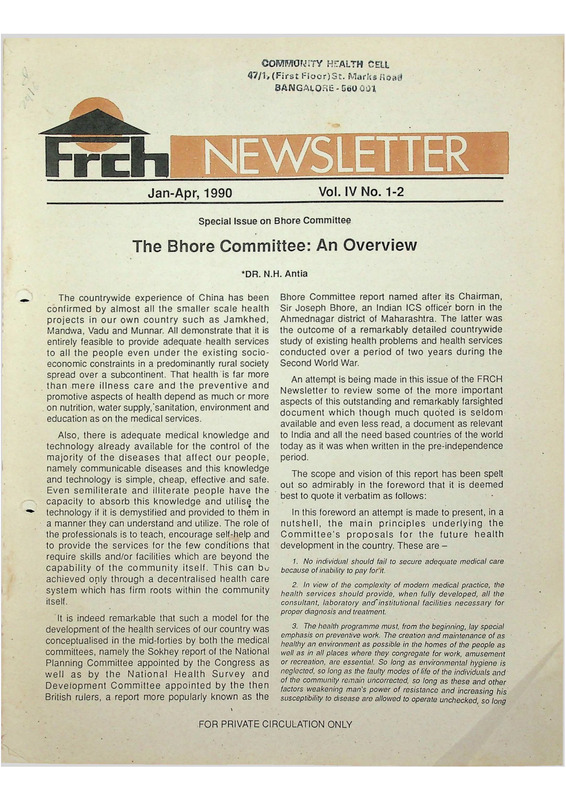
- Title
- FRCH NEWSLETTER VOL.3-No. 1-5-JAN -APR-JULY-AUGUST-1990
- extracted text
-
COMMONTY HEALTH CELL
47/1, (First Floor) St. Marks Road
BANGALOHE-560001
Vol. IV No. 1-2
Jan-Apr, 1990
Special Issue on Shore Committee
The Bhore Committee: An Overview
*DR. N.H. Antia
-
-
The countrywide experience of China has been
confirmed by almost all the smaller scale health
projects in our own country such as Jamkhed,
Mandwa, Vadu and Munnar. All demonstrate that it is
entirely feasible to provide adequate health services
to all the people even under the existing socio
economic constraints in a predominantly rural society
spread over a subcontinent. That health is far more
than mere illness care and the preventive and
promotive aspects of health depend as much or more
. on nutrition, water supply,‘sanitation, environment and
education as on the medical services.
Also, there is adequate medical knowledge and
technology already available for the control of the
majority of the diseases that affect our people,
namely communicable diseases and this knowledge
and technology is simple, cheap, effective.and safe.
Even semiliterate and illiterate people have the
capacity to absorb this knowledge and utilise the
technology if it is demystified and provided to them in
a manner they can understand and utilize. The role of
the professionals is to teach, encourage self-help and
to provide the services for the few conditions that
require skills and/or facilities which are beyond the
capability of the community itself. This can bu
achieved only through a decentralised health care
system which has firm roots within the community
itself.
' It is indeed remarkable that such a model for the
development of the health services of our country was
conceptualised in the mid-forties by both the medical
committees, namely the Sokhey report of the National
Planning Committee appointed by the Congress as
well as by the National Health Survey and
Development Committee appointed by the then
British rulers, a report more popularly known as the
Bhore Committee report named after its Chairman,
Sir Joseph Bhore, an Indian ICS officer born in the
Ahmednagar district of Maharashtra. The latter was
the outcome of a remarkably detailed countrywide
study of existing health problems and health services
conducted over a period of two years during the
Second World War.
An attempt is being made in this issue of the FRCH
Newsletter to review some of the more important
aspects of this outstanding and remarkably farsighted
document which though much quoted is seldom
available and even less read, a document as relevant
to India and all the need based countries of the world
today as it was when written in the pre-independence
period.
The scope and vision of this report has been spelt
out so admirably in the foreword that it is deemed
best to quote it verbatim as follows:
In this foreword an attempt is made to present, in a
nutshell, the main principles underlying the
Committee's proposals for the future health
development in the country. These are 1. No individual should fail to secure adequate medical care
because of inability to pay for*it.
2. In view of the complexity of modern medical practice, the
health services should provide, when fully developed, all the
consultant, laboratory and* institutional facilities necessary for
proper diagnosis and treatment.
3. The health programme must, from the beginning,.lay special
emphasis on preventive work. The creation and maintenance of as
healthy an environment as possible in the homes of the people as
well as in all places where they, congregate for work, amusement
or recreation, are essential. So long as environmental hygiene is
neglected, so long as the faulty modes of life of the individuals and
of the community remain uncorrected, so long as these and other
factors weakening man’s power of resistance and increasing his
susceptibility to disease are allowed to operate unchecked, so long
FOR PRIVATE CIRCULATION ONLY
will our towns and villages continue to be factories for the supply of
cases to our hospitals and dispensaries.
Committees in.every village and through the
stimulation of local effort for the improvement of
environmental sanitation, control-of infectious
diseases and other purposes. A wide programme of
Health Education, covering all sections of the *
population, is also proposed, promoting the growth of
such public support”.
4. The need is urgent for providing as much medical relief and
preventive health care as possible to the vast rural population of
the country. The debt which India owes to the tiller of the soil is
immense and, although he pays the heaviest toll when famine and
pestilence sweep through the land, the medical attention he
receives is of the most meagre description....
5 The health services should be placed as close to the people
as possible in order to ensure the maximum benefit...to the
communities to be served. The unit of health administration should
therefore be made as small as is compatible with practical
considerations.
The intervening half a century has seen several
reports based on the same theme, the two most
quoted being the WHO Alma Ata Declaration and the
joint report of the Indian Councils of Social Science
and Medical Science, 'Health for All: An Alternative
Strategy*. Yet none of these has been based on such
extensive information nor do they have the width of
vision or provide the detailed recommendations as in
the Shore Committee’s report.
6. ...The idea must be inculcated that, ultimately, the health of
the individual is his own responsibility and, in attempting to do so,
the most effective means would seem to be to stimulate his health
consciousness by providing health education on the widest
possible basis as well as opportunities for his active participation in
the local health programme.
This report provides short as well as long term
plans for the organisation and administration of a
'national health service for the people*. The four
volumes totalling 1200 pages consist of Vol.1 Survey, Vo 1.2 - Recommendations, Vo 1.3 Appendices and Vo1.4 - Summary. In these they cover
almost every subject concerning health, not only
hospitals and.major diseases such as malaria,
tuberculosis and leprosy but nutrition, general
education, occupational health, maternal and child
health, mental health, dental and school health,
drugs, social workers, local self-government, vital
statistics, water supply, sanitation, pollution, housing
as well as town and village planning.
7. ...Both in respect of legislation and of administration it is
likely that some of the measures to be undertaken may offend
existing social and religious practices, while others may involve
control over the day to day life of the citizen. We therefore feel that
it is only a Minister enjoying the confidence of the people who can
carry such enactments through the legislature and ensure their
practical application in the country.
In putting forward its proposals for a national health
organisation, which incorporates these principles, the
Committee has drawn up a long-term programme
which, if implemented on the lines suggested, should
help to provide the people with a reasonably well
developed service based on the newer and
expanding conceptions of modern health practice.
The attainment of this objective, which may take
about 40 years, is to be achieved through successive
stages of intensive effort directed towards the
production of the necessary trained personnel and the
creation and development of the organisations and
institutions which will form essential parts of the
community’s health service. The Committee has
attempted to outline, in some detail, the first and
second five-yearly stages of such development and
has also suggested certain objectives to be kept in
view for the next five years, leaving subsequent
developments to be shaped in the light of the
circumstances existing at the time.
A major criticism that has been levelled against this
report is the excessive financial cost of implementing
such a comprehensive health system. The Committee
had estimated the cost of such a health service in
keeping with the percentage of the GNP incurred by
some of the Western countries at that time; Even
today the percentage of government health
expenditure on health at about 2 5 percent of our
National GNP is far lower than that of countries like
UK - 6% and USA -11% though the combined
expenditure on health of the public and private sector
in India is today almost 6% of our GNP or about Rs.
15,000 crore. Even half that amount would be
sufficient to provide all our people with the type of
health care visualised in the Bhore report, lit is the
skewed nature of the expenditure in the private as
well as the public health sector, and not the total
available resources that are responsible for the poor
health care of our people. This is partly the result of
the undue position and privilege provided by both the
Bhore report as well as the founder fathers of our
nation to the allopathic medical profession who have
utterly failed to comprehend health as enunciated in
this document and has converted health into an
illness-based industry where they have become the
The doctor of the future should be a “social
physician protecting the people and guiding them to a
healthier and happier life". He should place
prevention of disease in the forefront of his
programme and should so combine remedial and
preventive measures as to confer the maximum
benefit on the community. The Committee's proposals
for the training of the 'basic* doctor, the term applied
to the medical graduate of the future, are designed to
equip him for all such duties.
The active support of the people is .sought to be
secured through the establishment of Health
2
chief beneficiaries. The blame cannot be placed only
on the Shore Committee or the founders of our nation
who placed their implicit trust and faith in the medical
profession which has failed the country. It must lie
squarely on the shoulders of the medical profession
and those who support them.
system of medicine"; thus revealing the Western
allopathic bias of this Committee.
That this report was implemented in China, but not
in the country of its origin, reveals the pre-eminence
of the political system as well as the political will (as
demonstrated in Sri Lanka, a democracy) in the
implementation of any programme designed for the
benefit of the people at large and not merely for that
of a select few.
Another weakness of the report is the failure to
give due consideration to the indigenous systems of
medicine to which the report only say "we are
unfortunately not in a position to assess the real value
of these systems..... We do however, say quite
definitely that there are certain aspects of health
protection which in our opinion can be secured wholly
or at any rate largely only through the scientific
This report needs reprinting and wide
dissemination, for it should be incumbent reading for
anyone concerned • with the planning and
implementation of the health services of our people;
not forgetting the medical profession.
("Dr N.H. Antia is the Director of The Foundation for Research in Community Health)
A REVIEW OF THE
BHORE COMMITTEE -1946
AND ITS RELEVANCE -1990
*Ravi Duggal
The Health Survey and Development Committee,
popularly known as the Shore Committee, is now
forty-four years old. We feel its relevance is not lost
even today. This paper reviews the entire three
volume report (the fourth volume is the summary of
the report) with detailed references and quotations to
highlight its wide scope and its comprehensive and
progressive nature. At the end the paper discusses
the need for a national health service keeping in mind
the Shore Committee recommendations which should
constitute the foundation on which a national health
service can be built. (The references and quotations
from the report have been given in the text within
brackets, for example (11.100) meaning volume two,
page number 100).
reference were simple: (a) a broad survey of the
present position in regard to health conditions and
health organization in British India, and (b)
recommendation for future development (1.1).
The letter of appointment of the Committee further
stated that “a survey of the whole field of public
health and medical relief has not hitherto been
attempted. The immediate necessity for initiating
such a survey has arisen from the fact that the time
has come to make plans for post-war development in
the health field. The Government of India consider
that such plans should be based on a comprehensive
review of the health problem ... one of the difficulties
with which the Committee will be confronted, is that of
finance. Financial considerations clearly cannot be
ignored. Plans based on the assumption that
unlimited funds will be available for recurring
expenditure will have little practical value. On the*
other hand it would be equally unwise to assume that
expenditure on health administration will in the future
be limited to the sums which were expended in the
pre-war years. It is desirable, therefore, to plan boldly,
avoiding on the one hand extravagant programmes
which are obviously incapable of fulfillment and on
the other halting and inadequate schemes which
could have no effect on general health standards and
which would bring little return for the expenditure
involved” (1.1-2).
The.Shore Committee was set up at a great
historical juncture. It was in the midst of the Second
World War and in succession to the Quit-India
movement that the Government of India on 18th
October 1943 announced the appointment of the
Health Survey and Development Committee under
the Chairmanship of Sir Joseph Shore. It’s secretary
was Dr. KCKE Raja and one of the joint secretaries
Dr. K.T. Jungalwala: Some of the well known
members included Dr. J.B. Grant, Dr. S.C. Roy,
Pandit P.N. Sapru and Dr. A. L. Muda liar.
Why was this Committee appointed? The terms of
3
The Committee was thus given a completely free
hand in studying the health situation and arriving at
recommendations for the general benefit of the
masses, especially the “tiller of the soil" (11.4-5).
Government of India (ibid).
annual reports of the sanitary commissions. An
investigative tradition became an integral part of the
sanitary movement, especially after the first
The Bhore Committee begins with a comparison of
the Indian Health situation with other countries. (see
Table 1).
The 1896 plague outbreak and the subsequent
report of the Plague Commission in 1904 made a
case to further strengthen public health administration
To lend support to the Committee five Advisory in India, and the Commission's recommendation
Committees were formed from among the Committee included the creation of a Medical Research
members, and it also included selected eminent Department and the establishment of the Indian
persons in the respective fields. These committees Research Fund Association (1.24). And the
were: (i) Public Health (ii) Medical Relief (iii) Government of India Act of 1919 transferred health,
Professional Education (iv) Medical Research and (v) among other subjects, to the provinces, and
Industrial Health (1.3, 111.337-338). The Advisory subsequently the 1935 Act further consolidated these
Committee deliberations, tours (in all provinces powers to the provinces by granting a greater
except Assam and Baluchistan), interviews, measure of autonomy (II.289). Between this
observations etc. resulted in 206 background papers, intervening period of the two Acts the health sector,
memoranda and notes which formed the basis of the including rural areas, received much more attention.
final report (III. 339-351). This task was accomplished (Earlier with the establishments of Municipalities after
1870 and District Boards after 1880 urban areas and
in 26 months (1.4).
district headquarters were already benefiting from the
Historical Background
setting up of dispensaries and hospitals). A lot of
Though the Bhore Committee was the first documentation took place through annual reports,
significant attempt in understanding the health special studies and medical research. The Indian
situation from a holistic perspective, it was certainly Medical Gazette, Indian Journal of Medical Research,
not a pioneer in this field. Some attempts had been the Journal of the Association of Medical Women in
made in the past and these were very useful to the India, Bradfield's Indian Medical Review - 1938, and
Bhore Committee in arriving at its own understanding D.G. Crawford’s. A History of the Indian Medical
and recommendations.
Service 1600-1913 (2 vols.), among others, contained
useful contributions in putting together the health
One of the earliest known official attempt was the
situation in India.
Royal Commission that enquired into the health
(sanitary state) of the army in 1859. The British army
Nevertheless the historical importance of the Bhore
was ravaged by disease and mortality primarily due to Committee still remains and its relevance to the
insanitary conditions and not so much due to wounds Indian people is even greater today.
inflicted in the wars. The Crimean war and the Indian
In this paper we critically review the National
“Mutiny” called for a review, and as a result two Royal
Health Services Scheme of the Bhore Committee and
Commissions, one in Britain (1857) and another in
make a case for its implementation today, forty four
India (1859) were appointed.
years after it was published.
The analysis of mortality between 1817 and 1857
Health Situation at the Time of Bhore Committee
by the Indian Royal Commission indicated that of all
In defining health the Bhore Committee stated that
the deaths of soldiers in this period only 6 percent
were due to war. The rest were caused by four major the term ‘health’ implies more than an absence of
diseases -fevers, dysentery & diarrhoea, liver disease sickness in the individual and indicates a state of
and cholera. Clearly, therefore, the main enemy of the harmonious functioning of the body and mind in
British soldier in India was not the Indian enemy but relation to his physical and social environment, so as
disease (Royal Sanitary Commission Report 1863 to enable him to enjoy life to the fullest possible
quoted by Radhika Ramasubban, “The Colonial extent and to reach his maximum level of productive
Legacy and the Public Health Systems in India" in capacity (1.7).
Socialist Health Review, 11:1,6-16, June 1985)
This is what one would call a definition of positive
health
but data regarding positive health are difficult
The recommendations of this Commission created
to
collect
arid these were not available to the Bhore
the foundation for sanitary reforms and public health
Committee.
What was then available was data
in India, albeit on an enclave pattern. Sanitary
relating
to
sickness and mortality, which
Commissions were set up and from then on some
had
accumulated
as a result of earlier efforts as
organised data on health and disease particularly vital
indicated
in
a
preceding
section of this paper.
statistics and disease control, was available in the
4
Table I: Inter-Country Comparison of Mortality and Life Expectancy (1.7-8).
—----------- 1987*- — — •
Death
Rate
(1937)
IMR
(1937)
New Zealand
Australia
Union of S. Africa
9.1
9.4
10.1
31
38
37
65.04
63.48
57.78
Canada
U.S.A.
10.2
11.2
76
54
59.32
59.12
47.55
Germany
11.7
64
59.86
67.88 (1931)
67.14. (1932-34)
61.48 (1925-27)
(Europeans
only)
61.59 (1929-31)
62.67 (whites)}
49.51 (Blacks)}
(1929-31)
62.75 (1932-34)
England & Wales
Italy
France
Japan
Java
12.4
14.2
15.0
17.0
18.8 ‘
58
109
65
106
—
58.74.
53.76
54.30
44.82
—
62.88
56.00
. 59.02
46.54
—
(1930-32)
(1930-32)
(1928-33)
(1926-30)
12
10
10
7
9
Palestine
Ceylon
British India
Egypt
18.9
21.7
22.4
27.2
153
158
162
165
—
—
26.91
—
—
— '
26.56 (1921-30)
-—
—
6
11
10
Country
Life Expectancy
at Birth
Males
Females
Death
Rate
IMR
Life Expe ctancy
Male Ftemale
9
8
10
11
72
78
10
73
80
72
58
64
(Blacks & Whites)
8
9
8
73
80 .
74
10 .
72
(Blacks & Whites)
12
8
72
(W. Germany)
9
72
. 10
74
8
74
6
75
71
58
(Indonesia)
—
—
33
68
99
58
85
59
78
78
80
80
81
62
—
73
58
62
('Source for 1987 data : World Development Report 1989, World Bank.)
administration resided. The concern for the “native"
population was there only as far as it affected those
staying in enclaves, for example, when there was an
epidemic outbreak. For instance in 1936 of the 35,871.
villages in 27 districts of the Punjab province only
about one percent were considered as “sanitated" by
the Director of Public Health i.e. those having (i) a
water supply protected from surface contamination (ii)
drains for removal of waste water (iii) regular removal
of filth and refuse outside the village to a place
prepared for their reception (1.12).
Table I clearly establishes the poor state of India's
health (IMR and life expectancy) in comparison to
other countries, especially the developed ones. But
what is more tragic is that today, fifty-three years later,
India has not reached the level of health
which developed countries had achieved before the
start of World War II!
. At the time of the Bhore Committee the health of
children and women was still worse. Of all deaths in
India in the pre-war years 48% was that of children
below 10 years in comparison to only 10% in England
and Wales, and maternal mortality was 20 per 1000
confinements in India in contrast to about 3 per 1000
in England. (1.9,63) The comparison is even worse
today as in India still over 40% of the deaths continue
to be in the under-10 years age group and maternal
mortality is higher than 5 per 1000.
(ii) Defective Nutrition: Malnutrition and
undernutrition reduce the vitality and power of
resistance of an appreciable section of the population.
An insufficient and ill-balanced diet is typical of the
food consumed by millions in India. - about 80 to 90
percent of the food consumed by Indians consists of
cereals and in the 1939-43 period even this fell short
(in terms of availability) by 22 percent (1.12).
What were the causes of this low level of health
in India? (It is important to note that these same
causes are responsible for poor health of Indians
even today - in Independent India !)
(iii) Inadequacy of the existing medical and
preventive Health Organizations: The existing
facilities are only a fraction of the requirement on the
basis of any decent standards. A comparison of India
and United Kingdom for the year 1942-43 shows the
following ratios. (1.13) (Table II)
(i) Insanitary Conditions: The development of
public health was very poor inspite of reforms that
began since 1860. As stated earlier these reforms
were only in enclaves where the military or civil
5
Table II : Health Facilities in India and UK in 1942-43 and India 1987.
(Population per facility)
INDIA
1987
U.K
INDIA
Categories
19412-43
Doctors
(Allopathic)
Nurses
Health Visitors
Midwives
Pharmacists
Dentists
Hospital beds
1 to
6,300
43,000 .
1 to
1 to 400,000
60,000
1 to
1 to 4,000,000
1 to 300,000
4,167
1 to
1 to 1,000
1 to 2,330
1 to 300
1 to 4,770
1 to 618
1 to 3,000
1 to 2,700
1 to 140
1 to 3,480
1 to 60,000
1 to 4,300
1 to 3,500
1 to 80,000
1 to 1,310
(1 to 1000 including
non-allopathic doctors)
(1 to 2133 including ANMS)
(’Source for 1987 data Health Information of India - 1987; CBHI, GOI, 1988)
It is reasonable to consider the World War II
ratios of U.K. as the optimal requirement that India
must have today. But, with perhaps the exception of
doctors and pharmacists the other requirements, as
of today, lag far behind.
These aggregate figures apart, the rural-urban
differentials in India then (and today) are indeed
alarming. For instance in 1942 urban areas of Bengal
had three and a half times more doctors as a ratio to
population, in comparison to rural areas and in Sind
this difference was as much as 49 times, (considering
the fact that 90% population lived in rural areas)
(1.14). Apart from the lack of availability the quality of
medical aid provided was very low, especially for the
poorer classes who had to travel considerable
distances and spend a whole morning before they
were seen by the doctor (1.15).
(iv) Lack of General and Health Education:
General education is a pre-condition for health
education, which together helps develop civic
consciousness. This deficiency is responsible for a
lack of environmental hygiene (1.16-17).
It must be clarified that the Bhore Committee did
not view these causes as independent of each other.
They were seen as being interrelated, and overriding
these causes were unemployment and poverty
which were considered by the Committee to
constitute the social background of ill-health.
“Unemployment and Poverty produce their adverse
effect on health through the operation of such factors
as inadequate nutrition, unsatisfactory housing and
clothing and lack of proper medical care during
periods of illness.... (therefore) our survey of the
causes of ill health in India will not be complete
without drawing attention to the profound influence
that these factors exert on the health of the
community” (1.17).
The above discussion clearly indicates that the
health situation in the country at the time of the Bhore
Committee was quite alarming, especially when we
consider U.K's pre-war level of development as a
minimal human standard. The Bhore Committee fixed
a much lower standard in their recommendation for .
India's health development programs. These we feel
were not unreasonable and definitely not an overmedicalised solution, as has been made put by
various post-independence health committees.
THE POLITICAL ECONOMY OF A NATIONAL
HEALTH PLAN
Having made an analysis of the health situation in
the country in ‘volume one' of the report the Bhore
Committee begins its volume on recommendations
(vol.ll) with the following opening statement “A study
of volume I of our report cannot fail to reveal the
extent and intensity of the dark shadows in the health
picture of the country. It is not for us to apportion
responsibility for the sombre realities which face us
today. It is with the future that we are concerned and
if the picture is to be substantially altered for the
better with the least possible delay, a nation-wide
interest must be aroused and the irresistible forces of
an awakened public opinion essayed in the war
against disease. Only a vivid realization of the
grievous handicap which is today retarding the
country's progress can help to mobilize an all-out
effort in this campaign and infuse into it a driving force
which will gather and not lose momentum as time
goes on. If it were possible to evaluate the loss, which
this country annually suffers through the avoidable
waste of valuable human material and the lowering of
human efficiency through mal-nutrition and
preventible morbidity, we feel that the result would be
so startling that the whole country would be aroused
and would not rest until a radical change had been
brought about.
6
“...we feel that a 'nation’s health’, using the term to increasing awareness , on the part of governments
signify that positive state of well being in which mind and people, of the need for measures which will
and body are able to function to their fullest capacity, ensure social security, and health protection is
is perhaps the most potent single factor in becoming recognized as an essential-part of social
determining the character and extent of its security. The idea that the state should assume full
development and progress. Expenditure of money responsibility for all measures, curative and
and effort on. improving the nation’s health is a gilt- preventive, which are necessary for safeguarding the
edged investment which will yield not deferred health of the nation, is developing as a logical
dividends to be collected years later, but immediate sequence.... The modern trend is towards the
and steady returns in substantially increased provision of as complete a health service as possible
productive capacity.... We feel we can safely assert by the state and the inclusion, within its scope, of the
that a nation’s wealth prosperity and advancement, largest possible proportion of the community. The
whether in the economic or the intellectual sphere, need for assuring the distribution of medical benefits
are conditioned by the state of its physical well-being. to all, irrespective of their ability to pay, has also
In regarding national health as the foundation on received recognition” (11.7,12).
which our plan of reconstruction must be based if it is
The Bhore Committee, on the basis of the above
to yield optimum results, we feel we are merely
review, concluded that health care services would be
repeating an axiomatic proposition. We need no
available to all citizens, irrespective of their ability to
further justification for attempting to evolve a
pay, and that it should be a complete medical service,
comprehensive plan which must inevitably cover a
domiciliary and institutional, in which all the facilities
very wide field and necessarily entail large
required for the treatment and prevention of disease
expenditure, if it is to take into account all the more
as well as for the promotion of positive health are
important factors which go to the building up of a
provided. Thus there should be provision for every
healthy, virile and dynamic people" (11.1-2).
patient, if his condition requires it, to secure the
Armed with this philosophy, that had emerged from consultant, laboratory and other special services
a scientific understanding of the health situation in which may be necessary for diagnosis and treatment.
India, the- Shore Committee formulated its There should also be provision for the periodical
medical examination of every person, sick or healthy,
recommendations and evolved a national health plan.
so as to ensure that his physical condition is
In designing this plan the Committee clearly
appraised from time to time and that suitable advice
indicated that the national health services would be
and medical aid, wherever necessary, are given in
an integral part of an overall program of
order to enable him to maintain his health at the
reconstruction." We should be failing in our duty if we
highest possible level. (II.6)
omitted to stress the composite character of the
problem with which we are faced and to point out that
Before the Committee proceeds to delineate its
a frontal attack upon one sector alone can only end in plan it discusses and clarifies three issues that
disappointment and a waste of money and effort .... emerge from the trend analysis in the context of
we must ensure the conditions essential for healthful India’s political economy - whether the health services
living in town and countryside. Suitable housing, should be free, whether the service should be a
sanitary surrounding and a safe-drinking water supply salaried one and whether some measure of choice
are the primary conditions for securing such a can be given to the patient as regards his doctor.
measure of environmental hygiene as is essential to
(i) Whether the medical service should be free or
ensure the pre-requisites of a healthy life.... (and
whether it should be paid for ? We feel that a very
above all) the elimination of unemployment, the
large section of the people are living below the normal
provision of a living wage, improvement in agricultural
subsistence level and cannot afford as yet even the
and industrial production, the development of village
small contribution that an insurance scheme will
roads and rural communications, as distinct from the
require. We therefore consider that medical benefits
great national highways now projected, are all so
will have, in any case, to be supplied free to this
many facets of a single problem calling urgently for
section of the population until atleast its economic
attention" (II.2).
condition is materially improved. We are averse to
The Shore Committee made a global review of drawing any line of distinction between sections of the
recent trends and developments in health care community which are and are not in a position to pay
services. It looked at the developments in Britain, for such benefits. The application of a "means test” for
Australia, New Zealand, Canada, USSR and the USA this purpose is unsatisfactory and may often involve
and found an increased role of the state in providing inquisitorial enquiries. Such enquiries placc n*
health care. It concluded that the ferment of ideas unpleasant duty on the officer making *
arising out of the World War has resulted in an give rise to resentment and a se
COMMUNITY HEALTH eru
47/1, (First Floor)Sc. Marha Roa
rnec*
•----.t. --00 001
consider, therefore, that for the present medical
services should be free to all without distinction and
that the contributions from those who can afford to
pay should be through the channel of general and
local taxation (11.14).
they were formulating:
(ii) A salaried service as against a service of
private practitioners. The absence of certain
amenities and services in the countryside has proved
a deterrent to medical practitioners leaving the
attraction of cities and towns and migrating to the
villages. Various attempts have been made to solve
the problem. One method, which has been tried in
more than one province, has been the settling of
medical practitioners in rural areas and giving them a
subsidy which will enable them to start practice. This
subsidy was intended to be supplemented by private
practice among the richer sections of the community.
We have had considerable evidence to show that this
method has been far from being an unqualified
success, partly because in many villages the income
derived from private practice is too small to support
the doctor in reasonable comfort. The result has been
that, in many cases, the better type of such
subsidized doctors have tended to gravitate back to
the towns. In areas where there are greater
opportunities for private practice, the more
prosperous sections of the community, have, we are
told, generally received greater attention than the
poor. We have, therefore, come to the conclusion that
the most satisfactory method of solving this problem
would be to provide a whole-time salaried service
which will enable governments to ensure that number
of representatives of medical associations, by private
individuals and by several responsible medical
administrators lends strong support to this proposal
(11.14-15).
2) these services should be placed as close to
the people as possible, in order to ensure their
maximum use by the community which .they are
meant to serve;
Further, if the poor in the rural areas must
receive equal attention and if preventive work must
get done then private practice by whole-time salaried
doctors should be prohibited (11.5).
The Bhore Committee further recognized the vast
rural-urban disparities in the existing health services
and hence based its plan with specifically the rural
population in mind. It’s plan was for the district as a
unit. ‘Two requirements of the district health scheme
are that the peripheral units of the (health)
organization should be brought as close to the people
as possible and that the service rendered should be
sufficiently comprehensive to satisfy modern
standards of health administration" (II.22).
1) the services should make adequate provision
for the medical care of the individual in the curative
and preventive fields and for the active promotion of
positive health;
3) the health organization should provide for the
widest possible basis of co-operation between the
health personnel and the people;
4) in order to promote the development of the
health program on sound lines the support of the
medical and auxiliary professions, such as those of
dentists, pharmacists and nurses, is essential;
provisions should, therefore, be made for enabling the
representatives of these professions to influence the
health policy of the country;
5) in view of the complexity of modern medical
practice, from the stand-point of diagnosis and
treatment, consultant, laboratory and institutional
facilities of a varied character, which together
constitute “group" practice should be made available;
6) special provision will be required for certain
sections of the population, eg., mothers, children, the
mentally deficient and others;
7) no individual should fail to secure adequate
medical care, curative and preventive, because of
inability to pay for it and
8) the creation and maintenance of as healthy an
environment as possible in the homes of the people
as well as in all places where they congregate for
work, amusement or recreation, are essential (11.17).
(iii) Freedom of choice of a doctor - theoretically
the patient will be free to take treatment in any state
institution. But.in practice for his own convenience he
would go to the nearest available. His choice would
widen with the expansion of health care
facilities.(11.16) Concluding this discussion the
committee categorically states that “we are satisfied
that our requirements can only be met satisfactorily
by the development and maintenance of a state
health service” (11.13).
The district health scheme, also called the three
million plan, which represented an average districts
population, was to be organized in a 3-tier system “in
an ascending scale of efficiency from the point of view
of staffing and equipment. At the periphery will be the
primary unit, the smallest of these three types. A
certain number of these primary units will be brought
under a secondary unit, which will perform the dual
function of providing a more efficient type of health
The National Health Plan
. Keeping in view the socio-economic and health
commurmy v India the Bhore Committee set itself the
‘ be achieved through the plan
8
supported by 6 public health nurses, 2 sanitary
inspectors, 2 health assistants and 6 midwives to
provide domiciliary treatment. At the hospital there
would be a complement of 20 nurses, 3 hospital
social workers, 8 ward attendants, 3 compounders
and other non- medical workers.
service at its headquarters and of supervising the
work of these primary units. The headquarters of the
district will be provided with an organization which will
include, within its scope, all the facilities that are
necessary for modern medical practice as well as the
supervisory staff who will be responsible for the
health administration of the district in its various
specialized types of service" (11.22).
Two medical officers along with the public health
nurses would engage in providing preventive health
services and curative treatment at homes of patients.
The sanitary inspectors and health assistants would
aid the medical team in preventive and promotive
work. Preferably at least three of the six doctors
should be women.
This health organization would provide integrated
health services curative, preventive and promotive to the entire population. “The health organization is
expected to produce a reasonably satisfactory service
for rural and urban communities alike. It is based
mainly on a system of hospitals of varying size.and of
differing technical efficiency. The institutions will play
the dual role of providing medical relief and of taking
an active part in the preventive campaign" (11.30).
Of the 75 beds 25 would cater to medical
problems, ten for surgical, ten for obstetrical and
gynecological (ob. & gy.), twenty for infectious
diseases, six for malaria and four for tuberculosis.
In this paper we will discuss only the long term
programme which was to be realized within a period
of 30 to 40 years (11.35). That is, by the early eighties
all the facets of the Bhore Committee should have
been realized. We are now in the year 1990 and very
well know (and it is very humiliating to know) that we
are nowhere close to what the Bhore Committee had
recommended in 1946 as the minimum requirements
for a decent health care delivery system. This
embarrassment is only enhanced when we discover
that these recommendations of the Bhore Committee
were far lower than the level most developed
countries had reached on the eve of World War III
This primary unit would have adequate ambulatory
support to link it to the secondary unit when the need
arises for secondary level care.
Each province was given the autonomy to organize
its primary units in the way it deemed most suitable
for its population, but there was to be no compromise
on quality and accessibility. Hence, a highly dense
province like Bengal may have a primary unit for
every 20,000 population but a province like Sind (now
in Pakistan) or Central Provinces which have a highly
dispersed population may have a primary unit for
every 10,000 or even less population unit. The
deciding factor should be easy access for that unit of
population.
What was this level of health care envisaged by
the Bhore Committee? Stated in terms of ratio to a
standard unit of population the minimum requirement
recommended was :
Secondary Unit
About 30 primary units or less would be under a
secondary
unit. The secondary unit would be a 650567 hospital beds, 62.3 doctors, 150.8 nurses per
bedded
hospital
having all the major specialities with
100,000 population.
a staff of 140 doctors, 180 nurses and 178 other staff
As a contrast to this in 1942 in the United kingdom including 15 hospital social workers, 50 ward
these ratios were :
attendants and 25 compounders. The secondary unit
714 beds, 100 doctors, 333 nurses per 100,000 besides being a first level referral hospital would
supervise both the preventive and curative work or
population.
the primary units.
And in India of 1988 these ratios lagged at:
The 650 beds of the secondary unit hospital would
76
.3 beds, 42.9 doctors per 100,000 population
be distributed as follows:
(100 per 100,000 if we include noh-allopaths), 28.7
Medical
150
nurses per 100,000 population.
Surgical
200
The three tier plan of health organizations was as
Ob. & Gy.
100
follows: (11.17-34, Hl.3,4)
Infectious Diseases
20
Malaria
10
Primary Unit
Tuberculosis
120
Every 10,000 to 20,000 population (depending on
Pediatrics
50
density from one area to another) would have a 75bedded hospital served by six medical officers
650
including medical, surgical and obstetrical and
gynecological specialists. This medical staff would be District Hospital
9
COMMUNITY HEALTH CELL
47/1, (First Floor)St. Marka Roag
BANGALORE * 560 001
Every district centre would have a 2500 beds
hospital providing largely tertiary care with 269
doctors, 625 nurses, 50 hospital social workers and
723 other workers. The hospital would have 300
medical beds, 350 surgical beds, 300 ob.& gy beds
540 tuberculosis beds, 250 pediatrics beds, 300
leprosy beds, 40 infectious diseases beds, 20 malaria
beds and 400 beds for mental diseases.
A large number of these district hospitals would
have medical colleges attached to them. However,
each of the three levels would have functions related
to medical education and training, including internship
and refresher courses.
Special Services
In addition to this basic infrastructure the
Committee recommended a wide range of other
health programs, keeping in mind the special
problems that India faced due to its economic and
political conditions, that would provide support and
strength to this health organization.
Certain diseases were singled out for special
inputs that would be required to control and/or
eradicate them. They were singled out because they
constituted a major problem then (See box). And
most of them 45 years later still constitute a major
problem in the country. These diseases were malaria,
tuberculosis, small pox, cholera, plague, leprosy,
veneral diseases, hook-worm disease, filariasis,
guineaworm disease, cancer, mental diseases,
mental deficiency and diseases of the eye and
blindness.
For all these diseases the Committee found that
facilities are grossly inadequate and need urgent
attention - proper sanitation and other public health
measures are the key to eradicate or control such
diseases (1.88-132). For instance in the control of
cholera three measures are essential (a) provision of
protected water supply (b) satisfactory disposal of
nightsoil and (c) sanitary control over the production,
distribution and sale of food (1.112). Similarly,
inadequate sanitary measures can precipitate malaria
as happened in the Sukkur Barragae and Mettur
irrigation projects where the failure to make provision
of adequate drainage to prevent marshy conditions
resulted in large scale outbreak of malaria in regions
which were previously free from it (1.91).
A review of environmental hygiene by the
committee indicates inadequate and poor quality town
Some estimates of various diseases
Malaria : In 1935, 100 million cases recorded with a fatality rate of 8 per 1000 cases; totally about one
million deaths due to malaria occur annually in endemic areas and another quarter to half million in
epidemics; between the years 1932 and 1941 average annual mortality from malaria was 2.4 million or 37%
of all deaths (1.90).
Tuberculosis : In 1935 about 10 to 20% of mortality from all fevers and 20% of all respiratory tuberculosis
diseases are estimated to be due to pulmonary tuberculosis; on the basis of this the mortality.fro#
tuberculosis was estimated between 456,647 and 818,934 annually; for every death due to tuberculosis
there were atleast 5 active cases of tuberculosis; thus, for an average of 500,000 TB deaths an estimated
2.5 million TB cases existed in India (1.97).
SmallPox: Between 1932 and 1941 average number of deaths due to small pox were 69,474 per year; the
mortality among infants and children of one to ten years was very high - between 1937 and 1941 the
mortality from small pox of these age groups ranged between 12.1% to 19.7% and 19.2% to 30.5%,
respectively (1.109).
Cholera : Between 1877 and 1941 deaths due to cholera (5 year smoothed averages) have ranged
between 141,000 to 444,000 per year (1.111-112); the 1904 epidemic, however, claimed a whopping 1.15
million deaths in a single year (1.114).
Leprosy :An estimate of one million patients in India (1.117), of which 20% were lepromatous cases (1,118);
there were 95 institutions with 14,000 patient accommodation when 250,000 cases needed isolation (1.119).
Veneral Disease: In 1933 there were an estimated 5.5 million cases of syphilis and 7.6 million cases of
gonorrhea (1.123).
Mental Disease : An estimated 8 lakhs to 1 million population requires hospitalization for various mental
diseases whereas only 10,189 beds are presently,available; the estimate for mental deficiency in addition is
1.6 million population (1.130-131).
Hookworm Disease : According to a survey in 1925-27 large endemic pockets of hookworm infection
existed in India, especially in mining and plantation areas; in many of the endemic areas 60 to 80% of the
population were infected with this condition (1.126-127).
10
and village planning, housing, water supply and
general sanitation (1.133 to 146). This is a cause for
concern because without this medical relief has little
meaning. Hence, a social disease such as
tuberculosis can be combated successfully only if
ameliorative measures on an extensive scale can be
undertaken so as to improve the general standard of
living, including housing, nutrition and sanitation of
the environment in the home, the workplace and
places of public resort (1.103).
Hence the need to organize special programmes of
public health especially with regard to the diseases
mentioned above.
In the case of malaria the setting up of an anti
malaria organization was advocated which would
function through the primary units under the provincial
malaria organization. Malaria control units under a
specially trained doctor with a complement of
assistants and fieldworkers was envisaged by the
committee for both preventive and curative work (II.
147-151). As indicated earlier hospital beds were
provided at each level of the health organization for
malaria patients who needed hospitalization.
that in the first year of the implementation of the
committee's plan the entire population should be
covered with primary vaccination. Since this is a
simple operation no special staff is needed. All
paramedics of the primary units can be trained for this
purpose. This operation can be repeated every five
years for revaccination (11.172).
Measures needed to control cholera have already
been referred to in an earlier paragraph. The primary
units would be geared up to be in a position to tackle
this problem where isolation, treatment and
immunization is concerned, but ultimately wide
ranging sanitary measures, protected water supply
and environmental hygiene only will prevent the
occurrence of cholera (11.176-180).
The same is true about plague. Plague control
vests largely outside that of the health organization.
Improved sanitary conditions and rat-proof dwellings
and food godowns are the measures needed to
prevent excessive breeding of rats (11.183).
As in the case of malaria the Shore Committee
recommended a separate organization for leprosy
also. This would of course function as an integral part
of the health organization. Out-patient treatment
would be provided through the primariy units whereas
in-patient care was envisaged at the district
headquarter level where group isolation would be
more feasible. The Shore Committee also envisaged
an important role of voluntary organizations in the
anti-leprosy effort and recommended that they must
be encouraged even further (11.190).
The attack on tuberculosis, advocated the
committee, must be in two directions (a) towards an
improvement of the socio-economic conditions, as
mentioned in an earlier paragraph, and (b) towards an
effective, control of the spread of infection from
patients to those who are healthy. The importance of
measures to improve living conditions has been
amply demonstrated in other countries where, even
before anti-tuberculosis measures were instituted, the
mortality from the disease began to fall as the result
of a rise in the general standard of living. While such
measures are no doubt important, a direct attack on
the reservoirs of infection is equally necessary
(11.158).
Syphilis and gonorrhea needed to be tackled at
two levels (a) provision of medical care and (b)
discouragement of promiscuity and prostitution. The
former has to be tackled by the health organization
but for the latter the committee recommended sex
education in schools and colleges and enforcement of
severe penalties on brothelkeepers (11.198,200-201).
Further the Committee recognized that prostitution
being a problem of poverty also needed to be tackled
by providing employment opportunities for women.
In order to provide a comprehensive and integrated
service the tuberculosis organization should include
(i) a domiciliary service (2) clinics. (3) hospitals (4)
aftercare colonies (5) homes for incurables and, in
addition, (6) certain ancillary welfare services (11.159).
These services would be developed as an integral
part of the health organization. As far as possible the
treatment should be through clinics and home
isolation but where this is not possible then
hospitalization should be resorted to. Special
emphasis has been placed by the committee on aftercare and welfare, especially for wage-earners who
need an improved home and work environment after
their cure, and while they are bed ridden and unable
to work, then measures for their family support will
need to be taken. This must be done both by the
government and voluntary organizations (11.159-166).
Mental illness and deficiency is another wide
spread problem that needs to be tackled by creating a
separate mental health organization that would
oversee and implement care and treatment of mental
patients through the general health organization
(11.211).
The other diseases, referred to earlier, like guinea
worm-disease, filariasis, hookworm infestation,
cancer and blindness, too would need certain special
inputs in the health organization and the committee
has provided for this in their national health plan.
Some of the other special considerations which the
Committee has deemed necessary to spell out
For small-pox eradication it was recommended
11
separately are environmental hygiene, public health
engineering, housing, health education, health
services for mothers and children, health services for
school children, industrial health service and the
population problem.
Similarly the Committee has worked out details for
medical education, medical research, vital statistics
and administration.
We will not go into the details of the Committee’s
recommendations on all these matters. We will deal
briefly with health services for mothers and children
and the industrial health service only with the purpose
of highlighting the fact that the Shore Committee Plan
was not only highly progressive and comprehensive
but also designed to suit India’s socio-economic
conditions.
Health of Mothers and Children: “Our ultimate
aim should be not merely to safeguard maternity but
also to provide adequate health protection to all
women, in order to ensure that the function of
motherhood is undertaken under optimum conditions
of health. Special services for the protection of
maternity will no doubt be required, but these services
should be developed as parts of the wider
organization for providing adequate health protection
to all women” (11.98). Keeping this principle in mind
special services were recommended by the
Committee for the health of mothers and children
within the framework of general health services. The
facilities available at the primary unit would enable the
establishment of a maternity and child welfare centre
which would have the following functions :
(1) To get in touch with as many pregnant women
in the area and to persuade them to visit the clinic
regularly. On the first visit a detailed examination of
the expectant mothers general and obstetric, should
be made and a record of her medical history kept. At
subsequent visits advice in respect of the hygiene of
pregnancy and instruction regarding diet will be given.
Further, it should be possible to make an early
diagnosis of any deviation from normal health, to give
appropriate advice and timely treatment for such
diseases as tuberculosis, syphilis, anaemia and
toxemias of pregnancy or to refer the patient to
institutions of specialists for medical attention.
(2) To provide for the skilled assistance of a
midwife or trained dai at the time of delivery and for
domiciliary visits by a public health nurse for two
weeks thereafter. A record of the confinement and of
immediate postnatal history should be added to the
card of the mother and a new one opened for the
infant.
(3) To keep the
mother and child under
12
observations, if possible, for a year. It is desirable to
keep a weekly weight record of the infant. Advice to
the mother should be given in respect of lactation,
diet and exercise and, at a later stage, in respect of
weaning. Treatment, where necessary should be
given and extra nourishment to mother and child
should be made available, if required.
(4) To teach mothercraft in all its branches with
practical demonstrations, special emphasis being laid
on the inculcation of sound hygienic habits in the
mother and child.
(5) To keep children under observation, if possible,
upto five years, weight and progress records should
be kept. From the second year onwards monthly visits
would suffice, but mothers should be instructed to
report any illness arising between visits to the clinic
and a domiciliary visit by a doctor should, in such
cases, be arranged.
(6) To organize occasional talks, by suitable
persons, for husbands and fathers in order to secure
their cooperation,
(a) in the care of their women, especially during
pregnancy,
(b) in the advisability of spacing the births of their
children,
(c) in child-psychology,
(d) in aiding their wives in the maintenance of
hygienic surroundings and in providing a well
balanced diet for the family and
(e) in the development of the faculties of children
by means of manual occupations, special toys,
games etc....
(7) To give instruction on birth control (11.100).
Besides the above the Committee recommended
provisions for a playground for children at the centre
with adequate facilities that would make it a social
activity area for mothers and children through which
health and social education can be imparted by
trained social workers (11.101).
The Committee also recommended the
establishment of nurseries on the lines of those that
had been set up in the Soviet Union. These nurseries
should develop as an integral part of the child
welfare organization: Its aims would be not only to
provide proper education to the mothers and children
but to also provide support in child care during the
mother's working hours (II. 105,106).
And finally the Bhore Committee recommended a
maternity benefit scheme that would help the
pregnant and nursing woman to overcome the strain
resulting from the overwork that she is invariably
subjected to. The Committee recommended
compulsory abstention from work for working women
six weeks prior and six weeks after delivery alongwith
a grant of a maternity benefit. This could start first
with industrial workers, then be gradually extended to
all working women. It is heartening to note that the
Bhore Committee did not forget the housewife who is
“subject to undue physical strain in the discharge ot
(her) household duties”. For such women the
Committee recommended a system of ‘home-help* by
the public authority as was being practiced in
progressive countries. (11.105)
Industrial Health Service: “It seems correct to hold
that, over and above the general provision for health
protection which the worker can share with the other
members of the population, he has the right to claim
that special measures should be taken to counteract
the adverse effects of those factors which are
associated with his occupation. The provision of such
special health measures is the function of an
industrial or occupational health service. We believe
that to a greater or lesser extent, all those who are
gainfully employed outside their own homes will
require the services of the occupational health
organization” (1.71).
The Committee reviewed the morbidity and
mortality among industrial workers (1.73-74), medical
relief and safety (1.74-77), working conditions (1.7779),. housing and living conditions of workers (1.8081), nutrition of workers, hours of work, transport
facilities, rest shelters, alcoholism and drug addiction
(1.81- 84), special problems of women workers (1.8485), Factories Act and Inspection, industrial zoning,
unregulated factories and so on (1.85-87). Their
evidence indicated deplorable conditions all over the
country but it has cited a few exceptions to serve as
examples in developing services for workers.
The proposed industrial health service will not
minister to the general medical needs of the workers.
This function will have to be performed by the service
for the community as a whole. The industrial health
organization is intended to meet the needs of the
worker in respect to that group of factors affecting the
health which are associated with the occupation he
pursues. The two services are complementary to
each other and will together provide him with
'adequate medical care. The industrial health
organisation should form an integral part of the
provincial health department and should be
developed as such (11.125).
The aims of such an industrial health service
should thus be as follows:
.(a) to promote the general health of the worker by
the provision of a good working environment by fitting
the worker to that environment;
(b) to prevent occupational disease;
(c) to assist in the prevention of injuries at work;
(d) to organize and supervise a service for the
emergency treatment and care of injured and sick
workers at their place of work;
(e) to take an active part in the restoration to full
working capacity of workers disabled by injury or
disease and resettlement of workers suffering from
permanent disability;
(f) to educate workers in the preservation of
health and promotion of well being and
(g) to promote research and investigation (11.123).
The Shore Committee also made it clear that,
though this service must be the responsibility of the
Provincial Health Department, the employer must be
made to contribute considerably because he will gain
the most out of this provision through reduced
absenteeism and higher productive capacity of the
workers. The Committee hence recommended that
the employer and government together must be
responsible for meeting the cost of the proposed
industrial health service and that the worker should be
exempt from being made to pay for it. However, a
central health insurance fund could also be created to
provide additional support and resources ter such an
organization (11.126-127).
The discussion so far provides adequate evidence
of not only the progressive and comprehensive nature
of the national health scheme but also shows that the
plan is based on a seriously studied and documented
picture of the health situation of the country. We
would also like to add here that the Bhore
Committee's analysis and recommendations go into
even very minor details and at the same time offer
adequate flexibility in implementation. We have not
gone into these details in this paper because the
purpose here is limited to highlighting the plan and
show its relevance even today.
Financing of the National Health Services
At the time of the Bhore Committee the amount of
expenditure for medical relief and public health by the
state was very small. It ranged from (in 1944-45) a
low of 2.8 annas (or 16.8 paise per capita in Central
provinces and Berar to a high of 10.9 annas (Or 65.4
paise) in the Bombay Province which was 3.1% and
4 .5%, respectively, of total provincial government
expenditure (11.514).
The Bhore Committee comments that in Great
Britain in 1934-35 (prior to NHS) the government was
spending as much as 20.4% of their total expenditure
on health care services. Even the United States
government spent 13.8% of its total expenditure in
COMMUNITY HEALTH CELL
47/1,(First Floor)St. Marks Ao-d
BANGALORE - 560 001
1938 on health services. It is hence obvious that
governments in India have been spending an unduly
small proportion of their incomes on health
administration and there is therefore every
justification for demanding that the ratio of
expenditure under this head must be raised
considerably. The government should be prepared to
increase the money spent on health to atleast 15% of
the total expenditure (11.514).
The development of the plan as envisaged by the
Committee would cost the government as little as Re
1 and annas 14 (Rs.1.87) per-capita per year in the
first ten years (1945-46 prices) on recurring
expenditure and Re. 1, anna 1 and paisa 5 (Rs. 1.11)
per capita per year on non-recurring expenditure. The
former would be spent from state revenues and the
latter from loans, (the recurring cost includes
amortisation payments for non-recurring expenditure)
(11.510). This would have amounted to only 1.33% of
GNP. The distribution of the recurring and non
recurring expenditure as worked out by the
Committee is given in Table III (III. 247-249).
Table III : Distribution of Expenditure for various Health Programs
•
(Percentages)
Health Programs
Heads of Expenditure
3 million unit scheme
Central & Provincial
Directorates
Malaria Organisation
Tuberculosis
Mental Disease
Venera! Disease
Leprosy
School Health
Nutrition
51.34
Professional
Education
Water Supply &
Drainage
Health Education
Industrial Health
Service
Medical Research
Leave Reserve for
Personnel
Contribution of
Centre
Amortisation payments
for non-recurring exp.
TOTAL
|
Non-Recurring Recurring
' 50.18
(primary unit 26.32)
1.48
1.06
2.63
2.41
1.31
1.57
1.75
1.07
}
0.78
0.02
J 11-72
(primary units 26.54)
I
0.20
11.17
(Doctor=8.02
Nursing=2.31)
27.55
—
2.29
0.05
0.11
0.29
0.18
—
3.80
5.66
4.72
—
16.66
100.00
100.00
Graduate
(Doctors =4.97
Nursing =3.45
Scholarships =1.10)
Note: These percentages are based on the plan’s first ten years expenditure estimates. The total expenditure worked out for the rst
ten years, (i.e. short term plan) was Rs. 9640 million (recurring and non recurring).
14
From the percentage distribution of the national
health schemes expenditure it is clear that a little
more than half of the total (both in case of recurring
and non-recurring ) would go to the three million unit
schemes which forms the core of the plan; and over
one-half of this would be spent on Primary units that
would provide health services at virtually the doorstep
of the population.
The other major head of expenditure is
professional medical education which has been
allocated 11% of the plan's share: Of this nearly half
would be spent on the education and training of
doctors and about one-third on nursing education (in
the case of non-recurring cost 68% of professional
education expenditure would be for training of
doctors).
On the non-recurring side water supply and
drainage have been allocated a major share. By its
'nature it is largely a capital expenditure and the
recurring costs are mainly charges for maintenance of
the system.
full form. ‘The existing state of public health in the
country is so unsatisfactory that any attempt to
improve the present position must necessarily involve
administrative measures of such magnitude as may
well seem to be out of all proportion to what has been
conceived and accomplished in the past. This seems
to us inevitable, especially because health
administration has so far received from governments
but a fraction of the attention which it deserves in
comparison with other branches of governmental
activity. We believe that we have only been fulfilling
the duty imposed on us by the Government of India in
putting forward this health programme, which can in
no way be considered as extravagant either in
relation to the standards of health administration
already reached in many other countries or in relation
to the minimum requirements of any scheme which is
intended to demonstrate an appreciable improvement
in the health of the community. For reasons already
set out, we also believe that the execution of the
scheme should not be beyond the financial capacity
of governments.
“We desire to stress the organic unity of the '
component parts of the programme we have put
forward. Large-scale provision for the training of
health personnel forms an essential part of the
scheme, because the organisation of a trained army
of fighters is the first requisite for the successful
prosecution of the campaign against diseases. Side
by side with such training of personnel, we have
provided for the establishment of a health
Two other important items (on the recurring side)
organisation which will bring remedial and preventive
are salaries and drugs. In the three million unit services within the reach of the people, particularly in
scheme salaries constitute 69.39% of the total
the rural areas. Considerations based on inadequacy
expenditure on the three million units and drugs of funds and insufficiency of trained-workers have
7 .04%. (II1.263-265). Of course, this is only for the 3
naturally necessitated the suggestion that the new
million units scheme. Salaries and drugs would also organisation should first be established over a limited
be important components in the other schemes of the area in each district and later extended as and when
Bhore Committee Plan.
possible. Even with such limitations the proposed
Finally, the Bhore Committee strongly recommends health service is intended to fulfil, from the beginning
that it should be a statutory obligation on and in ah increasing measure as it expands, certain
governments to spend a minimum of 15% of their requirements which are now generally accepted as
revenues on health activities (11.515). The plan set out essential characteristics of modern health
by the Bhore Committee averages about 12% of administration. These are that curative and preventive
government expenditure over the 1st ten year period work should dovetail into each other and that, in the
for which the Bhore Committee has given the financial provision of such a combined service to the people,
outlays. In describing financial outlays the Bhore institutional and domiciliary treatment facilities should
Committee goes into minor details for each province - be so integrated as to provide the maximum benefit to
with details of each type of staff, equipment etc. It the community. There should also be provision in the
should suffice here to say that the plan was ‘bottom- health organisation for such consultant and laboratory
heavy* and that rural and urban areas have been services. Our proposals incorporate these
dealt on an equal treatment, ofcourse with a little bias requirements of a satisfactory health service.
towards rural areas which had to catchup with
“We have drawn attention to these aspects of the
facilities that urban areas already had.
health programme because we feel that it is highly
An interesting component of expenditure of the
Bhore Committee's plan is provision for housing
accomodation for all health staff involved in the three
million unit scheme. This expenditure (on the nonrecurring .side) is 30% of total non-recurring
expenditure and a whopping 58.52% of the three
million unit non-recurring expenditure (III.253-254,
290).
desireable that the plan should be accepted and
executed in its entirity. We would strongly deprecate
The Bhore Committee ends its report on a clear
note of urgency for implemenation of the plan in its
15
any attempt, on the plea of lack of funds, to isolate
specific parts of the scheme and to give effect to them
without taking into consideration the interrelationships
of the component parts of the programme. Our
conception of the process of the development of the
national health services is that it will be a cooperative
effort in which the centre acting with imagination and
sympathy, will assist and guide a coordinated
advance in the provinces. We therefore look forward
to a pooling of resources and personnel, as far as
circumstances permit, in the joint task that lies before
the governments” (11.516-517).
Relevance of Shore Committee Today
Health services today are as inadequate and
underdeveloped as they were during the time of the
Shore Committee. The analysis of the health situation
by the Shore Committee in the early forties would
hold good if a similar enquiry is undertaken today,
nearly half a century later. The enclave pattern of
development of the health sector continues-even
today - the poor, the villagers, women and other
underpriviledged sections of society, in other words
the majority, still do not have access to even basic
health care.
is that these private medical practitioners have been
produced at the expense of the public exchequer and
they profit from the practice of medicine without any
significant state regulation of their activity.
The other recommendations of the Shore
Committee have been gradually diluted and
unfocussed. For instance the Primary Health Centre
which we have at present is not even an apology of
what the Shore Committee had outlined - the 75bedded Primary Health Unit with six doctors, 20
nurses, 6 public health nurses and a host of other
paramedic staff catering to a 10,000 to 20,000
population then proposed, as against a six bedded
primary health centre with one doctor, 1 nurse
midwife, 1 public health nurse, 6 auxiliary nurse
midwives and 6 Male Multipurpose Workers for a
30,000 to 80,000 population now existing. It will only
add to the humiliation if we compare the other
recommendations to the achievements today!
Another aspect of the health sector, besides
production of doctors, which has developed
considerably is the production of drug formulations,
especially in the private sector. It is logical that this
should develop to support the large mass of private
medical practitioners. Even the production of
pharmacists has increased phenomenally from 1
pharmacist to 4 million population in 1942-43 to 1
pharmacist to 3500 population in 1987. The Bhore
Committee, for reasons not known, did not pay any
significant attention to this aspect of the health sector,
except mentioning that a combination of public &
private enterprise should take responsibility of
producing drugs and the former should monopolise
biological products required for prevention and
treatment of epidemic .diseases (11. 452). What was
possibly implicit in the brief discussion of the Bhore
Committee regarding this issue was that drug
production globally was controlled by a few
companies and the development of an Indian drug
industry in the near future was a difficult proposition.
Instead of the national health care services that the
Shore Committee had envisaged, which would be
available to one and all irrespective of their ability to
pay, further modification of health care services took
place strengthening the operation of market forces in
this sector.
It is true that mortality has declined, but there is no
evidence of, decline in morbidity. One suspects that
the latter must have increased manifold due to
mortality reduction. Infact the little evidence of
classwise mortality differentials indicate that mortality
decline among the poorer sections is only marginal.
The aggregate figures are biased by the favourable
conditions that the top 20% of the population has
carved for itself. It is this improvement that reflects the
aggregate improvements in all spheres of India’s
development.
To conclude this paper we will not discuss why the
Bhore Committee recommendations were not
implemented but will instead argue in favour of a
national health service based largely on the plans of
the Bhore Committee report.
The recommendations of the Shore Committee
were not rejected outright by the governments of
Independent India. The principles were accepted in
the First Five Year Plan but the contents were very
selectively focused. The rest is history.
Universal coverage of the population through some
health plan is historically well entrenched today,
Forty years later we see that only one target of the whether this be through health insurance or state run
Shore Committee’s recommendations was realised health services. There is ng developed country,
i .e., the production of doctors. But the unfortunate whether capitalist or socialist, which has not ins ired
aspect of this development is that these doctors have through either of the above means or a combination
been produced not for the 'salaried service' in the of a minimum standard of health care for its
national health plan that the Shore Committee had population. In socialist countries the state provides
envisaged but for adding to the ranks of private health care, among other 'social services', as a basic
medical practitioners. What is even more unfortunate right of the citizen. In capitalist countries social
16
security has evolved under the concept of a welfare
state and health care’is one of the prominant
elements.
India was fortunate in having a National Health
. Services plan prior to independence but it missed the
bus. Inadequate resources may appear to be a strong
reason for not implementing the Bhore Committee
plan but when resource allocations are studied
carefully we clearly see that financial resources were
largely committed to areas which helped the
development of capitalism. The focus was clearly in
that direction leaving for the 'social services’ like
health, education and housing only residual
resources. Over the years more than 80% of plan
resources have been allocated to 'economic services’
whose benefits have been appropriated by a small
class of capitalist farmers- and the bourgeoisie. For
instance, most of the resources expended on
agriculture and irrigation have benefitted the rich and
middle peasantry and agri-business (fertiliser,
pesticide and modern farm implements industry). The
development of power, basic or infrastructure
industry, transport and communication has largely
helped industrial capitalism to prosper, with the public
sector industry invariably absorbing vast losses.
The same pattern of expenditure is seen in the
expending of revenue resources of the state. The
'Economic Services’ and 'non- development
expenditure’ (defence, police and administration) eat
away more than 80% of these resources leaving only
a mere lip-service worthiness for the social services
sector. We will not extend this explanation further
because it is very well documented by various
scholors.
Given the subsistence or even below subsistence
standard of life in India, the demand for a national
health service assumes a great urgency, and hence
resource constraint cannot be an issue. In such a
socio-economic setting the state’s responsibility in
providing a free minimum standard of health care
alongwith other 'social services’ becomes even more
important because the majority of the households do
not have a surplus, after spending on their basic
necessities such as food, clothing, water and shelter
to take care of their basic social needs such as
education and health care. Hence the demand for a
national health service is justified on just this ground,
let alone other reasons.
The Bhore Committee provides a wide framework
to develop a national health service. And we feel that
with suitable modifications to accomodate present
conditions and considerations a national health
service can be evolved within a single plan period.
One of the main arguments against a national
17
health service is that public medical institutions that
presently exist are both inefficient and inadequately
provided, besides being impersonal and corruption
ridden. This may be true to some extent but this
simple argument can be easily countered by showing
that the inefficiency and inadequacy of public
hospitals is largely due to the existence of the private
health sector. If there was no private health sector
then the public services would have no choice but to
function properly and people, as well as the state,
would ensure this because the alternative private
health sector would not be there.
It is well established that state monopolies function
quite smoothly and efficiently and many also make
huge profits that even large private corporations envy.
The public sector petroleum industry (ONGC, Indian
Oil etc.), for instance, make whopping profits.
Similarly public services like railways, electricity
supply, water supply, telephones, public road
transport, banking etc. function quite efficiently and
provide people a fairly adequate services where they
exist. We are not saying that they don’t have
problems or they are running at optimal efficiency. All
we want to point out is that a public sector monopoly
can deliver goods, provided the private sector
doesen’t have vested interests attached to it. For
example, a large number of state infrastructure
industry make heavy losses not because they are
inefficient but because they provide subsidised inputs
to the private industrial sector. We would like to round
off this argument by saying that today most of the
large and medium private corporations are thriving
with resources of public financial institutions like UTI,
LIC, public sector banks etc. Thus there should be no
constraint on finances for setting up a national health
service.
The support for privatisation has gained strength in
the last one year with perestroika and glasnost in the
socialist countries. In India the health sector too has
got caught in this wave and beginnings have been
made with the introduction of user-charges in public
health institutions. The small mercies that the
underpriviledged had in the form of free public health
services too seem to be getting out of their reach.
This must be prevented and countered, and the
demand for a national health service must become
vociferous before the corporate and HMO type of
'health revolution* takes over in India and uproots the
small legacy of public health services we already
have. We have to demand that health becomes a
right which the state must provide for unconditionly
from the revenues it collects from citizens. The Bhore
Committee report, though nearly half a century old,
gives us the basic foundation from which we can build
the apparatus of a national health service.
Resolutions of the National Planning Committee
on the Report of the Sub-Committee on National Health
An Extract:
The Interim Report of the Sub-Committee on
National Health was presented by the Chairman, Col.
S.S. Sokhey, on the 30th and 31st August, 1940
where the following Resolutions were adopted:-
implications of medical and public health work. There
should be one Health Worker for every thousand of
the population, and this number should be attained
within five years. Selected Health Workers should be
given further training at suitable intervals so that they
might be better trained for this service.
1. For the purpose of raising the standards of
public health in the country, and for the prevention of
disease, it is essential that dietary standards should
be substantially raised and made adequate and better
balanced. In this connection, the N.P.C. notes the
specific recommendations of the Sub-Committee, and
resolves that they be placed before the National
Planning Commission.
7. There should be ultimately one qualified
medical man or woman for every 1000 of population,
and one bed for every 600 of the population. Within
the next ten years the objective aimed at should be
one medical man or woman for every 3,000 of
population, and a bed for every 1,500 of population.
This should include adequate provision for maternity
cases.
Note:- The specific recommendations are that the dietary
standards laid down by the technical Commission of the Health
with a permissible reduction of 8 per cent, be accepted for India.
These provide a basic diet of 2,400 calories for an average adult,
with suitable additions proportioned to the nature and strain of the
work.
2. India should adopt a form of health
organisation, in which both curative and preventive
functions are suitably integrated, and administered
through one agency.
8. The medical and health organisation should be
so devised and worked as to emphasise the social
implications of this service. With this object in view
the organisation should be made a free public
service, manned by whole-time workers trained in
scientific method. To give effect to this aim, a Chair
should be established in every medical school for
special training in the social or service aspect of
Medicine and National Health.
3. Such an integrated system of health
organisation, can be worked only under State control.
It is, therefore, recommended that the preservation
and maintenance of the health of the people should
be the responsibility of the State.
9. Adequate steps be taken to make India selfsufficient as regards the production and supply of
drugs, biological products, scientific and surgical
apparatus, instruments and equipment, and other
medical supplies.
4. For the proper functioning of such an
organisation, medical and health research in the
widest possible field is essential. This research
should, therefore, form an important function of a
Health Organisation; and this should include the
application of the scientific method for the
investigation of the indigenous and other methods for
the maintenance of health, and the prevention and
cure of diseases.
10. A Pharmacopoeia Committee should be
appointed to draw up an Indian pharmacopoeia. In
order to carry out this object adequately, research
should, be particularly intensified to determine the
action of drugs traditionally used in India.
5. In view of the paucity of qualified medical men
and women in the country, it is necessary to increase
rapidly and substantially their number. For this
purpose it is necessary to organise a large number of
training centres.
Proprietary remedies whose composition is
clearly indicated, may, however, be allowed to be sold
under proper State supervision.
11. No secret remedies, or remedies whose exact
composition is not stated on the labels of the
containers in the clearest possible terms, should be
allowed to be sold.
12. No individual or firm, Indian or foreign, should
be allowed to hold patent rights for the preparation of
any substances useful.in human or veterinary
medicine.
6. In addition to the above, and as an immediate
step in order to meet the special conditions prevailing
in India, we recommend the training of large numbers
of Health Workers. These Health Workers should be
given elementary training in practical, community, and
personal hygiene, first-aid, and simple medical
treatment, stress being laid on the social aspects and
The State should encourage and encow
research and suitably recognise and reward those
who achieve successful results.
Note:- Mr Ambalal Sarabhai is of opinion that such patents
18
should be treated on the same basis as "copyright in books or
industrial patents.
Medical training in every field should be based on
scientific method.
13. An attempt should be made to absorb the
practitioners of the Ayurveda and Unani systems of
medicine into the State health organisation by giving
them further scientific training where necessary.
Note:- Mr Nanda was of opinion that other systems , such
as homoeopathy and naturopathy, should also be included in this
by addition of the words “and other systems." It was pointed out,
however, that no exclusion was intended in the resolution but stress
was laid on the necessity of the scientific method and training.
CHRONOLOGY OF HEALTH COMMITTEES 1940 - 1981
•Compiled by Manish Mankad
This article attempts to give a brief note on some of the selected
committees set up in the field of health since 1940 in India.
1) The Health Survey and Development Committee. — Sir
Joseph Shore (Chairman); Oct. 1943.
It undertook the following tasks :
a) a broad survey of the present position in regard to health
conditions and health organisations in British India, and
b) recommendations for future development.
2) National Health (National Planning Committee Series), Col.
S.S. Sokhey (Chairman), 1948.
This document on national health is the report of one of the various
subcommittees set up by the national planning committee of the
Congress in 1938.
The terms of reference of the subcommittee on public health were:
(i) Prescribing standards of dietary and nutrition for all classes of
population.
(i) Consideration of the nature and incidence of the various
epidemics which take a heavy toll of life and suggesting ways and
means of guarding against these.
(iii) "Investigation into the volume and cause of infant mortality as
well as mortality among women; and suggesting ways,and means
of reducing such mortality.
(iv) Provision of the necessary health units comprising physicians
nurses, surgeons hospitals and dispensaries, sanitoria and nursing
homes.
(v) Health insurance.
yi) Medical training and research
(vii) Compilation of vital statistics including those of birth and death
rates.
(viii) Cultivation of the necessary drugs and production of
medicines to provide the necessary preventive or curative aid,
scientific and surgical appliances and accessories to the National
Health Services and,
(ix) any other connected questions.
3) Committee on Indigenous System of medicine
Col. Sir, R.N. Chopra (Chairman), Ministry of Health 1948.
The committee was set up partly to counter the criticism about the
Shore Committee's lack of attention to indigenous systems.
4) The environmental hygiene committee, Dr. B.C. Das Gupta
(Chairman), Ministry of Health, 1949.
This committee discussed the problems of housing, water supply,
general sanitation including conservancy and drainage, prevention
of river and beach pollution, control of insect vectors, disposal of
trade wastes etc.
Terms of reference were:
(i) to recommend provisions for research and the application of
scientific methods for investigation of indigenous systems.
(ii) to suggest measures to improve facilities for training.
(iii) to consider the desirability of state control and other measures
to increase the usefulness of the system.
(iv) to investigate whether the three systems Ayurveda, Unani and
modern cannot be combined into one comprehensive system.
5) The Homeopathic Enquiry Committee - J.N. Mukherji
(Chairman), Ministry of Health, 1949.
Terms of reference were:
(i) to report on the place of homeopathy in relation to medicine in all
its aspects including treatment, prevention and control of diseases;
(ii) to survey the existing facilities for the teaching of homeopathy in
India, the extent to which this system of treatment is practised in
the country, and the manner in which such practice is carried on,
i.e. whether by people adequately trained or not; and
(iii) to make recommendations to the Government on (a) .the
measures to be taken to improve facilities for training in
homeopathy and to regulate such training and (b) the desirability of
state control of the practice of homeopathy.
6) Committee to advise on the steps to be taken to establish a
research centre in the indigenous systems of medicine and
other cognate matters - Dr. C.G. Pandit (Chairman), 1949.
The terms of reference were :
To work out and submit to the government a detailed scheme for
the development of a centre of research in Ayurvedic and Unani
systems of medicine on as broad a basis as possible along the
lines indicated in the Chopra committee.
To investigate and define in what manner special training in
Ayurvedic and Unani system can be incorporated during the last
year or so of the under-graduate course in modern medicine for
those who would like to quality in these systems or alternately how
these systems can be fitted into the modern medical course.
To make recommendations regarding the policy for evaluating and
assessing the performance of existing institutions imparting
instruction in indigenous systems.
7) Advisory Committee on social and moral hygiene Central Social Welfare Board, 1954.
The advisory committee on social and moral hygiene was
constituted under the central social welfare board to study the
extent of the problem of immoral traffic in women and children and
to suggest remedial measures.
8) The committee to study the question of formulating uniform
standards in respect of education and regulation of practice of
vaidyas, hakims and homeopaths, 1955.
9) The committee to assess and evaluate the present status of
Ayurvedic system of medicine - Dr. K.N. Udupa, 1960.
Terms of reference were :
To evaluate and assess the work already done; existing facilities for
training and research in Ayurveda; nature, volume and standard of
pharmaceutical products and practice and recognition of the
ayurvedic system of medicine.
10) Report of the health survey and planning committee. Dr. A.L Mudaliar (Chairman), Ministry of Health -1961.
The terms of refernece were:
(i) The assessment of developments in the field of medical relief
and public health centres, submission of the report;
(ii) Review of the Second Five Year filin' health projects;
19
(iii) Formulation of all the recommendations for the future plan of
health development in the country.
11) Special Committee on the preparation for entry of the
National Malaria Eradication Programme Into the maintenance
phase - Dr. M.S. Chadha, Ministry of Health, 1963.
12) Report of the committee on Integration of Health Services—
Dr. N. Jungalwala.
This committee made an overview of the development of medical
and health services in India and abroad, and noted changing
concepts in health administration with particular reference to :
(a) broadening outlook on social welfare,
(b) centralization and decentralization,
(c) specialization,
(d) changing concept of preventable diseases,
(e) integration of curative and preventive care services,
(f) mental health services,
(g) growing emphasis on health education,
(h) biostatistical approach,
(i) international collaboration,
(j) organisation, and
(k) undesirable trends like fragmentation and multiplicity of
agencies- providing services for different sections of the
population.
13) Report of the Study group on medical case services - A.P.
Jain (chairman), 1966.
Terms of reference were:
Future pattern of development of hospital services of .regional,
district, peripheral levels in terms of size and facilities to be
provided; the requirements of specialised hospital facilities such as
for infectious diseases. P.336
14) Committee on multi-purpose worker - Shri Kartar Singh
(Chairman), 1966.
Terms of reference were:
i) The structure for integrated services at the peripheral and
supervisory levels.
ii) Feasibility of having bi/multi-purpose workers in the field.
iii) Training requirements.
iv) Utilisation of mobile service units set up under family planning
programmes. (p.217)
15) Review of staffing pattern and financial provisions under
Family Planning - Dr. B. Mukherjee, 1966.
16) Health services and medical education : a programme for
immediate action. Report of the group on medical education
and support manpower - Dr. J.B. Shrivastav (Chairman), 1975.
This committee was constituted to restructure medical education
following from the Fifth Plan requirement for reorienting it towards
community care rather than hospital oriented care and to
accomodate the new emphasis on family planning. The committee
was charged with the responsibility of devising a suitable
curriculum for training a cadre of health assistants to serve as a link
between the qualified medical practitioners and the multi-purpose
workers, thus forming an effective team to deliver health care,
family welfare and nutritional services to the people. It was also
required to suggest suitable ways and means for implementing the
recommendations of the earlier committees on medical education,
especially the Medical Education Committee of 1968, and the
Medical Education conference of 1970, and to suggest steps for
improving the existing medical education processes.
17) Report of the Committee on drugs and pharmaceutical
industry - Shri Hathi Jaisukhlal (Chairman); Ministry of Petroleum
and Chemicals, 1975.
The terms of reference were as under:
i) To enquire into the progress made by the industry and the status
achieved by it.
ii) To recommend measures necessary for ensuring that the public
sector attains a leadership role in the manufacturing of basic drugs
and formulations, and in research and development.
iii) To make recommendations for promoting the rapid growth of the
drugs industry and, particularly, of the Indian and Small Scale
Industries Sector keeping in view a balanced regional dispersal of
the industry.
iv) To examine the present arrangements for the flow of new
technology into the industry, and make recommendations thereof.
v) Measures for effective quality control of drugs, and for rendering
assistance to small-scale industries.
vi) To examine the measures taken so far to reduce the prices of
drugs for the consumer, and to recommend further measures as
may be necessary to rationalise the prices of drugs and
formulations.
vii) To recommend measures for providing essential drugs and
common house-hold remedies to the general public, especially in
the rural areas.
viii) Arrangements to ensure equitable distribution of basic drugs
and raw materials especially to the small scale sector.
18) Working group on health for all by 2000 A.D- Dripa Narain
(Chairman), Ministry of Health and Family Welfare, 1981.
The terms of reference were :
To review the current health status keeping in view the plan
programmes; to evolve Plan outlines for 1980-81 and 1984-85 for
the health sector and suggest measures so .that foundation is laid
for achieving Health for All; and to suggest specific programmes to
benefit rural and other weaker sections and to review health
components of the Minimum Needs Programme.
•(Manish Mankad is a Library & Documentation officer at FRCH)
VACANCY AT LOCOST .
Post
i Co-ordinator
Function : To interpret and visualise the broad scope of LOCOSTS activities for demystificaton of
medicines and medical knowledge. Specific duties include coordination of production, supply and
distribution of drugs as well as related educational efforts in rational therapy.
Qualifications : A science or pharmacy graduate with a minimum of two years working experience
in a similar organisation. Should be in touch with general developments. Should be able to work in a
team and be able to achieve specific goals.
Write to:
LOCOST, Krishna T.
1st Floor, Premanand Sahitya Sabha
Opp. Lakadi Pool, Dandia Bazar
Vadodara 390 001
GUJARAT, (INDIA)
Edited by Sarita Pungaliya with the co-operation from Manish Mankad and secretarial assistance from Audrey Fernandes and Anuradha
Naik. Produced by the Foundation for Research In Community Health, MA R.G. Thadani Marg, Worli, Bombay - 400 018, Registered
under the Bombay Public Trust Act. Printed by Data-com Office Services, Pune -411 011.
20
Position: 3510 (4 views)