FRCH NEWSLETTER VOL.1-No.-1-NOV-DEC-1986
Item
- Title
- FRCH NEWSLETTER VOL.1-No.-1-NOV-DEC-1986
- extracted text
-
November-December, 1986
Vol. I
No. 1
Need For a Dialogue
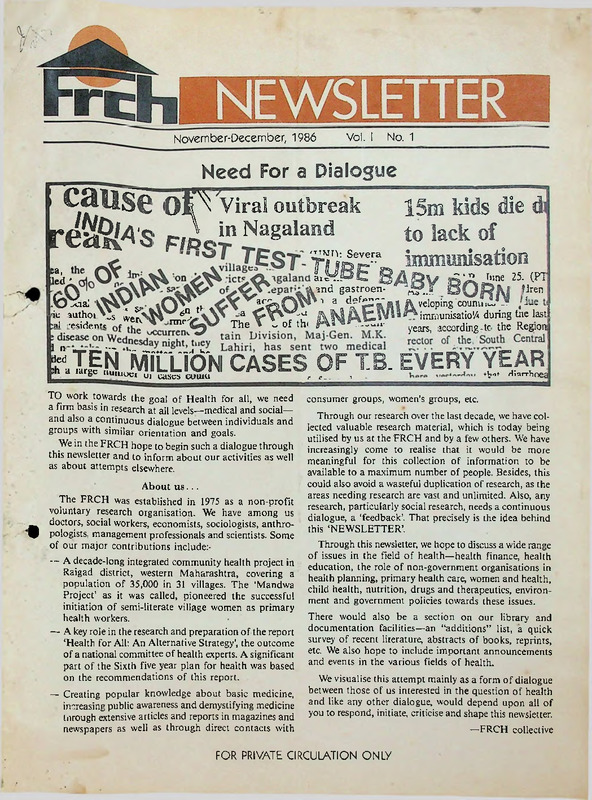
Cause Of Viral outbreak
reMA’s FX in Nagaland
53,
15m kids die d
to lack of
CTINT): Severa
=--- immunisation
a&DE BAPy 5‘PIne 25. (PT
Land gastroenBORN Piren
IV--rO “---57 — a Ts g
t
led *
.I
lOY ss OM" MYsoOWAEMIAYloringcoun I
iv authors wer t S
ANE
immunisation during tne last!
mmec
The V Lof th
yeas, according-to the Region
&ZTEN MILLION CASES OF TB, EVERY YEAR
,n a large numver Or cases coma
ee---
TO work towards the goal of Health for all, we need
a firm basis in research at all levels—medical and social—
and also a continuous dialogue between individuals and
groups with similar orientation and goals.
We in the FRCH hope to begin such a dialogue through
this newsletter and to inform about our activities as well
as about attempts elsewhere.
consumer groups, women’s groups, etc.
About us...
The FRCH was established in 1975 as a non-profit
voluntary research organisation. We have among us
•. doctors, social workers, economists, sociologists, anthroV pologists, management professionals and scientists. Some
of our major contributions include:-
' — A decade-long integrated community health project in
Raigad district, western Maharashtra, covering a
population of 35,000 in 31 villages. The ’Mandwa
Project’ as it was called, pioneered the successful
initiation of semi-literate village women as primary
health workers.
— A key role in the research and preparation of the report
’Health for All: An Alternative Strategy’, the outcome
of a national committee of health experts. A significant
part of the Sixth five year plan for health was based
on the recommendations of this report.
— Creating popular knowledge about basic medicine,
increasing public awareness and demystifying medicine
tnrough extensive articles and reports in magazines and
newspapers as well as through direct contacts with
’
Through our research over the last decade, we have col
lected valuable research material, which is today being
utilised by us at the FRCH and by a few others. We have
increasingly come to realise that it would be more
meaningful for this collection of information to be
available to a maximum number of people. Besides, this
could also avoid a wasteful duplication of research, as the
areas needing research are vast and unlimited. Also, any
research, particularly social research, needs a continuous
dialogue, a ‘feedback’. That precisely is the idea behind
this ‘NEWSLETTER’.
Through this newsletter, we hope to discuss a wide range
of issues in the field of health—health finance, health
education, the role of non-government organisations in
health planning, primary health care, women and health,
child health, nutrition, drugs and therapeutics, environ
ment and government policies towards these issues.
There would also be a section on our library and
documentation facilities—an “additions” list, a quick
survey of recent literature, abstracts of books, reprints,
etc. We also hope to include important announcements
and events in the various fields of health.
We visualise this attempt mainly as a form of dialogue
between those of us interested in the question of health
and like any other dialogue, would depend upon all of
you to respond, initiate, criticise and shape this newsletter.
FOR PRIVATE CIRCULATION ONLY
—FRCH collective
Practice of Medicine
—Dr Mukund Uplekar
How many practising general practitioners know about ‘Health for All by 2000 A.EK?
Our quick telephonic survey of 50 doctors (M.B.B.S), chosen randomly in Bombay
revealed to us the following:
PRIVATE PRACTITIONERS' AWARENESS ABOUT
"HEALTH FOR ALL BY 2000 AD."
HAVE YOU HEARD ABOUT "HEALTH FOR ALL"?
COULD YOU TELL US MORE ABOUT IT?
No Comments
—compiled by Sujata Gothoskar
“The examination of the genitals should command special
attention. It must take place in good light in the lithitomy
position, with the parts fully exposed. No false modesty
should be allowed to interfere with a thorough, careful,
unhurried examination, as a man’s liberty may depend
on this” (page 481).
“Vulval and vaginal injuries may be maliciously produced
in children by instruments or fingers and a false charge
of rape brought against an individual with a view to take
revenge or extorting money from him” (page 488).
“Often, the victim’s story gives a strong indication of the
falsity of a charge. The girl who tells of........ on
recovering her senses found her clothes in disorder, and
HOW DO YOU THINK YOU COULD
HELP TO ACHIEVE THIS GOAL ?
complains that she has been interfered with, is almost
certain to be an hysterical one, rather than a victim of
rape.” (page 489).
“The statement of a woman, who presents no signs of
a struggle and who appears to have offered no resistance
to her assailant, that she was under the influence of a drug
must be accepted with great caution” (page 489).
“In such a case, a close inquiry must be made into the
history of the case.... the complainant must be pressed
for details and the story may be so clear that drugging
may be ruled out” (page 489).
(From Parikh’s Textbook of Medical Jurisprudence and
Toxicology—for classrooms and courtrooms. 1983 edition.
The book is subsidised by the Government of India,
through the National Book Trust, India for the benefit
of the students.)
FOCUS
Battling Sex Determination
Manisha Gupte
SCIENCE and technology are not neutral in content. That
they are determined by the prevailing social structure is
clearly demonstrated by the sex determination and sex
preselection techniques. Amniocentesis, a technique
originally designed to detect foetal defects, but grossly
misused to detect foetal sex and thereby for female
foeticide has raised considerable storm in India.
for MTP is registered as ‘failure of contraception* or ‘grave
mental injury (sic) to the pregnant women! We also feel
that an Act to ban sex determination and sex preselection
must be passed at the Centre and not at the state level.
Aware that mere banning will not erase the problem, we
still feel that it is the minimum that has to be done by
the government.
Whereas in radical circles abroad, there have been
lengthy debates on the ethics of eliminating the handi. capped foetus and that the definition of ‘normalcy’ is
infact eugenic in character, in India the main concern has
. been over the meteoric growth of sex determination clinics
"Y all over the country. A mutual vested interest develops
within sex determination, on the one hand satisfying the
male child preference in individual families, and on the
other hand, offering a lucrative business prospect to the
medical and para medical professions. Clinics therefore
are manned by even untrained practitioners who merely
extract the amniotic fluid and then send samples to
specialised laboratories for prenatal sexing.
The FRCH is represented on a committee that has been
formed by the state government to study the magnitude
of the problem that sex determination tests pose and the
measures necessary to curtail them. This committee, com
prising further of technical, legal and public awareness
subcommittees will present its report to the government
by mid November 1986.
With a highly adverse sex ratio (937 females per 1000
males in India according to the 1981 census), there is
imminent danger that atrocities on women, including rape,
purdah, forced polyandry and female infanticide will
increase. Doyens of population control have also squarely
blamed women for reproduction and in the same spirit,
the Government of India has pledged itself to the NRR-1
(Net Reproduction Rate Unity) by the year 1990, spelling
out in lay person’s terms, that only one daughter should
replace her mother. We believe that elimination of the
victim cannot solve the problem; infact it only legitimises
. oppression. What is required is a systematic questioning
W of the problems that surround women and the role of the
medical profession vis a vis maintaining the status quo.
We have to question whether technology can successfully
understand and solve non-technological problems.
Vocal protest campaigns, especially in Bombay have
been raising pertinent issues for the past five years, the
most active campaigners being the Forum Against Sex
Determination (SD) and Sex Preselection (SP) techniques
and the Doctors against SD and SP techniques. With
rising storm, two bills were recently presented, one in the
Maharashtra legislative assembly which seeks to ban sex
determination procedures and the other in the parliament
that seeks to amend the existing Medical Termination of
Pregnancies (MTP) Act of 1972.
Mere amendment in the MTP Act cannot strengthen
legal action against amniocentesis because it is difficult
to legally establish the nexus between sex determination
and subsequent female foeticide. Most often the reason
We see the two Bills and the formation of this com
mittee as a positive step for a number of reasons. Besides
stripping sex determination of its respectability and
legality, it is heartening to see that a people’s campaign
has created pressure in government circles. The scope and
the scale of debate will undoubtedly widen with these
developments. As a next step we need to consolidate
various campaigns that revolve around the issue of
reproductive technology and to question their role within
the context of a woman’s right over her own body and
also with reference to the ideology and role of medicine.
* “Better 500 now than 5000 later", coax the
posters by the Bhandari Hospital in Amritsar.
(The 500 indicates the price of the test and
abortion and 5,000, the price of dowry, if the
girl is allowed to be born (sic !).
» According to a study by R.R Ravindra, in Dhule,
a small district town in northern Maharashtra,
with a population of 2.5 lakh, five such clinics
have sprouted in just 3 years! Other small towns
like Jalgaon and Amravati also have such clinics.
* Sex determination is but one method of get
ting rid of the female foetus, others being CVB,
Ericsson and Japansese method of pre
selection, B.N. Purandare's method of Rudraksha
and Podar Medical College's Ayurvedic nasal
drop technique. And many more are threaten
ing to come every minute!
Health Expenditure in India
Ravi Duggal
ESTIMATES of health financing in India are surrounded
with a great deal of controversy. The fact is that, public
financing (at least aggregate figures) is more or less well
known and documented. It is also well known that public
sector services are utilised by only about 20 per cent of
the population; the 80 per cent that remains, is a very grey
area of which very little is known. A few widely varying
estimates are available.
For instance, the National Sample Survey (28th round,
1973-74) has estimated household health expenditure at
Rs. 843 crore or Rs. 14.05 per capita per annum which
was 300 per cent over and above a public expenditure of
Rs. 280 crore in the same year. Applying this same ratio
for the year 1981-82, we get, Rs. 83.58 per capita private
health expenditure in addition to the Rs. 27.86 per capita
of public health expenditure. This means that for 1981-82
we get a total health expenditure of Rs. 7635.87 crore
(Rs. 111.44 per capita) which is 5.14 per cent of Gross
Domestic Product (GDP) (Rs. 148678 crore, 1981-82
prices).
But according to the estimates of the CMIE, health
expenditure was only 2.1 per cent of the GDP in 1981-82
(0.8 per cent government and 1.3 per cent private) giving
us a total expenditure of Rs. 3122.24 crore or Rs 45.57
per capita (Standard of Living, 1984).
Culling data from various sources, a somewhat different
picture emerges. In the year 1981-82, the state expenditure
on health (excluding family planning) was Rs. 1908.97
crore (Rs. 27.86 per capita—Combined Finance and
Revenue Account, quoted in CBHI, 1984). Of this expen
diture, an estimated 80 per cent was spent in urban areas
(Rs. 95.45 per capita) and only 20 per cent in rural areas
(Rs. 7.3 per capita). Besides the state expenditure, in urban
areas, municipal corporations and municipalities spent
around Rs. 53 per capita (estimated from a 1976-77 based
WHO BEARS
THE
AN
(RUPEES,
BURDEN
ESTIMATE
OF HEALTH
BY
FWANCING?
FRCH
crores)
9430.16
6956.25
383.25
0080808
RURAL
(POPULATION -52.5 .
"
CMRES)
POFULAION
(w croKS)
RVRAL URBAN
52.5
16
PEK CMTA NCH-TAIATE
EXPENDIUAE C I RVrrS)
KIRAL
UMM
URBAN
What remains unaccounted is private household expen
diture. On the basis of two urban studies and one rural
study, the FRCH has been able to make a reasonable
estimate of private household expenditure
In urban areas, middle class citizens (all members of
the Mumbai Grahak Panchayat), whose family annual
incomes ranged between Rs. 10,000 to Rs. 25,000, incurred
a health expenditure of Rs. 240 per capita per annum
(Rs. 1200 per family or 6.86 per cent of their average
income). This excluded reimbursements from employers
or other subsidies. In another study of class IV employees
(average income Rs. 7000 per annum) of a medical
research institute it was found that these families spent
Rs. 176 (excluding reimbursements) per capita per annum
(Rs. 880 per family or 12.57 per cent of their average
income). From this we estimate a figure of Rs. 208 per
capita per annum as urban private household expenditure
on health care. This entire amount went to the private
health sector (private practitioners, private hospitals,
diagnostics and drugs).
In the rural study conducted in five different districts
of Maharashtra we estimated private household expen
diture on health care to be Rs. 125 per capita per annum,
for the year 1981-82. This is based on one month’s actual
expenditure in a sample population of 4537.
All this for the country works out to as follows:
llllllllllllllllllllli
88888888
88888888
88888888
88888888
88888888
6562.5 88888888
20000000
o°0°0°0
38388888
88888888
NCAER study of municipal resources, 1980) or totally
Rs. 848 crore. And on the basis of Pune zilla parishad
and Dhule zilla parishad expenditure accounts, we con
clude that zilla parishads on an average spend Rs. 0.20
per capita per annum (rural).
Further, on the basis of data of selected public sector
and private sector organisations (see 22nd estimates com
mittee of the Lok Sabha and an ORG study on health
financing in India) a weighted average estimate for a
12 crore population (employee families included) works
out to Rs. 3726.96 crore or Rs. 310.58 per capita. This
figure includes insurance expenditures (ESIS, CGHS, etc).
LOCAL BODV
CORPORATE SECTOR
& INSURANCE
STATE
PRIVATE
HOUSE HOLD
URBAN
( POPULATION: 16
CEORES)
Urban (16 crore population)
= Rs. 1527. 20 crore
(a) State expenditure
(Rs. 95.45 per capita)
(1981-82)
(b) Municipal expenditure = Rs. 848 crore
(Rs. 53 per capita)
(estimate for 1983)
= Rs. 3726.96 crore
(c) Public & private
(Rs. 310.58 per capita)
industry including
insurance schemes
(d)
(for 12 crore popu
lation—estimate for
1981-82)
Private household
expenditure (1984)
Urban Total
= Rs. 3328 crore
(Rs. 208 per capita)
= Rs. 9430.16 crore
(Rs. 589.39 per capita)
Rural (52.5 crore population)
= Rs. 383.25 crore
(a) State expenditure
(Rs. 7.3 per capita)
(1981-82)
= Rs. 10.5 crore
(b) Z.P. expenditure
(Rs. 0.2 per capita)
(1983-84)
= Rs. 6562.5 crore
(c) Private household
(Rs. 125 per capita)
expenditure (1984)
= Rs. 6956.25 crore
Rural total
(Rs. 132.50 per capita)
= Rs. 16386.41 crore
India Total
(Rs. 239.22 per capita)
RURAL-URBAN
DISPARITIES
These estimates indicate that health expenditure in India
works out to 8.33 per cent of GDP (Rs. 196,745 crore at
1983-84 prices). Of the above estimated health expenditure
60.4 per cent is borne by households as a part of their
consumption expenditure (an astonishing 94 per cent in
the rural areas and only 35 per cent in the urban areas).
This only adds to the disparity between rural and urban
areas. Not only are public facilities and expenditure are
highly skewed in favour of urban areas, but the rural
population also spends 2.68 times more on health care
from its own household resources, as compared to the
urban population.
The FRCH will soon be undertaking a large study
monitoring health expenditure over a period of one year
in a representative district in order to carry out a detailed
analysis of private household expenditure. Any advice and
help is welcome.
HEALTH OUTLAYS UNDER
5-YEAR PLANS
7™ plan
DISTRIBUTION
OF
HOSPITALS
6th PLAN
Ta
DISTRIBUTION
plan
5
OF
HOSPITAL BEDS
4- PLAN
2RP
PLAN
3
POPULATION
COVERED
PER
HOSPITAL
BED
2
HD
■ •
RURAL
PLAN
URBAN
SOURCE : COMPILED
FROM
6MTX , IHDEPEAPENCE
DM SPCCIAL , 1 AUGUST 1986.
PLAN
SOURCE: COMPILED
PAY
FROM
Buiz, INDEPENDENCE
SPECIAL , 16 AucuST
1966._______________
Dear Reader,
We hope you have enjoyed reading our Newsletter and have found it meaningful. Would you like to continue receiving
it? Do fill up the following few queries and send them to us.
Do also send in your suggestions, criticisms and any contributions. The format of the newsletter is fairly flexible
and will depend on all of you to change it. Eg. There would be half a page or more for letters..., that is, if you
send us any.
We hope to receive answers to these queries as fast as possible.
Yours
FRCH COLLECTIVE
* We would like/would not like to receive the FRCH Newsletter.
* We would like the newsletter to focus on__________________________________________________________ _
♦ We would like the newsletter to cover topics like____________________________________________________
* If there was a contribution to be made towards the newsletter, would you still like to receive it? Yes/No.
* Our activities and interests are --------- -------------------------------------------------------------------- —----------------------
India and China—A Comparison
$
Dr. Ramesh Awasthi
INDIA and China together constitute over one-third of
the total world population and therefore offer great
TABLE III: HEALTH INFRASTRUCTURE
attraction to the expanding world market. Both these
India
China
India
China
countries have recently opened their flood-gates to free
(1950)
(1983)
trade economies, the consequences of which will be
Per 10,000 population
1.65
6.7
13.4
3.9
No. of physicians
watched with interest throughout the world.
No. of nursing
Having rid themselves of the colonial clutches almost
0.68'
0.23f
2.1
6
persons
at the same time, the two giant neighbours in Asia were
7
3.
1.5
21
No. of hospital beds
faced with similar challenges, with their backward
f: figures for 1946; g: figures for 1949.
economies and traditional societies. The two towering
men, Gandhi and Mao, who led their peoples’ struggles China has far exceeded the targets that we in India have set forth
for independence, had an almost identical vision of a new for 2000 A.D. and that too without any access to the latest western
social order—a society free from all forms of exploita technology, which was available to India.
tion, a decentralised economy and power in the hands of
the people. They however differed in the means for
TABLE IV: LIVING STANDARDS
achieving the desired goal.
India
China
India
China
In this context, it is worth comparing the performance
(1952)
(1982)
of the two countries in the last three decades in the fields
of agriculture, health services and infrastructure, living
20h
69)
16.7h
363
Literacy percent
standards and economic equality.
Per capita availablity
While India has taken the help of massive import of
450*
669*
542
384
Foodgrains (gms/day)
21.4
4.4
12.4
0.9
Sugar (kgms./yr)
Western technology, huge aid, loans and investment by
Edible Oils
the multinational corporations, China’s achievements have
2.1 i
5.81
3.1
3.51
(kgms./year)
been without any dependance on imported technology,
Cotton and Synthetic
but through the mobilisation of the people in all the
5.7
13.5
10.0
Textiles (meters/year)
11.0
h: figures for 1951; i: figures for 1951-52; j: figures for 1980;
k: figures for 1983; 1: figures for 1981-82.
TABLE 1: AGRICULTURE
India
China
(1950-51)
Cultivated land
(mill, hect.)
Irrigated land
(mill. heel.)
Total food production
(mill, tonnes)
India
China
(1984)
119
141
143
144
21
20
53
44.5
55a
1648
150
407
Because of the wide gulf between the consumption levels of the rich
and the poor, the per capita aggregate figures for India hide more
than what they reveal about the true condition of the vast majority
of the population. This is not the case with China, due to its
egalitarian distribution as evident from the data given below.
TABLE V: ECONOMIC DISPARITIES
a: figures for 1952.
INDIA (1984)
With nearly an equal area under cultivation and the same level of
irrigation, China produces about 3 times as much of food grains
as India does with all its green revolution technology, high yielding
varieties and chemical fertilizers.
TABLE II: HEALTH INDICATORS
India
China
(1950)
-1346
India
China
(1981)
Infant mortality rate
121
35
(Per 000)
__
lld
Child (1-4) death rate
24
(Per 000)
40b
37b
35
Crude birth rate
21
(Per 000)
27c
Crude death rate
17c
13
6.4
(Per 000)
___
32
52
Life expectancy at
67
birth (yrs.)
—
2.1e
Population growth
1.56
rate (mill)
7494
361
542
Total Population
10294
b: figures for 1950-51; c: figures for 1951; d: figures for 1984
e: figures for 1971-81
CHINA (1982)
Only 20.25 per cent of the
89 per cent of the popula
households have an income tion has an income between
between + 50 per cent of
± 50 per cent of the per
the average household
capita average of 41.7 yuan
income whereas 60 per cent per year.
of the households get less
than the average.
In India the top 20 per cent corner 49.4 per cent of the total
household income.
aspects of development. In fact, it is clear that India and
China have much more to learn from each other’s
experience than from the West.
Sources of Data:
1. China* A statistics survey in 1985; State statistical bureau, China, 1985.
2. China* A general survey, Foreign language press, Beijing, China 1981.
3. Life in modern China, New world press, Beijing, China, 1984.
4. World development report 1986, Oxford university press, 1986.
5. Indian agriculture in brief, ministry of agriculture. New Delhi, 1982.
6. Health statistics ofIndia, 1984, ministry of health andfamily welfar.
New Delhi, 1984.
Library and Documentation Cell
FOR any serious and useful research, a good library is
an invaluable asset. The in-house library of the FRCH
has been developed as a result of the collective efforts of
our researchers over the last decade.
The library covers areas like health economics, health
education, primary health care technology, environment,
ecology, safety and government policies on these issues.
The Breakup of this collection is as follows:
appx. no.
3000
Books
3000
Reprints
appx. no.
Journals
65
Newspapers
8
What is
World health organisation (TRS-722), “Use of essential
drugs” — Geneva: WHO, 1985.
World health organisation (TRS-622), “Promotion and
development of traditional medicine”. — Geneva:
WHO, 1978.
Mamdani M. et.al, “Essential drugs and developing coun
tries”. — London: EPC publications, 1985.
De’monte Darryl, “Temples or tombs”? — New Delhi:
Centre for science and environment, 1986.
Centre for science and environment, “State of India’s
environment report: 1984-85’, — New Delhi: CSE,
1985.
Allaby Michael, “MacMillan dictionary of environment”,
— London: Macmillan press, 1983.
Consumers assistance of Penang, “Curing the sick or rich,
rising cost of medical care in Malayasia”. — Penang:
CAP, 1983.
Institute of development studies, “Primary health care and
the role of foreign aid”.—Sussex: IDS; 1979.
India, Govt, of, “Leprosy status report: 1986”.—New
Delhi: India, Govt, of, 1986.
Harrington N. M. (Ed), “Recent advances in occupational
Health No. 2”.—London. Churchill Livingstone, 1984.
Banerji D, “Health and family planning services in India:
an epidemiological, socio-cultural and political analysis
The library also provides documentation services like
classified newspaper clippings, indexing and abstracting
of important articles in journals, providing an ‘additions’
list every month, photocopying on payment eta
The library is open to any reader. A letter of recom
mendation from her/his institute/college/university will
be appreciated. The library however is meant only for
reference work.
The Library timings are as follows:-
9 a.m. — 5. p.m. Monday to Friday.
New?
and perspective”.—New Delhi: Lokpaksh, 1985.
Crowley D. et.al, “How to run a radio learning group
campaign”.—Bonn: Friedrich-Ebert-Stiftung, 1985.
Chattopadhyay M., “Condition of labour in Indian
agriculture: apparent and real”.—Calcutta: K. P. Bagchi
and Co., 1985.
Alderson Michael, “An introduction to epidemiology”.—
London: MacMillan press, 1983.
Shah Shantilal (Ed.), “API text book of medicine”.—
Bombay: association of physicans of India, 1986.
Central statistical organisation, “National accounts
statistics: January 1986”—New Delhi, India, Govt, of,
1986.
Ministry of finance, “Economic survey: 1985-86”.—New
Delhi: India, Govt, of, 1986.
Leontief Wassily and Duchin Faye, “Future impact of
automation on workers”.—New York: Oxford univer
sity press, 1986.
Sahabat Alam Malayasia, “Bhopal tragedy—one year
after”.—Penang: Sahabat Alam Malayasia: 1986.
Morehouse Ward and Subramaniam A. “Bhopal
tragedy”.—New York: Council of international public
affairs, 1986.
Weir David, “Bhopal syndrome”.—Penang: IOCU, 1986.
Books in Brief
PUBLIC MEETING
Manish Mankad
ON
1. Harrington, N.M. (Ed.), “Recent advances in occupa
tional Health, number 2”, London: Churchill Living
stone, 1984, pp 283.
HEALTH CARE SERVICES IN INDIA:
DO PEOPLE MATTER?
This book, 2nd in this series, is a compendium of
articles written by occupational health and safety
experts on recent developments in this area. There are
20 articles, divided into 5 sections, viz, work hazards,
investigative methods, environmental control, socio
economic aspects and controversy. Each article is rich
in references. The book also contains good photo
graphs and charts, as well as an exhaustive and useful
index.
VANMALI HALL, DADAR (W),
OPP. CHHABILDAS HIGH SCHOOL
2. Banerji Debabar, “Health and family planning services
in India: an epidemiological, socio-cultural and
political analysis and perspective”, New Delhi:
Lokpaksh, 1985, pp. 464, price Rs. 300/-.
The main theme of this book is an analytical account
of the growth and development of health services in
India and a discussion of the factors influencing their
availability and accessibility to different sections of the
population.
The content is organised in six parts. 1. The broad
cultural, social and political analysis of the factors
which determine the basic elements of the health ser
vices; II. Programmes for communicable diseases; III.
Population growth and family planning; IV. Formation
of primary health care services; V. Aspects of inter
sectoral action for health; VI. Perspective for alter
native approaches. The epilogue deals with the postu
lates of the proposed theory. This book also contains
81 tables and 9 charts.
3. Wilson, M.X. (Ed.), “Directory of foreign funding
AT
ON
SUNDAY, 16 NOV. 1986
AT
4.00 P.M.
ORGANISED BY
THE FOUNDATION FOR RESEARCH IN
COMMUNITY HEALTH
RESEARCHERS, ACTIVISTS AND
PROMINENT PERSONS FROM THE HEALTH
FIELD WILL SPEAK AND ANSWER YOUR
QUESTIONS.
organisations”, Madras: Commercial laws data
corporation, 1986: pp. 88, Price. 120/-.
This directory is divided into 8 sections. However,
there is no order—sequential or alphabetical—in either
of these. Neither are there any cross references from
areas of interest to the corresponding donors. For the
majority of the organisations mentioned, there is
neither the full postal address nor the aims or objec
tives. Even the codification of the entries is
unexplained.
Besides, there are a few more directories which pro
vide information about foreign funding organizations.
* ‘The State shall regard the raising of the level of
nutrition and the standard of living of its people
and the improvement of public health as among
its primary duties’.
—Part IV, Article 47, Constitution of India.
* In 1981, the Study Group of ICSSR and ICMR
concluded that there had been little or no im
provement in the nutritional status of Indians over
the past 30 years.
* In October 1985, in a national seminar, experts
revealed that over 200 million people in the
country suffer from some degree of malnutrition.
* According to the Indian Council of Medical
Research, more than 7 million new-born babies in
the country, every year, are underweight.
* 30 per cent infants who survive have a low birth
weight of less than 2,500 gms.
* Diarrhoea claims the lives of 1.5 million babies
each year.
* 40,000 Indian babies go blind every year owing
to Vitamin A deficiency.
* Early childhood malnutrition is also the single
greatest cause of mental and physical retardation.
Source: Compiled from Blitz, Independence day
special, 16 August, 1986.
Source: Compiled from Blitz, Independence day
special, 16 August, 1986.
Edited by Sujata Gothoskar with the co-operation of Manish Mankad and secretarial assistance from Sunita Vichare and Amirbanu Sumnani.
Art work by Madhu Rokle and Vineeta. Produced by The Foundation for Research in Community Health, 84-A, R. G. Thadani Marg, Worli,
Bombay - 400 018. Printed by Modern Arts and Industries, A-Z Industrial Estate, Lower Parel, Bombay.
Position: 3259 (5 views)