ICMR BULLETIN VOL. 25-No.-11-NOVEMBER-1995
Item
- Title
- ICMR BULLETIN VOL. 25-No.-11-NOVEMBER-1995
- extracted text
-
LIBRARY
AND
CUMENTATION
ISSN 0377-4910
ICMR
1I1S
BULLill
November, 1995
Vol. 25, No. 11
STUDIES ON THE NATURE AND UTILIZATION OF
CARBOHYDRATES CONTAINED IN PULSES
Pulses and dhals have always been important ingrvdients in Indian traditional diets. Inclusion of pulses ensures
adequate dietary protein intake among populations in the
developing countries. Studies reported hitherto generally
considered protein content or its quality in pulses for their
supplementaiy effect on cereal proteins. Some information
on the presence of antinutritional Actors such as trypsin
inhibitors1 and non-reducing sugars2 in pulses is available.
a
s
D
d
30
00L/P2SON?
In the developing countries most of the dietary calories
are derived from carbohydrates ofcereals, pulses and tubers.
The carbohydrate content reported for cereals ranges from
68-78 per cent, tubers 33-35 per cent and pulses 57-60 per
cent but these values were obtained by difference after
accounting for protein,自t, fibre and minerals3. There is a
popular belief that.pulses are less digestible and that their
consumption leads to flatulence. There is, however, little
information on the nature of these carbohydrates and effi
ciency with which they are utilized. Studies carried out at
the National Institute ofNutrition (NIN), Hyderabad, on the
nature and digestibility of caibohydrates in the four com
monly consumed pulses4,5 wz. Bengal gram, green gram, red
gram and black gram have provided scientific data on rela
tive merits ofthese pulses with regard to their carbohydrates.
1-4 linkages of the polysaccharide. The pulses studied
showed distinct difierences in their
vitro digestibility.
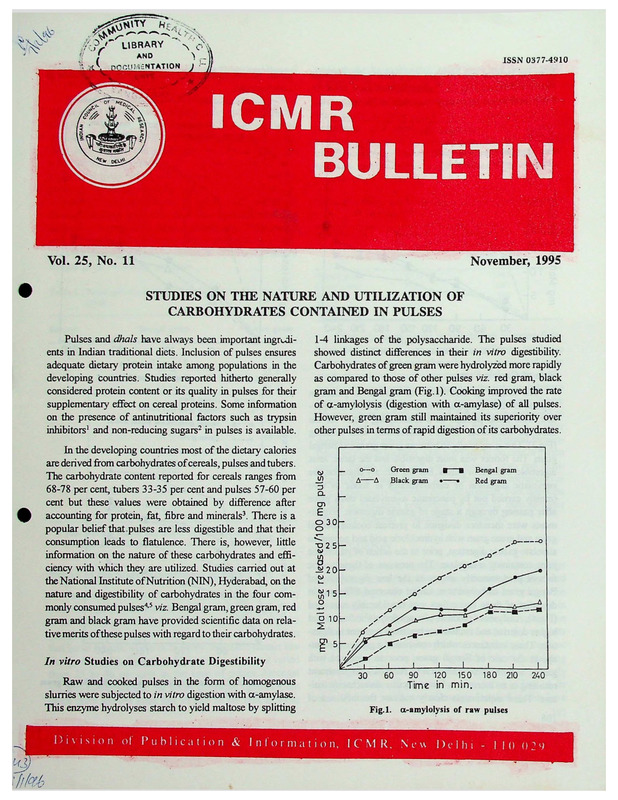
Carbohydrates of green gram were hydrolyzed more rapidly
as compared to those of other pulses Wz. red gram, black
gram and Bengal gram (Fig.1). Cooking improved the rate
of a-amylolysis (digestig with a-amylase) of all pulses.
However, green gram still maintained its superiority over
other pulses in terms of rapid digestion of its carbohydrates.
25
20
2 15
S
O
- 10
O
S
U n5
E
In vitro Studies on Carbohydrate Digestibility
Raw and cooked pulses in the form of homogenous
slurries were subjected to in vitro digestion with a-amylase.
This enzyme hydrolyses starch to yield maltose by splitting
Fig.l.
a-»mylolysis of raw pulses
Division of Publication & I n format ion, I C M R, New
歹
Even the isolated raw starches from these pulses 就lowed
similar differences (Fig.2). Cooked starches were, however,
easily hydrolyzed by a-amylase almost at the same rate.
35
OOL/pasD-? 2S0-DW
25
20
15
」
00_/p3soz -2
30
10
6
E
50l
a
s
D
d 4
6
E
4
6
E
gastnc fectors such as HC1 and pq)sin on the digestkm of
carbohydrates.
5
60
9
o I*
1
20 50
1
—
30
80 21
o2
6
E
o
3
o
2
o
1
c
40
Time in min.
60
Fig.2. a-amylolysis of raw starches
Role of Gastric Factors
00I/P2SD2-2J 2 S O L O W
106
240
Fig.3. Effect of cooking on a-amylolysis of pulses.
as-nd
The manner of distribution of starches in pulses in
relation to other components in their native form is impor
tant. This could perhaps be a contributing factor for the
observed differences in their digestibility after cooking
(Fig.3). This is especially so between green gram and Bengal
gram. The former was most digestible and the latter, least
digestible, ofthe four pulses. Barring salivaiy digestion, the
enzymatic digestion of carbohydrates in foods in vivo
(mostly carried out by pancreatic a-amylase) takes place
after passing through a stage of gastric digestion. Experi
ments were therefore designed to pretreat cooked Bengal
gram and green gram with hydrochloric acid and pepsin' to
simulate gastric digestion, prior to the action of pancreatic
juice containing a-amylase. The presence of these gastric
factors predominantly improved the low digestibility of
Bengal gram carbohydrates; earlier observed difference in
digestion of these two pulses was considerably narrowed
(Fig.4). Analyses ofproducts ofa-amylolysis7 indicated that
higher dextrins and maltotriose remained resistant to diges
tion. These substances which constituted a greater percent
age in the case of Bengal gram, prior to treatment with
gastric factors, were considerably reduced after treatment
resulting in an increase in low molecular disaccharide mal
tose. These experiments clearly indicate the influence of
120
180
Time in min.
■-----■
o— o
Bengal gram
Bengal gram HCi treated
A----- ▲
Bengal gram HCI & pepsin treated
•___ «
Green gram
5 o ▲----- ▲
Green gram HCI treated
Green gram HCI & pepsin treated
4o
3o
2o
1c
60
120
180
Time in min.
240
Fig.4. Effect of HC1 and pepsin on a-amylolysis of Bengal gram
and green gram
Utilization ofCarbohydrates ofGreen Gram and Bengal
Gram in vivo in Children
respectively. As against this, black gram and Bengal gram
showed amylose values like 44 to 45 per cent re^>ectively.
Studies were undertaken to determine the efficacy of
utilization of carbohydrates ofgreen gram and Bengal gram
vivo in diildien. Subjects aged 3 to 4 years (using
crossover design) were given cooked homogenous slurry
from Bengal gram and green gram and the carbohydrate
tolerance test was performed. The per cent increase in blood
sugar level (peak value) over fasting level in children fed
green gram was significantly higher compared to that ob
served on feeding Bengal gram (Table I). Further, in six of
the eight children examined, peak blood glucose level was
attained at 30 min in the case of green gram. Wth Bengal
gram, in 4 ofthe 8 children, glucose peak occurred at 60 min.
These studies indicate poorer utilization of carbohydrates of
Bengal gram for ene里y purposes.
Apart from the amount of amydose present in starch, its
chain length in terms of total glucose residues also is of
(mportance Ulis latter characteristic of starch seems to
influence its digestion. Degree ofpolymerizatkMi of amylose
moiety isolated from these pulses indicated that Bernal gram
and black gram had chain length 3-6 times higher compared
to green gram (Table II).
Table I. Blood glucose in children fed Bengal gram and green
gram.
Bengal gram
Subject
Source
Bengal gram
Green gram
Red gram
Black gram
Amylose
(% linear
fraction)
45.81
35.01
38.01
43.86
Degree of Polymerisation
(No. of glucose residues/
amylose unit)
1667
667
540
4000
Green gram
1.
14.46
16.67
2.
17.28
53.40f
3.
15.38
30.77
4.
25.00f
39.30
5.
22.84f
31.58
6.
4.55
18.60
7.
15.38f
25.63f
8.
13.22f
13.22
Mean
16.01
28.65
± SE
2.201
士 4.689*
f Peak level was readied later than 30 min. after pulse meal.
Values are the percentage increase over fasting levels.
* P
Table n. Amylose and chain length (degree of polymerisation)
of amyloie.
Consumption of pulses is also known to cause flatu
lence. Non-reducing sugars, such as, raffinose, stachyose
and verbascose, present in the pulses were implicated in the
production of flatulence9. Concentration of these non-reduc
ing sugars could not be considered as the sole contributory
&ctor for higher flatulence seen with Bengal gram. Poorer
digestibility of carbohydrates of Bengal gram compared to
other pulses, is the primary cause for flatulence. Lower
digestibility of starches can lead to their bacterial fermen
tation by the gut bacteria. This is evident in the case ofpotato
starch. Potato starch like that of Bengal gram and black
gram has also higher value for degree of polymerisation of
its amylose and is therefore difficult to digest. Poor digestion
results in increased proportion of residual carbohydrates
which are exposed to bacterial fermentation.
CONCLUSION
<0.05
Nature of the Starch Component in Pulses
Percentage of linear chain fraction of starch (amylose)
from these pulses was determined8 to explain the difierence
in the rates of a-amylolysis of isolated starches using the
standard potentiometric titration procedure. It was evident
that linear fraction of starch in easily digestible cereals like
rice constituted to the extent of 20 per cent whereas it varied
from 35 to 46 per cent in the case of pulses. Amongst
the four pulses studied, the better digestible starches from
green gram and red gram had 35 and 38 per cent amylose
Data from the investigations repoited here indicate that
the composition of starch in terms of amylose content and
its chain length are important &ctors in determining the
digestibility and effective utilization of carbohydrates in
pulses. These findings support the view that qualitative
difierences among starchy foods are major determinants
affecting digestion and absorption of carbohydrates, because
ofstarch dominance in human diets10 and help in fbnnulating
weaning foods based on specific pulses to ensure not only
adequate intake of protein but also better utility of its
carbohydrates as sources of energy. Detailed studies have
107
brought out tiie superior quality of caibohydrates in green
gram. Going by the chemical nature of the carbohydrates,
red gram also appears to be equally promising. These inves
tigations also provide valuable information for formulating
pulse-based weaning foods. For infants who suffer from
poor gastric digestion, formulations based on green gram
could be a good choice.
References:
4.
Srinivasa Rao, R Studies on the digestibility of carbohydrates
in pulses. Indian J Med Res 57: 2151, 1969.
5.
Srinivasa Rao, R Nature of carbohydrates in pulses. J Agr
Fd Chem 24: 948, 1976.
6.
Oser, B.L. In: Hawk's Physiological Chemistry. 14th ed. Ed.
B.L. Oser. Academic Press, New "Ybrk, 1965, p.47.
7.
Williams, K.T, and Arthur; B. The chromatographic examination
of sugars in wheat flour. Cereal Chem 28: 416, 1951.
8.
Schoch, T.J. lodimetric determination of amylose. Methods
Carbohydr Chem 4: 157, 1964.
9.
Murphy, E.L. Proceedings of the 6th Research Conference
on Dry Beans. Los Angeles, Califcrnia. USDA Report WUEDD,
1963, p.30.
1.
Sohonie, K. and Bhandaricar, A.P Trypsin inhibitors in Indian
foodstuffs. Rirt n. Inhibitors in pulses. J Sci Ind Res (India)
14C: 100, 1955.
2.
Nigam, V.N. and Giri, K.V. Sugars in pulses. Can J Biochem
Physiol 39: 1847, 1961.
10. Bjorck, L, Grandtfelt, Y, Liljebcrg, H., Ibvar J. and Asp,
N.G. Food properties affecting the digestion and absorption
of carbohydrates. Am J Clin Nutr 59: 6998, 1994.
3.
Gopalan, C. Ramasastri, B.V., and Balasubramaniam, S.C.
Nutritive value of Indian Foods. Revised and updated by B.S.
Narsinga Rao, YG. Deosthale and K.C.隔nt. National
Institute of Nutrition (ICMR), Hyderabad, 1989, p.47.
This write-up has been.contributed by Dr. P. Srinivasa Rao,
Dy. Director, National Institute of Nutrition, Hyderabad.
ABSTRACTS
Some Research Projects Completed Recently
Functional value of nerve decompression in leprosy
patients.
tenderness were seen (in 84% and 94% patients respectively)
in the majority.
The nerves of 34 patients of leprosy with nerve involve
ment ranging from 22 days to 7 years were subjected to nerve
decompression to assess its benefit in terms of symptomatic
relief and improvement in functions/sensitivity of the af
fected part (foot and hand). Due to difficulties in evaluaticn
of nerve damage and improvement, children below 10 years
of age were excluded from the study. Twenty five nerves
were subjected to nerve decompression alone under local
anaesthesia, while the other 25 nerves were treated with
intralesional corticosteroid injection intraoperatively, fol
lowed by 2 injections at weekly intervals postoperatively.
Postoperative recovery of function was assessed at the end
of 6 weeks. Sweat prints of the affected part 7e palm/foot
were taken preoperatively and 6 weeks postoperatively to
assess the enhancement of sweat secretion.
Improvement in nerve function was observed in most of
the nerves subjected to nerve decompression. The nerves
subjected to intralesional steroid injection had better im
provement in nerve function. Deterioration or no change in
nerve function was observed in nerves with a long duration
of nerve involvement and presence of nerve abscesses.
Lesser the duration of nerve involvement better was the
recoveiy following either nerve decompression alone or
when combined with intralesional steroids. The best results
were obtained when nerve involvement was of less than
6 months duration. Mailed relief in pain was observed in all
nerves subjected to nerve decompression. Enhancement in
sweat secretion fiom the preoperative status was noticed in
both the groups which was more maiked in patients given
steroids. However, the amount of sweat secretion did not
reach nonnal level in either group during the study.
Neurological involvement was observed more often in
the tuberculoid iqprosy patients (88.23%) and least in the
lepromatous patients (5.9%). Loss of sweat secretion and
nerve thickening was seal in all patients. Nerve pain and
VK. Sringesh
N.C. Padhi
Department of Surgery
M.K.C.G. Medical College
Berhampur.
108
Immunocytochemical localization and biochemical
estimation of peptide hormone binding capacity of
breast tissue.
membrane preparations. Prolactin binding sites were present
in greater proportion in peri or post men(^)ausal breast
cancer patients.
The study was carried out to examine
immunohistochemically detectable prolactin (PRL), follicu
lar stimulating hormone (FSH) and leutinising hormone
(LH) binding sites in various breast lesions using a highly
sensitive modified dinitrophenyl hapten sandwich staining
procedure and biochemically estimating PRL binding in
particulate membrane prq)arations of breast tissue.
It is thus concluded that the more consistent
immunostaining in breast carcinoma as compared to benign
breast tissues as well as presence of PRL receptor in erode
membrane of breast-carcinoma tissue suggest the role of
PRL in mammary tumourigenesis. The results of immuno
cytochemistry on FNAC smears were comparable with that
of histologic sections. FNAC being economical, quick and
a nonoperative procedure, could be more easily used for
study of hormone binding sites in breast lesions.
One hundred and seven formalin fixed paraffin embed
ded breast tissue sections were immunostained for
localisation of prolactin binding sites in benign and malig
nant breast lesions. Of these, 35 and 28 sections were also
stained for FSH and LH binding sites respectively. Eighty
two per cent of breast carcinoma gave an intracellular
positive reaction in tissue sections for prolactin binding sites,
but the positivity was 72 per cent in fine needle aspiration
smears.
In an attempt to biochemically quantitate prolactin receptors, both purified and crude plasma membranes of
tissues from benign and malignant lesions, were prepared.
Breast carcinoma showed more consistent staining as com
pared to benign breast lesions. Also, prolactin recq^tors
could be located biodiemically in malignant breast tissue
Sandeq) Kumar
Dq)aitment of Suigery
Maulana Azad Medical College
New Delhi
Publications:
1.
Agarwal, P.K. Tandon, S., Agarwal, A.K. and Kumar, S.
Highly specific sites of prolactin binding in benign and
malignant breast tissue. Indian J Expt Biol 27: 1035, 1989.
2.
Tindon, S., Agarwal, P.K., Mishra, L., Goel, A. and Kumar,
S. Immunocytochemical detection of prolactin binding sites
in fine needle aspiration smears of breast tissue lesions. Indian
J Med Res 98: 161, 1993.
ICMR NEWS
The IX meeting of the Directors of the ICMR Institutes/Centres located in different parts of India was held at
New Delhi on October 29 and 30, 1995.
****
****
****
Meetings:
An Expert Group Meeting on Training Modules for the
Modified Project on Integrated Delivery of Reproductive
Health Care Services at the District Level, was held at New
Delhi (October 18, 1995).
Participation of ICMR Scientists in Scientific Events:
Dr. S. Radhakrishna, Director, Institute for Research in
Medical Statistics, Madras, served as a Short-term WHO
Consultant on Tuberculosis in Phillipines for one month
(w.e.f October 11, 1995).
Dr. G.V Satyava也 Director-Goieral, ICMR, chaired
the Concluding Session of the Seminar on Policy Implica
tions and Action Plan Based on National Family Health
Survey at New Delhi (October 21,1995). She also delivered
the Inaugural Address of the Symposium on U.N.
Brahmachari and Perspective of Kala-azar Research at
Calcutta (November 3, 1995).
and
109
ICMR AIDED SYMPOSIA/SEMEVARSAVORKSHOPS/COURSES/CONFERENCES
Symposium/Seminar/Workshop/
Course/Conference
Date & Place
Contact Address
XXVI Annual Conference of the Endocrine Society of
India.
December 1-3,1995;
(at Ahmedabad)
Dr. J.M. Bhatavdekar, Organising Secretary,
ESICON-1995, Division of Molecular Endo
crinology, The Gujarat Cancer Society,
Ahmedabad.
International Symposium on Radiomodifiers in Human
Health.
December 28*31,
1995;
(at Manipal)
ProE P. Uma Devi, Convenor, ISRHH, Departmerit ofRadiobiology^Kasturba Medical College,
Manipal.
COUNCILS TRAINING PROGRAMMES
Reproductive Biology
At the Institute for Research
Occupational Health
Reproduction, Bombay:
•
Training Course on Techniques in Immunology, Cell
Biology and Molecular Biology (November5-25,1995).
•
Training'Course on Techniques in Neuroendocrine Re
search (February 6-10, 1996).
Nutrition
•
Orientation Course on Occupational Health for
Industrial Medical Officers (November 13-24,
1995).
•
Training Course on Air Pollution Monitoring and
Risk Assessment (December 13-19, 1995).
Laboratory Animal Technology
At the National Institute of Nutrition, Hyderabad:
•
At the National Institute of Occupational Health,
Ahmedabad:
Annual Training Course in Nutrition (December 1,
1995 - February 28, 1996).
At the Laboratory Animal Information Services Centre,
National Institute ofNutrition, Hyderabad:
•
Training Course for Laboratory Animal Supervisors
(September 4 - November 30, 1995).
ICMR PUBLICATIONS
Price (Rs.)
Nutritive Wue of Indian Foods (1985), by C. Gopalan, B.V Ramasastri and
S.C. Balasubramaniam, Revised and Updated (1989), by B.S. Narasinga Rao,
K.C, Pant and Y.G. Deosthale (Reprinted 1995)
25.00
Growth & Physical Development of Indian Infants and Children
(1972, Reprinted 1989)
10.00
110
Studies on Weaning & Supplementary Foods (1974, Reprinted 1986)
6.00
Studies on Pre-School Children (1974, Reprinted 1984)
6.00
A Manual of Nutrition (Second Edition 1974, Reprinted 1992)
4.50
Low Cost Nutritious Supplements (Second Edition 1975, Reprinted 1994)
4.00
Menus for Low Cost Balanced Diets and School Lunch Programmes Suitable
for South India (Third Edition 1977, Reprinted 1991)
4.50
Menus for Low Cost Balanced Diets and School Lunch Programmes Suitable
for North India (Second Edition 1977, Reprinted 1994)
4.50
Some Common Indian Recipes and their Nutritive Value (Fourth Edition 1977,
Reprinted 1991) by S waran Pasricha & L.M. Rebello
10.00
Nutrition for Mother & Child (Third Edition 1978, Reprinted 1991)
by P.S. Wnkatachalam & L.M. Rebello
9.00
Japanese Encephalitis in India (Revised Edition 1980)
5.00
Some Therapeutic Diets (Fourth Edition 1988, Reprinted 1995) by Swaran Pasricha
4.50
Nutrient Requirements & Recommended Dietary Allowances for Indians
(1990, Reprinted 1994)
14.00
Fruits (1983, Reprinted 1992) by Indira Gopalan & M. Mohan Ram
7.00
Count What Ybu Eat (1989, Reprinted 1991) by Swaran Pasricha
9.00
Diet & Diabetes (Second Edition 1993) by T.C. Raghuram, Swaran Pasricha
& R.D. Sharma
18.00
Dietary Tips for the Elderly (1992, by Swaran Pasricha & B.V.S. Thimmayamma
3.50
Diet and Heart Disease (1994) by Ghafborunissa and Kamala Krishnaswamy
26.00
♦Depressive Disease (1986) by A. Venkoba Rao
58.00
**Medicinal Plants of India Vbl.2 (1987)
136.00
♦♦The Anophelines of India (Revised Edition 1984) by T. Ramachandra Rao
150.00
*10 per cent discount allowed to individuals.
**25 per cent discount allowed to individuals.
Unpriced Publications
(for limited distribution)
Proceedings of the Indo-UK Workshop on Leishmaniasis (1983)
Collaborative Study on Blindness, 1971-74 (1987)
111
Endomycocardial Fibrosis in India (1983)
Epidmiological Survey of Endemic Goitre and Endemic Cretinism (1989)
Illegal Abortion in Rural Areas (1989)
Collaborative Study on Phenomenology and Natural History of Acute Psychosis (1989)
Melatonin (1991) by S. Parvathi Devi
3
;
Field Supplementation Trial in Pregnant Women with 60 mg, 120 mg and 180 mg of iron with 500 |ig of
FolilcAcid (1992).
/
These publications are available on prepayment of cost by cheque, bank draft or postal order (bank and postal
charges will be extra) in favour of the Director-General, Indian Council of Medical Research, New Delhi.
Money orders are not acceptable. All correspondence in this regard should be addressed to the Chief, Division
of Publication and Information, Indian Council of Medical Research, Post Box No.4911, Ansari Nagar, New
Delhkl 10029 (India).
EDITORIAL BOARD
Dr. G.V. Satyavati
.... Chairperson
Dr. Badri N. Saxena
….Member
Dr. N. Medappa
.... Editor
Printed and Published by Shri J.N. Mathur for the Indian Council of Medical Research, New Delhi
at the ICMR Offset Press, New Delhi-110029
R.N. 21813/71
Position: 2040 (14 views)