ICMR BULLETIN VOL. 26-No.-11-NOVEMBER-1996
Item
- Title
- ICMR BULLETIN VOL. 26-No.-11-NOVEMBER-1996
- extracted text
-
ISSN 0377-4910
VOL. 26, No. 11
NOVEMBER, 1996
ICMR Completes 85 Years
PM launches the concluding ceremony and gives away ICMR awards
The year long celebrations of the 85th year of ihe
Indian Council of Medical Research (starting fi-oin No
vember 1995) will be concluding in November, 1996. Shri
H.D. Deve Gowda, Hon'ble Prime Minister of India
launched the concluding phase of the 85th year celebra
tions by lighting a lamp on October 15,1996 at a function
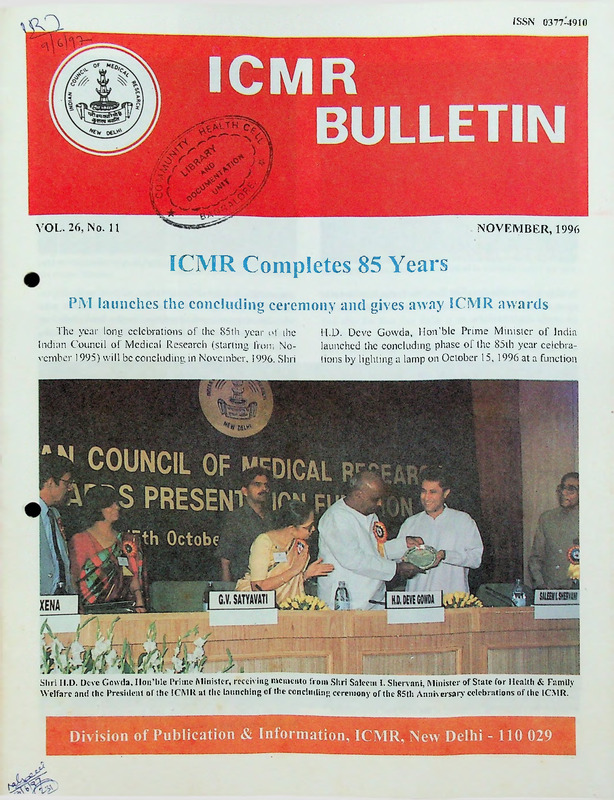
Shri H.D. Devc Gowda, HonMjlc Prime Minister, receiving memento from Shri Saleem I. Shervani, Minister of State for Health & Family
Welfare and the President of the ICMR at the launching of the concluding ceremony of the 85tli Anniversary celebrations of the ICMR.
"Hon'ble Prime Minister of India and other dignitaries on the (lias
held at Vigyan Bhavan. The Hon'ble Prime Minister also
gave away the ICMR awards to distinguished Indian
biomedical researchers.
Addressing the distinguished gathering, Shri Deve
Gowda complemented the track record of the ICMR. He
exhorted the scientists gathered to undertake work on
practical solutions fbr major health problems common to
India and other developing countries. The success of any
health programme, he said, depends not only on the proper
use of drugs and other tools but finally on the community
-the people affected, without their cooperation, help and
support no public health problem can be properly tackled.
Dr V. Ramalingaswami receiving Dr. B.R. /Xrnbcdkar Ccntcnan
?\ward from the Prime Minister.
(
community at large. It is, therefore, of paramount impor
tance that health related policies and research are peri
odically reviewed and reoriented in the background of
cuiTent socio-economic realities, keeping pace with the
social dynamics'*.
Shri Deve Gowda said "Research management is not
an end in itself. It is one of the means by which the output
of research can exert its full beneficial impact on the
Dr N.K. Ganguly receiving Basanti Devi Amir Chand Prize from
the Prime Minister.
Hon'ble Prime Minister Shri II.D. Deve Gowda lighting the lamp
to launch the concluding ceremony of the 85th year celebrations
oflCMR.
110
He filrther added : "We live in a world wherein man
kind has to eternally fight the microbes and also maintain
and pursue environment-friendly life styles. There will
thus be many new challenges fbr ICMR in the years to
come. I am, therefore, happy to launch the concluding
ceremony of the 85th year of this prestigious Council. I
wish not only many successes fbr ICMR in the coming
years, but a meaningfiil role in all national and even inter
national efforts in promoting and providing health fbr all
by the tum of this century',.
Dr R.C. Mahajan receiving Basanti Devi Amir Chand Prize from
c Prime Minister.
The II on'bl e Minister of State Shri Saleem I.Shervani,
who is the President of the Governing Body of ICMR,
presided over the function. Shri Shervani congratulated the
awardees for their excellent researches and hoped that they
will be more motivated now to take up the challenging
Dr S.!l. Advani receiving Sandoz Oration Award from the Prime
Minister.
areas ofbiomedical research. He made specific mention of
the use of herbal remedies in India since time immemorial
and also the fact that India is an acknowledged leader in
the world. To retain such a status he said: "With the
Intellectual Property Rights issues now being debated in
Awardees with the Prime Minister.
Ill
our countiy, it is the right time fbr all Indian research
agencies to join hands and work towards a common goal
by deciding on priorities lor research in this area and also
fbr taking bold decisions with respect to the patenting of
the native herbal wealth of India. I understand that some
preliminary work has been done on standardization &
quality control of herbal remedies by ICMR (in collabora
tion with CSIR) in our countiy. Such efforts need to be
considerably strengthened.5' He called upon scientists of
the ICMR to rededicate themselves to play a significant
role in providing research inputs and their timely applica
tion fbr reducing the burden of disease in our country. He
suggested a dynamic planning and co-ordination with the
Directorate ofHealth Services towards achieving this goal.
Address by Shri H.D. Deve Gowda, Hon'ble Prime Minister of India
I am happy to be here to participate in the 85th year
ceremony of ICMR as we honour several distinguished
Indian biomedical scientists who have achieved success
and brought glory to our countiy by finding solutions to
the health problems of our countiy. I would also like to
congratulate the ICMR in its 85th birthday and all the
awardees fbr the excellent work done by thenr '
The wider importance of research is sometimes not
understood as people in the frontline are absorbed with
operational difficulties and finding solutions to current
outbreaks and epidemics. Sometimes, the implementation
of health programmes becomes routine and one docs not
Shri H.D. Dcvc Gowda, Hoifblc Prime Minister delivering his
speech.
think about ways and means of improving things. It is
precisely that gap that many of the scientists have been able
to fill by grappling with what is achievable, significant,
relevant, affordable and innovative.
I would like to emphasise here that research must be
aimed at devising simple techniques that are appropri
ate to the socio-economic realities of the country. It is not
always easy to devise such techniques or strategies; very
often, they are the most difficult.
112
Wc also need to adopt a nature friendly approach
instead of making efforts to only control and tame Na
ture. This anti- ecological thinking should be shunned.
It would be more rewarding if research eftbrts are aimed
at satisfying the primary health needs of the community.
Here wc need to have a holistic approach which
require fusion and interaction between various disciplines
of medical science and related social sciences.
I would also like to emphasise that the end result of
research should be health equity fbr under-privileged and
poorer sections of the society. Research should not lead
to widening of the gap between the affluent and under
privileged classes in terms of health care delivery. Wc
should also look at ethical issues in research from the
consumer perspective, including the rights of the pa
tients.
The track record of the ICMR in taking up research to
find practical solutions and tools to handle health problems
common to all developing countries has been impressive.
In the control of major diseases like cholera and diarrhoea,
ICMR has played a crucial role. Scientists at the National^
Institute of Cholera and Enteric Diseases at Calcutta hav(9
made very valuable contributions in the control of persist
ent diarrhoea in children through oral re hydration using
fluids which can be readily prepared at home, and thus
helped in saving the lives of thousands of children, at very
little cost. They are now working oq developing a cholera
vaccine, in collaboration with the laboratories of CSIR
and the DBT.
The success of any health programme depends not
only on the proper use of di*ugs and other tools, but finally
on the community, the people affected. Without their co
operation, help and support no public health problem can
be properly tackled. This is one of the major reasons why
even after scientists have given the knowledge and tech
nology to us fbr controlling many diseases, wc have not
yet fully succeeded in eradicating many infectious diseases
in our country. The well-known Chcrtliala project in
Kerala, conducted by the Vector Control Research
Centre of ICMR located at Pondicherry, has demon
strated how a stubborn disease like elephantiasis can
be controlled, if the affected cominunity participates
with total involvement.
The oldest Institute of the Council - the National
Institute of Nutrition at Hyderabad, has contributed
significantly by detennining nutritive value of Indian
foods, preparing recipes of low cost high nutritive value
for North and South India, as well as helping .the State
Goveniments in evaluating the nutritive status of people,
and by conducting nutrition survey and surveillance.
Research by the ICMR in Family Welfare is also
commendable. The safety, efficacy and acceptability of a
/^number of family planning methods have been tested by
'ICMR fbr their possible utilisation in the national pro
grammes. ICMR research has also helped in pointing out
the need ibr improvement in services at the Primary Health
Centres - specially tor Maternal and Child Health Care.
The national programmes to control the three major nutri
tional deficiencies viz. Iron, Iodine and Vitamin A, have
been based on ICMR studies. A number of ICMR collabo
rating centres located in different parts of the country are
thus assisting the Department of Family Welfare in moni
toring these useRil programmes.
Research management is not an end in itself. It is one
of the means by which the output of research can exert its
Rill beneficial impact on the community at large. It is,
therefore, of paramount importance that health related
policies and research are periodically reviewed and reori
ented in the background of current socio-economic reali
ties, keeping pace with the social dynamics.
We live in a world wherein niankind has to eter
nally fight the microbes and also maintain and pursue
environment-friendly life styles. There will thus be many
new challenges fbr ICMR in the years to come. I am,
therefore, happy to launch the concluding ceremony of the
85th year of this prestigious Council. I understand these
celebrations were started last year and will conclude this
November. I wish not only many successes fbr ICMR in
the coming years, but a meaningful role in all national and
even international efforts in promoting and providing
health fbr all by the turn of this century.
The awardees of ICMR Prizes are all eminent scien
tists in different age groups (from a very senior scientist
like Prof.V.Ramalingaswami to the very young Dr Kakoli
Baneijee). I am particularly pleased to see Dr S.H. Advani
of Bombay who is a shining example of how scientific
excellence can be achieved, despite physical handicap. I
am also happy lo see a number of young scientists, includ
ing women among the awardees. I am sure this function
and the awards would encourage all the recipients to con
tinue lheir good work in the coming years. I would like to
once again congratulate the ICMR and all the awardees and
wish them the very best in their future endeavours, whose
ultimate aim is to alleviate human suffering.
Jai Hind!
Presidential Address by Shri Saleem I. Shervani, Hon9ble Minister of State
for Health & Family Welfare
It gives me great pleasure to extend a hearlly wel
come to our Respected Prime Minister of India who has
agreed to give the ICMR Awards for 1994-95 to distin
guished Indian scientists who have made a mark in
medical science by their outstanding research contribu
tions. I take this opportunity to congratulate them and
wish them greater success in the future. I am confident
that the prestigious ICMR awards will further motivate
and encourage them to attain greater heights in their
chosen areas of research. I also convey my best wishes
and congratulations to ICMR on its 85th year celebration
(to be concluded next month).
It is indeed a matter of pride and gratification that the
second Dr B.R. Ambedkar Centenary Award instituted by
ICMR fbr Excellence in Biomedical Research is being
presented today. The recipient of this prestigious award is
the renowned medical scientist oflndia - Prof. V. Ramalingaswami (who is currently a National Professor). Of the
22 recipients of the ICMR Awards today 6 are women
scientists. This is an encouraging trend which I hope will
be sustained in the coming years. Of the 22 recipients of
awards today, only four are from ICMR's own Research
Institutes, this year. The ICMR thus recognises good
biomedical research, irrespective of where it is done be it
113
Filariasis are well known. In recent years, the ICMR has
focussed research on Non-communicable Diseases like
Cancer, Blindness, Cardiovascular diseases, Mental
Health etc. The Council is ably assisting, through appro
priate research, the National Family Welfare as also the
Maternal & Child Health Programmes.
While the overall efforts of ICMR are commendable,
much more remains to be done, and I am conGdent that,
with the cooperation of all scientists including those re
ceiving awards today, the Council will be able to meet the
new challenges.
Shri Saleem I. Shervani, Minister of State for Health and Family
Welfare addressing the audience.
in the CounciPs own Centres or in non-ICMR Institutes. I
also understand that a major part of research undertaken
by many of the awardees today has been supported by the
ICMR, in some manner or the other.
I am happy to note that the ICMR has an Award each
meant exclusively for (i) Women Scientists (ii) Scientists
belonging to Underprivileged Communities; and (iii)
Research Conducted in Underdeveloped Areas.
The main objective of scientific research is generally
considered to be pursuit of new knowledge. However, in
health science, application of the knowledge already avail
able for preventing diseases and promotion of health is
equally important. The challenge before us is to find prac
tical ways and means to apply the available knowledge and
techniques for overall improvement in the health condition
of the common maiil It is therefore necessary to ensure that
in health sciences significant scientific leads are picked up
promptly for developing them into technology and to see
that this technology is adapted to suit the socio- cultural
and economic conditions of our country and applied rap
idly. The crying need of the day is to improve the outreach
of health services to cover even the most under-privileged
sections of our society.
The ICMR has been playing a vital role tor eight and
a half decades through research in medical and health
sciences. The Councifs original research contributions in
the areas ofNutrition, Communicable Diseases like Tu
berculosis, Viral Diseases including HIV/A1DS, Chol
era, and Vector Control of diseases like Malaria and
114
A new full-fledged Department of ISM (Indigenous
Systems of Medicine) was established only last year in the
Ministry of Health with an independant Secretary. With
the global importance and the growing recognition
received by these systems and considering that at least
indigenous systems viz. Ayurveda & Siddha, Unani as
well as Naturopathy & Yoga (apart from Homeopathy)
are being widely practiced and officially recognised by the
Government of India, we cannot afford to ignore the im
mense possibilities for research and application in ISM.
From time immemorial, herbal remedies have been used
by mankind and India is an acknowledged world leader in
this field. With the Intellectual Property Rights issues now
being debated in our country, it is the right time for all
Indian research agencies to join hands and work towards a
common goal by deciding on priorities fbr research in this
area and also for taking bold decisions with respect to the
patenting of the native herbal wealth of India. I understand
that some preliminary work has been done on standardi
zation & quality control of herbal remedies by ICMR (in
collaboration with CSIR) in our country. Such efforts need.
to be considerably strengthened.
V
• India is now at the threshold of the next century. In the
field of medical and health research, India should scale
new heights in the coming century and in this endeavour
we would like ICMR to soar high with a vision for the
future at the national as well as international levels. While
congratulating ICMR on its 85th year, Ido hope that ICMR
is poised to play a significant role in providing research
inputs and 由eir timely application fbr reducing the burden
of diseases in our country. To achieve this, a dynamic
planning and co-ordinating mechanism is essential at the
levels of not only ICMR, but the Directorate of Health
Services. 1 wish all success to ICMR in its future activities.
Once again I congratulate and convey my best wishes
to the recipients of the ICMR Awards.
gw
The Minister of State for Health and Family Welfare presentniR
a memento to Shri T.D. Joshi, who retired as Assistant Director.
Shri Joshi, who retired in 1972 from the ICMR, joined in 1943
the Indian Research Fund Association (IRFA), the predecessor of
,
.
_
Shri P.P. Chauhan, Henlth Sccrctan, Ministry ofHeMi and
Family Welfare, releasing the booklet on ICMR Awards an
Awa rdccs (1983-93).
ICMR.
A view of the awardees at the function.
A view of the audience at the function.
ICMR Research Institutes Celebrate the 85th Year of the Council
The ICMR entered the 85th year of its existence in
November, 1995. In spite of 85 years of its existence, the
achievements/activities ofICMR are not as widely known.
This anniversary was thought to be a good opportunity to
inform the professionals, planners, policy makers as well
as the general public about the Council, its network of
Institutes/Centres located all over India, the major objec
tives as well as the contributions/achievements of the
Council. As a result it was planned to organise various
scientific programmes spread over a year (from November,
1995 to November, 1996) with the mam aim of highlight
ing the contributions/achievements of the Council.
For effective dissemination of information, a specific
topic/subject was identified and highlighted each month
during the year. It was decided to bring out health educa
tion material in the form of booklets, pamphlets, folders,
posters for distribution among the general public and or
ganize symposia/seminars/exhibitions/opcn-houses/lectures/ discussions/screening of audio-visual programmes ,
by all the ICMR Institutes/Centres every month on the
115
On-the-spot intcr-schoo) painting competition organised by the
NIN, Hyderabad.
selected topic. For each topic/subject one of the ICMR
Institutes/Centres (mainly engaged in research on that
particular area) was designated as the nodal point. Special
issues of the Indian Journal of Medical Research, the
ICMR Bulletin, Nutrition News, etc. were produced during
the year featuring articles on some of the specific subjects/areas identified.
NIN, exhorted the scientists to strive fbr a multifaceted,
futuristic approach to research. A Special Issue of the
Indian Journal of Medical Research on Nutrition Research
was also released. The NIN also published pamphlets fbr
the lay public on Diet, Heart Attack and Blood Pressure;
Iodine Deficiency Disorders; Obesity; Food fbr Rich
Blood; Diet and Diabetes; Food for Growth; Breast Fed
Baby is the Best Fed Baby; Food for Sight; and Low Cost
Nutritious Food Supplements fbr Young Children. Other
Institutes/Centres of the Council also celebrated the Nutri
tion month by organising exhibitions, public lectures, etc.
Students participating in a health awareness programme on
Nutrition organised at the campus of IRR, Mumbai.
Nutrition being one of the important areas of research
under the Council and the National Institute of Nutrition
(N1N), Hyderabad, being the oldest and the most well
known Institute ol' the Council which has significant con
tributions, Nutrition was selected as the theme fbr the
inaugural month i.e. November, 1995.
The celebrations were launched at the NIN, Hydera
bad, on November 28, 1995. Dr G.V. Satyavati, Director
General, ICMR, while inaugurating the celebrations at the
116
A view of the exhibition organised by RMRC, Port Blair as part
of the Andaman & INicobar Tourism Festival, "Islands on the
March''.
The theme fbr December 1995 was AIDS as 1st De
cember is celebrated as the World AIDS Day. At Pune, the
National AIDS Research Institute (NARI), organized a
talk on the theme fbr World AIDS Day i.e.4'Shared Rights
and Shared Rcsponsibilities,,. Other ICMR Institutes/Cen
tres also organised video film shows/exhibitions, etc.
Rc,casc of health education materia! on Tuberculosis at the I RC
Chennai.
T ubcrculosis and Leprosy were the themes selected for
January and February 1996 respectively. The Tuberculosis
Research Centre (TRC), Chennai, organized an awareness
programme on Tuberculosis in January 1996. The pro
gramme comprised a scientific lecture, a two day exhibi〔ion on tuberculosis, a quiz programme for school children
and a free health check-up camp in which the patients were
advised and given medicines. The TRC, Chennai also
Symposium on Leprosy Eradication Research & National
Leprosy Eradication Programme organised by the CJIL Field
Unit, Avadi (Chennai).
Virus diseases (other than AIDS) was the theme for
the month of March, 1996. The National Institute of Virol
ogy (NIV), Pune brought out a number of publications on
Viral Diseases which included pamphlets on Rabies, Den
gue Fever, Gastroenteritis, Viral Hepatitis and Influenza
and other Respiratory Viral Diseases. The National Insti-
llealth education on Leprosy organised by the DMRC, Jodhpur
(at village Ramdeora), Rajasthan.
Visitors at a health awareness programme on Leprosy organised
by the CJIL, Agra.
brought out popular publications in the form of pamphlets
entitled TB Bacilli Speaks; and Facts About TB.' The
Central Jalma Institute fbr Leprosy (CJIL), Agra, also
brought out many popular publications in the form of
pamphlets on Leprosy, Multidrug Treat men t in Leprosy
and Correction of Disabilities Caused by Leprosy, rhe
CJIL, Agra, organised awareness programmes on Nutri
tional Disorders, AIDS, Leprosy and Tuberculosis during
this period.
tute of Cholera and Enteric Diseases (NICED), Calcutta,
organized an awareness programme on Viral Diseases
which also included a lecture and a poster exhibition lor
the students of the National Medical College, Calcutta, and
staff of the NICED. The Centre for Research in Medical
Entomology, Madurai, besides bringing out a pamphlet on
Japanese Encephalitis: The Disease that Cripples Children,
organized a symposium on Viral Diseases and an exhibi
tion and a quiz competition fbr school children on February
28, 1996. The RMRC, Jabalpur, organized talks/discus-
117
Diseases. The RMRI, Patna, organised a symposium on
Tribal Health on April 30, 1996. Topics covered in the
symposium included health and sickness among the tribal
of M.P., health of tribals, tribal malaria, etc., and a lecture
on "Tribals of India and their Health Status". The ICMR
Bulletin (March - April, 1996) featured an article on High
lights ofTribal Research under Indian Council of Medical
Research.
Students participating in an exhibition on Viral Diseases
organised by the CRME, Madurai.
sions on Common Viral Diseases at the Kundam block of
Jabalpur district on March 29, 1996.
Tribal Health was the theme Ibr the month of April,
1996. The RMRC, Jabalpur, brought out a number of
popular publications/folders related to the problems of
Tribal Health. These included a booklet on Glimpses of
Tribal Health and a folder on Sickle Cell Anaemia. An
awareness programme was also organized on Tribal Health
and Cancer and Cardiovascular Diseases in May 1996
simultaneously at the RMRC, Jabalpur and ata hospital in
district Mandla. The NIN, Hyderabad, brought out a spe
cial issue of Nutrition News (April 1996), on Nutrition
Profile of Tribals. The IIH, Mumbai, published health
education material in the form of pamphlets on Thalassaemia, Haemophilia, G-6-PD Deficiency, Importance of
Blood Groups, Hypertension and Transfusion Transmitted
Audience at a programme on Common Viral Diseases organised
by the RMRC, Jabalpur at Kundam block of Jabalpur district.
118
Display of health education material on Diarrhoeal Diseases at
the NICED, Calcutta.
Cardiovascular Diseases and Cancer, and Medicinal
Plants were the themes selected for May and June, 1996
respectively. The Institute of Cytology and Preventive
Oncology and the Institute ofPathology, New Delhi organ
ized an unique Health Education-cum-Entertainment Pro
gramme in May 1996 using a novel approach of
interspersing health education messages on Cancer and
Cardiovascular Diseases with entertainment. The ICMR
Hq., brought out a number of popular publications in the
tbrm of pamphlets on Cancer, Rheumatic Heart Disease,
etc. The Regional Occupational Health Centre, Bangalore
(Southern), as well as other ICMR Institutes also organized
health education programmes on Cardiovascular Diseases.
Diarrhoeal Diseases and Environmental/Occupational
Health were the themes tor the month of July and August,
1996. The NICED, Calcutta, organized a one day sympo
sium on Diarrhoeal Diseases in July, 1996 which was
attended by several distinguished scientists, medical ex
perts and medical officers from various hospitals, and
research institutions of Calcutta. Other ICMR Institutes
Students participating in an exhibition on \'cctor-born(. Diseases
organised by the VCRC, Pondicherry.
also organised cxhibitions/^alks and other awareness pro
gramme on Cholera and Enteric Diseases. A special issue
of the Indian Journal of Medical Research on DiaiThoeal
Diseases was published in July 1996.
Vector-borne Parasitic Diseases (Malaria/Filariasis/Kala- azar) was the theme selected fbr the month of
September, 1996. The Vector Control Research Centre
(VCRC), Pondicherry, organized an exhibition on Control
of Vectors and Vcclor-bome Parasites in September, 1996.
The exhibits were in the fbnn of posters, photopaneJs,
charts and models. The exhibition concluded with a
'Therukiitlm, "a very popular folk art of the region high
lighting the achievements of ICMR in general and the
VCRC in particular. All other ICMR Institutes/Ccntres
also organised awareness programmes on Vcclor-bomc
Diseases like common diseases transmitted by the mos
quito viz., malaria, filariasis, Japanese encephalitis, den
gue, etc., their transmission, signs and symptoms,
Therukuthu (a folk play) organised by the \'CRC, Pondicherry.
prevention and control during September 1996. The Ma
laria Research Centre (MRC), Delhi, VCRC, Pondicheny
and Rajendra Memorial Research Institute fbr Medical
Sciences (RMRI), Patna, brought out health education
material in the form of booklets, pamphlets, brochures on
malaria, filariasis, dengue, biolarvicides, pyrethroid im
pregnated bednets, Neem oil, biological control of vectors
of malaria, kala-azar, etc. The ICMR. Bulletin lea lured an
article on Prospects of Using Monomolecular Surface
Films in Mosquito Control in September, 1996.
Maternal and Child Hea 1 th/Reproductive I Icaltli/Family Welfare was the theme fbr the month of October, 1996.
Mass education on Vcctor-bornc Diseases through camps/classcs conducted by VCRC, Pondicherry and EILCO Movement in Chcrthala.
119
Students of Delhi Public School, R.K. Purani, New Delhi,
participating in an exhibition on Malaria organised by the MRC,
Delhi.
Students participating in an cxhibilion on Mosquito-borne
Diseases organised by the RjSIRC, Dibrugarh.
The 1CMR Bulletin published an article on Research in
Infertility whereas the Nutrition News published an article
on Nutrition Immunization Interactions and Relevance to
Child Health in October, 1996.
and the topics covered unddf- the programme included
diaiThocal diseases, nutrition, immunisation, maternal and
child health, environmental sanitation and personal hy
giene. etc. An awareness programme on diarrhoeal dis
eases and a week long health education programme on
leptospirosis was organized in Middle Andaman in July,
1996.
The Regional Medical Research Centres also took a
very active interest in the 85th Year Celebrations. The
Regional Medical Research Centre, Port Blair, organized
various activities over the year to celebrate the 85th Anni
versary of the Council. The Centre organized leclurcs/seminars to create awareness about leptospirosis.
Health camps were organized among the Shampens, a
mongoloid tribe of the Great Nicobar to create health
awareness. Health education material on nutrition, diar
rhoeal diseases and intestinal infections, vector-borne dis
eases, leptospirosis, tuberculosis, AIDS, etc. was
displayed in an exhibition, organised during the tourism
festival "Islands on the March" in February, 1996. The
Centre also organized a week long health awareness pro
gramme among the Great Andamanese tribes of the Island
The RMRC, Bhubaneswar also organized various pro
grammes during the year to mark the 85th Anniversary of
the Council. The Centre organized a series of heal th aware
ness programmes on Nutrition and HIV/AIDS in Decem
ber 1995 and January 1996 at various schools in
Bhubaneswar. The Centre organized a health awareness
programme on Health and Nutrition in Januaiy 1996 al the
Rourkela Steel Plant, another on HIV/AIDS in January
1996 at a college in Bhubaneswar and an awareness pro
gramme on Nutrition, Tuberculosis and HIV/AIDS in Feb*Ak
ruaiy 1996 at the RMRC campus for the staff of the State^^
Institute of Health and Family Welfare. Bhubaneswar.
EDITORIAL BOARD
Dr. G.V. Satyavati
...
Dr. Badri N. Saxena
Chairperson
Member
Dr. Bela Shah
...
Member
Dr. N. Medappa
...
Editor
Printed and Published by Shri J.N. Mathur for the Indian Council of Medical Research, New Delhi at the
National Institute of Science Communication, Dr K.S. Krishnan Marg, New Delhi - 110012
R.N. 21813/71
Position: 4454 (2 views)