ICMR BULLETIN VOL. 27-No.-6-JUNE-1997
Item
- Title
- ICMR BULLETIN VOL. 27-No.-6-JUNE-1997
- extracted text
-
Vol. 27, No. 6
June, 1997 .
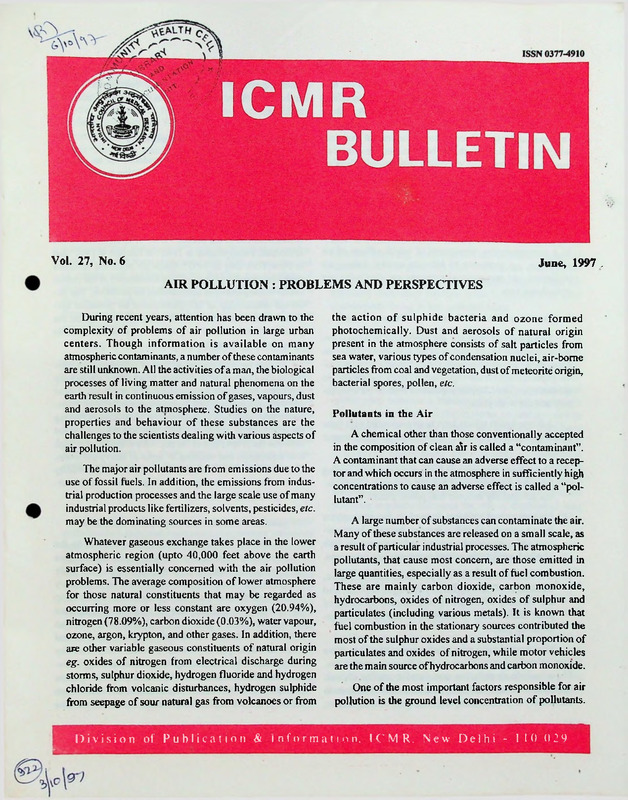
AIR POLLUTION : PROBLEMS AND PERSPECTIVES
During recent years, attention has been drawn to the
complexity of problems of air pollution in large urban
centers. Though information is available on many
atmospheric contaminants, a number ofthese contaminants
are still unknown. All the activities ofa man, the biological
processes of living matter and natural phenomena on the
earth result in continuous emission of gases, vapours, dust
and aerosols to the atmosphere. Studies on the nature,
properties and behaviour of these substances are the
challenges to the scientists dealing with various aspects of
air pollution.
The major air pollutants are from emissions due to the
use of fossil fuels. In addition, the emissions from indus
trial production processes and the large scale use of many
industrial products like fertilizers, solvents, pesticides, etc.
may be the dominating sources in some areas.
Whatever gaseous exchange takes place in the lower
atmospheric region (upto 40,000 feet above the earth
surface) is essentially concerned with the air pollution
problems. The average composition of lower atmosphere
for those natural constituents that may be regarded as
occurring more or less constant are oxygen (20.94%),
nitrogen (78.09%), carbon dioxide (0.03%), water vapour,
ozone, argon, krypton, and other gases. In addition, there
are other variable gaseous constituents of natural origin
. eg. oxides of nitrogen from electrical discharge during
storms, sulphur dioxide, hydrogen fluoride and hydrogen
chloride from volcanic disturbances, hydrogen sulphide
from seepage of sour natural gas from volcanoes or from
the action of sulphide bacteria and ozone formed
photochemically. Dust and aerosols of natural origin
present in the atmosphere consists of salt particles from
sea water, various types of condensation nuclei, air-borne
particles from coal and vegetation, dust of meteorite origin,
bacterial spores, pollen, etc.
Pollutants in the Air
A chemical other than those conventionally accepted
in the composition of clean aV is called a “contaminant”.
A contaminant that can cause an adverse effect to a recep
tor and which occurs in the atmosphere in sufficiently high
concentrations to cause an adverse effect is called a “pol
lutant”.
A large number of substances can contaminate the air.
Many of these substances are released on a small scale, as
a result of particular industrial processes. The atmospheric
pollutants, that cause most concern, are those emitted in
large quantities, especially as a result of fuel combustion.
These are mainly carbon dioxide, carbon monoxide,
hydrocarbons, oxides of nitrogen, oxides of sulphur and
particulates (including various metals). It is known that
fuel combustion in the stationary sources contributed the
most of the sulphur oxides and a substantial proportion of
particulates and oxides of nitrogen, while motor vehicles
are the main source of hydrocarbons and carbon monoxide.
One of the most important factors responsible for air
pollution is the ground level concentration of pollutants.
Division of Publication & information. I-CMR. New Delhi - 1 10 029
These ground level concentrations are the ultimate results
of various atmospheric dispersions under prevailing me
teorological conditions. Air pollution causes many effects
some of which are immediate and obvious. Nearly all these
effects could result in chronic degradation of man and his
resources under specific conditions. The general areas into
which air pollution effects can be classified are effects on
man and other animals; effects on vegetation; effects on
material; and effects on climate at the regional and global
levels.
The effects on vegetation, material and climate are
beyond the scope of this article and are not considered
here. Several environmental health issues that are related
to a comprehensive assessment of health effects of air
pollution, eg. exposure to tobacco smoke, indoor air
pollutants and occupational exposure are also being not
considered here.
Implications of Air Pollutants on Human Health
Three lines of evidence are applicable to a consider
ation of human health effects of air pollutants. These in
clude data derived from animal experiments, from practi
cal experimental human exposure and from epidemiologic
studies of exposed human population both in the commu
nity and the work place.
Adverse health effects have been associated with three
major types of air pollution related to three major source
categories:
(i)
The sulphur dioxide and particulate complex arising
from the combustion of sulphur containing fossil fu
els, particularly in fossil fuel power plants.
(ii)
Photochemical oxidants formed in the atmosphere
frpm a complex chemical reaction between hydrocar
bons and oxides of nitrogen and carbon monoxide, both
of which are largely related to automobile emissions.
effects on ventilatory function; cancer of the lungs; heart
diseases; sensory, neurological and behavioural effects;
and effects from persistent metals and other pollutant
residues.
Air pollution and associated mortality
Historically the most clear evidence for an associa
tion between SOx/particulates air pollution and death was
showed by a number of acute air pollution episodes dur
ing which meteorological conditions caused several days
of air stagnation and increased atmospheric concentration
of pollutants. The best known of these episodes are those
which occurred in the Meuse Valley of Belgium in I9301,
in Donora, Pennsylvania in 19482, in London in 19523 and
in New York City in 19534. These air pollution episodes
drew the attention of the medical community to the public
health consequences of uncontrolled air pollution. The ob
served relationship of SOx/particulates air pollution epi
sodes to excess mortality led investigators to examine the
possible association of air pollution of lesser magnitude
with variations in daily mortality5’14.
Studies on SOx/particulates type of pollution from vari
ous parts of the world in different years imply a relatively
consistent association between long-term residence in more
polluted communities and increased mortality rates. Popu
lation mobility tends to decrease the likelihood of finding
the effects of air pollution. There may be some correlation
between the proportion of the population involved in high
risk occupation and residing in areas of heavy pollution.
Therefore, the consistency of the air pollution/mortality
associations does not imply causality due to several inter
vening factors.
Air pollution and chronic respiratory morbidity
Identifying the contribution of air pollution to the
development of chronic obstructive respiratory diseases
introduces difficulties in isolating the effects from other
(iii) A miscellaneous class of air pollutants such as arsenic,
contributing factors. Most studies of chronic respiratory
asbestos, beryllium, cadmium, hydrogen sulphide, lead
disease and air pollution have indicated a relationship
and mercury which are mostly emitted by localized
between the prevalence of chronic respiratory symptoms
point sources such as smelters, refineries and manu
and SOx/particulate complex15"25. Interpretations of an
facturing plants.
observed associations between air pollution exposure and
prevalence of respiratory disease are often complicated by
Nine general categories of adverse health effects have
many potentially confounding factors like smoking, socio
been related to human exposure to different air pollutants.
economic characteristics, occupational exposure, migration
These include air pollution associated mortality; chronic
of populations into or out of polluted areas, etc. When
respiratory disease morbidity; exacerbation of disease in
adjustments are made for potential confounders, the
chronically ill person; acute respiratory disease morbidity;
52
association of respiratory disease prevalence with air
pollution often becomes considerably weak and it is
difficult to determine whether the effect is really quite small
or whether the effects were over adjusted for some of the
confounding factors. The role of confounding factors
become larger when attempt is made to determine lowest
concentrations at which air pollution contributes to the
risks.
Airpollution and exacerbation ofdisease in chronically
ill person
An extensive series of studies on the effects of air
pollution on bronchitic patients attending chest clinics was
conducted by Lawther et al26, which show that exacerba
tions of disease were associated with high concentrations
of smoke and sulphur dioxide. Further examination of
sickness absence records, rates of physicians consultation
and daily records of hospital admissions through the emer
gency service showed associations with periods of heavy
air pollution5*27'31.
Study of the effect of air pollution on persons with
chronic respiratory disease is particularly important from
a public health point of view because these persons are
believed to include a segment of population, extremely
susceptible to air pollution exposure. Air quality standards
based on protection of public health should be established
to provide adequate protection for these susceptible groups.
Many investigators have studied the temporal pattern of
symptoms status in these persons in relation to con
centrations of air pollutants and weather factors7*32.
Air pollution and acute respiratory disease
An experimental basis for a relationship between air
pollution and impaired resistance to respiratory infections
has been established in laboratory animals. Mice infected
with respiratory pathogens and exposed to SOx33, ozone34
and urban air pollution35 have shown increased mortality
and decreased resistance to infection compared to infected
but unexposed animals. Similarly, several epidemiologi
cal studies have observed an increased incidence of respi
ratory illness in populations living in localities with more
SOx/particulate pollution36'38.
These studies support an association between increased
acute lower respiratory tract disease (acute bronchitis,
pneumonia and other acute chest illness) in adults and resi
dence in more polluted localities. However, the pollutants
or concentrations in the presence of which increased risk
of acute illness occurs, have not been established and it is
difficult due to many environmental and personal factors,
to implicate a specific concentration that contributes to a
population risk of acute respiratory illness.
Air pollution and ventilatory function
In the studies reported from England, Japan, USA,
Canada and Denmark, geographic differences in various
air pollution indices have been related to ventilatory func
tion in school children 32JW3. Ventilatory function in chil
dren is a useful measure of air pollution effects, because
cigarette smoking, occupational exposure and changes of
residence do not generally play a role in the observed ef
fects. Children residing in more polluted areas show di
minished ventilatory function when compared with their
counterparts living in less polluted areas.
Slightly diminished lung function may not be
important, but when other respiratory challenges such as
frequent infections, cigarette smoking, air pollution and
occupational exposure are added, respiratory health may
be seriously compromised. Burrows et al" observed close
relationship between a history of childhood respiratory
disorders and prevalence of symptoms, obstructive airway
diseases, and ventilatory impairment in adults. They have
also noted that even young adults with relatively mild
ventilatory impairment and a history of paediatric
respiratory illness show a steeper declining slope in
function with age and cigarette smoking than the adults
without impairment or history of illness. The fact that air
pollution exposure increases the risk of diminished lung
function and acute respiratory illness in childhood also
suggests an increased risk for subsequent development
of obstructive lung disease in adulthood45. Long-term
prospective studies, beginning in childhood, are therefore,
required to provide definite evidence for these possible
relationships. Experimental human exposures are
particularly useful in determining the precise
concentrations of specific pollutants at which airways of
healthy adults can be affected. Experimental studies on
healthy human volunteers are very valuable in identifying
physiological responses to precisely known pollutant
concentrations and in establishing dose response
relationships. However, experimental studies may not
adequately represent the real atmosphere with its complex
and dynamic mixture of air pollutants.
53
Air pollution and cancer of the lung
The hypothesis that air pollution may be a factor in
human lung cancer derives from three types of studies viz.
(i) comparison of lung cancer rates in immigrants from
one country to another with the rates of native bom non
immigrants in both countries46; (ii) investigation of urban
and rural differences in lung cancer risk47; and (iii) quali
tative and quantitative differences in air pollution by area.
and associated lung cancer rates47"49.
The suspicion that air pollution leads to lung cancer
remains neither proved nor disproved. The overwhelming
influence of cigarette smoking, the contribution of occu
pational exposures, the scarcity of good measurements of
potential atmospheric carcinogens and the long latent pe
riod between first exposure and detection of cancer, all
contribute to the difficulty of obtaining evidence for the
relationship between air pollution and lung cancer.
Air pollution and heart disease
Cigarettes, diet, lack of exercise, high blood pressure
and increased serum lipid concentrations have received
the most attention as the environmental risk factors that
contribute to heart disease. Evidence that air pollution, par
ticularly carbon monoxide increases heart disease risk also
exist30**1. Although
*
there are many uncertainties in these
findings, their significance is considerably enhanced by
studies on individuals with angina pectoris exposed to CO
on freeways32 or experimentally33*34. The experimental stud
ies show that persons with angina experience chest pain
significantly earlier during exercise when
carboxyhaemoglobin concentrations reach 2.5 to 3.0 per
cent.
Several other reports suggest a relationship between
exposure to ozone and damage to myocardial fibres33, be
tween exposure to sulphur dioxide and cardiovascular
deaths36 and between sulphate concentrations and exacer
bation of disease in elderly persons with heart diseases37.
Large concentrations of cadmium in air have been corre
lated with death rates due to cardiovascular diseases38.
annoying aspects of air pollution. Perception of these
effects is very real, but quantifying them is difficult59.
Most odourous materials, except for hydrogen sul
phide, are difficult to measure at concentrations that are
perceived as objectionable. Odour annoyance survey meth
ods60 are appropriate ways of monitoring for odour and
estimating the severity of impact.
Hydrogen sulphide is a common and offensively
odourous material, readily perceived by its rotten egg
odour. It originates from kraft paper mills, industrial waste
disposal ponds, sewage treatment plants, tanneries, coke
oven plants and geothermal Wells. At higher concentra
tions, hydrogen sulphide may impair the sense of smell
and produce unconsciousness.
Aldehydes produced by incomplete combustion of
fossil fuels are irritating to the skin and eyes. Formalde
hyde is one of the more common aldehydes that irritate
the eyes, nose and other portions of the respiratory tract61.
Ozone, the major component of photochemical smog,
directly irritates the pharynx and trachea, causing a burn
ing sensation in the upper part of the chest. Japanese inves
tigators62,63 have described eye irritation, chest discomfort,
headache, and various other symptoms in school children
playing outdoor on “smog alert” days in various cities in
Japan.
Carbon monoxide can alter human performance as well
as cardiac function. At small concentrations, effects on
various measures of performance, such as time interval
discrimination and ability to concentrate, decrements in
vigilance tasks and in visual threshold have been reported
in experimentally exposed subjects64*66. Apparently the ef
fect of CO can be overcome by sustained interest in the
task. However, when subjects are required to perform te
dious and monotonous tasks, carbon monoxide can impair
performance.
Air pollution and sensory irritation, central nervous
system function and human performance
Inhalation of significant amounts of air-borne lead
can cause neurologic disturbances and even adversely
affect the central nervous system. Children living near a
lead smelter were shown to have altered nerve conduc
tance velocities67.
The odour of some air-borne substances and irritation
to the eyes, nose and throat are the most common and
It is apparent that these air pollutants can impair
sensory organs and human performances. Some of these
54
effects are easily perceived, others are difficult to
demonstrate. The long-term health, implications of this
category of effects are not adequately known.
Airpollution and effectsfrompersistent metals and other
chemicals
Certain trace metals, various synthetic chlorinated hy
drocarbons and polychlorinated biphenyls accumulate in
the body. The accumulation ofthese substances in the body
is a cause for concern. In the case of synthetic hydrocar
bons, little is known about the long-term health conse
quences of increased tissue concentrations, however, based
on animal studies there is suspicion that some of these
compounds are carcinogenic68. Considerably more is
known about the toxic effects of increased tissue concen
trations of lead, cadmium and arsenic69*70. Air pollution is
an important contributor to tissue concentrations of these
substances and may increase the risk oftoxic effects when
other environmental exposure are added. It is necessary to
use animal toxicity data for trace metals, in formulating
guidelines for protection of public health.
The National Air Pollution Scenario
The Air (Prevention and.control of pollution) Act 1981
and the Environment Act 1986 form the basis for moni
toring and controlling air pollution in the country espe
cially after the Bhopal gas tragedy in 1984. However, even
before the promulgation of these Acts, several attempts
were made to monitor the air quality with specific objec
tives from time to time. Data on air quality were available
upto 1980 only for the three metropolitan cities ofBombay,
Calcutta and Delhi under WHO/GEMS programme oper
ated by National Environmental Engineering Research
Institute (NEERI), Nagpur71*72. A study conducted by the
GEMS network on the global distribution of particulate
pollution over the period of 1980-84 observed that the daily
mean concentration of particulates in New Delhi exceeded
the WHO standards of230 pg/m3 on 294 days during the
year73.
Six of the ten largest cities in India viz. Bombay,
Calcutta, Delhi, Ahmedabad, Kanpur and Nagpur, have
severe air pollution problems with the annual levels oftotal
suspended particles (TSPs) at least three times as high as
the WHO standards. Over 80 per cent of the National
Ambient Air Quality Monitoring (NAAQM) stations, for
which annual mean concentrations are reported by the
Central Pollution Control Board, showed particulates
exceeding 75 pg/m3. In contrast, the annual average
concentrations of SO, and NO were lower in relation to
the respective air quality standards. There does not apear
to be any clear correlation between a city’s population and
air pollution. Many medium sized cities have air pollution
levels higher than several megacities74. The critical analysis
of the air quality data of nine urban centres in India from
1978-81 by Chatterjee et aPs revealed that if the TSPs are
not taken into consideration, the gaseous pollutants
generated by industries and by motor vehicles together
failed to produce any significant levels of pollution in any
ofthe nine urban areas. The significance of particulates in
urban areas in India is not clear since air in the rural
environments also contain almost equally high
concentrations of TSPs74. Only a small undetermined
proportion of TSPs in urban air is anthropogenic73.
Until recently the air quality data in India had been
traditionally collected in the form of TSPs which is of
limited value from the heatlh poiont ofview. Recent studies
have indicated that particulate matter having £ 10 p
diameter (PM|0) could provide a better index of health
risks13*29. Hence more data on PM10 should be generated
using sophisticated instruments.
A few systematic studies on the air pollution and its
effects on human beings have been reported for urban cen
tres like Bombay76, Ahmedabad77*78, Bangalore79 and
Vadodara80. The blood lead levels of persons in some cit
ies (Ahmedabad, Bangalore and Calcutta) of the country
that still use leaded gasoline, on an average, were higher
compared to countries using lead free gasoline81.
The most recent World Bank estimates for air
pollution/health risks for 36 cities in India indicated that
there could be over 40,000 premature deaths, with 7,500
(19%) in Delhi, 5,700 (14%) in Calcutta and 4,500 (11%)
in Bombay, due to exposure to the current air pollution
levels in these cities. These premature deaths could have
been avoided if the air pollution levels in these cities were
brought down to the WHO standards82.
These studies have shown the qualitative effects
of air pollution especially on high risk population groups.
Recently studies on air pollution and its impact on
residents of certain critically polluted identified areas of
the country have been concluded by the Ministry of
Enviroriment & Forests, Government of India. The results
of these studies would provide a better understanding of
air pollution/health risks relationship based on Indian
experiences.
55
Not many studies have been undertaken till recently
in the field of biological air pollution or of the potential
biohazards such as bio-allergens. Biological contaminants
of air include fungi, viruses, bacteria, insects, vegetable
dust, pollen grains, etc. Indian studies on bio-allergens have
been restricted to only a few towns and cities like
Aurangabad, Jaipur, Calcutta, Delhi, Bangalore, Gulbarga,
Gwalior and Imphal83’89. Studies on bio-allergens will be
an important aspect of air pollution in addition to routine
chemical analysis.
7.
Lebowitz, M.D. A comparative analysis of the stimulus-response
relationship between mortality and air pollution-weather. Environ
Res 6: 106, 1973.
8.
Lebowitz, M.D., Toyama, T. and Me Carroll, J. The relation
ship between air pollution and weather as stimuli and daily
mortality as responses in Tokyo. Japan, with comparison with
other cities. Environ Res 6: 327, 1973.
9.
Schimmel, H. and Murawski, T.J. SO2 harmful pollutant or air
quality indicator? J Air Pollut Control Assoc 25: 739, 1973.
10.
Schwartz, J. and Marcus, A. Mortality and air pollution in Lon
don, a time series analysis. Am J Epidemiol 131: 185, 1990.
11.
Schwartz, J. and Dockery, D.W. Particulate air pollution and
daily mortality in Steubenville, Ohio. Am J Epidemiol 135: 12,
1992.
12.
Schwartz, J. and Dockery, D.W. Increased mortality in Phila
delphia associated with daily air pollution concentrations. Am
Rev Respir Dis 145: 600, 1992.
13.
Pope, C.A. Ill, Schwartz, J. and Ransom, M.R. Daily mortality
and PMl0 pollution in Utah Valley. Arch Environ Health 47:
211,1992.
14.
Saldiva, P.H.N., Pope, C.A. Ill, Schwartz, J. Dockery, D.W.,
Lichtenfels, A.J., Salge, I.M., Barone, I. and Bohn, G.M. Air
pollution and mortality in elderly people : A time series study in
Sao Paulo, Brazil. Arch Environ Health 50: 159, 1995.
15.
Petrilli, F.L., Agnese, G. and Kantiz, S. Epidemiologic studies
of air pollution effects in Genoa, Italy. Arch Environ Health 12:
733, 1966.
16.
Yashizo, T. Air pollution and chronic bronchitis. Osaka Univ
Med J 20: 10, 1968.
17.
Bates, D.V. The fate of the chronic bronchitis : A report of the
ten year follow up in the Canadian Department of Veteran’s Affairs
Coordinated Study of Chronic Bronchitis. Am Rev Respir Dis
108: 1043, 1973.
18.
Chapman, R.S., Shy, C.M., Finklea, J.F., House, DE., Goldberg,
H.E. and Hayes, C.G. Chronic respiratory disease in military
inductees and parents of school children. Arch Environ Health
27: 138, 1973.
19.
Ministry of Health. Mortality and morbidity during the London
fog of December 1952. Report on Public and Medical Subjects
No.95. Her Majesty’s Stationery Office, London, 1954.
Hrubec, Z., Cedulof, R.r Friber, L. and Harton, R. Respiratory
symptoms in twins : Effects of residence associated air pollu
tion, tobacco and alcohol use and other factors. Arch Environ
Health 27: 189, 1973.
20.
Greenberg, L., Jacobs, M.B., Drolette, B.M., Field, F. and
Braverman, M.M. Report of an air pollution incident in New
York city, November 1953. Public Health Rep 77: 7, 1962.
Ferris, B.G., Chen, H., Puleo, S. and Murphy, R.L.H. Jr. Chronic
non-specific disease in Berlin. New Hampshire, 1967-1973. A
further follow up study. Am Rev Respir Dis 113: 475, 1976.
21.
Chronic Non-Specific Respiratory Disease in the City ofCracow.
Report of a 5 year follow up study among adult inhabitants of
the city of Cracow. Eds. F. Sawicki and P.S. Lawrence. National
Institute of Hygiene, Warsaw, 1977.
22.
Hodgkin, J.E., Abbey, D.E., Euler, G.L. and Magie, A.R. Compar
ison of chronic obstructive pulmonary disease prevalence in nonsmokers in high and low photochemical air pollution areas. Chest
86: 830, 1984.
Conclusions
Animal experiments, experimental human exposure
studies and studies on populations exposed to air pollu
tion have provided qualitative and quantitative understand
ing of the health effects of community air pollution.
The issues involved in evaluation of air pollution/
health risks are complex and difficult. Existing knowledge
of air pollution/health damage relationships can be im
proved, extended and tested against new data. Simplify
ing assumptions can be made more realistic and other fac
tors that modify the effects of air pollution can be evalu
ated. Progress in our understanding of the effects of air
pollution on the full range of biological response in hu‘man beings, and measurement of population exposure will
be required to resolve the issues satisfactorily.
References
8.
2.
3.
4.
Firket, J. The cause of the symptoms found in Meuse Valley
during the fog of December 1930. Bull R Acad Med 11: 683,
1931.
Schrenk, H.H., Heimann, H., Clayton, G.D., Gafafer, W. and
Wexter, H. Air pollution in Donora, Pennsylvania. Epidemiol
ogy of unusual smog episodes of October 1948. Public Health
Bulletin. 306, U.S. Government Printing Office, Washington DC.
1949.
5.
Martin, A.E. Mortality and morbidity statistics and air pollu
tion. Proc R Soc Med 57: 969, 1964.
6.
Buechley, R.W., Riggan, W.B., Hasselbald, V. and Van Bruggen,
J.B. SO2 levels and perturbations in mortality. A study in the
New York, New Jersey Metropolis. Arch Environ Health 27:
134, 1973.
56
23.
24.
Euler, G.L., Abbey, D.E., Hodgkin, J.E. and Magie, A.R. Chronic
obstructive pulmonary disease symptom effects of long-term cu
mulative exposure to ambient levels of total suspended partic
ulates and sulphur dioxide in California Seventh-Day Adventist
residents. Arch Environ Health 42: 213, 1987.
Abbey, D.E., Petersen, F.F., Mills, P.K. and Kittle, L. Chronic
respiratory disease associated with long-term ambient concen
trations of sulphates and other pollutants. J Exp Anal Environ
Epidemiol 3 (SI): 99, 1993.
reactions by sensitive individuals to air pollution and weather.
Environ Res 5: 135, 1972.
38.
Levy, D., Gent, M. and Newhouse, M.T. Relationship between
acute resiratory illness and air pollution levels in an industrial
city. Am Rev Respir Dis 116: 167, 1977.
39.
Biersteker K. and van Leeuwen,P. Air pollution and peak flow
rates of school children. Arch Environ Health 20: 382, 1970.
40.
Feriss, B.G. Effects of air pollution on school absences and dif
ference in lung function in first and second graders in Berlin,
New Hampshire. January 1966 to June 1967. Am Rev Respir Dis
J02: 591, 1970.
41.
Shy, C.M., Hasselblad, V., Burton, R.M., Nelson, C.J. and Cohen,
A. A. Air pollution effects on ventilatory function of US School
children. Results of studies in Cincinnati, Chattanooga and New
York. Arch Environ Health 27: 124, 1973.
42.
Chapman, R.S., Hasselblad, V., Hayes, C.G., Williams, J.V.R.
and Hammer, D.I. Air pollution and childhood ventiiatoiy func
tion. I. Exposure to particulate matter in two south eastern cit
ies. 1971, 1972. In: Clinical Implications ofAir Pollution Re
search. Eds. A. J. Finkel and W.C. Duel. Publishing Science Group.
Inc. Acton, Mass, p.285, 1976.
25.
Abbey D.E., Hwang, B.L., Burchette, R.J., Vancuren, T. and-'
Mills, P.K. Estimated long-term ambient concentrations of PM10r<
and development of respiratory symptoms in non-smoking popu
lation. Arch Environ Health 50: 139, 1995.
26.
Lawther, P.J., Waller, R.E. and Henderson, M. Air pollution
and exacerbation of bronchitis. Thorax 25: 525, 1970.
27.
Came, S. Air pollution study. Proc R Soc Med 57: 620, 1964.
28.
Gregory, J. The influence of climate and atmospheric pollution
on exacerbation of chronic bronchitis. Atmos Environ 4: 453,
1970.
29.
Pope; C.A. Respiratory hospital admissions associated with PM10
pollution in Utah, Salt Lake and Cache Valleyes. Arch Environ
Health 46:'90, 1991.
43.
White,’M.C., Etzel, R.A., Wilcox, W.D. and Llyod, C. Exacer
bation ofchildhood asthma and ozone pollution in Atlanta. Environ
Res 65: 56, 1994
Keiding, L.M., Rindel, A.K. and Kronbarg, D. Respiratory ill
nesses in children and air pollution in Copenhagen. Arch Environ
Health 50: 200, 1995.
44.
Burrows, B., Knudson R.J: and Lebowitz, M. The relationship
of childhood respiratory illness to adult obstructive air way dis
ease. Am Rev Respir Dis 115: .751, 1977..
45.
Reid, D.D. The beginnings of bronchitis. Proc R Soc Med 62:
311, 1969.
46.
Reid, D.D., Cornfield, J., Markash, R.E. et al. Studies of dis
ease among migrants and native population in Great Britain,
Norway and the United States.!!!. Prevalence of cardio-respiratory symptoms among migrants and native bom in the United
States. Natl Cancer Inst Monogr 19: 321, 1966.
47.
Hammond, E.C. Smoking habits and air pollution in relation to
lung cancer. In: Environmental Factors in Respiratory Disease.
Ed. D.H.K. Lee. Academic Press, New York, p.177, 1972.
48.
Camow, B. W. and Meier, P. Air pollution and pulmonary can
cer. Arch Environ Health 27: 207, 1973.
49.
Menck, H.R., Casagrande, J.T. and Henderson, B.E. Industrial
air pollution: Possible effects on lung cancer. Science 183: 210,
1974.
50.
Cohen, S.I., Deane, M. and Goldsmith, J.R. Carbon monoxide
and survival from myocardial infarction. Arch Environ Health
19: 510, 1969.
51.
Lebowitz, M.D., Cassell, E.J. and Me Carroll, J.D. Health and
Hexter, A.C. and Goldsmith, J.R. Carbon monoxide: Associa
tion of community air pollution with mortality. Science 172:265,
the urban environment: XV. Acute respiratory episodes as
1971.
30.
31.
Stieb, D.M., Burnett, R.J., Beveridge, R.C. and Brook, J.R. As
sociation between ozone and asthma emergency department vis
its in Saint John, New Brunswick, Canada. Environ Health Prespect
104: 1354, 1996.
32.
Mosechalm, L., Taudori, E. and Frosig, A. Pulmonary function
changes in asthmatics associated with low level of SO2and NO2
air pollution, weather and medicine intake. Allergy 48:334,1993.
33.
Fairchild G.A., Roan, J. and McCarrol, J. Atmospheric pollut
ants and the pathogenesis of viral respiratory infection. Sulphur
dioxide and influenza infection in mice. Arch Environ Health
25: 174, 1972.
34.
35.
36.
Coffin, D.L. and Gardner, D.E. Interaction of biologic agents
and chemical air pollutants. Ann Occup Hyg 15: 219, 1972.
Saldiva, P.H.N., King, M., Delmonte, V.L.C. Machionfc, M.,
Parada, M.A.C., Daliberto, M.L., Sakne, R.S., Criado, P.M.P.,
Silveira, P.L.P., Zin, W.A. and Bohn, G.M. Respiratory alter
ations due to urban air pollution: An experimental study in rats.
Environ Res 57: 19, 1992.
Verma, M.P., Schilling, F.J. and Becker, W.H. Epidemiological
study of illness absences in relation to air pollution. Arch Environ
Health 18: 536, 1969.
37.
57
52.
Aronow, W.S., Harris, C.N., Isbell, M.W., Rokow, S.N. and
Imparato, P. Effect of freeway travel on angina pectoris. Ann
Intern Med 77: 669, 1972.
53.
Aronow, W.S. and Isbell, M.W. Carbon monoxide effect on ex
ercise induced angina pectoris. Ann Intern Med 79: 392, 1973.
54.
Anderson, E.W., Andelman, R.J., Strauch, J.M:, Fortuin, N.J.
and Knelson, J.H. Effect of low level carbon monoxide expo
sure on onset and duration of angina pectoris. A study in ten
patients with ischaemic heart disease. Ann Intern Med 79: 46,
1973.
55.
Brinkman, R., Lambents, H.B. and Venirga, T.S. Radiometric
toxicity of ozonised air. Lancet i: 133, 1974.
56.
Camow BW. Sulphur oxides and particulates: Effects on health.
In: Proceedings of the National Academic of Science Confer
ence on Health Effects ofAir Pollution. US Government Print
ing Office, Washington DC Stock No. 5270-02105, p.263,1973.
57.
>
58.
59.
60.
61.
Goldberg, H.E. et. al. Frequency and severity of cardiopulmo
nary symptoms in adults panels: 1970/71, New York, studies in
health consequences of sulphur dioxide: A report from CHESS,
EPA 65011-74.004. US Government Printing Office, Washing
ton DC 1974.
Carroll, R.E. The relationship of cadmium in the air to cardio
vascular disease death rates. JAMA 198: 267, 1966.
Henkin, R.J. Effects of vapor phase pollutants on nervous sys
tem and sensory function. In: Clinical Implication ofAir Pollu
tion Research. Eds. A.K. Finkel and W.C. Duel. Publishing Sci
ence Group Inc. Acton. Mass, tp. 193, 1976.
Karolinska Institute : Methods for measuring and evaluating
odorous air pollutants at the source and in the ambient air. Re
port on the International Symposium in Stockholm. June 1-5,
Department of Environmental Hygiene, Stockholm, 1970.
Brabec, M.J. Aldehydes and acetals. In: Patty’s Industrial Hy
giene and Toxicology. Third Edition (Vol. IIA). Eds. G.D. Clayton
and F.E. Clayton. John Willey and Sons, New York, p.2629,
1981.
62.
Schimizu, T. Classification of subjective symptoms of junior
high school students
*
affected by photochemical air pollution. J
Jpn Soc Air Pollut 9: 734, 1975.
63.
Makino, K. and Mizoguchi, I. Symptoms caused by photochemical
smog. Jpn J Public Health 22: 421, 1975.
64.
67.
Landrigen, P.T., Baker, E.L. Jr., Fieldman, R.G., Cox, D.H., Eden,
R.V., Omstein, WjA, Mathew, J.A., Jankel, A.J. and von Lindem,
I.H. Increased lead absorption with anaemia and slower nerve
conductance in children near a lead smelter. J Pediatr 89: 904,
1976.
68.
Innes, J.R.M., Ulland, B.M., Valrio, M.G., Petrucell, L., Fishbein,
L., Hart, E.R., Pallota, A.J., Bates, R.R., Falk, H.L., Gart, J.J.,
Klein, M., Mitchell, I. and Peters, J. Bioassay of pesticides and
industrial chemical for tumorigenicity in mice. A preliminary
note. J Natl Cancer Inst 42: 1101, 1969.
69.
Metallic Contaminants and Human Health. Ed. D.H.K., Lee.
Academic Press. New York, 1972.
70.
Handbook on Toxicology of Metals. Vol. II. Specific Metals.
Eds. L. Friberg, G.F. Nordberg and V.D.Vouk. Elsevier Science
Publishers BV, New York, 1986.
71.
Urban Air Pollution. 1973-1980. Global Environmental Moni
toring Systems. WHO, Geneva, 1984.
72.
Sundaresan, B.B., Pamptiwar, V.L. and Aggrawal, A.L. Air quality
in selected cities in India. National Environmental Engineering
Research Institute, Nagpur, 1983.
73.
French, H. Cleaning the air: A global agenda. Worldwatch paper
94. Worldwatch Institute, Washington, D.C., 1990.
74.
Central Pollution Control Board : National Ambient Air Quality
Statistics ofIndia 1991. National Ambient Air Quality Monitor
ing Series, New Delhi, 1992.
75.
Chatterjee, B.B., Patel, T.S. and Raiyani, C.V. Analysis ofchar
acteristics of urban air pollution over a four year period 197881. Indihn J Public Health 29: 226, 1985.
76.
Kamat, S.R., Godkhindi, K.D., Shah, B.W., Mehta, A.K., Shah,
V.N., Gregrat, J., Papewar, V.N., Tyagi, N.K., Rashid, S.A.,
Bhiwankar, N.T. and Natu, R.B. Correlation of health morbid
ity to air pollutant levels in Bombay city. Results of prospective
3 year survey at one year. J Postgrad Med 26: 45, 1980.
77.
Aggrawal, A.L., Patel, T.S., Raiyani, C.V., Patel, P.D., Dewan,
A., Mohan Rao, N. and Chatterjee SK. Ahmedabad autoexhaust
pollution survey and its effects on exposed occuptional groups.
Monograph l.National Institute of Occupational Health,
Ahmedabad, 1979.
78.
Patel, T.S., Raiyani, C.V. and Kulkami, P.K. Comparative epi
demiological studies on effects of air pollutants. In: Annual Re
port, 1984-85. National Institute of Occupational Health,
Ahmedabad, p.Bl
79.
Raj mohan, H.R., Rajan, B.K., Krishnamurthy, V., Shanmukappa,
D.R.k Ramaswami, T.P. and Nagarajan, L. Air Pollution Study
in Bangalore City - 1981. In: Annual Report, 1984-85. National
Institute of Occupational Health, Regional Occupational Health
Centre (Southern), p.24.
80.
Patel, T.S., Patel, P.D., and Kashyap, S.K. A Report on Integrated'Air Quality Surveillance Study Over Vadodara Urban
Development Area. National Institute of Occupational Health,
Ahmedabad, 1989.
Halperin, M.H., Me Farland, R.A., Niren, J.I. and Roughton,
FJ.W. The time course of the effects of carbon monoxide on
visual threshold. J Physiol 146: 583, 1959.
65.
Howarth, S.M., Dahms, T.E. and O’Hanlon, J.F. Carbon mo
noxide and human vigillance. A deleterious effect of present urban concentration. Arch Environ Health 23: 342, 1971.
66.
Fodor, G.G. and Winneke, G. Effect of low CO concentrations
on resistance to monotony and on psychomotor capacity (En
glish ed.) Staub Reinhat Luft, 32: 46, 1972.
58
w
81.
WHO/UNEP : Assessment of Human Exposure to Lead and
Cadmium through Biological Monitoring. Ed. M. Vahtcr. WHO,
Department of Environmental Hygiene,. Karolinska Institute,
Stockholm, 1982.
82.
Brandon, C. and Hammann, K. The Cost ofInaction : Valuing
the Economy - Wide Cost ofEnvironmental Degradation in In
dia Executive summery report Asia Environment Division, World
Bank 1995.
83.
Shivpuri, D.N. Comparative evaluation of the sensitivity ofcom
mon methods of diagnostic antigen tests in patients of respira
tory allergy. Indian J Chest Dis 4: 102, 1962.
84.
Shivpuri, D.N. Studies in allergy to fungi in India. Aspects Allergy
Appl Immunol 15: 19, 1982.
85.
Agashe, S.N., Nagalakshamma, K.V., Chatterjee, M. and.Anand,
P. Aeromycoflora of Bangalore (A preliminary study). Aspects
Allergy Appl Immunol 16: 49, 1983.
86.
Agashe, S.N., Anand, P., Manjunath, K. and Abraham, J.N. Air
borne pollen survey of Bangalore (A preliminary study). Aspects
Allergy Appl Immunol 16: 53, 1983.
87.
Mari Bhat, M. and Rajasab, A.H. Incidence of air-borne pollen
at two different locations in Gulbarga during 1984-85. Indian J
Med Res 82: 346, 1985.
88.
Dana, T.R. and Jain, A.K. Certain biocomponents in the air of
an industrial area at Gwalior. Indian J Aerobial 3: 45, 1990.
89.
Singh, N.I. and Devi, K.K. Aerobiology and allergic human
diseases in Manipur. II. Air-borne pollen grains of Imphal. In
dian J Aerobiol 5 (Special Issue): 49, 1992.
This write-up has been contributed by Dr. T.S. Patel, Assistant
Director, National Institute ofOccupational Health, Ahmedabad.
ICMR NEWS
The following meetings of various technical committees/groups of the Council were held:
Meetings of the Task Force (TF)/Project Advisory
Committee (PAC) held at New Delhi:
Steering Committee of the
TF on the monitoring of
adverse drug reactions in India
May 20,1997
PAC on Quality of Community
Life
June 5,1997
Dr. J.M. Deshpande, Director, Enterovirus Research
Centre, Mumbai, paticipated in the IV meeting of the WHO
South-East Asia Regional EPI Technical Consultative
Group on Vaccine Preventable Diseases at New Delhi
(May 29-June 2,1997).
Dr. Bhanu Iyengar, Director, Institute of Pathology,
New Delhi, participated in the IV World Conference on
Melanoma and XIX World Congress of Dermatology at
Sydney (June 10-14 and 15-20,1997 respectively).
Workshop:
Participation of ICMR Scientists in Scientific Events:
Dr. S.K. Kar, Director, Rajendra Memorial Research
Institute of Medical Sciences, Patna, participated in the
meeting ofthe WHO South-East Asia Regional Task Force
on Kala-azar at Patna (May 19-20,1997).
Dr. Kamala Gopalakrishnan, Dy. Director and Dr. K.V.
Rani Reddy, Senior Research Officer, Institute for Research
in Reproduction, Mumbai, participated in the VI Interna
tional Congress of Andrology at Salzburg, Austria (May
25-29,1997).
ICMR organized a national workshop on sharpening
of tools for improving the quality and coverage of repro
ductive and child health services in the national
programme, at New Delhi (June 10-12,1997).
♦♦♦
*
»♦
Dr. K. Banerjee, relinquished charge as Director of
the National Institute of Virology, Pune w.e.f. May 31,
1997.
59
INDIAN COUNCIL OF MEDICAL RESEARCH
AWARDS AND PRIZES 1996
The Indian Council of Medical Research invites nominations/applications from Indian scientists for its various
prizes and awards in the field of biomedical sciences. Details of the awards/prizes, as also the format for application
may be seen in the following pages. They may also be obtained from the Director-General, Indian Council of Medical
Research, (Indo-Foreign Cell), Post Box No. 4911, Ansari Nagar, New Delhi-110029.
Nominations/completed applications should reach this office on or before 30th September, 1997.
DETAILED INFORMATION
1.
Basanti Devi Amir Chand Prize (Value : Rs.5,000)
This prize will be awarded annually to a senior research worker of more than ten years standing for work of out
standing merit in any subject in the field of biomedical science, including clinical research. The term “Clinical Re
search” implies research into the mechanism and causation of disease, including its prevention and cure. The criteria for
award of the prize are the significance and value of addition to existing knowledge contributed by a worker in a particu
lar field in which he/she has been actively engaged over a number of years and has shown sustained activity in research.
The selection for this prize is made one year in advance.
2.
Dr.P.N.Raju Oration Award (Value : Rs.5,000)
This prize will be awarded in alternate years, to an eminent scientist, preferably a medical person, for his/her work
in any subject of national importance in the field of medicine or public health. The subject for this award for 1996 is
Research in Orthopaedics.
3.
Sandoz Oration Award for Research in Cancer (Value : Rs.2,500)
This prize (and a medal) will be awarded in alternate years, to an eminent scientist for outstanding work carried out
on a particular aspect of Cancer. The eminence is to be judged on the basis of his/her contributions to cancer research
which should have been recognised nationally and internationally and helped towards control, prevention and cure of
cancer.
4.
Dr.Y.S.Narayana Rao Oration Award in Microbiology (Value : Rs.4,000)
This prize will be given in alternate years, to an eminent scientist for outstanding work carried out in the field of
Microbiology. The criterion for award of the prize is the significance and value of addition to existing knowledge
contributed by a worker in Microbiology in which he/she has been actively engaged over a number of years and has
shown sustained activity in research.
*5.
Chaturvedi Kalawati Jagmohan Das Memorial Award (Value : Rs.2,000)
This prize (and a gold medal) will be awarded once in three years, to an eminent scientist, preferably a medical
person, for his/her work in the field of Cardiovascular Diseases. The criterion for award ofthe prize is the significance
and value of addition to existing knowledge contributed by a worker in Cardiovascular Diseases in which he/she has
been actively engaged over a number of years and has shown sustained activity in research.
* This Prize/Award is not being awarded for the year 1996.
60
6.
Dr.Kamala Menon Medical Research Award (Value : Rs.5,000)
This prize will be awarded to an eminent scientist, preferably a medical person, for outstanding contribution made
in the fields of Internal Medicine and Paediatrics in alternate years. The criterion for award of the prize is the signifi
cance and value of addition to existing knowledge contributed by a worker on a subject :n which he/she has been actively
engaged over a number of years and has shown sustained activity in research. The subject for the 1996 award is Internal
Medicine.
7.
Kshanika Oration Award to a Woman Scientist for Research in the field of Biomedical Sciences (Value :
Rs.5,000)
This prize will be given annually to an eminent woman scientist for outstanding work carried out in any branch of
biomedical science, contributing to the alleviation of human suffering. The criterion for award of this prize is the
significance and value of addition to existing knowledge contributed by her in any field of biomedical sciences in which
she has been actively engaged Over a number of years and has shown sustained activity in research.
8.
Dr.M.K.Seshadri Prize in the field of Practice of Community Medicine (Value : Rs.10,000)
This prize (and a gold medal) will be awarded in alternate years, to an eminent scientist or institution whose original
work has led to useful inventions in or otherwise significantly contributed to the practice of Community Medicine.
9.
M.N.Sen Oration Award for Practice of Medicine (Value : Rs.5,000)
This prize will be given once in three years, to an eminent scientist for outstanding work carried
out
*
in the field of
practice of medicine (Clinical, Laboratory or Therapeutic). The criterion for award of the prize is the signific'ance
and value of addition to existing knowledge contributed by a worker to the practice of medicine in which he/she has been
actively engaged over a number of years and has shown sustained activity in research.
10.
JALMA-Trust Fund Oration Award in the field of Leprosy (Value : Rs.5,000)
This prize (and a medal) will be given annually to an eminent scientist for outstanding research in the field of
Leprosy. The criterion for award ofthe prize is the significance and value of addition to existing knowledge contributed
by a worker on any aspect of leprosy in which he/she has been actively engaged over a number of years and has shown
sustained activity in research.
11.
Dr.J.B.Srivastav Oration Award in the field of Virology (Value : Rs.10,000)
This prize will be given in alternate years, to an eminent scientist for outstanding work carried out in the field of
Virology. The criterion for award of the prize is the significance and value of addition to existing knowledge contrib
uted by a worker in Virology in which he/she has been actively engaged over a number ofyears and has shown sustained
activity in research.
12.
ICMR Prize for Biomedical Research for Scientists belonging to Under-privileged Communities (Vaiue :
Rs.10,000)
This prize will be given annually to an eminent scientist for his/her outstanding contributions in any field
of Biomedical Sciences. The criterion for award of the prize is the significance and value of addition to existing
knowledge contributed by a worker in the particular field in which he/she has been actively engaged over a number of
years and has shown sustained activity in research. This prize will be awarded to scientists belonging to under
privileged communities.
61
*.
13
ICMR Prize for Biomedical Research conducted in Under-developed Areas (Value : Rs.10,000)
This prize will be awarded annually to an eminent scientist for his/her outstanding contributions in any field of
Biomedical Sciences. The criterion for award of the prize is the significance and value of biomedical research carried
out by a worker based in under-developed parts of the country, or for work carried out in under-developed parts
of the country over a period of five years preceding the year for which the award is to be given.
14.
BGRC Silver Jubilee Oration Award (Value :Rs.5,000)
This prize will be given in alternate years, to an eminent scientist for outstanding work carried out in the field of
Haematology/Immunohaematology. The criterion for award-of the prize is the significance and value of addition to
existing knowledge contributed by a worker in this speciality in which he/she has been actively engaged over a number
of years and has shown sustained activity in research.
*15.
Smt.Swaran Kanta Dingley Oration Award (Value : Rs.10,000)
This prize will be given in alternate years, to an eminent scientist for outstanding contribution in the field of Repro
ductive Biology. The criterion for award of the prize is the significance and value of addition to existing knowledge
contributed by a worker in the field of Reproductive Biology in which he/she has been actively engaged over a number
of years and has shown sustained activity in research.
16.
.
'
Dr.M.O.T.Iyengar Memorial Award (Value : Rs.4,000)
This prize will be given annually to an eminent scientist for outstanding contribution in the fields of Malaria,
Filariasis, Plague or Medical Entomology. The criterion for award of the prize is the significance and value of
addition to existing knowledge contributed by a worker in any of the fields of Malaria, Filariasis, Plague or Medical
Entomology in which he/she has been actively engaged over a number of years and has shown sustained activity in
research.
17.
Prof.B.K.Aikat Oration Award (Value : Rs.3,000)
This prize will be given in alternate years, to an eminent scientist for outstanding work carried out in the field of
Tropical Diseases. The criterion for award of the prize is the significance and value of addition to existing knowledge
contributed by a worker in Tropical Diseases in which he/she has been actively engaged over a number of years and has
shown sustained activity in research.
18.
Dr.Vidya Sagar Award (Value : Rs.5,000)
This prize will be awarded in alternate years, to an eminent scientist for outstanding contributions made in the field
of Mental Health. The criterion for award of the prize is the significance and value of addition to existing knowledge
contributed by a worker in Mental Health in which he/she has been actively engaged over a number of years and has
shown sustained activity in research.
19.
Am rut Mody-Unichem Prize (Value : Rs.10,000)
This prize will be given to an eminent scientist for outstanding work carried out in the field of Cardiology <&
Neurology, and Gastroenterology (in alternate years). The criterion for award ofthe prize is the significance and value
of addition to existing knowledge contributed by a worker on a subject in which he/she has been actively engaged over
a number of years and has shown sustained activity in research. The subject for the 1996 award is Cardiology &
Neurology.
* This Prize/Award is not being awarded for the year 1996.
62
$
20.
Amrut Mody-Unichem Prize (Value : Rs.10,000)
This prize will be given to an eminent scientist for outstanding work carried out in the field of Maternal & Child
Health, and Chest Diseases (in alternate years). The criterion for award of the prize is the significance and value of
addition to existing knowledge contributed by a worker on the subject in which he/she has been actively engaged over a
number of years and has shown sustained activity in research. The subject for the 1996 award is Chest Diseases.
Chaturvedi Ghanshyam Das Jaigopal Memorial Award (Value : Rs3,000)
21.
This prize will be given in alternate years, to an eminent scientist for outstanding work carried out in the field of
Immunology. The criterion for award of the prize is the significance and value of addition to existing knowledge
contributed by a worker on the subject in which he/she has been actively engaged over a number of years and has shown
sustained activity in research.
Lala Ram Chand Kandhari Award (Value : Rs.5,000)
22.
This award will be given in alternate years, to an eminent scientist for outstanding research in the fields of Derma
tology and Sexually Transmitted Diseases. The criterion for award of the prize is the significance and value of
addition to existing knowledge contributed by a worker on the subject in which he/she has been actively engaged over a
number of years and has shown sustained activity in research.
Dr.Prem Nath Wahi Award for Cytology and Preventive Oncology (Value : Rs.20,000)
*23.
This-award will be given in alternate years, to an eminent scientist for outstanding contribution in the field of Basic
and/or Clinical Cytology, and/or Preventive Oncology. The criterion for award is the significance and value of
addition to existing knowledge contributed by a worker on the subject in which he/she has been actively engaged over a
number of years and has shown sustained activity in research.
Dr.D.N.Prasad Memorial Oration Award (Value : Rs.20,000)
*24.
This award (and a medal) will be given in alternate years, to an Indian scientist for significant contribution to
research in the field of Pharmacology, carried out in India, as evidenced by research papers and innovations. The
criteria for award will be the significance and value of addition to existing knowledge in research in pharmacology.
25.
Prof.Surindar Mohan Marwah Award (Value : Rs.25,000)
This award will be given once in two years to an Indian scientist for significant contribution in the field of Geriat
rics, through sustained research in India on the problems of the aged as evidenced by research papers in science publi
cations.- The subject matter could be biomedical or psychosocial research on problems of the aged, both basic and
applied.
Prize/Award for scientists above 45 years of age
on January 1st of the year for which the award is to be given
26.
Smt.Pushpa Sriramachari Award (Value : Rs.5,000)
This prize (and a silver medal) will be given in alternate years, to individuals for outstanding contribution to re
search on Pathology and Pathophysiology - Clinical or Experimental. The individual should be an established
scientist above the age of 45 years and should have made a comprehensive and significant original contribution in
unravelling the understanding and the nature, evolution or prevention of any human disease entity.
* This Prize/Award is not being awarded for the year 1996.
63
Prizes/Awards for young scientists below 40 years of age
on January 1st of the year for which these awards are being given
27.
Shakuntala Amir Chand Prizes (Four in Number of value : Rs. 1,500 each) :
These four prizes will be awarded annually to the best published research work in any subject in the field of
biomedical science including clinical research. The term ‘Clinical Research’ covers research into the mechanism and
causation of disease and its prevention and cure, and includes work on patients in hospitals, field studies in epidemi
ology and social medicine, and observations in general practice.
Both medical as well as non-medical graduates are eligible for award of the prize. The prizes are awarded to
Indian nationals for work done in any institution in India. Work started in India but completed abroad will not be
acceptable.
Papers published in Indian or Foreign Journals in the previous two years will be considered for award of these
prizes in the current year.
28.
Raja Ravi Sher Singh of Kalsia Memorial Cancer Research Award (Value : Rs.2,000)
This prize will be awarded in alternate years, to a scientist for outstanding work done in the experimental or
clinical aspects of cancer or in the organisation and conduct of any service or service-cum-research programme
in cancer prevention and treatment. For the prize to be awarded in the current year the work carried out in the
previous year will be considered.
*29.
Dr.V.N.Patwardhan Prize in Nutritional Sciences (Value : Rs.7,000)
This prize will be given in alternate years, to an eminent scientist, for outstanding work carried out in India on
Fundamental, Clinical or Field Studies in Nutritional Sciences. The criterion for award of prize is the contribution
of a worker to Nutritional Sciences in which he/she has been actively engaged over a number of years and has shown
sustained activity in research.
30.
Tilak Venkoba Rao Award (Value : Rs. 1,000)
This prize will be given to an eminent scientist for research in the field of Psychological Medicine and Repro
ductive Physiology respectively in alternate years. The criterion for the award is the significance of contribution to
existing knowledge by a worker who has been actively engaged in research on the subject over a number of years. The
subject for the 1996 award is Psychological Medicine.
31.
Dr.T.Ramachandra Rao Award (Value : Rs.3,000)
This prize will be given in alternate years, to a scientist for his/her outstanding contribution made in the field of
Medical Entomology. The criterion for award of the prize is the significance and value of addition to existing
knowledge contributed by a worker in this speciality in which he/she has been actively engaged over a number of
years and has shown sustained activity in research.
32.
Dr.C.G.S.Iyer Oration Award (Value : Rs.1,500)
This prize will be given in alternate years, to a scientist for his/her outstanding contribution made in the field of
Leprosy. The criterion for award of the prize is the significance and value of addition to existing knowledge contrib
uted by a worker in this speciality in which he/she has been actively engaged over a number of years and has shown
sustained activity in research.
* This Prize/Award is not being awarded for the year 1996.
64
33.
Dr.Dharamvir Datta Memorial Oration Award (Value : Rs.3,000)
This award will be given in alternate years, to a scientist (Medical or Non-medical) for work carried out in the last
5 years in India in the field of Liver Diseases. The criteria include significance and value of addition to existing
knowledge contributed by a worker in this speciality, with special reference to application of findings to Clinical
Hepatology.
34.
Prof.B.C.Srivastava Foundation Award (Value : Rs.5,000)
This award will be given in alternate years, to a scientist for work in the field of Community Medicine in medical
colleges/recognised institutions. The criterion for the award is the significance of research contributions to the practice
of Community Medicine by a worker.
35.
Smt. Kamal Satbir Award (Value : Rs.5,000)
This award will be given annually to individuals for outstanding contribution to research on Non-tuberculous
Chest Diseases, especially Respiratory Allergy and Chronic Obstructive Lung Diseases, pertaining to mechanism
and causation of the diseases, their prevention and/or management.
The work to be assessed would be the research carried out in India and published in scientific journals during the
three years preceding the year for which the award is to be given.
36.
Major General Saheb Singh Sokhey Award (Value : Rs.10,000)
This award will be given annually to a scientist for his/her outstanding contribution in the field of Communicable
Diseases depending upon its significance and value in terms of addition to existing knowledge contributed by the
worker in that field. The facets of work to be considered could be basic or applied research which add to the knowledge
on the mechanism and causation of communicable diseases, their prevention and/or their management. The work to be
assessed would be the research carried out in India and published in scientific journals, during the 3 years preceding the
year for which the award is to be given.
37.
Dr.H.B.Dingley Memorial Award (Value : Rs.5,000)
This award will be given annually to individuals for outstanding contribution to research in the field of Paediatrics
by Indian scientists. The work to be assessed would be research work carried out in India and published in scientific
journals during the 3 years preceding the year for which the award is to be given.
*Dr. B.R.Ambedkar Centenary Award for Excellence in
Biomedical Research (Value : Rs. 1.00 lakh)
Dr. B.R. Ambedkar Centenary Award for excellence in biomedical research was instituted in
the year 1991-92 as part of the Dr. Ambedkar Birth Centenary Celebrations. The award, of
value Rupees one lakh, is to be awarded in alternate years, for excellence in any field of
biomedical research, as evidenced by scientific publications in internationally recognised
journals, and contribution to advancement of knowledge and/or improvements in medical
practices, health programmes, etc. This Award is open to all age groups.
Direct applications are not accepted for this Award. Only nominations by certain categories
of people will be considered. Details are available in a separate brochure, which are
available on request.
This Prize/Award is not being awarded for the year 1996.
65
HOW TO APPLY
Applications/nominations should provide the names and other particulars of the candidates for award of the prizes to the Coun
cil in the prescribed proforma.
Five copies (Ten copies in the case of the Basanti Devi Amir Chand Prize) of each of the following documents will have to be
sent with the application:-
1.
The proforma for application/nomination with the details duly completed.
2.
A note giving full details of the outstanding research contribution of the nominee or applicant which makes him/her worthy
of the award.
3.
A short biographical sketch of the candidate.
4.
A list of papers published by the candidate giving details of those published in Indian and Foreign Journals separately, and
also indicating whether the journals are indexed or not.
5.
Five reprints each of five recent significant papers published on the subject of the award by the applicant/nominee (for the
Basanti Devi Amir Chand Prize, ten reprints of each paper are required).
The applications for Shakuntala Amir Chand Prize should be sent along with ten copies each of the following documents.
1.
The proforma for application/nomination with the details duly completed.
2.
Reprints of the papers submitted for the prize.
3.
A note giving details of research work done by the candidate.
4.
A list of papers published giving details of those published in Indian and Foreign Journals separately, and also indicating
whether the journals are indexed or not.
5.
A short biographical sketch of the candidate.
Nomination for Dr. B.R.Ambedkar Centenary Award for Excellence in Bio-Medical Research should
be in the separate format prescribed. Direct applications will not be entertained for this Award. It
may, however, be noted that this Award is not on offer for 1996.
TERMS & CONDITIONS OF ICMR AWARDS/PRIZES
66
1.
Only work published in Scientific (scholarly) Journals will be considered for ICMR Awards.
2.
Normally work done during the preceding five years on the subject will be considered (except where otherwise indicated,
under “Detailed information on the ICMR prizes/awards”.
3.
If a scientist has received an ICMR award for a particular subject, the same material will not be considered for another
ICMR award or the same award in a subsequent year, unless there is evidence that additional woik have been done. As
such, those applicants/nominees who have received an ICMR award previously, should clearly indicate the additional work
done by them and substantiate the same with reprints of subsequent publications.
4.
Only applications/nominations which are complete in all respects will be considered. Five sets of documents (10 in case
of Basanti Devi and Shakuntala Amir Chand Prizes) should be submitted, each set containing one copy of the docu
ments indicated in the Section “How to Apply”. If sets received are not complete, the application/nomination will not be
considered.
5.
Applicants/Nominees need not provide “No Objection Certificates” from co-authors (since 1990 onwards). However, in
the event of any dispute, the onus will be on the applicant/nominee/recipient of an ICMR Award or Prize, and ICMR
will not be responsible for any such dispute arising out of counter claims.
6.
The nominations/applications complete in all respects and with all the required documents should reach the Council not
later than 30th September,1997, for ICMR Awards/Prizes for the year 1996.
JOINT APPLICATIONS
In the case ofjoint applications/publications, the prizes shall be divided between the applicants/authors in such proportion
as the Selection Board may decide. The role of the individual who applies for the prize should be clearly indicated so as to make
it easy to determine whether major part of the work has been done by that person. A certificate from the senior author that the
candidate applying for the award has himself/herself made significant contribution to the research work for which his/her paper is
being recommended for the. award should also be submitted along with the application.
FORMAT FOR FURNISHING RELEVANT INFORMATION
ABOUT THE NOMINEE/APPLICANT
Name of Award Applied for.
1.
Name of the Nominee/Applicant:
Z
Date of birth and age as on 1st January of the year for which the award is being given
3.
Academic qualifications beginning with the Bachelor's degree
4.
Present employment and posts held previously
5.
Details of outstanding research achievements during the last five years
6.
Whether the achievements have been recognised/awarded by any learned Society/Institution
7.
Number of scientific papers published, and reprints of those papers to be considered for the present application
8.
Subject of research work presented for the award
9.
Whether you have received earlier any award for the same work or paper. If so:(i) Name (ii) Year (iii) Value of award and
(iv) Exact caption of work for which the Prize was awarded
10.
Give names and designations of all the joint authors, if any, on the work/paper(s) submitted for the award
11.
State whether for the same work/paper(s) any of the joint authors have received any award. If so, give the names of all the
authors, the name of the prize awarded, year of award and its value
12.
If you are a joint author, state precisely what has been your individual contribution to the work
13.
State whether you have applied for any other award for the same or any other work. If so, state the name of the award and
the subject of work submitted for the award
14.
(i) List of papers, if any, submitted earlier for any other award and
(ii) List of papers published subsequently and now submitted for consideration of the award:
15.
Address for correspondence:(Please also give telephone, fax and e-mail numbers)
NOTE: Applicants for the the ICMR Prize for Biomedical Research for scientists belonging to Underprivileged
Communities should provide attested Caste/Community Certificates.
COUNCIL’S TRAINING PROGRAMMES FOR 1997-98
Leprosy
•
Diploma in Medical Virology (June 1997-May 1998)
At the Central JALMA Institutefor Leprosy, Agra:
•
Training Course on National Leprosy Eradication
Programme for Medical Officers (September 15-26,
1997).
Virology
At the National Institute of Virology, Pune:
Reproductive Biology
At the Institute for Research in Reproduction, Mumbai:
•
Workshop on Genotoxicity (August 18-29,1997).
•
Workshop on Basic Molecular Biology for Clinicians
(December 2-11,1997).
67
Endocrinology
•
At the National Institute of Nutrition, Hyderabad:
•
Annual Certificate Course on Endocrinological Tech
niques and their Applications (August 1-September
15,1997).
Laboratory Animal Technology
At the National Centre for Laboratory Animal Science,
National Institute ofNutrition, Hyderabad:
•
Training Course for Laboratory Animal Technicians
(June 16-July 31, 1997).
•
Training Course for Laboratory Animal Supervisors
(September 1-November 29,1997).
Nutrition
At the National Institute of Nutrition, Hyderabad:
•
M.Sc. in Applied Nutrition (June 1,1997-February 28,
1998).
•
Postgraduate Certificate Course in Nutrition (Decem
ber 1,1997-February 28,1998).
Haematology
At the Institute-of Immunohaematology, Mumbai:
•
Occupational Health
At the National Institute of Occupational Health,
Ahmedabad:
•
Training Course on Environmental Hygiene Practice
(November 10-14,1997).
Orientation Course on Occupational Health for Indus
trial Medical Officers (September 30-October 11,
1997).
Training Course in Transfusion Medicine for Blood
Bank Medical Officers (August 27-October 24,
1997).
•
Training Course in Blood Group Serology and Blood
Bank Methodology for Blood Bank Technicians (Au
gust 27-September 26,1997).
•
Training Course in Advanced Haematology and
Immunohaematology (October 6-24, 1997).
ERRATUM
Dr.A. Gajanana, Dy. Director, Centre for Research in Medical Entomology, Madurai, did not participate in the IV
International Symposium on Dengue Feverat Tahiti (April 14-17,1997) as reported in the April 1997 issue (Vol.27, page
41) under the column ICMR News.
EDITORIAL BOARD
•>
Dr. G.V. Satyavati
...
Chairperson
Dr. Badri N. Saxena
...
Member
Dr. Bela Shah
...
Member
Dr.N. Medappa
__ * Editor
Printed and Published byShriJ.tf Mathur for the”Indian Council of Medical Research, New Delhi
at the ICMR Offset Press, New Delhi-110 029
R.N. 21813/71
O
Position: 2470 (12 views)