ICMR BULLETIN VOL. 27-No.-1-JANUARY-1997
Item
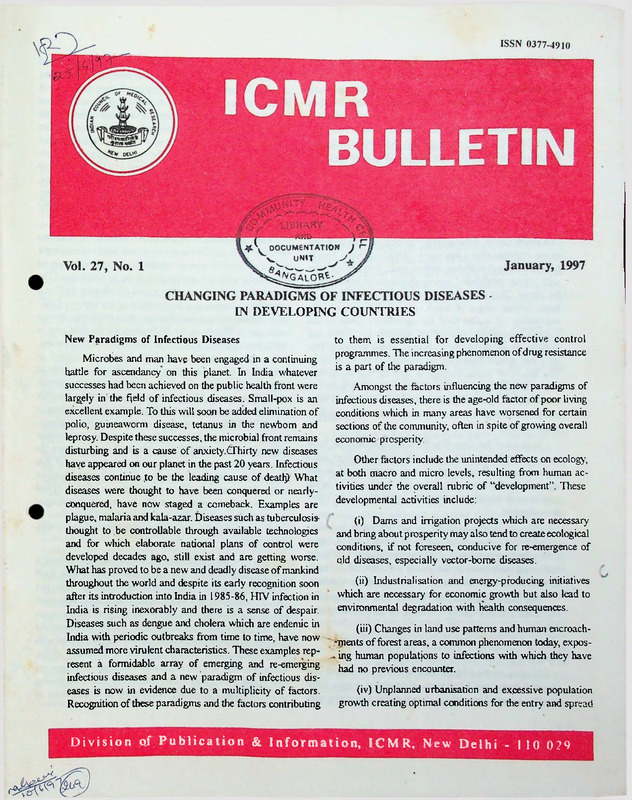
- Title
- ICMR BULLETIN VOL. 27-No.-1-JANUARY-1997
- extracted text
-
IN DEVELOPING COUNTRIES
New Paradigms of Infectious Diseases
Microbes and man have been engaged in a continuing
battle for ascendancy on this planet. In India whatever
successes had been achieved on the public health front were
largely in'the field of infectious diseases. Small-pox is an
excellent example. To this will soon be added elimination of
polio, guineaworm disease, tetanus in the newborn and
leprosy. Despite these successes, the microbial front remains
disturbing and is a cause' of anxiety.(Thirty new diseases
have appeared on our planet in the past 20 years. Infectious
diseases continue Jo be the leading cause of deatljy What
diseases were thought to have been conquered or nearlyconquered, have now staged a comeback. Examples are
plague, malaria and kala-azar. Diseases such as tuberculosis
thought to .be controllable through available technologies
and for which elaborate national plans of control were
developed decades ago, still exist and are getting worse.
What has proved to be a new and deadly disease of mankind
throughout the world and despite its early recognition soon
after its introduction into India in 1985-86, HIV infection in
India is rising inexorably and there is a sense of despair.
Diseases such as dengue and cholera which are endemic in
India with periodic outbreaks from time to time, have now
assumed more virulent characteristics. These examples rep
resent a formidable array of emerging and re-emerging
infectious diseases and a new paradigm of infectious dis
eases is now in evidence due to a multiplicity of factors.
Recognition of these paradigms and the factors contributing
to them is essential for developing effective control
programmes. The increasing phenomenon of drug resistance
is a part of the paradigm.
Amongst the factors influencing the new paradigms of
infectious diseases, there is the age-old factor of poor living
conditions which in many areas have worsened for certain
sections of die community, often in spite of growing overall
economic prosperity.
Other factors include the unintended effects on ecology,
at both macro and micro levels, resulting from human ac
tivities under the overall rubric of “development”. These
developmental activities include:
(i) Dams and irrigation projects which are necessary
and bring about prosperity may also tend to create ecological
conditions, if not foreseen, conducive for re-emergence of
old diseases, especially vector-borne diseases.
(ii) Industrialisation and energy-producing initiatives
which are necessary for economic growth but also lead to
environmental degradation with health consequences.
(iii) Changes in land use patterns and human encroach“ments of forest areas, a common phenomenon today, exposing human populations to infections with which they have
had no previous encounter.
(iv) Unplanned urbanisation and ex.cessive population
growth creating optimal conditions for the entry and spread
Division pf Publication & Information, ICMR, New Delhi -110 029
of infectious diseases in congested squatter settlements. The
essential problem here is the breakdown of infrastructure
and services in slum areas creating conditions conducive to
the resurgence of diseases once brought under control. Urban
health is a matter of overwhelming urgency without much
time left to correct the prevailing deficiencies and hazards.
(v) Growing trade, tourism and trucking accompanying
increased international travel leading to greater intermin
gling of people today than ever before creating conditions for
the spread of infectious diseases. The speed of transmission
of infections increased enormously as mankind transited
■* from sailing ships to jet planes.
The changes in climatic conditions now reveal signifi
canthealth effects. Atmospheric pollution, deforestation and
ozone depletion play a key role in global warming. This in
turn, would lead to higher surface water evaporation rates
with greater rainfall and heavier monsoons in key areas of
the planet. This would alter everything from migration of
birds, habitat ranges of insect vectors of disease and the
availability of arable land for agriculture. Dengue and
malaria transmitting vectors are sensitive to rainfall and
ambient temperatures. As a result of global warming, ma
laria may spread further up the foothills of the Himalayas.
The lesson of macro-ecology is that all life forms *and
chemical systems are closely linked in complex ways1. It
would appear that current and anticipated changes in local
and global ecologies would favour some microbes and their
insect vectors.
In place of the Cold War there are now multiple local
wars and conflicts which along With natural disasters, such
as famines and floods, lead to mass movement of people
internally within countries and across borders. The living
conditions of the refugees provide a fertile ground for infec
tious diseases.
Changes in human lifestyles and behaviour including
sexual behaviour and food habits are another potent factor
in the changing paradigms of infectious diseases. Lastly, the
continuing inadequacy in the quality and outreach of health
services is. an important factor compounding the situation?^
The challenges presented by the New Paradigms of
Infectious Diseases can be conveyed by the following four
diseases.
Dengue
( Dengue, by the 14th of October 1996, had caused 126
reported deaths and 2,545 cases of presumed dengue fever
complex admitted to public hospitals giving a mortality rate
2
of 5 per cent. While this corresponds to the average rate of
mortality in other parts of the world, there may be scope for
it to be reduced further by improved case management
through early recognition of haemorrhagic manifestations
and shock, prompt and efficient replacement of lost plasma
through fluids and electrolytes, plasma/plasma expanders
and platelets as indicated. Blood transfusion will be needed
if there is internal bleeding. The modem regimen of treat
ment of Dengue Haemorrhagic Fever (DHF) and Dengue
Shock Syndrome (DSS) was evolved by Thai physicians,
some years back and now forms the basis of WHO recom
mendations2. This regimen has been shown to reduce the
mortality rate to 2.0 per cent or less.
Dengue had been known to be endemic for over two
centuries in India and for the most part had been running a
benign self-limited course. All the four known serotypes of
the dengue virus are now known to be in circulation. Tbg^
disease has lately changed its course manifesting itself in
proportion of cases in a severe form of the disease, DHF/
DSS. This new lethal manifestation of an old benign disease
broke out in Manila in the Philippines for the first time in
1953; then attacked Bangkok in Thailand in 1958; Havana,
Cuba experienced the worst DHF known to mankind in
1981. DHF had been raging in our immediate neighbour
Myanmar since 1970. Cambodia had seen a severe outbreak
of DHF last year. In Manila, dengue occurred each year after 4
the rains. Seasonal and cyclical epidemic pattem-of dengue
with DHF/DSS in a proportion of cases is a recent pheno
menon developing in India and Sri Lanka in the same manner
as happened in the Philippines, Thailand and Indonesia.jln
other words, there has been a westward movement oEthis
new paradigm into India, Pakistan, Sri Lanka and Maldives
in the 1980s and early 90s in which Dengue 3 (DEN-3) had
been the predominant serotype. The history of Indian dengu^
illustrates the well known transition from a paradigm
small outbreaks to a paradigm of major outbreaks with
DHF/DSS2-4
The new dengue disease paradigm has now secured a
firm foothold in India. The paradigm is manifesting itself
extensively in Latin America and the Caribbean since last
year. Its emergence as a major health problem has been most
dramatic in the American region. This region had an excel
lent record of eradicating Aedes aegypti in the 1950s and 60s
as a part of die Yellow Fever Control Programme, but with the discontinuation of this Programme from the 1970s, M
Aedes returned, and the worst ever outbreaks of dengue are /
< now raging there .'This shows that even a year’s slackeningof vector control measures could bring back outbreaks of
vector-bome diseases .{Similarly, relaxation of immunisation
can result in re-emergence of disease as in the Russian
Federation and the former USSR with respect to diphtheria.
Aedes is a very efficient epidemic vector of both dengue and
yellow fever33. The virus type responsible for the current
outbreak in Delhi has not yet been identified but work in this
area is going on.
/The reasons for this dramatic emergence in India and
around the globe of dengue/DHF as a major public health
problem, as already indicated, are many: Ineffective mos
quito control programme, major demographic changes-the
most important being uncontrolled urbanisation, excessive
population growth and urban decay characterised by sub
standard housing and inadequate water and waste disposal
system. Increased travel by airplanes produces constant
exchange of dengue viruses.^
ft There is a crisis approach to public health in our coun
try, public health activities being largely punctuated from
crisis to crisis. What is needed are sustained programmes for
the prevention of epidemic transmission. Surveillance sys
tems are inadequate as the Technical Advisory Committee’s
(TAC) Report on Plague demonstrated. Mosquito densities
in relation to rainfall and ambient temperatures ate not
available and early detection and reporting systems are
inadequate. No dengue vaccine is available although a
quadrivalent attenuated live vaccine representing all four
serotypes has been developed in Thailand and is in advanced
stages of trial.(This vaccine appears to be safe and effective
but it will probably be another 5 years before an effective
dengue vaccine will be available/for public use. Prospects
for reversing the recent trends in dengue/DHF do not look
bright in Delhi and early breakthroughs may not happen.
And yet, there is no cause for despair.
b In response to the recommendation of the TAC on
Plague, a National Apical Advisory Committee for Disease
Control through Surveillance and Response has been estab
lished by the Government. Treatment regimens have been
developed with respect to dengue2, control of the disease is
possible through efficient management of the disease and
through a double-pronged attack on mosquito vectors,
namely, insecticide spraying by Government action and
elimination of mosquito breeding by family and community
action to reduce sources of larval breeding. The latter strat
egy is particularly important, especially in the long run and
one would like to see social mobilisation efforts in much
greater evidence.
The most effective means of.dengue vector control is
environmental management through physical transforma
tion of largely man-made vector habitats, within and around
human dwellings. Education and community participation in
planning, execution and evaluation ofthese control measures
is the critical factor. Commonsense approach is needed.
Aerial spray is often used, where extensive areas must be
treated in a short period, but spectacular results may not be
expected as the Aedes rests indoors. The approach must be
complemented with larvicidal application in and around
homes where containers cannot be emptied or covered. The
most effective way to control Aedes is larvicidal source
reduction by eliminating clean water holding containers that
serve as larval habitats4. The 1981 Aedes eradication cam
paign in Cuba depended upon reduction of larval habitats
in artificial and natural containers of water, intense public
education, and biological and chemical control methods. The
Tanzanian campaign consisted of source reduction, educa
tion and clean-up campaigns. Dengue control is an area
where Science and Society meet. There is considerable
expertise on this aspect within the ICMR in India which must
be mobilised.
Pro-active, laboratory-based surveillance systems that
can provide early warning of an impending dengue epidemic
must be developed. An encouraging development is the Thai
dengue vaccine which could be available in the next few
years. Another possibility is the use of genetically engi
neered mosquitoes which cannot transmit the disease.
Malaria
After the initial successes India is now unable to get the
upper hand in malaria control and ever the past decade or
so the number of malaria cases has remained unchanged with
the addition of increase in falciparum malaria. The issue
today is that malaria has now entered new ecological niches5.
The problem is essentially due to man-made environmental
alteration which provides excellent opportunities for the
mosquito vector to breed. The new paradigm of malaria
consists of new eco-types such as irrigation malaria, urban
malaria, development project malaria, migration malaria
and border malaria5. These eco-types are in addition to the
already existing eco-type of rural malaria in rain-fed areas.
Environment degradation is conducive to the sustenance of
malaria. Epidemics are increasingly common such as that
currently in Mewat, Haryana. The revised malaria strategy
consists ofearly diagnosis and prompt treatment and focuses
on local transmission dynamics and control based on
selective and sustainable technologies. But there is a wide
gulf between the fine experimental projects involving source
reduction through biotechnological methods and their exten
sion into nation-wide malaria control programmes.
3
Malaria was one of the first infections diseases to be
treated successfully with the drug, quinine, extracted from
the bark of the cinchona tree. The latest and highly effective
anti-malarial compound is also derived from plantsArtemisia annua L.-for chloroquine resistant malaria. Forty
per cent of the world’s population is still at risk and is
yearning for a vaccine, cheap and effective. There is not
much private investment in malarial research throughout the
world and most of the work is done under Government
sponsored and charity auspices. Drug resistance is a real
problem and hence the different strains in different geo
graphic areas may require different drugs. It is disappointing
that the antimalaria vaccine developed by Dr. Manuel
Patarroyo, has now been shown to be not effective. There
were initial successes with this vaccine, but only partially to
the extent of 31-34 per cent protection but more recent
studies in the Gambia and Thailand confirm the failure of
the vaccine. The Patarroyo vaccine is a harbinger of better
vaccines to come based on multi-stage antigens.
Cholera
4 A completely new strain of cholera vibrio had emerged :
in India in 1992 in Madras. It has been christened Vibrio
cholerae 0139 Bengal, with pandemic potential. It produces
a clinical picture of severe disease, dehydration and
hyponatraemia similar to classical cholera but is susceptible
to some antibiotics. It has spread throughout India and went
to Bangladesh in 1993 and then on to South West China,
Thailand and other parts of South-East Asia. What happens
zto the Vibrio in between the outbreaks is not known and some'
scientists had postulated that the Vibrio is dormant between
outbreaks in the Hilsa fish in the Hooghly^No confirmatory
evidence had been forthcoming for this hypothesis but algal
blooms have been found to be responsible for the spread of
El tor cholera to Latin America in 1991, a continent that had
not experienced cholera over the last 100 years. Algal
blooms where cholera organisms reside, are, in effect, “giant
floating gene pools” in which antibiotic resistance, virulent
genes and plasmids move about freely between viruses and
bacteriaAln the paradigms that are being discussed, marine
eco-systems influencing human health should find an impor
tant place. It would appear that current and artificial changes
in global ecologies favour microbes and their insect vectors.
Tuberculosis
With the increase in the incidence of AIDS, tuberculosis
is becoming worse. The efficacy of BCG vaccine in prevent
ing tuberculosis remains variable depending upon geographi
cal and epidemiological factors. A better vaccine than BCG
is needed although the disease is still treatable with existing
4
technologies just as HTV/AIDS is preventable. India has not
derived maximum benefits from the results of research at the
Tuberculosis Research Centre in Chennai with respect to
multi-drug and domiciliary therapy, though it is now pro
posed to use short course multi-drug therapy against tuber
culosis throughout the country. Case management with such
a therapy, case finding with high quality bacteriological
examination, improved programme management and di
rectly-observed treatment can lead to a virtual cessation of
transmission of tuberculosis in the general population even
under adverse conditions.
DNA Vaccines
'^Multi-drug resistance is rapidly advancing in India and
gradually assuming serious proportions. New drugs and new
vaccines are needed to fight tuberculosis effectively. It is
noteworthy that mice injected with plasmid DNA encoding
a single mycobacterial antigen (65 kDa) developed immunity against subsequent challenge with the tubercle bacillus. —
It seems likely that a DNA vaccine against tuberculosis
might replace the BCG. In animal models of several infec
tious diseases, DNA vaccines seem to be broadly applicable
for conferring protective immunity to a number of infectious
pathogens. They seem not to need replicating vectors and
adjuvants and seem to be practical and safe. Eventually, a
cocktail vaccine, DNA plasmid-based may be needed encod
ing for a number of mycobacterial antigens to generate
complete and lasting protection against tuberculosis.)
DNA vaccines may help man to be one step ahead of
microbial pathogens which are either staging a comeback or
evolving into more virulent organisms. Surely, the biological
front is never static. To foresee is to govern.
References
1.
Garrett, L. The Coming Plague. Farrar, Straus and Giroax, New
York, p 557, 1994.
2.
World Health Organization: Dengue Haemorrhagic Fever: Diag
nosis, Treatment and Control, Second edition. In Press, 1996.
3.
Gubler, D. J. and Clark, G. G. Dengue/Dengue Haemorrhagic
Fever. The emergence of a Global Health Problem. Emerg Infect
Dis, 1 (2): 55, 1995.
4.
Gubler, D. J. Dengue/Dengue Haemorrhagic Fever, Persona]
communication, 1996.
5.
ShannA. V. P. Malaria and its control in India, In: Global Meet
on Parasitic Diseases: Abstracts de Scientific Programme, Ma
laria Research Centre, Delhi, p 2, 1996.
The write-up 4s based on the Second Dr. B.R. Ambedkar Cen
tenary Award (1993-94) Oration of the ICMR delivered by
Dr. V. Ramalingaswami, National Research Professor All India
Institute of Medical Sciences, New Delhi, on October 15,1996
at New Delhi.
EIGHTY FIFTH ANNIVERSARY CELEBRATIONS OF
ICMR CONCLUDED
The year long celebrations of the 85th Anniversary
of the Indian Council of Medical Research concluded
in November, 1996. Shri Saleem I. Shervani, Hon’ble
Minister of State for Health and Family Welfare and
President of the Governing Body of ICMR presided over
the concluding ceremony organised at the National
Science Centre. New Delhi on November 29 1996.
The Delhi based ICMR Institutes/Centres (yiz.
Malaria Research Centre, Institute of Pathology and
Institute of Cytology and Preventive Oncology) as also
the National Institute of Nutrition, Hyderabad had
M illEMlfciwife
"
CONCLUDING CEREMONYOR?*
85* YEAR OF ICMR
BASANTI DEVI AMIR CHAND PRIZE(I995J0RATON
NOVEMBER 29.1996
ng
Dr. N.K. Ganguly and Dr..R.C. Mahajan delivering their
oration.
Shri Saleem I. Shervani, Hon’b le Minister of State for Health
and Family Welfare and other dignitaries on the dias.
The Basanti Devi Amir Chand Prize (1995) Orations
of the ICMR were also delivered on the same day. The
joint winners of this Prize viz., Prof. N.K. Ganguly,
Head, Department of Experimental Medicine and Bio
technology, and Prof. R.C. Mahajan, Head, Department
of Parasitology, Postgraduate Institute of Medical
Education and Research, Chandigarh, delivered these
orations respectively on .Pathophysiology of Bacterial
Diarrhoea and Pathophysiology of Parasitic Diarrhoea.
organised an exhibition on this occasion, comprising
posters, charts, photo-panels on major health problems
like malaria, cancer, AIDS, dengue, rheumatic heart
disease, etc. and their prevention and control;
bioenvironmental control of mosquito vectors:
Visitors at an exhibition organised at the function.
Basanti Devi Amir Chand Prize awardees and other
dignitaries on the, dias.
nutritional deficiency diseases and their prevention with
the help of balanced diets/foods prepared from locally
available food items, etc. There was a live demonstration
of larvivorous fishes feeding on mosquito larvae, apart
from specimens of organs with malignant (cancerous)
lesions. Video films on various health problems (like
malaria, nutrition, etc.) were screened and health
by the Council (1953); constitution of the first Review
ing. Committee (1966); as also the second Reviewing
Committee (1982-83); and the phase of expansion of the
Council in the late seventies and the eighties through the
setting up of Regional Medical Research Centres, etc.
Visitors at an exhibition organised at the function.
education material in the . form of folders, pamphlets,
booklets and brochures brought out by various ICMR
Institutes/Centres were distributed.
The Hon’ble Minister released a special issue of the
ICMR Bulletin (November 1996) on this occasion, high
lighting reports of the year long celebrations.
Shri Shervani also presented mementos to the former
Directors-General and also the Additional DirectorsGeneral present on the occasion.
Hon’ble Minister releasing the special issue of the ICMR
Bulletin.
Welcoming the Hon’ble Minister of State for Health
and Family Welfare qnd other dignitaries who attended
the function, Dr. G.V. Satyavati, Director-General,
ICMR, gave a brief overview of the significant contribu
tions of the Council over the last eight and a half decades
and referred to milestones such as the establishment of
the ICMR as the Indian Research Fund Association in
1911 and publication of the Indian Journal of Medical
Research (1913)-the first Indian journal exclusively
devoted to medical research; institution of various awards
6
She also drew attention to the various bottlenecks
encountered by the Council over the past several years
that need the urgent attention of the policy makers in
the Government, such as poor funding, and lack of
autonomy (which was pointed out by the First Reviewing
Committee itself). This Reviewing Committee had cat
egorically stated that these two critical factors had
affected the efficiency and performance of the Council.
The second Reviewing Committee of the ICMR had also
recommended greater autonomy, better funding as also
better service facilities for ICMR staff. She informed
that as much as 80 per cent of the budget allocated goes
towards payment of salaries, with little left for research.
Extramural support to scientists in Medical Colleges
which was once considered a strong point of the ICMR
for nurturing the research talent in the biomedical field
in the country, has dwindled from about 60 per cent
during 1970s to barely 25 per cent now. She noted that
although ICMR is the oldest Research body in India,
currently it has a lower fund allocation than the youngest
S&T Department v/z., Department of Ocean Develop
ment (DOD).
Addressing the distinguished gathering, Shri Shervani
congratulated the ICMR and its scientists for their
dedicated efforts. He called upon the Council’s scientists
to rededicate themselves to high quality research and to
ensure that the ICMR reaches greater heights in the
coming years and joins hands with health authorities to
find practical solutions relevant to the health problems
of our country. A very important challenge before all
medical scientists and health authorities, he said, is to
find appropriate ways and means to ensure practical
application of the outcome of important medical
research and that too without loosing much time, which
requires not only interaction among multiple groups
involved in the health and development sector in the
country but also coordination at the highest levels.
Shri Shervani said “The ICMR has come a long
way in this span of 85 years. Its research activities range
from the conventional disease-oriented studies through
intramural research (initiated in the early part of this
century)—as relevant to a tropical country like India—
to the current multi-disciplinary approach to newer
dimensions
of
various health
problems encoun
tered by our coun
try”.
Shri Shervani
further added “In
its 85 years of
existence, ICMR
has always tried to
assist health au
thorities in case of
various situations
arising in health
sector in India—
be it epidemics
cholera,
Hon'ble Minister of State for Health like
plague,
dengue,
and Family Welfare delivering the
presidential address.
hepatitis, etc. or
aflatoxicosis or even man- made disasters like the Bhopal
gas tragedy. The ICMR (and its Institutes) have either
been approached by the State/Central Health Depart
ments or the Council itself has offered such assistance
to the State and Central Health Authorities by means
of field visits, and aiding in diagnosis and management”.
He felt “While ICMR has many successes in its 85
years of existence, there are many new challenges the
Council has to face. What the ICMR needs today is
not only adequate funding but also focussing on specific
problems and also build on its strengths. With the advent
of newer research agencies like the Department of
Biotechnology and the industry-oriented research agen
cies like CSIR which are likely to come up with more
and more products—be it diagnostic probes/kits or
vaccines and other products (including drugs) that will
need authentic evaluation, ICMR has to. gear itself to
provide vital support for such evaluation, on a massive
scale”.
ICMR NEWS
Meetings of the Scientific Advisory Groups (SAGs)/
Scientific Advisory Committees (SACs) held at New
Delhi:
SAG of the Division of Basic
Medical Sciences
January 3, 1997
SAC of the ICMR-NIC Centre
for Biomedical Information,
New Delhi
January 14, 1997
Meetings of the Project Review Committees (PRCs)/
Expert Groups/Committees held:
PRC on HIV/AIDS and Substance Abuse
December 10, 1996
(at Calcutta)
PRC on Malaria, Filariasis, Leishmaniasis and Diarrhoeal Diseases
December 12, 1996
(at New Delhi)
PRC on Tuberculosis and Lepr
osy
December 13, 1996
(at New Delhi)
Expert Committee on ENT
December 23, 1996
(at Madurai)
Meetings of Experts and Investi
gators on (i) Traditional Reme
dies for Bronchial Asthma, and
(ii) Filariasis
December 30, 1996
(at New Delhi)
Participation of ICMR Scientists in Scientific Events:
Dr. A. Roy Chowdhury, Dy. Director, Regional
Occupational Health Centre (Eastern), Calcutta, partici
pated in the II International Conference on Environmental
and Industrial Toxicology at Bangkok (December 9-13,
.
1996)
Dr. C.N. Paramasivan, Dy. Director (Sr. Grade),
Tuberculosis Research Centre, Chennai, participated in
the Annual Conference of the Sri Lanka College of
Microbiologists at Colombo (December 13-15, 1996).
♦♦
♦♦
♦♦
Dr. M.D. Gupte took over as the Director of the
Institute for Research in Medical Statistics, Chennai
w.e.f. December 11, 1996.
♦♦
««
Dr. S.K. Kashyap, relinquished charge as Director,
National Institute of Occupational Health, Ahmedabad
w.e.f. October 31, 1996.
Dr. M. Mohan Ram relinquished charge as Director,
National Institute of Nutrition, Hyderabad w.e.f. Decem
ber 31, 1996.
7
ICMR AIDED SYMPOSIA/SEMINARS/WORKSHOPS/COURSES/CONFERENCES
Symposlum/Seminar/Workshop/
Course/Conference
Date & Place
Contact Address
Symposium on Frontiers in Biology and Biotechnology
January 6-8, 1997;
(at Vellore)
Dr. Anna Oomen, Organising Secretary of the*
Symposium, Department of Neurological Scien
ces, Christian Medical College, Vellore-632004.
International Symposium on AIDS and Hepatitis
January 9-12, 1997;
(at New Delhi)
r
Dr, R.K. Tandon, Chairman of the Symposium,
Department of Gastroenterology and Human Nut
rition, All India Institute of Medical Sciences,
N^W Delhi.-! 10029.
XX All India Cell Biology Conference and Symposium
on Recent Trends in Cell Biology
January 13-15/ 1997f\\ *7/~ Dr. .RA» Bhisey, Organising Secretary of the
(at Mumbai J ’ . J ,' *”• • Conference, . Cancer^Research Institute, Mumbai-400bl*2r
Symposia on (i) AIDS and Cancer Victims: Quality of
Life, Psychosocial Interventions and Issues Related to
Caregivers; and (ii) Divorce: A Grief Process
January 23-24,’ 1^97;’.^.^ s, JDr. K.B. Kuin^r,. Department of Psychiatry, Kasturb£ Hospital, Mani pal-576119.
(at Mani pal) •
V Brain Storming Session in Molecular Immunology
February 21-23, 1997;,-.:
(at Varanasi)
International Conference on Developing Human Rela
tions and Ethnic Understanding
February 26-28, 1997;
(at Hardwar)
<*.
?• /
.; Dr. ,Aj it Sodhi ^Coordinator of the Session, School
''of Biot^eliridlogy, Banaras Hindu University, Var^
anasi-221005.
fl
Dr. S.K. Srivastava, Organising Secretary of the
Conference, Department of Psychology, Gunikul
Kangri University, Hardwar-249404.
COUNCIL’S TRAINING PROGRAMMES FOR 1997-98
Leprosy
At the Central JALMA Institute for Leprosy, Agra:
• Training Course on National Leprosy Eradication
Programme for Medical Officers (February 24-March
7 and September 15-26, 1997).
Virology
At the National Institute of Virology, Pune:
• Diploma in Medical Virology (July 1997-May 1998).
Reproductive Biology
At the Institute for Research in Reproduction, Mumbai:
• Training Course on Research Methods in Clinical Trials
of Newer Contraceptives (April 14-25, 1997).
• Workshop on Genotoxicity (August 28-29, 1997).
• Workshop on Basic Molecular Biology for Clinicians
(December 2-11, 1997).
\
Endocrinology
At the National Jnstitute of Nutrition, Hyderabad:
• Annual Certificate Cpurse on Endocrinological Tech
niques and their Applications (August 1-September 15,
.
1997)
Nutrition
At the National Institute of Nutrition, Hyderabad:
® M.Sc. in Applied Nutrition (June 1, 1997-February 28,
.
1998)
® Postgraduate Certificate Course in Nutrition (December
1, 1997-February 28, 1998).
Laboratory Animal Technology
At the National Centre for Laboratory Animal Science,
National Institute of Nutrition, Hyderabad:
© Training Course for Laboratory Animal Technicians
(June 16-July 31, 1997).
• Training Course for Laboratory Animal Supervisors
(September 1-November 29, 1997).
"
Occupational Health
At the National Institute of Occupational Health,
Ahmedabad:
° Orientation Course on Occupational Health for Indus
trial Medical Officers (September 30-October 11,1997).
• Training Course on Environmental Hygiene Practice
(November 10-14, 1997).
EDITORIAL BOARD
Dr. G.V. Satyavati
Dr. Badri N. Saxena
...
...
Dr. Bela Shah
Dr. N. Medappa
Chairperson
Member
Member
...
Editor
Printed and Published by Shri J.N. Mathur for the Indian Council of Medical Research, New Delhi
at the ICMR Offset Press, New Delhi-110029
R.N.*21813/71
Position: 2198 (14 views)