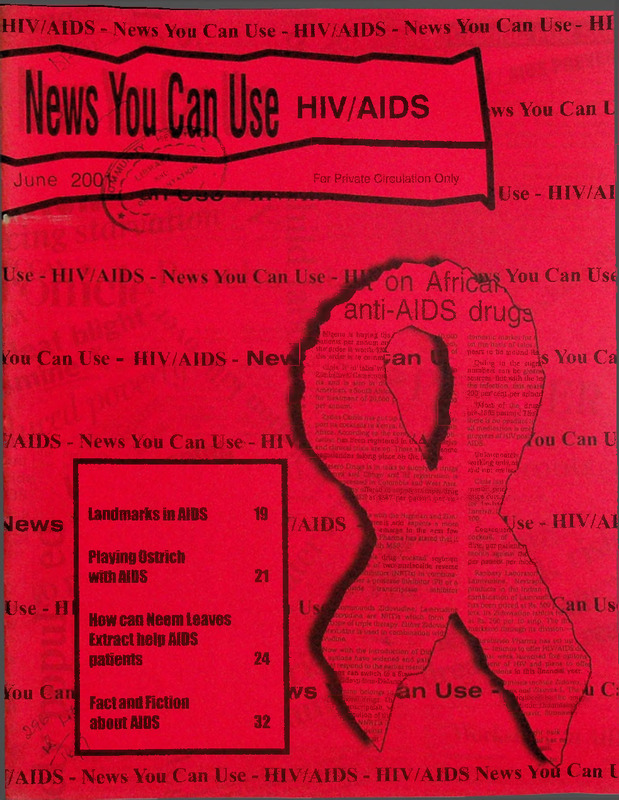
NEWS YOU CAN USE HIV-AIDS JUNE 2001
Item
- Title
- NEWS YOU CAN USE HIV-AIDS JUNE 2001
- extracted text
-
HIV/AIDS - News You Can Use - HIV/AIDS- News You Can Use - HI
HIV/AIDS
ws You Can L
$
1
MR
For Private Circulation Only
Use- HIV/AI
You Can Us*
Afri
gHInti-AIDS dru
jfoti Can Use - HIV/AIDS - Nevi
Nigeria.Is bwylni tha/%r
j^Bpahonis per annum at/
^ihtrclnlorh v.anh «£
K ..dw^witt 10 co.nmC Q
P' ^ CipIiv Is' iii'iWd'wf >• ,. ; ®
f ' . 'Zuntebwwc^raenwd■;;
|
-1
y
.pcnreto bo.wound R1
.Q'vitig to the $Gg(i
J
|n: ? numbed can be
■ sources- BiK with thein«
,s ¥ou Ca
.■.^°4P®r^‘T‘-P$raxinurf
' X'.'-Mwt .of
dfue/
I
5pti‘-J595pacejn|’CThe7
[/AIDS - NewS^iC»fc-:Hii^
ss.brenregist«i.i<d.in(?>J>|
pfJjjrx : ■: •
^lilC ''
HK&gotlatMas lefcinfl pliwa.pji tte [■
.
hjw
\ ?vyoM'ng;' wffcai
' ay<d nor oivlts>
. ■
j-na. ’
Ul
•■,;..■■
UnFoi tunMCh
W®^w®S?
4ews
Landmarks in AIDS
Hayinn Ostrich
with AIDS
Use - H
foil C
y \ • v
19
/AIDS
nhr,-aija
emerge fn the next few
OBIV/A1
'■>'..-'• •.-.>
L
.ConsoqueiK
£-Sf.g?? ■Jing,:pcrp«i|e»Jw
' ‘^'^;n!en
ner ?nV
r two. nuclMsIde reverse
P“ pi,'l“’1’er ln»lN..
•' ■ " ■ ' '■
g
. .. 1
;
21
S'
How can Neem Leaves
Extract heln AIDS
patients
24
io
■hns can switch id s Sism——
Fact and Fiction
about AIDS
hrs WX£’<
32
r^Rui>«i»w
ft
,n **’ nn;ino a yc”' / V.-
’■•
«Cdovudinc-r>i<huiy2
'.
■
.
Wsi-F
ftS'c
..
[/AIDS - News You Can Use - HIV/AIDS - HIV/AIDS, News Ymf Can I
‘/hwaiijs.
'. As a pan of a'rcgic.-iai initiative to j
huild.awaf chess .onv-HIWAiDS; |
specialpublicafion•
pre sen (s a cempd auoii o f news c lippings
. °i) liieissucv AAe.bopcih'at (he wuucnls
’
:
s e v e ra 1
c i7'o i r s
ha v e ■ • hee n «
£uiidcrtaljenkyMiANJhtfen^hojg^. '
f B.angaio. e Zone) m panne “ship ?'
will provide, readers with relevank .
. wilii Al;idItyam Dissemination of ’ J
facilitategrassroet-wMifon-prevention,
^cproponfehbtS^ts-'caiiipaigniTluss ■/
This'edition has been '
Vdtfgamg; \ ^|fdr!ts, -"'.through - compiled front
| 'X< The Times o"Indi?
■sinfon^iuldif
.ietlers•’•.■■.fronr '-leading ■•nati’onal.";.
newspapers.Eacltncwsilcnicaniesrhe
set v e as a t'egu I ar i ei ninder M rhe *
X Hindustan Tmiesw
&prgerfgytoaddre'$sing4h^assue/"t | £
TlW’Sisitesitian.^,.
The Pioneer
easy, reference.
’
> I,n t e^n aQonal'.Madhyam.|g
ajiT^
-The New Indian. Expt^si
I Deccan Herald
Dpccatl Chronicle
X
h
Hie Economic Tinies
X The Asian Age
intlrnatonai,
. ■
X
UN Newsletter
Communication for
Development and Learning
Developni&ni and Learning,
Bangalore
1 l/A, ?* Gros?, 17“ M»in. Kootmangala
O* Bloch. Bangaiore 560 095 '■
PhrlC^L
■
e-atail edlbk«H>gl. vsnl.net.in
' KI A^wcdlblrtirg
■
~
TABLE OF CONTENTS
JUNE -2001
Needed, will to tackle a global scourge
Reeling under death and disease
Western hand in AIDS prevention
Fact and fiction about AIDS
Sex ratio in 2001: good news or bad?
How the world can win its battle against AIDS
Analysis
09
14
29
32
36
47
Data
AIDS cases on the rise in AP
02
04
AIDS: Twenty years on, the battle is on
AIDS cases high among TB patients in Pune
12
AIDS picture grim: UN
16
2 million Indians infected will AIDS: UN report
16
Playing Ostrich with AIDS
21
Teen pregnancy falling
24
27
Controversial theory about HIV’s origins
30
15,000 get infected by AIDS every day
India heading towards a daughterless nation?
31
33
About the birds and the bees
37
AIDS situation alarming: UN
41
AIDS report mixup angers ministry
India second to S Africa with 3.7 m AIDS patients 45
An unidentified young woman...
Breakthrough in remedy for AIDS
Thais queue up for unproven AIDS drug
Rise and fall of the Indian Viagra
Centre’s nod for injectable contraceptive
for women
Court gives desi viagra a thumbs down
Women’s groups to protest against
new injectable....
Cheap Elisa kit developed to detect Hepatitis
'Emergency contraceptives’ may be introduced
Contraceptive minister quizzed
A cost-effective Hepatitis kit now
New contraceptive pill on cards
Vaccine goes on human trial
Cipla
58 nations want to try cheap drugs for AIDS
Drugs
03
12
18
34
38
38
39
41
42
42
44
46
46
48
49
Candour from an American friend
HIV centre at last
Feature
W’
26
G-8 may finance AIDS battle
Funding
02
Brazil lovers say yes to condoms
Canadian immigrants to be tested for AIDS
Aids scandal chills China
Gates gives $100 m. to AIDS fund
Sex is key to healthy heart: Barnard
How ‘GRID’ became AIDS
MAMA, don’t eat....
‘AIDS is both a social and moral problem*
Why young urban women have sex?
Global
16
23
31
37
Information
03
08
12
15
30
Industry
• Pfizer offers free AIDS drugs to 50 poor
nations
• Glaxo offers cheap AIDS drugs to more
countries
• TRIPS meet crucial for drug patent law
Aurobindo pharma to conduct AIDS
awareness camp
• Aurbindo offers cheapest Al DS drug
Aurobindo Pharma may tap Africa to sell
AIDS drug
Notice to Pfizer over Cadila Penegra plea
> Countries’ apathy to buy AIDS medicines
18
22
25
30
37
42
47
50
Media
NGO will use music to spread AIDS
awareness among
Indian touch in AIDS fair
‘At least their condom is comfortable’
Not alone
Holbrooke has new job, to wage war
against AIDS
Condom ads drive Philip Morris wild
13
27
28
33
43
49
Editorial
Landmarks in AIDS
Curbing AIDS
Needless controversy
A second look
19
43
44
50
South African AIDS boy activist Nkosi dies
Health awareness campaign on STDs
at dispensaries
News
01
03
She got the H/Vvirus from her own blood
0/77 students sell their eggs to pay off debts
Parents pass social virus to children
And now, a restaurant run by sex workers
Women beat men in Govt’s sterilisation
programme
AIDS camp held for BCs
Aids control programme
Cops fight AIDS with graffiti
Baby has AIDS & needle of suspicion points to
syringes
An Al DS victim who never was
First person to get legal marijuana dies
AIDS patient, Songvut I rapt
Mother, infant are banished to a hut here
Family, society termed oppressors of gays
Good bye, Nkosi
AIDS become ‘more affordable’ but right to
life still...
Junoon doc’s musical cure for AIDS
Many students pay for highway sex
Maternity benefits reach only a few
Create awareness on sex discrimination: Sonia
Al DS patient offers counselling
Safe sex and security risk
Govt seeks priests’ help to counter sex-ration
anomalies
State helpless in tackling Al DS
Siliguri mystery disease virus defies tests
India to seek more funds to fight AIDS
$ p billion needed to fight HIV/AIDS
ILO evolves codes for Aids sufferers
Sonia to address UN meet on AIDS
Clinton lauds TN. efforts to fight AIDS
Appeal to UN on funds for AIDS
Sonia to meet US officials, address
AIDS meet in UN
04
05
05
06
You can’t fight AIDS with moral judgments: Annan
Annan calls for funds to fight AIDS
Sonia for war against Al DS
07
07
07
11
'US must commit to fight AIDS’
48
48
49
Newsbriefs
11
13
16
16
17
18
20
22
25
27
28
33
33
35 *
38
38
39 •
40
40
45
45
46
46
47
Programmes
Funds crunch afflicts anti-AIDS schemes
01
Programme to prevent HIV transmission soon
08
USAID to launch project in Maharashtra
09
Move to check Al DS spread
22
CM sets precedent, to head State Aids Control
Society
41
Question and Answer
Hygiene in public toilets
13
How can Neem Leaves Extract Help AIDS
Patients?
24
Research
New AIDS drug works on monkeys
01
Many doctors still clueless about Al DS treatment
06
Hysteroscopy holds hope for women
07
‘Son of Viagra’ to give 24-hour potency
08
Indigenous diagnostic kits to detect Hepatitis C
20
Developing HIV vaccines is just not enough
22
Scientists finds ways to fight sex diseases
43
A cheaper treatment for Al DS
37
Schemes
Attempt to curb population through incentives
17
Two-child norm recipe for female foeticide: NGOs 20
Advertisement for inviting proposals...
44
Study details how AIDS virus kills immune cells
Study
26
Funds crunch afflicts
anti-AIDS schemes
Staff Reporter
New Delhi
THE DELHI .State Aids Control
Society (DSACS) will organise a
Fortnight-long Family health cam
paign to create mass awareness
about HIV/AIDS. The camp will
start on June 1.
According to Health Minister Dr
A K Walia, the condom distribu
tion programme in the city has
suffered since the National Aids
Control Organisation (NACO) has
not released Funds to DSACS.
While Rs 4 crore were sought last
year, only half the amount was re
leased.
"This year, NACO has been re
quested to allocate us Rs 5.65
crore. So far, there has been no respouse from NACO officials in this
15-day awareness campaign from today
regard. We are holding a dialogue
with them for early release of the
funds," he said. This was a major
stumbling block in launching pro
grammes against HIV/AIDS, the
Minister added.
He said the Union Government
was supplying condoms to the city
"but. (lie supply has been disturbed
for die past couple of months due
to reasons unknown to us". He
added: "Against a requirement of
nearly 2,500 condom boxes, only
500 boxes were to us."
Dr Walia said that though the
idea of installing condom-vending
machines at places like Kashmere
Gate, ISBT- were successful, they
could not be repeated elsewhere
because of "poor handling" of such
New AIDS drug
works on monkeys
Rixensart, Belgium: Belgian
researchers have developed a
medicine that protected rhe
sus’ rqonkeys for 18 months
from an AIDS-like sickness,
Belgian Radio reported.
The pharmaceutical compa
ny Glaxosmithkline in Rixen
sart, near Brussels, developed
the vaccine in its laboratories
and presented it for the first
time at a conference last week
in Puerto Rico, the report
said on Friday.The OS
•national institutes for health
provided financial support
for the tests.(DPA)
machines. "Now we are planning
to set up these machines at hos
pitals, and they have already
been installed at six-seven places,"
the Health Minister said.
Dr Walia said contrary to gen
eral perception that only sex
workers or truck drivers are af
flicted by HIV/AIDS, the disease
has now spread to general pub
lic. "The objective of tlus campaign
is to create mass awareness," he
added. Till 1993, 40 persons had
The Asian Age
succumbed to AIDS virus. The cu
mulative* figure so far has reached
03 June 2001
142 persons while 520 persons
have been diagnosed to be suf
fering from the deadly virus. The Pioneer
Besides, about 22,400 persons are
01 June 2001
HIV-positiVe in Delhi.
The Times of India
02 June 2001 _
South African AIDS boy activist Nkosi dies
JOHANNESBURG:
Nkosi
Johnson, the 12-year-old AIDS
activist who Mr Nelson Mandela
praised as an icon of the struggle
against the epidemic, lost his battle
against the disease on Friday.
“Gail Johnson regrets to
announce the death of Nkosi, who
passed away at 0540 Local (0340
GMT) this morning,” a spokesman
for his family told Reuters.
Nkosi had become the public
face of AIDS in a country strug
gling to come to terms with the dis
ease, which is predicted to infect as
many as seven million South
Africans within the next decade
from more than four million today.
He took his message of safe- sex
and advocacy of anti-AIDS drugs
across the country and abroad at a
time when government policy
towards the disease was thrown
into disarray after Mr Mandela's
successor, President Thabo Mbeki,
questioned the link between HIV
and AIDS and the safety of AIDS
drugs.
In his short life, Nkosi also suc
ceeded in fighting some of the deep
stigmas surrounding AIDS, partic
ularly that the disease could be
caught by hugging HIV-positive
babies and children.
Mr Mandela described Nkosi as
an example for the world to follow
and said the boy —who was aban
doned by his HIV-positive biologi
cal mother at the age of two
because she had been ostracised by
her neighbours —inspired millions
of people around the world. “Let
his life and example spur us on to
be strong, resilient and vigorous in
our fight against this dreaded infec
tion... He has earned the right to be
accorded all honour, dignity and
respect,” Mr Mandela said in the
final months of Nkosi’s life.
Nkosi’s white foster mother Gail
Johnson, who looked after him for
nearly 10 years, said Nkosi had
focused world attention on the epi
demic in Africa and given hope to
sufferers. More than 70,000 babies,
like Nkosi, will be bom HIV-posi
tive this year in South Africa. Few
will have the same privileges and
attention Nkosi had enjoyed.
The boy became a potent symbol
after being labelled the longest liv
ing AIDS child and after he was
accepted by a Johannesburg pri
mary school despite opposition by
some parents and the school.
Nkosi — bom Xolani Nkosi —had
Gail Johnson with her foster son, the young AIDS activist Nkosi Johnson,
in Johannesburg on Thursday.
been in a semi-coma since AIDS
attacked his brain in January this
year. His natural .mother died of
the disease in 1997.The disease had
ravaged his frail body, leaving him
unable to speak and control his
bodily functions in his final days.
(Reuters)
NYCU - HIV/AIDS
1
AIDS cases on the rise in AP
Pioneer News Service
Hyderabad
ANDHRA PRADESH is one of the
stales in the country where the
deadly disease of AIDS seems to be
on the rise rapidly and the HIV in*
reclion was percolating from var
ious high risk groups to the low risk
groups of population.
This is the one of the highlights
of a report compiled on the HIV in
fection among adult population in
the country by UNAIDS-India and
released by the Center for
Advocacy and Research. New Delhi
in the context of the forthcoming
first special session of the United
Nations on H1V/AIDS in New York
from June 25 to 27.
The State Government officials
say that while the country as a
whole is estimated to have four mil
lion AIDS or HIV positive cases,
Andhra Pradesh is at number two
just behind Maharashtra with 6S0
full blown cases of AIDS and
7.800 HIV cases.
The. UNAIDS-India report has
said that there were 3.5 million
cases of HIV infection in the coun
try bi 1998.3.7 million in 1999 and
3.86 million last year.
According to the estimation of
HIV infection among adult popu
lation in die country, wliich is based
on HIV Sentinel Surveillance
Round: 2000. Maharashtra. Tamil
Nadu. Karnataka. Andhra Pradesh.
Manipur and Nagaland were in the
Group I where the HIV infection
among the low risk group of ante
natal women had crossed 1 per
cent or more. In Group II states like
Gujarat, Goa and Pondicherry the
HIV infection was just below 1 per
cent among the antenatal women
but more than 5 per cent among
the high risk groups and in the
Group Ill, in which all the re
maining Indian states have been in
cluded, the infection among the an
tenatal women was below 1 per
cent and infection among the high
risk groups was less than 5 per
cent.
Quoting the sentinel surveil
lance data from antenatal clinics
in 7 metros in the country, the re
ports said that among the antena
tal women the infection had
crossed 2 per cent in Mumbai, and
more than 1 per cent in
Hyderabad. Bangalore, Chennai
and was below 1 per cent in
Calcutta, Delhi and Ahmedabad.
"This data clearly supports the
evidence that HIV infection was
percolating from various high risk
groups to lew risk groups popula
tion," the report said. In the state
of Andhra Pradesh seven districts
have been included in the list of
places where prevalence of HIV
among the people who are affect
ed by the sexually transmitted dis
eases and other similar problems.
These districts include the state
capital
Hyderabad,
Vishakhapatnam. Guntur, East
Godavari, Chittoor. Kurnool and
Warangnl
While the inclusion ofthe coastal
areas like Guntur, Vishakhapatnam
and East Godavari has come as vin
dication of the earlier findings by
the local non-governmental or
ganisations that these places were
the worst affected as the most busy
national highways pass through
these places and the truck drivers
and cleaners have been identified
as the highest risk group as well
as major carrier of HIV infection.
However the non inclusion of oili
er coastal districts like Krishna, be
lieved the worst affected in the re
gion has come as a surprise to the
officials.
The UNAIDS-India report was
prepared on the basis of Sentinel
Surveillance for HIX' Infection at
232 sites like STD clinics, antena
tal clinics. The analysis of the da
ta collected showed that 45 districts
had a high prevalence of HIV
among the STD and ANC.
The high risk groups of popula
tion identified include patients at
tending STD clinics and users of in
travenous drugs. The low risk
groups include the mothers at
tending antenatal clinics. According
to the study the sexually trans
mitted diseases prevalence was 10
per cent in urban areas of the high
prevalent states, 7 per cent in the
medium prevalent states, and 5 per
cent in the low prevalent states. In
the rural areas the STD prevalence
was 5 per cent in all the states and
union territories. It was equal in
males and females in both urban
and rural areas of all the stales.
However, there is a difference in
HIX' prevalence in the urban and
rural areas. For every three in
fected persons in the high risk
groups in urban areas, there will
be one person in rural areas.
Among the low risk population for
every 8 infected cases in urban ar
eas, there will be one case in the
rural areas. The number of male
infected persons was higher than
females. Ln high prevalent slates for
every infected female there are 1.2
males, in moderate prevalent
states, for every infected female
there are 2 males and in low preva
lence states, for every infected fe
male the male ratio is three.
It was in 1986 that the first HIV
case was delected in India in
Chennai and since then the dread
ed disease is constantly on the rise
and the number of infected cases
is growing every year. Despite the
best efforts to keep an eye on its
spread, the officials admit that the
available data does not represent
a final picture.
"Because of varied problems in
cluding illiteracy. ignorance and the
social stigma attached to the prob
lem. many people suffering from
AIDS are reluctant to come out in
to open." says a senior official of
the AP State AIDS Control Society.
The Pioneer
02 June 2001
jo jointly announced plans to set up a fund to battle infectious dis
eases. The G-8 initiative is part of an effort to back up that plan.
Summit host Italy has insisted $1 billion should be raised for the G8 fund - to be made up of $500 million in donations from the G-8 and
other nations, and another $500 million from the private sector.
The Japanese government, however, remains cautious about a
proposal that the G-8 declaration include a fixed amount to be
raised for the fund.
YOMIURl SHIMBUN____________________________________
Japan’s attitude reflects a widespread view that its budgets for fis
ASIA NEWS NETWORK
cal 2002 and later years are certain to reduce official development
assistance. It is also unclear how much each government will be
TOKYO, June 3. - The Group of Eight major industrial nations able to obtain in private-sector donations, according to the sources.
are expected to announce a plan to establish a fund to finance a In addition, the G-8 countries will discuss other important is
global war on AIDS and other infectious diseases at the upcoming sues related to the fund after mulling the results of discussions
G-8 summit in Genoa,.Italy, according to government sources.
at a special UN Assembly meeting on AIDS in late June.
A G-8 declaration to be issued at the three-day summit in July Topics will include whether the G-8 fund will come under the
will call for global efforts to combat three major infectious disea control of the United Nations or the World Bank, and whether
ses that afflict many parts of the world - AIDS, malaria and tu the fund’s resources should be directed more toward treatment of
berculosis, sources said.
infectious diseases or their prevention.
Earlier, US President Mr George W Bush, UN Secretary Gener
The Statesman
al Mr Kofi Annan and Nigerian President Mr Olusegun Obasan
G-8 may finance
AIDS battle
04 June 2001
2
NYCU - HIV/AIDS
Sex is key to healthy heart: Barnard
Emsie Ferreira
CAPE TOWN: South African
heart transplant pioneer Christiaan
Barnard (79) says that regular sex
is the best way to keep one’s circu
lation flowing.
Barnard, who now lives in
Austria, returned to Cape Town at
the weekend with a two- year-old
Russian boy who has a constriction
is his main heart artery and will not
live much longer without surgery.
Russian doctors do not have the
necessary equipment, Barnard
said, and former Soviet President
Michael Gorbachov asked him to
arrange an operation.
It is 34 years since Barnard trans
planted the first human heart at
Groote Schuur Hospital in Cape
Town but he said he still does not
understand what all the fuss was
about.
“What amazed us was not that
the patient recovered but the
amount of interest the operation
generated. Frankly... I,did not even
inform the hospital superintendent
what we were doing,” he told jour
nalists this week.
Barnard also claimed that he
never thought there was anything
special about being a doctor or
found the heart particularly inter
esting compared to other organs.
Promoting a new book in
Johannesburg he told journalists: “I
became a doctor to make money so
that I could help my family, who
were very poor. I never thought I
was a better surgeon than anybody
else.”
And in the opening lines of the
book — titled 50 Ways to a Healthy
Heart —he states: “For me the
heart has always been an organ
without any mystique attached to
it., it is merely a primitive pump.”
Barnard pioneered open heart
surgery and became world-famous
after transplanting the heart of a
young woman who died in a car
crash into 55-year-old Louis
Washkansky, who had diabetes and
incurable heart disease, in
December 1967.
Washkansky died 18 days after
ward .of double pneumonia as a
result of his suppressed immune
system, but the operation has now
become routine.
Barnard said he made no apolo
gies for the glamorous lifestyle that
came with fame. “Maybe that was
one of the reasons for a lot of my
trouble, because I never acted like
a big professor —I liked girls and
dancing,” he said.
He has already confessed to
romancing movie stars and in the
book he drops more names, writing
that he repeatedly tried to save
Peter Sellers after he saw an elec
trocardiogram print-out of the
comedian’s heart rate during a
cruise off the Italian coast.
Sellers ignored his advice and
instead consulted “notorious spiri
tual healers” in southeast Asia and
proclaimed that he had been
healed. Sellers ignored his pleas to
sec a cardiologist and died of a
heart attack two months later.
Barnard cites advice actress
Sophia Loren once gave him on
how to reduce anxiety. She told
him: “Never cry over things that
cannot cry over you ” he recalls.
For the rest the book dispenses
no- nonsense, and sometimes sur
prising advice about health.
Barnard advocates sleep, exercise,
eating vegetables, ignoring your
cell phone, eating a bit of fat, drink
ing wine and having sex, devoting
many pages and ascribing much
importance to the last but warning
that it works best coupled with
romance.
“Sex, regular sex is the most
beautiful, healthiest and most
pleasurable way to keep the circu
lation in gear, keeping the heart
healthy,” he writes, adding that it
also helps stave off the flu and
makes men live longer. Lonely
people, on the other hand, are
doomed to die young, he says.
Barnard also wholeheartedly
recommends that men should use
the anti-impotence drug Viagra,
though he claims he never has.
He takes an unconventional
approach to stress, writing that it is
riot the killer people believe it to
be. “Stress is not all. It can motivate
and create self-confidence. The
body’s true enemy is constant
haste.”
Barnard developed rheumatoid
arthritis in the 1970s and retired as
a surgeon in 1987. In 1998 he
founded the Christiaan Barnard
Foundation which gives medical
assistance to sick, underprivileged
children.
Barnard left South Africa in 1999
and spends most of his time in
Vienna. He has said he has only
two regrets, endorsing a dubious
youth elixir and not doing enough
to fight apartheid. “1 opposed it
whenever I could. But I didn't stick
my-neck out.” (afpj
The Times of India
04 June 2001
Health awareness
campaign on STDs
at dispensaries
O
An unidentified young woman (right), infected with © g
the AIDS virus waits with crying relatives at a
© m
C
stadium in Bangkok to receive V-I Immunitor, a
□
purported anti-HTV drug, on Saturday. The
© “3
government is still deciding whether to approve
-C CO
distribution of this drug. — APIPTl _____ ____ °
SEXUALLY TRANSMITTED Dis
eases and Reproductive Tract
Infections have close relation
with HIV/AIDS and timely treat
ment of such diseases is essen
tial like that of other ailments
said Delhi Health and Family
Welfare Minister, Dr A K Walia.
He was inaugurating a confer- q
ence of NGOs on family health c
awareness.
■—
The campaign is being organised from June 1 to 15. Health C
awareness camps will be organ- S T2
ised at 1058 dispensaries in
g
Delhi. Out of these, special
CM
arrangements for treatment of q ©
STD and RTI have been made in y
450 dispensaries.
The campaign was organised 2
by Delhi State Aids Control SociS
ety.
HTC, New Delhi
NYCU - HIV/AIDS 0
3
AIDS: Twenty years on, the battle is on
Washington, June 3
ON JUNE 5, the world will reach
a milestone in the AIDS epidem
ic: the 20th year since the US
Federal Centers for Disease Con
trol and Prevention first report
ed, in the cold lexicon of epi
demiology, that "five young men,
all active homosexuals," had
turned up at three hospitals in
Los Angeles, all with the same
rare and potentially fatal pneu
monia. It was a symptom of a
new disease, gay-related immu
ne deficiency, now AIDS,
acquired immune deficiency
syndrome.
AIDS has killed nearly 22 mil
lion people worldwide since that
report on June 5,1981. Globally,
the figure for those infected
with HIV was 5.3 million last
year. No longer confined to gay
men and intravenous drug
abusers, AIDS is increasingly an
epidemic of the poor.
The disease ushered in a sci
entific research effort without
parallel. While there have been
notable failures - there is still no
vaccine - the successes in thera
py stand as a powerful reminder,
said Dr. Anthony S Fauci, the
top AIDS expert at the US
National Institutes of Health, of
"what can happen when one
puts a lot of resources into a
public health calamity."
But what the disease has
changed most, of course, is the
lives of the people who live with
it. Once a sure path to the ceme
tery, infection with HIV is today
as manageable for some people
as diabetes. Yet the disease still
carries a social stigma so strong
that sometimes the biggest_bur
den of having HIV is keeping it
a secret.
There is no typical prognosis
for someone infected with HIV.
Much depends on how soon a
patient seeks treatment, and
whether the virus has developed
resistance to AIDS drugs. (Resis
tance can occur when the drugs
are not strong enough to keep
the virus from replicating in the
blood, or when people skip doses
of their medicines.)
Newly infected patients tend
to respond quite well to therapy.
At the same time, about 15 per
cent of all patients do not toler
ate the drugs, which have a
range of side effects, including
diarrhoea, kidney stones, high
blood sugar and high cholesterol
as well as disturbed dreams.
Some HIV patients are now on
cholesterol-lowering pills in
addition to their drug cocktails.
The New York Times
AN ASIAN NIGHTMARE
SOUTH AND southeast Asia is
the region where HIV is spread
ing the fastest.
The Southeast Asia Aids Infor
mation website says more than
800,000 new HTV cases were repo
rted in 2000, mostly in India.
There are more six million peo
ple with HIV in Asia, home to 60
per cent of the world's popula
tion. The International Aids
Society says the region "is poten
tially facing a devastating spread
of the epidemic". The infection
rate in Cambodia, for example, is
about four per cent of the adult
population.
AFP, Hong Kong
The Hindustan Times
04 June 2001
She got the HIV virus from
her o wnblood
By Subrata Nacchoudhury
’
Bhatar (Burdwan),
June 3:
MARCH, 12001 is a day etched
in blood and stone for the
Ghosh family of Ara village in
Burdwan district It was the
day three words changed the
lives of the family forever, the'
day blood test reports from
Kolkata’s School of Tropical
Medicine landed in ’their
hands, telling them that
Gopali Devi and her son
Paran were “reactive to
HIV-1.” Or simply, they were
HTV positive.
Mother-child transmission
isn’t
unusual',
particularly
during childbirth. But Gopali
Devi, who is in her mid-sixties, has contracted the virus
during a blood ..transfusion- ons from them.
.....
• village and died on March 9,
from her son. Inquiries point
When Gopali Devi was adm just eight days after being dec
to suspected negligence by the itted for a gall bladder' surg lared positive.'1
government " run Burdwan ery at Burdwan hospital in
Explanations are now mean
Medical College/- Hospital, July last year, her son Paran, ingless for the Ghosh family.
where Gopali'Devi was,given a truck driver in Delhi, came They are convinced • that
a transfusion of blood taken back to the village. On July Gopali’s fate could have been
from 27-year-old Paran, who 14, a .day before the operation, avoided had the hospital authwas later diagnosed as HIV doctors wanted two bottles of’ orities been more cautious..
positive.
blood for Gopali Devi’s opera- Since1 Paran, a truck driver,
Gopali Devi has now moved tion. Paran (27) and Parimal ’ fell into the high risk group,
the West Bengal Human -the youngest of Gopali Devi’s “the .hospital should have tak
Rights Commission (WBHRC) three sons - matched her en care,” said Sukumar
seeking compensation of Rs i blood group and volunteered. Ghosh, Gopali’s husband.
five lakh from the hospital. At the time, the blood donated “Instead of a cure, my mother
The commission has served by Paran was cleared by 'the has come back with this killer
disease. We have been spend-notices to the Director of Hea hospital’s blood bank..
After the operation, Paran ing Rs 5,000 per month for my
lth Services, Chief Medical Of
ficer (Health) of Burdwan and returned - to his- job. • While in mother.-'We can manage only
the Superintendent of the Bur- Chennai, he fell ill, and a med- fqr a couple of months more,..s
dwan Medical College and iqal test sh6we&he was HIV but latef/we‘Il; turn into pad
Hospital, seeking explanati- positive. .He_J^tuFded'' to his pers,’’ isayS:a' shattered Jibon.
The Indian Express
04 June 2001
British girl students sell their eggs to pay off debts
LOIS ROGERS AND JANE
MULKERRINS
LONDON: Young women are resortinglo selling their eggs for thousands
of pounds a time to childless couples
as a w^y of paying off their student
debts. The introduction of tuition fees
and the cuts in grants to pay living ex
penses mean that the average gradu
ate begins the search for a job with
debts of more than 10,000 pounds.
British infertility clinics are reluc
tant to discuss the new trend. They
say their role is to ensure that egg
donors are not acting under duress,
not to police payment arrangements
made by donor and recipient.
Although it is illegal in Britain to
pay women any more than unspeci
fied “expenses” for egg donation, ad
vertisements appealing for donors
are appearing increasingly in maga
zines with high student readerships,
such as The Big Issue.
American clinics are allowed to re
ward donors handsomely for the un
pleasant and potentially risky proce
dure. Some of them, aware of British
/Students’ financial problems, are now
targeting women here.
Graduates and those with high IQs
are in particular demand. Many com
missioning couples, desperate to have
children, are also prepared to pay
premium prices for specific physical
attributes and good looks.
Clinics attract women by advertis
ing payments of between 6,000
pounds and 10,000 pounds for eggs
from scarce Jewish donors or other
specified ethnic groups.
Dorothy, a science graduate from
Reading University, is one such
donor. She is preparing to fly to the
Centre for Surrogate Parenting and
Egg Donation (CSPED) in’Beverly
Hills, California.
She has already been a paid volun
teer in a number of trials of untested
new drugs to try to pay off her stu
dent loan, and sees egg donation as a
much more lucrative option.
“I saw an advert in a science maga
zine,” she said. “I replied to it. I wasn’t
really expecting to hear anything, and
about five days later a big application
form arrived in the post. It took me
quite a long time to do it, beerfuse
they wanted pictures of me and my
family, and I had to get reprints done.
“They said my application is excep
tional. I am on a waiting list, appear
ing in a brochure of donors, until
somebody decides they like me. All
the eggs I am producing are going to
waste, and the money would really
help.” Dorothy, 28, has been told her
eggs will be worth “as much as 6,000
pounds”.
Her expenses in going to America
and staying in a hotel during the
month-long egg collection process,
will be covered by the childless cou
ple who select her as their donor.
Karen Synesiou, the director of
CSPED, where Dorothy is donating
her eggs, said: “I am getting an in
creasing number of inquiries from
British women wanting to pay for
their education. Some couples may
well want to bring donors across from
the UK, particularly if you have
something unique about you, like a
PhD.
“First-time donors normally get
about 2,400 pounds and more if they
are very well educated. A first-time
Jewish donor will automatically get
6,800 pounds to 10,300 pounds be
cause they are harder to find.The
same with Asians and east Africans.”
Eggs are collected from women by
administering drugs to induce artifi
cial menopause.The menstrual cycle
is then restarted with more drugs de
signed to cause multiple eggs to ripen,
instead of the normal one-a-month
released naturally. A young, heal thy
donor can produce 15-or 20 eggs,
sometimes many more, in a single cy
cle of treatment
Gedis Grudzinskas, the director of
the Bridge Centre, one of London’s
biggest private fertility clinics, said his
clinic had never knowingly taken eggs
from a paid student donor.
“If we got a really young donor,
alarm bells would start ringing,” he
said. “We really see our role as ensur
ing there is no coercion, but it is not
up to us to check private arrange
ments for payment. We don’t
think egg donation is unsafe, but we
don’t know what the long-term
effects are, and nobody should do
it lightly.” (The Sunday Times)
The Times of India
04 June 2001
Parents pass social virus to children
Four kids ostracised after mother, father die of AIDS
From N Vamsi Srinivas
Erragutta (Warangal), June 3: It is said the
sins of forefathers pass on from generation to
generation. So it appears with four children
here, at the receiving end of a social boycott
because their parents contracted AIDS.
Komala, the mother of the children —
Rajnikanth (12), Srikanth (I0). Srinu (10) and
Mounika (8) — succumbed to AIDS on
Wednesday.
The father died of the same disease four years
ago.
In this backdrop, the adults in the village sus
pect the kids are carriers of AIDS.
The penalty: they have to live in a makeshift
hut on the outskirts of the village.
“It gets too hot under the tarpaulin, so we take
shelter under a tree.” Rajnikanth said. “I have
(From left} Mounika Srikanth, Srinu and seen our family being ignored and ill-treated.
Rajnikanth
'
But I don’t know why," he added.
All he remembers is an ailing mother strug
gling to keep the family afloat. Things wors
ened a fortnight ago when the village learned
that Komala was dying of AIDS.
The villagers boycotted the family and shunted
them out fearing AIDS would spread.
Defending the decision, a village elder said:
“There is nothing wrong in driving them out
since others would also get effected by being
in close proximity to Komala.”
Ironically, the villagers are largely ignorant of
AIDS and refuse io believe it can’t be spread
by standing close to someone.
Before she died, Komala was forced to
approach her parents after her husband fell vic
tim to AIDS.
“The husband's relatives refused to take care
of the children out of fear,” Komala's brother
Srinivas said. Srinivas is jobless himself and is
wondering if the children can be admitted in
government-run residential schools.
Deccan Chronicle
04 June 2001
NYCU-HIV/AIDS
5
And now, a restaurant run by
sex workers
TH1RUVANANTHAPURAM: A temple “Jwalamukhi” is one of the names of the
town in Kerala, India's most literate state, is goddess Durga, viewed as a symbol of
the focus of a unique experiment aimed at women’s empowerment
rehabilitating sex workers Fifteen of them
Of the 15 women who run the restaurant,
arc running a small restaurant in the heart six have given up their previous profession
o( the city.
while the others put in a full day at the
“Initially it was viewed by all as a meeting establishment before plying their trade.
place for sex workers,” said A.P. Sujatha of
Sujatha sees nothing wrong in this dual
the Association for Care and Support, a vol role. “There is nothing wrong in certain
untary association that is overseeing the women continuing in the profession,
project at Thrissur, 300 km from here.
because they do the job because they enjoy
“Even policemen were suspicious and doing it,’’ she said. “Our aim is to see that
they used to come in plainclothes. Under none stays in the profession by force. We try
the pretext of having food, they observed our best to rehabilitate all those who want
what we were doing. Finally the doubts to come out of it”
were cleared and now no one has any suspi
To this end, ACS, which oversees the
cion about our intentions,” she said.
functioning of the restaurant, also offers
Named “Jwalamukhi,” the one-room medical assistance to sex workers and con
restaurant functions out of a building that ducts vocational classes for them.
houses the ACS, an organisation supported
The restaurant is now looking to expand
by the Kerala State AIDS Cell. since “in the nearly one-month of our oper
Many doctors still clueless
about AIDS treatment
NEW YORK: Many general physi pert consultant input in the manage
cians are unaware of current treat ment of those with HIV/AIDS,” the
ment guidelines for HIV and AIDS, a study concludes.
recent study reports. The survey of
The researchers presented doctors
more than 1 ,200 internal medicine and with two hypothetical cases and asked
infectious disease doctors in Califor whether antiretroviral treatment was
nia, Florida, Massachusetts and New recommended. This treatment often
York found that generalists were less uses three or four different powerful
likely to choose recommended drug drugs to boost the immune system and
therapies than those who specialized suppress HIV.
or had more experience treating these
But according to findings published
patients.
in the June issue of the Journal of Gen
“Based on the data presented here, eral Internal Medicine, infectious dis
generalists in several high HlV-preva- ease doctors were more than four
lence states may not be prepared to times as likely to choose currently rec
provide state-of-the-art care for those ommended • antiretroviral therapy.
with H1V/AIDS,” Dr Valeric E Stone Similarly, those with the most experi
and colleagues from Brown University ence treating patients with HIV/AIDS
School of Medicine in Providence, were twice as likely to recommend the
Rhode Island, conclude.
correct drug therapy than, inexperi
They suggest that primary-care doc enced physicians.
tors consult with specialists when
Many doctors with little experience
treating patients with HIV or AIDS.
treating these patients said they would
“These results lend support to cur refer the hypothetical patients to an
rent recommendations for routine ex HIV expert, however.iRey/era;
ation, the sales have been good,” Sujatha
said. “We are already on the lookout for a
bigger place, so that we could expand the
restaurant”
The restaurant got a major boost when
two of the women who run it, Nalini
Jameela and K. Lalitha, were invited to
attend a week-long international seminar
organised by the Global Alliance Against
Trafficking of Women in Thailand.
Speaking to IANS, Nalini said that sex
workers were taught at the seminar to han
dle a video camera. “This was done to train
us to make a documentary film on sex
workers. We came back on May 29 and have
started to work on the script of a video film
that is to be shot in Kerala, Andhra
Pradesh, Karnataka, Mumbai and Delhi,”
she said.
The GAATW will provide a video cam
era while the other expenses for the film
will have to be raised locally. “We require at
least Rs. 200,000. We are hopeful of raising
this money from donations,” said Nalini.
“Unlike other states, where this is a more
organised and commercial business with
several brothels and brokers operating, it is
not like that in Kerala. Here there are edu
cated sex workers, whereas in other states,
many are duped or sold into this business,”
she said.
Nalini, who took to the profession 22
years ago, helps out in the restaurant and
occasionally goes back to her trade - but has
no qualms about it. “This is a profession and
1 don’t think that there is anything wrong in
pursuing a vocation which one likes.
“Isn’t sex part of nature? Like all other pro
fessions, we enjoy thisprofession. We are
against anyone being lured into this profes
sion without their consent or approval",
said Nalini, who has two daughters, (ians)
The Times of India
04 June 2001
The Times of India
04 June 2001
6
NYCU - HIV/AIDS
Women beat men in Govt’s
sterilisation programmes
HT Correspondent
Gorakhpur, June 4
ITS THE fair sex which is mak
ing family planning a success in
Gorakhpur division.
They have not only left the
males far behind in sterility
operations of the family plan
ning department but have
helped the government in reach
ing the set target of these pro
grammes.
The vast gap between male
and female ratio in the steril
ization operation has made up
the health and family plan
ning department officials to
sit and rethink over the strate
gy.
The family planning officers
said they are planning to high
light the new techniques under
which there is no need of opera
tion to attract males for sterilisa
tion.
The State family planning
department has set the target of
14414 sterilisation operations for
Gorakhpur district from April
2000 to March 2001.
The family planning depart
ment was able to reach the target
of 11595 sterilisation operations.
Hysteroscopy
holds hope
for women
Compared to the 11571 women planning issue is discussed in
who were operated in various the family it is the womenfolk
camps organised at the primary who come forward for sterilisa
health centres, community tion willingly or under pres
health centres and the district sure.
hospital, there were just 24 males
Dr. Singh said another reason
in these camps.
for the poor attendance of males
In Deoria district, the family was the stigma prevalent in the
planning target was 11060 opera society that such an operation
tions. But the district family will have an adverse effect on
planning department was able their health.
to convince only 4255 persons of
They were not ready to under
which 4186 were women and 6'9 go the operation as believed that
it would have an adverse effect
males.
The 7situation is no better in on their health.
Kushinagar district. Though the
However he was hopeful that
district family planning depart the new method that the plan
ment managed to reach 62.46 per ning department were planning,
cent of the target But out of 5906 one which will not involve any
sterility operations, only 9 males operation, will attract more
males.
were treated.
In reply to a query the CMC
In Maharajganj district the
gap between male-female ratio is expressed dissatisfaction over
most glaring. Out of the 8827 the progress of family planning
sterility operations performed in programme. He was not. happy
the district, 8821 were women with its functioning.He said
and here too only 6 males visited thousands of rupees are spent
in the organisation of one
the camp.
The Chief Medical Officer Dr camp.
Though family planning
Gyanendra Singh holds the feu
dal mentality among the people department sets the target of ten
for vast difference between male operation in one camp, but even
that is not achieved due to lack of
female ratio.
He says, whenever family awareness among the people.
The Hindustan Times
05 June 2001
AIDS camp held for BCs
Programme to increase student awareness
Telangana districts were selected is the only medicine for AIDS.
after a written entrance exam. Highlighting statistics on AIDS, he
Hyderabad, June 3: The Andhra According to H Lajipathi Rai, said, Andhra Pradesh stands sec
Pradesh Study Circle for Backward director of the study circle, the ond in the AIDS cases in the entire
Classes on Saturday held an AIDS main aim behind the programme is India which is a matter of grave
concern.
awareness programme and rally to
The students were offered coun
spread awareness on the AIDS
selling by the members of the AP
problem. The programme was held
in collaboration with the AP AIDS to inculcate information about the AIDS control society. Later a rally
Control Society and was meant for AIDS and to stop innocent people was taken from Nimboliadda traf
150 BC students who are undergo from falling prey to it. K fic police station to Kachiguda
ing civil services training at the Anjaneyappa, former APPSC police station. The students held
member who was the chief guest at placards reading messages about
study circle.
The 150 students who hail from the programme said that awareness AIDS awareness.
From Our Bureau
FORWARD FIGHT
From Our Bureau
Hyderabad, June 4: Good news
for all those women suffering from
problems of the uterus. Now, they
need not undergo surgery instead
the it can be overcome by a nonsurgical method ‘Hysteroscopy’.
Experts dealt with the subject in
detail in a workshop, ‘Advanced
Colposcopy and Hysteroscopy’,
organised by
the
Assisted
Conception Services Unit of the
Mahavir Hospital and Research
Centre.
Head of the department of gynae
cology, Neena Desai, said through
colposcopy, ulcers, problems relat
ing to uterus, cancer of cervix
could be diagnosed. The results
from colposcopy were more accu
rate and specific than the conven
tional Papsmear tests now conduct
ed to detect the cervical cancer, she
said.
She said the cancer of cervix was
the second major cause of death in
women in India. By early detection
the mortality rate in women could
be minimised, she added.
Deccan Chronicle
05 June 2001
Aids control
programme
he Bihar AIDS Control
Society is all set to impart
sex education to senior stu
dents of all district schools in
the state. The two-day AIDS
session is likely to be held in
Patna this month. Official
sources said the programme is
aimed at creating awareness
about AIDS. “There are 44
AIDS patients and 68 HIV
positive cases in Bihar and
Jharkhand,” BACS project
director C.K.Anil said.
T
The Asian Age
05 June 2001
Deccan Chronicle
04 June 2001
NYCU - HIV/ AIDS
Q
7
Programme to prevent
HIV transmission soon
By Our Special Correspondent
cent could be women. •
The situation is particularly se
launch a programme for prevent rious in Tamil Nadu, Andhra Pra
ing the transmission of HIV — desh, Karnataka, Maharashtra,
AIDS virus — from mother to Manipur, Mizoram and Naga
child. The Centrally-sponsored land, where HFV prevalence has
programme is to be launched by already crossed one per cent
among women attending ante
August.
natal clinics.
It assumes importance as al
The main component of the
most eight per cent of the HIV
cases are due to transmission programme will be provision of
from mother to child. The per the anti-retroviral drug, AZT, to
centage is expected to remain the women in the last trimester of
same, if not increase, considering their pregnancy.
The programme has been un
that HIV prevalence has been in
der the consideration of the Gov
creasing among women.
ernment for several years now. It
The chances of transmission remained on the backburner be
from an infected mother to her cause of doubts over its feasibility
children have been estimated be in a country like India, where of
tween 13 and 60 per cent.
fering to test for HIV and counsel
The infection could occur ei ling in busy ante-natal clinics may
ther during gestation or at the be a difficult proposition.
time of delivery and post-natal
A major step forward was taken
period, mainly through breast in March last year, when a feasi
feeding.
bility study was launched in II
As per official estimate, as centres across the country. The
many as 3.86 million people may study showed that the doubts
be infected, of whom about 25 per were misplaced.
NEW DELHI, JUNE 3. The Centre will
The Hindu
04 June 2001
‘Son of Viagra’ to give
24-hour potency
LOIS ROGERS
LONDON: A new potency drug, capable of keeping
men in a “state of readiness” for sex, is to be launched
in Britain next year. The pill, described as “son of Via
gra”, is being promoted as an effective aid for impo
tent men because its effects last for 24 hours or more.
At the moment, Viagra users have to schedule their
sexual activity and take one of the blue, diamond
shaped tablets four to five hours before they expect to
have sexual intercourse. The effects of Viagra are said
to wear off quite rapidly, but the new drug, Cialis, will
allow men suffering problems with impotence to re
spond to sexual stimulus the day after taking it Some
of the most significant results in the trials, which have
so far involved more than 4,000 men, were presented
at the annual meeting of the American Urological As
sociation in California this weekend.
Gerald Brock, an associate professor of urology at
the University of Western Ontario, Canada, told the
meeting that his group of 212 previously impotent men
who took the drug reported that they were able to
have sex on average 16 minutes later. Many were still
able to perform the next day, before the effects of the
drug wore off. Clinicians in his team used a device
called a rigiscan to measure the sexual response of
men who had been given the drug to sexual images
while they were still in the surgery.
“Men who have erectile dysfunction want to return
to a normal state and be able to respond to sexual ad
vances when their partners are interested,” Brock said.
“We are still assessing the side-effects, which affect a
small minority of users and seem to be similar to Via
gra - headaches, mild muscular aches and facial flush
ing.” In Brock’s study, 88 percent of men found Cialis
worked. In another study of 196 Taiwanese men, 93
percent reported that the drug produced excellent
results. (The Sunday Tunes)
The Times of India
04 June 2001
How ‘GRID’ became AIDS
AP
Los Angeles
TWENTY YEARS ago. Dr Michael
Gottlieb sent a researcher to roam
a wing of the b'cla Medical Center
and scout for interesting immuno
logical cases. Bring back something
interesting to discuss, Gottlieb told
him.
The researcher did. returning
with word that a young gay man
had a low white blood cell count.
strange fungal infections and a ran?
type of pneumonia normally found
only in people with st've'V’h
pressed immune systems.
It took just a few more patients
for (iottlieb in realise sometliing was
afoot. Il would be called AIDS. "It
was clearly something new and
something Unique and the mystery
wils what was causing iL That was
the burning question." Gottlieb, now
a 53-ycar-old immunologist in pri
vate practice?, said in a recent in
terview. Some sleuthing found two
mon* patients in the San Fernando
Valley. Another at Cedars-Sinai
Medical (’enter. A report on the five
cases Was submitted to the (DCs
morbidity and mortality weekly re•v«ri The ’vj'v-lKinrs\ page-tind-half
write-up appeared on June 5.
1981, overshadowed by reports of
dengue fever in American tourists
returning from the Caribbean.
.Mthough it wouldn’t be isolated
or named for another two years,
AIDS had arrived after lurking un
detected in infected humans for
decades. Armed with the five Los
Angeles cases, die CDC started look ing in other cities with sizable pop
ulations of gay men. “Lo and behold.
there were lots of cases," said
Gottlieb of the disease he would lat
er be criticised for provisionally dub
bing “Grid." or gay related im
munodeficiency disease.
In the first years, the number
stayed small. By the end of 1981.
there were fewer than 200 AIDS
cases in the United States. "It ap
peared to be an outbreak, not an
epidemic," Gottlieb said. "In 1981,
it's a colossal understatement to say
no one would have predicted 20
years later 34 million people around
the world would be infected."
The death toll has been stagger
ing. In the 20 years since Gottlieb
and his colleagues tracked those
first five cases, nearly 450,000 have
died of AIDS in the United States
alone. Worldwide, the number is 22
million.
The Pioneer
06 June 2001
8
NYCU - HIV/AIDS
0
Needed, will to tackle a global scourge
By Peter Plot
Exactly twenty years ago, the first official
report of the disease now known as AIDS was
made in a nine- paragraph report of the U.S.
Center for Disease Control. Five persons were
affected.No one reading those nine para
graphs could know that they were looking at
what would become the most devastating epi
demic in human history. It was inconceivable
that HIV would spread so rapidly that within
the first 20 years of the epidemic it would in
fect 58 million people, killing 22 million of
them. But from nearly the outset, the warning
signs were there.
I will never forget the day in 1983 when I
revisited Kinshasa’s large Mama Yemo Hospi
tal, a place I had come to know during the
Ebola outbreak in 1976. When I saw the large
numbers of emaciated young men and wom
en, I instantly realised that the world would
face a major new epidemic — one driven by
sex. Even so, none of us involved in those early
days of AIDS could have imagined the scale of
the epidemic that has unfolded.
It is a tale of globalisation; of the rapid glob
al spread of a mainly sexually transmitted vi
rus, of global inequities in health, and of the
need for a truly global response and solution.
And it is a tale that is still in its opening chap
ters. HIV is characterised by a relatively long
gap between infection and major illness, and
its natural dynamic is to show up first among
those at heightened risk, while at the same
time it gradually moves across the whole of
the sexually active population. So one of the
hardest lessons is that, for all the destruction
the epidemic has already caused, v/e are still at
the early stages of the epidemic.
But that does not mean that we have no
choice but succumb to an inevitably growing
toll of the disease. The opposite is true. The
course the epidemic takes over the next 20
years will be a consequence of the choice the
world makes now. The brief history of AIDS is
one of evolving understandings and shifting
paradigms — from a medical curiosity to a
complex health issue with major develop
ment, political and human security dimen
sions.
/Less than a month ago, a meeting of 30 of
the leading scientific and policy thinkers on
AIDS from around the world was convened by
UNAIDS, the International AIDS Society and
the Bill and Melinda Gates Foundation to ad
vise the U.N. and the international scientific
community on the next steps of an effective,
achievable global response to AIDS. Perhaps
for the first time, this meeting aired a truly
global set of perspectives based on a realistic
appraisal of the billions of dollars needed for
the fight against AIDS and in a context where
treatment gains experienced in rich countries
through anti-retroviral therapy can be con
templated across the world. For years, the
price of drugs seemed to be an impossible bar
rier. But today, preferential prices for devel
oping countries for AIDS drugs has been
widely accepted within both the pharmaceu
tical industry and by policy makers. In this
new context, consensus is growing around a
new paradigm.
Five of the meeting's conclusions stand out.
First, investment now will prevent tens of mil
lions of new infections and extend the lives of
PERSPECTIVE
millions already living with HIV. Second,
whatever the stage of the epidemic, special
recognition of the needs of young people max
imises the effectiveness and impact of preven
tion. Third, prevention, medical treatment
and social support are all critical components
of effective responses. Their effectiveness is
immeasurably increased when they are used
together.
Fourth, while the degree to which poor
countries are able to extend access to anti
retroviral therapy varies, in every case a begin
ning can be made. But these treatments have
to be used carefully if they are to have lasting
benefits, given that even under the best-re
sourced and most closely monitored condi
tions, the virus develops resistance to these
drugs. And fifth, political commitment and
planning exists in many countries around the
world to build on existing programmes to
greatly scale up prevention and treatment.
What they lack are the resources.
The benchmark cost of providing a preven
tion and care response to the epidemic in low
and middle-income countries is between $7
and S10 billion. There is a big gap between this
figure and current AIDS spending from pri
vate, national and international sources in
these countries of under $2 billion. Filling this
gap will undoubtedly need a greater level of
commitment from national budgets. That is
one reason why liberating funds through debt
relief is a valuable part of HIV responses. Pri
vate sector involvement at the workplace and
community responses to HIV is another
source of support.
But as well as building up these channels of
support, meeting the resources gap will need a
new global fund, attracting genuinely new
money, from both wealthy countries and from
private donors. To this end. an international
AIDS and health fund, as called for by the U.N.
Secretary'- General, Mr. Kofi Annan, is rapidly
taking shape. These resources must provide
for a wide spectrum of efforts, from support
ing prevention programmes to increasing ac
cess to care and building the healthcare
infrastructure that is sorely lacking in much of
the world.
For the first time in the history of this epi
demic, we have the opportunity to turn the
tide on a truly large scale — the scale that
matches the extent of the epidemic. The stars
are moving into the right configurations; we
know what works, there is a strategy, there is
political commitment, and resources are com
ing. There are still some stars missing — (he
ones with the vaccine and an effective microb
icide that kills HIV on contact, as well as the
one with (he all-out effort to eradicate the stig
ma associated with AIDS.
Later this month, the United Nations Gener
al Assembly will hold a three-day Special Ses
sion on HIV/Al DS. That session will mark the
extent to which the world is prepared to dem
onstrate the resolve and the vision necessary
to turn back the epidemic. We know what we
need to do to slow new infections, and provide
care for those who are ill. The only question,
on this 20th anniversary of that first report of
the disease called AIDS, is whether we have
the will to do it.
(The writer is Executive Director, UNAID6K
The Hindu
05 June 2001
project will focus on target
USAID to launch edTheinterventions
for high risk
groups as well as broad-based
project in
preventions messages for the gen
eral population and capacity
Maharashtra building
among State and local
By Our Special Correspondent HIV/ AIDS prevention group.
An agreement for the project
NEW DELHI, JUNE 6. USAID is was signed here today by Mr. Wal
launching a $ 41.5 million project ter North, director, USAIDS, Mr.
for the prevention of HIV/AIDS in Prasada Rao, director of the Na
Maharashtra. Called ‘Avert’, it will tional AIDS Control Organisation,
be USAID’s largest project in the and Mr. S.S.Hussain, secretary, The Hindu
area of HIV/ AIDS prevention Public Health, of the Maharashtra
anywhere in the world.
Government.
____ 07 June 2001
NYCU - HIV/AIDS
9
Candour from an American friend
P
HYSICIAN JIM McDer efforts at economic liberali there were half a million began.”
mott has visited India sation.”
Dr McDermott, as befits
Prime
Minister cases.
14 times. A decade ago, Vajpayee gets good marks “Later, public health officials someone who has visited
he was among the first to from Dr McDermott for asked me, ‘How did you India more than any other
recognise that India, like continuing this liberalisation. know?’” As a doctor in one of Congressman, is remarkably
many other nations, would In particular, Dr McDermott the first nations to be hit by knowledgeable about the
face an HIV/Aids crisis. He believes that “last year’s the pandemic, he understood world’s second-largest nation.
admires
Indian culture, home-and-home visit between that Aids is always under- He is attracted by India’s
appreciates the long and rich Mr Vajpayee and Mr Clinton reported and largely ignored intricacies,
and
deeply
history of Indian civilisation really opened things up” at its first appearance.
appreciative of its democracy.
and understands Indian poli between the two nations, the This has been true of the “To see democracy work in
tics. He is also one of the world’s largest democracies. USA, of Thailand, of Ro India is fascinating. I’m a
dozen Americans most in “Indians have a tremendous mania, of South Africa - and psychiatrist, and appreciate
fluential in shaping Indo-US capacity to participate in the it was at the time the case what it means for democracy
relations.
to thrive in the midst of such
world economy, a capacity with India as well.
For Dr McDermott, as a untapped in the past.”
Dr McDermott is candid a diversity of languages and
member of the -US Congress, That capacity, Dr McDer about the current situation religions. I think it is quite
is the co-chair of the congres mott believes, has moved regarding Aids in India. true,” he says, turning to
sional caucus on India and towards becoming a reality “What most of us agree on is comment on his fellow
Indian Americans.
through the efforts of Mr that - understandably, with Americans, “ that we can
A recent interview gave me Vajpayee and Mr Clinton.
so many other problems to learn from the Indians. The
the opportunity to explore his But I wondered, will the ad address - India has not paid whole idea of a secular
views on India and its links vent of the Bush adminis enough attention to Aids. At society,
which
Indians
with the USA.
tration change relations the same time, Indian struggle with every day, the
What, focusing on recent between the two nations? Dr scientists are participating in idea that a nation cannot fall
news, does Dr McDermott McDermott was direct and the world-wide effort to find a into a religious society ...”
think will happen to techno refreshingly non-partisan. “I vaccine
for
Aids.”
Dr Here Dr McDermott pauses,
logy-leader India as informa don’t think relations will go McDermott foresees help developing
an
emerging
tion technology companies1 backward. In particular, coming from outside, but adds parallel to the USA, “If we
plummet in value on the there is - unlike the expect that indigenous efforts must Americans do not heed India’s
world’s stock markets?
ations of some friends of India be the substrata of any effort example ...We ourselves are
“The business cycle goes - no tilt towards Pakistan to deal with Aids.
not so far away from ending
through various ups and under President George W While acknowledging that the separation of church and
downs, and we are in a trough Bush.
the disease is a terrible state here in the USA. We can
at the moment. But I don’t see “I expect that things will go problem, he also understands learn from the long history in
us turning back to the forward as in the recent past, that the problem cannot be which India has worked to
industrial age,” says Dr Mc that our mutual relations will merely ignored or wished maintain a secular state.”
Dermott.
continue to develop.” When away. "My heart’s with them, Lately,
the
Indian
A substantial part of his pressed, Dr McDermott said
company
but they - the Indians - will pharmaceutical
work in the India caucus and there has been only one have to work on combating Cipla has been much in the
the US Congress is focused on problem in Indo-US relations
American and world news for
it.”
knowledge and technology. “I in recent years, what he
Despite Dr McDermott’s its offer to sell at low prices
want to help establish an termed “a bump on the road:”
concerns, the congressional drugs to limit the effects of
enduring and deep relation the detonation, by India, of
drugs
which
the
caucus on India, does not Aids,
ship between the USA and nuclear weapons.
foreground Aids. Its 120 international pharmaceutical
India on every level. In But then it-is no surprise
members
“have
many companies have under patent
particular, I want to make it that what many Indians see
different views on what needs and currently sell at very
easier forstudents to travel to as an assertion of national
to be done” to further Indo-US high prices.
the USA to pursue their autonomy is viewed by many
relations. The caucus, Dr I asked, what are Dr
education, just as I want to outside India as a threat to
McDermott offers, is an McDermott’s views on the
encourage the efforts to make world peace.
amorphous group, comprising efforts of the developing
use of India’s remarkably Dr McDermott is aware that
Democrats and Republicans, world - as in the Cipla-South
well-trained workforce in there are problems in India,
Africa negotiations - to find
liberals and conservatives.
information technology.”
as there are in the USA. One But when asked what holds ways to address pressing
The liberal Democrat has that he sees shared by both
it together, his answer is health care needs? Again, he
seen great advances in Indo- nations is the pandemic
clear. “The group is united by responded with candour.
US relations during his 12 HIV/Aids, the problem which
the need to help Americans “The Cipla example is an
years in the House of
first drew the physician- see who and what the new indicator of the much larger
Representatives. “America
Representative to India over India is. As well, the caucus problem we have in the world,
should develop closer rela
a decade* ago.
helps other members of the of the ‘haves’ and the ‘havetions with India in as many
“In 1990, when the Govern American Congress see what nots.’ We must make it
ways as possible. This, how
ment of India said there were is different about India, and possible for all nations to
ever, was almost unmention 50 cases of Aids in Mumbai, I to see where it is going. We’ve participate in the success of
able before the PV Narasimha
research
and
told them that as a doctor I made major strides in the 10 scientific
Rao government and its
thought it was clear that years since the Caucus
Contd...
1'0
NYCU - HIV/AIDS
0
Contd...
technology. Cipla in the end
has not done anything that
we should not be figuring out
ways to do. Still, I believe in
the patent system - but also
in humanitarian concern.
There has to be a way to meet
the needs of both.”
At the close of the interview,
I asked Representative Mc
Dermott to expand upon his
earlier statement that “Indi
ans have a tremendous
capacity to participate in the
world economy."
He told me that there are two
modes of development, two
ways of developing economic
capacity. One is that of the
tiger, agile, quick to pounce,
predatory. (Was he thinking
of the so-called “Asian tigers”
with their rapidly burgeoning
economies?). The other is that.
of the elephant, slow, patient,
ponderous, unstoppable.
His conclusion recognised
the importance of India’s
democratic
commitments,
and the impact of democracy
on economic transformation.
“India will never be a tiger
but an elephant. Democracy
requires slower movement.”
(Huck Gutman is Professor of
English at the University of
Vermont. He was until
recently a Fulbright visiting
Professor at Calcutta Uni
versity and Jadavpore Uni
versity. He is the author, with
US Representative Bernie
Sanders of Outsider in the
House.)
Cops fight AIDS with graffiti
Slogans on brothel walls hit condom sales
From N Vamsi Srinivas
Hasanparti (Warangal), June 5:
Graffiti has had many uses in the
past, notably during revolutions
like the French and the Russian
and in modem elections across
India.
Now, the police here is falling
back on this ancient form of com
munication to tackle a post-mod
em scourge: The AIDS virus. This
village is notorious as a centre for
prostitution and there’s nothing the
local cops have been able to do to
control it. From prostitution has
emerged AIDS (through unpro
tected sex).
From AIDS has come the graffiti.
First, the cops identified where sex
workers live and then scribbled
slogans on the walls warning
clients of the risk of contracting
AIDS. Slogans like “sex with
prostitutes leads to AIDS",
"kshanikaavesam kosam nurella
jeevitham paaduchesukokandi
(momentary pleasure can lead to
lifelong destruction)", "thodi der
WRITE VIRUS
ka maja, Jeevan bhar ka saja ” are
scrawled across houses in
Vangapahad and Siddapur. identi
fied by the Slate Aids Control
Society as “high risk" zones.
“The idea is to create awareness
among people on the dangers of
sex with prostitutes and the possi
bility of spreading AIDS,"
Inspector Liyaqat Ali Khan said.
Claiming the trick has worked, he
said a recent survey has shown a
downward trend in sale of con
doms in medical shops in
Warangal and surrounding areas
from 35,000 a month to 10,000.
At least 200 families in the three
villages live on income from flesh
trade. “There is no alternative,”
the sex workers argue. Musugu
Bhimanna of Hasanparti, a repre
sentative of the community, fumes
al the government for not provid
ing an alternative livelihood.
Consequently, defiant sex workers
of Vangapahad say the profession
will overcome any “oppression".
These sex workers once killed a
PWG Naxalite when the group
tried to stop prostitution forcibly.
Deccan Chronicle
06 June 2001
Baby has AIDS & needle of
suspicion points to syringes
Sriranjan Chaudhuri
BANGALORE: Gectanjali is a
year and seven-month old. She has
AIDS. How did she get it? Fingers
very often point to the parents in
such cases, but not this time. Tests
show that both her parents are
HIV-negative. Could it be an
HUCK GUTMAN
unwanted gift from the Registered
Medical Practitioners (RMPs) in
The Statesman
Bcllary who the little girl was
05 June 2001
taken to a few days after birth?
Gectanjali’s parents arc from
Bellary and she is their first born.
They went to the Freedom
Foundation unit at Bcllary because
all the other doctors had written
her off. The only investigative
report they had with them was the
one done for HIV. Gectanjali had
to be put into hospital.
“While talking to her parents,
the counsellor of the Foundation
noticed that the little girl was Jimp.
She could hardly breathe or swal
low. Every movement seemed to
cause her pain and the little one
just whimper.The counsellor
The Times of India could
had to take some kind of a deci
06 June 2001
sion. He could cither refer the
child back to a hospital in Bellary
where it was obvious the doctors
had given up hope or sec to it that
the family was brought to
Bangalore,,where he knew that his
colleagues would do everything
possible to help her fight,” says Dr
Nirmala Rajagopalan, Medical
Officer of Freedom Foundation.
According to her parents,
Gectanjali had been taken to
RMPs in their hometown Bellary
soon after birth. “During these vis
its, injections had been adminis
tered by these practitioners and
more than once, the syringes used
might have not been of the dispos
able variety,” Dr Nirmala says.
“The RMP system for all
medico-legal purposes is outdated
and unrecognised by the medical
fraternity. The RMP came into
being sometime just after India
got Independence. They are not
formally trained and are not quali
fied to treat various ailments. Yet.
the rural people seek them out
due to the lack of doctors in their
vicinity. Most of the time, treat
ment is confined to quick-fix
methods such as injections for
fever and pain.” she adds.
Says Ashok Rau. trustee. “The
awareness drive to curb the epi
demic is fast gaining momentum.
However, all these programmes
still focus on minimising risk
behaviour and the usage of con
doms. The risk of infection
through injections given through
non-disposablc syringes and nee
dles is just about mentioned.”
Today, Geetanjali is fighting for
her life. At one year and seven
months, she should be bubbling
with joy and energy. Her mother
might have had dreams of her
growing up, going to school, get
ting married, having children and
everything else that a mother
would hope for her daughter.
But will that happen? For. igno
rance demands a heavy price.
Sometimes, there simply are no
comebacks.
(Those wanting to help HTV
positive children can contact
Freedom Foundation Trust at
5449766,5440134, and 5440135).
NYCU - HIV/AIDS
11
AIDS cases high among
TB patients in Pune
By Sanchita Sharma
*
New Delhi, June 5: AIDS inc
idence in Pune seems to be
much higher than what the
National AIDS Control Orga
nisation (NACO) figures ind
icate. One in four tuberculo
sis patients getting treated at
B J Medical College,. Pune,
was found to have AIDS.
Most of them did not even
know they were infected. .
The severity of the prob
lem strikes home when you.
compare the numbers with
other centres like Delhi,
where only one per cent of
tuberculosis patients tested
positive for AIDS at the All
India Institute of Medical Sci
ences.
Both
hospitals
were
among the nine centres parti
cipating in a multicentric tri
al to determine the factors
that could be contributing to
a rise in multi-drug resistant
tuberculosis.
One of the factors being
considered was the _prevale-’
nee of HIV/AIDS in patients
with tuberculosis, which is
the biggest killer of people
living with AIDS as HIV
lowers the body’s immunity
and increases risk of contra
cting infectious diseases like
tuberculosis.
“Still, it was shocking to
find HIV prevalence to be a
high 28 per cent among tube
rculosis patients, most of
whom did not know they had
the disease,” said Dilip R
Joshi, Head of the Departm
ent, Respiratory Medicine, B
J Medical College.
In comparison; only five
people tested positive among
the 500 tested for HIV in
Delhi.“Reports from • the
other centres are yet to come
and the data analysis will
take another 14 months,”
says J N Pande" Head, Depar
tment of Medicine, AUMS,
who is coordinating the coun
trywide research.The twoyear study is being, done by
the Clinical Epidemiology
Network of India.
The Indian Express
06 June 2001
MAMA, don’t eat...
OTHERS who nurse their infants should be very
careful about the drugs they take, for these may
accumulate in milk and ger transmitted to the infant. The
amount of a drug entering the nnlk depends on its lipid
-solubility, mechanism of transport and degree of ionisa
tion. Here are a few drugs and their « lTrci on infants.
M
.ALCOHOL: Decreased linear growth of infam and seda
tion.
’ANTIBIOTICS: Aminoglycosides affect the infant's bow
els. Floranitroferantoins. generally used for urinary tract
infections, may cause haemolytic anaemia in deficient
infants. Medicines like septron. etc. can even cause jaun
dice and anaemia: So. it’s best to avoid them.
ANTIHISTANIMICS: Infants afre very sensitive to these
drugs taken by mothers'as oxjeritie-counter medications.
ANTI-THYROIDS: Some of these arc sale while others
arecbntra-indicated as. they may cause co lire or agranupeytostsin new-borns.
COMETODINE AMD RANITIDINE: These are general
ly considered antacids by a lavman. These may suppress
gastric acidity and CNS stimulation in a r.ev horn.
ERGOTAN1NE TO TREAT MIGRAINE: Causes vomit
ing, diarrhoea', convulsions in rhe mfain while suppress
ing Lactation in the mother.
HORMONES (Even low-dose oral r«mt inceptive): These
may cause reduction of milk supply.
LAXATIVES: Can cause diarrhoea in infants.
Breakthrough in
remedy for AIDS
NICOTINE: It increases rhe risk o! resjm atory disease in
infants. Even the father should noi smoke near the child
to prevent broach bis and asthma
Geneva: Swiss scientists have reportedly made a discovery which
COFFEE: It makes tile infant very jr”itable and sleepless.
may be a breakthrough in the fight against Aids. Researchers say
they have found a chemical which is apparently two million times
more effective than the drug AZT, which prevents symptoms
developing. The molecule NU 1320 stops the virus depositing its
DNA inside the core cells of a sufferer’s lymph tissue. But it does
n't damage the lymphocytes and can locate the cells. The discov
ery has already been patented by the University of Geneva and the
French laboratory Mayoly Spindler. Both parties are pushing for
the speedy development of a hew medicine. (New Scientist)
SEDATIVES AND TRANQV1L1SERS: Tlu-v Wise sta
tion in infants.
These are just a few of the d'Tigs used commonly by moth
ers. In general, every drug or suMonco must be evaluat-.
ed for its potential adverse eflect on the bub). No drug
should ever be taken without proscription.
The Indian Express
05 June 2001
Deccan chronicle
08 June 2001
12
NYCU - HIV/AIDS
NGO will use music to spread
AIDS awareness among youth Hygiene in
public toilets
CHENNAI: Statistics may be
But as awareness is growing, one
frightening, but music is not. And docs find more and more young
for the MTV generation, music can people, high school and college stu
give AIDS the human touch. Non dents, in Tamil Nadu doing volun
governmental
organisations tary work in the rehabilitation cen
(NGOs) working in healthcare and tres, participating in awareness pro
AIDS awareness at least seem to grammes.
think so.
Students in the corporation
When an 18-ycar-old musician schools here arc allowed to partici
dies of AIDS in Chennai, one won pate in these programmes but it is
ders if the situation in Tamil Nadu the private school authorities who
is not as bad as in Harare or continue to fight shy of AIDS edu
Bangkok. As the years pass, things cation.
will only get worse.
A Tamil Nadu AIDS Control
The number of unrecorded Society (TN-ACS) report says
HIV/AIDS cases are as many as there are 17,000 cases of full-blown
the officially recorded, with people AIDS in the state.
still unaware and too scared to
According to TN-ACS chief Dr
report to the authorities, given the K. Gopal, at least 30 per cent of the
stigma attached to the ailment. AIDS and HIV positive cases
Many of the cases in this city are, reported in India by NACO
however, due to bad blood transfu (National
AIDS
Control
sion practises and not solely Organisation) arc from Tamil
because of unsafe sex.
Nadu, though people like Chennai
In a city where there is a hospital Mayor M.K. Stalin take pride in
— either government or private — claiming that the state capital’s
every sq km, there is no strict poli AIDS control programme is the
cy, checking mechanism or punish best in the country.
ment in place that controls dona
Whatever be the arguments, one
tion of AIDS-infected blood. NGO in this city feels strongly
Vehicle accidents and the conse about the issue and has got down to
quent hospitalisation are in many really doing something about it.
cases the cause of HIV infection.
Nalamdana, with a grant from the
Ford Foundation, has produced a
music
album.
S.P.
Balasubramaniam. Vani Jayaram,
Nithyashrcc, S.N. Surender, M.S.
Vishwanathan, O.S. Arun, Devi and
Mahanadi Shobhana have sung for
the album. There arc 10 songs in
the album, among them the popu
lar ones being Azhage Azhage
Rasikalam (Enjoy, Enjoy) and
Nilavai thottu parthamanidha
(Touch the moon).
The assistant programme coordi
nator of the organisation,
Arivalagan,says the album is being
distributed free to NGOs involved
in AIDS awareness programme in
Tamil Nadu like Action Aid and the
Indian Council of Child Welfare
working in Usilmapatti. Shastik in
Dindigul. Nalamdana itself carried
out awareness campaigns in 10 vil
lages in four districts last year. The
NGO also has a music video that
was telecast on AIDS Day by sev
eral channels.
The NGO is also producing a
telefilm named Pesu Maname Pesu
about a youth who hides his HIV
positive condition, gets married
and the consequence of his actions.
The staff members of the NGO
have acted in the film, cans)
The Times of India
08 June 2001
An AIDS victim who never was
KOLKATA, JUNE 6. It is a sordid tale
of a young woman: gangraped
at 18 and then wrongly tested
HIV positive. She now roams
the city streets with the stigma
of an AIDS victim.
Meet Anita (not her real
name), 23, with a baby in arms
- from her second husband hanging around the Nimtala
crematorium in the northern
Kolkata.
She cannot stay at one place
for more than two days, as the
other pavement-dwellers drive
her out.
After being raped by her par
amour and his friends, deserted
by her family and husbands,
she hardly has anybody to turn
to.
Daughter of a poor Bidi
worker, Anita fell for a roadside
Romeo, whose name she does,
not reveal. She eloped with him
to Ranchi.
Shattered and. forlorn after
the rape, she returned to the
city. Her parents filed a case
with the Jorabagan police sta
tion.
Things turned worse when
she conceived and developed
some complications. She was
taken to a city hospital where
she was declared HIV positive.
Anita gave birth to a male
offspring, also 'detected* HIV
positive, in February 1998. The
baby did not survive but she
did.
Meanwhile, she came Into
contact with a voluntary orga
nisation, 'Medical Bank*. But
she could not stay there for
long and tried to return home,
only to find the doors shut on
her because of her 'affliction*.
However, her elder sister
managed to find a man to mar
ry her.* In fact, she married
twice, only to be deserted and
driven out by her husbands
when they came to know of her
'problem*.
Unable to withstand the se
ries of traumatic experiences,
Anita lost her mental balance.
But the irony of fate continued.
It was during her second deliv
ery the School of Tropical Med
icine certified her as HIV
negative after conducting the
Elisa test.
“But the damage had already
been done. She could not con
vince others that she was not
afflicted with HIV. Till date she
continues to be ostracised by
her family and others/* says D
Ashis, the secretary, Medical
Bank. — PTI
(Dr Neeru Bhatia, Deputy Director, Delhi
State Aids Control Society answers your
queries about AIDS.)
QI) Recently, on the Ambala- Delhi road,
our car met with an accident. My uncle
was badly injured and taken to a nearby
hospital. He was transfused two bottles of
blood. We are not sure whether the blood
was tested for AIDS or not? My uncle is al
right but apprehensive about having
contracted AIDS. What should we do?
A) As per the Government of India gazette
notification, it is mandatory that any unit
of blood being issued by a licensed blood
bank be tested for HIV negativity. If the
blood used for your uncle was issued from
a licensed blood bank, it would be safe.
Your uncle should get HIV testing done,
three months after the transfusion.
Q2) I am a 22- year-old man. Recently, I
donated blood and got my HIV test done
at the Voluntary Testing and Counselling
Centre. I was found to be HIV positive. I
have no health problems but am well built
and energetic. Why aren’t there any symp
toms?
A) Undoubtedly you are harbouring HIV
infection. A person may remain free of any
symptoms for a long time; may be five to
10 years before actually showing any
signs / symptoms. Visit one of our
Voluntary counselling and Testing Centres
opened in the following hospitals:
□ Armed Forces Transfusion Centre
□ All India Institute of Medical Sciences
□ Maulana Azad Medical College
□ Sucheta Kriplani Hospital
□ University College of Medical Sciences.
GTB Hospital
Q3) I am going to Africa on an official vis
it next monih. I have, ifcard thdtfhe inci
dence ofAIDS is verjr high there. Can one
be infected with AIDS by using the pub
lic toilets.
A) Public toilets, public bathing places.
community lunches or dinners cannot
cause HIV/AIDS infection.
Address mail to Aids Alert, Vivacity, Link
House, 3 BSZ Marg, New Delhi - 2.
e-mail: www.pioneer@del2.vsnl.netan
The Pioneer
07 June 2001
The Hindu
07 June 2001
NYCU-HIV/AIDS 0
®
Reeling under death
and disease
daughter died of diarrhoea a
month ago. “He might chase me
away."
Her monthly remittance is
“On its own. the question of hardly enough to help keep her 5KwaZulu-Natal has already put
HE Church of Scotland
Hospital is located in an in place a structure to cope with drugs will certainly go a long way," year-old son alive, much less buy
arid backwater of KwaZulu- the impact of the disease. Mkhize said. "But that is not the drugs that could extend her own
Natal province, in South Africa. Although it is far from perfect. complete picture."
life.
A South African law allows the
but it can provide results of an doctors say it would help them dis
“The government would have to
HIV blood test in minutes. It has tribute and monitor the use of import of cheap, generic medica make these cheap drugs available
were
tions,
but
leading
pharmaceutical
two operating rooms. X-ray facili- antiretroviral medicines,
to the poor, and they have to make
they to become widely available.
companies have been seeking to them available for free because the
ties and a basic laboratory.
But the Msinga district is not strike down the legislation, which poverty is so deep," said Costa
Nine experienced doctors treat
about 500 patients each day. At 13 typical - either of rural South they say would violate patent Gazi, director of the AIDS Babies
clinics in the surrounding Msinga Africa or the rest of the continent. rights. (The court challenge ”
Battling AIDS trust, or ABBA.
The annual health-care budget was set to resume April 18 at
district, nurses who are in tele
which provides counselling and
phone or radio contact with the of some African nations is less press time).
HIV testing to pregnant women.
South African President
hospital attend to drop-in patients. than $5 per person. Many hospitals
Some anti-AIDS drugs are sup
Hack
equipment
and
medicine
for
Thabo Mbeki has come under
Two mobile clinics also offer
posed to be taken on a full stomach.
free treatment. In the absence of even basic ailments. Doctors and fire for questioning the cause
but finding food is a struggle for
addresses, they use global position nurses are in short supply. Poor of AIDS and for stalling on
many country dwellers. Clean
ing systems to determine the loca roads and communications ham authorising the use of anti
water is also needed to wash down
per
access
to
medical
facilities.
tion of AIDS patiente'who are at
AIDS drugs in public clinics.
some antiretroviral pills. But for
home. Volunteers follow up with And in much of Africa, the disease He says he is not opposed to
most rural Africans, clean water is
patients to ensure that no one is is treated as a badge of shame.
the use of antiretroviral
hard to come by.
Intensive public awareness drugs as long as there is an
simply left to die.
A report by the World Health
One thing that is lacking, here campaigns have helped Uganda cut infrastructure to properly
Organisation earlier this year indi
and in most of Africa, is a supply its infection rate among adults administer them.
cated that a community of 800,000
of inexpensive antiretroviral from 14 per cent to 8 per cent.
Mbeki and other African
people in KwaZulu-Natal had no
Senegal
has
kept
its
rate
of
adult
drugs that could help prolong the
leaders have also been criti
access to clean water. A recent out
lives of people who have AIDS. But infection close to 1 per cent. But cised for wasting money on
break of cholera infected more
these
countries
are
the
exception.
given the size of the problem in
armaments. South Africa is
than 53,000 people and claimed
Sub-Saharan Africa accounts embroiled in controversy
sub-Saharan Africa, and the dire
more than 100 lives.
fojyjearly
70
per
cent
of
the
world's
shortages of good roads, communi
over the 43 billion rand - 5.3
Roads would need to be built to
cations, medical facilities and 36 million HIV and AIDS cases and billion dollars - it committed
remote villages. Laboratories
90
per
cent
of
all
deaths
because
of
trained doctors, the question is
to buying new Europeanwould have to be constructed and
how much of a difference the the disease. About 4.7 million built planes and submarines.
refrigerators installed to analyse
South
Africans,
or
one
in
nine
.of
drugs could make.
Tens of millions of ordi
and store blood samples. An intri
the
45
million
citizens,
are
living
“If this area was flooded with
nary Africans survive on less
cate communications system
cheaper drugs, we would be very with the virus.
than a dollar a day. Many are
would have to be in place to ensure
The acquired immune deficien
happy because we would definitely
subsistence farmers. In
that stocks were kept up to date.
cy
syndrome
has
orphaned
mil
use them." said Tony Moll, a senior
South Africa’s Eastern Cape
There is an overall shortage of
lions
of
children,
crippled
the
doctor at the hospital. Fully 36 per
province, almost half the 6.3
medical personnel, and physicians
cent of the adults in KwaZulu- labour force and slashed life million people are unem
qualified to prescribe antiretrovi
Natal province are infected. Moll expectancy. A recent US study pro ployed^
ral drugs are few. Though the doc
jected
that
life
expectancy
in
estimated that, without proper
“A lot of our patients can
tors at the Church of Scotland
Botswana
could
fall
to
as
low
as
29
treatment, 70,000 of Msinga dis
not afford to pay the six rand
Hospital have laid the groundwork
trict's 350.000 people will die with years.
(less than $1) to reach the hospital for the widespread distribution of
In
general,
access
to
antiretro
in 10 years.
when they are desperately sick," anti-AIDS drugs, none has been
Announcements by several viral drugs has proved to prolong said Moll, the doctor. “You can for trained to administer their use.
major pharmaceutical companies Jives. But in Africa, the impact get about paying for antiretroviral
“The AIDS epidemic has under
be
minimal,
many
that they will slash the prices of would
lined all the deficiencies of the
drugs."
researchers
say.
The
standard
anti-AIDS drugs have given some
Suffering from chronic chest public health system." Gazi said.
hope to KwaZulu-Natal. On April 4, triple therapy costs about $10,000 and back pain and vaginal sores, “If you don't tackle the infrastruca massive AIDS prevention and to $15,000 a year. Even reduced to 20 AIDS
patient
Khangazile ture, you cannot tackle AIDS."
treatment plan spearheaded by UN per cent of the cost, the drugs Ntombela depends on the $30 a
And then there is the question
would
remain
unaffordable.
agencies was unveiled, and the
month her husband sends from his of compliance. Medical officials
Zweli Mkhize, minister of job at a Johannesburg factory, acknowledge that ii was hard
next day, UN Secretary-General
for
KwaZulu-Natal Though she suspects that her enough ensuring that patients
Kofi Annan persuaded six compa health
province, said South Africa would spouse gave her the disease, she adhered to a course of antibiotics
nies to cut their prices further.
Annan, who called AIDS “the need more than 10. billion rand, or has kept her illness a secret for for illnesses like tuberculosis,
$1.24 billion, for the next 10 years
fear that he might abandon her.
much less getting them to stick to a
greatest public health challenge of
to build an infrastructure that
“Sometimes husbands are strict and often complex regimen
our times," said he was also aiming
could cope with an infusion of
naughty, and they are rude,” said of sophisticated antiretroviral
for dramatic improvements in pre
antiretroviral drugs.
Ntombela. 30, whose 3-year-old drugs.
vention, education and care.
T
14
NYCU - HIV/AIDS
free to HIV-positive women maybe before they die some help
In the end, even proponents of
in order to curb transmis will come, and maybe a cure," supplying cheap antiretroviral
“You need very good supervi
sion of the virus to babies. Mqadi said. "As it is now, they drugs say the solutions are much
sion and monitoring of your
But the programme has been just die."
broader.
patients,” Mkhize said. “How do
slow to take off because
As the debate rages over cheap
Mkhize,
KwaZulu-Natal’s
you say to somebody, 'You should
health officials want to learn anti-AIDS
drugs,
many health minister, said the govern
take this medication at a certain
more about the long-term researchers and health officials ment and private sector must
time,’ when they don’t even have a
implications of the drug say impoverished countries work together to educate people,
watch?"
first
would benefit most from a flood of ending a culture of denial about
Without proper supervision,
Meanwhile, activists say, basic medicines to treat illnesses AIDS, as well as improving infra
patients might stop the treatment.
thousands of mothers are such as tuberculosis, hyperten structure and reducing poverty.
Unreliable deliveries might stymie
dying and infecting their sion and diabetes. Many patients
others. Researchers warn that
“The understanding of the
children.
die of those illnesses before their cause of the spread of HIV/AIDS
such poor compliance could result
Moll, whose hospital has AIDS infection can develop full is more potent than the availabil
in the emergence of a more resist
been selected as a test site, blown symptoms.
ant strain of HIV, the human
ity of drugs," Mkhize said. "We
said having access
“If people were receiving bet should not say that the end of our
immunodeficiency virusthat caus
to nevirapine would be ter (general) treatment, they problems would come with access
es AIDS.
crucial. “If I could take a would spend less time in patient to the drugs."
Some argue that not enough is
mother from dying with a 3- care," said Chris Desmond, a
known yet about antiretroviral
year-old or 5-year-old child researcher at the University of
drugs to determine their benefits.
“We don’t really know the long to dying with a 15-year-old, that Natal’s Health Economics and
Ann M Simmons
HIV/AIDS research division.
term impact of these drugs," said would be magic," Moll said.
Los Angeles Tim§Z
Many grandmothers have
Suzanne
Leclerc-Madlala,
a
Deccan Herald
Durban-based medical anthropolo taken over the role of raising
gist. “Maybe for orphans it will young children. Elsie Mtetwa
07 June 2001
mean prolonged help. But maybe took charge of four of her grand
for those with the disease it will children after her daughter and
son-in-law died of AIDS-related
mean prolonged suffering."
However, those who can afford illnesses more than seven years
the drugs argue that the medica ago. Mtetwa, 52, earns only about
tions break the equation between $70 a month as a domestic worker
but says she would have paid that
AIDS and death.
South African Constitutional - and more - for anti-AIDS drugs.
“I wanted so much for my
Court Judge Edwin Cameron, who
spends about $400 a month on a daughter to get better,” she said.
Mtetwa’s grandchildren are
combination of anti-AIDS drugs,
has appealed for them to be gener lucky to have her. Parents of most
ally available at a more reasonable of the 43 children at the Agape
Child Care and Support Centre in
cost.
"There is a demand for anti the remote village of Waterfall
retroviral drugs and a demand for have died of AIDS-related dis
By Our Correspondent
greater care, and it is our responsi eases, or are too sick or poor to
look
after
them.
Children
share
bility in the medical profession to
Bangalore, June 8: Deputy director, Karnataka state AIDS prevention
offer them," said Daya Moodley, a mattresses on the floor and play
society, Dr Chandrashekar Nair said that there was an immediate need to
researcher at the University of in two old shipping containers in
create more awareness about AIDS especially at high school level while
the yard.
Natal in Durban.
speaking at the inauguration of Bangalore Friendly Advisors Forum in
Two-year-old twins Londa and
Others argue that a steady sup
the city. He said that it was also important to sensitise young minds about
Londeka
Zuke
Mnpanza
were
ply of cheap anti-AIDS drugs will
the socio economic impact due to HIV/AIDS. He said that die government
brought
to
the
centre
in
January,
actually force African countries to
had taken the task of strengthening services with respect to AIDS. He
emaciated,
crying
and
covered
in
improve infrastructure so that the
also said that adolescents must be taught on aspects like positive thinkscabs. Their mother left them
{ing and goal setting among other things.
medicines can be administered.
“Undoubtedly the infrastruc with an elderly male neighbour.
Supreme Court Judge and president, governing board, Insa, Justice S.
Rajendra Babu said, “AIDS is now both a social and moral problem. We
ture needs to be improved, but it’s Counsellors suspect that she ran
have lost a lot of great people from literary and artistic fields due to the
not an excuse to delay bringing away to die.
“Commonly, mothers do not
dreaded disease.” He added that AIDS awareness was now possible due
down prices," said Nathan Geffen,
to the efforts by teachers, NGO’s and other organisations working in the
a spokesman for the Treatment want to be seen dying in front of
field. Speaking about the various problems that AIDS posed as a disease,
Action Campaign, a group that lob their children, or to see their chil
Justice Babu said, “Man loses so many things when he loses his health.”
bies for better access to dren dying," said Bonnie
“AIDS education cannot be in the form of a book in a students bag, it
Phungula, a preschool teacher
health care for the poor.
should be incorporated in the minds of the young,” program director,
“With the cheaper drug and volunteer counsellor. “So it’s
Insa Edwina Periera opined.
prices, the pressure to common to find children who
improve the health-care sys have been dumped."
The Asian Age
Zodwa Mqadi, a community
tem would come. The cheap
09 June 2001
development
worker
who
runs
er drugs would be an incen
tive to get the infrastructure the child-care centre, believes
that antiretroviral drugs would
going," Geffen said.
As a test, South Africa give ailing parents a reason to
decided last year to provide live.
“It would reduce the stress of
milk powder and the anti______ retroviral drug nevirapine being sick and bring hope that
Contd...
‘AIDS is both a social
and moral problem’
NYCU - HIV/AIDS
15
Brazil lovers say
yes to condoms
Rio de Janeiro, Brazil: To prevent the spread of aids, the health min
istry and a business organisation are giving away 800.000 condoms for
lovers’ day — June 12 — the Brazilian version of Valentines day.
The focus of the campaign are heterosexuals, who account for 43.5 per
cent of all new HIV infections in Brazil and are the group among which
the disease is growing at the fastest pace.
The health ministry wants to triple the number of condoms used in
Brazil each year from a current 600 million, Paulo Teixeira, head of the
government HIVXAIDS task force, said at the launch of the campaign in
Sao Paulo.
The condoms are to be distributed between Saturday and Tuesday in
cinemas, newspaper stands and in the companies of the national business
council to prevent HIV/AIDS, said the group financing the campaign.
The group includes companies such as the Globo Media Group. Brazil’s
Volkswagen unit and National air carrier, Varig. Brazil's aggressive
AIDS prevention campaigns and a policy of distributing a cocktail of
anti-AIDS drugs to HIV-infected Brazilians free of charge have helped
to halve number of AIDS-related deaths in the country since 1995,
according to numbers of the ministry’s AIDS/HIV task force.
.Brazil also distributes about 200 million condoms a year for free. The
country has 203,000 registered cases of HIV, the virus that causes AIDS,
and an estimated 400,000 unreported cases. Both figures are the hemi
sphere’s second highest in total numbers after the United States. (AP)
AIDS patient Songvut Lrapt IT receives a dose of the
'V-1 Immunltof drug from a Thai doctor in Bangkok on
Saturday, which its creator claims eliminates the virus ent
irely. Thousands of AIDS patients are flocking to a clinic in
central Thailand which claims to have found a miracle
cure for the deadly virus. The drug has not passed clinical
trials and the government has not approved it as medic
ine.-- Reuters
The Asian Age
10 June 2001
AIDS picture grim: UN
-WITH MORE than 36 million peo
ple worldwide living with AIDS
and the HIV virus, a new UN
chart paints a grim picture of the
’epidemic spreading not only
through Africa, but also through
parts of Asia and Latin America.
Five countries have at least
two million people each living
Xvith AIDS or the HIV virus —
"Ethiopia, India, Kenya, Nigeria
Jand South Africa, according to a
•chart released on Thursday by
the UN population division. In
five other African countries —
Botswana, Lesotho, Swaziland,
Zambia and Zimbabwe - at least
io per cent of the adult popula
tion is infected.
AP, United Nations
The Hindustan Times
09 June 2001
16
The Indian Express
10 June 2001
2 million Indians
infected with
AIDS: UN report
UNITED NATIONS. June 8 (PTI)
First person to get
India is among the five countries
which host more than two million
legal marijuana dies
people with AIDS and HIV, the
Sarasota, Florida: Robert
virus which causes AIDS, the
Randal], Jhe first person in
United Nations reported, painting
the United States io obtain
a grim picture of the disease.
legal access to marijuana for
The remaining four countries
medical use, has died of com
are Africa, Ethiopia, Kenya,
plications from AIDS, his
Nigeria and South Africa. The dis
wife said.
ease, it says is assuming epidemic
■Randall, 53, legally smoked
form in Africa, Asia and Latin
10 marijuana cigarettes a day
America. In India, Some 310,000
until his death on Saturday at
people, more than any other coun
his home in Sarasota, Florida,
try, fell victims to AIDS in 1999. the
his wife, Alice O’Leary said.
Randall developed glauco
world body found. Ethiopia
ma in his teens and doctors
accounted for 280,000 deaths and
told him the buildup of pres
another 250,000 died of disease in
sure in his eyes would cause
Nigeria. However, the worst affect
blindness within a few years.
ed are
Botswana,
Lesotho,
(Reuters)
Swaziland, Zambia and Zimbabwe
where at least 20 per cent of the
The Asian Age
population is infected. The life
07 June 2001
expectancy in these countries as
also Kenya, Namibia and South Deccan Herald
Africa is expected to go down by
09 June 2001
more than 17 years by 2005.
NYCU-HIV/AIDS
O
Attempt to curb population through incentives
HT Correspondent
Lucknow, June 8
CONCERNED ABOUT the dras
tic growth in population in
Uttar Pradesh, the State Cabinet
oh Thursday discussed several
steps including a system of
incentives and disincentives
and reservation for women in
jobs to make them self-depen
dent in order to arrest phenom
enal growth of population.
At a meeting of the Cabinet it
was felt that without the
involvement of people the geo
metric progression of popula
tion could not be curbed.
It was decided to involve all
the government organs in the
task to spread the message of a
planned family.
The Cabinet felt that a cam
paign for population control
should be taken up as people's
movement to secure desired
results.
The present growth of popu
lation, if continued unchecked,
would negate all the develop
ment in every sphere, the Cabi
net felt.
The steps suggested to curb
the
population
explosion
include mandatory provision
for registration of marriage, 20
per cent reservation for women
in government jobs and allot
ment of 20 per cent fair price
shops, involvement of educa
tion department and other gov
ernment bodies to educate
masses and gradual introduc
tion
of
incentives
and
disincentives.
The Cabinet also decided to
reduce the price of Indian made
foreign liquor (IMFL) and rum
supplied to the army following
the hike in price of these prod
ucts as per the new excise policy.
The Indian made foreign liquor
has been made cheaper by 50
per cent and the price of rum
has been Oreduced by Rs 40 per
bottle.
Similarly, prices of other
brands of liquor would be
cheaper for the army canteens
as per the Cabinet decision.
The Cabinet felt satisfied at
wheat procurement with 17.99
lakh tonne of wheat purchased
till yesterday against 12.80 lakh
tonne purchased last year.
The purchases would be on
till June end in order to help
farmers secure minimum sup
port price of Rs 610 per quintal.
Reversing an earlier decision,
the Cabinet decided to make it
obligatory for the fair price
shops to lift their full foodgrain
quota meant for the population
living below the poverty line.
The service rules for the staff
of the Cultural Department and
its directorate were also
approved.
It was decided to reimburse
Rs 5 lakh to the Directorate of
Education, Allahabad, which
was meant for the disbursement
of salaries but was stolen on
August 3,1998.
The case is being referred to
the crime branch, CID for fur
ther investigation.
The Hindustan Times
09 June 2001
PRIMITIVE CUSTOMS PREVAIL ININFOTECH CAPITAL’SBACKYARD
Mother; infant are banished to a hut here
Sriranjan Chaudhuri
BANGALORE: One wouldn’t believe that this
was still happening just a few kilometres outside
India’s IT capital. Leelavathi delivered her baby
a month and a half ago. Both mother and child
are still to be allowed into their house. For them,
home is a three-foot-tall structure made of dried
leaves and branches. And they will be there till
the infant is three months old.
This is Dodda Gollarahatti village, just a few
kilometres away from the Kengeri satellite
township off Mysore Road. The gollas are in the
business of cattle rearing.
Not just Leelavathi’s daughter, but all other
infants are treated the same way. Things are
much better, though, these days. Some of the
younger men in the community at least ensure
that their wives deliver their children in a nurs
ing home. Though they are rushed back into the
makeshift huts in a jiffy.
Compare this with what went on even two
years ago. The pregnant woman would be sent
off to the fields on getting the first pangs of
labour pain. She would deliver the baby there
and then cut off the umbilical chord herself with
a sickle. For the bleeding to stop, cowdung
would be applied. This carries on to this day in
the interior villages.
The baby’s first feed till this day is not
Leelavathi holds her baby outside the hut which
will be their makeshift home for three months.
mother’s milk but castor oil. The logic: castor oil
makes for a good purgative. It cleans the baby’s
stomach of all impurities.
This is what Dr M.S. Rajaima, Professor of
Community Medicine in Kempegowda Institute
of Medical Sciences here, and his team found in
the village almost five years ago. “They are longheld customs and traditions and cannot be
changed overnight. But they took a heavy toll of
mother and child, resulting in child mortality
and serious infections and illnesses to the
mother,” he says.
Leelavathi is lucky. She was taken to a nursing
home nearby. She was not rushed to the hut as
per tradition because she had a complicated
delivery. She moved into the hut after a few
days.
The hut is suffocating. There is no ventilation
but for a little entrance. It is placed on a bamboo
platform about two feet from the ground.
Leelavathi always has to crouch inside. There’s
no room to stand. All the bathing and washing
of mother and child is by the side of the struc
ture. Unhygienic would be a mild word in the
circumstances.
The beliefs of these simple people defy basic
principles of modem medicine. “Much of it is
because of ignorance, sometimes because of
poverty,” says Dr Rajanna.
For instance, Leelavathi gets just one whole
meal around 11 every morning. Another small
snack is all she’ll get at about 6 in the evening.
“She gets no breakfast or other meals because
she’ll catch a cold,” says her father-in-law. Drip
ping with sweat in the pigeon-hole, Leelavathi
still has to put a sweater on.
Strange, but it happens in the backyard of
high technology and the backdrop of a new mil
lennium.
Some things, it seems, never change.
The Times of India
10 June 2001
NYCU - HIV/AIDS
0
17
Pfizer offers free AIDS drugs to 50
poor nations
By Barbara Crossette
New York Times Service
United Nations, June 9: Pfizer has
announced that it would offer the gov
ernments of more than 50 of the world’s
poorest nations an unlimited free supply
of a powerful drug to combat fungal
infections associated with AIDS.
The company began providing the
drug, which it markets under the brand
name Diflucan, to South Africa early this
year under a programme that company
officials said would cost $50 million over
two years.
At a press conference here on Wednes
day, Henry McKinnell, Pfizer’s chair
man and chief executive officer, said that
the project would now be extended to
five other countries in the region —
Botswana, Lesotho, Malawi, Namibia
and Swaziland. Pfizer said that it was
inviting the governments of all 50 coun
tries that the United Nations considers to
be the world’s poorest and most affected
by AIDS to participate in the project.
“There is no time or dollar limit set on
this programme,” Mr McKinnell said.
“We are ready to begin providing Diflu
can immediately.”
Governments would be expected to sign
an agreement assuring Pfizer that the
drug would be pro
vided free. Mr McK
innell said that Pfiz
er would also provide “medical training
and patient education.” Next week, the
company is expected to announce its par
ticipation in the establishment of an
AIDS medical training centre in Uganda.
Pfizer’s plan to provide a leading drug
free of charge to governments follows a
round of price reductions by pharmaceu
tical companies on anti-retroviral treat-
SPOTLIGHT
Family, society termed
oppressors of gays
By Our Staff Reporter
bangalore, JUNE 9. Society and
family are the major impediments
to the rights of sexual minorities
in India, rather than the law, ac
cording to Dr. Raj Rao, writer, po
et and gay activist
Speaking on the subject of
"What ails the Indian Homosex
ual: Human rights of sexual mi
norities” at an interaction
programme organised by Sangama, a City-based sexual rights or
ganisation here on Saturday, Dr.
Rao said while family and patri
archal society were the “oppres
sors” as far as gays were
concerned, it was the “homo
phobes” (homosexuals who hate
other homosexuals) who were not
allowing the gay rights movement
to move forward. He emphasised
the need for homosexuals and
other sexual minorities to become
more responsible and come out
in the open about their sexual ori
entation instead of leading to a
“schizophrenic” existence.
He was sympathetic to those
sexual minorities who belonged
to the working class and could not
afford to come out in the open
but he said it was disheartening
that many of the so- called upper
class educated, English-speaking
homosexuals who could afford to
be open about their orientation
were not doing so.
“It is our sexual orientation that
gives us our identity and we
should not try to derive it from
class, caste, religion or colour,"
he said. “Our personality and
character defines our orienta
tion.”
Talking about the misconcep
tions in Indian society regarding
gays, Dr. Rao said heterosexuals
tend to perceive gays as perverts.
“The issue is not about the sexual
act, it is about expressing your
choice just as a bachelor can ex
press his choice by staying single,” he said.
“feminists are dreamers be
cause they dream of a society
where men and women have
equal rights. Dalits are dreamers
because they dream of a casteless
society. Naxalites are dreamers as
they dream of a class-less society.
Then why not gays dream of a
perfect world where homosexuals
are perceived as equal to hetero
sexuals,” Dr. Rao asked.
j
The Hindu
10 June 2001
18
ments that can prolong the lives of people
infected with the virus that causes AIDS.
Diflucan is used to treat cryptococcal
meningitis, an infection of the mem
branes around the brain and spinal cord
that occurs in one of every 10 AIDS
patients and kills more than 20 per cent
of those affected. The drug is also used to
treat a condition known as esophageal
candidiasis, a fungal infection of the
esophagus found in 20
per cent to 40 per cent
of AIDS patients.
It can cause chest pain, nausea and
vomiting as well as impair the ability to
swallow, which leads to weight loss and
fatigue. The announcement by Pfizer was
welcomed guardedly by advocates for
greater generosity from pharmaceutical
companies in the fight against AIDS.
American drug manufacturers have been
widely criticised for pricing their products out of the reach of most nations,
then opposing efforts by foreign compa
nies to make and sell the same or similar
medicines at considerably lower prices.
Joel Pressley, the executive director of
the New York AIDS Coalition, who
shared the platform with Mr McKinnell
at the press conference on Wednesday,
said that he “truly applauds” Pfizer’s
decision. He added, “Crypto meningitis is
but one of the numerous serious issues
that have to be addressed in a compre
hensive public health approach in deal
ing with the HIV-AIDS epidemic. Pfizer
has made a step in the right direction, a
major step.”
“However, it and other pharmaceuti
cals along with policymakers near and
far must make giant strides to find
proactive, creative and comprehensive
solutions to stem and stop the tide of
despair and misery,” Mr Pressley said.
The Asian Age
10 June 2001
Thais queue up for unproven AIDS drug
Bangkok: Thousands of Thai H1V/AIDS patients queued up at
Bangkok police school to receive free handouts of an alleged “miracle
cure" which will soon be banned from the market. An estimated 10,000
H1V/AIDS sufferers came to receive a packet of seven tablets each of
V-l immunitor, an unpatented, unproven medication that some users
claim can relieve their AIDS-related illnesses and restore health. The
Ministry of Public Health announced that it will hereafter temporarily
ban the sale of V-l immunitor, developed by a Thai doctor, until it has
been properly analysed by the Food and Dmg Administration and
approved as either a drug or food supplement. (DPA)
Deccan Chronicle
10 June 2001
NYCU - HIV/AIDS
LANDMARKS IN AIDS
JUNE 2001 IS a landmark in the history of the
pandemic that is HIV/AIDS. It marks the 20th
anniversary since an unknown virus was first
identified by clinical medicine in the U.S. The
virus is of course much older, but it was only in
1981 that the world was alerted to what has be
come a global scourge rivalling the medieval
plague. Over the past two decades AIDS has tak
en the lives of some 21 .million people and it is
now a disease overwhelmingly of poverty that is
currently concentrated in the developing coun
tries. Today 36 million people world-wide are
believed to be infected with HIV, with India
home to the second-largest HIV population.
Tens of millions more may die, an entire gener
ation may be wiped out in some countries and
societies and economies severely disrupted be
fore the pandemic falls off, as projected, in the
third decade of this century. But this devastation
is not inevitable. One country, Brazil, has already
shown that even a relatively poor society can,
with government- citizens’ group co-operation,
dramatically lower the rate of new infections,
reduce mortality and provide free treatment for
all HIV patients. Governments of the world have
an opportunity to make June 2001 the second
landmark in the history of the pandemic if they
use a special meeting convened at the U.N. to
make a commitment to contain the global
spread of HIV and provide medication to those
already afflicted by the virus.
While researchers continue to investigate
the possibility of a vaccine against HIV, the only
cure in the foreseeable future is prevention. But
success in prevention requires extensive and in
tensive education and persuasion on safe sex
practices, monitoring of blood transfusion and
an end to sharing of needles among intravenous
drug users. Simple these measures may be but
they require the expenditure of considerable
sums of money on innovative programmes. That
condom use in sub-Saharan Africa, the region
most afflicted by the pandemic, remains at un
der 10 per cent shows just how far HIV/AIDS
prevention programmes need to travel. Funds
are also required for providing highly active anti
retroviral therapy (HAART), medication which
replaces inevitable death for the HIV-infected
with an opportunity to lead a useful life. This
medication which with patented medicines typ
ically costs over $10,000 a year in the U.S. is now
available at $350 or less with the use of generic
medicines, produced largely by Indian compa
nies. Academics at Harvard University estimate
that it will require no more than $1.4 billion a
ypar to provide HAART globally, a sum that
would rise to $4.2 billion by the fifth year of a
programme. This means treatment is eminently
affordable for the world, even if the poor coun
tries cannot on their own finance even a generic
drug programme.
The U.N. Secretary-General, Mr. Kofi An
nan, has proposed an annual $7-10 billion Glob
al AIDS and Health Fund to fight AIDS, malaria
and tuberculosis, with the larger share ear
marked for HIV/AIDS. Unfortunately, in the two
months since this fund was proposed the global
response has been less than enthusiastic. Finan
cial commitments so far have totalled a measly
$350 million. Donors have discouraged any talk
of using the funds to buy generic drugs and have
instead spoken of using it solely for prevention.
It would be a crime of a different kind if the
availability of affordable treatment is not taken
advantage of on the ground that patents on
medicines need to be protected. A sustained
global campaign by citizens’ groups and a string
of bad publicity events have forced patent hold
ers to drop their prices for anti-retroviral drugs.
But these are still far too expensive for a global
treatment programme. It would be a scandal if
the U.N. General Assembly Special Session at the
end of the month is not used by the world com
munity to make the funding of the Global AIDS
and Health Fund a reality and to agree on a pro
gramme that gives equal importance to preven
tion and treatment.
The Hindu
11 June 2001
NYCU -HIV/AIDS
19
Two-child norm
recipe for female
foeticide: NGOs
Indigenous diagnostic kits
to detect Hepatitis C
By Michael Patrao
DH News Service
BANGALORE. June 10
After making headway in informa*
tion technology. Bangalore is forg
ing ahead in Biotechnology.
Pioneering efforts have been made
in various spheres of biotechnolo
gy including medical biotechnolo
gy
Hep-CheX C, the country’s first
indigenous diagnostic kit for
detection of Hepatitis C. is the
fruit of the untiring efforts of Dr B
V Ravi Kumar of Bangalore, devel
oped in collaboration with All
India Institute of Medical Sciences
(AIIMS) and International Centre
for Genetic Engineering and
Biotechnology, Delhi.
Incidentally, the Drug Control
Department has made screening of
blood for Hepatitis C compulsory
from June 1, 2001. Earlier the
screening of blood was a must only
for HIV, Hepatitis B, Malaria and
venereal diseases.
Hepatitis
C,
transmitted
through blood, is a form of virus
which causes liver cirrhosis which
can cause death ultimately. In
India, it has an incidence of more
than one percent of its general
population. The treatment and
diagnosis of Hepatitis C is compli
cated as this virus changes its
structure frequently after entering
the human body There are 11 types
of this virus which are again sub
divided into subgroups like *a* to *g*
based on their structure. Hepatitis
C la and lb are universal across
the world. These are also responsi
ble for 50 per cent of the infections
in India. The rest 50 per cent is
caused by 2a, 3a, 3b, 3g subtypes in
India. An indigenous kit to detect
Hepatitis C assumes greater signif
icance in India as we have different
genotypes as compared to western
countries.
Special emphasis has been
given to detect cases early by incor
porating antigens from the local
subtypes. The kit takes just one
hour to give results, while other
kits require a minimum of two
hours and besides it is the only kit
which can detect genotypes 2 and 3
early.
Dr Kumar says that the amount
of scepticism that Indian products
generates is not justified. We have
all the abilities to make world class
products, he adds.
In fact, the detection kit for
Hepatitis C is not the first achieve
ment for Dr Ravi Kumar, who
besides been an MBBS and a psy
chiatrist has also a Phd in neurosciences from Indian Institute of
Science.
Earlier, he developed and
patented the first indigenous
detection kits for antibodies to HIV
1 and 2 called HIV-CheX. Licensed
by the Drug Controller General of
India, it was launched in August
1997. The unique feature of this
kit is that it has incorporated pep
tides of HIV 1C the most prevalent
strain in India, besides other sub
types.
Dr Kumar, who set up Xcyton
Diagnostics in 1994 gave up the
idea of coming out with a diagnos
tic kit for HIV at least three times.
He finally got the licence for the kit
in 1996 and was in the market in
1997.
HIV-CheX was evaluated by the
National
AIDS
Reference
Laboratories at Christian Medical
RathinDas
College, Vellore; National Institute
of Communicable Diseases, Delhi
and National Aids Research
Institute, Pune. It was also evalu
ated by the National AIDS
Surveillance Centres at NIMHANS
and Victoria Hospital, Bangalore
Gandhinagar, June 8
THOUGH THE Opposition Con
gress has welcomed the Gujarat
Governments decision to imple
ment the two-child norm in the
State, some NGOs have expressed
apprehensions that the regula
tion may in fact trigger a wave of
female foeticide.
"Poverty forces the poor to
have more and more children, as
that translates into more earning
hands," pointed out Robert
Kennedy, World Human Rights
award winner Martin Macwan.
Already, the female to male ratio
in Gujarat had fallen drastically
due the growing preference for
the male child, he said, warning
that the new move would cause a
rise in cases of female foeticide.
In such a situation, the incen
tives and disincentives in gov
ernment jobs would not work as
these constitute only 2 per cent of
all employment opportunities,
opined Achyut Yagnik of Setu.
"The move is a foolish attempt
to appease the Hindu vote bank
that feels that the minorities’ are
reluctant to adopt family plan
ning methods and causing popu
lation explosion," he added.
Though the terms of reference
of the panel to formulate the leg
islation have not yet been speci
fied,
Education
Minister
Anandiben Patel is reported to
have expressed her reservation.
"Empowerment and education
of women," says Hanif Lakdawala of the NGO Sanchetana.
An overall improvement in the
quality of life could also help, he
added.
Citing the example of a Dalitpopulated ghetto in Ahmedabad,
the NGO activist said the reduc
tion in infant mortality rate over
a decade had actually brought
down the birth rate.
and Tuberculosis Research Centre.
Chennai.
A technical team of National
AIDS Control Organisation, Union
Ministry of Health and Family
Welfare inspected the manufactur
ing and quality control proce
dures. The WHO has also evaluat
ed this kit at Antwerp, Belgium.
Dr Ravi Kumar is also the
inventor of Cysti-CheX, a detec
tion kit for neurocysticercosis.
This is the product of research
conducted at Astra Research
Centre in Bangalore, which was
the tropical disease centre for
Astra AB, Sweden (now called
Astra Zeneca). The product was
launched in April 2000 and is
patented by Astra Zeneca.
Cysti-CheX is the only kit in the
world market which uses excreto
ry-secretory antigens, the metabol
ic product of live cysticerci main
tained in vitro.
These are the only antigens
seen by the human immune sys
tem.
By July this year Xcyton will
come out with Hep-CheX B, detec
tion kit for Hepatitis B and by
December it will come out with TB
CheX, kit for the detecting pul
monary tuberculosis. Also in the
offing are TBM-CheX, kit for
detecting tuberculosis meningitis,
Malaria-CheX, kit that detects
malaria caused by P falciparum
and P vivax and Typhoid-CheX, kit
for detecting typhoid fever.
Deccan Herald
11 June 2001
Good bye, Nkosi
JOHANNESBURG: About 2,000 mourners paid their last re
spects to South Africa’s best known AIDS patient - 12-yearold Nkosi Johnson - at a cemetery in Johannesburg at the
weekend. He was lauded for his courage, determination and
his brave struggle against the killer disease, as the face of
which he had become familiar to millions. His death drove
home the reality of the AIDS pandemic and its magnitude to
South Africans and millions beyond. It also showed that
20
The Hindustan Times
09 June 2001
with access to drugs, the lives of those afflicted can be pro*
longed. Nkosi was one of the 4.7 infected million people - a
tenth of South Africa’s population - expected to perish In the
coming years. The Zulu child contracted the virus from his
mother at birth. When she could no longer take care of him,
he was put up for adoption at the age of two, when doctors
gave him just nine more months to live. But with medication
- funded by a private donor in the United States, Nkosi was
able to survive opportunistic infections to become one of the
country’s longest surviving AIDS patients.
.
Pioneer
1 z uunc
i
NYCU - HIV/AIDS
X
Playing Ostrich with AIDS
The Debate Over Numbers Is Futile
By KALPANA JAIN
families will ensure that none of
these deaths ever get registered as
AIDS cases. The stigma of HIV
docs not die with the deceased. It
lives on and gets carried over to the
next generation in the form of an
infection, or a bleak future as an or
phan. Families plead for silence
with the doctor even after the
death. They are scared of AIDS be
ing put as the cause of death in the
certificate. This may keep them
from getting the insurance claim or
the property of the deceased. And
who knows, the people around may
not allow the family to live in the
place any more.
In Andhra Pradesh, a young wid
ow with three small children was
forced to sleep outside her hut af
ter the death of her husband. The
grieving widow took me to a dump
ing ground where her husband had
spent his last few days crying in
pain and desperate for help, with
pigs and dogs roaming around him.
And this did not happen in the ini
"IN BRIEF---------- tial years of the entry of HIV into
the country, but only six months
• The HIV epidemic is more
back. Ignorance and discrimination
widespread than most
still remain high despite all the
people realise
work being seemingly done by
• Secrecy persists because a
non-government and governmen
stigma is still attached to AIDS
tal organisations. Most people pre
• It is time we stopped deluding
fer to pass away either in care
ourselves and faced reality
homes and hospices, or at least in
places where they can die with
fight. In parts of Manipur, every some dignity.
one I spoke to had a relative or
None of the trauma of AIDS can
friend either living with HIV or be reduced to a mere statistical or
already dead as a result of it.
epidemiological exercise. The is
Yet, given a choice, no one would sues are endless. HIV is not
like to talk about their status. just about living with a disease.
Therefore, these numbers never It is about living with multiple
ever show up in official govern social problems, including multiple
ment records. During my visits to diseases.
Maharashtra,Tamil Nadu, Andhra
The saddest thing about all these
Pradesh, Karnataka, Rajasthan, Bi deaths is that they were all pre
har and Manipur. I could gather ventable. Especially when we had
more numbers than have been list the first six cases. Yet, the Indian
ed in the monthly bulletins issued Council of Medical Research
by the National AIDS Control Or (ICMR), the topmost research
ganisation. Even in Bihar, where body, in its wisdom did not believe
the prevalence is officially said to HIV would ever threaten a moral
be low, private diagnostic centres society such as ours. This remains a
and missionary hospitals show high problem till today. What most of us,
numbers with records of people including the-then ICMR directorcoming from different districts.
general, perhaps do not realise is
The stigma around HIV is so in that HIV is not about morality. It’s
tense that families prefer to remain .about that truly complex human
silent about what they consider as phenomenon: behaviour. We can
their shame. I met those living with not predict it. We can only try to in
HIV in their homes, at positive fluence it. The first step is not to get
peoples’ meetings and at care cen into a game of numbers. We will
tres. They are all reluctant to dis never get the real faces behind the
close their condition, since they numbers till we remove the stigma.
want to protect both themselves Till then, we may continue to deny
and their families. Eventually, the the existence of a massive problem.
12 June 2001
that have found a new clientele
desperate for confidentiality and
a need to remain hidden behind
the screens of plush, high-cost
HI V-specialising centres
The debate about numbers at
this point is futile. Every hospital
and testing centre that I visited
over the past five months across
the country, whether a government
or- private facility, showed records
of spiralling numbers and deaths.
Ten per cent of beds at the Nation
al Institute of Mental Health and
Neurosciences
in
Bangalore
alone are crowded by one single
neurological complication caused
by HIV.
In towns dotting the coastal ar
eas of Andhra Pradesh and parts of
Tamil Nadu, HIV has entered al
most every third to fourth home. In
some of these places HIV is no
longer seen as someone else’s
problem. It’s a problem that com
munities are coming together to
The Times o f India
E are back to squabbling
over the real statistics of Ac
quired Immune Deficiency Syn
drome (AIDS) for India, an exer
cise which takes up a lot of time but
yields little by way of knowledge.
In this endless statistical game, not
only are crucial issues lost sight of,
but the messages get so confused
that many people might be con
vinced that the human immuno de
ficiency virtis (HIV) does not pose
a serious threat to them. Rarely do
we realise that we may have just
put a young life to risk, through a
false assurance that HIV is not
really a problem in India.
It is time to get real about HIV
and address an epidemic that may
be closer to us than we realise. In
homes deep in the remotest parts
of India, HIV is beginning to wipe
out young adults, leaving behind
grieving old folks doing their best
to earn and bring up grandchil
dren. In households of Maharash
tra, where going for work to Mum
bai is the norm, 70 to 80-year-old
women are back to ploughing
fields for Rs 20 a day. As the state
was the among the earliest to
detect the virus, the signs of
its alarming progression are also
visible here.
It may take a few years for the
epidemic to become as visible else
where, but the tell-tale signs cannot
be missed, whether in the underde
veloped districts of Bihar or the
prosperous towns of Tamil Nadu.
More than numbers, it is the extent
to which the virus has spread
across regions, classes and commu
nities that makes you sit up. The
virus, which had infected only six
people when it was first detected in
Chennai in 1986, is no longer re
stricted to people indulging in
high-risk behaviour, such as het
erosexual and homosexual sex
workers and their clients. It has
crept into homes by way of infect
ed blood, infected needles or
sex, well within the confines
of marriage.
In short, you can no longer iden
tify or define risk groups. The virus
can no longer be associated with
promiscuity. Newly married, preg
nant women, lining up at hospitals
in Pune to receive counselling on
how to cope with their acquired
positive status, provide enough evi
dence on that score. I have met col
lege-going youngsters, computer
professionals, fashion designers
and architectural engineers amid
c scores crowding private clinics.
W
Glaxo offers cheap
AIDS drugs to
more countries
Developing HIV vaccines is
just not enough
N ’The Constant Gardener*,
British novelist John Le Carre
spins a horrific tale of a global
conspiracy by profiteering phar
maceutical companies against hap
less AIDS victims in Africa. In their
greed to amass profits, these com
panies do not hesitate to use
underdeveloped vaccines that
should actually be tested on mon
keys, in turn killing poor AIDS vic
tims.
Le Carre is an excellent story
teller. He may be exaggerating a
bit; but it is well known that some
pharmaceutical companies use
aggressive and less humane ways
of testing drugs in Africa. People
who run these companies should
be arrested.
There is a lot of masala in the
subject. Le Carre can write anoth
er novel on it, and make some
more profit for himself. But the
bottom line in the pharmaceuti
cal business is that drugs have to
be tested, and at some advanced
stage, they have to be tested on
human beings. That's the only way
to know whether a drug is effec
tive, and what are its side effects.
Since a large number of peo
ple infected with AIDS now live in
developing countries and have no
hope of survival as they cannot
afford expensive AIDS medicine,
more and more such tests would
be conducted on these hapless vic
tims. Hopefully, their lives would
not be wasted and one day we will
have a vaccine for this deadly dis
ease.
Until a few years ago, phar
maceutical firms were unwilling
to invest big bucks in developing
HIV vaccines as they were unsure
that they would be able to sell
enough vaccine at a sufficiently
high price to recoup their expen
ditures. Political intervention in
the sale of vaccines has been so
I
rampant in the past that it has pre
vented the development of effec
tive markets for these drugs. Soon
after a vaccine is found, govern
ments force pharmaceutical com
panies to sell these drugs at
extremely low prices. On human
itarian grounds, once a vaccine to
eradicate a disease is found, it
should be made available at a price
that everyone can afford.
Unfortunately, this adversely
affects the economics of vaccines.
Development of new vaccines
takes years and billions of dollars.
Since they cannot recoup even the
ECOSCOPE
NEERAJ KAUSHAL
costs, drug companies are less
interested in investing into vaccine
research. No wonder we don't
have a vaedne for malaria or tuber
culosis.
The good news is that in recent
years a considerable effort has gone
into the development of HIV vac
cine. This year, the National
Institutes of Health in the US has
planned to spend $282 million on
vaedne research for HIV, which is
13 per cent of its budget for AIDS.
There is some more positive news
on the vaedne front
On May 29, VaxGen, a small
US based biotechnology company
announced that its AIDSvax vac
cine has stimulated immune
response to more strains of HIV
than was expected initially.
AIDSvax is the first AIDS vaedne
to conduct Phase 3 studies in the
US, which involves tests on a large
scale on people in high-risk groups.
Other bigger companies have been
at various stages of developing a
vaccine, but none has gone so far.
The bad news is 30 experi
mental HEV vaccines have been
tested since 1987, but not a single
one has turned out to be effective.
Although most sdentists are opti
mistic about success on this front,
they think that a complete vaccine
is still ten years away. Which is a
very long time, long enough for
this epidemic to wipe out a gen
eration. According to recent pro
jections by the United Nations, in
the last 20 years, AIDS has reduced
life expectancy in Botswana by 24
years from 68 to 44 and in South
Africa by seven years from 63 to
57.
The numbers are scary and get
ting scarier every year. So far 36
million people have been infected
by AIDS, of which 21 million have
died. Three million people died of
AIDS last year. According to the
United Nations, 5.5 million peo
ple get infected with HIV every
year. In 1999, the largest number
of people dying of AIDS were
Indians.
There is evidence that coun
tries can fight AIDS by carrying out
effective prevention programmes.
The disease has to be fought at all
levels, which indudes educating
people of the disease, encouraging
safer sex and promoting the use of
condoms. HIV spreads fast in coun
tries where people do not use con
doms, where there is a large adult
population with multiple partners
and where people move back and
forth between home and a far-off
work place.
Condoms are effective irre
spective of the number of sex part
ners or the mobility of partners
Unfortunately, use of condoms if
extremely low, especially in devel
oping countries including India
We should make effort to prevent
HIV from spreading further so that
India does not become anothei
Botswana or Uganda in the next
1.0 years.
The Economic Times
. 12 June 2001
22
LONDON, JUNE ii. GlaxoSmithKline
pic (GSK) said on Monday that it
was extending its offer of cheap
AIDS drugs to a total of 63 coun
tries.
The medicines will be offered at
the cost of production to all least
developed countries (LDCs), as
defined by the United Nations,
and to any country in sub-Sah
aran. Africa.
The British group, which is the
world's largest supplier of HIV/
AIDS medicines, has come under
intense pressure from activists to
do more to ensure poor countries
have access to life-saving drugs.
GSK also promised to make an
ti-malarial medicines available at
cost and to continue research in
other diseases that afflict poor
countries. It is setting up a corpo
rate social responsibility commit
tee, chaired by its non-executive
chairman, Mr. Richard Sykes.
At the same time, GSK plans a
new pilot programme to study of
fering preferentially priced antiinfectives, de-worming agents
and anti-diarrhoeal drugs in poor
countries. — Reuters
The Hindu
12 June 2001
Move to check
AIDS spread
KOLKATA, June 13. - The*
United States Agency for In
ternational Development has
taken up a scheme to prevent
the spread of AIDS into India
through its port cities.
Christened ‘Operation Light
house^- the project will involve
12 ports, over one million peo
ple and an annual expenditure
of between $ 2 million and $4
million, Ms Bethanne Moskov
of USAID said at the American
Centre today. — SNS
The Statesman
14 June 2001
NYCU- HIV/AIDS
AIDS becomesfmore affordable9 but
right to life still beyond reach
By Aruna Chakravorty
Mumbai, June 11: Ashok has
the look of a man who sees ■ Even today, drug prices are out of the range of 95 per cent of patients and the Govern
death even as he speaks. His ment, which has the opportunity to take the lead what with pharma companies being
fluent recollection about how able to provide cheap drugs, is denying the HIV patient his/her right to life — Advocate
he first discovered he was Anand Grover whose Lawyers Collective runs an ‘HTV-AIDS Unit’.
HIV-positive, the endless rou ■ ART is tremendously effective not just against the disease, but also in bolstering the
nds he made of NGOs and so- patients psychologically. As of today, a patient will have to take these drugs for a lifet
called AIDS experts in the city ime. How many can afford it? — J K Maniar, professor in Grant Medical College and
and his plummeting health, honorary AIDS physician, Bhatia General Hospital.
hides a desperation difficult ■ Treatment depends on the stage of the disease, the patient's physical condition as
much as his economic status. But how many doctors are aware? In our country, doctors
to articulate.
“It is a disease that only the are not expected to undertake continued education. They are educated by medical reps.
rich can afford. For the —IS Gilada, People’s Health Organisation, which works exclusively with HIV patients.
poor...”, Ashok shakes his
ren. I will have to keep myself would now cost around Rs Three years?” he wonders.
head, “it is very difficult”. In
alive for them,” she says.
25,000 per month, Ashok esti- “The only hope is that some
Ashok’s case, the “difficulty
It is wofds like these that mates that he will have to set one might soon find a cure.”
is compounded since his wife
doctors say are both reassur- aside at least Rs 10,000 for the
is also a full-blown AIDS pati
The Indian Express
ing as well as alarming. For viral load and CD4CD8 tests.
ent
12 June 2001
even though drug prices have "EVen if r keep, aside Rs 5
Yet • three years since
.become “more affordable” — lakh, how long will it suffice?
Ashok uuniracieu
contracted the
killer • .
ASHOK
uie ..nmei
_ u
qt;ii bevdisease, it is only now, after not, 9“eaP
? 1S suy
ond the scope of patients like
pharmaceutical companies reAsha, says Gilada. “Unless
* cently slashed the prices of
the government takes some de
anti-AIDS drugs by more than
50 per cent, that Ashok, a cision to declare these drugs
small businessman, can consi as life-savers, they will conti
der starting anti-retroviral nue to be beyond the reach of
many,” he says.
therapy (ART).
Not surprisingly, doctors
For him and many more
are wary of patients walking
AIDS patients in the middle
in with newspaper cuttings of
income group, who till now
advertisements of the drug
OTTAWA: Canada will begin testing all immigrants and peo
could afford to treat only opp
ple seeking refugee status for the AIDS virus, Immigration
and demanding a prescription
ortunistic infections like tube
’Minister Elinor Caplan said. A positive result would not mean
across the table.
rculosis or pneumonia, the re
automatic exclusion from Canada, Caplan said Thesday. Each
J K Maniar, professor with
duction of drug prices in a
case would be assessed individually, she said, with one factor in
the Grant Medical College and
range of 30 to 50 per cent — Rs
the decision being the burden it would place on the nation’s
honorary doctor- with Bhatia
15,000 worth of triple drug
strained health care system.
Hospital, says the tough ART
combination i< now available
Caplan said spouses, partners, dependent children and
regimen demands proper acc
for Rs 6,ooo and less, depend
refugees would be admitted to Canada even if they tested posi
ess to Hi V counselling and tes
tive, and would be offered counseling and treatment. Under
ing on the pharmaceutical
ting, which is still lacking in
current policy, people seeking to live in Canada get tested for
company — holds out new
the city. Ashok’s is a crying
the HIV virus that causes AIDS at the discretion of a doctor.’
hope.
example of such callous hand
The new policy would make such testing mandatory.
Like Asha, who is in a clinic
“I _ was told (by an
Would-be immigrants already can be excluded from Canada
run by .the People’s Health ling.
NgO)“ not to take any medici
for leprosy, mental handicaps and other conditions. Caplan’s
Organisation for a check-up nes and that I would be fine
spokesman, Perik Hodgson, said the goal was to get more in
after a sudden bout of fatigue. for at least six to seven years.
formation for treatment and coping with the situation, not to
“There are television commer
I took their word for it,” he
provide a tool for denying people access to Canada,
cials on AIDS drugs,” she tells says.- Thanks to this, Ashok’s
the doctor. “Are they really ge body weight dropped drastica
The Times of India
tting cheap?” Widowed after lly from a robust 84 kg to 60
14 June 2001
her husband succumbed to
kg. Even today, though the
the disease, Asha ekes out a
cost of the drugs lias fallen
livelihood as a cook. She belie sharply, treatment entails det
ves she will have to do someth
ailed monetary calculations.
ing to stem the disease. “I
Apart from the drugs, which
have two schoolgoing childfor both Ashok and his wife
Canadian immigrants
to be tested for AIDS
NYCU-HIV/AIDS
0
23
How Can Neem Leaves Extract
Help AIDS Patients?
PRaval Q. How is AIDS detected in the blood test,
A. There is no exact time duration for win by looking for anti-bodies or the virus
dow period. It differs in person to person and itself?
Soma Sindhav
therefore an average has been taken which
A. AIDS is not diagnosed in the body, it is
is around 8-12 weeks.
This period is considered from the day the the method to detect whether the Al DS
virus. HIV is present in die body or not. The
virus entered the body and stalled produc
ing antibodies and the detection level of anti two common methodologies used to detect
HIV in blood are ELISA and Western-blot
body in the blood by ELISA test.
test
Therefore there is no exact time period. I
Both detect die antibody produced due to
do not understand the logic of continuing
her HIV testing for 10 long years, provided— the presence of the virus in the body. There
are other kinds of tests that are very expen
' you practice safe sex.
Question: If an HIV positive person takes Q. Can HIV be transmitted through an
sive and are mainly used for research. These
the extract ofneem leaves, can he become HIV positive person’s sweat, saliva or
are antigen tests and one of these tests is
impotent? I have heard that Rishis of
known as polymerase chain reaction (PCR)
tears, when he/she is in contact ■with
"ancient times used to take the juice of
test.
someone else who has a scar or an open
neem leaves so that they could live a celi- .wound?
bate life?
* ,
PrateekR Q. Are the chances of HIV spreading
Laxmun M a. There is no evidence that sweat contains higher in homosexual or heterosexual
HIV, though in saliva, very small quantity of relationships?
SS
Answer: I do not know whether extract of virus could be detected and this too depends
A: In homosexuals - the gay community, the
neem leaves brings impotency or not. It is
on the viral load in die body. In general,
my personal experience working with many because oflow quantity and bad quality of
chances of HIV transmission are greater 1I7 V).(isitive people that they felt good after the virus, the salivary secretions are not__ because of the nature ofthe sexual act.
Unprotected sex whether homosexual or in
taking the extract of neem leaves.
considered as potential for transmitting
heterosexual is of high risk for the transmis
A change in the skin texture with some
body fluid.
glow too has been observed. This is not an
—
No research as yet has given any positive sion of H1V._.
observation in one person, but at least in 12- indication in this respect.
The Indian Express
.15 and both in males and females. I have not
12 June 2001
talked to any one of these people on the sex
potentiality aspect, but cis per counselling,
sale sex was talked about.
The second statement is that because of
neem extract. the rishis lead the life of celi
bates.
Rishis did not become impotent to have a
celibate life - on the contrary through yoga,
WASHINGTON: The teen pregnancy rate in the US hit a
they developed control on their ‘indriyas’ record low in 1997, with births falling fast and abortions falling
and that helped them to lead an anatomical
even faster. Experts credit birth control, programmes that en
courage teens to postpone sex and a strong economy that gives
ly - physiologically healthy life.
them better opportunities.
Any one who can throw some light on this
In 1997, about 9.4 per cent of all girls ages 15 to 19 became
aspect, can join us here and send in their
pregnant - a total of 872,000 pregnancies, the centers for
inputs.
disease control and prevention reported yesterday. Fifty-five
per cent gave birth, 29 per cent had abortions and the rest
Q. What is tjie exact time period of the
miscarried.
window period? My wife has been tested
The teen pregnancy rate fell by 4.4 per cent between 1996
negative after one week of my diagnosis
and 1997, the most recent year for which data is available, con
of being HIV positive - then the test was
tinuing a trend that has marched through the 1990s. Pregnancy
repeated after one month and then
rates are significantly higher in low-income communities,
repeated again after six months of the
and black and Hispanic girls are more than twice as likely to
first test, all the results were negative.
get pregnant, as White girls are. Still, the rates are falling
among all races, (ap/
My doctor suggested that her Hiy test
should be conducted every six months for
The Times of India
a period of 10 years. I need to know about
14 June 2001
the exact window period and ifrepeated
tests are necessary?
Sponsored by
AP State AIDS Control Society
Teen pregnancy falling
24
NYCU-HIV/AIDS 0
TRIPS meet crucial for drug patent law
____
Gauri Kamath________
—___________ _ ____ for any patented product (including
MUMBA112 JUNE
'TUNE 20 could prove to be an imI portant day for Indian patent
kJ law. The TYade Related Aspects
of Intellectual Property Rights
(TRIPS) Council of the World Trade
Organisation (WTO) will meet at a
one-day session to discuss the TRIPS
agreement, a key part of the WTO.
The aim of the session is to clar
ify how much flexibility developing
countries have in applying the agree
ment's provisions for compulsory li
censing and parallel imports of drugs
in the case of public health emer
gencies. The June meeting will lay
the groundwork for a ministerial
gathering in November.
Compulsory licenses are issued
by a government in case of an emer
gency to companies other than the
patent-owner of a drug to manu
facture that drug even when if it is
patented. Parallel imports allow the
import of a drug from a country
where it is cheaper. Both provisions
are in the limelight as the South
African government has decided to
invoke them to encourage afford
ability of and access to HIV/AIDS
drugs.
The session may hold ramifica
tions for the Indian patent law which
is currently being amended to make
the transition to IPR recognition from
2005. The Indian Pharmaceutical Al
liance (IPA), a lobby group of the top
Indian domestic pharmaceutical
companies, has drawn the govern
There Is Too Much At Stake For The Drug Industry
ment's attention to this session. IPA lows the use of automatic licenses
Secretary General D G Shah told ET for at least medicines for serious ill
he would like to see India play an nesses, and promoting the full use
active role in this session to ensure of all flexibility given in the TRIPS
that interests of Indian drug com agreement including the full transi
panies and consumers arc protected. tional period offered to developing
India is a WTO member country. In nations to move from patent-free
dian drug prices are currently one regimes to one that respects IPRs.
of the lowest in the world as Indian
The meeting will take place in the
companies are allowed to replicate wake of an acrimonious debate be
patented drugs which they can do tween the United States TYade Rep
economically.
resentative (USTR), which has taken
Mr Shah said the TRIPS council Brazil to the WTO disputes settle
meeting can be leveraged by devel ment body for a provision in its
oping countries like India to ensure patent law which USTR claims is vi
the wide use of compulsory licens olative of TRIPS. The provision says
ing, establish a provision which al a compulsory license can be issued
a drug) if it is not locally manufac
tured within three years of its in
troduction in Brazil.
According to a lobby group ol
multinational drug companies whe
visited India last month to plumb foi
a strict patent law, this provision
might find its way into the scconc
amendment to the Indian patent lavs
too. South Africa too was sued by
39 drug MNCs for compulsory li
censing provisions in its law. But the
MNCs dropped the lawsuit after fac
ing criticism from the intemationai
community.
Mr Shah said the government hac
yet to disclose who would be at
tending the meeting from New Delhi
"We would like to take this oppor
tunity to brief the government thor
oughly so the case (for compulsory
licenses etc) is well-represented but
we do not know who will attend,'
Mr Shah said.
Drug multinationals from devel
oped countries represented by pow
erful lobbies like the Pharmaceuti
cal Research and Manufacturers ol
America (PhRMA) are clearly against
compulsory licensing norms of de
veloping countries like South Afria
and Brazil which they claim are con
trary to TRIPS and violate IPRs oi
drug companies. PhRMA represen
tatives are equally opposed to simi
lar provisions that are sought to be
included in India's patent law effec
tive January 1,2005 when the coun
try' makes a transition to recognis
ing product patents.
The Economic Times
13 June 2001
Junoon doc’s musical cure for AIDS
Islamabad, June 12: The leader of
a popular Pakistani rock group
vowed on Monday to use music to
fight and conquer the deadly AIDS
epidemic.
Junoon group leader and medical
doctor Salman Ahmad said that he
planned to hold concerts and dis
cussions to make youth aware of
the epidemic's dangers.
“Two-thirds of Pakistan's popula
tion (of nearly 140 million) is
under the age of 25. and I think
rather than lecturing or preaching
to them it would be belter to make
information available to them so
that they can think for themselves
and make their own decision about
their life, which more often than
not would be cor
rect ” he said.
“You can’t pass a
decree for this. People have to
make their own personal choices,”
said Dr Ahmad, a medical doctor
who has turned into a popular gui
tarist and composer of the threeman Junoon group.
“I shall be doing that through the
forum of music, which is very
powerful," he added.
Dr Ahmad has been named by the
United Nations as the national
spokesperson in
Pakistan in the
fight
against
AIDS. Pakistan, rated among the
poorest in the world has very poor
literacy rates and many of the
young people even in urban areas
arc not aware of the threat of AIDS.
Dr Ahmad said Islamic Pakistan
NEW TUNE
had to a large extent remained pro
tected from AIDS because of “a
combination of our unique reli
gious and cultural practices.”
“But in no way should wc feel
complacent or safe from the
onslaught of this disease," he
added.
"As an artist 1 believe that art
should educate as well as entertain.
and secondly as a doctor, this
assignment is very close to my
heart.” he said of his new role.
(Reuters)
Deccan Chronicle
13 June 2001
NYCU - HIV/AIDS
25
HIV CENTRE AT LAST
RAJEEV R ROY
lthough a little late, the New
Delhi Municipal Council (NDMC)
has now felt the need for counselling-cum-testing centres for HIV
and sexually transmissible diseases
(STD). The Council has decided to set
up one such centre at Shahid Bhagat
Singh Marg. The centre, the first of its
kind in the Capital, will offer coun
selling and its other facilities almost free
of charge. Visitors will only be required
to pay Rs 10 as a registration fee. The
centre should begin to be operational
from the first week of July and will re
main open 24 hours of the day.
Close to Rs 50 lakh will be spent on
setting up the centre, a five-minute walk
from Gautam Buddha Marg, the most
HIV/STD-prone area in the city. The
National AIDS Control Organisation
(NACO) and the government of Delhi
have already given their approvals to
the opening of the centre. At present,
HIV and SID testing facilities are avail
able only at Safdarjung Hospital and the
National Institute of Communicable
Diseases (NICD), at Shamnath Marg.
But neither of these two centres offer
any counselling. "A number of private
practitioners also test for HIV howev
er. they don't offer any counselling ei
ther. Which is why it is important that
we counsel people afflicted with HIV or
an STD," said Municipal Health Officer
(MOH) Lt Col AS Gurung.
The centre will be equipped with all adhere to the strictest levels of confimodem facilities and will be different dentiality,” he added.
from other centres in more ways than Lt Col Gurung said tests would be
one. It will have skin and medical spe- conducted with the rapid ELISA, macialists, microbiologists, pathologists chine. "A report will be made ready in
and other experts from the fields of test- a few hours — but will be given to paing and counselling. In order to main- tients only after a day," said he. Before
tain confidentiality, all patients will be a report is handed over to a patient, he
given a registration number. “The reg or she will be properly counselled, to
istration number will strictly be given make certain that they do not get un
only to patients. Similarly, reports will necessarily panicked. “With the accent
also be given only to patients," said Lt on counselling rather than testing,
Col Gurung. “We will use different many such centres are likely to be
software to accumulate the registration opened in the coming years," Lt Col
numbers and the report cards. Plus, we Gurung informed us, adding that the
will make certain that the two are not need to properly counsel people with
confused with each other, in order to HIV was terribly important. “For want
A
Study details
how AIDS
virus kills
immune cells
_________ Will Dqnham_________
WASHINGTON 13 JUNE
AS IT INVADES the body, the virus
that causes AIDS unleashes a
domino effect of destruction at the
molecular level within immune sys
tem cells, ultimately leading to cel
lular suicide, scientists said on Tues
day. Researchers at the University
of California at San Diego used cut
ting-edge technology to track with
unprecedented precision the pro
gression of cellular damage that fol
lows infection with human im
munodeficiency virus (HIV).
They revealed the sequence of
events and the mechanisms em
ployed by the virus to slay the very
cells charged with defending the
body against such invaders — im
mune cells called CD4+ T cells. “They
are like the conductor of the im
mune response,* said Mr Jacques
CorbeiL assistant professor of med
icine at the UCSD School of Medi
cine and the study's lead author.
Those cells previously were
known as T helper cells. *You lose
of proper counselling, many lives in the those and you are done. It creates a
Capital are ruined each year,” said an profound immunodeficiency,* Mr
NDMC official.
Corbeil said in a telephone inter
Lt Col Gurung also said such centres view. HIV invades and swiftly over
would help us collect authentic data on powers the immune cell's DNA, in
the HIV scenario in the capital. "At the serting its own viral blueprints into
moment, we don't have any reliable the cellular machinery, poisoning
figures about the number of people genes and altering the cellular en
living with HIV or AIDS in the Capital, ergy source, the researchers said.
nor do we truly know about the — Reuters
magnitude of the epidemic," he said.
The Economic Times
“Though Delhi does come under a low
risk zone, the city has a high floating 14 June 2001
population. Hence, the need for more
and more HIV and STD counselling and
testing centres in the city," said Lt Col
Gurung.
The Pioneer
14 June 2001
26
NYCU - HIV/AIDS
Indian touch
in AIDS lair
Controversial theory
about HIV’s origins
PRESS TRUST OF INDIA_________________ “
KOLKATA, June 12. - Adding a fourth monkey
to the simian trio that preaches restraint in hear
ing, speech and sight, an indigenous poster at the
first HIV/AIDS Educational Materials Fair in In
dia inaugurated here today boldly depicted that
controlling promiscuity prevents AIDS.
Giving “vety Indian’ touches to AIDS educational
materials aimed exclusively at Indian communi
ties, over 60 NGOs and representatives from doz
ens of public and private groups from across the
country got together here at the unique one-day
meet organised by the American Centre.
“They have come adorned in typically regional
hues - posters, videos, street and mime theatre,
choruses, minstrels using patachitra and educa
tional games for children - holding forth
HIV/AIDS awareness issues concerning local
populations,” deputy director of the American
Centre Mr Steven Labensky said.
The message, he said, was clear — providing a
platform to all organisations working towards
maximising the use of limited resources and lob
bying by local governments.
Ministerspeak: The health minister today
stressed the need for AIDS awareness at the
HIV/AIDS fair. Mr Suryakanta Mishra said the
state was trying to make people aware about the —.
disease and asked NGOs to lend a “helping hand” ■
-----
HE AIDS pandemic was not caused by polio vaccines tested in Africa
in the 1950s, says several teams of researchers. Their work should
settle the issue once and* for all.
In 1999, waiter Edward Hooper put forward this controversial theo
ry in his book The River. He claimed that tissue from chimpanzees was used
.to prepare that CHAT vaccine'giyen to around a million people in what is now
the Democratic Republic of Congo. According to Hooper some batches of the
vaccine became contaminated with SIV, the chimp version of HIV, allowing
the virus to Jump to humans. However, the Wistar Institute of Philadephia,
which made the vaccine, insists only macaques were used.
Now twp: teams, led by Simon Wain Hobson of the Pasteur Institute in
Paris; and1 Neil Berry of Britain’s National Institute of Biological Standards
and Control (NIBSO in Hertfordshire, have analysed old stocks of the vac
cine. They found no trace of HIV, SIV or chimp DNA But they did find
macaque DNA, confirming that the vaccine was prepared iun macaque cells.
Hooper dismissed similar results presented at a meeting of the Royal Socie
ty in London last year, saying that the key batches of the vaccine no longer
exist But Berry’s team managed to find a vial of vaccine 10-11 at the NIBSC
that originally came from the Wistar Institute in 1958. Hooper specifically
implicated batch 10A-11, so the finding that this too was free from SIV is a
significant blow to his theory.
Another team, led by Edward Holmes of Oxford University, has created the
fullest evolutionary tree so far for HIV.by comparing the DNA of 197 strains
from the Congo. The free suggests that the virus jumped from chimps to
humans just once, years before the vaccination campaign started.
S
— New Scientist
o.
btatesman
13 June 2001
The Hindu
14 June 2001
Many students pay for highway sex
By Manisha Jain
New Delhi, June 13: A large
number of high school students
have been found to be indulging
in pre-marital sex with commer
cial sex workers on the highways.
In fact, several of them are in the
habit of bunking school and hitch
hiking with truckers to go across
the border.
A study conducted by the State
Resource Centre at Pune on truck
ers and helpers on the MumbaiBangalore highway (Satara dis
trict, Maharashtra) showed that
some of them have admitted they
contracted sexually transmitted
diseases and HIV because of
unprotected sex.
According to this, almost 70 per
cent of the truckers and helpers in
the area go to commercial sex
workers. Of the helpers, 44 per
cent of them arc between 15 and
21 years old. The study also
shows many of them have an
abysmally low awareness regard
ing STDs and the use of condoms.
The cleaners and the truckers,
mainly aged between 21 and 40,
have been found to be indulging
in pre-marital and extra-marital
sex.
The report “Baseline Survey of
Truck Drivers and Helpers in
regard to Knowl
edge, Attitude and
Safe Sexual Behav
iour” points out that a large num
ber of clients of commercial sex
workers were high school students
who, in turn, required intensive
counselling in regard to (heir sex
ual behaviour.
Dr Mohan Kumar, additional
director, department of adult edu
cation, said there was a large num
ber of boys who came for coun
selling. These adolescents were, in
fact, in need of Urgent counselling,
he said. It was important to make
them understand that pre-marital
sex was risky and if unprotected,
doubly so. Most of those who
came for counselling had prob
lems related to sexual diseases and
some of them also said they were
HIV positive. Among the truck
drivers (252 were surveyed) 80.15
per cent were married and 19.85
per cent were
unmarried. Among
the helpers (105
were surveyed) 89.52 per cent
were unmarried and 10.47 percent
were married^ Most of the respon
dents, says the survey, stay away
from home and are on duty for
four to 15 days.
As many as 86.3 per cent of the
truck drivers are literate.
The survey was sponsored by the
Department of Adult Education
and the United Nations Population
SPOTLIGHT
Fund. Usually, the truckers are led
to dhabas and motels by pimps
who take them to sex workers.
Volunteers in the field say the
lifestyle of trackers keeps them
away from their homes for long
stretches. They usually travel by
night and it is common practice for
them to stop for meals at wayside
hotels and then go to sex workers.
During one awareness pro
gramme organised by the popula
tion and development education
cell of the State Resource Centre,
Pune, commercial sex workers
revealed that their main clients
were truck drivers.
Dr Kumar said the trackers usu
ally stop at petrol stations for
maintenance and refuelling so that
would be the best venue for coun
selling sessions considering the
fact that it is difficult to coax
truckers and students to go for
counselling.
The Asian Age
14 June 2001
NYCU - HIV/AIDS
27
‘At least their condom is
comfortable’
the ad world who will pat each acceptance. And then too. ii
furore.
Talking to The Pioneer Alyqu other on the back and dismiss raised a storm.
grievances pleading aesthetics.
Padamsee. Lintas ex-CEO and
Mumbai
But. Padamsee is unrepenRap us on the knuckles, by all lent. "I believe in truth in ad
creative director and the man
means. "
MUMBAI’S ADVERTISING world whose brainchild was the
vertising and if you an* adver
Narayan is, however, quick to tising a condom, you have to
is neither amused nor angered ’Kama Sutra’ ads. said: "Such
add that the advertising indus make clear whether it is for
by Wednesday’s crackdown by demonstrations are held to
draw attention towards them try does tend to misuse the fe blowing balloons or for having
the police on newspaper ven
male anatomy, and that it is
dors in Cochin who were hawk selves and to get some cheap
sex." he says with customary
wrong. "But it is a question of candour.
ing copies of 'The Outlook' mag publicity. If they were so con
azine. The police were reacting cerned about nudity, why don't subjectivity. My reaction to see
For Narayan, the later gener
ing a mini-skirted woman might ation of condom ads arc effec
to protests by certain women’s they get the ’nanga sadhus* to
be 'what great legs’, while
wear underpants.”
organizations in the city who
tive. "Nirodh had been adver
thought the ’Durcx’ condom ad
Ramesh Narayan, the presi someone might think, ‘how ob tised for 25 years before Kama
scene'.
Each
is
entitled
to
his
dent of the Advertising Agencies
vertisement in the magazine
Sutra came on. but it didn’t
opinion."
Association of India, regrets
was obscene.
work because it was a dull, dry
Condom ads. starling with the and third rale. ad. It was seen,
The women activists’ ire wits that the agitators do not appeal
explosive 'Kama Sutra’ cam
raised by the aerial photograph to the Advertising Standards
but it had little impact. Market
paign with Pooja Bedi in various research has shown that it is
of a naked couple making love. Council of India.
"We are the only industry to coital postures, have always
perched precariously on a div
men who decide whether to use
have such a regulatory mecha been controversial. T V Sovam. a condom or not. And they never
ing board with the lesson in
bold letters: “At least their con nism. Eight of the 14 members a media manager with the erst will if they think it will hamper
dom is com fortable".
on the Consumer Complaints
while agency Heart boat, which their pleasure. What these new
Ad honchos in Mumbai have Council, the body formed specif handled 'Kania Sutra* al one
ads do is emphasize that con
boon inured to such politico
ically to adjudicate on such mat point, recalls difficulties getting doms are not intrusive, that they
moral high handedness. In the ters, are from outside the ad
newspapers to carry it. Il was
are '.uiernsiing and exciting."
parly nine ties the ’Kama Sutra’ vertising industry. So it is not as only after "minor" changes
condom ads created a similar
The Pioneer
if the .ASCI is full of people from were made Io it that it gained
Gargl Gupta
16 June 2001
Maternity benefits reach only a few
By Sreelatha Menon
New Delhi, June 15: Ninety
two per cent of working wom
en in India who come in the in
formal sector do not receive
any maternity benefits. But
maternity benefits is no
where on the agenda of a team
of the Labour Ministry which
is currently camping in Gen
eva for the International lab
our Conference.
Only eight per cent of work
ing women are in the organi
sed sector which alone is cov
ered by the Maternity Benefit
Act 1961. That is also the rea
son perhaps why the govern
ment is shjing away from rat
ifying an ILO convention on
maternity protection which
completes a year this month.
. The convention stipulates en’s Association criticised the
maternity benefits for all wor government’s neglect of the
king women including those issue as reflecting an anti
worker stand.
in the informal sector.
“The government has gone
However joint secretory in
the ministry S Krishnan said to Geneva to get support for
that maternity benefits’ will an anti-worker amendment in
not figure in the discussions the Industrial Disputes Act
to be held in Geneva by the 1947 which would prohibit uni
delegation led by Minister of ons in units which have less
State for Labour Mimi Lal. than 100 workers.” she said.
Hence the question of ratifica The record of most western
tion of the ILO convention 183 countries is poor regarding
does not arise at present, he maternity benefits, says Pant
said. According
to adding that maternity benef
Krishnan, the thr^e items to its are not being given even in
be taken up by India at the Switzerland which is the head
ILC are cooperatives,- safety quarters of the ILO. The ILO
standards for agricultural convention 183 has been ratif
workers and discussion on so ied so far only by Slovakia,
says ILO spokesperson.
cial security net for workers.
The convention which com
Pramila Pant vice-president
of All India Democratic Wom pletes a year of existence this
month includes all employed
women both full time and part
time and also home-based wor
kers or those employed in
“atypical forms of dependent
work”. It stipulates 14 weeks
of leave including six weeks
of
compulsory
post-natal
leave. Ratification of the conv
ention would lend voice to tho
usands of women who engage
in assembling units, garment
export, units, home-based con
tract work like papad making.
bindi making and chicken em
broidery.
“What is the benefit of spen
ding crores of rupees on repr
oductive health when the Gov
ernment cannot ensure mater
nity benefits and child care fa
cilities-to majority of women
workers?" asks Prasad.
The Indian Express
16 June 2001
28
NYCU - HIV/AIDS
Western AIDS establishment, they other category of resource that our
began to insist that the sexual professionals in this Held abdicatimpulse cannot be controlled and, cd their responsibility.
hence, the only sensible thing to do The success story of Uganda's
is to trust the condom since we battle against AIDS is relevant to
cannot trust ourselves. In the our argument. Commendable
process, no one bothered to won- political will was brought to bear
der if the repeated assertions of on this national effort. President
such assumptions would not have Museveni himself led from the
the result of smuggling these front. The resources of technology
notions into our mental outlook were neither overlooked nor absoBy Swami Agnivesh and Rev Valson Thampu and national culture. If the sexual' — --- - |U(isej
The
’
impulse
is
so
irresistible,
isn
’
t
it
Ugandan
t is curious how tragedies that coming inhibiunhealthy even to try to control it?
response did not,
threaten the lives of millions don. As a result,
Il has happened that the youth read
at the same time,
fade on the landscape of pub- according
to
lhe cultural sub-text of permissive
fight shy of mar
lie
memory;
whereas Herbert
Marness in the AIDS awareness litera
shalling
the
instances of crime and violence cusse,
people
ture more readily than they did the
moral and spiri
continue to haunt popular imagina- became ashamed
main text of risk-avoidance. The
tual resources
tion. Recall the local obsession only of their
result has been rather unfortunate.
available, espe
with a brawl in which a person was sense of shame.
An India Today attitudinal survey
cially in bring
knifed. Remember the national Dominique Lap
conducted among the college and
ing about behav
obsession with the hijack of the ierre in his book
■university youth in 1993 revealed
ioural changes
Indian Airlines flight from Beyond
Love
that about 48 per cent of those
that are crucial
Kathmandu involving some 160 chronicles the
interviewed did not find anything"
to halting lhe
people in an ordeal that lasted a kind of sexual
wrong with premarital sex. A sur
death dance of
week. Now put alongside with perversions and
vey done in Delhi among school
HIV. Religious
these the HIV/AIDS scenario in practices
this
children from classes X to XII by
constituencies
which already several million peo- outlook general
the All India Institute of Medical
were mobilised,
pie in India live under senterted <Jf ed in the '60s
spiritual
res
Sciences around the same time
death. It has virtually vanished and '70s of the
revealed that more than 50 per cent
ources invoked,
from the radar of media attention, last century and
and an all-out
of them were “sexually active”.
This is yet another instance of the their possible link
national effort
scandal that the life of the VIPs is with the outbreak
launched. The
ronically, the indiscreet and
priceless, whereas the life of the of HIV/AIDS in
result has been
indiscriminate promotion of the
people is valueless. Questioning the '80s.
impressive. The
condom as a safely measure has
this assumption must be deemed That
human
prevalence
of
resulted in the promotion of
not only the bottom-line of battling instincts
and
HIV/AIDS
in
promiscuity also. Can the means
the AIDS pandemic but also of impulses cannot
improving the quality of life of the be controlled thus became a mod- for something (say, condom) be Uganda has declined from 30 to 20
people. The eagerness to prevent ern cultural dogma. Perhaps •promoted-- without also legitimis per cent; a stunning success story
people from dying must be com- Swami Vivekananda could help us ing the“lonfext of its use (in this by any standard.
For any society, it is wiser to
plemented by the commitment to understand why. According to case, promiscuous sex)? An openimprove their quality of life.
Swamiji, the East focused exclu- minded review of the HIV/AIDS engage its problems using all the
In the wake of identifying the sively on mastering the world scenario gives us enough reasons resources available to it than to
throw only a part of its arsenal at
early cases of HIV infection in within: and the West, the world to be concerned.
India in 1986, efforts were initial-without. As a result, the East It is not in the least our con the enemy. The insistence that only
that
technological certain types of resources and
cd to engage this emerging crisis ht became vulnerable to external and tention
two levels: Prevention and care, the West to internal forces. That resources for coping with this cri strategies should be relied upon
We shall focus only on the proven- being the case, the assumption of sis, or any other for that matter, smacks of bias and vested inter
tive part of the story, and that too, helplessness in respect of the sexu- should be spumed. Our argument ests. By definition, vested interests
only from a cultural angle, al impulse is more intelligible in is only that the exclusive reliance are not meant to promote the inter
Whether or not it was so designed the context of Western cultures on the resources of technology is a ests of the people in general. There
intentionally, the fact remains that than it is in their Eastern counter- product of Western cultural ethno are two basic things that we need
the AIDS awareness programmes parts. In the Shivite tradition, for centrism and that it is necessary to to remember about every cultural
have had the effect of popularising example, the ascetic principle is counterbalance it with the insights model. First, all cultures are mixed
Western cultural assumptions assumed to be integral to human and resources of Eastern cultures, bags; they offer positive and nega
about human sexuality. As com- sexuality. In contrast, impulse- especially drawing from their spir- tive features, values and resources.
pared to the East, sex has been release, rather than self-control, is jitudP’Urttfifethical resources. It is No cultural model is either perfect
more explicitly central to the the
Freudian
prescription. (precisely here that we run into the or self-sufficient. Second, the spir
Western culture, especially since Asceticism, or purposive self jntolerAnce and cultural dogma it of ethnic arrogance and intoler
Sigmund Freud. The Freudian die- restraint, deepens the experience tism of the Western response ance vitiates every’ culture.
turn “sex drives the world" dis- and meaning of sexuality; whereas model. It dismisses summarily Intellectual integrity and commit
placed (he historical truth “hunger promiscuity, even by Western even lhe • possibility that such ment to people's welfare demand
drives the world", mainly because admission, degrades it and makes resources could be relevant to the that we remain vigilant and critical
issue at hand. The idea that ethical about what we accept from lhe
physical hunger had by then it shallow and disappointing.
ceased to a major problem in the Viewed in this light, it is embar- and spiritual resources should wares offered by cultures. The
West. Unprecedented material rassing how quickly and unthink complement the resources of tech Vedic generosity that opens the
progress. complemented by the ingly the protagonists of AIDS nology has been mostly dismissed windows of lhe mind to the world
ideology of liberal individualism, awareness and prevention in this as an instance of religious obscu should apply only to noble
has made freedom synonymous country internalised the culture- rantism. It is in endorsing the thoughts and healthy norms.
with the licence to maximise plea- specific dogmas on which the exclusive relevance of the Western The invasiveness and intolerance
sure. This equated individual liber-Western response to AIDS is model and in the corresponding of the Western materialistic culture
ation with overbased. Taking the cue from the unwillingness to welcome any is a proven fact of modern history. Contd...
Western hand in
AIDS prevention
I
I
NYCU - HIV/AIDS
X29
Aurobindo pharma
to conduct AIDS
awareness camp
Imunus today announced the
launch of two more anti-retroviral
drugs, namely indinavir and stavuurobindo Pharma will dine.
host detection camps for
It currently markets lamivudine,
AIDS patients in an effort to zidovudine, a combination of the
identify patients, create awareness two, nevirapine and a triple drug
about the disease and the drugs avail combination of all three which are
able to control it.
available in the market at a discount
The Hyderabad-based company's to competitors, Mr Srinivas said.
recently launched division. Imunus,
Another drug didanosine will be
markets anti-retrovirals given to also on shelves a month from now.
AIDS sufferers and will oversee these Aurobindo manufactures all these
camps which will be held a few drugs from the basic stage which
months from now.
helps to control costs, Mr Srinivas
‘'This is not a disease that people said.
would like to be seen being tested
It also exports the bulk drug —
for.
the key ingre
. The camps
dient used in
THE HIV FACTOR
making the
will be held
discretely in
medicine. In
clinics where patients would come 2000-2001, the company exported
to be treated for other diseases (that Rs 100 crore worth of bulk drugs to
AIDS patients are susceptible to) like patent-free markets as most of these
tuberculosis,' said Mr Lanka Srini- drugs are still under patent.
In India, the companies that sell
vas, director, Aurobindo Pharma.
Aurobindo created Imunus to anti-retroviral drugs, besides Au
network with doctors, non-govern robindo, indude Glaxo India, Cipla,
mental organisations (NGOs) and Hetero Drugs and Ranbaxy Labora
the government in an, effort to gen tories. Cipla was the earliest to en
erate sales for a basket of seven AIDS ter this segment in 1991 with zi
dovudine.
drugs that Aurobindo has launched
India has an estimated 3.86 mil
in the country.
lion people living with the HIV virus
The camps will make available or suffering from full-blown AIDS,
these tests at prices lower than the according to National AIDS Control
market, Mr Srinivas said. 'We are in Organisation figures. It ranks second
talks with a US firm to see how after South Africa which has over 4
cheaper diagnostic kits for AIDS can million people living with HIV/AIDS.
be made available at the camps,' he
Aurobindo's formulations busi
said.
ness is just a year old with sales of
However, HIV diagnostics would Rs 55-60 crore in 2000-2001.
not emerge as a full-fledged business
It markets gastrointestinal, respi
activity. It would only supplement ratory, anti-infective, cardio, diabetes
Imunus's efforts, he said. _
and AIDS drugs.
______ Our Mumbai Bureau______
17 JUNE
A
The Economic Times
18 June 2001
15,000 set infected ting infected with HIV on an
°
J
average each day, according to
by AIDS every day a UN expert This means that
ith no cure in sight, the
dreaded AIDS disease .
continues to haunt the world
over with about 15,000 people,
including 2,000 children, get-
W
30
each month that goes by with
the epidemic unchecked, some
440,000 more people arc infect
ed, says Dr Michael Fox, senior
technical adviser, UNAIDS.
Why young urban
women have sex?
By KEITH MULVIHILL
NEW YORK: According to a new study, teenage girls
are making decisions about whether or not to have sex
based on their own personal beliefs. In fact, the vast
majority of young women who participated in the
study report that they have sex because they “like” or
“love” the person they choose to have sex with. About
one-third said the main reason that they had sex was
that they “liked having sex.”
Lead researcher Dr. Jan E. Paradise, of Boston Uni
versity School of Medicine, in Massachusetts, said that
she hopes the study provides insight on how best lo
educate sexually active teens about reducing their risk
for sexually transmitted diseases “In general, sexually
transmitted diseases are highest in people between the
ages of 15 and 30 years old ” Paradise said.
Paradise and her colleagues gave questionnaires to
197 young women 14 or older who were visiting an ur
ban adolescent clinic.The women were asked a variety
of questions about their sexual activity as well as what
motivated them to have sex. Forty of the young
women reported that they were virgins and 25 said
they were not virgins but had not bad sex during the 3
months prior to their clinic visit. The majority of the
participants, 132 in all, said they were sexually active at
the time they visited the clinic, the study indicates.
“Virgins were more likely than inactive girls to cite
three specific reasons for not having sex: ‘not the right
thing for me now’ (82% vs 50%),‘waiting until 1 am
older’ (69% vs 8%), and ‘waiting until 1 am married*
(67% vs 38%),” the authors report. Paradise and col
leagues note that 23% of virgins and 13% of sexually
inactive girls cited “against my religious beliefs” as the
reason why they weren’t having sex.
The two reasons for having sex that active girls chose
most frequently were “I like/lovc the person” (86%)
and “1 like having sex” (37%).Paradise suggests that ed
ucating sexually active young women about condoms
and about limiting the number of people they have sex
with could help reduce STD in this group. (Reuters;
Contd...
The Times of India
12 June 2001
The sting of it reached us a few
centuries ago in the form of colo
nialism. The age of colonialism
may have ended, but the spirit of
colonisation is still art large. The
scary thought thanks to globalisa
tion, is that unlike olden days, the
colonisers of today do not have to
“come*’ and “see” in order lo “con
quer”. The systemic, ethnological
and ideological ramifications of
globalisation enable remote-con
trol colonialism that cannot be
fought or boycotted as effectively
as its erstwhile counterpart. There
are serious lessons to be drawn
from the ease with which
HIV/AIDS has been turned into a
Trojan horse for Western culture.
We cannot afford to overlook them
in the global village where AfroAsian societies are becoming mere Deccan Gnronicle
satellites to the Western technolog- 5 June 2001
ica^ultufe^
NYCU - HIV/AIDS
9
N 1996 a patient of Dr Gao
Yaodie, a gynaecologist in
Henan province, died of Aids
with which she had become infect
ed when receiving a blood transfu
sion. "The fact that the blood came
from a blood bank shocked me,"
Gao recalls. uOur blood is not safe.
How many people may have been
affected?"
The story was told last week to
the Global Health Council in
Washington DC in Gao's accept
ance speech on receiving the
Jonathan Mann Award for Global
Health and Human Rights - but
she was not there to read it herself.
The
Henan
health depart
ment
had
intervened to
prevent her
obtaining a
passport from
the
police
with which to
leave China.
This clumsy action by scared
local bureaucrats has ensured that
the grim tale of the Aids epidemic
among peasants in the north
Chinese province has become
known worldwide. Henan health
officials in the early and mid-90s
saw blood collection as a revenue
earner, with large profits to be
made from selling on blood prod
ucts (mostly plasma) to commer
cial outfits in the cities.
“There was a mad rush to estab
lish blood collection centres (in
Henan),” says a recent account in
the Jiangnan Daily. It describes
how unscrupulous Bblood heads"
emerged, including government
health workers, their friends and
relatives, and private commercial
operators. "There was no physical
examination when blood was sold.
There were no tests done on the
blood. If you've got blood, they'll
take it. No one was refused."
Blood from different donors
was poured into a vat where plas
ma was extracted by centrifuge.
The depleted blood was then trans
ferred back to the donors, who had
been promised that “we'll give it
back to you, and the money too".
The ignorance among medical
workers was an important factor.
Gao and a few other volunteers
I
India heading
towards a
daughterless
nation?
have distributed educational mate sands of peasant sufferers - per
rial as well as medicines-and she haps millions - receive negligible
intends to publish a manual with help?
her prize money (if she is allowed
It is only recently that Beijing
to receive it). .
appears to have imposed some
As so often in these revelations high-level new appointments on
of human suffering in China, the Henan and allocated special funds
full picture is a complex one, to some of the affected areas.
which casts Beijing in both a good
Even so it is not clear whether
________ Vineeta Dwivedi________
and a bad light. On the (marginal the old corrupt officials have been
NEW DELH117 JUNE ’
ly) positive side, it is misleading to removed. And why didn't Beijing
say that Gao was prevented from intervene to insist that Gao should
ARE WE heading towards a daugh
terless nation — the pertinent ques
travelling by “Chinese authori receive her passport, if only in its
tion arises from the provisional fig
ties.” It was a local action taken by own interests to minimise the
ures available from the 2001 census
the health department, to which unfavourable publicity to China?
where the child sex ratio (0-6 age
the police appear to have agreed
The easy answer is to point to
group) shows a sharp decline in sev
with some reluctance.
the bureaucratic problems that the
eral states.
“centre” has always
The girl child seems to have lost
encountered in enforcing
badly despite numerous pro
policy at the "local" level.
grammes and projects. The sex ra
This is true enough, yet
tio of the child population which
these local forces are not
was 945 in 1991, decreased to 927,
immune to a determined
a decrease of 18 points.
assault from Beijing The dismal figures arc revealed
which in this case has
in the first publication of (provi
never been launched. An
sional) results of the Census of In
important
piece
of
dia 2001 by the registrar general in
Reports of an official “black
which separate figures are available
out” on the Aids disaster are an research by Chinese Aids cam
for the sex composition for the 0-6
over-simplification. Exposes have paigner Wan Yanhai, published
age group.
been published in the pastyear recently on the Aizhi (Beijing)
Though the census papers show
describing the Henan tragedy as a Action website (wwW.aizhi.org).
an overall increase in the sex ratio
“man-made disaster” castigating suggests why.
(females per 1,000 males) of the pop
Wan shows that, while the
the local authorities, and report
ulation, 933 in 2001 compared to
ing illegal blood collection in other Henan crisis has been widely
927 in 1991 or an increase by six
reported, no news about it has
provinces.
points during the last decade, the
Warnmgs by officials and appeared in the official health
decline in the child sex ratio is the
experts have been issued. press controlled by the Chinese
most shocking aspect.
Professor Zeng Yi of the Chinese ministry of health in Beijing. The
Renowned demographer Prof
China
Health
News
published
by
Academy of Sciences warned a
Ashish Bose remarks that the 2001
year ago that, unless China took the ministry even claimed that
figure is not freak, it is a secular
swift action, “Aids will become a Henan had made a “great leap for
trend. In 1961, the 0-6 sex ratio was
ward" in ensuring the safety of its
national disaster."
976, it declined to 964 in 1971, 962
donated
blood
supplies.
A relatively frank account of
in 1981 and 945 in 1991. But the
As so often, local bureaucrats
the blood-related HIV problem was
sharpest decline has been in the past
published more than three years have been protected by national
decade.
bureautcrats
who
fear
that
they
ago by the Chinese ministry of
The census commissioner ob
will
be
tarnished
by
association.
health in a report jointly prepared
serves in his report "one thing is clear
Thus the obstructive factor is
with UN Aids in China. It revealed
— the imbalance that has set in at
that there were jabout 3m paid vertical as well as local-and it is yet
this early stage is difficult to be re
another
problem
for
the
prime
donors, mostly living in poor
moved and would remain to haunt
minister,
Zhu
Fongji,
in
his
battle
provinces such as Henan, Hebei,
the population (or a long time to
against bureaucratic lethargy.
Anhui, Shanxi and Guizhou.
come. Dcmographically the 0-6 sex
Ironically, the trigger to a
“Some of them are unemployed
ratio does not augur well for the fu
national
alert
may
come
from
the
or dmigrant persons who live by
ture of the country." —PTI
selling blood” the report warned. growing awareness that the sus
The Economic Times
“Drug use and unsafe sex practices pect “blood products" have not
stayed in the countryside, but were
exist among this population."
18 June 2001
This is where the positive gloss processed for urban use.
Unless Beijing can shake off its
turns abruptly negative. If Beijing
has known about it for years, why inertia, Zeng's "national disaster"
Deccan Herald
does thelocal cover-up continue. may not be so far off.
and why do the hundreds of thou
14 June 2001
China’s bureaucrats are trying
to draw a veil over Aids scandal,
says JOHN GITTINGS
Inside Asia
NYCU - HIV/AIDS
0
31
Fact and fiction about AIDS
By Siddarth Dube
O HEAR the fiction about India's
AIDS epidemic, speak to our pol
iticians, bureaucrats, and jour
nalists. The vast majority will
assure you: "There is simply no disease
called AIDS. It’s a myth! Anyway, even if
it exists, it’s not a problem in India, un
like Africa or the West. And if there are so
many thousands dying in India of this
disease, where are they, why don’t we
notice? AIDS gets so much attention only
because of those U.N. agencies and for
eign donors — and those socialites look
ing for a fashionable cause. Anyway, why
worry, no respectable, useful people are
getting infected — only prostitutes, ho
mosexuals and the poor".
To hear another variant of this fiction,
; speak to the bureaucrats who head the
National AIDS Control Organisation and
its State- level equivalents. They will as
sure you: "Yes, AIDS is a problem, but we
have it firmly under control. So you don’t
need to worry. The U.N. agencies are ab
solutely incorrect to say that lakhs of In
dians are dying each year of AIDS. We are
the only source for statistics! No, the U.N.
is also wrong to say that five lakh Indians
are contracting HIV every year—only 1.6
lakh Indians got infected in 2000."
If only fiction were fact. Unfortunately,
the facts are many orders more harrow
ing. Here are the facts, as I understand
them based on over a decade of working
on AIDS, access to restricted documents
at the World Bank and other agencies I
have worked for, and conversations with
impartial experts.
AIDS now kills about three lakh Indian
adults each year. This is roughly 15 times
the number of people killed in the Guj
arat earthquake. And in the past 15 years,
since HIV first surfaced in India, some 20
lakh to 25 lakh Indians have died of AIDS,
that's a 100 or more Gujarat earthquakes.
AIDS is already the second largest killer
of Indian adults, second only to TB. But
in a couple of years, AIDS-caused deaths
will outstrip TB. At that point, just from
the numbers of Indians currently infect
ed — even if not one more Indian is in
fected from today onwards — well over
1.0 lakh adults will be dying each year
from AIDS, that’s about 50 Gujarat earth
quakes each year! AIDS will then be In-
T
Across India, we are in a vicious cycle of doing
far too little too late to combat AIDS.
NYCU - HIV/AIDS
dia’s foremost killer disease.
At a
minimum, between 40 lakh’ to 50 lakh
Indians are currently infected, not in
cluding the 20 lakhs to 25 lakhs who have
already died. Another five lakh Indian
adults are getting infected every year —
one new adult every minute!
Three States — Maharashtra, Andhra
Pradesh and Karnataka — are in the
midst of full-blown epidemics, with well
over two per cent of all adults infected.
Another three States follow just behind
— Tamil Nadu, Manipur and Nagaland.
In about eight to ten urban areas of these
six States, three to five per cent of adults
are infected. These include such major
cities as Pune, Kolhapur and Hyderabad.
These are among the most severely af
fected areas outside Africa, on a par with
Thailand, which has been battling a se
vere epidemic for a decade. And every
year, the number of States with worsen
ing epidemics swells — Kerala just cross
ed the one per cent infection level
amongst adults, and even remote Orissa
is nearly there.
It is not just the poor who are contract
ing HIV. For proof, look at the members
of the "Positive People’s Groups" that
are mushrooming in every major urban
area, from Delhi to Bangalore to Vijaya
wada — they are middle and upper in
come, not blue-collar, not poor.
India’s epidemic is running far, far
ahead of the Government’s response.
Even in our six worst-hit States, we are
not doing one-tenth of what Thailand did
before it could curb its epidemic — and
spending only 1 /15th of what that coun
try invested in AIDS prevention. Across
India, we are in a vicious cycle of doing
far too little far too late: to date, only a
tiny fraction of prostitutes — or for that
matter, injecting drug users, homosex
uals, migrants or young people — are
getting the information and support they
need to protect themselves and others.
And another vicious cycle of overwhelm
ing financial needs that continue to sky
rocket —- witness the Government’s ar
gument that it simply cannot afford to
pay for hospital- based care, let alone
universal anti-retroviral treatment! (Sim
ilarly, the Government maintains a con
venient silence about how the soaring
number of children orphaned by AIDS
will be cared for.) And yet another vicious
cycle of having very low absorptive ca
pacity for even whatever money is avail
able^
The World Bank and the Indian Gov
ernment’s own calculations are that if
use of the Bank’s loan for AIDS control is
as successful as possible then by 2005
there will be 80 lakh Indian adults in
fected, roughly twice as many as are in
fected today! (Because so many Indians
are already infected, the epidemic will
grow even if the most effective preven
tion begins immediately.) And if the loan
performs indifferently, then their conser
vative projection is that about 1.4 crore
Indian adults will be infected by 2005!
And if there is complete failure, three
crore to four crore Indians could be in
fected by 2005, that is five per cent of all
adults.
These are bone-chilling statistics and
facts. They are all true and correct, cer
tainly as ballpark estimates. We should
ask: where are the headlines, the front
page stories, about these facts and the
seriousness of the situation? And why
aren't our politicians and bureaucrats
shouting out that we are already in a
state of crisis with HIV/AIDS? And why
does NACO continue only to dispute or
bury these facts?
And we should urgently ask: is the Gov
ernment’s response at all adequate, as
the bureaucrats at NACO and the State
level AIDS agencies keep assuring us?
What should we be insisting they do if we
are to save India from having an Africascale AIDS epidemic? India will not be
able to avert an epidemic unless our poli
ticians, bureaucrats, and journalists im
mediately end their knee-jerk response
to AIDS. An essential first step is to end
our foolish denial that our society is
somehow impervious to AIDS, that it
cannot go the way of Africa.
We then need to insist that our health
care system is improved, right-away. The
Government simply has to find the mon
ey and commitment to ensure that every
Indian has access to decent health ser
vices, including prevention and care for
sexually-transmitted diseases and TB.
HIV/AIDS cannot be fought where health
services barely exist.
We also need to insist that NACO is
moved from the Health Ministry to an
inter-ministerial council chaired by the
Prime Minister, with the Health Minister
as deputy. (In parallel, at the State level,
Chief Ministers have to make the state
AIDS agencies report directly to them.)
And that NACO be run in a committed,
transparent and participatory fashion,
serving the needs of all Indians, not as
the high-handed, secretive, stonewalling
bureaucracy that it is now.
We need a NACO that is dedicated to
ensuring that no more Indians get infect
ed, and that no more die because they
cannot afford treatment with anti-retrovirals and other medicines.
We also need to insist that all Indians
be given comprehensive sex education
that will dispel the confusion about HIV/
AIDS and enable them to protect them
selves. In addition, young people every
where must have regular face-to-face
counselling on safe sex. (Politicians who
believe that they are our moral police
should be told firmly that we value lives,
not misplaced prudery.)
And we also 'need to insist that laws
and policies are changed to empower
and protect people already infected or
those from especially vulnerable groups.
No more police raids on prostitutes, no
more forced testing on the orders of feu
dal-minded judges, bureaucrats and pol
iticians! Commercial sex work needs to
be decriminalised. So does homosexual
ity. The Supreme Court ruling suspend
ing the right of marriage of infected
people must be repudiated. Discrimina
tion in the private sector against infected
people must be made illegal. Does our
AIDS epidemic warrant such far- reac
hing changes? Absolutely yes.
(The writer is a health policy expert.)
The Hindu
16 June 2001
FTTHIS was a fair with a difference.
the "HIV/AIDS
Educational Materials Fair'* held at
The American Center oh 12 June, it
had nothing to do with bringing about a
direct AIDS awareness to a
rickshawpuller by way of lectures. It ’
was aimed at the kind of tools the
variouaNGO’em the country used, to
bring about awareness in their
respective areas. The fair, according to
the organisers, had a vary strong
message - to focus one's awareness
campaigns, target the audience and
maximise the use oflimited resources,
develop contacts with like-minded
private and public institutions, win
over the local government, and also aim
for information and inspiration. “All.
that matters is effective strategy in
Not alone __
devising educational materials to bring
an awareness among the Indian
masses," said Steve Labensky, deputy *
director of The American Center.
During the past two years the United*
States Consulate General in Kolkata
has worked on a variety of HIV/AIDS
public diplomacy initiatives. They have
liaisqned with NGOs and met with
various government officials, organised
local and regional conferences and held
discussions..
According to Steve some good has
emergedbut of this, in the sense that
formerly isolated NGOs are beginning
to work with each other, resources are
Create awareness on sex
discrimination: Sonia
NEW DELHI: Congress presi
dent Sonia Gandhi has called
upon the Mahila Congress to
create awareness and mobilise
'public opinion against female
foeticide and the practice of sex
determination tests before birth.
Addressing a meeting of the
National Council of the All India
Mahila Congress here on Satur
day, she said the fall in the sex
ratio in the 0 to 6 age group as re
vealed by the 2001 Census re
sults was very disturbing.
The sex ratio was abnormally
low especially in Punjab, Har
yana, Delhi, Himachal Pradesh
and Chandigarh, states known to
be enjoying considerable eco-
nomic prosperity. The NGOs and
the media have attributed it to
female foeticide and sex' deter
mination before birth.
Mrs
Gandhi also urged the Mahila
Congress to incorporate anti
AIDS programme in its agenda.
She suggested the Mahila Con fl
gress to set up NGOs at the vil ’*6
lage panchayat, block and district E
levels in different states.
CReferring to the laws against o O
child marriages and dowry, she q N
said the implementation of the
laws left much to be desired. She
underlined the need for legal lit
eracy, literacy on social legisla a ->
tion and for providing legal aid -c Im
services to the needy, (uno
About the birds ar I the bees
HE Bihar AIDS Control Society (BACS) is set
to impart sex education to senior students of
all district schools in the state. The two-day
AIDS session is likely to be held this month. Official
sources said the programme is aimed at creating
awareness about AIDS. ‘There are 44 AIDS
patients and 68 HIV positive cases in Bihar and
Jharkhand," BACS project director CK Anil said, q
The BACS is confident of the sue- *•- ~— ----- £
cess of sex education. ‘As the
jZ
majority of schools do not provide
q
co-education, the girls would find
•—
no problem in interacting with our
E O
teachers if the programme is
c CM
organised in girls’ schools," a
O q
BACS spbkesman said.
The
O g
BACS will involve NGOs, which
3
will train schoolteachers who will
J2
£
hold classes on sexually-transmitted diseases.____________________
'
T
being shared and the state government
is recognising their role in fighting this
epidemic. Several months ago,
reminisced Stave, during one such
meeting, “I was given copies of stickers
and calendars that the NGOs used for
their awareness campaigns. Many Of
them were similar. It became apparent
people were not networking. That was
the problem. We realised that most
public and private groups were
reinventing the wheel each time a new
AIDS/HIV awareness campaign was
planned. So we thought we could
correct this by holding an HTV/AIDS
educational materials fair.”
On12 June representatives from
dozens of public and private
organisations were assembled and.
more than 60 NGOs from other states
participated. They had a chance to
present the best samples of their
HIV/AIDS awareness and educational
material. These organisations had sent
their stuff for display - like posters,
videos, cards, T-shirts with AIDSrelated messages and audiotapes.
Patoc/u/zxz scroll paintings with a
message and educational games for
children were also there. The folk
mune with a message was effectivein*
percolating down to the rural Level
The foir had a festive mxxxL And
there was assurance for a silent AIDS
victim that he was hot alone.
The Hindustan Times
17 June 2001
- Anju Munshi
The Statesman
17 June 2001
AIDSpatient offers counselling
Jeevan Mukundan
stant fever accompanied by low
blood pressure, he feared he was
suffering from blood cancer.
AN HIV positive patient of Married, with two children, he
Indore, who made a futile attempt worried about his family in case
at suicide last year after being something happened to him.
diagnosed of the dreaded disease,
After doctors diagnosed him
has now found a new meaning to for HIV positive his parents
his life. He now plans to offer deserted him. A dejected Sud
counselling for similar patients hakar Rao approached Dr Glory
to help them live the remaining Alexander and was referred to a
dark days of their lives.
'Sneha Daan’, where they nursed
A couple of years back, when
and counseled him. “They gave
N Sudhakar Rao, a marketing me a new life and instilled the
executive, in Indore, complained confidence that 1 could counsel
of a lump in his throat and con others,” he said.
Indore, June 16
NYCU - HIV/AIDS
0
33
Rise and fall of the Indian Viagra
Amrfta Nair-GhaswaJla
MUMBAI: The Indian challenge to
Viagra is wilting as quickly as it had
risen. Sales of the numerous desi
versions of Pfizer’s wonder drug to
.fight impotence, to put it mildly,
have been flaccid, belying expecta
tions of firms which jumped into
making sildenafil citrate-based for
mulations. Acutal figures have been
nowhere near the projected sales
Rs 50-60 crore with the annual sales
this year expected to be in the re
gion of Rs 20 crore.
The latest trouble corries from the
Delhi high court, where based on a
Pfizer complaint, a judge gave an
ex-parte injunction from the Delhi
high court, which has restrained an
Ahmedabad firm from using its desi
version of the drug.
Now, the American major has
trained its guns on other Indian
drug firms which have desi Viagras
jostling for shelf space. Pfizer Inc
has threatened similar legal action
against other Indian companies.
Cipla’s Silagra, Ranbaxy's Caverta, Sun Pharmaceutical's. Edegra,
Ajarita Pharmaceuticals Kamagra,
Torrent
Pharma's
Androz,
Unichem's Erix and Cadila’s Juan
are all going blue with anxiety. Most'
i of these firms have either a familiar
shape or a similar colour as that of
the original.
And that is where the American
major has decided to draw the line.
“Thankfully, India's copyright
and trademark laws are one of the
best," states a senior official at Pfiz
er India.
The official went on to add,
“Though there are several other
legal steps involved, the ex-parte
has served its purpose."
It is interesting to note that the
legal action has come at a time
when the domestic brands them
selves are not doing very well.
A major criteria contributing to
low sales, is the fact that the desi
wonder-drug is a prescription, ethi
cal medication available only on
doctor's advice. Moreover, accord
ing to industry sources, the drug
controller has specified that only
specialists can prescribe the drug. In
other words, psychiatrist, urologists,
sexologist, andrologist (dealing with
male hormones) and diabctclogists
are allowed to prescribe the Indian
version.
“Since* we do not have too many
of these specialists in the country,
the people who can prescribe it is
limited," sources indicated adding,
“we have only 3,500 practicising,
qualified practitioners in these spe
cific categories."
According to Sim Pharma's sen
ior vice-president, marketing, Shyamal Ghosh, “there was no reason
not to be taken in by the hype which
preceded the launch of the drug.
With 39 per cent of Indian men
above 40 years of age suffering
from this problem, we expected a
huge market. Those statistics have
not changed." He went on to add,
“one has to however understand
the magnitude of ignorance that
prevails in the Indian mindset —
about speaking openly about an impotency problem, about the side ef
fects of the drug.”
Though Pfizer’s Viagra is a regis
tered trademark in India, the firm
has not launched the drug here. Re
alising a potential goldmine, Indian
pharmaceutical companies decided
to jump in and make hay while the
sun rose on the American major’s
horizon. Since its launch in 1998.
Pfizer has raked in over a billion
dollars from Viagra sales world
wide.
With a potential, burgeoning
market clamouring for the Indian
drug, domestic pharma firms decid
ed to put sildenafil citrate—the key
chemical used in the drug — to its
best possible use. They clamoured
for approval from the Drugs Con
troller of India and vied with each
other to be the first to hit the mar
ket with the potential aphrodisiac.
Ahmedabad-based Zydus Cadila
Healthcare was among the first to
place its 'Penegra* in the market As
of now, the firm is in the dock, since
Pfizer Inc has dragged the firm to
court for marketing the most suc
cessful sildenafil citrate brand in
India.
The American arm, which owns
the trademark, “felt they should
persecute people infringing their
trademark. This is no orchestrated
move," countered the official, “but
where intellectual property is con
cerned, a Company cannot sit back
and allow infringement"
According to ORG-MARG, in
the first three months of the calen
dar year, Zydus Cadila clocked
sales of Rs 2.19 crore from its Pene
gra brand. Ranbaxy's Caverta
earned Rs 1.23 crore, Sun Pharma’s
Edegra managed sales of Rs 0.85
crore and Cipla’s Silagra clocked Rs
0.53 crore for the same period. Tor
rent Pharmaceuticals raked in Rs
1.01 crore for its Androz and
Unichem Rs 0.24 crore for its Erix.
Cadila Pharmaceuticals earned Rs
0.08 crore for its brand, Juan.
The Times of India
17 June 2001
Safe sex and security risk
YOGESH KUMAR________
STATESMAN NEWS SERVICE
NEW DELHI, June 20. — Safe sex and se
curity risks make strange bedfellows in
Nirman Bhavan.
The condom-dispensing slot machine in
stalled there has attracted a lot of curious
visitors, not all customers, and that is
causing much anxiety among security
staff.
In the spirit that underlies the installa
tion of the automated vending unit - which.
offers candy, chips and chocolate too those wishing to use it aren’t required to
procure “visitor’s permits” to enter the of
fice complex through gate No. 6. Security
officials fear a terrorist might use that lee
way to gain access and create trouble.
Every day several people inquire after
the precise location of the condom machine
and say they would feel embarrassed to
ask the staff inside, a security official said.
They are generally given the desired infor
mation.
“Normally we don’t allow anyone to enter
the building without the requisite pass or
identity card of the ministries functioning
here, but we don’t stop those who say they
are wanting to buy condoms without hav
ing to ask a shopkeeper for them,” an offi
cial said. “Some of them even ask us the
price of the brands on sale.”
“We cannot escort them to the machine
since it would not look nice accompanying
someone wishing to buy condoms in some
privacy” the official pointed out, but he
stressed that unregistered entry did im
pact on security.
Officials at the reception office confirmed
that when people went there saying they
wanted, to use the vending facility they let
them in without entering their names in
the register - which also requires mention
ing the name of the person the visitor
wishes to meet.
“Condom machine,” one quipped, “would
not be authorised to direct the reception of
fice to send the visitor upstairs.”
Not that the machine is “free of human
interference.” Mr Pankaj Kumar, em
ployed to oversee its operation tells cus
tomers to "take your pick” but his prime
task is to provide them coins of the de
nominations which the machine accepts.
The customer personally actuates the
push-button facility.
The machine had proved quite popular,
and in response to customer demand some
of more costly brands have been made
available. So were fertility control tablets
for women. However, Mr Kumar points out
that the sale of condoms has decreased
during the summer, “there was a time
when 165 packets” were sold each day.
But no machine is foolproof and recently
customers have complained that the but
tons keep getting stuck. Women patrons
are reluctant to make an issue of it, it
would cause them some embarrassment.
A few days ago, Mr Kumar said, a wom
an made a sheepish departure when the
machine took her coins but the two packets
of condoms for which she had paid failed to
pop up.
State helpless in tackling AIDS
OINDRILA MUKHERJEE___________________ ______________
STATESMAN NEWS SERVICE
KOLKATA, June 21.— High price of drugs and 1ack of infrastructure stands in the way of both
testing and treatment of HIV positive persons in
the state.
Announcing a new Out Patient Department for
viral diseases, at the School for Tropical Medi
cine, doctors in the tropical medicine department
said that 300 persons had been detected as HIV
positive in the last one and a half year. Fourteen
patients had succumbed to AIDS in the hospital,
while several others, who had failed to. follow up
treatment, were believed to have died.
Since the new OPD opened five weeks ago,
there had been 10 cases of HIV a week, doctors
added. At present, eight positive persons are ad
mitted to the hospital, including a two-year-old.
Three of the patients are haemophiliacs and a
couple suffer from thalassemia.
Dr SK Guha, assistant professor, department of
tropical medicine, said that both the Viral Load
test and the CD 4 Count test to determine immu
no-suppression are inaccessible to people in West
Bengal. Despite the provision of FACS machines to
all states to conduct the CD 4 test, by the Nation
al AIDS Control Organisation, the machine at Cal
cutta Medical College is not operational, he said.
A FACS machine has been languishing at Cal
cutta Medical College, for over a year, although
according to Dr Guha, plans are afoot to set it up
in the microbiology department “soon.”
“These tests are required frequently, at the
time of diagnosis and to determine the need for
anti retroviral drugs, but are not available in
any government institution”, he said.
>
HIV is most effectively transmitted through
blood transfusions, which are particularly un
safe in India, Dr Guha said.
“HIV ELISA and Western Blot tests conducted
before transfusions, often yield negative results
if the donor is in early stage of infection. These
tests detect only antibodies, which do not devel
op an early on. Antigens are detected by the P 24
Antigen test, which has rendered blood virtually
safe in the West, b.ut is not available here.”
Funds are a major hindrance in the treatment of
people living with HIV/AIDS. A number of phar
maceutical firms have introduced anti retroviral
drugs since one company reduced prices last
year. Costs are still astronomical for many.
“Anti retroviral drugs should be prescribed to a11 symptomatic positive persons, and some asy
mptomatic ones. But the costs are so high, rang
ing from Rs 3,500 to 10,000 a month depending
on the stage of infection, that most of my patie
nts cannot afford them. These costs are lifelong
as the drugs are suppressive in nature, not cura
tive,” JJr Guha explained.
The Statesman
22 June 2001
The Statesman
21 June 2001
Court gives
desi viagra a
thumbs down
New Delhi, June 19: The
fight for Indian market betw
een the much sought after
anti-impotence drug Viagra
and its ‘desi’ version Penegra
has spilled on to the Delhi
High Court, which has restra
ined the Indian manufacturer
Cadila from using the brand
name Penegra.
American
multinational
drug company Pfizer, which
claimed to have spent milli
ons of dollars on development
of Viagra. approached the
High Court. The court, in its
ex-parte interim order said
“Defendants (Cadila) are rest
rained from producing or dist
ributing any articles, the tr
ade mark VTdgroor any imita
tions thereof or any mark dec
eptively similar thereto’* ■ PTI
The Indian Express
20 June 2001
NYCU - HIV/AIDS
35
Sex ratio in 2001: good news or bad?
By Sudhanshu Ranade
chennai. JUNE 20. Shooting the bearer of bad
news may not be a good idea; but it is a pop
ular one. This has often been said; so it hardly
needs to be said again. However, for the past
decade 1 have begun asking myself if the idea
is really such a bad one after all.
Over the past few weeks there have been
ever so many ‘good news, bad news* reports
about the sex ratio as revealed by the 2001
census: reports by laymen like myself, by pro
fessional demographers, and even by the Cen
sus Commissioner himself.
The 'bad news' is that there has been a fall
in the sex ratio for children; in the 0-6 age
group to be precise. In 1991, there were 945
girls for every thousand boys; but the figure for
2001 was only 923. This sort of bad news is
easy to believe: day after day we hear more
and more of girl babies dying of neglect, being
deliberately starved or poisoned, left behind in
a bus or train, or simply dumped in a trash
can.
As if this were not bad enough, a great many
people are alarmed at the very real possibility
that murders of the unborn girl child over the
past two decades are large, and rapidly in
creasing: because the technology required for
determining the sex of the foetus has become
easily accessible - not only in cities, but in
rural areas as well, thus paving the way for 'sex
selective* abortions. Indeed, some enterpris
ing doctors have even begun using mobile
vans to fully exploit this potentially lucrative
market.
In general, there are three reasons for the
increased incidence of bad news; not only
about the sex ratio, but also about any other
subject you care to name. One, our mind set,
our moral depravity, is going from bad to
worse. Two, things are gradually getting bet
ter; but nevertheless seem to be getting worse
because of increases in our awareness of them
(thanks to the dramatic way they are forced on
to our consciousness); and, because, as we be
come ever more civilised, ever more refined,
as our standards rise, we are ever more out
raged by our depraved tendencies; increasing
ly unwilling to put up with them. Finally, the
'advance* of technology could be to blame; in
the present case, it has made it easier for peo
ple to act on their preference for sons; easier
for them to do away with a unwanted girl, if
they choose to do so.
It is true that things are bad — and everyone
believes that everything is getting worse; but
what are the facts: are things getting better? or
worse ?
The apparently ‘Small’ decline in the sex ra
tio, between 1991 and 2001, for the 0-6 age
group from 945 to 923 is not to be taken light
ly. If true, it means that we have allowed many
millions more girls to die in this decade than
in the one before; or killed them — before or
after they were bom.
But let us go a little deeper. The 2001 census
was the first to separately tabulate figures for
the 0-6 age bracket; because it was felt that
leaving out data on children below 7 would
give us a more precise idea of the extent of
illiteracy. The fall in the sex ratio for the 0-6
age group was discovered by accident, so to
speak. Earlier censuses did not separately tab
ulate figures for the 0-6 age group; they in
stead reported figures for the 0-4 age group.
5-9, 10-14, 15-19, and so on.
Before the results for 2001 were out, many
professional demographers had been bom
barding us with the ‘theory'* that the fall in the
sex ratio of the total population (from 934 in
1981 to 927 in 1991) must necessarily have
occurred, or most probably occurred, because
NEWS ANALYSIS
an ever larger number of girl babies were get
ting killed before they were even born; on ac
count of female foeticide or sex selective
abortions.
I, personally, had my doubts whether and to
what extent these fatalities, before or soon af
ter birth, could possibly account for a fall in
the sex ratio for the total population, running
as it did into well over 800 million people.
On looking through the data, I discovered to
my surprise that both in 1981 and in 1991, at
the all-India level (excluding the figures for
Assam, which was not censused in 1981, and
Jammu and Kashmir, which was not censused
in 1991), the sex ratio for children aged 0-4 was
better than the sex ratio for the 5-9 group. The
ratios for the 0-4/5-9 in 1981 were 977.68 and
940.83 respectively; and in 1991, 954.56 and
937.97. This was a huge surprise; if girl babies
were indeed getting killed before they were
born or soon after, the 0-4 age group should
have been precisely the one where the deficit
of girls was the highest.
This discovery also meant that if one in
creased the lowest age group from 0-4 (as in
1981/1991) to 0-6, the sex ratio for children
would necessarily fall regardless ofwhether lit
tle girls were getting better or worse off com
pared to boys, going by the pattern in both
1981 and 1991 of (he large and puzzling de
cline in the sex ratio for children, as they
moved on to an older age group. This is some
thing that can easily be put to test. If someone
now decides to use data from the 1991 and
2001 censuses to compute and compare the
sex ratio for the 0-9 age group, rather than
only 0-6, the ‘fall’ in the sex ratio is sure to
appear even larger.
Since access to and use of technologies for
sex selective abortion are said to be increasing
over time, it is odd that both in 198.1 and in
1991, there were relatively more girls among
the 0-4 age group (i.e. among those who were
born later, in the second half of the decade), as
compared to the 5-9 age group (i.e. the chil
dren who had been born earlier in the decade,
when sex determination technology had not
had a chance to spread so much).
One last thing; the 'good news’ about the
increase in the sex ratio for the overall pop
ulation between 1991 and 2001, should be tak
en with a pinch of salt; given the much
lamented fall in the sex ratio in the preceding
decade, between 1981 and 1991.1 am not at all
convinced that we were right to shed so many
tears over the drop in 1991 as compared to
1981.
Examining ‘rates of attrition’ for various co
horts over that decade (i.e. the size of the 0-1
age group in 1981 with the size of the 10-14
group ten years later, in 1991; and so on), I
found to my surprise that there were 8.7 mil
lion more 10-14 year old boys around in 1991
than 0-4 boys in 1981.1 simply do not under
stand where they could have come from.
The figure for 0-4/10-14 girls too was higher
in 1991 than in 1981, by 4.5 million. Combin
ing the 0-4 with the 5-9 group in 1981, there
were 2 million more boys around in the 10-19
age group in 1991 than one would expect; even
if not a single boy in the 0-9 age group in 1981
had died over the decade. The figure for girls,
however, declined by 4.7 million; there were
85.9 million 0-9 girls in 1981, only 81.1 million
of these were still around in 1991.
Given the large and unexplained relative ‘in
crement’ of boys between 1981 and 1991, it
seemed likely that the sex ratio for children,
and consequently for the population as a
whole, had actually been worse than reported
in 1981. If one looks at the figures for each
census from 1901 to 2001 (972, 964, 955, 950,
945, 946, 941, 930, 934, 927, 933), 1981 defi
nitely seems to be the odd man out. This
would, incorrectly, make 1991 look bad; and,
correspondingly, make the 2001 results look
good when compared with 1991.1 have there
fore now begun toying with the idea of shoot
ing the bearers of good news as well.
The Hindu
21 June 2001
36
NYCU-HIV/AIDS
A cheaper treatment for AIDS
By P Divakaran
cation of all the systems of could be brought down consi cost In cases where indigen
ous medicines have been pro
medicine, including allopa derably.
The total drug cost for an ved to be effective, such prep
Kasargod, June 21: To the thy, ayurveda and homeopa
thousands of people living thy for the continued care of AIDS patient in India accord arations could be provided as
ing to the present WHO guide home remedies or in the hos
with AIDS in the country life HIV-infected persons.
The team of doctors who lines is Rs 9,439 per year. The pital ward as an alternative
could be more bearable if the
novel integrated home-based have drawn up a document cost of anti-retroviral ther to allopathic medicines for
mode of treatment ‘Gruhopa- enlisting the advantages of apy which is estimated at the purpose of palliative
chara', now being advocated this multi-pronged approach around Rs 1,20,000 per year care. A trained doctor shall
by a handful of doctors pract of providing relief to the infe for one patient, however, is administer the alternative
ising various systems of med cted population already had beyond the reach of the maj medicine under the supervis
icine here, gain acceptance at submitted the proposals to ority of infected population ion of the multi-disciplinary
team, he said.
the director of National AIDS in the country.
the national-level
Under
Gruhopachara,
According to Dr Narhari,
Gruhopachara, the Sansk Control Organisation and the
Gruhopachara aims at identi there is provision to give Rasrit word which means “giv State Health department
The biggest advantage of fying and initiating prompt ayana Chikitsa to those will
ing treatment at home", is
the brainchild of a group of Gruhopachara, according to and effective therapy for the ing to accep't it. The new app
doctors led by Dr S R Narah- the physicians sponsoring patients afflicted with the dis roach is proposed to meet
ari, a practising dermatolog the new system, is that the ease. Drugs for a majority of AIDS threat,and is claimed to
infections be better suited to the coun
total drug;-cost for the manag opportunistic
ist here.
It involves combined appli ement of patients with AIDS could be provided free of try.
The Indian Express
22 June 2001
AIDS situation
alarming: U.N.
UNITED NATIONS. JUNE 21. The United Nations has called for firm com
mitment by top-level leadership across the world, “extraordinary”
response and finding billion of dollars to fight the HIV/AIDS epidemic
which has penetrated every part of the world, reversing important
development gains.
In a report released ahead of the three-day special General Assemb
ly session on AIDS beginning on Monday, the world body said dozens
of countries were already deep in the grip of the epidemic with many
more teetering on the brink. “The scale of tlireat they face is unprece
dented, outstripping the worst-case scenarios of the only decade
ago,” it stressed.
The epidemic, it says, radiates across the society and in worst affect
ed countries, it is fraying police forces, adversely affecting health care
systems, affecting productivity and competitiveness and scaring away
investors. In India, it has low prevalence rates but given its vast pop
ulation, this translates into 3.7 million people living with HIV/AIDS,
more than any other country besides South Africa.
But it says the poorer counties are suffering much more the effects
of the epidemic than the industrialised nations where almost 1.5
million live with HIV.
Some 5.3 million people became infected globally last year, 600,000
of them children. Over the next decade, without effective treatment
and care, at least 4.3 million will join the ranks of some 22 million who
have died of the disease since its first clinical evidence was detected in
1981, it said.
Though Africa is the worst affected, the deadly disease has not
spared other regions too. The world body estimates that 780,000 peo
ple became infected in South and South East Asia last year alone.
In Africa, sub-Saharan areas remain worst affected. More than 25
million Africans are living with living with HIV and 17 million have
already died of AIDS which is three times the deaths in the rest of the
world. Two million more women than men carry HIV, the virus which
causes AIDS. More than 12 million children in the region had been
orphaned by the disease by the end of 1999. In sub-Saharan Africa,
the virus spreads mainly through heterosexual intercourse and wom
en’s physiological, social and economic vulnerability contributes to
their higher rates. In Latin America and Caribbean countries, almost
,1.8 million people are living with the disease. — PTI
Gates gives $100 m. to AIDS fund
BRUSSELS: The Bill’and Melinda Gates- Foundation on Tuesday
donated $100 million to an international health fund to fight
AIDS and called on European Union nations and other countries
to make further contributions. “A
dramatic increase in funding is
necessary and required to fight the
pandemic,” said the Foundation
president, Ms. Patty Stonesifer, who was
in Brussels to meet with Mr. Poul
Nielson, E.U.’s Development
Commissioner. She was also to meet
with members of the European
Parliament. Ms. Stonesifer said the fight
against AIDS was a "top priority” for
Mr. Bill Gates, founder of Microsoft
Corp, and one of the world’s richest
men. “We support the establishment of the fund ... Improving
health is the key to poverty reduction,” Ms. Stonesifer said,
adding there were 5 million new infections of the virus last year
alone. The announcement of the contribution to the global fund
was made ahead of a key U.N. conference on AIDS to be held
next week in New York. — AP
—
The Hinud
20 June 2001
Aurobindo offers cheapest AIDS drug
c
Mumbai: Aurobindo Pharmaceuticals has offered to supply an
AIDS triple drug cocktail to the world’s poor al S295 per patient
per year — lower than the price offered by rival Cipla in February.
Aurobindo Managing Director Ramprasad Reddy said his compa
ny. like Cipla, had made its offer to international charity Medecins
Sans Frontieres, other non-govemment organisations, and foreign
governments. “Ours is probably the lowest price in the world," he
said. "We have made an identical offer at $295 to all buyers, and
there are no conditions attached.” he added. (Reuters)
"5
CM
CM
Deccan Chronicle
21 June 2001
o
o
CM
Q
□
NYCU - HIV/AIDS
37
Govt seeks priests' help to counter
sex-ratio anomalies
“We have to keep ahead, as
pletely ineffective.
“All ultrasound machines
“Not a single case has will have to be registered recent trends have shown
New Delhi, June 20: Unable been filed for the violation of now to prevent people from that as more people opt for
to control the downward spi the Act even in States like setting up illegal clinics,*’ small families, their prefere
ralling sex-ratio differentials Uttar Pradesh, Bihar, Rajast- says Family Welfare Secrcm nce for sons also increases/*
through laws and regula han, Madhya Pradesh and ry A R Nanda.
The Indian Express
tions, the Government and Orissa, where sex determina
21 June 2001
the Indian Medical Associat- tion techniques are regularly
The Hindu
ion (IMA) are seeking help used to get sex-selective abor
unconventional tion done," says, Health &
from ■ an
21 June 2001
source: Clerics.Family Welfare Minister Dr
The IMA will bring toget C P Thakur.
her over 250 religious heads
The sex-ratio differentials
in Delhi on June 26, who will have been going down drasti
sit together with Science and cally in the 0-6 years group,
Technology Minister Murli decreasing from 945 women
By Our Special Correspondent
Delhi-based University College of
Manohar Joshi, Health & per 1,000 men- in 1999, to 927
Medical Sciences, the All-India In
Family Welfare Minister C P womeirper 1,000 men in 2001.
NEW DELHI, JUNE 20. The Union
stitute of Medical Sciences, the
Thakur. Human Resource De- “We need to create awarenMinistry of Family Welfare has giv National Institute of Health and
velopment Minister Sumitra ess and change the mind-set
en the go-ahead for social market Family Welfare, Government Med
ing of emergency contraception ical Colleges in Meerut, Allahabad,
Mahajan, Delhi Chief Minis- pf the people because in this
(the morning after pill) and intro Sambhalpur, Gwalior, Udaipur,
ter Shiela Dixit, Delhi Health crime, there are no witnesduction of Net-en, the controver Shimla, Rohtak, Bhopal and the
Minister A K Walia and ses, and if the demand remasial injectable contraception for R.G. Kar Medical College in Kolka
Laloo Prasad Yadav to disc- jns, so will people who offer
women.
ta.
uss ways of stopping the prac- these services,” says Saroj
This was announced by the
In addition, 12 medical colleges
tice.
. Pachauri, Director, PopulatUnion Minister, Dr C. P. Thakur, at had been identified in west and
The Shankaracharya of jOn Council.
the first meeting of the Empo south India to conduct research on
Kanchi, Archbishop of Delhi, The Indian Medical Associwered Action Group on Population the acceptability of Net-en.
Akal Takht Jathedar Jogin- ation (IMA) admits that docthere on Monday. The meeting, at
Dr. Thakur said national consul
der Singh, Abdullah Bukh-ors
aiso at fault
tended by representatives from tations on emergency contracep
eight densely-populated States,
ari, Acharya Gopisagarji,
“Doctors are party to the
tives had been completed. The
experts and NGOs, was told that Government had accepted the pri
Sadhavi Rithambara, Profess- crime by using technology to
permission
had
been
granted
to
or Manjit Singh from Keshar‘ get sex-sel•
mary recommendation to intro
help people
give women more choice. Bihar, duce Net- en under the social
garh Sahib, and Swami Agniective
abortions
lagging behind in the utilisation of marketing programme “without
vesh will be among those app
done,” says Dr Sanjiv
Reproductive and Child Health delay.” The eight States which par
roached.
Malik. Honorary Secr
funds, kept away from the meet ticipated in the meeting included
Jathedar Joinder Singh
ing. So did the department of pri Bihar, Jharkhand, Uttar Pradesh,
etary General, Indian
mary education. After the Uttaranchal, Rajasthan, Orissa,
.already took the lead two
Medical Association
Supreme Court vacated the stay on Madhya Pradesh and Chattisgarh.
months ago, when he decla
(IMA).
introduction of Net-en, on a pet
red “anyone indulging in the
“Now, apart from
The Minister was not happy
ition filed by women’s groups with Rajasthan and Gujarat going
unhealthy practice of fepiale
declaring ex-determiwhich had argued that the side in for the two-child norm, which
foeticide would be excommunation unethical, the
effects of the invasive hormonal was against the spirit of the Cairo
nicated.”
IMA will actively recoinmmethod had not been tried and Conference that India had en
With 793 women per 1,000 end the derecognition of its
tested on Indian women, the Gov dorsed. To ensure better participa
men in Punjab, and 820 wom members by the concerned
ernment decided to introduce it tion of doctors at the primary
as a pilot project.
en per 1,000 women in Hary medical councils.” As for pol
health centres, the Government
ana, Punjab and Haryana iticians, Malik says the Ind
Twelve medical colleges, in col would initiate discussions on the
have amongst the lowian
Medical
Association
laboration with the Indian Coun re-introduction of the three-year
(IMA) wants to involve politi
est sex ratios in the
cil of Medical Research, would LMP (Licenciate in Medical Prac
introduce Net- en, manufactured tice). Discussions would also be
world.
cians and put foeticide on
by a German company, on a pilot held on allowing MBBS doctors to
It’s not that there
each party’s political agenda.
basis.
The colleges would study conduct laparoscopic operations.
are no laws in place.
The Government, for its
The meeting noted that al
women’s response to the bi
The Pre-Natal Diagno
part, is planning to give the
monthly shots. A vial, which costs though there were female foeticide
stic Techniques (Reg
Act more teeth by introduc
about Rs. 120, would be subsidised in States, no one had been booked
ulation,
Prevention
ing amendments to include
under the social marketing under the recently-enacted Preand Misuse) Act was
scheme and would cost about Rs. Natal Diagnostic Techniques (Reg
the manipulation of chromo
80 per injection. The colleges se ulation Prevention and Misuse)
implemented on Janu
somes before conception as a
. lected for the pilot project were the Act, 1994.
ary 1,1996, but’
form_of foeticide.
,
By Sanchita Sharma
Centre’s nod for injectable
contraceptive for women
NYCU - HIV/AIDS 9
38
Siliguri mystery disease virus
defies tests
FF
J__
____ __ ______
___
__ MT-
__
highly contagious, and it must
be something unfamiliar to us.”
fectious diseases and tropical
neurology.”
The Ebola virus, named after
“Most of them had coma and • KOLKATA, June 21. - The an African river where it was
HYDERABAD, June 21. - The
mystery disease that plagued fever. They went into fits and i School of Tropical Medicine first detected in 1976, killed 360
Siliguri in February-March this started dying. In the beginning | has opened an out patient! in Zaire and Sudan in three epi
year killing 42 people, includ they all died, but it slowed department for AIDS victims. ■ demic outbreaks till 1979. The
ing medical personnel, was pre down and at the end of five ' Doctors said 300 people had ■ ’source of the virus remains un
sumably caused by a virus that weeks, we saw no more been found HIV positive in I known, despite thousands of
remained unknown despite ex deaths,” he said.
the past one-and-a-half year. tests on animals near the affec
tensive investigations. But the
He had been working with . - SNS
ted areas. It struck again in
virus was recognised to be le other researchers, including
Uganda between August 2000
(Details on page 3)
thal and highly contagious.
several national institutes, to
and January 2001 claiming 225
Dr Nihar Ranjan Haidar, a find the cause of the disease. So Its mysterious and lethal na victims, including 29 health care
practising neurologist in Sili far despite their best efforts, ture can be comparable to Ebo workers, a WHO report said.
guri who examined the first very little is known. The re la and Marburg viruses that The Marburg virus, named af
seven patients, narrated the bi- searchers have not found any wreaked havoc in Africa.
ter a German town where it was
zarre nature of the disease at virus that has been reported.
The session’s chairman, Prof found in 1967, hit Congo in
the ongoing World Congress c.f As no sign of parasites or bac •Thiravat Hemachudha, a neu March 1999 killing 60 people.
Neurology, London. He made teria was found and also be rologist from Chulalongkorn It’s similar to Ebola and thought
his presentation - “First epi cause some symptoms resemble University in Bangkok, said: “I- to be transmitted by a species of
demic of viral encephalitis in those of Japanese Encephalitis, t’s certainly serious - the mor African monkeys. There is no
2001 of highly infectious nature it is believed to be a new virus tality rate of 70% puts it at a treatment or vaccine for Ebola
with fading mortality at Sili- that is still hiding its identity. level with Ebola or Marburg. It’s_ or Marburg, a researcher_of the
Marburg virus wrote.
Interestingly, the health minm
was in use in countries like
Despite involvement of the
®
t *
]
Indonesia,
Pakistan
and istry had said that the NetEn trial
WHO and, US Centres for Dis
would be conducted in mainly
Bangladesh.
ease Control and Prevention in
It has been found safe in trials north and east Indian hospitals,
investigations,
Dr Haidar
called for more intensive efforts
carried out in USA and New since ICMR is carrying out a simi
to discover the cause of the Sil
Zealand.
lar study in south India. .
iguri disease.
But the Delhi-based women’s
Family Planning Association of
Dr Haidar told New Scientist:
DH News Service
India (FPAI.) and Federation of group Saheli, alleged that ICMR
“The local investigations we
never
came
out
with
the
data,
and
Gynaecologists
and
Obstetricians
NEW DELHI. Juno 20
have done with cerebro-spinal
Even as the Health Ministry has of India (FOGSI) have supported the drug lobby may be pushing the
fluid with blood proved to be
drug
in
India
as
a
huge
population
use
of
the
contraceptive.
allowed introduction of controver
negative.” He said the identity
But talking to Deccan Herald, of women would be available for
sial imported injectable contracep
of the virus is only a part of the
the
experiment.
tive NetEn, albeit in a limited the president of All India
mystery.
The drugs have little accept
scale, women’s groups and a sec Democratic Women’s Association
“We know very little about 0
tion of non-governmental organi (AIDWA) Brinda Karat taid that ance in the developed countries.
how it behaves. We tried to £
CD
sations (NGO) are gearing up to the move would have disastrous and found use only in the develop
track it but we could not find 0
CM
consequences
on
the
fragile
health
ing
world,
where
women
do
not
44
the
vector
or
the
mode
of
trans
start an all out agitation against
0 O
of
Indian
women.
AIDWA
and
a
have
choice,
said
a
Saheli
repre
mission. Also we have no idea 44
the decision.
about the origin. The people (/)
The ministry had agreed to Delhi-based NGO "Sama” will sub sentative. She however, admitted
mit
a
memorandum
to
the
health
that
the
government
is
within
its
who survived must have anti 0
introduce the contraceptive as a
CM
minister
tomorrow.
legal
limit
in
trying
the
drugs
in
bodies to whatever it is and we
trial project in 12 medical colleges
CM
"We
will
let
the
health
of
Indian
need
to
study
them
ur
gently.
”
accordance
with
a
decision
of
the
across the north and east India.
STANLEY THEODORE_______________
STATESMAN NEWS SERVICE
Women’s groups
to protest agamst ]
new injectable ,
contraceptives
If it comes through successful women suffer due to business Supreme Court.
Trials will be conducted in affects the menstrual cycle to give
ly, the drug is likely to find wider interest of. some multinational
drug
companies,"
Ms.
Karat
said,
three
medical colleges in Delhi, rise medical complications.
use in the national family welfare
adding that "powerful lobby" is along with medical colleges in
programme.
"With little counselling and sur
Rohtak,
Meerut, veillance facility' existing in the
The injectable contraceptive to pushing hard to sell the product, Shimla,
0
be applied after every two months, manufactured by a German com Allahabad, Kolkata. Sambalpur, Indian medical systems, introduc o
Gwalior and Bhopal.
CM
would be used for at least one to pany, in India.
tion of the drug is only meant for
The Indian Council of Medical
But the effect will be disastrous money-making. We are even wor
0
two years to collect data on the
safety of the drug, health minister Research (ICMR) had started clini on poor women, said Ms Karat, as ried whether the ‘informed con 0
o
Dr C P Thakur had said earlier in cal trial of NetEn in the 1980s, but the country hardly has a monitor sent’ norms will be followed in the o
had to stop it because of its unde ing mechanism. This is essential trials of NetEn," said the Saheli 0
the week.
CM
for' administering the drug that representative
The minister said that the drug sirable side effects.
NYCU - HIV/AIDS
0
39
$9 billion needed to fight HIV/AIDS
By Our Science Correspondent
bangalore, JUNE 21. As the United Nations'
General Assembly prepares to meet next week
in a special session to consider an expanded
global response for combating HIV and AIDS,
an article published in the latest issue of the
journal Science estimates that such a pro
gramme would require about $ 9 billion an
nually, half of which would be needed in
sub-Saharan Africa.
About $ 4.8 billion would be required for
prevention, including interventions focusing
on youth, workplace programmes, mother-tochild transmission and condom distribution.
Another $ 4.4 billion would be needed for
treating opportunistic infections to which HIV
patients become susceptible.
“Thirty-six million people arc living with
HIV/AIDS, 22 million men, women and chil
dren have died, and 15,000 new infections oc
cur each day," the article said. Effective tools
for prevention, treatment and support had
been developed over the last two decades.
Many countries, including some of the poor
est, had shown political commitment and de
veloped plans to upscale treatment and
prevention programmes. What they needed
were resources, the authors noted.
The annual resources needed for an ex
panded global response would increase from $
3.2 billion in 2002, $ 4.7 billion in 2003, $ 6.8
billion in 2004 to $ 9.2 billion in 2005. Up to 80
per cent of the resources needed in Africa and
South and South-East Asia may need to come
from international sources. The funding re
quired from international donors would rep
resent only a seven to 10 per cent increase in
the official development assistance currently
being provided.
This level of spending by 2005 would pro-
vide prevention services for over 22 million,
and voluntary counselling and testing for nine
million. An additional 35 million women
would receive testing at prenatal clinics and
9,00,000 would receive antiretroviral drugs to
prevent mother-to-child transmissions. Spe
cial prevention programmes would reach al
most six million sex workers, 28 million men
who have sex with men and three million in
jecting drug users. These costs would include
funds for over six billion condoms, according
to the paper.
International acceptance of the emergency
nature of the AIDS crisis had led to virtually all
pharmaceutical companies substantially re
ducing the high cost of antiretroviral drugs.
Acting individually anil collectively, the
world’s high-income countries had signalled
that they recognised the need for an extraor
dinary boost to fight AIDS.
The authors of the paper are from (he Joint
United Nations Programme on HIV/AIDS
(UNAIDS), The Futures Group International,
the National Institute of Public Health in Mex
ico and the London School of Hygiene and
Tropical Medicine in London. The paper is
available online from http://www.scicnccmag.org/sciencexprcss/rccent.shlml.
Sonia likely to be part of delegation
By Our Special Correspondent
NEW DELHI, JUNE 21. The Congress president,
Ms. Sonia Gandhi, is likely to be part of the
Indian delegation to the special session of the
United Nations’ General Assembly on HTV/
AIDS, which is being held in New York from
June 25 to 27.
The special meet, which has been called to
mobilise a more intensified global response
to the killer disease, would particularly aim at
galvanising political commitment and lead
ership to tackle the “global emergency”.
The agenda for the meet includes the adop
tion of a declaration of commitment by Gov
ernments across the world of a series of
strategic targets and timetables and formal
isation of a global fund exclusively for tack
ling the HIV/AIDS epidemic.
The Union Health Minister, Dr. C.P. Thakur, who will lead the Indian delegation, said
he would press for greater allocation from
the fund for India as the country accounted
for a major share of HIV/AIDS cases in the
world. He was speaking to reporters after re
leasing a report brought out by UNAIDS as a
forerunner to the conference.
Meanwhile, what could have turned out to
be a major controversy was nipped in the bud
after UNAIDS withdrew a statement in the
report that 5.6 lakh children were estimated
to have been orphaned in India because of
HIV/AIDS. The UNAIDS withdrew the state
ment as being due to an oversight, after the
Health Minister hotly refuted the figure. So
far, the reported deaths due to the disease
had been about 17,000 and even if the actual
numbers were more than that considering
the social stigma attached to the disease, the
numbers of orphans could not be more than
70,000. he said.
The Hindu
22 June 2001
India to seek more funds to fight AIDS
Pioneer News Service
Nev/ Delhi
IT IS not feasible for the
Government to provide sub
sidised anti-retroviral treatment
to all HIV-infected people, but
some programmes for sub
sidised treatment has been
launched. Union Health Minister
CP Thakur said on Thursday.
India will seek more funds to
check the
spread of
HIV/AIDS in
Asian coun
tries iit the
upcoming UN
special ses
sion on AIDS,
the Minister
said.
“We have high hopes about
the outcome of the special ses
sion. especially with regard to
the commitment for a global
fund to help poor countries,” Mr
Thakur told here at the launch
of UNAIDS report ‘Together we
can,’ ahead of the June 25-27
special UN General Assembly
session. India is currently chair
ing the Programme Coordinating
Board of UNAIDS. Mr Thakur al
so apprised newspersons about
various initiatives on issues like
prevention, care and support.
and resources.
Besides, drugs to prevent
mother-to-child transmission of
AIDS has been introduced.
The cost of the drug is Rs
1000 per patient. It would be
come part of the national pro
gramme soon, he said. “We have
also assured provision of full
anti-retroviral treatment to
health care functionaries who
may suffer the risk of infection
through accidental needle in
juries.” the Minster said.
The Pioneer
22 June 2001
40
NYCU - HIV/AIDS 9
CM sets precedent, to head
State Aids Control Society
She stressed the need to give a
political direction in the fight
against HIV and called upon the
NEW DELHI. June 22
chief ministers to be on the fore
Giving a new political direction to front in the fight against the dread
fight the dreaded disease AIDS, ed disease. Ms Gandhi, who
Chief Minister S M Krishna has sources say, feels passionately on
assumed the chairmanship of the the subject, is due to address the
Karnataka AIDS Control Society.
speciall session on AIDS at the
Acting on the directive of General Assembly of United
Congress President Sonia Gandhi Nations Tuesday next, while repre
who wanted the Congress-ruled senting India.
States to realise the dangers ahead,
The AIDS Control Society in
with a stunning increase in the Karnataka was so far headed by
number of HIV positive cases, Mr the chief secretary as chairperson
Krishna took over as the head of and an IAS officer as project direc
the KACS on Wednesday. He has tor. With Mr Krishna assuming the
also informed Ms Gandhi of the role of the chairman, he has taken
same.
the post away from the bureaucra
This move is seen as an impor cy giving it a new thrust and shift
tant step ahead as Karnataka is ing the fight against HIV into a
one of the six states in the country new gear.
which is bracketed in the high risk
These societies are set up in all
the States and Central funds go
zone.
Mr Krisl.na thus becomes the directly to these socieities in fight
first chief minister in the country ing AIDS.
The societies are broadbased
to take over as chairman of the
AIDS Control Society, sending a with its members reprsenting var
right signal of full political back ious departments such as welfare,
ing to a movement that needs to be education, industry, etc.
Karnataka is one of the six
carried on with all seriousness.
Informed sources told Deccan states in the country having high
Herald today that’at the one-day est incidence of AIDS. Other states
meeting of the chief ministers of are: Andhra Pradesh, Tamil Nadu,
Manipur
and
Congress-ruled States here on Maharashtra,
June 15. Ms Gandhi spoke strongly Nagaland. While in Nagaland arid
of the need to fight the dreaded dis Manipur most of cases were
ease which was spreading in many caused by drug usage, in other
states it is mainly because^ het
states with an alarming alacrity.
From B S Arun
PH News Service
erosexuality. Incidentally, three of
the states in the high risk zone are
Congress-ruled: Karnataka, Maha
rashtra and Nagaland.
The spead of the disease in
Karnataka makes an alarming
study : one per cent of the total
babies born in the state are afflict
ed with AIDS infection; Karnataka
is recognised as one of the high
risk states by NACO [National
AIDS Control Organisation! with
more than one per cent of popula
tion in Bangalore infected by HIV
etc.
Realising the seriousness of
the spread of the scourge, Prime
Minister A B Vajpayee had con
vened a meeting of chief ministers
of the six States here last month in
which Mr Krishna called for more
Central assistance to fight the dis
ease in Karnataka. He suggested a
bold policy decision by the Centre
to supply anti-HIV drugs free of
cost to the patients.
In that meeting, Mr Vajpayee
had underlined the need to remove
some of the social evils in
Karnataka that help proliferate the
disease. Obviously referring to the
Devadasi system which is believed
to be playing an active role in the
spread of the disease, the prime
minister had stated that labourers
from these northern districts of
the State go to Maharashtra and
Gujarat and take with them the
disease too.
Deccan Herald
23 June 2001
Cheap Elisa kit
developed to
detect Hepatitis
Thiruvananthapuram: The
Rajiv Gandhi Centre for
Biotechnology here has
developed a cost-effective
and efficient Elisa kit for
detecting the Hepatitis C
Virus, which has recorded a
high infection rate of three
per cent in India. Centre
director M R Das said for
eign-made elisa kits avail
able now were not cent per
cent foolproof in detecting
Indian strains of HCV. There
were indeed
variations
among the strains depending
upon the geographical varia
tions. “The kit developed by
US is strain specific. It is 2.5
times as much specific and
sensitive to Indian strains of
the HCV as compared to
imported kit.” Das. who is
also the principal investiga
tor of the project, said. (UNI)
Deccan Chronicle
23 June 2001
The Asian Age
23 June 2001
AIDS report mixup angers ministry
By Our Special
Correspondent
New Delhi, June 22: The Union
minister for health and family wel
fare. Dr C.P. Thakur, has taken a
serious view of the bungling of fig
ures related to AIDS orphans in
India, pul out by UNAIDS at a
press meet on Thursday.
He has directed senior officials in
the ministry to act promptly and
sort out the figures pertaining to
the number of AIDS deaths in
India and the children orphaned as
a result. The National Aids Control
Organisation and UNAIDS arc
both putting their heads together to
work out the figures by the end. of
the year. In 1999,
a major controver
sy had erupted
with NACO and UNAIDS being at
loggerheads over the number of
AIDS-affected people in the coun
try. In 1999. NACO had estimated
that there were 3.5 million AIDS
patients in the country. In 2000. the
figure had risen to 3.7 million. In
2001, both the UNAIDS and
NACO had agreed upon the esti
mate of 3.86 million AIDS patients
in India. As an advocacy expert put
it, on the basis of
these
figures,
UNAIDS had cal
culated the number of AIDS
orphans in the country*.
The estimates were based on a
statistical method which was rigor
ous and went according to the
range. Since there was a glaring
Bm-IIHIH
discrepancy in the figures, it was
felt that there was a need to work
out the figures in co-ordination
with the NACO. Il is difficult to
say at this point how far the figures
are right or wrong.
Dr Thakur, for one. is extremely
upset by the ^whole episode.
Sources close to'him said he had
stressed that with such a sharp
focus on the issue of AIDS in the
media, such blunders were a cause
of much embarrassment for the
government.
NYCU - HIV/AIDS
0
41
Aurobindo Pharma may tap
Africa to sell AIDS drug
M S Anand
HYDERABAD 22 JUNE
urobindo Pharma has
A
trained its sights on the
African continent where the
Acquired Immuno-Deficiency Syndrome(AlDS) is spreading in alarm
ing proportions.
'There is a huge opportunity in
Africa following the withdrawal of
the patent suit filed by about 40
global pharma companies against the
South African Government which
allowed the sale of cheaper branded
generic drugs/ Mr Lanka Srinivas,
director, Aurobindo Pharma told in
a recent interview.
As per the survey conducted by
National AIDS Control Organisation
(NACO), the number of HIV posi
tive cases in South Africa is over 25
million while in India, it is in the
range of 3-4 million caSes.
Other players like Ranbaxy, Het
ero Drugs, and Kopran too have an
nounced the launch of their AIDS
drugs. 'But our facilities especially
the Unit VI which manufactures
Sterile Cephalosporin has been ap
proved by South African authori
ties,' argues Mr Lanka Srinivas.
Regarding the domestic market,
Mr Lanka said 'There is no clear ev
idence on the size of the domestic
market for anti-AIDS drugs but on
the basis of turnover at retail level,
it could be anywhere between Rs
100-120 crore,' he said.
Aurobindo Pharma has 6 manu
facturing units in Andhra Pradesh
and Pondicherry'. These are as fol
lows, Pondicherry: Unit-I (Semi Syn
thetic Penicillins) Bolaram: Unit-II:
(Semi Synthetic Penicillins) Kukatpally: Unit-IH: (Formulation) Pashmylaram: Unit-IV : (Drug Interme
diates 6* Quinolones) Unit-V :
(Cephalosporins) Chitkul: Unit VI:
(Sterile Cephalosporin).
The company has set up a new
division — Immunus to offer
HIV/AIDS drugs. Immunus has
launched about five options so hr
and plans to launch seven more vr •
cions within the current fiscal year.
The medicines are being distributed
through NGOs and government or
ganisations besides the company's
own network.
The Economic Times
23 June 2001
Contraceptive: Minister quizzed
By Sreelatha Menon
New Delhi, June 22: Union
Health Minister C P Thakur
was cornered Thursday by wo
men’s groups who listed the
various side-effects cf the injectible contraceptive Net-N
which the government has de
cided to introduce in 12 cent
res. He was on the point of pro
mising that he-would reconsi
der the whole trial when Fam
ily Welfare Secretary A R
Nanda stepped in. and said
that the trial would go on.
Speaking to this newspaper
after facing a barrage of quest
ions from women’s groups
like the All India Democratic
Women’s Association, Jagori,
YWCA, CWDS, Joint Wom
en’s Programme and- Sama,
Nanda said that going back on
introducing the injections
was not possible.
. “You cannot prevent an ope
rational trial of a drug in this
country,” he said, adding that
he would instead ask the wom
en’s groups to be present at
the centres where the injecti
ons are to be given. However,
the women led by Brinda
Karat of AIDWA, said they
would picket the centres and
do everything possible to prev
ent the injections from being
administered. They pointed
out that the Indian Council of
Medical Research had discon
tinued trials ef Net-N after the
second phase due to the num
erous side-effects.
Earlier, when women activ
ists confronted Nanda with a
list of severe side-effects prod
uced by Net-N, Nanda said.
“We are not introducing it in
the family planning pregra
mme. It is only a trial.’ But
when Karat asked him why
the trials were being undertak
en when the government
knew about the side-effects,
the secretary had no reply.
Why should these women be
offered an injection which
would make it impossible for
them to work because side-eff
ects like irregular menstrual
cycles it was pointed out to
the minister that Net-N could
lead to loss of fertility by an
expert in the Indian Council
of Medical Research.
The Indian Express
23 June 2001
42
‘Emergency
contraceptives’
may be introduced
NEW DELHI. June 22 (DHNS)
The Centre may introduce ‘emer
gency contraceptives’ in the
national family welfare pro
gramme within the next-two years
as one of the means to stabilise
growing population, according to
Union Health Minister C P Thakur.
Emergency contraception —
taking medicines after sexual
intercourse — would provide a safe
and effective method to prevent
unwanted pregnancy and reduce
the number of deaths due to abor
tions, Dr Thakur said after releas
ing a report on the national con
sensus on such ways of contracep
tion.
In India, about 11 million abor
tions take place each year and
20,000 women die due to abortionrelated complications.
About 78 per cent pregnancies
are unplanned and unwanted preg
nancy, Dr Thakur said. About 7599 per cent pregnanciy could be
prevented by the method.
Secretary to the Department of
Family Welfare A R Nanda told
reporters the report that contained
recommendation from an expert
group involving World Health
Organisation and the All-India
Institute of Medical Sciences
(AHMS) here would be translated
into an action plan soon to evalu
ate the pros and cons of introduc
ing the method in the national
programme.
Experts have suggested a drug
called Levonorgestel as the dedi
cated means of emergency contra
ceptive (ECP). Dr Sunita Mittal,
Professor at the AIIMS and chief
coordinator for the national con
sensus
meeting.
said
Levonorgestel did not have any
side-effects and had a window of
about 120 hours.
However, it would be sold only
on prescriptions, Mr Nanda said.
Deccan Herald
23 June 2001
NYCU - HIV/AIDS
0
Holbrooke
Scientists
has new job,
Curbing AIDS
finds ways
to wage war
nion health minister CP Thakur’s statement on Thursday to fight sex
that India will seek more funds at the forthcoming special
against AIDS
session of the United Nations in New York on AIDS, to check
diseases
the spread of the disease in Asia, is understandable. According
U
to NGOs, AIDS kills three lakh adult Indians every year. Though
the UN Secretary General, Kofi Annan has already endorsed India’s
proposal for setting up a global fund for AIDS, Dr Thakur is clear
ly unwilling to leave things to chance in India’s case. Hence, ac
cording to him, India will ask for a larger share of funds for Asia
along with China and Thailand. With the virus literally spread
ing by the minute, the demand is justified particularly since the
Government is in no position to subsidise treatment for the af
fected.
Meanwhile, it is unfortunate that AIDS still has no vaccine though
it has been 20 years since the disease was first officially detect
ed in the gay community in the United States, and vast amounts
of money have been spent on research. Globally, it has affected
36 million people; 21.8 million have died, including 3 million last
year. Each year 5.5 million people are infected, which means 15,000
a day. The closest to a cure is the “controversial” highly active
anti-retroviral therapy (HAART) which some drug companies seek
to project as the only antidote though it does no more than
“promise” to help patients to lead productive lives. Unfortunately
India is not in a position to subsidise its distribution. There is, how
ever, a way out. Many Indian drug companies have offered to ex
port anti-retroviral drugs at $350 per patient, to Western nations
where one has to pay between $10,000 to $12,000 for a course
of treatment. Though, the Indian price is vastly lower, it has to
be seen in the context of the nation’s poor per capita income of
$440 or roughly Rs 20,250. It would be a good idea if, in addi
tion to seeking UN funds, the Government created a corpus from
the earnings from anti-retroviral drugs export to subsidise the dis
tribution of the medicine in India.
Given the global nature of the disease, it needs to be countered
not in isolation but internationally. Hence, the idea of a global fund
as well as one for Asia is eminently sensible. Simultaneously, the
Government must move quickly to implement its plans to set up
AIDS testing centres in all district headquarters by the end of 2002.
These centres will also provide pre and post testing counselling
along with free tests for HIV/AIDS. But anti-retroviral therapy still
remains “an impossibility”. It is also regrettable that unlike the
NGOs. the National AIDS Control Organisation (NACO) which is
supposed to be the centre for AIDS related information in India,
has no clear idea of the number of AIDS-related deaths in India.
While dependable statistics and availability of medicines are im
portant. it will require more than these and UN funds to control
the dreaded virus. There is a need for a change in the way some
people live.
The Pioneer
23 June 2001
London: Programmes (o limit
the sexual transmission of dis
eases could be made more effec
tive by being specifically target
ed at the most promiscuous peo
ple, American and Swedish sci
entists said on Wednesday.
The critically acclaimed play
and film Six Degrees of Separa
tion suggests that anyone on
earth can trace a connection to
anyone else through no more
than six others. The scientists
have found the average number
of sexual partners that link one
person to another is about the
same.
They made their estimate by
studying a survey of the number
of sexual partners each of nearly
3,000 Swedish men had in a
year.
“From the distribution of con
nectivity, you can estimate what
the number would be. My guess
would be an average number
between three and seven.” Luis
Amaral, of Boston University,
said. The research, reported in
the science journal Nature, says
that the small'sexual separation
between most people stems from
the fact that a small number of
men have an unusually large
number of sexual partners.
Amaral and his colleagues at
Stockholm University in Sweden
believe the study could explain
the rapid spread of the HIV virus
that causes AIDS. (Renters)
The Asian Age
22 June 2001
United Nations, June 20: Richard
Holbrooke, the former US ambas
sador to the United Nations, is
back at the world body to tell busi
nessmen they should take care of
their employees afflicted with
AIDS.
An early champion of interna
tional action to combat the killer
disease, Mr Holbrooke said on
Tuesday that he had accepted a
non-paid post as president and
chief executive officer of the
Global Business Council, a group
that includes corporations trying
to combat AIDS.
The council, formed in 1997 in
London, is chaired by MTV Net
works International, a unit of Via
com, Inc. It is coordinating a pri
vate-sector response to UN Secre
tary-General Kofi Annan’s-appeal
for a $7 billion to $10 billion
annual war chest to fight the dis
ease.
“I have come to believe that
despite all the many other major
problems we face in the world
today — terrorism, nuclear
weapons, drugs — that AIDS is
the greatest threat,” he said in an
interview. “Businesses which
have activities in high impact
AIDS areas have a tremendous
role to play,” Mr Holbrooke said.
The United Nations is holding its
first major conference on AIDS,
from June 25 to June 27. Mr Hol
brooke had convinced the UN
Security Council for the first lime
to recognise AIDS as a major
threat (Reuters)
The Asian Age
21 June 2001
'US must commit to fight AIDS'
Washington: Former President Bill Clinton said on Sunday
the war on AIDS in the developing world is winnable, but can
not be fought on a ‘shoestring’ budget In an op-ed piece in
Sunday’s Washington Post, Clinton endorsed a United Nati
ons call for a global fund to help poor nations fight the AIDS
pandemic and urged the U.S. to commit to the anti AIDS cam
paign.
The Indian Express
25 June 2001
NYCU - HIV/AIDS
0 43
Needless controversy
t is possible that in a vast country like India where the
majority of people are illiterate and impoverished, the actu
al number of those unfortunate people who have contracted
the deadly AIDS virus may vary from one agency’s estimates
to another. Having said that, it is nothing short of utterly repre
hensible that some “authorities” on the issue have chosen to
indulge in a completely pointless debate. The ongoing contro
versy is beating around the bush, as it were. The short point is
simple: If there is some agency, official or unofficial, Indian or
foreign, which has categorical information that AIDS figures
are being deliberately fudged in this country, the least that they
ought to do is to come out with a comprehensive factsheet.
Instead, hair-splitting and posturing seem to be the order of the
day. Certain facts of the matter are too obvious to be misunder
stood. For one, in spite of rather insufficient HTV/AIDS sur
veillance in the country, the menace is not half as alarming in
this country than it is made out to be by some. Equally, it will
be facile to assume that the problem does not represent a rising
trend. Specific studies are now available from the north-eastern
states in particular which show a relatively higher share of the
dreaded scourge than other regions. However, the problem is
spread all over India, even when its intensity may vary. Maha
rashtra and Tamil Nadu are two of the worst affected states as
far as AIDS is concerned. Controlling the virus is a very serious
and sensitive issue; it is practically impossible to get the blood
samples of every Indian examined. There is also the fact that
examining blood needs the prior consent of the person con
cerned. The enormity of sample-testing is another area which
needs to be kept in mind. There is also a distinct possibility that
someone might actually be an HIV positive case but may not
know of the matter; such a person may, quite unsuspectingly,
infect another either through sexual contact or through blood
transfusion etc. The most ticklish issue raised by the ongoing
controversy is whether it is prudent to ensure the confidentiali
ty of the HIV positive cases or not. The matter can be debated
endlessly, with the moral and the social aspects of the issue
being brought home sharply. But, in the end, the main issue is
how to prevent the AIDS virus from spreading and how to edu
cate people about what the virus is and how there is life even
after being a confirmed case of HIV positive. If, in the whole
process, there are people who are deliberately distorting issues,
fudging facts and figures or playing politics with AIDS, they
ought to be immediately exposed. The fundamental premise of
any civil society is the right to knowledge and information.
Obscuring these essential aspects of surveillance and detection
is not going to help anybody. Instead, it is going to kill a whole
lot of people. One myth which has been broken in recent times,
but needs to be broken further is that only the veritable “others”
can have AIDS, not the beautiful people. AIDS has killed
countless numbers, and those who have perished to the virus
include film and sports’ stars, celebrities of various hue and of
course the ordinary person ignorant about the deadly virus.
Nobody is immune from AIDS; till that fact is internalised, asi\nine controversies will keep some people needlessly busy.
I
The Asian Age
23 June 2001
DELHI STATE AIDS CONTROL SOCIETY
GOVT. OF NCT OF DELHI
11, LANCER'S ROAD, TIMARPUR, DELHI-110054 1
ADVERTISEMENT FOR INVITING PROPOSALS FROM NGOs FOR
WORKING ON TARGETED INTERVENTION PROGRAMME AND
SCHOOL AIDS AWARNESS PROGRAMME
Separate proposals are invited from NGOs for implementing following
programmes in the NCT of Delhi:
i)
Targeted Intervention Programme : The programme will cover the
vulnerable groups like Commercial Sex Workers (CSWs), Street
Children, Migrant Labour, IVDUs, Industrial Workers, Men Having
Sex with men (MSM) and Truckers.
ii)
School AIDS Awareness programme : The Programme will be
implemented in the Higher and Senior Secondary Schools asper the
guidelines laid down by NACO.
iii)
Nodal NGO at District Level : The NGO will be responsible for
coordination of different activities such as Family Health Awareness
Campaign, Voluntary Blood Donation, Advocacy / Sensitization
Programme at District level. The Organisation may submit their
profile indicating the district in which they are interested to work with
experience in the related activities.
The proposal of NGO must include
a) The Background, justification and objectives of the Project, b) approach
and strategy, c) activities, d)work plan, e) proposed output, f) monitoring and
evaluation, g) sustainability, h) personal requirements, i) budget, j) process
of reporting and evaluation of the programme.
The organisation must have atleast 3 years experience as a registered
Soclety/Trust and experience of implementing the health related
programmes. Preference will be given to those organisation who have
experience ofworidng in the field of HIV/AIDS.
The applications duly signed by NGO Head with Stamp I Seal must
reach the Project Director, DSACS by 15th July, 2001 alongwith the
following documents:
I) Copy of Official Registration Certificate, ii) Annual Report/Work Plan
for the last 3 years (Including audited Financial Report), iii) Report of the
organisational structure of the NGO and rv) Self Assessment Report of 8
the NGO.
Sa/- e
PROJECT DIRECTOR a
CHILD PROSTITUTION IS THE MOST HEINOUS CRIME. J
PUNISHMENT-LIFE IMPRISONMENT
The Hindustan Tinies
24 June 2001
A cost-effective
Hepatitis kit now
he Rajiv Gandhi Centre
for Biotechnology in
Thiruvananthapuram has
developed a cost-effective and
efficient Elisa kit for detecting
the Hepatitis C Virus, which
has recorded a high infection
rate of three per cent in India.
Centre director M.R. Das said
that foreign-made Elisa kits
available now were not cent
per cent foolproof in detecting
Indian strains of HCV. There
were indeed variations among
the strains depending upon the
geographical variations.__
T
The Asian Age
23 June 2001
44
NYCU - HIV/AIDS
ILO evolves codes
for Aids sufferers
GENEVA, June 23 (Reuters)
The
International
Labour
Organisation (ILO), which brings
together governments, unions and
employers, has announced it had
drawn up a new code to protect the
job rights of Aids sufferers. The
code, the first such effort to spell
out a policy for dealing with the
killer disease at the workplace,
will be formally presented at the
United Nations* special assembly
on Aids next week in New York.
"Health is always an issue in job
hiring and it would be naive to
think that Aids was not be a big
consideration when taking people
on," said ILO spokesman John
Doohan yesterday.
The code, which rejects all
forms of discrimination against
Aids sufferers, was approved by
the ILO's governing council, which
is made up of 28 governmental rep
resentatives and 14 each from em
ployer and employee bodies.
Although it is not binding in
law, officials said that the code
would send out a strong moral and
political message to the 191member countries of the ILO. one
of the world’s oldest international
organisations. ’It is the most wideranging and comprehensive blue
print for workplace policy on
HIV/Aids ever... And addresses
this present situation as well as
future consequences for the work
place," ILO Director-General Juan
Somavia said in a statement.
Aids or HIV, the virus that
triggers the disease, "should be
treated like any other serious
illness/condition", reads the first
of the code's nine key principles.
In the spirit of decent work
and respect for the human rights
and dignity of persons infected or
affected by HIV/Aids, there should
be no discrimination and stigmati
sation against workers on the basis
of real or perceived HIV status," it
says.
Screening for Aids should nbt
be required for job applicants or
for people already in employment
and any testing should be entirely
voluntary, the ILO said. Where a
person had been exposed to po
tential infection at the workplace,
they should be referred to medical
facilities. The disease affects some
36 million around the world, 25
million of them in sub-Saharan
Africa. The code also opposes any
discrimination against sufferers
by insurance companies and calls
for all information relating to a
person’s HIV status to be treated as
confidential.
_
Sonia to address
UN meet on AIDS
PH Newsservice
NEW DELHI, June 23
Congress President Sonia Gandhi
today left for a six-day visit to the
United States, during which she
will meet the Bush administra
tion's National Security Advisor
Condolezza Rice and Deputy
Secretary of State Richard
Armitage, and address the UN
General Assembly’s special session
on HIV/AIDS.
Ms Gandhi will also call on
United Nations Secretary-General
Kofi Annan and address the India
Caucus of the US House of
Representatives during her US
tour. There is a possibility of her
calling on US Vice-President Dick
Cheney too. but that meeting has
not been confirmed as yet.
She will discuss with Ms Rice
and Mr Armitage issues relating to
further strengthening the political
and
economic
relationship
between India and the US, party
sources said. At the UN meet on
HIV/AIDS, where the leader of the
Opposition will be present as a
member of the Indian delegation
led by Union Health Minister C P
Thakur, Ms Gandhi will speak on
how India is tackling the deadly
menace.
Ms Gandhi, accompanied by the
party’s economic affairs depart
ment chairman Dr Manmohan
Singh and Secretary Jairam
Ramesh, external affairs depart
ment chairman K Natwar Singh
and Mumbai Regional Congress
Committee President Murli Deora,
will also speak at an investment
meet
organised
by
the
Confederation of Indian Industry.
She is expected to reaffirm her
party's commitment to economic
reforms during her interaction
with the investors* community.
As per her itinerary, she will
also address the Asia Society the
Council on Foreign Relations and
the Overseas Indian Congress dur
ing her stay in New York. Her
Congressional and CH engage
ments are in Washington. On her
way to the US, Ms Gandhi will also
visit Iceland for a day at the invita
tion of the country's president
Deccan Herald
24 June 2001
Deccan Herald
24 June 2001
minister for health and family plan- dative to introduce drugs to prevent
ning,
mother-to-child
of the Programme Cp-or- AIDS, (at
of
Rs
Unaids,
patient would
part
definitely stake
allotment the
programme
substantial
the
soon*.
well
other Asian countries
where the 'potential
aids India, David Miller
unchecked
of
ex- that
were
timely action is
the fighoped
would keep
which were
Asia in priority along with the sub- and assumptions.
W
Our New Delhi Bureau
Saharan Africa which was the worst
While the confusion brings to ®
22 JUNE
affected area. "We have high hopes mind a similar incident in Africa
INDIA has 3.7 million people living oh the outcome of the special ses- where the health minister had dis- j—
with HIV/AIDS, second only to sion, especially with regard to the puted the UN daim, the threat of q
South Africa and the Unaids report, commitment for a global fund to the pandemic spreading at an alarm- ’ £ v
E O
“Together We Can: Leadership in the help resource poor countries,* he ing rate in Asia is real.
Dr Miller said the burden of the 2
World of AIDS* released here said.
Dr Thakur, however, said the fig- disease was maximum in sub-Sa- q «
squarely blames unsafe sex and
drug-injecting practices for the ris ure of 5,60,000 children—orphaned haran Africa, but the disease was o c
due to AIDS in India, as per the UN slowly moving to India. Reports in- UJ
ing prevalence rates.
Releasing rhe report in prepara fact-sheet was erroneous and he dicated that states in the South and O
tion for the UN General Assembly's would write to the UN to correct it North East India had been seriously £
affected, he said.
•"
Special session on HIV/AIDS, to be to 60,000-70,000.
Besides, Dr Tbhkur said an inti.
convened in New York on June 25,
rransmision of
India second man CP Thakur said India, as chaira cost about
1000
dianting Board of
would per
become
of
claim to
national
'very
to S Africa of
funds to
country
as
as
Country programme advisor Unwith 3.7 m
of an
conceded
spread HIV/AIDS
national governments
not
ists, if
not taken', consulted in compilation of
AIDS patients He the UN
ures
based on estimates
NYCU-HIV/AIDS
45
New contraceptive
pill on cards
Staff Reporter
New Delhi
IN WHAT would be a boon fur
women wishing to get rid of un
wanted pregnancies, a new pill
Levonorgestrel will soon be avail
able in the market as a means of
emergency contraception.
But it will be al least two years
before it finds a place for itself in
the National Health and Family
Welfare programme.
Announcing this recently. Union
Minister for Health and Family
Welfare Dr C P Thakur said the pill,
when made a part of the National
Health and Family Welfare pro
gramme. would greatly help in con
trolling India’s burgeoning popu
lation.
1 le was releasing the report and
recommendations
of the
Consortium on National Consensus
for Emergency Contraception held
al AllMS a few months back.
Speaking to newsmen. Dr
Thakur said the population prob
lem in India was province specif-
ic and drugs to tackle emergency
contraception were greatly need
ed.
“The main aim of the drug is to
empower women,” said Dr Thakur.
The pill is effective for five days
since the day of sexual contact. If
taken within that “window period”.
chances of the woman becoming
pregnant are greatly reduced.
Elaborating on the effectiveness
of the pill, chief co-ordinator of die
consortium. Professor Suneeta
Mittal of the Department of
Obstetrics and Gynaecology said re
search had shown that die pill was
92 per cent effective.
“Of all the people on whom it
was tried, only four per cent ex
perienced nausea." said Prof Mittal.
Research on die pill has been on
since 1996 at /MIMS. Along with it,
there have been 21 other centres
around the world where similar re
search work was carrying on.
Presently there are no oral
emergency contraceptives avail
able in India. What is offered is four
specific doses of Mala-D but a ma
jor side-effect of that is it leads to
nausea.
The Pioneer
25 June 2001
Appeal to UN on
Binds for AIDS
HUNDREDS OF AIDS activists
demonstrated in pouring rain
on Saturday to appeal for
increased support for people
with AIDS worldwide. Their
march and rally were held to
coincide with the United Nati
ons General Assembly's first
special session on the health
crisis that has claimed more
than 22 million victims and left
36 million others facing a death
sentence.
i
“People are dying, whether
g
we want to admit it or not, and
jZ
we have to do the right thing,”
said Mercy Makhalemele, foun<5
der of the Tsa Botsogo AIDS
** O Organisation of South Africa,
□ O who came to New York to speak
at the rally and attend the UN
C
session.
E
Representatives of dozens of
0
nations planned to meet startring on Monday to adopt new
H CM targets for a global campaign to
Vaccine goes on
human trial
PORT-ORSPAIN (TRINIDAD), JUNE
24. Researchers testing an
experimental HIV vaccine
have injected the first of 40
volunteers in Trinidad for a
study sponsored by a U.S.
health agency and the French
and U.S. manufacturers.
WASHINGTON, JUNE 24. The former U.S. President, Mr. Bill Clinton, said
today that Tamil Nadu, where people and government were working to
“The inspiration to join the
stop HIV in its track could be an example to the world in its war against
programme came from
AIDS.
knowing people who had been
infected — that motivated me
Ahead of the UN special session on AIDS, he lauded the Indian efforts
to help somehow,” the 28and said: "Tamil Nadu, is where ordinary citizens and their govern
ment are working together, with great success, to stop HIV in its
year-old male volunteer said
tracks." The experience of Tamil Nadu, Uganda, Senegal and Brazil
on condition of anonymity.
show that with increased effort and funding, as urged by the UN Secre
He was injected with the
tary-General, Mr. Kofi Annan, "can win the war on AIDS,” he wrote in
first shot of the combination
the Washington Post.
vaccine — Alvac —
“We must fight AIDS as we would any other life-and- death struggle,
manufactured by Aventis
with overwhelming determination. Around the world, local organisa
Pasteur of Lyon and Rgl20
tions have proven that with strong leadership, popular commitment
Mn made by Vaxgen of San
and proportionate resources, they can slow or even reverse the rate of
Francisco.
new infection and provide life-prolonging treatment for the sick,” he
Both are synthetic vaccines
said, adding, Uganda, once the centre of Africa’s the epidemic, has seen
that cannot give a person the
its infection rate drop by more than half through an unremitting and
O HIV virus, according to the
vigilant public awareness campaign. — PTI
O U.S. National Institute of
Allergy and Infectious
The Hindu
-o
® Diseases, which is sponsoring
26 June 2001 ~
the trials.
o —> A Trinidadian Government
jC iO ethics committee gave its
approval in November, and
Clinton lauds T.N. efforts to fight AIDS
46
halt the epidemic.
"The United States should
cancel all debts to African
nations and that money should
be used to keep people from
dying," Makhalemele told chee
ring demonstrators, who hud
dled under umbrellas and held
soggy placards reading "Mo
ney for AIDS care, not debt and
"Generic AIDS drugs save
lives."
"One in five South Africans
are infected with HIV, but it s
not about numbers, it’s about
people. I can't count the num
ber of friends I have lost to
AIDS," she said.
Ruth Messinger, former
Manhattan borough president,
called AIDS "a crisis that is
destroying the future of the
world," and urged the US
administration to do more to
fight the disease.
AP, New York
“our medical ethics
committee has ensured that
the researchers will give the
volunteer the best medical
treatment that is available
worldwide,” said the Health
Minister, Mr. Hamza Rafeeq.
The Caribbean, with 2
percent HIV infection rate,
has the highest incidence of
AIDS after Africa. Officials
estimate at least 17,000 are
infected with HIV in Trinidad
and Tobago, a two- island
Caribbean nation of 1.3
million people.
He said they would choose
the rest of the volunteers —
who must be free of HIV and
are compensated only for
meals and lost job time —
over the next six months.
The foundation is working
with research centres in Brazil
and Haiti — which also will
carry out trials on 40
volunteers each — and U.S.
universities such as the
University of Baltimore,
Cornell University and the
University of Pittsburgh.
— AP
NYCU - HIV/AIDS
How the world can win
its battle against AIDS
By Kofi A. Annan
There are two wrong approaches to the
global threat of HIV/AIDS. One is to under
estimate or ignore it. The other is to despair.
The first can only be described as irresponsib
le. The second is unjustified.
No continent, no society, and no social
group is immune from this scourge. Twentytwo million people have already died and last
year's total of three million was the highest
yet. Adolescents and children are dying every
day, and in every country. So are their parents
— young adults — in what should be the
prime of their lives.
In some African countries today one quarter
of the population is infected; the workforce is
being decimated; and decades of progress in
raising living standards and life expectancy is
being wiped out. The same will soon happen
to countries in other parts of the world — Asia,
eastern Europe, the Caribbean — unless they
take drastic action now.
But action is possible. Despair is not justi
fied, for we are not powerless against this epi
demic. Even poor and middle- income
countries can protect themselves by combin
ing prevention and treatment, as Brazil, Sene
gal and Thailand have shown. Even the worst
affected countries can confront the disease
and contain its spread, as Uganda has shown.
In the last few months, the world has at last
woken up. International drug companies, re
sponding to world public opinion and to com
petition from generic manufacturers, have
slashed the price of antiretrovirals and other
AIDS-related medicines in the poorest coun
Sonia to meet
US officials,
tries. Providing treatment to infected people
in those countries is no longer an impossible
dream.
In Africa political leaders, too, have faced up
to the problem as never before. Two months
ago, at the African summit in Abuja, Nigeria, I
sensed a new spirit of urgency. All the nations
represented there undertook to increase the
share of resources they devote to health, and
to HIV/AIDS in particular.
At Abuja, I laid out five key objectives for the
worldwide struggle: First, we have to prevent
the disease spreading further, above all by
teaching young people how to avoid it. Sec
ond, we must stop the cruellest infections of
all — those from mother to child. Third, we
OPINION
must bring care and treatment within reach of
all those infected. This is not an alternative to
prevention, but an essential complement to it,
since people are more willing to take HIV tests
when they know there is hope of treatment.
Fourth, we must step up the scientific search,
both for a vaccine and for a cure. And fifth, we
must protect those whom AIDS has left most
vulnerable starting with the orphans.
Those five objectives were chosen after wide
consultation among all those involved in fight
ing AIDS. They form the nucleus of a strategy'
on which all can agree. And they are achiev
able. All this can be done, in the whole of the
developing world, for an annual expenditure
of $7 to S10 billion, provided it is sustained for
the long term. That represents a five-fold in
crease on what is now being spent. But it is
only a quarter of New York city’s budget. The
world can surely find this amount.
Some of it will be found within developing
countries. But clearly international solidarity
is needed. And I believe the public in devel
oped countries is now ready to show it. They
understand that it is in their self-interest to do
so, since no country can be unaffected by a
global disaster of this magnitude.
Governments, foundations, commercial
companies, private individuals all have been
coming forward in the past few months, want
ing to play their pari in the global effort. Some
already know how they want to spend their
money, and to whom they
should give it. But others want to contribute to
a global fund, which can make sure all five
priorities are addressed, and can simplify the
application procedures for countries that need
assistance. Several countries, one major cor
poration, and countless individuals have al
ready pledged money for this Fund. Today in
New York the United Nations General As
sembly begins a Special Session on HIV/ Al DS,
during which 1 am sure more countries will
announce contributions.
Every day lost is a day when over 10,000
more people become infected with HIV, and
many millions of people living with AIDS suf
fer unnecessarily. We can beat this disease.
And we must. But the longer we delay, the
higher the cost will be.
(The writer is Secretary-General
of the United-Nations.)
The Hindu
Adviser Condoleezza Rice and
26 June 2001
Deputy Secretary of State Richard
Armitage in Washington.
She will also address the UN gen
eral assembly special session on
HIV and AIDS next week to offer
an insight into India’s efforts in
tackling the deadly disease. Sonia
New Delhi: The Delhi high court issued
will meet members of the India
a notice to American pharmaceutical
caucus in Washington, have discus
major Pfizer on a petition by the Indian
sions on international issues with
pharma giant Cadila Healthcare chal
From Shahid Faridi
UN secretary general Kofi Annan
lenging the court order restraining it
at the UN headquarters and have a
from marketing the anti-impotency drug
New Delhi, June 23: Congressluncheon meeting
owith the Press in
Penegra. Justice Manmohan Sarin and
president Sonia Gandhi is likely to Washington on June 28.
Justice O.P. Dwivedi asked the US com
have wide-ranging talks during her She will also address a joint pripany to file its reply by Monday. Justice
week-long visit to Iceland and the vale dinner meeting of the Asia
A.K. Sikri had passed an order restrain
United States.
Society and council of foreign relaing Cadila from producing, manufactur
Scnior party leaders said the aim tions. On Monday evening, the
ing or distributing any merchandise with
of her trip is to reassure the US that Congress president will meet mcmthe Viagra trademark. (UNI)
thc Congress wouldn’t allow the bers of the Indian community at a
economic reforms process initialed public meeting being organised by
The Asian Age
by the party to be derailed with a Indian National Overseas Congress
26 June 2001
change of government.
in Manhattan. An investment meet D6CCan Chronicle
She is expected to meet senior is also organised by
the
hmA 9004
members of the Bush administra- Confederation of Indian Industry.
viuiie ZUU I
tion including National Security
Notice to Pfizer over
Cadila Penegra plea
meet in UN
NYCU - HIV/AIDS
47
You can’tfight AIDS with moral
judgments: Annan
By Diiaram Shourie
United Nations, June 25 United
Nations Secretary General Kofi
Annan on Monday opened the
first ever international meet on
IllV/AIDS calling for unprece
dented response to the crisis
created by the deadly disease
which has left 22 million dead,
saying it “cannot be dealt with
by making moral judgement.”
In an apparent rebuke to con
servative Islamic nations and
the Vatican which are objecting
both about the ways that people
to gays and intravenous drug
users being included in “vulner t become infected and about
what they can do to avoid infec
able groups” in the final docu
tion,” Mr Annan said.
ment, Mr Annan said “AIDS
Addressing the moralists, he
cannot be dealt with by making
said “when we urge others to
moral judgement or refusing to
change their behaviour so as to
face the unpleasant facts.”
“The world is still less likely to protect themselves against
infection, we must be ready to
deal with it by stigmatising
change our own behaviour in
those who are infected and
the public arena.”
making it out to be their fault,”
The meet is expected to set
he told delegates from more
goals for reducing the infection
than 180 nations.
in a document to be adopted on
“We can do (deal with) it by
* Wednesday. Lamenting that the
speaking clearly and openly,
Annan calls for funds
to fight AIDS
UNITED NATIONS, JUNE 25. In a pow
erful opening to die first global
gathering on HIV/A1DS, the U.N.
Secretary-General, Mr. Kofi An
nan, urged world leaders on Mon
day to set aside moral judgments
and face the unpleasant facts of a
disease that has killed 22 million
people and ravaged many of the
world’s poorest nations.
“Up to now, the world's re
sponse has not measured up to
the challenge,’’ Mr. Annan said.
Mr. Annan, who has made the
fight against AIDS his personal
priority, said money must be ur
gently mobilised and used effec
tively in response to this
“unprecedented crisis’’. The
United Nations opened a threeday session on AIDS with a potent
symbol — a multicoloured,
patchwork quilt honouring the
millions of lives lost to one of the
worst epidemics in human histo-
iy-
Expectations for a successful
gathering are high and varied for
many of the 3,000 participants,
including health experts, politic
ians, scientists, AIDS activists and
patients working to find an end to
the scourge.
Three days of conferences and
meetings touching on everything
from drug prices to homosexual
ity, AIDS orphans and funding
will conclude on Wednesday with
a document mapping out a global
strategy to halt the disease and re
verse its effects.
Hours before the conference,
however, diplomats were still ar
guing over treatment versus pre
vention
and
fundamental
differences on the language in the
document
Many Muslim nations and even
the United States are vehemently
opposed to specifically naming
the disease’s most vulnerable
groups, including 'homosexual
men. Others argue it is imperative
to identify those most in need of
the world’s attention in the AIDS
fight.
Somber messages were expect
ed to follow from the leaders of
Kenya and Nigeria — each home
to more than 2 million HIV pa
tients — and from impoverished
Botswana and Zimbabwe. — AP
The Hindu
26 June 2001
48
international response so far
has not measured up the chal
lenge, Mr Annan said “spend
ing against AIDS in the devel
oping world need to rise rough
ly five times” and called on rich
donors to finance the global
AIDS and health fund being set
up for the purpose.
The fund would help to
finance the comprehensive,
coherent and coordinated strat
egy the world needs, Mr Annan
said. The fund was proposed by
Mr Annan who said seven to
$10 billion were needed annual
ly to fight the disease. It would
be administered by an indepen
dent board the composition of
which is yet to decided.
Stating the goal is to make the
fund operational by the this
year end, Mr Annan promised
to continue to work with all
stake holders to ensure that the
goal is met.
So far, less than $550 million
have been pledged. To fight the
menace, which is spreading
_with frightening speed in eastern Europe, Asia and in the
Caribbean, Mr Annan said
“leadership is needed at all lev
els — community, national and
international — and called for
solidarity between rich and
p.oor nations.
“The developing countries are
ready to provide their share but
they cannot do it alone,” he
said. “Ordinary people in
developed countries are now
showing that they understand
it. I hope their leaders act
accordingly, he said. (PTI)
The Asian Age
27 June 2001
The Asian Age
26 June 2001
CIPLA
t can be seen that Dr Reddy has flared
up in a subdued market with a major
gain. This is not astonishing given the
developments taking place in the compa
ny. Similar good developments are taking
place al Cipla and this could bring in very
bullish movements. The company is well
placed to capitalise the AIDS boom. It is
reportedly lifting a huge quantity of raw
material for supplying to the export mar
ket for AIDS. The stock is being accumu
lated by most funds and foreign institu
tional investors.
I
NYCU - HIV/AIDS
0
Sonia for war
against AIDS
united nations. June 26. India to ty representatives and grass-root
day called for global, national and democratic institutions and with
regional level initiatives to meet them leaders from social, cultural
the challenge of (he HIV/AIDS and faith-based groups. The aim
epidemic and internationally- should be to bring about a beha
funded research to find vaccines vioural change among the people
and therapeutic drugs so that at large,” she added.
benefits were available to all ‘Spread Cong, message1
across the globe.
Earlier, inaugurating the Indian
Addressing the United Nations
National Overseas Congress (INspecial session on HIV/AIDS here,
OC) here on Moday, Ms. Gandhi
the Congress president, Ms. Sonia
asserted that her party would nev
Gandhi, said while the thrust of
er deviate from the time-tested
global effort should be on preven
principles of secularism, prag
tion, care and support for those
matic economic and social poli
infected, it should not be restrict
cies and eradication of poverty,
ed to only medical services but
adherence to which is absolutely
encompass social and emotional
essential for the development and
support from the family and the
unity of the country.
community at large.
She criticised the self-appoint
The global efforts for preven
tion of HIV/AIDS should not be ed guardians of Indian culture
limited to high-risk groups but to who, she said, in effect had twist
all sections of people in affected eel it for their own ends and did
countries, particularly students, riot believe that diversity gave the
youth, migrant workers, rural country strength. The Congress,
she said, was the only party which
women and children.
had for over a century consistent
Expressing full support for the ly followed the tradition of inclu
global fund to fight the epidemic siveness, social justice, uplift of
in developing countries, she the poor and empowerment of
stressed the need to make the the vulnerable groups.
norms for eligibility flexible, ap
portion resources equitably and
Ms. Gandhi had an hour-long
ensure it serves the need of all re meeting with the former U.S. Sec
gions of the world carrying high retary of State, Dr. Henry Kissin
burden of the disease. Of the ger. Urging non-resident Indians
three factors — leadership, coor to carry forward the Congress
dination and resources — identi message and become part of the
fied as necessary to fight the gigantic organisation which had
disease, she said resources were the country’s welfare at its heart,
the "most important and criti she said the party always believed
cal”. “Largescale prevention pro in a mixed economy and contingrammes can only be put into ued to do so^— PT1_
operation by involving communis
58 nations want
to try cheap
drugs for AIDS
By Our Special
Correspondent
countries (ten of them in Africa,
one in Latin America) have
already reached an agreement with
New Delhi, June 26: Efforts to manufacturers on significantly
improve and speed up the access to, reduced drug prices.
care for' people living with
The process is gaining new
HIV/AIDS is gaining new momen momentum as regional groups of
tum, the Joint United Nations Pro countries recognise the potential of
gramme on HlV/AlDS(UNAIDS) driving drug prices lower through
said on Tuesday.
regional procurement'.
A total of 58 countries have now
This regional approach potential
expressed interest in gaining ly also offers people moving
access lo lower-price drugs — between countries in a region,
including treatment for oppor access to fairly standard levels of
tunistic infections and antiretrovi care. Countries in Southern, East
ral therapy — in the context of the ern and West Africa arc actively
public-private partnership started pursuing this option.
in May 2000 by five United
“A regional approach holds
Nations agencies and five private strong potential lo expand the ben
sector companies. These countries efits lo expand the benefits of
are participating in the UN Session improved access to care, for exam
on AIDS being held in New York. ple through the possibility of bulk
Five research-based pharmaceu purchasing, shared technical assis
tical companies (Boehringer Ingel tance and joint resourcing,” said
heim, Bristol Myers Squibb.Glaxo Dr Peter Piot. executive director of
Wellcome, Hoffman La Roche and UNAIDS.
Competition from genetic manu
Merck) and the World Health
Organisation,
World
Bank, facturers and a proactive altitude
UNICEF, UNFPA and the on the part of the research and
UNAIDS Secretariat have been development-based industry have
exploring ways of speeding up helped to reduce drug prices^
access to HIV/AIDS related care Uganda’s approach to lowering
and treatment in developing coun prices for example, has involved
tries. Twenty three countries have direct competition between gener
indicated interest in the past month ics and research and development
alone. Eleven of the participating based manufacturers.
Deccan Herald
27 June 2001
--J^tnittee in trouble with US cigarette
The Asian Age
27 June 2001
jn the Toronto ads. sexually
UU5 8'an( Philip Morris because the active people are also advised to
e
images of tall, young men in‘‘cow......................
ride safely.
”
MVIlfA Dkllm* boy hats and boots are too similar “Our lawyers have seen (the
UllVC ■ 111110 to ads for Marlboro cigarettes. __
f I understand
___ Lin-iriT11 1in
. have* UK
^ds).
they
the,
Billboards of the Toronto ad fea'and''fccl“
some" of om
ture two cowboys sitting sugges- advertising, but they are using it
tivelv on a horse.
*"
rfor - another
, 8* purpose.
but ibey In
^areprinciple.
usingjt
----------•----------- ----------------tiwlyonahorsc.
By Rajiv Sfkhri
The slogan: Welcome to Con-we object Io
K Ro£en
B RAJ,VSEKHR*
dom Country, is similar to Marl- Kaplan. a spokesman for Philip
Toronto- A new advertisement1x110 S
ads featuring Monis>
(Reuters}
loronio. a new auveniscincni a ^gg^ cowboy and the invila__
. .
promoting condom use is landing
“Qome (0 Marlboro CounThe ASISPI Age
Toronto s npn-profiLAIDS com2? Jung 2QQ ’
Morris wild
NYCU - HIV/AIDS
49
A SECOND LOOK
There is an expectation among a number of
developing countries — including India — that
AS A SPECIAL Session of the United Nations the ongoing discussions will lead up to the issue
General Assembly meets to discuss how to com of a statement at a political level at the WTO's
bat the global spread of the Acquired Immune ministerial meeting in November about the pri
Deficiency Syndrome (AIDS), an important ority of public health over intellectual property
process has begun in the World Trade Organisa rights. That is a negotiating battle that is yet to be
tion whose outcome will have a bearing on how fought, for, while there is now much greater pub
far developing countries can go in providing care lic concern world-wide about the cost of patent
for those already afflicted by the Human Immu ed health care, a number of Governments —
nodeficiency Virus (HIV). Last week, members of especially the U.S. and Switzerland — remain
the WTO had their first meeting ever about the insistent about the paramount importance of in
impact that the current rules on patents have on tellectual property rights. The U.S. has expressed
public health. Of course, drug patents affect the its willingness to be flexible when it comes to
cost of treatment in a number of diseases and HIV/AIDS care and it has pointed to the WTO
not just HIV/AIDS. But it is the extremely high provisions on the use of compulsory licences
cost of medication with patented drugs in HIV/ when there is “a national emergency” like the
AIDS care that has brought this issue to the sur current incidence of AIDS in some countries. But
face again within just a few years of the signing the issue now goes much further than HIV/AIDS
of the agreement on Trade-Related aspects of care. it is also about the future cost of health care
Intellectual Property Rights (TRIPS).
in a variety of diseases and illnesses such as tu-
What is on the agenda at this point is not a berculosis and malaria. Public and private health
modification of TRIPS — though a number of care will become more expensive if Government
organisations, economists and even Govern- policy is straitjacketed by the provisions of
ments have argued in favour of such an eventu- TRIPS as it is now written.
alley — but explicit clarifications on how much
The Hindu
flexibility the WTO agreement provides to Gov
26 June 2001
ernments to meet public health objectives by
over-riding the rights of patent holders. TRIPS
makes explicit provision for the grant of com
Mr. Bale said a proposed global fund
pulsory licences to third parties and less explicit
of $7 to S10 billion was essential to help
ly for parallel imports. Both are useful
poor nations purchase medicines.
instruments that have been used outside TRIPS
Many countries do not have the physi
cians and other medical support needed
but mainly in the developed countries to check
to provide the drugs even if they are free,
anti-competitive behaviour by patent-holders.
said Mr. Rolf Krebs, chairman of drug
RUG
MAKERS
said
they
had
But because the TRIPS agreement is not exhaus
maker Boehringer Ingelheim and presi
done their part to fight AIDS in dent of the industry group.
tive in its listing of the grounds on which com
poor countries by lowering
pulsory licences can be issued and because of
prices but that many govern Some countries have sought to pro
ments were not taking advantage of the duce cheaper, generic versions of anti
the ambivalence on parallel imports, the flexibil
retrovirals, moves that brand-name
offer.
ity of TRIPS remains on paper. Over the past
makers consider a threat to their patent
"I think it is a public failure,** said Mr.
protection.
year, global drug companies have shown that
Harvey Bale, director general of Interna
tional Federation of Pharmaceutical Mr. Bale said further attacks on intel
they are less than open about Governments exManufacturers, an industry trade associ lectual property rights may prompt com
ercising their options on parallel imports. In_a
panies to shift research to cancer, heart
ation.
high-profile case in South Africa, more than
disease or other illnesses where they
In May 2000, major drug companies would face less controversy.
three dozen companies filed a petition against
offered to cut poor nations' prices for
antiretroviral drugs, the medicines that The drug companies have been under
new legislation that would have allowed the
have extended AIDS patients* lives by increasing pressure to continue lowering
Government to import drugs — patented and
prices, which Dr. Peter Piot, head of the
years in wealthy countries.
UNAIDS programs, says are still not low
non-patented — at the lowest price from any
Eleven countries have signed agree enough.
where in the world. The suit was eventually with
ments to purchase discounted drugs,
and 14 others are close to deals, but the While the United Nations maintains
drawn, but only because a sustained campaign
the firms need to hold on to their patents
response
was less than expected.
by global public health groups brought the com
so they can conduct research into the
Bale spoke at a news conference at disease, health experts say most of the
panies more bad publicity than they could bear.
U.N. headquarters, where the world discoveries have been made by universi
In another case that is now before the WTO’s
body's General Assembly is holding a ties or under U.S. government grants. —
three-day special session on HIV and Reuters
dispute settlement process, the U.S. has contest
AIDS, which afflict 25 million people in
ed Brazilian legislation that would allow parallel
The Hindu
sub-Saharan Africa. ______
imports and use of compulsory licences in case
28 June 2001
the patent holder does not “work” the patent
(i.e., produce the product) locally.
Countries’ apathy
to buy AIDS
medicines
D
50
NYCU - HIV/AIDS
0
News You Can Use - HIV/AIDS - News Ybu Can U
8 - News You Can Use - HIV/AIDS - News You Can Use - 1H
> - News You Can Use - HIV/AIDS - News You Can Use - HIV/AIDS
>u Can Use - News You Can Use - HIV/AIDS - News You Ca
>U Can Use - HIV/AIDS - News You Can Use - HIV/AIDS - New:
8 - News You
► - News You Can
iu Can Use -
Nel
Set up in February 1997. Communication for Development
and Learning is a Bangalore-based NG&effcring a fangs of
media-related services for NGOs. The long-term objective of
CDL aims to integrate communication mto the development
process. The focus of CDL media activtfies-is'OH.titeprint form,
with a •specialization on the news media; Amongst the major
-activities are
• Media research
* Documentation
•
Publication
• Design and production
*
Media management
• Charkha Features Network
•Our other publications are 'News You Can Use* and
‘What Makes News? A User's Handbook'
bu Can Use |Hi
H i
le- HIV/AIDS
1 - News You Cai
We welcome visitors!
Communication for Development and Learning
■ P',7/
|
1
Iu Can Use -
L
11 /A, 7di Crow. J7th Main. Kuramangaii
6th Block. Bangalrav 560 <195
IV/AIDS - Nevis
- News You Can Use - HIV/AIDS - News You Can Use - Hi
Not viewed