NEWS YOU CAN USE HIV-AIDS DECEMBER 2001
Item
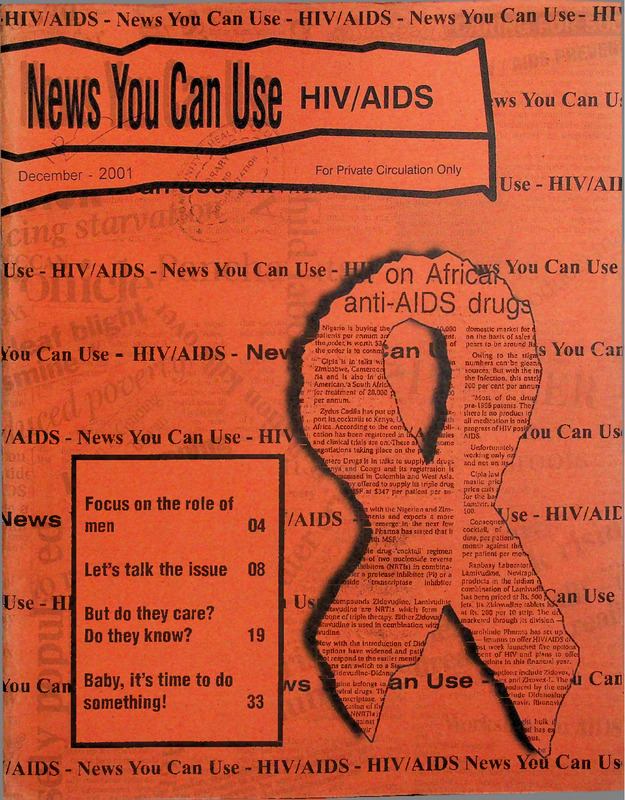
- Title
- NEWS YOU CAN USE HIV-AIDS DECEMBER 2001
- extracted text
-
•HIV/AIDS - News You Can Use - HIV/AIDS - News You Can Use- HI'
Use - HIV/AIDS - News You Can Use
kouCan Use - HIV/AIDS - Nevi
/AIDS - News You Can Use - HIV
Focus on the role of
04
men
Mews
08
Let’s talk the issue
bseSHl
But do they care?
jv
!>■
Nigeria is buying the.
,000 domestic market for d
|^Hpafloots per annum anr
pnt. on the bawls of sales’;!
B^Ttho .order, Js. worth-$34
I of pears io ba around til
B the border, is to cornmje
/.Owing to the stigm^
V_xvtlJ
r ’ }JJ,,-CIpla’*iri- fn’talks wi|
n numbers can-be gleans r ■' Zlmbab’we/Camero.orl
‘ /sources. But with the in)
K ria and Is also -in1 dil
’ the Infection, this marl/
■ American.'a South’Africk .
JMh> 200 peri cent per an nun ’ .
for treatment of 20,000 ft
- ."Most of lhe..dnirf •
e’’’per annum, ' /!.
\ ’A";,
■ ; :■ ■ pre-1995 patents. The/ '
[•... ’ Zydus Cadlla has put upl
^ftx-; 1 there Is no product ly
E ,»• port its.cocktails to Kenya;
all medication is ohl/
.
’’/__
Africa,,According to the con\/ * j W)li- i- progress of HIV posil
ft: cation has been registered in tn^Jafl ■nries AIDS.
A
■Land clinical trials are on;There a\l| t/?1?
Unforlunatety/
Wbaegotladons taking place on the pm
’** ” ’ , working only art ■
^ft^tero Drugs is in talks to suppl^l drags and not on nsz
'
C°n8° and Its registration Js;
Cipialasl f
/^fticcessed in Colombia arid West Asia.
.
offered to supply Its triple drug mestic prid
^I^WSP.at $347 per’patient per on- .. price, cuts /
• . for the bo/
’Lamivinv...
|S with the Nigerian and Zlm- 100. .
bnents and expects, a more
Conscquer
ft’emerge-.in- the next few
B Phanna has .stated that it cocktail, of
dine.por
patienra
■iLh MSF.V' “
month againstJhA
pie drug^codaaU’ regimen per patient per moftc;
poftwo; nucleoside reverse
Ranbaxy LnboratorX, 'I
^^^,-iiblton5-(NRTis).incombinaa protease Inhibitor (PI) or a Lamivudlne, NcvirapX
dMrosidc ’.'‘l’transcriptase * -Inhibitor products In the Indian A
combination ofLamlvudiJL^
yj
^■compounds Zidovudine, Lamivudinc has been priced at Rs. 500J
jcts.iU.Zidnviidlno.tnblcis NN
^■tnvudinc are NRTls which'- form j|ft
at Rs. 260. per 10 strip. The dft.
Broqne of triple therapy. Either ZidovuJ^ftl^marketed
through its division -4 ••
BtaVudlno is used in combination wltg
rvudlne. ■
:4,• j^fturoblndo Pham la has set upy.
"’^ft— Imunus to offer HIV/AIDS dK
NdV;with the introduction of Dldr' . “
’^Mast week launched five option^
k options have widened and pat/
B^nent of HIV and plans to offcJ _
ftot respond to the earlier mentir. ■
^^tions in this financial yanr. J '
^ftns can switch to a St;
Bptlbns Include Zidpvox,
wp; idovudlnc-DIdani '
and.ZIxovcx-L The i
^Mplnc belongs to*
^ftoduecd by the end/
viral drugs. Th/
^ftdudc Dldanqalnur
^ftmscrlptase, w
^Bkiavir, Riionavi/
'“ ^ftfcatlon of th/
.^ftNNnTisi/
' '^^ftzalnst/
bulk.d
'Ifclr 7
nd has ea
Vnil
*-MU
an
bu Can Us<
se HIV/AIE
/AIDS 1
N,an use
. Ui
19
Do they know?
I
■'
You Can Use
oo Afri
anti-AIDS dru
n Use
riou Can Baby, it’s time to do
33
something!
Caii
■QUS.
. _
■
■
;
- >.• • •'
■■
• ■
.,
/
J
/AIDS - News You Can Use - HIV/AIDS - HIV/AIDS News You Can Us
1
News You Can Use -HIV/AIDS
(NYCU) is a specially formulated
monthly mediascan on issues related to
HIV/AIDS compiled to meet the
specific information needs of NGOs.
Directed to. meet the urgent need for
As a part of a regional initiative to
information and awareness building on
build awareness on HIV/AIDS,
HIV/AIDS, this special publication
several
presents a compilation of news clippings
undertaken fey PLAN International
on the issue. We hope that the contents
(Bangalore Zone) in partnership
will provide readers with relevant,
with Madhyam. Dissemination of
useful and topical information to
information to NGOs is a key
facilitate grassroot work on prevention,
component of this campaign. This
care and networking.
publication is aimed, to strengthen
The publicationincludes a selection of
newsitems/features/articles/editorials/
letters . from
leading
national
newspapers. Each newsitem carries the
efforts
ongoing
have
been
efforts ‘ through
information processes as well as
serve as a regular reminder of the
urgency to addressing the issue.
name and date of publication and is
placed under appropriate categories for
PLAN
easy reference.
Madhyam.
International .
and
Team:
Shannon Das Gupta
Jiji Abraham
Surekhg. PIC
News You Can Use is compiled and
published by Communication for
Development and Learning,
Bangalore
compiled from
X
The Times of India
X Hindustan Times
X The Hindu
X The Statesman
This publication is supported by
Shobha C
This edition has been
X The Pioneer
X The New Mian 'Express
X
Deccan Herald
X
Deccan Chronicle
X
The Economic Tinies
X The Asian Age
1WHYAM
Communication for
Development and Learning
1 IM/. 7th Cross, 17th Main, Koramangaia
6th Block, Bangalore - 560 095.
Ph: (080) 5503481 .Telefax: 5524192
Email: cdlHr@bghvsnl.net.in
URL; Svwwxdlblr.oig
•
X
EDITORIAL
Lets Beat AIDS Together
PLAN International is a humanitarian, child focused development organisation without religious, political
or governmental affiliation. PLAN’S vision is of a world in which all children realise their full potential in
societies, which respect people’s rights and dignities. PLAN works in five critical interrelated areas called
Domains that most impact a child’s all-round growth. These are - Growing up Healthy, Learning, Habitat,
Livelihood and Building Relationships
While PLAN focuses on maternal and child health programs, the ‘Growing Up Healthy Domain’ also
emphasises on HIV/AIDS. PLAN is working in partnership with 14 NGOs in the rural and urban areas
across the country. One such initiative on Awareness Building on HIV/AIDS has been undertaken in
partnership with Madhyam, a Bangalore based development communication organisation.
The programme is in the form of a mass campaign and seeks to influence and sensitise the general
population in Karnataka on the HIV/AIDS pandemic. Looking at the gravity of the situation, a two pronged
strategy has been adopted:
•
Urban communications campaign through mainstream media like press, outdoor publicity, TV
spot, radio etc. Specific programmes include sensitizing slum dwellers, targeting student groups,
street children and adolescents.
•
Rural communications campaign through street theatre and fairs comprising a mix of education
and entertainment.
The activities undertaken are:
Outdoor Publicity
Advertisement through colourful hoardings with sensitive messages have been erected to catch the attention
of passerby’s, on the importance of protection in HIV/AIDS.
Bus Hoardings have been used to display information on different modes of HIV transmission and highlight
the AIDS services. Messages on protection have been displayed behind bus seats on 15 buses in Bangalore.
This new medium of communication promises high visibility and mobility whereby thousands of people
are able to imbibe the message every day. Autoboards with similar messages have been displayed on
autos in Kannada and in English across the city.
Electronic Media
The Commercial Broadcasting Service Station of the All India Radio aired messages on HIV/AIDS protection
with the AIDS Forum Karnataka (AFK) helpline number. In the second phase, the message was changed
to include a popular Kannada folk song. Prevention and protective messages on HIV/AIDS were integrated
in the announcements on Radiocity, a Bangalore city based FM channel. A TV Spot of 1 min 30 sec
duration features a popular Kannada Actor speaks of protection from HIV/AIDS. It also announces the
AFK helpline number. Doordarshan, Siti Channel, Anjali Cable, TMG and USN cable network are some
channels airing these spots. In the website www.madhyam.org issues related to HIV/AIDS occupies 10
pages. It covers vote poll, Activities, Services, Campus Initiative, Resources, AIDS Blackboard and FAQ’s.
A hotline service has been set up at Bangalore Medical Services Trust (BMST) and all the campaign
highlights the phone number of this service.
Print Media
Free space in 60 newspapers in 23 districts of Karnataka has been received for publishing an AIDS story
‘Re Ondhnimisha’ (ExcuseMe, One Minute) in Kannada every month. A journal titled “AIDS: Men make a
Difference” was coordinated, designed and produced with 13 articles from experts in different areas of
HIV/AIDS related work. 1200 copies were printed and distributed by Madhyam.
Tech Mail, an IT newspaper by Technology Media Group, Bangalore earned advertisements on AIDS
awareness. A sticker with an AIDS message designed, produced and printed in English was distributed at
stores across the city. To publicise and promote the use of the helpline, all incoming letters to Bangalore
have HIV/AIDS messages stamped on it.
Plays and events
Street Shows are instrumental in raising general awareness in creating an environment where intervention
for behavior change can yield desired results. A questionnaire was administered to 25 people before and
after the show to get an opinion of the level of HIV/AIDS awareness. A play on HIV/AIDS was performed in
the City Central Jail during the occasion of 134th year of the jail. An exhibition in collaboration with various
NGOs was also held. A musical event titled ‘ War of the DJs,’ targeting young people was organised with
a view to integrate AIDS awareness and sensitisation messages.
CDL Collaboration
Madhyam and CDL are collaborating to publish ‘News You Can Use - HIV/AIDS’ which is compiled and
produced by CDL. News You Can Use—HIV/AIDS is a journal aimed at disseminating news and information
to NGOs and persons working with the issue of HIV/AIDS.
Under the new international legal regime i.e. Trade Related Aspects of Intellectual Property Rights (TRIPS),
by 2005 India will have to recognise the monopolistic rights of foreign pharmaceutical companies over the
manufacture of any new medicine invented after 1995. Drugs may be sold at unaffordable and highly
inflated price, and drug access may become impossible. Lawyers Collective HIV/AIDS Unit organised
city meetings to raise public awareness about the issue in Bombay and Delhi. NGOs working in the field
of health in general and HIV/AIDS in particular, doctors, lawyers, people living with HIV/AIDS, students and
others were brought together at a common platform.
Each of these attempts is directed at reaching a large number of people with public service messages. It
also serves to give visibility to PLAN International whose name is associated with every message.
There has been no empirical research to understand behavioral change in HIV/AIDS, as no yardsticks
exists to measure both attitudinal and behavioral change. However with such a wide range of
communication tools, it is hoped that PLAN’S role in spreading the message of HIV/AIDS awareness will
have impact.
Sandhya Nair
PLAN International
Dec 2001.
TABLE OF CONTENTS
DECEMBER - 2001
Editorial
Analysis
Focus on the role of men
04
I care, do you?
18
25
30
Increased importance
Whose womb is it anyway?
Do new reproductive technologies empower
women?
31
Population growth - boon or bane?
35
Comment
‘Aidsucate’ yourself
14
20
Countering AIDS
Data
3.5 lakh HIV cases in State: Minister
AIDS picture black and bleak in Gujarat
Concern over rise in Sikkim AIDS cases
600 infected by AIDS every hour: WHO
Pune registers rise in HIV cases among
Aid with information
Drugs for AIDS
12
24
Feature
Death to the girl child!
01
AIDS Day: Where does the buck stop?
NGOs, Govt...
Let's talk the issue
07
08
But do they care? Do they know?
19
A new generation: Teenagers living with HIV
Firefight against Aids wrapped in red tape
A new struggle for HIV-infected patients
Tribals value their women
23
27
28
03
03
05
06
Funds
$100m for AIDS moms
Fund for Aids treatment
15
INDO-U.S. project on maternal child health
22
27
infants
07
For patients, ostracism is worse than the
disease
10
Gender selection is now a reality!
38
AIDS control: Focus now on low risk areas
Don’t repeat Africa
10
16
Condemn Gender Selection technology
Sex tests remain a doc’s choice
Times have changed, gender bias hasn’t
Sophie’s Choice
38
38
39
Half of Russia’s population could fall victim
to AIDS
AIDS ‘awareness campaign’ flounders in
rural India
HIV in 2% pregnant women
Gen-Select
17
21
21
Killer virus eating into vulnerable group mothers-to-be
22
34
1 daughter = 10 sons
Drugs / Industry
Aurobindo eyes 50% mkt share in anti-HIV
products
02
Cost-effective medicines for HIV patients
03
GSK to cut prices of 2 AIDS drugs in
S Africa
Zydus slashes price of anti-HIV drugs
HC bans drug touted as cure for AIDS
Nigerian arm bags AIDS drugs order
39
40
Protest against ad on pre-natal sex selection 40
Gender on sale
41
Abort gender pre-selection
04
11
33
36
‘Pre-natal diagnostic Act being enforced’
Govt, bit to stop female foeticide
41
Doing away with daughters
It’s No Choice At All
Anti-women ads
42
43
43
The XY Terror
Pre-natal test clinics in trouble
44
45
41
Health dept men raid 16 sex test centres
45
Sex-test Act given teeth
Hospitals warned against gender tests
Gender selection: Parental choice vs
46
46
women
Ads on sex determination decqed
47
47
‘Sex-selective abortions deplorable’
Media urged to educate public against
47
Diagnosis: Patient rights need boost
12
pre-natal sex...
48
Conference on AIDS from today
‘TB killing more people than AIDS’
12
17
Fighting for gay men’s rights
‘Moral code of conduct can save you
20
20
Global
Million face death in Asia
Nigeria defends Indian AIDS drugs
06
06
from AIDS’
S African govt loses lawsuit on AIDS drug
29
women
AllMS to organise symposium on HIV
21
22
HIV-infected child ostracised
24
Red Cross calls for trade in generic AIDS
■drugs
26
High Court notice to maker of AIDS ‘drug’
29
Anjali Rai to head panel on female foeticide
New contraceptives for women to be
launched
30
Information
Banking on safety and numbers
Transsexualism and left-handedness
13
13
Media
Radio City to help nail a killer
The tube’s day to tale AIDS
02
26
Breast cancer on the rise among urban
News
Anti-AIDS campaign to focus on men: WHO 02
Campaign for affordable medicines for Aids
03
AllMS team closerto HIV vaccine
Men are a tired lot, even in womb
36
Research
10
15
AIDS in the workplace! Indian cos waking up 05
Is Karnataka still the model state in
Condoms get a new look at Chennai
institute
29
combating AIDS?
Rajasthan to circulate books on sex in
06
Checking mother-child HIV spread
34
schools
06
‘Spread awareness on AIDS’
08
Aids treatment
Now, Biman on Poca, Poto (and AIDS)
Condoms! They are for death control
08
09
Rural Karnataka still has no idea about AIDS 15
Sentinel Surveillance for HIV spread in India 18
‘Distribute condoms at public places’
09
Garlic impairs AIDS drugs
‘How do you make love?’
22
27
Drug-resistant HIV spreading
Baby, it’s time to do something!
28
33
Herbal aid saps the strength of HIV drug
36
Citizen offer aids for campaign
09
AIDS bomb is ticking: Expert
11
SCR takes out AIDS awareness rally
Dressing for the occasion
11
11
Study
13
Gyan Marwah
Death
to the
girl
child!
The Statesman
01 December 2001
H
law of Dr Suranya Kumar, gets pregnant
around the same time as her maid Urmila.
Both are forced by the male members of
their family to undergo sex determination
tests.
When it is found that both of them have
female babies, their families force them to go
for abortion. But the timely intervention of
Dr Kumar helps avoid the killing of two girls
still in their respective mothers’ wombs.
There are no clearly defined villains in the
film and everybody gets redeemed except for
the unscrupulous doctor, a pillar of society
who continues to misuse technology for
snuffing out lives.
The film consciously takes a cue from
mainstream entertainment, using the rheto
ric of popular soap operas. This has been
done to present hard-hitting matter in a
palatable form in order to have a broad mass
appeal.
Says director,
Nilamadhab Panda, “The
format of a soap opera has
been adopted to increase the
appeal of the film. We did
not want anyone to think
that we were making a
propaganda film”.
The powerfill film has
already been aired on
Doord arshan's National
Network. The producers are
now approaching private
channels that have a large
presence in north India.
Already Tara Punjabi and
Alpha Punjabi have shown
interest. Made on a shoe
string budget of mere Rs 10
lakh, the film has-been
Atmqjaa: bom from the soul
funded by PLAN India, an
international NGO working
However, the problem does not persist
in the field of women and child welfare in
among the poor and illiterate alone, but has
addition to the Ministry of Health and
its untroubled adherents among the rich and
Family Welfare.
Though Atmajaa may be a small-budget
educated for whom a boy is a gift from heav
en and a girl, a curse. Contributing to the
film, it carries a very relevant message and
crime are doctors who conduct sex-determi
in no maner looks less in presentation or
content than any of the soap operas that are
nation tests illegally and, under the garb of
genuine abortions, undertake selective
being aired on TV. It has the punch to create
awareness about the prevalence of female
killing of female foetuses.
foeticide.
Atmajaa is a powerful tale revolving
As Union Minister for Health and Family
around Dr Suranya Kumar, the independent
Welfare Dr CP Thakur who was present at
and outgoing daughter of a rich Munjal fam
the special screening of the film, put it,
ily. She is also the government appointed
“Female foet icide is a not a single evil, it is a
'appropriate authority' to check sex-determi
combination of many factors like dowry,
nation tests in her city, a task which she
girl’s education and family system. Only a
does with missionary zeal.
sustained awareness campaigns along with
The film tries to understand the reasons
strict legal measures can root out this evil
why both educated people As’well as the
underprivileged sections of scfciety continue
from Indian society. Atmqjaa is a step in the
tight direction”.
to prefer boys to girls. Ruchj, the sister-in
(
OW much does a girl cost a mid
dle-class household? Perhaps a
couple of lakhs of rupees, taking
into account her marriage ad
dowry. How much does it cost to kill a girl at
birth? A couple of hundred rupees. So which
is a better preposition?
For an answer to that, one you would have
to see Atmqjaa, a stunning telefilm on the
girl child that underlines the fact that of a
multitude of evils prevalent in society, the
most revolting is female foeticide, the singu
lar cause for the alarming drop in the coun
try’s sex ratio that utands at 927 females per
1,000 males.
Atmqjaa, based on an Oriya poem on the
girl child and directed by Nilamadhab
Panda, has been given the format of a soap
opera so that it does not look like a propa
ganda film. It discusses the serious issue of
aborting the female foetus
as a girl. In many parts of
the country a girl is consid
ered a perennial expense
with no returns. It is
believed that her soul can
achieve salvation only if a
male performs the last; rites
and she never comes back in
the form of a female.
Such abominable views
and beliefs are particularly
prevalent in some parte of
Haryana, Punjab and
Rajasthan, where the axial
structure is based on the
patriarchal system and
women have very little irole
to play except look after the
household and produce
babies, and male ones at
that
So how does a woman
keep producing male children? The answer
is simple. A pregnant woman undergoes a
sex determination test and if the child she’s
carrying happens to be a female the next log
ical step is abortion. Which explains the rea
sons for the extremely low sex ratio in these
states. Punjab has 793 females per thousand
males, Haryana has 820 while Rajasthan
has 831 girls for every 1,000 boys.
Though the government .has passed strin
gent laws to curb this practice, success still
eludes them. After an Act of Parliament that
bans sex-determination tests and prescribes
strict action against those clinics and doctors
who indulge in this crime, the government is
now planning to bring a new law which will
have more stringent provisions against
offending doctors as well as l»an sperm
manipulation which is another way of hav
ing a boy.
Aurobindo eyes 50% mkt ‘
share in anti-HIV products
Our Hyderabad Bureau
30 NOVEMBER
HE RS 1,000-crore Aurobindo
Pharma, which has forayed into
the AIDS segment by launch*
ing anti-HIV products in May this
year, has ambitious plans to comer
50 per cent of the anti-HIV products
market, which is currently domi
nated by pharma major Cipla.
The company, which has so far
launched 10 of its 'options' in the
anti-HIV segment, is contemplating
to launch four more in a phased
manner during the year 2002, ac
cording to Mr S Hariharan, vice-pres
ident of Aurobindo.
'We would eventually launch Sequonavir. Ritonavir, Delaviradine,
and Abacavari," Mr Hariharan said.
Over the last seven months, Au
robindo has marketed Rs 2 crore
worth of anti-HIV products. 'But we
have plans to comer 50 per cent of
the market share,* he said. The coun
try-wide market size is presently es-
T
timated al Rs 25 crore.
Aurobindo is looking at states like
Maharashtra, Gujarat, Karnataka,
Thmi: Nadu, and Andhra Pradesh, he
said. 'We would look at Kerala, West
Bengal, and Punjab in the second ________ Shalini Singh________
phase,' he said.
NEW DELHI 30 NOVEMBER
Trie company, which manufac
tures almost all the varieties of anti- THE $220-million Gribbles Group,
HIV drugs in the bulk category, made one of the largest private pathol
a foray into the formulations seg ogy firms in Australia, has entered
ment with the launch of Imunus di a 51:49 joint venture with Dr
vision in May this year. Imunus is a Reddy's Laboratories to open a
separate formulation division for an drain of 28 laboratories with a net
tiretrovirals, he said. Exports from
work of 300 collection centres in
this segment alone, in the bulk cat
different cities across India.
egory, was to the tune of Rs 100 crore
Pathnet.India, the joint venture
during the last fiscal year ended
firm, intends to be India's largest
March 2000.
'We were prompted to get into private pathology operator within
domestic formulations, as we are con 4 years.
fident of giving other companies a
run for their money. We have priced cal product options for treatment of
our products at least 15 per cent less AIDS. Imunus division is working in
than that of the competitors prices,* tandem with GOs and NGOs to in
Mr Hariharan said. "We are com crease awareness and motivate AIDS
mitted to offer wider and economi- natients to take treatment, he said
Gribbles, DRL
to open labs
The Economic Times
01 December 2001
also to educate and inform
them about this deadly
epidemic. Today, AIDS is a
global concern, and there is an
urgent need to address issues
pertaining to its prevention, care
and support of the afflicted, and
substance addicts) on RJ Gita
adio city fm 91,
reduce the social stigma
Bangalore’s and India’s Modgil’s show between noon
associated with it. The need of
first FM private station, and 3 p.m. Apart from being
will mark International recognised by NACO as a model the hour is collective response.
care-and-support unit. Freedom We see this as an important part
AIDS Day on Saturday with a
of our mandate as an
range of programmes aimed at Foundation has also been
infotainment medium.”
spreading awareness about the declared by UNAIDS as the
“best practice in care and
killer scourge.
Before we forget, the Police
Popular RJ Vera Mascarenhas support for HIV/AIDS”.
Commissioner, H.T. Sangliana,
1 Further, Radio City will air
talks to Dr. K.S. Satish,
will be interviewed on Suresh
consultant at Wockhardt
short periodic capsules on the
Venkat’s Super Sunday show
myths and fallacies associated
Hospital and Heart Institute,
from 4 p.m. to 7 p.m.
with the syndrome, along with
between 8 a.m. and noon. Dr.
By K. Satyamurty
Satish is Advisor to NACO India, messages from celebrities from
set up by the President for the various walks of life, to raise the
~ The Hindu
treatment of HIV/AIDS, and is awareness level among
01 December 2001
also Advisor- Consultant to the Bangaloreans. Especially the
Karnataka AIDS Forum.
young who are most vulnerable.
'This will be followed by an
Sonali Thakker, Head and
interview with Ashok Rau,
Vice-President, Radio City
co-founder of the Freedom
Station, says: “As a prominent
Foundation (which has been
media entity, we would like to
dealing compassionately with
use our ability to reach out to
HIV/AIDS afflicted as well as
-people not only to entertain but
Radio City to help
nail a killer
R
2
Anti-AIDS
campaign
to focus on
men: WHO
Manila, Nov. 30: The World
Health Organisation said on
Friday that anti-AlDS cam
paign in Asia and the Pacific
must focus on men, who
account for at least 80 per cent
of all infections in the region, to
help contain-the epidemic.
“Men are driving the AIDS
epidemic in Asia and the Pacif
ic,” who said in a statement on
the eve of world AIDS day.
“Everywhere in the region,
men’s . sexual behaviour and
habits have determined the epi
demic’s course and extent. It is
from men that the vims spreads
to women,.their wives and part
ners, and then to children," it
added. WHO noted that more
men than women engage in
high-risk behaviour that leads
to infection with HIV, which
causes AIDS, such as having
multiple sex partners and illegal
drugs abuse.
“Men need to be part of the
solution, not just part of the
problem,” said Mr Shigeru
Omi, director of WHO’s west
ern Pacific region. “It is men
who can change the direction of
the epidemic.”
Mr Omi cited statistics show
ing that more than 92 per cent
of those infected with HIV in
Australia, New Zealand and the
eastern Pacific area are men. In
much of Asia, there are often
three times as many men infect
ed than women. Another key
factor in the region’s epidemic
is illegal drugs injection — a
largely male habit —- which is
the “major route of HIV trans
mission in Malaysia, Nepal,
Vietnam and Yunnan/’ (DPA)
The Asian Age
01 December 2001
NYCU-HIV/AIDS
Campaign for affordable 3.5 lakh HIV cases
medicines for Aids
in State: Minister
ernment has not responded to this
urgent issue.
More and more people are get
BANGALORE, Nov 30
ting affected or are dying and the
On the occasion of World Aids Day government has to take a pro
on December 1, a group of individ active stand, he adds.
uals and organisations have come
Elsewhere in the country many
together to launch a nationwide individuals and organisations
campaign for making available working in the areas of Hiv/Aids
affordable medicines and treat will campaign for affordable medi
ment for all.
cines.
In Bangalore the campaign will
They include Delhi Network of
be
launched
by
Freedom Positive
People,
Lawyers
Foundation and Samraksha, Collective Hiv/Aids unit (Delhi),
NGOs engaged in the field of Manipur Network of People
Hiv/Aids, Alternative Law Forum Living with Hiv/Aids, Care
and Karnataka Network of Foundation
(Manipur).
Positive People (KNP+), at Maharashtra Network of Positive
Vidhana Soudha during a Aids People (MNP+), Mumbai, Network
rally at 3 pm.
of Maharashtra for Positive
This campaign plans to lay spe People (Pune), Positive People
cial emphasis on access to Goa, Indian Network of Positive
Hiv/Aids medicines for oppor People (Chennai).
Mr Rau says that the preven
tunistic infections (OIs) and AntiRetroviral Therapy-(ART). People tion activity of the Government
with Hiv/Aids can prolong their doesn’t seem to make a major
lives with the help of these medi impact as more people are testing
cines, which are already very positive with a conservative offi
expensive (minimum of Rs 1,800 cial estimate of four million peo
per month for ART). New medi ple in the country and nearly
reported
cases
in
cines for the treatment of 10,000
HIV/AIDS are going to be even Karnataka. These figures, howev
er, are a gross underestimate and
more expensive.
According to Mr Ashok K Rau, the figure could be as high as eight
co-founder
of
Freedom to 10 million positive people in the
Foundation,
Bangalore-based country, he adds.
He says in Karnataka, Udupi
NGO engaged in the area of
Hiv/Aids it' we do not stand up and Mangalore are emerging as
against Trade Related Intellectual centres were highest incidence of
Property (Trips) now, many more HIV positive cases are reported.
lives will be lost to this epidemic. Until recently Bellary, where
Indian law will soon undergo Freedom Foundation has set up a
change because India is a signato centre, reported the highest inci
ry to the- international agreement dence.
As many as 412 people have
on Trips. This change will have a
huge impact on the Indian patent reported positive in Udupi and
law, which protects the invention Mangalore area, but the actual fig
ures could be as high as 1,000. The
of new products.
The ‘process patent’ system Foundation is planning to set up
used in India so far will be an Hiv/Aids treatment centre very
replaced by a more restrictive soon.
‘product patent’ system. Foreign
Deccan Herald
pharmaceutical companies will
01
December 2001
have sole rights to determine the
production, distribution and pric
ing and, therefore, availability of
new medicines. It is feared that
such a situation will raise the
prices of new medicines to
amounts that are unaffordable to
most Indians, he said.
Mr Rau says that the campaign
is launched since the Indian gov
By Michael Patrao
pH News Service
From Our Bureau
Hyderabad, Nov. 30: Health
Minister N Janardhan Reddy on
Friday said the State had 3.5 lakh
suspected HIV positive cases.
Speaking to mediapersons, he
said Guntur, East Godavari,
Anantapur and Chiltoor had a large
number of HIV positive cases com
pared to other districts of the State.
‘‘According to a survey conduct
ed recently by an independent
agency, the four districts account
for majority of HIV positive cases.
We have increased surveillance in
these districts,” he said.
The State government will
observe the World AIDS Day at
Ravindra Bharati on Saturday at
5.30 pm. A rally would be taken
out from Nizam College grounds to
Ravindra Bharati, Reddy said.
The New Indian Express
01 December 2001
Deccan Chronicle
01 December 2001
Cost-effective
medicines for
HIV patients
From Our Bureau
Hyderabad, Nov. 30: Aurobindo
Pharma, a growing pharma compa
ny in the country, has introduced
Stavex 30 L and Stavex 30 LN. a
cost-effective fixed dose combina
tion medicines -for HIV positive
patients. Announcing the launch of
the two medicines, Imunus vicepresident S Hariharan the monthly
dose of Stavex 30 L comprising 60
tablets was priced at Rs 8,00. The
price of monthly dose of Stavex 30
LN is Rs 1,500.
Deccan Chronicle
01 December 2001
AIDS picture black
and bleak in Gujarat
working on HIV and AIDS in
all districts of the State since
Ahmedabad, Nov 30: On the several years.
eve of World AIDS Day, there
As far as the district-wise
can’t be more frightening stat break-up goes, Ahmedabad
istics. The first case of AIDS leads the list - 483 cases till
was detected in. Gi jarat in September-2001. After Ahmed
1986. Fifteen years down the abad, come Surat with 226
line, the number has multipl cases .and Rajkot with 113
ied to 1,600.
cases. Ninety-six cases have
Want to hear more? In just been detected in Jamnagar
one year (1999-2000), the num while Vadodara has 86 cases
ber of HIV-infected cases dou HIV-infected cases.
bled - from 176 to 350. Nine
Interestingly, Gandhinagar
months later* the number has only one case till date
touched 493 - an addition of while the Dangs has two. Junagadh has 79, Kheda 62, Mehs150 cases.
This was revealed by the .Gu ana 47, Kutch 46, Bharuch has
jarat State AIDS Control Soci 42, Sabarkantha has 38 and
ety, a Gujarat Government un Amreli has 37 HIV-infected
dertaking, which has been cases, the statistics reveal.
Express News Service
NYCU-HIV/AIDS
0 3
"I care.. .Do you?"
women, girls, and other
men, sometimes in their
own family or household.
UNICEF released a report
in 2000 stating that world
wide at least one in three
women has been beaten,
coerced into sex or other
wise abused in her lifetime.
cy at birth and higher death rates during adult
hood than women. But boys who are brought up
to believe that “real men don’t get sick” often see
themselves as invulnerable to illness or risk.
This is reflected in the under-use of health ser
vices by men. Greater attention must be given
to the health needs of men including those liv
ing with HIV and AIDS.
s the slogan for the second year of a two-year
campaign intended to create a sustained
focus on the role of men in the AIDS epidem
Part of our task is to con
ic. This slogan was chosen since it is capable of
vince leaders to speak out
encapsulatingdiscussions about the role oflead
as a friend, parent and con
ers and the needs of young men while being
cerned world citizen. The
There
are
sound
reasons
why
men
should
broad enough to discuss other issues relevant to
World AIDS Campaign
prevention and care to both genders and to dif become more fully involved in the fight against
focusing on men offers an
AIDS.
All
over
the
world,
men
tend
to
have
more
ferent age groups. The new campaign aims to
opportunity for world lead
involve men, particularly young men, more ful sex partners than women including more extra
ers to renew their commit
ly in the effort against AIDS, to bring about a marital partners, thereby increasing their own
ment to HIV/AIDS. It pro
much-needed focus on men in national respons and their primary partners’ risk of contacting
vides a platform to voice concerns on the rapid
es to the epidemic and to involve leaders both as HIV. Over 7 per cent of HIV infections world
spread of the epidemic and the need for unified
politicians and in their personal lives in the wide occur through sex between men and
action. It also gives world leaders the opportu
women and a further 10 per cent through sex
response to the HIV epidemic.
nity not just to speak in their official capacity
between men. Another 5 per cent or so take place
but also to use their personal equity and repu
All over the world, women find themselves at a among people who inject drugs, four-fifths of
tation to support HIV prevention and care for
special risk of HIV infection because of their whom are men. Secrecy, stigma and shame sur
those infected. All this does not mean an end to
lack of power to determine where, when and rounding HIV compound the effects of all these
prevention programes for women and girls.
risk behaviours. 'Hie stigma surrounding HIV
how sex takes place. What
may prevent many men and women from Rather, the campaign aims to complement such
is less recognised, howev
acknowledging that they have become infected. programmes. Work that enhances gender
er, is that the cultural
awareness and sensitivity should focus on the
beliefs and expectations
A number ofspecial circumstances place men at needs of both sexes. The campaign is designed to
that make this the case
particularly high risk of contracting HIV. Men provide material for national and organisations
also heighten men's own
who migrate for work and live away from their to create their own campaign based on “I
vulnerability. HIV infec
families may pay for sex and use substances, care....Do you?” while responding to local pri
tions and AIDS deaths out
particularly alcohol, as a way to cope with the orities.
number those in women
on every continent except
stress and loneliness of living away from home.
For more information on the World AIDS cam
sub-Saharan
Africa.
paign
please contact: Andrew Doupe, World
Male violence further dri
Young men are more at
ves the spread of HIV - AIDS Campajgn Coordinator, UNAIDS, Geneva.
risk than older ones: about
through wars and the You may also visit the UNAIDS Home Page on
one in four people with
migration they cause, as the Internet for more information
HIV is a young man under
.
well as through forced sex. (http://www.unaids.org)
the age of 25.
Millions of men a year are
The New Indian Express
sexually violent towards
Part of the effort to curb
01 December 2001
the AIDS epidemic must
include challengingharm
ful concepts of masculini
ty and changing many
commonly-held attitudes
including the way men
GSK to cut
of 2 AIDS
in Africa
view risk and how boys
Johannesburg: Europe's biggest drugmaker GlaxoSmithKline (GSK) will
slash 20 per cent off the price of two key antiretroviral AIDS drugs in South
are socialised to become
Africa from next year, the company said on Friday. The discount on its 3TC
men. Broadly speaking,
(lamivudine) and Combivir, a combination of lamivudine and zidovudine,
men are expected to be physically strong, emo
drugs was announced to mark World AIDS Day on Saturday, in. a country
tionally robust, daring and virile. Some ofthese
which has five million people estimated to be living with the deadly dis
expectations translate into ways of thinking and
ease. Under GSK's latest price offer, a month's treatment of Combivir would
behaving that endanger the health and well
fall to 800 rand ($77.22) from 1,000 rand. The price of the leading AZT
being of men and their sex partners. Other
treatment will remain unchanged at around 650 rand for a month's treat
behaviours and attitudes on the contrary repre
ment. The price reduction is the latest in a series of offers by the world's
sent valuable potential that can be tapped by
biggest drug firms in an attempt to make AIDS drugs more affordable in
Africa, where more titan 28 million people are living with the disease.
AIDS programmes.
I
prices
Focussing the campaign on men also acknowl
edges the fact that men are often less likely to
seek health care than women. Except in a hand
ful of countries, men have a lower life expectan-
4
drugs
S
The Economic Times
01 December 2001
NYCU - HIV/AIDS
lem of child labour.
But the threat of the epidemic
spreading is just part of the problem
HIV/AIDS poses for companies. Com
panies are faced not just with the is
sue of employees being infected, but
with how to reintegrate them into
the workforce if they are able.
________ Vikram Doctor________ cases/ she says. The company ex- says Ms Kalai Natarajan, corporate
M&M, for instance, has a policy
MUMBAI 30 NOVEMBER
tends its awareness creation and communications manager, Levi that is able to deal with thatsituasupport services to the managerial Strauss Asia-Pacific.
lion. But the problem with HIV/AIDS
// X. A Te don't have AIDS in level as well.
The Confederation of Indian In- is that the issues never stop. At M&M
WU our company.* "We The extent of HIV/AIDS in India dustry (CII) has also set down guide- for example, the company now faces
have never thought is a subject of intense debate. Cur- lines for Indian industry on HIV/AIDS the question of treatment. The com
about this issue.* These are just a rent figures put the number of cases and Dr Sandhya Bhalla, consultant pany currently picks up the cost of
sample of responses from compa- of people living with HIV/AIDS be- to CH, is confidant that the members treatment for all the usual oppornies contacted by ET to check their tween the three million to four mil- are following this policy. “There is tunistic infections that HIV positive
policies on employees with lion range. NGOs accuse the Indian definitely awareness on this issue and people become vulnerable to.
HIV/AIDS.
government of under estimating efforts are being made,* she says, alThe Economic Times
Now consider Ms Mati cases, the government accuses though she admits that not every. Ho o h onn-f
Ahluwalia, manager, welfare, of NGOs of over estimating them. It is one has written policies on
UT UecemDeT ZUU1
Mahindra ;& Mahindra (M&M). 'Of an issue.
HIV/AIDS. “About 50% of our mem
course we have employees who are Yet, the response from Indian bust-’ bets have not set out such dear poliHIV positive,* she says as a matter ness has been mixed. The good news cies and our current aim is to get
of fact. “My estimate would put of sorts is that companies like M&M them to do so,* she says. In per
them at around 5 per cent of our seem to be increasing. Along with suading companies to take HIV/AIDS
workforce.* Nor is this anything M&M, several other top Indian com- seriously, Dr Bhalla says her pitch is
particularly recent. The company panics like Larsen & Toubro (L&T), simple. “HIV is one disease that at
has been aware of cases since 1995. Telco, TISCO, Bajaj Auto, Glaxo and tacks workers when they are at their
Then, as now, the company got to SAIL have all set, or are in the process most productive age,* she says.
Because the disease is mainly be
know when employees went to of setting out clear policies on
hospitals for treatment. “We have HIV/AIDS in the workplace. L&T was ing spread in India through sexual
a strict policy of not requiring HIV one of the first companies to get in transmission the most likely targets
tests as a precondition for require volved, starting as (ar back as 1985. are young men, who contract it and
STATESMAN NEWS SERVICE
ment,* says Mrs Ahluwalia. “But Using this early expertise, its per- pass it on to their wives. "We talk about
the hospital has a policy of requir sonnel department was also one of the loss of skilled workers and the ecoGANGTOK, Dec. 1. - There’s
ing tests when someone goes there the first to start spreading the mes- nomic impact this has,* she says.
There are no clear figures for
a growing concern among
for treatment and that is when they sage outside the company.
Telco, which also first detected pos- HIV/AIDS in the workplace, but orhealth department officials
get to know.'
here over the detection of
When those first cases were de itive employees in 1995, and subse- ganisations like the International
“
(ILO) suggest
eight HIV positive cases in
tected, the company was quick to quently instituted a company pro- "Labour Organisation
the state since 1998.
respond with a policy and an gramme, has now taken up the task that based on international trends
of spreading the message to a popu these will not be small, 'As ILO In
There were no reports of
awareness programme.
lation that is both particularly vul dia Project has begun just a few
Today when a worker tests HIV
such cases in the entire state
nerable and also important to the months ago. we do not have India
positive, a set procedure is imme
till 1996. In 1998, the figure
company—the truck drivers. Medi specific data at the moment,* says
diately invoked. "First of all we en
was seven. Sikkim m?w has a
care, the network marketer, is using Mr S M Afsar, ILO's national project
sure complete confidentiality,* says the company's own structure to
record of 15 HIV positive ca
Mrs Ahluwalia. "Thedoctorshave spread HIV/AIDS awareness. It is co-ordinator in India on their Pre
ses with four of them of full
vention
of
HIV/AIDS
in
the
World.
even been told not to write the fact
blown proportions.
looking at spreading awareness first
on the patient's case sheet. They in among the seven lakh consultants Of Work project. The ILO estimates
An AIDS cell of the health
form our medical officer here, who who make up its network, and us that at least 23 million workers in
department had been set up
informs me personally. No one else ing volunteers among them to spread prime labour force (15-49 years) are
in 1992 and till four years lat
living with HIV/AIDS. It is estimated
gets to know.*
awareness among the communities that the size of labour force in high
er no HIV positive cases were
The employee is offered coun they come from.
detected. It was only after
HIV prevalence countries will be be
selling and, assuming they are fully
Several multinational companies tween 10 to 30% smaller by 2020
1996 that the first HIV posi
able to come back to work, they are have also taken steps to address
tive case was detected.
put back on the job with no change. HIV/AIDS issues among their em than it would have been without
Dr R L Sharma, project di
“As long as the employees can per ployees. Both MTV and Levi Strauss, AIDS. ILO studies in several sub-Sa
rector of the State AIDS Proj
form their jobs, their HIV positive which have strong corporate com- haran African countries indicate that
ect Society, said that Sikki
status will not be an issue," says Mrs mitments to spreading HIV/AIDS HIV/AIDs may reduce the rate of eco
m’s close proximity to north
Ahluwalia. As of now she says the awareness among the young con- nomic growth by as much as 25%
Bengal, specially Siliguri,
company has at least six cases of sumers who are their primary target over a 20 year period.
Similar trends may be developing
home to a flourishing flesh
employees who are HIV positive market, have also formulated poliwho have been working satisfacto- des for their employees. These es- in India. 'The fact that a majority of
market, is a major cause of
reported
AIDS
cases
(89%)
are
in
the
rily for the last 4 to 5 years. She sentially lay down commitments to
concern.
age
group
of
15-44
years
shows
the
adds that the company's efforts at nca^iscrimination ofHIV'positive - s
The Statesman
awareness and support are not lim employees, guaranteeing them con- threat that HIV/AIDS poses to the
fidentiality
and
normal
career
paths
most
productive
segment
of
the
so02 December 2001
ited to just factory employees. The
as long as they are able to carry out aety, the working dass,* says Mr Afcompany has had cases among their work normally. “The exact poli- sar. In addition he says 14 million
white collar workers as well. des may differ somewhat between children will have lost one or both
“Again, we would only get to know countries depending on local cus- parents to AIDS and many of them
about it if its reported to us from toms, but the overall commitment will be forced out of school on to the
the hospital, but we have had two to non discrimination is constant,'Job market,, exacerbating the prob-
AIDS in the workplace!
Indian cos waking up
YV
Concern over
rise in Sikkim
AIDS cases
NYCU - HIV/AIDS
5
Rajasthan
to circulate
books on sex
in schools
Times News Network
BANGALORE: Facts and figures
surrounding
AlPS
AIDS are alwa
ys sketchy and
depressing. But
nothing more
saddening than
this fact. The
DAY
National AIDS
Control Organisation identified
Karnataka as a model state in
AIDS care, in fact an example to
be followed world over in 2000.
But a year down the line, on Dec.
1, 2001. Karnataka is looking at
others to learn how to grapple
with the HIV problem.
The lack of proper count on the
number of AIDS cases in the state
(reported or otherwise), inade
quate number of testing centres
and the lack of a proper national
or state policy to co-ordinate the
sparse efforts in the direction is
the gist of the problem.
Consider the following:
Number of HIV-positive cases
in Karnataka: Last jyear it was
4.000, this year it is 9,029. A more
than 100percent increase. But the
figures are not to be believed. It is
only a central agency that is enti
tled to surveillance of figures, and
this organisation has not collected
cases from a world-renowned
organisation called Freedom
Foundation, which itself had 5,000
reported cases. At the state level,
statistics are collected from state
government
hospitals
like
Victoria. Bowring and Lady
Curzon, KC General Hospital and
Nimhans. There is no statistics
relating to the growing number of
children being inflicted with the
virus, however.
Number of voluntary organisa
tions working with AIDS victims:
Unofficial numbers say that 26
NGOs in the state work for this
cause. But some among these
could have closed shop for lack of
funds to support the function for
which they started work. Others
have shifted to other issues like
the cause of women and children,
for instance.
Treatment: It will take 15 to 20
years of research to get ready for
human usage. Vaccine initiatives
have been successful in the West.
In India and in Karnataka in par
ticular, the anti-retrovial treat
ment is far from the reach of
many because of the high costs
involved.
What the state government is
doing: It is still working out a
strategy to have effective partner
ship with the voluntary organisa
tions, to cash in on the latter’s suc
cess stories.
Model state: None so far. Each
state is grappling with its own
problems. Tamil Nadu, which till
recently had made some headway
in the direction of treatment and
care, is now being,questioned on
various fronts.
Model country: Brazil,- where
treatment is made affordable for
AIDS victims through govern
ment policies.
The message for this World
AIDS Day: Treatment Access
Campaign. The message empha
sises on accessible and affordable
treatment for those afflicted.
The times of India
01 December 2001
600 infected by
AIDS every
hour: WHO 3
_
Jaipur, Dec. 1: The Rajasthan
government will soon distribute
books on sex education in 850
senior secondary schools’ of the
stale, minister of slate for educa
tion Rajendra Singh said on Sat
urday.
A helpline has already been
started for HIV patients in the
state. Information about the dis
ease could be received on tele
phone No. 1097, he said at a
function organised by the Slate
AIDS Control Society in Jaipur^
Stale revenue board chairman
Sudhir Verma and the director
health services, Mr R. K. Garg,
also spoke at the function, organ
ised in the Bi ria Auditorium.
Slrect plays and songs were
organised in .other parts of the
city as well io mark the World
AIDS Day on Saturday.
Aw lera kya hoga. kaalia — a
mock Gabbar Singh asked out
side the Albert Hall Museum.
adapting a scene from the super
hit Hindi film Sholay. Kaalia had
no hope this time, even a pardon
from the sardar was useless, as
he had contracted.AIDS.
A small crowd had assembled
lo watch AIDS: A Truth, a sireetplay directed by Mr Amilabh
Zibbu for the Jecvan Asha Project of World Vision.
It used images from Sholay and
stories like Laila-Majnu and
Bikram-Bclal to’spread the message of AIDS prevenlion. (UNI)
q
infections at anything up to four
O
million. AIDS specialist Dr
fN
Nadeem Nag said India was home
to 10 per cent of the world’s HIV
n
positive patients. (afp>
HONG KONG: Asia will mirk
C
•
The
UN
has
declared
AIDS
as
“
the
By Our Special Correspondent
q
World AIDS Day on Saturday with
most devastating disease" in
0
cases soaring into the multi-mil
NEW
DELHI,
DEC.
1.
Every
hour
al
I
0)
human - history. And the equally
lions and experts warning countries
most 600 persons are getting in- q Q
devastating tragedy: Preventive
Nigeria defends
such as China, India and Cambodia
fected by the deadly HIV virus anc f
/efforts are failing in parts of the
are sitting on a time-bomb.
/^-developed world.
more than 60 children are dyingH
AIDS drugs
With the virus reaching epidem
because of the disease in the
ic proportions, millions more are •-Asia is not doing enough to pro
lagos
,
dec
.
1.
The Nigerian Gov
world, according to the latest fig
being plunged into poverty as suf mote safe sex, especially among
ernment today rose in defence of
ures
released
by
the
WHO
on
the
prostitutes and their clients, and
ferers are forced to sell their
cheap generic AIDS drugs import
occasion of the World AIDS Day
among bisexual men.
homes and put their children out
ed from India, saying that they
today.
to work to pay for expensive drugs • In Andhra Pradesh, infection rate
had the same quality as the
Given the grim situation, the
and treatment.
. among pregnant women who
branded ones.
U.N. agency has decided to focus
"India is advanced in the man
The AIDS situation is particular . attended ante-natal clinics was
on men as the medium for fight
ufacture of quality drugs and is
ly grave in Cambodia, where doc ■:more than 2 per cent, and the figing the scourge this year and has
technically far advanced in the
tors warn another generation faces:g ure was at least one per cent in
coined the slogan 'I care....do
Maharashtra,
field,” said Sani Gwarzo, the coor
being wiped out by the rampant j• ^Karnataka,
you?’ for a world-wide campaign.
': Manipur, Nagaland and Chennai.
dinator of Nigeria’s AIDS pro
virus.
The campaign which began today
gramme. “We are buying these
China’s cases are estimated at up • • Seventy-five per cent of those
would stress on the need for men
AIDS drugs but (they) have the
to a staggering 1.5 million follow- afflicted with AIDS In Singapore
to care for themselves as well as
same quality as those with brand
ing the disastrous actions of unli- % ... cannot afford the drugs,* less than
their partners and children. It
ed names,” Sani Gwarzo said in a
censed donation centres which . ^0 per cent affords the optimum
particularly focuses on young
phone-in programme on Radio
treatment
spread contaminated blood.
sters and suggests ways and
Nigeria to mark World AIDS Day.
India’s problem is even worse,
The Times of India
means by which they can prevent
— AFP
with experts putting the number of
the AIDS menace.
_______
.
Millions face
death in Asia
The A sian Age
02 Decem ber 2001
Is Karnataka still the model
state in combating AIDS?
01 December 2001
6
NYCU - HIV/AIDS
The H indu
02 D ecem ber 2001
o Indian
By M Radhika
ignorance ofcitizens.,
"People do not take tests to check
Bangalore, Nov 30
AIDS/HIV voluntarily. Unless, the
stigma vanishes, they will not,’’says
HE world celebrates the AIDS Dr Raghuveer Samartha, a former.
Day on Saturday. And, true to official at the Government Isolation
form, the'City’s various agen Hospital, meant for epidemic treat
cies concerned - NGOs, hospitals, ment. "The co-operation ofall is nec
Government and so on - are slated to essary for this. A single organisa
come out with a few, pious humani tion or an individual will not be able
to help.” ' After the’ high-voltage
tarian gestures.
In fact, a group ofyoungsters have publicity blitz, burning crores of
already been going around the City rupees, many HIV-infected people
staging street plays and talking to and AIDS patients do not even know
adolescent school children. And, their infection status, experts like
/ ■
NGOs_and the Karnataka AIDS Pre Dr Samartha say.
vention Society will hold a march Dr H Sudarshan, Chairman of
from the Vidhana Soudha. There’s Task Force on Health and Family
another rally slotted from Mayo Welfare, feels that AIDS awareness
Hall. As usual, there will also be the programmes are talked about, but
awareness has not percolated down
us ual flood ofspeeches.
Meanwhile, many AIDS patients to the masses. "AIDS has to be dealt
here continue to live and die quietly. with by everybody. The programme
According to NGOs, Bangalore, on AIDS cannot be integrated into
Bellary and Udupi has of late seen district health programmes," he
many full-blown cases ofAIDS. Inde says.
"With NGOs, the problem is that
pendent health workers find the rise
in infections alarming, especially in their number is limited,” says Dr
Sudarshan. "And, most NGOs are
the City.
In the event, the State Govern concentrated in cities. Very few
ment’s statistics for HIV/AIDS cases work in villages. The Task Force has
seem to be far from Realistic. The charted out an awareness pro
number of reported cases of HIV gramme that is different from the
infection in the State was 10,067 till Government’s approach.”
The Task Force’s , programme
Sept 30, 2001. Karnataka has the
third largest numberofHTV infected includes mapping oftheState, mark
persons. And, Karnataka, along ing out .hot spots of infection. “It is
with Tamil Nadu and Maharashtra, sensitive and difflcult,but has to be
are in the top red category of .the done. We will do it soon,” adds Dr
National AIDS Control Organise-' Sudarshan.
"There has to be a concerted
tion(NACO).
Experts say the real niimber.could effort,” says Dr Latha Jagannathah,
be easily three-fold. According to Managing Trustee and Medical
NACO, there are 3.86 million HIV- Director ofRotary TTK Blood Bank.
infected persons in India. Unofficial She feels that whiledealing with hot
figures put the figure at over 8 mil spots, often, the larger picture is
missed. She adopts that*'the
lion. .
Most of the cases go unreported at approach to the whole programme
the State Government’s AIDS pre lacks theattention it needs.
"There is no dearth of ideas,” Dr
vention cell, thanks to the confiden
tiality tag attached by doctors, the Latha explains. "But follow-up is
stigma the disease carries and sheer lacking in mqst^prqgrammes. NGOs
T
The New Indian Express
01 December 2001
Hindustan Times
02 December 2001
Pune registers rise in HIV
cases among infants
Sisir Mishra
Pune, December 1
THE FACTS speak for them
selves. On World AIDS Day on
Saturday, the message seems to
have been lost on India.
Pune became the third in the
country, next to neighbouring
Mumbai and Sangli, to record the
highest number of HIV-infected
pregnancy cases of two per cent.
The city has over 5,000 com
mercial sex workers, out of
whom 40 per cent are HIV posi
tive. With the city recording an
alarming two per cent in paedi-
atric HlV-infection, experts are
panicking. They say, if not tack
led, the figures are' likely to
increase manifold in the next
couple of years.
Though these findings do not
reflect the general trend, experts
are worried about infants con
tracting the deadly virus.
• Dr Sanjay Mehendale of the
National AIDS Research Insti-*
tute says the prevalence of HIV
infection
among - pregnant
women in the city has crossed
two per cent compared to overone-per-cent in Chennai, Banga
lore and Hyderabad.
Let’s talk the issue
Times News Network
Despite
government-spon
BANGALORE:The fact that it is sored "prevention programmes”,
hard to get even basic figures like the fear of AIDS continues to be
the number of HIV patients in pervasive and results in a fear of
the city, is a measure of how well the AIDS-afflicted. AIDS cam
the government is doing on the paigns would have us believe that
AIDS front. However, conserva you are safe unless belong to the
tive as they may be, the figures high-risk category of female sex
workers, truck drivers and drug
are scary enough.
They prove beyond doubt that users.
This is unfortunately not the
the disease continues to spiral.
According to estimates, there has full truth. Says Ashok Rau of
Foundation,
an
been a 30 per cent jump in the Freedom
number of AIDS patients in the HIV/AIDS rehabilitation centre
state in the last one year. in Bangalore: "The awareness
Bangalore urban tops the list. strategies talk in principle and
Another survey, involving a sam most don’t address the cultural
ple size of 4,44,696 persons who factors that dominate mindsets.”
Over these two decades of
were tested in two phases, showed
a 100 per cent growth in the num AIDS, as a nation we have moved
ber of positives from the first to from denouncing AIDS as a "for
the second phase. Among the dis eign disease” that could never
tricts, Udupi is the*worst hit after touch us given our culture of
monogamy and sexual prudery to
Bangalore.
Says a source at the health a clinical acceptance of the dis
department: "Nothing serious is ease itself Now we say the dis
being done by the government to ease is still in its early stages here.
contain the epidemic. Prevention As a nation we are ashamed of
programmes will fail unless we AIDS and shun its victims. Our
have adequate testing centres.” governments avoid talking about
Karnataka has just eight testing it and pretend that it does not
centres for its five-crore popula exist. This is no way to fight
tion.
AIDS.
NYCU-HIV/AIDS
0
The Tim es o f India
01 D ecem ber 2001
AIDS Day: Where
does the buck
stop? NGOs,
Govtshrug
unfortunately can’t do as much as banked too much on NACO while
the government can. -And, the.gov- shruggingofftheirownresponsibilemmentrelies too much oriNGOs.” ity,DrLathasays. ■
In-short, what we see here is a sim- This year’s theme for the World
pie game ofpassing thebuck.
AIDSDayis:Icare,doyou?IrdnicalWhen the National AIDS Control ly, it is tough for State agencies and
Organisation (NACO) laid down cer- NGOs to give a sincere and positive
tain guidelines on the issiie, States answer.
7
A to visit my son and parents ers. Ihe program director of
f next year. I pay a room-rent STD/HTV-Intervention Progra
• of Rs 70-a day... money is mme (Sonagachi* Project), Mr
. 2 _ hard to cling onto”, she said. Mrinal Kanti Dutta couldn’t
Meanwhile, at the local Dur spire, time to talk. “Come to
bar Mahila Samanaya Commi the Press Club in the afterno
ttee office, Pepsi and pulao we on. The visiting team will intere being served to a visiting de ract with you regarding these
STATESMAN NEWSSERVICE
a full-blown case, doctors often
legation of Brazilian sex-work Imatters”. he said.
say, ‘what’s the use of treating
The Statesman
KOLKATA, Dec. 1. — For him, he’ll die anyway.’ Often*
those living in the high risk they don’t even prescribe saline
02 December 2001
zone, campaigns and rallies administration.’’
mean little.
. Ranjit was as a construction
“I care - do you .” - read a wbrker. He hasn’t worked for
placard carried by a child at nearly one-and-half years
By Our Staff Reporter
an AIDS awareness rally at now. He says: “I have taken
But do they care
Do they know?
'Spread awareness on AIDS'
Esplanade.
'
loans from every person I
Somewhere in a city hospi- know to keep the treatment
tai, a 28-year-old man couldnt going. I've to get back to work
care less. He was wondering feat to repay them.”
when he could go back to wo
rk. He hadn’t heard doctors
Business makes sense,
discussing in hushed voices
nnt
folk
the imminence of his death. *
Ranjit Maiti (not his real Married off at 14 in Bonname) lies in his hospital bed, gaon> Mita (not her real
his emaciated body barely name) came to Kolkata after
discernible under the blan-her husband deserted her
ket. His face and head are and her infant son.
covered with scabs.
Now she solicits customers in
While the world celebrates Sonagachi. Attending .to four
AIDS Day, Ranjit, a father of customers on an average evtwo, doesn’t know he has the payday, she charges between
disease. Doctors have told
30 to Rs 50. She is ignorant
him his body has become “poi- of the week long AIDS awaresoned”. His bed head-ticket ness campaign in her area
reads “sporiatic arthritis.’
Asked whether she used
While talking to this wire- precautions, she was evasive,
spondent, he removes the blah- while admitting that eight of
ket to reveal a body disfigured |q customers refuse to use
by sores. “The doctors said the colldoms and more often than
poison entered my body thr-'not> she has
gfve ln
ough the skin. In the beginning “The competition is huge. I
the sores used to itch and I may refuse but another girl
scratched them with my nails.
promptly agree and -the
His wife Sampa (not her re- CUBtomer will never come
al name) has a more clear hack to me.”
idea about what lead to the Mita has vaguely heard of
“infection .
^e local medical centre whe
refore our marriage, he had re Uood
other tests
once been to a redlight area in- conducted, but has never gofluenced by his friends. Doc- he there-for a check-up.
tors say that could be the rea- jjer neighbour, Shabana
son. But how can that be? It was more dismissive “Why
was so long ago.”
would men come here if they
She has been asked to get a wanted to take precautions ?”
blood test done and is awaiting Mita is not bothered as she
the report. Her daughters are 4 hasn’t known illness yet. Posand 7 years old. “Doctors say aibly since she has been in Sodepending on the report, they nagachi for only eight months.
will decide whether my daugh- During festivals business
tershave to undergo a test too.” is slack. “There are days
In the nurses’ presence, she when there’s only one cusspeaks volumes about the goo- tomer and sometimes none”,
dness ofhospital authorities. In Shabana said.
a whisper, she adds, not all doc- The women become despertors and nurses are nice.__
ate as they have to pay their
Speaking on conditions of an- daily expenses irrespective of
onymify, one nurse said: “If it’s business done. “I am saving
8
bangalore, dec. 1. The Minister for Health and Family Welfare,
Dr. AB. Maalakaraddy on Saturday asked officials of the Health
Department to launch a massive awareness movement on
prevention of AIDS.
Speaking after inaugurating a "World AIDS Awareness Day”
function organised by the Bangalore Medical College-here, he
said only awareness could prevent the spread of the disease.
He said prevention programmes should be taken up on the
lines of those in Thailand. "Condoms should be distributed in
fair-price shops, bus-stands and all public places. The same
approach was adopted in Thailand and there was a drastic fall
in the rate of HIV positive cases,” he said.
He wanted the officials to hold talks with office- bearers of
the Truck Drivers’ Association and Taxi Drivers’ Association on
the prevention of AIDS.
Referring to this year’s theme of "World AIDS Awareness
Day” — ‘I care, do you?’, he said the theme was more powerful
than last year’s ‘Men can make a change’.
Deccan Herald
02 December 2001
Front meeting
Now, Biman had
discussed
Poca.
He refused to
on Poca, Poto comment
on
the Forward
(and AIDS) Block accusing
the CPI-M of a
“big-brotherly attitude.”
On AIDS: Mr Bose today said
KOLKATA, Dec. 1. - Mr Bi AIDS awareness had to be in
man Bose, Left Front chair creased because prevention is
man, today blamed the media better than cure. He attended a
for the prevailing confusion number of programmes on the
over Poto and Poca.
occasion of World AIDS Day.
“The confusion rests on the Mr Bose said the situation in
media, not on the governm India wasn’t yet alarming, but
ent spokesmen, including the the number of HIV-positive
chief minister,” Mr Bose said, people had increased. There
when asked to clarify, wheth were now nearly 3.9 million
er Poto and Poca were the sa AIDS patients in the country.
me or different.
In West Bengal, AIDS pa
He said he hadn’t read the tients had increased from 695
draft of the state legislation on to 725 in two years. He said
Poca, but asserted it was differ he was not aware of the num
ent from the
ber of HIV-positive people,
which is several times the
proposed Cen
number of AIDS cases.
tral ordinance.
He said a Left
The Statesman
STATESMAN NEWS SERVICE
02 December 2001
NYCU - HIV/AIDS
Condoms! They are ‘Distribute
condoms
for death control
and the military are among the
population that are widely affected
by HIV
“At petrol pumps, let us give out
AIDS information and condoms.
Use the transport network. Have
an AIDS week for teachers next
year,” he has suggested to
UNAIDS.
“We have to start young. In
Thailand, we start AIDS education
in primary schools at the age of
eight. We give parents a choice.
They can either attend their child’s
graduation with flowers when he is
not a medical problem, it is a soci 25 or his funeral,” said Mechai.
etal problem. We have to talk
Taxi drivers in Bangkok have
about prevention, about changing cassettes on AIDS. Cassettes with
behaviour.”
questions and answers on the issue
“We do not need a World AIDS are run during the drive for inter
Day. I would like a World Condom ested passengers.
Day,” he said. “Get a condom and
Radio arid TV are important
give it away. Il may make people tools in a war. As in-charge of
angry, but they will come around. broadcasting, Mechai did away
The important tiling is that their with censorship. Every hour, a
attention would be engaged.”
half-minute advertisement on
“Let us run a total war against AIDS was aired. Producers were
AIDS. Talk to hotel chains, con given a half-minute extra to air
vince them to have condoms in these advertisements. They earned
bars where people drink and more money and were happy.
move towards unsafe behaviour,”
Film producers and directors
he said commenting, “we have lost were given a subsidy if their
the race if we talk only to doctors movies devoted a few minutes to
HIV. Indian filmmakers can follow
and nurses.”
“Let us have a special cops and suit as a step in a “total war against
rubber day. Every cop should give AIDS.” __
out a condom,” he suggested
The Times of India
observing that, incidentally, cops
AIDS
at public
places’
lllf
02 December 2001
Citizens offer aids for campaign
Times News Network
BANGALORE: More than 1,000 citizens participat
ed in the AIDS awareness walk organised by the
Rotary Club of Bangalore from Mayo Hall to
Gandhi Park near KSCA as part of World AIDS
Awareness Day in Bangalore on Saturday.
MLA Alexander and classical dancer Vani
Ganapathi flagged off the walk, which was preceded
by a street play on AIDS by ‘Samraksha’. Voluntary
organisations—AIDS Forum in Action,T1K, Blood
Bank and others participated.
The Bangalore branch of Family Planning
Association of India and the Department of State
Education Research and Training, Bangalore, organ
ised a programme ‘I care...Do you?’ for teacher
trainees at Nehru Smaraka Vidya Kendra.
It was inaugurated by Dr B.T. Tukol, retired
Professor and Head of the Department of Medicine,
Bangalore Medical College. Shanti R. Baliga presi
dent of FAMPLAN, Bangalore, presided.
The Apollo Hospital organised a conference in
association with National AIDS Control
Organisation (NACO) to mark the occasion.
The times of India
02 December 2001
Bangalore, Dec 1: AIDS, the
'lethal disease, has brought
with it debate, stigma, social
banishment, and a reason for
those who wish to show they’
care.
While the rest of the country;
goes on debating about the var
ious methods, approaches a? fl
measures that are more talked
of than implemented, there
was a straight solution the
State Health Minister -----suggested on Saturday.
The Minister was spe
aking at a function in aid of
AIDS awareness, organised by
the Karnataka Aids Prevent
ion Society and National
Service Scheme.
He said condoms must be dis
tributed to the public at fair
price shops, bus-stands, rail
way stations and other such
public places to curtail the
spread of AIDS.
He said this would help in
two ways. “It*will help people
' protect themselves against th£
dreaded disease and also aid
family planning programmes
that is the need of the
hour.” The minister
gave the example of
Thailand, where he said the
number of people affected by
the disease was about 20-30 per
cent of the population but had
come down to 10 per cent beeause of rigorous AIDS preven
tion measures implemented
there.
He said the World Health
Organisation theme for World
AIDS Day this year is better.
“Last year, it was said that
men make a difference. This
year’s theme emphasises on
everyone accepting responsibi
lity,"he said.
NYCU - HIV/AIDS
Deccan Herald
02 Decem ber 2001
By Sadhna Mohan
NEW DELHI: To fight AIDS,
India needs someone like
Thailand’s “Mr Condom.”
Mechai’s one-liners and astute
communication strategy on con
doms can put advertising agencies
to shame. “Condoms are a girl’s
best friend - not diamonds,” advo
cates Mechai with a large smile on
his face. “People dismiss condoms
as an ineffective birth control
measure. They are actually for
‘DEATH’ control.” he says.
Recently,
at
the
sixth
International Congress on AIDS
in Asia and the Pacific in
Melbourne, I met Mechai
Viravaidya, the single force
responsible for Thailand’s success
in arresting the HIV epidemic. He
is Bangkok’s senator and Cha
irman, Population and Community
Development Association.
“Very few in Asia Pacific have
done enough in the area of
HIV/AIDS. We have to make sure
every politician and business
leader understands the problem.
UNAIDS has to work a lot more
io engage politicians on this issue,”
said Mechai.
Coke still advertises-why? This
is because things remain in peo
ple’s memory for only 48-hours.
You have to change the music, the
tunc of a campaign to be up with
the trend, he advocated. “AIDS is
9
For patients, ostracism is
worse than the disease AIDS control: Focus
By Praveen Bose
In the absence of any cure, the best comTimes News Network
fort aids patients can expect is a society
BANGALORE: Twenty years after HIV that lets them live their truncated lives in
AIDS
claimed its first human dignity. This, in fact, is the endeavour of a
g -ctwr a victim, the disease is now Bangalore-based NGO, KNP+. However,
■t;
IS the
world’s
fourth al limes lhe task is beyond help. Says Raju
£ biggest killer, says WHO. Mathew, a counsellor at an NGO called
© JWBF ig In India alone, there are Accept: “The wife of a man who died of
§
as 3.9 million HIV-posilive AIDS a few days ago has been ostracised,
'
cases, and unless con- allhough she is perfectly healthy" She has
trolled the epidemic been left to die with no means of livelihood^
threatens to engulf the nation in what Shockingly, even now a number of doccould be a huge human and economic dis- tors and hospitals turn away AIDS
aster.
patients owing purely io irrational, ignoHowever, no statistic, scary as it is, can ra?1 ^ea[* Medical help is virtually nonquite explain the terror on the face of an existent in the districts outside Bangalore.
AIDS patient, who is al once preyed by a Worse, in a state with at least 35,000
remorseless killer and social abuse, bom of reported cases of AIDS there are just 150
wide-spread ignorance. “Ignorance is worse beds for the patients. Treated like pariahs
than the disease itself," laments a victim in by the society and with apathy by the govBangalore. who along with his friends coun-ernments, patients pray for death rather
seis the afflicted and their families.
than life.
The Times of India
01 December 2001
now on low risk areas
New Delhi, Dec 2: From the
first case detected in 1986 to
four million HIV positive
cases till today - the frighten
ing and explosive growth of
AIDS in the country has pro
mpted government authorit
ies to take a fresh look at the
strategies used in the initial
phase of the fight against the
disease besides bringing into
focus the 'low risk' groups,
the new credo being 'keep the
green states green’.
Of the four million HIV pos
itive cases in the country, 90
per cent fall in the most econ
omically
productive
age
group of 15-44, one in four
cases is a woman and there is
a four per cent prevalence
among ante-natal mothers.
National AIDS Control Org
anisation’s (NACO) sentinel
surveillance data from ante
natal clinics in the seven
metro cities across the coun
try shows that while the infec
tion rate has crossed two per
cent in Mumbai, it is more
than one per cent in Hydera
bad, Bangalore, Chennai, and
below one per cent in Kolkata,
Ahmedabad and Delhi. NACO
considers this to be evidence
of the HIV infection fast mov
ing from high-risk groups to
the low-risk population# PTI
The New Indian Express
03 December 2001
AIIMS team closer to HIV vaccine
Poornima Joshi
New Delhi, December 1
DR PRADEEP Seth drops his
usual nonchalance at the mere
mention of his favourite topic—
a vaccine for HIV. The head of
Microbiology in the All India
Institute of Medical Sciences
(AIIMS) says a vaccine for Sub
type C of Human Immunodefi
ciency Virus (HIV) Type I is well
and truly under way. Which
means there's some good news
to convey on World Aids Day.
Of the two main types of HIV,
the most commonly found virus
is HIV-1. HIV-2 is less easily
transmitted, and has a longer
gestation period between the
initial infection and illness.
At least 10 genetically distinct
subtypes of HIV-1 are known.
They have been categorised
from A to J. In addition, group 0
(Outliers) contains a distinct
group of very heterogeneous
viruses. These subtypes are
unevenly distributed through
out the world. In India, HIV I
Subtype C is the cause of infec
tion in 80 per cent of cases.
According to experts, the
major difference between these
subtypes is their genetic compo
sition. "Certain subtypes may be
associated with specific modes
of transmission. For instance,
Subtype B is known to be associ
ated with homosexual contact
and intravenous drug use
(essentially via blood) and sub
types E and C, with heterosexu
al transmission," says a
researcher.
This is where Dr Seth and his
team of researchers steps in.
Work on this project started
AIDS DAY RESOLVE
• Every hour of every day
almost 600 people are
infected by HIV and every
hour more than 60 children
die of the dreaded virus
• Member countries In the
World Health Organisation
have decided to focus on
men in the context of AIDS.
• World AIDS Day this year has
the slogan: "I care ...Do you?’
over three years back, but it
wasn’t until the experiments on
mice started that they realised
that they were on the right
track. "We figured there was
light at the end of the tunnel,"
says a researcher.
The Department of Biotech
nology' (DBT) funding Dr Seth's
study under the Jai Vigyan Mis
sion is satisfied that Dr Seth has
elicited favourable immune
responses from his specimens.
"There is no way to fight AIDS
except
strengthening
the
immune system. The first part
of my study is over successfully,
with responses that are more
than encouraging. The second
phase has to start with pri
mates, mainly monkeys. The
moment that is approved, we
can start with the second phase.
To tell you the truth, I have
never been so excited," Dr Seth
exclaims.
"It is very important that
India develops a vaccine to fight
the strain common here. After
all, foreigners will not do that
for us," he says.
Hindustan Times
02 December 2001
10
NYCU - HIV/AIDS
O
AIDS bomb is ticking: Expert
Zydus slashes price
of anti-HIV drugs
Zydus Cadila Healthcare has
slashed the prices of its anti-HIV
From Our Bureau
Bhargava said that the general by involving NSS volunteers of 46
drugs by around 20 to 40 per cent.
public has to be made aware that colleges. Over 1,600 students par
Besides the price cuts to push
Hyderabad, Dee. 1: About ten there is no cure for AIDS. He said ticipated in the rally which started
sales, the Rs 51.0 crore company
Indians are infected with HIV virus that diseases like oral cancer, TB. from B R Ambcdkar College and
has also decided to launch three
every minute leading to AIDS, said dermatome and pneumonia are culminated into a meeting at A V
more drugs in this segment, pro
V K Bhargava. consultant physi associated with AIDS patients.
College. The volunteers of NSS,
viding the entire gamut of anti
cian, Apollo Hospital.
“There is an increase in viral mul speaking on the occasion stressed
retroviral regimen.
Bhargava was delivering a lecture tiplication in AIDS patients and the the need for prevention of the
The price cut has come at a
on ‘Recent Trends in Management doctor has to prescribe the best dreaded disease and briefed about
time when a fierce price war is
of HIV Infection' on the occasion medicine,” Bhargava added.
the preventive steps to be taken.
raging in the anti-HIV drugs
of World AIDS Day organised by
Awareness programmes, frec- Prizes were also given to the stu
segment. Market leaders like Cipla
the Indian Medical Association check-up camps and rallies marked dents who bagged first, second and
and Aurobindo Pharma have al
here on Saturday. He said that more the observation of World AIDS third slots in the various competi
ready cut prices of their antiretro
than one per cent of women who go Day in the twin cities on Saturday. tions like quiz, elocution, debate
viral drugs in recent months. “We
The Citizen’s Council of Andhra and slogan writing in connection
to an ante-natal clinic for checkup
want to provide drugs to the HIVtest as HIV positive. Similarly, 80 Pradesh organised an awareness with the theme of AIDS, held earliaffected persons at a realistic
per cent of AIDS patients in India campaign on AIDS at Falaknuma etr
price.” Zydus Group official has
The
Evergreen
Friends
are in the age group of 18 to 40 and near Jangamct. Lions Club of Twin
saicl
more than 50 per cent AIDS Cities president J Rama Raju told Association organised an AIDS
that scrum therapy would become awareness programme at its office
patients are less than 25 years.
At present, Zydus makes three
Despite the grim scenario, an effective method to eradicate in Ghansi Bazaar at Old City. Il
drugs: Ladiwin (Lamivudine).
Indians are ill informed about AIDS. The National Service educated the gathering on preven
which has been synthesised
AIDS and do not take adequate Scheme of Osmania University tion of the disease and on the care
through in-house R&D efforts:
care to prevent the disease, he said. organised an AIDS awareness rally to be taken on the AIDS patients.
Zydowin (Zidovudine), which is
available in 100 mg and 300 mg
Deccan Chronicle
tablets: and Lamuzid, which is a
02 December 2001
combination of Zidovudine and
Lamivudine.
While the price of a 10 tablet
strip of Zydowin (300 mg) has been
slashed to Rs 230, that of Ladiwin
The South Central Railway on Saturday observed World AIDS Day
(150 mg) has been cut from Rs 380
by taking out a rally in the colonics of South and North Lallaguda,
Mcltuguda and Sitaphahnandi. Students from Railway Mixed High
to Rs 230 for 10 tablets. There is no
School, Railway Boys High School and Railway Junior College par
change in the price of Lamuzid.
ticipated in the rally. The students held placards and banners and nnrran
which costs Rs 470.
raised slogans on prevention of AIDS. The rally was flagged off by
vnroniui©
Moreover, the company is also
medical director of Railway Hospital, Lallaguda.
* 03 December 2001
planning to launch three more
anti-HIV drugs to provide a full
array of antiretroviral drugs. On
the cards are launches of
Didanosine and Efavirenz.
Besides, Zydus is planning to
launch a third drug called
Bangalore: ‘Love . is./dressing for: the occasion. Protect
Nelfinavir, which is categorised
Yourself against AIDS,’ reads the T-shirt. -The friendly cartoon
under protease inhibitor class.
of a condom invites you to look at the T-shirt A unique way of
Nelfinavir has potent advantages
telling people: Use condoms.
due to its compatibility in combi
Condoms ahd pamphlets were.distributed to hundreds of pas
nations and lesser side-effects in
sers-by on the way. A sensible way of asking you to be careful
the long-term therapy.
Alas’ The truck-driver out there on a highway did hot get to see
Besides. Zydus has successfully
it, and protect himself against AIDS.
registered its anti-HIV drugs in
Saturday Was World AIDS Day- Organisations in and around
Cambodia and Zambia, and is
the City and the State'organised various programmes to show
shortly going to start the exports.
they cared. Three rallies and a great many skits on awareness,
Besides, it has submitted its
messages; appeals: These marked* the-observance of World
product dossiers for registration
AIDS Day in the. Qty. Hundreds of students gathered at Town
O to Kenya and Uganda. Myanmar,
Hall on Saturday morning, to go on a rally to Bangalore Medical
OSri Lanka, and Vietnam, Russia
College. ChiefMinister S M Krishna flagged off the rally, .organi
•u and Ukraine. The company is in
sed by Karnataka Aids Reventidn. Society and NSS (National
process of filing registration
L. q the
Service Scheme) of various colleges. More than 20 organisati
in Sudan, Namibia. Kazakhstan.
o
ons got together jn the inorning to participate: ■' '
X E Zimbabwe, Ethiopia, Nigeria.
;Despite all this, ;there is no news Of blood testing camps in the
c g Ghana and Tanzania.
City; An irohy,wheneveryone is talking ofvoluntary blood test(0 q
The company is also talking to
O Q some non-governmental organisamg ifany one suspects he or she is HIVpositive • ENS
O
CD eo tions (NGOs) to market its antiThe New Indian Express
Q O HIV drugs in African countries.
SCR takes out AIDS awareness rally
DRESSING FOR THE OCCASION
j
02 December 2001
NYCU - HIV/AIDS
|
Diagnosis: Patient rights need boost
Sanchita Sharma
New Delhi, December 2
A BOOK on patients’ rights is the
last thing you’d expect from a
practising surgeon. But then. Dr
A.’Sampathkumar is different he is biting in his criticism of
doctors who put profit before
patients.
"Patients are treated very
casually in this country and a
wrong diagnosis, an incomplete
operation, a procedural mishap
or other examples of incompe
tence get buried with the victim,"
says Sampathkumar, professor,
cardiothoracic and vascular
surgery at the All India Institute
of Medical Sciences, whose book.
Patient’s Rights, will be released
next week.
The good doctor wants to put
Indian patients' plight in a global
perspective.
"Unlike in the United States
and Europe, patients here have
PILL OF RIGHTS
All patients have a right to:
• Know the complications and
consequences of treatment
• Know doctor's or hospital’s
treatment record — success
rate, death rate, complication
rate, costs, etc
• Obtain a copy of medical
records
• Secrecy
• Receive treatment in an emer
gency
• Die or assisted suicide of termi
nally ill patients
no legislative and legal support,"
he says.
Even under the Consumer Pro
tection Act, the onus of provid
ing evidence of negligence is
with the patient.
"So, unless the mistake is very
Aid with information
blatant, like operating on the
wrong leg or leaving the scalpel
inside, it is difficult for patients
to provide evidence to clinch a
conviction," says Sampathku
mar.
Mechanisms to bring errant
doctors to book exist within the
medical fraternity, but are sel
dom exercised.
"The Indian Medical Council
and Indian Medical Association
can take disciplinary steps but
medical licences are rarely can
celled and a doctor gets to prac
tise for life once he gets a
licence," says the 55-year-old
Sampathkumar.
Though the Ministry of Health
began considering making it
mandatory for doctors to renew
licences every five years after the
Kumaramangalam botch-up last
year, the decision is yet to trans
late into practice.
Meanwhile, hospitals and doc
tors continue to play havoc with
limbs and lives. "In an emer
gency, it’s mandatory for doctors
and hospitals to give immediate
treatment to save life; irrespec
tive of training or the victim's
ability to pay for treatment, but
many doctors and nursing homes
just refer patients to big hospi
tals," says Sampathkumar.
Sampathkumar does not fight
shy of dealing with highly-sensitive issues like the right to die.
arguing that countries like the
United States have legalised
assisted suicides of terminally
ill patients.
Doctors may think they know
best, but it’s their definition of
best that needs to be challenged.
Considering that the efforts to
put together a charter of
patients' rights is sporadic at
best, the only option patients
have is to become more discern
ing about the doctor they choose
and demand services that are
well within their rights.
Hindustan Times
03 December 2001
Another World AIDS Day has been observed internationally with removed. People, especially the younger generation, must be
government and non-government organisations pledging to tack empowered with information on safe sex. The battle against
le the problem seriously in the coming year. A study released by AIDS can be won only if the general health infrastructure in the
UNAIDS and the World Health Organisation (WHO) reveals that country is improved. In the absence of health centres in villages
HIV/AIDS struck an estimated 3.86 million by the end of last or equipment to test for AIDS, even identifying the disease
year. While India accounts for below 1 per cent of the global AIDS becomes a problem. Besides, the treatment of AIDS is still far
cases, it has more cases than any other country, except for South beyond the reach of the common man. The battle against AIDS
Africa. Among the states that show an increasing incidence of can be won. But that will be possible only when information and
the disease in the country is Karnataka. Bangalore figures treatment are easily accessible to the masses. The Karnataka
among the major cities that are coming under the HIV/AIDS government and NGOs working in the field should focus atten
threat. The incidence of AIDS has registered a worrying tion on AIDS prevention and awareness programmes so that the
increase in towns like Udupi and Mangalore. According to offi situation does not worsen any further.
cial Indian estimates, there are around 10,000 positive cases in
Deccan Herald
Karnataka. It was only in 1988, that the first full-blown AIDS case
03
December 2001
was diagnosed in Karnataka. The mounting numbers are indeed
cause for worry. The Human Development Report says that since
the figures are limited to data gathered from surveillance centres
only, the actual number with HIV infection in Karnataka could
exceed a lakh.
According to UNAIDS and WHO, the spread of AIDS in our
Chennai: The third International Conference on Aids India
part of the world has been rapid primarily because of unprotect
would be held here from Saturday. Dr MGR Medical Uni- •
ed sex and needle sharing. This means that the spread of AIDS
versity vice-chancellor K Ananda Karman said more than
can be arrested significantly with a little bit of effort. It is clear
1,000 participants, including those from abroad, were exp
that the spread of AIDS has been compounded by ignorance and
ected to attend the five-day conference organised by the uni
prejudice. Millions of people have still not heard about the dis
versity department of experimental medicine.
ease. Many do not know how HIV is transmitted and how it can
The New Indian Express
be prevented. It is unfortunate that, despite the launching of
innumerable programmes on creation of AIDS awareness, the
01 December 2001
message has clearly not reached the masses. Half the battle
against the disease would be won if people were told how to pre
vent it. The secrecy and shame that shrouds the disease must be
Conference on AIDS from today
12
NYCU-HIV/AIDS
Banking On Safety
And Numbers
SANCHITA SHARMA
ty," says Dr R. N. Makroo, Hon. Director,
Rotary Blood Bank.
"It is safe, in fact, healthy to donate blood
HEN was the last lime you regularly and a person who donates blood
donated blood? Very likely, it every three months is at one-third the risk
happened when someone you of a heart attack than a person who does
knew needed blood for an operation, if n’t,” says Aggarwal. “Donating blood just
at all. That’s the reason why Delhi faces takes 10 minutes, and that’s all you need to
an annual shortage of 1,50,000 units of save a life," he adds. All blood is tested for
blood every year. "Unfortunately, this venereal diseases, jaundice and HIV/AIDS.
shortage is being met by professional Rational use of blood also figures high on
donors who are at a higher risk of infec Aggarwal’s priorities. “We’re going for 100
tions like HIV/AIDS and Hepatitis B," per cent blood component use, where two
says Sudarshan Aggarwal, President, to three patients can benefit from a single
Rotary Foundation, and the head of the unit of blood," he says. Each unit is divid
Rotary Blood Bank project. “To cut ed into red blood cells (for anaemia),
down on'professional donations and platelets (thrombocytopemia) and fresh
make donated blood completely safe, we frozen plasma (for coagulation disorders) so
plan to discourage replenishment dona that all its components are used. “While
tions by collecting blood only through blood donors can donate four times a years,
voluntary donations and maintaining a people donating platelets through the cell
database of regular donors,” says
DOS
OF BLOOD
Aggarwal, also a former secretary gen
eral of the Rajya Sabha
and a member of the
YOU CAN DONATE BLOOD IF;
National Human Rig
• You are between 18 and 60 years.
hts Commission. The
• Your weigh over 45 kg.
Rotary Blood Bank is
• Your haemoglobin is over 12.5 gms.
expected to become
• Your last blood donation was three
operational by the end
months earlier.
of this year.
W
& DOOTS
DONATION
All blood banks requ
YOU CANNOT DONATE
ire you to replenish
BLOOD IF:
blood you take from
• You’ve had a major surgery in the
them to ensure there
last six months.
is no shortage. Simply
• You are a heart patient
put, if you lake two
• You are a hypertensive, epileptic or
units of blood, you ha
diabetic.
ve to donate two units
• You have a history of TB, cancer,
to replace it “Most pe
kidney disease, bleeding tendencies,
ople don’t want to do
anaemia, venereal disease, malaria,
nate or cannot get
mumps or measles.
enough people to donate blood when the • You’ve had cold/fever in the past
need arises, so they simply pay profession one week,
al donors to donate for them,” says Ag • You are on antibiotics or other med
garwal. Though all the blood donated is test ication,
ed for HIV, a person who is infected but still • You’ve been vaccinated in the last
in the "window period" — a period when the 24 hours.
infected status does not show up in tests — • You’ve had a miscarriage or have
will not test positive. Since a window peri been pregnant or lactating In the past
od usually lasts for three month after expo one yeat.
sure to HIV, infected blood can unknowing '• You have a history of alcoholism,
ly be given to a person. “In India, 0.3 per cent drug addiction or have had unsafe sex
donors are HIV positive, so voluntary donors with unknown partners,
who are screened regularly should be
• You had fainting attacks during the
encouraged to donate to ensure blood safe- last blood donation.
separator can donate every two weeks,” says
Aggarwal. While Rotary is targeting building
o
a base of 30,000 units within a year, it plans (/)
0) o
to increase collections to 100,000 units in E CM
u
four years.
P 0
Soon, its base of 75,000 members and
c
1,800 clubs across the country will ensure (U E
that for service charges between Rs 500 to V) <D
O
Rs 600, you’ll blood that can’t get safer. And 3 0
*u
0
the poor needn’t despair: they will get
c
blood absolutely free, with no charges for
CO
processing it as well.
♦X o
Aids treatment
SYMPTOM-FREE HIV patients
can safely hold off taking AIDS
drugs longer than previously
thought, two new studies
suggest. When anti-retroviral
drugs were first available in the
•mid-1990s, their dramatic effects
prompted many doctors to rec
ommend immediate treatment
for all HIV patients to keep the
virus in check. But the drugs are
costly, must be switched often to
remain effective, and can cause g g
serious side effects, so doctors p CM
have sought to delay treatment ,E swhen possible.
H 2
Recently revised guidelines c p
indicate the drugs could be start- ft. C
ed when levels of disease-fighting (/) q
CD4 white blood cells drop to 350
o
per cubic millimetre instead of
Q
the previously recommended 500. «- Tf
‘;
USA Today
°
NYCUI HIV/AIDS
Q
13
'AIDSUCATE'
YOURSELF
TEENS
SPEAK
our good sense... it
deserts you at the
time when you
need
most
doesnit’t the
it? Sonia
It isn’t just Sonia, it is a whole
brood of teenagers today who
want to experiment with sex. It
is a natural feeling. But aware
discovered this fact of life, min ness is the key.
utes after she had experimented Teens don’t have to worn*
about a source of information
with the other facts of life.
Things had happened loo quick these days. So what if you
ly. It was her first month in col aren’t comfortable discussing
sex and STDs with your par
lege, and she had become .
ents? Check out the telly. They
instantly popular. Nikhil flirted
are doing everything short of
with her at every opportunity,
screaming out from the
and she had enjoyed every
minute of it. When he asked her rooftops. Talk about it with
your friends. Don’t worry, you
out to a movie and a pizza, she
-C Rebecca Lily
are not going to be frowned
said
‘
yes
’
...
after
all
she
had
Sex before marriage is not the
upon. Just make sure you are
only way you • can express been waiting for weeks for this.
know what you are doing
your feeling. If you are in a When it started raining they
before you rush headlong into
relationship, there arg so decided to skip the pizza and
the act.
many you have to consider. hang out al Nikhil’s place. One
Sex is a very sensitive issue
You have be in loye with thing led to another and they
even for Generation X, who are
someone before you can think ended up having sex...
believed to be a lot bolder than
of going all the way with him,. “How could I have had sex
their progenitors were. But you
But come on! Is the risk of without even thinking of pro
can clearly see that they are
tection
or
birth
control!
”
rued
contracting AIDS worth a few
beginning to realise that talking
moments of physical plea Sonia, on her way home.
about sex is one way that they
But the worst was yet to come.
sure?
can learn. The fear of AIDS is
The news of the night before
there in everyone’s minds. All it
had spread all over college,
Varuna Verma
takes is protection to save two
courtesy
Nikhil,
and
she
learnt
I think sex before marriage
lives. A physical relationship is
shouldn’t be considered that she wasn’t the first girl
a ig responsibility and requires
taboo. We aren’t that prudish! who he had been involved with.
a great deal of thought. Just
Sex is natural and it is the That’s when the icy finger of
remember that you live in India,
most beautiful thing that can fear gripped her heart... fear of
and that no amount of Friends,
AIDS.
Images
of
her
life
were
happen between two individu
Temptation Island or Central
als. But one should .keep in flashing before her eyes. A pic
Park West is going to change
mind that both the gal and the ture of her mom, to whom she
Indian mindsets. So act accord
bguy should haye just one had promised that she would
ing to the encironment
never
hide
anything;
her
father
partner. You can’t be tod care
ful, with the threat of AIDS who trusted her more than any you live in.
one else and her loving family. Until a cure is found, AIDS,
looming large.
you can’t afford to be casual
Lucky for Sonia, her HIV test
about it. Sonia was lucky, but
turned out to be negative. But
Fauzan Khan
many others may not be so for
she
lost
most
of
her
self-confi
It’s okay to be involved with
tunate. Remember it’s safe sex
someone and share a physical dence and all of the trust that
or no sex.
relationship with them even her parents had placed in her
before,ypu. are comilted Jo. after that incident.
Deepa Swaminathan
each other: I wouldn’t mind'
doing it. In fact, I would go as
far as to say that it is happen
ing right under our noses. So
it shouldn’t be considered
taboo. AU of us have physicsl
needs. You know that a con
dom will protect you from
AIDS, so arm yourself with
one wherever you go.
T Madhuri
The word sex immediately
reminds me of AIDS. I think
teenagers, especially girls
should take great care to avoid
premarital Sexual encounters.
Unless you are totally in love
with somebody, sex isn’t
worth risking your lige. If are
going to do it anyway, make
sure the guy uses a condom. I
don’t think I’d experiment
without it! '
Y
PARENT
Shefali Narang
(Mother of two teenagers)
Initially I didn’t know how to
explain to my kids what
AIDS was, but then I knew
that I. had to make my kids
get rid of the idea of birds
and bees concept. I had to tell
them about the real world;. I
knew that it is better for their
minds to be filled with
knowledge than their bodies
filled with virus. I explained
every detail to them, as sim
ply as I could, and today 4 am
sure I haven’t' left- anything’
out. They can be trusted. And
today’s, teenagers are pretty
smart .and are very well
informed, compared to what
we were at their age.
Rajiv Bhalla
(Father of one teen).
When my son reached, his
teens, the fact that I had to
have a talk with him left me
feeling a little uncomfort
able, But it was a problem
that couldn’t be simply left
so I decided to first give him
a small booklet on AIDS and
then talked to him. It helped.
He understood my awkward
ness and I understood his..
But then I knew that I didn’t
want him landing up in some
sort of . trouble which, he
would have to regret for the
rest of his life.
Mariohar Ahuja
(Father of two teenagers)
I understand teenagers When
they say that they- want to
experiment, with sex. With
media playing an important
role in spreading rrAIDS
awareness, parents just need
to provide subtle hints. I
don’t see why it should be an
awkward issue. A parent
would be able to inform his
teenager better than a friend.
You just have to remember,
ignorance is MOT bliss, at
least when it comes to AIDS.
Anshujita Sarangi
Deccan Chronicle
05 December 2001
Nivedita Southekal
14
NYCU - HIV/AIDS
Q
MEN ARE A TIRED LOT. EVEN IN
WOMB
London: Scientists believe men
may be naturally more inclined
to suffer from stress, even before
birth. Research carried out at the
University of Cambridge sug
gests men may be predisposed to
stress because they release more
of the stress hormone cortisol
than women.
Scientists examined levels of
the hormone in unborn Iambs
and found that males released
twice as much cortisol as
females. They believe the find
ings, presented to the Society for
Endocrinology’s annual meet
ing, can also be applied to
humans and may explain why
the two sexes respond different
ly to stress.
“We have known for a long
time that men and women
respond differently to stressful may be more predisposed than
conditions,” said Dino Giussani, females to overreact to stressful
of University of Cambridge who conditions later in life.”
led the study. “Il has been He added: “Our results show
thought that this was due to that there may already be differenvironmental factors but we ences between
men
and
have shown that these differ- women’s ability to deal with
ences between men and women stress even before birth.”
may be pre-determined from Giussani said his research team
birth,” he said.
would now look at continuing
The study on unborn lambs the study on human foetuses. A
found little variation between recent study suggested that
males and identified a signifi- every day around 270,000 pec
cant difference compared with pie take time off work for stress
females. “The males released related illness. Absenteeism is
twice as much cortisol and there estimated to have cost the UK
was little variation between £ 10.2bn last year.
them,” Dr Giussani said.
Earlier studies had proved that
“This is a new idea, which may women cope better with stress
have direct clinical and agricul- than men because they possess a
rural implications. However, this special “anti-stress” hormone.
work also suggests that males' Oliver Wolf, of the University
Rural Karnataka still has
no idea about AIDS
NEW DELHI, Dec 4 (DHNS)
of the population knows about the true nature of
Villagers in Karnataka, particularly women have AIDS, says the study.
fairy tale ideas about AIDS, as almost 95 per cent of
In Karnataka, only 5.9 per cent of females in
them believe that it is a disease that could be trans rural areas know that AIDS cannot be transmitted
mitted through mosquito bite or by sharing a meal through mosquito bites or sharing meals and less
With an AIDS-infected person.
than ten per cent respondents have correct knowl
These revealing facts on Karnataka which has edge about these facts. But NACO and the Health
acquired a place in the global AIDS map, have been Ministry are happy about the 76 per cent figure and
brought out by a National AIDS Control have decided to go ahead with two television shows
Organisation (NACO) study that shows that though on AIDS. While, the Hindi show hosted by Neena
about 76 per cent people of the country are aware Gupta will be aired on DD from tonight at 10 P.M.,
about AIDS, only ten per cent know what the dis the English one, anchored by danseuse Malliaka
ease is and how it could be prevented. The study Sarabhai, will be aired on Zee TV from March next
was released by Health Minister Dr C P Thakur at a year. NACO has also agreed to extend its mother-tofunction here last night. Based on a survey of 85,000 child AIDS prevention programme which is based
people across the length and breadth of the country, on anti-retroviral drug AZT, throughout the coun
the NACO behavioural study shows that overall 76 try after the success in the feasibility studies con
per cent people have heard of the HIV or AIDS ducted in 11 hospitals in five states. Administering
though there are individual states where the aware the drug during pregnancy has brought down the
ness is poor. Based on a few indicators the study mother to child transmission rate to eight per cent
gives a broad-spectrum picture about the awareness at birth and ten per cent at the age of two months
level about AIDS in Indian society. One of the indi from the normal rate of 25-45 per cent respectively.
NACO chief Dr J V R Prasad Rao said that in the
cators was related to probing the spread of incor
rect ideas about the disease and it has been found first phase all medical colleges in the hi-prevalence
that Bihar, Uttar Pradesh, Gujarat, Madhya states — Karnataka. Manipur. Maharashtra, Tamil
Pradesh, Orissa, Karnataka, Tamil Nadu and Nadu and Andhra Pradesh — would be covered by
Assam are the states where only about five per cent the programme by February.
of Dusseldorf, said tests had
shown differences in the way
male and female college stu
dents coped with a memory test
after they, had experienced
stress.
He tested 58 students aged 20
to 30. They were asked to mem
orise a list of words, then
required to speak for five min
utes before what Wolf called a
“grim-looking
committee”,
before being asked to count
backwards from 2.043 in steps
of 17. They were then tested on
how well they remembered the
words.
Men who had higher levels of
the hormone cortisol, which is
produced during stress, could
recall fewer words than those
who had lower levels. (BBC)
Deccan Chronicle
05 December 2001
$100 m for AIDS moms
A NEW collaborative project has
pledged 100 million US dollars for
the next five years for the treat
ment of mothers infected with
aids in Asia and Sub-Saharan
Africa. The pledge for the funds
on Friday came from Bill and
Melinda Gates Foundation,
William and Flora Hewlett, the
Robert Wood Johnson Founda
tion, the henry J. Kaiser family.
John and Catherine Macarthur
Foundation.
PTl, United Nations
Hindustan Times
09 December 2001
Deccan Herald
05 December 2001
NYCU - HIV/AIDS
0 15
DON'T REPEAT
AFRICA
prevalence among women anenomg ante-natal clinics
was higher than to per cent in Andhra Pradesh and ex
ceeded one per cent in five other stares (Karnataka,
Maharashtra, Manipur, Nagaland and Tamil Nadu) and
in several major cities (including Bangalore, Chennai,
Hyderabad and Mumbai).
Indonesia—the worlds fourth-most populous coun
IV/AIDS was late coming to Asia. Until
try'—offers an example of how suddenly a HIV/AIDS epi
the late 90s, no country in the region
demic can emerge. After more than a decade of negli
had experienced a major epidemic
gible rates of HIV, the country is now seeing infection
and, in 1999, only Cambodia, Myanmar
rates increase rapidly among injecting drug users and
and Thailand ad documented signifi
sex workers, in some places, along with an exponential
cant nationwide epidemics. This situation is now
rise in infection among blood donors (an indication of
rapidly changing. In 2001.1.07 mil
HIV spread in the population at large). HIV infection in
lion adults and children were new
injecting drug users was not considered worth mea
ly infected in Asia and the Pacific.
suring until 1999/2000, when it had already reached 15
bringing to 117. 1 million the total
per cent. Within another year, 40 per cent of injectors
number of people living with
in treatment in Jakarta were already infected. In Bogor,
HIV/AIDS in this region. Of partic
in West Java Province, 25 per cent of injecting drug users
ular concern are the marked in
rested were HIV-infected, while among drug-using
ulases registered in some of the,
prisoners tested in Bali, prevalence was 53 percent.
world’s most heaVily*'pdf>ulattd
Behaviours that bring the highest risk of infection
countries.
Suiveillance data on Chinas huge
in Asia and the Pacific are unprotected sex between
clients and sex workers, needle sharing and un
population are sketchy, but the
country's health ministry estimates
protected sex between men. But infections do not
dial about 600,000 Chinese were liv
remain confined to those with higher risk behaviour.
ing with HIV/AIDS in 2000. Given
Many countries have seen major
iiir recently observed rises in re
epidemics grow out of initially rel
ported HIV infections and infection
atively contained rates of infection
nites in many sub-populations in
in these populations. Northern
Thailand’s epidemic in the late 80s
•cveral pans of the country, the to
tal number of people living with
and early 90s was primed in this
HIV/AIDS in China could well have
way. Over 10 pdr cent of young men
became infected before strong na
exceeded one million by late 2001.
tional and focal prevention efforts,Reported HIV infections rose by 67.4
including the 100 per cent Condom
per cent in the first six months of
programme, reduced high-risk be
2001, compared will) the previous
haviour, encouraged safer sex and
year, according to the country’s
lowered HIV prevalence.
ministry of health. Increasing evi
Commercial sex provides the virus
dence has emerged of serious epi
with considerable scope for growth.
demics in Henan Province in cen
The limited national behavioural
tal China, where many tens of thousands (and possi
data collected in the region to date
bly more) of rural villagers have become infected since
show that, over the past decade, the
the early 90s by selling their blood to collecting centres
percentage of surveyed adult men
that did not follow basic blood donation safety proce
who reported having visited a sex
dures;
worker in a given year ranged from
HIV levels in specific groups are known to be rising
five per cent in some countries to
in several other areas. Seven Chinese provinces were ex
20 per cent in others. India and
periencing serious local HIV epidemics in 2001, with
Vietnam are countries where levels
prevalence higher than 70 per cent among injecting drug
of infection among clients and sex
users in a number of areas, such as Yili Prefecture in
workers are rising. In Ho Chi Minh
Xinjiang and Ruili county in Yunnan. Another nine
City, the percentage of sex workers
provinces are possibly on the brink of HIV epidemics
with HIV has reached over 20 per
among injecting drug users because or ofvery high rates
cent by 2000.
of needle sharing. There are also signs of heterosexuFew countries are acting vigorously enough to pro
ally transmitted HIV epidemics in at least thr$e
provinces (Yunnan, Guangxi and Guangdong), with HIV tect sex workers and clients from the HIV virus. Yet, it
rates reaching 4.6 percent (up from 1.60 per cent in 99) is from the comparatively small pool of sex workers first
in Yunnan and 10.7 percent in Guangxi (up from six per infected by their clients that HIV steadily enters the larg
cent) among sentinel sex worker populations in 2000. er pool of still-uninfectcd clients who eventually trans
India faces similar challenges. At the end of2000, the mit the virus to their wives and partners. Although re
national adult HIV prevalence rate was under one per cent behaviour surveillance surveys show that in 11 of
rent, yet this meant that an estimated 3.86 million in- 15 Asian countries and Indian states, over two-thirds of
dians were living with HIV/AIDS — more than in any sex workers report using a condom with their last client,
other country besides South Africa. Indeed, median HIV the need to boost condom use remains. In Bangladesh, Contd...
H
16
NYCU-HIV/AIDS
egories ot men engage in same-sex intercourse. Many
men who prefer sex with men also have sex with
Indonesia, Nepal and the Philippines, for instance, few women.Indeed, many marry and raise families. This cre
er than half of sex workers report using condoms with ates a huge potential for men who have unprotected sex
every client. Sharing injecting equipment is a very ef with men to act as ‘bridges’ for the virus in the wider .
ficient way of spreading HIV, making prevention pro population. In Cambodia, 40 per cent of men who
grammes among injecting drug user populations an have sex with men reported also having had sex with
other top priority. Upwards of 50 per cent of injecting women in the month prior to being surveyed.
drug users have acquired the virus in Myanmar, Nepal,
There is ample evidence that early, large-scale and
Thailand, China’s Yunnan Province and Manipur in focused prevention programmes, which include ef
India. Recent surveys show that a third of injecting drug forts directed at those with higher-risk behaviour can
users .in Vietnam said they recently shared needles with keep infection rates lower and reduce the risk of ex
other users, while 55 per cent of male injecting drug tensive HIV spread among the wider population.
users in northern Bangladesh and 75 per cent in the cen Cambodia’s prevention measures, which began in
tral region reported sharing injecting equipment at least earnest in 1994-95, saw high-risk behaviour among men
once in the week prior to being questioned.
fall and condom use rise consistently in the late 1990s.
Extensive harm reduction programmes can and do As a consequence, HIV prevalence among pregnant
work. By the late 1980s. Australia had prevented a ma women declined from 3.2 per cent in 1997 to 2.3 per
jor epidemic from occurring among injecting drug users cent at the end of 2000, suggesting that the country is
and, quite likely, from spreading beyond them. Such ex beginning to bring its epidemic under control.
ample are being followed by several other countries, but
Thailand’s well-funded, politically supported pre
in an isolated fashion. The project in Dhaka, Bangladesh, vention programmes, which accelerated in the early 90s,
offers injecting drug users needle exchange, safer in have trimmed annual new HIV infections to about
jecting options and safer sex education, as well as con 30,000, from a high of 1,40,000 a decade ago.’Although
doms. IKHLAS, in the Malaysian capital of Kuala an estimated 7,00,000 Thais are living with HIV today,
Lumpur, provides peer support services, but the esti its prevention efforts probably averted millions of HIV
mated 5000 injecting drug users reached are only a frac infections. Nonetheless, one in-60 Thais in the country
tion of the country’s drug-injecting population.
of 62 million population is infected with HIV, and AIDS
The need to expand such programmes nationally is has become the leading cause of death, despite the coun
patent if these concentrated epidemics are to be try’s prevention successes. Transmission between
brought under control before they spill into the wider spouses is now responsible for more than half of new
population. Many injecting drug users are sexually ac infection. Mainly targeting high-risk groups is inade
tive young men. Many have steady partners; others buy quate and countries need to carefully track patterns of
sex. The overlap between injecting drug use and buy HIV spread and adapt their responses accordingly.
ing sex is striking. In someVietnamese cities, 17 per cent
In large parts ofAsia and the Pacific, prevention pro
of male injecting drug users reported having recently grammes are poorly funded and resourced. Typically,
bought unprotected sex. Between half and three-quar small projects are scattered across countries and do not
ters of male injecting drug users in several cities of acquire the scale or coherence that is needed to halt the
Bangladesh have reported buying sex from women dur epidemic’s spread. Because many high-risk practices are
ing the past year, with fewer than one-quarter of them frowned upon and even criminalised, there are serious
saying they had used a condom the last time they paid political hurdles to prevention.
for sex. There also is increasing evidence of female sex
The Pioneer
workers taking up injecting drug use in Vietnam.
Some self-identified‘gay’ communities exist through
06 December 2001
out the region but, in most ofAsia, many additional cat^
Contd...
Half of Russia’s population
coukl fall victim to AIDS
Fred Weir
Moscow, December 5
THE FORMER Soviet Union has
the fastest-growing rates of AIDS
infection on earth, and experts
fear half of all Russians could be
sick within a decade if present
trends continue.
"This epidemic is a creeping
catastrophe, and almost nothing
is being done to stop it," says
Vadim Pokrovsky, head of the
Russian government's anti-AIDS
programme. "Most of those who
are infected probably don't even
know yet that they are ill".
Official figures show the rate
of AIDS infection in Russia is
doubling annually. In 1995 just
200 cases were reported. Last
year the number was 56,000 and
medical experts are projecting
more than 100,000 new cases by
the end of 2001.
The actual figures are far high
er, Pokrovsky says. Due to a dila
pidated medical system and poor
reporting procedures, the real
number of newly-infected Russi
ans is closer to 1 million, he says.
If true, Russia's rate of conta
gion is equal to that of the entire
continent of Asia, and would see
half of the country's population
infected by 2010.
According to a report issued
this week by the joint UN Pro
gramme on HIV/AIDS, the worst
situation is in the former Soviet
‘TB killing
more people
than AIDS’
By Our Staff Reporter
BANGALORE, DEC. 5. The Health
Minister, Dr. AB.-Maalakaraddy,
said here on Wednesday that it
was ironical that tuberculosis
continued to remain a major
health concern in India and other
developing countries, and there
was one TB-caused death every
minute.
Speaking at the launch of the
52nd Annual TB Seal Sale Cam
paign, he said that nearly 40 per
cent of the population was affect
ed, and TB killed more people
than AIDS or malaria.
However, Karnataka was one of
the first States to implement the
National TB Control Programme
(NTBCP), and since 1997, the re
vised programme was going on
apace, with a target to detect 70
per cent of the estimated cases.
and achieve 85 per cent cure rate
among them. Dr. Maalakaraddy
said. He urged government agen
cies, NGOs, and the media to help
create awareness about preven
tion and the importance of fol
lowing the strict regimen for cure.
as it was vital in the treatment of
the debilitating disease.
The Governor, Ms. V.S. Rama
Devi, who inaugurated the cam
paign, regretted that the TB men
ace persisted despite many
developments in science. The ru
ral areas were particularly vulner
able, she said, and expressed
concern over pregnant women
and new mothers being particu
larly susceptible. Lack of nutrition
and basic hygiene was the main
cause, she added. She wanted the
managers of the TB control pro
gramme to examine whether the
dry sanitation and open toilets
prevalent in rural areas could be
increasing chances of infection
and spread of the disease. Dr. G.
Visweswaraiah, Honorary Secre
tary, Karnataka State Tuberculo
sis Association, gave details of the
programmes and activities of the
association.
republic of Ukraine, where one
per cent of the-population is
already infected with the HIV
virus.
Experts say the AIDS epidem
ic was slow to start in the ex
USSR because the Communist
system barred most contact with
foreigners and cracked down
hard on drug abuse and other
behaviour known to facilitate the
spread of HIV.
But since the demise of the
Soviet Unio, AIDS has exploded
The Hindu
among young Russians due to
widespread unprotected sex and
06 December 2001
a wave of. intravenous drug taking - which includes mass shar
ing of hard-to-obtain hypoder Hindustan Times
mic needles.
06 December 2001
NYCU - HIV/AIDS
0 17
I CARE, DO
YOU?
care ...do you?” is the slogan of to ensure that the health needs of
the World AIDS Campaign 2001. men (including those living with
In line with the Men Make a HIV and AIDS) get the attention
Difference theme of 2000, it spot they deserve—not least from men
lights the many ways in which men themselves.
contribute to the AIDS epidemic
Men have to become more in
and the powerfill roles they can volved in the fight against AIDS.
play in tackling it. This year’s cam Over 70 per cent of HIV infec
paign challenges men everywhere tions worldwide occur
to make a difference in the strug through sex between men
gle against AIDS.
and women, and 10 per
World over, women find them cent through sex be
selves at special risk of HIV infec tween
men.
tion because they lack the power Approximately five
to determine where, when and per cent of infec
how sex takes place. But the same tions
occur
expectations, cultural beliefs and among people
social customs of men that so dis who
inject
empower women also heighten drugs—four-fifths of them men. All
men’s own vulnerability. HIV in over the world, men tend to have
fections and AIDS deaths among more sex partners (extramarital
men outnumber those of women partners) than women, thereby
on every continent except sub- increasing their own and their priSaharan Africa. The younger the marypajtnpcs’, risk of contracting
men are, the more they are at risk:
HIV
men under 25 years ofage make up HIV dficxmrages'men and womena quarter of the 40 million people .from acknowledging their HIV
currently living with HIV/AIDS.
positive status.
Harmful notions of masculinity
Men who migrate fo’r work and
need to be reshaped, along with are separated from their families
the common attitudes that shape may pay for sex and use sub
how boys are socialised to be stances like alcohol to cope with
come men and how men regard
stress and solitude. That combi
risk. Research shows that peo
nation increases their risk of in
ple generally maintain be
fection. So does the culture of
havioural patterns that
risk-taking
they learn at an early
that tends to char
age. It is easier to
acterise predomi
achieve the goal
nantly male envi
of 100 per cent
ronments like the
condom
military. In all-male
use
if
institutions such as
young ‘
prisons, men who oth
men do
erwise prefer women
so as soon as
as sex partners may
they become sexually
have unsafe sex with
active. Given the information and
other men.
life skills, young men can be em
Male violence is an im
powered to make healthy choices
portant factor in the
that include abstinence and de
spread of HIV through
layed sexual activity and safer sex.
the displacement of com
The World AIDS Campaign’s em
munities by wars and civ
phasis on men also shows that
il conflict, as well as
men are less likely to seek health
through coerced sex. Each
care' than women. In all but a
year, millions of men com
handful of countries, men have a
mit sexual violence against
lower life expectanqpt hfrth and
women, girls and other
experience higher
males —often in their own
'ing adulthood than* women. Yet,
family. According to. a
boys are often brought up to think
UNICEF report worldwide at.
of themselves as impervious to ill least one in three women will,
ness Or risk. The Campaign sets out
I
18
their potential to make a dif
in their lifetime, be beaten, sex
ference. As politicians, enter
ually assaulted or abused.
Men — those who lead coun tainers, pioneers, frontline workers,
tries, communities and busi fathers, sons, brothers, partners
nesses —- need to speak out-as and friends, men have much to
friends, partners and citizens. give. They need to be prompted to
take a much stronger hand in carThey should lead by example.
By focussing on men, the World in^p^.theifjpartn^atid families
an
AIDS Campaign challenges leaders
that 'his robbed
and role models—from politicians A1S?
to sports stars and entertainers to over’13 million children of their
affirm and demonstrate their com parents. None of this suggests an
mitment to fight AIDS. It offers end to prevention programmes for
.them a platform and provides av women and girls: The campaign
enues for supporting prevention complements those endeavours by
and care-programmes. But a recognising that until men every
balance must be struck be where dare to care, the struggle
tween recognising how men’s against HIV/AIDS will only be
behaviour contributes to the half-won.
epidemic and building on
The Pioneer
Deccan Herald
06 December 2001
06 December 2001
Sentinel Surveillance for
HIV spread in India
at regular intervals among select
ed groups in the population
CHANDIGARH. Dec 5
known as “Sentinel groups." In
The next report on HIV preva other words, with HIV Sentinel
lence and spread of HIV in India Surveillance, trends in HIV infec
based on the 8th round of the tion are monitored over time, by
Sentinel Surveillance carried out group and by place. HIV Sentinel
in over 320 sites from August 1 to Surveillance can be either com
October 31,2001 shall be available munity-based or clinic/health
in March 2002. As per the previous facility—based; the latter is much
rounds carried out during last more convenient and is always
year there were an estimated 3.22 preferred. As many as 45 districts
million people in the country in mostly in high prevalent states
the age group of 15 to 49 years who had shown high prevalence of
were carrying the HIV virus.
HIV among STD patients and
This was disclosed by Dr Antenatal Women during this
Shaukat,
Deputy
Director, round.
National
AIDS
Control
Based on Sentinel Surveillance
Organisation, while presiding data of the last round, the HIV
over the Regional Meeting on HIV prevalence in adult population
Sentinel
Surveillance
for can be broadly classified into
Northern Region, here on three groups of states and UTs in
Tuesday. Representatives from the country.
Uttar Pradesh, Bihar, Jharkhand,
The first group includes states
Uttaranchal, Himachal Pradesh, like Maharashtra, Tamil Nadu.
Punjab, Haryana, Jammu & Karnataka, Andhra Pradesh,
Kashmir, Delhi and Chandigarh Manipur and Nagaland where
participated at the meeting.
HIV infection has crossed 1 one
He added that the regional per cent or more in antenatal
meeting of the Southern and women. The second group
North-Eastern States had been includes states like Gujarat, Goa
held and the reports of the States and Pondicherry where HIV infec
comprising these regions had tion has crossed 5 per cent or more
been sent to National Institute for among high risk groups but the
Health and Family Welfare which infection is below 1 one per cent in
is the nodal agency for compiling, antenatal women.
analysis and interpretation of
The third group includes
data and for preparing the All remaining states where the HIV
India Report.
infection in any of the high risk
HIV Sentinel Surveillance groups is still less than 5 per cent
means carrying out cross-section and is less than 1 per cent among
al studies of HIV prevalence rales antenatal women.
DHNewsService
NYCU - HIV/AIDS
A new generation:
Teenagers living
with HIV
Despite their resilience, many awards and accolades for her
of these children have problems AIDS activism. She even has a
’similar to those of other chib__ foundation in her name. But pridren living with chronic illness- vately, she struggles with a fickes. Some are sick all the time, le short-term memory. a result
often with side effects from
of HIV-related brain damage.
Hydeia was also very ill as a
first generation of children
their medications. This can
N THE surface,
Mora Gale of Bou ’ bom with HIV to reach adoles lead to missed days — or years child, and did not attend school
until the seventh grade. She is
lder Colorado, is an cence. In the past, most babies — of school, and restricted
now in a special program at
average
teenager.
A bom with the virus had little social lives. Some have emo
sophomore
at
Boulder High School, she likes hope of living long enough to
tional or neurological problems Odyssey High School, which
allows her to do most of her
enter high school.
school and for the most part
related to the disease.
schoolwork at home via the
does well. She volunteers as a
According to data from the
‘The medications will
computer. "My daughter didn’t
peer counsellor at school,
Centres for Disease Control
always be there for these
have a formal education because
hopes to get her driver’s
and Prevention, before the
Jtids,” said Dr Joseph A
of her illness,” said Hydeia’s
License next month when she mid-1990s children with HIV
Church, director of the mother. Patricia. “My priority
turns 16 and is looking for a
lived to an average age of nine. Children's AIDS Centre at
was not school,'but keeping her
part-time job to help finance
But thanks to breakthroughs Children’s Hospital in Los
frequent trips to the mall. But in antiretroviral medication, Angeles. "So what we have to healthy in the time she had. I
unlike most teenagers, Alora since 1996 the average age has do is spend time talking about truly didn’t believe she'd even
be here, so I didn’t think any
seems cautious, wary and frag risen to 13 to 15 and is going
dating and relationships and
thing she’d learn would be
ile. She has good reason. In
up. There are now 2,400 adoles the futures they didn’t think
important,” she adds.
1993, her mother, Linda, was
cents who were bom with HIV they were going to have.” he
Some of the teenagers were
found to have AIDS. Tests
infection, and thousands more adds. Many infected teenagers
so sheltered by worried, wellshowed that Alora and hetwho will turn 13 over the next have had extremely difficult,
meaning fomiljes that they
younger brother had also been five years.
fractured lives. Futterman
now find it difficult to cope
infected, almost certainly
Experts say the prognosis calls tliis group particularly
with independence. Dr Robert
while in their mother’swomb. for these teenagers looks hope vulnerable. "Many have lost
In 1995, at age 10, Alora
ful. "As Jong as they take their their mothers, so they have to Johnson, director of adolescent
watched her mother’s slow,
medication, the vast majority deal with that tremendous sad and young adult medicine at
the New Jersey Medical School
painful decline and death.
should live.” said Dr Edwin
ness,” she said. “They may
in Newark, said, "Many of
“Losing my mom was really
Siinpser, chief medical officer _ have also lost other friends
these kids have been so over
hard.” she said. "But die hard for St Mary’s Healthcare
who were HIV-positive. The
protected, often by grandpar
est part may have been that
System for Children in Bayside, roots of trauma are deep in
ents that are now raising
this disease that was killing
New York, which provides care their lives.” Church says,
them, that they don’t know
her was also in my body.”
for nearly 400 children with
"Well over 50 per cent of the
Still, Alora insists that she HIV or AIDS. “How long they children we see are cognitively how to act independently in
the world.” Gary Gale, Alora’s
is an ordinary teenager and
are going to live, we don’t
impaired, sometimes with sig
wants to be looked at that way. know.” Dr Donna Futterman, nificant learning disorders or father, said he had struggled to
She takes several antiretroviral the director of the Adolescent emotional disturbance. It’s not strike a balance between car
ing for his children and turn
medications twice a day, keeps AIDS Program at Montefiore
always the result of the virus
track of her viral load and T- Medical Centre in the Bronx
ing them into spoiled brats.
doing brain damage. Many of
cell count and endures frequent says, "When I first started
“When I thought my kids were
these children are products
going to die, I tried to make
coughs, colds and doctor visits, working in AIDS in the early
pregnancies that weren’t opti
every birthday, every holiday,
with little complaint She is
'80s, it was clear tirat in chil mal. The brain can take hits
happy to be alive. “I have the dren, this was only a pediatric
every minute of their lives spe
when there is prematurity or
same life as any other teenager disease. But now there are so
cial,” said Gale, who is direc
exposure to drugs in uterus.”
except that AIDS is part of it,” many children living longer
tor of the National Pediatric
Hydeia Broadbent, 17, of Las
she said. Alora is part of the
than we ever thought possible, Vegas is an accomplished public AIDS Network, a nonprofit
support and information
and even becoming adults.”
Conid....
speaker who has won numerous
O
NYCU-HIV/AIDS
X19
Fighting for gay
men's rights
STAFF REPORTER
he Naz Foundation, a non govern
ment organisation working on creat
ing awareness about HIV and AIDS
among "men who have sex with men"
(MSM) for the last seven years has filed a
writ petition challenging Section 377 (mak
ing "unnatural” sexual acts an offence) in
the Delhi High Court. It says the section has
become an instrument of harassment by
the police.
The petitioners add that the section is viojative of the fundamental rights (Articles
14, 15, 19 and 21 of the Constitution of
India) of gays, bisexual and trans-gender
men. "It criminalises same sex behaviour
irrespective of the consent of the adults in
volved. It has led to much harassment and
extortion by the police. Our outreach work
ers and the MSM community, for whom we
are working, have to live under constant
fear of police action," says gay activist
Shaleen Rakesh.
The respondents to the petition are the
Government of National Capital Territory
of Delhi, Commissioner of Police, Delhi,
National AIDS Control Organisation (NA
CO) and the Union of India through the
Ministry of Home, Health and Social
Welfare.
According to activists, Section 377 of the
Indian Penal Code, 1860, has become an ab
surdity in modern times when people
have come to accept homosexual tenden
cies as natural human behaviour.
A portion of the section defines "unnat
ural offences" as "whoever, voluntarily, has
carnal intercourse against the order of na
ture with any man, woman or animal shall
be punished with imprisonment of either
T
the way he thought of me as a
person.” Arlo, a 15-year-old
organisation. “But now tliat
from Oak Park. Illinois, who
they’re teenagers, I’m more
asked that his last name not be
careful. 1 don’t want the things
used, said he‘felt relieved that
I did early on, that I thought
he revealed his HIV status to a
were necessary, to make them
girl he was beginning to date.
into rotten adults.”
Secrecy is also a big issue . “We were just talking, and I
said, ‘I have something to tell
for these children. A 17-yearyou. I have AIDS.’ She just
old’Brpoklyn girl said she was
said, ’Okay.’ Now tliat we are
so afraid to tell her boyfriend
starting to go out, Tm happy
of her disease that she wrote a
note to him. “But he ripped up that she already knows and
accepts it?’
_g.
the paper and hugged me and
said that it wouldn’t change
Contd...
description for a term which may extend
up to 10 years and shall be liable to be
fined." The term “unnatural offences” has
been interpreted to include sodomy and
oral sex.
Says Shaleen, "It basically refuses to
recognise any sexual act that does not lead
to procreation as legal. It has been cultur
ally accepted now that sex is not for pro
creation alone.”
The writ petition argues: "Section 377
creates an arbitrary and unreasonable
classification between natural (penilevaginal) and unnatural (penile-non vaginal)
sexual acts that is violative of Article 14's
guarantee of equal protection before and
under the law. Socio-scientific evidence al
so suggests that the prohibited acts are in
deed not 'unnatural'.”
According to Naz, the social effects gen
erated as a result of these provisions drives
gay men underground with a devastating
impact upon HIV/AIDS prevention ef
forts.
Once underground, it becomes difficult
for them to negotiate safe sexual behaviour.
Thepetition says, "These dire social impacts
of section 377 render it violative of the fun
damental rights to life as guaranteed un
der Article 21.”
According to Lawyers Collective who
have drafted the petition on behalf ofNaz,
though section 377 has been successful in
penalising child sex abuse and comple
menting the lacunae of the rape law, it fails
miserably in providing legal protection to
sexual minorities who are harassed and
blackmailed by the police.
Adds Shaleen, “Isn’t it ironical that
Britain, who introduced the law in all
their colonies, have repealed it, while it con
tinues to be followed in India.”
The Pioneer
10 December 2001
Countering AIDS
HIV infections. It is a matter of
grave concern that the sexually
Sir: Even as December 1 is ob transmitted infections have
served as AIDS Day to create been increasing at an alarming
awareness about AIDS, it is dis rate due to, largely, frequent
heartening to note that affluent commercial sexual encounters.
Asians are now the deadly dis Unfortunately, despite an or
ease’s new risk group (NIE, Nov chestrated awareness cam
16). The spread of HIV/AIDS paign, quite a sizable section of
among the middle class in sev the younger generation is falling
eral Asian countries reflects the prey to AIDS. The statistics pro
changing social conditions. vided by the head of the United
Sadly, many migrants to larger Nations HIV/AIDS programme
cities are more vulnerable to are distressing, to say the least.
20
An estimated seven million peo
ple across Asia have been in
fected with HIV. Against this
dismal backdrop, there is an im
perative need to wage a battle
against the AIDS that is getting
to sear the civilised community.
—B H SHANMUKHAPPA
_ Davangere
The New Indian Express
08 December 2001
Linda VillarosiT
The New Indian Express
09 December 2001
‘Moral code
of conduct
can save you
from AIDS’
From Our Bureau
Hyderabad, Dec. 8: The AP Study
Circle for Backward Classes organ
ised an AIDS awareness pro
gramme here on Saturday.
Addressing a gathering of stu
dents on the occasion, AP AIDS
Control
Society
director
Damayanti said “Youth can play an
important role by sensitising peo
ple about the steps to be taken to
prevent AIDS.”
She said that since AIDS has no
cure it is imperative on ail of us to
strive towards preventing it from
spreading further.
Commenting on the degrading
moral values in the society, she
said. AIDS can be prevented by
following a moral code of conduct.
The present generation is blindly
aping the Western culture, she said.
“We have to evolve a strategy
whereby each one of us becomes a
guide for the other. Innocent people
should be stopped from becoming
the victims of AIDS,” she said.
More than 100 students from the
o
study circle participated in the (O O
awareness programme.
c
The programme included discus- O Jg
sion on AIDS, posters to explain its r XI
prevention, AIDS related quiz, Q £
seminar and talk by experts. The c Q
AP Study Circle for Backward <u
Classes offers coaching to back- O q
ward class students in preparing for q
civil service exams._____
q g
NYCU-HIV/AIDS
Yoga Rangatia
New Delhi
FIRST THE good news: Roughly
two-thirds of India’s population is
aware of HIV/AIDS. But that may
not be a sufficient reason to
cheer. After a decade-long
HIV/AIDS awareness campaign
funded by at least Rs 1,000 crore
of public money, most rural
women are still ignorant of the in
fection.
The findings of a survey com
missioned by the National AIDS
Control Organisation (NACO) re
veal that a vast majority of niral
women in several states are un
aware of the danger posed by
AIDS. These women are highly
vulnerable to HIV infection, and
their lack of awareness can po
tentially thwart efforts to contain
a possible epidemic.
Union Health and Family Welfare
Minister C P Thakur admits to com
placency on part of the central and
state AIDS Societies. “There is a
problem of coordination between
NACO and State Governments.
The current pattern of decentrali
sation does not seem to be work
ing,” Dr Thakur told The Pioneer.
Since the Phase-1 of National
AIDS Control Programme in 1992,
the accent has been on prevention
of HIV infection by creating aware
ness among high (AIDS) prevalence
States - Maharashtra, Tamil Nadu,
Karnataka, Andhra Pradesh,
Manipur and Nagaland - where
HIV infection has affected one per
cent or more of the population.
But in the process, disadvan
taged sections in the low preva
lence states (HIV infection less
than five per cent in high risk
group) seems to have lost out.
Awareness among rural women is
low in Bihar (21.5 per cent),
Gujarat (25 per cent), Uttar
Pradesh (27.6 per cent), Madhya
Pradesh (32.3 per cent) and West
Bengal (38.6 per cent).
t The first ever National Baseline
General Population Behavioural
Surveillance Survey 2001 high
lights that only eight to 16 per cent
of rural women across these States
were aware that use of condoms
and sexual relationship with an un
infected partner can save them
from contracting the infection.
This new information has set
alarm bells ringing in the Health
Ministry, even as it ponders new
er strategies to rope in the dis
advantaged rural section. “This is
serious. We do not want the epi
demic to spread even to low
prevalence states,”* Dr Thakur
said. AIDS has been known to
spread from high-risk groups like
sex workers, drug addicts, ho
mosexual, to the general popula
tion, mainly through unsafe sex.
This is the primary route for
women also to contract the in
fection.
UNAIDS recognises gender in
equalities as a major driving
force behind the AIDS epidemic.
“Women face heavier risk of HIV
infection than men because their
diminished economic and social
status compromises their ability to
choose safer and healthier life
strategies," UN IDS says.
NACO’S HIV/AIDS combating
strategy draws from information
provided by the annual sentinel
survey, which charts the preva
lence rate in high risk groups and
general population (represented
by ante-natal women). But if
meaningful intervention has to be
effected, there should be behav
ioural and attitude change in the
society, feel experts. In this re
spect, the latest behavioural sur
veillance survey will throw more .
light towards the Central
Government’s strategy.
The veil of secrecy around in
fected persons and social stigma
associated with the disease adds
to policy planners’ woes.
"AIDS/H1V victims are hidden
from everyone. People do not see
real risk in their neighbourhood.
This does not encourage behav
ioural change,” says Professor
Jacob John at the Christian
Medical College, Vellore. The sur
vey confirms that nearly one out
of 10 people in the country knew
or heard of somebody suffering or
having died from HIV/AIDS.
Success of AIDS awareness
control programme depends on
the State Government. But there
are deficiencies in effective im
plementation, says Dr Thakur.
“AIDS (programme implementa
tion) officials insist upon regular
monitoring," he adds. The Union
Health Minister is also keen that
Prime Minister call a meeting of
Chief Ministers from low
q
prevalance states and sensitise
O
them to the issue.
CM
The behavioural survey also u
notes that nearly half the respon- q n
dents residing in rural areas had
g
poor access to condoms. Lowest S q>
condom use was observed in — O
Orissa. Only 10.4. per cent people
S
in the State were aware of an O u
HIV/AIDS testing facility in their £ ®
vicinity.
Thrissur, Dec 10: Compared
to their rural counterparts,
the incidence of breast can
cer in Kerala is higher by 25
per cent among urban wom
en, said Dr K Ramadas, asso
ciate professor of Regional
Cancer Centre, Thiruvananth'apuram. Delivering the key
note address at a seminar on
“Breast cancer - diagnosis
and treatment” organised by
the radiology department of
the Jubilee Mission Hospital
here on Sunday, he said the
main reason for this is the
city lifestyle - fast food, lack
of exercise, etc. Till recen
tly, it was cervical cancer
which topped the list. As per
statistics, every year 2,300
new cases of breast cancer
are reported from Kerala.
It is unfortunate that 70
per cent of the cases coming
for treatment are always in
an advanced stage.
Ramadas said that women
who have not given birth are
at higher risk. At the same
time, those with more child
ren are spared. Women with
late menopause and those on
hormone-mixed drugs are
more prone to the disease.
Women who consume fatty
food and lack exercise have
to be more cautious, he ad
ded. Self examination of bre
asts is even now the best way
of screening, said the doctor• ENS. .
The New Indian Express
11 D ecem ber 2001
Breast cancer on
the rise among
urban women
AIDS ‘awareness campaign’
flounders in rural India
HIV in 2% pregnant women
New Delhi, Dec. 8: A recent sur
vey conducted by National AIDS
Control Organisation in the major
HIV-infested States in the country
have found 1.7 per cent of pregnant
women to be HIV positive, a mem
ber of Parliament said.
“The survey was conducted in
major HIV-infected States of
Maharashtra.
Tamil
Nadu,
Karnataka, Andhra Pradesh and
Manipur.
In all 1,03,681 women in 11 med
ical colleges/hospitals were either
screened or blood tested for HIV,”
a release quoting the MP, Kirit
Somaiya, said on Saturday.
Out of the total affected pregnant
woman, 1,724 or 1.7 per cent of
them were found to be HIV posi
tive, he said, adding, “this is a very
dangerous signal.”
He said in Maharashtra, particu
larly Mumbai, Pune and Sangli,
were the most dangerous areas as
per the survey, adding 3.51 per cent
of the women were found HIV pos
itive in Mumbai alone while Pune
and Sangli accounted for 4.2 per
cent. Somaiya said the socio-eco
nomic impact of the problem of
AIDS would be disastrous and
appealed to the various social,
business and religious leaders to
study and understand the problems
arising out of the disease. (PT1)
Deccan Chronicle
09 December 2001
NYCU - HIV/AIDS ® |
Killer virus eating into
vulnerable group> — AIIMS to organise
symposium on HIV
mothers-to-be
10 December 2001
an for every four men. Now, the ratio
12.5 (womenmien).”
Bangalore. Dec 9
Samraksha has recorded about
3,260eases since 1993. Ofthese, there
HILE AIDS experts arid offi have been 89 women in the last three
cials in India continue to years who.tested HIV positive. The
debate over statistics and figures pertaining to this, before.
their authenticity, the killer disease then, have not been released “to keep
is now rearing its head in a very vul the victims’ identity confidential”.
nerable group - mpthers-to-be. Espe “The number of AIDS cases is ris
ing at a high rate. As the number of
cially in Bangalore.
With over one per cent ofthe popu HIV cases rises, it is natural that the
lation infected, Bangalore shows a number of women testing HIV posi
high prevalence of HIV infection in tive will also rise in proportion.
ante natal clinics. In other words, There is no such thiriglike a high
more women are getting affecteel risk group any longer,” said Dr
here. The City stands just behind six Satish, consultant to. Wockhardt
other cities where HIV infection has Hospital and Samraksha.
The State Govemrtient has report
crossed two per cent of the popula
tion. Mumbai, Hyderabad, Chennai, ed that there are 10,067 cases in the
Kolkata, Ahmedabad and Delhi are State, with 1,253 reported by volunthe otherhot zones.
tary testing centres. Ampngthye, 75
National Aids Control Organisa- per cent involve men, wmie zo pert
tion, through its Sentinel Surveil- cent of wyiuen tested HIV-positive.
lance Survey, has found that as But AIDS prevention workers feel
many as 45 districts in the country “the trends are changing.
have shown a high prevalence ofHIV "The num^gr_of hou^ewiyesjeslamong patients ofsexually transmit- faB H^V positive has risen dramatited diseases and ante-natal worn- rcally. At least 81 pregnant women
en. The survey is conducted every have tested HTV positive in Freedom
year between August and October Foundation,” said Ashok Ram of
among selected groups in the popula- Freedom Foundation. We are in
tion known as‘sentinel groups’.
touch with 152 HIV positive children
However, the survey was stopped fa Bangalore. All people who gettestafter June this year, said sources, ed do not get reflected in national
“because of controversy over fig- statistics,” headded.
ures.” Added an NGO" member, ‘"Hie Government figures were
“Thatledtoapoliticalfellout.”
. 8354 reported cases from 1987 to2001
The total population in India with February, and the officials deducted
HIV-positive infections stands at 800 saying these belonged to other
3.86 million, and these are only the States. Bctt in Freedom.Foundation
reported cases.
alone, toe haver-received 5,000 HIV
Unfortunately, Karnataka - with a positive-cases since 1996. If we could
top-ranking Chief Minister and the record so many cases, imagine the
SiliconPlateauoflndiaasitsCapital numbers that so many other testing
- is in the ‘high risk’ group ofStates, centres would have recorded in the
Bangalore Urban tops its HIV charts. P35* 15years,” said AshokRam.
‘.‘It is because many people from the “Whether the increase is because
districts and other places get tested more centres are available for testhere,” a health worker explained. It fag or because people have become
is true that the number of pregnant more aware, is debatable,” said
women testing HIV positive is rising Sanghamitra. “The. same patient
alarmingly. Director ofSamraksha - ’ Wgo to two or three different cenan NGO working with AIDS patients ^res» ^nd the case may have to be
- Sanghamitra Iyengar said, “In 94- recorded thrice,’’sheadded.
95, our clients were about one wornExpress News Service
W
22
StaffReporter
New Delhi
THE HUMAN Nutrition Unit of All
India Instiliutu of Medical Sciences
(AllMS) with the support of the
UNICEF is organising a National
Symposium on "HIV and Infant
Feeding" from December 9 to dis
seminate guidelines for HIV and in
fant feeding:
According to a press release, the
Symposium is expected to be at
tended by medical scientists, nu
tritionists, dieticians, planners, ad
ministrators, faculty members of
medical and home science colleges
and representatives of national in
stitutions ofthe country. In all, more
titan 200 eminent scientists from all
over the country are expected to
participate in the Symposium.
It has been estimated that in
stances of HIV cases in pregnant
women in India have been on a rise
.It has been further estimated that
about 25% HIV infected mothers
transmit die virus to their new bom
babies.
I lence, it is feared dial if this epi
demic is not put under control then
in another 5 years IIIV positive cliildren will occupy 10% beds in paedialic wards in hospitals.
Il has been observed that main
ly the breast feeding transmits the
virus from a HIV positive mother to
her baby.
Various important issues, which
are expected to be discussed dur
ing the Symposium, are tlie HIV sta
tus in India, policy guidelines to be
observed during breast feeding by
HIV positive- mothers and the cur
rent status of the Mother-to-Child
Transmission (MTCT) ofHIV along
with many other issues.
The Pioneer
08 December 2001
Garlic impairs
AIDS drugs
federal study concludes.
The study makes garlic the second
popular herbal remedy found to
interact dangerously with
prescription drugs. Experts already
• GARLIC supplements, often taken warn tnat St. John's Wort, which
in hopes of lowering cholesterol, can claims to ease depression, can block
seriously interfere with drugs used the effectiveness of several drugs,
to treat the AIDS virus, a new
including AIDS treatments and
medicine vital for organ transplant
recipients.
"Doctors and patients should not
assume that dietary supplements are
benign therapies," wrote Dr. Judith
Falloon of the National Institutes of
Health in the United States, co
author of the garlic study.
The Hindu
16 December 2001
Fund for Aids treatment
o
A new collaborative project has pledged $100 mil
o
lion for the next five years for the treatment of
"O CM
mothers infected with AIDS in Asia and Subk.
co
Saharan Africa, PTI reports from United Nations. k. 0
X)
0
The pledge for the funds on Friday came from
Bill and Melinda Gates Foundation, William and X E
c 0
Flora Hewlett, the Robert Wood Johnson
0 O
Foundation, the Henry J Kais6r Family, John and o 0
o Q
Catherine MacArthur Foundation, David and
0
Lucile Packard, the Rockefeller Foundation and Q o>
o
UN foundations..-
NYCU - HIV/AIDS
Firefight against Aids wrapped
in red tape
But after the imposition of Central rule, some,’
Dr
the Governor- in-Council, with the Gov Khomdon said.
ernor as its head, took over the task. The
“If there is
council felt the ministry’s clearance was information on
needed before releasing funds.
specific NGOs
According to MACS, nearly Rs 100 having a nexus
YUMNAM RUPACHANDRA '
lakh of the Rs 240 lakh released as first with
insur
in Imphal.'
installment had been used up - before gents,
these
the restriction came into effect - under must be black
the
NACO
listed soon so
anipur observed World Aids Day
represent
that we can get
on 1 December with fanfare but
oh with the
ative’s super
ground action to combat Aids is in
vision.
work.”
jeopardy. According to data collected till
The GoverMACS pro
August, Aids-related deaths stand at 186
ject director,
nor’s adviser,
and confirmed cases at 997 with 1,2000
Khomdon
Mr
Kipgen,
people testing HIV positive in the state.
Lisam, said:
who handles
The first Aids case was reported in
“We
have
the
health
Manipur in 1986. The authorities,
portfolio, said
written
to
however, are yet to evolve a system free
NACO and
the funds were
from
bureaucratic
and
political
the
blocked after
Union
interference to combat the dreaded virus.
home ministry
an
official
Funds are not being released by the
for direction.
memorandum
Manipur Aids Control Society (MACS),
We have ap
from the home
the state’ apex body to combat Aids. This
ministry.
prised them of
has affected the functioning of NGOs
MACS had
the situation
which run hospitals for Aids patients,
been
black
and critical
organise rapid intervention and other
listed in Jan
nature of the
programmes.
uary'. In March,
work. A pub
Funds were frozen after a blanket ban
senior officials
lic interest lit ithat followed a Union home ministry ..
of NACO were
has
report which alleged: “Funds have been.Lgj 1
asked to conduct a probe into alleged
Jbeen filed by a
siphoned off to underground elementsj
irregularities into MACS’ functioning.
journalist.
through NGOs.” This dealt a blow to
The team did not find any discrepancy.
“The joint
about 100 NGOs empanelled with MACS.
So, the funds had been disbursed to it.
j secretary of
According to a report, the National
“We have also found out -that the
the Union ho
AIDS Control Organisation (NACO), the
allegation that MACS had a nexus with
me ministry,
nodal Aids-fighting agency in India, had
underground organisations is not true. Dr
Surinder Kuapproved Rs 681.53 lakh for 2001-2002
Khomdon will be sent to New Delhi
for MACS under its action plan forQver’
te|e_
soon,” Mr Kipgen said. Mr Kumar has
Manipur where the disease is spreading °hone t
’
been asked to conduct a probe into the
fast because of its proximity to the.--5
NGOs activities in Manipur.
clearance for all NGOs working with
“Golden Triangle”.
“The present instruction is that funds to
The amount approved initially was Rs MACS from the district commissioner
existing
NGOs be disbursed after verifica
480.53 lakh but was increased on MACS’ before^disbursing funds. We have written
to the DC for clearance certificates for all tion by senior officers of the department
request. Of the allocation, Rs 240 lakh is jj
concerned at the Centre and any new
in MACS’ kitty. MACS’ executive NGOs working with us.”
NGOs seeking funds need to be cleared.”
..................
_
.......
____
__
_
The
Commissioner
(Health),
Henry
K
committee and governing body had ..
But the problem is that officials con
approved the action plan and the funds Flenny, had written to NACO on 30
cerned are unwilling to visit Manipur, he
had been disbursed.
October that the matter was “top
said. A senior official, who did not want to
However, after the imposition of priority • Mr Henny had highlighted that
be named, said the blanket ban should be
Central rule in Manipur in June, funds “a^ 3C
M^S bad been
extended to all insurgency-prone areas
in ‘the ............
past three
were frozen on instruction from the grounded
~ ‘
“ months.
like Assam and Nagaland and not be
Union home ministry vide Gol letter no The government drew media criticism. restricted to Manipur. On the black list
8/17/200-NE dated 6/12/2000 which “We cannot treat this at par with other are names of NGOs which have not
sought the blanket ban. Earlier, the state issues as the situation is critical and lives received any funds. Aids/HIV statistics
are at stake,” said Dr Khomdon.
government continued to disburse funds
are shooting, though. Of the 3,456 blood
in violation of the order on the premise “We understand the Union home samples tested up to September, at least
ministiy’s concern but HIWAids is an
that MACS was an autonomous body and
epidemic and should be treated as such,” 948 were found HIV positive, while 249
directly monitored by NACO. Usage of
were confirmed Aids cases.
he said. This cannot be put on hold.
funds were approved by its governing and
“People are dying. The virus is Manipur
. . - m has . recorded
ino, .1,010 ,.HIV
executive bodies of which the chief spreading rapidly and the least we can do Pos,llve S.3^ ??nce 1986 from blood
minister was the chairman and the com is to continue with the fire-fighting. All
54,-3-. The unofficial figure is
missioner (Health) was president, NGOs must not be made to suffer for the much hl8h«Aids-related deaths
respectively.
handiwork of are not reP°rtcd because of the stigma Contd...
M
NYCU - HIV/AIDS
23
istration in public hospitals. For the poorer preg
nant women who are infected by HIV, a one-time
THERE IS ONE thing common to South Africa and nevirapine-based treatment at a public hospital is
India which neither country can be proud of. The possibly the best option. Since it is relatively in Contd...
two lead the rest of the world in the number of expensive, it is also the only feasible option in attached to the disease. The good news is
people infected by HIV/AIDS, accounting for 20 India for the cash-strapped public health system. that there is a decline in the HIV
seroprevalence rate from 80.7 per cent in
per cent of the global population of 40 million that However, it is a measure of the lack of public con
1997 to 60 per cent in 2001.
is now afflicted by this pandemic. Yet, the two cern in India that even such a basic programme
The bad news is that the rate among
countries also share a singular unwillingness to has not been initiated. The Indian AIDS pro pregnant women is on the rise. The latest
take care of their HIV/AIDS citizens. Since there is gramme, financed by large loans from the World epidemiological analysis of HIV/Aids in
no cure for the disease, the best treatment is its Bank, is more focussed on what it feels is the pri Manipur conducted by MACS estimated
prevention. But for those who have been struck by ority of prevention. But in spite of the expenditure there are about 1.000 afflicted children in
HIV, medicines are available — at rapidly falling of huge sums, the Indian record in prevention is Manipur.
The trend is shifting from intravenous
prices — which can enable them to lead produc nothing to be proud about. As in South Africa, it
drug users to sexual transmission,
tive and long lives. Still, there is no widespread will probably take a combination of pressure from according to field workers.
public health care available for South Africa's civil society and intervention by the Judiciary for
After Maharashtra and Tamil Nadu,
HIV/AIDS population partly because the Presi the Central and State Governments to wake up to Manipur is the third-highest HIV/Aids
dent, Mr. Thabo Mbeki, has publicly questioned their responsibility in AIDS care. Nevirapine is a infected state in India.
The Statesman
the link between HIV and AIDS. And in India, drug under patent in the developed countries. But
whose pharmaceutical industry has led the world it is not illegal, under Indian law, to produce and
12 December 2001
in producing AIDS-care drugs at a fraction of glob use it in public health programmes. In any case, as
al prices, the only treatment that is available is for the recent WTO Declaration on TRIPS and Public
those who can afford private treatment, because Health has made clear, Governments do have the
the Central and State Governments do not think power to over-ride patents when public health
this is a priority.
concerns so demand it. But will the two countries The Hindu
However, the situation is going to change in exercise this power?
19 December 2001
South Africa and that could possibly hold lessons
for India as well. A South African court, acting on a
petition filed by AIDS activists and paediatricians,
has ruled that it is “an ineluctable obligation” of
the state to provide treatment that will reduce the
chances of HIV transmission from infected moth
ers to their children. In a country where 2.3 million
women in the reproductive age are infected by
child. There was no improve
From Our Bureau
ment in their health even after
HIV/AIDS and where up to 100,000 babies every
Sammaiah disposing of his halfHuzurabad (Karimnagar), Dec.
year are bom with the virus, the court order
13: A heart-rending case of a
an-acre land and spending the
should make a difference to the spread of the
amount on treatment.
young-Dalit couple succumbing
scourge. A variety of treatment regimes, in which
Sammaiah lost his wife in
to AIDS disease caused by an
infected syringe and their 18September, eight months after
drug intake is only one element, are available to
month-old child being banished
the child was born. After her
control what is called ‘'mother to child transmis
death, Sammaiah got his child
by the villagers has come to
sion” of HIV. The most effective, spread over the
examined by doctors who con
light.
last three months of pregnancy, is also the most
firmed that the child had inher
According to the villagers of
expensive and possibly beyond the capacity of ei
Ippala Narsingapur in the man- ited the disease from his parents.
Heart broken with the unfore
da), Boragala Sammaiah, 30,
ther South African or Indian society. However,
was a daily-wage earner, who
seen developments, Sammaiah
field trials have also shown that the administra
had no bad habits. When he was died on December 8 leaving the
tion of a single dose of the drug, nevirapine, just
child to his fate. The villagers
suffering from fever, he
before childbirth, followed by similar treatment to
and relatives of Sammaiah shift
approached a local doctor who
ed the child to the village out
administered an injection. But
the new-born baby, can bring down the likelihood
the fever aggravated and he was skirts fearing that they might
of HIV transmission from 30 per cent to 12 per
contract the disease if the child
found to have contracted the
cent. The Government of South Africa has now
remained amidst them. Though
dreaded AIDS disease.
been directed to provide nevirapine in all public
Shocked over the revelation and the villagers were giving food to
hospitals and to take nation-wide measures to
the child every day, the tiny-tot
fearing that his wife too might
was deprived of parental love
have contracted the disease
control transmission of HIV from infected moth
and care due to the negligence of
through him, Sammaiah got his
ers to their children. This is possibly the first step
doctors and cruel hand of fate.
pregnant wife Manemma, 25,
in South Africa providing a larger public health
Sammaiah’s relatives'claimed
examined by doctors who con
care programme.
that he was a victim of an infect
firmed his suspicion. Later,
ed needle used by the doctors.
Manemma delivered a male
DRUGS FOR AIDS
HIV-infected
child ostracised
In India, a UNICEF scheme did experiment
with nevirapine and Indian drug companies have
offered to provide, at no cost, the drug for admin
24
Deccan Chronicle
14 December 2001
NYCU-HIV/AIDS
Increased importance
Thus the assumption of the NPP
HE Planning Commission
2000 that only three factors con
has released the Approach
By PH REDDY
tribute to high population growth
Paper to the Tenth Five Year
Unmet need for contraception does not seem to be correct.
Plan (2002-07). The paper consists was 21.3 per cent, almost 3 percent
The NPP 2000 has set for itself
of five chapters, each dealing with age points less than that during is identified as one of the three fac
tors that contribute to high popula three objectives. The immediate
(1) objectives, targets and strategy, 1981-91. It must, however, be noted
(2) resources and other measures, that although population growth tion growth in India and its contri objective is to meet the unmet need
(3) sectoral policy issues, (4) design rates during 1981-91 and 1991-2001 bution is estimated to be 20 per not only for contraception but also
of programmes, governance and were lower than those during their cent. The estimate of contribution for health care infrastructure and
is as unfear as that of the large size health personnel. The medium
the industrial framework for devel respective preceding decades, the
of population in the reproductive term objective is to bring down the
opment and (5) conclusions. The absolute numbers of people added
age. The NPP 2000 has rightly iden Total Fertility Rate to replacement
Approach Paper to the Ninth Five to India’s population were more.
tified high IMR as one of the fac level by 2010. The long-term objec
Year Plan (1997-2002) clubbed Factors of high growth
tors that contribute to high popula tive is to achieve a stable popula
together the sectors of population,
The NPP 2000 has identified tion growth. It is true that unless tion by 2O45.The NPP 2000 has
family welfare and health and three factors that contribute to
couples are reasonably certain identified 14 socio-demographic
included them in the fourth chap high population growth in India
that two or three children born to goals to be achieved by 2010.
ter. But the Approach Paper to the and estimated the contribution of
them will survive to adulthood. Mention must be made of four
Tenth Plan separated the popula each of the three factors. These
they will not accept the idea and socio-demographic goals: address
tion sector from that of health and are (1) large size of the population
some method or the other of fami the unmet needs for basic repro
included in the very first chapter:
in the reproductive age and its con ly planning.
ductive and child health sen'ice,
the health sector is included in the tribution to population growth is
A quick examination of the supplies and infrastructure;
third chapter. This perhaps indi estimated to be 58 per cent, (2)
decline in the crude death rate reduce IMR to below 30 per 1,000
cates increased importance given
higher fertility due to unmet need (CDR) and IMR reveals that the for live births; promote delayed mar
to the population programme.
for contraception and its estimated mer has declined by about 42 per riage for girls preferably after 20
The section on population in contribution to population growth
cent from about 16 per 1,000 popu years of age and achieve 80 per
the Approach Paper to the Tenth
is 20 per cent and (3) high wanted lation in 1975 to a little less than 9 cent institutional deliveries and
Plan does not give details about
fertility due to high Infant mortali in 1999, while the latter has 100 per cent deliveries by trained
population growth, causes of pop
ty rate (IMR) and its contribution declined by 50 per cent from 140 persons.
ulation growth, strategies to bring
to population growth is estimated per 1,000 five births in 1975 to 70 in
it down, etc. Instead, it urges the to be 20 per cent.
1999. Although infants have bene- Strategic themes
readers to refer to the National
A cursory glance at the current fitted slightly more than adults
The NPP 2000 has identified 12
Population Policy 2000 (NPP 2000)
ly married women (CMW) in the from the improvement in living strategic themes in order to
issued in February 2000, for these
reproductive age of 15-44 years in conditions, IMR is so high that It achieve the national socio-demo
details. But it does say that 1961. 1971, 1981, 1991 and 2000
cannot create confidence in the graphic goals. Three strategies
“During the Tenth Plan, the major
reveals a substantial increase in minds of couples to accept a fami may be singled out for comment:
focus of the family welfare pro
their numbers. For example, the ly planning method, especially a first, meeting the immet need for
gramme will be on ensuring that
number of CMW increased by a terminal method. The NPP 2000 contraception. Thus, the concern
families will have improved access
whopping 90 million from 78 mil has estimated the contribution of for meeting the unmet need runs
to health care facilities providing
lion in 1961 to 168 million in 2000. high wanted fertility due to the through the objectives, socio
appropriate high quality of health
The reason for this increase is high IMR also at 20 per cent. It is demographic coats and strategies
care to enable them to achieve
high fertility in the past. This is not clear how the estimate is made of the 25 NPP 2000. Second, con
their reproductive goals”.
sometimes called “echo effect". by the NPP 2000.
centrate on undeserved population
A brief review of population
Further examination reveals that
groups of slum dwellers, tribal
Apart
from
the
three
factors
growth in India since the begin
the proportion of CMW age 15-19 identified by the NPP 2000. there communities, hill area popula
ning of the 20th century reveals
years in the total number of CMW could be other factors that con tions, displaced and migrant popu
four patterns: near stagnant popu
age 15-44 years gradually declined tribute to high population growth. lations and adolescents. And third,
lation during 1901-21, steady
from 15 per cent in 1961 to 8 per Large-scale surveys conducted in promote increased participation of
growth during 1921-51, rapid high
cent in 2000. This is due to increase different
States,
including men in planned parenthood. This
growth during 1951-81 and high
in the age al marriage of girls. Karnataka, have revealed that the is as it should be.
growth with definite signs of slow
However, it is estimated that about reasons for non-acceptance of fam
The time-frame for achieving
ing down during 1981-2001.
50 per cent of girls in India still ily planning, as given by CMW in the medium-term objective and the
Observations
marry below the age of 18, the min the reproductive age, included 14 socio-demographic goals of the
A few observations can be made imum legal age of marriage. There desire for son. desire for daughter, NPP 2000 is 2000-10. But the time
on high growth of population with is also some decline in the propor objections from elders/spouse, frame of the Tenth Plan is 2002-07.
definite signs of slowing down tion of CMW age 20-24 years. Thus, family planning against religion, A simple exercise should have
been undertaken by the Planning
during 1981-2001. India’s popula the NPP 2000 is right in assuming etc.
Commission and the medium-term
tion increased from 686 million in increase in size of population in NPP assumption
objective of reducing the Total
1981 to 843 million in 1991, register the reproductive age as one of the
Does the contribution of all Fertility Rate to a particular level
ing a decadal growth rate of 23.9 factors that contribute to high pop
per cent, marginally lower than ulation growth in India. But how these factors account for only 2 per and the degree of achieving the
24.7 per cent during 1971-81. In the NPP 2000 estimated its contri cent to the population growth. socio-demographic goals during
2001, India's population was 1,027 bution to population growth to be unaccounted for by the three fac the time-frame of the Tenth Plan
million and decadal growth rate 58 per cent is far from clear. tors identified by the NPP 2000? specified.
NYCU - HIV/AIDS
D eccan H erald
0 25
15 D e ce m b e r 2001
T
Red Cross calls for trade in
generic AIDS drugs
Bangkok. Dec. 17: The
Internationa! Federation of Red
Cross and Red Crescedt Societies
called on Monday for a change in
global trade rules to allow produc
ers of cheap generic drugs to
export to countries with
HIV/AIDS epidemics.
A World Trade Organisation min
isterial meeting last month in
Doha. Qatar, allowed countries to
produce cheap generic drugs to
combat a “national emergency’’.
But the world’s least developed
countries, without the money or
technical capacity to produce their
own generic drugs, cnjp.plain that
WTO rules still prevent them from
importing the drugs.
Alvaro Bermejo, head of the
International Federation’s health
department, said countries such as
India, Thailand, Brazil and South
Africa should be allowed to sup
ply poor countries with cheap
drugs.
“This is one solution and one of
the most realistic solutions,’’ he
said before the start of a confer
ence on home care for HIV/AIDS
patients.
“This has to be true for HIV and
AIDS (drugs), but countries are
also facing problems in multi-
The tube's day
to talk AIDS
resistant tuberculosis and malaria,**
he said.
A WTO committee working on
trade-related aspects of intellectual
property rights is due to propose
ways of helping poor countries
COMBATING HIV
obtain generic drugs by the end of
next year.
Drug firms say last month’s WTO
ruling leaves them with no profit
incentive to carry out vital
research into new drugs. Trade in
generic drugs would further mar-
ginalise them, they say.
But Bermejo said pharmaceutical
giants had little to lose. The firms
were making little money in
developing countries because their
products were too expensive, he
said. “Sales of these drugs to
developing countries represent a
minute percentage of their total
sales,” he said.
“Making drugs more affordable
will not make much difference to
companies with record earnings
and healthy balance sheets.”
Bermejo said government schemes
to provide generic diugs cheaply
or completely free m<Jc economic
sense. “Providihglfcatmeht free is
cost effective, in terms of hospital
beds and absenteeism — keeping
breadwinners in the family," he
said. Thailand said this month it
would include anti-retroviral
drugs, used to strengthen the
immune system of HIV/AIDS
patients, in a wider health scheme
charging just 30 baht (S0.68) per
hospital visit from next year.
Indian companies like Cipla,
Aurobindo, Ranbaxy and others
could benefit from the exports of
cheap generic AIDS drugs and
could bring relief to the suffering
poor nations. (Reuters)
GARGI GUPTA
was a challenge for her, since the conver.............................................................. sat ion frequently and explicitly dealt with
ts almost 20 years now since the disease sexual mores. “We had to be very careful not
we now know as AIDS was first defined to offend," she says. "The issue of when to
for the world. Since then, the acronym start sex education for a child raised a lot
has become something ofa global bugbear. of hackles. One expert said it should be at
Deccan Chroncile
It is to spread awareness about AIDS and age six but many in the audience felt that
dispel false notions about the disease that was too soon."
18 December 2001
At
present,
there
are
about
34.4
million
the IEC (information, education and com
The concept for the shows has been put
munication) cell of NACO (National AIDS people affected worldwide with the
Control Organisation) - the central body HIV/AIDS virus. Ten per cent of these — together by NACO’s own set of experts. In
that works with the government and NGOs around 3.5-4 million—live in India alone. order to set the conversational ball rolling,
to control the spread of the epidemic in No other country, except South Africa, has there is a short film of a case study.
India, has produced two chat shows on a larger population of HIV/AIDS patients. Audiences are then asked what they think
HIV/AIDS titled Kharnoshi Kyon in Hindi Largescale poverty, a general lack of of the medical and social issues brought up
awareness about sexual health, a repressive in the film. The anchor and panel of ex
and Talking Positive in English.
The Hindi version, which began airing on society and general apathy on the part of perts, comprising doctors-and counsellors,
then answer the questions raised by the au
December 5 at 10 pm on Doordarshan, is the government make matters worse.
anchored by well-known television per Along with measures to make the latest dience.
The chat shows also revealed the neces
sonality and actress Neena Gupta. The treatments available to theHIV affected at
English show, anchored by danseuse and affordable rates, an extensive awareness sity of proper education for counsellors.
social activist Mallika Sarabhai, will be first drive is imperative. Most Indians have Mallika Sarabhai recounted an incident
aired on Zee News on December 15. It has heard of AIDS, of course, but know little near Surat where a counsellor advised truck
been assigned the prime Saturday 2 pm about how it spreads and preventive mea drivers not to visit prostitutes because of
slot. NACO had petitioned other Hindi lan sures. As a result, a number of myths have the danger of contracting the virus. The
guage channels to broadcast the shows but- gained ground. AIDS continues to carry a truck drivers instead took to sodomising a
o
were turned away as such shows were per lot of social stigma, patients are refused young boy in their midst, which was not onO
ceived, not to sell, despite the “K” factor, treatment by doctors, and even ostracised ly equally unsafe but also traumatic for the
youth. Some ofthe revelations are funny as
considered lucky after the popularity of a by their families.
spate ofserials whose names start with that Says Neelam Kapur, joint director of the well. “One woman recalled how she always u Q
IEC, “Television, especially Doordarshan, thought babies were born if two people A) Xi
particular letter.
touch their lips with the other, as in the £ E
For Neena Gupta, the entire exercise was is a good way of reaching out to the semimovies
when two birds are seen touching q A>
urban
and
rural
populace.
The
two
anchors
educative. For example, she didn’t know
that the exposed virus is delicate and can were chosen because they had mass appeal beaks," says Gupta.
Given this degree of ignorance about the
q
only last 53 seconds, and can be transmit and had at some point in their life stood up birds
and bees, the two chat shows are in- £ o
ted only if uninfected blood comes into for human rights or the independence of
deed creditable ventures.
H ▼contact with it during those 53 seconds. It women,*
I
26
NYCU-HIV/AIDS
It would focus on understand
A new struggle
for HIV-infected
patients
Indo-U.S. project ing (he causes and treatment of
malnutrition, reduction of child
on maternal,
hood death and development
problems, and prevention of
child health
mother to child HIV/ AIDS pre
By Our Special Correspondent vention.
Addressing a joint press con
new Delhi, dec. 15. India and the
United States have launched a ference, the two co- chairpersons
of the programme - Dr. N.K.
collaborative
research
pro
gramme in the area of maternal Ganguly and Dr. Robert L. Gold
enberg, said the work on at least
and child health and human de
three projects would begin in the
velopment
next six months.
By Jeff Stryker
said, 14 liver transplants have been done in
The programme was launched
New York Times Service
At the two-day meeting, the
HIV-positive patients al Pittsburgh and the at a two-day meeting of senior
University of Miami. Twelve are still alive; scientists of the two countries, experts examined about 38 joint
l would not be like him to lie down and one-year survival rales approach 90 per
research proposals and shortlist
die quietly. Larry Kramer, the 66-year- cent, comparable to that for recipients with which concluded here on Friday. ed 11 for further examination.
old novelist and playwright, AIDS out HIV. Dr Fung, who will perform Mr
Under the programme, Indian
Dr. Ganguly is the directoractivist and agitator, is fighting again.
Kramer’s transplant if a liver becomes and U.S. biomedical researchers'
Last spring, doctors told Kramer he had as available, said. “Cardiovascularly and neu- team would study the major general of ICMR, and Dr. Gold
little as a year to live. His liver was failing, rologically, Larry is in as good shape as any causes of illness and disability in enberg chairman of Department
a consequence of Hepatitis B infection of our other candidates.”
mothers and children in both the of Obstetrics and Gynaecolgy,
University of Albalama at Bir
complicated by HIV. His weight had Mr Kramer is following an exacting diet countries.
mingham.
dropped from 160 to 120 pounds, and fluid and exercise regimen to get in shape for
was accumulating in his abdomen. Doctors what could be a 10-hour operation. “I feel
The Hindu
repeatedly punctured his belly with long better,” he said. “I work.! drive. Tgo to
16 December 2001
needles, draining 12 litres of fluid at a lime. gym. I travel. And I kvelch when I have a
This autumn, Mr-Kramer said he was feel cold,” he added, sniffling and coughing.
ing better. An experimental drug, Adefovir, Dr Fung’s sentiments are echoed in
seems to be helping keep his liver disease in UNOS policy guidelines, which stale, that
check. The death sentence has not been lift 'an HIV-positive, asymptomatic patient
ed, but a liver transplant may offer a stay. “should not necessarily be excluded from
Mr Kramer has joined the 18,646 patients candidacy for organ transplantation, but
on the national liver transplant waiting list, should be advised that he or she may be at
maintained by the United Network for increased risk of morbidity and mortality
Organ Sharing, which operates under con because of immunosuppressive therapy.”
tract to the US government. Like Mr Not many transplants have been done in
Kramer, a significant number of people patients with HIV disease. UNOS counts 94
HONGKONG: -Hongltdi^tccnagers know so lit
with HIV are also infected with Hepatitis B between 1988 and 2000, including 33 liver
tle about sex that one ’wanted to know whether
or C, or both viruses. Overall, 15 per cent of transplants. (The numbers may be incom
plastic wrap could be used in place of condoms.
the people with HIV are estimated to have plete because of state confidentiality laws
The most commonly asked questions found by a
Hepatitis C; among gay then with HIV, 40 prohibiting reporting of information about
concern group which surveyed 2.000 teenagers
per cent are thought to have.Hepatitis B. A patients’ HIV status.) Eleven of the 33 liver
in 50 schools were basic ones such as “What is
few years ago, organ transplants for people transplants in HIV-positive recipients were
making love?” and “How do you catch AIDS?”.
with HIV were unthinkable. They were not performed just last year, a small fraction of
Many youths in the territory pick up false infor
expected to live long enough to justify the 4,954 liver transplant surgeries nation
mation about sex from comics and movies while
receiving a scarce donor organ; in addition wide in 2000. Only 17 of 122 medical cen
sex education in schools is inadequate and irrel
to the perils of AIDS alone, they were tres that perform liver transplants have per
evant. the group teen aids complained. “Many
thought to be especially vulnerable to the formed them on HIV-positive recipients.
schools have started opening up but their pace
risks of the immune-suppressing drugs used Mr Kramer counts himself as fortunate,
is far behind the demand from students." lhe
to prevent organ rejection.
merely to have a chance to navigate the
group's director. Atty Ching said, told today’s
But things have changed. The prognosis__________________
___
______
transplant allocation system, which he calls
south china morning post. “1 came across a
for people with HIV has improved marked- “American medici ^bureau^cy atIts
teenager telling me that he was going to have
ly since 1996, when combination drug lher- worsL” Mr Kramer passed what is perhaps
sex with his girlfriend and was already saving
apy, the famous AIDS cocktails, came into thc mosl exacting transplant screening test,
up for her to have an abortion" because he
widespread use. Surgeons began trying w|ia( some cap
wallet biopsy. After iniknew so little about birth control. The group
transplants in people with HIV, and initial liaj denials, Medicare and his private insurcalled on Hong Kong's education department to
results suggested that they tolerated er, Empire Blue Cross and Blue Shield,
improve sex education in schools. A spokesman
immune-suppressing drugs better than doc agreed to cover the costs of the transplant,
for the department said it would study the sur
tors had anticipated. As a result, many sur allowing him to travel “out of network” to
vey’s findings.
geons say it is not ethically acceptable to Pittsburgh for the procedure. Not everyone
The Pioneer
deny transplants to HIV patients. But at the fares as well. Belynda Dunn of Boston, 50,
19 December 2001
same time, some doctors say such trans- had trouble with the wallet
„
biopsy. Her HIV
plants should be done only as part of rigor- ‘infection
diagnosed inWSkshe has
Ol!s X °Jsl8nc<* studies to determine
Hepatitis C for 30 years, since receiving
whether the procedure is truly effective.
a blood transfusion during the birth of her
John Fung, a transplant surgeon at the son. She said that her HMO, Boston’s
University of Pittsburgh, said: “No one Neighbourhood
wroanw«in
«mst.sPlan, had denied ,her
Health
group should bear the brunt of the organ app]ication and an appeal for coverage for a
shortage. People with HIV should n°t be |jVer transplant. she filed a further appeal to Th 6 Asian AqG
singled out The fact is. these are life-saving lhe officeof Paticnt Pratcction> pa^f the
onni
procedure^Jnjhe last four years. Dr Fung Massachu5ells department of public health, 20 December 2001
I
'How do you make love?’
NYCU - HIV/AIDS
0 27
TRI BALS VALU E
THEIR WOMEN
outh Sikkim has the highest sex ratio in the formation about markets nor the money to to be averse to selective sex abortions? "Only
zero to six age group in the country. The meet their minimum needs.
time can 1611,” says Prof Bose. Bad practices
2001 census shows that it has 1,036 females Prof Bosesays easy access to technology like _ seem to be infectious! In the Kangra district of
per 1,000 males. Not far behind, Upper Slang ultra sound and amniocentesis is another im- Himachal Pradesh, the sex ratio plummeted
of Jammu and Kashmir has 1,018 females per portant reason for the fall in the sex ratio in the fr°m 939 to 836 in 2001 because of the influ1.000 males in the same age group. Then comes states of Punjab, Haryana and Himachal ence from the neighbouring Punjab with its
Rajnandangaon, a district of the newly formed Pradesh. In spite of the law, which prohibits strong son preference.
tribal state ofChattisgarh. The sex ratio of this misuse ofthe new technologies, unscrupulous 1 However, Muslim terrorists in Baramulla,
district is 990. In Gumla district, in the other doctors have learnt how to dodge it. But the Jammu and Kashmir, have warned doctors
newlv formed tribal state of Jharkhand, the sex technologyand professional services to abort* against practising female foeticide because
ratio is a respectable 977.
are not available with the tribals.
™ng1116 unborn child is against their religion.
What do these districts have in common? The post-Green Revolution trend among the Professor Bose says the Muslims probably fear
What is so special about them? Arid in what re- wealthy farmers to settle abroad is also re- that abortions could adversely affect their pop spect are they different from the other so called sponsible for the male preference. The con- ulation growth. In Punjab, religious leaders are
prosperous states and districts?
servative Punjabis find it easier to send sons stepping in to curb foeticide. The Akai Takht
Well, all these places fall in the tribal belts of abroad for studies or business. They then fol- jathedar, Toginder Singh were against Sikh
the country. They are among the top 20 districts ]ow them and settle there, says Prof Bose. Girls tenets and of female offenders foeticide would
that have a very fair sex ratio, above the national are considered to be vulnerable in foreign lands be ex-communicated.
average of927. These tribal areas are different»and so they don’t want girls.
But do other states have religious leaders with
evi
from the prosperous states of Punjab, Haryana,
If tribals obtain technology and the capaci mass louowing wno v
Gujarat, Himachal Pradesh, Tamil Nadu and ty to indulge in luxuries would they continue practice of foeticide?
Delhi, which have an adverse sex ratio in the
Dibyajyoti Chatterjee
zero to six age group.
The Pioneer
The reason for the large number of girls
among the tribals is they don’t practice female
18 December 2001
infanticide or foeticide. In the rest of the
Hindustan Times
country, female foeticide and infanticide are
widely practiced. But with so called civilisation 20 December 2001
seeping into the tribal belts there is great danger of preference for a son and foeticide catching up. Sylvina, a tribal from Ulathia, Raigarh
district of Madhya Pradesh, has four sisters and
a brother. “We never felt inferior to boys," she DRUG-RESISTANT STRAINS of
10-20 per cent of people newly
says. But in the neighbouring Ambikapur HIV, the AIDS virus, have spread
infected with HIV carry drug
where sonography and ultra-sound facilities are widely since the first effective
resistant strains.
available, some tribals do go for tests and drop drugs were introduced five years
The new study relied on blood
the foetus if it is a girl, she admits.
ago, making the deadly disease resistant HIV there is, the more samples taken from 1,083
Well-known demographer Ashish Bose says far tougher to treat, researchers it will spread from person to per patients who were no longer ben
the dowry system of tribals living in the reported yesterday in the first son, Richman says. "I think this efiting much from their treat
Northeast is different from that of those in oth large-scale study of the extent of indicates why we're seeing much ment. This population was statis
er parts of India. In fact, daughters are at a pre HTV resistance.
more transmission of drug-resis tically representative of 132,442
mium. They bring in dowry and are assets. ■ The study, which focussed on tant virus."
people treated between 1996 and
Among the tribals it is the women who do most patients treated between 1996
Prior studies have shown that 1999, says Richman, who collabo
of the work. They work in the fields, do the mar and 1999, found that 78 per cent
rated with experts at the Rand
keting in addition to their household chores. harboured virus that was resis
Corp.
The men, particularly in the Northeast, migrate tant to one class of drugs, 51 per
Jose Zuniga, director of the
Lab cheers red wine
in search of jobs. The women are left behind cent had virus that was resistant
International Association of
to bring up the children.
to two classes of drugs, and 18
THE POPULAR belief that
Physicians in AIDS Care, says
The tribals don't have a prejudice against the per cent had virus that was resis
a glass of red wine pro
doctors should test their HIV
girl child. Women enjoy superior status and are tant to all three classes of drugs?
tects the heart has been
patients for drug-resistant virus
respected. In fact, in the Northeast women have
"The prevalence of resistance
validated in the laboratory.
after the drugs' benefits fade, so
a greater say in family matters and other issues. is much higher than we thought,"
Red
wine,
health
they can tailor therapy to the
The drastic fall in the sex ratio in the decade says lead author Douglas Rich
researchers report, is rich
patient
from 1991 to 2001 in the states of Punjab, man of the VA San Diego Healthin polyphenols. These
This isn't a simple matter,
Haryana and Himachal Pradesh indicates near care System.
helpful molecules inhibit a
because current resistance tests
hatred for girls. With TV channels propagating
The ease with which HIV
peptide called endothelinmeasure resistance only in the
consumerism 24 hours a day, the greed for the changes to protect itself against
1, which causes blood ves
most common AIDS strains.
good things of life has increased. People are the most lethal drugs available
sels to constrict and has
Resistance in up to half of the
abusing the dowry system to/satisfy their represents evolution in action.
been fingered as a major
less common strains may be
greed for luxuries. The girl’s parents become the Only the fittest viruses survive to
villain in heart disease.
missed, and the results can be
cash cows for the groom and his family.
multiply, quickly filling the void
AFP, Paris
difficult to interpret. But newer,
The tribal belts seem to be untouched by this left by their more vulnerable
better tests are in the works.
rat race of consumerism. They have neither in-. ancestors. Jvloreoyer, the more
USA Today
S
Drug-resistant HIV spreading
bodytauF"|
28
NYCU - HIV/AIDS
Condoms get a new
look at Chennai S African govt
loses lawsuit
institute
partments including defence,
space research, packaging, wa
ter management and automo
bile industry.
By P Sudhakar
"All our products - being
used by these departments Chennai, Dec 20: For couples
are performing well since we
.who find it tough to handle
prepare the polymer compon
the age-old copper T and vari
ents with the exact technical
ous varieties of condom,
specification required by us
here’s good news.
ers.
.. The Central Institute of Plas
"We don’t compromise at
tics Engineering and Technol
any point in ensuring the sup
ogy (CIPET), an apex body
erior characteristics of the
under the Union Ministry of output," Verma said.
Chemicals and Fertilizers, is
About the’ ongoing campa
•evaluating sophisticated and
ign against the use_of plastic,
(highly sensitive prototypes of
Verma said the carcinogenic
•these two family planning de material emanating during
vices.
the tar-laying process, was
- These new products are lik- higlily hazardous.
?ely to hit the stands soon,
"The burning of tar spews
after receiving the mandatory
out highly poisonous carcino
green signal from CIPET and
genic material and the only
•the Ministry of Family
way. to take the campaign
Welfare.
forward is getting an ISO
Speaking to The New Indian
14001 certification for comp
■Express, CIPET director gene
anies that are eco-friendly,"
ral, Dr Sushil K Verma, discl
said Verma.
osed that final tests on these
CIPET, with Its ultra-mod
products and evaluation Wi's
ern equipment in five
in full swing.
centres, has turned its attent
"We have to carefully test
ion towards computer aided
and evaluate their quality so
design, computer aided manu
that safety and sensitivity
facturing and computer aided
which are the prime objecti engineering in recent times in
ves of these products, are not a bid to give the products here
lost. More importantly, we the much needed techno-com
have to guarantee and satisfy mercial competitiveness to be
the consumers that the new able to take on the internati
products
will
be
user- onal market
friendly," said Verma.
The New Indian Express
CIPET is also actively en
21 December 2001
gaged in preparing high
performance polymer com
ponents for the Indian
Space Research Organisat
ion (ISRO) and the Depart
ment of Material Science
Research Development and
Engineering at Kanpur, a res
earch institution under the
Ministry of Defence.
Revising to divulge more de
tails about these prestigious
and challenging assignments,
Verma only said that CIPET
had become one of the major
contributors to various key de
on AIDS drug
Johannesburg________
15 DECEMBER
SOUTH African government on Fri
day lost a crucial case on AIDS treat
ment when a high court ruled that
it should provide anti-retroviral drugs
fcr HIV positive pregnant women
and babies.
The Pretoria High Court ruled in
a landmark case, brought by the
Treatment Action Campaign (TAC),
an AIDS NGO, that the government
must make available the AIDS drug,
nevirapine, to infected pregnant
women who give birth in public hos
pitals.
Judge Chris Botha also said the
government should institute a pro
gramme to reduce transmission from
mother to child which will include
counselling and HIV testing in addi
tion to follow-up treatment.
He also ordered that the govern
ment should, by the end of March,
report on the progress of the pro
gramme.
The TAC argued that anti-retronrals had a scientific track record of
preventing the spread of the virus
from mothers to children by about
50 per cent.
Despite an offer by the German
pharmaceutical firm Boehringer In
gelheim to provide nevarapine free
of cost, the government distributes
the drug at a handful of research sites
reaching about 10 per cent of HIVinfected women.
Marumo Moerane, representative
of the health department, said there
were insufficient resources to expand
the government's present pro
gramme. He also said the long-term
efficacy of nevirapine had yet to be
proved. About 200 babies are bom
HIV-positive every day in South
Africa. —FT!
The Economic Times
16 December 2001
High Court
notice to
maker of
AIDS ‘drug’
Kochi, Dec 20: A Division
Bench of the Kerala High
Court on Wednesday ordered
notice by special messenger to
T A Majeed. proprietor of Fair
Pharma, Ernakulam, in respo
nse to a public interest writ pe* tition seeking to restrain him
from manufacturing, market
ing and selling any seif-deve
loped drug until after it had
been clinically tested by exp
ert bodies.
The petitioner, the State
unit of the People’s Union for
Civil Liberties, sought that
Majeed's drugs be subjected
to required protocols and
tests by the National Institute
of Communicable Diseases in
New Delhi, the National Insti
tute of Virology in Pune or the
Centre for Advanced Resea
rch in Virology in Vellore.
Majeed, who is not a registe
red
medical
practitioner
under any system of medi
cine, has been manufacturing.
prescribing and selling a drug
claiming to be of Ayurvedic
prescription, for treatment of
AIDS since 1989. The dnig. cal
led Immuno-QR. is dispensed
in the form of syrup and
tablets. One course of the
drug costs Rs 8,400 and he
does not give any receipt or
bill to the patients.
Since the scientific world
has not developed any known
cure for AIDS and no Govern
ment has recognised any suit
able drug, patients have been
queuing up to buy ImmunoQR as a last resort.
With the concerned authori
ties unable to deal suitably
with the situation, the petitio
ner has sought an investigat
ion, pending which Majeed be
kept away from advertising
his find* ENS
The New Indian Express
21 December 2001
NYCU - HIV/AIDS
29
Whose womb is it anyway?
MRINAL PANDE
1200 providers (1CMR, 1989) showed that
* If we are committed to safe
most women in rural areas were unaware
guarding women's rights over
that the PHC was supposed to provide them their bodies as inalienable human rights,
bortion is an issue that
with safe and legal abortions. Most of the in and at the same time, are eager to prevent
has always generated a
duced abortions (1:11) were performed by the misuse of abortion facilities, we have to
somewhat, heated
quacks and other unauthorised persons. enforce strict regulatory control over the pri
debate bteau&MK*"
All women carry a tremendous burden of vate sector while recognising the need for
invoNps the rights^Ae
,
guilt when they opt for an abortion and are safe abortions.
dividual and the rights or
extremely discreet about it. This inhibits
To this end, non-sex selective and safe
the unborn. In India, too,
them from going to government hospitals. abortion services must be made widely
abortions were deemed il
A woman's secondary position in society, her available and easily accessible. For the
legal till the early 1970s.
economic dependence and her ignorance poor in the rural areas, the facilities at the
Interestingly the demand
about her rights further aggravate her access PHCs have to be upgraded and a woman
for safe and legal abortions
to safe abortion care. In government hos-. friendly environment provided in hospitals
came, when it did, not from
pitals, the ambiguity in the registration where the urban women from slums go for
women’s groups, but from the
O
forms which often call for husband’s ap abortions.
demographers and doctors
o
CM
Increasing the space within families for
proval and procedural delays dissuade all
guided by professional interests
u
those who wish to seek abortion and con women to access their sexual and reproand ideologies. The demographers
0
ductive rights and enhancing their role in q> n
fidentiality about it
saw legalised abortion as an effective
An exploratory study done by CEHAT, decision making is equally important For Q E
method of population control. The doctors,
who were aware of the widespread incidence (Gupte, Bandewar and Pisal 1996) Mumbai, that we must consider building women’s 5 0
of unsafe, backroom abortions and the to understand the issue from the women’s support groups and counselling services es- .2 o
0
threat it posed to the lives of millions of perspective, uncovered an unsettling sce pedally in slums and rural areas. NGOs such
0
women, demanded legalised abortions as a nario. Most of the women surveyed had no as Cehat (Mumbai), Search (Gadhch troll) 0
say in choosing a husband, in sexual part-. and Masum (Pune) have done excellent f
way of accepting reality and saving lives.
CM
The Medical Termination of Pregnancy nership or spacing between children. These • pioneering work in Maharashtra.
vital
Issues
were
decided
by
the
husband
and
Act of 1972 (MTP) liberalised and regularised
“the termination of certain pregnancies by the in-laws. In some cases, where women
registered Medical Practitioners* but it did had clandestine abortions and were found
not encompass access to safe abortion as a out, they were thrown out of the husband’s
fundamental right for women. Today the lib house.
We all know about the son-preference in
eralised law has little meaning for most
Indian women, especially the rural and ur most families in India. Most of the urban
ban poor. They find it extremely hard to ac families surveyed showed they sought abor
’ CHAIRPERSON OF the Delhi
cess a developed network of abortion facil tions on a selective level. They did not hes
Commission for Women Anjali
ities in approved government run hospitals itate to suggest or even insist on an abortion,
Rai will head a committee to sug
and the 22,441 Primary Health Centres when the new and expensive pre-natal
gest ways of checking female
(PHCs). As a result, the proportion of reg medico-diagnostic techniques showed the
foeticide by creating social
istered to non-registered abortion service sex of the foetus as female. Even difficult
awareness.
centres is estimated at 1:5 and the private pregnancies, repeated and dangerous abor
Replying to a discussion initi
sector dominates the abortion scenario. The tions and high expenses did not deter these
ated by Rai in the Delhi Assem
private health sector in India is by and large families (most or them urban and middle
bly, Health Minister A K Walia
an unregulated sector, and apart from class) from opting for female foeticide.
said the committee can have two
MLAs as members, apart from
Delhi and Maharashtra, none of the other These families were not worried_abqut the
experts from the medical field.
states and Union Territories have rules, acts mother’s health. Although most couples sur
Walia said he would ask the
regulatory and monitoring mechanisms to veyed cited failed contraception as the of
Centre to increase the amount in
keep tabs over this sector. Only 25 per cent ficial reason for demanding abortion, stud
Balika Samriddhi Yojna. At pre
of the several hundred private nursing ies showed that none of them were using
homes in the capital city of Delhi, for ex contraceptives.
sent, Rs 500 is deposited in the
’ ■' The first results of Census 2001 show that
bank after birth of a girl child.
ample, are registered!
She also gets Rs 300 per annum
Another hurdle is that an overwhelming the situation i$ not very.tjjfjejept in other
till class m, Rs 500 for class IV, Rs
number of the private sector hospitals is lo prosperous. • states—Haryana, Punjab,
600 for class V, Rs 700 for class VI
cated in urban areas. Abortion-seekers in Gujarat and Tamil Nadu, all of them have
and VII, Rs 800 for class vm and
rural areas find that most PHCs there do not registered a frightening decline in the num
Rs 1,000 for classes above VDT.
have the facilities. Very often, rural women ber of girls in the 0-4 age group. The gov
The government has proposed
have to wait for the doctor to visit the PHC. ernment has now issued stem guidelines
free education to girl students till
o
The government's financial input per in against sex-selective abortions and misuse
senior secondary level, free 0 O
duced abortion is Rs 15. Delay means grave of the tests.
transport in rural areas and free g
The question that arises is if the pub
complications and danger for the mother,
textbooks upto class V It has also p }jj
lic sector is cash strapped and the pri
so poor women have no choice but to seek
been proposed that SC/ST chil£i
vate sector functions only on money
out untrained abortionists who maybe dais,
dren of class VI get Rs 120 extra g £
herbalists or even a village barber who can
ethics, are we doomed to suffer
per annum, class VII Rs 180 and
0
mix potions that will abort a foetus!
from the ratio of one safe abor
class VIH Rs 240. They will also 55 g
In 1990, Chhabra & Nuna estimated
tion to 11 unsafe ones? And is the
get free uniforms and textbooks, no q
that 11-12 per cent of the maternal deaths
urban healthcare system going to
Walia suggested reservation C.
were due to bad abortions. Another com
continue aborting girls clandes
for women in state Assemblies £
munity based survey of 10,000 women and
tinely?
and the_Parliament
A
Anjali Raj to head panel
on female foeticide
30
NYCU - HIV/AIDS
Q
Do new reproductive
technologies
empower women?
o n td ..
hough many of her conclusions are out of proletarian revolution which will eliminate social reproductive techno
line with current feminist ’thinking, the class
•
---------1------ ---------’ *’ logics
’
and,• through the
use off —
cybernetics,
make
and their concomost notorious radical feminist analysis of possible the elimination of labour itself; it is, mitant social arrangereproduction
remains
Shulamith however, the women’s revolution that she sees as ments promise women.
Firestone’s The Dialectic of Sex (1970). In this, the ultimate human revolution, for this will end Corea is convinced that
Firestone argues that it is their role as reprodu not just a particular form of power, but the because men currently
cers that has handicapped women over the cen psychology of power itself.
control them, the new
As a political programme, such sweeping and reproductive technoturies and made possible men’s patriarchal pow
er: “The heart of women’s oppression is her grandiose proposals are clearly inadequate, and logies will be used not to
Firestone offers no suggestions as to how or when empower women but to
childbearing and child-rearing role”.
It is, she says, this biological reality rather than her revolutions are to occur, how they interact further consolidate male
economic structures that forms the material basis with each other and how feminists should start power. Corea drew imfor the most fundamental division in society - organising. She also fails to disentangle the bio- pHcit analogies between
that between men and women. She, therefore, logical and social aspects of childbirth, and child- Count Dracula and Dr
attempts to rewrite the Marxist theory of history, rearing, and her whole theoretical framework has Robert Edwards, one of
the co-developers of in
combining it with what she sees as the positive -been"Stacked as confused and. simplistic. . .
aspects of Freudian analysis and substituting “re IndeedJiirestonp’s analysis has been criticised vitro fertilisation. Just as
production” for “production” and “sex class” for as a blueprint forwomen’s further enslavement. Dracula never had
Her critics such as Andrea Dworkin and Gena enough blood to drink,
“economic class”.
The sexual-reproductive organisation of so Corea argue that women’s oppression is not Dr Edwards never had
ciety always furnishes the real basis starling from caused by “female biology,” in and of itself, but enough ova upon which
which we can alone work out the ultimate expla rather by man’s control of that biology - a control to experiment.
nation of the whole superstructure of economic, that could become total, depending on i_how ,
3 result, he would
judicial and political institutions as well as of the reproductive technology is developed.
_____ _rappear
___________
routinely
at the
religious, philosophical and other ideas of a given
All of these writers believe that reproductive hysterectomies his colperiod. Although rooted in nature, the biological technology poses an enormous threat to whatever leagues were performing
basis is not unchanging. With the development of powers women still possess and that biological so that he could secure
effective contraception and new reproductive motherhood ought to be forsaken in favour of enough ova for his
technology, the possibility exists for the first time artificial motherhood.
— Mo
experiments (The
of breaking the link with biology and freeing wo/hs Andrea
* ‘
“ pointed out, technologies far Machine: ReprDworkin
men from their reproductive role, and she sees such’ as artificial insemination, in vitro fertili- oductive Technologies
future artificial reproduction outside the womb sation, sex pre-selection, embryo transplantation,
Artificial Insemina"
foetal monitoring, and eventual cloning make the n’en to Artificial Wombs,
as
the basis‘ for women’s ,:v
liberation.
Such liberation will not, however, be the auto womb not the province of women, but of scien 1985). Toward the end
matic consequence of the new technologies, for tists and doctors who wish to control it;
of her essay, entitled
men’s interest in maintaining patriarchy will
For women to worry about whether these tech “Egg Snatchers,” Corea
continue, and the new technology, especially nologies are moral or immoral, good or bad, asked: Why are men
fertility control, may be used against women to then, is to worry about the wrong issue. Instead, focusing
all
this
reinforce the entrenched system of exploitation. women should be worrying whether these technology on woman’s
Women, therefore, constitute an oppressed technologies are going to be used to further generative organs - the
class which must rise and seize control of the consolidate male power, to create a society in source
of .
her
means of reproduction (which includes the social which women are not
procreative power? Why
institutions of child-bearing and child-rearing as whole persons but mere
are. they collecting our
well as the new technologies, with the ultimate functions: domestics, sex
eggs? Why do they seek to freeze them?
goal of eliminating not just male privilege but the prostitutes, andI reWhy do men want to control the production of
sex distinction itself so that “genital differences productive prostitutes.
human beings? Why do they talk so often about
between human beings would
longer matter Like Dworkin, Gena
producing “perfect” babies? Why are they
culturally”.
Corea is also suspicious
splitting the functions of motherhood into
She assumes that this will be accompanied by a of what the new
smaller parts? Does that reduce the power of the O
NYCU - HIV/AIDS
31
Clearly, modem con
All this is a far cry from Firestone’s belief in
traception and repro the liberating possibilities of artificial wombs, and
mother and her claim to the child? (“I only gave
ductive technology have suggests that in a patriarchal society “seizing the
the egg. I am not the real mother.” “I only loaned
had a major effect on means of reproduction” might be a reformulation
my uterus. I am not the real mother.” “1 only
the lives of many wo of Marx, and that it can have little practical
raised the child. I am not the real mother.”)
men. The ability to plan meaning.
Nevertheless, the central idea that a feminist
and control fertility has
Once again, the issue must be related to other
theory of women’s history and oppression must
a potentially liberating areas of patriarchal control, and the struggle over
start with human reproduction and that
effect, and has made reproductive rights must be fought in this context,
modem technology may be the basis of
possible a kind of free rather than isolated as a simple cause of
liberation, is shared by other writers. For
dom undreamed of by oppression or key to liberation.
example, Mary O’Brien in The Politics of
earlier generations.
This means that the whole area of contra
Reproduction (1981) argues that reproduction is
However, the real ception, childbirth and the new reproductive
not an unchanging biological fact, but a process
choices available to technologies can be seen as yet another site in
related to human consciousness and the basis of
women are also con which power is exercised but in which it can also
strained by economic, be resisted. The outcome of such a struggle is
human society.
From this perspective, the two key moments of
social and political crucially important, but it cannot be simply
human history are the first early discovery of
circumstances and by determined, for it is tied in with power relations
paternity, and the modern contraceptive prevailing ideologies and moralities, and in elsewhere.
technology which has for the first time made patriarchal society new developments are more
As we have seen earlier, reproductive
likely to be used to control rather than to liberate technology raises profound questions about
possible the rational control of reproduction.
Both of these are “world historical events”, women; they are also, particularly likely to be motherhood - about the importance of genetic
which "create a transformation in human abused in relation to poor, black or third world and gestational links to the children one rears. It
consciousness of human relations with the women, who may face forced sterilisation or be also raises troubling questions about power natural world” and change the whole structure of the unwitting guinea pigs for contraceptive about who controls reproduction in societies such
experiments.
society.
as ours.
Therefore, although feminists have increasing
Refusing to reproduce and to mother may be
Most of human history has occurred between
these events, and has been characterised by a ly come to see free access to contraception and the safest course of action for women who wish to
male supremacy that is in fact based on men’s abortion as key feminist demands, some have also escape the snares of patriarchy; but because any
failure to establish absolute control over come to understand their potential dangers, such refusal represents, for many women at least,
arguing that they can endanger women’s health an act of self-denial, there may also be good
reproduction.
“The social relations of reproduction are and lead to an increase in sexual exploitation, and reason to lay claim to those dimensions of
relations of dominance precisely because at the that they may be used to limit the reproductive reproduction and mothering that have not been
heart of the doctrine of potency lies the intran capacities of women deemed “unfit” to become distorted by patriarchal socialisation.
The main problem, of course, is to determine
sigent impotency of uncertainty.....” Now, how mothers (blacks, the poor, the single, lesbians,
precisely what it is about reproduction and
ever, “The institutions of patriarchy are the mentally abnormal...).
vulnerable because the Age of Contraception has
Similarly, though modern medicine can greatly mothering that is, from women’s point of view,
• changed the process of decrease the risks involved in pregnancy and both power giving and pleasure giving. Whatever
reproduction, and the childbirth, it can also become unnecessarily the difficulties that may accompany this search,
social relations of re interventionist, and involve a transfer of power the woman who completes it successfully is un
production must, there from female friends, relations and midwives to likely to be disappointed. Rpther, she is likely to
fore ‘ undergo trans male doctors, while the mother herself may be discover why it is that she wants to mother - and
formation.”
unable to participate actively in the birth of her how much.
The Statesman
E Badinter, too, sdes own child. Recent developments in reproductive
contraceptive techno technology have also, it is argued, been used
22 December 2001
logy as of extraordinary against women to consolidate male power and
importance. Though she make patriarchy for the first time absolute: “Here
argues that patriarchy is man’s control of the awesome power of woman;
has been in gradual the last stronghold of nature which he can finally
decline for the last two dominate” (R.Arditti, Test-Tube Women, 1984).
centuries, she says that- Thus, access to AID (artificial insemination by
in the last 20 years, donor) or IVF (in vitro fertilisation) programmes
women have won the may be limited to those the authorities consider
right to control their “respectable” and all forms of surrogate
fertility and this has motherhood are likely to involve the exploitation
dealt the coup de grace of poor or third world women, while the social
to male power, making conditions that may drive women to see
possible the creation of pregnancy' as their only source of worth or
a-whole new world order fulfilment remain unexamined. Even more
in which men and sinister, pre-birth diagnosis of sex has led in some
circumstances to selective abortion of female
Women
increasingly
come to resemble each foetuses, and some writers fear this and other
other, and in which the developments mean that women may ultimately
age-old sexual division become dispensable, or that “there will be a new
of labour is being kind of holocaust, as unimaginable now as the
abandoned for the first Nazi one before it happened....men will finally
time in the whole of have the means to create and control the kind of
human history (Mani women they want...they will be domestics, sex
Woman. The One is the prostitutes, and reproductive prostitutes (Andrea
Other, 1989).
Dworkin, Right-Wing Women, 1983).
Contd...
32
NYCU-HIV/AIDS
HIV i- mother that while.
The New Indian __
Express
breastfeeding canries a risk’of 23 December 2001
VEln hour, India wit much lower in
transmission, exclusive
nesses the birth of
developed coun
breastfeeding is better than
four HIV+ children. In tries. However, .
mixed feeding, which
a year, of about 25 mil we found that by
includes breastfeeding and
lion births, that’s about
administering
substitute feeding.” agrees
1,25,000 children born with
AZT at the appro
Vincent 'Die natural tenden
HIV. And in another five
priate time, the
cy for an Hl V+ mother, espe
years, if the present rate of
MTCT rate fell
cially in India, is towards
mother-lo-child transmission from 36 per cent to
mixed feeding: Cultural dic
(MTCT) — the largest source 8.4 per cent in rhe 11
tates ensure that a new moth
of HIV infection in children
districts,” says J V R
er-must breastfeed, but
• is not controlled, pediatric Prasada Rao, Director,
because of her HIV4- status,
Kochi,* Dec 21: A division
AIDS will be responsible for
NACO. The Central govern- .
bench of the Kerala High
she will also feed her baby
about io per cent of childhood ment now plans to extend the
Court on Friday restrained
home prepared substitutes
illnesses.
pilot project across the coun
M/S Fair Pharma of Kochi
(modified animal milk) or
The figures, courtesy the
try beginning February 2002.
from manufacturing, market
commercial formula milk.
National Aids Control,
While AZT intervention
ing and advertising the medic
According to the findings
Organisation (NACO), are
does reduce MTCT signifi
inal product named ‘hrimun
of a South Africa study car
scary enough to send the gov cantly. tire high transmission
oqr' — which the firm claims
ried out by Dr Michael
ernment. as well as interna- . ■ risk in developing countries
can cure AIDS and other
latham. a professor of intert tonal organisations and pub is largely due to infant feed
dreaded diseases.
. national nutrition at Cornell •
lic health institutes into a .
ing practices. Twenty five per
The bench, comprising Chi
University, USA, 20 per cent
tizzy Recently. NACO estab cent of all women who are
ef Justice B N Srikrishna and
of babies who were given
lished the key findings of a
HIV+ transmit the virus to
Justice M Ramachandran. sus
mixed feeding became infect
feasibility study of adminis
their children through breast
pended an interim stay order
ed with HIV and 13 per cent
tering short-term AZT inter feeding. The option, obviousagainst the cancellation of lic
of
those
fed
only
formula
milk
vention to HIV- mothers to
lv. is not to breastfeed, but in
ence obtained by the company
- got the virus, while only 8 per
reduce chances of MTCT.
a country
for manufacture of the ayurv
cent of babies weaned exclu
AZT, or zidovudine, is an
like India, where'
edic formulation.
sively on breast milk tor the
antiretroviral drug: used as a
commercial breast
The court issued the inte
first three months were
’cocktail’ with two or three
milk substitutes are hard to
rim order on a PIL filed by the
infected. “Mixed feeding,” '
other drugs, it reduces mul
come by and adequate knowl
Kerala unit of the People’s
explains Vincent, “is dan
tiplication of infected cells.
edge, literacy and healthcare
Union for Civil Liberties
gerous because formula
In the.11 districts selected
delivery are low, "it’s a ■very
(PUCL), seeking a CBI probe
milk may damage the
for tne study. 1.7 per cent of
tough choice",.admitted Dr
into the manufacture and mar
walls
of
the
baby
’
s
gut,
women attending antenatal
Anne Vincent of the UNICEF,
keting of Immunoqr.
mak ing the baby
clinics who agreed to HIV
while addressing a one-day
The court ordered issuance
r
more susceptible to
testing, were found positive.
National Consultation on HIV
of notice to Centre, Director of
developing
HIV
“The M'l’CT risk in
and Infant Feeding, organised
the CBI, Director of National
infection from
developing countries
recently-by Delhi’s All India
Institute of Virology. National
the
breast
milk
ranges between 25-40
Institute of Medical Sciences
AIDS Control Organisation
ofanHIV+
per cent, while it is
(AIIMSX
and the Kerala State AIDS
mother." _
Control Society. UNI
NYCU - HIV/AIDS
The New Indian E xpress
HC bans drug
touted as
cure for AIDS
22 D ecem ber 2001
Baby,
While exclu
According to the
sive breastfeed
WHO/UNICEF/UNAIDS
ing carries the
guidelines on HIV and
least risk of MTCT,^
infant feeding, the breastfeed
it has a high opportunity
ing substitute has to meet five
criteria: Acceptability, feasi cost — especially for working
bility, affordability, safety and mothers: the alternative is to
jgRfc sustainability. However, new make commercial formula
milk easily available and
research from South Africa
also indicates that the risks of .cheap. This, however, must
be accompanied by education
not breastfeeding are far
greater than the risk of MTCT in preparing formula milk, as
through breastfeeding. In fact, well as hygienic practices. “It
also represents a huge win
exclusive breastfeeding till
the baby is six months old is dow of opportunity for manu
now considered the best way facturers of commercial
infant formula, and there is a
to prevent MTCT, because
antibodies developed in the ■ need for strong monitoring of
mother’s body are passed on breast milk substitute mar
keting.” warns Vincent
to her baby.
“It is very tough to tell an Jf
— Anupreeta Das
33
1 daughter
= 10 sons
ity in our society. Introduction of new technologies in the patriarchal
society have worsened the situation with the practice of female foeti
cide spreading like wild fire. The sex ratio of the population in the 06 age group has declined from 945 females per 1000 males in 1991 to 927
per 1000 in 2001. Though the 2001 census has counted 531 million
males and 496 million females giving rise to an overall sex ratio of
933 females per 1,000 males compared to 927 per 1,000 in 1991, the sex
ratio at birth has become more favourable to males. Though Uttar
Pradesh and Uttaranchal, both have registered an improvement in
overall sex ratio between 1991 and 2001, the child sex ratio has
declined. Interestingly, all the States that have shown large declines
in child sex ratio between 1991 and 2001 - Punjab, Haryana, Himachal
Pradesh, Gujarat, Maharashtra, Chandigarh and Delhi - are econom
'Dasa putra sama kanya, dasa putran prabardhayan
ically well-developed and have recorded a fairly high literacy rate.
Yatphalam labhate mattya, tallavyam kanyaiekaya.”
Identifying the decline in the child sex ratio as the crux of the pop
(Skandapurana) ulation problem, noted demographer and one of the authors of the
(A daughter is equivalent to ten sons. The benefits which one may national population policy, Dr Ashish Bose said the son-complex cou
acquire by bringing up ten sons, can match with that of a single pled with new technology, money power and mindless consumerism
daughter.)
that has jacked up the dowry; have wreaked havoc. That is why the
decline in child sex ratio is more alarming in relatively prosperous
HIS is not an exception, but one of the many slokas that spec states of Punjab and Haryana with 793 and 820 females per 1000 male
ify the benefits of having a daughter over that of a son and respectively In 1991 the figure for Punjab was 875 and Haryana 879.
the divine rewards for 'kanyadaan' (giving a daughter for
"Even the medical fraternity is worried about the possible imbal
marriage). Much to the heart burning of the son-aspirants, ance that the missing girl child can create," said Dr Sanjiv Malik,
our scriptures bear ample testimony to the fact that the General Secretary of the Indian Medical Association, which had
'pimya' of kanyadaan far outshines that of performing vedic sacri recently organized a conference of the religious leaders to condemn
fices, pilgrimage to holy places, feeding the Brahmins and arranging female foeticide.
charity for them. Scriptures also suggest that one should adopt
True, religion cannot provide a solution to each and every issue.
daughters, if he does not have one, to acquire mental peace and well But isn't the end more important than the means?
being of both the pith and martri kulas.
SHRUBA MUKHERJEE
According to the Parashara school of astrology, which is the oldest
Deccan Herald
and the most authentic one, the problems caused by Mercury (Budha)
and Venus (Shukra) can be solved by performing kanyadaan. While
23 December 2001
Mercury usually affects mental peace, Venus contributes to material
well-being.
"Mercury can play havoc with the nervous system and you will suf
fer from anxiety, irritation and lack of concentration,’ said Pandit
Biharilal Sharma, a faculty member of Lal Bahadur Shastri Sanskrit
Vidyapith in New’ Delhi. It can cause skin diseases also.'
And if one follows Parashar, only a daughter can provide the nec
essary succour. She can nullify the evil effects of Venus and bring in
Research Indicates that a cheap and widely
a happy married life for the members of her family
available . tij
V.
■
According to eminent astrologer Pandit Shukdev Chaturvedi,
anti-malariai drug-may be used to reduce/ !
Dharmashastras prescribe kanyadaan for a person, who wants to
m other-to~child transmission of HIV, The antiacquire three-times the benefit of performing sacrifices and satisfy
maferial drug chloroquine, which was recently
ing his forefathers.
shbwn-tasloyy,the replication pf..yiy,v>^. - vJ •
“Since kanya or a girl is considered to be a form of shakti who,
accumulates In high concentrations in-breast
according to the scriptures, is the prime moving force in this uni
mRk,_researchers report Breast-feeding may ,
verse. nurturing her ensures happiness in this world and the next,"
account for up to a halfof-all cases of ’•!
*
said Pandit Sharma.
mother-to-child transmission of.HIV. This •. •
"A man without a daughter is doomed just like shivd without shak
research suggests that women may be able toti. Both are incapable Of offering any service to the universe," he
reduce the risk of transmitting HIV-to their . ?
explained.
/children via breast milk by taHng;>
And when a father gives his daughter for marriage, he is bound to
get divine blessings, as he is not expecting any thing in return.
i’/ chloroquine. The research is,preliminary, but
Ishopanishad specifies that one can only savour the fruits of his
/ft “warrants further study," they point pUt;:<
’daan’ or offering, when he performs it without any expectations.
The authors note that chloroquine te cheap,
A number of couples, who do not have any daughter of their own,
widely available and causes few side effects at
are even going for adoption for the sake of kanyadaan.
low doses. Researchers are planning a study
"After all, the daughter is a Lakshmi and what better gift you can
to see the effect of chloroquine, on HIV levels
offer than the goddess of wealth and prosperity?" asked Sujji Srinivas
in toe breast-milk of HIV-positive women/ . ;
who, inspite of being a father of two sons, has adopted an orphan girl
The Times of India
child.
Srinivas’ message has been promptly taken up by Sumitra Bhalla,
23 December 2001
a widow, who opted for a girl child from the adoption center. 'A son is
only for one’s own family. But a daughter is like a flower. Her fra
grance knows no boundaries,* Sumitra said.
This assumes significance in view of the fact that social compul
sions and the so-called urge to fulfil religious duties (lighting the pyre
for example), the aspiration to have a son has reached a level of insan
T
34
NYCU - HIV/AIDS
Population growth — boon
or bane?
for the phenomenal success of the much larger population than the pre
book, Malthus’ Essay, which was the sent one, both quantitatively and qual
book of the hour. There were several itatively, at a higher level of
factors, which facilitated a warm recep consumption because science and
MALTHUS AND HIS GHOST: Dr. Girish tion to the book in 1798. The two great
technology have unlimited potential.
Mishra; Manak Publications Pvt. Ltd.,
political events in the 18th century, the
Dr. Mishra has shown with the help
G-19, Vijay Chowk, Laxml Nagar, New American War of Independence in
of recent studies, the size and the
Delhi-110092. Rs. 750.
1776 and the French Revolution in growth of population had both bene
1789, aroused a new consciousness. ficial as well as harmful consequences.
THE BOOK under review puts human This frightened propertied class in Bri
population and its size and growth in tain and Europe. Across the Channel Had there been slower growth of pop
ulation, their economic growth could
proper perspective and looks into property was threatened. Malthus was
Malthus' theory', its historical back the apostle of private property. The have been definitely facilitated, yet
ground, the birth and implications of Malthusian Theory of Population was there was no need to take an alarming
neo-Malthusianism after the Second put forward as an ideological weapon view. There is no causal connection be
World War and the recent Neo-Malthu- in the hands of the propertied to ratio tween the size and the growth of pop
sian remedy of Zero Population nalise and justify existing exploitation, ulation and high rates of inflation,
Growth. It questions the general per misery and sufferings of the labouring unemployment crimes and traffic acci
ception that population is responsible masses and oppose progressive ideas dents and culture of violence. At best
for declining quality of life, inflation, of equality and exploitation-free socie population may be an aggravating fac
ethnic frictions, communal riots and ty' and to frustrate all attempts at in tor. The increasing number of children
may be a problem to the State exche
terrorism and examines whether short stitutional reforms and changes.
ages of space, food and non-renewable While it was hailed by the propertied quer and country as to bear the burden
resources are really due to growing classes and their protagonists, its val of providing certain services, etc., to
population. The book concludes that idity was thoroughly scrutinised by them but in the long run they turn out
both Malthus and his ideas have terror radical intellectuals. Marx and Engles to bb a boon provided they are properly
ised the world too long and the time and their followers subjected it to a brought up and equipped with skills.
The study has cited several studies to
has come to bury them deep. It has thorough autopsy, investigating all its
tried to prove that population is a boon postulates, factual basis and conclu underline the role population growth
rather than a curse.
sions and policy implications. He was plays in technological development.
With the help of extensive research found guilty of the logical fallacy of il Both of them have been inter-related.
and literature survey, it has been licit generalisation. The introduction of Population change indicates techno
shown that Malthus’ theory of popula moral restraints and emphasis on pre logical change and vice versa. A num
tion was in no way original or based on ventative checks in the later editions of ber of inventions and discoveries have
observations of demographic changes. the Essay brought in a number of con influenced the size and distribution of
As observed by Karl Marx, it was a su tradictions in his theoretical design. human population. Likewise, many
perficial plagiarism of the pre-Malthu- His theory was reactionary and inhu other inventions and discoveries have
sian writings on population of De Foe, mane and it was an excuse to oppose brought down mortality rate and
James Stuart, Townsend, Franklin, all progressive reforms. Malthus' ab-' helped population growth. Without
Wallace, etc. Malthus attempted to solved the existing institutional ar- technological changes, the rapid rise in
shift the blame for misery and suffering rangement of all responsibility for human population would not have
of the people at large onto the laws of prevailing misery and sufferings of the been possible. Almost all the invennature and exonerated social institu people at large. He ignored the role of tions of today have been due to de
tions and property relations.
or
cost-induced
science, technical knowledge and in mand-induccd
In simple words, according to Malth stitutional reforms in bringing about a motivation.
us, population, when unchecked, in tremendous increase by the supply of
Radical changes in the relation be
creases in a geometrical ratio. the means of subsistence.
tween human and natural resources
Subsistence increases in an arithmeti
Influenced by Malthusian ideas, occur in areas in which population
cal ratio. This imbalance could not go population growth is seen as the major multiplies. Shrinking supplies of land
so forever and had to be corrected by cause of under-development of today. and other natural resources would pro
nature and correction was very’ painful.
Poverty in Africa, Asia and Latin Amer vide motivation to invest in better
According to him, poor themselves
ica is often blamed on what is called means of utilising scarce resources or
were responsible for their misery' and
over-population. The popular media in to discover substitutes for them. More
destitution because they bred thought
particular tends to associate scarcity over, population increase would make
lessly and there was no justification
compelling others to pay for their wel- and famine with a surfeit of mouth to it possible to use methods that are infeed. Dr. Mishra has argued very co- applicable when population increase
fare. Malthus helped the propertied
gently that frightful prophecy of Maith- would make it possible to use methods
classes in two ways. First, their con
science was cleared of any sense of us and his followers, all the so-called that are inapplicable when population
guilt and they were told not to be un facts and scientific data marshalled by is smaller. Once these motivations led
duly perturbed at the suffering of the them, have proved to be utterly false. to inventions or importation of tech
poor because they were just paying for Except for a few pockets, per capita av nologies, the technological changes
their sins. Second, they were provided erage availability of food has increased would then result in further population
with arguments to fight successfully and the incidence of malnutrition has change, which in turn would induce
the attempts by the then British Prime gone down. There is no ground to think still further technological change. In
Minister, Pit, to raise the levies on them that foodgrains production will not go this way, an interlinked process of deup in future. All the available indicators mographic and technological change _
to finance the relief for the poor.
The author has analysed the reasons point out that the world will support a would occur. Increased demand for wOntu...
NYCU - HIV/AIDS
0 35
Herbal aid saps the
strength’ oftHW drug;
~ OME people with HIV turn to herbal
medicines to supplement the mix of
conventional drugs they take to keep
their infections in check. But now, a
study has found, garlic supplements.,
among the most popular of the prod
ucts, may pose a special risk. The sup
plement appears to reduce sharply the
effectiveness of the drug saquinavir,
researchers report in the current
online issue of Clinical Infectious
Diseases. Volunteers who took garlic
caplets twice a day for three weeks
experienced a drop of about 50 per cent
in the saquinavir levels in their blood.
And the effect of the garlic supple
ments, often taken in the belief that
they counteract the cholesterol-raising
effect of some drugs, could still be seen
10 days after they stopped taking them.
For the moment, the researchers are
advising only those patients being
treated solely with saquinavir to avoid
the supplements. But the . researcherssay more work is needed "to determine
whether garlic supplements affected
other drugs that treat HIV and AIDS.
The study, however, says it was
unclear what component of garlic
played a role, so there was no way of
knowing whether diets high in garlic
also posed a risk.__
S
The New Indian Express
23 December 2001
Nigerian arm
bags AIDS
drugs order
Reirtem
MUMBAI, 20 DECEMBER
anbaxy Laboratories, India's
top drugmaker by sales,
said on Thursday that its
Nigerian unit had received a
$1.75 million order to supply
anti-AIDS drugs to the African
country.
Ranbaxy will supply lamivudine, stavudine and nevirapine,
which form a three-drug antiAIDS cocktail
The patent for lamivudine is
controlled by GlaxoSmithKline
Pic, stavudine by Bristol-Myers
Squibb and nevirapine by
Germany’s
Boehringer
Ingelheim.
Another Indian drugmaker,
Cipla Ltd, has already agreed
to supply $3.5 million worth of
cheap anti-AIDS drugs to a
Nigerian programme to treat
10,000 AIDS patients.
Indian law allows companies
to make drugs under patent in
ternationally provided their
process differs from the patent
holder’s.
R
The Economic Times
21 December 2001
Contd...
New contraceptives for
women to be launched
By Gargi Parsai
new DELHI, DEC. 24. The Govern
ment will launch two new contra
ceptives for women in the
national family welfare pro
gramme. The new contraceptives
— Emergency Contraceptive (EC)
Pill and the Intra-Uterine Device
(IUD) 380A — will be available on
prescription from April next. This
is happening after a gap of 15
years. Mala-D was the last contra
ceptive pill introduced for women
in 1985 under the population sta
bilisation programme.
The Drug Controller of India
has given permission to three
firms for marketing the Emergen
cy Contraceptive Pill, also known
as the Morning After Pill. The
Government-owned ID PL and VCare Pharma Limited have been
given the licence to manufacture
and market the new pill, while
Contech Devices Limited in Noida has been allowed to import
and market the finished formula
tion of the pill.
Emergency Contraception is a
hormonal method of contracep
tion that can be used to prevent
pregnancy after unprotected sex
or sexual abuse, rather than re
sorting to (unsafe) abortion later
on. It also gives a woman a sec
ond chance to avoid pregnancy if
the traditional contraceptive
method failed for some reason.
The prescribed dosage is two
pills of levonorgestrel (.75 mg
each) which should be taken
within the first four days of un
protected sex. Multi-country and
multi-centric clinical trials con
ducted by Prof. Suneeta Mittal at
the All-India Institute of Medical
Sciences have shown more than
85 per cent efficacy and an occa
sional nausea as a side-effect.
It is not well known that IUD is
also a method of emergency con
traception, and it is non-hormonal. It involves insertion in the
woman of copper-releasing IUD
within five days of unsafe sex. If
placed well, it is a better method
of preventing pregnancy and has
more than 95 per cent efficacy.
The IUD-380A that is being intro
duced will provide a 10-year pro
tection to women as against the 3
to 4 years safety net of the existing
IUD-200.
“The Government has decided
to introduce these two methods
of contraception to widen the
basket of contraceptives available
for women and to empower them.
Statistics show that every lime a
new contraception is introduced,
the fertility rate goes down,” said
Ms. Meenakshi Dutta Ghosh,
joint-secretary in charge of the
programme in the Ministry of
Health and Family Welfare.
The reported abortion rate in
India is said to be about 6 lakhs
per year. It is estimated that four
times more cases go unreported
resulting in high maternal mortal
ity and morbidity rate. Prof. Mittal
said if by adopting these methods
women can be saved the trauma
of going through abortions it will
do the country a lot of good. She
will soon launch training and
awareness campaign on EC
amongst doctors and health
workers.
commodities due to rising income and
population may create scarcity in the
short run but a higher price of that par
ticular commodity induces people to
solve the problem. This phenomenon
has been observed throughout human
history. If this scarcity does not arise, versely related to fertility. Economic jias propagated loo manythikfren but
there will be no occasion for investors growth itself is the best contraceptive
jt bas faj]ed to organise a world in
and entrepreneurs to demonstrate because with increasing per capita in- which they can grow in peace and
their spirit of venture and all scientific come, faster urbanisation, spread of prosperity. The main conclusion of the
and technological research will come knowledge and better housing and book is not how many people can share
to a standstill. However, the author medical facilities the fertility rate will
eartb but whether they can devise
agrees with the pessimistic attitude of certainly come down.
^e mean’s of sharing it all. The subject
Malthusians regarding scarcity of reDr. Mishra observes that the danger marter of the book is very topical and it
sources. There is no finiteness either in of Malthusian idea is that it diverts at- svjy be useful to general reader, stuagricultural land or in sources of ener- tention and resources from other prob- jents ^d researchers interested in ecgy. If we consider a long run view, the lems and solutions to these problems Onomic history, population studies and
sources of energy as well as other nat- may not be discovered if our thinking is development issues.
ural resources are not finite.
cast in Malthusian terms. There are
_ „ PANDEY
Fertility is influenced by a variety of drastic costs to human freedom and
... .*■
factors like levels of income, education dignity if many of the proposals for
MIDuU
of parents, mortality rate, the state and widespread population control are tak25 December 2001
nature of social scarcity, the status of en seriously and adopted. He sums up
women in the society etc., that are in- that the problem is not that mankind
36
The Hindu
25 December 2001
NYCU-HIV/AIDS
ATTENTION READERS
“New from US
Gender selection is now a reality” reads a small 9x6 cms. box
advertisement in one of the leading newspapers. This advertisement appeared on four
consecutive days in November 2001. Showcasing a chubby-cheeked, fair and cute
baby, the advertisement highlights a new product Gen-Select, an American medical kit
that enables couples to select the sex of the unborn child. The copy also proclaims 96%
results in delivering a baby of a particular sex. Some critical concerns arise:
1. The advertisement is in direct violation of the Pre-Natal Diagnostic Technique
(Regulation and Prevention of Mis-use) Act 1994 that prohibits advertising of
information related to pre-natal sex determination tests.
To quote, “No
newspaper, hoarding or poster should carry advertisements regarding anything
related to sex selection”. The advertisement clearly violates the Act.
2. The census survey data shows a falling male-female ratio. The 2001 figures
highlight that Punjab, for instance has 793:1000 and Haryana is 861:1000.
Furthermore, the survey also indicates that the ratio of girls of six years of age
and below per 1000 boys has declined from 945 in 1991 to 927 in 2001. Given
the Indian penchant for a male child, the advertisement overtly and covertly
suggests a gender selection, which reiterates the same value system.
3. By encouraging a selection of the sex of the child, the product and the company
facilitate couples in making a choice. The implications of selection for a male
child, (no one is actually naive enough to assume that couples will use this
product to opt for a girl child) will lead to and create a situation where the
syndrome of the ‘missing girl child’ will increase manifold.
4. The advertisers stretch themselves further.
In order to attract the Indian
consumer, they offer a Toll-Free facility for callers from India. This effort at
exploiting the Indian psyche for a male child has been cleverly converted into a
commercial advantage - besides being covertly racist.
In a society where patriarchal values co-exist with exploitation such as female foeticide,
malnourishment, dowry deaths and domestic violence, products such as these need to
be viewed as not merely unwelcome, but more importantly, outrightly dangerous.
The lack of political will coupled with little endorsement from the medical fraternity has so
far hindered the application of the law. The persistently strong societal bias against girls
needs to be countered by education. However, till such time, it is essential that products
such as these be kept out of the market. These products and its advertising are vehicles
on the same road and direction, which opt to do away with our daughters.
We invite all our readers to join a nationwide signature campaign to protest this issue.
Coordinated by Vimochana, we request you to inform, educate and collect as many
signatures as possible from your area. These can be forwarded to:
Shri A. R. Nanda
Secretary
Room 346
Directorate of Health
Nirman Bhavan
New Delhi 110 011
Ms. Meenakshi Dutta Ghosh
Central Supervisory Board
PNDT Act
Nirman Bhavan
New Delhi 110 011
For readers in Karnataka
Dr. Murugendrappa
Project Director - RCH
State Appropriate Authority
Directorate of Family Health
Anand Rao Circle
Bangalore 560 009
Vimochana - No.40/1, 2nd floor, Richmond Road, Bangalore - 560 025. Ph: 556 5124
NYCU - HIV/AIDS
Condemn Gender tireInfraternity.
clinical practice, many pa
tients seek many whims and fan
Selection Technology cies
ever since the media hype on
The Times of India
14 November 2001
The editorial ‘Sophie’s Choice’
(November 22) is interesting. Med this technology. But we live in a so
ciety and have certain norms and
ically, there is no technique which
obligations towards the society.
can give 100 per cent choice of gen
When the social structure is going
der. The separation of X and Y
to be affected by such anti-social
chromatin-bearing sperms by cer
tain methods is up to 60 per cent technology, we can always refrain
from it and ask the government to
and not 90 per cent as some com
stop such practices.
panies claim.These kits were being
used even in some conservative The right for termination of
countries like Saudi Arabia and pregnancy and pre-natal diagnosis
are of high social and moral con
Kuwait where I worked earlier.
India stands unique as far as gen cerns and have to be rightly under
der selection controversies are stood in the correct perspective.
concerned. Now we have a tech Why has such a situation come ab
nique called ‘pre-iniplantation ge out? Do we allow euthanasia even
netic diagnosis’ where the embryo in cases where it appears to be jus
can be screened for various genetic tified? Do we allow organ trading?
defects and the sex of the foetus. Do we allow human cloning?
But this requires a hi-tech embryo Every technology has positive and
laboratory and is highly expensive. negative aspects. If a concerned
But if the patient conceives (which doctor/ scientist is crazy, can we al
is around 30-35 per cent), the sex low him to do what he likes? The
selection is 100 per cent. In a recent answer is big no. Let us be more ra
international conference in an In tional and more human. Let us
dian city, one doctor from Mumbai condemn such things right now.
justified this technique for gender K Ravindranath, Bangalore
selection as a parental choice. Any
The Times of India
way, it was condemned by the en
14 November 2001
Sex tests remain a doc’s choice
Majority of city's prenatal test institutes still unregistered
From One Bi itE-xr
Radiologists who have not applied
for registration argue that they do
Hyderabad Nov. 25: The
not carry out yny sex determina
Supreme Court fiat banning med
tion tests and therefore there is no
ical institutions with prenatal diag need for them to register them
nostic facilities from carrying out
selves. However, medical authori
sex deleriuinr.tion tests, seems to
ties claim that under the Prenatal
have fallen «»n deaf ears.
Diagnostic Techniques Act. regis
Die district- level advisors- com
tration is mandatory for every
mittee on prenatal diagnostic tests
institute including
had directed medical instil inions
State hospitals. The
in the city to register themselves
ultrasound machine
with the District Medical and
is also used to diag
Health Office before November
nose genetic disorders, abdominal
30. Only 69 of the 345 institutes
problems and foetal development.
dial possess ultrasound sonogra
However, while diagnosing these
phy machines have done so far.
problems, the sex of the child is
Carrying out tests to determine the also revealed. It is possible that
sex of the child are banned under
doctors and technicians who han
the new apex court law.
dle the sonography machine may
reveal the sex to parents.
According to Dr Mukta Bai, addi
tional DMHO, MCH, who is also
the inchargc of the advisory' com
mittee on PNDT Act, a meeting of
doctors and medical experts will
be held shortly to sensitise them
about lhe need to gel themselves
registered. “Registered medical
institutions have to
file periodic returns
on the tests done by
them to the commit
tee apart from sending records and
the list of patients they have coun
selled,” said Mukta Bai. Experts in
lhe advisory commiltee feel that
sex determination tests cannot be
curbed just by enacting laws.
“People, especially doctors, need
GENDER BIAS
to be sensitised on lhe issue and
its social impact —- female foeti
cide. An awareness campaign has
to be taken up involving various
NGOs and government authori
ties," said Ali Azghar of Cova. a
city-based NGO. As per lhe latest
statistics available with Cova.
Punjab — which has a
male/female ratio 1000:825 —
tops lhe list of female foeticides.
In Andhra Pradesh, the sex ratio is
1000:910. “It is difficult to say
whether female foeticide is more
prevalent in rural or urban areas.
Sonography machines are portable
and doctors can easily carry them
anywhere. A separate study has io
be carried district-wise to assess
the facts,’’ he added.
Deccan Chronicle
26 November 2001
3.8
NYCU-HIV/AIDS
0
Times have changed, gender
bias hasn’t
l'*KOM OUK BUXEAti
Hyderabad Nov. 22: Newfrom
US. Gender selection is now a
reality! Couples now able io
choose gender of the next child
with Genselect... Genselcct was
developed by top US physicians..
to be used in the privacy of your
home.
For lhe last few days, (his press
advertisement has been telling
people about Genselect, a new
product that promises "96 per
cent” results in delivering a baby
of a particular sex.
The product has a website, too,
giving "select" details about the
history of the product (not too
informative as to how and why
this product was developed),
instructions on how to use this
“integrated programme" for "96
per cent effectiveness” and a
demographic profile (sex ratio),
"retail” link that has columns for
the latest census figures have jolt
people to fill up their address and
ed us. Our society seems to be
information to get lhe product
heading for massive femicide.
delivered at their doorsteps.
Advertisements such as the one
The sex ratio in most States in
referred to contribute hugely
India is nothing worth crowing
towards this."
about with the exception of Kerala It further slates: "The NCW
and Pondicherry where the num
appeals to your sensitivity and
ber of females outnumber die
concern for both lhe health of lhe
males.
In an official response to the
advertisement, chairperson of the
National Commission for Women,
Vibha Parthasarathy, wrote to lhe
girl child and health of our soci
chairperson of the leading daily.
ety." Parthasarathy also urged
The Idler, dated November 20,
action from the concerned man
reads: "The NCW is deeply disap agement. There are other aspects
pointed and very seriously con
to this issue as well. How ethical
cerned that the newspaper has
and sensitive io women, is scien
chosen to publish such an adver
tific research? Dr Mercy Joseph,
tisement. Even when we were
head, PME Group. CCMB, said,
aware of the tragic trend in the
"Sex tests have been going on for
Sophie’s Choice
SON SET
a long time now. Pathological labs
sometimes withhold information
of the sex of the baby, unless they
unofficially reveal it."
"But inventions are mostly done
with good intentions. So far as sex
determination goes, the sex of the
foetus is indirectly related to abor
tion. If the RH positive factor is
present in the female foetus, the
chances of abortion are less, while
the same for lhe male foetus is
more. But this is more a case of
awareness at the social level. The
dowry system makes this a big
problem," she added.
P A Kamaleswari, a leading advo
cate, said, "These kinds of adver
tisements are unconstitutional. We
had problems about prenatal diag
nosis and its legality. This kind of
an ad in a newspaper is a matter of
concern. As per the CEDAW dec
laration at the human rights con
ference, gender bias in any form
must be condemned. A public
interest litigation can be filed
against this.”
Vasanth Kannabiran, founder pres
ident, Asmita Women's Resource
Centre, says, "Sex selection is
unconstitutional. We are already
suffering from the consequences
of gender bias. So far as lhe ad is
concerned, we do not know if this
new 'technology' is being used for
money alone and how ‘effective’ it
is."
"But how does a reputed newspa
per with a national readership
carry an ad like this, is what needs
to be questioned. They are violat
ing norms and restraints. Asmita is
considering filing a written com
plaint to the Press Council of India
on this regard.”
A recent advertisement in this paper on a ‘new’ gender selection^
technique marketed by a US company has raised comment, much of it
critical. It raises a number of issues, ethical, legal and medical. On the
legal front, the advertiser is in the clear. The Indian law does not
prohibit a person from using any technique available to pre-determine
the gender of her child before conception.The Pre-natal Diagnostics
Techniques (Prevention of Misuse) Act, 1994 focuses on various med
ical techniques which enable a person to ascertain the sex of the child
right from conception, whether or not the intent is to terminate the
pregnancy. Technology has, however, always been a step ahead of the
law and the need to legislate on pre-conception selection techniques is
now being debated. On the medical front, doctors argue that techniques
as the one advertised are dubious at best. An earlier technique which
involved the separation of the chromosomes to ensure the sex of the
child was proved unreliable. Doctors are now examining to what extent
the law requires to be amended to obviate questionable gender selec
tion techniques. This becomes imperative in the current socio-cultural
context in India where a woman’s worth is at a discount. The alarmingly
skewed sex ratio is now a cause for serious concern, with some districts
registering less than 700 women to 1,000 men. From cradle to grave, all
Deccan Chronicle
too many Indian women are congenital victims of chronic malnutrition,
dowry-related violence and other forms of oppression. So much so, that
23 November 2001
often women themselves are reluctant to have girl children who, they
fear, will suffer the same sad fate as their mothers.
Indeed, this history of discrimination can colour our perceptions of
ethics and morality. Many who were exercised by the recent advertise
ment would not disagree that a fundamental tenet of democracy—the
freedom of choice, provided it is not at the cost of another person or in
violation of the law — must be upheld. This raises the issue of a
woman’s right to have an-abortion. While it is extreme to say that life
begins at conception and that any termination would amount to the
taking of a life, once the vital signs of a foetus become apparent, the
procedure cannot be viewed purely clinically. Therefore, a woman's
right to abortion ought to be conditional on her being in full knowledge
of the import of her actions. But, while we can agree with the sentiment conception gender selection techniques currently in vogue. Opposition
that any life or potential life must be protected by the law, can we to such techniques stems from the fact that they are nearly always
abridge an individual’s right to choose the gender of her child before aimed at eliminating the girl child, but that in itself should not create a
conception? It can be argued that this is neither against the law nor in situation where individual freedoms — including that of parental
contravention of another person’s right to life. After all, the law allows preference of (heirchild’s gender—are curtailed.
adoption procedures wherein an individual has the absolute right to
The Times of India
adopt a child of a gender, and even physical attributes of her choosing. It
would, however, be useful to educate the public on the fallibility of pre
22 November 2001
NYCU - HIV/AIDS || 39
Abort gender
pre-selection
Yoga Bangiilia
l is clearly shocking that an editorial in a leading national
daily trivinlised crime against the unborn girl child, by
endorsing the choice of the mother to select the gender
of child before conceiving. The editorial goes ahead and gives;
a clean rhit to tKo ad'^wJv-’nr of such a facility, whose covert'
intention seems to cash-in on the perverse preference among*.
Indian families for a male child.
Is the editorial suggesting that falling male-female ratio;
is OK if the technique used for decimating the female pop-’
ulaiion is preselection, and not abortion of female foetus?*
Is gender preselection guilt-free because it is seen not to
amount to the terminating of a life? The proponents of gen
der preselection are flawed in their perception that women
in India have rights over their womb. It is because women
have little say in the family that the Supreme Court has made
even disclosure of the sex of foetus by ultrasonologist a pun
ishable offence, upon the presumption that the information
will be used to discriminate against the unborn girl child.
The intent of the law is clear; that an unborn girl child
has the right to arrive in the world. And it does not dis
criminate between the advertiser and publisher of such
derogatory advertisements. The Supreme Court, which is
hearing a PILon implementation of the Pre-natal Diagnostic
Test (Hvgulnlion nod Prevention of Misuse) Act 1994, is ii.sking for rngisirnllmi of ouch mid every nltnisoiind machine
In the country. Nun-rogisirniiim is nn offence; so Is adver
tising the facility for the determination of the gender of the
foetus. The appropriate authorities have slapped a case
against a weekly for carrying just such an advertisement.
It is true that criminals are always a step ahead of the law.
The Union Health and family Welfare Ministry is bringing in
an amendment to include gender preselection under the am
bit of the law. Just because the amendment has not yet been
effected does not imply that gender preselection, and adver
tisements about it, are ethically correct. The Apex Court has
taken cognisance of the fact that the woman has no real choice
in rearing a daughter in tho womb. Societal and family pres
sure forces the woman to abort the female foetus, often at
the risk of her own life. Because ultrasound can detect a child's
gender only after 12 weeks of gestation, aborting the foetus
after this period is life-threatening for the mother.
The argument forwarded by the editorial is, not surpris-,
ingly. Similar to that forwarded by unscrupulous doctors who
have no qualms about 'giving in to the family's insistence to
know the sex of the foetus*. In their race to make a quick:
buck, doctors too shift the blame to the mother who may
decide to do away with the female foetus. If women are vic
tims of oppression and violence, the solution is not avoid
ing the birth of a female child by presuming that she too will
undergo the ill-treatment meted out to her mother. By con
ceding Io such tactics as preselection and female foeticide,
violrnce against women will only increase, sociologists feel.
The editorial obfuscates ihe issue by talking about n
woman's right Io abortion. The Medical Tcrmimilion of
Pregnancy Act 1971 grants (lie woman right to abort a foe
tus less than 12 weeks old, under special medical conditions.
Abortion after the. specified period is to be carried out af
ter explicit approval of three doctors. Most cases of female
I
40
foeticide flout this rule. The powerful PNDT Act lacks force
ful implementation by appropriate authorities. The fact that
no action has yet been initialed against the offensive ad
vertisement is in Itsolf an indication of the poor Interest
showed by Ihn niilhorllius. It Is time the (tailrnl and Slate
gnvt'iniHi'iiLs net on Ihe dlrerilvoN of the Apex Court imd show
sonie grit. The Cent nil Guveminrnl should effect the
amendments to tho PNDT Act with urgency.
The Pioneer
28 November 2001
Protest against
ad on pre-natal
sex selection
BANGALORE. Nov 26 (DUNS)
About one hundred members of
Vimochana, a forum for women’s
rights, today staged a peaceful
demonstration outside the offices
of an English newspaper in the
City protesting against the publi
cation of an advertisement on pre
natal sex selection in its pages.
According to Vimochana, the
advertisements encouraged cou
ples to choose the genderof their
child by an ’integrated approach’
called ’Gen-Select' which is being
offered ’new from the United
Slates’. "It is clear that this com
pany wants to cash in on the
Indian penchant for mule babies'*.
the protestors said.
The Forum said it was outra
geous that the newspaper had
thrown all social concerns to the
winds and "allowed economic
considerations and greed for rev
enue" to be the sole criteria of its
media policy and carry the GenSelect advertisements consistent
ly over tho last week, al a time
when the Supreme Court has
called for ihe launch of a vigorous
media campaign against female
foeticide and pre-natal sex deter
mination aimed at eliminating
the girl child.
The Forum demanded that the
newspaper make a public retrac
tion of the advertisement.
Deccan Herald
27 November 2001
NYCU - HIV/AIDS
E’RE supposed to believe this is the next
best thing after sliced bread. But not
everyone who has worked up a lather about
the gender-selection issue would have felt
this way had the two column print advertise
ment that promoted this kit not trivialised the
issue the way it did.
You know that genius is bordering on the
weird when you see an advertisement for a
successful science experiment reading.like
the instructions on the pack of microwavable
popcorn. “Call toll free to order your gender
specific kit today.”
Gender specific kids. After ready-to-drink
milk in tetrapaks and heat-and-serve dal
makhani in a tin, here comes a time when gen-
W
Gender on sale
der selection is as easy as calling up a number race a great favour. If it was so. and if gender
in the USA and choosing your preferred selection was absolutely necessary to trick
colour. Pink for girls and blue for boys.
Nature’s flaws, then do Man’s attempts to
Just like green shampoo for oily hair and play God need to be advertised in national
pink for conditioner-enriched
dailies alongside cars and restau
shampoos and yellow for normal A rv
rants?
hair.
Wouldn’t a medical journal be a
Call me prude, old-fashioned or
more appropriate platform to cre
excessively moralistic, I’ll wear
o ate awareness among people who
all the labels proudly, but don’t
really need help with their progetell me that this kit and its makers have hon- ny? If the target audience has been as narourable intentions and are doing the human • rowed down as say a group of parents who
want to choose a specific gender to avoid
transmission of genetic abnormalities passed
on through a specific gender, then commer
cialising the breakthrough is hardly war
ranted.
Unless the intent of the advertisement IS to
give couples a choice to select the gender of
tests without registration was
their child and to hell with things like main
three years in jail or/and a fine of
taining
a balance in the male-female ratio.
Rs. 10,000.
Maybe it’s a freak’s way of providing a solu
He was briefing the press in
tion to the problem of subjugation of women.
connection with the Pulse Polio
immunisation programme to be
When there are no women left in a society
undertaken on December 2 and
that yearns for male progeny, where’s the
20 all over the State. Oral polio
question of subjugation, bride burning,
drops would be administered to
female infanticide...
children below the age of five
-By Anupama Bijur
years. All-out efforts were being
The New Indian Express
made, and 27,063 administering
booths would be set up to admin
03 December 2001
ister the vaccine to 70 lakh chil
dren. Dr. Maalakaraddy said 107
lakh doses of the vaccine had
been supplied to the health cen
tres and care had been taken to
ensure that the vaccine was pro
tected in the cold chain system.
The services of personnel of his
department, anganwadi workers The Hindu
and voluntary organisations
02 December 2001
would be enlisted.
Pre-natal diagnostic
Act being enforced’
By Our Special Correspondent
bangalore, dec. 1. The State Gov
ernment has started enforcing the
Pre-natal Diagnostic Act, 1994
and directed all the private hospi
tals and nursing homes in the
State undertaking foetal sex-de
termination tests to register
themselves.
The Minister for Health and
Family Welfare, Dr. A.B. Maalakaraddy, told presspersons here on
Friday that in a matter of two
months, 600 private hospitals and
nursing homes which were also
genetic clinics or laboratories
having ultrasonograph facility
had registered themselves. The
department had carried out a sur
vey of such centres.
The minister said the puni
shment prescribed in the Act for
carrying out sex-determination
Govt bid to stop female foeticide
. Sources said the government, on the recom• mendation of the MCI, has evolved a 22-point
new code ofconduct for medical professionals
NEW DELHI, Dec. 3. - The government has. •to. be. implemented after* making suitable
decided to “immediately” cancel the registra.- amendments in the existing Medical Council of
tion of medical professionals with* the Medical India Act, 1954. The recommendations, after
Council of India if found guilty of female getting the. nod from the Health ministry, have
foeticide.
> ..
•»
been sent to theUnionLaw ministry.
The government has also, made it mandatd
Sources said in. 1994, the government had
ry for hospitals to maintain records of eaqh.and enacted the Prenatal Diagnostic (Regulation
every indoor patient for at least three years. and Prevention of Misuse) Act, which became
Hospital'authorities have been asked to make a law oh 1 January, 1996.-This prohibited the
•the records “readily available” within-72-hours, misuse of prenatal diagnostic techniques to deif the patients, their relatives or any-authorised . termine the sex of a foetus.
person ask for them.
But according to the new code of conduct,“if
Statesman News Service:
any medical professional defies the law, it will
be treated as misconduct on his part and suita
ble disciplinary action will be taken against
him.”
According to census this year, some states
O
suffer from the “missing girl child” problem. In
o
C
Punjab, there are 793 girls for every 1,000 boys. CO CM
In Haryana, the ratio is 861 to 1,000. The ratio E ®
of females to males overall in India has im w £
proved inthe last 10 years, from 927 to 1,000 a
decade ago to 933 to 1,000. But the ratio* of S8
girls of six years of age and below per 1,000 </) o
boys has declined from 945 in 1991 to 927 in oQ
2001. Studies have shown out of every 1,000
foetuses aborted in India, 995 are female.
NYCU - HIV/AIDS
41
Doing away with
daughters
facilities seemed unaware of the re
newed call for registration through ad
vertisements issued by the State
Government in June 2001. However,
they were obviously more conscious of
the illegality of sex determination and
sex-selective abortion. Those interRECENT newspaper ad males in the adult Indian population viewed said they recommended at least
ples
to select
the sex
of
ostensibly
permits
cou
vertisement
for Gen-Se
(from 927 to 933:1000), the sudden fall one scan in the course of a pregnancy
their childrenAmerican
to be, has
kicked
up
a
medical
kit
that
lect,
an
allegedly in the number of girls in the youngest in order to rule out foetal anomalies
storm that has focussed attention once
but never revealed the sex of the foetus.
again on the persistent problem of age group is believed to be proof of the
increased incidence of sex-selective Some suggested that there was not
“son preference” in India. Widespread
abortion (or female foeticide) follow much demand for such information in
criticism of the publication of the of
ing sex determination through the this pan of the country; others said
fending ad by at least one leading En
abuse of medical technologies such as they did not accede to such requests.
glish newspaper prompted the daily to
ultrasound scanning and amniocente Almost all of them claimed that their
publish an editorial acknowledging the
sis.
machines could detect the sex only in
ethical questions involved but ulti
The most dramatic drop in the child the fourth or fifth month of pregnancy,
mately defending its decision to carry
sex ratio seems to have taken place in when abortion is not as simple a proce
the ad.
Punjab, Haryana, Himachal Pradesh, dure as it is in the first trimester.
A protest demonstration spearhead
Gujarat and Maharashtra, where clinics
Circumstantial evidence suggested
ed by Vimochaha, a women’s organisa
specialising in sex determination and ' otherwise. If scans were meant merely
tion, was staged on November 26 in
sex-selective abortion are known to for routine screening, why was the ser
front of the Bangalore office of the
have been in existence for at least a vice so prominently advertised outside
newspaper. Letters to the editor de couple of decades. However, it is now
many clinics? At least one had a huge
ploring the publication of the ad were
common knowledge that such clinics sign painted on the side-wall of the
sent to both the concerned daily and
have since spread to most other pans building proclaiming: Ultrasound scan
others. In addition, the legality of the of the country. In places where female facilities available here. Few nursing
ad and its publication has apparently infanticide was a customary practice,
homes announce the availability of
been challenged through writ petitions female foeticide has come in as a dead ‘ HIV/AIDS testing so publicly, although
filed before courts in some parts of the ly substitute that is more convenient, I most of the gynaecologists interviewed
country.
less traumatic and equally effective. If ■ said they routinely screened pregnant
Meanwhile, encouraged by the posi amniocentesis was die first medical • women as well as all inpatients for HIV,
tive response to the ad from couples technology to be widely abused for the mainly to protect themselves and their
wishing to try their luck with the kit, purpose, in recent years ultrasound staff.
the manufacturers are reportedly plan
scanning has emerged as a simpler and
Interestingly, the local 100-bed gov
ning to set up operations in India as more popular alternative.
ernment hospital does not have scan
soon as possible. They are no doubt*
On a recent visit to Hospet, a small facilities. Patients who want, need or
pleased to have struck gold with the town in Karnataka whose main claim are told to undergo ultrasound scan
little ad that launched a big debate.
to fame is its proximity to the famous ning have no option but to turn to the
Not long ago, pre-natal sex determi
ruins of Hampi, a casual inquiry at the private sector. In fact, one gynaecol
nation and selection caused concern local government health office yielded ogist attached to a public health facility
a list of more than a dozen private also practices at a family-run nursing
nursing homes with ultrasound scan home that offers scanning.
facilities.
The comments of a gynaecologist
In the absence of the officer in and a health official reinforce the susmainly among women's groups and charge, who happened to be out of picion that a small town like Hospet
progressive health professionals, as town, the administrative staff provided would not boast so many clinics with
well as a few gender-conscious demog- the information quite readily. They ultrasound scan facilities if all they
raphers and economists. However, the clearly had no idea that this could be were being used for was routine
depletion of the country's female pop- sensitive information because of con- screening
for
possible
foetal
ulation has now been officially ac- cem about the routine misuse of such abnormalities.
A young woman, pregnant soon af
knowledged as an impending national facilities for sex determination, and becrisis, thanks largely to the alarming cause the government is legally respon- ter a caesarean section delivery, who
statistics thrown up by the Census of sible for ensuring that they are not used had come to the gynaecologist's clinic
India 2001, which revealed a sharp de- for this purpose and that, as a first step with a request for medication to in
cline in the sex ratio of children in the towards preventing misuse, all such duce abortion, was counselled instead
0-6 age group in the 10 years since the machines are registered with the ap- to undergo tubectomy after the second
last census (from 945 to 927 females propriate authority (the Directorate of baby was bom. After the disappointed
per 1000 males).
Health and Family Welfare Services at would-be patient had left, the doctor
Occurring as it did during a decade the State level).
explained that she had taken a decision
that witnessed a marginal improve- Similarly, local gynaecologists whose not to perform abortions, mainly bement in the skewed ratio of females to nursing homes offer ultrasound scan, cause ofher experience as amember of Co ndt.,.
K
42
NYCU - HIV/AIDS
0
sations. If all that the apex court has
any real sense.
Arbitrary, sporadic and half-hearted directed comes to pass, perhaps the
a team working on a World Health Or action against stray individuals and in manufacturers of Gen-Select and oth
ganisation sponsored research project stitutions is unlikely to solve the prob ers hoping to follow suit, will not find
on abortion methods, which had put lem, which is clearly endemic and fertile ground in this country for their
requires sustained, systemic action on claims and products, dubious or other
her off the procedure.
According to her, many of her col many fronts by the Government, the wise. •
leagues do not bother to advise pa medical profession and civil society.
AMMU JOSEPH.
There is little doubt that the Pre-Na
tients about contraception, even when
The
Hindu
pregnancy is medically inadvisable, at tal Diagnostic Techniques (Regulation
09
December
2001
least partly because they stand to profit and Prevention of Misuse), Act, 1994,
from' every unwanted pregnancy. which came into being thanks, mainly
“Abortions are the bread and butter of to pressure from gender and health ac
facturers of Gen-Sclect are dubi
s
Choice
most O&Gs," she pointed out.
tivists, and is supposed to have come
ous. so arc the arguments ad
Her remarks were echoed by a senior into force from January 1996, has not
vanced by the edit regarding ad
At
health officer who did not realise that been very effective thus far. In fact, the
vertisers’ freedom of expression.
Refer to your edit ’Sophie’s
women’s right to abortion and par
he was speaking to a journalist. He im evident non-implementation of the
Choice’ (November 22). while we
ents’ right to choose the sex of
plied that the proliferation of ultra law had led last year to the filing of a
appreciate your attempt to debate
their child. It is absurd to make an
sound scan machines in a small town writ petition by health policy expert
the issues raised by the publication
issue about the need to uphold the
like Hospet clearly pointed to the fact and activist Sabu M. George, together
of the advertisement regarding
gender pre-selection technology, freedom of expression of an entre
that they were being used for sex deter with the Maharashtra-based organisa
we are not convinced by your argu preneurial carpetbagger when the
mination. He, too, spoke of the profit tions, Centre for Enquiry into Health
voices of large sections of the pub
ments.
ability of sex-selective abortion. Asked and Allied Themes (CEHAT) and Mahilic regularly go unheard in the me
To
us,
as
mediapersons,
the
legal
wly he had not taken action against la Sarvangeen Utkarsh Mandal (MAdia. The argument about women's
ity
and
veracity
of
the
advertise
the illegal practice, he suggested that SUM).
freedom of choice in this context is
ment
are
less
relevant
than
the
any such effort was futile because it The Supreme Court's interim order
akin to the suggestion that women
ethics of publishing it. It is. of
have a right to commit sari if they
was promptly and invariably stymied on the petition, issued in May 2001,
course, necessary for the media to
wish to.
through political pressure. He claimed castigated the Central and State Gov
investigate whether or not the ad
It should not be necessary in this
to be speaking from experience. He al ernments — first for their inaction with
vertisement contravenes the letter
so confessed that it was awkward for regard to the law, and then for their
and/or spirit of the Pre-natal Diag new millennium to point our that if
women make such so-called choic
nostics Techniques (prevention of
him to take punitive action against fel tardiness in responding to the court’s
Misuse) Act, 1994, and to urge es they arc not necessarily exercis
low doctors, some of them former own notices following the admission of
ing their free will but conforming
steps to ensure that the purpose of
classmates or colleagues. According to the petition.
to the patriarchal order or yielding
the
law
is
not
defeated
by
semantic
1
The
order,
given
by
Justices
M.B.
him, he tried to advise them instead.
to. familial and societal pressures.
legalism.
The gynaecologist also confirmed Shah and S.N. Variava, includes specif
This is obviously not a simple
It is also important to consult the matter of women’s right to seek
that the demand for sex determination ic directions to the Central Govern
medical and scientific community abortion, which is in any case up
was by no means confined to certain ment, the Central Supervisory Board
in order to educate the public on held by Indian law. As for parents’
notorious areas in the country but was (provided for by the act) (CSB), State
the claims made by the advertise rights, we wish their right to feed
evident even in a place like Hospet.
Governments and the administrations
ment. But it is equally important and educate their children would
The facts revealed by the census of union territories, as well as the ap
for the media to think about its so be defended by the media with as
cial responsibility given the unfor much zeal.
speak for themselves. While the adult propriate authorities empowered to
tunate and persistent preference Reya Acharya, C.K. Meena, Ammu
sex ratio in Karnataka rose from 960 in take action against violations of the
for male progeny that has led to
1991 to 964 in 2001, the child sex ratio act.
Joseph, Januki Murali and
the unnatural and dangerous de
fell from 960 in 1991 to 949 in 2001. In Among these is the instruction to the
Tuiiushrre (iun^tpailhvav.
pletion ul India's female populaHiingtilore
some districts the ratio of female to CSB to examine the need to amend the
lion.
male children is far lower than the law “keeping in mind emerging tech
The Times of India
If the claims made by the manu
State average. The five worst districts nologies and difficulties encountered
07 December 2001
for girls are Belgaum (924), Gulbarga in implementation of the Act”. A draft
(937), Koppal (938), Bagalkot (939) and amendment suggested by the techni
Bangalore Urban (940). But Bangalore cal committee appointed by the gov
Rural (941), Dharwad (944) and Uttara ernment to consider required changes
Kannada (946) also fall below the state, in the law, as directed by the Supreme
average, while Bellary and Davangere Court, is currentiy before the union
Anti-women ids
ment negates women’s rights.
are up to par at 949. Interestingly, with cabinet, awaiting approval prior to be
The 2001 census shows that the
the exception of Bagalkot, the six dis ing tabled in Parliament. According to
TWO ADVERTISEMENTS of a: ratio of girls belonging to the 0-6
US group promoting safe and’ age group has dropped from 945
tricts with the most severe girl child George, the draft covers all possible
easy-to-use methods of deter to 927 per 1,000 boys.
deficit have registered a slight increase current and future technologies that
mining the sex of the unborn By publishing such anti
aid and abet sex determination and/or
in the ratio of women to men.
child appeared in November in a women advertisements; the
Hospet is located in Bellary district. selection — pre-natal, pre-conception
national daily. The publication of media are abdicating their
Clearly the situation there and in other et al
such advertisements is a direct responsibility of being society’s
districts—and other parts of the coun The Supreme Court has also called
violation of the 1994 Pre-Natal watchdog. We in ActionAid India
try — with similar or lower child sex upon the Central and State Govern
Diagnostic Technique Act which protest against such anti-women
ratios needs to be investigated, mon ments, as well as associations and bod
prohibits advertisements related advertisements.
ies comprising medical professionals
itored and corrected.
to pre-natal sex determination
HARSH MANDER
The identities of the doctors, health to initiate campaigns to create public
tests. Further, under the garb of
Delhi
officials and nursing homes men opinion against the practice of sex de
offering choices, the advertise
Hindustan Times
tioned here are being withheld be termination, selective abortion and
cause it would be easy enough to make pre-selection. For once the onus has
05 December 2001
scapegoats of a few people without not been placed solely on women’s
taking steps to change the situation in groups and non-governmental organi-
It’ No
AH
NYCU - HIV/AIDS 8 43
A
44
Gen-Select works. They don't go beyond
saying that the kit uses "uniquely formula
ted niilricrutic.il tablets and specially form
ulated douches". These, they claim, comb
ine “into a fully integrated programme add
ressing all phases of conception". The prog
ramme, the manufacturers say, sways the
"naturally occurring pre-conception gender
selection factors in the couple's favour".
The National Commission for Women
has written a condemnatory letter to The
Times of India for carrying the advertisem
ent. Its chairperson Vibha Parthasarthi is
concerned about the support for sex select
ion in a country where the ratio of men to
women has plummeted alarmingly. Over
the last 50 years, the sex ratio has fallen
from 946 women per 1,000 men to 933
women per 1,000 men. According to unicef
estimates, nearly 50 lakh covert female
foeticides take place in India each year.
Currently, the only legislation curbing
discrimination against the unborn female
child is rhe Pre-Natal Diagnostic Techniq
ues (Regulation and Prevention of Misuse)
Act, 1994. Maharashtra enacted the legisla
tion in 1988, following a sustained campa
ign by women's groups. The act targets the
misuse of tests, whica are meant to detect
foetal abnormality, for sex determination.
However, it doesn't address preconception
sex determination techniques ranging from
pills and potions to an assortment of new
reproductive technologies. Among the tech
nologies currently on offer is pre-implantation genetic diagnosis (1*00) which can ident
ify male and female embryos during in vitro
fertilisation. The embryo of the preferred
sex is implanted into the womb.
"Illis typifies the transition of old patri
archal biases through the use of modern
technology," says health researcher Ravi
Duggal from the Centre for Enquiry into
Health and Allied Themes (cehat). The
organisation is one of the bodies which
filed a public interest petition in the
Supreme Court last year, demanding the
inclusion of preconception sex discrimina
tion techniques In the act.
Those opposing the cehat move include
infertility specialist Aniruddha Malpani,
who promotes pgd as the "ultimate form of
family planning". Better to have preconce
ption sex selection rather than female foe
ticide or subject a girl child to a lifetime of
discrimination, he argues. All his 60 pgd
patients over the past two years asked to be
implanted with a male embryo.
Women's groups dismiss this "self-defeat
ing and circular" rhetoric. Says Ammu
Abraham of the Mumbai-based Women's
Centre: "Not even allowing the girl child
the right to be born is the ultimate expres
sion of hatred towards the female gender."
Legal wheels are turning to include pre
conception, sex discrimination in the act.
But the greater challenge is its implement
ation. The lack of political will and cooper
ation from the medical fraternity, coupled
with the strong societal bias against girls,
have hindered action. Until the govern
ment cracks its whip, thousands of unborn
girls are destined to remain "missing". ■
Priyanka Kakodkar
NYCU - HIV/AIDS
10 December 2001
T first glance, it seems like an innocu
ous spiel for baby-food. The advert isemenl. lucked away on Iliv 19th page
ol The Tunes of India, shows a mop-haired
and diapered toddler, gleefully clutching
its hands. Then, you notice the disquieting
catch phrase: "Gender Selection now a
Reality." It goes on to offer Gen-Select—a
pill-and-douche kit from a US firm—which
claims to help couples choose the sex of
their child. That too, before conception.
The product, which has been on offer for
more than two weeks on the son-craving
Indian shores, has sparked a wave of prot
est from women's rights groups and health
activists. The foray made by the manufact
urers of Gen-Select into the Indian market
has also highlighted the urgency of plugg
ing legal loopholes vis-a-vis the ban on sex
determination tests. Currently, the law
bans the use of genetic tests for identifying
the sex of the foetus. But it doesn't address
prc-conception sex determination tests.
Gen-Select—its claims have been dismis
sed by doctors in Mumbai—is the product
of an Orangeberg, South Carolina, firm..
That it has specifically targeted the Indian
market, which reveres sons and despises
daughters, is clear from its website. The
only overseas toll-frc: number listed is for
India. The product costs SI 19.95 (roughly
Rs 6,(MX)) .Hid can lx* ordered online. When
contacted by ()nllook, the firm's managing
director Scott M. Sweazy said* he had recei
ved "tremendous response" in India, both
from the public and distributors.
The manufacturers are vague on how
The ad (left); a manual shows how it works
O utlook
A son-biased India proves a fertile market for Gen-Select
Pre-natal test clinics in trouble
Chetan Chauhan
New Delhi, December 19
THE DELHI government has ini
tiated criminal proceeding
against two organisations for
conducting pre-natal tests. A
magazine and a leading daily
have also landed in the dock for
publishing advertisements for it.
Delhi was one of the states
pulled up by the Supreme Court
recently for its poor record in
preventing female foeticide. Of
the many diagnostic centres run
ning in the Capital, only 200 cen
tres are registered with the
Directorate of Family Welfare.
Officials say that 292 centres had
applied for registration earlier.
But only 200 were registered.
Delhi has 822 women against
1,000 men in Delhi. However, the
female number in the 0-6 age
group is higher at 865 as against
1,000 boys.
Health Minister A K Walia
said that the government would
launch a drive to register diag
nostic centres, especially the
ones
having
ultrasound
machines, which are used for
pre-natal sex determination.
"The centres which fail to regis
ter with us will be booked under
the relevant sections of PreNatal Diagnostic Technique
(Regulation and Prevention of
Misuse) Act, 1994," Walia said.
The first case this year was
registered against Dr P D Gupta
Clinic in Daryaganj on July 10.
The case was registered under
section 28 (a) of the Act for con
ducting sex determination test of
the foetus following an inspection
conducted by the directorate.
The Chief Metropolitan Mag
istrate is currently hearing the
case. Gupta clinic had been con
ducting the test for the past sev
eral months.
On the complaint of National
Medical Forum, the directorate
got an inquiry conducted against
Dham Diagnostic Centre, Karol
Bagh. Dr Rekha Joshi and Dr
Hem Chand submitted their
report on September 5, finding
evidence that the sex determina
tion test was being conducted
there.
The report stated that the test
was being conducted and the cen
tre was not registered with the
government,’a prerequisite for
running an ultrasound diagnos
tic centre under the Act. The cen
tre was found to be charging
exorbitant amount for sex deter
mination. The case was finally
registered on September 26 by
the Karol Bagh police.
The directorate also cracked
the whip against the publications
advertising sex determination
test. The first case was registered
against India Abroad weekly
about two months ago following
legal examination of the case by
Director, Public Prosecution
branch. The case under section
28 has been registered at R K
Puram police station.
Under the same section, the
directorate registered a case
against an English daily for pub
lishing an advertisement pro
Hindustan Times
moting the use of the test for
detection of sex before birth. . 20 December 2001
Health dept men raid
16 sex test centres
AJoke Sharma
Meerut
TEAMS OF health department
.raided 16 ultrasound centres on
a complaint that they were con
ducting foetal sex determination
tests. Many such centers were not
registered with the Health De
partment.
Chief Medical Officer Dr
Roshan Lal told The Pioneer
that the department had re
ceived complaints that many
doctors were running ultrasound
centers in te city without regis
tration. It was also alleged that
some of these doctors were also
conducting sex determination
tests on pregnant women This
testy according to the CMO, is
banned.
CMO formed three teams of his
department on Thursday to raid
these centers. First team in the
leadership of Dy CMO Y K Gupta,
raided the ultrasound centers of
Dr Savita Garg at Chippi Tank, Dr
The Pioneer
Ashutosh Tondon at City Center,
22 December 2001 Ajay Ultrasound Center at W K
road, Ur Vinod Singh at W K
Road, Suri Nursing Home at
Prabhat Nagar and Dr Jindal
Nursing Home at Eves Crossing.
The team met .a couple at one
of these centers, who told the
team members that they had
come to to center for a sex de
termination test on the recom
mendation of a lady doctor. This
couple however went away with
out the test, when the team
members tried to further in
quire them. The team found that
Dr Sunita Suri and Dr Ashutosh
Tondon were not registered with
the Health Department.
A second team lead by Dr R K
Panwar raided the centers of Dr
Manjula Lakhanpal at Hapur
road. Dr Nisha Grover, Dr Amita
Aggarwal and Dr Sucheta
Kamboj at Garth road. All these
doctors were also not registered
with the Health Department.
This team also raided Tomar
Ultrasound Center at Garh road
and found that no record of pa
tients were being kept there. The
staff there used to keep paper
slips for the patients and would
later .used destroy these slips.
The management of this center
was warned for stern action if
they would not keep proper
records in the future.
Third team in the leadership of
Dr Madhu Aggarwal raided the
Arora Ultrasond Center at Shivam
Complex,
Bhagwan
Das
Charitable Hospital at Eves
Crossing, Jeevan Ultrasound at
Baghpat road and Dr Renu
Kamboj Ultrasound Center at
Kesar Ganj. The team members
found that Dr Renu Bhagat, Dr
Rpnu Kamboj and Dr Godawari
Goy al of Bhagwan Das Charitable
Hospital were not registered
with the health department. Dr
Godawari Goyal's husband Dr
Rajnish goyal allegedly manhan
dled the team members.
The CMO has asked officials to
register a case against Dr Goyal
for manhandling Government
employees, who were on duty.
Cases are being registered
against all other doctors who
were found conducting such
tests without obtaining a regis
tration...
NYCU-HIV/AIDS
0 45
Sex-test Act given teeth
Yoga Rangatia
New Delhi
•WHEN GENDER preselection ad
vertisements appeared on pages
of a leading national daily, all ihe
authorities could muster was to is
sue directives to the concerned de
partments under the Drug and
Magic Remedies Act The reason:
the powerful Anti-Female
Foeticide Law docs not specify sex
selection at pre-conceivement
stage an offence, despite the im
plicit discrimination against the
unborn girl child.
The Union Health and Family
Welfare Ministry mindful of the
glaring loophole in the Law has
proposed amendment in the PreNatal Diagnostic Test, 1994. The
note awaiting the Cabinet’s nod
brings under its ambit "sex selecdon/determination, before and
after conception." The title will al
so be suitable amended to the Sex
Selection and Pre-Natal Sex
Determination (Prohibition and
Regulation) Act. The Ministry is
keen on bringing these amend
ment to Parliament during its
Budget Session.
The amendment further cracks
down on medicos for abetting fe
male foeticide. The onus of main
taining patients' records and the
purpose of using ultrasound ma
chines rests with the doctor.
Failure to comply will automati
cally invite punitive action. This is
because ultrasound technique is
largely misused to detect sex of the
foetus as against for the purpose
of detecting abnormalities in foetal
growth.
The scope of the Appropriate
Authority, who holds the key to im
plementation of the Act at district
and state levels, will also be ex
panded to a three-membered
body from a single person au
thority at present. The authority
will now also consist of woman
representative of a NGO, and al
so a legal expert.
Under the current provision of
the Pre-Natal Diagnostic Tests
(Prevention of Misuse) Act, 1994,
Appropriate Authority is the in
vestigative and enforcing agency
and have been vested with vast
powers. "The multi-membered
body will ensure that in places
where the chief medical officer is
unable to perform his duty, other
members can take the process for
ward," says Geetanjali God of the
Human Rights Law Network,
which gave its inputs in the draft
ing process of the amendment.
This will also ensure support
from women community workers
and legal experts.
Even advertising gender pres
election by quacks, herbal reme
dies and astrology has been
brought under the ambit of the
Law.
The authority has been given
ample powers under the PNDT Act
1994. But funds were always a
problem as no source was speci
fied. Under the proposed amend
ment, the fees charged for regis
tration of ultrasound with the au
thority may be used towards im
plementation of the Act.
The proposed amendment also
mandates State governments to
set up State Supervisory Board for
review and monitoring of the
AcL Currently, only a national
body - Central Supervisory Board
(CSB) - reviews the implementa
tion of the Act by State govern
ments. Only recently. State gov
ernments were pulled up by the
Apex Court for tardy implemen
tation of the Act. Further, the
board has been mandated to
meet atleast once in three months.
Definitions of methods of sex se
lection and pre-natal sex deter
mination have been further fine
tuned in keeping with the tech
nological changes taking place.
Ultrasound machines fitted in
mobile vans, which reach re
mote areas, have been specifical
ly brought under the ambit of the
proposed Law.
The proposed amendments
have undergone a round of de
liberation within the Central
Supervisory Board, Union Health
Ministry and other departments of
the Government. The ministry
hopes that the Union Cabinet
goes through the amendments af
ter which it will be redrafted and
tabled in Parliament.
It is said that criminals are al
ways a step ahead of the Law. But
in case of Anti-Female Foeticide
Law. it is hoped, tin’s will not be
for long.
me Pioneer
27 December 2001
undergo the test.
ation of India president G S
Hospitals violating the Act Bhatt as president of the Pre
would attract a fine of Rs natal Diagnostic Technic Act.
10,000 and the doctor who vio ’Other members include gyna
lates the Act would be subjec ecologist Ultaf Fatima, paedi
ted to three years imprisonm- atrician M D Prashanth, med
ent. He said efforts would be ical geneticist K V Lakshmi
Express News Service
He said the committee has made to create awareness
Devi and public prosecutor H
served orders to 43 hospitals among the public not to und
E Chinappa.
Mysore, Dec 28: The Hea
which have ultra-scan facil ergo gender tests and apprise
lth and Family Welfare Depa
ity. and has taken an underta them of the importance of the The New Indian Express
rtment and members of the
king from them to abide by girl child.
29 December 2001
Prenatal Diagnostic Technic
the provisions of the Act.
He
said
the
committee
Act have warned hospitals
As' per the Act of 1994,
which would meet at regular
against conducting gender
which came into force in 1996 intervals would look into
discrimination tests.
in the State, the Government
Speaking to mediapersons has appointed SpeclaT Offic cases and ensure that gender
here on Friday, Prenatal Dia ers. This was based on a tests were stopped..
The Act also barred genetic
gnostic Technic (Regulation
Supreme Court judgment on
and Prevention of Misuse) a public interest litigation counselling centres, genetic
Act 1994, Special Officer filed charging the Governm laboratories or genetic clinic
Kabir Ahmed said the comm ent of apathy in Implement- unless registered under the
Aqt to conduct or help in con
ittee constituted t?y thd Gove
ing the Act
rnment and the Health and He said the Committee will ducting activities relating to
Family Welfare department makrtsurprise visits to hospi pre-natal diagnostic techniq
a drive tals which have ultra-scanTa- ues.
have launched
against gender tests being duties and would take an un- ' The Government has appointed Family Planning Associ
conducted.
— dertaking from patients, who
Hospitals warned
against gender tests
46
NYCU - HIV/AIDS
Gender selection: Parental choice vs women
Bangalore, Dec 29: Do pare* nsive material on empowerm its any one from advertising that the State Government has
nts have the right to choose ent of women and champion gender selection/“Advertising now empowered assistant dire
their baby's gender? Vimoch- their cause. On the other hand, is gaining strength in the ctors of Women and Child Weiana, a women’s rights organis they talk of the right of parents global world, especially in the fare Department and tahsild- q
ation held a seminar on ‘Ethics to choose their baby’s gender," West, in the name of freedom ars to seize equipment from un- p
of sex selection’, on Saturday, said Shakun Mohini of Vimoc of expression. But any kind of registered
hospitals
and x tLU ®
that brought out a discussion hana. She said though, India advertising that goes against clinics.
on not just this subject, but does not have a law to promote the interests of humanity is un
He said the Government has C cm
set programmes till March to .S jhow effective the Pre-Natal the practice, it should act on ex ethical," he said.
Diagnostic Techniques Act amples such as Norway and
Project Director, Appropri promote awareness on PNDT *9 _q
(PNDT) and law enforcement China where gender selection ate Authority of State Health Act. Editor of Frontline N Ram — c
agencies are in punishing the is prohibited.
Department .'Dr Murugendra- criticised the media for publis- ? o
guilty.
World Health Organisation’s ppa said about 900 medical hing advertisements with scieq
Vimochana was the first to National Professional Officer centres with ultra-sound sono ntifically dubious claims, and
q
raise the question on the Dr Arvind Mathur said the graphic equipment have regis “cold bloodedly championing r- o
media. “Newspapers use exte medical code of ethics prohib- tered themselves so far, and the right to discriminate."
H co
Ads on sex determination decried
By Our Special Correspondent
of individual right and that there was no law
prohibiting gender selection. “Is the media so
unquestionable," she asked.
Frontline editor N. Ram termed the editorial
in the English newspaper as awful. “It is a case
of appalling judgement when you-can profess
cold blooded championing of discrimination
and say it is just an advertisement and people
Bangalore, Dec. 29: Avertisements which
appeared in a section of the media recently on
sex determination, came in for severe criticism
at a meeting on “Ethics of sex selection"
organised by Vimochana, a non governmental
organisation on Saturday.
The tone was set with Ms Shakun Mohini of
Vimochana unleashing a torrent of questions
on the ethical responsibility of newspapers on
such issues. “Why do we need a technology
which is not neutral, which is only industry have the right to choose,” he said of the news
and profit driven, which thrives only in secre paper. Mr Ram added that publishing such
cy and which medicalises the natural process matter, whether an editorial or advertisement,
of birth," Ms Mohini asked.
was akin to racism and communalism.
On the issue of pre sex determination adver
“It is definitely not acceptable for the media
tisement as well as an editorial on the same to advocate discrimination. Unfortunately,
issue published in an English newspaper, Ms journalism is given no code of conduct. There
Mohini said that the editor of the paper had is a moral dimension to journalism, which has
made the excuse that.an editorial was a matter to be upheld," he said.____________________
GENDER DIVIDE
Mr Ram conceded that the entire issue could
not be solved with proper media coverage
alone.,
“The principle of being humane as a journal
ist as well understanding that social responsi
bility is part of ethical equipment ofjournalists
is important,” he said.
Strict implementation of laws as well as seri
ous action by the Indian Medical Association
against medical professionals indulging in
such practises for unethical purposes are also
q
required to fight against the problem, Mr Ram
O
said.
®
Dr Arvind Mathur, national professional 5 q
officer. WHO, spoke on Ethics of pre sex*** n
selection—a medical perspective.
C g
He said the lime had come to take a firm .2 o
stand on the issue. Advertisements promoting ? O
discrimination and violence should be totally
5
prohibited and the people concerned taken to JJ U
task, he said.
f 2
‘Sex-selective abortions deplorable’
By Our Staff Reporter
female foeticide thrive in secrecy and misin
formation. The fact that sex-selection took
BANGALORE, DEC. 29. Newer technological in
away the right of the girl child and was an act
novations in the field of medicine are leading of violence against the female foetus was a
to increasing immoral practices, including matter of concern.
pre-natal sex determination, and further, to
She flayed the U.S.-based company for hav
gender inequality, said the experts who partic
ipated in a discussion organised by Vimocha ing put out an advertisement to lure people for
na, a women’s rights organisation, here on sex-selection tests and the newspaper for its
irresponsibility in publishing the advertise
Saturday.
ment and moreover justifying its stand
At the panel discussion on “The ethics of sex through an editorial supporting the advertise
selection", triggered by an advertisement for a ment.
clinic offering pre-natal sex determination
Speaking on the medical perspective of the
tests, that appeared in a leading newspaper in
the City, experts from various fields deliberat ethics of pre-sex selection. Dr. Arvind Mathur,
ed on the- moral responsibilities involved in National Professional ’Officer, World Health
the issue of sex selection and the discrimi Organisation (India), said there was a growing
nation towards the girl child who has not even gap between technology and a humane ap
proach to the profession. Techniques such as
come into the world.
amniocentesis, ultrasonography, and other
Ms. Shakun Mohini of Vimochana high pre-natal tests were primarily developed for a
lighted that these techniques for determina
Contd...
tion of the sex of the child which might lead to
NYCU - HIV/AIDS
47
Media urged to educate public
against pre-natal sex selection
Mr Ram said there was an
increased awareness about the
RANG ALORE. Dec 29
declining sex ratio after the
Pre-natal sex selection which has announcement of recent census
become a hot topic of debate in figures.
the modern times raising many
Dr Arvind Mathur, National
questions needs to be addressed Professional Officer. WHO, India,
through a holistic approach said woman who is subjected to
involving all those concerned. sex selection during pregnancy
chorused the participants at a
and later to abortion undergoes a
meeting on "the ethics of sex severe physical and psychological
selection" jointly organised by
trauma.
Vimochana. a forum for women's
Dr Mathur said it was unethi
rights and the Bangalore based
cal. immoral and in contravention
Network of Women Journalists.
of medical ethics on the part of
here today
the doctors to indulge in sex selec
The speakers unanimously
tion.
opined that the escalating sex
MEASURES: Dr Murugendrappa,
selection being carried out by par
project director, appropriate
ents craving for male child could
authority, RCH & PNDT Act. said
be effectively curtailed by strin
gent laws, creating awareness
among parents and doctors and
through the involvement of media
and social organisations.
Questioning the very essence
of the advent of sex determination techniques, Ms Shakun
Mohini of Vimochana, asked
"Who needs a economy-driven
technological application which
thrives in secrecy and disinforma
tion.”
Pointing at the lack of legisla
tion prohibiting sex selection, Ms
Shakun called upon people and
the doctors who indulge in sex
selection, not to hide themselves
behind technicalities and contin
ue the unethical practice of sex
selection.
Speaking on “Media ethics and
sex
selection,"
Frontline
Magazine Editor N Ram. said “the
tendency to subvert good tech
nologies to shocking uses such as
sex selection was unethical."
Stressing the role of activists and
the media in combating sex selec
tion, he said "though there are no
codes for journalists, it is ethical
ly unacceptable to advocate such
issues."
DH News Service
48
they had inspected around 900
genetic laboratories and clinics
and counselling centres and had
made 644 of them register them
selves with the government.
He said the district health offi
cers were responsible for conduct
ing inspections and making
seizures. "We have formed dis
trict-level appropriate authorities
in all the districts in the State," he
added.
"However, as DHOs are already
overburdened, I have authorised
tahsildars, assistant commission
ers and assistant directors of
Women and Child Development
Departments to carry out seizures
in the genetic clinics which per
formed sex detection tests," Dr
Murugendrappa added.
Referring to the health educa
tion programme undertaken by
the government, he said Rs 26 lakh
has been earmarked for the pur
pose and education materials
including pamphlets and posters
will also be distributed under the
programme.
He said the sex selection by
doctors attracted an imprison
ment up to 3 years and a fine of Rs
10,000.
Tax Reforms Commission
Member Secretary Dr Renuka
Viswanathan chaired the meeting.
Ms
Donna
Fernandes
of
Vimochana and freelance journal
ist Ammu Joseph also spoke on
the occasion.
Deccan Herald
30 December 2001
Contd...
better purpose but were being abused and
misused.
Pre-sex selection tests and female foeticide
were the most extreme form of violence and
discrimination.
Speaking on the role of the media Mr.
N.Ram, Editor, Frontline, said it was deplor
able that any agency could be a party to or
promote pre-natal sex selection and therefore
sex discrimination. “In this, we have to look
into the bigger problem of sex-selective abor
tions,’' he said. Quoting Nobel laureate, Dr.
Amartya Sen, he said of late there was a
“transformation from mortality inequality to
natality inequality*’.
Dr. Murugendrappa, Project Director, RCH,
spoke about the role the State Government
was playing in the implementation of the PreNatal Diagnostic Treatment Act in each dis
trict
The Hindu
30 December 2001
NYCU - HIV/AIDS
Development News
makes 4%* of the
/ NYCU is\ monthly
developmenumediascan
Order youa copy today!
News You Can Use
is compiled and published by Communication
for Development and learning
Cars
V;.i-m'.'e.e'-; Dv.
1
Subscription Rates:
■ Three Years;
One Yean
Rs 850 . ..
Rs.300
... * Research Data 1999-2000 of 10 English Newspapers .<
Communication for
Development and Learning
11/A, 7th Cross. 17th Main. Koramangala,
6th Block. Bangalore 560 095
Ph: (080) 5524192.
email: cdlblrt^ bgl.vsnl.net.in
URL: www.cdlblr.tKg
News You Can Use - HIV/AIDS - News You Can Use
DS - News You Can Use r 1IV/AIDS - News You Can Use - HI
Use - HIV/AIDS - News You Can Use - HIV/AIDS
Vou CaiitJse * News You Can Use - HIV/AIDS - News You C
bu Can;Use;|'HIV^iPS’-News You Can Use - HIV/AIDS -
- News You
News You Can
Set up in February 1997, Communication for Development
and Learning is a Bangalore-based NGO offering a range of
media-related services for NGOs. The long-term objective.of;
CDL aims to integrate, communication into the development
process. The focus of CDL media activities is on the print form,
with a specialization on the news media. Amongst the major
activities are
• Media research
•
Ne
je - HIV/AIDS
• Design and production
Publication
• Media management
hi Can Use -
Documentation .
"ou Can Use
• Charkha Features Network
Our other publications are ‘News You Can Use’ and
‘What Makes News? A User ’s Handbook’.
* - News You Cai
We welcome visitors!
Communication for Development and Learning
pH/',/
|
r'Pj I
Can Use -
L
11/A. 7th Cross,- 1:7th Mail), Koramangala
6th Block, Bangalore 560 095
ph (080) 5503481,Telefax: 5524:192 Email cdlb!r«Pbgl.vsnl:neLih
IV/AIDS -
■ News YOU Can Use - HIV/AIDS - News You Can Use -
Position: 6493 (1 views)