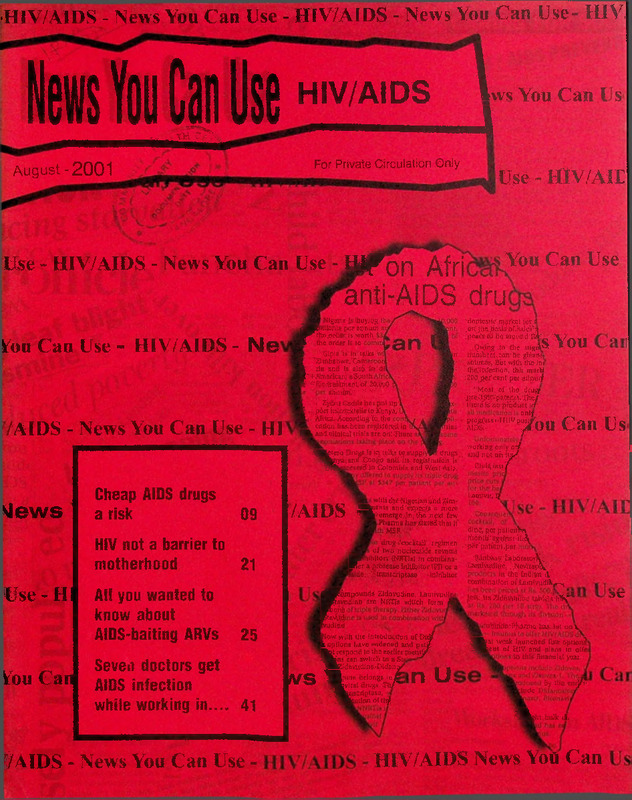
NEWS YOU CAN USE HIV-AIDS AUGUST 2001
Item
- Title
- NEWS YOU CAN USE HIV-AIDS AUGUST 2001
- extracted text
-
•Hi'V/Al DS - News You Can Use - HI V7AI DS - Ne ws You Can Use -HI V.
sgr _
hs I’m to to HIV/AIDS
L You Can I s
-------------- - oFcX
August-2001
|
For Private Circulation Only
.
UMWv/aie
Afri ^ttUCah ■Use
anti-AIDS dru
ta-Hiv/AiDS-NewsYouCanta-wfon
Vou Can Use - H1V/AIDS- Ne
/AIDS - News You Can Use - HI
Nigeria js buyfog'
^■paUtfot? per annum
BFtho .o rds U, wo n A
B rfoeordM is to
Cipln is in talks
I "Zimbabwe.'Gam
k ria and is alsbfo-'di
■ ’ -I-AmericanjaSouth
fc ’* lyrtrejfahanlbt/So.wO.
.■
tfiiniinf" ;jy.£•':: - '
L ■ Zydus Cadlla has put up
E J.jpbrtllsJwgatfoUsto Konya;
L. Africa..According to. foe.
carton his. been registered in
^k and clinical trials are on: -There
‘darrtcsilc n^rket fpr 4
,&TiJbe; -.tfash'jof. iiak’K 4
4jcafS ttf be arpufld'RiE
‘'.\0wjng 4a the stigrA
n; HuhiheS ..can'be gttaw.
3&ources,Bbtwith the-in t
■■tbe^nfcttioh, this marH
:200iper’cent pec atipurf
s You
/'Most of the drug
^re//lp95|5at^r<f.'XHQ/:
liftfrd h no pfoduct |tf‘
onlf .’j t
tiei"XX’nf,,,VpXbu Can Us
■••/orklng oniy o:/
• .■ •. '•
Wftero
Drugs
tosuppiiW
not on its/ ’ ' ’
ml
- « .Ism
•/* telly
■-' ---.•.
-»•• drugs ;.'. and nbt.'oh
■|hya; and Congo and Its registratfon is
•
<
rieftMcesced-in
Asia,'.A. d.oIA.mst f ..:...-.; c.
^■cDcessed
in Colombia and West Asia.
slews
Cheap AIDS drugs
a risk
HIV not a barrier to
motherhood
Use - H
B|||
tfou Can
with djfi'NigQriXn^d^im- < Lain!Vif. f{ \c,Va;~ ’ ,? ‘
09
JM^ents and 'eg>»s^> ft more
yem.e?je;Jn; the rnW few
’
/AIDS <^^k
Pharma hartfawdih’at if■■’•»
dine,perpatlcnSn
’ ii'. e.i
MSF ■ ' ‘
• ,.dine,
nor n'ah
riidhth: againstih\
‘drug .'cochaii’ regimen
■ •pSr'patfcnt.jier
i . ',.■. '.
of tv.-o nucleoside reverse
cmumuu' .,-C,‘'?^llitiytilbi5riio^k.t.1.
■nnil>ltOR(JVRTl»)fncombtnaBer
Inhibitor (Pl)
lef a protease
prdteasc lnhlbitor
(PI) or a ^tondyi^dlpe,.
namivudtuc..'-.NcVirapik
. Ncvirap\ ■•.;..
Sldev^tranacriptate'' -Inhibitor
in the Indian fl •
combination ot .LnmfvudA^-, .T">'
■'
rnpounds Zidovudine, Ltnnvurlim Jcfot .iisZItfoM'iinhe tDhteln-fflSr*
3V
We)t?WK
odlno nrc NKTIs whfcit form jis
21
All you wanted to
know about
AIDS-baiting ARVs
E
25
Seven doctors get
AIDS infection
while working in.... 41
■
NS
Now with the introduction of dk/
k options have widened and par/ ' *.
Sot respond to the earlier focrit&f'.
^kns con switch to a Sit “z
^■adovndlne-pidon^ rTU
^Mpinr belongs tojfc
^■tvlrai drops TM* ••
' ;j®niscriplaso.
i
-l^Latlon of th/.
I'obitjdOT^idrmti'bas.bat uaV.S!
. ^^•fst tveol launched ftv» option?
^^fcenl of HIV- and plans io o(fe
id Bilif finanafal year.;
Iuc,c
by 1H0 ^t]P
i
jB^:.bulk (J.
I&IDS - News You Can Use;-HIV/AJDS News Yott Can
News You Can Use - HIV/AIDS
(NYCU) is a specially formulated
monthly mediascan on issues related to
HIV/AIDS compiled to meet the
specific information needs of NGOs
Directed to meet the urgent need for
As a pan of a regional initiative to
information and awareness building on
build awareness on HIV/AIDS,
HIV/AIDS, this special publication
several efforts
presents a compdauon of news clippings
undertaken by PLAN International
on the issue We hope that the contents
(Bangalore Zone) in partnership
will provide readers with relevant,
with Madhyam. Dissemination of
useful and topical information to
information to NGOs is a key
facilitate grassroot work on prevention,
component of this campaign. This
care and networking.
publication is aimed to strengthen
The publication includes a selection of
newsitems/fcatures/articles/ednorials/
letters
from
leading
national
neuspapers Each newsitem carries the
ongoing
have
efforts
been
through
information processes as well as
serve as a regular reminder of the
urgency to addressing the issue
This publication is supported by
placed under appropriate categories for
PLAN
easy reference
Madhyam
News You Can Use is compiled and
published by Communication for
Development and Learning,
Bangalore
compiled from
X The Times of India
X Hindustan Times
X The Hindu
X The Statesman
name and date of publication and is
Team:
Shannon Das Gupta
Jlji Abraham
ShobhaC
Janet Lazarus
This edition has been
International
and
X The Pioneer
X The New Indian Express
X Deccan Herald
X Deccan Chronicle
X The Economic Times
PLAN
INTERNATIONAL
X Hie A M an A ge
X UN Newsletter
Communication for
Development and Learning
11/A, 7* Cross. IT** Main. Koramangala
6* Block Bangalore 560 095
Ph (080) 5524192
e-mail cdlblr^bgl vsnl net.ta
URL ww w cdiblr
X
Editorial
Let’s begin this edition by taking a quick glance through of the contents of
this compilation. A random sampling includes:
•
An epidemic staring in the face
•
3.86m infected with HIV
•
More than 26,000 infected with HIV
•
AIDS killing 50 per cent adults in South Africa
•
HIV bomb ticks
The headlines are worded to cause panic. The contents confirm this
approach.
On the positive side, the contents also include efforts of the pharmaceu
tical industry which is working on introduce new drugs at reduced prices.
A 3-in-1 drug for HIV has been tried and tested and has elicited mixed
reactions. Ongoing research and development efforts are also making
progress. The print media has attempted to cover these elaborately.
Coverage to the growing initiatives in care of the victims of the virus is also
apparent. Projects, government schemes and direct interventions are
included. Helplines, telephonic counseling, AIDS webline, are instances
of efforts which increase outreach to the individual - while ensuring con
fidentiality in providing support.
The role of the media is recognized as crucial in this effort. Much empha
sis has been placed on the integral use of the media for raising awareness
and growing societal concern. However, along with the increased cov
erage and positioning to aspects related to the issue, as important is the
need for sensitivity in the media in approaching the issue. The tendency
of the media to sensationalise news in order to draw reader attention is
too well-known to be elaborated here. Yet while each sector has its own
agenda in adopting its approach to work, it is our role as media observers
to draw attention to the importance of the focus of the media in this case.
Headlines that create panic and hysteria may draw readership, but do not.
contribute to increasing the need for understanding and care that is re
quired in the case of the individual victim. The stress on data and num
bers often overshadows the fact the behind each statistic is an individual
- at risk or as a victim. Each statistic also represents a human life and a
part of a family and social network. Emphasising the importance of care
and support to the victim is as crucial as the data that needs to be shared.
/ ( . < . 4 'W 2. let Io/
It is our effort at CDL to deconstruct the contents of the media coverage
and place this for discussion with - both the sector as well as the media.
Our role as media researchers assumes two key focus areas - one, and
the more tangible effort is the importance of disseminating information.
This publication is a product of this objective. The other, and to our mind,
equally, if not more important, is the need for a closer study of the focus
and approach of the coverage. A study of the contents will provide
insights to the contents in terms of the focus, the approach and the quali
tative aspects of the coverage. It is our belief that this understanding will
provide many lessons that we can learn from.
For in all this, no one can be afford to forget that central to the issue is the
fact that there is a human life is at stake and that this cannot be allowed
to be reduced to a mere statistic
Editorial Team
August 2001 -
ailvv^®wspapei7
race ipv of cdrnjj
r < rioiis frqm
... :,e.r said
J <.’• tprti and cf
r.v-nx h// .
fRP Winy,
--x^-
-
m
development mediascan.
•• jTVfiXiS’.’..? '
rj&t.ck’CS. pE^aiLja,
p£:alLpijk
tanxJ:;- _T*
Gs?a. - X'nrl;
■FTiojj.
.. ,.v
J.
..
.
ajg'bjCTia"'
Parl«5fiuh<
-q—rrtrnataka and the floor lei
. ail parties nnd iaier. call
''
iuist ar along .with
fiSuc11 “Ncws^ *Yoii C^n°Use^-
" bi- £ QP AUgu»t‘fe
j
' u’llVff
> 4toi W>PWraffi§9R)iuhi
t and. Leariufl^* ni; c ItStM?nfxl
Communication for
Development and Learning
‘ '' •1 - ^it.. •.•Bjjhgplprl' X' 11/A, 7th Cross, 17th Main, Koraman gala, Subscription Rales:
tKc’AdMgsi^addt’ra
6th Block, Bangalore 560 095
Ph: (080) 5524192.
^lrec Years:
Rs.850
One Year.
Rs.3001
email: cdlblr@bgl.vsnl.net.in
gift
_
URL: www.cdlblr.org
i
TABLE OF CONTENTS
AUGUST - 2001
Information
Analysis
Child sex ratio
06
Tests deadlier than HIV
07
Distraction from the real issue
10
Mother or milch cow?
12
Cheap AIDS drugs a risk
5 HIV positive cases in Suryapet
09
19
Scare vs care
14
HIV not a barrier to motherhood
21
Death warrant for four million
28
Chicago: Fewer than ...
21
Is the govt forcing the issue?
35
Rights and wrongs
22
Data
Attention Media Agencies I NGOs
24
An epidemic staring in the face
03
Beware of quick fix cures for AIDS
29
Alarming rise in HIV-infected women
08
Demand for Viagra touches new heights
34
World population set to peak at 9 b by 2070
10
Female sterilisation hurts male ego
38
Breast Bonding
42
Census: Kerala greeted with higher female
rate of birth
13
Telephonic counselling for Aids
44
3.86 m infected with HIV
19
Ranbaxy's AIDS webline for doctors
45
AIDS risk: it's never too old
21
HIV and children
47
Deep-rooted evil
32
Living with HIV
47
More than 26,000 infected with HIV in China
39
Helpline
48
AIDS killing 50% adults in South Africa
45
Living with HIV
47
Industry
H'bad co bags $5-m order for AIDS drug
02
Drugs
Anti-HIV drug recasts fortunes for Matrix labs
02
Cipla launches new AIDS drug
New drug to combat AIDS to be launched
19
21
Analysts upbeat on Cipla, Sun Pharma plans
13
Zydus cuts anit-AIDS drug price by nearly 50%
38
3-in-1 drug for HIV gets mixed reaction
23
Aurobindo, Hetero to launch new AIDS drugs
23
Editorial
News
Thompson to work AIDS for one year
01
AIDS worker criticises Princess Di
02
Battling the pandemic
01
A shot that keeps the baby away
04
UNderplaying AIDS
05
Zimbabwe considers double burial as AIDS
Talking Heads
08
bites hard
05
Ugandan Heads UN AIDS Fund
07
UK gives 23 m to fight AIDS in Africa
07
Feature
Look before you leap
Taking lessons from an obscure village
11
15
Counter-productive raid
18
Andhra's shame: child sex abuse
Kyonki saas can be an agent of change
08
2-child norm: Govt bows to expert opinion
09
20
No more surrogate mothers in China
China flags off project to tackle HIV-AIDS
09
11
They 'wash' and suffer silently
30
The stick Munda women fear most
17
Negotiating Gay Spaces
33
Checking teen pregnancies
17
Children of a lesser God
40
March for cheap AIDS drugs
21
Viagra on menu
22
Duty exemption for HIV drugs
23
Bihar Govt, to install 5,000 condom vending
machine's
43
Kopran forms JV in Uganda for anti-AIDS drugs
25
HIV bomb ticks
43
New male contraceptive soon
TV as birth control pill
44
46
Masters degree in sexuality
46
HC orders relief to AIDS victim
46
Beijing parents to receive sex education
25
Art for awareness on AIDS
Levi Strauss offers grant to society
26
26
Senegal shows the way for AIDS
ravaged Africa
27
AIDS patients left in the lurch by NGOs
29
Question and Answer
All you wanted to know about Al DS-baiting ARVs
Judges’ plea may benefit same-sex partners
31
AIDS centre in Bengal
36
CM to head AIDS prevention society
36
Female genital mutilation rising among
UK Africans
37
Viagra may help lung disorder
17
NRIs flock clinics for sex determination tests
37
New way to block HIV transmission
27
Lucknow docs out with Viagra lipstick
37
HIV filter
31
Mon's placenta may predict baby's weight
34
A prison within a prison for inmates with AIDS in
Alabama
A condom mascot offers leaflets to
39
Thai teenagers...
TV channel for homosexuals
41
41
Herbal contraceptive on the anvil
41
Seven doctors get AIDS infection while
working in ....
41
25
Research
AIDS research with coconut oil
14
Study
Americans delay AIDS tests: Study
26
Viagra not potent enough for smokers
26
IUDs may be safe for HIV-positive women
45
Minor mutations in HIV virus
45
'Privacy factor may block HIV therapy'
46
BATTLING THE PANDEMIC
THE FIRST-EVER meeting of the United Nations
that was devoted to discussing a public health
issue has concluded with the adoption of a Dec
laration of Commitment on HIV/AIDS. The tar
gets laid down in the declaration are not binding
on the members of the U.N. and the intolerant
were successful in spending valuable time in
making the delegates argue about whether or not
the statement should refeY to prostitutes and ho
mosexuals. Still, the meet was important in that it
concentrated the world’s attention on HIV/AIDS.
The foundation has now been hopefully laid for a
world-wide and co-operative battle against this
pandemic.
the current level of pledges (one million dollars)
compared to the target of $7-10 billion that the
U.N. Secretary-General, Mr. Kofi Annan, had sug
gested in April. A group of scientists, including
representatives from the coordinating body, UN
AIDS, recently estimated that a universal global
prevention and care programme would cost $9.2
billion annually. This is likely an over-estimate.
But as that study made clear even this is not an
outlandish amount for the global community be
cause it will mean only a 10 per cent increment to
current annual levels of overseas development
assistance by the advanced countries.
In the declaration, countries have agreed on
2005 as the target year to reduce the prevalence
of HIV among young adults in the most affected
countries by 25 per cent and to do so by 2010 in
all countries. By 2005 countries will also develop
comprehensive programmes to take care of HIV/
AIDS patients with a variety of measures, includ
ing the provision of inexpensive anti-retroviral
drugs — the medicines that enable the HIV-in
fected to lend fairly normal lives. The larger em
phasis in the charter is on prevention as against
care, although the weeks preceding tlie meeting
saw much attention focussed world-wide on the
cost of highly active anti-retroviral therapy
(HAART). Yet, prevention and care need to go
together. As Brazil has demonstrated with its
highly successful HIV/AIDS programme even a
relatively poor country can adopt a twin-ap
proach to control the spread of infections and
provide care to the infected. The Brazilian pro
gramme has also shown that a commitment can
overcome even powerful obstacles. It could not
have been a coincidence that the U.S. chose the
week of the U.N. meeting to announce that it was
dropping its WTO complaint against a Brazilian
law that could be used to lower the prices of
patented medicines. While the U.N. conference
was not expected to see decisions on funding the
global fight against AIDS, it was not surprising
that there was a great deal of dissatisfaction with
There is a view that too much attention is
being paid to AIDS even as other diseases and
poverty issues in the developing countries are
being ignored. What makes HIV/AIDS special at
this point of time is the virulence with which this
irreversible and incurable infection is now
spreading in Africa and will soon in Asia as well,
in the process threatening to decimate an entire
generation of young adults. A special situation
therefore does deserve special attention, al
though it does not mean that either issues of
poverty or diseases like malaria, tuberculosis or
diabetes can be ignored. The Indian approach to
the U.N. meeting was, sadly, only mainly one of
how to obtain a part of the resources in the global
fund. Although India is home to the world's sec
ond largest HfV population, there is no urgency
either at the governmental or social level on pre
vention and care. Indian drug firms have devel
oped the capability of producing HAART drugs at
the lowest prices in the world. The tragedy is that
there is not a single public health programme in
the country, either at the Centre or in the States,
that provides these medicines even for control of
mother-to-child transmission of the virus. On
prevention, vast sums of money are being spent,
but there is little that the National AIDS Control
Organisation can show other than questionable
statistics that point to the virus spreading more
slowly.
Thompson to
work for AIDS
for one year
London: British actress Emma
Thompson is to take a year off
from work to travel round
Africa with her family to raise
awareness of HIV and AIDS.
The two-time Oscar winnej
will be going to Africa on
behalf of the charity action
aid, the Daily Mail reported on
Saturday.
“We have always wanted to
do some voluntary work over
seas," she was quoted as say
ing.
' “I will talk to women and
orphans and try to spread the
message about AIDS to inform
people of the risks. The prob
lem with Africa is that people
are not talking about their
problems." Thompson said she
hoped her celebrity status
would come to good use.
“Celebrities can sometimes
help get a good reaction for a
cause," she said.
Thompson will be accompa
nied by partner Greg Wise and
their 17-month-old daughter
Gaia. (Reuters)
The Asian Age
01 July 2001
The Hindu
02 July 2001
NYCU - HIV/AIDS
1
H’bad co bags $5-m
order for. AIDS drug
Gauri Kamath
MUMBA11 JULY
ETERO Drugs, a Hyderabad
based pharmaceuticals com
pany, has bagged an interna
tional tender worth $5 million
(approximately Rs 24 crore) to sup
ply an anti-HTV/AIDS drug indinavir
to Brazil. Hetero has bested Merck
& Co., the patent-owner of the drug,
which had slashed its price by 65 per
cent recently in an attempt to pre
vent the Brazilian government from
importing cheaper versions of its
drug. Hetero said on Saturday ij had
also beaten two other Hyderabad
based companies Vorin Laboratories
(of the Ranbaxy group) and Au
robindo Pharma, besides some Eu
ropean firms, who had competed for
the tender.
Hetero will supply 7,100 kilos of
the bulk drug — the key ingredient
that makes the drug effective — to
a government-owned Brazilian firm
over the next two months. This firm,
called Farmanguinhos, will convert
{he bulk into ready-to-consume
H
medicines and distribute them
through government programmes.
With Hetero's bulk drug, the cost of
the finished dosage form would
work out to 27 cents a capsule much
lower than the price quoted by
Merck which is well over 40 cents a
capsule. Indinavir, branded Crixivan
by Merck, inhibits a pan of the hu
man immuno-defidency virus (HIV)
which causes AIDS. When this pan
— called the protease — is blocked,
the HIV copies itself, but without the
ability to infect new cells. In effect,
it slows the spread of the virus.
Brazil, a WT£L member which
recognises product patents, has made
an exception ip the c<§e of HIV?AIDS
drugs as a marrer of public health
policy. It has dedded to make some
patented drugs freely available to
HTV/AIDS patients by importing the
raw material and locally manufac
turing the finished dosage forms
through government companies. Mr
Dharmesh Shah, director of business
development at Hetero Drugs said
this was one such tender and more
would follow.
The Economic Times
02 July 2001
birthday.
Mr Michael Adler, the chair
AIDS worker man
of Britain’s National
AIDS Trust, related how he
(ritkises
changed his opinion of her and
says that working with the
princess became
Prioress Di glamorous
more trouble than it was
London: The late Diana,
Princess of Wales was to be
accused of treating AIDS
patients “as though they were
in a zoo” in a television docu
mentary to be screened in
Britain tomorrow, the day that
would have marked her 40th
worth. Nostalgia for the
princess, once an icon for her
work with AIDS patients and
land mine victims, is waning
fast in Britain. Many insist it is
“time to move on” as the
fourth anniversary of her
death in a Paris car accident
approaches. (DPA)
The Asian Age
01 July 2001
Anti-HIV drug
recasts fortunes
for Matrix Labs
__________ M S Anand__________
HYDERABAD 2 JULY
HE PHARMA industry is hot.
The cholesterol-lowering drug,
the new arthritis drug, and
now the anti-HIV drug has joined
the portfolio of pharma companies.
But, of these, it is the demand for
anti-HIV drug particularly from Latin
America and South Africa that is
changing the fortunes of some
pharma players. The city-based Ma
trix Laboratories is one such where
the demand for its anti-HIV drug
alone has helped the company to
turn the comer.
The company, which had netted
a loss of Rs 8.59 crore for the year
ended 1999-2000, has earned a net
profit of Rs 4.20 crore, thanks to its
foray into anti-HIV drug. Matrix has
added to its portfolio anti-HIV drugs
like celecoxib and refecoxib.
The management of the company
too has undergone a change. "The
new management as a part of its ini
tiative to give a new look to the com
pany, apart from other strategic
moves has decided to change the
company's name to Matrix Labora
tories Limited," highly placed com
pany sources told ET. The company
was formerly known as Herren
Drugs & Pharmaceuticals.
On the export front the company
registered substantial growth of over
tenfold with a turnover of Rs 4.56
crore as against Rs 42 lakh in the
previous year.
“There was a surge in exports on
account of demand for anti-HIV
T
Changed Inflow
drugs and other anti-bacterial drugs,'
sources said.
The company's management un
dertook various strategic initiatives
for revamping its operations. Prod
ucts profile underwent a drastic
change, products with less contri
bution were replaced with new gen
eration high value products. Also ad
equate care was taken to broad-base
the product profile to represent var
ious therapeutic segments.
Almost 40 per cent of production
was cut down in plder-generation
drugs of the likes of: Ibuprofen; Nor
floxacin; and Nimesulide. The re
spective production figures of these
drugs were at: 4,54,116 kg (5,38,105
kg); 28755 kg (41,410 kg); and
52047 kg (80,273 kg).
Matrix is now in the process of
establishing regulatory affairs divi
sion to prepare product master files
for registrations in various regula
tory markets within the purview of
GATT provisions. The company is
also planning to get export house
status to avail itself of various statu
tory incentives.
The Economic Times
03 July 2001
nycu-hiv/aids
An epidemic staring
in the face
any time after impregnation and
during breastfeeding which in
creases the risk by 10-20 per cent.
Short term antiretroviral pro
phylactic treatment can prevent
mother-to-child transmission and
HE facts about Aids, which education, income and their the manufacturers of one such
is now a global epidemic, socially inferior status, has been drug have offered to supply the
are stark. According to the brought out by the fact sheet: in drug free to developing countries
fact sheet released prior to sub-Saharan Africa, the disease in collaboration with the UN.
the UN Special Session on affects 12 million women as And then there is the death of
against 10 million men.
HIV/Aids,
parents, sometimes both of them,
about 36 million people are Also women are infected at a because of the disease. Aids has
affected with the disease, 5.3 younger age than men: in 1998, 20 created 2.3 million orphans around
million joining the ranks in 2000 per cent of HIV positive women in the world, a third of them below
alone. Roughly 22 million people Namibia were in their 20s and “in the age of five^
have died of the disease since it some of the hardest hit countries, Half of those carrying the virus
was first detected in 1987, that is girls are five to six times more are infected by the disease before
almost three times the population likely to be infected than teenage their 25 th-birthday and n\any die
boys”, while in Zambia 18 per cent before turning 35, leaving their
of Switzerland.
Sub-Saharan Africa is worst of young women became infected children to fend for themselves
affected, as is to be expected, be within a year of becoming sexually and battle the stigma at the same
cause the spread of the disease has • active._____
time.
been found to be concomitant with For those who are not aware, HIV The massive incidence of this
levels of underdevelopment, th is now a predominantly hetero disease means that it lias the
ough in terms of sheer numbers, sexual disease, with 70 per cent of capacity to significantly alter
India has more HIV positive all transmissions occurring th demography .as well as socio
people in the world, excepting rough sexual intercourse between economic indicators. It is esti
South Africa. The spread of the men and women, 10 per cent mated that 23 million workers in
disease is global: 1.8 million in through sex between men and 5 the age-group 15-49 are HIV
Latin America, 2 pel* cent of the per cent through intravenous drug positive.
population in Caribbean countries, abuse.
This has a direct impact on the
64 million in Asia, 1.5 million in The fact sheet shows that men labour market, especially relating
high-income
industrialised have a special responsibility, to skilled workers, on productivity
countries, while eastern Europe under the circumstances, because and employee health financing. In
and central Asia are catching up. their attitude towards the opposite some of the hardest hit countries,
This is the geographical spread, sex is a primary factor in the productivity has gone down by 50
but then the prevalence of HIV is spread of the disease.
per cent.
determined by all sorts of social, To quote: “Research has shown In sub-Saharan Africa, annual per
cultural and political factors which that in up to 80 per cent of cases capita growth is falling by 0.5 to
add a degree of complexity to the where women in long-term stable 1.2 per cent and the rate of decline
relationships are HIV positive, ‘may touch ‘8 per cent in the
situation.
Young people are at the centre of they acquired the virus from their1 hardest hit countries by 2010.
the risk and 10 million of their partners.”
Poverty levels have risen by 5 per
number are infected worldwide, .The fact sheet doesn’t say so, but cent worldwide because of Aids.
this
is
presumably
because
in
with sub-Saharan Africa account
•Aids also means “mounting
ing, once again, for the bulk. Drug many cultures it is considered expenses on health and orphan
abuse and sexual promiscuity have unvirile to use a condom while care, reduced revenues and a lower
something to do with this fact, but having sex, even with a sex return on social investment.”
ignorance, especially, in the con worker.
Agriculture is affected even more
text of underdevelopment, also They open themselves to risk and badly. In Kenya’s agriculture
also
others,
since
men
are
more
plays a role.
ministry, 50 per cent of all staff
The fact sheet mentions that in likely to have sex with several deaths are caused by Aids and oneMozambique, 74 per cent of girls partners than women.
third of Aids-affected families in
and 62 per cent of boys in the age The impact on children is drastic: Thailand saw a 50 per cent fall in
group 15-19 have no idea how not there are those who are directly their agricultural output.
to get infected, while half the infected through sexual inter Aids-affected households shift to
teenage girls in sub-Saharan Af course or drug abuse dr blood less labour intensive'farming and
the
over lower production figures are being
rica think if a man looks healthy, transfusions, but
whelming number of them - 90 per reported from several countries.
he can’t possibly be infected.
The growing vulnerability of wo cent - are infected at birth by the The overall impact of these Aidsmen, because of gender in mother.
related phenomena on countries Qontd
equalities- as
reflected
in The disease can be transmitted at .such as those in sub-Saharan
T
NYCU - HIV/AIDS
0 3
instance, has a special responsibility towards the health of
rica whose economies have vir- workers, while the ministry of
tually collapsed under the debt agriculture should think of
burdens that eat up all their GDP, strategies to stop the disease from
can well be imagined.
spreading in the countryside.
An International Partnership Countries outside the indusagainst Aids in Africa has been trialised world that have been
launched at the initiative of a particularly successful in concoalition of African countries in taining the epidemic are Senegal,
collaboration with Unaids and se- Thailand, Brazil and Uganda. Braveral other agencies of the inter- zil worked assiduously on its gay
national body.
community, Uganda on teenage
The
search
for a vaccine women, Senegal relied on women’s
continues, but as the fact sheet groups and faith-based organinotes, the development of an HIV sations, while Thailand launched a
vaccine is “an arduous and 100 per cent condom programme in
expensive process”. The first its red-light areas in the 1990s.
vaccine trial on a human volunteer Uganda cut its prevalence rate
was done in 1987 and since then 30 from 14 per cent in the early 1990s
experimental vaccines have been to 8 per cent in 2000, while
tested in roughly 60 trials.
Senegal has brought it down to
The problem with the HIV virus is less than 2 per cent. Every country
that the classical method of must adapt its strategies accord
developing a vaccine by using a ing to the social profile of the
dead or harmless micro organism, epidemic. In Europe and North
virus or bacterium, is not safe, America, the disease affects gays
since it is^'the 'immune-ayatem. and drug abusers more than the
which is threatened. Experimental heterosexual population.
vaccines use parts of the virus and Awareness campaigns, using
are tested in three phases, prog- innovative publicity methods, are
ressively taking in an increasing* a must, especially in low-income
number of volunteers and testing countries, since low literacy rates
its safety and response levels.
prevent dissemination of knowThe final phase trials go on for ledge about the disease through a
four years, involve thousands of literate media.
volunteers and is intended to test Half the adolescents in three
whether the vaccine actually continents did not know a single
prevents infection or stops the . method of preventing the disease.
onset of Aids. The fact sheet notes: It is estimated that the global
“Phase III trials are ethically,:' distribution of condoms must go up
logistically and scientifically com from 6 billion to 24 billion to
plicated.”
protect the population.
There are 10 subtypes of the Unaids and its cosponsors launch
virus, some found only in indus ed an accelerating access initiative
trialised countries, others in (AAI) last May, to which 36 count
underdeveloped ones, and it is not ries in Africa, Europe, Asia, the
certain that a single vaccine is Caribbean and Latin America,
going to be effective against all.
have subscribed to facilitate access
However, there is cause *for hope, and distribution of HIV drugs at a
vaccines have successfully pro price the populations of the count
tected animals against the disease. ries concerned can afford.
The only short-term approach In all circumstances, the message
towards the epidemic is, therefore, must reach the highest levels of
prevention and care. Here the government that the epidemic
initiatives have to be social and cannot be ignored.
political as much as medical.
Attention has to be paid to health (The author is Senior Leader Wri
infrastructure, but also the com ter, The Statesman.)
munity has to be oriented towards
SOUMITRO DAS
accepting HIV and Aids as facts of
The Statesman
life and adapt its behaviour
accordingly.
18 July 2001
At the government level, this is
not something that can be left to a
single department, the entire gov
ernment must mobilise itself on as
many fronts* as possible to tackle
Contd...
this menace.
The labour
4
department,
A shot that
keeps the
baby away
CHANCHALPAL CHAUHAN____________
STATESMAN NEWS SERVICE
NEW DELHI, July 8. - This
may be just what India needs with its population: one billion
and growing, and where men in
general are notoriously reluc
tant to share their burden of
contraception.
An easily administered, longacting but reversible contra
ceptive for men.
Controlled marketing is expec
ted to start in one year, comm
ercial marketing, a couple of
years after that.
Developed indigenously, Risug
Reversible Inhibition of
Sperm Under Guidance - is the
fruit of painstaking research by
Dr Sujoy K Guha, of the Biome
dical Engineering department,
DT, Delhit
In plain English, the contra
ceptive works via an injection
in the penis. On being ad
ministered, the drug sends
electrical
impulses which
distort the sperm and render it
ineffective.
In jargon, Risug is injected
Into the Lumen of the Vas Def
erens, the male reproductive
duct, in a small. dose, about
one-tenth of a gram.
The drug once injected
transforms into a gel due to the
chemical reaction with body
fluids. It works by inducing
non-obstructive azoospermia.
Translation: no sperms in the
semen.
To reverse the procedure the
gel has to be suctioned out.
Administering the drug takes
one 30-minute sitting, while a
reversal will require between
three and four sittings, each
lasting 30 minutes. Both
procedures, insists Dr Guha,
are painless. *
The three phases of trials
which precede controlled mar- Contd...
for
NYCU-HIV/AIDS Q
Contd...
keting — the final stage before
commercial sale - of any drug
are complete for Risug, and
they have been approved by the
Drug Controller General of
India.
The all too vital permission
from the ethics committee of
the host institution (in this case
the Lok Nayak Jai Prakash
Narayan Hospital), which
performs the trials of the drug,
has been obtained. Another
must, the approval of the Toxic
ology Review panel of the In
dian Council of Medical Re
search has also been secured.
Dr Guha said the other form of
male contraception, vasectomy,
results in blocking the sperm
passage, which causes pressure
build-up and other adverse
effects.
The working of Risug is diff
erent, he claims. “There is no
blockage or removal of sperm
duct"
The drug has been under trial
for the past 11 years, though it
was conceptualised almost
three decades back.
There have been tests on ani
mals — langurs, rhesus
monkeys, rats and rabbits.
Clinical trials on humans were
conducted between 1990 and
1993 at the LNJP hospital,
New Delhi. The focal point in
these tests was whether Risug
was safe for use on humans.
After the safety aspect of
Risug was confirmed, phase II
was given the'go ahead. This
phase conducted between 1994
and 1997 was for combined
testing of efficacy and safety.
The third and final phase
which began in 2000 is yet to be
concluded. This phase is
essentially an extension of
phase II with the aim of finetuning the drug.
This phase is being conducted
under the aegis of the Indian
Council for Medical Research
and the Ministry of-Health and
Family Welfare. The ICMR has
been funding the project for the c
past twenty years, said its o
deputy director, Dr S Mokk- g g
apati.
g o
Dr Guha claims that the drug S CM
is the first of its kind. He has
>>
patented the drug in the US, CD
Bangladesh, Malaysia, China o
and India. Claims are pending -g g
in other countries.
r
Zimbabwe considers double
burial as AIDS bites hard
Harare, July 8: The city council in Zimbabwe’s capital Harare is
calling on residents to consider double burials to save space in a
capital whose graveyards are filling fast due to AIDS.
Harare city curator of graves Eiadinos Zimbwa told the Sunday
Mail newspaper that although Zimbabwe’s black majority was
opposed to the practice, it made sense to promote the double buri
als because space for individuals graves was running ouL
The council now prefers to dig a much deeper grave which can
accommodate a second body later, but many families are refusing
this on their belief that it is not respectful of the dead, he said.
‘^Because of black people’s cultural beliefs, it has been very dif
ficult to convince them that is a better way of saving space,” Mr
Zimbwa said. Zimbabwe has one of the highest rates of HIV infec
tion in the world, with one in five people believed to have the virus
that_causes the deadly disease AIDS. (Reuters)
The Times of India
04 July 2001
The Asian Age
09 July 2001
UNderplaying AIDS
What has been a common refrain all these years in the debate on
HIV/AIDS? That the best antidote to the killer disease is to break the
silence on the subject. Yet, for all its hype, the first ever UN general
assembly session on H1V/A1DS has been less than forthcoming on
issues which ought ho longer to be swept under the carpet Indeed, the
landmark declaration which came at the end of the three-day summH
has steered clear of any explicit references to homosexual
commercial sex workers and drug users as being vulnerable groups.Athe intention behind this move was that no particular group should b singled out as being more vulnerable than another, there can be n*
complaint. But, in this instance, the reason was pressure from th*
Islamjc countries and the Vatican. Hence, we must assume that the
objection is moral. And this could prove fatal in the battle against the
virus which respects no boundaries, class or religion. However, the
summit has focused on the main reason why the virus has kept one
step ahead of those combating it — it has so far been treated as a
merely medical problem. This is to deal with only one aspect of the
epidemic. The dimension which the summit has rightly highlighted is
that there is a major human rights aspect to it as well. Especially, those
relating to women. Across the world, women are powerless partners
in relationships. And today, heterosexual transmission is the main
vehicle for the spread of the virus.
Another alarming feature of the disease, especially in the last
decade, is the spread of the virus in the world’s most backward and
poor countries. From sub-Saharan Africa to the desperately under
developed countries of South Asia, HIV/AIDS is felling a generation
in its prime. As UN secretary general Kofi Annan enters his second
term, he has made an impassioned plea for a global war chest of
upward of $9 billion for the fight against the epidemic. And what role
did India, with the world’s second largest number of infected, play in
all this? Very little, going by reports coming from the United Nations.
Our minister took the opportunity to yet again contest UN figures for
orphans from AIDS-related diseases in India, claiming that as against
the quoted 5,60,000, the actual figure is somewhere between
60,000-70,000. He also said India had been extremely successful in
combating the virus and staked a claim to be on the governing body of
the proposed global HIV/AIDS fund. This is not the time to be
quiboling about figures; rather we must accept that this is a serious
problem and formulate a concerted awareness plan to tackle it as
countries like Uganda have done. Half the battle will have been won
when we jettison our penchant < for verbosity at international
conferences and admit to our failings — but so far there is no
indication that this is happening in thecase qfHiy/AIDS.
NYCU-HIV/AIDS
5
blaming doctors or government
for not stopping sex-deter
mination tests, women acti
vists are in a way trying to put
the blame for their own folly on
VER since the publics- which is about one-foiirth of the used as a method of family others. This will not help. It is
tfon of the Census 2001 total births in the same year, planning, the reality is that
time the woman activists
provisional report high- So the condemnation of medi- abortion has de facto become
pressed the government to
lighting the decline in the child cal practitioners for conducting ah accepted method of family
repeal the MTP Act (1971).
(O-^years) sex ratio from 945 in these illegal sex-determination planning in India.
1991 to 927 female child per tests is quite understandable. These are all very dangerous
RELIGIOUS ROLE
1000 male child in 2001, there But what is not comprehensible consequences of liberalisation
However if it is no more
has been a hue and cry against is why nobody is questioning of abortion in a country which possible to put the genie of
this demographic change. The the justification for the liber- is also plagued with the serious
liberalised abortion back into
Press, intellectuals and wo- alisation of the right to abor- problem of over-population.
the bottle, I have another sug
man's organisations have been tion in a society like ours where The mushrooming growth of gestion: amend the MTP Act
quite vocal in raising an alarm a strong male child preference abortion clinics and their ex- (1971) to the effect that the
against this trend caused niain- exists. It is both the sex-de- tensive and unabashed advermedical termination of preg
— termination test and the libera- tisements should be a matter of
ly due to. female
nancy will be permitted only if
lisation of right to abortion that serious concern. Hence women
foeticide, and even
the husband too undergoes
together have lead to the prac- organisations and activists who
female infanticide.
vasectomy simultaneously.
tice of female foeticide in India, championed the cause of “right
This malady of
This suggestion is pro-woman
It is time women activists in to abortion" resulting in the and pro-family planning. But
declining child sex
ratio has indeed
particular and the society in;MTP Act (1971) must now re above all, this amendment in
general realised that liberali- alise their mistake and start a
become quite wide
the MPT Act (1971) will signi
spread
in
the
sation of abortion in India has,movement to rescind the MTP ficantly reduce the evil of fem
proved to be an anti-woman Act (1971). Or else their pro
country. Out of the
ale foeticide. Secondly, this
28 states and seven
measure.
tests against the declining measure will also discourage
Union territories,
_Prior to the passage of the child sex ratio is likely to be men from using abortion as a
only four states,
Medical Termination of Preg- viewed as shedding of croco- normal method of family
namely
Kerala,
nancy Act in August 1971, in- dile’s tears.
planning. Thirdly, this step will
Tripura, Mizoram
duced abortion was a criminal It may be highlighted here significantly bring down pre
and Sikkim, and
offence except for the purpose that the National Population marital abortions OPWC
as well which
of saving the pregnant woman’s Policy 20(50 laysi stress on ^“^portedto"^ ^creasing in
only one Union
life. But the MTP Act a971)|'«ta^nmg and «q>andwg
Medical Terminatio® of
territory, Laksha
dweep, are free
liberalised abortion to the ex-1 facilities for safe abortion as a
should however be
tent that it became permissiblej“promotional and motivational1
from this degrad
ing and socially
even in case of a pregnancy fol- measure for adoption of small w
ses like threat to life nr
or rnnA
rape.
harmful
pheno
lowing failure of contraception, family norm”. There are seveIt is reported that the Akai
Again, the government has not ral eminent woman activists
menon. The worst
Takht has recently issued dir
only liberalised abortion but who are members of the Natioaffected states and
ections to the Sikh community
Union territories are Punjab, has also facilitated it by mak- nal Population Commission set not to indulge in female foeti
Haryana, Himachal Pradesh, ing a provision for paid abor- up last year. Do they approve of
cide and has also warned that
Gujarat, Uttaranchal, Delhi tion leave of about three weeks abortion as a population conthose flouting these directions
and Chandigarh. And all these to working married women who trol measure? I think this is anor found associated in any way
five states and the two Union underwent medical termina- ti-woman and must be condem- with the malpractice would be
ned and opposed by
territories are ironically quite tion of p^egriancy? These meas
excommunicated from the Sikh
all and by woman
high in female literacy rates.
ures have, in fact, given rise to
religion. This directive coming
activists
in
parti
two major problems. It is
from the religious leaders is
ANTI WOMAN
cular.
impossible to argue that a
commendable and is sure to
But instead of
This decline in the child sex woman can abort a pregnancy
have a salutary effect. Religion
doing this, women
ratio highlighted by the latest caused due to failure of contra
in this country has always
census figures has also led to ception but she cannot do so if
activists are Q y influenced people in general. It
blaming
doctors
v - *
renewed protests against intra the foetus is a female one. Also,
would,
therefore,
be
uterine
sex-determination once we approve of foeticide
who perform sex- commendable if all other religi
tests. Woman activists have
abortion) even on such tri
determination
ous heads issued similar
condemned medical practition vial grounds like contraception
tests
which of
directives.
ers who conduct foetus* sex failure and also go for the
course are illegal.
By KBSAHAY
determination tests despite popularisation of the medical
Surely the gov
these tests having been decla termination of pregnancy as is
ernment must be
The Statesman
red illegal.
more vigilant to
happening in India, then
20 June 2001
High incidence of induced female foeticide is also bound to
prevent the sex
abortions in India and the de get people’s acceptance.
tests; but we also
cline in child sex ratio confirm
know that as long
the rampant misuse of foetus OVERPOPULATION
there is a strong
sex-determination tests to ab
demand for such
Liberalisation of abortion has
ort female foetuses. According led to another problem in India.
tests, it would, like
to the latest data available, Even though it is always
prohibition, be dif
there were 6.7 million induced asserted from a public platform
ficult to stop the
abortions in India in 1991 that_abortiqn is never to be.practice. Moreover by simply
CHILD SEX RATIO
6
NYCU - HIV/AIDS
Tests deadlier than HIV
Patients cough up Rs 10,000 every 6 months
From Our Bureau
Hyderabad, July 31: Believe it or
not. it costs more than Rs 10,000
every six months for a HIV posi
tive patient to undergo clinical
tests, leave alone purchase of med
icines, which is next to impossible
for an average middle class person.
This is a major factor contributing
to the spread of AIDS in India, says
India-born US expert on infectious
diseases Dr Satish Murthy
Mocharla.
Satish is a well-known consultant
al Cleavland Regional Medical
Centre, Texas, that plays a key role
in AIDS Clinical Trials Group in
North America. Satish told Deccan
Chronicle here that a HIV positive
patient has to undergo two impor
tant clinical tests every six months
to check the status of the disease:
CD-4 test which costs Rs 1,200 and
HIV PCR test which costs Rs
9,000. These two tests are impor
tant for undergoing treatment.
“Which means, each patient has
to spend Rs 10,200 on these tests
alone, apart from the cost of drugs.
That is why, an average patient in
India disappears soon after being
identified as a HIV positive case.
There is no way one could trace the
patient, who is a potential carrier of
the disease,” he said.
Satish said the government
should heavily subsidise the two
tests, so that even a lower class
patient could afford to undergo
clinical tests. At the same time, the
government alone could not fund
the entire expenditure. “In the US,
people themselves contribute to
AIDS control. India has one billion
population. Even if each person
donates on an average Re 1 a year,
it will_become Rs 100 crore, which
will help in curbing the spread of
AIDS. Instead of seeking funds
from national and international
agencies, funds can be generated
by the government from its own
people to combat the dreaded dis
ease,” he opined.
Another major drawback in the
country with regard to AIDS con
trol, according to Satish, is the aooavailability of anti-retroviral drtigs.
Out of three classes of drugs which
are required to control the dreaded
disease, only one or two classes are
available in India. Steps should be
taken to import the drugs, he said.
He strongly advocates introduc
tion of sex education in the high
school curriculum. “Importance of
safe sex practices, monogamy and
birth control have to be taught at
the high school level itself, since
teenage pregnancy is said to be
very high in India.” he added.__
Deccan Chronicle
01 August 2001
Ugandan Heads
UN AIDS Fund
AGENCE FRANCE PRESSE
UNITED NATIONS, July 31. UN Secretary General Kofi
Annan has appointed former
Ugandan health minister Mr
Crispus Kiyonga to spearhead
the establishment of a global
fund to combat AIDS and other
diseases.
The Global AIDS and Health
Fund is to be set up by Decv
mber. Interim arrangements
for the fund were agreed at .-<
12-13 July meeting in Brussels
of representatives developed
and developing nations. NGOs
and the private sector.
So far, $1.4 billion has b*cn
pledged to the fund, the UN
statement said.
Mr Kiyonga. is currently nat
ional political adviser and
minister without portfolio in
Uganda after having served as
health and finance minister
The Statesman
01 August 2001
UK gives £23 m to fight AIDS in Africa
By Our Special Correspondent
New Delhi, July 31: The British Department
for International Development, in consultation
with the joint United Nations Programme on
HIV/AIDS has awarded a contract worth more
than £23 million to Action Aid in support of
the International Partnership against AIDS in
Africa. Action Aid is a UK-based non-govern
mental organisation.
“This is an important new initiative,” said Dr
Peter Piot, executive director of UNAIDS.
“The countries selected have serious AIDS
epidemics, and these new resources under the
IPAA will make an important difference. This
is a new strategic partnership between imple
menting governments and their civil societies,
international civil society, the United Nations
and a donor government. We have high hopes
for its success.”
DFID’s support to the IPAA will strengthen
the capacity of governments to coordinate the
inputs of all partners in the fight against AIDS.
The project will provide ongoing assistance
in Burundi, Ethiopia, Ghana and Rwanda and
focus on building management capacity at both
national and community levels.
Country specific activities such as education
programmes for truck drivers and sex workers
or linking HIV/AIDS to debt reduction will
also be supported.
National AIDS commissions and pro
grammes will receive managerial technical
assistance, with funding also earmarked for
selected community organisations.
In addition to this, Action Aid will establish a
regional support office in Nairobi to provide
technical assistance through regional networks
and country visits, expanding the number of
countries' benefiting from the project.
Regional technical assistance will monitor
the impact of national AIDS programmes,
strengthen the management capacity of nation
al programmes and support behaviour change
communication to reduce stigma and discrimi
nation and encourage safer sex practices.
The International Partnership against AIDS
in Africa works on the principle that actors
from all parts of society collaborate under the
guidance of African leadership to scale up
AIDS-related activities.
The Asian Age
01 August 2001
NYCU-HIV/AIDS ® |
cuss this equally odd subject.
Says Puttamma, a mother-in-law,
who has come to attend the pro
gramme, “If you have an opera
tion, you cant work. I never had
an operation, daughter-in-law
doesn’t need to have one either."
Dr MN Sandhya, a medical
Kanak HI ran I
Most of the young mothers in
officer, is working along with Dr
SIXTY-YEAR-OLD Gangamma
slums have more than two chil
Parimala to get these women
frowns as she holds up a strip of dren. This means that most of
comfortable with the idea of birth
birth control pills. The message
the children don’t even have
control. They have carried con
doms, birth control pills and cop
she’s getting isn’t a welcome
access to a decent village edu
one. A young doctor is trying to
cation. While they may be open
per T along with them and are
get her to warm up to a new idea to the idea of a tubectomy or
showing them to the older
— birth control for her daughterusing copper T, the mother-inwomen. “This group has around
in-law — an uncomfortable
law gets in the way. The BCC
20 ladies. Initially, they were
change for Gangamma who’s too health officers found that they
reluctant to tell me about their
used to telling her son's wife
had to talk to the mothers-in-law fears, but now they have opened
what to do.
if the wanted to make a differ
up,” says Dr Sandhya. She
This could well be a scene
ence. Known as the focus group, explains that one of the mes
from Tu-tu-meln-mein, where the the mothers-in-law were asked
sages she gives includes the
mother-in-law tries to call the
benefits of having a small
shots. But in this case it indi
family. “Often, the women
cates the, progress being
are made to have children
made by the Bangalore City
till she gives birth to a son.
Corporation to get some good
Giris are still considered
work done. As part of the India
to gather on a regular basis and
unlucky in many places and we
Population Project (VIII), an out talk about their fears related to
try to change that,” she explains.
reach programme is being con*
birth control, one of which includ At meetings like this women like
ducted for mothers-in-law
ed the fear of losing control or
Gowramma stand up and talk to
throughout 500 slums. Here, a
importance.
the others about how it's best to
group of doctors talk to mothersOnce the programme was initi have just two children. She says,
in-law about the positive results
ated at the 55 health centres,
"At least that way you can keep
of birth control methods. And in
the 'good1 mothers-in-law spoke
an eye on your children and
turn, all the mothers-in-law who
to the others and tried to con
make them good citizens. Also
have manage to convert to the
vince them. This week, an
never shout at your daughter-inidea, talk to their friends about
unusual mix of women gathered
law in front of the neighbours.
how good it is.
at Gutadahalli Anganwadi to dis- Treat her as your own daughter.”
Kyonki saas can be
an agent of change
Population Control
Alarming rise in
HIV-infected women
The new signals coming out of
AIDS-stricken countries in Asia,
Africa, Latin America and the
Caribbean are that the proportion
of women living with HTV/AIDS
has risen steadily in* recent years.
“Today, young women in the
developing world are twice as like
ly to be infected as men,” warns Dr
Peter Piot, executive director of
UNAIDS.
A terrifying pattern that is
emerging depicts that about 55 per
cent of all HIV positive adults in
sub-Saharan Africa are women
compared with a decade ago when
men outnumbered women. <ips>
The Tinies of India
03 August 2001
The Times of India
02 August 2001
Cut to Kerala where former chief minister E K Nayanar, when
addressing the rise in crimes against women, dismissed the issue of rape
‘Talk less, work more’ was an exhortation popularised by with the pronouncement: “What is all this fuss over rape? There is a
Sanjay Gandhi in his heyday during the Emergency. With his rape every five minutes in America”. Feminists are still getting over
characteristic disdain for parliamentary norms, he aimed his aphorism that one. For those in the dark about the reasons for illiteracy in
at the common man, who has never had. the luxury of-talking more and this country, the minister for human resource development had an
working less. But, perhaps, these words may be valuable advice for our interesting prognosis. Addressing a function at which the head of
elected representatives who tend towards inappropriate verbosity, UNESCO was present, the HRD minister laid the blame for India’s
irrespective of the occasion. The forum, the gravity of the subject, the illiteracy squarely on our colonial rulers. Before the British broke the
sentiments of the audience, none of these factors deters our netas once back of our traditional education system, he said, there was a primary
they get into bhashan mode. If the venue is an international one, then school in eveiy village. The British have been gone for well over
truly there is no stopping our ministers from lengthy discourses. Experts 50 years but the UNESCO chief presumably was too polite to raise this
must still be trying to figure out the nuances of our health minister’s inconvenient point. Earlier too, the minister has never failed to assert
virtuoso performance at the historic UN general assembly on that the India of yore was more advanced than most other countries.
HTV/AIDS. In pursuit of a post for India on the board of a proposed But with the characteristic indulgence we extend to the obiter dicta
global fund of around seven billion dollars to fight the disease, the of our leaders, no one has openly challenged any of these theories.
minister declared in the same breath that India had been enormously Perhaps, there is a message for our elected representatives in the lines
successful in fighting the virus and today had the second highest by Richard Garnett “I hardly ever ope my lips,” one cries/ “Simonides,
number of cases in the world. Earlier, he vigorously contested UN fig what think you of my rule?”/ “If you’re a fool, I think you’re very
ures of HIV prevalence, claiming that these were grossly exaggerated. wise/ If you are wise, I think you are a fool.”
The minister’s performance pales in comparison with a previous one by
The Times of India
a filmstar-tumed-politician who declared at a function to raise funds to
fight HTV/AIDS that those affected by the virus ought to wear badges
02 August 2001
to identify themselves. The chief guest, Hollywood actor Richard Gere,
was left speechless by this public display ofinsensitivity.
_
Talking Heads
8
NYCU-HIV/AIDS
0
Cheap AIDS drugs a risk
Patients can develop multi-drug resistance, say experts
have no training* about the
amount of dose, the combinat
ion of medicines and the dura
tion and end up giving all
wrong prescriptions, she said.
This creates a resistance to
the drugs in the patients and
they have to be given higher
drugs after some time, she ad
ded
The only option is that doct
binations of drugs that are
commonly being used for tre
atment of AIDS are costing Rs
Mumbai, Aug 1: While reduc
2,500 and Rs 8,000, which is
tion in prices of drugs has
much less compared to the
come as a relief to HIV patie
earlier cost of Rs 16,000.
nts, it has also created a situa
However, patients still have
tion where doctors inexperie
to be told that the treatment
nced in this field of treatment
will last a lifetime, and that
are indiscriminately prescrib
ing these drugs, which accord
they should not miss even a
single dose, he said. In their
ing to experts, can cause pat
initial enthusiasm, the
ients to develop multi
doctors do not explain th
drug resistance.
'Most of the doctors who are
ese details, and after a
Several pharmaceuti
prescribing these drugs do not while the patient finds
cal companies had slas
have any experience with
the treatment beyond his
hed the prices of the par
treating AIDS patients'
reach and begins to defa
ticular drugs from Rs
ult, he said.
16,000 per month to Rs
Getting resistant to the ba
3,000 per month a few months ors treating AIDS patients
ago with the idea of making it need to update themselves sic drugs means that the pati
available to the common Ind and there should be specific ent does not respond to them
centres where the drugs are after a while, and his condit
ian patient
However, according to Dr made available, she said. This ion starts deteriorating rapid
Alka Deshpande, professor will create some kind of super ly, Dr Maniar said. Further,
and head of medicine depart vision over the prescription of indiscriminate use of these
ment, J J Hospital, this has re these drugs and will give the medicines also results in side
sulted in other complications desired benefit to the patients, effects like anaemia and liver
toxicity, and this is another re
since most of the doctors who she said.
Commenting on the subject, ason why there should be
are prescribing these drugs do
not have any experience with Dr J K Maniar. specialist in some control on who' prescri
_
treating AIDS patients. They skin and VD, said the two com besthese drugs, he said.
By Rajiv Sharma
The Indian Express
02 August 2001
No more surrogate
mothers in China
BEIJING: China’s Health Ministry has banned
doctors and hospitals from helping couples use
surrogate mothers to have children, a state-run
newspaper said Thursday. The Beijing Morning
Post said hospitals in the Chinese capital have
helped couples with surrogate pregnancies, mostly
for sisters who carried their sibling’s child.
The regulations banning medical establish
ments and staff from implanting a couple’s fertil
ized egg into another woman took effect
Wednesday, the newspaper said.
In explaining the ban, the ministry said it was
concerned about problems, including who would
be responsible if the surrogate mother suffers
complications during pregnancy or the baby has
birth defects. Another concern was that the surro
gate mother might not want to surrender the
child, “Current laws and regulations cannot
resolve these issues,” the newspaper said, (ap) '
The Times of India
03 August 2001
2-child norm
Govt bows to
expert opinion
Express News Service
Gandhinagar, Aug 1: Bow
ing to experts’ opinion agai
nst “forceful means” of pop
ulation control, the State
Government is now consid
ering to announce incenti
ves for those who practise a
two-child norm instead of
bringing in a legislation to
enforce it through disincen
tives.
Talking informally to ne
wspersons here on Mon
day, Industries Minister
Suresh Mehta, who also
holds additional charge of
Health and Family Welfare,
said, “The State Governm
ent is against enforcing the
proposed two-child norm
through any coercive meth
ods or by denying benefits
to the people”.
Indicating a climbdown
from the Government’s ear
lier intentions, Mehta said
the Government would ad
opt a “positive” approach
while implementing the
proposed population cont
rol measure across the
State, where families sho
uld not feel that they were
being punished for not prac
tising the two-child norm
which would be implemen
ted as a ‘moral law*.
Mehta, who also heads
the Cabinet sub-committee
to prepare a draft policy for
the proposed two-child
norm, declined to offer com
ments when asked if the
Government would bring a
Bill on the two-child norm
during the current Budget
session of the Assembly.
The Indian Express
02 August 2001
NYCU - HIV/AIDS
9
Distraction from
the real issue __
t i
| r
. .
.
I.
A
global fund to tacklo HIV/AidS, as
World population set to
countries - not helped by structurpeak at 9 b by 2070
al
adjustment
programmes
By PATRICIA REANEY
imposed by the World Bank that
demanded cutbacks in public LONDON: The world’s population will probably
suggested by Kofi Annan, would spending. The same donors who peak-at about 9 billion around 2070 before it starts
supported these policies are now to decline, scientists predicted Wednesday.
need to be channelled through a new, pledging money to the global fund. Demographers at a think tank in Austria calculate
' Third, if donors were truly that by the turn of the century the number of peo
concerned
fighting ple on the planet will have dropped down to 8.4
top-heavy global administration. The HIV/Aids, theyabout
would massively billion people.
They also predict the population will be older,
increase their aid
key to tackling HIV/Aids
spending. Yet they with up to 40 percent aged over 60 by 2100. “We
have cut their over see the end of world population growth on the
seas aid to the horizon. But the level of'population size and the
poor countries is to start at
world’s 49 least speed of increase will-depend on policy and devel
developed countries opment in the different regions,” Wolfgang Lutz
said in a telephone interview.
by 45% in real
the bottom, not the top
But Lutz, a demographer at the International
terms since 1990.
Institute for Applied Systems Analysis in
Instead of a new
Laxenburg, said the predictions reported in the
global fund, govern science journal Nature should not mean the end of
ments could reform population concerns because populations will still
HE United Nations sec well as distrib
existing aid pro be increasing in some of the world’s poorest areas.
retary general, Kofi uting food to
grammes by ensur
Annan, has called for Aids widows
“Some of the most vulnerable regions, such as
ing
that
the sub-Saharan Africa or South Asia, will still sec
funds of between $7bn
and organising
increased spending very significant population growth,” he added.
and SlObn a year to care
for
was focused on
Although it is impossible to predict what will
tackle HIV/Aids. The unbeliev orphans of the
community initia happen in future centuries, Lutz and his col
able truth is that, in response to disease. This
tives
and
on leagues believe the 9 billion figure could be an allthis, a set of countries enjoying work is lowstrengthening time high for world population. “Population aging
unprecedented wealth is propos tech and lownational health sys will be the dominant population issue of this cen
• UN Secretary' General
ing a global fund that is unlikely to cost. But with
Kofi Annan
tems - this would tury because the decline in fertility together with
attract more than $lbn, with no more money,
help ensure a sus further increasing life expectancy in most parts of
guarantee of further money to fol more of this
low. Yet 23 of the world’s poorest community-based action could tained attack on the disease and the world except Africa will result in a significant
change in the age structure,” said Lutz.
countries are set to repay twice begin to attack the roots of the cri empower those affected.
In most European countries people over 60
Thirty years ago the wealthy
that amount in debt this year.
sis. Decisions in the fight against
make up 20 percent of the population. Lutz and
Even more shocking is the fact HIV/Aids need to be taken as close members of the UN general
his team predict that by the middle of the century
that a proportion of this money is to the affected communities as assembly made a promise. They
the figure will rise to 35 percent and reach 45 per
committed
themselves
to
giving
not new. Britain, for instance, is possible.
cent by 2100. They believe China’s percentage of
drawing its $106m contribution
Second, the global fund is likely 0.7% of their national wealth to elderly will triple from 10 percent today to 30 per
from funds already allocated to to be a distraction from address poor countries. Had they met this cent by 2050. In Japan the elderly will comprise
overseas aid - robbing Peter to pay
ing the poverty on which target then perhaps the Aids crisis half the population by the turn of the century. The
Paul. In Christian Aid’s view a
HIV/Aids thrives. When women would not have bitten so deeply.
scientists said life expectancy would continue to
Since then summit after sum
global fund is a distraction from
are so poor they have to sell their
rise, except in part of Africa where the HIV/AIDS
mit
has
seen
them
reiterate
the
the real issue, and is inherently
bodies to feed their families, when
epidemic has taken a very heavy toll. According to
flawed. First, a global fund would
workers have to travel across a promise, but only five of the 22 scientists a fertility rate of 2.1 is needed to replace
need to be channelled through a continent to earn a living, and countries capable of achieving one generation with another. Many countries
new, top-heavy global administra when people cannot afford to pay this have hit the target. already have rates below that figure. The greater
tion. The key to tackling HIV/Aids for a simple Aids test, then the dis Shamefully, the powerful G7 lead number of elderly will increase pressure on social
in poor countries is to start at the ease will thrive. In Africa per capi ing industrial countries currently security services and demand for care of elderly
bottom, not the top. The world’s
and necessitate changes in working habits. (Reuters)
ta spending on health is just $10 give an average of 0.19%.
The global fund in all probabil
poorest communities are having per year - basic care, as well as
The Times of India
ity will prove to be another false
their hearts ripped out by a dis education and public services in
dawn
for
the
poor.
In
03 August 2001
ease that either infects or affects poor countries are in dire need of
the meantime world leaders will
everyone.
money.
In some parts of southern
Yet the major contributors to enjoy the kudos of being seen to be
Africa as many as one in four peo the fund want most of the money doing something about Aids. But
ple are HIV-positive. It is in these to be spent on "commodities” such in truth they will be dressing the
communities where trends need to as drugs and mosquito nets, rather window without first stocking the
be reversed. Many are quietly than on addressing underlying shop.
Mark Curtis Deccan Herald
fighting back - working to educate poverty. National health services
people and change attitudes, as
are at breaking point in many
Guardian Weekly 02 August 2001
10
NYCU - HIV/AIDS
BEFORE
are higher, birth rates may not decline as
rapidly, leading to unprecedented growth
in population. This is a key issue in India,
which passed the 1 billion mark just last
year. Elsewhere, recent survey data from a
number of less developed countries, in
cluding Bangladesh and Egypt, indicate
that fertility declines measured earlier
have slowed.
Major highlights of the Data Sheet in
clude:
□ Women in less developed countries (ex
cluding China) average 3.6 children, com
pared with only 1.6 in the more developed
countries. Annually, about 123 million ba
bies are bom to mothers in less devel
oped countries, while there are about 13
million births in the more developed
countries (Europe, North America,
Australia, Japan, and New Zealand). But
the number of births in the latter counBeijing. Aug. 3: China has
tries is offset by about 12 million deaths
launched a drive to curb (he spread
each
of the HIV virus through tainted
O In Europe, fewer babies are born each
blood transfusions amid warnings
year than there are deaths, leading to
that an AIDS epidemic is reaching
“natural decrease,” or population decline,
dangerous levels, the official
except where it is offset by immigration.
Xinhua news agency reported on
This situation is due both to the low birth
Friday.
rate and to higher proportions of older
The government will spend 100
people in the population.
million Yuan ($12 million) annual
□ The United States is now the only in
ly on the programme, which fol
dustrialised country in the world with a
lows reports in State media of mass
fertility rate at or above the “replacement
infections from unregulated blood
level” of 2.1 children per woman.
banks in villages in the central
□ One of the major population develop
province of Henan.
ments in recent years has been the spread
According to official statistics,
of HIV/AIDS, particularly in sub-Saharan
China had
23.905
reported
Africa. As a result, the populations of sev
HIV/AIDS cases at the end of
eral African countries—Botswana, South
March this year. But health experts
Africa, and Zimbabwe—are expected to
say the number could be more than
decline over the next 50 years, a sharp re
6.00.000 and the UN has said
versal from past projections. Among
China would have 10 million or
adults in Botswana's 1.6 million popula
more HIV/AIDS sufferers by 2010
tion, an astounding 36 percent are infect
unless it acts decisively.
ed .with the virus.
China drew up a plan in 1998 to
□ Despite AIDS, Africa will make a major
keep HIV cases below 1.5 million
contribution to global population growth,
by 2010. Xianyi, deputy director of
adding about 1 billion people between
the Health Ministry's Department
now and 2050, an addition greater than
of Disease Control said.
the total population of Europe (including
“However, the plan has not been
Russia).
effectively implemented in some
□ Bad demographic news from Russia
places because local officials are
continues, as both the birth rate and life
still unaware of the seriousness of
expectancy have dropped again. The situ
the epidemic, even though the situ
ation is similar in Ukraine. Those two
ation is getting dangerous." said
countries have the highest rate of natChen.
ural decrease in modem history, a
The new programme is aimed to
remarkable 0.7 per cent per
reduce the annual growth rate of
year. Life expectancy for
HIV/AIDS and sexually transmit
Russian males fell for the
ted disease cases to below 10 per
k second year in a row, to
cent by 2005 from more than 30
only 59 years, after hav
percent in recent years. (Renterst
ing registered a come
Deccan Chronicle
back earlier in the
1990s.
04 August 2001
□ Globally, six out of
10 couples practise
some form of family
planning, although the
proportion is less than
• half (47 percent) in the
less developed countries.
The use of family planning
' is lowest in sub-Saharan
Africa, where only 19
The Pioneer
..
tafiv
Per cent C0UPles
—
use contraception.
02 August 2001
China flags
off project
to tackle
HIV-AIDS
tatistics have shown that the 21st
century will experience a major
transformation in world population.
Population growth in the industrialised
(or “more developed”) countries has es
sentially stopped. Demographic growth
has now shifted almost entirely to the less
developed countries of Africa, Asia, and
Latin America. This is one of the major
conclusions reached in the annual report
on global population trends, the 2001
World Population Data Sheet, released by
the Washington DC-based Population
Reference Bureau (PRB).
“Currently, of the 83 million people
added to global population each year by
the difference between births and deaths,
only one million are in the industrialised
countries,” said PRB demographers Carl
Haub and Diana Cornelius, who prepared
the data sheet. “The result will be a very
different world in terms of population. In
1950, there were twice as many people in
the less developed countries. By 2050,
that difference could be almost six to one.
The developing world’s population is pro
jected to increase by 2.9 billion by 2050,
compared to only 49 million in the
more developed countries.
Population growth this cen
tury will depend on how
quickly, or how slowly,
birth rates decline in
die areas of the world
where we have seen
either no decline or
moderate decline.”'
In India, for
pie, the birth rate
cline has taken
in the more literate
and prosperous
southern states. The
key to that country’s
ture population is what
happens next. In the
ly populated northern
states, where rates of l - j. >
illiteracy and fertility -AST
Mother or milch cow?
INCE 1991, the first seven days of storage. In many regions,
mother’s milk in monetary terms!
August are celebrated worldwide as these conditions simply do not exist”
“Mother's milk each year has an economic
Global Breastfeeding Week. India is
Louise A Tilly and Joan W Scott in
value similar to the combined health and
an active participant of the programme.
their studies in England and France
family welfare sector outlays throughout
This participation is underscored through around the 18th and 19th centuries noted the five years of-the seventh plan,” wrote
that working mothers in the 19th century Arun Gupta and John E Rohde in The
public advertisements in the print and
were separated from their babies for long Economic and Political Weekly some
electronic media. The stress is on
working days. “With the result that many years ago. They pointed out that
mother's milk that cannot be effectively
babies were bottle-fed with animal milk
substituted by any other kind of milk,
economists and planners have ignored the
natural or man-made. Many of these ads or soups or turned over to a wet-nurse.”
economic value of breast milk as it is
espouse the cause of the mother - that a Habits bom out of economic and social
neither marketed nor sold. They theorised
woman who breastfeeds her baby does so necessity could not be easily uprooted
that if all young mothers in the country
also for her own good. But is breast milk with arguments on infant mortality, lack lactated fully every year, it would lead to
really the best? So it would seem from the of sanitation and hygiene, etc. So began
the production of 8000 million litres of
the trend of international marketing of
kind of emphasis international
milk annually. They estimate actual
man-made formulas. This was based on
organisations like the WHO and Unicef
“production” at around 3316 million litres
considerations like lack of adequate
have given to breast-feeding as
per annum with its market value (at a
supply of breast milk for an infant’s
appropriate nutrition for the child’s
modest estimate of Rs 9 per litre) working
nutritional needs, lack of privacy to
health and development. Among
out to a sum-total of Rs 2984 crore.
breastfeed, too many children, lack of
questions that could arise is the one
Replaced with tinned powdered milk
time to breastfeed and work environment. priced at around Rs 18 per tin, the value
about the “political correctness” of
The assumption was that all nursing
breastfeeding as a decision imposed on
would double to over Rs 5900 crore. This
mothers everywhere suffered from these amounts to foreign exchange earnings to
the woman on a private, intimate and
problems. This was an exaggeration. The around $22,300 million per annum.
emotional subject that also tells on her
main reason for the boom in the
own health and nourishment. There is.
_ The study also highlighted the
international marketing of baby foods
also the question of the time she has to
opportunity cost of breastfeeding in other
was capitalistic, motivated solely by
spend on breastfeeding vis-^-vis time
related areas such as on environment, on
profit When birth rates in industrially
gainfully spent on economically
land needed for cattle-grazing, on the
developed countries began to. fall rapidly, need for milch cows, etc. Opportunity cost
productive work.
The USA, Switzerland and UK began they explored marketing outlets for their stands for costs incurred if mother's milk
is not available and has to be replaced by
the manufacture of processed baby food in baby foods in India and other Third
the 1920s. Till the 1960s, these countries World countries.
alternative forms of nutrition for infants.
Judith A Harrington’s research in
found no problem selling their total
For example, 3,00,000 high-yielding milch
Nigeria compares an index of physical
produce in the domestic markets. After
cows would be necessary to substitute
and nutritional stress with an index of
3316 litres of breast milk every year just
this, the birth rate in these countries
began to fall. International marketing of the economic participation of women. Her to yield 1000 million litres of milk per
findings reveal that one-third to a half of annum. Around 75,000 acres of land
baby food formulas led to a fall in
the women in three different ethnic
breastfeeding habits among new and
would be needed for the grazing of these
groups ranked high both in terms of
young mothers. This alarmed public
cows, the cost of which would be around
nutritional and physical stress and in
policy makers. They worked out an
Rs 500 crore. These costs did not include
inverse equation between infant mortality terms of economic participation. She
the costs for infant formulas such as
questioned the global public policy of
rate and breastfeeding rate.
firewood and fuel for boiling water and
encouraging breastfeeding on grounds of sterilising bottles, health threats arising
The link turned out to be
infant-survival and child spacing.
baseless without scientific
out of formula foods such as diarrhoea in
' Extended breastfeeding places most Third infants which could lead to
substantiation of exactly how
World women under conditions of
these formulas were being
hospitalisation, etc.
extreme nutritional, physical and
implemented. Sue Ellen M
The thrust of the entire research was
economic stress. The reasons are not far focussed on the promotion of
Charlton writes (Women in
to seek. Most of these women have an
Third World Development)'.
breastfeeding over alternate infant
early marriage, have too many children
“Infants can thrive on
feeding in India. When all arguments
too quickly, are burdened with heavy
artificial formulas when they
about the mother's own health and
loads ofhousework and are themselves
are used properly. But proper
nutritional needs fail, the economic
undernourished.
use entails appropriate
argument is the only one that can hope to
Ironically, juxtaposed against this
dilution, dean water and
win. The study remained silent about the
unfairness stands the results of an Indian health repercussions of such
bottles (or other instruments
study that evaluated the equivalent of
for feeding) and proper
breastfeeding onunder-nourished young
12
NYCU - HIV/AIDS
0
on
S
Analysts upbeat on Cipla, Sun Pharma plans
By Amrita Nair-Ghaswalla
Times News Network
MUMBAI: Pharmaceutical compa
nies have been going through .the
grind. Though most have posted a
mixed show in their earnings, with a
dosage which is neither bitter nor
sugar coated, two domestic firms
seem to have got the tune right,
according to analysts researching
the sector.
The prognosis is clear. Cipla and
Sun Pharma have been hailed as the
only two domestic firms which will
count in the long run. Analysts
pointed out that Cipla, with its 15
per cent growth in the domestic sec
tor and its fingers in the generic
business as well as the AIDS pic has
“a much higher base with a reliable
product line.”
According to an analyst with
Motilal Oswal (MO), “Cipla has a
robust domestic business with niche
categories, a growing market share,
an agile field force that helps less
time to market. Moreover, its mar
gin expansion is driven by exports.
The company’s exclusive tie-ups for
generic supply to the US markets is
an indication of process efficiency".
“Given its positioning in the
domestic formulation business,
growing exports and the possible
generic upsides, we recommend
Cipla as the best pick on the Indian
pharma horizon,” said the MO ana
lyst
Analysts pointed out that in
terms of value per product though,
Cipla was outperformed by Sun
Pharmaceuticals Sun’s value per
product was the highest al Rs 63
lakh and the company has launched
30 new products. Analysts pointed
out that Sun’s strategy to introduce
high value brands seems to have
paid off
“Its performance was largely
influenced by the sale of two of its
products, Celact and Oleanz. The
former used in the
treatment of arthritis, is
its best selling new
product. Celcct was
launched in March this
year and has so far
earned over Rs 4
crore,” analysts said.
Sun’s Oleanz, used in
the treatment of schiz
ophrenia. has emerged
as its next best selling
new product having
grossed Rs 3.7 crore.
Ranbaxy, on the
other hand, has received the thumbs
up from analysts. “The next two
quarters will prove to be very good,”
said an analyst with a foreign bro
kerage house, requesting anonymi
ty. “The figures speak well—a nine
per cent growth in the first quarter
and a 13% in the second quarter,
considering their base and how
badly they have been doing.”
Added another analyst with an
FII, “Ranbaxy’s new product
launches and newly launched gener
ic business will augur well for the
firm. However, its anti-infective seg
ment, which registered 47 per cent
of domestic formulation lumovei. is
showing a degrowth.*'
Despite incessant hiccups, ana
lysts predict that the next two quar
ters “would be good for Cipla and
Ranbaxy, especially in their antiinfeclives and asthma (Cipla). The
firm will have a brisk business in
anti-asthma and anti-hypencnsives
more than offsetting a
slowdown in anti
infective sales” he
added.
However, there is a
downside. “Cipla’s
growth numbers will
not be all that high
(last year’s first quar
ter was not that good.
They should make up
in the third or fourth
quarter),” analysts
maintained
that
Ranbaxy had “pushed
it to their subsidiaries The second
quarter export formulation growth
(which was 71%) would be unlike
ly.” Another analyst said that
Ranbaxy would be able to manage.
“just about 40-45 per cent for the
whole year.They will find it tough to
maintain the previous year’s target.”
As for Dr Reddy’s, analyst point
ed out that the firm’s, “fluoxetine
(anti depressant) story’ and other
generic products needed some iron
ing. Moreover, the firm needs to sta
bilise its markets in the Middle East
and in South East Asia which arc
erratic.”
They added that though Sun
Pharma has been showing poor
growth too.“the company has made
changes by withdrawing some prod
ucts and registering new products.
They have better numbers.” an ana
lyst with a foreign brokerage house
said.
He added that Wockhardl would
do well on the export front,since the
company has just expanded its
Vitamin B12 capacity. “The compa
ny’s cephalosporins would also take
off in a big way. Though the compa
ny is very aggressive in the biotech
nology sector, none of their existing
products are doing that great.”
As far as multinational compa
nies arc concerned, analysts main
tained that the only positive one was
Hoechst, which is the “only compa
ny introducing new products, which
is already registering in its bottomline. A greater reflection will come
in from next year.” they added.
Analysts attributed Pfizer’s
strong sales growth to the perform
ance of newer brands like antibiotic
Magnex, Hepatitis B vaccine
Hepashield, vitamin Cardiovit and
deworming drug * Combatrin.
During the second quarter, Pfizer
India’s wholly-owned subsidiary.
Duchem Laboratories, which mar
kets its flagship vitamins brand
Becosules, clocked net sales of Rs
31.2 crore.
The Times of India
05 August 2001
Contd...
mothers already burdened with many
children within a brief span of time. One
of their basic functions directly related to
reproduction - breastfeeding - was taken
for granted. It did not consider the
emotions and sentiments of women who
would hate to be measured in economic
terms for an emotional responsibility and
attribute they are born with. The binding
source for this kind of research raises
questions. Who funded it and why?
Shanti Ghosh, a paediatrician, opined
that valuation of breast milk in terms of
money reduces the mother into a milch
cow. She hit the proverbial nail right on
its head.
. .
The Statesman
05 August 2001
The census of 0-6 year age-group
Census: Kerala reveals
that 1.83 lakh less babies
were born as compared to 1991.
The pleasant surprise was that
greeted with
decline in male babies was 97.858
that of the baby girls, 85.464.
higher female while
However, a word of caution still
rings. Irudaya Rajan, a demogra
pher of Centre for Development
rate of birth
Science argued that if some 10 lakh
male Gulf immigrants were to be
counted ‘ the new findings do not
TH1RUVANANTHAPURAM: If hold good.
not all over the country, at least
At any given point of time, over
Kerala can heave a sigh of relief 13 lakh Malayalis are in various
after the Census 2001 as.it still Gulf countries. Of them, 78 per
maintains the numerical female cent are males. And of those in the
superiority of 1,058 females per other parts of the world, there
1,000 males.
indeed is not much data.
This is opposite to the national
The Times of India
scenario where the baby girl popu
lation is declining, allegcdlydue to
04 August 2001
lower female longevity and female
foeticide.
Times News Network
NYCU - HIV/AIDS || 13
Scare vs care
By Dr Ravi Vadrevu
productivity. All these lead to econo
Let us stop being hysterical and
mic misery. In a country like India deluding ourseives about the white.
R Indranill Basu Ray’s,The already suffering from rampant mala man’s vaccines being tested on black
AIDS scare (NSE, July 22) ria and tuberculosis, HIV has dealt a people. If India is to overcome HIVmakes several sweeping severe blow in fuelling the flames of AIDS, we need to develop our own
observations
that
not multi-drug resistant tuberculosis vaccine.* (The types of HIV virus
backed
up by
theare
facts.
prevalent in India are different from
Apart from his statentent that some (MDRT) and resistant malaria. .
those of the West.) We need the con
NGOs have squandered money ear
certed effort of both institutions and
marked for preventive strategies, his Prevention better than cure
The old adage holds good in the doctors in our country to identity
other opinions on the subject are
unacceptable. He has confused the case of HIV more than any other dis possible ways of developing a candi
general malaise of corruption, inac ease. Hence, any sensible govern- date vaccine.
tion, lack of accountability and lack ment/non governmental programme
of perspective and foresight on the should focus on information, educa- Conclusions:
one hand and the reality of the rag ' tion, and counselling (IEC). If the
ing AIDS epidemic in the subconti Government of India and the various i. HIV - AIDS Is a reality in India.
nent with the attendant social, eco State Governments are to be blamed, ii. Digression from the facts or
nomic and medical fallout on the it is for inaction or doing too little under-reporting (as seen with some
other hand. To set the record too late. In the early 90s, the apex government bodies) will not
straight, I offer my comments on the Maharashtra and Tamil Nadu State serve the purpose.
subject from a purely scientific and Governments were in the forefront ill. NGOs should be encouraged to
of IEC activities. However, of late, take up HIV work. At the same time,
practical point of view.
there appears to be a sense compla proper streamlining and careful util
Is HIV-A1DS a reality in India? cence in these states, barring a few isation of funds flow is a must.
The arfswer is a resounding yes. NGOs —- perhaps due to lack of Iv. The mother to child transmission
According to NACO estimates, there funds. Andhra Pradesh now has a (MTCT) control programme should
are 3.75 million HIV positive cases dynamic state AIDS Control Cell. be the top priority in treatment
in India. As per the estimates of under a committed official, Chandr- v. Chemotherapy through anti-retro
responsible national and interna amouli, who is demonstrating to the viral drugs is. beyond the reach of
tional voluntary organisations, it rest of the country the capabilities of more than 90 per cent of our
may be dose to 10 million (refer the a motivated Government depart patients.
vi. Vaccine research has to start
latest issue of AIDS Asia published1 ment.
by the Peoples Health Organisation! The average age of seropositivity immediately.
from Mumbai). In this day and age, for HIV in India is between 22
Dr Ravi is a practising dermatolo
India does not have to repeat the and 25 years. This means that indi
gist and HIV clinician. He can be
blunder of the various African viduals are getting infected at
reached at ravi vadrevu@sify.com
Nations in denying the existence of around 20’years of age. Sex qducaHIV Positive people. They did it in tionin Class X, and in the Plus Two
The Indian Express
the 80s and have reaped the conse stage is therefore a must. And far
05 August 2001
quences in the 90s. The political from being a marketing gimmick,
rhetoric of some African leaders condom promotion is truly a safety
mechanism.
(like President Mbeke), coupled with
AIDS research with coconut oil
misguided scientific elements, com Children at risk
To prevent India from having the
pelled the knowledgeable HIV med
Coimbatore: The Asia Pacific Coconut Community (APCC)
ical scientific community across the world's largest pool of HIV Positive *
i is carrying out research to extract medicine from an acid con
globe to issue the historic# Durban children by 2010, what we need to do
tained in coconut oil, to fight the AIDS virus, according to Dr
Declaration at the World AIDS today is allocate two centres per dis
P Rethinam, chairman of Kochi-based Coconut Development
Board. With reports that rich content of lauric acid, a compo
Conference, Durban, South Africa trict all over India to take care of
(July 2000).
nent fractionalised from coconut oil, was found to be useftil
HIV Positive pregnant women. (The
to fight the virus, tests were being carried out by the APCC,
In the history of any country with overall countrywide incidence of
Rethinam told press persons here on Friday.
a record of HIV Positive cases, it is at anti-natal HIV positivity is between
first a few cases here and there snow 1 — 2 per cent). It has been scientifi
The Indian Express
balling, within a decade, into lakhs cally shown that 90 per cent of moth
04 August 2001
and millions of full blown AIDS er to child transmission (MTCT) can
patients. The results: huge medical be prevented by following a Protocol
bills, orphans, and a drastic fall in known as ACTG 076.
D
14
NYCU - HIV/AIDS
Taking lessons
from an
Partha S Banerjee
obscure village
AST year m Janakpur village, 40 km village. An ancient temple fronts the main can be true heirs and can keep the family name
from Neemuch in Madhya Pradesh, square where old men in traditional white alive, Hindus believe that a son (eldest if there
there were no admissions at the dhotis and turbans or “Gandhi” caps sit in are many) should light a parents cremation
primary school. Reason: there weren’t groups on the steps, chatting on a lazy pyre and"
and perform the elaborate last rites.
any children to admit.
afternoon. One of them, tall and bubbly, is
Men or women without sons live with the
Children, indeed, are relatively hard to come Shaligram Patidar, 70, one of the first in the
lifelong regret that when they die, their
by in Janakpur. Unlike in most rural areas of village to have opted for sterilization,
funeral rites would not be quite perfect
India, groups of ill-clad, snot-nosed kids don’t undergoing a vasectomy operation 40 years ago.
But such issues do
hang out in street comers here. But then, “I had four kids then,” he said, “but today, they
not appear to bother
Janakpur isn’t a typical Indian village, are doing it after just two, or even one.”
the enlightened villagers of
demographically at least. It’s one of those rare “It was Dashrathlal Nagar, the village school
Janakpur. “A daughter is as
south Asian rural communities with a negative master, .who advised me to go for sterilization,”
good as a son in today’s
population growth.
recalled Shaligram. “He was* a much respected
world,” said Sushila, 22, an
Earlier this year, as India’s decennial census man who had been posted here to run the attractive housewife who has a boy and plans to
confirmed that the country’s population had government school. He was a Gandhian. I was Bavp no more children. “What’s wrong with a
crossed 1 billion (reaching 1.0269 billion, to be scared about the operation and had many
lighting the funeral pyre.” Mahendra
preinse) with an annual growthrate of 2.13 per misgivings but he said it was a minor surgery patidar 30 has views a trifle more
cent (down from 1991’s 2.38 per cent but still with little pain, and that I would be as strong as conservative. “If one doesn’t have a son,” he
alarmingly high), worried demographers could before. I went to Mandsaur town (90 km away) reasoned, “there is always the brother's son or
well have been looking at Janakpur, wondering for the surgery; those days there Were few ^he SOn-in-law to perform the last rites.”
why most rural and urban slum communities doctors who* could do it Later, I persuaded my Mahendra has a daughter and has decided to
do not take lessons from that obscure village, older brother to also opt for the operation." •
«g0 for
operation” after their next child, boy
“We all practice family planning here,” said Shaligram and a few of his contemporaries, ‘orgiri.
Ram Niwas Patidar, the village headman of influenced by school master Nagar, set the Shaligram Patidar dismisses the old
Janakpur. “It has become part of our tradition.” trend in the early 1960s and Janakpur has not argument that mnre children mean more hands
The figures from the 2001 census are not in since looked back on family planning. Now, jor
farm and for gracing livestock. “Where
yet, but in 1991, Janakpur recorded a many of the women too are getting sterilized, are thebig farms today?”lie asks.^Theland has
population of 914, down from 1,045 in 1981, and strangely enough, it is sterilization, not j)een divided and subdivided with each
which in turn was a fall from the 1971 count of contraception, that seems to be the preferred generation, and with acreages now so reduced,
1,100. And there were no major epidemics or method to limit family size.
where is the need for too many extra hands?”
disasters to account for the steady decline.
Stranger still is how the -villagers have got vHiat is needed instead, he argues, is fewer
“That village is unique,” said PrabhatParashar, over age-old beliefs, customs and taboos that children so the land doesn’t get further divided.
the Neemuch district collector (chief official), come in the way of birth control. In tradition“What we of Janakpur have learnt to
“They have known the benefits of limiting bound rural south Asia, women who do not appreciate ” sums* up Ghanshyam Patidar,
family size since a very long time.” The Madhya produce several children are looked down upon minister of law in the Madhya Pradesh state
Pradesh state administration declared while her husband is regarded as “weak”. Not cabinet and undoubtedly the village’s most
Janakpur a “model village” back in 1964, and as enough children also mean less hands to work prominent citizen, “is that land is not
token of the government’s appreciation, a small in the farm and lesser assurance of security in stretchable like rubber.**
:
traditional-medicine health centre was set up old age. And of course, as in many other Third
It is Janakpur’s widespread literacy (close to
there.
World countries, it’s the male child that 95 per cent compared to the national average of
Set amidst lush farmlands growing wheat, everybody hankers for, and couples keep trying, 65.38 per cent) that is obviously the key to the O
garlic and oranges, in a region also famous for even after several daughters, until a boy is bom. village’s high degree of awareness. Dominated'*-'
poppy cultivation, Janakpur is a one-street Apart from holding the notion that only boys ~
L
NYCU-HIV/AIDS
15
Contd...
for them sometimes had their salaries withheld helped popularise contraception. China also
by the Patidars, a progressive agricultural or even suspended.
benefited from a significantlyhigher literacy
community, the village had embraced a
The campaign of forced sterilizations (and rate than India’s, so that though the country
campaign against child marriage 30 years agn, other totalitarian policies of the government) so launched its population control dnve much
The campaign could well have prepared the incensed people that when elections were finally later, it has achieved much better results. Also,
ground for the birth control drive that followed, held in March 1978, called by an over-confident
impose its controversial one-child policy
By the late 1970s, when the Indian government Indira Gandhi to affirm her democratic
the absence of democracy, the
launched an aggressive family planning credentials, they voted her out of office.
Chinese leadership, after all, has never had to
programme under Sanjay Gandhi, then Prime
Gandhi’s Congress party, which had ruled the ^ace
popular revolt that threw out
Minister Indira Gandhi’s youngest son, country for 30 years, was routed by a united the Indira Gandhi government in 1978.
restricting family size was already the norm in opposition, and both mother and son (Sanjay)
^ual analysis, however, it is improved
Janakpur, and a sterilization surgery camp set were defeated. The new government lifted the standard of living that best brings down
up in the village was always well and willingly state of Emergency, restored fundamental population growth. As is often said,
attended.
rights, and predictably, went soft on family development is the best contraception.
That, however, was rarely the case in most planning.
.Demographers talk of a critical level of wellother such camps set up across the country-in
Ever since, all political parties (and the!^^ that, when attained, initiates a rapid
1975-76. Villagers revolted against government governments they have formed) have stayed Auction in birth rate. For middle class urban
officials who tried to persuade, and more often clear of family planning, never touching the Indians, accounting perhaps for 15 per cent of
than not, force them to undergo sterilization in subject in their election manifestos, never
population, that level has of course been
a mad scramble to achieve family planning giving it too much importance when in power, attained. It has also apparently been attained
targets. This was the period of the “Emergency’-’, As columnist KB Sahay put it in a newspaper
Janakpur where not only are the villagers
21 months during which_ India’s cherished article, “One of the ’worst casualties of the mos^y literate, they are also relatively affluent.
democracy was put on hold - for the first and Emergency... was the family planning Almost every home in the village can boast of
only time.
programme... Ask anybody even today why the television,. refrigerator and motorcycle; there
“You called me a dictator when I was not,” political parties are so apathetic... to the are half a dozen cars and jeeps in the village, 55
declared Indira Gandhi in Parliament. “I am a population crisis and pat would come the reply factors and some 50 telephone connections.
dictator .now and you will see.” Have you forgotten the Emergency?”
While economic indicators like these help
Blustered her son Sanjay, “I
The Indian government’s apathy is account for Janakpur s birth control success,
firmly believe that the best particularly ironic considering that the Country
,^on * exPlain everything. After all, it
ideology for the people is my wa§ the world's first to officially launch a family wasnt so affluent in the 1970s or 60s when
ideology.” He came out with a planning programme, back in 1951. It even Shaligram Patidar and his contemporaries
“five-point programme” that built a factory to manufacture condoms and set °Pted for ^sterilization. “The village thinks
included ending illiteracy and up birth control clinic* in all government J^erently>^ said collector Parashar. It acts
caste-distinctions and most hospitals and primary health centres. But like ^^erent^y- There are, for instance, no
importantly, birth control. A so many other government initiatives, the y°nvenience stores, groceries or even tea-stalls
national target of 4.3 million programme was pursued half-heartedly, until
Janakpuris vicinity for fear that such
sterilizations was announced 1975 that is (and again after 1978). Besides, establishments will become centres of idle
but chief ministers of various there was too much stress on just two methods: S0SS^P ^or
young. “They are a serious lot,”
states, to curry favour with implanting intra-uterine devices (IUD) and a^^ptemed a doctor in Neemuch, and there
Saiyay, vied with each other to sterilization.
seems to be an unusual rational streak in their
•raise their provincial targets
Easily acceptable contraceptive choices were ^unkmg. It is such thinking that has helped
well beyond the New Delhi determined quotas, never available and birth control information ^em
around social and cultural barriers to
Thus in Uttar Pradesh, the chief minister never quite adequately disseminated in the k™1 control. Thats the real secret of
changed the target from 400,000 to 1,500,000. rural backwoods. In fact, abortion (which is Janakpur s negative population growth.
To achieve such big counts, government legal in the country, though mostly performed ^ear^ if rural India is to emulate Janakpur, it
officials and the police used force freely. In the by quacks) is perhaps the most preferred must first shed the culturar baggage that
villages, men (and occasionally women) were method of birth control in India; according to opposes the idea ofsmallfamily.lt must chfinge
often dragged from homes, or markets, to camps one alarming estimate, there are 452 abortions lts “tekrng.
for sterilization operations. So apprehensive did for every 1,000 births in the country. Female
villagers become in some areas of northern infanticide is prevalent too, thanks to the
India that all adult males would rush into traditional preference for boys (this year’s
hiding as soon as they spotted an approaching census reveals a sex ratio of 933 females for
government vehicle. In cities, police periodically every 1,000 males).
arrested people and took them straight to the
Female infanticide (and foetidide) is, of
clinics for vasectomies. None of these actions course, a bigger problem in China with the
could be challenged in court since basic rights government strictly imposing a one-child policy.
had been suspended. There are even reports of But if the Chinese government has been
old men and unsuspecting teenagers being coercive, it has also done more than India to
brought to the operating table just to fulfil facilitate birth control. “Barefoot doctors”
targets. Officials who could not meet targets set taking basic health care to the villages have
/e
Tn6 oiawsnicin
05 August 2001
NYCU-HIV/AIDS
The stick Munda women fear most
Ehtashamuddin Khan_ _ _ _ _ _ _ _ _ _ _
Ranchi
WHILE THE Internet has invaded our lives
and reduced global distances; while we
savour McDonald's burgers and Diet Coke as
a quick meal; and even as we talk of artifi
cial insemination as an alternative to pro
create, there are people, not too far away,
who are as ancient and disconnected from
the present world as to eat tubers and drink
rice beer (locally called handiya) and use a
bare hard stick as a means of contraception.
Sounds difficult to believe, but it is true.
The story is from the newly-formed State of
Jharkhand’s capital, Ranfthi.
Kabutri was married eight years ago and
has five children. She narrates the ways of fam
ily planning practiced in her village, after much
insistence. Kabutri, 25, lives in Dungra Khas
village of Khunti in Ranchi district.
According to her, a small hard stick is in
serted in the vagina to turn the fallopian tube
upside down. The stick is then taken ouL The
tube is left like that till one wants to conceive.
It is turned back to its original position once
the man and his family decides for a baby.
The ‘operation’ is so painful that Kabutri
starts to cry even as she recalls it. However,
she has no choice but to accept it. “This is
our tradition and every married woman has
to follow it,” she says.
Similar sentiments are echoed by other
women, who are too shy to tell their names.
All feel the practice should be stopped, but
are too bound by tradition and too suppressed
to protest Asked why they haven't tried to stop
it an elderly woman says: “We never thought
of it. Every woman has to go through this.”
Gauri, a newly married woman, was able
to spend just a week with her husband, af
ter which he left for Gujarat. He will return
after a year or so. Gauri also underwent the
operation, but is ignorant about motherhood.
“I don’t know how it happens,” she says. She
thinks this painful birth control method is part
of a marriage.
Not only is the operation painful and unhygenic, it causes several diseases which the
villagers are unable to identify, says gynae
cologist Reeta Saran. It also creates several
complications during pregnancy and child
birth. Needless to say, every woman in this
village gives birth at home with the assistance
of untrained midwives. The absence of any
hospital in the vicinity, and the sole govern
ment dispensary sans any doctor, has made
matters worse. With little exposure to the de
veloping medical world, the methods used for
abortion are as crude and harsh. Says Dr
Saran, “They use bottles and sticks to kill the
foetus. We normally get cases when things
are almost out of control."
The villagers belong to the Munda tribe and
the village happens to be the constituency of
Karia Munda, who was one of the main con
tenders for the post of Chief Minister in the
newly-created State of Jharkhand. The vil
lage has two small hamlets — Panda Tola,
with around 50 houses, and Dungra Tola,
with 80 houses. The villagers depend upon
the Kharif crop, sown once a year. The men,
therefore, work as daily labourers in near
by towns or quite often are forced to go to
other States to earn for their families and re
turn once a year. The contraceptive, however,
remains on the women through the year.
The Pioneer
05 August 2001
Checking teen pregnancies
By ROGER DOBSON and TOM ROBBINS
BOYS AGED as young as 11 are being
given free condoms and advice on how to
use them in a pilot project designed to cut
teenage pregnancies. The scheme, run by
the Archway sexual health clinic in north
London, allows boys under 16 to walk in
and receive condoms and advice about
sex.
The scheme, which organisers hope will
be copied by clinics nationwide, is likely to
provoke controversy among parents who
believe children’s access to contraception
should be restricted.
Robert Whelan, director of Family and
Youth Concern, said: “It gives boys the idea
adults actually expect them to be sexually
active at very early ages. That is extremely
unhelpful and just creates another pressure
for them.”
In January the relaxation of rules sur
rounding the “morning after” pill sparked
fury in some quarters. The emergency
contraceptive pill was made available
over the counter with no prescription to
girls over 16. The Archway scheme is
designed primarily for boys who have not
yet become sexually active. Most arrive
after school and are seen quickly to avoid
the embarrassment of sitting in the wait
ing room.
The boys are given demonstrations of
condom use, advice on sexual issues, a free
condom and a leaflet entitled “4Boys - a
below the belt guide to the male body”.
They are then given a registration card and
once they become sexually active, they can
return to receive more free condoms.
“The age range has been from 11 to 17
and the average is 13,” said Rose Tobin,
senior health adviser at the clinic. “It’s basi
cally about dispelling myths and correcting
misinformation.”
While free condoms have been available
to children under 16 for several years, girls
Boston, Aug. 4: Doctors are ask
have traditionally been more likely to
ing the manufacturer of the impo
attend family planning clinics.The scheme’s
tence drug Viagra to develop a
focus on boys fits with the government’s
pediatric version to treat a rare but
attempt to tackle teenage pregnancy bypotentially fatal lung disorder after
engaging boys as well as girls.
the drug was successfully used on
The number of teenage pregnancies has
patients at Boston Children’s
dropped slightly in recent years but experts
Hospital. This week, 10 pediatri
are now concerned by a surge in cases of
cians from the US and Europe met
sexual diseases such as chlamydia and gon
with Pfizer officials in London to
orrhoea among young people.
ask for help making a pediatric
Britain still has the highest teenage preg
intravenous formulation of Viagra
nancy rate in Europe and the highest rate
and paying for clinical trials to
of sexually transmitted diseases among 16
determine the drug’s effectiveness,
to 19-year-olds.
The Boston Globe reported. (AP)
“We are certainly not saying having sex is
the best thing to do, but certainly that some
Deccan Chronicle
thought needs to go into it,” said Tobin.
05
August 2001
“We noticed we were getting a lot of
schoolboys dropping in to our adult clinic
for advice so there was clearly a need for The Times Of India
some appropriate sex education.” (n* Sunday gg
2001
Viagra may
help lung
disorder
NYCU - HIV/AIDS
9
17
Counter-productive
to be “obscene” in this case.
HIV/AIDS is no
The actions of the police in Lucknow are
respecter of per
punitive and counter-productive. Who can
sons. One of the
imagine, looking at India, that the use of
reasons why men
police time and energy on such issues is
who have sex
CARCELY a day goes by without with men are
anything but a monstrous diversion from
the publication of some premonitory targeted by Bha
the gangs, crooks, swindlers, the violence
article warning of the spread of rosa and other
and cruelty which scar the daily life of the
HIV/AIDS in the world. Invariably NGOs in India is
country?
it will be mentioned that India has, in sheer that 80 per cent
That what people do together in private is
numbers, more HIV-positive people than of
the concern of the State would be laughable
them
are
any country in the world, apart, possibly married, and risk
were it not so tragic in its further effects;
from South Africa.
and that means not only the organised and
carrying
back
On 7 July, police in Lucknow raided the . infection to wives
„
systematic criminality that gets
offices of Bharosa, an NGO committed to *
children.
away with it, but also the
the reduction in the spread of HIV/AIDS. As is well known
consequences for India if. the
HIV/AIDS virus is not effectively
They confiscated material, arrested the from the expe
staff and placed them in jail under sections rience in Africa,*
checked.
of the Penal Code concerned with the once it gains
India remains beset by a terrible,
promotion of sexual activities against the ground in the
institutionalised disregard for the lives of
order of nature.
the socially disposable. Privilege has
general
popu
Bharosa deals specifically with men who lation its spread
traditionally been able to buy its way out of
the ills that shadow the lives of the poor.
have sex with men. This constitutes a is almost unstop
But the principal vectors of HIV are drugs
significant proportion of men in India, and pable, especially
is distinct from homosexuality, in the sense in
and sex, against which no one is proof; and
a
country
....
w in
... the the virus lies in waiting, concealed in the
that those who have sexual relations with where millions of men must migrate
others of the same gender do not identify as search for livelihood, among the upheavals, briefest encounter, the most ephemeral
J
gay or homosexual. The behaviour is violence and driven mobility of the •rush of pleasure, the short-term high and
the unmindful moment, to ambush the
widespread, but is not named. In this way, globalising imperative.
homosexuality can be represented as a If the Indian government is concerned with least suspecting and the most secure.
foreign, decadent or Western practice by the welfare of its people - a matter, given Female sex workers and* intravenous drug
which Indian men remain untainted. persistent levels of poverty, exclusion and users may seem remotefrom the ejqjenence
of
a
majority
of
the
middle
class;
but
these
Exactly the same argument was advanced violence, that remains perpetually open to
~ « ««».
things (like male
in Egypt in July 2001, when a disco was doubt - absolute priority should be given to
male sex) have
raided and all the Egyptian nationals the halt of HIV, which is going to devour a
only. to touch a
jailed. This, it was stated, is “un-Islamic”, disproportionate amount of the country’s
friend of a friend
inspired by a degenerate West.
resources within the next generation unless
for them to erupt
This is far from the truth and bears no greater urgency is deployed today in
suddenly into the
relation to the social reality of India, Egypt, dealing with an issue that will soon
most exemplary
or indeed, any .other society on the planet. overshadow all others.
lives - the sons of
Section 377 of the Indian Penal Code is an This involves education, especially
the powerful ad
imperial inheritance from the British.
education in matters of sexual and affective
dicted to heroin,
In Britain, the last vestiges of this were relationships. And this is the purpose of
the husband far
swept away 34 years ago. It is a
Bharosa and a number of similar
from home in a
remarkable survival, that this
organisations in India. It is impossible to
strange city, who
should be invoked in an India,
change behaviour by exhortation.
may
go
for
apparently free for more than half a
You cannot preach sexual abstinence,
comfort to a sex
century, but, it seems, no more able
especially to people, forced by economic
worker - female
to throw off its colonial yoke in these necessity to leave their home, ill-rewarded
or male.
matters any more than it is capable of labour in construction, transport, on
So what can
resisting malign incursions of Western plantations in factories, even in the armed
possibly
1have
developmentalism in almost every other forces, in distant cities, in unfamiliar
motivated
the
aspect of life. Such laws were imposed on surroundings. To invoke the Indian family
’
on
“
crackdown
”
India by the imperial power, precisely in this context is a delusion: it is precisely
responsible
in
because the British were afraid of the through the family that HIV/AIDS will be
struction ini' the
spontaneity and affection of men in India: spread if meaningful and comprehensible
of
dangers
themselves uptight, without feeling for instruction is not carried out on a wide scale
unprotected sex?
those they ruled, they were terrified of for the benefit of those people displaced by
relationships to which they might development. Education involves explicit The staff of Naz Foundation International .
themselves have been tempted.
information about safe sex; and it is the and Bharosa were denied bail by the police :
Fascinated and repelled at the same time, material dealing with this - much of it on the grounds that the activists arrested
are “a curse to society”. Could it be yet c
they enacted their laws, joyless, prurient published by anti-AIDS groups in other
another symbolic attack on Western O
and fearful.
parts of the world - that has been deemed
influence by Indian nationalists, who have
raid
18
NYCU - HIV/AIDS
Contd...
renounced absolutely none of the
advantages which Western development
has showered upon them? Can they see
whipping up anti-homosexual feeling
another easy target for a rhetorical
consistency in a pro-Indian agenda, which
they-have, in all other areas, abandoned?
Wifi they renounce Western wealth for the
sake of Indian simplicity?
Will they give up foreign travel and exotic
medical care for the sake of promoting
indigenous systems? Will they give up their
property in those agreeable Western
capitals which offer their families respite
from the heat and the monsoon, and plenty
of good shopping into the bargain, to
promote the Indian way oflife of which they
see themselves as the most vigorous
defenders?
Even the Government of India, through its
National AIDS Control Organisation, has
identified men who have sex with men as
one of the vulnerable groups who must be
targeted. When uniformed police raid the
office of a humanitarian NGO, they are at
odds with the professed policy of the health
ministry. This is by no means an attack on
alien cultures, curses to society or1 any other
exogenous scourge of an Indian purity,
which has, in any case, long been
compromised by collusion between
generations of politicians and Western
interests.
It is in reality an attack on the wellbeing of
the people of India in general, since any
obstacle placed in the path of those seeking
to prevent HIV/AIDS can only be seen as
furthering the implacable onward march of
a devastating sickness.
It is not by anti-pollution rituals that AIDS
will be stopped; but by a commitment to
both human rights and the health of the
people, which ought to be among the
highest priorities of any government.
(The author lives in Britain. He has written
plays for stage, television and radio, made
TV documentaries, published more than 30
books and contributes to leading journals
around the world.)
JEREMY SEABROOK.
The Statesman
05 August 2001
5 HIV positive cases in Suryapet
Suryapet (Nalgonda): Five persons belonging to two families in
Suryapet tested HIV positive during a free medical check-up on
Sunday. The free medical camp was organised jointly by Divine
Touch Ministries and Lupin Laboratories. Of the five, who tested
HIV positive is a 3-year-old kid. Doctors said his father and mother
also tested positive. Earlier, the doctors told those attending the
'camo about the need to build awareness about AIDS.
Deccan Chronicle
06 August 2001
Cipla launches new
AIDS drug
By Our Staff Correspondent
mumbai, aug. 6. Cipla today
launched a triple drug cocktail for
HIV/AIDS under the brand name
Triomune. Triomune is a combi
nation of three antiretroviral
drugs — Stavudine, Lamivudine
and Nevirapine.
The company has priced Trio
mune at Rs. 1,800 per month. The
product is a single bi-layered for
mulation and would reduce the
pill burden for HIV/AIDS patients
from six to two tablets, according
to a company release. This, ac
cording to the company, repre
sents a 5-6 fold reduction in the
cost of therapy per month.
Cipla is also making available a
paediatric formulation of nevira
pine called Nevimune Suspen
sion. This together with the
paediatric fomulations of Zido
vudine and Lamivudine should
considerably help treat HIV dis
ease in children. Cipla first
launched Zidovir, an anti-retro
viral in 1993 in the domestic mar
ket. Earlier this year, the
company created a stir in the
global anti-AIDS drugs market by
offering a triple drug cocktail for
as low as US $ 350 per patient per
year.
The company has since been
exporting the AIDS cocktail to
several African countries. Ac
cording to a company press re
lease, the incidence of HIV/AIDS
in India has reached alarming
proportions and an estimated 3.7
million persons are reported to
be suffering from the disease. Al
so alarming is the fact that while
15,000 new cases are reported ev-
ery day, almost 95 per cent from
developing countries like India. A
disturbing facet is that 1,600 of
these are children below the age
of 15 and hence prevention of
mother-to-child transmission of
HIV infection assumes priority
for countries like India.
The Hindu
07 August 2001
3.86 m infected with HIV
New Delhi: The number of people infected with HIV
in the country was 3.86 million and had taken a het
erogenous pattern. Minister for State Health and
Family Affairs A Raja said. Answering a question by
Ved Prakash Goyal the Minister in his written replies
said the HIV pattern was grouped in three categories,
under group one. the HIV prevalence was more than
one percent among antenatal mothers, and in group
two HIV among the risk population was five percent
and above. The remaining States were in the group
three where HIV prevalence was less than five per
cent among the risk population and less than one per
cent among the antenatal mothers. (UNJ)
Deccan Chronicle
07 August 2001
NYCU - HIV/AIDS
19
ANDHRA'S SHAME:
CHILD SEX ABUSE
he* Indian
Labour sold to sex tourism and prostitu- including Andhra Pradesh. If one under the age of 18 is a child
Organisation has con- tion. There is little mention of Maharashtra and Karnataka have but out there, in society, especially
firmed that Andhra efforts to bring child sex workers to bear the shame of the Devadasi with some communities, the
Pradesh has the largest back to schools where they belong, system, Andhra Pradesh has four minute the child attains mcnarchc
number of child labour- The Bangalore-based NGO streams of the system — the she is an adult. Any attempt to res
ets in the country.
Equation and local NGOs Prajwala Joginis, the Mathas, the Basavis cue or stop a child from being
Not surprisingly, our Stale has and Mahita will present some of and the Dpmmaras. Girls after they bought or sold after menarche is
one of the highest rate of school these facts and figures at a work- attain puberty are either sold to the met with "Kya amnia badi hogayi
dropouts in the south of India, our shop on strategies needed to com- highest bidder like the Dommaras na bachi. Maina aagaya. ” The
literacy level al 61 per cent, below bat trafficking and sexual exploila- do or required to provide sexual NGOs have no choice but to come
even the national average of 65 per tion of children to be held in services to priests and temple into some tacit understanding with
Hyderabad on Saturday.
cent.
patrons like the Joginis, women them or risk losing the few suc
Andhra Pradesh is second only to According to Dr Sunita Krishna dedicated to Goddess Pochamma cessful rescues that have been pos
Maharashtra in the number of of Prajwala, 28 to 30 per cent of •in name, married to the potharaju sible.
the prostitutes in Mumbai’s in practice and forced into being a The newer development is the
HIV/AIDS infected cases.
Amidst this comes the again not* Kamatipura are from Andhra . sex slave of the upper caste men in induction of young boys into the
so-surprising revelation: Andhra Pradesh, at Baina in Goa it is reality. Many eventually are sold trade, either under the guise of
their being sent for camel races in
Pradesh perhaps accounts for the almost a monopoly with 60 per to brothels.
largest number of child prostitutes. cent of the prostitutes coming from Some studies say there are many the Gulf or being indentured as
Not surprising because common the State. It’s the same scene in young girls from the minority labour, quite coincidentally, in
sense indicates that every issue Chennai, Mahabalipuram and community in Andhra Pradesh known hunting grounds for pae
mentioned above is closely linked Kolkata.
who are sold into this trade — dophiles.
with the other. A dubious distinc The Slate is free to question the many under the guise of contract It is State-run institutions that
tion on any one count automatical figures as there can be no recorded marriages. Their parents being seem to be devoid of any code of
ly means you are down the ladder scientific data of such a clandes willing sellers in this sordid trade. ethics. It has come to light that one
of development on all other para tine industry. But even if we were Parents send their little girls, of the State-run homes for destitute
to arrive at some basic figures sometimes as young as IO, with girls has been sexually abusing
meters.
A complete lack of any serious based on the statistics forwarded .“marriage brokers” under the guise girls as little as six and eight years
agenda or strategy on children’s by the ILO, Andhra Pradesh has of marriage to some groom in old. Today, it is co-managed by a
rights is reflected in the State pro received its wake-up call some five Mumbai or Dubai. The excuse is local NGO.
ducing the nation's largest child years back. One can only conclude always that the little girl will hope Improved levels of awareness of
labour force. A natural outcome of that the State has lacked the will to fully get a better life. More often the threat of HIV/AIDS have been
the basic right to education not stop being a thriving supply hub than not, the parents do not hear a major factor in increasing the
for sex traders.
being enforced.
from the little girl after her “mar demand for .younger and younger
The AIDS figures are another The ILO says there are an esti riage” and somehow this does not children in the sex industry, as they
pointer to the complete lack of mated 23 lakh prostitutes in India surprise anyone. Let’s make no are perceived to be less likely to
respect and rights for our women and over 15 per cent of them are mistake, poverty is only an excuse. carry sexually transmitted dis
and children. Maharashtra lops the children. Eighty-six per cent of the Not every poor parent denies their eases, or be HIV+. But it is this
list as Asia’s largest prostitution 23 lakh prostitutes comes from child a childhood and sells her for sexual slavery that is leading to
den accounting also for its equally Andhra Pradesh, Karnataka. Tamil sexual exploitation. Such sub HIV and there is an urgent need to
high incidence of HIV+ people. Nadu, West Bengal, Maharashtra human, depraved behaviour knows break this vicious circle and pro
Andhra Pradesh needs to ask and Uttar Pradesh, in that order. A no religion, yet, right from the tect the children.
whether it has the second-highest fairly simple calculation will tell State to the NGOs they are all There may be no conclusive evi
HIV+ population because it is the you that 86 per cent of 23 lakh is afraid to act, fearing a communal dence of a nexus between the
largest supplier of women and nearly 20 lakh. Even if wc set aside backlash. In fact, the only NGO police and the sex traffickers but
children to the sex industry. Are that Andhra Pradesh is the largest that works towards the prevention unless there are individual stake
greed and brutal disregard for supplier, and divide that figure of children being contracted for holders who have State, support,
human rights the reasons why our evenly by the six States men sex or labour is Cova. Il has done this racket cannot flourish.
State has seen such a phenomenal tioned, Andhra supplies some 3.4 some tremendous work in the Old Trafficking is a worldwide multi
increase in trafficking in children lakh prostitutes. If children City by increasing awareness of billion dollar industry. Child sex
tourism itself grossing millions.
and women in the last decade?
account for 15 per cent or more, it education.
It is virtually impossible to have totals to some 50,000 children Ironically, much of the support in Given the huge stakes involved, it
quantitative research on such a being sold into prostitution. The the process of collection of data is not surprising that a lot of people
covert, illegal operation, but. figures would be certainly more, from red light areas and rescue of are on the take.
according to data collected with not less. And large numbers are minors from these places comes
he government seems to be
the help of NGOs on the field, the added every year, every month.
from the pimps and prostitutes
impotent The Slate does not
figures are numbing. While aware
themselves. They seem to have
ness is being raised about child
uman . Rights Watch has their own code of ethics and help have any rescue policy or plan of
labourers (Andhra Pradesh has
reported that the practice of rescue children if they haven’t action to stem the trade. NGOs
16,62.000 child labourers) there dedicating or marrying young, pre- menarched. Which usually means have no immunity against any
has been a deliberate glossing over pubesccnt girls to Hindu deities or children
under
12.
The thing. They undertake rescue mis
of the terrible tragedy of the grow temples as servants of God contin International Convention on sions with much risk to their lives
ing number of boys and girls being ues in several southern States, Child’s Rights-may hold that any- and often get beaten up. The
T
20
Contd..
H
T
NYCU-HIV/AIDS
Contd...
effort?? of the NGOs thus far has
been fairly isolated. If there is
some’oody doing excellent work in
Nelle ire, there is another doing
equally successful work in
Anaratapur, but there has been no
concerted effort to pool the
resources and network to make an
impact State-wide.
Like the Uniccf itself has pointed
out, there are no simple solutions.
But as a step towards eliminating
child sex trafficking, the State
needs to address the root causes:
Discrimination against minorities,
unequal treatment of the girl child,
and economic policies which fail
to ensure universal access to edu
cation and legal protection.
Trafficking in children is not just
a rights issue but a crucial devel
opment issue too. Child prostitu
tion denies children the opportuni
ty to pursue education and thus
deprives the State of potential
human resources for develop
ment.
(Mohan Guruswamy is away on
his travels)
A
T
Jayanti
Deccan Chronicle
10 August 2001
HIV not a barrier
to motherhood
A FEW years ago it was almost
unheard of for a woman who
knew she was infected with
HIV to attempt to become preg
nant. But now, with a regimen
of medication, an HIV-positive
woman can reduce the chance
of infecting her child to almost
zero. Armed with this informa
tion, small but increasing num
bers of HIV-positive women are
deciding to have children.
Experts say the reduction in
mother-to-chUd transmission is
one of the few success stories
in the battle against AIDS.
Dr Howard Minkoff of theMaimonides Medical Centre,
Brooklyn, says," An HIV-infect
ed woman who does everything
right can now be reasonably
sure that there is a 99 per cent
chance that her baby will be
born free of the virus."
Denison, 39, found out she
was HIV positive 10 years ago
but is the mother of twin girls
born in 1996. "In the old days
there were a handful of us who
would get together and talk
Hindustan Times
08 August 2001
AIDS risk: it’s
never too old
LOU CONSTANTINE is 55 years
old, single and—like many people his
age — sexually active. He is also typi
cal of 50-plus singles in another way:
He doesn’t practice safe sex and does
n’t think he needs to. Like many sexu
ally active seniors, he doesn’t think j
he’s at risk for HIV. Constantine is
nevertheless part of the fastest-grow
ing AIDS demographics — hetero
sexuals 50 and older. For most of the
20 years since the start of the AIDS
epidemic, people 50 and over have
accounted for a steady 10 percent of
all new AIDS cases diagnosed annual
ly. But a few years ago, that rate began
an ominous climb—to 11.6 percent in
1997, 12.7 percent in 1998 and 13.4
percent in 1999. The fastest-rising
route of transmission in this age group
is nothing exotic like needle use—it’s
heterosexual sex. The growth of HIV
among seniors is also forcing public
health officials to rethink attitudes
about the elderly, (latwpsvc)
The Times of India
11 August 2001
about how much grief we had
because we wanted to be moth
ers, but now most of us have
either done it, are gathering
information about it or trying
to get the treatment regimens
stable enough to get pregnant."
The Centres for Disease Con
trol and Prevention estimates
that every year 6,000 HIV-infect
ed women give birth in the US,
and most are on some kind of
antiretroviral therapy. Nov/,
about 300 to 400 HIV-infected
babies are born each year.
In the past, most HIV-positive
pregnant women had no idea
they were infected until after
they became pregnant and it
was discovered by routine test
ing. But that has changed. Now,
a greater number of women
know they are HIV-positive and
yet they want to get pregnant
Recent studies show that co
mbination therapy can lower
the risk of perinatal transmiss
ion even further, to as low as 1
per cent.
The New York Times
March for cheap AIDS drugs
Addis Ababa: Thousands of Ethiopians, including many
children orphaned by AIDS, took to the streets of Addis
Ababa Sunday to appeal to their Government to import cheap
drugs to combat the AIDS epidemic sweeping the country.
Roughly three million Ethiopians from a population of 60
million are thought to be infected with HIV. More than 700
people die every day of AIDS in the Impoverished nation._
The Indian Express
07 August 2001
hicago: Fewer than onethird of black mothers
opt to breast-feed their
babies compared with twothirds of white mothers, a
disparity that accounts for
higher infant mortality rates
among blacks, researchers
said onMonday.
C
The Asian Age
08 August 2001
New drug
to combat
AIDS to be
launched
From Our Bureau
Hyderabad, Aug. 10: Hyderabad
based bulk drug company Hetero
Drugs Limited will be launching
"Nelfinavir Mesylate*’ (Nelfin). an
anti-HIV drug in the Indian market
this week, announced marketing
manager A KN Prasad and product
manager Viswanatham on Friday.
Briefing the newsmen about the
new anti-HIV drug, they said
Hetero Drugs Limited had already
launched eight anti-HIV drugs in
the past and the present Nelfin drug
was ninth in the series. The new
Nelfin drug would give more
choice in (lie treatment of AIDS.
Besides. Nelfin would overcome
certain disadvantages of the earlier
drugs. Specialists could bring
down the viral loads to unde
tectable level with Protease
Inhibitor drugs like Nelfin.
They said Hetero has launched
three categories of ARV drugs last
year — Nucleoside Analogues
(nukes). Non-Nukes and Protease
Inhibitors. The new drug would
cost about Rs 9.000 per person per
month. Referring to the govern
ment’s decision to abolish sales tax
on the anti-AIDS drugs, they said
this would bring down the price to
about 40 per cent. The drug would
be still cheaper if the government
distribute the medicine to hospitals through its channels eliminating
retailers, they added.
They said Hetero was the first
company to tie up with South
Africa to locally produce economi
cal ARV drug cocktails for treat
ment of 4.2 million AIDS victims
there. Last month, rhe company
also bagged a new export order of
anti- AIDS drugs to Brazil. It hits
been exporting the drug to Brazil
for the last three years.
They said that no single drug was
effective in fighting the AIDS men
ace and therefore a combination of
ARV drugs were always recom
mended to fight HIV/AIDS. These
Antiretroviral (ARV) combination
was popularly called “ARV cock
tails”.
Deccan Chronicle
11 August 2001
NYCU-HIV/AIDS
|
Rights and wrongs
HILE
provision of
reproductive health and
family planning servic
es have witnessed a significant
improvement all over the world,
women’s reproductive rights and
sexual health remain seriously
compromised. No Paradise Yet:
The World's Women Face the New
Century, edited by Judith Mirsky
and Marty Radlett, examines
some of the issues that have
resulted in this deplorable state of
affairs.
The book is a collection of
essays by journalists from various
developing countries. The essays
cover areas such as lack of infor
mation on sexual matters, the
legal position on issues such as
domestic violence, marital rape,
inheritance, etc and how these
impact on the reproductive health
of women. The book shows how
reproductive wellbeing is inextri
cably linked to social, economic:
legal and political factors.
.Swati Bhattacharjee points
out that adolescent sexuality is a
subject most Indians prefer to
keep under wraps. The conse
quences are serious. Studies
indicate that around 30 per
cent of abortion seekers in
the country are adolescent,
88 per cent of unmarried
girls in rural areas whc ,
sought abortion did not
know the relationship
between sex and preg
nancy.
Denied access tc
information on sex and
reproduction, an Indian
adolescent girl is much
more likely to become
pregnant than if these
issues had been discussed openly
with her.
Lamis Hossain argues that in
Bangladesh, child custody laws
are biased in favour of men. It is
not surprising then that a woman,
even one who is seriously abused,
will hesitate to walk out of the
marriage. The impact this has on
her health is enormous, especially
if she is a victim of marital rape.
The issue of marital rape
comes up repeatedly. A human
rights activist in Sri Lanka
observes that most domestic vio
lence has to do with sex and the
withholding of sex. For many
women, saying “no” to sex espe
cially within a marriage is just not
an option.
Analysing the impact of
W
22
The book shows
how women’s
reproductive rights
require more than
just provision of
reproductive
health services
domestic violence and women’s
reproductive health in Chile,
Lezak Shallat points out that
women who live with a violent
partner are at risk of coercive sex.
This in turn means unwanted
pregnancy, as the woman cannot
negotiate contraceptive use.
There is the issue of abortion
in countrips
a Dor
is illegal, it
that often
life of the
is in dan-
NO PARADISE YET
The World’s Women Face
the New Century
Ed by Judith Mirsky
and Marty Radlett
London: Panos/Zed Books,
2000, pp 260
Pakistan, of the hudood laws and
how they have trampled on even
the most basic of human rights.
Hilda Sayeed and Ayesha Khan
give a detailed insight into how
cruelty against women is legal in
Pakistan.
However, it is not only overt
violence that undermines a
woman’s reproductive rights. In
many countries women do not
have maternity rights and arc not
allowed maternity leave, employ
ers do not provide childcare facili
ties. The violation of these rights
is particularly serious in the infor
mal sector.
The kind of world women face
in the new century then is a
depressing one, as the accounts
from various parts of the world
indicate. The main problems that
the book focuses on are not new we are all aware of marital rape,
domestic violence and social pres
sures on women to bear male chil
dren, etc. However, where the book
provides interesting and new
insights is in analysing the wider
impact that these problems have.
The personal styles in which the
stories arc narrated make the
issues particularly poignant, even
painful.
However, while the accounts
are depressing, the book is not pes
simistic. The essays also draw
attention to various initia
tives that are seeking to
address the problems.
Besides, in the introduc
tory chapter, the editors
suggest five areas outside
f the health sector where
l interventions would have
' an immediate impact on
the wellbeing of women.
These include education
s: (combating sexual harass7' ment in schools and educational .
institutions);
f . .
employment
and
X^JW^income
generation
^Xgfcflending discrimination
1 against women who are married,
pregnant or have a young infant,
and
discrimination
against
women in access to land); family
policy (formulating and imple
menting fairer marriage, divorce
and child custody laws); gender
violence (campaigns against
domestic violence, in particular)
and programmes for youth (creat
ing more openness about the real
ities of adolescence).
The book is essential reading
for activists involved in gender
issues and policy makers involved
in reproductive health, legal mat
ters and social justice.
Sudha Ramachandran
Deccan Herald
12 August 2001
Viagra on menu
Singapore: Singapore
diners are getting more than
just Char Kway Teow and
Mee Goreng for lunch at
their neighbourhood hawker
stalls with,the appearance of
fake viagra to spice up their
meals. In the first detected
case of a counterfeit drug be
ing sold in Singapore, the
fake anti-impotence pills are
available at half the normal
price.
At least two hawker stalls
are selling them to regular
customers, the Straits Times
reported Tuesday. Pfizer, the
company which makes the
genuine pills, said the fakes
are selling for 10 Singapore
dollars (5.50 US) each, comp
ared to 15-20 Dollars for legit
imate viagra.
______
The Indian Express
08 August 2001
Aurobindo, Hetero to
launch new AIDS drugs
By Ramnath Subbu
MUMBAI, AUG. u. Close on the
heels of Cipla’s launch of the
world’s first triple drug combina
tion — Triomune earlier this week
— the other players in the ac
quired immuno-deficiency syn
drome (AIDS) retrovirals segment
— Hetero Drugs and Aurobindo
Pharma — have also announced
new product launches.
Aurobindo Pharma is launch
ing two products Efavirenz and
Nelfinavir under the brandnames
of Virenz and Nelvex next week.
"Nelfinavir is a non-nucleoside
reverse transcriptase inhibitor
(NNRTI) and will be useful for
those who are unable to tolerate
the popular NNRTI Nevirapine
and Efavirenz is a protease inhib
itor for those unable to tolerate
Indinavir. Both products are be
ing launched nationally next
week." said Mr. Srinivas Lanka,
director, Aurobindo Pharma.
Virenz and Nelvex are both
priced at Rs. 40 per tablet and the
recommended dosage is three
tablets of Virenz once a day and
three tablets of Nelvex thrice a
day.
Hetero Drugs is launching Nel
finavir Mesylate which is a pro
tease inhibitor under the brand
name of Nelfin next week. The
product has been priced at Rs.
9,000 for a pack of270 tablets. The
company has also completed the
dissolution studies for Efavirenz,
Ritonavir and Saquinavir Mesy
late and will be launching these
products in the market soon.
Cipla’s Triomune is a single bi
layered tablet and reduces the pill
burden for HIV/AIDS patients.
The company also announced its
paediatric formulation of Nevira
pine — Nevi mu ne Suspension for
mother-to-child (MTC) cases. The
product has been priced at Rs.
240 per 100 ml with daily dosage
being the same as the tablet form
of 200 mg twice daily.
Today the triple drug ‘cocktail’
regimen typically consists of two
nucleoside reverse transcriptase
inhibitors (NRTIs) in combina
tion with either a protease inhib
itor (PI) or a non-nucleoside
transcriptase inhibitor (NNRTI).
The compounds Zidovudine,
Lamivudine and Stavudine are
NRTIs which form the backbone
of triple therapy. Either Zidovu
dine or Stavudine are used in
combination with Lamivudine.
Nevirapine belongs to the
NNRTI class of anti-retroviral
drugs. These act by inhibiting re
verse transcriptase, which is es
sential for the multiplication of
the human immuno-deficiency
virus. NNRTIs inhibit HIV-1 strain
but are not active against HIV-2
strain. Indinavir, Nelfinavir, Abacavir are protease inhibitors (PI).
The Hindu
12 August 2001
Duty exemption
for HIV drugs
By Our Special Correspondent
new DELHI, AUG. 7. The Centre has
decided to exempt certain drugs
used in the treatment of HIV/
AIDS and the opportunistic infec
tions associated with it from cus
toms and excise duties with a
view to make them more afforda
ble.
The decision was taken at a
meeting presided over by the
Union Health Minister, Dr. C.P.
Thakur, and attended by repre
sentatives of Finance, Commerce
and Industry Ministries.
3-in-l drug for HIV
gets mired reaction
By Seema Kamdar
Times News Network
pop-easy culture that this drug
signals. The medical community
MUMBAI: The launch of a cap nurses some apprehension about
sule, a combination of three anti its possible misuse by ‘enterpris
retroviral drugs, gives HIV pat ing’ doctors who may be embold
ients reason to cheer. Specialists ened to recommend this drug
on HIV hail it as heralding a freely to patients since it makes
‘compact world order’. Though prescription-fp much simpler.
Drug intake should be moni
the capsule is a welcome relief to
HIV patients, but its welcome is tored and be given under "care
ful medical supervision’’. Dr
laced with lots of caution.
The good news first. The cap Joshi points out. Otherwise, there
sule. Triomunex reduces the ‘pill is a very real risk of the drug get
burden* of HIV patients. They ting misused, thanks to the way it
don’t have to live with too many has simplified medication.
In the absence of a special
pills and schedules, says Dr
Shashank Joshi, a consultant with branch dealing with HIV infec
tion and treatment, the possibili
Lilavati Hospital.
The cost factor is gratifying (at ty of the drug being mis-preabout Rs 1.800, i.e less than $40). scribed or over-prescribed can
says a spokesperson of the Peo not be ruled out. he says.
The capsule culture can work
ple’s Health Organisation, given
that an international equivalent in the US where patient compli
of litis drug is available for $800 ance is monitored by giving them
in the grey market. The Centre’s placebos for the first two weeks
decision
to
exempt
all and professional counselling is
HIV/AIDS drugs from customs the norm, says an expert.
Moreover, doctors fear the low
and excise duties will bring the
cost ofTriomune further down to cost would also tempt one to self
medicate, apart from falling prey
Rs 1,500, he says.
Launched by an Indian phar to doctors untrained in HIV care.
maceutical company last week, The cost of treatment is anyway
Triomune combines three anti one component in HIV care.
retroviral drugs: Lamivudine. St "HIV cases require extensive
avudine and Nevirapine. Anti monitoring. Every' three months.
retroviral drugs are reported to the viral load and CD4 count has
boost the immunological systems to be tested. These two tests
of a HIV patient and prevent the alone cost Rs 4,000. If the drug is
virus from multiplying or infect taking effect, the viral load will
drop and the CD4 count will go
ing new cells.
Apart from bringing HIV drugs up. However, after a while, the
within the reach of more HIV- patient may develop drug resist
affected people, the price reduc ance." a HIV counsellor says.
tion will encourage many to keep "Very often, doctors recommend
drugs to HIV patients even with
away from quacks, doctors say.
While bringing down treat out these two basic tests when
ment costs of HIV infection, doc these tests are an absolute must,”
tors are also wary of this instant, she points out.
The anti-HIV drugs which have
been exempted are: Nevirapine,
Effavirenz, Stavudine, Indinavir,
Abacavir, Didanorine, Zalcitabine, lamivudine, Ritonavir, and
Saquanavir. The drugs used for
treating the opportunistic infec
tions and which have been ex
empted from the duties are:
Tretinarin, amphotericin B. antiD-Immunoglobin, Gancyclovir, The Hindu
Alfa- Interferon, and Somatropin. 08 August 2001
The Times of India
14 August 2001
NYCU-HIV/AIDS
0 23
Attention Media Agencies / NGOs
Request for Letter of Expression of Interest for
Mass media advertising agency
Cr. 3242-IN
Project Name: Second National HIV/A1DS Control Project
IFB No.: KSAPS/AIDS/IEC/9A/2000-2001
August 6,2001
1.
Letters of interest are invited from qualified and experienced mass media advertising agencies for Second National
HIV/AIDS Control project.The Government of India has received a credit from International Development Association
(IDA) and intends to apply a portion of the proceeds of this credit to finance the cost of this service.
2.
Under the project, professional mass media advertising agency will be required to undertake the following
tasks/activities in the state of Karnataka:
■ Design and develop a cost effective mass media plan such as Radio. TV. Press, Folk media etc., with an
appropriate media-mix, based on the Community needs assessment carried out by Karnataka State AIDS
Prevention Society (KSAPS).
■ Define key objectives and messages for each group and segment target audiences, using the community needs
assessment and othenavailable primary and secondary databases.
■ Design appropriate messages and produce communication material based on the approved media plan for
HIV/AIDS/STD prevention and control through all forms of media addressing both low-risk as well as high-risk
population groups, health providers etc.
■ Design for each group an appropriate media-mix and frequency of exposure to optimize reach and effect
changes in priority target groups.
■ Implement media plan, through the approved media-mix, including buying of time in electronic media.
■ The consulting agency shall be required to effect necessary changes in the implementation of the media plan
based on feed back from KSAPS.
The total cost of mass media services is estimated at Rs. 30 million (US $ 0.64 Million). The period of consultancy
services is likely to be for 12 months with effect from January 2002.
' The mass media advertising agencies interested in being considered for the assignment should submit information
3.
supporting their experience and capability and specialization in conducting similar assignments in the country.
The agency should have implemented a single media campaign within a space of 12 months valued at not less than
Rs. 25 lakhs. The following information on adequacy and availability of resources to carry out the assignment should
also be provided:
• Name address and facsimile number of the consulting Agency
• Name and short CVs of Principal
• Ownership and organizational structure of the Agency
• Financial statement for the last 3 years and
• List of major assignments undertaken in recent years In advertising in mass media on social sector issues with ’
special emphasis on health related issues.
Letter of expression of interest with accompanying materials should be submitted to the address given below by
5.00 p.m. on 3rd October 2001.
Please note that this is not a request for proposal. After a review of the letters of interest, short list will be prepared and
those listed will 6e invited to submit detailed technical/financial proposals through request for proposals as per
specified terms of reference. Any additional information requested will be at the cost of the interested consultants.
Project Director,
Karnataka State AIDS Prevention Society
U
jgnwfo
Government of Karnataka
< ~
KARNATAKA STATE AIDS PREVENTION SOCIETY (R)
No. 13, 5th Main, 10th Cross, 12th Block, Kumara Park West (Behind BDA Office), Bangalore - 560 020.
Phone : 080-3349057, 3341078. Fax : 3349142. E-mail:ksaps@bgl.vsnl.net.in
24
The Indian Express
13 A ugust 2001
4.
All you wanted to know
about AIDS-baiting ARVs
What are ARVs?
Anti-retroviral drugs (or ARVs)
are used to combat the Human Immuno-Delidency (HIV) virus that
causes AIDS. They are targeted at a
class of viruses known as retroviruses
which attack the immune system of
the body.
How do ARVs work ?
A virus infects a white blood cell
and then produces other viruses that
kill the cell and infect other cells,
ARVs interfere with this process and
prevent the HIV from infecting more
immunity-providing cells in the hu
man body. Depending on the way
they work the most commonly-pre
scribed ARVs are classified as nucle
oside reverse transcriptase inhibitors
(NRTIs), non-nudeoside reverse tran
scriptase inhibitors (NNRTIs) and pro
tease inhibitors (Pls). Each type of
drug is given at different points of
lime during the HIV life cyde.
What are NRTIs ?
NRTIs, sometimes referred to as
'Nucleoside Analogues' or 'nukes'
for short, prevent healthy cells in the
body from becoming infected with
HTV. The HIV has an enzyme called
the 'reverse transcriptase' enzyme
which converts its RNA into DNA.
This process is necessary for it to in
fect healthy cells. NRTIs contain
faulty versions of the building blocks
(nucleosides) used by reverse tran
scriptase to convert RNA to DNA.
When reverse transcriptase uses these
faulty building blocks, the new DNA
cannot be built correctly. In turn,
HIV's genetic material cannot be in
corporated into the healthy genetic
material of the cell and prevents the
cell from produdng the new virus.
The first ARV to combat the HIV virus
was an NRTI called zidovudine or
AZT. It was first seen to have anti
retroviral properties in 1987.
IN THE
CLASSROOM
What are NNRTIs ?
NNRTIs also prevent the reverse
transcriptase from converting the
RNA into DNA but by a different
mechanism.
What are protease inhibitors ?
Protease is also an enzyme that
the HIV uses to infect new cells. The
protease gets into action when the
HIV has already entered the cell's nu
cleus and has made Jong chains of
proteins and enzymes that will form
many new copies of HIV. But before
Kopran forms JV
they can start working correctly, the
_______ PH News Service_______
long chains have to be cut into
MUMBAI Aug 14
smaller pieces. The protease performs
Kopran Ltd has followed Gipla,
this function. A protease inhibitor
Ranbaxy and Aurobindo in join
prevents the protease from doing so
ing the war on AIDS through the
and therefore reduces the rate at
manufacture and marketing of
which the HIV infects new cells.
anti-AIDS drugs. The company
What is triple-drug therapy 7
has set up a joint venture in
The three drug combination com
Uganda
Kampala
bining one NRTI with two other anti
Pharmaceutical Industries Ltd
HIV drugs has been widely accepted
(KPI), which has applied to the
as the standard approach to manage
health ministry there for compul
HIV. Clinical studies have shown that
sory licensing to market various
it can reduce the HIV virus in the
anti-AIDS drugs with the support,
body to very low levels. However,
technology and raw material from
since HIV-infected cells lie dormant
Kopran.
in the body for a long time, it is im
portant to continue with die treat
Kampala
Pharmaceutical
ment for a long time. The emphasis
Industries is the largest producer
while researching ARVs is on im
of pharma products in Uganda
proving patient compliance and mak
and is a joint venture between
ing it easier to take these drugs.
Industrial Promotion Services, a
Can ARVs be curative?
subsidiary of the Aga Khan Fund
ARVs do not cure a person of
for Economic Development and
AIDS. They only try to arrest the
Kopran Ltd. Uganda has a popula
progress of the virus. However some
tion of two lakh AIDS infected
ARVs have been discovered to re
patients out of which only 10,000
duce the risk of vertical transmission
are surviving on these drugs.
or mother-to-child transmission of
Deccan Herald
HIV.
Though more research is going
15 August 2001
into finding potent ARVs, there is
also work on discovering an AIDS
vaccine which will immunise peo
ple against the virus. Until then, ARVs
are the next best way of helping an The Economic Times
HIV-infected person live a longer,
13 August 2001
healthier life...
Beijing parents to receive sex education
BEU ING: Parents in the Chinese capital will be
lectured about sex beginning this autumn, a
move local education authorities hope will
improve sex education among the country’s
teenagers.
The Education Committee of Beijing’s
Xuanwu district announced its Parental Sex
Education Plan last Sunday, hoping that parents
would pass the knowledge on to their middle
school children, the state media reported.
Teachers are also required to join the training
session, which will include watching videotapes^
discussions and lectures, Xinhua news agency
reported. "The fathers and mothers of middle
school students grew up more often than not in
a lime when such things were not discussed. Sb,
few of them know how to instruct their adoles
cent children properly. And this class will be
good for them.” one parent commented.
Education experts have supported the move.
They say that middle school is a crucial time for sex among Chinese youngsters, the survey
students to get correct knowledge about sex, found.
and that parental training is the most suitable
Although sex outside marriage is technically
way. Such education should include warnings to illegal in China, 14 per cent of women seeking
avoid premature sex and eliminate the spread abortions at the obstetrics and gynaecology
hospital in beijing are under 20, the survey said.
of aids and venereal disease.
They advocated that primary school children
Almost half of students questioned in recem
Should know about sex and the sex organs. And surveys supported pre-marital sex, it said. In
so, as they grow up, they can come to a better one recent survey of739 beijing teenagers, near
understanding of sex-related physiology, psy ly 49 per cent accepted the notion of sex before
chology, ethics, physics, health care and contra marriage. Some 18.8 per cent of students said
ception.
they had embraced a member of the opposite
Prof. Gao Dewei, President of the Beijing Sex sex, while 10 per cent admitted kissing. Seven
Health and Education Association, said sex students said they had sexual intercourse, while
education is life-long, but the two crucial phas 22 per cent refused to answer this question.
es are at the age of two to three and 12 to 13.
Nationwide statistics released by the Ministry'
An earlier survey in Beijing had blamed igno of Education last year showed that 22.7 per cent
rance for increasing cases of pre- marital sex in of students in cities approved of pre- marital
China. A lack of sex education in schools and at sex, but only nine per cent felt the same in rural
home has resulted in an increase in pre-marital areas, m
The Times of India
13 August 2001
NYCU-HIV/AIDS ® 25
Art for awareness on AIDS
NGO organises novel dance programme
From R Umamaheshwari
Hyderabad. Aug. 13: A novel and
message-based dance programme
was organised by Srishii to create
awareness on AIDS, at the
Ravindra Bharat i on Monday.
The institution Srishti, was start
ed a year ago by two students,
Sharmishtha and Harini. of the
Kalakshcira, Chennai is sponsored
by the AP AIDS Control Society
and the Confederation of Indian
Industries.
The ballets Asatoma Sadgamaya
highlighted the apprehension of an
individual suffering with AIDS, his
loneliness, poverty and suffering
for his momentary enjoyment
The second ballet. Quest for
Freedom, lead one through Indian
history under the British and the
freedom struggle to the present
limes. Il questioned whether, with
the evils such as communal riots,
terrorism and diseases like AIDS,
were people in India really free.
Speaking on the occasion,- S
Aruna, Minister of Stale for Health
and Family Welfare, commended
Srishii for giving a revolutionary
concept in dance and making art
relevant to the society.
Noted Kuchipudi exponent,
Shobha Naidu, said all artistes
must contribute their mite towards
the welfare of society. She lauded
(he dancers for taking up social
themes and spreading social mes
sages through dance.
Earlier, prizes were given away to
winners of the AIDS cartoon con
test organised at the national level
by the AP.AIDS Control Society.
Subhani, cartoonist of Deccan
Chronicle, won the top prize which
carried Rs 10,000 cash and a
memento. The second prize went to
Suresh Sawant from Mumbai and
the third to Shyam Mohan from
Hyderabad. The awards were
selected by a jury comprising of
noted cartoonist Mario Miranda
from Goa, B V Ramamurthy from
Bangalore, Chandana Khan and B
P Acharya, both IAS officers.
Two NGOs. Pragati
and
Nrityanjali, had also set up stalls
distributing leaflets and pamphlets
on AIDS awareness.
Deccan Chronicle
14 August 2001
Americans
delay AIDS
tests: Study
Atlanta, Aug. 15: A large number
of Americans infected with the
human immuno deficiency virus
are waiting often more than a
decade before having an HIV test,
undermining efforts to control the
spread of AIDS, US health experts
said.
Forty one per cent of all people
diagnosed with AIDS in 25 Stales
between 1994 and 1999 only
learned they had HIV, the virus that
causes AIDS, at lhe same time or
within one year of coming down
with AIDS. Researchers said the
fears associated with the testing as
well as poor access to quality med
ical care were reasons why many
tests occurred in the late stages of
infection. (Reuters)
Deccan Chronicle
16 August 2001
Levi Strauss
offers grant
to society
director, C S Suryanarayanari said
that the objective of the project
was to educate commercial sex
workers and truck drivers about
HIV/AIDS and to promote healthy
sex practices.
The parent body has a world
wide funding network to help
Bangalore, Aug. 13: The Levi improve the quality of life in vari
Strauss foundation has offered a ous countries through community
grant of dollar 36,000 to the Moth partnership programmes. The
er Saradadevi Social Service Soci foundation also supported other
ety to create awareness about key issues such as economic The Asian Aqe
HIV/AIDS. Talking to reporters empowerment, social justice and
3
here^ Levi Strauss India managing youth empowerment. (UNI) __ 14 AllCJUSt 2001
Viagra not potent enough for smokers
Hong Kong, Aug. 13: Nine out of 10 impo
tent men who find Viagra does not work are
smokers, a survey published on Monday in
Hong Kong found.
The findings came from a two-year study
at Hong Kong's Kwong Wah hospital on
patients who failed to respond to the anti
impotence drug.
The study found 840 of 926 patients who
found Viagra did not work for them were
regular smokers.
Overall, the study found that 83 per cent
of 5,450 men given Viagra at the hospital
responded successfully. Of those, 3,651 were
smokers who notched up a 77 per cent suc
cess rate. Andrew Yip, a urologist who
headed the survey, said in an interview with
Monday’s South China Morning. Post that
smokers may need a bigger dose of Viagra
in order to enhance their sex potential.
“Obviously we can see smoking more or
less worsens the result of the treatment,” he
said.
Nicotine damages the blood vessels in the
penis, Yip said, while Viagra works by
expanding blood vessels.
Chinese men in general appeared to have a
better response rate to Viagra than western
men, Yip said, although more research into
the matter was needed.
In western countries, the success rate of
Viagra is usually around 78 per cent.
The demand for Viagra has increased by
several times particularly in China as well
as Hong Kong where sex is rarely talked
about. Several versions of Viagra have
flooded the Chinese and Hong Kong mar
kets inspite of stringent measures initiated
by the authorities concerned. Use of Viagra
and similar drugs were reported to be high
in Hong Kong’s Trendy Party district.
(Agencies)
Deccan Chronicle
14 August 2001
26
NYCU - HIV/AIDS
0
New way to block
HIV transmission
HOLESTEROL IS instrumen
tal in HIV’s ability to infiltrate
cells, and removing this fatty
material from a cell’s mem
brane blocks infection, according to a
Johns Hopkins study reported in the
Journal of AIDS Research and Human
Retroviruses.
The discovery may provide new op
portunities to stop HIV transmission.
"With a vaccine not immediately on
the horizon, microbicides that can re
move cholesterol from cell mem
branes, rendering HIV non-infectious,
may play an important part in controll
ing the AIDS pandemic," says James
Hildreth, associate professor of phar
macology and molecular science at
Johns Hopkins. Researchers found that.
a starchy substance that drains choles
terol from a cell’s membrane can com
pletely block HIV transmission.
Using microbicides that contain this
cholesterol-depletor during sex should
be able to reduce or stop HIV transmis
sion, according to the study. Research
ers have long known that HIV steals
many proteins from a cell membrane
when it exits the cell. The theft of ad
hesion proteins, for example, allows
the virus to bind to many cell types,
increasing its infectious nature. Scien
tists wondered, however, why a partic
ular protein called CD45 was plentiful
in cell membranes but ignored in
HIV’s robbery efforts.
Looking closely at the issue, Hildreth
observed that lipid rafts, subregions of
a cell’s membrane enriched with cer
tain lipids and cholesterol, do not con
tain this protein. "We thought that
because HIV leaves behind CD45, and
because CD45 doesn’t exist in the lipid
rafts, then maybe HIV emerges from
C
Senegal shows the
way for AIDS
ravaged Africa
Alexandra Zavls
Dakar. Senegal
WITH A twinkle in her eye, a
A starchy substance that drains cholesterol from mother of 10, slips a condom over
a coke bottle before a room of at
a cell’s membrane can completely block HIV
tentive Muslim women in veils
and long dresses. "This is how 1
transmission. With a vaccine not presently
protect my partner." Aminata
available, rendering HIV non-infectious plays an Niang explains, then cracks a few
risquejbkes before launching in
important role in controlling AIDS
to a frank discussion about how
the lipid rafts when it exits a cell," says
Hildreth. Studies showed that indeed
this was true, and in the current report,
researchers focused on solving the
next question. "We wondered why lip
id rafts might be important for HIV
biology, and our attention focused on
cholesterol in the rafts because it’s im
portant in a number of biological func
tions, including fusion,” says Hildreth.
"We also knew that certain other virus
es require cholesterol for infection." To
test their hypothesis, the scientists ma
nipulated cholesterol levels by using
cyclodextrins, chains of sugar polym
ers that form circles or rings. The in
sides of these rings provide a
hydrophobic environment, one that is
appealing to molecules that hate wa
ter.
Since molecules such as cholesterol
are hydrophobic, they like to sit inside
the rings. The researchers removed
cholesterol from several primary cell
lines by treating them with cyclodex
trins, allowing the rings to absorb the
fat-like material.
They then exposed these cells to vi
rus particles and cells infected with
HIV. To their surprise, the scientists
discovered that cholesterol was not
only crucial for the virus' exit but also
for its entrance into a cell.. When ex
posed to the virus, treated cells resisted
to safely use and dispose of con
doms. The gathering in an im
HIV infection.
poverished neighborhood on the
Upon further inspection, the re outskirts of Dakar is part of a farsearchers discovered that removing reaching campaign - drawing in
cholesterol reduces the number of so- politicians, aid workers, reli
called chemokine receptors, HIV co gious leaders and prostitutes -receptors that the virus must latch on that has helped senega! avoid the
to to gain entry into a cell. Hildreth worst of the aids epidemic grip
believes that in the absence of choles ping Africa.
terol, a rigid substance, these receptors
On a continent that accounts
lose their shape, become unstable and for more than 70 per cent of the
are destroyed. Cholesterol’s stiffening world’s 36 million people Living
quality is actually responsible for the with the HIV/ AIDS virus, and
name "lipid raft." This fatty material where the infection rate in many
stiffens the lipid soup, and sub regions nations runs in double digits.
then appear as little boats or rafts float Senegal's HIV rale is less than 2
ing in the more liquid components of per cent. Health officials believe
the membrane.
the West African country has
The researchers have tested the cy been shielded in part by widely
clodextrins with both HIV-1 and SIV, a held cultural and religious values
close cousin of HIV that affects mon that limit sex to marriage.
keys, and thus believe cyclodextrins
But Senegal, which is pre
will similarly affect all viral strains. dominantly Muslim, also took up
"Cholesterol plays a crucial role in the the AIDS challenge long before
biology of the virus. The finding that the disease started ravaging the
cyclodextrins can stop infection is al continent. When most African
lowing us to develop an entirely new countries still denied the scope —
strategy for blocking sexual transmis and in some cases the existence
sion of HIV using microbicides," says — of the virus. Senegal had a
Hildreth. "Cyclodextrins have been Government-sponsored preven
used in humans for many years as a tion programme going in 1987.
carrier for hydrophobic drugs so the within a year of the diagnosis of
molecule already has a proven safety its first three HIV cases.
profile. And remarkably, it’s non-toxic
Muslim clerics preached about
to cells
AIDS in crowded mosques with a
frankness rare in the Islamic
The Hindu
world. Teachers spoke about the
16 August 2001 virus in schools. The Government
required prostitutes to submit to
annual HIV tests. Senegal’s elect
ed Government was one of the
first in Africa to negotiate cut-rate
treatment for its people;
AP
The Pioneer
13 August 2001
NYCU - HIV/AIDS
27
Death warrant for four
million
ond largest killer of our”adults —next Rs 40,000 crore in telecom fees and more
only to tuberculosis. This is not in dis in non-performing assets. The crux is
pute. Its cumulative toll, since India’s official misanthropy bad policy and elite
first HIV case was detected in 1986, is apathy, rooted in prudery, sexual preju
conservatively estimated at two million dice and contempt for the poor. That's
lives. At this rate, HIV/AIDS could soon why India has ignored two of the three
T TOOK social reformers like Phule acquire African proportions in India — planks of any rational AIDS policy (care,
and Shahu Maharaj a lifetime of threatening to decimate a whole genera including counselling and support, and
painful struggle — supplemented by tion of young adults, and leaving treatment), while concentrating only
Bentinck’s sati ban — to highlight the unspeakable social and economic devas- on prevention — supposedly through
prevalence of obnoxious anti-human tatlon in its wake.
“awareness”. A single-track obsession
practices, and the need for radical
The official Indian position on with prevention is perverse when mil
change. It took Ambedkar and many HIV/AIDS could not have been more hyp lions are already affected: they must be
Dalit sacrifices, and more recently, ocritical. From one side of the mouth, the cared for, counselled, monitored, fully
Phoolan Devi and her gruesome murder, government swears by the Declaration of rehabilitated; their families must be
to remind us of the persistent tyranny of Commitment adopted six weeks ago at helped; and society must look after their
casteism. How many avoidable deaths the major UN conference on HIV/AIDS, orphaned children.
must occur before this apathetic society the first-ever devoted to a public health
Patients in whom HIV infection is
recognises the gruesome reality of issue. It is bound by Article 25 of the Uni detected relatively early must be empow
HIV/AIDS?
versal Declaration of Human Rights, ered to prevent becoming full-blown AIDS
Must some Indian celebrities die (like International Covenant on Economic, cases and to lead virtually normal, pro
Miles Davis and Rock Hudson in the US), Social and Cultural Rights, Health for All ductive lives. Advanced cases must be
before it dawns upon us that the endemic (Alma Ata), as well as by the right-to-life treated in earnest as much for opportunis
that annually kills five million people — Article 21, and non-discrimination — tic infections, as for fighting the virus. My
worldwide is not some distant phenome Article 14, and Article 47 of our own conversations with AIDS specialists —
non, but bang in our midst, and that AIDS Constitution.
including Dr Suniti Solomon, who discov
is not just a health/medical problem, but a
All these unambiguously spell the/im- ered India’s first HIV case, and Dr Vinay
political, economic and, above all, a damental right to health, well-being, ade Kulkarni of Pune-based NGO Prayashuman rights issue, especially afflicting quate nutrition, and to information, test Health, suggest this is eminently achiev
the underprivileged? When will our gov ing, counselling and medicines. But from able under Indian conditions at a realisti
ernment and medical profession realise the other side of the mouth, the govern cally low cost, such as Rs 3,000 per month.
that HIV is no longer an inevitable or rapid ment pours scorn upon any notion of This is what a bed in an upper middle
killer, but a condition which can be treat rights. It explicitly denies care and treat class-level hospital costs per day\
ed, and which most patients can live with, ment to HIV-positive people, thus tram
However, what passes for “prevention”
not quite unlike living with diabetes?
pling on their acknowledged human rights. in India is largely miseducation through
Consider the following. India has the
The argument that this denial is justi advertisement and publicity, coupled
world’s second highest number of HIV- fied by a paucity of funds won’t wash, with measly assistance from the National
infected people — 3.86 million, according morally and legally The rationale of the AIDS Control Organisation via informa
to official claims, and at least double Supreme Court’s Unnikrishnan judg tion, condoms, etc. The predominant mes
that number, according to independent ment on the State’s duty to provide sage is: HIV/AIDS is incurable; it’s a sure
researchers. And yet, AIDS treatment is free education to all children to age 14, killer; there is no defence against it; don’t
not part of our National Health Pro irrespective of its financial resources, take risks; practise monogamy, at least
gramme! The government does not spend applies with redoubled force to life-and- use a condom... This is profoundly dis
a single rupee on anti-retroviral drugs death issues.
empowering. A person who suspects s/he
which are now highly recommended for
Yet, the government’s annual AIDS has the infection will try especially hard
HIV/AIDS treatment. On the contrary, it VV41ltU4
control allocation w
is «
a pathetic to avert social stigma by suppressing the
profits on the backs of AIDS patients ^‘210 crore7($ 45 minion).<Thi!s'woiks
fact S/he is asked to place misplaced
through duties and taxes.
out to
to $
each HIV-positive
out
$ 12
12 for
for each
HIV-positive Indian.
Indian. morality above life itself.
,.,In£a,s Pharmaceuticals companies Brazil is a third world country too. But it
That is not all. Official AIDS education
like Cipla have made international head- spends
.
- over -$ —
830 or 70 times more per ducks vital issues. An obsessive empha
lines for
anti retrovirals
head Thailand
spends xu
15 iuucd
times muic.
more. sis on single-partner sex, as distinct from
...supplying
.
.Ia in
.to ucau.
xuauauu__ opciiuo
cnnin rxt tHa nfnrld'c
—
..
...
some of the world s poorest aaaa
people
in _Botswana and- Ghana
are .-fourth
world
’ safe sex, not only reveals prudery; it fails
sub-Saharan Africa, at an unbelievable states y^ey spend many multiples more." to engage withreality. Surveys show that
one-fifteenth of the cost that multina- Today, Indian companies like Cipla, up to a third
..........................................................
of people have extra-marital
tionals charge And yet, the government Hetero and RaHb
are offeri
sex. Their numbers are probably growing
rnmnlomc
fnot
nlzfail"
.
_
complains that anti-retroviral “cocktail” retroviral triple cocktails for under as migration increases and work compels
therapy is unaffordable because of “exor Rs 2,000 per month — as against Rs 40,000 individuals to Eve alone.
bitant” cost — although this has fallen a few years ago. This is by no means unaf
Again, the widespread reluctance
five-fold to about Rs 70 a day. There is fordable. And it is falling. A judicious mix among Indian men to use condoms is
talk of reducing central duties on these
of therapies and classes of drugs (focused; rarely faced squarely. Addressing it
drugs, cutting their cost by about oneon specific infections) can further lower means asking uneasy questions about
third for individuals, but no commitment the annual per-patient cost to a moderate sexuality, male “prowess”, (female) vir
to systematic large-scale public treat
Rs 20-25,000 — of the same order as ginity, “purity”, the lot... NACO has
ment with them.
India’s per capita GDP in current rupees. failed to promote z culture which permits
HIV infection is spreading in India at
Surely, a billion Indians can support five this. Nor are outrageous assertions about
the dizzying rate of 200,000 cases a year— million fellow-citizens!
true “Indianness” and its opposition to
or 23 cases every minute1.(This may be an
The issue is not that of funds — after “improper sex” adequately countered.
_
under-estimate.) AIDS is already the secall, the government has written off- Even the legal system is hostile to Contd...
I
28
NYCU - HIV/AIDS
Beware of quick fix
cures for AIDS
By Rojo Kandath
Timas News Network
QUACKS who claim to treat AIDS
actually 'cure' their patients with a
heavy dose of medicine and a
highly nutritious diet, both of
which manage to bring down the
virus content to 500 ml per cubic
metre of blood. The patient is
declared cured as the suppressed
virus will not be shown in the
tests. Later as the virus’s immuni
ty increases, it doubles in the
patient's blood stream. This was
disclosed by Raja of Mother
Saradadevi Social Service Society
(MSSSS) from Dindigul district in
Tamil Nadu.
This organisation recently won
the Tamil Nadu government’s
award for the best NGO in AIDS
prevention work. Raja was in the
city on August 13 to receive the
Levi Strauss grant which is given
to an NGO, every year.
The grant this year is $ 36,000
and MSSSS will use this money
particularly to educate 20,0b0
truck drivers about the precaution
and cure of AIDS, most of them
from the Pollachl and Dindigul
truck terminals. “There are more
HIV positive cases reported from
rural rather than urban areas,”
says Raja, whose wife Prasanna
started the organisation in 1988.
According to him, a majority of the
AIDS patients being treated in city
centres like Bangalore, are from
rural areas. Currently, MSSSS
provides assistance like day care
centre and family counselling to
203 AIDS victims. The organisa
tion says they have representa
tives and party workers from
major political parties in Tamil
Nadu visiting them for assistance.
The annual funding for this organi
sation is over Rs 50 lakh.
N Raghunath, Catalyst
Management Services, an associ
ate of the voluntary organisation
says there are very few organisa
tions that dare to work with sex
workers, truck drivers and
eunuchs.
"We make it very clear to the
victims that AIDS is an incurable
disease but they can use the last
few years of their life to plan for
the future of their family mem
bers," says Raja. He adds that his
organisation works in tandem with
the National Aids Council of India
and the Tamil Nadu government.
Commenting on corporate fund
ing for voluntary organisations,
CS Suryanarayan, managing
director, Levi Strauss (India) says
it is easier to take decisions on
the company’s marketing policies
than on voluntary organisations
doing genuinely good work. "With
unscrupulous elements getting on
to the AIDS bandwagon, we
should be careful."
AIDS patients left in
the lurch by NGOs
K Sandeep Kumar
ty is punishable under the Indian
law, most NGOs treat the homo
sexuals at best as children of a
THE ONLY lifeline for homosex lesser God.
ual AIDS patients in UP has been
Post-Bharosa
controversy,
snipped off as even the handful
AIDS awareness and control pro
of NGOs reaching out to them
grammes targeting the State's
have backed off, following the
invisible homosexual communi
recent raids and subsequent ty have come to a standstill.
hype in the Bharosa case.
No NGO in the entire State is
Bharosa was the only NGO
willing to come forward to work
which had been working among among them and the UP AIDS
the homosexuals in the State but
Control Society at present has no
the subsequent arrest of its
intervention
programmes
members on charges of 'posses planned either.
sion of pornographic material
The community members,
and indecent sexual activity' has
under much pressure, have
become a major deterrent for already gone into a virtual hid
other NGOs. The incident has
ing while the Government seems
also put paid to attempts by the
satisfied with adopting an out-of
UP AIDS Control Society to cre sight, out-of-mind policy towards
ate a 'suitable atmosphere' so as
them.
to initiate intervention pro
Mr Bachittar Singh, Project
grammes to prevent and control
Director, UP AIDS Control Soci
the spread of AIDS among homo ety said, “Though we have some
sexuals.
NGOs which are working among
These NGOs are not sure when
the commercial sex workers in
"help to homosexuals will be
Varanasi, Allahabad and Kan
labelled as encouragement to pur, there is no NGO which is
pornography considering that working among the homosexual
legal guidelines for NGOs to
community through us in the
work among homosexuals are State." Sources said the Society's
ambiguous," as put by the Direc attempt to search for an NGO to
tor of an NGO working for AIDS work among the homosexual
control in the State capital. More community have come to a
over, since, legally homosexuali naught.
Lucknow, August 15
Hindustan Times
16 August 2001
The Times of India
18 August 2001
Contd...
recognising that specific groups are espe and counsellors.
cially HIV-vulnerable — witness the on
Changes in textbooks, advertising
going victimisation of the Naaz Founda messages and information packages
tion. Some politicians even “threaten” must follow. But we have to get rid of
they will never “allow" AIDS to enter one big economic prejudice, that
their state borders!
AIDS treatment must become unafford
Changing all this will need a radical able under the WTO’s Trade-Related
reorientation of social priorities, moral Intellectual Property Rights treaty.
attitudes and health approaches. But a This is not so.
beginning must be made by constituting
Articles 7 and 8 of TRIPS contain many
a broad-based, high-powered, National alternatives to oppressive monopolistic
AIDS Commission, which draws on patents, including compulsory licensing
worldwide experience, especially of peo in the public interest or in national
ple living with AIDS and of dedicated health emergencies. If HIV/AIDS is not
health professionals, social scientists an emergency, then what is?
Hindustan Times
ByPrafulBidwai 17 August 2001
NYCU - HIV/AIDS H 29
THEY 'WASH' AND
SUFFER SILENTLY
About 6.7 million abortions take place in India every year, mostly by
unauthorised medical practitioners, reports KAMALNAIN BINDRA
and a few miscarriages. The
n Nij Bihaguri, a village near the north-eastern town
film says it all — lack of ed
of Tezpur, women regularly turn up at the govern
ucation, male attitudes and
ment hospital for a “wash," that is abortion. Their hus
cultural obstacles that isolate
bands find it the easiest way out. The Calcutta Rescue
Centre, an NGO run health care unit for street women
every woman.
and children, says most of these villagers are anaemic due
A woman living in India runs
to repeated abortions and malnutrition.
300 times greater risk of dy
The ratio of males and females in India is 1000:930. Male
ing during pregnancy and
refusal to use condoms, illiteracy among women, scare
childbirth compared to that
mongering and prejudice among older women and the
in the developed world. Very
abuse of ultrasound tech
often, it’s a case of widow or
nology in cities are to blame.
teenage pregnancy.
In urban areas, with the ul
A quarter century after leg
tra-sonography making it
islation, the estimated ratio
possible to check the foetus'
of illegal-to-legal abortions in India is still an astounding
sex, there has been an un
11:1. A four year study conducted by a researcher Shelley
expected fallout. But wide
Saha of Centre for Enquiry into Health and Allied Themes
spread abortion after coer
(CEHAT), Pune says that unsafe abortions account for 20
cion by families continues.
per cent of maternal deaths. Complications include
The Indian Parliament
haemorrhage, sepsis and uterine perforation. Even when
was passed the Medical
treated, these may lead to infertility and/ or chronic mor
Termination of Pregnancy
bidity, chronic pelvic pain and pelvic inflammatory dis(MTP) Act in 1971. But ac
ease. In reproductive tract infections, 20-40 per cent cas
cording to population expert
es face pelvic inflammatory disease and consequent in
Saroj Pachauri, this land
fertility. Acute renal failure and gas gangrene may also be
mark in social legislation
seen.
failed to translate into real
On July 21-22 this year, FOGSI held a Millennium
ity for majority of Indian rur
Conference at Agra, wherein criticality of safe abortions
al women. In fact, India still
and condemnation against illegal medical practices were
has the highest rate of ille
discussed. The conference tapped young talent in ob
gal abortions in the world. “An estimated 6.7 million abor stetrics and gynaecology to present papers and research
tions take place in India every year, mostly by unautho work on this theme. They even organised a banner march
rised medical practitioners,** claims the Bangalore Society against illegal abortions, female infanticide, sex deter
of Obstetrics and Gynaecology. “Of these, more than 80 minations and abortion practices.
per cent are unsafe. And of the 80,000 deaths occuring
Their argument was that when doctors, instead of un
globally due to unsafe abortions, one fifth take place in skilled practitioners, perform the abortions, sterile equip
India. This is due to lack of awareness regarding safe pub ment is used. Proper information when given to pregnant
lic hospitals/services and resistance to undergo a thorough women encourages them to access services earlier in their
checkup. Is the emphasis on technology andpills and even pregnancy. When properly performed, abortion is ex
condoms going to work in face of using abortions as a tremely safe and abortion mortality and morbidity are
quick fix? Official policy or even NGOs hold women re largely preventable. The organising secretary, Dr Narendra
sponsible in family planning issues.
Malhotra, claimed, "The story doesn’t end with a safe abor
A recent attempt made by filmmaker Shyam Benegal in tion. Post abortion counselling is a must Post abortion
his new movie Hari-Bhari (Fertility) reflects this grim side syndrome guilt is felt along with regret, shame, lowered
ofsocial reality. The story revolves around a Muslim cou self-esteem, insomnia and nightmares. At times, hostili
ple where the husband kicks out his wife because she dares ty towards men is experienced and she might become
to suggest that the sex of the progeny depends on the fa frigid. Depression often leads to suicidal attempts.”
ther. And refuses to share the blame in case a male child
Once the problems have been identified, action plans
isn’t born. He divorces her can be looked at. To facilitate greater access to safe and
and remarries. Her sister-in- legal abortions, the number of MTP registered centres need
law is forbidden on grounds to be increased and health care providers should be made
of religious diktat to opt for accountable as a first step. For more MTP centres, more
sterilisation despite poor non-govemment institutions should be recognised as such
health after two children throughout the country. Shorten the bureaucratic proce- C O n td...
I
30
NYCU - HIV/AIDS
HEV Filter
cientists
have
come up with a new
device that filter HIV
from blood, in the process
slowing the progress of
AIDS by lowering levels
of the virus in the body.
The device called the
HIV- Hemopurifier, can
be used in conjunction
with
antiretroviral
drugs, which slows the
progress of AIDS by lowering the levels of the
virus. Unlike drugs,
though it should have no
side effects, nor should
the virus be able to devel
op resistance.
The. HTV-Hemopurifier
comes in a cartridge that
fits into kidney dialysis
machines. It contains hal
low fibres with pores just
large enough for the
virus to pass through
ugh.
. -PTI
S
Judges’ plea may benefit
same-sex partners
By M.S. Prabhakara
cape town, AUG. 7. Consequent upon the
'judicial intervention’ of an unusual kind,
gays and lesbians in South Africa are poised
to win another legal victory in their search
for equality in the wake of some fresh legal
changes to certain laws or interpretations
thereof.
In particular, the adoption of a child
jointly by both the same-sex partners living
in a gay relationship is almost certain to
become legal.
At present, only one of the partners in
such a same-sex relationship is allowed to
adopt, in her or his individual capacity, and
become the legal guardian of a child, as per
the provisions of the Child Care Act.
The unusual nature of these legal
challenges is that they have been mounted
by two sitting members of the higher
judiciary, Judge Anna-Marie de Vos of the
Pretoria High Court and Judge Kathy
Satchwell of the Johannesburg High Court,
both living in apparently long and stable
relationships with their same-sex partners
— 13 years in the case of Judge de Vos and
15 years in the case of Judge Satchwell.
Judge de Vos is seeking a ruling declaring
provisions of the Child Care Act which do
not allow for the joint adoption of a child
by both partners of a same-sex relationship
unconstitutional.
She has adopted two children, a boy and
girl, and wants this parental relationship to
be made legally valid covering her same-sex
partner as well.
Judge Satchwell is seeking a ruling
declaring unconstitutional those provisions
of the Judges Remuneration Act which do
not allow such benefits as are available to
the (heterosexual) spouses of judges,
including payment of two thirds of the
judge’s salary to the surviving spouse in the
event of the death of a sitting judge, to be
made available to her same-sex partner.
Judge Frans Kgomo of the Pretoria High
Court who began hearing both the
applications this morning reserved his
riding in respect of the application of Judge
de Vos.
He said considering the similarities
between the two applications, he wanted to
hear the Satchwell application as well
before making his ruling, expected
tomorrow.
Interestingly, the Government is not
opposing the application of Judge de Vos.
The present provisions, whi&h violate the
equality and anti-discrimination clauses of
the Constitution, are patently
unconstitutional.
Several earlier judicial rulings have struck
down corresponding provisibns affecting
same-sex partners.
However, the Government is opposing
the Satchwell application on the ground,
among others, that it lacks resources to
make available to same-sex partners of
judges benefits which are presently
available only to legally married spouse:.
and that any favourable ruling would ‘open
the floodgates’.
Some organised Christian and Muslim
groups which have anyway been opposed
to die “freedom of sexual orientation”
provision in the Equality clause of the Bill
of Rights are also opposing the applications
by the two judges.
The Hindu
08 August 2001
The Indian Express
08 August 2001
Contd...
dure by decentralising power from the state to the district
level. Encourage heads of health care institutions to get
their centres registered for MTP services.
The authorities should routinely monitor MTP facilities.
Counselling facilities should be offered to women un
dergoing abortion to deal with psychological trauma.
Through intensive campaigning, women should be in
formed about the available facilities (paid or free of cost).
Doctors, health researchers, social activists who witness
the consequences of restrictive laws related to abortion
and gender inequality, have a greater obligation towards
health care. Until both the government and society at large
commit themselves to this cause, millions of women will
continue to suffer—silently and in pain.
The Pioneer
14 August 2001
NYCU - HIV/AIDS
|
for a male child sponsor
95 per cent of such
activity.
A critical study of
society reveals that the
(In the 0-6 age group)
concept of individual
rights has never been
developed in Punjab
District
1991
200i
though struggles for group
rights have been
Fatehgarh Sahib
874
754
exemplary. The concept of
Bathinda
860
779
purity of identity and the
evolution of the Sikhs as aPatiala
770
871
"martial race” have
Gurdaspur
878
775
contributed to the
Kapurthala
879
775
practice of female
infanticide, which has
Mansa
779
873
now metamorphosed into
Sangrur
873
784
female foeticide.
Amritsar
783
861
In many sections of the
society in Punjab, the
791
Rupnagar
884
perceived ill is the lack of
Jalandhar
886
797
a male child and not
Faridkot
805
865
female foeticide. Instances
are widespread of female
Muktsar
807
858
foetuses being aborted,
Ludhiana
814
877
after clandestine
Firozpur
887
819
detection, despite a legal
ban on such practice. In
819
Moga
867
Bathinda district, a man,
H oshi ar pur
884
810
“with the consent” of his
first wife who had as
Nawanshahr
900
810
many as 14 abortions,
married another woman;
all for a male child.
It can be easily inferred
The sex determination tests
. that over the years the peasant
society has imposed a hierarchy
are patronised by the people
that emanates from the land
who till now depended on
holding structure. With the
quacks and also religious
success of the Green
rituals. This could also in pan
Revolution, the value of land
explain the anxiety of the
increased and therefore of the
clerics over the issue.
male child as well.
Dr. Daggar argues that,
The crisis of stagnation in the
before blaming it all on the
agricultural economy and the
sex-determination clinics, there
period of terrorism only
is a need to debate upon the
accentuated the attitude of
discrimination a girl child faces
viewing the girl child as a
— in terms of mother’s care,
liability.
medical services, nutrition,
The possible success of the
education, inheritance and
“anti-foeticide” programme of
even the right to a dignified
the clergy and the NGOs carries
life. Ironically, while the
the inherent danger of revival
women are deprived of their
of female infanticide, which
rights, they are treated as the
could be carried out
hallmark of the family’s
surreptitiously, even if a tough
honour, though only to get
stance is adopted by religious
targeted while settling family
authorities.
disputes. The concept of
“honour killings” of girls,
Dr. Pramod Kumar, a
prevalent among Jat Sikhs is
commentator, while suggesting
now being copied by others
a multifarious intervention to
castes.
deal with the crisis, stressed a
vital point by arguing that all
On the doorstep of the office
international trade agreements
of the Akai Takht Jathedar in
must ensure that gender rights
the Golden Temple complex in
are neither disrupted nor
Amritsar, stand two ‘Nishan
Sahibs’ where the ‘kesari’ cloth
displaced.
cover is changed everyday.
Advocating the need for the
According to a recent study
provision of a “Gender Box” on
conducted by the Institute for
the lines of the “green box” in
Development and
the agreements such as the
Communication (1DC), like at
WTO, he favours various
many other places all over the
incentives to protect and
State, those who seek blessings
promote the rights of women.
Sex ratio of
districts in Punjab
Graphic by Varghese Kallada
N APRIL 18 this year,
the five Singh Sahiban
(apex clergy) issued a
hukumnama (edict)
from the Akai Takht that any
Sikh indulging in female
foeticide could be
excommunicated as the
practice was forbidden under
the *Rehat Maryada’ (code of
religious conduct) issued by the
Shiromani Gurdwara
Parbandhak Committee (SGPC).
The edict followed the
revelation in the Census report
that the sex ratio in Punjab fell
from 882 to 874 over the last 10
years. Worse, the sex ratio in
the 0-6 age group had fallen
from 875 to 793.
The Sikh clergy, in
collaboration with NGOs and
heads of other religious sects,
has initiated an action plan to
ensure that the message
reaches the grassroots. On
August 11, the Jathedar of
Takht Keshgarh Sahib, Prof.
Manjit Singh, who is one of the
Singh Sahibs, presided over the
meeting of granthis (priests)
from local gurdwaras of
Fatehgarh Sahib, one of the
worst-affected districts. The
exercise was aimed at
mobilising them against female
foeticide.
The edict and its followup
are a positive step, especially in
O
32
'
: Punjab
Deep-rooted evjl
the absence of any visible
initiative from the Government
or the political leadership in
the state, but it is limited. The
focus is only on the misuse of
modern technology — the sex
determination tests — there is
not enough on changing social
attitudes. The sex ratio in
Punjab seems to inversely
proportional to the
improvement in other
development indicators during
the last century.
Dr. Rainuka Daggar, a scholar
on issues related to the
development of women, says
that with patriarchal values
embedded deeply in the every
aspect of life, factors which
have contributed to the
prosperity of the people in the
State have only perpetuated the
preference for the male child.
Technology is only an
instrument.
Female foeticide in
Punjab has its roots
in social attitudes
and blaming modern
technology is not
the answer, says
Sarabjit Pandher.
The Hindu
19 August 2001
■■ National
Negotiating Gay Spaces
ATRIARCHY has an gays and lesbians are increasing
The procession wound its way
uncanny way of staving off ly assertive today. The PUCL through the huts and hovels of
any challenge to its seem report lists almost forty homosex the bustee, the hijras, gaudily
ingly invincible power. This is ual organisations in various parts painted and powdered and decked
particularly so in South Asia, of India, although just one each in bridal finery, clapping their
where patriarchy has assumed in Pakistan and Bangladesh.
hands, singing and dancing with
the most extreme, grotesque
Several more exist in cyber gay abandonee the throbbing beat
forms, best epitomised in such space. These groups cater to only of a dholak. 'Jai Gopala, Jai
practices as widow-burning and a small proportion of the region’s Gopala', they cried out in passion,
dowry deaths, forms of control of massive sexual minority popula invoking the blessings
of
women unheard of in the rest of tion, who could number any Krishna, who, the story goes.
the world.
where between 50 and 100 million. rushed to the rescue of the hapIf women have borne the brunt Informal, hidden support net less Draupadi when her five hus
of the burden of patriarchal ter works provide succour and help bands had gambled her away to
ror, the trauma of homosexual to vast numbers, whom gay the wicked Kauravas.
men has been no less acute. activists have not yet been able to
It took well over an hour for
Homosexuality continues to be reach.
the procession to return to the
treated as a crime in the statute
Of all sexual minorities, the temple, joined now by a large
books of all South Asian coun hijras seem to have the most sta crowd of men and women, awe
tries, buttressed by powerful ble and well-organised social sup struck devotees of the eunuchsanctions of religion and appeals port systems. Last week, I had the turned goddess.
to tradition.
The puja then gave over with a
good fortune of being invited to
Homosexuals continue to be attend a traditional hijra ceremo community lunch, prepared spe
harassed and persecuted in our ny at a temple in a Bangalore sub cially by the hijras, where men,
part of the world. In Afghanistan urb.
women and the rest all sat togethunder the Taliban, several gay
The little shrine, dedicated to a er on the bare floor for a sumptu
men have been summarily sent to local goddess, Plagueamma (so ous lunch of meat pulao.
the gallows. In India, where gays called because, her followers
What struck me most about the
face relatively less hostility, they believe, she keeps the plague festival was the awe -1 can think
are frequently targeted by the away!), is tucked away in a work of no better word for it - that men
police. Last month, activists of a ing class locality that has few and women who had gathered at.
Lucknow-based gay support civic amenities. Negotiating a pot- the temple seemed to hold the
group were suddenly picked up holed street and overflowing hijras in.
For one day in the year, the
and put behind bars, where they drains. I got to the temple just as
still languish.
the ceremonies were about to much-despised hijras were treat
Gay support groups all over start.
ed with reverence and respect.
India now fear a major backlash.
The chief priestess of the tem The following day they would.
As the recently-released report of ple, a hijra in her fifties, had been however, I was told, have to go
the Karnataka unit of the dressed up in a bright yellow silk back to routine work - begging
Peoples’ Union of Civil Liberties saree, weighed down with heavy and singing and dancing to make
(PUCL), titled ‘Human Rights gold jewellery, her hair decked ends meet. What better way of
Violations
Against
Sexual with long strands of moti flowers silencing their challenge to male
Minorities in India* so dramati that stretched like a carpet reach supremacy than turning them
cally illustrates, despite the ing down almost to her ankles. into one-day-a-year deities?
As.Saleem Kidwai and Ruth
mushroom growth of gay groups Balancing seven copper pots pre
in India, homosexuals in the cariously on her head, one on top Vanita have so brilliantly illus
country continue to face wide of the other, she led a procession trated in their recent book, ‘Same
spread hostility from their fami of fellow hijras and curious by Sex Love in India’, this is all part
lies, employers, the medical estab standers through the maze of of a piece - those who dare to defy
lishment, the police and the legal lanes, stopping at each house to the iron law of heterosexuality
. system.
_____ give her blessings. Housewives must be silenced through terror
Harrowing tales of persecu came out to wash, her feet with or even murder, but if that does
tion of gays and lesbians are rosewater and turmeric paste, not work, then, perhaps a more
vividly described in another while the men of the house did a effective way to deal with them is
recent report, issued by Amnesty little puja to her, waving a plate to ritualise and thereby neu
International, which has now containing a little clay lamp, a tralise the threat that they pose.
launched a world-wide campaign bunch of paan leaves and red
The transformation of fiercely
for the rights of sexual minori kum-kum powder as if she were independent women into harm
ties, a group which, despite num some powerful goddess who need less consorts of male gods is also
bering several millions in South ed to be appeased. To those who part of this entire tradition.
Asia, local human right groups, a fell at her feet in adoration, she
In the face of deeply ingrained
few notable exceptions apart, had. in fact, been transformed and institutionalised hatred for
have generally chosen to ignore. into a deity, Plagueamma herself, them, the hijras, 1 discovered.
Despite the heavy odds that being specially appointed to pro have a very strong support net
they are forced to contend with, tect the locality from disease.
work among themselves. Each Contd...
P
NYCU - HIV/AIDS
33
Contd...___________
In no other part of
the world has
patriarchy
assumed such
grotesque forms as
in South Asia. This
is why the
emergence
of vocal
gay activist
groups
must be
welcomed,
for they directly
question and
challenge the
normativeness of
male supremacy,
writes YOGINDER
SIKAND
hijra belongs to a particular gharana or house, each of which has
a head or guru.
Followers of each guru treat
each other as siblings. Few hijras
are born eunuchs, most of them
being gay men who later undergo
surgery. In a culture where gay
men are forced to remain invisi
ble, becoming hijras is often the
only way out.
Surgical operations are gener
ally conducted by poorly-trained
midwives or dais, and often result
in death. But. as the gay move
ment gathers strength, despite the
seemingly insurmountable odds
that it is faced with, perhaps a day
would dawn when such painful
choices no longer need to be
made.
As such, the very notion of
homosexuality is a direct chal
lenge to patriarchy since it ques
tions the understanding of the
ideal man. a notion based on the
sexual control of women.
Patriarchy in our part of the
world has devised ingenious
means to negotiate this threat.
Most gays are forced into
silence and invisibility, while oth
34
ers go the way of Plaguemma’s
devotees. Either way, the ideology
and structures of heterosexual
male privilege remain preserved
intact. •
This is why the emergence of
vocal gay activist groups must be
welcomed, for they directly ques
tion and challenge the normative
ness of male supremacy. The path
ahead is far from smooth, but it_
must, however, be trod
Deccan Herald
19 August 2001
Mom’s placenta may
predict baby’s weight
NEW YORK: When placenta volume is small in the
second trimester of pregnancy, a woman may be more
likely to have a low birth weight baby, researchers in
Jamaica report. Since low birth weight babies have an
increased risk of health problems both in childhood
and perhaps even as adults, measuring placental vol
ume may allow doctors to take steps to restore normal
growth before a child is bom, according to the report
in the August issue of Obstetrics and Gynecology. “The
introduction of technology to easily measure placental
volume could help scientists to explore the associations
between early markers of smallness —placental vol
ume, fetal size —and health later in life,” Dr Terrence
E Forrester of the University of the West Indies in
Kingston, Jamaica, said.
Right now, however, the measuring method used in
this study is only practical during a short window of
lime ending at the 20th week of pregnancy. Low birth
weight infants lend to have more health problems dur
ing infancy and early childhood than normal-weight
babies do. and some research suggests a connection
between low birth weight and the adult risk of diseases
such as diabetes, high blood pressure and coronary
heart disease.
Ultrasound testing allows a doctor to measure the
size of a fetus in the womb, but Forrester and his
colleagues wanted to know whether the size of the
placenta—the structure within the uterus that
passes nutrients from mother to fetus—could predict
birth weight. (Reuters)
The Times of India
14 August 2001
Demand for Viagra
touches new heights
Kuala Lumpur, Aug. 17: adoul sales of S31.6 million, of which a
30,000 Malaysian men have seen significant amount came from
their sex lives improve in the past Viagra sales, the New Straits Times
two years after using the wonder daily newspaper reported.
drug, Viagra, which helped cure Viagra is sold for 38 ringgit a
them of erectile dysfunction, a tablet in Malaysia, which permits
news report said on Friday.
only doctors to prescribe the med
The tiny blue pill is the biggest ication. Health authorities say
revenue earner for pharmaceutical about 1.5 million men in Malaysia
firm. Pfizer, which produces and suffer from erectile dysfunction.
sells Viagra, in Malaysia, the com Several oilier versions of the drug
pany’s local managing director have also flooded the Malaysian
Ramdzi Ramli said.
market following the increasing
_Pfizer Malaysia last year raked in demand for Viagra. (DPA)
Deccan Chronicle
18 August 2001
NYCU - HIV/AIDS
0
Is the govt forcing
the issue?
Trith
ith the Centre ready
.
™
regular bleeding, general weakness, migraines and se
to include injectible
vere abdominal cramps,” he said, adding, “In acouncontraceptives in its
ry where a large percentage of women in the repro
family planning kit
ductive age group suffer from anaemia, irregular
and various states set to get harsh
bleeding will further weaken them.”
on those who do not stick to the
The injectible can also lead to reduction in bone
two-child norm, the family welfare
density increasing the risk of osteoporosis. Bone den
programme is about to enter a new
sity among poor women is already low due to lack
era of forced population control.
of calcium. Studies on the effects of injectibles do not
But not without raising a contro
rule out increased risk of cancer. There are questions
versy. While the government says
regarding fertility and health of babies bom after the
this will increase choice and im
contraceptive has been stopped,” Dr Sengupta added.
prove the health of women, others say it will do the
The third phase of trials conducted by the ICMR
opposite and turn women into guinea pigs.
in the early Eighties were given up because of side
. On June 18, Union Health Minister CP Thakur an
effects and unsuitability for Indian women. In their
nounced the government’s decision to introduce the
memorandum, the women’s organisations said,
injectible contraceptive Net-N on trial basis in 12 med
“Since the targetted population is the poor woman who
ical colleges across the country. These included the works long hours to ensure her family’s survival, side
University College of Medical Sciences, AIIMS and effects will also inhibit ability to work.” The
the National Institute of Health and Family Welfare women’s organisations called for close monitoring of
in Delhi and medical colleges at Shimla, Rohtak, the injectible and study of its long-term impact on both
Allahabad, Meerut, Kolkata, Sambalpur, Gwalior and women and children bom. “This is impossible giv
Bhopal. Two months later, the government is tight- en the woefully inadequate health delivery system in
lipped about developments. “A committee under the the country,” they said. Calling the trials of Net-N in
Indian Council of Medical Research (ICMR) has been selected government hospitals a hoax. Dr Amit
formed to monitor the operational research of Net- Sengupta said, “Experience shows the concerned med
N,” says Family Welfare Secretary AR Nanda. ical authorities have failed to monitor subjects prop
“Women’s health is uppermost in our minds,” he erly. During the Norplant trials, which were conducted
added.
in urban centres, there were thousands of women who
Net-N is a long-acting hormonal injectible con- could not be followed up. There is no record of their
traceptive being made by Schering, a German com- health or healthcare.” It is the poor women who will
pany. It has to be administered every two months. Its be the guinea pigs since they are the ones to routinely
introduction had been stayed by the Supreme Court visit government hospitals, Dr Sengupta added.
following a petition by a Gujarat-based NGO about Women activists have also contested the government’s
eight months back. Later the petition was withdrawn argument that Net-N will increase the women’s choice.
and the Union Health Ministry decided to introduce According to them, women in these sections have nevit gradually, at first restricting it to urban centres, par- er had choice in health, education or work. Regarding
ticularly medical colleges. The ministry expects the the Health Ministry’s contention that injectible con
trial to last a year. It asserts the in traceptives are being used in 104 countries with
jectible has no serious side effects. women using them after informed choice, they as
However several women’s groups serted “it is mainly in Third World countries with high
and NGOs have condemned the illiteracy rates that injectibles find a market due to
Health Ministry’s decision. In the strong pressure from funding agencies and multina
?, &
memorandum submitted to Mr tional pharmaceutical companies.”
Net-N is not the only cloud of worry m-the hori
Thakur, they reminded him of his
acceptance earlier that he was be zon. Coercive measures are also being
eral states to control poor women’s ferw^^S^ut
ing petitioned by “powerful lob
bies” to allow the introduction of addressing socio-economic reasons for.dcqao^phr,. »ex
..
such contraceptives. According to ic expansion. Government-figures show
Dr Amit Sengupta of the Delhi ratio in the 0-6 age group has declined alarmingly, and
Science Forum, Net-N will seriously affect the health there is barely improvement in infant mortality rates.
Literacy levels among women are still low and health
of women, especially those belonging to poorer sec
tions. “Some side effects are menstrual disorders, ir- services abysmal. Yet in the recent meeting of the cm-
Contd,.,
NYCU - HIV/AIDS O 35
Contd...
powered action group for stabilisation of population,
Rajasthan health secretary B P Ary a revealed the state
government's plan to ban from jobs those with more
than two children, deny promotions for five years to
a person who had a third child while in service and
order compulsory retirement for those who had a
fourth child in office. “Using covert coercion for con*
trolling population means punishing poor for their
poverty. The experience globally has been that pop
ulation stabilisation and decrease in fertility rates fol
low overall socio-economic development. The gov
ernment is therefore trying to overturn convention
al logic/' Dr Sengupta said. Conventional logic may
succumb to dictates of the new era, but the uncom
fortable questions will take time to die down. Should
women not have the right to decide the number of
children, have access to safe and affordable contra
ceptives? And finally, isn't linking survival measures
and schemes with small family norms a violation of
human rights and constitutional guarantees?
Dhlrendra K Jha
The Pioneer
19 August 2001
AIDS centre
in Bengal
Kolkata: The West Bengal
government has planned to set
up two rescarch-cum-treatment
centres for AIDS and TB. The
state government has decided io
provide space and hospitals for
the centres and is seeking
expertise and technical and
financial support from the Cen
tre. “We are worried about the
rise in AIDS and TB cases in
the slate and it is high lime we
set up research centres for the
two diseases,” chief minister
Buddhadeb Bhattacharjee said.
(UNI)
The Asian Age
20 August 2001
CM to head AIDS prevention society
By Al I ad i Jayasri
bangalore, AUG. 20. The Karnata
ka AIDS Prevention Society
(KSAPS) will have a new chairper
son. The general body of the
KSAPS will meet on August 31 to
make a small, but significant
change to its Memorandum ofAs
sociation which will have the
Chief Minister, Mr. S.M.Krishna,
replacing the Chief Secretary as
chairperson.
The KSAPS will be the first State
society in the country to be head
ed by the Chief Minister.
With over one per cent of the
State’s adult population estimat
ed to be HIV positive, the State
now has the dubious distinction
of being bracketed with other
high-prevalence States such as
Maharashtra, Andhra Pradesh,
Tamil Nadu, Manipur and Naga
land.
The KSAPS was set up in 1997 to
implement the National AIDS
Control Programme, a Centrally
sponsored scheme under the
Ministry of Health and Family
Welfare. With Phase II in place
since 1999, the KSAPS has set it
self two goals: To prevent the
spread of HIV infection, and
strengthen the State's capacity to
respond to the AIDS threat on a
long-term basis. This, the KSAPS
has been trying to achieve by aim
ing at containing the prevalence
rate at under three per cent of the
adult population. Blood-borne
transmission of HIV will be kept
at less than one per cent.
The idea of having the Chief
Minister to head the KSAPS was to
emphasise the reality of the AIDS
threat in the State, which report
ed the first death due to the dis
ease in 1988, said Mr. Sanjay Kaul,
Commissioner for Health and
Family Welfare, who is also the
Director of the KSAPS. In 12 years,
8,354 HIV positive cases have
been screened, 935 cases of AIDS
reported, and 118 AIDS deaths
counted in the State.
Mr. Krishna had been person
ally monitoring the programmes
and progress of the KSAPS, and it
was largely due to his sustained
interest that the Canada-India
HIV/AIDS collaborative project
took off, Mr. Kaul said. Under the
project, voluntary counselling
and testing centres were being set
up in the districts.
Mr. Kaul said with the Chief
Minister directing the activities of
the KSAPS, the society would be
able to effect tie- ups and under
standing with
neighbouring
States^ and even bring in corpo
rate involvement in the pro
grammes.
The new KSAPS would look for
collaborations with other State
governments and stakeholders
(NGOs, healthcare providers,
counsellors) in areas such as
awareness programmes for truck
ers and other high-risk groups.
"The KSAPS is talking to corpo
rate houses, the IT industry, and
business forums such as the Con
federation of Indian Industries,
and the Greater Mysore Chamber
of Industry, but we want them to
factor AIDS and HIV into the their
workplace intervention pro
grammes on health," Mr. Kaul
said. A KSAPS headed by the Chief
Minister would help in changing
the mindset of the bureaucracy
about AIDS-affected persons, and
in addressing legal, ethical and
human rights concerns.
Finally, in a message which is
included in a booklet tracing the
State’s response to AIDS, Mr.
Krishna states: "Combating AIDS
has been placed as the Govern
ment’s foremost priority....’’ The
fatal nature of AIDS and the stig
ma attached to it had produced a
devastating scenario, Mr. Krish
na’s said and appealed to all sec
tions of society to support the
Government’s efforts.
The Hindu
21 August 2001
36
NYCU-HIV/AIDS 0
Female genital mutilation rising among
UKAfricans
By Nabanita Sircar
London, Aug. 21: The British Medical
Association has urged doctors across the
-- fight •*
-j spread
——j of
_«•
country <_
to help
the rapid
female genital mutilation.
The GPs were called by BMA after a series
of cases involving girls as young as six came
to light. These mutilations are being carried
out by refugee communities in the country.
It is believed that about 15,000 girls in the
UK are at risk from this tradition practised
by people from various African countries.
The NHS is also paying for nearly 200
operations a year to reverse female genital
mutilation. Tire BMA has issued guidlines
for GPs to try and deter families from the
practice as soon as they register themselves
with a surgery. The BMA has asked GPs to
--inform social services as soon as they suspecl
a
may
about to undergo
FGM in the UK or is being sent on holiday.
Girls are often taken abroad
for FGM, mostly to the Hom
of Africa. Paris used to be a
I
centre for the practice but
French authorities put a stop to it. It is
believed Amsterdam is the new centre in
Europe. The World Health Organisation fig
ures show that 138 million women world
wide have undergone FGM. Amnesty International suspects that some British regis
tered GPs are prepared to perform the opera
tion.
In the most extreme form of FGM, infibulation, ail the external genitalia of a girl are
sliced off, with the scarred tissue being
stitched together leaving a matchstick-sized
opening for the passage of
urine or menstrual
menstrua blood.
Tragically, this> gory prac
tice is extremely common
among people from Ethipia, Somalia and
Eritrea. Il is learnt that nearly all Somali
women and girls over ten years old who
came to Britain had undergone FGM. Harry
Gordon, a surgeon in London who has per
formed over 300 operations to reverse FGM.
told The Times, London that he was not
happy about the BMA’s advice. It will just
further increase the rift between these partic
ular people and social services who don’t
really know what they are doing in relation
to this. Certainly as far as the West London
Somalis are concerned, social workers arc
people who try and take your children away.
Southall is one such area, which though
once known as “Little India” is being over
taken by Somalis, giving rise to gang wars.
Mr Gordon also informed that the reversal
operation takes only about 15 minutes and is
simple and cheap. “Il costs my time, the
anaesthetic, some catgut and the instru*
ments." he said.
The Asian Age
22 August 2001
NRIs flock clinics for
sex determination tests
New York, Aug. 16: Taking advantage of some Indian immigrant famiilies’ preference for male child, some medical clinics in the US are offer
ing sex selection procedures. One of the clinics even offers to determine
the sex of the foetus within five weeks of pregnancy which, many other
experts say, might not be possible, a newspaper report said on Thursday.
According to doctors at these clinics in New York city area, immigrants
from India and elsewhere in Asia arc making up a fast-growing part of
their clientele. The New York Times said. The ethnic groups that are mov
ing in from the Asian subcontinent and China have a tradition of wanting
boys, Andrew Y Silverman, medical director of gender-selection centres
in Manhattan and White Plains, was quoted as saying.The cost for each
inseminationjs 1,000 to 1,500 dollars. (PT1)
Deccan Chronicle
17 August 2001
Lucknow docs out
with Viagra lipstick
Lucknow: Doctors of the
National Botanical Research
Institute in Lucknow claim to
have developed a herbal lip
stick equivalent of Viagra. It is
said to arouse sensual and sexu
al feelings, help fight fatigue.
boost creativity, and lead to
mental tranquillity. NBRl
director Pushpangadan sathat kissing would acquire
new' meaning with this lipstick.
He said research show's bodies
absorb aromas through the skin.
The lips, which ha\e the most
sensitive skin in the body, are
an erogenous zone and best
suited for sub-dermal absorp
tion. The lipsticks would be
available for both men and
women. (Ananova)
Deccan Chronicle
23 August 2001
Female sterilisation hurts
male ego
SanatKChakraborty
Shillong
REPRODUCTIVE RIGHTS campaign is
catching up fast in Mizoram.
Mizo women are asserting their
choices over having child for both
physical health and economic solven
cy.
And to hurt the male ego, women's
new found freedom is inadvertently
affecting the traditional man-woman
relationship in the family.
The success of birth control
through female sterilisation, prefer
ably tubcctomy, in Mizoram has
amazed doctors and social workers.
said an investigator studying the sta
tus of women in Mizo society. But,
has this disturbed the male species
of the region?
"The choice of the female folk to
undergo sterilisation is causing seri
ous strain in the husband-wife rela
tionship, affecting their families."
said a counselor at the Synod Family
Guidance and Counseling Centre in
Aizawl.
He said he had come across sever
al cases where the problem in the
marriage started with the husband
beginning to doubt his wife's fidelity,
after she went through sterilisation.
which is available in 100
Zydus cuts dovudine),
mg and 300 mg tablets; and Lamuzid.
which is a combination of zidovu
dine and lamivudine. While a 10anti-AIDS tablet
strip of Zydowin (100 mg) is
currently priced at Rs 100, that of
Ladiwin {150 mg) is priced at Rs 230.
drug price by Lamuzid
(150 mg) is priced at Rs 470.
Moreover, the company is also
nearly 50% planning
to launch three more anti-
AIDS drugs to provide a full array of
anti-retrovirals. 'We want to offer
the entire gamut of anti-AIDS regi
ZYDUS Cadila Healthcare has also men. We will shortly launch Dijoined the price war that has been danosine and Efavirenz. Besides, Zy
raging in the domestic anti-AIDS dus is planning to launch a third drug
drug segment. Taking a cue from called Nelfinavir, which is categorised
market leader Cipla and others like under protease inhibitor dass,' said
Aurobindo Pharma, Zydus has de Mr Nayak. NelHnavir has potent ad
cided to cut the prices of its three vantages due to its compatibility in
combinations and lesser side-effects
drugs by nearly 50 per cent.
'We want to provide drugs to in the long-term therapy.
Zydus' move to slash prices fol
AIDS-affected persons at a realistic
price,' Zydus Group Executive Di lows similar cuts by leader in die seg
ment Cipla and other players like
rector Mr Ganesh Nayak told ET.
At present, Zydus makes three Aurobindo Pharma and Hetero
drugs: Ladiwin (lamivudinc), which Drugs. These companies have cut
has been synthesised through in prices of their anti-AIDS drugs three
four times in the past few months.
house R&D efforts; Zydowin
Dharmendrasinh Chavda
AHMEDABAD 21 AUGUST
Husbands complain of their wifes be
ing "as free as man* after the sterili
sation.
They suspect their wifes getting in
to extra-marital affairs.
Liani (name changed) is one such
woman who found herself into an*in
explicable situation after she under
went tubectomy, which eventually
pushed her to divorce.
"My husband got so suspicious
that we decided to split,” she said re
morsefully.
'We are trying to create aware
ness among Mizo women and help
them develop confidence in them
selves,” said Ms Lalnipuii, president
of Mizoram Hmeichhia Insuikhawm
(MHIP). a federation of Mizo women
spearheading a campaign against the
codification of traditional practices,
some of which demean women.
The MHIP is also trying to draft a
marriage bill, as the traditional prac
tices are "anti-women”.
Though Mizo women have come up
shoulder to shoulder with men in
every walks of life, but gender rela
tions between them is still biased
against them. "There is still a long
way to go," says Lallhansangi, a so
cial worker. However. Mizoram is not
far from the influence of the West.
"Mizos are deep in the world of lat
est Fashion, music and modern life
style." said Mawii.
Every body wants to look good and
trendy, she added, indicating to
wards the mushrooming growth of
beauty parlours and boutiques in
Aizawl and other urban centres of
the State. In fact, foreign garments.
fashion accessories and cosmetics
are hot cakes in the markets of
Mizoram.Argues Prof Tlanglawma of
Northeastern Hill University. "The
massive explosion of information and
mass media, especially the television
and cable networks is creating a
consumerist mind set here also.
which worries me."
The Pioneer
21 August 2001
The Economic Times
22 August 2001
38
NYCU - HIV/AIDS 0
A prison within a prisonfor inmates
with AIDS in Alabama
By David Crary
Capshaw (Alabama), Aug. 20: A prison
within a prison, the special unit lives.up
to its name. Every man in the Alabama
prison system known to have AIDS is
confined here, a converted warehouse
at the limestone correctional facility.
More than 200 prisoners — some frail
and red-eyed, others fortified by body
building — inhabit long rows of bunk
beds in the unit’s main room, a cav
ernous, gray place as long as a football
field.
To a degree unmatched in.any other
state, these men are systematically seg
regated round-the-clock and excluded
from programs offered to other
inmates. Eating, sleeping, worshipping,
arguing, taking medication, perusing
law books, playing dominos — every
part of their daily routine occurs within
a fenced-in compound that is like a
quarantined island inside the larger
prison complex.
Inmates complain that living in such
close quarters is stressful and
unhealthy. The only privacy for each
man is a drawer under his bed that he
can padlock; pneumonia is more com
mon in the unit than in other cellhouses
scattered across limestone’s grounds in
northern Alabama.
But the segregation policy also has
More than 26,000
infected with
HIV in China
CHINA DAILY__________________________________ polities, especially in Yunnan, Xinjiang,
Guangxi, Guangdong and Sichuan.
In the past several years, HIV/AIDS
BEIJING, Aug. 24. — The reported has spread rapidly in some parts of
number of people infected with HIV in China, resulting in the virus being
CKmaTias"reached 26,058, .resulting, imtransmitted locally and leading to great
a total of 1,111 AIDS cases and 584 concerns at home and abroad.
AIDS-related deaths, said the health Yin said a major cause of the problem
vice-minister, Yin Dakui, yesterday.
is the rampant illegal blood donation
“The epidemic of HIV/AIDS is still at a and collection that took part in some
relatively low level,” Yin said, “but for a central provinces in the early 1990s.
country with a very large population According to epidemical reports, 996
like China, that would mean a relative- HIV cases had been infected through
ly high absolute number of people with blood donation from 1998 to June 2001,
infections.”
________
___________ which accounted for 6 per cent of the
Experts estimate that more than total number of reported cases during'
600,000 people in the countiy have the same period. Most patients were
already been infected with HIV.
infected in the early 1990s.
Intravenous drug use is the most com- Yin estimates that at least 30,000 to
mon transmission route of the virus, 40,000 illegal blood donators have been
contributing to 69.8 per cent of the total infected by HIV/AIDS.
cases. All three HIV transmission China has placed great importance on
routes - blood transmission, sexual con- controlling the rapid increase of
tact and mother-to-infant - have been HIV/AIDS since the first HIV/AIDS
documented in China.
case was reported in 1985.
The rate of infections caused by conta- • China vows to keep the annual
minated needles continues to rise. Till increase of HIV/STD cases to below 10
June 2001, HIV infection among injecting per cent and lower the rate of HIV
drug users have been found in 27 transmission through clinical blood
provinces, autonomous areas and munici- transfusion to one in 100,000.
ASIA NEWS NETWORK
fuelled a spirit of camaraderie and selfreliance. The men run their own substance-abuse and aids-awareness cours
es. They organise memorial services
when fellow inmates die. “We consider
ourselves family,” said Arion Davis,
who started a 17-year sentence for
SPOTLIGHT
manslaughter in 1994. “At times, it
causes tension. But we try to support
each other.”,
Davis and other inmates interviewed
privately during a recent visit to the
unit appreciate the efforts of their
guards and medical staff to make life
bearable, but they are bitter over their
exclusion from educational and work
release programs that help shorten
other prisoners* sentences. The inmates
— ranging from first-time, nonviolent
offenders to convicted murderers —
struggle with the reality that there are
only two ways out: fight the disease
long enough to serve your time or die.
“Keep us segregated if you want, but
don’t keep us from the programmes,”
said Michael Merchant, jailed since
1999 on a drug conviction. “How are
you going to keep a person from com
ing back here if there’s no rehabilita
tion?’
For nearly 16 years, Alabama's AIDS
segregation policy was under legal
attack by the American Civil Liberties
Union and other groups.
Last year, the US Supreme Court
refused to hear an appeal in which
lawyers representing Davis and other
HIV-infected inmates accused the state
of unconstitutional discrimination.
State officials welcomed the ruling
and have made clear they plan to stick
with the segregation policy despite crit
icism. The goal of preventing the
spread of AIDS among prisoners “out
weighs the rights they may have to
equal programming,” department of
corrections attorney Andy Redd said.
(AP)
_______
The Asian Age
21 August 2001
The Statesman
25 August 2001
NYCU-HIV/AIDS
Q
39
Children of a lesser God
HE dingy lanes of Kalighat are on.
tyunjoy. Thronome to drunkards and crowded
Mrityunjoy, a student ofClass XI, was ugji this fun
huts. The latest Hindi movie num- one of the participants, although he learning, all of
bers blare from every nook and cranny, comes from a “normal home”. He said, “I us have gained a
an apt background score for a scene of used to get very angry earlier”. But the lot,” he added.
encroached houses along the Tolly angry young boy has metamorphosed
Mrityunjoy
Nullah, garbage dumped on both sides, into a tame young man during the courte has, in turn, taught his mother about
and a mother pig running behind her of these sessions.
HTVZAIDS. The kids have learnt to use
pigleta, mliahing the stink.
The project's primary objective was better and “cleaner” words for terms
The perfect ambience for a healthy sex-education. “I can talk about sex and- related to sex, terms that are often
childhood and •adolescence?
sexuality very easily, even to a complete regarded as abusive.
The children of sex workers in this stranger if need be. Because I know we
Impact-assessment of the project has
need not associate taboos to these facts,” led to the following findings:
area don't have
■ Partners live in a sexually overcharged
Mrityunjoy said.
many options.
atmosphere, but talking sex is a taboo
The things they can now talk
But thanks to
between mothers and children.
unabashedly about include HIVZAIDS,
DIKSHA (Disco
ways of preventing it, and “how babies ■ Providing a non-intrusive space to adovering
Inner
are bom”.
x
lescents in these circumstances leads
Knowledge and
Dipa has introduced an important
tn questions about sexuality.
Sexual Health
scheme in her school “Adolescent girls ■ Adolescents in special circumstances
Awareness) there
need specially designed interventions
have a terrible plight when they start
appears to be a
menstruating in school,” she said. She
for comprehensive developmentLinthe
light of hope for
thought up aTund where every
areas
reprod i
areas of
of sexual
sexual and
and reproductive
the likes of Anita,
girl student would contribute to
health and behaviour.
Kalpana, Bappa,
buy sanitary napkins which ■ Needs and responses vary according to
Dipa and Shiuli.
•could be used in times of emer
age, economic status and service expo
It has been a
gency.
learning experi
sure.
The workshops and classes, ■ Sexuality for adolescents encompasses
ence for Paramita Banerjee and her pro
which they prefer to call “meet
ject assistant, Sumita Bandopadhyay.
the body and its activities as well as
ings”, have helped them grow
The two-year- project, assisted by the
sodal/ethical/relational questions.
into creative and responsible ■ Mixed group sessions help in challeng
India chapter - of the MacArthur
young people.
Foundation and city-based NGO,
ing gender stereotypes.
From Salman Khan fans to
Sanlaap, was completed earlier this
Paramita and her project assistant,
karate experts, to those who Sumita, believe that the adolescents
month. It involved working with around
stand first in class, it is a motley have gained all-round development in
60 adolescent children - aged 10 to 19 crowd of youngsters, each with terms of community leadership skills
of commercial sex workers from
a brilliant sense of humour. In and, in most cases, of communication
Kidderpore, Kalighat and Sonagachhl
the course of their interaction with their mothers, thus managing to
areas
with the children, Paramita and break down existing taboos.
The project that was started in 1999.
Sumita have discovered the
”
under the head
The sex workers themselves have
children's talents. Bappa has a expressed interested in similar work
ing, “Adolescent
. flair for acting, Dipa is a karate shops. The project is to be expanded, to
Sexuality & Ferti
expert - leading everyone to include documentation, sessions with sex
lity”, Was later
joke about how scared they are workers in these areas, and peer educa
renamed
DIK
of her- some are painters, and tion
__ by the children in other segments.
SHA, as it became
others love to sing. But most of ~
a lot more multidi
As Dinesh,
all, they eryoy talking and mak
mensional
Dipa, Bappa,
ing friends.
The
pro
Shiuli and Anita
The “meetings”, most of
gramme, compris
gear up for their
ing
interactive them said, have helped them at biology
cultural
pro
workshop sessions classes in school
gramme
at
aunties
based on an essen “The
Kalighat High
tially non-class- have taught us
School, to mark
room approach, what the inside
the end of the
focussed on adolescent sexuality, jts of the human
project, they are
heeds and concerns, sexual and repro body is like, and
joined by older
ductive behaviour and related topics. The how reproduc
women.
takes
adolescents, by their own admission, tion
“Without
opened up gradually as the sessions wore place,” said Mri^
T
their support, Contd...
40
NYCU - HIV/AIDS
Herbal
Contd...
working here
would have been impossible”, said
Paramita. Crucial support has also been
forthcoming from Bela Roy of Abohelito
Nari-Jubok o Shishukalyan Samity, a
local organisation in Kalighat.
The children, the “aunties” and the
mothers, are all huddled together like a
big happy family, singing merrily. And if
the children are to be believed, growing
up is real fun, in spite of all its trials and
tribulafions1__
_
Swati Sengupta
The Statesman
24 August 2001
A condom mascot offers leaflets to Thai teenagers during a promo- Deccan Chronicle
tional campaign by condom manufacturer Durex to educate Thai youths on how to use condoms to fight AIDS
0 AFP 26 August 2001
e
TV channel for homosexuals
• The world’s first television channel geared to homosexual,
bisexual and transsexual viewers will begin broadcasting from
September 7, the network, PrideVision TV, has announced, reports
AFP from Toronto. The channel is to broadcast 24 hours a day, ded
icating its airwaves primarily to gay and lesbian viewers, but also
with plans to target the transvestite community, with a series of
news, travel, Sports, finance, music and cookery programmer
Deccan Herald
24 August 2001
Seven doctors get AIDS infection
while working in emergency ward
HT Correspondent
Kanpur, August 27
ABOUT SEVEN doctors of the
GSVM Medical College have
reportedly fallen prey to AIDS.
The doctors caught the deadly
infection while treating the
AIDS-affected patients in the
emergency ward.
According to sources, some of
these doctors got the infection
through the needle pricks. One
doctor got the HIV virus when a
drop of blood of an AIDS patient
fell on the mucous membrane of
his eye. However, it is difficult for
these doctors to arrange the
required prophylactic drugs for
treatment due to their exorbitant
rates. Recently, pharmaceutical
company CIPLA offered to treat
these doctors for free.
Some senior doctors told the
Hindustan Times that there was
always the danger of catching
HIV virus by doctors while
attending to patients in the emer
gency ward, as it is impossible to
ask patients to undergo an AIDS
test before treatment. In such
cases, the doctors sometimes
accidentally catch the deadly
infection from the blood of
patients.
According to doctors, when a
patient in a serious condition
comes to the emergency ward,
resuscitation is given top priori
ty. Then it is difficult to identify
AIDS patients and separate
them. This often leads to the
attending doctor falling victim of
the disease. Doctors feel they
should be provided with certain
precautionary kits, which could
be used while working in emer
gency wards.
According to Dr Ratio Lalchandani, an associate professor med
icine at the GSVM College, trans
mission of HIV through occupa
tional exposure is rare. Risk of
infection through percutaneous
exposure is about three per cent
while -risk through a mucous
membrane exposure is 9 per cent
She said that potential infec
tious materials include semen
and vaginal secretions, cere
brospinal, spinal, pleural, peri
toneal, pericardial or amniotic
fluids or tissues. She suggested
that in case of exposure, the
wound or the affected skin part
should be thoroughly washed
with soap and water. Exposed
mucus membrane should also be
flushed with water. Caustic
agents like bleaching powder
should not be used, nor an anti
septic or disinfectants.
CONTRACEPTIVE
ON THE ANVIL
Jitendra Verma_______
New Delhi
WOMEN WHO were unhappy
with the Centre's decision to in
clude injectible contraceptives in
family planning programmes can
now take the herbal route.
For the first time in India, a
herbal contraceptive will be avail
able soon. The contraceptive.
taken orally, is in the final phase
of human trials.
“We believe that this herbal
contraceptive will have much
more acceptability by Indians."
says Ranjit Roy Choudhary. chair
man. Task Force on Development
of Herbal Contraceptive, formed
to look into this contraceptive. “It
has a 100 per cent success rate
in tests on animals and there is no
side effect on humans." he adds.
The clinical trials on humans
are on in Chandigarh PGI. J1PMER
in Pondichery and KEM hospital.
Mumbai. The project is being un
dertaken by the Ministry of
Health, the money being spon
sored by the Family Welfare
Deptt.
Herbal contraceptives are not
a new phenomenon. They find de
tailed mention in 2000-year-old
Susharta scriptures. “For accept
ability in the modern world, we
adopted a scientific approach."
says Choudhary.
The contraceptive is based on
the combination of three plants
— Pipali (Piper longum). Vindaga
(Embella ribes) and Borax.
The project is a mega one.
Started 10 years back, it
has on board 60 scientists and 15
institutes from all over the coun
try.
“People were always hesitant in
using contraceptives. A survey
done by us found out that people
were not averse to indigenous
herbal contraceptives as they
feel they are less toxic.” says
Choudhary.
The Pioneer
26 August 2001
Hindustan Times
28 August 2001
NYCU-HIV/AIDS
41
be exclusively breast-fed for conferred substantial advantages •
Ratanshould
K Pani
the first six months but there are for cognitive development and that
about 13 million dropouts by three this" could" perhaps be explained by
UTT T’TH the birth of months of age and about 20 million the presence of various factors in
VAZ every child man may dropouts by the age of six months. breast milk necessary for the devel
V V calculate that God is Breast-feeding plays an important opment of neutral tissues.
still hopeful about the world He role in providing food security to
Moreover, breast-fed children are
created” — Wordsworth.
_ available, protected from all kind of illnesses.
the babies - it is readily
From a large number of off- affordable apd nutritious. In fact The presence of essential chain fatty
spring to issueless by choice, from WHO and UNICEF experts have rec- acids, besides providing complete
ommerided exclusive breast-feeding, food with balance nutrients, profor the first six months arid comple- tects Children against infection,
mentary food are to be added there- diarrhoea, respiratory illness, preafter. Besides preventing malnutri- vents allergies (asthma, eczema),
tion, breast-feeding helps control promotes bonding, makes smarter
births, fertility, reduces post-par- babies and ensures lower risk of dis
tum bleeding and anaemia in eases in adulthood.
Of nearly 12 million children
women and reduces infant morbidi
Adequate nutri- under five who die each year in
ty and mortality.
being barren and cursed to assist- tion is one of the fundamental’rights BF
ed conception, the society has which a child demands from the
undergone tremendous change society. Breast-feeding perfectly
and so also the concept of mother- combines the three fundamentals of
hood and child rearing. With sound and adequate nutrition - food,
more and more mothers opting to health and care. Breast-feeding pro
work, the rearing of the child is motion as an intervention in the
taking a back seat. This not only community can bring down pneumeans less time .with the infants monia and gastroenteritis by 33.2
who learn from their parents but per cent and 14.6 per cent respec••Brain development
also the denial of vital nutrition tively. Children, normal and pre—- breast-feeding.
terms, who are fed on mother’s milk
All over the world there’s have higher IQs than children who ‘•'Learning readiness
increasing knowledge and con- are given artificial milk.
cern about early child develop-" A study, conducted in New o-Trust
ment and “significant interac- Zealand on “Breast-feeding and
tions” in the family. However, the later Cognitive development and ••Sense of security
significance of breast-feeding for Academic outcomes” showed that
human development and for the the increased duration bf breast ••Immunity
quality of life of families is rarely feeding was associated with statisticonsideted. Even though Breast- cally significant increases in IQ
feeding Promotion Network of assess.ed at the ages of 8 and 9. ••Health
India (BPNI) in association with Similarly, a British study on
World Alliance for Breast-feeding ‘‘Breast milk and subsequent intelli ••Nutrition
Action (WABA) has been celebrat gence quotient in children bom pre
ing World Breast-feeding Week mature” showed that the children developing countries mainly from
(WBW) since 1991, the significance who received their mother's milk preventable causes, the death of
of breast-feeding is yet to get the due had a significant higher IQ at ages over 6 million are either directly or
acceptance in society.
7.5 to 8 years than children who did indirectly attributed to malnutri
In India, about 25 million babies not receive breast milk. The study tion. Some 2.2. million children die
are born each year. Ideally, all concluded that breast milk itself from diarrhoeal dehydration as a Contd...
BREASTFEEDING
it enhances the
child’s
42
NYCU - HIV/AIDS
Bihar Govt to install 5,000 condomvending machines
DHABAS, PUBLIC TOILETS
Navin Upadhyay
^'NTRtfCEIfflVrsMOVAILABLE AT MOVIE HALLS, RAILWAY STATIONS, BUS STANDS,
Patna
BIHAR MAY become the first
State in India to install contra
ceptive vending machines al
public places to check the pop
ulation boom. Health Minister
Shakeel Ahmad told The Pioneer
that 5.000 contraceptive vending
machines would be installed in
first phase at cinema halls, rail
way stations, bus stands, road
side dhabas. and public toi
lettes. " Depending on the re
sponse. we will install more
such machines all over the
State." he said.
The latest Census report has
shown that the post-Jharkhand
Bihar remains as the third most
populous State in the country af
ter Uttar Pradesh and
Maharashtra. According to the
provisional census result.
Bihar’s population stood al
82.878 crore at March 1.2001.
The population of Bihar grew by
28.43% between 19912001 against the na
tional average of 21.34
per cent. However, the sex ratio has gone up
from 907 in 1991 to 921
since the last census.
Mr Ahmad said that in
the first phase, the Union
Health Ministry has
agreed to provide 11
such vending machines.
which will be installed
soon. However, he be
moaned that not every
one was warm to his ini
tiative.
"1 was shocked to know that
some MPs have written to Union
Health Minister C P Thakur say
ing that such measures will give
a boost to moral perversion,” Mr.
Ahmad said, referring to Mr.
Thakur's speech at a recent
function in Patna.
Mr Ahmad said that the Indian
male was still hesitant in walk
ing into a shop and asking for
contraceptives. " The vending
machines will come handy for
such large number of our men,"
he said. Mr Ahmad said that in
the first phase he would ensure
that such machines are installed
at all public places with special
HIV bomb ticks
Scavengers pick AIDS body
From Jyothi Gumaledar
Rajahmundry, Aug. 28: The very
mention of. the four-letter word,
AIDS, strikes terror even among
the boldest sex workers of this
region.
Incidents of ostracisation of
AIDS victims have been reported
in Rajahmundry's red-light areas
where Kamala is one such sex
worker who was isolated and died
an agonising death.
A sex worker of Dowalaiswaram,
Kamala was abandoned by her co
sex workers as the word spread like
wildfire in the area and she was
treated like a “pariah’'.
Kept in a separate enclosure, food
was thrown to her from a distance.
After her death, nobody was will
ing to perform the last rites. The
scavengers had to be called to
remove her body. But Kamala’s
death has not deterred the sex
workers afflicted with HIV from
leaving the profession. They con
tinue to cling to it despite knowing
the fact that the deadly virus was
running in their veins.
Most sex workers test positive
but do not openly admit what with
the fear of ostracism lurking. “No.
Nothing is wrong with me. I only
have a slight fever and I am sure it
emphasis on road
side dhabas and cin
ema halls. "Recent
studies have shown
that highway dhabas
an* the most potent
sources of aids car
rier through truck
drivers. The avail
ability of contracep
tives on these
dhabas would also
contain the dangers
of AIDs." he said.
Mr Ahmad said that
he was in touch with
the urban develop
ment ministry and has been as
sured that cinema halls refusing
to install these machines will
have their license cancelled.
Mr Ahmad said that the lat
est report of the national census
has painted grim picture of the
population boom in the State. "
Bihar can never recover from its
backwardness and illiteracy un
less we are able to tackle the
problem of such rapid population
growth." he said.
. Mr Ahmad said that the Stale
Govt, would soon launch a dri
ve to encourage vasectomy in the
State. ” It is shocking that the
women arc forced* to undergo
cubvclumy where as the males in
our society are nut willing to
even talk about the vasectomy."
Mr Ahamd said adding, the ra
tio shows that 98 per cent oper
ations are of tuhe.clomy and on
ly two per cent of vasectomy.
Mr Ahmad said that in a state
like Bihar where literacy rale is
abysmally low, it is all the mure
difficult to successfully imple
ment any population control
measures. "If people do not un
derstand the gravity of the situ
ation. Bihar will never be able to
catch up with other slates on de
velopment fronts," he said.
The Pioneer
30 August 2001
Deccan Chronicle
29 August 2001
NYCU - HIV/AIDS
43
New male contraceptive soon
Contd...
In the mother, it
*■ Postpones pregnan
cy
by delaying ovulation
<•* Decreases the risk of
breast & ovarian
cancer
NEW DELHI. Aug 29 (UNI)
A new male contraceptive devised
by the capital's All India Institute
of Medical Sciences (AHMS)
would soon be marketed as part of
the national birth control pro
gramme, Health and Family
Welfare Minister C P Thakur
informed the Lok Sabha today.
Replying to supplementaries
during the question hour, he point
ed out that the male contraception
was not picking up much, despite
the availability of much improved
and easier surgical interventions.
The health minister admitted
to Mr Mulayam Singh Yadav that
lack of entertainment, inadequate
housing facilities and illiteracy all
together contributed to unwanted
births.
The government was trying to
tackle the problem from all the
three angles, the health minister
stated.
Mr Thakur said: "Some years
ago New York was plunged in
darkness and nine months later
there was a baby boom in the city
showing how important entertain
ment was for checking population
boom."
Mr Thakur’s reference to the
classic case of population boom in
New’ York to frequent power cuts
in the city suffered evoked laugh
ter in the House.
Some members remarked that
the power cuts in India too was a
culprit.
_____ ________ —
«* Reduces post-partum
bleeding & anaemia
** Contracts uterus &
Deccan Herald
30 August 2001
result of persistent diarrhoea that is
often aggravated by malnutrition.
Telephonic counselling for Aids
Of about 25 million children born in
• The Asha Foundation has set up a 24-hour anonymous tele
India, 2.5 million die within the
phonic information and counselling service on HIV/ Aids, which
first two years.
operates from 9.30 am to 4.30 pm. Those who wish to avail of coun
Of the rest, one out of nine dies
selling sendees may contact the helpline on (080) 3543333 or tollbefore reaching the age of four, and
free .number 1097 (in Bangalore). The Foundation also has a free
five out of ten suffer from malnutri
HIV/Aids clinic and testing centre at Elbit Diagnostics on
tion. In fact, many of the children
Tuesdays and Thrusdays from 2 pm to 4 pm.
have either to miss their childhood,
Deccan Herald
or youth and directly enter into
adulthood. Research has revealed
29 August 2001
that this statistics could have been The indian FYnrPcc
reversed had breast-feeding been 1 ne lnalan express
encouraged.
28 August 2001
Deccan Chronicle
29 August 2001
HIV bomb ticks away
Scavengers pick body offorsaken AIDS victim
flee to Peddapuram. Here, she
“We can only ask these sex work
thinks she can continue her trade
ers to take preventive measures,
as usual.
but cannot stop them. They say
will disappear soon. I am taking
Like her, many sex workers fled
they do not have any other alterna
all the required precautionary
Rajahmundry to other neighbour
tive source of income, so they
measures, then why should I be
ing districts to continue their busi refuse to leave the trade despite
afraid of anything,” declares
ness.
being tested positive,” says K S L
Kavita, an HIV positive. But
“They never come forward on
Chowdari, director of Arise, a
unfortunately, even before Kavita
non-govemmental organisation
started taking the preventive mea their own to get the HIV tests
sures, the deadly virus was already done. But when they come to us
which is involved with creating an
with any small complaint, since it
coursing in her blood.
awareness among sex workers
Laxmi, another HIV case, came to is a high-risk area we also do the
about the most dreaded HIV/AIDS
HIV test.
know about the virus just a few
virus.
If they test positive, we inform
days ago. But she hides this fact
“It’s a dangerous situation. The
them and ninety nine per cent of
as she feels her madam will
government should act as soon as
“throw her out”. She even request them they do not come back to us
possible and try to-provide, at
for further treatment. Soon, we get least, to silch infected sex workers
ed the local doctor not to reveal
the “secret”.
to hear from the locals that she has some alternative source of income.
But the fear that somebody will
fled the place,” says G C S Raju, a Otherwise,these women will Con
doctor working in one of the redcome to know about this “secret”
tinue spreading the disease to oth
haunted her and so Laxmi plans to light areas.
ers,” adds Chowdari.
From Page 1
NYCU - HIV/AIDS
0
Ranbaxy’s AIDS webline for doctors
By Our Staff Correspondent
mumbai, AUG. 29. Ranbaxy Labora-
tones, in association with DoctorAnywhere.com,
a
leading
tele-medicine company, has taken
a major initiative to fulfil the in
creasing need of interaction of
family physicians with AIDS spe
cialists and regular updates on
therapy management trends by
launching the Ranbaxy Aids We
bline for doctors.
Mr. Sanjiv D. Kaul, regional di
rector, Ranbaxy Labs, said, “The
Ranbaxy AIDS webline is an inno
vative initiative that would ad
dress the widely felt need to
facilitate knowledge sharing. Doc
tors would benefit tremendously
through mutual sharing of clinical
cases, treatment guidelines and
various other developments."
The Ranbaxy AIDS webline,
managed and maintained by Doc-,
AIDS killing 50% adults
in South Africa
Durban: Nearly 50 per cent of
adult deaths in South Africa are
due to HIV/AIDS, according to a
report. The report, “impending ca
tastrophe revisited," published by
an organisation, “Lovelife', paints
a very gloomy picture of popula
tion growth, saying because of
AIDS the country's population is
expected to grow only to 47 mil
lion by 2010. In absence of AIDS,
the population would have risen
from 43 million to 52 million by
2010, it added. The prevalence of
HIV/AIDS among teenagers has
risen from 10 to 15 per cent in last
three years. Among teenage girls,
the report states, 35 per cent were
found to be pregnant or having a
child. Over 5 million people are re
ported to be infected with the
AIDS virus in South Africa .
torAnywhere.com, will leverage
the power of information technol
ogy to create a unique platform for
community building and knowl
edge sharing by bringing together
the top AIDS specialists, family
physicians and leading NGOs.
This will go a long way in improv
ing treatment of the AIDS affected
and also help doctors create and
maintain online case records for
their patients and facilitate teleconsultation with leading AIDS
specialists.
_________
The Hindu
30 August 2001
IUDs may be safe for
HIV-positive women
NEW YORK: Women infected with the most com
mon form of HIV may safely use the intrauterine
device (IUD) for contraception, provided they see a
doctor regularly, new study findings suggest.
World Health Organization and Planned
Parenthood Federation guidelines currently state
that, in general, HIV-infected women should avoid
IUDs. “Those guidelines were essentially made on
theoretical concerns, and there is really very little data
on what contraceptive is appropriate for HIV-infected
women,” said Dr Charles S. Morrison.
Morrison and colleagues gathered information on
IUD-related complications at 1,4 and 24 months after
placement of the device in 636 women living in
Nairobi, Kenya. Of these women, 156 had HIV infec
tion. There was “little difference in any side effects in
HIV-infected women compared with HIV-uninfected
women, suggesting that the IUD is likely an appropri
ate method for HIV-infected women,” Morrison said.
“This is an important issue, because there are now 16
million women living with HIV and a lot of them have*
a critical need for contraception,” he said.
The researchers did find that women with infec
tions such as gonorrhea or chlamydia at the study’s
outset were at increased risk of IUD complications,
confirming current guidelines suggesting that women
with sexually transmitted diseases not use IUDs.
Morrison said. “Women with cervical infections are at
increased risk of complications; women with HIV
infection are not.” ffuuuwi
The Times of India
30 August 2001
Minor mutations
in HIV virus
ACCORDING TO a recent study publish
ed in Nature by researchers at Massachu
setts General Hospital (MGH) HIV can
mutate key proteins in order to hide from
an immune attack, and once these muta
tions occur they persist
When HIV attacks, the cell alerts the
immune system by displaying viral pro
tein fragments on the surface. This is a
suicide signal to kill the infected cell The
immune response that is generated de
pends on the ability to recognise the dis
played HIV fragment The study indicates
that the virus can learn how to evade the
immune response in one person, and
that it retains this ability even after it is
transmitted to the next person according
to researchers. When this happens, the
immune system is forced to use a secondline attack strategy that was less effective
in containing the virus in the patients
studied. These studies, which were per
formed in HIV-infected mothers who
transmitted virus to their infants, showed
that the infected infants are less able to
control the virus because of mutations
that occurred in the mothers. The effects
of these mutations were particularly ap
parent in the children since they inherit
key elements of their immune systems
from their parents, and thus there is a
strong chance that they will be pro
grammed to target the same regions that
the mother targeted. In mothers in whom
mutations had already arisen, the chil
dren could not target the virus effectively.
The Hindu
30 August 2001
The Economic Times
24 August 2001
NYCU- HIV/AIDS
45
TV as birth control pill
Times News Network
NEW DELHI: Worried that the
darkness of the night may be
encouraging a baby boom, the '
government could be considering
a move to distract the masses at
night by giving them cheap televi
sion sets.
Consideration of this innovative
prophylactic measure emerged on
Wednesday in the Lok Sabha
when Union Health Minister CP.
Thakur sought to assuage con
cerns being expressed by members
that at its current rate of popula
tion growth India would soon
overtake China as the most popu
lous country.
In supplementary remarks to a
starred question on the issue,
Thakur candidly admitted that an
entertainment-starved people
indulged in procreatioh.
He. in fact, recalled that a pro
longed powercut in New York had
once brought about a baby boom
of sorts.
“Entertainment is an important
component of the population poli
cy, we want people to watch televi
sion.” Thakur said.
When Samajwadi Party chief
Mulayam Singh Yadav attempted
to pin him down and asked
whether cheap television sets could
be made available for the poor,
Thakur said that the government
would indeed consider that option.
In more business-like mode,
Thakur agreed with a member
that men were reluctant to adopt
contraceptive methods. He said
the government was keen to try
out pills on the male partners, if
only to drive home the point that
in bed all. were equal.
t
The Times of India
30 August 2001
‘Privacy factor may
block HIV therapy’
_______ Anthony J Brown_______
NEW YORK 30 AUGUST
IV-INFECTED patients are of
ten concerned about the con
fidentiality of their HlV-positive status.
In fact, some patients are so wor
ried that they will actually forgo treat
ment to prevent the release of this
information, according to a report
published in the August issue of AIDS
Care.
Dr Kathryn Whetten-Goldstein
and colleagues from Duke Univer
sity, Durham, North Carolina, stud
ied the confidentiality issues of 15
HIV-infected patients from rural
North Carolina locations. Each par
ticipated in focus groups designed to
explore their attitudes toward, and
experiences with, breaches in confi
dentiality.
v 'The fear of a breach in confi
H
dentiality is definitely affecting the
care that HIV-infected patients re
ceive,' Dr Whetten-Goldstein said.
'Most study patients had experi
enced or knew someone who had
experienced a breach in confiden
tiality,' she stated.
*T\vo types of breaches occurred,'
Dr Whetten-Goldstein noted. 'The
first was a more obvious type of
breach. One example was a nurse
who told her child that her patient
was HIV-positive out of concern that
her child would play with the pa
tients child.
'The other type of breach was
more subtle, one that providers might
not consider breaches,' Dr WhettenGoldstein explained. 'This type of
breach involves providers talking
about a patients HIV status without
the patients knowledge of the in
teraction. —Reuters
The Economic Times
31 August 2001
Masters degree
in sexuality
BANGKOK: A Thai university
is to launch a course that it says
is the world’s first masters
degree in human sexuality, a
report said Sunday.
Chualongkom University hopes
the programme will raise
Thailand’s “sexual literacy” and
help lift the social taboo sur
• The Andhra Pradesh High Court has ordered payment of com
rounding the subject, course
pensation to an AIDS victim, who was infected with HIV virus
adviser Nikom Dusitsin told The
while undergoing treatment at a hospital in Karimnagar district,
Nation newspaper.*! would like
reports PTI from Hyderabad A five-judge bench of the court, headed
to see people of all ages, genders
by Chief Justice Satyabrata Sinha, directed the management of the
and professions gain a better
state-owned Singareni Collieries Company Limited (SCCL) to pay
understanding of sex and be
Rs 1 lakh compensation to a worker's wife.
able to communicate clearly
with each other on the subject,”
Deccan Herald
he said.The course, an initiative
31
August 2001
of the prestigious university’s
Institute of Health Research, is
aimed at producing consultants
in all fields of sexual behaviour.
“The country is currently sexual
ly illiterate, which means there is
a lack of communication
between parents and young peo
ple, wives and husbands, teach
ers and students and so on,”
Nikorn said. “If people gain a
better understanding of the
The Times of India
topic, many social ills will be
27 August 2001
cured.”
. ■ . ,
HC orders relief to AIDS victim
46
NYCU - HIV/AIDS
and children
n the next few years in In
dia, tens of thousands of The signs are
children will be bom with
♦ Low birthweight
HIV. Children with HIV in de
velopingcountries are at agreater ♦ Persistent diarrhoea
♦ Slow growth
risk because poor nutrition and
O Slow physical and mental
widespread diseases make sur
.development .
vival difficult.
Foetus in the womb and in ♦ Persistent fever and cough
The Week
fants often get the infection from ♦ Mouth infections
19 August 2001
an infected mother. Ifthe baby is infected there are chances that
the mother also has the infec
The Week
tion. Or if the mother tests HIV
19 August 2001
positive, the child should also be
taken for a test
I
Symptoms in children
Many babies with HIV show
symptoms by the lime they are
six months old. If a child is con
tinuously ill for apparently no
reason, he/she should be taken
to the doctor and tested for HIV.
But the test does not work till the
baby is 18 months old.
Children born with HIV usu
ally develop AIDS by the time
they are two years old, and die
before they are five. Only a very
small percentage survive till five.
Since their immune system is still
developing, children tend to con
tract infections quickly and suc
cumb to it faster than adults. The
common infections in children
are bacterial, such as meningitis.
Viral infections like chicken pox
and measles keep recurring.
Children with HIV should
have regular check ups. Infants
should be breastfed as breast mi Ik
provides all necessary nutrients
and builds their immune system.
Children should be given
normal, healthy food and al
lowed to live as normal a life as
possible. They can play with
other children. Risk arises only
when they get wounded and the
blood falls on another child’s
open wounds.
Living with HIV
ccording to the UNAIDS,
by last year 36.1 million
people around the world
were living with the HIV, 16.4
million ofthem bei ng women and*
1.4 million children.
However, the fight goes on.
People infected with HIV can
continue to live a socially useful
life and help in stopping the ftirther transmission of the disease.
They need the support of family
and the community.
The HIV positive should be
told that they can live a healthy
li fe for a long time before they get
sick. They should follow a con
trolled lifestyle, should not do
nate blood or have sex. If they
have sex they should use
condoms. They should not share
injection instalments.
A
The HIV infected need
proper care and should get medi
cal check ups done regularly.
Patients should preferably quit
smoking, heavy drinking or us
ing drugs. They should get
enough rest and be positive in
their outlook. Encourage the
HIV positive to be as self reliant
for as long as they can. This
would make them f eel in control
of their lives.
What eveiy person dreads is
being discriminated against, and
discriminating against the HIV
positive can have a negative im
pact on the patient. It can force
the patient to run away which
means he/she will never get
proper care and education on
H1V/AIDS and may end up pass
ing the infection to other people.
Age and sex distribution of AIDS cases in India
(May 1986-March 2000) n=11251
NYCU - HIV/A1DS
E
Gujarat State AIDS Control So* Punjab State AIDS Control Socicicly, Old Cardiology Building, ety, SCO No. 481-82, Sector 35Civil Hospital, Ahmedabad. C, Chandigarh. Phone: 0172Phonc: 02712-37772, 38293, 669322,669324.
38294.
here are governmental
Rajasthan State AIDS Control
and non-governmental Haryana AIDS Control Society, Society, Medical & Health Di
organisations that work SCO 10, Sector 10, Panchkula. rectorate, Swasthya Bhavan,
for the control and prevention of Phone: 0172-585413,563488.
Tilak Marg, C Scheme, Jaipur-5.
AIDS in India.
Phone: 0141-381707.
NACO is the nodal agency Jammu & Kashmir State AIDS
for policy-making and imple Control Society, Mini Block,Civil Tamil Nadu State AIDS Control
mentation ofprogrammes for the Secretariat, Jammu. Room No. Society, 417, Pantheon Road,
prevention and control of AIDS 342, III Floor, Civil Secretariat, Egmore, Chennai. Phone: 040in the country. With no vaccine Srinagar. Phone: 0194-452262. 8255261, 8254917, 8255467-
T
or cure in sight, information,
awareness and education are the Karnataka State AIDS Control Uttar Pradesh State AIDS Con
best ways to prevent the disease Society, No. 13, 5th Main, 10th trol Society, II Floor, Maternity’
cross, 12th Block, Kumara Park Home, Naval Kishore Road,
from spreading.
(west), Bangalore-560020. Hazratganj, Lucknow-226001.
National
AIDS
Control Phone: 080-2277391.
Phone: 0522-231575.
Organistaion, Ministry ofHealth
& Family Welfare, Government Kerala State AIDS Control Soci West Bengal State AIDS Preven
of India, 9th door, Chandralok ety, IPP Building, Red Cross tion & Control Society, P-16, In
building, 36, Janpath, New Road, Thiruvananthapuram- dia Exchange Place Extension,
Delhi-110 001.
695037- Phone: 0471-327865. C1T Building, Kolkata. Phone:
email: asec-jvr@hub.nic.in
033-2256845.
Web site: www.nacomic.in
Madhya Pradesh State AIDS
Control Society, OILFED Build Some of the NGOs working in
There are also AIDS control so ing, 1 Arera Hills, Bhopal462011.
Tata Institute ofSocial Sciences,
cieties in all the states and Union Phone: 0755-553481
Sion-Trombay Rd, P.O. Box
Territories. Some of these are:
8313, Deonar, Mumbai. Phone:
Maharashtra State AIDS Con 022-5563290-3296.
Andhra Pradesh State AI DS Con trol Society, Ackworth Leprosy
trol Society, Directorate ofMedi Hospital Compound, Behind
Lifeline Foundation, P.O. Box
cal &• Health Services, Sultan SIWS College, RA. Kidwai Marg,
118, Keisham thong, Top Leirah,
Bazar, Hyderabad-500059. Wadala(west), Mumbai. Phone:
Imphal. Phone: 0385-224186.
Phone: 040-4650365
022-4113035,4113097,4115619.
AIDS Prevention & Control
Assam Slate Al DS Control Soci Manipur State AIDS Control project, Voluntary Health Serety, Khanapara, Guwahati. Society, Medical Directorate, vjces> Adavar. Chennai. Phone:
Phone: 0361-620524.
Lamphelpat, Imphal. Phone: 3710429.
0364-223140.
emailrires @irc.unx.emetin.
Bihar State Aids Control Society,
Health Department, Patna-15. Nagaland State AIDS Control United Nations Development
Phone:0612-223167,290278.
Society, Health & Family Wei- Programme, Projccton HIV and
fare Deptt. New Secretariat Development, 13, Jor Bagh,
Dilli AIDS Niyantran Samiti, 11, Building, Kohima. Phone:O37O- Ground Floor, New Delhi-3.
Lancers Road, Mall Road,
222626,233027. *
Phone:011-4632339Timarpur, Delhi-110054. Phone:
011-3866763.
Orissa State AIDS Control Soci- UNIFEM, National Programme
ety, Directorate of Health Ser- Office (Gender & HIV/A1DS),
Goa State Al DS Control Society, vices, Bhubaneshwar. Phone: 223, Jor Bagh, New DelhiJL
Directorate of Health Services,
0674-410840.
Campal, Panaji-403001.
Phone: 0832-437286.
48
NYCU - HIV/AIDS
MADHYAM
For HIV/AIDS information
and counselling
Call: 2296300
Plan
International
Hews You Gan Use « HJ^/^IDS
Hews, You Can
OS - News You Can Use ^HlV/AIDS^ewsYou' Can Use - H
•S-News You Can Use - HIV/AJOS - News You Can Use - HIV/Al DS
fd^Wn>UsdjrfHe^S YouCan Use - IH V7AIDS - News You Ca
- HIV/AIDS -
DS?r News You
AlSet;up in February. 1997. Con»inu!iicati<>n ibr'Development
?* ’ - I
?media iclateji services for NGOs The long-tcnp objective of
7- ^pL auns • to' integrate com mu ni cati oh int^SiW^fe^efopment- v J
£V '
>S - News You Can
V ieAHlY/AUOS
Fd«i.^in'oO.;Ne
We welcome visitors!
its!!d-o;AA0is'
[Bf?AmfcNev
rou Can Use ■
NewsW^u^nSO&;-^J|OlWWBwOSS®W
Position: 4237 (2 views)