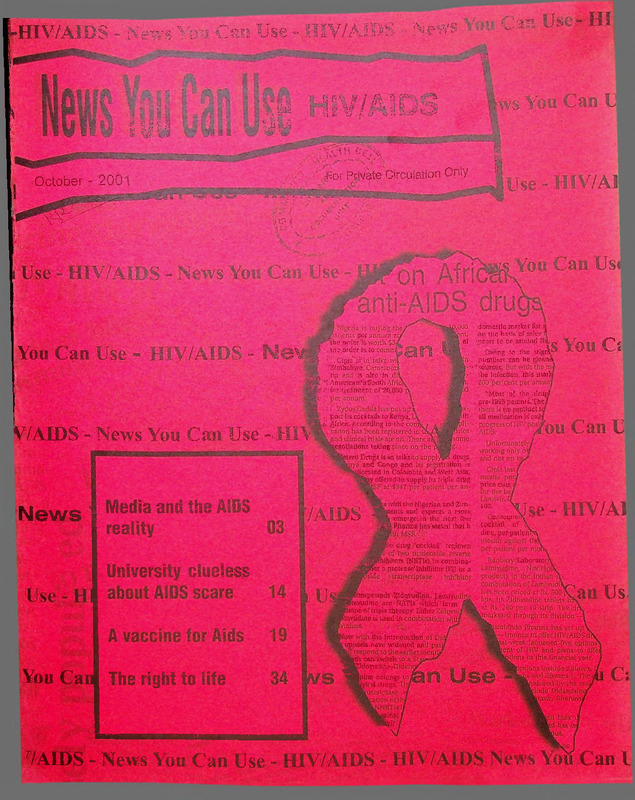
NEWS YOU CAN USE HIV-AIDS OCTOBER 2001
Item
- Title
- NEWS YOU CAN USE HIV-AIDS OCTOBER 2001
- extracted text
-
•hiv/aids - News WWfW MWAWS wWW
— -MBw*wlk
7®
1
.S
&
o WWDS:
.»-S
»■#-•
«
12 $4
w
•yyrj
W5KW^.
■.
-■' • 1 ■ ■
'
■- - •,. ■...
.
.•for Private^ C'rciJiatipn Only
■'■W&fober- 2001 ■
•:
.•..
< >. ..
Ct«4L7 • Ti>
®?>
•domest Ic market for (j ;.
- ■ •. I
•on the ba*;lK of sales-:i . . _ • , .
of ;j)cars to bo around Ha,^
£f~'' <f
.- Owing to the sGgnl^ K <1*
i
■ nuni.Uerc .'can-he. gleanA ' ■ ■’ . ■'’•
■
^duree^► .•■''. - I
.''■■■-ihe infccUon,.'.this ntar1(3
■ ■''■■■ '■":■ ..
<■ .v?.-•;1<< ^'.
.-."Mbsf :rbf.Ahapciiug/ '■:’£.'' ■' ■•. I
?p- ^?pre? lHt<5paicn!^'^^. / / Pv; •:
Li
acr
ihc jjnfcrjl^
MS.; ,• thp.prddr, is.
to
s.Cd'cqmh»
OOf“ NeviIwRjy ;-C©ji;'M
ix^ftdkXS
-.^nlbaljjYei
S& \fi.a'
S.dlso?)^
KH ',hj\niencajit;la'SQUtK1,,
^2’>’\for:^cdcment.of2^qOG.
K '■ I:; a
<<po-ks.'cdcktiur5 to Kenya,
^^l^.^frico;: according to-the;'idic
y^ffiDi^®^s'X^U:CariUse‘“<HlX
$BiWWM{w
’h- aUmedication 5.<orJj
“
’-• :■■ ' -
u
'some
jgegqtlatidns taking
ketprpj&hgitison uik£
drugs.
doh is
W^K^essed -in Co/omhlafand^West .A.$ia<
■• ''l^yoffered'to supplj’hs triple drvg-Anti' GOOgO ^110 - 4<W .A»•'***■• •
’?>; -li*p
^hcs-cyis;¥<;:
L;. 7 -
*’ •
News
^^if^h4The'4|M
realty w
. _ • .‘.'^fesis'ith theNigcrjan.andZwngjj
• ’JfigtenU and -expccn* a more;
. ’ Js C? •_
emerfic.ih the. next • ft*w
.: • ’ . *^®.Phannalia9;t>’aiccl thaik •.epekliulf. of X
dinq, pcr pailcnhn ‘ •' . >
. . ;. _■ '.
■.•■•f'”’^v c°.-. v '
jMpio’ drug.-'cocktaU’ regimen
attOSSW^o
'. • ‘ _^^^b'?bitGrs (blRTlej.ih combina*
'/■)(^M^r'ft^rouias4)'inhiUitortRD dr a
‘“..ySse?SWiM
^!f^.
.
'^8®sSXy^^? • '■:
:\
^bprat^ji \*x
.-«,_ r. ... r.. ..,„...
®9s<
|M^oBtppund$^ldQVM^ha;pirnvyi
■rK^ditio^Kr--'tW&r$hWi form:
Kdojiu of triple th emo v- Either
Kt^vddine:i<ii&ed.'^:
Wow
'^Wiapucfjcjn ofDii
!|fcurol>fndo .Pharma ha.< set up \
^L~-(mum?sjtapffcrH57AI0$di
Kspp^'tn^^wUw^ral1
1|^rf8-rati4fr|tch
You Can The right to life
itlorisin*
Wt£®KS^L
ilSISfflg bcl ongt
- iBlx1 1 drugs -’
MUK-eii; by ihc cjwj
■lu<lc Dkianosiny
|pav»r, Hitbnirvj/
ralhst
;hl.W
hdKast
Kw£
VAIDS- - News \k)u Can Use - H.IV/A1DS
0»j
Or<
News You Can Use - HIV/AIDS
tNYCU) is a specially formulated
m»>nthl> mediascan on i^ucs related to
HIV.’A IDS compiled to meet the
specific information needs trf NGOs
Directed to meet the urgent need for
As a part of a regional initiative to
intormation and aw areness building on
build awareness on HIV/AIDS,
HIV/AIDS. this special publication
several
presents acompilation of news clippings
undertaken by PLAN 1 ntemat tonal
on the issue We hope that the contents
I Bangalore Zone) in partnership
will provide readers w ith relevant.
with Madhyam. Dissemination of
useful and topical information to
information to NGOs is a key
facilitate grassroot work on prevention.
component of th is campaign This
v are and networking.
publication is at me d to strengthen
The publication include-, a selection of
newsitems/featurcs/artidex/edito rials/
letters
from
leading
national
newspapers Eavh newsitcm carries the
efforts
ongoing
have been
efforts
through
information processes as well as
serve as a regular reminder of the
urgency to addressing the issue.
Tins publication is supported by
placed under appn>priate categorles for
PLAN
easy reference
Madhyam.
Team;
Shannon Das Gupta
3 C*
Shobtta C
Surek.hu P.K
News You Can Use is compiled and
published by Communication for
compiled from
X The Times of India
X
Hindustan Times
X The Hindu
X The Statesman
name and date of publication and is
hjt Abraham
This edition has been
International
Fl AN
INTERNATIONAL
and
X The Pioneer
X The New Indian Express
X Deccan Herald
X Deccan ChrpuKiie
X
Lhe Economic 15®^*
X
The Asian Xge
MADHYAM
1'mnmnnication for
Development and
:pg
IUA. ” Cmts. T* Main P’
Deveiopmeni and Learning.
Block Rangitore 5600"’
Ph iO«m 5524192
-a ,
enud* ixift>u®bgt vmii nw 1
—
Bangalore
VRL : * ww cdlblr arg
/
FROM OUR READERS
The effectiveness of any message conveyed or communicated is reflected
by the extent to which it prompts the receiver to respond. The encourag
ing responses received, has proved this effort fruitful. The responses were
from different NGOs and individuals where they found the publication
useful in research, conducting workshops, maintaining data base etc.
Here are the excerpts of few selected responses that we have received
from our readers.
“
We conducted two sensitisation workshop on HIV/AIDS for religious lead
ers and Dhaba owners .We request you to kindly publish the news about these
two initiatives in your" News You Can Use-HIV/AIDS “
Family Planning Association of India, Bhubaneshwar
“NYCU gives latest information on HIV/AIDS which has helped us to increase
our knowledge “
CARDTS, Mangalore
“ We are publishers of sex magazine-Abhisarika (Telugu), which also carries
articles and news on HIV/AIDS regularly. We request you to kindly send us your
publication “News You Can Use”
Dr. DVR Poosha PhD., Samalkot
“ One of our main focus is the PSH project where the target group is commer
cial sex workers in the twin cities of Hyderabad and Secunderabad. Our main
objective in this project is to give knowledge about STD/HIV/AIDS
We ap
preciate the steps taken by you in bringing out media scan. It is interesting to
have all the collected details from the newspapers as a magazine” Integrated
Rural Development Services, Secunderabad.
“We are an NGO working on HIV/AIDS. So the publication will be very useful for
our information..."
GAP-ISRCDE, Ahmedabad.
“Thank you for the “News You Can Use HIV/AIDS and we found it highly useful.
Please do include the story I am enclosing in your next issue of “News You Can
Use-HIV/AIDS”
SEEDS, Guntur.
X
“...Thank you for bringing out the newsletter' News You Can Use-HIV/AIDS’. It
is really helpful and informative. Thanks for putting so much of efforts in collect
ing
and
selecting
the
clippings
from
different
periodicals
“
Concern for Working Children, Bangalore.
“ Please send details of awareness programme for people subject of HIV/AIDS
.We work in rural areas of M.P
”
Nav Jagrathi Sanchar Manch, Hoshangabad
“We really appreciate the work.lt will be a handy book to know about the various
paper clippings or articles published in various leading newspapers in India on
HIV/AIDS. Nrityanjali is a non-profit organisation working on STD/HIV/AIDS for
the past 3 years. Under the guidance of DFID we could conduct targeted inter
ventions in slums of Hyderabad and Secunderabad. You could give publicity to
our activities in your NYCU-HIV/AIDS
”
Nrityanjali Academy, Secunderabad.
“ I was thrilled to see “News You Can Use-HIV/AIDS issue....I have been col
lecting newspaper cuttings since many years....now CDL team has saved our
time and made the news available in one compact magazine .My heartiest con
gratulations to your team for this much needed tough job.
Dr. Geeta Bhave,Mumbai.
“
We are NGO and our activities are related to AIDS and Cancer we wish to
get each and every copy of your publication regularly to enable us to get infor
mation about AIDS “
The Human AIDS & Cancer Control Society of India
Thiruvananthapuram
“
News You Can Use-HIV/AIDS, contained some excellent material..."
Allison Drynan .Canadian International Development Agency.
TABLE OF CONTENTS
OCTOBER- 2001
Analysis
Cities change their social fabric to cope
with the disease
Media and the Al DS reality
Far from positive
Ribbon or Ribb-off?
The right to life
‘Untouchables’ in modern India: A long way
ahead for...
Spotlight on population problem
Going for the gonads
35
40
48
Cue from China
‘AIDS sweeping through Asia’
AIDS on the rise in Orissa
Female foeticide on rise
‘Punjab, Haryana lead in selective abortion’
Births, deaths, Who cares?
More Germans Opt for Life Without Kids
Population meter ticks slowly in MP
Data
07
17
18
21
30
39
44
45
01
03
05
13
34
Drugs / Industry
Coal-based drug for AIDS
12
US panel backs Gilead’s AIDS drug
17
Glaxo AIDS drug rights goto SA firm
19
Cipla appeals to SA body on rivals’
anti-AIDS -drug...
23
India for cheap anti-AIDS drugs
24
Hyderabad firm to make ‘herbal Viagra’?
36
Imunus offers drugs for AIDS treatment
36
Aurobindo expands anti-AIDS basket
42
A Pregnant Pause
43
New AIDS drug
48
War on AIDS
Moronic measure
Prickly Issue
Census pointers
Editorial
06
10
18
25
Feature
The World of dais
02
University clueless about AIDS scare
14
Money buys abortion rules in Govt clinics
29
Male to order
Where have all the girls gone?
Vitamin D & breast cancer
Making babies
The HIV virus and oral health
Realising the dream
31
46
Information
17
20
36
38
News
Distributing condoms doesn’t ensure usage 09
A unique women’s meet
09
AIDS meet
10
Boy or a girl? US ethics panel sees parental
choice as ...
15
Vietnam barbers spread anti-AIDS
message to people
15
When the world maps fear, look we
measure pleasure
16
Sex worker’s kids in blind alley
16
AIDS victim kills family
17
Sex workers to form union
17
25 vending machines to be set up in Delhi
18
Tackling A! DS costly
18
Resolution on HIV testing for sex workers
scrapped
22
Doctors guilty of sex tests will be barred
25
Doctor claims cure for AIDS, moves court
26
Sex test of foetus banned
26
Hind Latex to set up packing distribution
centre in Dubai
26
Police, NGO team up to reform, rehabilitate
sex workers ...
27
Couple end life after hubby tests HIV
positive
27
Rani’s ’friend’ is HIV positive
Case against magazine for advertising
sex test
Expert calls for education in sex from
primary level
Bangalore NGO bags award for action
against HIV/AIDS
More people in Taiwan have munprotected
sex...
TB clinic for prostitutes
Solider sues Army for declaring him
HIV-positive
Shah flags off anti-AI DS rally
Mass circumcision drive in Indonesia
‘AIDS will bring down India’s GNP’
Our rights are human rights too, chant gays
Focus on mother to child infection
’HIV tests for all truck drivers’
27
28
29
30
30
32
32
33
35
37
42
Programme
24
24
Question and Answer
The body in question
17
New dreams replace a lost childhood
47
The genesis of an epidemic
Praneem an effective spermicide
A vaccine for Aids
Research
11
12
19
Breakthrough in AIDS vaccine is a long
way off
23
Sperm protein to lead to new pill
New infertility cure in Britain: just
swap womb
26
‘Surgery can cure intersex defects
28
Unique sperm protein as contraceptive
Determining spread of cervical cancer
An issue close to the heart
Baby vs Govt
How biotech can engineer corn
contraceptives, edible...
Slowing Down Sperm for Birth Control
New doubts about premature babies
30
32
33
33
therapy
25
37
44
45
Scheme
Govt to launch new scheme against
AIDS in Jan
22
Cities change their social fabric
to cope with the disease
By Kalpana Jain Timos Nows Network
While Manipur may have found itself in the
Indian epicenter of the AIDS pandemic because of
NEW DELHI:The doomsayers may not have been its large number of intravenous drug users, whose
quite off the mark, at least in Imphal: the increasing sharing of syringes made the spread of HIV so easy,
numbers in mortuaries, long waiting lists at care the ways in which the disease has spread now are no
centres and insufficient beds in hospitals, tell a grim different from other cities in the country. HIV is
story of a society hit by HIV, even as the lives of now being primarily transmitted through heterosex
those left behind illustrate how a city changes its ual contact
So, the only way in which Manipur is different
social fabric to cope with a deadly disease.
Young widows are moving out of their homes, from other states is that it has accepted the reality
even before the mourning period is over, searching of the epidemic and found ways to live with it.
for jobs or support groups that can help them find a Other states are either struggling in their efforts or
way to bring up their children; the state itself has refusing the accept the problem even though there
started encouraging people to go in for pre-marital is heavy concentration of cases coming from not just
sections of society seen to
HIV testing and infected
be indulging in high-risk
young men have taken on
behaviour. For instance,
the role of community ► Pre-marital testing for HIV has started
Arivoli lyakkam. the organ
mobilisers to create aware
► Widows have organised Into groups_______
ization running (he Tamil
ness.
Nadu government’s aware
Several ‘Widow Groups’, ► Private labs are giving HIV-free certificates
ness programme, estimates
as they arc called, have come
up in Manipur in recent times, teaching women how that in Namakkal district alone. 10,000 people arc
to face life—whether it is learning a vocational skill infected.
or coping with the mother-in-law. Most of all, they
Hundreds of widows gather here for meetings,
check women from indulging in self-pity while holding their children, most of them infected, in
ensuring that they take better care of their health. their laps. While they may not yet be organising
Indira Devi is the president of one such group. themselves into groups like in Manipur to live a bet
called HOPE. Horizon of Prosperity and ter life, HIV is speeding up a process of change.
Education.
There are, for instance, demands for HIV-free cer
She was a reticent young housewife till some tificates before marriages are arranged. Several lab
months ago. But her husband's recent death has oratories have sprung up to conduct the tests.
compelled her to take on a different role. “My hus
In the coastal areas of Andhra Pradesh, such as
band passed away last month. I felt a sudden feeling Samalkot, families coping with HIV, arc being
of emptiness. With such a group, we all feel that we required to pull children out of schools. In one such
are get cared for.” says this young widow, wearing case, a 14-year-old boy in this district was selling pota
the mourning dress of a pink phanek and a white toes in sheer desperation. Perceptible societal
doth draping her upper body.
changes have started taking place almost everywhere.
The Times of India
21 September 2001
NYCU - HIV/AIDS
1
I
2
death by drought related starvation, trict, dais are trained at the Shodthe whole government office hgram, a health and research centre
descends on our village to find out run by the NGO, SEARCH. The genial
who died and how. From Panchayat trainer Dr. Baituley says they first
Pradhan to Collector, all are made tried training the partially trained
answerable. But each year dozens of Auxiliary Nurse.Midwives (ANMs) but
young, healthy, women die in child their superiors resented it. They were
birth, and not even a leaf falls. told the ANMs were required for
Everyone says this is the lot of a lugai "family planning” (read sterilisation)
(woman). Then they get the man and immunisation work. So eventu
another wife.”
ally, they turned to the illiterate dais,
If, to gather knowledge is to gather the only birth attendants available to
pain, as the wise voice of Ecclesiastes the poor living in far off villages. The
tells us, then to talk to village dais is to same applies to workers of ARTH in
gather a whole harvest of pain and far away Rajasthan, and workers of
neglect. This knowledge comes not as ADITI in Bihar. All these health
a whole, organically constructed researchers and trainers realised that
matrix, but in pieces. It is like trying to though training these semi-literate
understand a fistful of little shards dais into correct and basic birthing
and bits of paper that may once have •techniques is rife with problems, their
carried precious but long lost formula reclamation and reinduction into the
perfected in some bombed out lab. mainstream of healthcare is essential
Most dais today are illiterate, poor if millions of maternal lives are to be
and belong to lower castes, because, saved. Births, like deaths, do not wait
as they tell you, birthing is a dirty job, for governmental policy changes or
full of blood, sweat and pain. They sensitisation of the healthworkers. On
acquire an aura of holiness through the other hand, our formal medical
their ability to assist the birth of a new systems, by a sensitive and humane
life. When they come to deliver a interaction with the world of the dais,
baby, their word is treated as law, and may gain valuable insights into areas
their touch does not pollute. But that can create simple and inexpen
although they can prescribe herbs sive health initiatives for women.
and oils and preside over normal
It is not simply the depth of the
birthing rituals, in cases' where the problems the dais and their clients
birth is difficult and requires surgical face everyday, but the strange for
intervention or transfusions, they are bearance and compassion with which
helpless and clueless.
they try to make the best of a bad situ
lassi ben and her daughter-in-law ation that makes you look at them
are a good example of this. They form with respect. Our women, especially
a team from Madhav Nagar village. the poor ones, refuse to compartmen
She said before they were trained by talise their experience of their own
the doctors from SEWA, they too knew and others’ motherhood, into joys
little and subscribed to local supersti and sorrows to be celebrated and
tions regarding birth, such as:
mourned separately. For the dais, as
★ The pregnant woman must eat for millions of Indians, the mysteries
very little and not eat sticky food like of life and death are whole mysteries
bananas, milk and buttermilk, that where spiritualism and physicality,
“cling” to the bacchedani (uterus).
joy and pain co-exist. Their search for
★ Mother’s milk was "bad” in the well-being and relief means a
first three days after delivery and had stretching and deepening of one’s
to be discarded. Meanwhile, the baby commonsense and kindness and
is to be fed a mixture of water and gur, women’s ability to stand up to pain.
★ The mother was "unclean” after Despite the blood, sweat and tears
birth for three weeks, so she must stay when the birth of a healthy baby is
in her room and not bathe. A hole was announced, joy warms up the mother,
dug in a corner for defecating. The the dai and all those around hen
“Mother-in-law is here, the hus
room at the end of the "unclean”
band’s sister
period began to stink like a sty.
Too shall come at noon, the
* The woman's body is a large sack
brother’s wife in the evening.
inside which the organs float. If the
With sandalwood paste and colours
labour is long, chances are, she has
Come all, O women ofmy village,
sucked up air and the baby is lodged
- and celebrate my baby’s arrival. ’’
in her chest and must be expelled by
(Traditional Zachcha song from
the dai bearing down on it.
In Maharashtra, in Gadhchiroli dis MaJwa)°
MRINALPANDE
!
T is a large room packed with
women who have come to the
of
Traditional
Birth
Attendants
(TBAs
or
dais),of
called
byTaluka
SEWA
Shisha
village
Sanada
to attend
aWomen
meeting
(Self in Gujarat,
Employed
’s
Association). These women have
been
delivering
babies
for
generations, and the hunar or the art
they have, is usually passed down
from mother-in-law to daughter-inlaw. Approximately one million
women are said to be working as dais
in India. In the urban areas they still
attend to almost 60 per cent of all
births, whereas in the rural areas, the
percentage goes up to almost 90 per
cent. They all belong to the areas
where they serve and share deep
ethno-cultural ties with the women.
They are mostly paid in kind because
in the villages cash is hard to come by.
The earnings come variously: in the
shape of grain, jaggery, saris, blouse
material or garden produce. The
quantity depends on the economic
status of the family and the gender of
the baby. “If it is a boy, and the
firstborn at that,” says Gomat ben,
“families pay the maximum. But if it is
a girl and a third or a fourth one at
that, then there is rona-dhona (crying
and wailing) that the dai just accepts
whatever she gets and leaves.”
Gomat ben is a matriarch of the old
school, but is open to new ideas, espe
cially on midwifery. A mother of five
sons herself, she works both on her
farm and as a healthworker. She says
she has gained much by being trained
by the doctors from SEWA. She and
her fellow birth attendants now
realise how faulty and hazardous
some of the old practices of delivering
babies were. Maternal mortality was
very high, and childbearing for
women, Gomat ben says, was like a
trip to narak (hell) and back. Through
all this, families stood by and waited.
A woman’s lot they said, was such.
Diane Smith, a Canadian nurse
midwife, training dais in Tamil Nadu
at a health centre run by another
NGO, RUWSEC (Rural Women’s Socio
Educational Centre) was appalled at
the general indifference to maternal
well-being in India, particularly in the
rural areas. "There is a lack of forensic
thinking in villages relating to child
births. Stories told about deaths are
just accepted,” she wrote in a journal
(International Midwife - Winter,
1998). In Rajasthan, another village
healthworker told me, "If there is a
The Hindu
24 Ju n e 2001
The world of dais
Media and the AIDS
•
woul lose what little support they reporting that reflects (here is feeling
would
hadiif they disclosed their status. He behind it he said." Mr. Chandan
had
also spoke of how respondent after Mitra, Editor of the Pioneer, felt that
respondent had wondered why the the focus should be on individuals
media rarely came to their rescue by and “the human dimension of the
J
focus
focussing
on the positive rather than issue" and cautioned against “obfusT is a well known fact that the negative aspects of HIV/AIDS. eating the issue by talking about
HIV/AIDS is a devastating Particularly harmful him was the use larger issues like, poverty, malnutrivirus, that knocks the bottom of wrong terminology, ^especially tion and ignorance, which cannot
"
. _ ,in ..the
really «_
be------resolved
out of economies, plays havoc when phrases like “AIDS
near future, rather than
with the lives of those it claims patient" and “terminal
the specific problem."
- an estimated 3.86 million in stage" were used for
But. it was also
India
alone.
It
has
serious those leading full and
repeatedly stressed that
ramifications that go beyond the useful lives.
The findings of the
reportage cannot be
health sector to include development,
simplified to a lack of
depredation, vulnerability and scores media monitoring done
expertise, insight or per
of other ills. The question before the by the Centre for Advo
ceptions. Mr. Oindrila
editors and senior media people who cacy and Research
Mukherjee
of
the
attended National Consultation on (CFAR), however, was
Statesman, spoke of how
HIV/AIDS and the Media, jointly that while the coverage
she was convinced of
conducted by UNDP Regional-SSWA may fall short of the
the success of the innov
and the Centre for Media Advocacy expectations and needs
ative Sonagachi project,
and Research, (CFAR), in New Delhi of the affected, there
a collective of commer
last week, was whether the media's was no denying that
cial sex workers, but was
attempts to remove the myths and when looked at quanti
it
was
unable to either show
misconceptions that cloud the tatively,
case it as an unqualified
disease and place it in the context of significant with a fair
success or counter the
development and peoples lives had share of compelling
criticism that was being
copy that attempted to
been significant and adequate.
levelled against it from
The consensus among the journal instil a sense of imme
other quarters because
ists was that ethical guidelines ought diacy, commitment and
of the non-availability of
to be evolved for both reporters and responsibility. But while
any impact assessment
copy editors and that trained and spe that may be so, the
data. Similarly, Ms.
also
cialist writers alone should cover the monitoring
Sathya Saran, Editor of
HIV beat, journalists could be put revealed a felt need for
Femina, talked of how
through an intensive training before reshaping the prevailing
she was keen to target
they write. The tone of the delibera news gathering and
her young readership
tions was set by ,Dr. Nirmala reporting processes so
and share information
Lakshman, Joint Editor of The Hindu. as to enable and
on different aspects of
In her inaugural address she spoke of encourage the kind of
sexual health but was
(he need for the media to partner the inforr d writing and
unable to do it because
work being done by governments and perceptions that this
of the lack of empirical
NGOs and to see whether “our preoc issue requires.
data and the fact that
The editors were of
cupation with a different kind of
women's
groups
journalism deters us from bringing the opinion that this was
thought of her magazine
an issue that should be
these issues to centrestage.*
as anti-women and one
The positive groups, however, had reported without bias to
that catered only to
their own experience of how the issue any particular commu
bimbos. Meanwhile, Ms.
should be centrestaged with sensi nity or way of life. Facts
Kai pan a jam of The
tised and focussed handling of the and details should be
Times of India, Delhi,
concerns of the affected, rather than checked and rechecked
while agreeing that the
just dealing with the virus per se. because any distortion,
media did tend to sensa
Ashok Pillai, perhaps the best known misinterpretation,
tionalise and
even
face among them, referred to a breach of confidentiality
sample survey recently conducted by or sensationalism could result in exploit the traumas of the affected for
the Indian Network of Positive People untold harm to the affected. Mr. D.N. the sake of good copy, said that during
to stress on the concerns of the Bezboruah, Editor of the Sentinel, extensive travels across the country,
affected: Of how the stigma and dis lamented that the charges often made she had found that "these traumas"
media of “false,
inaccu- were in fact a reality
as was
the,—
phecrimination created by exaggerated, against
-<>------ --the
—----------------- ----------------------------------------z —
---------and often outdated, statistics, under- * rate, uninformed and insensitive nomena of AIDS victims. What is
statements and sensationalised reporting" was in fact valid. "There is worse, many of them were not only
reports resulted in the affected shying much the media can do about the confronting the inevitable but were
away from the media for fear that they kind_ of positive, correct, sensitive also suffering for no fault ofjheirs. Contd...
reality s
NYCU-HIV/AIDS
3
Contd...
The National Consultation on HIV/AIDS and the Media held recently
in New Delhi was a forum for editors and journalists to discuss the issues
that revolve around the disease. The concerns of the affected too were discussed, as
was the need for reviewing the news gathering and reporting processes to enable
informed, sensitive reporting on the subject A special session on the epidemic will be
held by the UN General Assembly in New York between June 25 and June 27.
Even when confronted with the possi
bility that they could have been
infected by their partners, they seem
to accept their fates with stoic resig
nation.
Participants also brought up the
many limitations they had to cope
with while dealing with this issue. Of
deadlines that left them no time for
research or to check details and pro
cure informed consent, and of the
rush, especially among television
channels, to be the first to flash the
news which made it well nigh impos
sible to maintain confidentiality.
Unfortunate misinterpretations by
those translating for them, was also
seen as a problem as was the paucity
of updated statistics and the reluc
tance of officials and those in the
know to reveal details.
Earlier, Mr. Swarup Sarkar, head of
the inter-country team for South-Asia
of the Joint U.N. Programme on
HIV/AIDS, (UNAIDS), spoke of how
20 years into the epidemic, "Not many
seem to realise that this is going to be
the biggest killer of the adult popula
tion in the country over the next ten Source: Surveillance data from NACO, 2000
years, perhaps more than all the wars
that we had fought put together."
HE United Nations General Assembly is holding a special
According to him there are pockets
session on HJV/A1DS at the highest political level between
where the epidemic is of African pro
June 25 and June 27 in New York. The special session’s focus
portions - where prevalence is over
two percent - a fact that is rarely high will be on intensifying intern ati o nal action an d to mobilise
lighted. What is worse, we know that resources to fightthe epidemic. At the session, governments are' those who have information and expected to adopt a Declaration of Commitmeht, setting targets and
choices can protect themselves from timetables to fight the accelerating epidemic.
exposure and the most vulnerable are • t UN Secretary-General Kofi Annan and government delegations
will address various issues relating to AIDS, Including incresing
those whose choices are limited. Yet,
resources for treatment, the importance of political leadership to
as Ms. Barbara Brar of the United
Nations Development Programme deal with the issues thrown up by the disease, preventing new infecpointed out, nothing was being done .tjons arid access to affordable and accessible care. •
to "generate the conditions in which the Prime Minister, in his IndepenThe Hindu
people are empowered to protect dence Day speech, had described
June ZUU1
themselves from infection and the HIV/AIDS as one of the three most
effected are empowered to live with important issues confronting the
dignity in society."
nation, no Indian leader will be pre
The raison d’etre, Sarkar felt, was sent when world leaders meet at U.N.
under-funding by donors, under General Assembly Special Services
spending by governments and the fact (UNGASS) later this month to discuss
that India appears to be unconvinced the worst epidemic in 400 years? •
and unconcerned of the many ramifi
SHYAMALA SHIVESHWARKAR
cations of the epidemic. How else
could you explain the fact that though
B
NYCU-HIV/AIDS
0
Far from positive
Trr one looks at a map
lion population, this low rate translates into more
I showing the prevalence
than 3.7 million people living with HIV/AIDS,
jg
I of HIV/AIDS around the
which makes it amongst the highest number in
M •£>world. South Africa is
the world. But India is still to wake up to the full
gravity of the situation. HIV positive patients do
shaded in a deep, dark
\O F
colour, while India is a pleas*
not receive adequate medical attention since even
medical staff are still to understand the disease.
.
ing lighter shade. However,
Several cases of AIDS patients being thrown out
when the map shows the
of hospitals have been'
jL wlnumber of HIV/AIDS affected
reported, especially
people, the colour marking India will be just
from states which
a shade lighter than South Africa. Despite the
have a low incidence
high numbers, which incidentally are also in
of HIV patients.
dispute, there is little AIDS awareness in the
Incidentally,
country. Nor is there a concerted country-wide
Bangladesh with a
programme for prevention of the disease.
lower incidence of
Meanwhile, UNAIDS and the National AIDS
AIDS, has acted more
Control Organisation (NACO) in India contindecisively to stem the
ue to quibble over the number of AIDS related
epidemic. The gov
deaths in the country, even though it is ac
ernment raised funds
cepted that ten per cent of world’s HIV infected
for a preventive pro
persons live in India.
gramme
while
The UN is to hold a special session on
Bangladesh Prime
HIV/AIDS in New York from June 25 to 27.
Minister
Sheikh
The Indian delegation to the Special UN
Hasina highlighted
Session will be led by Health Minister CP
HIV/AIDS as a priori
Thakur. Indian stales with a higher incidence
ty item in her address
of AIDS infection arc Maharashtra, Tamil
at the UN Millennium
Nadu, Andhra Pradesh, Karnataka, Nagaland
Summit in 2000.
and Manipur.
Thailand also adopted
Internationally, however, the widespread
an effective strategy to combat its high incidence
prevalence of HIV/AIDS has turned it into a
threat to human security in large number of
of HIV patients. Cheaper anti-retroviral drugs have
countries, and in some cases acquiring the
helped. There is, however, urgent need for fur
proportions of affecting national security. The epi ther research and development for an HIV vac
demic was taken up as a subject of concern by cine and better treatments. According to the UN
the UN Security Council since early 2000, when AIDS. one of the surprising lessons learned is that
it was sent as a threat to global peace and secu efforts to expand access to treatment, care and
rity in several regions. UN Secretary General Kofi support for HIV-positive patients, often has the
Annan has named the battle against AIDS as oue
effect of spreading
of his personal priorities. About a year ago, the
wider health re
Security Council passed a resolution that stressed
forms and improve
the need to combat the spread of the virus, es
ments in those coun
pecially during peackeeping operations. It was de
tries.
cided at that time that a special session of the UN
The reason why the
be held a year later in New York.
Security Council took
“I care...do you?” has been adopted as the slo
up tiie issue in a big
gan of the World AIDS campaign 2001. HIV/AIDS
way was that links
has spread to every part of the world in the two
between AIDS and
decades since awareness has grown about the dis
issues of security are
ease. There are an estimated 36 million people
many. The epidemic
living with AIDS in the world. It has served to
destabilises societies
widen the gap between the rich and the poor and
in several ways. The
undermined social and economic security in the
effects of the epi
countries it is prevalent. Sub-Saharan Africa is
demic
cascade
the worst affected region, which has had three
through society, re
times the number of deaths due to AIDS than the
ducing the income
rest of the world. More than 25 million Africans
levels of the people.
are living with AIDS. In southern African coun
thereby weakening it
tries, about one-in-five adult is HIV-positive.
and undermining the
There is an alarming increase in its incidence
social fabric of the
in heavily populated countries of Asia. Statistically,
country. Studies have shown the disease's dra
the prevalence rate of.HIV/AIDS is low in India,
matic impact on the economic and develop
at about 0.7 per cent. But, given India’s one bil
mental indices in several countries. It has been
Contd...
NYCU-HIV/AIDS
5
Contd...
estimated that GDP growth shrinks by about
two per cent in a year in countries where the
prevalence of HIV is more than 20 per cent.
Over several years of the epidemic, the loss
of economic output adds up on an alarming
rate. Unlike popular impressions, HIV is not
a disease of poverty; it affects both rich and
poor people in underdeveloped as well as de
veloped countries. However, poverty reduc
tion can help reduce people’s vulnerability to
the epidemic. For the disease pushes people
deeper into poverty, making it difficult for
them to maintain their livelihood at the same
level.
The epidemic increases the strain on state
institutions and resources, and al the same
time undermines the social systems that help
the people to cope with adverse conditions.
This can lead to social and political instabil
ities in these countries, as AIDS thrives in
places with high degrees of socio-economic
insecurity. In the worst affected countries in
Africa, it is said that HIV is spreading fiislrst
among young women under the age of 24
years, as they have less access to means of
protecting themselves. Recent studies in
some African countries have revealed the star
tling information that adolescent girls are six
to seven times more likely to be HIV-positive
than boys of the same age.
The use of rape as an instrument of war and
repression adds another dimension. In conflict sit
uation, children and young adolescents are es
pecially vulnerably to HIV/AIDS, as they face, high
risks of sexual abuse, forced military recruitment
and prostitution. Conflict resolution and peace
keeping measures are important elements of
strategies designed to contain HIV/AIDS. with an
urgent need to step up HIV/prevention and care.
in armies and in international peacekeeping
forces.
Around the world it has been noticed that pre
venting HIV infection is the first line of defence
in the fight against the AIDS epidemic. The twodecade experience in countries as diverse ns
Brazil, Thailand and Uganda has shown thai de
termined efforts towards prevention, which in
volve communities and the support and care sys
tems, can be fairly effective. The example of
Uganda is striking; it conducted a determined pre
vention campaign to control AIDS with the result
that the HIV prevalence- rah* among teenage girls
in capital Kampala dropped from 28 per cent in
1991 to six per cent in 1998.
While the world is getting increasingly con
earned about AIDS, the Indian response has r<*
mained lackadaisical. Our health system is in com
plete disarray. A more committed, heller
dinated and focused programme to prevent •’ .•
increase of AIDS needs to be formulated.
Shubha Singh
The Hindu
26 June 2001
WAR ON AIDS
THE global community has at long last declared a war on AIDS
and has set deadlines for winning it. The declaration adopted by
a special UN session in New York on Thursday is truly historic
for three reasons. First, nations have got together for the first time
to launch specific time-bound, universalised and targets-oriented
collective action to contain a dreaded disease which has already
claimed 22 million lives the world over and is threatening the
lives of another 36 million. Second, the declaration enjoins on
UN member-nations to subscribe to a special fund of around $ 10
billion annually to finance the war as against less than $2 billion
currently spent in developing countries — especially in “low
income and middle income” nations. The fund, to be called
Global HIV/AIDS and Health Fund, is to be created and made
operational by 2005. Third, for the first time again, global atten
tion has turned towards bringing down drug prices drastically so
that they can become affordable. The special session can legiti
mately take credit for successfully persuading major internation
al pharmaceuticals and manufacturers to reduce drug prices sub
stantially. Since even the reduced prices are beyond the reach of
a majority of individuals and nations, government intervention to
subsidise their sales has assumed considerable importance.
Speaking on behalf of India, Leader of the Opposition and
Congress president Sonia Gandhi struck a pragmatic note by sug
gesting that a definitive solution to the HIV/AIDS problem can
come about only through the development of potent therapeutic
drugs and vaccines. Drug research in this critical life-saving area
must be financed through international funding so that the prod
uct, when available, remained in the public domain for use by all
in need. Significantly, global research for finding a sure cure for
the other dreaded disease — cancer — is also internationally
funded, and specialists are speaking with greater optimism today
than say, a decade ago, about a breakthrough in the near future.
The outcome of the special session is of great significance to
India where relative to the rate at which the disease has spread in
the last five years and continues to spread, the campaign to con
tain it has hardly begun and measures to fight it remain peripher
al. Union Health Minister C P Thakur has claimed that fears of a
“runaway” increase in the number of HIV/AIDS cases have been
belied, and insists that assessments of non-governmental organi
sations of higher incidence are incorrect. Even the 3.86 million
cases registered in 2000 AD must be seen to be high considering
that the disease was virtually unknown in India till a decade ago.
However, on the positive side is the hope that since the afflicted
are but a small percentage of the population, the war against
AIDS in India has a good chance of succeeding, provided the pre
sent government and succeeding ones remain seriously commit
ted to containing it If misgivings in this respect exist in the pub
lic mind, it is largely because public investments in some of the
crucial social sectors like health, education, drinking water, sani
tation and child care remain far below the desired levels in the
new economy sought be ushered in through liberalisation and
globalisation. At New York, at the insistence of some Islamic
nations and others backed by the Vatican the declaration deliber
ately refused to identify homosexuals, drug users and prostitutes
as particularly vulnerable groups. However, so long as the pre
ventive campaigns envisaged by the UN session are universally
focussed and targeted, the battle will not be lost, so long as
nations, health groups and services and individuals remain com
mitted warriors in die war against the disease.
Deccan Chronicle
30 June 2001
NYCU-HIV/AIDS
Cue from China
ndia’s first Census of the new century and the pie’s perceptions and attitudes about the popumillennium is over. The data, so gathered, are lation with the expansion in the urban middle class
being processed and the detailed statistics may and educational opportunities available to them.
take some time to be made public. As for now An educated Indian citizen belonging to a midwe are only told that India’s population is about die class family is now much more conscious than
1.027 billion. If these population figures are com- ever before, about the gap between limited napared with those of China, many significant, in- tional resources and ever growing necessities of
teresting and meaningful conclusions may be life. He is also well aware of the possible unhappy
drawn.
and severe consequences of the unabated growth
China’s latest Census was conducted last year in population. That is why more and more peoand it had detailed a population of 1.265 billion, pie are seriously real- ’ *
Obviously, the population must have grown dur- ising the need and
ing the last one year. However, if we take these adopting means and
figures as a point of reference, we find a differ- ways to keep the size
ence of 238 million between the population of of the family affordCbina and India. But this difference is not as im- ably small. But in spite
portant as the fact that China’s population in- of all this consciouscreased by only 132.3 million since the last ness and awareness.
Census in 1990, while India’s population in- when the decisive mocreased during 1991-2001 at a growth rate of.menl of keeping the
21.34 per cent, resulting in an increase of 181' number of children
million people. So, on present trends, India seems under control arrives,
to be on the path to overtake China in total pop- most Indians tend to
ulation at some point between 2025 and 2050. • get overwhelmed and
Although doubts have been raised about the driven by the rcligioaccuracy of China’s Census statistics, yet it is be cultural stereotypes
ing assumed that China’s population might be and considerations of
more than the figures released. There is, how fate and destiny. So all
ever, no doubt that China has achieved a re the efforts towards
markable and imitable success in slowing down population control fail to become a reality, despite
its population growth. One of the main causes all the desire, realisations and awareness about
of this significant success seems to be the strict it. There may be many reasons for it but the dom
implementation of the “One couple, one child” inant one seems to be that there is no such col
policy. Moreover, the campaigns for popularis- lective
_________________________
________
drive about the family
planning or welfare
ing the use of contraceptives and benefits of small J^his country which might' make efforts to confamily launched there with full force also showed troi the population a part and parcel of the peopositive results. It is also a fact that at least dur- p]c’s awareness and the priorities of their life.
ing the last decade, the severity of the popula- The government and official measures about
tion explosion was very seriously felt and taken the family planning fail to go beyond mere panote of in China and, accordingly, the strategies-----—~~
p
--------'P1-----------per
work.
The con
worked out to check the population growth were
cerned departments
effectively implemented at all levels — of the gov
and the health work
ernment as well the people. It means that efforts
ers do precious tittle
to slow down the population grow J were turned
and. if at all. do it
into a people’s movement by mobilising public
without any involve
emotions and support on a grand scale.
ment and rest con
It is quite difficult to say to what extent the peo
tent with updating
ple voluntarily participated in this process and
their files. Not that
how much was the role played by the political re
there is paucity of
pression as the Chinese system is a closed one and
funds. It is a known
is quite impossible to penetrate. As such repres
fact that despite lack
sive measures to curb population growth cannot
of resources in India.
be ruled out but at the same time it will also not
the funds provided
be correct to suggest that the people did not par
and available for this
ticipate in this process at all. Such remarkable
task are such as may
success in population control cannot be achieved
produce wonderful
without public involvement in any measure.
results if used prop
On the other hand a very unfortunate and pa
erly and sincerely.
thetic scenario is unfolded if we look at the pop Obviously, checking population growth will remain
ulation situation and the concerned government an impossible task till there is an intensive mass
policies and programmes, and the way they are movement to make the family planning one of the
implemented in India. There is no doubt that a priorities of life.
positive change has been brought about in peo-
I
Contd...
NYCU - HIV/AIDS
7
Contd...
The non-serious and casual approach towards
the serious problem of the population explosion
is not confined to the governments anil the bu
reaucracy alone. The entire political system in
cluding the ruling party or parties, the opposi
tion and all the politicians as a class is plagued
by it. Undoubtedly, the repressive way the fam
ily planning was implemented during the
Emergency, and the excesses committed, made
it a dreaded thing, which dealt a severe blow to
the efforts of population control. To protect their
political interests, subsequent governments coldshouldered the family planning and this attitude
gradually became institutionalised.
India is no doubt the largest democracy in the
world. The way democratic institutions and tra
ditions had struck roots here during the last 53
years, is both astonishing and a matter of pride.
But at the same time the irresponsible manner
with which we had used certain democratic free
doms is equally unfortunate. Corruption at all lev
els, exploitation, chaos, disorderliness, self
seeking, misappropriations of public resources
and neglect of public welfare are eating into the
vitals of our national existence and the fruits of
development and progress have been confined to
a few "chosen" people.
Many of our political leaders have large fam
ilies and tend to take pride in it. Obviously they
cannot be expected to become role models and
inspire the common man to control the popula
tion. Even the National Commission on Population
constituted last year also includes some people
who do not know the ABC of Family Planning
Programme and its nuances. What can they con
tribute towards such programme. The National
Commission also seems to reflect the overpopu
latedness of the country with more than 100 mem
bers who have still to go beyond routine meet
ings and conferences.
While a national body of this status at the cen
tral level is always necessary, there is no doubt
it can be effective only when its branches off to
reach out to villages and small towns and cities
so that the public involvement and support in the
process of population control could be ensured.
Taking a cue from Chinese experience, it is in
deed essential to evolve a system of incentives and
disincentives in India to make the population con
trol programme a great success. It is in human
nature that people are driven solely by the lure
of incentives on the one hand and the fear of dis
incentives on the other. It is all the more neces
sary because in a country like ours with the lev
el of literacy and awareness that we have the peo
ple cannot be expected to contribute to popula
tion control voluntarily.
(The writer is Editor, Mustaqbil, an Urdu
fortnightly)
SM Shah Nawaz
The Pioneer
29 June 2001
8
NYCU - HIV/AIDS
9
Distributing condoms doesn’t ensure usage
By Kalpana Jain
Times News Network
NEW DELHI: When Shakila dresses up for the
evening in the slums of Vishakhapatnam, the
area pimp. Gopi, smears her forehead with
some dirt from the back of his chappal.This rit
ual is said to keep evil spirits away.
But of late, another ritual is performed: As
Shakila is about to step out into the dark alley,
Lakshmima, the madame, thrusts some con
doms, regularly delivered to her door by an
NGO, into her hand.
Shakila quickly stuffs them inside her blouse
as she breezes out, leaving a trail of cheap per
fume behind.
By the time she returns, Shakila will be a dif
ferent gid, sighs Lakshmima, who has been run
ning a brothel in the area for the past several
years: she would be drunk and mouthing abus
es till she drifts off to sleep.
Whether any of the condoms that she has
taken would be used at all to protect herself
against the possibility of contracting HIV is
anybody’s guess
Gopi the pimp admits that he has lost three
girls already to AIDS and about 25 to 30 have
been sent back to their villages after they began
to fall ill.
. The reality is that the government’s frenzied
distribution of condoms to control HIV spread
ing into the general population, does not ensure
its usage.
While no large-scale studies are available to
show the results of such prevention pro
grammes, smaller district-based studies reveal a
continuing presence of high levels of sexually
transmitted diseases amongst sex workers, a
sure indicator of unprotected sex.
Targeted interventions, as they are called, are
a crucial part of the government’s AIDS control
programme.
So, currently, several crores of rupees are
being spent on making sex workers understand
the mechanics of condom use — right from
checking the quality, expiry date, to negotiating
usage with the clients.
The fact is that almost all sex workers are
aware that they need to protect themselves. It is
just that the choice of usage really rests with the
clients.
Often sex workers are struggling for an
income of Rs 10 to 15 from a single act.
Insistence on condom usage makes the client
think that the woman herself is infected.
She fears losing her source of livelihood, says
Aruna, a sex worker.
And carrying a condom for street-based sex
work is just not so simple: For even as one wing
of the government wants to make their work
safer, another is looking for evidence to
penalise sex workers.
Condoms provide just that evidence.
The success of the condom distribution pro
gramme is measured by the number of sex
workers an NGO is able to reach. Few of these
NGOs bother to find out how well such pre
vention is working.
To ensure that they continue to receive fund
ing, NGOs are eager to show .that targets arc
reached, even though at times the figures that
may not match reality.
For instance. Society for People’s Action for
Development, working with sex workers in
Bangalore, claims to have “ established contact”
with 6000 sex workers, within 15 months or so.
even as several others insist that it is not possi
ble to reach numbers beyond 1500.
This seems to be the practice all over. Numbers
and names look good only on paper.
Beyond that there are issues that need to be
addressed.
The Times of India
01 October 2001
A unique women’s meet
Lesbians, feminists, eunuchs air opinions
From R Umamaheshwari
The highlight of the conference
has been stories of struggle and
Hyderabad Sept. 30: It has been
conviction about altemate/gay/lcsa conference with a difference,
bian sexuality, coming from two
giving voices to people who usual women, one from Pune, the other
ly do not get a platform to air their from Bangalore.
feelings even in feminist forums
Sheeba represented an organisa
and women’s groups meets.
tion Olava (Pune). This is the only
The three-day conference of
forum of its kind voicing the con
young feminists, organised by the
cerns of lesbians. She said.
Hyderabad Women’s Collective, in “Lesbians are seen as perverted
association with Anveshi, has suc people, because normally love is
cessfully brought together women linked with procreative sex under
including lesbians, transgendered
the ‘lock-and-key’ logic. For peo
women and single women.
ple like me, it is a struggle for sur
According to Madhumceta and
vival, with the fear of being
Sunita from the Hyderabad
‘found out’, and then ‘punished’.
Women’s Collective, “This meet is losing out on family, being
significant because young women
forcibly married off.”
need to start talking about staying The story of Famila was as
single, gender and sexuality."
poignant. She is a hijra. She had
undergone an operation to
“become a woman”. She says, “I
realise the problems of women
though I still refer to myself as a
hijra'' Her does not like to meet
her. However, her mother often
does. She says. “People like us
have no right to live, the police
harass us, force us to have sex
with them. Wc are exhibits for the
medical field. Joining Sangama,
an organisation in Bangalore, 1
learnt about my own sexuality and
I am able to talk about it now.”
Many of the young women were
not activists for some just desired
to share their views with a peer
group. This effort is a small but
firm voice giving strength to the
universal call by women for their
true emancipation.
Deccan Chronicle
01 October 2001
NYCU - HIV/AIDS
Q
9
Moronic measure
Condom failure is not related to size or region but use
HE ministry of health is really on a moron
ic ego trip, going by the Express report of
Saturday. The subject of its latest project
on population control sounds more like locker
room chatter than a problem of reproductive
health in an overpopulated, underdeveloped soci
ety. Health ministry officials are, of course, not
the first to come up with this ridiculous idea of
researching the huge diversity in the male organ.
Everyone from the esteemed American sex
researcher, Alfred Kinsey, to amateur webmas
ters has entered the fray to figure out the penis. In
fact, even the ancients were obsessed with the
idea. King Menes was the first true Pharoah of
Egypt and the first to unite both upper and lower
Egypt- He is also supposed to have constructed
Memphis, the world’s first imperial city. But for
the Egyptians he will always be remembered as
the pre-eminent God symbolising male sexual
virility, He was supposed to be a descendant of
half-god, half-human hybrids, created from the
union of over-libidinous gods and the human
females they seduced. Also, in his case, there is
consensus on the moot issue: bigger is better. In
fact, all the later fertility gods — Bacchus, Pan,
Dionysius, Cupid and Priapas — although they
were modelled after him, were portrayed as wine
selling gluttons who simply couldn’t match his
virility.
The problem of India’s health ministry is not
taxonomy. In fact, the Rs 11 lakh they are propos
ing to spend on the project is a pittance compared
to millions spend on such surveys worldwide.
T
The problem is of a deeper nature, one concern
ing a spurious correlation and causation that can
only be termed baloney. To correlate the actual
length of the member with the region of the coun
try, as it attempts to do, is to enter a totally murky
area, one that is not just unscientific and politi
cally incorrect but plainly puerile.
There have, of course, long been stereotypes
about races that are supposedly better or less
endowed than others. There are even the extraor
dinary claims made by people like a Canadian
organ-enhancement surgeon, a certain Robert
Stubbs, who concluded,**! think there is definitely
a racial difference, there are three sizes: black,
white and yellow (Asian), in descending order.”
But does this opinion stand up in the court of sci
entific accuracy? We have the contrary opinion of
the much more reputed physician, Dr Jerald
Bain, who having carried out hundreds of sur
veys, stated that “there is no difference in organ
size from one ethnic origin to another”. He fur
ther argued that as far as the issue of virility is
concerned, “Asian men have clearly populated
the world much more than either black or white”.
No controversy there. As far as the failure rate of
condoms are concerned, that has nothing to do
with either organ size or the region of the coun
try. Surely, their inefficacy in terms of breakage
or spillage can be better explained by the quality
of the rubber and the manner in which they are
handled. Surely, our ministry of health would be
more gainfully employed working on these prob
lems than correlating size with region.
The New Indian Express
02 October 2001
AIDS meet
Staff Reporter
New Delhi
THE MUNICIPAL Corporation of
Delhi (MCD) Commissioner S P
Aggrawal on Saturday inaugu
rated a symposium on “Prevention
of HIV & AIDS and Syndromic
Approach to Sexually Transmitted
Infections” at the Guru Teg
Bahadur Hospital.
The symposium was attended
by representatives from the World
Health Organisation and many
other organisations.
The Pioneer
01 October 2001
10
NYCU-
The genesis of an epidemic
HREE years ago, Dr Beatrice ple.The ’chimpanzee virus looked so west-central Africa - a region where
Hahn got a call from a colleague much like HFV1 that it was almost irre chimpanzees live - as the place where
asking if she wanted some body sistible to think that the animals had the human AIDS epidemic began.
Scientists, analysing the genetic
parts from a chimpanzee that had died a somehow given the virus to people. Its
decade ago. The colleague said, “I have genes were arranged the same way. and sequences of AIDS viruses found in
the spleen, the brain and the lymph it even had a distinctive gene, called patients from around the world, were
nodes in my freezer. I need to clean my vpu, that had never been seen in any discovering that the viruses in west
central Africa were the most diverse.
freezer, so before I throw it out, do you other virus.
want to look at it?”
While AIDS-like viruses were start And it is a general rule that the more
Then the scientist said the animal ing to emerge in other primates and in diverse an organism’s genes are. the
had antibodies in its blood very much other animals, none looked so much like longer it has been around. That is
because as the years go by more and
like ones that people develop when they HIV-1 as this chimpanzee one did.
are infected with the AIDS virus. Dr
Adding to the evidence was a tanta more variations accumulate in an
Hahn leapt at the chance. It was a long lising snippet of another AIDS-like organism’s genes.
For example, Dr. Holmes said.
shot, but it was possible that the long- virus found in a tube of blood from a
dead chimpanzee could be a missing baby chimpanzee that had died. While human DNA is most diverse in Africa.
link in the search for the origins of the fragment was too small for anyone supporting the idea that the human
AIDS. A few days later, Federal Express to be certain that it closely resembled species originated on that continent.
The second line of evidence.was a
delivered a huge box of frozen chim- HIV-1, the genetic sequence from this
panzee parts, packed in dry ice, to Dr second chimp lined up exactly with a plausible way for the virus to get from
chimpanzees to humans. People in west
Hahn’s laboratory at the University of piece of the first chimpanzee’s virus.
Alabama at Birmingham, where she is a
But soon the picture became cloud central Africa eat chimpanzees. It was
professor of medicine.
ed. A few years ago, scientists, found a entirely reasonable to think that an
Three days later she had her answer, third chimpanzee with an AIDS-like infected animal's blood gave the virus to
That chimpanzee, which had been virus, but when they analysed that a person who was handling the chim
healthy until she died in childbirth at virus, they discovered that it was only panzee meat, infecting the person and
age 26, held elutes that eventually distantly related to HIV-1. So, some setting the stage for an AIDS epidemic.
"People eat chimpanzees." Dr. Hahn
enabled Dr Hahn and an international asked, were chimpanzees really the
group of 11 others to unravel the mys source of the human AIDS epidemic? said. "We expect that transmissions
tery of the origin of the epidemic. It Or were chimpanzees, and numans, occurred through the exposure to blood
was a mystery that took years to solve becoming infected by some other ani through hunting or, preparation of
meat."
and that had frustrated researchers and mals?
the public, stunned by the sudden emer-• Oneway to find out would be to study
Finally; researchers were discover
gence of such a terrible new disease.
wild chimpanzees and see whether they ing AIDS-like viruses in other animals
Some said AIDS was caused by a had a virus like the human form, HIV-1, and other primates in Africa but none
mutant virus, a sort of andromeda whether they had a different virus like were as closely related to HIV-1 as the
strain. Others favoured conspiracy the- the third chimpanzee's virus or whether viruses in the three chimpanzees.
pries suggesting that HIV had been ere- they were infected with a variety of
The only species that fit all the eviated by scientists and escaped from AIDS-like viruses. But the only way to dence as the source of HIV-1 was the
germ warfare labs. There was a Western find viruses was to look for them in chimpanzee, Dr. Holmes said.
medicine disaster theory, which held blood. And researchers could not draw • a scientific paper that Dr. Hahn had
that the virus was injected into blood from the elusive animals with-out published about the frozen chimpanzee
Africans in bad batches of polio vac- running them first with a tranquilizer "was extraordinarily important." Dr.
cine.
gun, and the stunning effort was Holmes said. "It really made people
Then there was a more pedestrian impractical.
■
believe that chimps were the ancestral
idea that people got HIV from primates
To make matters worse, no one could species."
in Africa.
show thaLthe animal with a virus like
Dr Paul M. Sharp, a professor of
Scientists tended to favour the pri- HIV-1 came from the region where the genetics at the University of
mate hypothesis because they knew human epidemic first exploded.
Nottingham who worked on the analythat diseases can jump from animals to
That was when Dr. Hahn examined ses of the viruses, said: “It had been a
people. Dengue fever, Hanta virus. the frozen chimpanzee organs, and the gradual shift in our perceptions. At first
influenza and hepatitis B all originated mystery began to crack. That animal, we had been saying that either chimps
in other species. But. researchers she discovered, also had a virus in its are the source or they are recipients,
learned, it was not easy to trace the tissues that looked like H.IV-1.
like humans." Dr. Rahn's chimp made all
virus causing the human AIDS epidemSuddenly, said Dr. Edward Holmes, the difference, Dr. Sharp said.
ic, HIVI to an animal. And even when an evolutionary biologist at Oxford
Now, researchers say, they have
they started seeing provocative hints University, he and others who had ques- found two more chimpanzees that were
about the origins of AIDS, those hints tioned whether chimpanzees really infected in the wild with a virus like
soon turned contradictory.
were the source of HIV-1 in humans, HIV-1..The animals were among a group
The first evidence that HIV-1 jumped became convinced. While scientists of 29 captured in Cameroon, in the westto humans from primates came about a bad found only two, or possibly three central region of Africa. It would be
decade ago, when scientists isolated a chimpanzees that had the virus, Dr. ideal, of course, to find stored blood
virus from an African chimpanzee that Hahn’s information, added to three from the original people who contracted
very closely resembled the AIDS virus other lines of evidence, was enough.
HIV-1 and stored tissue from chimnow infecting tens of millions of geoOne line of evidence pointed to jpanzees in the same area, and then Contd
T
NYCU-HIV/AIDS # |
Contd...
show they had exactly the same virus. tainly infected humans repeatedly as world’s attention around 20 years ago?
Dr. Holmes said. But, he added, that is they killed and ate chimpanzees over
Her mathematical models showed
the years, but that it is hanl to startan that it made sense. For the first 30 years,
not going to happen.
Yet, he said, there is the virus in AIDS epidemic. For it to develop, the the number of cases would have
chimpanzees, there is the geographical virus must be prevented from dying climbed into the hundreds. As the web
overlap between where chimpanzees with its victims and a steady chain of of infections grew, the numbers would
live and where HIV started, and there is transmissions must occur.
jump, reaching large numbers in Africa
"We think that these transmissions by 1980. At that point, enough people
a mechanism.
"That was it for us," Dr. Holmes said. have gone on forever and a day, for all would be infected that the epidemic
But knowing the virus came from the centuries that people hunted chim would be noticed. That model is particu
chimpanzees left two pressing ques panzees,’’ Dr. Hahn said. "The rule is larly troubling, Dr. Hahn Said.
tions. When did the virus take hold in that these transmissions go nowhere.
“If you say T don’t know how it got
the human population? And how?
They just, peter out, unless you have started; it could have been this, it could
Dr. Bette T. Korber, a molecular additional factors that promote subse have been that,* and if all you need are a
geneticist at Los Alamos National quent spread in the new human host." certain set of circumstances in the
One possible explanation for the beginning so that it doesn’t die out, then
Laboratory, and her colleagues had a
way to get an answer to the question of extensive spread of H.l.V.-l, several sci it could happen again," she said.
when. They had the genetic sequences entists said, was that people began con
"People don’t want to hear that."
of viruses isolated from people and gregating in cities in Africa. There, the
knew when those viruses were found. conditions were ripe for an AIDS epi
GINA KOLATA
starting with the oldest human HIV demic.
New York Times
“If you look at the Population of
sample available. It was from a man in
Deccan Herald
what is now Kinshasa, Congo, in west Kinshasa, it’s an exponential curve
going up," Dr. Sharp said. "During the
central Africa, in 1959
02 October 2001
Since the viruses mutate at a rough 20th century, you have far more move
ly constant rate, the researchers could ment of people into urban areas and
construct a path of how the virus had perhaps changes in behavior." In addi
mutated and determine how long it tion, doctors in clinics in Africa com
would take to move from one virus to monly reused needles without steriliz
another one with the amount of genetic ing them between patients, a practice
diversity found today From these cal that, he said, "would have played a role
culations, they found a date when the in getting virus kick-started.”
spark of the epidemic was lit: 1931, plus
Another possible explanation is less
comforting.
or minus 15 years.
"You might think, if the virus was
Dr. Korber asked if it w'as possible
present in 1930, how on earth did we not that nothing really special made the epi
see it?" Dr. Korber asked. "But if it is demic grow, other than an initial trans
only present in a. few thousand individ mission that, by chance, did not die out
uals and it takes a decade to get sick, it Could a very slow curve of exponential
growth, starting around 1930, end up in
could easily have been missed."
Researchers say the virus almost cer an epidemic that finally caught the
Praneem an effective spermicide
Coal-based drug for AIDS
Pretoria: A South African govern
ment- funded research and devel
opment firm said that a coal-based
drug it tested on AIDS patients was
safe and boosted their immune
systems. The drug, oxihumate-k,
was already available in South
Deccan Herald
01 October 2001
• Indian researchers have tested the efficacy of a polyherbal sper
micide, known as “praneem”, and claim that it is effective in killing
human sperms, PTI reports from New Delhi. The formulation also
inhibits a wide range of microbial and viral pathogens of the geni
tal tract, they claim in a paper published in the Indian Journal of
Medical Research. Most of the available spermicides employ
nonoxynol-9 (N-9) as the active ingredient which is a powerful
detergent with high spermicidal properties. However, its repeated
use has been observed to cause inflammation and genital ulcera
tion. The study on Praneem was conducted by scientists from
Talwar Research Foundation, Delhi, and Postgraduate Institute of
Medical Education and Research, Chandigarh. The team led by Dr
Poonam Raghuvanshi found that spermicidal action of Praneem
was eight times amplified in comparison to that of individual plant
extracts. Nine women were tested for Praneem efficacy while seven
for commercially available pressary "Today". Post-coital tests
showed that Praneem was fully effective in five women, partially
effective in three and ineffective in one.
The Economic Times
01 October 2001
12
NYCU - HIV/AIDS
Vikram Doctor
FTER THE ruins came the
ribbons. Barely a day after
the World Trade Center
attack, politicians were
turning up on CNN and Fox News
sporting inverted V-shaped ribbons
pinned on theirjackets. Initially there
didn't seem to be consensus on the
ribbon colours though a fuzzy pink
ish shade seemed to predominate.
"It's red, while and blue, which
comes across all jumbled on TV,"
reported a friend in the US. "Some
people wear yellow, and I've also
seen some bluish white ribbons, but
that might just be poor ribbon quality."By the lime of celebrity telethon
and then the interfaith service in
New York last weekend consensus
had emerged and the ribbon quality
had clearly improved. Oprah, May
or Guiliani, ex-President Clinton —
nearly everyone on screen had a neat
little ribbon with clear red, white and
blue bands pinned below their jack
et lapels. In this most extreme Amer
ican crisis, nothing less than the
RA
CHAI
A
r\l IIvl ILCil I llCllRIUCll IUIUUD m/UlU UU
NST
RS
httprfvMw.geodties.com/
ResearchTrian^ef
ThinktanW4890
c
‘
•
BT
—
RibbonOr Ribb-off?
for (he official ribbon of the event.
Whatever I he l raged y, it seems like
there's a ribbon to match it. Breast
cancer? Pink. Diabetes? Silver-gray.
The Columbine school massacre onApril 20, 1999? Blue and white. Vic
tims of chemical injuries? Purple and
yellow. Slavery reparations? Red and
green. Artists against racism? Violet.
With so many causes and only
that many colours, it's not surprising
that overlaps happen. Red ribbons
stand for causes like AIDS, Mothers
Against Drunk Driving, the War
Against Drugs or in Canada, Legal
Firearms. Orange for causes as
diverse as Racial Tolerance and Cul
tural Diversity or support
of the Ulster Unionists
(also Families with Loved
Ones in Jail).
One solution to this is
to look al different shades.
Since blue ribbons already
stand for Freedom of
Speech on the Internet, or
as a memory of Matthew
Shepherd, the gay college studeni
lynched in Wyoming in 1998 or for
International No-Diet Day, cam
paigners have turned to shades of
blue like teal (Ovarian Cancer), cyan
(Support Microsoft and a Free Mar
ket in Technology) or sky-blue
(Behcet's Disease Awareness).
Professional propagandists presum
ably need to carry Pan tone books
Behind every successful campaign,
there’s a ribbon. From AIDS and breast
cancer to attacks on New York to
keeping idiots off the Internet, there’s a
ribbon for every cause. This
communication tool is becoming
generic—just imagine Lalitaji
endorsing products other than Surf
these days.
Ribbons have become the essen
tial tool for cause-related
marketing. The story of
how this happened pro
vides interesting insights
into the value of icons in
creating awareness—and
the pitfalls. Of course, rib
bons in general have long
been used to convey mes
sages. Strips of doth in dif
ferent colours that could be lied or
hung or pinned on one's clothes
were a cheap and convenient way of
sending a signal or showing your
identification with a cause. Black rib
bons were worn for mourning. Red,
white and blue ribbons actually date
to the French Revolution. Most peo
ple though would date the use of
cause relatedn
ribbons, to the red AIDS
the ribbons were a catalyst.
T\vo decisions taken by Visu
al AIDS seem to have helped
though. The first was to rely
on celebrities wearing them at
public functions. The symbol
was launched officially at the
45th Annual Tony Awards
ceremony on June 2, 1991.
The host , actor Jeremy Irons
was the first to wear it. with
many other nominees agreeing to
wear it.
The symbol caught on quickly,
possibly because of the number of
awareness ribbon launched in 1991. celebrities like Rock Hudson who
had died of AIDS. (The fact that
Visual AIDS, an organisation of
the symbol was stylish and
artists and an professionals, was
distinctive was certainly no
one of the groups that was trying
disincentive). Red AIDS rib
io change this, specifically by
bons became part of the dress
looking al graphic symbols and
events as a means of raising AIDS
code at the Oscars and all oth
awareness. It came up with the
er kinds of public ceremonies.
idea of a red, inverted-V ribbon
With all these events televised.
that could be worn as a very vis
the public impact was huge,
ible indicator of support for
and soon there was a demand
action against AIDS. The idea
for red ribbons in emulation
was not entirely original. So
of the stars. Visual AIDS had
why did the AIDS ribbon
decided right from the start
succeed? The least cynical
not to trademark the ribbon.
explanation is that the Ribbons supporting: and this helped in its
ribbons came after the
Breast Cancer (I), dissemination. People
horror of its first impact
were soon wearing the
Victims Of
— and the crude reac
ribbons more as a lash
Intergalactic
tions against it — had
Violence (c), Free ion statement than
been digested. The
from any feeling.
Speech For
The final proof of the
moment was right and
. Aliens (r)
Contd..
13
University clueless about
AIDS scare
his is ridiculous—they teach this in
school to toddlers, but adults in DU
colleges pass out without having
learnt a thing about HIV/AIDS,”
complains the principal of Sri
Venkateswara College, A Sankara Reddy.
College is a place to get enlightened acade
mically. However, studying to get a job is one
part of the story and being able to fight one
of the biggest challenges of our time is an
other.
Right now, not a single DU curriculum or
course deals with HIV/AIDS; no-textbook
talks about it, either. The complacency
among academic circles in DU is obvious
from this statement: “India is a very moral
istic society and we need not impart this in
our courses.” So says DCAC Principal, Dr S
C Shukla. He adds, “As and when we get any
circular from the government we apprise stu
dents of this. More efforts should be made
through the electronic and print media to
guard youngsters against this menace.” But,
certainly not on college premises, is what he
means.
The total number ofAIDS cases till August
2001 in India were 25,896, of which there
were 19,719 and 6,177 male and female pa
tients respectively.
HIV carriers stood at 3.86 million in 2000,
according to the National AIDS Control
Organisation, NACO.
However, the age group between 15-29
alone accounts for 10,187 AIDS patients of
T
which 7,189 axe males and
2,948 females. This
group, therefore, has
more than 39 per /
cent of the total
AIDS patients and
certainly, college
students also fall in
this category.
Across Delhi, col
legegoers seem to
be aware about
HIV/AIDS menace.
Many axe quite sexu
ally active too. On
condition of anonymity,
a girl from Maltri College
says, "I have had sex with
my boyfriend a couple of
times.” Asked whether she
knows what safe sex is, she
remarked, “You have to be loy
al to one partner, use a condom and
besides, ward off unwanted pregnan
cies.”
Students also believe that oral sex is safer
than intercourse. A lot of them admitted to
Contd... I
they
were. to
The
ribbon
had
Contd...
I when it made the leap caring
macje lts
transition
being
an icon.
indulging in the former.
Siddhanti Khanna (name
changed), a student of
DCAC College believes,
“Physical intimacy is a
big-time activity, may
be about 80 per cent
are involved.”
Mukul Mehta from
the same college ad
mits guys his age are
quite active sexually.
He himself has had as
many as four partners
already. When asked if
uses any protection,
he says, “Even though
I play it safe, I did for
get to protect myself
once.”
Unlike the girls, Mukul be
lieves that students his age
know all there is to know about
sex. So, any formal attempts at sex
education are really not required.
Anju Singh, coordinator, Joint Action
Council (AIDS) Kannur, offers another point.
“There is a tendency among people to mag
nify everything related to AIDS. I think the
concerned authorities are going too far in cre
ating an AIDS scare. Did you know there is
a one in a thousand chance of your con
tracting HIV from a positive partner? Or that
oral sex, though it might not lead to HIV, can
surely cause a number of other sexually
transmitted diseases? Students need to know
all these facts. They generally get only the ex
treme views through the media. I strongly
support on campus counselling. Sex educa
tion should be included in the curriculum.”
Agrees Reddy, who says that teachers can
double up as counsellors. "I think we need
a curriculum which takes into account so
cial issues, for instance, environment, fam
ily planning, moral duties and, of course,
things like HIV/AIDS.”
Singh feels that due to the stigma attached
to AIDS, the tendency is to simply turn a
blind eye. However, a disease of such great
magnitude affects a person in every possi
ble way — mentally, socially and economi
cally. “Unless we want our students to fall
prey to AIDS, it’s time we acted,” she warns.
Unlike Reddy, not everyone seems to
consider this the need of the hour. The gen
eral attitude can be gauged by this comment.
Venkat Kumar, a DU reader, says, "Already,
students have too much workload. Adding to
it will definitely affect their studies.”
But even if it affects their lives, it’s not DU’s
problem, it seems!
this case it was the commu- tional colours. It's surely just a matnication tool that had become ter of time before an Indian version
from ribbon to other
generic, as if Lalitaji were to iof
ribbon Is
created. For
all11
1111 ribbon
L1UUU1I llciu
lldllolinUlU US.
i V’B the red
IWU llizi/l/ll
!□ IHUHU.
1 VI Cl
The
had transcended
its
i media. People started original product, the AIDS cause and suddenly start endorsing products that they are a cliche, cause related
wearing AIDS ribbon j
*
- * — ■
• • ••• •j-------------- j—
was now up for grabs. Soon there other than Surf. Not surprisingly, ribbons do seem to be answering a
shaped pins, some- were so many ribbons, that people many in the HIV/AIDS action com- need. If the response to the WTC is
times even as jew were creating spoof ribbons. You can munity have gone deeply off the red any indication, we better not be
ellery. set with pre- get ribbons to stop chain e-mails (pale ribbons.
throwing those safety pins away.
1 dous stones. The rib brown), to keep idiots off the Inter
To be fair to Visual AIDS, they had
bon symbol appeared net (chrome), cow appreciation succeeded in creating awareness.
vikram.doctor@timcsgroup.com
on T-shirts, embroi (black and white) and even against Their very success at this was what
The
Economic Times
dered on baseball caps,
all other ribbon campaigns was creating demands of the ribbon
backpacks, on cards, china dishes,
that
it
couldn't
possibly
fill.
The
His
03
October
2001
(clear fluorescent).
keychains, as Christmas trees orna
Marketers will recognise panic AIDS Forum, for example, has
ments, and even a postage stamp.
the dilemma here. It's similar 'Latinised' the ribbon, by placing a
The growth of the Internet gave a
io the generic issue, when your bright yellow sun, a symbol for life.
further boost, with ribbon graphics
product becomes a synonym j in the middle of rhe ribbon. Scotland
become essential elements of many
| for an entire category, like I hr.ms -a red tartan ribbdr..L.
ribbon. In Africa, ::
it
people's homepages io show how
• Xerox for photocopying. Ini is being modified by the use of tradi-
Harish K Chaiala
The Pioneer
03 October 2001
_ — *
1Q
fl 071^*/ r
V) --.-a
'U'U
IT
/ I
kJ
—<•► __
1
tinVIPl
VWl'tVJ I/U'flvl JvvJ
21
_ • _ >£
1
7]
•
parental choice as
acceptable right
ics, do we reject kids who do not
have superior intelligence or who
’ don’t have the right colour hair or
The embryo selection method,
called pre-imp^tation genetic
diagnosis, has been available for
about a decade, but was reserved
almost exclusively for couples at
Mr. Robertson added that he
expected the committee to dis
cuss the letter at its next meeting,
ew York: In a letter that in January.
Mr Robertson used the term
has stunned many leading
American fertility special “gender variety” to explain the
ists, the acting head of their pro acceptable uses of the sex-selec
fessional society’s ethics com tion technique.
By that, he said, he meant that a
mittee says it. is sometimes
acceptable for couples to choose couple who already had a child of
the sex of their children, selecting one sex could ethically select
either male or female embryos embryos that would guarantee
following in vitro fertilisation,* them that the embryo selected
was of the opposite sex.
and discarding the rest.
Mr Robertson wrote that
The group, the American Soci
ety for Reproductive Medicine, embryo sex selection could be
establishes positions on ethical offered for gender variety “when
issues, and most clinics say they there is a good reason to think
that the couple is fully informed
abide by them.
One fertility specialist, Dr Nor of the risks of the procedure and
bert Gleicher, whose group has are counselled about having
nine centres and who had asked unrealistic expectations about the
for the opinion, was quick to act behaviour of children of the pre
ferred gender.”
on it.
The group’s previous state
“We will offer it immediately,”
Dr Gleicher said of the sex-selec ment, in 1999, said that selecting
tion method. “Frankly, we have a embryos solely to have a child of
list of patients who asked for it”’ a particular sex “should be dis
Couples would have to undergo couraged.”
Leading fertility specialists said
in vitro fertilisation, and then
their embryos would be exam that they were taken aback by the
ined in the first few days when new letter and could hardly
believe its message.
they consisted of just eight cells.
“Sex selection is sex discrimi
Dr Gleicher is chairman of the
board of the Centre for Human nation, and I don’t think that is
Reproduction, which has five fer ethical,” said Dr James’Grifo, the
tility centres in the Chicago area president-elect of the Society for
and four others in New. York Assisted.Reproductive Technolo
gy, an affiliate of the reproduc
City.
The acting chairman of the tive medicine society.
“It’s not ethical to take some
ethics committee at the reproduc
tive medicine society, John one off the street and help them
Robertson, an ethicist and lawyer have boy or a girl.”
Dr Grifo, a reproductive
al the University of Texas, said
that he had responded to a request endocrinologist at New York
by Dr Gleicher for clarification of University Medical Centre,
added that publicity over centres’
the society’s position.
' Mr Robertson said he had writ- ■ offering such sex selection would
ten the letter after consulting with sully the field and could ultimate
another committee member and ly make it impossible to help
that he thought it reflected the patients with a medical need for
the technology. *
group’s position.
“What’s the next step?” asked
The committee would have dis
cussed the question at its meeting Dr William Schoolcraft of the
this month, he said, but the meet Colorado Centre for Reproduc
ing was cancelled because of. the tive Medicine at Englewood.
“As we learn more about genetterrorist attacks.
Doctors can test their embryos
to see if they have the disease
gene before implanting the
embryos in the woman’s uterus.
But it has always been clear that
the method could easily be used
-for sex selection. It is simple to
see whether the embryo is male,
with an X and a Y chromosome,
or female, with two X chromo
somes.
The Asian Age
04 October 2001
By Gina Kolata
New York Times Service
N
Vietnam barbers
spread anti-AIDS
message to people
By Angela Takats
aiphong, Vietnam: “Bar
ber Tien” snips away at the
mop of dark hair in front of
him, chatting with his young male
customer.
“You really must use condoms if
you are sleeping with more than
one woman because you don’t
know who could have AIDS,” he
says as he trims.
“What if you got AIDS and then
passed it on to your wife?”
The slim man in the barber’s
chair tilts his head backward as
Barber Tien reaches for his razor.*
“But condoms don’t feel com
fortable,” the customer says.
“Maybe you aren’t using them
properly? Besides, isn’t it better to
be safe?”
Tien is one of 50 barbers in this
busy port city, 100 km east of
Hanoi, who have been trained as
AIDS educators by non-profit
organisation Family Health Inter
national.
<
They work in teams of 10 an 1 set
up their stands by the roadside. On
their mirrors are stickers which
read “Condoms are wonderful to
stop AIDS” and “Sharing needles
is bad”. Underneath shelves
stacked’with scissors lie comics
H
and information sheets on HIV, the
virus that causes AIDS. In a coun
try where access to mass media is
limited this kind of one-to-one
communication is proving vital in
getting the AIDS message across.
“Often people need to ask ques
tions and interact,” says Thomas
Kane, Vietnam director for Family
Health International.
“Interacting with your peers...can
be a very effective way to commu
nicate messages on how they can
protect themselves and their•fami
lies,” Kane said.
But it’s not just the barbers of
Haiphong who spread the word on
AIDS — a team of 20 shoeshine
boys also pass on the message as
part of efforts to halt the spread of
the fatal disease. The projects have
been running for six months and
tens of thousands of customers
have been given information about
AIDS. “It’s not only the public
who is benefiting from this cam
paign,” said FBI’s Kane. “It is also
doing wonders for the self-esteem
of the
barbers
and
shoe
shiners...they know they are mak
ing a difference”. Around seven
million people in Asia live with
HTV/AIDS while some 500,000
die ‘ of the disease each year.
(Reuters)
The Asian Age
04 October 2001
NYCU - HiV/AIDS
«
When the world maps fear, look
how we measure pleasure
can hardly oe me same as Family Welfare: “The minis Mumbai have already agreed
what national or regional spe try is fully supportive of the to be part of the study, the five
New Delhi, Oct 3: Will war cifics are,’” says R S Sharma
project.” other centres in Assam, Bihar.
break out in the next few days? the Indian Council of Medical
Work began Orissa, Chennai and Punjab
Have the Americans entered Research (ICMR) scientist in
in July with are being identified. Scientists
Afghanistan? Does the Indian charge of the project. He says
scientists said the study .was originally
penis differ in size as you go that the World Health Organic
procuring a meant to cover 16 centres acr
north to south, east to west?
ation (WHO), had in 1992,
digital cam oss the country but lack of fun
For many, the last may not asked nations to have their
ds forced the Indian Council of
era.
be a millon-dollar question own specific data.
“We are Medical Research (ICMR) to
• right now. but for the Govern "The collection of data will
now prepar confine it to seven states.
ment, it’s at least an 11-lakh be" a scientific process in
“We hope it will be represen
ing a softw
one. Thai’s what the Health which the length and width
are that will tative enough;” said a scient
Ministry is shelling out, fortu would be recorded in a digital
translate ist-. Each centre will identify
nately in rupees, for a project camera at the time of full erec
pictures aut 300 volunteers, mainly kin of
to map the size of the “average tion,” says Sharma.
omatically patients admitted there and
penis”— whatever that means The proposal made by the In into measurements of width the delicate task will begin in
— of the Indian male.' Its hypo dian Council of Medical Resea and length.” Sharma said.
January. The report will- be re
thesis: More and more cond rch (ICMR) was approved by While All India Institute of ady by the year end, says
oms are getting tom, the popu the Health Ministry this year. Medical Sciences and KEM, ICMR. The nation waits.
lation is rising. And the long Says A R Nanda, Secretary,
The New Indian Express
and short of it is that all cond
04 October 2001
oms are of the same size when
all penises are not.
So what is neededis “compr
ehensive national baseline
data.” N C Saxena, head of rep
roductive biology at the Indian
Council of Medical Research
(ICMR)—the institution coonf
Segregated from classmates,, my child".
Himansu S Sahoo
mating the project—says once
Bhubaneswar, Octobers
Sangeeta now washes dishes at a
A local NGO, Human Develop
we know the “length and
local hotel
ment Initiative (HDI) had lodged
width of the male organ in dif
Seven-year-old Pradip Sarkar complaints
SANGEETA PRADHAN, 11
with
the
ferent parts of the country ” it
cleared her fifth standard exami also met the same fate. He was Bhubaneswar Municipal Corpo
could help bring down the
nations but was not allowed to denied admission to a govern ration on the deprivation of edu
15-20 per cent failure rate of
continue her education at the ment upper primary school for cation of the sex workers’ chil
Press
Colony
School
of disclosing his real identity. The dren, but to no avail. They even
condoms due to “breakage or
Bhubaneswar Municipal Corpo headmaster instead verbally mooted a proposal to establish a
spillage.” Once the regional
ration. The reason-she is the abused Pradip and asked the separate school for these chil
“variations in size" are
daughter of a commercial sex peon to drag his mother out of dren.
known, he says, “condoms can
worker and unable to name her the school premises.
School and Mass Education
be tailored” accordingly.
father.
Pradip now despatches coun Minister Bhagabat Behera is
The recent National Family
On the plea of complaints try-liquor pouches and narcotics aware of the problems. He told
from parents and guardians of for the brothel owners and anti the Hindustan Times, “The
Health Survey puts condom
other children who threatened to socials in his area. In return, he department on April 1 this year
use at three per cent and vase
withdraw their wards from the gets two cigars filled with ’ganja'. announced plans to set up two
ctomy at two per cent; female
school if children from the redSuch stories are common in primary schools for Malisahi
sterilisation is 34 per cent and
light area were allowed to study,1 the Malisahi red-light area. Chil area. But due to unnecessary
52 per cent don’t use any contr
the school authorities deemed it dren like Sangeeta and Pradip delay in sanctioning land, the
aception.
fit to strike off Sangeeta’s name often remain unnoticed. With bit idea has failed.
from the register. “Though we ter experiences of ostracism,
The only Anganwadi morning
“There are hardly any anth
don’t have problems with such these children are destined to school which is being run in a
ropometry studies except two
children, we have to give priority become social deviants.
portion of an AIDS clinic by an
or three in Africa and Europe,
to the interests of a larger sec
NGO engaged in AIDS preven
Sangeeta
’
s
mother
told
the
which proved there is a huge
tion of students to keep the Hindu-tan Times, “We are lead tion and control work barely
variation in size. Presently,
school running”, a senior ing a cursed life as society even attracts 20 out of about 300 chil
we go by the international spe
teacher of the school explained.
denies the right of education to dren of school going ageL
cification as provided by the
By Sreelatha Menon
Sex worker’s kids in blind alley
WHO and the International
Standards Organisation which
16
Hindustan Times
04 October 2001
NYCU - HIV/AIDS
1 am a 33-year-old man, married for seven
years with (wo children and have never had
extramarital sex. I had to undergo coronary
artery bypass surgery ip the month of may and
now recovering from the surgery. I was operat
ed upon in one hospital but for logistic reasons,
recuperation was in another hospital and some
of the listed tests were done in another hospi*
tai. And all were reputed places as you can
make out. Soon after surgery, I developed
ulcers on the foreskin and some burning sensa
tion during urination. After initial indifference
the doctors carried out detailed tests which
included tests for HIV and VDRL though this
was done at the time of admission and earlier.
I was given medication. Again in the next hos
pital these tests were repeated. And the last
hospital asked for IGM and IGG antibodies
against Herpes. I have been applying
muciprocin ointment and the ulcer is healing
now. Though I am recovering from the heart
surgery I remain depressed because of all the
interrogation by these doctors and repeated
testing despite my telling that these have been
done and are found negative. I am worried if
these tests arc foolproof. How did these ulcers
develop? Am I still a HIV suspect?
1 have condensed your poignant letter to the
extent possible, 'fhis letter raises many impor
tant issues which are relevant not only to you
THE BODY IN QUESTION
_ _ _ _ _ _ _ _ _ Dr B.C.RAO_ _ _ _ _ _ _ _
but also to many patients who go to our hospi
tals. But before going into those issues let me
assure you categorically that you have no
AIDS virus in you. You don’t suffer from
Syphilis nor from Herpes genitalis Most likely
cause of the prepucial ulcers is localised reac
tion to drugs or chemicals used in cleaning
which are now healing. This must reassure you.
There is an ongoing debate on whom to test
for AIDS? It has been agreed that one should
not be routinely tested for AIDS without the
person’s permission. This applies to persons
like you who underwent a major surgery. The
surgeons follow what is called as universal pre- jg
cautions to prevent contamination or spread of *□ yany infection which includes HIV from one to £ O
the other.Then why test for AIDS at all before
surgery or any procedure when they are sup- O *
posed to take these precautions any way? In </) O
your case, the repetition of the test for AIDS z -Q
and venereal disease despite the fact that these
Q
were done before the surgery and were found H P
negative was due to the fact that they didn’t q O
have trust in-the labs or may be they were wor- jC io
tied that the tests were performed in the win- • ®
Vitamin D &
breast cancer
• Women with breast can
cer are twice as likely to have
a fault in a gene needed to
reap the benefits of vitamin
D. Reuters reports from
London quoting British
researchers.
Scientists suspect that
vitamin D, which helps to
build bones, may also protect
against breast cancer and in
some forms may even be used
to shrink existing tumours.
Deccan Herald
06 October 2001
AIDS victim kills family
Midnapore, West Bengal: In a
bizarre incident, an AIDS vic
tim shot dead his wife and child
and made an abortive suicide
attempt at Durlovgunje village
in the district. Tarak Nath
Majumdar, a truck driver, came
to know that he was suffering
from the killer disease when he
went to Vellore for treatment
US panel backs Gilead’s AIDS drug
Silver Spring (Maryland)* A US advisory panel on Wednesday backed
(•Head Sciences' HIV-fighting drug, Viread, a new type of AIDS medicine
that could help patients who have developed resistance to other therapies.
The need for new drugs to suppress HIV is growing as the virus mutates
and more patients exhaust current options, panel members said in urging
the Food and Drug Administration to clear Viread for marketing quickly.
The Economic Times
05 October 2001
The Asian Age
05 October 2001
Sex workers to form union
AMSTERDAM: Dutch sex workers are set to fight
for better pay and conditions in the country's
thriving brothels and sex clubs by setting up the
AIDS
Asia
world's first trade union for prostitutes, cam
paigners said on Wednesday. The Rode Draad (red
Melbourne (AUSTRALIA): Delegates gathering on Friday for an
thread) group, which campaigns for the rights of
international conference on HIV/AIDS in Asia and the Pacific
the country's 20,000 prostitutes, said the initia
warned Governments they could no longer afford to ignore the
tive was backed by the country's biggest trade
epidemic which is gathering pace as it sweeps through the
union federation. The Dutch, with a long-stand
region. Representatives from the political, scientific and
ing liberal tradition, lifted a near century-long
community sectors of over 40 countries were due to attend a
ban on brothels last year. Prostitution had already
gala ceremony to officially open the sixth International Congress
largely been above board in a. country renowned
on AIDS in Asia and the Pacific, which runs until Oct. 10 in the
for its tolerance since the French emperor,
southern city of Melbourne. Some 36 million people around the
Napoleon, legalised it in 1815. "A trade union is
world are living with HIV, the virus that leads to AIDS, according
going to be formed. In about a year it should be
to the United Nations AIDS agency, UNAIDS. In Asia, about 6.4
up and running," Rode Draad spokeswoman
million people cany the disease, second only to the sub-Saharan
Christy Ten Broeke said. Campaigners hoped to
Africa region. A U.N.- sponsored report released Thursday by the
start recruiting union members from the world’s
non-govemment organisation monitoring the AIDS pandemic,
oldest profession by early next year. "Nowhere
showed that the once relatively low levels of infection of HIV/
elfiAJD-lhfi3YQridJWtQukL&Dx-.workers, be consid
AIDS in Asia have increased markedly. While only Thailand,
ered full partners for negotiations and inter
Myanmar and Cambodia showed substantial HIV epidemics in
mediation," {ihft fsaidi AVlUbihjOAhels are regu
1999, the virus has now begun spreading rapidly in Indonesia,
lated and inspected by local authorities and the
Iran, Japan, Nepal and Vietnam, the report said. — AP
country's labour laws apply to prostitutes and
The Hindu
their employers. Sex workers are also eligible for
The Pioneer
invalidity or unemployment benefit, according to
06 October 2001
a government wcbsiie.
05 October 2001
‘
sweeping through
NYCU-HIV/AIDS
’
9 17
Tackling AIDS costly
Melbourne: Tackling the growing
HIV/A1DS epidemic in Asia would
require billions of dollars each year for
treatment and prevention programs,
leading AIDS experts have said. It would
also mean adaptations in research efforts
and treatment drugs, which are often
too complex and nor used correctly by
people in Asia, International AIDS '
Sodety president Stefano Vella
said.Speaking at the 6th international
Congress on AIDS in Asia and the Pacific
in the southern city of Melbourne, .Vella
said barriers to .HIV care and treatment.
in the region were the high cost of
drugs, lack of health infrastructure, the
existence of other health emergencies
and the complexity of current treatment
programs. ’
The Economic Times
07 October 2001
persons. 65 have been detected to
have contracted AIDS.
Statistics revealed that nine out
of 30 districts in the state are
more vulnerable to AIDS. The
vulnerable districts are Bolangir,
Gajpali, Cutlack, Balasorc, Ganjam. Jharsuguda, Khurda, and
Sonepur. Ganjam has the highest
number of HIV positive cases. At
least 20 people of this district arc
suffering from the dreaded
By Our Correspondent
disease.
Bhubaneswar, Oct. 7: Killer dis SAC project director Ranjana
ease AIDS is rapidly rising in Chopra said as per the NACO
Orissa. Thirteen people have so far standards, a slate is categorised as
died of (he disease, while 65 oth high-risk if five per cents of atten
ers suffering from it are battling dees in sexually transmitted dis
for their lives.
ease clinics and one or more per
According to statistics supplied cent attendees in lhe antenatal care
by the State AIDS Cell, so far, 13 units arc tested HIV positive.
people have died due to AIDS
In Orissa it is four per cent in
while 964 persons are HIV posi STD clinics, while in Maharshtra
tive. Out of the 964 HIV positive it is more than 50 per cent.-
AIDS on
the rise
in Orissa
The Asian Age
08 October 2001
The Times of India
09 October 2001
Prickly Issue
The New Indian Express
08 October 2001
25 vending machines
to be set up in Delhi
Express News Service
Kochi, Oct 7:As part of its soc
ial marketing project, Hindus
tan Latex Limited (HLL) will
soon install 25 electronic vend
ing machines in New Delhi, to
provide contraceptives arid
health
care prod
ucts.
Address
ing a press conference here on
Saturday, G R^jamohan, chai
rman and managing director
of HLL said that, for easy acc
ess, these vending machines
will be installed at Railway
stations, bus stations, super
markets and hospitals. The
products available here will
include condoms, oral contra
ceptive pills and sanitary
napkins.
This facility will soon be ext
ended to other major cities in
cluding Chennai, Hyderabad
and Patna, he said.
HLL is relaunching its pre
mium condom, "Share” and is
also introducing in Kerala its
health
care
pro'ducts,
“Ferro Plus”
brand of iron
and folic acid tablets meant
for pregnant women and adol
escent girls and “Jal Jeevan”
brand of Oral Dehydration
Salt (ORS) to control diarrh
oea. The company will also
implement various program
mes to promote the qse'of con
traceptives in the village
areas of UP, MP, Bihar, Ori
ssa. Jharkhand and AP.
CONTRACEPTIVES
18
Frustrated by the inefficacy of its population control policy the
government has at last decided to take a more hands-on approach. The
problem the government informs us with uncharacteristic candour is the
emblem of Indian malehood. Indeed, policy makers are kicking
themselves for devising a population policy which gave short shrift to the
politically incorrect precept: Size matters. Apparently, diversities in the
size of male appendages are responsible for the government’s policy
snafus: Condoms available in India have not been entirely effective in
preventing pregnancies because they are prone to leaking and tearing.
And this happens, the government says, — and this does stretch the
mould — not because Indians weaned on the Kama Sutra are given to
bouts of frenetic love making, but because the condoms are ill-fitting. To
plug these leaks the government will undertake a Rs 11 lakh programme
to ensure that future policies incorporate these priapic variations. First,
enumerators will fan out into different parts of the country armed with
digital cameras—not to mention also the odd pair of vernier callipers —
to measure the Indian male at his upright best. Then this anthropometric
data will be used to design condoms of requisite sizes and thickness to
ensure that they function effectively. Needless to say critics are outraged
and have lashed out at the government for concocting an ingenious
cock-and-bull theory. Even political pundits are appalled by the
government’s lack of political perspicacity. By encouraging uprightness
— a characteristic conspicuous by its absence in the political class — the
critics believe, the government has dug its own political grave. Others
have taken the moral high ground and are criticising the government for
its prurience:The lingam is after all “the cosmic life force” that is meant to
be revered and not studied. They say that in keeping with the Gandhian
tradition the government should be encouraging people to ‘raise’ the life
force inwards through celibacy and meditation. Clearly, the government
has taken on more than it can handle. However, it could soften the blows
to its prickly proposal by cutting costs. As a first step it could postpone the
survey to coincide with the Kumbh Mela. With so many willing volunteers
at hand in one place this move would obviate the necessity to send
surveyors on government expense to different pajts of the country.
Second, it could begin the study with members of our own Lok Sabha, as
they truly represent India’s ethnic diversity.
NYCU-
HE dreaded AIDS pan
frontline defenders. During
demic,
which
has
this interrugnum, GP-120
emerged as a major killer
unfolds so that it can take on
in the African continent and is
the human receptor called CD 4
well on the way to playing havoc
which serves as a gateway to
in thickly populated Asia, is
the human cell.
likely to be humbled in the near
Against such a limitation,
future if the research efforts on in
De..Vico planned to devise a vac
various parts of the world yield
cine by permanently fusing the
the desired results.
exposed portion of GP-120 with CD
In the early 1990s, with no
4, stimulating the immune system
drugs around to fight this killer
to create potent antibodies that
disease, AIDS infection meant cer
could disable HIV when it was
tain death... But, by the mid ’90s,
most vulnerable.
there was a dramatic turnaround
Nearer home, Akhil Banerjee, a
with drugs called protease
scientist at the National Institute
inhibitors prolonging the life of
of Immunology in New Delhi
"AIDS pat
tygj'fogthe first
claflQS to have designed a
time eveP,’c!?8tK
in the^’
ribozyme that can inhibitVRhe
USA dropped by' 25%. The'figure *
replication of the AIDS virus.
has continued to fall by an addi
According to Banerjee, "We are
tional 18%- in 1998 and 9% by 1999.
using a ribozyme as a molecular
For those down with AIDS the
scissor to selectively silence a gene
good news is that a group of
in the virus and cripple it."
American biomedical researchers
Incidentally, Banerjee’s thesis is
have reported that they have
that if you can keep the HIV
achieved $ breakthrough in engi
virusreplication below the thresh
neering a'Vaccine that strikes and
old value you can prevent full
cripples the disease causing virus
blown AIDS.
through the release of powerful
On another front, the drug out
antibodies. For long, researchers
fit Vaxgen Inc. has reported initial
were under the impression that
breakthroughs in the use of its
because the disease causing virus
trivalent formulations in curbing
Research groups in different parts of the
mutates rapidly, no single vaccine
HIV. As things stand now. the ulti
could tackle the disease. Moreover,
mate objective of Vaxgen is to
world
have
succeeded
in
developing
till now no one has managed to
develop a series of vaccines that
stimulate the virus to create anti
induce anti-bodies that build
vaccines that could possibly
bodies that could eliminate the
around the surface of HIV with
virus itself. “While we are hesitant
the goal of preventing the virus
to get too excited or overstate our
from entering the human cells. If
combat the dreaded disease,
findings, what we have seen so far
HIV is stopped from entering the
is very very promising," says
human cell, it dies in the blood
writes RADHAKRISHNA RAO
Robert Gallo, Director of the
stream and as such can't cause
University of Maryland's Institute
AIDS. Obviously, antibodies are
well-known fact that the AIDS that it is exposed to the immune the only immunological response
of HumamVirology.
As it is, the vaccine was first virus guards itself from recogni system for only about half an hour known to prevent HIV infection.
conceived'by Anthony De Vico, tion by camouflaging its surface during the period it tries to invade
working at Gallo’s Institute. It is a protein called Gi ...0. This implies the white blood cells - the body's
Associated News Features
T
A vaccine for Aids
Deccan Herald
09 October 2001
to treatment.
Glaxo AIDS overTheaccess
move comes six months after .
39 pharmaceutical companies backed
in a court battle with the South
drug rights go down
African government.
Aspen Pharmacare, South Africa's
to SA firm largest
generic company, has been
________ Ben Hirschter
_____ granted a voluntary licence on
patents to GSK's anti-retroviral drugs
AZT and 3TC and a third pill, ComGLAXOSMITHKLINE said on Sunday bivir, which combines the two. GSK
it had handed over rights to its mar and another British firm, Shire Phar
ket-leading AIDS medicines in South maceuticals, which licenses 3TC to The Economic Times
Africa to a local generic drug firm, in GSK. will waive their rights to roy- og October 2001
attempt to defuse a continuing row dues on sales. —Reuters
LONDON 8 OCTOBER
NYCU - HIV/AIDS ® 19
NFERTILITY is broadly defined as the early 20s; chronic diseases (diabetes, lupus,
inability of a woman to conceive after arthritis, hypertension, or asthma); sexually
the couple has been living together for transmitted diseases; environmental factors
one year without any* means of contracep- -cigarette smoking, alcohol consumption, or
tion. In India, 40% of the causative factors exposure to work place hazards or toxins;
for infertility are relate^ to women, another excessive or very low body fat; abnormal
40% to men and the rest is genetic or pap smears that have been treated with
unknown factors.
cryosurgery or cone biopsy; DES taken by
According to World Health Organisation’s mother during pregnancy etc.
latest estimates, around 10% of couples in Common male factors for infertility:
the world are facing infertility and assodat* *Abnormally shaped sperm, low motility
ed disorders every year. While there have and low count are all common male factors.
been dramatic advances in the field of fer- ‘Severe male factors include epididymal
tility treatments, age is still a major deter* agenesis, congenital absence of vas, blocked
spermatic cord and testicular agenesis.
mining factor to their success.
Contributing factors may include history
With the advances in reproductive
medicine and Assisted Reproduction of prostatitis, genital infection, or sexually
Techniques (ART) such as In-vitro fertilisa transmitted diseases; exposure to hazards
tion, Intra Cytoplasmic Sperm Injection on the job or toxic substances such as radi
(ICSI) and Pre Implantation Genetic ation, radioactivity, welding and many
Diagnosis (PGD), there is hope for almost chemicals; smoking-cigarette or marijuana;
heavy alcohol consumption; exposure of the
every couple.
Common female factors causing infertil genitals to high temperatures; undescended
ity: *A woman's inability to ovulate regu testicles; mumps after puberty. Combined
I
larly. Conditions like premature ovarian factors may include a combination of the
insufficiency, poly cystic ovarian disease above factors or unexplained infertility that
has not responded to other treatments.
(PCOS) can also cause this problem,
•Blocked fallopian tubes or peri tubal adhe Genetic abnormalities can result in repeat
sions due to infections, previous surgeries ed abortions or abnormal births. Human
or conditions like endometriosis. This can reproduction even in the normal couple can
also be due to previous ectopic pregnancies be said to be a relatively inefficient process.
damaging the tubes. Tubal diseases that Out of the millions of sperms that may be
cannot be treated successfully by surgery or produced at one ejaculation, only one is
absent fallopian tubes may also be seen in selected to fertilise the egg usually. The
expectancy of a continuing pregnancy
some cases
‘Infertility due to hormonal imbalances which will result in the birth of a child after
because of pituitary, thyroid and pancreatic any one exposed cycle of intercourse is
somewhere in the range of 20-30%.
malfunction.
‘Defects in the uterus, scar tissue and dam Diagnosis of infertility: Diagnosis of infer
aged or closed cavity. These maybe due to tility and its cause can be a long drawn pro
previous surgeries or pelvic infections or cess and mentally exhaustive affair for the
couple. And by the time they decide to take
could be congenital.
‘Endometriosis that has not responded to medical help and reach a conclusion on the
surgical or medical treatment This is a very diagnosis, the woman has lost quite a few
rampant condition in India, and even with years which further reduces her chances of
treatment, recurrence is quick and com getting pregnant, even with treatment.
There is a host of diagnostic tests and pro
mon.
‘Infertility secondary to sperm antibodies. cedures one can undergo to confirm the
‘Other contributing factors may include cause factor for infertility. These can usual
age- women in their late 30s are about 30 ly range from routineblood tests and ultra
Contd...
percent less fertile than women in their sound scan to a diagnostic laparoscopy.
20
NYCU - HIV/AIDS
Contd...
Semen Analysis (SA): The male factor can surgery unit that allows us to directly view
be easily detected by a series of semen anal- the uterus, tubes and ovaries. However,
yses. The semen is evaluated for volume, laparoscopy may miss microscopic tubal
number of sperm, motility and shape, damage.
However, a normal looking sperm sample Chromotubation may also be done along
does not necessarily rule out other abnor- with a diagnostic laparoscopy to check tubal
malities. Together with a fructose test, cases patency.
of obstructive and non-obstructive male fac:
Dr B.M
tors can be diagnosed making treatment
The New Indian Express
options easier.
While obstructive factors can be corrected
09 October 2001
by surgical procedures, other severe factors
may require direct aspiration of sperm from
the testes, epididymis or vas. An Intra
Cytoplasmic Sperm Injection programme
may be chosen as an option in severe cases.
Worse* cases where sperm cannot be
obtained, may require donor programmes.
Ultrasound Scanning (USS): An
Ultrasound scan can give basic information
of the female anatomical problems and
endometrial thickness, if there is ovulation,
size of the follicles (egg) and also the time of
ovulation.
A colour doppler scan can give much
more detailed and in-depth information
than the regular USS. A doppler. scan may
be done for both the male and female
patients when indicated.
Hormone Assays: A hormone study of the
patient is crucial to diagnose the cause of
infertility. Cases such as poly cystic ovarian
foeticide on
disease (PCOg), prolactinomas, thyroid mal
The
urban
areas
of both Haryana and Punjab have registered an
function etc can be detected easily.
increase in the female foeticide indicating a clear preference for
Hystero-salpingogram (HSG): An HSG
male child, reports PTI quoting United Nations Population Fund
can give information about the tubal paten
(UNFPA) report. In a chilling indicator of gender discrimination
cy, ie. whether the woman's fallopian tubes
and the unequal status of women, the UNFPA study uSex-selective
are blocked or open; as well as details of the
Abortions and Fertility Decline in Haryana and Punjab.** noted that
anatomy of the uterus. It is a procedure that
62,000 sex-selective abortions were recorded in Haryana during
can also detect abnormalities such as uter
1996-98, while the figure in Punjab was about 51.000.
ine scar tissue,, polyps, fibroids or an abnor
Deccan Herald
mally shaped uterus.
It has been found that the use of an oil
10 October 2001
contrast dye increases pregnancy rates for
three to six months after the HSG, when the
test results are normal
However, these dye studies are not entire
ly accurate and about 25% of abnormal HSG
results do not really reflect abnonnal condi
tions.
Hysteroscopy: Hysteroscopy provides a
very definitive diagnosis of intra uterine
anomalies, endometrial details etc. With a
scope inside the uterus, any fibroid or septae or bands may be diagnosed and correct
ed.
Laparoscopy: In many infertility cases, a
diagnostic laparoscopy is required to rule
out anatomical problems, endometriosis etc
and to make a definitive statement of the
female factor. Laparoscopy is a relatively
minor surgical procedure usually per
formed under general anesthesia in a day
John
Female
rise
NYCU - HIV/AIDS
21
Resolution on HIV testing'
for sex workers scrapped
dy Krishna Kumar
Mumbai, Oct. 10: The scheme by
Brihanmumbai
Municipal
Corporation corporators for com*
pulsory testing of commercial sex
workers in .Mumbai for sexually
transmitted diseases like HIV, has
come to a naught.
The state health department has
written a letter to the municipal sec
retary saying it is opposed to any
effort made by the BMC to compul
sorily test sex workers, as it is a
violation of human rights.
BMC corporators, cutting across
party lines, had passed a resolution
on February 21 last year calling for
compulsory testing of commercial
sex workers in Mumbai due to the
rising incidence of sexual diseases.
The resolution stated that taking
into account the fact that 95 per
cent of sexually transmitted dis the test report being fully confiden
eases are transferred through sexual tial. The letter also said that such
contact with sex workers, who gen testing could not be done since it
erally do not use any kind of protec cannot be proved conclusively that
tion, the BMC should initiate mea by such testing, citizens as a whole
sures where sex workers are com will benefit. The letter further
pelled to test whether they are HIV emphasised that people would not
positive or not. The resolution also like being compulsorily tested for
stated that sex workers should be HIV and it would create quite a stir,
allowed to operate only after they and it would also pose other unfore
'test negative in the tests. This pro seen problems if the testing is per
posal was later sent to the state gov mitted. It also pointed out that the
ernment as the BMC has no author resolution was against the standards
ity to implement the said resolution. of che UN AIDS organisation,
The state health department, in its which opposes forcible testing of
reply to the municipal secretary. sex workers.
The interesting fact about this res
said that the implementation of the
resolution was simply not possible olution is that it was passed three
as it was not possible to force even times before the current resolution.
a single commercial sex worker to and each, time, the state health
undergo such a test. The letter said department refused permission to
that testing of sex workers was only carry out such tests. Sardar Tara
possible after they arc assured of Siqghrta veteran corporator who
alsb had passed a similar resolu
tion^ few years back. said. “The
disease is spreading at an alarming
rateandcurbing it was our main
transmission bf AIDS using
Govt to launch AZTZNevirapine
While addressing
the sixth international congress on
new scheme AIDS
in. Asia and Pacific at
Melbourne, titled "Break Down
... against
Barriers", Dr Thakur said the war
against HIV is a long drawn one
in Jan which requires the participation of
Staff Reporter
New Delhi
UNION HEALTH
Minister Dr C P
Thakur said on
Tuesday that the
Government
would be launch
ing a nation-wide
programme from
January 2002 on
•*»vention of
rher to. child
22
civil society to create public con
sciousness which is essential in
fighting the evil. He also said that
denial of* basic human rights such
as the right to correct and complete
information, right to health services,
education and employment was fa
cilitating the spread of HIV/AIDS.
Stressing on the need of making an
ti-retro .viral drugs available at af
fordable prices, he said that any re
strictions under TRIPS would be
counterproductive in making these
drugs available at affordable prices.
inteowbn. The scheme can emerge
a Success if the <ex workers are
ensured confidentiality of the
report. I had organised a camp
whpre some sex workers. who
were assured of confidentiality.
go* themselves tested.** Mr Singh
alsb has faith ir. sex workers and
feels that if they rested powhe.
they would u<e protection to save
their clients. The re.-.'Jution was.
Iasi year, proposed by Digambar
Khatidarkar. leader of the House
and was seer.-.drJ
Gopal Shetty.-BJP ivad.r ;r ti.e Houu*. The
B.\)C me.-.::v.h:*e.
scrapped the
rotrtcwn
.r.ttmation hy the
staiohejl’h department.
The Asian Age
11 October 2001
The Pioneer
11 October 2001
NYCU - HIV/AIDS
Breakthrough in
AIDS vaccine is
a long way off
By Kalpana Jain
Times News Network
NEW DELHI: For the thousands
of experts and people with HIV
gathered in Melbourne, hope on h
breakthrough in AIDS vaccine is
still a long way off: not only will it
take a minimum of six years to
begin clinical texts of n candidate
vaedne, but the first such vaccine
may have a poor efficacy, an expert
from the US National Institute of
Health said.
Currently, efforts arc going on in
several parts of the work! to dcvel*
op a vaedne. The largest trial of a
vaccine being conducted is of
AlDSVitx, produced by a small
biotechnology firm in California,
Vax- Gene. Over 9,000 human sub
jects, which included about 5300
in the US and 2300 in Thailand,
were part of these trials. Dr
Margaret Johnston from the U.S
National Institute of Health said.
Smaller trials involving 15 to 200
people arc going on as well for
other vaccines for IIIV.
As of now, all these vacdncs
were being tested in infected peo
ple, but finally it seemed they may
offer very little protection to
those already infected, Dr
Johnston said.
The trials arc currently being
conducted on infected people to
know whether they arc potent
enough to stimulate the immune
systems to control the virus. It is a
challenge to test the vaedne in
those infected as the virus has
already taken hold and gone into
the system.
Usually vaednes would have a
head start over the virus by having
the immune responses ready
before the virus entered. Dr
Johnston explained. And finally,
these vaccines would be more
effective in preventing the infec
tion than in curing people, she
added.
Cipla appeals to SA body on
rivals’ anti-AIDS-drug prices
By Amrita Nair-Ghaswalla
Times News Network
MUMBAI: Prices for anli-AlDS drugs are set to become mure afford
able in South Africa with Cipla-Medpro. the associate of Indian pharma
ceutical firm Cipla alleging that multinational GlaxoSmithKline and
BOehringCf Ingelheim have abused their patents in .Africa.
hi a complaint to the Competition Commission in South Africa. CiplaMedpro has challenged the way patents have been used by both lite
MNC companies to allegedly keep drug prices high. Cipla s joint manag
ing director M.K. I I an lied confirmed the development to this newspaper.
The initiative is aimed at cutting (he cost of the mo>t frequently pre
scribed anti-retrovirals in South Africa, where AIDS has become the lead
ing cause of death. It accounted for -IO per cent of the deaths in the 15-49
age group last year and remains one of the biggest challenges faring the
country. The move is seen as legally ground-breaking and may percolate to
slashing of prices in India as well. Cipla has offered 3 price of $350 per
patient per year to Medicins Sans Premieres (MSI"), a Nobel Prize winning
non-governmental organisation. to which it is supplying a vital, triple-drug
combination. As for the Indian market, Cipla recently effected its fourth
price cut in the last nine months on the triple-drug combo. Despite the cut,
the cocktail costs Rs 2,130 per month. And it has to be taken for life. Cipla
manufactures Nevirapine, an anti-retroviral drug that helps to prevent
mother-to-child transmission of HIV. In the SA complaint. Cipla has
sought rcdrcssal for what it sees as abuse of patents for a similar drug
m.triufaciured by the two MNCs.
According to James Love from the Consumer Project on Technology.
a key player in the fight for cheaper AIDS drugs. "Big pharma compa
nies will seek to undermine the current Cipla compulsory licensing
efforts that is in the works in SA.” In this regard. "It is important to lower
entry barriers and encourage real competition”. The only real market in
South Africa for anti-retroviral drugs has been in the private sector, as
tiie government has ’‘consistently refused to provide life prolonging
drugs to public sector patients who cannot afford the expense”.
The Times of India
10 October 2001
The Times of India
11 October 2001
NYCU - HIV/AIDS
0 23
Focus on mother to ‘HIV tests for all
child infection
truck drivers’
at
select
government
health centres across the
New Delhi, Oct 10: The na country, according to a rec
tional programme to prev ent Ministry statement in
ent mother-to-child HIV tra Parliament
nsmission would start
Though, the drug * is
from January, Health Min known to be toxic with seri
ister C P Thakur said on ous side-effects, it is now
being used as a preventive
Tuesday.
The announcement came in many developing countr
as health groups called for ies. Amit Sengupta of Jan
"informed consent" of the Swasthya Sabha said he
women targeted. Thakur welcomed the move beca
was speaking in Melbou< use the benefits of Nevirap
me, Australia, at the Sixth ine are known to outweigh
International Congress on the risks. He, however, had
AIDS in Asia and the Paci reservations oh India's abil
fic, according to a a release ity to correctly identify
by his Ministry. .
people in need of such inter
The intervention invol vention.
ves giving a dose of the
Kali for Women publis
drug Nevirapine to the pre her Urvashi Butalia said
gnant mother and the new her gut reaction to the pro
born child. The process is posal was that women sho
being implemented on trial uld be given a choice.
By Sreelatha Menon
Express News Service
eon. Thakur however said
that the identity of HIV pos
New Delhi, Oct 10: Does itive individuals will not
the Health Ministry intend be reported. Only numbers
to quarantine all HIV posit will go into the relevant
ive truck drivers? In abse documents, he said.
As for the truck drivers,
nce of any cure for AIDS,
what other purpose will a he said that testing should
proposed drive to test not looked upon as a viola
truck drivers for the dise tion of human rights.
ase achieve?
Meanwhile,
National
Health Minister C P Tha AIDS Control Organisation
kur told Express last week (NACO), the HIV wing of
that the Government plan the Ministry, has denied
ned to test every truck dri knowledge of any such
ver for HIV tinder the new plan. The national guideli
nes set up by NACO ban
AIDS policy.
Subject to approval by mandatory testing.
The draft AIDS policy
the Cabinet, the HIV posit
ive condition will also be has been awaiting Cabinet
declared notifiable. This approval for the last three
means that every positive months and, according to
case will have to be repo the Ministry, it is unlikely
rted to the district medical to be passed this month eit
authority or the civil surg her.
The New Indian Express
11 October 2001
India for cheap
anti-AIDS drugs
Melbourne, Oct. 10: India has
said it would launch a campaign to
keep anti-AIDS drugs out of the
purview of the World Trade
Organisation to make the medi
cines available to the poor at
affordable prices.
"AIDS is a major global problem.
We would pressurise to keep antiAIDS drugs out of the purview of
the WTO so that affordable drugs
can be made available to poor peo
ple," Health Minister C P Thakur,
who is here for the 33-nation sixth
international
congress
on
HIV/AIDS in Asia and Pacific,
said.
"We have advised the Commerce
Ministry to take up the matter at
the WTO meeting to be held in
Doha. We would also pressurise to
make production of these drugs
generic to bring down costs," he
said. He said the Indian govern
ment is striving to make anti-AIDS
drugs available through public
health system beginning with tar
geting people below the poverty
line. "In India, we have already
lifted the excise and customs duties
and the States have agreed to
remove the sales tax on anti-AIDS
drugs," he said.
Meanwhile, the Asia-Pacific
Ministers meet warned that
HIV/AIDS posed a serious threat
of destabilisation. "Global atten
tion is currently on security threats
of a different kind, but HIV/AIDS
cannot be neglected," Australian
Foreign
Minister Alexander
Downer said after a meeting of 33
Ministers from the Asia-Pacific
region. Seven million Asia-Pacific
people are living with AIDS, he
said. JReuters)
Deccan Chronicle
11 October 2001
24
NYCU-HIV/AIDS
Census pointers
Doctors guilty of sex
tests will be barred
Medical Council sounds warning
■The Code of Medical
Ethics will contain a
provision that on no .
account will sex tests
be done to terminate
foetus
Express News Service
Bangalore, Oct 10
OCTORS, beware. Sex
determination test will
not only land you in jail, it
will also lead to your “pro
fessional death sentence.”
The State Medical Council
will remove doctors’ names
from its register and dis
qualify them from practis
ing, if they engage in deter
mining the sex of a foetus.
The Karnataka State Med
ical Council's note ofcaution
to all doctors follows a direc
tion from the Medical Coun
cil of India, a statutory body
of the Government of India.
According to an official
note sent by MCI Secretary
M Sachdeva to the State Med
ical Council, the Code of
Medical Ethics will hence
forth contain a provision
that on no.account .will sex
determination tests be
undertaken to terminate
female foetus development
in the womb. Such termina
tion is allowed only if there
are absolute indications for
termination of pregnancy as
specified in the Medical Ter
mination of Pregnancy Act.
“Any act of terminating
D
pregnancy of the normal
female foetus amounting to
female foeticide will be
regarded as professional
misconduct on the part of the
physician leading to penal
erasure besides rendering
him liable to criminal pro
ceedings of law,” the note
stated.
The Prenatal Diagnostic
Techniques (Regulation and
Prevention of Misuse) Act
was enacted in 1994 and
enforced with effect from
June 1,1996.
The Act sought to prevent
the disclosure of the sex of a
foetus using prenatal diag
nostic techniques. Under the
Act, no genetic counselling
centre, laboratory or clinic
is allowed to use prenatal
diagnostic technique includ
ing ultrasonography to
determine the sex of the
foetus.
The Act prohibits any
advertisement relating to
prenatal determination of
sex. Anybody flouting the
provisions ofthe Act is liable
to punishment with impris
onment of up to five years
with fine. A Central Supervi
sory Board under the chair
manship ofthe Union Health
and Family Welfare Minis
ter is functioning for the
implementation of the Act.
On the subject, the
Supreme Court too had, on
May 4 this year, directed the
Union Government and the
State Governments to
ensure the implementation
of the Act.
The New Indian Express
11 October 2001
The Paper 2 of Census 2001 with provisional data on rural-urban
break-up has thrown up a mixed picture of the state of affairs in
Kartnataka. The state has more urban migrants, at 33.98 percent,
than the national average of 27.98. Though there has been an over
all acceleration in the urban population in the last decade, there
has been a fall in the decennial growth rate with urban units going
down. In effect urbanisation has come down. The population
growth rate for the state also has fallen considerably from 21 per
cent to 17 percent in the last decade. The sex ratio for the state also
stands higher than the figures for the country at 964 women for
every 1000 men while for the nation it stands at 933. Again the rural
urban break-up in the state is 976 and 940, a telling tale in itself.
The literacy rate is up all over, with Bangalore standing
second after Mumbai in the country’s list of metros, up from 56
percent in 1991 to 67 in 2001. While the literacy figures seem to
speak positively, the fact is that literacy is linked to the basic abil
ity to read and write and this is not what the impoverished lot are
looking for, which is elementary education for their children.
That the so-called backward states boast high figures is a clear
indication that the literacy programmes have been effective.
However, the relatively low figures for female literacy and the
inescapable fact that a one-third of the nation still lacks even
basic literacy proves that the efforts were obviously just not
enough. The sex ratio on an average is up nationwide, but the fig
ures for the age group 0-6 as also in the economically developed
areas are down, suggesting that more people are availing of facil
ities to determine the sex of the embryo and resort to female
infanticide. This does not augur well by any means considering
that economic wealth has not translated into social development.
Any average figure cannot in itself tell the whole truth. The
rounding off process brings in certain discrepancies in the infor
mation provided. While the population growth rate may have
fallen, there is the need for improved birth control programmes.
The census process kicked off early on in March this year will
take at least a couple of years to see all the data processed. As
more interesting and revealing information unfolds, hopefully
the concerned departments and people will set to work to raise
and lower figures towards an all-round development.
Deccan Herald
13 October 2001
Sperm protein to
lead to new pill
London: A new protein found
only in sperm could lead to
the development of a novel
type of contraceptive pill that
could be taken by women or
men, American researchers
said on Wednesday.
The unisex pill is still years
away but research by scien
tists has brought it a step clos
er. They found a protein,
called CatSper, in the tail of
sperm. (Reuters)
The Asian Age
12 October 2001
NYCU - HIV/AIDS H I
Hind Latex to
set up packing,
distribution
centre in Dubai
NEW INFERTILITY
CURE IN BRITAIN:
JUST SWAP WOMB
From Lois Rogers
London: Doctors have proved
that it is possible to transplant a
womb capable of carrying a
pregnancy, a breakthrough
which could allow thousands of
infertile women to have a child.
The research,
led by Richard
Smith, a London
gynaecological
surgeon, could
allow infertile
women
to
receive a donor
womb and keep
it while they bear
children.
Once their fam
ilies are com
plete, the organ
would
be
removed to pre
vent reliance on
the dangerous
anti-rejection
drugs used in
donor
opera
tions.
The technology could help up
to 15.000 British women of
child-bearing age unable to have
babies.
They could use eggs from their
Sex test of
foetus banned
_______ S Sanandakumar_______
KOCHI 12 OCTOBER
own ovaries or, if they were
unable to do so, could have eggs
from a donor fertilised by their
partner and placed in the
implanted womb.
Details of the technique —
which has been successfully car
ried out on pigs — will be
revealed at a
meeting of the
American
Society
for
Reproductive
Medicine
in
Orlando,
Florida,
later
this month.
Smith, who is
hoping the tech
nique
will
become a rou
tine treatment
within the next
few years, said
the
donor
wombs would
come principal
ly from women
having
hys
terectomies, but could also be
donations from mother to daugh
ter or sister to sister.
He plans trials with would-be
mothers as early as next year.
Doctor claims
cure for AIDS,
moves court
Mumbai, Oct 12: A doctor,
claiming to have a cure for Ac
quired Immuno Deficiency
Syndrome (AIDS) in alternat
ive medicine, has filed a petit
ion in Mumbai High Court
urging for a direction to the
Centre, Maharashtra Govern
ment and various authorities
to examine his research.
In view of world AIDS day
falling on December 1, Dr Nab
war .Manilal Doshi has urged
the Court to hear his petition
expeditiously.
Accordingly,
his petition has been listed for
hearing next week before a
bench of Justices R M Lodha
and Nlshita Mhatre.
Doshi claimed that he had
treated several patients suffer
ing from this dreaded disease
and obtained certificates from
them that they had been
cured. The doctor said he was
prepared to bring, his patients
before the Court who may
hear them in camera about
the results. Doshi, runs a
trust for AIDS awareness at
Charkop in KandlvalUPTI
Deccan Chronicle
15 October 2001
The New Indian Express
The Karnataka Medical
4 Q nn4AL.flr OAn-f
Council, in a press release, said ■ UC lODei ZUU I
that all genetic counselling
centres, clinics, laboratories,
By Our Staff Reporter
and ultra-sonography centres
were prohibited from
BANGALORE, OCT. 13. The
determining the pre-natal sex
Pre-Natal Diagnostic
Techniques Act 1994 has been of the foetus. Any contravention
enforced with effect from June of the PNDT Act would lead to
"Professional Death Sentence”
1, 1996, and the Supreme
and be liable for fine and
Court, in its judgment dated.
imprisonment of up to five
May 4, 2001, has directed the
State and Union governments years, the release said.
to enforce the Act immediately.
The Hindu
14 October 2001
26
Hindustan Latex (Hind Latex), the
leader in contraceptive and health
care products, is planning to set up
a major packing unit and distribu
tion centre at Dubai to cater to the
demand from markets like Middle
East, Iran, Iraq. African Countries7
etc.
The company has lied up with
Middle East Development and Gen
eral Trading Company for selling up
the unit.
Speaking to the ET G Rajamohan,
CMD, the company said that it will
export condoms to Dubai from where
it will be packed and distributed in
these markets. “We will be provid
ing technical collaboration to the
Dubai-based company," he said.
As per the strategic alliance, the
Middle East Development and Gen
eral Trading Company will take care
of the investment while Hind Latex's
role will be mainly maintaining the
supply line.
The company has finalised plans
to install 25 electronic vending ma
chines at*New Delhi to provide easy
access for various contra ceptive and
health care aids for the masses.
These vending machines are to be
installed at railway stations, bus sta
tions, super markets, hospitals etc to
reach a wide cross section of the peo
ple. The products that would be made
available through this facility include
condoms, oral contraceptive pills,
sanitary napkins, medicated plasters
etc. Very soon this facility will be ex
tended to other major cities in the
country, he said.
Mr Rajamohan who was here in
connection with the launch of the
new condom namely 'Share' said the
company has a 36 per cent share in
the premium condom segment of the
market in the state.
Hind Latex has also entered the
area of social marketing in a big way.
The company has through this ap
proach entered the rural markets of
states like Bihar, Orissa, Jharkhand,
AP, MP, UP eta
Hind Latex made a total profit of
Rs 7 crore in 2000-2001 on a
turnover of Rs 110 crore.
The Economic Times
13 October 2001
NYCU-HIV/AIDS
Police, NGO team up to reform,
rehabilitate sex workers in city
By Imran Gowhar
Bangalore,
Oct.
14:
The
Bangalore East division police,
along with city-based NGO
Humane Touch, will initiate a
programme to rehabilitate sex
workers by helping them become
financially independent through
self employment. The East divi
sion police is approaching phil
anthropists seeking aid for the
scheme.
“The idea of helping sex work
ers came to my mind following
the arrest of two sex workers on
M.G. Road last week,” deputy
commissioner of police (east) U.
Nissar Ahmed told The Asian
Age on Sunday. On interroga
tion, it was found that the
women came from poor families
and were involved in the profes
sion as they had no other means
of livelihood, he said.
“Both the women
have
promised to earn a decent living
if they are provided a chance,”
Mr Ahmed said, adding, “I was
taken aback by the confessions
of the arrested women. With a
strong feeling that the police
should do something to help
Rani’s friend’is
HIV positive
From Our Bureau
Hyderabad, Oct. 14: Himanshu,
the 35-year-old Bengali from
Kolkata who claims that tigress
Rani in Nehru Zoological Park
was a friend in his previous birth,
is an HIV-positive patient.
He tested HIV-positive in
Kolkata and was reportedly
ostracised by his family members,
including his brothers and wife.
A mentally-disturbed Himanshu
came to Hyderabad in the hope of
finding some “babas” who could
cure his disease. After boarding in
a lodge al Nampally, Himanshu
started enquiring about the
“babas” and in the process came
across a brochure of AP Tourism
Department on which the photo
graph of a tigress was printed.
Subsequently, on October 6, he
visited the Zoo and saw the tigers
and tigresses along with the visi
tors. Then, he started enquiring
about the details of tigress Rani
from the staff of the zoo and also
offered money to the gatekeeper
of the zoo to purchase milk for
feeding the tigress. “When the
gatekeeper refused the money, he
started weaving the story of previ
ous birth.
He later called up the residence
of Zoo veterinary doctor Naveen
Kumar and said that if he was not
allowed to meet tigress Rani, it
will escape and come to him,’’ zoo
curator A V Joseph said adding
Himanshu’s version of “friend
ship in previous birth” cannot be
true as the photograph of tigress
on the Tourism Department’s
brochure was not that of tigress
Rani.' The zoo authorities were
flummoxed at the phone call
made by Himanshu, as none of
the persons in the zoo knew
Naveen Kumar;s phone number
which was allotted just a couple
of days back. Another reason for
the zoo authorities panicking was
that it was incidentally during the
same month (October 4) last year
that royal Bengal tigress Sakhi
was skinned.
The jittery zoo authorities
lodged a complaint with the
police who arrested Himanshu.
them, I approached Humane
Touch, which is a city-based
NGO, working on projects for
the upliftment of poor women
and children in slum areas.”
The first phase of the pro
gramme would involve collect
ing information about sex work
ers in the city. “With the help of
volunteers, wc will approach
these women and convince them
to join the programme,” Mr
Ahmed sai'.\
The sea* nd phase will include
training sessions for sex workers
who are willing to reform. Here
they will learn skills like tailor
ing, zari work and Agarbatti man
ufacturing, depending on the incli
nation of each individual. “Once
the training period is over, the
women will be given financial
assistance to set up their own busi
ness. We are hoping to get some
help from philanthropist and char
itable organisations for the pur
pose," the deputy commissioner
said. The East division police is
also thinking of conducting a sim
ilar programme
The Asian Age
15 October 2001
Couple end
life after
hubby tests
HIV positive
From Our Bureau
Boyinapalli, Oct. 13: A cou
ple of N'arsingapur village
committed suicide on Friday
night after the husband test
ed HIV positive.
Manda Venuprasad Goud,
28. came to know of the
grave fact when he offered
blood to his wife, who had
been suffering from breast
cancer.
The couple is survived by two
sons aged six and three years.
According to sources,
Venuprasad, who was work
ing as a jeep driver in
Nagunuru, had taken his wife
Karuna to a private hospital
in Karimnagar.
The doctors, who tested the
blood of Venuprasad, told *
him that his blood tested HIV
positive and asked him to go
to Hyderabad for further
tests.
But the couple returned to
their native village and ended
their lives by consuming
insecticide.
The couple resorted to the
extreme action unable to
bear the prospect of boycott
by the people of the village.
The parents of Venuprasad
found the bodies of the cou
ple lying under a tree near
their house.
Boyinapalli Sub-inspector
Mohammad Salimoddin reg
istered a case and is investi
gating.
Deccan Chronicle
14 October 2001
Deccan Chronicle
15 October 2001
NYCU - HIV/AIDS
27
‘Surgery can cure intersex
defects’
Blresh Banerjee
New Delhi
BEING BORN a hijra' is not a
curse. It is merely a defect at birth
which can be treated by surgery.
According to Dr Yogesh Kumar
Sarin, head of paediatric surgery
at the Maulana Azad Medical
College (MAMC) and associated
hospitals, and. secretary of the
Delhi state chapter of the Indian
Association of' Paediatric
Surgeons, the intersex defects
can be treated by maledemale
genitoplasty surgeries.
"Most of the times, at first
glance it may seem that the baby
belongs to one sex, while chromosomally and genetically it be
longs to another," says Dr Sarin.
Says Dr Rajiv Kulshrestha, se
nior consultant in paediatric
surgery at Sri Ganga Ram
Hospital, "The commonest type’bT
intersex disorder is congenital
adrenal hyperplasia (CAH), in
which at first glance it seems that
the baby is a male because of the
presence of a penis like structure."
The structure, he says, is noth
ing but an enlarged clitoris.
Chromosomlcally, the baby is a fe
male but can be confused as a
male.
"A hormonal imbalance in the
child causes large clitoris and -if
the disorder is treated properly,
she can grow up to have children
also," says Dr Kulshreshtha.
In most of the other kinds of in
tersex disorders, the females can
not grow up to have children of
their own. Bui at the same time,
they can perform all sexual func
tions.
However, before doctors reveal
the sex of the child to the parents,
they perform a number of tests
such as a genitogram, ultrasound
of the pelvic area and karyotyp
ing to determine whether the child
has male or female chromosomes.
If these initial tests prove in
conclusive, other tests are con
ducted on the baby.
Says Dr Sarin, "Even though
the sex of the baby may seem in
conclusive, genetically, the baby is
inclined to be either a male or a
female."
The results of the doctors*
analysis is then conveyed to the
parents who are asked to choose
the sex to be given to the baby de
pending on what their child is
more inclined towards.
"Here lies the challenge. In
India, people prefer to have male
babies rather than female ones.
Also, the social implications of a
woman who cannot give birth to
a child and further the family line,
are very humiliating," he says.
The surgeries are usually con
ducted before such time that the
Case against magazine
for advertising sex test
Yoga Rangatla
New Delhi
OBLIVIOUS OF the Supreme
Court’s stern rulings, doctors in
Delhi are blatantly -going about
.advertising, detecting and abort
ing the female foetus. In the first
of its kind, a case has been filed
in the Tis Hazari Court against a
publication for carrying an ad
vertisement on sex determina
tion^
Director of Family Welfare,
NCR of Delhi, has filed a case
against .the publishers of the
weekly India Abroad for pub
lishing an advertisement of sex
determination test. "Not just the
advertiser, but even the publish
er carries the burden of break
ing the law. Even distributing of
leaflets tis an offence," says a
Health. Ministry official.
In another startling revelation,
Government officials found that
foetus sex-determination and
abortion was carried out by illit
erate anti untrained attendant at
28
child becomes used to living as a
member of one sex. Usually, be
fore the age of two, doctors op
erate and form well-defined sex
organs of the child.
Male genitoplasty is performed
to make the child a male and it in
volves the removal of uterus/vagina or correction of bent penis.
It can also involve the con
struction of an artificial penis
made out of selastic bars and the
insertion of testicular prosthesis
also made of selastic, at a later
date.
The surgery of making the
vagina is called vaginoplasty. "The
vaginas can be made from an
artery from the intestine which is
brought down and isolated," says
Dr Sarin.
Once the child grows up, hor
mones such as testosterone for
males and estrogen for females
are given so that the child devel
ops physical attributes according
to his or her sex.
"Of course, tjiese operations
mean long term associations with
the family due to the need for con
stant counselling and surgeries at
different stages in the patient’s
life," says Dr Kulshrestha.
In the Capital, such surgeries
are performed in LNJP, AllMS,
Safdarjung and UCMS hospitals in
the government sector.
In the private sector, almost all
major hospitals perform the op
erations.
Doctors say that the main
clients for these operations are
those of middle class and
higher class families.
"The lower socio-economic
group and those in rural areas are
not aware of the procedures."
“They do not even come for
ward for such operations due to
the prevailing socio-economic sit
uations there," adds Dr
Kulshreshtha.
a local clinic in East Delhi. A raid
carried out today at a private
clinic in east Delhi revealed that
unscrupulous doctors even made
use of portable ultrasound ma
chines and traveled to hinter
lands of Uttar Pradesh to conduct
sex-determination tests.
Under the Pre-Natal Diagnostic
(Prevention of Misuse) Act, 1994,
Section 22, advertising for de
tection of sex of the foetus is pun
ishable upto 3 years of impris
onment or a fine of Rs 10,000.
The other two cases lodged by
the Delhi Government are trudg
ing along with inadequate in
vestigation and evidence. One of
the cases has been referred to
Police for the further investiga
tion.
According to the PNDT Act, ad
vertising, conducting tests and
disclosing sex of foetus is a pun
ishable offence. But lack of peer
pressure from the doctors’ lobby
as well as complacency by district
and State authorities see that
Pioneer
doctors continue to flout the law
with impunity.
16 October 2001
The Pioneer
16 October 2001
NYCU - HIV/AIDS
MONEY BUYS ABORTION
RULES IN GOVT CLINICS
penses, she says she'll ask the doctor to slash
back about Rs 2,000 from total — if we pose
as her relatives. A little more insistence and
NIVEDITA PANWAR
she says she wouldn’t mind being offered Rs
500 to a 1,000 for her “mediatory" services.
hile in 1991, there were 945 girls for
As one travels from south to west Delhi,
every 1,000 boys in India, the latest
one sees a drastic change in rates by one and
census figures show that the ratio
sundry — private medical practitioners, gov
has gone down further to 927 girls for every'
ernment approved clinics and nursing
1000 boys. What's more, the worst figures are
homes. Here in west Delhi, the rates drop
reported from the most prosperous states.
down to Rs 5,000 for the SDT and Rs 1,200
These only prove that poverty isn't the only
for the ultrasound. Of course, if you happen
reason for rejecting daughters.
to be Shakuntala's relative you could proba
Since the 1980s, when sex determination
bly get the rates lowered even a little further.
technology' came to India, pre-natal diagnos
"India mein sab kuch milta hai” comes
tic techniques, better known as sex-determi- *
the reply from the attending nurse at a nurs
nation tests (SDTs), have become compara
ing home in East Patel Nagar. The home has
tively cheaper and more widely available.
put up a small hand written placard in one
Correspondingly, female foetuses have be
discreet corner of the reception area which
gun disappearing in even larger numbers.
reads: “No Sex Determination Tests here.”
For those who argue that SDTs have been
Says Dr Bharti Ahuja, gynaecologist with
banned since 1994 and are no longer carried
Kasturba Gandhi Hospital near Jama Masjid,
out or that illegal abortions are a thing of the
"Terminating an advanced pregnancy is usu
past, here arc a few eye openers.
ally very dangerous and can even hinder fu
The scene unfolds in a government-ap
ture pregnancies. These risks increase mani
proved clinic in the posh Greater Kailash lo fold if the woman in question is a minor.
cality of south Delhi. The doctor running the First, no government hospital would under
clinic listens to the problems of a 16-year-old take any such operation without the written
and agrees to abort her 15-week-old foetus. consent of the father or in his absence, the
As far as a guardian's consent is concerned, legal guardian. And as far as SDTs are con
she offers, "Koi bhi bada jo saath mein ho,
cerned, ever since the Government banned
woh sign karsakta hai." The Medical
them, the practice has been discontinued
Termination of Pregnancy Act, 1971, lays
altogether.”
down strict norms against the abortion of a
What should be pointed out is that all the
foetus in an advanced stage of pregnancy, es above mentioned clinics find a place in the
pecially when it comes to minors. Even if the
government’s list of approval. Asked to com
law allows abortion under certain condi
ment, Ms Rekha Joshi, MHO at the
tions, a guardian's consent, in this case the
Directorate of Family Welfare, Delhi, main
father’s if he is alive or else the mother’s, is
tained that she was unaware of such mal
an absolute must. Money also plays a crucial practices. While only three of the 493 MTP
part here. The more desperate you are, the
centres at Malka Ganj, for instance, have so
higher the costs go. Initially, the gynaecolo far been stripped of their licences, Joshi
gist in question explains that the procedure maintains, "We are absolutely ready to take
would cost anywhere between Rs 7,000 and action if informed about other errant clin
10,000. Sensing the desperation of the visi
ics.”
tors, she says it could, of course, cost as
Interestingly, an official at the Directorate
much as Rs 15,000.
says, “It’s been quite a while since anybody
At first, she refuses SDT. A little insistence^
last surveyed these centres." He also adds
later, she says that if she comes to know of
that only three licences had been confiscated
the child’s sex during the abortion process, so far. Apparently, the Government’s existing
she will let the anxious relatives know.
requirements for approving MTP clinics are
Though nothing about the SDT has been dis
not enough. Under clause(B) of rule (4) MTP
cussed between the two parties, the patient
Act 1; the prerequisites pertain to manpow
or her relatives are probably expected to
er, physical facilities, equipment,-drugs ?md<
cough up a little extra later.
frill addresses.
.
c
Act I, Scene 11, moves to another govern
The Pioneer
ment approved abortion clinic in Moti
Nagar. We have an hour before the gynaecol
18 October 2001
ogist gets free. In the meantime, SF. kuntala,
an employee, lends the investigating party a
sympathetic ear. The ploy remains the same
— a minor, an advanced stage of orcgnancy,
no consenting guardians and an dDT.
"Sab ho jaayega, aap chinta kyon karte
hain," Shakuntala reassures us. As for the ex
SHWETA AUSTIN AND
W
Expert calls
for education
in sex from
primary level
From Our Bureau
Vijayawada, Oct. 15: The country
is witnessing an unprecedented rate
of growth in the number of HIV
positive cases, according to noted
physician G Samaram.
Speaking to reporters here on
Monday after his return from the
UN Conference on AIDS held at
Melbourne in Australia in the firstweek of October, noted expert on
sex-related diseases, Dr Samaram
said of the 100-crore population,
over 70 lakh were found to be
AIDS victims. He said the disease
was more advanced in the States of
Maharashtra, ’ Andhra Pradesh,
Tamil Nadu and Karnataka and the
situation was alarming.
Samaram said he had also pre
sented a paper on the incidence of
AIDS in India and the measures
being taken by the government and
non-governmental organisations to
combat the dreadful disease.
He also underlined the need to
introduce sex education from the
primary level to wipe out inhibi
tions regarding sex. He said people
should be made aware of the perils
of promiscuity and the positive
aspects of safe.sex to reduce the
spread of dreaded diseases.
Deccan Chronicle
16 October 2001
NYCU-HIV/AIDS j| 29
Bangalore NGO bags award
for action against HIV/AIDS
Bv ChristobeUe Joseph
goodpractice.andhopestocar----------- - ---------------------------- ry on the work that it has been
Bangalore. Oct 18
d<)in8- But this Ume'iVs on a
.better footing!
HE heady smell of achieve The New Indian Express
ment is spreading through
19 October 2001___
the humble premise of NGO,
Freedom Foundation, and it’s
making them slightly dizzy. for the organisation has just
been honoured with the Com
monwealth Foundation Award
for Action on HIV/AIDS. Free
dom Foundation (FF) received
the award in the ‘comprehen
sive care’ category.
Part of the Commonwealth
Foundation, Para 55 is a core
group named after the para
graph of the 1999 Common
wealth Heads of Government
Hyderabad, Oct 12: An ion
Durban Communique, in
channel protein that plays a
which Commonwealth leaders.
central role in sperm motilit
personally pledged to take
could be an enticing target for
action against HIV/AIDS and
a new type , of contraceptive
urged Commonwealth organi
for either men or women to
sations to work together. Para
block fertilization.
55 was responsible for nomi
The newly discovered prot
nating FF, a fact’that gives
ein, called catsper, controls
the flow of calcium into , the
Ashok Rau, Executive trustee
of Freedom Foundation, great
tails of spermatozoa. This inf
pleasure.
lux of calcium triggers the
This is the first time that
sperm’s
motor
proteins,
awards of this kind have been
causing the tail to beat The
catsper ion channel is found
handed out and FF bagged the
only In a principal section of
award after trouncing 72 nom
the sperm’s tail and nowhere
inees from 52 countries. Quite
else in the body, making it
an achievement, one would
likely that a. contraceptive
say. What gave the foundation
that targets catsper would
an edge over the other nomi
have far fewer side effects
nees? “It was really about
than a hormone-based contra
approach,” says Rau, "Ours is
ceptive. Discovery of the
a rights-based approach, tack
catsper ion channel was repo
les developmental issues, and
rted in an article published in
is holistic.”
the October 11, 2001, issue of
On their website, Para 55 had
the journal Nature by Howard
this to say about the organisa
Hughes Medical Institute inv
tion - “In addition to advocab
estigator David Clapham and
ing the rights of people living
colleagues at Harvard Medi
with HIV/AIDS, Freedom
cal School rPTI
Foundation has been cam
paigning for relevant legal and The New Indian Express
other structural changes.” •
13 October 2001
Rau. who accepted the award
on behalf of the organisation,
received a citation and a
plaque. FF has already just
been adopted by UNAIDS for
T
Unique sperm
protein as
contraceptive
30
The Hindu
19 October 2001
ore people in Taiwan have
unprotected sex than any
where else in /Asia, local media
reported. Around 14 per cent of
sexually-active Taiwanese do
not use any contraceptive meth
ods, resulting in the highest
pregnancy rate in Asia, accordw.
ing to online media Ettoday,
o
quoting results from a soon-to- qj ©
be published sex survey spon<
sored by condom giant Durex.
r- q
While around 50 million concu £1
doms are used on the island
'JJ g
annually, on an average every
< O
sexually-active Taiwanese uses q O
less than ten condoms a yearY
XI
the report said.______ H v
M
‘Punjab, Haryana lead
in selective abortion’
By Our Special Correspondent
mil Nadu and Uttar Pradesh. It
found that Punjab and Haryana
NEW DELHI, OCT. 18. Three years led in sex-selective abortions. In
ago, when the daughter-in-law of fact, the Census 2001 results have
an educated family living in a shown a decline in sex-ratio in the
posh colony gave birth to a son, 0-6 age group, which the UNFPA
the excited father and grandpar team traces to the practice of sexents woke up practically the en selective abortions.
tire neighbourhood in the wee
The number of sex-selective
hours to share the happy news^
abortions in Haryana rose to
and distribute sweets. Last year, a
69,000 from 62,000, and in Pun
baby girl was bom in the same
jab, from 51,000 to 57,000, in the
household on a Sunday after
last six years.
noon.
Had there been no such abor
No one in the neighbourhood tions in the two States, the fertility
got a whiff of it till the mother and rate would have been 32 (instead
child returned from the hospital.
of 2.9) in Haryana and 2.9 (instead
“Munda sona, kudi chinta (son of 2.2) in Punjab.
is gold, daughter means worry)”
A spokesman of the UNFPA
is the thinking in many house says there is no agreement among
holds even today and it cuts scholars on the number of abor
across the rural and urban, rich tions taking place across the
and poor, professional and illiter country because most of them are
ate population.
carried out by unregistered ser
While the general impression is vice providers, non-allopathic
that female foeticide is more practitioners, paramedics and
common in Tamil Nadu, Rajas others.
An imbalance in the sex com
than and Uttar Pradesh — a UNI
CEF study revealed four years ago position not only means violation
that Madurai and Kanpur were of the human rights of a girl child,
first and second in the incidence but can also lead to disastrous de
of female foeticide — a more re mographic and social conse
cent study by the UNFPA has re quences.
vealed that Punjab and Haryana
Analysing the nature and
are experiencing a rapid decline strength of son preference, the
in fertility owing to "sex- selective study says it is stronger in urban
abortions.”
areas and among literates and ris
Based on data generated by the es with the number of children in
National Family Health Survey in the family and the mother’s age.
The desire to have a boy as the
1990-92 and 1996-98, the UNFPA
undertook a study last year in first born is stronger in Punjab
nine States known for high rate of probably due to the couple’s "as
abortion — Andhra Pradesh, Bi piration to attain preferred sex
har, Gujarat, Haryana, Madhya composition within the, small
Pradesh, Punjab, Rajasthan, Ta family norm.”
NYCU - HIV/AIDS
0
CROSS FIRE
BY GULNAAR MIRZA KHAN
Male To Order
his is not strange science fic
tion, but a technological factiyr
it is possible to select the se> f
of your child, right here in 7^
Bangalore. This correspondent^
posing as the dissatisfied parent ol •
a girl child, went to a few fertility
clinics around the city, and found ■ S
to her surprise that a baby boy was
there for the asking, and the pay-. .
•
ing.
We explained our family's
'predicament' to one doctor. She? .
had obviously been tipped off by ’
the receptionist, who was also in
the know. “It's banned, it is not • ; v.y’
done. The papers are full of sex
determination tests and all that... .
.
We can't promise you a boy 100 In
per cent, but we can improve your
chances, maybe 70 per cent.”
A 'doctored' baby costs RsH^^HB
10,000 — for the tests, the mixing
and matching in the laboratory and IB
the insertion. If the patient is lucky,
she could get impregnated, if not,
the cycle is repeated the next A^^gj
month, for a similar sum. This is for Br?3B|
the woman who can conceive normally. Those who have difficulty in
conceiving and opt for In-Vitro
Fertilisation (IVF), pay a hefty Rs trifuged, the chances of having a
boy are roughly 70 per cent. For a
1 lakh plus.
girl, the Y chromosomes are dis
This is what the doctors do: take pensed with and the X chromo
the sperm containing X and Y somes used for impregnation. There
, chromosomes, spin it in a machine, is no risk to cither mother or child.*'
the minimally lighter Y chromo
One doctor admitted that she had
somes float to the top. This is then
I sucked up by a pipette and used to been carrying out such operations
fertilise the egg, either through till May, when the Supreme Court
intrauterine insemination for sim cracked the whip. But those in the
ple cases or in vitro fertilisation for know say the practice continues in a
complicated ones. The process is clandestine manner by clinics with
called 'Microsort', and is based on well-equipped laboratories. “This
the fact that the X chromosome is method was brought to Mumbai
a little larger and contains 2.8 per way back in 1984,” says Dr
cent more DNA than the Y chro Manorama Thomas, emeritus pro
mosome.
fessor in Anatomy and Human
Explains Dr Parvati Javali.gynae- Genetics at the St John's Medical
cologist, "After the sperm is cen College. On the technical commit
T
Pooja Vlrmanl
tee bringing amendments to the
Pre-Natal Diagnostic Technique
Act (PNDTA), which deals with sex
determination, she says sex-selcction will now be included in its
purview.
The law has not kept pace with
technology, and says nothing.
Here's a bigger surprise: The
technology has been around for
over a decade now. Genetic engi
neering has broken barrieis in its
quest for a better life: Sex-selcction
technology can be used to breed
embryos of a particular sex, in
cases of sex-related and congenital
diseases. But given the typical
Indian mindset, science is twisted
with impunity to satisfy the longing
ter a male child.
The law permits the use of this
technology only in those cases
where the child, usually male,
could suffer from sex-linked disor
ders, like haemophilia, colour
blindness and muscular dystro
phies. The sex is determined and
the foetus aborted accordingly.
Says Dr Thomas: "We know sex
selection is being practised, we can
do nothing about it. It is our effort
to have it legally banned, except in
these cases.’’
In the United States of America,
this technology is freely available
and has been used on both animals
and humans. The success rate has
been 315 pregnancies till July and
Mother’s choice
When. Siinita, mother of a girl,
Had trouble conceiving her sec
ond child; doctors advised her
to go in for an IVF procedure.
After identifying a fertility clinric: ■ ;
in
Bangalore’s
Sadashivnagar, Siinita. came
down from Belgaiim. ’"During
' niyA stay here, ’ the doctors
offered to implant a boy. I did;
not know that such a thing was
possible. My firat babyjyas nor-T
mally conceived?’’ she slud
when contacted oyer phone.
.. 0f course, Sunita opted for-a
boy. We were spending such a
lot, and I have a daughter, so we,
agreed. She was implanted with
a . fertilised embryo, and
roughed up Rs 2 lakh—ter the
procedure, , the, lab charges,
check-ups,and hormone injec
tions. '
But luck was not on her side:
. she travelled back to her home
town,.and had a miscarriage.
She .‘tried again after .a year,
again she lost her child. Sunita..
blames the- .doctors. "They
should have advised me not to*,
travel. Instead, all they said was
that abroad, women go m for;
ah IVF, and drive themselves
back home. This is not the US,
qut roads are terrible," she says
with regret. '
'
.• ■• '
222 babies have been bom.
Studies have shown that thou
sands of girls are either aborted or
even killed at birth. "Sex selection
seems a tad better than foeticide or
infanticide. At least, the baby is not
killed, but it still does not seem
morally right," feels Dr Javali.
With gynaecologists and fertility
experts going ahead with playing
God in their labs, what was once a
“divine gift" is now turning into a
commercial choice. Besides taking
the element of surprise out of mak
ing babies.
The Times of India
19 October 2001
TB clinic for prostitutes
OINDRILA MUKHERJEE______________
STATESMAN NEWS SERVICE
| NGO FESTIVE GIFT
KOLKATA, Oct 18. - There is a
special Puja gift for prostitutes
in the city.
The Durbar Mahila Samanwaya Committee, an NGO that
campaigns for prostitutes’s ri
ghts, and the National Institute
for Cholera and Enteric Disea
ses, will open a tuberculosis clin
ic on Bhahani Dutta Lane on 30
October. Tuberculosis is common
among HIV-positive persons.
“The increase in commercial
activity during^he festival is
evident from the^ncreased sale
of condoms in that period,” said
Mr Mrinal Kanti Dutta, direc
tor,41MSC. The rest of the year
sees 6000 prostitutes in the Sonagachi area, with 3000 “floating”-
prostitutes. “During the Pujas,
girls come to Kolkata from vil
lages to meet the rush of clients
coming here from districts,” Mr
Dutta said.
Mr Saiy’ay Ghosh, a counsellor
at the DMSC City Counselling
Centre, said: “Our counselling
centre has 83 HIV-positive per
sons at present. Forty of them
have been detected with TB,
which is nearly 50 per cent. The
next most common opportunistic
infection is diarrhoea,” he said.
Economic deprivation and fear
of stigma prevent prostitutes
from going to KMC TB clinics
and government hospitals for
check-ups and tests. “When doc
tors ask TB patients for their ex
posure
history,
it
gets
embarrassing for the prostitutes.
They prefer to go to a clinic run
by familiar people,” Mr Ghosh
said. The clinic, to be inaugura
ted by health minister Dr Surya
Kanta Mishra will provide test
ing facilities and free medicine
for prostitutes referred to it by
doctors in the STD/HIV clinics in
red light areas.
“The importance of TB treat
ment cannot be over-emphas
ised. Without full recovery from
TB, HIV-positive persons can
not be administered anti-retro
viral drugs,” Mr Ghosh said.
There is no definite data avail
able on incidence of TB among
prostitutes here. The disease is
detected mostly among those of
Nepalese origin. Dr Protim
Ray, attributes this to poverty.
The Statesman
19 October 2001
Determining spread
of cervical cancer
PHYSICIANS AT Washington Universi
ty School of Medicine and the Univer
sity’s Alvin J. Siteman Cancer Center in
St. Louis have discovered evidence that
positron emission tomography (PET) is
more accurate than the cunent com
puted tomography (CT), in determin
ing whether cervical cancer has spread
to other areas of the body.
PET’s superiority in detecting the
spread is because it reveals a metabolic-rather than anatomical-difference
between cells and structures.
In this study, PET detected the dif
ference in the way cells consume glu
cose, a sugar required by cells to grow.
Cervical cancer cells grow at a faster
rate and therefore have a higher rate of
glucose consumption than the normal
cells making up the lymph node. Thus, PET can often identify the
presence of cancer cells in normal
sized lymph nodes. It, however, does
have a limit of detection, and it will
miss tumour-containing lymph nodes
if the number of cancer cells is too
low..
The Hindu
18 October 2001
category was upgraded to A on
the orders of the President of. the
Medicai Board of the Delhi Cantt
base hospital.
Vinod has now’ sought com
pensation from the authorities
on grounds of being subjected to
humiliation and disgrace. In
addition, he has also sought that
the respondents in the case make
good the loss of overseas pay and
allowances for the one-year
dier, who joined the Army in tenure of his unit at Lebanon
Sridhar Kumaraswami
1997, has stated that he felt so which, according to him,
New Delhi, October 19
humiliated that he went for a re amounted to more than Rs 4
test at Safdarjung hospital in the lakh.
A SOLDIER has sued the Union Capital. Here he tested negative The Delhi High Court has
Government and the Indian for HIV antibodies as deter issued notices to Centre and the
Army for ‘wrongly-’ categorising mined by the Elisa tests. He also Army authorities to reply to
him as HIV-positive and denying tested negative in tests conduct Vinod’s petition.
him a chance to go abroad with ed in the Post-Graduate Institute
Hindustan Times
his unit.
of Medical Education and
P.S. Vinod of the 2nd Madras
20 October 2001
Research, Chandigarh.
Regiment submitted to a medical
Finally, in February this year.
test in October 1999 along with Dr Pradeep Seth, head-of the
others of a unit headed for microbiology
department,
Lebanon as part of a United AIIMS, certified that Vinod had
Nations mission. However, he tested HIV- negative in the three
was diagnosed as HIV positive at Elisa tests as also the western
the Army base hospital after the blot tests. In a further boost to
screening of his blood sample. Vinod's claims that he did not
His medical category was down
have AIDS, Col. P.S. Dhot. Com
graded in January 2000 by the
Medical Board of the Delhi Cantt manding Officer and Senior
Advisor
of the Armed Forces
hospital.
Vinod’s unit, meanwhile, had Transfusion Centre, in his labo
left for Lebanon on November 18, ratory report'submitted that
Sepoy Vinod had tested negative
1999.
'for AIDS 1 and 2‘.
- In his petition before the Delhi
Following this, his medical
High Court, the 23-year-old sol-
Soldier sues Army
for declaring him
HIV-positive
32
NYCU - HIV/AIDS
0
Chemical residues in breast milk worry researchers.
LAURIE TARKEN reports
ITH her 7-week-old baby
nursing at her breast, Dr
Sandra Steingraber spoke at
a conference recently in New York *
to address ah important issue: the
pf'esence of low levels of chemical
residues in breast milk.
, Steingraber, an ecologist and a
visiting assistant professor at
Cornell University’s programme on
breast cancer and environmental
risk factors, described breast-feeding
as “a very exquisite communion
between myself and my child” — but
also a transfer of chemicals.
She and the other experts who
gathered at the New-York Academy
of Medicine for the conference on
‘Chemical Contaminants in Breast
Milk:,Impact oh Children’s Health’,
agreed that it was not known if the
chemicals that turned up in human
breast milk were harmful, and they
did not want to make women afraid
’to breast-feed.
Many studies show that breast
fed babies are healthier ahd'do bet-:ter develop mentally than those who
are. given formula. “We are making
a very clear and unequivocal affir
mation that those of us in the med
ical community are all absolutely
convinced that breast milk is with
out question the very best from of
W
nutrition for human infants,” said
Dr Philip Landrigan, director of the
Centre for Children’s Health and the
Environment at the Mount Sinai
School of Medicine.
But, Landrigan said, “Because
pediatricians and others are so anx
ious to promote breast-feeding,
they’ve been reluctant to confront
the fact that breast milk is not as
good as it could be and as it used to
be.”
People absorb environmental
chemicals from polluted air and con
taminated foods, fish and animal
products in particular. Because
chemicals like polychlorinated
biphenyls (PCBs), dioxin and
dichlorodiphenyl dichlo-roethene
(DDE), a breakdown product of DDT,
are fast soluble, they are not readily
excreted from the body. Instead,
they attach to fat cells, where they
may stay for a lifetime. If a woman
breast-feeds her child, these fat cells
are activated to produce milk. The
contaminants, clinging to the fat, go
•directly into the milk.
A women can shift 20 per cent of
her total body burden of contami
nants into her infant in the first six
months bf breast-feeding,
Steingraber said. “We know that for
women with PCBs at the high end of
the range, their babies have reduced
IQ, and loss of some psychological
and verbal skills,” Landrigan said.
“We do know that babies are vulner
able. We know that very complex
processes of growth and develop
ment are occurring with create win
dows of opportunity for damage.”
The few studies on the long-term
effects of pollutants in breast milk
that have been done, however, show
conflicting results. Experts agree
that more research is needed.
Since contaminants accumulate
over a lifetime, experts say that
pregnant and lactating women
should limit their exposure. For
instance, women should not have
lead paint removed from their
homes while they are pregnant or
breast-feeding. They should not eat
fish or seafood from contaminated
waterways, because the fish proba
bly contain PCBs. Pesticides and
fumes from nail polish remover,
paint, paint remover, dry cleaners,
gasoline and other chemicals should
be avoided, the authorities caution.
Pregnant or breast-feeding
women may also want to avoid buy
ing new wall-to-wall carpet or syn
thetic wood furniture because the
products emit gasses that may be
absorbed.
■
The New Indian Express
21 October 2001
she’s 19-year-old mother -the family name was not
Johannesburg: A six-mon been made public - haVe dem
th-old baby who contracted
anded a provincial health ex
HIV from her mother is
ecutive pay 700,000 rand
suing South African authori (76,000 dollars) in damages
ties for failing to prevent it, for negligence.- The suit is be
lawyers and health officials ing conducted in the baby’s
said. Lawyers acting on inst name, a precedent allowed
ructions from baby Tina-4
under South African law.
Baby vs Govt
The New Indian Express
21 October 2001
the Sonata Foundation,
Shah flags off by
Kolkata, in association with
West Bengal AIDS Pre
anti-AIDS rally the
vention and Control Society
and the CII (eastern region),
KOLKATA, Oct. 20. - The will visit all the sensitive and
Governor, Mr Viren J Shah, high risk zones in the city,
flagged off an AIDS aware Howrah, North and South 24ness rally from Raj Bhavan Parganas.
this morning.
— SNS
The 11-day rally, organised
The Statesman
21 October 2001
NYCU - HIV/AIDS
O g
The right to life
F die estimated 26.8 distorting the reality of AIDS, the deci- individual to the social responsibility ot"
million adults and over sion not to support the doctor’s claim, the State and its agencies, particularly
2.5 million children when seen against this, appears grossly health care and delivery systems.
worldwide who have unjust, if only because it is framed by a When a disease/ailment reaches epiHIV/A1DS, India alone moral judgment dial is not only unac- demic proportions, the State is responaccounts for 3.5 to 4 ceptablc but also irrelevant to the case, sible for putting in place policy
million adults. While there has been a Yet again this ambivalence is charac- measures for its treatment and eradisignificant increase in HIV/AIDS teristic of judicial discourse particular- cation. However; the problem arises
awareness programmes and advocacy ly evident in cases of rape.
when the State, in the conceptualisain India, there is need to increase pub- A recent Full Bench decision of die tion and implementation of its policy,
lie discourse on this issue. Questions Andhra Pradesh High Court views masks the character of the disease in
with regard to the rights of persons AIDS as a public health issue and one question. The forced testing of blood is
who test HIV +ve have been debated in that needs to be articulated in terms of carried out as a matter of routine on
courts in the past few years, fore- the constitutional guarantee to the socially marginalised and vulnerable
grounding the right to life. This article right to life, making employers and populations, the so-called "high risk"
examines a couple of critical issues de- health providers accountable for any constituencies. In this case, since even
bated in the judiciary, in the light of the negligence, omission or failure to con- the Supreme Court believes that AIDS
recent Full Bench decision of the And- form to procedure.
is a result of indisciplined sex, the highhra Pradesh High Court in M. Vijaya’s In M. Vijaya vs. Chairman, Singareni est risk categories are sex workers. But
case.
Collieries Hyderabad, M. Vijaya, whose identifying and targeting sex workers
An issue that merits serious consid- husband has been an employee of the cannot lead to the eradication of HIV/
eration is the apparent conflict be- company for the past 17 years, under- AIDS. This approach even denies tlie
tween the rights of individuals affected went a hysterectomy at the company’s possibility of a near accurate census
by HIV/AIDS and the social responsib- hospital in January 1998, for which her and mapping of its occurrence. Instead
ility of the State and its institutional ap- brother donated blood. Fifteen days we need to think of HIV/AIDS as a pubparatus.
While
employers
and later, she fell sick and was advised fur- He health concern and conceive of polhospitals have used the argument of ther tests, which revealed that she was icy in new and effective ways.
public safety to deny rights of employ- HIV +ve. Her husband tested negative, As the Supreme Court has held,
ment and access to persons with HIV/ while her brother tested positive. In its mandatory blood testing does not conAIDS, the courts on the other hand counter affidavit, the hospital not only stitute a violation of a citizen’s right to
have managed to create an environ- disclosed facts about the widespread privacy. There are multiple channels of
ment conducive to a discussion on prevalence of HIV/AIDS in the collier- transmission of HIV/AIDS, and AIDS
rights in all its complexity. The most ies but also admitted that it had not-has in fact reached epidemic propordebated one has been that of the right tested the blood of the donor before tions. The public health campaign that
to privacy of a person with HIV/AIDS, accepting it.
comes immediately to mind both in
and the consequent right against dis- This, the court said, was negligence terms of its reach and spirit is the polio
closure.
on the part of doctors and could eradication programme, or what is
The case of Mr. "X" vs. Hospital "Z”, scarcely be condoned. The Court more popularly known as Pulse Polio.
1999 decided by the Supreme Court awarded compensation as a public law All citizens, irrespective of. gender,
deals with the "suspended right to remedy in addition to and apart from class, social location, sexual orientamarry." A doctor, who tested HIV +ve the private law' remedy for tortuous tion or occupational status, must be re
claimed damages against a hospital for damages. Drawing on D. K. Basu’s case quired to go through periodic and
disclosing his status to the family that where the Supreme Court held that the mandatory blood tests for HIV/AIDS.
brought him a marriage proposal, lead- State is vicariously liable for infringe- By articulating the problem as an issue
ing to the withdrawal of the proposal, ments of the rights of citizens by public of public health policy that is generally
When. the_ National Consumer Dis- servants, and is thus liable to pay com- applicable to all citizens, the debate
putes Redfessal Commission refused pensation, the court directed Singareni will be relocated in a space free from
to take up his case, he approached the Collieries to pay Rs. one lakh towards moral censure.
Supreme Court, arguing that the right medical costs, in addition to the spe- Medical procedures take on the
to marry was a fundamental right. The cial or general claims for damages that character of health check ups in which
Supreme Court, while arguing that per- the petitioner might make.
the HIV/AIDS test will be one composons with HIV/AIDS have a right to emThe corporatisation of health care, nent. This will be clearly separate from
ployment, felt that the Court could not now in its ascendancy, goes hand in the coercion that is intrinsic to State
assist such persons to marry.
hand with the collapse of public health sponsored target-oriented approaches
What is disturbing about the deci- systems that are meant to provide care to health and population control.
sion is the preamble to the statement to the working class. While the mere The right to privacy is a right that is
on the court’s inability to assist in mar- absence of adequate facilities itself is mediated by class. The poor do not
riages: "AIDS is the product of indis- an infringement of the right to life, neg- have the right to privacy. When everyciplined sexual impulse. This impulse, ligence only compounds it In this con- one is required, as a matter of routine,
being the notorious human failing if text, this case shifts public discourse on to go through tests, and when health
not disciplined, can afflict and over- HIV/AIDS out of the arena of promis- delivery systems of the State are re
take anyone howsoever high or low he cuity into the arena of public health, quired to conduct them and maintain
may be in the social strata.” Apart from thus also effecting a shift away from the detailed and accurate records of these Contd...
34
NYCU-HIV/AIDS Q
‘Untouchables’ in modern India: A
long way ahead for Devadasis
By K Ramakrishna
number of real devadasis. wda Bayyapur says, “It is sad
That's what happened in that the agenda on devadasis is
Raichur, Oct 21: Devadasis Raichur district. “This is why put last in every development
are not prostitutes, or so mod- j suggest a survey of the deva- tai review meeting. By the
ern India has been told. But dasis," insists Shanta Reddy, a time the matter comes before
they certainly seem to be Unto- member of the National Com- discussion, the officials and
uchables, so how ‘modern’ is mission for Women. “SC/ST non-officials would have lost
India? Pregnant devadasis are Corporation has money. Social interest and (the day would
not allowed in primary health welfare department has the have passed) without discusscentres and Government doct- funds. But the officials have ion,” he complains.
ors refuse to treat them, says a not applied their mind. Had According to Leela Kulkarni
social worker from Vimukti, a they taken up an action plan of Mahila Samakhya. another
voluntary organisation of Man- soon after the survey in 1991, NGO, the devadasis who have
vi taluk.
the situation would not have left have other problems.
In spite of the Government’s been so bad,” she says. v
Those who were getting leftoboast that devadasis have been During the year 1990-1991, ver food posing as jogathis
rehabilitated and all kinds of the Department of Child and now have none. Though they
measures have been _taken to women Welfare did conduct a are/feady to work, no one will
stopthis ‘social evil, how are detailed survey to identify the use them as coolies. The Govthey supposed to blend in with devadasis. In Raichur district, eminent which says that the
the rest of the populace when 3 272 devadasis were identi- system was wrong should be rethe populace treats them as fje(j According to the official ady to provide shelter, employ
rough they have communica- figures only, assistance has ment and other basic amenitble diseases? At least 25 deva- been given to 2,518 devadasis. ies, she says. In 22 villages
dasis in Manvi have not even
Hanumanthi, a devadasi whepe the Mahila Samakhya is
been given houses. Even to get from Adavi Amareshwara vill- functioning, there are 147 dev-.
old-age pension, they have to ag6i sayS that she does not adasis and of them 112 are bet
run from pillar to post.
know anything about the facil- ween 35 to 45. Only 27 have
When some devadasis plea- Ries offered by the State Gove- houses and 38 have got loan facded for basic amenities, a tahsi- rnment.
ilities. Again, these are numbIdar reportedly said, “Your
Pujar, Secretary of ers.
father should be hanged . Is SEVA, another NGO here Perhaps what we have to rethis the solution for their pro- which has been striving for member is that there are peoblems? There have been atte- eradication of the system for pie behind the numbers, and
mpts at others. Under the Kar- tbe last 10 years says, “Identifi- what is needed is the will to
nataka J^eygdagi {Dedication, cation of the devadasis should .help them lead normal lives.
and Prohibition) Act-1982, the be done by grama sabhas of re- Th
Evnrocc
Government made provisions spective ^.na panchayafs The New Indian Express
Jakarta: An Indonesian blood
donors club held a mass cir
cumcision ceremony for 75
boys living in the vicinity of
the Lippo Karawaci housing
estate in western Jakarta,
news reports said on Monday.
The
Lippo
Karawaci
Donors Club sponsored the
mass snip some time last
week, the Jakarta Post said.
The participants, who were
described as needy, not only
received free circumcisions
but were also given Muslim
clothing and some money. No
blood was taken from the
boys, sources said. (DPA)
The Asian Age
23 October 2001
Contd...
tests, the issue of privacy becomes re
dundant. All citizens then, across class
will be in a position to make informed
life choices, without having to depend
on the benevolence of disclosure or on
the arbitrariness of contemporary
medical practice and health delivery.
The onus is, in other words, on the
State to take appropriate measures to
restore the citizen’s fundamental right
to life. •
(The writer teaches at NALSAR
University of Law and works
with Asmita Resource Centre
for Women, Hyderabad.)
KALPANA KANNABIRAN
NYCU-HIV/AIDS
The Hindu
21 O ctober 2001
for the rehabilitation progra- and the list should be forwar- 22 October 2001
mme for devadasis through ded to the concerned departm
SC/'ST development program ent. Devadasis should be given
mes
like
house-cum-cattle individual certificates. Period
shed, land purchase scheme ical health check-up should be
and self-employment program done. A circular should be
mes. The Department of Wom issued for the same to the prim
en and Child Development was ary health centres and district
asked to encourage devadasi hospitals. Day-care centres sho
.marriages by giving Rs 10,000 uld be opened for the devada
as assistance, as well as award sis at taluk and district levels.
ing scholarships for the child Identified devadasis should be
ren of devadasis.
involved in income-generating
Those were the attempts. In activities by opening separate
reality, the number of benefici vocational training centres."
aries go on rising - as do the Lingsugur MLA Amarego-
Massdrcundson
drive ii Indonesia
35
Hyderabad firm to make
THE HIV VIRUS®
‘herbal Viagra’?
ORAL HEALTH .
By Our Staff Reporter
bangalore, OCT. 20. Nandan Agro Farms
Pvt. Ltd., a Hyderabad-based company,
is thinking of setting up a musli factory
in Mysore to process musli roots into a
<IV virus is probably the most talked about product that can be easily consumed.
today. A virus js a strange entity, a bridge
The company has applied for patents
id non living, a thing that gives life to other
in the U.S., one of which is related to
extraction of saponin, the ‘'principal ac
tive component” in musli, sources said.
However, saponin, a naturally-occurring
chemical compound, is commonly
found in a large number of Indian food
and medicinal plants, according to Data
base of Medicinal Plants, by Dr. C.Kameshwara Rao, former Chairman,
Dr Jai Mahadevan
!
36
Department of Botany, Bangalore Uni
versity, who is considered an authority
on medicinal plants. High on the list of
Nandan Agro is the potential use of mus
li as an aphrodisiac. Mr. B.R.S.Rao, Di
rector of the company, told The Hindu
that the company was looking at the pos
sibility of producing a musli-based
“herbal Viagra”.
About the proposed factory in Mysore.
he said: "It depends on what incentives
the State Government offers.” As the
company was headquartered in Andhra
Pradesh, if the incentives from that State
were better, it would set up a unit there.
However, the company had a nursery in
Mysore, he said.
The Hindu
21 October 2001
Imunus offers drugs
for AIDS treatment
By Our Correspondent
Mumbai, Oct. 23: Imunus, the exclusive antiretroviral division of
Hyderabad based Aurobindo Pharma Ltd has introduced two
more molecules Efavircnz (bulk drug name Viranz) and
Nelfinavir (bulk drug name Nelvex) for the treatment of AIDS.
Willi this introduction, Aurobindo Pharma now offers more
product options for the treatment of AIDS than any other pharma
company in India, a company statement claimed. “Imunus, the
antiretroviral division was launched by Aurobindo about five
months ago. and in a short time, has been able to offer wider product options than any other pharma company. Further, all these
products are competitively priced reducing the overall cost of HI V
treatment,’’ said Mr Hariharan, vice president, Aurobindo Pharma.
Aurobindo Pharma is able to offer these drugs al such competi
tive prices on account of its large scale bulk manufacturing facili
ties as well as strong in-house R&D capabilities. Aurobindo’s
R&D is working on developing fixed dose combination forms to
reduce pill burden. This will enable patients to adhere to the dosage
of the medicines and will bring.down the overall cost of treatment.
The Times of India
22 October 2001
The Asian Age
24 October 2001
NYCU - HIV/AIDS
0
How biotech can engineer corn
contraceptives, edible vaccines
present in the native plant. This en maimed when they walk along San-Diego-based biotech company
may yet enter uncharted ables more than one half of the global minefields. Zebra fish have, likewise, Epicyte have discovered a rare class
realms turning biologists' population to get vitamin A from the been modified to act as biosensors of human antibodies that attack the
Hights of fantasy to matters of now single most favourite source of en for water-borne pollutants as PCBs sperm.
Genes that regulate the manu
and here. In the pipeline are bacte ergy and nutrition. This innovation and dioxins that dimmish aquatic
facture of these antibodies have been
ria that detect land mines; spider silk would help benefit at least 400 mil flora and fauna.
Banana, potato and cassava can engineered into com plants that now
made from goat's milk; fish that sniff lion of the world's population that
out pollutants; and swaying fields of suffer from vitamin A deficiency. It now carry edible vaccines, obviat produce this contraceptive, all nat
com that may one day assist in ar would also save more than half-a- ing the need for costly vaccinations urally!
The company has also created a
resting the uncontrolled population million children’ from going blind against deadly diseases such as
cholera, small pox and hepatitis be com plant that makes antibodies
each
year
and
protect
them
from
di
explosion among humansi
sides saving millions from getting against the herpes virus. A plant
Looking down the road at what arrhoea and respiratory diseases
secondary infections from improper basedjelly that not only prevents un
is in store from this powerful tech caused due to Vitamin A deficiency.
Likewise, the introduction of the sterilisation of needles that are used wanted pregnancy but also protects
nology, one never ceases to admire
against herpes can now be stacked
i he myriad novel traits and benefits
in a com plant.
i hat they can bestow upon this planet
Commodify Focus
Contraceptive com borrows from
which will enhance the quality of life
immune infertility, a rare condition,
without compromising on biosafety
GURUMURTI NATARAJAN
where a woman makes antibodies
(>r sustainability of the environment.
that attack the sperm. The antibod
Spider silk is one of the strongest ferritin gene from soya to rice has to provide these vaccinations. Ad ies simply latch on to surface re
natural materials known to man that helped the rice plant produce grains ditional advantages accrue from ceptors on the sperm, rendering them
can be used in the sewing of a bul with up to three times the iron con lower cost of administering these heavier and less motile and inca
let-proof vest.
vaccines by obviating the need for pable of fertilising the egg. The com
tent.
Unfortunately, it cannot be grown
According to an FAO study, over the cold chain, so essential to pre pany will launch clinical trials in a
in sufficient quantity to make it com two billion of the world's population serve its integrity but a serious in few months.
mercially viable. Scientists have now is iron-deficient with consequent frastructure nightmare in develop
Such are the treats waiting to be
cracked the code by using a protein impairment of intellectual perform ing
countries where such discovered from the treasure- trove
from goal's milk spliced with a spi ance besides increased susceptibility interventions are needed the most. of modem biotechnology. Science
Malaria-resistant mosquitoes and and technology deserve a chance tc
der gene and soon, the ones that to infections and lead poisoning.
need such additional protection may
Explosives such as TNT used in other insects are being looked upon be harnessed for the beneficial use*
be able to do so without the extra land mines can now be detected by as potential biocontrols of insea dis of humanity without the dubiou
weight about their rib cage.
genetically modified bacteria that be eases in plants without having to re distractions of doomsday prediction
TVvo genes from the daffodil, and gin to glow when exposed to this sort to the use of polluting chemi and misinformation campaigns iron
vested interests.
.1 bacterium have already been en deadly explosive, thanks to the in cals.
(Comments may be addressed t
By far the most interesting of these
gineered into the rice plant to pro sertion of a gene from a jelly fish.
duce jbeta carotene, a precursor to This saves thousands of unsuspect developments is the one involving Dr Gurumurti Natarajan a
Vitamin A, which is otherwise not ing innocents from being killed or the com plant in which scientists of greenthumb@vsnl.com)
B
iotechnology researchers
The New Indian Express
23 October 2001
The Times of India
23 October 2001
peacefully. "‘Since the prevention aspect does not have
tangibility, we focus on care and support,” says Ashok, the
founder of the ogranisation, who received the award in
Melbourne on October 4.
He cites cases of heads of companies, college students,
children testing HIV positive at the Bangalore centre.
“AIDS will bring down the GNP in 2005-2010 by 15 per
Times News Network
cent, so we should understand the enormity of the epi
BANGALORE: The winner of this year’s demic in India,” he says.
Commonwealth Award for comprehensive care of HIV
Ashok likes to describe Freedom Foundation as the
patients, Ashok Rau of the Freedom Foundation, India, Shoppers’ Stop for AIDS patients, “with all facilities
says AIDS is not just a health problem but a development including legal under one root” The legal and structural
issue.
shifts initiated by the foundation include changes to prop
The foundation is one among the 12 winners from 52 erty-ownership law’s that discriminate against women and
Commonwealth countries for action on AIDS. The 72 the mainstreaming of AIDS in the health sector.
entrants for the prestigious award were from countries
Dr Neal Blewett, the former Australian Minister for
like Kenya. Malawi. Namibia, South Africa,Trinidad and Health announced at the Melbourne awards ceremony:
Tobago, Uganda and United Kingdom.
“nearly 60 per cent of HIV positive people live in the
Freedom Foundation set up in 1992 has helped 5,000 Commonwealth countries, and half of all AIDS deaths
AIDS patients so far, out of which 146 patients have died have been in Commonwealth member countries.”
‘ IDS will bring
A
down India’s GNP’
NYCU - HIV/AIDS
37
Realising the
dream
etc, which maybe used'in indi Cryopreservation of sperm is
vidual cases. Sperm Aspiration also particularly useful when
techniques maybe required in the husband is not living with
some cases of male' infertility. the wife. This allows the wife to
When the semen analysis' go'ahead with the IVF pro
shows very poor results, such gramme while the husband is
techniques are required to cor away.
ADVANCES IN ASSISTED naturally. IVF can bypass most
rect the abnormality ofThe DONOR PROGRAMMES: For
REPRODUCTION^ TECH causes of infertility, including
male or to retrieve sperm for the worst-hit patients, where
tubes
damaged
by
ectopic
preg
NIQUES: The advances in
the IVF/ICSI programme.
patients may not be producing
assisted reproduction in the nancies, irreversibly blocked
Various techniques such as sperm. or egg, donor pro
recent years have been amaz fallopian tubes, anti-sperm
vasectomy reversal, micrbscop- grammes are available. After
problems,
ing. Techniques such as Intra antibody
ic asovasostomy, microscopic completing all medico-legal for
Cytoplasmic Sperm Injection endometriosis, a cervical factor
epididymovasostomy, micro malities in severe cases of
problem,
low
sperm
counts,
(ICSI) have improved the suc
scopic vasal sperm aspiration,
cess rates of ART programmes and even unexplained causes of microscopic epididymal sperm infertility, donor sperms and
eggs from healthy volunteers
considerably. While the treat infertility.
aspiration (MESA), testicular maybe used in the ART cycle
In-Vitro Fertilisation (IVF)
ment option for each patient is
sperm retrieval from biopsy, as the case maybe. This is done
decided by the doctor on an offers a much higher chance of trans-urethral resection ofejac
individual basis, usually the success per cycle for tubal dam ulatory ducts, sperm retrieval in strict confidentiality under
existing laws of the country.
patients are put on a few cycles age than surgery.
by fine needle aspiration
of IUI before attempting an In- Intra Cytoplasmic Sperm (PESA) etc maybe performed PATIENT EDUCATION:
Before treatment, you should
Injection (ICSI): Intra
Vitro fertilisation cycle.
by specialist doctors.
INTRA UTERINE INSEMI Cytoplasmic Sperm Injection PRE-IMPLANTATION understand the entire IVF pro
cess, step by step, what each
NATION (IUI): In this simple or ICSI has brought a revolu
! GENETIC
DIAGNOSIS test is for, how each pro
procedure, sperm is placed tion! in Assisted Reproduction (PGD):
Pre-Implantation
within the uterus around the techniques. It is a micro Genetic Diagnosis helps in the gramme is conducted includ
time of ovulation. The hus manipulation technique devel diagnosis of genetic disorders ing how and when drug thera
band's semen is taken and oped to help achieve fertilisa before implantation of the py begins, how often the
washed to select the best and tion for couples with severe embryo. This is an alternative woman needs blood tests and
most active sperms to be placed male factor infertility or cou to Pre-natal genetic diagnostics ultrasound monitoring, and
into the uterus. Ovulation ples who failed to fertilise in which can only detect gene dis when egg retrieval is likely to
induction combined with IUI is previous in-vitro fertilisation orders once the embryo has take place. Patients should also
often the first course of treat attempts. The ICSI procedure, implanted and grown into a be aware of possible complica
like an IVF cycle, requires that foetus. It offers the hope of a tions they could face such as an
ment.
IN-VITRO FERTILISATION the-woman partner undergo healthy baby in couples with Ovarian Hyper Stimulation
(IVF): IVF in simple terms ovarian stimulation with fertil genetic disorders, which lead Syndrome. ART centres usual
involves removing eggs from a ity medications (hormones) so them to have repeated abor ly provide information materi
woman, fertilising them in the that several mature eggs devel tions. The Smoryos cells are al and some centres provide
specialist counsellors for the
laboratory and then transfer op. These eggs are then aspi taken before implantation or
ring the fertilised eggs or rated through the vagina, transfer into the uterus and patient support.
zygotes, into the uterus a few using vaginal ultrasound, and examined for genetic disorders. ETHICAL ISSUES: As IVF
other
Assisted
days later. More specifically, incubated under precise condi This is done by. techniques and
after super ovulation with hor tions in the embryology labora called fluorescent in-situ Reproduction techniques are
mones to produce multiple tory. The semen sample is pre hybridisation (FISH) and kary relatively new, there are many
eggs, the IVF team aspirates pared by centrifuging (spin otyping. This is more relevant ethical issues surrounding it.
‘eggs from the ovary. They then ning the sperm cells through a in patients with genetic disor Whether man should interfere
in reproduction, which is con
place the retrieved eggs in ster special medium). The micro ders.
ile culture media along with manipulation specialist picks CRYO' PRESERVATION: sidered a natural process is
processed sperm and keeps up a single live sperm in a glass Cryo preservation or freezing core to the issue.
them at normal body tempera- needle and injects it directly is the technique/facility for Other issues include whether
ture inside an incubator, into the egg, thereby fertilising freezing and storing fertilized manipulation of embryos and
where fertilisation and early the egg. The success rates are eggs and gametes. This allows gametes can be justified,
cell division take place. Then much higher than a regular preservation of sperms for whether it is right for man to
the team returns the fertilised IVF programme.
transfer in future spontaneous override the natural selection
and dividing eggs to the uterus. Other techniques related to ovulation cycles and embryos process and choose the sperm
From that point, if the IVF include Gamete Intra in future frozen cycles of IVF. for ICSI, the issue of cryo
zygotes implant successfully Fallopian Transfer, Zygote The ability to preserve pre preservation of embryos, dis
and become embryos, the preg Intra" Fallopian""’Transfer,. embryos for future use lowers posing extra embryos, donor
nancy continues as it would Assisted Hatching techniques the total cost of repeated IVF. programme justification, sur
Contd...
rogacy,etc.
38
NYCU - HIV/AIDS
Post-natal depression has same whether it occurs
been a recognised problem before or after a woman has
Contd...
for many years, with an given birth.
FINANCIAL
COMMIT I estimated one out of 10
The study looked at over
MENTS: Before deciding on an
Women suffering-from the 9,000 women whose babies
ART programme, the couple condition.
were due between. April 1,
should understand their finan
Severe post-natal depres 1991 and December 31,1992.
cial commitments fully. The sion can lead to family Clinically approved scales
equipment, drugs, culture break-up, neglect of the
for measuring depression
media etc used in assisted child and suicide and emo
were used to assess women
reproduction are costly, there tional and behavioural
at 18 weeks and 32 weeks
by making these options also problems in the child.
into pregnancy,- and eight
expensive. In India, the costs
There has been relatively weeks.and eight months
can vary from Rs.75,000 to little research into the con
after their child was born.
Rs.1.50,000 per cycle of an ART sequences of ante-natal
The researchers found the
programme, of IVF or ICSI, depression. However, this
average scores recorded
depending on the quality of the latest piece of research sug
were higher during preg
drugs, media, equipment etc.
gests the severity and nancy than after the births.
SUCCESS RATES: Patients nature of depression are the
should understand that ART
programmes are not always
Dr
John
successful. World average of
The
New
Indian
Express
success rates for an IVF pro
23 October 2001
gramme may vary between 2535%, while an ICSI cycle gives
a much higher rate.
BM
(The writer is practising at
Credence Hospital Centre
for Reproductive Medicine
Near Ulloor Bridge,
Trivandrum -1. Email:
emailbmj@yahoo.com,
credencelvf@hotmail.com)
Depression
more during
pregnancy
OMEN are more likely
to become depressed
while pregnant than after
their babies- are born,
according to latest research
findings.
Scientists found the peak
for depression was 32 weeks
into pregnancy, close to
birth. The unborn child may
also be affected by this
depression. For example, a
rise in stress hormones
could lead to low birth
weight.
The researchers are call
ing for more recognition
and treatment for ante-natal
depression. “The message is
don’t be surprised if some
one is depressed during
pregnancy,” the' research
team said. “There is an
assumption that one just
blooms and it’s important to
recognise that might not be
the case.”
W
Births, deaths, who cares?
Andhra Pradesh behind Orissa in registration
From C R Gowri Shanker
Hyderabad, Oct. 22: For all the
Information Technology hype and
a hoopla generated in the State,
Andhraites certainly do not seem
educated enough to register births
and deaths.
The registration of births and
deaths, which has been made
mandatory under an Act passed by
the Central government, is the
lowest in the State.
What’s more, the rate of registra
tion of births and deaths is much
less than that of backward Orissa
State.
Worse still, the State is literally on
par with Bihar and Uttar Pradesh
as far as the issue of registration is
concerned!
According to official records, the
registration of births is 20 per cent
and deaths 27 per cent in rural
areas and 91 per cent and 75 per
cent respectively in urban areas.
Admits Health Minister C Aruna:
“It’s a fact that we have the lowest
“The reason for the low registra
tion of births and deaths is lack of
education. In the case of births, it
is solely due to institutional deliv
eries. Even today, in many vil
lages, the deliveries are done at
home. In most other States, the
registration is high because of
institutional deliveries,” the Health
Minister explained.
Though the civil registration of
births and deaths is mandatory and
came into force several decades
ago, it has not improved in Andhra
Pradesh and few other States.
According to an official, people
few are far ahead of Andhra
are ignorant about the importance
Pradesh.
of registering births and deaths
For example, the registration of
and also unaware of the the insti
births and deaths in Gujarat is 94.2 tution which registers the same.
per cent and 60.4 per cent, Kerala “Tell me, does anyone in a village
cent per cent and 85 per cent,
knows where to register births and
Madhya Pradesh 47.7 per cent and death? Except for those in need
59.1 per cent, Maharashtra 82.9
who run from pillar to post, many
per cent and 75.4 per cent, Orissa
are unaware of the institution and
65.6 per cent and 50.2 per cent
its importance. We need to give
and Tamil Nadu 94.4 per cent and wide publicity to improve the mat
78.4 per cent.
ter,” he remarked. .
registration of births and deaths.
As per the statistics provided to
me now, the average registration
of births is 40.4 per cent and
deaths is 40.4 per cent respective
ly. We will launch a publicity
campaign as the registration will
help the State in chalking out vari
ous welfare programmes.”
States like Gujarat, Kerala,
Madhya Pradesh, Maharashtra,
Orissa and Tamil Nadu to name a
DATABASE
Deccan Chronicle
23 October 2001
NYCU - HIV/AIDS
39
Spotlight on population
problem
with daughters needs to be frustrated need literacy and education in the
and the effort to frustrate Nature’s
general sense of the terms, we need
designs can be pushed to absurd
to cope with the mess we have
limits.
procreated. Our education must be
Then there is the third category:
tailored to help our people learn to
the urbane class with the elitist class think independently and prepare for
NDIA POSSESSES 2.4 per cent of~ at its apex. This category does not
the particular kind of plight they have
the total land area of the world
over-breed, no doubt, but in this it
been bom into.
but it has to support about 16 per helps the quality of our population to
It should teach them to love the
cent of the total world population.
develop in ways not ideally suited to villages (as for instance there is this
With fast expanding population,
India’s advantage. The quality of this kind of attraction for the countryside
education acquires a vastly different
category also cannot be considered
in European countries but the feeling
role. We've thought of rewriting
satisfactory because in its attempt to is somewhat absent here). Movement
Indian history. We've thought of the Westernise and advance materially
should be towards the village rather
relevance of introducing a
and technologically, it often leaves
than towards the town. Schools and
compulsory Sanskrit or Urdu in our
behind the need to be humane or
universities should make this desired
curriculum. We've tried to update our even to remain truly Indian,
shift in our perspectives. Of course,
schools with relevant or irrelevant
cultivating and promoting Indian
the governments should make such
computer courses. But have we ever culture. This class of people is
movements attractive propositions.
thought of how our rewriting of
frequently obsessed with Information
Schooling
history, how our Sanskrit and Urdu,
Technology and the fruits thereof,
our computers, can steer us through and the computer seems to be
Our children must be brought face
the staggering masses that act as
substituting not only its physical
to face with the population hazards
barriers, walls, and stumbling blocks efforts but also much of its thinking. that they would face. To bring them
to every step towards any real
The urge to think is fast
up on old and dead metaphors and
progress?
phrases is quite a meaningless
disappearing — all thought being
Leaders have talked about the
exercise. The slogans and maxims
used up by which car to possess,
perils of population explosion. But
with which they are fired should also
which fridge, which TV, which
there has never been any real effort
be different to those that have existed
computer, which money making
at changing the nature of education
in the past. For example, to say that
profession to strive for, which posh
in India to cope with the threatening locality to reside in and which shares “two is a company, and three is a
dangers that we are swimming in. By to buy. Life is becoming more and
crowd" or "more the merrier” is
extending the reservation policy for
irrelevant for us.
more mechanical and humane
admission to educational institutions, emotions, sentiments, and
We should breed in our children
and for jobs, in 1999, the Parliament considerations are disappearing from the fear of overcrowding by coining
has accepted that the reservation
new maxims like “two is a crowd"
this class of the Indian population.
policy has failed to achieve its
instead of “two for joy". We can say
This kind of development results in
objective — bring at par the reserved making people more selfish and self “one for joy". A phrase like "crowded,
categories.
cabined, cribbed and confined"
promoting.
But in the fear of losing votes, no
What is promoted along with them would also help. Similarly a nursery
political party has dared to come out is a stony, insensitive, uncultured
rhyme like “There was an old woman
in the open against reservation.
existence, which has nothing to strive who lived in a shoe, she had so many
Therefore we must at least try to
children she didn’t know what to
after but money and power.
make alternative arrangements so
do,” should be more useful than an
Even the top leaders are not free
that the ravaging flood of the growing from ambitions, which lead to the
ordinary one like “Where are you
crowds doesn't drown us, and our
going to my pretty maid?”
same results. Their ideals, patriotic
basic rights. The alternative
New rhymes should be invented to
concerns and farsightedness are
arrangement can be seen to lie in
displaced by power grabbing tactics mould the thinking of our children.
part in our system of education.
and involvement in scams. In a word. For poems and lessons learned early
the quality of the Indian population in life go a long way in shaping our
The quality of population
in relative terms is.rather unenviable. views. Nursery rhymes like "Hickory,
The Indian population can roughly We have retained the negative traits dickdry, dock” or "Jack and Jill”, does
be divided into three broad
of our own culture and are acquiring little to young minds except bringing
categories. Firstly there are the large the negative features of the Western them closer to the structures of the
ignorant masses of illiterate and
English language and familiarising
civilisation. And this is, largely
semi-literate people who remain
them with the concept of rhythmic
because our system of education is
unconscious of the alarming
utterance.
not matching the needs of an
consequences of their multiplications overgrowing population.
But of course, these are only
and additions. Secondly, there are the
peripherals. It is vitally necessary for
Education & population
educated but communally inclined
educationists to work out pew
who may be able to think, but their
Our policy makers should first and subjects to replace the present ones.
thought may never go beyond their
foremost be conscious that the needs These should be aimed as S.O.S.
personal, religiously or socially
subjects without which we will only
of our education are different from
fashioned ideas of what the ideal size
the needs of the more technologically lead towards starvation,
of a family ought to be: the male
overcrowding, lawlessness and
advanced nations if for no other
child is a vital necessity to continue
criminality. This will be a situation in
reason than the fact that the latterthe lineage of the family, or clan. For are not baffled by the hazards of
which demand will always exceed
Contd...
them, Nature’s plan to bless only
overgrown population. Whereyjhey supply. It is necessary to visualise
I
40
NYCU-HIV/AIDS
9
continuously improving materially
she rarely identifies with the Indian
but is losing out on its cultural and
villager. The goal is quite clear, a fat
new subjects like, “traffic rules"
humane concerns. Governments
salary packet, the rest is moonshine.
(without which our roads will
would do well to visualise the
As a result, several of the
become impossible to use), "decent
problems caused by overcrowding —
humanities and social sciences,
language" (the kind of language
the problems of our near future, and
which is necessary to keep such large the more distant future, if this violent which are enriching disciplines, are
scarcely found relevant by them.
masses of people from frequent tiffs breeding is not checked.
A course in hotel management or
and conflicts), "principles of co
catering or interior design turns out
Learning music & art
existence" (new codes of social
to be much more deserving of their
behaviour and actions like garbage
Indian music, the arts and
attention than literature, philosophy,
disposal, without which society itself literatures should be taught and
anthropology, psychology, history and
would often be on the point of
encouraged. They should be
political science.
collapse, "train and bus ethics” (the developed as never before. If students
The quality of education sought by
manners that are necessary for
are exposed to these treasures
our best students itself not the best.
travellers that exceed the available
instead of over learning computer
The universities are packed with
travelling space); “overcoming class
science and its allied technologies,
students and thousands are denied
and caste barriers" (barriers which
they may make India a more
admission. Those who cannot always
are increasing due to the reservation attractive place even for the West.
be described _as our best study the
policies of our near helpless leaders).
Music and art have always lured
Then there should be an over dose
more enriching kind of subjects.
people and they can be used to make
of the arts, particularly Indian
a significant kind of industry, which Studying humanities
classical music and Indian art,
no other nation is working to create.
painting, sculpture and literatures.
Education in universities and other
Students are being drawn towards professional institutes must in each
Because, for example, these can be
packaged to the West in a big way if Western and other models of music case be supplemented with the
and art. We are turning out inferior
our educationists and governments
humanities particularly with the
replicas of Western music. We need study of literature and the other
make the effort.
to look into the richness of our own performing arts.
Well planned textbooks
music. This is one of the few things
Literary studies acquire the highest
that India can really be proud of.
Science should be taught in
importance at the university level
relation to Indian agriculture,
Pandit Ravi Shanker, Ali Akbar
because literature contains within the
horticulture, and ecological
Khan and Pandit Jasraj had the
best ideas and experiences of some
awareness. Students should be made power to captivate the West. Our
of the best and most sensitive minds
aware of the importance of planting schools should help prospective
— minds which has visions and has
trees, particularly fruit trees and
talent to take shape and help in
acquired the voices to convey the
other useful trees for our ecology.
creating a taste for our rich music
visions.
Rainwater harvesting should also be and arts.
indoctrinated at the early stage, if
Literature is not a subject that can
Quality of education
Indians are to be saved from a
be compared with other subjects that
perilously thirsty existence. It is only
Universities in India have been
have been approached by minds,
in schools that such awareness can
loosing out in esteem in the last two which were merely intellectual.
really be instilled with the help of
decades. Technological and other
Literature contains surrogate
properly planned out textbooks.
career-oriented institutes have been experience potted and boiled.
Computer science should not be
gaining at their cost. Only about the
It takes us into another’s
introduced too early in schools
best 10 per cent university students
experience. One can know (like
because it can also be seen as a bane in the country can be certain of
of our new education. Millions of
getting good jobs solely on the basis Hamlet) what it is to be the son of a
mother who has married soon after
people are learning this subject at the of their university degrees. The
cost of so many others, which might quality of students as a whole is also his father has died.
be more relevant to our approaching deteriorating. It’s either the best
It can tell us what it is to be black
problems. We are learning one
colleges of Delhi, Kolkata, Mumbai,
and 38 and be the husband of a
computer language after another. But Chennai and a few other towns, or its white woman of 18 (like Othello). It
nothing!
the applications of these computer
can tell us what it is to feel
languages are often missing for the
Boards such as 1SCE and CBSE are marginalised (like Ammu and Velutha
majority of learners.
producing fine students, no doubt,
in God of Small Things).
We are only providing markets for but there is something robot-like in
The list of things one can
American computer companies, and them. Their education makes them
experience though literature is
recycling and putting into motion a good at cramming facts. They have
system which will lead to more and crammed factual knowledge at school endless. Literature can make people
more unemployment and frustration and often supplemented it with the
more humane because it enables
in India, besides producing
them to feel for others by entering
cramming of factual knowledge
unemotional, mechanical and
provided by coaching institutes. Their into the experience of others — say a
uncreative young men and women.
character in a novel or play^or poem,
creative side is hardly allowed to
Computers are necessary and must blossom’.
or simply the world of a literary text.
be retained in the curriculum but
The student of today is on the road
A sensitive man reading literature
only after students have been warned to specialisation— to reach the 95
can know what it is to be a woman,
about the dangers that will accrue
per cent mark or something close to and a similar woman can know what
from an indiscriminate use of these
that. Where is the time for stupid
it feels like in being a man.
visionless idiot boxes.
things like creativity, games or public
Even in the West computers are
Conclusion
speaking and dramatics?
leading to an impoverishment of the
The concern for the fellow human
Whereas it has become
quality of life, a life that is
beings is also taking a back seat. He/
unavoidable to mechanise our
Contd...
NYCU - HIV/AIDS ||
41
Aurobindo expands
anti-Al DS basket
By Our Staff Correspondent
mumbai, oct. 23. Imunus, the ex
Contd...
students by making them study
computers and allied courses, it is
equally necessary in an over
populated country like ours to
humanise them with courses like
literature and the arts.
In India where the numbers are
fast multiplying, imagine a society
where indifferent mechanical people,
unable to feel for each other, live and
interact in close proximity in
overcrowded localities, each trying to
outdo the other in order to advance
himself and in the process give birth
to conflict, ill-will, crime, corruption
and despair.
Perhaps such an education would
soon lead us back to the state of
nature as envisioned by Thomas
Hobbes, who depicted in it the life of
man as “solitary, poor, nasty, brutish
and short."
If India's population was not
growing at such an alarming rate, we
could have continued to have the
kind of unplanned progress we
currently have in this country. But we
can't give to ourselves the luxury of
such an unplanned kind of system of
education. We've got to control the
kind of people who are to be
sardined into the can called "India*.
If school and university can work
together towards bringing awareness
of the forthcoming threatened
existence in our students and then
humanise them as well, we might not
be entirely condemned sardines.
Our political parties can, in that
case still afford to ignore the
population problem and continue
their chase of vote-banks, without
any real harm coming to the nation.
LAKSHMI RAJ SHARMA
The Hindu
23 October 2001
clusive antiretroviral division of
Aurobindo Pharma, has intro
duced two more molecules for the
treatment of AIDS (acquired im
muno deficiency syndrome) —
Efavirenz (brandname Viranz)
and Nelfinavir (brandname Nel
vex).
Viranz and Nelvex have been
priced at Rs. 40 per capsule and
tablet respectively. While the rec
ommended dosage for Viranz is
one tablet thrice a day, for Nelvex
the dosage is three tablets thrice a
day. The dosage works out to Rs.
480 per patient per day.
Viranz is a highly effective treat
ment as it does not lead to drug
interaction. Speaking to The
Hindu, Mr. S. Hariharan, Vice
President, Imunus division, said,
"Most HIV patients develop tu
berculosis and are treated with
Rifampicin and cannot be treated
with protease inhibitors (Pls) —
nelfinavir or indinavir. But with
Viranz there is no drug reaction.
Also with Nelvex, if there is a reac
tion, there will be an exclusive re
sistance to Nelfinavir and not
other Pls that would allow treat
ment with other Pls."
The anti-AIDS drug basket of
Aurobindo includes three NRTIs
(nucleoside reverse transcriptase
inhibitors) including zidovudine,
stavudine and lamivudine, two
NNRTIs (non-nucleoside reverse
transcriptase inhibitors) includ
ing nevirapine and efavirenz and
two PAs including indinavir and
nelfinavir.
Aurobindo's R&D is working on
the development of fixed dose
combination forms to reduce pill
burden to patients. This will en
able patients to adhere to dosage
of the medicines, improve com
pliance and will further bring
down the overall cost of treat
ment Mr. Hariharan said, "The
initial therapy for HIV patients is
HAART — highly active anti-ret
roviral therapy that includes two
NRTIs and one NNRTI as the ba
sic regimen. We are working on
combining these into one tablet
that would bring down the pill
burden. We would be soon
launching a zidovudine-lamivudine-nevirapine and stavudinelamivudine-nevirapine combina
tion."
Mr. Hariharan also said that
Imunus would soon start market
ing antivirals, antibiotics and an
tifungal preparations for all other
infections associated with HIV/
AIDS. "The patients typically get
respiratory and fungal infections
and so we will be selling these
medicines as a package to ease
the burden on the patients. This
should be launched in the next
two months," said Mr. Hariharan.
The Hindu
24 October 2001
The Pioneer
26 October 2001
Our rights are human
rights too, chant gays
Gargl Gupta
Mumbai
THOUGH GAYS, lesbians and
trans-sexuals in the metropolis are
not just one big faniily, they are
now united against- their harass
ment by the law enforcement au
thorities.
Twelve separate groups of
trans-sexuals, lesbians and gays,
waving bold banners announcing
“Gay is . normal" and “I am a
Lesbian”; recently staged a show
of their togethemess/or the first
time in the metropolis, as they
protested against the arrest of
nine HIV/AIDS workers in
Lucknow in July. They chanted
slogans like “Recognise rights of
sexual minorities, and “Our rights
are human rights too".
Mumbai’s Flora Fountain, a
regular venue for different kinds
of demonstrations, witnessed a
rather unusual fare this time, as
the demonstrators lit candles to
express their solidarity against the
“raw deal" they have been getting
from the law enforcement au
thorities over the years.
Their specific grouse was
against Section 377 of the Indian
Penal Code under which HIV/AIDS
workers were arrested in
Lucknow. This Section provides
for imprisonment up to 10 years
to “whoever voluntarily has car
nal intercourse against the order
of nature with any man, woman
or animal". It was promulgated by
the British in 1860.
The law continues to be in force
in India, although it was, re
pealed in Britain in 1967. Though
the law does not mention anything
against homosexuals or homo
sexuality," says Anand Grover of
the Lawyers Collective HIV/AIDS
Unit, “It has become a handy tool
for the police to harass us with.”
Ashok Row Kavi of Humsafar, a
gay organisation in Mumbai, saysL
“Outreach workers from
Humsafar are routinely picked up
when they go to distribute con
doms in red light areas.
“We are working for the
Government. We were one of the
first to be chosen for a pilot pro
ject to work among the 'men hav
ing sex with men' and it is another
Government group (police) that
harasses us," he says.
“The police have developed in
novative ways to harass us. They
often come dressed in plain
clothes, deliberately unzip and
when someone approaches them,
they ask for money,” he* said .
The Section 377 does not hold
much importance for lesbian
groups like Aanchal and Stree
Sangam; It is societal rather than
potice oppression that is a bigger
evil for them. However, it was an
opportunity for them to be seen
and counted among the commu
nity that induced them to take part
in the morcha.
NYCU-HIV/AIDS
0
A Pregnant Pause
oral contraceptive and, equally
important, that only 2% of the
women questioned would not trust
their partners to take it
mone which, as in the female Pill,
shuts off production in the brain of
those molecules that stimulate the
gonads to go about their reproduc
tive business. To counteract an asso
ciated shutdown in male-hormone
production, the volunteers receive a
shot of a slow-release testosterone
derivative.
The results are encouraging. The
subjects stopped producing sperm
Reproductive Medicine at the Uni
versity of Munster, Germany, has
also started trials using injectable
hormones. Both the Edinburgh and
Munster groups are trying to refine
their approach with better versions
of testosterone and new alternatives
to the gestogens and all their side
effects. There is talk of the two com
panies co-operating.
On the face of it, even such a
Dr Baird reckons that a male hor
monal contraceptive might be on
the market within a decade. In the
meantime, a number of other labo
ratories are working on more sophis
ticated methods of suppressing male
fertility than merely flooding the
body with hormones.
One option is to interfere not
with the production of sperm, but
with their maturation. Trevor Coop
er, at the University of Munster, has
been focusing on the epididymis.
This is a long tube that leads out of
the testis, in which newly formed
sperm acquire some of their survival
skills, such as their ability to swim.
Dr Cooper has found that sperm
produced by some genetically mod
ified mice, which are missing part
of the epi
didymis,
get
their tails into
such a twist
when they enter
the female repro
ductive tract that
they travel back
wards and can
not hit their tar
gets:
Genetic
modification of
men is not, of
course,
an
option, but understanding what,
exactly, the epididymis is doing
might allow the development of a
chemical to stop it.
within four months of starting the
trial. There were no pregnancies
among their partners. Their sperm
counts returned to normal within
four months of discontinuing the
treatment. And the short-term side
effects (acne, mood swings and
weight gain) experienced by a few
of them were irritating, but not life
threatening.
Organon, part of Akzo Nobel, a
Dutch firm, is taking the work for
ward with 120 men, and hopes to
have preliminary results next spring.
Schering, another drug company, in
collaboration with Eberhard
Nieschlag's group at the Institute of
souped-up male hormonal contra
Ladies first?
ceptive might seem a hard sell. This plethora of investigations into
Women may worry about the nasty male genitalia does not mean that
side-effects of oral contraceptives, researchers are neglecting ways of
but at least they can console them improving contraceptives for
selves with the thought that the risk women. On paper, and in prelimi
of death from an unwanted preg nary animal tests, there are plenty
nancy or an abortion is much of bright ideas about how to get in
greater. Men have no such comfort Mother Nature's way. One is inter
ing rationale, so their tolerance of fering with the final steps of egg
complications or side-effects is like maturation, so that any eggs released
ly to be smaller. However, surveys of are either immature or past their
5,000 people in Scotland, China and prime. Another is messing up the
South Africa, by David Baird and his formation of new blood vessels in
colleagues in Edinburgh, suggest the uterus, so that there is no cosy
that between half and two-thirds of womb for an embryo to take root in.
the men polled would use a male
A third proposed method is to
Sexual chemistry
/ / TT A ‘T’OULDyoube
* * 1 /% / more careful if
1/ %/ it was you that
<
▼ got
preg
nant?" That was the message on the
poster opposite, when it graced the
hoardings of Britain in 1969. Sexu
al intercourse, as Philip Larkin once
observed in a poem, began in 1963.
And the catalyst of 1960s promis
cuity, whether real or just in the
imagination of those who thought
they were living through it, was the
contraceptive pill. This had its ori
gins in a chemical synthesis first car
ried out 50 years ago on October
15th, in a laboratory in Mexico.
The invention of the Pill marked
a shift in the reproductive power
struggle between the sexes. Women
could, for the first time, reliably pre
vent themselves from becoming
pregnant. But power goes hand in
hand with responsibility, and in the
eyes of many that power-loss diminished the responsibility of men (not,
perhaps, that high in die first place).
Hence the Health Education Coun
cil's campaign, six years after Larkin's
supposed watershed.
Power may, however, be about
to shift again. After years of research,
chemical contraceptives for males
are now undergoing clinical trials. If
those trials work, a Pill for men
should become available for those
who want it.
The father of invention
The trick required for a male Pill is
to switch off sperm generation but
at the same time maintain machis
mo. Biologists have been struggling
with this balancing act for longer
than the female Pill has existed, but
a couple of research groups seem
now to have cracked it. Richard
Anderson and his team at the
Human Reproductive Sciences Unit,
in Edinburgh, have been testing a
male Pill — or, rather, a daily pill
and an injection every three
months—on 66 men in Edinburgh
and Shanghai.
The pill in question contains a
gestogen. This is a synthetic hor
Contd...
NYCU - HIV/AIDS
0 g
Contd...
vaccinate. John Herr and his group
at the University of Virginia are
among those scanning the human
genome in order to find suitable
materials for vaccines. The team has
already located more than a dozen
genes, and their associated proteins,
that are active in the later stages of
sperm or egg life. Such novel pro
teins can be used not only to devel
op drugs, but also as vaccines to
stimulate the production of anti
bodies that will block sperm or egg
function. Dr Hen is ready to start
human trials of a vaccine against a
protein known as LDHC4, that is
found in sperm. In female baboons,
this reduced fertility by 70%. By
combining LDHC4 with other
newly found sex-cell proteins, the
team hopes to create a vaccine that
will improve this rate to near 100%
when applied in women.
But the troubled history of con
traceptive vaccines shows how hard
it is to beat the Pill. Many approaches, such as immu
nising women
against the zona
pcllucida, have
been tried in the
past and failed.
Moreover,
women's rights
groups in India
and elsewhere
have responded
violently to the
notion of fertility
control through
a potentially irreversible vaccine,
and have rejected the technology
just as violently.
In any case, as Dr Nieschlag
points out, vaccinating against fer
tility is trickier than vaccinating
against disease. In part, that is
because there is no 'herd immuni
ty4 in reproduction. Although it is
enough to protect a group against a
virus by vaccinating most of its
members, a contraceptive vaccine
has to work on every woman and
man every time to avoid unwanted
pregnancies. No wonder drug com
panies in the business of contracep
tion prefer to stick to the slow but
steady market for hormonal contra
ceptives, rather than venture into
such choppy waters.
The Economist
The Economic Times
26 October 2001
childless,” said Professor
More Germans main
Herwig Birg, managing direc
tor of the Institute for Demo
and Social Manage
Opt For Life graphy
ment at Bielefeld University.
Other figures show that wo
Without Kids men
in Germany are investing
more time in their education
and career. This means that on
HAMBURG, Oct 25. - Ms “ average, a married women
Almut Pannbacker (43) has b®8 her first child a few
never actively decided against months short of her 29th
having a child. She has birthday. Even in former East
thought about it off and on for Germany, the birth rate has
20 years. “But now, time has 8hpped to 1.1 children per
run out,” says the Hamburg- woman, despite comprehensive
based optician.
day care.
She doesn’t regret the way
The Statesman
things have turned out,
ofi Octohpr
though. The Federal DemoM OCIODer ZUU i
graphy Institute in Wiesbaden
says around a third of women
bom alter 1960 in Germany
remain childless - and the ten
dency is rising. An existence
without children is becoming a
way of life for many couples.
Around half of all childless
couples in Germany make a
conscious decision against rais
ing a family, said sociologist
Harald Rost of the State
Institute for Family Research
DEUTSCHE PRESS AGENTUR
yltjew o“ th”md^fdBe^Tt "Slowing Down Sperm for Birth Control
humming parents in their ear- ^hc ^alest e^on 10 rome up with a male contraceptive focuses not on
ly years. “Most keep delaying blocking or killing the sperm but on temporarily slowing it down.
until it’s too late * he said.
Researchers at the Howard Hughes Medical Institute and Harvard
He discovered that couples Medical School have discovered a protein found only in the tail of the
can produce a host of reasons sPcrm lhal
a kcY ro,e in powering it up to burst through to the
for saying no to kids. It may be
where fertilization occurs. The scientists believe that a
that the right partner, is mis- drug aimed at temporarily blocking this protein could be taken by men
sing or there are fears that or women, before or even right after sex, with no lasting effect on fertilichildren might disturb a happy lY- ^ie rcsearch is described in the Oct. 11 issue of Nature. After discovrelationship.
er^n8 die Protcin, which they call CatSper, the scientists removed the
Fear of losing independence, Bene tbat Produces >1 from a strain of mice. The sperm of the altered
the physical changes during mice were less vigorous than normal, and the mice were completely
pregnancy or the 'demands of infertile. However, the researchers discovered that if they removed the
motherhood can also play a outer coatmg of311
die weakened sperm could fertilize it normally.
role.
Howard Hughes researcher David Clapham says the protein may give
Experts, though, agree that the sperm's tai£a turbocharge at the last minute to penetrate the egg.
one of the main reuses is the
failure to reconcile the family
and profession. Academics, especially, fall into this category:
89 per cent are childless. And a
glance at Germany’s European
neighbours shows that the
birth rate is higher where cre
ches, kindergartens and play
schools are available. That is
the case in Scandinavia and
France.
Whereas a woman in Ger
many gives birth to 1.4 chil
dren statistically, the figure is
1.7 to 1.8 in France, “There,
The Economic Times
oo o 4. u
ona 4
UCiODOr ZOO 1
only 15 per cent of women re-
44
NYCU-HIV/AIDS
New doubts about premature
babies therapy
By Jane E. Brody
New York Times Service
octors arc raising serious
questions about a prac
tice that has become com
monplace: giving weekly doses
of steroids to pregnant women
who are at risk of starting
labour too early and having pre
mature babies.
The problem is not steroids
per se: Research has shown that
the drugs can decrease the risk
of life-threatening complications
in premature babies. But many
obstetricians have been giving
their patients higher amounts
than have been studied, and evi
dence is mounting that overus
ing the drugs can sometimes
D
cause serious consequences in
mothers and their babies, with
little or no benefit.*
Five years ago, a survey of
doctors specialising in maternalfetal medicine revealed that 92
per cent of them gave several
courses of steroid treatment
when women went into labour
before 34 weeks of gestation,
and 60 per cent of the doctors
continued to give women the
drugs even when preterm
labour was halted. The usual
length of a full-term pregnancy
is 40 weeks and, for twin preg
nancies, 38 weeks.
The ability of steroids to help
premature babies was first
noted in sheep. In the 1970s,
researchers in New Zealand
found that when steroids were
given to pregnant sheep, Iambs
born prematurely had better
lung function and were less like
ly to die than untreated animals.
The researchers then demon
strated a similar benefit in preg
nant women who went into
SPOTLIGHT
labour prematurely. Dr Robert
L. Goldenberg, an obstetrical
specialist at the University of
Alabama at Birmingham, noted
that it took more than 20 years
and 15 random trials showing
the benefit of one course of
steroids for American obstetri-
912 (females) per thousand
this has bettered to
Population (males);
920 per thousand in 2001.
unprecedented decline in
meter ticks theThepopulation
growth rate
and improved sex ratio is a
slowly in MP pointer to effectiveness of the
state’s family planning pro
grammes, said a government
spokesperson.
BHOPAL, Oct. 28. — Madhya
Last year, the government
Pradesh has registered its low had announced its population
est population growth rate in a stabilisation policy aimed at
decade since its birth in 1956. bringing down fertility rate to
* The growth rate has come 2.1 by 2011. Strategies had
down from 27.24 per cent in been worked out to popularise
1981-1991 to 24.37 per cent in the use of contraceptives to 65
1991-2001, according to provi per cent while reducing infant
sional figures of the Census re mortality rate to 62 per thou
port, 2001.
sand and maternal mortality
The population growth rate rate to 220 per lakh, the
of the state in 1981-91 was spokesperson said.
3.42 per cent higher than the The government is also focus
national average of 23.82 per sing its efforts to integrate ma
cent. This difference has, how ternity services, increase age
ever, fallen to 3 per cent in of marriage, universalise ac
1991-2001.
cess to education, and make
The sex ratio has also im women an integral part of
proved. In 1991. the figure was family planning programmes.
STATESMAN NEWS SERVICE
eians to adopt the practice. It
took hold after a panel of
experts convened by the Nation
al Institutes of Health in 1994
concluded that giving corticos
teroids to women likely to give
birth before 34 weeks could
speed the maturation of babies*
lungs and circulatory systems
and reduce their risk of respira
tory distress, brain haemor
rhage and death.
Studies had indicated that the
steroid therapy was most effec
tive between one and seven days
after it was administered. That
finding gave rise to the practice
of repeating the treatment week
ly until the baby was born, or
until a woman had completed 34
weeks of gestation, at which
point the risk of respiratory dis
tress is greatly reduced.
Last year, the same expert
panel that had endorsed steroid
use cried “whoa.”
Noting that most doctors now
give the mother steroids weekly
and sometimes even give them
to the baby after birth, the panel
— again convened by the health
institutes — concluded that
while a single course of therapy
could improve a premature
baby’s health and survival
chances, more treatment was
not necessarily better.
Among the possible complica
tions are growth retardation,
neurological deficits and, in
babies and their mothers, infec
tions.
The Asian Age
25 October 2001
The Statesman
29 October 2001
NYCU - HIV/AIDS
45
Where have all the girls gone?
Anuradha Duh_________
Since divinity is hardly likely to
heed such a prayer, Ganga
Kanwar admits, after some prod
ding, that baby girls are often
born,- and immediately spirited
away by the mid-wife-to an un
known destination.
The visible absence of.girls in
the village, which has mostly
boys of varying ages, gives it an
unnatural air.
A similar phenomenon is en
countered at Devra village in the
neighbouring Jaisalmer district It
has the distinction of hiving re
ceived a baraat after 110 years,
in 1997, when Jaswant Kanwar,
the daughter of Inder Singh and
male children. Significantly,
Jaswant Kanwar has three
younger brothers.
The .Rajputs of* Devra are
Bhattis, and Jaswant married a
Ranawat boy. The two sub-castes
that have a pronounced anathe
ma to baby, girls are Rathores and
Bhattis.
• They get their brides from oth
er sub-castes that boast of a fe
male population, and procure
large dowries too —Rs 1 lakh
cash. 1 kg gold and household
goods. In turn, they never need to
give dowry as there are no girls
to marry off. Haathisingh. Devra,
Kotara and Jarila are four villages
says Karan Singh, founder of Lok
Shakti, a local NGO that first pub
licised the problem. The NGO,
which has been trying for some
IF THE enumerators involved in
years to spread social awareness
the recent census exercise had
and enhance female literacy, con
taken a count of boys among the
ducted a survey of the families en
Rathore Rajputs in Haathisingh
gaged in embroidery work, main
village in Rajasthan, and then cal
ly Rajputs and Sindhi Muslims, in
culated the ratio of boys to girls,
June 1996.
they would have been shocked.
Much to his dismay, Singh
For while the’ 200-odd Rathore
found that 88 Rathore families had
families in this Rajput-dominated
hardly any girls amongst them.
village in Western Rajasthan’s
This alerted him to their bias
Barmer district have two to four
against female children and,
male children each on an average,
through inference, their practice
there are only two girls in the en
of infanticide. He brought the fact
tire clan. At a conservative estito the notice of CRY (Child Relief
mate, the ratio is 400
and You), which,
male children to 2 fe
in turn, arranged
male children.
wide media cov
The Ranas, a Rajput
erage of the issue.
sub-caste that is sub
Sadly,
the
Rajasthan
servient
to
the
Rathores, are credited
Government does
with having about 10
not seem to have
girls.
taken note of the
Where, then, have
problem, and
all the girls gone? Ther
done anything to
answer: They are killed
tackle it. Family
at birth. A charge that
planning mea
is not conceded by the
sures, as a hu
local women when ap
mane alternative,
proached for informa
are neither being
tion. Yet, the facts are
propagated nor
Left:
A
Rathore
woman
in
Haathisingh
village,
flanked
by
boys
of
her
family.
damning enough. A few
•practiced, in the
Right:
Samada
Kanwar
of
Devra
flanked
by
her
mother-in-law
and
daughter-inarea. A nurse may
instances should suf
law
Photo/A Dutt be sent to five or
fice.
six villages every
Roop Singh and his
wife Ganga Kanwar, a middle- Samada Kanwar married into a in the region where female in few days by the local administra
aged couple, have three sons. Two Rajput family in a distant village. fanticide is rampant. The latter tion to educate the inhabitants on
are students in * Barmer town The event catapulted Devra into ■ three villages have just four to five family planning, but reportedly
does little. Nor are any preventive
while the youngest is a baby, still r. the limelight even as it became a girls each.
being nursed by his.mother. Roop focus of media interest.
In marriage loo there are re methods handed out. Singh's elder brother has four
In the meantime,, the tourism
Jaswant Kanwar was, appar strictions. The Bhattis. who boast
sons. He had a daughter who died. ently. tho first female born in this of having few peers, obtain brides department is hard selling west
Another woman. Rattan village, in over a century who sur from the Ranawat. Shekhawat and ern Rajasthan as India’s and the
Kanwar, has three sons. She says vived long enough to get married. .Kupawat clans. The Rathores get State’s most exotic destination to
she got herself sterilised after the A miracle of sorts, credited to her Sodha girls. These moinkewalas unsuspecting foreigners and wellmother’s presence at her paternal are at the lower and of the social heeled domestic travellers.
birth of her last child.
And why are girls never born to home-in another village during the spectrum among the Rajputs, and
On the surface, the desert
these sturdy Rajput women? Roop
lime of delivery. Another version therefore, have the onus of pro towns, local festivals and folk cul
Singh’s mother’s answer, who has is that before the girl’s birth, her viding wives lo.grooms who claim ture are indeed enchanting. But if
two sons, is explanation enough: mother lost a couple of male ba ascendancy over them.
one delves a. little deeper,- the
“We .pray to God not to give us bies. Then, an occultist advised
In fact; feudal hierarchy js the . harsh reality is unveiled. So muph
girls," she cries with folded hands that orfe girl dhild would need to primary reason for the anathema for Rajput chivalry. And so much
and her lips twisted in a grimace. be saved to ensure the survival of against having female children. for the romance of the desert.
Barmer
Female inlanlh*ide still rrfmpaiitinRajaslliaii
The Pioneer
28 October 2001
46
nycu-hiv/aids
NEW DREAMS REPLACE A LOST CHILDHOOD
As of April 2000, over 676 chil
dren involved in prostitution,
have
been
identified
in
Bangalore. Pushpalee Lobo
meets Renu Appachu, director of
Jagruthi, a city-based NGO
which works with such children,
to understand the dimensions of
the problem
What is Jagruthi*s stand?
Children should not be in the sex
trade, but taken care of by their
parents or other agencies. We do
use coercion, but believe in moti
vating the child to leave sex work
after a rehabilitation programme.
The children are given the option
of going back to their parents, or if
they do not feel safe with them,
staying with us. We started with
25 children. Now, we have 56,
which is why we are looking for
support.
NYCU - HIV/AIDS
Since Bangalore does not have
designated red light areas, how
do you identify the children ?
We worked with older sex work
ers earlier and identify the
younger ones through their peers.
There are several street-based pro
jects in Bangalore and we have a
network with them. They in turn
send exploited or abused children
to us, for rehabilitation or reinte
gration. Or else, if the police come
to know of any children, they
inform us.
What is the age profile of these
children?
Our youngest, who unfortunately
has gone back to the trade, is
seven years, old. She is -already
into substance abuse and depen
dent on drugs. Most of these chil
dren use erasex, which
costs just Rs 2. They don’t
bother about food, but
want money for drugs.
This girl is so puny that she looks
like a four-year-old, but since she
claims to be seven, we have to go
with that.
taught. This is a long
term programme. We
hope to find job place
ments for some children
and re-integrate them. We have
also decided to keep in touch with
them and continue giving them
support, on humanitarian grounds.
Reaching OUT
any NGO can honestly claim to
work independently, each has its
own special skills.
sex work and the money dynamics
become very important. They
reach a stage when it’s just give
and take, for survival.
Can the children ever lead nor
mal lives?
Each child’s problem has to be,
addressed individually. A girl j
from Hyderabad once told me, I
“aunty, someone loved me so
much, but he hit me and now my
face is disfigured. How do I get it
back?” There were no visible
scars on her face, but emotionally,
it hit her so badly that she actually
believes her face is scarred. Every
story is painful. We take the chil
dren for picnics, just so that they
can explore nature in its self. They
only know a park as a sex ground
and have used it for that, but as
children, they have not enjoyed
such luxuries.
How many children are involved
in sex work in Bangalore? Are
children being traded?
A study is in the offing, but as of
now, we cannot arrive at an
absolute figure, because this pro
ject only aims at looking after 60
to 70 children.
In the field, we do come across
children who have been sold, but
by the time'we find them, they are
completely into sex work. A few
children have even been sold by
their mothers. One girl from
Ranchi landed up in Bangalore
wearing only a gunny sack. Her
father was an alcoholic and the
only thing her mother could think
of was selling her daughter as
.domestic help, where’ she was
sexually molested. The child ran
away from the situation, but
unfortunately got into the wrong
train and reached Bangalore.
How much do these children
know about AIDS?
It’s not that information about
HIV and AIDS has not reached
them. But it does not make much
sense to them. They know about
HIV and AIDs related illnesses,
but they do not understand the full
impact. By the time they contract
the disease, they either have a
“revengeful” attitude and feel, “I
got it from somebody, let me give
it back," or they are into full-time
What are the components of
Jagruthi*s rehabilitation pro
gramme?
When we designed it, we realised
that the child should be kept occu
pied. Earlier, according to the
It’s not that
information about HIV
and AIDS has not
reached these children.
But it does not make
much sense to them.
They know about HIV
and AIDs related
illnesses, but they do
not understand
the full impact
government policy, all children
had to be in school. But how do
you send a child, who is already
14, to school. They find it difficult
to adjust. They can’t make friends
because they are much older than
their classmates and don’t fit in.
Which is why, we decided to offer
skilled development — first there
is the therapeutic element, it is a
part of the healing process, then
there are life skills, along with a
“bridge course,” where basic edu
cation is provided. Kannada,
mathematics and English is
Do children from rural parts of
the state come to the city ?
That is something we cannot
demarcate definitely, but a study
is in the offing. We have children
coming in from all parts of India,
including Karnataka rural. Andhra
Pradesh, Maharashtra and Goa.
Some are exploited so badly, that
they run away from brothels, only
to land up at the railway station
and in wrong hands. Either they
end up on the street or as sex
workers. To identify the families,
we have built a network in all the
above places. If the child has test
ed positive, then NGOs in the
other parts of the country also
refer the children to us for care
and support.
Does Jagruthi invite volunteers?
Volunteers do come with a lot of
enthusiasm. But the time con
straints are so much. It is a
demanding job, with a lot of emo
tional strain. Somehow, they can
You
mentioned
Makkala ■ not commit themselves. Each
Sahayavani. How closely do you
child is different, each problem is
work with the police?
different.
We have built a rapport with the
police over the years. If they iden
Why did you start Jagruthi?
I met Mother Theresa during the
tify a child, they refer her to us.
We also work closely with NGOs
Eighties. She asked ‘ me to do
which address children’s issues.
something to serve the people.
Our network is our strength in Since I met her in a children’s
Bangalore.
home, I decided to start something
Ours is only a care and support related. Otherwise, I come from a
very different background. I am
programme, we work in co-ordi
nation with Asha Kiran, an organ an entrepreneur, but I gave that
isation for the terminally ill,
up. What we have taken from
Sneha Dan, Bosco, Makkala
society, we must be able to g'ive
Sahayavani, Nimhans’ psychiatric
back.
care and St. John’s. I don’t believe
■Call: 2860346
The Asian Age
30 October 2001
the gonads
OULD you be morecareftil if it •; , .tion, the itoiupteers receive a shot of a . • started trials using injectable hormones.
was'you that got pregnant? That Blow-releasetestosteronederivative.
? Both the Edinburgh and Munster groups
■X Tlie resiilta are en'courajdiig- Thg -j? arc.trying to refine their approach with
was die message on th e poster
wheiiTt graced the hoardings of Britain
subjects stopped productive sperm within better versions of testosterone and new in 196& Sexual intercourse, as Philip 7 7, ,four months of starting the trail. There
alternatives to the gestagens and all'their
Larkinonce observed in apoein,beganin.; were nd .pregnancies among their partside-effects. There is talk of the two coin
1963. And the catalyst of 1960s promiscu hks. Theitspenn countsreturned to nor- panics co-operation.
On
of it.even such a souped-up
ity. whether real or just in the hnagina- • mal within four months of discontinuing
~ the’face
‘
_
tion of those who thought they were Ihfc^ . the treatment.And the short-term sidemale hormonal contraceptive might seem
tag
the contraceptive
- through
w it,. was
.
.. pill
.
effects (acne, mood swings and weight
a hardsell. Women may wo try about the
This had its origins in a chemlaflsynthe- gain) experienced by a few of them were nasty side-effectsof oral contraceptives,
sis first carried out 50 years ago on
- . irritating, but not life-ihreatening.
but al least they can console themselves
October 15, in a laborator}' in Mexico.
. Organon, part of Akzo Nobel. a-Dutch with the thought that the risk of death ;
The invention of rhe pill marked a .shift firm, is taking the work forward with 120 from an unwanted pregnancy or an ubor- ’
in the reproductive power-struggle \ < men, and hopes to have preliminary
■.tion is much greater. Men have no such
betwe^ the sexes.Women could; for-the results next spring. Schering, another
comforting rationale, so their tolerance of
first thrte, reliably prevent thoinsclvds
drug company, in collaboration with
complications or sldoeffects Is likely to
from becoming pregnant. But power goes : Eberhard Nieschlags group at the
be smaller.
hand In hand wlfo responsibilitypaitd in ’ Institute of Reproductive Medicine st the <
the eyes of many that power loss diminUnivegity Munster, Germany, has also :1 .
r 5 7^:
—.The Economist
ished theresponsibility
.
The New Indian Express
hapsJfhat high in the first place). Hehce?/
28 October 2001
theH^fo?EducaticmppuhciTs campaign,
sixyeareafterLarkin’s suppoBed:water:J':
shed;/-Tf'/v
Power may, however, be about to shift
again. After years of research, chemical
contraceptives for males are now undergoing clinical trials. If those trials work.a pHl for men should become available...
for those who want itvy’
The trick required for a-male pill‘is. to.?.
switchioff spc-im generation but
same Hmo jnafotefo machismo^ BfolijglstsHvehean struggltag
balahdiig.
iict forlonger than..the female
$xi^»
Anderwnand^
Edfobu^ toefe
—or,rather,a daffy pill and
Edtabiu^ap^
uiaie
48
New AIDS drug
Washington, October 30
A NEW anti-viral drug is being
added to the arsenal of anti-AIDS
medications.
The United States Food and
Drug Administration said yester
day it had approved Viread for
use in combination with other
drugs in fighting HIV, the virus
that causes AIDS.
The drug blocks reproduction
of the virus, the agency said. Its
technical name is tenofovir d isoproxil fumarate.
The FDA said it approved the
new pill after two clinical trials
on more than 700 people who
showed increased HIV despite
treatment with other drugs.
They showed significant reduc
tions in the amount of HIV in
their blood during the trials, the
agency said.
The new drug is taken as a sin
gle pill once a day. Supplies
should be available by the end of
this week, according to the man
ufacturer, Gilead Sciences.
In clinical trials, the common
est side effects of Viread were
moderate diarrohea, nausea,
vomiting and flatulence. Viread
is a type of drug known as a
nucleotide analog.
AP
Hindustan Times
31 October 2001
NYCU - HIV/AIDS
Do you have a story to tell?
• Are you interested in writing?>
• Would you like, to learn more about how to write? ;
• Would you like to get to know how to relate to the media?
Come, be a part of a learning experience aft the Charkha Training Programme.
• Training in Communication and Media Skills.
• Training in Willing Skiffs
About the training:
Training in Communication and Media Skills
Objectives:
This training workshop is geared towards training activists tn all aspects of media
relations andimparting skills in the process arid production of wall magazines and
newsletters for effective communication.
Dates: December 11 -14, 2001
Training in Writing Skills
Objectives:
The training workshop aims to introduce and train activists in various aspects of
writing skills and communication exercises in print media to empower them to
document and publish their experiences. It also aims to equip NGO activists with
information about the newspaper industry and how to build and sustain a relation
with the media.
Dates: January 16 -18, 2002
Participant Profile:
Participants can be activists or key persons in the communication team of NGOs
with an interest in acquiring writing skills, skills in media relations and the production
of in-house publications.
Medium of Instruction:
The sessions of both training programmes will be in English but the assignments
can be done in Kannada or English.
Venue: ISI, Bangalore
For more details contact:
The Training Coordinator
Communication for Development and Learning
11/A, 7th Cross, 17th Main,
Koramangala 6th Block,
Bangalore - 560 095
Phone: 55 24192
Mews Yer. -Q00.tJse - HIV/AIDS - News You Can U
OS'- News You Can Use « HIV/AIDS - News You Can Use - H
>$ 4Sews.You Can Use - HIV/AIDS - News You Can Use - HIV/AIDS
- News You Can Us® - HIV/AIDS - News You Ca
'OU CanUs©SHW7M&S - News-Wu Caa Use - HIV/AIDS -'New
DS-News You
Sei up;iii Eebmary' 1997. Conmiunk-aiion.for pevelojjn’.ent 'I47 :' .
-;ahd Learnmg .is.a Bangataie>biis.e'd NGO.offeringa.ranglc.of.. <! 0® V>AP.U-SO:. “. U
nieclia-fel.ated services for NGOs. The lont’-term objeciivc of
CDL ainis to.integrate comro.unicaiion into the. development
>S -News You Can
esMWlPS
12).e^hneniau<jn ■
• Media managemeii.1':
SSJS'■■’'■%
flfilCaji l'se - Ne
We welcome visitors!
£■1? jffJ*
'ouCanllse
<<;<.'/
:'• Our other priblications .are’ ‘News-You--Can. Us
.■ ;™ ^tkes.News^'User’s'Hattdbotrk’ ' /
dfey--
„
» - News You C
f
CoininumidOon (or DetUopmutl and Ltaintne
IV/AIDS-Ne
BS^News YOU Can Use - HJ.V/AipS>NeWs;YGU-Can Use -1
Position: 6493 (1 views)