JANASHAKTI JULY 1991
Item
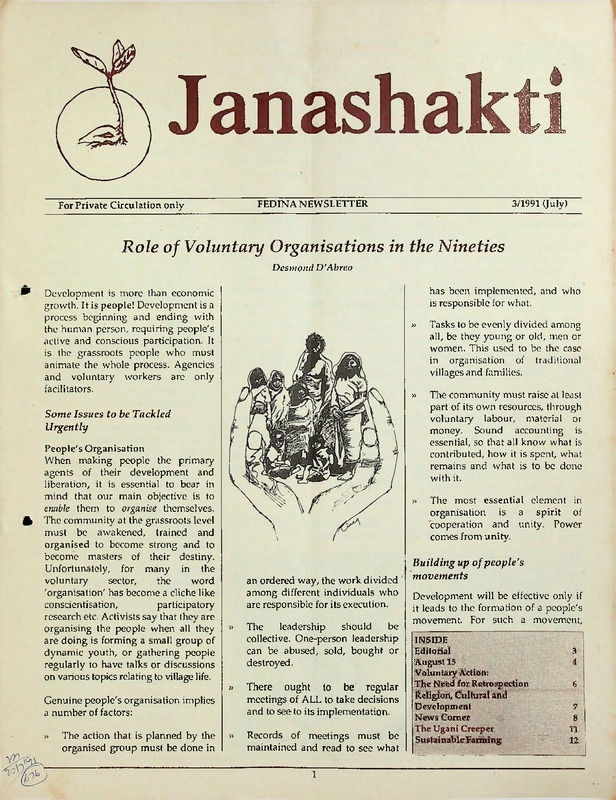
- Title
- JANASHAKTI JULY 1991
- extracted text
-
Janashakti
3/1991 (July)
FEDINA NEWSLETTER
For Private Circulation only
Role of Voluntary Organisations in the Nineties
Desmond D'Abreo
&
_
£
has been implemented, and who
is responsible for what.
Development is more than economic
growth. It is people! Development is a
process beginning and ending with
the human person, requiring people's
active and conscious participation. It
is the grassroots people who must
animate the whole process. Agencies
and voluntary workers are only
facilitators.
»
Tasks to be evenly divided among
all, be they young or old, men or
women. This used to be the case
in organisation of traditional
villages and families.
»
The community must raise at least
part of its own resources, through
voluntary labour, material or
money. Sound accounting is
essential, so that all know what is
contributed, how it is spent, what
remains and what is to be done
with it.
»
The most essential element in
organisation is a spirit of
"cooperation and unity. Power
comes from unity.
Some Issues to be Tackled
Urgently
People's Organisation
When making people the primary
agents of their development and
liberation, it is essential to bear in
mind that our main objective is to
enable them to organise themselves.
The community at the grassroots level
must be awakened, trained and
organised to become strong and to
become masters of their destiny.
Unfortunately, for many in the
voluntary
sector,
the
word
'organisation' has become a cliche like
consdentisation,
participatory
research etc. Activists say that they are
organising the people when all they
are doing is forming a small group of
dynamic youth, or gathering people
regularly to have talks or discussions
on various topics relating to village life.
an ordered way, the work divided
among different individuals who
are responsible for its execution.
»
»
There
ought
to
be
regular
meetings of ALL to take decisions
and to see to its implementation.
Genuine people's organisation implies
a number of factors:
The action that is planned by the
organised group must be done in
The
leadership
should
be
collective. One-person leadership
can be abused, sold, bought or
destroyed.
»
Records of meetings must be
maintained and read to see what
Building up of people's
movements
Development will be effective only if
it leads to the formation of a people's
movement. For such a movement,
inside
.
Editorial
August 15' |
Voluntary Actionr
The Ne'ed for Retrospection
Religfoh/Cutturai and
Development
News Corner
-3 s';,
Sustainable Faxriling
■ iii
4
; > 7
8
liwfi
'|||
ir
resources should be tapped locally
and from the people themselves as far
as possible. It has been proved that
external resources deter any growth of
authentic people's movements.
Community
development
and
liberation,
as
well as social
transformation must be the action of
the people at the grassroots. It is they
who must be the planning subjects,
the primary agents and the authentic
results of the whole liberation process.
We who come from another
background, are really outsiders,
however much we might feel that we
belong to them, and we must have the
humility to accept that and give the
power to them to be the primary
agents of their liberation. All that the
social activist can do is to enable them
to have a critical awareness of their
situation
and
of
their
own
potentialities and limitations. We
must be catalysts in the process of
their organisation and in mobilising
themselves. In this process we have to
realise that our possibilities are
limited. We are working with the
unorganised and are hopeful of
organising them. But this organisation
will not be big or strong enough to
make any sufficient impact on the
system.
We,
the
representatives
of
development voluntary organisations,
too often see ourselves as if we were
some kind of saviours who have
descended on earth and will be able to
change it on our terms. We have not
put ourselves in a realistic context.
When we try to organise the
unorganised, we find that since we do
not have a national united structure,
our efforts are hamstrung. The people
need an association that is already
organised in order to get strength on a
wider level. The only one they will
find will be a political party which has
a force that can have a national
impact. We may be dismayed that the
group we have been working with
will go on to collaborate with a
political party.
It is imperative that we have a critical
perspective on this. We must enable
the people we are working with to
have a deeper perception which will
bring to bear on the political party
with which they are collaborating.
Our role is an important one, though a
preliminary "precursor" one. We have
to organise the unorganised, so that
they can, of their own free will and
decision, join whatever organised
institutions that exist and are
powerful enough to help them
effectively to win in their struggle for
their rights.
Networking
To break away from the isolation that
prevails among the voluntary
agencies, it is important that networks
be initiated at two levels: among
voluntary agencies and groups, and
among the grassroots people's
organisations.
Other Issues
»
Issue-orientation
programmes.
rather
than
Concentrate on the three weakest
sectors of the society, namely,
women, dalits and tribals. What
are the values we proclaim with
regard to these sections of people,
especially women, in our own
organisations?
The need to give more attention to
the urban poor.
The fight against communalism
and fundamentalism. How do we
go about this? We must discover
the right meaning of secularism
and make the people aware of it.
Secularism as it exists today is
guided and controlled by the elite
and has become a tool or weapon
in the hands of the elite for their
vested interest. This is the reason
behind all communalism.
Ecological situation must be
given emphasis. Concentrate on
local flora that the people are used
to, for example, leaf plates, apart
from the larger issues such as
watershed management, water
harvesting, forestry, alternative
forestry etc.
Rediscover
relevant
and
alternative approaches, deriving
from the traditional ones which
are lost. For example, ecological
farming
and
tree-cropping
methods, soil conservation, water
harvesting, etc. that is already part
of people's culture. Also, look into
alternative health care systems
that protects the child from early
mortality.
Bring groups together to focus on
drought,
and
search
for
alternatives with regard to
agriculture. These are some of the
points that can be taken up by
voluntary agencies in their search
for
developing
alternative
approaches.
Value-formation is a strong point
that ought to be empasised
especially in the fight against
consumerism,
which
has
permeated into the voluntary
sector itself.
2
»
Training and human resource
development.
Finally, it is urgent that the voluntary
sector enhances its own public image.
There is a need for a better deal in
voluntary agencies especially with
regard to its integrity. A voluntary
agency's credibility is derived from
the congruence of its vision, objectives
and its activities, the transparency of
what it is, what it intends to do, and
how the work is accomplished. Above
all, there should be transparency in all
its financial operations so that these
can be open and convincing to the
grassroots people, who, as has been
said earlier, are the primary agents of
the whole development process. The
lifestyle of a voluntary agency should
be simple and
unostentatious.
Definitely, its programmes should be
cost-effective*.
Such transparency and accountability
must be directed to the people, as well
as to the members of the agency and
the resource agency. This calls for
openness in its dealings, sharing of
information through appropriate
forums and continual dialogue. Any
gap
between
promise
and
performance erodes credibility and
such a gap can be bridged by constant
reflection on reality as well as effective
monitoring and evaluation. Ideology
and action must be brought on a
converging track.
Our wish, for this new decade that has
dawned, is that the voluntary agencies
throughout the country avert the crisis
that is deepening within the voluntaiy
sector. This can be effected by a clarity
of vision, derived from an ongoing
structural analysis on the micro and
macro levels, and above all, a respect
for the grassroots people with a faith
in their potential to bring about a
lasting and just transformation of
society.
Extracted from NGOs in the Nineties
gBIiljgRfA'gl
‘Economy at Crossroads
Can the TW(govemment cure the ailing Indian economy? ‘There is a general
consensus among a zoide cross section of the society that India has reached the
threshold of an economic disaster. It needs intensive care and transfusion to
put it back, on its rails. The process has begun. IMT The WorldBank-and
other international lending institutions are being approached for assistance
and aid. They have shown great interest and willingness to reach India with
fattened purses. In the course of one single weeki the rupee was devalued
twice. Liberalisation is on the cards. There is mixed reaction to all these from
all over.
Where does the common person figure in all these wheelings and dealings?
They are not overtly concerned about what happens in world capitals. Tor
them, what matters most is what is going to happen at the ration shop, at the
provision store, or at the milk- booth. Can the government arrest the
sky-rocketing prices? Can the government machinery provide security to life
andproperty? Can it contain violence, corruption and red-tapism? Can a clean
and efficient administration be made available?
Will the government, in order to resurrect the dying economy, succumb to
pressures from the IMT and World Bank? Though statements are made in the
negative, one is hesitant to accept them. Scepticism reigns supreme in all
quarters, especially among those who know the plight of other Third World
countries where such massive aid was infused.
Strong andfirm decisions are needed at an hour like this. The political will to
implement them is equally important. Is it possible for the government to come
down heavily on the smugglers, tax-evaders, black^marketers and others who
subvert the economy of our country? Can the government contain inflation
and black- money? Can it sustain the hopes and aspirations of the poor, the
tribals, the dalits and all those who are cheated, in some way or the other, by
the so-called ‘plans andprogrammes "?
Meaningful and effective measures to put the economy backjn command are
called for. A high degree of restriction on non-plan expenditure, sustained
effort to strengthen the weakened economy and united effort by every citizen
are calledfor. We hope the forthcoming budget and the current planners will
spell out these dreams, giving priority and attention to the basic needs of the
poor.
3
August 15: The Illusion and Betrayal
No, sir. I swear, per year.
What about your meals?
Once a day, in the afternoon the
landlady will give us a bowl of
porridge. If she is pleased, sometimes
some leftovers in the evenings.
Don't you feel hungry?
It was August 15. A great
and memorable day for
every Indian. I always
cherished the memory of
many August 15ths. School
bands, march pasts, flag
. hoistings, fiery speeches
compensated with chocolates, sports
and all the fun. It was a pleasant
morning. Usual bhajans, marches and
speeches. After a hectic discussion the
previous day my friends and 1
decided to go to one of the nearby
hills for a picnic. I always used to be
fascinated by the mystic beauty of
those undulating hills and the serenity
of the plains beneath, filled with green
vegetation. When the sun would sink
between the peaks, the whole canopy
of hills would be silhouetted against a
blaze of colour and splendour. The
colours, shades and the forms would
lead me to dizzy raptures while
standing on the hostel terrace.
"Heaven should be something like
this!" I was at the bosom of it.
As we were climbing up, we saw a
few children coming down with
firewood loaded on their heads. We
stopped. We just couldn't believe our
eyes. Such heavy loads on such tender
children. Shapeless, grubby, tattered
figures with grave faces and wide
gestures. We tried to smile at them.
Looking at us there was an unknown
terror in their eyes. We explained to
them that we were college students
and haa come to see the place and the
people. They were tired. They put the
firewood down and sat under a tree
with us. Murugan started with a wide
grin:
We thought you were "mamool"
people, sir. They normally threaten us
and extract the little money our
parents have.
How much money do you get for this?
Money, sir? No, sir. All these go to the
landlord's house, sir. We are already
aalkarans.
What do you mean by aalkaran?
It means slave, sir.
When it's too much, I steal something
and eat. If they catch, they will beat
me. But it's okay, sir.
What about holidays?
Twice a year, sir. Deepavali and New
Year's Day. On New Year's Day they
will give us a new set of clothes and
get our thumb impressions on a white
paper.
Can't you ask for better wages and
treatment?
(All of them laugh.)
You! at this age?
That's the end of you, sir.
Yes, sir. Last year my elder sister had
to be married. We needed Rs. 500. The
landlord would loan that amount only
when my father took me to him as an
aalkaran.
What do you do?
At four in the morning I am woken up
to clean the cowshed and to carry
water. When the cowman takes the
cows I have to go to the fields to weed
and to water the crops. In the evening
when I am back, I have to carry water,
wash the cows and feed them. I can go
to bed only around 10.00 p.m. after
helping in the household chores. I
have to sleep in the cowshed.
Then how come you carry firewood?
The days when there is no work in the
fields we have to climb up the hills,
cut firewood and carry it to the
landlord's house.
One of the big boys spoke:
Few months back by aunt was spoiled
by the landlord, sir. My uncle was
angry and complained to the
panchayat. The panchayat was called.
The whole village was there. The
landlord ordered his goondas to tie us
up to some trees nearby. The colony
people were asked to stand at a
distance. My uncle was asked to
repeat the complaint. As soon as he
finished mumbling a few sentences i
five, men caught hold of him. They i
laid him flat on the ground and held I
him. Three people came with choppers.
We started screaming and yelling. One
started cutting his leg to pieces.
Another, his hands... (The boy started
crying...) Then they came to us. We
were pleading with folded hands to
spare us. They hesitantly left us
threatening,
"Never
open
your
How much do they pay you ?
mouths!"
Hundred rupees per year.
That evening, the police came and
repeated the same warning, "Never
open your mouths!"
No! Per month you mean?
4
The next morning we were shocked to
find aunt also missing. God only
knows (not sure!) where she is - alive
or dead!
A few more eyes were wet with tears.
The boy's tender face was twisted
with all the agonies and cruelties that
he had endured. He would never be a
child again. He would grow together
with the others. But he would be
different. The deep wounds of his
tender heart would always be an
unconquerable threat to the security
of the society that is so indifferent.
One of my friends went over and sat
near the weeping boy and tried to
console him:
Don't worry. You look bright and
strong. You can become a great man.
The boy straightened up and said
cynically,
Yes, a big aalkaranl
was the death of the only child in a
family. The* mother was sobbing,
"Munnu! Munnu!" The child, skin
and bone, looked frighteningly
malnourished. The children standing
around did not look veiy much
different either. Tiny distorted bodies
with tormented little minds. (In India
approximately 1,00,000 children die
every month as a result of
malnutrition!)
The hut was so small and miserable.
The roof was just a few sticks covered
with coconut palms and leaves, with
gaping holes. There were three or four
mud pots, two aluminum plates and a
few rags of clothes hanging on a stick.
That was all inside the hut. Few men
who came found it strange to see us
there. They politely asked us to leave
the place.
We don't want any trouble, sir. The
landlords won't be happy.
Change? No, sir. It is our fate, I would
often imagine and say to myself, 'It
would have been far better to be bom
as the cow of the landlord.'
While in the bus, one of my friends
said, It is their money, their tax, their
labour and sweat that pays for our
education and comforts, for the
landlords'
luxuries
and
their
children's education. Many slog and
sweat without even the basic
necessities of life so that a few can
enjoy all the comforts and luxuries. It
is their own labour and sweat that
keep widening the gap between them
and the basic necessities of life.
Back in the hostel I couldn't sleep that
night. The faces of the children and
Munnu were haunting me.
It is my indifference that killed
They refused to talk to us. They were Munnu, that keeps alive the system
adamant that we should leave the that tortures so many innocent human
I remember going to the school for place immediately. The children who beings, a system that creates starved
two years. We would go and play took us there agreed to take us to the stomachs and packed godowns! Is it
under a tree and come back. The nearest bus stop. While talking with not this whole civilization, a broad
teacher would come to the village 1 them, we found that no medical j daylight robbery? A cruel unjust
once or twice a year. I loved to watch facility was available to those people. system that denies humanity to the
the village children going to the town When few social workers brought majority of human beings, that thrives
school. I used to ask myself, 'Why some free medicine to be distributed fleshy and juicy sucking the blood and
can't I dress like them, play and laugh to them, the landlords' people threw the life of the helpless humanity.
stones at the jeep and chased them off.
like them.' I used to cry ...
The colony people were not allowed Gandhi was a prophet.
By then, we were in no mood to to take water from the village well.
continue our picnic. We decided to go During the summer months they have Make statues of him and cover them
with the children to the village. We to get up early, walk a long distance to with flowers and garlands. Don't
wanted to carry the firewood. The collect drinking water and report to bring him down. Don't let his spirit
It will be a
children would not agree. We the landlords on time for the day's intrude reality.
disturbance,
anti-national,
anti-social
persisted. They reluctantly gave in. work. We were dumbfounded. Our
that
can
lead
to
preventive
detention,
For us it was a sort of fun in the hearts were wrenched with pity for
torture
and
brutality
beyond
human
those
people
clinging
with
such
beginning. But soon, it started
imagination.
Don't
disturb.
Let
the
desperate
hands
to
a
life
that
offers
pricking our heads. It became more
system
go
on.
them
nothing
but
sweat,
toil,
misery
and more painful and unbearable.
When we came near the village, the and starvation. At everything we were
Will it really go on?
asking, "Why?", "Why not?" etc.
children took the load from us saying,
How long?
If they see you, we will be in trouble. One of the boys innocently asked,
You people stay there. We will go and Everything looks so strange to you, (Reflections based on true and factual life
drop these in their houses and come. sir. You seem to know nothing.
experiences. Names, places and sequences
We will take you to the colony.
altered for reasons well known).
What do you study in those big
As we were walking towards the places, sir?
Antony Swamy
colony, we heard some wailing. The
children feared that something was We tried to dodge and pacify the,.
wrong. Soon we came to know that it youngster. I humbly admitted,
Did you ever think ofstudying?
al
I feel so much pity for you. But I should
admit, I really don't know how I can help
you. How we can bring about a change.
5
Voluntary Action:
The Need for Retrospection
LukoseJacob
We live in stirring times. An
irresistible wave of human freedom is
sweeping across many lands. Not only
political systems but economic
structures are beginning to change in
countries where democratic forces had
long been suppressed. People are
beginning to take charge of their own
destiny in these countries. This trend
of the people's movement all over the
world resembles the changing face of
voluntarism.
In the midst of these events, we are
rediscovering the essential truth that
people must be at the centre of all
development.
The purpose of
development is to offer people more
options. One of their options is access
to income - not as an end in itself but
as a means to acquiring human
well-being. But there are other options
as well, including long and healthy
life, right to knowledge, political
freedom,
personal
security,
community
participation
and
guaranteed human rights.
People
cannot be reduced to mere cogs in the
wheel of state machinery that pursues
only economic goals.
All such self-initiated and non-profit
oriented activities aimed at human
development are to improve the
conditions of the oppressed and
underprivileged sections of the
society. One may call such motivated
action by a group or organisation as
voluntary action.
Voluntary action is not a new
phenomenon in India; it is embedded
in our culture and has deep
ideological roots. Through the
centuries, religious traditions have
instilled among the devout a sense of
compassion and social obligation
towards fellow-beings, the less
fortunate and the disadvantaged. The
range and scope of voluntary action
thus appears to be as wide as it is
complex.
Every official plan produced in this
country
for
comprehensive
development has ended up on the
specimen shelf of still-born intentions,
preserved in the formalin of public
memory. In sharp contrast, voluntary
agencies offer much promise and are
generally characterised by timely and
speedy action, creativity in approach,
options
based
on
experience,
flexibility in functioning, innovative
methods
and
meaningful
participation of the people.
Voluntary action has undergone
changes, depending on the needs, the
systemic factors controlling them and
based on the socio-economic and
political situations. Consumerism,
modernisation, mechanisation and
industrialisation, etc. are some of the
factors which have contributed to this
kind of change. The on-going conflict
between tradition and modernity on
the one hand, and between vested
interests and awareness on the other,
has intensified the demand and need
for changes. Political control and
manipulation of nature, ecology and
environment adds to this dimension.
In this process, some have adopted a
preferential option for the poor, while
some others have made voluntary
action into an area of employment.
Even among voluntary agencies, the
approach has shifted from offering
relief and rehabilitation to being
middlemen of awareness building.
Human development is incomplete
without human freedom. Any index
of human development should ,
therefore give adequate weight to a |
society's human freedom in pursuit of
material and social goals. Therefore,
as partners, innovators, advocates,
and critics voluntaiy agencies
(voluntarism) should bring about a .
better nexus between needs and
resources and generate people's
participation in programmes directed
towards their own growth.
The role of voluntary agencies as
change-agents will gain importance in
the years to come for the simple
reason that there are many people
whose commitment to society is deep
and beyond suspicion. What we need
is a deeper understanding on the
concept of voluntarism in a situation
which is constantly changing.
: Do not walk in front of me
;
cannot follow you
The quietitude of mind cannot be achieved
by vow of silence, even if one goes in deep trance.
! Do not walk behind me
!...... I cannot lead you
1
The fasting does not satiate the hunger for worldly goods, •
even if one has all the riches of the world.
: But ...walk along with me and
; We can make it TOGETHER
I
Not one out of a hundred thousand devices and j
contrivances works to achieve unity with’Him.
:
I The purity of mind cannot be achieved by bathing,
{ even if one bathes a hundred thousand times.
................................................................................
6
j
I
I
I
Religion, Culture and Development
Some Reflections
Pramod
Together with the postulation that we
are now living in a world where the
human race has to "develop" or
perish there is an equally strong
stream vying for the attention of
public consciousness - the greens who
advocate ecofriendly or sustainable
development.
Development has many inextricably
linked facets. The causes and effects
are also equally interlinked each
proceeding from, and reinforcing the
other symbiotically. Since, by virtue
of domination of the global agenda at
crucial junctures of history, it is the
west that has brought its concept of
development to the centre-stage as the
global agenda, and that by virtue of its
domination, development has come to
be so closely identified with the
western model.
Lop-sided View
All religions, at some stages of their
development, have a messianic fervor.
The crusades and the white man's
mission to civilize the natives are but
facets of this world view.
This
brahminical world-view carried to its
extreme necessitated a denial of
human qualities not only to other
animate life but also to people of other
races and women. It is in this cultural
framework that the seeds of
colonization
bears
fruit.
The
dehumanization of others and the
divine mission entrusted to self
became a potent wellspring for
domination of the "less developed".
As long as a religion retains its
original
messianic
fervor and
amorphous assimilative nature, the
tolerance which characterizes it will
encompass nature. The loss of this
messianic (revolutionary) fervour and
ideology will result in that religion
being identified with one established
theology, much to the detriment of
others. It is at this stage that religion
becomes intolerant, inconsistent and
stifling. It oppresses both its adherents
and the rest of the world. All religions
go through these phases.
Progress is now quantified materially
regardless of the social or other
hidden costs. Rapid production of
weapons of mass destruction is
termed progress. Periodic wars
become an economic necessity.
Technology, much like religion and
culture, has too often been the
handmaiden of destruction. Dominant
trends of technology have helped in
the "exploitation" of natural resources
with devastating effect. Mainstream
science and technology has helped
reinforce and further the dominant
world-view that has held that people
must exploit nature. It is significant to
observe that western science refers to
plants and animals as "lower on the
evolutionary tree". The inanimate is
disdainfully ignored. This gradation is
absent in bio-friendly science.
Capitalist
The largest beneficiaries of research
funding has been the military and the
military, industrial complex. With
sufficient arsenals to eliminate the
earth itself this trend of scientific
research is yet to show signs of
abatement.
Even the much-vaunted seemingly
altruistic green revolution had, as part
of the package, tractors for regions
with only two centimeters of top-soil.
That western commercial interests
were served by this transfer of
technology, that it has resulted in the
perpetuation of unjust structures of
power, and that it served the interests
of the west are no longer in dispute.
The dislocation of entire peoples by
transferred technologies, toxic waste
disposal by the West in Third World
countries and the terrible price paid
by the developing countries for the
prosperity
of
the
west
are
7
well-known.
The substitute is an alternative system
wherein the entire paradigm is
changed to be more harmonious and
cosmo-centric. In these tasks the
enormous liberative potential of
religions and the diverse forms of
indigenous cultural resistance should
be mobilised to defend, counteract
and destroy the negative models of
development so as to evolve a new
philosophy where humans are seen as
part of the living cosmos, to see
development as the adapting of
humans to the environment and
where progress is measured in terms
of harmony with ourselves, fellow
beings-, nature and the cosmos.
Action-Research on Tribals
Though Fedina has been actively
involved in the development of the
tribals, no concrete effort was made so
far to identify specific issues related to
tribal life. To offset this drawback, a
meeting was arranged on 8th April
where staff of Fedina, ICRA and Pipal
Tree shared their views on the matter.
It was suggested that the possible
areas of study and research could be
housing (including their habitat and
the
community),
health,
folk
traditions, decision-making process,
tribal spirituality, tribal rights,
women, etc.
Trustees Meet
Trustees of Fedina met on April 23
1991 at the Bangalore office. It was an
opportunity for staff to share their
experiences in the field. The Trustees
discussed the future and immediate
priorities of Fedina.
Hazardous Drugs
To commemorate the late Dr. Olle
Hansson, a symposium was arranged
on June 22, 1991 at Gandhi Bhavan,
Bangalore. This Swedish doctor's
name is closely linked with his fight
against
hazardous
drugs
like
mexaform. It was only natural for
Fedina to give full support to this
programme organised by Drug Action
Forum Karnataka as we have been
consciously fighting against the use of
hazardous drugs in our health
programmes.
Our street theatre
group from Sarjapura organised street
plays on this occasion.
Staff Training: KISS
Leadership Training
"Keep It Simple and Short" was the
formula that caught the imagination
of our staff at a workshop to improve
writing and reporting skills organised
by Fedina. The two-day training
session was conducted by Mr. Koshy
Mathew, a freelance journalist and
publisher, on July 2nd and 3rd at our
Bangalore Office.
All
area
coordinators and those involved in
report-writing participated in this
workshop.
Fedina has always stressed the need
for building up local leadership in all
areas of its work. With this in mind,
the team at Sarjapura organised a
3-day leadership programme at the
Institute for Youth and Development,
Koramangala, from 17th to 19th April.
21 young men participated in this
training programme.
Summer Camp
Away from home for three days
brought a pleasant change for the
children of Sarjapura in their
otherwise boring summer holidays. 30
school children in the age group of 9
to 12 years assembled at Gunjur from
May 13th to 15th for this camp
organised by our team at Sarjapura.
The inauguration of this camp was
done by the children themselves who
lit the traditional lamp at 10.00 a.m.
Environment,
health
and
the
importance of education were the
main issues discussed during the
three days. Songs, dance, posters and
cultural programmes in the evenings
made this event quite lively for the
children.
Area Coordinators' Meeting
All the area coordinators from our six
areas met on the 3rd and 4th of June at
Bangalore office to exchange their
experiences with others. It was an
enriching experience for everyone to
hear about the various activities
organised by our staff at various
centres. Fedina Coordinator and the
Bangalore office staff were also
present at this meeting.
8
Giriraja Chicken
Small savings scheme has been in
operation at Yamare village for quite
some time now. To further this
programme Fedina „ has provided
nearly 50 giriraja chicks to 9 families.
These birds grow fast and weigh
much more than the ordinary chicken
in a short time. Hence it is hoped that
this scheme will help the women to
earn. additional income for their
families.
Voluntary Action Week
The state-level voluntary action week
which was inaugurated on March
12th
at
Thiruvananthapuram
concluded at Sultan Battery on March
17th. This function was organised
under the joint auspices of VANI
(Kerala chapter) and the Forum for
Development
Agencies
(FDA),
Wayanad.
Nearly 400
people
representing
various
voluntary
organisations in Wayanad were
present at the valedictory function.
The meeting decided to focus on
environment as the main concern
during 1^91.
workshop which was held at
Vazhavatta on May 21 for the
traditional tribal craftsmen witnessed
the production of craft items which
the tribals were using in the bygone
days. Nearly 20 such models were
made on that day.
A Dream Come True
A home to live in - that is what
everybody dreams of. Even the tribals
have their dreams of a home. Chatti
Miravan of Varikeri was really
fortunate to have a house of his
dreams - a house in tune with his
beliefs, traditions and customs - an
ideal Paniya house.
Tribals Celebrate
May 12th was a day of celebration for
hundreds of tribals who gathered at
M.C. Tholalu, a remote village in H.D.
part of the programme of the day.
Collective Farming
After the displacement of the tribals
from their original habitat - the forest they had to engage in cultivation on
their private lands. But the tribals of
N. Beguru felt the need to cultivate
collectively. They acquired 8 acres of '
land and have started a xcollective
farm. The youth group of Budakattu /
Ranga Vedhike joined hands with the
farmers and helped to plough and
sow the seeds.
This model house with pressed mud
blocks was unique in its design and
appearance from the conventional
type of tribal houses constructed by
the government. The inauguration of
this model house on 22nd April
attracted a large crowd at Varikeri.
This alternative model house scheme,
initiated by Fedina, has caught the
attention of government and other
NGOs.
AAS Exposure
The
AdiVasi • Aikya
Samithy
representatives after an exposure to
the BKS convention at H.D. Kote has
gained optimism for unity. The study
tour which was held in May was a
unique opportunity for the tribal
leaders of Wayanad and Nilgiris to
learn and understand the - various
activities which are going on among
their brothers in the neighbouring state.
Balavadis Stopped
Has the Indian family planning
programme attained
its goal?
Intensive
family
planning
programmes among the tribals of
Wayanad has resulted in the
unemployment of three balavadi
teachers of Fedina. Due to the lack of
nursery school children, three
balavadis had to be stopped recently.
Handicraft Workshop
It was a day of fun and laughter,
productive as well. The handicraft
Tribal Home in HD. Kote
Kote taluq. This was an unusual
festival arranged by the Budakattu
Krishikara Sangha and Vanavasi
Mahila Sangha, the two tribal
organisations at H.D. Kote. The youth
of Budakattu Ranga Vedike, a street
theatre group, performed many street
plays highlighting different issues of
tribal life. There was a lot of singing
and dancing the whole night.
Children and Environment
Every year, the tribal children of H.D.
Kote spend 2 or 3 days to understand
the importance of education and a
healthy environment. The two days
get-together was arranged in the
month of April at M.C. Tholalu and N.
Beguru areas. The children took part
in painting, singing and in identifying
forest species.
The annual general body meeting of
the BKS took place the next day. The
discussions focused mainly on
people's organisation, rebuilding and In Annum, Antharasanthe and B.
strengthening the BKS and the role of Matakere areas the children organised
women's participation. The meeting processions. Hundreds of children
was inaugurated by the District Forest walked from colony to colony
Officer.
An exhibition on tribal spreading
the
message
about
medicines, health programme and education
and
protecting
the
organic farming was also arranged as I environment.
9
50 minus 10 = 30?
50 minus 10. Is it 30 or 40? It was 30 in
those days; but now the tribals have
understood that it is 40.
This
understanding led to a clash between
Kunkan and the local shop-owner.
Kunkan was seriously injured in the
fight with the shop-owner and had to
be hospitalised. The news spread like
wild fire and all the Adivasi Aikya
Samithy representatives assembled
and conducted a dhama in front of the
shop and filed a case. Eventually the
shop owner had to agree that fifty
minus ten won't be thirty any more
for the tribals of Nilgiris.
The Gowlis of Kittur at a group meeting
Gowlis
May Day Celebration
Anti-liquor Campaign
Excessive consumption of cheap
country liquor produced locally in
large quantities at almost every village
in Nilgiris has claimed a few lives and
many had to be hospitalised in serious
condition. Our team at Nilgiris
organised an anti-liquor campaign to
convey the ill-effects of alcohol.
Processions, film-shows and posters
were used to draw the attention of the
The inauguration of handlooms at
Machi was the highlight of the
celebration on May 1st. The mahila
sangha of Machi had approached the
khadi centre at Kittur and Bailhongal for
a weaving centre in their hamlet as all
the villagers were landless. The people
themselves contributed money and free
labour to build the shed for this purpose.
Bailhongal khadi centre agreed to give a
few handlooms. The mahila sanghas of
The newly initiated programme
among the Gowlis is slowly gaining
momentum. At present, seven Gowli
wades (hamlets) have been identified
and a survey is going on to assess
their situation. Social and cultural
aspects of the Gowlis will be given
priority in this survey.
Ration Cards
Illiteracy and inaccessibility to the
government
authorities
have
prevented the tribals from obtaining
ration cards. Our team at Chengam
has been constantly taking up this
matter with the concerned authorities.
Finally
296
applications
were
submitted to the government during
March. It was a great relief for 158
tribal families to receive their ration
cards. The remaining cards will be
issued in the near future, it is said.
Training
Chengam: Training programme for women
people and the government to this
problem. The government of Tamil
Nadu has responded positively and
all country liquor shops in Tamil
Nadu will be closed from the 15th of
July.
Ningapur,
Galaginamada
and
Kulavalli joined hands with the
people of Machi on this occasion.
Pooja was conducted, guests were
garlanded and the women sang songs
to celebrate this great event at Machi.
10
Two training programmes conducted
by Ms. Christy from RWWDS were
arranged in the month of April - one
for men and another for women. 36
women from 17 villages participated
in the 3-day programme at our
Chengam office. "The status of tribal
people in the present political
context" was the main topic of
discussion.
Mr.
Krishnan,
the
Coordinator of WARM, was the main
resource person for this training session.
Ugani Creeper and the Fence
(Lettaomia Aggregata)
The ugani creeper which is found in
bushes is useful to farmers in many
ways. Farmers no longer need to
search for ropes to bundle ragi husk,
grass or firewood. Ugani creeper is
within hand's reach in the rural areas.
but the plant was of the same height.
When I checked, the creeper was
again surrounding the plant curtailing
its growth.
The ugani creeper binds itself around
different varieties of small plants in
the fence and grips it tight to suffocate
the plant.
The tribals value this creeper for its
medicinal quality. For example, it is
used to cure dysentery and- wounds.
The extract of this creeper can be used
to imprint designs either on cloth or
body which lasts for quite a long time.
Four years ago, in our backyard, a
sapling of Ramaphala (Anona
Reticulata) started growing near the
fence. As its fruit is very tasty 1 cleared
its surroundings and watered it every
day. Soon the plant grew to my
height.
When I visited the tribal settlements to
study their culture, children were
playing with its juice. Children use
this fluid to draw pictures on their
forearms and then rub these drawings
with burnt ash. It remains for one
week.
Monsoon began and the ugani creeper
in the fence reached Ramaphala and
started tightening the grip. I loosened
the grip and chopped the creeper. I
expected that the Ramaphala plant to
have grown much taller in a month,
To test whether the same effect is
possible on white paper, I drew some
figures with this fluid and then
rubbed with burnt ash. To my
astonishment, black lines appeared on
the white paper. Ugani creeper is
identified by by its leaves but is not
known for its flowers.
In January of eveiy year the Ugani
creeper sheds its leaves and is left
only with flowers appearing like a
bride with pride.
Surviving the wrath of summer and
being alive is possible only in the
fence. Different types of plants,
bushes and creepers grown in the
fence create a cool atmosphere. The
kachi plants (egg plants - solatum
melongena) acts like stone pole and
the ugani creeper like an iron fence.
This is a kind of natural fencing which
protects both animals and plants
under its cover.
The basic ideology of natural farming
is innate in the concept of fence. If we
observe the fence very sensitively, we
can understand many things that
contribute to natural farming.
Ksheerasagar
Voluntary Organisations: Four Generations
GENERATION
FIRST
Relief and Welfare
SECOND
THIRD
Community
Development
Sustainable Systems
Development
FOURTH
People's Movements
Shortage
Local Inertia
Institutional and Policy
Constraints
Inadequate Mobilizing
Vision
Time Frame
Immediate
Project Life
Ten to Twenty Years
Indefinite Future
Scope
Individual or Family
Neighborhood or Village Region or Nation
Chief Actors
NGO
NGO plus Community
All Relevant Public and
Private Institutions
Loosely Defined
Networks of People &
Organisations
NGO Role
Doer
Mobilizer
Catalyst
Activist/Educator
Management
Orientation
Logistics Management
Project Management
Strategic Management
Coalescing and
Energizing Self
Management Networks
Development
Education
Starving Children
Community Self-Help
Constraining Policies
and Institutions
Spaceship Earth
| Problem Definition
11
National or Global
Sustainable Farming
(A collective experiment at Manti Hadi)
Reported by Vasu
During the past seven years, Fedina
has been involved with the
marginalised people at different
places especially among the tribals. In
H.D. Kote, Fedina has been
instrumental in bringing the tribals
together through a process of critical
education.
submerging vast tracts of forest lands.
Tribals had to run away from the
submerging forests in order to
survive. Truly these big dams damned
the very survival of these tribals. The
displaced
were
not
properly
rehabilitated immediately. In a way,
these tribals were cheated by the
modem paradigms of development.
Continuing Struggle
Wronged People
United effort was needed to get these
people
their land so that they could
The tribals of H.D. Kote have gone
have
a
place to live in to sustain
through untold hardships due to the (
themselves.
With the support of these
wrong policies and priorities of the
people,
Fedina
managed to get back
so-called "civilized society". Tribals
the
land
rights
wherever it was
here were forest-dwellers, eating what
possible
and
also
persuaded the
was available in the forest. Fruits and
government
to
distribute
excess land
roots along with leaves and honey
in
that
region.
To
a
very
great
extent
were their sustenance. The forest
these
efforts
were
successful
and
most
provided them their house, and it was
of
the
tribals
today
have
some
piece
of
their life and hope. Amidst the
land.
Initiating
them
into
agriculture
thickness of these forests, they found
meaning to their lives, expression to was seen as a logical step to be
their feelings and relationship with undertaken.
their gods. The forests sustained
Collective Action
them, their culture and their beliefs.
The forest laws framed by the British
as well as the Indian Government
became stumbling blocks to the very
survival of the tribals in the forests. In
the name of reserved forests, game
sanctuaries and Project Tiger, the
tribals were sent out of these forests to
the periphery, displacing them from
their age-old traditional habitat. The
Government failed to re-settle them in
a proper way. Pushed outside the
forests, they also became persona
non-grata to the "civilised society".
These tried to push them back into the
forest, forcibly taking away anything
that was given to them by the
Government. This is not a story but
the pitiable plight of the tribals of
HtD. /Kote and may be true to any
tribalcommunity.
**
[Wrong Priorities *. ’ V. '
Development took an^^t|^gjy^ our
country. ‘ It saw the ’ need for
constructing
huge
dams
by
identified them and perceiving their
miserable situation, pressured the
local government to respond. The
Ji I la Parishad rose to the occasion, and
granted them 22 acres of land for their
rehabilitation after release. The Land
Army built 20 houses in a place now
called Manti Hadi.
Fedina felt that whatever it does
should not in any way go against the
principles of environment. Our
involvement in this line should be
ecologically
sound
and
environmentally friendly. Hence,
when it was related to agriculture, we
had no other choice but to opt for
sustainable farming.
About 12 km from H.D. Kote, in a
sloping land, one can see some 20
houses in two rows. They were
constructed recently by the Land
Army and handed over to 19 tribal
families. These were the families that
were displaced and were not being
re-settled properly. They had no other
option but to become bonded
labourers to a landlord at Ergalli in
H.D. Kote Taluk. They were surviving
in a miso/ahle situation, with hardly
anything to house them. They
managed to survive in difficult
situations facing untold miseries and
hardships. Two years ago, Fedina staff
12 .
This is a sloping hillock, filled with
thorny bushes and stones. One can
also notice hundreds of mole-hills all
around, in a word god-forsaken land.
Seeing this, the tribals called this place
"Manti" and thus it became Manti
Hadi.
Unfortunately everything did not go
well with everyone. The land rights
for these 22 acres are written only in
the name of 16 families leaving 3
families landless. Besides, out of the
22 acres, three to four acres are just’
rocky and unfit for any cultivation^
Also, due to the non-malntenance of
proper records, no family here knows
which land belongs td whom. An
equal division of this land would
mean that each family may get about
1.1 acres of land, either somewhat
cultivable or totally uncultivaBle.
It is at this juncture that Fedina began
reflecting seriously with these 19
families belonging to the Soliga
community. Fedina's staff began
visiting this hadi regularly and
initiated a discussion on sustainable
agriculture that too in a collective way.
(to be continued)
Janashakti is the official newsletter of
Foundation
for
Educational
Innovations in’Asia (Fedina),
902, Indiranagar, 1st Stage,
Bangalore - 560 038.
No. 3/1991
July
Designed and Printed by Wordmakers
- Media
 JANASHAKTI JULY 1991.pdf
Position: 4237 (2 views)