JANASHAKTI OCTOBER 1991
Item
- Title
- JANASHAKTI OCTOBER 1991
- extracted text
-
COMMUNITY HEALTH CELL
No* 367, 'Srinivasa Milaya'
Jakkasandra, I Main, I Block,
For Private Circulation Only
FEDINA NEWSLETTER
4/1991 (October)
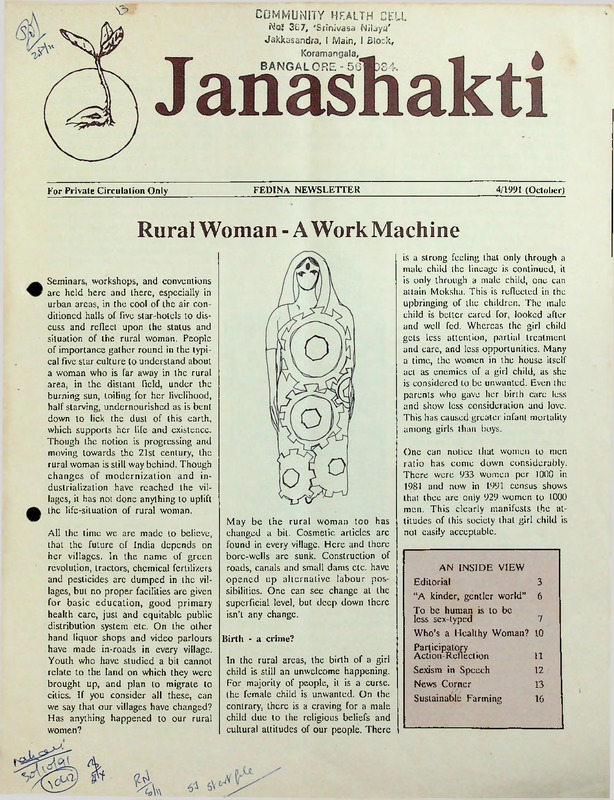
Rural Woman-A Work Machine
is a strong feeling that only through a
male child the lineage is continued, it
is only through a male child, one can
attain Moksha. This is reflected in the
upbringing of the children. The male
child is better cared for, looked after
and well fed. Whereas the girl child
gets less attention, partial treatment
and care, and less opportunities. Many
a time, the women in the house itself
act as enemies of a girl child, as she
is considered to be unwanted. Even the
parents who gave her birth care less
and show less consideration and love.
This has caused greater infant mortality
among girls than boys.
Seminars, workshops, and conventions
are held here and there, especially in
urban areas, in the cool of the air con
ditioned halls of five star-hotels to dis
cuss and reflect upon the status and
• situation of the rural woman. People
of importance gather round in the typi
cal five star culture to understand about
a woman who is far away in the rural
area, in the distant Held, under the
burning sun, toiling for her livelihood,
half starving, undernourished as is bent
down to lick the dust of this earth,
which supports her life and existence.
. Though the notion is progressing and
moving towards the 21st century, the
rural woman is still way behind. Though
changes of modernization and in
dustrialization have reached the vil
lages, it has not done anything to uplift
the life-situation of rural woman.
All the time we are made to believe,
that the future of India depends on
her villages. In the name of green
revolution, tractors, chemical fertilizers
and pesticides are dumped in the vil
lages, but no proper facilities are given
for basic education, good primary
health care, just and equitable public
distribution system etc. On the other
hand liquor shops and video parlours
have made in-roads in every village.
Youth who have studied a bit cannot
relate to the land on which they were
brought up, and plan to migrate to
cities. If you consider all these, can
we say that our villages have changed?
Has anything happened to our rural
women?
May be the rural woman too has
changed a bit. Cosmetic articles are
found in every village. Here and there
bore-wells are sunk. Construction of
roads, canals and small dams etc. have
opened up alternative labour pos
sibilities. One can see change at the
superficial level, but deep down there
isn’t any change.
Birth - a crime?
In the rural areas, the birth of a girl
child is still an unwelcome happening.
For majority of people, it is a curse.
the female child is unwanted. On the
contrary, there is a craving for a male
child due to the religious beliefs and
cultural attitudes of our people. There
One can notice that women to men
ratio has come down considerably.
There were 933 women per 1000 in
1981 and now in 1991 census shows
that thee are only 929 women to 1000
men. This clearly manifests the at
titudes of this society that girl child is
not easily acceptable.
AN INSIDE VIEW
Editorial
3
“A kinder, gentler world” 6
To be human is to be
less sex-typed
7
Who’s a Healthy Woman? 10
Participatory
Action-Reflect ion
11
Sexism in Speech
12
News Corner
13
Sustainable Farming
16
to be given in marriage, and attain
motherhood. Getting the girl married
seems to be the biggest responsibility
of parents. At the first opportunity, the
marriage is arranged. There is no ques
tion of finding out girl’s likes and dis
likes; whether she is ready and mature
to accept this responsibility. It is the
parents or elders who decide everything
on behalf of the girl. The parents heave
a sigh of relief when they finally settle
their daughter in marriage. They are
not really concerned about her feelings,
or what happens to her after the mar
riage. Whatever happens to her, they
believe, is her fate and they cannot do
anything about it or couldn’t have done
better.
Struggle:
The girl child has to struggle for ex
istence right from her birth. She has
no recognition either at home or in
the society. She is considered to be
an outsider, to be given away in mar
riage, and dispatched to another house.
So why to invest on one who is to flower
in another house? Why care for one
who is to become a part of another
family. These are cultural attitudes that
we have inherited. The female child is
a liability where as a son is an asset
to be cared for and looked after. Thus
from the beginning hardships are in
store for girls. It is a great struggle
for the girl to get an opportunity to
go to a school. Surveys have shown that
80% of the rural boys are admitted to
standard 1, whereas only 54% of rural
girls get this chance. Of the girls who
are admitted to school, only 24% sur
vive till standard VI and just 15% reach
pre-university studies.
According to the survey conducted,^
66% of the rural women had married
when they were between 10 -14 years.
Though according to 1981 census, the
marriage age is 18.3 years,but more
than half of the women married before
they completed 18 years. Many of the
rural women, by that time, have
mothered more than one or two
children, and suffer physically and
psychologically.
It is not just the rural poverty which
is the cause of rural girls not getting
the opportunity of schooling but the
attitude of people that it is girls who
have to learn the household work as
they are to be prepared to be members
of another family. On the contrary, it
is the boys who have to learn , achieve
something in life and become the
bread-winner of the family. Hence, the
childhood of most of the rural girls is
spent in household chores, taking care
of the younger siblings and take care
of the home while mother is away toil
ing in the field etc. Secondly, our
education system itself in no way con
siders all these aspects, and is irrelevant
It is the general belief that girls are
meant for work. Right from the time,
the girl is able to walk and can have
a'moderate grip in her hands, she is
made to work, like sweeping, cleaning
and carrying. Later on cooking and
taking care of the house becomes her
responsibility. In agricultural areas, be- j
sides the household work, she has to
also join the field work. According to
one survey, a girl in rural area works
continued on page 4
1400 KM WALK
Ecological degradation and deforestation has made the life of the rural woman increasingly difficult in
meeting her requirements offirewood, water andfodder. She has to walk and walk! According to a survey
conducted in a village called Pura in Tumkur district of Karnataka, a woman in a family has to walk
about 1400 kms a year in order to collect 1.74 tonnes offirewood. Watch out - this is more than the
distance between Bombay and Delhi!
EDITORIAL
WOMAN, THY NAME IS EXPLOITATION !
A lot of water has flown down the bridge since the world has woken up to the issues faced by
women. From then on a hue and cry has been raised practically from every corner of the globe,
to understand and improve the plight of women.
There seems to be a sudden awakening; the dormant, male-dominated and insensitive society has
begun to realise that there exists another being, like himself, who craves for recognition and ac
ceptance as a human being.
National and International bodies re-oriented themselves to face this urgent issue, and began declar
ing days, years and decades dedicating them to the cause of women. Programmes, large and
small, are being conceived and implemented for the upliftment of the “Weaker Sex”
Where are we in India? It is said that women enjoyed considerable or equal freedom in the Vedic
age. Even during the Brahmanas, though considerable changes were noticed, women were free to
move about, had a right to select their spouse, and even divorce them. Widow re-marriage was
accepted. Towards the end of the Brahmanas, and especially during the Epic period, saw a
deterioration in the status and freedom of women. She was confined to the house. Early marriages
were introduced. The main goal of a woman was to remain ’pativrata' and the special blessing was
“Sada-Suhagan". Ban on widow remarriages came into existence. The dictum that a wife ought to
accept her husband as a God even if he is a drunkard, useless, or even unable to function, was
accepted without questioning. Practice of Sati was also introduced. The theory of perpetual tutelage
of women was clearly formulated by Manu, the law giver. This role of woman became permanent
and was accepted in its totality.
To add to this, dowry, wife-beating, bride-burning,and demand for the birth of a male child further
condemned the life of women to a degraded and exploited situation. Factors like socio-cultural and
religious sanctions fettered the woman all the more to a sub-standard level of existence. For media
and advertising agencies, she is a symbol of sex to be used to attract more and more consumers.
In India, which has progressed so much and has taken such big strides in development, as far as
the woman is concerned is still in the Epic age. We still hear of “Banus” here and “Ameenas” there.
Dowry deaths are common and the ugly practice of Sati is raising its head again. Widows are still
•regarded as inauspicious and have no place in society. Sexual molestation and rape is on the
increase. Are women in our society considered as human beings of dignity and respect ?
Voluntary organisations, professing different values, are themselves not far away from these. There
is a large gap between theory and practice. Though crude forms of exploitations are not visible,
subtle ways are quite rampant. Woman, because she is a woman, has been and will be treated so
and not considered as a human being. Male chauvinists will not allow women working along with
them to grow up as healthy human beings. Can we expect a change ? A new direction and a new
vision ?
3
more than 9 hours at home daily, and
about 300 days a year. If minimum
wages are paid, then she would have
earned Rs.4500 - 5000/- per annum, or
by the time she reaches , i.e. she would
have earned around Rs.55,000 to
60,000/-. Yet the girl is useless, a
liability. More than 42% of India’s
population; below 15 years, and nearly
half of it are girls, of these about three
fourth are rural women. How much un
paid labour they have contributed to
the society.
Unpaid labour
The rural women’s contribution to the
society is their unpaid labour. It is the
foundation no which rural women
operate. She labours in the house of
her birth, then once
married, continues the
same or more in the
husbands house. From
early dawn to late
night, she is a working
machine. It is also
noted that 85% of the
rural women work as
agricultural labourers.
She is the backbone of
the Indian agriculture.
Most of these women work in three
shifts; from early morning till such time
she goes to work; then in the field
during the day; and from the time she
returns home till she finally retires for
rest. She has to care not only for the
house, but also for animals if any. It
is the same case with girls/women
belonging to rural artisan’s family, as
they involve themselves in the family
trade. Yet all these is termed as “Unproductive Labour”, even though she
puts up 14 to 16 hours of work is un
recognized, not valued, and the
woman’s work is considered secondary.
If only this society could value the
labour of the rural woman, this could
amount to more than half of the na
tional income.
Inspite of her intense participation in
labour and production, in building up
the nations economy, she suffers most
from various natural or created scar
cities. Droughts, ecological degrada
tion, price rise has the direct effect
on women. Mechanization in agricul
ture has lessened her job opportunities,
During droughts even migrate in search
of labour, leaving women to care for
the household.
Water - fetchers; firewood collec
tors:
Fetching water seems to be the work
of women in rural areas. Water for
cooking,bathing, cleaning and for
animals has to be procured by women.
It is noted that rural women nearly
spend 4 hours a day to fetch water.
When mothers are away at work, it is
the duty of the grown up girls who
have to fetch water. It could be considered as our national symbol - the
girl carrying a large pot of water!
Another area that is set aside for
women us the collection of firewood
for cooking food. Rural family cannot
afford to buy their requirements of fuel.
Hence, they have to collect the
firewood needed. It is the women who
have to walk miles together to collect
firewood.
It is very rarely that rural men give a
helping hand to women in their
household work. Generally men begin
their work in the field and also end
it there, whereas women, like a working
machine, start their work at home, con
tinue it in the fields and then again
end it at home, No amount of mod
ernization has lessened the burden of
the rural women. It is in the hands
that toil continuously and the feet that
4
move are the ones that provide for the
family. They are the instruments of
labour in rural areas.
Inspite of being part of production, the
rural women are deprived of a square
meal a day. It is said that, nearly if
not more of the world’s food has been
produced by women. Yet the rural
women suffer from scarcity. They eat
after everyone in the family has eaten,
and often they are underfed. On the
one hand hard work, on the other hand
malnutrition has worsened the situation
of women. It is only twice they are
really cared for, once at the time of
child birth. Even here, due to the rural
poverty they don’t get the needed care.
Alienation
Rural woman is
alienated from all that
we call development.
She is alienated from
good medical care,
nutritious food, educa
tional opportunities
etc. She is prone to ill
health, malnutrition.
Early marriage and
motherhood
has
deteriorated her health. As in every
developing or under-developing
countries, there is a high percentage
of mortality at child birth. According
to a survey, the mortality rate of women
at child birth is quite high in India.
For every hundred thousand women,
the death rate is 92 in Mexico, 15 in
France, 7 in Denmark, whereas it is
450 in India.
Though government machinery
propagates constantly the health care
of women, even though she is the sub
ject of family planning etc., she gets
no health care at her village. Very often
women are remembered only in family
planning programmes. For good or
bad, they are the targets of this
programme. But for their other health
needs, there is no one to care for.
She has to face many other problems.
She has to inhale poisonous smoke
while cooking, work in polluted water,
and survive all the hardships, rural
poverty, cultural attitudes and other
traditional practices imposed on them.
She gets neither compassion nor hospi
tal care. She gets worried about
everyone’s health, but no one to worry
about her, and neither she is worried
about it.
If she has no time to worry and think
about herself, how on earth she can
find time to reflect on her status in
the society. In the vicious circle of
Labour and family care, she is caught
up like a machine and goes on this
way till she breathes her last. There
is no reward for her sacrifice, as it is
her duty.
On the other hand, even through she
produces more than half she owns
nothing, there is no property in her
name. She has no right to decide, It
is always the man who owns and
decides. In rural areas, men spend most
of their wages on themselves, whereas
the women spend the entire wages on
the family. Women are considered to
be the second class citizens, they have
to put up with everything, with the
whims and fancies of men, drunken
ness, beating, oppression etc. This is
the fate of the rural women irrespective
of caste or class.
Legal assistance
Rural women have no access to any
legal assistance. Child- marriage, right
to property, minimum and equal wages,
exploitation and oppression etc., in all
these, she does not know what legal
assistance she has, or what right she
could claim for. She accepts everything
as her fate. When health facilities have
not reached the villages, how on earth,
the legal education and assistance
could reach the villages. All the
development programmes are planned
in urban areas , and they hardly touch
or relate to rural women. It has further
sharpened the irregularity between men
and women. Rural woman suffer from
the twofold oppression, one being poor
and the other being woman. Religion,
culture and traditional practices has
further exploited the fragile situation
of women.
Nation’s real work force is woman. Yet
they don’t have the purchasing power.
It may be the reason why advertising
agencies rarely focus on rural workers
in their sale of consumer goods, know
ing well that it produces no results.
On the contrary they target at urban
middle class women. The rural women
only labour and rarely they enjoy the
fruits of their labour.
For the rural woman, labour is her
breath, insecurity is her name. Though
to a certain extent, life has changed,
it has made her life more difficult, as
she has to even get out of the village
to earn her and her families livelihood.
This has brought in on her untold
misery and hardship. It is unfortunate
that, in our society, the situation of
rural women has reached such a sad
state. It is important that our plans and
development programmes give serious
and urgent thought on reviewing the
rural development programme. Even
the people’s organisations that have
emerged recently failed to consider this
issue seriously. It is to be noted that
the situation of the urban poor woman
is not different from that of rural poor
women.
United effort is needed from every
quarter to understand the sad plight
of rural women. Uninterrupted atten
tion and serious planning and honest
implementation of such programmes is
the need of the day. Let the rural
women be the subject of their own
development and not just the targets.
{translated, and adapted by Mahesh H
Lobo from the article in Kannada by R
Poomima, published in “ SUDHA”, 5th
March, 1989.}
“WHEN YOU EDUCATE A MAN YOU
EDUCATE AN INDIVIDUAL; WHEN
YOU EDUCATE A WOMAN YOU
EDUCATE A WHOLE FAMILY”
200 CIGARETTES A DAY
Firewood and dung cakes are the common fuel for cooking in
rural areas. The smoke these emanate is not conducive for
health. According to a research survey, a woman who spends
three hours cooking inhales as much of a poisonous gas called
Carcinogenic Benzopyrine as would have been inhaled by
smoking 20 packs of cigarettes. This is 40 times higher than the
limits set by WHO.
5
“A KINDER, GENTLER WORLD”
The rise of a Super power is inevitably '
linked to an overemphasis of aggression
in its national ethos. This can be
military or economic most often a com
bination of both each complementary
to the other. There is an internal im
balance in the relations within the
country, family and even individuals.
The resultant tension has to be worked
out on “others”. To lend a moral halo
and to sooth the little that remains of
their conscience, the violence inflicted
on people outside their country ie the
colonized, the colonizers build up the
myth of civilizing the natives.
The homogenization of the conquered
is often the task of the second genera
tion of colonialists who are the mid
dle-class bureaucrats. The middle-class
values of the colonizing culture is
sought to be imposed on the indigenous
populations. The first wave is often
satisfied with the tribute it gets and is
content to let the social structure and
mores remain untouched as long as
their supremacy is acknowledged. It
is-in the civilization process that the
decay and the moralization sets in.
The colonizer’s mission starts with an
interaction to “civilize” and then a
gradual realization that the colonized
are not “uncivilized” but actually has
something to offer in its richer world
view and dynamic cultural conceptions,
that much of the so-called backward
ness is actually a site-specific vibrant
culture with strong support system of
sustainable development and alternate
values that far surpass anything outside
modes of development have to offer
that the still ignorant but well- meaning
development activists with a con
sumerist, concept of well-being fed on
the begging bowl imagery of cultures
other than their own find hard to com
prehend.
In order to civilize the native the
zealous cultural-missionary must how
ever unknowingly come into direct con
tact with the indigenous culture and
is often astounded by its vibrant
dynamism and richness in areas that
are often missing in the so-called su
perior culture. In a couple of genera
tions, the equality and then the
superiority of the indigenous culture is
grudgingly recognized.
Once their moral superiority is con
vincingly disproved by their own
analysts, the colonists beat retreat. The
social institutions that supported the
colonization also join in the cry for a
speedy withdrawal of colonial forces for
fear that a longer exposure to an al
ternate culture will expose the
bankruptcy of their own, and make the
institutions redundant. Witness the
defection of the liberals to the cause
of the struggling peoples in the present
century.
Of course, there are also simultaneous
pressures being applied on the colonial
edifice by other means; the refusal of
the suppressed to play by their rulers
rules and instead delving into their own
culture for an effective counter-system
where they — the oppressed -r are
more powerful. The non-cooperation
movement is but one such example.
The evolution of an alternative rooted
in our culture is imperative so as to
alter the balance of power. If we
respond to the oppressors parameters
we are essentially responding to an
alien culture from a position of weak
ness. Moreover, for our protest to be
‘acceptable’ in that alien cultural ethos,
we have to make our protest less
dynamic to conform to the imposed cul
ture. Then our form of protest will no
longer be revolutionary but reformatory
leaving the core of the unjust structures
untouched for every culture has ‘ac
ceptable’ forms of protest — the shocks
of which it can absorb. But to demolish
the unjust edifice we must use our own
forms of protest sanctioned by our own
culture, which can cause impacts the
alien culture cannot withstand.
The evolution of the alternate system
based on the local culture is a long
drawn out process and comes only after
failure of resistance to the colonizer
6
according to the imposed parameters
is evident. Then the renewal of the local
culture throws up an alternative
framework which effectively mar
ginalises the center. This change of the
center and the periphery is the libera
tion of the oppressed.
The indigenous culture is often the end
result of millennia of trial and error
in obtaining the best possible from the
available resources and is geared to
keeping the world safe for the future.
While the cultural renaissance of the
oppressed takes place, making their
once-dead colonize-able lethargic cul
ture vibrant, the culture of the colonizer
goes into decline on the defensive from
the repeated battering of the re-emergent culture. They suffer a lack of con
fidence and loose their vantage.
Ideally a sustainable cultural ethos
ought to be a prefect blend of the mas
culine and the feminine, the more the
diffusion the more the richness of the
culture and the harmony and the les
sening of militarism. The polarization
of the present national cultures is not
so evident, but it is present neverthe
less. The break up of the Russian em
pire can be attributed to this. The
American culture is less polarized and
hence it will take longer for the
American empire to fall. But fall it
will. In each of these declines, it is
the shifting of the centre that takes
place. This trend has to be
strengthened and hastened.
TRUTH
JUDGE : “What’s your age?”
CONVICT: “Twenty-two, Sir.”
JUDGE : “That is what you have been
telling us for the last ten years.”
CONVICT: “That is right, Sir, I’m not
the type that says one thing today and
another tomorrow.”
TRAINING MATERIAL
TO BE HUMAN IS TO BE LESS SEX TYPED
-EMEHEL
Society is divided into two a particular way, under the vigilant and Health hazards of sex-stereotyping.
gender groups, female and scrutinizing eyes of society as a
male. Being either female or boy/man or a girl/woman and not as Adhering strictly to the forms of sex
male is one of the most im- a human person or an individual. Their stereotyping, and growing up in this
portant characteristic of one’s behavior is controlled and directed, and “conditioned atmosphere” has even
self-identity and worth. From the difference between man and woman caused health and psychological
the time a child is born, it is is exaggerated. It is taken for granted problems. For example, society does
brought up, cared for and accepted as that women are weak, shy, sensitive, not permit men to express publicly the
a “girl” or a “boy” and not as a “human emotional, gentle, nurturing, powerless, feelings of weakness, sorrow and fear.
child”. For example a boy gets a considerate, and so on. Society is very One ought not shed tears in public.
vigorous handling, whereas a girl, a soft hesitant to accept any girl/woman who The physical and psychological conse
touch and protection. For toys, boys goes against or beyond this pattern. On quences of such a way of acting or
get guns and other such things which the other hand boys/men are strong, hiding ones strong feelings, may lead
show assertiveness and aggression, aggressive, powerful, authoritarian, am to hyper-tension, ulcers or even heart
whereas girls are given toys that evoke bitious, assertive, logical etc. and are disease. Girls on the other hand, are
and reimpose characteristics of caring, not expected to behave in any other always protected and expected to be
gentle and dependent. They have to
nurturing and mothering. There is a way.
learn these qualities which go along
stereotype of activities in which society
with mothering. As they grow up,
engages these boys and girls. It as
they begin to lack self-confidence
signs a set of personality charac
and hence feel inferior and un
teristics and behaviours which
It is taken for granted that women are able to take risks and respon
society thinks appropriate for weak, shy, sensitive, emotional, gentle, nur
sibilities. They end up, finally,
women and men.
turing, powerless, considerate, and so on.
being resigned to their fate. In
the role of a passive house wife,
In our society, boys have greater
—
questioning nothing critically, but
license to behave appropriately, “
accepting everything as part of
i.e., to express of aggressive emo
one’s life, as part of being born
tions like anger but not to manifest Society has determined these roles.
those emotions that express sadness or Religion has sanctified and reimposed as a woman.
weakness like tears. They have greater these either by sanction or by practice,
freedom of movement, handling of and men and women have accepted Exploitation based on sex
money, and other such privileges which these patterns as their own. This tradi
are denied to girls. Girls, on the other tion has been carried through uncriti Due to the above mentioned factors,
we may regard society as inherently
hand, are more controlled and are for cally and “comfortably”.
sexist. It denies certain basic rights and
bidden to be away from home at late
freedom on the basis of gender. This
Today
there
is
an
increasing
awareness
hours of the evening or night, to show
sort
of oppression and exploitation ex
aggressive feelings of anger or strength. among people and a critical questioning
ists
in
every society, everywhere. No
But it is fine for them to feel shy, weak in this area has brought in some chan
doubt
changes,
even drastic ones have
or even to shed tears publicly. They ges. In the spheres of religion and cul
taken
place,
specially
in the northern
ture,
these
roles,
which
were
and
may
can and must express so called
and
in
certain
parts
of
the southern
“weaker” feelings in public, and it is be still sacrosanct, begun to crumble.
hemisphere.
But
even
in
the
so- called
quite “womanly” to behave so. But it The male domain has been invaded,
highly-developed
countries,
exploita
is considered “unmanly” for boys to and women have shown that they are
tion
on
the
basis
of
sex
still
exists in
in
no
way
inferior
to
men.
Further,
it
express similar feelings.
has all the more brought to the fore some subtle form or the other, whereas
that the traditional and conditioned it is blatant and crude in the developing
Conditioning of roles
form of upbringing has created negative and underdeveloped world, specially in
What we see and observe in society consequences which has throttled the India. Patriarchy seems to be the norm
is a process of conditioning. The child holistic and creative growth of human of the day - governing all aspects of
society. Though changes have beeh ef
is brought up and allowed to grow in persons, female or maJp
fected through legislations and amend
COMMUNITY HEALTH CELL
No: 367, 'Srinivasa Nnuya*
Jakkasandra, I Main, I Blook,
Koramangala,
ments to the Constitution, to bring
about equal opportunity and status to
women the changes have been superfical and cosmetic.
Unwelcome Girl-Child
In this direction of maintaining equal
status to either sex [not legally, but so
cially and culturally], India has a long
way to go. The metropolitan cities have
seen some changes in this direction.
Our society is still faced with the stark
reality of non- acceptance of the female
child. Scientific investigations have
helped this male-dominated society to
decipher the sex of the child in the
womb and abort the unwanted female
foetus. Cultural, social, and religious
practices have made the birth of the
female child unwelcome. The girl is
controlled and unequal treatment, un
scrupulous ways of bring, limiting of
opportunities to grow etc., have crip
pled the holistic, healthy growth of a
girl as a human being. Society has
determined that marriage, children and
motherhood are the only roles that a
girl/woman can assume and they are
considered to be their ultimate goals.
This has been sanctioned further by
religion. Anyone stepping out of these
roles is not easily accepted, but
criticized and frowned upon.
Are Men and Women Different?
Society has propagated a vast
amount of differences between
women and men. Are they really so different from each other?
S Is one sex superior or inferior
■Y to another?
(
Over the ages, social scientists
and psychologists have conducted
series of researches on this problem.
They have found that when oppor
tunities are provided, women have
shown that there are no real differences
between them and men in the perfor
mance of tasks, in taking up respon
sibility or even in physical or mental
qualities. Recent histories in the scien
tific and literary fields, political leader
ship, and the whole area of sports and
games, have all the more proved that
given the right opportunity, human
beings have proved to be equal in
achievement irrespective of gender.
The only difference therefore, is
biological. In order to continue the
species through procreation, nature has
designed the body into female and male
forms. In this process, the male can
assume the role of a father only and
only he can impregnate. It is only a
woman who can assume the role of a
mother, i.e., give birth, and breast-feed
the child. Except for these biological
differences, which are real and natural,
all the other differences are generated
by society, or which are “man made”.
Instrumental Vs. Communion
Research in this area has been con
ducted across the continents with dif
ferent cultural groups all over the
world. The study has been able to iden
tify and isolate traits that are associated
with the male or female gender.
Boys/men tend to describe themselves
more in terms of agency, and girls/
women in terms of communion. A study
that was conducted showed that traits
identified by boys can be classified as
instrumental. The qualities that were
associated with them were related to
the following : to be assertive, shrewd,
rational, independent, critical, dominat
ing, adventurous, aggressive, practical,
logical, hierarchical, reactive, strong,
powerful, etc. Whereas the adjectives
girls associated themselves generally
were mostly that of being community
oriented: loving, gentle, non-competi
tive, emotional, sensitive, nurturing, ar
tistic, negotiating, considerate,
responsive, helpful, generous, life
giving, people-centered, sympathetic,
etc.
The general tendency has been to un
derstand and label male qualities onto
boys/men and female ones to
girls/women. There is a wide difference
of behavior inherent in these traits.
They are reportedly water- tight com
partments, and boys and girls are ex
pected to move only in their respective
arenas.
The study further showed that these
traits were inter-changed in many in
dividuals or in groups. Aggressive be
havior goes well with boys/men as per
the list we have just gone throughout
cross-cultural studies have shown that
in certain cultures, women have shown
greater aggressive characteristics than
men. Also, though caring goes well with
women, many men show higher levels
of caring than women. There are clear
indications scientifically proved, that
the differences between men and
women is learned rather than genetic.
Over the years, we have observed that,
if opportunities have been provided,
possibilities created, and the right type
of environment sustained, people of
both sexes have competed and proved
to be equal. The results of such im
plementation has shown that one is not
superior to the other, or vice versa.
Earlier, certain jobs, certain sports, and
certain educational fields of specializa
tion, were set aside or considered to
be the domain of one sex. There was
a sex-bias in all the areas of life and
activity. Once such water-tight com
partments were broken, women and
men have gone on proving that being
female or male is not a hindrance to
undertake any form of activity. Thus,
the differences are not genetic; they
are also absorbed from generation to
generation. The potentialities hidden in
human beings are crushed on the basis
of gender, and other factors cultural,
religious, and social have imposed over
and over again the sexual bias.
Towards Androgyny
Therefore, we cannot categorize the
male qualities/adjectives with men and
the female values with women alone.
Whether the traits are instrumental or
communitarian, they belong to both,
women and men. So far, society
labelled them as belonging to either
men or women, and did not allow the
intermingling or interchanging of these
traits. We realize today that both of
these traits are essential and are
needed to produce healthy human
beings and to bring about a balanced
growth in an individual.
Besides having male and female traits
or values, we also have the so-called
neuter values such as co-operation,
humour, friendship, jealousy, kindness,
communicativeness, punishment, en
couragement, anger, openness, etc. etc.
All these three categories, male, female
and neuter values need to be integrated
in one’s life.
Increased awareness in society, in
scientific, social and psychological
" areas has enabled us to integrate these
elememts. It has helped to merge those
values which are salient in need and
helpful to one to make a meaningful
living being without in any way judging
one being superior or inferior to the
other. It is absorbing these traits from
the three categories, mixing them well
in oneself that one grows up as an in
tegrated personality leading one
towards an androgynous being. It is in
the blending of these traits harmonious
ly that one builds up oneself as a person
and a human being. The male has to
build up and strengthen the female in
oneself, and vice versa. This will help
to break down sex biases based on
areas defined as male or female
domain, and to accept everything as
part of human life and growth, making
no distinction based on gender except
those that go along with biological dif
ferences.
l
Contrary to this, in India and else
where, we perceive a strict and rigid
sex- role. Men and women are trapped
in these roles by society. We are faced
with sex typed feminine women and
masculine men. These have assumed
a specific sex roles within the
framework of sex bias. Human beings
are so fettered that they are unable
to come out of these bondages, nor
can they even imagine accepting or as
suming any sex role ascribed for the
other sex than one’s own. These are
stereotyped women and men, sex-be
havior determined, functioning without
spontaneity and unable to attend even
to daily-life incidents sensitively. There
are men who have fathered but cannot
handle small babies, and women who
cannot show any assertive behavior.
Androgynous orientation looks for a
more integrated sex-role identity. Fur
ther, it asserts certain human achieve
ments and values, and establishes that
each individual be able to become
whatever sexual identity is pertinent
and appropriate for her/him. To say
the least, androgyny in clear terms asks
us what kind of people and human
beings, not merely men or women, we
want to be. Therefore, to be human
is to be less sex-stereotyped.
. . . androgyny in clear terms asks
us what kind of people and human
beings, not merely men or women, we
want to be ... In every woman there
is the masculine [animus] ... in every
man there is the feminine [anima]. Be
cause of cultural and social factors,
women and men deny these aspects
In every woman there is the masculine[animus] projected within the
ideal of masculinity. It is part of her
own creation which has not been in
tegrated due a deep rooted fear of nonacceptance by society. Vice versa, in
every man there is the feminine [anima]
projected into the ideal of femininity.
Because of cultural and social factors,
women and men deny these aspects
which are so deep rooted within oneself
in the fear of being “unwomanly”or
“unmanly”. Socio-cultural factors have
built up in women and men strong feel
ings and attitudes to life and all aspects
of social living. This has built up strong
reactions and resistances against the in
built mechanism of achieving/integrating what it considers belongs to the
other sex. Society has further inscribed
9
in us the ideals of feminine or mas
culine, and we remain strongly attached
to it, not wanting to break the pattern
of behavior, or thought or belief that
would demean our male or female ego.
Becoming Healthy Human Beings
We are now however witnessing tremendous changes in this
domain. Sex-typed behavior
has to give way to a more
androgynous one, to produce
a fully human and integrated
personality. It is right and ap
propriate that men integrate
qualities of self-assertion with these of
mutuality, self-interest with inter-de
pendence and self-extension with joint
welfare. So also women, can become
more self-assertive etc. This well-mixed
and integrated set of characteristics
representing communal and instrumen
tal side will make a man or woman a
true human being. “Thus the goals of
the human relations movement are -
f
a) a spirit of enquiry - experimenting
with one’s role in the world,
b) an expanded interpersonal con
sciousness,
c) increased authenticity, feeling freer
to be oneself
d) acting in an interdependent way
with peers, superiors and subor
dinates, and
e) resolving conflict through problem
solving rather than through coercion
or power manipulation.
When more and more women and men
reflect seriously on this, and begin to
function in this way, we could be
moving towards a more well-balanced
and less sexually stereotyped society,
where human persons relate to each
other not as men or women, but as
individuals and individual human
beings.
( * Jean Campbell, the 1977 Annual
Handbook for Group facilitators)
WHO IS A HEALTHY WOMAN ?
Smitha
A healthy woman would be both tough
and tender; nurturing, responsive and
sensitive. She would have a ready ac
cess to a wide range of feelings, in
cluding anger, fear, joy, love, pain, etc.
Even though she can identify with
others at times, she would remain dis
tinct. She would work towards maxi
mizing her own effectiveness, know
what support is needed and reach for
the appropriate resources when it
seems desirable. She would accept her
self as she is and work towards chang
ing those aspects which she feels
uncomfortable. She would see herself
as unique yet universal.
Access to herself
fore regard what she does as important.
She will value her own aspirations, try
to do something which she finds mean
ingful and which contributes to her
feelings of worth. Her own work and
her identity is important to her as
anyone else’s. She will pursue ways for
getting the emotional and technical
support which enables her to carry out
the work. Ideally, the way in which she
earns a living will have some meaning
for her and will be part of her own
self.
Her dreams and reaching out to them
in one way or the other is something
which a healthy woman allows herself
to. She may be comfortable working
independently or collectively. However,
she feels confident enough to work
competitively. This does not mean that
she allows herself to be victimized. She
values first and foremost herself and
sees her achievements as part of that
self and as part of some broader set
of goals outside herself.
periences some pain or dissatisfaction
with an aspect of herself.
It is not enough for a healthy woman
to have access to herself, work mean
ingfully and have relationships which
are special and enduring . A part of
one’s larger self would still be missing.
A healthy woman would see herself as
a part of the present situation, involve
with the many social, political, and
economic injustices which we are all
part of . She must look at her own
situation and determine for herself the
specific ways in which she chooses to
connect to the larger total picture.
Even though every individual woman
must defme for herself, her own course
of action is necessary. These notions
cannot be relegated to a later date, to
someone with more time, to a different
issue. These have to be dealt with in
one’s own way.
A healthy woman has maximum access
to her feelings at all all levels - physical,
mental, intellectual and emotional. She
tries to take care of her needs accord
ing to her preferences and knows how
to give herself pleasure in a variety of
ways. She is conscious of providing her
Reference : ’’Female Psychology - The
own sustenance, takes care of herself
Emerging self by Sue Cox
at all levels and turns to others when Relating with others
it is desirable. Finally, she has a high
degree of self-acceptance and a positive A healthy woman gives meaning to her
identity {a good sense of who she is own existence and looks to others for
and who she is not}. There will be added meaning and support but not
moments of regression, self-doubt, and for basic survival. Her relationship with
LIGHT A CANDLE
confusion. However, a healthy women others will be direct expressions of her
will recognize these regressions for own relationship to her self. If her ac
Diogenes was standing at a street
what they are and takes initiatives in cess to herself is maximal, her relations
corner one day laughing like a man
eliminating them.. She also values her with others will probably be deeply
out of his mind.
own health. When she sees that her mutual and meaningful. No matter how
health threatened by her own self intimately she relates to another she
“What are you laughing about?” a pas
destructive tendencies or threats from will always serve a sense of where she
serby asked.
outside herself she moves quickly in ends and another person begins.
favour of her own health. She also
“Do you see the stone in the middle
recognizes signals that all may not be She will be able to entrust some of of the street? Since I got here this
well, tries to understand and deal with her deepest feelings to those whom she morning ten people have stumbled on
them. These may include insomnia, cares about most with some of her it and cursed it. But not one of them
headaches, stomach ache, tension, etc. deepest feelings. In her friendships, she took the trouble to remove it so others
Thus, the relationship between physical will also be open and responsive to wouldn’t stumble.”
and mental health is clear to a woman the emotions of others. A healthy
actively involved in maintaining access woman will also be able to experience
to herself and acting on her own behalf. both similarities and differences among
people she chooses to be close to similarities will be acknowledged, dif
Relation to her own work
ferences respected. She will never
A healthy woman will see herself as choose for another, she will only change
special and important and will there- when she chooses to, when she ex
10
Participatory Action-Reflection
Promod
Perspective
A couple of decades after true
voluntarism has died out and the very
concept of voluntarism has come under
attack both from internal and external
sources, it is time to take a fresh look
at this vital arena.
It must be acknowledged that the days
of the idealist-graduate who lived
among the downtrodden fully com
mitted to social justice regardless of
personal cost — and I refer to cost
in its broadest sense and not merely
in its pecuniary meaning — are clearly
numbered if not over.
They are being replaced by the career
- social workers, armed with a
postgraduate degree in social work, for
whom the non-governmental sector is
often the last resort. Their exposure
to the underprivileged sections of
society is largely bookish and restricted
to a few “field trips” often in pursuit
of data for their end-term thesis.
Another large minority of careerists are
those alienated from their own social
milieu who have no clarity of vision
as to the whys and wherefores of volun
tary action. They are plagued by the
messianic-martyr syndrome.
The problem as I see it
While admitting that these careerists
are initially better theoretically
ft equipped for structural analysis, their
bookish understanding of developmen
tal issues has more often than not been
a hindrance rather than an asset in
practice. The college dropout of
yesteryear, besides the endearing
quality of humbleness and genuine fel
low feeling, had a far greater grasp of
reality and local priorities and was
motivated by altruism. Since nostalgia
has seldom helped in the solution of
any present issue, it is best we accept
that the careerist is here to stay.
Though careerists would like to be part
of the solution, it must be conceded
that atleast initially they are a part of
the problem. How best we can re-edu
cate careerists to be genuinely people
oriented was a priority task of the
FEDINA action-research program.
This re-orientation is a vital project in
itself and was given equal priority as
the on-site developmental activities.
The program though focusing on the
careerist, was to be undergone by
others also.
A Personal Context-specific Insight
A significant part of FEDINA work
aims to preserve the ‘cultural ethos’ of
the tribals and such others bypassed
by the development process by shield
ing them from the onslaught of modern
western consumerist way of life.
The intellectuals who argue that this
is to safe-guard the indigenous way of
life are ably assisted by hordes of social
workers who decry the ape-west ten
dency. While the objectives in them
selves may be lofty and the intentions
impeccable, these very same intellec
tuals are guilty of playing into the hands
of Lord Macaulay’s successors.
The west has advanced so much that
it now seeks diversions in the form of
ever longer holidays and is poised to
become a leisure society by the turn
of the century if not soon after. In seek
ing to preserve the tribal culture what
the actions of these do-gooders may
result in could be a live zoo for the
‘developed’ nations and national elites.
In seeking to keep the tribals less
developed what we are doing in effect
is letting the exploiters use up all the
resources of the earth — and use it
up they will, by plunder and loot if
necessary, if recent history is anything
to go by — and leave ourselves defen
seless to their instruments of terror and
domination.
Moreover we are also depriving the
tribals of their right to make the choice
whether they would like to join in the
stream of westernized modernization
however much we are convinced of the
11
detrimental effects of such modern
ization on the tribal/indigenous culture.
The plunge into the dominant mode
of development often leads to a ‘loss
of innocence’ whereby once the fruits
are tasted and though found bitter
there is no going back. Though we
know it for certain that innocence once
lost can never be regained, and how
ever much we are hurl by the wrong
choices that are made, it is imperative
that we remember that all people have
the right to make their own mistakes.
We seek to keep them from this
demeaning experience of lopsided
development and from experiencing
what is only superfluously glossy. We
must persuade and educate as to the
pitfalls, for that is our duty, but at no
time should we dictate.
Possible corrective methodologies
The tremendous reach of FEDINA, the
vital arena of involvement, the delicate
local situation, and the tensions that
any liberative effort creates makes it
imperative that FEDINA does not rely
on the individual ability of staff mem
bers to paper over these tensions. A
suitable mechanism is to be evolved for
the imparting of such skills required
for the defusing of the hostile attitude
by the FEDINA staff, as well as a forum
for sharing and building up of con
fidence.
This task can only be done by the active
involvement by our “volunteers” in the
peoples programs. The research should
be a corollary to the participation in
the struggle - both daily and conceptual
- of the down trodden. The common
life that is lead by both the volunteer
and the marginalised helps concretize
the research making it grow from the
felt needs of the people and conse
quently highly relevant. It is only by
the active physical participation in this
life that FEDINA can truly put its
ideology of participatory action-re
search into practice.
SEXISM IN SPEECH
smitha
It may also be noted that
the aspect of “pitch” is
important in this regard.
A woman is always found
to be using a higher pitch
than that of a man. In
human beings “pitch”
depends on the frequency
of vibration of the vocal
chords. It so happens that
the vocal chords in a
woman vibrate more
swiftly than in that of a
man. Consequently, the
speech is clear and com
prehensive. The fact that
women are preferred in
jobs such as telephone
operators, receptionists,
radio announcers etc., are
largely based on this fac
tor.
Usage of the first person “I” is found
to be more common in women than
in men. This may be because of their
craving for identity. By continually
refering to themselves they demand
most interruptions were made by men.
The Indian woman’s plight too may be
the same. Mixed conversations arc
usually male dominated. Most of the
time the women are outnumbered.
Feelings of inferiority
and diffidence arc quite
common. As far as the
rural woman is con
The recent annual get-together of FEDINA staff
cerned, her speech is
members focussed on this issue in one of the dis
restricted to the area of
domesticity.
cussion sessions. Since ours is a mixed language
Differences between men and women
are not only evident in their behavior
and attitudes, but also prominent in
their speech and usage of language.
group comprising Kannada, Malayalam and Tamil,
it was decided to have this discussion in language
groups. At the plenary session each group was asked
to present their findings of how language is used
to degrade women. It was an eye-opener for all
of us that consciously or unconsciously we have
been using language as a means of asserting su
periority of men over women. Innumerable ex
amples to substantiate this fact were given by the
participants. It is maintained that in all languages
there are expressions, sayings, proverbs, swear-words
etc. which are biased against women.
Secondly, research has
also proved that women
are more polite than men.
Recent research by the Department of
Linguistics, Oxford, confirms this. It
was noted that of all the customers who
visited a Departmental store, women
were found to ’request’ whereas men
were more informal and casual.
^ACTION-REFLECTION con■-•T tinued from previous page...
Another area is the training given to
the local population. They should be
made self-sufficient as soon as possible.
The twin qualities of self-confidence
and self-motivation should be stressed
in the programs of FEDINA so that
the withdrawal of FEDINA from a
project area does not mean the ces
sation of all development work and the
retrogession of peoples action.
others to identify with their existence.
Western women feel that little oppor
tunity is given to them to talk in the
presence of men. Interruptions are
most likely when they talk. Studies con
firmed that in mixed conversations
And finally
The effort that is put into this restruc
turing will definitely yield considerable
results. But this is not a task to be
undertaken lightly. It involves patience,
dedication and most of all an open
mind and willingness to accept that our
practices may be out of date. Our cur
rent mode of operation and current
value perspectives of “action” and “re
search” will be questioned, challenged
and in some cases discarded. To those
12
In giving importance to
politeness, the woman’s
speech is getting more
modified which ensures
that they do not inter
rupt but also do not
protest when interrupted
by men.
Numerous examples can
be cited in which men
can assume the right to
talk in mixed groups.
Not only can they use
their power to ensure
that they talk more, but
they choose the topics as
well. It is not possible to
be the center of a conversation and
to.talk a lot if one is a woman. It is
not possible to accommodate, listen, or
be supported and encouraged by men
speakers if one is a woman.
Courtesy “Femina” Sept. 1991
willing to make the effort the rewards
will be bountiful, keeping at bay stag
nation and resulting at the very least
in personal and organisational growth.
In any case let us give the people a
chance. As we so often say : let the
people decide. The final decision is
theirs alone. It is their happiness and
way of life that is on the line. As also
their innocence.
Action Reflection:
In collaboration with Pipal Tree,
Fedina has initiated a new process
known as Action Reflection. This is a
new concept in the voluntary sector and
it offers much scope for Action and
Reflection. All our area co-ordinators
and staff from the office shared in this
action reflection which was conducted
at our Bangalore office from 27th to
30th August, 1991. Gopinath, Rajan
Chandy (Pipal Tree) and Sidhartha as
sisted in this workshop which looked
seriously into the present activities and
the future plans of Fedina. It was felt
that in planning our programmes, much
W/ care and consideration should be given
to the background of the people, their
culture, values and traditions. Such an
approach is bound to have a deeper
impact and will be more effective and
lively. This Action Reflection process
will be followed up at our programme
areas in the coming months.
19th at ISI for discussion and reflection.
The coordinator, and all the staff mem
bers, were present for this meeting.
This was an open forum where each
one was free to air his or her views
on the role that one could play both
at the office and at our programme
areas. Similar meetings are planned for
the future as well.
Fedina Get-Together:
The much awaited annual get-together
of the Fedina family took place at ODP,
Mysore, from 29th September to 1st
October. Nearly 60 staff members as
sembled to have fun and fellowship
with their colleagues from different
areas. This coming together of all our
staff members has helped to deepen
the relationship both at the personal
and institutional levels. Various group
activities, such as discussions and cul
tural programmes, were organised and
appreciated by everyone.
Being away from the usual surround
ings can be helpful in reflecting and
planing programmes more effectively.
It also provides opportunities to inter
act with each other without being dis
turbed by outside forces. Hence it was
decided to use September 18th and
Twenty three women from seven vil
lages participated in this training
programme conducted at IYD from 8th
to 12th of July, 1991. Initiating leader
ship qualities among the women was
the main focus of attention during this
training. Status of women, education,
health, environment etc. were some of
the other topics dealt with in this train
ing.
Street-theatre group:
The influence of modern life and thv
slow fading out of some of our cultural
practices like street theatre was felt by
the youth of Sarjapura who decided
to form a street-theatre group of their
own at Katriguppe. Young boys from
four villages have come together to
make this group alive. A special train
ing for this group was given al IYD
from 16th to 23rd of July where they
were given an orientation to perform
street theatre effectively in their areas.
Exposure Programme
Organic Farming Workshop:
It was a workshop with a difference.
More than 80 farmers, mostly from
Karnataka and other parts of South
India, took part in this workshop which
was organised mutually by ICRA and
Fedina at J. P. Nagar from September
2nd to 6th. These farmers who have
been practicing organic farming at their
A respective places came together to
share their experiences concerning this
new method of farming which is en
vironmentally sound and viable. They
were unanimous in their opinion that
organic methods of farming can be
practiced by anyone who is convinced
of the need for preserving nature.
Leadership Training:
Tailoring Centre:
A new centre has been set up at Neriga
to impart basic skills in tailoring to the
women of this area. There are eleven
women who benefit from this scheme.
In addition to this the TRYSEM
scheme, which is a government spon
sored initiative, is also helping some
more women to become self-reliant.
Lack of exposure to other people, and
places has its limitations. To counter
this malady, and to encourage our
women of Sarjapura, an exposure trip
was arranged in which 15 women were
taken to another organization called
REDS at Tumkur. This was the first
experience of this kind for these
women. 3 days were spent at Tumkur,
during which they had opportunities to
1981 CENSUS
women
men
Total population [in crores]
318
340
Urban areas
73
83
Rural areas
245
257
Ratio [1000 men for women]
933
1000
Urban areas
880
1000
Rural areas
954
1000
Work Force [in crores]
66
181
Literacy - percentage
25
47
Urban areas
48
66
Rural areas
18
41
interact with the staff of REDS and
to share their experiences.
Balawadi Teachers Meet
A combined meeting-cum-training for
Balawadi teachers of both Sarjapura
and H.D.Kote was conducted at our
Bangalore office from 4th to 8th of July,
1991. This was an opportunity to
refresh their skills and to evaluate their
performance. Importance of Balawadi
teachers, their responsibilities and
duties were given serious consideration
during this meeting. Effective use of
teaching aids was also demonstrated
during this session.
H.D. KOTE
Night Schools:
Thirty night schools were opened at
HD Kote in the month of August.
Seven hundred and fifteen tribals were
motivated to enrol themselves. The
teachers were found within the tribal
communities themselves. Children and
grandchildren taught their parents and
tember 19th, 20th and 21st as a follow
up of this. This gave an opportunity
for all the staff members to understand
and reflect on the relevance and im
portance of this process in the volun
tary circle.
Adivasi Aikya Samithy Training:
To improve leadership qualities among
the members of the Aikya Samithy, the
second phase of training has already
begun in the month of August. Sundays
are set aside for this training
programme. Only the area committee
representatives and taluk committee
representatives participate in this train
ing. After the completion of this train
ing, committee members will be given
training in their respective areas.
Onam celebrations:
grandparents. Young tribals, who had
studied up to eight standard or above
were pressed into service as teachers.
Shedding their inhibitions, the elders
came to night schools to be taught by
their youngsters.
There were celebrations at Battery,
Cheeral, Irulam and Vazhavatta areas
to mark this joyous occasion. Cultural
programmes and other competitions
were well appreciated by everyone.
Prizes were awarded to those who put
up the best cultural programmes.
Collective farming by women:
Organic Farming:
Our attempt at collective organic farm
ing at Mantihadi has been a real suc
cess this year thanks to the good rains
and active participation of the people.
Ragi, maize, jowar and green-gram
have come up to the satisfaction of all
involved in this process. 300 bamboos
have been planted at the border of this
plot of land. Even though it was
planned to plant saplings around the
bunds and the boarder areas, this could
not be materialised as the Forest
Department failed to supply the see
dlings.
Follow-up Programme:
Further to our Action Reflection
process which was held at Bangalore
office, the staff at H.D. Kote spent Sep
14
Under the guidance of a women’s com
mittee for the Cheeral area, ten women
have come forward to attempt collec
tive farming in their area. One acre
of land has been taken on lease for
this purpose. They have already started
cultivating paddy in this onc-acre land
and the results are promising.
Balavedi convention
As a follow up of the recently formed
Balavedis and to give guidance and
orientation to these youngsters conven
tions were held at Cheeral, Vazhavatta,
Battery and Irulam areas. Leadership
training and various cultural problems
were the main events during these con
ventions. K.K.George from Wayanad
core team conducted these conventions
in all the four areas.
Literacy with New Syllabus
To facilitate the work of the teachers
and to convey literacy to children in
a simple and comprehensive way a new
syllabus has been prepared. Much ef
fort has been put to incorporate the
background of the tribals in this syl
labus. Prepared originally in
Malayalam, plans are underway to
translate this into Tamil.
Kulavalli Land Issue
Staff Training
Our team at Kittur has been running
from pillar to post to fight against the
oppression and exploitation to which
the people of Kulavalli have been sub
jected to on account of the so called
Inamdari system. Their effort has not
been in vain. The honorable Revenue
minister of Karnataka has called for a
meeting on the 10th of October and
take a final decision on this issue.
Since our program)
at Chengam are
of recent origin, it ’
decided to invite
the Chengam tea)
or a training at
Bangalore office. S iff members par
ticipated in this
ning programme
from 9th to 14th September. Apart
from giving guidance on various aspects
of social work, the team was also ap
praised about Fedina’s ideology and
style of functioning. Mr. Sam Chelladurai from Indian Social Institute as
sisted us in conducting this programme.
Independence Day Celebrations
Health Programme for Women
It was the first time that the national
flag of India was hoisted at Jawadi Hills
on August 15th, 1991. Tribals of this
hilly area were not aware of the ex
istence of such an important event until
the team at Chengam launched the
educational programmes. However,
once they understood the significance
of Independence day, they decided to
celebrate this event with the full par
ticipation of all the people of the area.
Police Department of Chengam was in
vited to hoist the national flag. Forest
officer, School Headmaster and other
local elders spoke on the occasion.
There was active participation by
children in the sports and other cultural
programmes organised at this occasion.
A training programme for the benefit
of pregnant women was conducted on
September 23rd and 24th. Basic
knowledge about prenatal and postna
tal care was imparted to women during
the two days programme. Mrs. Jayamma, a health worker, gave leadership
for this training which was well ap
preciated by all who participated. They
have also decided to meet once in every
month
Area Committees
During the conventions held separately
for men and women area committees
were formed. Training’s were given to
the committee members to make them
participate actively and conduct
programmes effectively.
Balawadis
Choladi, Kanamvayal, Patavayal and
Thenampady were the four areas
chosen to initiate this new programme.
Preliminary work in this regard has al
ready been completed. Parents have as
sured to give their full support to
implement this programme.
Village jatha
This jatha which started in one of the
villages on the 25th of September con
tinued through all the other villages and
culminated at Kulavalli where more
than 300 villagers participated. Creat
ing awareness regarding their right of
land was the main purpose of this
event. It was planned to submit a
memorandum to the Assistant Commis
sioner from Bailahongal who was sup
posed to attend this function. Since,
he was not present the people later
met him at his office and submitted
the memorandum. Village youth
enacted street dramas portraying land
issues. A street drama group from
Dharwad (Samudaya) also performed
at this occasion.
15
SUSTAINABLE FARMING
(A collective experiment at Manti Hadi)
Reported by Vasu
Regular visits and discussion with the
people of Manti Hadi motivated all the
nineteen families to take up “Collective
Farming”. Soon, the question of sus
tenance came up. If all of them started
working on their land where would they
get their wages from as all of them
depend on daily wages for their
livelihood.
Involvement of CASA
At this juncture CASA (Church
Auxiliary for Social Action),
Madras came to their help.
“Food for work” was initiated.
One hundred and ten bags of
wheat were sanctioned: As there
was no proper storehouse in
Manti Hadi, the wheat was stored
in a house in the neighboring
Padukote Hadi. Mr.Selvi Joseph
from CASA also gave them
necessary instructions regarding
the maintenance of attendance
and stock register. It was also decided
that the organization would provide
them money for the materials required
and later the money would be returned
in easy installments.
Group Discussion
constructed and under the leadership
of Devaiah the men took up this task.
Working hours were fixed. Four hours
in the morning (8 A.M. to 12 A.M.)
and three hours in the afternoon (3
P.M. to 6 P.M.) Tuesdays were
declared a holiday as it was Shandy(
marketing) day. After the days work
each one would get his/her share of 5
kg’s of wheat. Distributing of 5 kg’s
of wheat as wages both to men as well
as women brought about certain
amount of discontentment among the
women. They were if opinion, as their
traditional practice is, that either the
men should get more or the women
less. For certain, Equality between the
men and women was not an issue here.
They were pacified with the informa
tion that according to the regulations
of CASA, whoever worked through the
day, man or woman, was eligible to 5
kg’s of wheat. There is nothing wrong
in getting equal wages.
In the meantime, meetings continued
regularly to discuss their work. At one
of these meetings a doubt was raised
- would it be better to work on one
plot and then take up the next. This
would also help to keep a clear ,
detailed record of the whole process
that is taking place.
Advice from the Expert
Sri.Narayan Reddy, Advisor to the or
ganization on Organic Farming visited
Manti Hadi. He also advised the people
of the construction of bunds, the re
quired height and direction of^^jj
the main bunding and the use
fulness of the subsidiary Bund
ing. He also advised the people
to dig up the area of mole hills
to make a water storage.
Spreading dried neem leaves
around the bags of wheat could
protect the wheat from any in
sects, it was stated.
The Tahshildar of H.D. Kote
along with the Surveyor visited Manti
Hadi. He was happy to see the trans
formation taking place at this barren
land. The surveyor conducted a
thorough survey of the land and
promised to send a copy of the report.
With the help of this report fencing
would be done later on.
Before taking up the experiment a
meeting was held mainly to discuss the The work begins
Il was decided to cultivate maize, ragi,
plan of action. This idea of “Collective
tuvar, jola, and lentils. Saplings of jack
Farming had brought about a lot of The next day they started clearing up fruit, mango, neem, gladysidia,
excitement among the villagers. Put- the place. The stones which were tamarind would be got from the forest
taiah, Basamma, Chandra and Devaiah cleared by the women were used to department.
were just comparing their past situation construct a boundary. The men went
to the present. This year they had their about the task of building Bunds. At (To be continued)
own piece of land, own house and could the end of the day each one collected
grow their own food. This was some his/her share of 5 kg’s of wheat.
thing which they had never dreamed
of and were looking forward to it.
Janashakli is the official newsletter of The Foundation for Educational Inovations in Asia
Since this area is full of thorny bushes,
stones and mole-hills, their first task
was to clear up the place. Basamma
took the responsibility of supervising
the women’s group. Bunds had to be
(Fedina), 902, Indira Nagar, 1st Stage, Bangalore, India 560 038. Published in English, Kanada
and Malayalam by Mahesh H Lobo, Coordinator, Fedina,
Editorial Team (English): Kokkat, Mahesh, Promod, Smitha, Vasu.
Graphics and Illustrations: Lincy.
Designed and Printed by
16
No. 4/1991 October
jCumaran Printers dtr "Binders
•)
Position: 6493 (1 views)