JANASHAKTI VOL. 2 NO. 2 APRIL 1992
Item
- Title
- JANASHAKTI VOL. 2 NO. 2 APRIL 1992
- extracted text
-
J anashakti
COMMUNITY HEALTH Cftt
326. V Main, I Block
Koram^ngala
BenC&lor«-56uQ34
Mia
(for private circulation only)
Vol. 2 No. 2
April 1992
THE 'WITCH DOCTORS' OF WAYANAD
ince January 1992 the Fedina of
fice at Suithan Bathcry looks more
like a hospital than an office. Asthma
patients from different parts of the
country have been coming to our of
fice for treatment. Treatment, not from
super-specialized foreign-returned
doctors but from illiterate tribal doc
tors for succour from the dreaded and
debilitating asthma. People from dif
ferent walks of life approach these
tribal doctors to get relief from
asthma. Even formally trained 'MBBS'
medical doctors do not hesitate to
avail of their treatment. Patients from
Bangalore, Madras, Salem, Coim
batore, Malappuram, Palghat, Kottayam and other far off places visit
Fedina office at Bathery to obtain
medicine from these doctors.
Nearly eighty percent of the
patients who have taken treatment
from these tribal doctors claim that
their ailment has been reduced consid
erably. The tribal doctors on the other
hand are confident that within six
months they can cure this sickness
completely using only herbal
medicine.
Unexpected beginning
Though tribal medicine and tradi
tional practices are priority areas of
our research and study; it was by
chance that Fedina took interest in the
treatment of asthma. During this
study, we had the opportunity to meet
traditional tribal doctors of Wayanad
and to find out their medical practices.
The depth of knowledge these doctors
have about medicine is amazing.
Many illnesses which the modern
medical science has labelled as in
curable arc easily cured by tribal
medicines. Proof is documented and is
available. If facilities and oppor
tunities arc given to these simple il
literate tribal doctors, modem medical
science may well be humbled by the
'witch doctors' and their 'mumbojumbo.'
The knowledge which they have
inherited from their forefathers is kept
sacred and is considered a divine gift.
The tribal medicines and medical
practices arc not easily shared with
anyone else. It is their belief that shar
ing this knowledge with others will
cause it's effectiveness to diminish.
Naturally their ancestors will be angry
with them!
Contents
Tfte Wttdi Dot
o/Mil
Editorial: IMF and the
Village Shandy
3
South Africa in Transition
-An Interview
4
Fedina News Corner
5
page 2
JANASHAKTI
Through our constant interaction
and involvement with the tribals of
Wayanad, we were able to establish
rapport and credibility with them.
This has enabled Fedina to collect in
formation regarding nearly fifty dif
ferent types of sicknesses and their
treatment.
Experience of Agnes
As mentioned earlier, the begin
ning of this asthma treatment was un
expected.
This is how it all began:
The couple Kavilan and Belichy are
neighbours of Luckose Jacob who is
our Programme Co-ordinator at
Wayanad. For various reasons they
used to come to the house of Luckose.
Agnes, the wife of Luckose and a
member of our team at Wayanad, has
been suffering from asthma for the
past seven years. She had not left any
stone unturned to get relief from
asthma during these years.
During a visit Belichy happened to
see Agnes who was having a serious
attack of asthma. Belichy was con
cerned and offered to cure Agnes from
asthma. Agnes was sceptical of
Belichy and her treatment as she had
already spent much money going to
various specialists in this field and get
ting their treatment. Since Belichy's
treatment is purely herbal medicine
Agnes agreed to try this out.
Next morning Belichy came with
the medicine. The first course for three
days was given. After the third day
Agnes felt relief, a fraction of which
she never had from taking the expen
sive medicines from other specialists.
Agnes continued to take medicine for
one month and during the past one
year she never had any attack of
asthma. A few neighbours who came
to know about the experience of
Agnes approached Belichy for treat
ment. They too felt the effectiveness of
the herbal medicine which Belichy
prepared for them. These incidents
have been a turning point for us as
well.
'Asthma' at core team
The success of Belichy's treatment
has been discussed among the core
team members. The team which is al
ready involved in the study and re
search of tribal medicine and
traditional practices felt that the ex
perience of Agnes and others cannot
be ignored. Raju, a core team member
working at Vazhavatta area, men
tioned that Chakkiliyan and Vanchala
from the same area arc also known for
their treatment of asthma.
It was in this context that a new
idea emerged: why can't we bring
these doctors together and organise a
camp for non-tribals who are suffering
from asthma? Meanwhile the effec
tiveness of tribal medicine for asthma
was proved convincingly in a few
cases. Another motivating factor was
that among the adivasis, especially
April 1992
among Paniyas, asthma is absent.
The team members had many dis
cussions with both the tribal doctors
and others regarding the asthma
camp. It took a long time before we
decided to organise the camp. It was
only after much persuasion that the
tribal doctors agreed to conduct the
camp for the public. They have the
inner fear that their hereditary healing
system may become defunct if it is
extended to the public.
The first camp
The Junior Chamber of Suithan
Bathery offered to collaborate with
Fedina to organise the camp. Thus the
first asthma camp was conducted at
the Fedina office in Suithan Bathcry on
January 22d, 1992. Only the first
patients who had registered thcii^
names for the camp were given
medicines by the tribal doctors
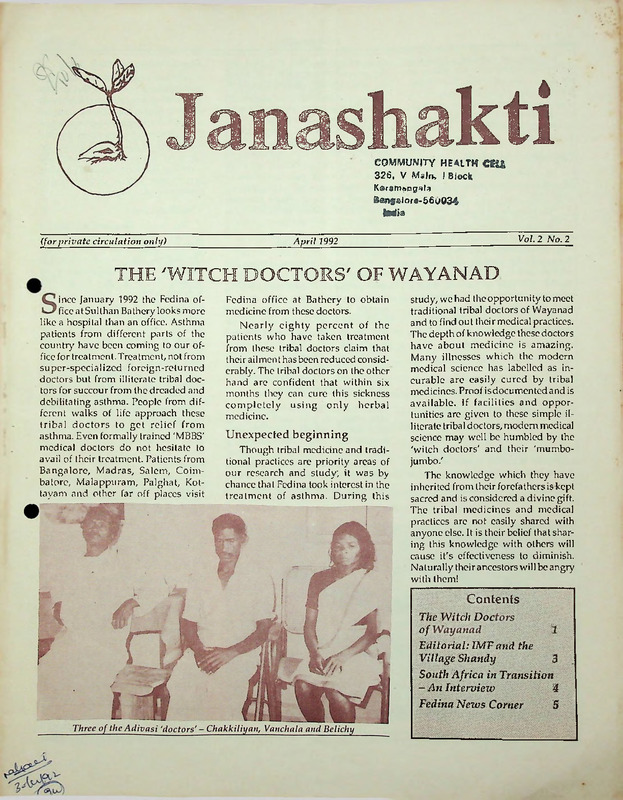
Belichy, Kavilan, Chakkiliyan and
Vanchala. Kavilan and Belichy are
husband and wife. All belong to the
main tribal group of Wayanad — the
Paniyas. Medical doctors Shenoy,
Jithcndranath, Mohan and Nayak (all
members of Suithan Bathery Jaycecs)
conducted various tests to find out if
the patients who came for treatment
really suffer from asthma. Only
after confirming this would the
tribal doctors give their herbal
medicine.
Similar camps were conducted on
February 22d and March 24th. Next
camp is planned for April 28th.
Meanwhile, the tribal doctors come to^r
Fedina office every Tuesday to ob
serve the condition of those who are
under their treatment and to provide
further medicine if required.
No foolproof claims yet
Velichy examining a patient
The first group of 100 patients who
have taken tribal treatment are now
under observation. The fluctuations
and changes are noted and recorded.
More than 80 of them have vouched
that the medicine had very positive
effect on them. The observation period
will be for six months. It is important
to find out how the patients react to
the climatic changes during this
period.
As far as the treatment of asthma is
concerned, a new chapter has begun.
April 7992
Yet Fedina docs not claim that this is
foolproof and without any limitations.
This is still in the experimental stage.
If we make any claim, it will be only
after the observation period and after
verifying each case.
Asthma patients who have under
gone all kinds of treatment, including
the famous 'fish treatment', have con
fessed that the tribal medicine has
given them much better relief. Such
remarks make us hopeful and op
timistic.
Some limitations
This asthma treatment is still in the
experimental stage. Therefore we
have avoided making any active cam
paign in this regard. We need to prove
(the authenticity and effectiveness of
the tribal medicine during the obser
vation period of six months. It is only
then that we can actively launch the
programme. Though no attempt was
made to advertise or campaign, the
number of asthma patients who turn
up to meet these tribal doctors is on the
increase. However, due to the non
availability of some herbs it becomes
an unpleasant task both for Fedina
and for the tribal doctors to return the
patients who have taken much trouble
of traveling long distances empty
handed.
In the past the herbs used for
making the medicine were easily
available on the banks of the ponds
and streams in the forest. Consequent
to the unscientific deforestation these
herbs have become a scarce commodi ty today. The ponds and streams
once abundant in the forest are seen no
more. Most of the forests have been
converted into agricultural land.
Another reason for the scarcity of
these herbs is the ecological degrada
tion and inadequate rainfall. The in
human forest laws do not permit the
tribal doctors to collect the life-giving
herbs available in the existing forests.
JANASHAKTl
page 3
EDITORIAL
IMF AND WB AT THE
VILLAGE SHANDY!
The time span of 1991-1992 has very specific implication to rural
communities. This is the period manifesting the macro economic in
fluences, in their direct proportion — on rural communities. Qlobaland
international economic influences, sofar, were something - 'out there'.
(But not any more. It has come to the life of every individual in the
villages. 14 case study done in a village 20 hms awayfrom (Bangalore
brings out these manifestations in very specific forms. ‘The first, is the
large scale promotion of sericulture. ‘The public sector credit institu
tions have a target of converting 20-25percent of agricultural crops
into sericulture, over the next three years. 14ny local resident is able to
see the transitional'replacement of rqgi-eucalyptus-sericulture, in a
quantum target approach. The second major manifestation is in the
shortage of granite for house construction. The gulf reconstruction
combined with the policies for liberalization has made granite quar
rying predominantly accessible to mechanized hi-tech granite in
dustries. The manifestation has otherforms such as commodity control
over natural resources, from the situation of water being sold in pots
by women as a source of incomegeneration, the situation over the past
two years is one in which tanker operators have movedin to sell water.
14(1forms of infrastructural development for promotion of market
economy could be observedhere. 14nSTD/IS(D booth has been installed
four months bach. The main road leading to the town has been
expanded in a big way. Issuing ofpattas are being made easier. T/uen
in the cities, issue ofpattas to slums has been offered by the WB as a
cost effective solution for slum clearance!
These changing situations have very specific message to the 9^pn
governmental (Development sector. The need of the hour is to
revalidate a good amount of logical, assumptions and ideological
guidelines, on which we have been wording so far. There is the need
A turning point
to update our understanding of communities in a macro mainstream
From the so-called uncivilized and
illiterate tribal society, the modern
and civilised society has found rays of
hope for a new life in the whole
process. Many patients must have
come to these tribal doctors with some
apprehensions. What was uppermost
context and decide what interventions could contribute towards a
people-oriented approachfor socialjustice andfundamental humanis
tic rights -coming under the constitutional provisions of the nation.
page 4
April 1992
JANASHAKTI
in the minds of atleast some of the
patients was this: "am I going to be
treated by these dark and shabby look
ing adivasis?" We need to look at the
other side of the coin as well. Though
they are tribal doctors, they feel un
easy because they are "uneducated
tribals" who are called to treat the socalled "elite." A wound will always
show a scar. It will not be easy either
for the tribals or for the non-tribals to
forget the different roles each has been
playing so far -- the exploited and the
exploiter, the oppressed and the op
pressor.
To eliminate their inhibitions and
to build up their self- confidence,
Fedina had organised many training
sessions for these doctors. Those who
used to look down on the tribals have
now begun to acknowledge their
worth. Will the wisdom and
knowledge of the illiterate open a new
chapter for the modem society? In
dications are that we can be optimistic.
(Translated by Kokatt)
SOUTH AFRICA IN TRANSITION
(An Interview with Philip Van Ryneveld)
hilip Van Ryneveld is a member of
the African National Congress
(ANC) who sees his role as that of
offering "policy options" for the ANC
leadership in planning the future local
governments. He was in India to loam
of our experiences with decentraliza
tion. Interestingly, in South Africa, the
ANC — like B R Ambedkar -- is for
centralization and Pretoria against it.
He works at the University of Western
Cape.
P
He made a presentation of the
South African Polity tracing its roots
from the often innocent laws to the
draconian present state violence, al
ways setting it off against contem
porary social and economic
imperatives.
Is the ANC anything more than a
tribal party?
It is not a tribal party. It is the only
truly national movement in the
country at the moment and includes
people from many different ethnic
groups, whites, asians, mixed trends,
etc. Its ideology is to find the
methodology of the urban industrial
society more than anything else.
JS: You have no power - but you have
majority. When you come to power
how will you safeguard the rights of
the minority?
How does ANC's commitment and
demand for democracy square with
the street reality with regard to Inkatha movement and minority In
dians?
I think they would be safeguarded
on individual basis rather than on a
group basis. Individual rights of the
people would be protected and there
by peoples right to be a part of the
associations that they are choosing. I
also think that the conditions in South
Africa do not really exist for a repres
sive state to emerge because a repres
sive state cannot exist when there is
multiplicity of power centers and
there arc going to be multiplicity of
power centers in South Africa.
I think that ANC at the moment
has a very strong democratic tradition
developing and people who are of
South African origin will certainly be
included in that vision of democracy.
The way in which the ANC has been
dealing with the threat from Inkatha
and the violence coming from the
State has been to expose the process
and open it up to public as much as
possible. Of course all instances of
violence have to be brought to the at
tention of the independent judicial
process and that always is for the com
mitment to democracy.
Do you recognize the struggles of
minority groups in various countries,
especially in the context of India's
harijans?
I am speaking here as a member of
ANC and not as a representative of
ANC. I would say that ANC likes to
identify itself as a democratic move
ment and movements resisting oppres
sion of all kinds, races, classes, religious
oppression and would identify them
selves in response to that.The extent to
which we actually do that remains to be
seen. Unfortunately South Africans are
quite narrow in this respect and 1 don't
After the presentation the
Janashakthi team met him for this in
terview.
believe they are sufficiently conscious
about struggles elsewhere and this is
partly the result of isolation which has
been due to the sanctions whiclf^
though an important part of our strug
gle has had problematic side effects.
How much has international
solidarity helped in your struggle —
materially and morally?
Immensely. The campaigns that
took place show that local struggles
exist. The pressure from campaigns
outside the country and local strug
gles inside the country gave more
force and I don't believe that the
government would have embarked on
constitutional talks as early as this had
it not been for the international
sol i d ari ty movemen ts a nd the in temational campaign. Of course India was
the first country to impose sanctions
and for that reason India's contribu
tion is very important.
Can you give some concrete sugges
tions as to how people can help on
going struggles by minorities?
I think what is really needed at this
point is a much greater flow of people,
information and ideas between India
and South Africa. Understanding
democratic people will help to develop
new strategics and these new strategics
have to be relevant to an increasingly
international world, and an internation
al world economy. I don't have very
clear ideas of how people can support
each other but I do think that India and
South Africa face a lot of similar
problems, problems of appropriate
technology, problems of ways of
doing things, and could benefit a lot
by sharing.
April 1992
I ndia has a lot of technical expertise
in dealing with these kind of
problems. India and South Africa
could draw on these very profitably.
What role can voluntary organisa
tions play in this regard?
I think you can share and exchange
ideas. There is a strong voluntary
movement in South Africa. Voluntary
movement in South Africa will change
i ts form wi th the emergence of the new
democratic constitution. I believe that
this development issue will become
independent and voluntary organisa
tions will play a role in that.
Earlier the leadership was tradition
al. Now power has shifted more to a
democratic one and the general
j secretary has a trade union back
ground. Can you go deeper into the
shifting in leadership and your out
look and the historical reasons for it.
I think that Nelson Mandela
leadership and the leadership of the
ANC people who were forced into
exile developed really in 40s and 50s
and South Africa was much less in
dustrialized and urbanized at that
stage. The leadership that emerged in
the 80s has done so in the context of
much more industrial and urbanized
society and therefore follows that kind
of logic
JS: How does it affect your tactics,
world view, strategy...
I think it tends to make traditional
forms of leadership and social or
ganization less important in ANC
than was the case before. There is an
important group within ANC, of
whom Mandela is part, who are stress
ing the need to find ways of incor
porating some of these traditional
positions into the new constitution
even if only at a symbolic level. The
problem is that the apartheid regime
used these traditional structures, more
than anything else, to enforce apartheid.
LONG WAIT
She stopped her carat the red traf
fic light. The light turned green. Ab
sorbed in her own thoughts, she did
not notice the change, until the
gentleman in the following car came
out and politely asked her, "Madam,are
you waiting for your favourite colour?"
JANASHAKT1
_________________
BANGALORE
input in the economic programmes.
Will high financial input lead to selfreliance or dependency? To discuss
this topic key persons from Fedina,
ICRA and Pi pal Tree met together on
March 3rd and 4th at Bangalore. A
thorough discussion took place on the
pros and cons of the issue. Even
though no concrete solution could be
arrived at, everyone felt that strategies
should be given serious consideration
when planning and implementing
long term economic programmes.
Our women staff
at Bangalore
The month of February was unique
for the women staff of Fedina. For the
first time the women staff from all our
project areas met at Bangalore office
for two days (February 3rd and 4th).
There was no pre-planned agenda for
this meeting. This being the first meet
ing, discussions focused mainly on
topics such as situation of women in
Fedina, their relationship with their
colleagues and how the women's
programmes in general could be im
proved. This meeting was a pleasant
change from their hectic field work. It
is planned to have similar meetings in
the future.
Financial Legislation
for NGOs
A workshop on Financial Legisla
tion for NGO's was conducted on 20th
and 21st March at SCM House, Ban
galore. Nearly sixty representatives
from various voluntary organisations
participated. Mr.K.N. Gupta, partner,
Thakur Vaidyanath Ayer and Co.,
New Delhi and Major Michael, Execu
tive Director of CASA, New Delhi,
chaired the sessions. Sri.S.Scnthamarai Kannan, Deputy Commis
sioner of Income-Tax, Bangalore and
Sri.P.Govindarajulu, Chartered Ac
count, Bangalore spoke about the in
come tax laws and FCRA regulations.
Workshop was sponsored by Forum
of Financial Management and Legal
Regulation in India and hosted by
ICRA/FEDINA.
High Financial Input A Debate
There has been a rethinking among
both the donor agencies and NGO's
regarding the impact of high financial
P<&5
SAR/APURA
Persuasion Pays
35 year old Akkayamma from Billapura had the habit ofchewing tobac
co from her childhood and had now
become an addict. This habit had its
ill-effects on her health. She used to
complain of constant backache and
stomach ache. One of our field staff,
Precilia, who used to visit Billapura
regularly knew about her tobacco
chewing habit. She suspected that the
root cause of her problems was tobac
co. Her constant counselling and ad
vice regarding the ill-effects of tobacco
helped Akkayamma to gradually
reduce the intake of tobacco. Finally
she was able to give up this habit com
pletely. Mahadevamma from
Kamanahalli too had the same ex
perience. But constant advice and per
suasion on our part and a strong will
on their part did the job.
People Succeed Where
Government Failed
Non-availability of drinking water
was a crucial issue for the people of
Sompura village. With the support
and guidance of our staff the people of
this village organized themselves to
solve this problem. Constant visits to
the government offices made the
authorities concerned to look into the
matter. Specialists were brought to
identify the place to dig the borewell.
Even after attempting at seven places
these experts could not locate water
and the government finally gave up.
This did not stop the people from
April 1992
JANASHAKTI
page 6
persuading the government again.
However the people insisted that they
would identify a place to dig the
borewell. The government threatened
the people that if they failed to find
water the expenses will have to be met
by the people themselves. This of
course disappointed the people. Yet
they did not give up their contact with
the government. They convinced the
government that there was water
available in the neighborhood and a
borewell nearby would give them
water. Finally the government agreed
for one last attempt and to their
amazement. Water was found there.
Women's Day
Celebrations
The women's day celebration this
year was conducted at 2 villages Kugoor and Sarjapura. Previously this
event used to take place only at Sar
japura. The purpose of having at two
places was to make it easier for women
to participate without having to travel
1 ong d istances. An importan t aspect of
the celebration this year was the active
participation of the hobli level
women's committee which was
formed recently. Members of this
committee arc those who have par
ticipated in our trainings. Many of
them shared their experience of their
involvement with Fedina and how
this has helped in their overall
development. A street play was
enacted by these women which was
immensely appreciated by everyone.
tivities of last year and chalking out
future programmes were the high
lights of this meeting.
Cultural troupe
Budakattu Rangavedike is a cul
tural troupe of youth which is con
cerned with the preservation of tribal
culture. Since its inception they had
conducted various cultural program
mes at different places. So far only the
youth from N.Bcgur were involved.
But recently the youth from Annur
area too have taken a lot of interest and
have formed a troupe of their own.
They too had actively participated in
the one month jatha that was con
ducted in December. This troupe
could create plays on the spot based
on any issue they come across.
Women's Committee
Meet
The women's working committee
met for the first time in February at
H.D. Koto where twenty five women
participated. They divided into small
groups and discussed about their
achievements and failures. It was felt
that due to the lack of active participa
tion by women nothing concrete could
be achieved so far. The importance of
setting goals and adhering to the rules
and regulations of the sangha was em
phasized at this meeting. They have
decided to conduct similar meetings
once in every two months.
WAYANAD
Adivasi Day
The Adivasi Aikya Samithy
celebrated its 2nd birthday on April
8th. To mark this occasion they or
ganized a one week programme at
area level which concluded at Sultan
Bathery on April 8th with a con ven- «
tion and a massive jatha through the *
town. Nearly thousand Adivasis from
Wayanad braved the hot sun and ex
pressed their solidarity and oneness.
During the public meeting at Bathery
town the Aikya Samithy members
spoke about the need for a new tribal
society free from exploitation and op
pression. Even the political opponents
could only marvel at the way those
so-called illiterate tribals organized
themselves on that day. They have
decided to celebrate every April 8th as
Adivasi Day.
North Indian Tour
The Adivasi Aikya Samithy presi
dent, Kumar Vazhavatta, along with
other tribal representatives from
Kerala visited various places in North
India, especially Bihar. The purpose of
H.D.KOTE
Annual General
Body Meeting
The AGM of Budakattu Krishikara
Sangha took place on April 8th and 9th
at Machoor hadi. Nearly two
thousand tribals from all the hadis of
H.D. Kote arrived on 8th evening to
celebrate this annual event. Various
cultural programmes (traditional
songs, dance, street theatre etc.) kept
the crowd entertained the whole
night. The formal meeting began on
9th morning. Evaluation of the ac
H.D. Kote:The General Body in session
April 1992
page 7
JANASHAKTI
KITTUR
New Federation
Formed
________ Wayanad: The Adivasis taking out a procession on Adivasi Day
Samajam has been formed and
this tour was to have first hand inforregistered under the name "Udayam".
Ifcnation about their tribal counterparts
Kum. Parvati has been selected presi
in these areas and to find out about the
dent for this Samajam. All the
activities that take place there.
development programmes for women
are
undertaken by this Samajam.
SCIAF representative
Under their leadership some units
visits Wayanad
have already started cash kuris for in
Mr. Desmond Fernandez of SCIAF
come generation.
visited Wayanad in the month of
February. It was for the first time that
Model House at Valad
a representative from SCIAF visited
the area. Mr. Desmond was accom
Similar to the tribal model houses
panied by Mahesh Lobo. He spent
constructed at Cheeral and Vazhavat
three days with the team and par
ta in Wayanad, one such house is
ticipated in the tribal model house in
under construction at Valad, Nilgiris.
auguration at Vazhavatta. He also
Mammatty of Valad will be the
interacted with AAS representatives
beneficiary of this house.
from all areas.
Tribal Insurance
Mothers' Day
During a function organized at the
office premi ses 71 AAS members were
insured under a special group in
surance scheme of the New India As
surance Company. This scheme
provides assistance when the insured
incur losses due to death, accident or
other natural calamities. The Suithan
Balhery Jaycecs also collaborated with
this programme.
International mothers day was
celebrated with various functions. The
programmes were organized in col
laboration with the threebalawadis that
are functioning in Nilgiris. Conscicntization seminar for mothers, cultural
competitions for mothers and children
were the main highlights of the day. A
film on health education was screened
as part of the programme.
NILGIRIS
OXFAM in Nilgiris
"Udayam” - Adivasi
Vanitha Samajam
Involving the women from all the
units of Nilgiris a new Vanitha
OXFAM representative Smt. Bella
Rosario visited Nilgiris along with
Mahesh Lobo and Mathew Kokkat.
After visiting the project areas she in
teracted with the team members at the
area office.
All the nine villages which con
stitute the Kulavalli cluster do not
have basic facilities like street lights,
drinking water, roads, hospitals,
schools, etc. Unfortunately each vil
lage functioned independently and
had no interaction with the other.'
Fedina felt that formation of a federa
tion of these nine villages could help
to solve many of their common
problems. Various meetings to this ef
fect were organized and people from
all the villages were invited. Though
initially the participation was rather
poor, gradually the number of people
who came for these meetings in
creased. These meeting^ helped to
create an understanding among the
people which in turn led to the forma
tion of a 'Federation of the Kulavalli
cluster*.
Jatha for Development
To draw the attention of the
government about the overall
development of the villages a jatha
was organized on February 19th. A
disciplinary committee was formed to
ensure a peaceful jatha. More than 300
people assembled at Katrigudde road
and proceeded towards Bailahongla
via Kittur. The officials of Electricity
Board, Road Transport, AEO, Tahshildar, BDO, and Assistant Commis
sioner met the people and accepted
their memorandum. The active par
ticipation and outspokenness of the
shy and hesitant women of this area
won the admiration of all present.
Do Your Duty
Though the government rule states
that the village accountants should go
to the farmers and collect the revenue,
in practice it is quite the opposite.
Often the villagers had to go to these
accountants and settle the accounts.
However, the farmers of the Kulavalli
cluster would not budge in to this and
demanded that these village account
ants should visit the villages and col-
page 8
lect it themselves. Surprisingly the vil
lage accountants visited each and
every village and collected the
revenue.
CHENGAM
School with
a Difference
The people of Melthattyapattu vil
lage had made many appeals to the
government authorities to establish a
primary school in their village. But all
their attempts were in vain because
the forest officials strongly opposed
the establishment of the school. In
spite of all the oppositions, the people
have taken the bold step of construct
ing the school all by themselves. The
work is in progress and the parents
and children are looking forward to
the opening of the school in the near
future. Land and other infrastructural
materials for the school are provided
by the people.
Health Camp at Chengam
Tribal Youth
Beaten Up
The forest officer at Chengam al
ways had some spite against one of
our field staff (Thaniga). Recently
Thaniga was arrested for no reason at
all and he was beaten-up by six people
from the forest department. He was
also kept in jail for a day. Following
this incident written complaints were
sent to the higher authorities such as
the Ranger, D.F.O, and District Collec
tor. The Sub-Inspector of Police at
Jamnamarthur was also informed
about this atrocity done to an innocent
tribal youth.
J anashakti is the official newsletter
of the Foundation for Educational
Innovations in Asia (Fedina), 902,
Indiranagar I Stage, Bangalore-560
038. P u b 1 i s h cd in E ng 1is h,
Kannada and Malayalam by
Mahesh Lobo, Coordinator,;.
Fedina. Issue dated April 1992.
Editorial Team: Mahesh, Kokkat,
Smit ha, Pramod and Vasu
Laserset and produced by Wordmakers
Tribal family at H.D. Kote
Position: 4237 (2 views)