JOURNAL OF HOMEOPATHIC MEDICINE VOL. 7 OCTOBER-DECEMBER-1973 NO. 4
Item
- Title
- JOURNAL OF HOMEOPATHIC MEDICINE VOL. 7 OCTOBER-DECEMBER-1973 NO. 4
- extracted text
-
INDIAN JOURNAL OF HOMOEOPATHIC MEDICINE
( Published by the Homoeopathic Education Society )
Published Quarterly
Aude Sapere '
(Dare to be wise)
OCT.—DEC. 1973
No. 4
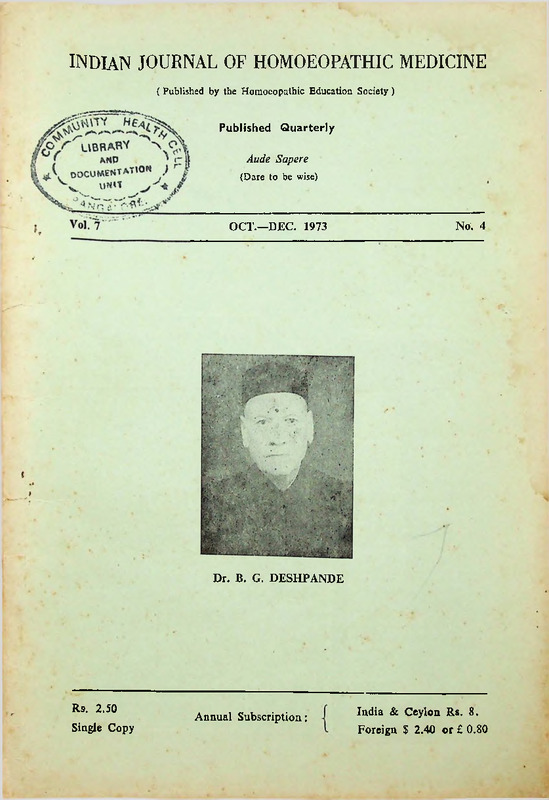
Dr. B. G. DESHPANDE
Rs. 2.50
Single Copy
Annual Subscription:
India & Ceylon Rs. 8.
Foreign $ 2.40 or £ 0.80
THE HOMOEOPATHIC
SANDESH
A mouthpiece monthly of
The 'All India Homoeopathic
Medical Association
Now in New set up and New get-up
in Hindi & English
Serving for the last 25 years.
Subscription Foreign..$3 or £ 1.5
(Inland) .. Rs. 7.00 per Annum
To the Members of Homoeopathic
affiliated Association in India
Rs. 6.00
Specimen copy
Re. 1.00
Contact:
The Managing Editor
THE HOMOEOPATHIC SANDESH
4457, Pahari Dhiraj, Delhi 6.
Phone: 511908
j
Now Available
TAUTOPATHIC DRUGS
IN VARIOUS POTENCIES
Prepared by Dr. R. P. Patel
Write for the List to:
HAHNEMANN HOMOEOPATHIC
PHARMACY
Parangot Malekal, Kodimatha,
Kottayam, Kerala State.
Read “Tautopathy” by Dr. R. P. Patel.
THE INDIAN
HOMOEOPATHIC GAZETTE
“Med-House” Chowghat
(S. India)
Annual Subscription
Rs. 3.00
Specimen Copy
Re. 1.00
The only English
Homoeopathic Journal published
from the Central part of Kerala
For Advertisement rates etc.
please write to the Editor.
50 ML
Quarterly
THE 50 MILLESIMAL
(the Journal of Pure Homoeopathy)
Editor: Dr. R. P. Patel,
D.M.S., D.F.Hom. (Lond.)
L.M. (Dublin)
Post Graduate in Homoeopathy
(Glasgow. Germany. U.S.A, etc.)
N.B.: Other Books By The Same Author.
Annual Subscription
: Rs. 4.00
1. My Experiments with 50 Millesimal
Potencies.
2. The Art of Case Taking and Practical
Repertorisation
3. A Treatise on Homoeopathic Surgery.
4. Analysis and Evaluation of Symptoms.
5. Homoeopathy, its
Principles
and
Doctrines.
6. Case taking form with easy Repertori
sation.
7. Repertory Charts.
Single copy
: Rs. 1.25
Specimen copy
: Re. 1.00
Please Write To:
Dr. R. P. Patel;
Parangot Malekal,
Kodimatha, Kottayam,
Kerala, S. India.
INDIAN
JOURNAL OF HOMOEOPATHIC MEDICINE
Near Ida Naka, Vile Parle (West), Bombay-56
Phone No. 571135
s
frPTsrf
iT:
II
‘That which restores health is the proper remedy, he who cures the patient
is the best physician.
*'
...
...
...
...
—Charaka
“Life is short, art is long, opportunity fleeting, experiment fallacious and
judgment difficult/'
.
...
—Hippocrates
“The physician's high and only mission is to restore the sick to health."
—Hahnemann
EDITOR
P. SANKARAN
F.C.E.H., D.F. HOM. (LONDON) D.H.T. (U.S.A.)
EDITORIAL NOTICES
The INDIAN JOURNAL of HOMOEOPATHIC MEDICINE is published quarterly on the
last day of the quarter of publication viz. the last day of March, June, September and December.
It welcomes for publication contributions in the shape of original articles, case reports
lectures, symposia, panel discussions, extracts, news cuttings and other informative material
of interest to the homoeopathic medical profession. All authenticated matter and articles
of scientific interest will be particularly welcomed. All public and private homoeopathic
institutions are requested to send us reports of their activities for purposes of reference
and record.
Contributions will be accepted on the understanding that they are submitted exclusively
to the Indian journal of homoeopathic mbdicine- All contributions shall be subject
to Editorial revision. Papers for publication must be sent in two neatly typed copies
with double-line spacing and a good margin. Illustrations, if any, must be on separate
sheets. All contributions, books for review etc., should be addressed to the Editor,
Indian journal of homoeopathic medicine, near Irla Naka, Vile Parle (West), Bombay 56.
If contributors so desire, reprints of their papers can be supplied at their cost, provided
an advance request is made. The Editors reserve the right to reject any material without
assigning any reasons. No correspondence can be entered into on this account. Matter
not. accepted for publication can be returned only if sufficient stamps are received for
return postage.
Normally subscribers will receive the issues within fifteen days from the date of publica
tion. Any complaint from subscribers about non-receipt of copies should reach us within
one month of these dates.
All communications of a business nature, dealing with subscriptions, advertisement etc.
should be addressed to the Business Department quoting the subscription number. Outstation
cheques should include Bank commission charges.
THE
HOMOEOPATHIC
MEDICAL
PUBLISHERS
LATEST PUBLICATIONS
1.
PROPHYLACTICS IN HOMOEOPATHY
This is a compilation of the prophylactic remedies in homoeopathy useful for preventing
various diseases and conditions.
4th Edition
Price : Rs. 2. (Postage 30 P.)
2. THE IMPORTANCE OF AETIOLOGY IN HOMOEOPATHY (A Symposium)
This is a symposium on the subject of aetiology which reveals the enormous significance
and usefulness of the exciting cause in the homoeopathic treatment of the patients.
Reprinted
Price: Rs. 2.20 (Postage 30 P.)
3. REPETITION OF THE DOSES
Repetition of the doses in homoeopathic practice is a vexing problem. This question has
been dealt with in this booklet which summarises the experience of numerous veteran
homoeopaths.
Price: Rs. 1.60 (Postage 30 P)
4. HOMOEOPATHY AND SURGERY
There is a lot of confusion about the relationship between homoeopathy and surgery
This booklet in its new and enlarged edition explains this relationship and gives illustrative
cases to show how homoeopathy is useful in numerous so-called ’surgical
*
conditions as also
in conditions where surgery is actually necessary.
2nd Edition
Price : Rs. 2.00 (Postage 30 P.)
5. INTRODUCTION TO BOGER’S SYNOPTIC KEY
Boger’s Synoptic Key is a masterpiece but few are able to understand and utilise it fully.
Dr. P. Sankaran’s introduction to this book will help practitioners to recognise its extra
ordinary usefulness.
Price : Rs. 1.70 (Postage 30 P.)
6. HOW TO BE A SUCCESSFUL HOMOEOPATHIC PHYSICIAN
This booklet describes the qualities needed for success and how they should be applied
in practice.
Price Rs. 1.00 (Postage 30 P.)
7. THE POCKET REPERTORY
The Pocket Repertory is a handy booklet which supplies the need for, a concise but
comprehensive repertory when used independently. It also serves as an index for the Card
Repertory, helping to pick out the correct rubric-cards.
Sth Edition
Price: Rs. 6. (Postage 30 P.)
OUR STOCKISTS: Andhra Pradesh: Ramakrishna Homoeo Stores, Hyderabad;
Delhi : National Homoeo Stores, Fatehpuri, Delhi 6; Bhandari Homoeo Stores, Delhi 6»
Gujarat: Parmanand Sheth and Co. Gandhi Road, Ahmedabad 1; Kerala: Hahnemann
Homoeopathic Pharmacy, Kottayam; Homoeo House, Banerjee Road, Cochin; Madhya
Pradesh : Manohar Chunekar & Co., Indore 4; Maharashtra : Roy & Co., Princess Street,
Bombay 2; Banaji’s Homoeopathic Pharmacy. Princess Street, Bombay 2; Mysore: St. George’s
Homoeopathic Clinic and Pharmacy, Mangalore 2; Indian Institute of Homoeopaths, Gandhi
Nagar, Bangalore; Punjab and Haryana : Ideal Book Centre, Sector 17-D, Chandigarh;
Tamil Nadu: Indian Institute of Homoeopaths Kumbakonam; Uttar Pradesh: Bharat
Homoeo Medical Stores, Dchra Dun, U. P.; Pareek Homoeo Stores, Agra 3; West Bengal:
Hahnemann Publishing Co., 165, Bipin Bchari Ganguly St., Calcutta 12.
These publications are available from all the leading homoeopathic pharmacies; if not
please address your enquiries and order to :
THE HOMOEOPATHIC MEDICAL PUBLISHERS,
13-A, Station Road, Santa Cruz (West),
BOMBAY-54.
ACKNOWLEDGEMENT
The following Journals were received :
Athurashram Homoeopathic Medical College Magazine (Eng.), Kottayam;
Centre
calling (Family Planning), New Delhi; The Hahnemannian Gleanings (Eng.), Calcutta;
Homoeopathy (Telugu), Madras; The Homoeopathic Bulletin (Eng.), Calcutta;
The
Homoeopathic Sandesh (Eng. and Hindi), Delhi; Homoeopathy (Tamil), Kumbakonam;
Homoeopathy (Eng.), Kumbakonam; Homoeo-Doot (Marathi and Eng.), Nasik; Homo
eopathic Vikas (Eng. and Hindi), Gwalior;
Homoeopathic Reporter (Telugu), Eluru;
Homoeo Bulletin (Tamil), Tiruvarur; Homoeopathy Navnit (Eng. & Hindi), Lucknow;
Honey (Eng.), Hubli; The Indian Homoeopathic Gazette (Eng.), Chowghat; Karnataka
Homoeopathy Bandu, Bangalore; The Madras Homoeopathic Journal (Eng.), Madras;
News from Israel (Eng.), Bombay; Orissa Homoeopathic Bulletin (Oriya), Calcutta; Orissa
State Board Homoeopathy Journal, Bhuvaneshwar (Eng. and Oriya); Kerala Homoeo-
Journal, (Eng.), Kottayam; The 50 Millisimal (Eng.), Kottayam; The Torch of Homoeo
pathy (Eng. and Hindi), Jaipur; Homoeo Review (Eng.), Madras;- Homoeopathic Uplift
(Eng. and Hindi), Lucknow; Homoeopathic World (Eng.), Calcutta; Rogi Chikitsa
(Beng.), Calcutta.
INDIAN JOURNAL OF HOMOEOPATHIC MEDICINE
STOdi RT
Lead me from the fake to the true.
aw) nr
Lead me from mortality to immortality.
Lead me from darkness to light.
3JT
I
:
Let noble thoughts come to us from every side.
OCT—DEC. 1973
Vol. 7
No. 4
CONTENTS
1.
2.
3.
4.
5.
6.
7.
8.
9.
10.
11.
12.
Editorial ... Homoeopathy in India—A Frank Appraisal
137
L. R. Twentyman M. B., Ch. B., F. F. Hom .. Natrum mur. ..
140
N. J. Pratt .. Case Histories showing the successful action
of Phosphorus in Homoeopathic Potency
145
Natrum mur. (A Discussion)
..
147
Gallavardin
Medical Treatment of the Suicidal Impulse
151
Homoeopathy in Emergencies (A Discussion)
153
K. K. Datey, B. A., M. D., F. R. C. P. etc .. Coronary Heart
Disease
155
M. M. Bhamgara
Some Questions about Healthy Living ..
157
Importance of Pathology ( A Discussion )
160
Hernia and Hydrocele (A Discussion)
162
From our Case Books :
i. S. R. Phatak, M. B.» B. S. .. Two Cases
..
167
ii. P. Sankaran, L. I. M., F. C. E. H.» D. F. Hom. (Lond),
D. H. T. (U. S. A.) .. Some Cases ..
167
iii. H. Singh
Some Notes
..
170
iv. S. R. Wadi a, M. B., B. S., M. F. Hom. (London) .. Pyrexia..
171
Diwan Harish Chand .. The 28th International Homoeopathic
2
C ongress
..
17
13.
14.
News and Notes
Book Review
••
••
15.
16.
17.
Abstracts and Extracts
Dr. B. G. Deshpande, M. B., B. S.
Obituary
177
..
178
..180
18.
Placebos
••
176
177
180
The views and opinions expressed by the various writers do not necessarily coincide with
those of the Editor.
INDIAN
JOURNAL
OF
HOMOEOPATHIC
MEDICINE
137
EDITORIAL
HOMOEOPATHY IN INDIA — A FRANK APPRAISAL
*
Just as free India has completed 25 years of its existence,
the Indian Parliament has just passed the Central Homoeopathy
Council Bill for standardising the education and practice of Homoeopathy.
Therefore this is an appropriate opportunity to look back to evaluate
the progress and assess the present position of Homoeopathy in India.
Only 25 years back the Homoeopaths of India were an unrecognised
race. Their lot was an unenviable one for they were treated like Harijans because Homoeopathy itself was unrecognised.
Therefore, these
practitioners had no legal status or even existence. They could practise
merely because the Government had benevolently ignored them and had
not prohibited them from practising. And because Homoeopathy was an
effective system, there was a demand from the people and so the practice
flourished.
However, the situation has changed considerably. Homoeopathy has
now been accepted and recognised in almost every State of India and
by the Union Government also. Large numbers of homoeopathic practi
tioners have been registered or enlisted. There are 77 homoeopathic col
leges in India, many of them with hospitals attached. There are numerous
homoeopathic journals and many useful and valuable books are being
printed or reprinted. The Union Government as also several State Govern
ments have -appointed Advisers or Directors of Homoeopathy and Homoe
opathy Boards are functioning in most States. The Union Government
has also created a Central Council of Research in Indian Medi
cine and Homoeopathy, which is aiding, guiding and conducting research
in several institutions. Some funds are being allocated for homoeopa
thic education and research by the Central and the State Governments,
1 hough these amounts appear proportionately very low when compared
with the allotments made for allopathic medicine. India has the largest
number of homoeopathic practitioners in the world. Therefore, it would
seem that we have every reason to be contented, happy and even proud.
However, it is necessary to take a closer look, make a deeper analysis
and carry out a careful assessment to establish whether everything is
as satisfactory as it seems on the surface.
Homoeopathic Practitioners :
Though the number of homoeopathic practitioners, even those on
the rolls of the State registers is fairly high—over a hundred thousand—
the number of those who have actually received regular training and
possess institutional qualifications is relatively low—.about 10%. Even
among this small number, the persons who actually practise Homoeopa
thy is lower because many are tempted to practise the allopathic system
of medicine. These persons are largely adopting and accepting the use
Published by arrangement with the 50 Millesimal.
138
INDIAN JOURNAL OF HOMOEOPATHIC MEDICINE
of the other systems not because they have found it superior but because
they say they find it easier to practise and more lucrative. Even among
’hose who practise Homoeopathy the proportion of persons who practise it
scientifically is still lower. Below the large canopy of Homoeopathy, there
seems to be all kinds of practices existing ranging from the use of the
single similar medicine to polypharmacy and use of combinations, speci
fics, patents etc. There are persons who use these patent and specific
medicines without any understanding of the basic principles of Homoe
opathy. Many of these practitioners can be called as homoeopaths only
because they use the potentised medicines. Therefore these will be homoeoopaths only in name. Again if the cases as found reported in some of
our Indian Journals are any indication of the standard of homoeopathic
practice, we have to conclude with regret that in general the homoeopathic
practice itself is of a very poor scientific standard.
Homoeopathic Education :
We have mentioned that there are 77 homoeopathic colleges. This
number seems to’be increasing very rapidly. Whereas to establish an
allopathic college, a very large amount of planning seems to be called
for, homoeopathic colleges, it seems, are esablished very easily. We are
told that an average allopathic medical college and hospital require a
capital investment of at least a hundred lakhs of rupees whereas there
are homoeopathic colleges which have been started with only Rs. 20,000/as capital. Of these numerous homoeopathic colleges only about half the
number may come up to some kind of a standard, and if the rigid
criteria of present day medical educational requirements are applied,
less than half a dozen may be found passable. The fault may not be
with the institutions themselves because modem medical educational re
quirements necessitate a huge investment of funds and these institutions
have neither such large private funds at their disposal nor do they re
ceive adequate Government support. These institutions are founded only
because of the excessive enthusiasm of the organisers. Also considering
the comparatively poor emoluments given to the teachers in these ins
titutions, these institutions cannot attract the best talent in the field. The
hospitals attached to these colleges do not have enough beds nor are they
sufficiently equipped. The students who are attracted to these institu
tions are not the best in the field because Homoeopathy is still being
considered only a second best system and is often the refuge of those
who cannot get admission into the allopathic colleges. Therefore, the
number of homoeopathic institutions in India reflects only an expansion
in volume and not a growth in quality, so that as Dr. Kanjilal says, this
one-sided growth if allowed to continue may be compared to a filarial
limb, bulky but useless.
Literature :
In the field of homoeopathic literature again, there seems to be a
healthy competition. We can boast of publishing over 50 journals. Every
INDIAN JOURNAL OF HO.MOEOPATHIC MEDICINE
139
year new journals are being started. But if one were to go and examine
carefully the contents of these journals, there is bound to be much dis
appointment. Original matter is generally found to occupy only a minor
part of the journals and even this original matter that is found is not
up to the standard. Sometimes, there is often a lot of verbiage with wellworn cliches explaining the principles of Homoeopathy or alternately
reprints of articles from other journals. The- editing and printing also
leave much to be desired and will not come up to international standards.
The books that are published are usually reprints of well known
foreign editions so that a casual observer would conclude that Indian
homoeopaths have very little original thoughts or experiences to con
tribute. Even these books it would seem are published only with a com
mercial idea and not with a view to advance the science.
Research :
We have already discussed elsewhere the rigid requirements of
research. Proper research requires very talented and capable persons who
have mastered the subject in which they are attempting to- do research.
However the data provided in the research reports are often insufficient
and the conclusions drawn faulty and questionable. The equipment
available for research purposes is quite inadequate this again being due
to want of funds. The institutions in India which are involved in research
lack almost all the requirements though it may be -due to no fault of
theirs. Research is -a very costly adventure and unless there is enough
support financially it is not possible to do- proper research. In the field of
allopathy, the huge pharmaceutical cartels which make tons of money
are willing to expend some of their profits on research because research
promises to bring, in new discoveries and these new discoveries may open
up further avenues of profit. But this is not possible in the homoeopathic
field because firstly homoeopathic pharmacies are not so big financially
and secondly the very principles of homoeopathy go against private profit
making. Therefore homoeopathic research can be conducted only if the
Government gives enough support. The Government, though often very
vociferous in its support of Homoeopathy, does not match its action with
its words when it comes to actual allocation of finances. We are informed.
that indigenous systems of medicine and Homoeopathy do not receive even
one per cent of the allotment that allopathic medicine enjoys. Under the
circumstances, research is bound to suffer and is likely to be of a haphazard
nature.
Our contribution as homoeopathic practitioners in general and
leaders in particular is also very disheartening. It would appear as if we
are in state of somnolence. We are satisfied with very superficial achievments and do not care or dare to look deeper. We are busy with
our own petty problems forming associations. jockeying for
position and power or pontifying. while the science suffers. The one
hundred thousand of us could not prove even ten remedies in the last 25
140
INDIAN
JOURNAL OF
HOMOEOPATHIC
MEDICINE
years while one silent dedicated worker — Dr. Raeside of England —
has proved several remedies with a few volunteers. Can there be a sadder
commentary on our indifference and indolence?
To summarise, it will be seen that the general picture of healthy and
rosy development of Homoeopathy is not confirmed by a closer examina
tion. Homoeopathy in India is almost like a Calcarea carb, child, fat and
flabby but with no inner strength. No amount of Acts of legislature is
going to bring progress unless we the homoeopaths develop our inner
birength and vitality and closely coordinate our work and work together
sincerely. If we honestly desire the advancement of Homoeopathy as we
proclaim from house tops, it is high time that we start working earnestly
and silently, not to advance our personal ambitions but to promote the
progress of Homoeopathy.
NATRUM MURTATTCUM AND OUR CONVULSIVE AGE
*
by L. R. Twentyman, M.B., Ch.B., F.F. Hom., London
**
We live in an age of continuing crisis. It is of course true that all
ages of history are times of crisis, but some are more overwhelming in
scope than others, just as in the life of the individual puberty and
adolescence and again menopause are such moments of transforma
tion on the grand scale. Birth and death or perhaps rather conception
and death, mark the greatest of the turning points but the crisis of the
noon-tide is the greatest between birth and death. Gutkind wrote of
the crisis of the noon-tide.
"The terror of noon-tide is more frightful than any terror of night.
It is extreme of tension, when the height has been reached the
day can rise no more; there must be a.decline. Today there is this ten
sion; we are experiencing the suffering of limitation, of finiteness, of
being able to grow no more — the suffering of death. Yet this time is no
time of decadence—it is the mightiest of all world crises. The world
is passing its noon-tide height; it will change, and a new thing, unheard
of before, will come to pass”.
From this critique of modem man we can gain a deeper insight into
our troubled times. There is an immense tide of energy, a spiritual mo
mentum gathering in the so-called unconscious. Yet this gathering
pressure of libido can fundamentally find no outlet within the establish
ed forms and order of our present intellectual establishments and their
embodiments, the modem nation-states. All current forms are too nar
row, too limited for the vast currents of our time, and crack under the
great pressure. In the midst of it all, feelings of despair and exhaustion
arise and even characterise our time as one of overwhelming depression
and importance. Yet it is only the despair of the old modes of thinking
•
Paper presented at the International Homoeopathic Congress, Vienna, May-June 1973.
Consultant Physician, The Royal London Homoeopathic Hospital; Hon. Editor, The Bri
tish Homoeopathic Journal.
INDIAN JOURNAL
OF
HOMOEOPATHIC
iMEDICINE
141
unable to cope with the unheard-of-new life seeking birth. The terrible
crises of our days are birth-pangs. The grim and shattering experiences
of the two world wars lie heavy still, unrepented, on our human con
science; in the life-lime of my generation uncountable millions, prob
ably hundreds of millions, have met their deaths in the wars and revo
lutions through which we have lived.
Yet we must try and see these
catastrophies, spasms, convulsions, more in the light of birth-pangs than
of decadence. It is only the fact that the new cannot be grasped with our
cold intellects that .accounts for our despair and sense of impotence. "Life
has not weakened upon the earth. More vehement than ever before seems
rhe thundering of secretly yoked suns and worlds soaring through ages,’’
affirmed Brezina, the poet of Czechoslovakia.
The gathering hurricane of spiritual life breaks again and again against
the rigid concerts of tradition, habits of thought, dead rituals of bygone
times. The faces of our time betray pur plight. Even a century ago the
faces of our forebears were strong and full of content, whilst today the
term "faceless” has been coined to- characterise a whole civilization. The
cld spirituality is gone and now into the faces of emptiness must come the
new spirituality, born truly in the hearts and souls of the mere individuals
men, women and children. It must be a spirituality which is the expres
sion of the free individuality not possessed by tribal oversoul or instinc
tive unconscious forces. To those still seeking to be possessed, driven,
moved by vast collective forces, it will therefore appear as weak and in
significant.
Against this background of our time we must seek the expression of
the universal crisis in the experiences and diseases of the individual.
There is no doubt that the forms of disease have greatly changed in this
century and very particularly since the last war. Epidemic febrile
diseases have declined in severity. Deaths from carcinoma of the bron
chus death from rheumatic carditis have given way to deaths from coro
nary thrombosis, myocardial infarction. Accidents are now the com
monest cause of death under twenty years of age. Nervousness and sleep
lessness have become well-nigh universal, so that universal sedation by
day and night seems necessary for the full enjoyment of the benefits of
the welfare state.
The concept of stress was introduced by Selye to cover the non
specific syndrome which occurred in response to all sorts of specific in
juries at the same time as the specific responses also developed. The
post-war years have seen the accumulation of enormous new factual
knowledge about the functions of the suprarenal glands and their hor
mones. Much of this has been in relation to the stress adaptation syn
drome. There
*
is little doubt that many disorders regarded today as
stress disorders have increased in occurrence during recent decades, and
the growth of the researches into these hormones seems to correspond
to the growth in their importance.
142
INDIAN
JOURNAL OF HOMOEOPATHIC
MEDICINE
At the same time, during and after the second world war, the late
Dr. John Paterson was noticing, in the course of his work on bowel bac
teria, that an increasing number of patients showed the organism Pro
teus in their stool cultures. (It should be noted that the nomencla
ture and method of typing these organisms is according to the technique
described by Dr. Paterson, and based on Bach’s original description).
Before the war Morgan had been the commonest organism, but Proteus
became more and more common. Now in his work on the bowel orga
nisms and nosodes, Paterson was gradually able to associate the various
non-lactose fermenting organisms in the stool with specific groups of
homoeopathic remedies. The main remedy associated with Proteus was
Natrum muriaticum., and Paterson associated the greater frequence
of indication for these remedies with the long stress of the war crisis.The use of the word stress by Selye is of course not quite the same, but
their relation is obvious. Paterson therefore noticed that the type of
reaction in the host organism resulting in different organisms in the
stools had considerably changed from the twenties and thirties of the
century, at the same time as clinical observation showed such changes
in the forms of disease, and at the same time as the interest
in the suprarenal glands had exploded in the medical world.
Now John Paterson considered the keynote of the Proteus nosode
and its associated group of remedies to be "brain storms”. An obvious
example of what he means is migraine. Leaving alone. all the detailed
maze of physiological mechanisms in the migraine attack, the term brain
storm fairly characterises the phenomena from the patient’s point of
view. There is often a prodromal period of tension, followed by the
lightning flashes of visual spectra and the thunderclaps of headache,
cumulating in vomiting and followed by peace. Here, in Vienna, we may
perhaps recall the storm from Beethoven’ Pastoral Symphony.
Now it seems to me that in these symptoms we can follow a certain
conflict between the cool awareness of our head, very much become in
our day an onlooker consciousness, and the irrational forces buried in
our unconscious depths. These dynamic, ultra-dynamic forces are frustrat
ed of expression, the onlooker’s world becomes more and more shadowy
and unreal and yet is unable to .accept the life-giving impulses from
the blood in other than recurrent convulsions, storms, crises. In English
literature the figure of,D. H. Lawrence gave expression to this conflict
and the sexual reaction against cerebralism. Today all this has become
symptomatic of the age. Youth is in rebellion against the unreal, shadowy
mirage of our culture and civilisation, and seeks in sex, drugs and orien
ted in these lights. Often very nice, very sympathetic persons, in orditalism to reach reality, experience. The question is whether what is
reached is not yet still more illusory.
The characteristic Natrum muriaticum patients can be interprenary life mild, they find the proximities of family life and the challenge
INDIAN JOURNAL OF HOMOEOPATHIC MEDICINE
143
of strong emotional relationships unbearable. As Paterson observed, they
make bad wives. Under the stronger emotional challenges they become
*,
irritable
even impossible, and I think this accounts for the oft-repeated
phrase that they object to sympathy. It is not sympathy discreetly,
tactfully, offered that they object to, but they fear being involved, over
whelmed in an emotional situation beyond their control. They excel in
a gentle sympathy which keeps uninvolved and hence many go to them
with their troubles. But the deeper currents erupt in migraines and
the emotional outburst which we recognise.
When we turn to associated remedies, we find Ignatia, Cuprum,
Chamomilla, Secale. The same idea runs through them. In Ignatia it
manifests in nervous instability and contradictoriness, in Cuprum in
sudden cramps and angers, the cramps appearing in varied organs; in
Chamomilla mainly in fevers and tempers. Secale offers a most important
contribution to our task. Secale itself, extract of the Claviceps purpura
growing on rye, gives rise mainly to cramps of digital arteries, though
history suggests that the epidemics of St. Anthony’s fire also gave rise
to acute insanity. From the crude extract, chemical sophistication has
produced many substances. ergometrine acting primarily on the uterus,
ergotamine with its selective- use in migraine, and lysergic acid with
its characteristic psychic phenomena. Could we not call an LSD trip a
psychic migraine ?
John Paterson related the Morgan nosode and associated remedies
particularly with the liver. The Dysentery Co. nosode, he related to the
heart and epigastric regions. It seems to me reasonable to relate his
Gaertner to the lungs and I wish to suggest that Proteus and its reme
dies, including Nat.mur., find the basis of their reaction in the kidney
and suprarenal system. I think the empirical findings of modern research
justify taking kidney and suprarenal as parts of a common
function. Their closely inter-related actions in the renin-angio
tensin
mechanisms of hypertension, the peculiar kidney pheno
mena in the adaptation syndrome, the role of the kidney in
maintaining electrolyte balance and homoeostasis and the suprarenal
influence on sodium and potassium do, I think, give a basis for thinking
of these organs together. It is not by accident that the suprarenals sit
like hats on the kidneys. Rudolf Steiner and his school have pointed to a
higher function of the kidney, other than urinary excretion. This they
have called the kidney radiation. If urine is excreted, there must be a
counterthrust into the organism, the kidney radiation. Some of the
phenomena of this are mediated through the suprarenals.
The kidney mostly performs an eliminatory and katabolic activity
the suprarenals more an inliminating, or incretciy, and anabolic action.
The pictures of Cushing’s and Addison’s diseases can serve quite usefully
to focus our attention in an extreme form on hyperadrenal .and hype
rirenal syndromes, overactive complex and varied though these are. The
144
INDIAN JOURNAL OF
HOMOEOPATHIC
MEDICINE
hypertensive, florid, overactive pyknic Cushing contrasts with the
hypotensive, pale and pigmented, fatigued, depressed, asthenic Addison.
Embryologically, both the kidney and the suprarenal gland are
formed by a combination of polar forces and systems. The kidney
originates in the pronephros at the cephalic pole which, as it were, calls
forth the metanephros from the sacral pole. The adrenal gland also com
bines a nervous medullary with .a metabolic cortical portion.’ From thininner tension of origin and function arise the rhythmic phenomena of
the kidney and suprarenal function. I would draw attention particularly
to the rhythmic changes in cortisol level. This level rises during the
morning and there is a corresponding fall in the number of eosinophils in
the peripheral blood. By 10-11 a.m. these have reached a minimum, the
cortisol a maximum, and this is maintained over noon-tide. In the
afternoon reversal begins, and by 10 p.m. eosinophils are nearing a
maximum, cortisol a minimum. Now Natrum mur. is characterised homoeopathically by a 10 a.m. aggravation and Chamomilla by a 10 p.m.
aggravation. I suggest that the depressed, often, hypotensive, fatigued,
wasting picture of Natrum mur. lies in the direction of hypo-adranalism,
as has often been suggested before, but also I suggest that the strong,
angry, flushed, screaming Chamomilla who by contrast wants to be held
points rather to the hyperadrenal side of the balance.
That Natrum mur. quite often proves of value in rheumatoid arth
ritis is now understandable, and its great value after times of emotional
stress, bereavement, unhappy love, when depression, fatigue, emaciation
supervene, is justified. Migraine has found its place and the peculiar
combination of gentleness and irritability. Natrum mur. patients often
have a tendency to watery secretions. They weep easily, or have watery
nasal secretions, suggesting allergic rhinitis; they may have pale, watery
polyuria. The water drops and drips from them, they cannot hold it and
stress incontinence also arises. The whole picture is a drooping and a
dripping, and this is one aspect of the condition we are studying; it repre
sents the exhaustion of the upbuilding invigorating adrenal forces. Near
to it is the hypoadrenalism of Sepia. We can also relate the water retain
ing tendency of sodium chloride.
Finally, I should like to mention the occurrence of aphthous ulcera
tion in the mouth. I know of no other remedy so likely to relieve the
severe recurrent cases of this painful condition. Is it related to the equally
common recurrent herpes simplex on and around the lips ? The virolo
gists say so. Are they psychogenic from the reluctance to kiss or be kiss
ed? Do they point to a state of actual nervous exhaustion? But they come
in crops, explosively, probably from the nervous system, and bring us
back to Dr. Paterson’s brilliant characterisation of this group of remedies
and disorders associated with his Proteus nosode "brain storms”.
I have attempted to see how far one can understand this remedy
Natrum mur. as the mirror of our age. The terror of the noontide is the
INDIAN
JOURNAL OF
HOMOEOPATHIC MEDICINE
145
terror of our time, and we have seen how this is corroborated even into
detail of empirical research. Empirical research, traditional homoeopathic
drug pictures, the researches of Dr. John Paterson come together and
even help to throw light on and build a bridge of understanding towards
the remarkably illuminating ideas of Steiner and his school. I hope also
I have not strayed from the injunction of our League President Dr.
Paschero to pursue the Holistic Path.
CASE HISTORIES SHOWING THE SUCCESSFUL ACTION OF
PHOSPHORUS IN HOMOEOPATHIC POTENCY
*
by Dr. N. J. Pratt, Norwich, England
This paper describes 32 cases from the author’s own practice, all
cured or much improved after the administration of Phosphorus in
homoeopathic potency.
Diagnoses : They include 8 cases of Epistaxis, 5 cases of Gingivitis,
5 cases of Dyspepsia and Vomiting and 14 cases of other illnesses.
Age and Sex of patients : The ages of the patients ranged from 3
years to 91 years. There were 22 females and 10 males. Perhaps it is of
some significance that all the patients with Gingivitis were females, and
the patients with Epistaxis were 7 females and 1 male, whereas in con
trast all the 5 patients with Dyspepsia and vomiting were male.
Potencies used : The 3x potency was used in 29 cases. The 6x potency
was used in 3 cases. The 30c potency was used in 4 cases, and the 200c
potency was used in 1 case —a girl aged 17 years who complained of
sore gums and loose teeth, with bleeding from the gums "ever since I
can remember”.
Phos. 3x pills made her "go hot all over”, so she stopped taking
them, and 6 days later I gave her one dose of Phos. 200 and healing was
complete in 3 weeks, and there was no recurrence in a follow up of 10
months.
Duration of Illness : In 6 cases the illness had lasted for more than
1 year, in 7 cases for between 3 and 12 months, in 6 cases for between
4 to 8 weeks, and in 12 cases for between 1 to 8 weeks, and
in 12 cases for between 1 to 20 days. The most acute case was a
case of a boy aged 9 years who had an attack of vomiting attributed
to tinned jam. He vomited about every hour while awake — at least 12
times, and there were streaks of blood in the vomit. Every little drink
was returned after a few minutes. I prescribed Phos. 3x pills, 2 to be taken
every 2 hours. He vomited once more, then made a quick recovery to
normal health.
One of the most chronic cases was a man aged 32 who had blood in
the nasal mucus nearly every day for about a year, never more than 2
*
Paper presented at the International Homoeopathic Congress, Vienna, May-June 1973.
146
INDIAN JOURNAL OF
HOMOEOPATHIC MEDICINE
days without some blood. He mentioned that his face and ears fre
quently became hot. I prescribed Phos. 3x pills, 3 times a day for 3 days,
then at progressively longer intervals. He had blood in the mucus only
once in the next month, and took only about 20 doses of pills. There was
a slight recurrence 9 months later, then.no more blood in the following
8 years.
Time of response to Treatment: Response to treatment was noticed
in an average of 10 days. This may sound slow to doctors who use sup
pressive allopathic treatment, but it seemed quick to most of the
patients. On average the time in which response was noticed was one
tenth the time the illness had lasted. Most patients were completely
cured; 6 patients were much improved, but not completely cured. We
have to admit that Homoeopathy cannot always cure diseases which are
caused by degenerative changes in old age, but we can claim that Homoe
opathy can alleviate most of those diseases.
10 cases improved within 3 days, 8 cases improved within 1 week,
and 7 cases improved within 1 month. In the remaining 7 cases, for one
reason or another, the time of response is not clearly stated.
In my experience, in all types of cases treated with many different
remedies, I find the commonest time in which response to homoeopathic
treatment begins is 2 to 3 days; perhaps this is the time needed for the
elimination of toxins or the correction of disturbed enzyme systems.
Burning Feet: A woman aged 53, working as bottler at a brewery,
complained of hot painful feet for three weeks. She had to wear clogs at
work. The soles of her feet were "burning hot”. I prescribed Phos. 3x
t.d.s. and in five days the improvement was marked, in spite of her conti
nuing at work, in spite of a heat wave with temperatures up to 79° in
the shade, and more in the brewery. She could then wear her ordinary
shoes again, after having to wear sandals or slippers for 3 to 4 weeks.
There was no recurrence of the trouble in a follow up of 14 years.
Haemoptysis: A young woman, a teacher, aged 31, complained of
coughing up "little lumps of blood” for about 12 years, for 2 to 3 days
at a time with intervals of freedom for about a week. She had received
treatment from a number of doctors and at least 2 chest specialists. Her
chest X-rays were normal. No definite diagnosis had been made. I
prescribed Phos. 3x t.d.s. for 3 days. She coughed up a little blood only
twice in the next month, and never again in the following 16 years
Follow up : It is important to complete the case history with an ade
quate follow up. Unfortunately, patients do not always take the trouble
to report that they have been cured; perhaps they think the doctor is
not really interested, and they do not like to bother him. I always
want to know how they respond, and was able to follow up all these cases
but one.
Reasons for prescribing Phosphorus : Some of these patients needed
careful and full repertorisation in the Kentian manner. Others needed
INDIAN
JOURNAL OF HOMOEOPATHIC MEDICINE
147
little more than a reference to one or two rubrics in the Repertory to
confirm the choice of Phos. and to glance at related remedies. Others
notably the cases of Gingivitis and of Epistaxis, were so clearly similar
to the toxic effects of Phosphorus that the correct remedy, the simillimum
was in no doubt.
Quite recently a member 6f the audience to whom I had given a
lecture on homoeopathy said that she had been told that every patient
needed, at the first consultation, an hour for "taking the case”. This is
often true when the general health is disturbed, and the constitutional
remedy must be found. But in other cases, with some experience, only a
few minutes are needed to find the correct and successful remedy, as
above.
NATRUM MUR.
*
(A Discussion)
Bhanu Desai, M. B. Raut, Miss H. A. Merchant,
R. R. Bharucha, P. Sankaran and Sarabhai Kapadia.1
Sankaran ;
Considering the fact that three-fourths of the
earth’s surface is covered by water in the form of the sea and that the
major solid constituent of this water is ordinary salt and considering
also that almost all human beings require and consume salt in their food,
I think Nat. mur. should be a very important remedy for many disease
conditions and perhaps should be used more extensively. We have, of
course, treated many cases with Nat. mur. but I shall describe a few
peculiar ones, particularly some treated by Dr. S. R. Phatak.
Some years back he was consulted by a gentleman for his wife who
was behaving in insane manner. She would weep and laugh alternately
without cause. She would also clap her hands and sing suddenly. She
was generally incapable of looking after herself.
There was a history that three years back a child of hers has fallen
ill and had died on her lap. This had given her a shock but she could
not and did not weep then. A few days later she had exhibited an ab
normality of behaviour as described above. Some physicians were con
sulted and she had been relieved by Electro convulsive (shock) therapy.
Three years later i.e. now, she has had another child born to her and
this child resembled exactly the previous one. Perhaps it brought back
to her forgotten memories and also perhaps produced internal an
xiety about the safety of this child. As a result she became insane and
started behaving irrationally as described above.
In treating her, Dr. Phatak took the cause as the first symptom viz.
that she had suppressed grief. Kent’s Repertory under the rubic "Sad
cannot weep” (p. 78) gives only Gels, and Nat. mur. Out of these
Nat. mur. covered the alternate weeping and laughing. So he prescribed
[ Participants:
A free private discussion.
148
INDIAN JOURNAL OF HOMOEOPATHIC MEDICINE
for her Nat. mur. IM, 2 or 3 doses and it cleared up the whole trouble.
For several years now she has remained normal.
Once I was treating a child for some complaints. As the improvement
was slow I consulted Dr. Phatak. The parents had given the history that
when the child was born he had not cried for a long time so much so
that the doctor had been seriously worried. On this indication Dr. Phatak
prescribed Nat mur. There was very good improvement in the child’s
health. I asked him how this can be taken as an indication be
cause the Nat mur. patient is sad but cannot cry. To this he replied that
when the child was expected to cry, it did not cry. This is an indica
tion of Nat mur. Then he asked me jokingly "How do you know the child
was not sad ?” Perhaps it is so. I remembered that the child’s first cry is
said to be a cry of protest because it is pushed out from a cushy warm
environment into a cold cruel world.
In another case the symptoms were practically contradictory and
hopelessly mixed up. Boger gives an indication under Nat mur. "Thin,
thirsty and hopeless.’’ Giving a broad interpretation of this word 'hope
less’, Dr. Phatak prescribed Nat mur. which gave relief to the patient.
While going through Hering’s Guiding Symptoms, I noted that Nat
mur. has got a crack on both the upper and lower lips, whereas all the
materia medica people only emphasise the crack in the middle of the
lower lip. I wonder why they have omitted the crack in the upper lip.
By the way, I also wonder how the various materia medica compilers
pick out and give some particular symptoms out of the large group of
symptoms found in the provings. I wonder what is their criteria of selec
tion. Incidentally the biochemic practitioners I think use Nat mur. ertensively. Biochemic people say that Nat mur. is the remedy for
disturbances of fluids, either excessive fluidity or dryness e.g. lacrymation,
diarrhoea, constipation etc. There is lacrymation or weeping with laugh
ter or laughter ending in weeping.
Bharucha :
Just like we use Nux vomica.
Sarabhai : Some leading homoeopath has remarked that he used
Nat mur. more than any other two remedies put together.
Sankaran :
I think this kind of statement is given about many
remedies. I have read a prominent American homoeopath saying that
if he were allowed only one remedy he would prefer Sepia. I think ul
timately people start developing a preference or fancy for some particu
lar remedy, just like Dr. Wadia uses Thuja more.
Sarabhai :
When people get tears from laughter it is generally
a sign of internal grief.
Sankaran :
This may be so. Dr. Elizabeth Wright once asked
me ■ “Sanky you are always making jokes, laughing and making others
laugh. There must be some grief inside your mind”. When I said I had
no grief she would not believe it. By the way under "Sad but cannot
INDIAN JOURNAL OF HOMOEOPATHIC MEDICINE
149
weep”, besides the two remedies given by Kent I found Boericke’s Materia
Medica giving Amm-m.
Sarabhai :
Yes. This Boericke’s Materia Medica is a remarkable
book. In his repertory section, he gives many remedies not even found
in Kent and here we find many beautiful indications given.
Sankaran :
I many times wonder how he wrote that book be
cause the very mechanical part of writing the book, even without think
ing and referring, would have taken 5 years.
Sarabhai :
I was reading in the Brit. Hom. J. about a case—the
case of a boy who had a perfectly normal family history and develop
ment. But he was found to be lying, cheating, stealing, absconding etc.
He was even dismissed from his school. A careful history-taking showed
that he had fallen down when he was a small boy and had been injured on
the head. The
*
doctor gave him Nat mur. which did not work but when he
gave Nat sul. there was a slight aggravation followed by improvement
till he became well. Even after 1| yrs., the boy was found to be normal. It
is said that when the boy fell down he was stunned and did not weep.
The author remarks that Nat mur. has lacrymation while Nat sul. has
dryness of the eyes. Therefore, the doctor thinks inability to weep should
be more an indication of Nat-s. than Nat-m. I have seen some cases with
a crack in the middle of the lower lip and I have prescribed Nat m. taking
this as an indication but I have not observed whether this crack, dis
appears. I too have wondered how the various materia medica writers
select certain symptoms out of the thousands of proved symptoms while
every proving symptom can be an indication. Of course, they might
have selected those symptoms which were found more often recurring in
practice. Kent says that in the proving of Thuja many valuable symp
toms have been thrown away from the provings. This is a tragedy. Be
cause Burnett developed a crack in the lower lip under Nat m. he em
phasised that as a verified symptom.
Sankaran
Under Nat m. in the provings there are 34 symp
toms given under the Face in Hering's Guiding Symptoms. Out of these
34 Boericke gives 3 symptoms and Boger gives 4. How did they select
these 3 and 4 symptoms cut of the 34 ? Who told them these are the
important symptoms? Did it depend on their own experience?
Sarabhai
What are the sine qua non symptoms of Sulph? What
are the symptoms which contra-indicate Sulph ? I have strained my
rnind over this for a long time. Will you not prescribe Sulph., if certain
symptoms are absent ? I may here quote a most interesting experience
I have had last year. I generally used to prescribe Iris v. only on the
indications given in the books of materia medica. But there was a case in
which a patient had headache with salivation when talking. Under
rhe rubric "Salivation while talking” only two remedies are mentioned
in italics in Kent’s Repertory viz. Iris v. and Lach. He had no acidity
or burning anywhere. But Iris v. relieved him. Since then I have pres-
150
INDIAN JOURNAL OF HOMOEOPATHIC
MEDICINE
rribed Iris v. for a number of different types of cases on this symptom
mainly and got very good results. In my experience this minor symptom
of Iris v. has proved to be a major indication for this remedy and has
given surprisingly good results in more than 20 cases.
Sankaran :
Yes. Some homoeopaths ask "How can you give
such-and-such medicine when such-and such symptom is not present ?
They don’t seem to appreciate that the symptoms of the patient must
of course be in the remedy but all the symptoms of the remedy will not
be found in one patient.
Sarabhai
What is your idea, Nat-m. is chilly or warm-blooded?
Sankaran :
They say Nat-m, is chilly but< by heat.
Sarabhai :
In my college I was taught that the 3 characteristic
features of the Nat-m. patient are that he is warm-blooded, weeps easily
and craves for salt.
Sankaran : What about? < consolation? Dr. Dhawale (Sr.) always
used to emphasize that. By the way Dr. Gutman told me once that Nat-m
has no dreams of robbers though it is given in Alien's Encyclopedia. It is
Nat-c. which has this symptom.
Sarabhai :
Burnett says Nat-m. is the test of dynamisation. The
whole population of the world is consuming salt but it is not apparently
making them sick in its crude form while it can disturb or cure in its
potentised form.
Sankaran
That may be so but have you noticed that the ayur
vedic physicians cut off salt and many of their patients improve due to
this?
Sarabhai
Perhaps, it contributes to their sickness. Hahnemann
says that even a simple item of food taken in excess can cause
sickness.
Sankaran :
What is the most important symptom which reminds
you of Nat-m?
*
Sarabhhai
:
A h/o grief and periodicity esp. agg. with the sun
Sankaran :
Is it not due to the warmth of the day?
Sarabhai : No. "Stretching back
*
> lumbar pain” is also a good
indication. I had a case of jaundice in which the patient had craving for
salt and backache > by stretching. Nat-m. helped him
Bhanu Desai :
They say that Nat-m. should not be given during
a headache but I have given it then and find no. <
Sankaran :
Dr. Phatak told me that in the beginning of his
practice he used to give Nat-m. during fever and found very bad agg.
But in my experience I have given it without agg.
Sarabhai :
But you must have decided upon and given Nat-m.
only after the headache has gone, when you noticed the periodicity. I have
found it needed for headache during menses. I had a patient with a h/o
INDIAN JOURNAL OF HOMOEOPATHIC MEDICINE
151
sun-headaches in childhood. Later it became chronic with irregular perio
dicity after a vaccination. I gave him Thuja and told him that later on
you will get a sun-headache and on that day evening you take Nat-m.
He did get the sun-headache after
months and took Nat-m. and became
well.
Bhanu Desai :
In my experience Sang, is a better remedy for
sun-headaches, even in It. sided headaches.
Sankaran
Some people say Nat-m. is a good remedy for high
B.P. You know these patients are by < salt.
Sarabhai :
I have not had good results in high B.P. with Nat-m.
But then high B.P. cases are difficult. They don’t open out their mind.
Bhanu Desai :
In one case I prescribed Nat-m. on other indi
cation viz. giddiness when walking. Boger-Bonninghausen gives 4 marks
for Nat-m. in this rubric.
Sankaran :
I had one case. He could not forget an evil someone
had done to him He went on thinking about revenge. Dr. Phatak pres
cribed Nat-m. Boger says "A thought clings and inspires revenge”. The
patients brood over old griefs and grievances.
Sarabhai
:
I have used it in fissure-in-ano when the stool is hard
and tears the anus and the pain lasts the whole day. One patient could
not sit due to pain. He stuck on to Homoeopathy and was cured by Nat-m.
MEDICAL TREATMENT OF THE SUICIDAL IMPULSE
*
by Dr. Gallavardin of Lyons
I
In making known the medicines which are capable of dissipating the
impulse to suicide, I consider I am performing at once a charitable and a
social act; a charitable act in preserving members to thousands of families
and often their most important members; a social act in preserving
thousands of citizens to each nation. In France, for example, previous to
1830 there were only 1,500 suicides a year; to-day the rate is nearly
10,000. And the number will increase in proportion to the decline of
zeligious education which teaches resignation to the unhappy of this
world in the hope of future recompense. Thus the Mahomedans, in spite
of their deplorable morals, do not commit suicide because they retain a
religious faith.
In the French edition of my book on the Treatment of Alcoholism
I said I had found six agents of moral and intellectual culture; three of
them immaterial — Religion, Education and Instruction, and three
material — Medicine, Food and Climate, Experience has taught me that
we can only make daily use of two of these agents — Religion and
Medicine, which can come to the assistance of the alcohol habit and some
times replace it altogether. The present article is concerned with the
suicidal impulse; when this is not dissipated by religion it must be done
Reprinted from the Homoeopathic World, 1895; Translated by Dr. J. H. Clarke.
152
INDIAN
JOURNAL OF HOMOEOPATHIC
MEDICINE
by medicines. This is what I am now going to teach in setting forth in
what follows the differential indications of several medicines.
II
Medicines indicated against:—
1. The suicidal impulse: Aco., Alum., Aur., Bell., Carb.v., Chi,
Grap., Lach., Nat.m., Nux. v., Op., Puls, Rhus t, Sep, Stap.
2. Persistent suicidal impulse: Give successively, and following in
this order, a single dose of these five remedies in the 200th dilution, allow
ing each dose to act forty days:
(1) Bell.,
(2) Nux. void., (3) Puls.
(4) Aur.
(5) Ars. This
treatment would thus last two hundred days giving each medicine only
once.
3. It may be cured in other ways; e.g. in paying regard to the disease
which leads to suicide/ Thus, when it is hypochondriasis which induces
it. choose the best indicated amongst the following: Stap., Nat.m., Caust.,
Calc.carb., Grap., Alum., Sep., Sulph.
4. The following are indicated for the impulse to commit suicide
by firearms: Alum., Calc carb., Carb. v. Chi. Nat m., Nux vom.
Op., Sep., Sulph., Stap.
5. Suicide by throwing oneself under a carriage : Ars,, Lach.
6. By drowning : Bell., Ars.
7. By dagger: Ars., Bell., Nux. vom.
8. By poison: Ars', Bell., Puls.
9. By leaping from a height: Bell., Hyos., Stram., Sec., Nux vom.,
Aur., Ign., Sil.
10. By suffocation with carbon fumes: Ars., Nux vom.
11. Cutting the throat with a razor: Aco.
12. Impulse to suicide with fear of death : Chi., Acid nit., Plat., Staph.
13. From the death of a lover; from unfortunate love; from the
despair of love; Caust., Staph., Bell.
Ill
I will now quote a few observations of cure.
1. Eight’ or ten years ago Dr. Burnett of London, sent to me an
English gentleman who had suffered for at least four years from the
deiirium of persecution, a repulsion against women and a strong impulse
to drown himself. Two of his brothers actually had drowned themse Ives.
I completely dispelled these three orders of symptoms by giving him at
intervals of one, two, three or four weeks a single dose of each of the
following medicines: Stap. 200, Stap. 10,000, Nux vom. 200, and Nux
vom. 10,000.
2. A lady of 65 years of age, after a quarrel with her son-in-law
spoke about nothing else but drowning herself. I caused to be given to
INDIAN JOURNAL OF HOMOEOPATHIC MEDICINE
153
her, without her knowing a single dose of Bell. 300, in her soup. A month
later she said to one of her neighbours, "Formerly I used to think of
nothing else but drowning myself; I no longer think of it now”.
3. A drunkard had hanged himself Vwice in one day. The first time at
his own house, when his wife had cut the cord; the second time at the
Parc de la Tete D’Or, at Lyons, when he was taken down by the police.
I caused to be given to him in his soup, without his knowing Bell. 300,
once every two days. It is now a year since he has attempted to hang
himself.
4. I have often cured with Nux vom. 200, suicidal impulses in
alcoholics.
5. It has been remarked in France that the soldiers who have com
mitted suicide are chiefly those who have received no money from their
relatives who are too poor to send it. I treated, unknown to himself, one
of these soldiers who had a strong suicidal impulse, and who suffered, in
addition, from insomnia. Bell. 30G given every two or three days, cured
these symptoms completely. This remedy is the most efficacious of all
against the impulse to suicide.
IV
The foregoing shows how superior homoeopathy is to allopathy from
the social point of view, allopathy having, so to say, no remedies at all
for the suicidal impulse. If, for example, the twelve thousand doctors of
France employed our remedies, France would not lose nearly one hundred
thousand citizens every ten years. When will Governments understand
the social importance of Homoeopathy, which, besides, would diminish
by more than half the number of criminals by curing them of their
passions? This last result I frequently observe in my Tuesday Morning
Dispensary, where during the last nine years, I have given more than
£000 consultations, of which more than 5000 were for alcoholics.
HOMOEOPATHY IN EMERGENCIES
*
(A Discussion)
Sarabhai :
To-day’s subject is ‘Emergency’. Emergency is a con
dition where death is evident unless some positive medical or surgical aid
is given. There are pseudo-emergencies where it is imagined that some
thing serious is happening or is going to happen. So it is always necessary
for us to really understand and diagnose the proper situation which we
are facing. But there are conditions where if the relief is not obtained in
time there is possibility of serious consequences or even death. I had an
occasion to see a child who had fallen down and was in coma. When I
saw the child it was pulseless and the respiration was slow. I gave a
few doses of Arnica. And the child recovered from the shock. Arnica is
a very good medicine for primary shock. There are also surgical emerPart of a tape-recorded discussion from a homoeopathic conference held in Poona.
154
INDIAN
JOURNAL OF
HOMOEOPATHIC
MEDICINE
gencies in which secondary shock may occur. The breath becomes cold,
the respiration becomes slow. Carbo veg. has been found useful in many
such cases. The Carbo veg. picture is well-known to homoeopaths. Stront
carb, is more useful whenever there is an operation with heavy loss of
blood. I had one case of an advanced cancer. There was a growth on the
side of the neck. Biopsy had been done 3 months earlier. Since then the
patient was worse. He was spitting blood all the time in increasing quan
tities. I gave him Arnica IM every 15 minutes and gave Calendula diluted
with water for gargling. After one dose and one gargle he said "I had a
restless feeling in my throat which has disappeared now. Now I feel a
small splinter-like thing in the throat”. He felt better.
Sankaran :
In spite of having practised for a number of years
and even after having been attached to a hospital for a number of years,
I must admit that I have not seen many emergency cases in the real sense.
I have treated numerous patients who were in an extremely serious con
dition, numerous cases which had been rejected by other doctors in which
death was considered imminent. These cases have responded to homoeo
pathy very well. But I have seen few real emergency cases. However I
shall describe two or three cases from my experience.
Seme years back we had admitted in our hospital a case of
abdominal Koch’s. The patient had been directed by a homoeopath from
a mofussil town. The case was studied and the
*
remedy was selected.
I think it was Puls. It was given for 3-4 days without much improve
ment. On the 7th day the lady suddenly went into a state of collapse.
Her B.P. came down to 70/50 or so. The pulse became very feeble and
even thready, she became cold. The only remedy we could think of
was Carbo veg. It was given. Within half a minute or so, she revived
very nicely. Her pulse and general condition improved. We just gave her
Carbo veg. for one or two days and then thought of giving her her con
stitutional drug but as she felt
*
so much better even in her abdominal pain
with Carbo veg. we continued the Carbo veg. You will be surprised to
know that within one month she became
*
normal. She went back to her
town after putting on to 10 to 12 lbs. of weight. I have heard after
6 years that she is quite well.
What I want to say in this case is that the emergency was saved
by Carbo, veg. no doubt but the same remedy also helped her in hei
chronic condition. There we can say that the emergency helped us to
find out her remedy or we can say that the emergency was a kind of cura
tive crisis which showed us the remedy which helped her. So if an
emergency develops during homoeopathic treatment, even that might
help us if we are alert. It may give us the indications for the remedy re
quired.
I shall give you another case. There is a good friend of mine, a
renowned E.N.T. Surgeon. I had treated his wife for sinusitis. She was
completely cured. One day his mother a gynaecologist aged 72 years
INDIAN JOURNAL OF HOMOEOPATHIC MEDICINE
155
became ill and gradually went into uremic coma. Her blood urea went
up to 120 mgs. Her general condition was going down. Several physi
cians had come and had said that, nothing cculd be done. The lady sud
denly opened her eyes and said "Call a homoeopath” and then, went back
into coma. She had great respect for homoeopathy. So I was called, I exa
mined her pupils. They were pin-pointed. They pin-pointed the remedy
to me. I gave her Opium IM. Within 10 minutes her pulse improved
and the B.P. improved. In one or two hours she passed urine
and became completely all right 2-|- years later she died of something else.
This impressed that E.N.T. specialist so much that when his mother-in
law gat a heart attack in Bhavnagar he wanted me to go and presrcibe
for her. As we could not get seats in the regular flight, he tried to char
ter a plane to take me there !
About Carbo veg. I must tell you that Dr. Mistry, the Surgeon from
Sholapur, writes that
*
he has consistently seen that Carbo veg. is Car
superior to any allopathic drugs in post-operative shock. He has report
ed several remarkable cases in the issues of the Indian Journal [of Homoeopathic
Medicine.
CORONARY HEART DISEASE
*
by Dr. K. K. Datey, B.A., M.D., F.R.C.P., F.A.M.S. F.A.C.C. F.A.C.P.,
D.C.H. D.T.M. & H.» F.I C.A., F.C.C.P.
Today coronary heart disease is the No. 1 killer in the western world.
in India in 1952 it was the 9th killer and by 1960 it had become the 3rd
killer, tuberculosis and infectious diseases being No. 1 and 2. Heart disease
may become No. 1 killer when the other two are wiped out.
The physiology and anatomy of the heart and its blood supply are
well-known to you. You know that the coronary artery is so named
because it sits on the head of the heart like a crown. The blood which is
inside the heart cannot supply to the heart; it has to come through
the coronary arteries.
Coronary heart disease (C.H.D.) may occur without any symptoms
(asymptomatic). It- may be manifested by angina or a heart attack. This
may end in cardiac asthma, pulmonary oedema or right-sided failure.
There may be irregularity of heart or no symptoms at all — only a
change in the ECG pattern.
Anginal pain may occur substernally and may radiate to both arms,
one arm, neck or back. The patient feels as if the heart is held in a vise
or he feels choked. The pain is worse on walking esp. after food and in
cold weather. This is the classical picture but there are many atypical
pictures. There may be burning substernally like acidity or aching or an
expanding sensation. It may be also precordial. It may be sharp or
lancinating or as if a knife is struck into the heart or a numbness in the
*
shoulder and in the hand. It may be felt in the wrist only as if there is
a wrist band or around the ear or in the lower jaw or in the teeth. Many
*
Extract from a lecture delivered at the Bombay Homoeopathic Medical College.
156
INDIAN JOURNAL OF HOMOEOPATHIC MEDICINE
times carious teeth have been thought to be the cause and have been
extracted when it was actually anginal pain. Or it may be a discomfort
in the nijple or in the It. scapula or in the epigastrium or the pain may
come after food and be relieved by belching and so they may think
it is due to gas. Or the pain may come during rest or at night or on emo
tional excitement only.
There was a case of a gambler who used to get pain whenever he
won in the cards. So when he had very good cards, to avoid the pain he
used tb take some tablet'. So the other players used to throw down the
cards whenever he took a tablet because they knew he had winning
cards. These are rare cases.
Angina Pectoris Inversa :
The pain here is of a longer
duration and does not come on on exertion but during rest. The pain may
appear after cardiac infarction. It comes on at the same time often in
the day or at night, not precipitated by exertion or emotion. There was
a case of a farmer. The man would work the whole day in the field but
get pain at night, month after month. It was diagnosed as a case of
neurosis but the ECG showed typical changes of angina.
Sometimes the ECG is normal. There was a waiter aged 55 yearc.
He used to get typical pain while carrying a tray. It was suspected as a
case of angina but' the ECG at rest and during exercise was normal. X-ray
of the cervical spine showed that to be a case of cervical spondylosis.
With traction and collar the pain disappeared.
In a heart attack when one coronary artery is involved and there is
occlusion, the area of the heart muscle supplied by this artery dies but
in due course of time collateral circulation gets established from the
other coronary artery and that is how most people survive myocardial
infarction. The diagnosis depends upon the clinical history of chest pain
and ECG. The pain is present in 99% of people. In some cases none of
those features may be present. Th£ major complications which account
for mortality are arrythmia with cardiac failure 30%, shocks 15%. You
must control the arrythmia.
I.C.’C. unit: In the Intensive Cardiac Care unit a monitor is present
and we are able to detect arrythmia as Soon as it starts. This has
reduced mortality by 30%. The electrodes are fixed on the patient. We
control this arrythmia with shocks.
We must tell patients what they should do and what they should not
do. In the rehabilitation programme we also use shavasana which leads
to mental relaxation. Modification in way of work and physical active
reconditioning will lead to less cardiac strain. With shavasana even a
high B.P. comes down.
INDIAN JOURNAL OF HOMOEOPATHIC MEDICINE
157
SOME QUESTIONS ABOUT HEALTHY LIVING
By Dr. M. M. Bhamgara, Bombay
(Since maintenance of health is as important as its restoration, we
addressed some questions about healthy living to the eminent expert
*
on
Naturopathy Dr. Bhamgara who has recently returned from abroad after
a very successful lecture tour. The questions and his answers set forth
hereunder will prove very informative and educative to our readers. We
are deeply grateful to the eminent doctor for his kindness in answering
them—ED.)
Q. Is a vegetarian diet more healthy than a non-veg. diet? If so, why?
A. A well-balanced veg. diet is definitely better than a well-balanced
non-veg. diet, nutritionally. However, an average Indian veg. diet is no
better than an average non-veg. diet.
Veg. diet is better because- it is first-hand, and the type for which
our teeth, digestive juices and alimentary canal are made. Mutton, beef,
etc. are second-hand foods (i.e. cow eats grass, and we eat the cow).
However fresh they may be, mutton, fish etc. are dead creatures, and
like all dead carcasses, they also contain a high concentration of uric
acids, purins, and other toxic substances. Then there is also the fear of
saturated fats, (believed to cause cardio-vascular conditions) which are
present more in animal fats.
Veg. diet can, however, be very harmful, if it consists of (1) refined
•starch and refined sugar instead of unrefined carbohydrates (2) many
fried items (3) much of pulses or cereals. Recommended daily diet may
consist of one meal made of a little cereal and pulses, more of lightly
cooked, lightly spiced vegetable and unsalted fresh vegetable salads. The
second meal may consist, of a cup of milk or curds with sweet fresh fruits
and sweet dry fruits. By way of drinks, no tea or coffee is good, coconut
water or fruit-juice may be taken. This may sound spartan; but actually
our need for food is much less than we think it is (Refer to the writer’s
article "You Are What You Eat”, for more dietetic hints.)
Q. Is refined white sugar harmful to health? If so, why?
A. Refined white sugar is harmful, because it is full of calories, but
has no vitamins or minerals. It can be a factor in causing not only obesity
and diabetes, but also colds, coughs, peptic ulcers, dental caries, polio,
arthritis, etc. Dr. J. Yudkin blames sugar for the increasing incidence of
heart disease in his country, U.K.
Q. Are the soft drinks in the market harmful to health?
A. Soft drinks are made with sugars, the harmful effects of which are
given above, or sugar-substitutes which are also not healthy to use,
whether cyclamates or saccharin. Besides, there are artificial colours.
essences and flavours, the long-term effects of which are yet not known.
Cold drinks contain caffeine and phosphoric acid; their harmful effects
158
INDIAN JOURNAL OF
HOMOEOPATHIC
MEDICINE
include addiction, loss of appetite, less of weight and increased heart
beats.
Q. Is the use of saccharine by diabetic patients in place of sugar harmful?
A. Since the ban on cyclamates, research has been intensified on saccha
j me also. Saccharine is a coal-tar derivative, and can inhibit secretion of
gastric juice, thus preventing digestion of protein in food, as also the
lipolytic (fat-digesting) action of pancreatic juice. Some scientists have
traced a casual link between ingestion of saccharine and incidence of goiter
and caner.
Q. Are. tubelights bad for the eyes?
A. Nothing is definitely known, but the flicker cf fluorescent tubes may
well be not good for the eyes. One thing known, however, is that there Vs
slight emission of ultra-violet rays from the tubelights. These prove harm
ful to people with sensitive skins if they are much exposed at close range
to the tubes.
Q. Many heart specialists recommend that saffola is to be used to pre
vent high cholestrol in blood. Do you approve of this?
A. Saffola may be used; it is high in pcly-unsaturated fatty acids. I let
my patients use sesame (til) oil or groundnut oil Everything depends
tipcn the Overall diet; and apart from diet, many other factors.
Q. Do you think the diet taken by the average middle-class citizen is
not health-giving? If so, can you recommend a suitable diet specimen fai
middle class persons which is balanced and nutritious?
A. Yes, I do feel the diet
*
of the average middle class is not wholesome.
He may have too much of fried cr sweet things, or may imbibe cups of
tea and coffee daily; cr the food may be very salty or spicy. He may
-imply be eating too much.
It is not possible to
* suggest a proper diet for the average middle class
family, because the needs of the young and the old, male and female in
the family will be different. A child should have more of protein; adultless of it. However, I suggest 40 to 50% cf total intake of food daily in
fresh, uncocked form, say, by way of fruits and vegetable salads. Nobody
is really hungry more than twice a -day; so, if we think of two meals,
ihey can be planned as in answer No. 1. Pulses are better taken sprouted,
when they become mere easily digestible, and then protein more
balanced. A growing child’s need for protein can be met from peanuts,
cashewnuts or sprouted pulses. He may also be given cottage cheese. We
Indians eat too much cereal, i.e. rice or chapaties or both, and too little
of vegetables and fruits. The proportion needs to be reversed.
Q. Is the use of toilet soap harmful?
A. So long as it is not Carbolic or G-ll soap, any well-known Indian
bath soap may be used. (Having used soaps of all kinds in many coun
tries, I personally consider our Indian soaps the best in the world.) But
even the most innocuous of soaps should be used sparingly, and prefe
INDIAN JOURNAL OF HOMOEOPATHIC MEDICINE
159
rably only on alternate days. If the skin is not oily and does not collect
much grime, the soap may be used only once or twice a week. Other
days, if necessary, Multani Mitti can be used.
Q. Is Air-conditioning good for health?
A. Air-conditioning has two advantages: The air is both cooled and
filtered, i.e. purified of dust and other air-borne particles. But the dis
advantage is that the filtered air is also stripped of its negative ions.
formal air consists of both -— ve and + ve ions; and it becomes un
healthy if — ve ions decrease.
Q Have you any experience of wheat-grass juice treatment, Are the
claims -of its protagonists true?
A. I have no personal experience of it, but many of my patients have
told me that it seems to do them good. Some, however, find it ineffec
tive; and a few find that it aggravates their troubles. I would opine
that it can not do .any more good than any mono-diet of liquids such a^
coconut water, grape juice or carrot juice.
W. Have you any experience of auto-urine therapy? Are the claims made
fcr it true?
A. Unless double-blind control experiments are done on auto-urine
therapy, nothing can be said conclusively. I feel the benefit derived by
those who drink their c-wn urine can be attributed to the strict diet
they follow, and the massage and the sun-bathing that are usually adopted
<dde by side. Main benefit is of the bland, wholesome diet or liquid, almost
like fasting.
Cy. Do you approve of Max Gerson’s diet for cancer patients?
A. I have no idea of Max Gerson’s diet for cancer, but I do feel cancer
patients can be helped by Sattwic vegetarian diet, mostly, if not totally,
raw. Johanna Brandt cured her breast cancer by living on grapes only,
and living naturally i.e. in sunshine and pure air. Dr. Kristine Nolfi, M.D.,
cured her own similar condition, and cancers of various types in other
patients, by an exclusive raw dietary and open air living. There are books
on and by these ladies. One other book which is a must for all doctors
and all cancer sufferers is 'Victory Over Cancer’ by Cyril Scott.
Q. Is the use of aluminium vessels for cooking and storage of food bad
tor health? Does this include pressure cookers?
A. Aluminium cooking utensils have been considered bad for health by
many. Stainless steel, glass and earthenware are by far better. If, how
ever, for economy reasons, Al. has to be used, it is suggested that the
vessels be not scrubbed or scoured with steel wool or metallic pads, but
only washed with soap. Also that strongly acidic substances such as sour
Jime juice, tamarind or vinegar be not put in Al. utensils. Pressure lookers,
I recommend for hard-to-cook or high protein items such as mi itton or
pulses.
INDIAN JOURNAL OF
160
HOMOEOPATHIC MEDICINE
Q. Is sleeping on rubber beds advisable?
A. Soft foam rubber mattresses are not conducive to spinal health if
they are more than 2" thick’ In supine and sidelying positions, body
should be almost in a st'raight line, which is not possible with too 'oft and
thick mattresses. If the mattress sags at the hips, over a period of months
or years of its use, spinal deformities may arise. High pillows are no good
either*
*.
IMPORTANCE OF PATHOLOGY
*
Dr. Cherian has mentioned that pathology is of no
value. During Hahnemann’s time Pathology was a science which was not
developed at- all. But later, during the last 100 yrs., Pathology has become
a highly developed science and we are now aware of many minute tissue
changes that occur in diseases. This knowledge can be utilised and inte
grated into our system as far as passible to explain and illustrate our
principles and approach. Again you will notice that we get rowadays
a number of cases where the pathological aspect predominates. Ve can
not tell a patient "Since you have only pathological symptoms, we can
not treat you.” We must be prepared to treat the patient at any stage
of the disease. This is why Boericke and Boger in their books on materia
medica have given a number of pathological indications for various reme
dies. And Boger was not' only one of the most successful homoeopaths of
this century but one who had assimilated the principles of Homoeopathy
thoroughly. Therefore I think we must allow the pendulum to move to
the other side and give importance to pathology at least where other
symptoms are not available. If characteristic symptoms are available,
don’t take pathological symptoms. But if they are not available do con
sider the pathological symptoms.
About the evaluation of symptoms, I can give you a simple technique
of evaluating them. If you do not know which symptoms are important
in a particular case, take down the whole symptomatology and take this
record along with the patient to an allopathic consultant. Ask him “Dr.,
which are the most important symptoms in this case?’’ If he marks them
out and says such-and-such symptoms are most important, you can just
throw away these symptoms because they will be the symptoms of the
disease; the rest are most important for us (Laughter).
I shall give two illustrative cases.
There was an Income-Tax Officer whose child used to get attacks of
temperature which used to go up very high, about' 107° or so. They called in
a child specialist. He came and told them that such high temperature may
Dr.
Sankaran
:
* More hints on diet, exercise, relaxation techniques, etc. can be obtained from the book ART
OF HEALTH by Dr. M. M. Bhamgara—publishers-Health Science, 16, Bharat Mahal, 86,
Marine Drive, Bombay-2. Price Rs. 5/- only.
* Part of a discussion at the Scientific Seminar on Homoeopathy, Coimbatore, 24-25 Dec. 1972.
INDIAN JOURNAL OF HOMOEOPATHIC MEDICINE
161
damage the central nervous system. And so he advised the parents to give
the child half-a-tablefr of aspirin every hour till the temperature started
coming down. Accordingly, they gave- the child aspirin the whole night
and by morning the child was better. But a similar attack occurred
again after one or two weeks and recurred a third and a fourth time at
v arying intervals. Since the attacks could not he prevented by the allo
pathic child specialist, they called me. I asked the mother how much
water the child was taking. She void me that the child would take nor
mally quite some water but during the fever the child did not want any
water. Then I asked the mother what in her opinion was the cause of
the fever. She said "No other doctor has asked me this question. But I
know the reason for the fever. Every time my child eats sour pickles,
she gets fever. But she is so fond of pickles that the moment my back is
turned, she eats them. Though I was not asked this point I had men
tioned this to the specialist but he told me this has no meaning.”
I prescribed for rhe child Ant. c. and it completely controlled the
fever which never recurred thereafter. After waiting for three months
and finding the child completely alright the Income Tax Officer came to
me and asked me "How is it, Doctor, the child specialist could not make
her alright but you came and asked us two silly questions and made her
alright” (Laughter)
Then he said "By the way I came to consult you on behalf of
my friend who is also an I.T.O. One day in the office he just turned his
head to look at something and got a sudden severe pain, in the head. He
took some analgesic but it did not subside. .So he consulted the
doctor in our dispensary and that
*
doctor advised him to enter the hospi
tal. In the hospital they suspected Meningitis and did various investi
gations and gave various treatments. But there is no improvement. So
they have stopped all medicines and are only observing. I thought this
may be a good case for homoeopathy. Can you come and see the patient?”
1 told him that I can visit the patient only with the permission of the
Supdt. of the Hospital. The I.T.O; promised to get the permission of
the Supdt. of the Hospital. But in the meanwhile he asked for some
temporary medicine. I told him that I cannot prescribe -unless I know
the symptoms to which he replied that he had noted one namely that
the headache became excruciatingly worse by the least movement/ of the
head. Thereupon I gave him, two doses of Bryonia 30. He took the doses
and gave it to the patienjt and the patient was so completely relieved
that the permission of the Supdt. was never required. And this is one of
those many cases where I never saw the patient
*
before or after the
treatment. When the patient was discharged after a few days he asked
the hospital authorities what
*
was the diagnosis and what was the
{reatment that had cured him to which they replied that they
did not know the diagnosis nor how he had become all right
*
since they
had stopped all medication. (Applause and laughterJ
INDIAN
142
JOURNAL OF HOMOEOPATHIC
MEDICINE
HERNIA AND HYDROCELE *
(A Discussion)
(Participants : Ehanu Desai, R. R. Bharucha. P.
Kapadia)
Sankaran, Sarabhai
Sankaran : In suggesting this subject I had three points in mind. One is
to know (1) whether Hernia and Hydrocele can be cured by homoeo
pathic medicines? (2) And if so, can they be cured unconditionally? —
By unconditionally I mean whatever the age of the patient, the degree
of the lesion etc. (3) Thirdly, if we are not sure about it but we think
medical treatment should be tried, how long shall we try it and when
shall we say “Now this case is not curable; it is better to go for surgery”?
I ask these questions because in many cases of hernia and hydrocele
I have taken the case most carefully but I could not find real symptoms
to prescribe upon. Is it worthwhile prescribing only for the hernia or
hydrocele without any other symptom or is it better to tell the patient.
“I am sorry I don’t find any symptoms. You better go for surgery”?
These are my doubts.
Bharucha
: What is your experience about Hiatus hernia?
Sankaran : When I said hernia I was mostly referring to inguinal hernia
I find very good results in hiatus hernia.
Sarabhai : Please describe the group of symptoms which you generally
find in hiatus hernia.
Sankaran : In hiatus hernia, I generally get symptoms like pain in the
abdomen, flatulence, eructation, discomfort, worse lying down with head
low esp. after food, worse lying on left side, right side etc., and other
general symptoms of the patient.
Sarabhai : How much importance do you give to the symptoms which
arise from the mechanical condition and which are likely to disappear
if surgery is performed? Every case will always have digestive symp
toms whether it is hiatus hernia or inguinal hernia or umbilical hernia.
As soon as you are able to relieve the digestive disorder, then you are
able to relieve them of the acute troubles. But the question is whether
the rupture which is responsible for hernia can be closed up.
Sankaran : In many cases of strangulated hernia, I find quick and com
plete relief with homoeopathic medicine. Formerly we were taught in
the college that in strangulated hernia if you do not operate immediately,
the bowel will become gangrenous and that the patient may die and
so on. And so, originally I was always afraid of handling these cases.
But after reading and hearing many reports of cures, I also treated many
cases with extraordinarily good results. So I have no fear nowadays.
A Free Private discussion
INDIAN
JOURNAL OF
HOMOEOPATHIC
MEDICINE
163
Sarabhai : Yes, the acute attacks are relieved but the damage or fear of
strangulation hangs over the patient’s head for many years and I think
it advisable to tell him to get operated.
Sankaran : I think you are giving a lazy answer. What is
your final
advice to the patient who comes to you with hernia and asks you “Is
it better to take treatment or better to get operated?”
Sarabhai : I do not give him any final answer. I tell him the pros and
cons. I tell him the advantage of homoeopathic treatment and the possi
bility of cure and I also tell that it is easier to get operated. It is for the
patient to decide what he wants and to take treatment as long as
he wants. I have already reported two dramatic .cases of hernia.
*
One was a case of strangulated hernia in which the preparations for
operation had already been made but the patient went on taking Nux
vomica and the strangulation was relieved before he was operated. In
the second case I had advised him to get operated but he went on taking
Nux vomica and never required surgery even though he was lifting heavy
weights. There is no trace of the hernia. In both cases I had given clear
cut advice to the patients to get operated but they went on with the
help of medicine and still remain well without getting operated.
I think in the homoeopathic literature few cases of Hernia are reported.
Dr. Pulford has reported one case cured with homoeopathic medicine.
I will tell
you of one case reported by Dr. Arvind Dode in one
of our meetings. He reported a case of septal defect in the heart which
completely disappeared under homoeopathic treatment. When Dr.
Prahlad challenged that statement, Dr. Dode replied that if open fonta
nelles can close, why not septal defects?
Sankaran : I have read that a series of cases of congenital septal defects
of the heart were observed for 10 years after birth without any treat
ment and it was found that in 7 cases out of 10, the defects disappeared
without treatment.
4
Sarabhai : Yes, septal defect is only a defect in the development of the
child or delay in the closure. Therefore, these delays can be removed by
homoeopathic treatment. Similarly in hernia also. When the testes des
cends from the abdomen into the scrotal sac, the passage closes up nor
mally and naturally. When there is a delay in this closure, then you get
hernia. Is it not possible that homoeopathy can remove this delay or
defect?
Sankaran :
By the way, have you treated cases of undescended testes?
Sarabhai: Yes, successfully. But the number is not statistically significant.
♦ Published in the Indian Journal of Homoeopathic Medicine, Oct-Dec. 1970, p. 141.
164
INDIAN
JOURNAL OF HOMOEOPATHIC MEDICINE
Sankaran : About hydrocele, I want to mention a funny experience of
mine. Many years back when I was just starting my homoeopathic
practice I had been to South India to attend a marriage. Someone casu
ally consulted me in the marriage for his stomach trouble. He told me
only that he had much trouble of flatulence between 4 and 8 in the
evening. I did not ask any question. I merely prescribed Lyco. 30, one
dose to be taken once a month. (In those days I was very conservative
about potency and repetition.) He purchased the medicine and took one
dose per month for one year and became all right. It seems, he had previ
ously taken treatment for four years for suspected amoebic colitis and He
said he had spent so far Rs. 800/- (because he could afford only Rs. 800/-!)
without any relief but this medicine costing 4 annas completely cured
him! He wrote to me thanking me and mentioned with surprise that a
very big hydrocele that he had been having had also disappeared! His
friends used to tease him saying that wherever he goes as a clerk, he
did not require a table — so big was the hydrocele. The funny thing was
that he had not mentioned to me about the hydrocele. If he had told me
then I might have asked him to get it operated.
Sarab.ai : I want to know if there was any desquamation. I find, that the
hydrocele becomes soft but may not reduce. In Surat there are a good
number of cases and I have myself treated many cases. Early hydroceles
can disappear. The extra connective tissues or fibrous tissue that forms
cannot disappear unless there is suppuration. What will happen to the sac
and extra muscle tissue that must have formed? I find that when it re
duces there is generally an eczematous eruption which forms a scale
first and then desquamates.
Sankaran : Now another very interesting case. A child had a hydrocele
and I gave the child Rhododendron 6th potency daily once. I gave it for
three months and nothing happened. So, when the child’s father told me
that there is no improvement, I asked him to stop the medicine. But
15 days after he stopped the medicine, the hydrocele disappeared
(laughter).
Sarabhai : In cases of children, it can get contracted.
Sankaran : In children I think both hernia and hydrocle are curable. I
give a case. There was a boy of 8 years. He had a brother aged 10 years.
One day the elder brother jumped on the abdomen of this boy and as
a result he developed hernia. That boy was completely cured. Mostly I
gave Arnica. In children I can give a guarantee. In the middle aged it
is doubtful and in old people I give no hope.
Sarabhai: In hernia where there is a rupture, I tell the patient to take
complete rest in bed and allow me to treat him. I ask him to lie in bed
because the gap cannot close if the hernia is allowed to protrude. I tell
him to buy and use a truss and also take medicine. In several cases
operation will have to be done — there is no harm. But there are some
people who are 'afraid of surgery. There are some people who are unfit
e.g. people with bronchitis, and all these can be treated by us.
INDIAN
JOURNAL OF HOMOEOPATHIC MEDICINE
165
I had a case, a child of 8 years with right-sided inguinal
hernia which responded mostly to Nux vom. and later on to Lyco. This
child was completely cured and 10 years have passed. Recently I had a
case of umbilical hernia in a child of two years, and he responded to
Nux vom. very well.
Sarablni : I apply a coin to the umbilicus and get it strapped.
Bhanu Desai: For Hydrocele one author has recommended Ars. alb.
Sarabhai : Dr. Kantilal Shah of Cambay says that Calc. carb.
is the
remedy for Hydrocele. Dr. Ramesh Upadhyaya of Surat went there and
saw one case completely cured with Calc. carb. 200, with one dose.
Sankaran : Hughes says that Apis is the medicine because there is a drop
sical swelling and no symptom.
Bharucha : I tried Apis; it did not work.
Sarabhai: 1 have read that application of a paste of the root of Symphytum
can cure hernia—not the <p. This is given by Clarke.
Sankaran : Suppose a patient comes to you with hernia and he says I
want to try homoeopathy, how long will you treat him to know whether
he is curable or not?
Sarubhai: As long as he is ready to take treatment.
Sankaran : I want to know when we should decide in our mind that this
case is not curable by medicine.
Bhanu Desai : I think in one month you will come to know.
Sarabhai : How can it be? You will have to treat all the three miasms;
for each miasm you will have to select the remedy and give it in various
potencies. How can you come to an end of it? Maganbhai’s patients used
to joke with him saying they might have to take treatment from him in
the next birth also.
Sankaran : If they continue his treatment in the next birth, there are two
advantages — their miasmatic load will be definitely less and Dr. Maganbhai also might be able to prescribe better due to his past birth’s
experience.
Bhanu Desai : I had a case of strangulated hernia. I was called to set
the patient at 4 a.m. I suggested using cold applications and then remov
ing him to the hospital. In the meanwhile I gave him some doses of Nux
vom. IM. By the time he was taken half way to the hospital, he felt
completely relieved and he came back home without going to the hospital.
Sarabhai : Nux vomica is the medicine whenever a patient thinks that
something should come out by any outlet — whether it is a renal stone, gall
stone or retention of urine or strangulation or anything else. After the
doses of medicine, the patient feels better in all directions — his sleep
may be better, his digestion will improve and you will find overall im
provement. When they start feeling better, along with that the hernia
will also improve. The patients, when they start feeling better, they tell
the doctor why not try homoeopathic treatment for one month more.
Bhanu Desai :
166
INDIAN
JOURNAL
OF HOMOEOPATHIC
MEDICINE
In one case I gave the patient the medicine for 2| years. He had
no trouble. He even carried heavy weights. Then he had a nervous
shock. There was some raid in his house. I think the income tax officers
raided his house. At that time he became nervous and he came to me.
He was in the habit of overeating; Saturday nights he used to overeat
and on Sunday afternoons he will have pain in the hernia. I attended
on him on three such occasions. The last time I told him “Please lie
down in bed, let me treat you or otherwise you get it operated.” But
he would not listen to me. The third time when I gave Nux vom. it took
too much time. I wanted to wait till 6 O’clock and in the meanwhile I
thought we should go to the hospital in this condition because otherwise
he will postpone the operation again. The surgeon, also came and tried
to reduce it but he could not and he said “Come to the hospital, I will
operate it”. The operation was fixed for 7.30. The trouble had started
at about 2.30 or so. And at 6 O’clock the hernia reduced itself and the
the patient passed a profuse stool I had given Nux vom. 1M every time.
Aurum is another remedy for hernia, esp. in children.
Bhanu Desai : What are the indications for Aurum?
Sarabhai : One of the indications for Aurum is that the person goes on
questioning and does not wait to get his answers. Two remedies fox' this
symptom are Aurum and Ambra. I have used Aurum successfully in two
eases on this indication. He may go on thinking of suicide but you may
not be able to know this because he will not tell you. But from the way
he asks questions you can find the remedy. There is another important
symptom of Aurum. A person wants to do too many things at
the same time. See for instance, Dr. Sankaran is taking part in our dis
cussion and at the same time he is reading some book (laughter).
Sankaran : I am able to attend to many things at the same time.
Bhanu Desai : If you give him Aurum you might remove this talent
(laughter)
Sankaran : I would prefer it if you give me Aurum but in its crude state.
Dr. Sarabhai, as you are very fond of repeating doses, you can give
me crude Aurum repeatedly (laughter)
Sarabhai : I am not prescribing for you. I am just giving the symptoms
of this medicine. A patient was having migraine headaches and Asth
matic bouts. The asthma was relieved by diarrhoea. I gave him Pothos.
He started getting headaches and the headaches were severe. I told him
whenever you get headache, you come and see me. One day he had head
ache and he came and sat down in my clinic. Then he told me “Yesterday
it was so bad I could not bear any noise. I could not bear the noise
when my wife started the water-tap in the wash basin.” Thereupon I
opened the water tap in my clinic and found he was oversensitive to the
noise of running water. I gave him Hydrophobinum 200 and this cured
him.
INDIAN
JOURNAL OF
HOMOEOPATHIC
MEDICINE
167
FROM OUR CASE BOOKS
TWO CASES
by Dr. S. R. Phatak, M.B.B.S, Bombay
1. Impotency : Once a gentleman came to me for impotency. *It seems
that when he married and attempted intercourse- he found that he could
not succeed because of some obstruction in his wife’s vagina. He got very
much frightened that he was impotent.
Later on his wife was
examined by a gynaecologist who found the cause of the obstruction and
removed it. But the gentleman continued to suffer from fear and impo
tency. When he came to me I gave him Opium and he became completely
all right.
2. Mastitis : Once a lady consulted me for a pain in the left breast.
Pain used to be worse in Bombay and better when she went to her
parents who were in a place called Pen. She had consulted several doctors
but found no relief with any of their medicines. Even the diagnosis could
not be made by them though they suspected Mastitis. She discovered
that she felt better by raising the arms up and also that the pain was
worse in the evening. On these symptoms I prescribed for her Sepia which
completely cured her.
SOME CASES
by Dr. P. Sankaran, L.I.M., F.C.E.H., D.F.Hom. (London) D-HT ( U.S.A.),
*
Bombay
I. Herpes Zoster : This happens to be my own case.
Early this year I was planning to go abroad. While making prepa
rations I got myself vaccinated to conform to the travel regulations. Nor
mally vaccination produces no effect' on me but this time for some
unknown reason I got inflammation and suppuration of the vaccinated
spots. They formed ulcers and then they healed very slowly taking in all
about three weeks. One week after they had healed there was itching in
the spots followed by suppuration again which subsided only after I took
one dose of Thuja, and one dose of Malandrinum. Even though the
ulcers healed they left behind depressed dicoloured scars but there was
still itching sensation in these scars which continued on and off.
A few days later we left for the U.S.A, and after three weeks in the
States we went on to Europe. In Europe; while in Paris I developed a
slight swelling of the glands in the- righit side of the neck with pain. I
ignored this and went on Ito Switzerland and there I developed numerous
small painless eruptions on my chin. I did not take any medicine but the
painless eruptions spread slowly over the right side of the face affecting
my forehead, head, ears, neck etc. Still I ignored it and went on to Vienna
to attend the International Homoeopathic Congress. But while I was pro
ceeding by train from St. Gallen to Vienna I started getting pains in all
♦ Ex-Hon. Physician, Govt. Homoeopathic Hospital, Bombay; Lecturer, Bombay Homoeopathic
Medical College etc.
168
INDIAN JOURNAL OF HOMOEOPATHIC MEDICINE
these eruptions. These pains increased very rapidly and became extremely
severe so that it made me restless and sleepless in the train. By the. time
I reached Vienna, the pains had become unbearable and I spent the day
in Vienna in severe suffering. As it was a Sunday I found all the
pharmacies closed. So I got the address of Dr. Dorsci the General Secre
tary of the Congress and reached his house. There, an important meeting
of German Homoeopaths was going on but Dr. Dorsci was kind enough
to meelt me. He said that he was very glad to see me and showed me a
book which he had written and in which he had made some honourable
mention about me. But I was not in a state of mind to enjoy anything.
I requested him to give me some doses of Ran.b. 200, which he was kind
enough to give me at once. But this medicine did not relieve me.
Next day I was glad to meet my friend Dr. Jugal Kishore from
India who prescribed for me Puls, on the basis of the symptoms I gave
him but this remedy also did not give any relief — probably I could riot
give him a clear picture. I could not get any homoeopathic reference
books in English nor any high potencies of homoeopathic medicines. For
three days and three nights I suffered unbearable agony. Thereafter I
decided to leave Vienna. I flew to Split in Yugoslavia where I joined my
wife and son. Even here homoeopathic medicines were not available. I
was nearly mad with pain and so my kind and anxious friends there
insisted on calling a local doctor.. This doctor prescribed for me some
antibiotic. I took this for two days and the pain became a little less but
I completely lost my appetite and developed nausea. So I stopped the
medicines. Then we came back to Bombay via London and New York.
After reaching Bombay I studied my symptoms which were as follows :
Big crusty painful eruptions all over the right side of the face and
head with severe stitching pains. The pains were as if a big brush made of
red hdt needles was being thrust into my face and head every second.
Severe shooting pain in the ear and on the face on the rt. side.
Severe itching and formication all over the rt. side of the face and
head.
Severe burning pain in the face (right side) which was worse by
warmth and covering and better by cold. Application of cold water re
lieved the burning pain but increased the stitching pains. The burning
would be worse by covering the face, while on uncovering the stitching
would be worse. All pains were worse by lying down and worse at night.
On the basis of the above symptoms I selected for myself the
remedy Mez. and I took Mez. IM, four times a day. I felt 50% better in
one day and 90% better in three days. I had to take also three doses of
Mez. 10M; then I felt 95% better. But there was slight residual pain for
about three days. Then I consulted Dr. S. R. Phatak and he prescribed
for me Variol. 200. This completely removed all the remaining pain. The
eruptions had left behind black scars on the face, chin and cheeks but
these also gradually disappeared.
INDIAN JOURNAL OF
HOMOEOPATHIC MEDICINE
169
I have the feeling that this attack could have been due to the vacci
nation which I had taken before my departure and which had troubled
me even before my departure. After the doses of Mez. and Variol., not
only the pains of herpes disappeared but also the itching in the vaccina
tion scars and the scars themselves which had been depressed became
normal in shape and their colour also became that of normal skin.
2. Natrum Mur : Mrs. R. S. aged 32 years consulted me on 17th
Jan. 1969 with the following history:
She feels mental fatigue and pressure on head causing throbbing
in head for last 5 to 7 years. She gets recurrent ulcers on the cervix
which was torn at the time of delivery. She also gets profuse bleeding
therefrom. Has got chronic colitis since childhood. She feels she is worth
less and has developed indifference towards life. Bitter experience of
delivery has caused some phobias and feeling of fright. Her gums are
bleeding. Has got dry hair with split ends. Has dandruff, falling of
hair and premature greying of hair. Headaches, throbbing in vertex. Her
appetite is less. Has aversion to sour food, milk and cold drinks; cannot
digest guava, cucumber. Hardly takes two glasses of water a day. Menses
are profuse, clotted and black. Gets coldness of feet and lower abdomen,
nervousness and weakness, lightness of head and loss of appetite during
menses. Has itching leucorrhoea. Feels hungry and energetic before
menses and relieved and healthy after menses. Has aversion for coition.
Dust .and humidity cause coryza. Noise and crowds upset her terribly.
prefers selected company. She has got fear of animals, being alone,
darkness and thunderstorm. She is irritable, impatient, depressed, dis
gusted and timid. Gets dryness of mouth and churning in the stomach
causing urge for stool when nervous. Feels frustrated for not being able
to utilise her creative faculties properly. Has loss of memory. Past Hist:
Had eczema in infancy, mumps in childhood, malaria and measles in
adolescence and severe pneumonia at the age of 19 years. Operated
twice for gynaecological disturbances.
Her case was repertorized in Kent’s Repertory as follows:
Grief, ailments from (p. 51 + Injury (p. 1368):
— Con., phos., lach., lyc., nat:m., nit-ac., nux:v:; ph:ac: plat:; puls:; staph.,
verat:
± Indifference (p. 54) =
—do—
+ Coition, aversion to (p. 715) = Lach., lyc., nat.m:, plat., stap
-f- Head, Pulsating vertex (p. 228) = Lach., lyc., nat.m.
-L Itching, leucorrhoea, from (p. 720) = Nat.m.
Nat.m. also covered the following symptoms numbers refer to pages)
viz. Sensitive, noise to (79), Haemorrhage (1365), Hair falling (120), Men
ses during, agg. (1374).
Nat.m. IM, three doses t.d.s. given.
18.3.1969 : Condition > Medicine repeated.
23.4.1969 : Feels much better mentally. Memory is >
170
INDIAN JOURNAL OF
HOMOEOPATHIC MEDICINE
Menses are better. Nat.m. IM t.d.s., once a month given
16.1.1970
Condition reported normal. Has joined the college for
further studies. 3. Addiction to Dexedrine :
Mrs. M. S. turned up for consuEtaition on
5ih Jan. 1970 with the following complaints:
For last 20 years she has been addicted to dexedrine and Methedrine.
Used to take 100 Dexedrine tablets per day (as she and her husband told
me) Go? low blood pressure. When these drugs were not available she
became irritable, aggressive, restless, violent and felt like killing some
body. When she became violent, she would resist with as much strength
as 20 persons. Was sleepless for a long time while she was taking the
drug. Now gets palpitation, sinking feeling, restlessness and vomiting of
bitter fluid. Feels that she will die. Palpitation is < sitting, < walking
< 1 p.m. to 4 p.m. and on lying down: She cannot bear hunger, cries when
hungry; likes warm, spicy food, cold drinks and extra salt. Constipated.
Feels drowsy all 'the time. Menses regular. She is now married a second
time. She was upset as her first husband was giving her a lot
* of trouble
and tried to make her insane. Was given electric shocks when she was
nervous. She is afraid of being alone, of ghosts, thunderstorm, earth
quake, darkness, deafth and sudden noise. Twice she tried to commit
suicide. Weeps easily, contradiction makes her angry; she gets offended
easily; emotional; jealous; puis on weight easily. Fam. Hist: Her mother
had tuberculosis.
Her case was repentorised in Kents Repertory as follows:
Fear, alone of being (p. 43) + Fear, ghosts, of (P. 45)
=- Ars., bell., brom., dros., kali.c., lyc., phos., puls:, ran:b., sep.; stram:
Fear, death of (p. 44) = Ars., bell., kali.c., lyc., phos., sep.; stram:
4- Fear, thunderstorm, of (p. 47) = Phos., sep.
-J- Suicidal disposition (p. 85) = Phos., sep.
4- Desires, salt things (p. 486) = Phos.
4- Fasting, while (p. 1365) = Phos.
Nux-vom. IM eight doses were given to be taken every 4 hours to
remove the effects of the drugging. She felt slightly better. Then Phos. IM
eight doses given to be taken every 4 hours. With these doses she felt
Thereafter Phos. IM was given as and when necessary. She went
on feeling much better with Phos. and she was able .to completely give
up the addiction to Dexedrine tablets.
SOME NOTES
by Dr. H. Singh, Varanasi
Tarentula :
In Clarke's Materia Medica (Vol. 3, p. 1378) under “Male
sexual organs” (Line 5) a symptom is given "Difficult coitus followed by
fatigue .and cough”. In my practice I have found this equally efficacious
in females, where the least intromission causes violent cough and com
pels the party to. withdraw.
INDIAN
JOURNAL OF
HOMOEOPATHIC
MEDICINE
171
Sumbul: In Allen’s Encyclopedia (Vol. IX, 462, lines 24 and 25) a symp
tom is given ’’Sensation (painful), as if internal ligaments and coverings
of right knee were loosened, on stepping; transient in the morning “with
a foot note” Did not appear again; symptoms enclosed thus [
are doubtful”. I have cured a case of arthritis of 10 years’ standing with
the .above symptoms with 2 doses of Sumbul 200 given 2 months apart
Digitalis :
Kent’s Repertory (p. 849) a symptom is given ’’Pain :
heart, coitus, after.” In my experience, I have found that Dig. has this
symptom both during and after coitus.
PYREXIA
By Dr. S. R. Wadia, M.B:B;S., M.F. Hom (London), Bombay
*
Mrs. R. D., aged 48, consulted me on 16.11.72 for the following:
She is having fever with chill and headache for the last 3 months. As she
was a railway officer’s wife, all investigations had been done at the rail
way hospital. Various diagnoses had been made such as viral infection of
lungs, typhoid, urinary tract’ infection- etc., and various allopathic medi
cines had been given all to no effect. When I saw her, her symptoms were :
Intermittent fever; constipation; urine every half to one hour with lots
of pus cells.
Appetite normal, thirst not much, prefers warm drinks. Though chilly,
she has heat in the head, palms and soles.
Heaviness in pit of the stomach, with flatulence. Menses regular.
Past History: *
Some unknown infection after first delivery; Malaria
treated with large doses of quinine. H/o Vaccination every year,
I gave her Sulphur 200, 3 doses on the symptoms of hear ’in palms,
soles and head and frequencey of urination. This reduced the sensation
of heat but the fever continued. The patient felt very weak- For weak
ness as well as for past1 h/o Malaria, China, 30, 2 doses were given on
18.11.72 • After 2 days, it was found that the highest temperature was
between 4 to 8 p.m. So, on 20.11.72, Lyco. 200, 3 doses were given on this
particular symptom. On 21.11.72 the patent felt better and the next day
temperature became normal. On 26.11.72 there was a phone call that
the temperature had become sub-normal, for which nothing was done.
Since ‘then the patient is enjoying good health and there is no recurrence
of fever at all for the last 8 months.
* Hon. Lecturer, Bombay Homoeopathic Medical College; Asst. National Vice President for
India, International Homoeopathic League etc.
172
INDIAN
JOURNAL OF
HOMOEOPATHIC
MEDICINE
THE REPORT OF THE XXVIII INTERNATIONAL CONGRESS
FOR HOMOEOPATHIC MEDICINE
May 28 to June 2, 1973
t
by Dr. Diwan Harish Chand, New Delhi
This year's International Homoeopathic Congress was held at
Vienna in Austria, a place which has always been famous as a centre for
medicine in the world.
It is of great significance that the Congress was held under the
Patronage of the President, of the Republic of Austria, Dr. H. C. Franz
Jonas. If had as the Presidents of Honour the Minister for Social Welfare,
the Minister for Science and Research and the Mayor of the City of
Vienna. The committee of Honour was constituted of the President of
the League and all the National Vice Presidents. The President of the
Congress and the moving force was Dr. R. Seitschek, the National Vice
President of the League for Austria, He was ably assisted by the
General Secretaries, Drs. G. Bayr and M. Dorcsi and treasurer, Dr. H. W
Schwarz. Dr. R. Seitchek and Dr. M. Dorcsi are, of course, affectionately
remembered in India, having participated in the 1967 Congress held at
New Delhi. The Congress was organised by the National Homoeopathic
Society — Osfterreichische Gesellschaft Fur Homoeopathishe Medizin,
with the blessings of the International Homoeopathic League.
As is the usual practice the Congress was preceded by a meeting of
the International League Council. A special feature this time was that
the council meetings were held for two days and a special meeting was
held on the third day to finish the agenda. This was very satisfactory
indeed as the agenda could be fully discussed and some positive decisions
for future working of the league could be taken.
The meetings of the council were presided by the League President,
Dr. Tomas P. Paschero, who was assisted by the Senior Vice President,
Dr. Carl Eenhoom. After a general survey report by the President,
the Secretary General and the Treasurer presented their reports The
National Vice Presidents of the different countries presented their reports
on the Stale of Homoeopathy in their respective countries.
Dr. Diwan Harish Chand gave a concise but full survey of the
great activity for Homoeopathy in India. He mentioned — the 300,000
whole time Homoeopathic practitioners; the 77 Homoeopathic colleges
turning out 3000 to 4000 Homoeopaths every year; the patronage enjoyed
from the Government and the great interest in Homoeopathy of the
President of India, the Vice President
*
of India and many of the ministers
of the Government;, a brief outline of the scheme conceived by the
Prime Minister for utilising the services of Homoeopaths in the rural
areas; the grant received by the different institutions of Rs. 2,400,000
(over U.S. $ 300,000) during 1972-73 etc., etc.
* National Vice-President (for India) International Homoeopathic League; Hony. Homoeopathic
Physician to the President of India.
INDIAN JOURNAL OF HOMOEOPATHIC MEDICINE
173
An important feature during the previous year was -the evidence
taken by the Joint Select Committee of Parliament which has subse
quently drafted the Central Council of Homoeopathy Bill expected to be
*
passed
by the Parliament soon. This would ensure further rapid progress
in the practice of Homoeopathy and improve its standards. He high
lighted the fact that India is publishing the largest number of Homoeo
pathic books in English and at very cheap prices. Many of the old classics
that had been out of print for long are being reprinted. The editors of
Homoeopathic journals (of which there are about 50) have formed an
Organisation — "The Homoeopathic Editors Guild”.
There was also a report from the Dental Section of the League which
was formed at the last Congress in Brussels. This wing had been very
active and has even brought out a journal, Acta Dentara. There are
a number of Dentists in Europe who use Homoeopathic remedies. In
fact during the scientific sessions one special session, in the group
discussions was devoted to the subject of "Homoeopathy and nosodetherapy in Dentistry”.
Future Congresses
The programme of future Congresses was discussed and the follow
ing decisions taken.
(1) 1974 in U.S.A. This would be held in Washington, D.C. and
clinical meetings at the end in San Fransisco, California. The Congress
would be from May 31st to June 10th, 1974. The themes of this congress
are (a) How to take the case (b) How to follow up the case (c) Sepia
(d) Lachesis.
It is to the great credit of Dr. F. W. Schmid, National Vice-President
of League for U.S.A, that immediately after the decision of the League
Council he was able to make the tentative programme and even print
and distribute cards for the U.S.A. Congress.
During the Congress at Vienna it was more or less settled that there
should in future be two or three main speakers on a subject and the
others to take part in discussion only. The main speakers for U.S.A? Con
gress have been chosen by the organisers. They will present the subject
in 30 minutes. The co-speaker will further elucidate the subject in 15
minutes. In the discussion to follow each discussant will be given 3
minutes.
(2) 1975 at Rotterdam (Holland). This will be the Golden Jubilee of
the Congress as the league was founded in the same city in 1925. One of
the ’themes of this congress will be History of Homoeopathy and another
one Diseases of Liver. Already active steps are being taken in organising
what is likely to be a very momentous congress. Even during Vienna
Congress papers welcoming the participants to Rotterdam in 1975 and
others giving touristic details were being distributed. The inaugural date
is 28.4.1975.
174
INDIAN JOURNAL OF HOMOEOPATHIC MEDICINE
(3) 1976 in Athens (Greece)
(4) 1977 in India. This would offer us another golden opportunity to
have in our midst a galaxy of Homoeopaths from all over the world and it
is likely that there will be an even greater participation from abroad than
was the case at- the last congress. It is indeed gratifying that our organition of the Congress in 1967 has created a confidence in the League to
accept the invitation to hold another congress here.
If we have to make a record congress the Homoeopaths of the country
must start preparing from now so that the provisional programme can
already be distributed at the Washington congress in 1974 and' detailed
plans at the Rotterdam congress in 1975.
(5) 1978 in Rome (Italy)
(6) 1979 in Munich (West Germany)
In view of the increasing activity of the League the question of
representation of more countries was taken up. Countries particularly
under consideration were Australia, Cameroon, Canada, Denmark, Ghana,
New Zealand, Nigeria, Pakistan, Sweden, Singapore. & Malaysia. To
these Dr. Diwan Harish Chand additionally proposed Sri Lanka (Ceylon),
Nepal & Bangla Desh. As Dr. Diwan Harish Chand has personal know
ledge about most1 of these countries he was asked to submit a note on
the position of Homoeopathy in these countries to enable the council to
decide on the form of representation that could be given to the new
applicants from these countries. He submitted the following note:—
To decide on the question of new countries seeking admission to
the Liga we must understand the situation in these countries. As I have
personally visited all these countries I know the exact situation. There
are the following classes of Homoeopaths in these places :—
- M.D., or its equivalent in British Commonwealth M.B., and
1.
converted to Homoeopathy after Post Graduate study by himself or in an
institution.
2. Studied in Recognised Homoeopathic Institutions of the type as
exist in India and Mexico and used to exist in U.S.A.
3. Self taught (has no medical qualification) but practised Homoeo
pathy for long and acquired some proficiency.
4. Part timer (practices Homoeopathy in spare time, main occupa
tion is different).
5. An absolute quack who styles himself as a Homoeopathic doctor
for some status or source of income.
In India — all types, 1 to 5
In Nepal — 2 to 5
In Ceylon — 2 to 5 & type 1
In Burma — 3 to 5
In Thailand — 3 to 5 (Mentioned in Telephone Directory but I could
not find any)
INDIAN
JOURNAL OF HOMOEOPATHIC MEDICINE
175
In Singapore & Malaysia — 3 to 5
In Indonesia — Did not find any ? 3 to 5
In Australia — 1 and 3. Naturopaths and Osteopaths also use
Homoeopathy
In New Zealand — One of No. 1 type, 3 to 4
In Pakistan — 2 to 5, few No. 1 (Mostly 3-5)
In Bangladesh — 2 to 5, ? Few No. 1 (Mostly 3-5)
In Africa (other than S. Africa) — to my knowledge only 3 to 5 but
I stand to be corrected.”
This note was discussed aft length and other members of the council
felt that' full members could only be the No. 1 category. After considera
ble persuasion from Dr. Harish Chand it was agreed that1 although No. 2
category may remain as full members but only where they are recognised
by their own state or country i.e. by the law of the land. But as this recogni
tion is confined to their country and not internationally they may not hold
an office in the International Homoeopathic League.
Finances
Because of the not so comfortable position of the finances of the League
it was proposed to increase the annual subscription. The representatives
from the more prosperous countries were favourable to making the annual
subscription anything between U.S. $ 5 to 15 which would have been 5
to 15 times of the present subscription.
This was vigorously protested to by Dr. Harish Chand who felt that it
would be difficult to have any member from India as the subscription
would be exorbitant to .'the pocket of the average Homoeopath.; here. He
proposed a sliding scale according to the economic condition of the different
countries and to make it* even more equitable to fix the subscription for a
country at the average of the consultation fees charged by the Homoeo
paths in their country as advised by the National Vice-President. This
matter will be considered by the general council of the League at the
meeting in Washington.
It was also proposed that the National Homoeopathic associations
should make some contribution to the League.
India was well represented at the Congress by Drs A. K. Asthana
(Presently working in Germany); R. K. Bhandari-New Delhi; Devendra
Mohan, Mrs. Devendra Mohan, both from Chandigarh; Diwan Harish
Chand (National Vice-President of League for India); Jugal Kishore, (sent
by the Ministry of Health) — New Delhi; P. Sankaran-Bombay.
Another notable feature was ‘the publication of all the papers in a
book form which was given to all the participants at the time of registra
tion. This book is available, from the office of Intercongress Werbegesellschaft, Stadiongasse 6-8, A-1010 Vienna, (Austria) at a cost of Austrian
Shillings 500 (approximately Rs. 200/-). However, most of the papers are
in German and French with only a dozen papers in English and to that
extent its utility is considerably limited for India.
176
INDIAN
JOURNAL OF
HOMOEOPATHIC
MEDICINE
The cost of the Congress was 1950 Austrian Shillings (Approx.
Rs. 650). Many of the social functions had to be paid for separately. The
Farewell Banquet cost 700 As (approx. Rs. 300) and as such none of the
Indian delegates could attend. The high cost of the Congress was the only
negative feature, especially for participants from India with limited
foreign exchange, to an otherwise superb Congress.
NEWS & NOTES
Maharashtra Homoeopathic Board Dissolved : Dr. S. R. Wadia, President of the
Maharashtra Homoeopathic Board (now dissolved) writes :— “Ever since the
finance of the Maharashtra Homoeopathic Board and Court were separated and
two separate budgets were made, the Board has been running into loss. The only
income of the Board is through the annual registration fees collected every two
years, which amounts to Rs. 40,000/-. In the past, the Ex. Chairman of the Court
used to give a loan to the Board and the Board used to repay it no sooner the
usual fees were collected. Recently, the Board asked for a loan from the Govern
ment, as well as the Court of Examiners, but could not get it. The Government
advised that the Board should be self-sufficient. Now, as there were no finances,
the Board could not hold the elections, as per schedule after 5 years. As such, the
Government has dissolved the same.
“The Government was not very happy with the functioning of the Board,
probably because a large number of meetings of the Board and the Executive
Committee were called at Bombay while as per rules, only two meetings in a year
are to be held. There is a provision for extra-ordinary meeting, but it was found
that instead of two meetings, 10/12 meetings were convened in one year. There
is a rule that important items can be circulated to members and lot of saving can
be had. But here, most of the members were interested in coming to Bombay for
even the most minor problems and extra-ordinary meetings were requisitioned.
Not only that, but some members insisted that meetings should be held at Matheran, Mahableshwar (Panchgani). As the majority of the members wanted the
same, the meetings were convened in these places with further financial loss to the
Board. All the members of the Executive Committee were from Akola, except the
President, who is ex-officio Chairman of the Committee. Had these members
given a thought to the same, the meetings could have been held at Akola and there
would have been a lot of saving.
“According to many, the Board has not done any useful work for the progress
or uplift of Homoeopathy in these 5 years. It was more a political body, where
the unqualified element was pitched against the qualified. There are about 9
colleges now existing in Vidarbha. Most of them are there for the past 20 years.
Orginally, there was a two year's course which was upgraded to 3 and now they
accepted truncated DBMS course, tut the position of the colleges and the teachers
remains the same. The number of subjects for the course have only increased on
paper. There is no hospital attached to any of the Institutions, which is very
vital for training the students of Homoeopathic medicine.”
INDIAN JOURNAL OF HOMOEOPATHIC MEDICINE
177
BOOK REVIEW
Homoeopathy cures Asthma: by Dr. S. R. Wadia, M.B..B.S. M:F. Hom.
(London); Published by Hahnemann Homoeopathic Pharmacy, Parangot,
Malekal, Kodimatha, Kottayam, Kerala State; Pp. 14, Price Rs. 1.20
This booklet is one more written by the author describing the atti
tude and approach towards asthma and the benefits of homoeopathy in
that condition Besides giving the homoeopathic remedies for this condi
tion he also mentions the Naturopathic and Yogic methods. He describes
three cases to illustrate the efficacy of Homoeopathy. The booklet is wellwritten and will be useful.
Notes on Homoeopathic Pharmacy and Dispensing, by Dr. Prakash S.
Kumta, L.C.E.H., Pp. 24, Price Rs: 2:50, Published by the Medico-Homoeo
pathic Research Institute & Clinic, 427/A, Somwar Peth, Poona-11.
This book (in cyclostyle form) is a welcome addition to the existing
literature. Dr. Kumta who is a teacher in the Poona Homoeopathic College
has brought out these notes for the benefit of the L.C.E.H. students. It Is a
good attempt though it is capable of further improvement The author
can add some notes on the preserving, and dispensing of medicines, which
we consider deserves as much importance as making them.
ABSTRACTS AND EXTRACTS
The Portuguese man-of-war, known around Bombay
as the blue bcttlle fish, is not a fish. The word 'Portuguese’ was prefixed
by the Spanish because of its brutality.
A single blue battle, or Physalia, is a conglomeration of several or
ganisms. The different members of the colony perform different functions
e.g. one sat forms the float, one digests food, another provides the tentacles,
and so on. The float is filled with gas (secreted by the organisms) which
can be expelled at will.
It is a common sight on the seashore, esp. during monsoons. The
powerful winds drive them to the shore. And when the tide recedes, the
little blue balloons dot the sands. Nature has armed -this spineless crea
ture with a deadly poison. The poison cells, are situated on the long
tentacles.
The poison cell is microscopic. Inside it lies a coiled barb. The barb
can easily penetrate the soft human skin. On the outside of every poison
cell is a hair-like trigger which responds to the slightest stimulation and
the barb lashes out with lightning speed, opening out by inverting itself
like the finger of a glove. The. spikes grip the victim and the toxin is in
jected into it. Each barb can be used but once. However, they are replaced
constantly.
The victim gets excruciating pain, dyspnoea, nausea and cramps;
cramps may be similar to epileptic convulsions. Though the bite in itself
is not usually fatal, the cramps may prevent the person from swimming,
and death from drowning follows.
Blue Bottles :
178
INDIAN
JOURNAL OF
HOMOEOPATHIC
MEDICINE
The proteinaceous poison causes cardio-respiratory failure. Coma may
follow. According to some, the poison is similar to cobra venom And the
symptoms may be remarkably similar to those of the black widow spider.
The toxicity does not end with the death of the animal. Even two year
old dried tentacles were shown to retain their toxicity.
The stings are numerous. The severity of the poison depends on
how long the person is in contact with the tentacle. You have to force
fully pull off the clinging (tentacles. (However using bare hands invites
more troubles)
It leaves a line of bruises that may turn into angry red rashes and
later into purple, livid discoloured patches The persons may feel faint and
weak. The pain (in the abdomen) is unbearable.
—Summarised from Science Today
The Skin : When one looks at the human body in an objective manner
one is convinced *th.a|t the skin contains us, the collagen supports us, the
gastro-inltestinal tract sustains us and the hormones rouse
*
us to activity
and growth The skin looks both ways to the world without, and to the
changing internal milieu within. This aspect is now being more and more
realised and topics like skin markers of internal diseases which had
arrested the attention of research workers for many decades continue
to arrest our attention. In addition a new thought put forward in 1967
by Prof. Sam Schuster of U.K. is that '‘instead of our being preoccupied
with the ripples of malevolence which come to the surface, i.e. the skin,
the scientific world should probe more inIto the aspect of breakers that
go crashing inwards. This idea has been reviewed by him in the Lancet
recently under the heading. ’’Systemic Effects of Skin Disease”. — Prof.
A. S. Thambiah, F.R.C.P., F.A.M.S., in a presidential address:
DR. B. G. DESHPANDE, M. B., B. S.
Dr. Bhagirath Govindrao Deshpande was born in a village in Dharwar Dt.
in the year 1890. He graduated through the Grant Medical College, Bombay in
1914. During the whole of his education he maintained himself on scholarships.
He started practice in Bijapur in 1915. and was initiated into Homoeopathy
in 1918 by one Shri Chitale who was practising there. This knowledge of Homoeo
pathy was of considerable benefit to his patients during the epidemic of Influenza
of 1918-’9. In 1920 he took a course in eye diseases and then took charge of
the Blind Relief Association, Bijapur.
In 1921 he became the C.M.O. in Ramdurg and here he put in the best work
in General and eye surgery. The political officers who visited the State apprecia
ted his work very much.
After three years he shifted to Bailhongal where he had a roaring practice.
But unfortunately a motor accident invalidated him and so he shifted to Dharwar
INDIAN JOURNAL OF HOMOEOPATHIC MEDICINE
179
where his brothers were living. But Dharwar did not suit his wife’s health. So
he shifted to Raichur, where her health improved so that he could both practice
and do social service.
He started the Karnatak Progressive Education Society, with a donation of
Rs. 10,000/-. The Society had by 1967 rendered help to 306 scholars with loan
scholarships to the extent of Rs. 2,26000/-. With a further donation of Rs. 10,000/he started the Karnatak Sangh, a literary and cultural society, which has rendered
glorious service. Dr. Deshpande has further donated Rs. 13,600/- for various
other causes.
Now we continue the narration in his own words.
“In Oct. 1965, I had an attack of Apoplexy resulting in mild paresis. I
entered the K. M. C. Hospital for treatment for one month. My paretic
condition improved but I did not feel well. I used to suffer from attacks of
vertigo and pulsation all over the body. The Doctors opined that it was all
due to high B. P. Hence T suspended my allopathy practice and came to
Dharwar. I regained my normal health in the course of two years. During
this period I heard from one Dr. H. R. Mahishi, a homoeopathic practitioner,
some of his experiences. I was much impressed and decided to study homoeo
pathy myself. I was then 78 years.
As I progressed in my study my interest in the science increased and I had
no difficulty in understanding the materia medica esp. as I had varied clinical
experiences.
But when I began to read the Organon I was first very much discouraged
but when I read the book over and over again, with my mature mind I could com
prehend the fundamental principles as propounded by the founder. I then started
treating patients according to Homoeopathic principles.
I had occasion to treat many patients who had been discharged as uncu
red by the allopathic Hospitals. I was able to cure them with Homoeopathy.
Thereupon I issued a number of pamphlets and booklets containing the histor
ies of such cases treated and cured by me and $ent those pamphlets to the
Presidents and Secretaries of the branches of the I. M. A.
TRIBUTES
To study the Organon and learn the homoeopathic materia medica at the
age of 78, after having spent a life-time in allopathic practice—this itself is
a formidable task which would have discouraged anyone. But it is a tribute
to the earnestness and endeavour of Dr. Deshpande that he did it. Actually
he has gone further by practising Homoeopathy, curing cases and challenging
his former colleagues to try Homoeopathy. Besides when he started Homoeo
pathic practice, he first donated to charities all his previous earnings accrued
through allopathy. His only regret now is that he did not take to Homoeo
pathy earnestly earlier.
We salute this enthusiastic grand old convert and doughty fighter.
—P. S.
180
INDIAN JOURNAL OF HOMOEOPATHIC MEDICINE
OBITUARY
Dr. K. R. Sethna, m.b.,b.s., f.c.e.h , m.f. hom. (London)
Dr. K. R. Sethna, originally an M.B., B.S. of the Bombay University
started taking keen interest in Homoeopathy some twenty years back. He was a
member of Our Homoeopathic Association as well as a member of the Board
of Editors of the Journal of Homoeopathic Medicine. He was one of the first
few who passed the F.C.E.H. examination held in Bombay. Later on, to enhance
his knowledge, he went to London, attended the Royal London Homoeo
pathic Hospital and qualified for the Membership of the Faculty of Homoeo
pathy (England).
In his death, we have lost a genuine friend and Homoeopath. We very well
remember his jovial nature and the sense of humour when we had all gone to
Calcutta together.
May his soul rest in peace. Our heartfelt condolences to Mrs. Sethna, his
son and all the relatives.
S. R. W
TRIBUTE
Keki Sethna was a thorough gentleman to the tips of his fingers. He was a
man of principle and fearlessly honest. He experimented with Homoeopathy and
became completely converted when he saw its fantastic results.
The following incident will illustrate one aspect of his nature. He had promised
to come with me to London to study Homoeopathy and even finance me with a
loan for my trip and study. Unfortunately due to some circumstances he could
not come and further a friend whom he had trusted had cheated him of a lot of
money. So he was not in a position to finance my trip. Thereupon he offered
to sell off his car and finance my trip.
P. S.
PLACEBOS
Coincidences : Life seems to be full of concidences and I am describ
ing two coincidences from my practice
Long ago when I was just starting my practice, one day I was having
no work and so I just turned over the pages of a book on Surgery which
was lying on my table. The page that I turned over to happened to deal
with torticollis. I just went through the1 whole chapter and then I
forgot about it. But the same evening .a patient with torticollis came
to consult me. It so happened that he had gone to a surgeon. The surgeon
had advised him to undergo an operation Ndt being keen to undergo an
operation, the patient had decided to consult me, without any
particular faith in me or in homoeopathy.
Now when I saw
him, the whole thing that I had read in the morning came
back to my mind and I started describing to him all about
the symptomatology of torticollis. This made such .an impression on the
INDIAN JOURNAL OF HOMOEOPATHIC MEDICINE
181
patient that he decided that I must be really an excellent doctor to know
so much about torticollis particularly as what I had described happened
to coincide closely with what the surgeon had told him. Therefore the
patient decided to take my treatment Of course, I treated him and he
became perfectly well.
I shall now describe another coincidence. Recently, one morning, I
was just going though some cases reported by Dr Phatak in his book
Clinical Cases and I found ithat there was a case of diarrhoea which he
had treated with Gratiola. The diarrhoea had come on after the patient
had drunk large quantities of water. The same evening a patient
came to me with diarrhoea and told me that the diarrhoea had come on
after he had drunk a large quantity of water I just
*
prescribed for him
Gratiola. Though the remedy did not help him and he actually improved
on Ceano thus, coincidence did strike me.
—Dr. Sarabhai Kapadia
His Last Dollar :
Emerging from ‘the lecture room in Rochester,
Minn. U.S.A., I halted outside the Mayo Clinic to gaze at' a tall staitue of a
man cast in black metal, raised high and pinioned to the wall of the
clinic. As I stood pondering it’s significance, a citizen stopped at my side
and spoke. "You will be wondering what that represents; I will tell you.
You should notice that it has been set up near the exit door of the world renowned Mayo Clinic, and it depicts 'the state of the patient
*
as he leaves.
First, observe that he is naked and next thaft his arms are raised to the
heavens, for he is reaching for his last
*
dollar” — William Evans in
Journey to Harley Street
New Achievements with:
A STUDY ON MATERIA MEDICA
by Dr. N. M. Choudhuri, M. D.
Pp. 1090
Size 23 x 36/16
Rs. 30.00
This book, rather a boon to the Homoeopathic World is the outcome
of Dr. N. M. Choudhuri’s twenty years
*
patient labour which stands
supreme in its arrangements. Almost all the known remedies have been
embodied in this volume with the exception of a few, a very few minor
ones of empirical and unauthenticated nature.
In presenting *A Study On Materia Medica,
*
the aim of the author
has been to elucidate this complex subject as to bring it within the compass
of the commonest intelligence, to ingrain and imprint the knowledge of
remedies in the heart of every homoeopath and to impress on the serious
nature of their study that helps essentially in the real understanding and
absorption of the Homoepathic Materia Medica. In the comparative
study of various medicines with a given remedy Dr. Choudhuri’s eminence
ranks high among the Indian stalwarts of Homoeopathy. He has explained
each medicine in the easiest and the most grasping language which is not
found elsewhere in any known Homoeopathic. Materia Medica.
To ensure proper understanding and management of the Homoeo
pathic Materia Medica the author has added to this most commendable
work a short and a concise Repertory'. The method followed in it is the
usual one of the organs in order of their natural arrangement. While
introducing the Repertory portion of the book the author admits to have
consulted the great stalwarts of Homoeopathy like Kent, Knerr, Lippe,
Boeninghausen, Boericke, Conant and other popular authors. A great
deal of unnecessary and unauthenticated matter has been left out to make
the Repertory portion more useful and easy of reference. At the end, an
Index to both Medicines and Repertory has been given which enables the
physicians to locate their requisites without wssting a single minute.
We wish that all lovers of Homoeopathy, student community and
the profession as a whole should ax ail themselves of this rare opportunity
to have a copy of this valuable work, which comprises of quality paper,
printing and fully rexine bound having a very fine get-up at such a fanta
stically low price. Orders received till 15th January. 1974 shall be despat
ched post free.
For trade enquiries and the list of our publications, please write to
M/s. HARJEET & CO.
7, Rattan Lal Building, Ram Nagar,
New Delhi 110055.
ORISSA HOMOEOPATHIC BULLETIN
HOMOEOPATHIC WORLD
(Only monthly bilingual homoeopathic
journal — Articles are published in English
and Oriya)
Homoeopathic Journal: Published every month
In English : 8th year :
Edited by Dr. Natabar Naik,
Annual Subscription fee Rs. 4/-
Annual Subscription Rs. 6/-
ROG
CHIKITSA
Homoeopathic Journal Published in Bengali:
Please ask for a specimen copy with 20
paise postage stamp.
Every month 15th year:
Annual Subscription Rs. 4/Edited by Dr. Abinash Das
Address for all correspondence:
Dr. Natabar Naik,
Editor, Orissa Homoeo.
Bulletin, Tilottama Homoeo House,
At/P.O. Jagatisinghpur, Dist.
Cuttack, Orissa.
To keep abreast of all information on
Health & Homoeopathy—You must read
regularly—
THE TORCH OF
HO MO EOP ATH Y
A Quarterly Journal
in English & Hindi
Published by:
The Rajasthan Homoeopathic
Association (Regd.)
New Colony, Jaipur,
(Rajasthan—India)
Annual Subscription :
Rs. 5/- only
Single Copy—Rs. 1.50 only
Sundar Homoeo Sadan
113, Netaji Subhas Road,
Calcutta-1.
HOMOEOPATHY
(Organ of the Indian Institute of
Homoeopaths, Kumbakonam)
A leading monthly of the South, Published
in English, Tamil & Kannada
Managing Editor: Dr. R. J. Murty
Annual Subscription: Rs. 5/- only
Please write for fuller details:—
The Editor,
“THE HOMOEOPATHY”
Homoeo House, Kumbakonam,
S. INDIA.
Please apply for Specimen Copy
with 25 P. stamp
Read & Subscribe
homoeo medical club patrika
Monthly bilingual ( English and Bengali )
Magazine stepped in 10th year.
Chairman of Editorial Board :
Dr. N. C. Chakravarty, h. M. B., DMS.
. Chief Editor :
Dr. N. K. Sarkar, b. Sc.. H. M. B.,
Annual Subscription .*
Rs. 8.00 ( Rupees eight only including
Postage )
Apply for a Specimen copy with one rupee
postage stamp to:
The Hony. Secretary,
Homoeo Medical Club, West Bengal,
Post Box No. 67,
Howrah-1, West Bengal.
Karnataka Homoeopathic College Laboratory & Hospital
(K. H. C. LABORATORY)
No. 61, 13th Cross XI Main Road,
Malleswaram-: Bangalore-3.
Genuine and Pure Homoeopathic Mother Tinctures, Dilutions, Bio-chemic
Medicines, Combinations, Our K.H.C. patent medicines and ointment are
available at moderate rates. Price list will be sent free on request. Visit our
show rooms at (1) No: 61 Upstairs, (Opp. to Hotel Raja Prakash), Subedar
Chatram Road. Bangalore 9 (2) O. T. Road, Near Royal Lodge. Shimoga.
1.
2.
3.
4.
5.
6.
HOMOEOPATHIC BOOKS IN KANNADA TRANSLATED BY
Dr. A. M. ‘ Ratnam
Price
Postage
Rs. 10.00—Rs. 2.00
Leaders in Homoeopathic Therapeutics by E. B. Nash
Rs. 7.50—Rs. 2.00
Organon of Medicine by Dr.. Samuel Hahnemann
Rs. 5.00—Rs. 1.50
Bio Chemistry
Rs. 2.00—Rs. 1.00
Materia Medica of Mother Tinctures
Rs. 0.75—Rs. 0.25
Head Ache and its Treatment
Rs. 1.00—Rs. 0.25
Doctor’s Guide
“KARNATAKA HOMOEOPATHIC BANDHU"
A ’ monthly magazine published every month in ENGLISH, KANNADA and
TELUGU languages. Annual Subscription Rs. 6/-.
NEW
PUBLICATIONS
Almfelt, Dr. G. A.—Basic Piinciples of Homoeopathy
— Catechism
Miller, Dr. G. R.—Comparative Value of Symptoms with
Commentary by Dr. Royal Hayes
Tyler, Dr. M. L.—A Study of Kent’s Repertory
Tyler, Dr. M. L.—How Not To Do It
,,
Sterns & Evia, Drs.—Physical Basis of Homoeopathy ..
Wright Hubbard, Dr. Elizabeth
—A Brief Study Course in Homoeopathy
Schmidt, Dr. Pierre—The Homoeopathic Consultation:
The Art of Interrogation
Stephenson, Dr. James—Hahnemannian Provings:
A Materia Medica and Repertory
Borland, Dr. D. M.— Homoeopathy in Theory and Practice
FROM:
176, Shamaldas Gandhi Marg,
(Princess Street), Bombay 2 BR.
Rs. 1.50
1.00
0.75
0.60
2.50
5.50
1.25
10.00
1.25
ROY & CO.
Now Available
1. 50 Millesimal Scale potencies prepared by Dr. R. P. Patel
2. Tautopathic Drugs
„
Dr. R. P. Patel
3. Homoeopathic Medicines (Hapco & B & T) 4. Biochemic Medicines
5. Nosodes & Sarcodes 6. Other Homoeopathic Requirements
BOOKS By Dr. R. P. PATEL
1. My Experiments with 50 Millesimal Scale Potencies
2nd Edn.
Price Rs. 6/- (Postage free)
■2. The Art of Case Taking & Practical Repertorisation
Price Rs. 12/- (Postage Rs. 1.80)
3. A Treatise on Homoeopathic Surgery
,2nd Edition.
Price Rs. 4/- (Postage Extra)
4. Tautopathy 3rd Edition
Price Rs. 4/- (
,,
)
5. Analysis & Evaluation of Symptoms
Price Re. !/- (
„
)
6. Homoeopathy, Its Principles & Doctrines Price Rs. 2/- (Postage Re. 1/-)
7. Case taking form with easy repertorisation
Re. 0.4Q (Postage Extra)
8. Repertory Charts (sheets) — per set
Price Re. 0.15 (
„
)
9. Research Report on 50 Millesimal Scale Potencies—in press
10. Lipoid Flocculation (Colloidal) Test
Price Re. 1/- (Postage Extra)
11. Dr. J. T. Kent & His Contribution to Homoeopathy
Price Re. 0.50 (
„
. )
. 12. Some of the Causes of Failures in Homoeopathy
Ask for the Price List
>
Hahnemann Homoeopathic Pharmacy
Parangot Malekal, Kodimatha,
KOTTAYAM, KERALA, INDIA.
Printed and. Published by Dr. P. Sankaran for the. Homoeopathic Education Society,
Near Irla Naka, S. V. Road,- Bombay 55 and printed at Lalvani Printing and Binding Private
Limited, Shalimar Industrial Estate, Matunga, Bombay .400 019.
Editor : P. Sankaran
Mini Dispensary at home 1 Isn't it wonderful ? Not all of you can
spare time to go to the doctor for your common ailments. What you are
looking for is a simple and safe
home remedyjike applying antiseptic
to a cut finger; and this Biochemic
set is the right answer. This set
is a Mini Dispensary at home for
less than what a doctor's visit
would cost. But don’t let low cost
fool you for, you will be surprised
with its effectivness
Price:
Tablet Set Rs. 20/*Set
Powder
Rs. 15/For V.P.P. orders
Please Send advance Rs 5/-
A BIOCHEMIC MEDICINE
IS A MEDICINE '
ONLY WHEN
IT IS NECESSARY
AND HARMLESS.
WHEN NOT
MANUFACTURED BY
Household Guide
to Biochemistry worth
Rs. 2 - with every se
NEW ERA
HOMOEOPATHIC
PHARMACY,
opp. Dadar Station (W Rly), Bombay-28 DD
. Our other household aids (Information on request)
ARNIFLOR • GASGON • TONIC POWDER • TONSILON
ALFALFA TONIC • EASIDENT • PILEN® KOFGON • ENLACTO
golden pub
Position: 2664 (6 views)