JOURNAL OF HOMEOPATHIC MEDICINE VOL. 7 JULY-SEPTEMBER-1973 NO. 3
Item
- Title
- JOURNAL OF HOMEOPATHIC MEDICINE VOL. 7 JULY-SEPTEMBER-1973 NO. 3
- extracted text
-
IND1AN JOURNAL of homoeopathic medicine
No. 3
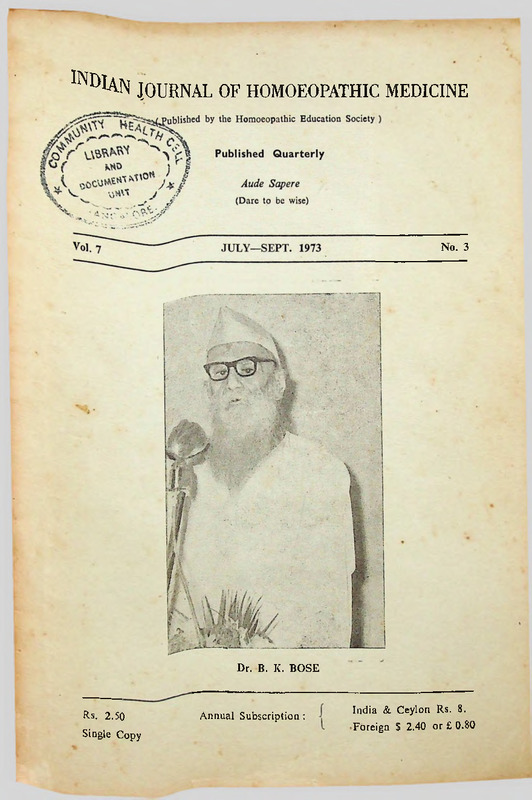
Dr. B. K. BOSE
Rs. 2.50
Single Copy
Annual Subscription:
India & Ceylon Rs. 8.
Foreign $ 2.40 or £ 0.80
THE HOMOEOPATHIC
THE INDIAN
SANDESH
HOMOEOPATHIC GAZETTE
A mouthpiece monthly of
The All India Homoeopathic
Medical Association
Now in New set up and New get-up
in Hindi & English
Serving for the last 25 years.
“Med-House” Chowghat
Subscription Foreign..$3 or £ 1.5
(Inland) .. Rs. 7.00 per Annum
To the Members of Homoeopathic
affiliated Association in India
Rs. 6.00
Specimen copy
Re. 1.00
Contact:
The Managing Editor
THE HOMOEOPATHIC SANDESH
4457, Pahari Dhiraj, Delhi 6.
Phone: 51190S
Now Available
TAUTOPATHIC DRUGS
IN VARIOUS POTENCIES
Prepared by Dr. R. P. Patel
Write for the List to:
HAHNEMANN HOMOEOPATHIC
PHARMACY
Parangot Malekal, Kodimatha,
Kottayam, Kerala State.
Read “Tautopathy” by Dr. R. P. Patel.
(S. India)
Annual Subscription
Rs. 3.00
Specimen Copy
Re. 1.00
The only English
Homoeopathic Journal published
from the Central part of Kerala
For Advertisement rates etc.
please write to the Editor.
50 ML
Quarterly
THE 50 MILLESIMAL
(the Journal of Pure Homoeopathy)
Editor: Dr. R. P. Patel,
D.M.S., D.F.Hom. (Lond.)
L.M. (Dublin)
Post Graduate in Homoeopathy
(Glasgow. Germany. U.S.A, etc.)
N.B.: Other Books By The Same Author.
Annual Subscription
Rs. 4.00 p..
1.
Single copy
Rs. 1.25 p.
2.
3.
4.
5.
6.
7.
My Experiments with 50 Millesimal
Potencies.
The Art of Case Taking and Practical
Repertorisation
A Treatise on Homoeopathic Surgery.
Analysis and Evaluation of Symptoms.
Homoeopathy, its
Principles
and
Doctrines.
Case taking form with easy Repertori
sation.
Repertory Charts.
Specimen copy
: Re. 1.00 p.
Please Write To:
Dr. R. P. Patel,
Parangot Malekal,
Kodimatha, Kottayam,
Kerala, S. India.'
INDIAN
JOURNAL
OF
HOMOEOPATHIC
MEDICINE
Near Irla Naka, Vile Parle (West), Bombay-56
Phone No. 571135
&**”'''*
a
rtfh=«n a:
u
“That which restores health is the proper remedy, he who cures the patient
is the best physician.
'
*
•••
•«
—
...
—Chara ka
“Life is short, art is long, opportunity fleeting, experiment fallacious and
judgment difficult.
*
’
.....
.....
..
...
—Hippocrates
“The physician’s high and only mission is to restore the sick to health.’’
—Hahnemann
EDITOR
P. SANKARAN
F.C.E.H., D.F. HOM. (LONDON) D.H.T. (U.S.A.)
EDITORIAL NOTICES
The Indian JOURNAL OF HOMOEOPATHIC MEDICINE is published quarterly on the
last day of the quarter of publication viz. the last day of March, June, September and December.
It welcomes for publication contributions in the shape of original articles, case reports
lectures, symposia, panel discussions, extracts, news cuttings and other informative material
of interest to the homoeopathic medical profession. All authenticated matter and articles
of scientific interest will be particularly welcomed. All public and private homoeopathic
institutions are requested to send us reports of their activities for purposes of reference
and record.
Contributions will be accepted on the understanding that they are submitted exclusively
to the Indian journal OF HOMOEOPATHIC MEDICINE- All contributions shall be subject
to Editorial revision. Papers for publication must be sent in two neatly typed copies
with double-line spacing and a good margin. Illustrations, if any, must be on separate
sheets. All contributions, books for review etc., should be addressed to the Editor,
Indian journal of homoeopathic medicine, near Irla Naka, Vile Parle (West), Bombay 56.
If contributors so desire, reprints of their papers can be supplied at their cost, provided
an advance request is made. The Editors reserve the right to reject any material without
assigning any reasons. No correspondence can be entered into on this account. Matter
not accepted for publication can be returned only if sufficient stamps are received for
return postage.
Normally subscribers will receive the issues within fifteen days from the date of publica
tion. Any complaint from subscribers about non-receipt of copies should reach us within
one month of these dates.
All communications of a business nature, dealing with subscriptions, advertisement eto.
should be addressed to the Business Department quoting the subscription number. Outstation
cheques should include Bank commission charges.
THE
HOMOEOPATHIC
MEDICAL
PUBLISHERS
LATEST PUBLICATIONS
1.
PROPHYLACTICS IN HOMOEOPATHY
This is a compilation of the prophylactic remedies in homoeopathy useful for preventing
various diseases and conditions.
4th Edition
Price : Rs. 2. (Postage 30 P.)
2. THE IMPORTANCE OF AETIOLOGY IN HOMOEOPATHY (A Symposium)
This is a symposium on the subject of aetiology which reveals the enormous significance
and usefulness of the exciting cause in the homoeopathic treatment of the patients.
Reprinted
Price : Rs. 2.20 (Postage 30 P.)
3.
REPETITION OF THE DOSES
Repetition of the doses in homoeopathic practice is a vexing problem. This question has
been dealt with in this booklet which summarises the experience of numerous veteran
homoeopaths.
Price: Rs. 1.60 (Postage 30 P.)
4. HOMOEOPATHY AND SURGERY
There is a lot of confusion about the relationship between homoeopathy and surgery.
This booklet in its new and enlarged edition explains this relationship and gives illustrative
cases to show how homoeopathy is useful in numerous so-called ‘surgical’ conditions as also
in conditions where surgery is actually necessary.
2nd Edition
Price : Rs. 2.00 (Postage 30 P.)
5. INTRODUCTION TO BOGER’S SYNOPTIC KEY
Boger’s Synoptic Key is a masterpiece but few are able to understand and utilise it fully.
Dr. P. Sankaran’s introduction to this book will help practitioners to recognise its extra
ordinary usefulness.
Price : Rs. 1.70 (Postage 30 P.)
6. HOW TO BE A SUCCESSFUL HOMOEOPATHIC PHYSICIAN
This booklet describes the qualities needed for success and how they should be applied
in practice.
Price Rs. 1.00 (Postage 30 P.)
7.
THE POCKET REPERTORY
The Pocket Repertory is a handy booklet which supplies the need for a concise but
comprehensive repertory when used independently. It also serves as an index for the Card
Repertory, helping to pick out the correct rubric-cards.
5th Edition
Price: Rs. 6. (Postage 30 P.)
OUR STOCKISTS : Andhra Pradesh: Ramakrishna Homoeo Stores, Hyderabad;
Delhi : National Homoeo Stores, Fatehpuri, Delhi 6; Bhandari Homoeo Stores, Delhi 6;
Gujarat: Parmanand Sheth and Co. Gandhi Road, Ahmedabad 1; Kerala: Hahnemann
Homoeopathic Pharmacy, Kottayam; Homoeo House, Banerjee Road, Cochin; Madhya
Pradesh: Manohar Chunekar & Co.. Indore 4: Maharashtra: Roy & Co., Princess Street,
Bombay 2; Banaji’s Homoeopathic Pharmacy. Princess Street, Bombay 2; Mysore: St. George’s
Homoeopathic Clinic and Pharmacy, Mangalore 2; Indian Institute of Homoeopaths, Gandhi
Nagar, Bangalore; Punjab and Haryana : Ideal Book Centre, Sector 17-D, Chandigarh;
Tamil Nadu: Indian Institute of Homoeopaths Kumbakonam; Uttar Pradesh: Bharat
Homoeo Medical Stores. Dehra Dun, U. P.; Pareek Homoeo Stores, Agra 3; West Bengal:
Hahnemann Publishing Co., 165, Bipin Behari Ganguly St., Calcutta 12
These publications are available from all the leading homoeopathic pharmacies; if not
please address your enquiries and order to :
THE HOMOEOPATHIC MEDICAL PUBLISHERS,
13-A, Station Road, Santa Cruz (West),
BOMBAY-54.
ACKNOWLEDGEMENT
The following Journals were received :
Athurashram Homoeopathic Medical College Magazine (Eng.), Kottayam;
Centre
calling (Family Planning), New Delhi; The Hahnemannian Gleanings (Eng.), Calcutta;
Homoeopathy (Telugu),
Madras; The Homoeopathic Bulletin (Eng.), Calcutta;
Homoeopathic Sandesh (Eng. and Hindi), Delhi;
Homoeopathy (Eng.), Kumbakonam;
The
Homoeopathy (Tamil), Kumbakonam;
Homoco-Doot (Marathi and Eng.), Nasik; Homo
eopathic Vikas (Eng. and Hindi), Gwalior,
Homoeopathic Reporter (Telugu), Eluru;
Homoeo Bulletin (Tamil), Tiruvarur; Homoeopathy Navnit (Eng. & Hindi),
Lucknow;
Honey (Eng.), Hubli; The Indian Homoeopathic Gazette (Eng.), Chowghat;
Karnataka
Homoeopathy Bandu, Bangalore; The Madras Homoeopathic Journal (Eng.), Madras;
News from Israel (Eng.), Bombay; Orissa Homoeopathic Bulletin (Oriya), Calcutta; Orissa
State Board Homoeopathy Journal, Bhuvaneshwar (Eng. and Oriya); Kerala HomoeoJournal. (Eng.), Kottayam; The 50 Millisimal (Eng ), Kottayam; The Torch of Homoeo
pathy (Eng. and Hindi), Jaipur; Homoeo Review (Eng.). Madras; Homoeopathic Uplift
(Eng. and Hindi), Lucknow; Homoeopathic World (Eng.), Calcutta; Rogi Chikitsa
(Beng.), Calcutta.
INDIAN JOURNAL OF HOMOEOPATHIC MEDICINE
Lead me from the false to the true.
HI
Lead me from mortality to immortality.
cHRlt
Lead me from darkness to light.
3JT Ht W. 5RT^t
ftw:
Let noble thoughts come to us from every side.
JULY—SEPT. 1973
Vol. 7
No. 3
CONTENTS
Non-Homoeopathic Practice by Homoeopathic
... Practitioners
1.
Editorial ...
2.
A. R. A. Acharya
3.
H. K. S. Rao, L.M.P.
4.
V. Sundaravaradhan, D.H.S.
5.
K. J. Shivadasani, L.M.S. ... Some Interesting Experiences
6.
S. P. Koppikar, B.H.M.S.
7.
Jugal Kishore, B.Sc., D.M.S.
8.
Silicea (A Discussion)
116
9.
Mercury (A Discussion)
119
10.
From Our Case Books:
i. V. Paulose .. Some Cases
ii. Bhanu D. Desai, M.B.,B.S. .. Some Cases
iii. R. R. Bharucha . • A Case of Suspected Malignancy
Colon
126
126
..
Therapeutics of Fevers
..
Therapeutics of Arthritis
...
..
Treatment of Acute
Asthmatic Attack
89
92
98
103
109
Acute Prescribing in
Homoeopathy
111
Homoeopathy in India
112
..
127
11.
Random Readings
127
12.
News and Notes
130
13.
Therapeutic Notes
132
14.
Book Review
133
15. Letters to the Editor
134
The views and opinions expressed by the various writers do not necessarily coincide with
those of the Editor.
INDIAN JOURNAL OF HOMOEOPATHIC MEDICINE
39
EDITORIAL
NON-HOMOEOPATHIC PRACTICE BY HOMOEOPATHIC
PRACTITIONERS
Elsewhere in this issue will be found a letter written by a homoeo
pathic physician criticising the homoeopathically qualified persons who
practise allopathy. We have been receiving many such letters. Homo
eopathically qualified persons seem to be adopting allopathic practice
in such good numbers, that it has attracted the attention of many.
Mentioning this point in his editorial Dr. Ramanlal Patel writes .in .the
50 Millesimal as follows :
“In their practice they gradually tend to administer other than
Homoeopathic medicines, for which they are least experienced. Here
are the people who forget homoeopathy and modernise themselves with
‘quick cure’ medicines of Allopathy, without knowing what harm they may
do to the patient. In reality they want monetary gains than Homoeopathy
but in return a rebound action takes place, wherein patients lose con
fidence in them and in Homoeopathy”.
Dr. Kanjilal writes in the Hahnemannian Gleanings as follows:
“All serious-minded homoeopaths and lovers of homoeopathy feel
perturbed and worried at the plight of the cadres coming out of the
homoeopathic teaching institutions, as they exist today, in their profes
sional life. Very few of them serve their patients with Homoeopathy, the
most rational and scientific system of Medicine. All the rest use their
homoeopathic diploma only as a licence to. practise in any system of
Medicine according to their sweet will and convenience, at great detriTherefore this problem merits our careful, earnest and serious con
sideration.
There was a time, not so long ago, when Homoeopathy was not
officially approved. Yet the intrinsic value of Homoeopathy was such
that it was recognised and accepted by the people so that the system
was in great demand particularly where the other systems had failed
miserably to relieve and cure. Where there is a demand, there is bound
to be a supply. So, since regular qualified physicians were not available
a large number of laymen practised it and that too with fairly good results
This was a stage.
But there was a feeling that if untrained laymen could do so much,
regularly trained practitioners should be able to do much more. So those
who had benefited from homoeopathic medicine and other enthusiastic
supporters who appreciated its merit, established various homoeopathic
colleges in different parts of the world in order to create regular train
ed practitioners of homoeopathy. In India also, with herculian efforts,
some homoeopathic colleges have been established.
The object of starting these colleges is that they should train scien
tific practitioners in Homoeopathy so that the benefits of this system
90
INDIAN JOURNAL OF HOMOEOPATHIC MEDICINE
can be spread to a much larger number of people. Therefore if the
practitioners coming out of these colleges turn to allopathy, those who
are in any way concerned with the founding and progress of these insti
tutions, those to whom homoeopathy is nearest and dearest to their
hearts, must naturally view this state of affairs with concern and even
disappointment. They must therefore make all efforts to set right this.
tragic anomaly.
Let us first look at the reasons given by some of these homoeopathic
practitioners who practice allopathy. Firstly, they say homoeopathy is
difficult to practise whereas allopathy is easy. Secondly, they feel
homoeopathy does not pay. Thirdly they state that patients want allo
pathic medicines, preferably injections. And fourthly, that homoeo
pathic practice involves very hard work.
We shall consider these reasons one by one.
1. We are not able to comprehend how they can find a system which
they learned for 4—5 years difficult to practise while a system which
they have not at all learned in the college becomes easy, especially a
system which deals with dangerous drugs.
2. The plea that homoeopathy does not pay is very far from the
truth. Bad homoeopathy does not pay, just like bad anything will not
pay. But good homoeopathy definitely gives ample rewards. Hahnemann
himself was known to have earned very well. And we know many
homoeopaths who have been very successful and are earning very well
to their heart’s content. Some of them perhaps, earn even more than
their allopathic counterparts.
3. As far as we understand it, the patient does not care what medi
cine is being given to him as long as it is able to give him relief and cure.
Whether it is homoeopathy or allopathy or nature cure or even a talis
man, if it gives him prompt amelioration he welcomes and accepts it.
And in our experience good homoeopathy can help more promptly and
definitely more lastingly than good allopathy while allopathy applied
ignorantly and wrongly is as useless as homoeopathy applied wrongly and
is in addition harmful also.
4. It is our belief that all good, constructive, solid work involves
hard work. There is no short cut to success. Success, they say, comes
before work only in the dictionary.
Apart from these considerations, is there not a factor called job satis
faction? The amount of inner satisfaction one gets by applying Homo
eopathy and giving prompt and permanent relief or cure cannot be com
pared with the short-term doubtful and suppressive relief given by crude
drugging. Is this not more important than any material returns one may
get ?
Whatever reasons may be given by these practitioners and whether
these reasons are true or false, real or imaginary, the fact is that they
practise allopathy. This is an absurd state of affairs for three reasons.
INDIAN JOURNAL OF HOMOEOPATHIC MEDICINE
91
Firstly, because there are allopathic colleges existing to train prac
titioners in that system; Secondly, since in homoeopathic colleges training
is given only in homoeopathy and not in allopathy, the students will not
be really fitted to practise allopathy, though they may be foolhardy
enough to do it. Thirdly, the very idea of establishing homoeopathic
colleges becomes defeated and the colleges will lose the very reason for
their existence if the practitioners coming out were to practise some other
system.
Except where a homoeopathic practitioner is honestly convinced by
repeated experience that allopathic medicine is far superior in its effects
and is in the interest of the patient, he has no business to practise allo
pathy. All those who otherwise practise allopathy after passing through
homoeopathic colleges are doing an immoral and reprehensible act.
So all adherents of homoeopathy who devoutly desire that the prac
titioners who come out of the homoeopathic colleges must faithfully
practise homoeopathy should think of concrete and practical solutions.
This problem is a big and complex one, bigger beyond solution by the
limited capacity of any one individual but if a number of interested and
sincere homoeopaths of a higher level can combine together and cogitate,
a proper solution can be surely found. This collective thinking should
have been done long ago but unfortunately it has not taken place. We
may even suggest a convention for this purpose. This convention should
consider every aspect of the matter including the genuine difficulties of
these nascent practitioners and offer practical solutions. At least now we
should not be guilty of neglecting this serious problem any further.
An obvious solution seems to be admit into these institutions only
those students who are bound to practise homoeopathy. But a difficulty
arises because the students who get admission may promise to practise
homoeopathy but no one can ensure that this promise will be fulfilled.
In fact, the promise may be made only for the purpose of getting admis
sion. The medical profession seems to be so full of glamour that a seat
in a medical college is much sought after and any means may be resorted
to obtain admission.
A suggestion has been made that non-homoeopathic practice by
homoeopathic physicians should be legally banned.. We are not in favour
of such a ban because a legal ban is difficult to enforce. This will only
lead to clandestine non-homoeopathic practice. It is better we go to the
root causes of this and eliminate them.
We may suggest the following steps :
1. Admission to the homoeopathic colleges must be given to students
of a higher level i.e. I.Sc., B.Sc., etc., because they will have a higher
level of maturity and understanding.
2. A better type of teaching should be adopted so that the students
can understand what they learn. Mere theoretical lectures cannot help
much.
92
INDIAN JOURNAL OF HOMOEOPATHIC MEDICINE
3. More intensive practical training with different types of cases
should be given with the help of experienced and confident homoeopaths
so that the students will witness and understand the real efficacy of this
system. It would not be enough to recruit inexperienced, full-time
teachers because their teaching may not inspire confidence. (Unfortu
nately the pay scales of homoeopathic teachers are not enough to attract
senior homoeopaths and our homoeopathic institutions cannot afford to
pay more.)
4. The teachers who teach homoeopathy should have faith and con
fidence in the homoeopathic system. If they themselves do allopathic
practice this can have a very disastrous effect on the morale of the
students.
5. Creation of opportunities for employment so that those who are
unable or afraid to start private practice may gain experience in em
ployment.
These are a few of our suggestions. Friends who have more know
ledge, experience and wisdom can give more and better suggestions. But
whatever suggestions are made will be useless if they are not seriously
considered and implemented by all concerned. Otherwise the steady
march towards disaster will continue. And such practitioners coming
out of the homoeopathic colleges who have no faith in homoeopathy may
turn out to be the potential enemies and destroyers of homoeopathy.
We are in fact anxious about another possible development. Sooner
or later, the Boards of Homoeopathy in the various States and the diffe
rent advisory bodies in the centre may be slowly infiltrated and become
composed of such homoeopathically qualified practitioners who have no
faith in homoeopathy but who practise allopathy. And these homoeo
paths may then lay down the plans, guidelines and rules for the future
development of homoeopathy. A more ridiculous and horrifying
situation for Homoeopathy will be difficult to imagine! Let not homoeo
pathic colleges turn out such potential wreckers of Homoeopathy.
Now we shall close with a warning. If we do not now take active
and effective steps for revitalising Homoeopathy we shall be very soon
following the path of the countries where homoeopathy is dying or dead.
In our country, on the one side, there is a greater and greater demand
for good homoeopathy and on the other side there is a lesser supply
of good homoeopaths. Let us not connive at perpetuating such a tragic
situation.
THERAPEUTICS OF FEVER
*
By Dr. A. R. A. Acharya, Bangalore
Man desires to keep fit and healthy so that he can enjoy life if pos
sible for a hundred years. Health is upset by hereditary background,
Paper presented at the Scientific Seminar on Homoeopathy, Coimbatore 24-25 Dec. 1972.
INDIAN JOURNAL OF HOMOEOPATHIC MEDICINE
93
diet and environment. Away from ease is disease. Disease is a condi
tion of our body and mind. Disease is known by symptoms and signs,
felt and observed. Signs and symptoms are the result of natural defence
mechanism operating and in fact they are the representatives of curative
processes to readjust the functions and maintain harmony of the mind
and body.
Common cold and fever and such acute diseases are the reactions of
our body, periodical cleansing work. But man is afraid of the deviations
from normal condition. Fever is one such anxious problem for him.
He must take rest, he cannot eat his usual food and he is confined to bed.
He wants to get rid of it quickly. If a child gets fever both the parents
will be in the grip of fear; esp. the mother will not sleep and she will
bother the doctor to stop the fever. That the fever is a protective phe
nomenon, she cannot understand. These anxious parents would do any
thing and pay any amount for stopping the fever.
Let us study the nature of fever, the modern view points of fever,
types of fever and homoeopathic approach to therapeutics with a few
case reports.
Dr. J. D. Ratcliff says “Thousands of people each day slip thermo
meters under their tongues, wait a few minutes, then consult the little
arrow. Most laymen believe that the higher the body temperature the
graver the illness. Doctors are not so sure. For upward of two thousand
years medical men have been debating the question: ‘Is fever a friend
or foe? Is it an indicator of how ill a person is — or of how vigorous an
effort his body is making to get well?’ What is fever? It is simply an
indication that the body is generating heat faster than it is losing it. Your
body’s remarkable heating system is in many respects strikingly like a
home heating system. The food you eat is burnt, mainly in muscle tissue.
The resultant heat is piped round the body by the blood in blood vessels.
Like a well built home, the body has its insulation — a layer of fat, under
the skin — to cut down the heat loss. The entire system is controlled
by cells in the hypothalamus, on the underside of the brain. This is the
body thermostat. .When it is pushed too high, there is fever. The sweat
ing mechanism slows down and the skin becomes dry and hot.
“To-day’s research men note that the body temperature varies wide
ly during- a day — being lowest in the early morning hours, highest in
the later afternoon. Therefore, Doctors think it would be better to speak
of normal “zone” from 97.2° to 99.5°.
“Although the blood is highly efficient, as distributor of heat, it does
not do a .perfect job. If the mouth temperature is 98.4° the rectal tem
perature is usually a degree higher. The liver, hottest organ in the body,
is about 101°. The groin area is usually atleast a degree lower than the
interior of the body. Survival of the human race depends on its rising
no higher. Above this level, male reproductive glands are unable to
produce sperm.
94
INDIAN JOURNAL OF HOMOEOPATHIC MEDICINE
“What induces fever? A surprising variety of causes. Anxiety is
one. Children frightened by going to the hospital often run fevers. One
army Doctor found that the temperature of 324 call-up examinees anxious
about their status, averaged nearly a degree above normal. Also, injury
to the brain thermostat — caused by accident or by tumours growing
into the area — often produce raging fevers.
“By far the largest producers of fever are bacterial and viral diseases.
The exact means by which these microbes cause fever is not known. It
may be that under a microbial attack white blood cells release fever
producing chemicals called pyrogens which prod the brain thermostat
into action.
“Are fevers harmful? There is no cut-and-dried answer. Some
fevers are clearly dangerous — particularly those caused by brain injury,
tumours, sunstrokes. They soar to levels where temperature itself be
comes a menace to life.
“A fever of 109° , for example, does irreparable damage to the brain
if not brought under quick control by ice-water enemas or immersion
in baths of ice water.
“Fevers following heart-attacks are also grave affairs. The danger
here is this: in fever the rate of cellular activity in the body (metabolism)
may be greatly increased. At this faster rate the cells require more
oxygen. Thus there is an added load on an already damaged heart.
These are exceptional cases. About the more common fevers that ac
company colds, sore throats and such, one point should be remembered :
fever is not a' disease but a symptom — often a valuable and revealing
one. Many doctors are to-day questioning the wisdom of fighting com
mon fevers with temperature drugs — such as aspirin. Speaking mainly
of childhood diseases, one professor of medicine observes : “Anti-fever
therapy is often employed more for the benefit of parents, or the doctor,
than the child. It is doubtful whether body temperature in the range of
104° is harmful, even if prolonged for several days.
“Fever may be the best, or the only available sign for following the
course of an illness, as many diseases have readily recognised tempera
ture patterns
“What are the safe limits for fever? There is no hard and fast rule.
It has been observed that people rarely survive temperatures above 109°.
However, temperature almost never rises above 106°. Apparently, the
body has some emergency mechanism that takes over at this point. A
chain of life-saving events gets under way. The patient usually goes
into coma, blood flow to the blood vessels near the surface of.the body
is increased and sweating becomes profuse. These events produce a cool
ing effect, and the fever begins to fall to safer levels.
“Fearsome as a fever may be to laymen, it has many beneficial effects.
It prods the body into greater production of bacteria-fighting white blood
cells and bacteria-killing anti-bodies. Recent evidence indicates that it
INDIAN JOURNAL OF HOMOEOPATHIC MEDICINE
95
increases production of the hormone ACTH, which in turn combats the
stress placed on the body by disease. It appears to enhance the action
of such antibiotics as penicillin.
“As wider knowledge of fever has accumulated, many old rules have
been rewritten. A generation ago it was standard practice to starve a
fever — which undoubtedly killed many badly debilitated patients. Since
fever hoists the metabolic rate, the need for food and fluids is increased.
Today’s rule : a high-protein, high-vitamin diet with all the liquid the
patient can take.”
Hahenmann’s lesson in the chronic diseases on the treatment of
acute syphilis must be applied to fevers of all types and acute diseases of
every name and every kind irrespective of habitat. If, as he affirms in
the Organon, acute diseases “are generally a transitory outbreak, an
explosion of a latent psoric affection,” the symptomatic expression of this
or any other dyscrasia must be included in the anamnesis, the remedy
selected from the totality thus obtained.
It is the patient and not the fever that is chiefly and especially to be
considered. It is the individual with his or her peculiar idiosyncrasies
and constitutional inheritance with which we have to deal. The symp
toms of the latent psoric affection must be analysed as fully and com
pletely as the symptoms of i^he “transitory outburst” a fever paroxysm.
As a rule, the family history is much more suggestive of the curative
remedy than the rapid pulse and high temperature, and should be care
fully studied. When discovered, the constitutional miasm — psora, sycosis,
syphilis, tuberculosis — should be esp. noted, for here will often be
found the rephasing tendency of the fever. It is the experience of the author
the rephasin tendency of the fever. It is the experience of the author
that if the remedy be selected from the totality of the objective, subjective
and miasmatic symptoms, the patient may be cured in any stage of the
fever. It is not necessary for a typhoid or any other fever to ‘run its
course’ (H. C. Allen).
“The name is not important, the patient is everything. It may be
and often is Sulphur in which “complaints that are continually relapsing
is a marked characteristic. When Sulphur or the best selected remedy
fails to relieve or permanently improve, Psorinum or Tuberculinum
selected upon the symptoms and peculiarities of the family history and
inherited diathesis, will cut short the acute attack and prevent a future
relapse. (Antipsoric remedies in typhoid cases are very helpful)”
(H. C. Allen).
“Remember that the Simillimum will cut short any disease at any
time and will act at once and rarely needs repetition. If it does need
repetition it is not the simillimum. The farther away you are from the
simillimum, the oftener you will have to repeat. Whenever a disease
must run its own given course it is a sign that you have at no time had
96
INDIAN JOURNAL OF HOMOEOPATHIC MEDICINE
the simillimum and that the patient would have been fully as well off,
if not better, had he had no medical interference whatever” (Pulford).
INFLUENZA
First remedy is Gelsemium. Dull, drowsy and dizzy, thirstless,
wants to cover all over, trembling, heavy head and eyelids, sneezing,
pain all over. Wants stimulants. Better after urination. Chill and fever
chase each other. The patient may have diarrhoea.
Second is Baptisia. Sudden tiredness, high fever, fetid mouth, lips
may be blue, confused state of mind. Feels limbs are detached.
Pain
all over, bed hard, pressure < , restless. Case looks dangerous but a
few doses of Bapt. remove all the toxic condition and the patient gets
complete relief. Unlike Gels., Bapt. has thirst. Diarrhoea, tenesmus,
colic and bileless stool are present.
Third is Bryonia. Bry. is Dry. Bry. patients do not want to speak
and do not want to be spoken to. They do not want to answer because
speaking annoys them, not because they are too tired to do so. They
are worried about their condition, depressed, anxious about their busi
ness. The Bry. patient is difficult to please and satisfy. Sometimes
they are restless and uncomfortable, and move about in spite of the
fact that the movement increases their pain. If the restlessness increa
ses their trouble, it is Bry. If better Bapt. or Rhus tox. They like
cool air, with desire for large quantities of cold water. They sweat
more — hot sweat. Joint pains are > by hot applications. This is a
local contradiction to the general heat Z. . Bitter taste, coated tongue
and thirst. Very intense headache in the forehead in “flu suggests Bry.
Headache from pressure and by any movement, talking etc. Head
must be raised with more pillows to be comfortable. Running of the
nose is less, nose burns, is full and congested. Constipation and lack of
appetite are expected.
If the patient does have a pneumonia attack, it will be a typical
Bry. pneumonia, with violent stabbing pains in the chest Z. on move
ment.
Eup. perf. is a cross between Bry. and Ip. Whenever the pain is
complained of from the bones — bone-breaking pain, this should be the
first remedy.
Restlessness, esp. physical, is a leading symptom in the Rhus tox
patient. Extremely anxious patient gets no peace at all, mentally wor
ried, depressed like Puls, and weeps also. Violent sneezing is a Rhus.
symptom. Red lip or dry tongue, burning hot and painful, nodular
urticaria and irritation also belong to Rhus.
Pyrogenium — Five in one; 1. Has a sore bruised condition as
marked as Arnica. 2. An aching pain in the bones as marked as Eup.
3. A restlessness heat and motion as marked as Rhus. 4. Is irritable,
INDIAN JOURNAL OF HOMOEOPATHIC MEDICINE
97
loquacious, confused about the body like Bapt 5. The eyeballs are
sore to touch, has fanlike motion of the alae nasi, like Lyco.
The face is pale, sunken and covered with cold sweat, cheeks red
and burning hot, tongue has a brown streak down the centre, stool has
a cadaveric odor, patient is anxious, has a sinking sensation about the
heart, pulse is rapid, irregular and fluttering, the bed feels hard.
The greatest and most positive indication is: Lack of relation bet
ween the pulse and temperature, they do not correspond.
Now as to how I tackle acute fever cases. If the patient shows an
xiety, I start with Aco. 200 on the first day. In a child I follow Acowith a dose of Sulph. 30 the next day. Thirst and dryness point to
Bry. and chilliness and sensitiveness point to Nux vom. For infants I
generally give Fer. phos. 6x first day and the next day Kali mur 6x. If
the child is breastfed, giving the mother the same medicine will hasten
the cure of the child. If the patient covers all over including the
head, Gels., Nux., or Hepar. come to my mind. I make further enquiry,
fix up one of these, give it and generally succeed. We must think of
stomach upsets, weather changes or infections as causative factors. In
marriage seasons Ant. c. and Puls, are handy.
A boy had fever for 5 days without much response. I found that
he had good appetite and liked cold things. Appetite during fever, in
Kent’s Repertory, showed Phos. in bold type. With Phos. 200 ’the boy
was normal in 24 hours.
A young lady had fever like “flu.” The fever went on even after 4
days although body pains and restlessness cleared with Eup. perf. 200.
She was lying quietly and would not complain. No headache, no pain,
“I am alright.” But temperature was 105°. I gave Arnica 1000 in water.
every hour and by morning she was normal and had no further fever.
A patient was running fever with body pain and restlessness. He said
that even the two beds are not sufficient for him as he feels so big.
With Pyrogen 30 the fever came to normal in 24 hours but went up
again. But with a dose of Pyrogen CM the fever was gone and he be
came quickly well.
An elderly lady had fever for 12 days. Her brother, an allopath
examined and said there is liver involvement and gave a long pre scripttion. The lady had complete faith in Homoeopathy. She had desire for
cold and sour things and for somebody to be with her sympathising and
rubbing the limbs gently. Averse to sweets. Old malarial background.
All these gave me a clue for Phos. It was given 0/30 (50 millesimal
potency) for 3 days. - Gradually she became alright in every way.
In acute conditions such as fever, symptoms may change. We
should have definite symptoms indicating a remedy; for this reason
personal examination and mostly objective symptoms are necessary.
Face, eyes, lips, tongue, chest, abdomen and extremities are to be care
98
INDIAN JOURNAL OF HOMOEOPATHIC MEDICINE
fully examined and changes observed. Then time modality, desires and
aversions, hot and cold, thirst, sweat, sleep, restlessness etc., will help
us to select a remedy which will give speedy relief.
THERAPEUTICS OF ARTHRITIS
*
By Dr. K. H. S. Rao, l.m.p., Bangalore
The treatment of any disease based entirely on diagnosis and
pathological findings will often end in failure. But, if the problem is
approached from the golden rule of individualising the patient on the
basis of “total symptomatology” (which also includes pathological
changes) we may expect better results Greater importance should be
given to the “diseased person” than to the “disease” itself. This
fact is equally true in the study of to-day’s subject — “Therapeutics
of Arthritis”.
The word ‘arthritis’ means inflammation of a joint — big or small.
One or more of its constituent parts may be involved in the process
of inflammation, such as : the bony ends, cartilage, serous capsule, liga
ments and the covering parts. The cardinal symptoms of inflammation:
heat, redness, swelling, pain and loss of function are all present.
The main function of any joint is movement (Locomotion) and this
function of movement is restricted or altered in all cases of involvement
of joints. In acute conditions it is due to exudation of serous fluid into
the joint cavity with stiffness of muscles and ligaments (nature’s pro
tective mechanism). In chronic conditions the movement may be either
restricted or entirely lost due to ankylosis of the joint, either temporarily
or permanently, depending upon the extent of bony changes.
The type of pain often indicates the main tissue most affected; for
instance, tearing or pricking pain of serous membrane, burning pain
of mucous membrane or skin; sore or aching pain of muscles and shoot
ing pain of nerves.
A few cardinal points which help us to individualise a case of
arthritis may be considered.
I place Causation first for our consideration. It may be a trauma.
physical or mental, bacterial infection or the fundamental, miasmatic
stigma or metabolic disorder. The exciting causal factors are: exposure
to strong weather changes — cold, dampness, sudden chilling (dry cold)
or extremes of heat, or digestive upsets. The importance of the proper
elicitation of family history cannot be over emphasised.
Basing upon the factors of causation, arthritis can be classified into
two main divisions :
1) Acute arthritis — including traumatic
2) Chronic arthritis — which is again divided into three sub-divisions,
Paper presented at Coimbatore Scientific Seminar, Dec. 24-25, 1972:
INDIAN JOURNAL OF HOMOEOPATHIC MEDICINE
99
viz., (a) rheumatic arthritis, (b) osteo-arthritis and arthritis-deformans, (c) gouty arthritis.
Rheumatic Arthritis: is supposed to be caused by bacterial infec
tion. No one particular germ is named, but various germs are incrimi
nated at various periods. Often it is attributed to an extension of the
infection from a septic focus lodged either in tonsils or nasal sinuses
or from a suppurating middle ear (S.O.M.), infected urinary bladder or
kidney; or infected gall-bladder or appendix or bad gums and teeth.
Depending upon the fancy of the surgeon one or many of these organs
are blamed and removed.
This may involve more than one joint at a time or may rapidly ex
tend from joint to joint. There is always the danger of the heart get
ting involved in acute rheumatic fevers.
Spondylitis is an arthritic condition of the spine and may be found
in both young and old. It is often inherited (hereditary). All condi
tions of transmission by inheritance are ‘chronic diseases’ and all
‘chronic diseases’ are miasmatic by nature.
Osteo-Arthritis is a chronic degenerative affection of the joint,
where the bony ends are involved. Radiological films show erosion of
bones and the presence of osteophytes. The joint space is narrowed
due to the thickening of the serous capsule and filling up of the joint
cavity with inflammatory products. The involvement of the bones with
erosion is suggestive of syphilitic miasm.
Gout is a metabolic disorder (like diabetes) and is recognised by
the presence of excess of uric acid and purin bodies in the blood, which
may also be excreted in the urine with its characteristic strong malodour. The condition of metabolic disorder and involvement of changes
in the bones of the joint is suggestive of strong psoric miasm with added
sycotic toxin.
*
The second point for consideration is Location, which not only in
cludes the various structures (tissues) of the joint, but also the several
regions of the body affected, such as spine, shoulders; big or small joints,
also the direction of extension; for instance, from below upwards, right
to left or from left to right or alternating from side to side, or shifting
from joint to joint.
The third and most important factor for consideration is the Moda
lity the condition of < or > such as by movement, season, weather
conditions, dry or wet weather, hot or cold; perspiration, pressure, sleep,
posture, thirst, menses, stool, urination etc.
Sensation is the character of pain, such as aching, burning, bursting,
cramping, numbness, tearing, throbbing etc.
* Depending on the seat of trouble, gouty-arthritic conditions are named as follows: When fin
ger joints are affected it is called chiragra, when toes are affec'ed podagra; knee joint gonogra
and shoulder joint omagra.
100
INDIAN JOURNAL OF HOMOEOPATHIC MEDICINE
The last but not of least importance is the presence of concomitant
symptoms, like the presence of warts, excess or want of perspiration,
high coloured or offensive urine, constipation or diarrhoea, leucorrhoea,
vomiting, fever etc.
‘Mental symptoms’ when well marked are of paramount importance.
Emotional upsets give a clue to the indicated remedy.
Radiograms and blood tests (E.S.R., leucocytosis, uric acid excess),
where possible can also be made use of in assessing the prognosis and
cure.
With this background, I wish to place before you a few therapeutic
hints. If I were to describe the treatment of arthritis in the classical
way, I have to go through the entire materia medica, which is neither
pleasant nor possible. Instead I place before you a few remedies
(which I have used in my practice) in groups for study.
If you look into Kent’s Repertory Extremities, Pain —- under the
rubric Joints, you will find two main divisions — Rheumatic and Gout
Boger in addition gives two useful rubrics — (1) Joints arthritic; and
(2) with cracking. The presence of grating or cracking condition in a
joint indicates that the bones are involved.
Relief of pain from movement, though worse at the beginning is an
indication that not the bones but the ligaments and muscles are involved.
It is purely a rheumatic condition. Agg. by movement and a desire
to keep the parts at rest, indicates that all the parts of the joint are
actively inflamed.
In Kent’s Repertory under the rubric, ‘Pain, Joint’ about 125 reme
dies are listed — capitals 22, italics 65 and the rest in ordinary type.
Lithium salts, Sy ph., Tub. and a few of the new and rare medicines are
not included (Osteo-arthritic nosode, Rawolfiia etc.)
In Boger’s book and Sankaran’s Pocket Repertory, about 37 drugs
are mentioned — 10 are in capitals. They are all worth studying care
fully.
For the purpose of eliminating and fixing the most likely indicated
remedy, we have to study the auxiliary rubrics given in a alphabetical
order beginning with time, hour, day or night, sides, air, conditions —
wet, cold etc., to the last rubric of extension. A few such conditions are
listed here.
Agg. Warmth: Bry., Led., Phos., Phyt., Puls., Sabi., Thu.
Amel. Warmth: Ars., Caust., Colch., Colo., Lyco., Merc., Nux. v., Rhust,
Sulph.
Agg. Cold Wet: Arn., Colch., Dulc., Rhus t., Nat.s. Verat., Puls.
Agg. Cold Dry: Aco., Bry., Caust., Hep., Kai. c., Nux. v.
Amel. Wet (Agg. Dry) : Asar., Bry., Caust., Hep., Kali c., Nux v., Sep.,
Spo.
Amel. Warm Wet: Caust., Hep., Nux v.
INDIAN JOURNAL OF
HOMOEOPATHIC MEDICINE
101
Amel. Cold: Led., Puls.
Agg. Motion: Bry., Fer., Phos., Lac. can., Led., Sal. ac., She).
Amel. Motion: Cham., Dulc., Rhod., Rhus t., Pul.
Shifting, rapidly: Kalm., Lac. can., Puls., Kali bi.
Ascending: Led., Bil.
Numbness with Pain: Aeon., Cham., Pul.
Agg. touch : Am., Bell., Bry., Cham., Colch., Hep., Led., Med.,
Nux. v., Pul., Rhod., Rhus t.
Agg. light touch and better pressure : Chi.
Agg. Jar: Arn., Bell., Bry., Hep., Led., Nux. v., Rhus t.
If you compare the remedies listed under the two rubrics — rheu
matic and gout, you will not fail to observe that most of them are found
in both the lists.
Among the bi-organic compounds, Calcium salts, Kalis, Magnesiums,
Sodiums appear prominently, but lithium compounds, which are often
indicated, are not mentioned. Among ths metals Arg., Aurum, Ferrum,
Stannum are important. The leading remedies from the vegetable
Kingdom (i.e. large in numbers) are Aco., Bell., Bry., Colch., Colo., Dulc.,
Kalm.. Led., Puls., Rhod., Rhus t., Sabi. etc.
Calc carb.is more a gouty remedy than rheumatic; chronic
arthritis with swelling of the joints; Z. every change of weather to cold,
getting wet. Right shoulder. Lumbago, after Rhus t. (Calc, completes
the action of Rhus A Other characteristic features like sensation of
coldness in vertex, easy and profuse sweat, coldness of feet etc.
Calc phos :
Esp. affects th? sutures and joint-unions (symphyses)
Is chilly, . in cold weather, arrests suppuration and promotes healing
of bones.
Kali carb :
is a dangerous drug in acute gout, esp. in old people.
Tubercular diathesis. Kali salts are not to be used where there is fever
(T. F. Allen).
Kali iodide :
is useful in chronic arthritis .with spurious ankylosis
— rheumatism in neck, back, esp. heels and soles of the feet. Fluid in
the knee joint.
C Austicum :
is a Kali salt and a very prominent remedy for arthritis-deformans. Apart from its paralytic effects, it is indicated by the
flaring, drawing pains in the muscular and fibrous tissues; stiffness,
swelling and deformity of the joints, flexors are contracted (Plumb
extensor). The characteristic modality is a strong guide — worse in
dry cold winds, clear chilly weather, chilling, but better in damp (wet)
weather and warmth. (See Margaret Tyler’s case).
Among the Natrums: Nat. mur, Nat. phos., and Nat. sulpb. are im
portant.
Nat. mur. is mentioned by Kent in small type under both the rub
rics, rheumatic and gouty. It is a very useful remedy for the compli
102
INDIAN JOURNAL OF
HOMOEOPATHIC MEDICINE
cations setting in the heart like tachycardia, fluttering, palpitations and
missing heart beats. It causes dryness, cracking and bony changes in
the joints. Nat mur., like Plumb, produces atrophy and sclerotie
changes in muscles. It is often indicated in arthritis after malarial
Severs.
I learn that Dr. Elizabeth Hubbard had placed Nat. mur. at the top
of her trio-remedies for rheumatic pains, the other two being Sulph. and
Rhus tox.
Ammonia phos. and Sabina: Ammon, pbos. is a remedy of choice
in gouty patients with nodosities in the finger joints end back of the
hands; shoulder joints painful, tendency to bronchitis. It is a chilly
remedy and coldness is felt by least draft of air. Here it is the opposite
of Sabina, which is a hot remedy and feels better in cold weather.
Kalmia and Ledum: The pains in Kalmia are shifting suddenly
changing location; deltoid pain, mostly right side; tendency to affect the
heart; pulse is slow; worse leaning forward (opp. K. carb)
Ledum: Rheumatic and gouty pains in lower extremities, esp. when
they commence below and go upwards. This upward direction is more
characteristic of the remedy than its > by cold; but Ledum is worse
by warmth.
The other three shifting remedies are Kali bich., Lac can., and Puls.
Formica: Formica is an arthritic remedy often indicated in old pa
tients of gout and articular rheumatism. It’s modalities are like that of
Bry — < motion, cold weather, > by pressure. Pains come on with
suddenness and much restlessness. No relief from sweat (Merc).
Fagopyrum: Has rheumatic bruised pains and stiffness in joints. It
causes spasms of the arteries and produces streaking and cramping pains
in fingers and forearm while writing (use of fingers). It has also ter
rible itching of the skin. Pruritus vulvae (with yellow leucorrhoea).
Vehement itching in arms and legs.
Lactic acid: is useful in diabetes with articular rheumatism. It can
cure both the conditions.
Benzoic acid : A very useful remedy has the peculiar odour and
colour of the urine. The pains may suddenly change their locality;
gout alternating with heart pain or with asthma. Pain in tendo-achilles,
a very chilly remedy, is worse by cold and exposure to draft; it is a
sycotic remedy.
Bryonia and Rhus tox are good examples to illustrate the impor
tance of modality of motion. Bry. is more indicated in acute arthritic
conditions with the inflammatory sign of < of pain by movement. Rhus
tox is > by motion (though < by beginning motion). Bry. needs
Sulph. and Rhus tox needs Calc. carb, to complete their action.
Thuja and Medorrh: Both strong sycotic remedies are useful after
suppressed gonorrhoea, br bad vaccination. Sweating of the parts when
INDIAN JOURNAL OF HOMOEOPATHIC MEDICINE
103
exposed and dry when covered is a useful indication. Suppressed gonor
rhoea or sycotic family history; tenderness and egg-shell crackling feel
ing in soles of the feet is met by this remedy.
Arbutus andrachne
— Arbutin was once popular with the old
school, (arbutin is found in Kalmia). It is useful if the rheumatic con
dition follows eczema of the skin.
Osteo Arthritic Nosode (O.A.N.) is a new nosode prepared from the
arthritic concretions. It holds great promise.
Rawolfia is also newly introduced into our materia medica. Its
characteristic guiding symptom is that the patient when standing puts
all his weight on one leg only (may be right).
Arnica is very useful for the aching sore pain in the muscles of the
back, after much physical strain or a long and tedious journey. (Rhus t.
for over-stretching and over-lifting.)
Drosera, Stan. met. and Tuberculinum are the leading remedies for
the joints, whether articular or suppurating. Calc. phos. is a supporting
remedy and builds up bones. Calc, hypophos. is useful in chronic sup
puration of the joints.
Ignatia and Nat. mur. are required when the articular pain has ap
peared after mental trauma, emotional upsets or suppressed grief.
Hysterical joints.
Fer. phos., Calc, phos, Kali and Nat. phos are all important tissue
salts. Calc, fluor, is the bone salt of Schussler.
In acute rheumatic conditions with or without involvement of joints,
a metastasis of the infection to heart is very common. A careful watch
over the condition of the heart is very essential. Whenever it gets
involved remedies which have an elective action on the heart — like
Kalm., Am., Dig., Rhus tox, Spig., Sang., or Craetegus have to be con
sidered.
j
TREATMENT OF ACUTE ASTHMATIC ATTACK *
By Dr. V. Sundaravaradhan, d.h.s. Madras ♦♦
It was Oliver Wendell Holmes who asserted that “Asthma is the
slight ailment that promotes longevity.” In other words, though the
acute attacks are troublesome indeed for the patient, yet in the majority
of cases, there is no danger to life. Many of the Asthmatics live to
reach old age and they learn to live with it.
The management of acute asthmatic attacks poses a serious prob
lem, which is often of an emergency nature and- taxes the resources of
the physician. This is more so for a homoeopath. Unless the homo
eopath has at his finger-tips the salient features of the acute episode as
* ' Condensation of. paper presented at the Scientific Seminar of the Coimbatore Dist. Hom. oeopathic Association on 24-12-1972.- .
* M. O..Simpson Group Coin panics: Union Hom? Medical Centres,'Madras.
♦
1(M
INDIAN JOURNAL OF HOMOEOPATHIC MEDICINE
well as that of drugs and is aware of the ways and means to apply them,
success will be seldom got. The responsibility becomes more when one
deals with cases of Status Asthmaticus. The intense respiratory agony
in both the types threatens the patient as if h:s life would come to an
end, with profound anxiety and apprehension and both the patient as
well as his relatives pressurise the doctor to do something immediately
to relieve the acute paroxysm.
Since I am dealing with diagnosed cases of Bronchial Asthma, I
assume that other clinical entities simulating the same, viz. tropical
eosinophilia, cardiac diseases, thymic enlargements, retrosternal goitre,
malignant deposits in mediastinal glands, etc., have been excluded.
Homoeopaths all over the world are placed in a piquant situation,
since they have to manage the crises with homoeopathic drugs which
should be able to relieve the acute spasms, as well as the known allo
pathic drugs like Adrenaline, Corticosteroids etc.
While acute diseases or acute manifestations generally present a
clear-cut clinical picture, which enables the Homoeopath to select the
appropriate drug, it is not often the case with Bronchial Asthma. Very
often it is difficult to work out the totality of symptoms or to base the
prescription on the principle of Hering's three-legged stool. Further, the
respiratory distress of the patient in an acute episode demands quick
relief, say within a few minutes — and it is important to prevent the
patient going into Status Asthmaticus stage.
In the light of the above, we shall consider the following aspects :
1. The general aspects, of the acute stage and that of Status Asth
maticus, incidence of these attacks and the etiological factors.
2. The relative value of drugs used in allopathic practice.
3. Clinical assessment of the drugs used in homoeopathic practice.
I have had the opportunity to treat a number of Bronchial Asthma
cases in all the age groups. The results are furnished below.
Now let me consider the above topics as follows :
1. The General Aspects: Chari states that “Little worries pro
duce asthma, big ones relieve it”, and explains that big worries release
more Adrenaline and thereby relieve an acute attack. This denotes the
psychic and emotional factors involved and. furnishes also a clue to
prevent such acute phases by proper psychiatric advice. Also no drug
is found to afford permanent relief or cure; and a drug which relieves
one patient may not help another, thus confirming the homoeopathic
tenets.
Bull advises that the severity of the acute attack may be reduced.
by asking the patient to breathe into a paper bag, to increase the CO2
content of the blood.
Though no age is exempt, the disease manifests itself more in young
age. Constitutional factors, various allergens like food, dust, chemicals,
drugs etc. may excite acute attacks. Finding out and eliminating the
*
INDIAN JOURNAL OF HOMOEOPATHIC MEDICINE
105
same may ward off such attacks. Emotional factors and conflicts may
trigger and maintain the attacks.
Wolff says : “An unusually strong childhood conflict between want
ing to please parents and wanting to rebel against them, is an essential
but not in itself sufficient cause of Bronchial Asthma. Many of these
patients have remained afraid of asserting their independence, easily
feel themselves to be oppressed and suffocated by their environment and
have to a greater or lesser degree failed to develop an independent per
sonality of their own”.
We know that Bronchial Asthma can result from suppressed eczema.
This is accepted by Allopathy also.
Wolff further confirms the value of the homoeopathic approach as
follows : “It is essential that whatever treatment is decided upon, the
Doctor must establish himself in the patient’s life as a helpful, support
ing and reassuring personality, who is willing to listen to his problems.
This supportive role of the doctor alone may be of great therapeutic
benefit. Sometimes it is equally or even more important for the doctor
to exert his influence on other members, of the family as well as on the
patient himself — and this is, of course, particularly so in Asthmatic
children, where the parents need to be helped to change their attitude
towards the child. Each asthmatic patient must be approached as a whole
person, which means that the psychological aspects are at least as im
portant in understanding and treating the patient as are the physical
ones. We should learn to understand that the patient’s wheezing and
his struggle for breath indicates not merely that his bronchioles are in
spasm, but that he — as a whole person — feels himself for environmen
tal or inner psychological reasons oppressed and suffocated and is ap
pealing to us to understand him and to help in his struggle towards
greater freedom in living and self-expression.”
The present era is a preventive era and hence instead of simply
affording some palliation we would do well to concentrate on the above
aspects.
Asthmatic attack triggered by infection from Adenoids may be reliev
ed by inducing vomiting. It may also be prevented by giving an ounce of
glucose in a cup of water at noon.
Asthmatic Bronchitis in Children: Asthmatic Bronchitis usually date
back to some earlier illnesses like Influenza, Pertussis, Bronchopneu
monia etc. In Homoeopathy, we have got the indication “Never well
since....” Hence, by administering the appropriate antidote for the past
illness, we will be able to relieve and cure.
Status Asthmaticus: When the acute attack does not respond to the
usual drugs and the severity of the bronchospasm increases and conti
nues for several hours or a few days, the condition is called ‘Status
.Asthmaticus’. Occasionally there is a fatal outcome.
106
INDIAN JOURNAL OF HOMOEOPATHIC MEDICINE
2. The relative value of allopathic drugs: In allopathic practice, to
tide over the paroxysm, Ephedrine, Adrenaline, Aminophylline etc., are
used depending upon the severity. In Status Asthmaticus, the corticos
teroids frequently help and often become life-savers. Oxygen is needed
if there is cyanosis. These drugs definitely relieve but the difficulties
faced with these are : (a) They become habit-forming in the sense that
they are required very frequently, (b) They produce side-effects like
palpitation, anorexia, nausea, etc. (c) In some cases, even repeated ad
ministration becomes necessary and a stage comes when they no longer
hold, (d) The Steroids have only a temporary suppressive effect.
Further, it is difficult to withdraw them later on. Also no clearcut indications may be available for a homoeopathic remedy and the pa
tient may not respond to his remedy. I have verified this in many cases.
Frank Bodman also confirms this as follows: “Treatment by Cortisone
will sabotage the efforts of the tissues to deal with the offending antigen,
and in actual practice, homoeopathic physicians have found that there is
little, if any, response to well-chosen homoeopathic remedies, if the patient
is also taking Cortisone or one of its derivatives. The outlook for allergic
patients treated with Cortisone is not favourable for homoeopathic treat
ment. I know from experience the difficulty in finding an effective re
medy in patients suffering from Asthma and Eczema, who have already
had Cortisone preparations for sometime.”
Walsh and Grant, after treating 273 cases with Steroids, found that
it was possible to reduce the dosage during the trial period ranging from
1 to 10 years, but in only 5% could treatment be stopped.
Considering the above, Steroid therapy may be resorted to as a life
saving measure in moribund cases or cases in extremis and Status Asth
maticus where the deranged vital force requires a gross stimulation. And
after the patient rallies, chronic treatment based on constitutional, etio
logical . and psychiatric aspects, may be resorted to homoeopathically.
Hahnemann had clearly instructed about the place of physiological medi
cation in emergency cases. In these emergencies, we seldom find any
‘totality of symptoms’ to prescribe upon.
Clinical assessment of homoeopathic drugs:
Homoeopaths have been employing various drugs to tide over the
acute attacks such as Ars. alb., Ipec., Grind., Lob
*,
Blatta o., Nat. sul.,
Nux vom., etc.
3.
But in many cases, these remedies relieve only after a.long time or
sometimes not at all, thus placing the Homoeopath, in an embarrassing
situation. Even remedies which seem definitely indicated like Ars. alb.
sometimes fail to relieve. Ferrandiz of Barcelona, observes that in treat
ing this.condition.we must correct and treat first all general disturbances,
anatomic defects, the diet, physical disturbances of function .etc.,, and then
only go oh to homoeopathic, medication.
107
INDIAN JOURNAL OF HOMOEOPATHIC MEDICINE
1 shall describe my own experience.
Drug
Aeon. nap.
30
4>
Aeon, radix
Ars. alb.
30
200
Potency Dosage
Time taken
to relieve
Route of
medication
Subcutaneously
1 cc
Vapour inhalation
10-15 mts.
Parenteral
Good
Inhalation
Good
1 drop in water,
1 teaspoonful
every 5 mts.
10 mts.
Oral
Good
Oral
Satisfactory
Parenteral
Good
Oral
Unsatisfactory
i) 10 globules in water,
30-60 mts.
1 teaspoonful every 5 mts.
until relieved
10-15 mts.
ii) 1 cc subcutaneously
In several drop doses
every 5-10 mts. until
relieved
Blatta o.
Grind
4
Ipec.
30
It
As in Ars. alb.
No,
in thin
patients; in
obese
Slow; more— Oral
than 1 hour
Response
>•
30-60 mts.
Oral
Satisfactory
Slow relief
more than
1 hour
Oral
Unsatisfactory
Satisfactory
Lob.
*
*>
Nat. sul.
6x
3 tablets every 5 mts.
until relieved
2-3 hrs.
Oral
Nux vom.
30, 200
As in (i) Ars. alb.
1 hours
Oral
>•
From the above, it may be noted that when Aeon, and Ars. alb. are
indicated, quicker relief followed after parenteral administration than by the oral
route. Ipec. followed Aeon, and Ars. alb. well, complementing their action. I
also found Sul. 6x proving useful. If it is continued for a few months, it prevents
further attacks. When used in 200th potency it relieves in 1 or 2 hours.
I found that both Aeon. nap. and Aeon, radix, as well as Ars. alb. relieve
as well as Adrenaline, when administered parenterally. Prof. Ramanathan
corroborates me and says that any homoeopathic remedy in potency, given sub
cutaneously, will work well and that Ars. alb. subcutaneously in acute asthmatic
attacks is a gem. The value of parenteral route for giving the indicated homoeo
pathic remedy had also been confirmed by a series of clinical experiments conducted
by Julian of Paris and his observation is as follows :
“Actue Asthma requires intravenous injections of Arit-ars., Astragalus
exeapus, Cuprum ars, Nicotiana tabacum, which will premit us to abort the crisis
without resorting to the certainly powerful but also harmful drugs of modern
pharmacology.”
I have found that Sycotic Co, the bowel nosode is of value when Ars. alb. is
indicated but does not relieve. This nosode has also got 2 a. m. aggravation.
108
INDIAN JOURNAL OF HOMOEOPATHIC MEDICINE
The efficacy of Aeon, in relieving the acute attacks was noted by Ruddock
who also obtained relief in iOmts. I give Thu. IM, after Ars. alb. relieves, and
this prevents recurrence.
A quiet night's sleep is absolutely needed for all asthmatic patients.
Whatever indicated remedies might have been given, I or 2 doses of Aran. diad.
helps to achieve this.
I find Psor. IMt a few infrequent doses, is able to prevent recurrent colds
which may lead on to the attack. Tub. bov. IM maybe needed infrequently in
refractory cases.
4.
How best to utilise Homoeopathic drugs.
In addition to the remedies mentioned above, the following are also found
useful.
Drug
Potency
Results
Adrenaline
Cuprum met
200, IM
Any potency
Very quick
- do -
Mephitis
- do -
- do -
Morgan
200 to CM
Ocimum sanct.
Pertussin
Pulmo vulpis
Sumbul
Q in drop doses
6CH, 5CH
900 th
2x, 10 drops in
Thyroid,
200 or IM
Remarks
Authority
—
Nervous asthma
Hom. Rec. Feb. 24
Russel
Marked coughing &
at night
L. Rcdeld
- do - &
also a cure
Asthma of children esp.
when Nat. s, Ars &.
fail
W. B. Griggs
V. Good
When Blatta or Aral.,
Lob. etc. fail
S. C. Ghose
- do Quick relief
-do — do -
choking coughing spasm Julian
—
R. F. Rabe
Mott
Allergic cause
M. B. Ghosh
Morgan is very efficacious in Bronchial Asthma from suppressed eczema
esp. in childern.
Mephitis and Pertussin, which are used in whooping cough and for its
sequelae, have in their drug pictures tough glairy difficult mucus. Adrenaline in
high potency relieves the acute bronchospasm. It is devoid of side-effects and
does not lead to habit formation. After relief Ars. alb. acts as its complemetary
and removes any weakness.
References
1.
2.
3.
4.
5.
6.
7.
8.
9,
Chari, M.V., The Antiseptic ; 64, 5, 315
Bull; National Jewish Hospital *. American Fed. for Clin. Res. Carmel, 28.1.60
Wolff, H.H.: J. Irish Med. Assn., Aug. ’62
Jacoby N.M. Lancet, 17.12.66
Bodman, Frank, Brit. Hom. J. LVI; 2, 67
Walsh and Grant: B.M.J., 1966, 2: 796
The Practitioner London : April 1961
Ferrandiz J. of Hom. Med., Bombay 1.2.1964
Julian, O. Hom. Prescribing Brit. Hom. J. LVI. 3 : 162
INDIAN JOURNAL OF HOMOEOPATHIC MEDICINE
109
SOME INTERESTING EXPERIENCES
*
By Dr. K. J. Shivadasani, l.m.s., Bombay **
Once, when I was in-charge of a hospital in Sind, the government had
supplied to us an irrigation apparatus for the treatment of V. D. But I
never opened the apparatus. Once the Asst. Surgeon General came for
inspection and I told him that without the use of this apparatus I can
cure gonorrhoea in two days. He asked me with disbelief "You can cure
this disease in two days?” I said “Yes” and then I narrated to him two
cases I had treated earlier.
One day when I was looking after the out-patient department, I
heard the pitiable crying of a small child. A man had brought a little
child covered with a cloth. He removed the cloth and 1 found that there
were innumerable abscesses on the body of the child. I took the child
to the operation room and I opened the abscesses at the rate of one every
day. On the third day the father came and asked me “Doctor, excuse me
for asking you so rudely. But are you a doctor or a butcher?” I felt
he was genuinely upset. Then I got a brain wave. I had read a book by
name Auto-therapy. The author of that book had said “You see a dog
with an injury in the back and it becomes septic. But if the dog has a
wound in the leg it never becomes septic because the dog licks the
wound”. So, this gave him the idea that if you administer the same
discharge to the patient he will improve. So, I told this man, “Today
will be the last operation.” I opened the wound and I took out some
pus without using any anti-septic, put it in a little water, stirred it,
passed it through muslin cloth, added some colour to the liquid and
asked him to give one dose every hour to the child. Next morning he
came smiling. He said “Doctor, you asked me to give three doses but
after the first dose itself the abscesses started bursting and the child
went to sleep for the first time after 3 days. By the time I gave him all
the three doses all the abscesses had burst.” This is one case cured.
One day I was consulted by the wife of an executive Engineer. She
brought her daughter who was three years old, opened the child’s thighs
and showed me the pus that was coming out of her vagina. I asked the
mother to find out if any one had touched the child’s genitals. She said,
the peon used to take her child out and it seems he had tried to penetrate
the child’s private part. He had then run away. Now I took a bit of
cotton-wool and kept it in the vagina for a few minutes, then put that
in water, stirred it with a spoon, passed it through muslin and asked
the mother to give this water to the child four times a day. Within one
day the child improved 50%. In three days she was normal. I narrated
this case to the Asst. Surgeon General who was specialist in V.D. He
told me that there is a doctor in Jalgaon who was curing cases wonder
fully and gave me his address. Thereupon I wrote to him. This doctor
* Extracts from a tape recorded interview.
** Retd. Civil Surgeon, Sind;
110
INDIAN JOURNAL OF HOMOEOPATHIC MEDICINE
sent to me literature about a treatment in which the main ingredient of
medicine was only dilute hydrochloric acid given intravenously and this
treatment was called HC1 therapy. The doctor had made some im
provements on this and called it the acid-mineral therapy. I also started
treatment with this and I found very remarkable cures in all kinds of
diseases.
The first case was an old man, a hakim himself about 65 years old.
He had .lost his memory. He said “I do not know anything. My mind
is vacant”. He was also very constipated. Then I remembered this HC1
therapy. I gave him one injection. Next day he came and said “Doctor,
I am feeling much better mentally. I am even passing stools”. After
three injections he was perfectly fit. That was my first case of HC1
therapy.
One day a very respectable old man came with his son who was 45
years old. He had consulted doctors all over India. The son was getting
six fits a day with involuntary stool and urine during each seizure. The
poor wife therefore had to clean him several times a day. I did not
want to take up the case. But he had heard about my injections and
was eager to have them. I gave the patient one injection. When the
old man came with his son next day he said “Good news, doctor. Since
we left your door, he has had no fits’” The person who had been suffer
ing for 15 years with convulsions had become free from fits, with one
injection. He came on the next day and said “Better news. Now he
does not spoil his bed; he sits in the lav. and passes stools.” Third day
he came and said “Still better news; he has started taking bath himselt.”
On the fourth day the son called his father and said “You have been
taking me to the doctor. Have you given him any fees?” This way his
mind went on improving. He even started discussing politics.
(The narrative was now continued by Hira Shivdasani who had
treated some cases under the supervision of his father)
I am not a professional man. But I used to give homoeopathic me
dicines under the guidance of my father. As a layman I have also come
across very interesting cases. One case was of T.B. He was a peon in
my office and was suffering from T.B. and no hospital was prepared to
admit him as in-patient. He had all the symptoms of T.B. He was
coughing and spitting blood. He came to me asking me to use my in
fluence to get him admission in some hospital. I thought of' giving
homoeopathic medicine. So, I gave him Tub. bov. IM three doses to
be taken in one day. After a week he reported 70% improvement; there
was no blood in the sputum. After 15 days he reported further improve
*
ment. There was no blood, no temperature. One more dose was given
after the 4th week. In between he had gone to the hospital. The doctor
there screened him and told him that there was much progress and asked
him to continue the medicine that he had prescribed. The patient told
him “I am taking not your medicine but homoeopathic medicine.” The
INDIAN JOURNAL OF HOMOEOPATHIC MEDICINE
111
doctor said “ O. K. whatever you are taking you are better. So continue
the same.” In six weeks he was completely well and rejoined duty.
Another interesting but simple case. The patient was a peon in
my office and he used to get recurrent styes. Once he came to me with
a stye on a Friday. I gave him Puls. 200 and told him not to worry
as it would subside. In case there was aggravation, I asked him to see
me. He did not report for work the next day i.e. Saturday. I was
feeling nervous as to why this patient has not turned up next day. He
came on Monday and said “Sir, I took the medicine and next day 1
found my eye swelling up. It went on swelling till the eye became
completely closed. My people got frightened and took me to some
doctor. He made a little cut and all the pus came out. I am now com
pletely well.” After that for four years I have not seen him getting a
single stye.
ACUTE PRESCRIBING IN HOMOEOPATHY
*
By Dr. S. P. Koppikar, b.h.m.s., Madras
Among what I may call beginners in homoeopathic practice, there
is always a lurking fear that they may be confounded in some acute
situation where they may not be able to pitch upon the right remedy,
This is mainly due to three things :
1. The study of the vast materia medica, with hundreds and thou
sands of all sorts of symptoms, is supposed to be a very complicated
and arduous affair, meant only for geniuses and giants.
2. The so-called rule of totality of symptoms, which is not actually
any definite thing, can vary from person to person, and
3. The difficulty in understanding which particular aspect deserves
urgent consideration in a given case.
I really wish there were many more teachers like Nash and H. C.
Allen today. I was lucky to learn from great “Gurus”, my own uncle
Dr. D. N. Koppikar, and Dr. N. M. Choudhari, a direct student of Dr.
H. C. Allen, and of course Dr. S. N. Sengupta, who all guided me in
those early years and taught me many things that I learnt, and am still
learning, regarding this acute prescribing.
The first and most important point to remember is that all that we
see in an acute case does not need treatment. If the central (what we
may call Key-note) condition or group of symptoms is tackled, the
other things will go off by themselves. Suppose it is a case of typhoid
or pneumonia etc., in the particular case, what exactly is troubling the
patient most? Only see this picture and forget the rest. And usually
there is another thing. The more acute the suffering, the more clear
is this picture. I underline the word This. We must never lose sight
of the prominent guiding condition. It always looks like some remedy
Gist of a talk given before the Society of Homoeopathic Physicians, Madras.
112
INDIAN JOURNAL OF HOMOEOPATHIC MEDICINE
we know, and believe it or not, it will be a fairly well-known and simple
remedy. If you have only Allen’s Keynotes or some small book like
Boger’s Synoptic Key (which has a small and generally reliable reper
tory) you can get the picture in 5 minutes.
This brings me to the second point. I mentioned just now that the
case looks like some remedy we know. But will it not depend upon how
well and how many remedies we know? Somehow, I feel that a car
penter who cannot use his tools and a Doctor who does not know his
remedies are quite alike. It is really wrong to neglect the study of the
Materia Medica. And here I must again ask you to use your precious
time in reading the essential things first. Now Nash’s Leaders is a
most wonderful book, which
must be read and studied. But that again
is pretty big. So after reading (not studying) the whole book once,
read in Allen’s Keynotes at least one remedy per day for about six
months — only fifteen minutes please. Then, read these in Kent’s
Materia Medica — reading them as if you are reading a novel descrip
tion of some persons, I am sure, within one year there will be no case
of acute trouble which cannot be identified by you as similar to some
particular drug. Allen’s Keynotes and Kent’s Materia Medica are com
plementary books, especially for acute prescribing. What Kent describes
in two pages, a marvellous pen portrait of a patient, Allen will describe
in one small para. Kent will describe all the indifference of Acid phos.
or Sepia in large paragraphs. Allen will say the same thing in three lines.
Try to picturise the remedy as a living human being. This is the only way
to remember the Materia Medica and use it.
Never doubt your system or your remedy or your own judgement.
Even if you may not be 100% accurate, even if the remedy covers only
part of the case, it will help the patient and you. Give the remedy
time to act. Here I wish to stress one more point. The best method
I have found for getting quick results is to dissolve the medicine (say
7 or 8 pills) in half a tumbler of cold water and give it in spoonful doses
frequently, the frequency depending upon the urgency. I have used
Aconite 30 every 3 minutes with extremely beneficial effects.
And lastly never overlook that auxiliary treatments like proper
nourishment, hot and cold applications, massages and cheerful encour
agements will all help.
I wish to be excused for a very brief period on a matter which per
haps needs more explanation.
HOMOEOPATHY IN INDIA *
By Dr. Jugal Kishore, b.sc., d.ms., New Delhi**
On behalf of my Government and the Homoeopaths of India, I
convey to you all our good wishes and greetings.
* Speech delivered at the International Homoeopathic Congress, Vienna May 1973.
** Hon. Adviser for Homoeopathy to the Govt, of India.
INDIAN JOURNAL OF HOMOEOPATHIC MEDICINE
IB
It gives me great pleasure to present before you, Sir, a resume of
the development of Homoeopathy during the last year and its present
status;
The last year was the 4th year of the 4th Five Year Plan. During
the 4th Five Year Plan, the Government of India had originally provid
ed over ten million rupees for the development of homoeopathic edu
cation, apart from separate funds for research. Apart from the Central
Government funds, the State Governments had also provided separate
funds for development of homoeopathic dispensaries, hospitals and some
help to the educational institutions. During the last year the Central
Government has dispersed about two and a half million rupees for
helping some of the homoeopathic colleges. The State Governments too
have come forward and participated with the Central Government in
developing these colleges. Although there are 77 homoeopathic colleges
in India, only 47 colleges conform to the minimum standards laid down
by the Central Government. Six of these institutions are run by the
State Governments. Three more States are considering actively the
starting of Degree colleges. The number of graduates who have quali
fied from those institutions is about 10,999 although those registered on
the basis of experience in different States are about 50,000, apart from
an equal number of enlisted practitioners. In addition, there are a
large number of lay homoeopaths running into lakhs, who practise homo
eopathy without any restraint so far.
To regulate the profession on an All-India level, the Central Gov
ernment has recently introduced in Parliament a Homoeopathy Cen
tral Council Bill. This will bring about uniformity of desirable stan
dards of homoeopathic education and will ensure that the practitioners
of Homoeopathy observe a code of ethics. In future no one will be
allowed to practise without having qualified from the recognised homo
eopathic institutions. The Government has also constituted a special
Committee with the Adviser as Chairman to suggest and to revise va
rious courses of study for Diploma, Degree and Post-graduate courses.
The Committee has finalised its report which may later be circulated to
the office of the International League.
In the matter of medical care, Central Government has opened a
number of homoeopathic dispensaries under the Central Government
Health Scheme. The State Governments, too have opened some hos
pitals and dispensaries. The State of Orissa, for example, has got 108
dispensaries. At present we have 27 homoeopathic hospitals in different
parts of India having more than 1000 beds. There are more than 300
homoeopathic dispensaries functioning in the rural areas. The number
of patients attending these dispensaries and hospitals is more than 30,000
every day and a million during one year. In its anxiety to provide
medical aid to our countryside, the Central Government is planning to
recruit homoeopathic physicians for manning some of the sub-centres.
The thinking of the Government is to utilise this system for providing
114
INDIAN JOURNAL OF HOMOEOPATHIC MEDICINE
medical care to the rural population in their every-day ailments. There
are certain other proposals now under the active consideration of the Gov
ernment. To satisfy the scientific enquiry of the top physicians of the
other school, it has been proposed to conduct clinical experiments for
scientific evaluation of homoeopathic remedies in some hospitals or
dispensaries. In this connection, we are having a dialogue with the
All-India Institute of Medical Sciences, the premier institution of edu
cation and research, regarding this evaluation so that our colleagues
from the Other school can have convincing evidence and later use homo
eopathic remedies at least to some extent in their departments. In this
context they have formed a special committee with one of the most
prominent professors of medicine as the Chairman.
I have tried to impress upon the Government that in a large num tier
of common ailments like virus diseases, common infections of upper
respiratory tract like rhinitis, tonsillitis and sinusitis, diseases of child
hood, allergic ailments, skin eruptions, certain digestive ailments and
diseases of blood vessels, Homoeopathy can offer effective agents and it
should be our policy to employ homoeopathic remedies for these 70 to
80% of the total human sickness. It could be tried as the first line of
treatment. It has been proposed to set up homoeopathic departments
in various Allopathic hospitals and dispensaries. The Government is
also thinking very seriously about starting a National Institute of Homo
eopathy, the highest educational institute which will train and provide
teachers and research workers. This might be taken up during the next
"Five Year Plan, in the coming year.
In the matter of research, we have made a small beginning. The
time of individuals carrying on research is long past. Pioneers of
homoeopathy have contributed to the development of homoeopathic re
search etc., by their individual efforts. But now, in our country the
Government has set up the Central Council of Research in Indian Me
dicine and Homoeopathy. This Council has, under its homoeopathic
department, set up a Central Research Institute in Calcutta, a Regional
Research institute at Delhi and a number of research centres for drug
proving and clinical research in different parts of the country. An Asst.
Director, Dr. K. P. Muzumdar, is looking after the work of Homoeopathy
in the Council and I am sure, before long we shall be able to present
the fruits of our research before this August Body. The Council is
advised by a Scientific Advisory Board with Dr. J. N. Sarkar as its
Chairman. At present, we are conducting provings of Kali mur.,
Abroma augusta and Cassia sophora and very useful data has been
collected. Apart from that, we are also carrying on the work of stand
ardisation of homoeopathic mother tinctures (Aconite, Belladonna,
Berbens vulgaris, Cina.) In the clinical research, apart from certain
other diseases; we have taken up Amoebiasis which is a scourge in our
country. We are experimenting with certain indigenous drugs in rela
tion to this particular disease complex. The drugs that are being inves
INDIAN JOURNAL OF HOMOEOPATHIC MEDICINE
115
tigated are Cynadon dactylon, Atista indica and Holarrhena anti-dysenterica. The Council has reported significant results esp. with the
first two remedies. It is too early to give a final evaluation. In the
meanwhile, we have planned to carry on extensive Hahnemannian prov
ings of these drugs before we complete our investigations. In one of
the Research Centres in Banaras, Caulophyllum 30 and 200 potency was
given to albino rats and it was found that it prevented implantation of
the foetus in the mucous membrane of the uterus. Histological and.
Histochemical analysis of the uterus, pituitary and thyroid were made.
This study can be taken as a biological method of standardisation of
high potencies. In another interesting experiment in a research, healthy
young guinea pigs were given Variolinum 200, before and during arti
ficially induced vaccinia by live vaccinia virus. In the controlled ex
periments all the stages of vaccinia were noted and lasted for 12 days
but in the experimental pretreated animals all stages were arrested
except slight erythema in some. From the experiment, it appears that
the preventive effect appears to be more pronounced than its curative
effect. The small experiment seems to have given us an evidence of an
anti-viral activity of Variolinum. Further experiments are indicated.
We are also engaged in the formulation of the official Homoeopathic
Pharmacopoeia. A Committee consisting of eminent homoeopaths, bota
nists, chemists and representatives of the pharmaceutical industry has
been formed. We have listed about 2000 drugs for their likely inclusion
in the Pharmacopoeia. To lay down the standards of finished products
we have planned to set up a central well-equipped pharmacopoeal labora
tory. A tiny nucleus of the same has already started working. The
first volume of pharmacopoeia has already been prepared and will be
out of the press shortly. The second volume is in active preparation.
This is one more sphere in which we would like international co-opera
tion with the international organisations as well as regional societies of
the countries. I have been deputed by the Government to make a short
exploratory trip to some countries, visit important centres, laboratories
and units.
I apologise for giving a lengthy speech. I hope some of you would
one day visit our country, may be in an International Congress and
share with us, our hopes and trials of building up a strong edifice for
homoeopathy.
116
INDIAN JOURNAL OF HOMOEOPATHIC MEDICINE
SILICEA *
(A Discussion)
PARTICIPANTS :
BHANU DESAI,
P. SANKARAN,
SARABHAI KAPADIA,
S. R. WADI A
Some years back there was an excellent paper on Silicea
by Dr. William Gutman published in the American and British Homoeo
pathic journals. It was a wonderful paper. I do not know whether you
have read it. There he starts by saying that Sil. is derived from the earth’s
crust. He starts from this point, and then he goes on building up and
explaining the symptoms of Sil. The crust consists of sand or grit and
the patient shows lack of grit. The earth’s crust gets easily heated by
the sun and easily chilled also. The Sil. patient is also sensitive to cold
and heat and is worse by cold and heat. Some people think that the Sil.
patient is only worse by cold. This is not true. The earth’s crust was
originally soft consisting of lava and then gradually it became hard
er
and
harder.
In
Sil. also
the
soft
parts
become
hard e.g. glands, muscles etc., can become hard and hard parts become
soft e.g. cold abscess, decay of teeth etc. There is an irregular distri
bution of matter. For instance, the Sil. child has a big head and small
body. There may be over-development of some parts and under-develop
ment of others. The patient may be mentally sharp and physically poor.
If you study the mind also you have got peculiar combination of timidity
and obstinacy. Timidity means lack of courage. So, when you find chil
dren with lack of courage, you think the children cannot have will
power. But they prove to be obstinate.
sarabhaiIt may not be lack of will-power, but lack of grit i.e.
the ability to hold on. The child may be obstinate, but yet may yield
easily. Here is the difficulty of understanding of our drugs.
sankaran:
Yes, the child may be stubborn or hard outside but
soft or yielding inside like a coconut or an oyster in its shell. The oyster
shell is only the hardened secretion of the oyster and consists of silica.
Boger uses the word “Stubborn” in a general sense. The disease may
be stubborn, or the patient may have stubborn non-heal’ng fistula and
stubbornness in mind.
People say that Sil. represents the fibre of the plant, the back bone
of the plant which keeps it erect and it also affects the back-bone of
the patient mentally making him cowardly and physically producing
curvatures. It has another good symptom i.e. nervousness. The patient is
quite nervous and this may be exhibited in so many ways — cold perspi
ration in the palms, soles etc. I had once seen a boy who was the son of
an High Court Judge. The boy was appearing for his law examination.
He would start vomiting violently every time three days before his final
examinations — so much so he could not appear at all for the exams.
For three years, year after year, this went on and the father got very
sankaran :
A free private discussion
INDIAN JOURNAL OF HOMOEOPATHIC MEDICINE
117
much worried. Ultimately when he consulted me, I prescribed for him
Sil. and this set him completely all right. He appeared and passed in the
examination. His father was so pleased that he took up the study of
homoeopathy and when he retired he himself started his consulting
homoeopathic practice, in the building next to mine!
Recently I had a very peculiar case. A boy has cold perspiration in the
palms and nervousness and he says if the perspiration in the palms stops, he
becomes generally dull and mentally unable to concentrate.
Bhanu Desai : When I started my practice I used to prescribe Biochemic medicines and I had a case of perinephric abscess. It was diagnos
ed by putting the needle and finding pus there. I went on prescribing Sil.
6x and after about one or two months the swelling bulged out in the
kidney region and it opened and two kidney-trayfuls of pus came out.
Another case was a case of chronic headache of many years’ dura
tion. The peculiar symptom was that after midnight she would get head
ache. For aggravation after midnight, Sil. was the only remedy given in
third grade in Boger-Boenninghausen’s Repertory. This headache was
worse in open air. I gave Sil. and I was surprised to find that in two or
three days the chronic headache of so many years was stopped. She was
staying opposite to my dispensary and she said there was no recurrence.
Sarabhai : Dr. Maganbhai used to differentiate Sil. from so many
other remedies by saying that in Sil., the affected glands may become
fistulous and may refuse to heal etc., but the other glands draining that
area will never become affected.
In Thuja, suppose there is an eczema even if the patient scratches
slightly the glands in the draining area will swell up. This may happen
in Thuja, Graphites, Mercury etc. but not in Sil. This was emphasised by
the late Dr. Maganbhai. The action of Calc, and Sil. are very similar and
close and their actions merge into each other.
Sankaran: I forgot to mention that a very large number of children
are found to improve on Sil. if they have a large head, shyness and obsti
nacy, tendency to suppuration etc. Borland describes that Calc, is dull
almost like Bar.c. but Sil. is extremely sensitive and alert.
Sarabhai: There are certain symptoms present in -Sil. but not in
Calc. Sil has a peculiar semilateral sick headache which starts in the
occiput and settles down in the eye. Sil. is more nervous which nervous
ness is esp. of an anticipatory type. It has also constipation during menses.
Calc, feels better when constipated. Of course, Sil is sensitive to heat and
cold and is worse by heat and cold but the Sil. patient decidedly lacks
in animal heat and he is chilly. But he wants cold food like Thuja and
Calc. Kent has described a very interesting case of Sil. in which the
causation is also matched. The patient was over-heated and got chilled
and developed a chronic disease. Sil. has a very prominent symptom viz.
localised sweat esp. on the head. Allen says this is the reverse of Thuja,
which perspires everywhere except on the head. There was a very inter
118
INDIAN JOURNAL OF HOMOEOPATHIC MEDICINE
esting case of brain tumour in which the patient developed retention
of urine. The patient was in Surat. The relatives had no hopes; they
were only hoping for a peaceful end. But I was asked to see the patient:
I went to Surat and I found that the patient was unconscious, she had
paralysis of several parts and other symptoms. But she was having per
spiration only on the head. For this reason, 1 prescribed Sil. 1000 every
2 hrs. This relieved the retention very quickly. Thereafter she lived for
six or eight months comfortably. Sil. has got another symptom and that
is leucoderma. Of course, Calc, has also got this symptom but I have
found Sil. more useful esp. as a complementary remedy of Thuja. Sil
forms a trio with Thuja and Flu-acid. In these cases I often get a history
of suppuration. When Sil. is clearly indicated I expect some septic focus
in the body. Even if there is no such focus I tell the patient that a suppu
ration may take place anywhere. And I dp find that when I put the patient
on Sil, the patient improves and then some sort of a purulent discharge
appears somewhere e.g. pus from the ear. It may come after two or three
months or six months but it is bound to come. If we meddle with that
then the skin improvement stops.
Sankaran •_ Have you ever given Sil. for head injuries? I have
used Sil. in head injuries resulting in convulsions. They may be worse
in sleep and during moon phases. Sometimes there is a history of late
teething, wallring etc. There are more remedies for head injuries than
those given in Kent’s Repertory.
Sarabhai : Usually Flu. acid is complementary to Sil. and Sil. is
complementary of Phos. I do not think you can achieve a complete cure
by Phos. unless you follow it with Sil. and Acid flour. Phos. deals with
disorders of the blood. The general modalities many times depend upon
the climatic conditions. You will find most of the Bombayites taking
hot bath and Punjabis and Bengalis taking cold bath by habit irrespective
of the weather. I therefore depend more upon the effect of cold and heat
to the part affected. In all painful conditions I try to apply heat and
cold and see the difference to see which one helps. By and large Calc.
is generally an over-nourished person. There is one basic fact pointed
out by Kent. Kent says that basically Sil. tends to throw out matter like
Phos., Kali, c etc. Suppose there is an abscess of a lemon-size, the dis
charge will be of five-lemon size (in quantity) whereas in Calc, you may
find in a lemon-size abscess only a small amount of discharge, of say
pepper size. Therefore it is better to use Calc.c. first and then give Silica
because both are complementary; otherwise they are very similar. The
discharge in Calc, is whitish but in Sil. it is muddy or dirty. Dr. B. K.
Bose of Calcutta used to say that the Sil. perspiration is corrosive. He
would ask the patient how long his socks last. He would even remove
the patient’s shoes and look into them to see if they are corroded inside.
Calc, is centrifugal in action while Sil is centripetal. Calc, is sluggish
wfaile Sil. is alert.
INDIAN JOURNAL OF HOMOEOPATHIC MEDICINE
119
Sankaran : In one case when I could not clearly distinguish between
Calc, and Sil., I gave Calc, silicata with good results.
Sarabhai : Calc, silicata has its own symptoms just like Antim-ars.
has got its own symptoms as distinct from Antim tart, and Ars. The
Antim. ars. patient lies down quietly in one place like Bry. The only dif
ference between Antim-ars. and Bry in Pneumonia cases is that in Bry.
there is no flapping of alae nasi. If flapping of alae nasi starts it shows
that consolidation is taking place and here Bry. will not help but only
Antim-ars. By the way Sil. is also indicat'd in stone cutters and indus
trial workers. It can be also be used in smokers who inhale carbon partides. How do you treat the chronic cough of smokers? I think the cough
is a good thing and the patient is trying to bring out the foreign particle.
I have found that with the development of cough the patient remains
well. If the cough is suppressed, he becomes worse. Of course the smok
ing should be banned but if a person has been smoking for 30 or 40
years there is no idea in asking him to stop because he cannot stop it
though he may promise or pretend to do so.
Sankaran : I had a patient who told me that he did not know when
he had started smoking because he said by the time he was aware of
himself he was already smoking!
Sarabhai : I think when the cough continues they are better off.
I have found in these cases that Kali chloricum is useful. The expectora
tion is first whitish, then becomes gray and then black and then they
start feeling better. In olden days when there were no antibiotics there
were not so many cases of lung cancer. After the antibiotics came, the
cough has been suppressed and cancer has increased. Elimination is an
essential process in the cure of a patient. Uuless the patient eliminates
the toxins by any route he is not going to be cured.
Sankaran : Suppression of any symptom can never help the patient.
Sarabhai : How and where the elimination takes place we cannot
say. He may bring it out by vomiting. Suppose a patient has taken bad
food, if he vomits he will improve. You don’t give something to stop the
vomiting even though the patient may psychologically ask for it to be
stopped. On the other hand you may use a stomach wash to throw out
the poison.
MERCURY *
(A Discussion)
(Participants: K. Prahlad, Ramesh Upadhyaya (of surat), P. Sankaran
Sarabhai Kapadia and S. R. Wadia)
Sankaran : Mercury is a very interesting drug to study. To con
fess the truth I did not realise its full potentialities in the beginning. Only
later I was able to understand its virtues.
A Free Private Discussion
120
INDIAN JOURNAL OF HOMOEOPATHIC MEDICINE
In acute cold and coughs due to constant change of weather from
heat to cold, it is an excellent remedy esp. in Bombay.
I must also tell you my personal experience about Merc. sol. For
some years I used to get repeated attacks of cold and coughs (tonsillitis)
esp. corning on if I took iced drinks. Therefore though I was very found
of cold drinks, I could not take them. The symptoms of the attacks
were: Severe pain in the throat worse empty swallowing, worse cold
drink, worse at night with fever and chill. I would feel chilly but if I
put off the fan I would feel hot and perspire. Complete thirstlessness.
Normally I would take 6 to 8 glasses of water a day but during the
attacks I would not like water at all. I used to work out my case and in
the repertory and it would come to Puls., but Puls, would not help at
all. I did not consider Mercury because of the thirstlessness. But once
I took by chance Merc. sol. (or Merc. iod. rub.) and I felt immense and
immediate relief. So the absence of thirst fooled me as I felt it was a
contra-indication for Merc.sol. Since then I am able to take a lot of cold
drinks with impunity and even if there is slight throat trouble, a dose
of Merc.sol. or Merc.i.r. puts me all right at once.
I have particularly chosen Merc.sol. for discussion today because
I went through a lecture given by Dr. Sarabhai and I must say I learnt
many things about Merc.sol. from him. I think he has excellent experi
ences about Aur.met., Merc.sol. and Zinc. (By the way these drugs are
in the beginning and middle and end of the materia medica in the alpha
betical list of remedies).
I would like to report a recent case treated by me. The patient
was a boy aged 10 yrs. He was having nocturnal enuresis. He would pass
urine in bed blit continue to sleep .over it. The urine was generally
offensive. Sometimes he would pass urine involuntarily even in day
time and sometimes he was not even aware that he had passed urine.
I repertorised his case taking the symptoms ‘Urination involuntary’ in
bed, ‘Urination unconscious’ and "‘Urine offensive’ — and found Merc. sol.
alone coming through. Merc.sol. put him all right.
Prahlad : If you were thirsty in general before the attack, ‘that is
also a symptom of Merc. That means you are a Merc, patient.
Sarabhai : The thirstlessness during the attack is not important.
It is said that the Merc, patient becomes chilly during attack and consti
tutionally he is thirsty with salivation or with moist mouth.
Prahlad : In sudden changes of weather to cold, I have found
Dulc. more useful because the days are hot and the nights are cold.
Particularly it is useful in children, whenever they have cold, cough,
fever, diarrhoea etc. due to such seasonal change. Once I had a case,
the father of a student. He had herpes. He was restless day and night
for 10 days with acute pain and the pain would not subside with any
remedy. Then on deeper enquiry, I learnt that the pain had started
•INDIAN JOURNAL
OF HOMOEOPATHIC MEDICINE
121
when there was a sudden change in the weather (to cold). I gave Dulc.
and with the first three doses, he got immediate relief.
Wadi a : Why didn’t you try Rhus tox?
Prahlad : I think Dulc. is much more suitable because it was a
change to cold and not to wet.
Upadhyaya : Merc. sol. covers the same symptoms also.
Prahlad : In Merc. sol. you must remember five salient points viz
Agg. by cold and heat; agg. by night, offensiveness, perspiration and
tremors esp. in the advanced stage. Here Dulc. is out of question for this
picture. Another important thing is that perspiration does not give relief
hut causes aggravation.
Sarabhai : In acute cases where you have to prescribe immediately
you may not be able to wait and discover the night aggravation. As
regards the changes of weather, Mercury is very sensitive to the slightest
changes of weather. As you know in Bombay, we do not have sharp
changes but only slight variations. But even if slight changes upset a
patient Merc, should be considered. However, in tropical weather perspi
ration generally makes a patient uneasy — very rarely you will find
people feeling better by perspiration.
Prahlad: On the other hand I feel there is more sudden change of
temp, in Bombay than in places like Delhi.
Sarabhai : Some four years back there was a period during mon
soon where there were no rains but only continuous breeze and cases
used to come with irritation in the eyes and sneezing. I used to give
Merc.sol. without good result. But when I gave a patient Euphrasia it
gave tremendous relief. Thereafter I was able to relieve most cases with
Euphrasia.
Prahlad : Children coming with constant running nose dirty noses
•or with green diarrhoea, straining for stool etc., require Merc. If there
is cyclical vomiting along with diarrhoea, they require Merc. dul. For
infants getting their nose blocked — they cannot suck the milk — Dulc.
or Amm. carb, is preferable. One more preparation which has helped is
Merc. iod. flav.
Wadia : When the patient gets inflammation of glands, e.g. mumps
•going from right to left or left to right, I generally succeed with Merc. i.f.
»or Merc. ijr.
Prahlad : But I have cured a case of tumour dn the left
with Merc. i.f. Merc. i.f. is often * indicated in breast tumours.
breast
Sarabhai : Whatever it is I have used in the last 10 years
Merc. i.f.
for right-sided and Merc. i.r. for left-sided complaints. I have preferred
the iodide salts more for acute conditions of fever because the iodine
element increases antiseptic power and it can be used as a rout'ne
medicine for all kinds of fevers.
122
INDIAN JOURNAL OF HOMOEOPATHIC MEDICINE
Sankaran : I have a problem with Merc. i.f. It is said that in Merc.
fi. the throat pain is better by cold drinks. But I have rarely seen throat
troubles better by cold drinks.
Sarabhai : Warm drinks and cold drinks both amel. the patients
in Merc.
I want to give a dramatic case of Merc. sol. At that time I did
not know much about Merc. sol. It was a case of Hydrothorax in Surat
in which they had done some operation on the chest and three ribs had
been removed. When the fluid started accumulating again, I gave him
some medicine which I did not remember now but the process of filling
up of the fluid became slow. Then gradually all of a sudden after some
1-5 months, he became aggravated and the fluid started filling up fast.
At that particular stage I also became anxious because the entire chest
was dull oh percussion. The patient was taken for screening and the
consulting physician said that the entire chest was full of fluid and
advised operation and removal of two ribs on each side which the patient
refused. The patient said that he would prefer to die rather than go in
for another operation. This was a pathological condition and 1 had no
symptoms to prescribe. He had come to me at a rush hour when I had
to see many patients. So I made him sit near me and asked him to tell
me whatever other symptoms he had. He told me “Doctor, one of my
teeth is paining very badly.” Then I got him a glass of ice water and'
hot water for gargling and asked him to try both. With warm water
gargling he felt better and then again it was aggravated and the same
happened with cold water also. The tooth was on the same (right) side
where he had the fluid. I gave him Merc. i.f. Then I came to Bombay
for four days. I asked my compounder to see him daily and ask him
whether the feeling of weight in the chest is better and to continue thesame medicine. Merc. i.f. was given every half hour dissolved in water.
The allopathic doctor told me that I should not be very dogmatic. So, I
told him that I have no objection if they could do something for this
patient and if the patient wanted their treatment. But the patientwanted only homoeopathic treatment. The patient already told me in the
morning that he was not feeling the weight in the chest. In the afternoon,
screening was done and they found that the fluid was not there. The
fluid had dried up in five days. The patient remained completely normal
for four years, and then died.
Prahlad : Once the fluid forms in the chest after it is dried up,
there is a fibrosis. Then if the fluid forms again it is not there in the
whole chest or the whole lung is not involved and that is why that
case cleared up in five days.
Sarabhai : In Bombay we cannot make. out. whether a patient -is-’
chilly or hot because all Punjabis take cold water bath, Maharashtrianstake luke-warm bath and Gujaratis take hot water bath in all the sea
sons’ People sometimes take ice-cold water the whole day and -sit under
123
INDIAN JOURNAL OF HOMOEOPATHIC MEDICINE
the fan all the time. So, my suggestion is that whenever there is a suf
fering part you can always perform a test with warm ancl cold water.
I always take this local modality and do not ask any other question.
Prahlad : One patient came to me. He wias sitting in the bus and
the side of the face which was exposed to cold air got paraylsed. As it
is one-sided paralysis, we will think of Causticum. I did not give Caus
ticum because whenever there is paralysis of face due to cold, either
right or left side, I give Merc. sol. I gave him Merc. sol. and the patient
was better within three days.
Sarabhai : When you go in the sun and start sneezing, the medicine
is Merc. sul. Merc. cor. is a thirstless salt of Mercury Merc. i.f. and Merc.
r. have tenderness of the glands. If the glands of the throat are affected,
i.
whether right or left, these drugs play a very important part. Merc. sol.
has got a typical flabby tongue.
Sankaran : I read in Guiding symptoms that Merc. §»ol. has an ex
cessive desire to travel and go abroad. I was wondering if our ministers
may require this remedy!
Prahlad : It has also got home-sickness. Mercury
type of mind. It is both suicidal and homicidal.
has
a
wavering
Sarabhai : Merc. i.f. has a brownish coating on the posterior part
of the tongue and Merc, cyan has white coating. Even in advanced condi
tions if offensiveness is not there but if the tongue has white coating, 1
give Merc. cyan. I have cured many such cases with Merc. cyan.
The
colour of the coating is very important.
Prahlad: Merc. cyan, is a preventive as well as curative against
diphtheria. In diphtheria there must be a swelling of the glands,, in
cluding the parotid gland. It has a malignant type of look.
Wadi a : When there are mercury symptoms with glandular
ment, the iodides are better.
involve
'Prahlad : I will now describe to you an early experience of mine,
a failure. Every time we should not talk of success only because we have
^failures also. A patient of gonorrhoea had come to me with symptoms
•of Merc. sol. and I treated him with Merc. sol. for many days without
;any improvement. Ultimately, he felt disappointed and told me that I
ocould consult my father if necessary. I consulted my father who was a
’well-known homoeopath. He prescribed the same Mercury but gave Merc,
ccor. instead of Merc. sol. This patient improved within one day and was
tthen cured. See what a difference it can make.
Sarabhai : Merc. cor. has nearly the same symptoms as Merc. sol.
llbut they are sharp and develop fast. In case of piles with condylomata
with Merc. sol. symptoms, Cinnabaris acts better. In cases of phimosis, I
lhave used Mercury with great success.
124
INDIAN JOURNAL OF HOMOEOPATHIC MEDICINE.
Prahlad : I had a case of a person who developed phimosis after
an attack of gonorrhoea. Merc. sol. was able to relieve him but was not
able to cure him.
Sankaran : Phimosis in children — should it be treated .medically
or surgically? I can tell you that originally I was taught and so I used
to believe that phimosis is a surgical condition. But I had chances to.
treat three or four patients with phimosis. They had retention of urine,
pain etc. Even though they were all relieved with homoeopathic medicine
I had advised the parents to have the children operated. They, for various
reasons, postponed the operation and went on giving the medicine when
ever there was trouble. The boys have grown up but they have no
trouble at all. Therefore, I am nowadays thinking seriously that phimosisis medically curable with homoeopathic medicines.
Sarabhai : I used to tell my patients with phimosis that the operation
is not necessary which opinion of mine was contradicted by their own
family physicians. But just now I have read a surgeon’s opinion that
operation is not necessary for phimosis *. In my opinion phimosis is dueto lack of sufficient elasticity of the prepuce. If we can restore the elasti
city, the condition will be cured.
Prahlad : In some cases the prepuce is so small that the bladder is
not able to empty completely and so they get retention of urine, severe
pain etc. In these cases circumcision is advisable.
* CIRCUMCISION
???
My sympathies for those who have suffered because of the- conflicting advice givenon the subject by the medical people and the public at large alike. This has been going
on for centuries because the subject did not receive scientific thinking.
As a surgeon I feel strongly that no operation however minor or harmless it may
appear, be performed thoughtlessly without its proper indication. That is the only way
to remove the time old myth of the claimed benefits of the operation.
It is rarely that the operation is indicated in a child. At birth the child has.
what should be called physiological phimosis and not anatomical phimosis. The nature
has provided the prepucial skin covering to protect the delicate glans from the ammonical
trauma of the urine-wet nappies. Hence routine circumcision should be contra-indicated
*
till the child is out of nappies, otherwise unnecessary complication of meatal ulceration
and stenosis can result. At birth the prepuce is not fully
retractile,
only
the
tip of the glans can be seen on gentle retraction of the foreskin, fu’l retraction is
achieved gradually by the age of 4-5 years, and at times delayed till puberty. Forceful
retraction of the prepuce prematurely by the doctor or the parent should not be prac
ticed because this leads to circumferential cracks in the delicate skin of the prepucial
orifice which heal by fibrosis, leading to phimosis, a man-made indication for circum
cision. And also it may cause paraphimosis. —Dr. Vinod K. Kapur, F.R.C.S. writes as fol•lows in the Bombay Hospital Journal, Oct. 72.
INDIAN JOURNAL OF HOMOEOPATHIC MEDICINE
125
Nature has provided a gentle way of achieving full retraction of the prepuce in
a gradual way by the way of periodic penile erections in a child. Have patience and! not
unnecessary patients.
Some recommend circumcision for aesthetic reasons but simple local hygiene can
achieve the same when the prepuce is fully retractile. Smegma is mainly composed of
desquamated cells, its relationship to carcinoma penis and cervix is without sound basis.
Local wash can achieve smegma-free penis, one docs not have to resort to surgery. That
the circumcised have greater sexual pleasure and produce a Master race is a myth. The
moisjt ’sensual part of the penis is the corona glandis which is exposed during coitus
even in the uncircumcised provided that the prepuce is fully retractile.
So, as surgeons, let us not interfere
**
indicated.
with
Sarabhai: I think it is not necessary.
will work. I have seen this many times.
the
nature
Even
here
Upadhyaya: I think if you apply a little vaseline
prepuce, it may come round.
intervene
but
our
and
when
medicines
pull
up
the
Sarabhai : There was a case in which the doctors had injected local
cortison to reduce the inflammation but the injected area itself become
so much swollen that the patient was in acute distress. So they could
not operate. He was treated with homoeopathic medicines and then he
became all right without operation.
Wadia : What is the difference between Merc. viv.
and
Merc,
sol?
Sarabhai •. They say the indications are the same. Actually they
are mixed up in the Materia medica but they say the Merc. sol. is better
for men and the Vivus for women.
Prahlad: They say that in
tions the Vivus helps better.
dysentery
Wadia : Have you observed
cases?
many
and
mental
gastro-intestinal
symptoms
in
condi
Mercury
Prahlad : No
Sarabhai : As Dr. Prahlad says, Mercury is both homicidal and suicidal.
Prahlad : In all syphilitic conditions of the eye such as iritis,
choroiditis etc., Merc, is often needed. Cellulitis is not usually covered.
In iritis the pupil must be dilated. Otherwise it will get adherent and
it will lead to complications even though the symptoms may subside. In
blepharitis I would prefer Petroleum or Bacillinum rather than Mercury.
For blepharitis I have found Merc, precip. albus as also Merc.
precip. darius., useful. For nocturnal enuresis if the urine is offensive
you can try Benzoic acid. It is a wonderfully effective remedy.
126
INDIAN JOURNAL OF HOMOEOPATHIC MEDICINE
FROM OUR CASE BOOKS
SOME CASES
By V. Paulose, Madras
1. Stramonium in Whitlow: One night I saw a boy aged 18 yrs.
having a whitlow on his left middle finger. The tip of the finger around
the nail was purple in colour, with intolerable pain which made the boy
run about like a mad man, crying loudly, and asking us to cut off the
finger. He and his family members had no faith in homoeopathy but
due to heavy rain the father could not reach any allopathic doctor or
hospital and so he requested me to give something for relief.
I thought of many remedies but remembered a tip of Dr. Ran that
Stramonium will relieve the pain of whitlow instantly. I gave two doses
of Stram. 30 each one drop in sugar of milk and asked him to take one
dose immediately and another after 4- hi-, if the pain did not lessen.
Next morning the boy reported that within one minute after taking
the medicine the pain subsided and that he slept well. The abscess burst
in his sleep. He was well in two days.
2. Arnica in Bee Sting: One morning when I was out, a good gather
ing of bees stung my wife on her face and hands. She cried out with pain
•and the bees were somehow driven off. In the meanwhile she fainted. My
:daughter brought Arnica and applied it on her face and hands. Within
;a few seconds my wife got up as if nothing had happened as the pain
.’disappeared entirely.
3. Ledum in Scorpion sting: One evening my young daughter aged
12 yrs. was stung on the foot by scorpion. The pain was intolerable,
burning as if on fire and reached upto the hips. Immediately I took a
pill of Nat. mur. 3x powdered it and kept on "the wound and dropped
2 drops of Ledum over it. Within no time the pain already above the
hips started descending. In a few minutes she became all right.
SOME CASES
By Dr. Bhanu D. Desai, m.b.,b.s., Bombay
1. I had once a case of an adult who had severe body pain worse
in the morning and severe weakness also worse in the morning. The
bodily pains were better after movements. There was no response to
Rhus tox., Kali carb., Sep., China, etc. But he responded to Syphilinum.
I gave him the remedy because Boericke in his Materia Medica gives
under Syphilinum the symptom. (P. 627) “Utter prostration and debility
in the morning.”
2. In a case of diarrhoea in a very hot summer Podo. 30 seemed indi
cated but failed but Aeon. 30 relieved. On page 7, Boericke in his Materia
Medica says Aconite is indicated “in complaints from very hot weather.
especially gastro-intestinal disturbances.”
INDIAN JOURNAL OF HOMOEOPATHIC MEDICINE
127
3. Three cases of burning in urethra during urination responded to
Uranium nitricum 30. The frequency of urination was not increased but
there was burning only during the day time esp. in summer heat. From
these symptoms, I concluded that the burning was due to acidic urine.
Therefore I gave Uran. nit. (Refer Boericke’s Materia Medica, P. 660-661
“Burning in urethra with very acid urine.”)
4. In cases of patients who have severe throat pain but where the
throat when examined looks normal, I give Lachesis and succeed.
A CASE OF SUSPECTED MALIGNANCY COLON
By Dr. R. R. Bharucha, Bombay
Shastri, C.L.R. aged 71 yrs. a vegetarian, consulted me on 15-5-1971
with a history of loss of appetite for last 3 or 4 months. He has constant
urge for stool but he is unable to expel it even by exerting all the pres
sure possible. He has become irritable.
X-ray after Baruim enema on May 8, 1971 had shown large irre
gular filling defects in the redundant loop- of the sigmoid colon. The
strong possibility of a malignancy in the colon was suspected and the
consultant had advised a biopsy. But as the patient believed in Nature
cure and homoeopathy, he had refused to have a biopsy done. He came
to me for homoeopthic treatment.
After trying out several remedies with poor results, I selected
for him Sanicula, and gave it in 30 potency, thrice a day for 4 days.
There was a remarkable response. He improved and became well with
some more doses of the same medicine.
RANDOM READINGS
Analgesics: Unfortunately all analgesics have serious side-effects.
Even the most popular one, aspirin, may play a part in abnormal haemo
stasis, pancytopenia, encephalopathy, and abnormal renal function in
rheumatoid arthritis; intolerance to it is common and is characterised by
asthma, rhinitis and nasal polyps. Gastric haemorrhage of some degree
occurs in 70% of all patients, is sometimes massive, but can anyway be
especially dangerous in the aged patient.
Narcotics may produce coma, interfere with sphincter action, and
cause dehydration and respiratory distress. Codeine is constipating and
can cause dizziness and drowsiness. Morphine has a strong depressant:
action and is probably contraindicated anyway in patients over 70.
— Prof. Peter Lamy from Documents Geigy
The Complex of clinical pain: H. K. Beecher, in classical studies,
still less well-known than they should be, examined the use of morphine
in relieving pain. He found it had no effect on other sensory modalities,
130
INDIAN JOURNAL OF HOMOEOPATHIC MEDICINE
NEWS & NOTES
Homoeopathic Research under the Central Council for Research in
Indian Medicine and Homoeopathy *
The Central Council for Research in Indian Medicine and Homoeo
pathy was constituted by the Govt, of India with the idea to initiate,
aid, develop and co-ordinate scientific research in different aspects,
fundamental and applied, of the Indian Systems of Medicine and Homo
eopathy and Yoga therapy. The Council is an autonomous organisation
registered under the Societies Registration Act and is fully financed by
the Ministry of Health & Family Planning, Govt, of India.
The President of this Council’s Governing Body is the Union Mini
ster for Health & Family Planning and the Vice-President is the Union
Secretary for Health. Apart from others there are official members — the
Director General, Indian Council of Medical Research & Director General,
Directorate of Health Services and the Honorary Adviser (Homoeopathy),
Government of India. The Governing Body is assisted in its functioning
by the Executive Committee which guides the day to day work of policy
making from time to time.. Under each discipline there is a Scientific
Advisory Board with its Chairman and Members who are drawn from
the respective professions, persons of eminence and persons who devote
their time for research work. The Scientific Advisory Board (Homoeo
pathy) draws out priorities based on the needs of the country and as
well as of the profession and earmarks the research programme for im
plementation.
In the Council the Asst. Director of Homoeopathy co-ordinates
the various research programmes, scrutinises them and keeps the S.A.B.
(H) informed with the activities and the performance-cum-achievements of these programmes.
While considering the need for research in Homoeopathy, the
priority was drawn by S.A.B. as follows:
1.
Standardisation of crude drugs and mother tinctures.
2.
Proving of drugs, indigenous and otherwise.
3.
Clinical confirmation of these proved drugs.
4.
Clinical verification of drugs already known about which very little
literature is available.
5.
Drug Research orientation with relation to the diseases.
6.
Literary Research Work.
* Extract from a report submitted by Dr. K. P. Mazumdar, Asst. Director for
Homoeopathy, C.C.R.I.M.H. to the International Homoeopathic Congress at
Vienna,
May 1973.
INDIAN JOURNAL OF HOMOEOPATHIC MEDICINE
131
The policy of the S.A.B. was to have its own Institution to con
duct research on the above lines and secondly to institute such research
enquiries in the voluntary homoeopathic organisations in the country
in order to create a sense of participation amongst the teachers and
the students of the institutions and to inculcate the research aptitude
to draw more and more research workers in future from the students’
and teachers’ community.
With this policy in mind the Council started the Central Research
Institute for Homoeopathy at Calcutta and Regional Research Institute
(Homoeopathy), New Delhi under its direct control, five Drug Proving
and two Clinical Research Units in the various homoeopathic institu
tions in the country and two Drug Standardisation Units, one in a
homoeopathic institution and the other in the All-India Institute of
Medical Sciences, New Delhi.
1. The Central Research Institute (Homoeopathy) was started in
Calcutta and was entrusted with the study of indigenous drugs with
clinical efficacy in Amoebiasis in order to establish therapeutic poten
tiality of these indigenous drugs. The programme was particularly taken
up in Calcutta because of its known endemacity in Amoebiasis. The
results obtained uptill now are very interesting and encouraging. The
programme has been well drawn-out with full-fledged pathological,
biological and biochemical analysis to corroborate the clinical results
obtained. In addition to this programme the C.R.I. engages itself in
standardising these drugs through chemical, pharmacological, and pharmacognostical methods. Later the drug provings will be introduced of
the same drugs which has been taken up for clinical trials.
2. The Regional Research Institute at Delhi was commissioned in
1972. It was the desire "of the Govt, of India to study and compare the
efficacy of homoeopathic drugs in respect of certain common ailments
in which modern medicine utilises the highly potent antibiotics and
chemo-therapeutic drugs which are found to have undesirable side-effects
besides being too expensive and prohibitive for our country. With this
object in view the R.R.I. has taken up the study of certain conditions
like tonsilitis, allergic manifestations, acute hepatitis, eruptive fevers,
acute sinusitis etc.
Literary research was also taken up earnestly. The review of Kent’s
Repertory was taken up immediately since the existing editions of Kent’s
Repertory were found to have many deficiencies. Boericke’s Materia
Medica and its repertory was taken up for verification in respect of
chapters in the Kent’s Repertory. These chapters on completion will be
circulated to the various research workers and professional men for their
comments.
Drugs which are standardised in the standardisation Units will
be subjected to provings in the R.R.I. in order to authenticate the salient
features of the drug’s activities.
132
INDIAN JOURNAL OF HOMOEOPATHIC MEDICINE
3. Drug Proving Units : At present five drug proving units have
been located in the homoeopathic institutions and the students are taken
up as provers. Two drugs have been proved so far. One is Abroma
augusta and the other is Kali mur. Our proving gives many more symp
toms adding to those already existing in the materia medica. In order
to confirm these proving records it has been proposed to reprove them
in some other units. Certain clinical conditions were picturised through
these provings and it is proposed to try out these drugs to verify their
clinical validity in practice. Clinical investigations are being carried out
at two homoeopathic institutions—one to study the efficacy of the homo
eopathic drugs in rheumatic diseases and the other in schizophrenia and
anxiety neurosis. In the latter unit a psychologist is associated who asses
ses the improvement in the cases independently.
The aim of drug standardisation is unquestionable. In any of the
programmes, may it be clinical, drug proving or clinical verification, no
proper results can be achieved without standard drug material. So
quality control is an essential requirement of all research programmes.
There are two aspects of standardisation. One is to standardise the avai
lable drug material in order to obtain the. good quality drug and the
other aspect is to introduce and substitute more and more indigenous
drugs for unavailable ones. At present India is the largest importer of
homoeopathic crude drugs and potencies. But we have a huge herbal
wealth which can be tapped and utilised. The drug standardisation
Units at present functioning have been able to arrive at preliminary
standardisation of about ten drugs. More survey units will be started in
the coming years.
An interesting work is being done at the Banaras Hindu University
on the study of effects of Caulophyllum, on reproductive metabolism of
rats. The results have proved so interesting that we may consider this
as a contraceptive. Clinical trials will follow. A full paper on this work
was read at the International Biological Conference in Bombay in Dec.
1972.
Cancer Research Hospital: The All India Baldeo Prasad Memorial
Homoeopathic Cancer Research cum Treatment Institute has been esta
blished in Lucknow with 120 beds. They report having treated 5000
patients till 31st March 1973.
Homoeopathic Bill passed in Rajya Sabha : The Rajya Sabha has passed the
Central Homoeopathy Council Bill. The Bill will now go before the Lok Sabha
and when passed will become an Act. This Bill seeks to standardise the teaching
and practice of Homoeopathy.
Laymen’s League formed : Mr. M. P. Polson informs us that the AU-India
Homoeopathic Laymen’s League has been formed and its constitution approved.
Those persons interested in the progress of Homoeopathy but who are not
registered practitioners are invited to become members. Particulars may be
INDIAN JOURNAL OF HOMOEOPATHIC MEDICINE
133
obtained from Mr. M. P. Polson, the Secretary at Moti Mahal, Churchgate
Reclamation, Bombay-20.
We hope enthusiastic and influential admirers of Homoeopathy will join the
League in large numbers and strengthen it.
International Homoeopathic Congress, Vienna : Among those who participated
in the last International Homoeopathic Congress held at Vienna were Dr. & Dr.
(Mrs.) Devendra Mohan of Chandigarh and Dr. & Mrs. Bhandari of New Delhi
and Dr. A. K. Asthana (presently in Germany). We regret that their names were
left out in our last issue.
International Homoeopathic Congress : Dr. Raymond Seidel of Philadelphia
writes to us that the International Homoeopathic League will now meet at
Washington D. C. from May 31st to June 10th 1974.
Dr. Sarabhai’s Resignation : Dr. Sarabhai Kapadia who has been a joint editor
of the Journal from its very inception has resigned his editorship for personal
reasons. His resignation has been accepted with regret.
We wish to record our deep appreciation of the valuable help and guidance
given by him during his joint editorship.
WANTED
Wanted for the Indian journal of homoeopathic medicine an
Assistant Editor. The post is purely an Honorary one. The aspirant
can look forward to very hard and incessant work which may be
even thankless. He may eventually end up as an editor which will
involve still harder and more thankless work. He must be ready
to accept all criticisms with grace. There will be no return except
the satisfaction of having served Homoeopathy in some way.
Applicants must be young, enthusiastic, and energetic having a
good command over English. Those who are not still discoura
ged may please apply to the Secretary, Homoeopathic Education
Society, Irla Naka, Vile Parle (West), Bombay-56.
BOOK REVIEW
Hahnemannian Healings: Qrtly journal published by Dr. Mrs. J.
Mohanty from 3, N.A.C. Bldg., Uditnagar, Rourkela 1, Orissa, Chief
Editor Dr. Amar Singh, Annual Subscription Rs. 7/-.
We have received the first issues of this new Journal with the
irrepressible Dr. Amar Singh as editor in chief. The issues are full of in
formative material and hold out promise of a good future. We hope this
journal will grow and flourish without becoming a victim of group
politics as has happened to some journals.
INDIAN JOURNAL OF HOMOEOPATHIC MEDICINE
134
Gastritis, Gastric Ulcer and Gastralgia: by Dr. P. S. .Kamthan,
published by The Indian Homoeopathic Gazette, Med. House, Chavakkad
(Kerala), Pp 24. Price Rs. 1.25
This is one more useful booklet from the prolific compiler. The
paper used could have been better.
Systematic Materia Medica of Homoeopathic Remedies: By Dr. K. N.
Mathur, M.B..B.S., M.F.Hom. (London) (with a foreword by Dr. Diwan
Harishchand) published by B. Jain Publishers, 55/1 Arjun Nagar, New
Delhi 16, Pp. 1033, Price not stated.
This fat well-printed nicely-bound (in cyclostyle form) book writ
ten by Dr. Mathur, who is a well-read person, and published by B. Jain
Publishers, who are well-known for bringing out useful homoeopathic
books, will gladden the hearts of homoeopaths. The detailed Materia
Medica of 200 well-known remedies along with their indications dosage,
repetition, duration of action, relationship of remedies and comparisons
puts in the hands of the homoeopaths all the required information in
a concise form. There was a need for such a good book and we congra
tulate the author and publishers for bringing it out.
LETTERS TO THE EDITOR
HOMOEOPATHY *
Sir,
I was horrified to read that the Royal London Homoeopathic
Hospital may be adversely affected by the reorganisation of the National
Health Service.
Thanks to the help and encouragement of my broad-minded GP.
(Not herself an homoeopath), for the last six months I have been treated
at this hospital for an incurable disease. They really are helping me.
If this hospital has to close, I might as well be in the middle of
the Gobi Desert as far as obtaining further treatment is concerned, as
I would refuse to accept any of the dangerous drugs offered by orthodox
medicines for this complaint.
At a time when a cascade of costly and dangerous tablets is being
poured down the throats of NHS patients by many orthodox doctors, it
is surely the height of folly to interfere in any way with the one place
where they are treating patients with natural medicines.
Sd/- Nora Hearne, East Grinstead.
Reprinted from The Sunday Times, London, June 3, 1973.
INDIAN JOURNAL OF HOMOEOPATHIC MEDICINE
135
HOMOEOPATHIC PRACTICE
Dear Sir,
It was a pleasure to read your Editorial “The Need for Publicity”
in the Jan-March 1973 issue of the journal giving good suggestions, but
I feel what we really need are true homoeopathic practitioners. I regret
to say that 60 to 70% qualified registered and enlisted homoeopaths
are doing allopathic practice. This should be stopped. If the Govern
ment can pass more stringent laws, this can be done successfully. Then
we will have enough homoeopaths for the spread of our science.
Secondly, in teaching institutes the staff should be pure homoeo
paths capable of attracting, convincing and assuring the budding homo
eopaths.
Sd/- B. M. Nanavati, D.M.S.
Municipal Bldg. Patthar Kuva,
Relief Road, Ahmedabad-1.
Dr. B. K. BOSE
Dr. B. K. Bose, born in 1888, is the only living disciple of the great
Dr. J. T. Kent. He began his career as a revolutionary and had to flee
to France to avoid arrest by the British Government in India. From
there he went to the U.S.A, where he joined first the New York Homoeo
pathic Medical College, then the University of Michigan and last the
Hering Medical College of Dr. Kent. He came in contact with Drs. Dewey
Smith, W. T. Helmuth, J. H. Allen, H. C. Allen etc. He received his M.D.
from Kansas City University. He also did his Diploma in Osteopathy
there.
On his return to India, he started his practice in Calcutta but was
soon invited to Benares for practice and stay. But on a call from Dr.
D. N. Ray, the founder and Principal of Calcutta Homoeopathic Medical
College, Dr. Bose left his established practice at Benares and returned
to join the institution. Though an ardent patriot, Dr. Bose did not engage
himself in politics on return to India. His love for Homoeopathy sub
merged all other interests. He has served the Calcutta Homoeopathic
Medical College with a singular devotion and tirelessly for over 50
years. Hundreds of his students are scattered throughout India as
members of the Homoeopathic profession serving Homoeopathy in dif
ferent ways. It is estimated that out of more than 600 teachers employed
in various Homoeopathic colleges, more than half are his students.
Dr. Bose is known not only for his extraordinarily successful
practice resulting from his brilliant prescriptions but also for his extre
mely vigorous championship of the cause of Homoeopathy. When he tahrs
about Homoeopathy his whole body and soul seem to be on fire. He has
completely identified himself with Homoeopathy and has served it sin
cerely and seriously throughout his long life. He is one of the few living
masters of the great science. We salute him.
136
INDIAN JOURNAL OF HOMOEOPATHIC MEDICINE
His numerous students have decided to felicitate him on his next
birthday which falls in August this year. A committee has been formed
for this purpose. The immediate objective of the committee is to raise a
fund of Rs. one lakh which is to be offered to Dr. Bose in recognition of
his selfless services. The committee has issued an appeal accordingly.
Donations, which have been granted exemption from income-tax, are to
be received by Dr. B. K. Bose, Felicitation Committee, Calcutta Homoeo
pathic Medical College and Hospital, 265-66, Upper Circular Road, Calcutta-9.
Homoeopathic practitioners and institutions are urged to contribute
liberally to this fund.
Karnataka Homoeopathic College Laboratory & Hospital
(K. H. C. LABORATORY)
No. 61, 13th Cross XI Main Road,
Malleswaram : Bangalore-3.
Genuine and Pure Homoeopathic Mother Tinctures, Dilutions, Bio-chemic
Medicines, Combinations, Our K.H.C. patent medicines and ointment are
available at moderate rates. Price list will be sent free on request. Visit our
show rooms at (1) No: 61 Upstairs, (Opp. to Hotel Raja Prakash), Subedar
Chatram Road. Bangalore 9 (2) O. T. Road, Near Royal Lodge. Shimoga.
1.
2.
3.
4.
5.
6.
HOMOEOPATHIC BOOKS IN KANNADA TRANSLATED BY
Dr. A. M. Ratnam
Price
Postage
..
Rs.
10.00
—
Rs.
2.00
Leaders in Homoeopathic Therapeutics by E. B. Nash
.. Rs. 7.50—Rs. 2.00
Organon of Medicine by Dr. Samuel Hahnemann
.. Rs. 5.00—Rs. 1.50
Bio Chemistry
.. Rs. 2.00—Rs. 1.00
Materia Medica of Mother Tinctures
.. Rs. 0.75—Rs. 0.25
Head Ache and its Treatment
.. Rs. 1.00—Rs. 0.25
Doctor's Guide
“KARNATAKA HOMOEOPATHIC BANDHU"
A monthly magazine published every month in ENGLISH, KANNADA and
TELUGU languages. Annual Subscription Rs. 6/-.
ORISSA HOMOEOPATHIC BULLETIN
HOMOEOPATHIC WORLD
(Only monthly bilingual homoeopathic
journal — Articles are published in English
and Oriya)
Homoeopathic Journal: Published every month
in English : 8th year :
Edited by Dr. Natabar Naik,
Annual Subscription fee Rs. 4/-
Annual Subscription Rs. 6/-
ROG
CHIKITS A
Homoeopathic Journal Published in Bengali:
Please ask for a specimen copy with 20
paise postage stamp.
Every month 15th year:
Annual Subscription Rs. 4/Edited by Dr. Ablnash Das
Address for all correspondence:
Dr. Natabar Naik,
Editor, Orissa Homoeo.
Bulletin, Tilottama Homoeo House,
At/P.O. Jagatisinghpur, Dist.
Cuttack, Orissa.
To keep abreast of all information on
Health & Homoeopathy—You must read
regularly—
Sundar Homoeo Sadan
113, Netaji Subhas Road,
Calcutta-1.
HOMOEOPATHY
(Organ of the Indian Institute of
Homoeopaths, Kumbakonam)
THE TORCH OF
HOMOEOPATHY
A leading monthly of the South, Published
in English, Tamil & Kannada
A Quarterly Journal in English & Hindi
Managing Editor: Dr. R. J. Murty
Annual Subscription: Rs. 5/- only
Published by:
The Rajasthan Homoeopathic
Association (Regd.)
New Colony, Jaipur,
(Rajasthan—India)
Annual Subscription :
Rs. 5/- only
Single Copy—Rs. 1.50 only
Please write for fuller details:The Editor,
“THE HOMOEOPATHY
*
’
Homoeo House, Kumbakonam,
S. INDIA.
Please apply for Specimen Copy
with 25 P. stamp
NEW
PUBLICATIONS
Almfelt, Dr. G. A.—Basic Principles of Homoeopathy
— Catechism
Miller, Dr. G. R.—Comparative Value of Symptoms with
Commentary by Dr. Royal Hayes
Tyler, Dr. M. L.—A Study of Kent’s Repertory
...
Tyler, Dr. M. L.—How Not To Do It
Sterns & Evia, Drs.—Physical Basis of Homoeopathy ..
Wright Hubbard, Dr. Elizabeth
—A Brief Study Course in Homoeopathy
Schmidt, Dr. Pierre—The Homoeopathic Consultation:
The Art of Interrogation
Stephenson, Dr. James—Hahnemannian Provings:
A Materia Medica and Repertory
Borland, Dr. D. M.—
Homoeopathy in Theory and Practice
FROM:
DAV JD
*
176
Shamaldas Gandhi Marg,
a
•
(Princess Street), Bombay 2 BR.
Rs. 1.50
1.00
0.75
0.60
2.50
5.50
1.25
10.00
1.25
Now Available
1. 50 Millesimal Scale potencies prepared by Dr. R. P. Patel
2. Tautopathic Drugs
„
Dr. R. P. Patel
3. Homoeopathic Medicines (Hapco & B & T) 4. Biochcmic Medicines
5. Nosodes & Sarcodes 6. Other Homoeopathic Requirements
BOOKS By Dr. R. P. PATEL
1. My Experiments with 50 Millesimal Scale Potencies
2nd Edn.
Price Rs. 6/- (Postage free)
2. The Art of Case Taking & Practical Repertorisation
Price Rs. 12/- (Postage Rs. 1.80)
3. A Treatise on Homoeopathic Surgery
2nd Edition
Price Rs. 4/- (Postage Extra)
4. Tautopathy 3rd Edition
Price Rs. 4/- (
,,
)
5. Analysis & Evaluation of Symptoms
Price Re. 1/- (
„
)
6. Homoeopathy. Its Principles & Doctrines Price Rs. 2/- (Postage Re. 1/-)
7. Case taking form with easy repertorisation
Re. 0.40 (Postage Extra)
8. Repertory Charts (sheets) — per set
Price Re. 0.15 (
,»
)
9. Research Report on 50 Millesimal Scale Potencies—in press
10. Lipoid Flocculation (Colloidal) Test
Price Re. 1/- (Postage Extra)
11. Dr. J. T. Kent & His Contribution to Homoeopathy
Price Re. 0.50 (
„
)
12. Some of the Causes of Failures in Homoeopathy
Ask for the Price List
Hahnemann Homoeopathic Pharmacy
Parangot Malekal, Kodimatha,
KOTTAYAM, KERALA, INDIA.
Printed and Published by Dr. P. Sankaran for the Homoeopathic Education Society,
Near Irla Naka, S. V. Road, Bombay 55 and printed at Lalvani Printing and Binding Private
Limited, Shalimar Industrial Estate, Matunga, Bombay 400 019.
Editor: P. Sankaran
Mini Dispensary at home! Isn't it wonderful ? Not all of you can
spare time to go to the doctor for your common ailments. What you are
looking for is a simple and safe
home remedy, like applying antiseptic
to a cut finger; and this Biochemic
set is the right answer. This set
is a Mini Dispensary at home for
less than what a doctor's visit
would cost. But don't let l.ow cost
fool you for, you will be surprised
with its effectivness
Price:
Tablet Set Rs. 20/Powder Set Rs. 15/For V.P.P. orders
Please Send advance Rs 5/-
A BIOCHEMIC MEDICINE
IS A MEDICINE
ONLY WHEN
IT IS NECESSARY
AND HARMLESS
WHEN NOT
MANUFACTURED BY
Household Guide
to Biochemistry
Rs. 21- with every set
NEW ERA
HOMOEOPATHIC
PHARMACY,
opp. Dadar Station (W Rly). Bombay-28 DD
Our other household aids (Information on request)
ARNIFLOR • GASGON • TONIC POWDER • TONSILON
ALFALFA TONIC • EASIDENT • PILEN® KOFGON © ENLACTO
golden pub
Position: 3146 (4 views)