JOICFP NEWS N0. 215 MAY 1992
Item
- Title
- JOICFP NEWS N0. 215 MAY 1992
- extracted text
-
No. 215 May 1992
’J0"'TY health CEU
ISSN 0911-0755
JOICFPNEWS
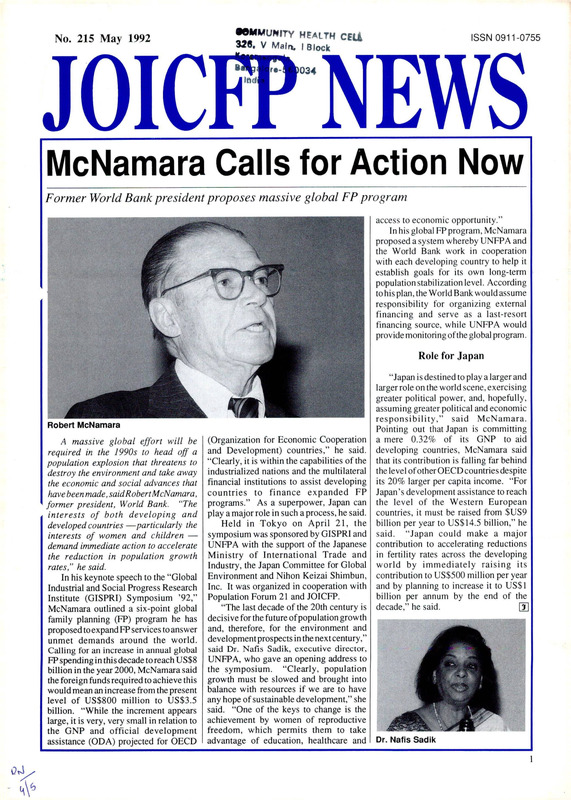
McNamara Calls for Action Now
Former World Bank president proposes massive global FP program
?|||
I
Mb/
Role for Japan
A'!5'
Robert McNamara
A massive global effort will be
required in the 1990s to head off a
population explosion that threatens to
destroy the environment and take away
the economic and social advances that
have been made, said Robert McNamara,
former president, World Bank. “The
interests of both developing and
developed countries —particularly the
interests of women and children —
demand immediate action to accelerate
the reduction in population growth
rates,” he said.
In his keynote speech to the “Global
Industrial and Social Progress Research
Institute (GISPRI) Symposium ’92,”
McNamara outlined a six-point global
family planning (FP) program he has
proposed to expand FP services to answer
unmet demands around the world.
Calling for an increase in annual global
FP spending in this decade to reach US$8
billion in the year 2000, McNamara said
the foreign funds required to achieve this
would mean an increase from the present
level of US$800 million to US$3.5
billion. “While the increment appears
large, it is very, very small in relation to
the GNP and official development
assistance (ODA) projected for OECD
access to economic opportunity.”
In his global FP program, McNamara
proposed a system whereby UNFPA and
the World Bank work in cooperation
with each developing country to help it
establish goals for its own long-term
population stabilization level. According
to his plan, the World Bank would assume
responsibility for organizing external
financing and serve as a last-resort
financing source, while UNFPA would
provide monitoring of the global program.
(Organization for Economic Cooperation
and Development) countries,” he said.
“Clearly, it is within the capabilities of the
industrialized nations and the multilateral
financial institutions to assist developing
countries to finance expanded FP
programs.” As a superpower, Japan can
play a major role in such a process, he said.
Held in Tokyo on April 21, the
symposium was sponsored by GISPRI and
UNFPA with the support of the Japanese
Ministry of International Trade and
Industry, the Japan Committee for Global
Environment and Nihon Keizai Shimbun,
Inc. It was organized in cooperation with
Population Forum 21 and JOICFP.
“The last decade of the 20th century is
decisive for the future of population growth
and, therefore, for the environment and
development prospects in the next century,”
said Dr. Nafis Sadik, executive director,
UNFPA, who gave an opening address to
the symposium. “Clearly, population
growth must be slowed and brought into
balance with resources if we are to have
any hope of sustainable development,” she
said. “One of the keys to change is the
achievement by women of reproductive
freedom, which permits them to take
advantage of education, healthcare and
“Japan is destined to play a larger and
larger role on the world scene, exercising
greater political power, and, hopefully,
assuming greater political and economic
responsibility,” said McNamara.
Pointing out that Japan is committing
a mere 0.32% of its GNP to aid
developing countries, McNamara said
that its contribution is falling far behind
the level of other OECD countries despite
its 20% larger per capita income. “For
Japan’s development assistance to reach
the level of the Western European
countries, it must be raised from $US9
billion per year to US$14.5 billion,” he
said. “Japan could make a major
contribution to accelerating reductions
in fertility rates across the developing
world by immediately raising its
contribution to US$500 million per year
and by planning to increase it to US$1
billion per annum by the end of the
decade,” he said.
|T|
Dr. Nafis Sadik
1
A6
In the News
Sustaining FP Successes
Women and young people targeted in new Indonesian FP initiatives
Dr. Kartono Mohamad, chairman,
Indonesian Planned Parenthood
Association (IPPA), and chairman, the
Indonesia Integrated Project (IP)
Coordinating Forum, spoke about the
Indonesian family planning (FP) and
maternal and child health (MCH)
situation in Indonesia during a visit to
JOICFP on March 24. Below is an
outline of his comments.
The Indonesian FP program has made
significant achievements in 20 years. It
is a success in terms of the reduction of
the population growth rate and infant
mortality rate (IMR). Our maternal
mortality rate has also been reduced, but
it is still one of the highest in Southeast
Asia. In the past, the MCH service has
been more oriented toward the child.
Now it is time to pay more attention to
mothers, especially pregnant women.
From now on it will be more difficult
to maintain the successes of the FP
program. There is a danger that if we’re
complacent, within the next 10 years the
rate of population growth could increase
significantly, since the fertility rate of the
young is high and the number of younger
couples is very large.
Programs for Young People
This potential for a rapid increase in
population is the reason why IPPA is
concentrating on the young population in
its programs. Many young urban couples
today think they can afford to have more
children. In answer to this trend, IPPA
must turn its focus to adolescents, young
people, young couples, and the urban
population. As a non-governmental
organization (NGO), IPPA can do much.
The collaboration between the govern
ment and NGOs in Indonesia is very
good, especially for community pro
grams. A meeting is held annually at
which government and NGOs talk about
what can be done by NGOs and done by
government.
IPPA has a different approach for the
rural and urban youths. In rural areas, we
usually train youths to do something
which will end up with them being selfemployed. For the urban youth we give
counselling, not only on sexual problems
but also on family problems. We now
have a pilot youth clinic in Jakarta. Also,
we have set up some learning facilities
where university students come to teach
2
Dr. Kartono Mohamad
high school students. If this is successful
we will expand the project.
At the grassroots, we promote
community development, especially for
women. We also conduct training for
women and motivate them to practice FP.
IPPA sometimes provides interest-free
loans for women to use to improve their
economic situation. We also have
preschool education integrated with FP.
In this program, we invite mothers to school
twice a month to observe their children.
At this time, we motivate them to practice
FP and consider healthcare for their
children.
In Jakarta, the IP has already been
expanded to cover 900 schools. The
minister of population and environment is
very interested in this project and has
promised to help so that the IP can be
implemented in Lombok. On this island,
the IMR is very high and the health situ
ation is the worst in Indonesia. The plan
for expansion is now under way.
I began my career in IPPA in 1976 as a
volunteer and was also involved when the
initial integrated clinic of the IP was
established in 1980. It was through the
integrated clinic that counselling was
provided for the first time in an Indonesian
clinic. I also visited the IPareain Sawalunto
in 1975.
IPPA now has several new programs
including a nutritional program for east
Indonesia, a youth clinic and a clinic for
males. The male clinic will deal with
vasectomies and sexually transmitted
diseases. It will be a place in the city
where men can come without being known
by anyone. Male participation in FP is still
quite low in Indonesia.
|T|
The Right
to Choose
To celebrate the 40th anniversary of
IPPF, a specially commissioned book
has been published by Earthscan Books
on 12 early family planning (FP)
pioneers. Written by Perdita Huston,
“The Right to Choose: Pioneers in
Women s Health & Family Planning” is
a collection ofstories of early leaders of
the FP movement. The stories, collected
by Hustonfrom those pioneers still living
or from people with whom they worked,
provide insights into the unique indi
viduals who struggled to bring women
their reproductive rights around the
world. The book mainly focuses on the
contribution that little known pioneers
made to the early FP movement.
In the anniversary issue of “People”
magazine, Huston outlines two reasons
why the stories were collected: “IPPF
wishes to honor
THE RIGHT TO those who dared
challenge
authority and
convention to
bring attention
to the health
needs of women
and their fam
ilies. By so
doing the feder
ation hopes to
prompt others
Perdita Huston
to take up the
struggle for reproductive rights.”
Featured in the book is the story of
Miyoshi Oba, a public health nurse who
worked to promote FP in poor rural
villages of Nagano Prefecture in Japan
during the postwar years. Oba, shocked
by the number of abortions taking place,
promoted use of the condom using an
innovative approach to win the accep
tance of villagers. Now retired, Oba not
only made significant contributions to
the FP and maternal and child health
field in Nagano, but also shared her
experiences with people from developing
countries through international cooper
ation activities.
Despite the diversity of backgrounds
of the pioneers in the book, Huston notes
that all shared a concern for women’s
health. “In sum, the will to do something
about the poor state of women’s health
and the tragedy of unsafe abortions were
the primary motivations of the men and
women who took up the challenge to
provide FP for their compatriots.”
[J]
CHOOSE
PIONEERS IN WOMEN'S HEALTH & FAMILY PLANNING
JOICFPNEWS, May 1992
Japan
Door Closes for Women
Japanese women likely to be denied access to low-dosage pills
The Japanese government has
decided to maintain its ban on lowdosage birth control pills indefinitely, a
major national newspaper reported on
March 18. Accord
ing to the report in
the Yomiuri Shim
bun, the Central
P harmaceutical
Affairs Council of
the Ministry of
Health and Welfare
cited “koshu eisei”
(public hygiene!
health) and concern
over the increasing
cases ofAIDS as the
reason for halting
the approval of the low-dose pills that
had been expected this summer.
The absence of an official statement
by the government on the issue, however,
worries the country’s family planning
(FP) promoters who insist that the public
should be informed on the government’s
intentions concerning contraceptive pills.
“The public have aright to know whether
the authorization of the pill is to be
delayed or whether it will be banned, and
the reasons for the government’s decision
on this matter,” said Yuriko Ashino,
Deputy Executive Secretary, Family
Planning Federation of Japan (FPFJ).
In a statement released after the
newspaper announcement, the Medical
From Strength
to Strength
At4.6per 1,000 live births (1990), Japan
enjoys the lowest infantmortality rate (IMR)
in the world. An achievement in itself, the
figure is all the more significant when it is
compared to the IMR of 166 that Japan
recordedjust over 70 years ago. One ofthe
majorfactors contributing to the successful
reduction ofthe IMR was Japan’s adoption
of an efficient health record system for
mothers and children in 1942. Known at
present as the Maternal and Child (MCH)
Handbook, this booklet ofpersonal medical
records quickly became a cornerstone of
MCH care in Japan and is still carried
today by everypregnant woman and mother.
In April, JOICFP published a new
English-language edition of the MCH
Handbook for foreign women living in Japan
JOICFP NEWS, May 1992
that promiscuity among young women
may increase.
The likelihood of a ban is bad news
for FP promoters who have been
campaigning for authorization of lowdose pills which have less side effects
than stronger types. At present,
medium-dose and high-dose pills can be
prescribed by doctors in Japan to treat
menstrual disorders. In reality, however,
women are able to use these higher-dose
pills for contraceptive purposes since
doctors who prescribe them for this
purpose are not penalized under the law.
According to the JFPA, some 500,000
women in Japan are currently using the
medium- to high-dose pills.
Committee of the Japan Family Planning
Association (JFPA) took issue with the
decision to link AIDS prevention and
reproductive choice. The function of the
Central Pharmaceutical
Affairs Council is to
determine the safety of
pharmaceuticals and not
to make decisions about
AIDS prevention, the
statement said. The
committee also pointed
Double Standard
out that recent studies
in Japan support the
The “double standard” that exists in
effectiveness and safety
of low-dose pills, while Japan, whereby women are able to use
no research has been stronger-dose pills for contraception
carried out to determine under the guise of medical treatment,
a relationship between use of contraceptive while being denied access to the safer
option of low-dose pills, should be
pills and the spread of AIDS.
An indefinite ban is seen as a serious abolished, say FP promoters. If the
blow to efforts to give Japanese women government is concerned about public
greater freedom to make their own health, why is it restricting access to safe
reproductive choices. The move also comes contraceptive options, commented
at a time when the government is showing Ashino. Lamenting the absence of
concern about the plunging birthrate and women’s involvement in the decision
considering measures to encourage women making process on the pills, Ashino said,
“Contraception should be a matter of
to have more children.
“Since there is no direct relation at all individual choice, not a moral issue.”
By linking the pills’ authorization to
between the pill and AIDS, I can only
imagine that there must be other reasons AIDS prevention, the government may
for the government to delay its release,” prolong the ban indefinitely and continue
to deny women in the country one safe
said Ashino.
She pointed to the falling birthrate as a and very effective means to determine
likely factor as well as government concern I the size of their own families.
andJapanese
women
living
abroad. The
second
revised
edition since
JOICFP
began pub
lishing the
booklet in
1983, the new MCH handbook is slightly thick
er and features a new layout with record sheets
in the front and medical information in the back
for easier reference. The changes in format
were made according to guidelines released by
the Ministry of Health and Welfare which has
also decentralized MCH care by giving
responsibility for the handbook and related
MCH activities to municipal authorities instead
of the public health facilities of each prefecture.
One reason why the MCH Handbook has
been so well accepted in Japan is that it puts the
health record of pregnancy and child health
Maternal and Child
. Health Handbook
: of Japan
until school age in the hands of the mother.
Every woman in Japan is obliged to inform
the municipal office of her pregnancy. At
this time she will receive a copy of the
handbook which contains at least two
coupons that will entitle her to two free
health checkups.
Without the efficient infrastructure of
Japan’s healthcare system, however, the
MCH Handbook would not be as effective.
At each municipality, Japanese mothers can
depend on a thorough system for childbirth,
immunization and health checkups that is
supported in many areas by a community
based network of volunteers drawn from
women’s and MCH groups. Thus, the rate
of children undergoing regular health
checkups is extremely high at 80-90%.
The effective role that the handbook has
played in Japan’s MCH care has also been
recognized by other countries. Following
Japan’s lead, the U.S. state of Utah, China,
Korea and Thailand have produced their
own versions of the handbook.
3
UNFPA
A World
in Balance
Running into the ground
Renewable resources are being used faster than they can be replaced.
• By 2025, 21 African countries are likely to face water scarcity, affecting
1,100 million people.
• An increase of 56 per cent of the developing countries' 1988 arable area will be
required to meet the needs of population growth between now and 2050. This will
rob wildlife of forests, wetlands and savannahs, reducing species diversity.
°-21
°'29
1988 - Arable area per person (hectares)
2050 - Low, medium and high projections (hectares)
°'13
the number of people will increase by an
average of 97 million annually, the high
est growth rate ever. Nearly all this growth
will be in Africa, Asia and Latin America.
Over half will be in Africa and south Asia.
Medium projections of population
growth see the number of people at 8.5
billion by 2025, a near doubling of the
present population to 10 billion in 2050,
and continued growth for another century
to mark 11.6 billion in 2150. According to
the most optimistic prediction, total
population could peak in mid-century and
begin to fall thereafter. If growth, however,
Food facts
• While the proportion of malnourished people dropped
from 27 per cent in 1969-71 to 21.5% in 1983-85, the total
numbers rose from 460 to 512 million.
520
\\Proportion of malnourished people
£ 26
510
25
500
I
i
i
490
23
480 •5
470
pnTpTT llllllllllllllllllllllllllll
• Some 300 million women had no access to safe methods
of contraception, representing a total family population of
1.5-2 billion.
1
• 2.3 billion did not have adequate sanitation. Slower
population growth would have helped better public services
reduce the numbers of the poor as well as the proportion.
Year
More of us
than ever
With the 1992 population
already at 5.48 billion we
face four decades of the
fastest growth in human
numbers in all history.
Between now and the
end of the century, we
will be adding 97 million
people annually roughly another Mexico
every year. With a likely
population of 8.5 billion
by 2025, and 10 billion
by 2050, the long-range
estimates show a likely
world population of 11.6
billion by 2150.
• In 1990, around 1.5 billion people had no access to clean
water and modern health care.
460 1
| Total number of malnourished
/J^ZZ
Health points
I
24
22
Population projections by region (medium variant)
I
I
12.0
11.5
11.0
10.5
10.0
-(-■
- — sss Africa
- — CSJ Other Asia
India
-—
- — eza china
dx Latin America
8.0
7.5
7.0
6.5
6.0
5.5
5.0
4.5
4.0
3.5
- —
■
-
:=
World lotal
•••
<r=D Developed
3.° -
2.5 2.0 - X
15
1
‘
1.0 -
.5 - |
0 -|-L
1950
1990
2000
2025
2050
Year
4
6J
5.9
2050
1988
Titled “A World in Balance”, this
year s State of World Population Report
callsfor immediate and determined action
to balance population, consumption and
development patterns: to put an end to
absolute poverty, provide for human
needs and yet protect the environment.
Released ahead ofthe Earth Summit (UN
Conference on Environment and
Development) to be held in Brazil in
June, the report highlights population
growth as a majorfactor in environmental
impact, noting that the immediate threat
of exploding population and consump
tion might be to “renewable” or
“unlimited” resources, including land,
water and biodiversity. Below is an
outline of the report.
From a total of 5.48 billion in mid1992, world population will expand to
hit 6 billion in 1998. In the next decade,
i
1988-2050
Land availability in the future
UNFPA report underscores
the role of population in
consumption, environment
and development
27
Future Land Expansion 1988-2050
For farm and non-farm needs
Area Expansion (million kmJ)
2075
2100
2125
2150
is not curbed, world population could
reach 12.5 billion in 2050 and head
towards 20.7 billion a century later.
Action to reduce family size in the next
decade will have a crucial impact on the
size of world population in the future.
Environmental Costs
World resources are adequate for the
sustained development of the planet, if
they are carefully used. The requirements
will be to improve the conditions for the
world’s 1.1 billion poorest people; to
meet the legitimate aspirations of the
three billion who are neither rich nor
very poor; to cut the environmental cost
of development and distribute its benefits
more equitably. Progress towards these
goals calls among other things for slower
population growth, smaller overall totals
and more balanced population distri
bution in and between countries.
It has been shown that attention to
population issues can help eliminate
absolute poverty, sustain economic
growth and achieve ecological balance.
Countries which succeeded in slowing
population growth between 1965 - 1980,
for example, saw the benefit in the 1980s
when the average income per person
grew 2.5% a year faster than countries
with more rapid population growth.
Ending absolute poverty, improving
health and education and raising the
status of women will contribute to slower,
more balanced population growth. In
particular, giving women access to better
education, healthcare and family plan
ning (FP) and fair wages will speed
economic development and reduce
family size. Smaller family sizes, in turn,
can directly contribute to better edu
cation, health and nutrition since children
from smaller families are healthier and
JO1CFP NEWS, May 1992
UNFPA
better nourished, stay longer in school
and do better there than children from
large families. Avoiding births to mothers
under 20 could cut deaths of under-fives
by 17%, while avoiding births spaced
closer than two years apart could also
yield the same result. Eliminating both
types of poor timing could reduce
maternal mortality by 40%.
Balanced Development
Balanced development between
urban and rural areas and between
countries is an essential component of
sustainable development. Some 83% of
population growth in the next decade
will be in urban areas. Over one million
people emigrate permanently to other
countries and close to that number seek
asylum each year. The number ofrefugees
rocketed from 2.8 million in 1976 to the
record level of 17.3 million in 1990.
Environmental impact is the product
of the number of people, their level of
consumption, and their technology.
Average consumption levels in the world
are bound to rise. Technology alone
cannot work miracles. Slower population
growth will help achieve growth within
lower damage levels. Working towards
balanced population growth is part of a
broad strategy to reduce environmental
impact and achieve sustainability.
Experience in the last two decades
has shown that fertility patterns can
change in as little as a decade and that
voluntary policies and programs can be
highly effective in encouraging the
change. Access to information and the
means to decide family size through
Slower population growth, faster
income growth
For richer, for poorer?
The UN estimates that the percentage of poor people in developing countries fell from 52 per cent in 1970 to 44 per cent in 1985. But
because population grew rapidly over this period the actual numbers of poor people rose from 944 million to 1,156 million.
• In Africa from 166
million to 273 million
• Latin America from 130
million to 204 million
52%
1,156 million
• Asia has the biggest
share of the world's poor
at 737 million despite a
big drop in the percentage
of poor people, from 56
per cent to 43 per cent.
' 944 million
'
■ h
1970
child spacing has been accepted as a
human right for over 20 years. Yet 300
million women in developing countries
did not have ready access to safe and
effective means of contraception in 1990.
Just over one birth in five in developing
countries may be unwanted. Enabling
women simply to avoid unwanted births
would help both them and their families.
Recommendations
Sustainable social and economic deve
lopment calls for a direct attack on the
roots of poverty. Strategies adopted by the
international community for the Fourth
International Development Decade should
be implemented withoutdelay. Population
is an essential component for sustainable
development and should be integrated in
every aspect of research, policy and
programs at every level. Internationally, a
sustained and concerted program with
special emphasis on Africa and south Asia
should be started immediately to bring
population growth towards the UN lower
population projection. At the national level,
• In 41 countries with faster population growth
in the 1980s, incomes fell on average by 1.25 per
cent a year.
L.
i
r
Growth of GDP per person. % per year
A
CHILDREN
Smaller families, better education - better
life chances
tCORE SCHOOL INFi
Studies in developed and developing countries show that
children from small families tend to have more years of
schooling and perform better at school.
EE~~EK LIFE CHANCES
• One year's schooling in developing countries has been found
to increase wages by 7 per cent to 25 per cent.
r-iA
JOICFP NEWS, May 1992
Actual
numbers ot poor
countries should adopt population
policies adapted to national situations,
aimed at achieving balance between
population and resources for develop
ment. Population policies should recog
nize that the interaction of population
and environment helps determine
sustainability. Governments should take
steps to assess the environmental
implications of population growth and
distribution, and take appropriate action.
They should also assess the environ
mental impact of their use of resources
and prevailing technology and make
decisive moves.
Human-centered development mea
sures should have priority in development
policies and programs. They should
include as essential elements means to
improve health, education and the status
of women. Measures to raise the status of
women include: establishing women’s
property rights and access to the labor
market; equalizing educational opportu
nities and literacy rates between men and
women; and reaching those women who
do not have ready and easy access to
modem, safe and effective means of FP.
Education for Women
• In 41 countries with slower population growth
in the 1980s, incomes grew on average by 1.23
per cent a year.
7 !/
1985
Population growth and income growth 1980-89
Out of 82 countries:
1h
Percentage ot poor people
In developing countries
• Increasing the average level of schooling by three years is
associated with an increase in the country’s rate of economic
growth of 27 per cent.
^Charts courtesy of UNFPA
The most urgent priority in education
is to ensure access to, and improve the
quality of, education for girls and women,
and to remove obstacles that hamper
their active participation. Education for
women must be given top priority since
it contributes to women’s personal
development, to smaller families and to
better health for mothers and children.
Developing human resources together
with balancing population and
consumption will be the key to the future.
The measures that slow population
growth are beneficial in their own right.
They will improve the quality of life,
especially for women and children and
will reduce damage to the environment
and achieve sustainable development.
They must not be delayed.
Q]
5
Mexico
Support from Across the Ocean
Assistance from Japanese public bolsters local NGO’s adolescent health program in Mexico
Recent initiatives from Japan to
support family planning (FP), maternal
and child health (MCH) and primary
health care promotion in Mexico have
met with a warm response at the
grassroots where their effects are most
felt. In areas where the Integrated Pro
ject (IP) is being implemented by the
Mexican Family Planning Foundation
(MEXFAM), health and education
personnel are now utilizing equipment
purchased withfundsfrom the Voluntary
Deposit for International Aid (VDIA)
scheme to promote health education
among adolescents, while reconditioned
bicycles donated by the Municipal
Coordinating Committee for Bicycle
Assistance (MCCOBA) are assisting
health promoters to take their messages
and services to people in communities. A
key to the effectiveness of the two
initiatives is their incorporation into the
activities of a local non-governmental
organization (NGO), MEXFAM, which
is implementing programs that address
the needs ofpeople at the grassroots.
With teenage pregnancy increasing
at an alarming rate in Latin American
practitioners by setting up a consultation
clinic and providing basic equipment.
After two to three years, these doctors
must become self-reliant. As part of the
scheme, they are obliged to devote their
afternoons to health education activities,
particularly those concerning adolescent
health. Currently, 40 of the 200 com
munity doctors supported by MEXFAM
are working in IP areas.
Wheels for Doctors
A volunteer FP promoter delivers
contraceptives to men in Tlaxcala.
countries, adolescent health is now being
highlighted as one of the most crucial
factors in the success of FP/MCH programs
throughout the region. To support
MEXFAM’s efforts to tackle this issue, 38
projectors, 81 adolescent health films and
37 sets of the educational Magnel Kit (a
magnetic board for teaching reproductive
processes) were purchased with funds from
the VDIA scheme administered by the
Ministry of Posts and Telecommunica
tions of Japan. The funds were collected
from 20% of the interest accrued on special
VDIA accounts held by Japanese people
wishing to support international cooper
ation activities in developing countries.
Health Education
A reconditioned mobile X-ray van (above)
is bringing much needed healthcare
services to people living in rural areas in
Mexico’s Queretaro State where the IP is
being implemented at the grassroots. The
van, donated by the Tochigi Health Service
Association in July, 1991, is being used to
support the FP/MCH, primary health care,
and health education activities of the IP
thanks to assistance of the Japan Health
Service Association, which covered the
cost ofthe van’s shipment. Utilized by the
Queretaro branch office ofMEXFAM, the
van enables mobile health teams to cover
greater distances and reach more people,
especially those in isolated rural areas. It
is also contributing to the office’s efforts
to achieve self-reliance, since fees are
chargedfor the services provided.
6
To confront adolescent health
problems, MEXFAM is concentrating on
IEC activities to give young people a basis
from which to make informed decisions
about reproduction and contraception.
Thus, the choice of equipment to support
these IEC activities was a particularly
appropriate form of assistance to offer the
adolescent health program. Distributed to
health and education personnel, the
projectors and kits are boosting efforts for
youth in marginal areas. Meanwhile, the
Magnel Kits offer a simple, visual means
to explain reproductive processes to aid
the understanding of reproductive health.
Among the personnel using the
equipment sent to MEXFAM are the
community doctors in the IP area supported
by the NGO. An outreach scheme to serve
isolated areas, the community doctor
program provides initial support to the
This scheme has also been strength
ened by the donation of reconditioned
bicycles, which assist the doctors to
reach the 15,000 people they are each
expected to serve. Based in peripheral
zones of cities and isolated rural areas,
the doctors and their staff are now using
the bikes to provide services, offer
counselling and educate communities.
The bicycles have also been distributed
to two other groups of community health
agents: the youth brigades, who actively
promote FP and offer sex education, and
the volunteer promoters, who are drawn
from the community to support
MEXFAM’s program in each village.
The IP received a second donation of
150 bikes in October, 1991, following
the effective use of the initial donation of
75 in 1990. Appropriate to the Mexican
situation, the bikes and the equipment
supplied through the VDIA scheme have
been greeted by health promoters as
very practical means of support.
[T]
Grassroots Perspective
Graciela Duce, country director,
UNFPA, Mexico (left) stands with a
local health volunteer during a visit to
La Hormiga, Oaxaca State, on
February 10. Duce joined Alfonso
Lopez
KA’lancV/EI
Juarez,
jetodo J ;ri f
executive
director,
MEXFAM,
deli
and staff
members
of JOICFP
on a field
trip to La
Hormiga and Huixtan to observe
preparations for the start of the IP and
view initial activities of the community
doctor scheme, respectively.
li
■ I
R
JOICFP NEWS, May 1992
In the News
Building on Initiatives
Simple innovation supports use of donated bicycles in Tanzania
The creation of a
simple metal box to
attach to the back of a
bicycle has made life a
lot easier for mobile
health promoters
working in areas where
the Integrated Project
(IP) is being imple
mented in Tanzania.
The innovation, a metal
“suitcase” that can be attached and
removed from the carrier of a bicycle
with ease, provides community-based
distributors such as the traditional birth
attendants (TBAs) and village health
workers that work directly at the
grassroots with a hardy, convenient
carrying case for medical and family
planning (FP) supplies.
Strong enough to withstand the
bumpy rides on the dirt roads linking
villages and homes in the rural areas
where the IP is implemented, the box was
designed to be used on the reconditioned
bicycles donated to the
project by Japanese local
governments belonging
to the Municipal
Coordinating Com
mittee for Bicycle
Assistance (MCCOBA)
through JOICFP. To
date, 600 bicycles have
been sent to Tanzania to
assist the health workers
to provide integrated FP, maternal and
child health (MCH) and primary health
care (PHC) services and offer health
education to encourage
community participation
in the project.
At present, the metal
boxes have not been
widely distributed to
health staff, but plans to
extend their use have
been incorporated into a
proposal to expand the
project to cover the total
Far-reaching
Messages
Embassy of Vietnam in Japan, com
mended the students and encouraged them
to continue their efforts.
The scheme has proved effective for
creating awareness of such issues as
maternal and child health (MCH) and
women’s development outside Taishido’s
gates and has gained the attention of the
mass media. It was featured on a news
program on March 21 on NTV, a popular
TV station. Another school, Fuchu Daiku
Junior High School of Fuchu City in
Tokyo, has also joined the scheme. On
March 10 reconditioned sewing ma
chines from the school were sent to IP
areas in Guatemala with 10 other units
donated by Japanese individuals.
Activities carried out by the students
of Taishido Junior High School in
Setagaya City in Tokyo to assist women
in developing countries have inspired
others to join a scheme organized by
JOICFP to support income generation
and skills training for women.
Taishido got the ball rolling in 1990
by sending 19 treadle sewing machines
(reconditioned free of charge by Janome
Sewing Machine Co., Ltd.) to areas in
Ghana where the Integrated Project (IP)
is being conducted. With the support of
the school administration, the scheme
was incorporated into the curriculum as
a way to teach the students about the
people of developing countries and the
importance of international cooperation.
In March, the school was involved
in the donation of 20 more treadle ma
chines to the IP in Vietnam. Students
also contributed to the cost of shipment
of the machines by collecting alumi
num cans for recycling. Speaking at the
school’s graduation ceremony on March
19, Luu Van Ke, first secretary,
JOICFP NEWS, May 1992
Luu Van Ke (left) presents a pictorial
booklet on Vietnam to a head student.
population of the Hai District,
Kilimanjaro Region. According to the
plan, the male and female village health
workers of each village will be trained to
provide FP services along with the PHC
services they currently offer.
Role of TBAs
At present, TBAs are utilized in IP
areas to promote FP integrated with
MCH care and provide health educa
tion. Respected by villagers, these
typically senior members of communities
have been effective in increasing the FP
acceptance rates in current IP areas.
However, in consideration of the large
distances that must be covered and the
age of most TBAs, the new plans have
targeted the younger, more active village
health workers as
effective agents of
change in the new,
expanded areas.
According to the
plan, the metal box will
become a familiar item
in every village where
the IP is implemented,
used by health workers
to bring FP/MCH and
PHC services to the
doorstep of community people.
E
Solid Footing
In a positive show of support from
Japan’s industrial sector, Okamoto
Industries, Co., Ltd. donated 40,000 pairs
of sneakers to JOICFP in mid-March for
distribution at the grassroots in areas
where the Integrated Project (IP) is being
implemented in Ethiopia, Ghana,
Tanzania and Zambia. The sneakers will
be utilized to promote preventive health
and health education among
schoolchildren and community people
and support project activities being
carried out by field workers and
volunteers. The size of the donation is
very large indeed. With a wholesale value
of ¥1,100 (approximately US$9.67 at an
exchange rate of ¥129 for US$1) a pair,
the entire donation is worth a total of
¥49.9 million (US$387,000). Okamoto
also ensured that the sneakers reach the
people at the grassroots in the four
countries by covering the costs of
shipment and inland transportation of
the sneakers. Representatives said the
company would like to continue
providing support to JOICFP activities
in the future.
[5]
7
Voice of Voices
ANNOUNCEMENTS
By Chojiro Kunii
International Seminar on Family Planning for Senior Officers
The Stagehand
IPPF selected Miyoshi Oba from
Nagano Prefecture, Japan, to feature in a
recently published book on the world’s
family planning (FP) pioneers. The book
of stories of these pioneers will be
distributed to individuals in the Ministry
of Health and Welfare, the Ministry of
Foreign Affairs, and the press in Japan.
The author, Perdita Huston, visited
me in my office last year and told me
about her meeting with Oba. She said she
was very impressed with the FP pio
neer’s untiring efforts in the villages of
Nagano, and her immense contributions
to the FP and maternal and child health
(MCH) fields over the years.
In particular, Huston was surprised
by the unique method employed by Oba
in FP education which entailed a oneyear rotation system for the chairperson
of the Women’s Association. Through
Oba’s influence, the focus of the
association changed annually from topics
such as nutrition and immunization one
year, to FP and preventive health check
ups the following year. Thus, the activities
of the association accumulated yearly
and were renewed constantly. Behind
the scenes, Oba remained a driving force
in the association, always standing by to
offer advice when it was sought.
I am convinced that the system
promoted by Oba was one of the origins
of growth of Japan’s FP movement. [J]
'I J
Shin-ichi Yagi, deputy executive director,
JOICFP (right), expresses appreciation
to FujikazuHorigome, managing director
(center), and Tsutomu Kamimura,
executive director, Social Welfare
Foundation, MainichiShimbun, on March
19 for a donation to support activities of
the Integrated Project (IP). The
foundation, chaired by Mainichi Shimbun
President Noboru Watanabe, donated
¥500,000 (US$3,900 at an exchange rate
of ¥129 to US$1) to cover the shipment
costs ofreconditioned bicycles to IP areas
in developing countries. This is the second
such grant receivedfrom the foundation
to support IP activities.
8
The government of Japan will conduct an international seminar on family planning
(FP) in Japan as part of its technical cooperation programs fordeveloping countries
for fiscal 1992 (April 1,1992- March 31,1993). The seminar will focus on effective
administration of FP and maternal and child health (MCH) programs at the central
and local levels through Japan’s experiences in this field and encourage mutual
sharing of relevant experiences and knowledge.
Date:
August 24 - September 11
Participants: 12 senior FP officers to be selected from Brazil, Egypt, Ethiopia,
India, Kenya, Malawi, Mexico, Nepal, Niger, Nigeria, Papua New
Guinea and the Philippines
Deadline for applications to the Embassy of Japan: June 18, 1992
The seminar will be executed by the Japan International Cooperation Agency
(JICA) in collaboration with JOICFP.
For further information, contact the Embassy of Japan in nominated countries
through the relevant government agency.
*
*
*
First Adolescent Health Workshop for Latin America & the
Caribbean Region
A workshop on “Adolescent Reproductive Health” will be' held in Brazil for
representatives of government and non-governmental organizations involved in
adolescent health programs. Sponsored by UNFPA and IPPF in cooperation with
JOICFP, the workshop will be hosted by CMI/PF of Brazil.
Date:
June 15 -19, 1992
Venue:
Sao Paulo, Brazil
For further information, please contact JOICFP.
DIARY
JOICFP Program Officer Hiroshi Taniguchi
was in the Philippines from Mar. 5 - 12 to
coordinate activities for Integration magazine.
* * *
Takehiko Okamoto, president, Okamoto
Industries, Co., Ltd. visited JOICFP on Feb.
14 to officially hand over a donation of con
doms for the IP in Asia.
* * *
Patricia Yamane, site supervisor, and Joyce
Akins, evaluator, Far East Office, U.S. General
Accounting Office, visited JOICFP on Mar. 16
to collect information on population and FP.
* * *
JOICFP Program Officer Ryoko Nishida and
staff member Sono Aibe were in Malawi from
Feb. 29 - Mar. 21 as members of a JICA team
on population and FP headed by Dr. Minoru
Muramatsu, former president, Saitama
College of Health.
* * *
Program Officer Atsushi Yoshino was in
Vietnam with a film production crew from
Feb. 21 - Mar. 26 to make a film for JOICFP’s
documentary series.
*
*
*
Dr. Kartono Mohamad, chairman, and
Wilarsa Budiharga, deputy executive direc
tor, Indonesian Planned Parenthood
Association, visited JOICFP on Mar. 24 and
25, respectively, to exchange information.
* * *
Javier Ricardo Duarte Duarte, second
secretary, Embassy of Colombia in Japan,
visited JOICFP on Mar. 27 to exchange
information.
Exchanges
Patricia Yamane, site supervisor
(right), and Joyce Akins, staff member,
General Accounting Office (GAO),
gained
fl
insights into
Japan’s
MCH care
J
during their
one
day
spent
at
JOICFP on
March
16.The two
visitors were particularly interested
in the preventive approach taken
toward child healthcare in Japan.
Yasuo Kon, deputy executive direc
tor, JOICFP, provided historical
background on MCH/FP in Japan
and reported on JOICFP-assisted
projects in developing countries.
JOICFP NEWS is a monthly newsletter
published by the Japanese Organization for
International Cooperation in Family Planning,
Inc. (JOICFP).
JOICFP NEWS welcomes your comments,
suggestions and contributions. Please mail to:
JOICFP NEWS
Hoken Kaikan Bekkan
1-1, Sadohara-cho, Ichigaya
Shinjuku-ku, Tokyo 162 Japan
Phone: Tokyo 3268-5875
Telex: 2324584 JOICFP J
Cable Address: JOICFP Tokyo
Facsimile: Tokyo 3235-7090
JOICFPNEWS, May 1992
- Media
 NO. 215 MAY 1992.pdf
Position: 281 (89 views)