JOICFP NEWS N0. 213 MARCH 1992
Item
- Title
- JOICFP NEWS N0. 213 MARCH 1992
- extracted text
-
No. 213 March 1992
ISSN 0911-0755
JOICEPNEWS
Population vs. the Environment
Japanese national television features Sadik’s call for immediate action on population
The serious threat that the rapidly
growing world population poses to
limited resources and the environment
was brought home to theJapanesepublic
by a hard-hitting documentary broadcast
by NHK (Japan Broadcasting Corpora
tion) on January 5. The program, titled
“Population Explosion and the Loom
ing Crisis: Can Humankind Determine a
Better Future?” featured interviews with
Dr. Nafis Sadik, executive director,
UNFPA; Dr. Paul Ehrlich, professor,
Stanford University, and other experts
from the population field who offered
insights into the challenges that popu
lation presents to the environment.
I®
f
Earth Summit
Aired ahead of the “Earth Summit”
(UN Conference on Environment and
Development) to be held in Brazil in
June, the documentary compared the
current global demographic and envi
ronmental situation with that expected
to exist in the year 2050, when world
population is predicted to reach 10 billion.
A global food crisis, depletion of energy
sources and resources, increasing
numbers of refugees and the destruction
of the environment were among the grim
prospects portrayed by the Film which
was made with the cooperation of
UNFPA and JOICFP.
Impact of Population
To illustrate the impact that
burgeoning populations in developing
countries are currently having on limited
resources and local environments, the
documentary featured reports from
countries in Asia and Africa. Japan,
meanwhile, was used as a model to
demonstrate the heavy burden that
industrialized countries place on the
global environment with rampant
consumption and waste. Comparisons
such as “The annual amount of plastic
thrown away in Japan is equivalent to
what Ghana uses over a four-year period,”
*
/■'5
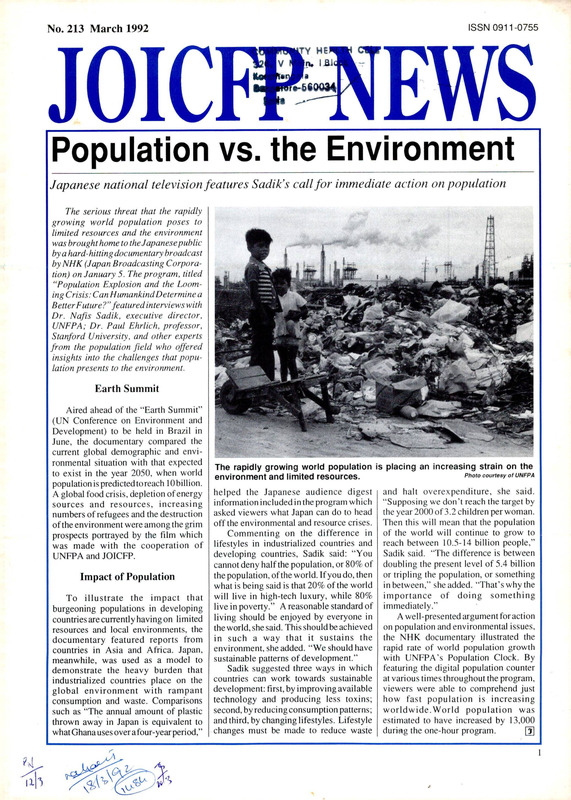
The rapidly growing world population is placing an increasing strain on the
Photo courtesy of UNFPA
environment and limited resources.
helped the Japanese audience digest
information included in the program which
asked viewers what Japan can do to head
off the environmental and resource crises.
Commenting on the difference in
lifestyles in industrialized countries and
developing countries, Sadik said: “You
cannot deny half the population, or 80% of
the population, of the world. If you do, then
what is being said is that 20% of the world
will live in high-tech luxury, while 80%
live in poverty.” A reasonable standard of
living should be enjoyed by everyone in
the world, she said. This should be achieved
in such a way that it sustains the
environment, she added. “We should have
sustainable patterns of development.”
Sadik suggested three ways in which
countries can work towards sustainable
development: first, by improving available
technology and producing less toxins;
second, by reducing consumption patterns;
and third, by changing lifestyles. Lifestyle
changes must be made to reduce waste
and halt overexpenditure, she said.
“Supposing we don’t reach the target by
the year 2000 of 3.2 children per woman.
Then this will mean that the population
of the world will continue to grow to
reach between 10.5-14 billion people,”
Sadik said. “The difference is between
doubling the present level of 5.4 billion
or tripling the population, or something
inbetween,” she added. “That’s why the
importance of doing something
immediately.”
A well-presented argument for action
on population and environmental issues,
the NHK documentary illustrated the
rapid rate of world population growth
with UNFPA’s Population Clock. By
featuring the digital population counter
at various times throughout the program,
viewers were able to comprehend just
how fast population is increasing
worldwide.World population was
estimated to have increased by 13,000
during the one-hour program.
[j]
1
Japan
6 Million Say Yes to Jnt’l Assistance
VDIA scheme gives Japanese avenue for cooperation with developing countries
An international assistance scheme
administered by the Ministry of Posts
and Telecommunications has not only
caught the public eye but has succeeded
in getting a remarkably large number of
Japanese individuals to actively
contribute to grassroots assistance
projects implemented by non
governmental organizations (NGOs) in
developing countries. The Voluntary
Deposit for International Aid (VDIA)
scheme has been greeted by an
overwhelming response from indivi
duals who have agreed to turn over 20%
of the interest earned on deposits made
in special VDIA accounts. Launched in
January 1991, the scheme had attracted
over 6 million new VDIA account
holders by the end of last year.
Funds collected under the scheme
during the April 1 - December 31, 1991,
period totaled ¥2.5 billion (US$19.7
million at an exchange rate of ¥127 to
US$1), some 2.5 times the amount of
money provided through Japan’s official
development assistance (ODA) to NGOs.
The¥l. 1 billion (US$8.7 million) donated
by account holders under the scheme
during the January 1 - March 31, 1991,
period was allocated in fiscal 1991 to
Japanese NGOs to support the activities
of local NGOs in recipient developing
countries.
In the 1991 allocation of funds,
JOICFP received a total of ¥32,699,000
(US$257,500) to support the maternal and
child health (MCH), family planning (FP),
primary health care and community
development activities conducted in
communities where the Integrated Project
(IP) is being implemented.
People living in project areas in
Guatemala, Mexico, Nepal and Zambia
benefited from this scheme in 1991 through
donations of materials and equipment. The
Japan Family Planning Association
(JFPA), JOICFP’s sister organization in
the Hoken Kaikan Group, also received
funds through the scheme to assist MCH
activities of the IP in the Philippines. Both
JOICFP and the JFPA will be seeking to
broaden the number of countries
receiving VDIA funds through them for
the 1992 allocation.
The remarkable response the Japanese
people have shown to the VDIA scheme
has not only demonstrated the public’s
commitment to international assistance
programs, but has highlighted the need to
provide people with appropriate avenues
to show their support. As a scheme
administered by a government ministry,
the VDIA program has won a reputation
for being a legitimate, well-monitored
assistance program whereby donated
funds are assured of reaching the people
at the grassroots of target communities.
Moreover, the ministry provides account
holders with a regular record of funds
collected and allocated and publishes
bulletins containing reports from the field
on use of the funds.
Through the ministry’s efforts to
further this campaign and the constant
attention the scheme has attracted in the
mass media, a growing number of
Japanese people are learning about the
needs of people in developing countries.
As the scheme’s popularity with
individuals snowballs, it is indeed
furthering the cause of international
understanding within Japan.
[J]
Traveling a Two-way Street
The bicycle assistance scheme being
implemented by JOICFP is bringing benefits
to people in developing countries, where the
reconditioned bicycles are being utilized to
promote community health and develop
ment, and in Japan where the scheme has
highlighted such issues as mass consump
tion and waste. This was an observation
made by three participants of the “Tele
vision Social Education Program” who
produced a documentary on the schemefor
broadcast in their home countries of
Paraguay, Poland and Senegal. The
program, sponsored by the Japan Inter
national Cooperation Agency (JICA) with
the support of NHK (Japan Broadcasting
Corporation), was conductedfrom February
10 - March 3 and was attended by 15
participants from as many countries.
“An important aspect of the project is
that it is not only positive for the people on
the receiving end of the bicycles, but people
in Japan are also benefiting,” said Daniel
Ignacio Ramirez, producer and director,
Educational Television, Ministry of
2
Education, Paraguay. Ramirez visited JOICFP
with fellow participants on February 6.
The scheme, through which JOICFP
coordinates the distribution of reconditioned
bicycles from nine cities within Greater Tokyo
to areas of the Integrated Project (IP), supports
the grassroots activities of the project. Often
put to use in sparsely populated, rural areas,
the bicycles offer healthcare workers an efficient
means of transport to support such areas of
activity as family planning and maternal and
child health.
“I think it is very important to have a good
project to utilize the bikes found in Tokyo,”
said Amadou Moctar Beye, producer,
Television Production Division, Office de
Radiodiffusion Television du Senegal.
Beye said that JOICFP plays a central role
in the scheme by “informing the people in
Japan about the relationship between the bicy
cle problem in Japan and the needs of other
countries.” He said JOICFP functions as the
liaison between the people in cities such as
Toshima City in Tokyo and the people of
developing countries. “It is necessary for
(From left) Beye, Dolacka and Ramirez.
JOICFP to control the ‘how’ and ‘where’
of bicycle assistance,” he added.
The bicycle scheme is a positive way of
getting people from different parts of the
world to cooperate, said Maria Dolacka,
journalist, Polish Television. “Sending these
bicycles abroad is the best way to utilize
them,” she added.
Prior to visiting JOICFP, the three me
dia representatives observed the congestion
caused by illegally parked bicycles in
Toshima and Setagaya cities and visited
rehabilitation centers in the cities where the
bicycles are reconditioned.
JOICFP NEWS, March 1992
Japan
Lessons
from Past
Successes
Japan offers convincing
argument for integrated
healthcare
A great deal of Japan s experiences
in preventive medicine are applicable in
developing countries, according to
participants of a seminar sponsored by
the Japan International Cooperation
Agency (JICA) from January 20February 17 in Japan. Before her trip to
Japan, Dr. Karen Lai Nee Lee Peng
Foon, research officer!acting head,
Division of Parasitology, Institute for
Medical Research, Malaysia, knew little
about its postwar history of preventive
medicine. But she said that what she had
learned at the seminar had convinced
her of the effectiveness ofapplying these
experiences in other countries through
the Integrated Project (IP).
During the seminar, the 10
participants from Brazil, Guatemala,
Indonesia, Jamaica, Malaysia,
Nicaragua, Tanzania and Thailand,
learned much about preventive health
activities that have been conducted in
Japan during the postwar years and the
application of these experiences through
the IP in developing countries. The 13th
meeting of its kind, the “Seminar on
Parasite Control Administration for
Senior Officers”, was entrusted to the
Japan Association of Parasite Control
(JAPC) by JICA. Including lectures and
presentations on concepts and strategies,
technical training and a week-long field
trip to Iwate Prefecture, the seminar was
conducted in cooperation with JOICFP.
The trip to Iwate served as a highlight
for most participants who learned much
from observing integrated healthcare
fl
I
Participants learn technical skills (left) and observe mass health checkups at
the Iwate Health Service Association (right).
conducted in communities by the
government, non-governmental orga
nizations (NGOs) and volunteer groups
which work in close cooperation. In
particular, the visit to the Iwate Health
Service Association demonstrated the
effectiveness of providing mass health
services on a fee-charged basis.
Preventive Healthcare
The Iwate association is one of 34
associations nationwide which grew out
of a Tokyo-based parasite control (PC)
organization set up after the war. The
health service associations are today fully
self-reliant and provide a wide range of
preventive health services including mass
health examinations in cooperation with
volunteer groups. Participants were able
to speak with some of the pioneers of this
association during the visit to Iwate.
The concept of utilizing mass services
to achieve program self-reliance appealed
to Dr. Rusdi SatriaRidwan, head, Division
of Planning and Development, National
Family Planning Coordination Board, West
Sumatra. In Jakarta, he pointed out, the IP
involves mass PC services to generate
income and gain the trust of the community
for the promotion of FP/MCH. “It is very
clear that using thiskind of simple approach
can make people believe that what is
... ...
The group meets school children (left) and health volunteers (right) in Iwate.
JOICFP NEWS, March 1992
provided is beneficial for them,” he said.
“Some people in my country think FP is
for the good of the government and not
for them because the benefits of FP may
not be seen immediately.” If mass PC is
used as a tool to get the commitment of
the people, however, it is much easier to
promote FP, especially in difficult areas
such as remote, rural areas and city
slums, he said.
Participants agreed that the seminar
was effective for learning workable
solutions to community health.
2]
Yasuo Kon, deputy executive director,
JOICFP (right), expresses appreciation
to Takehiko Okamoto, president,
Okamoto Industries, Inc., on February
14 for the donation of 23,000 gross of
condoms to support the activities of
the Integrated Project (IP) in Asia.
Okamoto Industries, Inc. provided the
practical assistance to IP areas in
Nepal, the Philippines, Thailand and
Vietnam to assist the promotion of
family planning and prevention of AIDS.
The condoms will be distributed
through JOICFP to IP areas. The
move by Okamoto, which has been
making donations of condoms to the IP
for some years, marked the second
time for the company to donate such a
large amount of the prophylactics
following a donation of 23,000 gross in
November 1990.
3
IEC
Getting Teenagers to Talk Back
New animated film in adolescent health series seeks responses from young target audiences
as sexual fantasies. The theme of “Music
for Two”, which is targeted at older
adolescents, is the development of a
sexual relationship between a young
man and woman. “Best Wishes”,
meanwhile, concerns the established
relationship between Gaspar and Sara,
who must reassess male-female roles
and learn to respect each other as
individuals. In doing so, the couple are
able to build a stronger, more meaningful
relationship. As in the previous films,
there is no attempt to misrepresent or
judge the sexual nature of the relationship
presented in the story. The couple, who
live in a crowded extended family
situation in an inner-city slum, enjoy a
natural sex life and practice family
planning as a matter of course.
Joint Production
Sara and Gaspar strive to build an equal partnership in "Best Wishes".
Building equal partnerships is the
theme of the latest film in JOICFP's
animated series on adolescent health.
“Best Wishes” is the third film in the
series created to support the adolescent
health education activities being
conducted in Latin America and the
Caribbean region under the Integrated
Project (IP). Released in February, the
latest film addresses such issues as
women’s development and financial
independence andfamily planning (FP)
within the context ofa sexual relationship
between a young man and woman.
The two previous films in the
Animator Carlos Carrera at work.
4
animated adolescent health series, “Blue
Pigeon” and “Music for Two”, have proven
extremely popular as education materials
within the region and in a growing number
of countries in other regions. Designed to
be used by qualified instructors to initiate
discussions among teenagers on adolescent
health, the films present issues such as
sexuality and contraception in a frank,
open manner. According to responses
from educators utilizing the IEC materials,
the films are extremely effective for
drawing questions and comments from
young people during follow-up discus
sion sessions.
All films represent a fresh, straight
forward approach to adolescent health and
reflect the significant input that was made
by adolescents themselves. Teenagers were
consulted on the theme and form of the
films prior to production of each to ensure
that the series was appealing to a youthful
audience. One of the most striking
characteristics of the series is the very
natural situations and characters that are
presented. For all three films, efforts were
made to create characters that feel, think
and experience the same things as ordinary
young people and thus, trigger responses
from young target audiences to enhance
the learning experience.
“Blue Pigeon”, the first in the series, is
aimed at younger adolescents and features
responses to puberty and experiences such
Fourteen minutes long, “Best Wishes”
was jointly produced by JOICFP and the
Mexican Foundation for Family Planning
(MEXFAM) with the support of UNFPA
and IPPF. The film, distributed by Sakura
Motion Picture Co., is the work of Carlos
Carrera, an award-winning Mexican
animator/director, whose creative
animation, lively characters and vivid
color schemes have won the admiration
of both instructors and young people
throughout the Latin American region.
Carrera, who also directed the two
previous films, created the animated
series with technical support from Japan.
Based on the extremely positive response
to the films in the region and elsewhere,
a similar series is being planned for Asia
that will reflect the values and issues of
the countries in the region.
[J]
DC v
I
aQ
y
I
Sara yearns for independence.
JOICFP NEWS, March 1992
Latin America
Test Case
for Better
Health
Pilot activities of the IP in
Guatemala should be
expanded, says evaluation
team
Community health activities
conducted in Guatemala under the
regional Integrated Project (IP)for Latin
America and the Caribbean region have
been effective for winning the
participation ofpeople living in remote
rural areas. In particular, the project
has been well received by the
predominantly indigenous population
(97%) living in the IP area of San Lucas
Tollman. These observations were made
by a two-person team which was in
GuatemalafromNovemberll -30,1991,
to carry out an independent evaluation
of the project. The two evaluators were
Luis Aller Atucha, executive director,
A.A.Y. Associados, Argentina, and
Patricia Poppe, program officer, Center
for Communication Programs, School of
Hygiene and Public Health, Johns
Hopkins University.
Review of Successes
To review the success of the IP in
Guatemala since its start in 1988, the
team “opted for an evaluative design of a
qualitative nature, including some
quantitative data already available on the
project.” Through interviews with project
personnel, participants and beneficiaries,
the consultants attempted to observe and
understand behaviors, attitudes and
knowledge levels of those involved in
the project.
According to the findings, the team
strongly suggested that the parasite
control (PC) and family health activities
of the project be expanded geographi
cally and that new programs emphasizing
maternal and child health (MCH) be
included to answer the requests of
community leaders from surrounding
areas. “For voluntary promoters of the
project, working with PC campaigns is
quite advantageous, ” said Mario
Maldonado, mayor, San Lucas Tollman,
who made his comments during an
interview with the team. “The recogni
tion and credibility gained among the
JOICFP NEWS, March 1992
o•
d
o
p
Luis Aller Atucha
Patricia Poppe
population give them the opportunity to
talk about contraceptive methods later.”
Noting the time that is required to
establish project credibility in communities
with large indigenous populations, the
evaluators urged that the pilot phase of the
project be prolonged. With more time,
significant results could be expected from
the communities’ efforts to adopt new
practices in environmental sanitation and
family planning (FP) promoted under the
project. According to available data, the
team deduced that that FP acceptance has
increased more than 250% in the pilot area
in the two and a half years since the IP was
launched. This was achieved despite
obstacles such as tradition and culture
and the systematic opposition of churches.
Among other recommendations, the
team urged that JOICFP provide techni
cal assistance, mainly in the field of
communication strategies and deve
lopment of IEC materials, and support
efforts to gain community participation
and the involvement and organization of
women in community health activities.
The value of the project’s success in
gaining community participation and
creating awareness of health issues was
demonstrated during recent community
efforts to avoid an outbreak of cholera,
the team reported.
[J]
Underscoring Education
Following their activities in Guatemala, the two consultants were in Mexico from
December 1-14 where they carried out an evaluation of activities conducted under the IP for
Latin America and the Caribbean region. To determine the progress of the regional project,
which focuses on community education and personnel training to ultimately improve family
health in project areas, the mission reviewed several aspects of the IP including activities and
IEC materials. The education materials evaluated by the team were the adolescent health
films and the book of photographs on women in Latin America titled “A New Wind Blows”.
The effectiveness of the IEC materials for training of personnel and creating awareness
of FP, adolescent health and health education in target communities was noted by the team.
Commenting on the animated films, “Blue Pigeon” and “Music for Two”, which are designed
to encourage the active participation of young people in adolescent health education
activities, the evaluators urged training for instructors to enhance the films’ impact. As for
the photo book, which seeks to promote the participation of women in FP and health
programs, the team said that it was an important tool for encouraging women’s organizations
in rural communities.
Reflecting the project’s emphasis on the training of personnel, the evaluators found that
the CAPRI (American Conference on Integrated Programs) Technical Training courses have
provided practical skills that have been readily applied in the field, while the CAPRI meetings
have been well received by participants. As for the Women’s Workshops, the evaluation
team were told that they were “extremely important” since they encouraged women to
commit themselves to initiating health movements in their countries.
Generally positive in their evaluation, the consultants offered practical suggestions that
could be acted on immediately. It was recommended, for example, that the experiences of
the Mexican Foundation for Family Planning (MEXFAM) be shared systematically with the
implementing agency, the Family Planning Association of Guatemala (APROFAM), to
support the IP activities in Guatemala and enhance project cost-effectiveness. The team also
emphasized the role that JOICFP can continue to play in providing technical assistance for
the development of IEC materials and communication strategies.
5
China
Preparing for a Brighter Future
Planning under way for expansion of the IP into new provinces in China from 1993 onward
A.
Infant checkups, the supply of clean water and efficient data collection are among the activities conducted under the IP.
A seminar held in preparationfor the
launch of the fourth phase of the
IntegratedProject(IP) in China received
an enthusiastic response from 20
participants representing 10 provinces
which have been nominated as potential
new IP expansion areas from 1993
onward. Held in Beijing from January
7-10, the National IP Seminar in
Preparation for the Next Cycle served as
an excellent forum for senior officers of
provincial Family Planning Commissions
(FPCs) and Family Planning Asso
ciations (FPAs) to gain an understanding
of the concepts and strategies of the IP
as well as practical know-how for
initiating and implementing the project.
Represented at the seminar were Fujian,
Anhui, Sichuan, Zhejiang, Hubei,
Guangdong, Jiangxi, Henan and Guizhou
provinces and Guangxi Autonomous
Region.
For many participants, the seminar
was their first opportunity to learn about
the innovative approach of the project
which integrates primary health care
components with family planning (FP)
for promotion at the grassroots. In
particular, participants were impressed with
the concept of utilizing readily acceptable
parasite control (PC) services as a means
of gaining community participation to
achieve the FP and maternal and child
health goals of the project. The involvement
of health, education and FP institutions
and such volunteer organizations as youth
and women’s groups in the implementation
of the IP was another unique aspect of the
project that received favorable comments
from a large number of participants at the
seminar.
Expansion of Project
The IP has been implemented in China
since 1984 by the China FPA with the
support of the State FPC and assistance
from IPPF and JOICFP. The number of
pilot areas has continued to increase from
the original nine townships of two counties
within two provinces to cover 27 town
ships of eight counties within the six
provinces of Inner Mongolia Autonomous
Region, Liaoning, Shandong, Jiangsu,
Hunan and Yunan provinces. The total
target population has also been expanded
from 274,000 to reach some 700,000.
Moreover, it was announced at the semi
nar that the number of people receiving
some benefit from the project during 1991
was as high as 4 million.
The scope of the IP was broadened
significantly following the National
Conference on the IP held in June last year.
Organized by the National IP Steering
Committee and aimed at bringing the
experiences of the IP to the attention of a
wider audience, the conference was
attended by representatives of 16 provinces.
In response to strong requests to initiate
the project in new provinces, the orientation
Participants take notes at the seminar. of the IP in China was widened from that
6
of a pilot project to that of a project
geared toward nationwide expansion.
The January seminar, held ahead of
the start of the next three-year cycle in
1993, focused on improving the manage
ment skills of IP implementors in the
fields of project planning, implementation
and monitoring in preparation for the
start of the project in new provinces.
Participants were given an overview of
the IP by Dr. Huang Baoshan, deputy
director. Department of Foreign Affairs,
SFPC, and project planning by Dr. Qiu
Shuhua, vice president and secretary
general, CFPA. Among the other
presentations given by experts in MCH/
FP and PC was that of Jia Wensheng,
senior program officer, UNFPA, China,
who spoke on UNFPA’s China programs.
Noting the practical nature of the
seminar, participants expressed a keen
interest in utilizing the new knowledge
they had gained.
[j]
JOICFP ADOLESCENT
HEALTH SERIES
NEW ANIMATION FILM
Best Wishes
14min, color/English, Spanish
Directed and distributed by
Sukura Motion Picture Co., Ltd.
STANDARD BLDG, 22-1, NISHI-SHINJUKU 1-CHOME
SHINJUKU-KU, TOKYO 160, JAPAN TEL.03-3342-5768
CABLE/SAKURA MOVIES TOKYO,,/Telex:J34799 ITCINBTH
| 16mm-VTR(£eta, VHS/NTSC, PAL, SECAM) |
JOICFP NEWS, March 1992
In the News
First Call
for Children
Promises made at the World
Summit for Children should
be kept: UNICEF report
The “State of the World's Children
1992" report is “a plea for the inclusion
ofthe issues which tend to be ignored and
the voices which are normally silent,"
states this year’s report published
recently by UNICEF. “It is a plea,
particularly, for the inclusion of those
voices silenced by poverty and illiteracy,
for those who are silenced by the effects
ofmalnutrition and preventable disease,
for those who are silenced by being born
female, andfor those many millions who
are silenced by death almost before their
lives have begun.”
Keeping the Promises
The report, published annually, calls
on societies to keep the promises made
at the “World Summit for Children” and
to follow the principle of “first call for
children”, whereby children have first
priority in resource allocation.
In view of political and economic
changes that have taken place over the
last three years and the new challenges
that now face humankind, the report
presents 10 propositions aimed at
bringing an end to malnutrition,
preventable disease and illiteracy among
millions of children worldwide.
“Creating the conditions in which people
can meet their own and their families’
For many women in Bhutan childbearing begins during the teen years.
needs for adequate nutrition, healthcare
and education is an essential underpinning
of efforts to meet those new challenges,”
says the report.
“If the issues of malnutrition,
preventable disease, and widespread
illiteracy are not confronted as a new world
order evolves, then it will be very much
more difficult to reduce the rate of
population growth and make the transition
to environmentally sustainable deve
lopment,” the report states. Notable among
the other propositions is an emphasis on
the crucial role of family planning. “The
responsible planning of births is one of the
most effective and least expensive ways of
improving the quality of life on earth —
both now and in the future,” says the report.
“One of the greatest mistakes of our times
is the failure to realize that potential.”
“Several million children die each year
because they were born too soon after a
previous birth or because they were born
to mothers who were too young to give
birth safely,” states the report. “Over
100,000 young women die every year
because they did not have the knowledge
or the means or the right to plan the
number or spacing of their pregnancies.”
The report says that if all women could
exercise that right, the rate of global
population growth would decrease by
approximately 30%. “Reducing child
deaths gives parents more confidence in
family planning. Most of the developing
nations are now entering or approaching
the stage at which further declines in
child deaths are associated with much
steeper declines in birthrates.”
g]
Focus on Family Planning
“If family planning is to be successful, it must be acceptable to the people at all times,”
says the narrator in a 14-minute film on the the activities of Integrated Project (IP) being
conducted in nine pilot communities in Ghana. Produced by Ghana Broadcasting Corporation,
the film highlighted the role that family planning (FP) plays in reducing maternal and child
mortality rates and increasing the health and welfare of families. Titled “Living Well”, the
film featured various aspects ofthe IP including FP, maternal and child health, environmental
sanitation and nutrition activities. The project is implemented by the Planned Parenthood
Association of Ghana (PPAG) which enlists the support of public health nurses, trained
community-based distribution (CBD) agents and volunteers from community groups such as
women’s associations. Noting that building trust with community people is an essential part
of the project, the film showed IP personnel maintaining personal contacts with village
people, promoting health services and education. Nutrition advice provided through the IP
to mothers with small children was particularly welcomed, said women interviewed in the
film. The project has brought positive changes to the lives of the people in the pilot sites and
surrounding areas by making health services more available and by motivating people to
change their lifestyles, the narrator pointed out. “Since the advent of the project, the attitudes
of the community have changed.”
JOICFP NEWS, March 1992
Twenty nurses from Brunei, Indonesia,
Malaysia, the Philippines, Singapore and
Thailand gained fresh insights into the
promotion of integrated family planning
(FP) and maternal and child health (MCH)
care at the "Special Nursing Course",
held at JOICFP on January 22. Organized
by the International Nursing Foundation
of Japan, the course offered participants
an overview of the community-based FP!
MCH activities that have been conducted
in Japan in the postwaryears and provided
insights into the application of these
experiences in developing countries
through the Integrated Project (IP).
7
Voice of Voices
By Chojiro Kunii
Sowing Seeds of the IP
“The Sower”, Millet’s famous
painting of farmers toiling in the fields
conveys a theme that is central to the
concept of the Integrated Project (IP) —
that of sowing seeds.
JOICFP has been engaged in the task
of sowing the seeds of the IP all over the
world with the cooperation of UNFPA,
IPPF and the Japanese government. The
one hurdle that has continued to confront
us in our activities over the years is that
of financial resources.
Several years ago, however, the IP
movement won some strong supporters
within Japan. Among these are a group
of municipal governments which has
launched a project whereby they collect
and recondition bicycles to assist
community people in developing nations.
This project has been most welcomed in
many countries (3,175 bicycles were sent
to IP areas as of the end 1991).
A second collaborator is the Ministry
of Posts and Telecommunications which
has set up a scheme to collect donations
from the general public. Among many
uses, these funds have helped to build
clinics and buy stationeries for primary
school students in IP areas. The total
amount of available funds is expected to
increase in the next fiscal year.
Such demonstrations of strong
support within Japan are indeed
heartwarming.
[j]
ANNOUNCEMENT
International Seminar on Community-based Family Planning Strategy
The government of Japan will conduct an international seminar on family planning
(FP) in Japan as part of its technical cooperation programs fordeveloping countries
for fiscal 1992 (April 1,1992 - March 31,1993). Focusing on the role of community
participation in the promotion of FP, the seminar will provide an understanding of
Japan’s experiences in FP/maternal and child health (MCH), which offer an
innovative approach to the field, and encourage mutual sharing of relevant
experiences and knowledge.
Date:
May 18 - June 12, 1992
Participants: 10 FP officers to be selected from Bangladesh, Brazil, Egypt,
Indonesia, Kenya, Malaysia, Mexico, Nepal, Peru, the Philippines,
Sri Lanka, Tunisia and Vietnam
Deadline for applications to the Embassy of Japan: March 25, 1992
The seminar will be executed by the Japan International Cooperation Agency
(JICA) in collaboration with JOICFP.
For further information, contact the Embassy of Japan in nominated countries
through the relevant government agency.
*
DIARY
JOICFP Program Officer Yukio Honma was in
China to attend the training seminar for planning
the next IP phase from Jan. 6-11.
* * *
Mustapha Asad, adviser to the president of
Sierra Leone, visited JOICFP on Jan. 16 to
exchange information. He was accompanied
by Tarek Mikaoui, barrister at law; Norio
Akahori, representative to Japan, Ministry of
Agriculture, Fisheries and National Resources,
Republic of Sierra Leone; and Ikunosuke
Yoshioka. president, Metro Overseas Japan.
* * *
Twenty senior nurses from Brunei, Indonesia,
Malaysia, the Philippines, Singapore and
Thailand participating in the “ASEAN
Specialized Nursing Course” attended a oneday JOICFP seminar on Jan. 22.
Soldrzano pays courtesy calls to Yoshio Nishino, mayor, Ota City (left),
and Masanori Endo, mayor, Bunkyo City (right).
One hundred andfifty reconditioned bicycles donated to the Integrated Project in Guatemala
will mobilize volunteers in IP villages to promote health, said the director of the Integrated
Project (IP) in Guatemala, Dr. Jorge A. Solorzano Benitez. Solorzano made his comments
to the mayors of Ota and Bunkyo cities whom he thanked during two courtesy calls to their
municipal offices on February 10. Both cities are members of the Municipal Coordinating
Committeefor Overseas Bicycle Assistance (MCCOBA) which has been supplying bicycles
to the IP to assist personnel to promote maternal and child health,family planning, primary
health care and community development activities. The cost of shipment of the bicycles to
Guatemala was covered by Bunkyo City’s budget. During discussions with the mayors,
Solorzano expressed appreciationfor the understanding and efforts ofJapanese Ambassador
to Guatemala Hirosuke Oshima who assisted in the bicycle donation. Solorzano said the
ambassador was scheduled to attend the official turnover ceremony for the bikes to the
Family Planning Association of Guatemala (APROFAM) in March.
8
*
*
Pierre Marchand, president, and
Christophe Graizon, senior officer, Partage,
visited JOICFP on Jan. 24 to exchange
information.
*
*
*
Dr. Hannu Sundquist, assistant director.
Licensing Business Department, Leiras,
visited JOICFP on Jan. 27 to exchange
information.
* * *
From Jan. 27-Feb. 22, JOICFP Deputy
Executive Director Shin-ichi Yagi and
Program Officer Kiyoko Ikegami visited
Mexico to attend the Fourth Women’s
Workshop and carry out project monitoring,
and traveled to New York to hold discussions
with IPPF/WHR and UNFPA.
* * *
Four representatives from China, Guyana,
the Philippines and Thailand participating in
the “Program for Public Health
Technologists’ Course” attended a one-day
seminar on the IP at JOICFP on Jan. 30.
* * *
Daniel Ignacio Ramirez, producer and
director, Educational Television, Ministry
of Education, Paraguay; Maria Dolacka,
journalist, Polish Television; Anadou
Moctar Beye, producer, Television Pro
duction Division, Office de Radiodiffusion
Television du Senegal, visited JOICFP on
Feb. 4 and 6 to gather information on the
bicycle assistance project for a television
documentary.
JOICFP NEWS is a monthly newsletter
published by the Japanese Organization for
International Cooperation in Family Planning,
Inc. (JOICFP).
JOICFP NEWS welcomes your comments,
suggestions and contributions. Please mail to:
JOICFP NEWS
Hokcn Kaikan Bckkan
1-1, Sadohara-cho, Ichigaya
Shinjuku-ku, Tokyo 162 Japan
Phone: Tokyo 3268-5875
Telex: 2324584 JOICFP J
Cable Address: JOICFP Tokyo
Facsimile: Tokyo 3235-7090
JOICFP NEWS, March 1992
- Media
 NO. 213 MARCH 1992.pdf
Position: 2060 (11 views)