A Brief report of the North Karnataka Meeting in Dharwad on the Flood Affected Areas – By Mr. E Premdas CHC
Item
- Title
- A Brief report of the North Karnataka Meeting in Dharwad on the Flood Affected Areas – By Mr. E Premdas CHC
- extracted text
-
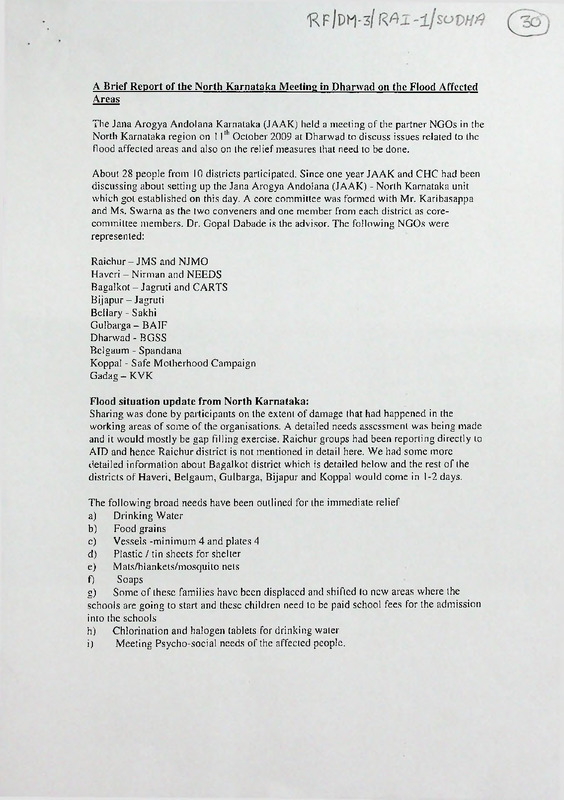
A Brief Report of the North Karnataka Meeting in Dharwad on the Flood Affected
Areas
The Jana Arogya Andolana Karnataka (JAAK) held a meeting of the partner NGOs in the
North Karnataka region on 11th October 2009 at Dharwad to discuss issues related to the
flood affected areas and also on the relief measures that need to be done.
About 28 people from 10 districts participated. Since one year JAAK and CHC had been
discussing about setting up the Jana Arogya Andolana (JAAK) - North Karnataka unit
which got established on this day. A core committee was formed with Mr. Karibasappa
and Ms. Swarna as the two conveners and one member from each district as core
committee members. Dr. Gopal Dabade is the advisor. The following NGOs were
represented:
Raichur-JMS and NJMO
Haveri - Nirman and NEEDS
Bagalkot-Jagruti and CARTS
Bijapur - Jagruti
Bellary - Sakhi
Gulbarga - BAIF
Dharwad - BGSS
Belgaum - Spandana
Koppal - Safe Motherhood Campaign
Gadag - KVK
Flood situation update from North Karnataka:
Sharing was done by participants on the extent of damage that had happened in the
working areas of some of the organisations. A detailed needs assessment was being made
and it would mostly be gap filling exercise. Raichur groups had been reporting directly to
AID and hence Raichur district is not mentioned in detail here. We had some more
detailed information about Bagalkot district which is detailed below and the rest of the
districts of Haveri, Belgaum, Gulbarga, Bijapur and Koppal would come in 1-2 days.
The following broad needs have been outlined for the immediate relief
a)
Drinking Water
b)
Food grains
c)
Vessels -minimum 4 and plates 4
d)
Plastic / tin sheets for shelter
e)
Mats/blankets/mosquilo nets
f)
Soaps
g)
Some of these families have been displaced and shifted to new areas where the
schools are going to start and these children need to be paid school fees for the admission
into the schools
h)
Chlorination and halogen tablets for drinking water
i)
Meeting Psycho-social needs of the affected people.
The following processes have been outlined for all the districts:
1.
The partner organisations are to further strengthen the networking processes with
other organisations working in the area
2.
Contact persons for the districts have been identified now and they would now
report on a daily basis to the central team in Bangalore regarding the needs of the
community.
3.
The organisations are to make needs assessment more as a gap filling exercise and
specifically identify the needs of the community which the other organisations are not
distributing. It will take another 3-4 days to figure out these exact needs.
4.
The district coordinating organisations are to establish contact with the district
DHO and DEO by giving JAAK's letter of preventive steps to be taken by the authorities.
They have to also establish the contacts with the PHC/CHC and Sub-centers (ANMs,
ASHAs and Anganawadis). Raichur has already done this and as a result of which the
spread of diseases has been mitigated to certain extent.
5.
The government efforts have to be monitored on the long term rehabilitation
efforts. These were not gone into to much detail as the immediate need was for relief.
Even then some of the broad areas that were identified were preparation of a commons
long term needs database for the village, use it as a reference to check the government's
survey reports and then use it as a tool for further lobbying of the government, continuous
monitoring of the government's efforts.
6.
The central JAAK team in Bangalore would get reports from the organisations on
the needs of the villages when assessment is done.
7.
The central team in Bangalore to send out periodic reports on the efforts done and
the support needed to the wider communities
The following are the efforts done in concrete terms in 2 districts. JAAK members have
risen to the occasion in Bagalkot district.
Bagalkot District
Badami taluk
Manneri Village: A breakfast center has been opened in Manneri by CARTS. 250
people are provided with breakfast since 3 days and the community has requested them to
continue this support for another 8 days. The partner organisations till now are running
these centers with the money raised from family and friends. The gruel centers of the
government are supplying the lunch and dinner but the quality of the same is being
monitored by the organisations
The cost of the running the breakfast center is coming to approximately Rs. 8 per person.
50 families have been affected in this village and 1 blanket has been provided by some
other organisation but as a gap filling exercise the demand is there for another 100
blankets for these families
Mangalagudda villag: The whole village has been affected and 2500 people are being
supplied breakfast by the breakfast center. Here also the gruel centers of the government
are supplying the lunch and dinner but the quality of the same is being monitored by the
organisations
Kyada Village: 2500 people affected. Out of 350 houses only 18 have survived. The
organisations were hesitant to open a food centre here as they felt they could not stretch
too much with the money they had raised. The meeting at Dharwad raised their hopes of
some more support coming and hence are now emboldened to open such centres here as
well
Chimmalagi village: 2500 people affected. Out of 308 houses 295 have been destroyed.
Further details about needs are awaited
Kaataraki village: 100 houses have fallen and 2000 people have been affected. Further
details are awaited
Neeralagi village: 25 houses have been destroyed and 100 families comprising of 500
people are in need of support
Tambinaala village: 100 families, 1000 population and 20 houses have been damaged.
The belt from Kyada village to Tambinala has not been covered by any other organisation
except Jagruti. Further details are awaited.
In addition to this, in Manneri village about 50 families displaced by the previous floods
of 2007 have not been suitably rehabilitated till now and there have been protests by
these families demanding immediate handing over of the proper papers of patta
pertaining to their lands (Ilakku patras). Authorities have promised to give it by this week
otherwise those families are going to intensify their struggle.
The children of the affected families because of displacement have to join new schools
when the schools reopen on Oct 15th for which definitely support is needed in the form of
fees, books etc., The details will be sent out shortly.
In lieu of the above efforts and looking al the needs, it is sincerely requested that the
wider community steps up the response to our appeal in solidarity with the affected
people. The JAAK TEAM (Headstreams, AID and SOCHARA) have decided to support
efforts in Bagalkote district)
- Report by Mr. E. Premdas, CHC
Harrowing experience: Those who are still in gruel centres, also have harrowing experience. The
women are the worst-affected as there is no toilet facility in the gruel centre, let alone taking bath.
After the unprecedented rains that rendered thousands homeless, it is shortage of relief materials
that has been haunting the displaced, who solely depend on relief camps set up by state
government.
NORTH KARNATAKA FLOODS - FACTS AND FIGURES
The unabated rain from September 29 to October 1 has wreaked havoc across the 13 northern
districts of the State, leaving people in a state of shock. Heavy floods have forced thousands of
people to take refuge either on treetops or tall buildings. Hundreds have fled their homes and taken
shelter in public buildings such as schools and community halls. Gruel centres have been opened
and food packets were being air dropped.
Loss of life and property
DISTRICT
DEATHS
Belgaum
Gul toiya
Bijapur
RaKhU!
Dharwad
Bacal kot
Bellary
KOppvil
Haven
Eidai
Gadag
Davcntjere
unara Kannada
Dakshina Kannada
Total
12
21
31
26
3
31
16
20
—
HOUSES
CATTLE’
VILLAGES’-
CAMPS
PERSONS"’ ‘
186
34,857
213
288
76,189
76
20.5 L 4 547
57
57.514
16.788
317
23
23842
110
30.936 1.894
158
61.541 |
883
3/367
106
12
14200
15
40.406 771
45
503
165.550
68
60.928
38.066
623
75
13625
25.360 330
46
74
3472
10
NA
2
313
743
11
NA
13
13.442
389
230
73,174
92
5722
76
20
8
1100
577
2.117
19
10
6
9
1
3
ISO
2.39.862 5.266
1,468
5,50,093
1.538
■ Canle loss. "Airc-ced vilifies. * " Pei sons accommodated
&juiw. fc-vcnuc Dc-pi) (A statement issued by the CMs secretariat put the death toll al ]94<
The worst-affected districts are Bijapur, Bagalkot, Raichur, Koppal, Bellary and Gadag.
BIJAPUR
Collapsed houses, breached tanks, damaged roads, culverts and bridges and rotting crops are
common scenes in Bijapur, one of the badly affected districts in the century's worst floods.
Thousands have been wounded and hundreds of villages have been surrounded by turbulent water
of rivers and streams that have been flowing in full spate. The roads are filled with knee-deep
water everywhere. The underground drainage system has completely given away throwing its
contents on to the roads.
It is not the first time that the district has witnessed disasters caused due to floods. Just two years
back, hundreds of villages on the banks of river Bhima and Krishna were flooded. Even then, the
suffering of the people was almost of the same magnitude. But even then, the district
administration was not prepared in spite of the apprehensions expressed by the villagers. Instead,
the politicians and the district officials got engaged in a blame game criticising the Maharashtra
government for the sudden release of water from its dams. But not a single boat was arranged, no
relief centres were opened and no measures to shift those vulnerable villagers were taken.
Growing fear of epidemic outbreak: Apart from the large scale destruction, the rains have
brought with them the fear of an epidemic outbreak. Cases of H1N1 and dengue, and now the
number of people suffering from fever, cold, cough, vomiting is steadily increasing.
The huge loss in the devastating floods began unfolding as the water levels started receding in most
of the places.
The villagers, whose houses have collapsed or submerged, are still camping at schools, temples and
community halls. Farming and stone quarrying activities have come to a stand still, rendering
thousands jobless. Several stone (Minajagi Parsi) quarries in Muddebihal taluk are filled with water.
People residing along the banks of Krishna, Bhima and the Doni rivers were worst affected. Khariff
crops - sugar cane, sunflower, tur dal, cotton jowar, bajra in thousands of acres in Bijapur, Indi,
Sindagi, Basavan Bagewadi and Muddebihal taluks have been lost. According to eyewitnesses,
villagers who are used to the staple "Jowar Roti" are being given rice gruel, that too in limited
quantities
The situation is no better in Bagalkot, another district worst hit by the rains, where people in
several villages have been migrating to other places in search of livelihood.
RAICHUR
The lack of connectivity of roads, where only two-wheelers can ply, is hindering relief work.
In Talamari village of Raichur taluk, process of clearing of debris and Drinking water availability led,
an irate mob burnt the vehicles of government officials and elected representatives.
Hulagunchi at Sindhanur taluk is another village which is highly affected, as the connecting road is
completely damaged. However local organisations and NGOs have made arrangements for food
and medical checkup. Basappa, a villager, says, "All our crops are washed away and stored grains
are wet. We have to start afresh from buying utensils to clothing and rebuilding shelter." There are
102 houses at Hulagunchi of which 100 houses have completely collapsed. They have erected
themselves temporary sheds on the roadside by stitching up plastic cement bags.
KOPPAL
Chikungunya, viral fever, diarrhoea - all these ailments are being detected in the flood-hit areas of
Koppal. People, who were worried about the gushing water around them, are now concerned about
the spread of water-borne diseases. The number of patients visiting the centre with complaints of
fever
and
bodyache
has
gone
up
after
the
heavy
rains
and
floods.
Water-borne diseases generally spread through mosquitoes. Chikungunya, particularly, is caused by
a mosquito which breeds on fresh water. After the flooding, sources for breeding of mosquitoes are
many.
As
a
result,
the
disease
is
spreading
rapidly.
The staff informed that basic amenities could not be offered to in-patients at the health centre,
which is the only one in 19 villages. As there was no power supply, for cases that came after dark,
the doctors were forced to deliver babies in candlelight!
The villagers of Chikkasindogi fetch water from a handpump at Gali Durgamma temple, about a
kilometre from the village. Those in Hiresindogi depend on Hirehalla water for drinking too. They
are not getting good water and unable to boil water as they cannot enter their houses which are in
dilapidated condition. Most of the people and children are suffering from cough and fever.
DAVANAGERE
In Davangere 506 houses collapse, 14 cattle washed away on Wednesday night. The rain related
loss is estimated at Rs 17.58 lakh. Five are seriously injured in house collapse.
The district has received average of 33.5 mm rain. Harapanahalli has received the height amount of
rain of 54.8 mm. Here around 271 houses have collapsed. Aladahalli, Kunemadihalli, Nagarkonda
and
Hagarisheeranahalli
are
totally
inundated.
Talavagal
tank
has
breached.
BELLARY
The rhythms of life have been disrupted by the ruinous floods in village after village of Siruguppa
taluk in Bellary district, triggering a mass migration which will take weeks, if not months, to
reverse. When the rains came and the water level in the Tungabhadra and’Hagari rivers swelled and
spilled over the banks, swallowing huts and brick-built houses, the people took refuge on treetops
and other sturdier buildings. But as the gushing and swirling water entered the villages, devouring
everything that stood in its way, the people ran for their lives. Two months back, Bellary was
declared drought-hit. At that time, the people of Siruguppa taluk made do without much water.
Now, with water being the cause of their miseries, they have left their villages where their
homesteads once stood.
The disastrous flood have flattened standing crops in the taluk, leaving middle-class farmers
wondering how they would fend themselves in the months to come.
UTTARA KANNADA
After the heavy rains and landslides, the residents have begun returning from the gruel centres
with worries over resuming their life from the scratch. Some of them are left with nothing but the
clothes they have worn. Their houses are filled with mud and stones, and foul smell emanates from
them.
Position: 642 (42 views)