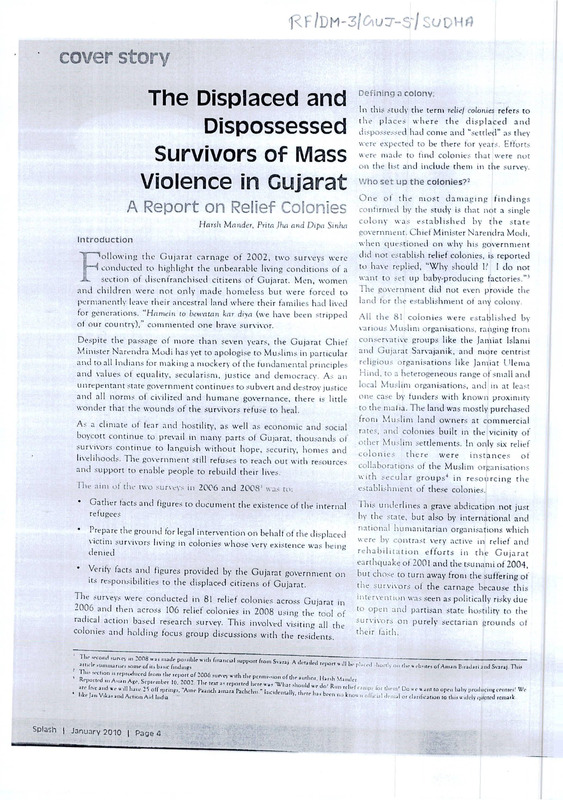
The Displaced and Dispossessed Survivors of Mass Violence in Gujarat – A Report on Relief Colonies
Item
- Title
- The Displaced and Dispossessed Survivors of Mass Violence in Gujarat – A Report on Relief Colonies
- extracted text
-
EF/DM-Z/C UT-S-J so OH fl
cover story
The Displaced and
Dispossessed
Survivors of Mass
Violence in Gujarat
A Report on Relief Colonies
Finrsh Mnnder, Prila Jhi and Difra Sinha
Introduction
oilowing the Gujarat carnage of 2002, two surveys were
conducted to highlight the unbearable living conditions of a
Defining a colony.
In this study the term reliej colonies refers to
the places where rhe displaced and
dispossessed had come and “settled" as they
were expected to be there for years. Efforts
were made to find colonies that were not
on the list and include them in the survey.
Who set up the colonies?"
One ol the most damaging findings
confirmed by the study is that not a single
colony was established by rhe state
government. Chief iMinister Narendra Modi,
when questioned on why his government
did nor establish relief colonies, is reported
to have replied, “Why should I.?
I do nor
section of disenfranchised citizens of Gujarat. Men, women
and children were not only made homeless bur were forced to
want to set up baby-producing factories.
The government did not even provide the
permanently leave their ancestral land where their families had lived
land tor the establishment of any colony.
for generations. Hamein to bewatan kar diya (we have been stripped
of our country),” commented one brave survivor.
All the 81 colonies were established by
various Muslim organisations, ranging from
Despite the passage of more than seven years, the Gujarat Chief
Minister Narendra Modi has yet to apologise to Muslims in particular
and to all Indians for making a mockery of the fundamental principles
and values ol equality, secularism, justice and democracy. As an
conservative groups like the Jamiat Islami
and Gujarat Sarvajanik, and more centrist
religious organisations like jamiat Ulema
unrepentant state government continues to subvert and destroy justice
and all norms of civilized and humane governance, there is little
wonder that the wounds of the survivors refuse to heal.
A> a climate of fear and hostility', as well as economic and social
boycott continue to prevail in many parts of Gujarat, thousands of
survivors continue to languish without hope, security', homes and
livelihoods. Tlie government still refuses to reach out with resources
Hind, to a heterogeneous range of small and
local Muslim organisations, and in at least
one case by funders with known proximity
to rhe mafia. The land was mostly purchased
from Muslim land owners ar commercial
rates, and colonies built in the vicinity of
other Muslim settlements. In only six relief
colonics
there
were
instances
of
collaborations of the Muslim organisations
and support to enable people to rebuild their lives.
with secular groups4 in resourcing the
Ilu- aim of the two surveys in 2006 and 2OO81 was to;
establishment of these colonies.
Gather facts and figures to document the existence of the internal
I his underlines a grave abdication not just
refugees
by the state, but also by international and
Prepare the ground for legal intervention on Ibehalf of the displaced
victim survivors living in colonies whose very, existence
------2 was being
denied
•
Verify facts and fig ures provided by the Gujarat government on
its responsibilities to the displaced citizens of Gujarat.
radical action based research survey. This involved visiting all the
colonies and holding focus group discussions with the resid.
lents.
in 2008
made po.oiblc m itli fnuncul $upi>orr from Svarai A <1, ^.1
earthquake of 2001 and the tsunami of 2004,
but chose to turn away from the suffering of
the survivors ol the carnage because this
The ssurveys were conducted in 81 relief colonies across Gujarat in
2006 and
t
;••••'• thenacross
106 relief colonies in 2008 using the tool of
vrond
national humanitarian organisations which
were by contrast very active in relief and
rehabilitation efforts in the Gujarat
I
intervention was seen as politically risky due
to open and partisan slate hostility to the
survivors on purely sectarian grounds of
their faith.
hi.'
~
dir a cb<Kcs of Anun Biratbri and Svaraj. Tl»i.«
; 11m, M-oion u reproduced (ron, tJlc fcporf of 2OO6
' diWc
•
Splash | January 2010 I Page 4
u.)rh tbc pcrinjMjon of dip
.i
r ' rvices
ii
No of colonics
86
• 103 colonies identified (85 from GoG list, I8 not in the list)
• 55 colonies in urban and 48 in rural areas
*4049 households in total
Education and
nutritional facilities :
Integrated Child
Development Scheme
85 colonies have the facility
of I.C.D.S. centres fully
functional
*
Mid-Day Meal Scheme
MDM facilities available to
all the 86 colonies within a
distance of between
0.5 to 2 kms
PDS : Issuance of
the Antodaya Cards
•
86 colonics have P.D.S.
shop facilities within
a distance of 3 krns.
■
--
21 colonies had an anganwadi centre in the colony
Remaining 79 colonies - the anganwadi centres were away from
the centre - distance ranging from less than I km to
more than 1 km away
89 colonies reported children attending government schools
and getting mid day meal in the school
Of these in 85 schools a hot cooked meal is served
In 2 colonies rhe people reported that Muslim children are
discriminated against in thy serving of the mid day meal
12 colonies had a PDS shop within the colony, 88 had
access to a ration shop within 3 km distan e
Under the Antodaya Anna Yojana each family is eligible
to receive 35 kgs ol grain each month (16 kg rice and
19 kg wheat)
• In 11 colonies people said that they were given less than
16kg of rice each month
In 38 colonies people reported being given less than 25 kg.
wheat each month
■ Most of the colonies now receive wheat Hour instead or wheat
o
In even* colony there are complaints regarding the quality
ol the wheat flour
o The wheat flour cannot be stored and if stored, within a
tew days they are infested with insects
o The people have urged stoppage of supply of
this wheat Hour
•
.■
MT
Basic Amenities
N/A
‘
•
•
46 colonies have access to drainage and sewerage facilities
67 colonies have access to clean drinking water sources
97 colonies have access to a regular supply of water
National
Maternity Benefit
Scheme/
Janani Suraksha Yojana
Aifidnvit does not mention
any details ol benefits
Given to pregnant mothers
in the relief colonies
•
•
Awareness and coverage of scheme is very low
People in only about 24 colonies knew about it and said
pregnant women in the colony have received benefit
I 39 women who are eligible for this scheme, but have
not benefited from it
NREGA
110 of rhe affected families
tailing under rural areas ol
the NREGA districts
(Bharuch, Panchmahals
and Sabarkantha), applied
tor and were issued job cards.
•
Old age and
widow pensions
•
•
217 elderly people were found
residing in these colonies of
•
which 52 eligible persons have
•
•
been sanctioned old age
pensions. 314 widows were
found living in the relief
colonies. 83 widows, who
were eligible have been
sanctioned the pension
•
•
•
Majorit)’ of the poor were employed as daily wage earners - in
tea stalls, shops, construction work, wood work, factories, etc.
Often even alter traveling about 4-5 km on an average per
day, many end up not getting any work at times
In 26 colonies people said that all old people in the colony
receive old age pensions
In 3? colonics people said that all widows arc getting pensions
In lour colonies there were people who were getting pensions
belore 2002 but these had stopped after they moved to the
relief colonies
In six colonies only, there were beneficiary ol the National
Family Benefit Scheme
113 eligible persons are yet to receive die oil age pension trom
all the colonies
104 widows who are eligible from all the colonies have yet to
receive the pension
Splash | January 2010 | Page S
The statutory National Commission for Minorities (NCM) in its
report based on its field visits from 13 to 17 October, 2006, observes
that ...the State Government has not been involved in constructing
houses for the violence affected, thus leaving the rehabilitation pro cess
to private organizations...”
The Supreme Court Commissioners
directions to the government of Gujarat,
June 2007 include immediate steps to be
taken ro ensure state accountability for
The insecurity of residents living in the colonies is further aggravated
the food and livelihood rights of its
b^ the fact that with the exception of one colony, none of the residents
citizens who remain internally displaced
have been given title deeds or long term leases ro their allotted
nearly h\e years after the 2002 communal
homes. Tins means that they can be evicted at will by the managers
carnage:
of the colonies. This is a reality, especially in the case of single
women. In Ekta Nagar, Ahmedabad four widows were exacted
arbitrarily because the managers and some male residents alleged
(hat they were engaging in sex work in order to survive. It was only
All families who continue to live in relief
colonies must be given Antyodaya cards,
as internally displaced persons, who lost
a dogged battle by the widows and support by external secular
all their belongings, face fear and
organisations that enabled their belated restoration
economic boycott, and are too afraid to
In addition, a letter from rhe Commissioners in March 2007 to the
return to their original homes.
Supreme Court recommended that contempt of court notices be
Primary schools with mid day meals
issued to the Chief Secretary and other officials of the government
should be opened in all 81 relief colonies
of Gujarat for misrepresenting facts and furnishing incomplete and
immediately, and in any case not.before
inaccurate information to the Commissioners appointed by the
Supreme Court.
the school should be such that it is
rhe next financial year. The location of
In August 2007, the government of Gujarat, in the face of the
accessible not only to the residents of the
evidence provided, acknowledged the presence of displaced people
camp,
in 86 relief colonies. And in doing so became accountable for services
communities, to promote integration.
and goods to the residents under the Indian Law and Constitution.
All 81
but
to
the
surround
colonies should havt
host
fully
Tire ggfernment made various claims in respect of the services and
functioning LCDS centres with the entire
provisions already in operation in the colonies. Tire second survey
revealed the facts behind this claim. Tire table gives details.
contingent of nutrition and health
services.
Tire first survey discovered the existence of colonies that were
I DS shops should be opened in all
unknown. Around 30,000 internally displaced people were still too
frightened to return to their homes, and were living in appalling
colonies where these are not available
'.•> ithin a distance of three kilometres.
conditions of deprivation and denial.
It is a credit to our democratic constitution and legal justice system
that the findings of the survey could be used to hold the government
accountable and when faced with potential contempt of court
proceedings, the Gujarat state suddenly acknowledged the existence
of not one but 86 relief colonies and furnished details of various
J here should be a drive within three
months to ensure that all eligible persons
li i NOAI'S and widows pensions receive
these.
j' I) cards under NREGA should be issued
sen ices and facilities available to the residents of these colonies.
i • all NREGA districts to all residents of
Tlie second survey shows that the claims of the Gujarat Government
n. lief colonies who are desirous of these.
on many fronts are not matched by the facts and figures on the
ground.
The survey did however force the government to make a
c m 2002 was not just about a sudden
start towards providing some basic facilities to citizens rendered
homeless and destitute by the unprecedented storm of horrific
P 'vsical loss of their possessions but also a
violence that permanently changed their physical and emotional
^e,.inning ol the process of effectively
landscapes.
^(r Pping them of their citizenship on the
There is evidence of major non-compliance on nearly all directions
issued by the Supreme Court Commissioners. Given that the Gujarat
government was able to react very efficiently, proactively and
humanely to the earthquake disaster, its reluctance and lack of
proactive efforts to assist the Muslim Gujaratis devastated by 2002 a
human created disaster, demonstrates its heartlessness and
‘>.a' *■'’
C b ;r ;c^gion. It was about making
11
il t^ey do not belong to the
country where they have lived for
generations...to return to the testimony of
'■ i.uiagM u>survi\'or Hamein beicmrinknr
ao<i .
indifference to those it has constructed as die aliens living within
Hmsh Man
Therefore it is not surprising that poor Muslims in Gujarat are feeline
dcirvist and author
■rtun derhuirs^/^nxiil.com
‘r?
Splash ] January 2010 I Page 6
r is a prominent human rights
- Media
 RF_DM-3_GUJ-5_SUDHA.pdf
Position: 955 (28 views)